EP1790344B1 - Methods for treatment of disease-induced peripheral neuropathy and related conditions - Google Patents
Methods for treatment of disease-induced peripheral neuropathy and related conditions Download PDFInfo
- Publication number
- EP1790344B1 EP1790344B1 EP07075011A EP07075011A EP1790344B1 EP 1790344 B1 EP1790344 B1 EP 1790344B1 EP 07075011 A EP07075011 A EP 07075011A EP 07075011 A EP07075011 A EP 07075011A EP 1790344 B1 EP1790344 B1 EP 1790344B1
- Authority
- EP
- European Patent Office
- Prior art keywords
- compound
- sprouting
- ait
- ngf
- nerve
- Prior art date
- Legal status (The legal status is an assumption and is not a legal conclusion. Google has not performed a legal analysis and makes no representation as to the accuracy of the status listed.)
- Expired - Lifetime
Links
- 208000033808 peripheral neuropathy Diseases 0.000 title claims abstract description 24
- 238000000034 method Methods 0.000 title claims description 20
- 208000037265 diseases, disorders, signs and symptoms Diseases 0.000 title claims description 14
- 201000010099 disease Diseases 0.000 title claims description 11
- 238000011282 treatment Methods 0.000 title abstract description 29
- 150000001875 compounds Chemical class 0.000 claims abstract description 37
- 230000003040 nociceptive effect Effects 0.000 claims abstract description 31
- 208000004454 Hyperalgesia Diseases 0.000 claims abstract description 25
- 208000035154 Hyperesthesia Diseases 0.000 claims abstract description 24
- 230000008760 nerve sprouting Effects 0.000 claims abstract description 19
- 210000000578 peripheral nerve Anatomy 0.000 claims abstract description 10
- 239000003814 drug Substances 0.000 claims abstract description 5
- 238000004519 manufacturing process Methods 0.000 claims abstract 2
- 208000032131 Diabetic Neuropathies Diseases 0.000 claims description 15
- 229910052739 hydrogen Inorganic materials 0.000 claims description 7
- 239000001257 hydrogen Substances 0.000 claims description 7
- 125000004435 hydrogen atom Chemical group [H]* 0.000 claims description 7
- WPYMKLBDIGXBTP-UHFFFAOYSA-N benzoic acid Chemical compound OC(=O)C1=CC=CC=C1 WPYMKLBDIGXBTP-UHFFFAOYSA-N 0.000 claims description 6
- MTZQAGJQAFMTAQ-UHFFFAOYSA-N ethyl benzoate Chemical compound CCOC(=O)C1=CC=CC=C1 MTZQAGJQAFMTAQ-UHFFFAOYSA-N 0.000 claims description 6
- 230000001939 inductive effect Effects 0.000 claims description 6
- 125000002924 primary amino group Chemical group [H]N([H])* 0.000 claims description 6
- 150000003839 salts Chemical class 0.000 claims description 5
- 208000030507 AIDS Diseases 0.000 claims description 4
- 206010000599 Acromegaly Diseases 0.000 claims description 4
- 208000007465 Giant cell arteritis Diseases 0.000 claims description 4
- 206010024229 Leprosy Diseases 0.000 claims description 4
- 208000016604 Lyme disease Diseases 0.000 claims description 4
- 208000021386 Sjogren Syndrome Diseases 0.000 claims description 4
- 125000004051 hexyl group Chemical group [H]C([H])([H])C([H])([H])C([H])([H])C([H])([H])C([H])([H])C([H])([H])* 0.000 claims description 4
- 208000003532 hypothyroidism Diseases 0.000 claims description 4
- 230000002989 hypothyroidism Effects 0.000 claims description 4
- 201000006292 polyarteritis nodosa Diseases 0.000 claims description 4
- 206010039073 rheumatoid arthritis Diseases 0.000 claims description 4
- 201000000306 sarcoidosis Diseases 0.000 claims description 4
- 201000000596 systemic lupus erythematosus Diseases 0.000 claims description 4
- 239000005711 Benzoic acid Substances 0.000 claims description 3
- 206010072579 Granulomatosis with polyangiitis Diseases 0.000 claims description 3
- 235000010233 benzoic acid Nutrition 0.000 claims description 3
- 125000001495 ethyl group Chemical group [H]C([H])([H])C([H])([H])* 0.000 claims description 3
- 108010025020 Nerve Growth Factor Proteins 0.000 abstract description 48
- 102000015336 Nerve Growth Factor Human genes 0.000 abstract description 43
- 229940053128 nerve growth factor Drugs 0.000 abstract description 43
- 102000007072 Nerve Growth Factors Human genes 0.000 abstract description 5
- 239000003900 neurotrophic factor Substances 0.000 abstract description 5
- 230000009471 action Effects 0.000 abstract description 4
- MICLTPPSCUXHJT-UHFFFAOYSA-M potassium;4-[3-(6-oxo-3h-purin-9-yl)propanoylamino]benzoate Chemical compound [K+].C1=CC(C(=O)[O-])=CC=C1NC(=O)CCN1C(NC=NC2=O)=C2N=C1 MICLTPPSCUXHJT-UHFFFAOYSA-M 0.000 description 61
- 206010012601 diabetes mellitus Diseases 0.000 description 32
- 241000700159 Rattus Species 0.000 description 29
- 230000000694 effects Effects 0.000 description 25
- 210000005036 nerve Anatomy 0.000 description 25
- 241001465754 Metazoa Species 0.000 description 21
- WSFSSNUMVMOOMR-UHFFFAOYSA-N Formaldehyde Chemical compound O=C WSFSSNUMVMOOMR-UHFFFAOYSA-N 0.000 description 14
- 230000024391 collateral sprouting Effects 0.000 description 14
- 230000001953 sensory effect Effects 0.000 description 14
- 239000000203 mixture Substances 0.000 description 13
- 125000000217 alkyl group Chemical group 0.000 description 12
- 229910003460 diamond Inorganic materials 0.000 description 12
- 239000010432 diamond Substances 0.000 description 12
- 150000003212 purines Chemical class 0.000 description 12
- 210000002683 foot Anatomy 0.000 description 11
- 230000004044 response Effects 0.000 description 10
- WQZGKKKJIJFFOK-GASJEMHNSA-N Glucose Natural products OC[C@H]1OC(O)[C@H](O)[C@@H](O)[C@@H]1O WQZGKKKJIJFFOK-GASJEMHNSA-N 0.000 description 9
- 239000008280 blood Substances 0.000 description 8
- 210000004369 blood Anatomy 0.000 description 8
- 239000008103 glucose Substances 0.000 description 8
- 230000001965 increasing effect Effects 0.000 description 8
- 238000013507 mapping Methods 0.000 description 8
- 125000003118 aryl group Chemical group 0.000 description 7
- 230000006698 induction Effects 0.000 description 7
- 239000007924 injection Substances 0.000 description 7
- 238000002347 injection Methods 0.000 description 7
- 239000000523 sample Substances 0.000 description 7
- 230000001588 bifunctional effect Effects 0.000 description 6
- 239000000835 fiber Substances 0.000 description 6
- 201000001119 neuropathy Diseases 0.000 description 6
- 230000007823 neuropathy Effects 0.000 description 6
- 230000008929 regeneration Effects 0.000 description 6
- 238000011069 regeneration method Methods 0.000 description 6
- 230000004064 dysfunction Effects 0.000 description 5
- 230000000763 evoking effect Effects 0.000 description 5
- 238000009472 formulation Methods 0.000 description 5
- 238000005259 measurement Methods 0.000 description 5
- 230000011514 reflex Effects 0.000 description 5
- FAPWRFPIFSIZLT-UHFFFAOYSA-M sodium chloride Inorganic materials [Na+].[Cl-] FAPWRFPIFSIZLT-UHFFFAOYSA-M 0.000 description 5
- 238000012360 testing method Methods 0.000 description 5
- 230000003827 upregulation Effects 0.000 description 5
- 125000003342 alkenyl group Chemical group 0.000 description 4
- 125000004432 carbon atom Chemical group C* 0.000 description 4
- -1 compound radicals Chemical class 0.000 description 4
- 208000034783 hypoesthesia Diseases 0.000 description 4
- 238000002955 isolation Methods 0.000 description 4
- 239000000243 solution Substances 0.000 description 4
- YMWUJEATGCHHMB-UHFFFAOYSA-N Dichloromethane Chemical compound ClCCl YMWUJEATGCHHMB-UHFFFAOYSA-N 0.000 description 3
- DNIAPMSPPWPWGF-UHFFFAOYSA-N Propylene glycol Chemical compound CC(O)CO DNIAPMSPPWPWGF-UHFFFAOYSA-N 0.000 description 3
- 210000003050 axon Anatomy 0.000 description 3
- 230000003376 axonal effect Effects 0.000 description 3
- 230000015572 biosynthetic process Effects 0.000 description 3
- 230000008499 blood brain barrier function Effects 0.000 description 3
- 210000001218 blood-brain barrier Anatomy 0.000 description 3
- 125000004122 cyclic group Chemical group 0.000 description 3
- 208000035475 disorder Diseases 0.000 description 3
- 238000002474 experimental method Methods 0.000 description 3
- 125000005843 halogen group Chemical group 0.000 description 3
- 125000001072 heteroaryl group Chemical group 0.000 description 3
- 208000021731 hypoalgesia Diseases 0.000 description 3
- 230000036032 hypoalgesia Effects 0.000 description 3
- 230000030214 innervation Effects 0.000 description 3
- 210000004126 nerve fiber Anatomy 0.000 description 3
- 210000000653 nervous system Anatomy 0.000 description 3
- 210000002569 neuron Anatomy 0.000 description 3
- 210000001428 peripheral nervous system Anatomy 0.000 description 3
- 229940083251 peripheral vasodilators purine derivative Drugs 0.000 description 3
- 239000003755 preservative agent Substances 0.000 description 3
- 238000011160 research Methods 0.000 description 3
- 239000011780 sodium chloride Substances 0.000 description 3
- 230000001225 therapeutic effect Effects 0.000 description 3
- BCSVCWVQNOXFGL-UHFFFAOYSA-N 3,4-dihydro-4-oxo-3-((5-trifluoromethyl-2-benzothiazolyl)methyl)-1-phthalazine acetic acid Chemical compound O=C1C2=CC=CC=C2C(CC(=O)O)=NN1CC1=NC2=CC(C(F)(F)F)=CC=C2S1 BCSVCWVQNOXFGL-UHFFFAOYSA-N 0.000 description 2
- IJGRMHOSHXDMSA-UHFFFAOYSA-N Atomic nitrogen Chemical compound N#N IJGRMHOSHXDMSA-UHFFFAOYSA-N 0.000 description 2
- PEDCQBHIVMGVHV-UHFFFAOYSA-N Glycerine Chemical compound OCC(O)CO PEDCQBHIVMGVHV-UHFFFAOYSA-N 0.000 description 2
- DHMQDGOQFOQNFH-UHFFFAOYSA-N Glycine Chemical compound NCC(O)=O DHMQDGOQFOQNFH-UHFFFAOYSA-N 0.000 description 2
- SIKJAQJRHWYJAI-UHFFFAOYSA-N Indole Chemical compound C1=CC=C2NC=CC2=C1 SIKJAQJRHWYJAI-UHFFFAOYSA-N 0.000 description 2
- 208000002193 Pain Diseases 0.000 description 2
- WCUXLLCKKVVCTQ-UHFFFAOYSA-M Potassium chloride Chemical compound [Cl-].[K+] WCUXLLCKKVVCTQ-UHFFFAOYSA-M 0.000 description 2
- ATUOYWHBWRKTHZ-UHFFFAOYSA-N Propane Chemical compound CCC ATUOYWHBWRKTHZ-UHFFFAOYSA-N 0.000 description 2
- JUJWROOIHBZHMG-UHFFFAOYSA-N Pyridine Chemical compound C1=CC=NC=C1 JUJWROOIHBZHMG-UHFFFAOYSA-N 0.000 description 2
- KAESVJOAVNADME-UHFFFAOYSA-N Pyrrole Chemical compound C=1C=CNC=1 KAESVJOAVNADME-UHFFFAOYSA-N 0.000 description 2
- 208000027418 Wounds and injury Diseases 0.000 description 2
- 239000000443 aerosol Substances 0.000 description 2
- 125000003545 alkoxy group Chemical group 0.000 description 2
- VREFGVBLTWBCJP-UHFFFAOYSA-N alprazolam Chemical compound C12=CC(Cl)=CC=C2N2C(C)=NN=C2CN=C1C1=CC=CC=C1 VREFGVBLTWBCJP-UHFFFAOYSA-N 0.000 description 2
- 238000013459 approach Methods 0.000 description 2
- 125000003710 aryl alkyl group Chemical group 0.000 description 2
- 230000003542 behavioural effect Effects 0.000 description 2
- 230000037396 body weight Effects 0.000 description 2
- 239000000872 buffer Substances 0.000 description 2
- 125000001309 chloro group Chemical group Cl* 0.000 description 2
- 230000001419 dependent effect Effects 0.000 description 2
- 231100000673 dose–response relationship Toxicity 0.000 description 2
- 229940079593 drug Drugs 0.000 description 2
- 235000013305 food Nutrition 0.000 description 2
- 230000012010 growth Effects 0.000 description 2
- BCQZXOMGPXTTIC-UHFFFAOYSA-N halothane Chemical compound FC(F)(F)C(Cl)Br BCQZXOMGPXTTIC-UHFFFAOYSA-N 0.000 description 2
- 229960003132 halothane Drugs 0.000 description 2
- 210000000548 hind-foot Anatomy 0.000 description 2
- FDGQSTZJBFJUBT-UHFFFAOYSA-N hypoxanthine Chemical group O=C1NC=NC2=C1NC=N2 FDGQSTZJBFJUBT-UHFFFAOYSA-N 0.000 description 2
- 238000001802 infusion Methods 0.000 description 2
- 238000007912 intraperitoneal administration Methods 0.000 description 2
- 239000007928 intraperitoneal injection Substances 0.000 description 2
- 238000001990 intravenous administration Methods 0.000 description 2
- AGBQKNBQESQNJD-UHFFFAOYSA-N lipoic acid Chemical compound OC(=O)CCCCC1CCSS1 AGBQKNBQESQNJD-UHFFFAOYSA-N 0.000 description 2
- 239000007791 liquid phase Substances 0.000 description 2
- 238000012423 maintenance Methods 0.000 description 2
- 210000003205 muscle Anatomy 0.000 description 2
- 230000007830 nerve conduction Effects 0.000 description 2
- 230000001537 neural effect Effects 0.000 description 2
- 229910052757 nitrogen Inorganic materials 0.000 description 2
- 230000036407 pain Effects 0.000 description 2
- 208000027232 peripheral nervous system disease Diseases 0.000 description 2
- 239000008194 pharmaceutical composition Substances 0.000 description 2
- 239000012071 phase Substances 0.000 description 2
- BASFCYQUMIYNBI-UHFFFAOYSA-N platinum Chemical compound [Pt] BASFCYQUMIYNBI-UHFFFAOYSA-N 0.000 description 2
- 238000002360 preparation method Methods 0.000 description 2
- 239000003380 propellant Substances 0.000 description 2
- QLNJFJADRCOGBJ-UHFFFAOYSA-N propionamide Chemical compound CCC(N)=O QLNJFJADRCOGBJ-UHFFFAOYSA-N 0.000 description 2
- 230000002269 spontaneous effect Effects 0.000 description 2
- 239000003381 stabilizer Substances 0.000 description 2
- 230000000638 stimulation Effects 0.000 description 2
- 239000000126 substance Substances 0.000 description 2
- 238000003786 synthesis reaction Methods 0.000 description 2
- 230000001228 trophic effect Effects 0.000 description 2
- XLYOFNOQVPJJNP-UHFFFAOYSA-N water Substances O XLYOFNOQVPJJNP-UHFFFAOYSA-N 0.000 description 2
- QDZOEBFLNHCSSF-PFFBOGFISA-N (2S)-2-[[(2R)-2-[[(2S)-1-[(2S)-6-amino-2-[[(2S)-1-[(2R)-2-amino-5-carbamimidamidopentanoyl]pyrrolidine-2-carbonyl]amino]hexanoyl]pyrrolidine-2-carbonyl]amino]-3-(1H-indol-3-yl)propanoyl]amino]-N-[(2R)-1-[[(2S)-1-[[(2R)-1-[[(2S)-1-[[(2S)-1-amino-4-methyl-1-oxopentan-2-yl]amino]-4-methyl-1-oxopentan-2-yl]amino]-3-(1H-indol-3-yl)-1-oxopropan-2-yl]amino]-1-oxo-3-phenylpropan-2-yl]amino]-3-(1H-indol-3-yl)-1-oxopropan-2-yl]pentanediamide Chemical compound C([C@@H](C(=O)N[C@H](CC=1C2=CC=CC=C2NC=1)C(=O)N[C@@H](CC(C)C)C(=O)N[C@@H](CC(C)C)C(N)=O)NC(=O)[C@@H](CC=1C2=CC=CC=C2NC=1)NC(=O)[C@H](CCC(N)=O)NC(=O)[C@@H](CC=1C2=CC=CC=C2NC=1)NC(=O)[C@H]1N(CCC1)C(=O)[C@H](CCCCN)NC(=O)[C@H]1N(CCC1)C(=O)[C@H](N)CCCNC(N)=N)C1=CC=CC=C1 QDZOEBFLNHCSSF-PFFBOGFISA-N 0.000 description 1
- LXIAWDJOQUWVQS-SHRURHRBSA-N (2s)-n-benzyl-3-(4-chlorophenyl)-n-(1,5-dipyridin-4-ylpentan-3-yl)-2-[methyl-[2-oxo-2-(3,4,5-trimethoxyphenyl)acetyl]amino]propanamide;methanesulfonic acid Chemical compound CS(O)(=O)=O.CS(O)(=O)=O.COC1=C(OC)C(OC)=CC(C(=O)C(=O)N(C)[C@@H](CC=2C=CC(Cl)=CC=2)C(=O)N(CC=2C=CC=CC=2)C(CCC=2C=CN=CC=2)CCC=2C=CN=CC=2)=C1 LXIAWDJOQUWVQS-SHRURHRBSA-N 0.000 description 1
- CPKVUHPKYQGHMW-UHFFFAOYSA-N 1-ethenylpyrrolidin-2-one;molecular iodine Chemical compound II.C=CN1CCCC1=O CPKVUHPKYQGHMW-UHFFFAOYSA-N 0.000 description 1
- IIZPXYDJLKNOIY-JXPKJXOSSA-N 1-palmitoyl-2-arachidonoyl-sn-glycero-3-phosphocholine Chemical compound CCCCCCCCCCCCCCCC(=O)OC[C@H](COP([O-])(=O)OCC[N+](C)(C)C)OC(=O)CCC\C=C/C\C=C/C\C=C/C\C=C/CCCCC IIZPXYDJLKNOIY-JXPKJXOSSA-N 0.000 description 1
- CHHHXKFHOYLYRE-UHFFFAOYSA-M 2,4-Hexadienoic acid, potassium salt (1:1), (2E,4E)- Chemical compound [K+].CC=CC=CC([O-])=O CHHHXKFHOYLYRE-UHFFFAOYSA-M 0.000 description 1
- HIXDQWDOVZUNNA-UHFFFAOYSA-N 2-(3,4-dimethoxyphenyl)-5-hydroxy-7-methoxychromen-4-one Chemical compound C=1C(OC)=CC(O)=C(C(C=2)=O)C=1OC=2C1=CC=C(OC)C(OC)=C1 HIXDQWDOVZUNNA-UHFFFAOYSA-N 0.000 description 1
- HRPVXLWXLXDGHG-UHFFFAOYSA-N Acrylamide Chemical compound NC(=O)C=C HRPVXLWXLXDGHG-UHFFFAOYSA-N 0.000 description 1
- 102000004219 Brain-derived neurotrophic factor Human genes 0.000 description 1
- 108090000715 Brain-derived neurotrophic factor Proteins 0.000 description 1
- 206010006784 Burning sensation Diseases 0.000 description 1
- 108090000932 Calcitonin Gene-Related Peptide Proteins 0.000 description 1
- 102100025588 Calcitonin gene-related peptide 1 Human genes 0.000 description 1
- OKTJSMMVPCPJKN-UHFFFAOYSA-N Carbon Chemical compound [C] OKTJSMMVPCPJKN-UHFFFAOYSA-N 0.000 description 1
- UGFAIRIUMAVXCW-UHFFFAOYSA-N Carbon monoxide Chemical compound [O+]#[C-] UGFAIRIUMAVXCW-UHFFFAOYSA-N 0.000 description 1
- 206010010774 Constipation Diseases 0.000 description 1
- 206010012735 Diarrhoea Diseases 0.000 description 1
- LVGKNOAMLMIIKO-UHFFFAOYSA-N Elaidinsaeure-aethylester Natural products CCCCCCCCC=CCCCCCCCC(=O)OCC LVGKNOAMLMIIKO-UHFFFAOYSA-N 0.000 description 1
- 206010015548 Euthanasia Diseases 0.000 description 1
- 239000004471 Glycine Substances 0.000 description 1
- 108010078321 Guanylate Cyclase Proteins 0.000 description 1
- 102000014469 Guanylate cyclase Human genes 0.000 description 1
- 101000996663 Homo sapiens Neurotrophin-4 Proteins 0.000 description 1
- 102000008100 Human Serum Albumin Human genes 0.000 description 1
- 108091006905 Human Serum Albumin Proteins 0.000 description 1
- UGQMRVRMYYASKQ-UHFFFAOYSA-N Hypoxanthine nucleoside Natural products OC1C(O)C(CO)OC1N1C(NC=NC2=O)=C2N=C1 UGQMRVRMYYASKQ-UHFFFAOYSA-N 0.000 description 1
- 108060003951 Immunoglobulin Proteins 0.000 description 1
- 108090000723 Insulin-Like Growth Factor I Proteins 0.000 description 1
- 102000048143 Insulin-Like Growth Factor II Human genes 0.000 description 1
- 108090001117 Insulin-Like Growth Factor II Proteins 0.000 description 1
- 244000081841 Malus domestica Species 0.000 description 1
- LKJPYSCBVHEWIU-UHFFFAOYSA-N N-[4-cyano-3-(trifluoromethyl)phenyl]-3-[(4-fluorophenyl)sulfonyl]-2-hydroxy-2-methylpropanamide Chemical compound C=1C=C(C#N)C(C(F)(F)F)=CC=1NC(=O)C(O)(C)CS(=O)(=O)C1=CC=C(F)C=C1 LKJPYSCBVHEWIU-UHFFFAOYSA-N 0.000 description 1
- 208000028389 Nerve injury Diseases 0.000 description 1
- 108090000742 Neurotrophin 3 Proteins 0.000 description 1
- 102100029268 Neurotrophin-3 Human genes 0.000 description 1
- 102100033857 Neurotrophin-4 Human genes 0.000 description 1
- ZCQWOFVYLHDMMC-UHFFFAOYSA-N Oxazole Chemical compound C1=COC=N1 ZCQWOFVYLHDMMC-UHFFFAOYSA-N 0.000 description 1
- 229910019142 PO4 Inorganic materials 0.000 description 1
- 241001494479 Pecora Species 0.000 description 1
- QGMRQYFBGABWDR-UHFFFAOYSA-M Pentobarbital sodium Chemical compound [Na+].CCCC(C)C1(CC)C(=O)NC(=O)[N-]C1=O QGMRQYFBGABWDR-UHFFFAOYSA-M 0.000 description 1
- 239000002202 Polyethylene glycol Substances 0.000 description 1
- 102100024304 Protachykinin-1 Human genes 0.000 description 1
- 102000007327 Protamines Human genes 0.000 description 1
- 108010007568 Protamines Proteins 0.000 description 1
- WTKZEGDFNFYCGP-UHFFFAOYSA-N Pyrazole Chemical compound C=1C=NNC=1 WTKZEGDFNFYCGP-UHFFFAOYSA-N 0.000 description 1
- PMZURENOXWZQFD-UHFFFAOYSA-L Sodium Sulfate Chemical compound [Na+].[Na+].[O-]S([O-])(=O)=O PMZURENOXWZQFD-UHFFFAOYSA-L 0.000 description 1
- 102000013275 Somatomedins Human genes 0.000 description 1
- ZSJLQEPLLKMAKR-UHFFFAOYSA-N Streptozotocin Natural products O=NN(C)C(=O)NC1C(O)OC(CO)C(O)C1O ZSJLQEPLLKMAKR-UHFFFAOYSA-N 0.000 description 1
- 101800003906 Substance P Proteins 0.000 description 1
- FZWLAAWBMGSTSO-UHFFFAOYSA-N Thiazole Chemical compound C1=CSC=N1 FZWLAAWBMGSTSO-UHFFFAOYSA-N 0.000 description 1
- 210000001361 achilles tendon Anatomy 0.000 description 1
- 239000004480 active ingredient Substances 0.000 description 1
- 239000000654 additive Substances 0.000 description 1
- 230000000996 additive effect Effects 0.000 description 1
- 239000003288 aldose reductase inhibitor Substances 0.000 description 1
- 229940090865 aldose reductase inhibitors used in diabetes Drugs 0.000 description 1
- 125000001931 aliphatic group Chemical group 0.000 description 1
- 125000003282 alkyl amino group Chemical group 0.000 description 1
- 125000004414 alkyl thio group Chemical group 0.000 description 1
- PNEYBMLMFCGWSK-UHFFFAOYSA-N aluminium oxide Inorganic materials [O-2].[O-2].[O-2].[Al+3].[Al+3] PNEYBMLMFCGWSK-UHFFFAOYSA-N 0.000 description 1
- HAMNKKUPIHEESI-UHFFFAOYSA-N aminoguanidine Chemical compound NNC(N)=N HAMNKKUPIHEESI-UHFFFAOYSA-N 0.000 description 1
- 239000003708 ampul Substances 0.000 description 1
- 230000003444 anaesthetic effect Effects 0.000 description 1
- 230000000202 analgesic effect Effects 0.000 description 1
- 238000010171 animal model Methods 0.000 description 1
- 229940045686 antimetabolites antineoplastic purine analogs Drugs 0.000 description 1
- 239000003963 antioxidant agent Substances 0.000 description 1
- 235000006708 antioxidants Nutrition 0.000 description 1
- 239000007864 aqueous solution Substances 0.000 description 1
- 125000003435 aroyl group Chemical group 0.000 description 1
- 125000001769 aryl amino group Chemical group 0.000 description 1
- 125000005110 aryl thio group Chemical group 0.000 description 1
- 125000004104 aryloxy group Chemical group 0.000 description 1
- 238000003556 assay Methods 0.000 description 1
- 125000004429 atom Chemical group 0.000 description 1
- 230000002567 autonomic effect Effects 0.000 description 1
- 210000001142 back Anatomy 0.000 description 1
- 239000000022 bacteriostatic agent Substances 0.000 description 1
- 230000006399 behavior Effects 0.000 description 1
- 230000009286 beneficial effect Effects 0.000 description 1
- 230000008901 benefit Effects 0.000 description 1
- 125000001797 benzyl group Chemical group [H]C1=C([H])C([H])=C(C([H])=C1[H])C([H])([H])* 0.000 description 1
- 229940064804 betadine Drugs 0.000 description 1
- 150000005347 biaryls Chemical group 0.000 description 1
- 210000004556 brain Anatomy 0.000 description 1
- 125000001246 bromo group Chemical group Br* 0.000 description 1
- 230000001680 brushing effect Effects 0.000 description 1
- 125000003917 carbamoyl group Chemical group [H]N([H])C(*)=O 0.000 description 1
- 125000001589 carboacyl group Chemical group 0.000 description 1
- 229910052799 carbon Inorganic materials 0.000 description 1
- 239000011203 carbon fibre reinforced carbon Substances 0.000 description 1
- 229910002091 carbon monoxide Inorganic materials 0.000 description 1
- 125000002915 carbonyl group Chemical group [*:2]C([*:1])=O 0.000 description 1
- 238000012754 cardiac puncture Methods 0.000 description 1
- 239000000969 carrier Substances 0.000 description 1
- 239000012876 carrier material Substances 0.000 description 1
- 230000003915 cell function Effects 0.000 description 1
- 230000001413 cellular effect Effects 0.000 description 1
- 210000003169 central nervous system Anatomy 0.000 description 1
- 210000001175 cerebrospinal fluid Anatomy 0.000 description 1
- 230000001684 chronic effect Effects 0.000 description 1
- 230000008602 contraction Effects 0.000 description 1
- 230000001276 controlling effect Effects 0.000 description 1
- 235000012343 cottonseed oil Nutrition 0.000 description 1
- 239000002385 cottonseed oil Substances 0.000 description 1
- 201000003146 cystitis Diseases 0.000 description 1
- 230000006378 damage Effects 0.000 description 1
- 230000002950 deficient Effects 0.000 description 1
- 230000006735 deficit Effects 0.000 description 1
- 230000007850 degeneration Effects 0.000 description 1
- 238000001514 detection method Methods 0.000 description 1
- 239000008121 dextrose Substances 0.000 description 1
- 238000003745 diagnosis Methods 0.000 description 1
- 235000015872 dietary supplement Nutrition 0.000 description 1
- 239000003085 diluting agent Substances 0.000 description 1
- 238000002224 dissection Methods 0.000 description 1
- 208000002173 dizziness Diseases 0.000 description 1
- 239000003937 drug carrier Substances 0.000 description 1
- 238000009509 drug development Methods 0.000 description 1
- 201000006549 dyspepsia Diseases 0.000 description 1
- 239000003792 electrolyte Substances 0.000 description 1
- 239000003995 emulsifying agent Substances 0.000 description 1
- 239000000839 emulsion Substances 0.000 description 1
- BEFDCLMNVWHSGT-UHFFFAOYSA-N ethenylcyclopentane Chemical compound C=CC1CCCC1 BEFDCLMNVWHSGT-UHFFFAOYSA-N 0.000 description 1
- RTZKZFJDLAIYFH-UHFFFAOYSA-N ether Substances CCOCC RTZKZFJDLAIYFH-UHFFFAOYSA-N 0.000 description 1
- LVGKNOAMLMIIKO-QXMHVHEDSA-N ethyl oleate Chemical compound CCCCCCCC\C=C/CCCCCCCC(=O)OCC LVGKNOAMLMIIKO-QXMHVHEDSA-N 0.000 description 1
- 229940093471 ethyl oleate Drugs 0.000 description 1
- 238000011156 evaluation Methods 0.000 description 1
- 230000007717 exclusion Effects 0.000 description 1
- 210000003811 finger Anatomy 0.000 description 1
- 125000001153 fluoro group Chemical group F* 0.000 description 1
- 230000004907 flux Effects 0.000 description 1
- 238000005755 formation reaction Methods 0.000 description 1
- 238000002825 functional assay Methods 0.000 description 1
- VZCCETWTMQHEPK-UHFFFAOYSA-N gamma-Linolensaeure Natural products CCCCCC=CCC=CCC=CCCCCC(O)=O VZCCETWTMQHEPK-UHFFFAOYSA-N 0.000 description 1
- VZCCETWTMQHEPK-QNEBEIHSSA-N gamma-linolenic acid Chemical compound CCCCC\C=C/C\C=C/C\C=C/CCCCC(O)=O VZCCETWTMQHEPK-QNEBEIHSSA-N 0.000 description 1
- 235000020664 gamma-linolenic acid Nutrition 0.000 description 1
- 229960002733 gamolenic acid Drugs 0.000 description 1
- 210000001035 gastrointestinal tract Anatomy 0.000 description 1
- 230000003861 general physiology Effects 0.000 description 1
- 230000002641 glycemic effect Effects 0.000 description 1
- 235000011187 glycerol Nutrition 0.000 description 1
- 229960002449 glycine Drugs 0.000 description 1
- 210000004013 groin Anatomy 0.000 description 1
- 210000004247 hand Anatomy 0.000 description 1
- 238000010438 heat treatment Methods 0.000 description 1
- 125000004475 heteroaralkyl group Chemical group 0.000 description 1
- 125000005842 heteroatom Chemical group 0.000 description 1
- 239000005556 hormone Substances 0.000 description 1
- 229940088597 hormone Drugs 0.000 description 1
- 230000003345 hyperglycaemic effect Effects 0.000 description 1
- 201000001421 hyperglycemia Diseases 0.000 description 1
- 230000008765 hyperinnervation Effects 0.000 description 1
- 238000010191 image analysis Methods 0.000 description 1
- 238000003384 imaging method Methods 0.000 description 1
- 102000018358 immunoglobulin Human genes 0.000 description 1
- 201000001881 impotence Diseases 0.000 description 1
- 230000006872 improvement Effects 0.000 description 1
- PZOUSPYUWWUPPK-UHFFFAOYSA-N indole Natural products CC1=CC=CC2=C1C=CN2 PZOUSPYUWWUPPK-UHFFFAOYSA-N 0.000 description 1
- RKJUIXBNRJVNHR-UHFFFAOYSA-N indolenine Natural products C1=CC=C2CC=NC2=C1 RKJUIXBNRJVNHR-UHFFFAOYSA-N 0.000 description 1
- 230000005764 inhibitory process Effects 0.000 description 1
- CDAISMWEOUEBRE-GPIVLXJGSA-N inositol Chemical compound O[C@H]1[C@H](O)[C@@H](O)[C@H](O)[C@H](O)[C@@H]1O CDAISMWEOUEBRE-GPIVLXJGSA-N 0.000 description 1
- 229960000367 inositol Drugs 0.000 description 1
- 238000007918 intramuscular administration Methods 0.000 description 1
- 238000010253 intravenous injection Methods 0.000 description 1
- 125000002346 iodo group Chemical group I* 0.000 description 1
- 150000002500 ions Chemical class 0.000 description 1
- CTAPFRYPJLPFDF-UHFFFAOYSA-N isoxazole Chemical compound C=1C=NOC=1 CTAPFRYPJLPFDF-UHFFFAOYSA-N 0.000 description 1
- 239000000787 lecithin Substances 0.000 description 1
- 229940067606 lecithin Drugs 0.000 description 1
- 235000010445 lecithin Nutrition 0.000 description 1
- 229950011566 leteprinim Drugs 0.000 description 1
- 235000019136 lipoic acid Nutrition 0.000 description 1
- 239000007788 liquid Substances 0.000 description 1
- 230000007246 mechanism Effects 0.000 description 1
- BUGYDGFZZOZRHP-UHFFFAOYSA-N memantine Chemical compound C1C(C2)CC3(C)CC1(C)CC2(N)C3 BUGYDGFZZOZRHP-UHFFFAOYSA-N 0.000 description 1
- 229960004640 memantine Drugs 0.000 description 1
- 108020004999 messenger RNA Proteins 0.000 description 1
- 125000002496 methyl group Chemical group [H]C([H])([H])* 0.000 description 1
- 230000003278 mimic effect Effects 0.000 description 1
- 239000003703 n methyl dextro aspartic acid receptor blocking agent Substances 0.000 description 1
- 230000008764 nerve damage Effects 0.000 description 1
- 210000001640 nerve ending Anatomy 0.000 description 1
- 210000000944 nerve tissue Anatomy 0.000 description 1
- 230000007658 neurological function Effects 0.000 description 1
- 230000002981 neuropathic effect Effects 0.000 description 1
- 230000000508 neurotrophic effect Effects 0.000 description 1
- 210000000929 nociceptor Anatomy 0.000 description 1
- 231100000252 nontoxic Toxicity 0.000 description 1
- 230000003000 nontoxic effect Effects 0.000 description 1
- 230000037311 normal skin Effects 0.000 description 1
- 231100000862 numbness Toxicity 0.000 description 1
- 239000003921 oil Substances 0.000 description 1
- 210000000056 organ Anatomy 0.000 description 1
- 150000002895 organic esters Chemical class 0.000 description 1
- 239000003960 organic solvent Substances 0.000 description 1
- 125000004043 oxo group Chemical group O=* 0.000 description 1
- 239000006179 pH buffering agent Substances 0.000 description 1
- 238000007911 parenteral administration Methods 0.000 description 1
- 230000008506 pathogenesis Effects 0.000 description 1
- 230000037361 pathway Effects 0.000 description 1
- 230000035515 penetration Effects 0.000 description 1
- WEXRUCMBJFQVBZ-UHFFFAOYSA-N pentobarbital Chemical compound CCCC(C)C1(CC)C(=O)NC(=O)NC1=O WEXRUCMBJFQVBZ-UHFFFAOYSA-N 0.000 description 1
- 229960001412 pentobarbital Drugs 0.000 description 1
- 230000000737 periodic effect Effects 0.000 description 1
- 239000000546 pharmaceutical excipient Substances 0.000 description 1
- 239000010452 phosphate Substances 0.000 description 1
- NBIIXXVUZAFLBC-UHFFFAOYSA-K phosphate Chemical compound [O-]P([O-])([O-])=O NBIIXXVUZAFLBC-UHFFFAOYSA-K 0.000 description 1
- 230000035479 physiological effects, processes and functions Effects 0.000 description 1
- 229910052697 platinum Inorganic materials 0.000 description 1
- 229920001223 polyethylene glycol Polymers 0.000 description 1
- 229920005862 polyol Polymers 0.000 description 1
- 150000003077 polyols Chemical class 0.000 description 1
- 239000001103 potassium chloride Substances 0.000 description 1
- 235000011164 potassium chloride Nutrition 0.000 description 1
- 235000010241 potassium sorbate Nutrition 0.000 description 1
- 239000004302 potassium sorbate Substances 0.000 description 1
- 229940069338 potassium sorbate Drugs 0.000 description 1
- AYXYPKUFHZROOJ-ZETCQYMHSA-N pregabalin Chemical compound CC(C)C[C@H](CN)CC(O)=O AYXYPKUFHZROOJ-ZETCQYMHSA-N 0.000 description 1
- 229960001233 pregabalin Drugs 0.000 description 1
- 210000002248 primary sensory neuron Anatomy 0.000 description 1
- 239000000047 product Substances 0.000 description 1
- 230000000750 progressive effect Effects 0.000 description 1
- 239000001294 propane Substances 0.000 description 1
- 229960004063 propylene glycol Drugs 0.000 description 1
- 235000013772 propylene glycol Nutrition 0.000 description 1
- 229950008679 protamine sulfate Drugs 0.000 description 1
- 238000000746 purification Methods 0.000 description 1
- 125000000561 purinyl group Chemical group N1=C(N=C2N=CNC2=C1)* 0.000 description 1
- UMJSCPRVCHMLSP-UHFFFAOYSA-N pyridine Natural products COC1=CC=CN=C1 UMJSCPRVCHMLSP-UHFFFAOYSA-N 0.000 description 1
- 150000003254 radicals Chemical class 0.000 description 1
- 230000009467 reduction Effects 0.000 description 1
- 230000001105 regulatory effect Effects 0.000 description 1
- 230000002441 reversible effect Effects 0.000 description 1
- 210000003079 salivary gland Anatomy 0.000 description 1
- 238000009738 saturating Methods 0.000 description 1
- 210000003497 sciatic nerve Anatomy 0.000 description 1
- CDAISMWEOUEBRE-UHFFFAOYSA-N scyllo-inosotol Natural products OC1C(O)C(O)C(O)C(O)C1O CDAISMWEOUEBRE-UHFFFAOYSA-N 0.000 description 1
- 238000000926 separation method Methods 0.000 description 1
- 230000001568 sexual effect Effects 0.000 description 1
- 239000007787 solid Substances 0.000 description 1
- 239000002904 solvent Substances 0.000 description 1
- 230000000392 somatic effect Effects 0.000 description 1
- 230000003238 somatosensory effect Effects 0.000 description 1
- 235000010199 sorbic acid Nutrition 0.000 description 1
- 239000004334 sorbic acid Substances 0.000 description 1
- 229940075582 sorbic acid Drugs 0.000 description 1
- 238000012453 sprague-dawley rat model Methods 0.000 description 1
- ZSJLQEPLLKMAKR-GKHCUFPYSA-N streptozocin Chemical compound O=NN(C)C(=O)N[C@H]1[C@@H](O)O[C@H](CO)[C@@H](O)[C@@H]1O ZSJLQEPLLKMAKR-GKHCUFPYSA-N 0.000 description 1
- 229960001052 streptozocin Drugs 0.000 description 1
- 238000007920 subcutaneous administration Methods 0.000 description 1
- 239000007929 subcutaneous injection Substances 0.000 description 1
- 238000010254 subcutaneous injection Methods 0.000 description 1
- 125000001424 substituent group Chemical group 0.000 description 1
- 238000006467 substitution reaction Methods 0.000 description 1
- 125000000472 sulfonyl group Chemical group *S(*)(=O)=O 0.000 description 1
- 230000001629 suppression Effects 0.000 description 1
- 239000000375 suspending agent Substances 0.000 description 1
- 239000000725 suspension Substances 0.000 description 1
- 208000024891 symptom Diseases 0.000 description 1
- 238000007910 systemic administration Methods 0.000 description 1
- 230000009885 systemic effect Effects 0.000 description 1
- 239000002562 thickening agent Substances 0.000 description 1
- 229960002663 thioctic acid Drugs 0.000 description 1
- 210000003371 toe Anatomy 0.000 description 1
- 230000001052 transient effect Effects 0.000 description 1
- 210000001170 unmyelinated nerve fiber Anatomy 0.000 description 1
- 235000015112 vegetable and seed oil Nutrition 0.000 description 1
- 239000008158 vegetable oil Substances 0.000 description 1
- 238000009736 wetting Methods 0.000 description 1
- 239000000080 wetting agent Substances 0.000 description 1
- SXONDGSPUVNZLO-UHFFFAOYSA-N zenarestat Chemical compound O=C1N(CC(=O)O)C2=CC(Cl)=CC=C2C(=O)N1CC1=CC=C(Br)C=C1F SXONDGSPUVNZLO-UHFFFAOYSA-N 0.000 description 1
- 229950006343 zenarestat Drugs 0.000 description 1
- 229950005346 zopolrestat Drugs 0.000 description 1
Images


Classifications
-
- C—CHEMISTRY; METALLURGY
- C07—ORGANIC CHEMISTRY
- C07D—HETEROCYCLIC COMPOUNDS
- C07D473/00—Heterocyclic compounds containing purine ring systems
- C07D473/02—Heterocyclic compounds containing purine ring systems with oxygen, sulphur, or nitrogen atoms directly attached in positions 2 and 6
- C07D473/18—Heterocyclic compounds containing purine ring systems with oxygen, sulphur, or nitrogen atoms directly attached in positions 2 and 6 one oxygen and one nitrogen atom, e.g. guanine
-
- A—HUMAN NECESSITIES
- A61—MEDICAL OR VETERINARY SCIENCE; HYGIENE
- A61K—PREPARATIONS FOR MEDICAL, DENTAL OR TOILETRY PURPOSES
- A61K31/00—Medicinal preparations containing organic active ingredients
- A61K31/33—Heterocyclic compounds
- A61K31/395—Heterocyclic compounds having nitrogen as a ring hetero atom, e.g. guanethidine or rifamycins
- A61K31/40—Heterocyclic compounds having nitrogen as a ring hetero atom, e.g. guanethidine or rifamycins having five-membered rings with one nitrogen as the only ring hetero atom, e.g. sulpiride, succinimide, tolmetin, buflomedil
- A61K31/403—Heterocyclic compounds having nitrogen as a ring hetero atom, e.g. guanethidine or rifamycins having five-membered rings with one nitrogen as the only ring hetero atom, e.g. sulpiride, succinimide, tolmetin, buflomedil condensed with carbocyclic rings, e.g. carbazole
- A61K31/404—Indoles, e.g. pindolol
-
- A—HUMAN NECESSITIES
- A61—MEDICAL OR VETERINARY SCIENCE; HYGIENE
- A61K—PREPARATIONS FOR MEDICAL, DENTAL OR TOILETRY PURPOSES
- A61K31/00—Medicinal preparations containing organic active ingredients
- A61K31/33—Heterocyclic compounds
- A61K31/395—Heterocyclic compounds having nitrogen as a ring hetero atom, e.g. guanethidine or rifamycins
- A61K31/495—Heterocyclic compounds having nitrogen as a ring hetero atom, e.g. guanethidine or rifamycins having six-membered rings with two or more nitrogen atoms as the only ring heteroatoms, e.g. piperazine or tetrazines
- A61K31/505—Pyrimidines; Hydrogenated pyrimidines, e.g. trimethoprim
-
- A—HUMAN NECESSITIES
- A61—MEDICAL OR VETERINARY SCIENCE; HYGIENE
- A61K—PREPARATIONS FOR MEDICAL, DENTAL OR TOILETRY PURPOSES
- A61K31/00—Medicinal preparations containing organic active ingredients
- A61K31/33—Heterocyclic compounds
- A61K31/395—Heterocyclic compounds having nitrogen as a ring hetero atom, e.g. guanethidine or rifamycins
- A61K31/495—Heterocyclic compounds having nitrogen as a ring hetero atom, e.g. guanethidine or rifamycins having six-membered rings with two or more nitrogen atoms as the only ring heteroatoms, e.g. piperazine or tetrazines
- A61K31/505—Pyrimidines; Hydrogenated pyrimidines, e.g. trimethoprim
- A61K31/513—Pyrimidines; Hydrogenated pyrimidines, e.g. trimethoprim having oxo groups directly attached to the heterocyclic ring, e.g. cytosine
-
- A—HUMAN NECESSITIES
- A61—MEDICAL OR VETERINARY SCIENCE; HYGIENE
- A61K—PREPARATIONS FOR MEDICAL, DENTAL OR TOILETRY PURPOSES
- A61K31/00—Medicinal preparations containing organic active ingredients
- A61K31/33—Heterocyclic compounds
- A61K31/395—Heterocyclic compounds having nitrogen as a ring hetero atom, e.g. guanethidine or rifamycins
- A61K31/495—Heterocyclic compounds having nitrogen as a ring hetero atom, e.g. guanethidine or rifamycins having six-membered rings with two or more nitrogen atoms as the only ring heteroatoms, e.g. piperazine or tetrazines
- A61K31/505—Pyrimidines; Hydrogenated pyrimidines, e.g. trimethoprim
- A61K31/519—Pyrimidines; Hydrogenated pyrimidines, e.g. trimethoprim ortho- or peri-condensed with heterocyclic rings
- A61K31/52—Purines, e.g. adenine
-
- A—HUMAN NECESSITIES
- A61—MEDICAL OR VETERINARY SCIENCE; HYGIENE
- A61K—PREPARATIONS FOR MEDICAL, DENTAL OR TOILETRY PURPOSES
- A61K31/00—Medicinal preparations containing organic active ingredients
- A61K31/33—Heterocyclic compounds
- A61K31/395—Heterocyclic compounds having nitrogen as a ring hetero atom, e.g. guanethidine or rifamycins
- A61K31/495—Heterocyclic compounds having nitrogen as a ring hetero atom, e.g. guanethidine or rifamycins having six-membered rings with two or more nitrogen atoms as the only ring heteroatoms, e.g. piperazine or tetrazines
- A61K31/505—Pyrimidines; Hydrogenated pyrimidines, e.g. trimethoprim
- A61K31/519—Pyrimidines; Hydrogenated pyrimidines, e.g. trimethoprim ortho- or peri-condensed with heterocyclic rings
- A61K31/52—Purines, e.g. adenine
- A61K31/522—Purines, e.g. adenine having oxo groups directly attached to the heterocyclic ring, e.g. hypoxanthine, guanine, acyclovir
-
- A—HUMAN NECESSITIES
- A61—MEDICAL OR VETERINARY SCIENCE; HYGIENE
- A61P—SPECIFIC THERAPEUTIC ACTIVITY OF CHEMICAL COMPOUNDS OR MEDICINAL PREPARATIONS
- A61P25/00—Drugs for disorders of the nervous system
-
- C—CHEMISTRY; METALLURGY
- C07—ORGANIC CHEMISTRY
- C07D—HETEROCYCLIC COMPOUNDS
- C07D473/00—Heterocyclic compounds containing purine ring systems
- C07D473/26—Heterocyclic compounds containing purine ring systems with an oxygen, sulphur, or nitrogen atom directly attached in position 2 or 6, but not in both
- C07D473/28—Oxygen atom
- C07D473/30—Oxygen atom attached in position 6, e.g. hypoxanthine
-
- Y—GENERAL TAGGING OF NEW TECHNOLOGICAL DEVELOPMENTS; GENERAL TAGGING OF CROSS-SECTIONAL TECHNOLOGIES SPANNING OVER SEVERAL SECTIONS OF THE IPC; TECHNICAL SUBJECTS COVERED BY FORMER USPC CROSS-REFERENCE ART COLLECTIONS [XRACs] AND DIGESTS
- Y02—TECHNOLOGIES OR APPLICATIONS FOR MITIGATION OR ADAPTATION AGAINST CLIMATE CHANGE
- Y02A—TECHNOLOGIES FOR ADAPTATION TO CLIMATE CHANGE
- Y02A50/00—TECHNOLOGIES FOR ADAPTATION TO CLIMATE CHANGE in human health protection, e.g. against extreme weather
- Y02A50/30—Against vector-borne diseases, e.g. mosquito-borne, fly-borne, tick-borne or waterborne diseases whose impact is exacerbated by climate change
Definitions
- This invention is directed to the treatment of disease-induced peripheral neuropathy.
- Diabetic neuropathy can be defined as a demonstrable disorder, either clinically evident or subclinical, that occurs in the setting of diabetes mellitus without other causes for peripheral neuropathy.
- the neuropathic disorder includes manifestations in the somatic and/or autonomic parts of the peripheral nervous system.
- Diabetic neuropathy often is associated with damage to the nerves just under the skin leading to one or more of the following conditions: numbness and tingling of fingers, hands, toes, and feet; weakness in hands and feet; or pain and/or burning sensation in hands and feet. Nerve damage as the result of peripheral neuropathy can also lead to problems with the GI tract, heart, and sexual organs, causing indigestion, diarrhea or constipation, dizziness, bladder infections, and impotence.
- Diabetic neuropathy is one example of disease-included peripheral neuropathy, which has other causes. Similar neuropathies can occur in conditions such as acromegaly, hypothyroidism, AIDS, leprosy, Lyme disease, systemic lupus erythematosus, rheumatoid arthritis, Sjögren's syndrome, periarteritis nodosa, Wegener's granulomatosis, cranial arteritis, and sarcoidosis, among other conditions.
- Diabetic neuropathy appears to be more common in smokers, people over 40, and those who have had problems controlling their blood glucose levels.
- aldose reductase inhibitors which are thought to inhibit the increased flux through the polyol pathway caused by high blood glucose, mimicking the effect of improved glycemic control, nerve growth factor, alpha-lipoic acid, gamma-linolenic acid as a food supplement, insulin-like growth factor hormones, immunoglobulin, myo-inositol, or aminoguanidine.
- WO 96/03125 discloses medicaments and methods directed to the control of cellular and neural activity and which may be used to affect a variety of cellular and neurological functions and activities.
- AIT-082 is disclosed as a carbon monoxide dependent guanylyl cyclase modulating purine derivative.
- Rathbone et al (Drug Development Research, 45, pages 336-372, 1998 ) describes the physiology and pharmacology of AIT-082 in the nervous system.
- the invention relates to the use as defined in claim 1 and the purpose-limited compound according to claim 12.
- the compound is capable of passing through the blood-brain barrier.
- the administration of the compound induces peripheral nerve sprouting in the skin of the patient to whom the purine derivative is administered.
- the peripheral nerve sprouting can be nociceptive nerve sprouting.
- the nociceptive nerve sprouting is induced without the occurrence of hyperalgesia
- uses according to the present invention can prevent large and small sensory nerve dysfunction in diabetes.
- the disaase-induced peripheral neuropathy can be diabetic neuropathy or can be a neuropathy associated with the following conditions: acromegaly, hypothyroidism, AIDS, leprosy, Lyme disease, systemic lupus erythematosus, rheumatoid arthritis, SJögren's syndrome, periarteritis nodosa, Wegener's granulomatosis, cranial arteritis, or sarcoidosis.
- N-4-carboxyphenyl-3-(6-oxohydropurin-9-yl) propanamide also known as AIT-082 and leteprinim potassium
- AIT-082 and leteprinim potassium cutaneous nerve growth factor
- this activity occurred without the induction of hyperalgesia.
- This property of acting to induce peripheral nerve sprouting therefore, should also be possessed by other purine derivatives and analogues, as discussed below.
- Uses according to the present invention can prevent large and small sensory nerve dysfunction in diabetes.
- the peripheral nerve sprouting can be nociceptive nerve sprouting.
- the nociceptive nerve sprouting can occur without the induction of hyperalgesia.
- a compound useful in the present invention is capable of bypassing the blood-brain barrier.
- AIT-082 closely mimics the effects both of increased levels of endogenous NGF, and of exogenous NGF.
- the compound induces vigorous collateral sprouting, and the sprouting it induced was blocked by systemic anti-NGF treatment.
- the growth of such nerve tissue is evoked and maintained entirely by the increased levels of NGF in adjacent denervated skin.
- AIT-082 resembles more the effects of increased endogenous NGF than of exogenous NGF, because it did not induce hyperalgesia.
- the compound having the activity against disease-induced peripheral neuropathy is compound of formula (I) where n is an integer from 1 to 6 and R is hydrogen or C 1 to C 6 alkyl, or its salt.
- the compound is a compound of formula (I) wherein n is an integer from 1 to 6 and R is hydrogen or lower alkyl.
- R is hydrogen
- the compound is N-4-[[3-(6-oxo-1,6-dihydropurin-9-yl)-1-oxopropyl] amino] benzoic acid, designated AIT-082.
- R is ethyl
- the compound is N-4-[[3-(6-oxo-1,6-dihydropurin-9-yl)-1-oxopropyl] amino] benzoic acid ethyl ester.
- a preferred purine derivative is a compound of formula (I) wherein n is an integer from 1 to 6, or of a salt of formula (I), wherein n is an integer from 1 to 6.
- the purine derivative is a compound of formula (I) wherein n is an integer from 1 to 6.
- n is 2 and the compound is N-4-carboxyphenyl-3-(6-oxohydropurin-8-yl) propanamide, also known as AIT-082. The activity of this compound is described further in the Example.
- alkyl refers to saturated aliphatic groups including straight-chain, bronched-chain, and cyclic groups, all of which can be optionally substituted.
- Preferred alkyl groups contain 1 to 10 carbon atoms. Suitable alkyl groups include methyl, ethyl, and the like, and can be optionally substituted.
- alkenyl refers to unsaturated groups which contain at least one carbon-carbon double bond and includes straight-chain, branched-chain, and cyclic groups, all of which can be optionally substituted.
- Preferable alkenyl groups have 2 to 10 carbon atoms:
- alkoxy refers to the ether -O-alkyl, where alkyl is defined as as above.
- aryl refers to aromatic groups which have at least one ring having a conjugated ⁇ -electron system and includes carbocyclic aryl and biaryl, both of which may be optionally substituted.
- Preferred aryl groups have 6 to 10 carbon atoms.
- aralkyl refers to an alkyl group substituted with an aryl group. Suitable aralkyl groups include benzyl and the like; these groups can be optionally substituted.
- aralkenyl refers to an alkenyl group substituted with an aryl group.
- heteroaryl refers to carbon-containing 5-14 membered cyclic unsaturated radicals containing one, two, three, or four O, N, or S heteroatoms and having 6, 10, or 14 ⁇ -electrons delocalized in one or more rings, e.g., pyridine, oxazole, indole, thiazole, isoxazole, pyrazole, pyrrole, each of which can be optionally substituted as discussed above.
- sulfonyl refers to the group -S(O 2 ).
- alkanoyl refers to the group-C(O)Rg, where Rg is alkyl.
- aroyl refers to the group -C(O)Rg, where Rg is aryl. Similar compound radicals involving a carbonyl group and other groups are defined by analogy.
- aminocarbonyl refers to the group -NHC(O)-.
- oxycarbanyl refers to the group-OC(O)-.
- heterooaralkyl refers to an alkyl group substituted with a heteroaryl group.
- heteroarylkenyl refers to an alkenyl group substituted with a heteroaryl group.
- the term "lower,” in reference to an alkyl or the alkyl portion of an another group including alkyl, is defined as a group containing one to six carbon atoms.
- the term “optionally substituted” refers to one or more substituents that can be lower alkyl, aryl, amino, hydroxy, lower alkoxy, aryloxy, lower alkylamino, arylamino, lower alkylthio, arylthio, or oxo, in some cases, other groups can be induced, such as cyano, acetoxy, or halo.
- halo refers generally to fluoro, chloro, bromo, or iodo; more typically, “halo” refers to chloro.
- a compound useful in methods according to the present invention has a log P of from about 1 to about 4 in order to optimize bioavailability and CNS penetration of the compound.
- neurotrophic factor synthesis can involve one or more of these neurotrophic factors: NGF, NT-3, BDNF, and NT-4/5.
- compositions used in the present invention may be administered in various doses to provide effective treatment concentrations based upon the teachings of the present invention. What constitutes an effective amount of the selected composition will vary based upon such factors including the activity of the selected compound, the physiological characteristics of the subject, the extent and nature of the subject's disease or condition and the method of administration. Exemplary treatment concentrations which have proven effective in modifying neural activity range from less than 1 ⁇ M to concentrations of 500 mM or more. Generally, initial doses will be modified to determine the optimum dosage for treatment of the particular-mammalian subject.
- compositions may be administered using a number of different routes including orally, topically, transdermally, intraperitoneal injection or intravenous injection directly into the bloodstream.
- effective amounts of the compounds may also be administered through injection into the cerebrospinal fluid or infusion directly into the brain, if desired.
- the present invention may be effected using compounds administered to a mammalian subject either alone or in combination as a pharmaceutical formulation. Further, the compounds may be combined with pharmaceutically acceptable excipients and carrier materials such as inert solid diluents, aqueous solutions or non-toxic organic solvents.
- pharmaceutically acceptable excipients and carrier materials such as inert solid diluents, aqueous solutions or non-toxic organic solvents.
- these pharmaceutical formulations may also contain preservatives and stabilizing agents and the like, as well as minor amounts of auxiliary substance such as wetting or emulsifying agents, as well as pH buffering agents and the like which enhance the effectiveness of the active ingredient
- the pharmaceutically acceptable carrier can be chosen from those generally known In the art, inducing, but not limited to, human serum albumin, ion exchangers, dextrose, alumina, lecithin, buffer substances such a phosphate, glycine, sorbic acid, potassium sorbate, propylene glycol, polyethylene glycol, and salts or electrolytes such as protamine sulfate, sodium chloride, or potassium chloride. Other carriers can be used.
- Liquid compositions can also contain liquid phases either in addition to or to the exclusion of water.
- additional liquid phases are glycerin, vegetable oils such as cottonseed oil, organic esters such as ethyl oleate, and water-oil emulsions.
- compositions can be made into aerosol formations (i.e., they can be "nebulized") to be administered via inhalation.
- Aerosol formulations can be placed into pressurized acceptable propellants, such as dichloromethane, propane, or nitrogen. Other suitable propellants are known in the art.
- Formulations suitable for parenteral administration include aqueous and non-aqueous, isotonic sterile injection solutions. These can contain antioxidants, buffers, preservatives, bacteriostatic agents, and solutes that render the formulation, isotonic with the blood of the particular recipient Alternatively, these formulations can be aqueous or non-aqueous sterile suspensions that can include suspending agents, thickening agents, solubilizers, stabilizers, and preservatives.
- compositions suitable for use in methods according to the present invention can be administered, for example, by intravenous infusion, orally, topically, intraperitoneally, intravesically, or intrathecally.
- Formulations of compounds suitable for use in methods according to the present invention can be presented in unit-dose or multi-dose sealed containers, in physical forms such as ampules or vials.
- the disease-induced peripheral neuropathy to be treated can be diabetic neuropathy or can be a peripheral neuropathy arising as the result of another condition, such as, but not limited to, acromegaly, hypothyroidism, AIDS, leprosy, Lyme disease, systemic lupus erythematosus, rheumatoid arthritis. Sjögren's syndrome, periarteritis nodosa, Wegener's granulometosis, cranial arteritis, and sarcoidosis.
- bifunctional purine derivatives such as AlT-082 may depend on generalized trophic and NGF-sensitive mechanisms and not merely on the induction of sprouting. These trophic effects may boost the capacity of NGF-sensitive neurons to respond to still unknown regeneration factors other than NGF itself. For example, it is likely that CGRP and Substance P expression increases with treatments with AIT-082 or other bifunctional purine derivatives. Uses according to the present invention also can prevent large and small sensory nerve dysfunction in diabetes.
- NGF nerve growth factor
- NGF nerve growth factor
- AIT-082 injections would mimic exogenous NGF, and if so, to discover if it's effects were due to a direct action on neurons, or via an AIT-082- induced up-regulation of endogenous NGF.
- AIT-082 might have therapeutic applications and that exogenous NGF causes hyperalgesia we also examined whether its systemic administration induces hyperalgesia.
- Isolation of sensory fields This procedure, the initial step in the study of collateral sprouting and was done as described in Diamond et al. (1992), its purpose was to isolate the cutaneous innervation territory, or field, of a selected nerve within a vast surround of denervated back skin.
- the nerve used was the medial branch of the left dorsal cutaneous nerve (DCN), at segmental level T13 (mDCN-T13).
- the isolation of its field was achieved by surgically eliminating on the left side the 4 DCNs, immediately rostral and caudal to DCN-T13 (respectively T9 -T12 and L1-L4), the lateral branch of DCN-T13, and the 4 lateral cutaneous nerves supplying the flank skin adjacent to the DCN-T13 territory.
- the low-threshold (“touch”) fields were measured electrophysiologically as described by Jackson and Diamond (1984).
- the DCN-T13 was placed across bipolar platinum electrodes that fed Into a preamplifier and thence to an oscilloscope and audio amplifier. Brushing innervated skin with a fine bristle generates impulses in the large myelinated A ⁇ axons, producing audible responses that disappear abruptly as the bristle crosses into denervated territory.
- the areas of the cutaneous territories of the three sensory modalities studied (“pinch”, “heat” and “touch") were measured using the MCID image analysis system (Imaging Research, Inc., St. Catharines, Ontario, Canada).
- Nociceptive responses were studied in lightly restrained animals as described in Pertens et al. (1999), using the latency of foot withdrawal from a 49°C footbath, the temperature or the footbath at which withdrawal was initiated, and the heat thresholds for evoking the "CTM" reflex from back skin (see above).
- Hyperalgesis is defined here as a lowering of the threshold of a nociceptive stimulus required to produce a reflex response, and/or a reduction in the latency of that response.
- AIT-082 was obtained from NeoTherapeutics Inc. Irvine, California, USA. A 50 mg/ml solution in sterile 0.9% NaCl was made up freshly every three days. The standard administration protocol was a daily i.p. injection of 50 mg/kg AIT-082. A limited dose-response study (not illustrated) confirmed that this treatment was well above threshold for inducing nociceptive sprouting, but below saturating levels for this response.
- NGP and its antiserum The preparation and purification of nerve growth factor (2.5S NGF or 7S NGF) from male mouse salivary glands and of anti-NGF antiserum (anti-NGF) from adult sheep, and the evaluation of potency in functional assays, were done as described in detail in Diamond et al. (1992).
- nerve growth factor 2.5S NGF or 7S NGF
- anti-NGF anti-NGF antiserum
- AIT-082 induces sensory nerve sprouting in normally innervated skin, but only of NGF sensitive fibers.
- AIT-082 enhances nociceptive sprouting into adjacent denervated skin.
- AIT-082 rescues a sprouting blocked by a just-adequate anti-NGF treatment, but not one blocked by a supramaximal treatment.
- AIT-082-induced sprouting was affected by an anti-NGF treatment known to inhibit spontaneous collateral sprouting (Diamond et al., 1992).
- AIT-082 was administered daily throughout the period of a standard sprouting paradigm, exactly as in the experiment described in Figure 2 , but In this instance anti-NGF was also administered daily.
- the anti-NGF dosage was selected to be just adequate to block collateral sprouting on its own, while in a second group the anti-NGF dosage was about 5-fold this "threshold" dose (see Methods).
- the pinch and heat fields were measured after 22 days in all the animals.
- AIT-OB2 does not cause hyperalgesia.
- AIT-082 promotes nociceptive sprouting by way of an up-regulation of endogenous NGF.
- AIT-082 brings about a marked collateral sprouting of nociceptive nerves in adult rats, a sprouting normally driven entirely by skin-derived NGF (Diamond et al., 1992). However, AIT-082 does not evoke sprouting of the non-nociceptive A ⁇ sensory fibers, which are NGF-insensitive (Diamond et al., 1992). AIT-082 administration thus brings about a nociceptive hyper-innervation of the skin in unoperated animals, and enhances an on-going NGF-driven nociceptive sprouting into adjacent denervated skin.
- AIT-082 produced in such an on-going sprouting was approximately equal to the amount of de novo sprouting (measured by the field expansion) it induced in the normally innervated skin of unoperated animals. In all these respects AIT-082 injections mimicked the effects of NGF injections (Diamond et al., 1992).
- the second major finding is that the sprouting induced by AIT-082 is not achieved via a direct action on the nociceptive neurons, but is secondary to its action in up-regulating e ndogenous NGF levels.
- a block of spontaneous sprouting into adjacent denervated skin produced by a just-adequate anti-NGF treatment was completely reversed by administration of AIT-082, but AIT-082-induced sprouting was itself prevented when the anti-NGF dosage was increased approximately 5-fold.
- the aim of this study was to investigate the therapeutic potential of the purine analog AIT-082 in preventing nerve disorders that develop in diabetic rats,
- Induction of diabetes Female, adult, Sprague-Dawley rats (250-275g) were fasted overnight prior to the intraperitoneal injection of a freshly made solution of streptozotocin in 0.9% saline to deliver a dose of 50 mg/kg body weight. Food was restored and animals left for 3 days before determination of glucose levels in a blood sample obtained by tail prick. Animals with blood glucose levels >15 mmol/l were considered diabetic and used in the study. Treatment with the AIT-082 began on the day that hyperglycemia was confirmed. Animals that did not present as diabetic at the first testing were re-dosed with streptazotocin and re-tested 3 days later. If they presented as diabetic then they were added to the study, if not they were omitted.
- Blood and plasma glucose Blood glucose was measured in freshly-obtained samples using a strip-operated reflectance meter (Glucostix and Giucocheck). At euthanasia, blood was collected by cardiac puncture and plasma extracted and stored at -20°C until subsequent measurement of glucose levels by spectrophotometric assay using the Trinder kit (Sigma).
- Nerve Conduction Velocity Rats were anesthetized with halothane (4% in Oz for induction, 2-3% for maintenance) and the sciatic nerve exposed via an incision In the flank followed by separation of underlying musculature by blunt dissection. A thermistor probe was placed adjacent to the nerve and the wound, closed with a skin clamp and a second, rectal, probe was positioned. Nerve and rectal temperature was maintained at 37°C by a heating lamp and thermal pad connected to a temperature regulator and the thermistor probes.
- the nerve was stimulated (single 5v, 0.05ms square wave pulse) by fine needle electrodes placed at the sciatic notch and Achilles tendon and the evoked EMG recorded from the interosseus muscles via two fine needle electrodes and displayed on a digital storage oscilloscope.
- the distance between the two sites of stimulation was measured using surface calipers and NCV calculate as the latency between the A ⁇ / ⁇ wave peaks of the M wave (MNCV) or H wave (SNCV) divided by the distance between the two stimulation sites.
- NCV measurements were made in triplicate and the median used to represent the NCV.
- the thermistor probes were removed, the skin incision closed with wound clips and coated with Betadine and the animal withdrawn from halothane and monitored until it recovers consciousness. Rats were then returned to their cages with free access to food and water.
- Thermal response latency Rats were placed in an observation chamber on the surface (floor temperature 30°C) of a modified Hargreaves Apparatus (UARD, San Diego CA) and allowed to acclimate for 5 minutes.
- a heat source delivering 4,5 amps to give a paw withdrawal latency of approximately 10 seconds in control rats
- the heat source was turned an manually and a stop clock activated until it shut off automatically when the paw was moved (24 sec cut off time). The procedure was repeated 4 times on the same paw at 5 minute intervals and the median of values 2-4 used to represent the thermal response latency.
- Rats were restrained manually and formalin (50 ⁇ l of 0.2% solution) injected sub-dermally into the hindpaw dorsum. Rats were then placed in an observation chamber and flinching behaviors counted in 1 minute blocks every 5 minutes for 1 hour.
- Diabetic rats were hyperglycemic at the end of the study and AIT-082 did not affect plasma glucose levels in either control or diabetic rats. Diabetes caused loss of body weight and this was not altered by AIT-082.
- SNCV large sensory fiber
- Thermal response latency small sensory fiber: Diabetes produced a transient thermal hyperalgesia at week 4 that progressed to hypoalgesia by week 8. AIT-082 was without effect in control rats. In diabetic rats, AIT-D82 dose-dependently prevented both hyperalgesia and hypoalgesia. The high dose (100 mg/kg) completely prevented both hyperalgesia at week 4 and hypoalgesia at week 8 ( Figure 6 ).
- Formalin test primary sensory neurons with spinal modulation: Diabetes produced marked hyperalgesia during the formalin test ( Figure 7 ). AIT-082 dose-dependently reduced formalin-evoked flinching In both control and diabetic rats. In diabetic rats the suppression of hyperalgesia was notable in phases 1, Q, and 2a ( Figure 8 ). These data suggest a general analgesic property of AIT-082 rather than any selectivity for diabetes-induced hyperalgesia.
- the present invention provides new uses for treating patients with peripheral neuropathy, including diabetic neuropathy and other types of peripheral neuropathy, to induce peripheral nerve sprouting, which can Include nociceptive nerves sprouting. These provide for nerve regeneration. These can be performed, at least in some alternatives, without inducing hyperalgesia These can be combined with other treatments for peripheral neuropathy, including diabetic neuropathy, such as palliative measures for the relief of pain.
Landscapes
- Health & Medical Sciences (AREA)
- Chemical & Material Sciences (AREA)
- Organic Chemistry (AREA)
- Medicinal Chemistry (AREA)
- Veterinary Medicine (AREA)
- Public Health (AREA)
- General Health & Medical Sciences (AREA)
- Animal Behavior & Ethology (AREA)
- Life Sciences & Earth Sciences (AREA)
- Pharmacology & Pharmacy (AREA)
- Epidemiology (AREA)
- Bioinformatics & Cheminformatics (AREA)
- Engineering & Computer Science (AREA)
- Chemical Kinetics & Catalysis (AREA)
- Neurosurgery (AREA)
- Neurology (AREA)
- Biomedical Technology (AREA)
- Nuclear Medicine, Radiotherapy & Molecular Imaging (AREA)
- General Chemical & Material Sciences (AREA)
- Pharmaceuticals Containing Other Organic And Inorganic Compounds (AREA)
- Medicines That Contain Protein Lipid Enzymes And Other Medicines (AREA)
- Medicinal Preparation (AREA)
- Saccharide Compounds (AREA)
- Acyclic And Carbocyclic Compounds In Medicinal Compositions (AREA)
- Magnetic Treatment Devices (AREA)
Abstract
Description
- This invention is directed to the treatment of disease-induced peripheral neuropathy.
- Although methods have improved for the treatment of diabetes and its consequences, diabetic neuropathy is still an extremely serious problem. Diabetic neuropathy can be defined as a demonstrable disorder, either clinically evident or subclinical, that occurs in the setting of diabetes mellitus without other causes for peripheral neuropathy. The neuropathic disorder includes manifestations in the somatic and/or autonomic parts of the peripheral nervous system. Diabetic neuropathy often is associated with damage to the nerves just under the skin leading to one or more of the following conditions: numbness and tingling of fingers, hands, toes, and feet; weakness in hands and feet; or pain and/or burning sensation in hands and feet. Nerve damage as the result of peripheral neuropathy can also lead to problems with the GI tract, heart, and sexual organs, causing indigestion, diarrhea or constipation, dizziness, bladder infections, and impotence.
- Diabetic neuropathy is one example of disease-included peripheral neuropathy, which has other causes. Similar neuropathies can occur in conditions such as acromegaly, hypothyroidism, AIDS, leprosy, Lyme disease, systemic lupus erythematosus, rheumatoid arthritis, Sjögren's syndrome, periarteritis nodosa, Wegener's granulomatosis, cranial arteritis, and sarcoidosis, among other conditions.
- More than 15% of the 13 million diabetic patients in the United States suffer symptomatic disturbances to the nervous system. Significant clinical neuropathy can develop within the first 10 years after diagnosis of diabetes and the risk of developing neuropathy increases the longer a person has diabetes. Although in most cases (30-40%) there are no symptoms, up to 60% of patients with diabetes have some form of neuropathy. Diabetic neuropathy appears to be more common in smokers, people over 40, and those who have had problems controlling their blood glucose levels.
- There are currently no drugs on the market for the treatment of diabetic neuropathy. There are some drugs in trials or awaiting trials, including alond (zopolrestat; Pfizer), zenarestat (Fujisawa), pregabalin (Warner-Lambert), timcodar dimesylate (Vertex), the NMDA antagonist memantine (Merz), neurulin (Cortec), and an IGF-II product (Aurogen).
- Other approaches are being tried or being considered, including aldose reductase inhibitors, which are thought to inhibit the increased flux through the polyol pathway caused by high blood glucose, mimicking the effect of improved glycemic control, nerve growth factor, alpha-lipoic acid, gamma-linolenic acid as a food supplement, insulin-like growth factor hormones, immunoglobulin, myo-inositol, or aminoguanidine.
-
WO 96/03125 - Rathbone et al (Drug Development Research, 45, pages 336-372, 1998) describes the physiology and pharmacology of AIT-082 in the nervous system.
- However, there is still a substantial need for an improved treatment for diabetic neuropathy, particularly a treatment that can actually slow or reverse the degeneration of the nerves involved without inducing hyperalgesia
- Therefore, there exists a need for improved methods for treating diabetic neuropathy as well as other disease-induced peripheral neuropathies. There is a particular need for methods that can stimulate nerve growth or regeneration, particularly without inducing hyperalgesia.
- The invention relates to the use as defined in
claim 1 and the purpose-limited compound according toclaim 12. - Further embodiments are set out in
claims 2 to 11 and 13 to 14. - Preferably, the compound is capable of passing through the blood-brain barrier.
- Typically, the administration of the compound induces peripheral nerve sprouting in the skin of the patient to whom the purine derivative is administered. The peripheral nerve sprouting can be nociceptive nerve sprouting. Typically, the nociceptive nerve sprouting is induced without the occurrence of hyperalgesia Additionally, uses according to the present invention can prevent large and small sensory nerve dysfunction in diabetes.
- The disaase-induced peripheral neuropathy can be diabetic neuropathy or can be a neuropathy associated with the following conditions: acromegaly, hypothyroidism, AIDS, leprosy, Lyme disease, systemic lupus erythematosus, rheumatoid arthritis, SJögren's syndrome, periarteritis nodosa, Wegener's granulomatosis, cranial arteritis, or sarcoidosis.
- The following invention will become better understood with reference to the specification, appended claims, and accompanying drawings, where:
-
Figure 1(a) is a sketch of maps of newly-isolated mDCN-T13 nerve fields, with the individual heat, pinch, and touch areas identified; -
Figure 1(b) is a graph showing the effect of AIT-082 on sprouting of nociceptive nerve fibers; -
Figure 2(a) is a graph showing the effect of AIT-082 on sprouting of heat-nociceptive nerve fibers; -
Figure 2(b) is a graph showing the effect of AIT-082 on sprouting of mechano-nociceptive nerve fibers; -
Figure 3 is a graph showing the effect of AIT-082 in reversing the inhibition of sprouting by anti-NGF antibody; -
Figure 4 is a graph showing that AIT-082 does not cause hyperalgesia as measured by threshold temperature for foot withdrawal from a hot probe, threshold temperature for evoking the CTM reflex in dorsal skin; and the latency, of foot withdrawal from a 49°C hot bath; -
Figure 5 is a graph showing the effect of AIT-082 on sensory nerve conduction velocity in control and diabetic rats; -
Figure 6 is a graph showing the effect of AIT-082 on thermal response latency In control and diabetic rats; -
Figure 7 is a graph showing the effect of AIT-082 on formalin-induced foot flinching in control and diabetic rats; and -
Figure 8 is a graph showing the effect of AIT-082 on formalin-induced foot flinches in diabetic rats, showing the effect inphases 1, Q, and 2a. - We have discovered that the bifunctional purine derivative N-4-carboxyphenyl-3-(6-oxohydropurin-9-yl) propanamide (also known as AIT-082 and leteprinim potassium), which bypasses the blood-brain barrier, can act to induce peripheral nerve sprouting in the skin of adult rats. As detailed below In the Example, this activity may be attributable to upregulation of cutaneous nerve growth factor (NGF) levels induced by this bifunctional purine derivative, although Applicants do not intend to be bound by this theory. Moreover, this activity occurred without the induction of hyperalgesia. This property of acting to induce peripheral nerve sprouting, therefore, should also be possessed by other purine derivatives and analogues, as discussed below. Uses according to the present invention can prevent large and small sensory nerve dysfunction in diabetes.
- The peripheral nerve sprouting can be nociceptive nerve sprouting. The nociceptive nerve sprouting can occur without the induction of hyperalgesia.
- Typically, a compound useful in the present invention is capable of bypassing the blood-brain barrier.
- More specifically, as detailed bellow in the Example, systematically administered AIT-082 closely mimics the effects both of increased levels of endogenous NGF, and of exogenous NGF. The compound induces vigorous collateral sprouting, and the sprouting it induced was blocked by systemic anti-NGF treatment. The growth of such nerve tissue is evoked and maintained entirely by the increased levels of NGF in adjacent denervated skin. However, AIT-082 resembles more the effects of increased endogenous NGF than of exogenous NGF, because it did not induce hyperalgesia.
- The compound having the activity against disease-induced peripheral neuropathy is compound of formula (I)

- When the purine moiety is hypoxanthine, a preferred purine derivative is a compound of formula (I)

- In accordance with the present invention, and as used herein, the following terms, when appearing alone or as part of a moiety including other atoms or groups, are defined with the following meanings, unless explicitly stated otherwise. In addition, all groups described herein can be optionally substituted unless such substitution is excluded. The term "alkyl," as used herein at all occurrences, refers to saturated aliphatic groups including straight-chain, bronched-chain, and cyclic groups, all of which can be optionally substituted. Preferred alkyl groups contain 1 to 10 carbon atoms. Suitable alkyl groups include methyl, ethyl, and the like, and can be optionally substituted. The term "alkenyl," as used herein at all occurrences, refers to unsaturated groups which contain at least one carbon-carbon double bond and includes straight-chain, branched-chain, and cyclic groups, all of which can be optionally substituted. Preferable alkenyl groups have 2 to 10 carbon atoms: The term "alkoxy" refers to the ether -O-alkyl, where alkyl is defined as as above. The term "aryl" refers to aromatic groups which have at least one ring having a conjugated π-electron system and includes carbocyclic aryl and biaryl, both of which may be optionally substituted. Preferred aryl groups have 6 to 10 carbon atoms. The term "aralkyl" refers to an alkyl group substituted with an aryl group. Suitable aralkyl groups include benzyl and the like; these groups can be optionally substituted. The term "aralkenyl" refers to an alkenyl group substituted with an aryl group. The term "heteroaryl" refers to carbon-containing 5-14 membered cyclic unsaturated radicals containing one, two, three, or four O, N, or S heteroatoms and having 6, 10, or 14 π-electrons delocalized in one or more rings, e.g., pyridine, oxazole, indole, thiazole, isoxazole, pyrazole, pyrrole, each of which can be optionally substituted as discussed above. The term "sulfonyl" refers to the group -S(O2). The term "alkanoyl" refers to the group-C(O)Rg, where Rg is alkyl. The term "aroyl" refers to the group -C(O)Rg, where Rg is aryl. Similar compound radicals involving a carbonyl group and other groups are defined by analogy. The term "aminocarbonyl" refers to the group -NHC(O)-. The term "oxycarbanyl" refers to the group-OC(O)-. The term "heteroaralkyl" refers to an alkyl group substituted with a heteroaryl group. Similarly, the term "heteroaralkenyl" refers to an alkenyl group substituted with a heteroaryl group. As used herein, the term "lower," in reference to an alkyl or the alkyl portion of an another group including alkyl, is defined as a group containing one to six carbon atoms. The term "optionally substituted" refers to one or more substituents that can be lower alkyl, aryl, amino, hydroxy, lower alkoxy, aryloxy, lower alkylamino, arylamino, lower alkylthio, arylthio, or oxo, in some cases, other groups can be induced, such as cyano, acetoxy, or halo. The term "halo" refers generally to fluoro, chloro, bromo, or iodo; more typically, "halo" refers to chloro.
- preferably, a compound useful in methods according to the present invention has a log P of from about 1 to about 4 in order to optimize bioavailability and CNS penetration of the compound.
- As detailed below in the Example, compounds used according to the present invention are believed to exert their activity through the upregulation of neurotrophic factor synthesis. The upregulation of neurotrophic factor synthesis can involve one or more of these neurotrophic factors: NGF, NT-3, BDNF, and NT-4/5.
- Exemplary studies and treatments were performed as discussed below using various dosages and routes of administration of selected exemplary compounds representative of compositions that are effective with the present invention. Of course, those skilled in the art will recognize that the present invention is not specifically limited to the particular compositions, dosages or routes of administration detailed below.
- Depending upon the particular needs of the individual subject involved, the compositions used in the present invention may be administered in various doses to provide effective treatment concentrations based upon the teachings of the present invention. What constitutes an effective amount of the selected composition will vary based upon such factors including the activity of the selected compound, the physiological characteristics of the subject, the extent and nature of the subject's disease or condition and the method of administration. Exemplary treatment concentrations which have proven effective in modifying neural activity range from less than 1 µM to concentrations of 500 mM or more. Generally, initial doses will be modified to determine the optimum dosage for treatment of the particular-mammalian subject. The compositions may be administered using a number of different routes including orally, topically, transdermally, intraperitoneal injection or intravenous injection directly into the bloodstream. Of course, effective amounts of the compounds may also be administered through injection into the cerebrospinal fluid or infusion directly into the brain, if desired.
- The present invention may be effected using compounds administered to a mammalian subject either alone or in combination as a pharmaceutical formulation. Further, the compounds may be combined with pharmaceutically acceptable excipients and carrier materials such as inert solid diluents, aqueous solutions or non-toxic organic solvents. If desired, these pharmaceutical formulations may also contain preservatives and stabilizing agents and the like, as well as minor amounts of auxiliary substance such as wetting or emulsifying agents, as well as pH buffering agents and the like which enhance the effectiveness of the active ingredient The pharmaceutically acceptable carrier can be chosen from those generally known In the art, inducing, but not limited to, human serum albumin, ion exchangers, dextrose, alumina, lecithin, buffer substances such a phosphate, glycine, sorbic acid, potassium sorbate, propylene glycol, polyethylene glycol, and salts or electrolytes such as protamine sulfate, sodium chloride, or potassium chloride. Other carriers can be used.
- Liquid compositions can also contain liquid phases either in addition to or to the exclusion of water. Examples of such additional liquid phases are glycerin, vegetable oils such as cottonseed oil, organic esters such as ethyl oleate, and water-oil emulsions.
- The compositions can be made into aerosol formations (i.e., they can be "nebulized") to be administered via inhalation. Aerosol formulations can be placed into pressurized acceptable propellants, such as dichloromethane, propane, or nitrogen. Other suitable propellants are known in the art.
- Formulations suitable for parenteral administration, such as, for example, by intravenous, intramuscular, intradermal, and subcutaneous routes, include aqueous and non-aqueous, isotonic sterile injection solutions. These can contain antioxidants, buffers, preservatives, bacteriostatic agents, and solutes that render the formulation, isotonic with the blood of the particular recipient Alternatively, these formulations can be aqueous or non-aqueous sterile suspensions that can include suspending agents, thickening agents, solubilizers, stabilizers, and preservatives. Compositions suitable for use in methods according to the present invention can be administered, for example, by intravenous infusion, orally, topically, intraperitoneally, intravesically, or intrathecally. Formulations of compounds suitable for use in methods according to the present invention can be presented in unit-dose or multi-dose sealed containers, in physical forms such as ampules or vials.
- The disease-induced peripheral neuropathy to be treated can be diabetic neuropathy or can be a peripheral neuropathy arising as the result of another condition, such as, but not limited to, acromegaly, hypothyroidism, AIDS, leprosy, Lyme disease, systemic lupus erythematosus, rheumatoid arthritis. Sjögren's syndrome, periarteritis nodosa, Wegener's granulometosis, cranial arteritis, and sarcoidosis.
- Although Applicants do not intend to be bound by this theory, the beneficial effects of bifunctional purine derivatives such as AlT-082 may depend on generalized trophic and NGF-sensitive mechanisms and not merely on the induction of sprouting. These trophic effects may boost the capacity of NGF-sensitive neurons to respond to still unknown regeneration factors other than NGF itself. For example, it is likely that CGRP and Substance P expression increases with treatments with AIT-082 or other bifunctional purine derivatives. Uses according to the present invention also can prevent large and small sensory nerve dysfunction in diabetes.
- The invention is illustrated by the following Examples. These Examples are presented for illustration only and is not intended to limit the invention.
- The purpose of this study was to evaluate the effects of AIT-082 In the peripheral nervous system (PNS), focusing on well-characterized nerve growth factor (NGF)-dependent collateral sprouting of nociceptive nerves into denervated skin and within partially denervated skin (Nixon et al., 1984; Doucette and Diamond 1987). The induction and maintenance of this sprouting are brought about by endogenous NGF (Diamond et al., 1992), which increases in nerve-depleted skin both because of an increased NGF mRNA expression (Mearow et al., 1993), and because NGF is no longer taken up into eliminated nerve endings (Korsching and Thoenen, 1985). Systemically injected NGF induces sprouting in normal skin, enhances an on-going sprouting into adjacent denervated skin, and can restore a sprouting reduced by concomitant anti-NGF treatment (Diamond et al., 1992; Pertens et al., 1999). The clinical utility of exogenous NGF is severely limited because it causes hyperalgesia (Lewin et al., 1993, 1994). AIT-082 may up-regulate the expression of neurotrophic factors, including NGF. Thus we chose to examine the extent to which AIT-082 injections would mimic exogenous NGF, and if so, to discover if it's effects were due to a direct action on neurons, or via an AIT-082- induced up-regulation of endogenous NGF. Given that AIT-082 might have therapeutic applications and that exogenous NGF causes hyperalgesia we also examined whether its systemic administration induces hyperalgesia.
- All the animal procedures used in these studies were approved by the institutional Animal Research Ethics Board, and conform to NIH guidelines. In terminal, experiments animals were sacrificed while anesthetized with sodium pentobarbitone, 45 mg/kg (injected intraperitoneally, or i.p.), which was used for all operative procedures and during electrophysiological recording sessions. The nociceptive field mappings were done using 35 mg/kg pentobarbitone, which allows the CTM reflex (see below) to be elicited while maintaining the anesthetic state.
- "Isolation" of sensory fields: This procedure, the initial step in the study of collateral sprouting and was done as described in Diamond et al. (1992), its purpose was to isolate the cutaneous innervation territory, or field, of a selected nerve within a vast surround of denervated back skin. The nerve used was the medial branch of the left dorsal cutaneous nerve (DCN), at segmental level T13 (mDCN-T13). The isolation of its field was achieved by surgically eliminating on the left side the 4 DCNs, immediately rostral and caudal to DCN-T13 (respectively T9 -T12 and L1-L4), the lateral branch of DCN-T13, and the 4 lateral cutaneous nerves supplying the flank skin adjacent to the DCN-T13 territory.
- Mapping of sensory fields: As described in Nixon et al. (1984) and Doucette and Diamond (1987), the borders of the isolated mechano-nociceptive and heat-nociceptive fields, subserved respectively by the Aδ and C fibers mDCN-T13, were determined by systematically applying across the skin forceps pinches (for mechano-nociception) and brief applications of a 60°C heat probe (for heat-nociception); the "presence of nociceptive endings is indicated during these procedures when the stimuli elicit the "CTM reflex" response, a contraction of the underlying cutaneus trunci muscle, which causes a characteristic and easily recognized skin switch (Theriault and Diamond, 1988). The low-threshold ("touch") fields were measured electrophysiologically as described by Jackson and Diamond (1984). The DCN-T13 was placed across bipolar platinum electrodes that fed Into a preamplifier and thence to an oscilloscope and audio amplifier. Brushing innervated skin with a fine bristle generates impulses in the large myelinated Aβ axons, producing audible responses that disappear abruptly as the bristle crosses into denervated territory. The areas of the cutaneous territories of the three sensory modalities studied ("pinch", "heat" and "touch") were measured using the MCID image analysis system (Imaging Research, Inc., St. Catharines, Ontario, Canada).
- Measurement of collateral sprouting: The collateral sprouting of pinch and heat fibers in the DCN-T13, and the axonal regeneration of these and of the touch (Aβ) axons which do not undergo collateral sprouting in adult animals (Jackson and Diamond, 1984; Yasargil et al., 1988) were measured by periodic field re-mappings. These re-mappings revealed the progressive expansion of the initially isolated mDCN-T13 nociceptive areas into the surrounding denervated skin as collateral sprouting proceeded (Nixon et al., 1984; Doucette and Diamond, 1987).
- Detection of hyperalgesia: Nociceptive responses were studied in lightly restrained animals as described in Pertens et al. (1999), using the latency of foot withdrawal from a 49°C footbath, the temperature or the footbath at which withdrawal was initiated, and the heat thresholds for evoking the "CTM" reflex from back skin (see above). Hyperalgesis is defined here as a lowering of the threshold of a nociceptive stimulus required to produce a reflex response, and/or a reduction in the latency of that response.
- Administration of AIT-082: AIT-082 was obtained from NeoTherapeutics Inc. Irvine, California, USA. A 50 mg/ml solution in sterile 0.9% NaCl was made up freshly every three days. The standard administration protocol was a daily i.p. injection of 50 mg/kg AIT-082. A limited dose-response study (not illustrated) confirmed that this treatment was well above threshold for inducing nociceptive sprouting, but below saturating levels for this response.
- Preparation of NGP and its antiserum: The preparation and purification of nerve growth factor (2.5S NGF or 7S NGF) from male mouse salivary glands and of anti-NGF antiserum (anti-NGF) from adult sheep, and the evaluation of potency in functional assays, were done as described in detail in Diamond et al. (1992).
- Administration of anti-NGP antiserum: Subcutaneous injections were made In the groin region (not the region of back skin under study). The "low", or "adequate", dose anti-NGF treatment referred to later had a biological titer of 1:3,300, and was used at 0.3 ml/250 gm; the "high" or "supramaximal" anti-NGF had a titer of 1:10.000 and was used at 0.5 ml/250 gm.
- Here we report on whether AIT-082 would induce morphologically-demonstrable sprouting, and associated field expansions, within normally innervated skin. Two groups of unoperated rats were injected daily with either AIT-082 (50 mg/kg) or saline for 20 days. The innervation territory of mDCN-T13 was then isolated in each animal, as explained in Methods, to allow measurement of the two nociceptive areas of innervation (the heat field and the pinch field) by behavioral mapping, and the touch field, subserved by the NGF-insensitive Aβ fibers (Diamond et al., 1987) by electrophysiological mapping. The results are shown in
Figure 1a and 1b ; the two nociceptive fields, pinch and heat, had expanded significantly in the animals receiving AIT-082 treatment but the touch fields were unaffected. - This experiment examined whether the induction of sprouting by AIT-082 described above was additive to an on-going collateral sprouting into adjacent denervated skin. Immediately following the standard field isolation and mappings of the selected mDCN-T13 in two groups of rats; a daily regimen of AIT-082 injections was instituted in one group, with the second group receiving saline. The mappings were repeated every 3 or 4 days thereafter. Beginning at about 13 days post-isolation, an increased expansion of the nociceptive fields became apparent in the AIT-082 group relative to the expansions in the control group (
Figure 2 ). Because field expansions are represented here as a ratio (field area at the selected time relative to the initial field area), a direct comparison between this data and that ofFigure 1 is not possible. However, a comparison was achieved using the raw data that went to constructFigures 1 and2 ; it showed that after 20 days of treatment, the amount by which the field expansions in the AIT-082 sprouting group exceeded the expansions in the controls was approximately equal to the expansion in field areas induced in unoperated animals after 20 days of AIT-082 treatment (shown inFigure 1 ). - The objective here was to discover how AIT-082-induced sprouting was affected by an anti-NGF treatment known to inhibit spontaneous collateral sprouting (Diamond et al., 1992). AIT-082 was administered daily throughout the period of a standard sprouting paradigm, exactly as in the experiment described in
Figure 2 , but In this instance anti-NGF was also administered daily. In one group of animals the anti-NGF dosage was selected to be just adequate to block collateral sprouting on its own, while in a second group the anti-NGF dosage was about 5-fold this "threshold" dose (see Methods). The pinch and heat fields were measured after 22 days in all the animals. As seen inFigure 3 , AIT-082 totally rescued the sprouting that would otherwise have been blocked by the threshold ("low") anti-NGF treatment, but sprouting continued to be absent in the animals receiving the "supra-threshood" ("high") anti-NGF treatment - Groups of unoperated animals that had received the standard AIT-082 administration that caused nociceptive field expansions like those shown in
figure 1 were examined at various times for the presence of hyperalgesia. As seen infigure 4 , a number of recognized tests for hyperalgesia failed to provide any evidence for the occurrence of this phenomenon at any time during or following a treatment by AIT-082 that induced sprouting. - The present study shows firstly that systemically administered AIT-082 brings about a marked collateral sprouting of nociceptive nerves in adult rats, a sprouting normally driven entirely by skin-derived NGF (Diamond et al., 1992). However, AIT-082 does not evoke sprouting of the non-nociceptive Aβ sensory fibers, which are NGF-insensitive (Diamond et al., 1992). AIT-082 administration thus brings about a nociceptive hyper-innervation of the skin in unoperated animals, and enhances an on-going NGF-driven nociceptive sprouting into adjacent denervated skin. The absolute increase that AIT-082 produced in such an on-going sprouting was approximately equal to the amount of de novo sprouting (measured by the field expansion) it induced in the normally innervated skin of unoperated animals. In all these respects AIT-082 injections mimicked the effects of NGF injections (Diamond et al., 1992).
- The second major finding is that the sprouting induced by AIT-082 is not achieved via a direct action on the nociceptive neurons, but is secondary to its action in up-regulating endogenous NGF levels. A block of spontaneous sprouting into adjacent denervated skin produced by a just-adequate anti-NGF treatment was completely reversed by administration of AIT-082, but AIT-082-induced sprouting was itself prevented when the anti-NGF dosage was increased approximately 5-fold.
- There is increasing evidence that deficient neurotrophic support, including that provided to cutaneous nerves by NGF, contributes to the pathogenesis of the most common of peripheral neuropathies, diabetic neuropathy (Anand, 1998; Tomlinson at al., 1997), and indeed clinical trials of NGF as a treatment for this condition are already in progress (Apfel, 1998). Indirect support for this therapeutic approach comes from our earlier findings (Diamond et al., 1988; 1992) that chronic NGF-deprivation causes a shrinkage of nociceptive fields in the skin consistent with a "dying-back" neuropathy. AIT-082 administration, were it to induce endogenous NGF increases in the skin of diabetic individuals, could help protect NGF-sensitive neurons from the threat of diabetic neuropathy, without the hazard of hyperalgesia, as explained above.
- The following references are cited in the Example.
- Anand, P, Terenghi, G, Warner, G, Kaoperlman, P, Williams-Chestnut, RE, and Sinicropi, DV (1996) The role of endogenous nerve growth factor in human diabetic neuropathy. Nature Medicine 2:703-707.
- Apfel, S.C., Kessier, J.S., Adornato, B.T, Litchy, W.J., Sanders, C., and Rask, C.S. (1998) Recombinant human nerve growth factor in the treatment of diabetic polyneuropathy. NGF Study Group. Neurology 51:695-702.
- Diamond J, Holmes M and Visheau B (1988) NGF-regulated plasticity in the adult nervous system. Soc Neurosci Abstr 14:245.6
- Diamond J, Coughlin M, Macintyre L, Holmes M and Visheau B (1987) Evidence that endogenous nerve growth factor is responsible for the collateral sprouting, but not regeneration, of nociceptive axons in adult rats. Proc Natl. Acad. Sci USA 84:6596-6600.
- Diamond J, Coughlin M and Holmes M (1992) Endogenous NGF and impulses regulate the collateral sprouting of sensory nerves in the skin of the adult rat. J. Neurosci 12:454-1466.
- Doucette R, Diamond J (1987). The normal and precocious sprouting of heat nociceptors in the skin of adult rats. J. Comp. Neurol 261:592-603.
- Jackson PC, Diamond J (1984) Temporal and spatial constraints on the collateral sprouting of low-threshold mechanosensory nerves in the skin of rats. J. Comp. Neurol 226:336-345.
- Korsching S, Theonen H (1985) Nerve growth factor supply for sensory neurons: site of origin and competition with the sympathetic nervous system. Neurosci Lett 54:201-205.
- Lewin GR. Ritter AM, Mendell LM (1993) Nerve growth factor-induced hyperalgesia in the neonatal and adult rat. J. Neurosci 13:2136-2148.
- Lewin GR, Rueff A, Mendell LM (1994) Peripheral and central mechanisms of NGF-induced hyperalgesia. Eur J Neurosci 6:1903-1912.
- Mearow KM, Kril Y, and Diamond J (1993) increased NGF mRNA expression in denervated rat skin. Neuroreport 4:351-254.
- Nixon BJ, Doucette R, Jackson P and Diamond J (1984) impulse activity evokes precocious sprouting of nociceptive nerves into denervated skin. Somatosensory Res 2:97-126.
- Pertens E, Urschel-Gybers BA, Holmes M, Pal R, Foerster A, Kril Y and Diamond J (1999) intraspinal and behavioural consequences of NGF-induced nociceptive sprouting and NGF induced hyperalgesia compared in adult rats. J. Comp Neurol 410:73-89.
- Theriault E, Diamond J (1988) Nociceptive cutaneous stimuli evoke localized contractions in a skeletal muscle. J Neurophysiol 60:446-462.
- Tomlinson DR, Fernyhough P and Diemel LT (1997) Role of neurotrophins in diabetic neuropathy and treatment with nerve growth factors. .
- Yasargil GM, Macintyre L, Doucette R, Visheau B, Holmes M and Diamond J (1988) Axonal domains within shared touch domes in the rat: a comparison of their fate during conditions favoring collateral sprouting and following axonal regeneration J Comp Neurol 270:301-312.
- The aim of this study was to investigate the therapeutic potential of the purine analog AIT-082 in preventing nerve disorders that develop in diabetic rats,
- All animal procedures were approved by the local animal subjects committee and were performed in accordance with NIH Guidelines on the Care and Use of Laboratory Animals.
- Induction of diabetes: Female, adult, Sprague-Dawley rats (250-275g) were fasted overnight prior to the intraperitoneal injection of a freshly made solution of streptozotocin in 0.9% saline to deliver a dose of 50 mg/kg body weight. Food was restored and animals left for 3 days before determination of glucose levels in a blood sample obtained by tail prick. Animals with blood glucose levels >15 mmol/l were considered diabetic and used in the study. Treatment with the AIT-082 began on the day that hyperglycemia was confirmed. Animals that did not present as diabetic at the first testing were re-dosed with streptazotocin and re-tested 3 days later. If they presented as diabetic then they were added to the study, if not they were omitted.
- Blood and plasma glucose: Blood glucose was measured in freshly-obtained samples using a strip-operated reflectance meter (Glucostix and Giucocheck). At euthanasia, blood was collected by cardiac puncture and plasma extracted and stored at -20°C until subsequent measurement of glucose levels by spectrophotometric assay using the Trinder kit (Sigma).
- Nerve Conduction Velocity (NCV): Rats were anesthetized with halothane (4% in Oz for induction, 2-3% for maintenance) and the sciatic nerve exposed via an incision In the flank followed by separation of underlying musculature by blunt dissection. A thermistor probe was placed adjacent to the nerve and the wound, closed with a skin clamp and a second, rectal, probe was positioned. Nerve and rectal temperature was maintained at 37°C by a heating lamp and thermal pad connected to a temperature regulator and the thermistor probes. The nerve was stimulated (single 5v, 0.05ms square wave pulse) by fine needle electrodes placed at the sciatic notch and Achilles tendon and the evoked EMG recorded from the interosseus muscles via two fine needle electrodes and displayed on a digital storage oscilloscope. The distance between the two sites of stimulation was measured using surface calipers and NCV calculate as the latency between the Aα/β wave peaks of the M wave (MNCV) or H wave (SNCV) divided by the distance between the two stimulation sites. NCV measurements were made in triplicate and the median used to represent the NCV. The thermistor probes were removed, the skin incision closed with wound clips and coated with Betadine and the animal withdrawn from halothane and monitored until it recovers consciousness. Rats were then returned to their cages with free access to food and water.
- Thermal response latency: Rats were placed in an observation chamber on the surface (
floor temperature 30°C) of a modified Hargreaves Apparatus (UARD, San Diego CA) and allowed to acclimate for 5 minutes. For measurement of thermal response latency, a heat source (delivering 4,5 amps to give a paw withdrawal latency of approximately 10 seconds in control rats) was maneuvered underneath the hind paw. The heat source was turned an manually and a stop clock activated until it shut off automatically when the paw was moved (24 sec cut off time). The procedure was repeated 4 times on the same paw at 5 minute intervals and the median of values 2-4 used to represent the thermal response latency. - Formalin test; Rats were restrained manually and formalin (50µl of 0.2% solution) injected sub-dermally into the hindpaw dorsum. Rats were then placed in an observation chamber and flinching behaviors counted in 1 minute blocks every 5 minutes for 1 hour.
- General physiology: Diabetic rats were hyperglycemic at the end of the study and AIT-082 did not affect plasma glucose levels in either control or diabetic rats. Diabetes caused loss of body weight and this was not altered by AIT-082.
- SNCV (large sensory fiber): Diabetes reduced SNCV at
weeks 4 and B. AIT-082 had no effect in control rats or on the SNCV deficit atweek 4. Byweek 8 there was a dose-dependent improvement of SNCV in diabetic rats treated with AIT-082 (Figure 5 ). - Thermal response latency (small sensory fiber): Diabetes produced a transient thermal hyperalgesia at
week 4 that progressed to hypoalgesia byweek 8. AIT-082 was without effect in control rats. In diabetic rats, AIT-D82 dose-dependently prevented both hyperalgesia and hypoalgesia. The high dose (100 mg/kg) completely prevented both hyperalgesia atweek 4 and hypoalgesia at week 8 (Figure 6 ). - Formalin test (primary sensory neurons with spinal modulation): Diabetes produced marked hyperalgesia during the formalin test (
Figure 7 ). AIT-082 dose-dependently reduced formalin-evoked flinching In both control and diabetic rats. In diabetic rats the suppression of hyperalgesia was notable inphases 1, Q, and 2a (Figure 8 ). These data suggest a general analgesic property of AIT-082 rather than any selectivity for diabetes-induced hyperalgesia. - Conclusion: AIT-082 prevented large and small sensory nerve dysfunction in short-term diabetic rats
- The present invention provides new uses for treating patients with peripheral neuropathy, including diabetic neuropathy and other types of peripheral neuropathy, to induce peripheral nerve sprouting, which can Include nociceptive nerves sprouting. These provide for nerve regeneration. These can be performed, at least in some alternatives, without inducing hyperalgesia These can be combined with other treatments for peripheral neuropathy, including diabetic neuropathy, such as palliative measures for the relief of pain.
Claims (14)
- Use of a compound of formula (I)

- The use of Claim 1 wherein the compound is a compound of formula (I) wherein n is an integer from 1 to 6 and R is hydrogen or C1 to C6 alkyl.
- The use of Claim 2 wherein R is hydrogen.
- The use of Claim 3 wherein n is 2 and the compound is N-4-[[3-(1,6-dihydro-6-oxo-purin-9 yl)-1-oxopropyl]amino] benzoic acid.
- The use of Claim 2 wherein R is ethyl.
- The use of Claim 5 wherein n is 2 and the compound is N-4-[[3-(1,6-dihydro-6-oxo-purin-9-yl)-oxopropyl]amino] benzoic acid ethyl ester.
- The use of any one of Claims 1 to 6, wherein the compound is for inducing peripheral nerve sprouting in the skin of the patient.
- The use of Claim 7 wherein the peripheral nerve sprouting is nociceptive nerve sprouting.
- The use of Claim 8 wherein the nociceptive nerve sprouting is induced without the occurrence of hyperalgesia.
- The use of any one of Claims 1 to 6 wherein the disease-induced peripheral neuropathy is diabetic neuropathy.
- The use of any one of Claims 1 to 6 wherein the disease-induced peripheral neuropathy is caused by a condition selected from the group consisting of acromegaly, hypothyroidism, AIDS, leprosy, Lyme disease, systemic lupus erythematosus, rheumatoid arthritis, Sjögren's syndrome, periarteritis nodosa, Wegener's granulomatosis, cranial arteritis, and sarcoidosis.
- A compound of formula (I)
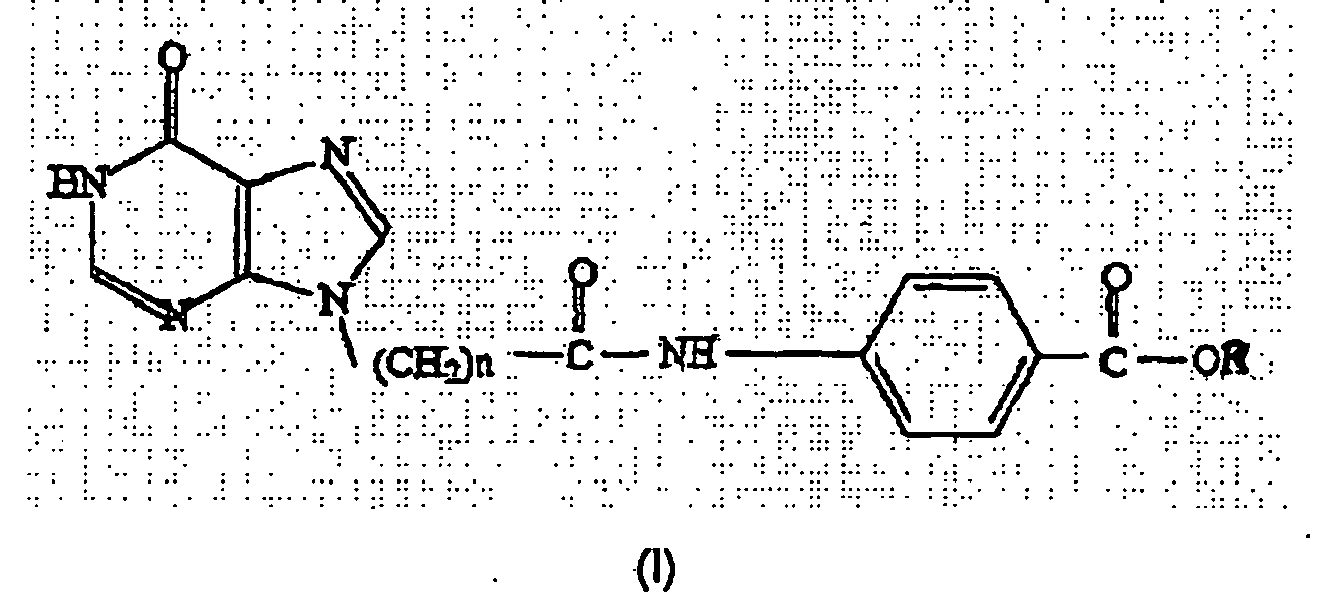
- The compound for use according to Claim 12, wherein the compound is N-4-[[3-(1,6-dihydro-6-oxo-purin-9-yl)-1-oxopropyl]amino]benzoic acid.
- The compound for use according to claim 12, wherein the compound its N-4-[[3-(1,6-dihydro-6-oxo-purin-9-yl)-1-oxopropyl]amino] benzoic acid ethyl ester.
Applications Claiming Priority (2)
| Application Number | Priority Date | Filing Date | Title |
|---|---|---|---|
| US21684400P | 2000-07-07 | 2000-07-07 | |
| EP01950964A EP1334103B1 (en) | 2000-07-07 | 2001-07-06 | Methods for treatment of disease-induced peripheral neuropathy and related conditions |
Related Parent Applications (2)
| Application Number | Title | Priority Date | Filing Date |
|---|---|---|---|
| EP01950964A Division EP1334103B1 (en) | 2000-07-07 | 2001-07-06 | Methods for treatment of disease-induced peripheral neuropathy and related conditions |
| EP01950964.5 Division | 2001-07-06 |
Publications (3)
| Publication Number | Publication Date |
|---|---|
| EP1790344A2 EP1790344A2 (en) | 2007-05-30 |
| EP1790344A3 EP1790344A3 (en) | 2007-06-27 |
| EP1790344B1 true EP1790344B1 (en) | 2011-02-23 |
Family
ID=22808722
Family Applications (3)
| Application Number | Title | Priority Date | Filing Date |
|---|---|---|---|
| EP07075011A Expired - Lifetime EP1790344B1 (en) | 2000-07-07 | 2001-07-06 | Methods for treatment of disease-induced peripheral neuropathy and related conditions |
| EP01952464A Withdrawn EP1334104A2 (en) | 2000-07-07 | 2001-07-06 | Methods for treatment of drug-induced peripheral neuropathy and related conditions |
| EP01950964A Expired - Lifetime EP1334103B1 (en) | 2000-07-07 | 2001-07-06 | Methods for treatment of disease-induced peripheral neuropathy and related conditions |
Family Applications After (2)
| Application Number | Title | Priority Date | Filing Date |
|---|---|---|---|
| EP01952464A Withdrawn EP1334104A2 (en) | 2000-07-07 | 2001-07-06 | Methods for treatment of drug-induced peripheral neuropathy and related conditions |
| EP01950964A Expired - Lifetime EP1334103B1 (en) | 2000-07-07 | 2001-07-06 | Methods for treatment of disease-induced peripheral neuropathy and related conditions |
Country Status (8)
| Country | Link |
|---|---|
| US (2) | US6630490B2 (en) |
| EP (3) | EP1790344B1 (en) |
| AT (2) | ATE499103T1 (en) |
| AU (2) | AU2001271908A1 (en) |
| DE (2) | DE60143850D1 (en) |
| DK (2) | DK1334103T3 (en) |
| ES (2) | ES2385931T3 (en) |
| WO (2) | WO2002004448A2 (en) |
Families Citing this family (45)
| Publication number | Priority date | Publication date | Assignee | Title |
|---|---|---|---|---|
| CZ380296A3 (en) * | 1994-07-25 | 1998-01-14 | Alvin J. Glasky | Medicament for long-term modification of mammal neural activity, treatment of neurological diseases, induction of long-term alteration of neurone membrane potential and other purposes |
| US6759427B2 (en) | 2001-04-20 | 2004-07-06 | Spectrum Pharmaceuticals, Inc. | Synthesis and methods of use of tetrahydroindolone analogues and derivatives |
| US20020156277A1 (en) * | 2001-04-20 | 2002-10-24 | Fick David B. | Synthesis and methods of use of purine analogues and derivatives |
| US20030055249A1 (en) * | 2001-07-17 | 2003-03-20 | Fick David B. | Synthesis and methods of use of pyrimidine analogues and derivatives |
| AU2003242388A1 (en) * | 2002-06-14 | 2003-12-31 | Takeda Pharmaceutical Company Limited | Prodrug and process for producing the same |
| CA2580730C (en) * | 2003-09-25 | 2015-01-13 | Cenomed, Inc. | Tetrahydroindolone derivatives for treatment of neurological conditions |
| CA2543315A1 (en) * | 2003-11-13 | 2005-06-02 | The General Hospital Corporation | Methods for treating pain |
| US8012964B2 (en) | 2004-03-26 | 2011-09-06 | Dainippon Sumitomo Pharma Co., Ltd. | 9-substituted 8-oxoadenine compound |
| AU2006244074B2 (en) * | 2005-05-09 | 2012-12-13 | Hydra Biosciences, Inc. | Compounds for modulating TRPV3 function |
| US8916550B2 (en) | 2005-05-09 | 2014-12-23 | Hydra Biosciences, Inc. | Compounds for modulating TRPV3 function |
| TW200801003A (en) * | 2005-09-16 | 2008-01-01 | Astrazeneca Ab | Novel compounds |
| EP1976495A2 (en) * | 2006-01-06 | 2008-10-08 | Aarhus Universitet | Compounds acting on the serotonin transporter |
| WO2008004948A1 (en) * | 2006-07-05 | 2008-01-10 | Astrazeneca Ab | 8-oxoadenine derivatives acting as modulators of tlr7 |
| BRPI0715504A2 (en) * | 2006-08-01 | 2014-05-06 | Spectrum Pharmaceuticals Inc | PHARMACEUTICAL METHODS AND PREPARATIONS TO CONTRIBUTE TO THE TREATMENT OF CHEMOTHERAPY-INDUCED NEUROPATHY. |
| TW200831105A (en) * | 2006-12-14 | 2008-08-01 | Astrazeneca Ab | Novel compounds |
| SI2132209T1 (en) * | 2007-03-19 | 2014-05-30 | Astrazeneca Ab | 9-substituted-8-oxo-adenine compounds as toll-like receptor (tlr7 ) modulators |
| JP5329444B2 (en) * | 2007-03-19 | 2013-10-30 | アストラゼネカ・アクチエボラーグ | 9-Substituted-8-oxo-adenine compounds as TOLL-like receptor (TLR7) modulators |
| AR065784A1 (en) * | 2007-03-20 | 2009-07-01 | Dainippon Sumitomo Pharma Co | DERIVATIVES OF 8-OXO ADENINE, DRUGS THAT CONTAIN THEM AND USES AS THERAPEUTIC AGENTS FOR ALLERGIC, ANTIVIRAL OR ANTIBACTERIAL DISEASES. |
| EP2138497A4 (en) * | 2007-03-20 | 2012-01-04 | Dainippon Sumitomo Pharma Co | NEW ADENINE COMPOUND |
| EP2155743B1 (en) * | 2007-05-08 | 2012-08-29 | AstraZeneca AB | Imidazoquinolines with immuno-modulating properties |
| US8821431B2 (en) * | 2007-09-07 | 2014-09-02 | Beta O2 Technologies Ltd. | Air gap for supporting cells |
| CN101896065B (en) * | 2007-10-11 | 2013-12-18 | 葛兰素史密斯克莱有限责任公司 | sEH inhibitors and their use |
| WO2009062134A1 (en) * | 2007-11-09 | 2009-05-14 | Cenomed Biosciences, Llc | Treatment of post-traumatic stress disorder with tetrahydroindolone arylpiperazine compounds |
| PE20091156A1 (en) | 2007-12-17 | 2009-09-03 | Astrazeneca Ab | SALTS OF (3 - {[[3- (6-AMINO-2-BUTOXY-8-OXO-7,8-DIHIDRO-9H-PURIN-9-IL) PROPYL] (3-MORFOLIN-4-ILPROPIL) AMINO] METHYL} PHENYL) METHYL ACETATE |
| WO2009091032A1 (en) | 2008-01-17 | 2009-07-23 | Dainippon Sumitomo Pharma Co., Ltd. | Method for producing adenine compound |
| JPWO2009091031A1 (en) * | 2008-01-17 | 2011-05-26 | 大日本住友製薬株式会社 | Method for producing adenine compound |
| US9483755B2 (en) * | 2008-03-04 | 2016-11-01 | Apple Inc. | Portable multifunction device, method, and graphical user interface for an email client |
| US20090264443A1 (en) * | 2008-04-18 | 2009-10-22 | David Helton | Treatment of organophosphate exposure with tetrahydroindolone arylpiperazine compounds |
| SG176464A1 (en) | 2008-05-09 | 2011-12-29 | Agency Science Tech & Res | Diagnosis and treatment of kawasaki disease |
| SG192509A1 (en) | 2008-08-29 | 2013-08-30 | Schulman A Inc | Optimized flavored polymeric compositions |
| EP2507237A1 (en) * | 2009-12-03 | 2012-10-10 | Dainippon Sumitomo Pharma Co., Ltd. | Imidazoquinolines which act via toll - like receptors (tlr) |
| US9884909B2 (en) | 2010-12-01 | 2018-02-06 | Alderbio Holdings Llc | Anti-NGF compositions and use thereof |
| US9067988B2 (en) | 2010-12-01 | 2015-06-30 | Alderbio Holdings Llc | Methods of preventing or treating pain using anti-NGF antibodies |
| US11214610B2 (en) | 2010-12-01 | 2022-01-04 | H. Lundbeck A/S | High-purity production of multi-subunit proteins such as antibodies in transformed microbes such as Pichia pastoris |
| US9078878B2 (en) | 2010-12-01 | 2015-07-14 | Alderbio Holdings Llc | Anti-NGF antibodies that selectively inhibit the association of NGF with TrkA, without affecting the association of NGF with p75 |
| US9539324B2 (en) | 2010-12-01 | 2017-01-10 | Alderbio Holdings, Llc | Methods of preventing inflammation and treating pain using anti-NGF compositions |
| NZ611076A (en) | 2010-12-01 | 2015-09-25 | Alderbio Holdings Llc | Anti-ngf compositions and use thereof |
| WO2012080728A1 (en) | 2010-12-16 | 2012-06-21 | Astrazeneca Ab | Imidazo [4, 5 -c] quinolin- 1 -yl derivative useful in therapy |
| ES2627433T3 (en) | 2010-12-17 | 2017-07-28 | Sumitomo Dainippon Pharma Co., Ltd. | Purine derivatives |
| WO2014063035A2 (en) * | 2012-10-19 | 2014-04-24 | Anthrogenesis Corporation | Treatment of pain using amnion derived adherent cells |
| WO2015058141A1 (en) * | 2013-10-18 | 2015-04-23 | Virginia Tech Intellectual Properties, Inc. | Nucleobase-containing monomers and copolymers |
| US9898162B2 (en) | 2014-05-30 | 2018-02-20 | Apple Inc. | Swiping functions for messaging applications |
| TWI676127B (en) | 2014-09-02 | 2019-11-01 | 美商蘋果公司 | Method, system, electronic device and computer-readable storage medium regarding electronic mail user interface |
| EP3377493B1 (en) | 2015-11-20 | 2020-04-08 | Forma Therapeutics, Inc. | Purinones as ubiquitin-specific protease 1 inhibitors |
| EP4408531A4 (en) * | 2021-09-28 | 2025-03-05 | University of Pittsburgh - of the Commonwealth System of Higher Education | Methods for treating peripheral neuropathy |
Family Cites Families (37)
| Publication number | Priority date | Publication date | Assignee | Title |
|---|---|---|---|---|
| US3300380A (en) | 1963-12-26 | 1967-01-24 | Upjohn Co | Diminishing toxicity of antiviral nu6-(hydroxyalkyl) adenines with 4-hydroxypyrazolo(3, 4-d) pyrimidine |
| US3321369A (en) | 1965-05-26 | 1967-05-23 | Abbott Lab | Method of enhancing learning rate and retention level in warm blooded animals |
| US3484521A (en) | 1966-06-23 | 1969-12-16 | Int Chem & Nuclear Corp | Enhancement of memory processes in mammals with basic addition salts of ribonucleic acid |
| BE759011A (en) | 1969-11-17 | 1971-05-17 | Wellcome Found | AMINOPURINES |
| DE2554453A1 (en) | 1974-12-18 | 1976-06-24 | Experimentales Et Cliniques De | MEDICINE FOR GLYCAEMIA REGULATION |
| GB1530912A (en) | 1975-02-13 | 1978-11-01 | Wellcome Found | Compositions containing 9-(2-hydroxy-3-alkyl)-adenines |
| US4138562A (en) | 1977-02-09 | 1979-02-06 | The Regents Of The University Of Minnesota | Adenosine deaminase resistant antiviral purine nucleosides and method of preparation |
| US4221910A (en) | 1978-09-15 | 1980-09-09 | Newport Pharmaceuticals International, Inc. | 9-(Hydroxy alkyl)purines |
| US4221909A (en) | 1978-09-15 | 1980-09-09 | Sloan-Kettering Institute For Cancer Research | P-Acetamidobenzoic acid salts of 9-(hydroxyalkyl) purines |
| US4221794A (en) | 1979-06-21 | 1980-09-09 | Newport Pharmaceuticals International, Inc. | Method of imparting immunomodulating and antiviral activity |
| US4340726A (en) | 1980-03-14 | 1982-07-20 | Newport Pharmaceuticals International, Inc. | Esters |
| US4347360A (en) | 1980-09-16 | 1982-08-31 | Ens Bio Logicals Inc. | Ring open nucleoside analogues |
| US4451478A (en) | 1982-03-12 | 1984-05-29 | Newport Pharmaceuticals International, Inc. | Imidazole compounds |
| US4643992A (en) | 1982-11-09 | 1987-02-17 | Scripps Clinic And Research Foundation | Modulation of animal cellular responses with compositions containing 8-substituted guanine derivatives |
| US5093318A (en) | 1983-11-01 | 1992-03-03 | Scripps Clinic And Research Foundation | Immunostimulating guanosine derivatives and their pharmaceutical compositions |
| US4952693A (en) | 1984-10-12 | 1990-08-28 | Warner-Lambert Company | Oxazolo-pyrimidine derivatives |
| JPH0696534B2 (en) | 1986-04-25 | 1994-11-30 | ヘキストジヤパン株式会社 | Anti-dementia agent |
| US5495010A (en) | 1987-04-17 | 1996-02-27 | The United States Of America As Represented By The Department Of Health And Human Services | Acid stable purine dideoxynucleosides |
| EP0338169B1 (en) | 1988-04-19 | 1996-07-24 | Institut Pasteur | Method for obtaining protective antigens against bordetella infections and toxic processes |
| US5256677A (en) | 1989-05-23 | 1993-10-26 | Abbott Laboratories | Retroviral protease inhibiting compounds |
| FI921092A7 (en) | 1989-09-15 | 1992-03-13 | Gensia Pharma | Method for treating neurodegenerative conditions |
| US5026687A (en) | 1990-01-03 | 1991-06-25 | The United States Of America As Represented By The Department Of Health And Human Services | Treatment of human retroviral infections with 2',3'-dideoxyinosine alone and in combination with other antiviral compounds |
| US5091432A (en) | 1990-03-28 | 1992-02-25 | Glasky Alvin J | 9-substituted hypoxanthine bi-functional compounds and their neuroimmunological methods of use |
| US5237051A (en) | 1990-12-06 | 1993-08-17 | Vanderbilt University | Purified enterotoxin receptor protein |
| US5646155A (en) | 1994-05-12 | 1997-07-08 | University Of Massachusetts Medical Center | Drugs to prevent recurrent herpes virus infections |
| US5801184A (en) | 1994-07-25 | 1998-09-01 | Glasky; Alvin J. | Carbon monoxide dependent guanylyl cyclase modifiers and methods of use |
| CZ380296A3 (en) | 1994-07-25 | 1998-01-14 | Alvin J. Glasky | Medicament for long-term modification of mammal neural activity, treatment of neurological diseases, induction of long-term alteration of neurone membrane potential and other purposes |
| US5447939A (en) * | 1994-07-25 | 1995-09-05 | Glasky; Alvin J. | Carbon monoxide dependent guanylyl cyclase modifiers and methods of use |
| US5795756A (en) | 1995-12-11 | 1998-08-18 | Johnson; Roger A. | Method and compounds for the inhibition of adenylyl cyclase |
| US5948771A (en) | 1996-01-31 | 1999-09-07 | The Trustees Of Columbia University In The City Of New York | Method for treating heart failure using tetrapyrroles and metallotetrapyrroles |
| US5801159A (en) | 1996-02-23 | 1998-09-01 | Galileo Laboratories, Inc. | Method and composition for inhibiting cellular irreversible changes due to stress |
| AU709323B2 (en) | 1996-03-15 | 1999-08-26 | Somerset Pharmaceuticals, Inc. | Method for preventing and treating peripheral neuropathy by administering selegiline |
| WO1999056550A1 (en) | 1998-05-04 | 1999-11-11 | Neotherapeutics, Inc. | Method for treating migraine in mammals |
| AU3786299A (en) | 1998-05-04 | 1999-11-23 | Neotherapeutics, Inc. | Novel serotonin-like 9-substituted hypoxanthine and methods of use |
| WO1999057119A1 (en) | 1998-05-04 | 1999-11-11 | Neotherapeutics, Inc. | Novel dopamine-like 9-substituted hypoxanthine and methods of use |
| TWI246421B (en) | 1998-12-03 | 2006-01-01 | Alcon Mfg Ltd | Use of neurotrophic factor stimulators for the treatment of ophthalmic neurodegenerative diseases |
| US6297226B1 (en) | 1999-10-15 | 2001-10-02 | Neotherapeutics, Inc. | Synthesis and methods of use of 9-substituted guanine derivatives |
-
2001
- 2001-07-06 WO PCT/US2001/021373 patent/WO2002004448A2/en not_active Ceased
- 2001-07-06 AT AT07075011T patent/ATE499103T1/en active
- 2001-07-06 EP EP07075011A patent/EP1790344B1/en not_active Expired - Lifetime
- 2001-07-06 EP EP01952464A patent/EP1334104A2/en not_active Withdrawn
- 2001-07-06 DE DE60143850T patent/DE60143850D1/en not_active Expired - Lifetime
- 2001-07-06 US US09/900,844 patent/US6630490B2/en not_active Expired - Lifetime
- 2001-07-06 DK DK01950964.5T patent/DK1334103T3/en active
- 2001-07-06 AT AT01950964T patent/ATE495177T1/en active
- 2001-07-06 AU AU2001271908A patent/AU2001271908A1/en not_active Abandoned
- 2001-07-06 DE DE60144123T patent/DE60144123D1/en not_active Expired - Lifetime
- 2001-07-06 US US09/899,901 patent/US6630478B2/en not_active Expired - Lifetime
- 2001-07-06 ES ES01950964T patent/ES2385931T3/en not_active Expired - Lifetime
- 2001-07-06 DK DK07075011.2T patent/DK1790344T3/en active
- 2001-07-06 WO PCT/US2001/021526 patent/WO2002004452A2/en not_active Ceased
- 2001-07-06 AU AU2001273212A patent/AU2001273212A1/en not_active Abandoned
- 2001-07-06 EP EP01950964A patent/EP1334103B1/en not_active Expired - Lifetime
- 2001-07-06 ES ES07075011T patent/ES2420354T3/en not_active Expired - Lifetime
Also Published As
| Publication number | Publication date |
|---|---|
| ES2385931T3 (en) | 2012-08-03 |
| EP1334103B1 (en) | 2011-01-12 |
| WO2002004448A3 (en) | 2003-01-23 |
| DE60144123D1 (en) | 2011-04-07 |
| US6630490B2 (en) | 2003-10-07 |
| DE60143850D1 (en) | 2011-02-24 |
| EP1790344A3 (en) | 2007-06-27 |
| ES2420354T3 (en) | 2013-08-23 |
| US20020055506A1 (en) | 2002-05-09 |
| EP1334104A2 (en) | 2003-08-13 |
| DK1790344T3 (en) | 2011-05-02 |
| DK1334103T3 (en) | 2011-04-04 |
| AU2001273212A1 (en) | 2002-01-21 |
| AU2001271908A1 (en) | 2002-01-21 |
| ATE495177T1 (en) | 2011-01-15 |
| EP1334103A2 (en) | 2003-08-13 |
| US6630478B2 (en) | 2003-10-07 |
| US20020061899A1 (en) | 2002-05-23 |
| ATE499103T1 (en) | 2011-03-15 |
| WO2002004452A2 (en) | 2002-01-17 |
| HK1102367A1 (en) | 2007-11-16 |
| WO2002004452A3 (en) | 2003-01-03 |
| WO2002004448A2 (en) | 2002-01-17 |
| EP1790344A2 (en) | 2007-05-30 |
Similar Documents
| Publication | Publication Date | Title |
|---|---|---|
| EP1334103B1 (en) | Methods for treatment of disease-induced peripheral neuropathy and related conditions | |
| EP0497258B1 (en) | Use of adenosine antagonists in the prevention and treatment of pancreatitis and ulcer | |
| CN1255854A (en) | Use of 1,2,4-triazolo[1,5-C]pyrimidine heterocyclic analog in preparation of medicine for treating cardiovascular disease | |
| Kitahata et al. | The depressant effect of halothane and sodium thiopental on the spontaneous and evoked activity of dorsal horn cells: lamina specificity, time course and dose dependence. | |
| CA2977444A1 (en) | Nk-3 receptor antagonists for therapeutic or cosmetic treatment of excess body fat | |
| JP2021073270A (en) | Tetrahydroisoquinoline derivative | |
| US5338743A (en) | New use of the adenosine antagonist | |
| EP0686155B1 (en) | Xanthine derivatives as adenosine a1 receptor antagonists | |
| US5643938A (en) | Pyrazolopyridine compounds for the treatment of anemia | |
| EP0273744B1 (en) | Centrally-acting muscle relaxants | |
| CA2333947C (en) | Pyrazolopyridine compounds as adenosine a1 antagonist for male sterility | |
| HK1102367B (en) | Methods for treatment of disease-induced peripheral neuropathy and related conditions | |
| US5686420A (en) | Thyrotropin-releasing hormone analogs and method of use | |
| KR20050058468A (en) | Adenosine a2a receptor antagonists for treating restless legs syndrome or related disorders | |
| CA3247370A1 (en) | Compounds and methods for treating spasticity | |
| US8741893B2 (en) | 6,7-dihydro-[1,3,4]thiadiazolo-[3,2-a][1,3]diazepin derivatives and pharmaceutical compositions containing the same as hypnotic or anesthetic agent and method for their preparation | |
| NL8200491A (en) | 17, 18-DEHYDROAPOVINCAMINOL-3'4 ', 5'-TRIMETHOXYBENZOATE, ITS ACID ADDITION SALTS, INTERMEDIATES, AND METHODS FOR PREPARING THESE COMPOUNDS. | |
| EP0900796A1 (en) | Preventives and remedies for ischemic intestinal lesion and ileus | |
| KR100237505B1 (en) | New use of the adenosine antagonist | |
| CA2519026A1 (en) | Therapeutic and/or preventive agent for chronic skin disease | |
| MX2012015090A (en) | Use of 1h-quinazoline-2,4-diones. | |
| KR20060124615A (en) | Prevention and / or treatment of higher cerebral dysfunction | |
| MC MK et al. | compositions containing the same as hypnotic or anesthetic agent and method for their preparation | |
| Baron et al. | Spread of scrapie agent to the central nervous system: study of a rat model |
Legal Events
| Date | Code | Title | Description |
|---|---|---|---|
| PUAI | Public reference made under article 153(3) epc to a published international application that has entered the european phase |
Free format text: ORIGINAL CODE: 0009012 |
|
| PUAL | Search report despatched |
Free format text: ORIGINAL CODE: 0009013 |
|
| 17P | Request for examination filed |
Effective date: 20070201 |
|
| AC | Divisional application: reference to earlier application |
Ref document number: 1334103 Country of ref document: EP Kind code of ref document: P |
|
| AK | Designated contracting states |
Kind code of ref document: A2 Designated state(s): AT BE CH CY DE DK ES FI FR GB GR IE IT LI LU MC NL PT SE TR |
|
| AK | Designated contracting states |
Kind code of ref document: A3 Designated state(s): AT BE CH CY DE DK ES FI FR GB GR IE IT LI LU MC NL PT SE TR |
|
| 17Q | First examination report despatched |
Effective date: 20070903 |
|
| REG | Reference to a national code |
Ref country code: HK Ref legal event code: DE Ref document number: 1102367 Country of ref document: HK |
|
| AKX | Designation fees paid |
Designated state(s): AT BE CH CY DE DK ES FI FR GB GR IE IT LI LU MC NL PT SE TR |
|
| GRAP | Despatch of communication of intention to grant a patent |
Free format text: ORIGINAL CODE: EPIDOSNIGR1 |
|
| GRAS | Grant fee paid |
Free format text: ORIGINAL CODE: EPIDOSNIGR3 |
|
| GRAA | (expected) grant |
Free format text: ORIGINAL CODE: 0009210 |
|
| AC | Divisional application: reference to earlier application |
Ref document number: 1334103 Country of ref document: EP Kind code of ref document: P |
|
| AK | Designated contracting states |
Kind code of ref document: B1 Designated state(s): AT BE CH CY DE DK ES FI FR GB GR IE IT LI LU MC NL PT SE TR |
|
| REG | Reference to a national code |
Ref country code: GB Ref legal event code: FG4D |
|
| REG | Reference to a national code |
Ref country code: CH Ref legal event code: EP |
|
| REG | Reference to a national code |
Ref country code: IE Ref legal event code: FG4D |
|
| REG | Reference to a national code |
Ref country code: CH Ref legal event code: NV Representative=s name: KIRKER & CIE S.A. |
|
| REF | Corresponds to: |
Ref document number: 60144123 Country of ref document: DE Date of ref document: 20110407 Kind code of ref document: P |
|
| REG | Reference to a national code |
Ref country code: DE Ref legal event code: R096 Ref document number: 60144123 Country of ref document: DE Effective date: 20110407 |
|
| REG | Reference to a national code |
Ref country code: SE Ref legal event code: TRGR |
|
| REG | Reference to a national code |
Ref country code: DK Ref legal event code: T3 |
|
| REG | Reference to a national code |
Ref country code: NL Ref legal event code: T3 |
|
| PG25 | Lapsed in a contracting state [announced via postgrant information from national office to epo] |
Ref country code: GR Free format text: LAPSE BECAUSE OF FAILURE TO SUBMIT A TRANSLATION OF THE DESCRIPTION OR TO PAY THE FEE WITHIN THE PRESCRIBED TIME-LIMIT Effective date: 20110524 Ref country code: PT Free format text: LAPSE BECAUSE OF FAILURE TO SUBMIT A TRANSLATION OF THE DESCRIPTION OR TO PAY THE FEE WITHIN THE PRESCRIBED TIME-LIMIT Effective date: 20110623 |
|
| PG25 | Lapsed in a contracting state [announced via postgrant information from national office to epo] |
Ref country code: BE Free format text: LAPSE BECAUSE OF FAILURE TO SUBMIT A TRANSLATION OF THE DESCRIPTION OR TO PAY THE FEE WITHIN THE PRESCRIBED TIME-LIMIT Effective date: 20110223 Ref country code: FI Free format text: LAPSE BECAUSE OF FAILURE TO SUBMIT A TRANSLATION OF THE DESCRIPTION OR TO PAY THE FEE WITHIN THE PRESCRIBED TIME-LIMIT Effective date: 20110223 Ref country code: CY Free format text: LAPSE BECAUSE OF FAILURE TO SUBMIT A TRANSLATION OF THE DESCRIPTION OR TO PAY THE FEE WITHIN THE PRESCRIBED TIME-LIMIT Effective date: 20110223 |
|
| REG | Reference to a national code |
Ref country code: HK Ref legal event code: GR Ref document number: 1102367 Country of ref document: HK |
|
| PLBE | No opposition filed within time limit |
Free format text: ORIGINAL CODE: 0009261 |
|
| STAA | Information on the status of an ep patent application or granted ep patent |
Free format text: STATUS: NO OPPOSITION FILED WITHIN TIME LIMIT |
|
| 26N | No opposition filed |
Effective date: 20111124 |
|
| PG25 | Lapsed in a contracting state [announced via postgrant information from national office to epo] |
Ref country code: MC Free format text: LAPSE BECAUSE OF NON-PAYMENT OF DUE FEES Effective date: 20110731 |
|
| REG | Reference to a national code |
Ref country code: DE Ref legal event code: R097 Ref document number: 60144123 Country of ref document: DE Effective date: 20111124 |
|
| REG | Reference to a national code |
Ref country code: ES Ref legal event code: NE2A Effective date: 20130514 |
|
| PG25 | Lapsed in a contracting state [announced via postgrant information from national office to epo] |
Ref country code: LU Free format text: LAPSE BECAUSE OF NON-PAYMENT OF DUE FEES Effective date: 20110706 |
|
| REG | Reference to a national code |
Ref country code: ES Ref legal event code: FG2A Ref document number: 2420354 Country of ref document: ES Kind code of ref document: T3 Effective date: 20130823 |
|
| PGFP | Annual fee paid to national office [announced via postgrant information from national office to epo] |
Ref country code: CH Payment date: 20140728 Year of fee payment: 14 Ref country code: DE Payment date: 20140729 Year of fee payment: 14 Ref country code: NL Payment date: 20140726 Year of fee payment: 14 Ref country code: IE Payment date: 20140728 Year of fee payment: 14 Ref country code: DK Payment date: 20140725 Year of fee payment: 14 |
|
| PGFP | Annual fee paid to national office [announced via postgrant information from national office to epo] |
Ref country code: FR Payment date: 20140717 Year of fee payment: 14 Ref country code: SE Payment date: 20140729 Year of fee payment: 14 Ref country code: ES Payment date: 20140728 Year of fee payment: 14 Ref country code: GB Payment date: 20140729 Year of fee payment: 14 Ref country code: AT Payment date: 20140702 Year of fee payment: 14 Ref country code: TR Payment date: 20140702 Year of fee payment: 14 |
|
| PGFP | Annual fee paid to national office [announced via postgrant information from national office to epo] |
Ref country code: IT Payment date: 20140724 Year of fee payment: 14 |
|
| REG | Reference to a national code |
Ref country code: DE Ref legal event code: R119 Ref document number: 60144123 Country of ref document: DE |
|
| REG | Reference to a national code |
Ref country code: DK Ref legal event code: EBP Effective date: 20150731 |
|
| REG | Reference to a national code |
Ref country code: CH Ref legal event code: PL |
|
| REG | Reference to a national code |
Ref country code: SE Ref legal event code: EUG |
|
| REG | Reference to a national code |
Ref country code: AT Ref legal event code: MM01 Ref document number: 499103 Country of ref document: AT Kind code of ref document: T Effective date: 20150706 |
|
| GBPC | Gb: european patent ceased through non-payment of renewal fee |
Effective date: 20150706 |
|
| REG | Reference to a national code |
Ref country code: NL Ref legal event code: MM Effective date: 20150801 |
|
| REG | Reference to a national code |
Ref country code: IE Ref legal event code: MM4A |
|
| PG25 | Lapsed in a contracting state [announced via postgrant information from national office to epo] |
Ref country code: IT Free format text: LAPSE BECAUSE OF NON-PAYMENT OF DUE FEES Effective date: 20150706 Ref country code: CH Free format text: LAPSE BECAUSE OF NON-PAYMENT OF DUE FEES Effective date: 20150731 Ref country code: DE Free format text: LAPSE BECAUSE OF NON-PAYMENT OF DUE FEES Effective date: 20160202 Ref country code: GB Free format text: LAPSE BECAUSE OF NON-PAYMENT OF DUE FEES Effective date: 20150706 Ref country code: LI Free format text: LAPSE BECAUSE OF NON-PAYMENT OF DUE FEES Effective date: 20150731 |
|
| REG | Reference to a national code |
Ref country code: FR Ref legal event code: ST Effective date: 20160331 |
|
| PG25 | Lapsed in a contracting state [announced via postgrant information from national office to epo] |
Ref country code: NL Free format text: LAPSE BECAUSE OF NON-PAYMENT OF DUE FEES Effective date: 20150801 Ref country code: FR Free format text: LAPSE BECAUSE OF NON-PAYMENT OF DUE FEES Effective date: 20150731 Ref country code: AT Free format text: LAPSE BECAUSE OF NON-PAYMENT OF DUE FEES Effective date: 20150706 Ref country code: SE Free format text: LAPSE BECAUSE OF NON-PAYMENT OF DUE FEES Effective date: 20150707 |
|
| PG25 | Lapsed in a contracting state [announced via postgrant information from national office to epo] |
Ref country code: IE Free format text: LAPSE BECAUSE OF NON-PAYMENT OF DUE FEES Effective date: 20150706 |
|
| PG25 | Lapsed in a contracting state [announced via postgrant information from national office to epo] |
Ref country code: DK Free format text: LAPSE BECAUSE OF NON-PAYMENT OF DUE FEES Effective date: 20150731 |
|
| PG25 | Lapsed in a contracting state [announced via postgrant information from national office to epo] |
Ref country code: ES Free format text: LAPSE BECAUSE OF NON-PAYMENT OF DUE FEES Effective date: 20150707 |
|
| PG25 | Lapsed in a contracting state [announced via postgrant information from national office to epo] |
Ref country code: TR Free format text: LAPSE BECAUSE OF NON-PAYMENT OF DUE FEES Effective date: 20150706 |