EP1788720A2 - Apparatus and method for outer loop uplink power control during link imbalance - Google Patents
Apparatus and method for outer loop uplink power control during link imbalance Download PDFInfo
- Publication number
- EP1788720A2 EP1788720A2 EP07004545A EP07004545A EP1788720A2 EP 1788720 A2 EP1788720 A2 EP 1788720A2 EP 07004545 A EP07004545 A EP 07004545A EP 07004545 A EP07004545 A EP 07004545A EP 1788720 A2 EP1788720 A2 EP 1788720A2
- Authority
- EP
- European Patent Office
- Prior art keywords
- snr
- uplink
- threshold
- average
- channel condition
- Prior art date
- Legal status (The legal status is an assumption and is not a legal conclusion. Google has not performed a legal analysis and makes no representation as to the accuracy of the status listed.)
- Granted
Links
Images
Classifications
-
- H—ELECTRICITY
- H04—ELECTRIC COMMUNICATION TECHNIQUE
- H04W—WIRELESS COMMUNICATION NETWORKS
- H04W52/00—Power management, e.g. Transmission Power Control [TPC] or power classes
- H04W52/04—Transmission power control [TPC]
- H04W52/18—TPC being performed according to specific parameters
- H04W52/22—TPC being performed according to specific parameters taking into account previous information or commands
- H04W52/225—Calculation of statistics, e.g. average or variance
-
- H—ELECTRICITY
- H04—ELECTRIC COMMUNICATION TECHNIQUE
- H04W—WIRELESS COMMUNICATION NETWORKS
- H04W28/00—Network traffic management; Network resource management
- H04W28/16—Central resource management; Negotiation of resources or communication parameters, e.g. negotiating bandwidth or QoS [Quality of Service]
- H04W28/18—Negotiating wireless communication parameters
-
- H—ELECTRICITY
- H04—ELECTRIC COMMUNICATION TECHNIQUE
- H04W—WIRELESS COMMUNICATION NETWORKS
- H04W52/00—Power management, e.g. Transmission Power Control [TPC] or power classes
- H04W52/04—Transmission power control [TPC]
- H04W52/06—TPC algorithms
- H04W52/12—Outer and inner loops
-
- H—ELECTRICITY
- H04—ELECTRIC COMMUNICATION TECHNIQUE
- H04W—WIRELESS COMMUNICATION NETWORKS
- H04W52/00—Power management, e.g. Transmission Power Control [TPC] or power classes
- H04W52/04—Transmission power control [TPC]
- H04W52/18—TPC being performed according to specific parameters
- H04W52/24—TPC being performed according to specific parameters using SIR [Signal to Interference Ratio] or other wireless path parameters
-
- H—ELECTRICITY
- H04—ELECTRIC COMMUNICATION TECHNIQUE
- H04W—WIRELESS COMMUNICATION NETWORKS
- H04W52/00—Power management, e.g. Transmission Power Control [TPC] or power classes
- H04W52/04—Transmission power control [TPC]
- H04W52/18—TPC being performed according to specific parameters
- H04W52/24—TPC being performed according to specific parameters using SIR [Signal to Interference Ratio] or other wireless path parameters
- H04W52/241—TPC being performed according to specific parameters using SIR [Signal to Interference Ratio] or other wireless path parameters taking into account channel quality metrics, e.g. SIR, SNR, CIR or Eb/lo
-
- H—ELECTRICITY
- H04—ELECTRIC COMMUNICATION TECHNIQUE
- H04W—WIRELESS COMMUNICATION NETWORKS
- H04W52/00—Power management, e.g. Transmission Power Control [TPC] or power classes
- H04W52/04—Transmission power control [TPC]
- H04W52/18—TPC being performed according to specific parameters
- H04W52/26—TPC being performed according to specific parameters using transmission rate or quality of service QoS [Quality of Service]
-
- H—ELECTRICITY
- H04—ELECTRIC COMMUNICATION TECHNIQUE
- H04W—WIRELESS COMMUNICATION NETWORKS
- H04W52/00—Power management, e.g. Transmission Power Control [TPC] or power classes
- H04W52/04—Transmission power control [TPC]
- H04W52/18—TPC being performed according to specific parameters
- H04W52/28—TPC being performed according to specific parameters using user profile, e.g. mobile speed, priority or network state, e.g. standby, idle or non-transmission
- H04W52/286—TPC being performed according to specific parameters using user profile, e.g. mobile speed, priority or network state, e.g. standby, idle or non-transmission during data packet transmission, e.g. high speed packet access [HSPA]
-
- H—ELECTRICITY
- H04—ELECTRIC COMMUNICATION TECHNIQUE
- H04W—WIRELESS COMMUNICATION NETWORKS
- H04W52/00—Power management, e.g. Transmission Power Control [TPC] or power classes
- H04W52/04—Transmission power control [TPC]
- H04W52/06—TPC algorithms
- H04W52/14—Separate analysis of uplink or downlink
- H04W52/146—Uplink power control
-
- H—ELECTRICITY
- H04—ELECTRIC COMMUNICATION TECHNIQUE
- H04W—WIRELESS COMMUNICATION NETWORKS
- H04W52/00—Power management, e.g. Transmission Power Control [TPC] or power classes
- H04W52/04—Transmission power control [TPC]
- H04W52/18—TPC being performed according to specific parameters
- H04W52/20—TPC being performed according to specific parameters using error rate
-
- H—ELECTRICITY
- H04—ELECTRIC COMMUNICATION TECHNIQUE
- H04W—WIRELESS COMMUNICATION NETWORKS
- H04W52/00—Power management, e.g. Transmission Power Control [TPC] or power classes
- H04W52/04—Transmission power control [TPC]
- H04W52/38—TPC being performed in particular situations
- H04W52/40—TPC being performed in particular situations during macro-diversity or soft handoff
Definitions
- the present invention relates generally to the field of wireless communication, and, more specifically, to uplink power control.
- the present invention is subject to a wide range of applications, it is especially suited for use in a cellular communication system, and will be described in that connection.
- the HS-DSCH is a downlink transport channel shared by one or several user equipment (UE).
- a UE can be in soft handoff (SHO) with multiple Node-Bs for the Dedicated Physical Channel (DPCH) on downlink.
- SHO soft handoff
- DPCH Dedicated Physical Channel
- HS-DSCH High Speed Downlink Shared Channel
- HS-DPCCH uplink High Speed Dedicated Physical Control Channel
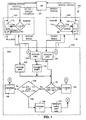
- FIG. 1 is a generalized block diagram of a communication system configured according to the present invention.
- FIG.1 illustrates a generalized block diagram of a communication system 100.
- User equipment (UE) 102 can be in wireless communication with a Node-B1 104 and a Node-B2 106.
- the UE can be a device, such as, a cellular phone or other fixed or mobile wireless devices.
- a Node-B can be a device, such as, a cellular base station that serves an entire cell.
- Node-B1 104 and Node-B2 106 can be in communication with Radio Network Controller (RNC) 108.
- the RNC receives signals from Node B-1 and Node-B2 and provides control information, among other things, to Node-B1 and Node-B2.
- UE 102 can be in the coverage area of Node-B1 104 and Node-B2 106, and can communicate with Node-B1 and Node-82 over various channels.
- the Nodes-B can communicate signals to the UE over downlink channels, for example, downlink Dedicated Physical Channel (DPCH) denoted as Dedicated Physical Data Channel (DPDCH) and Dedicated Physical Control Channel (DPCCH) in FIG. 1, and High Speed Downlink Shared Channel (HS-DSCH).
- DPCH downlink Dedicated Physical Channel
- DPDCH Dedicated Physical Data Channel
- DPCCH Dedicated Physical Control Channel
- HS-DSCH High Speed Downlink Shared Channel
- the UE can send signals to the Nodes-B over uplink channels, such as, uplink DPDCH, uplink DPCCH, and High Speed Dedicated Physical Control Channel (HS-DPCCH) associated with downlink HS-DSCH.
- uplink DPDCH uplink DPDCH
- uplink DPCCH Uplink DPCCH
- UE 102 can send an omnidirectional pilot signal comprising blocks of data over uplink DPCCH, in addition to feedback information bits (FBI) and UP/DOWN request signals for the downlink power control.
- FBI feedback information bits
- the UE's pilot signal can be received by Nodes-B within range of the pilot signal.
- Each Node-B has a target pilot signal-to-noise (SNR) threshold T at which it desires to receive the pilot signal from the UE.
- SNR target pilot signal-to-noise
- Each Node-B receiving the pilot signal can calculate the SNR of the received pilot signal. (Blocks 110 and 112.) If the calculated SNR is below the threshold T, a Node-B can request the UE to increase the transmit power of the pilot signal by sending an UP request over DPCCH. (Blocks 114 and 116.) If the calculated SNR is above the threshold T, a Node-B can request the UE to decrease the transmit power of the pilot signal by sending a DOWN request over DPCCH. (Blocks 118 and 120.)
- An OR of DOWNs determines whether to increase or decrease the pilot signal strength. If the UE receives a DOWN request from any one of the Nodes-B, then the UE's pilot strength is decreased. If the UE receives UP requests from all of the Nodes-B, then the UE's pilot strength is increased.
- a link imbalance may occur when UE 102 is receiving high speed data from Node-B1 over channel HS-DSCH and is in an uplink SHO state with Node-B1 and Node-B2.
- This link imbalance condition can occur when Node-B2 is sending a DOWN request and Node-B1 is sending an UP request.
- the UE can vary its transmit power according to the conventional OR of DOWNs when in SHO state.
- the reduction of pilot signal transmit power by UE 102 can affect the uplink high speed communications between the UE and Node-B1 104 because the signal strength of HS-DPCCH will be reduced in proportion to the reduction of the pilot signal strength in accordance with a traffic-to-pilot ratio stored in the UE.
- Node-B1 104 can send packet data to UE 102 over HS-DSCH.
- the UE can only receive packet data from one Node-B at a time over HS-DSCH.
- Node-B1 104 is the Node transmitting packet date to UE.
- Cell switching can occur that switches the UE from receiving packet data from Node-B1 to receiving packet data from Node-82 106 over the downlink channel HS-DSCH associated with Node-B2 (not shown).
- Higher level signaling achieves cell switching.
- Link imbalance can exist over a shorter time scale than that of cell switching.
- UE 102 can send an acknowledge/not-acknowledge (ACK/NAK) signal over HS-DPCCH.
- An ACK is sent by the UE if the UE has successfully received the packet data from the serving Node-B1 over HS-DSCH.
- a NAK is sent by the UE if the UE has unsuccessfully received the packet data from the serving Node-B1 over HS-DSCH. If a NAK is received by the sending Node-B1, the sending Node-B1can re-transmit the previously sent packet data.
- the UE can send nothing (NULL) if it missed a High Speed Shared Control Channel (HS-SCCH) associated with HS-DSCH.
- HS-SCCH indicates to the UE that a future transmission is imminent on HS-DSCH.
- Node-B2 transmits a DOWN request.
- This causes UE 102 to decrease its pilot signal strength, and, correspondingly, the signal strength of ACK/NAK.
- the decreased strength of the ACK/NAK signal can result in ACKs being received as NAKs that lead to increased transmissions on HS-DSCH; and NAKs or NULLs being received as ACKs that lead to missed packets on HS-DSCH.
- Node-B1 may receive false indications.
- a solution to this problem is for the RNC 108 to monitor the pilot strength, for example, the average SNR of the pilot signal received by Node-B1 104 (block 122) and the average block error rate (BLER) of the serving Node-B1 (block 124). These parameters may be used in determining whether to increase or decrease the target pilot SNR threshold T.
- the RNC 108 can compute the cyclic redundancy check of blocks transmitted over uplink DPDCH for both Nodes-B (blocks 126 and 128). If the CRC fails for both channels (block 130), the RNC directs the Nodes-B to increase the target pilot SNR threshold T (block 132). This in turn makes it likely that Node-B2 will change its request from a DOWN to an UP.
- RNC 108 determines if the uplink channel condition between Node-B1 104 transmitting the high speed packet data and the UE 102 is unsatisfactory (block 134), for example, determining if the average pilot signal SNR is less than a predetermined threshold TH1, or determining if the block error rate (BLER) over DPDCH is greater than a predetermined threshold TH2, or both. If the uplink channel condition is satisfactory, then RNC 108 can request that the target pilot SNR threshold T of the Nodes-B be decreased. (Block 136.)
- the RNC 108 can request that the target pilot SNR threshold T be increased (block 138).
- the increased T makes it more likely that Node-B2 will change its DOWN request to an UP request, which in turn can prevent a decrease in the pilot strength of the UE according to the OR of DOWNs.
- the RNC can request the the traffic-to-pilot ratio of the Nodes-B be reduced (block 140) in addition to increasing T (block 138). Reducing the traffic-to-pilot ratio reduces the average return link interferences by reducing the traffic channel strength in relation to the pilot signal strength.
- the present invention is capable of other and different embodiments, and its several details are capable of modification.
- W-CDMA Wideband Code Division Multiple Access
- the invention can equivalently be applied to CDMA2000 1xEV-DV.
- UE corresponds to a Mobile Station (MS); a Node-B corresponds to a Base Terminal Station (BTS); RNC corresponds to a Base Station Controller (BSC); HS-DSCH corresponds to Forward Packet Data Channel (F-PDCH); DPCH corresponds to Fundicated Channel (FCH/DCCH); HS-DPCCH corresponds to R-CQICH and R-ACKCH; and BLER corresponds to frame error rate (FER).
- MS Mobile Station
- BTS Base Terminal Station
- BSC Base Station Controller
- HS-DSCH corresponds to Forward Packet Data Channel (F-PDCH)
- DPCH corresponds to Fundicated Channel (FCH/DCCH)
- HS-DPCCH corresponds to R-CQICH and R-ACKCH
- BLER corresponds to frame error rate (FER).
- Node-B can be a device a cellular base station having beam-forming antennas that that serves various sectors of a cell.
- the functions of the RNC can be performed in the base station serving the UE for a link imbalance between sectors of the same base station.
- the uplink power control described herein provides the advantage to maintain the integrity of the uplink HS-DPCCH when the UE goes into SHO. This is primarily accomplished by controlling the target pilot SNR threshold by considering the pilot signal strength of the serving Node-B1 and/or the uplink channel condition the serving Node-B1 when deciding to increase or decrease the target pilot SNR threshold of Nodes-B.
Landscapes
- Engineering & Computer Science (AREA)
- Computer Networks & Wireless Communication (AREA)
- Signal Processing (AREA)
- Quality & Reliability (AREA)
- Physics & Mathematics (AREA)
- Probability & Statistics with Applications (AREA)
- Mobile Radio Communication Systems (AREA)
- Detection And Prevention Of Errors In Transmission (AREA)
- Bidirectional Digital Transmission (AREA)
- Cable Transmission Systems, Equalization Of Radio And Reduction Of Echo (AREA)
- Charge And Discharge Circuits For Batteries Or The Like (AREA)
- Adjustment Of The Magnetic Head Position Track Following On Tapes (AREA)
- Optical Recording Or Reproduction (AREA)
Abstract
Description
- The present invention relates generally to the field of wireless communication, and, more specifically, to uplink power control. Although the present invention is subject to a wide range of applications, it is especially suited for use in a cellular communication system, and will be described in that connection.
- Technical Specification 3GPP TS 25.211 v5.0.0 (2002-03), 3rd Generation Partnership Project (3GPP); Technical Specification Group Radio Access Network; Physical channels and mapping of transportation channels onto physical channels (FDD) (Release 5) provides for a High Speed Downlink Shared Channel (HS-DSCH). The HS-DSCH is a downlink transport channel shared by one or several user equipment (UE).
- In 3GPP High Speed Data Packet Access (HSDPA), a UE can be in soft handoff (SHO) with multiple Node-Bs for the Dedicated Physical Channel (DPCH) on downlink. There is, however, no HSDPA SHO for the High Speed Downlink Shared Channel (HS-DSCH) and corresponding uplink High Speed Dedicated Physical Control Channel (HS-DPCCH). This may result in a condition called link imbalance. That is, the Node-B serving the high speed data over the HS-DSCH is different from the Node-B to which the UE has the best uplink for the DPCCH.
- A need therefore exists for apparatus and methods for uplink power control during link imbalance that considers the reverse link HS-DPCH.
- Other features and advantages of the present invention will be set forth in part in the description which follows and accompanying drawings, wherein the preferred embodiments of the present invention are described and shown, and in part become apparent to those skilled in the art upon examination of the following detailed description taken in conjunction with the accompanying drawings, or may be learned by practice of the present invention. The advantages of the present invention may be realized and attained by means of the instrumentalities and combinations particularly pointed out in the appended claims.
- FIG. 1 is a generalized block diagram of a communication system configured according to the present invention.
- FIG.1 illustrates a generalized block diagram of a
communication system 100. User equipment (UE) 102 can be in wireless communication with a Node-B1 104 and a Node-B2 106. The UE can be a device, such as, a cellular phone or other fixed or mobile wireless devices. A Node-B can be a device, such as, a cellular base station that serves an entire cell. - Node-B1 104 and Node-B2 106 can be in communication with Radio Network Controller (RNC) 108. The RNC receives signals from Node B-1 and Node-B2 and provides control information, among other things, to Node-B1 and Node-B2.
- UE 102 can be in the coverage area of Node-B1 104 and Node-B2 106, and can communicate with Node-B1 and Node-82 over various channels. For example, the Nodes-B can communicate signals to the UE over downlink channels, for example, downlink Dedicated Physical Channel (DPCH) denoted as Dedicated Physical Data Channel (DPDCH) and Dedicated Physical Control Channel (DPCCH) in FIG. 1, and High Speed Downlink Shared Channel (HS-DSCH). The UE can send signals to the Nodes-B over uplink channels, such as, uplink DPDCH, uplink DPCCH, and High Speed Dedicated Physical Control Channel (HS-DPCCH) associated with downlink HS-DSCH.
- UE 102 can send an omnidirectional pilot signal comprising blocks of data over uplink DPCCH, in addition to feedback information bits (FBI) and UP/DOWN request signals for the downlink power control.
- The UE's pilot signal can be received by Nodes-B within range of the pilot signal. Each Node-B has a target pilot signal-to-noise (SNR) threshold T at which it desires to receive the pilot signal from the UE. Each Node-B receiving the pilot signal can calculate the SNR of the received pilot signal. (
Blocks Blocks 114 and 116.) If the calculated SNR is above the threshold T, a Node-B can request the UE to decrease the transmit power of the pilot signal by sending a DOWN request over DPCCH. (Blocks - An OR of DOWNs determines whether to increase or decrease the pilot signal strength. If the UE receives a DOWN request from any one of the Nodes-B, then the UE's pilot strength is decreased. If the UE receives UP requests from all of the Nodes-B, then the UE's pilot strength is increased.
- A link imbalance may occur when UE 102 is receiving high speed data from Node-B1 over channel HS-DSCH and is in an uplink SHO state with Node-B1 and Node-B2. This link imbalance condition can occur when Node-B2 is sending a DOWN request and Node-B1 is sending an UP request. In addition, the UE can vary its transmit power according to the conventional OR of DOWNs when in SHO state.
- The reduction of pilot signal transmit power by UE 102 can affect the uplink high speed communications between the UE and Node-B1 104 because the signal strength of HS-DPCCH will be reduced in proportion to the reduction of the pilot signal strength in accordance with a traffic-to-pilot ratio stored in the UE.
- In HSDPA, Node-B1 104 can send packet data to UE 102 over HS-DSCH. The UE can only receive packet data from one Node-B at a time over HS-DSCH. In FIG. 1, Node-B1 104 is the Node transmitting packet date to UE. Cell switching can occur that switches the UE from receiving packet data from Node-B1 to receiving packet data from Node-82 106 over the downlink channel HS-DSCH associated with Node-B2 (not shown). Higher level signaling achieves cell switching. Link imbalance, however, can exist over a shorter time scale than that of cell switching.
- UE 102 can send an acknowledge/not-acknowledge (ACK/NAK) signal over HS-DPCCH. An ACK is sent by the UE if the UE has successfully received the packet data from the serving Node-B1 over HS-DSCH. Conversely, a NAK is sent by the UE if the UE has unsuccessfully received the packet data from the serving Node-B1 over HS-DSCH. If a NAK is received by the sending Node-B1, the sending Node-B1can re-transmit the previously sent packet data. The UE can send nothing (NULL) if it missed a High Speed Shared Control Channel (HS-SCCH) associated with HS-DSCH. HS-SCCH indicates to the UE that a future transmission is imminent on HS-DSCH.
- In a link imbalance condition, Node-B2 transmits a DOWN request. This causes UE 102 to decrease its pilot signal strength, and, correspondingly, the signal strength of ACK/NAK. The decreased strength of the ACK/NAK signal can result in ACKs being received as NAKs that lead to increased transmissions on HS-DSCH; and NAKs or NULLs being received as ACKs that lead to missed packets on HS-DSCH.
- Further, because the UE sends channel quality indication (CQI) over HS-DPCCH, Node-B1 may receive false indications.
- A solution to this problem is for the
RNC 108 to monitor the pilot strength, for example, the average SNR of the pilot signal received by Node-B1 104 (block 122) and the average block error rate (BLER) of the serving Node-B1 (block 124). These parameters may be used in determining whether to increase or decrease the target pilot SNR threshold T. - The
RNC 108 can compute the cyclic redundancy check of blocks transmitted over uplink DPDCH for both Nodes-B (blocks 126 and 128). If the CRC fails for both channels (block 130), the RNC directs the Nodes-B to increase the target pilot SNR threshold T (block 132). This in turn makes it likely that Node-B2 will change its request from a DOWN to an UP. - If the CRC does not fail for both channels (block 130),
RNC 108 determines if the uplink channel condition between Node-B1 104 transmitting the high speed packet data and theUE 102 is unsatisfactory (block 134), for example, determining if the average pilot signal SNR is less than a predetermined threshold TH1, or determining if the block error rate (BLER) over DPDCH is greater than a predetermined threshold TH2, or both. If the uplink channel condition is satisfactory, thenRNC 108 can request that the target pilot SNR threshold T of the Nodes-B be decreased. (Block 136.) - If the uplink channel condition between Node-
B1 104 transmitting the high speed packet data and theUE 102 is unsatisfactory (block 134), theRNC 108 can request that the target pilot SNR threshold T be increased (block 138). The increased T makes it more likely that Node-B2 will change its DOWN request to an UP request, which in turn can prevent a decrease in the pilot strength of the UE according to the OR of DOWNs. - Optionally, the RNC can request the the traffic-to-pilot ratio of the Nodes-B be reduced (block 140) in addition to increasing T (block 138). Reducing the traffic-to-pilot ratio reduces the average return link interferences by reducing the traffic channel strength in relation to the pilot signal strength.
- The present invention is capable of other and different embodiments, and its several details are capable of modification. For example, although the invention is described with reference to the aforementioned technical specification for Wideband Code Division Multiple Access (W-CDMA), the invention can equivalently be applied to CDMA2000 1xEV-DV. For example, the following 3GPP terms have correspondence to CDMA2000 terms: UE corresponds to a Mobile Station (MS); a Node-B corresponds to a Base Terminal Station (BTS); RNC corresponds to a Base Station Controller (BSC); HS-DSCH corresponds to Forward Packet Data Channel (F-PDCH); DPCH corresponds to Fundicated Channel (FCH/DCCH); HS-DPCCH corresponds to R-CQICH and R-ACKCH; and BLER corresponds to frame error rate (FER).
- Node-B can be a device a cellular base station having beam-forming antennas that that serves various sectors of a cell. In this case, the functions of the RNC can be performed in the base station serving the UE for a link imbalance between sectors of the same base station.
- The functionality described herein, and of the blocks shown in FIG. 1, may be carried out in dedicated hardware, or equivalently, in software and a processor.
- In conclusion, the uplink power control described herein provides the advantage to maintain the integrity of the uplink HS-DPCCH when the UE goes into SHO. This is primarily accomplished by controlling the target pilot SNR threshold by considering the pilot signal strength of the serving Node-B1 and/or the uplink channel condition the serving Node-B1 when deciding to increase or decrease the target pilot SNR threshold of Nodes-B.
- Those skilled in the art will recognize that other modifications and variations can be made in the uplink power control technique of the present invention and in construction and operation without departing from the scope or spirit of this invention.
- 1. An apparatus for uplink power control comprising:
- determination logic for determining the channel condition of an uplink channel; and
- a target pilot signal-to-noise (SNR) threshold setter for increasing a target pilot SNR threshold when the determined channel condition is unsatisfactory.
- 2. The apparatus of 1 further comprising a traffic-to-pilot ratio setter for reducing the traffic-to-pilot ratio when the target pilot SNR threshold is increased.
- 3. The apparatus of 1, wherein the target pilot signal-to-noise (SNR) threshold setter decreases the target pilot SNR threshold when the determined channel condition is satisfactory.
- 4. The apparatus of 1, wherein the determined channel condition is unsatisfactory when the average SNR of a pilot signal is less than a predetermined first threshold.
- 5. The apparatus of 1, wherein the determined channel condition is unsatisfactory when the average block error rate over an uplink data channel is greater than a predetermined second threshold.
- 6. The apparatus of 1, wherein the determined channel condition is unsatisfactory when the average SNR of a pilot signal is less than a predetermined first threshold and the average block error rate over an uplink data channel is greater than a predetermined second threshold.
- 7. An apparatus for uplink power control comprising:
- a signal-to-noise (SNR) averager for computing the average SNR or an uplink pilot signal;
- a block-error-rate (BLER) averager for computing the average BLER or an uplink data signal;
- determination logic for determining the channel condition of an uplink channel is satisfactory or unsatisfactory according to the average SNR or average BLER or both; and
- a target pilot signal-to-noise (SNR) threshold setter for increasing a target pilot SNR threshold when the determined channel condition is unsatisfactory and for decreasing the target pilot SNR threshold when the determined channel condition is satisfactory.
- 8. A method for uplink power control comprising:
- determining the channel condition of an uplink channel; and
- increasing a target pilot SNR threshold when the determined channel condition is unsatisfactory.
- 9. The method of 8 further comprising reducing a traffic-to-pilot ratio when the target pilot SNR threshold is increased.
- 10. The method of 8 further comprising decreasing the target pilot SNR threshold when the determined channel condition is satisfactory.
- 11. The method of 8 wherein the determined channel condition is unsatisfactory when the average SNR of a pilot signal is less than a predetermined first threshold.
- 12. The method of 8 wherein the determined channel condition is unsatisfactory when the average block error rate over an uplink data channel is greater than a predetermined second threshold.
- 13. A method for uplink power control comprising:
- computing the average SNR or an uplink pilot signal;
- computing the average BLER or an uplink data signal;
- determining whether the channel condition of an uplink channel is satisfactory or unsatisfactory according to the average SNR or average BLER or both; and
- increasing a target pilot SNR threshold when the determined channel condition is unsatisfactory and for decreasing the target pilot SNR threshold when the determined channel condition is satisfactory.
- 14. An apparatus for uplink power control comprising:
- means for determining the channel condition of an uplink channel; and
- means for increasing a target pilot SNR threshold when the determined channel condition is unsatisfactory.
- 15. The apparatus of 14 further comprising reducing a traffic-to-pilot ratio when the target pilot SNR threshold is increased.
- 16. The apparatus of 14 further comprising decreasing the target pilot SNR threshold when the determined channel condition is satisfactory.
- 17. The apparatus of 14 wherein the determined channel condition is unsatisfactory when the average SNR of a pilot signal is less than a predetermined first threshold:
- 18. The apparatus of 14 wherein the determined channel condition is unsatisfactory when the average block error rate over an uplink data channel is greater than a predetermined second threshold.
- 19. An apparatus for uplink power control comprising:
- means for computing the average SNR or an uplink pilot signal;
- means for computing the average BLER or an uplink data signal;
- means for determining whether the channel condition of an uplink channel is satisfactory or unsatisfactory according to the average SNR or average BLER or both; and
- means for increasing a target pilot SNR threshold when the determined channel condition is unsatisfactory and for decreasing the target pilot SNR threshold when the determined channel condition is satisfactory.
Claims (9)
- An apparatus for uplink power control comprising:determination logic for determining the channel condition of an uplink channel; anda target pilot signal-to-noise (SNR) threshold setter for increasing a target pilot SNR threshold when the determined channel condition is unsatisfactory.
- The apparatus of claim 1 further comprising a traffic-to-pilot ratio setter for reducing the traffic-to-pilot ratio when the target pilot SNR threshold is increased.
- The apparatus of claim 1, wherein the target pilot signal-to-noise (SNR) threshold setter decreases the target pilot SNR threshold when the determined channel condition is satisfactory.
- The apparatus of claim 1, wherein the determined channel condition is unsatisfactory when the average SNR of a pilot signal is less than a predetermined first threshold.
- The apparatus of claim 1, wherein the determined channel condition is unsatisfactory when the average block error rate over an uplink data channel is greater than a predetermined second threshold.
- The apparatus of claim 1, wherein the determined channel condition is unsatisfactory when the average SNR of a pilot signal is less than a predetermined first threshold and the average block error rate over an uplink data channel is greater than a predetermined second threshold.
- An apparatus for uplink power control comprising:a signal-to-noise (SNR) averager for computing the average SNR or an uplink pilot signal;
- A method for uplink power control comprising:computing the average SNR or an uplink pilot signal;computing the average BLER or an uplink data signal;determining whether the channel condition of an uplink channel is satisfactory or unsatisfactory according to the average SNR or average BLER or both; andincreasing a target pilot SNR threshold when the determined channel condition is unsatisfactory and for decreasing the target pilot SNR threshold when the determined channel condition is satisfactory.
- An apparatus for uplink power control comprising:means for computing the average SNR or an uplink pilot signal;means for computing the average BLER or an uplink data signal;means for determining whether the channel condition of an uplink channel is satisfactory or unsatisfactory according to the average SNR or average BLER or both; andmeans for increasing a target pilot SNR threshold when the determined channel condition is unsatisfactory and for decreasing the target pilot SNR threshold when the determined channel condition is satisfactory.
Applications Claiming Priority (2)
| Application Number | Priority Date | Filing Date | Title |
|---|---|---|---|
| US10/179,677 US6850771B2 (en) | 2002-06-24 | 2002-06-24 | Uplink power control |
| EP03761173A EP1516440B1 (en) | 2002-06-24 | 2003-06-20 | Outer loop uplink power control during link imbalance |
Related Parent Applications (1)
| Application Number | Title | Priority Date | Filing Date |
|---|---|---|---|
| EP03761173A Division EP1516440B1 (en) | 2002-06-24 | 2003-06-20 | Outer loop uplink power control during link imbalance |
Publications (3)
| Publication Number | Publication Date |
|---|---|
| EP1788720A2 true EP1788720A2 (en) | 2007-05-23 |
| EP1788720A3 EP1788720A3 (en) | 2007-06-13 |
| EP1788720B1 EP1788720B1 (en) | 2016-06-22 |
Family
ID=29999142
Family Applications (2)
| Application Number | Title | Priority Date | Filing Date |
|---|---|---|---|
| EP07004545.5A Expired - Lifetime EP1788720B1 (en) | 2002-06-24 | 2003-06-20 | Apparatus and method for outer loop uplink power control during link imbalance |
| EP03761173A Expired - Lifetime EP1516440B1 (en) | 2002-06-24 | 2003-06-20 | Outer loop uplink power control during link imbalance |
Family Applications After (1)
| Application Number | Title | Priority Date | Filing Date |
|---|---|---|---|
| EP03761173A Expired - Lifetime EP1516440B1 (en) | 2002-06-24 | 2003-06-20 | Outer loop uplink power control during link imbalance |
Country Status (11)
| Country | Link |
|---|---|
| US (2) | US6850771B2 (en) |
| EP (2) | EP1788720B1 (en) |
| JP (1) | JP4347804B2 (en) |
| KR (1) | KR101015756B1 (en) |
| CN (1) | CN100468984C (en) |
| AT (1) | ATE362234T1 (en) |
| AU (1) | AU2003243677A1 (en) |
| BR (1) | BR0312061A (en) |
| DE (1) | DE60313773T2 (en) |
| TW (1) | TWI320272B (en) |
| WO (1) | WO2004002008A1 (en) |
Cited By (2)
| Publication number | Priority date | Publication date | Assignee | Title |
|---|---|---|---|---|
| WO2009072945A1 (en) * | 2007-12-06 | 2009-06-11 | Telefonaktiebolaget Lm Ericsson (Publ) | Method and arrangement for power control during soft handover |
| WO2012050506A1 (en) * | 2010-10-12 | 2012-04-19 | Telefonaktiebolaget L M Ericsson (Publ) | Uplink power control |
Families Citing this family (40)
| Publication number | Priority date | Publication date | Assignee | Title |
|---|---|---|---|---|
| US6850771B2 (en) * | 2002-06-24 | 2005-02-01 | Qualcomm Incorporated | Uplink power control |
| US7245939B2 (en) * | 2002-09-09 | 2007-07-17 | Interdigital Technology Corporation | Reducing the effect of signal interference in null areas caused by overlapping antenna patterns |
| US7236808B2 (en) * | 2002-09-09 | 2007-06-26 | Interdigital Technology Corporation | Vertical dynamic beam-forming |
| WO2004043081A2 (en) * | 2002-11-04 | 2004-05-21 | Lg Electronics Inc. | Uplink dpcch transmission power control for terminal in soft handover |
| US20040100911A1 (en) * | 2002-11-25 | 2004-05-27 | Raymond Kwan | Method for link adaptation |
| EP2393250A1 (en) * | 2002-12-04 | 2011-12-07 | Interdigital Technology Corporation | Reliability detection of channel quality indicator (CQI) and application to outer loop power control |
| CA2489265C (en) | 2003-04-29 | 2016-12-20 | Youn-Sun Kim | Reverse power control method and apparatus in a mobile communication system in which mobile station determines reverse data rate |
| JP4378676B2 (en) * | 2003-06-03 | 2009-12-09 | 日本電気株式会社 | Power control method and power control circuit |
| US7738901B2 (en) * | 2003-07-10 | 2010-06-15 | Telefonaktiebolaget Lm Ericsson (Publ) | Secondary link power control in a wireless communication network |
| WO2005022798A1 (en) | 2003-08-25 | 2005-03-10 | Interdigital Technology Corporation | Enhanced uplink operation in soft handover |
| US7406070B2 (en) * | 2003-10-09 | 2008-07-29 | Telefonaktiebolaget L M Ericsson (Publ) | Adaptive threshold for HS-SCCH part 1 decoding |
| US7046648B2 (en) | 2003-11-05 | 2006-05-16 | Interdigital Technology Corporation | Wireless communication method and apparatus for coordinating Node-B's and supporting enhanced uplink transmissions during handover |
| US7133690B2 (en) * | 2004-01-23 | 2006-11-07 | Nokia Corporation | Method and apparatus for fast data rate ramp up in Node B scheduling of UE uplink |
| JP4222957B2 (en) * | 2004-03-01 | 2009-02-12 | ソニー・エリクソン・モバイルコミュニケーションズ株式会社 | Transmission power control method and apparatus |
| US8094619B2 (en) * | 2004-03-04 | 2012-01-10 | Sk Telecom Co., Ltd. | Multi-mode multi-band mobile communication terminal and mode switching method thereof |
| US7907898B2 (en) * | 2004-03-26 | 2011-03-15 | Qualcomm Incorporated | Asynchronous inter-piconet routing |
| WO2006000900A1 (en) * | 2004-06-29 | 2006-01-05 | Nokia Corporation | Internet high speed packet access |
| KR101055730B1 (en) * | 2004-08-11 | 2011-08-11 | 엘지전자 주식회사 | Uplink transmit power scheduling method |
| US8224368B2 (en) * | 2004-09-27 | 2012-07-17 | Alcatel Lucent | Method and apparatus for controlling transmission power in a wireless network |
| JP4538366B2 (en) * | 2005-03-29 | 2010-09-08 | 株式会社エヌ・ティ・ティ・ドコモ | Transmission rate control method, mobile station and radio base station |
| US7546136B2 (en) | 2005-04-29 | 2009-06-09 | Telefonaktiebolaget L M Ericsson (Publ) | Variable transmit power control strategies for high-speed downlink packet access systems |
| US20070053287A1 (en) * | 2005-09-07 | 2007-03-08 | Gang Li | System and method for selecting data rates in a wireless communication system |
| JPWO2007108097A1 (en) * | 2006-03-20 | 2009-07-30 | 三菱電機株式会社 | Mobile station, fixed station and radio communication system |
| US7613476B2 (en) * | 2006-06-02 | 2009-11-03 | Alcatel-Lucent Usa Inc. | Method and apparatus for path imbalance reduction in networks using high speed data packet access (HSDPA) |
| CN101212274B (en) * | 2006-12-30 | 2011-02-16 | 华为技术有限公司 | Adaptive uplink communication method, system, and device |
| US9295003B2 (en) * | 2007-03-19 | 2016-03-22 | Apple Inc. | Resource allocation in a communication system |
| US7945258B2 (en) * | 2007-07-31 | 2011-05-17 | Broadcom Corporation | Wireless device operable to manipulate high-speed shared control channel (HSSCCH) quality control through channel quality indication report manipulation |
| KR101572880B1 (en) * | 2007-12-12 | 2015-11-30 | 엘지전자 주식회사 | Uplink power control method considering multiplexing rate |
| WO2009075548A1 (en) * | 2007-12-12 | 2009-06-18 | Lg Electronics Inc. | A method for controlling uplink power control considering multiplexing rate/ratio |
| JP2009302686A (en) * | 2008-06-10 | 2009-12-24 | Fujitsu Ltd | Wireless communication apparatus and method |
| KR20100033909A (en) * | 2008-09-22 | 2010-03-31 | 엘지전자 주식회사 | Method for controlling transmit power and transmitting device thereof |
| US8380182B2 (en) * | 2008-10-24 | 2013-02-19 | Qualcomm Incorporated | Method and apparatus for imbalance compensation in wireless networks |
| US20130072250A1 (en) * | 2011-03-30 | 2013-03-21 | Qualcomm Incorporated | Outage based outer loop power control for wireless communications systems |
| WO2013133746A2 (en) * | 2012-03-06 | 2013-09-12 | Telefonaktiebolaget L M Ericsson (Publ) | A radio network controller, a serving base station, a user equipment and methods therein |
| KR101284212B1 (en) | 2012-04-27 | 2013-07-09 | 주식회사 아이에스시 | Test socket which can be aligned easily |
| US9374191B2 (en) * | 2012-05-17 | 2016-06-21 | Apple Inc. | Outer loop link adaptation for device resumption |
| US9491664B2 (en) | 2012-08-03 | 2016-11-08 | Telefonaktiebolaget Lm Ericsson (Publ) | Base stations and nodes for use in a mobile communications network and methods of operating the same |
| CN103716868B (en) * | 2012-09-29 | 2018-03-02 | 华为技术有限公司 | The method and system of control channel power |
| US11277800B1 (en) | 2020-03-19 | 2022-03-15 | Sprint Communications Company L.P. | Wireless access node uplink power control based on uplink error rate |
| US20250261128A1 (en) * | 2024-02-09 | 2025-08-14 | Qualcomm Incorporated | Low signal-to-noise ratio (snr) operation with duty cycle selection |
Family Cites Families (44)
| Publication number | Priority date | Publication date | Assignee | Title |
|---|---|---|---|---|
| US5603096A (en) * | 1994-07-11 | 1997-02-11 | Qualcomm Incorporated | Reverse link, closed loop power control in a code division multiple access system |
| US5719898A (en) * | 1995-09-29 | 1998-02-17 | Golden Bridge Technology, Inc. | Fuzzy-logic spread-spectrum adaptive power control |
| US5884187A (en) * | 1996-03-13 | 1999-03-16 | Ziv; Noam A. | Method and apparatus for providing centralized power control administration for a set of base stations |
| CN1102308C (en) * | 1996-06-27 | 2003-02-26 | Ntt移动通信网株式会社 | transmit power controller |
| US5933781A (en) | 1997-01-31 | 1999-08-03 | Qualcomm Incorporated | Pilot based, reversed channel power control |
| US6426960B2 (en) * | 1997-06-24 | 2002-07-30 | Qualcomm Incorporated | Increased capacity data transmission in a CDMA wireless communication system |
| US6304562B1 (en) * | 1997-06-26 | 2001-10-16 | Samsung Electronics Co., Ltd. | Asymmetric forward power control in a CDMA communication |
| US6259928B1 (en) * | 1997-10-13 | 2001-07-10 | Qualcomm Inc. | System and method for optimized power control |
| JP3657195B2 (en) * | 1998-07-28 | 2005-06-08 | サムスン エレクトロニクス カンパニー リミテッド | Intermittent transmission apparatus and method in control maintenance state of CDMA communication system |
| US6449463B1 (en) * | 1998-10-29 | 2002-09-10 | Qualcomm, Incorporated | Variable loop gain in double loop power control systems |
| EP1033846A1 (en) * | 1999-03-01 | 2000-09-06 | Alcatel | Process for controlling uplink packet transmission in a wireless communication network |
| US6512750B1 (en) * | 1999-04-16 | 2003-01-28 | Telefonaktiebolaget Lm Ericsson (Publ) | Power setting in CDMA systems employing discontinuous transmission |
| EP1054518B1 (en) * | 1999-05-21 | 2004-04-28 | Alcatel Alsthom Compagnie Generale D'electricite | A method for improving performances of a mobile radiocommunication system using power control |
| ES2216459T3 (en) * | 1999-05-21 | 2004-10-16 | Alcatel | METHOD FOR IMPROVING THE PERFORMANCE OF A MOBILE RADIOCOMMUNICATION SYSTEM USING THE CONVERGENCE ASSESSMENT OF THE POWER CONTROL LOOP. |
| US6434367B1 (en) * | 1999-06-11 | 2002-08-13 | Lucent Technologies Inc. | Using decoupled power control sub-channel to control reverse-link channel power |
| US6370364B1 (en) * | 1999-06-22 | 2002-04-09 | Nokia Mobile Phones, Ltd. | Mobile station having power control loop offset alignment without requiring RF power measurement |
| US6298242B1 (en) * | 1999-07-22 | 2001-10-02 | Qualcomm Inc. | Method and apparatus for reducing frame error rate through signal power adjustment |
| US6633552B1 (en) * | 1999-08-06 | 2003-10-14 | Qualcomm Incorporated | Method and apparatus for determining the closed loop power control set point in a wireless packet data communication system |
| EP1081977A1 (en) | 1999-08-31 | 2001-03-07 | TELEFONAKTIEBOLAGET L M ERICSSON (publ) | Subscriber station, network control means and method for triggering inter-frequency measurements in a mobile communication system |
| US6931256B2 (en) * | 2000-02-01 | 2005-08-16 | Nokia Corporation | Apparatus, and associated method, for selectably permitting communication of burst data in a radio communication system |
| ATE372610T1 (en) * | 2000-02-21 | 2007-09-15 | Alcatel Lucent | METHOD FOR SETTING A SIGNAL QUALITY SET POINT DURING TRANSMIT POWER CONTROL IN A CDMA RADIO COMMUNICATIONS NETWORK |
| US6728551B2 (en) * | 2000-04-26 | 2004-04-27 | Samsung Electronics Co., Ltd. | Method of supporting power control on a DCCH in a base station transceiver system and a base station controller |
| FR2809252B1 (en) * | 2000-05-17 | 2003-10-03 | Cit Alcatel | METHOD FOR ADJUSTING TRANSMIT POWER BY BASE STATIONS TRANSMITTING IN MACRO-DIVERSITY |
| US8099122B1 (en) | 2000-06-05 | 2012-01-17 | Qualcomm Incorporated | Method and apparatus for improved forward link power control while in soft handoff |
| US6754506B2 (en) | 2000-06-13 | 2004-06-22 | At&T Wireless Services, Inc. | TDMA communication system having enhanced power control |
| CN1140147C (en) * | 2000-07-01 | 2004-02-25 | 信息产业部电信传输研究所 | Method and system of outer loop power control |
| US6597923B1 (en) * | 2000-10-23 | 2003-07-22 | Telefonaktiebolaget L.M. Ericsson (Publ.) | Method and apparatus for transmitter power control |
| US6768727B1 (en) * | 2000-11-09 | 2004-07-27 | Ericsson Inc. | Fast forward link power control for CDMA system |
| JP2002185398A (en) | 2000-12-18 | 2002-06-28 | Sony Corp | Transmission power control method and system |
| US7092686B2 (en) * | 2001-03-08 | 2006-08-15 | Siemens Communications, Inc. | Automatic transmit power control loop |
| US7069035B2 (en) * | 2001-03-30 | 2006-06-27 | Qualcomm, Incorporated | Method and apparatus for power control in a communication system |
| US20020160800A1 (en) * | 2001-04-25 | 2002-10-31 | Jack Rozmaryn | Method and system for providing a multi-level power control loop |
| US6587697B2 (en) * | 2001-05-14 | 2003-07-01 | Interdigital Technology Corporation | Common control channel uplink power control for adaptive modulation and coding techniques |
| FR2825857B1 (en) * | 2001-06-12 | 2006-05-19 | Cit Alcatel | METHOD FOR ADJUSTING POWER CONTROL INNER LOOP TARGET VALUE IN A MOBILE RADIOCOMMUNICATIONS SYSTEM |
| US7190964B2 (en) * | 2001-08-20 | 2007-03-13 | Telefonaktiebolaget Lm Ericsson (Publ) | Reverse link power control in 1xEV-DV systems |
| US6952591B2 (en) * | 2001-11-20 | 2005-10-04 | Lucent Technologies Inc. | Uplink power control algorithm |
| US6647273B2 (en) * | 2001-12-28 | 2003-11-11 | Nokia Corporation | Method and apparatus for reducing power consumption in transceivers in wireless communications systems having a power control loop |
| US7340267B2 (en) * | 2002-04-17 | 2008-03-04 | Lucent Technologies Inc. | Uplink power control algorithm |
| FR2839590B1 (en) * | 2002-05-07 | 2006-07-21 | Evolium Sas | METHOD AND DEVICE FOR CONTROLLING AN EXTERNAL LOOP ADJUSTING THE TARGET VALUE OF AN INTERNAL POWER CONTROL LOOP |
| US7352722B2 (en) * | 2002-05-13 | 2008-04-01 | Qualcomm Incorporated | Mitigation of link imbalance in a wireless communication system |
| US6850771B2 (en) | 2002-06-24 | 2005-02-01 | Qualcomm Incorporated | Uplink power control |
| US7493132B2 (en) * | 2003-02-14 | 2009-02-17 | Qualcomm Incorporated | System and method for uplink rate selection |
| US7480516B1 (en) * | 2003-10-31 | 2009-01-20 | Nortel Networks Limited | Method and apparatus of forward link and reverse link power control in a cellular wireless communication system |
| US7386030B2 (en) * | 2004-02-17 | 2008-06-10 | Texas Instruments Incorporated | Automatic threshold selection method for improving the detection of a wireless signal |
-
2002
- 2002-06-24 US US10/179,677 patent/US6850771B2/en not_active Expired - Lifetime
-
2003
- 2003-06-20 WO PCT/US2003/019462 patent/WO2004002008A1/en not_active Ceased
- 2003-06-20 KR KR1020047019186A patent/KR101015756B1/en not_active Expired - Fee Related
- 2003-06-20 AT AT03761173T patent/ATE362234T1/en not_active IP Right Cessation
- 2003-06-20 EP EP07004545.5A patent/EP1788720B1/en not_active Expired - Lifetime
- 2003-06-20 BR BR0312061-9A patent/BR0312061A/en not_active IP Right Cessation
- 2003-06-20 DE DE60313773T patent/DE60313773T2/en not_active Expired - Lifetime
- 2003-06-20 AU AU2003243677A patent/AU2003243677A1/en not_active Abandoned
- 2003-06-20 EP EP03761173A patent/EP1516440B1/en not_active Expired - Lifetime
- 2003-06-20 CN CNB038140128A patent/CN100468984C/en not_active Expired - Fee Related
- 2003-06-20 JP JP2004516005A patent/JP4347804B2/en not_active Expired - Fee Related
- 2003-06-24 TW TW092117129A patent/TWI320272B/en active
-
2005
- 2005-01-26 US US11/044,543 patent/US8160027B2/en not_active Expired - Fee Related
Cited By (7)
| Publication number | Priority date | Publication date | Assignee | Title |
|---|---|---|---|---|
| WO2009072945A1 (en) * | 2007-12-06 | 2009-06-11 | Telefonaktiebolaget Lm Ericsson (Publ) | Method and arrangement for power control during soft handover |
| CN102017712A (en) * | 2007-12-06 | 2011-04-13 | 艾利森电话股份有限公司 | Method and apparatus for power control during soft handover |
| US8825101B2 (en) | 2007-12-06 | 2014-09-02 | Telefonaktiebolaget Lm Ericsson (Publ) | Method and arrangement for power control during soft handover |
| WO2012050506A1 (en) * | 2010-10-12 | 2012-04-19 | Telefonaktiebolaget L M Ericsson (Publ) | Uplink power control |
| WO2012050507A1 (en) * | 2010-10-12 | 2012-04-19 | Telefonaktiebolaget L M Ericsson (Publ) | Uplink power control |
| CN103155655A (en) * | 2010-10-12 | 2013-06-12 | 瑞典爱立信有限公司 | Uplink power control |
| US8855700B2 (en) | 2010-10-12 | 2014-10-07 | Telefonaktiebolaget L M Ericsson (Publ) | Uplink power control |
Also Published As
| Publication number | Publication date |
|---|---|
| WO2004002008A1 (en) | 2003-12-31 |
| US20050130693A1 (en) | 2005-06-16 |
| AU2003243677A1 (en) | 2004-01-06 |
| DE60313773T2 (en) | 2008-01-24 |
| TWI320272B (en) | 2010-02-01 |
| JP4347804B2 (en) | 2009-10-21 |
| CN100468984C (en) | 2009-03-11 |
| EP1516440B1 (en) | 2007-05-09 |
| TW200412739A (en) | 2004-07-16 |
| DE60313773D1 (en) | 2007-06-21 |
| JP2005531217A (en) | 2005-10-13 |
| US20040203985A1 (en) | 2004-10-14 |
| US8160027B2 (en) | 2012-04-17 |
| EP1788720B1 (en) | 2016-06-22 |
| KR20050008740A (en) | 2005-01-21 |
| BR0312061A (en) | 2005-03-29 |
| ATE362234T1 (en) | 2007-06-15 |
| CN1663142A (en) | 2005-08-31 |
| EP1516440A1 (en) | 2005-03-23 |
| EP1788720A3 (en) | 2007-06-13 |
| KR101015756B1 (en) | 2011-02-22 |
| US6850771B2 (en) | 2005-02-01 |
Similar Documents
| Publication | Publication Date | Title |
|---|---|---|
| US6850771B2 (en) | Uplink power control | |
| US8014812B2 (en) | Uplink control channel transit power control based on received transmission | |
| US5987326A (en) | Transmit power reduction for a high speed CDMA link in soft handoff | |
| EP1826922B1 (en) | Mobile communication system, mobile station, and radio base station | |
| US8014363B2 (en) | Mitigation of link imbalance in a wireless communication system | |
| WO2005112486A2 (en) | Method for ack/nack signaling to facilitate ue uplink data transfer | |
| AU2002304333A1 (en) | Transmissions in a communication system | |
| JP2007536854A (en) | Communication method, packet radio system, control device, and user terminal | |
| WO2009072945A1 (en) | Method and arrangement for power control during soft handover | |
| JP4205937B2 (en) | Control station equipment | |
| JP2004166123A (en) | Base station apparatus and MCS selection method | |
| US8208456B2 (en) | Method and arrangement in a telecommunication system | |
| WO2003096572A2 (en) | Power control for reverse link channels | |
| HK1081015A (en) | Outer loop uplink power control during link imbalance | |
| HK1081354B (en) | Method to check communication link reliability |
Legal Events
| Date | Code | Title | Description |
|---|---|---|---|
| PUAI | Public reference made under article 153(3) epc to a published international application that has entered the european phase |
Free format text: ORIGINAL CODE: 0009012 |
|
| PUAL | Search report despatched |
Free format text: ORIGINAL CODE: 0009013 |
|
| 17P | Request for examination filed |
Effective date: 20070306 |
|
| AC | Divisional application: reference to earlier application |
Ref document number: 1516440 Country of ref document: EP Kind code of ref document: P |
|
| AK | Designated contracting states |
Kind code of ref document: A2 Designated state(s): AT BE BG CH CY CZ DE DK EE ES FI FR GB GR HU IE IT LI LU MC NL PT RO SE SI SK TR |
|
| AX | Request for extension of the european patent |
Extension state: AL LT LV MK |
|
| AK | Designated contracting states |
Kind code of ref document: A3 Designated state(s): AT BE BG CH CY CZ DE DK EE ES FI FR GB GR HU IE IT LI LU MC NL PT RO SE SI SK TR |
|
| AX | Request for extension of the european patent |
Extension state: AL LT LV MK |
|
| 17Q | First examination report despatched |
Effective date: 20071010 |
|
| AKX | Designation fees paid |
Designated state(s): AT BE BG CH CY CZ DE DK EE ES FI FR GB GR HU IE IT LI LU MC NL PT RO SE SI SK TR |
|
| REG | Reference to a national code |
Ref country code: DE Ref legal event code: R079 Ref document number: 60349071 Country of ref document: DE Free format text: PREVIOUS MAIN CLASS: H04B0007005000 Ipc: H04W0052120000 |
|
| RIC1 | Information provided on ipc code assigned before grant |
Ipc: H04W 52/14 20090101ALI20150126BHEP Ipc: H04W 52/22 20090101ALI20150126BHEP Ipc: H04W 52/20 20090101ALI20150126BHEP Ipc: H04W 52/24 20090101ALI20150126BHEP Ipc: H04W 52/12 20090101AFI20150126BHEP Ipc: H04W 52/40 20090101ALI20150126BHEP Ipc: H04W 52/28 20090101ALI20150126BHEP |
|
| GRAP | Despatch of communication of intention to grant a patent |
Free format text: ORIGINAL CODE: EPIDOSNIGR1 |
|
| INTG | Intention to grant announced |
Effective date: 20160128 |
|
| GRAS | Grant fee paid |
Free format text: ORIGINAL CODE: EPIDOSNIGR3 |
|
| GRAA | (expected) grant |
Free format text: ORIGINAL CODE: 0009210 |
|
| AC | Divisional application: reference to earlier application |
Ref document number: 1516440 Country of ref document: EP Kind code of ref document: P |
|
| AK | Designated contracting states |
Kind code of ref document: B1 Designated state(s): AT BE BG CH CY CZ DE DK EE ES FI FR GB GR HU IE IT LI LU MC NL PT RO SE SI SK TR |
|
| REG | Reference to a national code |
Ref country code: GB Ref legal event code: FG4D |
|
| REG | Reference to a national code |
Ref country code: CH Ref legal event code: EP |
|
| REG | Reference to a national code |
Ref country code: IE Ref legal event code: FG4D |
|
| REG | Reference to a national code |
Ref country code: AT Ref legal event code: REF Ref document number: 808288 Country of ref document: AT Kind code of ref document: T Effective date: 20160715 |
|
| REG | Reference to a national code |
Ref country code: DE Ref legal event code: R096 Ref document number: 60349071 Country of ref document: DE |
|
| REG | Reference to a national code |
Ref country code: NL Ref legal event code: MP Effective date: 20160622 |
|
| PG25 | Lapsed in a contracting state [announced via postgrant information from national office to epo] |
Ref country code: FI Free format text: LAPSE BECAUSE OF FAILURE TO SUBMIT A TRANSLATION OF THE DESCRIPTION OR TO PAY THE FEE WITHIN THE PRESCRIBED TIME-LIMIT Effective date: 20160622 |
|
| REG | Reference to a national code |
Ref country code: AT Ref legal event code: MK05 Ref document number: 808288 Country of ref document: AT Kind code of ref document: T Effective date: 20160622 |
|
| PG25 | Lapsed in a contracting state [announced via postgrant information from national office to epo] |
Ref country code: GR Free format text: LAPSE BECAUSE OF FAILURE TO SUBMIT A TRANSLATION OF THE DESCRIPTION OR TO PAY THE FEE WITHIN THE PRESCRIBED TIME-LIMIT Effective date: 20160923 Ref country code: NL Free format text: LAPSE BECAUSE OF FAILURE TO SUBMIT A TRANSLATION OF THE DESCRIPTION OR TO PAY THE FEE WITHIN THE PRESCRIBED TIME-LIMIT Effective date: 20160622 Ref country code: SE Free format text: LAPSE BECAUSE OF FAILURE TO SUBMIT A TRANSLATION OF THE DESCRIPTION OR TO PAY THE FEE WITHIN THE PRESCRIBED TIME-LIMIT Effective date: 20160622 |
|
| PG25 | Lapsed in a contracting state [announced via postgrant information from national office to epo] |
Ref country code: CZ Free format text: LAPSE BECAUSE OF FAILURE TO SUBMIT A TRANSLATION OF THE DESCRIPTION OR TO PAY THE FEE WITHIN THE PRESCRIBED TIME-LIMIT Effective date: 20160622 Ref country code: RO Free format text: LAPSE BECAUSE OF FAILURE TO SUBMIT A TRANSLATION OF THE DESCRIPTION OR TO PAY THE FEE WITHIN THE PRESCRIBED TIME-LIMIT Effective date: 20160622 Ref country code: EE Free format text: LAPSE BECAUSE OF FAILURE TO SUBMIT A TRANSLATION OF THE DESCRIPTION OR TO PAY THE FEE WITHIN THE PRESCRIBED TIME-LIMIT Effective date: 20160622 Ref country code: IT Free format text: LAPSE BECAUSE OF FAILURE TO SUBMIT A TRANSLATION OF THE DESCRIPTION OR TO PAY THE FEE WITHIN THE PRESCRIBED TIME-LIMIT Effective date: 20160622 Ref country code: SK Free format text: LAPSE BECAUSE OF FAILURE TO SUBMIT A TRANSLATION OF THE DESCRIPTION OR TO PAY THE FEE WITHIN THE PRESCRIBED TIME-LIMIT Effective date: 20160622 |
|
| PG25 | Lapsed in a contracting state [announced via postgrant information from national office to epo] |
Ref country code: PT Free format text: LAPSE BECAUSE OF FAILURE TO SUBMIT A TRANSLATION OF THE DESCRIPTION OR TO PAY THE FEE WITHIN THE PRESCRIBED TIME-LIMIT Effective date: 20161024 Ref country code: AT Free format text: LAPSE BECAUSE OF FAILURE TO SUBMIT A TRANSLATION OF THE DESCRIPTION OR TO PAY THE FEE WITHIN THE PRESCRIBED TIME-LIMIT Effective date: 20160622 Ref country code: BE Free format text: LAPSE BECAUSE OF FAILURE TO SUBMIT A TRANSLATION OF THE DESCRIPTION OR TO PAY THE FEE WITHIN THE PRESCRIBED TIME-LIMIT Effective date: 20160622 Ref country code: ES Free format text: LAPSE BECAUSE OF FAILURE TO SUBMIT A TRANSLATION OF THE DESCRIPTION OR TO PAY THE FEE WITHIN THE PRESCRIBED TIME-LIMIT Effective date: 20160622 |
|
| REG | Reference to a national code |
Ref country code: DE Ref legal event code: R097 Ref document number: 60349071 Country of ref document: DE |
|
| PLBE | No opposition filed within time limit |
Free format text: ORIGINAL CODE: 0009261 |
|
| STAA | Information on the status of an ep patent application or granted ep patent |
Free format text: STATUS: NO OPPOSITION FILED WITHIN TIME LIMIT |
|
| REG | Reference to a national code |
Ref country code: FR Ref legal event code: PLFP Year of fee payment: 15 |
|
| 26N | No opposition filed |
Effective date: 20170323 |
|
| PG25 | Lapsed in a contracting state [announced via postgrant information from national office to epo] |
Ref country code: DK Free format text: LAPSE BECAUSE OF FAILURE TO SUBMIT A TRANSLATION OF THE DESCRIPTION OR TO PAY THE FEE WITHIN THE PRESCRIBED TIME-LIMIT Effective date: 20160622 |
|
| PG25 | Lapsed in a contracting state [announced via postgrant information from national office to epo] |
Ref country code: SI Free format text: LAPSE BECAUSE OF FAILURE TO SUBMIT A TRANSLATION OF THE DESCRIPTION OR TO PAY THE FEE WITHIN THE PRESCRIBED TIME-LIMIT Effective date: 20160622 |
|
| PG25 | Lapsed in a contracting state [announced via postgrant information from national office to epo] |
Ref country code: MC Free format text: LAPSE BECAUSE OF FAILURE TO SUBMIT A TRANSLATION OF THE DESCRIPTION OR TO PAY THE FEE WITHIN THE PRESCRIBED TIME-LIMIT Effective date: 20160622 |
|
| REG | Reference to a national code |
Ref country code: CH Ref legal event code: PL |
|
| REG | Reference to a national code |
Ref country code: IE Ref legal event code: MM4A |
|
| PG25 | Lapsed in a contracting state [announced via postgrant information from national office to epo] |
Ref country code: IE Free format text: LAPSE BECAUSE OF NON-PAYMENT OF DUE FEES Effective date: 20170620 Ref country code: CH Free format text: LAPSE BECAUSE OF NON-PAYMENT OF DUE FEES Effective date: 20170630 Ref country code: LU Free format text: LAPSE BECAUSE OF NON-PAYMENT OF DUE FEES Effective date: 20170620 Ref country code: LI Free format text: LAPSE BECAUSE OF NON-PAYMENT OF DUE FEES Effective date: 20170630 |
|
| REG | Reference to a national code |
Ref country code: FR Ref legal event code: PLFP Year of fee payment: 16 |
|
| PGFP | Annual fee paid to national office [announced via postgrant information from national office to epo] |
Ref country code: FR Payment date: 20180516 Year of fee payment: 16 |
|
| PG25 | Lapsed in a contracting state [announced via postgrant information from national office to epo] |
Ref country code: HU Free format text: LAPSE BECAUSE OF FAILURE TO SUBMIT A TRANSLATION OF THE DESCRIPTION OR TO PAY THE FEE WITHIN THE PRESCRIBED TIME-LIMIT; INVALID AB INITIO Effective date: 20030620 |
|
| PG25 | Lapsed in a contracting state [announced via postgrant information from national office to epo] |
Ref country code: BG Free format text: LAPSE BECAUSE OF FAILURE TO SUBMIT A TRANSLATION OF THE DESCRIPTION OR TO PAY THE FEE WITHIN THE PRESCRIBED TIME-LIMIT Effective date: 20160622 |
|
| PG25 | Lapsed in a contracting state [announced via postgrant information from national office to epo] |
Ref country code: CY Free format text: LAPSE BECAUSE OF NON-PAYMENT OF DUE FEES Effective date: 20160622 |
|
| PG25 | Lapsed in a contracting state [announced via postgrant information from national office to epo] |
Ref country code: TR Free format text: LAPSE BECAUSE OF FAILURE TO SUBMIT A TRANSLATION OF THE DESCRIPTION OR TO PAY THE FEE WITHIN THE PRESCRIBED TIME-LIMIT Effective date: 20160622 |
|
| PG25 | Lapsed in a contracting state [announced via postgrant information from national office to epo] |
Ref country code: FR Free format text: LAPSE BECAUSE OF NON-PAYMENT OF DUE FEES Effective date: 20190630 |
|
| PGFP | Annual fee paid to national office [announced via postgrant information from national office to epo] |
Ref country code: DE Payment date: 20200518 Year of fee payment: 18 |
|
| PGFP | Annual fee paid to national office [announced via postgrant information from national office to epo] |
Ref country code: GB Payment date: 20200529 Year of fee payment: 18 |
|
| REG | Reference to a national code |
Ref country code: DE Ref legal event code: R119 Ref document number: 60349071 Country of ref document: DE |
|
| GBPC | Gb: european patent ceased through non-payment of renewal fee |
Effective date: 20210620 |
|
| PG25 | Lapsed in a contracting state [announced via postgrant information from national office to epo] |
Ref country code: GB Free format text: LAPSE BECAUSE OF NON-PAYMENT OF DUE FEES Effective date: 20210620 Ref country code: DE Free format text: LAPSE BECAUSE OF NON-PAYMENT OF DUE FEES Effective date: 20220101 |