EP1788032A2 - Addition curing silicone composition for CIPG with very good compression set and method of reducing compression set - Google Patents
Addition curing silicone composition for CIPG with very good compression set and method of reducing compression set Download PDFInfo
- Publication number
- EP1788032A2 EP1788032A2 EP06255822A EP06255822A EP1788032A2 EP 1788032 A2 EP1788032 A2 EP 1788032A2 EP 06255822 A EP06255822 A EP 06255822A EP 06255822 A EP06255822 A EP 06255822A EP 1788032 A2 EP1788032 A2 EP 1788032A2
- Authority
- EP
- European Patent Office
- Prior art keywords
- composition
- component
- curing
- cured product
- silicon atoms
- Prior art date
- Legal status (The legal status is an assumption and is not a legal conclusion. Google has not performed a legal analysis and makes no representation as to the accuracy of the status listed.)
- Granted
Links
- 239000000203 mixture Substances 0.000 title claims abstract description 122
- 230000006835 compression Effects 0.000 title claims abstract description 25
- 238000007906 compression Methods 0.000 title claims abstract description 25
- 229920001296 polysiloxane Polymers 0.000 title claims abstract description 24
- 238000013006 addition curing Methods 0.000 title claims abstract description 16
- 238000000034 method Methods 0.000 title claims description 17
- 238000001723 curing Methods 0.000 claims abstract description 33
- XUIMIQQOPSSXEZ-UHFFFAOYSA-N Silicon Chemical group [Si] XUIMIQQOPSSXEZ-UHFFFAOYSA-N 0.000 claims abstract description 28
- 125000003342 alkenyl group Chemical group 0.000 claims abstract description 22
- 239000003795 chemical substances by application Substances 0.000 claims abstract description 20
- BASFCYQUMIYNBI-UHFFFAOYSA-N platinum Chemical group [Pt] BASFCYQUMIYNBI-UHFFFAOYSA-N 0.000 claims abstract description 19
- 239000003054 catalyst Substances 0.000 claims abstract description 13
- 125000004435 hydrogen atom Chemical group [H]* 0.000 claims abstract description 11
- 229910052751 metal Inorganic materials 0.000 claims abstract description 10
- 239000002184 metal Substances 0.000 claims abstract description 10
- 229920006136 organohydrogenpolysiloxane Polymers 0.000 claims abstract description 10
- 238000010438 heat treatment Methods 0.000 claims abstract description 8
- 239000002253 acid Substances 0.000 claims description 14
- 239000000758 substrate Substances 0.000 claims description 14
- 238000007789 sealing Methods 0.000 claims description 9
- 125000001931 aliphatic group Chemical group 0.000 claims description 8
- 239000011256 inorganic filler Substances 0.000 claims description 7
- 229910003475 inorganic filler Inorganic materials 0.000 claims description 7
- 150000005323 carbonate salts Chemical group 0.000 claims description 6
- 239000003463 adsorbent Substances 0.000 claims description 4
- 229910052784 alkaline earth metal Inorganic materials 0.000 claims description 4
- 150000001342 alkaline earth metals Chemical class 0.000 claims description 4
- 239000003566 sealing material Substances 0.000 claims description 2
- 125000001183 hydrocarbyl group Chemical group 0.000 claims 4
- 238000003860 storage Methods 0.000 abstract description 12
- -1 alkyl titanate Chemical compound 0.000 description 46
- 239000000047 product Substances 0.000 description 36
- 150000001875 compounds Chemical class 0.000 description 26
- 229920001577 copolymer Polymers 0.000 description 13
- 125000002496 methyl group Chemical group [H]C([H])([H])* 0.000 description 12
- HSFWRNGVRCDJHI-UHFFFAOYSA-N alpha-acetylene Natural products C#C HSFWRNGVRCDJHI-UHFFFAOYSA-N 0.000 description 8
- 229920001843 polymethylhydrosiloxane Polymers 0.000 description 8
- 230000015572 biosynthetic process Effects 0.000 description 7
- 230000000694 effects Effects 0.000 description 7
- 239000000463 material Substances 0.000 description 7
- 238000003786 synthesis reaction Methods 0.000 description 7
- 125000000391 vinyl group Chemical group [H]C([*])=C([H])[H] 0.000 description 7
- VYPSYNLAJGMNEJ-UHFFFAOYSA-N Silicium dioxide Chemical group O=[Si]=O VYPSYNLAJGMNEJ-UHFFFAOYSA-N 0.000 description 6
- YXFVVABEGXRONW-UHFFFAOYSA-N Toluene Chemical compound CC1=CC=CC=C1 YXFVVABEGXRONW-UHFFFAOYSA-N 0.000 description 6
- 150000002430 hydrocarbons Chemical group 0.000 description 6
- 125000001997 phenyl group Chemical group [H]C1=C([H])C([H])=C(*)C([H])=C1[H] 0.000 description 6
- 229920002379 silicone rubber Polymers 0.000 description 6
- 230000002349 favourable effect Effects 0.000 description 5
- 229910052697 platinum Inorganic materials 0.000 description 5
- 239000004945 silicone rubber Substances 0.000 description 5
- 239000000126 substance Substances 0.000 description 5
- 0 C[C@]1C[C@@](CC2(CC2)[C@@]2[C@@](C)[C@](C)C[C@](C3)[C@]3C2)*CC1 Chemical compound C[C@]1C[C@@](CC2(CC2)[C@@]2[C@@](C)[C@](C)C[C@](C3)[C@]3C2)*CC1 0.000 description 4
- VTYYLEPIZMXCLO-UHFFFAOYSA-L Calcium carbonate Chemical compound [Ca+2].[O-]C([O-])=O VTYYLEPIZMXCLO-UHFFFAOYSA-L 0.000 description 4
- AFVFQIVMOAPDHO-UHFFFAOYSA-N Methanesulfonic acid Chemical compound CS(O)(=O)=O AFVFQIVMOAPDHO-UHFFFAOYSA-N 0.000 description 4
- 229910020388 SiO1/2 Inorganic materials 0.000 description 4
- 229910020485 SiO4/2 Inorganic materials 0.000 description 4
- QAOWNCQODCNURD-UHFFFAOYSA-N Sulfuric acid Chemical compound OS(O)(=O)=O QAOWNCQODCNURD-UHFFFAOYSA-N 0.000 description 4
- 239000000853 adhesive Substances 0.000 description 4
- 230000001070 adhesive effect Effects 0.000 description 4
- 229910052801 chlorine Inorganic materials 0.000 description 4
- 125000005388 dimethylhydrogensiloxy group Chemical group 0.000 description 4
- 238000002360 preparation method Methods 0.000 description 4
- 125000000217 alkyl group Chemical group 0.000 description 3
- 239000000460 chlorine Substances 0.000 description 3
- 230000000052 comparative effect Effects 0.000 description 3
- 125000004122 cyclic group Chemical group 0.000 description 3
- 230000006870 function Effects 0.000 description 3
- 239000011521 glass Substances 0.000 description 3
- 238000006459 hydrosilylation reaction Methods 0.000 description 3
- NYMPGSQKHIOWIO-UHFFFAOYSA-N hydroxy(diphenyl)silicon Chemical class C=1C=CC=CC=1[Si](O)C1=CC=CC=C1 NYMPGSQKHIOWIO-UHFFFAOYSA-N 0.000 description 3
- VXUYXOFXAQZZMF-UHFFFAOYSA-N titanium(IV) isopropoxide Chemical compound CC(C)O[Ti](OC(C)C)(OC(C)C)OC(C)C VXUYXOFXAQZZMF-UHFFFAOYSA-N 0.000 description 3
- 125000000725 trifluoropropyl group Chemical group [H]C([H])(*)C([H])([H])C(F)(F)F 0.000 description 3
- KOMNUTZXSVSERR-UHFFFAOYSA-N 1,3,5-tris(prop-2-enyl)-1,3,5-triazinane-2,4,6-trione Chemical compound C=CCN1C(=O)N(CC=C)C(=O)N(CC=C)C1=O KOMNUTZXSVSERR-UHFFFAOYSA-N 0.000 description 2
- VVOIQBFMTVCINR-WWMZEODYSA-N 11-deoxycorticosterone pivalate Chemical compound C1CC2=CC(=O)CC[C@]2(C)[C@@H]2[C@@H]1[C@@H]1CC[C@H](C(=O)COC(=O)C(C)(C)C)[C@@]1(C)CC2 VVOIQBFMTVCINR-WWMZEODYSA-N 0.000 description 2
- 125000003903 2-propenyl group Chemical group [H]C([*])([H])C([H])=C([H])[H] 0.000 description 2
- LSNNMFCWUKXFEE-UHFFFAOYSA-M Bisulfite Chemical compound OS([O-])=O LSNNMFCWUKXFEE-UHFFFAOYSA-M 0.000 description 2
- 229910020487 SiO3/2 Inorganic materials 0.000 description 2
- 239000007983 Tris buffer Substances 0.000 description 2
- FMRLDPWIRHBCCC-UHFFFAOYSA-L Zinc carbonate Chemical compound [Zn+2].[O-]C([O-])=O FMRLDPWIRHBCCC-UHFFFAOYSA-L 0.000 description 2
- 230000002411 adverse Effects 0.000 description 2
- 125000003118 aryl group Chemical group 0.000 description 2
- 229910000019 calcium carbonate Inorganic materials 0.000 description 2
- 239000006229 carbon black Substances 0.000 description 2
- 125000002091 cationic group Chemical group 0.000 description 2
- 229910000420 cerium oxide Inorganic materials 0.000 description 2
- UNJPQTDTZAKTFK-UHFFFAOYSA-K cerium(iii) hydroxide Chemical compound [OH-].[OH-].[OH-].[Ce+3] UNJPQTDTZAKTFK-UHFFFAOYSA-K 0.000 description 2
- 239000007809 chemical reaction catalyst Substances 0.000 description 2
- 239000003431 cross linking reagent Substances 0.000 description 2
- 230000003247 decreasing effect Effects 0.000 description 2
- 229920005645 diorganopolysiloxane polymer Polymers 0.000 description 2
- 125000001495 ethyl group Chemical group [H]C([H])([H])C([H])([H])* 0.000 description 2
- 125000002887 hydroxy group Chemical group [H]O* 0.000 description 2
- 239000007788 liquid Substances 0.000 description 2
- 150000002739 metals Chemical class 0.000 description 2
- 229940098779 methanesulfonic acid Drugs 0.000 description 2
- 238000006386 neutralization reaction Methods 0.000 description 2
- BMMGVYCKOGBVEV-UHFFFAOYSA-N oxo(oxoceriooxy)cerium Chemical compound [Ce]=O.O=[Ce]=O BMMGVYCKOGBVEV-UHFFFAOYSA-N 0.000 description 2
- 230000000704 physical effect Effects 0.000 description 2
- 229920000642 polymer Polymers 0.000 description 2
- 238000006116 polymerization reaction Methods 0.000 description 2
- 125000001436 propyl group Chemical group [H]C([*])([H])C([H])([H])C([H])([H])[H] 0.000 description 2
- 150000003839 salts Chemical class 0.000 description 2
- 239000000243 solution Substances 0.000 description 2
- 229910001220 stainless steel Inorganic materials 0.000 description 2
- 239000010935 stainless steel Substances 0.000 description 2
- 239000011667 zinc carbonate Substances 0.000 description 2
- 229910000010 zinc carbonate Inorganic materials 0.000 description 2
- 235000004416 zinc carbonate Nutrition 0.000 description 2
- QYLFHLNFIHBCPR-UHFFFAOYSA-N 1-ethynylcyclohexan-1-ol Chemical compound C#CC1(O)CCCCC1 QYLFHLNFIHBCPR-UHFFFAOYSA-N 0.000 description 1
- WZJUBBHODHNQPW-UHFFFAOYSA-N 2,4,6,8-tetramethyl-1,3,5,7,2$l^{3},4$l^{3},6$l^{3},8$l^{3}-tetraoxatetrasilocane Chemical compound C[Si]1O[Si](C)O[Si](C)O[Si](C)O1 WZJUBBHODHNQPW-UHFFFAOYSA-N 0.000 description 1
- 125000001731 2-cyanoethyl group Chemical group [H]C([H])(*)C([H])([H])C#N 0.000 description 1
- JGWUKKFNKOUBPW-UHFFFAOYSA-N 2-ethenyl-1,3,5,7,2,4,6,8-tetraoxatetrasilocane Chemical compound C=C[SiH]1O[SiH2]O[SiH2]O[SiH2]O1 JGWUKKFNKOUBPW-UHFFFAOYSA-N 0.000 description 1
- WFUGQJXVXHBTEM-UHFFFAOYSA-N 2-hydroperoxy-2-(2-hydroperoxybutan-2-ylperoxy)butane Chemical compound CCC(C)(OO)OOC(C)(CC)OO WFUGQJXVXHBTEM-UHFFFAOYSA-N 0.000 description 1
- OKTJSMMVPCPJKN-UHFFFAOYSA-N Carbon Chemical compound [C] OKTJSMMVPCPJKN-UHFFFAOYSA-N 0.000 description 1
- 239000005909 Kieselgur Substances 0.000 description 1
- KWYHDKDOAIKMQN-UHFFFAOYSA-N N,N,N',N'-tetramethylethylenediamine Chemical compound CN(C)CCN(C)C KWYHDKDOAIKMQN-UHFFFAOYSA-N 0.000 description 1
- AFCARXCZXQIEQB-UHFFFAOYSA-N N-[3-oxo-3-(2,4,6,7-tetrahydrotriazolo[4,5-c]pyridin-5-yl)propyl]-2-[[3-(trifluoromethoxy)phenyl]methylamino]pyrimidine-5-carboxamide Chemical compound O=C(CCNC(=O)C=1C=NC(=NC=1)NCC1=CC(=CC=C1)OC(F)(F)F)N1CC2=C(CC1)NN=N2 AFCARXCZXQIEQB-UHFFFAOYSA-N 0.000 description 1
- 239000004677 Nylon Substances 0.000 description 1
- 229910020447 SiO2/2 Inorganic materials 0.000 description 1
- GWEVSGVZZGPLCZ-UHFFFAOYSA-N Titan oxide Chemical compound O=[Ti]=O GWEVSGVZZGPLCZ-UHFFFAOYSA-N 0.000 description 1
- 238000007259 addition reaction Methods 0.000 description 1
- 239000000654 additive Substances 0.000 description 1
- 239000012790 adhesive layer Substances 0.000 description 1
- 150000001299 aldehydes Chemical class 0.000 description 1
- 229910052783 alkali metal Inorganic materials 0.000 description 1
- 150000001340 alkali metals Chemical class 0.000 description 1
- 150000001336 alkenes Chemical class 0.000 description 1
- 125000003545 alkoxy group Chemical group 0.000 description 1
- 229910052782 aluminium Inorganic materials 0.000 description 1
- XAGFODPZIPBFFR-UHFFFAOYSA-N aluminium Chemical compound [Al] XAGFODPZIPBFFR-UHFFFAOYSA-N 0.000 description 1
- 239000007864 aqueous solution Substances 0.000 description 1
- 125000003710 aryl alkyl group Chemical group 0.000 description 1
- 125000004429 atom Chemical group 0.000 description 1
- QRUDEWIWKLJBPS-UHFFFAOYSA-N benzotriazole Chemical compound C1=CC=C2N[N][N]C2=C1 QRUDEWIWKLJBPS-UHFFFAOYSA-N 0.000 description 1
- 239000012964 benzotriazole Substances 0.000 description 1
- 125000001797 benzyl group Chemical group [H]C1=C([H])C([H])=C(C([H])=C1[H])C([H])([H])* 0.000 description 1
- ZPOLOEWJWXZUSP-WAYWQWQTSA-N bis(prop-2-enyl) (z)-but-2-enedioate Chemical compound C=CCOC(=O)\C=C/C(=O)OCC=C ZPOLOEWJWXZUSP-WAYWQWQTSA-N 0.000 description 1
- 125000004369 butenyl group Chemical group C(=CCC)* 0.000 description 1
- 125000000484 butyl group Chemical group [H]C([*])([H])C([H])([H])C([H])([H])C([H])([H])[H] 0.000 description 1
- 150000001721 carbon Chemical group 0.000 description 1
- 229910052799 carbon Inorganic materials 0.000 description 1
- 125000002915 carbonyl group Chemical group [*:2]C([*:1])=O 0.000 description 1
- 125000001309 chloro group Chemical group Cl* 0.000 description 1
- 125000004218 chloromethyl group Chemical group [H]C([H])(Cl)* 0.000 description 1
- 229910017052 cobalt Inorganic materials 0.000 description 1
- 239000010941 cobalt Substances 0.000 description 1
- GUTLYIVDDKVIGB-UHFFFAOYSA-N cobalt atom Chemical compound [Co] GUTLYIVDDKVIGB-UHFFFAOYSA-N 0.000 description 1
- 239000003086 colorant Substances 0.000 description 1
- 239000007859 condensation product Substances 0.000 description 1
- 238000011109 contamination Methods 0.000 description 1
- 125000000753 cycloalkyl group Chemical group 0.000 description 1
- 125000000582 cycloheptyl group Chemical group [H]C1([H])C([H])([H])C([H])([H])C([H])([H])C([H])(*)C([H])([H])C1([H])[H] 0.000 description 1
- 125000000113 cyclohexyl group Chemical group [H]C1([H])C([H])([H])C([H])([H])C([H])(*)C([H])([H])C1([H])[H] 0.000 description 1
- 125000001511 cyclopentyl group Chemical group [H]C1([H])C([H])([H])C([H])([H])C([H])(*)C1([H])[H] 0.000 description 1
- 230000009849 deactivation Effects 0.000 description 1
- 230000006866 deterioration Effects 0.000 description 1
- 238000011161 development Methods 0.000 description 1
- 125000003438 dodecyl group Chemical group [H]C([H])([H])C([H])([H])C([H])([H])C([H])([H])C([H])([H])C([H])([H])C([H])([H])C([H])([H])C([H])([H])C([H])([H])C([H])([H])C([H])([H])* 0.000 description 1
- VICYBMUVWHJEFT-UHFFFAOYSA-N dodecyltrimethylammonium ion Chemical compound CCCCCCCCCCCC[N+](C)(C)C VICYBMUVWHJEFT-UHFFFAOYSA-N 0.000 description 1
- 239000000975 dye Substances 0.000 description 1
- 229920001971 elastomer Polymers 0.000 description 1
- 239000000806 elastomer Substances 0.000 description 1
- 230000007613 environmental effect Effects 0.000 description 1
- 125000003700 epoxy group Chemical group 0.000 description 1
- NKSJNEHGWDZZQF-UHFFFAOYSA-N ethenyl(trimethoxy)silane Chemical compound CO[Si](OC)(OC)C=C NKSJNEHGWDZZQF-UHFFFAOYSA-N 0.000 description 1
- WOXXJEVNDJOOLV-UHFFFAOYSA-N ethenyl-tris(2-methoxyethoxy)silane Chemical compound COCCO[Si](OCCOC)(OCCOC)C=C WOXXJEVNDJOOLV-UHFFFAOYSA-N 0.000 description 1
- 125000002534 ethynyl group Chemical group [H]C#C* 0.000 description 1
- 239000000945 filler Substances 0.000 description 1
- 229910052731 fluorine Inorganic materials 0.000 description 1
- 125000001153 fluoro group Chemical group F* 0.000 description 1
- 238000005187 foaming Methods 0.000 description 1
- 229910021485 fumed silica Inorganic materials 0.000 description 1
- 125000000524 functional group Chemical group 0.000 description 1
- 229910002804 graphite Inorganic materials 0.000 description 1
- 239000010439 graphite Substances 0.000 description 1
- 125000004051 hexyl group Chemical group [H]C([H])([H])C([H])([H])C([H])([H])C([H])([H])C([H])([H])C([H])([H])* 0.000 description 1
- 229910052739 hydrogen Inorganic materials 0.000 description 1
- 239000001257 hydrogen Substances 0.000 description 1
- 150000002432 hydroperoxides Chemical class 0.000 description 1
- 239000001023 inorganic pigment Substances 0.000 description 1
- 238000009434 installation Methods 0.000 description 1
- 238000011835 investigation Methods 0.000 description 1
- JEIPFZHSYJVQDO-UHFFFAOYSA-N iron(III) oxide Inorganic materials O=[Fe]O[Fe]=O JEIPFZHSYJVQDO-UHFFFAOYSA-N 0.000 description 1
- 125000000555 isopropenyl group Chemical group [H]\C([H])=C(\*)C([H])([H])[H] 0.000 description 1
- 125000001449 isopropyl group Chemical group [H]C([H])([H])C([H])(*)C([H])([H])[H] 0.000 description 1
- 238000004519 manufacturing process Methods 0.000 description 1
- 238000005259 measurement Methods 0.000 description 1
- UIUXUFNYAYAMOE-UHFFFAOYSA-N methylsilane Chemical compound [SiH3]C UIUXUFNYAYAMOE-UHFFFAOYSA-N 0.000 description 1
- 238000002156 mixing Methods 0.000 description 1
- 125000001624 naphthyl group Chemical group 0.000 description 1
- 125000002560 nitrile group Chemical group 0.000 description 1
- 229920001778 nylon Polymers 0.000 description 1
- 125000002347 octyl group Chemical group [H]C([*])([H])C([H])([H])C([H])([H])C([H])([H])C([H])([H])C([H])([H])C([H])([H])C([H])([H])[H] 0.000 description 1
- 150000003961 organosilicon compounds Chemical class 0.000 description 1
- 125000002255 pentenyl group Chemical group C(=CCCC)* 0.000 description 1
- 125000000286 phenylethyl group Chemical group [H]C1=C([H])C([H])=C(C([H])=C1[H])C([H])([H])C([H])([H])* 0.000 description 1
- 125000004344 phenylpropyl group Chemical group 0.000 description 1
- PARWUHTVGZSQPD-UHFFFAOYSA-N phenylsilane Chemical compound [SiH3]C1=CC=CC=C1 PARWUHTVGZSQPD-UHFFFAOYSA-N 0.000 description 1
- 150000003057 platinum Chemical class 0.000 description 1
- 239000000843 powder Substances 0.000 description 1
- 125000004368 propenyl group Chemical group C(=CC)* 0.000 description 1
- 239000010453 quartz Substances 0.000 description 1
- 230000003014 reinforcing effect Effects 0.000 description 1
- 239000012763 reinforcing filler Substances 0.000 description 1
- 238000011160 research Methods 0.000 description 1
- 229920005989 resin Polymers 0.000 description 1
- 239000011347 resin Substances 0.000 description 1
- 229910052703 rhodium Inorganic materials 0.000 description 1
- 239000010948 rhodium Substances 0.000 description 1
- MHOVAHRLVXNVSD-UHFFFAOYSA-N rhodium atom Chemical compound [Rh] MHOVAHRLVXNVSD-UHFFFAOYSA-N 0.000 description 1
- 150000004756 silanes Chemical class 0.000 description 1
- 239000000377 silicon dioxide Substances 0.000 description 1
- 239000013464 silicone adhesive Substances 0.000 description 1
- 229920002050 silicone resin Polymers 0.000 description 1
- 238000006884 silylation reaction Methods 0.000 description 1
- 229920005992 thermoplastic resin Polymers 0.000 description 1
- OGIDPMRJRNCKJF-UHFFFAOYSA-N titanium oxide Inorganic materials [Ti]=O OGIDPMRJRNCKJF-UHFFFAOYSA-N 0.000 description 1
- 125000003944 tolyl group Chemical group 0.000 description 1
- 125000005023 xylyl group Chemical group 0.000 description 1
Classifications
-
- C—CHEMISTRY; METALLURGY
- C08—ORGANIC MACROMOLECULAR COMPOUNDS; THEIR PREPARATION OR CHEMICAL WORKING-UP; COMPOSITIONS BASED THEREON
- C08L—COMPOSITIONS OF MACROMOLECULAR COMPOUNDS
- C08L83/00—Compositions of macromolecular compounds obtained by reactions forming in the main chain of the macromolecule a linkage containing silicon with or without sulfur, nitrogen, oxygen or carbon only; Compositions of derivatives of such polymers
- C08L83/04—Polysiloxanes
-
- C—CHEMISTRY; METALLURGY
- C08—ORGANIC MACROMOLECULAR COMPOUNDS; THEIR PREPARATION OR CHEMICAL WORKING-UP; COMPOSITIONS BASED THEREON
- C08G—MACROMOLECULAR COMPOUNDS OBTAINED OTHERWISE THAN BY REACTIONS ONLY INVOLVING UNSATURATED CARBON-TO-CARBON BONDS
- C08G77/00—Macromolecular compounds obtained by reactions forming a linkage containing silicon with or without sulfur, nitrogen, oxygen or carbon in the main chain of the macromolecule
- C08G77/04—Polysiloxanes
- C08G77/12—Polysiloxanes containing silicon bound to hydrogen
-
- C—CHEMISTRY; METALLURGY
- C08—ORGANIC MACROMOLECULAR COMPOUNDS; THEIR PREPARATION OR CHEMICAL WORKING-UP; COMPOSITIONS BASED THEREON
- C08G—MACROMOLECULAR COMPOUNDS OBTAINED OTHERWISE THAN BY REACTIONS ONLY INVOLVING UNSATURATED CARBON-TO-CARBON BONDS
- C08G77/00—Macromolecular compounds obtained by reactions forming a linkage containing silicon with or without sulfur, nitrogen, oxygen or carbon in the main chain of the macromolecule
- C08G77/04—Polysiloxanes
- C08G77/20—Polysiloxanes containing silicon bound to unsaturated aliphatic groups
Definitions
- the present invention relates to an addition curing silicone composition for CIPG (Cured in Place Gasket), which yields a cured product with particularly superior compression set, and is ideal for use in sealing electronic components and structural components, and also relates to a method of reducing the compression set for a cured product of the composition.
- CIPG Copper in Place Gasket
- compositions are unable to provide stable compression set properties, and achieving a composition that offers both favorable adhesion to certain components, and an ability to exist as a one-part type composition (which requires an improvement in storage stability) has proven difficult.
- alkyl titanates and cerium hydroxide accelerate the deterioration of the hydrogensiloxanes that function as cross-linking agents, whereas salts of cationic organonitrogen compounds tend to invite deactivation of platinum group metal-based catalysts, both of which can have an adverse effect on addition curing silicone compositions.
- the present invention addresses the circumstances outline above, and has an object of providing an addition curing silicone composition for CIPG, which yields a cured product with excellent compression set, and exhibits excellent storage stability, curing stability (curability following storage), and where required favorable adhesion, as well as a method of reducing the compression set for a cured product of the composition.
- Organohydrogenpolysiloxanes are typically synthesized using an acid such as sulfuric acid or a sulfonic acid (such as methanesulfonic acid), and although neutralization treatment is conducted as part of the production process, complete neutralization or removal of the acid components is difficult.
- an acid such as sulfuric acid or a sulfonic acid (such as methanesulfonic acid)
- the present invention provides an addition curing silicone composition for CIPG, comprising:
- a second aspect of the present invention provides a method of reducing compression set for a cured product of an addition curing silicone composition comprising the aforementioned components (A) through (D), the method comprising the steps of:
- the composition comprising the components (A) through (E) is prepared by adding the component (E) to the composition comprising the components (A) through (D).
- a third aspect of the present invention provides a cured product obtained by curing the above composition.
- a fourth aspect of the present invention provides a sealing material comprising the above composition.
- a fifth aspect of the present invention provides a method for sealing a substrate with a cured product of the above composition, comprising the steps of:
- An addition curing silicone composition for CIPG according to the present invention yields a cured product (a silicone rubber elastomer) with particularly superior compression set, and also exhibits excellent storage stability, curing stability, and where required favorable adhesion, and is consequently ideal for sealing electronic components and structural components.
- viscosity values refer to values measured at 25°C.
- the component (A) is an organopolysiloxane containing at least two alkenyl groups bonded to silicon atoms within each molecule, represented by an average composition formula (1) shown below: R 1 a R 2 b SiO (4-a-b)/2 (1) (wherein, each R 1 represents, independently, an unsubstituted or substituted monovalent hydrocarbon group that contains no aliphatic unsaturated bonds, each R 2 represents, independently, an alkenyl group, a represents a number from 1.0 to 2.2, b represents a number from 0.0001 to 0.5, and a+b represents a number within a range from 1.5 to 2.7).
- R 1 represents, independently, an unsubstituted or substituted monovalent hydrocarbon group that contains no aliphatic unsaturated bonds
- each R 2 represents, independently, an alkenyl group
- a represents a number from 1.0 to 2.2
- b represents a number from 0.0001 to 0.5
- a+b represents a number within
- the alkenyl groups may be bonded to the silicon atoms at the molecular chain terminals, to non-terminal silicon atoms (within the molecular chain), or to both these types of silicon atoms, but straight-chain diorganopolysiloxanes in which alkenyl groups are bonded to at least the silicon atoms at both molecular chain terminals are preferred.
- the component (A) may use either a single compound, or a combination of two or more different compounds.
- straight-chain diorganopolysiloxanes in which the principal chain is formed from repeating diorganosiloxane units such as dimethylsiloxane units, vinylmethylsiloxane units, diphenylsiloxane units or methylphenylsiloxane units, and both terminals are blocked with triorganosiloxy groups such as trimethylsiloxy groups, vinyldimethylsiloxy groups, divinylmethylsiloxy groups, trivinylsiloxy groups, vinyldiphenylsiloxy groups, phenyldimethylsiloxy groups or vinylmethylphenylsiloxy groups are preferred.
- the component (A) may be either a polymer comprising a single type of siloxane unit, or a copolymer comprising two or more different siloxane units.
- the value of a is preferably a positive number from 1.5 to 2.0
- b is preferably a positive number from 0.001 to 0.2
- a+b is preferably a positive number within a range from 1.9 to 2.1
- even more preferred values are positive numbers from 1.8 to 2.0 for a, from 0.001 to 0.1 for b, and from 1.95 to 2.04 for a+b.
- R 1 examples include alkyl groups such as a methyl group, ethyl group, propyl group, isopropyl group, butyl group, hexyl group, octyl group, or dodecyl group; cycloalkyl groups such as a cyclopentyl group, cyclohexyl group, or cycloheptyl group; aryl groups such as a phenyl group, tolyl group, xylyl group, or naphthyl group; aralkyl groups such as a benzyl group, phenylethyl group, or phenylpropyl group; and groups in which a portion of, or all of, the hydrogen atoms within these hydrocarbon groups have been substituted with a fluorine atom, chlorine atom, or a nitrile group or the like, including a trifluoropropyl group, chloromethyl group, or cyanoethyl group.
- the R 1 groups may be either the same or different.
- those in which all of the R 1 groups are methyl groups are particularly preferred in terms of chemical stability and ease of synthesis. In such components, if required, a portion of these methyl groups may be substituted with phenyl groups or trifluoropropyl groups.
- R 2 examples include a vinyl group, allyl group, propenyl group, isopropenyl group, butenyl group, or pentenyl group.
- the R 2 groups are preferably vinyl groups or allyl groups.
- components in which all of the R 2 groups are vinyl groups are the most preferred in terms of ease of synthesis and chemical stability.
- the viscosity of the organopolysiloxane of the component (A) is preferably within a range from 10 to 500,000 mPa ⁇ s, and even more preferably from 50 to 500,000 mPa ⁇ s. Viscosity values within this range are preferred for the reasons listed below.
- the viscosity of the composition Prior to curing, the viscosity of the composition can be suppressed to a level that ensures satisfactory workability. Following curing, the cured product can be prevented from becoming brittle, meaning the cured product can be more easily deformed or molded when the substrate is molded. Combinations of two or more different organopolysiloxanes may also be used as the component (A), provided the viscosity following mixing falls within the above range.
- the component (B) is an organohydrogenpolysiloxane represented by an average composition formula (2) shown below: R 3 c H d SiO (4-c-d)/2 (2) (wherein, each R 3 represents, independently, an unsubstituted or substituted monovalent hydrocarbon group that contains no aliphatic unsaturated bonds, c represents a number from 0.7 to 2.1, d represents a number from 0.001 to 1.2, and c+d represents a number within a range from 0.8 to 3.0).
- the value of c is preferably a positive number from 0.9 to 2.0, d is preferably a positive number from 0.01 to 1.0, and c+d is preferably a number within a range from 1.0 to 2.5.
- the component (B) may use either a single compound, or a combination of two or more different compounds.
- the component (B) functions as a cross-linking agent for forming a three dimensional structure, by reacting, in the presence of the platinum group metal-based catalyst of the component (C), with the alkenyl groups within the composition, and particularly the alkenyl groups bonded to silicon atoms within the component (A).
- the component must contain at least two (typically from 2 to 200), and preferably three or more, and even more preferably from 3 to 100, hydrogen atoms bonded to silicon atoms (namely, SiH groups) within each molecule.
- Synthesis of the component (B) typically involves the use of an acid such as sulfuric acid or a sulfonic acid (such as methanesulfonic acid).
- the component (B) may be either a polymer formed solely from siloxane units containing at least one silicon-hydrogen bond (such as (H)(R 3 ) 2 SiO 1/2 units, (H)(R 3 )SiO 2/2 units, and (H)SiO 3/2 units), or a copolymer which comprises these types of siloxane units, together with one or more units selected from amongst triorganosiloxane units ((R 3 ) 3 SiO 1/2 units), diorganosiloxane units ((R 3 ) 2 SiO 2/2 units), monoorganosiloxane units ((R 3 )SiO 3/2 units), and SiO 4/2 units.
- siloxane units containing at least one silicon-hydrogen bond such as (H)(R 3 ) 2 SiO 1/2 units, (H)(R 3 )SiO 2/2 units, and (H)SiO 3/2 units
- a copolymer which comprises these types of siloxane units together with one
- the polymerization degree is typically a value that results in a total number of silicon atoms of 2 to 300, and preferably from 3 to 200, and even more preferably from 4 to 150.
- Suitable examples of the above group R 3 include the same monovalent hydrocarbon groups as those presented as examples of the aforementioned group R 1 . These R 3 groups may be either the same or different. Of the different possible components (B), those in which all of the R 3 groups are methyl groups are particularly preferred in terms of ease of synthesis and chemical stability. In such components, if required, a portion of the methyl groups may be substituted with phenyl groups or trifluoropropyl groups.
- organohydrogenpolysiloxane of the component (B) include tris(dimethylhydrogensiloxy)methylsilane, tris(dimethylhydrogensiloxy)phenylsilane, 1,3,5,7-tetramethylcyclotetrasiloxane, methylhydrogencyclopolysiloxane, cyclic copolymers of methylhydrogensiloxane and dimethylsiloxane, methylhydrogenpolysiloxane with both terminals blocked with trimethylsiloxy groups, copolymers of dimethylsiloxane and methylhydrogensiloxane with both terminals blocked with trimethylsiloxy groups, methylhydrogenpolysiloxane with both terminals blocked with dimethylhydrogensiloxy groups, copolymers of dimethylsiloxane and methylhydrogensiloxane with both terminals blocked with dimethylhydrogensiloxy groups, copolymers of dimethylsiloxane and methylhydrogensi
- the quantity added of the component (B) is sufficient to provide from 0.4 to 10.0 mols, and preferably from 1.2 to 5.0 mols, of hydrogen atoms bonded to silicon atoms within the component (B) for each 1 mol of alkenyl groups bonded to silicon atoms within the overall composition (and in particular, alkenyl groups bonded to silicon atoms within the component (A)). If this quantity of hydrogen atoms is less than 0.4 mols, then curing of the composition may be inadequate, making it difficult to obtain a cured product with the required strength. In contrast, if the quantity of hydrogen atoms exceeds 10.0 mols, then the composition may undergo foaming on curing, and the physical properties of the cured product may be prone to changes over time.
- the platinum group metal-based catalyst of the component (C) has a function of accelerating the addition reaction (hydrosilylation reaction) between the alkenyl group-containing organopolysiloxane of the component (A) and the organohydrogenpolysiloxane of the component (B).
- the component (C) may use either a single material, or a combination of two or more different materials.
- Conventional hydrosilylation reaction catalysts can be used as the component (C).
- Specific examples of the catalyst include platinum black, chloroplatinic acid, alcohol-modified products of chloroplatinic acid, complexes of chloroplatinic acid with olefins, aldehydes, vinylsiloxanes or acetylene alcohols, and rhodium.
- a platinum-based catalyst that contains essentially no chlorine ions can be used.
- catalysts include zero-valent platinum complexes containing not more than 5 ppm of chlorine ions.
- specific examples of these catalysts include the vinylsiloxane-platinum complexes disclosed in U.S. Pat. No. 3,715,334 , No. 3,775,452 , and No. 3,814,730 .
- the quantity added of the component (C) need only be sufficient to ensure effective activity as a hydrosilylation reaction catalyst, and can be increased or decreased in accordance with the desired curing rate.
- a typical quantity, calculated as the mass of platinum group metal atoms relative to the total mass of the composition, is within a range from 0.1 to 2,000 ppm, and quantities from 1 to 200 ppm are preferred.
- the component (D) is a curing retarder, which is added to regulate the curing time of the composition of the present invention, thereby making the composition more suitable for practical application.
- the component (D) may use either a single material, or a combination of two or more different materials.
- component (D) examples include conventional curing retarders, and specific examples include vinyl group-containing organopolysiloxanes such as vinylcyclotetrasiloxane; triallyl isocyanurate; alkyl maleates such as diallyl maleate; acetylene alcohol-based compounds; hydroperoxides such as ketone peroxide (Permek N, manufactured by NOF Corporation); N,N,N',N'-tetramethylethylenediamine; benzotriazole; and combinations of the above compounds. Of these, acetylene alcohol-based compounds are particularly preferred.
- vinyl group-containing organopolysiloxanes such as vinylcyclotetrasiloxane
- triallyl isocyanurate alkyl maleates such as diallyl maleate
- acetylene alcohol-based compounds hydroperoxides such as ketone peroxide (Permek N, manufactured by NOF Corporation); N,N,N',N'-tetramethylethylenediamine; benzotri
- acetylene alcohol-based compounds include acetylene alcohols, and silane-modified or siloxane-modified products thereof.
- acetylene alcohols compounds in which the ethynyl group and the hydroxyl group are bonded to the same carbon atom are particularly preferred.
- Specific examples of such compounds include the compounds shown below.
- silane-modified and siloxane-modified products of acetylene alcohols refer to compounds in which the hydroxyl group of the acetylene alcohol has been converted to a Si-O-C linkage through silylation with either an alkoxysilane or an alkoxysiloxane respectively.
- Specific examples include the compounds shown below. (wherein, n represents an integer from 0 to 50, and m represents an integer from 1 to 50, and preferably from 3 to 50)
- the quantity added of the component (D) need only be sufficient to ensure the desired curing time, and can be increased or decreased as required, but is typically within a range from 0.0001 to 10 parts by mass, and preferably from 0.01 to 1 part by mass, per 100 parts by mass of the component (A).
- the component (E) is an acid-receiving agent which is inorganic, and is added to adsorb and neutralize residual acid components left after synthesis of the organohydrogenpolysiloxane of the component (B) and subsequently incorporated within the composition of the present invention.
- the compression set for a cured product of an addition curing silicone composition including the aforementioned components (A) through (D) can be effectively reduced by preparing a composition including said components (A) through (E) and curing said composition including said components (A) through (E) at room temperature or under heating.
- the component (E) may use either a single compound, or a combination of two or more different compounds.
- the component (E) is preferably a compound that does not release the trapped acid even at high temperatures, and examples of materials that satisfy this requirement include acid adsorbents which are inorganic, and basic inorganic fillers.
- suitable acid adsorbents which are inorganic include the Kyoward series of products such as Kyoward 500 (manufactured by Kyowa Chemical Industry Co., Ltd.),and the IXE series of products such as IXE600 (manufactured by Toagosei Co., Ltd.).
- suitable basic inorganic fillers include carbonate salts of alkaline earth metals, and carbonate salts of alkali metals.
- the component (E) can be added to a composition of the present invention without impairing the storage stability or curing stability of the composition, the composition can be distributed as a one-part type composition that contains the component (E). There are no particular restrictions on the time when the component (E) is mixed with the components (A) through (D). For example, the components (A) through (E) may be mixed together at the same time. The component (E) may also be added to the mixture of the components (A) through (D).
- the quantity added of the component (E) there are no particular restrictions on the quantity added of the component (E), and a suitable quantity can be selected in accordance with factors such as the manifestation of the effects of the composition, and the physical properties of the resulting cured product. Specifically, the quantity is typically within a range from 0.01 to 50 parts by mass, and preferably from 0.1 to 30 parts by mass, per 100 parts by mass of the component (A).
- Adhesion-imparting agents such as alkoxysilanes may also be added to a composition of the present invention. These adhesion-imparting agents impart the composition of the present invention with superior self-adhesiveness to a variety of substrates such as metals and organic resins.
- adhesion-imparting agents include organosilicon compounds such as silanes containing at least one, and preferably two or more, functional groups selected from a group consisting of alkenyl groups such as a vinyl groups, (meth)acryloxy groups, hydrosilyl groups (SiH groups), epoxy groups, alkoxy groups, carbonyl groups and phenyl groups, and cyclic or straight-chain siloxanes containing from 2 to 30, and preferably from 4 to 20, silicon atoms, as well as (mono-, di-, or tri-) alkoxysilyl-modified products of triallyl isocyanurate, and (partial) hydrolysis-condensation products thereof (namely, silicone-modified triallyl isocyanurates).
- organosilicon compounds such as silanes containing at least one, and preferably two or more, functional groups selected from a group consisting of alkenyl groups such as a vinyl groups, (meth)acryloxy groups, hydrosilyl groups (SiH groups), epoxy
- adhesion-imparting agents may be used either alone, or in combinations of two or more different compounds, and the quantity used is typically not more than 15 parts by mass (that is, from 0 to 15 parts by mass), preferably from 0.01 to 10 parts by mass, and even more preferably from 0.1 to 5 parts by mass, per 100 parts by mass of the component (A), and although there are no particular restrictions on the quantity provided the addition does not impair the effects of the present invention, in those cases where the adhesion-imparting agent includes hydrosilyl groups (SiH groups) within the molecule, the quantity of the adhesion-imparting agent is preferably adjusted so that the molar ratio of the combined total of the hydrogen atoms bonded to silicon atoms (SiH groups) within the component (B) and the hydrogen atom bonded to silicon atoms (SiH groups) within the adhesion-imparting agent, relative to each 1 mol of alkenyl groups bonded to silicon atoms within the component (A), is within a range from 0.4
- adhesion-imparting agent examples include the compounds shown below.
- Me represents a methyl group.
- An adhesion-imparting agent such as those described above imparts the composition with self-adhesiveness, and improves the adhesion of the composition to substrates.
- suitable examples include glass, metals such as stainless steel and aluminum, and thermoplastic resins such as PBT, PPS, nylon, and ABS.
- additives include reinforcing silica fillers, non-reinforcing fillers such as quartz powder and diatomaceous earth, colorants such as inorganic pigments like cobalt blue, and organic dyes, and heat resistance or flame retardancy improvement agents such as cerium oxide, red iron oxide, titanium oxide, and carbon black.
- colorants such as inorganic pigments like cobalt blue, and organic dyes
- heat resistance or flame retardancy improvement agents such as cerium oxide, red iron oxide, titanium oxide, and carbon black.
- carbon black or graphite or the like may also be added to the composition of the present invention in a powdered form, as whiskers, or in a highly structured form.
- a composition of the present invention exhibits excellent storage stability and curing stability, and can therefore be prepared as a one-part type composition, thus offering excellent workability. Furthermore, in a similar manner to conventional curable silicone rubber compositions, a composition of the present invention may also be prepared or stored as two or more separate liquids, with these liquids then mixed together and cured at the time of use. Accordingly, there are no particular restrictions on the configuration of the composition of the present invention, and either a one-part type or two-part type composition is suitable, although in terms of workability at the time of use, a one-part type composition is preferred.
- a cured product of a composition of the present invention exhibits superior compression set. Furthermore, as described above, the composition is able to be prepared as a one-part type composition, and consequently also provides excellent workability. In addition, if required, the composition may be imparted with adhesiveness, enabling an improvement in the level of adhesion to substrates. Accordingly, a composition of the present invention is particularly suited to use within CIPG applications.
- a composition of the present invention can be applied to a substrate selected in accordance with the application, and subsequently cured by heating.
- the curing temperature is preferably within a range from room temperature (23 ⁇ 3°C) to 180°C, and even more preferably from room temperature to 120°C.
- a typical curing time is within a range from approximately 5 to 1,000 minutes.
- a composition of the present invention is useful for sealing electronic components and structural components. These components can be sealed using a cured product of a composition of the present invention, using a method comprising the steps of:
- the curing conditions can employ the same conditions as those described above.
- suitable electronic components include transistors, IC, CPU or memory components, sensors, and electrical cells.
- suitable structural components include ECUs for vehicle installation, electrical equipment such as sensors, and mobile equipment.
- Samples of the compositions were cured by heating at 120°C for 60 minutes immediately following preparation, thus forming molded products with dimensions including a diameter of 25 mm and a height of 12.0 mm.
- the height of the molded product was compressed to 9.0 mm at a temperature of 110°C, and the molded product was held in that state for a period of 100 hours, 500 hours, or 1,000 hours.
- the height H of the molded product 30 minutes after completion and release of the compression was measured, and the compression set (%) was calculated using the following formula. ( 12.0 - H ) / ( 12.0 - 9.0 ) ⁇ 100
- each of the compositions was sandwiched between either a pair of glass plates or a pair of stainless steel (SUS304) plates, and was subsequently cured by heating at 100°C for 60 minutes.
- the adhesive surface area was 25 mm ⁇ 10 mm, and the thickness of the adhesive layer was 2.0 mm.
- the shear adhesive strength of the thus obtained cured product was measured using an Autograph (AG-IS) device manufactured by Shimadzu Corporation. The results are shown in Table 1.
Landscapes
- Chemical & Material Sciences (AREA)
- Health & Medical Sciences (AREA)
- Chemical Kinetics & Catalysis (AREA)
- Medicinal Chemistry (AREA)
- Polymers & Plastics (AREA)
- Organic Chemistry (AREA)
- Compositions Of Macromolecular Compounds (AREA)
- Adhesives Or Adhesive Processes (AREA)
Abstract
Description
- The present invention relates to an addition curing silicone composition for CIPG (Cured in Place Gasket), which yields a cured product with particularly superior compression set, and is ideal for use in sealing electronic components and structural components, and also relates to a method of reducing the compression set for a cured product of the composition.
- In order to enable liquid silicone rubbers, which exhibit superior levels of heat resistance, environmental resistance, and workability to be used as CIPG materials, much research has been conducted into improving the compression set of curable silicone resins. For example, addition curing silicone rubber compositions containing an alkyl titanate (patent reference 1), addition curing silicone rubber compositions containing cerium hydroxide (patent reference 2), and curable silicone rubber compositions containing a salt of a cationic organonitrogen compound (patent reference 3) are already known. Furthermore, curable silicone adhesive compositions that can be used for sealing electronic components or structural components are also being investigated, and are now commercially available.
- However, these compositions are unable to provide stable compression set properties, and achieving a composition that offers both favorable adhesion to certain components, and an ability to exist as a one-part type composition (which requires an improvement in storage stability) has proven difficult. In particular, alkyl titanates and cerium hydroxide accelerate the deterioration of the hydrogensiloxanes that function as cross-linking agents, whereas salts of cationic organonitrogen compounds tend to invite deactivation of platinum group metal-based catalysts, both of which can have an adverse effect on addition curing silicone compositions.
- Accordingly, the development of a material that produces a cured product with excellent compression set, while also offering excellent workability, and where required favorable adhesion, has been keenly sought.
- [Patent Reference 1]
EP 0 581 504 A2 - [Patent Reference 2]
EP 0 415 180 A2 - [Patent Reference 3]
EP 0 926 190 A1 - The present invention addresses the circumstances outline above, and has an object of providing an addition curing silicone composition for CIPG, which yields a cured product with excellent compression set, and exhibits excellent storage stability, curing stability (curability following storage), and where required favorable adhesion, as well as a method of reducing the compression set for a cured product of the composition.
- As a result of intensive investigation aimed at achieving the above object, the inventors of the present invention determined that residual acid components left after synthesis of organohydrogenpolysiloxanes and subsequently incorporated within addition curing silicone compositions have an adverse effect on the compression set of the cured products of those compositions. Organohydrogenpolysiloxanes are typically synthesized using an acid such as sulfuric acid or a sulfonic acid (such as methanesulfonic acid), and although neutralization treatment is conducted as part of the production process, complete neutralization or removal of the acid components is difficult. The inventors of the present invention discovered that trapping the acid components within an addition curing silicone composition using an acid-receiving agent which is inorganic provided an effective method of improving the compression set of the cured product of the composition, and they were thus able to complete the present invention. In other words, the present invention provides an addition curing silicone composition for CIPG, comprising:
- (A) 100 parts by mass of an organopolysiloxane containing at least two alkenyl groups bonded to silicon atoms within each molecule, represented by an average composition formula (1) shown below:
R1 aR2 bSiO(4-a-b)/2 (1)
(wherein, each R1 represents, independently, an unsubstituted or substituted monovalent hydrocarbon group that contains no aliphatic unsaturated bonds, each R2 represents, independently, an alkenyl group, a represents a number from 1.0 to 2.2, b represents a number from 0.0001 to 0.5, and a+b represents a number within a range from 1.5 to 2.7), - (B) an organohydrogenpolysiloxane represented by an average composition formula (2) shown below:
R3 cHdSiO(4-c-d)/2 (2)
(wherein, each R3 represents, independently, an unsubstituted or substituted monovalent hydrocarbon group that contains no aliphatic unsaturated bonds, c represents a number from 0.7 to 2.1, d represents a number from 0.001 to 1.2, and c+d represents a number within a range from 0.8 to 3.0), in sufficient quantity to provide from 0.4 to 10.0 mols of hydrogen atoms bonded to silicon atoms within this component (B) for every 1 mol of alkenyl groups bonded to silicon atoms within the entire composition, - (C) an effective quantity of a platinum group metal-based catalyst,
- (D) a curing retarder, and
- (E) an acid-receiving agent which is inorganic.
- A second aspect of the present invention provides a method of reducing compression set for a cured product of an addition curing silicone composition comprising the aforementioned components (A) through (D), the method comprising the steps of:
- preparing a composition comprising said components (A) through (E), and
- curing said composition comprising said components (A) through (E) at room temperature or under heating to produce a cured product with a reduced compression set from said composition comprising said components (A) through (E).
- In an embodiment of the method described above, typically, the composition comprising the components (A) through (E) is prepared by adding the component (E) to the composition comprising the components (A) through (D).
- A third aspect of the present invention provides a cured product obtained by curing the above composition.
- A fourth aspect of the present invention provides a sealing material comprising the above composition.
- A fifth aspect of the present invention provides a method for sealing a substrate with a cured product of the above composition, comprising the steps of:
- applying said composition to said substrate, and
- curing said composition to form said cured product on top of said substrate, thereby sealing said substrate with said cured product. Examples of the substrate include an electronic component and an structural component.
- An addition curing silicone composition for CIPG according to the present invention yields a cured product (a silicone rubber elastomer) with particularly superior compression set, and also exhibits excellent storage stability, curing stability, and where required favorable adhesion, and is consequently ideal for sealing electronic components and structural components.
- As follows is a more detailed description of the present invention. In this description, viscosity values refer to values measured at 25°C.
- The component (A) is an organopolysiloxane containing at least two alkenyl groups bonded to silicon atoms within each molecule, represented by an average composition formula (1) shown below:
R1 aR2 bSiO(4-a-b)/2 (1)
(wherein, each R1 represents, independently, an unsubstituted or substituted monovalent hydrocarbon group that contains no aliphatic unsaturated bonds, each R2 represents, independently, an alkenyl group, a represents a number from 1.0 to 2.2, b represents a number from 0.0001 to 0.5, and a+b represents a number within a range from 1.5 to 2.7). The alkenyl groups may be bonded to the silicon atoms at the molecular chain terminals, to non-terminal silicon atoms (within the molecular chain), or to both these types of silicon atoms, but straight-chain diorganopolysiloxanes in which alkenyl groups are bonded to at least the silicon atoms at both molecular chain terminals are preferred. The component (A) may use either a single compound, or a combination of two or more different compounds. There are no particular restrictions on the molecular structure of the component (A), and straight-chain, branched, cyclic, and network structures are all suitable, although normally, straight-chain diorganopolysiloxanes in which the principal chain is formed from repeating diorganosiloxane units such as dimethylsiloxane units, vinylmethylsiloxane units, diphenylsiloxane units or methylphenylsiloxane units, and both terminals are blocked with triorganosiloxy groups such as trimethylsiloxy groups, vinyldimethylsiloxy groups, divinylmethylsiloxy groups, trivinylsiloxy groups, vinyldiphenylsiloxy groups, phenyldimethylsiloxy groups or vinylmethylphenylsiloxy groups are preferred. Furthermore, the component (A) may be either a polymer comprising a single type of siloxane unit, or a copolymer comprising two or more different siloxane units. The value of a is preferably a positive number from 1.5 to 2.0, b is preferably a positive number from 0.001 to 0.2, and a+b is preferably a positive number within a range from 1.9 to 2.1, and even more preferred values are positive numbers from 1.8 to 2.0 for a, from 0.001 to 0.1 for b, and from 1.95 to 2.04 for a+b. - Specific examples of R1 include alkyl groups such as a methyl group, ethyl group, propyl group, isopropyl group, butyl group, hexyl group, octyl group, or dodecyl group; cycloalkyl groups such as a cyclopentyl group, cyclohexyl group, or cycloheptyl group; aryl groups such as a phenyl group, tolyl group, xylyl group, or naphthyl group; aralkyl groups such as a benzyl group, phenylethyl group, or phenylpropyl group; and groups in which a portion of, or all of, the hydrogen atoms within these hydrocarbon groups have been substituted with a fluorine atom, chlorine atom, or a nitrile group or the like, including a trifluoropropyl group, chloromethyl group, or cyanoethyl group. The R1 groups may be either the same or different. Of the various possible components (A), those in which all of the R1 groups are methyl groups are particularly preferred in terms of chemical stability and ease of synthesis. In such components, if required, a portion of these methyl groups may be substituted with phenyl groups or trifluoropropyl groups.
- Specific examples of R2 include a vinyl group, allyl group, propenyl group, isopropenyl group, butenyl group, or pentenyl group. The R2 groups are preferably vinyl groups or allyl groups. Of the different possible components (A), components in which all of the R2 groups are vinyl groups are the most preferred in terms of ease of synthesis and chemical stability.
- The viscosity of the organopolysiloxane of the component (A) is preferably within a range from 10 to 500,000 mPa·s, and even more preferably from 50 to 500,000 mPa·s. Viscosity values within this range are preferred for the reasons listed below. Prior to curing, the viscosity of the composition can be suppressed to a level that ensures satisfactory workability. Following curing, the cured product can be prevented from becoming brittle, meaning the cured product can be more easily deformed or molded when the substrate is molded. Combinations of two or more different organopolysiloxanes may also be used as the component (A), provided the viscosity following mixing falls within the above range.
- The component (B) is an organohydrogenpolysiloxane represented by an average composition formula (2) shown below:
R3 cHdSiO(4-c-d)/2 (2)
(wherein, each R3 represents, independently, an unsubstituted or substituted monovalent hydrocarbon group that contains no aliphatic unsaturated bonds, c represents a number from 0.7 to 2.1, d represents a number from 0.001 to 1.2, and c+d represents a number within a range from 0.8 to 3.0). The value of c is preferably a positive number from 0.9 to 2.0, d is preferably a positive number from 0.01 to 1.0, and c+d is preferably a number within a range from 1.0 to 2.5. The component (B) may use either a single compound, or a combination of two or more different compounds. The component (B) functions as a cross-linking agent for forming a three dimensional structure, by reacting, in the presence of the platinum group metal-based catalyst of the component (C), with the alkenyl groups within the composition, and particularly the alkenyl groups bonded to silicon atoms within the component (A). Accordingly, the component must contain at least two (typically from 2 to 200), and preferably three or more, and even more preferably from 3 to 100, hydrogen atoms bonded to silicon atoms (namely, SiH groups) within each molecule. Synthesis of the component (B) typically involves the use of an acid such as sulfuric acid or a sulfonic acid (such as methanesulfonic acid). - There are no particular restrictions on the molecular structure of the component (B), and straight-chain, branched, cyclic, or three dimensional network structures are all suitable. Furthermore, the component (B) may be either a polymer formed solely from siloxane units containing at least one silicon-hydrogen bond (such as (H)(R3)2SiO1/2 units, (H)(R3)SiO2/2 units, and (H)SiO3/2 units), or a copolymer which comprises these types of siloxane units, together with one or more units selected from amongst triorganosiloxane units ((R3)3SiO1/2 units), diorganosiloxane units ((R3)2SiO2/2 units), monoorganosiloxane units ((R3)SiO3/2 units), and SiO4/2 units. Although there are no particular restrictions on the polymerization degree (or the number of silicon atoms within each molecule) of the component (B), from the viewpoints of ensuring favorable co-solubility with the component (A) and ease of synthesis, the polymerization degree is typically a value that results in a total number of silicon atoms of 2 to 300, and preferably from 3 to 200, and even more preferably from 4 to 150.
- Suitable examples of the above group R3 include the same monovalent hydrocarbon groups as those presented as examples of the aforementioned group R1. These R3 groups may be either the same or different. Of the different possible components (B), those in which all of the R3 groups are methyl groups are particularly preferred in terms of ease of synthesis and chemical stability. In such components, if required, a portion of the methyl groups may be substituted with phenyl groups or trifluoropropyl groups.
- Specific examples of the organohydrogenpolysiloxane of the component (B) include tris(dimethylhydrogensiloxy)methylsilane, tris(dimethylhydrogensiloxy)phenylsilane, 1,3,5,7-tetramethylcyclotetrasiloxane, methylhydrogencyclopolysiloxane, cyclic copolymers of methylhydrogensiloxane and dimethylsiloxane, methylhydrogenpolysiloxane with both terminals blocked with trimethylsiloxy groups, copolymers of dimethylsiloxane and methylhydrogensiloxane with both terminals blocked with trimethylsiloxy groups, methylhydrogenpolysiloxane with both terminals blocked with dimethylhydrogensiloxy groups, copolymers of dimethylsiloxane and methylhydrogensiloxane with both terminals blocked with dimethylhydrogensiloxy groups, copolymers of methylhydrogensiloxane and diphenylsiloxane with both terminals blocked with trimethylsiloxy groups, copolymers of methylhydrogensiloxane, diphenylsiloxane, and dimethylsiloxane with both terminals blocked with trimethylsiloxy groups, copolymers of methylhydrogensiloxane, methylphenylsiloxane, and dimethylsiloxane with both terminals blocked with trimethylsiloxy groups, copolymers of methylhydrogensiloxane, dimethylsiloxane, and diphenylsiloxane with both terminals blocked with dimethylhydrogensiloxy groups, copolymers of methylhydrogensiloxane, dimethylsiloxane, and methylphenylsiloxane with both terminals blocked with dimethylhydrogensiloxy groups, copolymers comprising (CH3)2HSiO1/2 units, (CH3)3SiO1/2 units, and SiO4/2 units, copolymers comprising (CH3)2HSiO1/2 units and SiO4/2 units, and copolymers comprising (CH3)2HSiO1/2 units, SiO4/2 units, and (C6H5)3SiO1/2 units, as well as compounds in which a portion of the methyl groups within the above compounds have been substituted with other alkyl groups such as ethyl groups or propyl groups, with halogen-substituted alkyl groups such as 3,3,3-trifluoropropyl groups, or with aryl groups such as phenyl groups, and compounds represented by the formulas shown below:

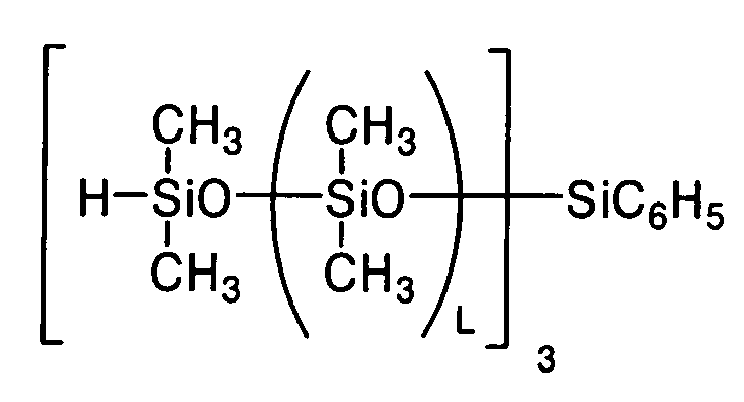
- The quantity added of the component (B) is sufficient to provide from 0.4 to 10.0 mols, and preferably from 1.2 to 5.0 mols, of hydrogen atoms bonded to silicon atoms within the component (B) for each 1 mol of alkenyl groups bonded to silicon atoms within the overall composition (and in particular, alkenyl groups bonded to silicon atoms within the component (A)). If this quantity of hydrogen atoms is less than 0.4 mols, then curing of the composition may be inadequate, making it difficult to obtain a cured product with the required strength. In contrast, if the quantity of hydrogen atoms exceeds 10.0 mols, then the composition may undergo foaming on curing, and the physical properties of the cured product may be prone to changes over time.
- The platinum group metal-based catalyst of the component (C) has a function of accelerating the addition reaction (hydrosilylation reaction) between the alkenyl group-containing organopolysiloxane of the component (A) and the organohydrogenpolysiloxane of the component (B). The component (C) may use either a single material, or a combination of two or more different materials. Conventional hydrosilylation reaction catalysts can be used as the component (C). Specific examples of the catalyst include platinum black, chloroplatinic acid, alcohol-modified products of chloroplatinic acid, complexes of chloroplatinic acid with olefins, aldehydes, vinylsiloxanes or acetylene alcohols, and rhodium.
- In those cases where it is necessary to suppress contamination of the composition of the present invention by chlorine ions, a platinum-based catalyst that contains essentially no chlorine ions can be used. Examples of such catalysts include zero-valent platinum complexes containing not more than 5 ppm of chlorine ions. Specific examples of these catalysts include the vinylsiloxane-platinum complexes disclosed in
U.S. Pat. No. 3,715,334 ,No. 3,775,452 , andNo. 3,814,730 . - The quantity added of the component (C) need only be sufficient to ensure effective activity as a hydrosilylation reaction catalyst, and can be increased or decreased in accordance with the desired curing rate. A typical quantity, calculated as the mass of platinum group metal atoms relative to the total mass of the composition, is within a range from 0.1 to 2,000 ppm, and quantities from 1 to 200 ppm are preferred.
- The component (D) is a curing retarder, which is added to regulate the curing time of the composition of the present invention, thereby making the composition more suitable for practical application. The component (D) may use either a single material, or a combination of two or more different materials. Examples of the component (D) include conventional curing retarders, and specific examples include vinyl group-containing organopolysiloxanes such as vinylcyclotetrasiloxane; triallyl isocyanurate; alkyl maleates such as diallyl maleate; acetylene alcohol-based compounds; hydroperoxides such as ketone peroxide (Permek N, manufactured by NOF Corporation); N,N,N',N'-tetramethylethylenediamine; benzotriazole; and combinations of the above compounds. Of these, acetylene alcohol-based compounds are particularly preferred.
- Specific examples of acetylene alcohol-based compounds include acetylene alcohols, and silane-modified or siloxane-modified products thereof.
- Amongst the acetylene alcohols, compounds in which the ethynyl group and the hydroxyl group are bonded to the same carbon atom are particularly preferred. Specific examples of such compounds include the compounds shown below.


- Furthermore, silane-modified and siloxane-modified products of acetylene alcohols refer to compounds in which the hydroxyl group of the acetylene alcohol has been converted to a Si-O-C linkage through silylation with either an alkoxysilane or an alkoxysiloxane respectively. Specific examples include the compounds shown below.


- The quantity added of the component (D) need only be sufficient to ensure the desired curing time, and can be increased or decreased as required, but is typically within a range from 0.0001 to 10 parts by mass, and preferably from 0.01 to 1 part by mass, per 100 parts by mass of the component (A).
- The component (E) is an acid-receiving agent which is inorganic, and is added to adsorb and neutralize residual acid components left after synthesis of the organohydrogenpolysiloxane of the component (B) and subsequently incorporated within the composition of the present invention. The compression set for a cured product of an addition curing silicone composition including the aforementioned components (A) through (D) can be effectively reduced by preparing a composition including said components (A) through (E) and curing said composition including said components (A) through (E) at room temperature or under heating. The component (E) may use either a single compound, or a combination of two or more different compounds.
- The component (E) is preferably a compound that does not release the trapped acid even at high temperatures, and examples of materials that satisfy this requirement include acid adsorbents which are inorganic, and basic inorganic fillers. Specific examples of suitable acid adsorbents which are inorganic include the Kyoward series of products such as Kyoward 500 (manufactured by Kyowa Chemical Industry Co., Ltd.),and the IXE series of products such as IXE600 (manufactured by Toagosei Co., Ltd.). Examples of suitable basic inorganic fillers include carbonate salts of alkaline earth metals, and carbonate salts of alkali metals. Of these basic inorganic fillers, considering the effects on other properties of the composition of the present invention, carbonate salts of alkaline earth metals are preferred, and amongst these carbonate salts, calcium carbonate and zinc carbonate are particularly suitable owing to their ready availability. Because the component (E) can be added to a composition of the present invention without impairing the storage stability or curing stability of the composition, the composition can be distributed as a one-part type composition that contains the component (E). There are no particular restrictions on the time when the component (E) is mixed with the components (A) through (D). For example, the components (A) through (E) may be mixed together at the same time. The component (E) may also be added to the mixture of the components (A) through (D).
- There are no particular restrictions on the quantity added of the component (E), and a suitable quantity can be selected in accordance with factors such as the manifestation of the effects of the composition, and the physical properties of the resulting cured product. Specifically, the quantity is typically within a range from 0.01 to 50 parts by mass, and preferably from 0.1 to 30 parts by mass, per 100 parts by mass of the component (A).
- Adhesion-imparting agents such as alkoxysilanes may also be added to a composition of the present invention. These adhesion-imparting agents impart the composition of the present invention with superior self-adhesiveness to a variety of substrates such as metals and organic resins. Examples of suitable adhesion-imparting agents include organosilicon compounds such as silanes containing at least one, and preferably two or more, functional groups selected from a group consisting of alkenyl groups such as a vinyl groups, (meth)acryloxy groups, hydrosilyl groups (SiH groups), epoxy groups, alkoxy groups, carbonyl groups and phenyl groups, and cyclic or straight-chain siloxanes containing from 2 to 30, and preferably from 4 to 20, silicon atoms, as well as (mono-, di-, or tri-) alkoxysilyl-modified products of triallyl isocyanurate, and (partial) hydrolysis-condensation products thereof (namely, silicone-modified triallyl isocyanurates).
- These adhesion-imparting agents may be used either alone, or in combinations of two or more different compounds, and the quantity used is typically not more than 15 parts by mass (that is, from 0 to 15 parts by mass), preferably from 0.01 to 10 parts by mass, and even more preferably from 0.1 to 5 parts by mass, per 100 parts by mass of the component (A), and although there are no particular restrictions on the quantity provided the addition does not impair the effects of the present invention, in those cases where the adhesion-imparting agent includes hydrosilyl groups (SiH groups) within the molecule, the quantity of the adhesion-imparting agent is preferably adjusted so that the molar ratio of the combined total of the hydrogen atoms bonded to silicon atoms (SiH groups) within the component (B) and the hydrogen atom bonded to silicon atoms (SiH groups) within the adhesion-imparting agent, relative to each 1 mol of alkenyl groups bonded to silicon atoms within the component (A), is within a range from 0.4 to 10, and particularly from 1.2 to 5.0.
- Specific examples of the adhesion-imparting agent include the compounds shown below. Me represents a methyl group.


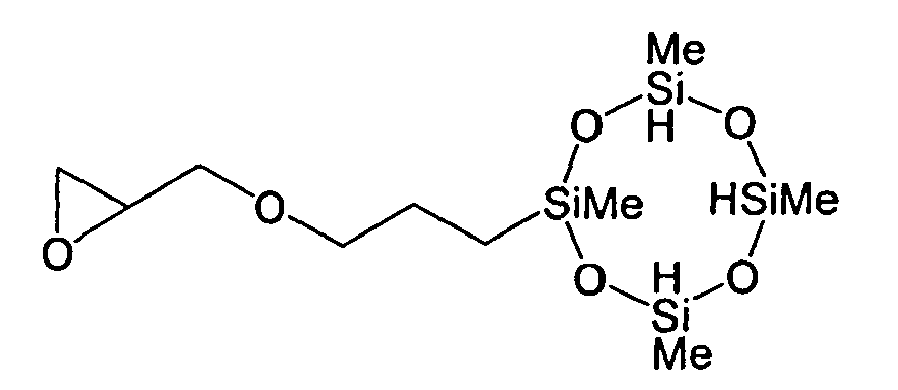


CH2=CHSi(OC2H4OCH3)3,


- An adhesion-imparting agent such as those described above imparts the composition with self-adhesiveness, and improves the adhesion of the composition to substrates. There are no particular restrictions on the adherend, and suitable examples include glass, metals such as stainless steel and aluminum, and thermoplastic resins such as PBT, PPS, nylon, and ABS.
- Other components may also be added to a composition of the present invention, provided the quantity in which they are added does not impair the effects of the composition, and examples of such additives include reinforcing silica fillers, non-reinforcing fillers such as quartz powder and diatomaceous earth, colorants such as inorganic pigments like cobalt blue, and organic dyes, and heat resistance or flame retardancy improvement agents such as cerium oxide, red iron oxide, titanium oxide, and carbon black. In addition, in order to improve the conductive stability, carbon black or graphite or the like may also be added to the composition of the present invention in a powdered form, as whiskers, or in a highly structured form.
- A composition of the present invention exhibits excellent storage stability and curing stability, and can therefore be prepared as a one-part type composition, thus offering excellent workability. Furthermore, in a similar manner to conventional curable silicone rubber compositions, a composition of the present invention may also be prepared or stored as two or more separate liquids, with these liquids then mixed together and cured at the time of use. Accordingly, there are no particular restrictions on the configuration of the composition of the present invention, and either a one-part type or two-part type composition is suitable, although in terms of workability at the time of use, a one-part type composition is preferred.
- A cured product of a composition of the present invention exhibits superior compression set. Furthermore, as described above, the composition is able to be prepared as a one-part type composition, and consequently also provides excellent workability. In addition, if required, the composition may be imparted with adhesiveness, enabling an improvement in the level of adhesion to substrates. Accordingly, a composition of the present invention is particularly suited to use within CIPG applications.
- A composition of the present invention can be applied to a substrate selected in accordance with the application, and subsequently cured by heating. There are no particular restrictions on the curing conditions employed, which vary depending on the quantity of the composition. The curing temperature is preferably within a range from room temperature (23±3°C) to 180°C, and even more preferably from room temperature to 120°C. A typical curing time is within a range from approximately 5 to 1,000 minutes.
- A composition of the present invention is useful for sealing electronic components and structural components. These components can be sealed using a cured product of a composition of the present invention, using a method comprising the steps of:
- applying the composition to the component, and
- curing the composition to form a cured product on top of the component, thereby sealing the component with the cured product.
- The curing conditions can employ the same conditions as those described above. Examples of suitable electronic components include transistors, IC, CPU or memory components, sensors, and electrical cells. Examples of suitable structural components include ECUs for vehicle installation, electrical equipment such as sensors, and mobile equipment.
- As follows is a more detailed description of the present invention, based on a series of examples and comparative examples, although the present invention is in no way restricted to the examples presented below.
- Various components were mixed together as per the Table 1, thus forming a series of compositions. In the table, the blend quantity of each component is shown in parts by mass. The components (A) through (F) in the table used the compounds shown below. Me represents a methyl group, and Vi represents a vinyl group.
- A vinyl group-containing organopolysiloxane represented by the formula:
ViMe2Si-O-(SiMe2-O)500-SiMe2Vi (viscosity: 10,000 mPa·s)
- A hydrogenpolysiloxane represented by the formula:
Me3Si-O-(SiMe2-O)10-(SiMeH-O)30-SiMe3 (viscosity: 70 mPa·s)
- A toluene solution of a complex of platinum and 1,2-divinyl-1,1,2,2-tetramethyldisiloxane (platinum content: 0.5% by mass)
- A toluene solution of ethynylcyclohexanol (50% by mass)
-
- a. IXE (a registered trademark) -600 (Toagosei)
- b. IXE (a registered trademark) -700 (Toagosei)
- c. Kyoward (a registered trademark) 500 (Kyowa Chemical Industry Co., Ltd.)
- d. Calcium carbonate
- e. Zinc carbonate
-
- a. A compound represented by the formula below.

- b. A compound represented by the formula below.

- Using a rotational viscometer RB-80H (manufactured by Toki Sangyo Co., Ltd.), the viscosity of each of the compositions was measured immediately following preparation (initial), and then following storage for 7 days at 40°C. The results are shown in Table 1.
- Samples of the (initial) compositions immediately following preparation, and the compositions following storage for 7 days at 40°C were cured by heating at 120°C for 60 minutes. The hardness of each of the resulting cured products was then measured using a durometer type A hardness meter. The results of the measurements are shown in
- Samples of the compositions were cured by heating at 120°C for 60 minutes immediately following preparation, thus forming molded products with dimensions including a diameter of 25 mm and a height of 12.0 mm. Using a compression jig, the height of the molded product was compressed to 9.0 mm at a temperature of 110°C, and the molded product was held in that state for a period of 100 hours, 500 hours, or 1,000 hours. The height H of the molded product 30 minutes after completion and release of the compression was measured, and the compression set (%) was calculated using the following formula.

- Immediately following preparation, each of the compositions was sandwiched between either a pair of glass plates or a pair of stainless steel (SUS304) plates, and was subsequently cured by heating at 100°C for 60 minutes. The adhesive surface area was 25 mm × 10 mm, and the thickness of the adhesive layer was 2.0 mm. The shear adhesive strength of the thus obtained cured product was measured using an Autograph (AG-IS) device manufactured by Shimadzu Corporation. The results are shown in Table 1.
Table 1 Example Comparative example 1 2 3 4 5 6 7 8 1 2 3 4 5 6 (A) V-Sx 100 100 100 100 100 100 100 100 100 100 100 100 100 100 Fumed silica 10 10 10 10 10 10 10 10 10 10 10 10 10 10 (C) Platinum catalyst 0.1 0.1 0.1 0.1 0.1 0.1 0.1 0.1 0.1 0.1 0.1 0.1 0.1 0.1 (D) Curing retarder 0.2 0.2 0.2 0.2 0.2 0.2 0.2 0.2 0.2 0.2 0.2 0.2 0.2 0.2 (B) H-Sx 2.5 2.5 2.5 2.5 2.5 2.5 2.5 2 2.5 2.5 2 2.5 2.5 2.5 (E) Acid-receiving agent which is inorganic a 1 b 1 1 1 c 1 d 1 10 e 1 (F) Adhesion-imparting agent a 1 1 b 2 2 Cerium oxide 1 TIPT 1 0.1% aqueous solution of DTMA 0.1 Viscosity (Pa·s) Initial 61 62 61 63 70 65 120 150 60 130 150 65 80 72 After storage 62 63 61 62 75 68 130 160 62 140 160 70 360 73 Hardness Initial 35 35 35 36 41 36 32 33 35 30 31 32 28 18 After storage 35 35 36 36 42 36 32 34 35 31 32 25 11 x 25% Compression set (%) (110°C) 100 hours 18 16 20 18 16 20 18 19 24 26 27 23 34 22 500 hours 23 20 25 20 18 25 22 24 31 33 35 33 38 28 1,000 hours 30 26 32 29 23 32 29 31 46 50 53 43 42 37 Shear adhesive strength (MPa) (100°C x 60 min.) Glass - - - - - - 1.9 1.9 - 1.8 1.9 - - - SUS - - - - - - 1.9 2 - 2 1.9 - - - (Notes) TIPT: tetraisopropoxy titanium, DTMA: dodecyltrimethylammonium, x: did not cure.
Claims (15)
- An addition curing silicone composition for CIPG, comprising:(A) 100 parts by mass of an organopolysiloxane containing at least two alkenyl groups bonded to silicon atoms within each molecule, represented by an average composition formula (1) shown below:
R1 aR2 bSiO(4-a-b)/2 (1)
(wherein, each R1 represents, independently, an unsubstituted or substituted monovalent hydrocarbon group that contains no aliphatic unsaturated bonds, each R2 represents, independently, an alkenyl group, a represents a number from 1.0 to 2.2, b represents a number from 0.0001 to 0.5, and a+b represents a number within a range from 1.5 to 2.7),(B) an organohydrogenpolysiloxane represented by an average composition formula (2) shown below:
R3 cHdSiO(4-c-d)/2 (2)
(wherein, each R3 represents, independently, an unsubstituted or substituted monovalent hydrocarbon group that contains no aliphatic unsaturated bonds, c represents a number from 0.7 to 2.1, d represents a number from 0.001 to 1.2, and c+d represents a number within a range from 0.8 to 3.0), in sufficient quantity to provide from 0.4 to 10.0 mols of hydrogen atoms bonded to silicon atoms within said component (B) for every 1 mol of alkenyl groups bonded to silicon atoms within said composition,(C) an effective quantity of a platinum group metal-based catalyst,(D) a curing retarder, and(E) an acid-receiving agent which is inorganic. - The composition according to claim 1, wherein said component (E) is an acid adsorbent which is inorganic.
- The composition according to claim 1, wherein said component (E) is a basic inorganic filler.
- The composition according to claim 3, wherein said basic inorganic filler is a carbonate salt of an alkaline earth metal.
- The composition according to claim 1, wherein said composition exhibits self-adhesiveness.
- The composition according to claim 1, wherein said composition is a one-part type composition.
- A method of reducing compression set for a cured product of an addition curing silicone composition, comprising:(A) 100 parts by mass of an organopolysiloxane containing at least two alkenyl groups bonded to silicon atoms within each molecule, represented by an average composition formula (1) shown below:
R1 aR2 bSiO(4-a-b)/2 (1)
(wherein, each R1 represents, independently, an unsubstituted or substituted monovalent hydrocarbon group that contains no aliphatic unsaturated bonds, each R2 represents, independently, an alkenyl group, a represents a number from 1.0 to 2.2, b represents a number from 0.0001 to 0.5, and a+b represents a number within a range from 1.5 to 2.7),(B) an organohydrogenpolysiloxane represented by an average composition formula (2) shown below:
R3 cHdSiO(4-c-d)/2 (2)
(wherein, each R3 represents, independently, an unsubstituted or substituted monovalent hydrocarbon group that contains no aliphatic unsaturated bonds, c represents a number from 0.7 to 2.1, d represents a number from 0.001 to 1.2, and c+d represents a number within a range from 0.8 to 3.0), in sufficient quantity to provide from 0.4 to 10.0 mols of hydrogen atoms bonded to silicon atoms within said component (B) for every 1 mol of alkenyl groups bonded to silicon atoms within said composition,(C) an effective quantity of a platinum group metal-based catalyst, and(D) a curing retarder,said method comprising the steps of:preparing a composition comprising said components (A) through (D) and (E) an acid-receiving agent which is inorganic, andcuring said composition comprising said components (A) through (E) at room temperature or under heating to produce a cured product with a reduced compression set from said composition comprising said components (A) through (E). - The method according to claim 7, wherein said component (E) is an acid adsorbent which is inorganic.
- The method according to claim 7, wherein said component (E) is a basic inorganic filler.
- The method according to claim 9, wherein said basic inorganic filler is a carbonate salt of an alkaline earth metal.
- The method according to claim 7, wherein said composition exhibits self-adhesiveness.
- The method according to claim 7, wherein said composition is a one-part type composition.
- A cured product obtained by curing the composition according to claim 1.
- A sealing material comprising the composition according to claim 1.
- A method for sealing a substrate with a cured product of the composition according to claim 1, comprising the steps of:applying said composition to said substrate, andcuring said composition to form said cured product on top of said substrate, thereby sealing said substrate with said cured product.
Applications Claiming Priority (1)
| Application Number | Priority Date | Filing Date | Title |
|---|---|---|---|
| JP2005333301 | 2005-11-17 |
Publications (3)
| Publication Number | Publication Date |
|---|---|
| EP1788032A2 true EP1788032A2 (en) | 2007-05-23 |
| EP1788032A3 EP1788032A3 (en) | 2008-05-21 |
| EP1788032B1 EP1788032B1 (en) | 2012-11-14 |
Family
ID=37744265
Family Applications (1)
| Application Number | Title | Priority Date | Filing Date |
|---|---|---|---|
| EP06255822A Active EP1788032B1 (en) | 2005-11-17 | 2006-11-14 | Use of basic carbonates for reducing the compression set in addition curing silicone compositions |
Country Status (2)
| Country | Link |
|---|---|
| US (2) | US20070112149A1 (en) |
| EP (1) | EP1788032B1 (en) |
Families Citing this family (5)
| Publication number | Priority date | Publication date | Assignee | Title |
|---|---|---|---|---|
| US8575273B2 (en) * | 2008-11-26 | 2013-11-05 | Schlumberger Technology Corporation | Coupling agents and compositions produced using them |
| US9403962B2 (en) | 2011-12-22 | 2016-08-02 | Schlumberger Technology Corporation | Elastomer compositions with silane functionalized silica as reinforcing fillers |
| CN106633910A (en) * | 2016-08-26 | 2017-05-10 | 苏州沃尔兴电子科技有限公司 | High-elasticity high-tear-resistance solid silicone rubber composition and preparation method thereof |
| JP6836697B1 (en) * | 2019-10-29 | 2021-03-03 | モメンティブ・パフォーマンス・マテリアルズ・ジャパン合同会社 | Polyorganosiloxane composition for adhesion of polyphenylene sulfide resin |
| JP2023532407A (en) * | 2020-06-24 | 2023-07-28 | ダウ グローバル テクノロジーズ エルエルシー | silicone rubber composition |
Citations (8)
| Publication number | Priority date | Publication date | Assignee | Title |
|---|---|---|---|---|
| EP0415180A2 (en) | 1989-08-28 | 1991-03-06 | General Electric Company | Low compression set, oil and fuel resistant, liquid injection moldable, silicone rubber |
| EP0489391A2 (en) | 1990-12-03 | 1992-06-10 | Dow Corning Corporation | Extrudable curable organosiloxane compositions |
| EP0581504A2 (en) | 1992-07-30 | 1994-02-02 | Dow Corning Corporation | Self-adhering silicone rubber with low compression set |
| EP0926190A1 (en) | 1997-12-29 | 1999-06-30 | General Electric Company | A Process for imparting low compression set to liquid injection moldable silicone elastomers |
| US6354620B1 (en) | 1999-08-13 | 2002-03-12 | Dow Corning Corporation | Silicone coated textile fabrics |
| EP1225211A2 (en) | 2001-01-17 | 2002-07-24 | Dow Corning Toray Silicone Company Ltd. | Adhesive for silicone rubber |
| WO2004070101A1 (en) | 2003-02-06 | 2004-08-19 | Dürkopp Adler Aktiengesellschaft | Button hole sewing machine |
| US20050137321A1 (en) | 2003-11-03 | 2005-06-23 | Rhodia Chimie | Silicone composition and process that is useful for improving the tear strength and the combing strength of an inflatable bag for protecting an occupant of a vehicle |
Family Cites Families (11)
| Publication number | Priority date | Publication date | Assignee | Title |
|---|---|---|---|---|
| US4762537A (en) * | 1985-11-07 | 1988-08-09 | Aluminum Company Of America | Adsorbent for HCl comprising alumina and acid-treated Y zeolite |
| JP2632614B2 (en) * | 1991-10-22 | 1997-07-23 | 信越化学工業株式会社 | Fluorosilicone composition and gel-like cured product thereof |
| WO1996031574A1 (en) * | 1995-04-04 | 1996-10-10 | Hitachi Chemical Company, Ltd. | Adhesive, adhesive film and adhesive-backed metal foil |
| US5595826A (en) * | 1995-10-11 | 1997-01-21 | Dow Corning Corporation | Curable organopolysiloxane compositions with improved adhesion |
| JP3500973B2 (en) * | 1998-07-15 | 2004-02-23 | 信越化学工業株式会社 | Oil bleed silicone rubber composition |
| US5989719A (en) * | 1998-10-13 | 1999-11-23 | Dow Corning Corporation | Oil resistant liquid silicone rubber compositions |
| DE10204893A1 (en) * | 2002-02-06 | 2003-08-14 | Ge Bayer Silicones Gmbh & Co | Self-adhesive addition-crosslinking silicone rubber mixtures, a process for their production, process for the production of composite molded parts and their use |
| CN1681864A (en) * | 2002-09-20 | 2005-10-12 | 三井武田化学株式会社 | Thermoplastic polymer compound, thermoplastic polymer composition, antistat and resin composition |
| WO2004070102A2 (en) * | 2003-02-04 | 2004-08-19 | Dow Corning Corporation | Coating compositions and textile fabrics coated therewith |
| JP4430470B2 (en) * | 2004-07-09 | 2010-03-10 | 信越化学工業株式会社 | Addition reaction curable silicone rubber composition |
| JP4628715B2 (en) * | 2004-07-13 | 2011-02-09 | 信越化学工業株式会社 | Curable organopolysiloxane composition and casting mold |
-
2006
- 2006-11-14 EP EP06255822A patent/EP1788032B1/en active Active
- 2006-11-16 US US11/560,659 patent/US20070112149A1/en not_active Abandoned
-
2008
- 2008-07-25 US US12/180,142 patent/US20080287603A1/en not_active Abandoned
Patent Citations (8)
| Publication number | Priority date | Publication date | Assignee | Title |
|---|---|---|---|---|
| EP0415180A2 (en) | 1989-08-28 | 1991-03-06 | General Electric Company | Low compression set, oil and fuel resistant, liquid injection moldable, silicone rubber |
| EP0489391A2 (en) | 1990-12-03 | 1992-06-10 | Dow Corning Corporation | Extrudable curable organosiloxane compositions |
| EP0581504A2 (en) | 1992-07-30 | 1994-02-02 | Dow Corning Corporation | Self-adhering silicone rubber with low compression set |
| EP0926190A1 (en) | 1997-12-29 | 1999-06-30 | General Electric Company | A Process for imparting low compression set to liquid injection moldable silicone elastomers |
| US6354620B1 (en) | 1999-08-13 | 2002-03-12 | Dow Corning Corporation | Silicone coated textile fabrics |
| EP1225211A2 (en) | 2001-01-17 | 2002-07-24 | Dow Corning Toray Silicone Company Ltd. | Adhesive for silicone rubber |
| WO2004070101A1 (en) | 2003-02-06 | 2004-08-19 | Dürkopp Adler Aktiengesellschaft | Button hole sewing machine |
| US20050137321A1 (en) | 2003-11-03 | 2005-06-23 | Rhodia Chimie | Silicone composition and process that is useful for improving the tear strength and the combing strength of an inflatable bag for protecting an occupant of a vehicle |
Also Published As
| Publication number | Publication date |
|---|---|
| US20070112149A1 (en) | 2007-05-17 |
| EP1788032B1 (en) | 2012-11-14 |
| EP1788032A3 (en) | 2008-05-21 |
| US20080287603A1 (en) | 2008-11-20 |
Similar Documents
| Publication | Publication Date | Title |
|---|---|---|
| CN1207361C (en) | Adhesive for silicone rubber | |
| EP1945716B1 (en) | Curable silicone composition | |
| EP2110401B1 (en) | Addition-curable silicone composition and cured product thereof | |
| US20060009577A1 (en) | Addition reaction curable silicone rubber composition | |
| EP1778768B1 (en) | Integrally molded body of silicone resin and silicone rubber, method of manufacture, and curable silicone resin composition | |
| CN111417687B (en) | Silicone rubber composition and composite material obtained using the same | |
| US20050250903A1 (en) | Silicone gel composition | |
| EP3666828B1 (en) | Addition-curable silicone composition and cured silicone rubber | |
| EP0934981B1 (en) | Addition curing type silicone compositions | |
| US20090105441A1 (en) | Curable Organopolysiloxane Composition | |
| US20060040116A1 (en) | Two-part curable silicone composition | |
| CN103459507B (en) | Two-part silicone rubber composition | |
| JP4541842B2 (en) | Self-adhesive organopolysiloxane composition | |
| KR102794275B1 (en) | Additive curing silicone adhesive composition | |
| US20080287603A1 (en) | Addition curing silicone composition for cipg that yields cured product with excellent compression set, and method of reducing compression set of cured product of the composition | |
| JP6468115B2 (en) | Addition-curable silicone rubber composition and cured product | |
| US20070100065A1 (en) | Silicone rubber composition for sealing stitched air bag | |
| JPH11335564A (en) | Addition-curable silicone composition | |
| KR102750550B1 (en) | Adhesive polyorganosiloxane composition | |
| US20090312475A1 (en) | Silicone Rubber Composition | |
| CN111117256B (en) | Addition-curable silicone resin composition, cured product thereof, and optical semiconductor device | |
| EP1728829B1 (en) | Addition type silicone adhesive composition | |
| EP3770219B1 (en) | Silicone gel composition, cured product thereof, and power module | |
| JP2007161999A (en) | Addition-curable silicone composition for CIPG that gives a cured product excellent in compression set characteristics, and method for reducing compression set of cured product of the composition | |
| JP3918944B2 (en) | Addition-curing silicone composition |
Legal Events
| Date | Code | Title | Description |
|---|---|---|---|
| PUAI | Public reference made under article 153(3) epc to a published international application that has entered the european phase |
Free format text: ORIGINAL CODE: 0009012 |
|
| AK | Designated contracting states |
Kind code of ref document: A2 Designated state(s): AT BE BG CH CY CZ DE DK EE ES FI FR GB GR HU IE IS IT LI LT LU LV MC NL PL PT RO SE SI SK TR |
|
| AX | Request for extension of the european patent |
Extension state: AL BA HR MK RS |
|
| PUAL | Search report despatched |
Free format text: ORIGINAL CODE: 0009013 |
|
| AK | Designated contracting states |
Kind code of ref document: A3 Designated state(s): AT BE BG CH CY CZ DE DK EE ES FI FR GB GR HU IE IS IT LI LT LU LV MC NL PL PT RO SE SI SK TR |
|
| AX | Request for extension of the european patent |
Extension state: AL BA HR MK RS |
|
| RIC1 | Information provided on ipc code assigned before grant |
Ipc: C08L 83/07 20060101ALI20080416BHEP Ipc: C09J 183/04 20060101ALI20080416BHEP Ipc: C08G 77/50 20060101ALI20080416BHEP Ipc: C08L 83/04 20060101AFI20070222BHEP |
|
| 17P | Request for examination filed |
Effective date: 20081016 |
|
| 17Q | First examination report despatched |
Effective date: 20081201 |
|
| AKX | Designation fees paid |
Designated state(s): DE |
|
| RTI1 | Title (correction) |
Free format text: USE OF BASIC CARBONATES FOR REDUCING THE COMPRESSION SET IN ADDITION CURING SILICONE COMPOSITIONS |
|
| GRAP | Despatch of communication of intention to grant a patent |
Free format text: ORIGINAL CODE: EPIDOSNIGR1 |
|
| GRAS | Grant fee paid |
Free format text: ORIGINAL CODE: EPIDOSNIGR3 |
|
| GRAA | (expected) grant |
Free format text: ORIGINAL CODE: 0009210 |
|
| AK | Designated contracting states |
Kind code of ref document: B1 Designated state(s): DE |
|
| REG | Reference to a national code |
Ref country code: DE Ref legal event code: R096 Ref document number: 602006033019 Country of ref document: DE Effective date: 20130110 |
|
| PLBE | No opposition filed within time limit |
Free format text: ORIGINAL CODE: 0009261 |
|
| STAA | Information on the status of an ep patent application or granted ep patent |
Free format text: STATUS: NO OPPOSITION FILED WITHIN TIME LIMIT |
|
| 26N | No opposition filed |
Effective date: 20130815 |
|
| REG | Reference to a national code |
Ref country code: DE Ref legal event code: R097 Ref document number: 602006033019 Country of ref document: DE Effective date: 20130815 |
|
| PGFP | Annual fee paid to national office [announced via postgrant information from national office to epo] |
Ref country code: DE Payment date: 20241001 Year of fee payment: 19 |