EP1787971A2 - Process for preparing aryl allyl ethers - Google Patents
Process for preparing aryl allyl ethers Download PDFInfo
- Publication number
- EP1787971A2 EP1787971A2 EP07004664A EP07004664A EP1787971A2 EP 1787971 A2 EP1787971 A2 EP 1787971A2 EP 07004664 A EP07004664 A EP 07004664A EP 07004664 A EP07004664 A EP 07004664A EP 1787971 A2 EP1787971 A2 EP 1787971A2
- Authority
- EP
- European Patent Office
- Prior art keywords
- allyl
- moiety
- rare earth
- ligand
- catalyst
- Prior art date
- Legal status (The legal status is an assumption and is not a legal conclusion. Google has not performed a legal analysis and makes no representation as to the accuracy of the status listed.)
- Withdrawn
Links
- -1 aryl allyl ethers Chemical class 0.000 title claims abstract description 147
- 238000004519 manufacturing process Methods 0.000 title claims abstract description 18
- 239000003446 ligand Substances 0.000 claims abstract description 230
- 239000003054 catalyst Substances 0.000 claims abstract description 153
- 229910052761 rare earth metal Inorganic materials 0.000 claims abstract description 121
- 150000002910 rare earth metals Chemical class 0.000 claims abstract description 121
- 238000000034 method Methods 0.000 claims abstract description 105
- 238000005937 allylation reaction Methods 0.000 claims abstract description 94
- 230000008569 process Effects 0.000 claims abstract description 89
- 125000003118 aryl group Chemical group 0.000 claims abstract description 65
- HVAMZGADVCBITI-UHFFFAOYSA-M pent-4-enoate Chemical compound [O-]C(=O)CCC=C HVAMZGADVCBITI-UHFFFAOYSA-M 0.000 claims abstract description 64
- 150000002989 phenols Chemical class 0.000 claims abstract description 49
- 150000001875 compounds Chemical class 0.000 claims abstract description 39
- 229910052707 ruthenium Inorganic materials 0.000 claims abstract description 30
- KJTLSVCANCCWHF-UHFFFAOYSA-N Ruthenium Chemical compound [Ru] KJTLSVCANCCWHF-UHFFFAOYSA-N 0.000 claims abstract description 28
- ZSWFCLXCOIISFI-UHFFFAOYSA-N endo-cyclopentadiene Natural products C1C=CC=C1 ZSWFCLXCOIISFI-UHFFFAOYSA-N 0.000 claims abstract description 16
- 125000000058 cyclopentadienyl group Chemical group C1(=CC=CC1)* 0.000 claims abstract description 8
- 238000002360 preparation method Methods 0.000 claims abstract description 8
- 239000004593 Epoxy Substances 0.000 claims abstract description 7
- YBYIRNPNPLQARY-UHFFFAOYSA-N 1H-indene Natural products C1=CC=C2CC=CC2=C1 YBYIRNPNPLQARY-UHFFFAOYSA-N 0.000 claims abstract description 3
- 125000003454 indenyl group Chemical group C1(C=CC2=CC=CC=C12)* 0.000 claims abstract description 3
- 125000002097 pentamethylcyclopentadienyl group Chemical group 0.000 claims abstract description 3
- IISBACLAFKSPIT-UHFFFAOYSA-N bisphenol A Chemical compound C=1C=C(O)C=CC=1C(C)(C)C1=CC=C(O)C=C1 IISBACLAFKSPIT-UHFFFAOYSA-N 0.000 claims description 54
- 238000006243 chemical reaction Methods 0.000 claims description 44
- 125000005842 heteroatom Chemical group 0.000 claims description 38
- 239000003153 chemical reaction reagent Substances 0.000 claims description 36
- 239000002904 solvent Substances 0.000 claims description 28
- 239000002638 heterogeneous catalyst Substances 0.000 claims description 27
- 239000011541 reaction mixture Substances 0.000 claims description 26
- 239000007787 solid Substances 0.000 claims description 23
- 125000001931 aliphatic group Chemical group 0.000 claims description 18
- 239000000463 material Substances 0.000 claims description 16
- SCZZNWQQCGSWSZ-UHFFFAOYSA-N 1-prop-2-enoxy-4-[2-(4-prop-2-enoxyphenyl)propan-2-yl]benzene Chemical compound C=1C=C(OCC=C)C=CC=1C(C)(C)C1=CC=C(OCC=C)C=C1 SCZZNWQQCGSWSZ-UHFFFAOYSA-N 0.000 claims description 12
- 125000004435 hydrogen atom Chemical group [H]* 0.000 claims description 8
- 239000002815 homogeneous catalyst Substances 0.000 claims description 6
- 125000004368 propenyl group Chemical group C(=CC)* 0.000 claims description 4
- 150000003303 ruthenium Chemical group 0.000 claims 1
- 229910052723 transition metal Inorganic materials 0.000 description 125
- 150000003624 transition metals Chemical class 0.000 description 124
- KDLHZDBZIXYQEI-UHFFFAOYSA-N Palladium Chemical compound [Pd] KDLHZDBZIXYQEI-UHFFFAOYSA-N 0.000 description 64
- ISWSIDIOOBJBQZ-UHFFFAOYSA-N Phenol Chemical compound OC1=CC=CC=C1 ISWSIDIOOBJBQZ-UHFFFAOYSA-N 0.000 description 43
- 229910052751 metal Inorganic materials 0.000 description 36
- 239000002184 metal Substances 0.000 description 36
- POSICDHOUBKJKP-UHFFFAOYSA-N prop-2-enoxybenzene Chemical compound C=CCOC1=CC=CC=C1 POSICDHOUBKJKP-UHFFFAOYSA-N 0.000 description 33
- XXROGKLTLUQVRX-UHFFFAOYSA-N allyl alcohol Chemical compound OCC=C XXROGKLTLUQVRX-UHFFFAOYSA-N 0.000 description 32
- 239000000203 mixture Substances 0.000 description 27
- 229910052760 oxygen Inorganic materials 0.000 description 27
- 239000003822 epoxy resin Substances 0.000 description 26
- 229920000647 polyepoxide Polymers 0.000 description 26
- XYFCBTPGUUZFHI-UHFFFAOYSA-N Phosphine Chemical compound P XYFCBTPGUUZFHI-UHFFFAOYSA-N 0.000 description 25
- 238000004458 analytical method Methods 0.000 description 25
- 239000001257 hydrogen Substances 0.000 description 24
- 229910052739 hydrogen Inorganic materials 0.000 description 24
- 229910052763 palladium Inorganic materials 0.000 description 24
- RIOQSEWOXXDEQQ-UHFFFAOYSA-N triphenylphosphine Chemical compound C1=CC=CC=C1P(C=1C=CC=CC=1)C1=CC=CC=C1 RIOQSEWOXXDEQQ-UHFFFAOYSA-N 0.000 description 24
- UFHFLCQGNIYNRP-UHFFFAOYSA-N Hydrogen Chemical compound [H][H] UFHFLCQGNIYNRP-UHFFFAOYSA-N 0.000 description 23
- 238000004817 gas chromatography Methods 0.000 description 23
- 239000012299 nitrogen atmosphere Substances 0.000 description 23
- BHEPBYXIRTUNPN-UHFFFAOYSA-N hydridophosphorus(.) (triplet) Chemical compound [PH] BHEPBYXIRTUNPN-UHFFFAOYSA-N 0.000 description 22
- 229910052710 silicon Inorganic materials 0.000 description 22
- BRLQWZUYTZBJKN-UHFFFAOYSA-N Epichlorohydrin Chemical compound ClCC1CO1 BRLQWZUYTZBJKN-UHFFFAOYSA-N 0.000 description 20
- YJVFFLUZDVXJQI-UHFFFAOYSA-L palladium(ii) acetate Chemical compound [Pd+2].CC([O-])=O.CC([O-])=O YJVFFLUZDVXJQI-UHFFFAOYSA-L 0.000 description 20
- 125000002887 hydroxy group Chemical group [H]O* 0.000 description 19
- BASFCYQUMIYNBI-UHFFFAOYSA-N platinum Chemical compound [Pt] BASFCYQUMIYNBI-UHFFFAOYSA-N 0.000 description 18
- ATVJXMYDOSMEPO-UHFFFAOYSA-N 3-prop-2-enoxyprop-1-ene Chemical compound C=CCOCC=C ATVJXMYDOSMEPO-UHFFFAOYSA-N 0.000 description 17
- QTBSBXVTEAMEQO-UHFFFAOYSA-N Acetic acid Chemical compound CC(O)=O QTBSBXVTEAMEQO-UHFFFAOYSA-N 0.000 description 15
- 125000004432 carbon atom Chemical group C* 0.000 description 15
- 125000001181 organosilyl group Chemical group [SiH3]* 0.000 description 15
- 239000000243 solution Substances 0.000 description 15
- 125000004429 atom Chemical group 0.000 description 14
- LNEPOXFFQSENCJ-UHFFFAOYSA-N haloperidol Chemical compound C1CC(O)(C=2C=CC(Cl)=CC=2)CCN1CCCC(=O)C1=CC=C(F)C=C1 LNEPOXFFQSENCJ-UHFFFAOYSA-N 0.000 description 14
- 229910052757 nitrogen Inorganic materials 0.000 description 14
- 239000001301 oxygen Substances 0.000 description 14
- 239000006227 byproduct Substances 0.000 description 13
- 239000008139 complexing agent Substances 0.000 description 13
- 229910052741 iridium Inorganic materials 0.000 description 13
- GKOZUEZYRPOHIO-UHFFFAOYSA-N iridium atom Chemical compound [Ir] GKOZUEZYRPOHIO-UHFFFAOYSA-N 0.000 description 13
- 239000000047 product Substances 0.000 description 13
- 125000003903 2-propenyl group Chemical group [H]C([*])([H])C([H])=C([H])[H] 0.000 description 12
- PXHVJJICTQNCMI-UHFFFAOYSA-N Nickel Chemical compound [Ni] PXHVJJICTQNCMI-UHFFFAOYSA-N 0.000 description 12
- XUIMIQQOPSSXEZ-UHFFFAOYSA-N Silicon Chemical compound [Si] XUIMIQQOPSSXEZ-UHFFFAOYSA-N 0.000 description 12
- QVGXLLKOCUKJST-UHFFFAOYSA-N atomic oxygen Chemical compound [O] QVGXLLKOCUKJST-UHFFFAOYSA-N 0.000 description 12
- 125000000217 alkyl group Chemical group 0.000 description 11
- 229910052796 boron Inorganic materials 0.000 description 11
- 150000001732 carboxylic acid derivatives Chemical class 0.000 description 11
- 125000001309 chloro group Chemical group Cl* 0.000 description 11
- 239000000543 intermediate Substances 0.000 description 11
- 229920003986 novolac Polymers 0.000 description 11
- 125000005375 organosiloxane group Chemical group 0.000 description 11
- 229910052698 phosphorus Inorganic materials 0.000 description 11
- YAYGSLOSTXKUBW-UHFFFAOYSA-N ruthenium(2+) Chemical compound [Ru+2] YAYGSLOSTXKUBW-UHFFFAOYSA-N 0.000 description 11
- 229910052717 sulfur Inorganic materials 0.000 description 11
- XEEYBQQBJWHFJM-UHFFFAOYSA-N Iron Chemical compound [Fe] XEEYBQQBJWHFJM-UHFFFAOYSA-N 0.000 description 10
- PPBRXRYQALVLMV-UHFFFAOYSA-N Styrene Chemical compound C=CC1=CC=CC=C1 PPBRXRYQALVLMV-UHFFFAOYSA-N 0.000 description 10
- JKJWYKGYGWOAHT-UHFFFAOYSA-N bis(prop-2-enyl) carbonate Chemical compound C=CCOC(=O)OCC=C JKJWYKGYGWOAHT-UHFFFAOYSA-N 0.000 description 10
- QJGQUHMNIGDVPM-UHFFFAOYSA-N nitrogen group Chemical group [N] QJGQUHMNIGDVPM-UHFFFAOYSA-N 0.000 description 10
- 229910000073 phosphorus hydride Inorganic materials 0.000 description 10
- OKKJLVBELUTLKV-UHFFFAOYSA-N Methanol Chemical compound OC OKKJLVBELUTLKV-UHFFFAOYSA-N 0.000 description 9
- 239000003795 chemical substances by application Substances 0.000 description 9
- 230000000052 comparative effect Effects 0.000 description 9
- 229910052697 platinum Inorganic materials 0.000 description 9
- QPFMBZIOSGYJDE-UHFFFAOYSA-N 1,1,2,2-tetrachloroethane Chemical compound ClC(Cl)C(Cl)Cl QPFMBZIOSGYJDE-UHFFFAOYSA-N 0.000 description 8
- 239000002585 base Substances 0.000 description 8
- YHLVIDQQTOMBGN-UHFFFAOYSA-N methyl prop-2-enyl carbonate Chemical compound COC(=O)OCC=C YHLVIDQQTOMBGN-UHFFFAOYSA-N 0.000 description 8
- 229920000642 polymer Polymers 0.000 description 8
- QQONPFPTGQHPMA-UHFFFAOYSA-N propylene Natural products CC=C QQONPFPTGQHPMA-UHFFFAOYSA-N 0.000 description 8
- 125000004805 propylene group Chemical group [H]C([H])([H])C([H])([*:1])C([H])([H])[*:2] 0.000 description 8
- XLYOFNOQVPJJNP-UHFFFAOYSA-N water Substances O XLYOFNOQVPJJNP-UHFFFAOYSA-N 0.000 description 8
- LFQSCWFLJHTTHZ-UHFFFAOYSA-N Ethanol Chemical compound CCO LFQSCWFLJHTTHZ-UHFFFAOYSA-N 0.000 description 7
- 229910003849 O-Si Inorganic materials 0.000 description 7
- 229910003872 O—Si Inorganic materials 0.000 description 7
- BLRPTPMANUNPDV-UHFFFAOYSA-N Silane Chemical compound [SiH4] BLRPTPMANUNPDV-UHFFFAOYSA-N 0.000 description 7
- 125000002524 organometallic group Chemical group 0.000 description 7
- 229910000077 silane Inorganic materials 0.000 description 7
- QFMZQPDHXULLKC-UHFFFAOYSA-N 1,2-bis(diphenylphosphino)ethane Chemical compound C=1C=CC=CC=1P(C=1C=CC=CC=1)CCP(C=1C=CC=CC=1)C1=CC=CC=C1 QFMZQPDHXULLKC-UHFFFAOYSA-N 0.000 description 6
- VVJKKWFAADXIJK-UHFFFAOYSA-N Allylamine Chemical compound NCC=C VVJKKWFAADXIJK-UHFFFAOYSA-N 0.000 description 6
- CURLTUGMZLYLDI-UHFFFAOYSA-N Carbon dioxide Chemical compound O=C=O CURLTUGMZLYLDI-UHFFFAOYSA-N 0.000 description 6
- ZOKXTWBITQBERF-UHFFFAOYSA-N Molybdenum Chemical compound [Mo] ZOKXTWBITQBERF-UHFFFAOYSA-N 0.000 description 6
- YXFVVABEGXRONW-UHFFFAOYSA-N Toluene Chemical compound CC1=CC=CC=C1 YXFVVABEGXRONW-UHFFFAOYSA-N 0.000 description 6
- 239000000654 additive Substances 0.000 description 6
- 229910052784 alkaline earth metal Inorganic materials 0.000 description 6
- 125000000753 cycloalkyl group Chemical group 0.000 description 6
- 229910052750 molybdenum Inorganic materials 0.000 description 6
- 239000011733 molybdenum Substances 0.000 description 6
- VLKZOEOYAKHREP-UHFFFAOYSA-N n-Hexane Chemical compound CCCCCC VLKZOEOYAKHREP-UHFFFAOYSA-N 0.000 description 6
- 229910052759 nickel Inorganic materials 0.000 description 6
- 239000000126 substance Substances 0.000 description 6
- WFKWXMTUELFFGS-UHFFFAOYSA-N tungsten Chemical compound [W] WFKWXMTUELFFGS-UHFFFAOYSA-N 0.000 description 6
- 229910052721 tungsten Inorganic materials 0.000 description 6
- 239000010937 tungsten Substances 0.000 description 6
- CSCPPACGZOOCGX-UHFFFAOYSA-N Acetone Chemical compound CC(C)=O CSCPPACGZOOCGX-UHFFFAOYSA-N 0.000 description 5
- KFZMGEQAYNKOFK-UHFFFAOYSA-N Isopropanol Chemical compound CC(C)O KFZMGEQAYNKOFK-UHFFFAOYSA-N 0.000 description 5
- 229910052772 Samarium Inorganic materials 0.000 description 5
- 229910052769 Ytterbium Inorganic materials 0.000 description 5
- 239000008346 aqueous phase Substances 0.000 description 5
- 150000001491 aromatic compounds Chemical class 0.000 description 5
- 150000001734 carboxylic acid salts Chemical class 0.000 description 5
- 229910017052 cobalt Inorganic materials 0.000 description 5
- 239000010941 cobalt Substances 0.000 description 5
- GUTLYIVDDKVIGB-UHFFFAOYSA-N cobalt atom Chemical compound [Co] GUTLYIVDDKVIGB-UHFFFAOYSA-N 0.000 description 5
- GYZLOYUZLJXAJU-UHFFFAOYSA-N diglycidyl ether Chemical compound C1OC1COCC1CO1 GYZLOYUZLJXAJU-UHFFFAOYSA-N 0.000 description 5
- 239000000499 gel Substances 0.000 description 5
- 229910052742 iron Inorganic materials 0.000 description 5
- 229920000233 poly(alkylene oxides) Polymers 0.000 description 5
- 229910052702 rhenium Inorganic materials 0.000 description 5
- WUAPFZMCVAUBPE-UHFFFAOYSA-N rhenium atom Chemical compound [Re] WUAPFZMCVAUBPE-UHFFFAOYSA-N 0.000 description 5
- 229910052703 rhodium Inorganic materials 0.000 description 5
- 239000010948 rhodium Substances 0.000 description 5
- MHOVAHRLVXNVSD-UHFFFAOYSA-N rhodium atom Chemical compound [Rh] MHOVAHRLVXNVSD-UHFFFAOYSA-N 0.000 description 5
- KZUNJOHGWZRPMI-UHFFFAOYSA-N samarium atom Chemical compound [Sm] KZUNJOHGWZRPMI-UHFFFAOYSA-N 0.000 description 5
- 239000010703 silicon Substances 0.000 description 5
- 239000002699 waste material Substances 0.000 description 5
- NAWDYIZEMPQZHO-UHFFFAOYSA-N ytterbium Chemical compound [Yb] NAWDYIZEMPQZHO-UHFFFAOYSA-N 0.000 description 5
- NXXYKOUNUYWIHA-UHFFFAOYSA-N 2,6-Dimethylphenol Chemical compound CC1=CC=CC(C)=C1O NXXYKOUNUYWIHA-UHFFFAOYSA-N 0.000 description 4
- HIXDQWDOVZUNNA-UHFFFAOYSA-N 2-(3,4-dimethoxyphenyl)-5-hydroxy-7-methoxychromen-4-one Chemical compound C=1C(OC)=CC(O)=C(C(C=2)=O)C=1OC=2C1=CC=C(OC)C(OC)=C1 HIXDQWDOVZUNNA-UHFFFAOYSA-N 0.000 description 4
- SSZWWUDQMAHNAQ-UHFFFAOYSA-N 3-chloropropane-1,2-diol Chemical compound OCC(O)CCl SSZWWUDQMAHNAQ-UHFFFAOYSA-N 0.000 description 4
- IJGRMHOSHXDMSA-UHFFFAOYSA-N Atomic nitrogen Chemical compound N#N IJGRMHOSHXDMSA-UHFFFAOYSA-N 0.000 description 4
- UBJVUCKUDDKUJF-UHFFFAOYSA-N Diallyl sulfide Natural products C=CCSCC=C UBJVUCKUDDKUJF-UHFFFAOYSA-N 0.000 description 4
- JUJWROOIHBZHMG-UHFFFAOYSA-N Pyridine Chemical compound C1=CC=NC=C1 JUJWROOIHBZHMG-UHFFFAOYSA-N 0.000 description 4
- SMWDFEZZVXVKRB-UHFFFAOYSA-N Quinoline Chemical compound N1=CC=CC2=CC=CC=C21 SMWDFEZZVXVKRB-UHFFFAOYSA-N 0.000 description 4
- WYURNTSHIVDZCO-UHFFFAOYSA-N Tetrahydrofuran Chemical compound C1CCOC1 WYURNTSHIVDZCO-UHFFFAOYSA-N 0.000 description 4
- 125000000129 anionic group Chemical group 0.000 description 4
- PXKLMJQFEQBVLD-UHFFFAOYSA-N bisphenol F Chemical compound C1=CC(O)=CC=C1CC1=CC=C(O)C=C1 PXKLMJQFEQBVLD-UHFFFAOYSA-N 0.000 description 4
- 150000001735 carboxylic acids Chemical class 0.000 description 4
- 230000003197 catalytic effect Effects 0.000 description 4
- 239000000460 chlorine Substances 0.000 description 4
- MYRTYDVEIRVNKP-UHFFFAOYSA-N divinylbenzene Substances C=CC1=CC=CC=C1C=C MYRTYDVEIRVNKP-UHFFFAOYSA-N 0.000 description 4
- RTZKZFJDLAIYFH-UHFFFAOYSA-N ether Substances CCOCC RTZKZFJDLAIYFH-UHFFFAOYSA-N 0.000 description 4
- 229930195733 hydrocarbon Natural products 0.000 description 4
- VNWKTOKETHGBQD-UHFFFAOYSA-N methane Chemical compound C VNWKTOKETHGBQD-UHFFFAOYSA-N 0.000 description 4
- 239000012071 phase Substances 0.000 description 4
- 239000000376 reactant Substances 0.000 description 4
- 150000003839 salts Chemical class 0.000 description 4
- 238000000926 separation method Methods 0.000 description 4
- ZWEHNKRNPOVVGH-UHFFFAOYSA-N 2-Butanone Chemical compound CCC(C)=O ZWEHNKRNPOVVGH-UHFFFAOYSA-N 0.000 description 3
- MSXVEPNJUHWQHW-UHFFFAOYSA-N 2-methylbutan-2-ol Chemical compound CCC(C)(C)O MSXVEPNJUHWQHW-UHFFFAOYSA-N 0.000 description 3
- OSDWBNJEKMUWAV-UHFFFAOYSA-N Allyl chloride Chemical compound ClCC=C OSDWBNJEKMUWAV-UHFFFAOYSA-N 0.000 description 3
- 239000004215 Carbon black (E152) Substances 0.000 description 3
- YMWUJEATGCHHMB-UHFFFAOYSA-N Dichloromethane Chemical compound ClCCl YMWUJEATGCHHMB-UHFFFAOYSA-N 0.000 description 3
- OTMSDBZUPAUEDD-UHFFFAOYSA-N Ethane Chemical compound CC OTMSDBZUPAUEDD-UHFFFAOYSA-N 0.000 description 3
- XEKOWRVHYACXOJ-UHFFFAOYSA-N Ethyl acetate Chemical compound CCOC(C)=O XEKOWRVHYACXOJ-UHFFFAOYSA-N 0.000 description 3
- 239000007983 Tris buffer Substances 0.000 description 3
- YIMUMKVZUBHTPB-UHFFFAOYSA-N [2-diphenylphosphorylethyl(phenyl)phosphoryl]benzene Chemical compound C=1C=CC=CC=1P(C=1C=CC=CC=1)(=O)CCP(=O)(C=1C=CC=CC=1)C1=CC=CC=C1 YIMUMKVZUBHTPB-UHFFFAOYSA-N 0.000 description 3
- 239000003513 alkali Substances 0.000 description 3
- 150000001412 amines Chemical class 0.000 description 3
- 238000004873 anchoring Methods 0.000 description 3
- 150000008378 aryl ethers Chemical class 0.000 description 3
- 230000015572 biosynthetic process Effects 0.000 description 3
- 239000000872 buffer Substances 0.000 description 3
- 239000006172 buffering agent Substances 0.000 description 3
- 239000001569 carbon dioxide Substances 0.000 description 3
- 229910002092 carbon dioxide Inorganic materials 0.000 description 3
- 150000004649 carbonic acid derivatives Chemical class 0.000 description 3
- 238000006555 catalytic reaction Methods 0.000 description 3
- 230000000536 complexating effect Effects 0.000 description 3
- 150000004696 coordination complex Chemical group 0.000 description 3
- 238000000151 deposition Methods 0.000 description 3
- 238000004821 distillation Methods 0.000 description 3
- 150000002118 epoxides Chemical group 0.000 description 3
- 238000000605 extraction Methods 0.000 description 3
- 238000011065 in-situ storage Methods 0.000 description 3
- 229910052740 iodine Inorganic materials 0.000 description 3
- 150000002576 ketones Chemical class 0.000 description 3
- 229910052746 lanthanum Inorganic materials 0.000 description 3
- FZLIPJUXYLNCLC-UHFFFAOYSA-N lanthanum atom Chemical compound [La] FZLIPJUXYLNCLC-UHFFFAOYSA-N 0.000 description 3
- 125000005647 linker group Chemical group 0.000 description 3
- 230000007935 neutral effect Effects 0.000 description 3
- 125000004430 oxygen atom Chemical group O* 0.000 description 3
- 125000001997 phenyl group Chemical group [H]C1=C([H])C([H])=C(*)C([H])=C1[H] 0.000 description 3
- 150000003573 thiols Chemical class 0.000 description 3
- WSLDOOZREJYCGB-UHFFFAOYSA-N 1,2-Dichloroethane Chemical compound ClCCCl WSLDOOZREJYCGB-UHFFFAOYSA-N 0.000 description 2
- WISUILQECWFZCN-UHFFFAOYSA-N 2-(oxiran-2-ylmethylsulfanylmethyl)oxirane Chemical compound C1OC1CSCC1CO1 WISUILQECWFZCN-UHFFFAOYSA-N 0.000 description 2
- BYDRTKVGBRTTIT-UHFFFAOYSA-N 2-methylprop-2-en-1-ol Chemical compound CC(=C)CO BYDRTKVGBRTTIT-UHFFFAOYSA-N 0.000 description 2
- ZRYCRPNCXLQHPN-UHFFFAOYSA-N 3-hydroxy-2-methylbenzaldehyde Chemical compound CC1=C(O)C=CC=C1C=O ZRYCRPNCXLQHPN-UHFFFAOYSA-N 0.000 description 2
- VEXZGXHMUGYJMC-UHFFFAOYSA-M Chloride anion Chemical compound [Cl-] VEXZGXHMUGYJMC-UHFFFAOYSA-M 0.000 description 2
- ZAMOUSCENKQFHK-UHFFFAOYSA-N Chlorine atom Chemical compound [Cl] ZAMOUSCENKQFHK-UHFFFAOYSA-N 0.000 description 2
- XDTMQSROBMDMFD-UHFFFAOYSA-N Cyclohexane Chemical compound C1CCCCC1 XDTMQSROBMDMFD-UHFFFAOYSA-N 0.000 description 2
- IAYPIBMASNFSPL-UHFFFAOYSA-N Ethylene oxide Chemical compound C1CO1 IAYPIBMASNFSPL-UHFFFAOYSA-N 0.000 description 2
- QIGBRXMKCJKVMJ-UHFFFAOYSA-N Hydroquinone Chemical compound OC1=CC=C(O)C=C1 QIGBRXMKCJKVMJ-UHFFFAOYSA-N 0.000 description 2
- UFWIBTONFRDIAS-UHFFFAOYSA-N Naphthalene Chemical compound C1=CC=CC2=CC=CC=C21 UFWIBTONFRDIAS-UHFFFAOYSA-N 0.000 description 2
- BPQQTUXANYXVAA-UHFFFAOYSA-N Orthosilicate Chemical compound [O-][Si]([O-])([O-])[O-] BPQQTUXANYXVAA-UHFFFAOYSA-N 0.000 description 2
- 239000004642 Polyimide Substances 0.000 description 2
- ATUOYWHBWRKTHZ-UHFFFAOYSA-N Propane Chemical compound CCC ATUOYWHBWRKTHZ-UHFFFAOYSA-N 0.000 description 2
- DNIAPMSPPWPWGF-UHFFFAOYSA-N Propylene glycol Chemical compound CC(O)CO DNIAPMSPPWPWGF-UHFFFAOYSA-N 0.000 description 2
- GOOHAUXETOMSMM-UHFFFAOYSA-N Propylene oxide Chemical compound CC1CO1 GOOHAUXETOMSMM-UHFFFAOYSA-N 0.000 description 2
- VYPSYNLAJGMNEJ-UHFFFAOYSA-N Silicium dioxide Chemical compound O=[Si]=O VYPSYNLAJGMNEJ-UHFFFAOYSA-N 0.000 description 2
- BQCADISMDOOEFD-UHFFFAOYSA-N Silver Chemical compound [Ag] BQCADISMDOOEFD-UHFFFAOYSA-N 0.000 description 2
- CDBYLPFSWZWCQE-UHFFFAOYSA-L Sodium Carbonate Chemical compound [Na+].[Na+].[O-]C([O-])=O CDBYLPFSWZWCQE-UHFFFAOYSA-L 0.000 description 2
- VMHLLURERBWHNL-UHFFFAOYSA-M Sodium acetate Chemical compound [Na+].CC([O-])=O VMHLLURERBWHNL-UHFFFAOYSA-M 0.000 description 2
- WQDUMFSSJAZKTM-UHFFFAOYSA-N Sodium methoxide Chemical compound [Na+].[O-]C WQDUMFSSJAZKTM-UHFFFAOYSA-N 0.000 description 2
- YTPLMLYBLZKORZ-UHFFFAOYSA-N Thiophene Chemical compound C=1C=CSC=1 YTPLMLYBLZKORZ-UHFFFAOYSA-N 0.000 description 2
- 229910021536 Zeolite Inorganic materials 0.000 description 2
- 150000001298 alcohols Chemical class 0.000 description 2
- 150000004808 allyl alcohols Chemical class 0.000 description 2
- 125000003277 amino group Chemical group 0.000 description 2
- MWPLVEDNUUSJAV-UHFFFAOYSA-N anthracene Chemical compound C1=CC=CC2=CC3=CC=CC=C3C=C21 MWPLVEDNUUSJAV-UHFFFAOYSA-N 0.000 description 2
- 150000004982 aromatic amines Chemical class 0.000 description 2
- VCCBEIPGXKNHFW-UHFFFAOYSA-N biphenyl-4,4'-diol Chemical group C1=CC(O)=CC=C1C1=CC=C(O)C=C1 VCCBEIPGXKNHFW-UHFFFAOYSA-N 0.000 description 2
- 239000007795 chemical reaction product Substances 0.000 description 2
- 229910052801 chlorine Inorganic materials 0.000 description 2
- MVPPADPHJFYWMZ-UHFFFAOYSA-N chlorobenzene Chemical compound ClC1=CC=CC=C1 MVPPADPHJFYWMZ-UHFFFAOYSA-N 0.000 description 2
- 238000004891 communication Methods 0.000 description 2
- 239000006184 cosolvent Substances 0.000 description 2
- 238000005859 coupling reaction Methods 0.000 description 2
- 229920006037 cross link polymer Polymers 0.000 description 2
- ZWAJLVLEBYIOTI-UHFFFAOYSA-N cyclohexene oxide Chemical compound C1CCCC2OC21 ZWAJLVLEBYIOTI-UHFFFAOYSA-N 0.000 description 2
- FWFSEYBSWVRWGL-UHFFFAOYSA-N cyclohexene oxide Natural products O=C1CCCC=C1 FWFSEYBSWVRWGL-UHFFFAOYSA-N 0.000 description 2
- 125000000113 cyclohexyl group Chemical group [H]C1([H])C([H])([H])C([H])([H])C([H])(*)C([H])([H])C1([H])[H] 0.000 description 2
- 125000001511 cyclopentyl group Chemical group [H]C1([H])C([H])([H])C([H])([H])C([H])(*)C1([H])[H] 0.000 description 2
- 238000007033 dehydrochlorination reaction Methods 0.000 description 2
- 230000001419 dependent effect Effects 0.000 description 2
- 230000008021 deposition Effects 0.000 description 2
- IEJIGPNLZYLLBP-UHFFFAOYSA-N dimethyl carbonate Chemical compound COC(=O)OC IEJIGPNLZYLLBP-UHFFFAOYSA-N 0.000 description 2
- XBDQKXXYIPTUBI-UHFFFAOYSA-N dimethylselenoniopropionate Natural products CCC(O)=O XBDQKXXYIPTUBI-UHFFFAOYSA-N 0.000 description 2
- 150000002009 diols Chemical class 0.000 description 2
- HNPSIPDUKPIQMN-UHFFFAOYSA-N dioxosilane;oxo(oxoalumanyloxy)alumane Chemical compound O=[Si]=O.O=[Al]O[Al]=O HNPSIPDUKPIQMN-UHFFFAOYSA-N 0.000 description 2
- ZUOUZKKEUPVFJK-UHFFFAOYSA-N diphenyl Chemical compound C1=CC=CC=C1C1=CC=CC=C1 ZUOUZKKEUPVFJK-UHFFFAOYSA-N 0.000 description 2
- VURFVHCLMJOLKN-UHFFFAOYSA-N diphosphane Chemical compound PP VURFVHCLMJOLKN-UHFFFAOYSA-N 0.000 description 2
- 125000001495 ethyl group Chemical group [H]C([H])([H])C([H])([H])* 0.000 description 2
- LYCAIKOWRPUZTN-UHFFFAOYSA-N ethylene glycol Natural products OCCO LYCAIKOWRPUZTN-UHFFFAOYSA-N 0.000 description 2
- 238000001914 filtration Methods 0.000 description 2
- 125000001153 fluoro group Chemical group F* 0.000 description 2
- WSFSSNUMVMOOMR-UHFFFAOYSA-N formaldehyde Substances O=C WSFSSNUMVMOOMR-UHFFFAOYSA-N 0.000 description 2
- SLGWESQGEUXWJQ-UHFFFAOYSA-N formaldehyde;phenol Chemical compound O=C.OC1=CC=CC=C1 SLGWESQGEUXWJQ-UHFFFAOYSA-N 0.000 description 2
- 238000002290 gas chromatography-mass spectrometry Methods 0.000 description 2
- 150000002334 glycols Chemical class 0.000 description 2
- 125000000623 heterocyclic group Chemical group 0.000 description 2
- PYGSKMBEVAICCR-UHFFFAOYSA-N hexa-1,5-diene Chemical group C=CCCC=C PYGSKMBEVAICCR-UHFFFAOYSA-N 0.000 description 2
- WGCNASOHLSPBMP-UHFFFAOYSA-N hydroxyacetaldehyde Natural products OCC=O WGCNASOHLSPBMP-UHFFFAOYSA-N 0.000 description 2
- PQNFLJBBNBOBRQ-UHFFFAOYSA-N indane Chemical compound C1=CC=C2CCCC2=C1 PQNFLJBBNBOBRQ-UHFFFAOYSA-N 0.000 description 2
- 229910010272 inorganic material Inorganic materials 0.000 description 2
- 239000011147 inorganic material Substances 0.000 description 2
- 125000000654 isopropylidene group Chemical group C(C)(C)=* 0.000 description 2
- 125000005394 methallyl group Chemical group 0.000 description 2
- BDAGIHXWWSANSR-UHFFFAOYSA-N methanoic acid Natural products OC=O BDAGIHXWWSANSR-UHFFFAOYSA-N 0.000 description 2
- 125000002496 methyl group Chemical group [H]C([H])([H])* 0.000 description 2
- UIUXUFNYAYAMOE-UHFFFAOYSA-N methylsilane Chemical compound [SiH3]C UIUXUFNYAYAMOE-UHFFFAOYSA-N 0.000 description 2
- 125000001624 naphthyl group Chemical group 0.000 description 2
- 239000013110 organic ligand Substances 0.000 description 2
- 230000003647 oxidation Effects 0.000 description 2
- 238000007254 oxidation reaction Methods 0.000 description 2
- 229920001568 phenolic resin Polymers 0.000 description 2
- 229920001721 polyimide Polymers 0.000 description 2
- 125000001436 propyl group Chemical group [H]C([*])([H])C([H])([H])C([H])([H])[H] 0.000 description 2
- UMJSCPRVCHMLSP-UHFFFAOYSA-N pyridine Natural products COC1=CC=CN=C1 UMJSCPRVCHMLSP-UHFFFAOYSA-N 0.000 description 2
- XSCHRSMBECNVNS-UHFFFAOYSA-N quinoxaline Chemical compound N1=CC=NC2=CC=CC=C21 XSCHRSMBECNVNS-UHFFFAOYSA-N 0.000 description 2
- 239000002994 raw material Substances 0.000 description 2
- 238000011084 recovery Methods 0.000 description 2
- 229910052709 silver Inorganic materials 0.000 description 2
- 239000004332 silver Substances 0.000 description 2
- 239000001632 sodium acetate Substances 0.000 description 2
- 235000017281 sodium acetate Nutrition 0.000 description 2
- 238000003786 synthesis reaction Methods 0.000 description 2
- CXWXQJXEFPUFDZ-UHFFFAOYSA-N tetralin Chemical compound C1=CC=C2CCCCC2=C1 CXWXQJXEFPUFDZ-UHFFFAOYSA-N 0.000 description 2
- ITMCEJHCFYSIIV-UHFFFAOYSA-M triflate Chemical compound [O-]S(=O)(=O)C(F)(F)F ITMCEJHCFYSIIV-UHFFFAOYSA-M 0.000 description 2
- YWWDBCBWQNCYNR-UHFFFAOYSA-N trimethylphosphine Chemical compound CP(C)C YWWDBCBWQNCYNR-UHFFFAOYSA-N 0.000 description 2
- 125000000391 vinyl group Chemical group [H]C([*])=C([H])[H] 0.000 description 2
- 229920002554 vinyl polymer Polymers 0.000 description 2
- 238000005406 washing Methods 0.000 description 2
- 239000010457 zeolite Substances 0.000 description 2
- PPTXVXKCQZKFBN-UHFFFAOYSA-N (S)-(-)-1,1'-Bi-2-naphthol Chemical compound C1=CC=C2C(C3=C4C=CC=CC4=CC=C3O)=C(O)C=CC2=C1 PPTXVXKCQZKFBN-UHFFFAOYSA-N 0.000 description 1
- KZPYGQFFRCFCPP-UHFFFAOYSA-N 1,1'-bis(diphenylphosphino)ferrocene Chemical compound [Fe+2].C1=CC=C[C-]1P(C=1C=CC=CC=1)C1=CC=CC=C1.C1=CC=C[C-]1P(C=1C=CC=CC=1)C1=CC=CC=C1 KZPYGQFFRCFCPP-UHFFFAOYSA-N 0.000 description 1
- DPMZXMBOYHBELT-UHFFFAOYSA-N 1,3,5-trimethyl-1,3,5-triazinane Chemical compound CN1CN(C)CN(C)C1 DPMZXMBOYHBELT-UHFFFAOYSA-N 0.000 description 1
- DEWLEGDTCGBNGU-UHFFFAOYSA-N 1,3-dichloropropan-2-ol Chemical compound ClCC(O)CCl DEWLEGDTCGBNGU-UHFFFAOYSA-N 0.000 description 1
- CTWJQOQFTNPBCX-UHFFFAOYSA-N 1-[2-(1h-inden-1-yl)ethyl]-1h-indene Chemical compound C1=CC2=CC=CC=C2C1CCC1C2=CC=CC=C2C=C1 CTWJQOQFTNPBCX-UHFFFAOYSA-N 0.000 description 1
- XQUPVDVFXZDTLT-UHFFFAOYSA-N 1-[4-[[4-(2,5-dioxopyrrol-1-yl)phenyl]methyl]phenyl]pyrrole-2,5-dione Chemical compound O=C1C=CC(=O)N1C(C=C1)=CC=C1CC1=CC=C(N2C(C=CC2=O)=O)C=C1 XQUPVDVFXZDTLT-UHFFFAOYSA-N 0.000 description 1
- SQAINHDHICKHLX-UHFFFAOYSA-N 1-naphthaldehyde Chemical compound C1=CC=C2C(C=O)=CC=CC2=C1 SQAINHDHICKHLX-UHFFFAOYSA-N 0.000 description 1
- QUYPSOKUBYENRV-UHFFFAOYSA-N 1h-pyrazole;pyridine Chemical compound C=1C=NNC=1.C1=CC=NC=C1 QUYPSOKUBYENRV-UHFFFAOYSA-N 0.000 description 1
- XRUGBBIQLIVCSI-UHFFFAOYSA-N 2,3,4-trimethylphenol Chemical compound CC1=CC=C(O)C(C)=C1C XRUGBBIQLIVCSI-UHFFFAOYSA-N 0.000 description 1
- QEEZSWGDNCHFKC-UHFFFAOYSA-N 2-(4,5-dihydro-1,3-oxazol-2-ylmethyl)-4,5-dihydro-1,3-oxazole Chemical compound N=1CCOC=1CC1=NCCO1 QEEZSWGDNCHFKC-UHFFFAOYSA-N 0.000 description 1
- TVPLKNNYGORCFB-UHFFFAOYSA-N 2-(4-chloro-1h-pyrazol-5-yl)pyridine Chemical compound ClC1=CNN=C1C1=CC=CC=N1 TVPLKNNYGORCFB-UHFFFAOYSA-N 0.000 description 1
- LPRQSQCAHSRGRZ-UHFFFAOYSA-N 2-(4-methoxyphenyl)-4,5-dihydro-1h-imidazole Chemical compound C1=CC(OC)=CC=C1C1=NCCN1 LPRQSQCAHSRGRZ-UHFFFAOYSA-N 0.000 description 1
- CVHGDUYDKAVOTO-UHFFFAOYSA-N 2-(5-methyl-1-octylpyrazol-3-yl)pyrazine Chemical compound C1=C(C)N(CCCCCCCC)N=C1C1=CN=CC=N1 CVHGDUYDKAVOTO-UHFFFAOYSA-N 0.000 description 1
- KFJQEHNCMPSEJG-UHFFFAOYSA-N 2-(5-methyl-1h-pyrazol-3-yl)pyridine Chemical compound N1C(C)=CC(C=2N=CC=CC=2)=N1 KFJQEHNCMPSEJG-UHFFFAOYSA-N 0.000 description 1
- FTZILAQGHINQQR-UHFFFAOYSA-N 2-Methylpentanal Chemical compound CCCC(C)C=O FTZILAQGHINQQR-UHFFFAOYSA-N 0.000 description 1
- NBYLBWHHTUWMER-UHFFFAOYSA-N 2-Methylquinolin-8-ol Chemical compound C1=CC=C(O)C2=NC(C)=CC=C21 NBYLBWHHTUWMER-UHFFFAOYSA-N 0.000 description 1
- IMSODMZESSGVBE-UHFFFAOYSA-N 2-Oxazoline Chemical compound C1CN=CO1 IMSODMZESSGVBE-UHFFFAOYSA-N 0.000 description 1
- VEUMANXWQDHAJV-UHFFFAOYSA-N 2-[2-[(2-hydroxyphenyl)methylideneamino]ethyliminomethyl]phenol Chemical compound OC1=CC=CC=C1C=NCCN=CC1=CC=CC=C1O VEUMANXWQDHAJV-UHFFFAOYSA-N 0.000 description 1
- 125000000022 2-aminoethyl group Chemical group [H]C([*])([H])C([H])([H])N([H])[H] 0.000 description 1
- POAOYUHQDCAZBD-UHFFFAOYSA-N 2-butoxyethanol Chemical compound CCCCOCCO POAOYUHQDCAZBD-UHFFFAOYSA-N 0.000 description 1
- SVEJCTKNUCAEFB-UHFFFAOYSA-N 2-cyclopenta-1,3-dien-1-yl-n,n-dimethylethanamine Chemical compound CN(C)CCC1=CC=CC1 SVEJCTKNUCAEFB-UHFFFAOYSA-N 0.000 description 1
- SEZSRPYCOMAEDL-UHFFFAOYSA-N 2-diphenylphosphoryl-1-(2-diphenylphosphorylnaphthalen-1-yl)naphthalene Chemical group C=1C=CC=CC=1P(C=1C(=C2C=CC=CC2=CC=1)C=1C2=CC=CC=C2C=CC=1P(=O)(C=1C=CC=CC=1)C=1C=CC=CC=1)(=O)C1=CC=CC=C1 SEZSRPYCOMAEDL-UHFFFAOYSA-N 0.000 description 1
- TYNJJEDJKSXWLE-UHFFFAOYSA-N 2-diphenylphosphorylcyclohexan-1-ol Chemical compound OC1CCCCC1P(=O)(C=1C=CC=CC=1)C1=CC=CC=C1 TYNJJEDJKSXWLE-UHFFFAOYSA-N 0.000 description 1
- XANDUUDKRPWWBO-UHFFFAOYSA-N 2-methyl-1-[2-(2-methyl-1h-inden-1-yl)ethyl]-1h-indene Chemical compound CC1=CC2=CC=CC=C2C1CCC1C2=CC=CC=C2C=C1C XANDUUDKRPWWBO-UHFFFAOYSA-N 0.000 description 1
- XMHDLKFMJMNOAX-UHFFFAOYSA-N 2-methyl-3-(2-methylprop-2-enoxy)prop-1-ene Chemical compound CC(=C)COCC(C)=C XMHDLKFMJMNOAX-UHFFFAOYSA-N 0.000 description 1
- MILSYCKGLDDVLM-UHFFFAOYSA-N 2-phenylpropan-2-ylbenzene Chemical compound C=1C=CC=CC=1C(C)(C)C1=CC=CC=C1 MILSYCKGLDDVLM-UHFFFAOYSA-N 0.000 description 1
- OVGVEBJEUMNHSI-UHFFFAOYSA-N 3,5-dibromo-4-(2,6-dibromo-4-hydroxy-3,5-dimethylphenyl)-2,6-dimethylphenol Chemical group CC1=C(O)C(C)=C(Br)C(C=2C(=C(C)C(O)=C(C)C=2Br)Br)=C1Br OVGVEBJEUMNHSI-UHFFFAOYSA-N 0.000 description 1
- MKJSWWMBGPREED-UHFFFAOYSA-N 3-cyclopenta-1,3-dien-1-yl-n,n-dimethylpropan-1-amine Chemical compound CN(C)CCCC1=CC=CC1 MKJSWWMBGPREED-UHFFFAOYSA-N 0.000 description 1
- JSDZSLGMRRSAHD-UHFFFAOYSA-N 3-methylbutan-2-ylcyclopropane Chemical compound CC(C)C(C)C1CC1 JSDZSLGMRRSAHD-UHFFFAOYSA-N 0.000 description 1
- SJECZPVISLOESU-UHFFFAOYSA-N 3-trimethoxysilylpropan-1-amine Chemical compound CO[Si](OC)(OC)CCCN SJECZPVISLOESU-UHFFFAOYSA-N 0.000 description 1
- VPWNQTHUCYMVMZ-UHFFFAOYSA-N 4,4'-sulfonyldiphenol Chemical compound C1=CC(O)=CC=C1S(=O)(=O)C1=CC=C(O)C=C1 VPWNQTHUCYMVMZ-UHFFFAOYSA-N 0.000 description 1
- PZVKSFBOPQYWGM-UHFFFAOYSA-N 4,5-dihydro-1,3-oxazole;pyridine Chemical compound C1CN=CO1.C1=CC=NC=C1 PZVKSFBOPQYWGM-UHFFFAOYSA-N 0.000 description 1
- OSWFIVFLDKOXQC-UHFFFAOYSA-N 4-(3-methoxyphenyl)aniline Chemical compound COC1=CC=CC(C=2C=CC(N)=CC=2)=C1 OSWFIVFLDKOXQC-UHFFFAOYSA-N 0.000 description 1
- XSTITJMSUGCZDH-UHFFFAOYSA-N 4-(4-hydroxy-2,6-dimethylphenyl)-3,5-dimethylphenol Chemical group CC1=CC(O)=CC(C)=C1C1=C(C)C=C(O)C=C1C XSTITJMSUGCZDH-UHFFFAOYSA-N 0.000 description 1
- PMNXCGMIMVLCRP-ZHACJKMWSA-N 4-[(e)-2-(4-hydroxyphenyl)prop-1-enyl]phenol Chemical compound C=1C=C(O)C=CC=1C(/C)=C/C1=CC=C(O)C=C1 PMNXCGMIMVLCRP-ZHACJKMWSA-N 0.000 description 1
- HDPBBNNDDQOWPJ-UHFFFAOYSA-N 4-[1,2,2-tris(4-hydroxyphenyl)ethyl]phenol Chemical compound C1=CC(O)=CC=C1C(C=1C=CC(O)=CC=1)C(C=1C=CC(O)=CC=1)C1=CC=C(O)C=C1 HDPBBNNDDQOWPJ-UHFFFAOYSA-N 0.000 description 1
- DNLWYVQYADCTEU-UHFFFAOYSA-N 4-[3-(4-hydroxyphenyl)-1-adamantyl]phenol Chemical compound C1=CC(O)=CC=C1C1(CC(C2)(C3)C=4C=CC(O)=CC=4)CC3CC2C1 DNLWYVQYADCTEU-UHFFFAOYSA-N 0.000 description 1
- FGWOVMNAWIHZRR-UHFFFAOYSA-N 4-[bis(4-hydroxy-3,5-dimethylphenyl)methyl]-2,6-dimethylphenol Chemical compound CC1=C(O)C(C)=CC(C(C=2C=C(C)C(O)=C(C)C=2)C=2C=C(C)C(O)=C(C)C=2)=C1 FGWOVMNAWIHZRR-UHFFFAOYSA-N 0.000 description 1
- WFCQTAXSWSWIHS-UHFFFAOYSA-N 4-[bis(4-hydroxyphenyl)methyl]phenol Chemical compound C1=CC(O)=CC=C1C(C=1C=CC(O)=CC=1)C1=CC=C(O)C=C1 WFCQTAXSWSWIHS-UHFFFAOYSA-N 0.000 description 1
- UHXIDHCQNRFIHV-UHFFFAOYSA-N 4-methyl-2-[6-(4-methyl-4,5-dihydro-1,3-oxazol-2-yl)pyridin-2-yl]-4,5-dihydro-1,3-oxazole Chemical compound CC1COC(C=2N=C(C=CC=2)C=2OCC(C)N=2)=N1 UHXIDHCQNRFIHV-UHFFFAOYSA-N 0.000 description 1
- TXYJJMNWKFRFNY-UHFFFAOYSA-N 6-(2-hydroxyphenyl)pyridine-2-carboxylic acid Chemical compound OC(=O)C1=CC=CC(C=2C(=CC=CC=2)O)=N1 TXYJJMNWKFRFNY-UHFFFAOYSA-N 0.000 description 1
- ZMFWTUBNIJBJDB-UHFFFAOYSA-N 6-hydroxy-2-methylquinoline-4-carboxylic acid Chemical compound C1=C(O)C=CC2=NC(C)=CC(C(O)=O)=C21 ZMFWTUBNIJBJDB-UHFFFAOYSA-N 0.000 description 1
- YWFPGFJLYRKYJZ-UHFFFAOYSA-N 9,9-bis(4-hydroxyphenyl)fluorene Chemical compound C1=CC(O)=CC=C1C1(C=2C=CC(O)=CC=2)C2=CC=CC=C2C2=CC=CC=C21 YWFPGFJLYRKYJZ-UHFFFAOYSA-N 0.000 description 1
- KSJGOAQFQZRUMY-UHFFFAOYSA-N 9-[cyclopenta-2,4-dien-1-yl(diphenyl)methyl]-9h-fluorene Chemical compound C1=CC=CC1C(C=1C=CC=CC=1)(C=1C=CC=CC=1)C1C2=CC=CC=C2C2=CC=CC=C21 KSJGOAQFQZRUMY-UHFFFAOYSA-N 0.000 description 1
- YDXRPPDCHGHWMY-UHFFFAOYSA-N 9-pyridin-2-ylfluoren-9-ol Chemical compound C12=CC=CC=C2C2=CC=CC=C2C1(O)C1=CC=CC=N1 YDXRPPDCHGHWMY-UHFFFAOYSA-N 0.000 description 1
- QTBSBXVTEAMEQO-UHFFFAOYSA-M Acetate Chemical compound CC([O-])=O QTBSBXVTEAMEQO-UHFFFAOYSA-M 0.000 description 1
- WEVYAHXRMPXWCK-UHFFFAOYSA-N Acetonitrile Chemical compound CC#N WEVYAHXRMPXWCK-UHFFFAOYSA-N 0.000 description 1
- LYJHVEDILOKZCG-UHFFFAOYSA-N Allyl benzoate Chemical compound C=CCOC(=O)C1=CC=CC=C1 LYJHVEDILOKZCG-UHFFFAOYSA-N 0.000 description 1
- QGZKDVFQNNGYKY-UHFFFAOYSA-O Ammonium Chemical compound [NH4+] QGZKDVFQNNGYKY-UHFFFAOYSA-O 0.000 description 1
- WVDDGKGOMKODPV-UHFFFAOYSA-N Benzyl alcohol Chemical compound OCC1=CC=CC=C1 WVDDGKGOMKODPV-UHFFFAOYSA-N 0.000 description 1
- BVKZGUZCCUSVTD-UHFFFAOYSA-M Bicarbonate Chemical compound OC([O-])=O BVKZGUZCCUSVTD-UHFFFAOYSA-M 0.000 description 1
- ROFVEXUMMXZLPA-UHFFFAOYSA-N Bipyridyl Chemical compound N1=CC=CC=C1C1=CC=CC=N1 ROFVEXUMMXZLPA-UHFFFAOYSA-N 0.000 description 1
- 229930185605 Bisphenol Natural products 0.000 description 1
- BTBUEUYNUDRHOZ-UHFFFAOYSA-N Borate Chemical compound [O-]B([O-])[O-] BTBUEUYNUDRHOZ-UHFFFAOYSA-N 0.000 description 1
- ZOXJGFHDIHLPTG-UHFFFAOYSA-N Boron Chemical compound [B] ZOXJGFHDIHLPTG-UHFFFAOYSA-N 0.000 description 1
- CPELXLSAUQHCOX-UHFFFAOYSA-M Bromide Chemical compound [Br-] CPELXLSAUQHCOX-UHFFFAOYSA-M 0.000 description 1
- 0 C*1CCCC1 Chemical compound C*1CCCC1 0.000 description 1
- OKTJSMMVPCPJKN-UHFFFAOYSA-N Carbon Chemical compound [C] OKTJSMMVPCPJKN-UHFFFAOYSA-N 0.000 description 1
- BVKZGUZCCUSVTD-UHFFFAOYSA-L Carbonate Chemical compound [O-]C([O-])=O BVKZGUZCCUSVTD-UHFFFAOYSA-L 0.000 description 1
- KZBUYRJDOAKODT-UHFFFAOYSA-N Chlorine Chemical compound ClCl KZBUYRJDOAKODT-UHFFFAOYSA-N 0.000 description 1
- SIKJAQJRHWYJAI-UHFFFAOYSA-N Indole Chemical compound C1=CC=C2NC=CC2=C1 SIKJAQJRHWYJAI-UHFFFAOYSA-N 0.000 description 1
- VQTUBCCKSQIDNK-UHFFFAOYSA-N Isobutene Chemical group CC(C)=C VQTUBCCKSQIDNK-UHFFFAOYSA-N 0.000 description 1
- 229910013504 M-O-M Inorganic materials 0.000 description 1
- 229910013500 M-O—Si Inorganic materials 0.000 description 1
- 229910002651 NO3 Inorganic materials 0.000 description 1
- NHNBFGGVMKEFGY-UHFFFAOYSA-N Nitrate Chemical compound [O-][N+]([O-])=O NHNBFGGVMKEFGY-UHFFFAOYSA-N 0.000 description 1
- CTQNGGLPUBDAKN-UHFFFAOYSA-N O-Xylene Chemical compound CC1=CC=CC=C1C CTQNGGLPUBDAKN-UHFFFAOYSA-N 0.000 description 1
- ZCQWOFVYLHDMMC-UHFFFAOYSA-N Oxazole Chemical compound C1=COC=N1 ZCQWOFVYLHDMMC-UHFFFAOYSA-N 0.000 description 1
- YGYAWVDWMABLBF-UHFFFAOYSA-N Phosgene Chemical compound ClC(Cl)=O YGYAWVDWMABLBF-UHFFFAOYSA-N 0.000 description 1
- 239000004146 Propane-1,2-diol Substances 0.000 description 1
- KEAYESYHFKHZAL-UHFFFAOYSA-N Sodium Chemical compound [Na] KEAYESYHFKHZAL-UHFFFAOYSA-N 0.000 description 1
- HEMHJVSKTPXQMS-UHFFFAOYSA-M Sodium hydroxide Chemical compound [OH-].[Na+] HEMHJVSKTPXQMS-UHFFFAOYSA-M 0.000 description 1
- PJANXHGTPQOBST-VAWYXSNFSA-N Stilbene Natural products C=1C=CC=CC=1/C=C/C1=CC=CC=C1 PJANXHGTPQOBST-VAWYXSNFSA-N 0.000 description 1
- QAOWNCQODCNURD-UHFFFAOYSA-L Sulfate Chemical compound [O-]S([O-])(=O)=O QAOWNCQODCNURD-UHFFFAOYSA-L 0.000 description 1
- RTAQQCXQSZGOHL-UHFFFAOYSA-N Titanium Chemical compound [Ti] RTAQQCXQSZGOHL-UHFFFAOYSA-N 0.000 description 1
- GOUDZXJGMHUWEX-UHFFFAOYSA-N [1-(2-methoxyethyl)cyclopenta-2,4-dien-1-yl]-trimethylsilane Chemical compound C[Si](C1(C=CC=C1)CCOC)(C)C GOUDZXJGMHUWEX-UHFFFAOYSA-N 0.000 description 1
- 159000000021 acetate salts Chemical class 0.000 description 1
- 239000002253 acid Substances 0.000 description 1
- 230000002378 acidificating effect Effects 0.000 description 1
- 125000002015 acyclic group Chemical group 0.000 description 1
- 230000000996 additive effect Effects 0.000 description 1
- 230000002411 adverse Effects 0.000 description 1
- 125000002947 alkylene group Chemical group 0.000 description 1
- 125000000746 allylic group Chemical group 0.000 description 1
- 150000004645 aluminates Chemical class 0.000 description 1
- PNEYBMLMFCGWSK-UHFFFAOYSA-N aluminium oxide Inorganic materials [O-2].[O-2].[O-2].[Al+3].[Al+3] PNEYBMLMFCGWSK-UHFFFAOYSA-N 0.000 description 1
- 125000003368 amide group Chemical group 0.000 description 1
- 150000001414 amino alcohols Chemical class 0.000 description 1
- XQJHRCVXRAJIDY-UHFFFAOYSA-N aminophosphine Chemical compound PN XQJHRCVXRAJIDY-UHFFFAOYSA-N 0.000 description 1
- 150000004945 aromatic hydrocarbons Chemical class 0.000 description 1
- GDCXBZMWKSBSJG-UHFFFAOYSA-N azane;4-methylbenzenesulfonic acid Chemical compound [NH4+].CC1=CC=C(S([O-])(=O)=O)C=C1 GDCXBZMWKSBSJG-UHFFFAOYSA-N 0.000 description 1
- CIPHOUPBLAOEKY-UHFFFAOYSA-N azepane-1-carbodithioate;azepan-1-ium Chemical compound C1CCCNCC1.SC(=S)N1CCCCCC1 CIPHOUPBLAOEKY-UHFFFAOYSA-N 0.000 description 1
- MUALRAIOVNYAIW-UHFFFAOYSA-N binap Chemical group C1=CC=CC=C1P(C=1C(=C2C=CC=CC2=CC=1)C=1C2=CC=CC=C2C=CC=1P(C=1C=CC=CC=1)C=1C=CC=CC=1)C1=CC=CC=C1 MUALRAIOVNYAIW-UHFFFAOYSA-N 0.000 description 1
- 239000004305 biphenyl Substances 0.000 description 1
- 235000010290 biphenyl Nutrition 0.000 description 1
- OJCPSWSLYMWPJL-UHFFFAOYSA-N bis(1h-cyclopenta[a]naphthalen-1-yl)-dimethylsilane Chemical compound C1=CC2=CC=C3C=CC=CC3=C2C1[Si](C)(C)C1C2=C3C=CC=CC3=CC=C2C=C1 OJCPSWSLYMWPJL-UHFFFAOYSA-N 0.000 description 1
- DXYTUIWIDDBVLU-UHFFFAOYSA-N bis(1h-inden-1-yl)-dimethylsilane Chemical compound C1=CC2=CC=CC=C2C1[Si](C)(C)C1C2=CC=CC=C2C=C1 DXYTUIWIDDBVLU-UHFFFAOYSA-N 0.000 description 1
- WXXXDSFGEXNHQT-UHFFFAOYSA-N bis(4-tert-butyl-2-methylcyclopenta-2,4-dien-1-yl)-dimethylsilane Chemical compound CC1=CC(=CC1[Si](C)(C)C1C=C(C=C1C)C(C)(C)C)C(C)(C)C WXXXDSFGEXNHQT-UHFFFAOYSA-N 0.000 description 1
- TZWIUTIZUVVALM-UHFFFAOYSA-N bis(9h-fluoren-9-yl)-dimethylsilane Chemical compound C12=CC=CC=C2C2=CC=CC=C2C1[Si](C)(C)C1C2=CC=CC=C2C2=CC=CC=C21 TZWIUTIZUVVALM-UHFFFAOYSA-N 0.000 description 1
- HABAXTXIECRCKH-UHFFFAOYSA-N bis(prop-2-enyl) butanedioate Chemical compound C=CCOC(=O)CCC(=O)OCC=C HABAXTXIECRCKH-UHFFFAOYSA-N 0.000 description 1
- BKXRKRANFLFTFU-UHFFFAOYSA-N bis(prop-2-enyl) oxalate Chemical compound C=CCOC(=O)C(=O)OCC=C BKXRKRANFLFTFU-UHFFFAOYSA-N 0.000 description 1
- GXZBKOBKIGFIMX-UHFFFAOYSA-N bis[4-(diethylamino)phenyl]-pyridin-2-ylmethanol Chemical compound C1=CC(N(CC)CC)=CC=C1C(O)(C=1N=CC=CC=1)C1=CC=C(N(CC)CC)C=C1 GXZBKOBKIGFIMX-UHFFFAOYSA-N 0.000 description 1
- 238000009835 boiling Methods 0.000 description 1
- 238000006664 bond formation reaction Methods 0.000 description 1
- 125000001246 bromo group Chemical group Br* 0.000 description 1
- 244000309464 bull Species 0.000 description 1
- 238000001354 calcination Methods 0.000 description 1
- 229910052799 carbon Inorganic materials 0.000 description 1
- 230000008859 change Effects 0.000 description 1
- 239000003610 charcoal Substances 0.000 description 1
- 238000005660 chlorination reaction Methods 0.000 description 1
- AHWRJPOOFGXEKF-UHFFFAOYSA-M chlororuthenium(1+);1,2,3,4,5-pentamethylcyclopenta-1,3-diene;triphenylphosphane Chemical compound [Ru+]Cl.CC=1C(C)=C(C)[C-](C)C=1C.C1=CC=CC=C1P(C=1C=CC=CC=1)C1=CC=CC=C1.C1=CC=CC=C1P(C=1C=CC=CC=1)C1=CC=CC=C1 AHWRJPOOFGXEKF-UHFFFAOYSA-M 0.000 description 1
- VZWXIQHBIQLMPN-UHFFFAOYSA-N chromane Chemical compound C1=CC=C2CCCOC2=C1 VZWXIQHBIQLMPN-UHFFFAOYSA-N 0.000 description 1
- PFURGBBHAOXLIO-OLQVQODUSA-N cis-cyclohexane-1,2-diol Chemical compound O[C@H]1CCCC[C@H]1O PFURGBBHAOXLIO-OLQVQODUSA-N 0.000 description 1
- 239000004927 clay Substances 0.000 description 1
- 238000010960 commercial process Methods 0.000 description 1
- 239000013065 commercial product Substances 0.000 description 1
- 239000007859 condensation product Substances 0.000 description 1
- 239000000356 contaminant Substances 0.000 description 1
- 238000001816 cooling Methods 0.000 description 1
- 230000008878 coupling Effects 0.000 description 1
- 238000010168 coupling process Methods 0.000 description 1
- 238000004132 cross linking Methods 0.000 description 1
- 238000002425 crystallisation Methods 0.000 description 1
- 230000008025 crystallization Effects 0.000 description 1
- 239000004643 cyanate ester Substances 0.000 description 1
- 125000004122 cyclic group Chemical group 0.000 description 1
- JNNJOZXOBOBYLP-UHFFFAOYSA-N cyclopenta-2,4-dien-1-yl-(9h-fluoren-9-yl)-dimethylsilane Chemical compound C12=CC=CC=C2C2=CC=CC=C2C1[Si](C)(C)C1C=CC=C1 JNNJOZXOBOBYLP-UHFFFAOYSA-N 0.000 description 1
- 238000010908 decantation Methods 0.000 description 1
- 239000000412 dendrimer Substances 0.000 description 1
- 229920000736 dendritic polymer Polymers 0.000 description 1
- VQAKYCZDETUXFW-UHFFFAOYSA-N di(cyclopenta-2,4-dien-1-yl)-dimethylsilane Chemical compound C1=CC=CC1[Si](C)(C)C1C=CC=C1 VQAKYCZDETUXFW-UHFFFAOYSA-N 0.000 description 1
- 150000004985 diamines Chemical class 0.000 description 1
- 238000005906 dihydroxylation reaction Methods 0.000 description 1
- 125000000118 dimethyl group Chemical group [H]C([H])([H])* 0.000 description 1
- XXHUSANMBSHRKP-UHFFFAOYSA-N dimethyl-bis(2-methyl-1h-inden-1-yl)silane Chemical compound CC1=CC2=CC=CC=C2C1[Si](C)(C)C1C2=CC=CC=C2C=C1C XXHUSANMBSHRKP-UHFFFAOYSA-N 0.000 description 1
- JZZIHCLFHIXETF-UHFFFAOYSA-N dimethylsilicon Chemical group C[Si]C JZZIHCLFHIXETF-UHFFFAOYSA-N 0.000 description 1
- PZPGRFITIJYNEJ-UHFFFAOYSA-N disilane Chemical compound [SiH3][SiH3] PZPGRFITIJYNEJ-UHFFFAOYSA-N 0.000 description 1
- 230000000694 effects Effects 0.000 description 1
- 230000007613 environmental effect Effects 0.000 description 1
- GKIPXFAANLTWBM-UHFFFAOYSA-N epibromohydrin Chemical compound BrCC1CO1 GKIPXFAANLTWBM-UHFFFAOYSA-N 0.000 description 1
- 238000006735 epoxidation reaction Methods 0.000 description 1
- 150000002148 esters Chemical class 0.000 description 1
- 150000002170 ethers Chemical class 0.000 description 1
- 125000001301 ethoxy group Chemical group [H]C([H])([H])C([H])([H])O* 0.000 description 1
- CWAFVXWRGIEBPL-UHFFFAOYSA-N ethoxysilane Chemical compound CCO[SiH3] CWAFVXWRGIEBPL-UHFFFAOYSA-N 0.000 description 1
- BGSFCOHRQUBESL-UHFFFAOYSA-N ethyl prop-2-enyl carbonate Chemical compound CCOC(=O)OCC=C BGSFCOHRQUBESL-UHFFFAOYSA-N 0.000 description 1
- 238000001704 evaporation Methods 0.000 description 1
- 230000008020 evaporation Effects 0.000 description 1
- 238000000895 extractive distillation Methods 0.000 description 1
- 239000012847 fine chemical Substances 0.000 description 1
- RMBPEFMHABBEKP-UHFFFAOYSA-N fluorene Chemical compound C1=CC=C2C3=C[CH]C=CC3=CC2=C1 RMBPEFMHABBEKP-UHFFFAOYSA-N 0.000 description 1
- UNKQPEQSAGXBEV-UHFFFAOYSA-N formaldehyde;4-[2-(4-hydroxyphenyl)propan-2-yl]phenol Chemical compound O=C.C=1C=C(O)C=CC=1C(C)(C)C1=CC=C(O)C=C1 UNKQPEQSAGXBEV-UHFFFAOYSA-N 0.000 description 1
- FLGPRDQFUUFZBL-UHFFFAOYSA-N formaldehyde;naphthalen-1-ol Chemical compound O=C.C1=CC=C2C(O)=CC=CC2=C1 FLGPRDQFUUFZBL-UHFFFAOYSA-N 0.000 description 1
- 235000019253 formic acid Nutrition 0.000 description 1
- 238000004508 fractional distillation Methods 0.000 description 1
- 239000011521 glass Substances 0.000 description 1
- 229910052736 halogen Inorganic materials 0.000 description 1
- 125000005843 halogen group Chemical group 0.000 description 1
- 150000002367 halogens Chemical class 0.000 description 1
- 150000003944 halohydrins Chemical class 0.000 description 1
- 238000010438 heat treatment Methods 0.000 description 1
- 150000002430 hydrocarbons Chemical class 0.000 description 1
- 150000002431 hydrogen Chemical class 0.000 description 1
- 230000003301 hydrolyzing effect Effects 0.000 description 1
- 238000010348 incorporation Methods 0.000 description 1
- 239000004615 ingredient Substances 0.000 description 1
- 238000003780 insertion Methods 0.000 description 1
- 230000037431 insertion Effects 0.000 description 1
- 239000003456 ion exchange resin Substances 0.000 description 1
- 229920003303 ion-exchange polymer Polymers 0.000 description 1
- 239000002608 ionic liquid Substances 0.000 description 1
- 238000006317 isomerization reaction Methods 0.000 description 1
- 239000007788 liquid Substances 0.000 description 1
- 239000007791 liquid phase Substances 0.000 description 1
- 238000000622 liquid--liquid extraction Methods 0.000 description 1
- 230000008018 melting Effects 0.000 description 1
- 238000002844 melting Methods 0.000 description 1
- 238000005374 membrane filtration Methods 0.000 description 1
- 125000001434 methanylylidene group Chemical group [H]C#[*] 0.000 description 1
- 125000000956 methoxy group Chemical group [H]C([H])([H])O* 0.000 description 1
- 125000000325 methylidene group Chemical group [H]C([H])=* 0.000 description 1
- 239000000178 monomer Substances 0.000 description 1
- 238000001728 nano-filtration Methods 0.000 description 1
- MNZMMCVIXORAQL-UHFFFAOYSA-N naphthalene-2,6-diol Chemical compound C1=C(O)C=CC2=CC(O)=CC=C21 MNZMMCVIXORAQL-UHFFFAOYSA-N 0.000 description 1
- 125000004971 nitroalkyl group Chemical group 0.000 description 1
- LYGJENNIWJXYER-UHFFFAOYSA-N nitromethane Chemical compound C[N+]([O-])=O LYGJENNIWJXYER-UHFFFAOYSA-N 0.000 description 1
- FBUKVWPVBMHYJY-UHFFFAOYSA-N noncarboxylic acid Natural products CCCCCCCCC(O)=O FBUKVWPVBMHYJY-UHFFFAOYSA-N 0.000 description 1
- SBOJXQVPLKSXOG-UHFFFAOYSA-N o-amino-hydroxylamine Chemical compound NON SBOJXQVPLKSXOG-UHFFFAOYSA-N 0.000 description 1
- NIHNNTQXNPWCJQ-UHFFFAOYSA-N o-biphenylenemethane Natural products C1=CC=C2CC3=CC=CC=C3C2=C1 NIHNNTQXNPWCJQ-UHFFFAOYSA-N 0.000 description 1
- TVMXDCGIABBOFY-UHFFFAOYSA-N octane Chemical compound CCCCCCCC TVMXDCGIABBOFY-UHFFFAOYSA-N 0.000 description 1
- 239000003960 organic solvent Substances 0.000 description 1
- 239000007800 oxidant agent Substances 0.000 description 1
- 230000001590 oxidative effect Effects 0.000 description 1
- AFEQENGXSMURHA-UHFFFAOYSA-N oxiran-2-ylmethanamine Chemical compound NCC1CO1 AFEQENGXSMURHA-UHFFFAOYSA-N 0.000 description 1
- NFHFRUOZVGFOOS-UHFFFAOYSA-N palladium;triphenylphosphane Chemical compound [Pd].C1=CC=CC=C1P(C=1C=CC=CC=1)C1=CC=CC=C1.C1=CC=CC=C1P(C=1C=CC=CC=1)C1=CC=CC=C1.C1=CC=CC=C1P(C=1C=CC=CC=1)C1=CC=CC=C1.C1=CC=CC=C1P(C=1C=CC=CC=1)C1=CC=CC=C1 NFHFRUOZVGFOOS-UHFFFAOYSA-N 0.000 description 1
- 125000000864 peroxy group Chemical group O(O*)* 0.000 description 1
- 150000004707 phenolate Chemical class 0.000 description 1
- ORUWSEKEVGOAQR-UHFFFAOYSA-N phenyl prop-2-enyl carbonate Chemical compound C=CCOC(=O)OC1=CC=CC=C1 ORUWSEKEVGOAQR-UHFFFAOYSA-N 0.000 description 1
- NNPKVBBGSBIZFD-UHFFFAOYSA-N phosphane silane Chemical compound [SiH4].P NNPKVBBGSBIZFD-UHFFFAOYSA-N 0.000 description 1
- OJMIONKXNSYLSR-UHFFFAOYSA-N phosphorous acid Chemical compound OP(O)O OJMIONKXNSYLSR-UHFFFAOYSA-N 0.000 description 1
- 229920003192 poly(bis maleimide) Polymers 0.000 description 1
- 238000006116 polymerization reaction Methods 0.000 description 1
- 125000002924 primary amino group Chemical group [H]N([H])* 0.000 description 1
- 230000001737 promoting effect Effects 0.000 description 1
- 239000001294 propane Substances 0.000 description 1
- 235000019260 propionic acid Nutrition 0.000 description 1
- 229960004063 propylene glycol Drugs 0.000 description 1
- 235000013772 propylene glycol Nutrition 0.000 description 1
- NPPLQHRDPZHEEW-UHFFFAOYSA-N pyrazine;1h-pyrazole Chemical compound C=1C=NNC=1.C1=CN=CC=N1 NPPLQHRDPZHEEW-UHFFFAOYSA-N 0.000 description 1
- 125000004076 pyridyl group Chemical group 0.000 description 1
- IUVKMZGDUIUOCP-BTNSXGMBSA-N quinbolone Chemical compound O([C@H]1CC[C@H]2[C@H]3[C@@H]([C@]4(C=CC(=O)C=C4CC3)C)CC[C@@]21C)C1=CCCC1 IUVKMZGDUIUOCP-BTNSXGMBSA-N 0.000 description 1
- 150000003254 radicals Chemical class 0.000 description 1
- 239000012048 reactive intermediate Substances 0.000 description 1
- 230000009257 reactivity Effects 0.000 description 1
- 238000009877 rendering Methods 0.000 description 1
- FZHAPNGMFPVSLP-UHFFFAOYSA-N silanamine Chemical compound [SiH3]N FZHAPNGMFPVSLP-UHFFFAOYSA-N 0.000 description 1
- 239000000377 silicon dioxide Substances 0.000 description 1
- 125000004469 siloxy group Chemical group [SiH3]O* 0.000 description 1
- JUDUFOKGIZUSFP-UHFFFAOYSA-M silver;4-methylbenzenesulfonate Chemical compound [Ag+].CC1=CC=C(S([O-])(=O)=O)C=C1 JUDUFOKGIZUSFP-UHFFFAOYSA-M 0.000 description 1
- UIIMBOGNXHQVGW-UHFFFAOYSA-M sodium bicarbonate Substances [Na+].OC([O-])=O UIIMBOGNXHQVGW-UHFFFAOYSA-M 0.000 description 1
- 229910000030 sodium bicarbonate Inorganic materials 0.000 description 1
- 235000017557 sodium bicarbonate Nutrition 0.000 description 1
- 229910000029 sodium carbonate Inorganic materials 0.000 description 1
- 239000012312 sodium hydride Substances 0.000 description 1
- 229910000104 sodium hydride Inorganic materials 0.000 description 1
- 238000000956 solid--liquid extraction Methods 0.000 description 1
- 238000000638 solvent extraction Methods 0.000 description 1
- 238000001179 sorption measurement Methods 0.000 description 1
- PJANXHGTPQOBST-UHFFFAOYSA-N stilbene Chemical compound C=1C=CC=CC=1C=CC1=CC=CC=C1 PJANXHGTPQOBST-UHFFFAOYSA-N 0.000 description 1
- 235000021286 stilbenes Nutrition 0.000 description 1
- 238000000859 sublimation Methods 0.000 description 1
- 230000008022 sublimation Effects 0.000 description 1
- 125000001424 substituent group Chemical group 0.000 description 1
- YLQBMQCUIZJEEH-UHFFFAOYSA-N tetrahydrofuran Natural products C=1C=COC=1 YLQBMQCUIZJEEH-UHFFFAOYSA-N 0.000 description 1
- LFQCEHFDDXELDD-UHFFFAOYSA-N tetramethyl orthosilicate Chemical group CO[Si](OC)(OC)OC LFQCEHFDDXELDD-UHFFFAOYSA-N 0.000 description 1
- 229930192474 thiophene Natural products 0.000 description 1
- 239000010936 titanium Substances 0.000 description 1
- 229910052719 titanium Inorganic materials 0.000 description 1
- JOXIMZWYDAKGHI-UHFFFAOYSA-N toluene-4-sulfonic acid Chemical compound CC1=CC=C(S(O)(=O)=O)C=C1 JOXIMZWYDAKGHI-UHFFFAOYSA-N 0.000 description 1
- PFURGBBHAOXLIO-PHDIDXHHSA-N trans-cyclohexane-1,2-diol Chemical compound O[C@@H]1CCCC[C@H]1O PFURGBBHAOXLIO-PHDIDXHHSA-N 0.000 description 1
- WLPUWLXVBWGYMZ-UHFFFAOYSA-N tricyclohexylphosphine Chemical compound C1CCCCC1P(C1CCCCC1)C1CCCCC1 WLPUWLXVBWGYMZ-UHFFFAOYSA-N 0.000 description 1
- STMPXDBGVJZCEX-UHFFFAOYSA-N triethylsilyl trifluoromethanesulfonate Chemical compound CC[Si](CC)(CC)OS(=O)(=O)C(F)(F)F STMPXDBGVJZCEX-UHFFFAOYSA-N 0.000 description 1
- IGNTWNVBGLNYDV-UHFFFAOYSA-N triisopropylphosphine Chemical compound CC(C)P(C(C)C)C(C)C IGNTWNVBGLNYDV-UHFFFAOYSA-N 0.000 description 1
- GYFWZJMAXANQSS-UHFFFAOYSA-N trimethyl-[1-[2-(5-methyl-2-propan-2-ylcyclohexyl)ethoxy]cyclopenta-2,4-dien-1-yl]silane Chemical compound C[Si](C1(C=CC=C1)OCCC1CC(CCC1C(C)C)C)(C)C GYFWZJMAXANQSS-UHFFFAOYSA-N 0.000 description 1
- FTVLMFQEYACZNP-UHFFFAOYSA-N trimethylsilyl trifluoromethanesulfonate Chemical compound C[Si](C)(C)OS(=O)(=O)C(F)(F)F FTVLMFQEYACZNP-UHFFFAOYSA-N 0.000 description 1
- 230000007306 turnover Effects 0.000 description 1
- 229910052720 vanadium Inorganic materials 0.000 description 1
- 239000003039 volatile agent Substances 0.000 description 1
- 239000002351 wastewater Substances 0.000 description 1
- 239000008096 xylene Substances 0.000 description 1
- 229910052727 yttrium Inorganic materials 0.000 description 1
Classifications
-
- C—CHEMISTRY; METALLURGY
- C07—ORGANIC CHEMISTRY
- C07D—HETEROCYCLIC COMPOUNDS
- C07D303/00—Compounds containing three-membered rings having one oxygen atom as the only ring hetero atom
- C07D303/02—Compounds containing oxirane rings
- C07D303/12—Compounds containing oxirane rings with hydrocarbon radicals, substituted by singly or doubly bound oxygen atoms
- C07D303/18—Compounds containing oxirane rings with hydrocarbon radicals, substituted by singly or doubly bound oxygen atoms by etherified hydroxyl radicals
- C07D303/20—Ethers with hydroxy compounds containing no oxirane rings
- C07D303/24—Ethers with hydroxy compounds containing no oxirane rings with polyhydroxy compounds
-
- C—CHEMISTRY; METALLURGY
- C07—ORGANIC CHEMISTRY
- C07C—ACYCLIC OR CARBOCYCLIC COMPOUNDS
- C07C41/00—Preparation of ethers; Preparation of compounds having groups, groups or groups
- C07C41/01—Preparation of ethers
- C07C41/16—Preparation of ethers by reaction of esters of mineral or organic acids with hydroxy or O-metal groups
-
- C—CHEMISTRY; METALLURGY
- C07—ORGANIC CHEMISTRY
- C07B—GENERAL METHODS OF ORGANIC CHEMISTRY; APPARATUS THEREFOR
- C07B41/00—Formation or introduction of functional groups containing oxygen
- C07B41/04—Formation or introduction of functional groups containing oxygen of ether, acetal or ketal groups
-
- C—CHEMISTRY; METALLURGY
- C07—ORGANIC CHEMISTRY
- C07C—ACYCLIC OR CARBOCYCLIC COMPOUNDS
- C07C43/00—Ethers; Compounds having groups, groups or groups
- C07C43/02—Ethers
- C07C43/20—Ethers having an ether-oxygen atom bound to a carbon atom of a six-membered aromatic ring
- C07C43/215—Ethers having an ether-oxygen atom bound to a carbon atom of a six-membered aromatic ring having unsaturation outside the six-membered aromatic rings
Definitions
- the present invention relates to a process for preparing aryl allyl ether compounds by reacting a phenolic compound with an allylating agent in the presence of a transition metal or rare earth metal catalyst complexed with a strongly bonded, non-replaceable stable ligand.
- the ligand of the transition metal or rare earth metal catalyst complex may be (i) an olefinic-containing ligand or an aromatic-containing ligand; or (ii) a polymeric ligand or a heteroatom-containing multidentate ligand.
- Aryl allyl ether compounds are useful in preparing epoxy-containing compounds.
- a well-known industrial process for producing epoxy resins on a large commercial scale is a process comprising the steps of:
- the most widely made and particularly useful epoxy resin is bisphenol A (bis A) epoxy resin which is made by first conducting a coupling reaction of bis A and ECH to form a bis( ⁇ -chlorohydrin) intermediate (generally described in Step (I) above); and then, converting the bis A bis( ⁇ -chlorohydrin) intermediate to a bis A diglycidyl ether epoxy resin in an epoxide ring-forming dehydrochlorination reaction with a base (generally described in Step II above).
- a two-step process for making an epoxy resin from ECH is described by H. Lee and K. Neville in Handbook of Epoxy Resins, McGraw-Hill Book Co., New York, New York, 1982, Reissue, 2-3 to 2-4 .
- ECH is an important commercial product for making the ⁇ -chlorohydrin intermediates for bis A epoxy resins, and epoxy resins in general
- ECH provides a chlorine-intensive route to producing epoxy resins.
- ECH is made from allyl chloride, and allyl chloride is made from thermal chlorination of propylene using chlorine gas, a process that. produces chlorinated by-products.
- chlorinated by-products are treated as waste material.
- ECH provides a process water-intensive route to producing epoxy resins.
- a large amount of process water is used in the reaction of allyl chloride with additional chlorine to make the ECH intermediate, propylene dichlorohydrin intermediate. This process water must eventually be treated as waste.
- epoxy resins made from ECH may have a high organic chloride content which may be deemed as undesirable in some applications, for example, in electronic applications.
- U.S. Patent No. 5,578,740 One non-ECH process as an alternative to the conventional ECH process is disclosed in U.S. Patent No. 5,578,740 .
- the process described in U.S. Patent No. 5,578,740 includes a process to make an epoxy resin comprising the steps of:
- the process of U.S. Patent No. 5,578,740 to make epoxy resins has the following advantages: fewer process steps are required when starting with propylene; a non-halogen process is used, thus, there are no halogenated by-products associated with production of epichlorohydrin to be treated as waste and there are no halogenated contaminants, or by-products, to adversely impact the properties of the resulting epoxy resin; and there are no large amounts of process water associated with the production of epichlorohydrin to be treated as waste.
- Step (1) of the process described in U.S. Patent No. 5,578,740 provides for an allylation reagent which is substantially halogen-free and which reacts with a hydroxyl, a thiol, a carboxylic acid, or an amine group to form an allyl ether, allyl thioether, allyl ester or allyl amine, respectively.
- Such allylation reagents generally fall into one of two types: (a) allyl esters, methallyl esters, or higher substituted allyl esters of carboxylic acids; and (b) allyl carbonates, methallyl carbonates, or higher substituted allyl carbonates.
- the carbonates may be symmetrical such as diallyl carbonate, but are more generally mixed carbonates such as allyl methyl carbonate.
- Step (2) of the process described in U.S. Patent No. 5,578,740 provides for allylating one or more compounds containing at least one active hydrogen atom using the allylation reagent from Step (1), whereby an allyl ether, allyl thioether, allyl ester, or allyl amine compound is formed.
- the allylation process of Step (2) is generally carried out in the presence of a transition metal catalyst and optionally with a basic acting compound which is present in catalytic to greater than stoichiometric amounts.
- the conditions for the allylation reaction are generally dependent on the type of the allylation reagent being used in the allylation reaction.
- Allylation of active hydrogen-containing compounds with type (a) allylation reagents including allyl esters, methallyl esters, or higher substituted allyl esters of carboxylic acids is carried out in the presence of a transition metal catalyst and usually in the presence of a basic acting material.
- a transition metal catalyst for example, the allylation of the active hydrogen-containing compound methanol with a substituted allyl acetate allylation reagent with molybdenum and tungsten catalysts has been reported by A. V. Malkov, et. al, in J. Org. Chem., 64, pp. 2737-2750, (1999 ).
- carboxylic acid salts such as sodium acetate formed when allyl acetate is used as the allylating agent, are not economically recoverable as a free carboxylic acid, such as acetic acid, which can be recycled to manufacture an allyl carboxylic acid ester, such as allyl acetate, and thus, the carboxylic acid salts must be disposed of as a waste material. It would be desirable to provide an alternative, non-carboxylic acid salt forming process, to the process described in U.S. Patent No. 5,578,740 .
- Allylation of active hydrogen-containing compounds with type (b) allylation reagents including allyl carbonates, methallyl carbonates, or higher substituted allyl carbonates is carried out in the presence of transition metal catalysts. Allylation with carbonates generally does not require a basic acting compound, but in some instances basic additives may be used.
- the allylation of the active hydrogen-containing compound phenol with allyl methyl carbonate allylation reagent with nickel catalysts has been described by A. Mortreux, et. al, in J. Chem. Soc., Chem. Commun., pp.1863-1864, (1995 ) .
- allylation of the active hydrogen-containing compound bisphenol A with allyl methyl carbonate allylation reagent with palladium catalysts has been described in U.S. Patent No. 4,507,492 and by S. Sivaram and A. G. Shaikh in Macromolecular Reports, A32(Suppl. 7), pp. 1053-1060, (1995 ).
- allylation reagents allyl carbonates provide the opportunity for easily recoverable and recyclable by-products, such as methanol and carbon dioxide, from the allylation reaction using allyl methyl carbonate.
- allyl carbonates are expensive and not readily available on a commercial scale.
- a third type (c) allylation reagent that is a much less efficient allylating agent than the aforementioned allyl esters and allyl carbonates than can be provided in Step (1) of the process described in U.S. Patent No. 5,578,740 .
- the type (c) allylation reagent comprises allyl alcohol, methallyl alcohol, or higher substituted allyl alcohols.
- Allylation of active hydrogen-containing compounds with type (c) allylation reagents including allyl alcohol, methallyl alcohol, or higher substituted allyl alcohols is carried out in the presence of transition metal catalysts and generally without the use of basic acting compounds.
- the allylation of the active hydrogen-containing compounds phenol, trimethyl phenol, and bisphenol A with allyl alcohol has been reported in low yields (for example, an 18.2 percent yield of the allyl ether of bisphenol A) using palladium as the catalyst in Japanese Patent No. 5306246 .
- the present invention is directed to a process for preparing an aryl allyl ether comprising reacting: (a) a phenolic compound or mixture of phenolic compounds with (b) an allylating agent such as an allyl carboxylate or an allyl carbonate in the presence of (c) a transition metal or rare earth metal catalyst complexed with at least one strongly bonded, non-replaceable stable ligand whereby an aryl allyl ether is formed.
- the ligand of the transition metal or rare earth metal catalyst complex may be (i) an olefinic-containing ligand or an aromatic-containing ligand; or (ii) a polymeric ligand or a heteroatom-containing multidentate ligand.
- the transition metal or rare earth metal catalyst used in the present invention may be a particular catalyst selected from the group of transition metals consisting of ruthenium, rhenium, molybdenum, tungsten, rhodium, palladium, iridium, platinum, nickel, cobalt, or iron; or selected from the group of rare earth metals consisting of lanthnum, ytterbium, or samarium; or any combination thereof either as the metal with organic ligand(s) or as the metal salt.
- allyl acetate for example, may be used for allylation of phenolic compounds, without the need of using a base or a basic buffer in the process, in the presence of a ruthenium, iridium or palladium catalyst having at least one strongly bonded, non-replaceable stable ligand whereby an aryl allyl ether is formed.
- the ligand of the transition metal or rare earth metal catalyst complex may be (i) an olefinic-containing ligand or an aromatic-containing ligand; or (ii) a polymeric ligand or a heteroatom-containing multidentate ligand.
- acetic acid for example, is formed as the by-product of the allyl acetate allylation reaction instead of an acetate salt. Therefore, the recovery and the recycle of acetic acid becomes feasible using the process of the present invention.
- the process of the present invention is directed to preparing an aryl allyl ether compound by reacting a phenolic compound with an allylating reagent such as for example an allyl carboxylate or allyl carbonate as the allylating reagent in the presence of a transition metal or rare earth metal catalyst complexed with at least one strongly bonded, non-replaceable stable ligand whereby an aryl allyl ether compound is formed.
- a "strongly bonded non-replaceable stable ligand” includes (i) a cyclopentadienyl ligand and (ii) a polymer-supported phosphine ligand.
- the present invention also includes a process for preparing epoxy-containing compounds without using halohydrins, by first making an allyl ether derivative compound of a phenolic compound or mixture of phenolic compounds as described in the present invention and subsequently epoxidizing the allyl derivative compound to an epoxy-containing compound.
- the process of epoxidizing an allyl derivative compound is taught, for example, in U.S. Patent 6,087,513 .
- a "phenolic compound” or "phenolic compounds” it is meant to include a single phenolic compound or a combination of two or more phenolic compounds or mixtures of phenolic compounds.
- U.S. Patent No. 5,578,740 discloses preferentially using an aqueous phase and a base for making allyl derivative compounds of active hydrogen-containing compounds. While the present invention process can also use an aqueous phase and a base in one embodiment of the present invention, it has been surprisingly found that the process for making allyl derivative compounds of phenolic compounds is more advantageous when an aqueous phase and a base (or a buffer) are not used and when the allylation reaction is carried out in the presence of a transition metal or rare earth metal catalyst, such as a palladium catalyst, having a strongly bonded ligand, such as a multidentate ligand or polymer bound ligand, for example, a polymer bound phosphine ligand; or in the presence of transition metal or rare earth metal catalysts, such as ruthenium or iridium catalysts, having at least one strongly bonded, non-replaceable ligand whose structure includes metal bonded ligands, such as cyclopentadie
- the present invention is an improved process over the process described in U.S. Patent No. 5,578,740 which uses a base or buffer in the allylation reaction and therefore produces a carboxylic acid salt by-product, such as sodium acetate, which can not be directly recycled to a process for making allyl carboxylates.
- the allylation reaction produces a carboxylic acid by-product, such as acetic acid, which can be directly recycled to a process for making allyl carboxylates.
- the transition metal or rare earth metal of the catalyst used in the present invention includes, for example, ruthenium, rhenium, molybdenum, tungsten, rhodium, palladium, iridium, platinum, nickel, cobalt, iron, lanthnum, ytterbium, samarium, or any combination thereof.
- ruthenium, iridium and palladium catalysts may be used in the present invention for allylation of active hydrogen-containing compounds, and especially for the allylation of aromatic compounds, such as phenols, when the specific ligands described previously are bound to the metal.
- Aryl allyl ether compounds or "aryl allyl ethers” as used herein means (i) allyl ethers that contain an allyl ether moiety connected directly to an aromatic ring; or (ii) allyl ethers that contain an allyl ether moiety and an aromatic ring, but the allyl ether moiety is not connected directly to the aromatic ring, but instead the allyl ether moiety is linked to the aromatic ring via a linking group, such as a polyalkylene oxide group.
- the aryl allyl ether or mixture of aryl allyl ethers prepared by the process of the present invention is represented by, but not limited to, the structures of the following Formulas I-V.
- Formula I generically represents a preferred class of aryl allyl ethers of the present invention: Formula I (R 1 ) x Ar(OR 2 ) y .
- x is from 0 to 750, and y is from 1 to 150.
- y is equal to or greater than two, then the aryl allyl ether is a multifunctional allyl ether.
- Ar may be a moiety containing a mononuclear aromatic ring, such as for example, phenyl.
- Ar may also be a moiety containing multinuclear aromatic rings, such as for example, biphenyl, 2,2-diphenyl propane, bisphenylene oxide, tetrakis(1,1,2,2-phenyl)ethane, stilbene, phenol-formaldehyde novolac, cresol-formaldehyde novolac, phenol-dicyclopentadiene novolac and hyper-branched aromatic phenol dendrimers.
- Ar may also be a moiety containing multinuclear fused aromatic rings, such as for example, naphthalene, anthracene and naphthalene-formaldehyde novolac.
- Ar may also be a moiety containing multinuclear fused aromatic rings with one or more heteroatoms, such as for example, O, N, S, Si, B, P or any combination of these heteroatoms, such as for example, quinoxaline, thiophene and quinoline.
- Ar may also be a moiety containing mononuclear or multinuclear aromatic ring(s) fused with a cycloaliphatic ring(s), such as for example, indane, 1,2,3,4-tetrahydronaphthalene and fluorene.
- Ar may also be a moiety containing mononuclear or multinuclear aromatic ring(s) fused with a cycloaliphatic ring(s) containing one or more heteroatoms, such as for example, O, N, S, Si, B, P or any combination of these heteroatoms, such as for example, chroman, indoline and thioindane.
- Ar as described above in Formula I may also be partially or fully fluorinated.
- Ar may also be a moiety containing aryl groups in which each aryl group may be connected to oligomeric (for example, polymers with less than 5000 molecular weight average) or high molecular weight (for example, greater than 5000 molecular weight average) organosiloxane units.
- the aryl groups may be attached directly to the Si atoms of the organosiloxane units, or the aryl groups may be indirectly attached to the Si atoms of the organosiloxane units via an organic aliphatic moiety, organic cycloaliphatic moiety, organic aromatic moiety, or any combination thereof.
- the organic aliphatic, cycloaliphatic, or aromatic moiety should contain no more than 20 carbon atoms.
- y is preferably from 2 to 150.
- R 1 is a group substituted for a hydrogen atom on the aromatic ring(s) of the Ar moiety.
- R 1 may be a halogen atom, such as for example, bromo or chloro; or a hydrocarbon radical, such as for example, an alkyl group, a cycloaliphatic group or aromatic group.
- R 1 may be preferably an alkyl group having from 1 to 20 carbon atoms, such as for example, methyl, ethyl or propyl; a cycloaliphatic group having from 3 to 20 carbon atoms, such as for example, cyclopentyl or cyclohexyl; an aromatic group having from 6 to 20 carbon atoms, such as for example, phenyl or naphthyl; or any combination thereof.
- the hydrocarbon radicals above may also contain one or more heteroatoms, such as, for example, O, N, S, Si, B, P or any combination of these heteroatoms.
- hydrocarbon radical containing an O heteroatom is a methoxy group, an ethoxy group or a polyalkylene oxide group derived from ethylene oxide, propylene oxide, butylene oxide, cyclohexene oxide or any combination thereof.
- R 1 as described above in Formula I may be partially or fully fluorinated.
- O is an oxygen atom substituted for a hydrogen atom on the aromatic ring(s) of the Ar moiety
- R 2 is a propenyl-containing moiety preferably selected from: wherein R 3 may be hydrogen; or R 3 may be an alkyl group, a cycloaliphatic group or an aromatic group; and i is from 0 to 6.
- R 3 may be an alkyl group having from 1 to 20 carbon atoms, such as for example, methyl, ethyl or propyl; a cycloaliphatic group having from 3 to 20 carbon atoms, such as for example, cyclopentyl or cyclohexyl; an aromatic group having from 6 to 20 carbon atoms, such as for example, phenyl or naphthyl; or any combination thereof.
- R 3 may be partially or fully fluorinated. Each individual R 3 may be the same group or may be a different group from each other.
- R 2 may also be a monoalkylene oxide group or a polyalkylene oxide group derived from, for example, ethylene oxide, propylene oxide, butylene oxide or cyclohexene oxide; wherein each monoalkylene oxide group or each polyalkylene oxide group is terminated with a propenyl-containing moiety selected from: where R 3 is as described above.
- the ether is an "allyl ether.”
- the aryl ether is a "methallyl ether.”
- R 2 in Formula I above is the aryl ether is a "cyclohexen-3-yl ether.”
- aryl allyl ethers useful in the present invention are represented by Formulas II-V separately or as mixtures of two or more aryl allyl ethers of Formulas II-V which follow.
- R 1 , O and R 2 have the same meaning as described above with reference to Formula I.
- x is from 0 to 5 and y is from 1 to 4.
- aryl allyl ethers of the present invention are binuclear aryl allyl ethers which are represented by the following Formula III:
- R 1 , 0 and R 2 have the same meaning as described above with reference to Formula I.
- each x is from 0 to 4, and each x may be the same or different; and each y is from 1 to 4, and each y may be the same or different.
- X may be nil; or X may be a heteroatom with or without substituents thereon to complete its necessary bonding valence; the heteroatom is preferably selected from O, N, S, Si, B, P, or any combination of two or more of the above heteroatoms.
- X may also be, for example, -C(O)-, -S(O 2 )-, -C(O)NH-, or -P(O)Ar-.
- X may also be, for example, a cycloaliphatic group, with or without heteroatoms, such as for example, a cycloaliphatic ring with greater than 3 carbon atoms; or an aromatic group, with or without heteroatoms; or any combination thereof, preferably with no more than 60 carbon atoms.
- X as described above in Formula III may be partially or fully fluorinated, such as for example, 2,2-perfluoroisopropylidene.
- aryl allyl ethers of the present invention are multinuclear aryl allyl ethers which are represented by the following Formula IV:
- R 1 , O, R 2 and X have the same meaning as described above with reference to Formula III.
- each x is from 0 to 4, and each x may be the same or different; and each y is from 1 to 4, and each y may be the same or different.
- m is from 0.001 to 10.
- aryl allyl ethers of the present invention are multi-nuclear aryl allyl ethers which are represented by the following Formula V:
- R 1 , O and R 2 have the same meaning as described previously with reference to Formula I.
- each x is from 0 to 4, and each x may be the same or different, and each y is from 1 to 4, and each y may be the same or different.
- Y may be an organic aliphatic moiety, with or without heteroatoms, such as, for example, O, N, S, Si, B, P or any combination of two or more of the above heteroatoms, wherein the aliphatic moiety has from 1 to 20 carbon atoms, such as for example, methine; a cycloaliphatic moiety, with or without heteroatoms, having from 3 to 20 carbon atoms, such as for example, cyclohexane tri-yl; an aromatic moiety, with or without heteroatoms, such as for example, benzenetriyl, naphthylenetriyl, fluorenetriyl; or any combination thereof, with no more than 20 carbon atoms.
- Y as described above in Formula V may be partially or fully fluorinated, such as for example, fluoromethine.
- m' is generally 3 or 4.
- Y may also be an oligomeric (for example, less than 5000 molecular weight average) organosiloxane unit or high molecular weight (for example, greater than 5000 molecular weight average) organosiloxane unit.
- the aryl groups are attached to the Si atoms of the organosiloxane unit directly or through an organic aliphatic, cycloaliphatic, aromatic group, or any combination thereof, with no more than 20 carbon atoms.
- m' in Formula V is preferably from 1 to 150.
- an aryl diallyl ether of the present invention includes the diallyl ether of bisphenol A.
- the aryl allyl ethers of the present invention are made from phenolic compounds or hydroxy-containing aromatic compounds or mixtures of phenolic compounds or mixtures of hydroxy-containing aromatic compounds.
- the phenolic compound useful in the present invention contains at least one hydroxyl group; preferably contains on average more than one such hydroxyl group; and more preferably contains on average at least 1.8 such hydroxyl groups.
- the phenolic compound may contain up to 10 such hydroxyl groups.
- suitable phenolic compounds include mono-, di- or multi-functional aromatic hydroxyl-containing compounds or any combination of such compounds.
- the hydroxy moiety of the hydroxy-containing aromatic compound may be directly attached to the aromatic ring of the hydroxy-containing aromatic compound, in which case it is a phenolic compound; or the hydroxy moiety may not be connected directly to the aromatic ring, but instead the hydroxy moiety may be linked to the aromatic ring via a linking group such as an alkylene group or polyalkylene oxide group.
- Particularly suitable examples of the phenolic compounds used in the present invention include those which may be represented by any one of Formulas I through V, except that in the case of a phenolic compound, R 2 in Formulas I through V is H; or any combination of any two or more of such phenolic compounds represented by the above Formulas I through V, wherein R 2 is H.
- phenolic compounds useful in the present invention include, for example, 1,2-, 1,3- and 1,4-dihydroxybenzene; 4-methyl-1,3-resorcinol; 1,4-, 1,5-, 2,5-, 1,7-, 1,6- and 2,6-dihydroxy naphthalene; 4,4'(3,3'5,5'-tetramethyl)bisphenol A; 4,4'(3,3'5,5'-tetramethyl-2,2',6,6'-tetrabromo)bisphenol A; 4,4'(3,3'5,'5'-tetramethyl)bisphenol F; 4,4'-dihydroxybiphenyl; 3,3',5,5'-tetramethyl-4,4'-dihydroxybiphenyl; 3,3',5,5'-tetramethyl-2,2',6,6'-tetrabromo-4,4'-dihydroxybiphenyl; bis(4-hydroxyphenyl)methane; bis(4-hydroxyphenyl)me
- the phenolic compound used in the present invention is preferably a bisphenol and is most preferably bisphenol A.
- the allylating reagent useful in the present invention is preferably an allyl carboxylate or an allyl carbonate.
- the allyl carboxylate may be selected from allyl formate, allyl acetate, allyl propionate, allyl benzoate, and diallyl carboxylates such as diallyl oxalate, diallyl glutarate, diallyl succinate, or any combination thereof.
- diallyl carboxylates such as diallyl oxalate, diallyl glutarate, diallyl succinate, or any combination thereof.
- Most preferred as the allyl carboxylate used in the present invention is allyl acetate.
- allyl carboxylates such as allyl acetate
- Others can be prepared, for example, by the oxidation of propylene in the presence of oxygen, a carboxylic acid (such as formic acid or propionic acid) and a palladium catalyst as described in U.S. Patent No. 3,970,713 .
- allyl carbonates which may be employed in the present invention include, for example, diallyl carbonate, dimethallyl carbonate, allyl methyl carbonate, allyl ethyl carbonate, allyl phenyl carbonate, or any combination of any two or more of such allyl carbonates.
- the allyl carbonates may be prepared by methods well known in the art, for instance, by reacting dimethyl carbonate or phosgene with allyl alcohol.
- allyl methyl carbonate, diallyl carbonate, or a mixture of allyl methyl carbonate and diallyl carbonate can be generated by reacting allyl alcohol with dimethyl carbonate in the presence of a catalytic amount of a base, such as, sodium hyroxide, sodium hydride or sodium methoxide and distilling out methanol formed during the process.
- Allyl methyl carbonate and/or diallyl carbonate or a mixture thereof prepared in this manner is suitable as the allylating reagent of the present invention.
- the allylating reagent of the present invention is employed in amounts such that the equivalent ratio of the allylating reagent to the hydroxyl group of the phenolic compound is from 0.1 to 500 equivalents of allylating reagent per one equivalent of hydroxyl group, preferably from 0.5 to 50 equivalents of allylating reagent per one equivalent of hydroxyl group, and more preferably from 1 to 20 equivalents of allylating reagent per one equivalent of hydroxyl group.
- the excess allylating reagent is also being employed as a solvent in addition to its use as a reactant.
- conversion to the desired product may be very low and the excess phenolic reactant may have to be recovered and recycled in the process.
- the catalyst useful in the present invention in the allylation reaction process is a transition metal or rare earth metal catalyst complexed with a strongly bonded, non-replaceable stable ligand.
- the ligand of the transition metal or rare earth metal catalyst complex may be (i) an olefinic-containing ligand or an aromatic-containing ligand; or (ii) a polymeric ligand or a heteroatom-containing multidentate ligand.
- Suitable catalysts used in the present invention for allylation of the phenolic compounds are represented by the following general structure Formula (A): Formula (A) [M +n s O t (H) v (L 1 ) v (L 2 ) v (L 3 ) v (L 4 ) v (L 5 ) v (L 6 ) v ...(L p ) v ] w wherein M is a transition metal or rare earth metal; n is the oxidation state of metal M, and n is from 0 to 8; and s is an integer from 1 to 5, and preferably from 1 to 3.
- O is oxygen such that in the above catalyst Formula (A) the oxygen bonds to metal to form a metal oxo moiety having the following structure:
- H is a hydrogen atom which is bonded to the metal atom M or is bonded to the oxygen of a metal- ⁇ -oxo moiety to form one of the following structures:
- Each one of L 1 , L 2 , L 3 , L 4 , L 5 , L 6 ...L p in the above general catalyst complex Formula (A), represents a ligand which may be the same ligand or a different ligand up to a maximum number of p ligands bound to the metal M;
- v is an integer from 0 to 10; and v may be the same for H and any of L 1 , L 2 , L 3 , L 4 , L 5 , L 6 ...L p or v may be different for H and any of L 1 , L 2 , L 3 , L 4 , L 5 , L 6 ...L p ; and
- w is an integer from 1 to 500.
- the transition metal or rare earth metal portion, M, of the transition metal or rare earth metal catalyst Formula (A) used in the present invention is a transition metal or rare earth metal selected from the group comprising ruthenium, rhenium, molybdenum, tungsten, rhodium, palladium, iridium, platinum, nickel, cobalt, iron, lanthanum, ytterbium, samarium or any combination thereof; more preferably, M is ruthenium, iridium, or platinum.
- M when s in Formula (A) above is greater than 1, when w is greater than 1, or when s is equal to 1 and w is greater than 1, M may be the same transition metal or rare earth metal, preferably ruthenium, iridium, or platinum, or the combination of ruthenium, iridium, or platinum with other transition metals or rare earth metals, such as, ruthenium, rhenium, molybdenum, tungsten, rhodium, palladium, iridium, platinum, nickel, cobalt, iron, lanthanum, ytterbium and samarium provided that at least one of such metal atom is ruthenium, iridium, or platinum.
- transition metal or rare earth metal catalyst of Formula (A) useful as catalyst in the present invention may include, for example, bi-metal complexes, poly-metal complexes, bi-metal oxo complexes, poly-metal oxo complexes, and metal clusters.
- the metal atoms may be bound to one another through metal-metal bonds, but are not required to be bound to one another.
- the metal atoms may be bound to each other through an oxygen atom such as in a metal ⁇ -oxo moiety.
- the metal atoms may also be bound to each other through bidentate or multidentate ligands, which include oxygen-containing ligands, nitrogen-containing ligands, phosphorous-containing ligands, organosilyl-containing ligands, and organosilyloxy-containing ligands.
- bidentate or multidentate ligands include oxygen-containing ligands, nitrogen-containing ligands, phosphorous-containing ligands, organosilyl-containing ligands, and organosilyloxy-containing ligands.
- Multidentate ligand means a ligand that contains three or more heteroatoms such as O, N, S, Si, B, P.
- the transition metal or rare earth metal catalyst of Formula (A) used in the present invention at least one or more of the ligands L 1 , L 2 , L 3 , L 4 , L 5 , L 6 ...L p is a "strongly bonded, non-replaceable stable ligand or complexing agent.”
- the "strongly bonded, non-replaceable stable ligand or complexing agent" portion of the transition metal or rare earth metal catalyst of Formula (A) used in the present invention is preferably (i) an olefinic ligand or an aromatic-containing ligand; or (ii) a polymeric ligand or a heteroatom-containing multidentate ligand.
- the at least one or more of the "strongly bonded, non-replaceable stable ligand or complexing agent" L 1 , L 2 , L 3 , L 4 , L 5 , L 6 ...L p portion of the transition metal or rare earth metal catalyst of Formula (A) used in the present invention is an unsaturated aliphatic or an aromatic moiety-containing ligand.
- the unsaturated aliphatic or aromatic moiety-containing ligands include neutral, monodentate ligands, bidentate ligands, and multidentate ligands.
- Formulas (B) through (G) are described and represent partial metal complex structures showing the various ways in which ligands having olefinic or aromatic moieties can be complexed with the transition metal or rare earth metal M of the transition metal or rare earth metal catalysts of Formula (A).
- Formula (B) as follows is a partial structure of the transition metal or rare earth metal catalyst useful in the allylation process of the present invention: Formula (B) R 5 -M
- M is a transition metal or rare earth metal and R 5 may be a monodentate olefinic or an aromatic-containing ligand, such as for example, cyclopentadienyl (Cp), pentamethylcyclopentadienyl (Cp*), indenyl (In), 9-fluorenyl(Fl), cyclooctadienyl (COD) or butyldienyl ligands.
- the monodentate Cp-, Cp*-, In-, Fl- and COD-containing ligands are described by S. Hitchcock in Organometallics, 14, pp.3732-3740, (1995) .
- the metal complexes having one monodentate olefinic or aromatic-containing ligand, or the substituted analogue thereof, are a very well-known class of compounds known as "half-shell" metal complexes.
- Half-shell transition metal or rare earth metal catalysts useful as allylation catalysts in the present invention which incorporate the partial Formula (B) into Formula (A) include, but are not limited to for example, Cp*RuCl(PPh 3 ) 2 ; Cp*RuCl(dppe); Cp*RuCl(COD); CpRuCl(PPh 3 ) 2 ; CpRuCl (dppe); CpRuCl (COD); CpRu + (PPh 3 ) 2 PF6 - ; CpRu + (PPh 3 ) 2 CF 3 SO 3 - ; wherein "dppe” is 1,2-bis(diphenylphosphino)ethane.
- Formula (C) set forth below is a partial structure of the transition metal or rare earth metal catalyst useful in the allylation process of the present invention: Formula (C) R 5 -M-R 5
- M is a transition metal or rare earth metal
- R 5 is as defined above with reference to Formula (B), wherein each R 5 may be the same or different.
- the above partial metal complex Formula (C) having two monodentate olefinic or aromatic-containing ligands or the substituted analogues thereof represents the partial structure of a very well-known class of compounds known as "sandwich" metal complexes.
- “Sandwich” transition metal or rare earth metal catalysts of Formula (A), which incorporate the partial Formula (C) into Formula (A), useful as allylation catalysts in the present invention include, but are not limited to for example, (Cp) 2 RuCl; (Cp) 2 RuBr; (Cp*) 2 RuCl; (Cp*) 2 RuBr; (In) 2 RuCl.
- Formula (D) set forth below is a partial structure of the transition metal or rare earth metal catalyst useful in the allylation process of the present invention:
- M is a transition metal or rare earth metal
- R 5 is as defined above with reference to Formula (B); and
- X' is a moiety bridging or linking the R 5 groups together such that the R 5 -X'-R 5 structure becomes a bidentate ligand, wherein R 5 may be the same group or a different group.
- R 5 groups in Formula (D) are different groups, R 5 may be a part of a ligand having O, P, N, S, or Si atoms.
- X' may be, for example, methylene, ethylene, isopropylidene, binaphthyldimethylene, dimethylsilylene, bis(dimethysilyl)oxy.
- the above partial metal complex Formula (D) having two monodentate olefinic or aromatic-containing ligands or the substituted analogues thereof connected by a bridging or linking moiety represents a partial structure of a very well-known class of compounds known as "ansa" metal complexes.
- "Ansa” bidentate strongly bonding ligands of Formula (A) useful as allylation catalysts in the present invention include, but are not limited to for example, bis(4-t-butyl-2-methylcyclopentadienyl)dimethylsilane; bis(cyclopentadienyl)dimethylsilane; bis(9-fluorenyl)dimethylsilane; bis(1-indenyl)dimethylsilane; bis(2-methyl-1-indenyl)dimethylsilane; cyclopentadienyl-(9-fluorenyl)diphenylmethane; cyclopentadienyl-(9-fluorenyl)dimethylsilane; 1,2-bis(1-indenyl)ethane; 1,2-bis(2'-methyl-1-indenyl)ethane; 1,2-bis(4',5',6',7'-tetrahydro-1-indenyl)
- Formulas (E), (F), and (G) set forth below represent partial structures of three additional "ansa"-type transition metal or rare earth metal complexes useful in the allylation process of the present invention wherein one or more of the transition metal or rare earth metal to ligand bonds is formed through an ancillary group A:
- M is a transition metal or rare earth metal
- R 5 and X' are as defined above with reference to Formula (B)
- A is an ancillary group attached to the R 5 or X' group, wherein A may be an aliphatic, cycloaliphatic, aromatic, or combination thereof moiety having one or more heteroatoms, such as O, N, S, Si, B or P, capable of forming one or more coordination bonds with the transition metal or rare earth metal M.
- A has more than one heteroatom, the heteroatoms may be the same or different.
- An A moiety includes, for example, but is not limited to, an alkyl, cycloalkyl, aromatic amine or diamine or any combination thereof; an alkyl, cycloalkyl, aromatic alcohol or diol or any combination thereof; an alkyl, cycloalkyl, aromatic ether or diether or any combination thereof; an alkyl, cycloalkyl, aromatic phosphine or diphosphine or any combination thereof; an alkyl, cycloalkyl, aromatic silane or disilane or any combination thereof, with or without fluorine atoms.
- an A moiety having two heteroatoms includes, for example, but is not limited to, alkyl, cycloalkyl, aromatic, or any combination thereof amino alcohol, amino ether, amino phosphine, amino silane, ether alcohol, phosphine alcohol, silane alcohol, ether phosphine, ether silane, phosphine silane, with or without fluorine atoms.
- the R 5 -A ancillary group may be a bidentate or multidentate ligand capable of forming two or more coordination bonds with the transition metal or rare earth metal.
- "Ansa"-type ligands which have an ancillary group A and which are strongly bonding ligands of Formula (A) useful as allylation catalysts in the present invention include, for example but are not limited to, bis(Cp*)(3-methoxy-1-propyl)methylsilane; bis(Cp*)(3-methoxy-1-pentyl)methylsilane; dimethyl (dimethylaminoethylcyclopentadienyl) (Cp*)silane; trimethyl(2-methoxyethylcyclopentadienyl)silane; trimethyl(2-isobornyloxyethylcyclopentadienyl)silane; trimethyl(2-menthylethyloxycyclopentadienyl)silane; trimethyl(2-fenchyloxyethylcyclopentadienyl)silane; N,N-dimethyl-2-aminoethylcycl
- the unsaturated aliphatic or aromatic ligand may be bonded to an organic, an inorganic, or a hybrid organic-inorganic polymeric backbone.
- unsaturated aliphatic or aromatic moiety-containing polymeric ligands are described by C. H. Brubaker, Jr., et. al, in J. of Organometallic Chemistry, 214, 325-337, (1981) and by P. Leeuwen in Angew. Chem. Int. Ed., 40, pp. 1828-1849, (2001) .
- the at least one or more "strongly bonded, non-replaceable stable ligand or complexing agent" L 1 , L 2 , L 3 , L 4 , L 5 , L 6 ...L p portion of the transition metal or rare earth metal catalyst of Formula (A) used in the present invention may be a O-, N-, S-, Si-, B-, or P-containing polymeric ligand or a multidentate phosphorous ligand.
- the polymeric ligand can consist of an organic polymeric backbone, an inorganic polymeric backbone, or a hybrid organic-inorganic polymeric backbone. Because of their polymeric nature these strongly bonded, non-replaceable or essentially non-replaceable, stable polymeric ligands are multidentate ligands.
- the polymeric ligands may contain heteroatoms such as O, N, S, Si, B, P or any combination of two or more of these heteroatoms.
- the polymeric ligands may also contain one or more asymmetric or chiral centers.
- heteroatom-containing polymeric ligands having organic polymeric backbones include, but are not limited to for example, styrene-co-divinyl benzene, vinyl pyridine-co-divinyl benzene and aromatic polyimide crosslinked polymers having substituted phosphorous moieties bound to the backbone.
- phosphorous-containing polymeric ligands are well-known in the art and are described, for example, in Polymer-supported Reactions in Organic Synthesis, edited by P. Hodge and D. C. Sherrington, John Wiley & Sons, 1980 ; by U. Yasuhiro in Tetrahedron, 55, pp. 14341-14352, (1999) and in J. Org. Chem., 64, pp. 3384-3388, (1999) ; and by, S. Ley in J. Chem. Soc., Perkin Trans. I, pp. 3815-4196, (2000 ).
- heteroatom-containing polymeric ligands having hybrid organic-inorganic ligands include, but are not limited to, for example, polymeric ligands having organo-sol gel backbones.
- Polymeric ligands having organo-sol gel backbones include, for example, the polymeric organophosphine ligands having organosiloxane backbones described by E. Lindner in J. Organometallic Chem., 628(2), pp. 151-154 , (2001), in Angew. Chem. Int. Ed., 38, pp. 2154-2157, (1999) , and in J. Non-Crysataline Solids, 225, pp. 208-216 (1999 ); and in U.S.
- Polymeric ligands having organo-sol gel backbones also include, for example, polymeric organonitrogen ligands having organosiloxane backbones and containing pyridinyl moieties as described by S. Yu in Angew. Chem. Int. Ed., 40, pp. 437-440, (2001) .
- Polymeric ligands having organo-sol gel backbones may also include, for example, polymeric organonitrogen ligands or polymeric organophosphine ligands having dendrimeric organosiloxane backbones such as described by P. Leeuwen in Angew. Chem. Int. Ed., 40, pp. 1828-1849, (2001) .
- the transition metal or rare earth metal of the transition metal or rare earth metal catalyst is anchored onto the polymeric backbone.
- the strongly bonded, non-replaceable or essentially non-replaceable, stable ligands useful for the transition metal or rare earth metal catalyst in the present invention include, for example, the multidentate phosphorous-containing ligands.
- the multidentate phosphorous-containing ligands may also contain heteroatoms such as O, N, S, Si, B or any combination of two or more of these heteroatoms.
- the multidentate phosphorous-containing ligands may also contain one or more asymmetric or chiral centers.
- the strongly bonded, non-replaceable, stable multidentate phosphorous-containing ligands which may be useful in the present invention include, but are not limited to, the tri-, tetra, penta- and greater-phosphorous-containing ligands, such as cis-cis-cis-1,2,3,4-tetrakis(diphenylphosphinomethyl)cyclopentane as described by M. Santelli, et. al, in J. Org. Chem., 66(5), pp. 1633-1637,(2001) ; and as described in U.S. Patent No. 6,087,513 .
- the ligand used in the present invention is a polymeric or a multidentate ligand, it may be bonded to the same metal atom or to two or more different metal atoms.
- the transition metal or rare earth metal of the catalyst contains at least one or more vacant coordination sites or at least one or more labile ligands L 1 , L 2 , L 3 , L 4 , L 5 , L 6 ...L p to allow for the insertion of the allylating agent onto the transition metal or rare earth metal in order to activate the allylic moiety to carry on the allylation process.
- the at least one or more labile ligands L 1 , L 2 , L 3 , L 4 , L 5 , L 6 ...L p of the transition metal or rare earth metal catalyst of Formula (A) are also called "hemilabile" hybrid ligands as described and illustrated by P. Braunstein, et al., in Angew. Chem. International Edit., 40(4), pp. 680-699, (2001) ; and by C. Bessel, et al., in Chem. Rev., 101, pp. 1031-1066, (2001) .
- Varying the steric nature and the electronic nature of ligands may be done according to the teachings by R. Crabtree in The Organometallic Chemistry of the Transition Metals, Second Edit., John Wiley & Sons, N.Y. (1994 ); by A. Yamamoto in Organotransition Metal Chemistry, John Wiley & Sons, N.Y. (1986 ); and by F. Cotton and G. Wilkinson in Advanced Inorganic Chemistry, Fourth Edition, John Wiley & Sons, N.Y. (1980 ).
- the ligands L 1 , L 2 , L 3 , L 4 , L 5 , L 6 ...L p useful in the present invention, as represented by Formula (A), may also include both strongly bonded and labile ligands, such ligands include, but are not limited to, the following representative ligands: (i) oxygen-containing ligands, (ii) phosphorous-containing ligands, (iii) nitrogen-containing ligands, (iv) silicon-containing ligands, and (v) anionic ligands.
- ligands L 1 , L 2 , L 3 , L 4 , L 5 , L 6 ...L p portion of the transition metal or rare earth metal catalyst of Formula (A) are meant to be representative of and not all inclusive of the ligands or complexing agents useful in the present invention.
- a more detailed definition of the ligands useful in the present invention can be found in U.S. Patent No. 6,087,513 .
- Ligands or complexing agents are preferably employed to stabilize and to enhance the activity of the transition metal or rare earth metal catalyst of Formula (A).
- the transition metal or rare earth metal of the catalyst of Formula (A) may be complexed with the complexing agent or ligand prior to addition to the allylation reaction mixture, in which instance the transition metal or rare earth metal catalyst is often isolated having a stoichiometric ratio of ligand(s) to transition metal or rare earth metal; or the catalyst complex may be formed in situ by adding the transition metal or rare earth metal and the ligand or complexing agent separately to the reaction mixture, in which instance the molar ratio of ligand or complexing agent to transition metal or rare earth metal may vary over a wide range.
- the complexing agents or ligands may be employed in amounts of from 0.5 to 20 equivalents of complexing atom or moiety per one equivalent of transition metal or rare earth metal catalyst, preferably from 0.75 to 10 equivalents of complexing atom or moiety per one equivalent of transition metal or rare earth metal catalyst, more preferably from 1 to 5 equivalents of complexing atom or moiety per one equivalent of transition metal or rare earth metal catalyst.
- the allylation catalyst of Formula (A) of the present invention may be employed as a homogenous or a heterogeneous catalyst.
- the allyation catalyst of Formula (A) is a homogeneous catalyst.
- the transition metal or rare earth metal catalyst is soluble in the allylation reaction mixture.
- the reaction may be conducted in a batch or continuous mode.
- the transition metal or rare earth metal allylation catalyst of Formula (A) is a heterogeneous catalyst.
- heterogeneous catalyst it is meant that the transition metal or rare earth metal catalyst is either (i) insoluble in the reaction mixture or (ii) placed onto a solid support material which is insoluble in the allylation reaction mixture.
- Heterogeneous catalysts may be formed by any of three separate processes: (i) by supporting the transition metal or rare earth metal on a support material through simple adsorption of the metal catalyst on the support material via deposition of the catalyst on the support material; (ii) by supporting the transition metal or rare earth metal on a support material through anchoring or tethering of the transition metal or rare earth metal catalyst of Formula (A) to a the support material via bond formation between a reactive site on the transition metal or rare earth metal catalyst of Formula (A) and the support material; or (iii) by forming the transition metal or rare earth metal catalyst of Formula (A) by reacting a transition metal or rare earth metal complex with a solid polymeric ligand.
- the heterogeneous catalysts may be made by any of several procedures well-known to those skilled in the art.
- the heterogeneous catalyst of Formula (A) of the present invention may be formed via process (i) by direct deposition of the transition metal or rare earth metal catalyst on the solid support, wherein the metal catalyst is simply absorbed onto the solid support, such as described for example by H.-U. Blaser, et. al, in J. of Molecular Catalysis A: Chemical, 173, pp. 3-18, (2001) ; and by D. Stirling, et. al, in J. of Molecular Catalysis A: Chemical, 172, pp. 207-218, (2001) .
- heterogeneous catalyst made by the process of depositing the transition metal or rare earth metal catalyst on the solid support may be utilized directly or the heterogeneous catalyst may be subsequently treated by any of a number of methods, such as calcination, well-known to those skilled in the art.
- the heterogeneous catalyst of Formula (A) of the present invention may be formed via process (ii) by anchoring or tethering the transition metal or rare earth metal catalyst to a solid support.
- anchoring or tethering the transition metal or rare earth metal catalyst to a solid support it is meant that a stable, ionic, coordination or covalent chemical bond is formed between at least one of the L 1 , L 2 , L 3 , L 4 , L 5 , L 6 ...L p ligands portion of the transition metal or rare earth metal catalyst of Formula (A) and the solid support, therefore rendering the transition metal or rare earth metal catalyst into the heterogeneous state.
- Such a process (ii) for formation of a heterogeneous catalyst is described, for instance, by B. Chaudret, et. al, in J. Am. Chem. Soc., 123, pp.7584-7593, (2001) .
- the solid support may include, for example, but is not limited to, styrene-co-divinyl benzene or vinyl pyridine-co-divinyl benzene crosslinked polymers or ion exchange resins, aromatic polyimides, organosol gels, charcoal, carbon, silica, alumina, Ba 2 SO 4 , MgO, clay, silicate, naturally occurring zeolite, synthetic zeolite phosphite, aluminate or any combination of these solid support materials.
- the heterogeneous catalyst of Formula (A) of the present invention may be formed via process (iii) by a process wherein the transition metal or rare earth metal complex catalyst is anchored onto a solid support through the formation of a strong, transition metal or rare earth metal to polymeric ligand bond.
- the ligand L 1 , L 2 , L 3 , L 4 , L 5 , L 6 ...L p portion of the transition metal or rare earth metal catalyst of Formula (A) is a polymeric ligand.
- Such processes for forming heterogeneous catalysts from polymeric ligands are described above under the topic of polymeric ligands and by Y. K. Chung, et. al, in J. of Molecular Catalysis A: Chemical, 174, pp. 151-157, (2001) .
- the ratio of the amount of the transition metal or rare earth metal in the catalyst on a metal weight basis to the weight of the solid support material is preferably in the range of from 1x10 -6 part to one part of transition metal or rare earth metal per one part of solid support; more preferably the ratio of the weight of the transition metal or rare earth metal in the catalyst to the weight of the solid support material is in the range of from 1x10 -5 part to 3x10 -1 part of transition metal or rare earth metal per one part of solid support; and most preferably, the ratio of the weight of the transition metal or rare earth metal in the catalyst to the weight of the solid support material is in the range from 1x10 -4 part to 1x10 -1 part of transition metal or rare earth metal per one part of solid support.
- the allylation reaction can be conducted in a fixed bed or suspended in the liquid reaction mixture; and the reaction can be carried out in a batch or continuous mode.
- buffering agents such as, for example, alkali or alkaline earth metal bicarbonates such as sodium carbonate or bicarbonate; carbon dioxide; alkali or alkaline earth metal hydrogen phosphates; or alkali or alkaline earth metal borates may be used in the process of the present invention.
- alkali or alkaline earth metal bicarbonates such as sodium carbonate or bicarbonate
- carbon dioxide alkali or alkaline earth metal hydrogen phosphates
- alkali or alkaline earth metal borates may be used in the process of the present invention.
- the pH of the reaction mixture be less than 9.
- additives are useful in promoting allylation of phenolic compounds or mixtures of phenolic compounds with allylating agents. These types of additives may be used in the process of the present invention if desired. For example, some additives may be used in order to replace labile or unstable ligands L, in the metal catalyst represented in Formula (A), including for example, but not limited to, silver tosylate; ammonium tosylate; trimethylsilyl trifluromethane sulfonate; triethylsilyl trifluromethane sulfonate; tri-isopropylsilyl trifluromethane sulfonate; silver trifluromethane sulfonate; ammonium hexaflurophosphonate; silver hexaflurophosphonate.
- the amounts of such additives that may be added to the allylation reaction mixture can be varied from 0.1 mole to 10 mole per equivalent of transition metal or rare earth metal.
- Suitable solvents which can optionally, but preferably, be employed in the process of the present invention include, for example, water; carbon dioxide; ionic liquids; excess amounts of allyl carboxylate and allyl carbonate; aliphatic, cycloaliphatic and aromatic hydrocarbons; and aliphatic, cycloaliphatic and aromatic halogenated hydrocarbons.
- Other solvents include, for example, nitro-alkanes and oxygenated hydrocarbons, such as alcohols, ethers, glycols, glycol ethers, esters, and ketones. Any combination of any two or more such solvents can also be used in the present invention.
- Particularly suitable solvents include, for example, allyl acetate, hexane, octane, cyclohexane, toluene, xylene, chlorobenzene, dichloromethane, 1,2-dichloroethane, acetone, methyl ethyl ketone, ethyl acetate, nitromethane, tetrahydrofuran, ethanol, isopropanol, glymes or any combination thereof.
- the preferred solvents are allylacetate, hexane, cyclohexane, toluene, 1,2-dichloroethane, isopropanol, acetone, glycols and glycol ethers or any combination of any two or more such solvents.
- the solvents are employed in amounts of from zero to 100 preferably from 0.5 to 20, more preferably from 1 to 10 parts by weight based upon the weight of the phenolic compound.
- the aryl allyl ether compound of the present invention is prepared by reacting a phenolic compound with an allylating reagent, such as an allyl carboxylate or an allyl carbonate, in the presence of at least one transition metal or rare earth metal catalyst; and optionally in the presence of at least one buffering agent; and optionally in the presence of at least one salt additive; and further optionally in the presence of one or more suitable solvents.
- an allylating reagent such as an allyl carboxylate or an allyl carbonate
- the allylation reaction is preferably carried out in the presence of a transition metal or rare earth metal catalyst selected from the group consisting essentially of ruthenium, rhenium, molybdenum, tungsten, rhodium, palladium, iridium, platinum, nickel, cobalt, iron, lanthanum, ytterbium, samarium or any combination thereof, with inorganic or organic ligand(s).
- a transition metal or rare earth metal catalyst selected from the group consisting essentially of ruthenium, rhenium, molybdenum, tungsten, rhodium, palladium, iridium, platinum, nickel, cobalt, iron, lanthanum, ytterbium, samarium or any combination thereof, with inorganic or organic ligand(s).
- the present invention allylation reaction is carried out in the presence of at least one ligand or complexing agent, which is strongly or non-replaceably bound directly to the transition metal or rare earth metal of the catalyst.
- the amount of heterogeneous catalyst in the reaction mixture may be highly variable dependent on numerous factors, such as, whether the reaction is a batch reaction or a continuous, fixed-bed or fluidized-bed reaction or how much solvent is used.
- the weight ratio of heterogeneous catalyst to allylation reaction mixture is 0.1 to 1000 parts of heterogeneous catalyst to 100 parts of allylation reaction mixture.
- the weight ratio of heterogeneous catalyst to allylation reaction mixture is 0.1 to 50 parts of heterogeneous catalyst to 100 parts of allylation reaction mixture.
- the weight ratio of heterogeneous catalyst to allylation reaction mixture is 100 to 1000 parts of heterogeneous catalyst to 100 parts of allylation mixture.
- a preferred molar ratio of the transition metal or rare earth metal catalyst to phenolic compound present in the reaction mixture is from 1x10 -6 equivalents to 0.1 equivalents of catalyst per one equivalent of phenolic compound; a more preferred molar ratio of the transition metal or rare earth metal catalyst to phenolic compound present in the reaction mixture is from 1x10 -6 equivalents to 0.01 equivalents of catalyst per one equivalent of phenolic compound; the most preferred molar ratio of the transition metal or rare earth metal catalyst to phenolic compound present in the reaction mixture is from 1x10 -6 equivalents to 0.001 equivalents of catalyst per one equivalent of phenolic compound.
- the allylation reaction may be conducted at a temperature of from 10°C to 200°C, preferably from 50°C to 150°C, more preferably from 70°C to 110°C and for a time sufficient to essentially complete the reaction, usually for 0.1 to 72 hours, preferably from 0.1 to 48 hours, and more preferably from 0.1 to 24 hours.
- Optimum allylation reaction temperatures and times for particular reactants will vary depending upon the reactivity of the particular reactants, solvents and catalysts employed.
- Particular pressures are not deemed to be determinative of any appreciative affects on the process; however, pressures should be employed which preferably will keep the reaction in the liquid phase. For example, a pressure of from 50 mmHg to 2 atmospheres may be used in the process of the present invention.
- the aryl allyl ether product may be separated and recovered from the reaction mixture using any appropriate techniques or suitable means.
- a particularly suitable means may include, for example, filtration or decantation from the catalyst if the transition metal or rare earth metal catalyst and its associated complexing agent are present as a heterogeneous phase in the reaction mixture.
- the catalyst may be removed, for instance, by membrane filtration techniques such as described by D. Turlan, et. al, in Chemical Communications, pp. 2608-2609, (2001 ); by nanofiltration techniques, such as described by A. G. Livingston et.
- the allylation reaction product may be separated and recovered from the reaction mixture using any appropriate techniques such as filtration, washing, fractional distillation, extractive distillation, liquid-liquid extraction, solid-liquid extraction and crystallization, or any combination of these methods.
- one product separation scheme could involve removal of all volatiles, such as solvent and unreacted allylating agent, from the reaction (mixture by distillation or evaporation.
- the carboxylic acid by-product of allylation with an allyl carboxylate recovered using these techniques may be recycled to allyl carboxylate manufacture.
- the allyl derivative compound may be further purified by suitable means such as distillation, crystalization, sublimation, or extraction.
- the heterogeneous and homogeneous catalysts of the present invention may be reusable after each allylation reaction.
- the catalyst may be separated and reused without additional treatment or the catalyst may be regenerated by any of several methods, such as through washing with certain non-reactive solvents or dilute acid or base, well-known to those skilled in the art.
- the aryl allyl ether compound is formed in situ during the allyl carboxylate synthesis step.
- aryl allyl ether compounds made by the process of the present invention are useful products directly in their allyl form, for instance, the compounds may be used as monomers in polymerization reactions, such as taught in European Patent EP 458240 with bismaleimide compositions and in European Patent EP 269392 A2 with cyanate ester compositions.
- allyl derivatives made by the process of the present invention may optionally be directly converted, for example by epoxidation, to useful commercial products, such as epoxy resins, as described in U.S. Patent Nos. 5,578,740 and 6,087,513 .
- the aryl allyl ethers made by the process of the present invention may optionally be further reacted, for example by dihydroxylation, to make new derivatives, for example ⁇ -dihydroxy derivatives, useful in preparing intermediates, such as carbonate intermediates or ⁇ -halohydrin intermediates, which can in turn be converted to useful commercial products, such as epoxy resins, such as disclosed in U.S. Patent Application Serial No. 09/899,409 , Attorney Docket No. C-60991; and U.S. Patent Nos. 6,172,182 B1 and 6,001,954 .
- the intermediate may also be converted to useful commercial products, such as fine chemicals, as described in U.S. Patent No. 4,871,855 and in Japanese Patent JP 05,271,270 .
- a 100-ml, round bottom, four-necked, glass reactor equipped with a cooling condenser, a thermometer, a magnetic stirrer, a nitrogen inlet and a heating lamp with thermo-controller was employed.
- a cooling condenser a thermometer
- a magnetic stirrer a nitrogen inlet
- a heating lamp with thermo-controller was employed.
- catalyst phenols, allyl acetate (commercially available from Aldrich Chemical Co.), solvent or other ingredient as indicated in the examples.
- the resultant reaction mixture was stirred for a period of time at the temperature as indicated, and the mixture of reaction product was then subjected to gas chromatography analysis or to gas chromatography/mass spectrometry analysis for the conversion of phenol or the yield of allyl ether of phenol.
- phenyl allyl ether was prepared from phenol and allyl acetate using a homogeneous ruthenium catalyst and allyl acetate as the solvent.
- phenyl allyl ether was prepared from phenol and allyl alcohol. Allyl alcohol is not an allylating agent of the present invention.
- phenyl allyl ether was prepared from phenol and allyl acetate using a homogeneous ruthenium catalyst in the presence of a solvent.
- phenyl allyl ether was prepared from phenol and allyl acetate using a homogeneous ruthenium catalyst in the presence of a solvent.
- phenyl allyl ether was prepared from phenol and allyl acetate using a homogeneous ruthenium catalyst in the presence of a solvent.
- phenyl allyl ether was prepared from phenol and allyl acetate using a homogeneous ruthenium catalyst in the presence of a solvent.
- 2,6-dimethylphenyl allyl ether was prepared from 2,6-dimethylphenol and allyl acetate using a homogeneous ruthenium catalyst and allyl acetate as the solvent.
- bisphenol A diallyl ether was prepared from bisphenol A and allyl acetate using a homogeneous ruthenium catalyst with allyl acetate as solvent.
- diallyl ether of bisphenol A was prepared from bisphenol A and allyl acetate using a homogeneous ruthenium catalyst with allyl acetate as solvent.
- diallyl ether of bisphenol A was prepared from bisphenol A and allyl acetate using a homogeneous ruthenium catalyst with water as solvent.
- phenyl allyl ether was prepared from phenol and allyl acetate using a homogeneous iridium catalyst.
- phenyl allyl ether was prepared from phenol and allyl acetate using a palladium catalyst and ten equivalents of a phosphine moiety in the form of a phosphorous heteroatom-containing polymeric ligand.
- phenyl allyl ether was prepared from phenol and allyl acetate using a palladium catalyst and ten equivalents (based on Pd) of a monodentate phosphine ligand.
- phenyl allyl ether was prepared from phenol and allyl acetate using a palladium catalyst and six equivalents (based on Pd) of a phosphine moiety in the form of a phosphorous heteroatom-containing polymeric ligand.
- phenyl allyl ether was prepared from phenol and allyl acetate using a palladium catalyst and six equivalents (based on Pd) of a monodentate phosphine ligand.
- phenyl allyl ether was prepared from phenol and allyl acetate using a palladium catalyst and six equivalents (based on Pd) of phosphorous as a didentate phosphine ligand.
- phenyl allyl ether was prepared from phenol and allyl acetate using a palladium catalyst and six equivalents (based on Pd) of phosphorous as a didentate phosphine ligand.
- phenyl allyl ether was prepared from phenol and allyl acetate using a palladium catalyst and two equivalents of a phosphine moiety in the form of a phosphorous heteroatom-containing polymeric ligand.
- a solution of 2.35 g (0.025 mole) of phenol, 0.06 g (1.0 percent mole) of palladium acetate, Pd(OAc) 2 , 0.16 g crosslinked styrene polymer supported triphenylphosphine (2 equivalents per Pd equivalent) and 15 g of allyl acetate (0.15 mole) under a nitrogen atmosphere is stirred at 95°C. After 4 hours, gas chromatography analysis shows that the conversion to phenyl allyl ether is 65 percent.
- phenyl allyl ether was prepared from phenol and allyl acetate using a palladium catalyst and four equivalents (based on Pd) of phosphorous as a didentate phosphine ligand.
- bisphenol A diallyl ether was prepared from bisphenol A and allyl acetate using a palladium catalyst and six equivalents of a phosphine moiety in the form of a phosphorous heteroatom-containing polymeric ligand.
- bisphenol A diallyl ether was prepared from bisphenol A and allyl acetate using a palladium catalyst and ten equivalents of a phosphine moiety in the form of a phosphorous heteroatom-containing polymeric ligand.
Landscapes
- Chemical & Material Sciences (AREA)
- Organic Chemistry (AREA)
- Chemical Kinetics & Catalysis (AREA)
- Organic Low-Molecular-Weight Compounds And Preparation Thereof (AREA)
- Low-Molecular Organic Synthesis Reactions Using Catalysts (AREA)
- Epoxy Compounds (AREA)
Abstract
A process for preparing an aryl allyl ether is disclosed comprising reacting (a) a phenolic compound with (b) an allyl acetate in the presence of (c) an allylation catalyst selected from a ruthenium or rare earth metal catalyst complex comprising at least one stable ligand containing a substituted aromatic-containing moiety, wherein the aromatic-containing ligand is cyclopentadienyl (Cp), pentamethylcyclopentadienyl (Cp*), indenyl (In), or 9-fluorenyl (F1), or a substituted olefinic-containing ligand, wherein the olefinic moiety is a cyclooctadienyl (COD) or butyldienyl moiety or substituted olefinic-containing ligands. A process for the preparation of an epoxy-containing compound is disclosed comprising epoxidizing the aryl allyl ether compound made according to this invention.
Description
- The present invention relates to a process for preparing aryl allyl ether compounds by reacting a phenolic compound with an allylating agent in the presence of a transition metal or rare earth metal catalyst complexed with a strongly bonded, non-replaceable stable ligand. The ligand of the transition metal or rare earth metal catalyst complex may be (i) an olefinic-containing ligand or an aromatic-containing ligand; or (ii) a polymeric ligand or a heteroatom-containing multidentate ligand. Aryl allyl ether compounds are useful in preparing epoxy-containing compounds.
- A well-known industrial process for producing epoxy resins on a large commercial scale is a process comprising the steps of:
- (I) reacting an active hydrogen-containing compound such as an alcohol, a phenol, a thiol, a carboxylic acid, or an amine with an epihalohydrin, such as epichlorohydrin (ECH) or epibromohydrin, to make an α-halohydrin as a reactive intermediate; and
- (II) converting the α-halohydrin intermediate of Step (I) into a glycidyl ether, glycidyl thioether, glycidyl ester, or glycidyl amine under basic reaction conditions.
- The most widely made and particularly useful epoxy resin is bisphenol A (bis A) epoxy resin which is made by first conducting a coupling reaction of bis A and ECH to form a bis(α-chlorohydrin) intermediate (generally described in Step (I) above); and then, converting the bis A bis(α-chlorohydrin) intermediate to a bis A diglycidyl ether epoxy resin in an epoxide ring-forming dehydrochlorination reaction with a base (generally described in Step II above). Such a two-step process for making an epoxy resin from ECH is described by H. Lee and K. Neville in Handbook of Epoxy Resins, McGraw-Hill Book Co., New York, New York, 1982, Reissue, 2-3 to 2-4.
- The above two-step process of coupling bis A and ECH followed by epoxide ring-forming dehydrochlorination has also previously been combined into a single-step reaction, wherein the bis(α-chlorohydrin) intermediate of bis A is generated in situ and converted into an a bis A diglycidyl ether epoxy resin simultaneously. Such a single-step process for making bis A epoxy resin is described in
U.S. Patent Nos. 4,499,255 ;4,778,863 ; and5,028,686 . - Although ECH is an important commercial product for making the α-chlorohydrin intermediates for bis A epoxy resins, and epoxy resins in general, ECH provides a chlorine-intensive route to producing epoxy resins. In the predominate commercial process for making ECH, ECH is made from allyl chloride, and allyl chloride is made from thermal chlorination of propylene using chlorine gas, a process that. produces chlorinated by-products. Generally, chlorinated by-products are treated as waste material.
- Additionally, ECH provides a process water-intensive route to producing epoxy resins. A large amount of process water is used in the reaction of allyl chloride with additional chlorine to make the ECH intermediate, propylene dichlorohydrin intermediate. This process water must eventually be treated as waste.
- Therefore, from an environmental standpoint, there is a desire to replace the use of ECH in the production of epoxy resin; and thus, reduce the consumption of chlorine and reduce the generation of chlorinated by-products and reduce the generation of waste water in the production of epoxy resin.
- In addition, epoxy resins made from ECH may have a high organic chloride content which may be deemed as undesirable in some applications, for example, in electronic applications.
- Because of the aforementioned disadvantages in using ECH for manufacturing epoxy resins, it is desired to provide a non-ECH process for making epoxy resins. That is, it is desired to provide an alternative epoxy resin route, that is, an alternative process without using ECH for manufacturing epoxy resins such as bis A epoxy resin.
- One non-ECH process as an alternative to the conventional ECH process is disclosed in
U.S. Patent No. 5,578,740 . The process described inU.S. Patent No. 5,578,740 includes a process to make an epoxy resin comprising the steps of: - (1) providing an allylation reagent which is substantially halogen-free and which reacts with a hydroxyl, a thiol, a carboxylic acid, or amine group to form an allyl ether, allyl thioether, allyl ester or allyl amine, respectively;
- (2) allylating one or more compounds containing at least one active hydrogen atom using the allylation reagent from Step (1), whereby allyl ether, allyl thioether, allyl ester or allyl amine compound is formed; and
- (3) converting the allyl groups present in the compound from Step (2) to epoxide groups, whereby a glycidyl ether, glycidyl thioether, glycidyl ester or glycidyl amine compound is formed.
- More specifically, the efficient, high yield production of epoxy-containing compounds, in three steps starting from the basic raw material, propylene is described in
U.S. Patent No. 5,578,740 . While the process ofU.S. Patent No. 5,578,740 describes a three-step process for production of epoxy containing compounds starting from propylene, other prior art processes involve four or more steps starting from the basic raw material propylene. The three-step process ofU.S. Patent No. 5,578,740 utilizing propylene may be summarized as follows: - (1) Propylene + oxygen + acetic acid + catalyst → allyl acetate (allylation reagent);
- (2) Allyl acetate + active hydrogen-containing compound such as bisphenol A → diallyl derivative of active hydrogen-containing compound, such as the diallyl ether of bisphenol A; and
- (3) Diallyl derivative of active hydrogen-containing compound + peroxy oxidant → diglycidyl derivative of active hydrogen-containing compound, such as the diglycidyl ether of bisphenol A.
- When compared with the aforementioned well-known industrial process for producing epoxy resins, the process of
U.S. Patent No. 5,578,740 to make epoxy resins has the following advantages: fewer process steps are required when starting with propylene; a non-halogen process is used, thus, there are no halogenated by-products associated with production of epichlorohydrin to be treated as waste and there are no halogenated contaminants, or by-products, to adversely impact the properties of the resulting epoxy resin; and there are no large amounts of process water associated with the production of epichlorohydrin to be treated as waste. - Step (1) of the process described in
U.S. Patent No. 5,578,740 provides for an allylation reagent which is substantially halogen-free and which reacts with a hydroxyl, a thiol, a carboxylic acid, or an amine group to form an allyl ether, allyl thioether, allyl ester or allyl amine, respectively. Such allylation reagents generally fall into one of two types: (a) allyl esters, methallyl esters, or higher substituted allyl esters of carboxylic acids; and (b) allyl carbonates, methallyl carbonates, or higher substituted allyl carbonates. The carbonates may be symmetrical such as diallyl carbonate, but are more generally mixed carbonates such as allyl methyl carbonate. - Step (2) of the process described in
U.S. Patent No. 5,578,740 provides for allylating one or more compounds containing at least one active hydrogen atom using the allylation reagent from Step (1), whereby an allyl ether, allyl thioether, allyl ester, or allyl amine compound is formed. The allylation process of Step (2) is generally carried out in the presence of a transition metal catalyst and optionally with a basic acting compound which is present in catalytic to greater than stoichiometric amounts. The conditions for the allylation reaction are generally dependent on the type of the allylation reagent being used in the allylation reaction. - Allylation of active hydrogen-containing compounds with type (a) allylation reagents including allyl esters, methallyl esters, or higher substituted allyl esters of carboxylic acids, is carried out in the presence of a transition metal catalyst and usually in the presence of a basic acting material. For example, the allylation of the active hydrogen-containing compound methanol with a substituted allyl acetate allylation reagent with molybdenum and tungsten catalysts has been reported by A. V. Malkov, et. al, in J. Org. Chem., 64, pp. 2737-2750, (1999). The allylation of active hydrogen-containing thiol compounds with allyl acetate using ruthenium catalysts is discussed by T. A. Mitsudo, et. al, in J. Am. Chem. Soc., 121, (37), pp. 8657-8658, (1999). The allylation of the active hydrogen-containing compound phenol with the allylation reagent allyl acetate with palladium catalysts has been reported, for example, by K. Takahashi, et. al, in Bull. Chem. Soc. Japan, 45, pp. 230-236, (1972) and by J. Muzart, et. al, in J. Organomet. Chem., 326, pp. C23-C28, (1987). In these last two cited references, the palladium catalyst efficiencies (catalyst efficiency is defined as turn over number, "TON") calculated on a per hour basis are extremely low, 8 TON and 1 TON, respectively.
- Palladium catalyzed allylation of active hydrogen-containing phenolic compounds using allyl esters of carboxylic acids and allyl carbonates is also disclosed in
U.S. Patent No. 5,578,740 .U.S. Patent No. 5,578,740 discloses that transition metal catalyst efficiency can be 12,800 TON per hour by carrying out the allylation reaction in a two-phase reaction including an aqueous phase in which the pH of the aqueous phase is carefully controlled between 9 to 12. In this pH range, a carboxylic acid salt of the corresponding allyl carboxylate is the by-product of this allylation process. Unfortunately, carboxylic acid salts, such as sodium acetate formed when allyl acetate is used as the allylating agent, are not economically recoverable as a free carboxylic acid, such as acetic acid, which can be recycled to manufacture an allyl carboxylic acid ester, such as allyl acetate, and thus, the carboxylic acid salts must be disposed of as a waste material. It would be desirable to provide an alternative, non-carboxylic acid salt forming process, to the process described inU.S. Patent No. 5,578,740 . - Allylation of active hydrogen-containing compounds with type (b) allylation reagents including allyl carbonates, methallyl carbonates, or higher substituted allyl carbonates, is carried out in the presence of transition metal catalysts. Allylation with carbonates generally does not require a basic acting compound, but in some instances basic additives may be used. For example, the allylation of the active hydrogen-containing compound phenol with allyl methyl carbonate allylation reagent with nickel catalysts has been described by A. Mortreux, et. al, in J. Chem. Soc., Chem. Commun., pp.1863-1864, (1995) . The allylation of the active hydrogen-containing compound bisphenol A with allyl methyl carbonate allylation reagent with palladium catalysts has been described in
U.S. Patent No. 4,507,492 and by S. Sivaram and A. G. Shaikh in Macromolecular Reports, A32(Suppl. 7), pp. 1053-1060, (1995). As allylation reagents, allyl carbonates provide the opportunity for easily recoverable and recyclable by-products, such as methanol and carbon dioxide, from the allylation reaction using allyl methyl carbonate. However, unfortunately, allyl carbonates are expensive and not readily available on a commercial scale. - In addition to the two aforementioned allylation reagents, there is a third type (c) allylation reagent that is a much less efficient allylating agent than the aforementioned allyl esters and allyl carbonates than can be provided in Step (1) of the process described in
U.S. Patent No. 5,578,740 . The type (c) allylation reagent, comprises allyl alcohol, methallyl alcohol, or higher substituted allyl alcohols. - Allylation of active hydrogen-containing compounds with type (c) allylation reagents including allyl alcohol, methallyl alcohol, or higher substituted allyl alcohols, is carried out in the presence of transition metal catalysts and generally without the use of basic acting compounds. For example, the allylation of the active hydrogen-containing compounds phenol, trimethyl phenol, and bisphenol A with allyl alcohol has been reported in low yields (for example, an 18.2 percent yield of the allyl ether of bisphenol A) using palladium as the catalyst in
Japanese Patent No. 5306246 - In view of the disadvantages of the prior known allylation processes described above, it would be desirable: (A) to provide an alternative process for allylation of active hydrogen-containing compounds or mixtures of active hydrogen-containing compounds, particularly phenols or mixture of phenols, using an inexpensive and readily available allylation material, such as an allyl ester of a carboxylic acid as the allylation reagent; and (B) to provide an alternative process for allylation of active hydrogen-containing compounds or mixtures of active hydrogen-containing compounds, in particular phenols or mixture of phenols, using a transition metal or rare earth metal catalyst without the use of a basic acting material, so the allylation can be done in a single phase under neutral to acidic pH; therefore, allowing recovery of the carboxylic acid by-product from the allylation reaction.
- The present invention is directed to a process for preparing an aryl allyl ether comprising reacting: (a) a phenolic compound or mixture of phenolic compounds with (b) an allylating agent such as an allyl carboxylate or an allyl carbonate in the presence of (c) a transition metal or rare earth metal catalyst complexed with at least one strongly bonded, non-replaceable stable ligand whereby an aryl allyl ether is formed. The ligand of the transition metal or rare earth metal catalyst complex may be (i) an olefinic-containing ligand or an aromatic-containing ligand; or (ii) a polymeric ligand or a heteroatom-containing multidentate ligand.
- In one embodiment of the present invention, the transition metal or rare earth metal catalyst used in the present invention may be a particular catalyst selected from the group of transition metals consisting of ruthenium, rhenium, molybdenum, tungsten, rhodium, palladium, iridium, platinum, nickel, cobalt, or iron; or selected from the group of rare earth metals consisting of lanthnum, ytterbium, or samarium; or any combination thereof either as the metal with organic ligand(s) or as the metal salt.
- In another specific embodiment of the process of the present invention, allyl acetate, for example, may be used for allylation of phenolic compounds, without the need of using a base or a basic buffer in the process, in the presence of a ruthenium, iridium or palladium catalyst having at least one strongly bonded, non-replaceable stable ligand whereby an aryl allyl ether is formed. The ligand of the transition metal or rare earth metal catalyst complex may be (i) an olefinic-containing ligand or an aromatic-containing ligand; or (ii) a polymeric ligand or a heteroatom-containing multidentate ligand. In such a process of the present invention, acetic acid, for example, is formed as the by-product of the allyl acetate allylation reaction instead of an acetate salt. Therefore, the recovery and the recycle of acetic acid becomes feasible using the process of the present invention.
- Generally, the process of the present invention is directed to preparing an aryl allyl ether compound by reacting a phenolic compound with an allylating reagent such as for example an allyl carboxylate or allyl carbonate as the allylating reagent in the presence of a transition metal or rare earth metal catalyst complexed with at least one strongly bonded, non-replaceable stable ligand whereby an aryl allyl ether compound is formed. A "strongly bonded non-replaceable stable ligand" includes (i) a cyclopentadienyl ligand and (ii) a polymer-supported phosphine ligand.
- In general, the present invention also includes a process for preparing epoxy-containing compounds without using halohydrins, by first making an allyl ether derivative compound of a phenolic compound or mixture of phenolic compounds as described in the present invention and subsequently epoxidizing the allyl derivative compound to an epoxy-containing compound. The process of epoxidizing an allyl derivative compound is taught, for example, in
U.S. Patent 6,087,513 . Herein, when reference is made to a "phenolic compound" or "phenolic compounds" it is meant to include a single phenolic compound or a combination of two or more phenolic compounds or mixtures of phenolic compounds. -
U.S. Patent No. 5,578,740 discloses preferentially using an aqueous phase and a base for making allyl derivative compounds of active hydrogen-containing compounds. While the present invention process can also use an aqueous phase and a base in one embodiment of the present invention, it has been surprisingly found that the process for making allyl derivative compounds of phenolic compounds is more advantageous when an aqueous phase and a base (or a buffer) are not used and when the allylation reaction is carried out in the presence of a transition metal or rare earth metal catalyst, such as a palladium catalyst, having a strongly bonded ligand, such as a multidentate ligand or polymer bound ligand, for example, a polymer bound phosphine ligand; or in the presence of transition metal or rare earth metal catalysts, such as ruthenium or iridium catalysts, having at least one strongly bonded, non-replaceable ligand whose structure includes metal bonded ligands, such as cyclopentadienyl, and ligands with strongly coordinating heteroatoms, such as P, O, and N. Therefore, in one view, the present invention is an improved process over the process described inU.S. Patent No. 5,578,740 which uses a base or buffer in the allylation reaction and therefore produces a carboxylic acid salt by-product, such as sodium acetate, which can not be directly recycled to a process for making allyl carboxylates. Whereas, in the present invention, the allylation reaction produces a carboxylic acid by-product, such as acetic acid, which can be directly recycled to a process for making allyl carboxylates. - In general, the transition metal or rare earth metal of the catalyst used in the present invention includes, for example, ruthenium, rhenium, molybdenum, tungsten, rhodium, palladium, iridium, platinum, nickel, cobalt, iron, lanthnum, ytterbium, samarium, or any combination thereof. Preferably, ruthenium, iridium and palladium catalysts may be used in the present invention for allylation of active hydrogen-containing compounds, and especially for the allylation of aromatic compounds, such as phenols, when the specific ligands described previously are bound to the metal.
- "Aryl allyl ether compounds" or "aryl allyl ethers" as used herein means (i) allyl ethers that contain an allyl ether moiety connected directly to an aromatic ring; or (ii) allyl ethers that contain an allyl ether moiety and an aromatic ring, but the allyl ether moiety is not connected directly to the aromatic ring, but instead the allyl ether moiety is linked to the aromatic ring via a linking group, such as a polyalkylene oxide group.
- In one embodiment of the present invention, the aryl allyl ether or mixture of aryl allyl ethers prepared by the process of the present invention is represented by, but not limited to, the structures of the following Formulas I-V.
- The following Formula I generically represents a preferred class of aryl allyl ethers of the present invention:
Formula I
(R1)x Ar(OR2)y. - In Formula I, x is from 0 to 750, and y is from 1 to 150. When y is equal to or greater than two, then the aryl allyl ether is a multifunctional allyl ether.
- In Formula I, Ar may be a moiety containing a mononuclear aromatic ring, such as for example, phenyl. Ar may also be a moiety containing multinuclear aromatic rings, such as for example, biphenyl, 2,2-diphenyl propane, bisphenylene oxide, tetrakis(1,1,2,2-phenyl)ethane, stilbene, phenol-formaldehyde novolac, cresol-formaldehyde novolac, phenol-dicyclopentadiene novolac and hyper-branched aromatic phenol dendrimers. Ar may also be a moiety containing multinuclear fused aromatic rings, such as for example, naphthalene, anthracene and naphthalene-formaldehyde novolac. Ar may also be a moiety containing multinuclear fused aromatic rings with one or more heteroatoms, such as for example, O, N, S, Si, B, P or any combination of these heteroatoms, such as for example, quinoxaline, thiophene and quinoline. Ar may also be a moiety containing mononuclear or multinuclear aromatic ring(s) fused with a cycloaliphatic ring(s), such as for example, indane, 1,2,3,4-tetrahydronaphthalene and fluorene. Ar may also be a moiety containing mononuclear or multinuclear aromatic ring(s) fused with a cycloaliphatic ring(s) containing one or more heteroatoms, such as for example, O, N, S, Si, B, P or any combination of these heteroatoms, such as for example, chroman, indoline and thioindane. Ar as described above in Formula I may also be partially or fully fluorinated.
- In Formula I, Ar may also be a moiety containing aryl groups in which each aryl group may be connected to oligomeric (for example, polymers with less than 5000 molecular weight average) or high molecular weight (for example, greater than 5000 molecular weight average) organosiloxane units. In such case, the aryl groups may be attached directly to the Si atoms of the organosiloxane units, or the aryl groups may be indirectly attached to the Si atoms of the organosiloxane units via an organic aliphatic moiety, organic cycloaliphatic moiety, organic aromatic moiety, or any combination thereof. The organic aliphatic, cycloaliphatic, or aromatic moiety should contain no more than 20 carbon atoms. When the Ar moiety contains such oligomeric or high molecular weight organosiloxane units, then y is preferably from 2 to 150.
- In Formula I, R1 is a group substituted for a hydrogen atom on the aromatic ring(s) of the Ar moiety. R1 may be a halogen atom, such as for example, bromo or chloro; or a hydrocarbon radical, such as for example, an alkyl group, a cycloaliphatic group or aromatic group. R1 may be preferably an alkyl group having from 1 to 20 carbon atoms, such as for example, methyl, ethyl or propyl; a cycloaliphatic group having from 3 to 20 carbon atoms, such as for example, cyclopentyl or cyclohexyl; an aromatic group having from 6 to 20 carbon atoms, such as for example, phenyl or naphthyl; or any combination thereof. The hydrocarbon radicals above may also contain one or more heteroatoms, such as, for example, O, N, S, Si, B, P or any combination of these heteroatoms. An example of a hydrocarbon radical containing an O heteroatom is a methoxy group, an ethoxy group or a polyalkylene oxide group derived from ethylene oxide, propylene oxide, butylene oxide, cyclohexene oxide or any combination thereof. R1 as described above in Formula I may be partially or fully fluorinated.
- In Formula I, O is an oxygen atom substituted for a hydrogen atom on the aromatic ring(s) of the Ar moiety, and R2 is a propenyl-containing moiety preferably selected from:
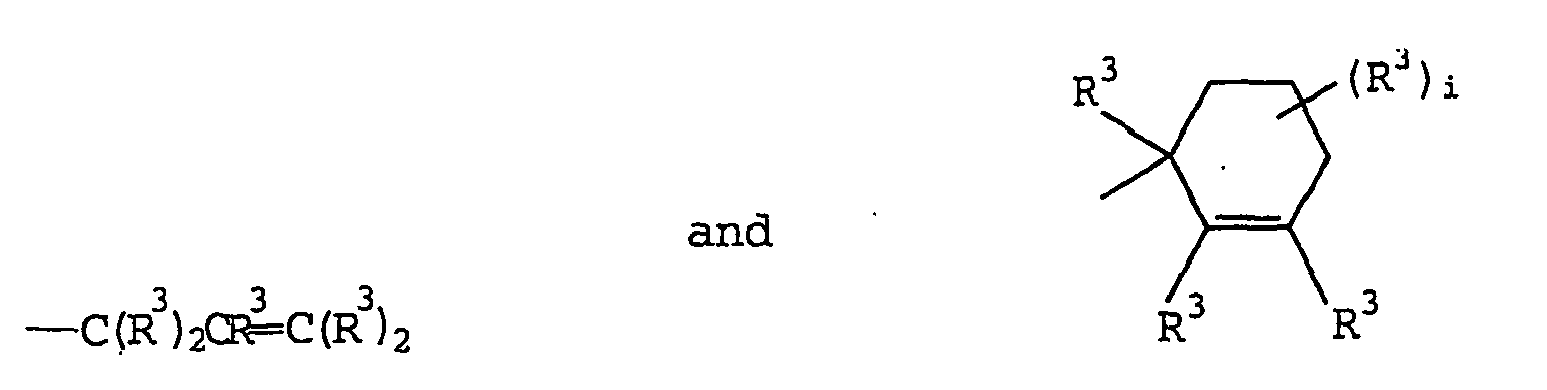
- In Formula I, R2 may also be a monoalkylene oxide group or a polyalkylene oxide group derived from, for example, ethylene oxide, propylene oxide, butylene oxide or cyclohexene oxide; wherein each monoalkylene oxide group or each polyalkylene oxide group is terminated with a propenyl-containing moiety selected from:

- In one embodiment of the present invention, when R2 in Formula I above is -CH2CH=CH2, the ether is an "allyl ether."
- In another embodiment of the present invention, when R2 is -CH2C(CH3)=CH2 in Formula I above, the aryl ether is a "methallyl ether."
- In yet another embodiment of the present invention, when R2 in Formula I above is

- More specific and preferred examples of aryl allyl ethers useful in the present invention are represented by Formulas II-V separately or as mixtures of two or more aryl allyl ethers of Formulas II-V which follow.
- Examples of mononuclear aryl allyl ethers of the present invention are represented by the following Formula II:

- In Formula II, R1, O and R2 have the same meaning as described above with reference to Formula I. In Formula II, x is from 0 to 5 and y is from 1 to 4.
- Other examples of aryl allyl ethers of the present invention are binuclear aryl allyl ethers which are represented by the following Formula III:

- In Formula III, R1, 0 and R2 have the same meaning as described above with reference to Formula I. In Formula III, each x is from 0 to 4, and each x may be the same or different; and each y is from 1 to 4, and each y may be the same or different.
- In Formula III, X may be nil; or X may be a heteroatom with or without substituents thereon to complete its necessary bonding valence; the heteroatom is preferably selected from O, N, S, Si, B, P, or any combination of two or more of the above heteroatoms. X may also be, for example, -C(O)-, -S(O2)-, -C(O)NH-, or -P(O)Ar-. X may also be, for example, an organic aliphatic moiety, with or without heteroatoms, such as for example, oxydimethylene, methylene, 2,2-isopropylidene, isobutylene, or -CR3=CH-, where R3 is as defined with reference to Formula I above. X may also be, for example, a cycloaliphatic group, with or without heteroatoms, such as for example, a cycloaliphatic ring with greater than 3 carbon atoms; or an aromatic group, with or without heteroatoms; or any combination thereof, preferably with no more than 60 carbon atoms. X as described above in Formula III may be partially or fully fluorinated, such as for example, 2,2-perfluoroisopropylidene.
- Other examples of aryl allyl ethers of the present invention are multinuclear aryl allyl ethers which are represented by the following Formula IV:

- In Formula IV, R1, O, R2 and X have the same meaning as described above with reference to Formula III. In Formula IV, each x is from 0 to 4, and each x may be the same or different; and each y is from 1 to 4, and each y may be the same or different. In Formula IV, m is from 0.001 to 10.
- Other examples of aryl allyl ethers of the present invention are multi-nuclear aryl allyl ethers which are represented by the following Formula V:

- In Formula V, R1, O and R2 have the same meaning as described previously with reference to Formula I. In Formula V, each x is from 0 to 4, and each x may be the same or different, and each y is from 1 to 4, and each y may be the same or different.
- In Formula V, Y may be an organic aliphatic moiety, with or without heteroatoms, such as, for example, O, N, S, Si, B, P or any combination of two or more of the above heteroatoms, wherein the aliphatic moiety has from 1 to 20 carbon atoms, such as for example, methine; a cycloaliphatic moiety, with or without heteroatoms, having from 3 to 20 carbon atoms, such as for example, cyclohexane tri-yl; an aromatic moiety, with or without heteroatoms, such as for example, benzenetriyl, naphthylenetriyl, fluorenetriyl; or any combination thereof, with no more than 20 carbon atoms. Y as described above in Formula V may be partially or fully fluorinated, such as for example, fluoromethine.
- In Formula V, m' is generally 3 or 4. However, Y may also be an oligomeric (for example, less than 5000 molecular weight average) organosiloxane unit or high molecular weight (for example, greater than 5000 molecular weight average) organosiloxane unit. In which case, the aryl groups are attached to the Si atoms of the organosiloxane unit directly or through an organic aliphatic, cycloaliphatic, aromatic group, or any combination thereof, with no more than 20 carbon atoms. When Y is an oligomeric or high molecular weight organosiloxane unit, m' in Formula V is preferably from 1 to 150.
- Even more particularly, the process of the present invention produces aryl diallyl ethers or aryl multifunctional allyl ethers. An example of an aryl diallyl ether of the present invention includes the diallyl ether of bisphenol A.
- Typically, the aryl allyl ethers of the present invention are made from phenolic compounds or hydroxy-containing aromatic compounds or mixtures of phenolic compounds or mixtures of hydroxy-containing aromatic compounds.
- The phenolic compound useful in the present invention contains at least one hydroxyl group; preferably contains on average more than one such hydroxyl group; and more preferably contains on average at least 1.8 such hydroxyl groups. The phenolic compound may contain up to 10 such hydroxyl groups. Examples of suitable phenolic compounds include mono-, di- or multi-functional aromatic hydroxyl-containing compounds or any combination of such compounds.
- The hydroxy moiety of the hydroxy-containing aromatic compound may be directly attached to the aromatic ring of the hydroxy-containing aromatic compound, in which case it is a phenolic compound; or the hydroxy moiety may not be connected directly to the aromatic ring, but instead the hydroxy moiety may be linked to the aromatic ring via a linking group such as an alkylene group or polyalkylene oxide group.
- Particularly suitable examples of the phenolic compounds used in the present invention include those which may be represented by any one of Formulas I through V, except that in the case of a phenolic compound, R2 in Formulas I through V is H; or any combination of any two or more of such phenolic compounds represented by the above Formulas I through V, wherein R2 is H.
- More specific and preferred examples of phenolic compounds useful in the present invention include, for example, 1,2-, 1,3- and 1,4-dihydroxybenzene; 4-methyl-1,3-resorcinol; 1,4-, 1,5-, 2,5-, 1,7-, 1,6- and 2,6-dihydroxy naphthalene; 4,4'(3,3'5,5'-tetramethyl)bisphenol A; 4,4'(3,3'5,5'-tetramethyl-2,2',6,6'-tetrabromo)bisphenol A; 4,4'(3,3'5,'5'-tetramethyl)bisphenol F; 4,4'-dihydroxybiphenyl; 3,3',5,5'-tetramethyl-4,4'-dihydroxybiphenyl; 3,3',5,5'-tetramethyl-2,2',6,6'-tetrabromo-4,4'-dihydroxybiphenyl; bis(4-hydroxyphenyl)methane; bis(4-hydroxyphenyl)sulfone; 2,2-bis(3,5-dibromo-4-hydroxyphenyl)isopropylidene; 2,2-bis(4-hydroxyphenyl)isopropylidene; 4,4'-bisphenol K; 9,9-bis(4-hydroxyphenyl)fluorene; 4,4'-dihydroxy-α-methylstilbene; 1,3-bis(4-hydroxylphenyl)adamantane; phenol-formaldehyde novolac (functionality greater than 2); o-cresol-formaldehyde novolac (functionality greater than 2); phenol-dicyclopentadienyl novolac (functionality greater than 2); bisphenol-A-formaldehyde novolac (functionality >2) or other biphenol-formaldehyde novolac (functionality >2 ); naphthol-formaldehyde novolac (functionality ≥ 2); or naphthadiol-formaldehyde novolac (functionality ≥ 2); tris(4-hydroxyphenyl)methane; tris(3,5-dimethyl-4-hydroxyphenyl)methane; 1,1,2,2-tetrakis(4-hydroxyphenyl)ethane; and mixtures thereof.
- The phenolic compound used in the present invention is preferably a bisphenol and is most preferably bisphenol A.
- The allylating reagent useful in the present invention is preferably an allyl carboxylate or an allyl carbonate.
- The allyl carboxylates useful in the present invention and from which the aryl allyl ether compounds can be prepared, include, for example, but are not limited to, those represented by the following Formula VI or any combination of any two or more such allyl carboxylates:
Formula VI
R4-C (=O)-O-R2
wherein R2 is as defined with reference to Formula I; and R4 may be hydrogen, an alkyl group having from 1 to 4 carbon atoms, or an aromatic group having from 6 to 20 carbon atoms. - Preferably, the allyl carboxylate may be selected from allyl formate, allyl acetate, allyl propionate, allyl benzoate, and diallyl carboxylates such as diallyl oxalate, diallyl glutarate, diallyl succinate, or any combination thereof. Most preferred as the allyl carboxylate used in the present invention is allyl acetate.
- Certain useful allyl carboxylates, such as allyl acetate, are commercially available. Others can be prepared, for example, by the oxidation of propylene in the presence of oxygen, a carboxylic acid (such as formic acid or propionic acid) and a palladium catalyst as described in
U.S. Patent No. 3,970,713 . - Suitable allyl carbonates which may be employed in the present invention include, for example, those represented by the following Formula VII or any combination of any two or more of such allyl carbonates:
Formula VII
R4-O-C (=O) -O-R2
wherein R2 is as defined with reference to Formula I; R4 may be as defined with reference to Formula VI; or R4 may be the same as R2. - Particularly suitable allyl carbonates which may be employed in the present invention include, for example, diallyl carbonate, dimethallyl carbonate, allyl methyl carbonate, allyl ethyl carbonate, allyl phenyl carbonate, or any combination of any two or more of such allyl carbonates.
- The allyl carbonates may be prepared by methods well known in the art, for instance, by reacting dimethyl carbonate or phosgene with allyl alcohol. For example, allyl methyl carbonate, diallyl carbonate, or a mixture of allyl methyl carbonate and diallyl carbonate can be generated by reacting allyl alcohol with dimethyl carbonate in the presence of a catalytic amount of a base, such as, sodium hyroxide, sodium hydride or sodium methoxide and distilling out methanol formed during the process. Allyl methyl carbonate and/or diallyl carbonate or a mixture thereof prepared in this manner is suitable as the allylating reagent of the present invention.
- The allylating reagent of the present invention is employed in amounts such that the equivalent ratio of the allylating reagent to the hydroxyl group of the phenolic compound is from 0.1 to 500 equivalents of allylating reagent per one equivalent of hydroxyl group, preferably from 0.5 to 50 equivalents of allylating reagent per one equivalent of hydroxyl group, and more preferably from 1 to 20 equivalents of allylating reagent per one equivalent of hydroxyl group.
- At ratios significantly above one equivalent of allylating reagent per one equivalent of hydroxyl group, the excess allylating reagent is also being employed as a solvent in addition to its use as a reactant. At ratios below about one equivalent of allylating reagent per one equivalent of hydroxyl group, conversion to the desired product may be very low and the excess phenolic reactant may have to be recovered and recycled in the process.
- The catalyst useful in the present invention in the allylation reaction process is a transition metal or rare earth metal catalyst complexed with a strongly bonded, non-replaceable stable ligand. The ligand of the transition metal or rare earth metal catalyst complex may be (i) an olefinic-containing ligand or an aromatic-containing ligand; or (ii) a polymeric ligand or a heteroatom-containing multidentate ligand.
- Suitable catalysts used in the present invention for allylation of the phenolic compounds are represented by the following general structure Formula (A):
Formula (A)
[M+n sOt(H)v(L1)v(L2)v(L3)v(L4)v(L5)v(L6)v...(Lp)v]w
wherein M is a transition metal or rare earth metal; n is the oxidation state of metal M, and n is from 0 to 8; and s is an integer from 1 to 5, and preferably from 1 to 3. - O is oxygen such that in the above catalyst Formula (A) the oxygen bonds to metal to form a metal oxo moiety having the following structure:
- M=O;
- or O is oxygen such that in the above catalyst Formula (A) the oxygen bonds to metal M and to H, L or to a second M to form a metal µ-oxo moiety having one of the following structures:
- M-O-H, M-O-M, or M-O-L;
- In the above catalyst complex Formula (A), H is a hydrogen atom which is bonded to the metal atom M or is bonded to the oxygen of a metal-µ-oxo moiety to form one of the following structures:
- M-H or M-O-H.
- Each one of L1, L2, L3, L4, L5, L6...Lp in the above general catalyst complex Formula (A), represents a ligand which may be the same ligand or a different ligand up to a maximum number of p ligands bound to the metal M; v is an integer from 0 to 10; and v may be the same for H and any of L1, L2, L3, L4, L5, L6...Lp or v may be different for H and any of L1, L2, L3, L4, L5, L6...Lp; and w is an integer from 1 to 500. Overall Ot(H)v(L1)v(L2)v(L3)v(L4)v(L5)v(L6)v...(Lp)v satisfies the bond nature of the transition metal or rare earth metal; and the sum of s, t, v and w satisfies the bond nature of the transition metal or rare earth metal. For a d orbital (d°) element metal, the total number of electrons in the d orbital is preferred to be less than or equal to 18.
- In one embodiment of the present invention, the transition metal or rare earth metal portion, M, of the transition metal or rare earth metal catalyst Formula (A) used in the present invention is a transition metal or rare earth metal selected from the group comprising ruthenium, rhenium, molybdenum, tungsten, rhodium, palladium, iridium, platinum, nickel, cobalt, iron, lanthanum, ytterbium, samarium or any combination thereof; more preferably, M is ruthenium, iridium, or platinum.
- In another embodiment of the present invention, when s in Formula (A) above is greater than 1, when w is greater than 1, or when s is equal to 1 and w is greater than 1, M may be the same transition metal or rare earth metal, preferably ruthenium, iridium, or platinum, or the combination of ruthenium, iridium, or platinum with other transition metals or rare earth metals, such as, ruthenium, rhenium, molybdenum, tungsten, rhodium, palladium, iridium, platinum, nickel, cobalt, iron, lanthanum, ytterbium and samarium provided that at least one of such metal atom is ruthenium, iridium, or platinum.
- Another embodiment of the transition metal or rare earth metal catalyst of Formula (A) useful as catalyst in the present invention may include, for example, bi-metal complexes, poly-metal complexes, bi-metal oxo complexes, poly-metal oxo complexes, and metal clusters. In such embodiment, the metal atoms may be bound to one another through metal-metal bonds, but are not required to be bound to one another. Alternatively, the metal atoms may be bound to each other through an oxygen atom such as in a metal µ-oxo moiety. The metal atoms may also be bound to each other through bidentate or multidentate ligands, which include oxygen-containing ligands, nitrogen-containing ligands, phosphorous-containing ligands, organosilyl-containing ligands, and organosilyloxy-containing ligands. "Multidentate ligand" means a ligand that contains three or more heteroatoms such as O, N, S, Si, B, P.
- In another embodiment of the present invention, in the ligand portion L1, L2, L3, L4, L5, L6...Lp of the transition metal or rare earth metal catalyst of Formula (A) used in the present invention, at least one or more of the ligands L1, L2, L3, L4, L5, L6...Lp is a "strongly bonded, non-replaceable stable ligand or complexing agent." The "strongly bonded, non-replaceable stable ligand or complexing agent" portion of the transition metal or rare earth metal catalyst of Formula (A) used in the present invention is preferably (i) an olefinic ligand or an aromatic-containing ligand; or (ii) a polymeric ligand or a heteroatom-containing multidentate ligand.
- In yet another embodiment of the present invention, it has been found that the at least one or more of the "strongly bonded, non-replaceable stable ligand or complexing agent" L1, L2, L3, L4, L5, L6...Lp portion of the transition metal or rare earth metal catalyst of Formula (A) used in the present invention is an unsaturated aliphatic or an aromatic moiety-containing ligand. The unsaturated aliphatic or aromatic moiety-containing ligands include neutral, monodentate ligands, bidentate ligands, and multidentate ligands. As illustrations of other embodiments of the present invention, the following Formulas (B) through (G) are described and represent partial metal complex structures showing the various ways in which ligands having olefinic or aromatic moieties can be complexed with the transition metal or rare earth metal M of the transition metal or rare earth metal catalysts of Formula (A).
- Formula (B) as follows is a partial structure of the transition metal or rare earth metal catalyst useful in the allylation process of the present invention:
Formula (B)
R5-M - In Formula (B), M is a transition metal or rare earth metal and R5 may be a monodentate olefinic or an aromatic-containing ligand, such as for example, cyclopentadienyl (Cp), pentamethylcyclopentadienyl (Cp*), indenyl (In), 9-fluorenyl(Fl), cyclooctadienyl (COD) or butyldienyl ligands. The monodentate Cp-, Cp*-, In-, Fl- and COD-containing ligands are described by S. Hitchcock in Organometallics, 14, pp.3732-3740, (1995).
- The metal complexes having one monodentate olefinic or aromatic-containing ligand, or the substituted analogue thereof, are a very well-known class of compounds known as "half-shell" metal complexes.
- "Half-shell" transition metal or rare earth metal catalysts useful as allylation catalysts in the present invention which incorporate the partial Formula (B) into Formula (A) include, but are not limited to for example, Cp*RuCl(PPh3)2; Cp*RuCl(dppe); Cp*RuCl(COD); CpRuCl(PPh3)2; CpRuCl (dppe); CpRuCl (COD); CpRu+(PPh3)2PF6-; CpRu+(PPh3)2CF3SO3 -; wherein "dppe" is 1,2-bis(diphenylphosphino)ethane.
- Formula (C) set forth below is a partial structure of the transition metal or rare earth metal catalyst useful in the allylation process of the present invention:
Formula (C)
R5-M-R5 - In Formula (C), M is a transition metal or rare earth metal, and R5 is as defined above with reference to Formula (B), wherein each R5 may be the same or different.
- The above partial metal complex Formula (C) having two monodentate olefinic or aromatic-containing ligands or the substituted analogues thereof represents the partial structure of a very well-known class of compounds known as "sandwich" metal complexes.
- "Sandwich" transition metal or rare earth metal catalysts of Formula (A), which incorporate the partial Formula (C) into Formula (A), useful as allylation catalysts in the present invention include, but are not limited to for example, (Cp)2RuCl; (Cp)2RuBr; (Cp*)2RuCl; (Cp*)2RuBr; (In)2RuCl.
- Formula (D) set forth below is a partial structure of the transition metal or rare earth metal catalyst useful in the allylation process of the present invention:

- In Formula (D), M is a transition metal or rare earth metal; R5 is as defined above with reference to Formula (B); and X' is a moiety bridging or linking the R5 groups together such that the R5-X'-R5 structure becomes a bidentate ligand, wherein R5 may be the same group or a different group. When the R5 groups in Formula (D) are different groups, R5 may be a part of a ligand having O, P, N, S, or Si atoms. X' may be, for example, methylene, ethylene, isopropylidene, binaphthyldimethylene, dimethylsilylene, bis(dimethysilyl)oxy.
- The above partial metal complex Formula (D) having two monodentate olefinic or aromatic-containing ligands or the substituted analogues thereof connected by a bridging or linking moiety represents a partial structure of a very well-known class of compounds known as "ansa" metal complexes.
- "Ansa" bidentate strongly bonding ligands of Formula (A) useful as allylation catalysts in the present invention include, but are not limited to for example, bis(4-t-butyl-2-methylcyclopentadienyl)dimethylsilane; bis(cyclopentadienyl)dimethylsilane; bis(9-fluorenyl)dimethylsilane; bis(1-indenyl)dimethylsilane; bis(2-methyl-1-indenyl)dimethylsilane; cyclopentadienyl-(9-fluorenyl)diphenylmethane; cyclopentadienyl-(9-fluorenyl)dimethylsilane; 1,2-bis(1-indenyl)ethane; 1,2-bis(2'-methyl-1-indenyl)ethane; 1,2-bis(4',5',6',7'-tetrahydro-1-indenyl)ethane; 2,2-(cyclopentadienyl)-(9-fluorenyl)propane; bis-(1-benzoindenyl)dimethylsilane.
- Formulas (E), (F), and (G) set forth below represent partial structures of three additional "ansa"-type transition metal or rare earth metal complexes useful in the allylation process of the present invention wherein one or more of the transition metal or rare earth metal to ligand bonds is formed through an ancillary group A:

- In Formulas (E), (F), and (G), M is a transition metal or rare earth metal; R5 and X' are as defined above with reference to Formula (B); and A is an ancillary group attached to the R5 or X' group, wherein A may be an aliphatic, cycloaliphatic, aromatic, or combination thereof moiety having one or more heteroatoms, such as O, N, S, Si, B or P, capable of forming one or more coordination bonds with the transition metal or rare earth metal M. When A has more than one heteroatom, the heteroatoms may be the same or different.
- An A moiety includes, for example, but is not limited to, an alkyl, cycloalkyl, aromatic amine or diamine or any combination thereof; an alkyl, cycloalkyl, aromatic alcohol or diol or any combination thereof; an alkyl, cycloalkyl, aromatic ether or diether or any combination thereof; an alkyl, cycloalkyl, aromatic phosphine or diphosphine or any combination thereof; an alkyl, cycloalkyl, aromatic silane or disilane or any combination thereof, with or without fluorine atoms.
- Additionally, an A moiety having two heteroatoms includes, for example, but is not limited to, alkyl, cycloalkyl, aromatic, or any combination thereof amino alcohol, amino ether, amino phosphine, amino silane, ether alcohol, phosphine alcohol, silane alcohol, ether phosphine, ether silane, phosphine silane, with or without fluorine atoms. When an ancillary A moiety has more than one heteroatom, the R5-A ancillary group may be a bidentate or multidentate ligand capable of forming two or more coordination bonds with the transition metal or rare earth metal.
- "Ansa"-type ligands, which have an ancillary group A and which are strongly bonding ligands of Formula (A) useful as allylation catalysts in the present invention include, for example but are not limited to, bis(Cp*)(3-methoxy-1-propyl)methylsilane; bis(Cp*)(3-methoxy-1-pentyl)methylsilane; dimethyl (dimethylaminoethylcyclopentadienyl) (Cp*)silane; trimethyl(2-methoxyethylcyclopentadienyl)silane; trimethyl(2-isobornyloxyethylcyclopentadienyl)silane; trimethyl(2-menthylethyloxycyclopentadienyl)silane; trimethyl(2-fenchyloxyethylcyclopentadienyl)silane; N,N-dimethyl-2-aminoethylcyclopentadiene; N,N-dimethyl-3-aminopropylcyclopentadiene; (Cp)dimethyl(diphenylphosphinomethyl)silane.
- Examples of "ansa"-type transition metal or rare earth metal catalysts of Formula (A) of the present invention include, but are not limited to, [Cp-C(=O)-O-(CH2)2-PPh2]Ru+(MeCN)2 PF6- as described by S. Takahashi in Chem. Commun., pp. 521-522, (2001); and Cp*Cl [(C6F5)2PCH2CH2P(C6F5)2] Ru+BF4 - as described by C. Suander in Dalton Communication, pp. 512-514, (2001).
- In another embodiment of the present invention, the unsaturated aliphatic or aromatic ligand may be bonded to an organic, an inorganic, or a hybrid organic-inorganic polymeric backbone. Examples of such unsaturated aliphatic or aromatic moiety-containing polymeric ligands are described by C. H. Brubaker, Jr., et. al, in J. of Organometallic Chemistry, 214, 325-337, (1981) and by P. Leeuwen in Angew. Chem. Int. Ed., 40, pp. 1828-1849, (2001).
- In another preferred embodiment of the present invention, it has been found that the at least one or more "strongly bonded, non-replaceable stable ligand or complexing agent", L1, L2, L3, L4, L5, L6...Lp portion of the transition metal or rare earth metal catalyst of Formula (A) used in the present invention may be a O-, N-, S-, Si-, B-, or P-containing polymeric ligand or a multidentate phosphorous ligand.
- When the strongly bonded, non-replaceable or essentially non-replaceable, stable ligand useful for the transition metal or rare earth metal catalyst of Formula (A) in the present invention is a polymeric ligand, the polymeric ligand can consist of an organic polymeric backbone, an inorganic polymeric backbone, or a hybrid organic-inorganic polymeric backbone. Because of their polymeric nature these strongly bonded, non-replaceable or essentially non-replaceable, stable polymeric ligands are multidentate ligands. The polymeric ligands may contain heteroatoms such as O, N, S, Si, B, P or any combination of two or more of these heteroatoms. The polymeric ligands may also contain one or more asymmetric or chiral centers.
- Examples of heteroatom-containing polymeric ligands having organic polymeric backbones include, but are not limited to for example, styrene-co-divinyl benzene, vinyl pyridine-co-divinyl benzene and aromatic polyimide crosslinked polymers having substituted phosphorous moieties bound to the backbone. Such phosphorous-containing polymeric ligands are well-known in the art and are described, for example, in Polymer-supported Reactions in Organic Synthesis, edited by P. Hodge and D. C. Sherrington, John Wiley & Sons, 1980 ; by U. Yasuhiro in Tetrahedron, 55, pp. 14341-14352, (1999) and in J. Org. Chem., 64, pp. 3384-3388, (1999); and by, S. Ley in J. Chem. Soc., Perkin Trans. I, pp. 3815-4196, (2000).
- Examples of heteroatom-containing polymeric ligands having hybrid organic-inorganic ligands, include, but are not limited to, for example, polymeric ligands having organo-sol gel backbones. Polymeric ligands having organo-sol gel backbones include, for example, the polymeric organophosphine ligands having organosiloxane backbones described by E. Lindner in J. Organometallic Chem., 628(2), pp. 151-154, (2001), in Angew. Chem. Int. Ed., 38, pp. 2154-2157, (1999), and in J. Non-Crysataline Solids, 225, pp. 208-216 (1999); and in
U.S. Patent No. 5,620,938 . Polymeric ligands having organo-sol gel backbones also include, for example, polymeric organonitrogen ligands having organosiloxane backbones and containing pyridinyl moieties as described by S. Yu in Angew. Chem. Int. Ed., 40, pp. 437-440, (2001). Polymeric ligands having organo-sol gel backbones may also include, for example, polymeric organonitrogen ligands or polymeric organophosphine ligands having dendrimeric organosiloxane backbones such as described by P. Leeuwen in Angew. Chem. Int. Ed., 40, pp. 1828-1849, (2001). - When the ligands used in the present invention are polymeric ligands, the transition metal or rare earth metal of the transition metal or rare earth metal catalyst is anchored onto the polymeric backbone.
- In one embodiment of the present invention, the strongly bonded, non-replaceable or essentially non-replaceable, stable ligands useful for the transition metal or rare earth metal catalyst in the present invention include, for example, the multidentate phosphorous-containing ligands. The multidentate phosphorous-containing ligands may also contain heteroatoms such as O, N, S, Si, B or any combination of two or more of these heteroatoms. The multidentate phosphorous-containing ligands may also contain one or more asymmetric or chiral centers.
- The strongly bonded, non-replaceable, stable multidentate phosphorous-containing ligands, which may be useful in the present invention include, but are not limited to, the tri-, tetra, penta- and greater-phosphorous-containing ligands, such as cis-cis-cis-1,2,3,4-tetrakis(diphenylphosphinomethyl)cyclopentane as described by M. Santelli, et. al, in J. Org. Chem., 66(5), pp. 1633-1637,(2001); and as described in
U.S. Patent No. 6,087,513 . - When the ligand used in the present invention is a polymeric or a multidentate ligand, it may be bonded to the same metal atom or to two or more different metal atoms.
- While it is desired to have at least one or more strongly bonded, non-replaceable or essentially non-replaceable, stable ligands L1, L2, L3, L4, L5, L6...Lp attached to the transition metal or rare earth metal of the transition metal or rare earth metal catalyst of Formula (A), it is also possible that the transition metal or rare earth metal of the catalyst contains at least one or more vacant coordination sites or at least one or more labile ligands L1, L2, L3, L4, L5, L6...Lp to allow for the insertion of the allylating agent onto the transition metal or rare earth metal in order to activate the allylic moiety to carry on the allylation process. The at least one or more labile ligands L1, L2, L3, L4, L5, L6...Lp of the transition metal or rare earth metal catalyst of Formula (A) are also called "hemilabile" hybrid ligands as described and illustrated by P. Braunstein, et al., in Angew. Chem. International Edit., 40(4), pp. 680-699, (2001); and by C. Bessel, et al., in Chem. Rev., 101, pp. 1031-1066, (2001).
- The steric nature and electronic nature of both the strongly bonded, non-replaceable or essentially non-replaceable, stable ligands L1, L2, L3, L4, L5, L6...Lp and the labile ligands or so called "hemilabile" hybrid ligands L1, L2, L3, L4, L5, L6... Lp may be varied to change the properties of the transition metal or rare earth metal atom(s) of the catalyst and hence the catalytic properties of the complexed metal salt or the transition metal or rare earth metal catalyst complex useful in the present invention when such complexed metal salt or transition metal or rare earth metal catalyst complex is combined with an allylating agent.
- Varying the steric nature and the electronic nature of ligands may be done according to the teachings by R. Crabtree in The Organometallic Chemistry of the Transition Metals, Second Edit., John Wiley & Sons, N.Y. (1994); by A. Yamamoto in Organotransition Metal Chemistry, John Wiley & Sons, N.Y. (1986); and by F. Cotton and G. Wilkinson in Advanced Inorganic Chemistry, Fourth Edition, John Wiley & Sons, N.Y. (1980).
- The ligands L1, L2, L3, L4, L5, L6...Lp useful in the present invention, as represented by Formula (A), may also include both strongly bonded and labile ligands, such ligands include, but are not limited to, the following representative ligands: (i) oxygen-containing ligands, (ii) phosphorous-containing ligands, (iii) nitrogen-containing ligands, (iv) silicon-containing ligands, and (v) anionic ligands.
- (i) Monodentate, bidentate or polydentate oxygen-containing ligands are ligands L useful for the preparation of transition metal or rare earth metal catalysts of Formula (A) of the present invention. Monodentate, bidentate or polydentate oxygen-containing ligands useful in the present invention include, but are not limited to, for example, aliphatic and cycloaliphatic alcohols and diols; phenolates; carboxylic acids; ketones; phenoxy imine compounds or the combination of these oxygen-containing ligands. Partially or fully fluorinated monodentate or polydentate oxygen-containing ligands are also included herein as examples useful in the present invention.
Examples of oxygen-containing ligands useful in the present invention are described inU.S. Patent No. 6,087,513 , including for example, propane-1,2-diol; cis- and trans-cyclohexane-1,2-diol; and 1,1'-binaphthyl-2,2'-diol. - (ii) Monodentate or bidentate phosphorous-containing ligands are ligands L useful for the preparation of transition metal or rare earth metal catalysts of Formula (A) of the present invention. Monodentate or bidentate phosphorous-containing ligands useful in the present invention include, for example, aliphatic, cycloaliphatic or aromatic organophosphinyl ligands.
Examples of labile, non-stable monodentate phosphorous-containing ligands useful in the present invention include, but are not limited to, for example, trimethylphosphine; triisopropylphosphine; triphenylphosphine; tricyclohexylphosphine or any combination of these phosphorous-containing ligands.
Strongly bonded, neutral or basic, bidentate ligands containing aliphatic, cycloaliphatic, or aromatic organophosphinyl ligands useful in the present invention include bidentate ligands, such as for example, but not limited to, 1,2-bis(diphenylphosphino)ethane; 2-(diphenylphosphinyl)cyclohexanol; 2,2'-bis(diphenylphosphino)-1,1'-binaphthyl; 1,1'-bis(diphenylphosphino)ferrocene; 1,2-bis(2,5-dimethylphospholano)ethane; endo,endo-3-(diphenylphosphoryl)-2-hydroxybornane.
Partially or fully fluorinated monodentate or didentate phosphorous-containing ligands are also included herein as examples useful in the present invention. - (iii) Nitrogen-containing ligands such as monodentate or polydentate amino compounds, heterocyclic ring compounds, biheterocyclic ring compounds or fused heterocyclic ring compounds are ligands L useful for the preparation of transition metal or rare earth metal catalysts of Formula (A) of the present invention. The nitrogen-containing ligands may contain heteroatoms other than nitrogen such as O, S, Si, B, P, or any combination of these heteroatoms. Partially or fully fluorinated monodentate or polydentate nitrogen-containing ligands are also included herein as examples useful in the present invention.
Included herein, but not intended to be a complete listing of examples of the nitrogen-containing ligands useful in the present invention, are multiaza, acyclic, cyclic, and macrocyclic amines, such as for example, tris[2-(N-trimethylsilyl)aminoethyl]amine; 1,3,5-trimethyl-1,3,5-triazacyclohexane; cyclam-(1,4,8,11-tetraazacyclodecane); 1,2-cyclohexanediamine-N,N'-bis(3,3-di-t-butylsalicylidene); ethylenebis(salicylimine); 2,6-bis(imino)pyridyl ligands.
The nitrogen-containing monodentate and multidentate monoheterocyclic and multiheterocyclic ligands useful in the present invention include, for example, but are not limited to, monoheterocyclic pyridine ligands, such as, (2'-pyridyl)propan-2-ol; 9-(2-pyridyl)-9-fluorenol; bis[4-(diethylamino)phenyl]-2-pyridylmethanol; 6-(2-hydroxyphenyl)pyridine-2-carboxylic acid.
Monodentate and multidentate monoheterocyclic and multiheterocyclic ligands useful in the present invention also include, for example, but are not limited to, multiheterocyclic pyridine ligands such as tris(2'-pyridylaminodimethyl silyl)methane; tris(2'-(4,6-dimethylpyridyl)aminodimethyl silyl)methane; 2,2'-bipyridine.
Monodentate and multidentate monoheterocyclic and multiheterocyclic ligands useful in the present invention include, for example, but not limited to, multiheterocyclic pyridine-oxazolin, pyridine-pyrazol, and pyrazine-pyrazol ligands, such as, 2,6-bis[4-methyloxazolin-2-yl]pyridine; 4-hydroxymethyl-5-phenyl-2-(2-pyridinyl)4,5-dihydro[2,1-d]oxazole; 2-(5-methylpyrazol-3-yl)pyridine; 2-(4-chloropyrazol-3-yl)pyridine; 2-(5-methyl-1-octylpyrazol-3-yl)pyrazine.
Nitrogen-containing ligands useful in the present invention include biheterocyclic quinoline and biheterocyclic oxazoline ligands, such as for example, but are not limited to, 2-methyl-8-hydroxyquinoline; 2,2'-methylenebis(oxazoline).
Nitrogen-containing ligands useful in the present invention also include nitrogen-containing heterocyclic ligands that contain boron, such as for example, but not limited to, hydrotris(3,5-dimethyl-1-pyrazolyl)borate.
Partially or fully fluorinated monodentate or polydentate nitrogen-containing ligands are also included herein as examples useful in the present invention. - (iv) Silicon-containing ligands such as monodentate, didentate or polydentate silyl or silyloxy ligands L are useful for the preparation of transition metal or rare earth metal catalysts of Formula (A) of the present invention.
The incorporation of silicon-based ligand L, within the transition metal or rare earth metal complexes of Formula (A) of the present invention is important not only because it may provide the chemical functionality for bonding of the transition metal or rare earth metal complexes to solid supports, but also the silicon-based ligands may impart advantageous solubility and hydrolytic stability properties to the catalyst.
Silicon-containing ligands can be generally divided into two groups: (1) organosilyl-containing ligands and (2) organosilyloxy-containing ligands.
In the organosilyl-containing ligands, the silicon atom is directly bonded to the transition metal or rare earth metal atom. An example of a monodentate organosilyl-containing ligand is -Si(R3)3 and an example of bidentate or multidentate organosilyl-containing ligand is -Si(R3)2[-O-Si(R3)2]m"-O-Si(R3)2- where R3 is the same as described above and m" is from 0 to 10. The method used to make such organosilyl-containing ligands wherein the silicon atom is directly linked to the transition metal is taught, for example, by W. Malisch in Inorg. Chem., 34, 23, pp. 5701-5702, (1995).
Organosilyl-containing ligands may also be introduced into a transition metal or rare earth metal complex by indirectly attaching the organosilyl-containing moiety to the transition metal or rare earth metal atom through a monodentate ligand, such as -L-Si(R3)3 wherein L is a ligand as defined above. An example of such a monodentate organosilyl-containing ligand is γ-aminopropyltrimethoxysilane, wherein an amido moiety is attached to one terminus and an organosilyl moiety is attached to the other terminus of the ligand such as described inU.S. Patent No. 5,620,938 . organosilyloxy-containing ligands, may be monodentate-ligands such as -O-Si(R3)3 or multidentate ligands such as -O-Si(R3)2[-O-Si (R3)2]m"-O-Si (R3)2-O-, wherein the silicon atom is indirectly bonded to the transition metal or rare earth metal through an oxygen atom, where R3 and m" are as defined above.
Organosilyloxy-containing ligands may also be introduced into a transition metal or rare earth metal complex by indirectly attaching the organosilyoxyl-containing moiety to the transition metal or rare earth metal atom through a monodentate ligand, such as -L-O-Si(R3)3 wherein L is as defined above. One such method to introduce an organosilyloxy-containing ligand into a transition metal complex is taught, for example, by W. Malisch in Inorg. Chem., 34, 23, pp.5701-5702 (1995).
When a transition metal or rare earth metal complex with mono-, di- or trifunctional organosilyl groups is condensed with mono-, di-, tri- or tetramethoxy or ethoxy silane, a three-dimensional organic-inorganic hybrid material is formed. Depending on the degree of crosslinking, such hybrid organic-inorganic material is soluble or partially soluble in organic solvents. The process making soluble or partially organic-soluble hybrid organic-inorganic materials useful in the present invention is described by K. J. Shea, et al., in Chem. Rev., 95, pp. 1431-1442 (1995).
When transition metals or rare earth metals with ligands are bonded to a silasesquioxane, a three-dimensional, organic soluble metallosiloxane is formed. The organic soluble, three-dimensional, transition metal or rare earth metal silasesquaoxane can be anchored or bonded onto a silicate-based, solid support to form a heterogeneous catalyst. When the transition metal or rare earth metal is connected three-dimensionally through M-O-Si bonds, it is very tightly anchored onto the solid support.
In the organosilyl-containing ligands, the silicon atom may also be directly bonded to the transition metal or rare earth metal atom. The silicon atom of organosily-containing ligands may also be bound to aliphatic, cycloaliphatic or aromatic segments or radicals. The silicon atom of organosily-containing ligands may also be bound to an organophosphinyl group. The silicon atom of organosily-containing ligands may also be bound to polymeric backbones or to oligomeric alkalene oxide chain(s), such as those described by E. Lindner, in J. Organometallic Chem., 628(2), pp. 151-154, (2001) and in J. Non-Crysatlline Solids, 225, pp. 208-216, (1999). - (v) The ligands L1, L2, L3, L4, L5, L6...Lp in Formula (A) may also be selected from anionic groups. When n of Formula (A) is greater than zero, then anionic or negatively charged ligands, such as, chloride, bromide, acetate, nitrate, sulfate, tosylate, triflate, and hexaflurophosphonate; or the combination of any two or more of these anionic ligands; may be useful as ligands in the transition metal or rare earth metal catalysts of the present invention.
- The above described ligands L1, L2, L3, L4, L5, L6...Lp portion of the transition metal or rare earth metal catalyst of Formula (A) are meant to be representative of and not all inclusive of the ligands or complexing agents useful in the present invention. A more detailed definition of the ligands useful in the present invention can be found in
U.S. Patent No. 6,087,513 . - Ligands or complexing agents are preferably employed to stabilize and to enhance the activity of the transition metal or rare earth metal catalyst of Formula (A). The transition metal or rare earth metal of the catalyst of Formula (A) may be complexed with the complexing agent or ligand prior to addition to the allylation reaction mixture, in which instance the transition metal or rare earth metal catalyst is often isolated having a stoichiometric ratio of ligand(s) to transition metal or rare earth metal; or the catalyst complex may be formed in situ by adding the transition metal or rare earth metal and the ligand or complexing agent separately to the reaction mixture, in which instance the molar ratio of ligand or complexing agent to transition metal or rare earth metal may vary over a wide range. The complexing agents or ligands may be employed in amounts of from 0.5 to 20 equivalents of complexing atom or moiety per one equivalent of transition metal or rare earth metal catalyst, preferably from 0.75 to 10 equivalents of complexing atom or moiety per one equivalent of transition metal or rare earth metal catalyst, more preferably from 1 to 5 equivalents of complexing atom or moiety per one equivalent of transition metal or rare earth metal catalyst.
- The allylation catalyst of Formula (A) of the present invention may be employed as a homogenous or a heterogeneous catalyst.
- In one embodiment of the present invention, the allyation catalyst of Formula (A) is a homogeneous catalyst. In such homogeneous catalysts, the transition metal or rare earth metal catalyst is soluble in the allylation reaction mixture.
- When the catalyst is employed as a homogeneous catalyst, the reaction may be conducted in a batch or continuous mode.
- In another embodiment of the present invention, the transition metal or rare earth metal allylation catalyst of Formula (A) is a heterogeneous catalyst. By heterogeneous catalyst it is meant that the transition metal or rare earth metal catalyst is either (i) insoluble in the reaction mixture or (ii) placed onto a solid support material which is insoluble in the allylation reaction mixture.
- Heterogeneous catalysts may be formed by any of three separate processes: (i) by supporting the transition metal or rare earth metal on a support material through simple adsorption of the metal catalyst on the support material via deposition of the catalyst on the support material; (ii) by supporting the transition metal or rare earth metal on a support material through anchoring or tethering of the transition metal or rare earth metal catalyst of Formula (A) to a the support material via bond formation between a reactive site on the transition metal or rare earth metal catalyst of Formula (A) and the support material; or (iii) by forming the transition metal or rare earth metal catalyst of Formula (A) by reacting a transition metal or rare earth metal complex with a solid polymeric ligand. The heterogeneous catalysts may be made by any of several procedures well-known to those skilled in the art.
- The heterogeneous catalyst of Formula (A) of the present invention may be formed via process (i) by direct deposition of the transition metal or rare earth metal catalyst on the solid support, wherein the metal catalyst is simply absorbed onto the solid support, such as described for example by H.-U. Blaser, et. al, in J. of Molecular Catalysis A: Chemical, 173, pp. 3-18, (2001); and by D. Stirling, et. al, in J. of Molecular Catalysis A: Chemical, 172, pp. 207-218, (2001). The heterogeneous catalyst made by the process of depositing the transition metal or rare earth metal catalyst on the solid support may be utilized directly or the heterogeneous catalyst may be subsequently treated by any of a number of methods, such as calcination, well-known to those skilled in the art.
- The heterogeneous catalyst of Formula (A) of the present invention may be formed via process (ii) by anchoring or tethering the transition metal or rare earth metal catalyst to a solid support. By anchoring or tethering the transition metal or rare earth metal catalyst to a solid support it is meant that a stable, ionic, coordination or covalent chemical bond is formed between at least one of the L1, L2, L3, L4, L5, L6...Lp ligands portion of the transition metal or rare earth metal catalyst of Formula (A) and the solid support, therefore rendering the transition metal or rare earth metal catalyst into the heterogeneous state. Such a process (ii) for formation of a heterogeneous catalyst is described, for instance, by B. Chaudret, et. al, in J. Am. Chem. Soc., 123, pp.7584-7593, (2001).
- In the processes (i) and (ii) for making a heterogeneous catalyst of the present invention, the solid support may include, for example, but is not limited to, styrene-co-divinyl benzene or vinyl pyridine-co-divinyl benzene crosslinked polymers or ion exchange resins, aromatic polyimides, organosol gels, charcoal, carbon, silica, alumina, Ba2SO4, MgO, clay, silicate, naturally occurring zeolite, synthetic zeolite phosphite, aluminate or any combination of these solid support materials.
- The heterogeneous catalyst of Formula (A) of the present invention may be formed via process (iii) by a process wherein the transition metal or rare earth metal complex catalyst is anchored onto a solid support through the formation of a strong, transition metal or rare earth metal to polymeric ligand bond. In this process (iii) for the preparation of a heterogeneous catalyst, the ligand L1, L2, L3, L4, L5, L6...Lp portion of the transition metal or rare earth metal catalyst of Formula (A) is a polymeric ligand. Such processes for forming heterogeneous catalysts from polymeric ligands are described above under the topic of polymeric ligands and by Y. K. Chung, et. al, in J. of Molecular Catalysis A: Chemical, 174, pp. 151-157, (2001).
- In one embodiment of the heterogeneous catalyst process of the present invention, the ratio of the amount of the transition metal or rare earth metal in the catalyst on a metal weight basis to the weight of the solid support material is preferably in the range of from 1x10⁻⁶ part to one part of transition metal or rare earth metal per one part of solid support; more preferably the ratio of the weight of the transition metal or rare earth metal in the catalyst to the weight of the solid support material is in the range of from 1x10⁻⁵ part to 3x10⁻¹ part of transition metal or rare earth metal per one part of solid support; and most preferably, the ratio of the weight of the transition metal or rare earth metal in the catalyst to the weight of the solid support material is in the range from 1x10⁻⁴ part to 1x10⁻¹ part of transition metal or rare earth metal per one part of solid support.
- When the catalyst is employed as a supported, heterogeneous catalyst, the allylation reaction can be conducted in a fixed bed or suspended in the liquid reaction mixture; and the reaction can be carried out in a batch or continuous mode.
- If desired, when water is employed as a solvent, either as the sole solvent or as a cosolvent, buffering agents such as, for example, alkali or alkaline earth metal bicarbonates such as sodium carbonate or bicarbonate; carbon dioxide; alkali or alkaline earth metal hydrogen phosphates; or alkali or alkaline earth metal borates may be used in the process of the present invention. When water is employed as a solvent, either as the sole solvent or as a cosolvent, with or without a buffering agent, it is preferred that the pH of the reaction mixture be less than 9.
- Some additives are useful in promoting allylation of phenolic compounds or mixtures of phenolic compounds with allylating agents. These types of additives may be used in the process of the present invention if desired. For example, some additives may be used in order to replace labile or unstable ligands L, in the metal catalyst represented in Formula (A), including for example, but not limited to, silver tosylate; ammonium tosylate; trimethylsilyl trifluromethane sulfonate; triethylsilyl trifluromethane sulfonate; tri-isopropylsilyl trifluromethane sulfonate; silver trifluromethane sulfonate; ammonium hexaflurophosphonate; silver hexaflurophosphonate.
- The amounts of such additives that may be added to the allylation reaction mixture can be varied from 0.1 mole to 10 mole per equivalent of transition metal or rare earth metal.
- Suitable solvents which can optionally, but preferably, be employed in the process of the present invention include, for example, water; carbon dioxide; ionic liquids; excess amounts of allyl carboxylate and allyl carbonate; aliphatic, cycloaliphatic and aromatic hydrocarbons; and aliphatic, cycloaliphatic and aromatic halogenated hydrocarbons. Other solvents include, for example, nitro-alkanes and oxygenated hydrocarbons, such as alcohols, ethers, glycols, glycol ethers, esters, and ketones. Any combination of any two or more such solvents can also be used in the present invention. Particularly suitable solvents include, for example, allyl acetate, hexane, octane, cyclohexane, toluene, xylene, chlorobenzene, dichloromethane, 1,2-dichloroethane, acetone, methyl ethyl ketone, ethyl acetate, nitromethane, tetrahydrofuran, ethanol, isopropanol, glymes or any combination thereof.
- The preferred solvents are allylacetate, hexane, cyclohexane, toluene, 1,2-dichloroethane, isopropanol, acetone, glycols and glycol ethers or any combination of any two or more such solvents.
- The solvents are employed in amounts of from zero to 100 preferably from 0.5 to 20, more preferably from 1 to 10 parts by weight based upon the weight of the phenolic compound.
- The aryl allyl ether compound of the present invention is prepared by reacting a phenolic compound with an allylating reagent, such as an allyl carboxylate or an allyl carbonate, in the presence of at least one transition metal or rare earth metal catalyst; and optionally in the presence of at least one buffering agent; and optionally in the presence of at least one salt additive; and further optionally in the presence of one or more suitable solvents.
- The allylation reaction is preferably carried out in the presence of a transition metal or rare earth metal catalyst selected from the group consisting essentially of ruthenium, rhenium, molybdenum, tungsten, rhodium, palladium, iridium, platinum, nickel, cobalt, iron, lanthanum, ytterbium, samarium or any combination thereof, with inorganic or organic ligand(s).
- Preferably, the present invention allylation reaction is carried out in the presence of at least one ligand or complexing agent, which is strongly or non-replaceably bound directly to the transition metal or rare earth metal of the catalyst.
- In the allylation process of the present invention utilizing a heterogeneous catalyst, the amount of heterogeneous catalyst in the reaction mixture may be highly variable dependent on numerous factors, such as, whether the reaction is a batch reaction or a continuous, fixed-bed or fluidized-bed reaction or how much solvent is used. Generally, the weight ratio of heterogeneous catalyst to allylation reaction mixture is 0.1 to 1000 parts of heterogeneous catalyst to 100 parts of allylation reaction mixture. Generally, in batch reactions, the weight ratio of heterogeneous catalyst to allylation reaction mixture is 0.1 to 50 parts of heterogeneous catalyst to 100 parts of allylation reaction mixture. Generally, in continuous, fixed-bed or fluidized-bed reactions, the weight ratio of heterogeneous catalyst to allylation reaction mixture is 100 to 1000 parts of heterogeneous catalyst to 100 parts of allylation mixture.
- In the allylation process of the present invention utilizing a homogeneous catalyst, a preferred molar ratio of the transition metal or rare earth metal catalyst to phenolic compound present in the reaction mixture is from 1x10⁻⁶ equivalents to 0.1 equivalents of catalyst per one equivalent of phenolic compound; a more preferred molar ratio of the transition metal or rare earth metal catalyst to phenolic compound present in the reaction mixture is from 1x10⁻⁶ equivalents to 0.01 equivalents of catalyst per one equivalent of phenolic compound; the most preferred molar ratio of the transition metal or rare earth metal catalyst to phenolic compound present in the reaction mixture is from 1x10⁻⁶ equivalents to 0.001 equivalents of catalyst per one equivalent of phenolic compound.
- The allylation reaction may be conducted at a temperature of from 10°C to 200°C, preferably from 50°C to 150°C, more preferably from 70°C to 110°C and for a time sufficient to essentially complete the reaction, usually for 0.1 to 72 hours, preferably from 0.1 to 48 hours, and more preferably from 0.1 to 24 hours. Optimum allylation reaction temperatures and times for particular reactants will vary depending upon the reactivity of the particular reactants, solvents and catalysts employed. Particular pressures are not deemed to be determinative of any appreciative affects on the process; however, pressures should be employed which preferably will keep the reaction in the liquid phase. For example, a pressure of from 50 mmHg to 2 atmospheres may be used in the process of the present invention.
- Once the allylation has been carried out to the desired degree of conversion, the aryl allyl ether product may be separated and recovered from the reaction mixture using any appropriate techniques or suitable means. A particularly suitable means may include, for example, filtration or decantation from the catalyst if the transition metal or rare earth metal catalyst and its associated complexing agent are present as a heterogeneous phase in the reaction mixture. In instances where the transition metal or rare earth metal catalyst and its associated complexing agent are present as a homogeneous phase in the reaction mixture, the catalyst may be removed, for instance, by membrane filtration techniques such as described by D. Turlan, et. al, in Chemical Communications, pp. 2608-2609, (2001); by nanofiltration techniques, such as described by A. G. Livingston et. al, in Tetrahedron Letters, 42, pp. 8219-8222, (2001); or by extraction techniques such as described in
U.S. Patent Nos. 5,874,639 ;5,874,640 ;5,892,119 ; and5,917,095 . - Once the catalyst is separated from the allylation reaction mixture, the allylation reaction product may be separated and recovered from the reaction mixture using any appropriate techniques such as filtration, washing, fractional distillation, extractive distillation, liquid-liquid extraction, solid-liquid extraction and crystallization, or any combination of these methods. For example, one product separation scheme could involve removal of all volatiles, such as solvent and unreacted allylating agent, from the reaction (mixture by distillation or evaporation. Then recovering the carboxylic acid by product by distillation or extraction to recover the desired allyl derivative product as a bottom product. The carboxylic acid by-product of allylation with an allyl carboxylate recovered using these techniques may be recycled to allyl carboxylate manufacture.
- If it is required to obtain the allyl derivative compound in a more purified state, then the allyl derivative compound may be further purified by suitable means such as distillation, crystalization, sublimation, or extraction.
- These example schemes for separation of an allylation reaction mixture are intended only to describe some of many possible separation schemes. The separation scheme of choice will depend on many factors such as the boiling points, melting points, thermal stabilities, and solubilities of the various components of the allylation reaction mixture.
- The heterogeneous and homogeneous catalysts of the present invention may be reusable after each allylation reaction. The catalyst may be separated and reused without additional treatment or the catalyst may be regenerated by any of several methods, such as through washing with certain non-reactive solvents or dilute acid or base, well-known to those skilled in the art.
- It is also preferred that with certain combinations of carboxylic acid and phenolic compounds that the aryl allyl ether compound is formed in situ during the allyl carboxylate synthesis step.
- The aryl allyl ether compounds made by the process of the present invention are useful products directly in their allyl form, for instance, the compounds may be used as monomers in polymerization reactions, such as taught in European Patent
EP 458240 EP 269392 A2 - Additionally, the allyl derivatives made by the process of the present invention may optionally be directly converted, for example by epoxidation, to useful commercial products, such as epoxy resins, as described in
U.S. Patent Nos. 5,578,740 and6,087,513 . - The aryl allyl ethers made by the process of the present invention may optionally be further reacted, for example by dihydroxylation, to make new derivatives, for example α-dihydroxy derivatives, useful in preparing intermediates, such as carbonate intermediates or α-halohydrin intermediates, which can in turn be converted to useful commercial products, such as epoxy resins, such as disclosed in
U.S. Patent Application Serial No. 09/899,409 , Attorney Docket No. C-60991; andU.S. Patent Nos. 6,172,182 B1 and6,001,954 . The intermediate may also be converted to useful commercial products, such as fine chemicals, as described inU.S. Patent No. 4,871,855 and inJapanese Patent JP 05,271,270 - The following examples are illustrative of the present invention, but are not to be construed as to affecting the scope thereof in any manner. The following comparative examples employ the method described in
U.S. Patent No. 5,578,740 . - The following general procedure and reaction equipment were used in the examples and comparative examples listed below:
- A 100-ml, round bottom, four-necked, glass reactor equipped with a cooling condenser, a thermometer, a magnetic stirrer, a nitrogen inlet and a heating lamp with thermo-controller was employed. At the ambient temperature (25°C) under a nitrogen atmosphere, to the reactor were added catalyst, phenols, allyl acetate (commercially available from Aldrich Chemical Co.), solvent or other ingredient as indicated in the examples. The resultant reaction mixture was stirred for a period of time at the temperature as indicated, and the mixture of reaction product was then subjected to gas chromatography analysis or to gas chromatography/mass spectrometry analysis for the conversion of phenol or the yield of allyl ether of phenol.
- In this example, phenyl allyl ether was prepared from phenol and allyl acetate using a homogeneous ruthenium catalyst and allyl acetate as the solvent.
- A mixture of 4.7 g (0.05 mole) of phenol, 0.363 g (1.0 percent equiv. mole) of chloro(cyclopentadienyl)bis(triphenylphosphinyl) ruthenium(II), and 25 g of allyl acetate (0.25 mole) under a nitrogen atmosphere is stirred at 95°C for 4 hours. After 4 hours, gas chromatography analysis shows that the conversion of phenol to phenyl allyl ether is 74 percent.
- In this example, phenyl allyl ether was prepared from phenol and allyl alcohol. Allyl alcohol is not an allylating agent of the present invention.
- A mixture of 4.7 g (0.05 mole) of phenol, 0.182 g (0.005 equivalents) of chloro(cyclopentadienyl)bis(triphenylphosphinyl) ruthenium(II), and 14.52 g of allyl alcohol (0.25 mole) under a nitrogen atmosphere is stirred at 95°C. After 4 hours, gas chromatography analysis shows that the conversion of phenol to phenyl allyl ether is only 11 percent, and the majority of the reacted allyl alcohol has converted into a self condensation product methylpentanal confirmed by gas chromatography/mass spectrometry analysis.
- In this example, preparation of phenyl allyl ether from phenol and allyl acetate was attempted using a homogeneous ruthenium catalyst outside the scope of the present invention.
- A mixture of 4.7 g (0.05 mole) of phenol, 0.376 g (1.0 percent equiv. mole) of dicarbonyldichloro-bis(triphenylphosphinyl) ruthenium(II), Ru(CO)2(PPh3)2(Cl)2, and 25 g of allyl acetate (0.25 mole) under a nitrogen atmosphere is stirred at 105°C. After 4 hours, gas chromatography analysis shows that the conversion to phenyl allyl ether is <1 percent.
- In this example, phenyl allyl ether was prepared from phenol and allyl acetate using a homogeneous ruthenium catalyst in the presence of a solvent.
- A mixture of 4.7 g (0.05 mole) of phenol, 0.182 g (0.5 percent equiv. mole) of chloro(cyclopentadienyl)bis(triphenylphosphinyl) ruthenium(II), and 10 g of allyl acetate (0.10 mole) in 15 g tetrachloroethane under a nitrogen atmosphere is stirred at 95°C. After 4 hours, gas chromatography analysis shows that the conversion to phenyl allyl ether is 45 percent.
- In this example, phenyl allyl ether was prepared from phenol and allyl acetate using a homogeneous ruthenium catalyst in the presence of a solvent.
- A mixture of 4.7 g (0.05 mole) of phenol, 0.363 g (1 percent mole) of chloro(cyclopentadienyl)bis(triphenylphosphinyl) ruthenium(II), and 10 g of allyl acetate (0.1 mole) in 15 g tetrachloroethane under a nitrogen atmosphere is stirred at 95°C. After 4 hours, gas chromatography analysis shows that the conversion to phenyl allyl ether is 61 percent.
- In this example, phenyl allyl ether was prepared from phenol and allyl acetate using a homogeneous ruthenium catalyst in the presence of a solvent.
- A solution of 4.7 g (0.05 mole) of phenol, 0.363 g (1 percent mole) of chloro(cyclopentadienyl)bis(triphenylphosphinyl) ruthenium(II), and 10 g of allyl acetate (0.1 mole) in 15 g tert-amyl alcohol under a nitrogen atmosphere is stirred at 95°C. After 4 hours, gas chromatography analysis shows that the conversion to phenyl allyl ether is 55 percent.
- In this example, phenyl allyl ether was prepared from phenol and allyl acetate using a homogeneous ruthenium catalyst in the presence of a solvent.
- A solution of 2.82 g (0.03 mole) of phenol, 0.09 g (0.5 percent mole) of chloro(cyclopentadienyl)[1,2-bis(diphenylphosphinyl)ethane]ruthenium(II), and 6 g of allyl acetate (0.06 mole) in 10 g tetrachloroethane under a nitrogen atmosphere is stirred at 95°C. After 4 hours, gas chromatography analysis shows that the conversion to phenyl allyl ether is 21 percent.
- In this example, 2,6-dimethylphenyl allyl ether was prepared from 2,6-dimethylphenol and allyl acetate using a homogeneous ruthenium catalyst and allyl acetate as the solvent.
- A mixture of 3.05 g (0.025 mole) of 2,6-dimethylphenol, 0.182 g (1 percent mole) of chloro(cyclopentadienyl)bis(triphenylphosphinyl) ruthenium(II), and 12.5 g of allyl acetate (0.125 mole) under a nitrogen atmosphere is stirred at 95°C. After 4 hours, gas chromatography analysis shows that the conversion to 2,6-dimethylphenyl allyl ether is 30 percent.
- In this example, bisphenol A diallyl ether was prepared from bisphenol A and allyl acetate using a homogeneous ruthenium catalyst with allyl acetate as solvent.
- A mixture of 2.85 g (0.0125 mole) of bisphenol A, 0.363 g (2 percent mole) of chloro(cyclopentadienyl)bis(triphenylphosphinyl) ruthenium(II), and 25 g of allyl acetate (0.25 mole) under a nitrogen atmosphere is stirred at 95°C. After 6 hours, gas chromatography analysis show that the conversion of bisphenol A is 96 percent; the phenolic OH conversion is 89 percent; and the ratio of diallyl ether to monoallyl ether to bisphenol A is 82:14:4.
- In this example, the diallyl ether of bisphenol A was prepared from bisphenol A and allyl acetate using a homogeneous ruthenium catalyst with allyl acetate as solvent.
- A solution of 2.85 g (0.0125 mole) of bisphenol A, 0.182 g (1 percent mole) of chloro(cyclopentadienyl)[1,2-bis(diphenylphosphinyl)ethane]ruthenium(II), and 12.5 g of allyl acetate (0.125 mole) under a nitrogen atmosphere is stirred at 95°C. After 4 hours, gas chromatography analysis shows that the conversion to bisphenol A diallyl ether is 56 percent.
- In this example, the diallyl ether of bisphenol A was prepared from bisphenol A and allyl acetate using a homogeneous ruthenium catalyst with water as solvent.
- A solution of 2.85 g (0.0125 mole) of bisphenol A, 0.182 g (1 percent mole) of chloro(cyclopentadienyl)[1,2-bis(diphenylphosphinyl)ethane]ruthenium(II), and 12.5 g of allyl acetate (0.125 mole) in 6.3 g water under a nitrogen atmosphere is stirred at 95°C. After 4 hours, gas chromatography analysis shows that the conversion to bisphenol A diallyl ether is 25 percent.
- In this example, phenyl allyl ether was prepared from phenol and allyl acetate using a homogeneous iridium catalyst.
- A solution of 4.70 g (0.05 mole) of phenol, 0.248 g (1.0 percent mole) of [Ir(COD)2]+ BF4 - and 10 g of allyl acetate (0.10 mole) in 50 g tetrachloroethane under a nitrogen atmosphere is stirred at 95°C. After 4 hours, gas chromatography analysis shows that the conversion to phenyl allyl ether is 29 percent.
- In this example, phenyl allyl ether was prepared from phenol and allyl acetate using a palladium catalyst and ten equivalents of a phosphine moiety in the form of a phosphorous heteroatom-containing polymeric ligand.
- A solution of 2.35 g (0.025 mole) of phenol, 0.06 g (1.0 percent mole) of palladium acetate, Pd(OAc)2, 0.80 g crosslinked styrene polymer supported triphenylphosphine (10 equivalents per Pd equivalent) and 15 g of allyl acetate (0.15 mole under a nitrogen atmosphere is stirred at 95°C. After 4 hours, gas chromatography analysis shows that the conversion to phenyl allyl ether is 82 percent.
- In this example, phenyl allyl ether was prepared from phenol and allyl acetate using a palladium catalyst and ten equivalents (based on Pd) of a monodentate phosphine ligand.
- A solution of 2.35 g (0.025 mole) of phenol, 0.06 g (1.0 percent mole) of palladium acetate, Pd(OAc)2, 0.72 g triphenylphosphine (10 equivalents per Pd equivalent) and 15 g of allyl acetate (0.15 mole) under a nitrogen atmosphere is stirred at 95°C. After 4 hours, gas chromatography analysis shows that the conversion to phenyl allyl ether is 52 percent.
- In this example, phenyl allyl ether was prepared from phenol and allyl acetate using a palladium catalyst and six equivalents (based on Pd) of a phosphine moiety in the form of a phosphorous heteroatom-containing polymeric ligand.
- A solution of 2.35 g (0.025 mole) of phenol, 0.06 g (1.0 percent mole) of palladium acetate, Pd(OAc)2, 0.48 g crosslinked styrene polymer supported triphenylphosphine (6 equivalents per Pd equivalent) and 15 g of allyl acetate (0.15 mole) under a nitrogen atmosphere is stirred at 95°C. After 4 hours, gas chromatography analysis shows that the conversion to phenyl allyl ether is 79 percent.
- In this example, phenyl allyl ether was prepared from phenol and allyl acetate using a palladium catalyst and six equivalents (based on Pd) of a monodentate phosphine ligand.
- A solution of 2.35 g (0.025 mole) of phenol, 0.06 g (1.0 percent mole) of palladium acetate, Pd(OAc)2, 0.435 g triphenylphosphine (6 equivalents per Pd equivalents) and 15 g of allyl acetate (0.15 mole) under a nitrogen atmosphere is stirred at 95°C. After 4 hours, gas chromatography analysis shows that the conversion to phenyl allyl ether is 47 percent.
- In this example, phenyl allyl ether was prepared from phenol and allyl acetate using a palladium catalyst and six equivalents (based on Pd) of phosphorous as a didentate phosphine ligand.
- A solution of 2.35 g (0.025 mole) of phenol, 0.06 g (1.0 percent mole) of palladium acetate, Pd(OAc)2, 0.30 g Ph2PCH2CH2PPh2 (6 equivalents per Pd equivalent) and 15 g of allyl acetate (0.15 mole) under a nitrogen atmosphere is stirred at 95°C. After 4 hours, gas chromatography analysis shows that the conversion to phenyl allyl ether is 10 percent.
- In this example, phenyl allyl ether was prepared from phenol and allyl acetate using a palladium catalyst and six equivalents (based on Pd) of phosphorous as a didentate phosphine ligand.
- A solution of 2.35 g (0.025 mole) of phenol, 0.06 g (1.0 percent mole) of palladium acetate, Pd(OAc)2, 0.47 g 2,2'-bis(diphenylphosphinyl)-1,1'-binaphthyl (6 equivalents per Pd equivalent) and 15 g of allyl acetate (0.15 mole) under a nitrogen atmosphere is stirred at 105°C. After 4 hours, gas chromatography analysis shows that the conversion to phenyl allyl ether is 12 percent.
- In this example, phenyl allyl ether was prepared from phenol and allyl acetate using a palladium catalyst and two equivalents of a phosphine moiety in the form of a phosphorous heteroatom-containing polymeric ligand. A solution of 2.35 g (0.025 mole) of phenol, 0.06 g (1.0 percent mole) of palladium acetate, Pd(OAc)2, 0.16 g crosslinked styrene polymer supported triphenylphosphine (2 equivalents per Pd equivalent) and 15 g of allyl acetate (0.15 mole) under a nitrogen atmosphere is stirred at 95°C. After 4 hours, gas chromatography analysis shows that the conversion to phenyl allyl ether is 65 percent.
- In this example, phenyl allyl ether was prepared from phenol and allyl acetate using a palladium catalyst and four equivalents (based on Pd) of phosphorous as a didentate phosphine ligand.
- A solution of 2.35 g (0.025 mole) of phenol, 0.06 g (1.0 percent mole) of palladium acetate, Pd(OAc)2, 0.21 g Ph2PCH2CH2CH2PPh2 (4 equivalents per Pd equivalent) and 15 g of allyl acetate (0.15 mole) under a nitrogen atmosphere is stirred at 95°C. After 4 hours, gas chromatography analysis shows that the conversion to phenyl allyl ether is 17 percent. After an additional 2 hrs at 105°C, phenyl allyl ether yield is 23 percent.
- In this example, bisphenol A diallyl ether was prepared from bisphenol A and allyl acetate using a palladium catalyst and six equivalents of a phosphine moiety in the form of a phosphorous heteroatom-containing polymeric ligand.
- A solution of 2.85 g (0.0125 mole) of bisphenol A, 0.06 g (1.0 percent mole) of palladium acetate, Pd(OAc)2, 0.48 g crosslinked styrene polymer supported triphenylphosphine (6 equivalents per Pd equivalent) and 15 g of allyl acetate (0.15 mole) under a nitrogen atmosphere is stirred at 95°C. After 4 hours, gas chromatography analysis shows that the conversion of bisphenol A is 91 percent, and the ratio of bisphenol A to mono allyl ether of bisphenol A to diallyl ether of bisphenol A is 9:60:31.
- In this example, bisphenol A diallyl ether was prepared from bisphenol A and allyl acetate using a palladium catalyst and ten equivalents of a phosphine moiety in the form of a phosphorous heteroatom-containing polymeric ligand.
- A solution of 2.85 g (0.0125 mole) of bisphenol A, 0.12 g (2.0 percent mole) of palladium acetate, Pd(OAc)2, 0.80 g crosslinked styrene polymer supported triphenylphosphine (10 equivalents per Pd equivalent) and 15 g of allyl acetate (0.15 mole) under a nitrogen atmosphere is stirred at 95°C. After 8 hours, gas chromatography analysis shows that the conversion of bisphenol A is 92 percent, and the ratio of bisphenol A to mono allyl ether of bisphenol A to diallyl ether of bisphenol A is 8:46:46.
Claims (13)
- A process for preparing an aryl allyl ether comprising reacting (a) a phenolic compound with (b) an allyl acetate in the presence of (c) an allylation catalyst selected from a ruthenium or rare earth metal catalyst complex comprising at least one stable ligand containing a substituted aromatic-containing moiety, wherein the aromatic-containing ligand is cyclopentadienyl (Cp), pentamethylcyclopentadienyl (Cp*), indenyl (In), or 9-fluorenyl (FI), or a substituted olefinic-containing ligand, wherein the olefinic moiety is a cyclooctadienyl (COD) or butyldienyl moiety or substituted olefinic-containing ligands.
- The process of Claim 1 wherein the ruthenium or rare earth metal catalyst complex with ligand is represented by partial structural Formula E, F, or G:

- The process of Claim 1 or 2 wherein the phenolic compound is represented by the following formula:
(R1)x Ar(OR2)y
wherein x is from 0 to 750; y is from 1 to 150; Ar is an aromatic moiety; R1 is a group substituted for a hydrogen atom on the aromatic ring(s) of the Ar moiety; and R2 is a hydrogen atom. - The process of any one of the preceding claims wherein the phenolic compound is bisphenol A.
- The process of any one of Claims 1 to 3 wherein the aryl allyl ether compound is represented by the following formula
(R1)x Ar(OR2)y
wherein x is from 0 to 750; y is from 1 to 150; Ar is an aromatic moiety; R1 is a group substituted for a hydrogen atom on the aromatic ring(s) of the Ar moiety; and R2 is a propenyl-containing moiety. - The process of Claim 5 wherein the propenyl-containing moiety is -CH2CH=CH2.
- The process of any one of Claims 1 to 4 wherein the aryl allyl ether compound is a diallyl ether of bisphenol A.
- The process of any one of the preceding claims including a solvent.
- The process of any one of the preceding claims wherein the pH of the reaction mixture is less than 9.
- The process of any one of the preceding claims wherein the reaction is conducted at a temperature of from 10°C to 200°C.
- The process of any one of the preceding claims wherein the ruthenium or rare earth metal catalyst is a homogeneous catalyst, or a heterogeneous catalyst which includes a solid support material.
- The process of any one of the preceding claims wherein the equivalent ratio of allylating reagent to phenolic compound is 0.1 to 500 equivalents of allylating reagent to 1 equivalent of phenolic hydroxy.
- A process for the preparation of an epoxy-containing compound comprising epoxidizing the aryl allyl ether compound made according to any one of the preceding claims.
Applications Claiming Priority (2)
| Application Number | Priority Date | Filing Date | Title |
|---|---|---|---|
| US10/210,905 US20040024263A1 (en) | 2002-08-02 | 2002-08-02 | Process for preparing aryl allyl ethers |
| EP03766924A EP1546078A1 (en) | 2002-08-02 | 2003-07-25 | Process for preparing aryl allyl ethers |
Related Parent Applications (1)
| Application Number | Title | Priority Date | Filing Date |
|---|---|---|---|
| EP03766924A Division EP1546078A1 (en) | 2002-08-02 | 2003-07-25 | Process for preparing aryl allyl ethers |
Publications (1)
| Publication Number | Publication Date |
|---|---|
| EP1787971A2 true EP1787971A2 (en) | 2007-05-23 |
Family
ID=31187461
Family Applications (2)
| Application Number | Title | Priority Date | Filing Date |
|---|---|---|---|
| EP07004664A Withdrawn EP1787971A2 (en) | 2002-08-02 | 2003-07-25 | Process for preparing aryl allyl ethers |
| EP03766924A Withdrawn EP1546078A1 (en) | 2002-08-02 | 2003-07-25 | Process for preparing aryl allyl ethers |
Family Applications After (1)
| Application Number | Title | Priority Date | Filing Date |
|---|---|---|---|
| EP03766924A Withdrawn EP1546078A1 (en) | 2002-08-02 | 2003-07-25 | Process for preparing aryl allyl ethers |
Country Status (8)
| Country | Link |
|---|---|
| US (2) | US20040024263A1 (en) |
| EP (2) | EP1787971A2 (en) |
| JP (1) | JP2006501209A (en) |
| KR (1) | KR20050026563A (en) |
| CN (1) | CN1675155A (en) |
| AU (1) | AU2003261263A1 (en) |
| TW (1) | TW200406377A (en) |
| WO (1) | WO2004013076A1 (en) |
Families Citing this family (8)
| Publication number | Priority date | Publication date | Assignee | Title |
|---|---|---|---|---|
| JP4426190B2 (en) * | 2003-01-24 | 2010-03-03 | 大日本印刷株式会社 | Method for manufacturing electroluminescent device |
| JP4037287B2 (en) * | 2003-02-28 | 2008-01-23 | ダイセル化学工業株式会社 | Method for producing allyl group-containing compound |
| JP5042491B2 (en) * | 2005-12-14 | 2012-10-03 | 株式会社ダイセル | Method for producing alicyclic epoxy compound and alicyclic epoxy compound |
| JP2008208090A (en) * | 2007-02-27 | 2008-09-11 | Mitsubishi Chemicals Corp | Method for producing carbonyl compound and transition metal complex used therefor |
| JP5473516B2 (en) * | 2009-09-28 | 2014-04-16 | 昭和電工株式会社 | Method for producing polyallyl ether solution |
| JP5745258B2 (en) * | 2010-11-30 | 2015-07-08 | 昭和電工株式会社 | Method for producing glycidyl ether compound |
| JP2013189504A (en) * | 2012-03-12 | 2013-09-26 | Showa Denko Kk | Liquid composition |
| CN107602382B (en) * | 2017-08-15 | 2021-04-09 | 常州大学 | A kind of method for organocatalytic synthesis of chiral aryl allyl ether compounds |
Family Cites Families (23)
| Publication number | Priority date | Publication date | Assignee | Title |
|---|---|---|---|---|
| US3855307A (en) * | 1967-02-20 | 1974-12-17 | Monsanto Co | Catalysis |
| CH545259A (en) * | 1969-07-02 | 1973-12-15 | Bayer Ag | Process for the production of allyl alcohol |
| US4499255B1 (en) * | 1982-09-13 | 2000-01-11 | Dow Chemical Co | Preparation of epoxy resins |
| US4507492A (en) * | 1983-05-06 | 1985-03-26 | The Dow Chemical Company | Preparation of aromatic derivatives |
| US4740330A (en) * | 1986-09-03 | 1988-04-26 | The Dow Chemical Company | Method for allylating aromatic hydroxyl-containing compounds |
| GB8628339D0 (en) * | 1986-11-27 | 1986-12-31 | Bp Chemicals Additives | Chemical process |
| US4778863A (en) * | 1987-08-13 | 1988-10-18 | The Dow Chemical Company | Preparation of epoxy resins having low undesirable halogen content |
| US4871855A (en) * | 1988-01-11 | 1989-10-03 | Massachusetts Institute Of Technology | Ligand-accelerated catalytic asymmetric dihydroxylation using dihydroquinidine and dihydroquinidine esters as ligands |
| US5028686A (en) * | 1988-12-12 | 1991-07-02 | The Dow Chemical Company | Concurrent addition process for preparing high purity epoxy resins |
| US5172182A (en) * | 1991-05-31 | 1992-12-15 | Sting Donald W | Internal reflectance element with very small sample contacting surface |
| US5118822A (en) * | 1991-09-30 | 1992-06-02 | Arco Chemical Technology, L.P. | Olefin epoxidation using a perrhenate catalyst and an organic hydroperoxide |
| NL9201482A (en) * | 1992-08-20 | 1994-03-16 | Dsm Nv | Epoxidation Catalyst. |
| US5319114A (en) * | 1993-09-23 | 1994-06-07 | Arco Chemical Technology, L. P. | Olefin epoxidation using a carbon molecular sieve impregnated with a transition metal |
| US5578740A (en) * | 1994-12-23 | 1996-11-26 | The Dow Chemical Company | Process for preparation of epoxy compounds essentially free of organic halides |
| US5633391A (en) * | 1996-04-12 | 1997-05-27 | National Starch And Chemical Investment Holding Corporation | Methyltrioxorhenium-bis(trimethylsilyl)peroxide epoxidation of olefins |
| US5917095A (en) * | 1996-11-26 | 1999-06-29 | Union Carbide Chemicals & Plastics Technology Corporation | Metal-ligand complex catalyzed processes |
| US5874640A (en) * | 1996-11-26 | 1999-02-23 | Union Carbide Chemicals & Plastics Technology Corporation | Metal-ligand complex catalyzed processes |
| ZA9610314B (en) * | 1996-11-26 | 1998-09-07 | Union Carbide Chem Plastic | Metal-ligand complex catalyzed processes |
| US5892119A (en) * | 1996-11-26 | 1999-04-06 | Union Carbide Chemicals & Plastics Technology Corporation | Metal-ligand complex catalyzed processes |
| AR011626A1 (en) * | 1997-02-07 | 2000-08-30 | Shell Int Research | A PROCEDURE FOR THE ELABORATION OF EPOXID COMPOUNDS, EPOXID RESINS OBTAINED THROUGH SUCH A PROCEDURE AND A PROCEDURE FOR THE ELABORATION OF INTERMEDIATE COMPOUNDS FOR THE ELABORATION OF EPOXID COMPOUNDS |
| TW499447B (en) * | 1997-08-14 | 2002-08-21 | Shell Int Research | Process for the manufacture of epoxy compounds |
| US6087513A (en) * | 1999-05-21 | 2000-07-11 | The Dow Chemical Company | Epoxidation process for aryl allyl ethers |
| US6646102B2 (en) * | 2001-07-05 | 2003-11-11 | Dow Global Technologies Inc. | Process for manufacturing an alpha-dihydroxy derivative and epoxy resins prepared therefrom |
-
2002
- 2002-08-02 US US10/210,905 patent/US20040024263A1/en not_active Abandoned
-
2003
- 2003-07-25 EP EP07004664A patent/EP1787971A2/en not_active Withdrawn
- 2003-07-25 WO PCT/US2003/023400 patent/WO2004013076A1/en not_active Ceased
- 2003-07-25 KR KR1020057001853A patent/KR20050026563A/en not_active Withdrawn
- 2003-07-25 EP EP03766924A patent/EP1546078A1/en not_active Withdrawn
- 2003-07-25 JP JP2004526169A patent/JP2006501209A/en active Pending
- 2003-07-25 AU AU2003261263A patent/AU2003261263A1/en not_active Abandoned
- 2003-07-25 CN CNA038186373A patent/CN1675155A/en active Pending
- 2003-08-01 TW TW092121141A patent/TW200406377A/en unknown
-
2004
- 2004-07-19 US US10/894,313 patent/US20050033094A1/en not_active Abandoned
Also Published As
| Publication number | Publication date |
|---|---|
| CN1675155A (en) | 2005-09-28 |
| KR20050026563A (en) | 2005-03-15 |
| JP2006501209A (en) | 2006-01-12 |
| WO2004013076A1 (en) | 2004-02-12 |
| TW200406377A (en) | 2004-05-01 |
| US20050033094A1 (en) | 2005-02-10 |
| US20040024263A1 (en) | 2004-02-05 |
| AU2003261263A1 (en) | 2004-02-23 |
| EP1546078A1 (en) | 2005-06-29 |
Similar Documents
| Publication | Publication Date | Title |
|---|---|---|
| EP1080084B1 (en) | Process for epoxidation of aryl allyl ethers | |
| EP0799261B1 (en) | Process for preparation of allyl ether, thioether and amine compounds | |
| EP1406885B1 (en) | Process for manufacturing an a-dihydroxy derivative and epoxy resins prepared therefrom | |
| TW201038521A (en) | Alkoxylation processes and catalysts therefor | |
| CN101270113B (en) | Preparation of multi-chiral catalyst, and application of the catalyst in preparation of cyclic carbonates with high optical activity | |
| US20040024263A1 (en) | Process for preparing aryl allyl ethers | |
| KR101415113B1 (en) | Process for production of glycidyl ether compounds, and monoallyl monoglycidyl ether compound | |
| AU727995B2 (en) | Process for the manufacture of epoxy compounds | |
| KR102864153B1 (en) | Novel copper metal organic frameworks compound and method of preparation of five-membered cyclic carbonates by using the same as catalyst | |
| JP5745258B2 (en) | Method for producing glycidyl ether compound | |
| US20060074149A1 (en) | Process for manufacturing an alpha-dihydroxy derivative and epoxy resins prepared therefrom | |
| CN111377951B (en) | Rare earth metal compound, preparation method, composition and method for catalyzing olefin epoxidation | |
| CN108097311B (en) | Heterogeneous polyoxometallate catalyst and preparation method and application thereof | |
| EP0876360A1 (en) | Preparation of oxirane compounds with titanasilsesquioxane catalysts |
Legal Events
| Date | Code | Title | Description |
|---|---|---|---|
| PUAI | Public reference made under article 153(3) epc to a published international application that has entered the european phase |
Free format text: ORIGINAL CODE: 0009012 |
|
| AC | Divisional application: reference to earlier application |
Ref document number: 1546078 Country of ref document: EP Kind code of ref document: P |
|
| AK | Designated contracting states |
Kind code of ref document: A2 Designated state(s): AT BE BG CH CY CZ DE DK EE ES FI FR GB GR HU IE IT LI LU MC NL PT RO SE SI SK TR |
|
| STAA | Information on the status of an ep patent application or granted ep patent |
Free format text: STATUS: THE APPLICATION IS DEEMED TO BE WITHDRAWN |
|
| 18D | Application deemed to be withdrawn |
Effective date: 20080201 |