EP1786243A1 - White-emitting phosphor blend and electroluminescent lamp containing same - Google Patents
White-emitting phosphor blend and electroluminescent lamp containing same Download PDFInfo
- Publication number
- EP1786243A1 EP1786243A1 EP06019597A EP06019597A EP1786243A1 EP 1786243 A1 EP1786243 A1 EP 1786243A1 EP 06019597 A EP06019597 A EP 06019597A EP 06019597 A EP06019597 A EP 06019597A EP 1786243 A1 EP1786243 A1 EP 1786243A1
- Authority
- EP
- European Patent Office
- Prior art keywords
- phosphor
- lamp
- electroluminescent
- europium
- alkaline earth
- Prior art date
- Legal status (The legal status is an assumption and is not a legal conclusion. Google has not performed a legal analysis and makes no representation as to the accuracy of the status listed.)
- Withdrawn
Links
Images

Classifications
-
- C—CHEMISTRY; METALLURGY
- C09—DYES; PAINTS; POLISHES; NATURAL RESINS; ADHESIVES; COMPOSITIONS NOT OTHERWISE PROVIDED FOR; APPLICATIONS OF MATERIALS NOT OTHERWISE PROVIDED FOR
- C09K—MATERIALS FOR MISCELLANEOUS APPLICATIONS, NOT PROVIDED FOR ELSEWHERE
- C09K11/00—Luminescent materials, e.g. electroluminescent or chemiluminescent
- C09K11/08—Luminescent materials, e.g. electroluminescent or chemiluminescent containing inorganic luminescent materials
- C09K11/77—Luminescent materials, e.g. electroluminescent or chemiluminescent containing inorganic luminescent materials containing rare earth metals
- C09K11/7728—Luminescent materials, e.g. electroluminescent or chemiluminescent containing inorganic luminescent materials containing rare earth metals containing europium
- C09K11/7729—Chalcogenides
- C09K11/7731—Chalcogenides with alkaline earth metals
-
- H—ELECTRICITY
- H10—SEMICONDUCTOR DEVICES; ELECTRIC SOLID-STATE DEVICES NOT OTHERWISE PROVIDED FOR
- H10F—INORGANIC SEMICONDUCTOR DEVICES SENSITIVE TO INFRARED RADIATION, LIGHT, ELECTROMAGNETIC RADIATION OF SHORTER WAVELENGTH OR CORPUSCULAR RADIATION
- H10F55/00—Radiation-sensitive semiconductor devices covered by groups H10F10/00, H10F19/00 or H10F30/00 being structurally associated with electric light sources and electrically or optically coupled thereto
-
- C—CHEMISTRY; METALLURGY
- C09—DYES; PAINTS; POLISHES; NATURAL RESINS; ADHESIVES; COMPOSITIONS NOT OTHERWISE PROVIDED FOR; APPLICATIONS OF MATERIALS NOT OTHERWISE PROVIDED FOR
- C09K—MATERIALS FOR MISCELLANEOUS APPLICATIONS, NOT PROVIDED FOR ELSEWHERE
- C09K11/00—Luminescent materials, e.g. electroluminescent or chemiluminescent
- C09K11/08—Luminescent materials, e.g. electroluminescent or chemiluminescent containing inorganic luminescent materials
- C09K11/0883—Arsenides; Nitrides; Phosphides
-
- C—CHEMISTRY; METALLURGY
- C09—DYES; PAINTS; POLISHES; NATURAL RESINS; ADHESIVES; COMPOSITIONS NOT OTHERWISE PROVIDED FOR; APPLICATIONS OF MATERIALS NOT OTHERWISE PROVIDED FOR
- C09K—MATERIALS FOR MISCELLANEOUS APPLICATIONS, NOT PROVIDED FOR ELSEWHERE
- C09K11/00—Luminescent materials, e.g. electroluminescent or chemiluminescent
- C09K11/08—Luminescent materials, e.g. electroluminescent or chemiluminescent containing inorganic luminescent materials
- C09K11/58—Luminescent materials, e.g. electroluminescent or chemiluminescent containing inorganic luminescent materials containing copper, silver or gold
- C09K11/582—Chalcogenides
- C09K11/584—Chalcogenides with zinc or cadmium
-
- H—ELECTRICITY
- H05—ELECTRIC TECHNIQUES NOT OTHERWISE PROVIDED FOR
- H05B—ELECTRIC HEATING; ELECTRIC LIGHT SOURCES NOT OTHERWISE PROVIDED FOR; CIRCUIT ARRANGEMENTS FOR ELECTRIC LIGHT SOURCES, IN GENERAL
- H05B33/00—Electroluminescent light sources
- H05B33/12—Light sources with substantially two-dimensional [2D] radiating surfaces
- H05B33/14—Light sources with substantially two-dimensional [2D] radiating surfaces characterised by the chemical or physical composition or the arrangement of the electroluminescent material, or by the simultaneous addition of the electroluminescent material in or onto the light source
-
- Y—GENERAL TAGGING OF NEW TECHNOLOGICAL DEVELOPMENTS; GENERAL TAGGING OF CROSS-SECTIONAL TECHNOLOGIES SPANNING OVER SEVERAL SECTIONS OF THE IPC; TECHNICAL SUBJECTS COVERED BY FORMER USPC CROSS-REFERENCE ART COLLECTIONS [XRACs] AND DIGESTS
- Y10—TECHNICAL SUBJECTS COVERED BY FORMER USPC
- Y10S—TECHNICAL SUBJECTS COVERED BY FORMER USPC CROSS-REFERENCE ART COLLECTIONS [XRACs] AND DIGESTS
- Y10S428/00—Stock material or miscellaneous articles
- Y10S428/917—Electroluminescent
Definitions
- This invention generally relates to electroluminescent (EL) lamps and phosphors, and, more particularly, to electroluminescent lamps for generating white light.
- EL electroluminescent
- Electroluminescence is the emission of light under electric-field excitation. Based on this mechanism, EL lamps are finding an increasing number of applications in the field of flat panel displays due to the growing demand for consumer electronic products, e.g., cellular phones and portable computing devices. EL lamps also provide uniform light emission independent of viewing angle and they are insensitive to mechanical shock and vibration. They can be easily DC-driven at 1.5-9 volts by using inverters that generate AC voltages of about 100-300 V (peak-to-peak) at frequencies of 50 to 1000 Hz.
- the two major EL lamp constructions are generally referred to as thin film and thick film.
- Thin-film EL lamps are made by depositing alternating thin layers of dielectric materials, phosphors and conductive oxides on a glass substrate using a vapor deposition technique such as CVD.
- Thick-film lamps are made by suspending powdered materials in resinous materials and then applying the materials in layers onto a plastic film using conventional screen printing techniques.
- the thick-film EL lamps can be thin, flexible and rugged thereby making them suitable for a wider range of lighting applications.
- the phosphors available for thick-film EL lamps are primarily comprised of zinc sulfide that has been doped with various activators, e.g., Cu, Au, Ag, Mn, Br, I, and Cl. Examples of these phosphors are described in U.S. Patent Nos. 5,009,808 , 5,702,643 , 6,090,311 , and 5,643,496 .
- the individual particles of the EL phosphors are encapsulated with an inorganic coating in order improve their resistance to moisture-induced degradation. Examples of such coatings are described in U.S. Patent Nos. 5,220,243 , 5,244,750 , 6,309,700 , and 6,064,150 .
- the brightest electroluminescent phosphors emit primarily in the blue to green spectral region at wavelengths from about 400 nm to about 550 nm. This makes it difficult to obtain a high CRI, white emission with EL lamps especially since a satisfactory red-emitting electroluminescent phosphor for thick-film EL lamps has yet to be developed.
- a white-emitting electroluminescent lamp has been developed using a phosphor blend comprising a blue- or blue-green emitting electroluminescent phosphor and an europium-activated alkaline earth phosphor having the general formula Sr 1-x Ca x S:Eu where 0 ⁇ x ⁇ 1, (herein referred to as (Sr,Ca)S:Eu).
- the (Sr,Ca)S:Eu functions as a photoluminescent phosphor by converting some of the blue- or blue-green light emitted by the electroluminescent phosphor into a red emission.
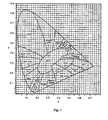
- white light may be generally defined as the central and generally ellipsoidal region of the CIE chromaticity diagram (also known as a Kelly Chart) shown in Fig. 1. Some common white color points include Daylight (0.333, 0.333), Cool White (0.380, 0.380), and Warm White (0.440, 0.400).
- CIE Commission Internationale de l'Eclairage
- the (Sr,Ca)S:Eu phosphor may be co-doped with another activator such as samarium ((Sr,Ca)S:Eu,Sm).
- a preferred (Sr,Ca)S:Eu phosphor contains from 0 to about 2 weight percent (wt.%) Ca.
- the amount of (Sr,Ca)S:Eu phosphor in the phosphor blend is from about 5 to about 60 weight percent, and more preferably from about 5 to about 20 weight percent.
- the electroluminescent phosphor is preferably a ZnS:Cu electroluminescent phosphor and may contain other co-activators such as chlorine and gold.
- the electroluminescent phosphor emits primarily between about 400 nm to about 550 nm and the (Sr,Ca)S:Eu phosphor emits primarily between about 580 nm to about 730 nm.
- the white-emitting electroluminescent lamp made with the phosphor blend preferably has an CIE x color coordinate of between about 0.245 and about 0.320 and a y color coordinate of between about 0.300 and about 0.370. More preferably, the x color coordinate is between about 0.250 and about 0.260 and the y color coordinate is between about 0.330 and about 0.370.
- the lamp exhibits a CRI of at least about 75 and more preferably at least about 80.
- the blend ratio may have to be adjusted depending on the operating conditions of the lamp since this can affect the intensity of the light emitted by the EL phosphor.
- Fig. 1 is a CIE chromaticity diagram showing the various color hues.
- Fig. 2 is a cross-sectional illustration of a thick-film electroluminescent lamp according to this invention.
- FIG. 2 there is shown a cross section of a thick-film electroluminescent lamp 2 according to this invention.
- the lamp 2 has two dielectric layers 20 and 22.
- a first conductive material 4, such as graphite, coated on a plastic film 1 2b forms a first electrode of the lamp 2; while a thin layer of a transparent conductive material 6, such as indium tin oxide, coated on a second plastic film 12a forms a second electrode.
- Adjacent to the first electrode 4 is a layer of dielectric material 14 in which are embedded particles of a ferroelectric material 10, preferably barium titanate. Adjacent to the second electrode 6 is a layer of dielectric material 14 in which are embedded particles of the blue or blue-green emitting electroluminescent phosphor 8 and particles of a (Sr,Ca)S:Eu phosphor 7.
- phosphor blends were prepared by adding the appropriate amounts of the phosphors to a plastic bottle and blending on a paint shaker for twenty minutes.
- Two electroluminescent (EL) phosphors were used: OSRAM SYLVANIA Inc.'s GlacierGlo ® types GG65 (blue-emitting) and GG25 (blue-green emitting).
- the amount of the (Sr,Ca)S:Eu phosphor was varied from 10 to 50% by weight (wt.%).
- the remainder of the blend consisted of types GG65 and GG25, or a combination thereof.
- the amount of the GG65 EL phosphor ranged from 0 to 60% and the amount of the GG25 EL phosphor ranged from 0 to 70% by weight.
- the EL phosphors and the (Sr,Ca)S:Eu phosphor had a protective coating of hydrolyzed TMA on the individual phosphor particles.
- the phosphor blends were incorporated into thick-film EL lamps and operated generally at 100V, 400Hz.
- Table 1 EL Phosphor Wt.% (Sr,Ca)S:Eu 24 hr. luminance (cd/m 2 ) 100 hr. luminance (cd/m 2 ) x color coordinate y color coordinate GG65 30 26.0 22.6 0.314 0.304 GG65 40 18.5 16.0 0.333 0.331 GG65 50 11.9 10.3 0.345 0.315 GG65 0 54.6 48.1 0.161 0.224 GG25 30 36.2 32.1 0.331 0.425 GG25 40 25.3 22.4 0.354 0.425 GG25 50 16.2 14.4 0.369 0.425 GG25 0 86.3 77.1 0.176 0.396
Landscapes
- Chemical & Material Sciences (AREA)
- Inorganic Chemistry (AREA)
- Engineering & Computer Science (AREA)
- Materials Engineering (AREA)
- Organic Chemistry (AREA)
- Luminescent Compositions (AREA)
Abstract
Description
- This application is a continuation-in-part of copending application Serial
No. 10/711,682, filed 9/30/2004 - This invention generally relates to electroluminescent (EL) lamps and phosphors, and, more particularly, to electroluminescent lamps for generating white light.
- Electroluminescence is the emission of light under electric-field excitation. Based on this mechanism, EL lamps are finding an increasing number of applications in the field of flat panel displays due to the growing demand for consumer electronic products, e.g., cellular phones and portable computing devices. EL lamps also provide uniform light emission independent of viewing angle and they are insensitive to mechanical shock and vibration. They can be easily DC-driven at 1.5-9 volts by using inverters that generate AC voltages of about 100-300 V (peak-to-peak) at frequencies of 50 to 1000 Hz.
- The two major EL lamp constructions are generally referred to as thin film and thick film. Thin-film EL lamps are made by depositing alternating thin layers of dielectric materials, phosphors and conductive oxides on a glass substrate using a vapor deposition technique such as CVD. Thick-film lamps are made by suspending powdered materials in resinous materials and then applying the materials in layers onto a plastic film using conventional screen printing techniques. Hence, the thick-film EL lamps can be thin, flexible and rugged thereby making them suitable for a wider range of lighting applications.
- The phosphors available for thick-film EL lamps are primarily comprised of zinc sulfide that has been doped with various activators, e.g., Cu, Au, Ag, Mn, Br, I, and Cl. Examples of these phosphors are described in
U.S. Patent Nos. 5,009,808 ,5,702,643 ,6,090,311 , and5,643,496 . Typically, the individual particles of the EL phosphors are encapsulated with an inorganic coating in order improve their resistance to moisture-induced degradation. Examples of such coatings are described inU.S. Patent Nos. 5,220,243 ,5,244,750 ,6,309,700 , and6,064,150 . - For signage and backlighting involving multi-color informational displays, it is important to be able to generate a white light with a high color rendering index (CRI). However, the brightest electroluminescent phosphors emit primarily in the blue to green spectral region at wavelengths from about 400 nm to about 550 nm. This makes it difficult to obtain a high CRI, white emission with EL lamps especially since a satisfactory red-emitting electroluminescent phosphor for thick-film EL lamps has yet to be developed.
- A white-emitting electroluminescent lamp has been developed using a phosphor blend comprising a blue- or blue-green emitting electroluminescent phosphor and an europium-activated alkaline earth phosphor having the general formula Sr1-xCaxS:Eu where 0 ≤ x ≤ 1, (herein referred to as (Sr,Ca)S:Eu). In the present invention, the (Sr,Ca)S:Eu functions as a photoluminescent phosphor by converting some of the blue- or blue-green light emitted by the electroluminescent phosphor into a red emission. The combined emissions of the electroluminescent phosphor and the (Sr,Ca)S:Eu phosphor produces an overall white emission from the lamp. In terms of CIE x,y color coordinates, white light may be generally defined as the central and generally ellipsoidal region of the CIE chromaticity diagram (also known as a Kelly Chart) shown in Fig. 1. Some common white color points include Daylight (0.333, 0.333), Cool White (0.380, 0.380), and Warm White (0.440, 0.400). (The x,y color coordinates referred to herein are for the 1931 Commission Internationale de l'Eclairage (CIE) Standard Observer (2°)).
- The (Sr,Ca)S:Eu phosphor may be co-doped with another activator such as samarium ((Sr,Ca)S:Eu,Sm). A preferred (Sr,Ca)S:Eu phosphor contains from 0 to about 2 weight percent (wt.%) Ca. Preferably, the amount of (Sr,Ca)S:Eu phosphor in the phosphor blend is from about 5 to about 60 weight percent, and more preferably from about 5 to about 20 weight percent. The electroluminescent phosphor is preferably a ZnS:Cu electroluminescent phosphor and may contain other co-activators such as chlorine and gold. Preferably, the electroluminescent phosphor emits primarily between about 400 nm to about 550 nm and the (Sr,Ca)S:Eu phosphor emits primarily between about 580 nm to about 730 nm. In addition, it is preferred to provide the particles of the (Sr,Ca)S:Eu phosphor with a protective coating like the protective coatings applied to EL phosphors. In particular, it is preferred to apply the hydrolyzed trimethylaluminum (TMA) coating described in
U.S. Patent No. 5,220,243 .
The white-emitting electroluminescent lamp made with the phosphor blend preferably has an CIE x color coordinate of between about 0.245 and about 0.320 and a y color coordinate of between about 0.300 and about 0.370. More preferably, the x color coordinate is between about 0.250 and about 0.260 and the y color coordinate is between about 0.330 and about 0.370. The lamp exhibits a CRI of at least about 75 and more preferably at least about 80. The blend ratio may have to be adjusted depending on the operating conditions of the lamp since this can affect the intensity of the light emitted by the EL phosphor. - Fig. 1 is a CIE chromaticity diagram showing the various color hues.
- Fig. 2 is a cross-sectional illustration of a thick-film electroluminescent lamp according to this invention.
- For a better understanding of the present invention, together with other and further objects, advantages and capabilities thereof, reference is made to the following disclosure and appended claims taken in conjunction with the above-described drawings.
- Referring to Fig. 2, there is shown a cross section of a thick-film electroluminescent lamp 2 according to this invention. The lamp 2 has two
dielectric layers plastic film 12a forms a second electrode. Sandwiched between the two conductive electrodes 4 and 6 are twolayers dielectric material 14 which can be, for example, cyanoethyl cellulose, cyanoethyl starch, poly-(methylmethacrylate/ethyl acrylate) or a fluorocarbon polymer. Adjacent to the first electrode 4 is a layer ofdielectric material 14 in which are embedded particles of aferroelectric material 10, preferably barium titanate. Adjacent to the second electrode 6 is a layer ofdielectric material 14 in which are embedded particles of the blue or blue-green emittingelectroluminescent phosphor 8 and particles of a (Sr,Ca)S:Eu phosphor 7. - Several phosphor blends were prepared by adding the appropriate amounts of the phosphors to a plastic bottle and blending on a paint shaker for twenty minutes. Two electroluminescent (EL) phosphors were used: OSRAM SYLVANIA Inc.'s GlacierGlo® types GG65 (blue-emitting) and GG25 (blue-green emitting). The amount of the (Sr,Ca)S:Eu phosphor was varied from 10 to 50% by weight (wt.%). The remainder of the blend consisted of types GG65 and GG25, or a combination thereof. The amount of the GG65 EL phosphor ranged from 0 to 60% and the amount of the GG25 EL phosphor ranged from 0 to 70% by weight. The EL phosphors and the (Sr,Ca)S:Eu phosphor had a protective coating of hydrolyzed TMA on the individual phosphor particles. The phosphor blends were incorporated into thick-film EL lamps and operated generally at 100V, 400Hz.
- Example 1
- A series of six samples were prepared by blending 30, 40 or 50wt.% of a (Sr,Ca)S:Eu phosphor containing 1.3 wt.% Ca with either type GG65 or GG25 EL phosphor. The lamp data is given in Table 1. Lamp luminance was measured at 24 and 100 hours. The color coordinates of the 40wt.% (Sr,Ca)S:Eu with GG65 are very close to the coordinates for Daylight White (0.333, 0.333).
-
Table 1 EL Phosphor Wt.% (Sr,Ca)S:Eu 24 hr. luminance (cd/m2) 100 hr. luminance (cd/m2) x color coordinate y color coordinate GG65 30 26.0 22.6 0.314 0.304 GG65 40 18.5 16.0 0.333 0.331 GG65 50 11.9 10.3 0.345 0.315 GG65 0 54.6 48.1 0.161 0.224 GG25 30 36.2 32.1 0.331 0.425 GG25 40 25.3 22.4 0.354 0.425 GG25 50 16.2 14.4 0.369 0.425 GG25 0 86.3 77.1 0.176 0.396 - Example 2:
- Three samples were prepared by blending 10, 20 and 30wt.% of a (Sr,Ca)S:Eu phosphor containing 1.3 wt.% Ca with a 50/50 blend of GG65 and GG25 by weight. The lamp results are given in Table 2. The lamp resulting from the blend of 10wt.% (Sr,Ca)S:Eu with the EL blend resulted in a preferred white emitting lamp.
-
Table 2 EL Phosphor Wt.% (Sr,Ca)S:Eu 24 hr. luminance (cd/m2) 100 hr. luminance (cd/m2) x color coordinate y color coordinate GG65/ GG25 10 56.0 49.3 0.249 0.342 GG65/ GG25 20 40.1 35.1 0.292 0.357 GG65/GG25 30 32.1 28.1 0.317 0.363 GG65/GG25 0 72.8 64.8 0.166 0.305 - Examples 3 and 4:
- Two more series of blends were prepared by blending 10wt.% of a (Sr,Ca)S:Eu phosphor containing 1.3 wt.% Ca with different ratios of types GG65 and GG25, 30/70 to 60/40 by weight, respectively. The lamp results are given in Table 3. The lamp produced using the 40/60 ratio produced a lamp that was white at both low and high frequencies.
-
Table 3 GG65/GG25 ratio Wt.% (Sr,Ca)S:Eu 24 hr. luminance (cd/m2) 100 hr. luminance (cd/m2) x color coordinate y color coordinate 30/70 10 55.4 49.1 0.253 0.371 35/65 10 54.1 47.9 0.253 0.365 40/60 10 51.6 46.3 0.259 0.361 45/55 10 51.0 45.6 0.258 0.353 50/50 10 50.6 45.1 0.257 0.345 55/45 10 50.6 45.0 0.256 0.338 60/40 10 49.2 43.8 0.254 0.331 - While there has been shown and described what are at the present considered the preferred embodiments of the invention, it will be obvious to those skilled in the art that various changes and modifications may be made therein without departing from the scope of the invention as defined by the appended claims.
Claims (24)
- An electroluminescent lamp including a phosphor blend comprised of a mixture of particles of an electroluminescent phosphor and particles of an europium-activated alkaline earth phosphor having the general formula Sr1-xCaxS:Eu where 0 ≤ x ≤ 1, the electroluminescent phosphor selected from a blue-emitting electroluminescent phosphor, a blue-green-emitting electroluminescent phosphor, or a combination thereof.
- The lamp of claim 1 wherein the lamp exhibits a CRI of at least about 75.
- The lamp of claim 1 wherein the lamp exhibits a CRI of at least about 80.
- The lamp of claim 1 wherein the lamp emits a white light having an x color coordinate of between about 0.245 and about 0.320 and a y color coordinate of between about 0.300 and about 0.370.
- The lamp of claim 1 wherein the lamp emits a white light having an x color coordinate of between about 0.250 and about 0.260 and the y color coordinate of between about 0.330 and about 0.370.
- The lamp of claim 1 wherein the europium-activated alkaline earth phosphor is codoped with samarium.
- The lamp of claim 1 wherein the electroluminescent phosphor emits primarily between about 400 nm to about 550 nm and the europium-activated alkaline earth phosphor emits primarily between about 580 nm to about 730 nm.
- The lamp of claim 1 wherein the electroluminescent phosphor is a ZnS:Cu phosphor.
- The lamp of claim 1 wherein the europium-activated alkaline earth phosphor comprises from about 5 to about 60 weight percent of the phosphor blend.
- The lamp of claim 1 wherein the europium-activated alkaline earth phosphor comprises from about 5 to about 20 weight percent of the phosphor blend.
- The lamp of claim 1 wherein the particles of the electroluminescent phosphor and the particles of the europium-activated alkaline earth phosphor individually have a coating of hydrolyzed trimethyaluminum.
- A white-emitting electroluminescent lamp comprising a first transparent electrode, a second electrode, a first dielectric layer, and a second dielectric layer, the first and second dielectric layers being disposed between the electrodes;
the first dielectric layer being disposed adjacent to the first transparent electrode and having a phosphor blend dispersed in a first dielectric material;
the second dielectric layer being disposed adjacent to the second electrode and having a ferroelectric material dispersed in a second dielectric material; and
the phosphor blend comprising of a mixture of particles of an electroluminescent phosphor and particles of an europium-activated alkaline earth phosphor having the general formula Sr1-xCaxS:Eu where 0 ≤ x ≤ 1, the electroluminescent phosphor selected from a blue-emitting electroluminescent phosphor, a blue-green-emitting electroluminescent phosphor, or a combination thereof. - The lamp of claim 12 wherein the lamp emits a white light having an x color coordinate of between about 0.245 and about 0.320 and a y color coordinate of between about 0.300 and about 0.370.
- The lamp of claim 12 wherein the europium-activated alkaline earth phosphor comprises from about 5 to about 60 weight percent of the phosphor blend.
- The lamp of claim 12 wherein the lamp exhibits a CRI of at least about 75.
- A phosphor blend comprising: a mixture of particles of an electroluminescent phosphor and particles of an europium-activated alkaline earth phosphor having the general formula Sr1-xCaxS:Eu where 0 ≤ x ≤ 1, the electroluminescent phosphor selected from a blue-emitting electroluminescent phosphor, a blue-green-emitting electroluminescent phosphor, or a combination thereof.
- The phosphor blend of claim 16 wherein the electroluminescent phosphor emits primarily between about 400 nm to about 550 nm and the europium-activated alkaline earth phosphor emits primarily between about 580 nm to about 730 nm.
- The phosphor blend of claim 16 wherein the electroluminescent phosphor is a ZnS:Cu phosphor.
- The phosphor blend of claim 16 wherein the europium-activated alkaline earth phosphor comprises from about 5 to about 60 weight percent of the phosphor blend.
- The phosphor blend of claim 16 wherein the europium-activated alkaline earth phosphor comprises from about 5 to about 20 weight percent of the phosphor blend.
- The phosphor blend of claim 20 wherein the electroluminescent phosphor is a ZnS:Cu phosphor.
- The lamp of claim 1 wherein the europium-activated alkaline earth phosphor contains from 0 to about 2 weight percent Ca.
- The lamp of claim 12 wherein the europium-activated alkaline earth phosphor contains from 0 to about 2 weight percent Ca.
- The phosphor blend of claim 16 wherein the europium-activated alkaline earth phosphor contains from 0 to about 2 weight percent Ca.
Applications Claiming Priority (1)
| Application Number | Priority Date | Filing Date | Title |
|---|---|---|---|
| US11/164,153 US7749405B2 (en) | 2004-09-30 | 2005-11-11 | White-emitting phosphor blend and electroluminescent lamp containing same |
Publications (1)
| Publication Number | Publication Date |
|---|---|
| EP1786243A1 true EP1786243A1 (en) | 2007-05-16 |
Family
ID=37696035
Family Applications (1)
| Application Number | Title | Priority Date | Filing Date |
|---|---|---|---|
| EP06019597A Withdrawn EP1786243A1 (en) | 2005-11-11 | 2006-09-19 | White-emitting phosphor blend and electroluminescent lamp containing same |
Country Status (3)
| Country | Link |
|---|---|
| US (1) | US7749405B2 (en) |
| EP (1) | EP1786243A1 (en) |
| KR (1) | KR100849786B1 (en) |
Cited By (2)
| Publication number | Priority date | Publication date | Assignee | Title |
|---|---|---|---|---|
| US7749405B2 (en) | 2004-09-30 | 2010-07-06 | Global Tungsten & Powders Corp. | White-emitting phosphor blend and electroluminescent lamp containing same |
| US8278816B2 (en) | 2004-09-30 | 2012-10-02 | Global Tungsten & Powders Corp. | High CRI electroluminescent lamp |
Families Citing this family (4)
| Publication number | Priority date | Publication date | Assignee | Title |
|---|---|---|---|---|
| US7452483B2 (en) * | 2004-09-30 | 2008-11-18 | Global Tungsten & Powders Corp. | Yellow-emitting phosphor blend for electroluminescent lamps |
| EP2128220A4 (en) * | 2007-03-23 | 2010-12-08 | Ube Industries | ALPHA-LICIUM PHOSPHORATED NITRIDE AND METHOD FOR PRODUCING THE SAME |
| US8710526B2 (en) * | 2011-08-30 | 2014-04-29 | Abl Ip Holding Llc | Thermal conductivity and phase transition heat transfer mechanism including optical element to be cooled by heat transfer of the mechanism |
| US8759843B2 (en) | 2011-08-30 | 2014-06-24 | Abl Ip Holding Llc | Optical/electrical transducer using semiconductor nanowire wicking structure in a thermal conductivity and phase transition heat transfer mechanism |
Citations (9)
| Publication number | Priority date | Publication date | Assignee | Title |
|---|---|---|---|---|
| US5220243A (en) * | 1990-10-05 | 1993-06-15 | Gte Products Corporation | Moisture insensitive zinc sulfide electroluminescent materials and an electroluminescent device made therefrom |
| WO2000033390A1 (en) * | 1998-11-30 | 2000-06-08 | General Electric Company | Light emitting device with phosphor composition |
| US6153123A (en) * | 1997-02-24 | 2000-11-28 | Superior Micropowders, Llc | Sulfur-containing phosphor powders, methods for making phosphor powders and devices incorporating same |
| WO2001069982A1 (en) * | 2000-03-16 | 2001-09-20 | Planar Systems, Inc. | Thin-film electroluminescent phosphor |
| WO2002011173A1 (en) * | 2000-07-28 | 2002-02-07 | Osram Opto Semiconductors Gmbh | Luminescence conversion based light emitting diode and phosphors for wavelength conversion |
| WO2003042327A1 (en) * | 2001-11-14 | 2003-05-22 | Sarnoff Corporation | Red photoluminescent phosphors |
| EP1371711A2 (en) * | 2002-06-14 | 2003-12-17 | Osram Sylvania Inc. | Long life, white light emitting electroluminescent phosphor |
| EP1447854A2 (en) * | 2003-02-13 | 2004-08-18 | Fuji Photo Film Co., Ltd. | AC operating electroluminescence device |
| JP2005146190A (en) * | 2003-11-19 | 2005-06-09 | Mitsui Mining & Smelting Co Ltd | Red phosphor mainly composed of alkaline earth sulfide and method for producing the same |
Family Cites Families (20)
| Publication number | Priority date | Publication date | Assignee | Title |
|---|---|---|---|---|
| JPH01302691A (en) * | 1988-05-30 | 1989-12-06 | Nec Kansai Ltd | Dispersed type electroluminescent element |
| US5244750A (en) | 1988-06-10 | 1993-09-14 | Gte Products Corporation | Coated electroluminescent phosphor |
| US5009808A (en) | 1988-12-27 | 1991-04-23 | Gte Products Corporation | Process for producing electroluminescent yellow zinc sulfide phosphors |
| US5156885A (en) | 1990-04-25 | 1992-10-20 | Minnesota Mining And Manufacturing Company | Method for encapsulating electroluminescent phosphor particles |
| US5643496A (en) | 1996-04-04 | 1997-07-01 | Osram Sylvania Inc. | Small size electroluminescent phosphor |
| US5702643A (en) | 1996-04-24 | 1997-12-30 | Osram Sylvania Inc. | ZnS:Cu electroluminescent phosphor and method of making same |
| DE19849581B4 (en) | 1997-10-27 | 2005-05-12 | Osram Sylvania Inc., Danvers | Process for producing a long lifetime electroluminescent phosphor |
| US6064150A (en) | 1998-01-12 | 2000-05-16 | Osram Sylvania Inc. | Nitride coated particle and composition of matter comprised of such particles |
| CA2348641A1 (en) * | 1998-08-31 | 2001-04-19 | The Government Of The United States Of America As Represented By The Secretary Of The Navy | Coated cathodoluminescent phosphors |
| EP1001660A1 (en) * | 1998-11-10 | 2000-05-17 | Korea Electronics Technology Institute | Electroluminescent device and manufacturing method thereof |
| US6090311A (en) | 1998-12-01 | 2000-07-18 | Osram Sylvania Inc. | Alkali iodide doped zinc sulfide electroluminescent phoshor |
| EP1104799A1 (en) | 1999-11-30 | 2001-06-06 | Patent-Treuhand-Gesellschaft für elektrische Glühlampen mbH | Red emitting luminescent material |
| US6580224B2 (en) | 2000-06-05 | 2003-06-17 | Kabushiki Kaisha Toshiba | Backlight for color liquid crystal, color liquid crystal display device, and EL element for backlight of color liquid crystal device |
| CN1340590A (en) | 2000-08-29 | 2002-03-20 | 中国科学院长春光学精密机械与物理研究所 | White electroluminescent material |
| WO2003080764A1 (en) | 2002-03-22 | 2003-10-02 | Nichia Corporation | Nitride phosphor and method for preparation thereof, and light emitting device |
| KR101142725B1 (en) | 2003-03-13 | 2012-05-04 | 니치아 카가쿠 고교 가부시키가이샤 | Light emitting film, luminescent device, method for manufacturing light emitting film and method for manufacturing luminescent device |
| US7723740B2 (en) | 2003-09-18 | 2010-05-25 | Nichia Corporation | Light emitting device |
| US8278816B2 (en) | 2004-09-30 | 2012-10-02 | Global Tungsten & Powders Corp. | High CRI electroluminescent lamp |
| US7452483B2 (en) | 2004-09-30 | 2008-11-18 | Global Tungsten & Powders Corp. | Yellow-emitting phosphor blend for electroluminescent lamps |
| US7749405B2 (en) | 2004-09-30 | 2010-07-06 | Global Tungsten & Powders Corp. | White-emitting phosphor blend and electroluminescent lamp containing same |
-
2005
- 2005-11-11 US US11/164,153 patent/US7749405B2/en not_active Expired - Fee Related
-
2006
- 2006-09-19 EP EP06019597A patent/EP1786243A1/en not_active Withdrawn
- 2006-11-08 KR KR1020060109891A patent/KR100849786B1/en not_active Expired - Fee Related
Patent Citations (9)
| Publication number | Priority date | Publication date | Assignee | Title |
|---|---|---|---|---|
| US5220243A (en) * | 1990-10-05 | 1993-06-15 | Gte Products Corporation | Moisture insensitive zinc sulfide electroluminescent materials and an electroluminescent device made therefrom |
| US6153123A (en) * | 1997-02-24 | 2000-11-28 | Superior Micropowders, Llc | Sulfur-containing phosphor powders, methods for making phosphor powders and devices incorporating same |
| WO2000033390A1 (en) * | 1998-11-30 | 2000-06-08 | General Electric Company | Light emitting device with phosphor composition |
| WO2001069982A1 (en) * | 2000-03-16 | 2001-09-20 | Planar Systems, Inc. | Thin-film electroluminescent phosphor |
| WO2002011173A1 (en) * | 2000-07-28 | 2002-02-07 | Osram Opto Semiconductors Gmbh | Luminescence conversion based light emitting diode and phosphors for wavelength conversion |
| WO2003042327A1 (en) * | 2001-11-14 | 2003-05-22 | Sarnoff Corporation | Red photoluminescent phosphors |
| EP1371711A2 (en) * | 2002-06-14 | 2003-12-17 | Osram Sylvania Inc. | Long life, white light emitting electroluminescent phosphor |
| EP1447854A2 (en) * | 2003-02-13 | 2004-08-18 | Fuji Photo Film Co., Ltd. | AC operating electroluminescence device |
| JP2005146190A (en) * | 2003-11-19 | 2005-06-09 | Mitsui Mining & Smelting Co Ltd | Red phosphor mainly composed of alkaline earth sulfide and method for producing the same |
Non-Patent Citations (1)
| Title |
|---|
| SHIGEO SHIONOYA, WILLIAM M. YEN: "PHOSPHOR HANDBOOK", 1999, CRC PRESS LLC, BOCA RATON, XP002419509 * |
Cited By (2)
| Publication number | Priority date | Publication date | Assignee | Title |
|---|---|---|---|---|
| US7749405B2 (en) | 2004-09-30 | 2010-07-06 | Global Tungsten & Powders Corp. | White-emitting phosphor blend and electroluminescent lamp containing same |
| US8278816B2 (en) | 2004-09-30 | 2012-10-02 | Global Tungsten & Powders Corp. | High CRI electroluminescent lamp |
Also Published As
| Publication number | Publication date |
|---|---|
| US7749405B2 (en) | 2010-07-06 |
| KR100849786B1 (en) | 2008-07-31 |
| US20060066221A1 (en) | 2006-03-30 |
| KR20070050829A (en) | 2007-05-16 |
Similar Documents
| Publication | Publication Date | Title |
|---|---|---|
| JP2012227157A (en) | High cri electroluminescence lamp | |
| Kim et al. | Optical and electrical properties of ZnGa2O4/Mn2+ powder electroluminescent device | |
| EP1884551A1 (en) | Yellow-emitting phosphor blend for electroluminescent lamps | |
| JP4939697B2 (en) | Color liquid crystal backlight, color liquid crystal display device, and EL light emitting device for color liquid crystal backlight | |
| JP4316929B2 (en) | White-emitting electroluminescent phosphor with long lifetime | |
| JP4740582B2 (en) | Electroluminescent device | |
| US7749405B2 (en) | White-emitting phosphor blend and electroluminescent lamp containing same | |
| US8501042B2 (en) | Phosphor, white light emitting device including the phosphor and method of preparing the phosphor | |
| JP4433384B2 (en) | Electroluminescence element and display device | |
| US7261838B2 (en) | Electroluminescent phosphor | |
| JPH07166161A (en) | Zinc Sulfide Phosphor for EL | |
| JPH0298092A (en) | White thin film electroluminescent device | |
| JP2010021085A (en) | Electroluminescent element | |
| KR101457056B1 (en) | Electroluminescent panel using sintered ceramic fluorescent sheet and manufacturing method thereof | |
| JP2006077111A (en) | Phosphor | |
| JP2006097028A (en) | Single component yellow-emitting electroluminescent phosphor | |
| JP2006310169A (en) | Inorganic dispersion type electroluminescent element and transparent positive image system | |
| JP2006236924A (en) | Inorganic dispersion type electroluminescence device and light emitting device system | |
| JPH07119405B2 (en) | Thin film EL device |
Legal Events
| Date | Code | Title | Description |
|---|---|---|---|
| PUAI | Public reference made under article 153(3) epc to a published international application that has entered the european phase |
Free format text: ORIGINAL CODE: 0009012 |
|
| AK | Designated contracting states |
Kind code of ref document: A1 Designated state(s): AT BE BG CH CY CZ DE DK EE ES FI FR GB GR HU IE IS IT LI LT LU LV MC NL PL PT RO SE SI SK TR |
|
| AX | Request for extension of the european patent |
Extension state: AL BA HR MK YU |
|
| 17P | Request for examination filed |
Effective date: 20071113 |
|
| 17Q | First examination report despatched |
Effective date: 20071220 |
|
| AKX | Designation fees paid |
Designated state(s): DE FR GB IT NL |
|
| RAP1 | Party data changed (applicant data changed or rights of an application transferred) |
Owner name: GLOBAL TUNGSTEN & POWDERS CORP. |
|
| GRAP | Despatch of communication of intention to grant a patent |
Free format text: ORIGINAL CODE: EPIDOSNIGR1 |
|
| GRAJ | Information related to disapproval of communication of intention to grant by the applicant or resumption of examination proceedings by the epo deleted |
Free format text: ORIGINAL CODE: EPIDOSDIGR1 |
|
| INTG | Intention to grant announced |
Effective date: 20151014 |
|
| INTC | Intention to grant announced (deleted) | ||
| STAA | Information on the status of an ep patent application or granted ep patent |
Free format text: STATUS: THE APPLICATION IS DEEMED TO BE WITHDRAWN |
|
| 18D | Application deemed to be withdrawn |
Effective date: 20160401 |