EP1786108A1 - Method and system for transmitting data to vehicles over limited data links - Google Patents
Method and system for transmitting data to vehicles over limited data links Download PDFInfo
- Publication number
- EP1786108A1 EP1786108A1 EP06018048A EP06018048A EP1786108A1 EP 1786108 A1 EP1786108 A1 EP 1786108A1 EP 06018048 A EP06018048 A EP 06018048A EP 06018048 A EP06018048 A EP 06018048A EP 1786108 A1 EP1786108 A1 EP 1786108A1
- Authority
- EP
- European Patent Office
- Prior art keywords
- dictionary
- message
- identified
- identifier
- protocol stream
- Prior art date
- Legal status (The legal status is an assumption and is not a legal conclusion. Google has not performed a legal analysis and makes no representation as to the accuracy of the status listed.)
- Withdrawn
Links
- 238000000034 method Methods 0.000 title claims abstract description 36
- 238000013519 translation Methods 0.000 claims abstract description 7
- 238000004891 communication Methods 0.000 claims description 50
- 230000014616 translation Effects 0.000 abstract description 3
- 238000007906 compression Methods 0.000 description 9
- 230000006835 compression Effects 0.000 description 9
- 230000004044 response Effects 0.000 description 7
- 238000010586 diagram Methods 0.000 description 6
- 230000005540 biological transmission Effects 0.000 description 4
- 239000003550 marker Substances 0.000 description 4
- 238000012546 transfer Methods 0.000 description 4
- 238000013144 data compression Methods 0.000 description 3
- 230000006837 decompression Effects 0.000 description 2
- 238000001514 detection method Methods 0.000 description 2
- 238000012545 processing Methods 0.000 description 2
- 230000006978 adaptation Effects 0.000 description 1
- 238000012512 characterization method Methods 0.000 description 1
- 238000005516 engineering process Methods 0.000 description 1
- 238000007726 management method Methods 0.000 description 1
- 238000005259 measurement Methods 0.000 description 1
- 238000012986 modification Methods 0.000 description 1
- 230000004048 modification Effects 0.000 description 1
- 238000005457 optimization Methods 0.000 description 1
- 239000013589 supplement Substances 0.000 description 1
Images



Classifications
-
- H—ELECTRICITY
- H03—ELECTRONIC CIRCUITRY
- H03M—CODING; DECODING; CODE CONVERSION IN GENERAL
- H03M7/00—Conversion of a code where information is represented by a given sequence or number of digits to a code where the same, similar or subset of information is represented by a different sequence or number of digits
- H03M7/30—Compression; Expansion; Suppression of unnecessary data, e.g. redundancy reduction
- H03M7/3084—Compression; Expansion; Suppression of unnecessary data, e.g. redundancy reduction using adaptive string matching, e.g. the Lempel-Ziv method
- H03M7/3088—Compression; Expansion; Suppression of unnecessary data, e.g. redundancy reduction using adaptive string matching, e.g. the Lempel-Ziv method employing the use of a dictionary, e.g. LZ78
Definitions
- the present invention relates to a method and system for transferring data over a limited data link between a transmitter and a receiver. More specifically, the present invention relates to a communication system for exchanging data between an onboard device and a remote center, wherein the onboard device and remote center each have copies of one or more dictionaries.
- Limited-bandwidth and small-packet wireless data networks provide cost-effective, ubiquitous coverage and access to mobile applications, such as those present in vehicles.
- Such data networks sometimes referred to as limited data links, make it possible to efficiently convey tens of bytes to a few hundred bytes of information, but put practical limits on the amount and richness of data that can be transferred and the applications that rely upon the data.
- Problems associated with limited data links include the fact that only a small number of bytes can be transmitted at a time, combined with the fact that the bit transfer rate can be slow. The high cost of data transfer puts practical limits on the volume of data that can be transmitted over the limited data links.
- 200 bytes is enough to transmit 228 English language clear-text characters, if those characters are encoded in 7-bit ASCII. This may be sufficient for a short text message consisting of a few sentences. Due to overhead, most protocols that carry text will use up a portion of the 200 bytes. Assuming (conservatively) there is 15% overhead, this leaves approximately 170 bytes of data that can be transferred. By using the available 170 bytes efficiently, it is possible to reduce both the load on transmission systems and networks and the costs of transmitting data.
- compression algorithms for reducing bandwidth consumption by data transmitted over limited data links are known in the art, but are limited in effectiveness.
- a typical compression ratio for text is typically only about 15%, which is hardly worth the embedded processing and memory costs.
- Algorithms that achieve higher than 15% compression ratio typically rely upon large internal or external dictionaries that replace words with shorter placeholders or symbols.
- compression algorithms can be effective on text or sources that are not dense with binary information, but are less effective for other applications. For example, if bitmapped information is transmitted over a link, and each bit conveys a meaning (e.g., a pixel in an image), compression techniques are limited in reducing bandwidth consumption. Referencing a large dictionary is a viable option if the computing platform has vast resources and fast network connectivity, such as with a desktop personal computer. However, referencing a large dictionary places high demands on the communication system's resources (e.g., memory) and can reduce overall performance in an embedded or mobile platform.
- resources e.g., memory
- BNF Backus-Naur Form
- EBNF Extended BNF
- LZW Lempel-Ziv-Welch
- ECMA European Computer Manufacturers Association
- DCLZ Lempel and Ziv
- the ECMA protocol essentially builds a dictionary based upon the candidate target compression text by replacing redundant sequences with references placed into the dictionary.
- the ECMA protocol can be useful for compressing text; however, the concept of using string replacements is not effective where there is little repetition of byte sequences within a data stream.
- the communication system for conveying data is preferably sufficiently flexible and adaptable to the language, symbolic, and cues utilized by a vehicle telematics system.
- the system can be configured to be flexible enough to switch from the default method of transmitting information (e.g., predetermined identifiers, symbols or tokens in a dictionary) to a free-symbol mode.
- the system can be configured to be able to convey spoken and written information, as well as other symbolic representations (e.g., haptic cues).
- the system is preferably not hard-tied to any one language, but instead is able to toggle between language and symbolic sets.
- the system can employ a protocol that is flexible enough to mix and match token sizes.
- the system can allow for optimization of length of symbol identifiers rather than being restricted to fixed-length identifiers.
- Such a communication system can be used to supplement or enhance the performance of vehicle navigation systems, which allow users to determine a route from a start point to a destination point.
- Navigation systems having capabilities for determining the geographic position of a reference point are also well known in the art, such as Global Positioning Systems (GPS) or self-contained systems having distance and bearing sensors.
- GPS Global Positioning Systems
- the present invention addresses the shortcomings of the prior art systems and methods.
- the present invention is directed to a method and system for communicating messages over narrow bandwidth data links by converting the messages into protocol streams that comprise message tokens.
- a method and system for communicating a message over a data link generally involves receiving a message that comprises one or more message objects, and referencing at least one dictionary to identify those message objects for which translations to the at least one dictionary tokens are available.
- the method further comprises converting each identified message object into a message token, and associating each non-identified message object with a free symbol indicator to generate a free symbol segment.
- the message tokens and the free symbol segments are then concatenated to generate a protocol stream that is sent over the narrow bandwidth data link to a receiver unit or location.
- a method and system for recovering a message received over a data link generally involves receiving a protocol stream that comprises a dictionary identifier, message tokens, and at least one free symbol. The method further comprises verifying that each dictionary identified by the dictionary identifier is accessible, and selecting each dictionary identified by the dictionary identifier. Each selected dictionary is referenced to translate the message tokens into message objects. The method also comprises reassembling the message from the message objects and the at least one free symbol.
- the present invention is directed to a system and method for sending data over a low bandwidth data communications link.
- the present invention is directed to a system and method for utilizing token or symbolic dictionaries at the transmitting and receiving ends of the low bandwidth data link to facilitate the efficient transfer of data over the data link, sometimes referred to as a data pipe or channel.
- token or symbolic dictionaries at the transmitting and receiving ends of the low bandwidth data link to facilitate the efficient transfer of data over the data link, sometimes referred to as a data pipe or channel.
- the vehicle 12 includes a navigation device 14.
- the navigation device 14 may include an output unit 21, a receiver unit 22, an input unit 23, a position detection unit 24, a navigation memory unit 30, a navigation processor unit 26, and an RF transceiver unit 52 that are all in electrical communication with one another.
- the navigation memory unit 30 includes at least a portion of a user profile and in some embodiments may include the entire user profile.
- the navigation memory unit 30 includes a road map database portion and, in some embodiments, includes a disk reading unit for reading road map information not built into the navigation device 14.
- the user profile and/or the road map database stored in the memory 30 may be updated in the vehicle by way of the input unit 23, which can include at least one of a keyboard, a touch sensitive display, and a microphone.
- the user profile and/or the road map database may also be updated by way of information received through the receiver unit 22 and/or the RF transceiver unit 52.
- the receiver unit 22 receives information from the remote location 10 and, in one embodiment, is in communication with the remote location by way of a one-to-many communication system.
- One-to-many communication systems include systems that can send information from one source to a plurality of receivers, such as a broadcast network 31.
- Broadcast networks include television, radio, and satellite networks.
- the broadcast network 31 is the XM Radio satellite network 40, which comprises broadcast towers 42, satellite servers (not shown), and satellites 43.
- the broadcast towers 42 transmit information to the satellites 43, which bounce the information back down to the receiver unit 22 of the navigation device 14.
- the information received by the receiver 22 may be processed by the navigation processor unit 26.
- the processed information may then be displayed by way of the output unit 21, which includes at least one of a display and a speaker.
- the receiver unit 22, the navigation processor unit 26 and the output unit 21 are provided access to only subsets of the received broadcast information based on user preferences and/or traffic information demands.
- the user preferences, as well as user identity information and traffic-related information, can be part of the user profile.
- the position detection unit 24 may include a GPS receiver that communicates with a plurality of GPS satellites (separate from the XM satellites) to determine the position of the vehicle 12. For example, the GPS receiver searches for and collects GPS information (or signals) broadcast from four or more GPS satellites that are in view of the GPS receiver. Next, using the time interval between the broadcast time and reception time of each broadcast signal, the GPS receiver calculates the distance between the GPS receiver and each of the four or more GPS satellites. These distance measurements, along with the position and time information received in the broadcast signals, allow the GPS receiver to calculate the geographic position of the vehicle 12.
- the mobile unit 18 is used to receive and transmit information from and to the remote location 10; and, in an alternate embodiment shown in Fig. 2, an RF transceiver 152 is used to receive and transmit information from and to the remote location 110.
- the mobile unit 18 may be a wireless phone or any other device that communicates with other devices by way of the wireless communication network 46.
- the mobile unit 18 includes a wireless receiver 32, a wireless transmitter 34, a mobile unit processor 40, and an RF transceiver unit 54 that are in communication with one another.
- the mobile unit 18 is in two-way communication with the remote location 10 by way of the receiver 32, the transmitter 34, and the wireless communication network 46, which comprises numerous base stations.
- information is transmitted from or to the vehicle or remote location over a high bandwidth packet data (e.g., GPRS, EDGE, 1xRTT, 1xEV, HSDPA, Flash-OFDM, etc.) channel of the wireless communication network 46. If the high bandwidth channel is unavailable, a low bandwidth DTMF channel can be used.
- the receiver 32 receives information from the remote location 10, and the transmitter 34 transmits information to the remote location 10. In other embodiments, the transmitter 34 also transmits information to suppliers of traffic or other information 48, 50.
- the information received from and transmitted to the remote location 10 by way of the mobile unit 18 is accessed by the user through the navigation device 14, which is in communication with the mobile unit 18.
- the mobile unit 18 may be embedded in the vehicle 12 and be in communication with the navigation device 14 by, for example, a cable (not shown).
- the navigation device 14 and mobile unit 18 are in communication with one another by way of RF transceiver units 54 and 52.
- Both the navigation device 14 and the mobile unit 18 include RF transceiver units 52, 54, which, in one embodiment, comply with the Bluetooth® wireless data communication format or the like.
- the RF transceiver units 52, 54 allow the navigation device 14 and the mobile unit 18 to communicate with one another.
- the receiver 32 and transmitter 14 of the mobile unit 18 and the receiver unit 20 of the navigation device 14 allow the navigation device 14 and mobile unit 18 to communicate with one another.
- the navigation device 114 transmits and receives information to and from the remote location 110 by way of the RF transceiver 152, access points 170, 172, and gateways 174, 176 that are in communication with the network 162.
- the RF transceiver 152 and the access points 170, 172 are compliant with the IEEE 802.11 specification, and such transceivers and access points include Wi-Fi® - certified equipment.
- the access points 170, 172 are typically in communication with the gateways 174, 176 by way of a cable, and the gateways are in communication with the remote location 110 by way of the network 162.
- the access points 170, 172 are in communication with the RF transceiver 152 and have a limited range over which they can communicate with the RF transceiver 152. Thus, it is preferable that there be numerous access points 170, 172 positioned so that the distance between the access points and the areas through which a vehicle 12 might pass is less than or equal to the limited range of the access points. When the access points 170, 172 are so positioned, the RF transceiver 152 effectively exchanges information with the access points 170, 172 and, thus, the remote location 110.
- the navigation device 114 also includes input and output units, a receiver unit, a memory unit, and a processor unit, none of which are shown.
- the components of the alternate navigation device embodiment 114 have the same functionality as do the corresponding components of the navigation device 14 of the first embodiment.
- the remote location 10, 110 includes a remote server 44, 144, a remote transmitter 56, 156 and receiver 58, 158, and a remote memory 60, 160 that are in communication with one another.
- the remote transmitter and receiver 56, 58 communicate with the navigation device 14 and mobile unit 100 by way of the broadcast 31 and wireless 46 communication networks, respectively.
- the remote transmitter and receiver 156, 158 communicate with the navigation device 114, including the RF transceiver 152, by way of the broadcast communication network 131 and a network 162.
- the remote location 10, 110 is also in communication with suppliers of traffic and/or other information 48, 50, 148, 150 such as government traffic information suppliers, private traffic information suppliers, and users of other vehicles, by way of the network 62, 162.
- the network 62, 162 is typically a wide area network (WAN) such as the Internet.
- WAN wide area network
- some of the information suppliers 48, 50, 148, 150 may be in communication with the remote location 10, 110 by way of a local area network (LAN), while other information providers 48, 50, 148, 150 such as the vehicle users, are in communication with the remote location by way of the Internet.
- the RF transceiver 152 is in communication with the remote location 110 and/or the information providers 148, 150 by way of a network 162 that is a LAN.
- the LAN 162 is compliant with the IEEE 802.3 specification or is an Ethernet network.
- the information suppliers 48, 50, 148, 150 may transmit updated user profiles and traffic-related information to the remote location 10, 110.
- a plurality of user profiles are in a user profile database, which, along with traffic-related information, is stored in the remote memory 60, 160.
- the updated user profiles and new traffic-related information are transmitted from the remote location 10, 110 to the navigation device 14, 114 by way of the broadcast network 31, 131.
- the new traffic-related information and updated user profiles may be transmitted to the vehicles 12, 112 by way of the wireless network 46 or the network 162.
- the user profile stored in the memory 30 of the navigation device 14 is updated, and the vehicle-related information is made accessible to the user by way of the output unit 26 of the navigation device 14.
- the information providers may communicate directly with the mobile unit 18 or RF transceiver 152 by way of the wireless communication network 46 or the network 162.
- a system and method for transmitting data over a limited data link between a sender/transmitter and a receiver wherein the transmitter and receiver each have identical copies of one or more token/symbol dictionaries.
- the transmitter and receiver typically each hold at least one copy of identical fixed-length dictionaries.
- the fixed-length dictionaries each comprise about 300 words or tokens.
- the transmitter and receiver In order for the transmitter and receiver to communicate and understand one another, the transmitter and receiver must hold the same dictionary. If the receiver and sender want to communicate emergency information, they will each refer to their "emergency" dictionary. Alternatively, under an extension of the protocol, the sender can download one or more new dictionaries to the receiver.
- the transmitter/sender is a provider of remote services while the receiver is an in-vehicle client device, such as a telematics device.
- the vehicle comprises the transmitter while the remote location comprises the receiver.
- the vehicle comprises a first transmitter and a first receiver, while the remote location comprises a second transmitter and a second receiver.
- each dictionary will contain tokens or symbols for efficient, low-bandwidth communication between a sender and a receiver.
- the dictionary can contain a set of English words and basic punctuation. However, dictionary entries could symbolize almost anything as long as there is an agreement or understanding between the end parties as to what reference an entry represents.
- Each dictionary's content can be homogeneous or can comprise heterogeneous collections ("objects") depending on the particular application.
- the dictionary 200 can comprise characters, sentences, postfixes, numbers, phrases, haptic cues, paragraphs, words, punctuation, icons, prefixes, symbols, etc.
- the data transmission system 199 comprises a remote response center 210 and a client device 220 (e.g., a telematics device in a car) that are in communication with each other via a communication or data link 212.
- the data link 212 typically has bandwidth, packet size, and usage restrictions.
- the data link 212 is a narrowband transmission link, channel, pipe, or the like, over a wireless network.
- the remote response center 210 and the client device 220 typically have one or more dictionaries, each with a plurality of words and symbols, according to the needs or demands of a particular application.
- the center 210 and the device 220 each comprise n different dictionaries (200 1 through 200 n ).
- the transmitter unit comprises a remote response center or the like.
- the receiver unit comprises a vehicle onboard computer, client device, or the like.
- the dictionaries (200 1 through 200 n ) are typically in memory units/devices that are in communication with the transmitter/receivers units.
- the transmitter/sender unit and the receiver unit have identical copies of the dictionaries (200 1 through 200 n ).
- the dictionaries are typically relatively small or limited in size. This can be achieved by utilizing dictionaries that are application or task specific, thereby avoiding the use of unnecessarily large dictionaries that fill memory units/devices with content that is not needed.
- the dictionaries can be modular in nature to facilitate efficient transfer of dictionary data to or from the memory units that are in communication with the transmitter/receivers units.
- the data transmission system 199 comprises modular, relatively small dictionaries (200 1 through 200 n ) that make it easier to add, change, or replace the dictionaries (200 1 through 200 n ) according to the application or task at hand.
- the sender In producing the translated version of the message to be sent over the limited data link, the sender typically assembles a protocol stream containing a chain of identifiers that represent the dictionary entries or tokens to convey. Other information can be encoded, such as protocol mode, length information, characterization of token lengths, and information to the receiver regarding which dictionary to use in translating the received tokens/symbols.
- the receiver Upon receiving the stream of tokens, the receiver will refer to the correct dictionary and translate the stream into the correct sequence of objects. The receiver can then use these objects to convey richer information to the user that otherwise would not have been possible.
- the sender/transmitter unit or location (e.g., remote response center 210) is in electronic communication with a memory unit that stores one or more dictionaries (e.g., 200 1 through 200 n ).
- the transmitter unit receives the message to be communicated (e.g., "The police car is blue.”), wherein each word and punctuation mark is a message object.
- the transmitter unit references at least one dictionary to identify those message objects for which translation to dictionary tokens or identifiers are available, and converts each identified message object into a message token.
- the center 210 retrieves the appropriate dictionary based upon service needs, user input, etc., and assembles a protocol stream 214 containing multiple identifiers (e.g., 3, 6, 4, 2, 5, and 1).
- the protocol stream 214 which comprises the IDs of dictionary tokens, is transmitted to one or more receiver units or devices.
- the receiver unit (e.g., client device 220) is typically in wireless communication with the transmitter unit or location (e.g., remote response center 210). More specifically, in the present embodiment, the receiver and transmitter units are in RF wireless communication with each other over a limited data link having narrow bandwidth.
- the receiver unit typically receives the protocol stream, verifies that the memory unit comprises each dictionary identified by the dictionary identifier, and then selects each dictionary identified by the dictionary identifier.
- the receiver unit references each selected dictionary to translate the message tokens into message objects, and reassembles the message from the message objects and the at least one free symbol, explained in further detail below.
- the phrase is reassembled at the receiving client device 220 and conveyed to the user.
- the reassembled phrase (e.g., "the police car is blue.") can be conveyed to the user via a display device 222 , a speaker 224, or the like, or combinations thereof.
- the transmitting and receiving roles of the remote response center 210 and the client device 220, respectively, can be reversed (i.e., the device 220 can transmit the protocol stream 214 to the center 210) depending on the particular application. Also, the device 220 and center 210 can utilize a plurality of dictionaries to convey protocol streams 214 to each other.
- the dictionary 200 utilized by the sender and receiver may not always contain a token for the object that the sender wishes to convey.
- the protocol allows escapement into free-symbol mode, wherein an encoding (e.g., ASCII characters) can be used to convey items that are not in the dictionary 200.
- dictionary symbols can be mixed with free symbols - words, phrases, etc. that are not located in the limited dictionaries - when the dictionary 200 does not contain the desired token(s). For example, suppose the center 210 intends to send the message "the police car is on Washington" to a user near the device 220.
- the transmitter assembles a protocol stream 214 containing multiple identifiers (e.g., 36427) and a free symbol (e.g., "Washington").
- the protocol stream 214 comprises a control information area or segment 230 that can include information regarding the protocol mode, which dictionary to use, token lengths, etc.
- the stream 214 further comprises an identifier segment 231, which is made up of one or more dictionary tokens.
- the stream 214 further comprises an escape marker or free symbol indicator 232 indicating that a free symbol area 235 will follow.
- the escape marker 232 is followed by an area 234 that includes information regarding the length of the proceeding free symbol area 235.
- Marker 236 indicates where the free symbol area 235 ends.
- the marker 236 also indicates the beginning of another identifier segment comprising one or more dictionary tokens.
- the phrase “the police car is on Washington” is reassembled at the receiver and conveyed to the user.
- the transmitter typically converts each identified message object into a message token, and also associates each non-identified message object with a free symbol indicator to generate a free symbol segment from each non-identified message object.
- the transmitter associates each non-identified message object with the free symbol indicator by prefixing each non-identified message with the free symbol indicator.
- the transmitter then concatenates the message tokens and the free symbol segments to generate the protocol stream that is sent over the narrow bandwidth data link to a receiver.
- the receiver Upon receiving the protocol stream, the receiver typically verifies that the memory unit it is in communication with comprises each dictionary identified by the dictionary identifier, and then selects each dictionary identified by the dictionary identifier.
- the receiver references each selected dictionary to translate the message tokens into message objects, and reassembles the message from the message objects and any free symbols, as explained above.
- the receiver unit preferably alerts the user if it is not able to access one or more dictionaries identified by the protocol stream's dictionary identifier and/or obtains copies of the missing dictionaries to be stored in a local or internal memory.
Landscapes
- Engineering & Computer Science (AREA)
- Theoretical Computer Science (AREA)
- Mobile Radio Communication Systems (AREA)
- Navigation (AREA)
Abstract


Description
- The present invention relates to a method and system for transferring data over a limited data link between a transmitter and a receiver. More specifically, the present invention relates to a communication system for exchanging data between an onboard device and a remote center, wherein the onboard device and remote center each have copies of one or more dictionaries.
- Limited-bandwidth and small-packet wireless data networks provide cost-effective, ubiquitous coverage and access to mobile applications, such as those present in vehicles. Such data networks, sometimes referred to as limited data links, make it possible to efficiently convey tens of bytes to a few hundred bytes of information, but put practical limits on the amount and richness of data that can be transferred and the applications that rely upon the data. Problems associated with limited data links include the fact that only a small number of bytes can be transmitted at a time, combined with the fact that the bit transfer rate can be slow. The high cost of data transfer puts practical limits on the volume of data that can be transmitted over the limited data links.
- For example, if there is a 200 byte limit for user data (disregarding lower-level protocol information), 200 bytes is enough to transmit 228 English language clear-text characters, if those characters are encoded in 7-bit ASCII. This may be sufficient for a short text message consisting of a few sentences. Due to overhead, most protocols that carry text will use up a portion of the 200 bytes. Assuming (conservatively) there is 15% overhead, this leaves approximately 170 bytes of data that can be transferred. By using the available 170 bytes efficiently, it is possible to reduce both the load on transmission systems and networks and the costs of transmitting data. It is desirable to utilize the limited data links in a manner that increases the richness of communications by conveying more information in the same bandwidth, while reducing processing overhead. It is also desirable to reduce the frequency with which data messages are transmitted and to simplify system operation by reducing the need to segment and reassemble multiple messages.
- Compression algorithms for reducing bandwidth consumption by data transmitted over limited data links are known in the art, but are limited in effectiveness. A typical compression ratio for text is typically only about 15%, which is hardly worth the embedded processing and memory costs. Algorithms that achieve higher than 15% compression ratio typically rely upon large internal or external dictionaries that replace words with shorter placeholders or symbols.
- While compression algorithms can be effective on text or sources that are not dense with binary information, but are less effective for other applications. For example, if bitmapped information is transmitted over a link, and each bit conveys a meaning (e.g., a pixel in an image), compression techniques are limited in reducing bandwidth consumption. Referencing a large dictionary is a viable option if the computing platform has vast resources and fast network connectivity, such as with a desktop personal computer. However, referencing a large dictionary places high demands on the communication system's resources (e.g., memory) and can reduce overall performance in an embedded or mobile platform.
- The Backus-Naur Form ("BNF") technique, often referred to as a "metasyntax" or "metalanguage", is well known in the fields of computer languages and programming, and is a form of notation and syntactical method that involves notating, assembling, and disassembling of languages. Extended BNF ("EBNF") has emerged as an ISO standard. Similarly, Lempel-Ziv-Welch ("LZW") is a data compression technique known in the art, frequently used for GIF graphics file formatting, one of the standard graphic formats used on the World Wide Web. However, such concepts deal inherently with compressing data at a source with decompression or storage done at the destination. Both endpoints must implement compression/decompression algorithms.
- Certain advanced compression technologies focus on a particular language (e.g., English) and implement an internal dictionary or rely upon an external dictionary and perform word replacement. For example, the European Computer Manufacturers Association (ECMA) has published a standard of lossless data compression, known as Data Compression according to Lempel and Ziv (DCLZ). The ECMA protocol essentially builds a dictionary based upon the candidate target compression text by replacing redundant sequences with references placed into the dictionary. The ECMA protocol can be useful for compressing text; however, the concept of using string replacements is not effective where there is little repetition of byte sequences within a data stream.
- There remains a need to efficiently and flexibly convey rich information over a limited data link, wherein the sender and/or receiver are restricted in terms of the memory and performance available for sending/receiving data over the limited data link. Pure compression systems are not up to the task. What is needed is an alternative method and system that facilitates communication of data over a limited data link between an in-vehicle user and a remote services resource (e.g., a response center).
- The communication system for conveying data is preferably sufficiently flexible and adaptable to the language, symbolic, and cues utilized by a vehicle telematics system. For example, if the system does not have the desired symbol in its knowledge base, the system can be configured to be flexible enough to switch from the default method of transmitting information (e.g., predetermined identifiers, symbols or tokens in a dictionary) to a free-symbol mode. The system can be configured to be able to convey spoken and written information, as well as other symbolic representations (e.g., haptic cues). The system is preferably not hard-tied to any one language, but instead is able to toggle between language and symbolic sets. The system can employ a protocol that is flexible enough to mix and match token sizes. The system can allow for optimization of length of symbol identifiers rather than being restricted to fixed-length identifiers. Such a communication system can be used to supplement or enhance the performance of vehicle navigation systems, which allow users to determine a route from a start point to a destination point. Navigation systems having capabilities for determining the geographic position of a reference point are also well known in the art, such as Global Positioning Systems (GPS) or self-contained systems having distance and bearing sensors.
- Accordingly, it would be very desirable to provide a system and method for communicating vehicle-relevant data over low bandwidth or limited data links that overcomes the above-described shortcomings of the prior art while retaining their advantages.
- The present invention addresses the shortcomings of the prior art systems and methods. In particular, the present invention is directed to a method and system for communicating messages over narrow bandwidth data links by converting the messages into protocol streams that comprise message tokens.
- In accordance with one aspect of the embodiments described herein, there is provided a method and system for communicating a message over a data link. The method generally involves receiving a message that comprises one or more message objects, and referencing at least one dictionary to identify those message objects for which translations to the at least one dictionary tokens are available. The method further comprises converting each identified message object into a message token, and associating each non-identified message object with a free symbol indicator to generate a free symbol segment. The message tokens and the free symbol segments are then concatenated to generate a protocol stream that is sent over the narrow bandwidth data link to a receiver unit or location.
- In accordance with another aspect of the embodiments described herein, there is provided a method and system for recovering a message received over a data link. The method generally involves receiving a protocol stream that comprises a dictionary identifier, message tokens, and at least one free symbol. The method further comprises verifying that each dictionary identified by the dictionary identifier is accessible, and selecting each dictionary identified by the dictionary identifier. Each selected dictionary is referenced to translate the message tokens into message objects. The method also comprises reassembling the message from the message objects and the at least one free symbol.
- A more complete understanding of the disclosed bandwidth conservation system and method will be afforded to those skilled in the art, as well as a realization of additional advantages and objects thereof, by a consideration of the following detailed description of the preferred embodiment. Reference will be made to the appended sheets of drawings which will first be described briefly.
-
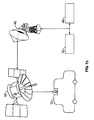
- Fig. 1a is a schematic diagram of a first embodiment of a communication system pursuant to aspects of the invention;
- Fig. 1b is a schematic diagram of a broadcast communication network;
- Fig. 1c is a schematic diagram of a navigation device in communication with a mobile unit;
- Fig. 2 is a schematic diagram of an alternate embodiment of a communication system;
- Fig. 3 illustrates an embodiment of a token/symbolic dictionary and some of the types of data contained by the dictionary;
- Fig. 4 is a schematic diagram of an embodiment of a data communication system wherein the sender and receiver each comprise the same token/symbolic dictionaries;
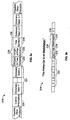
- Fig. 5a is a schematic diagram of an embodiment of a protocol stream for both predetermined identifiers and free symbols; and
- Fig. 5b illustrates an exemplary protocol stream that comprises free symbols.
- The present invention is directed to a system and method for sending data over a low bandwidth data communications link. In particular, the present invention is directed to a system and method for utilizing token or symbolic dictionaries at the transmitting and receiving ends of the low bandwidth data link to facilitate the efficient transfer of data over the data link, sometimes referred to as a data pipe or channel. In the detailed description that follows, like element numerals are used to describe like elements illustrated in one or more of the figures.
- With reference to Fig. 1a, there is provided a first embodiment of a system for the exchange of information between a
remote location 10 and avehicle 12 pursuant to aspects of the invention. Thevehicle 12 includes anavigation device 14. Referring now also to Fig. 1c, thenavigation device 14 may include anoutput unit 21, areceiver unit 22, aninput unit 23, aposition detection unit 24, anavigation memory unit 30, anavigation processor unit 26, and anRF transceiver unit 52 that are all in electrical communication with one another. Thenavigation memory unit 30 includes at least a portion of a user profile and in some embodiments may include the entire user profile. In addition, thenavigation memory unit 30 includes a road map database portion and, in some embodiments, includes a disk reading unit for reading road map information not built into thenavigation device 14. As is provided in greater detail below, the user profile and/or the road map database stored in thememory 30 may be updated in the vehicle by way of theinput unit 23, which can include at least one of a keyboard, a touch sensitive display, and a microphone. The user profile and/or the road map database may also be updated by way of information received through thereceiver unit 22 and/or theRF transceiver unit 52. - The
receiver unit 22 receives information from theremote location 10 and, in one embodiment, is in communication with the remote location by way of a one-to-many communication system. One-to-many communication systems include systems that can send information from one source to a plurality of receivers, such as abroadcast network 31. Broadcast networks include television, radio, and satellite networks. Referring now to Fig. 1b, in one embodiment, thebroadcast network 31 is the XMRadio satellite network 40, which comprises broadcast towers 42, satellite servers (not shown), andsatellites 43. The broadcast towers 42 transmit information to thesatellites 43, which bounce the information back down to thereceiver unit 22 of thenavigation device 14. - Referring now back to Fig. 1c, the information received by the
receiver 22 may be processed by thenavigation processor unit 26. The processed information may then be displayed by way of theoutput unit 21, which includes at least one of a display and a speaker. In one embodiment, thereceiver unit 22, thenavigation processor unit 26 and theoutput unit 21 are provided access to only subsets of the received broadcast information based on user preferences and/or traffic information demands. The user preferences, as well as user identity information and traffic-related information, can be part of the user profile. - The
position detection unit 24 may include a GPS receiver that communicates with a plurality of GPS satellites (separate from the XM satellites) to determine the position of thevehicle 12. For example, the GPS receiver searches for and collects GPS information (or signals) broadcast from four or more GPS satellites that are in view of the GPS receiver. Next, using the time interval between the broadcast time and reception time of each broadcast signal, the GPS receiver calculates the distance between the GPS receiver and each of the four or more GPS satellites. These distance measurements, along with the position and time information received in the broadcast signals, allow the GPS receiver to calculate the geographic position of thevehicle 12. - In the embodiment shown in Fig. 1a, the
mobile unit 18 is used to receive and transmit information from and to theremote location 10; and, in an alternate embodiment shown in Fig. 2, anRF transceiver 152 is used to receive and transmit information from and to theremote location 110. Themobile unit 18 may be a wireless phone or any other device that communicates with other devices by way of thewireless communication network 46. As shown in Fig. 1c, in one embodiment, themobile unit 18 includes awireless receiver 32, awireless transmitter 34, amobile unit processor 40, and anRF transceiver unit 54 that are in communication with one another. Themobile unit 18 is in two-way communication with theremote location 10 by way of thereceiver 32, thetransmitter 34, and thewireless communication network 46, which comprises numerous base stations. In one embodiment, information is transmitted from or to the vehicle or remote location over a high bandwidth packet data (e.g., GPRS, EDGE, 1xRTT, 1xEV, HSDPA, Flash-OFDM, etc.) channel of thewireless communication network 46. If the high bandwidth channel is unavailable, a low bandwidth DTMF channel can be used. Thereceiver 32 receives information from theremote location 10, and thetransmitter 34 transmits information to theremote location 10. In other embodiments, thetransmitter 34 also transmits information to suppliers of traffic orother information - In one embodiment, the information received from and transmitted to the
remote location 10 by way of themobile unit 18 is accessed by the user through thenavigation device 14, which is in communication with themobile unit 18. Themobile unit 18 may be embedded in thevehicle 12 and be in communication with thenavigation device 14 by, for example, a cable (not shown). - In another embodiment, the
navigation device 14 andmobile unit 18 are in communication with one another by way ofRF transceiver units navigation device 14 and themobile unit 18 includeRF transceiver units RF transceiver units navigation device 14 and themobile unit 18 to communicate with one another. In other embodiments not shown, thereceiver 32 andtransmitter 14 of themobile unit 18 and the receiver unit 20 of thenavigation device 14 allow thenavigation device 14 andmobile unit 18 to communicate with one another. In yet other embodiments, there may be an RF transceiver that is separate from thenavigation device 14 and themobile unit 18 and that allows thenavigation device 14 andmobile unit 18 to communicate with one another. - In the alternate embodiment shown in Fig. 2, the
navigation device 114 transmits and receives information to and from theremote location 110 by way of theRF transceiver 152,access points gateways network 162. In one embodiment, theRF transceiver 152 and theaccess points gateways remote location 110 by way of thenetwork 162. The access points 170, 172 are in communication with theRF transceiver 152 and have a limited range over which they can communicate with theRF transceiver 152. Thus, it is preferable that there benumerous access points vehicle 12 might pass is less than or equal to the limited range of the access points. When theaccess points RF transceiver 152 effectively exchanges information with theaccess points remote location 110. - Note that in the alternate embodiment of Fig. 2, the
navigation device 114 also includes input and output units, a receiver unit, a memory unit, and a processor unit, none of which are shown. The components of the alternatenavigation device embodiment 114 have the same functionality as do the corresponding components of thenavigation device 14 of the first embodiment. - Referring now to Figs. 1a and 2, the
remote location remote server remote transmitter receiver remote memory receiver navigation device 14 and mobile unit 100 by way of thebroadcast 31 andwireless 46 communication networks, respectively. In the alternate embodiment, the remote transmitter andreceiver navigation device 114, including theRF transceiver 152, by way of thebroadcast communication network 131 and anetwork 162. Theremote location other information network - In both the first and alternate embodiments shown in Figs. 1a-1c and 2, the
network information suppliers remote location other information providers RF transceiver 152 is in communication with theremote location 110 and/or theinformation providers network 162 that is a LAN. In these other embodiments, theLAN 162 is compliant with the IEEE 802.3 specification or is an Ethernet network. - As provided in greater detail below, the
information suppliers remote location remote memory remote location navigation device broadcast network vehicles wireless network 46 or thenetwork 162. At the vehicle, the user profile stored in thememory 30 of thenavigation device 14 is updated, and the vehicle-related information is made accessible to the user by way of theoutput unit 26 of thenavigation device 14. In other embodiments, the information providers may communicate directly with themobile unit 18 orRF transceiver 152 by way of thewireless communication network 46 or thenetwork 162. - As explained above, in accordance with one aspect of the embodiments described herein, there is provided a system and method for transmitting data over a limited data link between a sender/transmitter and a receiver, wherein the transmitter and receiver each have identical copies of one or more token/symbol dictionaries. The transmitter and receiver typically each hold at least one copy of identical fixed-length dictionaries. For example, in one embodiment, the fixed-length dictionaries each comprise about 300 words or tokens. In order for the transmitter and receiver to communicate and understand one another, the transmitter and receiver must hold the same dictionary. If the receiver and sender want to communicate emergency information, they will each refer to their "emergency" dictionary. Alternatively, under an extension of the protocol, the sender can download one or more new dictionaries to the receiver.
- In one embodiment, the transmitter/sender is a provider of remote services while the receiver is an in-vehicle client device, such as a telematics device. In another embodiment, the vehicle comprises the transmitter while the remote location comprises the receiver. In yet another embodiment, the vehicle comprises a first transmitter and a first receiver, while the remote location comprises a second transmitter and a second receiver.
- As explained above, each dictionary will contain tokens or symbols for efficient, low-bandwidth communication between a sender and a receiver. The dictionary can contain a set of English words and basic punctuation. However, dictionary entries could symbolize almost anything as long as there is an agreement or understanding between the end parties as to what reference an entry represents. Each dictionary's content can be homogeneous or can comprise heterogeneous collections ("objects") depending on the particular application. As shown in Fig. 3, the
dictionary 200 can comprise characters, sentences, postfixes, numbers, phrases, haptic cues, paragraphs, words, punctuation, icons, prefixes, symbols, etc. - With reference to Fig. 4, in one embodiment, the
data transmission system 199 comprises aremote response center 210 and a client device 220 (e.g., a telematics device in a car) that are in communication with each other via a communication ordata link 212. The data link 212 typically has bandwidth, packet size, and usage restrictions. In one embodiment, thedata link 212 is a narrowband transmission link, channel, pipe, or the like, over a wireless network. Theremote response center 210 and theclient device 220 typically have one or more dictionaries, each with a plurality of words and symbols, according to the needs or demands of a particular application. For example, thecenter 210 and thedevice 220 each comprise n different dictionaries (2001 through 200n). In one embodiment, the transmitter unit comprises a remote response center or the like. In another embodiment, the receiver unit comprises a vehicle onboard computer, client device, or the like. - The dictionaries (2001 through 200n) are typically in memory units/devices that are in communication with the transmitter/receivers units. The transmitter/sender unit and the receiver unit have identical copies of the dictionaries (2001 through 200n). The dictionaries are typically relatively small or limited in size. This can be achieved by utilizing dictionaries that are application or task specific, thereby avoiding the use of unnecessarily large dictionaries that fill memory units/devices with content that is not needed. The dictionaries can be modular in nature to facilitate efficient transfer of dictionary data to or from the memory units that are in communication with the transmitter/receivers units. In one exemplary embodiment, the
data transmission system 199 comprises modular, relatively small dictionaries (2001 through 200n) that make it easier to add, change, or replace the dictionaries (2001 through 200n) according to the application or task at hand. - In producing the translated version of the message to be sent over the limited data link, the sender typically assembles a protocol stream containing a chain of identifiers that represent the dictionary entries or tokens to convey. Other information can be encoded, such as protocol mode, length information, characterization of token lengths, and information to the receiver regarding which dictionary to use in translating the received tokens/symbols. Upon receiving the stream of tokens, the receiver will refer to the correct dictionary and translate the stream into the correct sequence of objects. The receiver can then use these objects to convey richer information to the user that otherwise would not have been possible.
- With continued reference to the embodiment of Fig. 4, the sender/transmitter unit or location (e.g., remote response center 210) is in electronic communication with a memory unit that stores one or more dictionaries (e.g., 2001 through 200n). The transmitter unit receives the message to be communicated (e.g., "The police car is blue."), wherein each word and punctuation mark is a message object. The transmitter unit references at least one dictionary to identify those message objects for which translation to dictionary tokens or identifiers are available, and converts each identified message object into a message token. For example, the
center 210 retrieves the appropriate dictionary based upon service needs, user input, etc., and assembles aprotocol stream 214 containing multiple identifiers (e.g., 3, 6, 4, 2, 5, and 1). Theprotocol stream 214, which comprises the IDs of dictionary tokens, is transmitted to one or more receiver units or devices. - The receiver unit (e.g., client device 220) is typically in wireless communication with the transmitter unit or location (e.g., remote response center 210). More specifically, in the present embodiment, the receiver and transmitter units are in RF wireless communication with each other over a limited data link having narrow bandwidth. The receiver unit typically receives the protocol stream, verifies that the memory unit comprises each dictionary identified by the dictionary identifier, and then selects each dictionary identified by the dictionary identifier. The receiver unit references each selected dictionary to translate the message tokens into message objects, and reassembles the message from the message objects and the at least one free symbol, explained in further detail below. For example, upon receiving the
protocol stream 214, thedevice 220 refers to the correct dictionary (i.e., the same dictionary utilized by the center 210) and translates the protocol stream into objects (e.g., 3 = "the"; 6 = "police"; 4 = "car"; 2 = "is"; 5 = "blue"; 1 = "."). In other words, the phrase is reassembled at the receivingclient device 220 and conveyed to the user. The reassembled phrase (e.g., "the police car is blue.") can be conveyed to the user via adisplay device 222 , aspeaker 224, or the like, or combinations thereof. - The transmitting and receiving roles of the
remote response center 210 and theclient device 220, respectively, can be reversed (i.e., thedevice 220 can transmit theprotocol stream 214 to the center 210) depending on the particular application. Also, thedevice 220 andcenter 210 can utilize a plurality of dictionaries to conveyprotocol streams 214 to each other. - The
dictionary 200 utilized by the sender and receiver may not always contain a token for the object that the sender wishes to convey. In one embodiment, the protocol allows escapement into free-symbol mode, wherein an encoding (e.g., ASCII characters) can be used to convey items that are not in thedictionary 200. As shown in Figs. 5a and 5b, dictionary symbols can be mixed with free symbols - words, phrases, etc. that are not located in the limited dictionaries - when thedictionary 200 does not contain the desired token(s). For example, suppose thecenter 210 intends to send the message "the police car is on Washington" to a user near thedevice 220. All of the words in this sentence are located in one of the limited dictionaries except for "Washington." The transmitter assembles aprotocol stream 214 containing multiple identifiers (e.g., 36427) and a free symbol (e.g., "Washington"). - With reference to Figs. 5a and 5b, in one exemplary embodiment, the
protocol stream 214 comprises a control information area orsegment 230 that can include information regarding the protocol mode, which dictionary to use, token lengths, etc. Thestream 214 further comprises anidentifier segment 231, which is made up of one or more dictionary tokens. Thestream 214 further comprises an escape marker orfree symbol indicator 232 indicating that afree symbol area 235 will follow. Theescape marker 232 is followed by anarea 234 that includes information regarding the length of the proceedingfree symbol area 235.Marker 236 indicates where thefree symbol area 235 ends. Themarker 236 also indicates the beginning of another identifier segment comprising one or more dictionary tokens. Upon receiving theprotocol stream 214, the receiver refers to the correct dictionary (based on the information in area 230) and translates the protocol stream into objects (e.g., 3 = "the"; 6 = "police"; 4 = "car"; 2 = "is"; 7 = "on"; free symbol = "Washington"). The phrase "the police car is on Washington" is reassembled at the receiver and conveyed to the user. - The transmitter typically converts each identified message object into a message token, and also associates each non-identified message object with a free symbol indicator to generate a free symbol segment from each non-identified message object. In one embodiment, the transmitter associates each non-identified message object with the free symbol indicator by prefixing each non-identified message with the free symbol indicator. The transmitter then concatenates the message tokens and the free symbol segments to generate the protocol stream that is sent over the narrow bandwidth data link to a receiver.
- Upon receiving the protocol stream, the receiver typically verifies that the memory unit it is in communication with comprises each dictionary identified by the dictionary identifier, and then selects each dictionary identified by the dictionary identifier. The receiver references each selected dictionary to translate the message tokens into message objects, and reassembles the message from the message objects and any free symbols, as explained above. The receiver unit preferably alerts the user if it is not able to access one or more dictionaries identified by the protocol stream's dictionary identifier and/or obtains copies of the missing dictionaries to be stored in a local or internal memory.
- Having thus described a preferred embodiment of a method and system for traffic management between a vehicle and a remote location, it should be apparent to those skilled in the art that certain advantages of the within system have been achieved. It should also be appreciated that various modifications, adaptations, and alternative embodiments thereof may be made within the scope and spirit of the present invention. For example, the use of broadcast communication networks has been illustrated, but it should be apparent that many of the inventive concepts described above would be equally applicable to the use of other non-broadcast communication networks.
Claims (23)
- A system for communicating over a data link, comprising:a transmitter unit; anda memory unit (30) in communication with the transmitter unit, the memory unit (30) comprising one or more dictionaries;wherein the transmitter unit is adapted to:receive a message to be communicated, the message comprising at least one message object;identify any of the at least one message objects having a corresponding translation in a first dictionary;convert each identified message object into a message token;associate each non-identified message object with a free symbol indicator (232) to generate a free symbol segment;concatenate the message tokens and the free symbol segments to generate a protocol stream; andsend the protocol stream over the data link.
- The system as recited in Claim 1, wherein the transmitter unit is adapted to associate each non-identified message object with the free symbol indicator (232) by prefixing each non-identified message with the free symbol indicator (232) .
- The system as recited in any of the preceding claims, wherein the transmitter unit is adapted to associate a dictionary identifier with the protocol stream, the dictionary identifier identifying the first dictionary used in generating the protocol stream.
- The system as recited in any of the preceding claims, wherein the transmitter unit is adapted to identify any of the at least one message objects having a corresponding translation in a second dictionary.
- The system as recited in any of the preceding claims, wherein the transmitter unit is adapted to associate a dictionary identifier with the protocol stream, the dictionary identifier identifying the first dictionary and the second dictionary used in generating the protocol stream.
- The system as recited in any of the preceding claims, wherein the first dictionary has tokens for message object types selected from the group consisting of characters, sentences, postfixes, numbers, phrases, haptic cues, paragraphs, words, punctuation, icons, prefixes, and symbols.
- A method for communicating over a data link, comprising:receiving a message to be communicated, the message comprising at least one message object;identifying any of the at least one message objects having a corresponding translation in a first dictionary;converting each identified message object into a message token;associating each non-identified message object with a free symbol indicator (232) to generate a free symbol segment;concatenating the message tokens and the free symbol segments to generate a protocol stream; andsending the protocol stream over the data link.
- The method of any of the preceding claims, wherein associating each non-identified message with the free symbol indicator (232) comprises prefixing each non-identified message with the free symbol indicator (232).
- The method of any of the preceding claims, further comprising associating a dictionary identifier with the protocol stream, wherein the dictionary identifier identifies the first dictionary used in generating the protocol stream.
- The method of any of the preceding claims, further comprising identifying any of the at least one message objects having a corresponding translation in a second dictionary.
- The method of any of the preceding claims, further comprising associating a dictionary identifier with the protocol stream, wherein the dictionary identifier identifies the first dictionary and the second dictionary used in generating the protocol stream.
- A system for recovering a message received over a data link, comprising:a receiver unit (22); anda memory unit (30) in communication with the receiver unit (22), the memory unit (30) comprising one or more dictionaries;wherein the receiver unit (22) is adapted to:receive a protocol stream that comprises a dictionary identifier, message tokens, and at least one free symbol;select the a dictionary identified by the dictionary identifier;reference the first dictionary to translate the message tokens into message objects; andreassemble the message from the message objects and the at least one free symbol.
- The system as recited in any of the preceding claims, wherein the receiver unit (22) is adapted to verify that the memory unit (30) comprises the first dictionary identified by the dictionary identifier.
- The system as recited in any of the preceding claims, wherein the receiver unit (22) is adapted to alert a user if the memory unit (30) is missing the first dictionary.
- The system as recited in any of the preceding claims, wherein the receiver unit (22) is adapted to access the first dictionary and copy the first dictionary into the memory unit.
- The system as recited in any of the preceding claims, wherein the receiver unit (22) is adapted to:select a second dictionary identified by the dictionary identifier; andreference the second dictionary to translate the message tokens into message objects.
- The system as recited in any of the preceding claims, wherein the receiver unit (22) is adapted to verify that the memory unit (30) comprises the second dictionary identified by the dictionary identifier.
- The system as recited in any of the preceding claims, wherein the receiver unit (22) is adapted to display the reassembled message for a user.
- A method for recovering a message received over a data link, comprising:receiving a protocol stream that comprises a dictionary identifier, message tokens, and at least one free symbol;selecting a dictionary identified by the dictionary identifier;referencing the selected dictionary to translate the message tokens into message objects; andreassembling the message from the message objects and the at least one free symbol.
- The method of any of the preceding claims, further comprising verifying that the dictionary identified by the dictionary identifier is accessible.
- The method of any of the preceding claims, further comprising alerting a user if the dictionary identified by the dictionary identifier is not accessible.
- The method of any of the preceding claims, further comprising obtaining a copy of the identified dictionary.
- The method of any of the preceding claims, further comprising displaying the reassembled message.
Applications Claiming Priority (1)
| Application Number | Priority Date | Filing Date | Title |
|---|---|---|---|
| US11/271,447 US20070124306A1 (en) | 2005-11-09 | 2005-11-09 | Method and system for transmitting data to vehicles over limited data links |
Publications (1)
| Publication Number | Publication Date |
|---|---|
| EP1786108A1 true EP1786108A1 (en) | 2007-05-16 |
Family
ID=37762488
Family Applications (1)
| Application Number | Title | Priority Date | Filing Date |
|---|---|---|---|
| EP06018048A Withdrawn EP1786108A1 (en) | 2005-11-09 | 2006-08-29 | Method and system for transmitting data to vehicles over limited data links |
Country Status (2)
| Country | Link |
|---|---|
| US (1) | US20070124306A1 (en) |
| EP (1) | EP1786108A1 (en) |
Cited By (1)
| Publication number | Priority date | Publication date | Assignee | Title |
|---|---|---|---|---|
| CN108599834A (en) * | 2018-03-07 | 2018-09-28 | 中国地质大学(武汉) | A kind of satellite communication network link utilization analysis method and system |
Families Citing this family (7)
| Publication number | Priority date | Publication date | Assignee | Title |
|---|---|---|---|---|
| US20110161829A1 (en) * | 2009-12-24 | 2011-06-30 | Nokia Corporation | Method and Apparatus for Dictionary Selection |
| US20120249341A1 (en) * | 2011-03-30 | 2012-10-04 | Qualcomm Incorporated | Communication of emergency messages with road markers |
| US10216553B2 (en) * | 2011-06-30 | 2019-02-26 | International Business Machines Corporation | Message oriented middleware with integrated rules engine |
| US8704676B2 (en) | 2011-08-09 | 2014-04-22 | Qualcomm Incorporated | Dynamic road markers to provide visual feedback as to vehicle speed |
| US9076339B2 (en) | 2013-02-15 | 2015-07-07 | Qualcomm Incorporated | Facilitating vehicle merging utilizing road markers |
| WO2017202461A1 (en) * | 2016-05-25 | 2017-11-30 | Siemens Aktiengesellschaft | Method, device and arrangement for tracking moving objects |
| US12556482B2 (en) * | 2022-04-21 | 2026-02-17 | Verizon Patent And Licensing Inc. | User plane congestion control service |
Citations (2)
| Publication number | Priority date | Publication date | Assignee | Title |
|---|---|---|---|---|
| WO1998006028A1 (en) * | 1996-08-06 | 1998-02-12 | Reynar Jeffrey C | A lempel-ziv data compression technique utilizing a dicionary pre-filled with fequent letter combinations, words and/or phrases |
| US5953503A (en) * | 1997-10-29 | 1999-09-14 | Digital Equipment Corporation | Compression protocol with multiple preset dictionaries |
Family Cites Families (66)
| Publication number | Priority date | Publication date | Assignee | Title |
|---|---|---|---|---|
| US7421321B2 (en) * | 1995-06-07 | 2008-09-02 | Automotive Technologies International, Inc. | System for obtaining vehicular information |
| US5551064A (en) * | 1994-07-27 | 1996-08-27 | Motorola, Inc. | Method and apparatus for communication unit frequency assignment |
| US5664948A (en) * | 1994-07-29 | 1997-09-09 | Seiko Communications Holding N.V. | Delivery of data including preloaded advertising data |
| US5648768A (en) * | 1994-12-30 | 1997-07-15 | Mapsys, Inc. | System and method for identifying, tabulating and presenting information of interest along a travel route |
| US6697633B1 (en) * | 1995-06-02 | 2004-02-24 | Northrop Grummar Corporation | Method permitting increased frequency re-use in a communication network, by recovery of transmitted information from multiple cochannel signals |
| US6720920B2 (en) * | 1997-10-22 | 2004-04-13 | Intelligent Technologies International Inc. | Method and arrangement for communicating between vehicles |
| US6272341B1 (en) * | 1995-11-30 | 2001-08-07 | Motient Services Inc. | Network engineering/systems engineering system for mobile satellite communication system |
| GB2311443A (en) * | 1996-03-23 | 1997-09-24 | Ibm | Data message transfer in batches with retransmission |
| US5802545A (en) * | 1996-05-23 | 1998-09-01 | Freightliner Corporation | Method and system for recording vehicle data relative to vehicle standard time |
| US5671195A (en) * | 1996-05-31 | 1997-09-23 | Intellectual Science And Technology Inc. | Audio system programmable for recording preselected audio broadcasts |
| JP2910678B2 (en) * | 1996-06-27 | 1999-06-23 | 日本電気株式会社 | Base station frequency allocation system |
| US6208932B1 (en) * | 1996-09-30 | 2001-03-27 | Mazda Motor Corporation | Navigation apparatus |
| US5926108A (en) * | 1997-02-12 | 1999-07-20 | Sony Corporation | Movie information pager |
| JP3593844B2 (en) * | 1997-04-24 | 2004-11-24 | ソニー株式会社 | Information receiving method, navigation device and automobile |
| US6701376B1 (en) * | 1997-06-19 | 2004-03-02 | International Business Machines Corporation | Web server enabling browser access to HTML and Non-HTML documents |
| US6707421B1 (en) * | 1997-08-19 | 2004-03-16 | Siemens Vdo Automotive Corporation | Driver information system |
| US5959577A (en) * | 1997-08-28 | 1999-09-28 | Vectorlink, Inc. | Method and structure for distribution of travel information using network |
| US6381533B1 (en) * | 1997-10-16 | 2002-04-30 | Navigation Technologies Corp. | Method and system using positions of cellular phones matched to road network for collecting data |
| US6329925B1 (en) * | 1999-11-24 | 2001-12-11 | Donnelly Corporation | Rearview mirror assembly with added feature modular display |
| JP3548459B2 (en) * | 1998-11-20 | 2004-07-28 | 富士通株式会社 | Guide information presenting apparatus, guide information presenting processing method, recording medium recording guide information presenting program, guide script generating apparatus, guide information providing apparatus, guide information providing method, and guide information providing program recording medium |
| KR100322025B1 (en) * | 1998-06-15 | 2002-06-24 | 윤종용 | A method and system for increasing a frequency assignment in mobile telecommunication system |
| GB9909825D0 (en) * | 1998-09-08 | 1999-06-23 | Airnet Global Holdings Limited | Communications system for aircraft |
| US6169894B1 (en) * | 1998-11-25 | 2001-01-02 | Lucent Technologies, Inc. | Apparatus, method and system for mobile broadcast of information specific to a geographic region |
| DE19908869A1 (en) * | 1999-03-01 | 2000-09-07 | Nokia Mobile Phones Ltd | Method for outputting traffic information in a motor vehicle |
| JP3532492B2 (en) * | 1999-06-25 | 2004-05-31 | 株式会社ザナヴィ・インフォマティクス | Road traffic information providing system, information providing device, and navigation device |
| JP3367476B2 (en) * | 1999-07-07 | 2003-01-14 | 住友電気工業株式会社 | Roadside transmission device |
| JP3791249B2 (en) * | 1999-07-12 | 2006-06-28 | 株式会社日立製作所 | Mobile device |
| US6353398B1 (en) * | 1999-10-22 | 2002-03-05 | Himanshu S. Amin | System for dynamically pushing information to a user utilizing global positioning system |
| US6826472B1 (en) * | 1999-12-10 | 2004-11-30 | Tele Atlas North America, Inc. | Method and apparatus to generate driving guides |
| JP4543480B2 (en) * | 2000-03-02 | 2010-09-15 | ソニー株式会社 | GPS receiver and GPS positioning method |
| US6812860B1 (en) * | 2000-03-22 | 2004-11-02 | Ford Global Technologies, Llc | System and method of providing information to an onboard information device in a vehicle |
| WO2001076120A2 (en) * | 2000-04-04 | 2001-10-11 | Stick Networks, Inc. | Personal communication device for scheduling presentation of digital content |
| US6785551B1 (en) * | 2000-04-07 | 2004-08-31 | Ford Motor Company | Method of providing dynamic regionally relevant data to a mobile environment |
| US6711398B1 (en) * | 2000-04-19 | 2004-03-23 | Hughes Electronics Corporation | Radio signal broadcast system and method |
| US6714797B1 (en) * | 2000-05-17 | 2004-03-30 | Nokia Corporation | System and method for the transfer of digital data to a mobile device |
| US6895249B2 (en) * | 2000-07-14 | 2005-05-17 | Qualcomm Incorporated | Method and apparatus for broadcasting position location data in a wireless communication system |
| JP2002048570A (en) * | 2000-08-01 | 2002-02-15 | Sony Corp | Car navigation device, traffic information providing device, program recording medium for car navigation device, and program recording medium for traffic information providing device |
| KR100353649B1 (en) * | 2000-08-18 | 2002-09-28 | 삼성전자 주식회사 | Navigation system using wireless communication network and route guidance method thereof |
| US6836667B1 (en) * | 2000-09-19 | 2004-12-28 | Lucent Technologies Inc. | Method and apparatus for a wireless telecommunication system that provides location-based messages |
| US6609004B1 (en) * | 2000-09-22 | 2003-08-19 | Motorola Inc | Communication management system for personalized mobility management of wireless services and method therefor |
| WO2002039061A1 (en) * | 2000-11-08 | 2002-05-16 | Matsushita Electric Industrial Co., Ltd. | System, navigation method, medium, and information set |
| FI115813B (en) * | 2001-04-27 | 2005-07-15 | Nokia Corp | System for sending group messages |
| US6735518B2 (en) * | 2001-05-03 | 2004-05-11 | Samsung Electronics Co., Ltd. | Route guiding method in a navigation system using a wireless network |
| US7703118B2 (en) * | 2001-09-13 | 2010-04-20 | Intel Corporation | Delivery of feedback information to scheduling service to determine optimum broadcast times based upon client platform tuner contention |
| US11388451B2 (en) * | 2001-11-27 | 2022-07-12 | Comcast Cable Communications Management, Llc | Method and system for enabling data-rich interactive television using broadcast database |
| US7721337B2 (en) * | 2001-10-26 | 2010-05-18 | Ibiquity Digital Corporation | System and method for providing a push of background data |
| JP2003134495A (en) * | 2001-10-29 | 2003-05-09 | Nec Corp | Internet satellite communication and radio broadcasting system |
| KR100454922B1 (en) * | 2001-10-31 | 2004-11-15 | 삼성전자주식회사 | Navigation system for providing a real-time traffic information and method thereof |
| JP2003156358A (en) * | 2001-11-20 | 2003-05-30 | Pioneer Electronic Corp | System, method, server apparatus, and program for providing information and information recording medium |
| JP2003194557A (en) * | 2001-12-27 | 2003-07-09 | Toyota Motor Corp | Traffic information output device, traffic information distribution device, and distribution method |
| US6816778B2 (en) * | 2001-12-29 | 2004-11-09 | Alpine Electronics, Inc | Event finder with navigation system and display method thereof |
| JP4343700B2 (en) * | 2002-02-19 | 2009-10-14 | アルカテル−ルーセント | Wireless communication terminal apparatus, broadcast and reception method, and broadcast system |
| US20040203630A1 (en) * | 2002-03-15 | 2004-10-14 | Wang Charles Chuanming | Method and apparatus for targeting service delivery to mobile devices |
| US6859728B2 (en) * | 2002-04-03 | 2005-02-22 | Matsushita Electric Industrial Co., Ltd. | Navigation system |
| EP1502078A1 (en) * | 2002-04-30 | 2005-02-02 | Telmap Ltd. | Template-based map distribution system |
| AU2003246179A1 (en) * | 2002-06-21 | 2004-01-06 | Aisin Aw Co., Ltd. | Navigation system, user terminal, navigation device, and information recording method program |
| US6978206B1 (en) * | 2002-06-21 | 2005-12-20 | Infogation Corporation | Distributed navigation system |
| US7116989B2 (en) * | 2002-07-18 | 2006-10-03 | General Motors Corporation | Method and system for telematic device activation attribute formation |
| US6795768B2 (en) * | 2003-02-20 | 2004-09-21 | Motorola, Inc. | Handheld object selector |
| US7450600B2 (en) * | 2003-04-21 | 2008-11-11 | Microsoft Corporation | Method and apparatus for managing a data carousel |
| US20040252197A1 (en) * | 2003-05-05 | 2004-12-16 | News Iq Inc. | Mobile device management system |
| US7383123B2 (en) * | 2003-06-03 | 2008-06-03 | Samsung Electronics Co., Ltd. | System and method of displaying position information including an image in a navigation system |
| US20050001743A1 (en) * | 2003-07-02 | 2005-01-06 | Haemerle Richard R. | Information retrieval and display device and system |
| US8190130B2 (en) * | 2003-10-01 | 2012-05-29 | General Motors Llc | Method and system for notifying a subscriber of events |
| JP2005181146A (en) * | 2003-12-19 | 2005-07-07 | Aisin Aw Co Ltd | Information delivery system and program for information delivery method |
| US20050221876A1 (en) * | 2004-04-05 | 2005-10-06 | Van Bosch James A | Methods for sending messages based on the location of mobile users in a communication network |
-
2005
- 2005-11-09 US US11/271,447 patent/US20070124306A1/en not_active Abandoned
-
2006
- 2006-08-29 EP EP06018048A patent/EP1786108A1/en not_active Withdrawn
Patent Citations (2)
| Publication number | Priority date | Publication date | Assignee | Title |
|---|---|---|---|---|
| WO1998006028A1 (en) * | 1996-08-06 | 1998-02-12 | Reynar Jeffrey C | A lempel-ziv data compression technique utilizing a dicionary pre-filled with fequent letter combinations, words and/or phrases |
| US5953503A (en) * | 1997-10-29 | 1999-09-14 | Digital Equipment Corporation | Compression protocol with multiple preset dictionaries |
Non-Patent Citations (1)
| Title |
|---|
| SALOMON D: "DATA COMPRESSION: THE COMPLETE REFERENCE", DATA COMPRESSION : THE COMPLETE REFERENCE, NEW YORK, NY : SPRINGER, US, 1998, pages 101 - 162,357, XP002150106, ISBN: 0-387-98280-9 * |
Cited By (1)
| Publication number | Priority date | Publication date | Assignee | Title |
|---|---|---|---|---|
| CN108599834A (en) * | 2018-03-07 | 2018-09-28 | 中国地质大学(武汉) | A kind of satellite communication network link utilization analysis method and system |
Also Published As
| Publication number | Publication date |
|---|---|
| US20070124306A1 (en) | 2007-05-31 |
Similar Documents
| Publication | Publication Date | Title |
|---|---|---|
| CN106021510B (en) | Method and system for processing queries initiated by users of mobile devices | |
| US7333801B2 (en) | Method and apparatus for translating resource names in a wireless environment | |
| US9727574B2 (en) | System and method for applying an efficient data compression scheme to URL parameters | |
| US7577740B2 (en) | Scalable vehicle processing system | |
| US20040117108A1 (en) | Navigation system | |
| US20130036238A1 (en) | Method and system for compressing location data of a radio for over-the-air transmission | |
| CN102541926B (en) | Data exchange processing method, equipment and system | |
| EP1786108A1 (en) | Method and system for transmitting data to vehicles over limited data links | |
| CN101248470A (en) | Encoding and decoding traffic information using encoded fields | |
| EP1240763B1 (en) | Method and system for optimizing usage of air link | |
| WO2000060886A1 (en) | Service via a cellular communications system | |
| US9049585B1 (en) | Method of providing additional information to emergency services about emergency locator beacons | |
| KR101376505B1 (en) | Method and system and apparatus for update of phonebook information | |
| US7719441B1 (en) | System and method for transferring bit-oriented data over an ACARS character-oriented data link | |
| KR20040068340A (en) | Hierarchical content classification in information transmissions | |
| JP2007006498A (en) | Method for providing transmitting function with extended short message service | |
| CN103220159A (en) | Method used for transferring information and device used for transferring information | |
| CN1972485A (en) | Transmitting and receiving of hand-written data of no character recognition on wireless device | |
| KR100700244B1 (en) | Method and device for transmitting and receiving traffic information through file transfer method | |
| WO2006115215A1 (en) | Mobile communication apparatus and method for updating telephone directory of mobile communication apparatus | |
| EP1336140B1 (en) | Data encoding method and system | |
| EP1946283B1 (en) | Apparatus and method for transferring traffic data | |
| CA2498836A1 (en) | Method and devices for utilizing data in data formats that cannot be directly processed | |
| US20050250479A1 (en) | Multimedia communication system with a mobile handset coupled to a display device via a radio link | |
| KR20050097167A (en) | System for translating message type |
Legal Events
| Date | Code | Title | Description |
|---|---|---|---|
| PUAI | Public reference made under article 153(3) epc to a published international application that has entered the european phase |
Free format text: ORIGINAL CODE: 0009012 |
|
| AK | Designated contracting states |
Kind code of ref document: A1 Designated state(s): AT BE BG CH CY CZ DE DK EE ES FI FR GB GR HU IE IS IT LI LT LU LV MC NL PL PT RO SE SI SK TR |
|
| AX | Request for extension of the european patent |
Extension state: AL BA HR MK YU |
|
| 17P | Request for examination filed |
Effective date: 20071031 |
|
| AKX | Designation fees paid |
Designated state(s): AT BE BG CH CY CZ DE DK EE ES FI FR GB GR HU IE IS IT LI LT LU LV MC NL PL PT RO SE SI SK TR |
|
| 17Q | First examination report despatched |
Effective date: 20080128 |
|
| STAA | Information on the status of an ep patent application or granted ep patent |
Free format text: STATUS: THE APPLICATION IS DEEMED TO BE WITHDRAWN |
|
| 18D | Application deemed to be withdrawn |
Effective date: 20080708 |