EP1785917A2 - Learning machine that considers global structure of data - Google Patents
Learning machine that considers global structure of data Download PDFInfo
- Publication number
- EP1785917A2 EP1785917A2 EP06122325A EP06122325A EP1785917A2 EP 1785917 A2 EP1785917 A2 EP 1785917A2 EP 06122325 A EP06122325 A EP 06122325A EP 06122325 A EP06122325 A EP 06122325A EP 1785917 A2 EP1785917 A2 EP 1785917A2
- Authority
- EP
- European Patent Office
- Prior art keywords
- input vectors
- space
- separating
- constraints
- correction
- Prior art date
- Legal status (The legal status is an assumption and is not a legal conclusion. Google has not performed a legal analysis and makes no representation as to the accuracy of the status listed.)
- Withdrawn
Links
Images

Classifications
-
- G—PHYSICS
- G06—COMPUTING OR CALCULATING; COUNTING
- G06N—COMPUTING ARRANGEMENTS BASED ON SPECIFIC COMPUTATIONAL MODELS
- G06N20/00—Machine learning
-
- G—PHYSICS
- G06—COMPUTING OR CALCULATING; COUNTING
- G06F—ELECTRIC DIGITAL DATA PROCESSING
- G06F18/00—Pattern recognition
- G06F18/20—Analysing
- G06F18/24—Classification techniques
- G06F18/241—Classification techniques relating to the classification model, e.g. parametric or non-parametric approaches
- G06F18/2411—Classification techniques relating to the classification model, e.g. parametric or non-parametric approaches based on the proximity to a decision surface, e.g. support vector machines
-
- G—PHYSICS
- G06—COMPUTING OR CALCULATING; COUNTING
- G06N—COMPUTING ARRANGEMENTS BASED ON SPECIFIC COMPUTATIONAL MODELS
- G06N20/00—Machine learning
- G06N20/10—Machine learning using kernel methods, e.g. support vector machines [SVM]
Definitions
- the invention relates to learning machines and, more particularly, to kernel-based techniques for implementing learning machines.
- the Lagrange multipliers ⁇ i define the separating hyperplane used by the learning machine.
- Boser, Guyon, and Vapnik devised an effective means of constructing the separating hyperplane in a Hilbert space which avoids having to explicitly map the input vectors into the Hilbert space See Bernard E. Boser, Isabelle M. Goyon, and Vladimir N. Vapnik, "A Training Algorithm for Optimal Margin Classifiers," Proceedings of the Fifth Annual Workshop on Computational Learning Theory (July 1992).
- the separating hyperplane is represented in terms of kernel functions which define an inner product in the Hilbert space
- Cortes and Vapnik generalized the maximal margin idea for constructing the separating hyperplane in the image space when the training data is non-separable. See Corinna Cortes and Vladimir N Vapnik, "Support Vector Networks," Machine Learning, Vol. 20, pp. 273-97 (Sept 1995 ).
- the quadratic form of the optimization problem is expressed in terms of what is referred to as a "slack variable" which is non-zero for those points that lie on the wrong side of the margin, thereby allowing for an imperfect separation of the training data.
- equation (1) the corresponding equation of the separating hyperplane is given by equation (1) above.
- a new machine learning technique is herein disclosed which generalizes the support vector machine framework
- the input vectors from a dataset are first clustered, either manually or using an automated clustering technique
- the input vectors are mapped to a separating space, and a separating hyperplane in the separating space is optimized by generating coefficients which define the separating hyperplane.
- the coefficients are generated, however, in accordance with generalized constraints which are dependent upon the clustering of the input vectors in the dataset.
- the input vectors are simultaneously mapped to the separating space and to a correction space, depending on the cluster to which the input vector belongs
- the input vectors of different clusters are mapped to the same separating space but different correction spaces
- Each correction space defines a correction function for the input vectors in a particular cluster.
- the coefficients for the separating hyperplane are generated, they are generated in a manner which optimizes the correction function for each cluster of input vectors
- the generalized constraints for a cluster of input vectors are defined in a manner which is dependent upon a kernel defined on the correction space to which the input vectors within the cluster are mapped.
- the learning machine can take advantage of any a priori knowledge one may have about the global structure of the data, including the noise characteristics in the input space (as defined by the clusters). The separation is still accomplished in the separation space, but the input vectors can be segregated and mapped to different correction spaces before the optimization problem is solved
- the generalized constraints can, accordingly, be defined by the structure of the data rather than simply being independent of the data.
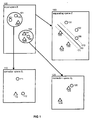
- FIG 1 is an abstract diagram illustrating the principles underlying the disclosed machine learning technique.
- FIG. 2 is a flowchart of processing performed in training a learning machine/classifier in accordance with the preferred embodiment
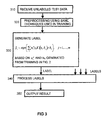
- FIG. 3 is a flowchart of processing performed in operating the learning machine/classifier in accordance with the preferred embodiment
- FIG. 1 is an abstract diagram illustrating the principles underlying the disclosed machine learning technique
- the training data for the learning machine are represented as input vectors in an input space, e.g., illustratively depicted in FIG. 1 as 101, 102, 106 in the input space 100
- Each training input vector 101, 102, 106 is labeled with a classification label, illustratively depicted in FIG 1 as a dot for a first label and as a triangle for a second label
- the classification label can represent, for example and without limitation, whether the training data corresponding to the input vector is a member or a non-member of a specified class.
- the goal is to construct a separating function based on the training input vectors 101, 102, 106 which can act as a classifier on the data.
- FIG. 1 depicts two example clusters 161, 162, formed on the training vectors-cluster 161 being formed from input vectors 101, 102, 103, and cluster 162 being formed from input vectors 104, 105, 106 It should be noted that although two clusters are depicted in FIG 1, any number of clusters, including a single cluster on all of the training input vectors, can be formed in accordance with the disclosed technique.
- each input vector is simultaneously mapped into two spaces a separating space 150 which defines the separating function and into a correction space 110, 120 which defines what the inventors refer to as a correction function.
- each cluster 161, 162 of input vectors can be assigned a different correction function and, accordingly, a different correction space 110, 120.
- the input vectors in cluster 161 are mapped to correction space 110 while the input vectors in cluster 162 are mapped to correction space 120.
- a separating hyperplane 180 is constructed in the separating space 150 which defines the above-mentioned separating function.
- the separating hyperplane 180 is constructed in a manner which not only optimizes the margins 171, 172 in the separating space 150, but which also takes into account the correction functions of the corresponding clustered input vectors Accordingly, in contrast with prior art techniques, the separating function can be generated in a manner which takes advantage of any a priori knowledge one may have about the global structure of the training data, including the noise characteristics in the input space 100.
- the disclosed technique can be seen as a generalization of the support vector machine framework; accordingly, the inventors refer to the technique as "SVM+".
- FIG. 2 is a flowchart of processing performed in training a learning machine/classifier in accordance with the preferred embodiment
- This data may come in any arbitrary format and may come from multiple sources, e.g. known data fusion techniques could be used to integrate information from disparate data sources into a form which could be used as the labeled training data
- the present invention is not limited to any specific preprocessing technique.
- Examples of conventional techniques of preprocessing include centralization, normalization, scaling, clipping, etc. Data with gaps or with different time scales, for example and without limitation, can be readily reconciled using well-known preprocessing techniques As a more sophisticated example, data which is subject to invariances under some form of symmetry transformation can also be transformed by preprocessing into a form that renders the classifier also invariant to the transformations
- the t clusters can be formed manually or using any of a number of known automated clustering techniques
- the present invention is not limited to any specific clustering technique Any clustering technique, including a hierarchical approach or a partitioning approach such as a k-means or k-medians clustering algorithm, can be readily adapted and utilized Where the input training data is represented in vector form x 1 , ... , x l , these vectors would be the disjoint union of the t clusters of vectors x i .
- kernel functions are defined for the learning machine.
- the input training vectors x i ⁇ X r are simultaneously mapped into a separating space z i ⁇ Z and a correction space z i r ⁇ Z r .
- Input vectors of different clusters are mapped to the same separating space Z but to different correction spaces Z r .
- the separating space Z defines the separating function.
- a positive definite function referred to in the art as a kernel function
- prior art techniques use a single kernel, the herein disclosed technique uses up to ( t + 1) distinct kernels.
- the present invention is not limited to any specific form of kernel function for either the separating space or the correction space(s).
- the inventors refer to the constraint in equation (5), which is the same as disclosed in the prior art, as a “balance” constraint.
- the t constraints in equation (6) will be recognized by those skilled in the art as what is referred to as a “lasso” constraint (see R Tibshirani, “Regression Shrinkage and Selection via the Lasso,” J. R Statist Soc (B), 58, 267-288 (1996) ).
- the inventors refer to the constraints defined in equation (8) as the matrix constraints. Note that the above constraint matrix form can be considered as a generalized form of the prior art constraint of 0 ⁇ ⁇ i ⁇ C .
- the threshold b o can be readily determined.
- FIG. 3 is a flowchart of processing performed by the learning machine, after the learning machine classifier has been trained
- the learning machine classifier can be arranged as a single binary classifier or can be arranged as a multiclass classifier using known techniques for reducing a multiclass classification problem to several binary classification problems
- the raw data may be represented in an arbitrary manner and may in fact be fused from multiple sources
- the generated label can be simply output or used in the relevant application.
- the classifier is a multiclass classifier
- the generated labels from a plurality of binary classifiers are combined at step 340 using known techniques.
- the multiclass classifier can be comprised of a plurality of binary classifiers, trained as above, where each binary classifier could compare one class to all others or could compare classes pairwise
- the final result can then be output at step 350
- the present invention can be readily adapted and utilized in a wide array of applications that includes all problems currently being addressed by the use of support vector machines.
Landscapes
- Engineering & Computer Science (AREA)
- Theoretical Computer Science (AREA)
- Data Mining & Analysis (AREA)
- Software Systems (AREA)
- Evolutionary Computation (AREA)
- Computer Vision & Pattern Recognition (AREA)
- Physics & Mathematics (AREA)
- General Engineering & Computer Science (AREA)
- General Physics & Mathematics (AREA)
- Artificial Intelligence (AREA)
- Medical Informatics (AREA)
- Mathematical Physics (AREA)
- Computing Systems (AREA)
- Bioinformatics & Cheminformatics (AREA)
- Life Sciences & Earth Sciences (AREA)
- Bioinformatics & Computational Biology (AREA)
- Evolutionary Biology (AREA)
- Information Retrieval, Db Structures And Fs Structures Therefor (AREA)
- Image Analysis (AREA)
Abstract
A new machine learning technique is herein disclosed which generalizes the support vector machine framework A separating hyperplane in a separating space is optimized in accordance with generalized constraints which are dependent upon the clustering of the input vectors in the dataset.
Description
- The invention relates to learning machines and, more particularly, to kernel-based techniques for implementing learning machines.
- There are a number of known techniques for automating the classification of data based on an analysis of a set of training data. Of particular interest herein are kernel-based techniques such as support vector machines. The development of support vector machines has a history that dates back to 1965, when Chervonenkis and Vapnik developed an algorithm referred to as the generalized portrait method fox constructing an optimal separating hyperplane. A learning machine using the generalized portrait method optimizes the margin between the training data and a decision boundary by solving a quadratic optimization problem whose solution can be obtained by maximizing the functional:


- In 1992, Boser, Guyon, and Vapnik devised an effective means of constructing the separating hyperplane in a Hilbert space which avoids having to explicitly map the input vectors into the Hilbert space See Bernard E. Boser, Isabelle M. Goyon, and Vladimir N. Vapnik, "A Training Algorithm for Optimal Margin Classifiers," Proceedings of the Fifth Annual Workshop on Computational Learning Theory (July 1992). Instead, the separating hyperplane is represented in terms of kernel functions which define an inner product in the Hilbert space The quadratic optimization problem can then be solved by maximizing the functional:


- In 1995, Cortes and Vapnik generalized the maximal margin idea for constructing the separating hyperplane in the image space when the training data is non-separable. See Corinna Cortes and Vladimir N Vapnik, "Support Vector Networks," Machine Learning, Vol. 20, pp. 273-97 (Sept 1995). The quadratic form of the optimization problem is expressed in terms of what is referred to as a "slack variable" which is non-zero for those points that lie on the wrong side of the margin, thereby allowing for an imperfect separation of the training data. By converting to the dual form, the quadratic optimization problem can again be expressed in terms of maximizing the following objective functional


- A new machine learning technique is herein disclosed which generalizes the support vector machine framework The input vectors from a dataset are first clustered, either manually or using an automated clustering technique The input vectors are mapped to a separating space, and a separating hyperplane in the separating space is optimized by generating coefficients which define the separating hyperplane. The coefficients are generated, however, in accordance with generalized constraints which are dependent upon the clustering of the input vectors in the dataset. In accordance with a preferred embodiment of the invention, the input vectors are simultaneously mapped to the separating space and to a correction space, depending on the cluster to which the input vector belongs The input vectors of different clusters are mapped to the same separating space but different correction spaces Each correction space defines a correction function for the input vectors in a particular cluster. As the coefficients for the separating hyperplane are generated, they are generated in a manner which optimizes the correction function for each cluster of input vectors In order to optimize the correction functions, the generalized constraints for a cluster of input vectors are defined in a manner which is dependent upon a kernel defined on the correction space to which the input vectors within the cluster are mapped.
- By varying the generalized constraints, the learning machine can take advantage of any a priori knowledge one may have about the global structure of the data, including the noise characteristics in the input space (as defined by the clusters). The separation is still accomplished in the separation space, but the input vectors can be segregated and mapped to different correction spaces before the optimization problem is solved The generalized constraints can, accordingly, be defined by the structure of the data rather than simply being independent of the data.
- These and other advantages of the invention will be apparent to those of ordinary skill in the art by reference to the following detailed description and the accompanying drawings
- FIG 1 is an abstract diagram illustrating the principles underlying the disclosed machine learning technique.
- FIG. 2 is a flowchart of processing performed in training a learning machine/classifier in accordance with the preferred embodiment
- FIG. 3 is a flowchart of processing performed in operating the learning machine/classifier in accordance with the preferred embodiment
- FIG. 1 is an abstract diagram illustrating the principles underlying the disclosed machine learning technique
- The training data for the learning machine are represented as input vectors in an input space, e.g., illustratively depicted in FIG. 1 as 101, 102, 106 in the
input space 100 Eachtraining input vector training input vectors - These
training input vectors example clusters cluster 161 being formed frominput vectors cluster 162 being formed frominput vectors space 150 which defines the separating function and into acorrection space input vectors 101, 102, ... 106 are mapped into the same separatingspace 150, eachcluster different correction space cluster 161 are mapped tocorrection space 110 while the input vectors incluster 162 are mapped tocorrection space 120. - As further explained herein, a separating
hyperplane 180 is constructed in the separatingspace 150 which defines the above-mentioned separating function. The separatinghyperplane 180 is constructed in a manner which not only optimizes themargins separating space 150, but which also takes into account the correction functions of the corresponding clustered input vectors Accordingly, in contrast with prior art techniques, the separating function can be generated in a manner which takes advantage of any a priori knowledge one may have about the global structure of the training data, including the noise characteristics in theinput space 100. As further discussed herein, the disclosed technique can be seen as a generalization of the support vector machine framework; accordingly, the inventors refer to the technique as "SVM+". - A preferred embodiment is further described with reference to FIG. 2
- FIG. 2 is a flowchart of processing performed in training a learning machine/classifier in accordance with the preferred embodiment At
step 210, the raw labeled training data
step 220, general preprocessing can be performed on the raw labeled training data to obtain the input training data
- At
step 230, the input training data

- At
step 240, kernel functions are defined for the learning machine. As discussed above, the input training vectors xi ∈ Xr are simultaneously mapped into a separating space zi ∈ Z and a correction space


- The present invention is not limited to any specific form of kernel function for either the separating space or the correction space(s). The most popular kernels used in machine learning today are the polynomial kernel of degree d


- An optimal separating function can then be constructed. The optimal separating hyperplane in the separating space can be found by minimizing the objective function


- The constraint in equation (7) can be rewritten in the form


- With reference again to FIG. 2, the generalized constraints are specified at
step 250. This can be accomplished by defining the constraint matrix
step 260, the coefficients
step 270, using the training data


- FIG. 3 is a flowchart of processing performed by the learning machine, after the learning machine classifier has been trained The learning machine classifier can be arranged as a single binary classifier or can be arranged as a multiclass classifier using known techniques for reducing a multiclass classification problem to several binary classification problems At
step 310, the raw unlabeled data
step 320, general preprocessing is performed on the data, as in the training phase, to obtain
step 330, the coefficients

step 340 using known techniques. For example, and without limitation, the multiclass classifier can be comprised of a plurality of binary classifiers, trained as above, where each binary classifier could compare one class to all others or could compare classes pairwise The final result can then be output atstep 350 - Note that the above training and testing techniques can be readily implemented using hardware, software, or various combinations of hardware and software
- The present invention can be readily adapted and utilized in a wide array of applications that includes all problems currently being addressed by the use of support vector machines. This includes, for example and without limitation, general pattern recognition (including image recognition, object detection, and speech and handwriting recognition), regression analysis and predictive modeling (including quality control systems and recommendation systems), data classification (including text and image classification and categorization), bioinformatics (including automated diagnosis systems, biological modeling, and bioimaging classification), data mining (including financial forecasting, database marketing), etc
- While exemplary drawings and specific embodiments of the present invention have been described and illustrated, it is to be understood that that the scope of the present invention is not to be limited to the particular embodiments discussed. Thus, the embodiments shall be regarded as illustrative rather than restrictive, and it should be understood that variations may be made in those embodiments by workers skilled in the arts without departing from the scope of the present invention as set forth in the claims that follow and their structural and functional equivalents
Claims (22)
- A method for training a classifier comprising:receiving input vectors from a dataset that have been clustered into one or more clusters,specifying generalized constraints which are dependent upon the clusters of input vectors in the dataset; andoptimizing a separating hyperplane in a separating space subject to the generalized constraints, where the input vectors are mapped to the separating space using a kernel function and where the separating hyperplane is determined by a set of coefficients generated in accordance with the generalized constraints
- The method of claim 1 wherein the generalized constraints are dependent upon a kernel function defined on a correction space into which the input vectors within a cluster are mapped
- The method of claim 2 wherein the input vectors of different clusters are mapped to the same separating space but to different correction spaces.
- The method of claim 2 wherein each correction space defines a correction function for each cluster
- The method of claim 2 wherein the generalized constraints can be represented as


- The method of claim 5 wherein the generalized constraints are alternatively represented as


- The method of claim 6 wherein the matrix

- The method of claim 6 wherein the matrix

- The method of one of claims 1 to 8 wherein preprocessing is applied to the dataset in order to obtain the input vectors.
- The method of one of claims 1 to 9 wherein multiple sets of coefficients are generated so as to form a multiclass classifier.
- A classifier which utilizes coefficients generated in accordance with the method of claims 1-10.
- A computer readable medium comprising computer program instructions which, when executed by a processor, define the steps ofreceiving input vectors from a dataset that have been clustered into one or more clusters;specifying generalized constraints which are dependent upon the clusters of input vectors in the dataset; andoptimizing a separating hyperplane in a separating space subject to the generalized constraints, where the input vectors are mapped to the separating space using a kernel function and where the separating hyperplane is determined by a set of coefficients generated in accordance with the generalized constraints.
- The computer readable medium of claim 12 wherein the generalized constraints are dependent upon a kernel function defined on a correction space into which the input vectors within a cluster are mapped
- The computer readable medium of claim 13 wherein the input vectors of different clusters are mapped to the same separating space but to different correction spaces.
- The computer readable medium of claim 13 wherein each correction space defines a correction function for each cluster
- The computer readable medium of claim 13 wherein the generalized constraints can be represented as


where there are t clusters and where Kr is the kernel function defined on the correction space into which the input vectors within the cluster r are mapped, α i are the coefficients determining the separating hyperplane in the separating space, and Tr defines a set of indices of input vectors within a cluster r. - The computer readable medium of claim 16 wherein the generalized constraints are alternatively represented as

where
- The computer readable medium of claim 17 wherein the matrix

- The computer readable medium of claim 17 wherein the matrix

- The computer readable medium of claim 12 wherein preprocessing is applied to the dataset in order to obtain the input vectors
- The computer readable medium of claim 12 wherein multiple sets of coefficients are generated so as to form a multiclass classifier.
- An apparatus for training a classifier comprising:means for receiving input vectors from a dataset that have been clustered into one or more clusters,means for generating coefficients which determine a separating hyperplane in a separating space, the input vectors being mapped into the separating space, and the coefficients being optimized in accordance with generalized constraints which are dependent upon the clusters of input vectors in the dataset
Applications Claiming Priority (1)
| Application Number | Priority Date | Filing Date | Title |
|---|---|---|---|
| US11/252,487 US20070168305A1 (en) | 2005-10-18 | 2005-10-18 | Learning machine that considers global structure of data |
Publications (1)
| Publication Number | Publication Date |
|---|---|
| EP1785917A2 true EP1785917A2 (en) | 2007-05-16 |
Family
ID=37547023
Family Applications (1)
| Application Number | Title | Priority Date | Filing Date |
|---|---|---|---|
| EP06122325A Withdrawn EP1785917A2 (en) | 2005-10-18 | 2006-10-16 | Learning machine that considers global structure of data |
Country Status (4)
| Country | Link |
|---|---|
| US (1) | US20070168305A1 (en) |
| EP (1) | EP1785917A2 (en) |
| JP (1) | JP2007115245A (en) |
| CN (1) | CN1952919A (en) |
Families Citing this family (8)
| Publication number | Priority date | Publication date | Assignee | Title |
|---|---|---|---|---|
| EP2144423A4 (en) | 2007-04-25 | 2012-05-16 | Nec Corp | Rotation type portable terminal |
| US8589397B2 (en) * | 2007-09-28 | 2013-11-19 | Nec Corporation | Data classification method and data classification device |
| US9070011B2 (en) * | 2010-06-18 | 2015-06-30 | Csr Imaging Us, Lp | Automated segmentation tuner |
| US8683417B2 (en) * | 2010-11-29 | 2014-03-25 | Synopsys Taiwan Co., Ltd | Multiple level spine routing |
| CN108763742A (en) * | 2018-05-28 | 2018-11-06 | 中广核工程有限公司 | A kind of strong electromagnetic pulse effect Vulnerability assessment method and device |
| JP7403253B2 (en) * | 2019-07-19 | 2023-12-22 | Lineヤフー株式会社 | Learning devices, learning methods and learning programs |
| CN112379276A (en) * | 2020-12-04 | 2021-02-19 | 东北大学 | SPSO vehicle-mounted storage battery SOC online prediction method based on number domain regression |
| US12586002B2 (en) | 2021-09-30 | 2026-03-24 | International Business Machines Corporation | Multi-polytope machine for classification |
Family Cites Families (3)
| Publication number | Priority date | Publication date | Assignee | Title |
|---|---|---|---|---|
| US6327581B1 (en) * | 1998-04-06 | 2001-12-04 | Microsoft Corporation | Methods and apparatus for building a support vector machine classifier |
| US7617163B2 (en) * | 1998-05-01 | 2009-11-10 | Health Discovery Corporation | Kernels and kernel methods for spectral data |
| US6640227B1 (en) * | 2000-09-05 | 2003-10-28 | Leonid Andreev | Unsupervised automated hierarchical data clustering based on simulation of a similarity matrix evolution |
-
2005
- 2005-10-18 US US11/252,487 patent/US20070168305A1/en not_active Abandoned
-
2006
- 2006-10-11 JP JP2006277168A patent/JP2007115245A/en active Pending
- 2006-10-16 EP EP06122325A patent/EP1785917A2/en not_active Withdrawn
- 2006-10-17 CN CNA200610131891XA patent/CN1952919A/en active Pending
Also Published As
| Publication number | Publication date |
|---|---|
| CN1952919A (en) | 2007-04-25 |
| JP2007115245A (en) | 2007-05-10 |
| US20070168305A1 (en) | 2007-07-19 |
Similar Documents
| Publication | Publication Date | Title |
|---|---|---|
| Gönen et al. | Multiple kernel learning algorithms | |
| Karamizadeh et al. | Advantage and drawback of support vector machine functionality | |
| Kim et al. | Sentiment visualization and classification via semi-supervised nonlinear dimensionality reduction | |
| US9286693B2 (en) | Method and apparatus for detecting abnormal movement | |
| US20210256538A1 (en) | Computer Methods and Systems for Dimensionality Reduction in Conjunction with Spectral Clustering of Financial or Other Data | |
| US8065241B2 (en) | Learning machine that considers global structure of data | |
| Chu et al. | Relational learning with gaussian processes | |
| US8135652B2 (en) | Parallel support vector method and apparatus | |
| US11615273B2 (en) | Creating apparatus, creating method, and creating program | |
| Bouveyron et al. | Kernel discriminant analysis and clustering with parsimonious Gaussian process models | |
| Crawford et al. | Big data modeling approaches for engineering applications | |
| EP1785917A2 (en) | Learning machine that considers global structure of data | |
| US20240095929A1 (en) | Methods and systems of real-time hierarchical image matting | |
| US20060047616A1 (en) | System and method for biological data analysis using a bayesian network combined with a support vector machine | |
| Kang et al. | Classification of histogram-valued data with support histogram machines | |
| Alzubaidi et al. | Projection pursuit Random Forest using discriminant feature analysis model for churners prediction in telecom industry. | |
| Bagirov et al. | An efficient algorithm for the incremental construction of a piecewise linear classifier | |
| Pérez-Ortiz et al. | Semi-supervised learning for ordinal kernel discriminant analysis | |
| Cipolli III et al. | Supervised learning via smoothed Polya trees | |
| Ye et al. | Decision fusion for hyperspectral image classification based on multiple features and locality-preserving analysis | |
| Merler et al. | Terminated ramp–support vector machines: a nonparametric data dependent kernel | |
| Sabzekar et al. | Improved DAG SVM: A New Method for Multi-Class SVM Classification. | |
| Camastra et al. | Clustering methods | |
| García et al. | Model selection for financial distress prediction by aggregating TOPSIS and PROMETHEE rankings | |
| US20240211510A1 (en) | Few-shot learning method and image processing system using the same |
Legal Events
| Date | Code | Title | Description |
|---|---|---|---|
| PUAI | Public reference made under article 153(3) epc to a published international application that has entered the european phase |
Free format text: ORIGINAL CODE: 0009012 |
|
| AK | Designated contracting states |
Kind code of ref document: A2 Designated state(s): AT BE BG CH CY CZ DE DK EE ES FI FR GB GR HU IE IS IT LI LT LU LV MC NL PL PT RO SE SI SK TR |
|
| AX | Request for extension of the european patent |
Extension state: AL BA HR MK YU |
|
| STAA | Information on the status of an ep patent application or granted ep patent |
Free format text: STATUS: THE APPLICATION IS DEEMED TO BE WITHDRAWN |
|
| 18D | Application deemed to be withdrawn |
Effective date: 20100504 |