EP1784183B1 - Processes for the preparation of isothiazole derivatives - Google Patents
Processes for the preparation of isothiazole derivatives Download PDFInfo
- Publication number
- EP1784183B1 EP1784183B1 EP05778840A EP05778840A EP1784183B1 EP 1784183 B1 EP1784183 B1 EP 1784183B1 EP 05778840 A EP05778840 A EP 05778840A EP 05778840 A EP05778840 A EP 05778840A EP 1784183 B1 EP1784183 B1 EP 1784183B1
- Authority
- EP
- European Patent Office
- Prior art keywords
- aryl
- isothiazole
- benzyloxy
- carboxylic acid
- ureido
- Prior art date
- Legal status (The legal status is an assumption and is not a legal conclusion. Google has not performed a legal analysis and makes no representation as to the accuracy of the status listed.)
- Expired - Lifetime
Links
- 0 *C(Nc1c(*=O)c(O*)n[s]1)=O Chemical compound *C(Nc1c(*=O)c(O*)n[s]1)=O 0.000 description 5
Classifications
-
- C—CHEMISTRY; METALLURGY
- C07—ORGANIC CHEMISTRY
- C07D—HETEROCYCLIC COMPOUNDS
- C07D275/00—Heterocyclic compounds containing 1,2-thiazole or hydrogenated 1,2-thiazole rings
- C07D275/02—Heterocyclic compounds containing 1,2-thiazole or hydrogenated 1,2-thiazole rings not condensed with other rings
- C07D275/03—Heterocyclic compounds containing 1,2-thiazole or hydrogenated 1,2-thiazole rings not condensed with other rings with hetero atoms or with carbon atoms having three bonds to hetero atoms with at the most one bond to halogen, e.g. ester or nitrile radicals, directly attached to ring carbon atoms
-
- A—HUMAN NECESSITIES
- A61—MEDICAL OR VETERINARY SCIENCE; HYGIENE
- A61K—PREPARATIONS FOR MEDICAL, DENTAL OR TOILETRY PURPOSES
- A61K31/00—Medicinal preparations containing organic active ingredients
- A61K31/33—Heterocyclic compounds
- A61K31/395—Heterocyclic compounds having nitrogen as a ring hetero atom, e.g. guanethidine or rifamycins
- A61K31/41—Heterocyclic compounds having nitrogen as a ring hetero atom, e.g. guanethidine or rifamycins having five-membered rings with two or more ring hetero atoms, at least one of which being nitrogen, e.g. tetrazole
- A61K31/425—Thiazoles
-
- A—HUMAN NECESSITIES
- A61—MEDICAL OR VETERINARY SCIENCE; HYGIENE
- A61K—PREPARATIONS FOR MEDICAL, DENTAL OR TOILETRY PURPOSES
- A61K31/00—Medicinal preparations containing organic active ingredients
- A61K31/33—Heterocyclic compounds
- A61K31/395—Heterocyclic compounds having nitrogen as a ring hetero atom, e.g. guanethidine or rifamycins
- A61K31/41—Heterocyclic compounds having nitrogen as a ring hetero atom, e.g. guanethidine or rifamycins having five-membered rings with two or more ring hetero atoms, at least one of which being nitrogen, e.g. tetrazole
- A61K31/425—Thiazoles
- A61K31/427—Thiazoles not condensed and containing further heterocyclic rings
-
- A—HUMAN NECESSITIES
- A61—MEDICAL OR VETERINARY SCIENCE; HYGIENE
- A61P—SPECIFIC THERAPEUTIC ACTIVITY OF CHEMICAL COMPOUNDS OR MEDICINAL PREPARATIONS
- A61P27/00—Drugs for disorders of the senses
- A61P27/02—Ophthalmic agents
-
- A—HUMAN NECESSITIES
- A61—MEDICAL OR VETERINARY SCIENCE; HYGIENE
- A61P—SPECIFIC THERAPEUTIC ACTIVITY OF CHEMICAL COMPOUNDS OR MEDICINAL PREPARATIONS
- A61P3/00—Drugs for disorders of the metabolism
- A61P3/08—Drugs for disorders of the metabolism for glucose homeostasis
- A61P3/10—Drugs for disorders of the metabolism for glucose homeostasis for hyperglycaemia, e.g. antidiabetics
-
- A—HUMAN NECESSITIES
- A61—MEDICAL OR VETERINARY SCIENCE; HYGIENE
- A61P—SPECIFIC THERAPEUTIC ACTIVITY OF CHEMICAL COMPOUNDS OR MEDICINAL PREPARATIONS
- A61P35/00—Antineoplastic agents
Definitions
- This invention relates to processes for preparing isothiazole derivatives that are useful in the treatment of hyperproliferative diseases, such as cancers, in mammals.
- polypeptide growth factors such as vascular endothelial growth factor (VEGF), which has a high affinity for the human kinase insert-domain-containing receptor (KDR) or the murine fetal liver kinase 1 (FLK-1) receptor, have been associated with the proliferation of endothelial cells and more particularly to vasculogenesis and angiogenesis.
- VEGF vascular endothelial growth factor
- KDR human kinase insert-domain-containing receptor
- FLK-1 murine fetal liver kinase 1
- the present invention provides a process for preparing compounds that are capable of binding to or modulating the KDR/FLK-1 receptor.
- the compounds may be used to treat disorders related to vasculogenesis or angiogenesis such as diabetes, diabetic retinopathy, hemangioma, glioma, melanoma, Kaposi's sarcoma and ovarian, breast, lung, pancreatic, prostate, colon and epidermoid cancer.
- disorders related to vasculogenesis or angiogenesis such as diabetes, diabetic retinopathy, hemangioma, glioma, melanoma, Kaposi's sarcoma and ovarian, breast, lung, pancreatic, prostate, colon and epidermoid cancer.
- This invention also relates to processes for preparing intermediates that may be converted to the aforementioned isothiazole derivatives and to the intermediates prepared.
- Processes for preparing isothiazole derivatives and their intermediates have been disclosed in International Patent Publication WO 99/62890, published December 9, 1999 , and United States Patent Nos. 6,235,764 ; 6,380,214 ; and 6,548,526 , issuing on May 22, 2001, April 30, 2002 and April 15, 2003, respectively.
- Processes for preparing 3-alkoxyisothiazole derivatives as herbicides have been disclosed in United States Patent No. 4,059,433, issuing on November 22, 1977 .
- Processes for preparing 5-amino-3-hydroxy(alkoxy,-amino-)isothiazoles have been disclosed in Chemische Berichte (1964), 97(11), 3106-17
- the present invention relates to a process for preparing a compound of the Formula I or a pharmaceutically acceptable salt, prodrug, hydrate or solvate thereof; wherein
- the reaction is preferably conducted in the presence of a solvent, such as C 1 -C 4 alcohols (e.g., methanol, ethanol, propanol, 2-propanol), dipolar aprotic solvents (e.g., dimethyl sulfoxide, dimethylformamide, dimethylacetamide, 1-methyl-2-pyrrolidinone), ethers (e.g., tetrahydrofuran, diisopropyl ether, methyl-tert-butyl ether, dioxane, 2-methyltetrahydrofuran), water or mixtures of at least two thereof. Tetrahydrofuran and methanol or mixtures thereof are especially preferred.
- a solvent such as C 1 -C 4 alcohols (e.g., methanol, ethanol, propanol, 2-propanol), dipolar aprotic solvents (e.g., dimethyl sulfoxide, dimethylformamide, dimethylacetamide, 1-methyl-2-pyrrolidin
- R 2 is H and R 1 is C 1 -C 10 alkyl optionally substituted by 1 or 2 substituents independently selected from -NR 5 R 6 , -NR 5 (CR 6 R 7 ) t OR 6 and -(CH 2 ) t (4-10 membered heterocyclic) where t is an integer from 0 to 5.
- R 1 is selected from propyl, butyl, pentyl and hexyl, and may be optionally substituted with dimethylamino, hydroxy, pyrrolidinyl, morpholino, and ethyl-(2-hydroxy-ethyl)-amino, and R 2 is H.
- R 2 is H and R 1 is -(CH 2 ) t (4-10 membered heterocyclic) wherein t is an integer from 0 to 5, said heterocyclic group is optionally fused to a C 6 -C 10 aryl group, a C 5 -C 8 saturated cyclic group, or a 4-10 membered heterocyclic group and the R 1 group, including any fused portions of said R 1 group, may be substituted by 1 or 2 substituents independently selected from C 1 -C 4 alkyl, hydroxy and hydroxymethyl.
- R 2 is H and the 4-10 membered heterocyclic moiety of the R 1 group, when the t variable of the R 1 group ranges from 2-5, may be any one of morpholino, pyrrolidinyl, imidazolyl, piperazinyl, piperidinyl, and 2,5-diaza-bicyclo[2.2.1]hept-2-yl and the R 1 group is optionally substituted with hydroxy, hydroxymethyl and methyl.
- R 3 is -(CH 2 ) t (C 6 -C 10 aryl) wherein t is an integer from 1 to 3 and the R 3 group is optionally substituted with 1 to 4 R 4 groups.
- R 3 is benzyl optionally substituted by 1 to 4 halo substituents.
- the present invention refers to those processes and compounds wherein R 2 is H, R 1 is -(CH 2 ) 4 -1-pyrrolidine, R 3 is 2,6-difluoro-4-bromobenzyl, and R 8 is methyl.
- R 2 is H
- R 1 is -(CH 2 ) 4 -1-pyrrolidine
- R 3 is 2,6-difluoro-4-bromobenzyl
- R 8 is methyl.
- the compound of Formula II is reacted with anhydrous ammonia in methanol at 50°C to 70°C at 10 to 40 psi.
- the compound of Formula II is reacted with anhydrous ammonia in methanol and tetrahydrofuran at 30°C to 50°C at 45 to 80 psi.
- Another embodiment of the present invention refers to those processes wherein the compound of Formula I is selected from the group consisting of 3-(4-Bromo-2,6-difluoro-benzyloxy)-5-[3-(4-pyrrolidin-1-yl-butyl)-ureido ⁇ -isothiazole-4-carboxylic acid amide;
- the present invention refers to those processes wherein the compound of Formula I is 3-(4-Bromo-2,6-difluoro-benzyloxy)-5-[3-(4-pyrrolidin-1-yl-butyl]-ureido ⁇ -isothiazoie-4-carboxylic acid amide and the pharmaceutically acceptable salts, prodrugs, hydrates and solvates thereof.
- the present invention also relates to a process for the preparation of a compound of the Formula II or a pharmaceutically acceptable salt thereof; wherein R 1 , R 2 , R 3 , R 4 , R 5 , R 8 , R 7 , and R 8 are as defined above for Formula I; comprising (1) reacting a compound of Formula IV wherein R 3 , R 4 , R 5 , R 6 , R 7 and R 8 are as defined above for Formula II with a source of carbonyl, with or without an added base, and then adding a compound of Formula III HNR 1 R 2 III wherein R 1 and R 2 are as defined above for Formula II, in a solvent to give a compound of the Formula II or (2) reacting a compound of Formula III with as source of carbonyl, with or without an added base; and then adding a compound of Formula IV in a solvent to give a compound of the Formula II.
- the source of carbonyl may be any suitable carbonyl source known to those skilled in the art.
- the source of carbonyl is represented by the Formula R'OCOX' wherein R' is a C 1 -C 4 alkyl or C 6 -C 10 aryl, and X' is a leaving group such as a chloro group.
- suitable carbonyl sources include 1,1'-carbonyldiimidazole, di-tert-butyl-dicarbonate in the presence of 4-dimethylaminopyridine and phosgene or its equivalents such as diphosgene or triphosgene.
- the reaction may be carried out at a temperature of between about -78°C to about 100°C, and preferably between about 15°C and about 25°C.
- the reaction may utilize any suitable base known to those skilled in the art.
- suitable base include tertiary amines (e.g. triethylamine, diisopropylethylamlne, pyridine, 4-dimethylaminopyridine), alkali metal carbonates, and alkali metal hydrogen carbonates.
- reaction may occur in any suitable solvent known to those skilled in the art.
- the reaction is carried out in the presence of a halogenated hydrocarbon solvent such as dichloromethane or chloroform; an ether such as tetrahydrofuran, diisopropyl ether, methyl-tert-butyl ether, and 2-methyltetrahydrofuran; a dipolar aprotic solvent such as dimethylsulfoxide, dimethylformamide, 1-methyl-2-pyrrolidinone, and dimethylacetamide, and mixtures thereof.
- a halogenated hydrocarbon solvent such as dichloromethane or chloroform
- an ether such as tetrahydrofuran, diisopropyl ether, methyl-tert-butyl ether, and 2-methyltetrahydrofuran
- a dipolar aprotic solvent such as dimethylsulfoxide, dimethylformamide, 1-methyl-2-pyrrolidinone, and dimethylacetamide, and mixtures thereof.
- the compound of Formula IV is treated with triphosgene and triethylamine in dichloromethane at a temperature of between about -78°C to about 20°C, then a compound of Formula III is added, preferably a compound of Formula III wherein R 1 is H and R 2 is -(CH 2 ) 4 -1-pyrrolidino, to give a compound of Formula II.
- the present invention refers to those processes wherein the compound of Formula II is 3-(4-Bromo-2,6-difluoro-benzyloxy)-5-[3-(4-pyrrolidin-1-yl-butyl)-ureido]-isothiazole-4-carboxylic acid methyl ester.
- the compound of Formula III wherein R 1 is H and R 2 is -(CH 2 ) 4 -1-pyrrolidine is treated with 1,1'-carbonyldiimidazole in tetrahydrofuran at a temperature of about -10°C to about 10°C to produce a product that is added to a compound of Formula IV in dimethylsulfoxide and potassium carbonate at a temperature of about 15°C to about 25°C, to give a compound of the Formula II, which is preferably 3-(4-Bromo-2,6-difluoro-benzyloxy)-5-[3-(4-pyrrolidin-1-yl-butyl)-ureido]-isothiazole-4-carboxylic acid methyl ester.
- Another embodiment of the present invention refers to those processes wherein the compound of Formula II is selected from the group consisting of 3-(4-Bromo-2,6-difluoro-benzyloxy)-5-[3-(4-pyrrolidin-1-yl-butyl)-ureido ⁇ -isothlazole-4-carboxylic acid methyl ester;
- the present invention also relates to a process for the preparation of a compound of Formula IV or a pharmaceutically acceptable salt thereof; wherein R 3 , R 4 , R 5 , R 6 , R 7 , and R 8 are as defined above; comprising reacting a compound of the Formula V wherein
- the reaction is preferably conducted in the presence of a solvent, such as water, C 1 -C 4 alcohols (e.g., methanol, ethanol, propanol, isopropanol), ethers (e.g., tetrahydrofuran, diisopropyl ether, methyl-tert-butyl ether, dioxane, 2-methyltetrahydrofuran), and dipolar aprotic solvents (e.g., dimethylsulfoxide, dimethylformamide, 1-methyl-2-pyrrolidinone, and dimethylacetamide).
- a solvent such as water, C 1 -C 4 alcohols (e.g., methanol, ethanol, propanol, isopropanol), ethers (e.g., tetrahydrofuran, diisopropyl ether, methyl-tert-butyl ether, dioxane, 2-methyltetrahydrofuran), and dipolar aprotic
- An embodiment of the present invention refers to those processes wherein the compound of Formula V is reacted with an ammonia source in a solvent to give a compound of Formula IV and wherein R 3 is -(CH 2 ) t (C 6 -C 10 aryl) wherein t is an integer from 1 to 3 and the R 3 group is optionally substituted with 1 to 4 R 4 groups.
- R 3 is benzyl optionally substituted by 1 to 4 halo substituents.
- the present invention refers to those processes wherein the compound of Formula V is reacted with an ammonia source in a solvent to give a compound of Formula IV wherein R 3 is 2,6-difluoro-4-bromobenzyl, R 8 is methyl, R 9 is methyl; and n is 2.
- the compound of Formula V is reacted with anhydrous ammonia in methanol or dimethylsulfoxide at 20°C to 60°C at atmospheric pressure to 50 psi.
- the compound of Formula V is reacted with anhydrous ammonia in tetrahydrofuran, and preferably at about 40°C to about 50°C at 45 to 55 psi.
- the present invention refers to those processes wherein the compound of Formula. IV is 5-Amino-3-(4-bromo-2,6-difluoro-benzyloxy)-isothiazole-4-carboxylic acid methyl ester.
- the present invention also relates to a process for the preparation of a compound of Formula V or a pharmaceutically acceptable salt thereof; wherein
- the reaction may be carried out at a temperature of between about -20°C to about 100°C, and preferably at between about 15°C to about 35°C.
- the reaction is also preferably carried out in the presence of a solvent.
- a solvent is a halogenated hydrocarbon solvent such as dichloromethane or chloroform, an ether, such as tetrahydrofuran, diisopropyl ether, methyl-tert-butyl ether, dioxane, or 2-methyltetrahydrofuran, or a dipolar aprotic solvent, such as dimethylsulfoxide, dimethylformamide, 1-methyl-2-pyrrolidinone, or dimethylacetamide.
- the solvent is a polar solvent such as nitromethane, acetonitrile, or 2,2,2-trifluoroethanol or a halogenated hydrocarbon solvent such as dichloromethane or chloroform.
- a preferred embodiment of the present invention refers to those processes wherein the compound of Formula VII is reacted with a compound of Formula VI in which X is an aryl sulfonate ester in a dipolar aprotic solvent with an alkali metal carbonate base to give a compound of the Formula V. It is especially preferred when R 3 is 2,6-difluoro-4-bromobenzyl; X is p-toluene sulfonate ester; R 8 is methyl; R 9 is methyl; n is 2; the alkali metal carbonate base is potassium carbonate; and the solvent is dimethylsulfoxide. This preferred process may be performed at about 15°C to about 35°C.
- the present invention refers to those processes wherein the compound of Formula V is 3-(4-Bromo-2,6-difluoro-benzyloxy)5-methanesulfonyl-isothiazole-4-carboxylic acid methyl ester.
- the invention also relates to compounds of Formulae IIa, IVa or Va that are useful in the preparation of the isothiazole derivatives of Formula I, which are in turn useful for binding or modulating KDR/FLK-1 receptors.
- the present invention relates to a compound of the Formula IIa or a pharmaceutically acceptable salt thereof; wherein
- An embodiment of the present invention refers to the compounds of Formula IIa where R 2 is H and R 1 is C 1 -C 10 alkyl optionally substituted by 1 or 2 substituents independently selected from -NR 5 R 6 , -NR 5 (CR 8 R 7 ) t OR 6 and -(CH 2 ) t (4-10 membered heterocyclic) where t is an integer from 0 to 5.
- R 1 is selected from propyl, butyl, pentyl and hexyl, and may be optionally substituted with dimethylamino, hydroxy, pyrrolidinyl, morpholino, and ethyl-(2-hydroxy-ethyl)-amino, and R 2 is H.
- the present invention refers to the compounds of Formula IIa where R 2 is H and R 1 is -(CH 2 ) t (4-10 membered heterocyclic) wherein t is an integer from 0 to 5, said heterocyclic group is optionally fused to a C 6 -C 10 aryl group, a C 5 -C 8 saturated cyclic group, or a 4-10 membered heterocyclic group and the R 1 group, including any fused portions of said R 1 group, may be substituted by 1 or 2 substituents independently selected from C 1 -C 4 alkyl, hydroxy and hydroxymethyl.
- the 4-10 membered heterocyclic of R 1 is selected from one of morpholino, pyrrolidinyl, imidazolyl, piperazinyl, piperidinyl, and 2,5-diaza-bicyclo[2.2.1]hept-2-yl and the R 1 group is optionally substituted with hydroxy, hydroxymethyl and methyl, and the t variable of the R 1 group ranges from 2-5.
- An embodiment of the present invention refers to the compounds of Formula IIa wherein R 3 is -(CH 2 ) t (C 6 -C 10 aryl) wherein t is an integer from 1 to 3 and the R 3 group is optionally substituted with 1 to 4 R 4 groups.
- R 3 is benzyl optionally substituted by 1 to 4 halo substituents.
- the present invention refers to compounds of Formula IIa wherein R 2 is H, R 1 is -(CH 2 ) 4 -1-pyrrolidine, R 3 is 2,6-difluoro-4-bromobenzyl, and R 8 is methyl.
- Another embodiment of the present invention refers to the compounds of Formula IVa or a pharmaceutically acceptable salt thereof; wherein
- R 3 is -(CH 2 ) t (C 6 -C 10 aryl), wherein t is an integer from 1 to 3 and R 3 is optionally substituted by 1 to 4 R 4 groups, and more preferred R 3 is benzyl substituted by 1 to 4 halo substituents.
- the present invention refers to compounds of Formula IVa wherein R 3 is 2,6-difluoro-4-bromobenzyl, and R 8 is methyl.
- Another embodiment of the present invention refers to the compounds of Formula Va or a pharmaceutically acceptable salt thereof; wherein
- R 3 is -(CH 2 ) t (C 6 -C 10 aryl), wherein t is an integer from 1 to 3 and the R 3 group is optionally substituted by 1 to 4 R 4 groups, and more preferably R 3 is benzyl optionally substituted by 1 to 4 halo substituents, still more preferably R 8 and R 9 are methyl.
- the present invention refers to compounds of Formula Va wherein n is 2, R 3 is 2,6-difluoro-4-bromobenzyl, R 8 is methyl, and R 9 is methyl.
- the compound of the Formula I is prepared by reacting the compound of Formula IIa with an ammonia source in a solvent.
- the compound of the Formula II is prepared by reacting a compound of the Formula IVa with a source of carbonyl with or without an added base, and then adding a compound of Formula III, as previously defined, in a solvent or alternatively, reacting a compound of Formula III with a source of carbonyl with or without an added base, and then adding a compound of Formula IVa in a solvent to give a compound of the Formula II.
- the compound of the Formula IV is prepared by reacting a compound of Formula Va with an ammonia source in a solvent.
- halo unless otherwise indicated, includes fluoro, chloro, bromo or iodo. Preferred halo groups are fluoro, chloro and bromo.
- alkyl as used herein, unless otherwise indicated, includes saturated monovalent hydrocarbon radicals having straight, cyclic or branched moieties. It is understood that for cyclic moieties at least three carbon atoms are required in said alkyl group.
- alkenyl as used herein, unless otherwise indicated, includes monovalent hydrocarbon radicals having at least one carbon-carbon double bond and also having straight, cyclic or branched moieties as provided above in the definition of "alkyl.”
- alkynyl as used herein, unless otherwise indicated, includes monovalent hydrocarbon radicals having at least one carbon-carbon triple bond and also having straight, cyclic or branched moieties as provided above in the definition of "alkyl.”
- alkoxy as used herein, unless otherwise indicated, includes O-alkyl groups wherein “alkyl” is as defined above.
- aryl as used herein, unless otherwise indicated, includes an organic radical derived from an aromatic hydrocarbon by removal of one hydrogen, such as phenyl or naphthyl.
- heteroaryl includes an organic radical derived by removal of one hydrogen atom from a carbon atom in the ring of a heteroaromatic hydrocarbon, containing one or more heteroatoms independently selected from O, S, and N. Heteroaryl groups must have at least 5 atoms in their ring system and are optionally substituted independently with 0-2 halogen, trifluoromethyl, C 1 -C 6 alkoxy, C 1 -C 6 alkyl, or nitro groups.
- 4-10 membered heterocyclic includes aromatic and non-aromatic heterocyclic groups containing one or more heteroatoms each selected from O, S and N, wherein each heterocyclic group has from 4-10 atoms in its ring system.
- Non-aromatic heterocyclic groups include groups having only 4 atoms in their ring system, but aromatic heterocyclic groups must have at least 5 atoms in their ring system.
- An example of a 4 membered heterocyclic group is azetidinyl (derived from azetidine).
- An example of a 5 membered, heterocyclic group is thiazolyl and an example of a 10 membered heterocyclic group is quinolinyl.
- non-aromatic heterocyclic groups are pyrrolidinyl, tetrahydrofuranyl, tetrahydrothienyl, tetrahydropyranyl, tetrahydrothiopyranyl, piperidino, morpholino, thiomorpholino, thioxanyl, piperazinyl, azetidinyl, oxetanyl, thietanyl, homopiperidinyl, oxepanyl, thiepanyl, oxazepinyl, diazepinyl, thiazepinyl, 1,2,3,6-tetrahydropyridinyl, 2-pyrrolinyl, 3-pyrrolinyl, indolinyl, 2H-pyranyl, 4H-pyranyl, dioxanyl, 1,3-dioxolanyl, pyrazolinyl, dithianyl, dithiolanyl, dihydropyr
- aromatic heterocyclic groups are pyridinyl, imidazolyl, pyrimidinyl, pyrazolyl, triazolyl, pyrazinyl, tetrazolyl, furyl, thienyl, isoxazolyl, thiazolyl, oxazolyl, isothiazolyl, pyrrolyl, quinolinyl, isoquinolinyl, indolyl, benzimidazolyl, benzofuranyl, cinnolinyl, indazolyl, indolizinyl, phthalazinyl, pyridazinyl, triazinyl, isoindolyl, pteridinyl, purinyl, oxadiazolyl, thiadiazolyl, furazanyl, benzofurazanyl, benzothiophenyl, benzothiazolyl, benzoxazolyl, quinazolinyl, quinox
- a group derived from pyrrole may be C-attached or N-attached where such is possible.
- a group derived from pyrrole may be pyrrol-1-yl (N-attached) or pyrrol-3-yl (C-attached).
- saturated cyclic group as used herein, unless otherwise indicated, includes non-aromatic, fully saturated cyclic moieties wherein alkyl is as defined above.
- phrases "pharmaceutically acceptable salt(s)", as used herein, unless otherwise indicated, includes salts of acidic or basic groups which may be present in the compounds of the invention.
- the compounds of the invention that are basic in nature are capable of forming a wide variety of salts with various inorganic and organic acids.
- the acids that may be used to prepare pharmaceutically acceptable acid addition salts of such basic compounds of the invention are those that form non-toxic acid addition salts, i.e., salts containing pharmacologically acceptable anions, such as the hydrochloride, hydrobromide, hydroiodide, nitrate, sulfate, bisulfate, phosphate, acid phosphate, isonicotinate, acetate, lactate, salicylate, citrate, acid citrate, tartrate, pantothenate, bitartrate, ascorbate, succinate, maleate, gentisinate, fumarate, gluconate, glucaronate, saccharate, formate, benzoate, glutamate, methanesulfonate, ethanesulfonate, benzenesulfonate, p-toluenesulfonate and pamoate [i.e., 1,1'-methylene-bis-(2-hydroxy-3-naphthoate
- Those compounds of the invention that are acidic in nature are capable of forming base salts with various pharmacologically acceptable cations.
- Examples of such salts include the alkali metal or alkaline earth metal salts and particularly the sodium and potassium salts.
- solvate includes a compound of the invention or a salt thereof, that further includes a stoichiometric or non-stoichiometric amount of a solvent bound by non-covalent intermolecular forces.
- Preferred solvents are volatile, non-toxic, and/or acceptable for topical administration to humans.
- hydrate refers to a compound of the invention or a salt thereof, that further includes a stoichiometric or non-stoichiometric amount of water bound by non-covalent intermolecular forces.
- Certain compounds of the present invention may have asymmetric centers and therefore appear in different enantiomeric forms.
- This invention relates to the use of all optical isomers and stereoisomers of the compounds of the invention and mixtures thereof.
- the compounds of the invention may also appear as tautomers.
- This invention relates to the use of all such tautomers and mixtures thereof.
- the subject invention also includes isotopically-labelled compounds, and the pharmaceutically acceptable salts thereof, which are identical to those recited in Formulas I, II, IIa, IV, IVa, V and Va but for the fact that one or more atoms are replaced by an atom having an atomic mass or mass number different from the atomic mass or mass number usually found in nature.
- isotopes that can be incorporated into compounds of the invention include isotopes of hydrogen, carbon, nitrogen, oxygen, sulfur, fluorine and chlorine, such as 2 H, 3 H, 13 C, 14 C, 15 N, 18 O, 17 O, 35 S, 18 F, and 36 Cl, respectively.
- Compounds of the present invention, prodrugs thereof, and pharmaceutically acceptable salts of said compounds or of said prodrugs which contain the aforementioned isotopes and/or other isotopes of other atoms are within the scope of this invention.
- Certain isotopically-labelled compounds of the present invention, for example those into which radioactive isotopes such as 3 H and 14 C are incorporated, are useful in drug and/or substrate tissue distribution assays. Tritiated, i.e., 3 H, and carbon-14, i.e., 14 C, isotopes are particularly preferred for their ease of preparation and detectability.
- Isotopically labelled compounds of Formula I of this invention and prodrugs thereof can generally be prepared by carrying out the procedures disclosed in the Schemes and/or in the Examples and Preparations below, by substituting a readily available Isotopically labelled reagent for a non-isotopically labelled reagent.
- Prodrugs include compounds wherein an amino acid residue, or a polypeptide chain of two or more (e.g., two, three or four) amino acid residues is covalently joined through an amide or ester bond to a free amino, hydroxy or carboxylic acid group of compounds of Formula I.
- amino acid residues include but are not limited to the 20 naturally occurring amino acids commonly designated by three letter symbols and also includes 4-hydroxyproline, hydroxylysine, demosine, isodemosine, 3-methylhistidine, norvalin, beta-alanine, gamma-aminobutyric acid, citrulline, homocysteine, homoserine, ornithine and methionine sulfone.
- prodrugs can be derivatized as amides or alkyl esters.
- the amide and ester moieties may incorporate groups including but not limited to ether, amine and carboxylic acid functionalities.
- Free hydroxy groups may be derivatized using groups including but not limited to hemisuccinates, phosphate esters, dimethylaminoacetates, and phosphoryloxymethyloxycarbonyls, as outlined in D. Fleisher, R. Bong, B.H. Stewart, Advanced Drug Delivery Reviews (1996) 19, 115 .
- Carbamate prodrugs of hydroxyl and amino groups are also included, as are carbonate prodrugs and sulfate esters of hydroxy groups.
- the compounds of Formula I are useful as agents for binding or modulating KDR/FLK-1 receptors and are thus useful in the treatment of hyperproliferative diseases, such as cancers in mammals.
- the process of the present invention in its first aspect concerns preparing the isothiazole derivatives of Formula I.
- Compounds of the Formula I may be prepared according to the following reaction scheme and discussion. Unless otherwise indicated, R 1 , R 2 , R 3 , R 4 , R 5 , R 6 , R 7 , R 8 , R 9 and R 10 in the reaction scheme and discussion that follow are as defined above.
- the compound of Formula I may be prepared by treating a malonate diester (XIII) with base and carbon disulfide (reaction a), followed by treatment with an alkylating agent to provide an (alkyl)sulfanyl-ethenethiol anion (XI) (reaction b).
- XI malonate diester
- reaction b base and carbon disulfide
- reaction c Amination of the (alkyl)sulfanyl-ethenethiol anion via an electrophilic aminating agent yields the 5-(alkyl)sulfanyl isothiazole (VIII) (reaction c).
- the isothiazole, VIII may be protected with a suitable protecting group (PG) to give a compound of general formula X (reaction e), which may then be treated with an oxidizing agent in a suitable solvent to prepare compounds of general Formula IX (reaction f).
- Compounds of general formula IX may then be deprotected to give compounds of 5-(alkyl)sulfonyl (or sulfinyl) isothiazole, VII. This mechanism is illustrated in Scheme 2 below.
- the 5-(alkyl)sulfonyl/sulfinyl isothiazole VII is treated with a compound of general formula R 3 X (VI), typically under basic conditions, to yield an isothiazole (V) now having alkoxy functionality at position three (3) of the isothiazole (reaction h).
- This reaction is particularly and unexpectedly advantageous when compound VI is a tosylate and the conditions include a base in a dipolar aprotic solvent.
- the reaction under these conditions proceeds in unusually high O:N selectivity where alkylation takes place on the hydroxyl group instead of the nitrogen atom of the isothiazole ring. Under the appropriate conditions O:N selectivity approximates a ratio of 35:1 O:N selectivity.
- reaction h in the process of the present invention proceeds with very high O:N selectivity, namely, approximately 35:1 for the conditions described in the experimental procedure of Example seven (7) discussed below, which is much higher than the selectivity ratios published in the references cited herein.
- the alkoxylated isothiazole (V) is treated with a source of ammonia in a suitable solvent converting the sulfonyl/sulfinyl moiety at position five (5) of the isothiazole to a primary amine (IV) (reaction i).
- a compound of general Formula IV may be combined with a secondary amine and a carbonyl source, with or without an added base, in a suitable solvent to give the compound of general Formula II, replacing the primary amine with ureido functionality at position five (5) on the isothiazole.
- a second treatment with an ammonia source converts the alkyl ester to an amide providing the compound of general Formula I.
- pressure is not critical unless otherwise indicated. Pressures from about 0.5 atmospheres to about 5 atmospheres are generally acceptable, and ambient pressure, i.e., about 1 atmosphere, is preferred as a matter of convenience.
- a reaction vessel was charged with acetonitrile (240 mL, 6 volumes) followed by 1,8-diazabicyclo-[5.4.0]undec-7-ene (2.1 equivalents, 96.8g). The mixture was cooled to 5°C under nitrogen atmosphere. Dimethyl malonate (1.0 equiv, 40.0 g) was added over 10-15 minutes. The mixture was held for 30-45 minutes at 5°C. Carbon disulfide (1.0 equiv, 23.1 g) was added over 10-15 minutes, and then the mixture was held for 60-70 minutes at 5°C. Dimethyl sulfate (1.05 equiv, 40.1 g) was added over 10-15 minutes, and then the mixture was held at 5°C for 16 hours. The mixture containing 2,2-Bis-methoxycarbonyl-1-methylsulfanyl-ethenethiol anion was finally warmed to 25°C over 30 minutes, and held at 25°C for 1-2 hours.
- a separate reaction vessel was charged with water (280 mL, 7 volumes) and sodium hydrogencarbonate (1.5 equiv, 38.2 g). The water/ sodium hydrogencarbonate mixture was cooled to 5°C under nitrogen atmosphere. Hydroxylamine-O-sulfonic acid (1.2 equiv, 41.1 g) was added over 5 minutes, and the mixture was stirred 15-30 minutes. The 2,2-Bis-methoxycarbonyl-1-methylsulfanyl-ethenethiol anion/acetonitrile solution from Example 1 was added over 60-70 minutes. The mixture was warmed to 25°C over 1 hour, then held for 16 hours at 25°C. Most of the acetonitrile was removed by vacuum distillation (130 Torr, 50°C).
- the toluene-4-sulfonic acid 4-bromo-2,6-difluoro-benzyl ester/dichloromethane solution from Example 6 was added to the 3-Hydroxy-5-methanesulfonyl-isothiazole-4-carboxylic acid methyl /potassium carbonate/dimethylsulfoxide slurry dropwise over 1 hour. The mixture was stirred at 25°C for 16.5 hours. Dichloromethane (185 mL, 10 volumes) then water (185 mL, 10 volumes) were added and the layers were separated. The organic layer was dried over magnesium sulfate and filtered. The dichloromethane was removed under vacuum to leave an orange paste.
- the pressure increased to about 45 psi.
- the pressure was adjusted to 50 psi and stirred at 600 rpm and 40°C for 90 hours.
- the stir rate was then adjusted to 1000 rpm and stirred for an additional 24 hours.
- the ammonia was removed by vacuum, and the mixture was cooled to 20°C and transferred out of the reactor.
- the mixture was filtered to remove insoluble solids (non-product related).
- the filtrate was diluted with 2-propanol (270 mL, 10 volumes), and the tetrahydrofuran and methanol were distilled atmospherically. Additional 2-propanol (135 mL, 5 volumes) were added, then the mixture was distilled to approximately 250mL total volume.
- the slurry was cooled to 20°C and stirred 18 hours.
Landscapes
- Health & Medical Sciences (AREA)
- Chemical & Material Sciences (AREA)
- Organic Chemistry (AREA)
- Veterinary Medicine (AREA)
- General Health & Medical Sciences (AREA)
- Medicinal Chemistry (AREA)
- Public Health (AREA)
- Pharmacology & Pharmacy (AREA)
- Life Sciences & Earth Sciences (AREA)
- Animal Behavior & Ethology (AREA)
- General Chemical & Material Sciences (AREA)
- Chemical Kinetics & Catalysis (AREA)
- Diabetes (AREA)
- Nuclear Medicine, Radiotherapy & Molecular Imaging (AREA)
- Bioinformatics & Cheminformatics (AREA)
- Epidemiology (AREA)
- Engineering & Computer Science (AREA)
- Emergency Medicine (AREA)
- Hematology (AREA)
- Obesity (AREA)
- Ophthalmology & Optometry (AREA)
- Endocrinology (AREA)
- Pharmaceuticals Containing Other Organic And Inorganic Compounds (AREA)
- Plural Heterocyclic Compounds (AREA)
- Thiazole And Isothizaole Compounds (AREA)
- Nitrogen Condensed Heterocyclic Rings (AREA)
- Heterocyclic Carbon Compounds Containing A Hetero Ring Having Nitrogen And Oxygen As The Only Ring Hetero Atoms (AREA)
Abstract
Description
- This invention relates to processes for preparing isothiazole derivatives that are useful in the treatment of hyperproliferative diseases, such as cancers, in mammals. It is known that polypeptide growth factors, such as vascular endothelial growth factor (VEGF), which has a high affinity for the human kinase insert-domain-containing receptor (KDR) or the murine fetal liver kinase 1 (FLK-1) receptor, have been associated with the proliferation of endothelial cells and more particularly to vasculogenesis and angiogenesis. The present invention provides a process for preparing compounds that are capable of binding to or modulating the KDR/FLK-1 receptor. The compounds may be used to treat disorders related to vasculogenesis or angiogenesis such as diabetes, diabetic retinopathy, hemangioma, glioma, melanoma, Kaposi's sarcoma and ovarian, breast, lung, pancreatic, prostate, colon and epidermoid cancer.
- This invention also relates to processes for preparing intermediates that may be converted to the aforementioned isothiazole derivatives and to the intermediates prepared. Processes for preparing isothiazole derivatives and their intermediates have been disclosed in International Patent Publication
WO 99/62890, published December 9, 1999 6,235,764 ;6,380,214 ; and6,548,526 , issuing on May 22, 2001, April 30, 2002 and April 15, 2003, respectively. Processes for preparing 3-alkoxyisothiazole derivatives as herbicides have been disclosed in United States Patent No.4,059,433, issuing on November 22, 1977 . Processes for preparing 5-amino-3-hydroxy(alkoxy,-amino-)isothiazoles have been disclosed in Chemische Berichte (1964), 97(11), 3106-17 - The present invention relates to a process for preparing a compound of the Formula I

- R1 is H, C1-C10 alkyl, C2-C10 alkenyl, C2-C10 alkynyl, -C(O)(C1-C10 alkyl), -(CH2)t(C6-C10 aryl), -(CH2)t(4-10 membered heterocyclic), -C(O)(CH2)t(C6-C10 aryl), or -C(O)(CH2)t(4-10 membered heterocyclic), wherein t is an integer from 0 to 5; said alkyl group optionally includes 1 or 2 hetero moieties selected from O, S and -N(R6)- with the proviso that two O atoms, two S atoms, or an O and S atom are not attached directly to each other; said aryl and heterocyclic R1 groups are optionally fused to a C6-C10 aryl group, a C5-C8 saturated cyclic. group, or a 4-10 membered heterocyclic group; 1 or 2 carbon atoms in the foregoing heterocyclic moieties are optionally substituted by an oxo (=O) moiety; and the foregoing R' groups, except H, are optionally substituted by 1 to 3 R4 groups;
- R2 is selected from the list of substituents provided in the definition of R1, -SO2(CH2)t(C6-C10 aryl), -SO2(CH2)t(4-10 membered heterocyclic), and -OR5, t is an integer ranging from 0 to 5, and the foregoing R2 groups are optionally substituted by 1 to 3 R4 groups;
- or R1 and R2 may be taken together with the nitrogen to which each is attached to form a 4-10 membered saturated monocyclic or polycyclic ring or a 5-10 membered heteroaryl ring, wherein said saturated and heteroaryl rings optionally include 1 or 2 heteroatoms selected from O, S and -N(R6)- in addition to the nitrogen to which R1 and R2 are attached, said -N(R6)- is optionally =N- or -N= where R1 and R2 are taken together as said heteroaryl group, said saturated ring optionally may be partially unsaturated by including 1 or 2 carbon-carbon double bonds, and said saturated and heteroaryl rings, including the R6 group of said -N(R6)-, are optionally substituted by 1 to 3 R4 groups;
- R3 is H, C1-C10 alkyl, C2-C10 alkenyl, C2-C10 alkynyl, -(CH2)4C6-C10 aryl), or -(CH2)t(4-10 membered heterocyclic), wherein t is an integer from 0 to 5; said alkyl group optionally includes 1 or 2 hetero moieties selected from O, S and -N(R6)- with the proviso that two O atoms, two S atoms, or an O and S atom are not attached directly to each other; said aryl and heterocyclic R3 groups are optionally fused to a C6-C10 aryl group, a C5-C8 saturated cyclic group, or a 4-10 membered heterocyclic group; 1 or 2 carbon atoms in the foregoing heterocyclic moieties are optionally substituted by an oxo (=O) moiety; the -(CH2)t- moieties of the foregoing R3 groups optionally include a carbon-carbon double or triple bond where t is an integer from 2 to 5, and the foregoing R3 groups are optionally substituted by 1 to 5 R4 groups;
- each R4 is independently selected from halo, C1-C10 alkyl, C2-C10 alkenyl, C2-C10 alkynyl, nitro, trifluoromethyl, triftuoromethoxy, azido, -OR5, -NR6C(O)OR5, -NR6SO2R5, -SO2NR5R6, -NR6C(O)R5, -C(O)NR5R8, -NR5R6, -S(O)jR7 wherein j is an integer ranging from 0 to 2, -NR5(CR6R7)tOR6, -(CH2)t(C6-C10 aryl), -SO2(CH2)t(C6-C10 aryl), -S(CH2)t(C6-C10 aryl), -O(CH2)t(C6-C10 aryl), -(CH2)t(4-10 membered heterocyclic), and -(CR6R7)mOR6, wherein m is an integer from 1 to 5 and t is an integer from 0 to 5; said alkyl group optionally contains 1 or 2 hetero moieties selected from O, S and -N(R6)- with the proviso that two O atoms, two S atoms, or an O and S atom are not attached directly to each other; said aryl and hetetocyclic R4 groups are optionally fused to a C6-C10 aryl group, a C5-C8 saturated cyclic group, or a 4-10 membered heterocyclic group; 1 or 2 carbon atoms in the foregoing heterocyclic moieties are optionally substituted by an oxo (=O) moiety; and the alkyl, aryl and heterocyclic moieties of the foregoing R4 groups are optionally substituted by 1 to 3 substituents independently selected from nitro, trifluoromethyl, trifluoromethoxy, azido, -NR6SO2R5, -SO2NR5R6, -NR6C(O)R5, -C(O)NR5R6, -NR5R6, -(CR6R7)mOR6 wherein m is an integer from 1 to 5, -OR5 and the substituents listed in the definition of R5;
- each R5 is independently selected from H, C1-C10 alkyl, -(CH2)t(C6-C10 aryl), and -(CH2)t(4-10 membered heterocyclic), wherein t is an integer from 0 to 5; said alkyl group optionally includes 1 or 2 hetero moieties selected from O, S and -N(R6)- with the proviso that two O atoms, two S atoms, or an O and S atom are not attached directly to each other; said aryl and heterocyclic R5 groups are optionally fused to a C6-C10 aryl group, a C5-C8 saturated cyclic group, or a 4-10 membered heterocyclic group; and the foregoing R5 subsituents, except H, are optionally substituted by 1 to 3 substituents independently selected from nitro, trifluoromethyl, trifluoromethoxy, azido, -NR6C(O)R7, -C(0)NR6R7, -NR6R7, hydroxy, C1-C6 alkyl, and C1-C6 alkoxy; and
- each R6 and R7 is independently H or C1-C6 alkyl;
- C(O)(4-10 membered heterocyclic), -(CH2)t(C6-C10 aryl), -(CH2)t(4-10 membered heterocyclic), -C(O)O(C1-C10 alkyl); -C(O)O(C6-C10- aryl), -C(O)O(4-10 membered heterocyclic) wherein t is an integer from 0 to 5; said aryl and heterocyclic R8 groups are optionally fused to a C6-C10 aryl group; and the foregoing aryl and heterocyclic R8 groups are optionally substituted with 1-2 substituents independently selected from halogen, trifluoromethyl, C1-C6 alkoxy, C1-C6 alkyl, and nitro groups; and R1, R2, R3, R4, R5, R6 and R7 are as defined above for the compound of the Formula I, with an ammonia source in a solvent to give a compound of the Formula I. The reaction is preferably performed at a temperature between about -50°C and about 150°C and pressures between about atmospheric pressure and about 200 psi, more preferably at a temperature of about 50°C to about 70°C at about 10 to about 40 psi, and still more preferably at about 30°C to about 50°C and at about 45 to about 80 psi. The ammonia source is preferably anhydrous ammonia, but the source of ammonia is not critical to the success of the invention. Other non-limiting sources of ammonia include ammonium hydroxide, liquid ammonia, ammonium chloride, sodamide, and formamide.
- The reaction is preferably conducted in the presence of a solvent, such as C1-C4 alcohols (e.g., methanol, ethanol, propanol, 2-propanol), dipolar aprotic solvents (e.g., dimethyl sulfoxide, dimethylformamide, dimethylacetamide, 1-methyl-2-pyrrolidinone), ethers (e.g., tetrahydrofuran, diisopropyl ether, methyl-tert-butyl ether, dioxane, 2-methyltetrahydrofuran), water or mixtures of at least two thereof. Tetrahydrofuran and methanol or mixtures thereof are especially preferred.
- An embodiment of the present invention refers to those processes and compounds where R2 is H and R1 is C1-C10 alkyl optionally substituted by 1 or 2 substituents independently selected from -NR5R6, -NR5(CR6R7)tOR6 and -(CH2)t(4-10 membered heterocyclic) where t is an integer from 0 to 5. In another embodiment R1 is selected from propyl, butyl, pentyl and hexyl, and may be optionally substituted with dimethylamino, hydroxy, pyrrolidinyl, morpholino, and ethyl-(2-hydroxy-ethyl)-amino, and R2 is H.
- In another embodiment R2 is H and R1 is -(CH2)t(4-10 membered heterocyclic) wherein t is an integer from 0 to 5, said heterocyclic group is optionally fused to a C6-C10 aryl group, a C5-C8 saturated cyclic group, or a 4-10 membered heterocyclic group and the R1 group, including any fused portions of said R1 group, may be substituted by 1 or 2 substituents independently selected from C1-C4 alkyl, hydroxy and hydroxymethyl.
- In yet another embodiment R2 is H and the 4-10 membered heterocyclic moiety of the R1 group, when the t variable of the R1 group ranges from 2-5, may be any one of morpholino, pyrrolidinyl, imidazolyl, piperazinyl, piperidinyl, and 2,5-diaza-bicyclo[2.2.1]hept-2-yl and the R1 group is optionally substituted with hydroxy, hydroxymethyl and methyl.
- An embodiment of the present invention refers to those processes and compounds wherein R3 is -(CH2)t(C6-C10 aryl) wherein t is an integer from 1 to 3 and the R3 group is optionally substituted with 1 to 4 R4 groups. In another embodiment R3 is benzyl optionally substituted by 1 to 4 halo substituents.
- In a preferred embodiment, the present invention refers to those processes and compounds wherein R2 is H, R1 is -(CH2)4-1-pyrrolidine, R3 is 2,6-difluoro-4-bromobenzyl, and R8 is methyl. Preferably, in this embodiment the compound of Formula II is reacted with anhydrous ammonia in methanol at 50°C to 70°C at 10 to 40 psi. Still more preferably, in this embodiment the compound of Formula II is reacted with anhydrous ammonia in methanol and tetrahydrofuran at 30°C to 50°C at 45 to 80 psi.
- Another embodiment of the present invention refers to those processes wherein the compound of Formula I is selected from the group consisting of 3-(4-Bromo-2,6-difluoro-benzyloxy)-5-[3-(4-pyrrolidin-1-yl-butyl)-ureido}-isothiazole-4-carboxylic acid amide;
- 5-{3-[3-(4-Methyl-piperazin-1-yl)-propyl]-ureido}-3-(2,3,6-trifluoro-4-methyl-benzyloxy)-isothiazole-4-carboxylic acid amide;
- 3-(4-Chloro-2,6-difluoro-benzyloxy)-5-(3-{4-[ethyl-(2-hydroxy-ethyl)-amino]-butyl}-ureido)-isothiazole-4-carboxylic acid amide;
- 3-(2-Fluoro-4-methyl-benzyloxy)-5-{3-[3-(4-methyl-piperazin-1-yl)-propyl]-ureido}-isothiazole-4-carboxylic acid amide;
- 3-(2,5-Difluoro-4-methyl-benzyloxy)-5-(3-4-[4-(2-hydroxy-ethyl)-piperazin-1-yl]-butyl}-ureido)-isothiazole-4-carboxylic acid amide;
- 3-(2,5-Difluoro-4-methyl-benzyloxy)-5-[3-(6-dimethylamino-hexyl)-ureido]-isothiazole-4-carboxylic acid amide;
- 3-(2-Fluoro-4-methyl-benzyloxy)-5-[3-(5-isopropylamino-pentyl)-ureido]-isothiazole-4-carboxylic acid amide;
- hydrochloride salt of 3-(4-Bromo-2,6-difluoro-benzyloxy)-5-[3-(4-pyrrolidin-1-yl-butyl)-ureido}-isothiazole-4-carboxylic acid amide;
- 3-(4-Chloro-2,6-difluoro-benzyloxy)-5-[3-(4-pyrrolidin-1-yl-butyl)-ureido]-isothiazole-4-carboxylic acid amide;
- 3-(4-Chloro-2,6-difluoro-benzyloxy)-5-{3-[3-(4-methyl-piperazin-1-yl)-propyl]-ureido}-isothiazole-4-carboxylic acid amide;
- 3-(4-Chloro-2,6-difluoro-benzyloxy)-5-{3-[-(1-methyl-pyrrolidin-2-yl)-ethyl]-ureido)-isothiazole-4-carboxylic acid amide;
- 3-(2,6-Difluoro-4-methyl-benzyloxy)-5-[3-(4-pyrrolidin-1-yl-butyl)-ureido]-isothiazole-4-carboxylic acid amide;
- 3-(2,6-Difluoro-4-methyl-benryloxy)-5-[3-{4-[4-(2-hydroxy-ethyl)-piperazin-1-y1]-butyl}-ureido)-isothiazole-4-carboxylic acid amide;
- 3-(4-Chloro-2,6-difluoro-benzyloxy)-5-[3-(3-hydroxy-5-pyrrolidin-1-yl)-pentyl)-ureido}-isothiazole-4-carboxylic acid amide;
- 3-(2,5-Difluoro-4-methyl-benzyloxy)-5-{3-[4-(3,4-dihydroxy-pyrrolidin-1-yl]-butyl]-ureido}-isothiazole-4-carboxylic acid amide;
- 3-(4-Chloro-2,6-difluoro-benzyloxy)-5-{3-[4-(3,4-dihydroxy-pyrrolidin-1-yl)-butyl]-ureido}- isothiazole-4-carboxylic acid amide;
- 3-(2,5-Difluoro-4-methyl-benzyloxy)-5-{3-[4-(2-hydroxymethyl-pyrrolidin-1-yl)-butyl]-ureido}-isothiazole-4-carboxylic acid amide;
- 3-(4-Chloro-2,6-difluoro-benzyloxy)-5-{3-[4-(2-hydroxymethy)-pyrrolidin-1-yl)-butyl]-ureido}-isothiazole-4-carboxylic acid amide;
- 3-(2,5-Difluoro-4-methyl-benzyloxy)-5-{3-[4-(3-hydroxy-pyrrolidin-1-yl)-butyl]-ureido}-isothiazole-4-carboxylic acid amide;
- 3-(4-Bromo-2,6-difluoro-benzyloxy)-5-[3-(4-pyrrolidin-1-yl-butyl]-ureido}-isothiazole-4-carboxylic acid amide;
- 3-(2,6-Difluoro-4-methyl-benzyloxy)-5-[3-(4-hydroxy-5-piperidin-1-yl-pentyl)-ureido]-isothiazole-4-carboxylic acid amide;
- 3-(2,5-Difluoro-4-methyl-benzyloxy)-5-{3-[4-(3-hydroxy-5-piperidin-1-yl-pentyl)-ureido]-isothiazole-4-carboxylic acid amide;
- 3-(4-Chloro-2,6-difluoro-benzyloxy)-5-{3-[4-(2-hydroxymethyl-piperidin-1-yl)-butyl]-ureido}-isothiazole-4-carboxylic acid amide;
- 3-(2,5-Difluoro-4-methyl-benzyloxy)-5-(3-{4-[ethyl-(2-hydroxy-ethyl)-amino]-butyl}-ureido)-isothiazole-4-carboxylic acid amide;
- 3-(4-Chloro-2,6-difluoro-benzyloxy)-5-[3-(5-hydroxy-6-piperidin-1-yl)-hexyl)-ureido}-isothiazole-4-carboxylic acid amide;
- 3-(4-Bromo-2, 3,6-trifluoro-benzyloxy)-5-{3-[3-(4-methyl-piperazin-1-yl)-propyl]-ureido}-isothiazole-4-carboxylic acid amide;
- 3-(2,6-Difluoro-4-methyl-benzyloxy)-5-{3-[3-(4-methyl-piperazin-1-yl-propyl]-ureido}-isothiazole-4-carboxylic acid amide;
- 3-(2,6-Difluoro-4-methyl-benzyloxy)-5-[3-(3-hydroxy-5-pyrrolidin-1-yl-pentyl)-ureido]-isothiazole-4-carboxylic acid amide;
- 5-[3-(4-Pyrrolidin-1-yl-butyl)-ureido]-3-(2,3,6-trifluoro-4-methyl-benzyloxy)-isothiazole-4-carboxylic acid amide;
- 5-[3-(3-Hydroxy-5-pyrrolidin-1-yl-pentyl)-ureido]-3-(2,3,6-trifluoro-4-methyl-benzyloxy)-isothiazole-4-carboxylic acid amide;
- 3-(4-Chloro-2,6-difluoro-benzyloxy)-5-{3-[3-(5-methyl-2,5-diazabicyclo[2.2.1]hept-2-yl)-propyl]-ureido}-isothiazole-4-carboxylic acid amide;
- 3-(4-Chloro-2,3,6-trifluoro-benzyloxy)-5-{3-[3-(5-methyl-2,5-diaza-bicyclo[2.2.1]hept-2-yl)-propyl]-ureido}-isothiazole-4-carboxylic acid amide;
- 3-(4-Chloro-2,3,6-trifluoro-benzyloxy)-5-{3-[2-(1-methyl-pyrrolidin-2-yl)-ethyl]-ureido}-isothiazole-4-carboxylic acid amide;
- 3-(4-Chloro-2,3,6-trifluoro-benzyloxy)-5-[3-(4-pyrrolidin-1-yl-butyl)-ureido]-isothiazole-4-carboxylic acid amide;
- 3-(4-Chloro-2,3,6-trifluoro-benzyloxy)-5-{3-[4-(2-hydroxymethyl-pyrrolidin-1-yl)-butyl]-ureido}-isothiazole-4-carboxylic acid amide;
- 5-{3-[2-(1-Methyl-pyrrolidin-2-yl)-ethyl]-ureido}-3-(2.3,6-trifluoro-4-methyl-benzyloxy)-isothiazole-4-carboxylic acid amide;
- 5-[3-(4-Dimethylamino-butyl)-ureido]-3-(2,3,6-trifluoro-4-methyl-benzyloxy)-isothiazole-4-carboxylic acid amide;
- 5-[3-(3-Dimethylamino-propyl)-ureido]-3-(2,3,6-trifluoro-4-methyl-benzyloxy)-isothiazole-4-carboxylic acid amide;
- 5-[3-(3-Hydroxy-5-isopropropylamino-pentyl)-ureido]-3-(2,3,6-trifluoro-4-methyl-benzyloxy)-isothiazole-4-carboxylic acid amide;
- 5-[3-(3-Isopropylamino-propyl)-ureido]-3-(2,3,6-trifluoro-4-methyl-benzyloxy)-isothiazole-4-carboxylic acid amide;
- 5-{3-[4-(4-Methyl-piperazin-1-yl)-butyl]-ureido}-3-(2,3,6-trifluoro-4-methyl-benzyloxy)-isothiazole-4-carboxylic acid amide;
- 5-(3-{4-[4-(2-Hydroxy-ethyl)-piperazin-1-yl]-butyl}-ureido)-3-(2,3,6-trifluoro-4-methyl-benzyloxy)-isothiazole-4-carboxylic acid amide;
- 5-[3-(3-Pyrrolidin-1-yl-propyl)-ureido]-3-(2,3,6-trifluoro-4-methyl-benzyloxy)-isothiazole-4-carboxylic acid amide;
- 5-[3-(4-Hydroxy-5-piperidin-1-yl-pentyl)-ureido]-3-(2,3,6-trifluoro-4-methyl-benzyloxy)-isothiazole-4-carboxylic acid amide;
- 3-(4-Chloro-2,6-difluoro-benzyloxy)-5-[3-(4-imidazol-1-yl-butyl)-ureido]-isothiazole-4-carboxylic acid amide;
- 5-(3-{4-[Ethyl-(2-hydroxy-ethyl)-amino]-butyl}-ureido)-3-(2,3,6-trifluoro-4-methyl-benzyloxy)-isothiazole-4-carboxylic acid amide;
- 3-(4-Chloro-(2,3,6-trifluoro-benzyloxy)-5-{3-[4-(2-hydroxmethyl-piperidin-1-yl)-butyl]-ureido}-isothiazole-4-carboxylic acid amide;
- 3-(4-Chloro-2,3,6-trifluoro-benzyloxy)-5-[3-(3-hydroxy-5-pyrrolidin-1-yl-pentyl)-ureido]-isothiazole-4-carboxylic acid amide;
- 3-(4-Bromo-2,6-difluoro-benzyloxy)-5-{3-[3-(4-methyl-piperazin-1-yl)-propyl]-ureido}-isothiazole-4-carboxylic acid amide;
- 3-(2,6-Difluoro-4-methyl-benzyloxy)-5-{3-[2-(1-methyl-pyrrolidin-2-yl)-ethyl]-ureido}-isothiazole-4-carboxylic acid amide;
- 3-(2,6-Difluoro-4-methyl-benzyloxy)-5-[3-(4-dimethylamino-butyl)-ureido}-isothiazole-4-carboxylic acid amide;
- 3-(2,6-Difluoro-4-methyl-benzyloxy)-5-[3-(3-dimethylamino-propyl)-ureido]-isothiazole-4-carboxylic acid amide;
- 3-(4-Bromo-2,3,6-trifluoro-benzyloxy)-5-[3-(4-pyrrolidin-1-yl-butyl)-ureido]-isothiazole-4-carboxylic acid amide;
- 3-(4-Chloro-2,3,6-trifluoro-benzyloxy)-5-[3-(4-imidazol-1-yl-butyl)-ureido]-isothiazole-4-carboxylic acid amide;
- 3-(4-Chloro-2,3,6-difluoro-benzyloxy)-5-(3-{3-[ethyl-(2-hydroxy-ethyl)-amino]-propyl}-ureido)-isothiazole-4-carboxylic acid amide;
- 3-(4-Chloro-2,3,6-trifluoro-benzyloxy)-5-(3-{3-[ethyl-(2-hydroxy-ethyl)-amino]-propyl}-ureido)-isothiazole-4-carboxylic acid amide;
- 5-[3-(3-Methylamino-propyl)-ureido]-3-(2,3,6-trifluoro-4-methyl-benzyloxy)-isothiazole-4-carboxylic acid amide;
- 5-[3-(3-Amino-propyl)-3-methyl-ureido]-3-(2,3,6-trifluoro-4-methyl-benzyloxy)-isothiazole-4-carboxylic acid amide;
- 5-[3-(4-Diethylamino-butyl)-ureido]-3-(2,3,6-trifluoro-4-methyl-benzyloxy)-isothiazole-4-carboxylic acid amide;
- 3-(2,6-Difluoro-4-methyl-benzyloxy)-5-[3-(3-pyrrolidin-1-yl-propyl)-ureido]-isothiazole-4-carboxylic acid amide;
- 3-(3-Chloro-2,6-difluoro-4-methyl-benzyloxy)-5-[3-(4-dimethylamino-butyl)-ureido]-isothiazole-4-carboxylic acid amide;
- 5-(3-{4-[Bis-(2-hydroxy-ethyl)-amino]-butyl}-ureido)-3-(2,6-difluoro-4-methyl-benzyloxy)-isothiazole-4-carboxylic acid amide;
- In an especially preferred embodiment, the present invention refers to those processes wherein the compound of Formula I is 3-(4-Bromo-2,6-difluoro-benzyloxy)-5-[3-(4-pyrrolidin-1-yl-butyl]-ureido}-isothiazoie-4-carboxylic acid amide and the pharmaceutically acceptable salts, prodrugs, hydrates and solvates thereof.
- The present invention also relates to a process for the preparation of a compound of the Formula II

R1, R2, R3, R4, R5, R8, R7, and R8 are as defined above for Formula I; comprising (1) reacting a compound of Formula IV
HNR1R2 III
wherein R1 and R2 are as defined above for Formula II, in a solvent to give a compound of the Formula II or (2) reacting a compound of Formula III with as source of carbonyl, with or without an added base; and then adding a compound of Formula IV in a solvent to give a compound of the Formula II. - The source of carbonyl may be any suitable carbonyl source known to those skilled in the art. In one embodiment the source of carbonyl is represented by the Formula
R'OCOX'
wherein R' is a C1-C4 alkyl or C6-C10 aryl, and X' is a leaving group such as a chloro group. Alternatively, other non-limiting examples of suitable carbonyl sources include 1,1'-carbonyldiimidazole, di-tert-butyl-dicarbonate in the presence of 4-dimethylaminopyridine and phosgene or its equivalents such as diphosgene or triphosgene. - The reaction may be carried out at a temperature of between about -78°C to about 100°C, and preferably between about 15°C and about 25°C.
- The reaction may utilize any suitable base known to those skilled in the art. Non-limiting examples of a suitable base include tertiary amines (e.g. triethylamine, diisopropylethylamlne, pyridine, 4-dimethylaminopyridine), alkali metal carbonates, and alkali metal hydrogen carbonates.
- The reaction may occur in any suitable solvent known to those skilled in the art.
- Preferably, the reaction is carried out in the presence of a halogenated hydrocarbon solvent such as dichloromethane or chloroform; an ether such as tetrahydrofuran, diisopropyl ether, methyl-tert-butyl ether, and 2-methyltetrahydrofuran; a dipolar aprotic solvent such as dimethylsulfoxide, dimethylformamide, 1-methyl-2-pyrrolidinone, and dimethylacetamide, and mixtures thereof.
- In a preferred embodiment the compound of Formula IV is treated with triphosgene and triethylamine in dichloromethane at a temperature of between about -78°C to about 20°C, then a compound of Formula III is added, preferably a compound of Formula III wherein R1 is H and R2 is -(CH2)4-1-pyrrolidino, to give a compound of Formula II.
- In a more preferred embodiment, the present invention refers to those processes wherein the compound of Formula II is 3-(4-Bromo-2,6-difluoro-benzyloxy)-5-[3-(4-pyrrolidin-1-yl-butyl)-ureido]-isothiazole-4-carboxylic acid methyl ester.
- In a more preferred embodiment the compound of Formula III wherein R1 is H and R2 is -(CH2)4-1-pyrrolidine is treated with 1,1'-carbonyldiimidazole in tetrahydrofuran at a temperature of about -10°C to about 10°C to produce a product that is added to a compound of Formula IV in dimethylsulfoxide and potassium carbonate at a temperature of about 15°C to about 25°C, to give a compound of the Formula II, which is preferably 3-(4-Bromo-2,6-difluoro-benzyloxy)-5-[3-(4-pyrrolidin-1-yl-butyl)-ureido]-isothiazole-4-carboxylic acid methyl ester.
- Another embodiment of the present invention refers to those processes wherein the compound of Formula II is selected from the group consisting of 3-(4-Bromo-2,6-difluoro-benzyloxy)-5-[3-(4-pyrrolidin-1-yl-butyl)-ureido}-isothlazole-4-carboxylic acid methyl ester;
- 5-{3-[3-(4-Methyl-piperazin-1-yl)-propyl]-ureido}-3-(2,3,6-trifluoro-4-methyl-benzyloxy)-isothiazole-4-carboxylic acid methyl ester;
- 3-(4-Chloro-2,6-difluoro-benzyloxy)-5-(3-{4-[ethyl-(2-hydroxy-ethyl)-amino]-butyl}-ureido)-isothiazole-4-carboxylic acid methyl ester;
- 3-(2-Fluoro-4-methyl-benzyloxy)-5-{3-[3-(4-methyl-piperazin-1-yl)-propyl]-ureido}-isothiazole-4-carboxylic acid methyl ester;
- 3-(2,5-Difluoro-4-methyl-benzyloxy)-5-(3-4-[4-(2-hydroxy-ethyl)-piperazin-1-yl]-butyl}-ureido)-isothiazole-4-carboxylic acid methyl ester;
- 3-(2,5-Difluoro-4-methyl-benzyloxy)-5-[3-(6-dimethylamino-hexyl)-ureido]-isothiazole-4-carboxylic acid methyl ester;
- 3-(2-Fluoro-4-methyl-benzyloxy)-5-[3-(5-isopropylamino-pentyl)-ureido]-isothiazole-4-carboxylic acid methyl ester;
- hydrochloride salt of 3-(4-Bromo-2,6-difluoro-benzyloxy)-5-[3-(4-pyrrolidin-1-yl-butyl)-ureido}-isothiazole-4-carboxylic acid methyl ester;
- 3-(4-Chloro-2,6-difluoro-benzyloxy)-5-[3-(4-pyrrolidin-1-yl-butyl)-ureido]-isothiazole-4-carboxylic acid methyl ester;
- 3-(4-Chloro-2,6-difluoro-benzyloxy)-5-{3-[3-(4-methyl-piperazin-1-yl)-propyl]-ureido}-isothiazole-4-carboxylic acid methyl ester;
- 3-(4-Chloro-2,6-difluoro-benzyloxy)-5-{3-[-(1-methy)-pyrrolidin-2-yl)-ethyl]-ureido}-isothiazole-4-carboxylic acid methyl ester;
- 3-(2,6-Difluoro-4-methyl-benzyloxy)-5-[3-(4-pyrrolidin-1-yl-butyl)-ureido]-isothiazole-4-carboxylic acid methyl ester;
- 3-(2,6-Difluoro-4-methyl-benzyloxy)-5-[3-{4-[4-(2-hydroxy-ethyl)-piperazin-1-yl]-butyl}-ureido)-isothiazole-4-carboxylic acid methyl ester;
- 3-(4-Chloro-2,6-difluoro-benzyloxy)-5-[3-(3-hydroxy-5-pyrrolidin-1-yl)-pentyl)-ureido}-isothiazole-4-carboxylic acid methyl ester;
- 3-(2,5-Difluoro-4-methyl-benzyloxy)-5-{3-[4-(3,4-dihydroxy-pyrrolidin-1-yl]-butyl]-ureido}-isothiazole-4-carboxylic acid methyl ester;
- 3-(4-Chloro-2,6-difluoro-benzyloxy)-5-{3-[4-(3,4-dihydroxy--pyrrolidin-1-yl)-butyl]-ureido}-isothiazole-4-carboxylic acid methyl ester;
- 3-(2,5-Difluoro-4-methyl-benzyloxy)-5-{3-[4-(2-hydroxymethyl-pyrrolidin-1-yl)-butyl]-ureido}-isothiazole-4-carboxylic acid methyl ester;
- 3-(4-Chloro-2,6-difluoro-benzyloxy)-5-{3-[4-(2-hydroxymethyl-pyrrolidin-1-yl)-butyl]-ureido}-isothiazole-4-carboxylic acid methyl ester;
- 3-(2,5-Difluoro-4-methyl-benzyloxy)-5-{3-[4-(3-hydroxy-pyrrolidin-1-yl)-butyl]-ureido}-isothiazole-4-carboxylic acid methyl ester;
- 3-(4-Bromo-2,6-difluoro-benzyloxy)-5-[3-(4-pyrrolidin-1-yl-butyl]-ureido}-isothiazole-4-carboxylic acid methyl ester;
- 3-(2,6-Difluoro-4-methyl-benzyloxy)-5-[3-(4-hydroxy-5-piperidin-1-yl-pentyl)-ureido]-isothiazole-4-carboxylic acid methyl ester;
- 3-(2,5-Difluoro-4-methyl-benzyloxy)-5-{3-[4-(3-hydroxy-5-piperidin-1-yl-pentyl)-ureido]-isothiazole-4-carboxylic acid methyl ester;
- 3-(4-Chloro-2,6-difluoro-benzyloxy)-5-{3-[4-(2-hydroxymethyl-piperidin-1-yl)-butyl]-ureido}-isothiazole-4-carboxylic acid methyl ester;
- 3-(2,5-Difluoro-4-methyl-benzyloxy)-5-(3-{4-[ethyl-(2-hydroxy-ethyl)-amino]-butyl}-ureido)-isothiazole-4-carboxylic acid methyl ester;
- 3-(4-Chloro-2,6-difluoro-benzyloxy)-5-[3-(5-hydroxy-6-piperidin-1-yl)-hexyl)-ureido-isothiazole-4-carboxylic acid methyl ester;
- 3-(4-Bromo-2,3,6-trifluoro-benzyloxy)-5-{3-[3-(4-methyl-piperazin-1-yl)-propyl]-ureido}-isothiazole-4-carboxylic acid methyl ester;
- 3-(2,6-Difluoro-4-methyl-benzyloxy)-5-{3-[3-(4-methyl-piperazin-1-yl-propyl]-ureido}-isothiazole-4-carboxylic acid methyl ester;
- 3-(2,6-Dfluoro-4-methyl-benzyloxy)-5-[3-(3-hydroxy-5-pyrrolidin-1-yl-pentyl)-ureido]-isothiazole-4-carboxylic acid methyl ester;
- 5-[3-(4-Pyrrolidin-1-yl-butyl)-ureido]-3-(2,3,6-trifluoro-4-methyl-benzyloxy)-isothiazole-4-carboxylic acid methyl ester;
- 5-[3-(3-Hydroxy-5-pyrrolidin-1-yl-pentyl)-ureido]-3(2,3,6-trifluoro-4-methyl-benzyloxy)-isothiazole-4-carboxylic acid methyl ester;
- 3-(4-Chloro-2,6-difluoro-benzyloxy)-5-{3-[3-(5-methyl-2,5-diazabicyclo[2.2.1]hept-2-yl)-propyl]-ureido}-isothiazole-4-carboxylic acid methyl ester;
- 3-(4-Chloro-2,3,6-trifluoro-benzyloxy)-5-{3-[3-(5-methyl-2,5-diaza-bicyclo[2.2.1]hept-2-yl)-propyl]-ureido}-isothiazole-4-carboxylic acid methyl ester;
- 3-(4-Chloro-2,3,6-trifluoro-benzyloxy)-5-{3-[2-(1-methyl-pyrrolidin-2-yl)-ethyl]-ureido}-isothiazole-4-carboxylic acid methyl ester,
- 3-(4-Chloro-2,3,6-trifluoro-benzyloxy)-5-[3-(4-pyrrolidin-1-yl-butyl)-ureido]-isothiazole-4-carboxylic acid methyl ester;
- 3-(4-Chloro-2,3,6-tritluoro-benzytoxy)-5-{3-[4-(2-hydroxymethyl-pyrrolidin-1-yl)-butyl]-ureido}-isothiazole-4-carboxylic acid methyl ester;
- 5-{3-[2-(1-Methyl-pyrrolidin-2-yl)-ethyl]-ureido}-3-(2,3,6-trifluoro-4-methyl-benzyloxy)-isothiazole-4-carboxylic acid methyl ester;
- 5-[3-(4-Dimethylamino-butyl)-ureido]-3-(2,3,6-trifluoro-4-methyl-benzyloxy)-isothiazole-4-carboxylic acid methyl ester;
- 5-[3-(3-Dimethylamino-propyl)-ureido]-3-(2,3,6-trifluoro-4-methyl-benzyloxy)-isothiazole-4-carboxylic acid methyl ester;
- 5-[3-(3-Hydroxy-5-isopropropylamino-pentyl)-ureido]-3-(2,3,6-trifluoro-4-methyl-benzyloxy)-isothiazole-4-carboxylic acid methyl ester;
- 5-[3-(3-Isopropylamino-propyl)-ureido]-3-(2,3,6-trifluoro-4-methyl-benzyloxy)-isothiazole-4-carboxylic acid methyl ester;
- 5-{3-[4-(4-Methyl-piperazin-1-yl)-butyl]-ureido}-3-(2.3.6-trifluoro-4-methyl-benzyloxy)-isothiazole-4-carboxylic acid methyl ester;
- 5-(3-{4-[4-(2-Hydroxy-ethyl)-piperazin-1-yl]-butyl}-ureido)-3-(2,3,6-trifluoro-4-methyl-benzyloxy)-isothiazole-4-carboxylic acid methyl ester;
- 5-[3-(3-Pyrrolidin-1-yl-propyl)-ureido]-3-(2,3,6-trifluoro-4-methyl-benzyloxy)-isothiazole-4-carboxylic acid methyl ester;
- 5-[3-(4-Hydroxy-5-piperidin-1-yl-pentyl)-ureido]-3(2,3,6-trifluoro-4-methyl-benzyloxy)-isothiazole-4-carboxylic acid methyl ester;
- 3-(4-Chloro-2,6-difluoro-benzyloxy)-5-[3-(4-imidazol-1-yl-butyl)-ureido]-isothiazole-4-carboxylic acid methyl ester;
- 5-(3-{4-[Ethyl-(2-hydroxy-ethyl)-amino]-butyl}-ureido)-3-(2,3,6-trifluoro-4-methyl-benzyloxy)-isothiazole-4-carboxylic acid methyl ester;
- 3-(4-Chloro-(2,3,6-trifluoro-benzyloxy)-5-{3-[4-(2-hydroxmethyl-piperidin-1-yl)-butyl]-ureido}-isothiazole-4-carboxylic acid methyl ester;
- 3-(4-Chloro-2,3,6-trifluoro-benzyloxy)-5-[3-(3-hydroxy-5-pyrrolidin-1-yl-pentyl)-ureido]-isothiazole-4-carboxylic acid methyl ester;
- 3-(4-Bromo-2,6-difluoro-benzyloxy)-5-{3-[3-(4-methyl-piperazin-1-yl)-propyl]-ureido}-isothiazole-4-carboxylic acid methyl ester;
- 3-(2,6-Difluoro-4-methyl-benzyloxy)-5-{3-[2-(1-methyl-pyrrolidin-2-yl)-ethyl]-ureido}-isothiazole-4-carboxylic acid methyl ester;
- 3-(2,6-Difluoro-4-methyl-benzyloxy)-5-[3-(4-dimethylamino-butyl)-ureido}-isothiazole-4-carboxylic acid methyl ester;
- 3-(2,6-Difluoro-4-methyl-benzyloxy)-5-[3-(3-dimethylamino-propyl)-ureido]-isothiazole-4-carboxylic acid methyl ester;
- 3-(4-Bromo-2,3,6-trifluoro-benzyloxy)-5-[3-(4-pyrrolidin-1-yl-butyl)-ureido]-isothiazole-4-carboxylic acid methyl ester;
- 3-(4-Chloro-2,3,6-trifluoro-benzyloxy)-5-[3-(4-imidazol-1-yl-butyl)-ureido]-isothiazole-4-carboxylic acid methyl ester;
- 3-(4-Chloro-2,3,6-difluoro-benzyloxy)-5-(3-{3-[ethyl-(2-hydroxy-ethyl)-amino]-propyl}-ureido)-isothiazole-4-carboxylic acid methyl ester;
- 3-(4-Chloro-2,3,6-trifluoro-benzyloxy)-5-(3-{3-[ethyl-(2-hydroxy-ethyl)-amino]-propyl}-ureido)-isothiazole-4-carboxylic acid methyl ester;
- 5-[3-(3-Methylamino-propyl)-ureido]-3-(2,3,6-trifluoro-4-methyl-benzyloxy)-isothiazole-4-carboxylic acid methyl ester;
- 5-[3-(3-Amino-propyl)-3-methyl-ureido]-3-(2,3,6-trifluoro-4-methyl-benzyloxy)-isothiazole-4-carboxylic acid methyl ester;
- 5-[3-(4-Diethylamino-butyl)-ureido]-3-(2,3,6-trifluoro-4-methyl-benzyloxy)-isothiazole-4-carboxylic acid methyl ester;
- 3-(2,6-Difluoro-4-methyl-benzyloxy)-5-[3-(3-pyrrolidin-1-yl-propyl)-ureido]-isothiazole-4-carboxylic acid methyl ester;
- 3-(3-Chloro-2,6-difluoro-4-methyl-benzyloxy)-5-[3-(4-dimethylamino-butyl)-ureido]-isothiazole-4-carboxylic acid methyl ester;
- 5-(3-{4-[Bis-(2-hydroxy-ethyl)-amino]-butyl}-ureido)-3-(2,6-difluoro-4-methyl-benzyloxy)-isothiazole-4-carboxylic acid methyl ester;
- The present invention also relates to a process for the preparation of a compound of Formula IV

comprising reacting a compound of the Formula V
- R3, R4, R5, R6, R7 and R8 are as defined above; R9 is C1-C10 alkyl, C6-C10 aryl, 4-10 membered heterocyclic, said aryl and heterocyclic R9 groups are optionally fused to a C6-C10 aryl group; and the foregoing aryl and heterocyclic R9 groups are optionally substituted independently with 1-2 substituents independently selected from halogen, trifluoroinethyl, C1-C6 alkoxy, C1-C6 alkyl, and nitro groups; and
- n is 0, 1, or 2;
- with an ammonia source in a solvent to give a compound of the Formula IV. The reaction is preferably performed at a temperature between about -50°C to about 150°C and pressures between about atmospheric pressure and about 200 psi, more preferably at a temperature of about 20°C to about 60°C at about atmospheric pressure to about 50 psi, and still more preferably at a temperature of about 40°C to about 50°C and at about 45-55 psi. The ammonia source is preferably anhydrous ammonia, but the source of ammonia is not critical to the success of the invention. Other non-limiting sources of ammonia include ammonium hydroxide and liquid ammonia.
- The reaction is preferably conducted in the presence of a solvent, such as water, C1-C4 alcohols (e.g., methanol, ethanol, propanol, isopropanol), ethers (e.g., tetrahydrofuran, diisopropyl ether, methyl-tert-butyl ether, dioxane, 2-methyltetrahydrofuran), and dipolar aprotic solvents (e.g., dimethylsulfoxide, dimethylformamide, 1-methyl-2-pyrrolidinone, and dimethylacetamide).
- An embodiment of the present invention refers to those processes wherein the compound of Formula V is reacted with an ammonia source in a solvent to give a compound of Formula IV and wherein R3 is -(CH2)t(C6-C10 aryl) wherein t is an integer from 1 to 3 and the R3 group is optionally substituted with 1 to 4 R4 groups. In another embodiment R3 is benzyl optionally substituted by 1 to 4 halo substituents.
- In a preferred embodiment, the present invention refers to those processes wherein the compound of Formula V is reacted with an ammonia source in a solvent to give a compound of Formula IV wherein R3 is 2,6-difluoro-4-bromobenzyl, R8 is methyl, R9 is methyl; and n is 2. Preferably in this embodiment the compound of Formula V is reacted with anhydrous ammonia in methanol or dimethylsulfoxide at 20°C to 60°C at atmospheric pressure to 50 psi. Still more preferably, in this embodiment the compound of Formula V is reacted with anhydrous ammonia in tetrahydrofuran, and preferably at about 40°C to about 50°C at 45 to 55 psi.
- In an especially preferred embodiment, the present invention refers to those processes wherein the compound of Formula. IV is 5-Amino-3-(4-bromo-2,6-difluoro-benzyloxy)-isothiazole-4-carboxylic acid methyl ester.
- The present invention also relates to a process for the preparation of a compound of Formula V

- R3, R4, R5, R6, R7, R8, and R9 are as defined above; and
- n is 0, 1, or 2;
- wherein R3 is as defined above and X is a halogen such as chlorine, bromine or iodine; hydroxyl; C1-C4 alkyl sulfonate ester; aryl sulfonate ester such as tosylate, nosylate, besylate or brosylate; or an imidate such as trichloromethyl imidate in the presence of an acid, a base, or Mitsunobu reagents R'3P and R"OC(O)N=NC(O)OR" wherein each R' and R" is independently C1-C4 alkyl or C6-C10 aryl, and wherein said R' and R" alkyl and aryl groups are optionally substituted with 1 to 3 R10 groups;
- R10 is C1-C10 alkyl, C2-C10 alkenyl, C2-C10 alkynyl, nitro, trifluoromethyl, trifluoromethoxy, -OR5, -NR6C(O)OR5, -NR6SO2R5, -SO2NR5R6, -NR6C(O)R5, -C(O)NR5R6, -NR5R6, -S(O)jR7 wherein j is an integer ranging from 0 to 2, -NR5(CR6R7)tOR6, -(CH2)t(C6-C10 aryl), -SO2(CH2)t(C6-C10 aryl), -S(CH2)t(C6-C10 aryl), -O(CH2)t(C6-C10 aryl), -(CH2)t(4-10 membered heterocyclic), and -(CR6R7)mOR6, wherein m is an integer from 1 to 5 and t is an integer from 0 to 5; said C1-C10 alkyl group optionally contains 1 or 2 hetero moieties selected from O, S and -N(R6)- with the proviso that two O atoms, two S atoms, or an O and S atom are not attached directly to each other: said -(CH2)t(C6-C10 aryl), -SO2(CH2)t(C6-C10 aryl), -S(CH2)t(C6-C10 aryl), -O(CH2)(C6-C10 aryl), and -(CH2)t(4-10 membered heterocyclic) groups are optionally fused to a C6-C10 aryl group, a C5-C8 saturated cyclic group, or a 4-10 membered heterocyclic group; 1 or 2 carbon atoms in the foregoing heterocyclic moieties are optionally substituted by an oxo (=O) moiety; and the alkyl, aryl and heterocyclic moieties of the foregoing R10 groups are optionally substituted by 1 to 3 substituents independently selected from nitro, trifluoromethyl, trifluoromethoxy, -NR6SO2R5, -SO2NR5R8, -NR6C(O)R , -C(O)NR5R6, -NR5R6, -(CR6R7)mOR6 wherein m is an integer from 1 to 5, -OR5 and the substituents listed in the definition of R9 where R5, R6, and R7 are as defined above with the proviso that R5, R6, and R7 cannot be H, in a solvent, to give a compound of the Formula V. When X is a halogen or a sulfonate ester, a base is typically used. Non-limiting examples of a suitable base include alkali metal carbonates, alkali metal hydroxide, alkaline earth metal carbonate, alkaline earth metal hydroxide, alkali metal C1-C4 alkoxide, alkali metal hydride, and tertiary amines such as triethylamine, diisopropylethylamine, 1,8-diazabicyclo-[5.4.0]undec-7-ene ("DBU") and 1,5-Diazabicyclo-[4.3.0]non-5-ene ("DBN"). When X is an imidate, acids are typically used. Non-limiting examples include mineral acids such as hydrochloric acid and sulfuric acid, Bronsted acids such as triflic acid, or Lewis acids such as Trimethylsilyl trifluoromethane-sulfonate, transition metal chlorides (e.g., SnCl4, TiCl4), BF3 etherate, and lanthanide triflate (e.g., Sc(OTf)3 and Ln(OTf)3). When X is hydroxyl, Mitsunobu reagents R'3P and R"OC(O)OR" are preferably used. Preferred reagents are wherein R' is C1-C4 alkyl or C1-C4 aryl and R" is C1-C4 alkyl or C1-C4 aryl. More preferred reagents are wherein R' is phenyl and R" is ethyl or isopropyl.
- The reaction may be carried out at a temperature of between about -20°C to about 100°C, and preferably at between about 15°C to about 35°C.
- The reaction is also preferably carried out in the presence of a solvent. Preferably, when X is a halogen, sulfonate, or hydroxyl the solvent is a halogenated hydrocarbon solvent such as dichloromethane or chloroform, an ether, such as tetrahydrofuran, diisopropyl ether, methyl-tert-butyl ether, dioxane, or 2-methyltetrahydrofuran, or a dipolar aprotic solvent, such as dimethylsulfoxide, dimethylformamide, 1-methyl-2-pyrrolidinone, or dimethylacetamide. Preferably, when X is an imidate, the solvent is a polar solvent such as nitromethane, acetonitrile, or 2,2,2-trifluoroethanol or a halogenated hydrocarbon solvent such as dichloromethane or chloroform.
- A preferred embodiment of the present invention refers to those processes wherein the compound of Formula VII is reacted with a compound of Formula VI in which X is an aryl sulfonate ester in a dipolar aprotic solvent with an alkali metal carbonate base to give a compound of the Formula V. It is especially preferred when R3 is 2,6-difluoro-4-bromobenzyl; X is p-toluene sulfonate ester; R8 is methyl; R9 is methyl; n is 2; the alkali metal carbonate base is potassium carbonate; and the solvent is dimethylsulfoxide. This preferred process may be performed at about 15°C to about 35°C.
- In an especially preferred embodiment, the present invention refers to those processes wherein the compound of Formula V is 3-(4-Bromo-2,6-difluoro-benzyloxy)5-methanesulfonyl-isothiazole-4-carboxylic acid methyl ester.
- The invention also relates to compounds of Formulae IIa, IVa or Va that are useful in the preparation of the isothiazole derivatives of Formula I, which are in turn useful for binding or modulating KDR/FLK-1 receptors.
- The present invention relates to a compound of the Formula IIa

- R1 is H, C1-C10 alkyl, C2-C10 alkenyl, C2-C10 alkynyl, -C(O)(C1-C10 alkyl), -(CH2)t(C6-C10 aryl), -(CH2)t(4-10 membered heterocyclic), -C(O)(CH2)t(C6-C10 aryl), or -C(O)(CH2)t(4-10 membered heterocyclic), wherein t is an integer from 0 to 5; said alkyl group optionally includes 1 or 2 hetero moieties selected from O, S and -N(R6)- with the proviso that two O atoms, two S atoms, or an O and S atom are not attached directly to each other; said aryl and heterocyclic R1 groups are optionally fused to a C6-C10 aryl group, a C5-C8 saturated cyclic group, or a 4-10 membered heterocyclic group; 1 or 2 carbon atoms in the foregoing heterocyclic moieties are optionally substituted by an oxo (=O) moiety; and the foregoing R1 groups, except H, are optionally substituted by 1 to 3 R4 groups;
- R2 is selected from the list of substituents provided in the definition of R1, -SO2(CH2)t(C6-C10 aryl), -SO2(CH2)t(4-10 membered heterocyclic), and -OR5, t is an integer ranging from 0 to 5, and the foregoing R2 groups are optionally substituted by 1 to 3 R4 groups;
- or R1 and R2 may be taken together with the nitrogen to which each is attached to form a 4-10 membered saturated monocyclic or polycyclic ring or a 5-10 membered heteroaryl ring, wherein said saturated and heteroaryl rings optionally include 1 or 2 heteroatoms selected from O, S and -N(R6)- in addition to the nitrogen to which R1 and R2 are attached, said -N(R6)- is optionally =N- or -N= where R1 and R2 are taken together as said heteroaryl group, said saturated ring optionally may be partially unsaturated by including 1 or 2 carbon-carbon double bonds, and said saturated and heteroaryl rings, including the R6 group of said -N(R6)-, are optionally substituted by 1 to 3 R4 groups;
- R3 is H, C2-C10 alkenyl, C2-C10 alkynyl, -(CH2)t(C6-C10 aryl), or -(CH2)t(4-10 membered heterocyclic), wherein t is an integer from 0 to 5; said alkyl group optionally includes 1 or 2 hetero moieties selected from O, S and -N(R6)- with the proviso that two O atoms, two S atoms, or an O and S atom are not attached directly to each other; said aryl and heterocyclic R3 groups are optionally fused to a C6-C10 aryl group, a C5-C8 saturated cyclic group, or a 4-10 membered heterocyclic group; 1 or 2 carbon atoms in the foregoing heterocyclic moieties are optionally substituted by an oxo (=O) moiety; the -(CH2)t- moieties of the foregoing R3 groups optionally include a carbon-carbon double or triple bond where t is an integer from 2 to 5, and the foregoing R3 groups are optionally substituted by 1 to 5 R4 groups;
- each R4 is independently selected from halo, C1-C10 alkyl, C2-C10 alkenyl, C2-C10 alkynyl, nitro, trifluoromethyl, trifluoromethoxy, azido, -OR5, -NR6C(O)OR5, -NR6SO2R5, -SO2NR5R6, -NR6C(O)R5,-C(O)NR5R6, -NR5R6, -S(O)jR7 wherein j is an integer ranging from 0 to 2, -NR5(CR6R7)tOR6, -(CH2)t(C6-C10 aryl), -SO2(CH2)t(C6-C10 aryl), -S(CH2)tC6-C10 aryl, -O(CH2)t(C6-C10 aryl), -(CH2)t(4-10 membered heterocyclic), and -(CR6R7)mOR6, wherein m is an integer from 1 to 5 and t is an integer from 0 to 5; said alkyl group optionally contains 1 or 2 hetero moieties selected from O, S and -N(R6)- with the proviso that two O atoms, two S atoms, or an O and S atom are not attached directly to each other; said aryl and heterocyclic R4 groups are optionally fused to a C6-C10 aryl group, a C5-C8 saturated cyclic group, or a 4-10 membered heterocyclic group; 1 or 2 carbon atoms in the foregoing heterocyclic moieties are optionally substituted by an oxo (=O) moiety; and the alkyl, aryl and heterocyclic moieties of the foregoing R4 groups are optionally substituted by 1 to 3 substituents independently selected from nitro, trifluoromethyl, trifluoromethoxy, azido, -NR6SO2R5, -SO2NR5R6, -NR6C(O)R5, -C(O)NR5R6, -NR5R6, -(CR6R7)mOR6 wherein m is an integer from 1 to 5, -OR5 and the substituents listed in the definition of R5;
- each R5 is independently selected from H, C1-C10 alkyl, -(CH2)t(C6-C10 aryl), and -(CH2)t(4-10 membered heterocyclic), wherein t is an integer from 0 to 5; said alkyl group optionally includes 1 or 2 hetero moieties selected from O, S and -N(R6)- with the proviso that two O atoms, two S atoms, or an O and S atom are not attached directly to each other; said aryl and heterocyclic R5 groups are optionally fused to a C6-C10 aryl group, a C5-C8 saturated cyclic group, or a 4-10 membered heterocyclic group; and the foregoing R5 subsituents, except H, are optionally substituted by 1 to 3 substituents independently selected from nitro, trifluoromethyl, trifluoromethoxy, azido, -NR6C(O)R7, -C(O)NR6R7, -NR6R7, hydroxy, C1-C6 alkyl, and C1-C6 alkoxy;
- each R6 and R7 is independently H or C1-C6 alkyl; and
- R8 is H, C1-C10 alkyl, -C(O)(C1-C10 alkyl), -C(O)(C6-C10 aryl), -C(O)(4-10 membered heterocyclic), -(CH2)t(C6-C10 aryl), -(CH2)t(4-10 membered heterocyclic), - C(O)O(C1-C10 alkyl); -C(O)O(C6-C10 aryl), -C(O)O(4-10 membered heterocyclic), wherein t is an integer from 0 to 5; said aryl and heterocyclic R8 groups are optionally fused to a C6-C10 aryl group; and the foregoing aryl and heterocyclic R8 groups are optionally substituted with 1-2 substituents independently selected from halogen, trifluoromethyl, C1-C6 alkoxy, C1-C6 alkyl, and nitro groups with the proviso that R8 is not ethyl when simultaneously R1 is H, R2 is pyrrolidin-1-yl-butyl and R3 is C1-C3 alkyl.
- An embodiment of the present invention refers to the compounds of Formula IIa where R2 is H and R1 is C1-C10 alkyl optionally substituted by 1 or 2 substituents independently selected from -NR5R6, -NR5(CR8R7)tOR6 and -(CH2)t(4-10 membered heterocyclic) where t is an integer from 0 to 5. In another embodiment R1 is selected from propyl, butyl, pentyl and hexyl, and may be optionally substituted with dimethylamino, hydroxy, pyrrolidinyl, morpholino, and ethyl-(2-hydroxy-ethyl)-amino, and R2 is H.
- In another embodiment the present invention refers to the compounds of Formula IIa where R2 is H and R1 is -(CH2)t(4-10 membered heterocyclic) wherein t is an integer from 0 to 5, said heterocyclic group is optionally fused to a C6-C10 aryl group, a C5-C8 saturated cyclic group, or a 4-10 membered heterocyclic group and the R1 group, including any fused portions of said R1 group, may be substituted by 1 or 2 substituents independently selected from C1-C4 alkyl, hydroxy and hydroxymethyl. In this embodiment, preferably the 4-10 membered heterocyclic of R1 is selected from one of morpholino, pyrrolidinyl, imidazolyl, piperazinyl, piperidinyl, and 2,5-diaza-bicyclo[2.2.1]hept-2-yl and the R1 group is optionally substituted with hydroxy, hydroxymethyl and methyl, and the t variable of the R1 group ranges from 2-5.
- An embodiment of the present invention refers to the compounds of Formula IIa wherein R3 is -(CH2)t(C6-C10 aryl) wherein t is an integer from 1 to 3 and the R3 group is optionally substituted with 1 to 4 R4 groups. In this embodiment, preferably R3 is benzyl optionally substituted by 1 to 4 halo substituents.
- In a preferred embodiment, the present invention refers to compounds of Formula IIa wherein R2 is H, R1 is -(CH2)4-1-pyrrolidine, R3 is 2,6-difluoro-4-bromobenzyl, and R8 is methyl.
- Another embodiment of the present invention refers to the compounds of Formula IVa

- R3 is H, C2-C10 alkenyl, C2-C10 alkynyl, -(CH2)t(C6-C10 aryl), or -(CH2)t(4-.10 membered heterocyclic), wherein t is an integer from 0 to 5; said alkyl group optionally includes 1 or 2 hetero moieties selected from O, S and -N(R6)- with the proviso that two O atoms, two S atoms, or an O and S atom are not attached directly to each other; said aryl and heterocyclic R3 groups are optionally fused to a C6-C10 aryl group, a C5-C8 saturated cyclic group, or a 4-10 membered heterocyclic group; 1 or 2 carbon atoms in the foregoing heterocyclic moieties are optionally substituted by an oxo (=O) moiety; the -(CH2)t- moieties of the foregoing R3 groups optionally include a carbon-carbon double or triple bond where t is an integer from 2 to 5, and the foregoing R3 groups are optionally substituted by 1 to 5 R4 groups;
- each R4 is independently selected from halo, C1-C10 alkyl, C2-C10 alkenyl, C2-C10 alkynyl, nitro, trifluoromethyl, trifluoromethoxy, azido, -OR5, -NR8C(O)OR5, -NR6SO2R5, -SO2NR5R6, -NR6C(O)R5, -C(O)NR5R6, -NR5R8, -S(O)tR7 wherein j is an integer ranging from 0 to 2, -NR5(CR6R7)tOR6, -(CH2)t(C6-C10 aryl), -SO2(CH2)t(C6-C10 aryl), -S(CH2)t(C6-C10 aryl), -O(CH2)t(C6-C10 aryl), -(CH2)t(4-10 membered heterocyclic), and -(CR6R7)mOR6, wherein m is an integer from 1 to 5 and t is an integer from 0 to 5; said alkyl group optionally contains 1 or 2 hetero moieties selected from O, S and -N(R8)- with the proviso that two O atoms, two S atoms, or an O and S atom are not attached directly to each other; said aryl and heterocyclic R4 groups are optionally fused to a C6-C10 aryl group, a C5-C8 saturated cyclic group, or a 4-10 membered heterocyclic group; 1 or 2 carbon atoms in the foregoing heterocyclic moieties are optionally substituted by an oxo (=O) moiety; and the alkyl, aryl and heterocyclic moieties of the foregoing R4 groups are optionally substituted by 1 to 3 substituents independently selected from nitro, trifluoromethyl, trifluoromethoxy, azido, -NR6SO2R5, -SO2NR5R6, -NR6C(O)R5, -C(O)NR5R6, -NR5R6, -(CR6R7)mOR6 wherein m is an integer from 1 to 5, -OR5 and the substituents listed in the definition of R5;
- each R5 is independently selected from H, C1-C10 alkyl, -(CH2)t(C6-C10 aryl), and -(CH2)t(4-10 membered heterocyclic), wherein t is an integer from 0 to 5; said alkyl group optionally includes 1 or 2 hetero moieties selected from O, S and -N(R6)- with the proviso that two O atoms, two S atoms, or an O and S atom are not attached directly to each other; said aryl and heterocyclic R5 groups are optionally fused to a C6-C10 aryl group, a C5-C8 saturated cyclic group, or a 4-10 membered heterocyclic group; and the foregoing R5 subsituents, except H, are optionally substituted by 1 to 3 substituents independently selected from nitro, trifluoromethyl, trifluoromethoxy, azido, -NR6C(O)R7, -C(O)NR6R7, -NR6R7, hydroxy, C1-C8 alkyl, and C1-C6 alkoxy;
- each R6 and R7 is independently H or C1-C6 alkyl; and
- R8 is H, C1-C10 alkyl, -C(O)(C1-C10 alkyl), -C(O)(C6-C10 aryl), -C(O)(4-10 membered heterocyclic), -(CH2)t(C6-C10 aryl), -(CH2)t(4-10 membered heterocyclic), - C(O)O(C1-C10 alkyl); -C(O)O(C6-C10 aryl), -C(O)O(4-10 membered heterocyclic), wherein t is an integer from 0 to 5; said aryl and heterocyclic R8 groups are optionally fused to a C6-C10 aryl group; and the foregoing aryl and heterocyclic R8 groups are optionally substituted with 1-2 substituents independently selected from halogen, trifluoromethyl, C1-C6 alkoxy, C1-C6 alkyl, and nitro groups with the proviso that R8 is not ethyl when R3 is C1-C3 alkyl.
- In a preferred compound of Formula IVa, R3 is -(CH2)t(C6-C10 aryl), wherein t is an integer from 1 to 3 and R3 is optionally substituted by 1 to 4 R4 groups, and more preferred R3 is benzyl substituted by 1 to 4 halo substituents.
- In a preferred embodiment, the present invention refers to compounds of Formula IVa wherein R3 is 2,6-difluoro-4-bromobenzyl, and R8 is methyl.
- Another embodiment of the present invention refers to the compounds of Formula Va

- R3 is C1-C10 alkyl, C2-C10 alkenyl, C2-C10 alkynyl, -(CH2)t(C6-C10 aryl), or -(CH2)t(4-10 membered heterocyclic), wherein t is an integer from 0 to 5; said alkyl group optionally includes 1 or 2 hetero moieties selected from O, S and -N(R6)- with the proviso that two O atoms, two S atoms, or an O and S atom are not attached directly to each other; said aryl and heterocyclic R3 groups are optionally fused to a C6-C10 aryl group, a C5-C8 saturated cyclic group, or a 4-10 membered heterocyclic group; 1 or 2 carbon atoms in the foregoing heterocyclic moieties are optionally substituted by an oxo (=O) moiety; the -(CH2)t- moieties of the foregoing R3 groups optionally include a carbon-carbon double or triple bond where t is an integer from 2 to 5, and the foregoing R3 groups are optionally substituted by 1 to 5 R4 groups;
- each R4 is independently selected from halo, C1-C10 alkyl, C2-C10 alkenyl, C2-C10 alkynyl, nitro, trifluoromethyl, trifluoromethoxy, azido, -OR5, -NR6C(O)OR5, -NR6SO2R5, -SO2NR5R6, -NR6C(O)R5, -C(O)NR5R6, -NR5R6, -S(O)jR7 wherein j is an integer ranging from 0 to 2, -NR5(CR6R7)tOR6, -(CH2)t(C6-C10 aryl), -SO2(CH2)t(C6-C10 aryl), -S(CH2)t(C6-C10 aryl), -O(CH2)t(C6-C10 aryl), -(CH2)t(4-10 membered heterocyclic), and -(CR6R7)mOR6, wherein m is an integer from 1 to 5 and t is an integer from 0 to 5; said alkyl group optionally contains 1 or 2 hetero moieties selected from O, S and -N(R6)- with the proviso that two O atoms, two S atoms, or an O and S atom are not attached directly to each other; said aryl and heterocyclic R4 groups are optionally fused to a C6-C10 aryl group, a C5-C6 saturated cyclic group, or a 4-10 membered heterocyclic group; 1 or 2 carbon atoms in the foregoing heterocyclic moieties are optionally substituted by an oxo (=O) moiety; and the alkyl, aryl and heterocyclic moieties of the foregoing R4 groups are optionally substituted by 1 to 3 substituents independently selected from nitro, trifluoromethyl, trifluoromethoxy, azido, -NR6SO2R5, -SO2NR5R6, -NR6C(O)R5, -C(O)NR5R6, -NR5R6, -(CR6R7)mOR6.wherein m is an integer from 1 to 5, -OR5 and the substituents listed in the definition of R5;
- each R5 is independently selected from H, C1-C10 alkyl, -(CH2)t(C6-C10 aryl), and -(CH2)t(4-10 membered heterocyclic), wherein t is an integer from 0 to 5; said alkyl group optionally includes 1 or 2 hetero moieties selected from O, S and -N(R8)- with the proviso that two O atoms, two S atoms, or an O and S atom are not attached directly to each other; said aryl and heterocyclic R5 groups are optionally fused to a C6-C10 aryl group, a C5-C8 saturated cyclic group, or a 4-10 membered heterocyclic group; and the foregoing R5 subsituents, except H, are optionally substituted by 1 to 3 substituents independently selected from nitro, trifluoromethyl, trifluoromethoxy, azido, -NR6C(O)R7, -C(O)NR6R7, -NR6R7, hydroxy, C1-C6 alkyl, and C1-C6 alkoxy;
- each R6 and R7 is independently H or C1-C6 alkyl;
- R8 is H, C1-C10 alkyl, -C(O)(C1-C10 alkyl), -C(O)(C6-C10 aryl),
- -C(O)(4-10 membered heterocyclic), -(CH2)t(C6-C10 aryl), -(CH2)t(4-10 membered heterocyclic), -C(O)O(C1-C10 alkyl); -C(O)O(C6-C10 aryl), -C(O)O(4-10 membered heterocyclic), wherein t is an integer from 0 to 5; said aryl and heterocyclic R8 groups are optionally fused to a C6-C10 aryl group; and the foregoing aryl and heterocyclic R8 groups are optionally substituted with 1-2 substituents independently selected from halogen, trifluoromethyl, C1-C6 alkoxy, C1-C6 alkyl, and nitro groups;
- R9 is C1-C10 alkyl, C6-C10 aryl, 4-10 membered heterocyclic, the aryl and heterocyclic R9 groups are optionally fused to a C6-C10 aryl group; and the foregoing aryl and heterocyclic R9 groups are optionally substituted independently with 1-2 substituents independently selected from halogen, trifluoromethyl, C1-C6 alkoxy, C1-C6 alkyl, and nitro groups; and
- n is 1 or 2.
- In a preferred compound of Formula Va, R3 is -(CH2)t(C6-C10 aryl), wherein t is an integer from 1 to 3 and the R3 group is optionally substituted by 1 to 4 R4 groups, and more preferably R3 is benzyl optionally substituted by 1 to 4 halo substituents, still more preferably R8 and R9 are methyl.
- In a still more preferred embodiment, the present invention refers to compounds of Formula Va wherein n is 2, R3 is 2,6-difluoro-4-bromobenzyl, R8 is methyl, and R9 is methyl.
- In an embodiment, the compound of the Formula I, as defined previously, is prepared by reacting the compound of Formula IIa with an ammonia source in a solvent.
- In another embodiment, the compound of the Formula II, as defined previously, is prepared by reacting a compound of the Formula IVa with a source of carbonyl with or without an added base, and then adding a compound of Formula III, as previously defined, in a solvent or alternatively, reacting a compound of Formula III with a source of carbonyl with or without an added base, and then adding a compound of Formula IVa in a solvent to give a compound of the Formula II.
- In yet another embodiment; the compound of the Formula IV, as defined previously, is prepared by reacting a compound of Formula Va with an ammonia source in a solvent.
- In this invention, the term "halo," unless otherwise indicated, includes fluoro, chloro, bromo or iodo. Preferred halo groups are fluoro, chloro and bromo.
- The term "alkyl," as used herein, unless otherwise indicated, includes saturated monovalent hydrocarbon radicals having straight, cyclic or branched moieties. It is understood that for cyclic moieties at least three carbon atoms are required in said alkyl group.
- The term "alkenyl," as used herein, unless otherwise indicated, includes monovalent hydrocarbon radicals having at least one carbon-carbon double bond and also having straight, cyclic or branched moieties as provided above in the definition of "alkyl."
- The term "alkynyl," as used herein, unless otherwise indicated, includes monovalent hydrocarbon radicals having at least one carbon-carbon triple bond and also having straight, cyclic or branched moieties as provided above in the definition of "alkyl."
- The term "alkoxy," as used herein, unless otherwise indicated, includes O-alkyl groups wherein "alkyl" is as defined above.
- The term "aryl," as used herein, unless otherwise indicated, includes an organic radical derived from an aromatic hydrocarbon by removal of one hydrogen, such as phenyl or naphthyl.
- The term "heteroaryl," as used herein, unless otherwise indicated, includes an organic radical derived by removal of one hydrogen atom from a carbon atom in the ring of a heteroaromatic hydrocarbon, containing one or more heteroatoms independently selected from O, S, and N. Heteroaryl groups must have at least 5 atoms in their ring system and are optionally substituted independently with 0-2 halogen, trifluoromethyl, C1-C6 alkoxy, C1-C6 alkyl, or nitro groups.
- The term "4-10 membered heterocyclic," as used herein, unless otherwise indicated, includes aromatic and non-aromatic heterocyclic groups containing one or more heteroatoms each selected from O, S and N, wherein each heterocyclic group has from 4-10 atoms in its ring system. Non-aromatic heterocyclic groups include groups having only 4 atoms in their ring system, but aromatic heterocyclic groups must have at least 5 atoms in their ring system. An example of a 4 membered heterocyclic group is azetidinyl (derived from azetidine). An example of a 5 membered, heterocyclic group is thiazolyl and an example of a 10 membered heterocyclic group is quinolinyl. Examples of non-aromatic heterocyclic groups are pyrrolidinyl, tetrahydrofuranyl, tetrahydrothienyl, tetrahydropyranyl, tetrahydrothiopyranyl, piperidino, morpholino, thiomorpholino, thioxanyl, piperazinyl, azetidinyl, oxetanyl, thietanyl, homopiperidinyl, oxepanyl, thiepanyl, oxazepinyl, diazepinyl, thiazepinyl, 1,2,3,6-tetrahydropyridinyl, 2-pyrrolinyl, 3-pyrrolinyl, indolinyl, 2H-pyranyl, 4H-pyranyl, dioxanyl, 1,3-dioxolanyl, pyrazolinyl, dithianyl, dithiolanyl, dihydropyranyl, dihydrothienyl, dihydrofuranyl, pyrazolidinyl, imidazolinyl, imidazolidinyl, 3-azabicyclo[3.1.0]hexanyl, 3-azabicyclo[4.1.0]heptanyl, 3H-indolyl and quinolizinyl. Examples of aromatic heterocyclic groups are pyridinyl, imidazolyl, pyrimidinyl, pyrazolyl, triazolyl, pyrazinyl, tetrazolyl, furyl, thienyl, isoxazolyl, thiazolyl, oxazolyl, isothiazolyl, pyrrolyl, quinolinyl, isoquinolinyl, indolyl, benzimidazolyl, benzofuranyl, cinnolinyl, indazolyl, indolizinyl, phthalazinyl, pyridazinyl, triazinyl, isoindolyl, pteridinyl, purinyl, oxadiazolyl, thiadiazolyl, furazanyl, benzofurazanyl, benzothiophenyl, benzothiazolyl, benzoxazolyl, quinazolinyl, quinoxalinyl, naphthyridinyl, and furopyridinyl. The foregoing groups, as derived from the compounds listed above, may be C-attached or N-attached where such is possible. For instance, a group derived from pyrrole may be pyrrol-1-yl (N-attached) or pyrrol-3-yl (C-attached).
- The term "saturated cyclic group" as used herein, unless otherwise indicated, includes non-aromatic, fully saturated cyclic moieties wherein alkyl is as defined above.
- The phrase "pharmaceutically acceptable salt(s)", as used herein, unless otherwise indicated, includes salts of acidic or basic groups which may be present in the compounds of the invention. The compounds of the invention that are basic in nature are capable of forming a wide variety of salts with various inorganic and organic acids. The acids that may be used to prepare pharmaceutically acceptable acid addition salts of such basic compounds of the invention are those that form non-toxic acid addition salts, i.e., salts containing pharmacologically acceptable anions, such as the hydrochloride, hydrobromide, hydroiodide, nitrate, sulfate, bisulfate, phosphate, acid phosphate, isonicotinate, acetate, lactate, salicylate, citrate, acid citrate, tartrate, pantothenate, bitartrate, ascorbate, succinate, maleate, gentisinate, fumarate, gluconate, glucaronate, saccharate, formate, benzoate, glutamate, methanesulfonate, ethanesulfonate, benzenesulfonate, p-toluenesulfonate and pamoate [i.e., 1,1'-methylene-bis-(2-hydroxy-3-naphthoate)] salts.
- Those compounds of the invention that are acidic in nature are capable of forming base salts with various pharmacologically acceptable cations. Examples of such salts include the alkali metal or alkaline earth metal salts and particularly the sodium and potassium salts.
- The term "solvate," as used herein includes a compound of the invention or a salt thereof, that further includes a stoichiometric or non-stoichiometric amount of a solvent bound by non-covalent intermolecular forces. Preferred solvents are volatile, non-toxic, and/or acceptable for topical administration to humans.
- The term "hydrate," as used herein refers to a compound of the invention or a salt thereof, that further includes a stoichiometric or non-stoichiometric amount of water bound by non-covalent intermolecular forces.
- Certain compounds of the present invention may have asymmetric centers and therefore appear in different enantiomeric forms. This invention relates to the use of all optical isomers and stereoisomers of the compounds of the invention and mixtures thereof. The compounds of the invention may also appear as tautomers. This invention relates to the use of all such tautomers and mixtures thereof.
- The subject invention also includes isotopically-labelled compounds, and the pharmaceutically acceptable salts thereof, which are identical to those recited in Formulas I, II, IIa, IV, IVa, V and Va but for the fact that one or more atoms are replaced by an atom having an atomic mass or mass number different from the atomic mass or mass number usually found in nature. Examples of isotopes that can be incorporated into compounds of the invention include isotopes of hydrogen, carbon, nitrogen, oxygen, sulfur, fluorine and chlorine, such as 2H, 3H, 13C, 14C, 15N, 18O, 17O, 35S, 18F, and 36Cl, respectively. Compounds of the present invention, prodrugs thereof, and pharmaceutically acceptable salts of said compounds or of said prodrugs which contain the aforementioned isotopes and/or other isotopes of other atoms are within the scope of this invention. Certain isotopically-labelled compounds of the present invention, for example those into which radioactive isotopes such as 3H and 14C are incorporated, are useful in drug and/or substrate tissue distribution assays. Tritiated, i.e., 3H, and carbon-14, i.e., 14C, isotopes are particularly preferred for their ease of preparation and detectability. Further, substitution with heavier isotopes such as deuterium, i.e., 2H, can afford certain therapeutic advantages resulting from greater metabolic stability, for example increased in vivo half-life or reduced dosage requirements and, hence, may be preferred in some circumstances. Isotopically labelled compounds of Formula I of this invention and prodrugs thereof can generally be prepared by carrying out the procedures disclosed in the Schemes and/or in the Examples and Preparations below, by substituting a readily available Isotopically labelled reagent for a non-isotopically labelled reagent.
- Compounds of Formula I having free amino, amido, hydroxy or carboxylic groups can be converted into prodrugs. Prodrugs include compounds wherein an amino acid residue, or a polypeptide chain of two or more (e.g., two, three or four) amino acid residues is covalently joined through an amide or ester bond to a free amino, hydroxy or carboxylic acid group of compounds of Formula I. The amino acid residues include but are not limited to the 20 naturally occurring amino acids commonly designated by three letter symbols and also includes 4-hydroxyproline, hydroxylysine, demosine, isodemosine, 3-methylhistidine, norvalin, beta-alanine, gamma-aminobutyric acid, citrulline, homocysteine, homoserine, ornithine and methionine sulfone.
- Additional types of prodrugs are also encompassed. For instance, free carboxyl groups can be derivatized as amides or alkyl esters. The amide and ester moieties may incorporate groups including but not limited to ether, amine and carboxylic acid functionalities. Free hydroxy groups may be derivatized using groups including but not limited to hemisuccinates, phosphate esters, dimethylaminoacetates, and phosphoryloxymethyloxycarbonyls, as outlined in D. Fleisher, R. Bong, B.H. Stewart, Advanced Drug Delivery Reviews (1996) 19, 115. Carbamate prodrugs of hydroxyl and amino groups are also included, as are carbonate prodrugs and sulfate esters of hydroxy groups. Derivatization of hydroxy groups as (acyloxy)methyl and (acyloxy)ethyl ethers wherein the acyl group may be an alkyl ester, optionally substituted with groups including but not limited to ether, amine and carboxylic acid functionalities, or where the acyl group is an amino acid ester as described above, are also encompassed. Prodrugs of this type are described in R.P. Robinson et al., J. Medicinal Chemistry (1996) 39, 10.
- Each of the patents, patent applications, published International applications, and scientific publications referred to in this patent application is incorporated herein by reference in its entirety.
- The compounds of Formula I are useful as agents for binding or modulating KDR/FLK-1 receptors and are thus useful in the treatment of hyperproliferative diseases, such as cancers in mammals.
- The process of the present invention in its first aspect concerns preparing the isothiazole derivatives of Formula I. Compounds of the Formula I may be prepared according to the following reaction scheme and discussion. Unless otherwise indicated, R1, R2, R3, R4, R5, R6, R7, R8, R9 and R10 in the reaction scheme and discussion that follow are as defined above.

- With reference to Scheme 1 above, the compound of Formula I may be prepared by treating a malonate diester (XIII) with base and carbon disulfide (reaction a), followed by treatment with an alkylating agent to provide an (alkyl)sulfanyl-ethenethiol anion (XI) (reaction b). Amination of the (alkyl)sulfanyl-ethenethiol anion via an electrophilic aminating agent yields the 5-(alkyl)sulfanyl isothiazole (VIII) (reaction c). Oxidation of the isothiazole (VIII) with an oxidizing agent in a suitable solvent yields either the 5-(alkyl)sulfonyl isothiazole when n=2; or 5-(alkyl)sulfinyl isothiazole when n=1 (VII) (reaction d). Alternatively, the isothiazole, VIII, may be protected with a suitable protecting group (PG) to give a compound of general formula X (reaction e), which may then be treated with an oxidizing agent in a suitable solvent to prepare compounds of general Formula IX (reaction f). Compounds of general formula IX may then be deprotected to give compounds of 5-(alkyl)sulfonyl (or sulfinyl) isothiazole, VII. This mechanism is illustrated in Scheme 2 below.
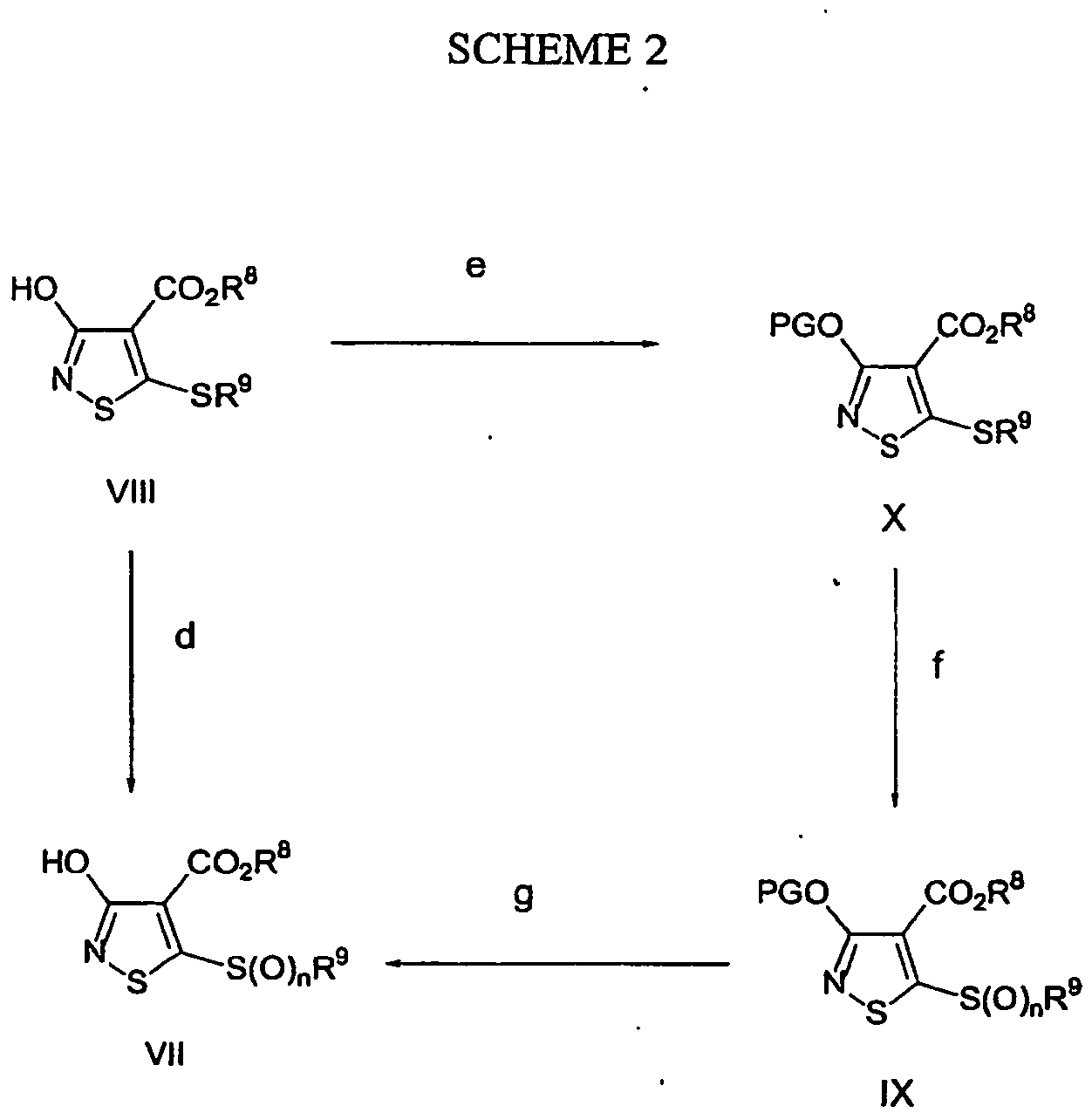
- Referring back to Scheme 1, the 5-(alkyl)sulfonyl/sulfinyl isothiazole VII is treated with a compound of general formula R3X (VI), typically under basic conditions, to yield an isothiazole (V) now having alkoxy functionality at position three (3) of the isothiazole (reaction h). This reaction is particularly and unexpectedly advantageous when compound VI is a tosylate and the conditions include a base in a dipolar aprotic solvent. The reaction under these conditions proceeds in unusually high O:N selectivity where alkylation takes place on the hydroxyl group instead of the nitrogen atom of the isothiazole ring. Under the appropriate conditions O:N selectivity approximates a ratio of 35:1 O:N selectivity.
- Alkylations of a variety of substituted 3-hydroxyisothiazoles have been reported in the literature. Mixtures of O- and N-alkylated products were observed in all cases, with a wide variety of electrophiles (alkyl halides, alkyl sulfates, diazomethane), solvents (water, acetone, DMSO, DMF, MeCN, DME) and bases (NaOH, K2CO3, Li2CO3, Ag2CO3) being used. For example, a thorough study on the alkylation of 3-hydroxyisothiazole is reported in Tetrahedron, 1970; (26), 2497-2506:

RX M DMSO (O:N) DMF (O:N) MeCN (O:N) DME (O:N) Mel K 46:54 41:59 40:60 20:80 Ag 68:32 - - - Li 34:66 17:83 - - Etl K 25:25 77:23 70:30 50:50 Li - 55:45 - - PrBr K 78:22 80:20 80:20 - iPrBr K 88:12 - 86:14 - BnCl K 68:32 59:41 45:55 34:66 - Additional references demonstrating 3-hydroxyisothiazole alkylation reactions with low O:N selectivity include the following:

76% yield, 1:3 O:N Aust. J. Chem. 1977, 1815-1818 
57% yield, 1.2:1 O:N BioOrg. Med. Chem., 1997, 5(8), 1569-1576 
76% yield, 1.1:1 O:N Acta Chem. Scand ser. B 1976, (30), 781-785 
68% O (N isomer not isolated) J. Med. Chem. 1997, 40(4), 520-527 - The alkylation step (reaction h) in the process of the present invention proceeds with very high O:N selectivity, namely, approximately 35:1 for the conditions described in the experimental procedure of Example seven (7) discussed below, which is much higher than the selectivity ratios published in the references cited herein.
- Referring again to Scheme 1, the alkoxylated isothiazole (V) is treated with a source of ammonia in a suitable solvent converting the sulfonyl/sulfinyl moiety at position five (5) of the isothiazole to a primary amine (IV) (reaction i). A compound of general Formula IV may be combined with a secondary amine and a carbonyl source, with or without an added base, in a suitable solvent to give the compound of general Formula II, replacing the primary amine with ureido functionality at position five (5) on the isothiazole. A second treatment with an ammonia source converts the alkyl ester to an amide providing the compound of general Formula I.
- The starting materials employed in Scheme I are readily commercially available or readily prepared using methods well known in the art.
- In each of the reactions discussed or illustrated in the Schemes, pressure is not critical unless otherwise indicated. Pressures from about 0.5 atmospheres to about 5 atmospheres are generally acceptable, and ambient pressure, i.e., about 1 atmosphere, is preferred as a matter of convenience.
- The examples and preparations provided below further illustrate and exemplify the compounds of the present invention, methods of preparing such compounds, and the methods of the present invention. It is to be understood that the scope of the present invention is not limited in any way by the scope of the following examples and preparations. In the following examples molecules with a single chiral center, unless otherwise noted, exist as a racemic mixture. Those molecules with two or more chiral centers, unless otherwise noted, exist as a racemic mixture of diastereomers. Single enantiomers/diastereomers may be obtained by methods known to those skilled in the art.
- The present invention is illustrated by the following Examples. It will be understood, however, that the invention is not limited by the specific details of the following Examples
-

- A reaction vessel was charged with acetonitrile (240 mL, 6 volumes) followed by 1,8-diazabicyclo-[5.4.0]undec-7-ene (2.1 equivalents, 96.8g). The mixture was cooled to 5°C under nitrogen atmosphere. Dimethyl malonate (1.0 equiv, 40.0 g) was added over 10-15 minutes. The mixture was held for 30-45 minutes at 5°C. Carbon disulfide (1.0 equiv, 23.1 g) was added over 10-15 minutes, and then the mixture was held for 60-70 minutes at 5°C. Dimethyl sulfate (1.05 equiv, 40.1 g) was added over 10-15 minutes, and then the mixture was held at 5°C for 16 hours. The mixture containing 2,2-Bis-methoxycarbonyl-1-methylsulfanyl-ethenethiol anion was finally warmed to 25°C over 30 minutes, and held at 25°C for 1-2 hours.
-

- A separate reaction vessel was charged with water (280 mL, 7 volumes) and sodium hydrogencarbonate (1.5 equiv, 38.2 g). The water/ sodium hydrogencarbonate mixture was cooled to 5°C under nitrogen atmosphere. Hydroxylamine-O-sulfonic acid (1.2 equiv, 41.1 g) was added over 5 minutes, and the mixture was stirred 15-30 minutes. The 2,2-Bis-methoxycarbonyl-1-methylsulfanyl-ethenethiol anion/acetonitrile solution from Example 1 was added over 60-70 minutes. The mixture was warmed to 25°C over 1 hour, then held for 16 hours at 25°C. Most of the acetonitrile was removed by vacuum distillation (130 Torr, 50°C). The residue was cooled to room temperature, acidified to pH -1 by addition of 37% hydrochloric acid (32 mL). The solids were granulated for 16 hours at 25°C. The slurry was filtered, and the filter cake was washed 3 x 100 mL with water, once with 200 mL 1:3 ethyl acetate:hexanes (v/v), and once with 100 mL 1:3 ethyl acetate:hexanes (v/v). The wet cake (50.5 g) was dried in a vacuum oven for 16 hours to give 3-Hydroxy-5-methylsulfanyl-isothiazole-4-carboxylic acid methyl ester, providing 45.4 grams (73% yield). 1H NMR: (DMSO-d6) δ 11.92 (s, 1H); 3.74 (s, 3H); 2.53 (s, 3H). MS: (API-ES pos) 206 (M+H)+, base.
-

- 3-Hydroxy-5-methylsulfanyl-isothiazole-4-carboxylic acid methyl ester (1.00 equiv, 10.0 g) and dichloromethane (100 mL, 10 volumes) were charged to a flask and held at 25°C under nitrogen atmosphere. Triethylamine (1.0 equiv, 6.78 mL, 4.88 g) was added. An orange solution formed, which was cooled to 0°C. Methyl chloroformate (1.0 equiv, 3.74 mL, 4.56 g) was added over 3 minutes. The mixture stirred at 25°C for 2 hours, then was washed with water (50 mL, 5 volumes) then brine (50 mL, 5 volumes). The solvent was displaced with acetonitrile (100 mL, 10 volumes) to give a tan slurry containing 3-Methoxycarbonyloxy-5-methylsulfanyl-isothiazole-4-carboxylic acid methyl ester.
-

- The 3-Methoxycarbonyloxy-5-methylsulfanyl-isothiazole-4-carboxylic acid methyl ester slurry was cooled to 0°C, and urea hydrogen peroxide addition compound (2.8 equiv, 12.8 g) was added. Trifluoroacetic acid anhydride (2.8 equiv, 19.2 mL, 28.4 g) was added dropwise over 20 minutes. The mixture stirred at 0°C for 45 minutes, and quenched with sodium hydrogen sulfite (2.0 equiv, 10.0 g) in water (90 mL, 9 volumes) and stirred at 25°C. Most of the acetonitrile was removed under vacuum, then the aqueous residue was extracted once with 100 mL and once again with 50 mL dichloromethane to provide 5-Methanesulfonyl-3-methoxycarbonyloxy-isothiazole-4-carboxylic acid methyl ester.
-

- The 5-Methanesulfonyl-3-methoxycarbonyloxy-isothiazole-4-carboxylic acid methyl ester /dichloromethane extracts were combined, then displaced with methanol (150 mL, 15 volumes). A solution of 98% sulfuric acid (50 mL, 5 volumes) in water (100 mL, 10 volumes) was added and the mixture was heated at 65°C for 6 hours. The foamy slurry became a clear solution with some insoluble white solids over time. The mixture was cooled to 25°C and stirred for 16 hours. Most of the methanol was removed under vacuum. The aqueous residue was extracted once with 100 mL dichloromethane, then twice with 50 mL dichloromethane. The combined dichloromethane extracts were dried over anhydrous magnesium sulfate and filtered. The dichloromethane was displaced with hexanes (100 mL, 10 volumes) and stirred at 25°C until solids formed. The solids were filtered, and the filter cake was rinsed with hexane and dried to give 9.27 g of 3-Hydroxy-5-methanesulfonyl-isothiazole-4-carboxylic acid methyl ester (80% yield). 1H NMR (DMSO-d6): δ 13.07 (s, 1H); 3.83 (s, 3H); 3.55 (s, 3H). MS (API-ES pos): 238 (M+H)+; 206 (M-MeO)+. base.
-

- In a flask under nitrogen (4-Bromo-2,6-difluoro-phenyl)-methanol (1.10 equiv, 19.1 g) was taken up in dichloromethane (185 mL, 10 volumes) and p-toluenesulfonic anhydride (1.1 equiv, 28.9 g) was added. The mixture was cooled to 0°C and triethylamine (1.2 equiv, 13.0 mL, 9.47 g) was added dropwise over 20 minutes. The mixture was warmed to 25°C and stirred for one hour. The mixture was then washed once with 185 mL 1 N hydrochloric acid, then once with 92.5 mL 1 N hydrochloric acid. The organic layer, containing toluene-4-sulfonic acid 4-bromo-2,6-difluoro-benzyl ester, was concentrated to about 55-60 mL.
-

- In a separate vessel, 3-Hydroxy-5-methanesulfonyl-isothiazole-4-carboxylic acid methyl ester (1.00 equiv, 18.5 g) was taken up in dimethylsulfoxide (185 mL, 10 volumes) and potassium carbonate (1.0 equiv, 10.8 g) was added. The toluene-4-sulfonic acid 4-bromo-2,6-difluoro-benzyl ester/dichloromethane solution from Example 6 was added to the 3-Hydroxy-5-methanesulfonyl-isothiazole-4-carboxylic acid methyl /potassium carbonate/dimethylsulfoxide slurry dropwise over 1 hour. The mixture was stirred at 25°C for 16.5 hours. Dichloromethane (185 mL, 10 volumes) then water (185 mL, 10 volumes) were added and the layers were separated. The organic layer was dried over magnesium sulfate and filtered. The dichloromethane was removed under vacuum to leave an orange paste. The orange paste was diluted with 10 volumes of 1:1 EtOAc:Hexanes (v/v) and slurried at 25°C for 16 hours. The mixture was filtered and the filter cake washed with 55-60 mL of 1:1 EtOAc:Hexanes (v/v) and dried to give 24.22 g of 3-(4-Bromo-2,6-difluoro-benzyloxy)-5-methanesulfonyl-isothiazole-4-carboxylic acid methyl ester (70% yield). 1H NMR: (DMSO-d6) δ 7.57 (m, 2H); 5.46 (s, 2H); 3.80 (s, 3H); 3.57 (s, 3H). MS (API-ES pos): 442/444 (M+H)+; 205/207 (1,5-difluoro-3-bromotropylium ion), base.
-

- In a 1 L autoclave 3-(4-Bromo-2,6-difluoro-benzyloxy)-5-methanesulfonyl-isothiazole-4-carboxylic acid methyl ester (1.00 equiv, 28.0 g) was taken up in tetrahydrofuran (840 mL, 30 volumes). The vessel was evacuated, heated to 50°C, then placed under 45 psi of anhydrous ammonia gas. The mixture was stirred at 600 rpm for 3 days, then 1000 rpm for an additional 21 hours. The mixture was cooled to 25°C, purged with nitrogen, then the tetrahydrofuran was removed on a rotovap. A 60:40 acetonitrile/water (v/v) solution (240ml, 10 volumes with respect to theoretical product mass) was added to the residue. The slurry was heated to 70°C for 1 hour then stirred at 25°C overnight. The slurry was filtered and the filter cake rinsed with 60:40 acetonitrile/water (v/v) (40 mL). The solids were dried under vacuum to give 21.55 g of 5-Amino-3-(4-bromo-2,6-difluoro-benzyloxy)-isothiazole-4-carboxylic acid methyl ester (90% yield). 1H NMR (DMSO-d6) δ 7.87 (s, 2H); 7.52 (m, 2H); 5.26 (s, 2H); 3.60 (s, 3H). MS: (API-ES pos) 379/381 (M+H)+; 205/207 (1,5-difluoro-3-bromotropylium ion), base.
-

- In a flask under nitrogen, 4-Pyrrolidin-1-yl-butylamine (1.3 equiv, 10.1 g) was taken up in tetrahydrofuran (105 mL, 5 volumes). The mixture was cooled to 0°C and 1,1'-carbonyldiimidazole (1.3 equiv, 11:6 g) was added. The mixture stirred at 0°C for 20 minutes, then warmed to 20°C over 10 minutes and held at 20°C for 30 minutes.
-

- Dimethylsulfoxide (105 mL, 5 volumes) was added to the imidazole-1-carboxylic acid (4-pyrrolidin-1-yl-butyl)-amide /tetrahydrofuran mixture, the tetrahydrofuran was removed by distillation under vacuum. The mixture was cooled to 20°C then 5-Amino-3-(4-bromo-2,6-difluoro-benzyloxy)-isothiazole-4-carboxylic acid methyl ester (1.00 equiv, 21.0 g) was added, followed by potassium carbonate (2.0 equiv, 15.2 g). The mixture stirred at 20°C for 21.5 hours. Ethyl acetate (210 mL, 10 volumes) then water (210 mL, 10 volumes) were added. The slurry was stirred at 20°C for 3-4 hours. The solids were filtered and the filter cake was rinsed with ethyl acetate (63.0 mL, 3 volumes). The solids were dried in a vacuum oven for 17 hours to give 27.36 grams of 3-(4-Bromo-2,6-difluoro-benzyloxy)-5-[3-(4-pyrrolidin-1-yl-butyl)-ureido]-isothiazole-4-carboxylic acid methyl ester (90% yield). 1H NMR: (DMSO-d6) δ 10.38 (s, 1H); 8.11 (m, 1H); 7.54 (m, 2H); 5.30 (s, 2H); 3.70 (s, 3H); 3.12 (m, 2H); 2.48 (m, 6H); 1.63 (m, 4H); 1.44 (m, 4H). MS (API-ES pos): 547/549 (M+H)+, base.
-

- In a 1 Liter autoclave 3-(4-Bromo-2,6-difluoro-benzyloxy)-5-[3-(4-pyrrolidin-1-yl-butyl)-ureido]-isothiazole-4-carboxylic acid methyl ester (1.00 equiv, 27.0 g) was slurried in methanol (270 mL, 10 volumes) and tetrahydrofuran (270 mL, 10 volumes). The mixture was cooled to 0°C and stirred at 600 rpm. Anhydrous ammonia gas was charged carefully, keeping the temperature below 10°C. Once a steady pressure of around 10 psi was maintained, the mixture was heated to 40°C. The pressure increased to about 45 psi. The pressure was adjusted to 50 psi and stirred at 600 rpm and 40°C for 90 hours. The stir rate was then adjusted to 1000 rpm and stirred for an additional 24 hours. The ammonia was removed by vacuum, and the mixture was cooled to 20°C and transferred out of the reactor. The mixture was filtered to remove insoluble solids (non-product related). The filtrate was diluted with 2-propanol (270 mL, 10 volumes), and the tetrahydrofuran and methanol were distilled atmospherically. Additional 2-propanol (135 mL, 5 volumes) were added, then the mixture was distilled to approximately 250mL total volume. The slurry was cooled to 20°C and stirred 18 hours. The solids were filtered and then dried under vacuum to give 19.9 grams of 3-(4-Bromo-2,6-difluoro-benzyloxy)-5-[3-(4-pyrrolidin-1-yl-butyl)-ureido]-isothiazole-4-carboxylic acid amide (76% yield). 1H NMR (DMSO-d6): δ 10.98 (s, 1H); 8.18 (m, 1H); 7.55 (m, 3H); 6.80 (s, 1H); 5.41 (s, 2H); 3.08 (m, 2H); 2.47 (m, 6H); 1.62 (m, 4H); 1.42 (m, 4H). MS (API-ES pos) 532/534 (M+H)+, base.


R3X VI
Claims (15)
- A process for the preparation of a compound of Formula I
 R1 is H, C1-C10 alkyl, C2-C10 alkenyl, C2-C10 alkynyl, -C(O)(C1-C10 alkyl), -(CH2)t(C6-C10 aryl), -(CH2)t(4-10 membered heterocyclic), -C(O)(CH2)t(C6-C10 aryl), or -C(O)(CH2)t(4-10 membered heterocyclic), wherein t is an integer from 0 to 5; said alkyl group optionally includes 1 or 2 hetero moieties selected from O, S and -N(R6)- with the proviso that two O atoms, two S atoms, or an O and S atom are not attached directly to each other; said aryl and heterocyclic R' groups are optionally fused to a C6-C10 aryl group, a C5-C8 saturated cyclic group, or a 4-10 membered heterocyclic group; 1 or 2 carbon atoms in the foregoing heterocyclic moieties are optionally substituted by an oxo (=O) moiety; and the foregoing R1 groups, except H, are optionally substituted by 1 to 3 R4 groups;R2 is selected from the list of substituents provided in the definition of R1, -SO2(CH2)t(C6-C10 aryl), -SO2(CH2)t(4-10 membered heterocyclic), and -OR5, t is an integer ranging from 0 to 5, and the foregoing R2 groups are optionally substituted by 1 to 3 R4 groups;or R1 and R2 may be taken together with the nitrogen to which each is attached to form a 4-10 membered saturated monocyclic or polycyclic ring or a 5-10 membered heteroaryl ring, wherein said saturated and heteroaryl rings optionally include 1 or 2 heteroatoms selected from O, S and -N(R6)- in addition to the nitrogen to which R1 and R2 are attached, said -N(R6)- is optionally =N- or -N= where R1 and R2 are taken together as said heteroaryl group, said saturated ring optionally may be partially unsaturated by including 1 or 2 carbon-carbon double bonds, and said saturated and heteroaryl rings, including the R6 group of said -N(R6)-, are optionally substituted by 1 to 3 R4 groups;R3 is H, C1-C10 alkyl, C2-C10 alkenyl, C2-C10 alkynyl, -(CH2)t(C6-C10 aryl), or -(CH2)t(4-10 membered heterocyclic), wherein t is an integer from 0 to 5; said alkyl group optionally includes 1 or 2 hetero moieties selected from O, S and -N(R6)- with the proviso that two O atoms, two S atoms, or an O and S atom are not attached directly to each other; said aryl and heterocyclic R3 groups are optionally fused to a C6-C10 aryl group, a C5-C8 saturated cyclic group, or a 4-10 membered heterocyclic group; 1 or 2 carbon atoms in the foregoing heterocyclic moieties are optionally substituted by an oxo (=O) moiety; the -(CH2)t- moieties of the foregoing R3 groups optionally include a carbon-carbon double or triple bond where t is an integer from 2 to 5, and the foregoing R3 groups are optionally substituted by 1 to 5 R4 groups;each R4 is independently selected from halo, C1-C10 alkyl, C2-C10 alkenyl, C2-C10 alkynyl, nitro, trifluoromethyl, trifluoromethoxy, azido, -OR5, -NR6C(O)OR5, -NR6SO2R5, -SO2NR5R6, -NR6C(O)R5, -C(O)NR5R6, -NR5R6, -S(O)jR7 wherein j is an integer ranging from 0 to 2, -NR5(CR6R7)tOR6, -(CH2)t(C6-C10 aryl), -SO2(CH2)t(C6-C10 aryl), -S(CH2)t(C6-C10 aryl). -O(CH2)t(C6-C10 aryl), -(CH2)t(4-10 membered heterocyclic), and -(CR8R7)mOR6, wherein m is an integer from 1 to 5 and t is an integer from 0 to 5; said alkyl group optionally contains 1 or 2 hetero moieties selected from O, S and -N(R6)- with the proviso that two O atoms, two S atoms, or an O and S atom are not attached directly to each other; said aryl and heterocyclic R4 groups are optionally fused to a C6-C10 aryl group, a C5-C8 saturated cyclic group, or a 4-10 membered heterocyclic group; 1 or 2 carbon atoms in the foregoing heterocyclic moieties are optionally substituted by an oxo (=O) moiety; and the alkyl, aryl and heterocyclic moieties of the foregoing R4 groups are optionally substituted by 1 to 3 substituents independently selected from nitro, trifluoromethyl, trifluoromethoxy, azido, -NR6SO2R5, -SO2NR5R6, -NR6C(O)R5, -C(O)NR5R6, -N5SR6, -(CR6R7)mOR6 wherein m is an integer from 1 to 5, -OR5 and the substituents listed in the definition of R5;each R5 is independently selected from H, C1-C10 alkyl, -(CH2)t(C6-C10 aryl), and -(CH2)t(4-10 membered heterocyclic), wherein t is an integer from 0 to 5; said alkyl group optionally includes 1 or 2 hetero moieties selected from O, S and -N(R6)- with the proviso that two O atoms, two S atoms, or an O and S atom are not attached directly to each other; said aryl and heterocyclic R5 groups are optionally fused to a C6-C10 aryl group, a C5-C8 saturated cyclic group, or a 4-10 membered heterocyclic group; and the foregoing R5 subsituents, except H, are optionally substituted by 1 to 3 substituents independently selected from nitro, trifluoromethyl, trifluoromethoxy, azido, -NR6C(O)R7, -C(O)NR6R7, -NR6R7, hydroxy, C1-C6 alkyl, and C1-C6 alkoxy; andeach R6 and R7 is independently H or C1-C6 alkyl;comprising reacting a compound of Formula II
 wherein R8 is H, C1-C10 alkyl, -C(O)(C1-C10 alkyl), -C(O)(C6-C10 aryl),-C(O)(4-10 membered heterocyclic), -(CH2)t(C6-C10 aryl), -(CH2)t(4-10 membered heterocyclic), -C(O)O(C1-C10 alkyl); -C(O)O(C6-C10 aryl), -C(O)O(4-10 membered heterocyclic), wherein t is an integer from 0 to 5; said aryl and heterocyclic. R8 groups are optionally fused to a C6-C10 aryl group; and the foregoing aryl and heterocyclic R8 groups are optionally substituted with 1-2 substituents independently selected from halogen, trifluoromethyl, C1-C6 alkoxy, C1-C6 alkyl, and nitro groups; and R1, R2, R3, R4, R5, R6 and R7 are as defined above for the compound of Formula I, with an ammonia source in a solvent to give a compound of the Formula I.
 - A process according to claim 1, wherein the compound of Formula I is selected from the group consisting of:3-(4-Bromo-2,6-difluoro-benzyloxy)-5-[3-(4-pyrrolidin-1-yl-butyl)-ureido}-isothiazole-4-carboxylic acid amide;5-{3-[3-(4-Methyl-piperazin-1-yl)-propyl]-ureido}-3-(2,3,6-trifluoro-4-methyl-benzyloxy)-isothiazole-4-carboxylic acid amide;3-(4-Chloro-2,6-difluoro-benzyloxy)-5-(3-{4-[ethyl-(2-hydroxy-ethyl)-amino]-butyl}-ureido)-isothiazole-4-carboxylic acid amide;3-(2-Fluoro-4-methyl-benzyloxy)-5-{3-[3-(4-methyl-piperazin-1-yl)-propyl]-ureido}-isothiazole-4-carboxylic acid amide;3-(2,5-Difluoro-4-methyl-benzyloxy)-5-(3-4-[4-(2-hydroxy-ethyl)-piperazin-1-yl]-butyl}-ureido)-isothlazole-4-carboxylic acid amide;3-(2,5-Difluoro-4-methyl-benzyloxy)-5-[3-(6-dimethylamino-hexyl)-ureido]-isothiazole-4-carboxylic acid amide;3-(2-Fluoro-4-methyl-benzyloxy)-5-[3-(5-isopropylamino-pentyl)-ureido]-isothiazole-4-carboxylic acid amide;hydrochloride salt of 3-(4-Bromo-2,6-difluoro-benzyloxy)-5-[3-(4-pyrrolidin-1-yl-butyl)-ureido}-isothiazole-4-carboxylic acid amide;3-(4-Chloro-2,6-difluoro-benzyloxy)-5-[3-(4-pyrrolidin-1-yl-butyl)-ureido]-isothiazole-4-carboxylic acid amide;3-(4-Chloro-2,6-difluoro-benzyloxy-5-{3-[3-(4-methyl-piperazin-1-yl)-propyl]-ureido}-isothiazole-4-carboxylic acid amide;3-(4-Chloro-2,6-difluoro-benzyloxy)-5-{3-[-(1-methyl-pyn-olidin-2-yl)-ethyl]-ureido}-isothiazole-4-carboxylic acid amide;3-(2,6-Difluoro-4-methyl-benzyloxy)-5-[3-(4-pyrrolidin-1-yl-butyl)-ureido]-isothiazole-4-carboxylic acid amide;3-(2,6-Difluoro-4-methyl-benzyloxy)-5-[3-{4-[4-(2-hydroxy-ethyl)-piperazin-1-yl]-butyl}-ureido)-isothiazole-4-carboxylic acid amide;3-(4-Chloro-2,6-difluoro-benzyloxy)-5-[3-(3-hydroxy-5-pyrrolidin-1-yl)-pentyl)-ureido}-isothiazole-4-carboxylic acid amide;3-(2,5-Difluoro-4-methyl-benzyloxy)-5-{3-[4-(3,4-dihydroxy-pyrrolidin-1-yl]-butyl]-ureido}-isothiazole-4-carboxylic acid amide;3-(4-Chloro-2,6-difluoro-benzyloxy)-5-{3-[4-(3,4-dihydroxy-pyrrolidin-1-yl)-butyl]-ureido}- isothiazole-4-carboxylic acid amide;3-(2,5-Difluoro-4-methyl-benzyloxy)-5-{3-[4-(2-hydroxymethyl-pyrrolidin-1-yl)-butyl]-ureido}-isothiazole-4-carboxylic acid amide;3-(4-Chloro-2,6-difluoro-benzyloxy)-5-{3-[4-(2-hydroxymethyl-pyrrolidin-1-yl)-butyl]-ureido}-isothiazole-4-carboxylic acid amide;3-(2,5-Difluoro-4-methyl-benzyloxy)-5-{3-[4-(3-hydroxy-pyrrolidin-1-yl)-butyl]-ureido}-isothiazole-4-carboxylic acid amide;3-(4-Bromo-2,6-difluoro-benzyloxy)-5-[3-(4-pyrrolidin-1-yl-butyl]-ureido}-isothiazole-4-carboxylic acid amide;3-(2,6-Difluoro-4-methyl-benzyloxy)-5-[3-(4-hydroxy-5-piperidin-1-yl-pentyl)-ureido]-isothiazole-4-carboxylic acid amide;3-(2,5-Difluoro-4-methyl-benzyloxy)-5-{3-[4-(3-hydroxy-5-piperidin-1-yl-pentyl)-ureido]-isothiazole-4-carboxylic acid amide;3-(4-Chloro-2,6-difluoro-benzyloxy)-5-{3-[4-(2-hydroxymethyl-piperidin-1-yl)-butyl]-ureido}-isothiazole-4-carboxylic acid amide;3-(2,5-Difluoro-4-methyl-benzyloxy)-5-(3-{4-[ethyl-(2-hydroxy-ethyl)-amino]-butyl}-ureido)-isothiazole-4-carboxylic acid amide;3-(4-Chloro-2,6-difluoro-benzyloxy)-5-[3-(5-hydroxy-6-piperidin-1-yl)-hexyl)-ureido}-isothiazole-4-carboxylic acid amide;3-(4-Bromo-2,3,6-trifluoro-benzyloxy)-5-{3-[3-(4-methyl-piperazin-1-yl)-propyl]-ureido}-isothiazole-4-carboxylic acid amide;3-(2,6-Difluoro-4-methyl-benzyloxy)-5-{3-[3-(4-methyl-piperazin-1-yl-propyl]-ureido}-isothiazole-4-carboxylic acid amide;3-(2,6-Difluoro-4-methyl-benzyloxy)-5-[3-(3-hydroxy-5-pyrrolidin-1-yl-pentyl)ureido]-isothiazole-4-carboxylic acid amide;5-[3-(4-Pyrrolidin-1-yl-butyl)-ureido]-3-(2,3,6-trifluoro-4-methyl-benzyloxy)-isothiazole-4-carboxylic acid amide;5-[3-(3-Hydroxy-5-pyrrolidin-1-yl-pentyl)-ureido]-3-(2,3,6-trifluoro-4-methyl-benzyloxy)-isothiazole-4-carboxylic acid amide;3-(4-Chloro-2,6-difluoro-benzyloxy)-5-{3-[3-(5-methyl-2,5-diazabicyclo[2.2.1]hept-2-yl)-propyl]-ureido}-isothiazole-4-carboxylic acid amide;3-(4-Chloro-2,3,6-trifluoro-benzyloxy)-5-{3-[3-(5-methyl-2,5-diaza-bicyclo[2.2.1]hept-2-yl)-propyl]-ureido}-isothiazole-4-carboxylic acid amide;3-(4-Chloro-2,3,6-trifluoro-benzyloxy)-5-{3-[2-(1-methyl-pyrrolidin-2-yl)-ethyl]-ureido}-isothiazole-4-carboxylic acid amide;3-(4-Chloro-2,3,6-trifluoro-benzyloxy)-5-[3-(4-pyrrolidin-1-yl-butyl)-ureido]-isothiazole-4-carboxylic acid amide;3-(4-Chloro-2,3,6-trifluoro-benzyloxy)-5-{3-[4-(2-hydroxymethyl-pyrrolidin-1-yl)-butyl]-ureidol-isothiazole-4-carboxylic acid amide;5-{3-[2-(1-Methyl-pyrrolidin-2-yl)-ethyl]-ureido}-3-(2,3,6-trifluoro-4-methyl-benzyloxy)-isothiazole-4-carboxylic acid amide;5-[3-(4-Dimethylamino-butyl)-ureido]-3-(2,3,6-trifluoro-4-methyl-benzyloxy)-isothiazole-4-carboxylic acid amide;5-[3-(3-Dimethylamino-propyl)-ureido]-3-(2,3,6-trifluoro-4-methyl-benzyloxy)-isothiazole-4-carboxylic acid amide;5-[3-(3-Hydroxy-5-isopropropylamino-pentyl)-ureido]-3-(2,3,6-trifluoro-4-methyl-benzyloxy)-isothiazole-4-carboxylic acid amide;5-[3-(3-Isopropylamino-propyl)-ureido]-3-(2,3,6-trifluoro-4-methyl-benzyloxy)-isothiazole-4-carboxylic acid amide;5-{3-[4-(4-Methyl-piperazin-1-yl)-butyl]-ureido}-3-(2,3,6-trifluoro-4-methyl-benzyloxy)-isothiazole-4-carboxylic acid amide;5-(3-{4-[4-(2=Hydroxy-ethyl)-piperazin-1-yl]-butyl}-ureido)-3-(2,3,6-trifluoro-4-methyl-benzyloxy)-isothiazole-4-carboxylic acid amide;5-[3-(3-Pyrrolidin-1-yl-propyl)-ureido]-3-(2,3,6-trifluoro-4-methyl-benzyloxy)-isothiazole-4-carboxylic acid amide;5-[3-(4-Hydroxy-5-piperidin-1-yl-pentyl)-ureido]-3-(2,3,6-trifluoro-4-methyl-benzyloxy)-isothiazole-4-carboxylic acid amide;3-(4-Chloro-2,6-difluoro-benzyloxy)-5-[3-(4-imidazol-1-yl-butyl)-ureido]-isothiazole-4-carboxylic acid amide;5-(3-{4-[Ethyl-(2-hydroxy-ethyl)-amino]-butyl}-ureido)-3-(2,3,6-trifluoro-4-methyl-benzyloxy)-isothiazole-4-carboxylic acid amide;3-(4-Chloro-(2,3,6-trifluoro-benzyloxy)-5-{3-[4-(2-hydroxmethyl-piperidin-1-yl)-butyl]-ureido}-isothiazole-4-carboxylic acid amide;3-(4-Chloro-2,3,6-trifluoro-benzyloxy)-5-[3-(3-hydroxy-5-pyrrolidin-1-yl-pentyl)-ureido]-isothiazole-4-carboxylic acid amide;3-(4-Bromo-2,6-difluoro-benzyloxy)-5-{3-[3-(4-methyl-piperazin-1-yl)-propyl]-ureido}-isothiazole-4-carboxylic acid amide;3-(2,6-Difluoro-4-methyl-benzyloxy)-5-{3-[2-(1-methyl-pyrrolidin-2-yl)-ethyl]-ureido}-isothiazole-4-carboxylic acid amide;3-(2,6-Difluoro-4-methyl-benzyloxy)-5-[3-(4-dimethylamino-butyl)-ureido}-isothiazole-4-carboxylic acid amide;3-(2,6-Difluoro-4-methyl-benzyloxy)-5-[3-(3-dimethylamino-propyl)-ureido]-isothiazole-4-carboxylic acid amide;3-(4-Bromo-2,3,6-trifluoro-benzyloxy)-5-[3-(4-pyrrolidin-1-yl-butyl)-ureido]-isothiazole-4-carboxylic acid amide;3-(4-Chloro-2,3,6-trifluoro-benzyloxy)-5-[3-(4-imidazol-1-yl-butyl)-ureido]-isothiazole-4-carboxylic acid amide;3(4-Chloro-2,3,6-difluoro-benzyloxy)-5-(3-{3-[ethyl-(2-hydroxy-ethyl)-amino]-propyl}-ureido)-isothiazole-4-carboxylic acid amide;3-(4-Chloro-2,3,6-trifluoro-benzyloxy)-5-(3-{3-[ethyl-(2-hydroxy-ethyl)-amino]-propyl}-ureido)-isothiazole-4-carboxylic acid amide;5-[3-(3-Methylamino-propyl)-ureido]-3-(2,3,6-trifluoro-4-methyl-benzyloxy)-isothiazole-4-carboxylic acid amide;5-[3-(3-Amino-propyl)-3-methyl-ureido]-3-(2,3,6-trifluoro-4-methyl-benzyloxy)-isothiazole-4-carboxylic acid amide;5-[3-(4-Diethylamino-butyl)-ureido]-3-(2,3,6-trifluoro-4-methyl-benzyloxy)-isothiazole-4-carboxylic acid amide;3-(2,6-Difluoro-4-methyl-benzyloxy)-5-[3-(3-pyrrolidin-1-yl-propyl)-ureido]-isothiazole-4-carboxylic acid amide;3-(3-Chloro-2,6-difluoro-4-methyl-benzyloxy)-5-[3-(4-dimethylamino-butyl)-ureido]-isothiazole-4-carboxylic acid amide;5-(3-{4-[Bis-(2-hydroxy-ethyl)-amino]-butyl}-ureido)-3-(2,6-difluoro-4-methyl-benzyloxy)-isothiazole-4-carboxylic acid amide;and the pharmaceutically acceptable salts, prodrugs, hydrates and solvates of said compounds.
- A process for the preparation of a compound of Formula II
 R1 is H, C1-C10 alkyl, C2-C10 alkenyl, C2-C10 alkynyl, -C(O)(C1-C10 alkyl), -(CH2)t(C6-C10 aryl), -(CH2)t(4-10 membered heterocyclic), -C(O)(CH2)t(C6-C10 aryl), or -C(O)(CH2)1(4-10 membered heterocyclic), wherein t is an integer from 0 to 5; said alkyl group optionally includes 1 or 2 hetero moieties selected from O, S and -N(R6)- with the proviso that two O atoms, two S atoms, or an O and S atom are not attached directly to each other; said aryl and heterocyclic R1 groups are optionally fused to a C6-C10 aryl group, a C5-C8 saturated cyclic group, or a 4-10 membered heterocyclic group; 1 or 2 carbon atoms in the foregoing heterocyclic moieties are optionally substituted by an oxo (=O) moiety; and the foregoing R1 groups, except H, are optionally substituted by 1 to 3 R4 groups;R2 is selected from the list of substituents provided in the definition of R1, -SO2(CH2)t(C6-C10 aryl), -SO2(CH2)t(4-10 membered heterocyclic), and -OR5, t is an integer ranging from 0 to 5, and the foregoing R2 groups are optionally substituted by 1 to 3 R4 groups;or R1 and R2 may be taken together with the nitrogen to which each is attached to form a 4-10 membered saturated monocyclic or polycyclic ring or a 5-10 membered heteroaryl ring, wherein said saturated and heteroaryl rings optionally include 1 or 2 heteroatoms selected from O, S and -N(R6)- in addition to the nitrogen to which R1 and R2 are attached, said -N(R6)- is optionally =N- or -N= where R1 and R2 are taken together as said heteroaryl group, said saturated ring optionally may be partially unsaturated by including 1 or 2 carbon-carbon double bonds, and said saturated and heteroaryl rings, including the R6 group of said -N(R6)-, are optionally substituted by 1 to 3 R4 groups;R3 is H, C1-C10 alkyl, C2-C10 alkenyl, C2-C10 alkynyl, -(CH2)t(C6-C10 aryl), or -(CH2)t(4-10 membered heterocyclic), wherein t is an integer from 0 to 5; said alkyl group optionally includes 1 or 2 hetero moieties selected from O, S and -N(R6)- with the proviso that two O atoms, two S atoms, or an O and S atom are not attached directly to each other; said aryl and heterocyclic R3 groups are optionally fused to a C6-C10 aryl group, a C5-C8 saturated cyclic group, or a 4-10 membered heterocyclic group; 1 or 2 carbon atoms in the foregoing heterocyclic moieties are optionally substituted by an oxo (=O) moiety; the -(CH2)t- moieties of the foregoing R3groups optionally include a carbon-carbon double or triple bond where t is an integer from 2 to 5, and the foregoing R3 groups are optionally substituted by 1 to 5 R4 groups;each R4 is independently selected from halo, C1-C10 alkyl, C2-C10 alkenyl, C2-C10 alkynyl, nitro, trifluoromethyl, trifluoromethoxy, azido, -OR5, -NR6C(O)OR5, -NR6SO2R5, -SO2NR5R6, -NR6C(O)R5, -C(O)NR5R6, -NR5R6, -S(O)jR7 wherein j is an integer ranging from 0 to 2, -NR5(CR6R7)tOR6, -(CH2)t(C6-C10 aryl), -SO2(CH2)t(C6-C10 aryl), -S(CH2)t(C6-C10 aryl), -O(CH2)t(C6-C10 aryl), -(CH2)t(4-10 membered heterocyclic), and -(CR6R7)mOR6, wherein m is an integer from 1 to 5 and t is an integer from 0 to 5; said alkyl group optionally contains 1 or 2 hetero moieties selected from O, S and -N(R6)- with the proviso that two O atoms, two S atoms, or an O and S atom are not attached directly to each other; said aryl and heterocyclic R4 groups are optionally fused to a C6-C10 aryl group, a C5-C8 saturated cyclic group, or a 4-10 membered heterocyclic group; 1 or 2 carbon atoms in the foregoing heterocyclic moieties are optionally substituted by an oxo (=O) moiety; and the alkyl, aryl and heterocyclic moieties of the foregoing R4 groups are optionally substituted by 1 to 3 substituents independently selected from nitro, trifluoromethyl, trifluoromethoxy, azido, -NR6SO2R5, -SO2NR5R6, -NR6C(O)R5, -C(O)NR5R6, -NR5R6, -(CR6R7)mOR6 wherein m is an integer from 1 to 5, -OR5 and the substituents listed in the definition of R5;each R5 is independently selected from H, C1-C10 alkyl, -(CH2)t(C6-C10 aryl), and -(CH2)t(4-10 membered heterocyclic), wherein t is an integer from 0 to 5; said alkyl group optionally includes 1 or 2 hetero moieties selected from O, S and -N(R)- with the proviso that two O atoms, two S atoms, or an O and S atom are not attached directly to each other; said aryl and heterocyclic R5 groups are optionally fused to a C6-C10 aryl group, a C5-C8 saturated cyclic group, or a 4-10 membered heterocyclic group; and the foregoing R5 subsituents, except H, are optionally substituted by 1 to 3 substituents independently selected from nitro, trifluoromethyl, trifluoromethoxy, azido, -NR6C(O)R7, -C(O)NR6R7, -NR6R7, hydroxy, C1-C6 alkyl, and C1-C6 alkoxy;each R6 and R7 is independently H or C1-C6 alkyl;R8 is H, C1-C10 alkyl, -C(O)(C1-C10 alkyl), -C(O)(C6-C10 aryl), -C(O)(4-10 membered heterocyclic), -(CH2)t(C6-C10 aryl), -(CH2)t(4-10 membered heterocyclic), -C(O)O(C1-C10 alkyl); -C(O)O(C6-C10 aryl), -C(O)O(4-10 membered heterocyclic) wherein t is an integer from 0 to 5; said aryl and heterocyclic R8 groups are optionally fused to a C6-C10 aryl group; and the foregoing aryl and heterocyclic R8 groups are optionally substituted with 1-2 substituents independently selected from halogen, trifluoromethyl, C1-C6 alkoxy, C1-C6 alkyl, and nitro groups; comprising (1) reacting a compound of Formula IV
HNR1R2 III
wherein R1 and R2 are as defined above for Formula II in a solvent to give a compound of the Formula II or (2) reacting a compound of Formula III with a source of carbonyl, with or without an added base, and then adding a compound of Formula IV in a solvent to give a compound of the Formula II. - A process according to claim 3 wherein the compound of Formula II is3-(4-Bromo-2,6-difluoro-benzyloxy)-5-[3-(4-pyrrolidin-1-yl-butyl)-ureido]-isothiazole-4-carboxylic acid methyl ester.
- A process according to claim 3 wherein the compound of Formula II is selected from the group consisting of:3-(4-Bromo-2,6-difluoro-benzyloxy)-5-[3-(4-pyrrolidin-1-yl-butyl)-ureido}-isothiazole-4-carboxylic acid methyl ester;5-{3-[3-(4-Methyl-piperazin-1-yl)-propyl]-ureido}-3-(2,3,6-trifluoro-4-methyl-benzyloxy)-isothiazole-4-carboxylic acid methyl ester;3-(4-Chloro-2,6-difluoro-benzyloxy)-5-(3-{4-[ethyl-(2-hydroxy-ethyl)-amino]-butyl}-ureido)-isothiazole-4-carboxylic acid methyl ester;3-(2-Fluoro-4-methyl-benzyloxy)-5-{3-[3-(4-methyl-piperazin-1-yl)-propyl]-ureido}-isothiazole-4-carboxylic acid methyl ester;3-(2,5-Difluoro-4-methyl-benzyloxy)-5-(3-4-[4-(2-hydroxy-ethyl)-piperazin-1-yl]-butyl}-ureido)-isothiazole-4-carboxylic acid methyl ester;3-(2,5-Difluoro-4-methyl-benzyloxy)-5-[3-(6-dimethylamino-hexyl)-ureido]-isothiazole-4-carboxylic acid methyl ester;3-(2-Fluoro-4-methyl-benzyloxy)-5-[3-(5-isopropylamino-pentyl)-ureido]-isoth iazole-4-carboxylic acid methyl ester;hydrochloride salt of 3-(4-Bromo-2,6-difluoro-benzyloxy)-5-[3-(4-pyrrolidin-1-yl-butyl)-ureido}-isothiazole-4-carboxylic acid methyl ester;3-(4-Chloro-2,6-difluoro-benzyloxy)-5-[3-(4-pyrrolidin-1-yl-butyl)-ureido]-isothiazole-4-carboxylic acid methyl ester;3-(4-Chloro-2,6-difluoro-benzyloxy)-5-{3-[3-(4-methyl-piperazin-1-yl)-propyl]-ureido}-isothiazole-4-carboxylic acid methyl ester;3-(4-Chloro-2,6-difluoro-benzyloxy)-5-{3-[-(1-methyl-pyrrolidin-2-yl)-ethyl]-ureido}-isothiazole-4-carboxylic acid methyl ester;3-(2,6-Difluoro-4-methyl-benzyloxy)-5-[3-(4-pyrrolidin-1-yl-butyl)-ureido]-isothiazole-4-carboxylic acid methyl ester;3-(2,6-Difluoro-4-methyl-benzyloxy)-5-[3-{4-[4-(2-hydroxy-ethyl)-piperazin-1-yl]-butyl}-ureido)-isothiazole-4-carboxylic acid methyl ester;3-(4-Chloro-2,6-difluoro-benzyloxy)-5-[3-(3-hydroxy-5-pyrrolidin-1-yl)-pentyl)-ureido}-isothiazole-4-carboxylic acid methyl ester;3-(2,5-Difluoro-4-methyl-benzyloxy)-5-{3-[4-(3,4-dihydroxy-pyrrolidin-1-yl]-butyl]-ureido}-isothiazole-4-carboxylic acid methyl ester;3-(4-Chloro-2,6-difluoro-benzyloxy)-5-{3-[4-(3,4-dihydroxy-pyrrolidin-1-yl)-butyl]-ureido}- isothiazole-4-carboxylic acid methyl ester;3-(2,5-Difluoro-4-methyl-benzyloxy)-5-{3-[4-(2-hydroxymethyl-pyrrolidin-1-yl)-butyl]-ureido}-isothiazole-4-carboxylic acid methyl ester;3-(4-Chloro-2,6-difluoro-benzyloxy)-5-{3-[4-(2-hydroxymethyl-pyrrolidin-1-yl)-butyl]-ureido}-isothiazole-4-carboxylic acid methyl ester;3-(2,5-Difluoro-4-methyl-benzyloxy)-5-{3-[4-(3-hydroxy-pyrrolidin-1-yl)-butyl]-ureido}-isothiazole-4-carboxylic acid methyl ester;3-(4-Bromo-2,6-difluoro-benzyloxy)-5-[3-(4-pyrrolidin-1-yl-butyl]-ureido}-isothiazole-4-carboxylic acid methyl ester;3-(2,6-Difluoro-4-methyl-benzyloxy)-5-[3-(4-hydroxy-5-piperidin-1-yl-pentyl)-ureido]-isothiazole-4-carboxylic acid methyl ester;3-(2,5-Difluoro-4-methyl-benzyloxy)-5-{3-[4-(3-hydroxy-5-piperidin-1-yl-pentyl)-ureido]-isothiazole-4-carboxylic acid methyl ester;3-(4-Chloro-2,6-difluoro-benzyloxy)-5-{3-[4-(2-hydroxymethyl-piperidin-1-yl)-butyl]-ureido}-isothiazole-4-carboxylic acid methyl ester;3-(2,5-Difluoro-4-methyl-benzyloxy)-5-(3-{4-[ethyl-(2-hydroxy-ethyl)-amino]-butyl}-ureido)-isothiazole-4-carboxylic acid methyl ester;3-(4-Chloro-2,6-difluoro-benzyloxy)-5-[3-(5-hydroxy-6-piperidin-1-yl)-hexyl)-ureido}-isothiazole-4-carboxylic acid methyl ester;3-(4-Bromo-2,3,6-trifluoro-benzyloxy)-5-{3-[3-(4-methyl-piperazin-1-yl)-propyl]-ureido}-isothiazole-4-carboxylic acid methyl ester;3-(2,6-Difluoro-4-methyl-benzyloxy)-5-{3-[3-(4-methyl-piperazin-1-yl-propyl]-ureido}-isothiazole-4-carboxylic acid methyl ester;3-(2,6-Difluoro-4-methyl-benzyloxy)-5-[3-(3-hydroxy-5-pyrrolidin-1-yl-pentyl)-ureido]-isothiazole-4-carboxylic acid methyl ester;5-[3-(4-Pyrrolidin-1-yl-butyl)-ureido]-3-(2,3,6-trifluoro-4-methyl-benzyloxy)-isothiazole-4-carboxylic acid methyl ester;5-[3-(3-Hydroxy-5-pyrrolidin-1-yl-pentyl)-ureido]-3-(2,3,6-trifluoro-4-methyl-benzyloxy)-isothiazole-4-carboxylic acid methyl ester;3-(4-Chloro-2,6-difluoro-benzyloxy)-5-{3-[3-(5-methyl-2,5-diazabicyclo[2.2.1]hept-2-yl)-propyl]-ureido}-isothiazole-4-carboxylic acid methyl ester;3-(4-Chloro-2,3,6-trifluoro-benzyloxy)-5-{3-[3-(5-methyl-2,5-diaza-bicyclo[2.2.1]hept-2-yl)-propyl]-ureido}-isothiazole-4-carboxylic acid methyl ester;3-(4-Chloro-2,3.6-trifluoro-benzyloxy)-5-{3-[2-(1-methyl-pyrrolidin-2-yl)-ethyl]-ureido}-isothiazole-4-carboxylic acid methyl ester;3-(4-Chloro-2,3,6-trifluoro-benzyloxy)-5-[3-(4-pyrrolidin-1-yl-butyl)-ureido]-isothiazole-4-carboxylic acid methyl ester;3-(4-Chloro-2,3,6-trifluoro-benzyloxy)-5-{3-[4-(2-hydroxymethyl-pyrrolidin-1-yl)-butyl]-ureido}-isothiazole-4-carboxylic acid methyl ester;5-{3-[2-(1-Methyl-pyrrolidin-2-yl)-ethyl]-ureido}-3-(2, 3,6-trifluoro-4-methyl-benzyloxy)-isothiazole-4-carboxylic acid methyl ester;5-[3-(4-Dimethylamino-butyl)-ureido]-3-(2,3,6-trifluoro-4-methyl-benzyloxy)-isothiazole-4-carboxylic acid methyl ester;5-[3-(3-Dimethylamino-propyl)-ureido]-3-(2,3,6-trifluoro-4-methyl-benzyloxy)-isothiazole-4-carboxylic acid methyl ester;5-[3-(3-Hydroxy-5-isopropropylamino-pentyl)-ureido]-3-(2,3,6-trifluoro-4-methyl-benzyloxy)-isothiazole-4-carboxylic acid methyl ester;5-[3-(3-Isopropylamino-propyl)-ureido]-3-(2,3,6-trifluoro-4-methyl-benzyloxy)-isothiazole-4-carboxylic acid methyl ester;5-{3-[4-(4-Methyl-piperazin-1-yl)-butyl]-ureido}-3-(2,3,6-trifluoro-4-methyl-benzyloxy)-isothiazole-4-carboxylic acid methyl ester;5-(3-{4-[4-(2-Hydroxy-ethyl)-piperazin-1-yl]-butyl}-ureido)-3-(2,3,6-trifluoro-4-methyl-benzyloxy)-isothiazole-4-carboxylic acid methyl ester;5-[3-(3-Pyrrolidin-1-yl-propyl)-ureido]-3-(2,3,6-trifluoro-4-methyl-benzyloxy)-isothiazole-4-carboxylic acid methyl ester;5-[3-(4-Hydroxy-5-piperidin-1-yl-pentyl)-ureido]-3-(2,3,6-trifluoro-4-methyl-benzyloxy)-isothiazole-4-carboxylic acid methyl ester;3-(4Chloro-2,6-difluoro-benzyloxy)-5-[3-(4-imidazol-1-yl-butyl)-ureido]-isothiazole-4-carboxylic acid methyl ester;5-(3-{4-[Ethyl-(2-hydroxy-ethyl)-amino]-butyl}-ureido)-3-(2,3,6-trifluoro-4-methyl-benzyloxy)-isothiazole-4-carboxylic acid methyl ester;3-(4-Chloro-(2,3,6-trifluoro-benzyloxy)-5-{3-[4-(2-hydroxmethyl-piperidin-1-yl)-butyl]-ureido}-isothiazole-4-carboxylic acid methyl ester;3-(4-Chloro-2,3,6-trifluoro-benzyloxy)-5-[3-(3-hydroxy-5-pyrrolidin-1-yl-pentyl)-ureido]-isothiazole-4-carboxylic acid methyl ester;3-(4-Bromo-2,6-difluoro-benzyloxy)-5-{3-[3-(4-methyl-piperazin-1-yl)-propyl]-ureido}-isothiazole-4-carboxylic acid methyl ester;3-(2,6-Difluoro-4-methyl-benzyloxy)-5-{3-[2-(1-methyl-pyrrolidin-2-yl)-ethyl]-ureido}-isothiazole-4-carboxylic acid methyl ester;3-(2,6-Difluoro-4-methyl-benzyloxy)-5-[3-(4-dimethylamino-butyl)-ureido}-isothiazole-4-carboxylic acid methyl ester;3-(2,6-Difluoro-4-methyl-benzyloxy)-5-[3-(3-dimethylamino-propyl)-ureido]-isothiazote-4-carboxylic acid methyl ester;3-(4-Bromo-2,3,6-trifluoro-benzyloxy)-5-[3-(4-pyrrolidin-1-yl-butyl)-ureido]-isothiazole-4-carboxylic acid methyl ester;3-(4-Chloro-2,3,6-trifluoro-benzyloxy)-5-[3-(4-imidazol-1-yl-butyl)-ureido]-isothiazole-4-carboxylic acid methyl ester;3-(4-Chloro-2,3,6-difluoro-benzyloxy)-5-(3-{3-[ethyl-(2-hydroxy-ethyl)-amino]-propyl}-ureido)-isothiazole-4-carboxylic acid methyl ester;3-(4-Chloro-2,3,6-trifluoro-benzyloxy)-5-(3-{3-[ethyl-(2-hydroxy-ethyl)-amino]-propyl}-ureido)-isothiazole-4-carboxylic acid methyl ester;5-[3-(3-Methylamino-propyl)-ureido]-3-(2,3,6-trifluoro-4-methyl-benzyloxy)-isothiazote-4-carboxylic acid methyl ester;5-[3-(3-Amino-propyl)-3-methyl-ureido]-3-(2,3,6-trifluoro-4-methyl-benzyloxy)-isothiazole-4-carboxylic acid methyl ester;5-[3-(4-Diethylamino-butyl)-ureido]-3-(2,3,6-trifluoro-4-methyl-benzyloxy)-isothiazole-4-carboxylic acid methyl ester;3-(2,6-Difluoro-4-methyl-benzyloxy)-5-[3-(3-pyrrolidin-1-yl-propyl)-ureido]-isothiazole-4-carboxylic acid methyl ester;3-(3-Chloro-2,6-difluoro-4-methyl-benzyloxy)-5-[3-(4-dimethylamino-butyl)-ureido]-isothiazole-4-carboxylic acid methyl ester;5-(3-{4-[Bis-(2-hydroxy-ethy)-amino]-butyl}-ureido)-3-(2,6-difluoro-4-methyl-benzyloxy)-isothiazole-4-carboxylic acid methyl ester;and pharmaceutically acceptable salts thereof.
- A process for the preparation of a compound of Formula IV
 R3 is C1-C10 alkyl, C2-C10 alkenyl, C2-C10 alkynyl, -(CH2)t(C6-C10 aryl), or -(CH2)t(4-10 membered heterocyclic), wherein t is an integer from 0 to 5; said alkyl group optionally includes 1 or 2 hetero moieties selected from O, S and -N(R6)- with the proviso that two O atoms, two S atoms, or an O and S atom are not attached directly to each other; said aryl and heterocyclic R3 groups are optionally fused to a C6-C10 aryl group, a C5-C8 saturated cyclic group, or a 4-10 membered heterocyclic group; 1 or 2 carbon atoms in the foregoing heterocyclic moieties are optionally substituted by an oxo (=O) moiety; the -(CH2)t- moieties of the foregoing R3 groups optionally include a carbon-carbon double or triple bond where t is an integer from 2 to 5, and the foregoing R3 groups are optionally substituted by 1 to 5 R4 groups;each R4 is independently selected from halo, C1-C10 alkyl, C2-C10 alkenyl, C2-C10 alkynyl, nitro, trifluoromethyl, trifluoromethoxy, azido, -OR5, -NR6C(O)OR5, -NR6SO2R5, -SO2NR5R6, -NR6C(O)R5, -C(O)NR5R6, -NR5R6, -S(O)jR7 wherein j is an integer ranging from 0 to 2, -NR5(CR6R7)tOR6, -(CH2)t(C6-C10 aryl), -SO2(CH2)t(C6-C10 aryl), -S(CH2)t(C6-C10 aryl), -O(CH2)t(C6-C10 aryl), -(CH2)t(4-10 membered heterocyclic), and -(CR6R7)mOR6, wherein m is an integer from 1 to 5 and t is an integer from 0 to 5; said alkyl group optionally contains 1 or 2 hetero moieties selected from O, S and -N(R6)- with the proviso that two O atoms, two S atoms, or an O and S atom are not attached directly to each other; said aryl and heterocyclic R4 groups are optionally fused to a C6-C10 aryl group, a C5-C8 saturated cyclic group, or a 4-10 membered heterocyclic group; 1 or 2 carbon atoms in the foregoing heterocyclic moieties are optionally substituted by an oxo (=O) moiety; and the alkyl, aryl and heterocyclic moieties of the foregoing R4 groups are optionally substituted by 1 to 3 substituents independently selected from nitro, trifluoromethyl, trifluoromethoxy, azido, -NR6SO2R5, -SO2NR5R6, -NR6C(O)R5, -C(O)NR5R6, -NR5R6, -(CR6R7)mOR6 wherein m is an integer from 1 to 5, -OR5 and the substituents listed in the definition of R5;each R5 is independently selected from H, C1-C10 alkyl, -(CH2)t(C6-C10 aryl), and -(CH2)t(4-10 membered heterocyclic), wherein t is an integer from 0 to 5; said alkyl group optionally includes 1 or 2 hetero moieties selected from O, S and -N(R6)- with the proviso that two O atoms, two S atoms, or an O and S atom are not attached directly to each other; said aryl and heterocyclic R5 groups are optionally fused to a C6-C10 aryl group, a C5-C8 saturated cyclic group, or a 4-10 membered heterocyclic group; and the forgoing R5 subsituents, except H, are optionally substituted by 1 to 3 substituents independently selected from nitro, trifluoromethyl, trifluoromethoxy, azido, -NR6C(O)R7, -C(O)NR6R7, -NR6R7, hydroxy, C1-C6 alkyl, and C1-C6 alkoxy;each R6 and R7 is independently H or C1-C6 alkyl;R8 is H, C1-C10 alkyl, -C(O)(C1-C10 alkyl), -C(O)(C6-C10 aryl), -C(O)(4-10 membered heterocyclic), -(CH2)t(C6-C10 aryl), -(CH2)t(4-10 membered heterocyclic), -C(O)O(C1-C10 alkyl); -C(O)O(C6-C10 aryl), -C(O)O(4-10 membered heterocyclic), wherein t is an integer from 0 to 5; said aryl and heterocyclic R8 groups are optionally fused to a C6-C10 aryl group; and the foregoing aryl and heterocyclic R8 groups are optionally substituted with 1-2 substituents independently selected from halogen, trifluoromethyl, C1-C6 alkoxy, C1-C6 alkyl, and nitro groups;comprising reacting a compound of the Formula V
 wherein R3, R4, R5, R6, R7 and R8 are as defined above;R9 is C1-C10 alkyl, C6-C10 aryl, 4-10 membered heterocyclic, said aryl and heterocyclic R9 groups are optionally fused to a C6-C10 aryl group; and the foregoing aryl and heterocyclic R9 groups are optionally substituted independently with 1-2 substituents independently selected from halogen, trifluoromethyl, C1-C6 alkoxy, C1-C6 alkyl, and nitro groups; and n is 0, 1 or 2, with an ammonia source in a solvent to give a compound of the Formula IV.
 - A process according to claim 6 wherein the compound of Formula IV is 5-Amino-3-(4-bromo-2,6-difluoro-benzyloxy)-isothiazole-4-carboxylic acid methyl ester.
- A process for the preparation of a compound of Formula V
 R3 is C1-C10 alkyl, C2-C10 alkenyl, C2-C10 alkynyl, -(CH2)t(C6-C10 aryl), or -(CH2)t(4-1 0 membered heterocyclic), wherein t is an integer from 0 to 5; said alkyl group optionally includes 1 or 2 hetero moieties selected from O, S and -N(R6)- with the proviso that two O atoms, two S atoms, or an O and S atom are not attached directly to each other; said aryl and heterocyclic R3 groups are optionally fused to a C6-C10 aryl group, a C5-C8 saturated cyclic group, or a 4-10 membered heterocyclic group; 1 or 2 carbon atoms in the foregoing heterocyclic moieties are optionally substituted by an oxo (=O) moiety; the -(CH2)t- moieties of the foregoing R3 groups optionally include a carbon-carbon double or triple bond where t is an integer from 2 to 5, and the foregoing R3 groups are optionally substituted by 1 to 5 R4 groups;each R4 is independently selected from halo, C1-C10 alkyl, C2-C10 alkenyl, C2-C10 alkynyl, nitro, trifluoromethyl, trifluoromethoxy, azido, -OR5, -NR6C(O)OR5, -NR6SO2R5, -SO2NR5R6, -NR6C(O)R5, -C(O)NR5R6, -NR5R6, -S(O)jR7 wherein j is an integer ranging from 0 to 2, -NR5(CR6R7)tOR6, -(CH2)t(C6-C10 aryl), -SO2(CH2)t(C6-C10 aryl), -S(CH2)t(C6-C10 aryl), -O(CH2)t(C6-C10 aryl), -(CH2)t(4-10 membered heterocyclic), and -(CR6R7)mOR6, wherein m is an integer from 1 to 5 and t is an integer from 0 to 5; said alkyl group optionally contains 1 or 2 hetero moieties selected from O, S and -N(R6)- with the proviso that two O atoms, two S atoms, or an O and S atom are not attached directly to each other; said aryl and heterocyclic R4 groups are optionally fused to a C6-C10 aryl group, a C5-C8 saturated cyclic group, or a 4-10 membered heterocyclic group; 1 or 2 carbon atoms in the foregoing heterocyclic moieties are optionally substituted by an oxo (=O) moiety; and the alkyl, aryl and heterocyclic moieties of the foregoing R4 groups are optionally substituted by 1 to 3 substituents independently selected from nitro, trifluoromethyl, trifluoromethoxy, azido, -NR6SO2R5, -SO2NR5R6, -NR6C(O)R5, -C(O)NR5R6, -NR5R6, -(CR6R7)mOR6 wherein m is an integer from 1 to 5, -OR5 and the substituents listed in the definition of R5;each R5 is independently selected from H, C1-C10 alkyl, -(CH2)t(C6-C10 aryl), and -(CH2)t(4-10 membered heterocyclic), wherein t is an integer from 0 to 5; said alkyl group optionally includes 1 or 2 hetero moieties selected from O, S and -N(R6)- with the proviso that two O atoms, two S atoms, or an O and S atom are not attached directly to each other; said aryl and heterocyclic R5 groups are optionally fused to a C6-C10 aryl group, a C5-C8 saturated cyclic group, or a 4-10 membered heterocyclic group; and the foregoing R5 subsituents, except H, are optionally substituted by 1 to 3 substituents independently selected from nitro, trifluoromethyl, trifluoromethoxy, azido, -NR6C(O)R7, -C(O)NR6R7, -NR6R7, hydroxy, C1-C6 alkyl, and C1-C6 alkoxy;each R6 and R7 is independently H or C1-C6 alkyl;R8 is H, C1-C10 alkyl, -C(O)(C1-C10 alkyl), -C(O)(C6-C10 aryl), -C(O)(4-10 membered heterocyclic), -(CH2)t(C6-C10 aryl), -(CH2)t(4-10 membered heterocyclic), -C(O)O(C1-C10 alkyl); -C(O)O(C6-C10 aryl), -C(O)O(4-10 membered heterocyclic), wherein t is an integer from 0 to 5; said aryl and heterocyclic R8 groups are optionally fused to a C6-C10 aryl group; and the foregoing aryl and heterocyclic R8 groups are optionally substituted with 1-2 substituents independently selected from halogen, trifluoromethyl, C1-C6 alkoxy, C1-C6 alkyl, and nitro groups;R9 is C1-C10 alkyl, C6-C10 aryl, 4-10 membered heterocyclic, said aryl groups and heterocyclic R9 groups are optionally fused to a C6-C10 aryl group; and the foregoing aryl and heterocyclic R9 groups are optionally substituted independently with 1-2 substituents independently selected from halogen, trifluoromethyl, C1-C6 alkoxy, C1-C6 alkyl, and nitro groups; andn is 0, 1, or 2;comprising reacting a compound of the Formula VII
R3X VI
wherein R3 is as defined above and X is halogen, hydroxyl, C1-C4 alkyl sulfonate ester, aryl sulfonate ester or an imidate, in the presence of an acid, a base, or R'3P and R"OC(O)N=NC(O)OR" wherein each R' and R" is independently C1-C4 alkyl or a first C6-C10 aryl, and wherein said R' and R" alkyl and aryl groups are optionally substituted with C1-C10 alkyl, C2-C10 alkenyl, C2-C10 alkynyl, nitro, trifluoromethyl, trifluoromethoxy, -OR5, -NR6C(O)OR5, -NR6SO2R5, -SO2NR5R6, -NR6C(O)R5, -C(O)NR5R6, -NR5R6, -S(O)jR7 wherein j is an integer ranging from 0 to 2, -NR5(CR6R7)tOR6, -(CH2)t(C6-C10 aryl), -SO2(CH2)t(C6-C10 aryl), -S(CH2)t(C6-C10 aryl), -O(CH2)t(C6-C10 aryl), -(CH2)t(4-10 membered heterocyclic), and -(CR6R7)mOR6, wherein m is an integer from 1 to 5 and t is an integer from 0 to 5; said C1-C10 alkyl group optionally contains 1 or 2 hetero moieties selected from O, S and -N(R6)- with the proviso that two O atoms, two S atoms, or an O and S atom are not attached directly to each other; said -(CH2)t(C6-C10 aryl), -SO2(CH2)t(C6-C10 aryl), -S(CH2)t(C6-C10 aryl), -O(CH2)t(C6-C10 aryl), -(CH2)t(4-10 membered heterocyclic) groups are optionally fused to a second C6-C10 aryl group, a C5-C8 saturated cyclic group, or a 4-10 membered heterocyclic group; 1 or 2 carbon atoms in the foregoing heterocyclic moieties are optionally substituted by an oxo (=O) moiety; and the alkyl, aryl and heterocyclic moieties of the foregoing groups are optionally substituted by 1 to 3 substituents independently selected from nitro, trifluoromethyl, trifluoromethoxy, -NR6SO2R5, -SO2NR5R6, -NR6C(O)R5, -C(O)NR5R6, -NR5R6, -(CR6R7)mOR6 wherein m is an integer from 1 to 5, -OR5 and the substituents listed in the definition of R5 where R5, R6, and R7 are as defined above with the proviso that R5, R6, and R7 cannot be H, in a solvent, to give a compound of the Formula V. - A process according to claim 8 wherein the compound of Formula V is 3-(4-Bromo-2,6-difluoro-benzyloxy)-5-methanesulfonyl-isothiazole-4-carboxylic acid methyl ester.
- A compound of the Formula IIa
 R1 is H, C1-C10 alkyl, C2-C10 alkenyl, C2-C10 alkynyl, -C(O)(C1-C10 alkyl), -(CH2)t(C6-C10 aryl), -(CH2)t(4-10 membered heterocyclic), -C(O)(CH2)t(C6-C10 aryl), or -C(O)(CH2)t(4-10 membered heterocyclic), wherein t is an integer from 0 to 5; said alkyl group optionally includes 1 or 2 hetero moieties selected from O, S and -N(R6)- with the proviso that two O atoms, two S atoms, or an O and S atom are not attached directly to each other; said aryl and heterocyclic R' groups are optionally fused to a C6-C10 aryl group, a C5-C8 saturated cyclic group, or a 4-10 membered heterocyclic group; 1 or 2 carbon atoms in the foregoing heterocyclic moieties are optionally substituted by an oxo (=O) moiety; and the foregoing R' groups, except H, are optionally substituted by 1 to 3 R4 groups;R2 is selected from the list of substituents provided in the definition of R1, -SO2(CH2)t(C6-C10 aryl), -SO2(CH2)t(4-10 membered heterocyclic), and -OR5, t is an integer ranging from 0 to 5, and the foregoing R2 groups are optionally substituted by 1 to 3 R4 groups;or R1 and R2 may be taken together with the nitrogen to which each is attached to form a 4-10 membered saturated monocyclic or polycyclic ring or a 5-10 membered heteroaryl ring, wherein said saturated and heteroaryl rings optionally include 1 or 2 heteroatoms selected from O, S and -N(R6)- in addition to the nitrogen to which R1 and R2 are attached, said -N(R6)- is optionally =N- or -N= where R1 and R2 are taken together as said heteroaryl group, said saturated ring optionally may be partially unsaturated by including 1 or 2 carbon-carbon double bonds, and said saturated and heteroaryl rings, including the R6 group of said -N(R6)-, are optionally substituted by 1 to 3 R4 groups;R3 is H, C2-C10 alkenyl, C2-C10 alkynyl, -(CH2)t(C6-C10 aryl), or -(CH2)t(4-10 membered heterocyclic), wherein t is an integer from 0 to 5; said alkyl group optionally includes 1 or 2 hetero moieties selected from O, S and -N(R6)- with the proviso that two O atoms, two S atoms, or an O and S atom are not attached directly to each other; said aryl and heterocyclic R3 groups are optionally fused to a C6-C10 aryl group, a C5-C8 saturated cyclic group, or a 4-10 membered heterocyclic group; 1 or 2 carbon atoms in the foregoing heterocyclic moieties are optionally substituted by an oxo (=O) moiety; the -(CH2)t- moieties of the foregoing R3 groups optionally include a carbon-carbon double or triple bond where t is an integer from 2 to 5, and the foregoing R3 groups are optionally substituted by 1 to 5 R4 groups;each R4 is independently selected from halo, C1-C10 alkyl, C2-C10 alkenyl, C2-C10 alkynyl, nitro, trifluoromethyl, trifluoromethoxy, azido, -OR5, -NR6C(O)OR5, -NR6SO2R5, -SO2NR5R6, -NR6C(O)R5, -C(O)NR5R6, -NR5R6, -S(O)jR7 wherein j is an integer ranging from 0 to 2, -NR5(CR6R7)tOR6, -(CH2)t(C6-C10 aryl), -SO2(CH2)t(C6-C10 aryl), -S(CH2)t(C6-C10 aryl), -O(CH2)t(C6-C10 aryl), -(CH2)t(4-10 membered heterocyclic), and -(CR6R7)mOR6, wherein m is an integer from 1 to 5 and t is an integer from 0 to 5; said alkyl group optionally contains 1 or 2 hetero moieties selected from O, S and -N(R6)- with the proviso that two O atoms, two S atoms, or an O and S atom are not attached, directly to each other; said aryl and heterocyclic R4 groups are optionally fused to a C6-C10 aryl group, a C5-C8 saturated cyclic group, or a 4-10 membered heterocyclic group; 1 or 2 carbon atoms in the foregoing heterocyclic moieties are optionally substituted by an oxo (=O) moiety; and the alkyl, aryl and heterocyclic moieties of the foregoing R4 groups are optionally substituted by 1 to 3 substituents independently selected from nitro, trifluoromethyl, trifluoromethoxy, azido, -NR6SO2R5, -SO2NR5R6, -NR6C(O)R5, -C(O)NR5R6, -NR5R6, -(CR6R7)mOR6 wherein m is an integer from 1 to 5, -OR5 and the substituents listed in the definition of R5;each R5 is independently selected from H, C1-C10 alkyl, -(CH2)t(C6-C10 aryl), and -(CH2)t(4-10 membered heterocyclic), wherein t is an integer from 0 to 5; said alkyl group optionally includes 1 or 2 hetero moieties selected from O, S and -N(R6)- with the proviso that two O atoms, two S atoms, or an O and S atom are not attached directly to each other; said aryl and heterocyclic R5 groups are optionally fused to a C6-C10 aryl group, a C5-C8 saturated cyclic group, or a 4-10 membered heterocyclic group; and the foregoing R5 subsituents, except H, are optionally substituted by 1 to 3 substituents independently selected from nitro, trifluoromethyl, trifluoromethoxy, azido, -NR6C(O)R7, -C(O)NR6R7, -NR6R7, hydroxy, C1-C6 alkyl, and C1-C6 alkoxy;each R8 and R7 is independently H or C1-C6 alkyl; andR8 is H, C1-C10 alkyl, -C(O)(C1-C10 alkyl), -C(O)(C6-C10 aryl),-C(O)(4-10 membered heterocyclic), -(CH2)t(C6-C10 aryl), -(CH2)t(4-10 membered heterocyclic), -C(O)O(C1-C10 alkyl); -C(O)O(C6-C10 aryl), -C(O)O(4-10 membered heterocyclic), wherein t is an integer from 0 to 5; said aryl and heterocyclic R8 groups are optionally fused to a C6-C10 aryl group; and the foregoing aryl and heterocyclic R8 groups are optionally substituted with 1-2 substituents independently selected from halogen, trifluoromethyl, C1-C6 alkoxy, C1-C6 alkyl, and nitro groups with the proviso that R8 is not ethyl when simultaneously R1 is H, R2 is pyrrolidin-1-yl-butyl and R3 is C1-C3 alkyl.
 - A compound of Formula IIa according to claim 10 which is 3-(4-Bromo-2,6-difluoro-benzyloxy)-5-[3-(-4-pyrrolidin-1-yl-butyl)-ureldo]-isothiazole-4-carboxylic acid methyl ester.
- A compound of the Formula IVa
 R3 is H, C2-C10 alkenyl, C2-C10 alkynyl, -(CH2)t(C6-C10 aryl), or -(CH2)t(4-10 membered heterocyclic), wherein t is an integer from 0 to 5; said alkyl group optionally includes 1 or 2 hetero moieties selected from O, S and -N(R6)- with the proviso that two O atoms, two S atoms, or an O and S atom are not attached directly to each other; said aryl and heterocyclic R3 groups are optionally fused to a C6-C10 aryl group, a C5-C6 saturated cyclic group, or a 4-10 membered heterocyclic groups 1 or 2 carbon atoms in the foregoing heterocyclic moieties are optionally substituted by an oxo (=O) moiety; the -(CH2)t- moieties of the foregoing R3 groups optionally include a carbon-carbon double or triple bond where t is an integer from 2 to 5, and the foregoing R3 groups are optionally substituted by 1 to 5 R4 groups;each R4 is independently selected from halo, C1-C10 alkyl, C2-C10 alkenyl, C2-C10 alkynyl, nitro, trifluoromethyl, trifluoromethoxy, azido, -OR5, -NR6C(O)OR5, -NR6SO2R5, -SO2NR5R6, -NR6C(O)R5, -C(O)NR5R6, -NR5R6, -S(O)jR7 wherein j is an integer ranging from 0 to 2, -NR5(CR6R7)tOR6, -(CH2)t(C6-C10 aryl), -SO2(CH2)t(C6-C10 aryl), -S(CH2)t(C6-C10 aryl), -O(CH2)t(C6-C10 aryl), -(CH2)t(4-10 membered heterocyclic), and -(CR6R7)mOR6, wherein m is an integer from 1 to 5 and t is an integer from 0 to 5; said alkyl group optionally contains 1 or 2 hetero moieties selected from O, S and -N(R6)- with the proviso that two O atoms, two S atoms, or an O and S atom are hot attached directly to each other; said aryl and heterocyclic R4 groups are optionally fused to a C6-C10 aryl group, a C5-C8 saturated cyclic group, or a 4-10 membered heterocyclic group; 1 or 2 carbon atoms in the foregoing heterocyclic moieties are optionally substituted by an oxo (=O) moiety; and the alkyl, aryl and heterocyclic moieties of the foregoing R4 groups are optionally substituted by 1 to 3 substituents independently selected from nitro, trifluoromethyl, trifluoromethoxy, azido, -NR6SO2R5, -SO2NR5R6, -NR6C(O)R5, -C(O)NR5R6, -NR5R6, -(CR6R7)mOR6 wherein m is an integer from 1 to 5, -OR5 and the substituents listed in the definition of R5;each R5 is independently selected from H, C1-C10 alkyl, -(CH2)t(C6-C10 aryl), and -(CH2)t(4-10 membered heterocyclic), wherein t is an integer from 0 to 5; said alkyl group optionally includes 1 or 2 hetero moieties selected from O, S and -N(R6)- with the proviso that two O atoms, two S atoms, or an O and S atom are not attached directly to each other; said aryl and heterocyclic R5 groups are optionally fused to a C6-C10 aryl group, a C5-C8 saturated cyclic group, or a 4-10 membered heterocyclic group; and the foregoing R5 subsituents, except H, are optionally substituted by 1 to 3 substituents independently selected from nitro, trifluoromethyl, trifluoromethoxy, azido, -NR6C(O)R7, -C(O)NR6R7, -NR6R7, hydroxy, C1-C6 alkyl, and C1-C6 alkoxy;each R6 and R7 is independently H or C1-C6 alkyl; andR6 is H, C1-C10 alkyl, -C(O)(C1-C10 alkyl), -C(O)(C6-C10 aryl), -C(O)(4-10 membered heterocyclic), -(CH2)t(C6-C10 aryl), -(CH2)t(4-10 membered heterocyclic), -C(O)O(C1-C10 alkyl); -C(O)O(C6-C10 aryl), -C(O)O(4-10 membered heterocyclic), wherein t is an integer from 0 to 5; said aryl and heterocyclic R8 groups are optionally fused to a C6-C10 aryl group; and the foregoing aryl and heterocyclic R8 groups are optionally substituted with 1-2 substituents independently selected from halogen, trifluoromethyl, C1-C6 alkoxy, C1-C6 alkyl, and nitro groups with the proviso that R8 is not ethyl when R3 is C1-C3 alkyl.
 - A compound of Formula IVa according to claim 12 which is 5-Amino-3-(4-bromo-2,6-difluoro-benzyloxy)-isothiazole-4-carboxylic acid methyl ester.
- A compound of the formula Va
 R3 is C1-C10 alkyl, C2-C10 alkenyl, C2-C10 alkynyl, -(CH2)t(C6-C10 aryl), or -(CH2)t(4-10 membered heterocyclic), wherein t is an integer from 0 to 5; said alkyl group optionally includes 1 or 2 hetero moieties selected from O, S and -N(R6)- with the proviso that two O atoms, two S atoms, or an O and S atom are not attached directly to each other; said aryl and heterocyclic R3 groups are optionally fused to a C6-C10 aryl group, a C5-C8 saturated cyclic group, or a 4-10 membered heterocyclic group; 1 or 2 carbon atoms in the foregoing heterocyclic moieties are optionally substituted by an oxo (=O) moiety; the -(CH2)t- moieties of the foregoing R3 groups optionally include a carbon-carbon double or triple bond where t is an integer from 2 to 5, and the foregoing R3 groups are optionally substituted by 1 to 5 R4 groups;each R4 is independently selected from halo, C1-C10 alkyl, C2-C10 alkenyl, C2-C10 alkynyl, nitro, trifluoromethyl, trifluoromethoxy, azido, -OR5, -NR6C(O)OR5, -NR6SO2R5, -SO2NR5R6, -NR6C(O)R5, -C(O)NR5R6, -NR5R6, -S(O)jR7 wherein j is an integer ranging from 0 to 2, -NR5(CR6R7)tOR6, -(CH2)t(C6-C10 aryl), -SO2(CH2)t(C6-C10 aryl), -S(CH2)t(C6-C10 aryl), -O(CH2)tC6-C10 aryl), -(CH2)t(4-10 membered heterocyclic), and -(CR6R7)mOR6, wherein m is an integer from 1 to 5 and t is an integer from 0 to 5; said alkyl group optionally contains 1 or 2 hetero moieties selected from O, S and -N(R6)- with the proviso that two O atoms, two S atoms, or an O and S atom are not attached directly to each other; said aryl and heterocyclic R4 groups are optionally fused to a C6-C10 aryl group, a C5-C8 saturated cyclic group, or a 4-10 membered heterocyclic group; 1 or 2 carbon atoms in the foregoing heterocyclic moieties are optionally substituted by an oxo (=O) moiety; and the alkyl, aryl and heterocyclic moieties of the foregoing R4 groups are optionally substituted by 1 to 3 substituents independently selected from nitro, trifluoromethyl, trifluoromethoxy, azido, -NR6SO2R5, -SO2NR5R6, -NR6C(O)R5, -C(O)NR5R6, -NR5R6, -(CR6R7)mOR6 wherein m is an integer from 1 to 5, -OR5 and the substituents listed in the definition of R5;each R5 is independently selected from H, C1-C10 alkyl, -(CH2)t(C6-C10 aryl), and -(CH2)t(4-10 membered heterocyclic), wherein t is an integer from 0 to 5; said alkyl group optionally includes 1 or 2 hetero moieties selected from O, S and -N(R6)- with the proviso that two O atoms, two S atoms, or an O and S atom are not attached directly to each other; said aryl and heterocyclic R5 groups are optionally fused to a C6-C10 aryl group, a C5-C8 saturated cyclic group, or a 4-10 membered heterocyclic group; and the foregoing R5 subsituents, except H, are optionally substituted by 1 to 3 substituents independently selected from nitro, trifluoromethyl, trifluoromethoxy, azido, -NR6C(O)R7, -C(O)NR6R7, -NR6R7, hydroxy, C1-C6 alkyl, and C1-C6 alkoxy;each R6 and R7 is independently H or C1-C6 alkyl;R8 is H, C1-C10 alkyl, -C(O)(C1-C10 alkyl), -C(O)(C6-C10 aryl),-C(O)(4-10 membered heterocyclic), -(CH2)t(C6-C10 aryl), -(CH2)t(4-10 membered heterocyclic), -C(O)O(C1-C10 alkyl); -C(O)O(C6-C10 aryl), -C(O)O(4-10 membered heterocyclic), wherein t is an integer from 0 to 5; said aryl and heterocyclic R8 groups are optionally fused to a C6-C10 aryl groups and the foregoing aryl and heterocyclic R8 groups are optionally substituted with 1-2 substituents independently selected from halogen, trifluoromethyl, C1-C6 alkoxy, C1-C6 alkyl, and nitro groups;R9 is C1-C10 alkyl, C6-C10 aryl, 4-10 membered heterocyclic, the aryl and heterocyclic R9 groups are optionally fused to a C6-C10 aryl group; and the foregoing aryl and heterocyclic R9 groups are optionally substituted independently with 1-2 substituents independently selected from halogen, tritluoromethyl, C1-C6 alkoxy, C1-C6 alkyl, and nitro groups; andn is 1 or 2.
 - A compound of Formula Va according to claim 14 which is 3-(4-Bromo-2,6-difluoro-benzyloxy)-5-methanesulfonyl-isothiazole-4-carboxylic acid methyl ester.
Priority Applications (1)
| Application Number | Priority Date | Filing Date | Title |
|---|---|---|---|
| PL05778840T PL1784183T3 (en) | 2004-08-26 | 2005-08-02 | Processes for the preparation of isothiazole derivatives |
Applications Claiming Priority (2)
| Application Number | Priority Date | Filing Date | Title |
|---|---|---|---|
| US60454204P | 2004-08-26 | 2004-08-26 | |
| PCT/US2005/027398 WO2006026034A2 (en) | 2004-08-26 | 2005-08-02 | Processes for the preparation of isothiazole derivatives |
Publications (3)
| Publication Number | Publication Date |
|---|---|
| EP1784183A2 EP1784183A2 (en) | 2007-05-16 |
| EP1784183A4 EP1784183A4 (en) | 2009-12-09 |
| EP1784183B1 true EP1784183B1 (en) | 2012-01-25 |
Family
ID=36000502
Family Applications (1)
| Application Number | Title | Priority Date | Filing Date |
|---|---|---|---|
| EP05778840A Expired - Lifetime EP1784183B1 (en) | 2004-08-26 | 2005-08-02 | Processes for the preparation of isothiazole derivatives |
Country Status (21)
| Country | Link |
|---|---|
| US (2) | US8884025B2 (en) |
| EP (1) | EP1784183B1 (en) |
| JP (2) | JP5100390B2 (en) |
| KR (1) | KR100893977B1 (en) |
| CN (1) | CN101043888B (en) |
| AR (1) | AR050613A1 (en) |
| AT (1) | ATE542533T1 (en) |
| AU (1) | AU2005280451B2 (en) |
| BR (1) | BRPI0514667A (en) |
| CA (1) | CA2578023C (en) |
| DK (1) | DK1784183T3 (en) |
| ES (1) | ES2378994T3 (en) |
| IL (1) | IL181063A0 (en) |
| MX (1) | MX2007002246A (en) |
| NO (1) | NO20071319L (en) |
| PL (1) | PL1784183T3 (en) |
| PT (1) | PT1784183E (en) |
| RU (1) | RU2349588C2 (en) |
| TW (1) | TWI361688B (en) |
| WO (1) | WO2006026034A2 (en) |
| ZA (1) | ZA200701016B (en) |
Families Citing this family (10)
| Publication number | Priority date | Publication date | Assignee | Title |
|---|---|---|---|---|
| JP5100390B2 (en) | 2004-08-26 | 2012-12-19 | ファイザー・インク | Method for producing isothiazole derivative |
| EP2797916B1 (en) | 2011-12-28 | 2017-02-15 | Allergan, Inc. | 3-phenyl-5-ureidoisothiazole-4-carboximide and 3-amino-5-phenylisothiazole derivatives as kinase inhibitors |
| CN103833665B (en) * | 2014-02-24 | 2015-09-23 | 杰达维(上海)医药科技发展有限公司 | A new method for synthesizing isothiazoles |
| US9353093B2 (en) | 2014-10-07 | 2016-05-31 | Allergan, Inc. | Indole-1-carboxamides as kinase inhibitors |
| US9403803B2 (en) | 2014-10-08 | 2016-08-02 | Allergan, Inc. | Indole-3-carboxamides as kinase inhibitors |
| US9371314B2 (en) | 2014-10-09 | 2016-06-21 | Allergan, Inc. | Pyridyl benzothiophenes as kinase inhibitors |
| US9359336B2 (en) | 2014-10-09 | 2016-06-07 | Allergan, Inc. | Heterocycle-substituted pyridyl benzothiophenes as kinase inhibitors |
| EP4644390A4 (en) * | 2022-12-28 | 2026-04-15 | Beyang Therapeutics Co Ltd | PROTEIN TYROSINE KINASE INTAKERS AND THEIR MEDICINAL USE |
| WO2026002137A1 (en) * | 2024-06-27 | 2026-01-02 | 苏州必扬医药科技有限公司 | Crystal form of free base of protein tyrosine kinase inhibitor |
| WO2026002126A1 (en) * | 2024-06-27 | 2026-01-02 | 苏州必扬医药科技有限公司 | Protein tyrosine kinase inhibitor and ophthalmic preparation thereof |
Family Cites Families (9)
| Publication number | Priority date | Publication date | Assignee | Title |
|---|---|---|---|---|
| DE2408234A1 (en) * | 1974-02-21 | 1975-09-04 | Celamerck Gmbh & Co Kg | 1-Alkyl-3-(substd 5-isothiazolyl)-ureas - with herbicidal, fungicidal and algicidal activity |
| US4059433A (en) * | 1976-06-18 | 1977-11-22 | Fmc Corporation | 3-Alkoxyisothiazole derivatives as herbicides |
| IL72093A0 (en) * | 1983-06-20 | 1984-10-31 | Lilly Co Eli | N'-substituted(3-alkyl-5-isothiazolyl)urea derivatives |
| UA60365C2 (en) * | 1998-06-04 | 2003-10-15 | Пфайзер Продактс Інк. | Isothiazole derivatives, a method for preparing thereof, a pharmaceutical composition and a method for treatment of hyperproliferative disease of mammal |
| HN2000000051A (en) * | 1999-05-19 | 2001-02-02 | Pfizer Prod Inc | USEFUL HETEROCICLIC DERIVATIVES AS ANTI-TARGET AGENTS |
| GB0010188D0 (en) * | 2000-04-26 | 2000-06-14 | Ferring Bv | Inhibitors of dipeptidyl peptidase IV |
| EP1527071A1 (en) * | 2002-07-25 | 2005-05-04 | Pfizer Products Inc. | Isothiazole derivatives useful as anticancer agents |
| US20060035954A1 (en) * | 2004-08-11 | 2006-02-16 | Sharma Padam N | Ammonolysis process for the preparation of intermediates for DPP IV inhibitors |
| JP5100390B2 (en) | 2004-08-26 | 2012-12-19 | ファイザー・インク | Method for producing isothiazole derivative |
-
2005
- 2005-08-02 JP JP2007537876A patent/JP5100390B2/en not_active Expired - Fee Related
- 2005-08-02 RU RU2007106847/04A patent/RU2349588C2/en not_active IP Right Cessation
- 2005-08-02 PL PL05778840T patent/PL1784183T3/en unknown
- 2005-08-02 AU AU2005280451A patent/AU2005280451B2/en not_active Ceased
- 2005-08-02 CN CN2005800284337A patent/CN101043888B/en not_active Expired - Fee Related
- 2005-08-02 WO PCT/US2005/027398 patent/WO2006026034A2/en not_active Ceased
- 2005-08-02 CA CA2578023A patent/CA2578023C/en not_active Expired - Fee Related
- 2005-08-02 ES ES05778840T patent/ES2378994T3/en not_active Expired - Lifetime
- 2005-08-02 KR KR1020077004371A patent/KR100893977B1/en not_active Expired - Fee Related
- 2005-08-02 MX MX2007002246A patent/MX2007002246A/en active IP Right Grant
- 2005-08-02 AT AT05778840T patent/ATE542533T1/en active
- 2005-08-02 BR BRPI0514667-4A patent/BRPI0514667A/en active Search and Examination
- 2005-08-02 PT PT05778840T patent/PT1784183E/en unknown
- 2005-08-02 EP EP05778840A patent/EP1784183B1/en not_active Expired - Lifetime
- 2005-08-02 DK DK05778840.8T patent/DK1784183T3/en active
- 2005-08-02 US US11/574,046 patent/US8884025B2/en not_active Expired - Fee Related
- 2005-08-22 TW TW094128618A patent/TWI361688B/en not_active IP Right Cessation
- 2005-08-23 AR ARP050103539A patent/AR050613A1/en not_active Application Discontinuation
-
2007
- 2007-01-30 IL IL181063A patent/IL181063A0/en unknown
- 2007-02-02 ZA ZA200701016A patent/ZA200701016B/en unknown
- 2007-03-09 NO NO20071319A patent/NO20071319L/en not_active Application Discontinuation
-
2012
- 2012-03-30 JP JP2012079463A patent/JP5498524B2/en not_active Expired - Fee Related
-
2014
- 2014-11-10 US US14/537,093 patent/US9371298B2/en not_active Expired - Fee Related
Also Published As
Similar Documents
| Publication | Publication Date | Title |
|---|---|---|
| US9371298B2 (en) | Processes for the preparation of isothiazole derivatives | |
| ES2226368T3 (en) | USEFUL ISOTIAZOL DERIVATIVES AS ANTI-TARGET AGENTS. | |
| JP5829520B2 (en) | Colchicine derivatives | |
| HK1249759A1 (en) | Substituted pyrimidinyl and pyridinyl-pyrrolopyridinones, process for their preparation and their use as kinase inhibitors | |
| CZ297907B6 (en) | Aminothiazole inhibitors of cyclin-dependent kinases | |
| KR101106127B1 (en) | Process for producing acid adduct salt of polyacidic base compound | |
| JP4220388B2 (en) | Process for the preparation of substituted bicyclic derivatives for treating abnormal cell proliferation | |
| WO1997031906A1 (en) | Isoxazole derivatives | |
| DE68917049T2 (en) | Furylthiazole derivatives, process for their preparation and pharmaceutical compositions containing them. | |
| HK1111359B (en) | Processes for the preparation of isothiazole derivatives | |
| JP2018501282A (en) | Method for producing thiazole derivative | |
| AU2004202433B2 (en) | Isothiazole Derivatives Useful as Anticancer Agents | |
| AU2013201455A8 (en) | Benzoheterocyclic compounds and use thereof |
Legal Events
| Date | Code | Title | Description |
|---|---|---|---|
| PUAI | Public reference made under article 153(3) epc to a published international application that has entered the european phase |
Free format text: ORIGINAL CODE: 0009012 |
|
| 17P | Request for examination filed |
Effective date: 20070326 |
|
| AK | Designated contracting states |
Kind code of ref document: A2 Designated state(s): AT BE BG CH CY CZ DE DK EE ES FI FR GB GR HU IE IS IT LI LT LU LV MC NL PL PT RO SE SI SK TR |
|
| DAX | Request for extension of the european patent (deleted) | ||
| A4 | Supplementary search report drawn up and despatched |
Effective date: 20091109 |
|
| 17Q | First examination report despatched |
Effective date: 20100215 |
|
| RAP1 | Party data changed (applicant data changed or rights of an application transferred) |
Owner name: OSI PHARMACEUTICALS, INC. Owner name: PFIZER INC. |
|
| GRAP | Despatch of communication of intention to grant a patent |
Free format text: ORIGINAL CODE: EPIDOSNIGR1 |
|
| GRAS | Grant fee paid |
Free format text: ORIGINAL CODE: EPIDOSNIGR3 |
|
| RAP1 | Party data changed (applicant data changed or rights of an application transferred) |
Owner name: OSI PHARMACEUTICALS, LLC Owner name: PFIZER INC. |
|
| GRAA | (expected) grant |
Free format text: ORIGINAL CODE: 0009210 |
|
| AK | Designated contracting states |
Kind code of ref document: B1 Designated state(s): AT BE BG CH CY CZ DE DK EE ES FI FR GB GR HU IE IS IT LI LT LU LV MC NL PL PT RO SE SI SK TR |
|
| REG | Reference to a national code |
Ref country code: GB Ref legal event code: FG4D |
|
| REG | Reference to a national code |
Ref country code: CH Ref legal event code: EP |
|
| REG | Reference to a national code |
Ref country code: CH Ref legal event code: NV Representative=s name: E. BLUM & CO. AG PATENT- UND MARKENANWAELTE VSP Ref country code: AT Ref legal event code: REF Ref document number: 542533 Country of ref document: AT Kind code of ref document: T Effective date: 20120215 |
|
| REG | Reference to a national code |
Ref country code: CH Ref legal event code: PFA Owner name: PFIZER INC. Free format text: PFIZER INC.#235 EAST 42ND STREET#NEW YORK, NY 10017-5755 (US) $ OSI PHARMACEUTICALS, LLC#C/O CORPORATION SERVICE COMPANY 2711 CENTERVILLE RD SUITE 400#WILMINGTON DE 19808 (US) -TRANSFER TO- PFIZER INC.#235 EAST 42ND STREET#NEW YORK, NY 10017-5755 (US) $ OSI PHARMACEUTICALS, LLC#1 BIOSCIENCE PARK DRIVE#FARMINGDALE, NY 11735 (US) Ref country code: IE Ref legal event code: FG4D |
|
| REG | Reference to a national code |
Ref country code: PT Ref legal event code: SC4A Free format text: AVAILABILITY OF NATIONAL TRANSLATION Effective date: 20120228 |
|
| REG | Reference to a national code |
Ref country code: DE Ref legal event code: R096 Ref document number: 602005032415 Country of ref document: DE Effective date: 20120322 |
|
| REG | Reference to a national code |
Ref country code: DK Ref legal event code: T3 |
|
| RAP2 | Party data changed (patent owner data changed or rights of a patent transferred) |
Owner name: PFIZER INC. Owner name: OSI PHARMACEUTICALS, LLC |
|
| REG | Reference to a national code |
Ref country code: ES Ref legal event code: FG2A Ref document number: 2378994 Country of ref document: ES Kind code of ref document: T3 Effective date: 20120419 |
|
| REG | Reference to a national code |
Ref country code: DE Ref legal event code: R082 Ref document number: 602005032415 Country of ref document: DE Representative=s name: LEDERER & KELLER, DE Ref country code: NL Ref legal event code: T3 |
|
| REG | Reference to a national code |
Ref country code: SE Ref legal event code: TRGR |
|
| REG | Reference to a national code |
Ref country code: GR Ref legal event code: EP Ref document number: 20120400715 Country of ref document: GR Effective date: 20120417 |
|
| LTIE | Lt: invalidation of european patent or patent extension |
Effective date: 20120125 |
|
| REG | Reference to a national code |
Ref country code: DE Ref legal event code: R082 Ref document number: 602005032415 Country of ref document: DE Representative=s name: LEDERER & KELLER PATENTANWAELTE PARTNERSCHAFT , DE Effective date: 20120509 Ref country code: DE Ref legal event code: R081 Ref document number: 602005032415 Country of ref document: DE Owner name: PFIZER INC., 10017 NEW YORK, US Free format text: FORMER OWNER: PFIZER PRODUCTS INC., OSI PHARMACEUTICALS, INC., , US Effective date: 20120201 Ref country code: DE Ref legal event code: R081 Ref document number: 602005032415 Country of ref document: DE Owner name: OSI PHARMACEUTICALS, LLC (N.D. GES. D. STAATES, US Free format text: FORMER OWNER: OSI PHARMACEUTICALS, LLC, PFIZER INC., , US Effective date: 20120509 Ref country code: DE Ref legal event code: R081 Ref document number: 602005032415 Country of ref document: DE Owner name: PFIZER INC., 10017 NEW YORK, US Free format text: FORMER OWNERS: PFIZER PRODUCTS INC., GROTON, CONN., US; OSI PHARMACEUTICALS, INC., MELVILLE, N.Y., US Effective date: 20120201 Ref country code: DE Ref legal event code: R081 Ref document number: 602005032415 Country of ref document: DE Owner name: PFIZER INC., 10017 NEW YORK, US Free format text: FORMER OWNERS: OSI PHARMACEUTICALS, LLC, WILMINGTON, DEL., US; PFIZER INC., 10017 NEW YORK, N.Y., US Effective date: 20120509 Ref country code: DE Ref legal event code: R081 Ref document number: 602005032415 Country of ref document: DE Owner name: OSI PHARMACEUTICALS, LLC (N.D. GES. D. STAATES, US Free format text: FORMER OWNERS: OSI PHARMACEUTICALS, LLC, WILMINGTON, DEL., US; PFIZER INC., 10017 NEW YORK, N.Y., US Effective date: 20120509 Ref country code: DE Ref legal event code: R081 Ref document number: 602005032415 Country of ref document: DE Owner name: OSI PHARMACEUTICALS, LLC (N.D. GES. D. STAATES, US Free format text: FORMER OWNERS: PFIZER PRODUCTS INC., GROTON, CONN., US; OSI PHARMACEUTICALS, INC., MELVILLE, N.Y., US Effective date: 20120201 Ref country code: DE Ref legal event code: R081 Ref document number: 602005032415 Country of ref document: DE Owner name: PFIZER INC., 10017 NEW YORK, US Free format text: FORMER OWNER: OSI PHARMACEUTICALS, LLC, PFIZER INC., , US Effective date: 20120509 Ref country code: DE Ref legal event code: R081 Ref document number: 602005032415 Country of ref document: DE Owner name: OSI PHARMACEUTICALS, LLC (N.D. GES. D. STAATES, US Free format text: FORMER OWNER: PFIZER PRODUCTS INC., OSI PHARMACEUTICALS, INC., , US Effective date: 20120201 |
|
| PG25 | Lapsed in a contracting state [announced via postgrant information from national office to epo] |
Ref country code: LT Free format text: LAPSE BECAUSE OF FAILURE TO SUBMIT A TRANSLATION OF THE DESCRIPTION OR TO PAY THE FEE WITHIN THE PRESCRIBED TIME-LIMIT Effective date: 20120125 Ref country code: IS Free format text: LAPSE BECAUSE OF FAILURE TO SUBMIT A TRANSLATION OF THE DESCRIPTION OR TO PAY THE FEE WITHIN THE PRESCRIBED TIME-LIMIT Effective date: 20120525 Ref country code: BG Free format text: LAPSE BECAUSE OF FAILURE TO SUBMIT A TRANSLATION OF THE DESCRIPTION OR TO PAY THE FEE WITHIN THE PRESCRIBED TIME-LIMIT Effective date: 20120425 |
|
| REG | Reference to a national code |
Ref country code: PL Ref legal event code: T3 |
|
| REG | Reference to a national code |
Ref country code: HU Ref legal event code: AG4A Ref document number: E013625 Country of ref document: HU |
|
| PG25 | Lapsed in a contracting state [announced via postgrant information from national office to epo] |
Ref country code: CY Free format text: LAPSE BECAUSE OF FAILURE TO SUBMIT A TRANSLATION OF THE DESCRIPTION OR TO PAY THE FEE WITHIN THE PRESCRIBED TIME-LIMIT Effective date: 20120125 |
|
| PG25 | Lapsed in a contracting state [announced via postgrant information from national office to epo] |
Ref country code: EE Free format text: LAPSE BECAUSE OF FAILURE TO SUBMIT A TRANSLATION OF THE DESCRIPTION OR TO PAY THE FEE WITHIN THE PRESCRIBED TIME-LIMIT Effective date: 20120125 Ref country code: SI Free format text: LAPSE BECAUSE OF FAILURE TO SUBMIT A TRANSLATION OF THE DESCRIPTION OR TO PAY THE FEE WITHIN THE PRESCRIBED TIME-LIMIT Effective date: 20120125 Ref country code: RO Free format text: LAPSE BECAUSE OF FAILURE TO SUBMIT A TRANSLATION OF THE DESCRIPTION OR TO PAY THE FEE WITHIN THE PRESCRIBED TIME-LIMIT Effective date: 20120125 |
|
| PLBE | No opposition filed within time limit |
Free format text: ORIGINAL CODE: 0009261 |
|
| STAA | Information on the status of an ep patent application or granted ep patent |
Free format text: STATUS: NO OPPOSITION FILED WITHIN TIME LIMIT |
|
| REG | Reference to a national code |
Ref country code: SK Ref legal event code: T3 Ref document number: E 12465 Country of ref document: SK |
|
| 26N | No opposition filed |
Effective date: 20121026 |
|
| REG | Reference to a national code |
Ref country code: DE Ref legal event code: R097 Ref document number: 602005032415 Country of ref document: DE Effective date: 20121026 |
|
| PG25 | Lapsed in a contracting state [announced via postgrant information from national office to epo] |
Ref country code: MC Free format text: LAPSE BECAUSE OF NON-PAYMENT OF DUE FEES Effective date: 20120831 |
|
| REG | Reference to a national code |
Ref country code: FR Ref legal event code: PLFP Year of fee payment: 12 |
|
| REG | Reference to a national code |
Ref country code: FR Ref legal event code: PLFP Year of fee payment: 13 |
|
| PGFP | Annual fee paid to national office [announced via postgrant information from national office to epo] |
Ref country code: NL Payment date: 20170826 Year of fee payment: 13 Ref country code: LU Payment date: 20170825 Year of fee payment: 13 |
|
| PGFP | Annual fee paid to national office [announced via postgrant information from national office to epo] |
Ref country code: PL Payment date: 20170718 Year of fee payment: 13 Ref country code: DK Payment date: 20170825 Year of fee payment: 13 Ref country code: BE Payment date: 20170828 Year of fee payment: 13 Ref country code: AT Payment date: 20170719 Year of fee payment: 13 Ref country code: HU Payment date: 20170720 Year of fee payment: 13 Ref country code: PT Payment date: 20170719 Year of fee payment: 13 Ref country code: LV Payment date: 20170718 Year of fee payment: 13 Ref country code: SE Payment date: 20170829 Year of fee payment: 13 |
|
| REG | Reference to a national code |
Ref country code: FR Ref legal event code: PLFP Year of fee payment: 14 |
|
| REG | Reference to a national code |
Ref country code: DK Ref legal event code: EBP Effective date: 20180831 |
|
| REG | Reference to a national code |
Ref country code: SE Ref legal event code: EUG |
|
| REG | Reference to a national code |
Ref country code: NL Ref legal event code: MM Effective date: 20180901 |
|
| REG | Reference to a national code |
Ref country code: AT Ref legal event code: MM01 Ref document number: 542533 Country of ref document: AT Kind code of ref document: T Effective date: 20180802 |
|
| PG25 | Lapsed in a contracting state [announced via postgrant information from national office to epo] |
Ref country code: LU Free format text: LAPSE BECAUSE OF NON-PAYMENT OF DUE FEES Effective date: 20180802 Ref country code: FI Free format text: LAPSE BECAUSE OF NON-PAYMENT OF DUE FEES Effective date: 20180802 Ref country code: LV Free format text: LAPSE BECAUSE OF NON-PAYMENT OF DUE FEES Effective date: 20180802 Ref country code: CZ Free format text: LAPSE BECAUSE OF NON-PAYMENT OF DUE FEES Effective date: 20180802 Ref country code: AT Free format text: LAPSE BECAUSE OF NON-PAYMENT OF DUE FEES Effective date: 20180802 Ref country code: HU Free format text: LAPSE BECAUSE OF NON-PAYMENT OF DUE FEES Effective date: 20180803 |
|
| REG | Reference to a national code |
Ref country code: SK Ref legal event code: MM4A Ref document number: E 12465 Country of ref document: SK Effective date: 20180802 |
|
| REG | Reference to a national code |
Ref country code: BE Ref legal event code: MM Effective date: 20180831 |
|
| PG25 | Lapsed in a contracting state [announced via postgrant information from national office to epo] |
Ref country code: SK Free format text: LAPSE BECAUSE OF NON-PAYMENT OF DUE FEES Effective date: 20180802 Ref country code: SE Free format text: LAPSE BECAUSE OF NON-PAYMENT OF DUE FEES Effective date: 20180803 Ref country code: PT Free format text: LAPSE BECAUSE OF NON-PAYMENT OF DUE FEES Effective date: 20190204 Ref country code: GR Free format text: LAPSE BECAUSE OF NON-PAYMENT OF DUE FEES Effective date: 20190307 |
|
| PG25 | Lapsed in a contracting state [announced via postgrant information from national office to epo] |
Ref country code: NL Free format text: LAPSE BECAUSE OF NON-PAYMENT OF DUE FEES Effective date: 20180901 |
|
| PG25 | Lapsed in a contracting state [announced via postgrant information from national office to epo] |
Ref country code: DK Free format text: LAPSE BECAUSE OF NON-PAYMENT OF DUE FEES Effective date: 20180831 |
|
| PG25 | Lapsed in a contracting state [announced via postgrant information from national office to epo] |
Ref country code: BE Free format text: LAPSE BECAUSE OF NON-PAYMENT OF DUE FEES Effective date: 20180831 |
|
| PGFP | Annual fee paid to national office [announced via postgrant information from national office to epo] |
Ref country code: DE Payment date: 20190828 Year of fee payment: 15 Ref country code: TR Payment date: 20190719 Year of fee payment: 15 Ref country code: ES Payment date: 20190902 Year of fee payment: 15 Ref country code: IE Payment date: 20190827 Year of fee payment: 15 Ref country code: FR Payment date: 20190826 Year of fee payment: 15 Ref country code: IT Payment date: 20190826 Year of fee payment: 15 |
|
| PGFP | Annual fee paid to national office [announced via postgrant information from national office to epo] |
Ref country code: GB Payment date: 20190827 Year of fee payment: 15 |
|
| PGFP | Annual fee paid to national office [announced via postgrant information from national office to epo] |
Ref country code: CH Payment date: 20190903 Year of fee payment: 15 |
|
| PG25 | Lapsed in a contracting state [announced via postgrant information from national office to epo] |
Ref country code: PL Free format text: LAPSE BECAUSE OF NON-PAYMENT OF DUE FEES Effective date: 20180802 |
|
| REG | Reference to a national code |
Ref country code: DE Ref legal event code: R119 Ref document number: 602005032415 Country of ref document: DE |
|
| REG | Reference to a national code |
Ref country code: CH Ref legal event code: PL |
|
| GBPC | Gb: european patent ceased through non-payment of renewal fee |
Effective date: 20200802 |
|
| PG25 | Lapsed in a contracting state [announced via postgrant information from national office to epo] |
Ref country code: LI Free format text: LAPSE BECAUSE OF NON-PAYMENT OF DUE FEES Effective date: 20200831 Ref country code: CH Free format text: LAPSE BECAUSE OF NON-PAYMENT OF DUE FEES Effective date: 20200831 |
|
| PG25 | Lapsed in a contracting state [announced via postgrant information from national office to epo] |
Ref country code: FR Free format text: LAPSE BECAUSE OF NON-PAYMENT OF DUE FEES Effective date: 20200831 Ref country code: IT Free format text: LAPSE BECAUSE OF NON-PAYMENT OF DUE FEES Effective date: 20200802 Ref country code: DE Free format text: LAPSE BECAUSE OF NON-PAYMENT OF DUE FEES Effective date: 20210302 |
|
| PG25 | Lapsed in a contracting state [announced via postgrant information from national office to epo] |
Ref country code: IE Free format text: LAPSE BECAUSE OF NON-PAYMENT OF DUE FEES Effective date: 20200802 Ref country code: GB Free format text: LAPSE BECAUSE OF NON-PAYMENT OF DUE FEES Effective date: 20200802 |
|
| REG | Reference to a national code |
Ref country code: ES Ref legal event code: FD2A Effective date: 20220103 |
|
| PG25 | Lapsed in a contracting state [announced via postgrant information from national office to epo] |
Ref country code: ES Free format text: LAPSE BECAUSE OF NON-PAYMENT OF DUE FEES Effective date: 20200803 |
|
| PG25 | Lapsed in a contracting state [announced via postgrant information from national office to epo] |
Ref country code: TR Free format text: LAPSE BECAUSE OF NON-PAYMENT OF DUE FEES Effective date: 20200802 |