EP1783128A1 - Heterocyclic compounds and their use as antifouling agents - Google Patents
Heterocyclic compounds and their use as antifouling agents Download PDFInfo
- Publication number
- EP1783128A1 EP1783128A1 EP05024187A EP05024187A EP1783128A1 EP 1783128 A1 EP1783128 A1 EP 1783128A1 EP 05024187 A EP05024187 A EP 05024187A EP 05024187 A EP05024187 A EP 05024187A EP 1783128 A1 EP1783128 A1 EP 1783128A1
- Authority
- EP
- European Patent Office
- Prior art keywords
- unsaturated
- saturated
- unsubstituted
- nostocarboline
- substituted
- Prior art date
- Legal status (The legal status is an assumption and is not a legal conclusion. Google has not performed a legal analysis and makes no representation as to the accuracy of the status listed.)
- Withdrawn
Links
- 239000002519 antifouling agent Substances 0.000 title claims description 24
- 150000002391 heterocyclic compounds Chemical class 0.000 title 1
- -1 nostocarboline compound Chemical class 0.000 claims abstract description 84
- 229910052739 hydrogen Inorganic materials 0.000 claims abstract description 35
- 229910052801 chlorine Inorganic materials 0.000 claims abstract description 22
- 125000000623 heterocyclic group Chemical group 0.000 claims abstract description 21
- 239000003139 biocide Substances 0.000 claims abstract description 18
- 230000000975 bioactive effect Effects 0.000 claims abstract description 16
- 125000002837 carbocyclic group Chemical group 0.000 claims abstract description 15
- 229910052794 bromium Inorganic materials 0.000 claims abstract description 14
- 229910052731 fluorine Inorganic materials 0.000 claims abstract description 14
- 229910052740 iodine Inorganic materials 0.000 claims abstract description 14
- 150000001408 amides Chemical class 0.000 claims abstract description 10
- 150000002500 ions Chemical class 0.000 claims abstract description 10
- 150000007933 aliphatic carboxylic acids Chemical class 0.000 claims abstract description 7
- 229920006395 saturated elastomer Polymers 0.000 claims description 64
- 125000005842 heteroatom Chemical group 0.000 claims description 27
- 125000001931 aliphatic group Chemical group 0.000 claims description 22
- MYSWGUAQZAJSOK-UHFFFAOYSA-N ciprofloxacin Chemical compound C12=CC(N3CCNCC3)=C(F)C=C2C(=O)C(C(=O)O)=CN1C1CC1 MYSWGUAQZAJSOK-UHFFFAOYSA-N 0.000 claims description 18
- 229920000642 polymer Polymers 0.000 claims description 11
- 229910001868 water Inorganic materials 0.000 claims description 11
- 125000001797 benzyl group Chemical group [H]C1=C([H])C([H])=C(C([H])=C1[H])C([H])([H])* 0.000 claims description 10
- 230000001681 protective effect Effects 0.000 claims description 10
- MYPYJXKWCTUITO-UHFFFAOYSA-N vancomycin Natural products O1C(C(=C2)Cl)=CC=C2C(O)C(C(NC(C2=CC(O)=CC(O)=C2C=2C(O)=CC=C3C=2)C(O)=O)=O)NC(=O)C3NC(=O)C2NC(=O)C(CC(N)=O)NC(=O)C(NC(=O)C(CC(C)C)NC)C(O)C(C=C3Cl)=CC=C3OC3=CC2=CC1=C3OC1OC(CO)C(O)C(O)C1OC1CC(C)(N)C(O)C(C)O1 MYPYJXKWCTUITO-UHFFFAOYSA-N 0.000 claims description 10
- 229960003405 ciprofloxacin Drugs 0.000 claims description 9
- 125000002496 methyl group Chemical group [H]C([H])([H])* 0.000 claims description 9
- 125000001624 naphthyl group Chemical group 0.000 claims description 9
- 125000001997 phenyl group Chemical group [H]C1=C([H])C([H])=C(*)C([H])=C1[H] 0.000 claims description 9
- XLYOFNOQVPJJNP-UHFFFAOYSA-N water Substances O XLYOFNOQVPJJNP-UHFFFAOYSA-N 0.000 claims description 9
- 108010059993 Vancomycin Proteins 0.000 claims description 8
- 229960000308 fosfomycin Drugs 0.000 claims description 8
- YMDXZJFXQJVXBF-STHAYSLISA-N fosfomycin Chemical compound C[C@@H]1O[C@@H]1P(O)(O)=O YMDXZJFXQJVXBF-STHAYSLISA-N 0.000 claims description 8
- 229960003165 vancomycin Drugs 0.000 claims description 8
- MYPYJXKWCTUITO-LYRMYLQWSA-N vancomycin Chemical compound O([C@@H]1[C@@H](O)[C@H](O)[C@@H](CO)O[C@H]1OC1=C2C=C3C=C1OC1=CC=C(C=C1Cl)[C@@H](O)[C@H](C(N[C@@H](CC(N)=O)C(=O)N[C@H]3C(=O)N[C@H]1C(=O)N[C@H](C(N[C@@H](C3=CC(O)=CC(O)=C3C=3C(O)=CC=C1C=3)C(O)=O)=O)[C@H](O)C1=CC=C(C(=C1)Cl)O2)=O)NC(=O)[C@@H](CC(C)C)NC)[C@H]1C[C@](C)(N)[C@H](O)[C@H](C)O1 MYPYJXKWCTUITO-LYRMYLQWSA-N 0.000 claims description 8
- 125000005427 anthranyl group Chemical group 0.000 claims description 7
- 229960003907 linezolid Drugs 0.000 claims description 7
- TYZROVQLWOKYKF-ZDUSSCGKSA-N linezolid Chemical compound O=C1O[C@@H](CNC(=O)C)CN1C(C=C1F)=CC=C1N1CCOCC1 TYZROVQLWOKYKF-ZDUSSCGKSA-N 0.000 claims description 7
- 239000000203 mixture Substances 0.000 claims description 7
- CTQNGGLPUBDAKN-UHFFFAOYSA-N O-Xylene Chemical compound CC1=CC=CC=C1C CTQNGGLPUBDAKN-UHFFFAOYSA-N 0.000 claims description 6
- 239000011159 matrix material Substances 0.000 claims description 6
- KRKNYBCHXYNGOX-UHFFFAOYSA-K Citrate Chemical compound [O-]C(=O)CC(O)(CC([O-])=O)C([O-])=O KRKNYBCHXYNGOX-UHFFFAOYSA-K 0.000 claims description 5
- FEWJPZIEWOKRBE-JCYAYHJZSA-N Dextrotartaric acid Chemical compound OC(=O)[C@H](O)[C@@H](O)C(O)=O FEWJPZIEWOKRBE-JCYAYHJZSA-N 0.000 claims description 5
- VZCYOOQTPOCHFL-OWOJBTEDSA-N Fumaric acid Chemical compound OC(=O)\C=C\C(O)=O VZCYOOQTPOCHFL-OWOJBTEDSA-N 0.000 claims description 5
- CKLJMWTZIZZHCS-REOHCLBHSA-N L-aspartic acid Chemical compound OC(=O)[C@@H](N)CC(O)=O CKLJMWTZIZZHCS-REOHCLBHSA-N 0.000 claims description 5
- WHUUTDBJXJRKMK-VKHMYHEASA-N L-glutamic acid Chemical compound OC(=O)[C@@H](N)CCC(O)=O WHUUTDBJXJRKMK-VKHMYHEASA-N 0.000 claims description 5
- 229940009098 aspartate Drugs 0.000 claims description 5
- 229930195712 glutamate Natural products 0.000 claims description 5
- 239000004009 herbicide Substances 0.000 claims description 5
- 229940095064 tartrate Drugs 0.000 claims description 5
- VZCYOOQTPOCHFL-UHFFFAOYSA-N trans-butenedioic acid Natural products OC(=O)C=CC(O)=O VZCYOOQTPOCHFL-UHFFFAOYSA-N 0.000 claims description 5
- 239000000539 dimer Substances 0.000 claims description 4
- 125000003903 2-propenyl group Chemical group [H]C([*])([H])C([H])=C([H])[H] 0.000 claims description 3
- 239000000839 emulsion Substances 0.000 claims description 3
- 238000001125 extrusion Methods 0.000 claims 1
- 230000002363 herbicidal effect Effects 0.000 claims 1
- 150000002148 esters Chemical class 0.000 abstract description 4
- RGQUDRQSJYJYAQ-UHFFFAOYSA-O nostocarboline Chemical class C1=C(Cl)C=C2C3=CC=[N+](C)C=C3NC2=C1 RGQUDRQSJYJYAQ-UHFFFAOYSA-O 0.000 description 43
- 150000001875 compounds Chemical class 0.000 description 42
- OKKJLVBELUTLKV-UHFFFAOYSA-N Methanol Chemical compound OC OKKJLVBELUTLKV-UHFFFAOYSA-N 0.000 description 33
- 239000003973 paint Substances 0.000 description 15
- 244000005700 microbiome Species 0.000 description 13
- 230000003373 anti-fouling effect Effects 0.000 description 12
- 230000003115 biocidal effect Effects 0.000 description 10
- IAZDPXIOMUYVGZ-UHFFFAOYSA-N Dimethylsulphoxide Chemical compound CS(C)=O IAZDPXIOMUYVGZ-UHFFFAOYSA-N 0.000 description 9
- HEDRZPFGACZZDS-UHFFFAOYSA-N Chloroform Chemical compound ClC(Cl)Cl HEDRZPFGACZZDS-UHFFFAOYSA-N 0.000 description 8
- RTZKZFJDLAIYFH-UHFFFAOYSA-N Diethyl ether Chemical compound CCOCC RTZKZFJDLAIYFH-UHFFFAOYSA-N 0.000 description 8
- KFZMGEQAYNKOFK-UHFFFAOYSA-N Isopropanol Chemical compound CC(C)O KFZMGEQAYNKOFK-UHFFFAOYSA-N 0.000 description 8
- PIILXFBHQILWPS-UHFFFAOYSA-N tributyltin Chemical compound CCCC[Sn](CCCC)CCCC PIILXFBHQILWPS-UHFFFAOYSA-N 0.000 description 8
- 125000004122 cyclic group Chemical group 0.000 description 7
- 229910052757 nitrogen Inorganic materials 0.000 description 7
- RYGMFSIKBFXOCR-UHFFFAOYSA-N Copper Chemical compound [Cu] RYGMFSIKBFXOCR-UHFFFAOYSA-N 0.000 description 6
- 229910052802 copper Inorganic materials 0.000 description 6
- 239000010949 copper Substances 0.000 description 6
- XMBWDFGMSWQBCA-UHFFFAOYSA-N hydrogen iodide Chemical compound I XMBWDFGMSWQBCA-UHFFFAOYSA-N 0.000 description 6
- 238000010992 reflux Methods 0.000 description 6
- 238000005160 1H NMR spectroscopy Methods 0.000 description 5
- 125000000217 alkyl group Chemical group 0.000 description 5
- 239000003795 chemical substances by application Substances 0.000 description 5
- 125000001495 ethyl group Chemical group [H]C([H])([H])C([H])([H])* 0.000 description 5
- 238000000034 method Methods 0.000 description 5
- 125000004076 pyridyl group Chemical group 0.000 description 5
- 125000001544 thienyl group Chemical group 0.000 description 5
- 238000001644 13C nuclear magnetic resonance spectroscopy Methods 0.000 description 4
- WEVYAHXRMPXWCK-UHFFFAOYSA-N Acetonitrile Chemical compound CC#N WEVYAHXRMPXWCK-UHFFFAOYSA-N 0.000 description 4
- IJGRMHOSHXDMSA-UHFFFAOYSA-N Atomic nitrogen Chemical compound N#N IJGRMHOSHXDMSA-UHFFFAOYSA-N 0.000 description 4
- CPELXLSAUQHCOX-UHFFFAOYSA-M Bromide Chemical compound [Br-] CPELXLSAUQHCOX-UHFFFAOYSA-M 0.000 description 4
- OKKJLVBELUTLKV-MZCSYVLQSA-N Deuterated methanol Chemical compound [2H]OC([2H])([2H])[2H] OKKJLVBELUTLKV-MZCSYVLQSA-N 0.000 description 4
- XEKOWRVHYACXOJ-UHFFFAOYSA-N Ethyl acetate Chemical compound CCOC(C)=O XEKOWRVHYACXOJ-UHFFFAOYSA-N 0.000 description 4
- 229910002651 NO3 Inorganic materials 0.000 description 4
- NHNBFGGVMKEFGY-UHFFFAOYSA-N Nitrate Chemical compound [O-][N+]([O-])=O NHNBFGGVMKEFGY-UHFFFAOYSA-N 0.000 description 4
- 241000192656 Nostoc Species 0.000 description 4
- 125000002619 bicyclic group Chemical group 0.000 description 4
- 230000015572 biosynthetic process Effects 0.000 description 4
- 125000004432 carbon atom Chemical group C* 0.000 description 4
- 230000006378 damage Effects 0.000 description 4
- 125000002541 furyl group Chemical group 0.000 description 4
- 125000002883 imidazolyl group Chemical group 0.000 description 4
- QSHDDOUJBYECFT-UHFFFAOYSA-N mercury Chemical compound [Hg] QSHDDOUJBYECFT-UHFFFAOYSA-N 0.000 description 4
- 229910052753 mercury Inorganic materials 0.000 description 4
- 125000003226 pyrazolyl group Chemical group 0.000 description 4
- 125000000714 pyrimidinyl group Chemical group 0.000 description 4
- 239000013535 sea water Substances 0.000 description 4
- 230000009182 swimming Effects 0.000 description 4
- 125000000335 thiazolyl group Chemical group 0.000 description 4
- 125000004306 triazinyl group Chemical group 0.000 description 4
- AIFRHYZBTHREPW-UHFFFAOYSA-N β-carboline Chemical compound N1=CC=C2C3=CC=CC=C3NC2=C1 AIFRHYZBTHREPW-UHFFFAOYSA-N 0.000 description 4
- 125000000022 2-aminoethyl group Chemical group [H]C([*])([H])C([H])([H])N([H])[H] 0.000 description 3
- QTBSBXVTEAMEQO-UHFFFAOYSA-N Acetic acid Chemical compound CC(O)=O QTBSBXVTEAMEQO-UHFFFAOYSA-N 0.000 description 3
- 239000002028 Biomass Substances 0.000 description 3
- GAWIXWVDTYZWAW-UHFFFAOYSA-N C[CH]O Chemical group C[CH]O GAWIXWVDTYZWAW-UHFFFAOYSA-N 0.000 description 3
- IYABWNGZIDDRAK-UHFFFAOYSA-N allene Chemical compound C=C=C IYABWNGZIDDRAK-UHFFFAOYSA-N 0.000 description 3
- 239000011248 coating agent Substances 0.000 description 3
- 238000000576 coating method Methods 0.000 description 3
- 238000001816 cooling Methods 0.000 description 3
- 229920001577 copolymer Polymers 0.000 description 3
- 125000000113 cyclohexyl group Chemical group [H]C1([H])C([H])([H])C([H])([H])C([H])(*)C([H])([H])C1([H])[H] 0.000 description 3
- 125000001511 cyclopentyl group Chemical group [H]C1([H])C([H])([H])C([H])([H])C([H])(*)C1([H])[H] 0.000 description 3
- 230000000694 effects Effects 0.000 description 3
- 230000007613 environmental effect Effects 0.000 description 3
- 125000000842 isoxazolyl group Chemical group 0.000 description 3
- 238000000816 matrix-assisted laser desorption--ionisation Methods 0.000 description 3
- 125000002971 oxazolyl group Chemical group 0.000 description 3
- 229910052760 oxygen Inorganic materials 0.000 description 3
- 125000004193 piperazinyl group Chemical group 0.000 description 3
- 125000003386 piperidinyl group Chemical group 0.000 description 3
- 125000000168 pyrrolyl group Chemical group 0.000 description 3
- 239000007787 solid Substances 0.000 description 3
- 229910052717 sulfur Inorganic materials 0.000 description 3
- 239000000725 suspension Substances 0.000 description 3
- 238000003786 synthesis reaction Methods 0.000 description 3
- CXWXQJXEFPUFDZ-UHFFFAOYSA-N tetralin Chemical compound C1=CC=C2CCCCC2=C1 CXWXQJXEFPUFDZ-UHFFFAOYSA-N 0.000 description 3
- 125000003831 tetrazolyl group Chemical group 0.000 description 3
- 125000005955 1H-indazolyl group Chemical group 0.000 description 2
- CFTOTSJVQRFXOF-UHFFFAOYSA-N 2,3,4,9-tetrahydro-1H-pyrido[3,4-b]indole Chemical compound N1C2=CC=CC=C2C2=C1CNCC2 CFTOTSJVQRFXOF-UHFFFAOYSA-N 0.000 description 2
- BRARRAHGNDUELT-UHFFFAOYSA-N 3-hydroxypicolinic acid Chemical compound OC(=O)C1=NC=CC=C1O BRARRAHGNDUELT-UHFFFAOYSA-N 0.000 description 2
- 125000005986 4-piperidonyl group Chemical group 0.000 description 2
- 125000002471 4H-quinolizinyl group Chemical group C=1(C=CCN2C=CC=CC12)* 0.000 description 2
- 241000192700 Cyanobacteria Species 0.000 description 2
- QIVBCDIJIAJPQS-VIFPVBQESA-N L-tryptophane Chemical compound C1=CC=C2C(C[C@H](N)C(O)=O)=CNC2=C1 QIVBCDIJIAJPQS-VIFPVBQESA-N 0.000 description 2
- JGSARLDLIJGVTE-MBNYWOFBSA-N Penicillin G Chemical compound N([C@H]1[C@H]2SC([C@@H](N2C1=O)C(O)=O)(C)C)C(=O)CC1=CC=CC=C1 JGSARLDLIJGVTE-MBNYWOFBSA-N 0.000 description 2
- 229910018162 SeO2 Inorganic materials 0.000 description 2
- WYURNTSHIVDZCO-UHFFFAOYSA-N Tetrahydrofuran Chemical compound C1CCOC1 WYURNTSHIVDZCO-UHFFFAOYSA-N 0.000 description 2
- DTQVDTLACAAQTR-UHFFFAOYSA-N Trifluoroacetic acid Chemical compound OC(=O)C(F)(F)F DTQVDTLACAAQTR-UHFFFAOYSA-N 0.000 description 2
- QIVBCDIJIAJPQS-UHFFFAOYSA-N Tryptophan Natural products C1=CC=C2C(CC(N)C(O)=O)=CNC2=C1 QIVBCDIJIAJPQS-UHFFFAOYSA-N 0.000 description 2
- 230000009102 absorption Effects 0.000 description 2
- 238000010521 absorption reaction Methods 0.000 description 2
- 238000009825 accumulation Methods 0.000 description 2
- 239000013543 active substance Substances 0.000 description 2
- 125000005073 adamantyl group Chemical group C12(CC3CC(CC(C1)C3)C2)* 0.000 description 2
- 125000003118 aryl group Chemical group 0.000 description 2
- 125000003785 benzimidazolyl group Chemical group N1=C(NC2=C1C=CC=C2)* 0.000 description 2
- 125000004603 benzisoxazolyl group Chemical group O1N=C(C2=C1C=CC=C2)* 0.000 description 2
- 125000000499 benzofuranyl group Chemical group O1C(=CC2=C1C=CC=C2)* 0.000 description 2
- 229910052799 carbon Inorganic materials 0.000 description 2
- 238000005119 centrifugation Methods 0.000 description 2
- ATNHDLDRLWWWCB-AENOIHSZSA-M chlorophyll a Chemical compound C1([C@@H](C(=O)OC)C(=O)C2=C3C)=C2N2C3=CC(C(CC)=C3C)=[N+]4C3=CC3=C(C=C)C(C)=C5N3[Mg-2]42[N+]2=C1[C@@H](CCC(=O)OC\C=C(/C)CCC[C@H](C)CCC[C@H](C)CCCC(C)C)[C@H](C)C2=C5 ATNHDLDRLWWWCB-AENOIHSZSA-M 0.000 description 2
- 229930002868 chlorophyll a Natural products 0.000 description 2
- 229940001468 citrate Drugs 0.000 description 2
- 229920006026 co-polymeric resin Polymers 0.000 description 2
- 229940125904 compound 1 Drugs 0.000 description 2
- 230000008878 coupling Effects 0.000 description 2
- 238000010168 coupling process Methods 0.000 description 2
- 238000005859 coupling reaction Methods 0.000 description 2
- 125000001995 cyclobutyl group Chemical group [H]C1([H])C([H])([H])C([H])(*)C1([H])[H] 0.000 description 2
- NLUNLVTVUDIHFE-UHFFFAOYSA-N cyclooctylcyclooctane Chemical compound C1CCCCCCC1C1CCCCCCC1 NLUNLVTVUDIHFE-UHFFFAOYSA-N 0.000 description 2
- 125000001559 cyclopropyl group Chemical group [H]C1([H])C([H])([H])C1([H])* 0.000 description 2
- NNBZCPXTIHJBJL-UHFFFAOYSA-N decalin Chemical compound C1CCCC2CCCCC21 NNBZCPXTIHJBJL-UHFFFAOYSA-N 0.000 description 2
- 235000019439 ethyl acetate Nutrition 0.000 description 2
- 239000000706 filtrate Substances 0.000 description 2
- 238000001914 filtration Methods 0.000 description 2
- 229940050411 fumarate Drugs 0.000 description 2
- 229940049906 glutamate Drugs 0.000 description 2
- 238000003919 heteronuclear multiple bond coherence Methods 0.000 description 2
- 125000001041 indolyl group Chemical group 0.000 description 2
- 125000001449 isopropyl group Chemical group [H]C([H])([H])C([H])(*)C([H])([H])[H] 0.000 description 2
- 125000002183 isoquinolinyl group Chemical group C1(=NC=CC2=CC=CC=C12)* 0.000 description 2
- 238000005259 measurement Methods 0.000 description 2
- 239000002609 medium Substances 0.000 description 2
- 125000000250 methylamino group Chemical group [H]N(*)C([H])([H])[H] 0.000 description 2
- 125000002950 monocyclic group Chemical group 0.000 description 2
- 230000035772 mutation Effects 0.000 description 2
- 125000004108 n-butyl group Chemical group [H]C([H])([H])C([H])([H])C([H])([H])C([H])([H])* 0.000 description 2
- 125000004123 n-propyl group Chemical group [H]C([H])([H])C([H])([H])C([H])([H])* 0.000 description 2
- 125000000160 oxazolidinyl group Chemical group 0.000 description 2
- 230000003647 oxidation Effects 0.000 description 2
- 238000007254 oxidation reaction Methods 0.000 description 2
- 239000004800 polyvinyl chloride Substances 0.000 description 2
- KMUONIBRACKNSN-UHFFFAOYSA-N potassium dichromate Chemical compound [K+].[K+].[O-][Cr](=O)(=O)O[Cr]([O-])(=O)=O KMUONIBRACKNSN-UHFFFAOYSA-N 0.000 description 2
- 238000000425 proton nuclear magnetic resonance spectrum Methods 0.000 description 2
- 125000001042 pteridinyl group Chemical group N1=C(N=CC2=NC=CN=C12)* 0.000 description 2
- 125000002943 quinolinyl group Chemical group N1=C(C=CC2=CC=CC=C12)* 0.000 description 2
- 239000011541 reaction mixture Substances 0.000 description 2
- JPJALAQPGMAKDF-UHFFFAOYSA-N selenium dioxide Chemical compound O=[Se]=O JPJALAQPGMAKDF-UHFFFAOYSA-N 0.000 description 2
- 238000004611 spectroscopical analysis Methods 0.000 description 2
- 239000000126 substance Substances 0.000 description 2
- ZXLDQJLIBNPEFJ-UHFFFAOYSA-N tetrahydro-beta-carboline Natural products C1CNC(C)C2=C1C1=CC=C(OC)C=C1N2 ZXLDQJLIBNPEFJ-UHFFFAOYSA-N 0.000 description 2
- 150000003568 thioethers Chemical class 0.000 description 2
- 230000001988 toxicity Effects 0.000 description 2
- 231100000419 toxicity Toxicity 0.000 description 2
- 125000004502 1,2,3-oxadiazolyl group Chemical group 0.000 description 1
- 125000004511 1,2,3-thiadiazolyl group Chemical group 0.000 description 1
- 125000001399 1,2,3-triazolyl group Chemical group N1N=NC(=C1)* 0.000 description 1
- 125000004504 1,2,4-oxadiazolyl group Chemical group 0.000 description 1
- 125000004514 1,2,4-thiadiazolyl group Chemical group 0.000 description 1
- 125000001376 1,2,4-triazolyl group Chemical group N1N=C(N=C1)* 0.000 description 1
- 125000004506 1,2,5-oxadiazolyl group Chemical group 0.000 description 1
- 125000004517 1,2,5-thiadiazolyl group Chemical group 0.000 description 1
- 125000001781 1,3,4-oxadiazolyl group Chemical group 0.000 description 1
- 125000004520 1,3,4-thiadiazolyl group Chemical group 0.000 description 1
- 125000004973 1-butenyl group Chemical group C(=CCC)* 0.000 description 1
- 125000004972 1-butynyl group Chemical group [H]C([H])([H])C([H])([H])C#C* 0.000 description 1
- 125000006017 1-propenyl group Chemical group 0.000 description 1
- 125000000530 1-propynyl group Chemical group [H]C([H])([H])C#C* 0.000 description 1
- BAXOFTOLAUCFNW-UHFFFAOYSA-N 1H-indazole Chemical compound C1=CC=C2C=NNC2=C1 BAXOFTOLAUCFNW-UHFFFAOYSA-N 0.000 description 1
- YBYIRNPNPLQARY-UHFFFAOYSA-N 1H-indene Natural products C1=CC=C2CC=CC2=C1 YBYIRNPNPLQARY-UHFFFAOYSA-N 0.000 description 1
- 125000004974 2-butenyl group Chemical group C(C=CC)* 0.000 description 1
- 125000000069 2-butynyl group Chemical group [H]C([H])([H])C#CC([H])([H])* 0.000 description 1
- 125000006024 2-pentenyl group Chemical group 0.000 description 1
- 125000001494 2-propynyl group Chemical group [H]C#CC([H])([H])* 0.000 description 1
- 125000004975 3-butenyl group Chemical group C(CC=C)* 0.000 description 1
- 125000000474 3-butynyl group Chemical group [H]C#CC([H])([H])C([H])([H])* 0.000 description 1
- GAMYYCRTACQSBR-UHFFFAOYSA-N 4-azabenzimidazole Chemical compound C1=CC=C2NC=NC2=N1 GAMYYCRTACQSBR-UHFFFAOYSA-N 0.000 description 1
- CYBHWCLUGRHMCK-UHFFFAOYSA-N 4aH-carbazole Chemical compound C1=CC=C2C3C=CC=CC3=NC2=C1 CYBHWCLUGRHMCK-UHFFFAOYSA-N 0.000 description 1
- QHQSJNAJKNEKNO-UHFFFAOYSA-N 6-chloro-1-methyl-4,9-dihydro-3H-pyrido[3,4-b]indole Chemical compound ClC=1C=C2C=3CCN=C(C)C3NC2=CC1 QHQSJNAJKNEKNO-UHFFFAOYSA-N 0.000 description 1
- YOYDGKNKZANQBG-UHFFFAOYSA-N 6-chloro-9h-pyrido[3,4-b]indole Chemical compound N1=CC=C2C3=CC(Cl)=CC=C3NC2=C1 YOYDGKNKZANQBG-UHFFFAOYSA-N 0.000 description 1
- 241000192542 Anabaena Species 0.000 description 1
- WZPBZJONDBGPKJ-UHFFFAOYSA-N Antibiotic SQ 26917 Natural products O=C1N(S(O)(=O)=O)C(C)C1NC(=O)C(=NOC(C)(C)C(O)=O)C1=CSC(N)=N1 WZPBZJONDBGPKJ-UHFFFAOYSA-N 0.000 description 1
- 108010001478 Bacitracin Proteins 0.000 description 1
- 241000894006 Bacteria Species 0.000 description 1
- FERIUCNNQQJTOY-UHFFFAOYSA-N Butyric acid Chemical compound CCCC(O)=O FERIUCNNQQJTOY-UHFFFAOYSA-N 0.000 description 1
- 0 CCCC*C1=C2c3c(*)c(Cl)c(*)c(*)c3NC2=CCC(C(C)(C)CC)=C1* Chemical compound CCCC*C1=C2c3c(*)c(Cl)c(*)c(*)c3NC2=CCC(C(C)(C)CC)=C1* 0.000 description 1
- OKTJSMMVPCPJKN-UHFFFAOYSA-N Carbon Chemical compound [C] OKTJSMMVPCPJKN-UHFFFAOYSA-N 0.000 description 1
- HZZVJAQRINQKSD-UHFFFAOYSA-N Clavulanic acid Natural products OC(=O)C1C(=CCO)OC2CC(=O)N21 HZZVJAQRINQKSD-UHFFFAOYSA-N 0.000 description 1
- 108010078777 Colistin Proteins 0.000 description 1
- 239000005749 Copper compound Substances 0.000 description 1
- 241000195493 Cryptophyta Species 0.000 description 1
- XFXPMWWXUTWYJX-UHFFFAOYSA-N Cyanide Chemical compound N#[C-] XFXPMWWXUTWYJX-UHFFFAOYSA-N 0.000 description 1
- SNRUBQQJIBEYMU-UHFFFAOYSA-N Dodecane Natural products CCCCCCCCCCCC SNRUBQQJIBEYMU-UHFFFAOYSA-N 0.000 description 1
- JOYRKODLDBILNP-UHFFFAOYSA-N Ethyl urethane Chemical compound CCOC(N)=O JOYRKODLDBILNP-UHFFFAOYSA-N 0.000 description 1
- UIOFUWFRIANQPC-JKIFEVAISA-N Floxacillin Chemical compound N([C@@H]1C(N2[C@H](C(C)(C)S[C@@H]21)C(O)=O)=O)C(=O)C1=C(C)ON=C1C1=C(F)C=CC=C1Cl UIOFUWFRIANQPC-JKIFEVAISA-N 0.000 description 1
- 238000005033 Fourier transform infrared spectroscopy Methods 0.000 description 1
- CEAZRRDELHUEMR-URQXQFDESA-N Gentamicin Chemical compound O1[C@H](C(C)NC)CC[C@@H](N)[C@H]1O[C@H]1[C@H](O)[C@@H](O[C@@H]2[C@@H]([C@@H](NC)[C@@](C)(O)CO2)O)[C@H](N)C[C@@H]1N CEAZRRDELHUEMR-URQXQFDESA-N 0.000 description 1
- 229930182566 Gentamicin Natural products 0.000 description 1
- 101000801643 Homo sapiens Retinal-specific phospholipid-transporting ATPase ABCA4 Proteins 0.000 description 1
- JUZNIMUFDBIJCM-ANEDZVCMSA-N Invanz Chemical compound O=C([C@H]1NC[C@H](C1)SC=1[C@H](C)[C@@H]2[C@H](C(N2C=1C(O)=O)=O)[C@H](O)C)NC1=CC=CC(C(O)=O)=C1 JUZNIMUFDBIJCM-ANEDZVCMSA-N 0.000 description 1
- CERQOIWHTDAKMF-UHFFFAOYSA-N Methacrylic acid Chemical compound CC(=C)C(O)=O CERQOIWHTDAKMF-UHFFFAOYSA-N 0.000 description 1
- RJQXTJLFIWVMTO-TYNCELHUSA-N Methicillin Chemical compound COC1=CC=CC(OC)=C1C(=O)N[C@@H]1C(=O)N2[C@@H](C(O)=O)C(C)(C)S[C@@H]21 RJQXTJLFIWVMTO-TYNCELHUSA-N 0.000 description 1
- 241000107845 Microcystis aeruginosa PCC 7806 Species 0.000 description 1
- 238000005481 NMR spectroscopy Methods 0.000 description 1
- 229930195708 Penicillin V Natural products 0.000 description 1
- XBDQKXXYIPTUBI-UHFFFAOYSA-N Propionic acid Chemical compound CCC(O)=O XBDQKXXYIPTUBI-UHFFFAOYSA-N 0.000 description 1
- 241000511532 Raphidocelis contorta Species 0.000 description 1
- 102100033617 Retinal-specific phospholipid-transporting ATPase ABCA4 Human genes 0.000 description 1
- 241000192707 Synechococcus Species 0.000 description 1
- 108010053950 Teicoplanin Proteins 0.000 description 1
- WKDDRNSBRWANNC-UHFFFAOYSA-N Thienamycin Natural products C1C(SCCN)=C(C(O)=O)N2C(=O)C(C(O)C)C21 WKDDRNSBRWANNC-UHFFFAOYSA-N 0.000 description 1
- BBAWTPDTGRXPDG-UHFFFAOYSA-N [1,3]thiazolo[4,5-b]pyridine Chemical compound C1=CC=C2SC=NC2=N1 BBAWTPDTGRXPDG-UHFFFAOYSA-N 0.000 description 1
- 238000002835 absorbance Methods 0.000 description 1
- 125000000641 acridinyl group Chemical group C1(=CC=CC2=NC3=CC=CC=C3C=C12)* 0.000 description 1
- 239000000654 additive Substances 0.000 description 1
- 230000000996 additive effect Effects 0.000 description 1
- 230000032683 aging Effects 0.000 description 1
- 238000004378 air conditioning Methods 0.000 description 1
- 230000002353 algacidal effect Effects 0.000 description 1
- BHELZAPQIKSEDF-UHFFFAOYSA-N allyl bromide Chemical compound BrCC=C BHELZAPQIKSEDF-UHFFFAOYSA-N 0.000 description 1
- HSFWRNGVRCDJHI-UHFFFAOYSA-N alpha-acetylene Natural products C#C HSFWRNGVRCDJHI-UHFFFAOYSA-N 0.000 description 1
- 229960004821 amikacin Drugs 0.000 description 1
- LKCWBDHBTVXHDL-RMDFUYIESA-N amikacin Chemical compound O([C@@H]1[C@@H](N)C[C@H]([C@@H]([C@H]1O)O[C@@H]1[C@@H]([C@@H](N)[C@H](O)[C@@H](CO)O1)O)NC(=O)[C@@H](O)CCN)[C@H]1O[C@H](CN)[C@@H](O)[C@H](O)[C@H]1O LKCWBDHBTVXHDL-RMDFUYIESA-N 0.000 description 1
- 229960003022 amoxicillin Drugs 0.000 description 1
- LSQZJLSUYDQPKJ-NJBDSQKTSA-N amoxicillin Chemical compound C1([C@@H](N)C(=O)N[C@H]2[C@H]3SC([C@@H](N3C2=O)C(O)=O)(C)C)=CC=C(O)C=C1 LSQZJLSUYDQPKJ-NJBDSQKTSA-N 0.000 description 1
- 229960000723 ampicillin Drugs 0.000 description 1
- AVKUERGKIZMTKX-NJBDSQKTSA-N ampicillin Chemical compound C1([C@@H](N)C(=O)N[C@H]2[C@H]3SC([C@@H](N3C2=O)C(O)=O)(C)C)=CC=CC=C1 AVKUERGKIZMTKX-NJBDSQKTSA-N 0.000 description 1
- 150000001450 anions Chemical class 0.000 description 1
- 239000003242 anti bacterial agent Substances 0.000 description 1
- 229940088710 antibiotic agent Drugs 0.000 description 1
- 229910052785 arsenic Inorganic materials 0.000 description 1
- RQNWIZPPADIBDY-UHFFFAOYSA-N arsenic atom Chemical compound [As] RQNWIZPPADIBDY-UHFFFAOYSA-N 0.000 description 1
- 125000004429 atom Chemical group 0.000 description 1
- 230000003816 axenic effect Effects 0.000 description 1
- 125000004931 azocinyl group Chemical group N1=C(C=CC=CC=C1)* 0.000 description 1
- 229960003644 aztreonam Drugs 0.000 description 1
- WZPBZJONDBGPKJ-VEHQQRBSSA-N aztreonam Chemical compound O=C1N(S([O-])(=O)=O)[C@@H](C)[C@@H]1NC(=O)C(=N/OC(C)(C)C(O)=O)\C1=CSC([NH3+])=N1 WZPBZJONDBGPKJ-VEHQQRBSSA-N 0.000 description 1
- 229960003071 bacitracin Drugs 0.000 description 1
- 229930184125 bacitracin Natural products 0.000 description 1
- CLKOFPXJLQSYAH-ABRJDSQDSA-N bacitracin A Chemical compound C1SC([C@@H](N)[C@@H](C)CC)=N[C@@H]1C(=O)N[C@@H](CC(C)C)C(=O)N[C@H](CCC(O)=O)C(=O)N[C@@H]([C@@H](C)CC)C(=O)N[C@@H]1C(=O)N[C@H](CCCN)C(=O)N[C@@H]([C@@H](C)CC)C(=O)N[C@H](CC=2C=CC=CC=2)C(=O)N[C@@H](CC=2N=CNC=2)C(=O)N[C@H](CC(O)=O)C(=O)N[C@@H](CC(N)=O)C(=O)NCCCC1 CLKOFPXJLQSYAH-ABRJDSQDSA-N 0.000 description 1
- 230000009286 beneficial effect Effects 0.000 description 1
- 125000004604 benzisothiazolyl group Chemical group S1N=C(C2=C1C=CC=C2)* 0.000 description 1
- 125000001164 benzothiazolyl group Chemical group S1C(=NC2=C1C=CC=C2)* 0.000 description 1
- 125000004196 benzothienyl group Chemical group S1C(=CC2=C1C=CC=C2)* 0.000 description 1
- 125000003354 benzotriazolyl group Chemical group N1N=NC2=C1C=CC=C2* 0.000 description 1
- 125000004935 benzoxazolinyl group Chemical group O1C(=NC2=C1C=CC=C2)* 0.000 description 1
- 125000004541 benzoxazolyl group Chemical group O1C(=NC2=C1C=CC=C2)* 0.000 description 1
- 125000005512 benztetrazolyl group Chemical group 0.000 description 1
- AGEZXYOZHKGVCM-UHFFFAOYSA-N benzyl bromide Chemical compound BrCC1=CC=CC=C1 AGEZXYOZHKGVCM-UHFFFAOYSA-N 0.000 description 1
- 125000002618 bicyclic heterocycle group Chemical group 0.000 description 1
- 238000009835 boiling Methods 0.000 description 1
- 239000006227 byproduct Substances 0.000 description 1
- 125000000609 carbazolyl group Chemical group C1(=CC=CC=2C3=CC=CC=C3NC12)* 0.000 description 1
- 125000004623 carbolinyl group Chemical group 0.000 description 1
- 238000001460 carbon-13 nuclear magnetic resonance spectrum Methods 0.000 description 1
- 125000003178 carboxy group Chemical group [H]OC(*)=O 0.000 description 1
- 150000001732 carboxylic acid derivatives Chemical class 0.000 description 1
- 150000001733 carboxylic acid esters Chemical class 0.000 description 1
- 230000015556 catabolic process Effects 0.000 description 1
- 239000006285 cell suspension Substances 0.000 description 1
- 125000001271 cephalosporin group Chemical group 0.000 description 1
- 238000012512 characterization method Methods 0.000 description 1
- PBAYDYUZOSNJGU-UHFFFAOYSA-N chelidonic acid Natural products OC(=O)C1=CC(=O)C=C(C(O)=O)O1 PBAYDYUZOSNJGU-UHFFFAOYSA-N 0.000 description 1
- DDTDNCYHLGRFBM-YZEKDTGTSA-N chembl2367892 Chemical compound CC(=O)N[C@H]1[C@@H](O)[C@H](O)[C@H](CO)O[C@H]1O[C@@H]([C@H]1C(N[C@@H](C2=CC(O)=CC(O[C@@H]3[C@H]([C@H](O)[C@H](O)[C@@H](CO)O3)O)=C2C=2C(O)=CC=C(C=2)[C@@H](NC(=O)[C@@H]2NC(=O)[C@@H]3C=4C=C(O)C=C(C=4)OC=4C(O)=CC=C(C=4)[C@@H](N)C(=O)N[C@H](CC=4C=C(Cl)C(O5)=CC=4)C(=O)N3)C(=O)N1)C(O)=O)=O)C(C=C1Cl)=CC=C1OC1=C(O[C@H]3[C@H]([C@@H](O)[C@H](O)[C@H](CO)O3)NC(C)=O)C5=CC2=C1 DDTDNCYHLGRFBM-YZEKDTGTSA-N 0.000 description 1
- 229960005091 chloramphenicol Drugs 0.000 description 1
- WIIZWVCIJKGZOK-RKDXNWHRSA-N chloramphenicol Chemical compound ClC(Cl)C(=O)N[C@H](CO)[C@H](O)C1=CC=C([N+]([O-])=O)C=C1 WIIZWVCIJKGZOK-RKDXNWHRSA-N 0.000 description 1
- 125000003016 chromanyl group Chemical group O1C(CCC2=CC=CC=C12)* 0.000 description 1
- 125000004230 chromenyl group Chemical group O1C(C=CC2=CC=CC=C12)* 0.000 description 1
- 125000000259 cinnolinyl group Chemical group N1=NC(=CC2=CC=CC=C12)* 0.000 description 1
- 229960003324 clavulanic acid Drugs 0.000 description 1
- HZZVJAQRINQKSD-PBFISZAISA-N clavulanic acid Chemical compound OC(=O)[C@H]1C(=C/CO)/O[C@@H]2CC(=O)N21 HZZVJAQRINQKSD-PBFISZAISA-N 0.000 description 1
- 239000003653 coastal water Substances 0.000 description 1
- 229960003346 colistin Drugs 0.000 description 1
- 239000000498 cooling water Substances 0.000 description 1
- 150000001880 copper compounds Chemical class 0.000 description 1
- BERDEBHAJNAUOM-UHFFFAOYSA-N copper(I) oxide Inorganic materials [Cu]O[Cu] BERDEBHAJNAUOM-UHFFFAOYSA-N 0.000 description 1
- KRFJLUBVMFXRPN-UHFFFAOYSA-N cuprous oxide Chemical compound [O-2].[Cu+].[Cu+] KRFJLUBVMFXRPN-UHFFFAOYSA-N 0.000 description 1
- XSYZCZPCBXYQTE-UHFFFAOYSA-N cyclodecylcyclodecane Chemical compound C1CCCCCCCCC1C1CCCCCCCCC1 XSYZCZPCBXYQTE-UHFFFAOYSA-N 0.000 description 1
- 125000000582 cycloheptyl group Chemical group [H]C1([H])C([H])([H])C([H])([H])C([H])([H])C([H])(*)C([H])([H])C1([H])[H] 0.000 description 1
- 125000000640 cyclooctyl group Chemical group [H]C1([H])C([H])([H])C([H])([H])C([H])([H])C([H])(*)C([H])([H])C([H])([H])C1([H])[H] 0.000 description 1
- 125000004856 decahydroquinolinyl group Chemical group N1(CCCC2CCCCC12)* 0.000 description 1
- 230000007423 decrease Effects 0.000 description 1
- 125000002704 decyl group Chemical group [H]C([H])([H])C([H])([H])C([H])([H])C([H])([H])C([H])([H])C([H])([H])C([H])([H])C([H])([H])C([H])([H])C([H])([H])* 0.000 description 1
- 238000006731 degradation reaction Methods 0.000 description 1
- 230000001419 dependent effect Effects 0.000 description 1
- 238000009792 diffusion process Methods 0.000 description 1
- 238000009826 distribution Methods 0.000 description 1
- 125000003438 dodecyl group Chemical group [H]C([H])([H])C([H])([H])C([H])([H])C([H])([H])C([H])([H])C([H])([H])C([H])([H])C([H])([H])C([H])([H])C([H])([H])C([H])([H])C([H])([H])* 0.000 description 1
- 238000000119 electrospray ionisation mass spectrum Methods 0.000 description 1
- 229960002770 ertapenem Drugs 0.000 description 1
- 125000004185 ester group Chemical group 0.000 description 1
- 125000001301 ethoxy group Chemical group [H]C([H])([H])C([H])([H])O* 0.000 description 1
- 125000002534 ethynyl group Chemical group [H]C#C* 0.000 description 1
- 229960004273 floxacillin Drugs 0.000 description 1
- 125000003983 fluorenyl group Chemical group C1(=CC=CC=2C3=CC=CC=C3CC12)* 0.000 description 1
- 239000012634 fragment Substances 0.000 description 1
- 125000003838 furazanyl group Chemical group 0.000 description 1
- 229910052736 halogen Inorganic materials 0.000 description 1
- 150000002367 halogens Chemical class 0.000 description 1
- 229910001385 heavy metal Inorganic materials 0.000 description 1
- 125000002192 heptalenyl group Chemical group 0.000 description 1
- 125000003187 heptyl group Chemical group [H]C([*])([H])C([H])([H])C([H])([H])C([H])([H])C([H])([H])C([H])([H])C([H])([H])[H] 0.000 description 1
- FUZZWVXGSFPDMH-UHFFFAOYSA-N hexanoic acid Chemical compound CCCCCC(O)=O FUZZWVXGSFPDMH-UHFFFAOYSA-N 0.000 description 1
- 125000006038 hexenyl group Chemical group 0.000 description 1
- 125000004051 hexyl group Chemical group [H]C([H])([H])C([H])([H])C([H])([H])C([H])([H])C([H])([H])C([H])([H])* 0.000 description 1
- 238000004128 high performance liquid chromatography Methods 0.000 description 1
- 230000007062 hydrolysis Effects 0.000 description 1
- 238000006460 hydrolysis reaction Methods 0.000 description 1
- 125000002632 imidazolidinyl group Chemical group 0.000 description 1
- 125000002636 imidazolinyl group Chemical group 0.000 description 1
- 150000002466 imines Chemical class 0.000 description 1
- ZSKVGTPCRGIANV-ZXFLCMHBSA-N imipenem Chemical compound C1C(SCC\N=C\N)=C(C(O)=O)N2C(=O)[C@H]([C@H](O)C)[C@H]21 ZSKVGTPCRGIANV-ZXFLCMHBSA-N 0.000 description 1
- 229960002182 imipenem Drugs 0.000 description 1
- 125000003392 indanyl group Chemical group C1(CCC2=CC=CC=C12)* 0.000 description 1
- 125000003454 indenyl group Chemical group C1(C=CC2=CC=CC=C12)* 0.000 description 1
- 125000004926 indolenyl group Chemical group 0.000 description 1
- 125000003387 indolinyl group Chemical group N1(CCC2=CC=CC=C12)* 0.000 description 1
- 125000003406 indolizinyl group Chemical group C=1(C=CN2C=CC=CC12)* 0.000 description 1
- 239000008235 industrial water Substances 0.000 description 1
- 238000002329 infrared spectrum Methods 0.000 description 1
- 230000002401 inhibitory effect Effects 0.000 description 1
- 230000003993 interaction Effects 0.000 description 1
- XMBWDFGMSWQBCA-UHFFFAOYSA-M iodide Chemical compound [I-] XMBWDFGMSWQBCA-UHFFFAOYSA-M 0.000 description 1
- 125000001977 isobenzofuranyl group Chemical group C=1(OC=C2C=CC=CC12)* 0.000 description 1
- 125000000959 isobutyl group Chemical group [H]C([H])([H])C([H])(C([H])([H])[H])C([H])([H])* 0.000 description 1
- 125000003384 isochromanyl group Chemical group C1(OCCC2=CC=CC=C12)* 0.000 description 1
- 125000005438 isoindazolyl group Chemical group 0.000 description 1
- 125000004594 isoindolinyl group Chemical group C1(NCC2=CC=CC=C12)* 0.000 description 1
- 125000000904 isoindolyl group Chemical group C=1(NC=C2C=CC=CC12)* 0.000 description 1
- 238000002955 isolation Methods 0.000 description 1
- 125000001786 isothiazolyl group Chemical group 0.000 description 1
- 125000003965 isoxazolidinyl group Chemical group 0.000 description 1
- 150000002611 lead compounds Chemical class 0.000 description 1
- 150000002632 lipids Chemical class 0.000 description 1
- 238000009630 liquid culture Methods 0.000 description 1
- 238000004519 manufacturing process Methods 0.000 description 1
- 238000001819 mass spectrum Methods 0.000 description 1
- DMJNNHOOLUXYBV-PQTSNVLCSA-N meropenem Chemical compound C=1([C@H](C)[C@@H]2[C@H](C(N2C=1C(O)=O)=O)[C@H](O)C)S[C@@H]1CN[C@H](C(=O)N(C)C)C1 DMJNNHOOLUXYBV-PQTSNVLCSA-N 0.000 description 1
- 229960002260 meropenem Drugs 0.000 description 1
- 229910052751 metal Inorganic materials 0.000 description 1
- 239000002184 metal Substances 0.000 description 1
- 125000000956 methoxy group Chemical group [H]C([H])([H])O* 0.000 description 1
- 229960003085 meticillin Drugs 0.000 description 1
- YPBATNHYBCGSSN-VWPFQQQWSA-N mezlocillin Chemical compound N([C@@H](C(=O)N[C@H]1[C@H]2SC([C@@H](N2C1=O)C(O)=O)(C)C)C=1C=CC=CC=1)C(=O)N1CCN(S(C)(=O)=O)C1=O YPBATNHYBCGSSN-VWPFQQQWSA-N 0.000 description 1
- 229960000198 mezlocillin Drugs 0.000 description 1
- 239000007003 mineral medium Substances 0.000 description 1
- 238000002156 mixing Methods 0.000 description 1
- 125000002757 morpholinyl group Chemical group 0.000 description 1
- JORAUNFTUVJTNG-BSTBCYLQSA-N n-[(2s)-4-amino-1-[[(2s,3r)-1-[[(2s)-4-amino-1-oxo-1-[[(3s,6s,9s,12s,15r,18s,21s)-6,9,18-tris(2-aminoethyl)-3-[(1r)-1-hydroxyethyl]-12,15-bis(2-methylpropyl)-2,5,8,11,14,17,20-heptaoxo-1,4,7,10,13,16,19-heptazacyclotricos-21-yl]amino]butan-2-yl]amino]-3-h Chemical compound CC(C)CCCCC(=O)N[C@@H](CCN)C(=O)N[C@H]([C@@H](C)O)CN[C@@H](CCN)C(=O)N[C@H]1CCNC(=O)[C@H]([C@@H](C)O)NC(=O)[C@H](CCN)NC(=O)[C@H](CCN)NC(=O)[C@H](CC(C)C)NC(=O)[C@@H](CC(C)C)NC(=O)[C@H](CCN)NC1=O.CCC(C)CCCCC(=O)N[C@@H](CCN)C(=O)N[C@H]([C@@H](C)O)CN[C@@H](CCN)C(=O)N[C@H]1CCNC(=O)[C@H]([C@@H](C)O)NC(=O)[C@H](CCN)NC(=O)[C@H](CCN)NC(=O)[C@H](CC(C)C)NC(=O)[C@@H](CC(C)C)NC(=O)[C@H](CCN)NC1=O JORAUNFTUVJTNG-BSTBCYLQSA-N 0.000 description 1
- 125000004593 naphthyridinyl group Chemical group N1=C(C=CC2=CC=CN=C12)* 0.000 description 1
- ZBGPYVZLYBDXKO-HILBYHGXSA-N netilmycin Chemical compound O([C@@H]1[C@@H](N)C[C@H]([C@@H]([C@H]1O)O[C@@H]1[C@]([C@H](NC)[C@@H](O)CO1)(C)O)NCC)[C@H]1OC(CN)=CC[C@H]1N ZBGPYVZLYBDXKO-HILBYHGXSA-N 0.000 description 1
- 125000001400 nonyl group Chemical group [H]C([*])([H])C([H])([H])C([H])([H])C([H])([H])C([H])([H])C([H])([H])C([H])([H])C([H])([H])C([H])([H])[H] 0.000 description 1
- 125000004930 octahydroisoquinolinyl group Chemical group C1(NCCC2CCCC=C12)* 0.000 description 1
- 125000002347 octyl group Chemical group [H]C([*])([H])C([H])([H])C([H])([H])C([H])([H])C([H])([H])C([H])([H])C([H])([H])C([H])([H])[H] 0.000 description 1
- UWYHMGVUTGAWSP-JKIFEVAISA-N oxacillin Chemical compound N([C@@H]1C(N2[C@H](C(C)(C)S[C@@H]21)C(O)=O)=O)C(=O)C1=C(C)ON=C1C1=CC=CC=C1 UWYHMGVUTGAWSP-JKIFEVAISA-N 0.000 description 1
- 229960001019 oxacillin Drugs 0.000 description 1
- 125000001715 oxadiazolyl group Chemical group 0.000 description 1
- QNNHQVPFZIFNFK-UHFFFAOYSA-N oxazolo[4,5-b]pyridine Chemical compound C1=CC=C2OC=NC2=N1 QNNHQVPFZIFNFK-UHFFFAOYSA-N 0.000 description 1
- 125000004095 oxindolyl group Chemical group N1(C(CC2=CC=CC=C12)=O)* 0.000 description 1
- LSQZJLSUYDQPKJ-UHFFFAOYSA-N p-Hydroxyampicillin Natural products O=C1N2C(C(O)=O)C(C)(C)SC2C1NC(=O)C(N)C1=CC=C(O)C=C1 LSQZJLSUYDQPKJ-UHFFFAOYSA-N 0.000 description 1
- 239000008188 pellet Substances 0.000 description 1
- 229940056360 penicillin g Drugs 0.000 description 1
- 229940056367 penicillin v Drugs 0.000 description 1
- 125000001147 pentyl group Chemical group C(CCCC)* 0.000 description 1
- 125000004934 phenanthridinyl group Chemical group C1(=CC=CC2=NC=C3C=CC=CC3=C12)* 0.000 description 1
- 125000004625 phenanthrolinyl group Chemical group N1=C(C=CC2=CC=C3C=CC=NC3=C12)* 0.000 description 1
- 125000004624 phenarsazinyl group Chemical group C1(=CC=CC2=NC3=CC=CC=C3[As]=C12)* 0.000 description 1
- 125000001791 phenazinyl group Chemical group C1(=CC=CC2=NC3=CC=CC=C3N=C12)* 0.000 description 1
- 125000001484 phenothiazinyl group Chemical group C1(=CC=CC=2SC3=CC=CC=C3NC12)* 0.000 description 1
- 125000005954 phenoxathiinyl group Chemical group 0.000 description 1
- 125000001644 phenoxazinyl group Chemical group C1(=CC=CC=2OC3=CC=CC=C3NC12)* 0.000 description 1
- BPLBGHOLXOTWMN-MBNYWOFBSA-N phenoxymethylpenicillin Chemical compound N([C@H]1[C@H]2SC([C@@H](N2C1=O)C(O)=O)(C)C)C(=O)COC1=CC=CC=C1 BPLBGHOLXOTWMN-MBNYWOFBSA-N 0.000 description 1
- 230000000243 photosynthetic effect Effects 0.000 description 1
- 125000004592 phthalazinyl group Chemical group C1(=NN=CC2=CC=CC=C12)* 0.000 description 1
- IVBHGBMCVLDMKU-GXNBUGAJSA-N piperacillin Chemical compound O=C1C(=O)N(CC)CCN1C(=O)N[C@H](C=1C=CC=CC=1)C(=O)N[C@@H]1C(=O)N2[C@@H](C(O)=O)C(C)(C)S[C@@H]21 IVBHGBMCVLDMKU-GXNBUGAJSA-N 0.000 description 1
- 229960002292 piperacillin Drugs 0.000 description 1
- 125000004928 piperidonyl group Chemical group 0.000 description 1
- 238000005498 polishing Methods 0.000 description 1
- 229920000768 polyamine Polymers 0.000 description 1
- 229920006254 polymer film Polymers 0.000 description 1
- XDJYMJULXQKGMM-UHFFFAOYSA-N polymyxin E1 Natural products CCC(C)CCCCC(=O)NC(CCN)C(=O)NC(C(C)O)C(=O)NC(CCN)C(=O)NC1CCNC(=O)C(C(C)O)NC(=O)C(CCN)NC(=O)C(CCN)NC(=O)C(CC(C)C)NC(=O)C(CC(C)C)NC(=O)C(CCN)NC1=O XDJYMJULXQKGMM-UHFFFAOYSA-N 0.000 description 1
- KNIWPHSUTGNZST-UHFFFAOYSA-N polymyxin E2 Natural products CC(C)CCCCC(=O)NC(CCN)C(=O)NC(C(C)O)C(=O)NC(CCN)C(=O)NC1CCNC(=O)C(C(C)O)NC(=O)C(CCN)NC(=O)C(CCN)NC(=O)C(CC(C)C)NC(=O)C(CC(C)C)NC(=O)C(CCN)NC1=O KNIWPHSUTGNZST-UHFFFAOYSA-N 0.000 description 1
- 229920000915 polyvinyl chloride Polymers 0.000 description 1
- 230000003389 potentiating effect Effects 0.000 description 1
- 239000000843 powder Substances 0.000 description 1
- 125000001844 prenyl group Chemical group [H]C([*])([H])C([H])=C(C([H])([H])[H])C([H])([H])[H] 0.000 description 1
- 239000000047 product Substances 0.000 description 1
- 125000000561 purinyl group Chemical group N1=C(N=C2N=CNC2=C1)* 0.000 description 1
- 125000004309 pyranyl group Chemical group O1C(C=CC=C1)* 0.000 description 1
- 125000003373 pyrazinyl group Chemical group 0.000 description 1
- 125000003072 pyrazolidinyl group Chemical group 0.000 description 1
- 125000002755 pyrazolinyl group Chemical group 0.000 description 1
- 125000002098 pyridazinyl group Chemical group 0.000 description 1
- 125000000719 pyrrolidinyl group Chemical group 0.000 description 1
- 125000001422 pyrrolinyl group Chemical group 0.000 description 1
- 125000002294 quinazolinyl group Chemical group N1=C(N=CC2=CC=CC=C12)* 0.000 description 1
- 125000001567 quinoxalinyl group Chemical group N1=C(C=NC2=CC=CC=C12)* 0.000 description 1
- 125000004621 quinuclidinyl group Chemical group N12C(CC(CC1)CC2)* 0.000 description 1
- 238000001953 recrystallisation Methods 0.000 description 1
- 229920005989 resin Polymers 0.000 description 1
- 239000011347 resin Substances 0.000 description 1
- 125000002914 sec-butyl group Chemical group [H]C([H])([H])C([H])([H])C([H])(*)C([H])([H])[H] 0.000 description 1
- 239000002904 solvent Substances 0.000 description 1
- 241000894007 species Species 0.000 description 1
- 238000003860 storage Methods 0.000 description 1
- 125000001424 substituent group Chemical group 0.000 description 1
- 229960005256 sulbactam Drugs 0.000 description 1
- FKENQMMABCRJMK-RITPCOANSA-N sulbactam Chemical compound O=S1(=O)C(C)(C)[C@H](C(O)=O)N2C(=O)C[C@H]21 FKENQMMABCRJMK-RITPCOANSA-N 0.000 description 1
- 239000002344 surface layer Substances 0.000 description 1
- 229960003865 tazobactam Drugs 0.000 description 1
- LPQZKKCYTLCDGQ-WEDXCCLWSA-N tazobactam Chemical compound C([C@]1(C)S([C@H]2N(C(C2)=O)[C@H]1C(O)=O)(=O)=O)N1C=CN=N1 LPQZKKCYTLCDGQ-WEDXCCLWSA-N 0.000 description 1
- 229960001608 teicoplanin Drugs 0.000 description 1
- 125000000999 tert-butyl group Chemical group [H]C([H])([H])C(*)(C([H])([H])[H])C([H])([H])[H] 0.000 description 1
- YLQBMQCUIZJEEH-UHFFFAOYSA-N tetrahydrofuran Natural products C=1C=COC=1 YLQBMQCUIZJEEH-UHFFFAOYSA-N 0.000 description 1
- 125000003718 tetrahydrofuranyl group Chemical group 0.000 description 1
- 125000003039 tetrahydroisoquinolinyl group Chemical group C1(NCCC2=CC=CC=C12)* 0.000 description 1
- 125000001712 tetrahydronaphthyl group Chemical group C1(CCCC2=CC=CC=C12)* 0.000 description 1
- 125000000147 tetrahydroquinolinyl group Chemical group N1(CCCC2=CC=CC=C12)* 0.000 description 1
- 125000004627 thianthrenyl group Chemical group C1(=CC=CC=2SC3=CC=CC=C3SC12)* 0.000 description 1
- 229960000707 tobramycin Drugs 0.000 description 1
- NLVFBUXFDBBNBW-PBSUHMDJSA-N tobramycin Chemical compound N[C@@H]1C[C@H](O)[C@@H](CN)O[C@@H]1O[C@H]1[C@H](O)[C@@H](O[C@@H]2[C@@H]([C@@H](N)[C@H](O)[C@@H](CO)O2)O)[C@H](N)C[C@@H]1N NLVFBUXFDBBNBW-PBSUHMDJSA-N 0.000 description 1
- 125000002889 tridecyl group Chemical group [H]C([*])([H])C([H])([H])C([H])([H])C([H])([H])C([H])([H])C([H])([H])C([H])([H])C([H])([H])C([H])([H])C([H])([H])C([H])([H])C([H])([H])C([H])([H])[H] 0.000 description 1
- 125000002948 undecyl group Chemical group [H]C([*])([H])C([H])([H])C([H])([H])C([H])([H])C([H])([H])C([H])([H])C([H])([H])C([H])([H])C([H])([H])C([H])([H])C([H])([H])[H] 0.000 description 1
- NQPDZGIKBAWPEJ-UHFFFAOYSA-N valeric acid Chemical compound CCCCC(O)=O NQPDZGIKBAWPEJ-UHFFFAOYSA-N 0.000 description 1
- PXXNTAGJWPJAGM-UHFFFAOYSA-N vertaline Natural products C1C2C=3C=C(OC)C(OC)=CC=3OC(C=C3)=CC=C3CCC(=O)OC1CC1N2CCCC1 PXXNTAGJWPJAGM-UHFFFAOYSA-N 0.000 description 1
- 125000000391 vinyl group Chemical group [H]C([*])=C([H])[H] 0.000 description 1
- 125000001834 xanthenyl group Chemical group C1=CC=CC=2OC3=CC=CC=C3C(C12)* 0.000 description 1
Images


Classifications
-
- A—HUMAN NECESSITIES
- A01—AGRICULTURE; FORESTRY; ANIMAL HUSBANDRY; HUNTING; TRAPPING; FISHING
- A01N—PRESERVATION OF BODIES OF HUMANS OR ANIMALS OR PLANTS OR PARTS THEREOF; BIOCIDES, e.g. AS DISINFECTANTS, AS PESTICIDES OR AS HERBICIDES; PEST REPELLANTS OR ATTRACTANTS; PLANT GROWTH REGULATORS
- A01N43/00—Biocides, pest repellants or attractants, or plant growth regulators containing heterocyclic compounds
- A01N43/90—Biocides, pest repellants or attractants, or plant growth regulators containing heterocyclic compounds having two or more relevant hetero rings, condensed among themselves or with a common carbocyclic ring system
-
- A—HUMAN NECESSITIES
- A61—MEDICAL OR VETERINARY SCIENCE; HYGIENE
- A61P—SPECIFIC THERAPEUTIC ACTIVITY OF CHEMICAL COMPOUNDS OR MEDICINAL PREPARATIONS
- A61P31/00—Antiinfectives, i.e. antibiotics, antiseptics, chemotherapeutics
-
- C—CHEMISTRY; METALLURGY
- C07—ORGANIC CHEMISTRY
- C07D—HETEROCYCLIC COMPOUNDS
- C07D471/00—Heterocyclic compounds containing nitrogen atoms as the only ring hetero atoms in the condensed system, at least one ring being a six-membered ring with one nitrogen atom, not provided for by groups C07D451/00 - C07D463/00
- C07D471/02—Heterocyclic compounds containing nitrogen atoms as the only ring hetero atoms in the condensed system, at least one ring being a six-membered ring with one nitrogen atom, not provided for by groups C07D451/00 - C07D463/00 in which the condensed system contains two hetero rings
- C07D471/04—Ortho-condensed systems
Definitions
- the present invention relates to antifouling agents, which are useful to prevent the formation of a biofilm on water exposed surfaces, their uses in various environments and a method of producing these agents.
- biofouling is an undesirable accumulation of microorganisms such as bacteria, cyanobacteria, algae etc. on submerged structures, e.g. ship's hulls.
- Biofilm accumulation can achieve considerable masses which, again referring to ships as an example, negatively affects their manouverability or carrying capacity. Further, the biofouling leads to the destruction of the affected surface. Of course, also other structures are affected such as oil platforms, seawater pipelines etc. Repairing and preventing such damages incurs annual costs of several billion Swiss Francs.
- Antifouling agents are usually used in the form of a protective coat or paint which is applied on the surface exposed to fouling. In closed systems the antifouling agent may either be applied on the submerged surfaces or it may be directly added to the water.
- Arsenic and mercury were also used as biocides in antifouling paints. Both, inorganic mercury and organomercury has been used.
- organolead and inorganic lead compounds have been employed in antifouling coats.
- organotin compounds replaced the traditional copper-based antifouling agents.
- protective coats or paints There are basically two different types of protective coats or paints that are used. In the first type, the organotin compound is freely dispersed in the paint. Once applied the organotin leaches out of the paint matrix based on diffusion. Typically, such protective coats or paints show a high initial and uncontrolled burst of the active agent. Subsequently, the release decreases until the antifouling properties of the paint are exhausted.
- TBT tributyltin
- SPC self polishing copolymer
- TBT compounds may adhere to silt, these agents came under scrutiny by environmental groups and eventually into the focus of environmental legislation.
- the use of TBT based biocides was subsequently either banned or at least restricted.
- copper, lead or mercury based antifouling agents contributed to some of the marine pollution in coastal waters found today. Low (bio-)degradability increases the tendency of these compounds to accumulate in the environment.
- a further problem is the non-existing selectivity displayed by most of the employed antifouling agents. This means microorganisms are unspecifically killed or blocked in their growth independent from their individual contribution to the fouling problem. In such cases the only way to achieve at least some "selectivity" may be managed through the effective concentration used. However this requires great differences in susceptibility to the antifouling compound between different organisms.
- WO 2004/101500 describes an algicidal compound eventually releasing cyanide as active agent.
- the problem of the present invention was to provide antifouling agents which are effective in low amounts, show an excellent selectivity between different microorganisms, show a good stability without being virtually non-(bio-)degradable. In addition, they have to be produced in simple and cheap manner.
- nostocarboline compounds according to formula (I) as described below are effective in very low amounts. Further, said compounds have an excellent selectivity displaying biocidal effect against photosynthetic microorganisms. Nostocarboline compounds according to the present invention have a good stability but despite their stability do not accumulate in their environment and they can be produced in very cost-effective manner.
- Nostocarboline compounds according to the present invention are used as biocidal agents.
- the nostocarboline compounds have a general structure according to formula (I) wherein R 1 , R 3 , R 4 and R 6 are independently selected from the group consisting of H, F, Cl, Br, I, a saturated or unsaturated, substituted or unsubstituted C 1 -C 20 aliphatic residue with straight or branched chain optionally having one or more heteroatom at the beginning or in the chain, and a saturated or unsaturated, substituted or unsubstituted C 1 -C 20 aliphatic residue with straight or branched chain comprising a carbocyclic or heterocyclic residue;
- R 2 is selected from the group consisting of H and Cl;
- R 5 is selected from the group consisting of H, a saturated or unsaturated, substituted or unsubstituted C 1 -C 20 aliphatic residue with straight or branched chain optionally having one or more heteroatom in the chain, and
- a saturated or unsaturated, substituted or unsubstitued C 1 to C 20 aliphatic residue with straight or branched chain is intended to mean alkyl chains with 1 to 20 carbon atoms, which may be straight or branched, substituted or unsubstituted and saturated or unsaturated.
- Examples are methyl, ethyl, n-propyl, i-propyl, n-butyl, i-butyl, sec-butyl, t-butyl, pentyl, hexyl, heptyl, octyl, nonyl, decyl, undecyl, dodecyl, tridecyl, ethenyl, 1-propenyl, 2-propenyl, 1-butenyl, 2-butenyl, 3-butenyl, 3-methyl-2-butenyl, 2-pentenyl, 3-pentenyl, hexenyl, ethynyl, 1-propynyl, 2-propynyl, 1-butynyl, 2-butynyl, 3-butynyl, allyl and the like.
- aliphatic residue may be substituted.
- substituted is intended to mean the replacement of a H of the aliphatic residue by a halogen, O, N or S.
- substituted aliphatic residues are aminoethyl, aminopropyl, amino-i-propyl, aminobutyl, amino-i-butyl, amino-s-butyl, amino-t-butyl, hydroxyethyl, hydroxypropyl, hydroxy-i-propyl, hydroxylbutyl, hydroxy-i-butyl, hydroxy -s-butyl, hydroxy -t-butyl.
- Said aliphatic residue may optionally have one or more heteroatom selected from the group consisting of N, O, and S at the beginning or in the chain. If the heteroatom is at the beginning of the chain, the heteroatom is bound directly to the ring system.
- Examples for aliphatic residues having a heteroatom at the beginning of the chain are methoxy, ethoxy, n-propoxy, i-propoxy, n-butoxy, s-butoxy, t-butoxy, n-pentoxy, and s-pentoxy.
- Preferred are methoxy, ethoxy, n-propoxy, i-propoxy, n-butoxy, s-butoxy, t-butoxy. Most preferred are methoxy and ethoxy.
- heteroatom of the saturated or unsaturated, substituted or unsubstituted aliphatic residue with the straight or branched chain is in the chain, the heteroatom may be bound for example as ether, thioether or imine.
- carbocyclic residue is intended to mean any stable 3- to 7-membered monocyclic or bicyclic or 7-to 20-membered bicyclic or tricyclic, any of which may be saturated, partially unsaturated, or aromatic.
- carbocycles include, but are not limited to, cyclopropyl, cyclobutyl, cyclopentyl, cyclohexyl, cycloheptyl, adamantyl, cyclooctyl, [3.3.0]bicyclooctane, [4.3.0]bicyclononane, [4.4.0]bicyclodecane (decalin), [2.2.2]bicyclooctane, fluorenyl, phenyl, benzyl, naphthyl, indanyl, adamantyl, indenyl, antracenyl or tetrahydronaphthyl (tetralin).
- Carbocycle are cyclopropyl, cyclobutyl, cyclopentyl, cyclohexyl, phenyl, naphtyl and antracenyl. Most preferred are cyclopentyl, cyclohexyl, naphtyl and antracenyl.
- the carbocyclic residue may be bound directly to the ring system or bound to an alkyl residue, for example a methyl or ethyl residue.
- the carbocylic residue is directly bound to the ring system for R 1 to R 4 and R 6 and preferably bound to methyl for R 5 and R 7 .
- heterocyclic residue is intended to mean a stable 5- to 7-membered monocyclic or bicyclic or 7- to 14-membered bicyclic heterocyclic ring which is saturated partially unsaturated or unsaturated (aromatic), and which consists of carbon atoms and 1, 2, 3 or 4 heteroatoms independently selected from the group consisting of N, O and S and including any bicyclic group in which any of the above-defined heterocyclic rings is fused to a benzene ring.
- heterocycles include, but are not limited to, 1H-indazole, 2-pyrrolidonyl, 2H,6H-1,5,2-dithiazinyl, 2H-pyrrolyl, 3H-indolyl, 4-piperidonyl, 4aH-carbazole, 4H-quinolizinyl, 6H-1,2,5-thiadiazinyl, acridinyl, azocinyl, benzimidazolyl, benzofuranyl, benzothiofuranyl, benzothiophenyl, benzoxazolyl, benzthiazolyl, benztriazolyl, benztetrazolyl, benzisoxazolyl, benzisothiazolyl, benzimidazalonyl, carbazolyl, 4aH-carbazolyl, chromanyl, chromenyl, cinnolinyl, decahydroquinolinyl, 2H,6H-1,5,
- Preferred 5 to 10 membered heterocycles include, but are not limited to, pyridinyl, pyrimidinyl, triazinyl, furanyl, thienyl, thiazolyl, pyrrolyl, pyrazolyl, imidazolyl, oxazolyl, isoxazolyl, tetrazolyl, benzofuranyl, benzothiofuranyl, indolyl, benzimidazolyl, 1H-indazolyl, oxazolidinyl, isoxazolidinyl, benzotriazolyl, benzisoxazolyl, oxindolyl, benzoxazolinyl, quinolinyl, and isoquinolinyl.
- Preferred 5 to 6 membered heterocycles include, but are not limited to, pyridinyl, pyrimidinyl, triazinyl, furanyl, thienyl, thiazolyl, pyrrolyl, piperazinyl, piperidinyl, pyrazolyl, imidazolyl, oxazolyl, isoxazolyl, tetrazolyl; more preferred 5 to 6 membered heterocycles include, but are not limited to, pyridinyl, pyrimidinyl, triazinyl, furanyl, thienyl, thiazolyl, piperazinyl, piperidinyl, pyrazolyl, imidazolyl, and tetrazolyl.
- the heterocyclic residue may be bound directly to the ring system or bound to an alkyl residue, for example a methyl or ethyl residue.
- the heterocylic residue is directly bound to the ring system for R 1 to R 4 and R 6 and preferably bound to methyl for R 5 and R 7 .
- a saturated or unsaturated, substituted or unsubstitued C 1 to C 20 aliphatic residue with straight or branched chain optionally having one or more heteroatom in the chain has the same meaning as for the residues R 1 to R 4 and R 6 beside the fact, that the optional heteroatom must not be at the beginning of the chain, meaning that no heteroatom is bound the nitrogen present in the ring system.
- a C 1 to C 6 carboxylic acid is intended to mean alkyl chains with 1 to 6 carbon atoms, which may be straight or branched, substituted or unsubstituted and saturated or unsaturated either comprising a carboxy, a ester or amide residue.
- Examples are acetic acid, ethyl carboxylic acid, propyl carboxylic acid, butyl carboxylic acid, pentyl carboxylic acid. This applies analogously to carboxylic esters and carboxylic amides.
- R 1 , R 3 , R 4 and R 6 are preferably selected from the group consisting of H, F, Cl, Br, I and unsubstituted, saturated or unsaturated C 1 to C 5 aliphatic residues.
- R 5 is preferably selected from the group consisting of H and unsubstituted, saturated or unsaturated C 1 to C 5 residues.
- R 2 is selected from the group consisting of H and Cl.
- R 7 is preferably selected from the group consisting unsubstituted, saturated or unsaturated C 1 to C 5 residues, phenyl, benzyl, naphtyl and anthranyl residues.
- R 7 may also be a nostocarboline compound.
- the second nostocarboline compound is bound to the first nostocarboline compound via a linker as defined below. This results in a nostocarboline dimer.
- R 1 , R 3 , R 4 and R 6 are more preferably selected from the group consisting of H and Cl.
- R 5 is more preferably selected from the group consisting of unsubstituted, saturated or unsaturated C 1 to C 5 residues.
- R 6 is more preferably selected from the group consisting unsubstituted, saturated or unsaturated C 1 to C 5 residues and benzyl.
- X - is a negatively charged ion and is preferably selected from the group consisting of F, Cl, Br, I,CF 3 CO 2 , PO 4 , HPO 4 , H 2 PO 4 , SO 4 , HSO 4 , NO 3 , OH, citrate, fumarate, tartrate, aspartate and glutamate.
- R 2 is Cl.
- Said nostocarboline compounds show excellent results with respect to their biocidal activity, selectivity and the very low environmental burden they cause. In addition, these compounds can be produced in a cost-effective manner.
- bioactive factors are usually bound to other compounds via a linker as further defined below.
- linker is intended to mean a is intended to mean alkyl chains with 1 to 20 carbon atoms, which may be straight or branched and saturated or unsaturated. Examples are methylen, ethylen, n-propylen, i-propylen, n-butylen, i-butylen, sec-butylen, t-butylen, pentylen, hexylen, heptylen, octylen, nonylen, decylen, undecylen, dodecylen, tridecylen, ethenylen, 1-propenylen, 2-propenylen, 1-butenylen, 2-butenylen, 3-butenylen, 3-methyl-2-butenylen, 2-pentenylen, 3-pentenylen, hexenylen, ethynylen, 1-propy
- the linker may also comprise one or more heteroatom in the chain or a carbocycle or heterocycle.
- the heteroatom must not be at the beginning of the chain or at the end of the chain in the case of dimer, meaning that no heteroatom is bound the nitrogen present in the ring system.
- the heteroatom may be an ether or thioether linkage. Heteroatoms in the chain may also be part of ester, amide or urethane linkage. Depending on the type of the linkage the linker can comprise hydrolytically unstable bonds, thus accounting to some extent for the degradation of the compounds.
- bioactive factor is intended to mean to mean any compound exerting an inhibitory effect on microorganisms.
- examples are nostocarbolines and antibiotics, e.g piperacillin, mezlocillin, ampicillin, amoxicillin, imipenem, meropenem, ertapenem, cephalosporines, flucloxacillin, methicillin, oxacillin, aztreonam, penicillin G, penicillin V, clavulanic acid, sulbactam, tazobactam, sultacillin, fosfomycin, teicoplanin, vancomycin, bacitracin, colistin, tyorthricin, amikacin, gentamycin, netilmycin, tobramycin, chloramphenicol, ciprofloxacin, fosfomycin, vancomycin, linezolid and the like.
- the bioactive factor is preferably selected from the group consisting of ciprofloxacin (as shown below in formula (XIII)), fosfomycin, vancomycin linezolid and a nostocarboline compound (forming a dimer; an example is shown in formula XIV). Most preferably the bioactive factor is selected from the group consisting of ciprofloxacin, fosfomycin, vancomycin and linezolid.
- nostocarboline compounds according to the present invention can be linked to other bioactive factors.
- Said bioactive factor can be a nostocarboline compound according to the present invention. This yields a dimer comprising two nostocarboline compounds as shown for example in formula (XIV) below.
- nostocarboline compounds according to the present invention can be used in antifouling agents or herbicides.
- Antifouling agents are often used in the form of protective coats or paints comprising at least one antifouling agent.
- Nostocarboline compounds according to the present invention are particularly suited to be employed in protective coats for surfaces submerged in water, e.g ship's hulls, boats, oil platforms etc. Such surfaces are especially exposed to biofouling activities and need to be treated with protective coats having very good antifouling properties.
- Nostocarboline compounds having excellent biocidal properties, very good stability and which are harmless for the environment have a structure according to formula (I) wherein R 2 is Cl (as shown in formula (I) and (II))
- R 1 , R 3 , R 4 and R 6 are preferably selected from the group consisting of H, F, Cl, Br, I and unsubstituted, saturated or unsaturated C 1 to C 5 aliphatic residues.
- R 5 is preferably selected from the group consisting of H and unsubstituted, saturated or unsaturated C 1 to C 5 residues.
- R 2 is Cl.
- R 7 is preferably selected from the group consisting unsubstituted, saturated or unsaturated C 1 to C 5 residues, phenyl, benzyl, naphtyl and anthranyl residues.
- R 7 may also be a nostocarboline compound.
- the second nostocarboline compound is bound to the first nostocarboline compound via a linker as defined below. This results in a nostocarboline dimer.
- R 1 , R 3 , R 4 and R 6 are more preferably selected from the group consisting of H and Cl.
- R 5 is more preferably selected from the group consisting of unsubstituted, saturated or unsaturated C 1 to C 5 residues.
- R 6 is more preferably selected from the group consisting unsubstituted, saturated or unsaturated C 1 to C 5 residues and benzyl.
- X - is a negatively charged ion and is preferably selected from the group consisting of F, Cl, Br, I,CF 3 CO 2 , PO 4 , HPO 4 , H 2 PO 4 , SO 4 , HSO 4 , NO 3 , OH, citrate, fumarate, tartrate, aspartate and glutamate.
- Said nostocarboline compounds show very good biocidal activity and good selectivity.
- R 7 is more preferably selected from the group consisting unsubstituted, saturated or unsaturated C 2 to C 5 residues, phenyl, benzyl, naphtyl and anthranyl residues.
- R 7 may also be a nostocarboline compound.
- the second nostocarboline compound is bound to the first nostocarboline compound via a linker as defined below. This results in a nostocarboline dimer.
- Said nostocarboline compounds show very good biocidal activity and good selectivity.
- nostocarboline compounds having the general formula (I) wherein the residues R 1 and R 3 are H.
- the structure of said nostocarboline compounds is shown in formula (III)
- a further preferred embodiment relates to nostocarboline compounds according to the general formula (I) wherein R 2 and R 4 are Cl (structure shown in formula (IV)). Said compounds show good antifouling properties and can be produced in a cheap and reliable process.
- nostocarboline compound carries substituents R 2 and R 4 wherein either R 2 is Cl and R 4 is H or vice versa.
- the respective structures are shown in the formulas (V) and (VI). These nostocarboline compounds show potent antifouling properties.
- nostocarboline compounds which all show very good biocidal activity, excellent selectivity in exerting their biocical effect.
- the structure of said nostocarboline compounds is shown in formulas (VII) to (XIII).
- Nostocarboline compounds according to the present invention can be employed in various compositions, e.g. biocides, herbicides, protective coats, paints and the like.
- Said compositions comprise a suitable carrier, e.g a polymer matrix, a polymer emulsion and the nostocarboline compound.
- a suitable carrier e.g a polymer matrix, a polymer emulsion and the nostocarboline compound.
- said compositions may comprise more than one carrier and at least one more bioactive factor different from the nostocarboline compound.
- the compositions may also comprise two or more different carboline compounds according to the present invention.
- the compound according to the present invention are useful to prevent the formation of a biofilm on water exposed surfaces.
- the compound according to the present invention may be employed by coating the submerged structure, for example with a paint or a protective coat containing the required effective amount in such a way that the said compound is released at a sufficiently high level so that the protected surface area is not colonized by microorganisms causing the typical biofouling damages during the desired service life of the antifouling coating.
- Such aquatic structures are for example ships, oil platforms, seawater pipelines, swimming pools, cooling water devices, turbines, air conditioning systems, cooling devices, submarines, marine infrastructure such as piers, etc.
- Antifouling agents are usually used in the form of a protective coat or paint which is applied on the surface which is to be protected against fouling.
- the antifouling agent according to the present invention may either be applied on the submerged surfaces or it may be directly added to the water. Since to some extent the antifouling agent is water-soluble, the direct adding of small amounts of antifouling agent as powder to e.g. a swimming pool is a particularly simple way to achieve antifouling protection.
- the required effective amount of the compound according to the present invention is in the surface layer of the aquatic structure in such a way that the structure is protected by a constant release of the said compounds, such as by a polymer film comprising the compound according to the present invention.
- the compound according to the present invention may be given into the extruder mass, which ensures an optimal distribution of said compound. Further, if due to aging of the polymer fissures are present in the polymer, said fissures are protected as well. Nostocarboline compounds according to the present invention can also be mixed with a polymer emulsion.
- PVC polyvinylchloride
- the compound according to the present invention may be bound covalently to a polymer matrix, such as methacrylic acid/methylmethacrylate co-polymer matrix.
- the compound may be bound to said polymer, e.g. PVC, via a linker as defined above.
- Said linker may additionally comprise hydrolytically unstable bonds, e.g. ester groups.
- the amount of compound according to the present invention varies according to the specific compound used, the identity of the fouling organism to be controlled, the water temperature, the mode of contact and the like.
- the compound is used in a concentration range of 0.1 to 100 ⁇ M, most preferably 1 to 75 ⁇ M. The best result has been obtained in a concentration range of 30 to 50 ⁇ M.
- nostocarboline (CD 3 OD, 600 MHz). Lines denote key J couplings or NOEs. compounds according to the present invention they can be widely employed as biocidal agents. The high selectivity prevents unwanted toxicity against beneficial organisms. Therefore, nostocarboline compounds according to the present invention are very useful antifouling agents or herbicides. Nostocarboline compounds have an very good stability at room temperature and thus a very good shelf-life. In addition, the storage does not require any costly measures such as cooling.
- nostocarboline compounds according to the present invention are particulary useful to prevent biofouling on submerged surfaces.
- Norharmane was prepared from tryptophan via the tetrahydro- ⁇ -carboline ( Lippke, K. P.; Schunack, W. G.; Wenning, W.; Müller, W. E.; J. Med. Chem. 1983, 26, 499-503 ) followed by oxidation by SeO 2 ( Hagen, T. J.; Skolnick, P.; Cook, J. M. J. Med. Chem. 1987, 30, 750-753 ) Position ⁇ H ⁇ C J (Hz) HMBC 1 NOE 1 9.23 132.4 br. s.
- 6-Chloroharmane was prepared using a modified literature procedure (see supporting information) ( Nakano, K.; Suyama, K.; Fukazawa, H.; Uchida, M.; Wakabayashi, K.; Shiozawa, T.; Terao, Y. Mutation Research 2000, 470, 141-146 . Ponce, M. A.; Tarzi, O. I.; Erra-Balsells, R. J. Heterocycl. Chem. 2003, 40, 419-426 ) 2-Methylnorharmane was prepared according to van Tamelen et al. (Van Tamelen et al.
- Mass spectra were recorded by the MS Service of the Laboratorium für Organische Chemie der ETH Zürich on an IonSpec Ultima 4.7 FT-ICR spectrometer using MALDI, fragment ions are given in m/z with relative intensities (%) in parentheses.
- Nostoc 78-12A The axenic strain Nostoc 78-12A (identical to Anabaena 78-12A and ATCC 43238) was obtained from C. P. Wolk (MSU, East Lansing, USA) as a liquid culture. It was grown in glass tower-type reactors as previously described ( Bister, B.; Keller, S.; Baumann, H. I.; Nicholson, G.; Weist, S.; Jung, G.; Süssmuth, R. D.; Irishttner, F. J. Nat. Prod. 2004, 67, 1755-1757 ). The yield was 2.0 g wet biomass per liter.
- the 15 N-labeled compound was obtained from cultures in 300-ml Erlenmeyer flasks by replacing the naturally labeled nitrate of the mineral medium by 15 N-enriched nitrate (98 atom %, Cambridge Isotope Laboratories, Inc., Andover MA, USA).
- Nostocarboline The frozen wet biomass (8.8 g) of Nostoc was extracted with methanol. Methanol was added in quantities to obtain a final concentration of 60% aq. methanol (MeOH:H 2 0, 60:40: v:v) assuming 85% water in the wet biomass.
- the extract was brought to dryness on a rotary evaporator at 40°C under reduced pressure. To remove the lipid by-products, the residue was washed with CH 3 CN.
- the bioactive factor was then extracted 4 times with 1-ml portions of 95% aq. CH 3 CN (CH 3 CN:H 2 O, 95:5, v:v).
- the yellow extract was separated by HPLC on a Polyamine II column (250 x 4.6 mm i.d., S-5 ⁇ m, 12 nm, YMC Europe GmbH) using the solvent 30% aq. CH 3 CN at pH 4 (trifluoroacetic acid) and reading the absorption at 306 nm.
- Nostocarboline eluted at 2.5 min.
- the natural anion (counterion) is not known.
- the concentration of nostocarboline was determined in a standing culture of Nostoc (12 ⁇ g chlorophyll a / ml) to be 0.4 ⁇ g nostocarboline/ ⁇ g chlorophyll a.
- Nostocarboline iodide (1) 6-Cl-norharmane (70 mg, 0.35 mmol) was dissolved in iPrOH (2 ml). MeI (45 ⁇ l, 0.70 mmol, 2 equiv.) was added at room temperature and the resulting suspension heated to reflux for 4 hours. The resulting yellow suspension was then cooled to room temperature and filtered. The filtrate was washed with iPrOH and dried under high vacuum. Recrystallization from MeOH/ i PrOH gave the title compound 1 iodide (113 mg, 0.33 mmol, 94 %).
- 6-Cl-norharmane 50 mg 0.25 mmol was dissolved in iPrOH (4ml). Allylbromide (32 ⁇ l, 0.37 mmol, 1.5 equiv.) was added at room temperature and the reaction mixture heated to reflux for 20 h. The resulting light brown solution was evaporated. The light brown solid was dissolved in boiling chloroform, cooled to room temperature and Et 2 O was added. Thin needles crystallized that were collected by filtration. The filtrate was washed with EtOAc and dried under high vacuum to give the title compound (36 mg, 0.11 mmol, 45 %). Light brown, thin needles. M.p. (Chloroform / Et 2 O) 174-177°C.
- 6-Cl-norharmane 50 mg, 0.25 mmol was dissolved in iPrOH (4ml).
- BnBr 43 ⁇ l, 0.37 mmol, 1.5 equiv.
- the yellow solution was evaporated and the resulting yellow solid was dissolved in chloroform under reflux.
- the solution was then cooled to room temperature and Et 2 O added.
- the product crystallized as thin yellow needles and was collected by filtration.
- the crystlas were washed with EtOAc and dried under high vacuum to give the title compound (54 mg, 0.14 mmol, 60 %). Bright yellow, thin needles (Chloroform / Et 2 O). M.p.
- the following example shows the biocidal activity of different nostocarboline compounds against three selected microorganisms:
- microorganisms were grown in commercial 96-well microtiter plates; 200 ⁇ l cell suspension was added to each well having an OD 675 nm of approximately 0.1 at the beginning. This value of about 0.1 was subtracted from all subsequent measurements.
- the microorganisms were grown on a cyanobacterial medium as described in Bergttner et al. ( Rheinttner F., Leonhardt J., Mschreiben S., 1983, Journal of General Microbiology 129, p. 407-412 ) at 20°C under continuous light from fluorescent tubes (7 ⁇ mol m -2 s -1 ).
- Table 2 shows which compounds were tested with which microorganism. Briefly, 9 compounds and 1 control were tested for Ma and Sc, 3 compounds and 1 control were tested for Kc.
- Each compound was tested in 7 concentrations (100 ⁇ M; 50 ⁇ M; 10 ⁇ M; 1 ⁇ M; 0.1 ⁇ M; 0.01 ⁇ M; 0.001 ⁇ M), each concentration was done in triplicate and each control was done in 12 replicates.
Landscapes
- Health & Medical Sciences (AREA)
- Organic Chemistry (AREA)
- Life Sciences & Earth Sciences (AREA)
- Chemical & Material Sciences (AREA)
- General Health & Medical Sciences (AREA)
- Environmental Sciences (AREA)
- Oncology (AREA)
- Engineering & Computer Science (AREA)
- Dentistry (AREA)
- Pest Control & Pesticides (AREA)
- Wood Science & Technology (AREA)
- Zoology (AREA)
- Agronomy & Crop Science (AREA)
- Communicable Diseases (AREA)
- Plant Pathology (AREA)
- Chemical Kinetics & Catalysis (AREA)
- General Chemical & Material Sciences (AREA)
- Medicinal Chemistry (AREA)
- Nuclear Medicine, Radiotherapy & Molecular Imaging (AREA)
- Pharmacology & Pharmacy (AREA)
- Animal Behavior & Ethology (AREA)
- Public Health (AREA)
- Veterinary Medicine (AREA)
- Nitrogen Condensed Heterocyclic Rings (AREA)
Abstract
The present invention relates to a nostocarboline compound of the formula (I) and its use as a biocidal agent.

In this formula R1, R3, R4 and R6 are selected from the group consisting of H, F, Cl, Br, I, a C1-C20 aliphatic residue, and a C1-C20 aliphatic residue comprising a carbocyclic or heterocyclic residue;
R2 is selected from the group consisting of H and Cl;
R5 is selected from the group consisting of H, a C1-C20 aliphatic residue, and a C1-C20 aliphatic residue comprising a carbocyclic or heterocyclic residue;
R7 is selected from the group consisting of a C1-C20 aliphatic residue, a C1-C20 aliphatic residue comprising a carbocyclic or heterocyclic residue, and a linker bound to a bioactive factor;
R8 is selected from the group consisting of H, a C1-C6 aliphatic carboxylic acid, ester, or amide, and a C3-C20 carbocyclic residue; and
X- is a negatively charged ion.
R2 is selected from the group consisting of H and Cl;
R5 is selected from the group consisting of H, a C1-C20 aliphatic residue, and a C1-C20 aliphatic residue comprising a carbocyclic or heterocyclic residue;
R7 is selected from the group consisting of a C1-C20 aliphatic residue, a C1-C20 aliphatic residue comprising a carbocyclic or heterocyclic residue, and a linker bound to a bioactive factor;
R8 is selected from the group consisting of H, a C1-C6 aliphatic carboxylic acid, ester, or amide, and a C3-C20 carbocyclic residue; and
X- is a negatively charged ion.
Description
- The present invention relates to antifouling agents, which are useful to prevent the formation of a biofilm on water exposed surfaces, their uses in various environments and a method of producing these agents.
- Microorganisms occur either naturally or as a consequence of pollution in almost any environment where water is present. Interaction of microorganisms with artificial surfaces eventually leads to a process known as biofouling. Briefly, biofouling is an undesirable accumulation of microorganisms such as bacteria, cyanobacteria, algae etc. on submerged structures, e.g. ship's hulls.
- Biofilm accumulation can achieve considerable masses which, again referring to ships as an example, negatively affects their manouverability or carrying capacity. Further, the biofouling leads to the destruction of the affected surface. Of course, also other structures are affected such as oil platforms, seawater pipelines etc. Repairing and preventing such damages incurs annual costs of several billion Swiss Francs.
- Other fields where biofouling causes problems are for instance industrial waters, swimming pools, cooling systems and the like. The sanitation of swimming pools relates to a field which imposes particularly high requirements on sanitation or antifouling agents in terms of their efficiency and selectivity since man is directly exposed to the agents employed.
- Antifouling agents are usually used in the form of a protective coat or paint which is applied on the surface exposed to fouling. In closed systems the antifouling agent may either be applied on the submerged surfaces or it may be directly added to the water.
- In the past various heavy metals have been used to achieve paints having antifouling and also anticorrosive properties. Copper has a long tradition as a antifouling additive in paints. Normally Cu2O is used as biocidal agent, but also copper metal and various other copper compounds were employed. A problem associated with copper based antifouling agents is an increasing resistance of microorganisms to such agents.
- Arsenic and mercury were also used as biocides in antifouling paints. Both, inorganic mercury and organomercury has been used.
- Further, organolead and inorganic lead compounds have been employed in antifouling coats.
- At the end of the 60's a new generation of antifouling agents, organotin compounds, replaced the traditional copper-based antifouling agents. The main reason was the excellent antifouling property, organotin compounds showed. There are basically two different types of protective coats or paints that are used. In the first type, the organotin compound is freely dispersed in the paint. Once applied the organotin leaches out of the paint matrix based on diffusion. Typically, such protective coats or paints show a high initial and uncontrolled burst of the active agent. Subsequently, the release decreases until the antifouling properties of the paint are exhausted. A second type of protective paint employed is referred to as tributyltin (TBT) self polishing copolymer (SPC). Nowadays, this type is widely used. Copolymer systems are based on a combination of biologically active resins and other active compounds, typically TBT copolymer resins. The TBT biocide is covalently bound within a copolymer resin system. The coating on a ship that has been painted with a TBT-SPC paint system will react, by hydrolysis with sea water, resulting in the slow release of TBT which prevents biofouling. The remaining surface of the paint system is eroded by moving seawater due to its mechanical weakness, resulting in the exposure of a fresh surface of TBT polymer.
- The antifouling agents described above show several disadvantages which render them more and more useless or impair at least their efficiency.
- For instance, in the last years copper based antifouling agents became less efficient because of an increasing resistance of the target organisms against such agents. Thus, to achieve the same effect one has to use higher amounts which in turn increases unwanted toxicity for other organisms.
- Once it became clear that TBT compounds may adhere to silt, these agents came under scrutiny by environmental groups and eventually into the focus of environmental legislation. The use of TBT based biocides was subsequently either banned or at least restricted. Clearly, also copper, lead or mercury based antifouling agents contributed to some of the marine pollution in coastal waters found today. Low (bio-)degradability increases the tendency of these compounds to accumulate in the environment.
- A further problem is the non-existing selectivity displayed by most of the employed antifouling agents. This means microorganisms are unspecifically killed or blocked in their growth independent from their individual contribution to the fouling problem. In such cases the only way to achieve at least some "selectivity" may be managed through the effective concentration used. However this requires great differences in susceptibility to the antifouling compound between different organisms.
-
WO 2004/101500 describes an algicidal compound eventually releasing cyanide as active agent. - The problem of the present invention was to provide antifouling agents which are effective in low amounts, show an excellent selectivity between different microorganisms, show a good stability without being virtually non-(bio-)degradable. In addition, they have to be produced in simple and cheap manner.
- The problem is solved by a compound according to
claim 1. Further preferred embodiments are the subject-matter of the dependent claims. - It has been shown that nostocarboline compounds according to formula (I) as described below are effective in very low amounts. Further, said compounds have an excellent selectivity displaying biocidal effect against photosynthetic microorganisms. Nostocarboline compounds according to the present invention have a good stability but despite their stability do not accumulate in their environment and they can be produced in very cost-effective manner.
- Nostocarboline compounds according to the present invention are used as biocidal agents. The nostocarboline compounds have a general structure according to formula (I)

R1, R3, R4 and R6 are independently selected from the group consisting of H, F, Cl, Br, I, a saturated or unsaturated, substituted or unsubstituted C1-C20 aliphatic residue with straight or branched chain optionally having one or more heteroatom at the beginning or in the chain, and a saturated or unsaturated, substituted or unsubstituted C1-C20 aliphatic residue with straight or branched chain comprising a carbocyclic or heterocyclic residue;
R2 is selected from the group consisting of H and Cl;
R5 is selected from the group consisting of H, a saturated or unsaturated, substituted or unsubstituted C1-C20 aliphatic residue with straight or branched chain optionally having one or more heteroatom in the chain, and a saturated or unsaturated, substituted or unsubstituted C1-C20 aliphatic residue with straight or branched chain comprising a carbocyclic or heterocyclic residue;
R7 is selected from the group consisting of a saturated or unsaturated, substituted or unsubstituted C1-C20 aliphatic residue with straight or branched chain optionally having one or more heteroatom in the chain, or a saturated or unsaturated, substituted or unsubstituted C1-C20 aliphatic residue with straight or branched chain comprising a carbocyclic or heterocyclic residue or a linker bound to a bioactive factor;
R8 is selected from the group consisting of H, saturated or unsaturated, substituted or unsubstituted C1-C6 aliphatic carboxylic acid, ester, amide with straight or branched chain, and a C3-C20 carbocyclic residue; and
X- is an negatively charged ion.
As used herein "a saturated or unsaturated, substituted or unsubstitued C1 to C20 aliphatic residue with straight or branched chain" is intended to mean alkyl chains with 1 to 20 carbon atoms, which may be straight or branched, substituted or unsubstituted and saturated or unsaturated. Examples are methyl, ethyl, n-propyl, i-propyl, n-butyl, i-butyl, sec-butyl, t-butyl, pentyl, hexyl, heptyl, octyl, nonyl, decyl, undecyl, dodecyl, tridecyl, ethenyl, 1-propenyl, 2-propenyl, 1-butenyl, 2-butenyl, 3-butenyl, 3-methyl-2-butenyl, 2-pentenyl, 3-pentenyl, hexenyl, ethynyl, 1-propynyl, 2-propynyl, 1-butynyl, 2-butynyl, 3-butynyl, allyl and the like. Preferred are methyl, ethyl, n-propyl, i-propyl and n-butyl. Most preferred are methyl and ethyl. Said aliphatic residue may be substituted. The term substituted is intended to mean the replacement of a H of the aliphatic residue by a halogen, O, N or S. Examples for substituted aliphatic residues are aminoethyl, aminopropyl, amino-i-propyl, aminobutyl, amino-i-butyl, amino-s-butyl, amino-t-butyl, hydroxyethyl, hydroxypropyl, hydroxy-i-propyl, hydroxylbutyl, hydroxy-i-butyl, hydroxy -s-butyl, hydroxy -t-butyl. Preferred are aminoethyl, aminopropyl, hydroxyethyl and hydroxybutyl. Most preferred are aminoethyl and hydroxyethyl. - Said aliphatic residue may optionally have one or more heteroatom selected from the group consisting of N, O, and S at the beginning or in the chain. If the heteroatom is at the beginning of the chain, the heteroatom is bound directly to the ring system. Examples for aliphatic residues having a heteroatom at the beginning of the chain are methoxy, ethoxy, n-propoxy, i-propoxy, n-butoxy, s-butoxy, t-butoxy, n-pentoxy, and s-pentoxy. Preferred are methoxy, ethoxy, n-propoxy, i-propoxy, n-butoxy, s-butoxy, t-butoxy. Most preferred are methoxy and ethoxy.
- If the optional heteroatom of the saturated or unsaturated, substituted or unsubstituted aliphatic residue with the straight or branched chain is in the chain, the heteroatom may be bound for example as ether, thioether or imine.
- As used herein, carbocyclic residue is intended to mean any stable 3- to 7-membered monocyclic or bicyclic or 7-to 20-membered bicyclic or tricyclic, any of which may be saturated, partially unsaturated, or aromatic. Examples of such carbocycles include, but are not limited to, cyclopropyl, cyclobutyl, cyclopentyl, cyclohexyl, cycloheptyl, adamantyl, cyclooctyl, [3.3.0]bicyclooctane, [4.3.0]bicyclononane, [4.4.0]bicyclodecane (decalin), [2.2.2]bicyclooctane, fluorenyl, phenyl, benzyl, naphthyl, indanyl, adamantyl, indenyl, antracenyl or tetrahydronaphthyl (tetralin). Preferred "carbocycle" are cyclopropyl, cyclobutyl, cyclopentyl, cyclohexyl, phenyl, naphtyl and antracenyl. Most preferred are cyclopentyl, cyclohexyl, naphtyl and antracenyl. The carbocyclic residue may be bound directly to the ring system or bound to an alkyl residue, for example a methyl or ethyl residue. Preferably the carbocylic residue is directly bound to the ring system for R1 to R4 and R6 and preferably bound to methyl for R5 and R7.
- As used herein, the term heterocyclic residue is intended to mean a stable 5- to 7-membered monocyclic or bicyclic or 7- to 14-membered bicyclic heterocyclic ring which is saturated partially unsaturated or unsaturated (aromatic), and which consists of carbon atoms and 1, 2, 3 or 4 heteroatoms independently selected from the group consisting of N, O and S and including any bicyclic group in which any of the above-defined heterocyclic rings is fused to a benzene ring.
- Examples of heterocycles include, but are not limited to, 1H-indazole, 2-pyrrolidonyl, 2H,6H-1,5,2-dithiazinyl, 2H-pyrrolyl, 3H-indolyl, 4-piperidonyl, 4aH-carbazole, 4H-quinolizinyl, 6H-1,2,5-thiadiazinyl, acridinyl, azocinyl, benzimidazolyl, benzofuranyl, benzothiofuranyl, benzothiophenyl, benzoxazolyl, benzthiazolyl, benztriazolyl, benztetrazolyl, benzisoxazolyl, benzisothiazolyl, benzimidazalonyl, carbazolyl, 4aH-carbazolyl, chromanyl, chromenyl, cinnolinyl, decahydroquinolinyl, 2H,6H-1,5,2-dithiazinyl, dihydrofuro[2,3-b]tetrahydrofuran, furanyl, furazanyl, imidazolidinyl, imidazolinyl, imidazolyl, 1H-indazolyl, indolenyl, indolinyl, indolizinyl, indolyl, isobenzofuranyl, isochromanyl, isoindazolyl, isoindolinyl, isoindolyl, isoquinolinyl, isothiazolyl, isoxazolyl, morpholinyl, naphthyridinyl, octahydroisoquinolinyl, oxadiazolyl, 1,2,3-oxadiazolyl, 1,2,4-oxadiazolyl, 1,2,5-oxadiazolyl, 1,3,4-oxadiazolyl, oxazolidinyl, oxazolyl, oxazolidinylperimidinyl, phenanthridinyl, phenanthrolinyl, phenarsazinyl, phenazinyl, phenothiazinyl, phenoxathiinyl, phenoxazinyl, phthalazinyl, piperazinyl, piperidinyl, pteridinyl, piperidonyl, 4-piperidonyl, pteridinyl, purinyl, pyranyl, pyrazinyl, pyrazolidinyl, pyrazolinyl, pyrazolyl, pyridazinyl, pyridooxazole, pyridoimidazole, pyridothiazole, pyridinyl, pyridyl, pyrimidinyl, pyrrolidinyl, pyrrolinyl, pyrrolyl, quinazolinyl, quinolinyl, 4H-quinolizinyl, quinoxalinyl, quinuclidinyl, carbolinyl, tetrahydrofuranyl, tetrahydroisoquinolinyl, tetrahydroquinolinyl, 6H-1,2,5-thiadiazinyl, 1,2,3-thiadiazolyl, 1,2,4-thiadiazolyl, 1,2,5-thiadiazolyl, 1,3,4-thiadiazolyl, thianthrenyl, thiazolyl, thienyl, thienothiazolyl, thienooxazolyl, thienoimidazolyl, thiophenyl, triazinyl, 1,2,3-triazolyl, 1,2,4-triazolyl, 1,2,5-triazolyl, 1,3,4-triazolyl, xanthenyl. Preferred 5 to 10 membered heterocycles include, but are not limited to, pyridinyl, pyrimidinyl, triazinyl, furanyl, thienyl, thiazolyl, pyrrolyl, pyrazolyl, imidazolyl, oxazolyl, isoxazolyl, tetrazolyl, benzofuranyl, benzothiofuranyl, indolyl, benzimidazolyl, 1H-indazolyl, oxazolidinyl, isoxazolidinyl, benzotriazolyl, benzisoxazolyl, oxindolyl, benzoxazolinyl, quinolinyl, and isoquinolinyl. Preferred 5 to 6 membered heterocycles include, but are not limited to, pyridinyl, pyrimidinyl, triazinyl, furanyl, thienyl, thiazolyl, pyrrolyl, piperazinyl, piperidinyl, pyrazolyl, imidazolyl, oxazolyl, isoxazolyl, tetrazolyl; more preferred 5 to 6 membered heterocycles include, but are not limited to, pyridinyl, pyrimidinyl, triazinyl, furanyl, thienyl, thiazolyl, piperazinyl, piperidinyl, pyrazolyl, imidazolyl, and tetrazolyl.
- The heterocyclic residue may be bound directly to the ring system or bound to an alkyl residue, for example a methyl or ethyl residue. Preferably the heterocylic residue is directly bound to the ring system for R1 to R4 and R6 and preferably bound to methyl for R5 and R7.
- The definition of the term "a saturated or unsaturated, substituted or unsubstitued C1 to C20 aliphatic residue with straight or branched chain optionally having one or more heteroatom in the chain", as mentioned for the residues R5 and R7 has the same meaning as for the residues R1 to R4 and R6 beside the fact, that the optional heteroatom must not be at the beginning of the chain, meaning that no heteroatom is bound the nitrogen present in the ring system.
- As used herein "a C1 to C6 carboxylic acid" is intended to mean alkyl chains with 1 to 6 carbon atoms, which may be straight or branched, substituted or unsubstituted and saturated or unsaturated either comprising a carboxy, a ester or amide residue. Examples are acetic acid, ethyl carboxylic acid, propyl carboxylic acid, butyl carboxylic acid, pentyl carboxylic acid. This applies analogously to carboxylic esters and carboxylic amides.
- R1, R3, R4 and R6 are preferably selected from the group consisting of H, F, Cl, Br, I and unsubstituted, saturated or unsaturated C1 to C5 aliphatic residues. R5 is preferably selected from the group consisting of H and unsubstituted, saturated or unsaturated C1 to C5 residues.
- R2 is selected from the group consisting of H and Cl.
- R7 is preferably selected from the group consisting unsubstituted, saturated or unsaturated C1 to C5 residues, phenyl, benzyl, naphtyl and anthranyl residues. R7 may also be a nostocarboline compound. In such a case the second nostocarboline compound is bound to the first nostocarboline compound via a linker as defined below. This results in a nostocarboline dimer.
- R1, R3, R4 and R6 are more preferably selected from the group consisting of H and Cl. R5 is more preferably selected from the group consisting of unsubstituted, saturated or unsaturated C1 to C5 residues. R6 is more preferably selected from the group consisting unsubstituted, saturated or unsaturated C1 to C5 residues and benzyl.
- X- is a negatively charged ion and is preferably selected from the group consisting of F, Cl, Br, I,CF3CO2, PO4, HPO4, H2PO4, SO4, HSO4, NO3, OH, citrate, fumarate, tartrate, aspartate and glutamate.
- In a preferred embodiment of the present invention R2 is Cl. Said nostocarboline compounds show excellent results with respect to their biocidal activity, selectivity and the very low environmental burden they cause. In addition, these compounds can be produced in a cost-effective manner.
- Often, it is not possible that a bioactive factor is directly bound to another compound, e.g. due to sterical reasons. Therefore, bioactive factors are usually bound to other compounds via a linker as further defined below.
- As used herein, the term "linker" is intended to mean a is intended to mean alkyl chains with 1 to 20 carbon atoms, which may be straight or branched and saturated or unsaturated. Examples are methylen, ethylen, n-propylen, i-propylen, n-butylen, i-butylen, sec-butylen, t-butylen, pentylen, hexylen, heptylen, octylen, nonylen, decylen, undecylen, dodecylen, tridecylen, ethenylen, 1-propenylen, 2-propenylen, 1-butenylen, 2-butenylen, 3-butenylen, 3-methyl-2-butenylen, 2-pentenylen, 3-pentenylen, hexenylen, ethynylen, 1-propynylen, 2-propynylen, 1-butynylen, 2-butynylen, 3-butynylen, and the like. Preferred are methylen, ethylen, n-propylen, i-propylen, n-butylen and dimethylbenzene. Most preferred are methylen, ethylen, and dimethylbenzene. The linker may also comprise one or more heteroatom in the chain or a carbocycle or heterocycle. The heteroatom must not be at the beginning of the chain or at the end of the chain in the case of dimer, meaning that no heteroatom is bound the nitrogen present in the ring system. The heteroatom may be an ether or thioether linkage. Heteroatoms in the chain may also be part of ester, amide or urethane linkage. Depending on the type of the linkage the linker can comprise hydrolytically unstable bonds, thus accounting to some extent for the degradation of the compounds.
- The term bioactive factor is intended to mean to mean any compound exerting an inhibitory effect on microorganisms. Examples are nostocarbolines and antibiotics, e.g piperacillin, mezlocillin, ampicillin, amoxicillin, imipenem, meropenem, ertapenem, cephalosporines, flucloxacillin, methicillin, oxacillin, aztreonam, penicillin G, penicillin V, clavulanic acid, sulbactam, tazobactam, sultacillin, fosfomycin, teicoplanin, vancomycin, bacitracin, colistin, tyorthricin, amikacin, gentamycin, netilmycin, tobramycin, chloramphenicol, ciprofloxacin, fosfomycin, vancomycin, linezolid and the like.
- The bioactive factor is preferably selected from the group consisting of ciprofloxacin (as shown below in formula (XIII)), fosfomycin, vancomycin linezolid and a nostocarboline compound (forming a dimer; an example is shown in formula XIV). Most preferably the bioactive factor is selected from the group consisting of ciprofloxacin, fosfomycin, vancomycin and linezolid.
- It has been shown that the nostocarboline compounds according to the present invention can be linked to other bioactive factors. Said bioactive factor can be a nostocarboline compound according to the present invention. This yields a dimer comprising two nostocarboline compounds as shown for example in formula (XIV) below.
- The excellent biocidal activity of nostocarboline compounds according to the present invention can be used in antifouling agents or herbicides. Antifouling agents are often used in the form of protective coats or paints comprising at least one antifouling agent.
- Nostocarboline compounds according to the present invention are particularly suited to be employed in protective coats for surfaces submerged in water, e.g ship's hulls, boats, oil platforms etc. Such surfaces are especially exposed to biofouling activities and need to be treated with protective coats having very good antifouling properties.
- Nostocarboline compounds having excellent biocidal properties, very good stability and which are harmless for the environment have a structure according to formula (I) wherein R2 is Cl (as shown in formula (I) and (II))

- In a preferred embodiment of the present invention R1, R3, R4 and R6 are preferably selected from the group consisting of H, F, Cl, Br, I and unsubstituted, saturated or unsaturated C1 to C5 aliphatic residues. R5 is preferably selected from the group consisting of H and unsubstituted, saturated or unsaturated C1 to C5 residues.
- R2 is Cl.
- R7 is preferably selected from the group consisting unsubstituted, saturated or unsaturated C1 to C5 residues, phenyl, benzyl, naphtyl and anthranyl residues. R7 may also be a nostocarboline compound. In such a case the second nostocarboline compound is bound to the first nostocarboline compound via a linker as defined below. This results in a nostocarboline dimer.
- R1, R3, R4 and R6 are more preferably selected from the group consisting of H and Cl. R5 is more preferably selected from the group consisting of unsubstituted, saturated or unsaturated C1 to C5 residues. R6 is more preferably selected from the group consisting unsubstituted, saturated or unsaturated C1 to C5 residues and benzyl.
- X- is a negatively charged ion and is preferably selected from the group consisting of F, Cl, Br, I,CF3CO2, PO4, HPO4, H2PO4, SO4, HSO4, NO3, OH, citrate, fumarate, tartrate, aspartate and glutamate.
- Said nostocarboline compounds show very good biocidal activity and good selectivity.
- In another preferred embodiment R7 is more preferably selected from the group consisting unsubstituted, saturated or unsaturated C2 to C5 residues, phenyl, benzyl, naphtyl and anthranyl residues. R7 may also be a nostocarboline compound. In such a case the second nostocarboline compound is bound to the first nostocarboline compound via a linker as defined below. This results in a nostocarboline dimer.
- Said nostocarboline compounds show very good biocidal activity and good selectivity.
- Further preferred embodiments are described below. Good results with respect to biocidal activity are achieved using nostocarboline compounds having the general formula (I) wherein the residues R1 and R3 are H. The structure of said nostocarboline compounds is shown in formula (III)

- A further preferred embodiment relates to nostocarboline compounds according to the general formula (I) wherein R2 and R4 are Cl (structure shown in formula (IV)). Said compounds show good antifouling properties and can be produced in a cheap and reliable process.

- In another preferred embodiment the nostocarboline compound carries substituents R2 and R4 wherein either R2 is Cl and R4 is H or vice versa. The respective structures are shown in the formulas (V) and (VI). These nostocarboline compounds show potent antifouling properties.

- Further preferred embodiments relate to the following specific nostocarboline compounds which all show very good biocidal activity, excellent selectivity in exerting their biocical effect. The structure of said nostocarboline compounds is shown in formulas (VII) to (XIII).


- Nostocarboline compounds according to the present invention can be employed in various compositions, e.g. biocides, herbicides, protective coats, paints and the like. Said compositions comprise a suitable carrier, e.g a polymer matrix, a polymer emulsion and the nostocarboline compound. Optionally said compositions may comprise more than one carrier and at least one more bioactive factor different from the nostocarboline compound. The compositions may also comprise two or more different carboline compounds according to the present invention.
- As mentioned above the compound according to the present invention are useful to prevent the formation of a biofilm on water exposed surfaces. In order to achieve this, the compound according to the present invention may be employed by coating the submerged structure, for example with a paint or a protective coat containing the required effective amount in such a way that the said compound is released at a sufficiently high level so that the protected surface area is not colonized by microorganisms causing the typical biofouling damages during the desired service life of the antifouling coating. Such aquatic structures are for example ships, oil platforms, seawater pipelines, swimming pools, cooling water devices, turbines, air conditioning systems, cooling devices, submarines, marine infrastructure such as piers, etc.
- Antifouling agents are usually used in the form of a protective coat or paint which is applied on the surface which is to be protected against fouling. In closed systems the antifouling agent according to the present invention may either be applied on the submerged surfaces or it may be directly added to the water. Since to some extent the antifouling agent is water-soluble, the direct adding of small amounts of antifouling agent as powder to e.g. a swimming pool is a particularly simple way to achieve antifouling protection.
- Especially good results are achieved if the required effective amount of the compound according to the present invention is in the surface layer of the aquatic structure in such a way that the structure is protected by a constant release of the said compounds, such as by a polymer film comprising the compound according to the present invention.
- If the surface to be protected is a polymer, e.g. polyvinylchloride (PVC), the compound according to the present invention may be given into the extruder mass, which ensures an optimal distribution of said compound. Further, if due to aging of the polymer fissures are present in the polymer, said fissures are protected as well. Nostocarboline compounds according to the present invention can also be mixed with a polymer emulsion.
- The compound according to the present invention may be bound covalently to a polymer matrix, such as methacrylic acid/methylmethacrylate co-polymer matrix. The compound may be bound to said polymer, e.g. PVC, via a linker as defined above. Said linker may additionally comprise hydrolytically unstable bonds, e.g. ester groups.
- The amount of compound according to the present invention varies according to the specific compound used, the identity of the fouling organism to be controlled, the water temperature, the mode of contact and the like. Preferably the compound is used in a concentration range of 0.1 to 100 µM, most preferably 1 to 75 µM. The best result has been obtained in a concentration range of 30 to 50 µM.
- Due to their excellent efficiency, their selectivety and the cost-effective method for producing the nostocarboline or by K2Cr2O7: Aiello, A.; Fattorusso, E.; Magno S.; Mayol, L. Tetrahedron 1987, 43, 5929-5932.). was converted to 6-Cl-norharmane (Nakano, K.; Suyama, K.; Fukazawa, H.; Uchida, M.; Wakabayashi, K.; Shiozawa, T.; Terao, Y. Mutation Research 2000, 470, 141-146. Ponce, M. A.; Tarzi, O. I.; Erra-Balsells, R. J. Heterocycl. Chem. 2003, 40, 419-426) using a modified literature procedure (8). This compound was then treated with MeI in iPrOH at reflux for 4 hours and the corresponding, bright yellow,
quaternized compound 1 was isolated in excellent yield. The resonances in the 1H-NMR spectrum of nostocarboline are slightly dependant on concentration and, for thesynthetic sample 1, the counterion (I-, Cl-, CF3CO2 -) (For example, H-7 and H-8 became isochronous for 1 iodide, 600 MHz, 23°C, c = 21 mM in CD3OD). Overall, spectroscopic data (UV, 1H-NMR, 13C-NMR) of thesynthetic sample 1 were in very good agreement to those of nostocarboline. The final proof of structure was delivered by mixing natural and synthetic samples, which were thus shown to be identical by 1H-NMR spectroscopy (8). The structure of nostocarboline was thus definitely established as 1 by chemical synthesis. - Table 1. NMR spectroscopic data of nostocarboline (CD3OD, 600 MHz). Lines denote key J couplings or NOEs.
compounds according to the present invention they can be widely employed as biocidal agents. The high selectivity prevents unwanted toxicity against beneficial organisms. Therefore, nostocarboline compounds according to the present invention are very useful antifouling agents or herbicides. Nostocarboline compounds have an very good stability at room temperature and thus a very good shelf-life. In addition, the storage does not require any costly measures such as cooling. - Surfaces which are submerged are most susceptible to biofouling and the damages associated thereto. The nostocarboline compounds according to the present invention are particulary useful to prevent biofouling on submerged surfaces.
-
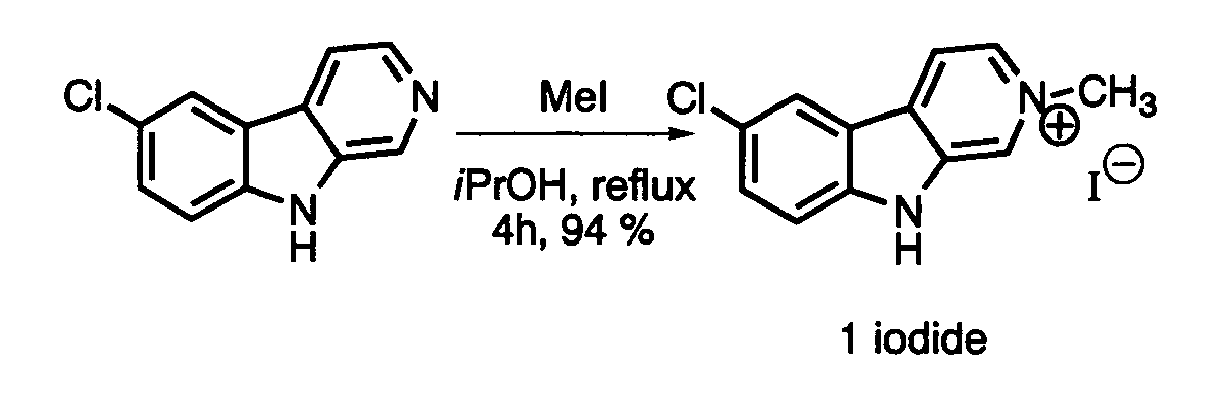
- Norharmane (Norharmane was prepared from tryptophan via the tetrahydro-β-carboline (Lippke, K. P.; Schunack, W. G.; Wenning, W.; Müller, W. E.; J. Med. Chem. 1983, 26, 499-503) followed by oxidation by SeO2 (Hagen, T. J.; Skolnick, P.; Cook, J. M. J. Med. Chem. 1987, 30, 750-753)

Position δH δC J (Hz) HMBC1 NOE 1 9.23 132.4 br. s. C-3, C-4a N- Me 3 8.52 134.6 dd, 6.4 (H-4), 0.9 (H-1) C-4a, C-1, C-4 H-4 4 8.68 119.3 d, 6.4 (H-3) C-9a H-5, H-3 4a 134.0 4b 122.1 5 8.49 123.8 dd, 2.0 (H-7), 0.8 (H-8) C-6, C-7, C-8a H-4 6 128.4 7 7.80 133.8 dd, 8.9 (H-8), 2.0 (H-5) C- 8a 8 7.77 115.5 dd, 8.9 (H-7), 0.8 (H-5) C-4b, C-6 8a 145.5 9a 138.4 N-Me 4.53 48.8 s C-1, C-3 H-1, H-3 1 Denotes HMBC correlations from proton at position X to the corresponding carbon. - Chemicals were generally purchased from ABCR, Acros, Aldrich or Fluka. Norharmane was prepared according to the literature (Norharmane was prepared from tryptophan via the tetrahydro-β-carboline (Lippke, K. P.; Schunack, W. G.; Wenning, W.; Müller, W. E.; J. Med. Chem. 1983, 26, 499-503) followed by oxidation by SeO2 (Hagen, T. J.; Skolnick, P.; Cook, J. M. J. Med. Chem. 1987, 30, 750-753) or by K2Cr2O7: Aiello, A.; Fattorusso, E.; Magno S.; Mayol, L. Tetrahedron 1987, 43, 5929-5932). 6-Chloroharmane was prepared using a modified literature procedure (see supporting information) (Nakano, K.; Suyama, K.; Fukazawa, H.; Uchida, M.; Wakabayashi, K.; Shiozawa, T.; Terao, Y. Mutation Research 2000, 470, 141-146. Ponce, M. A.; Tarzi, O. I.; Erra-Balsells, R. J. Heterocycl. Chem. 2003, 40, 419-426) 2-Methylnorharmane was prepared according to van Tamelen et al. (Van Tamelen et al. proposed to have isolated the 6-Cl species, but did not provide sufficient characterization: Van Tamelen, E. E.; Haarstad, V. B.; Orvis, R. L. Tetrahedron 1968, 24, 687-704.). HPLC-ESI-MS spectra were obtained on a LC-MS (LCQ Duo mass spectrometer, Finnigan Thermoquest). 1H and 13C NMR spectra were recorded using either Varian Gemini (300 MHz (1H) or 75 MHz (13C)), Varian Mercury (300 MHz (1H) or 75 MHz (13C)), Bruker AV600 600 MHz (1H) or 150 MHz (13C)) FT spectrometers at ambient temperature, chemical shifts □ are given in ppm, coupling constants J are in Hz. IR spectra were recorded as a KBr pellet using a Perkin Elmer RX I FT-IR spectrometer, absorptions are given in cm-1. Mass spectra were recorded by the MS Service of the Laboratorium für Organische Chemie der ETH Zürich on an IonSpec Ultima 4.7 FT-ICR spectrometer using MALDI, fragment ions are given in m/z with relative intensities (%) in parentheses.
- Culture of Nostoc 78-12A. The axenic strain Nostoc 78-12A (identical to Anabaena 78-12A and ATCC 43238) was obtained from C. P. Wolk (MSU, East Lansing, USA) as a liquid culture. It was grown in glass tower-type reactors as previously described (Bister, B.; Keller, S.; Baumann, H. I.; Nicholson, G.; Weist, S.; Jung, G.; Süssmuth, R. D.; Jüttner, F. J. Nat. Prod. 2004, 67, 1755-1757). The yield was 2.0 g wet biomass per liter. During centrifugation in a flow through centrifuge, the cells lyse to a great extent and lose nostocarboline to the medium. Therefore, short centrifugation steps are required to retain sufficient amounts of nostocarboline in the cells. The 15N-labeled compound was obtained from cultures in 300-ml Erlenmeyer flasks by replacing the naturally labeled nitrate of the mineral medium by 15N-enriched nitrate (98 atom %, Cambridge Isotope Laboratories, Inc., Andover MA, USA).
- Isolation of Nostocarboline. The frozen wet biomass (8.8 g) of Nostoc was extracted with methanol. Methanol was added in quantities to obtain a final concentration of 60% aq. methanol (MeOH:
H 20, 60:40: v:v) assuming 85% water in the wet biomass. The extract was brought to dryness on a rotary evaporator at 40°C under reduced pressure. To remove the lipid by-products, the residue was washed with CH3CN. The bioactive factor was then extracted 4 times with 1-ml portions of 95% aq. CH3CN (CH3CN:H2O, 95:5, v:v). The yellow extract was separated by HPLC on a Polyamine II column (250 x 4.6 mm i.d., S-5 µm, 12 nm, YMC Europe GmbH) using the solvent 30% aq. CH3CN at pH 4 (trifluoroacetic acid) and reading the absorption at 306 nm. Nostocarboline eluted at 2.5 min. The natural anion (counterion) is not known. The concentration of nostocarboline was determined in a standing culture of Nostoc (12 µg chlorophyll a / ml) to be 0.4 µg nostocarboline/ µg chlorophyll a. - Nostocarboline iodide (1). 6-Cl-norharmane (70 mg, 0.35 mmol) was dissolved in iPrOH (2 ml). MeI (45 µl, 0.70 mmol, 2 equiv.) was added at room temperature and the resulting suspension heated to reflux for 4 hours. The resulting yellow suspension was then cooled to room temperature and filtered. The filtrate was washed with iPrOH and dried under high vacuum. Recrystallization from MeOH/iPrOH gave the
title compound 1 iodide (113 mg, 0.33 mmol, 94 %). - Bright yellow, thin needles (MeOH): mp > 215°C. UV (MeOH) λmax (log ε) 254 (3.68), 307 (3.46), 385 (2.81). IR (KBr) 2979, 1644, 1572, 1518, 1492, 1451, 1323, 1284, 1152, 1067, 879, 834, 806. 1H- and 13C-NMR see Table 1. MS (MALDI, matrix: 3-hydroxypicolinic acid) 235.1 (7), 233.1 (15), 219.0 (39), 218.0 (18), 217.0 (100). HIRES-MALDI m/z 217.0523 (calcd. for C12H10 35ClN2 217.0527, □ = 1.84 ppm). Anal. C 41.56%, H 2.99%, N 8.00%, calcd for C12H10N2ClI, C 41.83%, H 2.93%, N 8.13%.
-

- 6-Cl-norharmane (50 mg 0.25 mmol) was dissolved in iPrOH (4ml). Allylbromide (32 µl, 0.37 mmol, 1.5 equiv.) was added at room temperature and the reaction mixture heated to reflux for 20 h. The resulting light brown solution was evaporated. The light brown solid was dissolved in boiling chloroform, cooled to room temperature and Et2O was added. Thin needles crystallized that were collected by filtration. The filtrate was washed with EtOAc and dried under high vacuum to give the title compound (36 mg, 0.11 mmol, 45 %). Light brown, thin needles. M.p. (Chloroform / Et2O) 174-177°C. UV (MeOH) λmax (log ε) 245 (4.21), 298 (3.98), 377 (3.36). IR (ATR) 3007m, 2949m, 2855m, 1905w, 1813w, 1745s, 1651s, 1489s, 1285s, 951s, 806s. 1H-NMR 9.31 (s, 1H), 8.71 (d, J = 6.6, 1H), 8.58 (dd, J1 = 6.6 J2 = 1.1, 1H), 8.47 (d, J = 1.1, 1H), 7.78 (s, 2H), 6.33-6.20 (m, 1H), 5.55 (d, J = 1.4, 1H), 5.51 (d, J 1= 5.1, 1H), 5.39 (d, J = 6.3, 2 H). 13C-NMR 143.5, 136.7, 133.3, 133.2, 133.1, 132.3, 130.4, 128.0, 123.2, 122.4, 121.2, 119.0, 114.9, 64.1. MS 245 (32), 243 (100), 209 (6), 204 (10), 202 (12).
-

- 6-Cl-norharmane (50 mg, 0.25 mmol) was dissolved in iPrOH (4ml). BnBr (43µl, 0.37 mmol, 1.5 equiv.) was added at room temperature and the reaction mixture heated to reflux for 24 h. The yellow solution was evaporated and the resulting yellow solid was dissolved in chloroform under reflux. The solution was then cooled to room temperature and Et2O added. The product crystallized as thin yellow needles and was collected by filtration. The crystlas were washed with EtOAc and dried under high vacuum to give the title compound (54 mg, 0.14 mmol, 60 %). Bright yellow, thin needles (Chloroform / Et2O). M.p. 121 - 125 °C. UV (MeOH) λmax (log ε) 211 (4.22), 260 (4.3), 310 (4.2), 389 (3.4). IR (ATR) 3399w br., 3057m, 2970m, 1643m 1491s, 1284s, 730s. 1H-NMR 9.41 (s, 1H), 8.71-8.67 (m, 2H), 8.45 (s, 1H), 7.89 (s, 1H), 7.76 (d, J = 1.25, 2H), 7.55-7.44 (m, 5H), 5.96 (s, 2H). 13C-NMR 143.2, 136.4, 135.2, 133.3, 132.9, 130.3, 130.2, 130.2, 129.7, 127.8, 123.0, 120.8, 119.1, 114.7, 79.2, 65.1. MS 295.2 (30), 293.2 (100), 259.2 (7).
-

- 6, 8-Dichloro-norharmane (50 mg, 0.21 mmol) was dissolved in iPrOH (4 mL). MeI (26µl, 0.42mmol 2 equiv.) was added at room temperature and heated the suspension was heated to reflux for 4 h. The resulting yellow solution was evaporated and the residue recrystallised from iPrOH / MeOH to give the title compound (40 mg, 0.11 mmol, 52 %). Bright yellow solid. m.p > 220 °C. UV (MeOH) λmax (log ε) 219 (4.3), 255 (4.3), 285 (4.0), 304 (3.9), 389 (3.4). IR (ATR) 3400m, 3022m, 2051w, 1983w, 1791w, 1652m, 1493s, 1277s, 845s, 737s, 671w. 1H-NMR 9.24 (s, 1H), 8.72 (d, J = 6.5, 1 H), 8.59 (d, J = 6.5, 1H), 8.47 (d, J = 1.6, 1 H), 7.91 (d, J = 1.6, 1H), 4.57 (s, 3H). MS 255.1 (8), 253.1 (64), 251.1 (100), 243.2 (40).
- The following example shows the biocidal activity of different nostocarboline compounds against three selected microorganisms:
- 2 cyanobacteria (Microcystis aeruginosa PCC 7806 (Ma);Synechococcus PCC 6911 (Sc))
- 1 green alga (Kirchneriella contorta SAG 11.81 (Kc))
- The microorganisms were grown in commercial 96-well microtiter plates; 200 µl cell suspension was added to each well having an OD675 nm of approximately 0.1 at the beginning. This value of about 0.1 was subtracted from all subsequent measurements. The microorganisms were grown on a cyanobacterial medium as described in Jüttner et al. (Jüttner F., Leonhardt J., Möhren S., 1983, Journal of General Microbiology 129, p. 407-412) at 20°C under continuous light from fluorescent tubes (7 µmol m-2 s-1).
- Measurements of OD675 nm were performed daily with an Absorbance Microplate Reader (SpectraMax; Molecular Devices Corporation).
- The different compounds were added on the 5th day (marked by an arrow) in 20 µl, compounds dissolved in 2% DMSO (end concentration 0.2% DMSO).
- Table 2 shows which compounds were tested with which microorganism. Briefly, 9 compounds and 1 control were tested for Ma and Sc, 3 compounds and 1 control were tested for Kc.
- The growth curves are shown in figures 1 to 21.
Table 2 Compound Ma Sc Kc 6-chloronorharmane + + 6,8-dichloronorharmane + + deschloronostocarboline iodide + + nostocarboline iodide + + + 2-allyl-nor-nostocarboline bromide + + 2-benzyl-nor-nostocarboline bromide + + 8-chloronostocarboline iodide + + ciprofloxacin nostocarboline conjugate + + + ciprofloxacin + + + 2% DMSO (control) + + + - Each compound was tested in 7 concentrations (100 µM; 50 µM; 10 µM; 1 µM; 0.1 µM; 0.01 µM; 0.001 µM), each concentration was done in triplicate and each control was done in 12 replicates.
Claims (26)
- Use of a nostocarboline compound of the formula (I)
 R1, R3, R4 and R6 are independently selected from the group consisting of H, F, Cl, Br, I, a saturated or unsaturated, substituted or unsubstituted C1-C20 aliphatic residue with straight or branched chain optionally having one or more heteroatom at the beginning or in the chain, and a saturated or unsaturated, substituted or unsubstituted C1-C20 aliphatic residue with straight or branched chain comprising a carbocyclic or heterocyclic residue;R2 is selected from the group consisting of H and Cl;R5 is selected from the group consisting of H, a saturated or unsaturated, substituted or unsubstituted C1-C20 aliphatic residue with straight or branched chain optionally having one or more heteroatom in the chain, and a saturated or unsaturated, substituted or unsubstituted C1-C20 aliphatic residue with straight or branched chain comprising a carbocyclic or heterocyclic residue;R7 is selected from the group consisting of a saturated or unsaturated, substituted or unsubstituted C1-C20 aliphatic residue with straight or branched chain optionally having one or more heteroatom in the chain, a saturated or unsaturated, substituted or unsubstituted C1-C20 aliphatic residue with straight or branched chain comprising a carbocyclic or heterocyclic residue and optionally having one or more heteroatoms in the chain, and a linker bound to a bioactive factor;R8 is selected from the group consisting of H, a saturated or unsaturated, substituted or unsubstituted C1-C6 aliphatic carboxylic acid with straight or branched chain, a saturated or unsaturated, substituted or unsubstituted C1-C6 aliphatic carboxylic ester with straight or branched chain, a saturated or unsaturated, substituted or unsubstituted C1-C6 aliphatic carboxylic amide with straight or branched chain, and a C3-C20 carbocyclic residue; andX- is a negatively charged ion,as a biocidal agent.
 - Use of the Nostocarboline compound according to claim 1 whereinR1, R3, R4 and R6 are independently selected from the group consisting of H, F, Cl, Br, I, and unsubstituted, saturated or unsaturated C1-C5 aliphatic residues;R2 is selected from the group consisting of H and Cl;R5 is selected from the group consisting of H, and unsubstituted, saturated or unsaturated C1-C5 aliphatic residues;R7 is selected from the group consisting of unsubstituted, saturated or unsaturated C1-C5 aliphatic residues, phenyl, benzyl, naphtyl, anthranyl residues, and a linker bound to a nostocarboline compound as claimed in claim 1, Ciprofloxacin, Fosfomycin, Vancomycin, and Linezolid;R8 is selected from the group consisting of H, a saturated or unsaturated, substituted or unsubstituted C1-C6 aliphatic carboxylic acid with straight or branched chain, a saturated or unsaturated, substituted or unsubstituted C1-C6 aliphatic carboxylic ester with straight or branched chain, a saturated or unsaturated, substituted or unsubstituted C1-C6 aliphatic carboxylic amide with straight or branched chain, and a C3-C20 carbocyclic residue; andX- is an ion selected from the group consisting of F, Cl, Br, I, CF3CO2, PO4, HPO4, H2PO4, SO4, HSO4, NO3, OH, citrate, fumarate, tartrate aspartate, and glutamate,as biocidal agent.
- Use of the Nostocarboline compound according to claim 1 or 2 wherein
R2 is Cl
as biocidal agent. - Use of the Nostocarboline compound according to any of claim 1 to 3 wherein
the linker is selected from the group consisting of a saturated or unsaturated, substituted or unsubstituted C1-C20 alkylen residue with straight or branched chain optionally having one or more heteroatom in the chain, and a saturated or unsaturated, substituted or unsubstituted carbocyclic or heterocyclic residue bound to a bioactive factor
as biocidal agent. - Use of the Nostocarboline compound according to any of claim 1 to 4 wherein
the bioactive factor is selected from the group consisting of a nostocarboline compound as claimed in claim 1, Ciprofloxacin, Fosfomycin, Vancomycin, and Linezolid
as biocidal agent. - Use of the Nostocarboline compound according to any of claim 1 to 5 wherein
the bioactive factor is a nostocarboline compound as claimed in claim 1 and forms a dimer
as biocidal agent. - Use of a biocidal agent according to claim 1 to 6 as an antifouling agent.
- Use of a biocidal agent according to any of claim 1 to 6 as a herbicide.
- Use of a biocidal agent according to any of claim 1 to 6 in protective coats for surfaces submerged in water.
- Nostocarboline compound of the formula (I)
 R1, R3, R4 and R6 are independently selected from the group consisting of H, F, Cl, Br, I, a saturated or unsaturated, substituted or unsubstituted C1-C20 aliphatic residue with straight or branched chain optionally having one or more heteroatom at the beginning or in the chain, and a saturated or unsaturated, substituted or unsubstituted C1-C20 aliphatic residue with straight or branched chain comprising a carbocyclic or heterocyclic residue;R2 is Cl;R5 is selected from the group consisting of H, a saturated or unsaturated, substituted or unsubstituted C1-C20 aliphatic residue with straight or branched chain optionally having one or more heteroatom in the chain, and a saturated or unsaturated, substituted or unsubstituted C1-C20 aliphatic residue with straight or branched chain comprising a carbocyclic or heterocyclic residue;R7 is selected from the group consisting of a saturated or unsaturated, substituted or unsubstituted C1-C20 aliphatic residue with straight or branched chain optionally having one or more heteroatom in the chain, a saturated or unsaturated, substituted or unsubstituted C1-C20 aliphatic residue with straight or branched chain comprising a carbocyclic or heterocyclic residue and optionally having one or more heteroatoms in the chain, and a linker bound to a bioactive factor;R8 is selected from the group consisting of H, a saturated or unsaturated, substituted or unsubstituted C1-C6 aliphatic carboxylic acid with straight or branched chain, a saturated or unsaturated, substituted or unsubstituted C1-C6 aliphatic carboxylic ester with straight or branched chain, a saturated or unsaturated, substituted or unsubstituted C1-C6 aliphatic carboxylic amide with straight or branched chain, and a C3-C20 carbocyclic residue; andX- is a negatively charged ion.
 - Nostocarboline compound according to claim 10 wherein
R1, R3, R4 and R6 are independently selected from the group consisting of H, F, Cl, Br, I, and unsubstituted, saturated or unsaturated C1-C5 aliphatic residues;
R2 is Cl;
R5 is selected from the group consisting of H, and unsubstituted, saturated or unsaturated C1-C5 aliphatic residues;
R7 is selected from the group consisting of unsubstituted, saturated or unsaturated C1-C5 aliphatic residues, phenyl, benzyl, naphtyl, anthranyl residues, and a linker bound to a nostocarboline compound as claimed in claim 1, Ciprofloxacin, Fosfomycin, Vancomycin, and Linezolid;
R8 is selected from the group consisting of H, a saturated or unsaturated, substituted or unsubstituted C1-C6 aliphatic carboxylic acid with straight or branched chain, a saturated or unsaturated, substituted or unsubstituted C1-C6 aliphatic carboxylic ester with straight or branched chain, a saturated or unsaturated, substituted or unsubstituted C1-C6 aliphatic carboxylic amide with straight or branched chain, and a C3-C20 carbocyclic residue; and
X- is an ion selected from the group consisting of F, Cl, Br, I, CF3CO2, PO4, HPO4, H2PO4, SO4, HSO4, NO3, OH, citrate, fumarate, tartrate aspartate, and glutamate. - Nostocarboline compound according to claim 10 or 11 wherein
R1, R3, R4 and R6 are independently selected from the group consisting of H, F, Cl, Br, I, and unsubstituted, saturated or unsaturated C1-C5 aliphatic residues;
R2 is Cl;
R5 is selected from the group consisting of H, and unsubstituted, saturated or unsaturated C1-C5 aliphatic residues;
R7 is selected from the group consisting of unsubstituted, saturated or unsaturated C2-C5 aliphatic residues, phenyl, benzyl, naphtyl, anthranyl residues, and a linker bound to a nostocarboline compound as claimed in claim 1, Ciprofloxacin, Fosfomycin, Vancomycin, and Linezolid;
R8 is selected from the group consisting of H, a saturated or unsaturated, substituted or unsubstituted C1-C6 aliphatic carboxylic acid with straight or branched chain, a saturated or unsaturated, substituted or unsubstituted C1-C6 aliphatic carboxylic ester with straight or branched chain, a saturated or unsaturated, substituted or unsubstituted C1-C6 aliphatic carboxylic amide with straight or branched chain, and a C3-C20 carbocyclic residue; and
X- is an ion selected from the group consisting of F, Cl, Br, I, CF3CO2, PO4, HPO4, H2PO4, SO4, HSO4, NO3, OH, citrate, fumarate, tartrate aspartate, and glutamate. - Nostocarboline compound according to any of claim 10 to 12 wherein R1 and R3 are H.
- Nostocarboline compound according to claim 10 to 12 wherein R4 is either H or Cl.
- Nostocarboline compound according to claim 10 to 12 wherein R2 and R4 are Cl.
- Nostocarboline compound according to claim 10 to 12 wherein R1, R3, and R4 and are H, R2 is Cl and R5 and R7 are methyl residues and X- is I.
- Nostocarboline compound according to claim 10 to 12 wherein R1, R3, R4 and R5 are H, R2 is Cl and R7 is an allyl residue and X- is Br.
- Nostocarboline compound according to claim 10 to 12 wherein R1, R3, R4 and R5 are H, R2 is Cl and R7 is a benzyl residue and X- is Br.
- Nostocarboline compound according to claim 10 to 12 wherein R1, R3, R4 and R5 are H, R2 is Cl and R7 is an anthranyl residue and X- is Cl.
- Nostocarboline compound according to claim 10 to 12 wherein R1, R3, R4 and R5 are H, R2 is Cl and R7 is ciprofloxazin comprising dimethylbenzene as linker and X- is Cl.
- Nostocarboline compound according to claim 10 to 12 wherein R1, R3, R4, R5, R6 and R8 are H, R2 is Cl, R7 is methyl and X- is I.
- Composition comprising a nostocarboline compound according to claim 10 to 21.
- Composition according to claim 22 comprising further biocidal agents, antifouling agents or herbicides.
- Polymer matrix, wherein the nostocarboline compound according to claim 10 to 21 is entrapped by extrusion.
- Polymer emulsion comprising the nostocarboline compound according to claim 10 to 21.
- Composition comprising a nostocarboline compound according to claim 10 to 21 in the concentration range of 0.1 to 100 µM, preferably 1 to 75 µM, most preferably 30 to 50 µM.
Priority Applications (2)
| Application Number | Priority Date | Filing Date | Title |
|---|---|---|---|
| EP05024187A EP1783128A1 (en) | 2005-11-07 | 2005-11-07 | Heterocyclic compounds and their use as antifouling agents |
| PCT/EP2006/010552 WO2007051630A1 (en) | 2005-11-07 | 2006-11-03 | Heterocyclic compounds and their use as antifouling agents |
Applications Claiming Priority (1)
| Application Number | Priority Date | Filing Date | Title |
|---|---|---|---|
| EP05024187A EP1783128A1 (en) | 2005-11-07 | 2005-11-07 | Heterocyclic compounds and their use as antifouling agents |
Publications (1)
| Publication Number | Publication Date |
|---|---|
| EP1783128A1 true EP1783128A1 (en) | 2007-05-09 |
Family
ID=36088485
Family Applications (1)
| Application Number | Title | Priority Date | Filing Date |
|---|---|---|---|
| EP05024187A Withdrawn EP1783128A1 (en) | 2005-11-07 | 2005-11-07 | Heterocyclic compounds and their use as antifouling agents |
Country Status (2)
| Country | Link |
|---|---|
| EP (1) | EP1783128A1 (en) |
| WO (1) | WO2007051630A1 (en) |
Cited By (1)
| Publication number | Priority date | Publication date | Assignee | Title |
|---|---|---|---|---|
| CN112353801A (en) * | 2020-08-11 | 2021-02-12 | 浙江工业大学 | Application of norharpagne in preparation of quorum sensing inhibitor and bacterial strain |
Families Citing this family (1)
| Publication number | Priority date | Publication date | Assignee | Title |
|---|---|---|---|---|
| CN118530258B (en) * | 2024-05-31 | 2025-01-21 | 山东第二医科大学 | Quaternized norharman dimer, its pharmaceutical composition and antibacterial use |
Citations (3)
| Publication number | Priority date | Publication date | Assignee | Title |
|---|---|---|---|---|
| WO2002023991A1 (en) * | 2000-09-19 | 2002-03-28 | Bayer Aktiengesellschaft | Use of riboflavin and flavin derivatives as chitinase inhibitors |
| WO2002062339A1 (en) * | 2000-12-08 | 2002-08-15 | Smithkline Beecham Corporation | Antibacterial compounds |
| WO2004101500A1 (en) | 2003-05-13 | 2004-11-25 | Lonza Ag | Algicidal compound |
-
2005
- 2005-11-07 EP EP05024187A patent/EP1783128A1/en not_active Withdrawn
-
2006
- 2006-11-03 WO PCT/EP2006/010552 patent/WO2007051630A1/en not_active Ceased
Patent Citations (3)
| Publication number | Priority date | Publication date | Assignee | Title |
|---|---|---|---|---|
| WO2002023991A1 (en) * | 2000-09-19 | 2002-03-28 | Bayer Aktiengesellschaft | Use of riboflavin and flavin derivatives as chitinase inhibitors |
| WO2002062339A1 (en) * | 2000-12-08 | 2002-08-15 | Smithkline Beecham Corporation | Antibacterial compounds |
| WO2004101500A1 (en) | 2003-05-13 | 2004-11-25 | Lonza Ag | Algicidal compound |
Non-Patent Citations (9)
| Title |
|---|
| AIELLO, A. ET AL., TETRAHEDRON, vol. 43, 1987, pages 5929 - 5932 |
| BECHER, PAUL G. ET AL: "Nostocarboline: isolation and synthesis of a new cholinesterase inhibitor from Nostoc 78-12A", JOURNAL OF NATURAL PRODUCTS , 68(12), 1793-1795 CODEN: JNPRDF; ISSN: 0163-3864, 2005, XP002375513 * |
| BISTER, B. ET AL., J. NAT. PROD., vol. 67, 2004, pages 1755 - 1757 |
| HAGEN, T. J.; SKOLNICK, P.; COOK, J. M., J. MED. CHEM., vol. 30, 1987, pages 750 - 753 |
| JÜTTNER F.; LEONHARDT J.; MÖHREN S., JOURNAL OF GENERAL MICROBIOLOGY, vol. 129, 1983, pages 407 - 412 |
| LIPPKE, K. P. ET AL., J. MED. CHEM., vol. 26, 1983, pages 499 - 503 |
| NAKANO, K. ET AL., MUTATION RESEARCH, vol. 470, 2000, pages 141 - 146 |
| PONCE, M. A.; TARZI, O. I.; ERRA-BALSELLS, R. J., HETEROCYCL. CHEM., vol. 40, 2003, pages 419 - 426 |
| VAN TAMELEN, E. E.; HAARSTAD, V. B.; ORVIS, R. L., TETRAHEDRON, vol. 24, 1968, pages 687 - 704 |
Cited By (1)
| Publication number | Priority date | Publication date | Assignee | Title |
|---|---|---|---|---|
| CN112353801A (en) * | 2020-08-11 | 2021-02-12 | 浙江工业大学 | Application of norharpagne in preparation of quorum sensing inhibitor and bacterial strain |
Also Published As
| Publication number | Publication date |
|---|---|
| WO2007051630A1 (en) | 2007-05-10 |
Similar Documents
| Publication | Publication Date | Title |
|---|---|---|
| Liao et al. | A novel acylhydrazone-based derivative as dual-mode chemosensor for Al3+, Zn2+ and Fe3+ and its applications in cell imaging | |
| Singh et al. | Antimicrobial active macrocyclic complexes of Cr (III), Mn (III) and Fe (III) with their spectroscopic approach | |
| Bougherra et al. | Synthesis, characterization, electrochemical and biological activities of mixed ligand copper (II) complexes with dimethylglyoxime and amino acids | |
| Zhang et al. | Design, synthesis, and antimicrobial evaluation of hexadentate hydroxypyridinones with high iron (III) affinity | |
| Medyouni et al. | One-pot three-component Biginelli-type reaction to synthesize 3, 4-dihydropyrimidine-2-(1H)-ones catalyzed by Co phthalocyanines: Synthesis, characterization, aggregation behavior and antibacterial activity | |
| Ahmad et al. | Synthesis, characterization and pharmacological evaluation of mixed ligand-metal complexes containing omeprazole and 8-hydroxyquinoline. | |
| Ramesh et al. | Synthesis, structure, electrochemical, DNA interaction and antimicrobial studies of fluorinated trans-dicationic pyridinium porphyrins | |
| Kannaiyan et al. | Green synthesis of Phenothiazinium Schiff base and its nano silver complex using egg white as a catalyst under solvent free condition | |
| Joseyphus et al. | Antimicrobial, photocatalytic action and molecular docking studies of imidazole-based Schiff base complexes | |
| Çınarlı et al. | Synthesis, characterization, biological, X-ray diffraction analysis and computational chemistry studies of new 2-acetylpyridine derivative hydrazone and its Zn (II) complex | |
| Çalışkan et al. | Synthesis, antibacterial and antioxidant activities of some new nsubstituted azachalcone, schiff base and pyrazole derivatives | |
| Abid Alradaa et al. | Preparation, characterization and prevention biological pollution of 4 (4-benzophenylazo) pyrogallol and their metal complexes | |
| Salameh et al. | New maleimide 1, 2, 3-triazole hybrids: design, synthesis, anticancer, and antimicrobial activities | |
| Habibi et al. | Application of the Fe3O4@ 1, 10‐phenanthroline‐5, 6‐diol@ Mn nano‐catalyst for the green synthesis of tetrazoles and its biological performance | |
| WO2007051630A1 (en) | Heterocyclic compounds and their use as antifouling agents | |
| Yesmin et al. | Cu (II) and Ni (II) complexes of Schiff base: synthesis, characterization and antibacterial activity | |
| Nejadmirfathi et al. | Novel N3-Schiff base and its zinc halide/pseudohalide complexes: Antimicrobial, antioxidant, cytotoxicity and burn wound healing activities | |
| Horozić et al. | Synthesis, spectral characterization, antibacterial and antifungal activity of copper (II)-pABA Complex | |
| EP0756598B1 (en) | Substituted 5,6-dihydro-5-oxo-1,4-dithiino-(2,3-d)-pyridazine-2,3-dicarbonitriles, compositions containing them and their use as antimicrobials | |
| CN115215794A (en) | N-2-pyridylbenzimine derivative and preparation method and application thereof | |
| Ekom et al. | Room temperature synthesis and characterization of novel Bi (III) complex with 2-amino-3-carbomethoxy-4, 5, 6, 7-tetrahydrobenzo [B] thiophene as potential antimicrobial agent | |
| Faheim et al. | Synthesis, characterization, biological activity and molecular modeling studies of Cu (II) complex with N, O-chelating Schiff’s base ligand incorporating Azo and sulfonamide moieties | |
| Chaudhary et al. | Studies on therapeutically relevant tin (II) and lead (II) complexes of Schiff base macrocyclic ligands containing thiosemicarbazone moiety | |
| Kamiloğlu et al. | Synthesis and electrochemical properties of new metal-free and metallophthalocyanines bearing 2, 6-dimethylquinoline-4-yl derivatives | |
| Wankhede et al. | Synthesis and characterization of biologically active mixed ligand complexes of 8-hydroxyquinoline and salicylaldehyde |
Legal Events
| Date | Code | Title | Description |
|---|---|---|---|
| PUAI | Public reference made under article 153(3) epc to a published international application that has entered the european phase |
Free format text: ORIGINAL CODE: 0009012 |
|
| AK | Designated contracting states |
Kind code of ref document: A1 Designated state(s): AT BE BG CH CY CZ DE DK EE ES FI FR GB GR HU IE IS IT LI LT LU LV MC NL PL PT RO SE SI SK TR |
|
| AX | Request for extension of the european patent |
Extension state: AL BA HR MK YU |
|
| AKX | Designation fees paid | ||
| REG | Reference to a national code |
Ref country code: DE Ref legal event code: 8566 |
|
| STAA | Information on the status of an ep patent application or granted ep patent |
Free format text: STATUS: THE APPLICATION IS DEEMED TO BE WITHDRAWN |
|
| 18D | Application deemed to be withdrawn |
Effective date: 20071110 |