EP1783118A2 - Preparation of risperidone - Google Patents
Preparation of risperidone Download PDFInfo
- Publication number
- EP1783118A2 EP1783118A2 EP07001138A EP07001138A EP1783118A2 EP 1783118 A2 EP1783118 A2 EP 1783118A2 EP 07001138 A EP07001138 A EP 07001138A EP 07001138 A EP07001138 A EP 07001138A EP 1783118 A2 EP1783118 A2 EP 1783118A2
- Authority
- EP
- European Patent Office
- Prior art keywords
- risperidone
- present
- risperidone form
- isopropanol
- butanol
- Prior art date
- Legal status (The legal status is an assumption and is not a legal conclusion. Google has not performed a legal analysis and makes no representation as to the accuracy of the status listed.)
- Granted
Links
- RAPZEAPATHNIPO-UHFFFAOYSA-N risperidone Chemical compound FC1=CC=C2C(C3CCN(CC3)CCC=3C(=O)N4CCCCC4=NC=3C)=NOC2=C1 RAPZEAPATHNIPO-UHFFFAOYSA-N 0.000 title claims abstract description 251
- 229960001534 risperidone Drugs 0.000 title claims abstract description 249
- 238000002360 preparation method Methods 0.000 title abstract description 13
- LFQSCWFLJHTTHZ-UHFFFAOYSA-N Ethanol Chemical compound CCO LFQSCWFLJHTTHZ-UHFFFAOYSA-N 0.000 claims description 50
- 238000000634 powder X-ray diffraction Methods 0.000 claims description 39
- VLKZOEOYAKHREP-UHFFFAOYSA-N n-Hexane Chemical compound CCCCCC VLKZOEOYAKHREP-UHFFFAOYSA-N 0.000 claims description 32
- 238000001556 precipitation Methods 0.000 claims description 26
- XLYOFNOQVPJJNP-UHFFFAOYSA-N water Substances O XLYOFNOQVPJJNP-UHFFFAOYSA-N 0.000 claims description 26
- CDBYLPFSWZWCQE-UHFFFAOYSA-L Sodium Carbonate Chemical compound [Na+].[Na+].[O-]C([O-])=O CDBYLPFSWZWCQE-UHFFFAOYSA-L 0.000 claims description 18
- 238000004519 manufacturing process Methods 0.000 claims description 16
- HEDRZPFGACZZDS-UHFFFAOYSA-N Chloroform Chemical compound ClC(Cl)Cl HEDRZPFGACZZDS-UHFFFAOYSA-N 0.000 claims description 14
- XDTMQSROBMDMFD-UHFFFAOYSA-N Cyclohexane Chemical compound C1CCCCC1 XDTMQSROBMDMFD-UHFFFAOYSA-N 0.000 claims description 11
- 229910000029 sodium carbonate Inorganic materials 0.000 claims description 9
- 239000007864 aqueous solution Substances 0.000 claims description 4
- 125000004432 carbon atom Chemical group C* 0.000 claims description 4
- 238000000034 method Methods 0.000 abstract description 60
- 239000008194 pharmaceutical composition Substances 0.000 abstract description 2
- KFZMGEQAYNKOFK-UHFFFAOYSA-N Isopropanol Chemical compound CC(C)O KFZMGEQAYNKOFK-UHFFFAOYSA-N 0.000 description 76
- WEVYAHXRMPXWCK-UHFFFAOYSA-N Acetonitrile Chemical compound CC#N WEVYAHXRMPXWCK-UHFFFAOYSA-N 0.000 description 45
- CSCPPACGZOOCGX-UHFFFAOYSA-N Acetone Chemical compound CC(C)=O CSCPPACGZOOCGX-UHFFFAOYSA-N 0.000 description 39
- ZMXDDKWLCZADIW-UHFFFAOYSA-N N,N-Dimethylformamide Chemical compound CN(C)C=O ZMXDDKWLCZADIW-UHFFFAOYSA-N 0.000 description 39
- ZWEHNKRNPOVVGH-UHFFFAOYSA-N 2-Butanone Chemical compound CCC(C)=O ZWEHNKRNPOVVGH-UHFFFAOYSA-N 0.000 description 38
- OKKJLVBELUTLKV-UHFFFAOYSA-N Methanol Chemical compound OC OKKJLVBELUTLKV-UHFFFAOYSA-N 0.000 description 36
- 239000002904 solvent Substances 0.000 description 33
- ZXEKIIBDNHEJCQ-UHFFFAOYSA-N isobutanol Chemical compound CC(C)CO ZXEKIIBDNHEJCQ-UHFFFAOYSA-N 0.000 description 26
- 239000000203 mixture Substances 0.000 description 26
- YMWUJEATGCHHMB-UHFFFAOYSA-N Dichloromethane Chemical compound ClCCl YMWUJEATGCHHMB-UHFFFAOYSA-N 0.000 description 18
- LRHPLDYGYMQRHN-UHFFFAOYSA-N N-Butanol Chemical compound CCCCO LRHPLDYGYMQRHN-UHFFFAOYSA-N 0.000 description 18
- 238000010438 heat treatment Methods 0.000 description 18
- 239000000243 solution Substances 0.000 description 15
- 230000015572 biosynthetic process Effects 0.000 description 13
- 150000001875 compounds Chemical class 0.000 description 13
- UHOVQNZJYSORNB-UHFFFAOYSA-N Benzene Chemical compound C1=CC=CC=C1 UHOVQNZJYSORNB-UHFFFAOYSA-N 0.000 description 12
- XEKOWRVHYACXOJ-UHFFFAOYSA-N Ethyl acetate Chemical compound CCOC(C)=O XEKOWRVHYACXOJ-UHFFFAOYSA-N 0.000 description 12
- YXFVVABEGXRONW-UHFFFAOYSA-N Toluene Chemical compound CC1=CC=CC=C1 YXFVVABEGXRONW-UHFFFAOYSA-N 0.000 description 12
- 239000000706 filtrate Substances 0.000 description 12
- 239000006185 dispersion Substances 0.000 description 11
- IAZDPXIOMUYVGZ-UHFFFAOYSA-N Dimethylsulphoxide Chemical compound CS(C)=O IAZDPXIOMUYVGZ-UHFFFAOYSA-N 0.000 description 10
- DKGAVHZHDRPRBM-UHFFFAOYSA-N Tert-Butanol Chemical compound CC(C)(C)O DKGAVHZHDRPRBM-UHFFFAOYSA-N 0.000 description 10
- WYURNTSHIVDZCO-UHFFFAOYSA-N Tetrahydrofuran Chemical compound C1CCOC1 WYURNTSHIVDZCO-UHFFFAOYSA-N 0.000 description 10
- BTANRVKWQNVYAZ-UHFFFAOYSA-N butan-2-ol Chemical compound CCC(C)O BTANRVKWQNVYAZ-UHFFFAOYSA-N 0.000 description 10
- NLKNQRATVPKPDG-UHFFFAOYSA-M potassium iodide Chemical compound [K+].[I-] NLKNQRATVPKPDG-UHFFFAOYSA-M 0.000 description 10
- 238000003786 synthesis reaction Methods 0.000 description 10
- 239000012065 filter cake Substances 0.000 description 8
- 150000002576 ketones Chemical class 0.000 description 8
- 239000000725 suspension Substances 0.000 description 8
- -1 for example Chemical compound 0.000 description 7
- 238000010992 reflux Methods 0.000 description 7
- HTSGKJQDMSTCGS-UHFFFAOYSA-N 1,4-bis(4-chlorophenyl)-2-(4-methylphenyl)sulfonylbutane-1,4-dione Chemical compound C1=CC(C)=CC=C1S(=O)(=O)C(C(=O)C=1C=CC(Cl)=CC=1)CC(=O)C1=CC=C(Cl)C=C1 HTSGKJQDMSTCGS-UHFFFAOYSA-N 0.000 description 6
- 239000000463 material Substances 0.000 description 6
- MRMGJMGHPJZSAE-UHFFFAOYSA-N 6-fluoro-3-piperidin-4-yl-1,2-benzoxazole Chemical compound N=1OC2=CC(F)=CC=C2C=1C1CCNCC1 MRMGJMGHPJZSAE-UHFFFAOYSA-N 0.000 description 5
- 238000009835 boiling Methods 0.000 description 5
- 239000003960 organic solvent Substances 0.000 description 5
- BDERNNFJNOPAEC-UHFFFAOYSA-N propan-1-ol Chemical compound CCCO BDERNNFJNOPAEC-UHFFFAOYSA-N 0.000 description 5
- YLQBMQCUIZJEEH-UHFFFAOYSA-N tetrahydrofuran Natural products C=1C=COC=1 YLQBMQCUIZJEEH-UHFFFAOYSA-N 0.000 description 5
- CMWCQQUYLPYOMY-UHFFFAOYSA-N 3-(2-chloroethyl)-2-methyl-6,7,8,9-tetrahydropyrido[1,2-a]pyrimidin-4-one Chemical compound C1CCCN2C(=O)C(CCCl)=C(C)N=C21 CMWCQQUYLPYOMY-UHFFFAOYSA-N 0.000 description 4
- NQRYJNQNLNOLGT-UHFFFAOYSA-N Piperidine Chemical class C1CCNCC1 NQRYJNQNLNOLGT-UHFFFAOYSA-N 0.000 description 4
- 150000001298 alcohols Chemical class 0.000 description 4
- 238000004458 analytical method Methods 0.000 description 4
- 238000006243 chemical reaction Methods 0.000 description 4
- 238000004090 dissolution Methods 0.000 description 4
- 238000001914 filtration Methods 0.000 description 4
- 239000002244 precipitate Substances 0.000 description 4
- 238000001953 recrystallisation Methods 0.000 description 4
- 238000002441 X-ray diffraction Methods 0.000 description 3
- 238000007796 conventional method Methods 0.000 description 3
- 238000001816 cooling Methods 0.000 description 3
- 239000003814 drug Substances 0.000 description 3
- 239000000543 intermediate Substances 0.000 description 3
- 239000011541 reaction mixture Substances 0.000 description 3
- 239000007787 solid Substances 0.000 description 3
- 238000001228 spectrum Methods 0.000 description 3
- 238000003756 stirring Methods 0.000 description 3
- ZTQSAGDEMFDKMZ-UHFFFAOYSA-N Butyraldehyde Chemical compound CCCC=O ZTQSAGDEMFDKMZ-UHFFFAOYSA-N 0.000 description 2
- ZAMOUSCENKQFHK-UHFFFAOYSA-N Chlorine atom Chemical class [Cl] ZAMOUSCENKQFHK-UHFFFAOYSA-N 0.000 description 2
- 239000000460 chlorine Substances 0.000 description 2
- 229910052801 chlorine Inorganic materials 0.000 description 2
- 239000013078 crystal Substances 0.000 description 2
- 238000004128 high performance liquid chromatography Methods 0.000 description 2
- 238000002844 melting Methods 0.000 description 2
- 230000008018 melting Effects 0.000 description 2
- 230000000704 physical effect Effects 0.000 description 2
- BWHMMNNQKKPAPP-UHFFFAOYSA-L potassium carbonate Chemical compound [K+].[K+].[O-]C([O-])=O BWHMMNNQKKPAPP-UHFFFAOYSA-L 0.000 description 2
- 239000002002 slurry Substances 0.000 description 2
- 239000000126 substance Substances 0.000 description 2
- IJGRMHOSHXDMSA-UHFFFAOYSA-N Atomic nitrogen Chemical compound N#N IJGRMHOSHXDMSA-UHFFFAOYSA-N 0.000 description 1
- 238000004566 IR spectroscopy Methods 0.000 description 1
- 208000028017 Psychotic disease Diseases 0.000 description 1
- 102100025490 Slit homolog 1 protein Human genes 0.000 description 1
- 101710123186 Slit homolog 1 protein Proteins 0.000 description 1
- XAGFODPZIPBFFR-UHFFFAOYSA-N aluminium Chemical compound [Al] XAGFODPZIPBFFR-UHFFFAOYSA-N 0.000 description 1
- 229910052782 aluminium Inorganic materials 0.000 description 1
- 239000000164 antipsychotic agent Substances 0.000 description 1
- 150000008316 benzisoxazoles Chemical class 0.000 description 1
- 230000003197 catalytic effect Effects 0.000 description 1
- 238000009833 condensation Methods 0.000 description 1
- 230000005494 condensation Effects 0.000 description 1
- 238000002425 crystallisation Methods 0.000 description 1
- 230000008025 crystallization Effects 0.000 description 1
- 238000001938 differential scanning calorimetry curve Methods 0.000 description 1
- 229910001873 dinitrogen Inorganic materials 0.000 description 1
- 239000008298 dragée Substances 0.000 description 1
- 229940079593 drug Drugs 0.000 description 1
- 239000003937 drug carrier Substances 0.000 description 1
- 239000006260 foam Substances 0.000 description 1
- 239000007903 gelatin capsule Substances 0.000 description 1
- 239000007902 hard capsule Substances 0.000 description 1
- 238000012986 modification Methods 0.000 description 1
- 230000004048 modification Effects 0.000 description 1
- 239000002547 new drug Substances 0.000 description 1
- 239000000546 pharmaceutical excipient Substances 0.000 description 1
- 239000006187 pill Substances 0.000 description 1
- 229910000027 potassium carbonate Inorganic materials 0.000 description 1
- 239000000843 powder Substances 0.000 description 1
- 238000001144 powder X-ray diffraction data Methods 0.000 description 1
- 239000000047 product Substances 0.000 description 1
- 229940106887 risperdal Drugs 0.000 description 1
- 238000004611 spectroscopical analysis Methods 0.000 description 1
- 239000006190 sub-lingual tablet Substances 0.000 description 1
- 239000006188 syrup Substances 0.000 description 1
- 235000020357 syrup Nutrition 0.000 description 1
- 239000003826 tablet Substances 0.000 description 1
- 238000001757 thermogravimetry curve Methods 0.000 description 1
- 230000007704 transition Effects 0.000 description 1
Images


Classifications
-
- C—CHEMISTRY; METALLURGY
- C07—ORGANIC CHEMISTRY
- C07D—HETEROCYCLIC COMPOUNDS
- C07D471/00—Heterocyclic compounds containing nitrogen atoms as the only ring hetero atoms in the condensed system, at least one ring being a six-membered ring with one nitrogen atom, not provided for by groups C07D451/00 - C07D463/00
- C07D471/02—Heterocyclic compounds containing nitrogen atoms as the only ring hetero atoms in the condensed system, at least one ring being a six-membered ring with one nitrogen atom, not provided for by groups C07D451/00 - C07D463/00 in which the condensed system contains two hetero rings
- C07D471/04—Ortho-condensed systems
Definitions
- the present invention relates to novel polymorphic forms of risperidone.
- the present invention also relates to methods of making polymorphic forms of risperidone.
- RISPERDAL® is an antipsychotic agent belonging to a new chemical class, the benzisoxazole derivatives.
- the chemical designation is 3-[2-[4-(6-fluoro-1,2-benzisoxazol-3-yl)-1-piperidinyl]ethyl]-6,7,8,9-tetrahydro-2-methyl-4H pyrido[1,2-a]pyrimidin-4-one.
- Risperidone may be prepared by condensation of the following two intermediates, 6-fluoro-3-(4-piperidinyl)-1,2-benzisoxazole (Compound I) and 3-(2-chloroethyl)-6,7,8,9-tetrahydro-2-methyl-4H-pyrido[1,2-a]pyrimidin-4-one (Compound II) in dimethylformamide (DMF) in basic conditions (Na 2 CO 3 or K 2 CO 3 ) with catalytic amount of potassium iodide (KI).
- the crude risperidone product (III) is crystallized from a mixture of DMF and isopropanol with an overall yield of 46 %.
- Polymorphism is the occurrence of different crystalline forms of a single compound and it is a property of some compounds and complexes. Thus, polymorphs are distinct solids sharing the same molecular formula, yet each polymorph may have distinct physical properties. Therefore, a single compound may give rise to a variety of polymorphic forms where each form has different and distinct physical properties, such as different solubility profiles, different melting point temperatures and/or different x-ray diffraction peaks. Since the solubility of each polymorph may vary, identifying the existence of pharmaceutical polymorphs is essential for providing pharmaceuticals with predicable solubility profiles. It is desirable to investigate all solid state forms of a drug, including all polymorphic forms, and to determine the stability, dissolution and flow properties of each polymorphic form.
- Polymorphic forms of a compound can be distinguished in a laboratory by X-ray diffraction spectroscopy and by other methods such as, infrared spectrometry.
- X-ray diffraction spectroscopy and by other methods such as, infrared spectrometry.
- polymorphs and the pharmaceutical applications of polymorphs see G.M. Wall, Pharm Manuf. 3, 33 (1986 ); J.K. Haleblian and W. McCrone, J. Pharm. Sci., 58, 911 (1969 ); and J.K. Haleblian, J. Pharm. Sci., 64, 1269 (1975 ), all of which are incorporated herein by reference.
- An object of the processes of the present invention is to provide more efficient and quicker methods for making pure risperidone.
- the present invention provides a process for the preparation of risperidone from the following two intermediates, 6-fluoro-3-(4-piperidinyl)-1,2-benzisoxazole (Compound I) and 3-(2-chloroemyl)-6,7,8,9-tetrahydro-2-methyl-4H-pyrido[1,2-a]pyrimidin-4-one (Compound II) in acetonitrile.
- the crude risperidone can be efficiently crystallized in high yield from an alcohol, for example, isopropanol, butanol, ethanol, or methanol; or from a ketone, for example, acetone or ethyl methyl ketone, without the need of using DMF, which is harmful to humans and is a very difficult solvent to remove.
- an alcohol for example, isopropanol, butanol, ethanol, or methanol
- a ketone for example, acetone or ethyl methyl ketone
- the present invention also provides forms of risperidone designated risperidone Form A, Form B and Form E.
- the present invention further provides a process for making risperidone comprising reacting Compound I with Compound II to form crude risperidone (III) in a solvent selected from the group consisting of acetonitrile, isopropanol, methyl ethyl ketone and iso -butanol.
- the crude risperidone is recrystallized from an alcohol; a mixture of alcohols; a mixture of water and alcohol; or from a ketone, e.g., acetone
- the alcohol is selected from the group consisting of methanol, ethanol, isopropanol, propanol, butanol, sec- butanol, iso -butanol and t -butanol.
- the alcohol is isopropanol.
- the alcohol is acetonitrile.
- the alcohol is isopropanol.
- the alcohol is iso -butanol.
- the ketone is acetone.
- the acetone is methyl ethyl ketone.
- the present invention also provides risperidone Form A which is characterized by x-ray powder diffraction peaks at 14.2 ⁇ 0.2, 21.3 ⁇ 0,2 degrees two-theta.
- the present invention also provides risperidone Form A of further characterized by x-ray powder diffraction peaks at 10.6 ⁇ 0.2, 11.4 ⁇ 0.2, 16.4 ⁇ 0.2, 18.9 ⁇ 0.2, 19.9 ⁇ 0.2, 22.5 ⁇ 0.2, 23.3 ⁇ 0.2, 25.4 ⁇ 0.2, 27.6 ⁇ 0.2, 29.0 ⁇ 0.2 degrees two-theta.
- the present invention also provides a risperidone polymorph that is characterized by a powder x-ray diffraction pattern substantially as depicted in Figure 1.
- the present invention also provides risperidone Form B which is characterized by x-ray powder diffraction peaks at 14.0 ⁇ 0.2 and 21.7 ⁇ 0.2 degrees two-theta.
- the present invention also provides a risperidone polymorph that is characterized by a powder x-ray diffraction pattern substantially as depicted in Figure 2.
- the present invention also provides risperidone Form B which is further characterized by x-ray powder diffraction peaks at 10.8 ⁇ 0.2, 11.9 ⁇ 0.2, 12.6 ⁇ 0.2, 14.0 ⁇ 0.2, 17.5 ⁇ 0.2, 18.3 ⁇ 0.2, 19.9 ⁇ 0.2, 21.0 ⁇ 0.2, 21.7 ⁇ 0.2 degrees two-theta.
- the present invention also provides risperidone Form E which is characterized by x-ray powder diffraction peaks at 16.5 ⁇ 0.2, 21.7 ⁇ 0.2degrees two-theta.
- the present invention also provides rispendone Form E which is further characterized by x-ray powder diffraction peaks at 16.5 ⁇ 0.2, 12.6 ⁇ 0.2, 21.7 ⁇ 0.2, 15.6 ⁇ 0.2, 17.0 ⁇ 0.2, 18.4 ⁇ 0.2, 19.1 ⁇ 0.2, 21.3 ⁇ 0.2, 24.0 ⁇ 0.2, 24.9 ⁇ 0.2, 27.0 ⁇ 0.2 degrees two-theta.
- the present invention also provides a risperidone polymorph that is characterized by a powder x-ray diffraction pattern substantially as depicted in Figure 3.
- the present invention also provides a process for preparing risperidone Form B comprising the steps of: dissolving risperidone in a substantially water soluble alcohol having 1 to 4 carbon atoms where the ratio of risperidone to alcohol is about 1:7.5 to about 1:9; adding water to facilitate precipitation; and isolating risperidone Form B.
- the present invention also provides a process for preparing risperidone Form B comprising the steps of: dissolving risperidone in chloroform; adding cyclohexane or hexane to facilitate precipitation; and isolating risperidone Form B.
- the present invention also provides a process for preparing risperidone Form B comprising the steps of: dissolving risperidone in an aqueous solution of HCl; adding an aqueous solution of Na 2 CO 3 ; and isolating risperidone Form B.
- the present invention also provides a process for preparing risperidone Form A comprising the steps of: dissolving risperidone in an organic solvent selected from the group consisting of dimethylformamide, tetrahydrofuran, acetone, benzene, ethyl methyl ketone, n-butanol, methanol, isopropanol, absolute ethanol, acetonitrile, toluene, dimethyl sulfoxide, iso-butanol, and ethyl acetate or mixtures thereof; heating the solvent to reflux; cooling the solvent to facilitate precipitation; and isolating risperidone Form A,
- the present invention also provides a process for preparing risperidone Form A comprising the steps of: dissolving risperidone in dichloromethane; adding cyclohexane or hexane to facilitate precipitation; and isolating risperidone Form A.
- the present invention also provides a method for preparing risperidone Form A comprising the step of: heating risperidone Form B at a temperature of about 25°C to about 80°C for a time sufficient to induce to formation of risperidone Form A; and isolating risperidone Form A.
- the heating takes place under reduced pressure or at atmospheric pressure.
- the temperature is about 80°C.
- the time for heating is about 16 to about 20 hours.
- the present invention also provides a process for preparing risperidone Form E comprising the steps of: dissolving risperidone in isopropanol where the ratio of risperidone to isopropanol is about 1:12; adding water to facilitate precipitation; and isolating risperidone Form E.
- the present invention provides new processes for preparing risperidone from the following two intermediates, 6-fluoro-3-(4-piperidinyl)-1,2-benzisoxazole (I) and 3-(2-chloroethyl)-6,7,8,9-tetrahydro-2-methyl-4H-pyrido[1,2-a]pyrimidin-4-one (II) using acetonitrile, isopropanol, iso -butanol, or methyl ethyl ketone as the solvent, which eliminates the need to use DMF as a solvent.
- risperidone is prepared by adding, 3-(2-chloroethyl)-6,7,8,9-tetrahydro-2-methyl-4H-pyrido[1,2-a]pyrimidin-4-one (Compound II or "the chlorine derivative”); 6-fluoro-3-(4-piperidinyl)-1,2-benzisoxazole (Compound I or "the piperidine derivative”); sodium carbonate; and potassium iodide (66 mg) into a flask containing the solvent isopropanol, acetonitrile, methyl ethyl ketone or iso -butanol.
- the Compound I and Compound II are present in a ratio of about 1:1.
- the reaction mixture is then heated by methods known in the art, such as, by placing the flask in an oil bath which is heated from about 60°C to about 85°C, and the reaction is allowed to reflux for a time sufficient to complete the formation of risperidone, about 9 hours to overnight.
- the reaction mixture is heated to about 60°C to about 67°C.
- the reaction is heated for about 9 hours when the solvent is isopropanol.
- the reaction mixture is heated overnight when the solvent is methyl ethyl ketone or iso-butanol.
- the reaction is heated for about 17 hours when the solvent is acetonitrile.
- the mixture is cooled by methods known in the art to induce the precipitation of risperidone.
- the resulting precipitated risperidone is filtered and the filter cake is washed in the filter with a small amount of isopropanol, acetone or a mixture of acetone and water.
- the filter cake is then slurried, filtered and easily dried by conventional methods to give crude risperidone in a yield of about 63 to 74 % yield.
- the present method eliminates the difficult step of removing DMF from the crude risperidone.
- the present invention also relates to new processes for recrystallizing crude risperidone from; an alcohol, such as, methanol, ethanol, isopropanol, propanol, butanol, sec -butanol and t -butanol; a mixture of alcohols containing any combination of, methanol, ethanol, isopropanol, propanol, butanol, sec -butanol and t -butanol; or a mixture of water and alcohol where the alcohol is one or more of the following alcohols, methanol, ethanol, isopropanol, propanol, butanol, sec -butanol and t -butanol.
- an alcohol such as, methanol, ethanol, isopropanol, propanol, butanol, sec -butanol and t -butanol
- the present recrystallization eliminates the use of the difficult to remove and potentially harmful solvent DMF.
- the solvent is isopropanol.
- crude risperidone is recrystallized by dissolving the crude risperidone in a solvent which is hot.
- the solvent is heated to reflux.
- the crude risperidone and solvent are present in a ratio of about 10 to about 15, more preferably the ratio is about 11 to 13, most preferably the ratio is about 11.5 to about 12.5.
- the solvent is isopropanol.
- the hot mixture is then filtered hot and allowed to cool where upon purified risperidone precipitates.
- the mixture is filtered by conventional methods to give high purity risperidone with a purity of about 99.7 to about 99.8 %.
- the overall yield of the present method of synthesis and recrystallization of risperidone is about 60 to about 63 %.
- the present invention also provides new processes for recrystallizing crude risperidone from a solvent that is a ketone, such as, acetone.
- the present recrystallization eliminates the use of the difficult to remove and potentially harmful solvent DMF.
- the solvent is acetone.
- crude risperidone is recrystallized by dissolving the crude risperidone in a ketone, which is hot.
- the ketone is heated to reflux.
- the crude risperidone and solvent are present in a ratio of about 25 to about 40, more preferably the ratio is about 28 to about 32.
- the solvent is acetone.
- the hot mixture is then filtered hot and allowed to cool where upon purified risperidone precipitates.
- the mixture is filtered by conventional methods to give high purity risperidone with a purity of about 99.7 to about 99.8 %.
- the overall yield of the present method of synthesis and recrystallization of risperidone is about 60 to about 63 %.
- the present invention also relates to a novel risperidone crystalline form designated Form A and processes for making risperidone Form A.
- Risperidone Form A is characterized by unique strong powder x-ray diffraction peaks at 14.2 ⁇ 0.2, and 21.3 ⁇ 0.2 degrees two-theta and medium intensity peaks at 10.6 ⁇ 0.2, 11.4 ⁇ 0.2, 16.4 ⁇ 0.2, 18.9 ⁇ 0.2, 19.9 ⁇ 0.2, 22.5 ⁇ 0.2, 23.3 ⁇ 0.2, 27.6 ⁇ 0.2, 25.4 ⁇ 0.2, and 29.0 ⁇ 0.2 degrees two-theta.
- risperidone Foam A is crystallized from risperidone at the reflux temperature of an organic solvent such as, DMF, tetrahydrofuran (THF), acetone, benzene, ethyl methyl ketone, n-butanol, methanol, isopropanol, absolute ethanol, acetonitrile, toluene, dimethyl sulfoxide (DMSO), iso -butanol or ethyl acetate.
- organic solvent such as, DMF, tetrahydrofuran (THF), acetone, benzene, ethyl methyl ketone, n-butanol, methanol, isopropanol, absolute ethanol, acetonitrile, toluene, dimethyl sulfoxide (DMSO), iso -butanol or ethyl acetate.
- risperidone is added to in a minimum amount of organic solvent by heating the mixture to facilitate dissolution of the risperidone. Upon complete dissolution of the risperidone, the solution is left to cool to room temperature to induce the precipitation of risperidone Form A. After the solution has reached room temperature, it is further cooled in an ice bath and then filtered to isolate risperidone Form A. Suitable volumes of solvent required for the present methods are listed below in Example 11 and in Table 1.
- Another aspect of this invention is a method of preparing risperidone Form A; or a mixture of risperidone Form A and other forms of risperidone, including risperidone Form B, by dissolving risperidone in dichloromethane and adding cyclohexane or hexane to induce precipitation.
- risperidone is dissolved in dichloromethane in a ratio of about 1 to about 9. Hexane or cyclohexane is then added until a cloudy dispersion is formed.
- the risperidone Form A is then isolated by filtration.
- risperidone Form A is prepared by heating risperidone Form B, or a mixture of risperidone Form A and B at temperatures above room temperature, preferably at about 80°C, under either reduced pressure or at atmospheric pressure, for a period of several minutes to several hours, preferably 16-20 hours.
- One embodiment of the present method for preparing risperidone Form A is heating risperidone Form B, or a mixture of risperidone Form B and risperidone Form A, at 80°C overnight, under reduced pressure or at atmospheric pressure, and isolating the resulting crystals of risperidone Form A.
- An alternative method of preparing risperidone Form A by heating risperidone Form B includes, heating risperidone Form B in a differential scanning calorimeter, at the rate of 5 to 20 degrees per minute, to yield risperidone Form A.
- the present invention also relates to a novel crystalline form of risperidone, denominated risperidone Form B.
- Risperidone Form B is characterized by unique strong powder x-ray diffraction peaks at 14.0 ⁇ 0.2 and 21.7 ⁇ 0.2 degrees two-theta, and medium peaks at 10.8 ⁇ 0.2, 11.9 ⁇ 0.2, 12.6 ⁇ 0.2, 17.5 ⁇ 0.2, 18.3 ⁇ 0.2, 19.9 ⁇ 0.2, 21.0 ⁇ 0.2, 21.3 ⁇ 0.2 degrees two-tbeta, and is well distinguished from risperidone Form A.
- risperidone Form B in a mixture with risperidone Form A is detected by the appearance mainly of the strongest peaks at 21.7 ⁇ 0.2, 17.5 ⁇ 0.2, 18.4 ⁇ 0.2, and also by the other peaks which appear at 11.9 ⁇ 0.2, 12.6 ⁇ 0.2 degrees two theta.
- the DSC thermogram of risperidone Form B is characterized by a solid-solid transition to risperidone Form A detected in a small endotherm at 164°C followed by a small exotherm and a melting endotherm of risperidone Form A at 171°C.
- Another aspect of this invention is a method of preparing risperidone Form B by dissolving risperidone in an alcohol having 1 to 4 carbon atoms, followed by the addition of water to facilitate the precipitation of risperidone Form B.
- the ratio of risperidone to alcohol is about 1:7.5 to about 1:9.
- the alcohol is ethanol or methanol.
- Another aspect of this invention is a method of preparing risperidone Form B pure or in a mixture with another form of risperidone, such as, risperidone Form A, which includes dissolving risperidone in a hot solution of aqueous HCl followed by the addition of aqueous Na 2 CO 3 to induce precipitation of risperidone Form B.
- risperidone is added to 0.5 N HCl in a ratio of about 1:6. Water is added in an amount equal to about two thirds the volume of HCl used.
- the solution is heated to induce dissolution of the risperidone.
- Sodium carbonate is then added until a pH of about 8 is leached, to facilitate precipitation.
- the solution is cooled and risperidone Form B is isolated by filtration.
- Another aspect of this invention is a method of preparing risperidone Form B pure or in a mixture with another form of risperidone such as risperidone Form A, wherein risperidone is dissolved in chloroform followed by the addition of cyclohexane or hexane to facilitate precipitation.
- risperidone is dissolved in chloroform in a ratio of about 1:6 followed by the addition of hexane of cyclohexane in an amount sufficient to produce a cloudy dispersion.
- the risperidone Form B is then isolated upon filtration.
- the present invention also relates to a novel crystalline form of risperidone, denominated risperidone Form E.
- Risperidone Form E is characterized by typical strong x-ray peaks at 16.5 ⁇ 0.2, 21.7 ⁇ 0.2 degrees two-theta, and medium x-ray peaks at 12.6 ⁇ 0.2, 15.6 ⁇ 0.2, 17.0 ⁇ 0.2, 18.4 ⁇ 0.2, 19.1 ⁇ 0.2, 21.3 ⁇ 0.2, 24.0 ⁇ 0.2, 24.9 ⁇ 0.2, 27.0 ⁇ 0.2 degrees two-theta
- Another aspect of this invention is a method of preparing risperidone Form E.
- risperidone is dissolved in isopropanol in a ratio of about 1 to 12. Water is then added until a cloudy dispersion is formed thereby facilitating the precipitation of risperidone Form E.
- Risperidone Form E is isolated upon filtration of the dispersion.
- these new forms of risperidone may be prepared as pharmaceutical compositions that are particularly useful for the management of the manifestations of psychotic disorders.
- Such compositions comprise one of the new forms of risperidone with pharmaceutically acceptable carriers and/or excipients known to one of skill in the art
- compositions are prepared as medicaments to be administered orally, or intravenously.
- suitable forms for oral administration include tablets, compressed or coated pills, dragees, sachets, hard or gelatin capsules, sub-lingual tablets, syrups and suspensions. While one of ordinary skill in the art will understand that dosages will vary according to the indication, age of the patient, etc., generally polymorphic forms of risperidone of the present invention will be administered at a daily dosage of about 4 to about 16 mg per day, and preferably about 4 to about 8 mg per day.
- Powder X-ray Diffraction (PXRD) patterns were obtained by methods known in the art using a Philips X-ray powder diffractometer, Phillips Generator TW1830; Goniometer PW3 020; MPD Control PW3710; X-Ray tube with Cu target anode; Monochromator proportional counter, Divergence slits 1°, Receiving slit 0.2 mm. Scatter slit 1°; 40KV, 30mA; and Scanning speed step 0.05 degrees to 2 degrees/min.
- the differential scanning calorimeter thermograms were obtained by methods known in the art using a DSC Mettler 821 Star c .
- the weight of the samples was about 3-5 mg.
- the temperature range of scans was 30°C-250°C at a rate of 10°C/min.
- Samples were purged with nitrogen gas at a flow rate of 40 mL/min.
- Standard 40 ⁇ l aluminum crucibles were used having lids with three small holes.
- the flask was placed in an oil bath at 80°C and allowed to reflux for 9 hours. The flask was then cooled in an ice bath and the contents was filtered. The filter cake was washed in the filter with a small amount of isopropanol. The filter cake was then slurried 3 times in 20 mL of water and filtered. The resulting slurry was dried to give 3 g of material in 73 % yield. The slurry was recrystallized by dissolving in 37 mL of boiling isopropanol, filtered hot and allowed to cool and filtered to give material which had a purity of 99.7 % and an overall yield of 60 %.
- Example 2 The same materials and method as in Example 1 with the exception being that methyl ethyl ketone (MEK) (15 mL) was used instead of 20 mL of isopropanol. The flask was put in an oil bath at 79-83 °C overnight, cooled, filtered and washed with acetone and water to give 2.19 g, 53 % yield.
- MEK methyl ethyl ketone
- Example 2 The same materials and method as in Example 1 with the exception being that 20 mL of acetonitrile was used instead of 20 mL of isopropanol.
- the flask was put in an oil bath for 17 hours at 79-83°C, than put in the freezer for 2 hours, filtered, and the filter cake washed with acetone until the filtrate had no color.
- the filter cake was then slurried in 25 mL water 3 times and filtered and dried to give 3.03 g, 74 % yield, of crude risperidone.
- the crude risperidone was recrystallized from 35 mL of isopropanol, filtered hot, cooled, filtered and dried to give 2.47g of risperidone, 60 % overall yield, 99.8 % pure by HPLC.
- Example 2 The same materials and method as in Example 1 with the exception being that 20 mL of acetonitrile was used instead of 20 mL of isopropanol.
- the flask was put in an oil bath for 17 hours at 79-83°C, then put in the freezer for 2 hours, filtered, and the filter cake washed with acetone until the filtrate had no color.
- the filter cake was then slurried in 25 mL water 3 times and filtered and dried to give 3.03 g, 74 % yield, of crude risperidone.
- the crude risperidone was recrystallized from 75 mL of acetone, filtered hot, cooled, filtered and dried to give 2.25 g of risperidone, 60 % overall yield, 99.9 % pure by HPLC.
- Example 2 The same materials and method as in Example 1 with the exception being that 20 mL of iso-butanol was used instead of 20 mL of isopropanol followed by stirring in an oil bath at 78 °C over night. Risperidone was isolated in 63 % yield.
- Risperidone (5.3 g) was dissolved in chloroform (30 mL). Cyclohexane (280 mL) was slowly added to the solution until a cloudy dispersion was formed. The suspension was filtered. The filtrate, analyzed by PXRD, contained risperidone Form B. Further heating overnight at 80°C under reduced pressure produced risperidone Form A, which was confirmed by PXRD analysis.
- Risperidone (5.0 g) was dissolved in 30 mL chloroform. Hexane (250 mL) was added to the solution until a cloudy dispersion was formed. The suspension was filtered. The isolated filtrate, analyzed by PXRD, contained risperidone Form B. Further heating of the filtrate overnight at 80°C under reduced pressure produced risperidone Form A, which was confirmed by PXRD analysis.
- Risperidone (5.3 g) was dissolved in 40 ml ethanol. Water (100 mL) was added to the solution until a cloudy dispersion was formed. The resulting suspension was filtered. The isolated filtrate, analyzed by PXRD, contained risperidone Form B. Further heating of the filtrate overnight at 80°C, under reduced pressure, produced risperidone Form A, which was confirmed by PXRD analysis.
- Risperidone (5.0 g) was dissolved in methanol (45 mL). Water (70 ml) was added to the solution until a cloudy dispersion was formed. The suspension was filtered. The isolated filtrate, analyzed by PXRD, contained risperidone Form B. Further heating of the filtrate overnight at 80°C, under reduced pressure, produced risperidone Form A, which was confirmed by PXRD analysis.
- risperidone (6 g) was dissolved at room temperature in 60 mL of 0.5 N HCl and water (40 mL) was added. The solution was heated in a boiling water bath and stirred with a magnetic stir bar. Concentrated aqueous sodium carbonate was added portion-wise to the solution to facilitate precipitation until a pH of approximately 8 was attained. A precipitate was formed. After cooling to room temperature, the mixture was cooled in an ice bath and filtered to give a mixture of risperidone Form A and risperidone Form B in an 82 % yield.
- Risperidone (6 g) was added portion-wise and dissolved in a minimum amount of solvent by heating in a boiling water bath (about 95°C). Suitable solvents and the corresponding suitable volumes are listed below in Table 1. Solvents having a boiling point lower than 95°C were heated to their boiling point. The solutions were left to cool to room temperature to facilitate precipitation of risperidone Form A. The mixture was then further cooled in an ice bath and then filtered. The precipitate was analyzed by PXRD and found to be risperidone Form A. Table 1.
- Risperidone (5.6 g) was dissolved in 50 mL dichloromethane. Cyclohexane (170 mL) was added to the solution until a cloudy dispersion was formed. The resulting suspension was filtered. The isolated filtrate, analyzed by PXRD, contained risperidone Form A and a minor quantity of risperidone Form B.
- Risperidone (5.1 g) was dissolved in 30 mL dichloromethane. n -Hexane (150 mL) was added to the solution to facilitate precipitation until a cloudy dispersion was formed. The resulting suspension was filtered. The filtrate, analyzed by PXRD, contained risperidone Form A and a minor quantity of risperidone Form B.
- Risperidone (5 g) was dissolved in 60 mL isopropanol. Water (950 mL) was added to the solution to facilitate precipitation until a cloudy dispersion was formed. The suspension was filtered. The filtrate, analyzed by PXRD, contained risperidone Form E.
Landscapes
- Chemical & Material Sciences (AREA)
- Organic Chemistry (AREA)
- Pharmaceuticals Containing Other Organic And Inorganic Compounds (AREA)
- Nitrogen Condensed Heterocyclic Rings (AREA)
Abstract
Description
- This application claims the benefit of provisional application serial number
60/225,361, filed August 14, 2000 60/243,263, filed October 25, 2000 - The present invention relates to novel polymorphic forms of risperidone. The present invention also relates to methods of making polymorphic forms of risperidone.
- RISPERDAL® (risperidone) is an antipsychotic agent belonging to a new chemical class, the benzisoxazole derivatives. The chemical designation is 3-[2-[4-(6-fluoro-1,2-benzisoxazol-3-yl)-1-piperidinyl]ethyl]-6,7,8,9-tetrahydro-2-methyl-4H pyrido[1,2-a]pyrimidin-4-one.
-
U.S. Patent No. 4,804,663 , the contents of which are incorporated by reference, describes a synthesis of risperidone. Risperidone may be prepared by condensation of the following two intermediates, 6-fluoro-3-(4-piperidinyl)-1,2-benzisoxazole (Compound I) and 3-(2-chloroethyl)-6,7,8,9-tetrahydro-2-methyl-4H-pyrido[1,2-a]pyrimidin-4-one (Compound II) in dimethylformamide (DMF) in basic conditions (Na2CO3 or K2CO3) with catalytic amount of potassium iodide (KI). The crude risperidone product (III) is crystallized from a mixture of DMF and isopropanol with an overall yield of 46 %.
- Polymorphism is the occurrence of different crystalline forms of a single compound and it is a property of some compounds and complexes. Thus, polymorphs are distinct solids sharing the same molecular formula, yet each polymorph may have distinct physical properties. Therefore, a single compound may give rise to a variety of polymorphic forms where each form has different and distinct physical properties, such as different solubility profiles, different melting point temperatures and/or different x-ray diffraction peaks. Since the solubility of each polymorph may vary, identifying the existence of pharmaceutical polymorphs is essential for providing pharmaceuticals with predicable solubility profiles. It is desirable to investigate all solid state forms of a drug, including all polymorphic forms, and to determine the stability, dissolution and flow properties of each polymorphic form. Polymorphic forms of a compound can be distinguished in a laboratory by X-ray diffraction spectroscopy and by other methods such as, infrared spectrometry. For a general review of polymorphs and the pharmaceutical applications of polymorphs see G.M. Wall, Pharm Manuf. 3, 33 (1986); J.K. Haleblian and W. McCrone, J. Pharm. Sci., 58, 911 (1969); and J.K. Haleblian, J. Pharm. Sci., 64, 1269 (1975), all of which are incorporated herein by reference.
- An object of the processes of the present invention is to provide more efficient and quicker methods for making pure risperidone. We have now found that the synthesis of risperidone from compounds I and II can done in acetonitrile and isopropanol, without using DMF, to give an improved and higher yield of about 75%.
- The present invention provides a process for the preparation of risperidone from the following two intermediates, 6-fluoro-3-(4-piperidinyl)-1,2-benzisoxazole (Compound I) and 3-(2-chloroemyl)-6,7,8,9-tetrahydro-2-methyl-4H-pyrido[1,2-a]pyrimidin-4-one (Compound II) in acetonitrile.
- It has also been found that the crude risperidone can be efficiently crystallized in high yield from an alcohol, for example, isopropanol, butanol, ethanol, or methanol; or from a ketone, for example, acetone or ethyl methyl ketone, without the need of using DMF, which is harmful to humans and is a very difficult solvent to remove.
- Polymorphs of risperidone are mentioned in the Summary Basis of Approval (SBA) of New Drug Application 20-272 and 20-588, however the SBA does not identify them by recognized methods of crystal structure identification such as x-ray diffraction.
- The present invention also provides forms of risperidone designated risperidone Form A, Form B and Form E.
- The present invention further provides a process for making risperidone comprising reacting Compound I with Compound II to form crude risperidone (III) in a solvent selected from the group consisting of acetonitrile, isopropanol, methyl ethyl ketone and iso-butanol.
- In another embodiment the crude risperidone is recrystallized from an alcohol; a mixture of alcohols; a mixture of water and alcohol; or from a ketone, e.g., acetone, In another embodiment, the alcohol is selected from the group consisting of methanol, ethanol, isopropanol, propanol, butanol, sec-butanol, iso-butanol and t-butanol. In another embodiment, the alcohol is isopropanol. In another embodiment, the alcohol is acetonitrile. In another embodiment, the alcohol is isopropanol. In another embodiment, the alcohol is iso-butanol. In another embodiment, the ketone is acetone. In another embodiment, the acetone is methyl ethyl ketone.
- The present invention also provides risperidone Form A which is characterized by x-ray powder diffraction peaks at 14.2±0.2, 21.3±0,2 degrees two-theta. The present invention also provides risperidone Form A of further characterized by x-ray powder diffraction peaks at 10.6±0.2, 11.4±0.2, 16.4±0.2, 18.9±0.2, 19.9±0.2, 22.5±0.2, 23.3±0.2, 25.4±0.2, 27.6±0.2, 29.0±0.2 degrees two-theta.
- The present invention also provides a risperidone polymorph that is characterized by a powder x-ray diffraction pattern substantially as depicted in Figure 1.
- The present invention also provides risperidone Form B which is characterized by x-ray powder diffraction peaks at 14.0±0.2 and 21.7±0.2 degrees two-theta.
- The present invention also provides a risperidone polymorph that is characterized by a powder x-ray diffraction pattern substantially as depicted in Figure 2.
- The present invention also provides risperidone Form B which is further characterized by x-ray powder diffraction peaks at 10.8±0.2, 11.9±0.2, 12.6±0.2, 14.0±0.2, 17.5±0.2, 18.3±0.2, 19.9±0.2, 21.0±0.2, 21.7±0.2 degrees two-theta.
- The present invention also provides risperidone Form E which is characterized by x-ray powder diffraction peaks at 16.5±0.2, 21.7±0.2degrees two-theta.
- The present invention also provides rispendone Form E which is further characterized by x-ray powder diffraction peaks at 16.5±0.2, 12.6±0.2, 21.7±0.2, 15.6±0.2, 17.0±0.2, 18.4±0.2, 19.1±0.2, 21.3±0.2, 24.0±0.2, 24.9±0.2, 27.0±0.2 degrees two-theta.
- The present invention also provides a risperidone polymorph that is characterized by a powder x-ray diffraction pattern substantially as depicted in Figure 3.
- The present invention also provides a process for preparing risperidone Form B comprising the steps of: dissolving risperidone in a substantially water soluble alcohol having 1 to 4 carbon atoms where the ratio of risperidone to alcohol is about 1:7.5 to about 1:9; adding water to facilitate precipitation; and isolating risperidone Form B.
- The present invention also provides a process for preparing risperidone Form B comprising the steps of: dissolving risperidone in chloroform; adding cyclohexane or hexane to facilitate precipitation; and isolating risperidone Form B.
- The present invention also provides a process for preparing risperidone Form B comprising the steps of: dissolving risperidone in an aqueous solution of HCl; adding an aqueous solution of Na2CO3; and isolating risperidone Form B.
- The present invention also provides a process for preparing risperidone Form A comprising the steps of: dissolving risperidone in an organic solvent selected from the group consisting of dimethylformamide, tetrahydrofuran, acetone, benzene, ethyl methyl ketone, n-butanol, methanol, isopropanol, absolute ethanol, acetonitrile, toluene, dimethyl sulfoxide, iso-butanol, and ethyl acetate or mixtures thereof; heating the solvent to reflux; cooling the solvent to facilitate precipitation; and isolating risperidone Form A,
- The present invention also provides a process for preparing risperidone Form A comprising the steps of: dissolving risperidone in dichloromethane; adding cyclohexane or hexane to facilitate precipitation; and isolating risperidone Form A.
- The present invention also provides a method for preparing risperidone Form A comprising the step of: heating risperidone Form B at a temperature of about 25°C to about 80°C for a time sufficient to induce to formation of risperidone Form A; and isolating risperidone Form A. In another embodiment, the heating takes place under reduced pressure or at atmospheric pressure. In another embodiment, the temperature is about 80°C. In another embodiment, the time for heating is about 16 to about 20 hours.
- The present invention also provides a process for preparing risperidone Form E comprising the steps of: dissolving risperidone in isopropanol where the ratio of risperidone to isopropanol is about 1:12; adding water to facilitate precipitation; and isolating risperidone Form E.
-
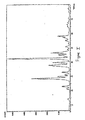
- Figure 1 is a characteristic x-ray powder diffraction spectrum of risperidone Form A.
- Figure 2 is a characteristic x-ray powder diffraction spectrum of risperidone Form B.
- Figure 3 is a characteristic x-ray powder diffraction spectrum of risperidone Form E.
- The present invention provides new processes for preparing risperidone from the following two intermediates, 6-fluoro-3-(4-piperidinyl)-1,2-benzisoxazole (I) and 3-(2-chloroethyl)-6,7,8,9-tetrahydro-2-methyl-4H-pyrido[1,2-a]pyrimidin-4-one (II) using acetonitrile, isopropanol, iso-butanol, or methyl ethyl ketone as the solvent, which eliminates the need to use DMF as a solvent. By the methods of the present invention, risperidone is prepared by adding, 3-(2-chloroethyl)-6,7,8,9-tetrahydro-2-methyl-4H-pyrido[1,2-a]pyrimidin-4-one (Compound II or "the chlorine derivative"); 6-fluoro-3-(4-piperidinyl)-1,2-benzisoxazole (Compound I or "the piperidine derivative"); sodium carbonate; and potassium iodide (66 mg) into a flask containing the solvent isopropanol, acetonitrile, methyl ethyl ketone or iso-butanol. Preferably, the Compound I and Compound II are present in a ratio of about 1:1. The reaction mixture is then heated by methods known in the art, such as, by placing the flask in an oil bath which is heated from about 60°C to about 85°C, and the reaction is allowed to reflux for a time sufficient to complete the formation of risperidone, about 9 hours to overnight. Preferably, the reaction mixture is heated to about 60°C to about 67°C. Preferably the reaction is heated for about 9 hours when the solvent is isopropanol. Preferably the reaction mixture is heated overnight when the solvent is methyl ethyl ketone or iso-butanol. Preferably the reaction is heated for about 17 hours when the solvent is acetonitrile. Upon completion of the reaction, the mixture is cooled by methods known in the art to induce the precipitation of risperidone.
- The resulting precipitated risperidone is filtered and the filter cake is washed in the filter with a small amount of isopropanol, acetone or a mixture of acetone and water. The filter cake is then slurried, filtered and easily dried by conventional methods to give crude risperidone in a yield of about 63 to 74 % yield. The present method eliminates the difficult step of removing DMF from the crude risperidone.
- The present invention also relates to new processes for recrystallizing crude risperidone from; an alcohol, such as, methanol, ethanol, isopropanol, propanol, butanol, sec-butanol and t-butanol; a mixture of alcohols containing any combination of, methanol, ethanol, isopropanol, propanol, butanol, sec-butanol and t-butanol; or a mixture of water and alcohol where the alcohol is one or more of the following alcohols, methanol, ethanol, isopropanol, propanol, butanol, sec-butanol and t-butanol. The present recrystallization eliminates the use of the difficult to remove and potentially harmful solvent DMF. Preferably, the solvent is isopropanol. By the methods of the present invention, crude risperidone is recrystallized by dissolving the crude risperidone in a solvent which is hot. Preferably, the solvent is heated to reflux. Preferably the crude risperidone and solvent are present in a ratio of about 10 to about 15, more preferably the ratio is about 11 to 13, most preferably the ratio is about 11.5 to about 12.5. Preferably the solvent is isopropanol. The hot mixture is then filtered hot and allowed to cool where upon purified risperidone precipitates. The mixture is filtered by conventional methods to give high purity risperidone with a purity of about 99.7 to about 99.8 %. The overall yield of the present method of synthesis and recrystallization of risperidone is about 60 to about 63 %.
- The present invention also provides new processes for recrystallizing crude risperidone from a solvent that is a ketone, such as, acetone. The present recrystallization eliminates the use of the difficult to remove and potentially harmful solvent DMF. Preferably, the solvent is acetone. By the methods of the present invention, crude risperidone is recrystallized by dissolving the crude risperidone in a ketone, which is hot. Preferably, the ketone is heated to reflux. Preferably the crude risperidone and solvent are present in a ratio of about 25 to about 40, more preferably the ratio is about 28 to about 32. Preferably the solvent is acetone. The hot mixture is then filtered hot and allowed to cool where upon purified risperidone precipitates. The mixture is filtered by conventional methods to give high purity risperidone with a purity of about 99.7 to about 99.8 %. The overall yield of the present method of synthesis and recrystallization of risperidone is about 60 to about 63 %.
- The present invention also relates to a novel risperidone crystalline form designated Form A and processes for making risperidone Form A. Risperidone Form A is characterized by unique strong powder x-ray diffraction peaks at 14.2±0.2, and 21.3±0.2 degrees two-theta and medium intensity peaks at 10.6±0.2, 11.4±0.2, 16.4±0.2, 18.9±0.2, 19.9±0.2, 22.5±0.2, 23.3±0.2, 27.6±0.2, 25.4±0.2, and 29.0±0.2 degrees two-theta.
- Another aspect of this invention is a method of preparing risperidone Form A. In the method of preparing risperidone Form A, risperidone Foam A is crystallized from risperidone at the reflux temperature of an organic solvent such as, DMF, tetrahydrofuran (THF), acetone, benzene, ethyl methyl ketone, n-butanol, methanol, isopropanol, absolute ethanol, acetonitrile, toluene, dimethyl sulfoxide (DMSO), iso-butanol or ethyl acetate. By the methods of the present invention, risperidone is added to in a minimum amount of organic solvent by heating the mixture to facilitate dissolution of the risperidone. Upon complete dissolution of the risperidone, the solution is left to cool to room temperature to induce the precipitation of risperidone Form A. After the solution has reached room temperature, it is further cooled in an ice bath and then filtered to isolate risperidone Form A. Suitable volumes of solvent required for the present methods are listed below in Example 11 and in Table 1.
- Another aspect of this invention is a method of preparing risperidone Form A; or a mixture of risperidone Form A and other forms of risperidone, including risperidone Form B, by dissolving risperidone in dichloromethane and adding cyclohexane or hexane to induce precipitation. By the methods of the present invention, risperidone is dissolved in dichloromethane in a ratio of about 1 to about 9. Hexane or cyclohexane is then added until a cloudy dispersion is formed. The risperidone Form A is then isolated by filtration.
- Another aspect of this invention is a method of preparing risperidone Form A by heating risperidone Form B. By the methods of the present invention, risperidone Form A is prepared by heating risperidone Form B, or a mixture of risperidone Form A and B at temperatures above room temperature, preferably at about 80°C, under either reduced pressure or at atmospheric pressure, for a period of several minutes to several hours, preferably 16-20 hours. One embodiment of the present method for preparing risperidone Form A is heating risperidone Form B, or a mixture of risperidone Form B and risperidone Form A, at 80°C overnight, under reduced pressure or at atmospheric pressure, and isolating the resulting crystals of risperidone Form A. An alternative method of preparing risperidone Form A by heating risperidone Form B includes, heating risperidone Form B in a differential scanning calorimeter, at the rate of 5 to 20 degrees per minute, to yield risperidone Form A.
- The present invention also relates to a novel crystalline form of risperidone, denominated risperidone Form B. Risperidone Form B is characterized by unique strong powder x-ray diffraction peaks at 14.0±0.2 and 21.7±0.2 degrees two-theta, and medium peaks at 10.8±0.2, 11.9±0.2, 12.6±0.2, 17.5±0.2, 18.3±0.2, 19.9±0.2, 21.0±0.2, 21.3±0.2 degrees two-tbeta, and is well distinguished from risperidone Form A. The presence of risperidone Form B in a mixture with risperidone Form A is detected by the appearance mainly of the strongest peaks at 21.7±0.2, 17.5±0.2, 18.4±0.2, and also by the other peaks which appear at 11.9±0.2, 12.6±0.2 degrees two theta.
- The DSC thermogram of risperidone Form B is characterized by a solid-solid transition to risperidone Form A detected in a small endotherm at 164°C followed by a small exotherm and a melting endotherm of risperidone Form A at 171°C.
- Another aspect of this invention is a method of preparing risperidone Form B by dissolving risperidone in an alcohol having 1 to 4 carbon atoms, followed by the addition of water to facilitate the precipitation of risperidone Form B. Preferably the ratio of risperidone to alcohol is about 1:7.5 to about 1:9. Preferably the alcohol is ethanol or methanol.
- Another aspect of this invention is a method of preparing risperidone Form B pure or in a mixture with another form of risperidone, such as, risperidone Form A, which includes dissolving risperidone in a hot solution of aqueous HCl followed by the addition of aqueous Na2CO3 to induce precipitation of risperidone Form B. By the methods of the present invention, risperidone is added to 0.5 N HCl in a ratio of about 1:6. Water is added in an amount equal to about two thirds the volume of HCl used. The solution is heated to induce dissolution of the risperidone. Sodium carbonate is then added until a pH of about 8 is leached, to facilitate precipitation. The solution is cooled and risperidone Form B is isolated by filtration.
- Another aspect of this invention is a method of preparing risperidone Form B pure or in a mixture with another form of risperidone such as risperidone Form A, wherein risperidone is dissolved in chloroform followed by the addition of cyclohexane or hexane to facilitate precipitation. By the methods of the present invention, risperidone is dissolved in chloroform in a ratio of about 1:6 followed by the addition of hexane of cyclohexane in an amount sufficient to produce a cloudy dispersion. The risperidone Form B is then isolated upon filtration.
- The present invention also relates to a novel crystalline form of risperidone, denominated risperidone Form E. Risperidone Form E is characterized by typical strong x-ray peaks at 16.5±0.2, 21.7±0.2 degrees two-theta, and medium x-ray peaks at 12.6±0.2, 15.6±0.2, 17.0±0.2, 18.4±0.2, 19.1±0.2, 21.3±0.2, 24.0±0.2, 24.9±0.2, 27.0±0.2 degrees two-theta
- Another aspect of this invention is a method of preparing risperidone Form E. By the methods of the present invention, risperidone is dissolved in isopropanol in a ratio of about 1 to 12. Water is then added until a cloudy dispersion is formed thereby facilitating the precipitation of risperidone Form E. Risperidone Form E is isolated upon filtration of the dispersion.
- In accordance with the present invention, these new forms of risperidone may be prepared as pharmaceutical compositions that are particularly useful for the management of the manifestations of psychotic disorders. Such compositions comprise one of the new forms of risperidone with pharmaceutically acceptable carriers and/or excipients known to one of skill in the art
- Preferably, these compositions are prepared as medicaments to be administered orally, or intravenously. Suitable forms for oral administration include tablets, compressed or coated pills, dragees, sachets, hard or gelatin capsules, sub-lingual tablets, syrups and suspensions. While one of ordinary skill in the art will understand that dosages will vary according to the indication, age of the patient, etc., generally polymorphic forms of risperidone of the present invention will be administered at a daily dosage of about 4 to about 16 mg per day, and preferably about 4 to about 8 mg per day.
- The present invention will now be further explained in the following examples. However, the present invention should not be construed as limited thereby.
- Conditions for obtaining Powder X-ray Diffraction (PXRD) patterns: The powder X-ray diffraction patterns were obtained by methods known in the art using a Philips X-ray powder diffractometer, Phillips Generator TW1830; Goniometer PW3 020; MPD Control PW3710; X-Ray tube with Cu target anode; Monochromator proportional counter, Divergence slits 1°, Receiving slit 0.2 mm. Scatter slit 1°; 40KV, 30mA; and Scanning speed step 0.05 degrees to 2 degrees/min.
- The differential scanning calorimeter thermograms were obtained by methods known in the art using a DSC Mettler 821 Starc. The weight of the samples was about 3-5 mg. The temperature range of scans was 30°C-250°C at a rate of 10°C/min. Samples were purged with nitrogen gas at a flow rate of 40 mL/min. Standard 40 µl aluminum crucibles were used having lids with three small holes.
- Isopropanol (20 mL), 3-(2-chloroethyl)-6,7,8,9-tetrahydro-2-methyl-4H-pyrido[1,2-a]pyrimidin-4-one (Compound II)("the chlorine derivative")(2,63 g,10 nuncios, 1 eq.), 6-fluoro-3-(4-piperidinyl)-1,2-benzisoxazole (Compound I)("the piperidine derivative") (2.17 g, 10 mmoles, 1 eq.), sodium carbonate (3.18 g, 30 mmoles, 3 eq.), and potassium iodide (66 mg) were added to a 100 mL round bottom flask and stirred with a magnetic stir bar. The flask was placed in an oil bath at 80°C and allowed to reflux for 9 hours. The flask was then cooled in an ice bath and the contents was filtered. The filter cake was washed in the filter with a small amount of isopropanol. The filter cake was then slurried 3 times in 20 mL of water and filtered. The resulting slurry was dried to give 3 g of material in 73 % yield. The slurry was recrystallized by dissolving in 37 mL of boiling isopropanol, filtered hot and allowed to cool and filtered to give material which had a purity of 99.7 % and an overall yield of 60 %.
- The same materials and method as in Example 1 with the exception being that methyl ethyl ketone (MEK) (15 mL) was used instead of 20 mL of isopropanol. The flask was put in an oil bath at 79-83 °C overnight, cooled, filtered and washed with acetone and water to give 2.19 g, 53 % yield.
- The same materials and method as in Example 1 with the exception being that 20 mL of acetonitrile was used instead of 20 mL of isopropanol. The flask was put in an oil bath for 17 hours at 79-83°C, than put in the freezer for 2 hours, filtered, and the filter cake washed with acetone until the filtrate had no color. The filter cake was then slurried in 25 mL water 3 times and filtered and dried to give 3.03 g, 74 % yield, of crude risperidone. The crude risperidone was recrystallized from 35 mL of isopropanol, filtered hot, cooled, filtered and dried to give 2.47g of risperidone, 60 % overall yield, 99.8 % pure by HPLC.
- The same materials and method as in Example 1 with the exception being that 20 mL of acetonitrile was used instead of 20 mL of isopropanol. The flask was put in an oil bath for 17 hours at 79-83°C, then put in the freezer for 2 hours, filtered, and the filter cake washed with acetone until the filtrate had no color. The filter cake was then slurried in 25 mL water 3 times and filtered and dried to give 3.03 g, 74 % yield, of crude risperidone. The crude risperidone was recrystallized from 75 mL of acetone, filtered hot, cooled, filtered and dried to give 2.25 g of risperidone, 60 % overall yield, 99.9 % pure by HPLC.
- The same materials and method as in Example 1 with the exception being that 20 mL of iso-butanol was used instead of 20 mL of isopropanol followed by stirring in an oil bath at 78 °C over night. Risperidone was isolated in 63 % yield.
- Risperidone (5.3 g) was dissolved in chloroform (30 mL). Cyclohexane (280 mL)was slowly added to the solution until a cloudy dispersion was formed. The suspension was filtered. The filtrate, analyzed by PXRD, contained risperidone Form B. Further heating overnight at 80°C under reduced pressure produced risperidone Form A, which was confirmed by PXRD analysis.
- Risperidone (5.0 g) was dissolved in 30 mL chloroform. Hexane (250 mL) was added to the solution until a cloudy dispersion was formed. The suspension was filtered. The isolated filtrate, analyzed by PXRD, contained risperidone Form B. Further heating of the filtrate overnight at 80°C under reduced pressure produced risperidone Form A, which was confirmed by PXRD analysis.
- Risperidone (5.3 g) was dissolved in 40 ml ethanol. Water (100 mL) was added to the solution until a cloudy dispersion was formed. The resulting suspension was filtered. The isolated filtrate, analyzed by PXRD, contained risperidone Form B. Further heating of the filtrate overnight at 80°C, under reduced pressure, produced risperidone Form A, which was confirmed by PXRD analysis.
- Risperidone (5.0 g) was dissolved in methanol (45 mL). Water (70 ml) was added to the solution until a cloudy dispersion was formed. The suspension was filtered. The isolated filtrate, analyzed by PXRD, contained risperidone Form B. Further heating of the filtrate overnight at 80°C, under reduced pressure, produced risperidone Form A, which was confirmed by PXRD analysis.
- risperidone (6 g) was dissolved at room temperature in 60 mL of 0.5 N HCl and water (40 mL) was added. The solution was heated in a boiling water bath and stirred with a magnetic stir bar. Concentrated aqueous sodium carbonate was added portion-wise to the solution to facilitate precipitation until a pH of approximately 8 was attained. A precipitate was formed. After cooling to room temperature, the mixture was cooled in an ice bath and filtered to give a mixture of risperidone Form A and risperidone Form B in an 82 % yield.
- Risperidone (6 g) was added portion-wise and dissolved in a minimum amount of solvent by heating in a boiling water bath (about 95°C). Suitable solvents and the corresponding suitable volumes are listed below in Table 1. Solvents having a boiling point lower than 95°C were heated to their boiling point. The solutions were left to cool to room temperature to facilitate precipitation of risperidone Form A. The mixture was then further cooled in an ice bath and then filtered. The precipitate was analyzed by PXRD and found to be risperidone Form A.
Table 1. Preparation of Risperidone form A The volumes of solvents used per 6 grams of Risperidone DMF: 40 ml iso-butanol: 35 ml THF: 40 ml Acetone: 200 ml Benzene: 26 ml methyl ethyl ketone: 70 ml absolute ethanol: 35 ml n-butanol: 45 ml Methanol: 40 ml Toluene: 45 ml Acetonitrile: 100 ml DMSO: 100 ml ethyl acetate: 150 ml Isopropanol: 100 ml - Risperidone (5.6 g) was dissolved in 50 mL dichloromethane. Cyclohexane (170 mL) was added to the solution until a cloudy dispersion was formed. The resulting suspension was filtered. The isolated filtrate, analyzed by PXRD, contained risperidone Form A and a minor quantity of risperidone Form B.
- Risperidone (5.1 g) was dissolved in 30 mL dichloromethane. n-Hexane (150 mL) was added to the solution to facilitate precipitation until a cloudy dispersion was formed. The resulting suspension was filtered. The filtrate, analyzed by PXRD, contained risperidone Form A and a minor quantity of risperidone Form B.
- Risperidone (5 g) was dissolved in 60 mL isopropanol. Water (950 mL) was added to the solution to facilitate precipitation until a cloudy dispersion was formed. The suspension was filtered. The filtrate, analyzed by PXRD, contained risperidone Form E.
- Although certain presently preferred embodiments of the invention have been described herein, it will be apparent to those skilled in the art to which the invention pertains that variations and modifications of the described embodiment may be made without departing from the spirit and scope of the invention. Accordingly, it is intended that the invention be limited only to the extent required by the appended claims and the applicable rules of law.
- Further aspects and features of the present invention are set out in the following numbered clauses.
- 1. A process for making risperidone comprising the steps of reacting compound (I)


- 2. The process of clause 1, further comprising the steps of recrystallizing crude risperidone from an alcohol, a mixture of alcohols, or a mixture of water and alcohoL
- 3. The process of clause 2, wherein the alcohol is selected from the group consisting of methanol, ethanol, isopropanol, propanol, butanol, sec-butanol, and t-butanol.
- 4. The process of clause 3, wherein the alcohol is isopropanol.
- 5. The process of clause 1, wherein the solvent is acetonitrile.
- 6. The process of clause 1, wherein the solvent is isopropanol.
- 7. The process of clause 1, wherein the solvent is methyl ethyl ketone.
- 8. The process of clause 1, wherein the solvent is iso-butanol.
- 9. The process of clause 1, further comprising the steps of recrystallizing crude risperidone from a ketone.
- 10. The process of clause 1, wherein the ketone is acetone.
- 11. Risperidone Form A which is characterized by x-ray powder diffraction peaks at 14.2±0.2, 21.3±0.2 degrees two-theta.
- 12. The risperidone Form A of clause 11 which is further characterized by x-ray powder diffraction peaks at 10.6±0.2, 11.4±0.2, 16.4±0.2, 18.9±0.2, 19.9±0.2, 22.5±0.2, 23.3±0.2, 25.4±0.2, 27.6±0.2, 29.0±0.2 degrees two-theta.
- 13. A risperidone polymorph that is characterized by a powder x-ray diffraction pattern substantially as depicted in Figure 1.
- 14. Risperidone Form B which is characterized by x-ray powder diffraction peaks at 14.0±0.2 and 21.7±0.2 degrees two-theta.
- 15. The risperidone Form B of clause 14 which is further characterized by x-ray powder diffraction peaks at 10.8±0.2, 11.9±0.2, 12.6±0.2, 14.0±0.2, 17.5±0.2, 18.3±0.2, 19.9±0.2, 21.0±0.2, 21.7±0.2 degrees two-theta.
- 16. A risperidone polymorph that is characterized by a powder x-ray diffraction pattern substantially as depicted in Figure 2.
- 17. Risperidone Form E which is characterized by x-ray powder diffraction peaks at 16.5±0.2, 21.7±0.2 degrees two-theta.
- 18. The risperidone Form E of clause 17 which is further characterized by X-ray powder diffraction peaks at 16.5±0.2, 12.6±0.2, 21.7±0.2, 15.6±0.2, 17.0±0.2, 18.4±0.2, 19.1±0.2, 21.3±0.2, 24.0±0.2, 24.9±0.2, 27.0±0.2 degrees two-theta.
- 19. A risperidone polymorph that is characterized by a powder x-ray diffraction pattern substantially as depicted in Figure 3.
- 20. A process for preparing risperidone Form B comprising the steps of:
- (a) dissolving risperidone in a water soluble alcohol having 1 to 4 carbon atoms where the ratio of risperidone to alcohol is about 1:7.5 to about 1:9;
- (b) adding water to facilitate precipitation; and
- (c) isolating risperidone Form B.
- 21. A process for preparing risperidone Form B comprising the steps of:
- (a) dissolving risperidone in chloroform;
- (b) adding cyclohexane or hexane to facilitate precipitation; and
- (c) isolating risperidone Form B.
- 22. A process for preparing risperidone Form B conprising the steps of:
- (a) dissolving risperidone in an aqueous solution of HCl;
- (b) adding aqueous Na2CO3 to facilitate precipitation; and
- (c) isolating risperidone Form B.
- 23. A process for preparing risperidone Form A comprising the steps of;
- (a) dissolving risperidone in an organic solvent selected from the group consisting of dimethylformamide, tetrahydrofuran, acetone, benzene, ethyl methyl ketone, n-butanal, methanol, isopropanol, absolute ethanol, acetonitrile, toluene, dimethyl sulfoxide, iso-butanol, and ethyl acetate;
- (b) heating the solvent to reflux;
- (c) cooling the solvent to facilitate precipitation; and
- (d) isolating risperidone Form A.
- 24. A process for preparing risperidone Form A comprising the steps of
- (a) dissolving risperidone in dichloromethane;
- (b) adding cyclohexane or hexane to facilitate precipitation; and
- (c) isolating risperidone Form A.
- 25. A process for preparing risperidone Form E comprising the steps of:
- (a) dissolving risperidone in isopropanol where the ratio of risperidone to isopropanol is about 1:12;
- (b) adding water to facilitate precipitation; and
- (c) isolating risperidone Form E.
- 26. A process for preparing risperidone Form A comprising the steps of:
- (a) heating risperidone Form B at a temperature of about 25°C to about 80°C for a time sufficient to induce to formation of risperidone Form A; and
- (b) isolating risperidone Form A.
- 27. The process of clause 26 wherein the heating takes place under reduced pressure or at atmospheric pressure.
- 28. The process of clause 26 wherein the temperature is about 80°C,
- 29. The process of clause 26 wherein the time is about 16 to about 20 hours.
Claims (6)
- Risperidone which is characterized by x-ray powder diffraction peaks at 14.0±0.2 and 21.7±0.2 degrees two-theta.
- The risperidone of claim 1 which is further characterized by x-ray powder diffraction peaks at 10.8±0.2, 11.9±0.2, 12.6±0.2, 14.0±0.2, 17.5±0.2, 18.3±0.2, 19.9±0.2, 21.0±0.2, 21.7±0.2 degrees two-theta.
- A risperidone polymorph that is characterized by a powder x-ray diffraction pattern substantially as depicted in Figure 2.
- A process for preparing risperidone of any preceding claim comprising the steps of:(a) dissolving risperidone in a water soluble alcohol having 1 to 4 carbon atoms where the ratio of risperidone to alcohol is about 1:7.5 to about 1:9;(b) adding water to facilitate precipitation; and(c) isolating the risperidone.
- A process for preparing risperidone of any of claims 1 to 3 comprising the steps of:(a) dissolving risperidone in chloroform;(b) adding cyclohexane or hexane to facilitate precipitation; and(c) isolating the risperidone.
- A process for preparing risperidone of any of claims 1 to 3 comprising the steps of:(a) dissolving risperidone in an aqueous solution of HCl;(b) adding aqueous Na2CO3 to facilitate precipitation; and(c) isolating the risperidone.
Priority Applications (1)
| Application Number | Priority Date | Filing Date | Title |
|---|---|---|---|
| EP08011131A EP1982980A1 (en) | 2000-08-14 | 2001-08-14 | Crystalline form of risperidone |
Applications Claiming Priority (3)
| Application Number | Priority Date | Filing Date | Title |
|---|---|---|---|
| US22536100P | 2000-08-14 | 2000-08-14 | |
| US24326300P | 2000-10-25 | 2000-10-25 | |
| EP01963971A EP1317434A4 (en) | 2000-08-14 | 2001-08-14 | Preparation of risperidone |
Related Parent Applications (1)
| Application Number | Title | Priority Date | Filing Date |
|---|---|---|---|
| EP01963971A Division EP1317434A4 (en) | 2000-08-14 | 2001-08-14 | Preparation of risperidone |
Related Child Applications (1)
| Application Number | Title | Priority Date | Filing Date |
|---|---|---|---|
| EP08011131A Division EP1982980A1 (en) | 2000-08-14 | 2001-08-14 | Crystalline form of risperidone |
Publications (3)
| Publication Number | Publication Date |
|---|---|
| EP1783118A2 true EP1783118A2 (en) | 2007-05-09 |
| EP1783118A3 EP1783118A3 (en) | 2007-05-23 |
| EP1783118B1 EP1783118B1 (en) | 2008-07-16 |
Family
ID=37913932
Family Applications (1)
| Application Number | Title | Priority Date | Filing Date |
|---|---|---|---|
| EP07001138A Revoked EP1783118B1 (en) | 2000-08-14 | 2001-08-14 | Preparation of risperidone |
Country Status (1)
| Country | Link |
|---|---|
| EP (1) | EP1783118B1 (en) |
Family Cites Families (1)
| Publication number | Priority date | Publication date | Assignee | Title |
|---|---|---|---|---|
| US4804663A (en) * | 1985-03-27 | 1989-02-14 | Janssen Pharmaceutica N.V. | 3-piperidinyl-substituted 1,2-benzisoxazoles and 1,2-benzisothiazoles |
-
2001
- 2001-08-14 EP EP07001138A patent/EP1783118B1/en not_active Revoked
Also Published As
| Publication number | Publication date |
|---|---|
| EP1783118A3 (en) | 2007-05-23 |
| EP1783118B1 (en) | 2008-07-16 |
Similar Documents
| Publication | Publication Date | Title |
|---|---|---|
| US6750341B2 (en) | Preparation of risperidone | |
| US3700673A (en) | 3-4-dihydrobenzo(b) (1,7)naphthyridin-1(2h)-ones | |
| CN114507230B (en) | A kind of bicyclic pyridone derivatives, its synthesis method and its application | |
| AU2020220512A1 (en) | FGFR inhibitor compound in solid form and preparation method therefor | |
| US20020115672A1 (en) | Preparation of risperidone | |
| WO2007109799A2 (en) | Polymorphs of eszopiclone malate | |
| CN114044776B (en) | Salts of compounds and crystalline forms thereof | |
| EP1783118B1 (en) | Preparation of risperidone | |
| El-Gendy et al. | Synthesis and antihypertensive activity of certain Mannich Bases of 2-ethoxycarbonylindoles and 5 H-pyridazino [4, 5-b] indoles | |
| CA2535728C (en) | Preparation of risperidone | |
| ZA200301200B (en) | Preparation of risperidone. | |
| CA2549398A1 (en) | Preparation of risperidone | |
| WO2012007952A1 (en) | Novel polymorph of irinotecan hydrochloride | |
| CN121889393A (en) | PARG inhibiting compounds | |
| JPH04103572A (en) | 4-phenyl-2-(1-piperazinyl)pyridine derivative | |
| MX2007003719A (en) | Tadalafil crystal forms and processes for preparing them | |
| CZ2016104A3 (en) | Crystalline modifications of methyl (3Z)-3- {[(4-{methyl[(4-methylpiperazin-1yl)acetyl]amino}phenyl)amino](phenyl)methylidene}-2oxo-2,3-dihydro-1H-indole-6-carboxylate and the methods of their preparation | |
| WO2010146594A1 (en) | Novel polymorphs of gemifloxacin mesylate | |
| EP2109613A2 (en) | Polymorphs of eszopiclone malate | |
| TW200413327A (en) | Novel process for the preparation of imidazolyl compounds | |
| JPWO2000041689A1 (en) | telomerase inhibitors |
Legal Events
| Date | Code | Title | Description |
|---|---|---|---|
| PUAI | Public reference made under article 153(3) epc to a published international application that has entered the european phase |
Free format text: ORIGINAL CODE: 0009012 |
|
| PUAL | Search report despatched |
Free format text: ORIGINAL CODE: 0009013 |
|
| 17P | Request for examination filed |
Effective date: 20070207 |
|
| AC | Divisional application: reference to earlier application |
Ref document number: 1317434 Country of ref document: EP Kind code of ref document: P |
|
| AK | Designated contracting states |
Kind code of ref document: A2 Designated state(s): AT BE CH CY DE DK ES FI FR GB GR IE IT LI LU MC NL PT SE TR |
|
| AX | Request for extension of the european patent |
Extension state: AL LT LV MK RO SI |
|
| AK | Designated contracting states |
Kind code of ref document: A3 Designated state(s): AT BE CH CY DE DK ES FI FR GB GR IE IT LI LU MC NL PT SE TR |
|
| AX | Request for extension of the european patent |
Extension state: AL LT LV MK RO SI |
|
| 17Q | First examination report despatched |
Effective date: 20070613 |
|
| AKX | Designation fees paid |
Designated state(s): AT BE CH CY DE DK ES FI FR GB GR IE IT LI LU MC NL PT SE TR |
|
| AXX | Extension fees paid |
Extension state: SI Payment date: 20070207 |
|
| GRAP | Despatch of communication of intention to grant a patent |
Free format text: ORIGINAL CODE: EPIDOSNIGR1 |
|
| GRAS | Grant fee paid |
Free format text: ORIGINAL CODE: EPIDOSNIGR3 |
|
| GRAA | (expected) grant |
Free format text: ORIGINAL CODE: 0009210 |
|
| AC | Divisional application: reference to earlier application |
Ref document number: 1317434 Country of ref document: EP Kind code of ref document: P |
|
| AK | Designated contracting states |
Kind code of ref document: B1 Designated state(s): AT BE CH CY DE DK ES FI FR GB GR IE IT LI LU MC NL PT SE TR |
|
| AX | Request for extension of the european patent |
Extension state: SI |
|
| REG | Reference to a national code |
Ref country code: GB Ref legal event code: FG4D |
|
| REG | Reference to a national code |
Ref country code: CH Ref legal event code: EP |
|
| REG | Reference to a national code |
Ref country code: PT Ref legal event code: SC4A Free format text: AVAILABILITY OF NATIONAL TRANSLATION Effective date: 20080805 |
|
| REF | Corresponds to: |
Ref document number: 60134899 Country of ref document: DE Date of ref document: 20080828 Kind code of ref document: P |
|
| REG | Reference to a national code |
Ref country code: IE Ref legal event code: FG4D |
|
| REG | Reference to a national code |
Ref country code: ES Ref legal event code: FG2A Ref document number: 2310410 Country of ref document: ES Kind code of ref document: T3 |
|
| PG25 | Lapsed in a contracting state [announced via postgrant information from national office to epo] |
Ref country code: AT Free format text: LAPSE BECAUSE OF FAILURE TO SUBMIT A TRANSLATION OF THE DESCRIPTION OR TO PAY THE FEE WITHIN THE PRESCRIBED TIME-LIMIT Effective date: 20080716 |
|
| PG25 | Lapsed in a contracting state [announced via postgrant information from national office to epo] |
Ref country code: MC Free format text: LAPSE BECAUSE OF NON-PAYMENT OF DUE FEES Effective date: 20080831 |
|
| REG | Reference to a national code |
Ref country code: CH Ref legal event code: PL |
|
| PLBI | Opposition filed |
Free format text: ORIGINAL CODE: 0009260 |
|
| PLAB | Opposition data, opponent's data or that of the opponent's representative modified |
Free format text: ORIGINAL CODE: 0009299OPPO |
|
| PG25 | Lapsed in a contracting state [announced via postgrant information from national office to epo] |
Ref country code: DK Free format text: LAPSE BECAUSE OF FAILURE TO SUBMIT A TRANSLATION OF THE DESCRIPTION OR TO PAY THE FEE WITHIN THE PRESCRIBED TIME-LIMIT Effective date: 20080716 |
|
| 26 | Opposition filed |
Opponent name: SANDOZ GMBH Effective date: 20090408 |
|
| PLAX | Notice of opposition and request to file observation + time limit sent |
Free format text: ORIGINAL CODE: EPIDOSNOBS2 |
|
| R26 | Opposition filed (corrected) |
Opponent name: SANDOZ GMBH (AT)/SANDOZ AG (CH) Effective date: 20090408 |
|
| REG | Reference to a national code |
Ref country code: IE Ref legal event code: MM4A |
|
| PG25 | Lapsed in a contracting state [announced via postgrant information from national office to epo] |
Ref country code: LI Free format text: LAPSE BECAUSE OF NON-PAYMENT OF DUE FEES Effective date: 20080831 Ref country code: CH Free format text: LAPSE BECAUSE OF NON-PAYMENT OF DUE FEES Effective date: 20080831 |
|
| NLR1 | Nl: opposition has been filed with the epo |
Opponent name: SANDOZ GMBH |
|
| PG25 | Lapsed in a contracting state [announced via postgrant information from national office to epo] |
Ref country code: IE Free format text: LAPSE BECAUSE OF NON-PAYMENT OF DUE FEES Effective date: 20080814 |
|
| NLR1 | Nl: opposition has been filed with the epo |
Opponent name: SANDOZ GMBH (AT)/SANDOZ AG (CH) |
|
| PLAF | Information modified related to communication of a notice of opposition and request to file observations + time limit |
Free format text: ORIGINAL CODE: EPIDOSCOBS2 |
|
| PLAF | Information modified related to communication of a notice of opposition and request to file observations + time limit |
Free format text: ORIGINAL CODE: EPIDOSCOBS2 |
|
| PLBB | Reply of patent proprietor to notice(s) of opposition received |
Free format text: ORIGINAL CODE: EPIDOSNOBS3 |
|
| PG25 | Lapsed in a contracting state [announced via postgrant information from national office to epo] |
Ref country code: SE Free format text: LAPSE BECAUSE OF FAILURE TO SUBMIT A TRANSLATION OF THE DESCRIPTION OR TO PAY THE FEE WITHIN THE PRESCRIBED TIME-LIMIT Effective date: 20081016 |
|
| PG25 | Lapsed in a contracting state [announced via postgrant information from national office to epo] |
Ref country code: FI Free format text: LAPSE BECAUSE OF FAILURE TO SUBMIT A TRANSLATION OF THE DESCRIPTION OR TO PAY THE FEE WITHIN THE PRESCRIBED TIME-LIMIT Effective date: 20080716 |
|
| PG25 | Lapsed in a contracting state [announced via postgrant information from national office to epo] |
Ref country code: CY Free format text: LAPSE BECAUSE OF FAILURE TO SUBMIT A TRANSLATION OF THE DESCRIPTION OR TO PAY THE FEE WITHIN THE PRESCRIBED TIME-LIMIT Effective date: 20080716 Ref country code: LU Free format text: LAPSE BECAUSE OF NON-PAYMENT OF DUE FEES Effective date: 20080814 |
|
| PG25 | Lapsed in a contracting state [announced via postgrant information from national office to epo] |
Ref country code: TR Free format text: LAPSE BECAUSE OF FAILURE TO SUBMIT A TRANSLATION OF THE DESCRIPTION OR TO PAY THE FEE WITHIN THE PRESCRIBED TIME-LIMIT Effective date: 20080716 |
|
| PG25 | Lapsed in a contracting state [announced via postgrant information from national office to epo] |
Ref country code: GR Free format text: LAPSE BECAUSE OF FAILURE TO SUBMIT A TRANSLATION OF THE DESCRIPTION OR TO PAY THE FEE WITHIN THE PRESCRIBED TIME-LIMIT Effective date: 20081017 |
|
| PGFP | Annual fee paid to national office [announced via postgrant information from national office to epo] |
Ref country code: NL Payment date: 20100813 Year of fee payment: 10 Ref country code: ES Payment date: 20100825 Year of fee payment: 10 |
|
| PLBP | Opposition withdrawn |
Free format text: ORIGINAL CODE: 0009264 |
|
| PGFP | Annual fee paid to national office [announced via postgrant information from national office to epo] |
Ref country code: IT Payment date: 20100823 Year of fee payment: 10 Ref country code: FR Payment date: 20100901 Year of fee payment: 10 Ref country code: DE Payment date: 20100823 Year of fee payment: 10 |
|
| RDAF | Communication despatched that patent is revoked |
Free format text: ORIGINAL CODE: EPIDOSNREV1 |
|
| PGFP | Annual fee paid to national office [announced via postgrant information from national office to epo] |
Ref country code: GB Payment date: 20100819 Year of fee payment: 10 |
|
| PGFP | Annual fee paid to national office [announced via postgrant information from national office to epo] |
Ref country code: PT Payment date: 20100806 Year of fee payment: 10 |
|
| PGFP | Annual fee paid to national office [announced via postgrant information from national office to epo] |
Ref country code: BE Payment date: 20100810 Year of fee payment: 10 |
|
| RDAG | Patent revoked |
Free format text: ORIGINAL CODE: 0009271 |
|
| STAA | Information on the status of an ep patent application or granted ep patent |
Free format text: STATUS: PATENT REVOKED |
|
| 27W | Patent revoked |
Effective date: 20101214 |
|
| GBPR | Gb: patent revoked under art. 102 of the ep convention designating the uk as contracting state |
Effective date: 20101214 |