EP1783115B1 - Arylamine ketones, their preparation methods, the pharmaceutical compositions containing them and their use - Google Patents
Arylamine ketones, their preparation methods, the pharmaceutical compositions containing them and their use Download PDFInfo
- Publication number
- EP1783115B1 EP1783115B1 EP05774475.7A EP05774475A EP1783115B1 EP 1783115 B1 EP1783115 B1 EP 1783115B1 EP 05774475 A EP05774475 A EP 05774475A EP 1783115 B1 EP1783115 B1 EP 1783115B1
- Authority
- EP
- European Patent Office
- Prior art keywords
- compound
- compounds
- preparation
- added
- hydrochloride
- Prior art date
- Legal status (The legal status is an assumption and is not a legal conclusion. Google has not performed a legal analysis and makes no representation as to the accuracy of the status listed.)
- Expired - Lifetime
Links
- 0 CCOC(C1C(C)CC*(CCC(C=Cc2c(*(C)C)c(*(C)C)*(*(C)=C)c(*)c2)=O)C1)=O Chemical compound CCOC(C1C(C)CC*(CCC(C=Cc2c(*(C)C)c(*(C)C)*(*(C)=C)c(*)c2)=O)C1)=O 0.000 description 3
Classifications
-
- C—CHEMISTRY; METALLURGY
- C07—ORGANIC CHEMISTRY
- C07D—HETEROCYCLIC COMPOUNDS
- C07D295/00—Heterocyclic compounds containing polymethylene-imine rings with at least five ring members, 3-azabicyclo [3.2.2] nonane, piperazine, morpholine or thiomorpholine rings, having only hydrogen atoms directly attached to the ring carbon atoms
- C07D295/16—Heterocyclic compounds containing polymethylene-imine rings with at least five ring members, 3-azabicyclo [3.2.2] nonane, piperazine, morpholine or thiomorpholine rings, having only hydrogen atoms directly attached to the ring carbon atoms acylated on ring nitrogen atoms
- C07D295/20—Heterocyclic compounds containing polymethylene-imine rings with at least five ring members, 3-azabicyclo [3.2.2] nonane, piperazine, morpholine or thiomorpholine rings, having only hydrogen atoms directly attached to the ring carbon atoms acylated on ring nitrogen atoms by radicals derived from carbonic acid, or sulfur or nitrogen analogues thereof
- C07D295/205—Radicals derived from carbonic acid
-
- A—HUMAN NECESSITIES
- A61—MEDICAL OR VETERINARY SCIENCE; HYGIENE
- A61P—SPECIFIC THERAPEUTIC ACTIVITY OF CHEMICAL COMPOUNDS OR MEDICINAL PREPARATIONS
- A61P19/00—Drugs for skeletal disorders
-
- A—HUMAN NECESSITIES
- A61—MEDICAL OR VETERINARY SCIENCE; HYGIENE
- A61P—SPECIFIC THERAPEUTIC ACTIVITY OF CHEMICAL COMPOUNDS OR MEDICINAL PREPARATIONS
- A61P19/00—Drugs for skeletal disorders
- A61P19/02—Drugs for skeletal disorders for joint disorders, e.g. arthritis, arthrosis
-
- A—HUMAN NECESSITIES
- A61—MEDICAL OR VETERINARY SCIENCE; HYGIENE
- A61P—SPECIFIC THERAPEUTIC ACTIVITY OF CHEMICAL COMPOUNDS OR MEDICINAL PREPARATIONS
- A61P19/00—Drugs for skeletal disorders
- A61P19/04—Drugs for skeletal disorders for non-specific disorders of the connective tissue
-
- A—HUMAN NECESSITIES
- A61—MEDICAL OR VETERINARY SCIENCE; HYGIENE
- A61P—SPECIFIC THERAPEUTIC ACTIVITY OF CHEMICAL COMPOUNDS OR MEDICINAL PREPARATIONS
- A61P21/00—Drugs for disorders of the muscular or neuromuscular system
-
- A—HUMAN NECESSITIES
- A61—MEDICAL OR VETERINARY SCIENCE; HYGIENE
- A61P—SPECIFIC THERAPEUTIC ACTIVITY OF CHEMICAL COMPOUNDS OR MEDICINAL PREPARATIONS
- A61P29/00—Non-central analgesic, antipyretic or antiinflammatory agents, e.g. antirheumatic agents; Non-steroidal antiinflammatory drugs [NSAID]
-
- A—HUMAN NECESSITIES
- A61—MEDICAL OR VETERINARY SCIENCE; HYGIENE
- A61P—SPECIFIC THERAPEUTIC ACTIVITY OF CHEMICAL COMPOUNDS OR MEDICINAL PREPARATIONS
- A61P37/00—Drugs for immunological or allergic disorders
- A61P37/08—Antiallergic agents
-
- A—HUMAN NECESSITIES
- A61—MEDICAL OR VETERINARY SCIENCE; HYGIENE
- A61P—SPECIFIC THERAPEUTIC ACTIVITY OF CHEMICAL COMPOUNDS OR MEDICINAL PREPARATIONS
- A61P43/00—Drugs for specific purposes, not provided for in groups A61P1/00-A61P41/00
-
- A—HUMAN NECESSITIES
- A61—MEDICAL OR VETERINARY SCIENCE; HYGIENE
- A61P—SPECIFIC THERAPEUTIC ACTIVITY OF CHEMICAL COMPOUNDS OR MEDICINAL PREPARATIONS
- A61P7/00—Drugs for disorders of the blood or the extracellular fluid
- A61P7/02—Antithrombotic agents; Anticoagulants; Platelet aggregation inhibitors
-
- C—CHEMISTRY; METALLURGY
- C07—ORGANIC CHEMISTRY
- C07D—HETEROCYCLIC COMPOUNDS
- C07D211/00—Heterocyclic compounds containing hydrogenated pyridine rings, not condensed with other rings
- C07D211/04—Heterocyclic compounds containing hydrogenated pyridine rings, not condensed with other rings with only hydrogen or carbon atoms directly attached to the ring nitrogen atom
- C07D211/06—Heterocyclic compounds containing hydrogenated pyridine rings, not condensed with other rings with only hydrogen or carbon atoms directly attached to the ring nitrogen atom having no double bonds between ring members or between ring members and non-ring members
- C07D211/08—Heterocyclic compounds containing hydrogenated pyridine rings, not condensed with other rings with only hydrogen or carbon atoms directly attached to the ring nitrogen atom having no double bonds between ring members or between ring members and non-ring members with hydrocarbon or substituted hydrocarbon radicals directly attached to ring carbon atoms
- C07D211/10—Heterocyclic compounds containing hydrogenated pyridine rings, not condensed with other rings with only hydrogen or carbon atoms directly attached to the ring nitrogen atom having no double bonds between ring members or between ring members and non-ring members with hydrocarbon or substituted hydrocarbon radicals directly attached to ring carbon atoms with radicals containing only carbon and hydrogen atoms attached to ring carbon atoms
- C07D211/14—Heterocyclic compounds containing hydrogenated pyridine rings, not condensed with other rings with only hydrogen or carbon atoms directly attached to the ring nitrogen atom having no double bonds between ring members or between ring members and non-ring members with hydrocarbon or substituted hydrocarbon radicals directly attached to ring carbon atoms with radicals containing only carbon and hydrogen atoms attached to ring carbon atoms with hydrocarbon or substituted hydrocarbon radicals attached to the ring nitrogen atom
-
- C—CHEMISTRY; METALLURGY
- C07—ORGANIC CHEMISTRY
- C07D—HETEROCYCLIC COMPOUNDS
- C07D211/00—Heterocyclic compounds containing hydrogenated pyridine rings, not condensed with other rings
- C07D211/04—Heterocyclic compounds containing hydrogenated pyridine rings, not condensed with other rings with only hydrogen or carbon atoms directly attached to the ring nitrogen atom
- C07D211/06—Heterocyclic compounds containing hydrogenated pyridine rings, not condensed with other rings with only hydrogen or carbon atoms directly attached to the ring nitrogen atom having no double bonds between ring members or between ring members and non-ring members
- C07D211/08—Heterocyclic compounds containing hydrogenated pyridine rings, not condensed with other rings with only hydrogen or carbon atoms directly attached to the ring nitrogen atom having no double bonds between ring members or between ring members and non-ring members with hydrocarbon or substituted hydrocarbon radicals directly attached to ring carbon atoms
- C07D211/18—Heterocyclic compounds containing hydrogenated pyridine rings, not condensed with other rings with only hydrogen or carbon atoms directly attached to the ring nitrogen atom having no double bonds between ring members or between ring members and non-ring members with hydrocarbon or substituted hydrocarbon radicals directly attached to ring carbon atoms with substituted hydrocarbon radicals attached to ring carbon atoms
- C07D211/20—Heterocyclic compounds containing hydrogenated pyridine rings, not condensed with other rings with only hydrogen or carbon atoms directly attached to the ring nitrogen atom having no double bonds between ring members or between ring members and non-ring members with hydrocarbon or substituted hydrocarbon radicals directly attached to ring carbon atoms with substituted hydrocarbon radicals attached to ring carbon atoms with hydrocarbon radicals, substituted by singly bound oxygen or sulphur atoms
- C07D211/22—Heterocyclic compounds containing hydrogenated pyridine rings, not condensed with other rings with only hydrogen or carbon atoms directly attached to the ring nitrogen atom having no double bonds between ring members or between ring members and non-ring members with hydrocarbon or substituted hydrocarbon radicals directly attached to ring carbon atoms with substituted hydrocarbon radicals attached to ring carbon atoms with hydrocarbon radicals, substituted by singly bound oxygen or sulphur atoms by oxygen atoms
-
- C—CHEMISTRY; METALLURGY
- C07—ORGANIC CHEMISTRY
- C07D—HETEROCYCLIC COMPOUNDS
- C07D211/00—Heterocyclic compounds containing hydrogenated pyridine rings, not condensed with other rings
- C07D211/04—Heterocyclic compounds containing hydrogenated pyridine rings, not condensed with other rings with only hydrogen or carbon atoms directly attached to the ring nitrogen atom
- C07D211/06—Heterocyclic compounds containing hydrogenated pyridine rings, not condensed with other rings with only hydrogen or carbon atoms directly attached to the ring nitrogen atom having no double bonds between ring members or between ring members and non-ring members
- C07D211/36—Heterocyclic compounds containing hydrogenated pyridine rings, not condensed with other rings with only hydrogen or carbon atoms directly attached to the ring nitrogen atom having no double bonds between ring members or between ring members and non-ring members with hetero atoms or with carbon atoms having three bonds to hetero atoms with at the most one bond to halogen, e.g. ester or nitrile radicals, directly attached to ring carbon atoms
- C07D211/60—Carbon atoms having three bonds to hetero atoms with at the most one bond to halogen, e.g. ester or nitrile radicals
-
- C—CHEMISTRY; METALLURGY
- C07—ORGANIC CHEMISTRY
- C07D—HETEROCYCLIC COMPOUNDS
- C07D211/00—Heterocyclic compounds containing hydrogenated pyridine rings, not condensed with other rings
- C07D211/04—Heterocyclic compounds containing hydrogenated pyridine rings, not condensed with other rings with only hydrogen or carbon atoms directly attached to the ring nitrogen atom
- C07D211/06—Heterocyclic compounds containing hydrogenated pyridine rings, not condensed with other rings with only hydrogen or carbon atoms directly attached to the ring nitrogen atom having no double bonds between ring members or between ring members and non-ring members
- C07D211/36—Heterocyclic compounds containing hydrogenated pyridine rings, not condensed with other rings with only hydrogen or carbon atoms directly attached to the ring nitrogen atom having no double bonds between ring members or between ring members and non-ring members with hetero atoms or with carbon atoms having three bonds to hetero atoms with at the most one bond to halogen, e.g. ester or nitrile radicals, directly attached to ring carbon atoms
- C07D211/60—Carbon atoms having three bonds to hetero atoms with at the most one bond to halogen, e.g. ester or nitrile radicals
- C07D211/62—Carbon atoms having three bonds to hetero atoms with at the most one bond to halogen, e.g. ester or nitrile radicals attached in position 4
-
- C—CHEMISTRY; METALLURGY
- C07—ORGANIC CHEMISTRY
- C07D—HETEROCYCLIC COMPOUNDS
- C07D241/00—Heterocyclic compounds containing 1,4-diazine or hydrogenated 1,4-diazine rings
- C07D241/02—Heterocyclic compounds containing 1,4-diazine or hydrogenated 1,4-diazine rings not condensed with other rings
- C07D241/04—Heterocyclic compounds containing 1,4-diazine or hydrogenated 1,4-diazine rings not condensed with other rings having no double bonds between ring members or between ring members and non-ring members
-
- C—CHEMISTRY; METALLURGY
- C07—ORGANIC CHEMISTRY
- C07D—HETEROCYCLIC COMPOUNDS
- C07D295/00—Heterocyclic compounds containing polymethylene-imine rings with at least five ring members, 3-azabicyclo [3.2.2] nonane, piperazine, morpholine or thiomorpholine rings, having only hydrogen atoms directly attached to the ring carbon atoms
- C07D295/04—Heterocyclic compounds containing polymethylene-imine rings with at least five ring members, 3-azabicyclo [3.2.2] nonane, piperazine, morpholine or thiomorpholine rings, having only hydrogen atoms directly attached to the ring carbon atoms with substituted hydrocarbon radicals attached to ring nitrogen atoms
- C07D295/10—Heterocyclic compounds containing polymethylene-imine rings with at least five ring members, 3-azabicyclo [3.2.2] nonane, piperazine, morpholine or thiomorpholine rings, having only hydrogen atoms directly attached to the ring carbon atoms with substituted hydrocarbon radicals attached to ring nitrogen atoms substituted by doubly bound oxygen or sulphur atoms
- C07D295/104—Heterocyclic compounds containing polymethylene-imine rings with at least five ring members, 3-azabicyclo [3.2.2] nonane, piperazine, morpholine or thiomorpholine rings, having only hydrogen atoms directly attached to the ring carbon atoms with substituted hydrocarbon radicals attached to ring nitrogen atoms substituted by doubly bound oxygen or sulphur atoms with the ring nitrogen atoms and the doubly bound oxygen or sulfur atoms attached to the same carbon chain, which is not interrupted by carbocyclic rings
- C07D295/108—Heterocyclic compounds containing polymethylene-imine rings with at least five ring members, 3-azabicyclo [3.2.2] nonane, piperazine, morpholine or thiomorpholine rings, having only hydrogen atoms directly attached to the ring carbon atoms with substituted hydrocarbon radicals attached to ring nitrogen atoms substituted by doubly bound oxygen or sulphur atoms with the ring nitrogen atoms and the doubly bound oxygen or sulfur atoms attached to the same carbon chain, which is not interrupted by carbocyclic rings to an acyclic saturated chain
-
- C—CHEMISTRY; METALLURGY
- C07—ORGANIC CHEMISTRY
- C07D—HETEROCYCLIC COMPOUNDS
- C07D295/00—Heterocyclic compounds containing polymethylene-imine rings with at least five ring members, 3-azabicyclo [3.2.2] nonane, piperazine, morpholine or thiomorpholine rings, having only hydrogen atoms directly attached to the ring carbon atoms
- C07D295/16—Heterocyclic compounds containing polymethylene-imine rings with at least five ring members, 3-azabicyclo [3.2.2] nonane, piperazine, morpholine or thiomorpholine rings, having only hydrogen atoms directly attached to the ring carbon atoms acylated on ring nitrogen atoms
- C07D295/18—Heterocyclic compounds containing polymethylene-imine rings with at least five ring members, 3-azabicyclo [3.2.2] nonane, piperazine, morpholine or thiomorpholine rings, having only hydrogen atoms directly attached to the ring carbon atoms acylated on ring nitrogen atoms by radicals derived from carboxylic acids, or sulfur or nitrogen analogues thereof
- C07D295/182—Radicals derived from carboxylic acids
- C07D295/185—Radicals derived from carboxylic acids from aliphatic carboxylic acids
-
- C—CHEMISTRY; METALLURGY
- C07—ORGANIC CHEMISTRY
- C07D—HETEROCYCLIC COMPOUNDS
- C07D317/00—Heterocyclic compounds containing five-membered rings having two oxygen atoms as the only ring hetero atoms
- C07D317/08—Heterocyclic compounds containing five-membered rings having two oxygen atoms as the only ring hetero atoms having the hetero atoms in positions 1 and 3
- C07D317/44—Heterocyclic compounds containing five-membered rings having two oxygen atoms as the only ring hetero atoms having the hetero atoms in positions 1 and 3 ortho- or peri-condensed with carbocyclic rings or ring systems
- C07D317/46—Heterocyclic compounds containing five-membered rings having two oxygen atoms as the only ring hetero atoms having the hetero atoms in positions 1 and 3 ortho- or peri-condensed with carbocyclic rings or ring systems condensed with one six-membered ring
- C07D317/48—Methylenedioxybenzenes or hydrogenated methylenedioxybenzenes, unsubstituted on the hetero ring
- C07D317/50—Methylenedioxybenzenes or hydrogenated methylenedioxybenzenes, unsubstituted on the hetero ring with only hydrogen atoms, hydrocarbon or substituted hydrocarbon radicals, directly attached to atoms of the carbocyclic ring
- C07D317/58—Radicals substituted by nitrogen atoms
-
- C—CHEMISTRY; METALLURGY
- C07—ORGANIC CHEMISTRY
- C07D—HETEROCYCLIC COMPOUNDS
- C07D405/00—Heterocyclic compounds containing both one or more hetero rings having oxygen atoms as the only ring hetero atoms, and one or more rings having nitrogen as the only ring hetero atom
- C07D405/02—Heterocyclic compounds containing both one or more hetero rings having oxygen atoms as the only ring hetero atoms, and one or more rings having nitrogen as the only ring hetero atom containing two hetero rings
- C07D405/06—Heterocyclic compounds containing both one or more hetero rings having oxygen atoms as the only ring hetero atoms, and one or more rings having nitrogen as the only ring hetero atom containing two hetero rings linked by a carbon chain containing only aliphatic carbon atoms
Definitions
- the present invention is concerned with araminone compounds of the general formula (Iaa), compounds of the general formaula (Iab), 5-[(4-ethoxycarbonyl)piperidyl]-1-(4-chlorophenyl)-1-penten-3-one hydrochloride, 5-[(3-ethoxycarbonyl)piperidyl]-1-(2,4-dichlorophenyl)-1-penten-3-one hydrochloride, 5-[(4-benzyl)piperidyl]-1-(4-trifluoromethylphenyl)-1-penten-3-one hydrochloride, 5-[(4-benzyl)piperidyl]-1-(4-butoxyphenyl)-1-penten-3-one hydrochloride and 5-[(4-carboxylic acid)piperidyl] -1-(4-chlorophenyl)-1-penten-3-one hydrochloride, pharmaceutical compositions containing them, and their use for the preparation of drugs for the treatment of various
- RA Rheumatoid arthritis
- SAIDs steroid anti-inflammatory drugs
- NSAIDs non-steroid anti-inflammatory drugs
- PAF Platelet activating factor
- PAF receptor antagonists compete with PAF for their receptors, so they can effectively inhibit inflammation.
- the previous investigation also shows PAF can enhance the production of other inflammatory mediators, the expression of cytokines, activate nuclear factor and influence many pathological process related to inflammation.
- PAF receptor has became an important target for developing new anti-inflammatory and immuno-regulatory drugs.
- PAF receptor antagonists can protect the gastrointestinal mucosa which is the protrusive advantage comparing with the launched anti-inflammatory drugs.
- BN50730 significantly improves the symptom of patients with rheumatoid arthritis after administration for 4 weeks.
- WEB2170 can inhibit the increase of new vessels in mouse angiogenesis model induced by synovial fluid of patient with rheumatoid arthritis.
- WEB2170 can inhibit the increase of TNF- ⁇ level in synovial fluid of rat ankle joint induced by immune complex.
- A-85783 can significantly inhibit the rat ear edema induced by PAF or PMA.
- BN50730 can significantly inhibit the joint swelling of mouse with arthritis induced by type II collagen, decrease the precipitation of fibronectin and the consumption of proteoglycan in cartilage.
- BN50730 can reduce the early activity of NF- ⁇ B and the expression of TNF- ⁇ mRNA in the infected mice.
- LDP-392 can significantly inhibit the mouse ear edema induced by arachidonic acid.
- R' 3 ,R' 4 , R' 5 and R' 6 are independently selected from hydrogen, C 1-6 alkyl, methylenedioxy, C 1-6 alkoxy, halogen (F, Cl, Br, I), hydroxy, NO 2 , CF 3 , CN, 3,4,5-tri-C 1-6 alkoxy , 3-methoxy-4-hydroxy, or 3,4-methylenedioxy-5-methoxy.
- the invention provides compounds represented by the following general formula (Iab) wherein, R' 3 , R' 4, R' 5 and R' 6 are independently selected from hydrogen, C 1-6 alkyl, methylenedioxy, C 1-6 alkoxy, halogen(F, Cl, Br, I), hydroxy, NO 2 , CF 3 , CN, 3,4,5-tri-C 1-6 alkoxy, 3-methoxy-4-hydroxy, or 3,4-methylenedioxy-5-methoxy.
- R' 3 , R' 4, R' 5 and R' 6 are independently selected from hydrogen, C 1-6 alkyl, methylenedioxy, C 1-6 alkoxy, halogen(F, Cl, Br, I), hydroxy, NO 2 , CF 3 , CN, 3,4,5-tri-C 1-6 alkoxy, 3-methoxy-4-hydroxy, or 3,4-methylenedioxy-5-methoxy.
- the invention provides compounds selected from
- the compounds of the invention can be prepared by the following reaction route:
- Reaction condition The reaction is carried out in the presence of a base, the preferred base is the hydroxide of alkali metals, or aluminum oxide, especially, potassium hydroxide, sodium hydroxide.
- Reaction Solvent Excessive acetone is used as the solvent.
- the other solvent such as ethanol and/or water may be added, according to the solubility of various benzaldehyde derivatives and the selected base. The amount of solvent is adjusted according to the solubility of the reactants.
- the reaction temperature is preferably 5-40°C, the preferred is 10-30°C,, the most preferred is 15-25°C,.
- the reaction time is 1-40 hours, the preferred is 5-30 hours, the most preferred is 14- 25 hours.
- the process of the reaction may be monitored by TLC or HPLC.
- the reaction mixture is neutralized by an acid when the reaction completed.
- the preferred acid is inorganic acid, the most preferred acid is HCl.
- the reaction product may be obtained by filtration or extraction with organic solvent. The product may be further washed, dried and purified to fulfill the requirements of the reaction of the next step.
- Reaction condition The reaction is conducted under acidic conditions, adjusting the pH value of the reaction solution to pH 3-4 with acid, preferably by hydrochloric acid.
- Solvent Anhydrous ethanol is used as the solvent, the required amount of the solvent is adjusted according to the solubility of the reactants.
- the reaction is carried out under reflux, the preferred temperature is about 90°C.
- the time of the reaction is 5-25 hours, the preferred time is 10-20 hours, the most preferred time is about 15 hours.
- the process of the reaction may be monitored by TLC or HPLC. After the completion of reaction, the mixture is concentrated under reduced pressure, separated solid is filtrated, dried and purified by recrystallization.
- the substituted group AL in the compounds of the invention can be introduced via start materials, that is, refluxing appropriate substituted or unsubstituted 4-phenyl-3-buten-2-one with AL group on the phenyl ring with the appropriate secondary amine hydrochloride and paraformaldehyde in acidic anhydrous ethanol.
- the present invention further relates to pharmaceutical compositions, which generally contain from 0.1 to 95% by weight of the compounds of the present invention as the active ingredient and conventionally pharmaceutically excipients and/or auxiliaries.
- compositions of the present invention can be prepared by the known art in the relating fields.
- the compounds of the present invention may be made into dosage forms for the use of drugs to people or animals, by mixed with one or more solids or liquids excipients and/or auxiliaries, if needed.
- the compounds and their complex in this invention can be administrated at unit dose by gastrointestinal tract or parenteral pathways, such as oral, intramuscular injection, subcutaneous injection, nasal mucosa, mucous membrane of mouth, cutis, abdominal injection or rectum.
- gastrointestinal tract or parenteral pathways such as oral, intramuscular injection, subcutaneous injection, nasal mucosa, mucous membrane of mouth, cutis, abdominal injection or rectum.
- the compounds and their complex can be administrated by injection which includes intravenous injection, intramuscular injection, subcutaneous injection, intradermal injection or acupuncture point injection.
- the formulation of the present invention may be in the solid, semi-solid or liquid dosage forms.
- the liquids include the solutions, colloids, emulsion, suspension and the like.
- the other dosage forms include tablets, capsules, sprays, aerosols, pills, drop pills, powder, granules, fine subtly systems, suppositorys, freeze- dried powder injections and the like.
- the compounds of the present invention may be prepared into specific formulations, such as implantation of slow-releases, sustained-released systems, time-release capsules or tablets, directing-targets and various fine subtly systems.
- diluents and absorbents such as starch, dextrin, calcium sulfate, lactose, mannitol, sucrose, sodium chloride, glucose, urea, calcium carbonate, kaolin, microcrystalcelluloses and aluminum silicate and the like
- moist and bonding agents such as water, glycerol, polyethyleneglycol, ethanol, propanol, starch thick liquid, dextrin, syrups, honey, glucose solution, Arabic gum , gelatin, sodium carboxymethyl celluloses, lacta, methylcellulose, potassium phosphate, polyvinylpyrrolidone and the like
- disintegrants such as dried starch, marine alginates, agar-powders, brown-algae starch, sodium hydrogencarbonate citric acid, calcium carbonate, polyoxyethylene sorbitol fatty acid ester
- diluents and absorbents such as glucose, lactose, starch, cocoa butter, hydro-vegetable oils, polyvinylpyrrolidone, Gelucire, kaolin, talc and the like
- bonding agents such as arabic gum, tragacanth, gelatin, ethanol, honey, liquid-sugars, rice pastes or flour pastes and the like
- disintegrants such as agar powder, dried starch, marine alginates, sodium lauryl sulfonate, methylcellulose, ethylcellulose and the like.
- the compounds of the present invention may be mixed with above various carrier(s).
- the mixtures obtained were packed into hard or soft capsules and also may be prepared into microcapsules which further are used as suspended in hydra-media and packed into hard capsules or to be prepared injections.
- the compounds of the present invention may be prepared as the injection dosage forms, such as solutions, suspensions, emulsions, freeze-dried powder suitable for injections, which these preparations may be contained water or no water, one and/or more pharmaceutically acceptable carrier(s), diluents, preservatives, surfactants or dispersing agents.
- diluents are selected from water, ethanol, polyethylene glycol, 1,3-propylene glycol, ethyloxyisostearates, polyoxyisostearates, polyoxyethylene sorbitol fatty acid ester and the like.
- the assistants conventionally used in the related fields can be added to the injection forms, such as the suitable sodium chloride, aqueous dextrose, glucose or glycerol, also can be added auxiliary dissolving agents, buffering agents, pH-modulators and the like.
- colorable agents such as sodium saccharin
- perfumes such as sodium saccharin
- sweetening agents such as sodium saccharin
- the compounds or pharmaceutical compositions of the present invention may be administrated by any known methods.
- the administrating dosage of the present invention may be extensively varied by depending on a lot of factors, for example, the serious degree of the prevented from or treated of diseases, sex, age, body weights, disposition and individual differences of the patients or animals, administrating routes or number of times and treating purposes.
- the effective dosages of pharmaceutically active ingredients of the present invention is known for technical person in the related fields.
- the quantity of drugs contained in the final preparation may be properly modulated according to the practical content of the compounds in the pharmaceutical compositions.
- the daily suitable ranges of dosages contained the compounds of the present invention are within 0.001-150mg/Kg body weights, preferably are within 0.1-100mg/Kg body weights, more preferably are within 1-60mg/Kg body weights, the most preferred are within 2-30mg/Kg body weights.
- the doses above described may be used in one portion or several portions, for example two, three or four portions, which is depended on the experiences of clinicians and the other different schemes of administration or treating methods.
- the total dosages can be administrated in multiple or single dose.
- the compounds or compositions of the present invention may be alone administrated or combined with the other treating drugs or cooperating agents, and the quantity of the compounds can be modulated according to the actual situation.
- the compounds of the present invention exhibit powerful anti-inflammatory effects in several animal models as the evaluating methods for anti-arthritis drugs, such as the cutaneous vascular permeability in mice, carrageenan-induced paw swelling in rats, adjuvant arthritis in rats and type II collagen-induced arthritis in rats and so on.
- the radioligand receptor binding experiment and biochemical or molecular biological experiments show that they have definite mechanisms and low acute toxicity.
- the compounds in the present invention have significant competitive effect on the binding between [ 3 H]-PAF and its receptor of rat polymorphonuclear leucocytes, mice macrophages and rabbit platelet. They can inhibit the release of lysosomal enzyme from polymophornuclear leucocytes (PMN) and the chemotaxis of PMN and macrophages. They can also decrease the raise of intracellular calcium level in PMN and prevent the production of NO and expression of TNF ⁇ in macrophages.
- PMN polymophornuclear leucocytes
- mice In animal models, they can inhibit the ear edema induced by croton oil in mice and the carrageenan-induced paw swelling in mice and rats, block the irritant-induced increase of cutaneous vascular permeability in mice, prevent the granuloma induced by cotton ball, adjuvant arthritis and type II collagen-induced arthritis in rats, inhibit the angiogenesis in chronic granulomatous air pouch in mice. In clinic, they should be used to therapy the acute or chronic inflammatory diseases, for instance, rheumatoid arthritis.
- the indications for the complex containing one of the compounds in the invention mainly include all acute and chronic inflammatory diseases and immune diseases, such as acute and chronic rheumatic arthritis and ankylosing spondylitis, osteoarthritis, scapulohumeral periarthritis, bursitis, tendonitis, peritendonitis, sprain, strain and other soft tissues injury.
- antibiotic drugs should be used simultaneously.
- the complex containing one of the compounds in the invention also can be used to therapy the thrombosis in blood vessel caused by platelet aggregation, such as myocardial infarction and cerebral vessel infarction.
- the starting materials in the preparation examples of the present invention may be prepared by the conventional procedures and/or well-known methods in the related fields.
- the secondary amines in the examples are commercially available, i.e., substituted or unsubstantiated piperidine, morpholine and can also be prepared by the conventional procedures and/or well-known methods in the related fields.
- the secondary amine salts, such as HCl salts, can also be prepared by the conventional procedures and/or well-known methods in the related fields.
- the title compound was prepared according to the method described in preparation 1, using 4-bromobenzaldehyde as the starting material, mp 82-84°C, yield: 49.0%.
- the title compound was prepared according to the method described in preparation 9, using 3, 4-methylenedioxy benzaldehyde as the starting material, the title compound was obtained as a pale yellow sheet crystal, mp: 108-109°C, yield: 76.4%.
- the title compound was prepared according to the method described in preparation 1, using 4-trifluoromethylbenzaldehyde as the starting material.
- the title compound was prepared according to the method described in preparation 1, using 4-chlorobenzaldehyde as starting material to react with 2-butanone.
- the title compound was prepared according to the method described in preparation 1, using 4-fluorobenzaldehyde as the starting material.
- the title compound was prepared according to the method described in preparation 1, using 4-propoxybenzaldehyde as the starting material.
- the title compound was prepared according to the method described in preparation 1, using 3-hydroxy-4-methoxybenzaldehyde as the starting material.
- the title compound was prepared according to the method described in preparation 1, using 4-n-butoxybenzaldehyde as the starting material.
- the title compound was prepared according to the method described in preparation 1, using 4-nitrobenzaldehyde as the starting material.
- the title compound was prepared according to the method described in preparation 1, using 2, 4-dinitrobenzaldehyde as the starting material.
- the title compound was prepared according to the method described in preparation 1, using 3-chlorobenzaldehyde as the starting material.
- the title compound was prepared according to the method described in preparation 1, using benzaldehyde as the starting material.
- the title compound was prepared according to the method described in preparation 1, using 3-methoxy-4-ethoxybenzaldehyde as starting material to react with 2-butanone.
- 1% carrageenan was injected into the right pleural cavity of Wistar rat to induce polymorphonuclear leucocytes.
- the cells were suspended in Dulbecoo's buffer at the concentration of 2.5 ⁇ 10 6 cells.ml -1 .
- the fluid containing the compound or solvent and 250 ⁇ l of cells suspension were added in test tube and incubated in 37 °C waterbath for 15min.
- 2.5 ⁇ l of cytochalasin B(1 ⁇ 10 -3 mol.L -1 ) was added and the reaction was continued for 5min.
- 2.5 ⁇ l of PAF (1 ⁇ 10 -4 mol.L -1 ) was added and for another 5min.
- the test tubes were put into ice bath to stop the reaction.
- the supernatant was isolated and used as the ⁇ -glucuronidase release fluid.
- 25 ⁇ l of the enzyme fluid, 25 ⁇ l of phenolphthalein-glucuronic acid (2.5mmol.L -1 ) and 100 ⁇ l of acetic acid buffer (0.1mol.L -1 ) were added into each well of 96-well plate which was placed into incubater and kept at 37 ⁇ for 18hr.
- 150 ⁇ l of NaOH (0.3mol.L -1 ) was added in each well to cease the reaction and the optical density was read at 550nm.
- the suspension of rat polymorphonuclear leucocytes was prepared. 240 ⁇ l of cells suspension (2 ⁇ 10 6 cells.ml -1 ), 5 ⁇ l of [ 3 H]-PAF (5 ⁇ mol.L -1 ) were added into each well. 5 ⁇ l of unlabeled PAF (5 ⁇ mol.L -1 )was added into the well for the nonspecific binding. The series concentrations of compound were added into the well for the competitive binding and the corresponding volume of solvent was added into the wells for the total binding or the nonspecific binding. The reaction was kept in water bath at 37°C for 30 min and stopped by ice bath. Reaction fluid was filtrated using the filter membrane which was rinsed by cold buffer to separate the free labeled ligand. The filter membrane was dried at 80°C and placed into a vial for scintillation in which 5 ml of scintillation agent was poured. The radioactivity strength was measured by scintillation counter.
- the blood was collected from the central artery and anticoagulated.
- the rich platelet layer of plasma was isolated and the suspension of platelet was prepared with concentration of 1 ⁇ 10 8 ml -1 .
- 240 ⁇ l of platelet suspension, 5 ⁇ l [ 3 H]-PAF (1.16nmol.L -1 ) were added into each well.
- 5 ⁇ l of unlabeled PAF (5 ⁇ mol.L -1 ) was added into the well for the nonspecific binding.
- the series concentrations of compound were added into the well for the competitive binding and the corresponding volume of solvent was added into the wells for the total binding or the nonspecific binding.
- Reaction was kept at 25°C for 30 min and stopped by ice bath.
- Reaction fluid was filtrated by filter membrane which was rinsed and dried. The filter was placed into a vial for scintillation in which 5 ml of scintillation fluid was added. The radioactivity was counted by scintillation counter.
- the series concentrations of compound were added into the well for the competitive binding and the corresponding volume of solvent was added into the wells for the total binding or the nonspecific binding.
- the reaction fluid was incubated at 4°C for 150 min and rinsed to wipe off the free labeled ligand. 300 ⁇ l of NaOH (0.3mol.L -1 ) was added to lyse the cells. The lysate fluid was transferred into a vial in which 7ml of scintillation solution was added. The radioactivity strength was measured by scintillation counter.
- the blood was collected from rat common carotid artery and anticoagulated.
- the neutrophils was isolated by 5% glucose solution and lymphocyte separating medium.
- 27 ⁇ l of irritant was added into the well at low part of the chemotaxis plate.
- the filter membrane was covered on the wells and the top part of the plate was assembled on the filter.
- 50 ⁇ l of cells suspension with various concentrations of compound or solvent was added into the well at top part of the plate.
- the plate was incubated at 37°C for 4hr.
- the filter was taken out, stained by hematoxylin and dehydrated. The cells migrated into the other side of the filter was counted by microscope.
- 1% carrageenan was used to induce polymorphonuclear leucocytes from rat peritoneal cavity.
- the Fura-2/AM (final concentration: 3 ⁇ 10 -6 mol.L -1 ) was added into cells suspension. ml of cells suspension was added into the test tube with compound or solvent. The test tubes were placed in a shaking waterbath at 37°C for 45 min. Then the test tubes were cooled at room temperature for 15 min. The cells were rinsed twice using HBSS to discarded Fura-2/AM remained in outside of the cells. The suspension of cells loaded with Fura-2/AM was added into the absorbent chamber of fluorospectrometer.
- the cells were kept to suspend at 37°C and the fluorescence strength was measured at resting condition or after 20 ⁇ l of PAF (1 ⁇ 10 -4 mol.L -1 ), 20( ⁇ l of 10% Triton X-100 and 100 ⁇ l EGTA (500 mmol.L-1) was added, respectively.
- the changes of the intracellular level of calcium at the resting condition or after irritants were added was calculated by program for Ca 2+ measurement.
- the macrophages from mouse peritoneal cavity were prepared as described before. 500 ⁇ l of cells were inoculated in 48-well plate which was incubated with 5% CO 2 at 37 ⁇ for 2.5 hr. The compounds and LPS (final concentration: 10 ⁇ g.ml -1 ) were added into each well of the plate. After incubating for 24 hr the supernatant was collected. The content of TNF- ⁇ was determined by following method. 100 ⁇ l of L929 cells (2 ⁇ 10 5c ells.ml -1 ) with 100 ⁇ l of RPMI-1640 or supernatant collected above were inoculated into 96-well plate which incubated under 5% CO2 at 37°C for 20 hr. The supernatant was discarded.
- mice Male, 18-22 g were randomly divided into two groups (treatment and control) with 10 animals for each group. The animals were orally administrated with compounds or solvent, respectively. 1 hr later, 50 ⁇ l of 2% croton oil was smeared on the two sides of mouse left ear. After 4 hr the mice were sacrificed by cervical vertebra displacement. The two ears were cut off and the central sections were excised using a punch with a diameter of 8 mm and weighed. Edema was quantified as the weight difference between the two sections.
- Kunming mice male, 18-22 g were randomly divided into two groups (treatment and control) with 10 animals for each group. The animals were orally administrated with compounds or solvent, respectively. 1 hr later, 50 ⁇ l of 1% carrageenan was intracutaneously injected into the sole of right posterior foot. After 4 hr the animals were sacrificed by displacing cervical vertebra. The two paws were cut off at ankle joint and weighed. The swelling was evaluated by the difference of the weights of two paws.
- Kunming mice male, 18-22 g were randomly divided into two groups (treatment and control) with 10 animals for each group. The animals were orally administrated with the compounds or solvent, respectively. 1 hr later, 0.25ml of 1% evans blue dye was injected into the tail vein. After 10 min, O.1ml of PAF (1 ⁇ 10 -8 mol.L -1 ) was intracutaneously injected into the dorsal skin shaved. 1 hr later, the animals were sacrificed by cervical vertebra displacement. The skin with blue spot was cut off. The evans blue dye was extracted by 0.8ml of mixed solution of acetone and normal saline (7:3). The supernatant was transferred into the 96-well plate. The optical density was measured at 620nm.
- Wistar rats male, 180 ⁇ 20 g were randomly divided into two groups (treatment and control) with 10 animals for each group. The animals were orally administrated with the compound or solvent, respectively. 1 hr later, 100( ⁇ l of 1% carrageenan was intracutaneously injected into the sole of right posterior foot. The perimeter of the ankle joint inflamed was measured at indicated time. The swelling level was evaluated by the difference of perimeters between the inflamed foot and non-inflamed foot.
- Wistar rats male, 165 ⁇ 15 g were randomly divided into two groups (treatment and control) with 10 animals for each group.
- 10mg of steriled cotton ball was planted into the two groins of the rat under the anaesthetized by ether.
- the animals were orally administrated with the compound for 7 days.
- the cotton ball was taken out, dried by the oven and weighed.
- the hyperplasia of granuloma was evaluated by the increase of weight of dried cotton ball.
- SD rats male, 190 ⁇ 10 g were randomly divided into two groups (treatment and control) with 10 animals for each group.
- 0.1ml of Freund's complete adjuvant was intracutaneously injected into the right posterior foot.
- the animals were orally administrated with the compound or solvent during 19-25th day.
- the perimeter of two ankle joint was measured and the inflammation of anterior foot, ear and tail were judged by scoring for every 3 days until 28 th day.
- mice The inhibition of the compound on the angiogenesis of the chronic granulomatous air pouch in mice
- mice were anaesthetized and kept at 40°C for 10 min. 1ml of 1% carmine red containing 5% gelatin was injected into the tail vein. The animal was kept at 0-4°C for 2-3 hr. The air-pouch tissue was detached, dried in oven at 56°C for 48 hr, weighed and cut to small pieces. 2ml of digesting fluid was added into the tissue. The carmine red was solved by NaOH (5mol.L -1 ). The supernatant was isolated and filtered. The absorbance was measured at 540 nm. The content of carmine red was calculated according to the correct curve.
- O.1ml of type II collagen (2mg.ml -1 ) was intracutaneously injected into the hind foot of Wistar rat (male, 100 ⁇ 10 g) (dO). Seven days later 0.1ml of type IIcollagen was intracutaneously injected into the root of tail. At 19th day (d19) the animals inflamed were selected to supply the experiment and randomly divided into two groups. The compound or solvent was orally administrated from that day to 42th day. The perimeter of the ankle joint of two hind feet, weight of body was measured and the systemic inflammation (including the toes of front and hind feet, ears and tails) was judged by scoring every 3 days. At 41th day 40 ⁇ l of 0.2% type II collagen was intracutaneously injected into the right ear.
- the edema level was evaluated by weighing the ponderance of ear piece (diameter: 8mm). At 42th day the blood was collected by decapitating. The serum was separated by centrifugating. The contents of antibody for anti-type ⁇ collagen, cytokine TNF- ⁇ , IL-1 ⁇ in serum were determined by ELISA kit.
Landscapes
- Chemical & Material Sciences (AREA)
- Organic Chemistry (AREA)
- Health & Medical Sciences (AREA)
- General Health & Medical Sciences (AREA)
- Engineering & Computer Science (AREA)
- Veterinary Medicine (AREA)
- Chemical Kinetics & Catalysis (AREA)
- General Chemical & Material Sciences (AREA)
- Medicinal Chemistry (AREA)
- Nuclear Medicine, Radiotherapy & Molecular Imaging (AREA)
- Public Health (AREA)
- Pharmacology & Pharmacy (AREA)
- Life Sciences & Earth Sciences (AREA)
- Animal Behavior & Ethology (AREA)
- Bioinformatics & Cheminformatics (AREA)
- Physical Education & Sports Medicine (AREA)
- Rheumatology (AREA)
- Orthopedic Medicine & Surgery (AREA)
- Immunology (AREA)
- Biomedical Technology (AREA)
- Pain & Pain Management (AREA)
- Pulmonology (AREA)
- Diabetes (AREA)
- Hematology (AREA)
- Neurology (AREA)
- Acyclic And Carbocyclic Compounds In Medicinal Compositions (AREA)
- Pharmaceuticals Containing Other Organic And Inorganic Compounds (AREA)
- Organic Low-Molecular-Weight Compounds And Preparation Thereof (AREA)
- Hydrogenated Pyridines (AREA)
- Heterocyclic Compounds That Contain Two Or More Ring Oxygen Atoms (AREA)
- Heterocyclic Carbon Compounds Containing A Hetero Ring Having Nitrogen And Oxygen As The Only Ring Hetero Atoms (AREA)
Description
- The present invention is concerned with araminone compounds of the general formula (Iaa), compounds of the general formaula (Iab), 5-[(4-ethoxycarbonyl)piperidyl]-1-(4-chlorophenyl)-1-penten-3-one hydrochloride, 5-[(3-ethoxycarbonyl)piperidyl]-1-(2,4-dichlorophenyl)-1-penten-3-one hydrochloride, 5-[(4-benzyl)piperidyl]-1-(4-trifluoromethylphenyl)-1-penten-3-one hydrochloride, 5-[(4-benzyl)piperidyl]-1-(4-butoxyphenyl)-1-penten-3-one hydrochloride and 5-[(4-carboxylic acid)piperidyl] -1-(4-chlorophenyl)-1-penten-3-one hydrochloride, pharmaceutical compositions containing them, and their use for the preparation of drugs for the treatment of various diseases relating to platelet activating factor (PAF), especially for the therapy of acute, chronic and immune inflammation.
- Rheumatoid arthritis (RA) is a systemic autoimmune disease with high incidence rate and long course. The patients suffer from distress and even lose the ability for work and life. It is difficult to be cured and easy to relapse.
- So far there are no satisfactory drugs to therapy rheumatoid arthritis. In the present available drugs for therapy of this disease include steroid anti-inflammatory drugs (SAIDs) and non-steroid anti-inflammatory drugs (NSAIDs). Although many drugs were supplied, all of them have serious side-effects. For example, SAIDs can make the body produce hormone-dependence, influence the metabolism and inhibit the immune system. Since NSAIDs inhibit cyclooxygenase and reduce production of prostaglands, they can damage the gastrointestinal mucosa.
- The pathological process of rheumatoid arthritis involves many inflammatory mediators. Platelet activating factor (PAF) is the important ones which belongs to phospholipids and is produced by several inflammatory cells. It can induce various responses after binding to its receptor and coupling through G-protein. PAF receptor antagonists compete with PAF for their receptors, so they can effectively inhibit inflammation. The previous investigation also shows PAF can enhance the production of other inflammatory mediators, the expression of cytokines, activate nuclear factor and influence many pathological process related to inflammation. PAF receptor has became an important target for developing new anti-inflammatory and immuno-regulatory drugs. Moreover, PAF receptor antagonists can protect the gastrointestinal mucosa which is the protrusive advantage comparing with the launched anti-inflammatory drugs.
- In the recent years some natural and synthesized compounds which have PAF receptor antagonistic effect were found. More than 60 pharmaceutical companies and institutes study on this field. About 550 compounds were synthesized and examined in biological experiments. Among them 18 enter the phase I clinic trail, 17 enter the phase II clinic trail, 2 (BN52021 and Y-24180) enter the phase III clinic trail. Especially, rheumatoid arthritis is one of the indications for those compounds. Among them, 2 compounds are researched at the stage of biological examination. Those compounds, such as CV-6209 can inhibit rat paw swelling induced by several inflamed agents (for instance PAF, carrageenan, histamine, 5-serotonin). BN50730 significantly improves the symptom of patients with rheumatoid arthritis after administration for 4 weeks. WEB2170 can inhibit the increase of new vessels in mouse angiogenesis model induced by synovial fluid of patient with rheumatoid arthritis.WEB2170 can inhibit the increase of TNF-α level in synovial fluid of rat ankle joint induced by immune complex. A-85783 can significantly inhibit the rat ear edema induced by PAF or PMA. BN50730 can significantly inhibit the joint swelling of mouse with arthritis induced by type II collagen, decrease the precipitation of fibronectin and the consumption of proteoglycan in cartilage. BN50730 can reduce the early activity of NF-κB and the expression of TNF-αmRNA in the infected mice. LDP-392 can significantly inhibit the mouse ear edema induced by arachidonic acid.
- According to a first aspect of the invention, there is provided a compound represented by the following general formula (Iaa)

- In a second aspect, the invention provides compounds represented by the following general formula (Iab)

- In a third aspect, the invention provides compounds selected from


- The compounds of the invention can be prepared by the following reaction route:
-

- Starting materials: substituted or unsubstituted benzaldehyde and acetone. meanwhile, excess of acetone is used as the solvent of this reaction.
- Reaction condition: The reaction is carried out in the presence of a base, the preferred base is the hydroxide of alkali metals, or aluminum oxide, especially, potassium hydroxide, sodium hydroxide.
- Reaction Solvent: Excessive acetone is used as the solvent. The other solvent, such as ethanol and/or water may be added, according to the solubility of various benzaldehyde derivatives and the selected base. The amount of solvent is adjusted according to the solubility of the reactants.
- Temperature: The reaction temperature is preferably 5-40°C, the preferred is 10-30°C,, the most preferred is 15-25°C,.
- Time: The reaction time is 1-40 hours, the preferred is 5-30 hours, the most preferred is 14- 25 hours.
- The process of the reaction may be monitored by TLC or HPLC. The reaction mixture is neutralized by an acid when the reaction completed. The preferred acid is inorganic acid, the most preferred acid is HCl. The reaction product may be obtained by filtration or extraction with organic solvent. The product may be further washed, dried and purified to fulfill the requirements of the reaction of the next step.
-

- Starting materials: Substituted or unsubstituted 4-phenyl-3-buten-2-one, paraformaldehyde and hydrochloride salts of substituted or unsubstituted piperidine.
- Reaction condition: The reaction is conducted under acidic conditions, adjusting the pH value of the reaction solution to pH 3-4 with acid, preferably by hydrochloric acid.
- Solvent: Anhydrous ethanol is used as the solvent, the required amount of the solvent is adjusted according to the solubility of the reactants.
- Temperature: The reaction is carried out under reflux, the preferred temperature is about 90°C.
- Time: The time of the reaction is 5-25 hours, the preferred time is 10-20 hours, the most preferred time is about 15 hours. The process of the reaction may be monitored by TLC or HPLC. After the completion of reaction, the mixture is concentrated under reduced pressure, separated solid is filtrated, dried and purified by recrystallization.
- The substituted group AL in the compounds of the invention can be introduced via start materials, that is, refluxing appropriate substituted or unsubstituted 4-phenyl-3-buten-2-one with AL group on the phenyl ring with the appropriate secondary amine hydrochloride and paraformaldehyde in acidic anhydrous ethanol.
- The present invention further relates to pharmaceutical compositions, which generally contain from 0.1 to 95% by weight of the compounds of the present invention as the active ingredient and conventionally pharmaceutically excipients and/or auxiliaries.
- The pharmaceutical compositions of the present invention can be prepared by the known art in the relating fields. In order to achieve the administrating purpose, the compounds of the present invention may be made into dosage forms for the use of drugs to people or animals, by mixed with one or more solids or liquids excipients and/or auxiliaries, if needed.
- The compounds and their complex in this invention can be administrated at unit dose by gastrointestinal tract or parenteral pathways, such as oral, intramuscular injection, subcutaneous injection, nasal mucosa, mucous membrane of mouth, cutis, abdominal injection or rectum.
- The compounds and their complex can be administrated by injection which includes intravenous injection, intramuscular injection, subcutaneous injection, intradermal injection or acupuncture point injection.
- The formulation of the present invention may be in the solid, semi-solid or liquid dosage forms. For example, the liquids include the solutions, colloids, emulsion, suspension and the like. The other dosage forms include tablets, capsules, sprays, aerosols, pills, drop pills, powder, granules, fine subtly systems, suppositorys, freeze- dried powder injections and the like.
- The compounds of the present invention may be prepared into specific formulations, such as implantation of slow-releases, sustained-released systems, time-release capsules or tablets, directing-targets and various fine subtly systems.
- In order to prepare tablets with administration of the unit form of drugs, it may extensively use the various known carrier(s) in the related fields. For example, diluents and absorbents, such as starch, dextrin, calcium sulfate, lactose, mannitol, sucrose, sodium chloride, glucose, urea, calcium carbonate, kaolin, microcrystalcelluloses and aluminum silicate and the like; moist and bonding agents, such as water, glycerol, polyethyleneglycol, ethanol, propanol, starch thick liquid, dextrin, syrups, honey, glucose solution, Arabic gum , gelatin, sodium carboxymethyl celluloses, lacta, methylcellulose, potassium phosphate, polyvinylpyrrolidone and the like; disintegrants, such as dried starch, marine alginates, agar-powders, brown-algae starch, sodium hydrogencarbonate citric acid, calcium carbonate, polyoxyethylene sorbitol fatty acid ester, sodium lauryl sulfonate, methylcellulose, ethylcellulose and the like; disintegrant inhibitors, such as sucrose, glycerol tristearate, cocoa butter, hydrogen-oil and the like; absorbent-promotors, such as quaternary ammonium salt, sodium lauryl sulfate and the like; lubricants, such as talc, silcon oxide, corn-starch, stearates, boric acid, paraffin oil, polyethyleneglycol and the like. Further tablets also may be coated, for example sugarcoating tablets, film-coating tablets, solvable-coating-tablets in intestines and double or more layers tablets.
- In order to prepare pills in unit of administration, the known various carriers in the related fields can be applied. For example, diluents and absorbents, such as glucose, lactose, starch, cocoa butter, hydro-vegetable oils, polyvinylpyrrolidone, Gelucire, kaolin, talc and the like; bonding agents such as arabic gum, tragacanth, gelatin, ethanol, honey, liquid-sugars, rice pastes or flour pastes and the like; disintegrants such as agar powder, dried starch, marine alginates, sodium lauryl sulfonate, methylcellulose, ethylcellulose and the like.
- In order to prepare capsules in the unit of administration, the compounds of the present invention may be mixed with above various carrier(s). The mixtures obtained were packed into hard or soft capsules and also may be prepared into microcapsules which further are used as suspended in hydra-media and packed into hard capsules or to be prepared injections.
- The compounds of the present invention may be prepared as the injection dosage forms, such as solutions, suspensions, emulsions, freeze-dried powder suitable for injections, which these preparations may be contained water or no water, one and/or more pharmaceutically acceptable carrier(s), diluents, preservatives, surfactants or dispersing agents. For example, diluents are selected from water, ethanol, polyethylene glycol, 1,3-propylene glycol, ethyloxyisostearates, polyoxyisostearates, polyoxyethylene sorbitol fatty acid ester and the like. In addition, for preparing the isotonic injections, the assistants conventionally used in the related fields can be added to the injection forms, such as the suitable sodium chloride, aqueous dextrose, glucose or glycerol, also can be added auxiliary dissolving agents, buffering agents, pH-modulators and the like.
- Besides, colorable agents, preservatives, perfumes, correctives, sweetening agents (such as sodium saccharin) and the like may be added to the preparation, if needed.
- For achieving administrating purpose and enhancing treating effect, the compounds or pharmaceutical compositions of the present invention may be administrated by any known methods. The administrating dosage of the present invention may be extensively varied by depending on a lot of factors, for example, the serious degree of the prevented from or treated of diseases, sex, age, body weights, disposition and individual differences of the patients or animals, administrating routes or number of times and treating purposes. In general, the effective dosages of pharmaceutically active ingredients of the present invention is known for technical person in the related fields. In order to achieve the requirement of treating effective dosages and complete the purpose of preventing from or treatment of diseases, the quantity of drugs contained in the final preparation may be properly modulated according to the practical content of the compounds in the pharmaceutical compositions.
- The daily suitable ranges of dosages contained the compounds of the present invention are within 0.001-150mg/Kg body weights, preferably are within 0.1-100mg/Kg body weights, more preferably are within 1-60mg/Kg body weights, the most preferred are within 2-30mg/Kg body weights. The doses above described may be used in one portion or several portions, for example two, three or four portions, which is depended on the experiences of clinicians and the other different schemes of administration or treating methods.
- The total dosages can be administrated in multiple or single dose. The compounds or compositions of the present invention may be alone administrated or combined with the other treating drugs or cooperating agents, and the quantity of the compounds can be modulated according to the actual situation.
- It was proved that the compounds of the present invention exhibit powerful anti-inflammatory effects in several animal models as the evaluating methods for anti-arthritis drugs, such as the cutaneous vascular permeability in mice, carrageenan-induced paw swelling in rats, adjuvant arthritis in rats and type II collagen-induced arthritis in rats and so on. The radioligand receptor binding experiment and biochemical or molecular biological experiments show that they have definite mechanisms and low acute toxicity.
- The compounds in the present invention have significant competitive effect on the binding between [3H]-PAF and its receptor of rat polymorphonuclear leucocytes, mice macrophages and rabbit platelet. They can inhibit the release of lysosomal enzyme from polymophornuclear leucocytes (PMN) and the chemotaxis of PMN and macrophages. They can also decrease the raise of intracellular calcium level in PMN and prevent the production of NO and expression of TNFαin macrophages. In animal models, they can inhibit the ear edema induced by croton oil in mice and the carrageenan-induced paw swelling in mice and rats, block the irritant-induced increase of cutaneous vascular permeability in mice, prevent the granuloma induced by cotton ball, adjuvant arthritis and type II collagen-induced arthritis in rats, inhibit the angiogenesis in chronic granulomatous air pouch in mice. In clinic, they should be used to therapy the acute or chronic inflammatory diseases, for instance, rheumatoid arthritis.
- The indications for the complex containing one of the compounds in the invention mainly include all acute and chronic inflammatory diseases and immune diseases, such as acute and chronic rheumatic arthritis and ankylosing spondylitis, osteoarthritis, scapulohumeral periarthritis, bursitis, tendonitis, peritendonitis, sprain, strain and other soft tissues injury. For serious infected inflammation, such as tonsillitis, otitis and sinusitis, antibiotic drugs should be used simultaneously. Moreover, the complex containing one of the compounds in the invention also can be used to therapy the thrombosis in blood vessel caused by platelet aggregation, such as myocardial infarction and cerebral vessel infarction.
- The starting materials in the preparation examples of the present invention may be prepared by the conventional procedures and/or well-known methods in the related fields. The secondary amines in the examples are commercially available, i.e., substituted or unsubstantiated piperidine, morpholine and can also be prepared by the conventional procedures and/or well-known methods in the related fields. The secondary amine salts, such as HCl salts, can also be prepared by the conventional procedures and/or well-known methods in the related fields.
- To the solution of 4-chlorobenzaldehyde (8.43g, 60mmol) in acetone(60ml) and ethanol (6ml) was added under stirring 10% NaOH aqueous solution(48ml) and water(240ml), the reaction solution was stirred at 25°C for 8 hr. The precipitated solid was collected by filtration and washed with water, dried to give the title compound 10.5g as a white solid, mp 56-57°C, yield: 96.9%.
- 4-Hydroxybenzaldehyde(10g, 82mmol) was dissolved in 28 ml of 10% sodium hydroxide aqueous solution, then acetone (20ml) and 10% sodium hydroxide aqueous solution (40ml) was added under stirring, and the reaction mixture was stirred for 6 hr at room temperature. separated solid diluted with water unitl all separated solid dissolved. The reaction mixture was neutralized with hydrochloric acid to pH=7.0. The precipitated solid was collected by filtration and washed with water and ethanol successively. The crude product was recrystallized from ethanol to give 9.3g of a pale yellow solid, mp: 104-105°C, yield: 70.4%.
- Water (20ml) and 10% NaOH aqueous solution (4ml) were added under stirring to the solution of 4-methylbenzaldehyde (1.2g, 10mmol) in acetone (10ml). The reaction mixture was stirred for 14 hr at room temperature, then the pH value was adjusted to pH=7.0 with 10% hydrochloric acid, extracted with methylene chloride. The combined methylene chloride extract was washed with water, dried over anhydrous sodium sulfate, filtered and concentrated to give 0.73g of a yellow viscous oil, yield: 45.6%.
- Anhydrous sodium carbonate (3.98g) and dimethyl sulfate (3.78g, 30mmol) were added to a solution of 4-(4-hydroxy-3-ethoxyphenyl)- 3-buten-2-one (6.2g, 30mmol) in acetone (40 ml). The reaction mixture was stirred under refluxing for 8hr. The precipitated yellow solid was filtered, washed with acetone, and then recrystallized from anhydrous ethanol to give 4.3g of a yellow crystal, mp 95-96°C, yield 65.3 %.
- 10% sodium hydroxide aqueous solution (80ml) was added under stirring to a solution of 3-ethoxy-4-hydroxybenzaldehyde (16.6g, 100mmol) in acetone (50ml), 95% ethanol (50ml) and water (400ml). The reaction mixture was stirred for 24 hr at room temperature, after the reaction completed, the reaction mixture was neutralized with 6N hydrochloric acid to adjust pH=7.0, the precipitated yellow solid was collected by filtration, washed with water and ethanol successively, dried, and then recrystallized from 95% ethanol to give 14.5g of a yellow crystal, mp: 98-100°C, yield 70.4%.
- 10% sodium hydroxide aqueous (40ml) was added under stirring to a solution of 3-methoxy-4-ethoxybenzaldehyde (9.09g, 50mmol) in acetone (25ml), 95% ethanol (25ml) and water (200ml). The reaction mixture was stirred for 24 hr at room temperature, after the reaction completed, the reaction mixture was neutralized with 6N hydrochloric acid to adjust pH=7.0. The precipitated solid was collected by filtrating and washed with water and ethanol successively, dried, and then recrystallized from 95% ethanol to give 7.38g of a pale yellow solid, mp: 95-97°C, yield: 66.5%.
- 3,4,5-Trimethoxybenzaldehyde (6.62g, 33.7mmol) was dissolved in acetone (105 ml), then aluminum oxide(11.65g, 114.7mmol) was added to the solution and the reaction mixture was heated under stirring for 24 hr, after the reaction completed, the reaction mixture was neutralized with 6N hydrochloric acid to adjust pH=7.0. The pracipitated solid was collected by filtration and washed with water and ethanol successively, and then recrystallized from 95% ethanol to give 3.33g of a pale yellow solid, mp: 90-91.5°C, yield: 21.9%.
- Water (150ml) and 10% NaOH aqueous solution (4.5ml) were added under vigorous stirring to a solution of 4-cyanobenzaldehyde (7.0g, 80.6mmol) in acetone (40ml) and water(25ml). The reaction mixture was stirred at 14°C for 8 hr, after the reaction completed, the reaction mixture was neutralized with 6N hydrochloric acid to adjust pH=7-8. The precipitated separated solid was collected by filtration and dried, then recrystallized from anhydrous ethanol to give 4.8g of crystals in needles, mp: 102-103°C, yield: 49.25%.
- To a solution of 3, 4-dimethoxybenzaldehyde (8.31g, 50mmol) in acetone (25 ml) and 95% ethanol (25 ml) was added water (200ml) under stirring. During this time white precipitated solid was formed, and 10% sodium hydroxide aqueous solution (40ml) was added dropwise under stirring below 10°C. Then the reaction mixture was stirred for 24 hr at room temperature, after the reaction completed, the reaction mixture was neutralized with 6N hydrochloric acid to adjust pH=7.0, the prepicitated yellow solid was collected by filtration and washed with ethanol, dried , then recrystallized from 95% ethanol to give 4.16g of a pale yellow crystal, mp: 78-80°C, yield: 17.75%.
- The title compound was prepared according to the method described in preparation 5, using 3-methoxy-4-hydroxybenzaldehyde as the starting material, mp: 126-128°C, yield: 48.9%.
- The title compound was prepared according to the method described in preparation 1, using 2,4-dichlorobenzaldehyde as the starting material, yield: 60.84%.
- The title compound was prepared according to the method described in preparation 1, using 4-bromobenzaldehyde as the starting material, mp 82-84°C, yield: 49.0%.
- The title compound was prepared according to the method described in preparation 6, using 4-methoxybenzaldehyde as the starting material, mp: 93-95°C, yield: 95%.
- The title compound was prepared according to the method described in preparation 9, using 3, 4-methylenedioxy benzaldehyde as the starting material, the title compound was obtained as a pale yellow sheet crystal, mp: 108-109°C, yield: 76.4%.
- The title compound was prepared according to the method described in preparation 1, using 4-trifluoromethylbenzaldehyde as the starting material.
- The title compound was prepared according to the method described in preparation 1, using 4-chlorobenzaldehyde as starting material to react with 2-butanone.
- The title compound was prepared according to the method described in preparation 1, using 4-fluorobenzaldehyde as the starting material.
- The title compound was prepared according to the method described in preparation 1, using 4-propoxybenzaldehyde as the starting material.
- The title compound was prepared according to the method described in preparation 1, using 3-hydroxy-4-methoxybenzaldehyde as the starting material.
- The title compound was prepared according to the method described in preparation 1, using 4-n-butoxybenzaldehyde as the starting material.
- The title compound was prepared according to the method described in preparation 1, using 4-nitrobenzaldehyde as the starting material.
- The title compound was prepared according to the method described in preparation 1, using 2, 4-dinitrobenzaldehyde as the starting material.
- The title compound was prepared according to the method described in preparation 1, using 3-chlorobenzaldehyde as the starting material.
- The title compound was prepared according to the method described in preparation 1, using benzaldehyde as the starting material.
- The title compound was prepared according to the method described in preparation 1, using 3-methoxy-4-ethoxybenzaldehyde as starting material to react with 2-butanone.
- 0.426g (2.2mmol) of 4-ethoxycarbonylpiperidine hydrochloride and 0.6g (20mmol) of paraformaldehyde were dissolved in a mixture of anhydrous ethanol (10ml)) and concentrated hydrochloric acid (0.24ml). The reaction mixture was refluxed and stirred for 30min. After the solid was dissolved, 0.324g (2.0mmol) of 4-(4-hydroxyphenyl)-3-buten-2-one (prepared as described in preparation 2) was added to the above reaction mixture. The solution was further refluxed and stirred for 19hr. TLC showed no starting material was left. After cooling by cold water bath to room temperature, the precipitated white solid was collected by filtration and then recrystallized from anhydrous ethanol and dried to give 0.267g of white crystals, yield: 36.3%, mp: 190-193°C, Rf=0.69 (CH2Cl2: CH3OH: HCOOH= 3ml: 10d: 1d). 1HNMR δppm (DMSO-d6): 1.20(t, 3H, J=7.0, OCH2 CH 3 ), 3.19-3.61(m, 6H, 3NCH2), 3.98-4.22(q, 2H, J=7.0, COOCH 2 CH3), 6.67(d, J=16.2Hz, 1H, =CHCO), 6.83(d, J=8.5Hz, 2H, ArH), 7.60 (d, J=8.5Hz, 2H, ArH); 7.56(s, 1H, OH, D2O exchange); 7.62(d, J=16.2Hz, 1H, CH=). MS (m/z): 331(M+, 6), 286(M+-45, 3), 175(90).
- 0.426g (2.2mmol) of 4-ethoxycarbonylpiperidine hydrochloride and 0.6g (20mmol) of paraformaldehyde were dissolved in a mixture of anhydrous ethanol (10ml) and concentrated hydrochloric acid (0.24ml). The reaction mixture was refluxed and stirred for 20min. After the solid was dissolved, 0.472g (2.2mmol) of 4-(4-cyanophenyl)-3-buten-2-one (prepared as described in preparation 8) was added to the above reaction mixture. The solution was further refluxed and stirred for 24hr, after staying overnight at room temperature, the precipitated solid was collected by filtration and then recrystallized from anhydrous ethanol and dried to give 0.339g of the title compound as needle crystals, yield: 46.7%, mp: 193-195°C. Rf= 0.44
(CH2Cl2: CH3OH: HCOOH=3ml: 10d: 1d);
1HNMR δppm (DMSO-d6): 1.20(t, 3H, J=7.0
Hz, OCH2 CH 3 ), 3.20-3.60 (m, 6H, 3NCH2), 3.98-4.22(q, 2H, J=7.0 Hz, COOCH 2 CH3), 6.69(d, J=16.2Hz, 1H, =CHCO), 6.82(d, J=8.5Hz, 2H, ArH), 7.59(d, J=8.5Hz, 2H, ArH); 7.62(d, J=16.2Hz, 1H, CH=). MS (m/z): 340(M+, 8), 295(M+-45, 4), 184(85). - 0.38g (2.0mmol) of 4-ethoxycarbonylpiperidine hydrochloride and 0.4g (14mmol) of paraformaldehyde were dissolved in a mixture of anhydrous ethanol (5ml) and concentrated hydrochloric acid (0.2ml). The reaction mixture was refluxed and stirred for 3hr. After the solid was dissolved, 0.36g (2.5mmol) of 4-(4-chlorophenyl)-3-buten-2-one (prepared as described in preparation 1) was added to the above reaction mixture. The solution was further refluxed and stirred for 12hr, after staying overnight at room temperature. TLC showed the reaction was completed, the precipitated solid was collected by filtration and then recrystallized from anhydrous ethanol and dried to give 0.45g of the title compound as crystals, yield: 58%, mp 172-174°C.
1HNMR δppm (DMSO-d6): 1.153(t, 3H, J=7.0 Hz, OCH2 CH 3 ), 1.83 (br, 2H, CH2), 2.01(m, 3H, COCH2, CHCO), 2.57(m, 2H, CH2), 2.944 (m, 2H, NCH2), 3.298(m, 2H, NCH2), 3.47(m, 2H,CH2N), 4.05
(q, 2H, J=7.0 Hz, OCH 2 CH3), 6.9(d,1H,J=16.2Hz,=CHCO), 7.49(d, 2H,
J=8.5Hz, ArH), 7.67(d, 1H, J=16.2Hz, CH=), 7.74 (d, 2H, J= 8.5Hz, ArH); MS (m/z): 349.3(M+, 15), 304.2(M+-45, 9), 194.1(M+-156, 5), 192(17), 170.2(100), 169.2(59), 165(50), 157(40). - 0.639g (3.3mmol) of 4-ethoxycarbonylpiperidine hydrochloride and 0.9g (30mmol) of paraformaldehyde were dissolved in a mixture of anhydrous ethanol (15ml) and concentrated hydrochloric acid (0.34ml). The reaction mixture was refluxed and stirred for 0.5hr, after the solid was dissolved, 0.619g (3mmol) of 4-(3,4-dimethoxyphenyl)-3-buten-2-one (prepared as described in preparation 9) was added to the above reaction mixture. The solution was further refluxed and stirred for 5.5hr, after staying overnight at room temperature, the reaction mixture was evaporated under reduced pressure to give a light yellow solid, filtered and then recrystallized from 95% ethanol to give 0.42g of pale yellow crystals, yield: 33.9%, mp: 159-162°C.
1HNMR δppm (DMSO-d6): 1.19(t, 3H, J=7.2Hz, OCH2 CH 3 ), 3.20-3.60(m, 6H, 3NCH2), 3.78(s, 6H, 20CH3), 3.98-4.22(q, 2H, J=7.2Hz, COOCH 2 CH3), 6.65(d, J=16.2Hz, 1H, =CHCO), 6.80(d, J=8.5Hz, 1H, ArH), 7.57(d, J=8.5Hz, 2H, ArH), 7.60(d, J=16.2Hz, 1H,CH=). MS (m/z): 359(M+, 7), 314(M+-45, 3), 286(M+-73, 3), 202(M+-156, 100). - 0.639g (3.3mmol) of 4-ethoxycarbonylpiperidine hydrochloride and 0.9g (30mmol) of paraformaldehyde were dissolved in a mixture of anhydrous ethanol (15ml) and concentrated hydrochloric acid (0.34ml). The reaction mixture was refluxed and stirred for 0.5hr, after the solid was dissolved, 0.661g (3mmol) of 4-(3-methoxy-4-ethoxyphenyl)-3-buten-2-one (prepared as described in preparation 6) was added to the above reaction mixture. The solution was further refluxed and stirred for 7hr, after staying overnight at room temperature, the precipitated solid was collected by filtration and then recrystallized from 95% ethanol and dried to give 0.47g of crystals, yield: 38.3%, mp: 175-177°C.
1HNMR δppm(DMSO-d6): 1.28(t, 3H, J=7.2 Hz, OCH2 CH 3 ), 1.41(t, 3H, J=7.2 Hz, COOCH2 CH 3 ), 1.9-2.2 (brs, 5H, (CH2)2CH), 3.20-3.60(m, 8H, 3NCH2+COCH2), 3.9(s, 3H, OCH3), 4.13 (d, d, 4H, J=7.2 Hz, J=7.2 Hz, COOCH 2CH3, OCH 2 CH3), 6.89(d, 1H, J=16.2Hz =CHCO), 7.05 (d, 1H, J=7.2Hz, ArH), 7.22-7.48(m, 2H, ArH), 7.71(d,1H, J=16.2Hz, CH=). MS (m/z): 389(M+, 30), 360(M+-29, 3), 344(M+-45, 12), 316(M+-73, 4), 232(90). - 0.426g (2.2mmol) of 4-ethoxycarbonylpiperidine hydrochloride and 0.6g (20mmol) of paraformaldehyde were dissolved in anhydrous ethanol (10ml). The pH value of the solution was adjusted to pH =2-3 with concentrated hydrochloric acid and the reaction mixture was refluxed and stirred for 20 min. After the solid was dissolved, 0.472g (2.2mmol) of 4-(3,4,5-Trimethoxyphenyl)-3-buten-2-one (prepared as described in preparation 7) was added to the above reaction mixture. The solution was further refluxed and stirred for 24hr, after staying overnight at room temperature, the precipitated solid was collected by filtration and then recrystallized from anhydrous ethanol and dried to give 0.347g of needle crystals, yield: 39.3%, mp: 176-178°C. 1HNMR δppm (DMSO-d6): 1.21(t, J=7.2Hz, 3H, COOCH2 CH 3 ), 1.9-2.2 (brs, 5H, (CH2)2CH), 3.20-3.61 (m, 6H, 3NCH2), 3.72(s, 3H, OCH3), 3.82(s, 6H, 2OCH3), 3.98-4.22(q, 2H, COOCH 2 CH3), 6.82(d, J=16.2Hz, 1H, =CHCO), 7.08(s, 2H, ArH), 7.64 (d, J=16.2Hz, 1H, CH=). MS (m/z): 405(M+, 6), 360(2), 248(100), 217(60).
- 0.426g (2.2mmol) of 4-ethoxycarbonylpiperidine hydrochloride and 0.6g (20mmol) of paraformaldehyde were dissolved in anhydrous ethanol (15ml). The pH value of the solution was adjusted to pH =2-3 with concentrated hydrochloric acid and the reaction mixture was refluxed and stirred for 2hr. After the solid was dissolved, 0.412g (2.0mmol) of 4-(3-ethoxy-4-hydroxyphenyl)- 3-buten-2-one (prepared as described in preparation 5) was added to the above reaction mixture. The solution was further refluxed and stirred for 12hr, after staying overnight at room temperature, the precipitated solid was collected by filtration and then recrystallized from 95% ethanol and dried to give 0.15g of crystals, yield: 18.2%, mp: 155-157°C.
1HNMR δppm (DMSO-d6): 1.16(t, 3H, J=7.2Hz, OCH2 CH 3 ), 1.22(t, 3H, J=7.2 Hz, COOCH2 CH 3 ), 1.9-2.2 (brs, 5H, (CH2)2CH), 3.20-3.58(m, 6H, 3NCH2), 4.04-4.13 (q,4H, J=7.2 Hz,COOCH 2 CH3, OCH 2 CH3), 6.76(d, J=16.0Hz, 1H, =CHCO), 6.84(d, J=8.1Hz, 1H,ArH), 7.16(d, J=8.1Hz, 1H, ArH), 7.30(d, J=8.1Hz 1H, ArH), 7.58(d, J=16.0Hz, 1H, CH=). - FAB-MS (m/z): 376.5(M+ +1), 348.5(M+- 29 +1).
- 0.485g (2.5mmol) of 4-ethoxycarbonylpiperidine hydrochloride and 0.6g (20mmol) of paraformaldehyde were dissolved in anhydrous ethanol (5ml). The pH value of the solution was adjusted to pH =2-3 with concentrated hydrochloric acid and the reaction mixture was refluxed and stirred for 2hr. After the solid was dissolved, 0.48g (2.5mmol) of 4-(3-methoxy-4-hydroxyphenyl)-3-buten-2-one (prepared as described in preparation 10) was added to the above reaction mixture. The solution was further refluxed and stirred for 12hr. TLC showed the reaction was completed, after staying overnight at room temperature, the precipitated solid was collected by filtration and then recrystallized from 95% ethanol and dried to give 0.42g of crystals, yield: 42 %, mp: 194-197°C.
1HNMR δppm (DMSO-d6): 1.20(t, 3H, J=7.2 Hz, COOCH2 CH 3 ), 1.9-2.2 (brs, 5H, (CH2)2CH),3.20-3.58(m, 6H, 3NCH2), 3.80(s, 3H, OCH3), 4.06-4.12(q, 2H, J=7.2 Hz, COOCH 2 CH3), 6.76(d, J=16.0Hz, 1H, =CHCO), 6.82(d, J=8.5Hz 1H, ArH), 7.16(d, J=8.5Hz, 1H, ArH), 7.31(d, J=1.5Hz, 1H, ArH), 7.60(d, J=16.0Hz, 1H, CH=). MS (m/z): 361(M+, 20), 316(M+-45, 10), 288(M+-73, 5), 204(M+-157, 100). - 0.485g (2.5mmol) of 4-ethoxycarbonylpiperidine hydrochloride and 0.6g (20mmol) of paraformaldehyde were dissolved in anhydrous ethanol (5ml). The pH value of the solution was adjusted to pH =2-3 with concentrated hydrochloric acid and the reaction mixture was refluxed and stirred for 2hr. After the solid was dissolved, 0.48g (2.5mmol) of 4-(3-hydroxy-4-methoxyphenyl)-3-buten-2-one (prepared as described in preparation 20) was added to the above reaction mixture. The solution was further refluxed and stirred for 12h. TLC showed the reaction was completed, after staying overnight at room temperature, the precipitated solid was collected by filtration and then recrystallized from 95% ethanol and dried to give 0.3g of crystals, yield: 30 %, mp: 187-190°C.
1HNMR δppm (DMSO-d6): 1.19(t,3H,J=7.2 Hz,COOCH2 CH 3 ), 1.9-2.2 (brs, 5H, (CH2)2CH), 3.21-3.57(m, 6H, 3NCH2), 3.8(s, 3H, OCH3), 4.07-4.14(q, 2H, J=7.2 Hz, COOCH 2 CH3), 6.62(d, J=16.0Hz, 1H, =CHCO), 6.97(d, J=8.5Hz, 1H, ArH), 7.15(d, J=8.5Hz, 2H, ArH), 7.57(d, J=16.0Hz, 1H, CH=). MS (m/z): 361(M+,15), 316(M+-45, 3), 204(M+-157, 100). - 0.426g (2.2mmol) of 4-ethoxycarbonylpiperidine hydrochloride and 0.6g (20mmol) of paraformaldehyde were dissolved in anhydrous ethanol (10ml). The pH value of the solution was adjusted to pH =2-3 with concentrated hydrochloric acid and the reaction mixture was refluxed and stirred for 2hr. After the solid was dissolved, 0.43g (2.0mmol) of 4-(2,4-dichlorophenyl)-3-buten-2-one (prepared as described in preparation 11) was added to the above reaction mixture. The solution was further refluxed and stirred for 17hr, after staying overnight at room temperature, the precipitated solid was collected by filtration and then recrystallized from 95% ethanol and dried to give 0.461g of crystals, yield: 54.8%, mp: 161-163°C.
1HNMR δppm (DMSO-d6): 1.2(t, 3H, J=7,2Hz, COOCH2 CH 3 ), 1.90(m, 4H, 2CH2), 3.0(m, 4H, 2NCH2), 3.32-3.38(q, 4H, COCH 2 CH 2 N-),
3.52(br, 1H, HC-CO), 4.10(q, 2H, J=7.2 Hz, COOCH 2 CH3), 7.0(d, 1H, J=16.2 Hz, =CHCO), 7.48(d, d, 1H, J=9.0 Hz, 1.8Hz, Ar-H), 7.73(d, 1H, J=1.8Hz, ArH), 7.82(d, 1H, J=16.2 Hz, CH=), 7.95(d, 1H, J=9.0Hz, Ar-H). MS (m/z): 383(M+, 4), 338(M+-45, 3), 227(M+-157, 5), 191(100). - 1.08g (6mmol) of 4-ethoxycarbonylpiperidine hydrochloride and 0.9g (30mmol) of paraformaldehyde were dissolved in anhydrous ethanol (50ml). The pH value of the solution was adjusted to pH =2-3 with concentrated hydrochloric acid and the reaction mixture was refluxed and stirred for 2hr. After the solid was dissolved, 0.95g (5mmol) of 4-(3,4-methylenedioxyphenyl)-3-buten-2-one (prepared as described in preparation 15) was added to the above reaction mixture. The solution was further refluxed and stirred for 15hr, after staying overnight at room temperature, the precipitated light yellow solid was collected by filtration and then recrystallized from anhydrous ethanol and dried to give 1.4g of light yellow crystals, yield: 68%, mp: 192-194°C.
1HNMR δppm (DMSO-d6): 1.19(t, 3H, J=7.2 Hz, COOCH2 CH 3 ), 1.8-2.2(brm, 5H, (CH 2)2CHCO-), 3.0-3.5(brm, 8H, 3NCH 2+COCH 2), 4.05(q, 2H, COOCH 2CH3), 6.0(s, 2H, -OCH 2O-), 6.75(d, 1H, J=16.2Hz, =CHCO), 7.0-7.35(m, 3H, ArH), 7.61(d, 1H, J=16.2Hz, CH=). MS (m/z): 359(M+, 7), 314(M+-45, 3), 286(M+-73, 3), 202(M+-156, 100). - 0.387g (2.0mmol) of 3-ethoxycarbonylpiperidine hydrochloride and 0.4g (14mmol) of paraformaldehyde were dissolved in anhydrous ethanol (5ml). The pH value of the solution was adjusted to pH =2-3 with concentrated hydrochloric acid and the reaction mixture was refluxed and stirred for 2hr. After the solid was dissolved, 0.44g (2.0mmol) of 4-(3-ethoxy-4-methoxyphenyl)-3-buten-2-one (prepared as described in preparation 4) was added to the above reaction mixture. The solution was further refluxed and stirred for 11hr. TLC showed the reaction was completed, after staying overnight at room temperature, the precipitated solid was collected by filtration and then recrystallized from 95% ethanol and dried to give 0.26g of crystals, yield: 30.1 %, mp: 158-160°C.
1HNMR δppm (DMSO-d6): 1.21(t, 3H, J=7.2 Hz, OCH2 CH 3 ), 1.33(t, 3H, J=7.2 Hz, COOCH2 CH 3 ), 2.26-2.71(brs, 5H, (CH2)2CH), 3.30-3.40(m, 8H, 3NCH2+COCH2), 3.80(s, 3H, OCH3), 4.10 (d, d, 4H, J=7.2 Hz, J=7.2 Hz, COOCH 2 CH3, OCH 2 CH3), 6.82(d, 1H, J=16.2Hz =CHCO), 7.02 (d, 1H, J=9.0Hz, ArH), 7.27(d, J=8.1Hz, 1H, ArH), 7.32(s, 1H, ArH), 7.63(d, 1H, J=16.2Hz, CH=). MS (m/z): 389(M+, 15), 344(M+-45, 12), 232(M+-156+H, 45), 316(M+-73, 3). - 0.387g (2.0mmol) of 3-ethoxycarbonylpiperidine hydrochloride and 0.4g (14mmol) of paraformaldehyde were dissolved in anhydrous ethanol (5ml). The pH value of the solution was adjusted to pH =2-3 with concentrated hydrochloric acid and the reaction mixture was refluxed and stirred for 2hr. After the solid was dissolved, 0.36g (2.0mmol) of 4-(4-chlorophenyl)-3-buten-2-one (prepared as described in preparation 1) was added to the above reaction mixture. The solution was further refluxed and stirred for 12hr. TLC showed the reaction was completed. After staying overnight at room temperature, the precipitated solid was collected by filtration and then recrystallized from 95% ethanol and dried to give 0.42g of crystals, yield: 54.4%, mp: 165-168°C.
1HNMR δppm (DMSO-d6): 1.18(t, 3H, J=7.2 Hz, COOCH2 CH 3 ), 1.90(m, 4H, 2CH2), 3.0(m, 4H, 2NCH2), 3.32-3.38(q, 4H, COCH 2 CH 2 N-), 3.52(br, 1H, HCCO), 4.095(q, 2H, J=7.2 Hz, COOCH 2 CH3), 6.87(d, 1H, J=16.2Hz, =CHCO), 7.50(d, 2H, J=8.5Hz, Ar-H), 7.75(d, 2H, J=8.5Hz, ArH), 7.69(d, 1H, J=16.2 Hz, CH=). MS (m/z): 349(M+, 12), 304(M+-45, 6), 276(M+-73, 4), 192(M+-156, 5), 170(100). - 0.387g (2.0mmol) of 3-ethoxycarbonylpiperidine hydrochloride and 0.4g (14mmol) of paraformaldehyde were dissolved in anhydrous ethanol (5ml). The pH value of the solution was adjusted to pH =2-3 with concentrated hydrochloric acid and the reaction mixture was refluxed and stirred for 2hr. After the solid was dissolved, 0.384g (2.0mmol) of 4-(3-hydroxy-4-methoxyphenyl)-3-buten-2-one (prepared as described in preparation 20) was added to the above reaction mixture. The solution was further refluxed and stirred for 10hr. TLC showed the reaction was completed. After staying overnight at room temperature, the precipitated solid was collected by filtration and then recrystallized from 95% ethanol and dried to give 0.35g of crystals, yield: 35%, mp: 163-165°C.
1HNMR δppm (DMSO-d6): 1.18(t, 3H, J=7.2Hz, COOCH2 CH 3 ), 1.91(m, 4H, 2CH2), 3.2(m, 4H, 2NCH2), 3.33-3.39(q, 4H, COCH 2 CH 2 N-), 3.51(br, 1H, HCCO), 3.63(s, 3H, OCH3), 4.10(q, 2H, J=7.2Hz, COOCH 2 CH3), 6.62(d, 1H, J=16.2Hz, =CHCO), 6.97(d, 1H, 1=8.1Hz, Ar-H), 7.14(d, 2H, J=8.1Hz, ArH), 7.56(d, 1H, J=16.2 Hz, CH=). MS (m/z): 361(M+, 20), 316(M+-45, 5), 204(M+-157, 100). - 0.387g (2.0mmol) of 3-ethoxycarbonylpiperidine hydrochloride and 0.4g (14mmol) of paraformaldehyde were dissolved in anhydrous ethanol (5ml). The pH value of the solution was adjusted to pH =2-3 with concentrated hydrochloric acid and the reaction mixture was refluxed and stirred for 2hr. After the solid was dissolved, 0.384g (2.0mmol) of 4-(3, 4-methylenedioxy-phenyl)-3-buten-2-one (prepared as described in preparation 15) was added to the above reaction mixture. The solution was further refluxed and stirred for 11hr. TLC showed the reaction was completed. After staying overnight at room temperature, the precipitated solid was collected by filtration and then recrystallized from 95% ethanol and dried to give 0.22g of crystals, yield: 27.7%, mp: 165-167°C.
1HNMR δppm (DMSO-d6): 1.18(t, 3H, J=7.2Hz, COOCH2 CH 3 ), 2.26-2.72(m, 4H, 2CH2), 3.23-3.41(m, 6H, 3NCH2), 4.12(q, 2H,
J=7.2Hz, COOCH 2 CH3), 6.09(s, 2H, OCH2O), 6.79(d, 1H, J=16.2Hz, =CHCO), 7.22(d, 2H, J=8.1Hz, ArH), 7.41(s, 1H, ArH), 7.61(d, 1H, J=16.2 Hz, CH=). MS (m/z): 359(M+, 25), 314((M+-45, 5), 286(M+-73, 4), 202(M+-157, 65), 170(100). - 0.426g (2.2mmol) of 3-ethoxycarbonylpiperidine hydrochloride and 0.6g (20mmol) of paraformaldehyde were dissolved in anhydrous ethanol (10ml). The pH value of the solution was adjusted to pH =2-3 with concentrated hydrochloric acid and the reaction mixture was refluxed and stirred until the solid was dissolved, 0.43g (2.0mmol) of 4-(2, 4-dichlorophenyl)-3-buten-2-one (prepared as described in preparation 11) was added to the above reaction mixture. The solution was further refluxed and stirred for 16hr. TLC showed the reaction was completed. After staying overnight at room temperature, the precipitated solid was collected by filtration and then recrystallized from anhydrous ethanol and dried to give 0.314g of crystals, yield: 37.4%, mp: 174-176°C.
1HNMR δppm (DMSO-d6): 1.2(t, 3H, J=7.2Hz, COOCH2 CH 3 ), 1.90(m, 4H, 2CH2), 3.0(m, 4H, 2NCH2), 3.32-3.38(q,4H,COCH 2 CH 2 N-), 3.52(br, 1H, HCCO), 4.10(q, 2H, J=7.2Hz, COOCH 2 CH3), 7.0(d, 1H, J=16.2 Hz, =CHCO), 7.48(d, d, 1H, J=9.0Hz, J=1.8Hz, Ar-H), 7.73(d, 1H, J=1.8Hz, ArH), 7.82(d, 1H, J=16.2Hz, CH=), 7.95(d, 1H, J=9.OHz, Ar-H).
MS (m/z): 383(M+, 16), 338(M+-45, 10), 226(M+-156, 5). - 0.635g (3.0mmol) of 4-benzylpiperidine hydrochloride and 0.9g (30mmol) of paraformaldehyde were dissolved in anhydrous ethanol (7ml). The pH value of the solution was adjusted to pH =1.5-2.0 with concentrated hydrochloric acid and the reaction solution was refluxed and stirred for 2hr. After the solid was dissolved, 0.644g (3.0mmol) of 4-(4-trifluoromethylphenyl)-3-buten-2-one (prepared as described in preparation 16) was added to the above reaction mixture. The solution was further refluxed and stirred for 13hr. After cooling with ice-water bath, the precipitated white solid was collected by filtration and then recrystallized from anhydrous ethanol and dried to give 0.164g of white crystals, yield: 12%, mp: 175-179°C.
1HNMR δppm (DMSO-d6): 1.68(m, 5H, (CH2)2CH-), 2.87(m, 6H, 2NCH2, -CH2-Ph), 3.2-3.4(m, 4H, CO(CH2)2N), 6.99(d, 1H, J=16.2Hz, =CHCO),
7.20 (m, 5H, ArH), 7.65(d, 2H, J=8.5Hz, ArH), 7.86(d, 2H, J=8.5 Hz, ArH), 7.89(d, 1H, J=16.2Hz, CH=). MS (m/z): 401(M+, 6), 227(M+-174, 32). - 0.423g (2.0mmol) of 4-benzylpiperidine hydrochloride and 0.6g (20mmol) of paraformaldehyde were dissolved in anhydrous ethanol (8ml). The pH value of the solution was adjusted to pH =1.5-2.0 with concentrated hydrochloric acid and the reaction mixture was refluxed and stirred for 0.5hr. After the solid was dissolved, 0.436g (2.0mmol) of 4-(4-butoxyphenyl)-3-buten-2-one (prepared as described in preparation 21) was added to the above reaction mixture. The solution was further refluxed and stirred for 20hr. TLC showed the reaction was completed. After cooling with ice-water bath, the precipitated white solid was collected by filtration and then recrystallized from anhydrous ethanol and dried to give 0.18g of white crystals, yield: 20%, mp: 182-184°C.
1HNMRδppm (DMSO-d6): 0.96(t, J=7.2Hz, 3H, CH 3 CH2-), 1.4-1.8 (m, 4H, -(CH2)2), 2.87(m, 6H, 2NCH2, -CH2-Ph), 3.2-3.4(m, 4H, CO(CH 2)2N), 4.03(t, J=7.2Hz, 2H, -CH2O), 6.73(d, 1H, J=16.2Hz, =CHCO), 7.02(d, 2H, J=8.5Hz, Ar-H), 7.21 (m, 5H, ArH), 7.63(d, 2H, J=8.5Hz, ArH), 7.68(d, 1H, J=16.2Hz, CH=). MS (m/z): 405(M+, 4), 230(M+-175, 100). - The title compound was prepared according to the method described in Example 22, using 4-(4-methoxyphenyl)-3-buten-2-one (prepared as described in preparation 13) as the starting material. Mp: 180-184°C.
1HNMRδppm (DMSO-d6): 2.87(m, 6H, 2NCH2, -CH2-Ph), 3.2-3.4(m, 4H, CO(CH2)2N), 3.80(s, 3H, OCH3), 6.88(d, 1H, J=15.9Hz, =CHCO), 7.02(d, 2H, J=8.5Hz, Ar-H), 7.22 (m, 5H, ArH), 7.62(d, 2H, J=8.5Hz, ArH), 7.69(d, 1H, J=15.9Hz, CH=).
MS (m/z): 363.4(M+, 17), 188.2(M+-175, 100), 175.2(M+-188, 56). - 0.303g (2.0mmol) of 2,6-dimethylmorpholine hydrochloride and 0.4g (13mmol) of paraformaldehyde were dissolved in anhydrous ethanol (5ml). The pH value of the solution was adjusted to pH =1.5-2.0 with concentrated hydrochloric acid and the reaction mixture was refluxed and stirred for 2.0hr. After the solid was dissolved, 0.384g (2.0mmol) of 4-(3-hydroxy-4-methoxyphenyl)-3-buten-2-one (preparedas described in preparation 20) was added to the above reaction mixture. The solution was further refluxed and stirred for 15hr. TLC showed the reaction was completed. After cooling with cold water bath, the precipitated pale yellow solid was collected by filtration and then recrystallized from anhydrous ethanol and dried to give 0.26g of white crystals, yield: 36.6%, mp: 194-196°C.
1HNMRδppm (DMSO-d6): 1.09(d, 6H, J =6.6Hz, 2xCHCH 3 ), 2.47-2.68
(m, 6H, 3NCH2), 3.24-3.46(t, 2H, COCH2), 3.95(q, 2H, J=6.6Hz, 2xCHCH3), 6.61(d, 1H, J=16.2Hz, =CHCO), 6.98(d, 1H, J=8.4Hz, ArH), 7.14(d, 2H, J=8.4Hz, ArH), 7.57(d, 1H, J=16.2Hz, CH=). MS (m/z): 319(M+, 40), 204(M+-115, 35), 190(M+-115-14, 10). - 0.5g (3.3mmol) of 2,6-dimethylmorpholine hydrochloride and 0.9g (30mmol) of paraformaldehyde were dissolved in anhydrous ethanol (15ml). The pH value of the solution was adjusted to pH =1.5-2.0 with concentrated hydrochloric acid and the reaction mixture was refluxed and stirred for 1hr. After the solid was dissolved, 0.619g (3.0mmol) of 4-(3-ethoxy-4-hydroxyphenyl)-3-buten-2-one (prepared as described in preparation 5) was added to the above reaction mixture. The solution was further refluxed and stirred for 9hr. After cooling with cold water bath, the precipitated pale yellow solid was collected by filtration and then recrystallized from anhydrous ethanol - methanol and dried to give 0.281g of white crystals, yield 25.3 %, mp: 198-201°C.
1HNMRδppm (DMSO-d6): 1.10(d, 6H, J=6.6Hz, 2xCHCH 3 ), 1.29-1.33
(t, 3H, J=7.2Hz, OCH2 CH 3 ), 2.47-2.61(m, 6H, 2NCH2), 2.62-2.69 (t, 2H, COCH2), 3.25-3.46(q, 2H, J=7.2Hz, OCH 2 CH3), 3.87(q, 1H, OH, D2O exchange), 3.95(q, 2H, J=6.6Hz, 2xCHCH3), 6.73(d, 1H, J=16.2Hz, =CHCO), 6.84(d, 1H, J=8.1Hz, ArH), 7.15(q, 1H, J=8.1Hz, J=1.5Hz, ArH), 7.29(s, 1H, ArH), 7.59(d, 1H, J=16.2Hz, CH=). FAB-MS (m/z): 334.3(M++1). - A mixture of 10g (26mmol) of 5-[(4-ethoxycarbonyl)piperidyl]-1-(4-chlorophenyl)-1-penten-3-one hydrochloride and 1N hydrochloride aqueous solution (600ml) was heated and stirring at 90°C for 2hr. After the solid was dissolved, the reaction solution was concentrated under reduced pressure, the precipitated solid was collected by filtration, washed with water and acetone successively, dried and then recrystallized from anhydrous ethanol and dried to give 4.85g of white crystals, yield: 52.3%, mp 174-176°C.
1HNMR δppm (500MHz, DMSO-d6): 1.816-3.50(m, 13H, -CH 2 CH 2 -N(CH 2 CH 2 ) 2 CHCO), 6.91(d, 1H, J=16.5Hz, =CHCO), 7.51(d, 2H, J=8.5Hz, ArHAA'), 7.70(d, 1H, J=16.5Hz, CH=), 7.76(d, 2H, J=8.1Hz, ArHBB'), 10.57(s, 1H, COOH, D2O exchange).
MS (m/z): 321.0(M+, 20), 191.9(55), 164.9(80), 157.0(100). - A solution of 6.16g (16mmol) 5-[(4-ethoxycarbonyl)piperidyl] -1-(4-chlorophenyl)-1-penten-3-one hydrochloride in 500ml) anhydrous ethanol was hydrogenated at atmospheric pressure in the presence of 0.448g of 10% Pd/C. Until hydrogen can not be absorbed any more, the catalyst was filtered off, and the filtrate was concentrated under reduced pressure. The solid was collected by filtration, dried and then recrystallized from anhydrous ethanol and dried to give 2g of white crystals, yield: 32.2%, mp: 125-127°C.
1HNMR: δppm (300MHz, DMSO-d6), 1.18(t, 3H, J=7.2Hz, COOCH2 -CH 3 ), 1.74-3.45(m, 17H, -CH 2 CH 2 COCH 2 CH 2 N(CH 2 CH 2 ) 2 CHCOO-),4.07(q, 2H, J=7.2Hz, COOCH2CH3), 7.23(d, 2H, J=8.5Hz, ArHAA'), 7.32(d, 2H, J=8.5Hz, ArHBB'). MS (m/z): 352.7(M++H, 100), 318.5(15.6), 170.4(7.5). - A solution of 2.0g (5.6mmol) 5-[(4-carboxylicacid)piperidyl]-1-(4-chlorophenyl)-1-penten-3-one hydrochloride in anhydrous ethanol (200ml) was hydrogenated at atmospheric pressure in the presence of 0.15g of 10% Pd/C. Until hydrogen can not be absorbed any more, the catalyst was filtered off, and the filtrate was concentrated under reduced pressure. The solid was collected by filtration, washed with ether and petroleum ether, dried to give 1.2g of white solids, yield: 59.7%, mp 126-128°C.
1HNMR: δppm (300MHz, DMSO-d6): 1.82-3.32 (m, 17H,-CH 2 CH 2 CO CH 2 CH 2 N(CH 2 ) 4 CHCOO-), 7.23(d, 2H, J=8.5Hz, ArHAA'), 7.32(d, 2H, J=8.5Hz, ArHBB'), 12.55(s, 1H, COOH, D2O exchange). MS (m/z): 323(M+, 4), 198(6), 194(75), 159(30), 142(86), 139(43), 129(27), 125(73). - A mixture of 5-[(4-ethoxycarbonyl)piperidyl]-1- (4-chlorophenyl) -1-penten-3-one hydrochloride (4g, 10.4mmol) and ethyl acetate (300ml) was neutralized with 300ml of saturated NaHCO3 solution under cooling with ice water bath, and the free base was extracted from the aqueous mixture with ethyl acetate. Then the ethyl acetate layer was separated, washed with brine, dried with sodium sulfate and the ethyl acetate layer was concentrated under reduced pressure. The solid was collected by filtration, dried to give 3.78g of the free base, yield: 96.6%, mp: 82-85°C.
- 5-[(4-Ethoxycarbonyl)piperidyl]-1-(4-chlorophenyl)-1-penten-3-one(3g, 8.6mmol) was dissolved in 40ml of the CeCl3•7H2O (6g) anhydrous methanol solution. Sodium borohydride (0.325g) was slowly added with strring under cooling with ice water bath. The reaction solution was allowed to react at room temperature for 10-15min, followed by hydrolysis with saturated NaHCO3 aqueous solution and extracted with ethyl acetate, then the ethyl acetate layer was separated, washed with brine, dried over sodium sulfate and the ethyl acetate layer was concentrated under reduced pressure. The solid was produced by the addition of concentrated HCl. The precipitated was recrystallized from anhydrous ethanol and dried to give 1.87g of white crystals, yield:61.7% , mp: 72-73°C.
1HNMR: δppm (400MHz, DMSO-d6): 1.16(t, 3H, J=7.2Hz, COOCH2 CH 3 ), 1.48-3.31(m, 13H, -CH 2 CH 2 N(CH 2 CH 2 ) 2 CHCOO-), 4.04(q, 2H, J=7.2Hz, COOCH 2 CH3), 4.19(m, 1H, -CHOH-), 5.16(s, 1H, -OH, D2O exchange), 6.32(q, 1H, J=16Hz, =CH-), 6.50(d, 1H, J=16Hz, -HC=), 7.35(d, 2H, J=8.8Hz, ArHAA'),7.43(d, 2H, J=8.4Hz, ArHBB').
MS (m/z): 351(M+, 9), 212(15), 182(11), 170(100), 142(21). - The title compound was prepared according to the method described in example 70, using 5-[(4-carboxylic acid)piperidyl]-1-(4-chlorophenyl)
- 1-penten-3-one (Compound No.67) as the starting material. 1HNMR: δppm (400MHz, DMSO-d6) 1.96-3.62(m, 13H,
- CH 2 CH 2 N(CH 2 CH 2 ) 2 CHCOO-), 4.44(s, 1H, -CHOH-), 4.83(s, 1H, -OH, D2O exchange), 5.55(s, 1H, -OH, D2O exchange), 6.49(d, 1H, J=17.2Hz, =CH-), 6.64(d, 1H, J=16Hz, -HC=), 7.40(d, 2H, J=8Hz, ArHAA'), 7.52(d, 2H, J=8Hz, ArHBB'). MS (m/z): 323.1(M+, 8), 184.1(13), 142.1(100), 128.1(15).
- 1% carrageenan was injected into the right pleural cavity of Wistar rat to induce polymorphonuclear leucocytes. The cells were suspended in Dulbecoo's buffer at the concentration of 2.5×10⁶ cells.ml-1. The fluid containing the compound or solvent and 250µl of cells suspension were added in test tube and incubated in 37 °C waterbath for 15min. Then 2.5µl of cytochalasin B(1×10⁻³ mol.L-1) was added and the reaction was continued for 5min. Then 2.5µl of PAF (1×10⁻⁴ mol.L-1) was added and for another 5min. The test tubes were put into ice bath to stop the reaction. The supernatant was isolated and used as theβ-glucuronidase release fluid. 25µl of the enzyme fluid, 25µl of phenolphthalein-glucuronic acid (2.5mmol.L-1) and 100µl of acetic acid buffer (0.1mol.L-1) were added into each well of 96-well plate which was placed into incubater and kept at 37□ for 18hr. 150µl of NaOH (0.3mol.L -1) was added in each well to cease the reaction and the optical density was read at 550nm.
- The results show that compounds have significant effect on the release of β-glucuronidase by polymorphonuclear leucocytes. It is suggested that the inhibition of compounds on the release of lysosomal enzyme maybe contribute to their anti-inflammatory action. Moreover, these compounds are perhaps the potential PAF receptor antagonists.
Table 1. The results of β-glucuronidase release assay Compounds Dose(mol·L-1) Irritant(mol·L-1 ) Inhibition(%) 4 1×10⁻⁵ 1×10⁻⁶ 28.05 5 1×10⁻⁵ " 45.34 6 1×10⁻⁵ " 39.53 10 1×10⁻⁵ " 51.07 13 1×10⁻⁵ " 20.56 14 1×10⁻⁵ " 36.65 20 1×10⁻⁵ " 104.03 22 1×10⁻⁵ " 69.00 2 2×10⁻⁶ 1×10⁻⁷ 126.36 3 2×10⁻⁶ " 142.96 8 1×10⁻⁵ " 158.42 12 1×10⁻⁵ " 181.48 15 1×10⁻⁵ " 141.17 16 2×10⁻⁶ " 84.38 1 1×10⁻⁵ 5×10⁻⁷ 97.87 Table 2. IC50 of part of effective compounds on release of β-glucuronidase Compounds IC50 (mol·L-1) 3 2.26×10⁻¹⁰ 16 2.24×10⁻⁸ 20 3.08×10⁻⁷ - The suspension of rat polymorphonuclear leucocytes was prepared. 240µl of cells suspension (2×10⁶cells.ml-1), 5µl of [3H]-PAF (5µmol.L-1) were added into each well. 5µl of unlabeled PAF (5µmol.L-1)was added into the well for the nonspecific binding. The series concentrations of compound were added into the well for the competitive binding and the corresponding volume of solvent was added into the wells for the total binding or the nonspecific binding. The reaction was kept in water bath at 37°C for 30 min and stopped by ice bath. Reaction fluid was filtrated using the filter membrane which was rinsed by cold buffer to separate the free labeled ligand. The filter membrane was dried at 80°C and placed into a vial for scintillation in which 5 ml of scintillation agent was poured. The radioactivity strength was measured by scintillation counter.
- The result shows that the compound has significant competitive effect on the binding between [3H]-PAF and its receptor of rat polymorphonuclear leucocytes. It is suggested that the compound was characterized as a PAF receptor antagonist. For this reason, it maybe has the anti-inflammatory action.
The competitive effect of the compound on the binding between [3H]-PAF and its receptors of rat polymorphonuclear leucocytes in vitro compound IC50(mol·L-1) 20 5.5×10⁻⁵ - The blood was collected from the central artery and anticoagulated. The rich platelet layer of plasma was isolated and the suspension of platelet was prepared with concentration of 1×10⁸ ml-1. 240µl of platelet suspension, 5µl [3H]-PAF (1.16nmol.L-1) were added into each well. 5µl of unlabeled PAF (5µmol.L-1) was added into the well for the nonspecific binding. The series concentrations of compound were added into the well for the competitive binding and the corresponding volume of solvent was added into the wells for the total binding or the nonspecific binding. Reaction was kept at 25°C for 30 min and stopped by ice bath. Reaction fluid was filtrated by filter membrane which was rinsed and dried. The filter was placed into a vial for scintillation in which 5 ml of scintillation fluid was added. The radioactivity was counted by scintillation counter.
- The result shows that the compounds have significant competitive effect on the binding between [3H]-PAF and its receptors of rabbit platelet. It is suggested that the compounds were characterized as PAF receptor antagonists and perhaps have the antithrombosis action.
The competitive effect of the compounds on the binding between [3H]-PAF and its receptors of rabbit platelet in vitro Compounds IC50(mol·L-1) 20 5.48×10⁻⁵ 22a (not according to the present invention) 1.21×10⁻⁵ - 4% of sodium mercaptoethanol was injected into C57BL/6 mouse peritoneal cavity to induce macrophages. The cells in peritoneal cavity were collected after injection for 3-4 days. 500µl of suspension (5×10⁵ cells.ml-1) was inoculated into 24-well culture plate which was placed into the incubator with 5% CO2 at 37°C for 2.5hr. The non-adherent cells and serum in media were discarded. 490µl of Tyrode-Hepes solution and 5µl of [3H]-PAF (final concentration: 2.8nmol.L-1) were added into each well. 5µl of unlabeled PAF (5µmol.L-1) was added into the well for the nonspecific binding. The series concentrations of compound were added into the well for the competitive binding and the corresponding volume of solvent was added into the wells for the total binding or the nonspecific binding. The reaction fluid was incubated at 4°C for 150 min and rinsed to wipe off the free labeled ligand. 300µl of NaOH (0.3mol.L-1) was added to lyse the cells. The lysate fluid was transferred into a vial in which 7ml of scintillation solution was added. The radioactivity strength was measured by scintillation counter.
- The result shows that the compounds have significant competitive effect on binding between [3H]-PAF and its receptors of macrophages from mouse peritoneal cavity. It is suggested that the compounds were characterized as PAF receptor antagonists and perhaps have the anti-inflammatory action.
The competitive effect of the compounds on the binding between [3H]-PAF and its receptors of macrophages from mouse peritoneal cavity Compounds Ki (mol.L-1) 3 4.40×10⁻⁶ 37 (not according to the present invention) 6.83×10⁻⁵ 36 (not according to the present invention) 4.81×10⁻⁵ - The blood was collected from rat common carotid artery and anticoagulated. The neutrophils was isolated by 5% glucose solution and lymphocyte separating medium. 27µl of irritant was added into the well at low part of the chemotaxis plate. The filter membrane was covered on the wells and the top part of the plate was assembled on the filter. 50µl of cells suspension with various concentrations of compound or solvent was added into the well at top part of the plate. The plate was incubated at 37°C for 4hr. The filter was taken out, stained by hematoxylin and dehydrated. The cells migrated into the other side of the filter was counted by microscope.
- The result shows that the compounds have significant inhibition on the chemotaxis of rat neutrophils which maybe is one of the mechanisms underlying its anti-inflammatory action.
The inhibition of the compounds on the chemotaxis of rat neutrophils in vitro Compounds IC50(mol·L-1) 20 3.35×10⁻⁷ 22a (not according to the present invention) 4.05x 10⁻⁹ - 4% of sodium mercaptoethanol was injected into C57BL/6 mouse peritoneal cavity to induce macrophages. The cells in peritoneal cavity were collected after injection for 3-4 days. 27µl of irritant was added into the well at low part of the chemotaxis plate. The filter membrane was covered on the wells and the top part of the plate was assembled on the filter. 55µl of cells suspension with various concentrations of the compounds or solvent was added into the well at top part of the plate. The plate was placed into incubater with 5% CO2 at 37°C for 2hr. The filter was taken out, stained by hematoxylin and dehydrated. The cells migrated into the other side of the filter was counted by microscope.
- The result shows that the compounds have significant inhibition on the chemotaxis of macrophages from mouse peritoneal cavity induced by PAF which maybe is one the of mechanisms underlying its anti-inflammatory action.
The inhibition of the compounds on the chemotaxis of macrophages from mouse peritoneal cavity in vitro Compounds IC50 (mol·L-1) 36 (not according to the present invention) 4.48×10⁻⁸ 37 (not according to the present invention) 8.32×10⁻⁸ 3 4.77×10⁻¹⁰ - 1% carrageenan was used to induce polymorphonuclear leucocytes from rat peritoneal cavity. The Fura-2/AM (final concentration: 3×10⁻⁶mol.L-1) was added into cells suspension. ml of cells suspension was added into the test tube with compound or solvent. The test tubes were placed in a shaking waterbath at 37°C for 45 min. Then the test tubes were cooled at room temperature for 15 min. The cells were rinsed twice using HBSS to discarded Fura-2/AM remained in outside of the cells. The suspension of cells loaded with Fura-2/AM was added into the absorbent chamber of fluorospectrometer. The cells were kept to suspend at 37°C and the fluorescence strength was measured at resting condition or after 20µl of PAF (1×10⁻⁴mol.L-1), 20(µl of 10% Triton X-100 and 100µl EGTA (500 mmol.L-1) was added, respectively. The changes of the intracellular level of calcium at the resting condition or after irritants were added was calculated by program for Ca2+ measurement.
- The result shows that the compound can significantly inhibit the increase of intracellular calcium level of polymorphonuclear leucocytes. It is suggested that the effects of the compound on the binding between PAF and its receptor and the following signal transduction maybe contribute to the mechanism of anti-inflammatory action.
The inhibition of the compound on the increase of intracellular calcium level of rat polymorphonuclear leucocytes in vitro Compounds IC50(mol·L-1) 20 5.16×10⁻⁶ - 4% of sodium mercaptoethanol was injected into C57BL/6 mouse peritoneal cavity to induce macrophages. The cells in peritoneal cavity were collected after injection for 3-4 days. 500µl of cells were inoculated in the well of 24 wells plate which was placed in the CO2 incubator at 37°C for 2.5 hr to make the cells adherent. The cells were rinsed by 1640 culture media. 495µl of 1640 media containing irritant and 5µl the compound or solvent were added into each well. The plate was incubated for 24 hr. The supernatant was taken out and mixed with the same volume of Griess agent. The reaction fluid was kept at room temperature for 10 min and the optical density was measured at 550nm. The numbers read was transferred into the content of NO.
- The results show that the compounds can significantly inhibit the production of NO in macrophages from mouse peritoneal cavity costimulated by LPS (1×10⁻⁹mol.L-1) and PAF(1×10⁻⁶mol.L-1). It is suggested that the inhibition of NO production maybe contribute to the mechanisms of their anti-inflammatory action.
The inhibition of the compounds on the production of NO in macrophages from mouse peritoneal cavity in vitro Compounds IC50(mol-L-1) 3 2.25×10⁻⁷ 37 (not according to the present invention) 3.69×10⁻⁶ 36 (not according to the present invention) 3.23×10⁻⁶ - The macrophages from mouse peritoneal cavity were prepared as described before. 500µl of cells were inoculated in 48-well plate which was incubated with 5% CO2 at 37□ for 2.5 hr. The compounds and LPS (final concentration: 10µg.ml-1) were added into each well of the plate. After incubating for 24 hr the supernatant was collected. The content of TNF-α was determined by following method. 100µl of L929 cells (2×10⁵cells.ml-1) with 100µl of RPMI-1640 or supernatant collected above were inoculated into 96-well plate which incubated under 5% CO2 at 37°C for 20 hr. The supernatant was discarded. 200µl of 0.5% crystal violet was added into each well. 10 min later crystal violet outside of the cells was rinsed using normal saline. The cells were dried under room temperature. 100µl of 10% SDS was added into each well. After the cells were lysed completely the optical density was measured at 570 nm. The well of 1640 media was as the control, The content of TNF-α was evaluated by the percentage of L929 cells survival.
- The results show that the compounds can significantly inhibit the production of TNF-α by macrophages from mouse peritoneal cavity which maybe contribute to the mechanisms of their anti-inflammatory action.
The inhibition of the compounds on the production of TNF-α by macrophages from mouse peritoneal cavity in vitro Compounds IC50(mol·L-1) 3 3.4×10⁻⁸ 37 (not according to the present invention) 2.0×10⁻⁹ 36 (not according to the present invention) 4.58×10⁻⁸ - Kuming mice (male, 18-22 g) were randomly divided into two groups (treatment and control) with 10 animals for each group. The animals were orally administrated with compounds or solvent, respectively. 1 hr later, 50µl of 2% croton oil was smeared on the two sides of mouse left ear. After 4 hr the mice were sacrificed by cervical vertebra displacement. The two ears were cut off and the central sections were excised using a punch with a diameter of 8 mm and weighed. Edema was quantified as the weight difference between the two sections.
- The results show that the compounds orally administrated at dose of 50 mg.kg-1 can significantly inhibit the mouse ear edema induced by croton oil.
The inhibition of the compounds on the mouse ear edema induced by croton oil Compounds Inhibition (%) 20 27.66 22a (not according to the present invention) 31.22 3 33.52 16 29.05 37 (not according to the present invention) 33.20 - Kunming mice (male, 18-22 g) were randomly divided into two groups (treatment and control) with 10 animals for each group. The animals were orally administrated with compounds or solvent, respectively. 1 hr later, 50µl of 1% carrageenan was intracutaneously injected into the sole of right posterior foot. After 4 hr the animals were sacrificed by displacing cervical vertebra. The two paws were cut off at ankle joint and weighed. The swelling was evaluated by the difference of the weights of two paws.
- The results show that the compounds orally administrated at dose of 50 mg.kg-1 can inhibit the mouse paw swelling induced by carrageenan.
The inhibition of the compounds on the mouse paw swelling induced by carrageenan Compounds Inhibition (%) 20 21.46 22a (not according to the present invention) 23.33 3 32.52 37 (not according to the present invention) 21.60 36 (not according to the present invention) 28.00 - Kunming mice (male, 18-22 g) were randomly divided into two groups (treatment and control) with 10 animals for each group. The animals were orally administrated with the compounds or solvent, respectively. 1 hr later, 0.25ml of 1% evans blue dye was injected into the tail vein. After 10 min, O.1ml of PAF (1×10⁻⁸mol.L-1) was intracutaneously injected into the dorsal skin shaved. 1 hr later, the animals were sacrificed by cervical vertebra displacement. The skin with blue spot was cut off. The evans blue dye was extracted by 0.8ml of mixed solution of acetone and normal saline (7:3). The supernatant was transferred into the 96-well plate. The optical density was measured at 620nm.
- The results show that the compounds orally administrated at dose of 50 mg.kg-1 can significantly inhibit the increase of cutaneous vascular permeability which maybe contribute to the mechanisms of their anti-inflammatory action.
The inhibition of the compounds on the increase of cutaneous vascular permeability in mice induced by PAF Compounds Inhibition (%) 20 55.78 22a (not according to the present invention) 51.14 3 53.23 16 48.09 37 (not according to the present invention) 38.70 36 (not according to the present invention) 33.50 - Wistar rats (male, 180±20 g) were randomly divided into two groups (treatment and control) with 10 animals for each group. The animals were orally administrated with the compound or solvent, respectively. 1 hr later, 100(µl of 1% carrageenan was intracutaneously injected into the sole of right posterior foot. The perimeter of the ankle joint inflamed was measured at indicated time. The swelling level was evaluated by the difference of perimeters between the inflamed foot and non-inflamed foot.
- The result shows that the compound orally administrated at dose of 100 mg.kg-1 can significantly inhibit the rat paw swelling.
The inhibition of the compound on the rat paw swelling induced by carrageenan Compounds Inhibition (%) 1h 2h 3h 4h 5h 3 49.7 55.5 44.2 29.0 19.4 - Wistar rats (male, 165±15 g) were randomly divided into two groups (treatment and control) with 10 animals for each group. 10mg of steriled cotton ball was planted into the two groins of the rat under the anaesthetized by ether. The animals were orally administrated with the compound for 7 days. At seventh day the cotton ball was taken out, dried by the oven and weighed. The hyperplasia of granuloma was evaluated by the increase of weight of dried cotton ball.
- The result shows that the compound orally administrated at dose of 100mg.kg-1 can inhibit the hyperplasia of granuloma induced by cotton ball in rats. It is indicated that the compound can counterwork the chronic inflammation.
The inhibition of the compounds on the rat granuloma induced by cotton ball Compounds Inhibition (%) 3 37.93 - SD rats (male, 190±10 g) were randomly divided into two groups (treatment and control) with 10 animals for each group. At 0 day 0.1ml of Freund's complete adjuvant was intracutaneously injected into the right posterior foot. For therapeutic experiment the animals were orally administrated with the compound or solvent during 19-25th day. The perimeter of two ankle joint was measured and the inflammation of anterior foot, ear and tail were judged by scoring for every 3 days until 28 th day.
- The result shows that the compound orally administrated at dose of 100 mg.kg-1 can significantly inhibit the adjuvant arthritis in rats. It is indicated that the compound can inhibit the immune inflammation.
The inhibition of the compound on the adjuvant arthritis in rat (therapeutic effect) Compound Inhibition (%) 21th day 23th day 25th day 27th day 3 31.9 49.3 54.5 59.3 - 3 ml of air was injected into the dorsal subcutaneous tissue. 24 hr later, 0.5 ml of 0.1% croton oil in Freund's complete adjuvant was injected into the air pouch. Meanwhile the compound or solvent was orally administrated everyday. At sixth day the mice were anaesthetized and kept at 40°C for 10 min. 1ml of 1% carmine red containing 5% gelatin was injected into the tail vein. The animal was kept at 0-4°C for 2-3 hr. The air-pouch tissue was detached, dried in oven at 56°C for 48 hr, weighed and cut to small pieces. 2ml of digesting fluid was added into the tissue. The carmine red was solved by NaOH (5mol.L-1). The supernatant was isolated and filtered. The absorbance was measured at 540 nm. The content of carmine red was calculated according to the correct curve.
- The result shows that the compound can significantly decrease the content of carmine red. It is indicated that the compound can inhibit the angiogenesis in murine chronic granulomatous air pouch.
The inhibition of the compound on the angiogenesis of the chronic granulomatous air pouch in mice Compound Dose (mg.kg-1×5d) Inhibition (%) 12.5 17.8 3 25 20.6 50 28.4 - O.1ml of type II collagen (2mg.ml-1) was intracutaneously injected into the hind foot of Wistar rat (male, 100±10 g) (dO). Seven days later 0.1ml of type IIcollagen was intracutaneously injected into the root of tail. At 19th day (d19) the animals inflamed were selected to supply the experiment and randomly divided into two groups. The compound or solvent was orally administrated from that day to 42th day. The perimeter of the ankle joint of two hind feet, weight of body was measured and the systemic inflammation (including the toes of front and hind feet, ears and tails) was judged by scoring every 3 days. At 41th day 40 µl of 0.2% type II collagen was intracutaneously injected into the right ear. Twenty-four hr later the edema level was evaluated by weighing the ponderance of ear piece (diameter: 8mm). At 42th day the blood was collected by decapitating. The serum was separated by centrifugating. The contents of antibody for anti-type □ collagen, cytokine TNF-α, IL-1β in serum were determined by ELISA kit.
- The results show that the compound orally administrated at dose of 100 mg.kg-1×13d can significantly inhibit rat arthritis induced by type II collagen and reduce the production of antibody for anti-type II collagen, TNF-α and IL-β in serum. It is indicated that the compound has the inhibitory effect on immune inflammation.
Table 1. The inhibition of the compound on the rat arthritis induced by type II collagen Compound Inhibition (%) Swelling of right ankle joint Swelling of left ankle joint Score for systemic inflammation 3 (100mg.kg-1× 13d) 68.8 67.5 52.6 Table 2. The inhibition of the compound on the delayed hypersensitivity in rats Compound Dose (mg.kg-1×13d) Inhibition (%) 3 100 21.2 Table 3. The inhibition of the compound on the production of TNF-α in serum of rat with arthritis induced by type II collagen Compound dose (mg.kg-1×13d) inhibition (%) 3 100 49.3 Table 4. The inhibition of the compound on the production of IL-1β in serum of rat with arthritis induced by type II collagen Compound Dose (mg.kg-1×13d) Inhibition (%) 3 100 45.7 Table 5. The inhibition of the compound on the production of IgG in serum of rat with arthritis induced by type II collagen Compound Dose (mg.kg-1×13d) Inhibition (%) 3 100 38.4
Claims (8)
- A compound represented by the following general formula (Iaa)
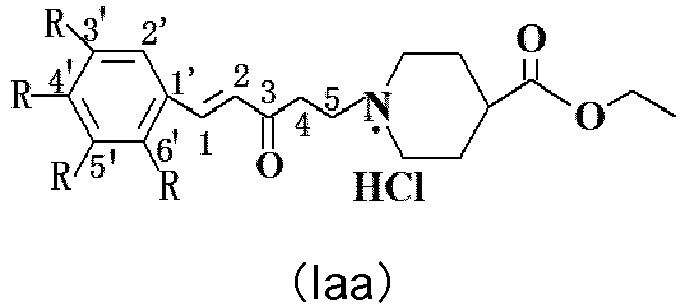
- A compound represented by the following general formula (lab)

- A compound selected from


- A pharmaceutical composition characterized in comprising a pharmaceutically effective dosage of a compound according to any one of claims 1-3, and a pharmaceutically acceptable carrier.
- The pharmaceutical compositions according to claim 4, characterized in that said the pharmaceutical compositions is a tablet, capsule, pill, injection, sustained-release, controlled-release and various fine particle delivery systems.
- Use of a compound according to any one of claims 1-3 for the preparation of drugs for the treatment or prophylaxis of inflammation.
- Use of a compound according to claim 6, characterized in that said inflammation is acute and chronic rheumatic arthritis, acute and chronic ankylosing, osteoarthritis, periarthritis of shoulder, bursitis, tendonitis and tenovaginitis.
- Use of a compound according to any one of claims 1-3 for the preparation of drugs for the treatment of anti-thrombus.
Applications Claiming Priority (2)
| Application Number | Priority Date | Filing Date | Title |
|---|---|---|---|
| CN2004100705282A CN1730476B (en) | 2004-08-06 | 2004-08-06 | Aromatic amine ketone compounds, its synthesis method, pharmaceutical composition containing same and uses |
| PCT/CN2005/001201 WO2006024217A1 (en) | 2004-08-06 | 2005-08-05 | Arylamine ketones, their preparation methods, the pharmaceutical compositions containing them and their use |
Publications (3)
| Publication Number | Publication Date |
|---|---|
| EP1783115A1 EP1783115A1 (en) | 2007-05-09 |
| EP1783115A4 EP1783115A4 (en) | 2010-04-07 |
| EP1783115B1 true EP1783115B1 (en) | 2016-07-13 |
Family
ID=35962901
Family Applications (1)
| Application Number | Title | Priority Date | Filing Date |
|---|---|---|---|
| EP05774475.7A Expired - Lifetime EP1783115B1 (en) | 2004-08-06 | 2005-08-05 | Arylamine ketones, their preparation methods, the pharmaceutical compositions containing them and their use |
Country Status (7)
| Country | Link |
|---|---|
| US (1) | US8524744B2 (en) |
| EP (1) | EP1783115B1 (en) |
| JP (1) | JP2008509094A (en) |
| CN (2) | CN1730476B (en) |
| CA (1) | CA2576830C (en) |
| EA (1) | EA200700413A1 (en) |
| WO (1) | WO2006024217A1 (en) |
Families Citing this family (5)
| Publication number | Priority date | Publication date | Assignee | Title |
|---|---|---|---|---|
| CN101264082B (en) * | 2007-03-14 | 2011-07-06 | 中国医学科学院药物研究所 | Compound for treating gastric injury |
| CN101264081B (en) * | 2007-03-14 | 2011-07-20 | 中国医学科学院药物研究所 | Compound for treating pulmonary fibrosis |
| CN101904843B (en) * | 2009-06-05 | 2014-04-30 | 中国医学科学院药物研究所 | Use of compound for preparing bone destruction inhibitor |
| CN110615774B (en) * | 2019-09-19 | 2022-11-11 | 安徽中医药大学 | Benzyl piperazine compound with anti-inflammatory activity, preparation method and medical application |
| CN118684636B (en) * | 2024-05-31 | 2025-03-11 | 上海优合贝德医药科技有限公司 | A kind of synthesis process of 4-morpholine-1-phenylmercapto-2-butanone |
Family Cites Families (14)
| Publication number | Priority date | Publication date | Assignee | Title |
|---|---|---|---|---|
| BE561320A (en) * | 1956-10-04 | 1960-05-20 | Lab Pharmaceutica Nv | PROCESS FOR THE PREPARATION OF NEW 4-CARBALKOXY-4-PHENYL PIPERIDINE DERIVATIVES. |
| US4209517A (en) * | 1978-07-17 | 1980-06-24 | Unicler | α-Ethylenic alcohols and ketones, their preparation, and their use as medicaments |
| US4548951A (en) * | 1983-04-21 | 1985-10-22 | Syntex (U.S.A.) Inc. | Hypotensive benzoxathiole pyrrolidines |
| US4791045A (en) * | 1988-01-25 | 1988-12-13 | Minnesota Mining And Manufacturing Company | Photosensitizers and polymerizable compositions with mannich bases and iodonium salts |
| CN1028100C (en) * | 1989-08-11 | 1995-04-05 | 默里尔多药物公司 | Process for preparing phenoxy-heterocyclic compounds |
| US6214994B1 (en) * | 1997-04-21 | 2001-04-10 | Molecular Geriatrics Corporation | Certain substituted 1-aryl-3-piperazin-1′-yl propanones |
| US5693804A (en) * | 1994-11-17 | 1997-12-02 | Molecular Geriatrics Corporation | Substituted 1-aryl-3-piperazin-1'-yl propanones |
| US5705501A (en) * | 1994-11-17 | 1998-01-06 | Molecular Geriatrics Corporation | Certain substituted 1-aryl-3-morpholinopropanones to treat Alzheimer's Disease |
| US5658909A (en) * | 1994-11-17 | 1997-08-19 | Molecular Geriatrics Corporation | Certain substituted 1-aryl-3-piperazin-1'-yl propanones to treat Alzheimer's Disease |
| US6262434B1 (en) * | 1996-08-23 | 2001-07-17 | California Micro Devices Corporation | Integrated circuit structures and methods to facilitate accurate measurement of the IC devices |
| GB2363792A (en) * | 2000-06-21 | 2002-01-09 | Portela & Ca Sa | Nitrocatechols |
| CN1181065C (en) * | 2002-05-08 | 2004-12-22 | 上海医药工业研究院 | Arylcarboxyalkylpiperazine Derivatives and Their Application as Neuroprotective Agents |
| US20040077529A1 (en) * | 2002-06-10 | 2004-04-22 | Per-Fredrik Lehmann | Urotensin II receptor agents |
| US7071211B2 (en) * | 2002-09-27 | 2006-07-04 | Bausch & Lomb Inc. | Small organic molecules that increase the activity of gelatinase a in ocular cells |
-
2004
- 2004-08-06 CN CN2004100705282A patent/CN1730476B/en not_active Expired - Lifetime
-
2005
- 2005-08-05 CA CA2576830A patent/CA2576830C/en not_active Expired - Fee Related
- 2005-08-05 JP JP2007524162A patent/JP2008509094A/en active Pending
- 2005-08-05 WO PCT/CN2005/001201 patent/WO2006024217A1/en not_active Ceased
- 2005-08-05 US US11/659,636 patent/US8524744B2/en not_active Expired - Fee Related
- 2005-08-05 EA EA200700413A patent/EA200700413A1/en unknown
- 2005-08-05 EP EP05774475.7A patent/EP1783115B1/en not_active Expired - Lifetime
- 2005-08-05 CN CNA2005800341984A patent/CN101146772A/en active Pending
Also Published As
| Publication number | Publication date |
|---|---|
| US20080221106A1 (en) | 2008-09-11 |
| CA2576830C (en) | 2014-10-28 |
| EP1783115A1 (en) | 2007-05-09 |
| CN1730476A (en) | 2006-02-08 |
| EA200700413A1 (en) | 2008-02-28 |
| CN1730476B (en) | 2011-04-06 |
| US8524744B2 (en) | 2013-09-03 |
| EP1783115A4 (en) | 2010-04-07 |
| JP2008509094A (en) | 2008-03-27 |
| CN101146772A (en) | 2008-03-19 |
| WO2006024217A1 (en) | 2006-03-09 |
| CA2576830A1 (en) | 2006-03-09 |
Similar Documents
| Publication | Publication Date | Title |
|---|---|---|
| US10144709B2 (en) | Piperidine compounds, pharmaceutical composition comprising the same and its use | |
| JP2002514647A (en) | New substituted arylhydroxamic acids as metalloproteinase inhibitors | |
| EP4592287A1 (en) | 2h-benzotriazole derivative, preparation method therefor, and pharmaceutical composition containing same | |
| US9630957B2 (en) | 2,3-butanediamide epoxide compound and preparation method and use thereof | |
| JP4982021B2 (en) | Use of bissulfonamide for the manufacture of a medicament for the prevention or treatment of hyperlipidemia | |
| EP1783115A1 (en) | Arylamine ketones, their preparation methods, the pharmaceutical compositions containing them and their use | |
| US11767295B2 (en) | Isoindole derivative | |
| JPH06247850A (en) | 12-lipoxygenase inhibitor | |
| US4442100A (en) | Substituted 2-amino-3,4-dihydropyridine derivatives, their production and their medicinal use | |
| WO1996016942A1 (en) | Pyridine derivatives | |
| US7411076B2 (en) | Coumarin derivative | |
| CN114853630A (en) | 2, 6-diphenylmethylene cyclohexanone oxime compound and preparation method and application thereof | |
| CN1730475B (en) | Aromatic amine ketene compounds, its synthesis method, pharmaceutical composition containing same and uses | |
| JPH03115267A (en) | Propiophenone derivative, its production and central muscle relaxant and antispasmodic agent containing the same | |
| KR102967967B1 (en) | Novel compound with pendrin inhibitory activity and medical use thereof | |
| CN121045089A (en) | Phenylidene piperazine-quinazoline hybrid compounds, their preparation methods and applications | |
| CN109134419A (en) | A kind of 2,2- dimethyl -1,3- dioxolanes analog derivative, preparation method and use | |
| CN121824453A (en) | Para-alkoxy benzene propionamide derivative, and preparation method and application thereof | |
| CN108863970A (en) | Noval chemical compound and its application in terms for the treatment of inflammation or inflammation related disease |
Legal Events
| Date | Code | Title | Description |
|---|---|---|---|
| PUAI | Public reference made under article 153(3) epc to a published international application that has entered the european phase |
Free format text: ORIGINAL CODE: 0009012 |
|
| 17P | Request for examination filed |
Effective date: 20070305 |
|
| AK | Designated contracting states |
Kind code of ref document: A1 Designated state(s): AT BE BG CH CY CZ DE DK EE ES FI FR GB GR HU IE IS IT LI LT LU LV MC NL PL PT RO SE SI SK TR |
|
| DAX | Request for extension of the european patent (deleted) | ||
| A4 | Supplementary search report drawn up and despatched |
Effective date: 20100305 |
|
| 17Q | First examination report despatched |
Effective date: 20100621 |
|
| GRAP | Despatch of communication of intention to grant a patent |
Free format text: ORIGINAL CODE: EPIDOSNIGR1 |
|
| RIC1 | Information provided on ipc code assigned before grant |
Ipc: C07D 211/14 20060101AFI20150724BHEP Ipc: A61P 29/00 20060101ALN20150724BHEP Ipc: C07D 211/64 20060101ALI20150724BHEP Ipc: C07D 211/20 20060101ALI20150724BHEP Ipc: C07D 211/22 20060101ALI20150724BHEP Ipc: A61K 31/496 20060101ALN20150724BHEP Ipc: C07D 211/66 20060101ALI20150724BHEP Ipc: C07D 211/60 20060101ALI20150724BHEP Ipc: C07D 211/36 20060101ALI20150724BHEP Ipc: C07D 241/04 20060101ALI20150724BHEP Ipc: C07D 211/18 20060101ALI20150724BHEP Ipc: C07D 211/62 20060101ALI20150724BHEP Ipc: A61K 31/5375 20060101ALN20150724BHEP Ipc: C07D 265/30 20060101ALI20150724BHEP Ipc: A61K 31/495 20060101ALN20150724BHEP Ipc: A61K 31/445 20060101ALN20150724BHEP |
|
| INTG | Intention to grant announced |
Effective date: 20150824 |
|
| RIC1 | Information provided on ipc code assigned before grant |
Ipc: C07D 265/30 20060101ALI20160114BHEP Ipc: C07D 211/64 20060101ALI20160114BHEP Ipc: C07D 211/22 20060101ALI20160114BHEP Ipc: A61K 31/495 20060101ALN20160114BHEP Ipc: C07D 211/18 20060101ALI20160114BHEP Ipc: A61K 31/496 20060101ALN20160114BHEP Ipc: C07D 211/36 20060101ALI20160114BHEP Ipc: C07D 211/62 20060101ALI20160114BHEP Ipc: C07D 211/60 20060101ALI20160114BHEP Ipc: A61P 29/00 20060101ALN20160114BHEP Ipc: A61K 31/5375 20060101ALN20160114BHEP Ipc: C07D 211/20 20060101ALI20160114BHEP Ipc: A61K 31/445 20060101ALN20160114BHEP Ipc: C07D 211/66 20060101ALI20160114BHEP Ipc: C07D 211/14 20060101AFI20160114BHEP Ipc: C07D 241/04 20060101ALI20160114BHEP |
|
| INTG | Intention to grant announced |
Effective date: 20160128 |
|
| RIC1 | Information provided on ipc code assigned before grant |
Ipc: C07D 211/64 20060101ALI20160119BHEP Ipc: C07D 211/36 20060101ALI20160119BHEP Ipc: C07D 211/14 20060101AFI20160119BHEP Ipc: A61P 29/00 20060101ALN20160119BHEP Ipc: C07D 211/60 20060101ALI20160119BHEP Ipc: A61K 31/445 20060101ALN20160119BHEP Ipc: C07D 211/22 20060101ALI20160119BHEP Ipc: A61K 31/495 20060101ALN20160119BHEP Ipc: A61K 31/496 20060101ALN20160119BHEP Ipc: A61K 31/5375 20060101ALN20160119BHEP Ipc: C07D 241/04 20060101ALI20160119BHEP Ipc: C07D 211/20 20060101ALI20160119BHEP Ipc: C07D 211/18 20060101ALI20160119BHEP Ipc: C07D 211/66 20060101ALI20160119BHEP Ipc: C07D 265/30 20060101ALI20160119BHEP Ipc: C07D 211/62 20060101ALI20160119BHEP |
|
| GRAS | Grant fee paid |
Free format text: ORIGINAL CODE: EPIDOSNIGR3 |
|
| GRAA | (expected) grant |
Free format text: ORIGINAL CODE: 0009210 |
|
| AK | Designated contracting states |
Kind code of ref document: B1 Designated state(s): AT BE BG CH CY CZ DE DK EE ES FI FR GB GR HU IE IS IT LI LT LU LV MC NL PL PT RO SE SI SK TR |
|
| REG | Reference to a national code |
Ref country code: GB Ref legal event code: FG4D |
|
| REG | Reference to a national code |
Ref country code: AT Ref legal event code: REF Ref document number: 812176 Country of ref document: AT Kind code of ref document: T Effective date: 20160715 Ref country code: CH Ref legal event code: EP |
|
| REG | Reference to a national code |
Ref country code: IE Ref legal event code: FG4D |
|
| REG | Reference to a national code |
Ref country code: DE Ref legal event code: R096 Ref document number: 602005049733 Country of ref document: DE |
|
| REG | Reference to a national code |
Ref country code: LT Ref legal event code: MG4D |
|
| REG | Reference to a national code |
Ref country code: NL Ref legal event code: MP Effective date: 20160713 |
|
| REG | Reference to a national code |
Ref country code: AT Ref legal event code: MK05 Ref document number: 812176 Country of ref document: AT Kind code of ref document: T Effective date: 20160713 |
|
| PG25 | Lapsed in a contracting state [announced via postgrant information from national office to epo] |
Ref country code: BE Free format text: LAPSE BECAUSE OF NON-PAYMENT OF DUE FEES Effective date: 20160831 |
|
| PG25 | Lapsed in a contracting state [announced via postgrant information from national office to epo] |
Ref country code: IS Free format text: LAPSE BECAUSE OF FAILURE TO SUBMIT A TRANSLATION OF THE DESCRIPTION OR TO PAY THE FEE WITHIN THE PRESCRIBED TIME-LIMIT Effective date: 20161113 Ref country code: IT Free format text: LAPSE BECAUSE OF FAILURE TO SUBMIT A TRANSLATION OF THE DESCRIPTION OR TO PAY THE FEE WITHIN THE PRESCRIBED TIME-LIMIT Effective date: 20160713 Ref country code: FI Free format text: LAPSE BECAUSE OF FAILURE TO SUBMIT A TRANSLATION OF THE DESCRIPTION OR TO PAY THE FEE WITHIN THE PRESCRIBED TIME-LIMIT Effective date: 20160713 Ref country code: NL Free format text: LAPSE BECAUSE OF FAILURE TO SUBMIT A TRANSLATION OF THE DESCRIPTION OR TO PAY THE FEE WITHIN THE PRESCRIBED TIME-LIMIT Effective date: 20160713 Ref country code: LT Free format text: LAPSE BECAUSE OF FAILURE TO SUBMIT A TRANSLATION OF THE DESCRIPTION OR TO PAY THE FEE WITHIN THE PRESCRIBED TIME-LIMIT Effective date: 20160713 |
|
| PG25 | Lapsed in a contracting state [announced via postgrant information from national office to epo] |
Ref country code: PT Free format text: LAPSE BECAUSE OF FAILURE TO SUBMIT A TRANSLATION OF THE DESCRIPTION OR TO PAY THE FEE WITHIN THE PRESCRIBED TIME-LIMIT Effective date: 20161114 Ref country code: SE Free format text: LAPSE BECAUSE OF FAILURE TO SUBMIT A TRANSLATION OF THE DESCRIPTION OR TO PAY THE FEE WITHIN THE PRESCRIBED TIME-LIMIT Effective date: 20160713 Ref country code: PL Free format text: LAPSE BECAUSE OF FAILURE TO SUBMIT A TRANSLATION OF THE DESCRIPTION OR TO PAY THE FEE WITHIN THE PRESCRIBED TIME-LIMIT Effective date: 20160713 Ref country code: AT Free format text: LAPSE BECAUSE OF FAILURE TO SUBMIT A TRANSLATION OF THE DESCRIPTION OR TO PAY THE FEE WITHIN THE PRESCRIBED TIME-LIMIT Effective date: 20160713 Ref country code: LV Free format text: LAPSE BECAUSE OF FAILURE TO SUBMIT A TRANSLATION OF THE DESCRIPTION OR TO PAY THE FEE WITHIN THE PRESCRIBED TIME-LIMIT Effective date: 20160713 Ref country code: BE Free format text: LAPSE BECAUSE OF FAILURE TO SUBMIT A TRANSLATION OF THE DESCRIPTION OR TO PAY THE FEE WITHIN THE PRESCRIBED TIME-LIMIT Effective date: 20160713 Ref country code: GR Free format text: LAPSE BECAUSE OF FAILURE TO SUBMIT A TRANSLATION OF THE DESCRIPTION OR TO PAY THE FEE WITHIN THE PRESCRIBED TIME-LIMIT Effective date: 20161014 Ref country code: ES Free format text: LAPSE BECAUSE OF FAILURE TO SUBMIT A TRANSLATION OF THE DESCRIPTION OR TO PAY THE FEE WITHIN THE PRESCRIBED TIME-LIMIT Effective date: 20160713 |
|
| REG | Reference to a national code |
Ref country code: FR Ref legal event code: PLFP Year of fee payment: 12 |
|
| REG | Reference to a national code |
Ref country code: CH Ref legal event code: PL |
|
| REG | Reference to a national code |
Ref country code: DE Ref legal event code: R097 Ref document number: 602005049733 Country of ref document: DE |
|
| PG25 | Lapsed in a contracting state [announced via postgrant information from national office to epo] |
Ref country code: MC Free format text: LAPSE BECAUSE OF FAILURE TO SUBMIT A TRANSLATION OF THE DESCRIPTION OR TO PAY THE FEE WITHIN THE PRESCRIBED TIME-LIMIT Effective date: 20160713 Ref country code: LI Free format text: LAPSE BECAUSE OF NON-PAYMENT OF DUE FEES Effective date: 20160831 Ref country code: RO Free format text: LAPSE BECAUSE OF FAILURE TO SUBMIT A TRANSLATION OF THE DESCRIPTION OR TO PAY THE FEE WITHIN THE PRESCRIBED TIME-LIMIT Effective date: 20160713 Ref country code: EE Free format text: LAPSE BECAUSE OF FAILURE TO SUBMIT A TRANSLATION OF THE DESCRIPTION OR TO PAY THE FEE WITHIN THE PRESCRIBED TIME-LIMIT Effective date: 20160713 Ref country code: CH Free format text: LAPSE BECAUSE OF NON-PAYMENT OF DUE FEES Effective date: 20160831 |
|
| PLBE | No opposition filed within time limit |
Free format text: ORIGINAL CODE: 0009261 |
|
| STAA | Information on the status of an ep patent application or granted ep patent |
Free format text: STATUS: NO OPPOSITION FILED WITHIN TIME LIMIT |
|
| PG25 | Lapsed in a contracting state [announced via postgrant information from national office to epo] |
Ref country code: SK Free format text: LAPSE BECAUSE OF FAILURE TO SUBMIT A TRANSLATION OF THE DESCRIPTION OR TO PAY THE FEE WITHIN THE PRESCRIBED TIME-LIMIT Effective date: 20160713 Ref country code: BG Free format text: LAPSE BECAUSE OF FAILURE TO SUBMIT A TRANSLATION OF THE DESCRIPTION OR TO PAY THE FEE WITHIN THE PRESCRIBED TIME-LIMIT Effective date: 20161013 Ref country code: CZ Free format text: LAPSE BECAUSE OF FAILURE TO SUBMIT A TRANSLATION OF THE DESCRIPTION OR TO PAY THE FEE WITHIN THE PRESCRIBED TIME-LIMIT Effective date: 20160713 Ref country code: DK Free format text: LAPSE BECAUSE OF FAILURE TO SUBMIT A TRANSLATION OF THE DESCRIPTION OR TO PAY THE FEE WITHIN THE PRESCRIBED TIME-LIMIT Effective date: 20160713 |
|
| REG | Reference to a national code |
Ref country code: IE Ref legal event code: MM4A |
|
| 26N | No opposition filed |
Effective date: 20170418 |
|
| PG25 | Lapsed in a contracting state [announced via postgrant information from national office to epo] |
Ref country code: IE Free format text: LAPSE BECAUSE OF NON-PAYMENT OF DUE FEES Effective date: 20160805 |
|
| PG25 | Lapsed in a contracting state [announced via postgrant information from national office to epo] |
Ref country code: LU Free format text: LAPSE BECAUSE OF NON-PAYMENT OF DUE FEES Effective date: 20160805 Ref country code: SI Free format text: LAPSE BECAUSE OF FAILURE TO SUBMIT A TRANSLATION OF THE DESCRIPTION OR TO PAY THE FEE WITHIN THE PRESCRIBED TIME-LIMIT Effective date: 20160713 |
|
| REG | Reference to a national code |
Ref country code: FR Ref legal event code: PLFP Year of fee payment: 13 |
|
| PGFP | Annual fee paid to national office [announced via postgrant information from national office to epo] |
Ref country code: GB Payment date: 20170822 Year of fee payment: 13 Ref country code: DE Payment date: 20170817 Year of fee payment: 13 Ref country code: FR Payment date: 20170831 Year of fee payment: 13 |
|
| PG25 | Lapsed in a contracting state [announced via postgrant information from national office to epo] |
Ref country code: CY Free format text: LAPSE BECAUSE OF FAILURE TO SUBMIT A TRANSLATION OF THE DESCRIPTION OR TO PAY THE FEE WITHIN THE PRESCRIBED TIME-LIMIT Effective date: 20160713 Ref country code: HU Free format text: LAPSE BECAUSE OF FAILURE TO SUBMIT A TRANSLATION OF THE DESCRIPTION OR TO PAY THE FEE WITHIN THE PRESCRIBED TIME-LIMIT; INVALID AB INITIO Effective date: 20050805 |
|
| PG25 | Lapsed in a contracting state [announced via postgrant information from national office to epo] |
Ref country code: TR Free format text: LAPSE BECAUSE OF FAILURE TO SUBMIT A TRANSLATION OF THE DESCRIPTION OR TO PAY THE FEE WITHIN THE PRESCRIBED TIME-LIMIT Effective date: 20160713 |
|
| REG | Reference to a national code |
Ref country code: DE Ref legal event code: R119 Ref document number: 602005049733 Country of ref document: DE |
|
| GBPC | Gb: european patent ceased through non-payment of renewal fee |
Effective date: 20180805 |
|
| PG25 | Lapsed in a contracting state [announced via postgrant information from national office to epo] |
Ref country code: DE Free format text: LAPSE BECAUSE OF NON-PAYMENT OF DUE FEES Effective date: 20190301 |
|
| PG25 | Lapsed in a contracting state [announced via postgrant information from national office to epo] |
Ref country code: FR Free format text: LAPSE BECAUSE OF NON-PAYMENT OF DUE FEES Effective date: 20180831 |
|
| PG25 | Lapsed in a contracting state [announced via postgrant information from national office to epo] |
Ref country code: GB Free format text: LAPSE BECAUSE OF NON-PAYMENT OF DUE FEES Effective date: 20180805 |