EP1783108A1 - Method for producing halogen-substituted benzenedimethanol - Google Patents
Method for producing halogen-substituted benzenedimethanol Download PDFInfo
- Publication number
- EP1783108A1 EP1783108A1 EP05768392A EP05768392A EP1783108A1 EP 1783108 A1 EP1783108 A1 EP 1783108A1 EP 05768392 A EP05768392 A EP 05768392A EP 05768392 A EP05768392 A EP 05768392A EP 1783108 A1 EP1783108 A1 EP 1783108A1
- Authority
- EP
- European Patent Office
- Prior art keywords
- halogen
- group
- substituted
- groups
- optionally substituted
- Prior art date
- Legal status (The legal status is an assumption and is not a legal conclusion. Google has not performed a legal analysis and makes no representation as to the accuracy of the status listed.)
- Granted
Links
- 0 *c1c(C(O*)=O)c(*)c(*)c(C(O*)=O)c1* Chemical compound *c1c(C(O*)=O)c(*)c(*)c(C(O*)=O)c1* 0.000 description 1
Classifications
-
- C—CHEMISTRY; METALLURGY
- C07—ORGANIC CHEMISTRY
- C07C—ACYCLIC OR CARBOCYCLIC COMPOUNDS
- C07C33/00—Unsaturated compounds having hydroxy or O-metal groups bound to acyclic carbon atoms
- C07C33/40—Halogenated unsaturated alcohols
- C07C33/46—Halogenated unsaturated alcohols containing only six-membered aromatic rings as cyclic parts
-
- C—CHEMISTRY; METALLURGY
- C07—ORGANIC CHEMISTRY
- C07C—ACYCLIC OR CARBOCYCLIC COMPOUNDS
- C07C29/00—Preparation of compounds having hydroxy or O-metal groups bound to a carbon atom not belonging to a six-membered aromatic ring
- C07C29/132—Preparation of compounds having hydroxy or O-metal groups bound to a carbon atom not belonging to a six-membered aromatic ring by reduction of an oxygen containing functional group
- C07C29/136—Preparation of compounds having hydroxy or O-metal groups bound to a carbon atom not belonging to a six-membered aromatic ring by reduction of an oxygen containing functional group of >C=O containing groups, e.g. —COOH
- C07C29/147—Preparation of compounds having hydroxy or O-metal groups bound to a carbon atom not belonging to a six-membered aromatic ring by reduction of an oxygen containing functional group of >C=O containing groups, e.g. —COOH of carboxylic acids or derivatives thereof
-
- C—CHEMISTRY; METALLURGY
- C07—ORGANIC CHEMISTRY
- C07C—ACYCLIC OR CARBOCYCLIC COMPOUNDS
- C07C33/00—Unsaturated compounds having hydroxy or O-metal groups bound to acyclic carbon atoms
- C07C33/40—Halogenated unsaturated alcohols
Definitions
- the present invention relates to a method for producing a halogen-substituted benzenedimethanol.
- a halogen-substituted benzenedimethanol is an important compound as raw materials and intermediates of pharmaceuticals and agrichemicals, and especially, US 4927852 discloses 2,3,5,6-tetrafluorobenzenedimethanol is useful as an intermediate of household pesticides.
- US 4927852 discloses a method comprising conducting bromination of 2,3,5,6-tetrafluoroparaxylene followed by conducting acetoxylation and then hydrolysis.
- GB 2127013 A discloses a method comprising reacting 2,3,5,6-tetrafluoroterephthalic chloride with sodium borohydride.
- US 5583131 discloses a method comprising reacting 2,3,5,6-tetrafluoroterephthalic acid with borane ⁇ tetrahydrofuran complex
- US 6759558 discloses a method comprising reacting 2,3,5,6-tetrafluoroterephthalic acid with sodium borohydride in the presence of dimethyl sulfate or sulfuric acid.
- JP 2002-20332 A discloses a method comprising hydrogenating 2,3,5,6-tetrafluoroterephthalonitrile followed by conducting diazotization and then hydrolysis.
- the present invention provides a method for producing a halogen-substituted benzenedimethanol represented by the formula (2): wherein X 1 to X 4 are the same or different and independently represent a hydrogen or halogen atom, provided that at least one of X 1 to X 4 is a halogen atom, by reacting a halogen-substituted terephthalic acid diester represented by the formula (1): wherein R 1 and R 2 are the same or different and independently represent an optionally substituted C1-C20 alkyl group and the substitutent of the alkyl group is a fluorine atom; a C1-C20 alkoxy group which is optionally substituted with a halogen atom or atoms; a C6-C20 aryl group which is optionally substituted with a C1-C6 alkoxy group or groups; a C6-C20 aryloxy group which is optionally substituted with a C1-C6 alkoxy group or groups or phen
- R 1 and R 2 are the same or different and represent a C1-C20 alkyl group which may have a substituent or substituents.
- the above-mentioned substituent is a fluorine atom; a C1-C20 alkoxy group which is optionally substituted with a halogen atom or atoms; a C6-C20 aryl group which is optionally substituted with a C1-C6 alkoxy group or groups; a C6-C20 aryloxy group which is optionally substituted with a C1-C6 alkoxy group or groups or a phenoxy group or groups; or a C7-C20 aralkyloxy group which is optionally substituted with a C1-C6 alkoxy group or groups or phenoxy group or groups.
- X 1 to X 4 are the same or different and independently represent a hydrogen or halogen atom, provided that at least one of X 1 to X 4 is a halogen atom.
- Examples of the C1-C20 alkyl group include a straight chain, branched chain or cyclic alkyl group such as a methyl, ethyl, n-propyl, isopropyl, n-butyl, isobutyl, sec-butyl, tert-butyl, n-pentyl, n-decyl, cyclopropyl, 2,2-dimethylcyclopropyl, cyclopentyl, cyclohexyl and menthyl group.
- a straight chain, branched chain or cyclic alkyl group such as a methyl, ethyl, n-propyl, isopropyl, n-butyl, isobutyl, sec-butyl, tert-butyl, n-pentyl, n-decyl, cyclopropyl, 2,2-dimethylcyclopropyl, cyclopentyl, cyclo
- the alkyl group may have a substituent or substituents and the substituent is a fluorine atom; a C1-C20 alkoxy group which is optionally substituted with a halogen atom or atoms; a C6-C20 aryl group which is optionally substituted with a C1-C6 alkoxy group or groups; a C6-C20 aryloxy group which is optionally substituted with a C1-C6 alkoxy group or groups or a phenoxy group or groups; or a C7-C20 aralkyloxy group which is optionally substituted with a C1-C6 alkoxy group or groups or phenoxy group or groups.
- halogen atom examples include a fluorine, chlorine and bromine atom.
- Examples of the C1-C20 alkoxy group which is optionally substituted with a halogen atom or atoms include a methoxy, ethoxy, n-propoxy, isopropoxy, n-butoxy, isobutoxy, sec-butoxyl, tert-butoxy, n-hexyloxy, n-decyloxy and trifluoromethoxy group.
- Examples of the C6-C20 aryl group which is optionally substituted with a C1-C6 alkoxy group or groups include a phenyl, 4-methylphenyl and 4-methoxyphenyl group.
- Examples of the C6-C20 aryloxy group which is optionally substituted with a C1-C6 alkoxy group or groups or a phenoxy group or groups include a phenoxy, 2-methylphenoxy, 4-methylphenoxy, 4-methoxyphenoxy and 3-phenoxyphenoxy group.
- Examples of the C7-C20 aralkyloxy group which is optionally substituted with a C1-C6 alkoxy group or groups or a phenoxy group or groups include a benzyloxy, 4-methylbenzyloxy, 4-methoxybenzyloxy and 3-phenoxybenzyloxy group.
- alkyl group substituted with the substituent or substituents examples include a fluoromethyl, trifluoromethyl, methoxymethyl, ethoxymethyl, methoxyethyl, benzyl, phenoxymethyl and benzyloxymethyl group.
- halogen-substituted terephthalic acid diester (1) examples include dimethyl 2-fluoroterephthalate, dimethyl 2-chloroterephthalate, dimethyl 2,5-difluoroterephthalate, dimethyl 2,6-difluoroterephthalate, dimethyl 2,3-difluoroterephthalate, dimethyl 2,5-dichloroterephthalate, dimethyl 2,6-dichloroterephthalate, dimethyl 2,3-dichloroterephthalate, dimethyl 2,3,5-trifluoroterephthalate, dimethyl 2,3,5-trichloroterephthalate, dimethyl 2,3,5,6-tetrafluoroterephthalate, diethyl 2,3,5,6-tetrafluoroterephthalate, di(n-propyl) 2,3,5,6-tetrafluoroterephthalate, diisopropyl 2,3,5,6-tetrafluoroterephthalate, di(n-butyl) 2,3,5,6-tetrafluorote
- the halogen-substituted terephthalic acid diester (1) can be produced, for example, by a method described in EP 0140482 B .
- the borohydride compound examples include an alkali metal borohydride such as sodium borohydride, lithium borohydride and potassium borohydride and an alkaline earth metal borohydride such as calcium borohydride and magnesium borohydride.
- the alkali metal borohydride is preferable and sodium borohydride is more preferable.
- a commercially available borohydride compound may be used and those prepared according to method described in US 3471268 , Inorganic Chemistry, 1981, 20, 4454 and the like may be used.
- the borohydride compound those priviously prepared may be used and it may be prepared in the reaction system.
- the amount of the borohydride compound to be used is usually 2 to 5 moles, preferably 2 to 2.5 moles relative to 1 mole of the halogen-substituted terephthalic acid diester (1).
- the alcohol means an organic compound wherein one or more hydrogen atom of a hydrocarbon is substituted with a hydroxyl group.
- examples thereof include an aliphatic alcohol such as methanol, ethanol, n-propanol, isopropanol, n-butanol and tert-butanol, and an aromatic alcohol such as phenol and benzyl alcohol, and the aliphatic alcohol is preferable and methanol is more preferable.
- the amount of the alcohol to be used is not particularly limited and large excess thereof, for example, 100 parts by weight relative to 1 part of the halogen-substituted terephthalic acid diester (1), may be used as the solvent and it is practically 1 to 50 moles relative to 1 mole of the halogen-substituted terephthalic acid diester (1).
- the present reaction is carried out in a solvent.
- the solvent include an ether solvent such as diethyl ether, methyl tert-butyl ether, tetrahydrofuran, dioxane and diisopropyl ether, and an aromatic hydrocarbon solvent such as toluene, xylene and chlorobenzene.
- the alcohol can be used as the solvent as described above.
- the amount of the solvent to be used is not particularly limited and it is practically not more than 100 parts by weight relative to 1 part of the halogen-substituted terephthalic acid diester (1).
- the reaction is conducted by adding the alcohol to a mixture obtained by mixing the halogen-substituted terephthalic acid diester (1), the borohydride compound and the solvent.
- the reaction is usually carried out under ordinary pressure conditions, and may be carried out under pressurized conditions.
- the progress of the reaction can be confirmed by a conventional analytical means such as gas chromatography and high performance liquid chromatography.
- a reaction liquid is mixed with an aqueous solution of a mineral acid such as hydrochloric acid, sulfuric acid, phosphoric acid and nitric acid, if necessary, followed by conducting treatment such as neutralizing, extracting using an organic solvent and concentrating to isolate a halogen-substituted benzenedimethanol represented by the formula (2) (hereinafter, simply referred to as the halogen-substituted benzenedimethanol (2)).
- the halogen-substituted benzenedimethanol (2) isolated may be further purified by a conventional purification means such as recrystallization and column chromatography.
- Examples of the halogen-substituted benzenedimethanol (2) thus obtained include 2-fluoro-1,4-benzendimethanol, 2-chloro-1,4-benzendimethanol, 2,5-difluoro-1,4-benzendimethanol, 2,6-difluoro-1,4-benzendimethanol, 2,3-difluoro-1,4-benzendimethanol, 2,5-dichloro-1,4-benzendimethanol, 2,6-dichloro-1,4-benzendimethanol, 2,3-dichloro-1,4-benzendimethanol, 2,3,5-trifluoro-1,4-benzendimethanol, 2,3,5-trichloro-1,4-benzendimethanol, 2,3,5,6-tetrafluorobenzendimethanol, 2,3,5,6-tetrachlorobenzendimethanol, and 2,3,5-trifluoro-6-chlorobenzendimethanol.
- the solution obtained was concentrated, 100 g of water was added to the residue obtained to extract three times with 70 g of ethyl acetate and the organic layers obtained were mixed. To the organic layer, magnesium sulfate anhydride was added and dried. After filtering off magnesium sulfate, the filtrate was concentrated to obtain 6.38 g of white crystals of 2,3,5,6-tetrafluorobenzenedimethanol. The crystals were analyzed by the gas chromatography internal standard method to find that the content of 2,3,5,6-tetrafluorobenzenedimethanol was 92.5%. Yield: 84%.
- the crystals were analyzed by the liquid chromatography area percentage method to find that the content of 2,3,5,6-tetrachlorobenzenedimethanol was 99.6%. Further, the filtrate after filtering the crystals was concentrated and the crystals precipitated were filtered and dried to obtain 0.63 g of white crystals of 2,3,5,6-tetrachlorobenzenedimethanol. The content of 2,3,5,6-tetrachlorobenzenedimethanol was 90.2%. Yield: 90%.
Landscapes
- Chemical & Material Sciences (AREA)
- Organic Chemistry (AREA)
- Organic Low-Molecular-Weight Compounds And Preparation Thereof (AREA)
Abstract

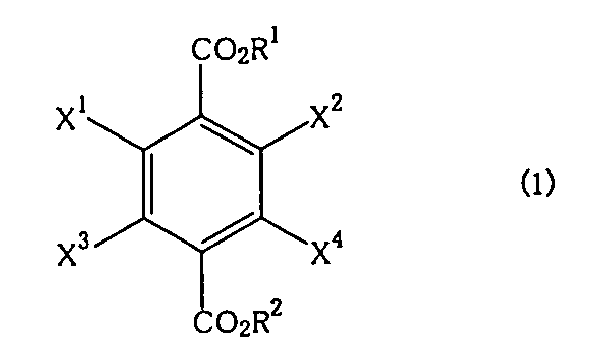
with a borohydride compound in the presence of an alcohol which comprises adding the alcohol into a mixture of the halogen-substituted terephthalic acid diester represented by the formula (1), the borohydride compound and a solvent.
Description
- The present invention relates to a method for producing a halogen-substituted benzenedimethanol.
- A halogen-substituted benzenedimethanol is an important compound as raw materials and intermediates of pharmaceuticals and agrichemicals, and especially,
US 4927852 discloses 2,3,5,6-tetrafluorobenzenedimethanol is useful as an intermediate of household pesticides. - As a method for producing 2,3,5,6-tetrafluorobenzenedimethanol, for example,
US 4927852 discloses a method comprising conducting bromination of 2,3,5,6-tetrafluoroparaxylene followed by conducting acetoxylation and then hydrolysis.GB 2127013 A US 5583131 discloses a method comprising reacting 2,3,5,6-tetrafluoroterephthalic acid with borane·tetrahydrofuran complex andUS 6759558 discloses a method comprising reacting 2,3,5,6-tetrafluoroterephthalic acid with sodium borohydride in the presence of dimethyl sulfate or sulfuric acid.JP 2002-20332 A - The present invention provides a method for producing a halogen-substituted benzenedimethanol represented by the formula (2):


with a borohydride compound in the presence of an alcohol which comprises adding the alcohol into a mixture of the halogen-substituted terephthalic acid diester represented by the formula (1), the borohydride compound and a solvent. - In the halogen-substituted terephthalic acid diester represented by the formula (1) (hereinafter, simply referred to as the halogen-substituted terephthalic acid diester (1)), in the formula, R1 and R2 are the same or different and represent a C1-C20 alkyl group which may have a substituent or substituents. Herein, the above-mentioned substituent is a fluorine atom; a C1-C20 alkoxy group which is optionally substituted with a halogen atom or atoms; a C6-C20 aryl group which is optionally substituted with a C1-C6 alkoxy group or groups; a C6-C20 aryloxy group which is optionally substituted with a C1-C6 alkoxy group or groups or a phenoxy group or groups; or a C7-C20 aralkyloxy group which is optionally substituted with a C1-C6 alkoxy group or groups or phenoxy group or groups. X1 to X4 are the same or different and independently represent a hydrogen or halogen atom, provided that at least one of X1 to X4 is a halogen atom.
- Examples of the C1-C20 alkyl group include a straight chain, branched chain or cyclic alkyl group such as a methyl, ethyl, n-propyl, isopropyl, n-butyl, isobutyl, sec-butyl, tert-butyl, n-pentyl, n-decyl, cyclopropyl, 2,2-dimethylcyclopropyl, cyclopentyl, cyclohexyl and menthyl group.
- The alkyl group may have a substituent or substituents and the substituent is a fluorine atom; a C1-C20 alkoxy group which is optionally substituted with a halogen atom or atoms; a C6-C20 aryl group which is optionally substituted with a C1-C6 alkoxy group or groups; a C6-C20 aryloxy group which is optionally substituted with a C1-C6 alkoxy group or groups or a phenoxy group or groups; or a C7-C20 aralkyloxy group which is optionally substituted with a C1-C6 alkoxy group or groups or phenoxy group or groups.
- Examples of the halogen atom include a fluorine, chlorine and bromine atom.
- Examples of the C1-C20 alkoxy group which is optionally substituted with a halogen atom or atoms include a methoxy, ethoxy, n-propoxy, isopropoxy, n-butoxy, isobutoxy, sec-butoxyl, tert-butoxy, n-hexyloxy, n-decyloxy and trifluoromethoxy group.
- Examples of the C6-C20 aryl group which is optionally substituted with a C1-C6 alkoxy group or groups include a phenyl, 4-methylphenyl and 4-methoxyphenyl group.
- Examples of the C6-C20 aryloxy group which is optionally substituted with a C1-C6 alkoxy group or groups or a phenoxy group or groups include a phenoxy, 2-methylphenoxy, 4-methylphenoxy, 4-methoxyphenoxy and 3-phenoxyphenoxy group.
- Examples of the C7-C20 aralkyloxy group which is optionally substituted with a C1-C6 alkoxy group or groups or a phenoxy group or groups include a benzyloxy, 4-methylbenzyloxy, 4-methoxybenzyloxy and 3-phenoxybenzyloxy group.
- Examples of the alkyl group substituted with the substituent or substituents include a fluoromethyl, trifluoromethyl, methoxymethyl, ethoxymethyl, methoxyethyl, benzyl, phenoxymethyl and benzyloxymethyl group.
- Examples of the halogen-substituted terephthalic acid diester (1) include dimethyl 2-fluoroterephthalate, dimethyl 2-chloroterephthalate, dimethyl 2,5-difluoroterephthalate, dimethyl 2,6-difluoroterephthalate, dimethyl 2,3-difluoroterephthalate, dimethyl 2,5-dichloroterephthalate, dimethyl 2,6-dichloroterephthalate, dimethyl 2,3-dichloroterephthalate, dimethyl 2,3,5-trifluoroterephthalate, dimethyl 2,3,5-trichloroterephthalate, dimethyl 2,3,5,6-tetrafluoroterephthalate, diethyl 2,3,5,6-tetrafluoroterephthalate, di(n-propyl) 2,3,5,6-tetrafluoroterephthalate, diisopropyl 2,3,5,6-tetrafluoroterephthalate, di(n-butyl) 2,3,5,6-tetrafluoroterephthalate, di(tert-butyl) 2,3,5,6-tetrafluoroterephthalate, dimethyl 2,3,5,6-tetrachloroterephthalate, diethyl 2,3,5,6-tetrachloroterephthalate, di(n-propyl) 2,3,5,6-tetrachloroterephthalate, diisopropyl 2,3,5,6-tetrachloroterephthalate, di(n-butyl) 2,3,5,6-tetrachloroterephthalate, di(tert-butyl) 2,3,5,6-tetrachloroterephthalate, and dimethyl 2,3,5-trifluoro-6-chloroterephthalate. The halogen-substituted terephthalic acid diester (1) wherein R1 and R2 are the same C1-C6 alkyl groups is preferable.
- The halogen-substituted terephthalic acid diester (1) can be produced, for example, by a method described in
EP 0140482 B . - Examples of the borohydride compound include an alkali metal borohydride such as sodium borohydride, lithium borohydride and potassium borohydride and an alkaline earth metal borohydride such as calcium borohydride and magnesium borohydride. The alkali metal borohydride is preferable and sodium borohydride is more preferable.
- A commercially available borohydride compound may be used and those prepared according to method described in
US 3471268 , Inorganic Chemistry, 1981, 20, 4454 and the like may be used. As the borohydride compound, those priviously prepared may be used and it may be prepared in the reaction system. - The amount of the borohydride compound to be used is usually 2 to 5 moles, preferably 2 to 2.5 moles relative to 1 mole of the halogen-substituted terephthalic acid diester (1).
- The alcohol means an organic compound wherein one or more hydrogen atom of a hydrocarbon is substituted with a hydroxyl group. Examples thereof include an aliphatic alcohol such as methanol, ethanol, n-propanol, isopropanol, n-butanol and tert-butanol, and an aromatic alcohol such as phenol and benzyl alcohol, and the aliphatic alcohol is preferable and methanol is more preferable. The amount of the alcohol to be used is not particularly limited and large excess thereof, for example, 100 parts by weight relative to 1 part of the halogen-substituted terephthalic acid diester (1), may be used as the solvent and it is practically 1 to 50 moles relative to 1 mole of the halogen-substituted terephthalic acid diester (1).
- The present reaction is carried out in a solvent. Examples of the solvent include an ether solvent such as diethyl ether, methyl tert-butyl ether, tetrahydrofuran, dioxane and diisopropyl ether, and an aromatic hydrocarbon solvent such as toluene, xylene and chlorobenzene. The alcohol can be used as the solvent as described above. The amount of the solvent to be used is not particularly limited and it is practically not more than 100 parts by weight relative to 1 part of the halogen-substituted terephthalic acid diester (1).
- The reaction is conducted by adding the alcohol to a mixture obtained by mixing the halogen-substituted terephthalic acid diester (1), the borohydride compound and the solvent.
- The reaction is usually carried out under ordinary pressure conditions, and may be carried out under pressurized conditions. The progress of the reaction can be confirmed by a conventional analytical means such as gas chromatography and high performance liquid chromatography.
- After completion of the reaction, for example, a reaction liquid is mixed with an aqueous solution of a mineral acid such as hydrochloric acid, sulfuric acid, phosphoric acid and nitric acid, if necessary, followed by conducting treatment such as neutralizing, extracting using an organic solvent and concentrating to isolate a halogen-substituted benzenedimethanol represented by the formula (2) (hereinafter, simply referred to as the halogen-substituted benzenedimethanol (2)). The halogen-substituted benzenedimethanol (2) isolated may be further purified by a conventional purification means such as recrystallization and column chromatography.
- Examples of the halogen-substituted benzenedimethanol (2) thus obtained include 2-fluoro-1,4-benzendimethanol, 2-chloro-1,4-benzendimethanol, 2,5-difluoro-1,4-benzendimethanol, 2,6-difluoro-1,4-benzendimethanol, 2,3-difluoro-1,4-benzendimethanol, 2,5-dichloro-1,4-benzendimethanol, 2,6-dichloro-1,4-benzendimethanol, 2,3-dichloro-1,4-benzendimethanol, 2,3,5-trifluoro-1,4-benzendimethanol, 2,3,5-trichloro-1,4-benzendimethanol, 2,3,5,6-tetrafluorobenzendimethanol, 2,3,5,6-tetrachlorobenzendimethanol, and 2,3,5-trifluoro-6-chlorobenzendimethanol.
- Into a 200 ml flask, 2.61 g of sodium borohydride, 26.8 g of tetrahydrofuran and 8.94 g of dimethyl 2,3,5,6-tetrafluoroterephthalate were charged. 26.7 g of methanol was added dropwise thereto at an inner temperature of 55°C over 80 minutes with stirring. After stirring at the same temperature for 6.5 hours, the mixing was conducted at room temperature for 20 hours. 24.5 g of 10% by weight hydrochloric acid was added dropwise to the reaction liquid at 25 to 30°C over 1 hour followed by stirring at the same temperature for 1 hour. Further, 8 g of 23% by weight aqueous sodium hydroxide was added thereto. The solution obtained was concentrated, 100 g of water was added to the residue obtained to extract three times with 70 g of ethyl acetate and the organic layers obtained were mixed. To the organic layer, magnesium sulfate anhydride was added and dried. After filtering off magnesium sulfate, the filtrate was concentrated to obtain 6.38 g of white crystals of 2,3,5,6-tetrafluorobenzenedimethanol. The crystals were analyzed by the gas chromatography internal standard method to find that the content of 2,3,5,6-tetrafluorobenzenedimethanol was 92.5%. Yield: 84%.
- Into a 200 ml flask, 1.66 g of sodium borohydride, 20 g of methyl tert-butyl ether and 5.32 g of dimethyl 2,3,5,6-tetrafluoroterephthalate were charged. 18.0 g of methanol was added dropwise thereto at an inner temperature of 55°C over 3 hours with stirring. After stirring at the same temperature for 5 hours, the resultant mixture was cooled to room temperature. 16 g of 10% by weight hydrochloric acid was added dropwise to the reaction liquid at 25 to 30°C over 30 minutes followed by stirring at the same temperature for 30 minutes. Further, 45% by weight aqueous sodium hydroxide was added thereto to adjust to pH 8. Methanol and methyl tert-butyl ether were distilled away from the solution obtained and 50 g of ethyl acetate was added to the residue obtained to extract twice and the organic layers obtained were mixed. To the organic layer, magnesium sulfate anhydride was added and dried. After filtering off magnesium sulfate, the filtrate was concentrated to obtain 10 g of concentrated liquid. To the concentrated liquid, 30 g of toluene was added and the crystals were precipitated. The crystals was filtered and dried to obtain 3.82 g of white crystals of 2,3,5,6-tetrafluorobenzenedimethanol. The crystals were analyzed by the liquid chromatography area percentage method to find that the content of 2,3,5,6-tetrafluorobenzenedimethanol was 95.5%. Yield: 87%.
- Into a 200 ml flask, 1.66 g of sodium borohydride, 18 g of tetrahydrofuran and 6.64 g of dimethyl 2,3,5,6-tetrachloroterephthalate were charged. 18.0 g of methanol was added dropwise thereto at an inner temperature of 55°C over 3 hours with stirring. After stirring at the same temperature for 5 hours, the resultant mixture was cooled to room temperature. 16 g of 10% by weight hydrochloric acid was added dropwise to the reaction liquid at 25 to 30°C over 30 minutes followed by stirring at the same temperature for 30 minutes. Further, 45% by weight aqueous sodium hydroxide was added thereto to adjust to pH 8. Methanol and tetrahydrofuran were distilled away from the solution obtained, and 50 g of ethyl acetate was added to the residue obtained to repeat twice extraction and the organic layers obtained were mixed. To the organic layer, magnesium sulfate anhydride was added to conduct dehydration and then, the solid was filtering off. The filtrate was concentrated and to the residue obtained, 5 g of toluene and 30 g of n-hexane were added and the crystals were precipitated. The crystals was filtered and dried to obtain 4.40 g of white crystals of 2,3,5,6-tetrachlorobenzenedimethanol. The crystals were analyzed by the liquid chromatography area percentage method to find that the content of 2,3,5,6-tetrachlorobenzenedimethanol was 99.6%. Further, the filtrate after filtering the crystals was concentrated and the crystals precipitated were filtered and dried to obtain 0.63 g of white crystals of 2,3,5,6-tetrachlorobenzenedimethanol. The content of 2,3,5,6-tetrachlorobenzenedimethanol was 90.2%. Yield: 90%.
Claims (8)
- A method for producing a halogen-substituted benzenedimethanol represented by the formula (2):


with a borohydride compound in the presence of an alcohol which comprises adding the alcohol into a mixture of the halogen-substituted terephthalic acid diester represented by the formula (1), the borohydride compound and a solvent. - The method according to claim 1, wherein R1 and R2 are the same C1-C6 alkyl groups.
- The method according to claim 1 or 2, wherein all of X1 to X4 are fluorine atoms.
- The method according to claim 1 or 2, wherein the amount of the borohydride compound to be used is 2 to 2.5 moles relative to 1 mole of the halogen-substituted terephthalic acid diester represented by the formula (1).
- The method according to claim 1 or 2, wherein the borohydride compound is an alkali metal borohydride.
- The method according to claim 5, wherein the alkali metal borohydride is sodium borohydride.
- The method according to claim 1 or 2, wherein the alcohol is an aliphatic alcohol.
- The method according to claim 7, wherein the aliphatic alcohol is methanol.
Applications Claiming Priority (2)
| Application Number | Priority Date | Filing Date | Title |
|---|---|---|---|
| JP2004228954 | 2004-08-05 | ||
| PCT/JP2005/014486 WO2006013999A1 (en) | 2004-08-05 | 2005-08-02 | Method for producing halogen-substituted benzenedimethanol |
Publications (3)
| Publication Number | Publication Date |
|---|---|
| EP1783108A1 true EP1783108A1 (en) | 2007-05-09 |
| EP1783108A4 EP1783108A4 (en) | 2008-04-23 |
| EP1783108B1 EP1783108B1 (en) | 2010-12-22 |
Family
ID=35787273
Family Applications (1)
| Application Number | Title | Priority Date | Filing Date |
|---|---|---|---|
| EP05768392A Expired - Lifetime EP1783108B1 (en) | 2004-08-05 | 2005-08-02 | Method for producing halogen-substituted benzenedimethanol |
Country Status (8)
| Country | Link |
|---|---|
| US (1) | US7678947B2 (en) |
| EP (1) | EP1783108B1 (en) |
| KR (1) | KR101189383B1 (en) |
| CN (1) | CN101001823A (en) |
| AT (1) | ATE492523T1 (en) |
| DE (1) | DE602005025497D1 (en) |
| ES (1) | ES2355834T3 (en) |
| WO (1) | WO2006013999A1 (en) |
Cited By (1)
| Publication number | Priority date | Publication date | Assignee | Title |
|---|---|---|---|---|
| EP2033944A4 (en) * | 2006-06-27 | 2010-04-07 | Sumitomo Chemical Co | PROCESS FOR PRODUCING HALOGEN-SUBSTITUTED BENZENEDIMETHANOL |
Families Citing this family (4)
| Publication number | Priority date | Publication date | Assignee | Title |
|---|---|---|---|---|
| HUP0800566A3 (en) * | 2006-01-10 | 2010-08-30 | Sumitomo Chemical Co | Method for producing halogen-substituted benzenedimethanol |
| KR101287752B1 (en) * | 2006-01-24 | 2013-07-19 | 스미또모 가가꾸 가부시키가이샤 | Method for producing halogen-substituted benzenedimethanol |
| JP5109499B2 (en) * | 2006-06-27 | 2012-12-26 | 住友化学株式会社 | Production method of halogen-substituted benzenedimethanol |
| WO2010101299A1 (en) * | 2009-03-05 | 2010-09-10 | 住友化学株式会社 | Method for producing halogen-substituted benzene dimethanol |
Family Cites Families (16)
| Publication number | Priority date | Publication date | Assignee | Title |
|---|---|---|---|---|
| FR1438326A (en) | 1965-03-04 | 1966-05-13 | Rhone Poulenc Sa | Preparation of alkali borohydrides |
| DE2658074C2 (en) | 1976-12-22 | 1986-12-04 | Bayer Ag, 5090 Leverkusen | Cyclopropanecarboxylic acid esters of halogenated benzyl alcohols, process for their preparation and their use for combating insects and acarids |
| US4183950A (en) * | 1976-12-22 | 1980-01-15 | Bayer Aktiengesellschaft | Combating arthropods with 2,2-dimethyl-3-vinyl-cyclopropane carboxylic acid esters of halogenated benzyl alcohols |
| GB8718620D0 (en) * | 1987-08-06 | 1987-09-09 | Ici Plc | Insecticide compounds |
| GB2217013B (en) | 1988-04-07 | 1992-10-21 | Kodak Ltd | Control of light emission from devices such as cathode ray tubes |
| GB9126677D0 (en) * | 1991-12-16 | 1992-02-12 | Johnson Matthey Plc | Improvements in chemical compounds |
| DE19651439A1 (en) | 1996-12-11 | 1998-06-18 | Hoechst Ag | Polymerizable biaryls, process for their preparation and their use |
| JPH1143455A (en) | 1997-07-25 | 1999-02-16 | Mitsubishi Chem Corp | Method for producing halogenated alcohol |
| KR100681257B1 (en) | 1999-05-07 | 2007-02-09 | 쇼와 덴코 가부시키가이샤 | Method for producing tetrafluorobenzenemethanol |
| US6433196B1 (en) | 2000-02-17 | 2002-08-13 | Sumika Fine Chemicals Co., Ltd. | Production method of citalopram, intermediate therefor and production method of the intermediate |
| DE60137422D1 (en) * | 2000-07-04 | 2009-03-05 | Showa Denko Kk | METHOD FOR PRODUCING A BENZOLDIMETHANOL COMPOUND |
| JP4409057B2 (en) | 2000-07-04 | 2010-02-03 | 昭和電工株式会社 | Method for producing benzenedimethanol compound |
| HUP0303249A3 (en) | 2001-02-22 | 2007-03-28 | Sankyo Co | Water-soluble triazole fungicide compounds and pharmaceutical compositions containing them |
| DE10117206A1 (en) * | 2001-04-06 | 2002-10-10 | Bayer Ag | Process for the preparation of halogen-substituted dibenzyl alcohols, these halogen-substituted dibenzyl alcohols and their use |
| CN1204104C (en) | 2003-06-06 | 2005-06-01 | 天津大学 | Process for preparing 2,3,5,6-Tetrafluoro-para-xylyl alcohol |
| US7312366B2 (en) * | 2003-10-10 | 2007-12-25 | Jiangsu Yangong Chemical Co., Ltd. | Preparation of one intermediate for pyrethroids |
-
2005
- 2005-08-02 EP EP05768392A patent/EP1783108B1/en not_active Expired - Lifetime
- 2005-08-02 US US11/572,505 patent/US7678947B2/en not_active Expired - Fee Related
- 2005-08-02 KR KR1020077005129A patent/KR101189383B1/en not_active Expired - Fee Related
- 2005-08-02 CN CNA200580026279XA patent/CN101001823A/en active Pending
- 2005-08-02 DE DE602005025497T patent/DE602005025497D1/en not_active Expired - Lifetime
- 2005-08-02 ES ES05768392T patent/ES2355834T3/en not_active Expired - Lifetime
- 2005-08-02 WO PCT/JP2005/014486 patent/WO2006013999A1/en not_active Ceased
- 2005-08-02 AT AT05768392T patent/ATE492523T1/en not_active IP Right Cessation
Cited By (2)
| Publication number | Priority date | Publication date | Assignee | Title |
|---|---|---|---|---|
| EP2033944A4 (en) * | 2006-06-27 | 2010-04-07 | Sumitomo Chemical Co | PROCESS FOR PRODUCING HALOGEN-SUBSTITUTED BENZENEDIMETHANOL |
| US7973201B2 (en) | 2006-06-27 | 2011-07-05 | Sumitomo Chemical Company, Limited | Process for production of halogen-substituted benzenedimethanol |
Also Published As
| Publication number | Publication date |
|---|---|
| EP1783108B1 (en) | 2010-12-22 |
| ES2355834T3 (en) | 2011-03-31 |
| EP1783108A4 (en) | 2008-04-23 |
| ATE492523T1 (en) | 2011-01-15 |
| WO2006013999A1 (en) | 2006-02-09 |
| US20070213570A1 (en) | 2007-09-13 |
| DE602005025497D1 (en) | 2011-02-03 |
| CN101001823A (en) | 2007-07-18 |
| KR20070045310A (en) | 2007-05-02 |
| US7678947B2 (en) | 2010-03-16 |
| KR101189383B1 (en) | 2012-10-10 |
Similar Documents
| Publication | Publication Date | Title |
|---|---|---|
| US7678947B2 (en) | Method for producing halogen-substituted benzenedimethanol | |
| US20190084921A1 (en) | Method of preparation of 4-isopropylamino-1-butanol | |
| US7973201B2 (en) | Process for production of halogen-substituted benzenedimethanol | |
| EP1978008B1 (en) | Method for producing halogen-substituted benzenedimethanol | |
| JP4815926B2 (en) | Method for producing halogen-substituted benzenedimethanol | |
| CA2516465A1 (en) | Chemical process for the preparation of intermediates to obtain n-formyl hydroxylamine compounds | |
| US20080064905A1 (en) | Process for preparing 1,2-diols from carbonyl compounds | |
| JP5109499B2 (en) | Production method of halogen-substituted benzenedimethanol | |
| EP1299343B1 (en) | Production method for benzenedimethanol compound | |
| JP5115762B2 (en) | Process for producing 4-formylpiperidine acetal derivative | |
| WO2015005341A1 (en) | Method for manufacturing optically active fluorolactic acid derivative | |
| JP5417860B2 (en) | Method for producing α-hydroxyesters | |
| EP2123627B1 (en) | Process for producing aromatic amine having aralkyloxy or heteroaralkyloxy group | |
| CN101490013B (en) | Method for preparing imidazolidine-2,4-dione compound and method for obtaining solid 4,5-dihydroxy-2-imidazolidinone compound | |
| JP5233123B2 (en) | Production of halogen-substituted benzenedimethanol | |
| JP5220985B2 (en) | Method for producing α-perfluoroalkylacrylic acid | |
| CN109836373B (en) | Environment-friendly preparation method of vitamin B6 and tail gas recycling method | |
| CA2496847C (en) | Process for producing aminobenzopyran compound | |
| JP2007211001A (en) | Production method of halogen-substituted benzenedimethanol | |
| HUP0800566A2 (en) | Method for producing halogen-substituted benzenedimethanol | |
| US20070166806A1 (en) | Process for making amino acids | |
| JP2007223964A (en) | Method for refining 4-(n-ethyl-n-isopropylamino)aniline | |
| JP2007290995A (en) | Method for producing 4-aminotetrahydropyran compound | |
| KR20110125258A (en) | Process for producing halogen substituted benzenedimethanol |
Legal Events
| Date | Code | Title | Description |
|---|---|---|---|
| PUAI | Public reference made under article 153(3) epc to a published international application that has entered the european phase |
Free format text: ORIGINAL CODE: 0009012 |
|
| 17P | Request for examination filed |
Effective date: 20070202 |
|
| AK | Designated contracting states |
Kind code of ref document: A1 Designated state(s): AT BE BG CH CY CZ DE DK EE ES FI FR GB GR HU IE IS IT LI LT LU LV MC NL PL PT RO SE SI SK TR |
|
| DAX | Request for extension of the european patent (deleted) | ||
| A4 | Supplementary search report drawn up and despatched |
Effective date: 20080320 |
|
| 17Q | First examination report despatched |
Effective date: 20080701 |
|
| GRAP | Despatch of communication of intention to grant a patent |
Free format text: ORIGINAL CODE: EPIDOSNIGR1 |
|
| GRAS | Grant fee paid |
Free format text: ORIGINAL CODE: EPIDOSNIGR3 |
|
| GRAA | (expected) grant |
Free format text: ORIGINAL CODE: 0009210 |
|
| AK | Designated contracting states |
Kind code of ref document: B1 Designated state(s): AT BE BG CH CY CZ DE DK EE ES FI FR GB GR HU IE IS IT LI LT LU LV MC NL PL PT RO SE SI SK TR |
|
| REG | Reference to a national code |
Ref country code: GB Ref legal event code: FG4D |
|
| REG | Reference to a national code |
Ref country code: CH Ref legal event code: EP |
|
| REG | Reference to a national code |
Ref country code: IE Ref legal event code: FG4D |
|
| REF | Corresponds to: |
Ref document number: 602005025497 Country of ref document: DE Date of ref document: 20110203 Kind code of ref document: P |
|
| REG | Reference to a national code |
Ref country code: DE Ref legal event code: R096 Ref document number: 602005025497 Country of ref document: DE Effective date: 20110203 |
|
| REG | Reference to a national code |
Ref country code: ES Ref legal event code: FG2A Ref document number: 2355834 Country of ref document: ES Kind code of ref document: T3 Effective date: 20110331 |
|
| REG | Reference to a national code |
Ref country code: NL Ref legal event code: VDEP Effective date: 20101222 |
|
| PG25 | Lapsed in a contracting state [announced via postgrant information from national office to epo] |
Ref country code: LT Free format text: LAPSE BECAUSE OF FAILURE TO SUBMIT A TRANSLATION OF THE DESCRIPTION OR TO PAY THE FEE WITHIN THE PRESCRIBED TIME-LIMIT Effective date: 20101222 |
|
| LTIE | Lt: invalidation of european patent or patent extension |
Effective date: 20101222 |
|
| REG | Reference to a national code |
Ref country code: HU Ref legal event code: AG4A Ref document number: E009984 Country of ref document: HU |
|
| PG25 | Lapsed in a contracting state [announced via postgrant information from national office to epo] |
Ref country code: LV Free format text: LAPSE BECAUSE OF FAILURE TO SUBMIT A TRANSLATION OF THE DESCRIPTION OR TO PAY THE FEE WITHIN THE PRESCRIBED TIME-LIMIT Effective date: 20101222 Ref country code: BG Free format text: LAPSE BECAUSE OF FAILURE TO SUBMIT A TRANSLATION OF THE DESCRIPTION OR TO PAY THE FEE WITHIN THE PRESCRIBED TIME-LIMIT Effective date: 20110322 Ref country code: FI Free format text: LAPSE BECAUSE OF FAILURE TO SUBMIT A TRANSLATION OF THE DESCRIPTION OR TO PAY THE FEE WITHIN THE PRESCRIBED TIME-LIMIT Effective date: 20101222 Ref country code: CY Free format text: LAPSE BECAUSE OF FAILURE TO SUBMIT A TRANSLATION OF THE DESCRIPTION OR TO PAY THE FEE WITHIN THE PRESCRIBED TIME-LIMIT Effective date: 20101222 Ref country code: SI Free format text: LAPSE BECAUSE OF FAILURE TO SUBMIT A TRANSLATION OF THE DESCRIPTION OR TO PAY THE FEE WITHIN THE PRESCRIBED TIME-LIMIT Effective date: 20101222 Ref country code: SE Free format text: LAPSE BECAUSE OF FAILURE TO SUBMIT A TRANSLATION OF THE DESCRIPTION OR TO PAY THE FEE WITHIN THE PRESCRIBED TIME-LIMIT Effective date: 20101222 Ref country code: AT Free format text: LAPSE BECAUSE OF FAILURE TO SUBMIT A TRANSLATION OF THE DESCRIPTION OR TO PAY THE FEE WITHIN THE PRESCRIBED TIME-LIMIT Effective date: 20101222 |
|
| PG25 | Lapsed in a contracting state [announced via postgrant information from national office to epo] |
Ref country code: PT Free format text: LAPSE BECAUSE OF FAILURE TO SUBMIT A TRANSLATION OF THE DESCRIPTION OR TO PAY THE FEE WITHIN THE PRESCRIBED TIME-LIMIT Effective date: 20110422 Ref country code: CZ Free format text: LAPSE BECAUSE OF FAILURE TO SUBMIT A TRANSLATION OF THE DESCRIPTION OR TO PAY THE FEE WITHIN THE PRESCRIBED TIME-LIMIT Effective date: 20101222 Ref country code: IS Free format text: LAPSE BECAUSE OF FAILURE TO SUBMIT A TRANSLATION OF THE DESCRIPTION OR TO PAY THE FEE WITHIN THE PRESCRIBED TIME-LIMIT Effective date: 20110422 Ref country code: GR Free format text: LAPSE BECAUSE OF FAILURE TO SUBMIT A TRANSLATION OF THE DESCRIPTION OR TO PAY THE FEE WITHIN THE PRESCRIBED TIME-LIMIT Effective date: 20110323 Ref country code: EE Free format text: LAPSE BECAUSE OF FAILURE TO SUBMIT A TRANSLATION OF THE DESCRIPTION OR TO PAY THE FEE WITHIN THE PRESCRIBED TIME-LIMIT Effective date: 20101222 Ref country code: BE Free format text: LAPSE BECAUSE OF FAILURE TO SUBMIT A TRANSLATION OF THE DESCRIPTION OR TO PAY THE FEE WITHIN THE PRESCRIBED TIME-LIMIT Effective date: 20101222 |
|
| PG25 | Lapsed in a contracting state [announced via postgrant information from national office to epo] |
Ref country code: NL Free format text: LAPSE BECAUSE OF FAILURE TO SUBMIT A TRANSLATION OF THE DESCRIPTION OR TO PAY THE FEE WITHIN THE PRESCRIBED TIME-LIMIT Effective date: 20101222 Ref country code: SK Free format text: LAPSE BECAUSE OF FAILURE TO SUBMIT A TRANSLATION OF THE DESCRIPTION OR TO PAY THE FEE WITHIN THE PRESCRIBED TIME-LIMIT Effective date: 20101222 Ref country code: RO Free format text: LAPSE BECAUSE OF FAILURE TO SUBMIT A TRANSLATION OF THE DESCRIPTION OR TO PAY THE FEE WITHIN THE PRESCRIBED TIME-LIMIT Effective date: 20101222 Ref country code: PL Free format text: LAPSE BECAUSE OF FAILURE TO SUBMIT A TRANSLATION OF THE DESCRIPTION OR TO PAY THE FEE WITHIN THE PRESCRIBED TIME-LIMIT Effective date: 20101222 |
|
| PLBE | No opposition filed within time limit |
Free format text: ORIGINAL CODE: 0009261 |
|
| STAA | Information on the status of an ep patent application or granted ep patent |
Free format text: STATUS: NO OPPOSITION FILED WITHIN TIME LIMIT |
|
| PG25 | Lapsed in a contracting state [announced via postgrant information from national office to epo] |
Ref country code: DK Free format text: LAPSE BECAUSE OF FAILURE TO SUBMIT A TRANSLATION OF THE DESCRIPTION OR TO PAY THE FEE WITHIN THE PRESCRIBED TIME-LIMIT Effective date: 20101222 |
|
| 26N | No opposition filed |
Effective date: 20110923 |
|
| REG | Reference to a national code |
Ref country code: DE Ref legal event code: R097 Ref document number: 602005025497 Country of ref document: DE Effective date: 20110923 |
|
| PG25 | Lapsed in a contracting state [announced via postgrant information from national office to epo] |
Ref country code: MC Free format text: LAPSE BECAUSE OF NON-PAYMENT OF DUE FEES Effective date: 20110831 |
|
| REG | Reference to a national code |
Ref country code: CH Ref legal event code: PL |
|
| PG25 | Lapsed in a contracting state [announced via postgrant information from national office to epo] |
Ref country code: LI Free format text: LAPSE BECAUSE OF NON-PAYMENT OF DUE FEES Effective date: 20110831 Ref country code: CH Free format text: LAPSE BECAUSE OF NON-PAYMENT OF DUE FEES Effective date: 20110831 |
|
| REG | Reference to a national code |
Ref country code: IE Ref legal event code: MM4A |
|
| PG25 | Lapsed in a contracting state [announced via postgrant information from national office to epo] |
Ref country code: IE Free format text: LAPSE BECAUSE OF NON-PAYMENT OF DUE FEES Effective date: 20110802 |
|
| PGFP | Annual fee paid to national office [announced via postgrant information from national office to epo] |
Ref country code: GB Payment date: 20120801 Year of fee payment: 8 |
|
| PGFP | Annual fee paid to national office [announced via postgrant information from national office to epo] |
Ref country code: FR Payment date: 20120823 Year of fee payment: 8 Ref country code: DE Payment date: 20120725 Year of fee payment: 8 Ref country code: HU Payment date: 20120712 Year of fee payment: 8 Ref country code: ES Payment date: 20120907 Year of fee payment: 8 |
|
| PG25 | Lapsed in a contracting state [announced via postgrant information from national office to epo] |
Ref country code: LU Free format text: LAPSE BECAUSE OF NON-PAYMENT OF DUE FEES Effective date: 20110802 |
|
| PG25 | Lapsed in a contracting state [announced via postgrant information from national office to epo] |
Ref country code: TR Free format text: LAPSE BECAUSE OF FAILURE TO SUBMIT A TRANSLATION OF THE DESCRIPTION OR TO PAY THE FEE WITHIN THE PRESCRIBED TIME-LIMIT Effective date: 20101222 |
|
| GBPC | Gb: european patent ceased through non-payment of renewal fee |
Effective date: 20130802 |
|
| PG25 | Lapsed in a contracting state [announced via postgrant information from national office to epo] |
Ref country code: DE Free format text: LAPSE BECAUSE OF NON-PAYMENT OF DUE FEES Effective date: 20140301 Ref country code: HU Free format text: LAPSE BECAUSE OF NON-PAYMENT OF DUE FEES Effective date: 20130803 |
|
| REG | Reference to a national code |
Ref country code: DE Ref legal event code: R119 Ref document number: 602005025497 Country of ref document: DE Effective date: 20140301 |
|
| REG | Reference to a national code |
Ref country code: FR Ref legal event code: ST Effective date: 20140430 |
|
| PG25 | Lapsed in a contracting state [announced via postgrant information from national office to epo] |
Ref country code: GB Free format text: LAPSE BECAUSE OF NON-PAYMENT OF DUE FEES Effective date: 20130802 |
|
| PG25 | Lapsed in a contracting state [announced via postgrant information from national office to epo] |
Ref country code: FR Free format text: LAPSE BECAUSE OF NON-PAYMENT OF DUE FEES Effective date: 20130902 |
|
| REG | Reference to a national code |
Ref country code: ES Ref legal event code: FD2A Effective date: 20140909 |
|
| PG25 | Lapsed in a contracting state [announced via postgrant information from national office to epo] |
Ref country code: ES Free format text: LAPSE BECAUSE OF NON-PAYMENT OF DUE FEES Effective date: 20130803 |
|
| PGFP | Annual fee paid to national office [announced via postgrant information from national office to epo] |
Ref country code: IT Payment date: 20140807 Year of fee payment: 10 |
|
| PG25 | Lapsed in a contracting state [announced via postgrant information from national office to epo] |
Ref country code: IT Free format text: LAPSE BECAUSE OF NON-PAYMENT OF DUE FEES Effective date: 20150802 |