EP1779068B1 - A method and system for adaptive navigation using a driver's route knowledge - Google Patents
A method and system for adaptive navigation using a driver's route knowledge Download PDFInfo
- Publication number
- EP1779068B1 EP1779068B1 EP05775061A EP05775061A EP1779068B1 EP 1779068 B1 EP1779068 B1 EP 1779068B1 EP 05775061 A EP05775061 A EP 05775061A EP 05775061 A EP05775061 A EP 05775061A EP 1779068 B1 EP1779068 B1 EP 1779068B1
- Authority
- EP
- European Patent Office
- Prior art keywords
- route
- user
- instructions
- navigation
- driver
- Prior art date
- Legal status (The legal status is an assumption and is not a legal conclusion. Google has not performed a legal analysis and makes no representation as to the accuracy of the status listed.)
- Expired - Lifetime
Links
Images




Classifications
-
- G—PHYSICS
- G08—SIGNALLING
- G08G—TRAFFIC CONTROL SYSTEMS
- G08G1/00—Traffic control systems for road vehicles
- G08G1/09—Arrangements for giving variable traffic instructions
- G08G1/0962—Arrangements for giving variable traffic instructions having an indicator mounted inside the vehicle, e.g. giving voice messages
- G08G1/0968—Systems involving transmission of navigation instructions to the vehicle
- G08G1/096855—Systems involving transmission of navigation instructions to the vehicle where the output is provided in a suitable form to the driver
- G08G1/096872—Systems involving transmission of navigation instructions to the vehicle where the output is provided in a suitable form to the driver where instructions are given per voice
-
- G—PHYSICS
- G01—MEASURING; TESTING
- G01C—MEASURING DISTANCES, LEVELS OR BEARINGS; SURVEYING; NAVIGATION; GYROSCOPIC INSTRUMENTS; PHOTOGRAMMETRY OR VIDEOGRAMMETRY
- G01C21/00—Navigation; Navigational instruments not provided for in groups G01C1/00 - G01C19/00
- G01C21/26—Navigation; Navigational instruments not provided for in groups G01C1/00 - G01C19/00 specially adapted for navigation in a road network
- G01C21/34—Route searching; Route guidance
- G01C21/36—Input/output arrangements for on-board computers
- G01C21/3626—Details of the output of route guidance instructions
- G01C21/3641—Personalized guidance, e.g. limited guidance on previously travelled routes
-
- G—PHYSICS
- G08—SIGNALLING
- G08G—TRAFFIC CONTROL SYSTEMS
- G08G1/00—Traffic control systems for road vehicles
- G08G1/09—Arrangements for giving variable traffic instructions
- G08G1/0962—Arrangements for giving variable traffic instructions having an indicator mounted inside the vehicle, e.g. giving voice messages
- G08G1/0968—Systems involving transmission of navigation instructions to the vehicle
- G08G1/096805—Systems involving transmission of navigation instructions to the vehicle where the transmitted instructions are used to compute a route
- G08G1/096811—Systems involving transmission of navigation instructions to the vehicle where the transmitted instructions are used to compute a route where the route is computed offboard
- G08G1/096822—Systems involving transmission of navigation instructions to the vehicle where the transmitted instructions are used to compute a route where the route is computed offboard where the segments of the route are transmitted to the vehicle at different locations and times
-
- G—PHYSICS
- G08—SIGNALLING
- G08G—TRAFFIC CONTROL SYSTEMS
- G08G1/00—Traffic control systems for road vehicles
- G08G1/09—Arrangements for giving variable traffic instructions
- G08G1/0962—Arrangements for giving variable traffic instructions having an indicator mounted inside the vehicle, e.g. giving voice messages
- G08G1/0968—Systems involving transmission of navigation instructions to the vehicle
- G08G1/096833—Systems involving transmission of navigation instructions to the vehicle where different aspects are considered when computing the route
- G08G1/096838—Systems involving transmission of navigation instructions to the vehicle where different aspects are considered when computing the route where the user preferences are taken into account or the user selects one route out of a plurality
Definitions
- the present invention relates to a method and system for adapting navigation instructions using a driver's knowledge about roads and routes, for example, and/or information regarding an external situation.
- the in-car devices requiring interaction with the driver may include, for example, navigation systems.
- navigation systems In the automotive industry, commercially available navigation systems may offer general-purpose turn-by-turn instructions, which may be helpful on certain occasions, but may be undesirable sometimes because they do not take into account a driver's knowledge, such as, for example, the driver's knowledge regarding certain roads or routes. The commercially available systems may also not take into account the external driving situation.
- Zukerman and Albrecht in the section entitled “Predictive statistical models for user modeling” of the 2001 publication "User Modeling and User-Adaptive Interaction” discuss two main user modeling techniques to adapt the behavior of systems in the contexts of a user-specific web page recommendation, namely, content-based modeling and collaborative modeling.
- Content-based modeling assumes that users exhibit particular behaviors under given circumstances, and that this behavior is repeated under similar circumstances, which may be most useful when a user's past behavior is a reliable indicator of future behavior.
- Collaborative modeling assumes that people with related characteristics tend to behave similarly under the same circumstances, which may be most useful when a user's behavior is similar to that of other (like- minded) users.
- the collaborative modeling may be used for a new user when there is not enough evidence to support a reliable prediction, and as more evidence is collected, the system may switch to the content-based approach.
- the document US 2002 / 082771 A1 describes computing a navigation route based on route segment attributes reflecting user-specific knowledge of the route segments or of a region.
- the present invention is defined in the appended claims and permits to adapt navigation instructions based on a driver's knowledge regarding, for example, roads, routes, points of interest (POIs) along the routes, etc. (referred herein collectively as “the driver's route knowledge").
- the driver's route knowledge may be represented, for example, by all the decision points (DPs) along the routes, in which the driver has traveled, together with the driver's familiarity with the decision points.
- the exemplary method may select navigation instructions to be presented to the driver based on the driver's familiarity with a decision point on a route.
- a model of the driver's route knowledge may be maintained and dynamically updated in an implicit manner by observing the driver's daily driving activities and responses to clarification questions, or in an explicit manner by directly querying the driver.
- the decision points may be hierarchically organized to handle the instances, for example, when there is a mismatch between the driver model and the driver's actual knowledge.
- An exemplary embodiment and/or exemplary method according to the present invention may provide a natural language dialogue interface for operating in-car devices and services, which may impose a minimum cognitive load on the driver by understanding drivers' requests and producing responses based on the driver's knowledge, the conversational context, and/or the external situation. It is believed that an interactive, robust and situation aware dialogue may enhance usability and safety by reducing cognitive load in the driving situation.
- An exemplary system may allow the driver to operate in-car equipment and obtain navigation information (e.g., turn-by-turn instructions) or other information about local facilities.
- An exemplary embodiment and/or exemplary method may provide a representation of the driver's route knowledge that is scaleable and allows fast dynamic updates.
- Prior approaches may use representations that log all intersections and roads that a driver has driven, which may explode in size, and also use information that is not necessarily salient to the driver to bias routes.
- An exemplary embodiment and/or exemplary method may also provide a navigation content selection method makes decisions about navigation instruction presentation to the driver based on a model of the driver's route knowledge and/or the external situation, whereas prior approaches may make decisions based on generalized driver prototypes.
- the user may be provided with only that information which is important or relevant to achieve that navigation task at hand. This may be useful, for example, for cognitively overloaded environments, such as driving a car.
- speaker recognition algorithms may be used to track down which routes belong to which driver so that cars with multiple drivers, such as, for example, rental cars, may also be accommodated.
- Two decision processes may be particularly relevant in the driving domain, that is, the decisions of "what to say” and "when to say it".
- an exemplary embodiment and/or exemplary method according to the present invention may generate instructions and related information required for the success of the navigation task at hand, while providing reaffirmation and necessary grounding, which is customized as appropriate for the current driver.
- an exemplary embodiment and/or exemplary method may generate appropriate navigation information at the appropriate time, being cognizant of the potentially stressful situations such as missed turns and driving situations requiring high attentiveness, so that, for example, output that is not immediately critical may be delayed. Accordingly, navigation instructions may be adaptively generated and/or tailored on the basis of characteristics of both the driver and the external situation.
- An exemplary embodiment and/or exemplary method of the present invention may address the "what to say" decision, such as, for example, the selection of navigation information to be presented to the driver, using a model of the driver's route knowledge.
- a content selection process may be included, for example, as a component of a domain-independent natural language generation system, which may be provided, for example, as part of a dialogue system toolkit.
- the in-car domain may raise specific issues for generation, such as situation awareness, user adaptibility, incremental generation, conversation resumption, and time sensitive generation.
- An exemplary embodiment and/or exemplary method of the present invention may address the "when to say it" decision using a model of the user's cognitive load, which may be estimated from a variety of sources, including, for example, instrumentation (e.g. sensors) and human factors.
- An exemplary embodiment and/or exemplary method of the present invention may improve the presentation of information to the user and enhance the perception of the dialog system's intelligence, and consequently may speed up the market acceptance of the technologies and improves products' competitiveness.
- a navigation system in any given car may be used by the same driver for many times, there may be opportunity to collect a large amount of driver-specific data through both implicit observations and explicit interactions.
- a GPS-based navigation system may maintain a history of all the places the driver has been to, and use this to generate hypotheses about the driver's route knowledge. Based on this knowledge, reasonable assumptions may be made about what the driver knows and predictions about what the driver needs to know. In this regard, evidence used to form the hypotheses may be gathered, for example, by implicit observation and explicit enquiry. In implicit observation, the driver's daily driving activities and use of clarification questions may provide useful information regarding the driver and what he may know.
- the driver has driven to a place without asking for help, it may be assumed that the driver is familiar with the route between the origin and destination. If the driver queries how to implement a specific navigation instruction, such as, for example, if the driver asks how to get to Highway 101, it may be assumed that the driver is not familiar with that route.
- a direct query may be used to determine if a driver has been to a particular place or not, and if so, whether the driver still needs help.
- an exemplary dialog system might say to the driver: You should first drive to Highway 101. Do you know how to get there? Accordingly, based on the driver's reply, the exemplary system may update its representation of the driver's route knowledge.
- an exemplary system may learn from this data and adapt its responses on the basis of the learned driver model. Accordingly, the exemplary system may omit information that the driver is familiar with, since otherwise, presenting all information, including information that the driver already knows, may be a distraction and/or cause irritation.
- both the content-based approach and the collaborative approach may be used.
- the content-based modeling approach may be appropriate when a sufficient amount of user specific data has been accumulated, and the collaborative modeling approach may provide defaults when user specific data is not available.
- Figure 1 shows an exemplary dialogue exchange 100 between a driver and an exemplary system according to the present invention, in which the exemplary system provides customized output to the driver based on the driver's knowledge.
- the exemplary system in response to the driver's request Ul for directions to a particular destination, the exemplary system adapts its responses or queries S1-S6 to the driver based on the driver's knowledge.
- the driver's knowledge may include, for example, a familiarity and/or preference regarding the local routes. Accordingly, instructions provided by the exemplary system may be more tailored to the driver and/or the task at hand.
- a description for a route from the driver's home to the freeway may be reduced to something like that in S1 in Figure 1 if the exemplary system knows that this is a route already known to the driver.
- the exemplary system may also refer to previous driving experiences, as in Take the freeway south; you 'll take the same exit you took to get to Bob 's house last week.
- Such adaptive instructions may be preferable to the turn-by-turn instructions provided by other navigation systems in use today.
- Generating personalized navigation instructions may require acquisition and representation of the driver's route knowledge. Representations that log all intersections and roads that a driver has driven may explode in size, and therefore may include and/or use information that is not necessarily salient to the driver (e.g. a crossroad or intersection in which the driver simply must past through but no other action by the driver is required).
- the Route-Compiler system described in " Personalization of the automotive information environment" by Rogers et al., which appears in the 1997 Proceedings of the Workshop on Machine Learning in the Real World: Methodological Aspects and Implications, held in Nashville, TN represents the routes that a driver has driven as a graph, in which nodes represent intersections and arcs represent the routes between them.
- a context-free grammar is extracted from the graph to represent the driver's route knowledge at various levels of detail, which is used to bias a route planing procedure to favor familiar routes, with the goal of minimizing the probability of getting lost.
- a route may be represented by all the decision points (DPs) along the route, including, for example, the intersections where the driver makes a turn, where a street name or its class changes, or where the route begins and ends (e.g., origin and destination).
- DPs decision points
- streets and roads may be assigned a class of 1 to 6, for example, with 6 denoting interstates and freeways, 3 denoting expressways, and 2 being a default class for most city streets.
- Figure 2 shows an exemplary decision point (DP) 200 describing that the driver should turn left from Arastradeo Road into Foothill Expressway, the driver has made this maneuver twice before, and the last time was on January 27, 2004 at 3pm.
- the exemplary decision point (DP) 200 includes "features" to structure the information contained therein.
- the exemplary decision point (DP) 200 includes the features of a "FromStreet”, “IntoStreet”, “TurnDirection”, “Familiarity”, and “LastVisit”, where FromStreet is the street from which the vehicle is to make a turn, IntoStreet is the street into which the vehicle should turn, TurnDirection is the direction the vehicle should turn, e.g., left, south, u-turn, Familiarity is a measure of how familiar the driver is with this intersection, based on the number of times the driver has driven through this intersection from and into the same road, making the same turn, and LastVisit is the last time that the driver was here.
- FromStreet, IntoStreet, and TurnDirection uniquely identify the exemplary decision point (DP). Familiarity may be measured, for example, on a scale of 1 to 5, with 5 indicating high familiarity. This information may be used, for example, to determine whether a decision point (DP) should be presented to the driver. LastVisit may be used, for example, as follows: if the driver traveled through a destination (DP) a long time ago, it may be assumed that the driver will not remember it, however, if the driver traveled the decision point (DP) fairly recently, then this information may be used to remind the driver about this intersection or road by referring to the driver's previous experience.
- the decision points (DPs) may be stored and maintained, for example, in a knowledge base through Protégé, which is a tool for constructing and maintaining knowledge resources (information regarding Protégé may be found, for example, in Musen et al., "Protégé II : An environment for reusable problem-solving methods and domain ontologies" appearing the 1993 International Joint Conference on Artificial Intelligence” held in Savoie, France ). For each routing task, all the decision points along the route may be examined. If a decision point (DP) is new, an entry may be created in the knowledge base with a Familiarity value of 1. If the decision point (DP) is already in the knowledge base, its Familiarity value is incremented. If the driver queries about the decision point (DP) or gives a negative answer to the system's query about the decision point (DP), its Familiarity value is decremented.
- the exemplary system may have no knowledge of the driver's background. As the interactions between the driver and the system increase, more and more driver specific features may be captured to provide a more fine-tuned and dynamic user modeling.
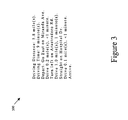
- Figure 3 shows an exemplary set of instructions 300 issued from a web-based navigation service provided by Robert Bosch Corporation in response to a request for routing information.
- the exemplary set of instructions 300 is supplied, for example, as text strings.
- the first line of the exemplary set of instructions 300 indicates the total travel distance
- the second line indicates the total travel time
- each subsequent line provides a tum-by-tum instruction.
- the exemplary set of instructions 300 may be provided as input to an exemplary content selection method according the present invention. Given this detailed input, the exemplary method may extract information, such as, for example, street names and turning directions from the strings, and represent the information as internal objects. The exemplary method may select which instructions to present to the driver based on its modeling of the driver's route knowledge, and may aggregate multiple instructions as appropriate. The driver's route knowledge base may also be updated as navigation information is presented.
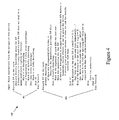
- Figure 4 shows an exemplary content selection method 400, in exemplary pseudo code form, to select and present certain decision points (DPs) using route instructions provided, for example, by a web-based navigation service.
- the exemplary content selection method 400 includes a first loop 401 to determine how to present decision points (DPs) based on the driver's route knowledge, and a second loop 402 to present each decision point (DP) to the driver.
- the exemplary content selection method 400 provides turn-by-turn instructions for a driver with little route knowledge, but for a local driver, it skips all familiar decision points (DPs) until encountering an unfamiliar or significant decision point (DP) (for example, a highway entrance).
- the exemplary content selection method 400 summarizes the route segments up to this decision point (DP), and provides detailed instructions from that point on.
- a driver's route knowledge may include, for example, some local areas and several highways branching out from these areas. It is therefore expected that route knowledge acquired in this manner should consist of clusters of decision points in these local areas. These clusters plus the road classes may facilitate natural route.
- the exemplary content selection method 400 may be optimized based upon data collected, for example, from a simulated or actual driving environment, and that values used by the exemplary content selection method 400, such as, for example, the familiarity values of "3" and "4" to denote somewhat familiar and very familiar, may be updated accordingly.
- the exemplary content selection method 400 performs aggregation based on the particular situation, using, for example, the distance between decision points.
- two instructions on decision points (DPs) whose distance is smaller than 0.1 miles are aggregated, as are adjacent instructions about the same decision point (DP).
- the exemplary content selection method 400 may be implemented, for example, on any suitable processing arrangement, including, for example, a computer, together with a suitable interface, display and/or other input arrangement.
- Figure 5A shows exemplary instructions 500A for a driver who has no knowledge of the requested route, which were generated using the exemplary set of instructions 300 of Figure 3 as input to the exemplary content selection method 400 of Figure 4 .
- the exemplary instructions 500A include all required information and pertinent details of the exemplary set of instructions 300 without omission of content.
- Figure 5B shows exemplary instructions 500B for a driver who has some knowledge of the requested route, which were generated using the exemplary set of instructions 300 of Figure 3 as input to the exemplary content selection method 400 of Figure 4 .
- the exemplary set of instructions 500B include only that information which may be important or relevant to the driver and/or the navigation task at hand.
- Figure 5B shows exemplary instructions 500B for a driver who knows how to get onto El Camino Real, which is a state highway, so in this instance, the exemplary system disregards instructions for the known sub-route.
- Two types of aggregation are featured in the first and last utterances of the exemplary instructions 500.
- conjunction is used to combine descriptions of the same decision point (DP) or adjacent decision points (DPs) and subordinated prepositional phrases are used to realize distance information.
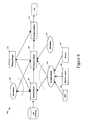
- Figure 6 shows an exemplary system architecture 600 to provide domain-independent natural language generation (NLG), which may be used in a vehicle-based environment to generate navigation instructions and/or adapt navigation instructions based on the external situation or knowledge that is specific to the user.
- NLG domain-independent natural language generation
- the exemplary system architecture 600 may produce conversational turns ranging from lengthy multi-clausal contributions to sub-clausal fragments, which are collectively referred to herein simply as "turns". Each turn may consist of several utterances, which should vary depending upon characteristics of the user.
- the exemplary system architecture 600 includes a pipeline architecture with three major components: a content planner 601, an utterance planner 602 and an utterance realizer 603.
- the content planner 601 selects information to be expressed and organizes this information into a hierarchical structure, which represents a globally coherent text plan.
- the utterance planner 602 and utterance realizer 603 construct utterances that convey the selected information, and choose grammatical features to produce locally fluent utterances.
- the exemplary system architecture 600 also includes a dialog manager 604 to manage the dialog, as well as user and situations models 608 and 609, respectively, which may affect all levels of generation and have a bearing on the variety and complexity of the text being generated.
- the situation model 609 may be created and maintained, for example, using input from a Global Positioning System (GPS) 605, a behavior agent 606, and other sensors and/or devices 607.
- GPS Global Positioning System
- a behavior agent 606 and other sensors and/or devices 607.
- the content planner 601 may be implemented, for example, in a generic manner to accommodate both needs, that is, to take either a communicative goal or a set of domain preferences as well as the semantic contents associated with these goals as the input, and produce a turn specification, which is a tree structure that contains the propositions to be expressed and the rhetorical relationships between them.
- the content planner 601 may be invoked once per conversational turn, and may make reference to a persistent dialogue model that is maintained over the entire dialogue.
- the content planer 601 may use the exemplary content selection method 400 of Figure 4 to adapt the dialogue based on a model of the driver's knowledge, which includes, for example, at least one exemplary decision point 200 of Figure 2 to represent the route.
- the utterance planner 602 takes a turn specification and produces a sequence of one or more utterance specifications, compatible with the realizer input specification language.
- Two tasks of the utterance planner 602 include aggregation and referring expression generation. These two tasks encounter new challenges in the in-car dialogue environment due to the time-and position-sensitive nature of the generation task.
- a referring expression or aggregated utterance may cause confusion if the driver's position changes significantly during processing. Aggregation may also be used to provide additional information (such as landmarks) to help identify domain objects (e.g., "Turn left at Mathilda Avenue, where you can see an Arco gas station at the corner.”).
- the utterance realizer 603 takes an utterance specification and produces marked-up text, which may be supplied, for example, to a Text-To-Speech (TTS) generator.
- TTS Text-To-Speech
- the utterance realizer 603 may have the ability to address the requirements of echoing user language, prosodic markup and variability.
- the dialogue manager 604 stores the current context of the ongoing conversation, as well as the historical context. Each utterance, whether by the user or the system, is classified as a dialogue move, updating this context.
- the dialogue manager 604 may construct an "Activity Tree", which represents all activities performed by the behavior agent 606 and their execution status. Other data structures may keep track of noun phrases (NPs), unresolved questions, etc.
- NPs noun phrases
- Requests from the user are communicated to the behavior agent 606 as goals for it to achieve.
- the behavior agent 606 may execute the user's requests, and may also initiate new conversation topics (e.g., based on observations).
- Communicative goals from the behavior agent 606, whether in response or its own initiative, may be put on to the dialogue manager's Activity Tree, to become part of the content planning process.
- the behavioral agent 606 may prioritize its communicative goals according to urgency and importance, and hence ensure that critically important information is communicated early by the content planner 601.
- the user and situation models 608 and 609 are used to influence the content selection process and the generation of utterances, thereby accounting for a current situation and user-specific state.
- the user model 608 stores information pertinent to the current user, including, for example, the driver's route knowledge, which may be adapting over time, by observing the behavior of the user and/or explicitly querying for user preferences.
- the situation model 609 may draw upon multiple information sources, such as, for example, the GPS 605, device sensors 607, etc.
Landscapes
- Engineering & Computer Science (AREA)
- Radar, Positioning & Navigation (AREA)
- Remote Sensing (AREA)
- Physics & Mathematics (AREA)
- General Physics & Mathematics (AREA)
- Automation & Control Theory (AREA)
- Mathematical Physics (AREA)
- Navigation (AREA)
Description
- The present invention relates to a method and system for adapting navigation instructions using a driver's knowledge about roads and routes, for example, and/or information regarding an external situation.
- As more devices find their way into the car to address people's desire for communication, entertainment and telematics services, a need may arise to ensure that these in-car devices can be operated without increasing the risk of traffic accidents. In this regard, if driving is considered a "eyes busy, hands busy" activity, then spoken language may be an appropriate choice for interaction between drivers and certain in-car devices. However, drivers may not be expected to learn and remember a complicated sets of spoken commands, and so rather than rely on a device-specific set of keywords, drivers may prefer to interact with in-car devices in a more flexible manner using natural language. Drivers may also prefer that their interaction with in-car devices be more personalized as well.
- The in-car devices requiring interaction with the driver may include, for example, navigation systems. In the automotive industry, commercially available navigation systems may offer general-purpose turn-by-turn instructions, which may be helpful on certain occasions, but may be undesirable sometimes because they do not take into account a driver's knowledge, such as, for example, the driver's knowledge regarding certain roads or routes. The commercially available systems may also not take into account the external driving situation.
- Existing route description generation systems may produce generic or at best navigation information that only accounts for limited driver specific characteristics. K. Höök, in her 1991 master's thesis entitled "An Approach to Route Guidance Interface" for the Department of Computer and Systems Sciences of Stockholm University, surveys the literature on driver modeling and concludes that an explicit user model is needed. However, K. Höök merely distinguishes users as tourist, resident and commuter navigators, in which routes are chunked and presented in different ways to these user groups. T. Pattabhiraman and N. Cercone in their paper entitled "Selection: Salience, relevance and the coupling between domain-level tasks and text planning", which appeared in the 1990 Proceedings of the 5th International Workshop on NLG held in Pennsylvania, discuss the importance of salience and relevance in the content selection stage of route description generation. However, the notion of relevance discussed therein is pertinent to the communicative goals of the generator rather than those of the user. L. Fraczak et al., in their paper entitled "Automatic generation of subway directions: Salience graduation as a factor for determining message and form", which appeared in the 1998 Proceedings of International Conference on Natural Language Generation, in Niagra-on-the-Lake, Canada, distinguish between known and unknown information, and discuss that the problem concerning the known information is to determine whether or not to make it explicit, but only deal with unknown information. Dale et al., in their paper entitled "Coral: Using natural language generation for navigational assistance", which appeared in the 2003 Proceedings of the 26th Australian Computer Science Conference in Adelaide, Australia, discuss a desire to produce natural route descriptions using general purpose generation techniques but only feature a generation architecture, which emphasizes the micro-planning level to reproduce human writing patterns. In particular, the system described by Dale et al. takes Geographic Information Service (GIS) data input, segments it into hierarchical structures, and then uses aggregation and referring expression generation techniques to merge the data into coherent multi-clausal sentences.
- Zukerman and Albrecht in the section entitled "Predictive statistical models for user modeling" of the 2001 publication "User Modeling and User-Adaptive Interaction" discuss two main user modeling techniques to adapt the behavior of systems in the contexts of a user-specific web page recommendation, namely, content-based modeling and collaborative modeling. Content-based modeling assumes that users exhibit particular behaviors under given circumstances, and that this behavior is repeated under similar circumstances, which may be most useful when a user's past behavior is a reliable indicator of future behavior. Collaborative modeling assumes that people with related characteristics tend to behave similarly under the same circumstances, which may be most useful when a user's behavior is similar to that of other (like- minded) users.
- [0009] Existing generation components of dialogue systems have previously used collaborative modeling to predict a user behavior based on those exhibited by the group the user belongs to. Zukerman and Litman, identify a number of user features often considered in the content planning module of existing natural language generation (NLG) systems, including expertise or interests, preferences, user prototypes, and emotional state.
- [0010] Although data may be collected from a large number of people, variations between individuals may reduce the predictability of the collaborative approach. The content-based approach, by contrast, may be more accurate for modeling individual user behaviors, but it use may be limited by a lack of sufficient training data. Accordingly, the two approaches may be combined to achieve better predictions. For example, the collaborative modeling may be used for a new user when there is not enough evidence to support a reliable prediction, and as more evidence is collected, the system may switch to the content-based approach.
- Further interesting prior art in this technical field is constituted by S. Rogers et al., "Interactive refinement of route preferences for driving", Interactive and mixed-initiative decision-theoretic systems (TR SS-98-03), AAAI Press Menlo Park; Ca, US; 1998, pages 109-113; XP002353615, ISBN 1-57735-048-0, and by K. Takhashi et al., "Driver's route selection based on fuzzy-neural approaches", Steps Forward, Proceedings of the Second World Congress on Intelligent Transport Systems 95, Yokohama Vehicle, Road & Traffic Intelligence SOC, Tokyo, Japanm, vol. 4, 1995, pages 1854-1859 vol., XP009056820. Interesting patent literature is
US 2002/082771 A1 andUS 2003/055558 A1 . - The document
US 2002 / 082771 A1 describes computing a navigation route based on route segment attributes reflecting user-specific knowledge of the route segments or of a region. - [0012] The present invention is defined in the appended claims and permits to adapt navigation instructions based on a driver's knowledge regarding, for example, roads, routes, points of interest (POIs) along the routes, etc. (referred herein collectively as "the driver's route knowledge"). In this regard, the driver's route knowledge may be represented, for example, by all the decision points (DPs) along the routes, in which the driver has traveled, together with the driver's familiarity with the decision points. Accordingly, the exemplary method may select navigation instructions to be presented to the driver based on the driver's familiarity with a decision point on a route. A model of the driver's route knowledge may be maintained and dynamically updated in an implicit manner by observing the driver's daily driving activities and responses to clarification questions, or in an explicit manner by directly querying the driver. The decision points may be hierarchically organized to handle the instances, for example, when there is a mismatch between the driver model and the driver's actual knowledge.
- An exemplary embodiment and/or exemplary method according to the present invention may provide a natural language dialogue interface for operating in-car devices and services, which may impose a minimum cognitive load on the driver by understanding drivers' requests and producing responses based on the driver's knowledge, the conversational context, and/or the external situation. It is believed that an interactive, robust and situation aware dialogue may enhance usability and safety by reducing cognitive load in the driving situation. An exemplary system may allow the driver to operate in-car equipment and obtain navigation information (e.g., turn-by-turn instructions) or other information about local facilities.
- An exemplary embodiment and/or exemplary method may provide a representation of the driver's route knowledge that is scaleable and allows fast dynamic updates. Prior approaches may use representations that log all intersections and roads that a driver has driven, which may explode in size, and also use information that is not necessarily salient to the driver to bias routes.
- An exemplary embodiment and/or exemplary method may also provide a navigation content selection method makes decisions about navigation instruction presentation to the driver based on a model of the driver's route knowledge and/or the external situation, whereas prior approaches may make decisions based on generalized driver prototypes. In this regard, rather than overwhelming the user with known or redundant information, the user may be provided with only that information which is important or relevant to achieve that navigation task at hand. This may be useful, for example, for cognitively overloaded environments, such as driving a car. Additionally, during the course of building up the driver model, speaker recognition algorithms may be used to track down which routes belong to which driver so that cars with multiple drivers, such as, for example, rental cars, may also be accommodated.
- Two decision processes may be particularly relevant in the driving domain, that is, the decisions of "what to say" and "when to say it". In regards to the decision of "what to say", an exemplary embodiment and/or exemplary method according to the present invention may generate instructions and related information required for the success of the navigation task at hand, while providing reaffirmation and necessary grounding, which is customized as appropriate for the current driver. In regards to the decision of "when to say it", an exemplary embodiment and/or exemplary method may generate appropriate navigation information at the appropriate time, being cognizant of the potentially stressful situations such as missed turns and driving situations requiring high attentiveness, so that, for example, output that is not immediately critical may be delayed. Accordingly, navigation instructions may be adaptively generated and/or tailored on the basis of characteristics of both the driver and the external situation.
- An exemplary embodiment and/or exemplary method of the present invention may address the "what to say" decision, such as, for example, the selection of navigation information to be presented to the driver, using a model of the driver's route knowledge. Such a content selection process may be included, for example, as a component of a domain-independent natural language generation system, which may be provided, for example, as part of a dialogue system toolkit. The in-car domain may raise specific issues for generation, such as situation awareness, user adaptibility, incremental generation, conversation resumption, and time sensitive generation.
- An exemplary embodiment and/or exemplary method of the present invention may address the "when to say it" decision using a model of the user's cognitive load, which may be estimated from a variety of sources, including, for example, instrumentation (e.g. sensors) and human factors.
- An exemplary embodiment and/or exemplary method of the present invention may improve the presentation of information to the user and enhance the perception of the dialog system's intelligence, and consequently may speed up the market acceptance of the technologies and improves products' competitiveness.
-
-
Figure 1 shows an exemplary dialogue exchange between a driver and an exemplary system according to the present invention. -
Figure 2 shows an exemplary decision point along a navigation route. -
Figure 3 shows an exemplary set of instructions issued from a web-based navigation service. -
Figure 4 shows an exemplary content selection method according to the present invention in pseudo code form. -
Figure 5A shows exemplary instructions for a driver who has no knowledge of the requested route, which were generated using the exemplary set of instructions ofFigure 3 as input to the exemplary content selection method ofFigure 4 . -
Figure 5B shows exemplary instructions for a driver who has some knowledge of the requested route, which were generated using the exemplary set of instructions ofFigure 3 as input to the exemplary content selection method ofFigure 4 . -
Figure 6 shows an exemplary system architecture to provide natural language generation incorporating the exemplary content selection method ofFigure 4 . - Since a navigation system in any given car may be used by the same driver for many times, there may be opportunity to collect a large amount of driver-specific data through both implicit observations and explicit interactions. For example, a GPS-based navigation system may maintain a history of all the places the driver has been to, and use this to generate hypotheses about the driver's route knowledge. Based on this knowledge, reasonable assumptions may be made about what the driver knows and predictions about what the driver needs to know. In this regard, evidence used to form the hypotheses may be gathered, for example, by implicit observation and explicit enquiry. In implicit observation, the driver's daily driving activities and use of clarification questions may provide useful information regarding the driver and what he may know. For example, if the driver has driven to a place without asking for help, it may be assumed that the driver is familiar with the route between the origin and destination. If the driver queries how to implement a specific navigation instruction, such as, for example, if the driver asks how to get to
Highway 101, it may be assumed that the driver is not familiar with that route. - In explicit enquiry, a direct query may be used to determine if a driver has been to a particular place or not, and if so, whether the driver still needs help. For example, an exemplary dialog system according to the present invention might say to the driver: You should first drive to
Highway 101. Do you know how to get there? Accordingly, based on the driver's reply, the exemplary system may update its representation of the driver's route knowledge. - Where there is a sufficient amount of driver data available, an exemplary system according to the present invention may learn from this data and adapt its responses on the basis of the learned driver model. Accordingly, the exemplary system may omit information that the driver is familiar with, since otherwise, presenting all information, including information that the driver already knows, may be a distraction and/or cause irritation.
- According to an exemplary embodiment and/or exemplary method, both the content-based approach and the collaborative approach may be used. In this regard, the content-based modeling approach may be appropriate when a sufficient amount of user specific data has been accumulated, and the collaborative modeling approach may provide defaults when user specific data is not available.
-
Figure 1 shows anexemplary dialogue exchange 100 between a driver and an exemplary system according to the present invention, in which the exemplary system provides customized output to the driver based on the driver's knowledge. In particular, in response to the driver's request Ul for directions to a particular destination, the exemplary system adapts its responses or queries S1-S6 to the driver based on the driver's knowledge. Here, the driver's knowledge may include, for example, a familiarity and/or preference regarding the local routes. Accordingly, instructions provided by the exemplary system may be more tailored to the driver and/or the task at hand. For example, a description for a route from the driver's home to the freeway may be reduced to something like that in S1 inFigure 1 if the exemplary system knows that this is a route already known to the driver. In this regard, the exemplary system may also refer to previous driving experiences, as in Take the freeway south; you 'll take the same exit you took to get to Bob 's house last week. Such adaptive instructions may be preferable to the turn-by-turn instructions provided by other navigation systems in use today. - Generating personalized navigation instructions may require acquisition and representation of the driver's route knowledge. Representations that log all intersections and roads that a driver has driven may explode in size, and therefore may include and/or use information that is not necessarily salient to the driver (e.g. a crossroad or intersection in which the driver simply must past through but no other action by the driver is required). For example, the Route-Compiler system described in "Personalization of the automotive information environment" by Rogers et al., which appears in the 1997 Proceedings of the Workshop on Machine Learning in the Real World: Methodological Aspects and Implications, held in Nashville, TN, represents the routes that a driver has driven as a graph, in which nodes represent intersections and arcs represent the routes between them. A context-free grammar is extracted from the graph to represent the driver's route knowledge at various levels of detail, which is used to bias a route planing procedure to favor familiar routes, with the goal of minimizing the probability of getting lost.
- According to an exemplary embodiment and/or exemplary method, a route may be represented by all the decision points (DPs) along the route, including, for example, the intersections where the driver makes a turn, where a street name or its class changes, or where the route begins and ends (e.g., origin and destination). In this regard, streets and roads may be assigned a class of 1 to 6, for example, with 6 denoting interstates and freeways, 3 denoting expressways, and 2 being a default class for most city streets. Intersections where the driver simply drives straight through or where there is no name or class change are not included as decision points (DPs) so that only the salient features to a route may be considered when biasing future route descriptions with respect to familiarity, although this may not preclude using other features in the route descriptions themselves. Accordingly, the amount of route information to be stored may be reduced since intersections and road information between intersections, which are not decision points, may be disregarded.
-
Figure 2 shows an exemplary decision point (DP) 200 describing that the driver should turn left from Arastradeo Road into Foothill Expressway, the driver has made this maneuver twice before, and the last time was on January 27, 2004 at 3pm. In this regard, the exemplary decision point (DP) 200 includes "features" to structure the information contained therein. In particular, the exemplary decision point (DP) 200 includes the features of a "FromStreet", "IntoStreet", "TurnDirection", "Familiarity", and "LastVisit", where FromStreet is the street from which the vehicle is to make a turn, IntoStreet is the street into which the vehicle should turn, TurnDirection is the direction the vehicle should turn, e.g., left, south, u-turn, Familiarity is a measure of how familiar the driver is with this intersection, based on the number of times the driver has driven through this intersection from and into the same road, making the same turn, and LastVisit is the last time that the driver was here. - The features FromStreet, IntoStreet, and TurnDirection uniquely identify the exemplary decision point (DP). Familiarity may be measured, for example, on a scale of 1 to 5, with 5 indicating high familiarity. This information may be used, for example, to determine whether a decision point (DP) should be presented to the driver. LastVisit may be used, for example, as follows: if the driver traveled through a destination (DP) a long time ago, it may be assumed that the driver will not remember it, however, if the driver traveled the decision point (DP) fairly recently, then this information may be used to remind the driver about this intersection or road by referring to the driver's previous experience.
- The decision points (DPs) may be stored and maintained, for example, in a knowledge base through Protégé, which is a tool for constructing and maintaining knowledge resources (information regarding Protégé may be found, for example, in Musen et al., "Protégé II : An environment for reusable problem-solving methods and domain ontologies" appearing the 1993 International Joint Conference on Artificial Intelligence" held in Savoie, France). For each routing task, all the decision points along the route may be examined. If a decision point (DP) is new, an entry may be created in the knowledge base with a Familiarity value of 1. If the decision point (DP) is already in the knowledge base, its Familiarity value is incremented. If the driver queries about the decision point (DP) or gives a negative answer to the system's query about the decision point (DP), its Familiarity value is decremented.
- For a new driver, the exemplary system may have no knowledge of the driver's background. As the interactions between the driver and the system increase, more and more driver specific features may be captured to provide a more fine-tuned and dynamic user modeling.
-
Figure 3 shows an exemplary set ofinstructions 300 issued from a web-based navigation service provided by Robert Bosch Corporation in response to a request for routing information. The exemplary set ofinstructions 300 is supplied, for example, as text strings. The first line of the exemplary set ofinstructions 300 indicates the total travel distance, the second line indicates the total travel time, and each subsequent line provides a tum-by-tum instruction. - The exemplary set of
instructions 300 may be provided as input to an exemplary content selection method according the present invention. Given this detailed input, the exemplary method may extract information, such as, for example, street names and turning directions from the strings, and represent the information as internal objects. The exemplary method may select which instructions to present to the driver based on its modeling of the driver's route knowledge, and may aggregate multiple instructions as appropriate. The driver's route knowledge base may also be updated as navigation information is presented. -
Figure 4 shows an exemplarycontent selection method 400, in exemplary pseudo code form, to select and present certain decision points (DPs) using route instructions provided, for example, by a web-based navigation service. The exemplarycontent selection method 400 includes afirst loop 401 to determine how to present decision points (DPs) based on the driver's route knowledge, and asecond loop 402 to present each decision point (DP) to the driver. - The exemplary
content selection method 400 provides turn-by-turn instructions for a driver with little route knowledge, but for a local driver, it skips all familiar decision points (DPs) until encountering an unfamiliar or significant decision point (DP) (for example, a highway entrance). The exemplarycontent selection method 400 summarizes the route segments up to this decision point (DP), and provides detailed instructions from that point on. Here, a driver's route knowledge may include, for example, some local areas and several highways branching out from these areas. It is therefore expected that route knowledge acquired in this manner should consist of clusters of decision points in these local areas. These clusters plus the road classes may facilitate natural route. It will be appreciated that the exemplarycontent selection method 400 may be optimized based upon data collected, for example, from a simulated or actual driving environment, and that values used by the exemplarycontent selection method 400, such as, for example, the familiarity values of "3" and "4" to denote somewhat familiar and very familiar, may be updated accordingly. - The exemplary
content selection method 400 performs aggregation based on the particular situation, using, for example, the distance between decision points. In particular, two instructions on decision points (DPs) whose distance is smaller than 0.1 miles are aggregated, as are adjacent instructions about the same decision point (DP). - The exemplary
content selection method 400 may be implemented, for example, on any suitable processing arrangement, including, for example, a computer, together with a suitable interface, display and/or other input arrangement. -
Figure 5A showsexemplary instructions 500A for a driver who has no knowledge of the requested route, which were generated using the exemplary set ofinstructions 300 ofFigure 3 as input to the exemplarycontent selection method 400 ofFigure 4 . Theexemplary instructions 500A include all required information and pertinent details of the exemplary set ofinstructions 300 without omission of content. -
Figure 5B showsexemplary instructions 500B for a driver who has some knowledge of the requested route, which were generated using the exemplary set ofinstructions 300 ofFigure 3 as input to the exemplarycontent selection method 400 ofFigure 4 . The exemplary set ofinstructions 500B include only that information which may be important or relevant to the driver and/or the navigation task at hand. In particular,Figure 5B showsexemplary instructions 500B for a driver who knows how to get onto El Camino Real, which is a state highway, so in this instance, the exemplary system disregards instructions for the known sub-route. - Two types of aggregation are featured in the first and last utterances of the exemplary instructions 500. In particular, conjunction is used to combine descriptions of the same decision point (DP) or adjacent decision points (DPs) and subordinated prepositional phrases are used to realize distance information.
-
Figure 6 shows anexemplary system architecture 600 to provide domain-independent natural language generation (NLG), which may be used in a vehicle-based environment to generate navigation instructions and/or adapt navigation instructions based on the external situation or knowledge that is specific to the user. In this regard, theexemplary system architecture 600 may produce conversational turns ranging from lengthy multi-clausal contributions to sub-clausal fragments, which are collectively referred to herein simply as "turns". Each turn may consist of several utterances, which should vary depending upon characteristics of the user. - The
exemplary system architecture 600 includes a pipeline architecture with three major components: acontent planner 601, anutterance planner 602 and anutterance realizer 603. Thecontent planner 601 selects information to be expressed and organizes this information into a hierarchical structure, which represents a globally coherent text plan. Theutterance planner 602 andutterance realizer 603 construct utterances that convey the selected information, and choose grammatical features to produce locally fluent utterances. Theexemplary system architecture 600 also includes adialog manager 604 to manage the dialog, as well as user andsituations models situation model 609 may be created and maintained, for example, using input from a Global Positioning System (GPS) 605, abehavior agent 606, and other sensors and/ordevices 607. Each component of theexemplary system architecture 600 is further described below. - There may be different ways in which multi-utterance dialogue contributions might be generated. Research in text generation has addressed both top-down and bottom-up content planning strategies. In a dialogue context, this decision may be determined by the nature of the dialogue domains. Some domains are highly structured and goal-driven, and the generation system may be required to produce a text plan that conforms to the goal structure. In other domains, the goals are only loosely structured, as may be, for example, for an in-car navigation system, where a goal is to effectively navigate the driver to the destination. Different text plans may achieve the same goal, so a generation system should choose a text plan that satisfies as many domain and user preferences as possible.
- The
content planner 601 may be implemented, for example, in a generic manner to accommodate both needs, that is, to take either a communicative goal or a set of domain preferences as well as the semantic contents associated with these goals as the input, and produce a turn specification, which is a tree structure that contains the propositions to be expressed and the rhetorical relationships between them. Thecontent planner 601 may be invoked once per conversational turn, and may make reference to a persistent dialogue model that is maintained over the entire dialogue. In this regard, thecontent planer 601 may use the exemplarycontent selection method 400 ofFigure 4 to adapt the dialogue based on a model of the driver's knowledge, which includes, for example, at least oneexemplary decision point 200 ofFigure 2 to represent the route. - The
utterance planner 602 takes a turn specification and produces a sequence of one or more utterance specifications, compatible with the realizer input specification language. Two tasks of theutterance planner 602 include aggregation and referring expression generation. These two tasks encounter new challenges in the in-car dialogue environment due to the time-and position-sensitive nature of the generation task. A referring expression or aggregated utterance may cause confusion if the driver's position changes significantly during processing. Aggregation may also be used to provide additional information (such as landmarks) to help identify domain objects (e.g., "Turn left at Mathilda Avenue, where you can see an Arco gas station at the corner."). - The
utterance realizer 603 takes an utterance specification and produces marked-up text, which may be supplied, for example, to a Text-To-Speech (TTS) generator. Theutterance realizer 603 may have the ability to address the requirements of echoing user language, prosodic markup and variability. - The
dialogue manager 604 stores the current context of the ongoing conversation, as well as the historical context. Each utterance, whether by the user or the system, is classified as a dialogue move, updating this context. In this regard, thedialogue manager 604 may construct an "Activity Tree", which represents all activities performed by thebehavior agent 606 and their execution status. Other data structures may keep track of noun phrases (NPs), unresolved questions, etc. - Requests from the user are communicated to the
behavior agent 606 as goals for it to achieve. In this manner, the user may effectively converse with thebehavior agent 606. In particular, thebehavior agent 606 may execute the user's requests, and may also initiate new conversation topics (e.g., based on observations). Communicative goals from thebehavior agent 606, whether in response or its own initiative, may be put on to the dialogue manager's Activity Tree, to become part of the content planning process. Thebehavioral agent 606 may prioritize its communicative goals according to urgency and importance, and hence ensure that critically important information is communicated early by thecontent planner 601. - The user and
situation models user model 608 stores information pertinent to the current user, including, for example, the driver's route knowledge, which may be adapting over time, by observing the behavior of the user and/or explicitly querying for user preferences. Thesituation model 609 may draw upon multiple information sources, such as, for example, theGPS 605,device sensors 607, etc.
Claims (21)
- A method of adapting instructions for performing a route-navigation task by a user, comprising : receiving instructions (300) for the route navigation task; selecting a subset of the received instructions (401), the selecting being based on user-specific knowledge regarding the route navigation task; constructing utterances (402) using the selected subset; and conveying the utterances to the user.
- The method of claim 1, further comprising: modeling the user-specific knowledge as at least one feature of a decision point along a navigation route for the route navigation task.
- The method of claim 2, wherein the at least one feature includes a familiarity value representing a measure of how familiar the user is with the navigation route.
- The method of claim 3, further comprising: including the subset of the received instructions related to the decision point in the selected subset if the familiarity value exceeds a predefined value.
- The method of claim 2, wherein the instructions include navigation instructions and the task includes navigating a route.
- The method of claim 5, wherein the decision point includes a point along the route.
- The method of claim 6, wherein the at least one feature includes a street from which the user is to make a turn, a street into which the user is to make the turn, a direction of the turn, a familiarity of the decision point by the user, and a time of last visit of the decision point by the user.
- The method of claim of claim 2, further comprising: one of observing and interacting with the user to adjust the at least one feature.
- The method of claim 1, further comprising: selecting the subset of the instructions based on a current situation.
- The method of claim 9, further comprising: modeling the current situation with input from at least one of a GPS device and a sensor device.
- The method of claim 1, wherein: the route navigation task is to navigate along a route; the instructions include instructions for multiple navigation manoeuvres to be performed along the route in order to navigate along the route; the subset of the received instructions includes instructions for only some and not all of the multiple manoeuvres; and the user-specific knowledge is knowledge regarding the multiple manoeuvres.
- A system to adapt instructions for performing a route navigation task by a user, comprising : a user model (608) to represent user-specific knowledge regarding the route navigation task; a content planner (601) to receive instructions for the route navigation task and to select a subset of the received instructions (401), whereon the selection of the subset is based on the user-specific knowledge; an utterance planner (602) to construct utterances (402) using the selected subset; and an utterance realizer (603) to convey the utterances to the user.
- The system of claim 12, wherein the user-specific knowledge is modeled as at least one feature of a decision point along a navigation route of the route navigation task.
- The system of claim 12, wherein the instructions include navigation instructions and the route navigation task includes navigating a route.
- The system of claim 12, further comprising: a situation model (608, 609) to represent a current situation, wherein the content planner (601) is configured to select the subset of the received instructions based on the current situation.
- The system of claim 12, further comprising: a global positioning system (605) to provide geographic information for adjusting the situation model.
- The system of claim 12, further comprising: a sensor device (607) to sense conditions of the current situation.
- The system of claim 12, further comprising: a dialog manager (604) to store a current context of the utterances conveyed to the user.
- The system of claim 12, wherein: the route navigation task is to navigate along a route; the instructions include instructions for multiple navigation manoeuvres to be performed along the route in order to navigate along the route; the subset of the received instructions includes instructions for only some and not all of the multiple maneuvers; and the user-specific knowledge is knowledge regarding the multiple maneuvers.
- A storage medium having a computer program, which is executable by a processor arrangement, comprising : computer program code for causing the processor arrangement to perform the following: receiving instructions for a route navigation task to be performed by a user; selecting a subset of the received instructions (401), the selecting being based on user-specific knowledge regarding the route navigation task; constructing utterances (402) using the selected subset; and conveying the utterances to the user.
- The storage medium of claim 20, wherein the received instructions include navigation instructions, the route navigation task includes navigating the route, and the computer program code further performs the following: modeling the user-specific knowledge as at least one feature of a decision point along a navigation route for the route navigation task, the at least one feature including a street from which the user is to make a turn, a street into which the user is to make the turn, a direction of the turn, a familiarity of the decision point by the user, and a time of last visit of the decision point by the user.
Applications Claiming Priority (2)
| Application Number | Priority Date | Filing Date | Title |
|---|---|---|---|
| US10/923,590 US7424363B2 (en) | 2004-08-20 | 2004-08-20 | Method and system for adaptive navigation using a driver's route knowledge |
| PCT/US2005/025807 WO2006023191A1 (en) | 2004-08-20 | 2005-07-20 | A method and system for adaptive navigation using a driver’s route knowledge |
Publications (2)
| Publication Number | Publication Date |
|---|---|
| EP1779068A1 EP1779068A1 (en) | 2007-05-02 |
| EP1779068B1 true EP1779068B1 (en) | 2012-09-12 |
Family
ID=35207364
Family Applications (1)
| Application Number | Title | Priority Date | Filing Date |
|---|---|---|---|
| EP05775061A Expired - Lifetime EP1779068B1 (en) | 2004-08-20 | 2005-07-20 | A method and system for adaptive navigation using a driver's route knowledge |
Country Status (3)
| Country | Link |
|---|---|
| US (1) | US7424363B2 (en) |
| EP (1) | EP1779068B1 (en) |
| WO (1) | WO2006023191A1 (en) |
Families Citing this family (107)
| Publication number | Priority date | Publication date | Assignee | Title |
|---|---|---|---|---|
| US9819561B2 (en) | 2000-10-26 | 2017-11-14 | Liveperson, Inc. | System and methods for facilitating object assignments |
| US8868448B2 (en) | 2000-10-26 | 2014-10-21 | Liveperson, Inc. | Systems and methods to facilitate selling of products and services |
| US8453065B2 (en) | 2004-06-25 | 2013-05-28 | Apple Inc. | Preview and installation of user interface elements in a display environment |
| US7716056B2 (en) * | 2004-09-27 | 2010-05-11 | Robert Bosch Corporation | Method and system for interactive conversational dialogue for cognitively overloaded device users |
| US7831433B1 (en) * | 2005-02-03 | 2010-11-09 | Hrl Laboratories, Llc | System and method for using context in navigation dialog |
| US7353034B2 (en) | 2005-04-04 | 2008-04-01 | X One, Inc. | Location sharing and tracking using mobile phones or other wireless devices |
| US8738732B2 (en) | 2005-09-14 | 2014-05-27 | Liveperson, Inc. | System and method for performing follow up based on user interactions |
| US9432468B2 (en) | 2005-09-14 | 2016-08-30 | Liveperson, Inc. | System and method for design and dynamic generation of a web page |
| US7698061B2 (en) | 2005-09-23 | 2010-04-13 | Scenera Technologies, Llc | System and method for selecting and presenting a route to a user |
| US7954064B2 (en) * | 2005-10-27 | 2011-05-31 | Apple Inc. | Multiple dashboards |
| EP2008200B1 (en) | 2006-04-06 | 2017-09-27 | Yale University | Framework of hierarchical sensory grammars for inferring behaviors using distributed sensors |
| US7702456B2 (en) | 2006-04-14 | 2010-04-20 | Scenera Technologies, Llc | System and method for presenting a computed route |
| US9086294B2 (en) * | 2006-07-06 | 2015-07-21 | Tomtom International B.V. | Navigation device with adaptive navigation instructions |
| US8311526B2 (en) | 2007-06-28 | 2012-11-13 | Apple Inc. | Location-based categorical information services |
| US8204684B2 (en) | 2007-06-28 | 2012-06-19 | Apple Inc. | Adaptive mobile device navigation |
| US8275352B2 (en) * | 2007-06-28 | 2012-09-25 | Apple Inc. | Location-based emergency information |
| US8175802B2 (en) * | 2007-06-28 | 2012-05-08 | Apple Inc. | Adaptive route guidance based on preferences |
| US9066199B2 (en) | 2007-06-28 | 2015-06-23 | Apple Inc. | Location-aware mobile device |
| US8385946B2 (en) | 2007-06-28 | 2013-02-26 | Apple Inc. | Disfavored route progressions or locations |
| US20090005018A1 (en) * | 2007-06-28 | 2009-01-01 | Apple Inc. | Route Sharing and Location |
| US8332402B2 (en) * | 2007-06-28 | 2012-12-11 | Apple Inc. | Location based media items |
| US8108144B2 (en) | 2007-06-28 | 2012-01-31 | Apple Inc. | Location based tracking |
| US8762056B2 (en) | 2007-06-28 | 2014-06-24 | Apple Inc. | Route reference |
| US9109904B2 (en) * | 2007-06-28 | 2015-08-18 | Apple Inc. | Integration of map services and user applications in a mobile device |
| US8463238B2 (en) | 2007-06-28 | 2013-06-11 | Apple Inc. | Mobile device base station |
| US8290513B2 (en) | 2007-06-28 | 2012-10-16 | Apple Inc. | Location-based services |
| US8180379B2 (en) | 2007-06-28 | 2012-05-15 | Apple Inc. | Synchronizing mobile and vehicle devices |
| US20090005076A1 (en) * | 2007-06-28 | 2009-01-01 | Scott Forstall | Location-Based Information Services |
| US8774825B2 (en) * | 2007-06-28 | 2014-07-08 | Apple Inc. | Integration of map services with user applications in a mobile device |
| US8127246B2 (en) * | 2007-10-01 | 2012-02-28 | Apple Inc. | Varying user interface element based on movement |
| US8977294B2 (en) * | 2007-10-10 | 2015-03-10 | Apple Inc. | Securely locating a device |
| US20090150167A1 (en) * | 2007-12-07 | 2009-06-11 | General Motors Corporation | Method for organizing data presented to a user in a vehicle |
| US8355862B2 (en) | 2008-01-06 | 2013-01-15 | Apple Inc. | Graphical user interface for presenting location information |
| US8452529B2 (en) * | 2008-01-10 | 2013-05-28 | Apple Inc. | Adaptive navigation system for estimating travel times |
| US7487017B1 (en) | 2008-03-31 | 2009-02-03 | International Business Machines Corporation | Systems and methods for generating pattern keys for use in navigation systems to predict user destinations |
| US20090326815A1 (en) * | 2008-05-02 | 2009-12-31 | Apple Inc. | Position Fix Indicator |
| US9250092B2 (en) | 2008-05-12 | 2016-02-02 | Apple Inc. | Map service with network-based query for search |
| US8644843B2 (en) | 2008-05-16 | 2014-02-04 | Apple Inc. | Location determination |
| US8369867B2 (en) | 2008-06-30 | 2013-02-05 | Apple Inc. | Location sharing |
| US8260846B2 (en) | 2008-07-25 | 2012-09-04 | Liveperson, Inc. | Method and system for providing targeted content to a surfer |
| US8762313B2 (en) | 2008-07-25 | 2014-06-24 | Liveperson, Inc. | Method and system for creating a predictive model for targeting web-page to a surfer |
| US8805844B2 (en) | 2008-08-04 | 2014-08-12 | Liveperson, Inc. | Expert search |
| US8874443B2 (en) * | 2008-08-27 | 2014-10-28 | Robert Bosch Gmbh | System and method for generating natural language phrases from user utterances in dialog systems |
| US8359643B2 (en) | 2008-09-18 | 2013-01-22 | Apple Inc. | Group formation using anonymous broadcast information |
| WO2010040385A1 (en) * | 2008-10-07 | 2010-04-15 | Tomtom International B.V. | Navigation apparatus and method for use therein |
| US9892417B2 (en) | 2008-10-29 | 2018-02-13 | Liveperson, Inc. | System and method for applying tracing tools for network locations |
| US8478712B2 (en) | 2008-11-20 | 2013-07-02 | Motorola Solutions, Inc. | Method and apparatus to facilitate using a hierarchical task model with respect to corresponding end users |
| US20120047087A1 (en) | 2009-03-25 | 2012-02-23 | Waldeck Technology Llc | Smart encounters |
| US8666367B2 (en) * | 2009-05-01 | 2014-03-04 | Apple Inc. | Remotely locating and commanding a mobile device |
| US8660530B2 (en) * | 2009-05-01 | 2014-02-25 | Apple Inc. | Remotely receiving and communicating commands to a mobile device for execution by the mobile device |
| US8670748B2 (en) | 2009-05-01 | 2014-03-11 | Apple Inc. | Remotely locating and commanding a mobile device |
| CN102652250B (en) * | 2009-12-25 | 2015-03-11 | 三菱电机株式会社 | Navigation device |
| WO2011092639A1 (en) * | 2010-01-29 | 2011-08-04 | Nokia Corporation | Systems, methods, and apparatuses for providing context-based navigation services |
| EP2556449A1 (en) | 2010-04-07 | 2013-02-13 | Liveperson Inc. | System and method for dynamically enabling customized web content and applications |
| US8417448B1 (en) | 2010-04-14 | 2013-04-09 | Jason Adam Denise | Electronic direction technology |
| US8825383B1 (en) * | 2010-12-10 | 2014-09-02 | Google Inc. | Extracting patterns from location history |
| US9350598B2 (en) | 2010-12-14 | 2016-05-24 | Liveperson, Inc. | Authentication of service requests using a communications initiation feature |
| US8918465B2 (en) | 2010-12-14 | 2014-12-23 | Liveperson, Inc. | Authentication of service requests initiated from a social networking site |
| CN102735257B (en) * | 2011-04-02 | 2015-01-21 | 深圳市赛格导航科技股份有限公司 | Navigation terminal, navigation method and navigation system |
| US8943002B2 (en) | 2012-02-10 | 2015-01-27 | Liveperson, Inc. | Analytics driven engagement |
| US8805941B2 (en) | 2012-03-06 | 2014-08-12 | Liveperson, Inc. | Occasionally-connected computing interface |
| US9563336B2 (en) | 2012-04-26 | 2017-02-07 | Liveperson, Inc. | Dynamic user interface customization |
| US9672196B2 (en) | 2012-05-15 | 2017-06-06 | Liveperson, Inc. | Methods and systems for presenting specialized content using campaign metrics |
| US20130325483A1 (en) * | 2012-05-29 | 2013-12-05 | GM Global Technology Operations LLC | Dialogue models for vehicle occupants |
| US10373508B2 (en) * | 2012-06-27 | 2019-08-06 | Intel Corporation | Devices, systems, and methods for enriching communications |
| EP2873034A2 (en) | 2012-07-12 | 2015-05-20 | Robert Bosch GmbH | System and method of conversational assistance for automated tasks with integrated intelligence |
| US9355093B2 (en) | 2012-08-30 | 2016-05-31 | Arria Data2Text Limited | Method and apparatus for referring expression generation |
| US8762134B2 (en) | 2012-08-30 | 2014-06-24 | Arria Data2Text Limited | Method and apparatus for situational analysis text generation |
| US9405448B2 (en) | 2012-08-30 | 2016-08-02 | Arria Data2Text Limited | Method and apparatus for annotating a graphical output |
| US8762133B2 (en) | 2012-08-30 | 2014-06-24 | Arria Data2Text Limited | Method and apparatus for alert validation |
| US9336193B2 (en) | 2012-08-30 | 2016-05-10 | Arria Data2Text Limited | Method and apparatus for updating a previously generated text |
| US9135244B2 (en) | 2012-08-30 | 2015-09-15 | Arria Data2Text Limited | Method and apparatus for configurable microplanning |
| WO2014042571A1 (en) * | 2012-09-17 | 2014-03-20 | Volvo Truck Corporation | Method and system for providing a tutorial message to a driver of a vehicle |
| US9600471B2 (en) | 2012-11-02 | 2017-03-21 | Arria Data2Text Limited | Method and apparatus for aggregating with information generalization |
| US8847788B2 (en) | 2012-11-15 | 2014-09-30 | Caterpillar Inc. | Traffic management |
| WO2014076525A1 (en) | 2012-11-16 | 2014-05-22 | Data2Text Limited | Method and apparatus for expressing time in an output text |
| WO2014076524A1 (en) | 2012-11-16 | 2014-05-22 | Data2Text Limited | Method and apparatus for spatial descriptions in an output text |
| WO2014102568A1 (en) | 2012-12-27 | 2014-07-03 | Arria Data2Text Limited | Method and apparatus for motion detection |
| WO2014102569A1 (en) | 2012-12-27 | 2014-07-03 | Arria Data2Text Limited | Method and apparatus for motion description |
| US10776561B2 (en) | 2013-01-15 | 2020-09-15 | Arria Data2Text Limited | Method and apparatus for generating a linguistic representation of raw input data |
| US9417069B2 (en) | 2013-07-25 | 2016-08-16 | Honda Motor Co., Ltd. | Familiarity modeling |
| WO2015028844A1 (en) | 2013-08-29 | 2015-03-05 | Arria Data2Text Limited | Text generation from correlated alerts |
| US9396181B1 (en) | 2013-09-16 | 2016-07-19 | Arria Data2Text Limited | Method, apparatus, and computer program product for user-directed reporting |
| US9244894B1 (en) * | 2013-09-16 | 2016-01-26 | Arria Data2Text Limited | Method and apparatus for interactive reports |
| US20150100240A1 (en) * | 2013-10-08 | 2015-04-09 | Toyota Jidosha Kabushiki Kaisha | Generating Dynamic Vocabulary for Personalized Speech Recognition |
| US9484025B2 (en) | 2013-10-15 | 2016-11-01 | Toyota Jidosha Kabushiki Kaisha | Configuring dynamic custom vocabulary for personalized speech recognition |
| CN114756124A (en) * | 2014-01-03 | 2022-07-15 | 谷歌有限责任公司 | Interaction between portable device and vehicle headend unit |
| US10113879B2 (en) | 2014-03-03 | 2018-10-30 | Apple Inc. | Hierarchy of tools for navigation |
| US11386442B2 (en) | 2014-03-31 | 2022-07-12 | Liveperson, Inc. | Online behavioral predictor |
| US10664558B2 (en) | 2014-04-18 | 2020-05-26 | Arria Data2Text Limited | Method and apparatus for document planning |
| US20150321604A1 (en) * | 2014-05-07 | 2015-11-12 | Ford Global Technologies, Llc | In-vehicle micro-interactions |
| CA2988120C (en) | 2015-06-02 | 2024-06-25 | Liveperson, Inc. | Dynamic communication routing based on consistency weighting and routing rules |
| US20160377447A1 (en) | 2015-06-25 | 2016-12-29 | International Business Machines Corporation | Cognitive needs-based trip planning |
| US9791573B2 (en) | 2015-06-30 | 2017-10-17 | International Business Machines Corporation | Intelligent global positioning system service |
| US9683862B2 (en) | 2015-08-24 | 2017-06-20 | International Business Machines Corporation | Internationalization during navigation |
| US10278065B2 (en) | 2016-08-14 | 2019-04-30 | Liveperson, Inc. | Systems and methods for real-time remote control of mobile applications |
| US10445432B1 (en) | 2016-08-31 | 2019-10-15 | Arria Data2Text Limited | Method and apparatus for lightweight multilingual natural language realizer |
| US10467347B1 (en) | 2016-10-31 | 2019-11-05 | Arria Data2Text Limited | Method and apparatus for natural language document orchestrator |
| US20180252545A1 (en) * | 2017-03-01 | 2018-09-06 | Delphi Technologies, Inc. | Destination-less travel system for an automated-vehicle |
| DE102017205531A1 (en) * | 2017-03-31 | 2018-10-04 | Continental Automotive Gmbh | Method and device for generating routes with dynamic navigation announcement |
| US10907986B2 (en) * | 2018-08-28 | 2021-02-02 | Here Global B.V. | User familiarization with a novel route for reducing cognitive load associated with navigation |
| US11029171B2 (en) | 2018-08-28 | 2021-06-08 | Here Global B.V. | User familiarization with a novel route for reducing cognitive load associated with navigation |
| US11047697B2 (en) | 2018-08-28 | 2021-06-29 | Here Global B.V. | User familiarization with a novel route for reducing cognitive load associated with navigation |
| CN109215369B (en) * | 2018-09-20 | 2021-07-06 | 北京新能源汽车股份有限公司 | Control method, device, equipment and network equipment of ADAS system |
| US11346683B2 (en) * | 2019-06-03 | 2022-05-31 | Here Global B.V. | Method and apparatus for providing argumentative navigation routing |
| FR3104791B1 (en) * | 2019-12-17 | 2021-11-12 | Renault Sas | Method for developing route guidance instructions |
| US12118307B2 (en) * | 2022-05-17 | 2024-10-15 | Sap Se | Enhanced chatbot intelligence |
Family Cites Families (3)
| Publication number | Priority date | Publication date | Assignee | Title |
|---|---|---|---|---|
| KR970002797A (en) * | 1995-11-30 | 1997-01-28 | 모리 하루오 | Navigation device |
| US6622087B2 (en) * | 2000-12-26 | 2003-09-16 | Intel Corporation | Method and apparatus for deriving travel profiles |
| JP3882554B2 (en) * | 2001-09-17 | 2007-02-21 | 日産自動車株式会社 | Navigation device |
-
2004
- 2004-08-20 US US10/923,590 patent/US7424363B2/en active Active
-
2005
- 2005-07-20 EP EP05775061A patent/EP1779068B1/en not_active Expired - Lifetime
- 2005-07-20 WO PCT/US2005/025807 patent/WO2006023191A1/en not_active Ceased
Also Published As
| Publication number | Publication date |
|---|---|
| WO2006023191A1 (en) | 2006-03-02 |
| US20060041378A1 (en) | 2006-02-23 |
| US7424363B2 (en) | 2008-09-09 |
| EP1779068A1 (en) | 2007-05-02 |
Similar Documents
| Publication | Publication Date | Title |
|---|---|---|
| US7424363B2 (en) | Method and system for adaptive navigation using a driver's route knowledge | |
| Richter et al. | A model for context-specific route directions | |
| Adler et al. | Toward the design of intelligent traveler information systems | |
| US10347248B2 (en) | System and method for providing in-vehicle services via a natural language voice user interface | |
| US10429195B2 (en) | Method, apparatus, and computer program product for generation of a route using time and space | |
| Dale et al. | Using natural language generation in automatic route description | |
| US8126641B2 (en) | Route planning with contingencies | |
| US10810431B2 (en) | Method, apparatus and computer program product for disambiguation of points-of-interest in a field of view | |
| Dale | Using natural language generation for navigational assistance | |
| AU2006345778B2 (en) | Navigation device with adaptive navigation instructions | |
| US11550864B2 (en) | Service graph for location-based searching | |
| JPH11148831A (en) | Method and device for displaying current vehicle position | |
| US20240102816A1 (en) | Customizing Instructions During a Navigations Session | |
| WO2022010450A1 (en) | Familiarity based route generation | |
| EP4644841A2 (en) | Conversational navigation routing based on user preferences | |
| JP5322080B2 (en) | Map information display device and map information display method | |
| Cheng et al. | Generating navigation information based on the driver’s route knowledge | |
| US20220156337A1 (en) | Late binding data for location-based searching | |
| CN119768666A (en) | Improvised navigation instructions | |
| Dale et al. | Using natural language generation in automatic route | |
| US20260110546A1 (en) | Customizable navigation route generation |
Legal Events
| Date | Code | Title | Description |
|---|---|---|---|
| PUAI | Public reference made under article 153(3) epc to a published international application that has entered the european phase |
Free format text: ORIGINAL CODE: 0009012 |
|
| 17P | Request for examination filed |
Effective date: 20070214 |
|
| AK | Designated contracting states |
Kind code of ref document: A1 Designated state(s): AT BE BG CH CY CZ DE DK EE ES FI FR GB GR HU IE IS IT LI LT LU LV MC NL PL PT RO SE SI SK TR |
|
| RIN1 | Information on inventor provided before grant (corrected) |
Inventor name: CHENG, HUA Inventor name: PETERS, STANLEY Inventor name: MENG, YAO Inventor name: DALE, ROBERT Inventor name: CAVEDON, LAWRENCE Inventor name: WENG, FULIANG |
|
| DAX | Request for extension of the european patent (deleted) | ||
| 17Q | First examination report despatched |
Effective date: 20100310 |
|
| RAP1 | Party data changed (applicant data changed or rights of an application transferred) |
Owner name: ROBERT BOSCH LLC |
|
| GRAP | Despatch of communication of intention to grant a patent |
Free format text: ORIGINAL CODE: EPIDOSNIGR1 |
|
| RIC1 | Information provided on ipc code assigned before grant |
Ipc: G08G 1/0968 20060101ALI20120228BHEP Ipc: G01C 21/36 20060101ALI20120228BHEP Ipc: G01C 21/34 20060101AFI20120228BHEP |
|
| GRAS | Grant fee paid |
Free format text: ORIGINAL CODE: EPIDOSNIGR3 |
|
| GRAA | (expected) grant |
Free format text: ORIGINAL CODE: 0009210 |
|
| AK | Designated contracting states |
Kind code of ref document: B1 Designated state(s): AT BE BG CH CY CZ DE DK EE ES FI FR GB GR HU IE IS IT LI LT LU LV MC NL PL PT RO SE SI SK TR |
|
| REG | Reference to a national code |
Ref country code: GB Ref legal event code: FG4D |
|
| REG | Reference to a national code |
Ref country code: CH Ref legal event code: EP |
|
| REG | Reference to a national code |
Ref country code: AT Ref legal event code: REF Ref document number: 575292 Country of ref document: AT Kind code of ref document: T Effective date: 20120915 |
|
| REG | Reference to a national code |
Ref country code: IE Ref legal event code: FG4D |
|
| REG | Reference to a national code |
Ref country code: DE Ref legal event code: R096 Ref document number: 602005036116 Country of ref document: DE Effective date: 20121108 |
|
| PG25 | Lapsed in a contracting state [announced via postgrant information from national office to epo] |
Ref country code: FI Free format text: LAPSE BECAUSE OF FAILURE TO SUBMIT A TRANSLATION OF THE DESCRIPTION OR TO PAY THE FEE WITHIN THE PRESCRIBED TIME-LIMIT Effective date: 20120912 Ref country code: LT Free format text: LAPSE BECAUSE OF FAILURE TO SUBMIT A TRANSLATION OF THE DESCRIPTION OR TO PAY THE FEE WITHIN THE PRESCRIBED TIME-LIMIT Effective date: 20120912 |
|
| REG | Reference to a national code |
Ref country code: NL Ref legal event code: VDEP Effective date: 20120912 |
|
| REG | Reference to a national code |
Ref country code: AT Ref legal event code: MK05 Ref document number: 575292 Country of ref document: AT Kind code of ref document: T Effective date: 20120912 |
|
| REG | Reference to a national code |
Ref country code: LT Ref legal event code: MG4D Effective date: 20120912 |
|
| PG25 | Lapsed in a contracting state [announced via postgrant information from national office to epo] |
Ref country code: SE Free format text: LAPSE BECAUSE OF FAILURE TO SUBMIT A TRANSLATION OF THE DESCRIPTION OR TO PAY THE FEE WITHIN THE PRESCRIBED TIME-LIMIT Effective date: 20120912 Ref country code: SI Free format text: LAPSE BECAUSE OF FAILURE TO SUBMIT A TRANSLATION OF THE DESCRIPTION OR TO PAY THE FEE WITHIN THE PRESCRIBED TIME-LIMIT Effective date: 20120912 Ref country code: LV Free format text: LAPSE BECAUSE OF FAILURE TO SUBMIT A TRANSLATION OF THE DESCRIPTION OR TO PAY THE FEE WITHIN THE PRESCRIBED TIME-LIMIT Effective date: 20120912 Ref country code: GR Free format text: LAPSE BECAUSE OF FAILURE TO SUBMIT A TRANSLATION OF THE DESCRIPTION OR TO PAY THE FEE WITHIN THE PRESCRIBED TIME-LIMIT Effective date: 20121213 |
|
| PG25 | Lapsed in a contracting state [announced via postgrant information from national office to epo] |
Ref country code: ES Free format text: LAPSE BECAUSE OF FAILURE TO SUBMIT A TRANSLATION OF THE DESCRIPTION OR TO PAY THE FEE WITHIN THE PRESCRIBED TIME-LIMIT Effective date: 20121223 Ref country code: CZ Free format text: LAPSE BECAUSE OF FAILURE TO SUBMIT A TRANSLATION OF THE DESCRIPTION OR TO PAY THE FEE WITHIN THE PRESCRIBED TIME-LIMIT Effective date: 20120912 Ref country code: NL Free format text: LAPSE BECAUSE OF FAILURE TO SUBMIT A TRANSLATION OF THE DESCRIPTION OR TO PAY THE FEE WITHIN THE PRESCRIBED TIME-LIMIT Effective date: 20120912 Ref country code: IS Free format text: LAPSE BECAUSE OF FAILURE TO SUBMIT A TRANSLATION OF THE DESCRIPTION OR TO PAY THE FEE WITHIN THE PRESCRIBED TIME-LIMIT Effective date: 20130112 Ref country code: RO Free format text: LAPSE BECAUSE OF FAILURE TO SUBMIT A TRANSLATION OF THE DESCRIPTION OR TO PAY THE FEE WITHIN THE PRESCRIBED TIME-LIMIT Effective date: 20120912 Ref country code: EE Free format text: LAPSE BECAUSE OF FAILURE TO SUBMIT A TRANSLATION OF THE DESCRIPTION OR TO PAY THE FEE WITHIN THE PRESCRIBED TIME-LIMIT Effective date: 20120912 Ref country code: BE Free format text: LAPSE BECAUSE OF FAILURE TO SUBMIT A TRANSLATION OF THE DESCRIPTION OR TO PAY THE FEE WITHIN THE PRESCRIBED TIME-LIMIT Effective date: 20120912 |
|
| PG25 | Lapsed in a contracting state [announced via postgrant information from national office to epo] |
Ref country code: PT Free format text: LAPSE BECAUSE OF FAILURE TO SUBMIT A TRANSLATION OF THE DESCRIPTION OR TO PAY THE FEE WITHIN THE PRESCRIBED TIME-LIMIT Effective date: 20130114 Ref country code: SK Free format text: LAPSE BECAUSE OF FAILURE TO SUBMIT A TRANSLATION OF THE DESCRIPTION OR TO PAY THE FEE WITHIN THE PRESCRIBED TIME-LIMIT Effective date: 20120912 Ref country code: PL Free format text: LAPSE BECAUSE OF FAILURE TO SUBMIT A TRANSLATION OF THE DESCRIPTION OR TO PAY THE FEE WITHIN THE PRESCRIBED TIME-LIMIT Effective date: 20120912 Ref country code: CY Free format text: LAPSE BECAUSE OF FAILURE TO SUBMIT A TRANSLATION OF THE DESCRIPTION OR TO PAY THE FEE WITHIN THE PRESCRIBED TIME-LIMIT Effective date: 20120912 |
|
| PG25 | Lapsed in a contracting state [announced via postgrant information from national office to epo] |
Ref country code: AT Free format text: LAPSE BECAUSE OF FAILURE TO SUBMIT A TRANSLATION OF THE DESCRIPTION OR TO PAY THE FEE WITHIN THE PRESCRIBED TIME-LIMIT Effective date: 20120912 |
|
| PLBE | No opposition filed within time limit |
Free format text: ORIGINAL CODE: 0009261 |
|
| STAA | Information on the status of an ep patent application or granted ep patent |
Free format text: STATUS: NO OPPOSITION FILED WITHIN TIME LIMIT |
|
| PG25 | Lapsed in a contracting state [announced via postgrant information from national office to epo] |
Ref country code: BG Free format text: LAPSE BECAUSE OF FAILURE TO SUBMIT A TRANSLATION OF THE DESCRIPTION OR TO PAY THE FEE WITHIN THE PRESCRIBED TIME-LIMIT Effective date: 20121212 Ref country code: DK Free format text: LAPSE BECAUSE OF FAILURE TO SUBMIT A TRANSLATION OF THE DESCRIPTION OR TO PAY THE FEE WITHIN THE PRESCRIBED TIME-LIMIT Effective date: 20120912 |
|
| 26N | No opposition filed |
Effective date: 20130613 |
|
| REG | Reference to a national code |
Ref country code: DE Ref legal event code: R097 Ref document number: 602005036116 Country of ref document: DE Effective date: 20130613 |
|
| PG25 | Lapsed in a contracting state [announced via postgrant information from national office to epo] |
Ref country code: MC Free format text: LAPSE BECAUSE OF FAILURE TO SUBMIT A TRANSLATION OF THE DESCRIPTION OR TO PAY THE FEE WITHIN THE PRESCRIBED TIME-LIMIT Effective date: 20120912 |
|
| REG | Reference to a national code |
Ref country code: CH Ref legal event code: PL |
|
| REG | Reference to a national code |
Ref country code: IE Ref legal event code: MM4A |
|
| PG25 | Lapsed in a contracting state [announced via postgrant information from national office to epo] |
Ref country code: CH Free format text: LAPSE BECAUSE OF NON-PAYMENT OF DUE FEES Effective date: 20130731 Ref country code: LI Free format text: LAPSE BECAUSE OF NON-PAYMENT OF DUE FEES Effective date: 20130731 |
|
| PG25 | Lapsed in a contracting state [announced via postgrant information from national office to epo] |
Ref country code: IE Free format text: LAPSE BECAUSE OF NON-PAYMENT OF DUE FEES Effective date: 20130720 |
|
| PG25 | Lapsed in a contracting state [announced via postgrant information from national office to epo] |
Ref country code: TR Free format text: LAPSE BECAUSE OF FAILURE TO SUBMIT A TRANSLATION OF THE DESCRIPTION OR TO PAY THE FEE WITHIN THE PRESCRIBED TIME-LIMIT Effective date: 20120912 |
|
| REG | Reference to a national code |
Ref country code: FR Ref legal event code: PLFP Year of fee payment: 11 |
|
| PG25 | Lapsed in a contracting state [announced via postgrant information from national office to epo] |
Ref country code: LU Free format text: LAPSE BECAUSE OF NON-PAYMENT OF DUE FEES Effective date: 20130720 Ref country code: HU Free format text: LAPSE BECAUSE OF FAILURE TO SUBMIT A TRANSLATION OF THE DESCRIPTION OR TO PAY THE FEE WITHIN THE PRESCRIBED TIME-LIMIT; INVALID AB INITIO Effective date: 20050720 |
|
| REG | Reference to a national code |
Ref country code: FR Ref legal event code: PLFP Year of fee payment: 12 |
|
| REG | Reference to a national code |
Ref country code: FR Ref legal event code: PLFP Year of fee payment: 13 |
|
| REG | Reference to a national code |
Ref country code: FR Ref legal event code: PLFP Year of fee payment: 14 |
|
| PGFP | Annual fee paid to national office [announced via postgrant information from national office to epo] |
Ref country code: FR Payment date: 20200727 Year of fee payment: 16 |
|
| PGFP | Annual fee paid to national office [announced via postgrant information from national office to epo] |
Ref country code: IT Payment date: 20200731 Year of fee payment: 16 |
|
| PG25 | Lapsed in a contracting state [announced via postgrant information from national office to epo] |
Ref country code: FR Free format text: LAPSE BECAUSE OF NON-PAYMENT OF DUE FEES Effective date: 20210731 |
|
| PG25 | Lapsed in a contracting state [announced via postgrant information from national office to epo] |
Ref country code: IT Free format text: LAPSE BECAUSE OF NON-PAYMENT OF DUE FEES Effective date: 20210720 |
|
| PGFP | Annual fee paid to national office [announced via postgrant information from national office to epo] |
Ref country code: GB Payment date: 20220725 Year of fee payment: 18 Ref country code: DE Payment date: 20220927 Year of fee payment: 18 |
|
| REG | Reference to a national code |
Ref country code: DE Ref legal event code: R119 Ref document number: 602005036116 Country of ref document: DE |
|
| GBPC | Gb: european patent ceased through non-payment of renewal fee |
Effective date: 20230720 |
|
| PG25 | Lapsed in a contracting state [announced via postgrant information from national office to epo] |
Ref country code: DE Free format text: LAPSE BECAUSE OF NON-PAYMENT OF DUE FEES Effective date: 20240201 Ref country code: GB Free format text: LAPSE BECAUSE OF NON-PAYMENT OF DUE FEES Effective date: 20230720 |