EP1776342B1 - Process for preparing carboxamide pyridine derivatives used as intermediates in the synthesis of nk-1 receptor antagonists - Google Patents
Process for preparing carboxamide pyridine derivatives used as intermediates in the synthesis of nk-1 receptor antagonists Download PDFInfo
- Publication number
- EP1776342B1 EP1776342B1 EP05770094A EP05770094A EP1776342B1 EP 1776342 B1 EP1776342 B1 EP 1776342B1 EP 05770094 A EP05770094 A EP 05770094A EP 05770094 A EP05770094 A EP 05770094A EP 1776342 B1 EP1776342 B1 EP 1776342B1
- Authority
- EP
- European Patent Office
- Prior art keywords
- formula
- compound
- alkyl
- process according
- methyl
- Prior art date
- Legal status (The legal status is an assumption and is not a legal conclusion. Google has not performed a legal analysis and makes no representation as to the accuracy of the status listed.)
- Expired - Lifetime
Links
- 0 **(*)c(nc1)cc(C2=C=CCC=C2)c1C(*)=O Chemical compound **(*)c(nc1)cc(C2=C=CCC=C2)c1C(*)=O 0.000 description 13
- ZJVYOVDSOZMWFU-UHFFFAOYSA-O NC(C[n+]1ccccc1)=O Chemical compound NC(C[n+]1ccccc1)=O ZJVYOVDSOZMWFU-UHFFFAOYSA-O 0.000 description 1
Classifications
-
- C—CHEMISTRY; METALLURGY
- C07—ORGANIC CHEMISTRY
- C07D—HETEROCYCLIC COMPOUNDS
- C07D213/00—Heterocyclic compounds containing six-membered rings, not condensed with other rings, with one nitrogen atom as the only ring hetero atom and three or more double bonds between ring members or between ring members and non-ring members
- C07D213/02—Heterocyclic compounds containing six-membered rings, not condensed with other rings, with one nitrogen atom as the only ring hetero atom and three or more double bonds between ring members or between ring members and non-ring members having three double bonds between ring members or between ring members and non-ring members
- C07D213/04—Heterocyclic compounds containing six-membered rings, not condensed with other rings, with one nitrogen atom as the only ring hetero atom and three or more double bonds between ring members or between ring members and non-ring members having three double bonds between ring members or between ring members and non-ring members having no bond between the ring nitrogen atom and a non-ring member or having only hydrogen or carbon atoms directly attached to the ring nitrogen atom
- C07D213/06—Heterocyclic compounds containing six-membered rings, not condensed with other rings, with one nitrogen atom as the only ring hetero atom and three or more double bonds between ring members or between ring members and non-ring members having three double bonds between ring members or between ring members and non-ring members having no bond between the ring nitrogen atom and a non-ring member or having only hydrogen or carbon atoms directly attached to the ring nitrogen atom containing only hydrogen and carbon atoms in addition to the ring nitrogen atom
- C07D213/127—Preparation from compounds containing pyridine rings
-
- C—CHEMISTRY; METALLURGY
- C07—ORGANIC CHEMISTRY
- C07D—HETEROCYCLIC COMPOUNDS
- C07D213/00—Heterocyclic compounds containing six-membered rings, not condensed with other rings, with one nitrogen atom as the only ring hetero atom and three or more double bonds between ring members or between ring members and non-ring members
- C07D213/02—Heterocyclic compounds containing six-membered rings, not condensed with other rings, with one nitrogen atom as the only ring hetero atom and three or more double bonds between ring members or between ring members and non-ring members having three double bonds between ring members or between ring members and non-ring members
- C07D213/04—Heterocyclic compounds containing six-membered rings, not condensed with other rings, with one nitrogen atom as the only ring hetero atom and three or more double bonds between ring members or between ring members and non-ring members having three double bonds between ring members or between ring members and non-ring members having no bond between the ring nitrogen atom and a non-ring member or having only hydrogen or carbon atoms directly attached to the ring nitrogen atom
- C07D213/60—Heterocyclic compounds containing six-membered rings, not condensed with other rings, with one nitrogen atom as the only ring hetero atom and three or more double bonds between ring members or between ring members and non-ring members having three double bonds between ring members or between ring members and non-ring members having no bond between the ring nitrogen atom and a non-ring member or having only hydrogen or carbon atoms directly attached to the ring nitrogen atom with hetero atoms or with carbon atoms having three bonds to hetero atoms with at the most one bond to halogen, e.g. ester or nitrile radicals, directly attached to ring carbon atoms
- C07D213/78—Carbon atoms having three bonds to hetero atoms, with at the most one bond to halogen, e.g. ester or nitrile radicals
- C07D213/81—Amides; Imides
-
- C—CHEMISTRY; METALLURGY
- C07—ORGANIC CHEMISTRY
- C07D—HETEROCYCLIC COMPOUNDS
- C07D213/00—Heterocyclic compounds containing six-membered rings, not condensed with other rings, with one nitrogen atom as the only ring hetero atom and three or more double bonds between ring members or between ring members and non-ring members
- C07D213/02—Heterocyclic compounds containing six-membered rings, not condensed with other rings, with one nitrogen atom as the only ring hetero atom and three or more double bonds between ring members or between ring members and non-ring members having three double bonds between ring members or between ring members and non-ring members
- C07D213/04—Heterocyclic compounds containing six-membered rings, not condensed with other rings, with one nitrogen atom as the only ring hetero atom and three or more double bonds between ring members or between ring members and non-ring members having three double bonds between ring members or between ring members and non-ring members having no bond between the ring nitrogen atom and a non-ring member or having only hydrogen or carbon atoms directly attached to the ring nitrogen atom
- C07D213/60—Heterocyclic compounds containing six-membered rings, not condensed with other rings, with one nitrogen atom as the only ring hetero atom and three or more double bonds between ring members or between ring members and non-ring members having three double bonds between ring members or between ring members and non-ring members having no bond between the ring nitrogen atom and a non-ring member or having only hydrogen or carbon atoms directly attached to the ring nitrogen atom with hetero atoms or with carbon atoms having three bonds to hetero atoms with at the most one bond to halogen, e.g. ester or nitrile radicals, directly attached to ring carbon atoms
- C07D213/78—Carbon atoms having three bonds to hetero atoms, with at the most one bond to halogen, e.g. ester or nitrile radicals
- C07D213/81—Amides; Imides
- C07D213/82—Amides; Imides in position 3
-
- C—CHEMISTRY; METALLURGY
- C07—ORGANIC CHEMISTRY
- C07D—HETEROCYCLIC COMPOUNDS
- C07D213/00—Heterocyclic compounds containing six-membered rings, not condensed with other rings, with one nitrogen atom as the only ring hetero atom and three or more double bonds between ring members or between ring members and non-ring members
- C07D213/02—Heterocyclic compounds containing six-membered rings, not condensed with other rings, with one nitrogen atom as the only ring hetero atom and three or more double bonds between ring members or between ring members and non-ring members having three double bonds between ring members or between ring members and non-ring members
- C07D213/04—Heterocyclic compounds containing six-membered rings, not condensed with other rings, with one nitrogen atom as the only ring hetero atom and three or more double bonds between ring members or between ring members and non-ring members having three double bonds between ring members or between ring members and non-ring members having no bond between the ring nitrogen atom and a non-ring member or having only hydrogen or carbon atoms directly attached to the ring nitrogen atom
- C07D213/60—Heterocyclic compounds containing six-membered rings, not condensed with other rings, with one nitrogen atom as the only ring hetero atom and three or more double bonds between ring members or between ring members and non-ring members having three double bonds between ring members or between ring members and non-ring members having no bond between the ring nitrogen atom and a non-ring member or having only hydrogen or carbon atoms directly attached to the ring nitrogen atom with hetero atoms or with carbon atoms having three bonds to hetero atoms with at the most one bond to halogen, e.g. ester or nitrile radicals, directly attached to ring carbon atoms
- C07D213/78—Carbon atoms having three bonds to hetero atoms, with at the most one bond to halogen, e.g. ester or nitrile radicals
- C07D213/84—Nitriles
- C07D213/85—Nitriles in position 3
-
- C—CHEMISTRY; METALLURGY
- C07—ORGANIC CHEMISTRY
- C07D—HETEROCYCLIC COMPOUNDS
- C07D401/00—Heterocyclic compounds containing two or more hetero rings, having nitrogen atoms as the only ring hetero atoms, at least one ring being a six-membered ring with only one nitrogen atom
- C07D401/02—Heterocyclic compounds containing two or more hetero rings, having nitrogen atoms as the only ring hetero atoms, at least one ring being a six-membered ring with only one nitrogen atom containing two hetero rings
- C07D401/04—Heterocyclic compounds containing two or more hetero rings, having nitrogen atoms as the only ring hetero atoms, at least one ring being a six-membered ring with only one nitrogen atom containing two hetero rings directly linked by a ring-member-to-ring-member bond
-
- C—CHEMISTRY; METALLURGY
- C07—ORGANIC CHEMISTRY
- C07D—HETEROCYCLIC COMPOUNDS
- C07D417/00—Heterocyclic compounds containing two or more hetero rings, at least one ring having nitrogen and sulfur atoms as the only ring hetero atoms, not provided for by group C07D415/00
- C07D417/02—Heterocyclic compounds containing two or more hetero rings, at least one ring having nitrogen and sulfur atoms as the only ring hetero atoms, not provided for by group C07D415/00 containing two hetero rings
- C07D417/04—Heterocyclic compounds containing two or more hetero rings, at least one ring having nitrogen and sulfur atoms as the only ring hetero atoms, not provided for by group C07D415/00 containing two hetero rings directly linked by a ring-member-to-ring-member bond
Definitions
- the present invention provides a process for preparing a carboxamide pyridine compound of the formula: where
- the carboxamide pyridine compounds of Formula I are useful intermediates in the preparation of Neurokinin-1 receptor antagonists, encompassed by Formula II.
- the tachykinin neuropeptide substance P is a naturally occurring undecapeptide that stimulates contractile action on extravascular smooth muscle tissue upon binding with the receptor Neurokinin 1 (NK-1).
- NK-1 receptors inhibit the central nervous system (CNS) and peripheral tissues of humans.
- CNS central nervous system
- the interactions of substance P and NK-1 are frequently associated with inflammatory conditions, such as migraine, rheumatoid arthritis, asthma and inflammatory bowel disease.
- the modulation of Parkinson's disease and other disorders of the CNS and mediation of the emetic reflex are attributed to substance P/NK-1 contact.
- NK-1 antagonists inhibit the interaction of substance P and NK-1 receptor site. These antagonists have previously been utilized for treatment of pain, headache, migraine, Alzheimer's disease, multiple sclerosis, attenuation of morphine withdrawal, cardiovascular changes, edema, chronic inflammatory disease, asthma/bronchial hyperactivity, allergic rhinitis, inflammatory diseases of the gut, ocular injuries and ocular inflammatory disease. Such compounds are also believed to be useful in the treatment of various psychological disorders, including disorders of the CNS, as well as treatment of motion sickness, inducement of vomiting and reduction of cisplatin-induced emesis. See Stout, S.C., et al., Annu. Rev. Pharmacol. Toxicol. (2001) 41, 877 .
- NK-1 antagonists of formula II require functionalization of a 2,5-disubstituted pyridine.
- One of the current methods for producing N-[6-(4-morpholinyl)-3-pyridinyl]pivalamide from 2-chloro-5-nitropyridine involves displacement of the chloro group with morpholine, reduction of the nitro group and acylation of the resulting amine by a pivaloyl group, such as pivaloyl chloride or pivaloyl anhydride.
- Another process for producing pyridine ring system based NK-1 receptor agonist utilizes Hoffman rearrangement reaction of a nicotinamide compound.
- microbial oxidation of nicotinic acid is used to produce 6-hydroxynicotinic acid, which is then converted to 6-chloronicotinic acid.
- the carboxylic acid group is then converted to a tert -butylamide group by converting the carboxylic acid to an acid chloride and reacting the acid chloride with tert -butylamine.
- the resulting pyridine compound is then reacted with o- tolylmagnesium chloride, followed by an oxidation of the resulting product to produce a 4-(o-tolyl)substituted pyridine compound.
- the overall yield of this process is often low, and requires an excess amount of o -tolylmagnesium chloride.
- an oxidation reaction is required to regenerate the pyridine ring system. Removal of the tert -butyl group followed by Hoffman rearrangement of the amide group results in a formation of an isocyanate which is then trapped with methanol to yield a carbamate.
- the overall production cost of this process is high due to use of expensive starting materials. And furthermore, the overall production efficiency of this process is low due to variability in the success of the Grignard reaction.
- pyridine compounds include the Hantzsch, Kröhnke and Guareschi-Thorpe syntheses.
- Preparation of pyridine compounds via the Guareschi-Thorpe synthesis uses cyanoacetamide and an arylacetate (e.g., ethyl benzoylacetate) as starting materials, described in US 4,182,887 . This process results in a low yield (42%) of 2,6-dihydroxy-3-cyano-4-phenylpyridine with bezoylacetate and still a lower yield when an aryl group is ortho-substituted.
- arylacetate e.g., ethyl benzoylacetate
- Trans -4-Aryl-3-cyano-6-ox-5-pyridino-1,4,5,6-tetrahydropyridin-2-olates can also be prepared by reaction of a pyridinium salt, an aromatic aldehyde and ethyl cyanoacetate in the presence of a base, described in Shestopalov, A.M., et al. Synthesis (1991) 402 ; Shestopalov, A.M., et al. Khim. Geterotsikl. Soedin. (1990) 363 ; and Litvinov, V.P., Shestopalov, A.M. Zh. Org. Khim. (1997) 33, 975 .
- NK-1 antagonist pyridine derivative of formula II is an amide of the formula:
- This acetamide compound can be obtained in good yield by the reaction of 2-chloroacetamide with pyridine, described in Katritzky, A.F., et al. J.C.S. Perkins I (1981) 1180-1185 .
- Hydrolysis of a nicotinonitrile to a nicotinamide compound can be achieved using a variety of reagents, including sulfuric acid, aqueous hydroxide, basic hydrogen peroxide or potassium trimethylsilanolate, as described in Miyamoto, T., et al. Het. Chem. (1987) 24, 1333 ; Salem, M., et al. Heterocycles (2000) 53, 1129 ; Humphries, M., Ramsden, C., Sythesis (1999) 985 ; Merchant, K., Tet. Lett. (2000) 41, 3747 .
- the present invention provides processes for preparing a variety of intermediates that can be used to synthesize carboxamide pyridine compounds of Formula I.
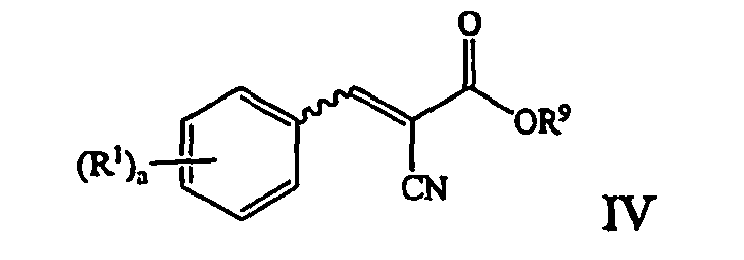
- methods of the present invention include reacting a pyridinium salt of the formula: with an ⁇ -cyano- ⁇ -aryl acrylate compound of the formula: to produce a pyridinium zwitter ionic compound of the formula: where X is halide, R 9 is lower alkyl, a, and R 1 are those defined herein.
- the ⁇ -cyano- ⁇ -aryl acrylate compound of Formula IV can be prepared by reacting a benzaldehyde compound of the formula: with an ⁇ -cyanoester compound of the formula: in the presence of a base, where a, R 1 , R 9 are those defined herein.
- the ⁇ -cyano- ⁇ -aryl acrylate compound of Formula IV can be prepared separately (i.e., in a separate step or process) or it can be prepared in situ.
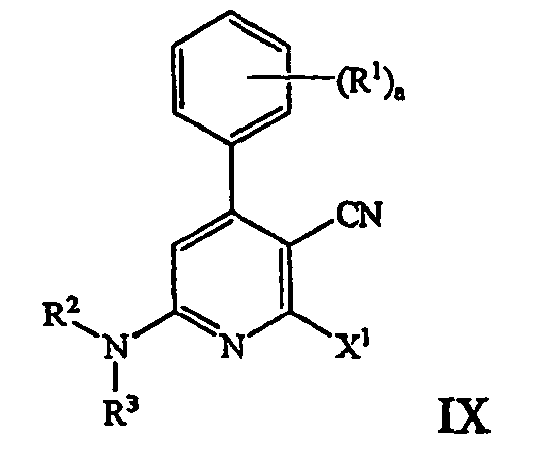
- the pyridinium zwitter ionic compound of Formula VII is treated with a reagent selected from POCl 3 , PBr 3 , and (F 3 CSO 2 ) 2 O to form a cyanopyridine compound of formula: where X 1 is halogen or trifluoromethanesufonate; and R 1 and a are those defined herein.
- Regioselective amination of the cyanopyridine compound of formula VIII with an amine compound of the formula HNR 2 R 3 then provides a tetra-substituted pyridine compound of the formula: where a, R 1 , R 2 , R 3 and X 1 are those defined herein.
- Methods of the present invention can also include hydrogenating the tetra-substituted pyridine compound of Formula IX in the presence of a hydrogenation catalyst to form a tri-substituted pyridine compound of the formula: where a, R 1 , R 2 , and R 3 are those defined herein.
- methods of the present invention can further include hydrolyzing the tri-substituted pyridine compound of Formula X to form the carboxamide compound of Formula I.
- acyl activating group refers to a group which facilitates transfer of an acyl group to an amine or a hydroxy functional group.
- exemplary acyl activation groups include, but are not limited to, halides (such as chlorides as in acid chlorides), anhydrides, and thioesters.
- Other acyl activating groups are well known to one skilled in the art and can be found, among others, in Smith and March, Advanced Organic Chemistry, 5th ed., John Wiley & Sons, New York, NY, 2001 and Harrison and Harrison et al., Compendium of Synthetic Organic Methods, Vols. 1-8 (John Wiley and Sons, 1971-1996 ).
- Alkylene means a saturated linear saturated divalent hydrocarbon moiety of one to twelve carbon atoms or a branched saturated divalent hydrocarbon moiety of three to twelve carbon atoms.
- exemplary alkylene, groups include, but are not limited to, methylene, ethylene, propylene, butylene, pentylene, and the like.
- Aralkyl means a moiety of the formula -R b R c where R b is an alkylene group and R c is an aryl group.
- exemplary aralkyl groups include, but are not limited to, benzyl, phenylethyl, 3-(3-chlorophenyl)-2-methylpentyl, and the like, with benzyl being the preferred aralkyl group.
- lower alkyl means a straight- or branched-chain alkyl group containing from 1-7 carbon atoms, for example, methyl, ethyl, propyl, isopropyl, n-butyl, i-butyl, t-butyl, and the like.
- Preferred lower alkyl groups are groups with 1-4 carbon atoms.
- lower alkoxy means a group wherein the alkyl residues are as defined above, and which is attached via oxygen atom.
- halogen and “halide” are used interchangeably herein and means chlorine, iodine, fluorine or bromine.
- cycloalkyl means a saturated carbocyclic group, containing 3-6 carbon atoms.
- aryl means an unsaturated aromatic ring, preferreably phenyl.
- Heterocyclyl means an aromatic or non-aromatic cyclic moiety having one or more ring heteroatoms, preferably one or two, each of which is independently selected from N, O, S(O) m (where m is 0,1 or 2) with the remaining ring atoms being C.
- exemplary heterocyclyl groups include, but are not limited to, morpholinyl, thiomorpholinyl, 1,1-dioxo-1 ⁇ 6 -thiomorpholinyl, piperidinyl, piperazinyl and the like.
- Heterocyclylalkyl means a moiety of the formula -R d -R e , where R d is alkylene and R e is heterocyclyl as defined herein.
- N-heterocyclyl refers to a heterocyclyl moiety as defined above, comprising at least one nitrogen ring atom with the understanding that the point of attachment of N-heterocyclyl moiety is through the ring nitrogen atom.
- 5 or 6 membered heterocyclyl refers to a heterocyclyl moiety having 5 or 6 ring atoms.
- exemplary 5 or 6 membered heterocyclyl moieties include pyridinyl, pyridimidinyl, oxadiazolyl, triazolyl, tetrazolyl, thiazolyl, thienyl, furyl, pyranyl, pyrrolyl, imidazolyl, pyrazolyl, isothiazolyl, piperazinyl, or piperidyl.
- Hydroxylalkyl refers to an alkyl, preferably lower alkyl, moiety as defined herein that is substituted with one or more hydroxyl group, provided that no two carbon atom contains more than one hydroxyl group.
- a hydroxylalkyl moiety is of the formula -R 8 -OH (where R 8 is alkylene, i.e., where the hydroxyl group is attached to the terminal carbon atom).
- One aspect of the present invention provides a process for preparing an amino-substituted cyanopyridine compound of the formula: by reacting a pyridinium salt of the formula: with an ⁇ -cyano- ⁇ -aryl acrylate compound of the formula: to produce a pyridinium zwitter ionic compound of the formula: where
- the pyridinium zwitter ionic compound of Formula VII is then reacted with a reagent selected from POCl 3 , PBr 3 , (F 3 CSO 2 ) 2 O, and other similar reagents known to one skilled in the art, to form a cyanopyridine compound of the formula: and the cyanopyridine compound of formula VIII is reacted with an amine compound of the formula HNR 2 R 3 to form a tetra-substituted pyridine compound of the formula: which is then hydrogenated in the presence of a hydrogenation catalyst to form the amino-substituted cyanopyridine compound of the Formula X, where a, R 1 , R 2 , and R 3 are those defined herein, and each X 1 is independently halide or trifluoromethanesufonate. Preferably, both X 1 are of the same moiety.
- the ⁇ -cyano- ⁇ -aryl acrylate compound of Formula IV can be prepared by reacting a benzaldehyde compound of the formula: with an ⁇ -cyanoester compound of the formula: in the presence of a base, wherein a, R 1 , and R 9 are those defined herein. Moreover, the ⁇ -cyano- ⁇ -aryl acrylate compound of Formula IV can be prepared and separated prior to use or it can be is prepared and used in situ.
- aminopyridine compounds of Formula II which are known Neurokinin-1 receptor antagonist
- Preparation of the aminopyridine compounds of Formula II can be achieved by one of several processes illustrated below. It should be appreciated that the preparation of the aminopyridine compounds of Formula II from the carboxamide pyridine compound of Formula I discussed below are only illustrative and the scope of the present invention is not limited to such processes.
- aminopyridine compounds of Formula II can be prepared from the carboxamide pyridine compound of Formula I by:
- a compound of Formula I can be reacted with an oxidizing agent and hydrolyzed with water rather than R 13 -OH to produce a diaminopyridine compound of the formula:
- This diaminopyridine of Formula XIIIA can then be further derivatized using similar processes and/or reactions as those described in reference to compounds of Formula XIII to produce corresponding compounds of Formula II.
- Some aminopyridine compounds of formulas II can be prepared from the diaminopyridine compound of Formula XIIIA by alkylating with an aralkyl compound of the formula: to produce the aminopyridine compounds of formulas II where X a is -N(H)-CH 2 -, L is a leaving group, and R 10a , R 10b , R 11 , and n are those defined herein.
- aminopyridine compounds of Formula II can be prepared from the carboxamide pyridine compound of Formula I by:
- X a is -CH 2 N(H)- or -N(H)-CH 2 - in compounds of Formula II
- the amino group of X a can be further alkylated to produce a substituted X a group, where X a is -CH 2 N(R 14a )- or -N(R 14a )-CH 2 -, where R 14a is C 3-6 cycloalkyl, aralkyl or lower alkyl.
- this alkylation can be achieved with a corresponding R 14a -X b , where R 14a those defined above and X b is a leaving group.
- a reductive amination reaction can also be used to substitute the amino group with R 14a group.
- a reductive amination involves reacting the amino group X a (where X a is -CH 2 N(H)- or -N(H)-CH 2 -) with an R 14a group having a carbonyl group (i.e., a corresponding R 14a carbonyl compound) in the presence of a reducing agent, such as sodium borohydride or other similar reducing agent.
- a reducing agent such as sodium borohydride or other similar reducing agent.
- the corresponding R 14a carbonyl compound refers to a compound having a carbonyl group within the R 14a moiety such that the reductive amination provided substitution of R 14a group. Reductive amination reaction is also disclosed in Smith and March, Advanced Organic Chemistry, 5th ed ., and Harrison and Harrison et al., Compendium of Synthetic Organic Methods, Vols. 1-8 .
- R 14a is an aralkyl or a lower alkyl
- X c is an acyl activating group such as halide or ester (i.e., -OR 16 , where R 16 is an alkyl or other hydrocarbon moiety) and reduction with a suitable reducing agent such as LiAlBH 4 .
- suitable reducing agent such as LiAlBH 4
- suitable reducing agents are well known to one skilled in the art as disclosed by Smith and March in Advanced Organic Chemistry, 5th ed .
- some aminopyridine compounds of Formula II can be prepared from the carboxamide pyridine compound of Formula I by reacting the carboxamide pyridine compound of Formula I with an aralkyl compound of the formula: in the presence of a base to produce the aminopyridine compound of Formula II, where n, R 10a R 10b , R 11 , and L are those defined herein.
- aminopyridine compounds of Formula II can be prepared including, but not limited to:
- Processes of the present invention overcome many of the disadvantages of the conventional synthetic methods by eliminating the need for expensive starting materials and avoiding use of a Grignard reaction.
- the overall process for preparation of compounds of formula I is shown in Scheme I.
- reacting a compound of formula VI with a compound of formula IV is typically carried out in the presence of an organic solvent, such as ether, ketone, toluene or alcohol, preferably methanol.
- an organic solvent such as ether, ketone, toluene or alcohol, preferably methanol.
- the reaction is carried out in the presence of a base, preferably an organic base, such as triethylamine.
- Typical reaction conditions include refluxing the reaction mixture for about one minute, then allowing the mixture to cool to about 20 °C to about 50 °C, preferably about 25 °C. After cooling, the reaction mixture is stirred for about 1 to 100 hours, typically about 66 hours. Filtration of the reaction mixture and air drying the solid then affords a pyridinium zwitter ionic compound of Formula VII.
- Compound of Formula IV can be generated separated prior to its reaction with the pyridinium salt of formula VI or it can be generated in situ.
- the pyridinium zwitter ionic compound of Formula VII can be produced by reacting a pyridinium salt of formula VI with a benzaldehyde compound of formula III in the presence of an ⁇ -cyanoester compound of the formula: where R 9 is as defined herein.
- the reaction is carried out in the presence of an alcohol, such as a lower alkyl alcohol, cycloalkyl alcohol, preferably isopropanol.
- the reaction is carried out in an organic solvent such as ether, ketone, toluene, alcohol (preferably methanol), or a mixture thereof.
- the reaction mixture includes an organic base, such as triethylamine.
- Typical reaction time is about 2 to 48 hours, generally about 24 hours. Suitable reaction temperature ranges from about 20°C to 33 °C, often about 25 °C to 30°C.
- a cyanopyridine compound of formula VIII reacting the pyridinium zwitter ionic compound of formula VII with a reagent selected from POCl 3 , PBr 3 , and (F 3 CSO 2 ) 2 O yields a cyanopyridine compound of formula VIII.
- Typical reaction conditions include heating the mixture to about 105°C for approximately 72 hours. The mixture is then cooled to approximately 20 °C to 33 °C, preferably 20°C to 25 °C and diluted with an organic solvent, such as methylene chloride. The resulting mixture is then placed in an ice bath and stirred for about 10 minutes. Aqueous work up followed by concentration of the organic layer then affords the cyanopyridine compound of formula VIII.
- the cyanopyridine compound of formula VIII is then reacted with an amine compound of the formula HNR 2 R 3 to form a tetra-substituted pyridine compound of formula IX.
- Displacement of one of the X 1 moiety with the amine compound of the formula HNR 2 R 3 is typically preformed in an alcoholic solvent, such as methanol.
- the reaction temperature is generally kept at about 0 °C to 25 °C, preferably 18 °C. If necessary, an ice-water bath can be used to control the reaction temperature.
- the amine compound of the formula HNR 2 R 3 is morpholine, which is added to the reaction mixture at a temperature of about 18 °C to 33°C, preferably 18 °C to 22 °C. Morpholine is typically added slowly to the reaction mixture, e.g., addition time of about 10 to 60 minutes, preferably 45 minutes. The resulting mixture is stirred at about 20 °C to 33 °C, preferably 20 °C to 25 °C, for approximately 48 hours.
- Hydrogenation of the tetra-substituted pyridine compound of formula IX in the presence of a hydrogenation catalyst then affords an amino-substituted cyanopyridine compound of formula X.
- the hydrogenation reaction is carried out in the presence of a base, preferably an organic base, such as triethylamine.
- the hydrogenation reaction temperature generally ranges from about 25 °C to 45 °C, preferably 20 °C to 25 °C.
- a variety of hydrogenation catalysts are suitable for reducing the tetra-substituted pyridine compound of formula IX.
- Preferred hydrogenation catalysts are transition metal based, preferably palladium metal based.
- a particularly useful hydrogenation catalyst is Pd(OH) 2 or 20% palladium hydroxide on carbon (Pearlman's catalyst).
- the hydrogenation reaction mixture includes an organic solvent, such as methanol.
- the reaction mixture is typically stirred under a high pressure of hydrogen atmosphere, typically at about 30 psi of hydrogen or higher, more generally about 40 psi of hydrogen or higher.
- the hydrogenation reaction is carried out at about 48.0 to 48.3 psi of hydrogen.
- the reaction time ranges from about 2 to 42 hours, often about 21 hours.
- the amino-substituted cyanopyridine compound of formula X is then hydrolyzed to provide a carboxamide pyridine compound of formula I.
- Hydrolysis of the nitrile function group of formula X can be achieved in a basic or, preferably, in an acidic medium.
- Exemplary acids that are useful in hydrolysis of the nitrile function group include, but are not limited to, H 2 SO 4 , HCl and acetic acid, with H 2 SO 4 being the typical acid used in hydrolysis.
- Hydrolysis can be carried out in the presence or absence of an organic solvent.
- Typical hydrolysis reaction is carried out at a temperature in the range of about 50°C to 140 °C, preferably about 60°C to 90 °C.
- the reaction time generally ranges from approximately 2 to 22 hours, preferably 12 hours.
- Scheme I shows various reactions in a particular sequence
- Scheme I is only an illustrative example.
- One skilled in the art having the present disclosure can readily recognize that some of the reaction sequences can be changed, eliminated or combined. Therefore, the scope of present invention includes all suitable variations to Scheme I reaction sequences.
- Scheme I illustrates a reaction sequence involving substitution of one of the X 1 moiety of compound of formula VIII with an amine compound of the formula HNR 2 R 3 , followed by hydrogenation of compound of formula IX, then hydrolysis of the cyano group of compound of formula X to produce the carboxamide pyridine compound of formula I.
- variations of reaction sequences illustrated in Scheme I are also readily apparent to those skilled in the art having the disclosure of the present invention.
- hydrolysis of the cyano group can be achieved prior to the reduction, i.e., hydrogenolysis, reaction.
- each R 1 is independently lower alkyl, alkoxy, halogen, cyano, or alkyamino; X 1 is halogen; and R 2 and R 3 together with the nitrogen atom to which they are attached to form optionally substituted N-heterocyclyl.
- each R 1 is independently lower alkyl, alkoxy, halogen, cyano and alkylamino;
- X 1 is chloro; and R 2 and R 3 together with the nitrogen atom to which they are attached to form morpholin-4-yl, 4-methyl-piperazin-1-yl, or 1,1-dioxothiomopholin-4-yl.
- Another embodiment of the present invention provides various compounds that can be produced by one or more reaction disclosed herein, such compounds include, but are not limited to, methyl 2-cyano-3- (2-methylphenyl) -2-propenoate, 1-(2-amino)-2-oxoethylpyridinium chloride, 5'-cyano-1'-2',3',4'-tetrahydro-6'-hydroxy-4'-(2-methylphenyl)-2'-oxo-1,3'-bipyridium, zwitter ion, 3-cyano-2,-6-dichloro-4-(2-methylphenyl)pyridine, 2-chloro-3-cyano-4-(2-methylphenyl)-6-(4-morpholinyl)pyridine, 5-cyano-4-(2-methylphenyl)-2-(4-morpholinyl)pyridine, 4-(2-methylphenyl)-6-(4-morpholinyl)-3-pyridinecarboxamide, 2-chloro-4-(2-methylphenyl)
- aminopyridine compound of Formula II including, but not limited to: N-(3,5-bis-trifluoromethyl-benzyl)-N-methyl-6-[methyl-(2-morpholin-4-yl-ethyl)-amino]-4-o-tolyl-nicotinamide, N-(3,5-bis-trifluoromethyl-benzyl)-N-methyl-6-morpholin-4yl-4-o-tolyl-nicotinamide, N-(3,5-bis-trifluoromethyl-benzyl)-N-methyl-6-thiomorpholin-4-yl-4-o-tolyl-nicotinamide, N-(3,5-bis-trifluoromethyl-benzyl)-N-methyl-6-(1-oxo-1 ⁇ 6 -4-thiomorpholin-4-yl)-4-o-tolyl-nicotinamide, N-(3,5-Bis-trifluoromethyl-benzyl)-6-(1,1-d
- Ammonium chloride (100 g of 15.9% aqueous solution) was added over 5 minutes at 15-20 °C. The solution was concentrated by fractional distillation (597 mL collected at 50-61 °C). The distillation pot layers were separated. The aqueous layer was extracted three times with 25 mL of methyl tert-butyl ether (i.e., MTBE). The organic layers were combined, washed with 50 mL of brine, dried (MgSO 4 ), filtered, and fractionally distilled (b.p. 54-62 °C) to yield 59.3 g of yellow oil. The oil was fractionally distilled (b.p. 60-62 °C at 1.6-2.0 mmHg of pressure) to afford 28.041 g (68.4%) of a colorless oil.
- MTBE methyl tert-butyl ether
- a 100-mL, 2-necked round bottom flask equipped with a reflux condenser was charged with 1.726 g (10.0 mmol) of the pyridinium salt (i.e., 1-(2-amino)-2-oxoethylpyridinium chloride, see Example 3 or 4), 2.012 g (10.0 mmol) of methyl 2-cyano-3-(2-methylphenyl)-2-propenoate (see Example 2), 20 mL of methanol, and triethylamine (1.55 mL, 1.11 g,1.10 equiv). The mixture was refluxed for 1 minute then allowed to cool to 25 °C and stirred for 66 hours.
- the pyridinium salt i.e., 1-(2-amino)-2-oxoethylpyridinium chloride, see Example 3 or 4
- 2.012 g (10.0 mmol) of methyl 2-cyano-3-(2-methylphenyl)-2-propenoate
- the addition funnel was charged with 153.3 mL (111.3 g, 1.1 mol) of triehtylamine and was added to the reaction mixture over a period of 20 minutes at 20-25 °C. The resulting mixture was stirred at 25-30 °C for 24 hours. The precipitate was filtered, washed successively with 500 mL of methanol, 500 mL of toluene and 500 mL of hexanes, and dried to afford 285.10 g (93.4%) of 1',2',3',4'-tetrahydro-5'-cyano-6'-hydroxy-4'(2-methylphenyl)-2'-oxo-1,3'-bipyridinium, zwitter ion as a bright yellow solid.
- the addition funnel was charged with 153.3 mL (111.3 g,1.1 mol) of triethylamine and was added to the reaction mixture over a period of 24 minutes at 20-25 °C. The resulting mixture was stirred at 25-30 °C for 24 hours.
- the addition funnel was charged with 31.1 mL (22.6 g, 223 mmol) triethylamine and was added to the reaction mixture over 11 min at 170 rpm and 20-25 °C (intermittent ice-water bath). The resulting mixture was stirred at 25-30 °C for 24 h.
- the precipitate was suction filtered using a 600 mL coarse sintered glass funnel.
- the precipitate was washed successively with 100 mL of 25 °C methanol, 100 mL of 25 °C toluene, and 100 mL of 25 °C hexanes.
- the solid was then air dried 3.5 h at 25 °C to afford 60.69 g (92.6%) of bright yellow solid, m.p.
- the reaction mixture was cooled to 25 °C and diluted with 75 mL of methylene chloride. The solution was transferred onto 350 g of ice. Additional methylene chloride (25 mL) was used to aid the transfer. The resulting mixture was stirred for 1 hour. The layers were separated, and the aqueous layer was extracted twice with 25 mL of methylene chloride and twice with 50 mL of toluene. The extracts were combined, dried (5.0 g Na 2 SO 4 ), and filtered through 15 g of Filtrol ® on a 60-mL coarse sintered glass funnel. The flask and the solid were washed with 50 mL of toluene. The combined mother liquors were concentrated to afford 28.70 g (83.3%) of 3-cyano-2,6-dichloro-4-(2-methylphenyl)pyridine as a near colorless solid (LC assay 100.7 wt %).
- the reaction mixture was cooled to 25 °C, diluted with 200 mL of methylene chloride, transferred using additional 25 mL of methylene chloride onto 450 g of ice, and stirred until all the ice melted.
- the layers were separated, and the aqueous layer was extracted successively twice with 25 mL of methylene chloride and twice with 125 mL of toluene.
- the combined extracts were filtered through 15 g of Filtrol ® on a 60-mL coarse sintered glass funnel. The flask and the solid were washed with 100 mL of toluene.
- the combined mother liquors were concentrated to afford 39.70 g (83.0%) of near colorless solid.
- Oxone ® (56.18 g, 91.4 mmol) was added to a solution of 2-chloro-3-cyano-4-(4-fluoro-2-methylphenyl)-6-(thiomorpholino)pyridine (26.54 g, 76.3 mmol) in 200 mL of NMP in a 1000-mL, 3-necked flask (equipped with a teflon paddle stirrer, septum with teflon-coated thermocouple, dry N 2 adapter). The mixture was stirred at 25 °C for 20 hours, and diluted with 800 mL of water. The resulting mixture was stirred at 25 °C for 30 minutes.
Landscapes
- Chemical & Material Sciences (AREA)
- Organic Chemistry (AREA)
- Pyridine Compounds (AREA)
- Catalysts (AREA)
- Low-Molecular Organic Synthesis Reactions Using Catalysts (AREA)
- Pharmaceuticals Containing Other Organic And Inorganic Compounds (AREA)
- Plural Heterocyclic Compounds (AREA)
Abstract
Description
- The present invention provides a process for preparing a carboxamide pyridine compound of the formula:

- each R1
- is independently lower alkyl, lower alkoxy, halogen, cyano or alkylamino;
- a
- is an integer from 0 to 2;
- R2
- is hydrogen, C3-6 cycloalkyl, aralkyl, lower alkyl, hydroxylalkyl, -S(O)2-lower alkyl, -S(O)2-Ar1, optionally substituted N- heteroryclyl)alkyl, -C(=O)R3, where Ar1 is aryl;
- R3
- is hydrogen, C3-6 cycloalkyl, aralkyl or lower alkyl;
- or R2 and R3
- together with the nitrogen atom to which they are attached to form optionally substituted N-heterocyclyl;
- or R2 and R3
- together form =C(R5)-R6-NR7R8;
where
R5 is lower alkyl or hydrogen;
R6 is alkylene or a bond and
each of R7 and R8 is independently hydrogen, C3-6 cycloalkyl, aralkyl, or lower alkyl. - The carboxamide pyridine compounds of Formula I are useful intermediates in the preparation of Neurokinin-1 receptor antagonists, encompassed by Formula II.

- a, R1, R2, and R3
- are those defined herein,
- each of R10a and R10b
- is independently hydrogen or lower alkyl, or R10a and R10b together with the carbon atom to which they are attached to form a cycloalkyl group;
- each R11
- is independently halide, trifluoromethyl, lower alkoxy, or cyano, or two R11 moieties together form -CRw=CRx-CRy=CRz-, where each of Rw, Rx, Ry, and Rz is independently selected from the group consisting of hydrogen, lower alkyl or lower alkoxy, provided that at least two of Rw, Rx, Ry, and Rz are hydrogen;
- n
- is an integer from 0 to 5; and
- Xa is
- -C(=O)N(R14)-, -R16-N(R14)-, -N(R14)C(=O)-, or -N(R14)-R16-,
where- R14 is hydrogen, C3-6 cycloalkyl, aralkyl or lower alkyl; and
- R16 is alkylene, preferably methylene or ethylene.
EP 1035 115 A1 . - The tachykinin neuropeptide substance P is a naturally occurring undecapeptide that stimulates contractile action on extravascular smooth muscle tissue upon binding with the receptor Neurokinin 1 (NK-1). NK-1 receptors inhibit the central nervous system (CNS) and peripheral tissues of humans. The interactions of substance P and NK-1 are frequently associated with inflammatory conditions, such as migraine, rheumatoid arthritis, asthma and inflammatory bowel disease. In addition, the modulation of Parkinson's disease and other disorders of the CNS and mediation of the emetic reflex are attributed to substance P/NK-1 contact.
- NK-1 antagonists inhibit the interaction of substance P and NK-1 receptor site. These antagonists have previously been utilized for treatment of pain, headache, migraine, Alzheimer's disease, multiple sclerosis, attenuation of morphine withdrawal, cardiovascular changes, edema, chronic inflammatory disease, asthma/bronchial hyperactivity, allergic rhinitis, inflammatory diseases of the gut, ocular injuries and ocular inflammatory disease. Such compounds are also believed to be useful in the treatment of various psychological disorders, including disorders of the CNS, as well as treatment of motion sickness, inducement of vomiting and reduction of cisplatin-induced emesis. See Stout, S.C., et al., Annu. Rev. Pharmacol. Toxicol. (2001) 41, 877.
- The conventional processes for synthesis of the pyridine ring structure of NK-1 antagonists of formula II require functionalization of a 2,5-disubstituted pyridine. One of the current methods for producing N-[6-(4-morpholinyl)-3-pyridinyl]pivalamide from 2-chloro-5-nitropyridine involves displacement of the chloro group with morpholine, reduction of the nitro group and acylation of the resulting amine by a pivaloyl group, such as pivaloyl chloride or pivaloyl anhydride. Regioselective lithiation of N-[6-(4-morpholinyl)-3-pyridinyl] pivalamide followed by reaction with an iodide source (such as iodine) then provides a 4-iodopyridine compound, which is used in a Suzuki coupling with an arylboronic acid. The coupled product is then hydrolyzed to remove the pivaloyl group. N-Methylation and acylation of the resulting aminopyridine compound then provides a 2,4,5-tri-substituted pyridine compound, as described in
EP 1,103,545 (Ballard, T.M. et al. ). The cost of this process is relatively high due to the need for lithiation. In addition, this process requires production of nitropyridine, which presents a safety hazard. - Another process for producing pyridine ring system based NK-1 receptor agonist utilizes Hoffman rearrangement reaction of a nicotinamide compound. In this process, microbial oxidation of nicotinic acid is used to produce 6-hydroxynicotinic acid, which is then converted to 6-chloronicotinic acid. The carboxylic acid group is then converted to a tert-butylamide group by converting the carboxylic acid to an acid chloride and reacting the acid chloride with tert-butylamine. The resulting pyridine compound is then reacted with o-tolylmagnesium chloride, followed by an oxidation of the resulting product to produce a 4-(o-tolyl)substituted pyridine compound. The overall yield of this process is often low, and requires an excess amount of o-tolylmagnesium chloride. In addition, an oxidation reaction is required to regenerate the pyridine ring system. Removal of the tert-butyl group followed by Hoffman rearrangement of the amide group results in a formation of an isocyanate which is then trapped with methanol to yield a carbamate. The overall production cost of this process is high due to use of expensive starting materials. And furthermore, the overall production efficiency of this process is low due to variability in the success of the Grignard reaction.
- Additional known methods for producing pyridine compounds include the Hantzsch, Kröhnke and Guareschi-Thorpe syntheses. Preparation of pyridine compounds via the Guareschi-Thorpe synthesis uses cyanoacetamide and an arylacetate (e.g., ethyl benzoylacetate) as starting materials, described in
US 4,182,887 . This process results in a low yield (42%) of 2,6-dihydroxy-3-cyano-4-phenylpyridine with bezoylacetate and still a lower yield when an aryl group is ortho-substituted. - Trans-4-Aryl-3-cyano-6-ox-5-pyridino-1,4,5,6-tetrahydropyridin-2-olates can also be prepared by reaction of a pyridinium salt, an aromatic aldehyde and ethyl cyanoacetate in the presence of a base, described in Shestopalov, A.M., et al. Synthesis (1991) 402; Shestopalov, A.M., et al. Khim. Geterotsikl. Soedin. (1990) 363; and Litvinov, V.P., Shestopalov, A.M. Zh. Org. Khim. (1997) 33, 975.
- Another suitable starting material for the production of the NK-1 antagonist pyridine derivative of formula II is an amide of the formula:

- Regioselective displacement of chloride from the 2,6-dichloro-3-cyanopyridine by an amine and the conversion of the nicotinonitrile to a nicotinamide are well known to one skilled in the art. In general, unhindered primary amines attack at the 2-position, while hindered primary and secondary amines attack at the 6-position, described in
US 4,061,642 , andUS 3,853,895 . Hydrolysis of a nicotinonitrile to a nicotinamide compound can be achieved using a variety of reagents, including sulfuric acid, aqueous hydroxide, basic hydrogen peroxide or potassium trimethylsilanolate, as described in Miyamoto, T., et al. Het. Chem. (1987) 24, 1333; Salem, M., et al. Heterocycles (2000) 53, 1129; Humphries, M., Ramsden, C., Sythesis (1999) 985; Merchant, K., Tet. Lett. (2000) 41, 3747. - While methods are available for the production of pyridine derivatives, there exists a need for a pyridine compound production process that utilizes low cost starting materials. There is also a need for a process that avoids the shortcoming of the Grignard reaction's variability.
- The present invention provides processes for preparing a variety of intermediates that can be used to synthesize carboxamide pyridine compounds of Formula I.
- In one embodiment, methods of the present invention include reacting a pyridinium salt of the formula:


- The α-cyano-β-aryl acrylate compound of Formula IV can be prepared by reacting a benzaldehyde compound of the formula:


- The α-cyano-β-aryl acrylate compound of Formula IV can be prepared separately (i.e., in a separate step or process) or it can be prepared in situ.
- In another aspect of the present invention, the pyridinium zwitter ionic compound of Formula VII is treated with a reagent selected from POCl3, PBr3, and (F3CSO2)2O to form a cyanopyridine compound of formula:

- Methods of the present invention can also include hydrogenating the tetra-substituted pyridine compound of Formula IX in the presence of a hydrogenation catalyst to form a tri-substituted pyridine compound of the formula:

- In addition, methods of the present invention can further include hydrolyzing the tri-substituted pyridine compound of Formula X to form the carboxamide compound of Formula I.
- The following definitions apply generally to terms used in this description regardless of whether the term appears alone or in conjunction.
- "Acyl activating group" refers to a group which facilitates transfer of an acyl group to an amine or a hydroxy functional group. Exemplary acyl activation groups include, but are not limited to, halides (such as chlorides as in acid chlorides), anhydrides, and thioesters. Other acyl activating groups are well known to one skilled in the art and can be found, among others, in Smith and March, Advanced Organic Chemistry, 5th ed., John Wiley & Sons, New York, NY, 2001 and Harrison and Harrison et al., Compendium of Synthetic Organic Methods, Vols. 1-8 (John Wiley and Sons, 1971-1996).
- "Alkylene" means a saturated linear saturated divalent hydrocarbon moiety of one to twelve carbon atoms or a branched saturated divalent hydrocarbon moiety of three to twelve carbon atoms. Exemplary alkylene, groups include, but are not limited to, methylene, ethylene, propylene, butylene, pentylene, and the like.
- "Aralkyl" means a moiety of the formula -RbRc where Rb is an alkylene group and Rc is an aryl group. Exemplary aralkyl groups include, but are not limited to, benzyl, phenylethyl, 3-(3-chlorophenyl)-2-methylpentyl, and the like, with benzyl being the preferred aralkyl group.
- The term "lower alkyl," means a straight- or branched-chain alkyl group containing from 1-7 carbon atoms, for example, methyl, ethyl, propyl, isopropyl, n-butyl, i-butyl, t-butyl, and the like. Preferred lower alkyl groups are groups with 1-4 carbon atoms.
- The term "lower alkoxy" means a group wherein the alkyl residues are as defined above, and which is attached via oxygen atom.
- The terms "halogen" and "halide" are used interchangeably herein and means chlorine, iodine, fluorine or bromine.
- The term "cycloalkyl," means a saturated carbocyclic group, containing 3-6 carbon atoms.
- The term "aryl" means an unsaturated aromatic ring, preferreably phenyl.
- "Heterocyclyl" means an aromatic or non-aromatic cyclic moiety having one or more ring heteroatoms, preferably one or two, each of which is independently selected from N, O, S(O)m (where m is 0,1 or 2) with the remaining ring atoms being C. Exemplary heterocyclyl groups include, but are not limited to, morpholinyl, thiomorpholinyl, 1,1-dioxo-1λ6-thiomorpholinyl, piperidinyl, piperazinyl and the like.
- "Heterocyclylalkyl" means a moiety of the formula -Rd-Re, where Rd is alkylene and Re is heterocyclyl as defined herein.
- The term "N-heterocyclyl" refers to a heterocyclyl moiety as defined above, comprising at least one nitrogen ring atom with the understanding that the point of attachment of N-heterocyclyl moiety is through the ring nitrogen atom. N-Heterocyclyl may optionally be substituted with hydroxy, lower alkyl, -Ra-COO-Rb (where Ra is a bond or alkylene, and Rb is lower alkyl), -N(Rc)C(=O)-lower alkyl (where Rc is hydrogen, C3-6 cycloalkyl, aralkyl or lower alkyl), hydroxylalkyl, cyano, -Re-O-Rf (where Re is alkylene and Rf is hydroxylalkyl), -CHO, 5- and 6- membered heterocyclyl, or 5- or 6-membered heterocyclylalkyl.
- The term "5 or 6 membered heterocyclyl" refers to a heterocyclyl moiety having 5 or 6 ring atoms. Exemplary 5 or 6 membered heterocyclyl moieties include pyridinyl, pyridimidinyl, oxadiazolyl, triazolyl, tetrazolyl, thiazolyl, thienyl, furyl, pyranyl, pyrrolyl, imidazolyl, pyrazolyl, isothiazolyl, piperazinyl, or piperidyl.
- "Hydroxylalkyl" refers to an alkyl, preferably lower alkyl, moiety as defined herein that is substituted with one or more hydroxyl group, provided that no two carbon atom contains more than one hydroxyl group. Preferably, a hydroxylalkyl moiety is of the formula -R8-OH (where R8 is alkylene, i.e., where the hydroxyl group is attached to the terminal carbon atom).
- The units "mmHg" and "psi" given in examples 1,15, 16 and 19 and in the description have the following meaning in the SI unit:
- 1 mmHg = 133.322 Pa and 1 psi = 6.894757 x 10³ Pa".
- One aspect of the present invention provides a process for preparing an amino-substituted cyanopyridine compound of the formula:



- each R1
- is independently lower alkyl, lower alkoxy, halogen, cyano or alkylamino;
- a
- is an integer from 0 to 2;
- R2
- is hydrogen, C3-6 cycloalkyl, aralkyl, lower alkyl, hydroxylalkyl, -S(O)2-lower alkyl, -S(O)2-Ar1, optionally substituted N-heterocyclyl)alkyl, -C(=O)R3, where Ar1 is aryl;
- R3
- is hydrogen, C3-6 cycloalkyl, aralkyl or lower alkyl;
- or R2 and R3
- together with the nitrogen atom to which they are attached to form optionally substituted N-heterocyclyl;
- or R2 and R3
- together form =C(R5)-R6-NR7R8;
where- R5 is lower alkyl, or preferably hydrogen;
- R6 is alkylene or preferably a bond; and
- each of R7 and R8 is independently hydrogen, C3-6 cycloalkyl, aralkyl, or lower alkyl;
- R9
- is lower alkyl; and
- X
- is halide.
- The pyridinium zwitter ionic compound of Formula VII is then reacted with a reagent selected from POCl3, PBr3, (F3CSO2)2O, and other similar reagents known to one skilled in the art, to form a cyanopyridine compound of the formula:


- The α-cyano-β-aryl acrylate compound of Formula IV can be prepared by reacting a benzaldehyde compound of the formula:


- Hydrolyzing the amino-substituted cyanopyridine compound of the Formula X provides a carboxamide pyridine compound of the formula:

WO 02/085458 - Preparation of the aminopyridine compounds of Formula II, which are known Neurokinin-1 receptor antagonist, can be achieved by one of several processes illustrated below. It should be appreciated that the preparation of the aminopyridine compounds of Formula II from the carboxamide pyridine compound of Formula I discussed below are only illustrative and the scope of the present invention is not limited to such processes.
- In one particular embodiment, the aminopyridine compounds of Formula II can be prepared from the carboxamide pyridine compound of Formula I by:
- (a) reacting the carboxamide pyridine compound of Formula I with an oxidizing agent in the presence of an alcohol of the formula R13-OH to produce a carbamate pyridine compound of the formula:

- (b) reducing the carbamate pyridine compound of Formula XII with a reducing agent to produce a diaminopyridine compound of the formula:

- (c) reacting the diaminopyridine compound of Formula XIII with a carbonyl compound of the formula:

- (d) optionally reacting the aminopyridine compound of Formula II, where Xa is -N(CH3)C(=O)-, with a second reducing agent to produce the aminopyridine compound of Formula II (where Xa is -N(CH3) -CH2-),
where- a, n, R1, R2, R3, R10a, R10b, and R11 are those defined herein;
- R13 is lower alkyl; and
- Y is alkoxide or an acyl activating group.
- It should be appreciated that a compound of Formula I can be reacted with an oxidizing agent and hydrolyzed with water rather than R13-OH to produce a diaminopyridine compound of the formula:

- Some aminopyridine compounds of formulas II can be prepared from the diaminopyridine compound of Formula XIIIA by alkylating with an aralkyl compound of the formula:

- In another embodiment, the aminopyridine compounds of Formula II can be prepared from the carboxamide pyridine compound of Formula I by:
- (a) contacting the carboxamide pyridine compound of Formula I with a reducing agent to produce an alkylamino-substituted pyridine compound of the formula:

- (b) reacting the alkylamino-substituted pyridine compound of Formula XV with an aralkyl compound of the formula:

- a, n, R1, R2, R3, R10a, R10b and R11 are those defined herein;
- L is a leaving group; and
- Xa is -CH2N(H)-.
- It should be appreciated that when Xa is -CH2N(H)- or -N(H)-CH2- in compounds of Formula II, the amino group of Xa can be further alkylated to produce a substituted Xa group, where Xa is -CH2N(R14a)- or -N(R14a)-CH2-, where R14a is C3-6 cycloalkyl, aralkyl or lower alkyl. Typically this alkylation can be achieved with a corresponding R14a-Xb, where R14a those defined above and Xb is a leaving group. Such alkylation reactions are well known to one of ordinary skill in the art, described for example in Smith and March, Advanced Organic Chemistry, 5th ed. and Harrison and Harrison et al., Compendium of Synthetic Organic Methods, Vols.1-8, all.
- Alternatively, rather than by an alkylation reaction, a reductive amination reaction can also be used to substitute the amino group with R14a group. Briefly, a reductive amination involves reacting the amino group Xa (where Xa is -CH2N(H)- or -N(H)-CH2-) with an R14a group having a carbonyl group (i.e., a corresponding R14a carbonyl compound) in the presence of a reducing agent, such as sodium borohydride or other similar reducing agent. For example, when R14a is an ethyl group, the corresponding R14a carbonyl compound is HC(=O)CH3, when R14a is benzyl group, the corresponding R14a carbonyl compound is HC(=O)Ph, and when R14a is cyclohexane, the corresponding R14a carbonyl compound is cyclohexanone. Thus, the corresponding R14a carbonyl compound refers to a compound having a carbonyl group within the R14a moiety such that the reductive amination provided substitution of R14a group. Reductive amination reaction is also disclosed in Smith and March, Advanced Organic Chemistry, 5th ed., and Harrison and Harrison et al., Compendium of Synthetic Organic Methods, Vols. 1-8.
- Still alternatively, synthesis of compounds where R14a is an aralkyl or a lower alkyl can involve acylation of the Xa moiety (where the initial Xa moiety is -CH2N(H)- or -N(H)-CH2-) with a R15-C(=O)c, where Xc is an acyl activating group such as halide or ester (i.e., -OR16, where R16 is an alkyl or other hydrocarbon moiety) and reduction with a suitable reducing agent such as LiAlBH4. Other suitable reducing agents are well known to one skilled in the art as disclosed by Smith and March in Advanced Organic Chemistry, 5th ed. and Harrison and Harrison et al., Compendium of Synthetic Organic Methods, Vols. 1-8, which have been previous incorporated by reference. Thus, an R14a group is incorporated by using the acylating agent R15-C(=O)-Xc, where R15-CH2- group represents R14a moiety. Accordingly, in these instances, R14a is a methylene homolog of R15 moiety.
- Yet in another embodiment, some aminopyridine compounds of Formula II can be prepared from the carboxamide pyridine compound of Formula I by reacting the carboxamide pyridine compound of Formula I with an aralkyl compound of the formula:

- Other processes for producing aminopyridine compounds of Formula II can be found in
WO 02/085458 WO 03/011860 EP 1 103 545 . - Using processes of the present invention, a wide variety of aminopyridine compounds of Formula II can be prepared including, but not limited to:
- N-(3,5-bis-trifluoromethyl-benzyl)-N-methyl-6-[methyl-(2-morpholin-4-yl-ethyl)-amino]-4-o-tolyl-nicotinamide;
- N-(3,5-bis-trifluoromethyl-benzyl)-N-methyl-6-morpholin-4-yl-4-o-tolyl-nicotinamide;
- N-(3,5-bis-trifluoromethyl-benzyl)-N-methyl-6-thiomorpholin-4-yl-4-o-tolyl-nicotinamide;
- N-(3,5-bis-trifluoromethyl-benzyl)-N-methyl-6-(1-oxo-1λ6-4-thiomorpholin-4-yl)-4-o-tolyl-nicotinamide;
- N-(3,5-bis-trifluoromethyl-benzyl)-6-(1,1-dioxo-1λ6-6-thiomorphohn-4-yl)-N-methyl-4-o-tolyl-nicotinamide;
- N-(3,5-bis-trifluoromethyl-benzyl)-N-methyl-6-piperazin-1-yl-4-o-tolyl-nicotinamide;
- N-(3,5-bis-trifluoromethyl-benzyl)-6-[4-(2-hydroxyethyl)-piperazin-1-yl)]-N-methyl-4-o-tolyl-nicotinamide;
- 2-(3,5-bis-trifluoromethyl-phenyl)-N-[6-(4-methyl-piperazin-1-yl)-4-o-tolyl-pyridin-3-yl]-N-methyl-isobutyramide;
- 2-(3,5-bis-trifluoromethyl-phenyl)-N-(6-morpholin-4-yl-4-o-tolyl-pyridin-3-yl)-N-methyl-isobutyramide;
- 2-(3,5-bis-trifluoromethyl-phenyl)-N-[4-(4-fluoro-2-methyl-phenyl)-6-(4-methylpiperazin-1-yl)-pyridin-3-yl]-N-methyl-isobutyramide;
- 2-(3,5-bis-trifliioromethyl-phenyl)-N-[4-(2-chloro-phenyl)pyridin-3-yl]-N-methyl-isobutyramide;
- 2-(3,5 bis-trifluoromethyl-phenyl)-N-methyl-N-(4-o-tolyl-pyridin-3-yl)-isobutyramide;
- 2-(3,5-bis-trifluoromethyl-phenyl)-N-methyl-N-[6-(4-pyridin-2-yl-piperazin-1-yl)-4-o-tolyl-pyridin-3-yl)-isobutyramide;
- 2-(3,5-bis-trifluoromethyl-phenyl)-N-(6-morpholin-4-yl-4-o-tolyl-pyridin-3-yl)-isobutyramide;
- 2-(3,5-bis-trifluoromethyl-phenyl)-N-[4-(2-chlorophenyl)-6-dimethylamino-pyridin-3-yl]-isobutyramide;
- 2-(3,5-bis-trifluoromethyl-phenyl)-N-methyl-N-(6-piperazin-1-yl-4-o-tolyl-pyridin-3-yl)-isobutyramide; or
- 2-(3,5-bis-trifluoromethyl-phenyl)-N-[6-(1,1-dioxo-1λ6-thiomorpholin-4-yl)-4-o-tolyl-pyridin-3-yl]-N-methyl-isobutyramide.
- Processes of the present invention overcome many of the disadvantages of the conventional synthetic methods by eliminating the need for expensive starting materials and avoiding use of a Grignard reaction. The overall process for preparation of compounds of formula I is shown in Scheme I.

- Throughout this specification, some synthetic processes for producing compounds of Formula I are often indicated by exact structures; however, it should be appreciated that processes of the present invention can be applied widely to analogous compounds of Formula I, given an appropriate consideration to protection and deprotection of reactive functional groups by methods standard to the art of organic chemistry. For example, hydroxy groups, in order to prevent unwanted side reactions, sometimes need to be converted to ethers or esters during chemical reactions at other sites in the molecule. The hydroxy protecting group is then removed to provide the free hydroxy group. Similarly, amino groups and carboxylic acid groups can be derivatized to protect them against unwanted side reactions. Typical protecting groups, and methods for attaching and cleaving
them, are described in the above references by T.W. Greene and P.G.M. Wuts, Protective Groups in Organic Synthesis, 3rd edition, John Wiley & Sons, New York, 1999, and Harrison and Harrison et al., Compendium of Synthetic Organic Methods, Vols. 1-8 (John Wiley and Sons, 1971-1996). - Referring to Scheme I, reacting a compound of formula VI with a compound of formula IV is typically carried out in the presence of an organic solvent, such as ether, ketone, toluene or alcohol, preferably methanol. Often the reaction is carried out in the presence of a base, preferably an organic base, such as triethylamine. Typical reaction conditions include refluxing the reaction mixture for about one minute, then allowing the mixture to cool to about 20 °C to about 50 °C, preferably about 25 °C. After cooling, the reaction mixture is stirred for about 1 to 100 hours, typically about 66 hours. Filtration of the reaction mixture and air drying the solid then affords a pyridinium zwitter ionic compound of Formula VII.
- Compound of Formula IV can be generated separated prior to its reaction with the pyridinium salt of formula VI or it can be generated in situ. In this manner, the pyridinium zwitter ionic compound of Formula VII can be produced by reacting a pyridinium salt of formula VI with a benzaldehyde compound of formula III in the presence of an α-cyanoester compound of the formula:

- Referring again to Scheme I above, reacting the pyridinium zwitter ionic compound of formula VII with a reagent selected from POCl3, PBr3, and (F3CSO2)2O yields a cyanopyridine compound of formula VIII. Typical reaction conditions include heating the mixture to about 105°C for approximately 72 hours. The mixture is then cooled to approximately 20 °C to 33 °C, preferably 20°C to 25 °C and diluted with an organic solvent,
such as methylene chloride. The resulting mixture is then placed in an ice bath and stirred for about 10 minutes. Aqueous work up followed by concentration of the organic layer then affords the cyanopyridine compound of formula VIII. - The cyanopyridine compound of formula VIII is then reacted with an amine compound of the formula HNR2R3 to form a tetra-substituted pyridine compound of formula IX. Displacement of one of the X1 moiety with the amine compound of the formula HNR2R3 is typically preformed in an alcoholic solvent, such as methanol. The reaction temperature is generally kept at about 0 °C to 25 °C, preferably 18 °C. If necessary, an ice-water bath can be used to control the reaction temperature. In one particular embodiment, the amine compound of the formula HNR2R3 is morpholine, which is added to the reaction mixture at a temperature of about 18 °C to 33°C, preferably 18 °C to 22 °C. Morpholine is typically added slowly to the reaction mixture, e.g., addition time of about 10 to 60 minutes, preferably 45 minutes. The resulting mixture is stirred at about 20 °C to 33 °C, preferably 20 °C to 25 °C, for approximately 48 hours.
- Hydrogenation of the tetra-substituted pyridine compound of formula IX in the presence of a hydrogenation catalyst then affords an amino-substituted cyanopyridine compound of formula X. Typically, the hydrogenation reaction is carried out in the presence of a base, preferably an organic base, such as triethylamine. The hydrogenation reaction temperature generally ranges from about 25 °C to 45 °C, preferably 20 °C to 25 °C. A variety of hydrogenation catalysts are suitable for reducing the tetra-substituted pyridine compound of formula IX. Preferred hydrogenation catalysts are transition metal based, preferably palladium metal based. A particularly useful hydrogenation catalyst is Pd(OH)2 or 20% palladium hydroxide on carbon (Pearlman's catalyst). The hydrogenation reaction mixture includes an organic solvent, such as methanol. The reaction mixture is typically stirred under a high pressure of hydrogen atmosphere, typically at about 30 psi of hydrogen or higher, more generally about 40 psi of hydrogen or higher. In one particular embodiment, the hydrogenation reaction is carried out at about 48.0 to 48.3 psi of hydrogen. Generally, the reaction time ranges from about 2 to 42 hours, often about 21 hours.
- The amino-substituted cyanopyridine compound of formula X is then hydrolyzed to provide a carboxamide pyridine compound of formula I. Hydrolysis of the nitrile function group of formula X can be achieved in a basic or, preferably, in an acidic medium. Exemplary acids that are useful in hydrolysis of the nitrile function group include, but are not limited to, H2SO4, HCl and acetic acid, with H2SO4 being the typical acid used in hydrolysis. Hydrolysis can be carried out in the presence or absence of an organic solvent. Typical hydrolysis reaction is carried out at a temperature in the range of about 50°C to 140 °C, preferably about 60°C to 90 °C. The reaction time generally ranges from approximately 2 to 22 hours, preferably 12 hours.
- While Scheme I shows various reactions in a particular sequence, it should be appreciated that Scheme I is only an illustrative example. One skilled in the art having the present disclosure can readily recognize that some of the reaction sequences can be changed, eliminated or combined. Therefore, the scope of present invention includes all suitable variations to Scheme I reaction sequences. For example, Scheme I illustrates a reaction sequence involving substitution of one of the X1 moiety of compound of formula VIII with an amine compound of the formula HNR2R3, followed by hydrogenation of compound of formula IX, then hydrolysis of the cyano group of compound of formula X to produce the carboxamide pyridine compound of formula I. However, variations of reaction sequences illustrated in Scheme I are also readily apparent to those skilled in the art having the disclosure of the present invention. For example, hydrolysis of the cyano group can be achieved prior to the reduction, i.e., hydrogenolysis, reaction.
- In one particular embodiment of the present invention, each R1 is independently lower alkyl, alkoxy, halogen, cyano, or alkyamino; X1 is halogen; and R2 and R3 together with the nitrogen atom to which they are attached to form optionally substituted N-heterocyclyl.
- In another embodiment of the present invention, each R1 is independently lower alkyl, alkoxy, halogen, cyano and alkylamino; X1 is chloro; and R2 and R3 together with the nitrogen atom to which they are attached to form morpholin-4-yl, 4-methyl-piperazin-1-yl, or 1,1-dioxothiomopholin-4-yl.
- Another embodiment of the present invention provides various compounds that can be produced by one or more reaction disclosed herein, such compounds include, but are not limited to, methyl 2-cyano-3- (2-methylphenyl) -2-propenoate, 1-(2-amino)-2-oxoethylpyridinium chloride, 5'-cyano-1'-2',3',4'-tetrahydro-6'-hydroxy-4'-(2-methylphenyl)-2'-oxo-1,3'-bipyridium, zwitter ion, 3-cyano-2,-6-dichloro-4-(2-methylphenyl)pyridine, 2-chloro-3-cyano-4-(2-methylphenyl)-6-(4-morpholinyl)pyridine, 5-cyano-4-(2-methylphenyl)-2-(4-morpholinyl)pyridine, 4-(2-methylphenyl)-6-(4-morpholinyl)-3-pyridinecarboxamide, 2-chloro-4-(2-methylphenyl)-6-(4-morpholinyl)-3-pyridinecarboxamine, 2,6-dichloro-4-(2-methylphenyl)-3-pyridinecarboxamide, 3-cyano-2,6-dichloro-4-(4-fluoro-2-methylphenyl)pyridine, 2-chloro-3-cyano-4-(4-tluoro-2-methylphenyl)-6-thiomorpholino)pyridine, 2-chloro-3-cyano-4-(4-fluoro-2-methylphenyl)-6-(1,1-dioxo-thiomorpholin-4-yl)pyridine, 4-(4-fluoro-2-methylphenyl)-6-(1,1-dioxo-thiomorpholin-4-yl)pyridine-3-carboxamide, 2-chloro-3-cyano-4-(2-methylphenyl)-6-(4-methylpiperazinyl)pyridine, 5-cyano-4-(2-methylphenyl)-2-(4-methylpiperazinyl)pyridine, and 4-(2-methylphenyl)-6-(4-methylpiperazinyl)-3-pyridinecaboxamide.
- Another aspect of the present invention provides aminopyridine compound of Formula II including, but not limited to: N-(3,5-bis-trifluoromethyl-benzyl)-N-methyl-6-[methyl-(2-morpholin-4-yl-ethyl)-amino]-4-o-tolyl-nicotinamide, N-(3,5-bis-trifluoromethyl-benzyl)-N-methyl-6-morpholin-4yl-4-o-tolyl-nicotinamide, N-(3,5-bis-trifluoromethyl-benzyl)-N-methyl-6-thiomorpholin-4-yl-4-o-tolyl-nicotinamide, N-(3,5-bis-trifluoromethyl-benzyl)-N-methyl-6-(1-oxo-1λ6-4-thiomorpholin-4-yl)-4-o-tolyl-nicotinamide, N-(3,5-Bis-trifluoromethyl-benzyl)-6-(1,1-dioxo-1λ6-6-thiomorpholin-4-yl)-N-methyl-4-o-tolyl-nicotinamide, N-(3,5-bis-trifluoromethyl-benzyl)-N-methyl-6-piperazin-1-yl-4-o-tolyl-nicotinamide, N-(3,5-bis-trifluoromethyl-benzyl)-6-[4-(2-hydroxy-ethyl)-piperazin-1-yl)]-N-methyl-4-o-tolyl-nicotinamide, 2-(3,5-bis-trifluoromethyl-phenyl)-N-[6-(4-methyl-piperazin-1-yl)-4-o-tolyl-pyridin-3-yl]-N-methyl-isobutyramide, 2-(3,5-bis-trifluoromethyl-phenyl)-N-(6-morpholin-4-yl-4-o-tolyl-pyridin-3-yl)-N-methyl-isobutyramide, 2-(3,5-bis-trifluoromethyl-phenyl)-N-[4-(4-fluoro-2-methyl-phenyl)-6-(4-methyl-piperazin-1-yl)-pyridin-3-yl]-N-methyl-isobutyramide, 2-(3,5-bis-trifluoromethyl-phenyl)-N-[4-(2-chloro-phenyl)-pyridin-3-yl]-N-methyl-isobutyramide, 2-(3,5 -bis-trifluoromethyl-phenyl)-N-methyl-N-(4-o-tolyl-pyridin-3-yl)-isobutyramide, 2-(3,5-bis-trifluoromethyl-phenyl)-N-methyl-N-[6-(4-pyridin-2-yl-piperazin-1-yi)-4-o-tolyl-pyridin-3-yl)-isobutyramide, 2-(3,5-bis-trifluoromethyl-phenyl)-N-(6-morpholin-4-yl-4-o-tolyl-pyridin-3-yl)-isobutyramide, 2-(3,5-bis-trifluoromethyl-phenyl)-N-[4-(2-chloro-phenyl)-6-dimethylamino-pyridin-3-yl]-isobutyramide, 2-(3,5-bis-trifluoromethyl-phenyl)-N-methyl-N-(6-piperazin-1-yl-4-o-tolyl-pyridin-3-yl)-isobutyramide, and 2-(3,5-bis-trifluoromethyl-phenyl)-N-[6-(1,1-dioxo-1λ6-thiomorpholin-4-yl)-4-o-tolyl-pyridin-3-yl]-N-methyl-isobutyramide.
- Additional objects, advantages, and novel features of this invention will become apparent to those skilled in the art upon examination of the following examples thereof.
- 2-Bromo-5-fluorotoluene (37.5 mL, 56.1 g, 297 mmol) was dissolved in 500 mL of dry THF and the solution was cooled to -78 °C. Butyllithium in hexanes (2.5 M) (119 mL, 297 mmol, 1.0 equiv) was added at -75 to -78°C over 35 minutes, and the resulting mixture was stirred at-78 °C for 20 minutes. Dry N,N-dimethylformamide (27.6 mL, 26.0 g, 356 mmol, 1.2 equiv) was added over 26 minutes at -75 to -78 °C. The resulting solution was stirred at -78 °C for 60 minutes then allowed to warm to 15°C over 2 hours.
- Ammonium chloride (100 g of 15.9% aqueous solution) was added over 5 minutes at 15-20 °C. The solution was concentrated by fractional distillation (597 mL collected at 50-61 °C). The distillation pot layers were separated. The aqueous layer was extracted three times with 25 mL of methyl tert-butyl ether (i.e., MTBE). The organic layers were combined, washed with 50 mL of brine, dried (MgSO4), filtered, and fractionally distilled (b.p. 54-62 °C) to yield 59.3 g of yellow oil. The oil was fractionally distilled (b.p. 60-62 °C at 1.6-2.0 mmHg of pressure) to afford 28.041 g (68.4%) of a colorless oil.
- A 100-mL, 1-necked round bottom flask (with magnetic stir-bar and dry N2 adaptor) was charged with 11.6 mL (12.0 g, 100 mmol) of o-tolualdehyde, 8.8 mL (9.9g, 100 mmol) of methyl cyanoacetate, and 50 mL of isopropanol. Morpholine (0.50 mL, 0.55 g, 6.3 mmol, 6.3 mol%) was added and the mixture was stirred at 20-33 °C for 60 minutes. This mixture was diluted with 25 mL of isopropanol. The precipitate was filtered, washed with 10 mL of isopropanol, and dried to afford 17.37 g (86.3%) of methyl 2-cyano-3-(2-mehtylphenyl)-2-propenoate as a colorless solid.
- A 3-L, 4-necked round bottom flask (with reflux condenser/dry N2 adaptor, perforated Teflon paddle stirrer with glass shaft, septum with Teflon-coated thermocouple, and Teflon stopper) was charged with 190.76 g (2.04 mol) of 2-chloroacetamide, 2.0 L of n-butyl acetate and 192 mL (187.8 g, 2.37 mol) of dry pyridine. The resulting mixture was refluxed for 24 hours, and then cooled to 25 °C. The precipitate was filtered, washed with 500 mL of n-butyl acetate and twice with 500 mL of hexanes, and dried to afford 324.05 g (92.0%) of 1-(2-amino)-2-oxoethylpyridinium chloride as a beige colored solid.
- A 2000-mL pressure bottle with paddle stirrer was charged with 93.51 g (1.00 mol) of 2-chloroacetamide, 300 mL of isopropanol, and 82.4 mL (80.7 g, 1.02 mol) of pyridine. The resultant mixture was refluxed for 18 hours, and then cooled to 25°C, and the title compound was isolated as described in Example 3.
- A 100-mL, 2-necked round bottom flask equipped with a reflux condenser was charged with 1.726 g (10.0 mmol) of the pyridinium salt (i.e., 1-(2-amino)-2-oxoethylpyridinium chloride, see Example 3 or 4), 2.012 g (10.0 mmol) of methyl 2-cyano-3-(2-methylphenyl)-2-propenoate (see Example 2), 20 mL of methanol, and triethylamine (1.55 mL, 1.11 g,1.10 equiv). The mixture was refluxed for 1 minute then allowed to cool to 25 °C and stirred for 66 hours. The precipitate was filtered, washed successively with 10 mL of methanol,10 mL of toluene and 10 mL of hexanes, and dried to afford 2.734 g (89.5%) of 1',2',3',4'-tetrahydro-5'-cyano-6'-hydroxy-4'(2-methylphenyl)-2'-oxo-1,3'-bipyridinium, zwitter ion as a bright yellow solid.
- A 3000-mL, 4-necked flask (with a 250-mL pressure equilibrating addition funnel/dry N2 adapter, spetum with Teflon-coated thermocouple, Teflon paddle stirrer/glass shaft, and stopper) was charged with 115.6 mL (120.15 g, 1.0 mol) of o-tolualdehyde, 87.9 mL (90.09 g, 1.0 mol) of methyl cyanoacetate, 172.61 g (1.0 mol) of the pyridinium salt of Example 3 and 2.0 L of methanol. The addition funnel was charged with 153.3 mL (111.3 g, 1.1 mol) of triehtylamine and was added to the reaction mixture over a period of 20 minutes at 20-25 °C. The resulting mixture was stirred at 25-30 °C for 24 hours. The precipitate was filtered, washed successively with 500 mL of methanol, 500 mL of toluene and 500 mL of hexanes, and dried to afford 285.10 g (93.4%) of 1',2',3',4'-tetrahydro-5'-cyano-6'-hydroxy-4'(2-methylphenyl)-2'-oxo-1,3'-bipyridinium, zwitter ion as a bright yellow solid.
- A 3000-mL, 4-necked flask (equipped with a 250 mL pressure equilibrating addition funnel/dry N2 adapter, septum with Teflon-coated thermocouple, Teflon paddle stirrer/glass shaft, and stopper) was charged with 115.6 mL (120.15 g,1.0 mol) of o-tolualdehyde, 87.9 mL (99.09 g, 1.0 mol) of methyl cyanoacetate, 172.61 g (1.0 mol) of pyridinium salt of Example 3, 300 mL of isopropanol, and 1.7 L of methanol. The addition funnel was charged with 153.3 mL (111.3 g,1.1 mol) of triethylamine and was added to the reaction mixture over a period of 24 minutes at 20-25 °C. The resulting mixture was stirred at 25-30 °C for 24 hours.
- The precipitate was filtered, washed successively with 500 mL of methanol, 500 mL of toluene and 500 mL of hexanes, and dried to afford 284.69 g (93.2%) of 1',2',3',4'-tetrahydro-5'-cyano-6'-hydroxy-4'(2-methylphenyl)-2'-oxo-1,3'-bipyridinium, zwitter ion as a bright yellow solid. An analytical sample tested revealed: m.p. 232-233 °C (dec); 1H NMR (DMSO-d6) δ 9.82 (s,1H), 8.98 (d, 2H), 8.50 (t,1H), 8.04 (t, 2H), 7.45 (br,1H), 7.12 (t, J = 7.0 Hz, 1H), 6.99 (t, J = 7.0 Hz,1H), 6.93 (d, J = 8.0 Hz,1H), 6.13 (d, J = 13 Hz, 1H), 6.82 (d, J = 13 Hz,1H), 2.08 (s, 3H); 13C NMR (DMSO-d6) δ 166.4, 163.8, 147.3, 145.8, 137.2, 137.0, 128.3, 128.1, 127.5, 126.9, 126.0, 75.3, 53.6, 19.8; IR (KBr) 3625-3300, 3162, 3135, 3045, 2956, 2929, 2168, 1701, 16341600 cm-1. Analytically calculated for C18H15N2O2: C, 70.81; H, 4.95; N, 13.76; Cl, 26.95. Found: C, 70.66; H, 5.10; N, 13.80.
- A 1000 mL, 4-necked flask (with 50 mL pressure equilibrating addition funnel/dry N2 adapter, septum with teflon-coated thermocouple, teflon paddle stirrer/glass shaft, and stopper) was charged with 28.01 g (203 mmol) of 4-fluoro-2-methylbenzaldehyde, 17.8 mL (20.1 g, 203 mmol) of methyl cyanoacetate, 35.00 g (203 mmol) of N-(carbamoylmethyl)-pyridinium chloride, and 400 mL of methanol. The addition funnel was charged with 31.1 mL (22.6 g, 223 mmol) triethylamine and was added to the reaction mixture over 11 min at 170 rpm and 20-25 °C (intermittent ice-water bath). The resulting mixture was stirred at 25-30 °C for 24 h.
- The precipitate was suction filtered using a 600 mL coarse sintered glass funnel. The precipitate was washed successively with 100 mL of 25 °C methanol, 100 mL of 25 °C toluene, and 100 mL of 25 °C hexanes. The solid was then air dried 3.5 h at 25 °C to afford 60.69 g (92.6%) of bright yellow solid, m.p. 236-237 °C (dec);1H NMR (DMSO d6) □ 9.84 (s,1H), 8.98 (d, J = 6.0 Hz, 2H), 8.52 (t, J = 7.5 Hz, 1H), 8.07 (dd, 2H), 7.50 (br, 1H), 6.97 (br t, 7.0 Hz, 1H), 6.80 (dd, J = 1.5 Hz, J = 10 Hz, 1H), 6.26 (d, J.= 13 Hz, 1H), 4.81 (d, J = 13 Hz, 1H), 2.08 (br, 3H); 13C NMR (DMSO d6) □ 166.3, 163.7, 161.2 (d, J = 241.9 Hz), 147.4,145.8, 139.9, 133.4, 130.3, 128.5, 126.0, 117.4, 113.7, 75.2, 53.6, 31.4, 19.7; IR (KBr) 3170, 3130, 3045, 2168, 1703, 1633, 1602, 1577 cm-1. Elem. Anal. Calcd for C18H14FN3O2: C, 66.87; H, 4.36; F, 5.88; N, 13.00. Found: C, 66.31; H, 4.29; F, 6.05; N, 12.72.
- A mixture of 40.00 g (131.0 mmol) of the appropriate pyridinium zwitter ion (prepared according to Example 5, 6 or 7) and 50.0 mL (82.3 g, 536 mmol) of phosphorus oxychloride was heated in a 300-mL Parr bottle at 135°C for 10 hours.
- The reaction mixture was cooled to 25 °C and diluted with 75 mL of methylene chloride. The solution was transferred onto 350 g of ice. Additional methylene chloride (25 mL) was used to aid the transfer. The resulting mixture was stirred for 1 hour. The layers were separated, and the aqueous layer was extracted twice with 25 mL of methylene chloride and twice with 50 mL of toluene. The extracts were combined, dried (5.0 g Na2SO4), and filtered through 15 g of Filtrol® on a 60-mL coarse sintered glass funnel. The flask and the solid were washed with 50 mL of toluene. The combined mother liquors were concentrated to afford 28.70 g (83.3%) of 3-cyano-2,6-dichloro-4-(2-methylphenyl)pyridine as a near colorless solid (LC assay 100.7 wt %).
- An analytical sample was prepared by recrystallization from isopropanol and revealed: m.p. 129-131 °C; 1H NMR (CDCl3) δ 7.43 (dt, J = 1.5 Hz, J = 7 Hz, 1H), 7.37-7.31 (m, 2H), 7.33 (s, 1H), 7.18 (dd, J = 1.5 Hz, 8 Hz, 1H), 2.25 (s, 3H); 13C NMR (CDCl3) δ 159.1, 153.9, 153.3,135.3, 134.1, 131.3,130.7,128.8, 126.7,124.5, 113.7, 110.3, 20.0; IR (KBr) 3087, 2227, 1603, 1569, 1520, 1340 cm-1. Analytically calculated for C13H8Cl2N2: C, 59.34; H, 3.06; N, 10.65; Cl, 26.95. Found: C, 59.00; H, 3.05; N, 10.64; Cl, 27.76.
- A mixture of 55.00 g (170.1 mmol) of the appropriate pyridinium zwitter ion (prepared according to Example 5, 6 or 7) and 65 mL (106.9 g, 697 mmol, 4.1 equiv) of phosphorus oxychloride was heated in a 300-mL Parr bottle at 135°C for 12 hours.
- The reaction mixture was cooled to 25 °C, diluted with 200 mL of methylene chloride, transferred using additional 25 mL of methylene chloride onto 450 g of ice, and stirred until all the ice melted. The layers were separated, and the aqueous layer was extracted successively twice with 25 mL of methylene chloride and twice with 125 mL of toluene. The combined extracts were filtered through 15 g of Filtrol® on a 60-mL coarse sintered glass funnel. The flask and the solid were washed with 100 mL of toluene. The combined mother liquors were concentrated to afford 39.70 g (83.0%) of near colorless solid.
- An analytical sample was prepared by recrystallization from isopropanol and revealed: m.p.161.5-162.5 °C; 1H NMR (CDCl3) δ 7.32 (s, 1H), 7.18 (dd, J = 5.5 Hz, J = 8.5 Hz, 1H), 7.08 (dd, J = 2.5 Hz, J = 9.5 Hz, 1H), 7.04 (dt, J = 2.5 Hz, J = 8-8.5 Hz, 1H), 2.26 (s, 3H); 13C NMR (CDCl3) δ 163.9 (d, J = 250 Hz), 158.0, 154.0, 153.4, 138.4 (d, J = 8.4 Hz), 130.8 (d, J = 8.8 Hz), 130.1 (d, j = 3.6 Hz), 124.6,118.2 (d, J = 21.6 Hz), 114.0 (d, J = 21.6 Hz), 113.6, 110.4, 20.2 (d, J = 1.6 Hz); IR (KBr) 3100, 2920, 2230, 1590, 1578, 1566, 1521, 1496 cm-1. Analytically calculated for C13H7Cl2FN2: C, 55.54; H, 2.51; F, 6.76; N, 9.97. Found: C, 55.32; H, 2.55; F, 7.02; N, 9.78.
- The crude dichloride, 3-cyano-2,6-dichloro-4-(2-methylphenyl)pyridine, (194.8 g, 0.740 mol, see Example 8) and 1100 mL of methanol were added to a 2000-mL, 3-necked flask (equipped with a 125-mL pressure-equilibrating addition funnel/dry N2 adapter, septum with teflon-coated thermocouple, and teflon paddle stirrer/glass shaft). The mixture was cooled to 18 °C. Morpholine (132.3 mL, 132.2 g, 1.52 mol) was charged to the addition funnel and added dropwise to the reaction mixture over a period of 45 minutes. The resulting mixture was stirred at 20-25 °C for 18 hours.
- The precipitate was filtered, washed successively with 150 mL of methanol and 1000 mL of water, and dried to afford 182.04 g (78.4%) of 2-chloro-3-cyano-4-(2-methylphenyl)-6-(4-morpholinyl)pyridine as a colorless solid.
- An analytical sample was prepared by recrystallization from isopropanol and revealed: m.p. 152-154 °C; 1H NMR (CDCl3) δ 7.35 (dt, J = 1.5 Hz, J = 7.5 Hz, 1H), 7.31-7.28 (m, 1H), 7.26 (dd, J = 1.5 Hz, J = 7.5 Hz, 1H), 6.37 (s,1H), 3.81-3.79 (m, 4H), 3.68-3.66 (m, 4H), 2.25 (s, 3H); 13C NMR (CDCl3) δ 158.3, 156.9, 153.0, 136.4, 135.1, 130.6, 129.5, 128.4, 126.1, 115.8, 104.7, 97.8, 66.4. 44.8, 19.7; IR (KBr) 2966-2843, 2216, 1597, 1490 cm-1.
- Analytically calculated for C17H16ClN3O: C, 65.07; H, 5.14; N, 13.39; Cl, 11.30. Found: C, 65.38; H, 5.28; N, 13.36; Cl, 11.65.
- Crude dichloride, 3-cyano-2,6-dichloro-4-(2-methylphenyl)pyridine, (78.00 g, 0.296 mol) and 330 mL of methanol were added to a 1000-mL, 3-necked flask (equipped with a 125 mL pressure-equilibrating addition funnel/dry N2 adapter, septum with teflon-coated thermocouple, and teflon paddle stirrer/glass shaft), and the mixture was cooled to 18°C. 1-Methylpiperazine (67.3 mL, 60.78 g, 0.607 mol) was charged to the addition funnel and added dropwise to the reaction mixture at 18-22 °C over a period of 15 minutes. Seed crystals of 2-chloro-3-cyano-4-(2-methylphenyl)-6-(4-methylpiperazinyl)pyridine were added after 2 hours and the suspension was stirred at 20-25 °C for an additional 18 hours.
- Water (165 mL) was added dropwise over 1 hour and the resulting mixture was stirred at 25 °C for 3 hours. The precipitate was filtered, washed successively with 90 mL of 2:1 methanol-H2O and 100 mL of water, and dried to afford 74.19 g (76.6%) of 2-chloro-3-cyano-4-(2-methylphenyl)-6-(4-methylpiperazinyl)pyridine as a beige solid.
- An analytical sample was prepared by recrystallization from isopropanol and revealed: m.p. 116-123 °C; 1H NMR (CDCl3) δ 7.34 (dt, J = 7.5 Hz, J = 1.5 Hz,1H), 7.3-7.25 (m, 2H), 7.14 (dd, J = 7.5 Hz, J = 1.5 Hz,1H), 6.37 (s, 1H), 3.71 (br m, 4H), 2.49 (br t, 4H), 2.35 (s, 3H), 2.25 (s, 3H); 13C NMR (CDCl3) δ 158.4,156.9,153.2,136.8,135.4,130.9,129.6, 128.7, 126.3, 116.2, 105.0, 97.3, 54.7, 46.3, 44.8, 20.0; IR (KBr) 2966, 2936, 2846, 2797, 2215, 1592, 1498 cm-1. Analytically calculated for C18H19ClN4: C, 66.15; H, 5.86; N, 17.14; Cl, 10.85. Found: C, 66.04; H, 6.04; N, 17.11; Cl, 10.94.
- Crude 3-cyano-2,6-dichloro-4-(4-fluoro-2-methylphenyl)pyridine, (32.44 g, 115.4 mmol) and 300 mL of methanol were added to a 500-mL, 3-necked flask (equipped with a 25-mL pressure-equilibrating addition funnel/dry N2 adapter, septum with teflon-coated thermocouple, and teflon paddle stirrer/glass shaft). Thiomorpholine (23.0 mL, 25.0 g, 242 mmol, 2.10 equiv) was added dropwise over a period of 22 minutes via the addition funnel, and the resulting mixture was stirred at 20-25 °C for 18 hours. The precipitate was filtered, washed with 30 mL of methanol, and dried to afford 35.47 g (88.4%) of 2-chloro-3-cyano-4-(4-fluoro-2-methylphenyl)-6-(thiomorpholino)pyridine as a beige solid.
- An analytical sample was prepared by recrystallization from ethanol and revealed: m.p. 195.3-197.3 °C; 1H NMR (CDCl3) δ 7.13 (dd, J = 5.5 Hz, J = 8.5 Hz, 1H), 7.01 (dd, J = 3.0 Hz, J = 10 Hz, 1H), 6.97 (dt, J = 3.0 Hz, J = 8.5 Hz, 1H), 6.33 (s, 1H), 4.04 (br, 4H), 2.70 (br t, J = 5.0 Hz, 4H), 2.25 (s, 3H); 13C NMR (CDCl3) δ 163.3 (d, J = 247 Hz), 157.7,156.2, 153.4,138.3 (d, J = 8.5 Hz), 132.7 (d, J = 3.1 Hz), 130.5 (d, J = 8.5 Hz), 117.7 (d, J = 21.3 Hz), 116.0, 113.4 (d, J = 21.6 Hz), 105.3, 97.5, 48.1, 27.0, 20.2 (d, J = 1.6 Hz); IR (KBr) 2219, 1594, 1581, 1502, 1489, 1448, 1432 cm-1. Analytically calculated for C17H15ClFN3S: C, 58.70; H, 4.35; N, 12.08. Found: C, 58.76; H, 4.43; N, 12.04.
- Oxone® (56.18 g, 91.4 mmol) was added to a solution of 2-chloro-3-cyano-4-(4-fluoro-2-methylphenyl)-6-(thiomorpholino)pyridine (26.54 g, 76.3 mmol) in 200 mL of NMP in a 1000-mL, 3-necked flask (equipped with a teflon paddle stirrer, septum with teflon-coated thermocouple, dry N2 adapter). The mixture was stirred at 25 °C for 20 hours, and diluted with 800 mL of water. The resulting mixture was stirred at 25 °C for 30 minutes. The precipitate was filtered, washed several times with H2O and dried to afford 29.30 g (101.1%) of 2-chloro-3-cyano-4-(4-fluoro-2-methylphenyl)-6-(1,1-dioxo-thiomorpholin-4-yl)pyridine as a colorless solid.
- An analytical sample was prepared by recrystallization from acetonitrile and revealed: m.p. 264-267 °C 1H NMR (DMSO-d6) δ 7.30 (dd, J = 5.5-6 Hz, J = 8.8 Hz, 1 H), 7.26 (dd, J = 2.5 Hz, J = 10 Hz, 1H), 7.17 (dd, J = 2.5 Hz, J = 8.5-9.0 Hz, 1H), 7.07 (s, 1H), 4.15 (m, 4H), 3.22 (br, 4H), 2.22 (s, 3H); 13C NMR (DMSO-d6) δ 163.1 (d, J = 244 Hz), 158.2, 155.8, 152.1, 139.1 (d, J = 8.4 Hz), 133.3 (d, J = 2.9 Hz), 131.6 (d, J = 8.8 Hz), 117.6 (d, J = 21.3 Hz), 116.4, 113.6 (d, J = 21.3 Hz), 107.9, 97.5, 51.2, 44.1, 20.1; IR (KBr) 2930, 2223, 1588, 1522, 1500, 1494, 1474, 1429, 1125 cm-1. Analytically calculated for C17H15ClFN3O2S: C, 53.76; H, 3.98; N, 11.06. Found: C, 53.76; H, 3.94; N,11.06.
- A mixture of 20.00 g (63.74 mmol) of 2-chloro-3-cyano-4-(2-methylphenyl)-6-(4-morpholinyl)pyridine, 9.77 mL (7.10 g, 70.11 mmol,1.1 equiv) of triethylamine, 33.9 mg Pd(OH)2 or 249 mg (0.242 mmol, 0.379 mol%) of 20% palladium hydroxide on carbon [Pearlman's catalyst, 32.2% LOD], and 80 mL of methanol was stirred in a 300-mL Parr bottle at 25 °C and 48.0-41.3 psi of hydrogen for 21 hours.
- The pressure was vented and the mixture diluted with 40 mL of H2O. The mixture was transferred to a round bottom flask using 40 mL of methanol. The mixture was concentrated and the residue was diluted with 80 mL of toluene and filtered through 2.0 g Celite®. Celite® was washed three times with 10 mL of toluene. A solution of 2.80 g (70.1 mmol) sodium hydroxide in 5 mL of H2O was added to the combined mother liquors. The layers were separated and the aqueous layer (pH = 13-14) was extracted three times with 20 mL of toluene. The organic layers were combined and concentrated to afford 17.95 g of 5-cyano-4-(2-methylphenyl)-2-(4-morpholinyl)pyridine as a colorless solid (LC assay 91.8-93.9 wt%) (yield 92.6-94.7%).
- An analytical sample was prepared by radial chromatography on silica gel followed by recrystallization from isopropanol and revealed: m.p. 128.5-129.7 °C; 1H NMR (CDCl3) δ 8.48 (s, 1H), 7.35 (dt, J = 1.5 Hz, J = 7.5 Hz, 1H), 7.31-7.29 (m, 1H), 7.28-7.26 (M, 1H), 7.16 (dd, J = 1.5 Hz, J = 7.5 Hz, 1H), 6.48, (d, 1H), 3.82-3.80 (m, 4H), 3.68-3.66 (m, 4H), 2.25 (s, 3H); 13C NMR (CDCl3) δ 159.6, 154.0, 153.1, 136.8, 135.2, 130.6, 129.2, 128.7, 126.0, 117.9, 106.3, 98.4, 66.5, 44.8, 19.7; IR (KBr) 2967, 2892, 2853, 2210, 1593, 1503, 1444 cm-1. Analytically calculated for C17H17N3O: C, 73.10; H, 6.13; N, 15.04. Found: C, 73.40; H, 6.18; N, 15.03.
- A mixture of 2-chloro-3-cyano-4-(2-methylphenyl)-6-(4-methylpiperazinyl)-pyridine (20.00 g, 61.19 mmol), 9.38 mL (6.81 g, 67.3 mmol, 1.1 equiv) of triethylamine, 25.8 mg Pd(OH)2 or 190 mg (0.184 mmol, 0.300 mol%) of 20% palladium hydroxide on carbon [Pearlman's catalyst, 32.2% LOD], and 80 mL of methanol was stirred in a 300-mL Parr bottle at 25 °C and 48.3-43.0 psi hydrogen for 10 hours.
- The pressure was vented and the mixture was diluted with 40 mL of H2O. The mixture was transferred to a round bottom flask using 40 mL of methanol. Volatiles were removed on a rotary evaporator at 35 °C and 60-30 mm Hg. The resulting residue was diluted with 80 mL of toluene, and filtered through a pad of 2.0 g of Celite®. The Celite® was washed three times with 10 mL of toluene. A solution of 2.80 g (70.1 mmol) sodium hydroxide in 5 mL of H2O was added to the combined mother liquors. The layers were separated and the aqueous layer (pH = 13-14) was extracted three times with 20 mL of toluene. The combined organic layers were concentrated in vacuo (rotary evaporator at 35 °C and 30 mm Hg). The residual yellow syrup was taken up in 100 mL of toluene, washed with dilute HCl (20.5 mL, 20 mL H2O with 0.5 mL 12 N HCl), washed with 20 mL of H2O, then concentrated to afford 16.85 g (94.2%) of 5-cyano-4-(2-methylphenyl)-2-(4-methylpiperazinyl)pyridine as a near-colorless solid.
- An analytical sample was prepared by recrystallization from isopropanol and revealed: m.p. 109.5-110.4 °C; 1H NMR (CDCl3) δ 8.46 (s, 1H), 7.34 (t, J = 7 Hz, 1H), 7.30 (d, J = 7 Hz, 1H), 7.26 (t, J = 7.5 Hz, 1H), 7.16 (dd, J = 7.5 Hz, 1H), 6.49 (s, 1H), 3.72 (br t, 4H), 2.50 (t, J = 5 Hz, 4H), 2.35 (s, 3H), 2.25 (s, 3H); 13C NMR (CDCl3) δ 159.7, 154.0, 153.4, 137.2, 135.5, 130.8, 129.3, 128.9, 126.2, 118.3, 106.6, 98.0, 54.9, 46.4, 44.7, 20.0; IR (KBr) 3019, 2936, 2884, 2848, 2793, 2210, 1607, 1590, 1504 cm-1. Analytically calculated for C18H20N4: C, 73.94; H, 6.90; N, 19.16. Found: C, 74.04; H, 7.03; N, 18.98.
- A 300-mL Parr bottle charged with crude 2-chloro-3-cyano-4-(4-fluoro-2-methylphenyl)-6-(1,1-dioxo-thiomorpholin-4-yl)pyridine (19.86 g, 52.29 mmol), 10.9 mL (7.94 g, 78.4 mmol, 1.50 equiv) of triethylamine, 220 mg Pd(OH)2 or 1.62 g (1.57 mmol, 3.0 mol%) of 20% palladium hydroxide on carbon [Pearlman's catalyst, 32.2% LOD] and 100 mL of dry DMF. The mixture was stirred at 25 °C and 48.9-43.2 psi of H2 for 25.5 hours. The pressure was vented, and the mixture was filtered through a 5.0 g pad of cellulose. The cellulose pad was washed with 10 mL of DMF. Water (400 mL) was added to the filtrate and the resulting mixture was stirred for 30 minutes. The precipitate was filtered, washed several times with H2O, and dried to afford 17.52 g (97.0%) of 5-cyano-4-(4-fluoro-2-methylphenyl)-2-(1,1-dioxo-thiomorphlin-4-yl)pyridine as a slightly grey solid (97% conversion).
- A 300-mL Parr bottle was charged with 17.31 g of crude 5-cyano-4-(4-fluoro-2-methylphenyl)-2-(1,1-dioxo-thiomorphlin-4-yl)pyridine, 7.3 mL (5.30 g, 52.4 mmol) of triethylamine, 148 mg Pd(OH)2 or 1.09 g (1.05 mmol) of 20% palladium hydroxide on carbon [Pearlman's catalyst, 32.2% LOD] and 100 mL of dry DMF. The mixture was stirred at 25 °C and 42.5-28.2 psi hydrogen for 23 hours. The pressure was vented and the mixture was filtered through a 5.0 g pad of cellulose. The cellulose pad was washed with 10 mL of DMF. Water (400 mL) was added to the filtrate and the resulting mixture was stirred at 25 °C for 30 minutes. The precipitate was filtered, washed several times with H2O, and dried to afford 17.04 g (95.5%) of 5-cyano-4-(4-fluoro-2-methylphenyl)-2-(1,1-dioxo-thiomorphlin-4-yl)pyridine as a colorless solid (100% conversion).
- An analytical sample was prepared by recrystallization from acetonitrile and revealed: m.p. 219.5-220.5 °C; 1H NMR (CDCl3) δ 8.52 (d, J = 1 Hz, 1H), 7.14 (dd, J = 5.5 Hz, J = 8.5 Hz, 1H), 7.04 (dd, J = 2.5 Hz, J = 9.5 Hz, 1H), 7.00 (dd, J = 2.5 Hz, J = 8.5 Hz, 1H), 6.61 (d, J = 1Hz, 1H), 4.27 (br t, 4H), 3.10 (br t, 4H), 2.24 (s, 3H); 13C NMR (CDCl3) δ 163.4 (d, J = 248 Hz), 157.9, 154.4, 153.6, 138.2 (d, J = 8.0 Hz), 132.5 (d, J = 3.3 Hz), 130.7 (d, J = 8.8 Hz), 117.8 (d, J = 21.6 Hz), 117.2,113.5 (d, J = 21.6 Hz), 107.2, 100.6, 51.6, 43.8, 20.2; IR (KBr) 2930, 2217, 1599, 1531, 1494, 1432, 1123, 1117 cm-1. Analytically calculated for C17H16FN3O2S: C, 59.12; H, 4.67; N, 12.17. Found: C, 59.19; H, 4.69; N, 12.17.
- A mixture of 5-cyano-4-(2-methylphenyl)-2-(4-morpholinyl)pyridine (17.71 g), 18 mL of toluene, and 17.0 mL (33.1 g, 319 mmol) of concentrated sulfuric acid was heated at 70 °C for 12 hours, cooled to room temperature, and quenched by addition of 100 mL of cold H2O. Ethyl acetate (100 mL) was added followed by a solution of 25.5 g (638 mmol) of sodium hydroxide in 50 mL of H2O. The aqueous layer was separated and extracted three times with 50 mL of ethyl acetate. The organic layers were combined and concentrated to afford 19.14 g of 4-(2-methylphenyl)-6-(4-morpholinyl)-3-pyridinecarboxamide as a colorless solid (LC assay 87.7 wt%) (yield 94.9-97%).
- An analytical sample was prepared by filtration through a plug of silica gel and recrystallization from ethyl acetate and revealed: m.p. 144-145.5 °C; 1H NMR (CDCl3) δ 8.93 (s, 1H), 7.36 (dt, J = 1.5 Hz, J = 7.5 Hz, 1H), 7.32-7.29 (m, 2H), 7.21-7.20 (m, 1H), 6.30 (s, 1H), 5.6 (br, 1H), 5.1 (br, 1H), 3.82-3.80 (m, 4H), 3.64-3.62 (m, 4H), 2.15 (s, 3H); 13C NMR (CDCl3) δ 168.0, 160.1, 151.8, 149.5, 139.0, 135.8, 130.7, 129.0, 128.2, 126.5, 117.6, 106.2, 66.6, 45.0, 19.8; IR (KBr) 3462, 3300-3000, 2959, 2854, 1660, 1584, 1491, 1391 cm-1. Analytically calculated for C17H19N3O2: C, 68.67; H, 6.44; N, 14.13. Found: C, 68.78; H, 6.48; N, 14.11.
- A mixture of 2-chloro-4-(2-methylphenyl)-6-(4-morpholinyl)-3-pyridinecarboxamide (5.00 g, 15.1 mmol), 2.31 mL (1.68 g, 16.5 mmol, 1.1 equiv) of triethylamine, 6.4 mg Pd(OH)2 or 47 mg (0.0453 mmol, 0.30 mol%) of 20% palladium hydroxide on carbon [Pearlman's catalyst, 32.2% LOD], and 50 mL of methanol was stirred in a 300-mL Parr bottle at 25 °C and 40.2-31.2 psi hydrogen for 21 hours.
- The pressure was vented and the mixture was filtered through a 2.0 g pad of Celite® on a coarse sintered glass funnel. The pad of Celite® was washed twice with 10 mL of methanol. Filtrate was concentrated and the resulting residue was taken up in 25 mL of toluene and 10 mL of H2O. A solution of 660 mg (16.5 mmol) sodium hydroxide in 2 mL of H2O was added. The layers were separated and the aqueous layer was extracted three times with 10 mL toluene. The organic layers were combined, dried (MgSO4), filtered, and concentrated to afford 4.24 g of 4-(2-methylphenyl)-6-(4-morpholinyl)-3-pyridinecarboxamide as a (94.6%) of colorless solid.
- A mixture of crude 5-cyano-4-(2-methylphenyl)-2-(4-methylpiperazinyl)pyridine (16.85 g, 57.6 mmol), 18 mL of toluene, and 27 mL (49.7 g, 507 mmol) of concentrated sulfuric acid was heated at 70 °C for 12 hours. The mixture was cooled and quenched with 200 mL of cold H2O. Ethyl acetate was added followed by a solution of 45.6 g (1.14 mol) of sodium hydroxide in 200 mL of H2O. Water (200 mL) was added and the layers were separated. The aqueous layer was extracted several times with 100 mL of ethyl. The organic layers were combined and concentrated to afford 17.55 g (98.1%) of 4-(2-methylphenyl)-6-(4-methylpiperazinyl)-3-pyridinecarboxamide as a colorless solid.
- [An analytical sample was prepared by recrystallization from isopropanol and final recrystallization from toluene-hexanes and revealed: m.p. 127.5-128.5 °C; 1H NMR (CDCl3) δ 8.92 (s, 1H), 7.35 (m, J = 1.5 Hz, J = 7-8 Hz, 1H), 7.31-7.28 (m, 2H), 7.21 (m, 1H), 6.31 (s, 1H), 3.68 (br t, J = 5 Hz, 4H), 2.51 (t, J = 5 Hz, 4H), 2.35 (s, 3H), 2.15 (s, 3H); 13C NMR (CDCl3) δ 168.4, 160.2, 152.1, 149.7, 139.4, 136.0, 130.9, 129.2, 128.4, 126.7, 117.3, 106.5, 55.0, 46.4, 44.8, 20.0; IR (KBr) 3459, 3324, 3273, 3168, 2967, 2935, 2849, 2795, 1665, 1581 cm-1. Analytically calculated for C18H22N4O: C, 69.65; H, 7.14; N, 18.05. Found: C, 69.76; H, 7.33; N, 17.92.
- A mixture of 5-cyano-4-(4-fluoro-2-methylphenyl)-2-(1,1-dioxo-thiomorpholin-4-yl)pyridine (14.80 g, 42.85 mmol), 15 mL of toluene, and 15 mL (27.6 g, 281 mmol) of concentrated sulfuric acid was heated in a 500-mL flask at 70 °C for 12 hours. The mixture was cooled and quenched with 150 mL cold H2O. A solution of 22.8 g (570 mmol) of sodium hydroxide in 200 mL of H2O was added dropwise at 25-30 °C over 15 minutes. The precipitate was filtered, washed with H2O, and dried to afford 15.68 g (100.7%) of 4-(4-fluoro-2-methylphenyl)-6-(1,1-dioxo-thiomorpholin-4-yl)pyridine-3-carboxamide as a colorless solid (2 wt% toluene remains).
- An analytical sample was prepared by recrystallization from acetonitrile and revealed: m.p.235-236 °C; 1H NMR (DMSO-d6) δ 8.38 (s, 1H), 7.36 (br, 1H), 7.13 (dd, J = 6 Hz, J = 8.5 Hz, 1H), 7.09-7.07 (m, 2H), 7.02 (dt, J = 2.5 Hz, J = 8.5 Hz, 1H), 6.78 (s, 1H), 4.11 (br, 4H), 3.11 (br, 4H), 2.10 (s, 3H); 13C NMR (DMSO-d6) δ 166.9, 160.3 (d, J = 241 Hz), 155.8, 148.2, 146.3, 136.7 (d, J = 8.0 Hz), 134.6 (d, J = 2.8 Hz), 129.1 (d, J = 8.4 Hz), 121.3, 114.8 (d, J = 20.8 Hz), 110.8 (d, J = 20.8 Hz), 107.2, 49.3, 42.1, 18.7; IR (KBr) 3446, 3324, 1372, 3147, 1663, 1608, 1575, 1496, 1399, 1121 cm-1. Analytically calculated for C17H18FN3O3S: C, 56.19; H, 4.99; N,11.56. Found: C, 56.14; H, 4.99; N, 11.88.
- A mixture of 3-cyano-2,6-dichloro-4-(2-methylphenyl)pyridine (15.00 g, 57.0 mmol), and 15 mL of concentrated sulfuric acid was heated at 100 °C for 3 hours. The mixture was cooled and quenched with 150 mL of H2O. The mixture was then extracted three times with ethyl acetate. The organic layers were combined, washed twice with 50 mL of H2O, dried (MgSO4), filtered, and concentrated to afford 11.99 g of near-colorless solid.
- An analytical sample was prepared by recrystallization from toluene and revealed: m.p. 154-156 °C; 1H NMR (CDCl3) δ 7.34 (dt, J = 1.5 Hz, J = 7.5 Hz, 1H), 7.27 (d, J = 7.5 Hz, 1H), 7.23 (t, J = 8 Hz, 1H), 7.20 (s, 1H), 7.12 (dd, J = 1 Hz, J = 7.5 Hz, 1H), 5.76 (br, 1H), 5.53 (br, 1H), 2.18 (s, 3H); 13C NMR (CDCl3) δ 166.0, 153.4, 150.6, 147.4, 135.4, 135.3, 130.9, 129.7, 128.5, 126.1, 124.5, 95.0, 20.4; IR (KBr) 3391, 3303, 3167, 2360, 2350-2340, 1685, 1565, 1525 cm-1. Elemental analytically calculated for C13H10Cl2N2O: C, 55.54; H, 3.59; N, 9.96. Found: C, 55.51; H, 3.57; N, 9.81.
- A mixture of 2-chloro-3-cyano-4-(2-methylphenyl)-6-(4-morpholinyl)pyridine (16.80 g, 53.5 mmol), 15 mL of toluene, and 14.3 mL (26.2 g, 268 mmol) of concentrated sulfuric acid was heated at 70 °C for 120 hours. The mixture was cooled and then quenched by addition of 160 mL of cold H2O. Isopropyl acetate (150 mL) was added followed by a solution of 24.46 g (612 mmol) of sodium hydroxide in 120 mL of H2O at 20-25 °C. The precipitate was filtered and dried to afford 16.83 g (94.8%) of colorless solid.
- An analytical sample was prepared by recrystallization from toluene to afford shiny colorless needles and revealed: m.p. 217-219 °C; 1H NMR (CDCl3) δ 7.28 (dd, 1H), 7.23 (d, J = 7.0 Hz, 1H), 7.19 (dd, 1H), 7.12 (d, J = 7.5 Hz, 1H), 6.32 (s, 1H), 5.72 (br, 1H), 5.43 (br, 1H), 3.79 (m, 4H), 3.55 (m, 4H), 2.20 (s, 3H); 13C NMR (CDCl3) δ 167.9,158.2,152.4, 146.6, 138.0, 135.5, 130.6, 128.8, 128.5, 125.8, 120.8, 105.7, 66.7, 45.3, 20.3; IR (KBr) 3393, 3197, 2970, 2920, 2900, 2861,1666, 1607, 1594, 1525 cm-1. Elemental analytically calculated for C17H18ClN3O2: C, 61.54; H, 5.47; N, 12.66. Found: C, 61.65; H, 5.44; N, 12.56.
where
Claims (32)
- A process for producing a carboxamide pyridine compound of the formula:
 (a) reacting a pyridinium salt of the formula:

 (b) reacting the pyridinium zwitter ionic compound with a reagent selected from the group consisting of POCl3, PBr3, and (F3CSO2)2O, to form a cyanopyridine compound of formula:
 (c) reacting the cyanopyridine compound of formula VIII with an amine compound of the formula HNR2R3 to form a tetra-substituted pyridine compound of the formula:
 (d) hydrogenating the tetra-substituted pyridine compound formula IX in the presence of a hydrogenation catalyst to form a tri-substituted pyridine compound of the formula:
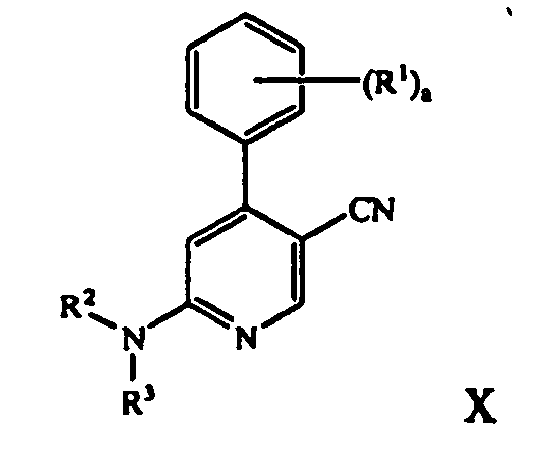 (e) hydrolyzing the tri-substituted pyridine compound to form the carboxamide compound of Formula I,whereeach R1 is independently C1-7-alkyl, C1-7-alkoxy, halogen, cyano or C1-7-alkylamino;a is an integer from 0 to 2;R2 is hydrogen, C3-6 cycloalkyl, aralkyl, C1-7-alkyl, hydroxy-C1-7-alkyl, -S(O)2-C1-7-alkyl, -S(O)2-Ar1, optionally substituted N-heterocyclyl-C1-7-alkyl, -C(=O)R3, where Ar1 is phenyl;R3 is hydrogen, C3-6 cycloalkyl, aralkyl or C1-7-alkyl;or R2 and R3 together with the nitrogen atom to which they are attached to form optionally substituted N-heterocyclyl;or R2 and R3 together form =C(R5)-R6-NR7R8;
where
R5 is C1-7-alkyl or hydrogen;
R6 is C1-12-alkylene or a bond and
each of R7 and R8 is independently hydrogen, C3-6 cycloalkyl, aralkyl, or C1-7-alkyl;R9 is C1-7-alkyl;X1 is halide or trifluoromethanesufonate; andX is halide. - The process according to claim 1, wherein the α-cyano-β-phenyl acrylate compound of Formula IV is prepared by reacting a benzaldehyde compound of the formula:


- The process according to Claim 2, wherein the α-cyano-β-phenyl acrylate compound of Formula IV is prepared in situ.
- The process according to Claim 2, wherein the base is morpholine.
- The process according to claim 2, wherein said step of producing the α-cyanoester compound comprises conducting the reaction in an alcoholic solvent.
- The process according to claim 5, wherein the alcoholic solvent comprises isopropanol, methanol, or a mixture thereof.
- The process according to claim 2, wherein the reaction temperature of said α-cyanoester compound producing step is in the range of 20 °C to 33 °C.
- The process according to claim 1, wherein the reaction conditions for said step of producing the pyridinium zwitter ionic compound comprises a reaction solvent and the presence of an organic base.
- The process according to claim 8, wherein the reaction solvent comprises ether, ketone, toluene, an alcohol, or a mixture thereof.
- The process according to claim 9, wherein the alcohol is methanol.
- The process according to claim 8, wherein the organic base is triethylamine.
- The process according to Claim 1, wherein X1 is chloride.
- The process according to claim 12, wherein the reagent for producing the cyano pyridine compound is phosphorous oxychloride.
- The process according to claim 1, wherein the amine compound is selected from the group consisting of morpholine, 1-methylpiperazine, and thiomorpholine.
- The process according to claim 14, wherein the amine compound is morpholine.
- The process according to claim 1, wherein the hydrogenation catalyst is Pd(OH)2.
- The process according to claim 1, wherein said hydrolyzing step comprises contacting the tri-substituted pyridine compound with an acid.
- The process according to Claim 17, wherein the acid is selected from the group consisting of H2SO4, HCl, and acetic acid.
- The process according to claim 18, wherein the acid is H2SO4.
- The process according to claim 1, wherein each of R1 is independently C1-7-alkyl, C1-7-alkoxy, halogen, cyano, or C1-7-alkyamino.
- The process according to Claim 20, wherein R2 and R3 together with the nitrogen atom to which they are attached to form optionally substituted N-heterocyclyl.
- The process according to Claim 21, wherein R2 and R3 together with the nitrogen atom to which they are attached to form morpholin-4-yl, 4-methy-piperazine-1-yl or 1,1-dioxothiomorpholin-4-yl.
- The process according to claim 1, wherein the carboxamide pyridine compound is:4-(2-methylphenyl)-6- (4-morpholinyl)-3-pyridinecarboxamide;4-(4-fluoro-2-methylphenyl)-6-(1,1-dioxo-thiomorpholin-4-yl)pyridine-3-carboxamide; or4-(2-methylphenyl)-6-(4-methylpiperazinyl)-3-pyridinecaboxamide.
- A process for preparing an aminopyridine compound of the formula:
 (a) reacting a pyridinium salt of the formula:

 (b) reacting the pyridinium zwitter ionic compound with a reagent selected from the group consisting of POCl3, PBr3, and (F3CSO2)2O, to form a cyanopyridine compound of formula:
 (c) reacting the cyanopyridine compound of formula VIII with an amine compound of the formula HNR2R3 to form a tetra-substituted pyridine compound of the formula:
 (d) hydrogenating the tetra-substituted pyridine compound of formula IX in the presence of a hydrogenation catalyst to form a tri-substituted pyridine compound of the formula:
 (e) hydrolyzing the tri-substituted pyridine compound to form the carboxamide pyridine compound of the formula:
 (f)wherein(i)(a) contacting the carboxamide pyridine compound of Formula I with an oxidizing agent in the presence of an alcohol of the formula R13-OH to produce a carbamate pyridine compound of the formula:
 (b) reducing the carbamate pyridine compound of Formula XII with a reducing agent to produce a diaminopyridine compound of the formula:
 (c) reacting the diaminopyridine compound of Formula XIII with a carbonyl compound of the formula:
 (d)optionally reacting the aminopyridine compound of Formula II, where Xa is -N(CH3)C(=O)-, with a second reducing agent to produce the aminopyridine compound of Formula II, where Xa is -N(CH3)-CH2-; or(ii)(a) contacting the carboxamide pyridine compound of Formula I with a reducing agent to produce an alkylamino-substituted pyridine compound of the formula:
 (b) reacting the alkylamino-substituted pyridine compound of Formula XV with an aralkyl compound of the formula:
 (iii) reacting the carboxamide pyridine compound of Formula I with an aralkyl compound of the formula:in the presence of a base to produce the aminopyridine compound of Formula II, where Xa is -C(=O)N(H)-,
 each R1 is independently C1-7-alkyl, C1-7-alkoxy, halogen, cyano or C1-7-alkylamino;a is an integer from 0 to 2;R2 is hydrogen, C3-6 cycloalkyl, aralkyl, C1-7-alkyl, hydroxy-C1-7-alkyl, -S(O)2- C1-7-alkyl, -S(O)2-Ar1, optionally substituted N-heterocyclyl-C1-7-alkyl, -C(=O)R3, where Ar1 is phenyl;R3 is hydrogen, C3-6 cycloalkyl, aralkyl or C1-7-alkyl;or R2 and R3 together with the nitrogen atom to which they are attached to form optionally substituted N-heterocyclyl;or R2 and R3 together form =C(R5)-R6-NR7R8;whereR5 is C1-7-alkyl or hydrogen;R6 is C1-12-alkylene or a bond; andeach of R7 and R8 is independently hydrogen, C3-6 cycloalkyl, aralkyl, or C1-7-alkyl;R9 is C1-7-alkyl;each of R10a and R10b is independently hydrogen or C1-7-alkyl, or R10a and R10b together with the carbon atom to which they are attached to form a C3-6-cycloalkyl group;L is a leaving group;each R11 is independently halide, trifluoromethyl, C1-7-alkoxy, or cyano, or two R11 moieties form a moiety of the formula
-CRw=CRx-CRy=CRz-, wherein each of Rw, Rx, Ry, and Rz is independently hydrogen, C1-7-alkyl or C1-7-alkoxy, provided that at least two of Rw, Rx, Ry, and Rz are hydrogen;R13 is C1-7-alkyl;n is an integer from 0 to 5;Y is C1-7-alkoxide or an acyl activating group;Xa is -C(=O)N(R14)-, -R16-N(R14)-, -N(R14)C(=O)-, or -N(R14)-R16-,
where
R14 is hydrogen, C3-6 cycloalkyl, aralkyl or C1-7-alkyl; and
R16 is C1-12-alkylene; andX1 is halide or trifluoromethanesufonate; andX is halide. - The process according to claim 24, wherein the aminopyridine compound of Formula II is:N-(3,5-bis-trifluoromethyl-benzyl)-N-methyl-6-[methyl-(2-morpholin-4-yl-ethyl)-amino]-4-o-tolyl-nicotinamide;N-(3,5-bis-trifluoromethyl-benzyl)-N-methyl-6-morpholin-4yl-4-o-tolyl-nicotinamide;N-(3,5-bis-trifluoromethyl-benzyl)-N-methyl-6-thiomorpholin-4-yl-4-o-tolyl-nicotinamide;N-(3,5-bis-trifluoromethyl-benzyl)-N-methyl-6-(1-oxo-1λ6-4-thiomorpholin-4-yl)-4-o-tolyl-nicotinamide;N-(3,5-bis-trifluoromethyl-benzyl)-6-(1,1-dioxo-1λ6-6-thiomorpholin-4-yl)-N-methyl-4-o-tolyl-nicotinamide;N-(3,5-bis-trifluoromethyl-benzyl)-N-methyl-6-piperazin-1-yl-4-o-tolyl-nicotinamide;N-(3,5-bis-trifluoromethyl-benzyl)-6-[4-(2-hydroxy-ethyl)-piperazin-1-yl)]-N-methyl-4-o-tolyl-nicotinamide;2-(3,5-bis-trifluoromethyl-phenyl)-N-[6-(4-methyl-piperazin-1-yl)-4-o-tolyl-pyridin-3-yl]-N-methyl-isobutyramide;2-(3,5-bis-trifluoromethyl-phenyl)-N-(6-morpholin-4-yl-4-o-tolyl-pyridin-3-yl)-N-methyl-isobutyramide;2-(3,5-bis-trifluoromethyl-phenyl)-N-[4-(4-fluoro-2-methyl-phenyl)-6-(4-methylpiperazin-1-yl)-pyridin-3-yl]-N-methyl-isobutyramide;2-(3,5-bis-trifluoromethyl-phenyl)-N-[4-(2-chloro-phenyl)-pyridin-3-yl] -N-methyl-isobutyramide;2-(3,5 -bis-trifluoromethyl-phenyl)-N-methyl-N-(4-o-tolyl-pyridin-3-yl)-isobutyramide;2-(3,5-bis-trifluoromethyl-phenyl)-N-methyl-N-[6-(4-pyridin-2-yl-piperazin-1-yl)-4-o-tolyl-pyridin-3-yl)-isobutyramide;2-(3,5-bis-trifluoromethyl-phenyl)-N-(6-morpholin-4-yl-4-o-tolyl-pyridin-3-yl)-isobutyramide;2-(3,5-bis-trifluoromethyl-phenyl)-N-[4-(2-chloro-phenyl)-6-dimethylamino-pyridin-3-yl]-isobutyramide;2-(3,5-bis-trifluoromethyl-phenyl)-N-methyl-N-(6-piperazin-1-yl-4-o-tolyl-pyridin-3-yl)-isobutyramide; or2-(3,5-bis-trifluoromethyl-phenyl)-N-[6-(1,1-dioxo-1λ6-thiomorpholin-4-yl)-4-o-tolyl-pyridin-3-yl]-N-methyl-isobutyramide.
- A process for preparing an amino-substituted cyanopyridine compound of the formula:
 (a) reacting a pyridinium salt of the formula:

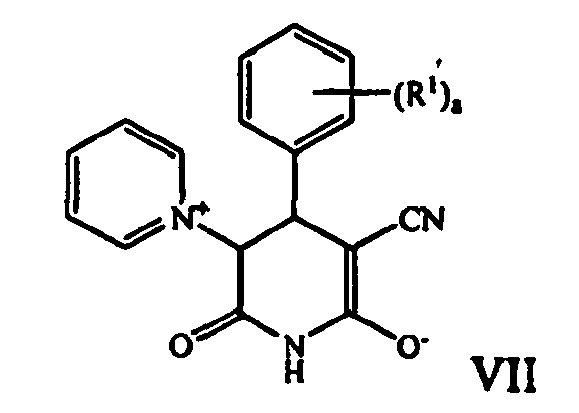 (b) reacting the pyridinium zwitter ionic compound with a reagent selected from the group consisting of POCl3, PBr3, and (F3CSO2)2O, to form a cyanopyridine compound of formula:
 (c) reacting the cyanopyridine compound of formula VIII with an amine compound of the formula HNR2R3 to form a tetra-substituted pyridine compound of the formula:
 (d) hydrogenating the tetra-substituted pyridine compound formula IX in the presence of a hydrogenation catalyst to form the amino-substituted cyanopyridine compound,whereineach R1 is independently C1-7-alkyl, C1-7-alkoxy, halogen, cyano or C1-7-alkylamino;a is an integer from 0 to 2;R2 is hydrogen, C3-6 cycloalkyl, aralkyl, C1-7-alkyl, hydroxy-C1-7-alkyl, -S(O)2- C1-7-alkyl, -S(O)2-Ar1, optionally substituted N-heterocyclyl-C1-7-alkyl, -C(=O)R3, where Ar1 is phenyl;R3 is hydrogen, C3-6 cycloalkyl, aralkyl or C1-7-alkyl;or R2 and R3 together with the nitrogen atom to which they are attached to form optionally substituted N-heterocyclyl;or R2 and R3 together form =C(R5)-R6-NR7R8;whereR5 is C1-7-alkyl or hydrogen;R6 is C1-12alkylene or a bond; andeach of R7 and R8 is independently hydrogen, C3-6 cycloalkyl, aralkyl, or C1-7-alkyl;R9 is C1-7-alkyl;X is halide; andX1 is halide or trifluoromethanesufonate.
 - The process according to Claim 26, wherein the α-cyano-β-phenyl acrylate compound of Formula IV is prepared by reacting a benzaldehyde compound of the formula:
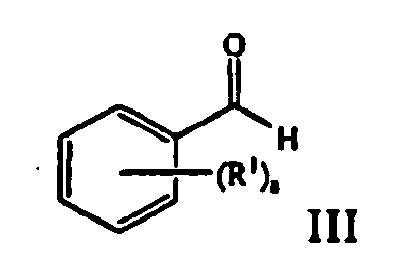

- The process according to Claim 26, wherein the α-cyano-β-phenyl acrylate compound of Formula IV is prepared in situ.
- The process accoding to Claim 26, wherein the base is morpholine.
- The process according to Claim 26, wherein said step of producing the α-cyanoester compound comprises conducting the reaction in an alcoholic solvent.
- The process according to Claim 30, wherein the alcoholic solvent comprises isopropanol, methanol, or a mixture thereof.
- The process according to Claim 26, wherein the amino-substituted cyanopyridine compound is:5-cyano-4-(2-methylphenyl)-2-(4-morpholinyl)pyridine; or5-cyano-4-(2-methylphenyl)-2-(4-methylpiperazinyl)pyridine.
Applications Claiming Priority (3)
| Application Number | Priority Date | Filing Date | Title |
|---|---|---|---|
| US58577904P | 2004-07-06 | 2004-07-06 | |
| US65573105P | 2005-02-23 | 2005-02-23 | |
| PCT/EP2005/006919 WO2006002860A1 (en) | 2004-07-06 | 2005-06-28 | Process for preparing carboxamide pyridine derivatives used as intermediates in the synthesis of nk-1 receptor antagonists |
Publications (2)
| Publication Number | Publication Date |
|---|---|
| EP1776342A1 EP1776342A1 (en) | 2007-04-25 |
| EP1776342B1 true EP1776342B1 (en) | 2011-03-02 |
Family
ID=35058532
Family Applications (1)
| Application Number | Title | Priority Date | Filing Date |
|---|---|---|---|
| EP05770094A Expired - Lifetime EP1776342B1 (en) | 2004-07-06 | 2005-06-28 | Process for preparing carboxamide pyridine derivatives used as intermediates in the synthesis of nk-1 receptor antagonists |
Country Status (11)
| Country | Link |
|---|---|
| US (1) | US7384939B2 (en) |
| EP (1) | EP1776342B1 (en) |
| JP (1) | JP4580426B2 (en) |
| CN (1) | CN1984891B (en) |
| AT (1) | ATE500224T1 (en) |
| CA (1) | CA2572645C (en) |
| DE (1) | DE602005026669D1 (en) |
| IL (1) | IL180312A (en) |
| MX (1) | MX2007000198A (en) |
| TW (1) | TWI305531B (en) |
| WO (1) | WO2006002860A1 (en) |
Cited By (4)
| Publication number | Priority date | Publication date | Assignee | Title |
|---|---|---|---|---|
| EP4385500A1 (en) | 2022-12-12 | 2024-06-19 | Alfred E. Tiefenbacher (GmbH & Co. KG) | Fixed dose combination comprising netupitant and palonosetron |
| EP4385497A1 (en) | 2022-12-12 | 2024-06-19 | Alfred E. Tiefenbacher (GmbH & Co. KG) | Antioxidant-free fixed dose combination of netupitant and palonosetron |
| WO2024126408A1 (en) | 2022-12-12 | 2024-06-20 | Alfred E. Tiefenbacher (Gmbh & Co. Kg) | Antioxidant-free fixed dose combination of netupitant and palonosetron |
| WO2024126398A1 (en) | 2022-12-12 | 2024-06-20 | Alfred E. Tiefenbacher (Gmbh & Co. Kg) | Fixed dose combination comprising netupitant and palonosetron |
Families Citing this family (6)
| Publication number | Priority date | Publication date | Assignee | Title |
|---|---|---|---|---|
| MX2007000198A (en) | 2004-07-06 | 2007-03-15 | Hoffmann La Roche | Process for preparing carboxamide pyridine derivatives used as intermediates in the synthesis of nk-1 receptor antagonists. |
| GB0808747D0 (en) | 2008-05-14 | 2008-06-18 | Glaxo Wellcome Mfg Pte Ltd | Novel compounds |
| CN102516164B (en) * | 2011-12-09 | 2013-09-04 | 中国科学院成都生物研究所 | 1,2-diaryl-5-substituted pyridinium compound, and preparation method and application thereof |
| CN103965893B (en) * | 2014-05-27 | 2015-07-15 | 北京理工大学 | Gold ion fluorescent probe based on o-aminopyridine nitrile compound and preparation method thereof |
| CN106892864A (en) * | 2015-12-21 | 2017-06-27 | 上海科胜药物研发有限公司 | It is a kind of how the crystal formation A of the smooth free alkali of appropriate skin and preparation method thereof |
| CN114181142B (en) * | 2021-12-31 | 2023-10-20 | 浙江工业大学 | Synthesis method of 6- (4-methylpiperazine-1-yl) -4-o-tolylpropionic nicotinamide |
Family Cites Families (19)
| Publication number | Priority date | Publication date | Assignee | Title |
|---|---|---|---|---|
| DE2260827C3 (en) * | 1972-12-13 | 1980-11-13 | Basf Ag, 6700 Ludwigshafen | 2,6-Diaminopyridines, process for their preparation and their use as coupling components for azo dyes |
| US4061642A (en) * | 1972-06-22 | 1977-12-06 | Cassella Farbwerke Mainkur Ag | 2,4,6-Trisubstituted-3-pyridine carboxamides |
| DE2643753A1 (en) * | 1976-09-29 | 1978-04-06 | Thomae Gmbh Dr K | NEW 1H-PYRAZOLO ANGLE CLAMP ON 3.4-B ANGLE CLAMP TO PYRIDINE |
| DK1394150T3 (en) * | 1999-02-24 | 2011-03-21 | Hoffmann La Roche | 4-phenylpyridine derivatives and their use as NK-1 receptor antagonists |
| EP1103545B1 (en) | 1999-11-29 | 2003-11-05 | F. Hoffmann-La Roche Ag | 2-(3,5-Bis-trifluoromethyl-phenyl)-N-methyl-N-(6-morpholin-4-yl-4-o-tolyl-pyridin-3-yl)-isobutyramide |
| US6303790B1 (en) | 1999-11-29 | 2001-10-16 | Hoffman-La Roche Inc. | Process for the preparation of pyridine derivatives |
| CN1178917C (en) | 2000-07-14 | 2004-12-08 | 弗·哈夫曼-拉罗切有限公司 | N-oxides of 4-phenyl-pyridine derivatives as NK1 receptor antagonist prodrugs |
| TWI287003B (en) | 2000-07-24 | 2007-09-21 | Hoffmann La Roche | 4-phenyl-pyridine derivatives |
| TWI259180B (en) * | 2000-08-08 | 2006-08-01 | Hoffmann La Roche | 4-Phenyl-pyridine derivatives |
| AU2002216085B8 (en) | 2000-12-14 | 2006-03-02 | F. Hoffmann-La Roche Ag | Self Emulsifying Lipid Matrix (SELM) |
| US6531597B2 (en) | 2001-02-13 | 2003-03-11 | Hoffmann-La Roche Inc. | Process for preparation of 2-phenyl acetic acid derivatives |
| MXPA03009720A (en) | 2001-04-23 | 2004-01-29 | Hoffmann La Roche | Use of nk-1 receptor antagonists against benign prostatic hyperplasia. |
| US20030083345A1 (en) | 2001-07-10 | 2003-05-01 | Torsten Hoffmann | Method of treatment and/or prevention of brain, spinal or nerve injury |
| US6849624B2 (en) | 2001-07-31 | 2005-02-01 | Hoffmann-La Roche Inc. | Aromatic and heteroaromatic substituted amides |
| IL162733A0 (en) | 2002-01-31 | 2005-11-20 | Hoffmann La Roche | Genetic polymorphisms in the preprotachykinin gene |
| PL378404A1 (en) | 2003-01-31 | 2006-04-03 | F. Hoffmann-La Roche Ag | NEW CRYSTALLINE MODIFICATION OF 2-(3,5-BIS-TRIFLUOROMETHYL-PHENYL)-N-[6-(1,1-DIOXO-1λ6-THIOMORPHOLIN-4-YL)-4(4-FLUORO-2-METHYL-PHENYL)-PYRIDIN-3-YL]-N-METHYL-ISOBUTYRAMIDE |
| US7288658B2 (en) * | 2003-07-15 | 2007-10-30 | Hoffmann-La Roche Inc. | Process for preparation of pyridine derivatives |
| MX2007000198A (en) | 2004-07-06 | 2007-03-15 | Hoffmann La Roche | Process for preparing carboxamide pyridine derivatives used as intermediates in the synthesis of nk-1 receptor antagonists. |
| DK1863767T3 (en) | 2005-03-23 | 2009-05-04 | Hoffmann La Roche | Metabolites for NK-I antagonists for emesis |
-
2005
- 2005-06-28 MX MX2007000198A patent/MX2007000198A/en active IP Right Grant
- 2005-06-28 JP JP2007519671A patent/JP4580426B2/en not_active Expired - Lifetime
- 2005-06-28 EP EP05770094A patent/EP1776342B1/en not_active Expired - Lifetime
- 2005-06-28 WO PCT/EP2005/006919 patent/WO2006002860A1/en not_active Ceased
- 2005-06-28 DE DE602005026669T patent/DE602005026669D1/en not_active Expired - Lifetime
- 2005-06-28 AT AT05770094T patent/ATE500224T1/en active
- 2005-06-28 CA CA2572645A patent/CA2572645C/en not_active Expired - Lifetime
- 2005-06-28 CN CN200580023101XA patent/CN1984891B/en not_active Expired - Lifetime
- 2005-07-05 TW TW094122651A patent/TWI305531B/en not_active IP Right Cessation
- 2005-07-05 US US11/175,799 patent/US7384939B2/en not_active Expired - Lifetime
-
2006
- 2006-12-25 IL IL180312A patent/IL180312A/en active IP Right Grant
Cited By (4)
| Publication number | Priority date | Publication date | Assignee | Title |
|---|---|---|---|---|
| EP4385500A1 (en) | 2022-12-12 | 2024-06-19 | Alfred E. Tiefenbacher (GmbH & Co. KG) | Fixed dose combination comprising netupitant and palonosetron |
| EP4385497A1 (en) | 2022-12-12 | 2024-06-19 | Alfred E. Tiefenbacher (GmbH & Co. KG) | Antioxidant-free fixed dose combination of netupitant and palonosetron |
| WO2024126408A1 (en) | 2022-12-12 | 2024-06-20 | Alfred E. Tiefenbacher (Gmbh & Co. Kg) | Antioxidant-free fixed dose combination of netupitant and palonosetron |
| WO2024126398A1 (en) | 2022-12-12 | 2024-06-20 | Alfred E. Tiefenbacher (Gmbh & Co. Kg) | Fixed dose combination comprising netupitant and palonosetron |
Also Published As
| Publication number | Publication date |
|---|---|
| CA2572645A1 (en) | 2006-01-12 |
| EP1776342A1 (en) | 2007-04-25 |
| WO2006002860A1 (en) | 2006-01-12 |
| CA2572645C (en) | 2011-01-18 |
| TWI305531B (en) | 2009-01-21 |
| MX2007000198A (en) | 2007-03-15 |
| CN1984891A (en) | 2007-06-20 |
| JP4580426B2 (en) | 2010-11-10 |
| IL180312A (en) | 2011-10-31 |
| DE602005026669D1 (en) | 2011-04-14 |
| ATE500224T1 (en) | 2011-03-15 |
| US20060014959A1 (en) | 2006-01-19 |
| IL180312A0 (en) | 2007-06-03 |
| JP2008505859A (en) | 2008-02-28 |
| CN1984891B (en) | 2012-08-08 |
| US7384939B2 (en) | 2008-06-10 |
| TW200606153A (en) | 2006-02-16 |
Similar Documents
| Publication | Publication Date | Title |
|---|---|---|
| AU2002212118B2 (en) | 4-phenyl-pyridine derivatives as neurokinin-1 receptor antagonists | |
| CA2648569C (en) | Pyridyl amide t-type calcium channel antagonists | |
| AU779550B2 (en) | Nitrogen-containing heterocyclic compounds and benamide compounds and drugs containing the same | |
| JP5285603B2 (en) | Substituted pyridylamide compounds as modulators of histamine H3 receptors | |
| EP1656351B1 (en) | Process for preparation of 4-aryl-nicotinamide derivatives | |
| NZ567936A (en) | Novel vanilloid receptor ligands and their use for producing medicaments | |
| KR20130016244A (en) | Inhibitors of protein kinases | |
| NZ337698A (en) | Nicotinamide derivatives for selective inhibition of phosphodiesterase type 4 (PDE4) and the production of tumour necrosis factor (TNF) useful for the treatment of respiratory, rheumatoid and allergic diseases | |
| ZA200605522B (en) | Derivatives of 1 piperazine and 1 homopiperazine carboxylates preparation method thereof and use of same as inhibitors of the faah enzyme | |
| IL171694A (en) | Derivatives of piperidinyl-and piperazinyl-alkyl carbamates, process for preparation thereof, pharmaceutical compositions comprising said derivatives and use of said derivatives for the preparation of medicaments | |
| KR20150067188A (en) | Benzamides | |
| CA2572645C (en) | Process for preparing carboxamide derivatives used as intermediates in the synthesis of nk-1 receptor antagonists | |
| KR100881240B1 (en) | Method for producing carboxamide pyridine derivatives used as intermediates in the synthesis of NX-1 receptor antagonists | |
| ES2359722T3 (en) | PROCESS OF OBTAINING PIRIDINE-CARBOXAMIDE DERIVATIVES AS INTERMEDIATE COMPOUNDS FOR THE SYNTHESIS OF ANTAGONISTS OF NK1 RECEPTORS. | |
| Harrington et al. | Research and development of an efficient process for the construction of the 2, 4, 5-substituted pyridines of NK-1 receptor antagonists | |
| US4843163A (en) | Certain 3-(2-phenethyl)-1-carbamoyloxypyridinium halide intermediates | |
| US4954632A (en) | Process for preparing intermediates for azatidine | |
| KR100501865B1 (en) | Tri-Substituted Phenyl Derivatives Useful as PDE IV Inhibitors | |
| HK1164881A (en) | Process for the preparation of a 2-ethylaminopyridine derivative | |
| HK1130471B (en) | Substituted pyridyl amide compounds as modulators of the histamine h3 receptor |
Legal Events
| Date | Code | Title | Description |
|---|---|---|---|
| PUAI | Public reference made under article 153(3) epc to a published international application that has entered the european phase |
Free format text: ORIGINAL CODE: 0009012 |
|
| 17P | Request for examination filed |
Effective date: 20070206 |
|
| AK | Designated contracting states |
Kind code of ref document: A1 Designated state(s): AT BE BG CH CY CZ DE DK EE ES FI FR GB GR HU IE IS IT LI LT LU MC NL PL PT RO SE SI SK TR |
|
| DAX | Request for extension of the european patent (deleted) | ||
| 17Q | First examination report despatched |
Effective date: 20080311 |
|
| GRAP | Despatch of communication of intention to grant a patent |
Free format text: ORIGINAL CODE: EPIDOSNIGR1 |
|
| GRAS | Grant fee paid |
Free format text: ORIGINAL CODE: EPIDOSNIGR3 |
|
| GRAA | (expected) grant |
Free format text: ORIGINAL CODE: 0009210 |
|
| AK | Designated contracting states |
Kind code of ref document: B1 Designated state(s): AT BE BG CH CY CZ DE DK EE ES FI FR GB GR HU IE IS IT LI LT LU MC NL PL PT RO SE SI SK TR |
|
| REG | Reference to a national code |
Ref country code: GB Ref legal event code: FG4D |
|
| REG | Reference to a national code |
Ref country code: CH Ref legal event code: EP |
|
| REG | Reference to a national code |
Ref country code: IE Ref legal event code: FG4D |
|
| REF | Corresponds to: |
Ref document number: 602005026669 Country of ref document: DE Date of ref document: 20110414 Kind code of ref document: P |
|
| REG | Reference to a national code |
Ref country code: DE Ref legal event code: R096 Ref document number: 602005026669 Country of ref document: DE Effective date: 20110414 |
|
| REG | Reference to a national code |
Ref country code: ES Ref legal event code: FG2A Ref document number: 2359722 Country of ref document: ES Kind code of ref document: T3 Effective date: 20110526 |
|
| REG | Reference to a national code |
Ref country code: SE Ref legal event code: TRGR |
|
| REG | Reference to a national code |
Ref country code: NL Ref legal event code: T3 |
|
| PG25 | Lapsed in a contracting state [announced via postgrant information from national office to epo] |
Ref country code: LT Free format text: LAPSE BECAUSE OF FAILURE TO SUBMIT A TRANSLATION OF THE DESCRIPTION OR TO PAY THE FEE WITHIN THE PRESCRIBED TIME-LIMIT Effective date: 20110302 Ref country code: GR Free format text: LAPSE BECAUSE OF FAILURE TO SUBMIT A TRANSLATION OF THE DESCRIPTION OR TO PAY THE FEE WITHIN THE PRESCRIBED TIME-LIMIT Effective date: 20110603 |
|
| LTIE | Lt: invalidation of european patent or patent extension |
Effective date: 20110302 |
|
| REG | Reference to a national code |
Ref country code: HU Ref legal event code: AG4A Ref document number: E010796 Country of ref document: HU |
|
| PG25 | Lapsed in a contracting state [announced via postgrant information from national office to epo] |
Ref country code: CY Free format text: LAPSE BECAUSE OF FAILURE TO SUBMIT A TRANSLATION OF THE DESCRIPTION OR TO PAY THE FEE WITHIN THE PRESCRIBED TIME-LIMIT Effective date: 20110302 Ref country code: BG Free format text: LAPSE BECAUSE OF FAILURE TO SUBMIT A TRANSLATION OF THE DESCRIPTION OR TO PAY THE FEE WITHIN THE PRESCRIBED TIME-LIMIT Effective date: 20110602 Ref country code: SI Free format text: LAPSE BECAUSE OF FAILURE TO SUBMIT A TRANSLATION OF THE DESCRIPTION OR TO PAY THE FEE WITHIN THE PRESCRIBED TIME-LIMIT Effective date: 20110302 |
|
| PG25 | Lapsed in a contracting state [announced via postgrant information from national office to epo] |
Ref country code: PT Free format text: LAPSE BECAUSE OF FAILURE TO SUBMIT A TRANSLATION OF THE DESCRIPTION OR TO PAY THE FEE WITHIN THE PRESCRIBED TIME-LIMIT Effective date: 20110704 Ref country code: EE Free format text: LAPSE BECAUSE OF FAILURE TO SUBMIT A TRANSLATION OF THE DESCRIPTION OR TO PAY THE FEE WITHIN THE PRESCRIBED TIME-LIMIT Effective date: 20110302 |
|
| PG25 | Lapsed in a contracting state [announced via postgrant information from national office to epo] |
Ref country code: IS Free format text: LAPSE BECAUSE OF FAILURE TO SUBMIT A TRANSLATION OF THE DESCRIPTION OR TO PAY THE FEE WITHIN THE PRESCRIBED TIME-LIMIT Effective date: 20110702 Ref country code: SK Free format text: LAPSE BECAUSE OF FAILURE TO SUBMIT A TRANSLATION OF THE DESCRIPTION OR TO PAY THE FEE WITHIN THE PRESCRIBED TIME-LIMIT Effective date: 20110302 Ref country code: CZ Free format text: LAPSE BECAUSE OF FAILURE TO SUBMIT A TRANSLATION OF THE DESCRIPTION OR TO PAY THE FEE WITHIN THE PRESCRIBED TIME-LIMIT Effective date: 20110302 Ref country code: RO Free format text: LAPSE BECAUSE OF FAILURE TO SUBMIT A TRANSLATION OF THE DESCRIPTION OR TO PAY THE FEE WITHIN THE PRESCRIBED TIME-LIMIT Effective date: 20110302 |
|
| PLBE | No opposition filed within time limit |
Free format text: ORIGINAL CODE: 0009261 |
|
| STAA | Information on the status of an ep patent application or granted ep patent |
Free format text: STATUS: NO OPPOSITION FILED WITHIN TIME LIMIT |
|
| 26N | No opposition filed |
Effective date: 20111205 |
|
| PG25 | Lapsed in a contracting state [announced via postgrant information from national office to epo] |
Ref country code: PL Free format text: LAPSE BECAUSE OF FAILURE TO SUBMIT A TRANSLATION OF THE DESCRIPTION OR TO PAY THE FEE WITHIN THE PRESCRIBED TIME-LIMIT Effective date: 20110302 Ref country code: DK Free format text: LAPSE BECAUSE OF FAILURE TO SUBMIT A TRANSLATION OF THE DESCRIPTION OR TO PAY THE FEE WITHIN THE PRESCRIBED TIME-LIMIT Effective date: 20110302 |
|
| REG | Reference to a national code |
Ref country code: DE Ref legal event code: R097 Ref document number: 602005026669 Country of ref document: DE Effective date: 20111205 |
|
| PG25 | Lapsed in a contracting state [announced via postgrant information from national office to epo] |
Ref country code: MC Free format text: LAPSE BECAUSE OF NON-PAYMENT OF DUE FEES Effective date: 20110630 |
|
| PG25 | Lapsed in a contracting state [announced via postgrant information from national office to epo] |
Ref country code: LU Free format text: LAPSE BECAUSE OF NON-PAYMENT OF DUE FEES Effective date: 20110628 |
|
| PG25 | Lapsed in a contracting state [announced via postgrant information from national office to epo] |
Ref country code: TR Free format text: LAPSE BECAUSE OF FAILURE TO SUBMIT A TRANSLATION OF THE DESCRIPTION OR TO PAY THE FEE WITHIN THE PRESCRIBED TIME-LIMIT Effective date: 20110302 |
|
| REG | Reference to a national code |
Ref country code: FR Ref legal event code: PLFP Year of fee payment: 12 |
|
| REG | Reference to a national code |
Ref country code: FR Ref legal event code: PLFP Year of fee payment: 13 |
|
| REG | Reference to a national code |
Ref country code: FR Ref legal event code: PLFP Year of fee payment: 14 |
|
| REG | Reference to a national code |
Ref country code: DE Ref legal event code: R082 Ref document number: 602005026669 Country of ref document: DE Representative=s name: KRAUS & LEDERER PARTGMBB, DE |
|
| PGFP | Annual fee paid to national office [announced via postgrant information from national office to epo] |
Ref country code: NL Payment date: 20240521 Year of fee payment: 20 |
|
| PGFP | Annual fee paid to national office [announced via postgrant information from national office to epo] |
Ref country code: IE Payment date: 20240523 Year of fee payment: 20 |
|
| PGFP | Annual fee paid to national office [announced via postgrant information from national office to epo] |
Ref country code: GB Payment date: 20240521 Year of fee payment: 20 |
|
| PGFP | Annual fee paid to national office [announced via postgrant information from national office to epo] |
Ref country code: DE Payment date: 20240521 Year of fee payment: 20 |
|
| PGFP | Annual fee paid to national office [announced via postgrant information from national office to epo] |
Ref country code: AT Payment date: 20240523 Year of fee payment: 20 |
|
| PGFP | Annual fee paid to national office [announced via postgrant information from national office to epo] |
Ref country code: IT Payment date: 20240522 Year of fee payment: 20 Ref country code: FR Payment date: 20240522 Year of fee payment: 20 Ref country code: FI Payment date: 20240521 Year of fee payment: 20 |
|
| PGFP | Annual fee paid to national office [announced via postgrant information from national office to epo] |
Ref country code: SE Payment date: 20240521 Year of fee payment: 20 Ref country code: HU Payment date: 20240604 Year of fee payment: 20 Ref country code: BE Payment date: 20240521 Year of fee payment: 20 |
|
| PGFP | Annual fee paid to national office [announced via postgrant information from national office to epo] |
Ref country code: CH Payment date: 20240701 Year of fee payment: 20 Ref country code: ES Payment date: 20240701 Year of fee payment: 20 |
|
| REG | Reference to a national code |
Ref country code: DE Ref legal event code: R071 Ref document number: 602005026669 Country of ref document: DE |
|
| REG | Reference to a national code |
Ref country code: CH Ref legal event code: PL |
|
| REG | Reference to a national code |
Ref country code: NL Ref legal event code: MK Effective date: 20250627 |
|
| REG | Reference to a national code |
Ref country code: ES Ref legal event code: FD2A Effective date: 20250704 |
|
| PG25 | Lapsed in a contracting state [announced via postgrant information from national office to epo] |
Ref country code: GB Free format text: LAPSE BECAUSE OF EXPIRATION OF PROTECTION Effective date: 20250627 Ref country code: ES Free format text: LAPSE BECAUSE OF EXPIRATION OF PROTECTION Effective date: 20250629 |
|
| REG | Reference to a national code |
Ref country code: CH Ref legal event code: PL |
|
| REG | Reference to a national code |
Ref country code: GB Ref legal event code: PE20 Expiry date: 20250627 |
|
| REG | Reference to a national code |
Ref country code: SE Ref legal event code: EUG |
|
| REG | Reference to a national code |
Ref country code: IE Ref legal event code: MK9A |
|
| REG | Reference to a national code |
Ref country code: BE Ref legal event code: MK Effective date: 20250628 |
|
| PG25 | Lapsed in a contracting state [announced via postgrant information from national office to epo] |
Ref country code: IE Free format text: LAPSE BECAUSE OF EXPIRATION OF PROTECTION Effective date: 20250628 |