EP1775880A1 - Method of processing information to be confidentially transmitted - Google Patents

Method of processing information to be confidentially transmitted Download PDF

Info

Publication number
EP1775880A1
EP1775880A1 EP05425713A EP05425713A EP1775880A1 EP 1775880 A1 EP1775880 A1 EP 1775880A1 EP 05425713 A EP05425713 A EP 05425713A EP 05425713 A EP05425713 A EP 05425713A EP 1775880 A1 EP1775880 A1 EP 1775880A1
Authority
EP
European Patent Office
Prior art keywords
binary
bits
factor
module
accordance
Prior art date
Legal status (The legal status is an assumption and is not a legal conclusion. Google has not performed a legal analysis and makes no representation as to the accuracy of the status listed.)
Withdrawn
Application number
EP05425713A
Other languages
German (de)
French (fr)
Inventor
Guido Marco Bertoni
Pasqualina Fragneto
Gerardo Pelosi
Keith Harrison
Liqun Chen
Current Assignee (The listed assignees may be inaccurate. Google has not performed a legal analysis and makes no representation or warranty as to the accuracy of the list.)
STMicroelectronics SRL
Original Assignee
STMicroelectronics SRL
SGS Thomson Microelectronics SRL
Priority date (The priority date is an assumption and is not a legal conclusion. Google has not performed a legal analysis and makes no representation as to the accuracy of the date listed.)
Filing date
Publication date
Application filed by STMicroelectronics SRL, SGS Thomson Microelectronics SRL filed Critical STMicroelectronics SRL
Priority to EP05425713A priority Critical patent/EP1775880A1/en
Priority to US11/548,251 priority patent/US8381267B2/en
Publication of EP1775880A1 publication Critical patent/EP1775880A1/en
Withdrawn legal-status Critical Current

Links

Images

Classifications

    • GPHYSICS
    • G06COMPUTING OR CALCULATING; COUNTING
    • G06FELECTRIC DIGITAL DATA PROCESSING
    • G06F7/00Methods or arrangements for processing data by operating upon the order or content of the data handled
    • G06F7/60Methods or arrangements for performing computations using a digital non-denominational number representation, i.e. number representation without radix; Computing devices using combinations of denominational and non-denominational quantity representations, e.g. using difunction pulse trains, STEELE computers, phase computers
    • G06F7/72Methods or arrangements for performing computations using a digital non-denominational number representation, i.e. number representation without radix; Computing devices using combinations of denominational and non-denominational quantity representations, e.g. using difunction pulse trains, STEELE computers, phase computers using residue arithmetic
    • G06F7/724Finite field arithmetic
    • G06F7/725Finite field arithmetic over elliptic curves
    • HELECTRICITY
    • H04ELECTRIC COMMUNICATION TECHNIQUE
    • H04LTRANSMISSION OF DIGITAL INFORMATION, e.g. TELEGRAPHIC COMMUNICATION
    • H04L9/00Cryptographic mechanisms or cryptographic arrangements for secret or secure communications; Network security protocols
    • H04L9/30Public key, i.e. encryption algorithm being computationally infeasible to invert or user's encryption keys not requiring secrecy
    • H04L9/3066Public key, i.e. encryption algorithm being computationally infeasible to invert or user's encryption keys not requiring secrecy involving algebraic varieties, e.g. elliptic or hyper-elliptic curves
    • H04L9/3073Public key, i.e. encryption algorithm being computationally infeasible to invert or user's encryption keys not requiring secrecy involving algebraic varieties, e.g. elliptic or hyper-elliptic curves involving pairings, e.g. identity based encryption [IBE], bilinear mappings or bilinear pairings, e.g. Weil or Tate pairing
    • HELECTRICITY
    • H04ELECTRIC COMMUNICATION TECHNIQUE
    • H04LTRANSMISSION OF DIGITAL INFORMATION, e.g. TELEGRAPHIC COMMUNICATION
    • H04L2209/00Additional information or applications relating to cryptographic mechanisms or cryptographic arrangements for secret or secure communication H04L9/00
    • H04L2209/08Randomization, e.g. dummy operations or using noise

Definitions

  • the present invention relates to communication protocols among modules, for example, of the electronic type. Particularly, the invention relates to a method of processing information which can be employed, preferably though not exclusively, in the protocols ensuring a safe communication among these modules.
  • a first operation is a scalar multiplication which is carried out on a point of an elliptical curve by means of a random integer generated by module A.
  • a second operation provides that a known pairing function, for example, the Tate's pairing is calculated.
  • the data M to be transmitted are processed by the first module A by means of this pairing function and are transmitted to the second module B together with the result of the scalar multiplication.
  • the second module B may re-ascend the data M being sent by means of a private key of the latter, starting from the information received by the first module A.
  • the method for cryptographically transmitting information based on the calculation, in succession, of a scalar multiplication and a pairing function requires onerous processing in terms of computing for the modules being involved in the communication. Thereby, the encryption operation is made slower.
  • the object of the present invention is to provide a method for processing information which is improved compared to the known methods.
  • a method for processing information in accordance with the invention can be applied both to encryption protocols of this information based on the IBE identity (Identity Based Encryption) and to digital signature schemes.
  • this processing method can be applied, for example, to the IBE encryption scheme set by Boneh-Franklin in the document Identity based encryption from the Weil pairing, SIAM J. Of Computing, vol. 32, No. 3, pp. 586-615, 2003 , Cripto 2001, LNCS vol. 2193, Springer-Verlag 2001, pp. 213-229 .
  • this method can be applied in the case where the encrypted information is transmitted to different scheme destinations each of which refers to a single Trusted Authority.
  • the processing method of the invention can be either applied, for example, to the following encryption protocols: the encryption protocol set by John Malone-Lee in the document Identity-Based Signcryption, Report 2002/098, Cryptology ePrint archive, or to the one set by Divya Nalla e K. C. Reddy in the document Signcryption scheme for Identity-based Cryptosystem, Report 2003/044, Cryptology ePrint archive, or to the IBE authentication protocol set by F. Zhang, S. Liu, K. Kim in the document ID-Based One Round Authenticated Tripartite Key Agreement Protocol with Pairings, Report 2002/122, Cryptology ePrint archive.
  • the method of the invention provides that a processing of information may be carried out by a first module C following which a piece of information INFO can be cryptographically transmitted to a second module D.
  • first C and second D modules can be both hardware-type modules, i.e. electronic devices (for example, a mobile telephone, a smart card, a computer etc.), and software modules, i.e. sequences of instructions for a program.
  • hardware-type modules i.e. electronic devices (for example, a mobile telephone, a smart card, a computer etc.)
  • software modules i.e. sequences of instructions for a program.
  • the method of the invention is based on mathematical schemes known to those skilled in the art and typical of the IBE protocol (Identity Based Encryption). These schemes provide:
  • an odd positive integer m co-prime with q, is defined so that the elliptical curve E contains an order point m.
  • a number k is the smallest integer, thereby the ratio m/(q k -1) is an integer.
  • a first m-torsion subgroup E(GF(q))[m] of the points of an elliptical curve E defined on the base field GF(q) is defined.
  • said positive integer m indicates the order of the subgroup E(GF(q))[m].
  • the method of the invention starts from the acquisition of the information INFO (step CALC1) which the first module C wants to cryptographically transmit to the second module D by means of encryption protocols based on elliptical curves.
  • the first module C has to calculate a first scalar multiplication and has to value a bilinear function. These steps have been indicated from Fig. 1 with SCAL-MLTr/m.
  • this first scalar multiplication involves a point P of the group of points of an elliptical curve E and a further random integer r. Said multiplication is carried out by adding the point P to the latter r times and has been indicated herein below with the notation [r]P.
  • the bilinear function which requires to be valued by the first module C is defined either as a map or a pairing.
  • This pairing has been, traditionally, indicated with the notation ⁇ .,.>.
  • a known bilinear function is the Tate's pairing which, being applied to a first point P1 ⁇ E(GF(q))[m] and a second point Q ⁇ E(GF(q k )) [m] , may be expressed by: ⁇ P ⁇ 1 , Q > f P ⁇ 1 ⁇ Q q ⁇ ⁇ k - 1 / m wherein f P1 indicates a rational function having coefficients in the extension field GF(q k ).
  • the bilinear function ⁇ .,.> is applied to linearly independent m-torsion points so that this function does not take a trivial value, i.e. the unit.
  • this Miller's algorithm is an iterative algorithm, substantially comprising the calculation of a second scalar multiplication [m]P similar to said first multiplication [r]P.
  • This second multiplication [m]P is carried out between the positive integer m indicative of the order of the m-torsion subgroup E(GF(q))[m] and said point P.
  • step SCAL-MLTr/m from Fig. 1 A preferred embodiment of the calculation step of the first scalar multiplication [r]P and the valuation of the Tate's pairing ⁇ P,Q> (step SCAL-MLTr/m from Fig. 1) can be described with reference to Figs. 2A-C.
  • step BIN-REPR binary notation
  • the method of the invention provides that said first (r) 2 and second (m) 2 binary numbers may have the same N numbers of bits. Therefore, given that 0 ⁇ r ⁇ m, if the number of bits corresponding to the representation of the random integer r should be smaller than the number of bits being used for representing the positive integer m, the number of bits of the first binary number (r) 2 would be increased by adding one (or more) bits 0 in the positions of the sequence which refer to the most significant bits.
  • the first module C carries out a scanning, i.e. a bit-by-bit reading, of the first (r) 2 and second (m) 2 binary numbers.
  • a scanning i.e. a bit-by-bit reading
  • the scanning of the first number (r) 2 is simultaneously carried out to the one of the second (m) 2 so that the bit taking the same position in the sequences of the two binary numbers are read during each step of the scanning.
  • this scanning is carried out from the right to the left, i.e. from the least significant bit (r 0 and m 0 ) to the most significant one (r N-1 and m N-1 ).
  • the first module C Following the scanning of the least significant bits r 0 and m 0 of the first (r) 2 and second (m) 2 binary numbers (step SCAN1), the first module C generates a first ordered factor Q 0 which, particularly, corresponds to the pre-determined point P (step GEN1).
  • the first module C following the scanning of each bit of the first (r) 2 and second (m) 2 binary numbers, the first module C generates a respective ordered factor. Therefore, the number of the generated factors coincides with the bit overall N number of (r) 2 (or (m) 2 ).
  • the first module C values whether the least significant bits r 0 and m 0 of the first (r) 2 and second (m) 2 binary numbers are 1 or 0 (step EVAL1).
  • the first module C calculates a first partial sum A 1(r) referring to the first binary number (step SUM1r) and a further first partial sum A 1(m) referring to the second binary number (step SUM1m).
  • a 1 m A 0 + Q 0
  • Q 0 P
  • a 0 is traditionally fixed to the value 0.
  • (8) and (8') are partial sums of the Double and Add algorithm.
  • a subsequent step of the processing method of the invention provides that a first intermediate function f 1 of the Tate's (step EVALf1) may be valued.
  • step EVAL2 a second partial sum is calculated for the first and second binary numbers (steps SUM2r and SUM2m):
  • a 2 r A 1 r + Q 1
  • a 2 m A 1 m + Q 1
  • a 1(r) and A 1(m) correspond to the partial sums being calculated in the previous step.
  • the bit r 1 /m 1 is equal to 0, the sums (9) and (9') are not carried out and the value of the second partial sum A 2(r/m) corresponds to the value of the sum in the previous step, i.e. A 1(r/m) .
  • step EVALf2 is valued.
  • the N-th partial sums A N(r) and A N(m) take the value of the sums in the previous step, i.e. A N-1(r) and A N-1(m) , respectively.
  • step EVALfn The N-th intermediate function f n (step EVALfn) is also valued.
  • the first module C calculates a first and second multiplicities of partial sums. Particularly, each partial sum is calculated at one bit 1 in the binary sequences of the numbers (r) 2 and (m) 2 .
  • N-th partial sum calculated for the first (r) 2 and second (m) 2 binary numbers corresponds to the result of the first [r]P and second [m]P scalar multiplications, respectively.
  • the processing method of the invention provides the encryption (step CALC2) by the first module C of the information INFO to be transmitted by means of the calculated Tate's pairing function ⁇ P,Q>.
  • both the encrypted information and the result of the first scalar multiplication [r]P are sent by the first module C to the second module D (step INV-INF) .
  • the partial sums referring to the first [r]P and second [m] P scalar multiplications can be calculated starting from the same ordered factors Q i .
  • the method of the invention allows the calculation of the first scalar multiplication [r]P and the one of the second multiplication [m]P to be simultaneously carried out. This considerably reduces the times of the processing being carried out by the first module C compared to the independent carrying out of each multiplication.
  • the first module C calculates for both the binary numbers the second partial sum A 2(7/11) :
  • module C values at the partial sums A 1(11) , A 2(11) and A 4(11) their respective intermediate functions f 1 , f 2 , and f 4 .
  • the intermediate function f 3 corresponding to the third partial sum A 3(11) is not calculated.
  • the first module C calculates the first scalar multiplication [7]P and values the Tate's pairing ⁇ P,Q> (including the second multiplication [11]P) by carrying out a number of operations which is smaller than the ones required if the known processing methods should be employed.
  • the required operations for the first module C are: three doubling operations, six partial sums and the valuation of the intermediate functions f v .
  • the scanning of the first binary number (r) 2 may be also carried out from the most significant bit r N-1 to the least significant one r 0 , i.e. from the left to the right of the binary sequence.
  • the calculation of the first multiplication [r]P would be onerous from the computing viewpoint because the first module C should carry out a larger number of operations compared to the ones required for the scanning of the same number (r) 2 from the right to the left.
  • the calculation of the second scalar multiplication [m]P being included in the Miller's algorithm would require a smaller number of calculations in the case where the scanning of the second binary number (m) 2 is carried out from the most significant bit m N-1 to the least significant one m 0 , i.e. from the left to the right. In this case, the carrying out of the Miller's algorithm would be faster.
  • a further embodiment of the processing method of the invention provides that the first module C may carry out the scanning of the second binary number (m) 2 from the most significant bit m N-1 to the least significant one m 0 (from the left to the right).
  • the first module C provides for advantageously representing said first number (r) 2 in a new numerical base or dynamic base B m .
  • this dynamic base B m is generated from the binary representation of the odd positive integer m, i.e. from (m) 2 .
  • the highest number which can be represented by means of the dynamic base B m being built from m is indicated by max_record.
  • the random integer r may be re-coded by means of the dynamic base B m and this re-coding is indicated by re-cod(r) in order to be distinguished from the binary representation of the random integer r.
  • the first module C doubles the first element of the base B 11 , so that the second element is equal to 2.
  • the first module C doubles the previous element, i.e. the fourth being equal to 5. Therefore, the fifth element of the base B 11 is equal to 10.
  • the first module C may carry out the first [r]P and second [m]P scalar multiplications (step SCAL-MLT1r/m) by simultaneously scanning the binary number (11) 2 from the left to the right and the re-coded number re-cod(7) from the right to the left.
  • the first bit of the binary number (11) 2 (the bit m 3 in the examined example) is always equal to 1, at the first step of the scanning (step PH0).
  • the second partial sum referring to the number (11) 2 is not carried out.
  • This factor Q 5 coincides with the last partial sum for the binary number (11) 2 and, particularly, with the final result of the second scalar multiplication [m]P.
  • the first module C may calculate the first scalar multiplication [r]P (through the scanning of the re-coded binary number re-cod(r) from the right to the left) and value the Tate's pairing ⁇ P,Q> by means of the Miller's algorithm (scanning of the binary number (m) 2 from the left to the right).
  • the first module C may also simultaneously value a multiplicity of Tate's pairing functions.
  • the processing method of the invention provides the encryption (step CALC) from the first module C of the information INFO to be transmitted by means of the calculated Tate's pairing function ⁇ P,Q>.
  • This encrypted information and the result of the first scalar multiplication [r]P are then sent from the first module C to the second D (step INV-INF1).

Landscapes

  • Engineering & Computer Science (AREA)
  • Physics & Mathematics (AREA)
  • Theoretical Computer Science (AREA)
  • General Physics & Mathematics (AREA)
  • Mathematical Analysis (AREA)
  • Mathematical Optimization (AREA)
  • Pure & Applied Mathematics (AREA)
  • Mathematical Physics (AREA)
  • Computing Systems (AREA)
  • Computational Mathematics (AREA)
  • General Engineering & Computer Science (AREA)
  • Algebra (AREA)
  • Computer Security & Cryptography (AREA)
  • Computer Networks & Wireless Communication (AREA)
  • Signal Processing (AREA)
  • Complex Calculations (AREA)

Abstract

A method of processing information (INFO) to be confidentially transmitted from a first module (C) to a second module (D) provides that a first scalar multiplication (SCAL-MLTr) may be carried out in order to obtain a first result [r]P) . This first scalar - multiplication comprises a plurality of generation steps of ordered factors (Q0, Q1) from which a plurality of first partial sums (SUM1r, SUM2r) are required to be built.
The method also comprises the carrying out of a second scalar multiplication (SCAL-MLTm) in order to obtain a second result ([m]P). This second multiplication provides that a plurality of second partial sums (SUM1m, SUM2m) may be built.
A piece of encrypted information is obtained by processing the information (INFO) based on the results of said scalar multiplications.
The method is characterized in that in order to build the second partial sums of the second scalar multiplication the same ordered factors being obtained by the generation step of the first scalar multiplication are employed.

Description

  • The present invention relates to communication protocols among modules, for example, of the electronic type. Particularly, the invention relates to a method of processing information which can be employed, preferably though not exclusively, in the protocols ensuring a safe communication among these modules.
  • As it is known, the need for making a transmission either of information or data of any nature safe among modules either of the hardware (for example, electronic devices) or software types communicating with one another is felt more and more, within the scope of the Information Technology.
  • To this purpose, encryption techniques of the transmitted messages have been refined in order to scramble the latter for non-authorized people.
  • As it is known to those skilled in the art, the most advanced encryption techniques are based on mathematical schemes set in protocols of encrypted communication either based on the identity or of the IBE-type (Identity Based Encryption).
  • Moreover, the interest in the mathematical schemes being applied to elliptical curves, such as for example the schemes based on a pairing is growing within the scope of these encryption protocols. Particularly, the most employed pairing is the Tate's one.
  • As it is known, in accordance with some protocols based on the identity, in order to safely transmit data that we have indicated with M from a first module A to a second module B, there is provided the carrying out of two subsequent operations by the first module A.
  • A first operation is a scalar multiplication which is carried out on a point of an elliptical curve by means of a random integer generated by module A.
  • A second operation provides that a known pairing function, for example, the Tate's pairing is calculated.
  • At this point, the data M to be transmitted are processed by the first module A by means of this pairing function and are transmitted to the second module B together with the result of the scalar multiplication.
  • The second module B may re-ascend the data M being sent by means of a private key of the latter, starting from the information received by the first module A.
  • It shall be noted that the method for cryptographically transmitting information based on the calculation, in succession, of a scalar multiplication and a pairing function requires onerous processing in terms of computing for the modules being involved in the communication. Thereby, the encryption operation is made slower.
  • The object of the present invention is to provide a method for processing information which is improved compared to the known methods.
  • This object is achieved by a processing method such as defined by the annexed claim 1. Preferred embodiments of the method of the invention are defined by the dependent claims.
  • The characteristics and the advantages of the present invention will be understood from the following detailed description of one exemplary and for-nothing-limiting embodiment thereof with regard to the annexed drawings, in which:
    • Fig. 1 schematically shows a flow diagram referring to a preferred embodiment of the method for processing information of the invention;
    • Figs. 2A-C schematically show flow diagrams referring to a step of the processing method from Fig. 1;
    • Fig. 3 schematically shows a flow diagram referring to a further embodiment of the method for processing information of the invention;
    • Fig. 4 schematically shows a flow diagram referring to a step of the further embodiment of the processing method from Fig. 3.
  • It shall be noted that a method for processing information in accordance with the invention can be applied both to encryption protocols of this information based on the IBE identity (Identity Based Encryption) and to digital signature schemes.
  • Advantageously, this processing method can be applied, for example, to the IBE encryption scheme set by Boneh-Franklin in the document Identity based encryption from the Weil pairing, SIAM J. Of Computing, vol. 32, No. 3, pp. 586-615, 2003, Cripto 2001, LNCS vol. 2193, Springer-Verlag 2001, pp. 213-229. Particularly, this method can be applied in the case where the encrypted information is transmitted to different scheme destinations each of which refers to a single Trusted Authority.
  • Furthermore, the processing method of the invention can be either applied, for example, to the following encryption protocols: the encryption protocol set by John Malone-Lee in the document Identity-Based Signcryption, Report 2002/098, Cryptology ePrint archive, or to the one set by Divya Nalla e K. C. Reddy in the document Signcryption scheme for Identity-based Cryptosystem, Report 2003/044, Cryptology ePrint archive, or to the IBE authentication protocol set by F. Zhang, S. Liu, K. Kim in the document ID-Based One Round Authenticated Tripartite Key Agreement Protocol with Pairings, Report 2002/122, Cryptology ePrint archive.
  • The method of the invention provides that a processing of information may be carried out by a first module C following which a piece of information INFO can be cryptographically transmitted to a second module D.
  • It shall be noted that these first C and second D modules can be both hardware-type modules, i.e. electronic devices (for example, a mobile telephone, a smart card, a computer etc.), and software modules, i.e. sequences of instructions for a program.
  • Moreover, the method of the invention is based on mathematical schemes known to those skilled in the art and typical of the IBE protocol (Identity Based Encryption). These schemes provide:
    • a finite field or base field GF(q), i.e. a finite set of elements in which add and multiplication operations are defined, q being an integer;
    • an extension field GF(qk), i.e. a finite field containing the base field GF(q);
    • an elliptical curve E defined on the base field GF(q).
  • Moreover, an odd positive integer m, co-prime with q, is defined so that the elliptical curve E contains an order point m. A number k is the smallest integer, thereby the ratio m/(qk-1) is an integer.
  • In addition, a first m-torsion subgroup E(GF(q))[m] of the points of an elliptical curve E defined on the base field GF(q) is defined. Particularly, said positive integer m indicates the order of the subgroup E(GF(q))[m].
  • Similarly, a second m-torsion subgroup of the points of an elliptical curve E defined on the extension field GF(qk) has been indicated by E(GF(qk)) [m] .
  • With reference to the flow diagram from Fig. 1, the method of the invention starts from the acquisition of the information INFO (step CALC1) which the first module C wants to cryptographically transmit to the second module D by means of encryption protocols based on elliptical curves.
  • To this purpose, as it is known to those skilled in the art, before the information INFO is encrypted and sent, the first module C has to calculate a first scalar multiplication and has to value a bilinear function. These steps have been indicated from Fig. 1 with SCAL-MLTr/m.
  • In greater detail, this first scalar multiplication involves a point P of the group of points of an elliptical curve E and a further random integer r. Said multiplication is carried out by adding the point P to the latter r times and has been indicated herein below with the notation [r]P.
  • For example, the calculation of the first scalar multiplication [r]P can be carried out from a binary representation of the random integer r, i.e.: r = j = 0 t - 1 r j 2 j
    Figure imgb0001
    and by expressing the result of the first scalar multiplication [r]P by: r P = j = 0 t - 1 r j 2 j P = 2 2 2 r t - 1 P + r t - 2 P + ) r 0 P
    Figure imgb0002
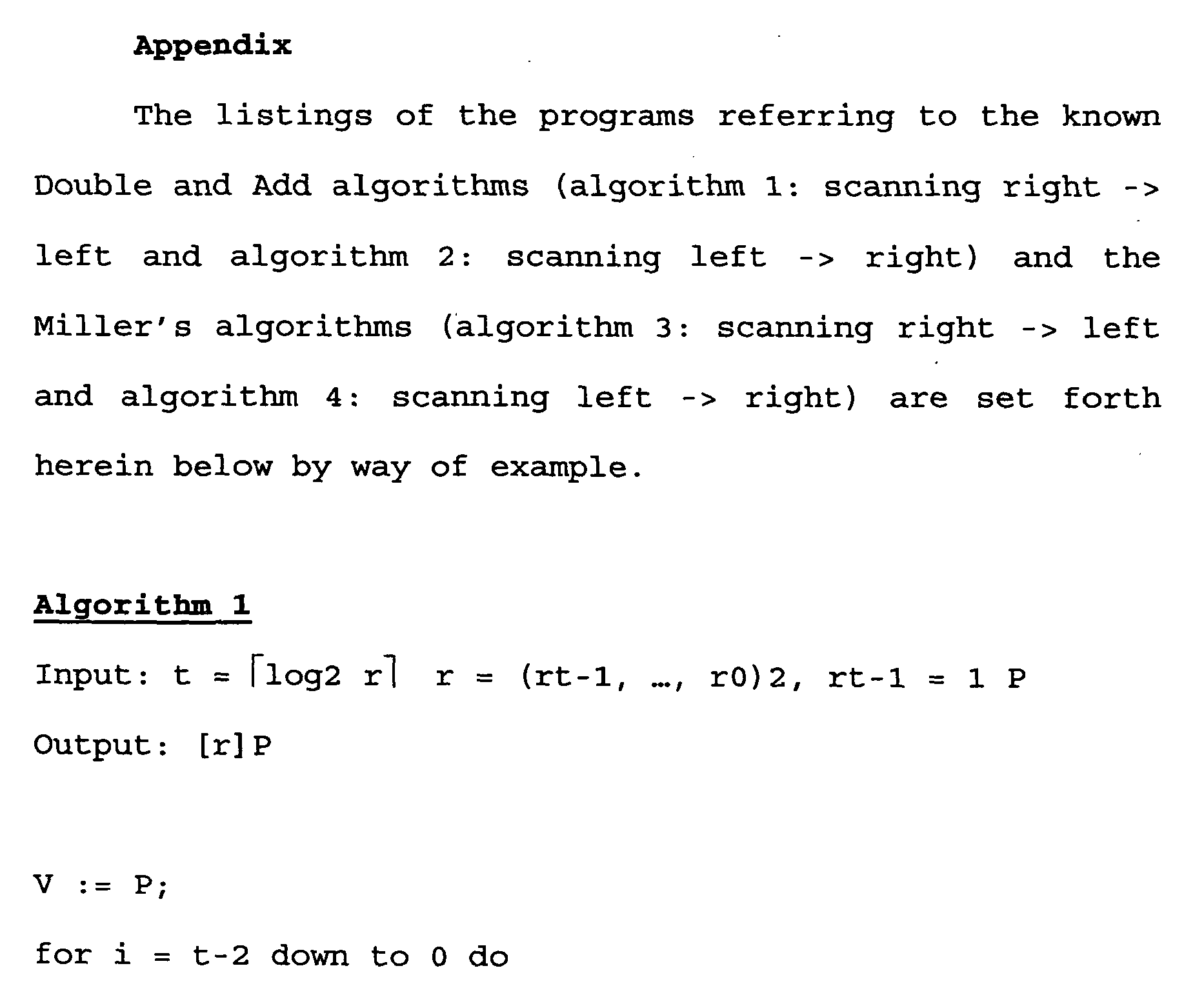
  • It shall be noted that the operation indicated in the expression (2) can be implemented by means of an algorithm known as the Double-and Add.
  • Moreover, the bilinear function which requires to be valued by the first module C is defined either as a map or a pairing. This pairing has been, traditionally, indicated with the notation <.,.>. For example, a known bilinear function is the Tate's pairing which, being applied to a first point P1 ∈ E(GF(q))[m] and a second point Q ∈ E(GF(qk)) [m] , may be expressed by: < P 1 , Q > f P 1 Q q k - 1 / m
    Figure imgb0003

    wherein fP1 indicates a rational function having coefficients in the extension field GF(qk). Furthermore, the bilinear function <.,.> is applied to linearly independent m-torsion points so that this function does not take a trivial value, i.e. the unit.
  • Preferably, the processing method of the invention provides that the point P of the first scalar multiplication [r]P and the first point P1 of the Tate's pairing coincide with each other, i.e. P=P1 ∈ E(GF(q))[m]. This equivalence is adopted herein below for the whole description.
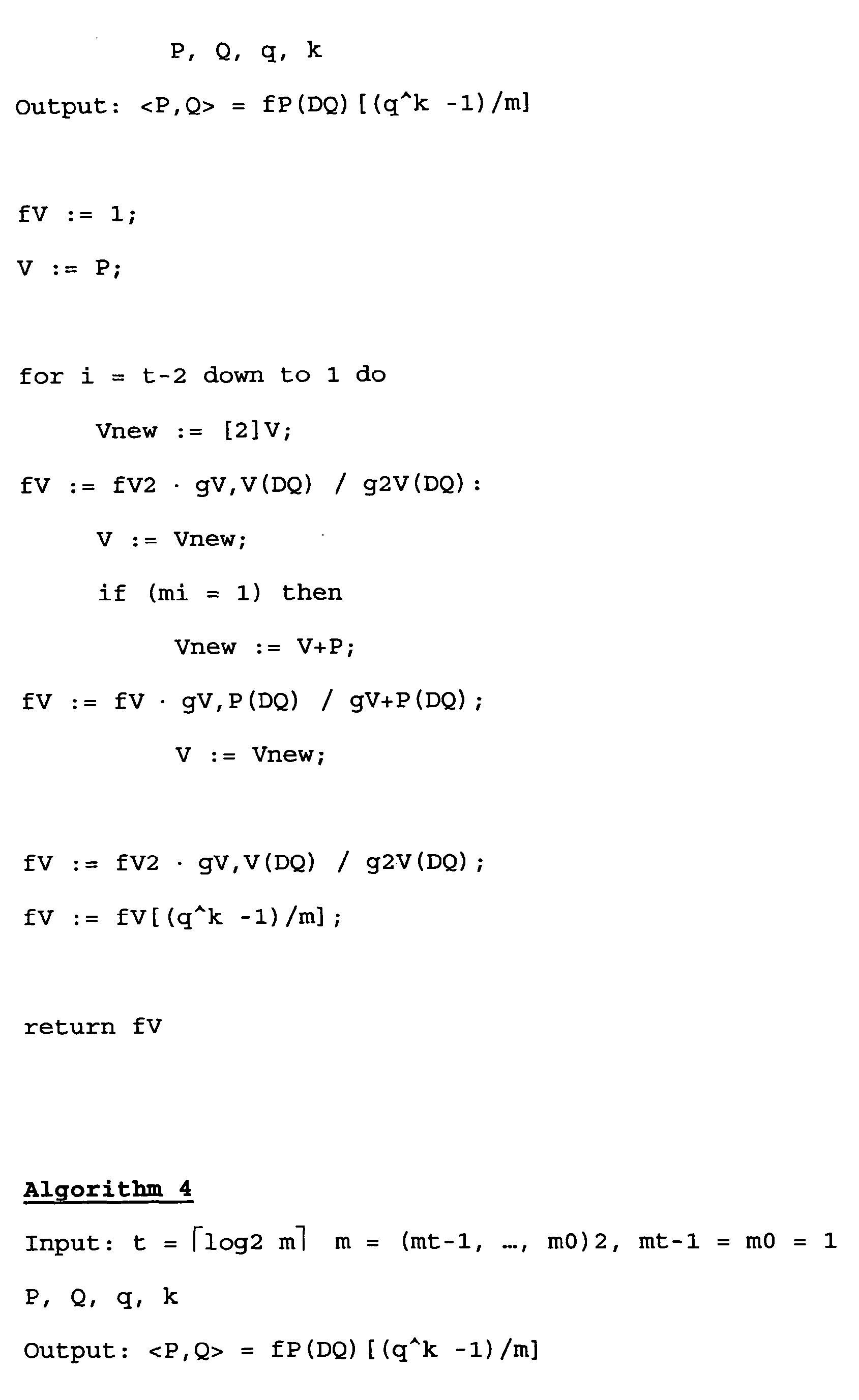
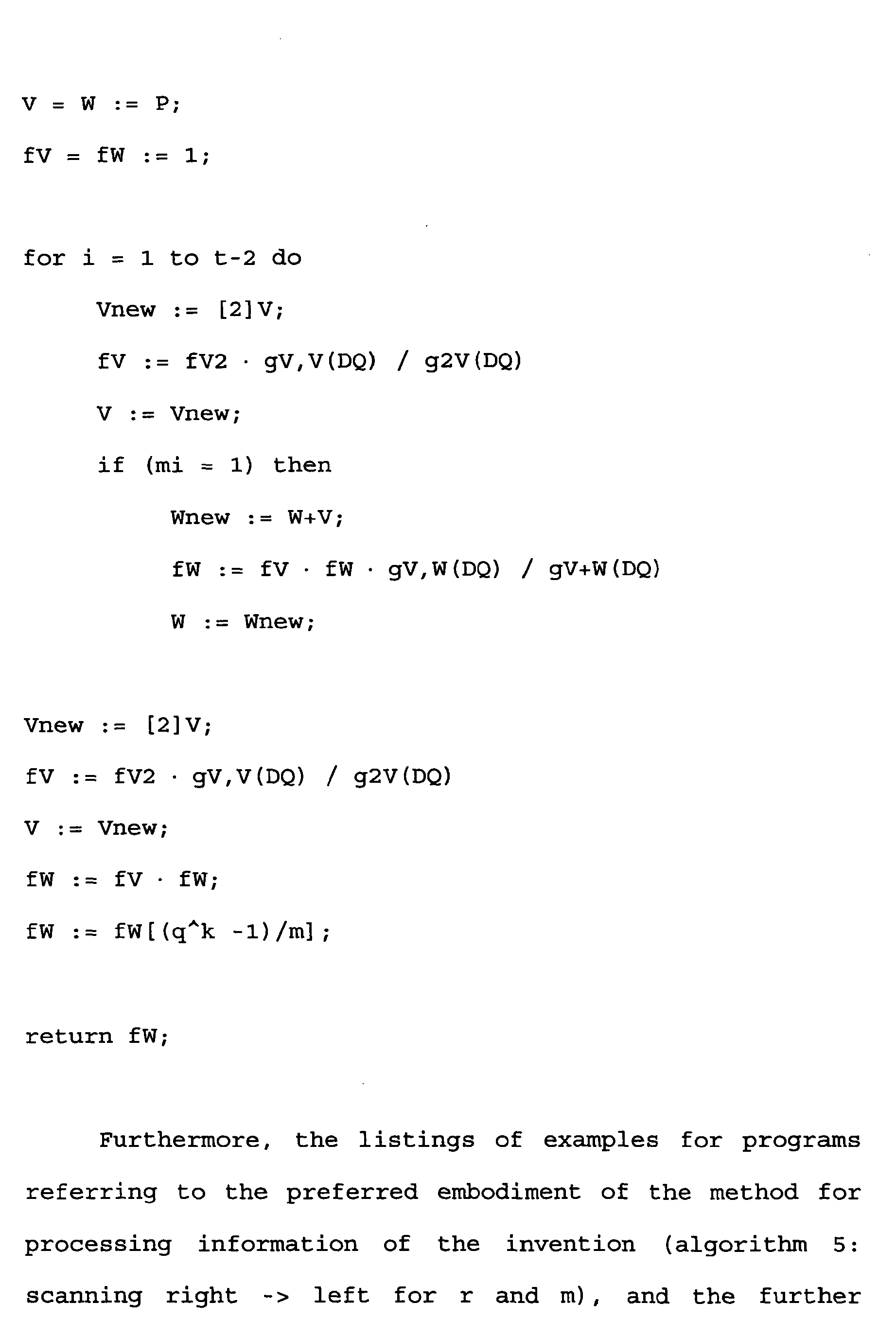
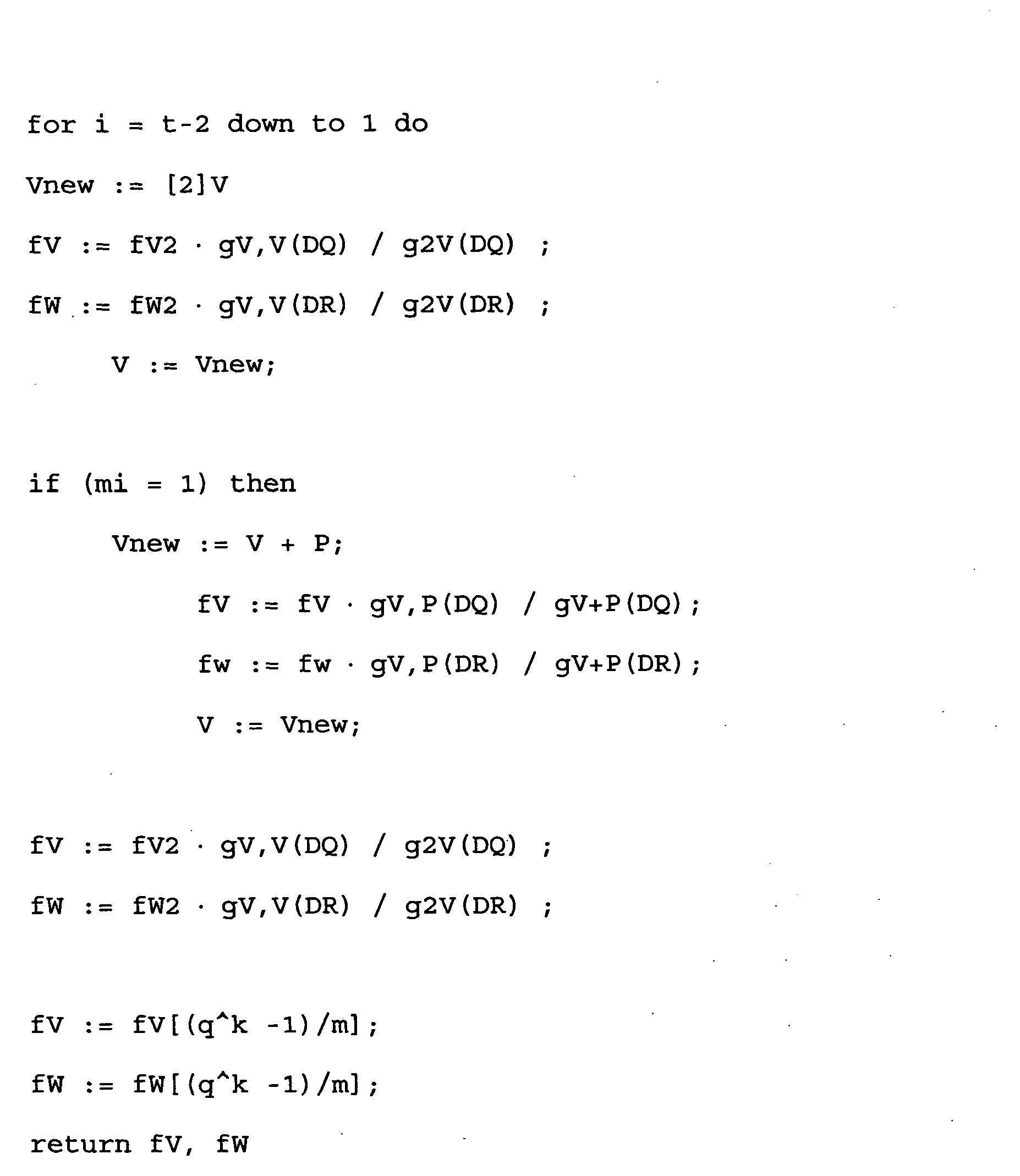
  • Furthermore, the Tate's pairing function <P1,Q>=<P,Q> can be calculated by means of a Miller's algorithm known to those skilled in the art. Particularly, this Miller's algorithm is an iterative algorithm, substantially comprising the calculation of a second scalar multiplication [m]P similar to said first multiplication [r]P. This second multiplication [m]P is carried out between the positive integer m indicative of the order of the m-torsion subgroup E(GF(q))[m] and said point P.
  • In addition, Miller's algorithm also comprises the iteratively valuation of intermediate functions fv (with v=1, 2, 3, ...). These intermediate functions fv contribute to determine the rational function fP1=fP of the Tate's pairing (3) at the end of the iteration.
  • A preferred embodiment of the calculation step of the first scalar multiplication [r]P and the valuation of the Tate's pairing <P,Q> (step SCAL-MLTr/m from Fig. 1) can be described with reference to Figs. 2A-C.
  • In order to calculate the first scalar multiplication and, simultaneously, value the Tate's pairing <P,Q>, the first module C generates the further random integer r (step EVAL) so that the latter is smaller than the positive integer m, i.e.: r = j = 0 t - 1 r j 2 j
    Figure imgb0004
  • In an initial step of the method, the positive integer m and the further random integer r are represented in binary notation (step BIN-REPR), i.e. by means of a sequence of N bits (bits 0 and 1). Thereby, a first (r)2 and second (m)2 binary numbers corresponding to the random integer r and the positive integer m, respectively, are obtained. These binary numbers (r)2 and (m)2 can be expressed by: r 2 = r N - 1 r 1 r 0
    Figure imgb0005
    m 2 = m N - 1 m 1 m 0
    Figure imgb0006

    wherein r0 and m0 are the least significant digits (or bits) of these binary numbers (r)2 and (m)2, whereas rN-1 and mN-1 are the most significant digits (or bits).
  • The method of the invention provides that said first (r)2 and second (m)2 binary numbers may have the same N numbers of bits. Therefore, given that 0<r<m, if the number of bits corresponding to the representation of the random integer r should be smaller than the number of bits being used for representing the positive integer m, the number of bits of the first binary number (r)2 would be increased by adding one (or more) bits 0 in the positions of the sequence which refer to the most significant bits.
  • At this point, the first module C carries out a scanning, i.e. a bit-by-bit reading, of the first (r)2 and second (m)2 binary numbers. Particularly, the scanning of the first number (r)2 is simultaneously carried out to the one of the second (m)2 so that the bit taking the same position in the sequences of the two binary numbers are read during each step of the scanning. Moreover, this scanning is carried out from the right to the left, i.e. from the least significant bit (r0 and m0) to the most significant one (rN-1 and mN-1).
  • Following the scanning of the least significant bits r0 and m0 of the first (r)2 and second (m)2 binary numbers (step SCAN1), the first module C generates a first ordered factor Q0 which, particularly, corresponds to the pre-determined point P (step GEN1).
  • In general, it shall be noted that, following the scanning of each bit of the first (r)2 and second (m)2 binary numbers, the first module C generates a respective ordered factor. Therefore, the number of the generated factors coincides with the bit overall N number of (r)2 (or (m)2).
  • It shall be further noted that, in accordance with the preferred embodiment of the method of the invention, these ordered factors Qi (with i=1, 2,..., N-1) are obtained by carrying out N-1 doubling operations starting from the first factor Q0, i.e. each factor Qi is obtained by doubling the previous one. Thereby, a sequence S1 of ordered factors is obtained, which can be expressed by: S 1 Q 0 = P Q 1 = 2 P Q 2 = 4 P Q N - 1 = 2 N - 1 P
    Figure imgb0007
  • After the first ordered factor Q0 has been generated, the first module C values whether the least significant bits r0 and m0 of the first (r)2 and second (m)2 binary numbers are 1 or 0 (step EVAL1).
  • For example, if the least significant bit r0/m0 of the first/second binary number (r)2/(m)2 is 1, the first module C calculates a first partial sum A1(r) referring to the first binary number (step SUM1r) and a further first partial sum A1(m) referring to the second binary number (step SUM1m). Particularly, these first partial sums are calculated based on the relations: A 1 r = A 0 + Q 0
    Figure imgb0008
    A 1 m = A 0 + Q 0
    Figure imgb0009

    wherein Q0=P, whereas A0 is traditionally fixed to the value 0. It shall be noted that (8) and (8') are partial sums of the Double and Add algorithm.
  • Furthermore, a subsequent step of the processing method of the invention provides that a first intermediate function f1 of the Tate's (step EVALf1) may be valued.
  • It shall be particularly noted that in the case where the least significant bit r0/m0 is equal to 0 the sum (8) and/or the sum (8') are not carried out, therefore it will be: A 1 r = A 0 = 0 A 1 m = A 0 = 0
    Figure imgb0010
  • By proceeding with the scanning of the first/second binary number (r)2/(m)2, the module C calculates the second ordered factor Q1=2P of the sequence S1 by doubling the first factor Q0=P (step GEN2) at the bit r1/m1 (step SCAN2).
  • At this point, if this bit r1/m1 is equal to 1 (step EVAL2), a second partial sum is calculated for the first and second binary numbers (steps SUM2r and SUM2m): A 2 r = A 1 r + Q 1
    Figure imgb0011
    A 2 m = A 1 m + Q 1
    Figure imgb0012

    wherein A1(r) and A1(m) correspond to the partial sums being calculated in the previous step. Even in this case, if the bit r1/m1 is equal to 0, the sums (9) and (9') are not carried out and the value of the second partial sum A2(r/m) corresponds to the value of the sum in the previous step, i.e. A1(r/m).
  • Moreover, the second intermediate function f2 (step EVALf2) is valued.
  • The procedure is similarly carried out with all the bits of the first/second binary number (r)2/(m)2 up to the most significant bit rN-1/mN-1. Following the scanning of this bit (step SCANn) the first module C calculates the last intermediate datum QN-1=2(N-1)P (step GENn). In that case, if the bit rN-1/mN-1 is equal to 1 (step EVALn) the N-th partial sum AN(r/m) is calculated based on the equality: A N r = A N - 1 r + Q N - 1
    Figure imgb0013
    A N m = A N - 1 m + Q N - 1
    Figure imgb0014

    wherein AN-1(r) and AN-1(m) are the partial sums calculated in the (N-1)-th step. In the case where the most significant bits rN-1 and mN-1 are equal to 0, the N-th partial sums AN(r) and AN(m) take the value of the sums in the previous step, i.e. AN-1(r) and AN-1(m), respectively.
  • The N-th intermediate function fn (step EVALfn) is also valued.
  • In other words, following the bit-by-bit scanning of the first (r)2 and second (m)2 binary numbers the first module C calculates a first and second multiplicities of partial sums. Particularly, each partial sum is calculated at one bit 1 in the binary sequences of the numbers (r)2 and (m)2.
  • It shall be further noted that the N-th partial sum calculated for the first (r)2 and second (m)2 binary numbers corresponds to the result of the first [r]P and second [m]P scalar multiplications, respectively.
  • With reference to Fig. 1, after the scalar multiplications have been carried out in accordance with the step SCAL-MLTr/m, the processing method of the invention provides the encryption (step CALC2) by the first module C of the information INFO to be transmitted by means of the calculated Tate's pairing function <P,Q>.
  • Finally, both the encrypted information and the result of the first scalar multiplication [r]P are sent by the first module C to the second module D (step INV-INF) .
  • Advantageously, with the method of the invention the partial sums referring to the first [r]P and second [m] P scalar multiplications can be calculated starting from the same ordered factors Qi. In other words, the method of the invention allows the calculation of the first scalar multiplication [r]P and the one of the second multiplication [m]P to be simultaneously carried out. This considerably reduces the times of the processing being carried out by the first module C compared to the independent carrying out of each multiplication.
  • The cost in terms of computing to be given to the first module C both to calculate the first scalar multiplication [r]P and to value the Tate's pairing <P,Q> (by means of the Miller's algorithm) for said preferred embodiment of the method of the invention can be expressed by: COST P , Q + r P = log 2 m + hw m + hw r + COSTf v
    Figure imgb0015

    wherein:
    • └log2m┘ is the lowest integer contained in the log2m. This lowest integer corresponds to the number of doubling operations required for building the sequence S1 of ordered factors from the first factor Q0;
    • hw(m) represents the number of partial sums calculated at the scanning of the second binary number (m)2, hw(m) being the hamming weight of the positive integer m, i.e. the number of bits 1 being present in the second binary number (m)2;
    • hw(r) indicates the number of partial sums calculated at the scanning of the first binary number (r)2, hw(r) being the number of bits 1 being present in the first binary number (r)2;
    • COSTfv is the cost in terms of computing required for the iterative valuation of the intermediate functions fv.
  • For example, if it is assumed that the odd positive integer m=11 and the further random integer r=7, first of all, the first embodiment of the method of the invention provides that these decimal numbers may be converted into a binary base, i.e.: 7 10 = 1 * 2 2 + 1 * 2 1 + 1 * 2 0 ( 7 ) 2 = 111
    Figure imgb0016
    11 10 = 1 * 2 3 + 1 * 2 1 + 1 * 2 0 ( 11 ) 2 = 1011
    Figure imgb0017
  • Given that the first binary number (7)2 includes 3 bits, whereas the second number (11)2 includes 4, the number of bits of the first number (7)2 is increased by adding a digit 0 in the position of the most significant bit. Thereby, the binary numbers on which the method of the invention is carried out are: 7 2 = 0111
    Figure imgb0018
    11 2 = 1011
    Figure imgb0019
  • Then, the first module C carries out the scanning of the first (7)2 and second (11)2 binary numbers from the least significant bit to the most significant one. Following the scanning of the least significant bits of these binary numbers (7)2 and (11)2, module C generates the first ordered factor Q0=P.
  • Given that the least significant bits of both the binary numbers (7)2 and (11)2 are equal to 1, module C calculates the first partial sum A1(7/11) referring to both the numbers, i.e.: A 1 7 = A 1 11 = 0 + P = P
    Figure imgb0020
  • By proceeding with the scanning from the right to the left, the second bit of the binary numbers (7)2 and (11)2 is also 1. Therefore, after the second ordered factor Q1, has been created, the first module C calculates for both the binary numbers the second partial sum A2(7/11) : A 2 7 = A 2 11 = P + 2 P = 3 P
    Figure imgb0021
  • The subsequent bits of the binary sequences of the first (7)2 and second (11)2 binary numbers are 1 and 0, respectively. Therefore, after the third intermediate datum Q2=4P has been valued, the third partial sum A3(7) referring to the first number (7)2 is calculated A 3 7 = 3 P + 4 P = 7 P
    Figure imgb0022
    whereas the third partial sum A3(11) referring to the second number (11)2 is not calculated and is A 3 11 = A 2 11 = 3 P
    Figure imgb0023
    Finally, the most significant bits of the first (7)2 and second (11)2 binary numbers are 0 and 1, respectively. Therefore, starting from the calculation from the last ordered factor Q3=8P, the fourth partial sum A4(7) referring to the first number (7)2 is not valued by taking the value of the previous partial sum, i.e. A 4 7 = A 3 7 = 7 P
    Figure imgb0024
    whereas, the fourth partial sum referring to the second binary number (11)2 is calculated by A 4 11 = 3 P + 8 P = 11 P
    Figure imgb0025
  • It shall be further noted that, in accordance with the Miller's algorithm, module C values at the partial sums A1(11), A2(11) and A4(11) their respective intermediate functions f1, f2, and f4. On the other hand, the intermediate function f3 corresponding to the third partial sum A3(11) is not calculated.
  • Advantageously, with regard to the described example the first module C calculates the first scalar multiplication [7]P and values the Tate's pairing <P,Q> (including the second multiplication [11]P) by carrying out a number of operations which is smaller than the ones required if the known processing methods should be employed. In fact, from the expression (11), for r=7 and m=11 the number of the overall operations to be carried out with the method of the invention, i.e. the cost in terms of computing of this method is: COST < P , Q > + r P = 3 doubling + 3 sums + 3 sums + COSTf v = 3 doubling + 6 sums + COSTf v
    Figure imgb0026
  • Therefore, the required operations for the first module C are: three doubling operations, six partial sums and the valuation of the intermediate functions fv.
  • It shall be particularly noted that with the preferred embodiment of the method for processing information the number of required doubling operations is smaller than the one of the known methods. In fact, these latest known methods provide that two independence sequences of ordered factors may be calculated, one of which is used for calculating the first scalar multiplication [r]P, whereas the other one is used for calculating the second multiplication [m]P.
  • For example, for r=7 and m=11, with the known processing methods, the number of required doubling operations would be equal to five.
  • As it is known to those skilled in the art, in order to calculate the first scalar multiplication [r]P with the Double-and-Add algorithm, the scanning of the first binary number (r)2 may be also carried out from the most significant bit rN-1 to the least significant one r0, i.e. from the left to the right of the binary sequence. However, in this case, the calculation of the first multiplication [r]P would be onerous from the computing viewpoint because the first module C should carry out a larger number of operations compared to the ones required for the scanning of the same number (r)2 from the right to the left.
  • On the contrary, the calculation of the second scalar multiplication [m]P being included in the Miller's algorithm would require a smaller number of calculations in the case where the scanning of the second binary number (m)2 is carried out from the most significant bit mN-1 to the least significant one m0, i.e. from the left to the right. In this case, the carrying out of the Miller's algorithm would be faster.
  • Having said that, a further embodiment of the processing method of the invention provides that the first module C may carry out the scanning of the second binary number (m)2 from the most significant bit mN-1 to the least significant one m0 (from the left to the right).
  • Moreover, in order to simultaneously carry out the scanning of the first binary number (r)2 from the right to the left by making use of the advantage which this entails in terms of computing, the first module C provides for advantageously representing said first number (r)2 in a new numerical base or dynamic base Bm.
  • Particularly, this dynamic base Bm is generated from the binary representation of the odd positive integer m, i.e. from (m)2. In fact, the positive integer m can be expressed by: m = 2 N - 1 + 2 d h - 2 + 2 d h - 3 + + 2 d 1 + 1
    Figure imgb0027

    wherein the exponent di indicates the position of the bits 1 within the binary sequence of m and the index h represents the hamming weight of the integer m.
  • From the expression (12), the dynamic base Bm being function of the integer m can be expressed by: B m = { 2 i with 0 i N - 1 - d h - 2
    Figure imgb0028
    2 i 2 ( N - 1 ) - d h - 2 + 1 with 0 i d h - 2 - d h - 3 2 i ( 2 d h - 2 ) - ( d h - 3 2 N - 1 - ( d h - 2 ) + 1 ) + 1 with 0 i d h - 3 - d h - 4 2 d 1 ( ( 2 d h - 3 - d h - 2 ( 2 N - 1 - d h - 2 + 1 ) + 1 ) ) + 1 }
    Figure imgb0029
  • It shall be noted that the dimension w of the dynamic base Bm, i.e. the number of elements of this base is given by: w = log 2 m + hw m
    Figure imgb0030
  • Furthermore, given the positive integer m, the highest number which can be represented by means of the dynamic base Bm being built from m is indicated by max_record. In this case, if the random integer r ≤ max_record, this number r can be represented as a linear combination of the elements of the dynamic base Bm, i.e.: r = c w - 1 b w - 1 + + c 1 b 1 + c 0 b 0
    Figure imgb0031

    wherein ci ∈ {0,1} and bi ∈ Bm.
  • In accordance with the equivalence (15), the random integer r may be re-coded by means of the dynamic base Bm and this re-coding is indicated by re-cod(r) in order to be distinguished from the binary representation of the random integer r.
  • It shall be further noted that the relation (4) is also valid with reference to the second embodiment of the method of the invention. This means that in (15) is Cw-1=0.
  • For example, for r=7 and m=11, the further embodiment of the processing method of the invention can be described with reference to Fig. 3.
  • Particularly, this embodiment of the method provides, first of all, that the dynamic base Bm=B11 (step GEN Bm) may be generated from the first module C. This base B11 is generated in accordance with (13) and from the scanning of the binary number (11)2, i.e. 11 2 = m 3 m 2 m 1 m 0 = 1 0 1 1
    Figure imgb0032
    from the most significant bit m3 to the least significant one m0.
  • It shall be noted that in accordance with (13), the first element of the dynamic base B11 (if this base is read from the right to the left) is always equal to 1. This first element is generated by the first module C following the scanning of the most significant bit m3=1 of the binary number (11)2.
  • Following the scanning of the bit m2=0 of (11)2, the first module C doubles the first element of the base B11, so that the second element is equal to 2.
  • With the scanning of the subsequent bit m1=1 of (11)2, the first module C doubles the value of the previous element of the base (i.e. of the second equal to 2), thereby the third element of the base B11 is equal to 4. Moreover, as the read bit m1=1, the first module C generates the fourth element of the base B11 by increasing this third element by one unit. After all, the fourth element of the base B11 is equal to 5.
  • Similarly, following the scanning of the bit m0=1 of (11)2, the first module C doubles the previous element, i.e. the fourth being equal to 5. Therefore, the fifth element of the base B11 is equal to 10.
  • Furthermore, given that the subsequent bit being read during the scanning of the number (11)2 is m0=1, the first module C generates the sixth element of the base B11 by increasing the value of this fifth element by one unit. Thereby, the sixth element of the base B11 is fixed to 11.
  • After all, the dynamic base generated by the first module C is: B 11 = 11 10 5 4 2 1
    Figure imgb0033
  • It shall be noted that the random integer r=7 can be thus represented in this base B11 by using known re-coding algorithms. For example, the following re-coding algorithm can be used: t = r - 11 = 7 - 11 0 ? No then re - cod r = 0 xxxxx
    Figure imgb0034
    t = r - 10 = 7 - 10 0 ? No then re - cod r = 00 xxxx
    Figure imgb0035
    t = r - 5 = 7 - 5 = 2 0 ? Yes then r = t ; re - cod r = 001 xxx
    Figure imgb0036
    t = r - 4 = 2 - 4 0 ? No then re - cod r = 0010 xx
    Figure imgb0037
    t = r - 2 = 2 - 2 = 0 0 ? Yes then r = t re - cod r = 00101 x
    Figure imgb0038
    t = r - 1 = 0 - 1 0 ? No then re - cod r = 001010
    Figure imgb0039
    and the random number r=7 is re-coded in the base B11 by: re - cod r = re - cod 7 = 0 0 1 0 1 0
    Figure imgb0040

    by particularly indicating each bit of this re-coded number: re - cod 7 = r 5 r 4 r 3 r 2 r 1 r 0 = 0 0 1 0 1 0.
    Figure imgb0041
  • At this point, the first module C may carry out the first [r]P and second [m]P scalar multiplications (step SCAL-MLT1r/m) by simultaneously scanning the binary number (11)2 from the left to the right and the re-coded number re-cod(7) from the right to the left.
  • With reference to Fig. 4, a carrying out example of the step SCAL-MLT1r/m has been described with a flow diagram.
  • Particularly, the first bit of the binary number (11)2 (the bit m3 in the examined example) is always equal to 1, at the first step of the scanning (step PH0). The first module C values the first ordered factor Q0=P which coincides with the first partial sum A 1 11 = A 0 + Q 0 = P
    Figure imgb0042
    (A0=0 traditionally) carried out for this binary number (11)2.
  • On the other hand, the first bit of the number re-cod(7) is r0=0, therefore, the corresponding first partial sum is not valued, i.e. A1(7)=0.
  • The following step of the scanning (step PH1), provides that the second ordered factor Q1=2Q0=2P being obtained by doubling this first factor Q0 may be generated. In this case, with r1=1, the second partial sum referring to the number re-cod(7) is carried out from the partial sum being valued in the previous step (step PH0), i.e.: A 2 7 = A 1 7 + Q 1 = 2 P
    Figure imgb0043
    On the other hand, with m2=0 the second partial sum referring to the number (11)2 is not carried out.
  • In the subsequent step of the scanning (step PH2), the first module C values the third ordered factor Q2=2Q1=4P. Given that r2=0 the third partial sum for re-cod(7) (which is equal to the previous one, i.e. A3(7)=A2(7)) is not valued.
  • On the other hand, with m1=1 the fourth ordered factor Q3=Q2+P=5P is generated by increasing the third datum Q2 by one unit.
  • The subsequent bit of the number re-cod(7) is r3=1. From this factor Q3, the partial sum is obtained: A 4 7 = A 3 7 + Q 3 = 7 P
    Figure imgb0044
  • In the subsequent step of the scanning (step PH3), the fifth ordered factor Q4=2Q3=10P is valued. Given that the bit r4=0 the partial sum for the number re-cod(7) which is equal to the one being valued in the previous step is not calculated.
  • On the other hand, with m0=1, the sixth ordered factor Q5=Q4+P=11P is valued. This factor Q5 coincides with the last partial sum for the binary number (11)2 and, particularly, with the final result of the second scalar multiplication [m]P. On the other hand, the last partial sum calculated for re-cod(7), i.e. A4(7)=7P coincides with the result of the first scalar multiplication [r] P.
  • It shall be noted that the cost in terms of computing for calculating the first [r]P and second [m]P multiplications can be expressed by: COST m P + [ r ] P = log 2 m + hw m + hw re - cod r
    Figure imgb0045

    wherein:
    • └log2m┘ is the number of doubling operations required for calculating the ordered factors Qi from the first factor Q0;
    • hw(m) is the number of partial sums calculated at the scanning of the second binary number (m)2, i.e. the number of bits 1 being present in the second binary number (m)2;
    • hw(re-cod(r)) indicates the number of partial sums calculated at the scanning of the re-coded number re-cod(r), i.e. the number of bits 1 being present in this number.
  • In accordance with the further embodiment of the method of the invention, the first module C may calculate the first scalar multiplication [r]P (through the scanning of the re-coded binary number re-cod(r) from the right to the left) and value the Tate's pairing <P,Q> by means of the Miller's algorithm (scanning of the binary number (m)2 from the left to the right). In this case, the cost in terms of computing of this operation is: COST P , Q + r P = log 2 m + hw m + hw re - cod r + Costf v
    Figure imgb0046
  • Finally, the first module C may also simultaneously value a multiplicity of Tate's pairing functions. For example, in the case of two pairing functions <P,R> and <P,Q>, the cost in terms of computing in order to calculate these functions by means of the Miller algorithm can be expressed by: COST P , Q + P , R = log 2 m + hw m + Costf v + Costf w
    Figure imgb0047
    It has been noted that the calculation of the pairing functions <P,R> and <P,Q> in accordance with the processing method of the invention, i.e. by using the same doubling operations, reduces the cost in terms of computing by about 50%.
  • Finally, it shall be noted that with reference to Fig. 3, after the scalar multiplications have been carried out in accordance with the step SCAL-MLT1r/m, the processing method of the invention provides the encryption (step CALC) from the first module C of the information INFO to be transmitted by means of the calculated Tate's pairing function <P,Q>.
  • This encrypted information and the result of the first scalar multiplication [r]P are then sent from the first module C to the second D (step INV-INF1).
    Figure imgb0048
    Figure imgb0049
    Figure imgb0050
    Figure imgb0051
    Figure imgb0052
    Figure imgb0053
    Figure imgb0054
    Figure imgb0055
    Figure imgb0056
    Figure imgb0057
  • Obviously, to the method of processing information of the present invention, aiming at satisfying contingent and specific needs, those skilled in the art will be able to carry out further modifications and variants, all of them being contemplated within the scope of protection of the invention, such as defined in the claims below.

Claims (12)

  1. A method of processing information (INFO) to be confidentially transmitted from a first module (C) to a second module (D), said method comprising the steps of:
    - carrying out a first scalar multiplication (SCAL-MLTr) in order to obtain a first result ([r]P), said first scalar multiplication comprising a plurality of steps generating ordered factors (Q0, Q1) from which a plurality of first partial sums (SUM1r, SUM2r) each of which to be associated to a corresponding factor requires to be built;
    - carrying out a second scalar multiplication (SCAL-MLTm) in order to obtain a second result ([m]P), said second scalar multiplication comprising a plurality of second partial sums (SUM1m, SUM2m) to be built;
    - processing said information (INFO) based on the results ([r]P, [m]P) of said first and second scalar multiplications in order to obtain an encrypted information,
    characterized in that for building the second partial sums of the second scalar multiplication, the same ordered factors being obtained by the generation step of the first scalar multiplication are employed.
  2. The method in accordance with claim 1, wherein the second scalar multiplication (SCAL-MLTm) is carried out between a point (P) of an elliptical curve (E) and a positive integer (m) indicative of the order of a point subgroup of this curve and wherein the first scalar multiplication (SCAL-MLTr) is carried out between the same point and a random integer (r) generated by the first module (C).
  3. The method in accordance with claim 2, wherein a subsequent ordered factor (Q1) generated in each generation step of said plurality of steps is obtained by doubling a first ordered factor (Q0) generated in the previous generation step, the first of said factors of said plurality being coincident with the point (P) of the elliptical curve.
  4. The method in accordance with claim 3, wherein the first (SCAL-MLTr) and second (SCAL-MLTm) scalar multiplications comprise the further steps of:
    a) representing (BIN-REPR), from the first module (C), said random integer (r) and said positive integer (m) by means of sequences of bits in order to obtain a first ((r)2) and second ((m)2) binary numbers, respectively;
    c) carrying out an at least simultaneous reading (SCAN1, SCAN2) of a first (r0, r1) and a further first (m0, m1) bits of said first and second binary numbers, said first and further first bits taking the same position in their respective binary sequences;
    d) generating (GEN1, GEN2) the first ordered factor (Q0) from the first module (C) referring to said first and further first bits read;
    e) building the first (SUM1r, SUM2r) and second (SUM1m, SUM2m) partial sums following a verification (EVAL1, EVAL2) of the coincidence of said first and further first bits with a logic 1;
    f) repeating the steps c)-e) for each bit of the binary sequences of said first and second binary numbers from the least significant bit to the most significant bit of these sequences.
  5. The method in accordance with claim 4, wherein the first (SUM1r) and second (SUM1m) partial sums referring to the least significant bits of the binary sequences of the first ((r)2) and second ((m)2) binary numbers coincide with said first ordered factor (Q0).
  6. The method in accordance with claim 5, wherein the first (SUM2r) and second (SUM2m) partial sums referring to the bits of the binary sequences following the least significant ones are calculated by adding the ordered factor generated for these bits to the partial sums being valued for the least significant bits.
  7. The method in accordance with claim 4, wherein said step e) comprises the further step of valuing (EVALf1) a first intermediate function (f1) referring to a pairing function.
  8. The method in accordance with claim 7, wherein said pairing is the Tate's pairing.
  9. The method in accordance with claim 4, having a cost in terms of computing to be calculated by: COST ( P , Q ) + [ r ] P = log 2 m + hw ( m ) + hw ( r ) + COSTf v
    Figure imgb0058
    with:
    - └log2m┘ the smallest integer included in the log2m;
    - hw(m) the number of partial sums calculated at the scanning of the second binary number ((m)2), wherein hw(m) the number of bits 1 of this second binary number;
    - hw(r) the number of partial sums calculated at the scanning of the first binary number ((r)2) wherein hw(r) the number of bits 1 being present in the first binary number;
    - COSTfv the cost in terms of computing required for the iterative valuation of the intermediate functions.
  10. The method in accordance with claim 4, comprising the step of generating (GEN Bm) a dynamic numerical base (Bm) from said second binary number ((m)2), said dynamic base being capable of being valued by means of the expression B m = { 2 i with 0 i N - 1 - d h - 2 2 i 2 ( N - 1 ) - d h - 2 + 1 with 0 i d h - 2 - d h - 3
    Figure imgb0059
    2 i ( 2 d h - 2 ) - ( d h - 3 2 N - 1 - ( d h - 2 ) + 1 ) + 1 with 0 i d h - 3 - d h - 4 2 d 1 ( ( 2 d h - 3 - d h - 2 ( 2 N - 1 - d h - 2 + 1 ) + 1 ) ) + 1 }
    Figure imgb0060
    said dynamic base allowing a re-coding of the first binary number ((r)2) to be carried out in order to obtain a re-coded number (re-cod(r)).
  11. The method in accordance with claim 10, wherein a further first (SCAL-MLT1r) and a further second (SCAL-MLT1m) scalar multiplications comprise the further steps of:
    a') carrying out an at least simultaneous reading of one most significant bit (m3) of said second binary number ((m)2) and one least significant bit (r0) of said re-coded number (re-cod(r));
    b') generating the first ordered factor (Q0) referring to said most significant bit read, said first factor being equal to the point (P) of the elliptical curve (E); c') building the first (A1(11)) partial sum referring to said most significant bit and the second (A1(7)) partial sum referring to said least significant bit following a verification of the coincidence of said bits with a logic 1 and from the first ordered factor;
    d') repeating the steps a')-c') for each bit of the binary sequences of said second binary number and re-coded number, the ordered factors subsequent to said first factor being generated either by adding the point to the previous factor or by doubling said previous factor.
  12. The method in accordance with claim 1, wherein the first C and second D modules can be both electronic devices, for example a mobile telephone, a smart card and a computer, and software modules comprising sequences of instructions for a program.
EP05425713A 2005-10-11 2005-10-11 Method of processing information to be confidentially transmitted Withdrawn EP1775880A1 (en)

Priority Applications (2)

Application Number Priority Date Filing Date Title
EP05425713A EP1775880A1 (en) 2005-10-11 2005-10-11 Method of processing information to be confidentially transmitted
US11/548,251 US8381267B2 (en) 2005-10-11 2006-10-10 Method of processing information to be confidentially transmitted

Applications Claiming Priority (1)

Application Number Priority Date Filing Date Title
EP05425713A EP1775880A1 (en) 2005-10-11 2005-10-11 Method of processing information to be confidentially transmitted

Publications (1)

Publication Number Publication Date
EP1775880A1 true EP1775880A1 (en) 2007-04-18

Family

ID=35985850

Family Applications (1)

Application Number Title Priority Date Filing Date
EP05425713A Withdrawn EP1775880A1 (en) 2005-10-11 2005-10-11 Method of processing information to be confidentially transmitted

Country Status (2)

Country Link
US (1) US8381267B2 (en)
EP (1) EP1775880A1 (en)

Cited By (1)

* Cited by examiner, † Cited by third party
Publication number Priority date Publication date Assignee Title
DE102009017340B4 (en) 2008-04-14 2019-05-02 Ngk Spark Plug Co., Ltd. Laminated gas sensor element and gas sensor

Families Citing this family (3)

* Cited by examiner, † Cited by third party
Publication number Priority date Publication date Assignee Title
EP1675300B1 (en) * 2004-12-23 2008-10-01 Hewlett-Packard Development Company, L.P. Improvements in the use of bilinear mappings in cryptographic applications
US9645794B2 (en) * 2014-09-23 2017-05-09 Texas Instruments Incorporated Homogeneous atomic pattern for double, add, and subtract operations for digital authentication using elliptic curve cryptography
US12101403B2 (en) 2022-10-26 2024-09-24 Tencent America LLC Interleaved scalar multiplication for elliptic curve cryptography

Citations (2)

* Cited by examiner, † Cited by third party
Publication number Priority date Publication date Assignee Title
US20020044649A1 (en) * 1998-12-24 2002-04-18 Certicom Corp. Method for accelerating cryptographic operations on elliptic curves
US20030068037A1 (en) * 2001-10-10 2003-04-10 Stmicroelectronics S.R.I. Circuit for the inner or scalar product computation in galois fields

Family Cites Families (14)

* Cited by examiner, † Cited by third party
Publication number Priority date Publication date Assignee Title
US6243467B1 (en) * 1998-07-23 2001-06-05 The United States Of America As Represented By The National Security Agency Method of elliptic curve cryptographic digital signature generation and verification using reduced base tau expansion in non-adjacent form
JP3796993B2 (en) * 1998-12-22 2006-07-12 株式会社日立製作所 Elliptic curve cryptography execution method and apparatus, and recording medium
JP3926532B2 (en) * 2000-03-16 2007-06-06 株式会社日立製作所 Information processing apparatus, information processing method, and card member
CA2369540C (en) * 2001-12-31 2013-10-01 Blackberry Limited Method and apparatus for computing a shared secret key
EP1815636B1 (en) * 2004-11-11 2012-02-22 Certicom Corp. New trapdoor one-way function on elliptic curves and its application to asymmetric encryption and shorter signatures
EP1675300B1 (en) * 2004-12-23 2008-10-01 Hewlett-Packard Development Company, L.P. Improvements in the use of bilinear mappings in cryptographic applications
ATE507625T1 (en) * 2005-11-03 2011-05-15 Certicom Corp METHOD FOR SIMULTANEOUS SCARAL MULTIPLICATION
WO2007080633A1 (en) * 2006-01-11 2007-07-19 Mitsubishi Denki Kabushiki Kaisha Elliptical curve encryption parameter generation device, elliptical curve encryption calculation device, elliptical curve encryption parameter generation program, and elliptical curve encryption calculation program
US7991162B2 (en) * 2007-09-14 2011-08-02 University Of Ottawa Accelerating scalar multiplication on elliptic curve cryptosystems over prime fields
US8139765B2 (en) * 2008-12-29 2012-03-20 King Fahd University Of Petroleum & Minerals Elliptical polynomial-based message authentication code
US8165287B2 (en) * 2008-12-30 2012-04-24 King Fahd University Of Petroleum & Minerals Cryptographic hash functions using elliptic polynomial cryptography
US8170203B2 (en) * 2008-12-31 2012-05-01 King Fahd University Of Petroleum & Minerals Message authentication code with elliptic polynomial hopping
CN102369687B (en) * 2009-04-24 2014-09-17 日本电信电话株式会社 Cryptographic system, cryptographic communication method, encryption apparatus, key generation apparatus, decryption apparatus, content server, program, and storage medium
CN102484586B (en) * 2009-08-03 2014-12-03 日本电信电话株式会社 Function cipher application system

Patent Citations (2)

* Cited by examiner, † Cited by third party
Publication number Priority date Publication date Assignee Title
US20020044649A1 (en) * 1998-12-24 2002-04-18 Certicom Corp. Method for accelerating cryptographic operations on elliptic curves
US20030068037A1 (en) * 2001-10-10 2003-04-10 Stmicroelectronics S.R.I. Circuit for the inner or scalar product computation in galois fields

Non-Patent Citations (1)

* Cited by examiner, † Cited by third party
Title
EISENTRÄGER, K; LAUTER, K; MONTGOMERY, P: "Fast Ellitpic Curve Arithmetic and Improved Weil Pairing Evaluation", 2003, SPRINGER VERLAG, USA, XP002372286 *

Cited By (1)

* Cited by examiner, † Cited by third party
Publication number Priority date Publication date Assignee Title
DE102009017340B4 (en) 2008-04-14 2019-05-02 Ngk Spark Plug Co., Ltd. Laminated gas sensor element and gas sensor

Also Published As

Publication number Publication date
US8381267B2 (en) 2013-02-19
US20070244944A1 (en) 2007-10-18

Similar Documents

Publication Publication Date Title
US5146500A (en) Public key cryptographic system using elliptic curves over rings
Alkim et al. Post-quantum key {Exchange—A} new hope
KR101040588B1 (en) An Efficient Identity-based Signature Signature Method and System That Provide Anonymity
CN111162906B (en) Collaborative secret sharing method, device, system and medium based on vast transmission algorithm
Burnett et al. A biometric identity based signature scheme
US8625782B2 (en) Method for privacy-preserving computation of edit distance of symbol sequences
EP3669490A1 (en) Threshold digital signature method and system
US7688973B2 (en) Encryption apparatus, decryption apparatus, key generation apparatus, program, and method
US11838431B2 (en) Cryptographic operation
ES2936809T3 (en) Method to verify the correct registration of information
US20150288527A1 (en) Verifiable Implicit Certificates
US20220385448A1 (en) Methods and systems for public and private-key leveled fully homomorphic encryption without bootstrapping with hensel codes
EP3918744A1 (en) Post-quantum signature scheme using biometrics or other fuzzy data
Essex Secure approximate string matching for privacy-preserving record linkage
US6252960B1 (en) Compression and decompression of elliptic curve data points
JP2004512570A (en) Method and apparatus using an insecure cryptographic accelerator
EP2082523B1 (en) Compressed ecdsa signatures
US20250125972A1 (en) Generating digital signatures
EP1775880A1 (en) Method of processing information to be confidentially transmitted
CN102769530A (en) Efficiently-calculated on-line/off-line digital signature method
WO2019056103A1 (en) Three-party supersingular elliptic curve cryptography key agreement scheme
Metzgar RSA cryptosystem: an analysis and python simulator
SOLDATI An advanced signature scheme: Schnorr algorithm and its benefits to the bitcoin ecosystem
EP4412151A1 (en) Cryptographic method for demonstrating a vector is binary
JPH1039751A (en) Communication and authentication method using public key cryptography and their devices

Legal Events

Date Code Title Description
PUAI Public reference made under article 153(3) epc to a published international application that has entered the european phase

Free format text: ORIGINAL CODE: 0009012

AK Designated contracting states

Kind code of ref document: A1

Designated state(s): AT BE BG CH CY CZ DE DK EE ES FI FR GB GR HU IE IS IT LI LT LU LV MC NL PL PT RO SE SI SK TR

AX Request for extension of the european patent

Extension state: AL BA HR MK YU

17P Request for examination filed

Effective date: 20071010

17Q First examination report despatched

Effective date: 20071107

AKX Designation fees paid

Designated state(s): DE FR GB IT

RAP1 Party data changed (applicant data changed or rights of an application transferred)

Owner name: STMICROELECTRONICS SRL

RAP1 Party data changed (applicant data changed or rights of an application transferred)

Owner name: STMICROELECTRONICS SRL

STAA Information on the status of an ep patent application or granted ep patent

Free format text: STATUS: THE APPLICATION IS DEEMED TO BE WITHDRAWN

18D Application deemed to be withdrawn

Effective date: 20140402