EP1775334A1 - Organic electroluminescence device - Google Patents
Organic electroluminescence device Download PDFInfo
- Publication number
- EP1775334A1 EP1775334A1 EP06021429A EP06021429A EP1775334A1 EP 1775334 A1 EP1775334 A1 EP 1775334A1 EP 06021429 A EP06021429 A EP 06021429A EP 06021429 A EP06021429 A EP 06021429A EP 1775334 A1 EP1775334 A1 EP 1775334A1
- Authority
- EP
- European Patent Office
- Prior art keywords
- emitting layer
- group
- unsubstituted
- substituted
- hydrogen atom
- Prior art date
- Legal status (The legal status is an assumption and is not a legal conclusion. Google has not performed a legal analysis and makes no representation as to the accuracy of the status listed.)
- Granted
Links
- 0 Cc1cc(-c2c(cc(*(c(cc3)ccc3OC)c(cc3)ccc3OC)cc3)c3c(-c3cc(C)cc(C)c3)c3c2ccc(*(c(cc2)ccc2OC)c(cc2)ccc2OC)c3)cc(C)c1 Chemical compound Cc1cc(-c2c(cc(*(c(cc3)ccc3OC)c(cc3)ccc3OC)cc3)c3c(-c3cc(C)cc(C)c3)c3c2ccc(*(c(cc2)ccc2OC)c(cc2)ccc2OC)c3)cc(C)c1 0.000 description 3
- VPRYGSKSLDELAY-UHFFFAOYSA-N Brc1cc2c(-c3ccccc3)c(ccc(Br)c3)c3c(-c3ccccc3)c2cc1 Chemical compound Brc1cc2c(-c3ccccc3)c(ccc(Br)c3)c3c(-c3ccccc3)c2cc1 VPRYGSKSLDELAY-UHFFFAOYSA-N 0.000 description 2
- BETCZZWVUXUNCM-UHFFFAOYSA-N C(CC1)CCN1c1ccc(C(c2ccccc2)c(cc2)cc3c2cc(cc(cc2)N(c4ccccc4)c(cc4)ccc4N4CCCCC4)c2c3)cc1 Chemical compound C(CC1)CCN1c1ccc(C(c2ccccc2)c(cc2)cc3c2cc(cc(cc2)N(c4ccccc4)c(cc4)ccc4N4CCCCC4)c2c3)cc1 BETCZZWVUXUNCM-UHFFFAOYSA-N 0.000 description 1
- FKLRTWKNEACUHO-UHFFFAOYSA-N COc1ccc(C(Cc(ccc2c3)cc2cc(cc2)c3cc2N(c(cc2)ccc2OC)c2c(cccc3)c3ccc2)c2cccc3ccccc23)cc1 Chemical compound COc1ccc(C(Cc(ccc2c3)cc2cc(cc2)c3cc2N(c(cc2)ccc2OC)c2c(cccc3)c3ccc2)c2cccc3ccccc23)cc1 FKLRTWKNEACUHO-UHFFFAOYSA-N 0.000 description 1
- XUEYLNXWPNRHGB-UHFFFAOYSA-N Cc(cc1)ccc1N(c1ccc(C)cc1)c1cc2c(-c3ccccc3)c(ccc(N(c3ccc(C)cc3)c3ccc(C)cc3)c3)c3c(-c3ccccc3)c2cc1 Chemical compound Cc(cc1)ccc1N(c1ccc(C)cc1)c1cc2c(-c3ccccc3)c(ccc(N(c3ccc(C)cc3)c3ccc(C)cc3)c3)c3c(-c3ccccc3)c2cc1 XUEYLNXWPNRHGB-UHFFFAOYSA-N 0.000 description 1
- WPWLKVSQSDCRAR-UHFFFAOYSA-N Cc1cc(C)cc(N(c(ccc2c3)cc2cc(cc2)c3cc2N(c2cc(C)cc(C)c2)c2ccccn2)c2ncccc2)c1 Chemical compound Cc1cc(C)cc(N(c(ccc2c3)cc2cc(cc2)c3cc2N(c2cc(C)cc(C)c2)c2ccccn2)c2ncccc2)c1 WPWLKVSQSDCRAR-UHFFFAOYSA-N 0.000 description 1
- JUFYHUWBLXKCJM-UHFFFAOYSA-N O=C(c(cc1)c2cc1Br)c(cc(cc1)Br)c1C2=O Chemical compound O=C(c(cc1)c2cc1Br)c(cc(cc1)Br)c1C2=O JUFYHUWBLXKCJM-UHFFFAOYSA-N 0.000 description 1
- XEIKXUBPSCYUAX-UHFFFAOYSA-N c(cc1)cc2c1c(N(c(ccc1c3)cc1cc(cc1)c3cc1N(c1cccc3ccccc13)c1ccccn1)c1ccccn1)ccc2 Chemical compound c(cc1)cc2c1c(N(c(ccc1c3)cc1cc(cc1)c3cc1N(c1cccc3ccccc13)c1ccccn1)c1ccccn1)ccc2 XEIKXUBPSCYUAX-UHFFFAOYSA-N 0.000 description 1
- XDYUEAVQCPLHAB-UHFFFAOYSA-N c1ccc(C(c2nc3ccccc3[s]2)c(ccc2c3)cc2cc(cc2)c3cc2N(c2ccccc2)C2=C[IH]c(cccc3)c3S2)cc1 Chemical compound c1ccc(C(c2nc3ccccc3[s]2)c(ccc2c3)cc2cc(cc2)c3cc2N(c2ccccc2)C2=C[IH]c(cccc3)c3S2)cc1 XDYUEAVQCPLHAB-UHFFFAOYSA-N 0.000 description 1
Images

Classifications
-
- C—CHEMISTRY; METALLURGY
- C09—DYES; PAINTS; POLISHES; NATURAL RESINS; ADHESIVES; COMPOSITIONS NOT OTHERWISE PROVIDED FOR; APPLICATIONS OF MATERIALS NOT OTHERWISE PROVIDED FOR
- C09K—MATERIALS FOR MISCELLANEOUS APPLICATIONS, NOT PROVIDED FOR ELSEWHERE
- C09K11/00—Luminescent materials, e.g. electroluminescent or chemiluminescent
- C09K11/06—Luminescent materials, e.g. electroluminescent or chemiluminescent containing organic luminescent materials
-
- H—ELECTRICITY
- H05—ELECTRIC TECHNIQUES NOT OTHERWISE PROVIDED FOR
- H05B—ELECTRIC HEATING; ELECTRIC LIGHT SOURCES NOT OTHERWISE PROVIDED FOR; CIRCUIT ARRANGEMENTS FOR ELECTRIC LIGHT SOURCES, IN GENERAL
- H05B33/00—Electroluminescent light sources
- H05B33/12—Light sources with substantially two-dimensional [2D] radiating surfaces
- H05B33/14—Light sources with substantially two-dimensional [2D] radiating surfaces characterised by the chemical or physical composition or the arrangement of the electroluminescent material, or by the simultaneous addition of the electroluminescent material in or onto the light source
-
- H—ELECTRICITY
- H10—SEMICONDUCTOR DEVICES; ELECTRIC SOLID-STATE DEVICES NOT OTHERWISE PROVIDED FOR
- H10K—ORGANIC ELECTRIC SOLID-STATE DEVICES
- H10K85/00—Organic materials used in the body or electrodes of devices covered by this subclass
- H10K85/60—Organic compounds having low molecular weight
- H10K85/615—Polycyclic condensed aromatic hydrocarbons, e.g. anthracene
-
- H—ELECTRICITY
- H10—SEMICONDUCTOR DEVICES; ELECTRIC SOLID-STATE DEVICES NOT OTHERWISE PROVIDED FOR
- H10K—ORGANIC ELECTRIC SOLID-STATE DEVICES
- H10K85/00—Organic materials used in the body or electrodes of devices covered by this subclass
- H10K85/60—Organic compounds having low molecular weight
- H10K85/631—Amine compounds having at least two aryl rest on at least one amine-nitrogen atom, e.g. triphenylamine
- H10K85/633—Amine compounds having at least two aryl rest on at least one amine-nitrogen atom, e.g. triphenylamine comprising polycyclic condensed aromatic hydrocarbons as substituents on the nitrogen atom
-
- C—CHEMISTRY; METALLURGY
- C09—DYES; PAINTS; POLISHES; NATURAL RESINS; ADHESIVES; COMPOSITIONS NOT OTHERWISE PROVIDED FOR; APPLICATIONS OF MATERIALS NOT OTHERWISE PROVIDED FOR
- C09K—MATERIALS FOR MISCELLANEOUS APPLICATIONS, NOT PROVIDED FOR ELSEWHERE
- C09K2211/00—Chemical nature of organic luminescent or tenebrescent compounds
- C09K2211/10—Non-macromolecular compounds
- C09K2211/1003—Carbocyclic compounds
- C09K2211/1011—Condensed systems
-
- C—CHEMISTRY; METALLURGY
- C09—DYES; PAINTS; POLISHES; NATURAL RESINS; ADHESIVES; COMPOSITIONS NOT OTHERWISE PROVIDED FOR; APPLICATIONS OF MATERIALS NOT OTHERWISE PROVIDED FOR
- C09K—MATERIALS FOR MISCELLANEOUS APPLICATIONS, NOT PROVIDED FOR ELSEWHERE
- C09K2211/00—Chemical nature of organic luminescent or tenebrescent compounds
- C09K2211/10—Non-macromolecular compounds
- C09K2211/1003—Carbocyclic compounds
- C09K2211/1014—Carbocyclic compounds bridged by heteroatoms, e.g. N, P, Si or B
-
- C—CHEMISTRY; METALLURGY
- C09—DYES; PAINTS; POLISHES; NATURAL RESINS; ADHESIVES; COMPOSITIONS NOT OTHERWISE PROVIDED FOR; APPLICATIONS OF MATERIALS NOT OTHERWISE PROVIDED FOR
- C09K—MATERIALS FOR MISCELLANEOUS APPLICATIONS, NOT PROVIDED FOR ELSEWHERE
- C09K2211/00—Chemical nature of organic luminescent or tenebrescent compounds
- C09K2211/10—Non-macromolecular compounds
- C09K2211/1018—Heterocyclic compounds
- C09K2211/1025—Heterocyclic compounds characterised by ligands
- C09K2211/1029—Heterocyclic compounds characterised by ligands containing one nitrogen atom as the heteroatom
-
- C—CHEMISTRY; METALLURGY
- C09—DYES; PAINTS; POLISHES; NATURAL RESINS; ADHESIVES; COMPOSITIONS NOT OTHERWISE PROVIDED FOR; APPLICATIONS OF MATERIALS NOT OTHERWISE PROVIDED FOR
- C09K—MATERIALS FOR MISCELLANEOUS APPLICATIONS, NOT PROVIDED FOR ELSEWHERE
- C09K2211/00—Chemical nature of organic luminescent or tenebrescent compounds
- C09K2211/10—Non-macromolecular compounds
- C09K2211/1018—Heterocyclic compounds
- C09K2211/1025—Heterocyclic compounds characterised by ligands
- C09K2211/1029—Heterocyclic compounds characterised by ligands containing one nitrogen atom as the heteroatom
- C09K2211/1037—Heterocyclic compounds characterised by ligands containing one nitrogen atom as the heteroatom with sulfur
-
- H—ELECTRICITY
- H10—SEMICONDUCTOR DEVICES; ELECTRIC SOLID-STATE DEVICES NOT OTHERWISE PROVIDED FOR
- H10K—ORGANIC ELECTRIC SOLID-STATE DEVICES
- H10K2102/00—Constructional details relating to the organic devices covered by this subclass
- H10K2102/10—Transparent electrodes, e.g. using graphene
- H10K2102/101—Transparent electrodes, e.g. using graphene comprising transparent conductive oxides [TCO]
- H10K2102/103—Transparent electrodes, e.g. using graphene comprising transparent conductive oxides [TCO] comprising indium oxides, e.g. ITO
-
- H—ELECTRICITY
- H10—SEMICONDUCTOR DEVICES; ELECTRIC SOLID-STATE DEVICES NOT OTHERWISE PROVIDED FOR
- H10K—ORGANIC ELECTRIC SOLID-STATE DEVICES
- H10K50/00—Organic light-emitting devices
- H10K50/10—OLEDs or polymer light-emitting diodes [PLED]
- H10K50/11—OLEDs or polymer light-emitting diodes [PLED] characterised by the electroluminescent [EL] layers
-
- H—ELECTRICITY
- H10—SEMICONDUCTOR DEVICES; ELECTRIC SOLID-STATE DEVICES NOT OTHERWISE PROVIDED FOR
- H10K—ORGANIC ELECTRIC SOLID-STATE DEVICES
- H10K85/00—Organic materials used in the body or electrodes of devices covered by this subclass
- H10K85/30—Coordination compounds
- H10K85/321—Metal complexes comprising a group IIIA element, e.g. Tris (8-hydroxyquinoline) gallium [Gaq3]
- H10K85/324—Metal complexes comprising a group IIIA element, e.g. Tris (8-hydroxyquinoline) gallium [Gaq3] comprising aluminium, e.g. Alq3
-
- H—ELECTRICITY
- H10—SEMICONDUCTOR DEVICES; ELECTRIC SOLID-STATE DEVICES NOT OTHERWISE PROVIDED FOR
- H10K—ORGANIC ELECTRIC SOLID-STATE DEVICES
- H10K85/00—Organic materials used in the body or electrodes of devices covered by this subclass
- H10K85/60—Organic compounds having low molecular weight
- H10K85/649—Aromatic compounds comprising a hetero atom
- H10K85/654—Aromatic compounds comprising a hetero atom comprising only nitrogen as heteroatom
-
- H—ELECTRICITY
- H10—SEMICONDUCTOR DEVICES; ELECTRIC SOLID-STATE DEVICES NOT OTHERWISE PROVIDED FOR
- H10K—ORGANIC ELECTRIC SOLID-STATE DEVICES
- H10K85/00—Organic materials used in the body or electrodes of devices covered by this subclass
- H10K85/60—Organic compounds having low molecular weight
- H10K85/649—Aromatic compounds comprising a hetero atom
- H10K85/657—Polycyclic condensed heteroaromatic hydrocarbons
-
- H—ELECTRICITY
- H10—SEMICONDUCTOR DEVICES; ELECTRIC SOLID-STATE DEVICES NOT OTHERWISE PROVIDED FOR
- H10K—ORGANIC ELECTRIC SOLID-STATE DEVICES
- H10K85/00—Organic materials used in the body or electrodes of devices covered by this subclass
- H10K85/60—Organic compounds having low molecular weight
- H10K85/649—Aromatic compounds comprising a hetero atom
- H10K85/657—Polycyclic condensed heteroaromatic hydrocarbons
- H10K85/6572—Polycyclic condensed heteroaromatic hydrocarbons comprising only nitrogen in the heteroaromatic polycondensed ring system, e.g. phenanthroline or carbazole
Definitions
- the present invention relates to an organic electroluminescent device, and more particularly, to an organic electroluminescent (EL) device comprising a structure having an anode, an emitting layer, and a cathode stacked therein, wherein a fluorescent compound of Formula 1 is used as a emitting material of the emitting layer of the EL device, or used as a dopant of the emitting layer of the EL device, a fluorescent compound of Formula 1 is used as a dopant and a fluorescent compound of Formula 2 is used as a host of the emitting layer of the EL device.
- EL organic electroluminescent
- An organic electroluminescent (EL) device is a system that emits light when electrons recombine with holes to thereby form electron-hole pairs and then they disappear, via injection of electric charges into an organic film formed between an electron-injection electrode (cathode) and a hole-injection electrode (anode).
- the organic electroluminescent device exhibits advantages such as capability to fabricate the device on a flexible and transparent substrate such as plastic materials, capability to operate at a lower voltage (less than 10 volts) compared to plasma display panels or inorganic EL displays, relatively low consumption of electric power, and superior tunability of colors of emitting light to desired colors.
- organic EL devices can display light of three colors, i.e., green, blue and red light, and thus have been receiving a great deal of attention as a next generation of displays capable of emitting various colors.
- an anode material is deposited on a transparent substrate.
- anode material indium tin oxide (ITO) is commonly used.
- hole-injection layer As the hole-injection layer, copper phthalocyanine (CuPc) is usually deposited to a thickness of 10 to 30 nm on the anode.
- CuPc copper phthalocyanine
- a hole-transport layer (HTL) is deposited on the hole-injection layer.
- NPB 4,4'-bis [N-(1-naphthyl)-N-phenylamino]biphenyl
- An organic emitting layer is then formed on the hole-transport layer.
- a dopant may be added to the organic emitting layer.
- tris(8-hydroxy-quinolate)aluminum hereinafter, referred to simply as Alq 3
- Alq 3 tris(8-hydroxy-quinolate)aluminum
- MQD N-methylquinacridone
- an electron-transport layer (ETL) and an electron-injection layer (EIL) are sequentially deposited on the organic emitting layer, or otherwise an electron-injection/transport layer is formed thereon. If it is desired to emit green light, an electron-injection layer (EIL)/ electron-transport layer (ETL) may not necessary because Alq 3 used for the organic emitting layer has high electron-transporting ability.
- a cathode is formed thereon and finally, a protective film is additionally coated on the resulting structure.
- the present invention is directed to an organic electroluminescent device that substantially obviates one or more problems due to limitations and disadvantages of the related art.
- An object of the present invention is to provide an organic electroluminescent device having high-color purity, high luminance and long lifetime via syntheses of compounds of Formula 1 and Formula 2.
- the present invention provides an organic electroluminescent device comprising a structure having an anode, an emitting layer, and a cathode stacked therein, wherein a fluorescent compound represented by Formula 1 below is used a emitting material of the emitting layer of the EL device.
- the present invention also provides an organic electroluminescent device comprising a structure having an anode, an emitting layer, and a cathode stacked therein, wherein a fluorescent compound represented by Formula 1 below is used as a dopant of the emitting layer of the EL device.
- a 1 and A 2 are independently selected from a substituted or unsubstituted C 1 -C 6 aliphatic group, a C 6 -C 20 aromatic group and a C 5 -C 19 heterocyclic group containing N, S or O
- a 3 is selected from a substituted or unsubstituted C 1 -C 6 aliphatic group, a C 6 -C 20 aromatic group, a C 5 -C 19 heterocyclic group containing N, S or O, and a hydrogen atom.
- substituents of A 1 , A 2 and A 3 may be one or more, respectively and the substituent is selected from the group consisting of C 1 -C 10 alkyl, C 1 -C 10 alkoxy, C 1 -C 10 alkylamino, C 1 -C 10 alkylsilyl, a halogen atom, C 6 -C 10 aryl, C 6 -C 10 aryloxy, C 6 -C 10 arylamino, C 6 -C 10 arylsilyl and a hydrogen atom.
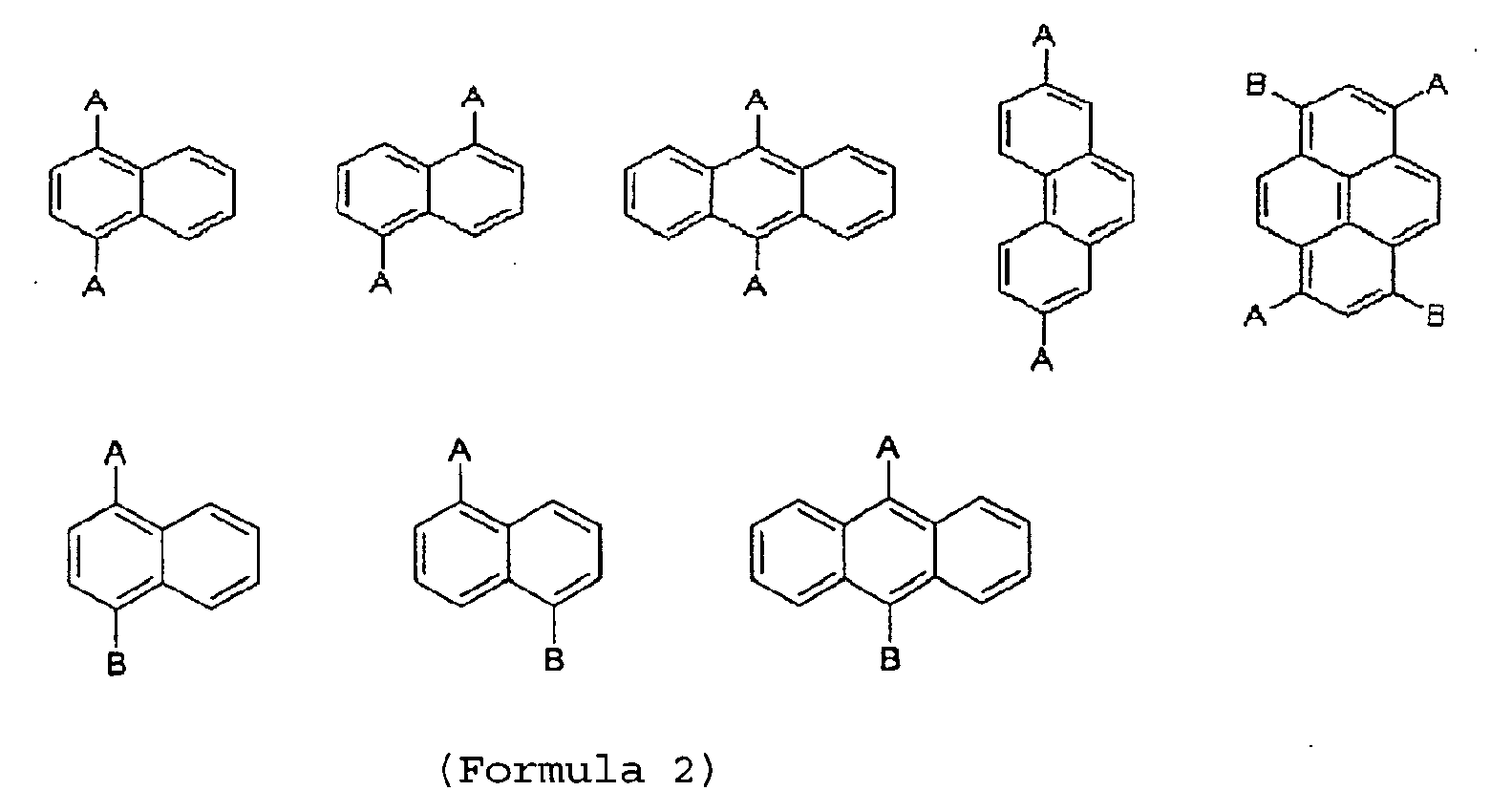
- the present invention also provides an organic electroluminescent device comprising a structure having an anode, an emitting layer, and a cathode stacked therein, wherein a fluorescent compound represented by Formula 1 above is used as a dopant and a fluorescent compound represented by Formula 2 below is used as a host of the emitting layer of the EL device.
- A is independently selected from a substituted or unsubstituted C 6 -C 30 aromatic group
- B is independently selected from a substituted or unsubstituted C 6 -C 30 aromatic group and a hydrogen atom.
- substituents of A and B may be one or more, respectively, and the substituent is selected from the group consisting of C 1 -C 10 alkyl and a hydrogen atom.
- a doping concentration thereof is preferably in a range of 0.5 to 10% by weight.
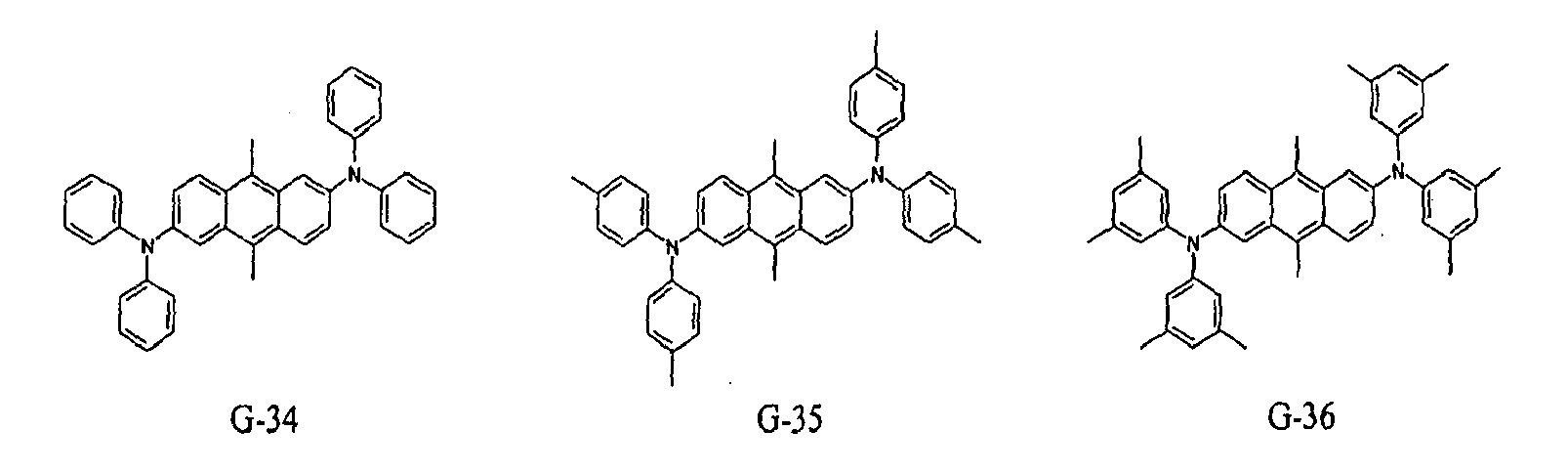
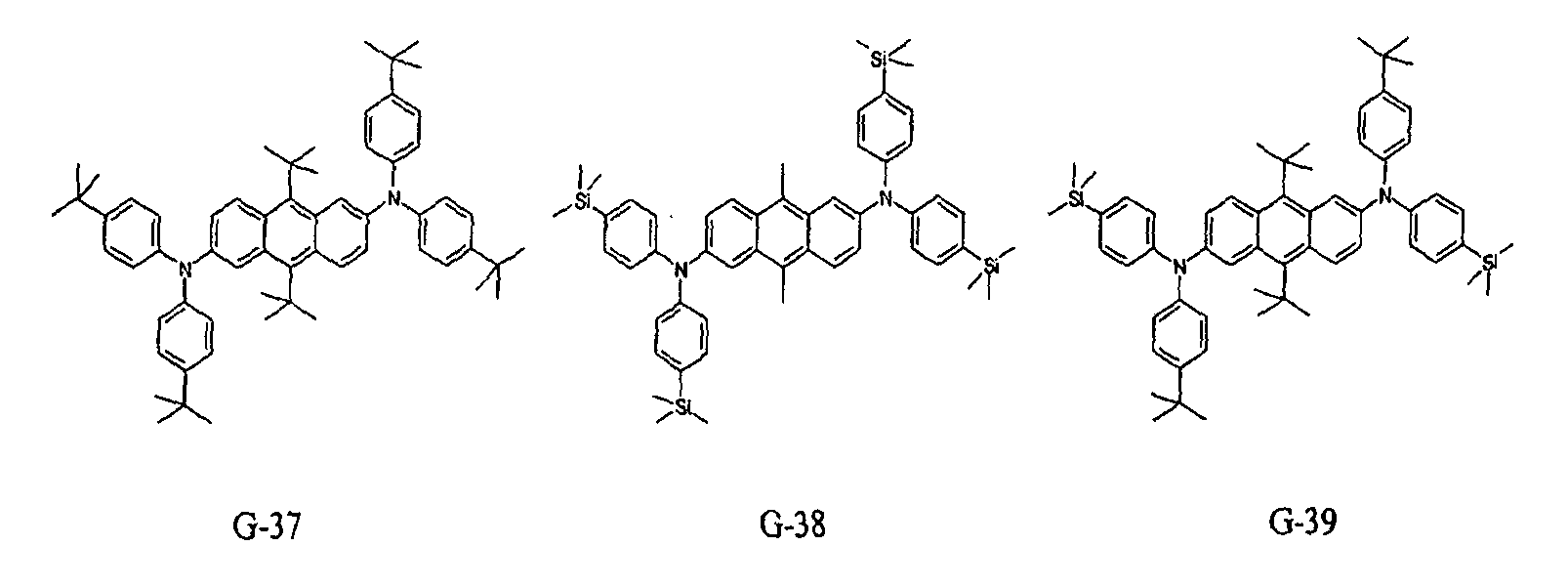
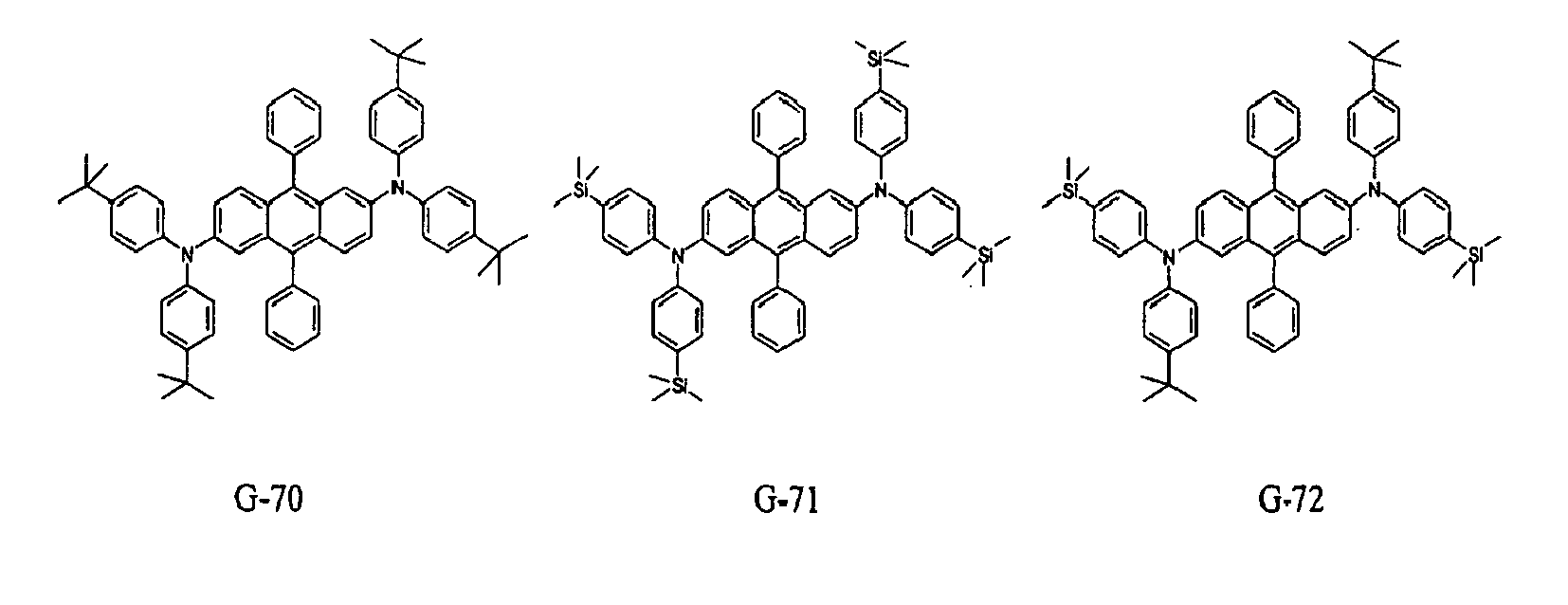
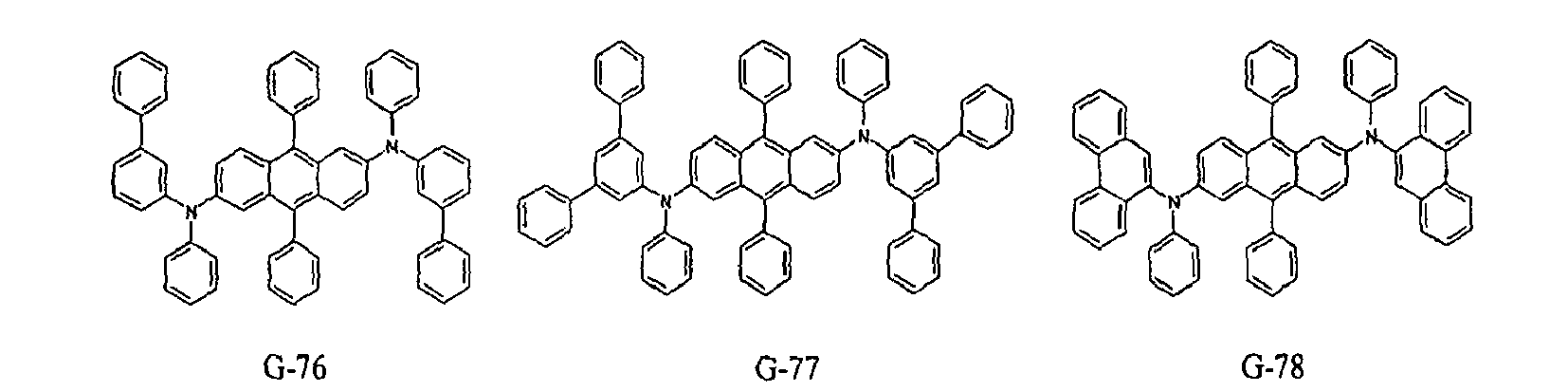
- Specific examples of the compound represented by Formula 1 include the following compounds G-01 through G-156:
- FIG. 1 illustrates the respective structural formulae of 4,4'-bis[N-(1-naphthyl)-N-phenylamino]biphenyl (NPD), copper (II) phthalocyanine (CuPc), tris(8-hydroxyquinolate)aluminum (Alq 3 ), H-1, H-2, H-3 and D-1, which are compounds used in Examples of the present invention.
- ITO indium tin oxide
- An organic electroluminescent device was prepared in the same manner as the Examples 1 through 8, except that hosts other than compounds in accordance with the present invention were used.
- ITO indium tin oxide
- the substrate was mounted on a vacuum chamber and a standard pressure was set to 1 x 10 -6 torr. Then, respective organic material films were sequentially formed on ITO, in order of CuPC (200 ⁇ ), NPD (400 ⁇ ), host(see Figure 1) + dopant(Formula 1) (0.5%-10%) (200 ⁇ ), Alq 3 (300 ⁇ ), LiF (5 ⁇ ) and Al (1000 ⁇ ), thereby preparing an organic electroluminescent device.
- An organic electroluminescent device was prepared in the same manner as the Examples 9 through 28, except that dopants other than compounds in accordance with the present invention were used.
- ITO indium tin oxide
- the substrate was mounted on a vacuum chamber and a standard pressure was set to 1 x 10 -6 torr. Then, respective organic material films were sequentially formed on ITO, in order of CuPC (200A), NPD (400A), host(Formula 2) + dopant(Formula 1) (0.5% - 10%)(200 ⁇ ), Alq 3 (300 ⁇ ), LiF (5 ⁇ ) and Al(1000 ⁇ ), thereby preparing an organic electroluminescent device.
- An organic electroluminescent device was prepared in the same manner as the Examples 29 through 48, except that dopants other than compounds in accordance with the present invention were used.
- the present invention provides a an organic electroluminescent device having higher color purity, higher luminance and longer lifetime than conventional organic electroluminescent devices, via the use of the compound of Formula 1 as a emitting material of the emitting layer of the EL device, or the use of the compound of Formula 1 as a dopant for an emitting layer of the EL device, and the use of the compound of Formula 1 is used as a dopant and the compound of Formula 2 is used as a host of the emitting layer of the EL device.
Landscapes
- Chemical & Material Sciences (AREA)
- Engineering & Computer Science (AREA)
- Materials Engineering (AREA)
- Physics & Mathematics (AREA)
- Spectroscopy & Molecular Physics (AREA)
- Organic Chemistry (AREA)
- Electroluminescent Light Sources (AREA)
Abstract

Disclosed is an organic electroluminescent device comprising a structure having an anode, an emitting layer, and a cathode stacked therein, wherein a fluorescent compound represented by Formula 1 is used as a dopant of the emitting layer and a fluorescent compound by Formula 2 is used as a host of the emitting layer:
Description
- This application claims the benefit of
Korean Patent Application No. 10-2005-0096003 10-2005-0096004 filed on October 12, 2005 - The present invention relates to an organic electroluminescent device, and more particularly, to an organic electroluminescent (EL) device comprising a structure having an anode, an emitting layer, and a cathode stacked therein, wherein a fluorescent compound of Formula 1 is used as a emitting material of the emitting layer of the EL device, or used as a dopant of the emitting layer of the EL device, a fluorescent compound of Formula 1 is used as a dopant and a fluorescent compound of Formula 2 is used as a host of the emitting layer of the EL device.
- Recently, an increase in sizes of displays has raised an increasing need for flat-panel displays taking up a small space. There have been rapid developments in the technology of organic electroluminescent (EL) devices, also called organic light emitting diodes (OLEDs), among these including flat-panel displays, and various pilot products thereof have already been released.
- An organic electroluminescent (EL) device is a system that emits light when electrons recombine with holes to thereby form electron-hole pairs and then they disappear, via injection of electric charges into an organic film formed between an electron-injection electrode (cathode) and a hole-injection electrode (anode). The organic electroluminescent device exhibits advantages such as capability to fabricate the device on a flexible and transparent substrate such as plastic materials, capability to operate at a lower voltage (less than 10 volts) compared to plasma display panels or inorganic EL displays, relatively low consumption of electric power, and superior tunability of colors of emitting light to desired colors. In addition, organic EL devices can display light of three colors, i.e., green, blue and red light, and thus have been receiving a great deal of attention as a next generation of displays capable of emitting various colors.
- A method for fabricating a conventional organic EL device will be briefly reviewed as follows.
- First, an anode material is deposited on a transparent substrate. As the anode material, indium tin oxide (ITO) is commonly used.
- Next, a hole-injection layer (HIL) is deposited thereon. As the hole-injection layer, copper phthalocyanine (CuPc) is usually deposited to a thickness of 10 to 30 nm on the anode.
- Next, a hole-transport layer (HTL) is deposited on the hole-injection layer. 4,4'-bis [N-(1-naphthyl)-N-phenylamino]biphenyl (NPB), as the hole-transport layer (HTL), is deposited to a thickness of 30 to 60 nm on the hole-injection layer.
- An organic emitting layer is then formed on the hole-transport layer. Herein, if necessary, a dopant may be added to the organic emitting layer. For example, if it is desired to fabricate the organic EL device emitting green light, tris(8-hydroxy-quinolate)aluminum (hereinafter, referred to simply as Alq3) as the organic emitting layer is deposited to a thickness of about 30 to 60 nm. Herein, N-methylquinacridone (MQD) is primarily employed as the dopant.
- Then, an electron-transport layer (ETL) and an electron-injection layer (EIL) are sequentially deposited on the organic emitting layer, or otherwise an electron-injection/transport layer is formed thereon. If it is desired to emit green light, an electron-injection layer (EIL)/ electron-transport layer (ETL) may not necessary because Alq3 used for the organic emitting layer has high electron-transporting ability.
- Then, a cathode is formed thereon and finally, a protective film is additionally coated on the resulting structure.
- Depending upon how the emitting layer is formed in the resulting structure, it is possible to fabricate a blue-, green- or red-emitting device as desired. Meanwhile, materials used as emitting compounds to realize conventional emitting devices have suffered from problems associated with poor operating lifetime and luminous efficiency.
- Accordingly, the present invention is directed to an organic electroluminescent device that substantially obviates one or more problems due to limitations and disadvantages of the related art.
- An object of the present invention is to provide an organic electroluminescent device having high-color purity, high luminance and long lifetime via syntheses of compounds of Formula 1 and Formula 2.
- Additional advantages, objects, and features of the invention will be set forth in part in the description which follows and in part will become apparent to those having ordinary skill in the art upon examination of the following or may be learned from practice of the invention. The objectives and other advantages of the invention may be realized and attained by the structure particularly pointed out in the written description and claims hereof as well as the appended drawing.
- To achieve these objects and other advantages and in accordance with the purpose of the invention, as embodied and broadly described herein, the present invention provides an organic electroluminescent device comprising a structure having an anode, an emitting layer, and a cathode stacked therein, wherein a fluorescent compound represented by Formula 1 below is used a emitting material of the emitting layer of the EL device.
- The present invention also provides an organic electroluminescent device comprising a structure having an anode, an emitting layer, and a cathode stacked therein, wherein a fluorescent compound represented by Formula 1 below is used as a dopant of the emitting layer of the EL device.
- Where said Formula 1 is used as a emitting material of the emitting layer of the EL device, said EL device will emit orange color, and a coordinates of orange color is CIE X = 0.45 ~ 0.60, CIE Y = 0.30 - 0.50. Where said Formula 1 is used as a dopant of the emitting layer of the EL device, said EL device will emit green color, and a coordinates of green color is CIE X = 0.45 ~ 0.60, CIE Y = 0.30 ~ 0.50.

- In
Formula 1, substituents of A1, A2 and A3 may be one or more, respectively and the substituent is selected from the group consisting of C1-C10 alkyl, C1-C10 alkoxy, C1-C10 alkylamino, C1-C10 alkylsilyl, a halogen atom, C6-C10 aryl, C6-C10 aryloxy, C6-C10 arylamino, C6-C10 arylsilyl and a hydrogen atom. - The present invention also provides an organic electroluminescent device comprising a structure having an anode, an emitting layer, and a cathode stacked therein, wherein a fluorescent compound represented by
Formula 1 above is used as a dopant and a fluorescent compound represented byFormula 2 below is used as a host of the emitting layer of the EL device.
- In
Formula 2, substituents of A and B may be one or more, respectively, and the substituent is selected from the group consisting of C1-C10 alkyl and a hydrogen atom. - Where the compound of Formula 1 is used as the dopant of the emitting layer, a doping concentration thereof is preferably in a range of 0.5 to 10% by weight.
- Specific examples of the compound represented by Formula 1 include the following compounds G-01 through G-156:







- Specific examples of the compound represented by Formula 2 include the following compounds H-01 through H-32:


- It is to be understood that both the foregoing general description and the following detailed description of the present invention are exemplary and explanatory and are intended to provide further explanation of the invention as claimed.
- The accompanying drawing, which is included to provide a further understanding of the invention and is incorporated in and constitute a part of this application, illustrates embodiment(s) of the invention and together with the description serve to explain the principle of the invention. In the drawing:
- FIG. 1 illustrates the respective structural formulae of 4,4'-bis[N-(1-naphthyl)-N-phenylamino]biphenyl (NPD), copper (II) phthalocyanine (CuPc), tris(8-hydroxyquinolate)aluminum (Alq3), H-1, H-2, H-3 and D-1, which are compounds used in Examples of the present invention.
- Reference will now be made in detail to the preferred embodiments of the present invention, examples of which are illustrated in the accompanying drawing. Wherever possible, the same reference numbers will be used throughout the drawing to refer to the same or like parts.
- Hereinafter, a synthesis method of a green fluorescent compound of the present invention will be described, using, as an example, compounds G-02, G-68 and G-101 from among the green phosphorescent compounds used in the organic electroluminescent device in accordance with the present invention.
- Synthesis Example
- 1. Synthesis of G-02
- (1) Synthesis of 2,6-dibromoanthraquinone

- 50 g of 2,6-diaminoanthraquinone was dissolved in 500 mL of concentrated HCl in a 1000 mL beaker on an ice bath and 25 g of an aqueous NaNO2 solution was gradually added dropwise thereto, and the resulting solution was warmed to room temperature. Then, 25 g of an aqueous KI solution was gradually added dropwise to the resulting solution and the mixture was stirred for 24 hours at room temperature. After the reaction was complete, the reaction materials were filtered and washed with water. The washed materials were recrystallized from methylene chloride (MC) and MeOH, thereby obtaining 30 g of brown 2,6-dibromoanthraquinone.
- (2) Synthesis of 2,6-dibromoanthracene
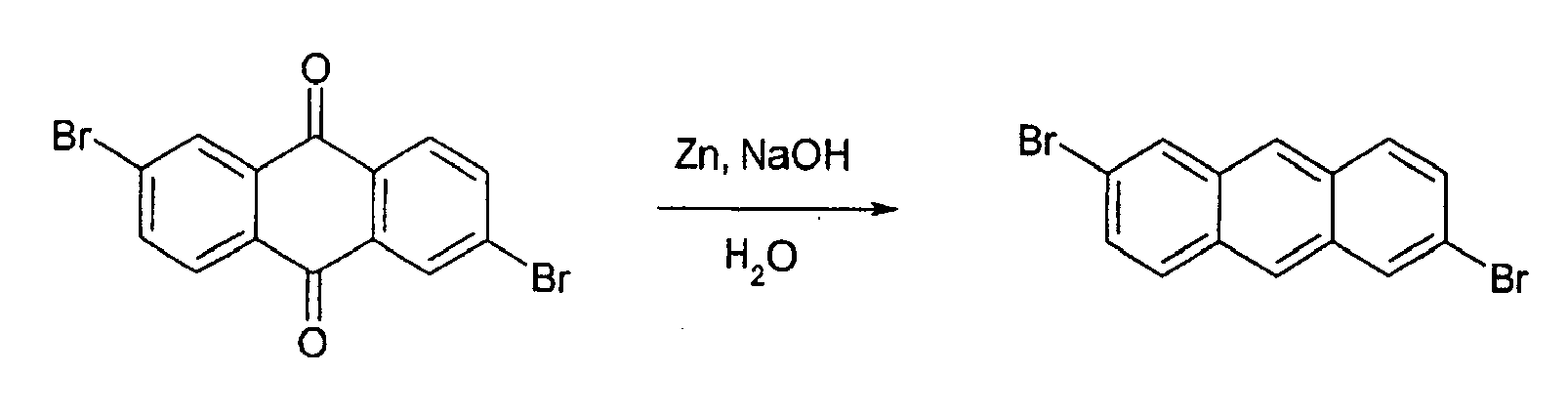
- 30 g of 2,6-dibromoanthraquinone, 5 g of Zn and 25 g of NaOH were stirred in 200 mL of water at 100°C for 24 hours and when the reaction was complete, the reaction materials were filtered. The thus-obtained organic material and inorganic material were dissolved in chloroform and the resulting mixture was re-filtered. The obtained filtrate was applied to a silica gel short column, thereby separating the inorganic material. The separated material was recrystallized from MC and MeOH, thereby obtaining 15 g of 2,6-dibromoanthracene.
- (3) Synthesis of G-02

- 2. Synthesis of G-68
- (1) Synthesis of 2,6-dibromo-9,10-diphenylanthracene

- 6 g of phenyl lithium was dissolved in Et2O, and the resulting solution was gradually added dropwise to a solution containing 5 g of 2,6-dibromoanthraquinone dissolved in Et2O. This reaction was carried out on a dry ice bath. Then, the temperature of the reaction material was elevated to room temperature, thereby obtaining white solids. The obtained solids were dissolved in 100 mL of AcOH, followed by addition of KI and NaH2PO2 and the resulting mixture was stirred at 130°C for 24 hours. After the reaction was complete, the resulting material was filtered with addition of water. The filtrate was then recrystallized from MC and MeOH, thereby obtaining 4.5 g of 2,6-dibromo-9,10-diphenylanthracene.
- (2) Synthesis of G-68

- 4.5 g of 2,6-dibromo-9,10-diphenylanthracene, 8 g of 4,4'-ditolylamine, 0.10 g of Pd(OAC)2, 0.18 g of BINAP and 12 g of NaOtBu were dissolved in 150 mL of toluene and the resulting solution was stirred under reflux for 24 hours. After the reaction was complete, toluene was first removed, MeOH was added thereto. The resulting mixture was filtered and the organic material thus obtained was applied to a silica gel short column using methylene chloride (MC) as an eluent. The eluted materials were recrystallized from MC and MeOH, thereby obtaining 2.5 g of G-68.
- 3. Synthesis of G-101
- (1) Synthesis of 2,6-dibromo-9,10-di-1-naphthylanthracene

- 5 g of 1-naphthyl lithium was dissolved in Et2O, and the resulting solution was gradually added dropwise to a solution containing 5 g of 2,6-dibromoanthraquinone dissolved in Et2O. This reaction was carried out on a dry ice bath. Then, the temperature of the reaction material was elevated to room temperature, thereby obtaining an intermediate product. The obtained intermediate product was filtered, thereby obtaining white solids. The white solids thus obtained were dissolved in 100 mL of AcOH, followed by addition of KI and NaH2PO2 and the mixture was stirred at 130°C for 24 hours. When the reaction was complete, the reaction material was filtered with addition of water. The filtrate was recrystallized from MC and MeOH, thereby obtaining 4 g of 2,6-dibromo-9,10-di-1-naphthylanthracene.
- (2) Synthesis of G-101

- 4 g of 2,6-dibromo-9,10-di-1-naphthylanthracene, 8 g of 4,4'-ditolylamine, 0.1 g of Pd(OAC)2, 0.18 g of BINAP and 12 g of NaOtBu were dissolved in 150 mL of toluene and the resulting solution was stirred under reflux for 24 hours. After the reaction was complete, toluene was first removed, MeOH was added thereto. The resulting mixture was filtered and the organic material thus obtained was applied to a silica gel short column using methylene chloride (MC) as an eluent. The eluted materials were recrystallized from MC and MeOH, thereby obtaining 2.3 g of G-101.
- Now, the present invention will be described in more detail with reference to the following examples. These examples are provided only for illustrating the present invention and should not be construed as limiting the scope and spirit of the present invention.
- EXAMPLES
- Examples 1 through 8
- An indium tin oxide (ITO) glass was patterned to have an emitting area of 3 mm x 3 mm and cleaned. The substrate was mounted on a vacuum chamber and a standard pressure was set to 1 x 10⁻⁶ torr. Then, respective organic material films were sequentially formed on ITO, in order of CuPC (200Å), NPD (400Å), EML (200Å), Alq3 (300Å), LiF (5Å) and Al(1000Å), thereby preparing an organic electroluminescent device.
- Comparative Examples 1 and 2
- An organic electroluminescent device was prepared in the same manner as the Examples 1 through 8, except that hosts other than compounds in accordance with the present invention were used.
- Characteristics and performance of organic electroluminescent devices were compared between Examples 1 through 8 and Comparative Examples 1 and 2. The results thus obtained are shown in Table 1 below. In Table 1, the respective performance values refer to values measured at electric current of 0.9 mA, and a lifetime refers to a period of time (hours) taking a drop of luminance from an initial value of 1000 nits to 500 nits.
Table 1 EML Voltage (V) Luminance (cd/m2) Current efficiency (cd/A) CIE(X Y) Lifetime (hours) Ex. 1 G-03 6.9 1233 12.3 (0.44 0.58) 10,000 Ex.2 G-12 6.4 1025 10.3 (0.410.55) 10,000 Ex. 3 G-39 7.0 1130 13.0 (0.36 0.58) 8,000 Ex. 4 G-42 6.8 1164 11.6 (0.37 0.60) 10,000 Ex. 5 G-68 6.2 1267 12.7 (0.36 0.61) 10,000 Ex. 6 G-72 6.7 1308 13.1 (0.38 0.60) 8,000 Ex. 7 G-140 7.1 1207 12.1 (0.37 0.58) 7,000 Ex. 8 G-153 7.0 1344 13.4 (0.36 0.56) 6,000 Comp. Ex.1 Alq3 7.8 786 7.9 (0.37 0.64) 2,000 Comp. Ex.2 D-a 8.3 603 6.0 (0.56 0.43) 1,000 - Examples 9 through 28
- An indium tin oxide (ITO) glass was patterned to have an emitting area of 3 mm x 3 mm and cleaned. The substrate was mounted on a vacuum chamber and a standard pressure was set to 1 x 10⁻⁶ torr. Then, respective organic material films were sequentially formed on ITO, in order of CuPC (200Å), NPD (400Å), host(see Figure 1) + dopant(Formula 1) (0.5%-10%) (200Å), Alq3 (300Å), LiF (5Å) and Al (1000Å), thereby preparing an organic electroluminescent device.
- Comparative Examples 3 through 5
- An organic electroluminescent device was prepared in the same manner as the Examples 9 through 28, except that dopants other than compounds in accordance with the present invention were used.
- Characteristics and performance of organic electroluminescent devices were compared between Examples 9 through 28 and Comparative Examples 3 through 5. The results thus obtained are shown in Table 2 below. In Table 2, the respective performance values refer to values measured at electric current of 0.9 mA, and a lifetime refers to a period of time (hours) taking a drop of luminance from an initial value of 1000 nits to 500 nits.
Table 2 Dopant Host Doping cone. Voltage (V) Luminance (cd/m2)
Current efficienc Y (cd/A) CIE(X Y) Life time (hours) Ex. 9 G-02 H-1 2% 6.8 1783 17.8 (0.26 0.65) 36,000 Ex. 10 G-19 H-1 3% 6.8 1692 16.9 (0.27 0.64) 40,000 Ex. 11 G-36 H-2 3% 6.5 1716 17.1 (0.28 0.65) 35,000 Ex. 12 G-42 H-3 3% 6.6 1820 18.2 (0.29 0.67) 40,000 Ex. 13 G-64 H-3 3% 6.5 1905 19.0 (0.31 0.65) 45,000 Ex. 14 G-68 H-1 1% 6.6 2037 20.4 (0.29 0.66) 55,000 Ex. 15 G-68 H-1 3% 6.6 2011 20.1 (0.29 0.66) 50,000 Ex. 16 G-68 H-3 3% 6.5 1968 29.7 (0.29 0.66) 35,000 Ex. 17 G-78 H-1 3% 6.9 1815 18.1 (0.30 0.66) 38,000 Ex. 18 G-85 H-1 3% 6.5 2140 21.4 (0.28 0.67) 35,000 Ex. 19 G-102 H-1 1% 6.4 2065 20.7 (0.31 0.65) 40,000 Ex. 20 G-116 H-2 3% 6.7 2005 20.0 (0.28 0.67) 40,000 Ex. 21 G-120 H-2 3% 6.9 2019 20.2 (0.30 0.66) 35,000 Ex. 22 G-124 H-1 3% 6.4 1956 19.6 (0.27 0.63) 40,000 Ex. 23 G-131 H-1 3% 6.4 2251 22.5 (0.31 0.64) 40,000 Ex. 24 G-133 H-1 3% 6.2 2150 22.5 (0.29 0.64) 40,000 Ex. 25 G-146 H-1 1% 6.3 2269 22.7 (0.31 0.64) 50,000 Ex. 26 G-146 H-1 3% 6.4 2196 22.0 (0.31 0.64) 50,000 Ex. 27 G-146 H-2 3% 6.3 2068 20.7 (0.31 0.63) 45,000 Ex. 28 G-148 H-1 3% 6.4 2093 20.9 (0.28 0.63) 40,000 Comp. Ex. 3 D-1 H-1 2% 6.6 1608 16.8 (0.34 0.65) 25,000 Comp. Ex. 4 D-1 H-2 1% 6.3 1638 16.4 (0.33 0.66) 20,000 Comp. Ex. 5 D-1 H-3 3% 6.7 1520 15.2 (0.36 0.63) 18,000 - Examples 29 through 48
- An indium tin oxide (ITO) glass was patterned to have an emitting area of 3 mm x 3 mm and cleaned. The substrate was mounted on a vacuum chamber and a standard pressure was set to 1 x 10⁻⁶ torr. Then, respective organic material films were sequentially formed on ITO, in order of CuPC (200A), NPD (400A), host(Formula 2) + dopant(Formula 1) (0.5% - 10%)(200Å), Alq3 (300Å), LiF (5Å) and Al(1000Å), thereby preparing an organic electroluminescent device.
- Comparative Examples 6 through 8
- An organic electroluminescent device was prepared in the same manner as the Examples 29 through 48, except that dopants other than compounds in accordance with the present invention were used.
- Characteristics and performance of organic electroluminescent devices were compared between Examples 29 through 48 and Comparative Examples 6 through 8. The results thus obtained are shown in Table 3 below. In Table 3, the respective performance values refer to values measured at electric current of 0.9 mA, and a lifetime refers to a period of time (hours) taking a drop of luminance from an initial value of 1000 nits to 500 nits.
Table 3 Dopant Host Doping conc. Voltage (V) Luminance (cd/m2)
Current efficienc y (cd/A) CIE(X Y) Life time (hours) Ex. 29 G-02 H-11 2% 6.8 1783 17.8 (0.26 0.65) 36,000 Ex. 30 G-19 H-11 3% 6.8 1692 16.9 (0.27 0.64) 40,000 Ex. 31 G-36 H-4 3% 6.5 1716 17.1 (0.28 0.65) 35,000 Ex. 32 G-42 H-14 3% 6.6 1820 18.2 (0.29 0.67) 40,000 Ex. 33 G-64 H-14 3% 6.5 1905 19.0 (0.31 0.65) 45,000 Ex. 34 G-68 H-11 1% 6.6 2037 20.4 (0.29 0.66) 55,000 Ex. 35 G-68 H-11 3% 6.6 2011 20.1 (0.29 0.66) 50,000 Ex. 36 G-68 H-14 3% 6.5 1968 29.7 (0.29 0.66) 35,000 Ex. 37 G-78 H-11 3% 6.9 1815 18.1 (0.30 0.66) 38,000 Ex. 38 G-85 H-11 3% 6.5 2140 21.4 (0.28 0.67) 35,000 Ex. 39 G-102 H-11 1% 6.4 2065 20.7 (0.31 0.65) 40,000 Ex. 40 G-116 H-4 3% 6.7 2005 20.0 (0.28 0.67) 40,000 Ex. 41 G-120 H-4 3% 6.9 2019 20.2 (0.30 0.66) 35,000 Ex. 42 G-124 H-11 3% 6.4 1956 19.6 (0.27 0.63) 40,000 Ex. 43 G-131 H-11 3% 6.4 2251 22.5 (0.31 0.64) 40,000 Ex. 44 G-133 H-11 3% 6.2 2150 22.5 (0.29 0.64) 40,000 Ex. 45 G-146 H-11 1% 6.3 2269 22.7 (0.31 0.64) 50,000 Ex. 46 G-146 H-11 3% 6.4 2196 22.0 (0.31 0.64) 50,000 Ex. 47 G-146 H-4 3% 6.3 2068 20.7 (0.31 0.63) 45,000 Ex. 48 G-148 H-11 3% 6.4 2093 20.9 (0.28 0.63) 40,000 Comp. Ex. 6 D-1 H-11 2% 6.6 1608 16.8 (0.34 0.65) 25,000 Comp. Ex. 7 D-1 H-4 1% 6.3 1638 16.4 (0.33 0.66) 20,000 Comp. Ex. 8 D-1 H-14 3% 6.7 1520 15.2 (0.36 0.63) 18,000 - The present invention provides a an organic electroluminescent device having higher color purity, higher luminance and longer lifetime than conventional organic electroluminescent devices, via the use of the compound of
Formula 1 as a emitting material of the emitting layer of the EL device, or the use of the compound ofFormula 1 as a dopant for an emitting layer of the EL device, and the use of the compound ofFormula 1 is used as a dopant and the compound ofFormula 2 is used as a host of the emitting layer of the EL device. - It will be apparent to those skilled in the art that various modifications and variations can be made in the present invention without departing from the spirit or scope of the inventions. Thus, it is intended that the present invention covers the modifications and variations of this invention provided they come within the scope of the appended claims and their equivalents.
Claims (8)
- An organic electroluminescent device comprising a structure having an anode, an emitting layer, and a cathode stacked therein, wherein a compound of Formula 1 is used as an emitting material of the emitting layer:

A3 is selected from a substituted or unsubstituted C1-C6 aliphatic group, a C6-C20 aromatic group, a C5-C19 heterocyclic group containing N, S or O, and a hydrogen atom, and
substituents of A1, A2 and A3 are respectively one or more, and the substituent is selected from the group consisting of C1-C10 alkyl, C1-C1 alkoxy, C1-C10 alkylamino, C1-C10 alkylsilyl, a halogen atom, C6-C10 aryl, C6-C10 aryloxy, C6-C10 arylamino, C6-C10 arylsilyl and a hydrogen atom. - An organic electroluminescent device comprising a structure having an anode, an emitting layer, and a cathode stacked therein, wherein the compound of Formula 1 is used as a dopant of the emitting layer:

A3 is selected from a substituted or unsubstituted C1-C6 aliphatic group, a C6-C20 aromatic group, a C5-C19 heterocyclic group containing N, S or O, and a hydrogen atom, and
substituents of A1, A2 and A3 are respectively one or more, and the substituent is selected from the group consisting of C1-C10 alkyl, C1-C1 alkoxy, C1-C10 alkylamino, C1-C10 alkylsilyl, a halogen atom, C6-C10 aryl, C6-C10 aryloxy, C6-C10 arylamino, C6-C10 arylsilyl and a hydrogen atom. - Device according to claim 1, wherein an emitting color of the device is orange.
- Device according to claim 2, wherein an emitting color of the device is green.
- Device according to claim 3, wherein a coordinates of the orange color is CIE X = 0.45 - 0.60, CIE Y = 0.30 ~ 0.50.
- Device according to claim 4, wherein a coordinates of the green color is CIE X = 0.00 ~ 0.45, CIE Y = 0.35 ~ 0.85.
- An organic electroluminescent device comprising a structure having an anode, an emitting layer, and a cathode stacked therein, wherein a compound of Formula 1 is used as a dopant and a compound of Formula 2 is used as a host of the emitting layer:

A3 is selected from a substituted or unsubstituted C1-C6 aliphatic group, a C6-C20 aromatic group, a C5-C19 heterocyclic group containing N, S or O, and a hydrogen atom, and
substituents of A1, A2 and A3 are respectively one or more, and the substituent is selected from the group consisting of C1-C10 alkyl, C1-C1 alkoxy, C1-C10 alkylamino, C1-C10 alkylsilyl, a halogen atom, C6-C10 aryl, C6-C10 aryloxy, C6-C10 arylamino, C6-C10 arylsilyl and a hydrogen atom;
substituents of A and B are respectively one or more, and the substituent is selected from the group consisting of C1-C10 alkyl and a hydrogen atom. - Device according to claim 2 or 7, wherein the doping concentration of the dopant is in the range of 0.5 to 10% by weight.
Applications Claiming Priority (2)
| Application Number | Priority Date | Filing Date | Title |
|---|---|---|---|
| KR1020050096004A KR100651889B1 (en) | 2005-10-12 | 2005-10-12 | Organic light emitting diode |
| KR1020050096003A KR100736619B1 (en) | 2005-10-12 | 2005-10-12 | Organic light emitting diode |
Publications (2)
| Publication Number | Publication Date |
|---|---|
| EP1775334A1 true EP1775334A1 (en) | 2007-04-18 |
| EP1775334B1 EP1775334B1 (en) | 2018-08-15 |
Family
ID=37564209
Family Applications (1)
| Application Number | Title | Priority Date | Filing Date |
|---|---|---|---|
| EP06021429.3A Active EP1775334B1 (en) | 2005-10-12 | 2006-10-12 | Organic electroluminescence device |
Country Status (2)
| Country | Link |
|---|---|
| US (1) | US8647753B2 (en) |
| EP (1) | EP1775334B1 (en) |
Cited By (13)
| Publication number | Priority date | Publication date | Assignee | Title |
|---|---|---|---|---|
| WO2007108666A1 (en) | 2006-03-23 | 2007-09-27 | Lg Chem, Ltd. | New diamine derivatives, preparation method thereof and organic electronic device using the same |
| JP2009504730A (en) | 2005-08-16 | 2009-02-05 | グレイセル ディスプレイ インク. | Green light emitting compound and light emitting device employing the same as light emitting material |
| WO2009025724A1 (en) * | 2007-08-20 | 2009-02-26 | Eastman Kodak Company | High-performance broadband oled device |
| JP2009051764A (en) * | 2007-08-27 | 2009-03-12 | Hodogaya Chem Co Ltd | Compound having substituted phenanthrene ring structure and organic electroluminescence device |
| EP2096108A1 (en) * | 2008-02-29 | 2009-09-02 | Gracel Display Inc. | Novel organic electroluminescent compounds and organic electroluminscent device using the same |
| JP2009221442A (en) * | 2008-03-19 | 2009-10-01 | Toyo Ink Mfg Co Ltd | Material for organic electroluminescent element and organic electroluminescent element |
| EP2108690A1 (en) * | 2008-04-02 | 2009-10-14 | Gracel Display Inc. | Novel organic electroluminescent compounds and organic electroluminescent device using the same |
| WO2010052885A1 (en) * | 2008-11-06 | 2010-05-14 | 出光興産株式会社 | Organic electroluminescence element |
| EP2194110A1 (en) * | 2008-11-26 | 2010-06-09 | Gracel Display Inc. | Electroluminescent device using electroluminescent compounds |
| WO2011110276A1 (en) | 2010-03-09 | 2011-09-15 | Merck Patent Gmbh | Materials for electronic devices |
| JP2014177442A (en) * | 2013-03-15 | 2014-09-25 | Idemitsu Kosan Co Ltd | Diaminoanthracene derivative and organic electroluminescent element |
| CN104109532A (en) * | 2014-04-03 | 2014-10-22 | 烟台万润精细化工股份有限公司 | Electron transfer material and its application |
| US20210206767A1 (en) * | 2019-12-27 | 2021-07-08 | Semiconductor Energy Laboratory Co., Ltd. | Compound, light-emitting device, light-emitting apparatus, electronic device, and lighting device |
Families Citing this family (26)
| Publication number | Priority date | Publication date | Assignee | Title |
|---|---|---|---|---|
| KR100828173B1 (en) * | 2005-11-22 | 2008-05-08 | (주)그라쎌 | Organic Electroluminescent Compounds and Display Device using The Same |
| KR100852328B1 (en) * | 2006-03-15 | 2008-08-14 | 주식회사 엘지화학 | Novel anthracene derivatives, preparation method thereof and organic electroluminescent device using same |
| US8512878B2 (en) * | 2007-05-08 | 2013-08-20 | Idemitsu Kosan Co., Ltd. | Diaminopyrene derivative and organic EL device using the same |
| KR100935356B1 (en) * | 2007-11-19 | 2010-01-06 | 다우어드밴스드디스플레이머티리얼 유한회사 | Green light emitting compound and organic electroluminescent device employing the same as light emitting material |
| KR100940938B1 (en) * | 2007-12-04 | 2010-02-08 | 다우어드밴스드디스플레이머티리얼 유한회사 | Novel organic light emitting compound and organic electroluminescent device employing it as light emitting material |
| KR100991416B1 (en) * | 2007-12-31 | 2010-11-03 | 다우어드밴스드디스플레이머티리얼 유한회사 | Organic light emitting compound and organic light emitting device comprising the same |
| KR100974562B1 (en) * | 2007-12-31 | 2010-08-06 | 다우어드밴스드디스플레이머티리얼 유한회사 | Novel organic light emitting compound and organic light emitting device employing the same as light emitting material |
| KR100901887B1 (en) * | 2008-03-14 | 2009-06-09 | (주)그라쎌 | Novel organic light emitting compound and organic light emitting device employing the same |
| KR100989815B1 (en) * | 2008-03-20 | 2010-10-29 | 다우어드밴스드디스플레이머티리얼 유한회사 | Novel organic light emitting compound and organic light emitting device employing the same as light emitting material |
| KR100946411B1 (en) * | 2008-03-28 | 2010-03-09 | 다우어드밴스드디스플레이머티리얼 유한회사 | Novel organic light emitting compound and organic light emitting device employing the same as light emitting material |
| KR100910150B1 (en) * | 2008-04-02 | 2009-08-03 | (주)그라쎌 | Novel organic light emitting compound and organic light emitting device employing the same as light emitting material |
| KR101495547B1 (en) * | 2008-04-17 | 2015-02-25 | 롬엔드하스전자재료코리아유한회사 | Novel compounds for electronic material and organic electronic device using the same |
| KR20090111915A (en) * | 2008-04-23 | 2009-10-28 | (주)그라쎌 | Novel organic light emitting compound and organic light emitting device employing the same as light emitting material |
| KR20100000772A (en) * | 2008-06-25 | 2010-01-06 | 다우어드밴스드디스플레이머티리얼 유한회사 | Novel organic electroluminescent compounds and organic electroluminescent device using the same |
| EP2145936A3 (en) * | 2008-07-14 | 2010-03-17 | Gracel Display Inc. | Fluorene and pyrene derivatives and organic electroluminescent device using the same |
| JP5459903B2 (en) * | 2008-09-02 | 2014-04-02 | 株式会社半導体エネルギー研究所 | Anthracene derivative, light emitting element, light emitting device, electronic device, and lighting device |
| KR20100041043A (en) * | 2008-10-13 | 2010-04-22 | 다우어드밴스드디스플레이머티리얼 유한회사 | Novel organic electroluminescent compounds and organic electroluminescent device using the same |
| US20120187382A1 (en) * | 2008-12-22 | 2012-07-26 | E.I. Dupont De Nemours And Company | Electronic devices having long lifetime |
| US8476823B2 (en) | 2009-05-22 | 2013-07-02 | Idemitsu Kosan Co., Ltd. | Organic electroluminescent device |
| US9153790B2 (en) * | 2009-05-22 | 2015-10-06 | Idemitsu Kosan Co., Ltd. | Organic electroluminescent device |
| WO2011059463A1 (en) | 2009-10-29 | 2011-05-19 | E. I. Du Pont De Nemours And Company | Deuterated compounds for electronic applications |
| DE102009053191A1 (en) * | 2009-11-06 | 2011-05-12 | Merck Patent Gmbh | Materials for electronic devices |
| KR20120100709A (en) | 2010-01-15 | 2012-09-12 | 이데미쓰 고산 가부시키가이샤 | Organic electroluminescent element |
| JP2011225501A (en) * | 2010-04-22 | 2011-11-10 | Canon Inc | Novel m-terphenyl compound and organic light-emitting element including the same |
| KR101547410B1 (en) | 2010-12-20 | 2015-08-25 | 이 아이 듀폰 디 네모아 앤드 캄파니 | Compositions for electronic applications |
| US20200111962A1 (en) | 2018-10-03 | 2020-04-09 | Idemitsu Kosan Co., Ltd. | Organic electroluminescence device and electronic apparatus provided with the same |
Citations (5)
| Publication number | Priority date | Publication date | Assignee | Title |
|---|---|---|---|---|
| JPH07109449A (en) * | 1993-10-15 | 1995-04-25 | Toyo Ink Mfg Co Ltd | Organic electroluminescence device material and organic electroluminescence device using the same |
| EP1061112A1 (en) * | 1998-12-28 | 2000-12-20 | Idemitsu Kosan Company Limited | Organic electroluminescent element |
| JP2004091334A (en) * | 2002-08-29 | 2004-03-25 | Mitsubishi Chemicals Corp | 2,6-Arylaminoanthracene-based compound, charge transport material, and organic electroluminescent device |
| CN1583691A (en) * | 2004-06-04 | 2005-02-23 | 友达光电股份有限公司 | Anthracene compound and organic electroluminescent device comprising the anthracene compound |
| US20050260442A1 (en) * | 2004-05-24 | 2005-11-24 | Chen-Ping Yu | Anthracene compound for organic electroluminescent device |
Family Cites Families (15)
| Publication number | Priority date | Publication date | Assignee | Title |
|---|---|---|---|---|
| US5935721A (en) * | 1998-03-20 | 1999-08-10 | Eastman Kodak Company | Organic electroluminescent elements for stable electroluminescent |
| KR100577179B1 (en) * | 2001-10-30 | 2006-05-10 | 엘지전자 주식회사 | Organic electroluminescent element |
| JP3841695B2 (en) * | 2002-02-06 | 2006-11-01 | 富士写真フイルム株式会社 | Organic EL element and organic EL display |
| TWI314947B (en) * | 2002-04-24 | 2009-09-21 | Eastman Kodak Compan | Organic light emitting diode devices with improved operational stability |
| CN1192684C (en) | 2002-06-05 | 2005-03-09 | 谢爽 | Organic electroluminescent device |
| US20040001969A1 (en) * | 2002-06-27 | 2004-01-01 | Eastman Kodak Company | Device containing green organic light-emitting diode |
| US7651788B2 (en) * | 2003-03-05 | 2010-01-26 | Lg Display Co., Ltd. | Organic electroluminescent device |
| JP2005075868A (en) * | 2003-08-29 | 2005-03-24 | Fujitsu Ltd | Fluorescent material, organic electroluminescence device, and organic electroluminescence display |
| US6818329B1 (en) * | 2003-10-03 | 2004-11-16 | Eastman Kodak Company | Organic electroluminescent devices having a metal sub-layer within a hole-transporting region |
| US7138763B2 (en) * | 2003-11-14 | 2006-11-21 | Eastman Kodak Company | Organic electroluminescent devices having a stability-enhancing layer |
| US9085729B2 (en) * | 2004-02-09 | 2015-07-21 | Lg Display Co., Ltd. | Blue emitters for use in organic electroluminescence devices |
| US7504163B2 (en) * | 2004-07-12 | 2009-03-17 | Eastman Kodak Company | Hole-trapping materials for improved OLED efficiency |
| US20060040131A1 (en) * | 2004-08-19 | 2006-02-23 | Eastman Kodak Company | OLEDs with improved operational lifetime |
| US20070092759A1 (en) * | 2005-10-26 | 2007-04-26 | Begley William J | Organic element for low voltage electroluminescent devices |
| US20070252516A1 (en) * | 2006-04-27 | 2007-11-01 | Eastman Kodak Company | Electroluminescent devices including organic EIL layer |
-
2006
- 2006-10-11 US US11/545,732 patent/US8647753B2/en active Active
- 2006-10-12 EP EP06021429.3A patent/EP1775334B1/en active Active
Patent Citations (5)
| Publication number | Priority date | Publication date | Assignee | Title |
|---|---|---|---|---|
| JPH07109449A (en) * | 1993-10-15 | 1995-04-25 | Toyo Ink Mfg Co Ltd | Organic electroluminescence device material and organic electroluminescence device using the same |
| EP1061112A1 (en) * | 1998-12-28 | 2000-12-20 | Idemitsu Kosan Company Limited | Organic electroluminescent element |
| JP2004091334A (en) * | 2002-08-29 | 2004-03-25 | Mitsubishi Chemicals Corp | 2,6-Arylaminoanthracene-based compound, charge transport material, and organic electroluminescent device |
| US20050260442A1 (en) * | 2004-05-24 | 2005-11-24 | Chen-Ping Yu | Anthracene compound for organic electroluminescent device |
| CN1583691A (en) * | 2004-06-04 | 2005-02-23 | 友达光电股份有限公司 | Anthracene compound and organic electroluminescent device comprising the anthracene compound |
Cited By (21)
| Publication number | Priority date | Publication date | Assignee | Title |
|---|---|---|---|---|
| JP2009504730A (en) | 2005-08-16 | 2009-02-05 | グレイセル ディスプレイ インク. | Green light emitting compound and light emitting device employing the same as light emitting material |
| EP1996540A4 (en) * | 2006-03-23 | 2011-12-28 | Lg Chemical Ltd | New diamine derivatives, preparation method thereof and organic electronic device using the same |
| WO2007108666A1 (en) | 2006-03-23 | 2007-09-27 | Lg Chem, Ltd. | New diamine derivatives, preparation method thereof and organic electronic device using the same |
| US8173272B2 (en) | 2006-03-23 | 2012-05-08 | Lg Chem, Ltd. | Diamine derivatives, preparation method thereof and organic electronic device using the same |
| WO2009025724A1 (en) * | 2007-08-20 | 2009-02-26 | Eastman Kodak Company | High-performance broadband oled device |
| JP2009051764A (en) * | 2007-08-27 | 2009-03-12 | Hodogaya Chem Co Ltd | Compound having substituted phenanthrene ring structure and organic electroluminescence device |
| EP2096108A1 (en) * | 2008-02-29 | 2009-09-02 | Gracel Display Inc. | Novel organic electroluminescent compounds and organic electroluminscent device using the same |
| JP2009215559A (en) * | 2008-02-29 | 2009-09-24 | Gracel Display Inc | Novel organic electroluminescent compound and organic electroluminescent element using the same |
| JP2009221442A (en) * | 2008-03-19 | 2009-10-01 | Toyo Ink Mfg Co Ltd | Material for organic electroluminescent element and organic electroluminescent element |
| EP2108690A1 (en) * | 2008-04-02 | 2009-10-14 | Gracel Display Inc. | Novel organic electroluminescent compounds and organic electroluminescent device using the same |
| JP2009249385A (en) * | 2008-04-02 | 2009-10-29 | Gracel Display Inc | New organic electroluminescent compound, and organic electroluminescent element using the same |
| WO2010052885A1 (en) * | 2008-11-06 | 2010-05-14 | 出光興産株式会社 | Organic electroluminescence element |
| EP2194110A1 (en) * | 2008-11-26 | 2010-06-09 | Gracel Display Inc. | Electroluminescent device using electroluminescent compounds |
| DE102010010631A1 (en) | 2010-03-09 | 2011-09-15 | Merck Patent Gmbh | Materials for electronic devices |
| WO2011110276A1 (en) | 2010-03-09 | 2011-09-15 | Merck Patent Gmbh | Materials for electronic devices |
| JP2014177442A (en) * | 2013-03-15 | 2014-09-25 | Idemitsu Kosan Co Ltd | Diaminoanthracene derivative and organic electroluminescent element |
| CN104109532A (en) * | 2014-04-03 | 2014-10-22 | 烟台万润精细化工股份有限公司 | Electron transfer material and its application |
| CN104109532B (en) * | 2014-04-03 | 2016-01-06 | 中节能万润股份有限公司 | A kind of electron transport material and application thereof |
| US20210206767A1 (en) * | 2019-12-27 | 2021-07-08 | Semiconductor Energy Laboratory Co., Ltd. | Compound, light-emitting device, light-emitting apparatus, electronic device, and lighting device |
| US12012405B2 (en) * | 2019-12-27 | 2024-06-18 | Semiconductor Energy Laboratory Co., Ltd. | Compound, light-emitting device, light-emitting apparatus, electronic device, and lighting device |
| TWI890720B (en) * | 2019-12-27 | 2025-07-21 | 日商半導體能源研究所股份有限公司 | Compound, light-emitting device, light-emitting apparatus, electronic device, and lighting device |
Also Published As
| Publication number | Publication date |
|---|---|
| EP1775334B1 (en) | 2018-08-15 |
| US8647753B2 (en) | 2014-02-11 |
| US20070087222A1 (en) | 2007-04-19 |
Similar Documents
| Publication | Publication Date | Title |
|---|---|---|
| EP1775334B1 (en) | Organic electroluminescence device | |
| KR101726459B1 (en) | Metal complex comprising novel ligand structures | |
| EP1783133B1 (en) | Red phosphorescent compound and organic electroluminescent device using the same | |
| KR100803125B1 (en) | Red phosphorescent compound and organic light emitting device using the same | |
| EP1205527B2 (en) | Organic electroluminescence device | |
| KR100797469B1 (en) | Red phosphorescent compound and organic light emitting device using the same | |
| KR101132635B1 (en) | Pyrene compound and organic electroluminescent device using the same | |
| EP2456617B1 (en) | Oled device with stabilized yellow light-emitting layer | |
| JP4766527B2 (en) | Anthracene derivative and organic electroluminescence device using the same | |
| KR101092003B1 (en) | Anthracene derivative and organoelectroluminescent device employing the same | |
| KR101668044B1 (en) | Oled with high efficiency blue light-emitting layer | |
| KR101717988B1 (en) | Spiro compound and organic electroluminescent devices comprising the same | |
| KR101326668B1 (en) | Electron transporting-injection material and Organic electroluminescent device using the same | |
| EP1784057B1 (en) | Red phosphorescent compounds and organic electroluminescent devices using the same | |
| EP1391495B1 (en) | Organic electroluminescence element | |
| KR20100071726A (en) | Amine derivatives and organic light emitting diode device comprising the same | |
| KR101856512B1 (en) | Pyrene derivative compound and organic electroluminescent devices comprising the same | |
| KR101779914B1 (en) | Naphthalene derivatives and organic light-emitting diode including the same | |
| JP7801899B2 (en) | Organic electroluminescent device and organic electroluminescent lighting using novel 1,10-phenanthroline compound | |
| KR100736619B1 (en) | Organic light emitting diode | |
| KR101957149B1 (en) | Blue Luminescent Compounds and Organic Electroluminescence Device Using the Same | |
| KR20120011336A (en) | Stilbene derivative and organic light emitting device comprising the same | |
| KR100861121B1 (en) | Organic metal complex for organic emitting layer and organic light emitting diode | |
| KR101193522B1 (en) | Naphthalene derivatives and organic light-emitting diode including the same | |
| KR20110068162A (en) | Electron transport compound and organic light emitting device comprising the same |
Legal Events
| Date | Code | Title | Description |
|---|---|---|---|
| PUAI | Public reference made under article 153(3) epc to a published international application that has entered the european phase |
Free format text: ORIGINAL CODE: 0009012 |
|
| 17P | Request for examination filed |
Effective date: 20061012 |
|
| AK | Designated contracting states |
Kind code of ref document: A1 Designated state(s): AT BE BG CH CY CZ DE DK EE ES FI FR GB GR HU IE IS IT LI LT LU LV MC NL PL PT RO SE SI SK TR |
|
| AX | Request for extension of the european patent |
Extension state: AL BA HR MK YU |
|
| AKX | Designation fees paid |
Designated state(s): AT BE BG CH CY CZ DE DK EE ES FI FR GB GR HU IE IS IT LI LT LU LV MC NL PL PT RO SE SI SK TR |
|
| 17Q | First examination report despatched |
Effective date: 20071220 |
|
| RAP1 | Party data changed (applicant data changed or rights of an application transferred) |
Owner name: LG DISPLAY CO., LTD. |
|
| GRAP | Despatch of communication of intention to grant a patent |
Free format text: ORIGINAL CODE: EPIDOSNIGR1 |
|
| INTG | Intention to grant announced |
Effective date: 20180309 |
|
| RAP1 | Party data changed (applicant data changed or rights of an application transferred) |
Owner name: LG DISPLAY CO., LTD. |
|
| GRAS | Grant fee paid |
Free format text: ORIGINAL CODE: EPIDOSNIGR3 |
|
| GRAA | (expected) grant |
Free format text: ORIGINAL CODE: 0009210 |
|
| AK | Designated contracting states |
Kind code of ref document: B1 Designated state(s): AT BE BG CH CY CZ DE DK EE ES FI FR GB GR HU IE IS IT LI LT LU LV MC NL PL PT RO SE SI SK TR |
|
| REG | Reference to a national code |
Ref country code: AT Ref legal event code: REF Ref document number: 1029739 Country of ref document: AT Kind code of ref document: T Effective date: 20180815 Ref country code: GB Ref legal event code: FG4D Ref country code: CH Ref legal event code: EP |
|
| REG | Reference to a national code |
Ref country code: IE Ref legal event code: FG4D |
|
| REG | Reference to a national code |
Ref country code: DE Ref legal event code: R096 Ref document number: 602006056078 Country of ref document: DE |
|
| REG | Reference to a national code |
Ref country code: NL Ref legal event code: FP |
|
| REG | Reference to a national code |
Ref country code: FR Ref legal event code: PLFP Year of fee payment: 13 |
|
| REG | Reference to a national code |
Ref country code: LT Ref legal event code: MG4D |
|
| REG | Reference to a national code |
Ref country code: AT Ref legal event code: MK05 Ref document number: 1029739 Country of ref document: AT Kind code of ref document: T Effective date: 20180815 |
|
| PG25 | Lapsed in a contracting state [announced via postgrant information from national office to epo] |
Ref country code: LT Free format text: LAPSE BECAUSE OF FAILURE TO SUBMIT A TRANSLATION OF THE DESCRIPTION OR TO PAY THE FEE WITHIN THE PRESCRIBED TIME-LIMIT Effective date: 20180815 Ref country code: GR Free format text: LAPSE BECAUSE OF FAILURE TO SUBMIT A TRANSLATION OF THE DESCRIPTION OR TO PAY THE FEE WITHIN THE PRESCRIBED TIME-LIMIT Effective date: 20181116 Ref country code: FI Free format text: LAPSE BECAUSE OF FAILURE TO SUBMIT A TRANSLATION OF THE DESCRIPTION OR TO PAY THE FEE WITHIN THE PRESCRIBED TIME-LIMIT Effective date: 20180815 Ref country code: IS Free format text: LAPSE BECAUSE OF FAILURE TO SUBMIT A TRANSLATION OF THE DESCRIPTION OR TO PAY THE FEE WITHIN THE PRESCRIBED TIME-LIMIT Effective date: 20181215 Ref country code: AT Free format text: LAPSE BECAUSE OF FAILURE TO SUBMIT A TRANSLATION OF THE DESCRIPTION OR TO PAY THE FEE WITHIN THE PRESCRIBED TIME-LIMIT Effective date: 20180815 Ref country code: SE Free format text: LAPSE BECAUSE OF FAILURE TO SUBMIT A TRANSLATION OF THE DESCRIPTION OR TO PAY THE FEE WITHIN THE PRESCRIBED TIME-LIMIT Effective date: 20180815 Ref country code: BG Free format text: LAPSE BECAUSE OF FAILURE TO SUBMIT A TRANSLATION OF THE DESCRIPTION OR TO PAY THE FEE WITHIN THE PRESCRIBED TIME-LIMIT Effective date: 20181115 |
|
| PG25 | Lapsed in a contracting state [announced via postgrant information from national office to epo] |
Ref country code: LV Free format text: LAPSE BECAUSE OF FAILURE TO SUBMIT A TRANSLATION OF THE DESCRIPTION OR TO PAY THE FEE WITHIN THE PRESCRIBED TIME-LIMIT Effective date: 20180815 Ref country code: ES Free format text: LAPSE BECAUSE OF FAILURE TO SUBMIT A TRANSLATION OF THE DESCRIPTION OR TO PAY THE FEE WITHIN THE PRESCRIBED TIME-LIMIT Effective date: 20180815 |
|
| PG25 | Lapsed in a contracting state [announced via postgrant information from national office to epo] |
Ref country code: IT Free format text: LAPSE BECAUSE OF FAILURE TO SUBMIT A TRANSLATION OF THE DESCRIPTION OR TO PAY THE FEE WITHIN THE PRESCRIBED TIME-LIMIT Effective date: 20180815 Ref country code: EE Free format text: LAPSE BECAUSE OF FAILURE TO SUBMIT A TRANSLATION OF THE DESCRIPTION OR TO PAY THE FEE WITHIN THE PRESCRIBED TIME-LIMIT Effective date: 20180815 Ref country code: CZ Free format text: LAPSE BECAUSE OF FAILURE TO SUBMIT A TRANSLATION OF THE DESCRIPTION OR TO PAY THE FEE WITHIN THE PRESCRIBED TIME-LIMIT Effective date: 20180815 Ref country code: PL Free format text: LAPSE BECAUSE OF FAILURE TO SUBMIT A TRANSLATION OF THE DESCRIPTION OR TO PAY THE FEE WITHIN THE PRESCRIBED TIME-LIMIT Effective date: 20180815 Ref country code: RO Free format text: LAPSE BECAUSE OF FAILURE TO SUBMIT A TRANSLATION OF THE DESCRIPTION OR TO PAY THE FEE WITHIN THE PRESCRIBED TIME-LIMIT Effective date: 20180815 |
|
| REG | Reference to a national code |
Ref country code: DE Ref legal event code: R097 Ref document number: 602006056078 Country of ref document: DE |
|
| PG25 | Lapsed in a contracting state [announced via postgrant information from national office to epo] |
Ref country code: DK Free format text: LAPSE BECAUSE OF FAILURE TO SUBMIT A TRANSLATION OF THE DESCRIPTION OR TO PAY THE FEE WITHIN THE PRESCRIBED TIME-LIMIT Effective date: 20180815 Ref country code: SK Free format text: LAPSE BECAUSE OF FAILURE TO SUBMIT A TRANSLATION OF THE DESCRIPTION OR TO PAY THE FEE WITHIN THE PRESCRIBED TIME-LIMIT Effective date: 20180815 |
|
| REG | Reference to a national code |
Ref country code: CH Ref legal event code: PL |
|
| PLBE | No opposition filed within time limit |
Free format text: ORIGINAL CODE: 0009261 |
|
| STAA | Information on the status of an ep patent application or granted ep patent |
Free format text: STATUS: NO OPPOSITION FILED WITHIN TIME LIMIT |
|
| REG | Reference to a national code |
Ref country code: BE Ref legal event code: MM Effective date: 20181031 |
|
| PG25 | Lapsed in a contracting state [announced via postgrant information from national office to epo] |
Ref country code: LU Free format text: LAPSE BECAUSE OF NON-PAYMENT OF DUE FEES Effective date: 20181012 Ref country code: MC Free format text: LAPSE BECAUSE OF FAILURE TO SUBMIT A TRANSLATION OF THE DESCRIPTION OR TO PAY THE FEE WITHIN THE PRESCRIBED TIME-LIMIT Effective date: 20180815 |
|
| 26N | No opposition filed |
Effective date: 20190516 |
|
| REG | Reference to a national code |
Ref country code: IE Ref legal event code: MM4A |
|
| PG25 | Lapsed in a contracting state [announced via postgrant information from national office to epo] |
Ref country code: LI Free format text: LAPSE BECAUSE OF NON-PAYMENT OF DUE FEES Effective date: 20181031 Ref country code: CH Free format text: LAPSE BECAUSE OF NON-PAYMENT OF DUE FEES Effective date: 20181031 Ref country code: SI Free format text: LAPSE BECAUSE OF FAILURE TO SUBMIT A TRANSLATION OF THE DESCRIPTION OR TO PAY THE FEE WITHIN THE PRESCRIBED TIME-LIMIT Effective date: 20180815 Ref country code: BE Free format text: LAPSE BECAUSE OF NON-PAYMENT OF DUE FEES Effective date: 20181031 |
|
| PG25 | Lapsed in a contracting state [announced via postgrant information from national office to epo] |
Ref country code: IE Free format text: LAPSE BECAUSE OF NON-PAYMENT OF DUE FEES Effective date: 20181012 |
|
| PG25 | Lapsed in a contracting state [announced via postgrant information from national office to epo] |
Ref country code: TR Free format text: LAPSE BECAUSE OF FAILURE TO SUBMIT A TRANSLATION OF THE DESCRIPTION OR TO PAY THE FEE WITHIN THE PRESCRIBED TIME-LIMIT Effective date: 20180815 |
|
| PG25 | Lapsed in a contracting state [announced via postgrant information from national office to epo] |
Ref country code: PT Free format text: LAPSE BECAUSE OF FAILURE TO SUBMIT A TRANSLATION OF THE DESCRIPTION OR TO PAY THE FEE WITHIN THE PRESCRIBED TIME-LIMIT Effective date: 20180815 |
|
| PG25 | Lapsed in a contracting state [announced via postgrant information from national office to epo] |
Ref country code: HU Free format text: LAPSE BECAUSE OF FAILURE TO SUBMIT A TRANSLATION OF THE DESCRIPTION OR TO PAY THE FEE WITHIN THE PRESCRIBED TIME-LIMIT; INVALID AB INITIO Effective date: 20061012 Ref country code: CY Free format text: LAPSE BECAUSE OF FAILURE TO SUBMIT A TRANSLATION OF THE DESCRIPTION OR TO PAY THE FEE WITHIN THE PRESCRIBED TIME-LIMIT Effective date: 20180815 |
|
| PGFP | Annual fee paid to national office [announced via postgrant information from national office to epo] |
Ref country code: NL Payment date: 20250821 Year of fee payment: 20 |
|
| PGFP | Annual fee paid to national office [announced via postgrant information from national office to epo] |
Ref country code: GB Payment date: 20250820 Year of fee payment: 20 |
|
| PGFP | Annual fee paid to national office [announced via postgrant information from national office to epo] |
Ref country code: FR Payment date: 20250821 Year of fee payment: 20 |
|
| PGFP | Annual fee paid to national office [announced via postgrant information from national office to epo] |
Ref country code: DE Payment date: 20250820 Year of fee payment: 20 |