EP1774862A2 - Brassiere with soft/hard underwire assembly - Google Patents
Brassiere with soft/hard underwire assembly Download PDFInfo
- Publication number
- EP1774862A2 EP1774862A2 EP06021604A EP06021604A EP1774862A2 EP 1774862 A2 EP1774862 A2 EP 1774862A2 EP 06021604 A EP06021604 A EP 06021604A EP 06021604 A EP06021604 A EP 06021604A EP 1774862 A2 EP1774862 A2 EP 1774862A2
- Authority
- EP
- European Patent Office
- Prior art keywords
- underwire
- brassiere
- assembly
- hard
- hard plastic
- Prior art date
- Legal status (The legal status is an assumption and is not a legal conclusion. Google has not performed a legal analysis and makes no representation as to the accuracy of the status listed.)
- Granted
Links
Images


Classifications
-
- A—HUMAN NECESSITIES
- A41—WEARING APPAREL
- A41C—CORSETS; BRASSIERES
- A41C3/00—Brassieres
- A41C3/12—Component parts
- A41C3/122—Stay means
-
- A—HUMAN NECESSITIES
- A41—WEARING APPAREL
- A41C—CORSETS; BRASSIERES
- A41C3/00—Brassieres
- A41C3/0007—Brassieres with stay means
-
- A—HUMAN NECESSITIES
- A41—WEARING APPAREL
- A41C—CORSETS; BRASSIERES
- A41C3/00—Brassieres
- A41C3/12—Component parts
- A41C3/122—Stay means
- A41C3/128—Stay means using specific materials
Definitions
- the present invention relates to a brassiere having a soft/hard underwire assembly with a dual (i.e. soft/hard) character.
- the use of an underwire as part of a brassiere frame has become common.
- the underwire, of metal, plastic-coated metal or plastic generally is received in a tubular pocket below each cup and lies along the sternum of the wearer substantially at the junction of the breast with the chest wall.
- Each cup is provided with such an underwire that maintains the configuration of the cup and contributes to the support of the breast.
- Another object of this invention is to provide a brassiere with an improved underwire structure.
- an underwire assembly adapted to be incorporated into a brassiere and comprising: a generally flat U-shaped hard underwire adapted to be positioned in a brassiere below in a cup thereof and along the chest of a wearer, the underwire being formed with two parallel arcuate portions joined at respective ends and separated by an arcuate slot between the ends; and a soft plastic body in which the hard underwire is embedded, ensheathing the hard underwire along a bottom of the body and having an apron along a concave side of the body lying at an angle to a plane of the hard underwire so that the body and the underwire form a pocket receiving a breast of the wearer in the cup.
- the brassiere in turn comprises:
- the hard plastic wire or armature is not wholly enclosed by the soft plastic and is exposed through windows therein at which the fabric can be attached by ultrasonic welding or laminating when stitching is used to attach the dual wire to the fabric, the stitching may run in the arcuate slit between he parallel arcuate portions.
- the underwire can be formed from a pair of metal wires interconnected at their ends by respective caps
- the underwire is preferably formed in one piece from a hard plastic, for example, polyamide-6,6 or nylon 6,6 or another plastic having a stiffness, rigidity and hardness comparable to that of polyamide-6,6.
- the soft plastic body is preferably a polyurethane with a Shore hardness 8OA to 9OA or an equivalent soft, flexible and, if desired, elastomeric plastic.
- the angle that is included between the plane of the U shaped hard underwire and the a frame can vary along the length of the underwire and corresponds generally to the angle at which a breast to be supported adjoins the chest.
- the underwire assembly forms a cup or pocket itself incorporated into the brassiere cup that receives the breast so that the weight of the breast will draw the ends of the underwire assembly toward one another and thereby counteract the tendency of the tension at the back of the brassiere to spread the underwires.
- each underwire assembly can also comprise a tab projecting from a convex side of the body at a location corresponding to a junction region of the cups of the brassiere.
- the tab also lies at an angle to this plane and like the apron can be provided with throughgoing slits running generally perpendicular to the hard plastic underwire.
- cuts are provided through the soft plastic of the body substantially along the arcuate slot.
- Spaced apart openings in the body can enable ultrasonic welding of the fabric through these openings to the hard plastic underwire.
- the arcuate portions of the hard plastic underwire have generally flat cross sections with the inner arcuate portion being thinner than the outer annular portion.
- the arcuate portion along the convex side can be formed along the length thereof with segments of alternatingly greater and lesser thicknesses, thereby producing formations or steps that assist in maintaining the hard plastic underwire in position within the body and preventing shifting.
- the assembly can be covered by fabric of the brassiere structure on both sides and that fabric can be stitched through the soft plastic.
- the fabric is laminated to the structure, e.g. by ultrasonic welding. Ultrasonic weld points may pass directly to the hard plastic underwire through openings in the soft plastic body.
- the combination of a hard member that nevertheless is formed with a slit along its length between inner and outer segments with a soft structure in which that hard member is ensheathed, allows advantages of both materials to reinforce one another.
- the underwire itself is stiff in its plane but because of its arcuate slit can allow the two segments to shift transversely and thereby flex transversely to the plane. It is therefore not rigid in the sense of a body with a solid cross-section (by contrast with a cross section subdivided by a slit). Warping however is largely precluded.
- the soft material cushions the harder plastic relative to the body over the entire length and provides, because of the apron structure, a pocket or pouch holding the breast.
- the wire structure thus can hug the breast along its underside and itself be stabilized by the breast.
- the key element to the dual wire underwire assembly of the invention is an underwire 10 (FIG. 4) that can be formed of a relatively hard plastic, e.g. polyamide-6,6 or nylon 6,6, that has a flat configuration as can be seen from FIGS. 5 and 6 and comprises an inner arcuate element or portion 11 at the concave side of the generally U-shaped underwire and an outer portion or element 12 parallel to the inner element and located on the convex side of the underwire.
- An arcuate slit or slot 13 is provided between these two parallel elements that are connected at rounded ends 14 and 15.
- the width of the inner element 11 may be less than the width W of the outer element.
- the thickness of the inner element 11 is likewise smaller than that of the outer element 12 (see FIGS. 5 and 6) and the inner element may taper in thickness inwardly while the outer element may taper in thickness outwardly as seen from FIGS. 5 and 6.
- the outer element can be formed with successive regions 17 and 18 alternately of lesser and greater thickness so that steps 19 are formed between these regions and serve as stops, when the underwire is embedded in the soft body to prevent that underwire from shifting in the body in which it is sheathed.
- that underwire is not incorporated directly in the brassiere but is partly embedded as shown at 10, 11 and 12 of FIG. 3 in a soft body 20 composed for example of polyurethane with a Shore hardness A of 80 to 90.
- the body 20 has an arcuate planar portion 21 in which the underwire is ensheathed and an apron 22 that lies at an angle to the plane of the portion 21 and itself forms a pocket that fits around the breast so that the breast can nestle in that pocket.
- the apron may be formed with spaced apart windows 23 through which a cover fabric can be ultasonically welded to the hard plastic underwire therein and slits may be provided in the body at for example 24 to increase the flexibility. These slits are formed along the slot 13 of the embedded underwire.
- the angle ⁇ may be 135° ⁇ 10° and may vary by ⁇ 10°, for example, over the length of the assembly.
- the soft plastic body is formed with a tab 25, located toward the armpit area to facilitate retaining the assembly in the brassiere.
- the angle between the apron 22 and the planar portion 21 can correspond to the angle between the breast and the chest wall against which, through the fabric of the brassiere, the portion 21 will lie.
- Both the apron 22 and the tab 25 are provided with throughgoing slots 26 and 27 that are perpendicular to the hard plastic underwire that is retained therein.
- the assembly 30 formed by the soft body 20 and the hard plastic underwire 10 is laminated between fabric layers 31 and 32 that can be ultrasonically welded or stitched through the soft plastic and/or to the hard plastic.
- the inner fabric layer 31 defines the cup in which the breast rests.
- FIG. 7 shows a brassiere 40 comprising shoulder straps 41, a pair of back straps 42 connected by a fastener 43 and a brassiere structure 44 comprising two cups 45, each of which is composed of fabric 31, 32 and has an underwire assembly 30 as has been described received therein.
- the swing wire of FIGS. 1 through 6 can be replaced by a metal wire assembly as shown in FIG. 8 that can have a pair of metal wires 51 and 52 joined by caps 54 and 55 at their ends and preferably at a midpoint or close to a midpoint by a member 57.
- a metal wire assembly as shown in FIG. 8 that can have a pair of metal wires 51 and 52 joined by caps 54 and 55 at their ends and preferably at a midpoint or close to a midpoint by a member 57.
- the caps 54 and 55 of the metallic wire 50 and member 57 prevent shifting in the soft body when the soft body is molded therearound otherwise the soft body functions in the same manner as the soft body 20 of the first embodiment.
- the dual wire arrangement 30 in which the soft body 20 is stitched through Along a stitching line 60 that can run in the slit 13 between the arcuate portions 11 and 12 of the underwire 10 that is not visible in FIG. 10 but is exposed through the openings 23 normally provided to allow the fabric also to be welded to the hard plastic wire if desired.
- the apron 72 of the soft body has a different configuration from the apron 22.
- the apron, which is part of the cup is reduced toward the ends with its width greatest toward the deepest part fo the dual wire. As a result, the weight of the breast can draw the ends together as has been described, to a greater extent, in opposition to the back wings that tend to spread the wire apart.
- the wire 10 has three curvatures C1, C2, and C3.
- the curvature C1 is concave upward and is dimensioned, that it has a radius, determined by the size of the breast in the respective cup 45.
- the curvature C2 is in a vertical plane generally perpendicular to the curvature C1 and serves to support and hold the breast.
- the curvature C3 (FIG. 2) is concave rearward toward the chest of a wearer of the brassiere 40 incorporating the underwire assembly 10 and is determined by chest size. Hence the underwire assembly sits flatly against the chest of the wearer underneath the breast.
- the curves C1 and C3 are formed by the hard material of the underwire 10 and the curve C2 by the softer front flange or apron.
- the curvature C2 serves to keep C1 in shape, that is to balance or counter the stress on the back wings caused by the weight of the breast.
- the curvature C1 lies in a generally vertical plane, is open upward, and is determined by the diameter of the breast or cup size.
- the curvature C2 lies in a generally vertical plane, is open upward, and is generally perpendicular to curvature C1.
- the curvature C3 lies in a generally horizontal plane, is concave backward toward the wearer of the brassiere, and is determined by the size of the chest or rib cage.
- the underwire 10 of this invention is not incorporated directly in the brassiere 40 but is fully embedded in a soft body 20 composed for example of polyurethane with a Shore hardness A of 80 to 90.
- the body 20 has an arcuate portion 21 in which the underwire is ensheathed and an apron 22 that lies at an angle to the plane of the portion 21 and itself forms a pocket that fits around the breast so that the breast can nestle in that pocket.
- the apron 22 may be formed with spaced apart windows 23 through which a cover fabric can be ultrasonically welded to the hard plastic underwire therein and slits may be provided in the body at for example 24 to increase the flexibility. These slits are formed along the slot 13 of the fully embedded underwire.
- the body 20 in which the underwire 10 is embedded is held between fabric layers forming the brassiere body 44.
- An inner layer of the fabric also defines the inner surface of the cups 45. No wire channel is needed because the wire construction is one part or layer of the different layers of fabrics that are stitched or otherwise laminated together.
Landscapes
- Engineering & Computer Science (AREA)
- Textile Engineering (AREA)
- Chemical & Material Sciences (AREA)
- Materials Engineering (AREA)
- Corsets Or Brassieres (AREA)
Abstract
Description
- The present invention relates to a brassiere having a soft/hard underwire assembly with a dual (i.e. soft/hard) character.
- The use of an underwire as part of a brassiere frame has become common. The underwire, of metal, plastic-coated metal or plastic generally is received in a tubular pocket below each cup and lies along the sternum of the wearer substantially at the junction of the breast with the chest wall. Each cup is provided with such an underwire that maintains the configuration of the cup and contributes to the support of the breast.
- In the past, problems have been encountered with such underwires. For example some underwire designs tended to poke through the fabric or to shift in the fabric pocket that was provided.
- The pull on the underwire when the brassiere is fastened, because of the tension applied around the back of the wearer, tended to spread the underwire that generally had a U- or C-shape.
- Frequently the stiffness of the underwire rendered the brassiere uncomfortable and often the lack of ability of the underwire to deform out of its plane caused discomfort as well. When efforts were made in the past to make the underwire more flexible, it tended to lose its stabilizing function.
- Furthermore, techniques for inserting the underwire, anchoring the underwire or generally assembling an underwire to the cup and other structures of the brassiere made fabrication complex and expensive. In particular, the tension on the underwire when the brassiere was tightened around the back of the wearer could not be counteracted in the past except by making the wiring so stiff that its breast-shaping and -supporting function was defeated.
- An effort to overcome at least some of these disadvantages is found in
United States patent 6,447,365 that describes a brassiere that ultimately was found to be impractical because of the stiffness of the armature embedded in the softer surround. - It is therefore the principal object of our present invention to provide an improved underwire structure that can overcome all of the drawbacks enumerated previously and provide improved comfort, shaping, support and convenience of manufacture for a brassiere.
- Another object of this invention is to provide a brassiere with an improved underwire structure.
- These objects and others that will become apparent hereinafter are attained, in accordance with the invention in an underwire assembly adapted to be incorporated into a brassiere and comprising:
a generally flat U-shaped hard underwire adapted to be positioned in a brassiere below in a cup thereof and along the chest of a wearer, the underwire being formed with two parallel arcuate portions joined at respective ends and separated by an arcuate slot between the ends; and
a soft plastic body in which the hard underwire is embedded, ensheathing the hard underwire along a bottom of the body and having an apron along a concave side of the body lying at an angle to a plane of the hard underwire so that the body and the underwire form a pocket receiving a breast of the wearer in the cup. - The brassiere in turn comprises:
- a generally flat U-shaped hard plastic underwire adapted to be positioned in the brassiere below the respective cup and along the chest of a wearer and formed with two parallel arcuate portions joined at respective ends and separated by an arcuate slot between the ends; and
- a soft plastic body in which the hard plastic underwire is embedded, ensheathing the hard plastic underwire along a bottom of the body and having an apron along a concave side of the body lying at an angle to a plane of the hard plastic underwire so that the soft plastic body and underwire of each cup forms a pocket receiving the respective breast,
- each of the assemblies being affixed to the structure.
- The hard plastic wire or armature is not wholly enclosed by the soft plastic and is exposed through windows therein at which the fabric can be attached by ultrasonic welding or laminating when stitching is used to attach the dual wire to the fabric, the stitching may run in the arcuate slit between he parallel arcuate portions.
- According to a feature of the invention, while the underwire can be formed from a pair of metal wires interconnected at their ends by respective caps, the underwire is preferably formed in one piece from a hard plastic, for example, polyamide-6,6 or nylon 6,6 or another plastic having a stiffness, rigidity and hardness comparable to that of polyamide-6,6. The soft plastic body is preferably a polyurethane with a Shore hardness 8OA to 9OA or an equivalent soft, flexible and, if desired, elastomeric plastic.
- The angle that is included between the plane of the U shaped hard underwire and the a frame can vary along the length of the underwire and corresponds generally to the angle at which a breast to be supported adjoins the chest. Surprisingly, unlike conventional underwire configurations, the underwire assembly forms a cup or pocket itself incorporated into the brassiere cup that receives the breast so that the weight of the breast will draw the ends of the underwire assembly toward one another and thereby counteract the tendency of the tension at the back of the brassiere to spread the underwires.
- The body of each underwire assembly can also comprise a tab projecting from a convex side of the body at a location corresponding to a junction region of the cups of the brassiere. The tab also lies at an angle to this plane and like the apron can be provided with throughgoing slits running generally perpendicular to the hard plastic underwire.
- To increase the flexibility, cuts are provided through the soft plastic of the body substantially along the arcuate slot.
- Spaced apart openings in the body can enable ultrasonic welding of the fabric through these openings to the hard plastic underwire.
- The arcuate portions of the hard plastic underwire have generally flat cross sections with the inner arcuate portion being thinner than the outer annular portion.
- The arcuate portion along the convex side can be formed along the length thereof with segments of alternatingly greater and lesser thicknesses, thereby producing formations or steps that assist in maintaining the hard plastic underwire in position within the body and preventing shifting.
- The assembly can be covered by fabric of the brassiere structure on both sides and that fabric can be stitched through the soft plastic. Preferably however the fabric is laminated to the structure, e.g. by ultrasonic welding. Ultrasonic weld points may pass directly to the hard plastic underwire through openings in the soft plastic body.
- When stitching is used to secure the dual wire in the fabric, it runs through the slit in the hard wire between the arcuate portions thereof.
- The combination of a hard member that nevertheless is formed with a slit along its length between inner and outer segments with a soft structure in which that hard member is ensheathed, allows advantages of both materials to reinforce one another. The underwire itself is stiff in its plane but because of its arcuate slit can allow the two segments to shift transversely and thereby flex transversely to the plane. It is therefore not rigid in the sense of a body with a solid cross-section (by contrast with a cross section subdivided by a slit). Warping however is largely precluded. The soft material cushions the harder plastic relative to the body over the entire length and provides, because of the apron structure, a pocket or pouch holding the breast. The wire structure thus can hug the breast along its underside and itself be stabilized by the breast.
- The above and other objects, features, and advantages will become more readily apparent from the following description, reference being made to the accompanying drawing in which:
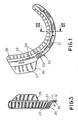
- FIG. 1
- is a front elevational view of a right breast underwire assembly in accordance with the invention, the left breast underwire assembly being mirror symmetrical thereto;
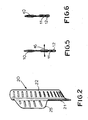
- FIG. 2
- is a side view of the underwire assembly of FIG. 1;
- FIG. 3
- is a cross sectional view taken along the line III-III of FIG. 1;
- FIG. 4
- is an elevational view of the one piece hard plastic underwire incorporated in the assembly of FIGS. 1 through 3;
- FIG. 5
- is a cross sectional view taken along the line V-V of FIG. 4;
- FIG. 6
- is a cross sectional view taken along the line VI-VI of FIG. 4;
- FIG. 7
- is a perspective view, partly broken away of the brassiere in which the underwire assemblies are incorporated;
- FIG. 8
- is an illustration of a metal wire structure that can be incorporated into the soft plastic body;
- FIG. 9
- is a cross sectional view illustrating the lamination of the underwire assembly in a brassiere;
- FIG. 10
- is a view similar to FIG. 1 showing the stitching line when stitching is used to attach the fabric to the dual wire;
- FIG. 11
- is a side view similar to FIG. 2 but showing a variation in the width of the apron in accordance with the invention;
- FIG. 12
- is a front view of another underwire assembly according to the invention;
- FIG. 13
- is a are side view taken in the direction of arrows XIII of FIG. 12 of the assembly;
- FIG. 14
- is a horizontal section taken along line XIV-XIV of FIG. 12;
- FIG. 15
- is a front view of the underwire; and
- FIG. 16
- is a small-scale perspective view of a brassiere incorporating the underwire of FIGS. 12 to 15.
- The key element to the dual wire underwire assembly of the invention is an underwire 10 (FIG. 4) that can be formed of a relatively hard plastic, e.g. polyamide-6,6 or nylon 6,6, that has a flat configuration as can be seen from FIGS. 5 and 6 and comprises an inner arcuate element or
portion 11 at the concave side of the generally U-shaped underwire and an outer portion orelement 12 parallel to the inner element and located on the convex side of the underwire. An arcuate slit orslot 13 is provided between these two parallel elements that are connected at rounded ends 14 and 15. So that theinner element 11 can flex to either side of the plane of the underwire relative to the outer element as represented by thearrow 16, the width of theinner element 11 may be less than the width W of the outer element. The thickness of theinner element 11 is likewise smaller than that of the outer element 12 (see FIGS. 5 and 6) and the inner element may taper in thickness inwardly while the outer element may taper in thickness outwardly as seen from FIGS. 5 and 6. - In addition, the outer element can be formed with
successive regions steps 19 are formed between these regions and serve as stops, when the underwire is embedded in the soft body to prevent that underwire from shifting in the body in which it is sheathed. - Because one or the other of the arcuate portions can swing relative to another portion, that wire has been referred to as a swing wire and has the properties described in the commonly owned copending
application Serial Number 11/232,424, filed 21 September 2005 that is hereby incorporated in its entirety by reference. - According to the present invention, that underwire is not incorporated directly in the brassiere but is partly embedded as shown at 10, 11 and 12 of FIG. 3 in a
soft body 20 composed for example of polyurethane with a Shore hardness A of 80 to 90. Thebody 20 has an arcuateplanar portion 21 in which the underwire is ensheathed and anapron 22 that lies at an angle to the plane of theportion 21 and itself forms a pocket that fits around the breast so that the breast can nestle in that pocket. The apron may be formed with spaced apartwindows 23 through which a cover fabric can be ultasonically welded to the hard plastic underwire therein and slits may be provided in the body at for example 24 to increase the flexibility. These slits are formed along theslot 13 of the embedded underwire. - The angle α may be 135° ± 10° and may vary by ± 10°, for example, over the length of the assembly.
- At one end, the soft plastic body is formed with a
tab 25, located toward the armpit area to facilitate retaining the assembly in the brassiere. The angle between theapron 22 and theplanar portion 21 can correspond to the angle between the breast and the chest wall against which, through the fabric of the brassiere, theportion 21 will lie. Both theapron 22 and thetab 25 are provided withthroughgoing slots - As can be seen from FIG. 9, the
assembly 30 formed by thesoft body 20 and thehard plastic underwire 10 is laminated between fabric layers 31 and 32 that can be ultrasonically welded or stitched through the soft plastic and/or to the hard plastic. Theinner fabric layer 31 defines the cup in which the breast rests. This can be seen in greater detail in FIG. 7 that shows abrassiere 40 comprisingshoulder straps 41, a pair of back straps 42 connected by afastener 43 and abrassiere structure 44 comprising twocups 45, each of which is composed offabric underwire assembly 30 as has been described received therein. - In a less preferred alternative, the swing wire of FIGS. 1 through 6 can be replaced by a metal wire assembly as shown in FIG. 8 that can have a pair of
metal wires caps member 57. By reason of thegap 53 between the wires, a swinging of one wire relative to another out of the plane and swivelling withinmember 57 is permitted. Thecaps metallic wire 50 andmember 57 prevent shifting in the soft body when the soft body is molded therearound otherwise the soft body functions in the same manner as thesoft body 20 of the first embodiment. - In FIG. 10 we have shown the
dual wire arrangement 30 in which thesoft body 20 is stitched through Along astitching line 60 that can run in theslit 13 between thearcuate portions underwire 10 that is not visible in FIG. 10 but is exposed through theopenings 23 normally provided to allow the fabric also to be welded to the hard plastic wire if desired. In theassembly 70, theapron 72 of the soft body has a different configuration from theapron 22. In this embodiment the apron, which is part of the cup, is reduced toward the ends with its width greatest toward the deepest part fo the dual wire. As a result, the weight of the breast can draw the ends together as has been described, to a greater extent, in opposition to the back wings that tend to spread the wire apart. - According to the invention the
wire 10 has three curvatures C1, C2, and C3. The curvature C1 is concave upward and is dimensioned, that it has a radius, determined by the size of the breast in therespective cup 45. The curvature C2 is in a vertical plane generally perpendicular to the curvature C1 and serves to support and hold the breast. The curvature C3 (FIG. 2) is concave rearward toward the chest of a wearer of thebrassiere 40 incorporating theunderwire assembly 10 and is determined by chest size. Hence the underwire assembly sits flatly against the chest of the wearer underneath the breast. The curves C1 and C3 are formed by the hard material of theunderwire 10 and the curve C2 by the softer front flange or apron. C2 serves to keep C1 in shape, that is to balance or counter the stress on the back wings caused by the weight of the breast. Thus the curvature C1 lies in a generally vertical plane, is open upward, and is determined by the diameter of the breast or cup size. The curvature C2 lies in a generally vertical plane, is open upward, and is generally perpendicular to curvature C1. The curvature C3 lies in a generally horizontal plane, is concave backward toward the wearer of the brassiere, and is determined by the size of the chest or rib cage. - The
underwire 10 of this invention is not incorporated directly in thebrassiere 40 but is fully embedded in asoft body 20 composed for example of polyurethane with a Shore hardness A of 80 to 90. Thebody 20 has anarcuate portion 21 in which the underwire is ensheathed and anapron 22 that lies at an angle to the plane of theportion 21 and itself forms a pocket that fits around the breast so that the breast can nestle in that pocket. Theapron 22 may be formed with spaced apartwindows 23 through which a cover fabric can be ultrasonically welded to the hard plastic underwire therein and slits may be provided in the body at for example 24 to increase the flexibility. These slits are formed along theslot 13 of the fully embedded underwire. - The
body 20 in which theunderwire 10 is embedded is held between fabric layers forming thebrassiere body 44. An inner layer of the fabric also defines the inner surface of thecups 45. No wire channel is needed because the wire construction is one part or layer of the different layers of fabrics that are stitched or otherwise laminated together.
Claims (31)
- An underwire assembly adapted to be incorporated into a brassiere, the assembly comprising:a generally flat U-shaped hard underwire adapted to be positioned in a brassiere below in a cup thereof and along the chest of a wearer, the underwire being formed with two parallel arcuate portions joined at respective ends and separated by an arcuate slot between the ends; anda soft plastic body in which the hard underwire is partially embedded, ensheathing the hard underwire along a bottom of the body and having an apron along a concave side of the body lying at an angle to a plane of the hard underwire so that the body and the underwire form a pocket receiving a breast of the wearer in the cup.
- The underwire assembly defined in claim 1 wherein the underwire is formed from a pair of wires interconnected at their ends by respective caps and at least one member between the caps, whereby the caps and the member prevent shifting of the underwire in the body.
- The underwire assembly defined in claim 1 wherein the underwire is formed from a plastic.
- The underwire assembly defined in claim 3 wherein the angle corresponds substantially to an angle at which a breast to be supported with the assembly adjoins the chest.
- The underwire assembly defined in claim 3 wherein the body further comprises a tab projecting from a convex side of the body at a location corresponding to a junction region of the cups of the brassiere.
- The underwire assembly defined in claim 5 wherein the tab lies at an angle to the plane.
- The underwire assembly defined in claim 5 wherein the tab is provided with an array of throughgoing slits generally perpendicular to the hard plastic underwire.
- The underwire assembly defined in claim 3 wherein the apron is provided with an array of throughgoing slits substantially perpendicular to the hard plastic underwire.
- The underwire assembly defined in claim 3, further comprising flexibility increasing cuts in the body substantially along the arcuate slot.
- The underwire assembly defined in claim 3, further comprising spaced apart openings in the body enabling ultrasonic welding of a fabric therethrough to the hard plastic underwire.
- The underwire assembly defined in claim 3 wherein the arcuate portions of the hard plastic underwire have generally flat cross sections.
- The underwire assembly defined in claim 11 wherein the inner arcuate portion is thinner than the outer annular portion.
- The underwire assembly defined in 3 wherein the hard plastic underwire is formed in one piece.
- The underwire assembly defined in claim 3 wherein the arcuate portion along the convex side of the underwire is formed along the length thereof with segments of alternatingly greater and lesser thickness.
- The underwire assembly defined in claim 3 wherein the angle is about 135° ± 10° as measured as the included angle between the ensheathed hard plastic underwire and the apron.
- A brassiere comprising a fabric structure formed with two brassiere cups interconnected at a front part of the brassiere and respective underwire assemblies incorporated in the structure to support each of the cups, each of the assemblies comprising:a generally flat U-shaped hard plastic underwire adapted to be positioned in the brassiere below the respective cup and along the chest of a wearer and formed with two parallel arcuate portions joined at respective ends and separated by an arcuate slot between the ends; anda soft plastic body in which the hard plastic underwire is partially embedded, ensheathing the hard plastic underwire along a bottom of the body and having an apron along a concave side of the body lying at an angle to a plane of the hard plastic underwire so that the soft plastic body and underwire of each cup forms a pocket receiving the respective breast,each of the assemblies being affixed to the structure.
- The brassiere defined in claim 16 wherein each assembly is covered by fabric of the structure on opposite sides of the assembly and is stitched to the fabric.
- The brassiere defined in claim 16 wherein each assembly is covered by fabric of the structure on opposite sides of the assembly and is ultrasonically laminated to the fabric.
- The brassiere defined in claim 18 wherein the fabric is at least in part ultrasonically welded to the underwires.
- The brassiere defined in claim 16 wherein the fabric has ultrasonic weld points directly to the hard plastic underwire through openings in the soft plastic body.
- The brassiere defined in claim 16 wherein each the body further comprises a respective tab projecting from a convex side of the respective body at a location corresponding to a junction region of the cups of the brassiere.
- The brassiere defined in claim 21 each of the tabs lies at an angle to the plane of the respective hard plastic underwire.
- The brassiere defined in claim 21 wherein the tab is provided with an array of throughgoing slits generally perpendicular to the hard plastic underwire and the apron is provided with an array of throughgoing slits substantially perpendicular to the hard plastic underwire.
- The brassiere defined in claim 21, further comprising flexibility increasing cuts in each of the bodies substantially along the respective arcuate slot, each of the bodies having spaced apart openings enabling ultrasonic welding of a fabric therethrough to the hard plastic underwires.
- The brassiere defined in claim 16 wherein the bodies are composed of soft polyurethane with a Shore hardness of 80A to 90A and the underwire is composed of polyamide 6,6.
- In a brassiere having a pair of cups, a pair of underwire assemblies each comprising:inner and outer U-shaped hard underwire portions extending substantially parallel to each other below a respective cup of the brassiere, joined together at ends, and separated by an arcuate slot between the ends, the portions have shapes that in an unstressed condition are arcuately concave in a first upward direction so as to conform to the contour of a breast in the cup and arcuately concave in a second horizontal direction transverse to the first direction so as to conform to the contour of the chest of a wearer of the brassiere; anda soft plastic body in which both of the hard underwire portions are embedded and having an apron along a concave side of the body lying at an angle to the hard underwire portions and with an upward curvature in a plane transverse to the wire so that the body and the underwire form a pocket receiving a breast of the wearer in the cup.
- The underwire assembly defined in claim 26 wherein the underwire portions are unitarily formed from a plastic.
- The underwire assembly defined in claim 28 wherein the underwire portions are connected together by integral spaced webs bridging the slot.
- The underwire assembly defined in claim 27 wherein the angle corresponds substantially to an angle at which a breast to be supported with the assembly adjoins the chest.
- The underwire assembly defined in claim 29 wherein the apron is provided with an array of throughgoing slits substantially perpendicular to the hard plastic underwire.
- The underwire assembly defined in claim 29 wherein the outer arcuate portion is formed along its length with segments of alternatingly greater and lesser thickness.
Applications Claiming Priority (2)
| Application Number | Priority Date | Filing Date | Title |
|---|---|---|---|
| US11/251,573 US7234994B2 (en) | 2005-10-14 | 2005-10-14 | Brassiere with soft/hard underwire assembly |
| US11/546,944 US7407428B2 (en) | 2005-10-14 | 2006-10-12 | Brassiere with soft/hard underwire assembly |
Publications (3)
| Publication Number | Publication Date |
|---|---|
| EP1774862A2 true EP1774862A2 (en) | 2007-04-18 |
| EP1774862A3 EP1774862A3 (en) | 2008-06-04 |
| EP1774862B1 EP1774862B1 (en) | 2011-02-02 |
Family
ID=37695992
Family Applications (1)
| Application Number | Title | Priority Date | Filing Date |
|---|---|---|---|
| EP06021604A Not-in-force EP1774862B1 (en) | 2005-10-14 | 2006-10-16 | Brassiere with soft/hard underwire assembly |
Country Status (3)
| Country | Link |
|---|---|
| US (1) | US7407428B2 (en) |
| EP (1) | EP1774862B1 (en) |
| DE (1) | DE602006019934D1 (en) |
Cited By (5)
| Publication number | Priority date | Publication date | Assignee | Title |
|---|---|---|---|---|
| GB2456897A (en) * | 2008-01-31 | 2009-08-05 | Fildan Accessories | Inlay for the reinforcement of bra cups |
| EP2340731A1 (en) | 2009-12-29 | 2011-07-06 | Shanghai Guangxu Underwear Assist Co., Ltd. | Brassiere cup support |
| GB2496157A (en) * | 2011-11-02 | 2013-05-08 | Intimate Kitty Ltd | Breast support garments comprising breast supporting elements |
| CN111528536A (en) * | 2019-05-22 | 2020-08-14 | 连银湾 | chest bracket |
| CN112641138A (en) * | 2019-10-11 | 2021-04-13 | 高华奥秘有限公司 | Chest support garment and chest support panel |
Families Citing this family (23)
| Publication number | Priority date | Publication date | Assignee | Title |
|---|---|---|---|---|
| US7425170B1 (en) | 2007-06-22 | 2008-09-16 | Jockey International, Inc. | Armature for a brassiere |
| US8206196B1 (en) | 2007-09-12 | 2012-06-26 | Redcats Usa, L.P. | Garment with wire support |
| US8161099B2 (en) * | 2008-12-17 | 2012-04-17 | Microsoft Corporation | Techniques to automatically syndicate content over a network |
| US8057278B2 (en) * | 2009-04-16 | 2011-11-15 | Warnaco U.S., Inc. | Wire-free brassiere |
| US8778475B2 (en) | 2010-04-24 | 2014-07-15 | Lesa Michelle Joyce | Patch for an underwire brassiere |
| US9241514B2 (en) | 2010-08-25 | 2016-01-26 | Qp Holdings Limited | Bra |
| US8585459B2 (en) | 2011-03-01 | 2013-11-19 | Victoria's Secret Store Brand Mangement, Inc. | Brassiere cups incorporating padded underwire assemblies and a method of making the same |
| FR2987975B1 (en) * | 2012-03-15 | 2014-04-04 | Dbapparel Operations | SUPPORT, IN PARTICULAR LACE, WITH CAPS WITH IMPROVED SUPPORT |
| CN105007768B (en) * | 2013-01-25 | 2019-03-15 | 伊芙琳&博比有限公司 | supportive corset |
| US9198468B2 (en) * | 2013-02-14 | 2015-12-01 | Victoria's Secret Stores Brand Management, Inc. | Support component for a bra |
| CN104273669B (en) * | 2013-07-01 | 2017-06-20 | 维珍妮国际(集团)有限公司 | Liner sleeve for steel ring and method of manufacturing the same |
| US20150004874A1 (en) * | 2013-07-01 | 2015-01-01 | Regina Miracle International (Group) Limited | Cushioned casing for an underwire and method of manufacturing the cushioned casing |
| US9993038B2 (en) * | 2013-08-20 | 2018-06-12 | Sculpted U, Inc. | Brassiere with anchored under supports |
| USD803518S1 (en) | 2014-06-04 | 2017-11-28 | Monika Hill | Brassiere underwire retainer |
| WO2016094477A1 (en) * | 2014-12-10 | 2016-06-16 | Bazooka Jane, Inc. | Breast support structure |
| CN105815827A (en) * | 2015-01-06 | 2016-08-03 | 维珍妮国际(集团)有限公司 | Support member for a brassiere |
| US10772362B2 (en) * | 2015-10-12 | 2020-09-15 | Tulifts, Llc | Breast supporting devices and methods |
| US10588359B2 (en) | 2015-11-05 | 2020-03-17 | Veil Intimates Llc | Formed brassiere and associated method of manufacture |
| WO2017143312A1 (en) | 2016-02-19 | 2017-08-24 | Cahan Anthony Crawford | Support garment with cantilevered sinusoidal support form |
| US10390571B2 (en) | 2016-05-27 | 2019-08-27 | Evelyn & Bobbie, LLC | Garment support structure and casing |
| CA3024708A1 (en) | 2016-05-27 | 2017-11-30 | Evelyn & Bobbie, LLC | Garment frame, support structure, casing, and housing |
| WO2018203915A1 (en) | 2017-05-05 | 2018-11-08 | Veil Intimates Llc | Formed brassiere and associated method of manufacture |
| US12193526B2 (en) | 2020-03-09 | 2025-01-14 | Sculpted U, Inc. | Under-support and molded bra cup |
Family Cites Families (12)
| Publication number | Priority date | Publication date | Assignee | Title |
|---|---|---|---|---|
| USRE22771E (en) * | 1943-09-21 | 1946-07-16 | Brassiere | |
| US2432910A (en) * | 1946-04-25 | 1947-12-16 | Licht Anna | Lady's garment |
| US2530829A (en) * | 1947-02-11 | 1950-11-21 | Licht Anna | Lady's garment |
| US2595088A (en) * | 1947-08-12 | 1952-04-29 | Licht Anna | Brace for lady's garment |
| US3276041A (en) * | 1966-01-17 | 1966-10-04 | Maid Rite Wire Products Corp | Garment boning member or stay |
| US3562802A (en) * | 1968-10-07 | 1971-02-09 | Ketterane Ltd | Wire frames for brassieres and the like |
| CA2242032C (en) * | 1997-07-09 | 2007-10-30 | Playtex Apparel, Inc. | Framework for the rigidification of a part of garment, made of a thermoplastic or thermosetting material with rigidification longitudinal fibres |
| GB9806143D0 (en) * | 1998-03-24 | 1998-05-20 | Charnos Plc | Undergarment |
| US6431946B1 (en) * | 2001-03-23 | 2002-08-13 | Fildan Accessories Corporation | Underwire assembly for brassieres and the like |
| US6346028B1 (en) * | 2001-04-18 | 2002-02-12 | Fildan Accessories Corporation | Spoon underwire |
| US6857933B2 (en) * | 2002-09-16 | 2005-02-22 | S & S Industries, Inc. | Garment underwire with zones of differing flexibility |
| US7234994B2 (en) * | 2005-10-14 | 2007-06-26 | Fildan Accessories Corporation | Brassiere with soft/hard underwire assembly |
-
2006
- 2006-10-12 US US11/546,944 patent/US7407428B2/en not_active Expired - Fee Related
- 2006-10-16 EP EP06021604A patent/EP1774862B1/en not_active Not-in-force
- 2006-10-16 DE DE602006019934T patent/DE602006019934D1/en active Active
Cited By (6)
| Publication number | Priority date | Publication date | Assignee | Title |
|---|---|---|---|---|
| GB2456897A (en) * | 2008-01-31 | 2009-08-05 | Fildan Accessories | Inlay for the reinforcement of bra cups |
| GB2456897B (en) * | 2008-01-31 | 2013-01-02 | Fildan Accessories Hk Ltd | Reinforcement inlay for bra cups |
| EP2340731A1 (en) | 2009-12-29 | 2011-07-06 | Shanghai Guangxu Underwear Assist Co., Ltd. | Brassiere cup support |
| GB2496157A (en) * | 2011-11-02 | 2013-05-08 | Intimate Kitty Ltd | Breast support garments comprising breast supporting elements |
| CN111528536A (en) * | 2019-05-22 | 2020-08-14 | 连银湾 | chest bracket |
| CN112641138A (en) * | 2019-10-11 | 2021-04-13 | 高华奥秘有限公司 | Chest support garment and chest support panel |
Also Published As
| Publication number | Publication date |
|---|---|
| US7407428B2 (en) | 2008-08-05 |
| US20070087660A1 (en) | 2007-04-19 |
| EP1774862B1 (en) | 2011-02-02 |
| EP1774862A3 (en) | 2008-06-04 |
| HK1101891A1 (en) | 2007-11-02 |
| DE602006019934D1 (en) | 2011-03-17 |
Similar Documents
| Publication | Publication Date | Title |
|---|---|---|
| EP1774862B1 (en) | Brassiere with soft/hard underwire assembly | |
| US7234994B2 (en) | Brassiere with soft/hard underwire assembly | |
| EP1065950B1 (en) | Brassiere or the like | |
| US6431946B1 (en) | Underwire assembly for brassieres and the like | |
| US7377833B1 (en) | Brassiere cup | |
| RU2631383C2 (en) | Bra, in particular lace bra, containing cups with enhanced support | |
| US7207861B2 (en) | Cushioned underwire | |
| US8286634B2 (en) | Holding device for a respiratory mask | |
| US7967658B2 (en) | Brassiere having double layer side panels | |
| US9867402B2 (en) | Breast support structure | |
| JP6446605B1 (en) | Women's underwear with a cup | |
| WO2019163201A1 (en) | Garment and brassiere | |
| KR900001411B1 (en) | U-shaped plastic support and bra with the support | |
| EP3110272B1 (en) | Garment with back stays for enhanced fit | |
| CN202077593U (en) | Bra supporting structure and bra with same | |
| US6334805B1 (en) | Female clothing with cup unit | |
| PT1309254E (en) | Stiffened brassiere | |
| US7435154B2 (en) | Laminated brassiere wing | |
| HK1101891B (en) | Brassiere with soft/hard underwire assembly | |
| JP3069237B2 (en) | Women's clothing with breast cup | |
| JP6380725B1 (en) | Clothing with cup | |
| US20090042478A1 (en) | Underwire Brassiere | |
| CN105815827A (en) | Support member for a brassiere | |
| JP7389503B2 (en) | women's clothing | |
| JP3793678B2 (en) | Women's clothing with a cup |
Legal Events
| Date | Code | Title | Description |
|---|---|---|---|
| PUAI | Public reference made under article 153(3) epc to a published international application that has entered the european phase |
Free format text: ORIGINAL CODE: 0009012 |
|
| AK | Designated contracting states |
Kind code of ref document: A2 Designated state(s): AT BE BG CH CY CZ DE DK EE ES FI FR GB GR HU IE IS IT LI LT LU LV MC NL PL PT RO SE SI SK TR |
|
| AX | Request for extension of the european patent |
Extension state: AL BA HR MK YU |
|
| REG | Reference to a national code |
Ref country code: HK Ref legal event code: DE Ref document number: 1101891 Country of ref document: HK |
|
| PUAL | Search report despatched |
Free format text: ORIGINAL CODE: 0009013 |
|
| AK | Designated contracting states |
Kind code of ref document: A3 Designated state(s): AT BE BG CH CY CZ DE DK EE ES FI FR GB GR HU IE IS IT LI LT LU LV MC NL PL PT RO SE SI SK TR |
|
| AX | Request for extension of the european patent |
Extension state: AL BA HR MK RS |
|
| 17P | Request for examination filed |
Effective date: 20081125 |
|
| AKX | Designation fees paid |
Designated state(s): DE GB |
|
| 17Q | First examination report despatched |
Effective date: 20090129 |
|
| GRAP | Despatch of communication of intention to grant a patent |
Free format text: ORIGINAL CODE: EPIDOSNIGR1 |
|
| GRAS | Grant fee paid |
Free format text: ORIGINAL CODE: EPIDOSNIGR3 |
|
| GRAA | (expected) grant |
Free format text: ORIGINAL CODE: 0009210 |
|
| AK | Designated contracting states |
Kind code of ref document: B1 Designated state(s): DE GB |
|
| REG | Reference to a national code |
Ref country code: GB Ref legal event code: FG4D |
|
| REF | Corresponds to: |
Ref document number: 602006019934 Country of ref document: DE Date of ref document: 20110317 Kind code of ref document: P |
|
| REG | Reference to a national code |
Ref country code: DE Ref legal event code: R096 Ref document number: 602006019934 Country of ref document: DE Effective date: 20110317 |
|
| REG | Reference to a national code |
Ref country code: HK Ref legal event code: GR Ref document number: 1101891 Country of ref document: HK |
|
| PLBE | No opposition filed within time limit |
Free format text: ORIGINAL CODE: 0009261 |
|
| STAA | Information on the status of an ep patent application or granted ep patent |
Free format text: STATUS: NO OPPOSITION FILED WITHIN TIME LIMIT |
|
| 26N | No opposition filed |
Effective date: 20111103 |
|
| REG | Reference to a national code |
Ref country code: DE Ref legal event code: R097 Ref document number: 602006019934 Country of ref document: DE Effective date: 20111103 |
|
| PGFP | Annual fee paid to national office [announced via postgrant information from national office to epo] |
Ref country code: DE Payment date: 20121023 Year of fee payment: 7 |
|
| PGFP | Annual fee paid to national office [announced via postgrant information from national office to epo] |
Ref country code: GB Payment date: 20121019 Year of fee payment: 7 |
|
| GBPC | Gb: european patent ceased through non-payment of renewal fee |
Effective date: 20131016 |
|
| PG25 | Lapsed in a contracting state [announced via postgrant information from national office to epo] |
Ref country code: GB Free format text: LAPSE BECAUSE OF NON-PAYMENT OF DUE FEES Effective date: 20131016 |
|
| REG | Reference to a national code |
Ref country code: DE Ref legal event code: R119 Ref document number: 602006019934 Country of ref document: DE Effective date: 20140501 |
|
| PG25 | Lapsed in a contracting state [announced via postgrant information from national office to epo] |
Ref country code: DE Free format text: LAPSE BECAUSE OF NON-PAYMENT OF DUE FEES Effective date: 20140501 |