EP1774516B1 - Normalization of cepstral features for speech recognition - Google Patents
Normalization of cepstral features for speech recognition Download PDFInfo
- Publication number
- EP1774516B1 EP1774516B1 EP05705425A EP05705425A EP1774516B1 EP 1774516 B1 EP1774516 B1 EP 1774516B1 EP 05705425 A EP05705425 A EP 05705425A EP 05705425 A EP05705425 A EP 05705425A EP 1774516 B1 EP1774516 B1 EP 1774516B1
- Authority
- EP
- European Patent Office
- Prior art keywords
- cepstral
- utterances
- noise levels
- coefficients
- normalization
- Prior art date
- Legal status (The legal status is an assumption and is not a legal conclusion. Google has not performed a legal analysis and makes no representation as to the accuracy of the status listed.)
- Expired - Lifetime
Links
- 238000010606 normalization Methods 0.000 title claims abstract description 33
- 238000013507 mapping Methods 0.000 claims abstract description 15
- 238000012545 processing Methods 0.000 claims description 16
- 238000000034 method Methods 0.000 claims description 6
- 238000012417 linear regression Methods 0.000 claims description 5
- 238000004590 computer program Methods 0.000 claims description 2
- 238000004891 communication Methods 0.000 description 7
- 230000003595 spectral effect Effects 0.000 description 4
- 230000005540 biological transmission Effects 0.000 description 3
- 230000000694 effects Effects 0.000 description 3
- 230000007774 longterm Effects 0.000 description 3
- 238000001228 spectrum Methods 0.000 description 3
- 230000005236 sound signal Effects 0.000 description 2
- 238000012546 transfer Methods 0.000 description 2
- 230000001755 vocal effect Effects 0.000 description 2
- 238000012935 Averaging Methods 0.000 description 1
- 230000005534 acoustic noise Effects 0.000 description 1
- 239000000654 additive Substances 0.000 description 1
- 230000000996 additive effect Effects 0.000 description 1
- 230000002411 adverse Effects 0.000 description 1
- 238000013459 approach Methods 0.000 description 1
- 230000003247 decreasing effect Effects 0.000 description 1
- 230000001934 delay Effects 0.000 description 1
- 230000001419 dependent effect Effects 0.000 description 1
- 238000010586 diagram Methods 0.000 description 1
- 238000002592 echocardiography Methods 0.000 description 1
- 230000005284 excitation Effects 0.000 description 1
- 210000004704 glottis Anatomy 0.000 description 1
Images

Classifications
-
- G—PHYSICS
- G10—MUSICAL INSTRUMENTS; ACOUSTICS
- G10L—SPEECH ANALYSIS TECHNIQUES OR SPEECH SYNTHESIS; SPEECH RECOGNITION; SPEECH OR VOICE PROCESSING TECHNIQUES; SPEECH OR AUDIO CODING OR DECODING
- G10L15/00—Speech recognition
- G10L15/20—Speech recognition techniques specially adapted for robustness in adverse environments, e.g. in noise, of stress induced speech
-
- G—PHYSICS
- G10—MUSICAL INSTRUMENTS; ACOUSTICS
- G10L—SPEECH ANALYSIS TECHNIQUES OR SPEECH SYNTHESIS; SPEECH RECOGNITION; SPEECH OR VOICE PROCESSING TECHNIQUES; SPEECH OR AUDIO CODING OR DECODING
- G10L15/00—Speech recognition
- G10L15/02—Feature extraction for speech recognition; Selection of recognition unit
-
- G—PHYSICS
- G10—MUSICAL INSTRUMENTS; ACOUSTICS
- G10L—SPEECH ANALYSIS TECHNIQUES OR SPEECH SYNTHESIS; SPEECH RECOGNITION; SPEECH OR VOICE PROCESSING TECHNIQUES; SPEECH OR AUDIO CODING OR DECODING
- G10L25/00—Speech or voice analysis techniques not restricted to a single one of groups G10L15/00 - G10L21/00
- G10L25/03—Speech or voice analysis techniques not restricted to a single one of groups G10L15/00 - G10L21/00 characterised by the type of extracted parameters
- G10L25/24—Speech or voice analysis techniques not restricted to a single one of groups G10L15/00 - G10L21/00 characterised by the type of extracted parameters the extracted parameters being the cepstrum
Definitions
- the invention relates to channel normalization for automatic speech recognition.
- the recognition performance (e.g., accuracy) of automatic speech recognition systems can be adversely affected by variability of the communication channel.
- Some causes of variability are due to the speaker (e.g., vocal tract geometry, glottal excitation), the transmission channel (e.g., the variable position and direction to the microphone, room acoustics, ambient noise), and the use of microphones with different characteristics.
- One such technique normalizes the recognition feature vector of cepstral coefficients such that each feature dimension feature[i] has zero mean and unit variance with respect to time t.
- cepstral mean normalization i.e., subtraction of ⁇ [i]
- cepstral variance normalization i.e., division by ⁇ [i]
- the amount of time over which to base the estimation of the channel characteristics can affect the performance of the speech recognizer. If the time window is chosen too long, the channel may not be considered stationary anymore. If the time window is chosen too short, the particular phonetic content of the speech segment can bias the estimation of the channel characteristics. As a compromise, many recognition systems estimate the channel based on a complete utterance of speech. Dependent upon the processing speed of the recognition system, this utterance-based normalization can lead to undesirable system delays since processing of the utterance does not start until the utterance has ended.
- Non-speech segments represent another complicating factor during channel estimation. Since the transmission channel separates the speaker from the microphone, the effect of the transmission channel only becomes auditorily apparent during speech segments. Consequently, a variable ratio of non-speech segments to speech segments will have a profound effect upon the estimated channel characteristics. However, trying to use a fixed ratio is limited by the uncertainties involved in differentiating between speech and non-speech segments.
- the document GB2 349 259 A describes a speech processing apparatus wherein an input speech signal is processed to compensate for the effects of noise.
- the invention features a method according to claim 1 and corresponding computer program product according to claim 4 and a system according to claim 5.
- Forming the statistically derived mapping includes forming a statistical regression.
- the feature normalization parameters corresponding to the plurality of utterances include means and variances over time of the plurality of utterances.
- aspects of the invention can include one or more of the following advantages.
- the amount of speech used to reliably estimate the characteristics of the communication channel is reduced.
- System delay associated with channel estimation and normalization is reduced.
- Explicit discrimination between speech and non-speech segments is not performed, improving robustness of automatic speech recognition to noisy speech.
- FIG. 1 is a block diagram of a processing system for automatic speech recognition channel normalization.
- a processing system for automatic speech recognition channel normalization includes off-line processing and on-line processing to generate normalization parameters.
- the system is configured to take advantage of observations about the nature of a communication channel. For example, the following observations can be made about a speaker and portions of a communication channel including a room, a microphone, and ambient noise:
- a reliable estimation of ⁇ [0] should preferably include at least some speech segments (e.g., speech frames, where a "frame" is a value of a cepstral coefficient cep[i,t] at a time t derived from values of a speech signal V s [t] over a finite window of time) due to its dependency upon the speaker's loudness and the speaker and/or microphone geometry.
- Higher-order coefficients of the channel mean ⁇ depend primarily upon the microphone and audio circuitry, and thus can be estimated from frames that are not necessarily speech frames.
- the channel variances depend upon the signal-to-noise ratio. While the noise level can be estimated from non-speech frames alone, the estimation of the signal level should include at least some speech frames.
- a processing system 10 for automatic speech recognition channel normalization estimates the cepstral means and variances of a communication channel 12 via a mapping module 20 that uses a functional map that takes as input parameters from an initial processing module 14 that quickly converge based on few speech frames.
- a i and b i are weights of the functional map.
- S[t] and N[t] are estimates for the signal level and noise level, respectively.
- the cepstral coefficients cep [i,t] are averages of the cepstral coefficients cep[i,t] over time.
- the linear weights a i , b i are determined during a prior off-line processing using a speech database 16 that contains utterances V 1 [t], ..., V n [t] of numerous speakers in different acoustic environments recorded with various audio equipment. Based on corresponding pairs of "input patterns” and “output patterns” of the mapping module 20, the weights are determined using a linear regression performed by a linear regression module 18. As “input patterns,” the system 10 uses the signal and noise levels as attained after each utterance, where each utterance stands by itself. The system 10 measures these signal and noise levels based on a portion of each utterance (e.g., an initial portion of an utterance, or an entire utterance).
- the particular speech/silence discrimination used for this step is not critical since the linear weights only model global tendencies of the data.
- the channel estimation scheme used by the system 10 performs well even with few speech frames because it primarily relies on the estimation of two characteristics of the audio signal: its minimum and maximum energy. Values close to the final minimum energy are typically encountered during the first couple of frames, i.e., before the utterance has even started. Values close to the final maximum energy are typically encountered within the first vowel spoken, regardless of its phonetic identity.
- An appendix includes a software implementation a normalization approach.
Landscapes
- Engineering & Computer Science (AREA)
- Acoustics & Sound (AREA)
- Health & Medical Sciences (AREA)
- Audiology, Speech & Language Pathology (AREA)
- Human Computer Interaction (AREA)
- Physics & Mathematics (AREA)
- Computational Linguistics (AREA)
- Multimedia (AREA)
- Computer Vision & Pattern Recognition (AREA)
- Telephonic Communication Services (AREA)
- Machine Translation (AREA)
- Measurement Of The Respiration, Hearing Ability, Form, And Blood Characteristics Of Living Organisms (AREA)
- Time-Division Multiplex Systems (AREA)
- Measurement Of Mechanical Vibrations Or Ultrasonic Waves (AREA)
- Stereophonic System (AREA)
Abstract
Description
- The invention relates to channel normalization for automatic speech recognition.
- The recognition performance (e.g., accuracy) of automatic speech recognition systems can be adversely affected by variability of the communication channel. Some causes of variability are due to the speaker (e.g., vocal tract geometry, glottal excitation), the transmission channel (e.g., the variable position and direction to the microphone, room acoustics, ambient noise), and the use of microphones with different characteristics.
- In order to reduce the influence of the communication channel on the recognition performance, numerous schemes have been proposed. One such technique normalizes the recognition feature vector of cepstral coefficients such that each feature dimension feature[i] has zero mean and unit variance with respect to time t. This technique is typically applied using K cepstral coefficients (or mel-frequency cepstral coefficients) cepstrum[i] and their first and second order derivatives (Δcepstrum[i] and ΔΔcepstrum[i]) to calculate normalized recognition features:

with: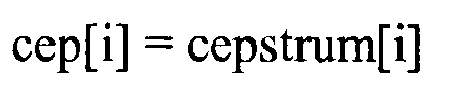


where µ[i] is the mean of cep[i] with respect to time t, and σ2[i] is the variance of cep[i] with respect to time t. - The cepstral mean normalization (i.e., subtraction of µ[i]) allows the removal of a stationary and linear, though unknown, channel transfer function. The cepstral variance normalization (i.e., division by σ[i]) helps to compensate for the reduction of the variance of the cepstral coefficients due to additive noise.
- The amount of time over which to base the estimation of the channel characteristics can affect the performance of the speech recognizer. If the time window is chosen too long, the channel may not be considered stationary anymore. If the time window is chosen too short, the particular phonetic content of the speech segment can bias the estimation of the channel characteristics. As a compromise, many recognition systems estimate the channel based on a complete utterance of speech. Dependent upon the processing speed of the recognition system, this utterance-based normalization can lead to undesirable system delays since processing of the utterance does not start until the utterance has ended. Time-synchronous (or online processing) schemes typically utilize some type of recursive realization of the channel normalization, in which the long-term estimates for the mean and variance of the cepstral features are incrementally updated in time t, every τ = 10-20 msec:


- Non-speech segments represent another complicating factor during channel estimation. Since the transmission channel separates the speaker from the microphone, the effect of the transmission channel only becomes auditorily apparent during speech segments. Consequently, a variable ratio of non-speech segments to speech segments will have a profound effect upon the estimated channel characteristics. However, trying to use a fixed ratio is limited by the uncertainties involved in differentiating between speech and non-speech segments.
- The document
GB2 349 259 A - In one aspect, in general, the invention features a method according to claim 1 and corresponding computer program product according to claim 4 and a system according to claim 5.
- Forming the statistically derived mapping includes forming a statistical regression.
- The feature normalization parameters corresponding to the plurality of utterances include means and variances over time of the plurality of utterances.
- Aspects of the invention can include one or more of the following advantages.
- The amount of speech used to reliably estimate the characteristics of the communication channel is reduced. System delay associated with channel estimation and normalization is reduced. Explicit discrimination between speech and non-speech segments is not performed, improving robustness of automatic speech recognition to noisy speech.
- Other features and advantages of the invention will become apparent from the following description, and from the claims.
-
FIG. 1 is a block diagram of a processing system for automatic speech recognition channel normalization. - A processing system for automatic speech recognition channel normalization includes off-line processing and on-line processing to generate normalization parameters. The system is configured to take advantage of observations about the nature of a communication channel. For example, the following observations can be made about a
speaker and portions of a communication channel including a room, a microphone, and ambient noise: - Long-term spectra of speakers can be primarily characterized by two parameters: an overall loudness and a spectral tilt that describes the overall slope of the spectrum. The spectral tilt is a direct result of the ratio between the time the glottis remains open versus closed during each pitch period. Although this ratio varies slightly between different speakers and their vocal effort (normal, shouting), the spectral tilt is typically -12dB/octave. In the cepstral domain, the overall loudness is captured by the 0th cepstral coefficient and the spectral tilt by the 1st cepstral coefficient. All higher order cepstral coefficients are close to zero for a long-term spectrum due to its smooth shape in the frequency domain.
- The transfer function of a room exhibits strong peaks and notches due to reverberations and echoes. In the cepstral domain, these frequency-to-frequency variations affect primarily coefficients of higher order than the ones used in speech recognition systems. Apart from these variations, the distance and direction between the speaker and the microphone impart primarily an overall attenuation in loudness, affecting primarily the 0th order cepstral coefficient.
- The microphone and audio circuitry typically impart some type of bandpass characteristics upon the audio signal. The corresponding frequency shape generally affects cepstral coefficients of all orders.
- During speech segments, the ambient acoustic noise reduces the variance of cepstral coefficients of all orders. This reduction increases with decreasing signal-to-noise ratios.
- A number of characteristics of the processing system are based on these observations:
- A reliable estimation of µ[0] should preferably include at least some speech segments (e.g., speech frames, where a "frame" is a value of a cepstral coefficient cep[i,t] at a time t derived from values of a speech signal Vs[t] over a finite window of time) due to its dependency upon the speaker's loudness and the speaker and/or microphone geometry. Higher-order coefficients of the channel mean µ depend primarily upon the microphone and audio circuitry, and thus can be estimated from frames that are not necessarily speech frames. The channel variances depend upon the signal-to-noise ratio. While the noise level can be estimated from non-speech frames alone, the estimation of the signal level should include at least some speech frames.
- Referring to
FIG. 1 , aprocessing system 10 for automatic speech recognition channel normalization estimates the cepstral means and variances of acommunication channel 12 via amapping module 20 that uses a functional map that takes as input parameters from aninitial processing module 14 that quickly converge based on few speech frames. In particular, the following linear map responds quickly to a speech onset while eliminating the need to explicitly detect the time of speech onset:µ[i,t] = a0 (S[t] - N[t]) + b0 + N[t] for i=0 µ[i,t] = cep[i,t] for 0 < i < K µ[i,t]=0 for K ≤i<3K σ[i,t] = ai+1 (S[t] - N[t]) + bi+1 for 0 ≤ i < 3K - Here, ai and bi are weights of the functional map. S[t] and N[t] are estimates for the signal level and noise level, respectively. The cepstral coefficients cep[i,t] are averages of the cepstral coefficients cep[i,t] over time.
- The
initial processing module 14 estimates signal level and noise level online by tracking the extreme values of the frame energy cep[0] over time:

- Alternatively, other ways of estimating S and N can be used, including the use of percentiles of cep[0, τ] (e.g., 80th and 20th percentiles of cep[0, τ], respectively).
- The
initial processing module 14 performs estimation of the average cepstral coefficients cep[i,t] online by averaging over all encountered frames:
- Alternatively, a recursive scheme can be used.
- The linear weights ai, bi are determined during a prior off-line processing using a
speech database 16 that contains utterances V1[t], ..., Vn[t] of numerous speakers in different acoustic environments recorded with various audio equipment. Based on corresponding pairs of "input patterns" and "output patterns" of themapping module 20, the weights are determined using a linear regression performed by alinear regression module 18. As "input patterns," thesystem 10 uses the signal and noise levels as attained after each utterance, where each utterance stands by itself. Thesystem 10 measures these signal and noise levels based on a portion of each utterance (e.g., an initial portion of an utterance, or an entire utterance). As "output patterns," thesystem 10 uses the channel means and variances based on all speech frames of a given session using the standard formulas:

where a session includes all utterances for which thecommunication channel 12 can be assumed stationary. The particular speech/silence discrimination used for this step is not critical since the linear weights only model global tendencies of the data. - The channel estimation scheme used by the
system 10 performs well even with few speech frames because it primarily relies on the estimation of two characteristics of the audio signal: its minimum and maximum energy. Values close to the final minimum energy are typically encountered during the first couple of frames, i.e., before the utterance has even started. Values close to the final maximum energy are typically encountered within the first vowel spoken, regardless of its phonetic identity. - Before the utterance starts, the proposed channel estimation scheme will generally under-estimate the signal-to-noise ratio SNR = S - N. Therefore, more accurate results are achieved when the SNR estimate is floored to a value that represents the SNR of the noisiest acoustic environment the
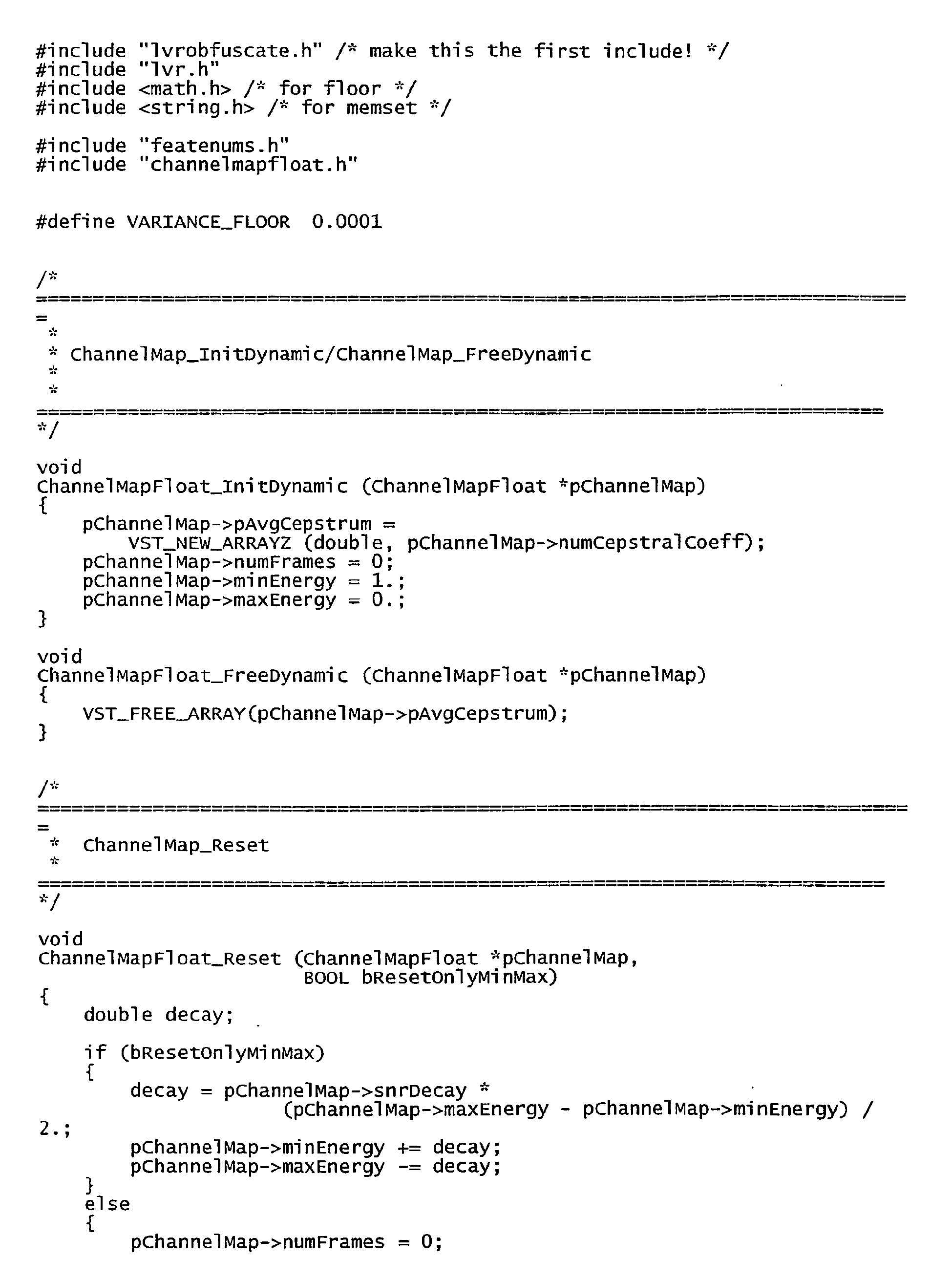
system 10 is expected to perform well in. Also, the introduction of a processing delay as small as 100-200 ms between the estimation of the SNR and the channel normalization will ensure that a rather mature channel estimate will be applied also to the few speech frames preceding the first vowel of the utterance. - An appendix includes a software implementation a normalization approach.
- Other embodiments are within the scope of the following claims.




Claims (5)
- A method comprising:accepting a plurality of utterances each associated with corresponding feature normalization parameters, the feature normalization parameters including cepstral normalization coefficients;measuring statistics of signal and noise levels from an initial portion of each of the plurality of accepted speech utterances, the measured statistics comprising extreme measures of energy from the initial portion of the speech utterance; andestimating the cepstral normalization coefficients based on the measured signal and noise levels and a statistically derived mapping relating the signal and noise levels and cepstral normalization coefficients, further comprising:forming the statistically derived mapping including linear weights derived from linear regression analysis of predetermined speech frames, the statistically derived mapping based on the measured signal and noise levels and the cepstral coefficients corresponding to the plurality of utterances.
- The method of claim 1 wherein forming the statistically derived mapping includes forming a statistical regression.
- The method of claim 1 or 2 wherein the feature normalization parameters corresponding to the plurality of utterances comprise means and variances of cepstral coefficients of upward coefficients over time of the plurality of utterances.
- A computer program product stored on a computer-readable medium comprising processor based instructions for causing a computer system to:accept a plurality of utterances each associated with corresponding feature normalization parameters, the feature normalization parameters including cepstral normalization coefficients;measure statistics of signal and noise levels from an initial portion of each of the plurality of accepted speech utterances, the measured statistics comprising extreme measures of energy from the initial portion of the speech utterance;estimate the cepstral normalization coefficients based on the measured signal and noise levels and a statistically derived mapping relating the signal and noise levels and cepstral normalization coefficients,form the statistically derived mapping including linear weights derived from linear regression analysis of predetermined speech frames, the statistically derived mapping based on the measured signal and noise levels and the cepstral normalization coefficients corresponding to the plurality of utterances.
- A system comprising:an initial processing module configured to accept a plurality of utterances each associated with corresponding feature normalization parameters, the feature normalization parameters including cepstral normalization coefficients and to measure statistics of signal and noise levels from an initial portion of each of the plurality of accepted speech utterances, the measured statistics comprising extreme measures of energy from the initial portion of the speech utterance; anda mapping module configured to estimate the cepstral normalization coefficients based on the measured signal and noise levels and a statistically derived mapping relating the signal and noise levels and cepstral normalization coefficients, estimating further comprising forming the statistically derived mapping including linear weights derived from linear regression analysis of predetermined speech frames, the statistically derived mapping based on the measured signal and noise levels and the cepstral coefficients corresponding to the plurality of utterances.
Applications Claiming Priority (2)
| Application Number | Priority Date | Filing Date | Title |
|---|---|---|---|
| US53586304P | 2004-01-12 | 2004-01-12 | |
| PCT/US2005/000757 WO2005070130A2 (en) | 2004-01-12 | 2005-01-10 | Speech recognition channel normalization utilizing measured energy values from speech utterance |
Publications (3)
| Publication Number | Publication Date |
|---|---|
| EP1774516A2 EP1774516A2 (en) | 2007-04-18 |
| EP1774516A4 EP1774516A4 (en) | 2009-11-11 |
| EP1774516B1 true EP1774516B1 (en) | 2011-03-16 |
Family
ID=34806967
Family Applications (1)
| Application Number | Title | Priority Date | Filing Date |
|---|---|---|---|
| EP05705425A Expired - Lifetime EP1774516B1 (en) | 2004-01-12 | 2005-01-10 | Normalization of cepstral features for speech recognition |
Country Status (6)
| Country | Link |
|---|---|
| US (1) | US7797157B2 (en) |
| EP (1) | EP1774516B1 (en) |
| JP (1) | JP4682154B2 (en) |
| CN (1) | CN101228577B (en) |
| DE (1) | DE602005026949D1 (en) |
| WO (1) | WO2005070130A2 (en) |
Families Citing this family (11)
| Publication number | Priority date | Publication date | Assignee | Title |
|---|---|---|---|---|
| US7702505B2 (en) * | 2004-12-14 | 2010-04-20 | Electronics And Telecommunications Research Institute | Channel normalization apparatus and method for robust speech recognition |
| US20070263848A1 (en) * | 2006-04-19 | 2007-11-15 | Tellabs Operations, Inc. | Echo detection and delay estimation using a pattern recognition approach and cepstral correlation |
| EP2100294A4 (en) * | 2006-12-27 | 2011-09-28 | Intel Corp | Method and apparatus for speech segmentation |
| JP4864783B2 (en) * | 2007-03-23 | 2012-02-01 | Kddi株式会社 | Pattern matching device, pattern matching program, and pattern matching method |
| US8930179B2 (en) * | 2009-06-04 | 2015-01-06 | Microsoft Corporation | Recognition using re-recognition and statistical classification |
| US8768695B2 (en) * | 2012-06-13 | 2014-07-01 | Nuance Communications, Inc. | Channel normalization using recognition feedback |
| EP2877992A1 (en) * | 2012-07-24 | 2015-06-03 | Nuance Communications, Inc. | Feature normalization inputs to front end processing for automatic speech recognition |
| CN106456257B (en) | 2014-05-13 | 2019-11-05 | 柯惠Lp公司 | Robot arm for operation support system and application method |
| US9953661B2 (en) * | 2014-09-26 | 2018-04-24 | Cirrus Logic Inc. | Neural network voice activity detection employing running range normalization |
| WO2016105216A1 (en) * | 2014-12-22 | 2016-06-30 | Intel Corporation | Cepstral variance normalization for audio feature extraction |
| US10540990B2 (en) * | 2017-11-01 | 2020-01-21 | International Business Machines Corporation | Processing of speech signals |
Family Cites Families (21)
| Publication number | Priority date | Publication date | Assignee | Title |
|---|---|---|---|---|
| JP2797949B2 (en) * | 1994-01-31 | 1998-09-17 | 日本電気株式会社 | Voice recognition device |
| US5604839A (en) * | 1994-07-29 | 1997-02-18 | Microsoft Corporation | Method and system for improving speech recognition through front-end normalization of feature vectors |
| GB9419388D0 (en) * | 1994-09-26 | 1994-11-09 | Canon Kk | Speech analysis |
| US5677990A (en) * | 1995-05-05 | 1997-10-14 | Panasonic Technologies, Inc. | System and method using N-best strategy for real time recognition of continuously spelled names |
| US6633842B1 (en) * | 1999-10-22 | 2003-10-14 | Texas Instruments Incorporated | Speech recognition front-end feature extraction for noisy speech |
| US6202047B1 (en) * | 1998-03-30 | 2001-03-13 | At&T Corp. | Method and apparatus for speech recognition using second order statistics and linear estimation of cepstral coefficients |
| CN1144172C (en) * | 1998-04-30 | 2004-03-31 | 松下电器产业株式会社 | Eigentone-based speaker adaptation methods including maximum likelihood methods |
| JPH11311994A (en) * | 1998-04-30 | 1999-11-09 | Sony Corp | Information processing apparatus and method, and providing medium |
| US6173258B1 (en) * | 1998-09-09 | 2001-01-09 | Sony Corporation | Method for reducing noise distortions in a speech recognition system |
| US6253175B1 (en) * | 1998-11-30 | 2001-06-26 | International Business Machines Corporation | Wavelet-based energy binning cepstal features for automatic speech recognition |
| US6658385B1 (en) * | 1999-03-12 | 2003-12-02 | Texas Instruments Incorporated | Method for transforming HMMs for speaker-independent recognition in a noisy environment |
| GB2349259B (en) * | 1999-04-23 | 2003-11-12 | Canon Kk | Speech processing apparatus and method |
| JP2001134295A (en) * | 1999-08-23 | 2001-05-18 | Sony Corp | Encoding device and encoding method, recording device and recording method, transmitting device and transmitting method, decoding device and encoding method, reproducing device and reproducing method, and recording medium |
| US6502070B1 (en) * | 2000-04-28 | 2002-12-31 | Nortel Networks Limited | Method and apparatus for normalizing channel specific speech feature elements |
| DE60110541T2 (en) * | 2001-02-06 | 2006-02-23 | Sony International (Europe) Gmbh | Method for speech recognition with noise-dependent normalization of the variance |
| US7062433B2 (en) * | 2001-03-14 | 2006-06-13 | Texas Instruments Incorporated | Method of speech recognition with compensation for both channel distortion and background noise |
| US7035797B2 (en) * | 2001-12-14 | 2006-04-25 | Nokia Corporation | Data-driven filtering of cepstral time trajectories for robust speech recognition |
| IL148592A0 (en) * | 2002-03-10 | 2002-09-12 | Ycd Multimedia Ltd | Dynamic normalizing |
| US7117148B2 (en) * | 2002-04-05 | 2006-10-03 | Microsoft Corporation | Method of noise reduction using correction vectors based on dynamic aspects of speech and noise normalization |
| US7197456B2 (en) * | 2002-04-30 | 2007-03-27 | Nokia Corporation | On-line parametric histogram normalization for noise robust speech recognition |
| JP4239479B2 (en) * | 2002-05-23 | 2009-03-18 | 日本電気株式会社 | Speech recognition apparatus, speech recognition method, and speech recognition program |
-
2005
- 2005-01-10 DE DE602005026949T patent/DE602005026949D1/en not_active Expired - Lifetime
- 2005-01-10 WO PCT/US2005/000757 patent/WO2005070130A2/en not_active Ceased
- 2005-01-10 CN CN2005800022461A patent/CN101228577B/en not_active Expired - Fee Related
- 2005-01-10 US US11/032,415 patent/US7797157B2/en active Active
- 2005-01-10 JP JP2006549503A patent/JP4682154B2/en not_active Expired - Fee Related
- 2005-01-10 EP EP05705425A patent/EP1774516B1/en not_active Expired - Lifetime
Also Published As
| Publication number | Publication date |
|---|---|
| JP4682154B2 (en) | 2011-05-11 |
| WO2005070130A3 (en) | 2009-04-09 |
| JP2007536562A (en) | 2007-12-13 |
| US7797157B2 (en) | 2010-09-14 |
| DE602005026949D1 (en) | 2011-04-28 |
| CN101228577A (en) | 2008-07-23 |
| WO2005070130A2 (en) | 2005-08-04 |
| EP1774516A4 (en) | 2009-11-11 |
| CN101228577B (en) | 2011-11-23 |
| US20050182621A1 (en) | 2005-08-18 |
| EP1774516A2 (en) | 2007-04-18 |
Similar Documents
| Publication | Publication Date | Title |
|---|---|---|
| US6173258B1 (en) | Method for reducing noise distortions in a speech recognition system | |
| US10783899B2 (en) | Babble noise suppression | |
| US8655656B2 (en) | Method and system for assessing intelligibility of speech represented by a speech signal | |
| EP1973104A2 (en) | Method and apparatus for estimating noise by using harmonics of a voice signal | |
| US7359856B2 (en) | Speech detection system in an audio signal in noisy surrounding | |
| US7133826B2 (en) | Method and apparatus using spectral addition for speaker recognition | |
| EP4128225B1 (en) | Noise supression for speech enhancement | |
| US20080208578A1 (en) | Robust Speaker-Dependent Speech Recognition System | |
| US8666737B2 (en) | Noise power estimation system, noise power estimating method, speech recognition system and speech recognizing method | |
| US9786295B2 (en) | Voice processing apparatus and voice processing method | |
| US7797157B2 (en) | Automatic speech recognition channel normalization based on measured statistics from initial portions of speech utterances | |
| JP5803125B2 (en) | Suppression state detection device and program by voice | |
| JP2009276365A (en) | Processor, voice recognition device, voice recognition system and voice recognition method | |
| US9875755B2 (en) | Voice enhancement device and voice enhancement method | |
| Dekens et al. | Improved speech recognition in noisy environments by using a throat microphone for accurate voicing detection | |
| Rehr et al. | Cepstral noise subtraction for robust automatic speech recognition | |
| KR100784456B1 (en) | Voice Enhancement System using GMM | |
| US20050114135A1 (en) | Signal variation feature based confidence measure | |
| Martin et al. | Robust speech/non-speech detection based on LDA-derived parameter and voicing parameter for speech recognition in noisy environments | |
| Win et al. | Speech enhancement techniques for noisy speech in real world environments | |
| JP3026855B2 (en) | Voice recognition device | |
| Dokku et al. | Detection of stop consonants in continuous noisy speech based on an extrapolation technique | |
| Lee et al. | Signal and feature domain enhancement approaches for robust speech recognition | |
| Kobashikawa et al. | Robust speech recognition based on HMM composition and modified Wiener filter | |
| Álvarez et al. | Speech enhancement for a car environment using LP residual signal and spectral subtraction. |
Legal Events
| Date | Code | Title | Description |
|---|---|---|---|
| PUAI | Public reference made under article 153(3) epc to a published international application that has entered the european phase |
Free format text: ORIGINAL CODE: 0009012 |
|
| 17P | Request for examination filed |
Effective date: 20060807 |
|
| AK | Designated contracting states |
Kind code of ref document: A2 Designated state(s): DE FI FR GB |
|
| R17D | Deferred search report published (corrected) |
Effective date: 20090409 |
|
| RTI1 | Title (correction) |
Free format text: SPEECH RECOGNITION CHANNEL NORMALIZATION UTILIZING MEASURED ENERGY VALUES FROM SPEECH UTTERANCE |
|
| A4 | Supplementary search report drawn up and despatched |
Effective date: 20091009 |
|
| RIC1 | Information provided on ipc code assigned before grant |
Ipc: G10L 15/20 20060101ALI20091005BHEP Ipc: G10L 15/02 20060101AFI20091005BHEP |
|
| 17Q | First examination report despatched |
Effective date: 20100126 |
|
| RIC1 | Information provided on ipc code assigned before grant |
Ipc: G10L 15/02 20060101AFI20100804BHEP Ipc: G10L 15/20 20060101ALI20100804BHEP |
|
| RTI1 | Title (correction) |
Free format text: NORMALIZATION OF CEPSTRAL FEATURES FOR SPEECH RECOGNITION |
|
| GRAP | Despatch of communication of intention to grant a patent |
Free format text: ORIGINAL CODE: EPIDOSNIGR1 |
|
| GRAS | Grant fee paid |
Free format text: ORIGINAL CODE: EPIDOSNIGR3 |
|
| GRAA | (expected) grant |
Free format text: ORIGINAL CODE: 0009210 |
|
| AK | Designated contracting states |
Kind code of ref document: B1 Designated state(s): DE FI FR GB |
|
| REG | Reference to a national code |
Ref country code: GB Ref legal event code: FG4D |
|
| REF | Corresponds to: |
Ref document number: 602005026949 Country of ref document: DE Date of ref document: 20110428 Kind code of ref document: P |
|
| REG | Reference to a national code |
Ref country code: DE Ref legal event code: R096 Ref document number: 602005026949 Country of ref document: DE Effective date: 20110428 |
|
| PG25 | Lapsed in a contracting state [announced via postgrant information from national office to epo] |
Ref country code: FI Free format text: LAPSE BECAUSE OF FAILURE TO SUBMIT A TRANSLATION OF THE DESCRIPTION OR TO PAY THE FEE WITHIN THE PRESCRIBED TIME-LIMIT Effective date: 20110316 |
|
| PLBE | No opposition filed within time limit |
Free format text: ORIGINAL CODE: 0009261 |
|
| STAA | Information on the status of an ep patent application or granted ep patent |
Free format text: STATUS: NO OPPOSITION FILED WITHIN TIME LIMIT |
|
| 26N | No opposition filed |
Effective date: 20111219 |
|
| REG | Reference to a national code |
Ref country code: DE Ref legal event code: R097 Ref document number: 602005026949 Country of ref document: DE Effective date: 20111219 |
|
| REG | Reference to a national code |
Ref country code: FR Ref legal event code: PLFP Year of fee payment: 12 |
|
| PGFP | Annual fee paid to national office [announced via postgrant information from national office to epo] |
Ref country code: FR Payment date: 20151208 Year of fee payment: 12 |
|
| PGFP | Annual fee paid to national office [announced via postgrant information from national office to epo] |
Ref country code: DE Payment date: 20160105 Year of fee payment: 12 |
|
| PGFP | Annual fee paid to national office [announced via postgrant information from national office to epo] |
Ref country code: GB Payment date: 20160106 Year of fee payment: 12 |
|
| REG | Reference to a national code |
Ref country code: DE Ref legal event code: R119 Ref document number: 602005026949 Country of ref document: DE |
|
| GBPC | Gb: european patent ceased through non-payment of renewal fee |
Effective date: 20170110 |
|
| REG | Reference to a national code |
Ref country code: FR Ref legal event code: ST Effective date: 20170929 |
|
| PG25 | Lapsed in a contracting state [announced via postgrant information from national office to epo] |
Ref country code: FR Free format text: LAPSE BECAUSE OF NON-PAYMENT OF DUE FEES Effective date: 20170131 |
|
| PG25 | Lapsed in a contracting state [announced via postgrant information from national office to epo] |
Ref country code: GB Free format text: LAPSE BECAUSE OF NON-PAYMENT OF DUE FEES Effective date: 20170110 Ref country code: DE Free format text: LAPSE BECAUSE OF NON-PAYMENT OF DUE FEES Effective date: 20170801 |