EP1772459A2 - Novel chromophores for polymeric thin films and optical waveguides and devices comprising the same - Google Patents
Novel chromophores for polymeric thin films and optical waveguides and devices comprising the same Download PDFInfo
- Publication number
- EP1772459A2 EP1772459A2 EP07100800A EP07100800A EP1772459A2 EP 1772459 A2 EP1772459 A2 EP 1772459A2 EP 07100800 A EP07100800 A EP 07100800A EP 07100800 A EP07100800 A EP 07100800A EP 1772459 A2 EP1772459 A2 EP 1772459A2
- Authority
- EP
- European Patent Office
- Prior art keywords
- substituted
- unsubstituted
- group
- compound
- formula
- Prior art date
- Legal status (The legal status is an assumption and is not a legal conclusion. Google has not performed a legal analysis and makes no representation as to the accuracy of the status listed.)
- Withdrawn
Links
- 0 CC(**=CC(CIC1=C[C@]2C=C*)=CC1=CC2I)(C(C)=C1C#N)OC1=C(*)C#N Chemical compound CC(**=CC(CIC1=C[C@]2C=C*)=CC1=CC2I)(C(C)=C1C#N)OC1=C(*)C#N 0.000 description 2
- RFRFQCSMGGZBEH-NODFVKRRSA-N CC([C@H]1OC2(CCCCC2)C(C)C1C#N)C#N Chemical compound CC([C@H]1OC2(CCCCC2)C(C)C1C#N)C#N RFRFQCSMGGZBEH-NODFVKRRSA-N 0.000 description 1
- YQDCALCNOFWXLG-UHFFFAOYSA-N CC1=CC(C(C#N)C#N)OC11c2ccccc2-c2ccccc12 Chemical compound CC1=CC(C(C#N)C#N)OC11c2ccccc2-c2ccccc12 YQDCALCNOFWXLG-UHFFFAOYSA-N 0.000 description 1
- LHOGNQZQKDZOBP-UHFFFAOYSA-N Cc(c(Cl)c1Cl)ccc1Cl Chemical compound Cc(c(Cl)c1Cl)ccc1Cl LHOGNQZQKDZOBP-UHFFFAOYSA-N 0.000 description 1
- OAXFGKBMXMLMEI-UHFFFAOYSA-N Cc(ccc(F)c1)c1[F]c(c(C)c1)cc(Cl)c1Cl Chemical compound Cc(ccc(F)c1)c1[F]c(c(C)c1)cc(Cl)c1Cl OAXFGKBMXMLMEI-UHFFFAOYSA-N 0.000 description 1
Classifications
-
- C—CHEMISTRY; METALLURGY
- C07—ORGANIC CHEMISTRY
- C07D—HETEROCYCLIC COMPOUNDS
- C07D409/00—Heterocyclic compounds containing two or more hetero rings, at least one ring having sulfur atoms as the only ring hetero atoms
- C07D409/02—Heterocyclic compounds containing two or more hetero rings, at least one ring having sulfur atoms as the only ring hetero atoms containing two hetero rings
- C07D409/06—Heterocyclic compounds containing two or more hetero rings, at least one ring having sulfur atoms as the only ring hetero atoms containing two hetero rings linked by a carbon chain containing only aliphatic carbon atoms
-
- C—CHEMISTRY; METALLURGY
- C07—ORGANIC CHEMISTRY
- C07D—HETEROCYCLIC COMPOUNDS
- C07D307/00—Heterocyclic compounds containing five-membered rings having one oxygen atom as the only ring hetero atom
- C07D307/02—Heterocyclic compounds containing five-membered rings having one oxygen atom as the only ring hetero atom not condensed with other rings
- C07D307/34—Heterocyclic compounds containing five-membered rings having one oxygen atom as the only ring hetero atom not condensed with other rings having two or three double bonds between ring members or between ring members and non-ring members
- C07D307/56—Heterocyclic compounds containing five-membered rings having one oxygen atom as the only ring hetero atom not condensed with other rings having two or three double bonds between ring members or between ring members and non-ring members with hetero atoms or with carbon atoms having three bonds to hetero atoms with at the most one bond to halogen, e.g. ester or nitrile radicals, directly attached to ring carbon atoms
- C07D307/68—Carbon atoms having three bonds to hetero atoms with at the most one bond to halogen
-
- C—CHEMISTRY; METALLURGY
- C07—ORGANIC CHEMISTRY
- C07D—HETEROCYCLIC COMPOUNDS
- C07D307/00—Heterocyclic compounds containing five-membered rings having one oxygen atom as the only ring hetero atom
- C07D307/94—Heterocyclic compounds containing five-membered rings having one oxygen atom as the only ring hetero atom spiro-condensed with carbocyclic rings or ring systems, e.g. griseofulvins
-
- C—CHEMISTRY; METALLURGY
- C07—ORGANIC CHEMISTRY
- C07D—HETEROCYCLIC COMPOUNDS
- C07D333/00—Heterocyclic compounds containing five-membered rings having one sulfur atom as the only ring hetero atom
- C07D333/02—Heterocyclic compounds containing five-membered rings having one sulfur atom as the only ring hetero atom not condensed with other rings
- C07D333/04—Heterocyclic compounds containing five-membered rings having one sulfur atom as the only ring hetero atom not condensed with other rings not substituted on the ring sulphur atom
- C07D333/06—Heterocyclic compounds containing five-membered rings having one sulfur atom as the only ring hetero atom not condensed with other rings not substituted on the ring sulphur atom with only hydrogen atoms, hydrocarbon or substituted hydrocarbon radicals, directly attached to the ring carbon atoms
- C07D333/14—Radicals substituted by singly bound hetero atoms other than halogen
- C07D333/20—Radicals substituted by singly bound hetero atoms other than halogen by nitrogen atoms
-
- C—CHEMISTRY; METALLURGY
- C07—ORGANIC CHEMISTRY
- C07D—HETEROCYCLIC COMPOUNDS
- C07D333/00—Heterocyclic compounds containing five-membered rings having one sulfur atom as the only ring hetero atom
- C07D333/02—Heterocyclic compounds containing five-membered rings having one sulfur atom as the only ring hetero atom not condensed with other rings
- C07D333/04—Heterocyclic compounds containing five-membered rings having one sulfur atom as the only ring hetero atom not condensed with other rings not substituted on the ring sulphur atom
- C07D333/06—Heterocyclic compounds containing five-membered rings having one sulfur atom as the only ring hetero atom not condensed with other rings not substituted on the ring sulphur atom with only hydrogen atoms, hydrocarbon or substituted hydrocarbon radicals, directly attached to the ring carbon atoms
- C07D333/22—Radicals substituted by doubly bound hetero atoms, or by two hetero atoms other than halogen singly bound to the same carbon atom
-
- G—PHYSICS
- G02—OPTICS
- G02F—OPTICAL DEVICES OR ARRANGEMENTS FOR THE CONTROL OF LIGHT BY MODIFICATION OF THE OPTICAL PROPERTIES OF THE MEDIA OF THE ELEMENTS INVOLVED THEREIN; NON-LINEAR OPTICS; FREQUENCY-CHANGING OF LIGHT; OPTICAL LOGIC ELEMENTS; OPTICAL ANALOGUE/DIGITAL CONVERTERS
- G02F1/00—Devices or arrangements for the control of the intensity, colour, phase, polarisation or direction of light arriving from an independent light source, e.g. switching, gating or modulating; Non-linear optics
- G02F1/35—Non-linear optics
- G02F1/355—Non-linear optics characterised by the materials used
- G02F1/361—Organic materials
- G02F1/3611—Organic materials containing Nitrogen
- G02F1/3612—Heterocycles having N as heteroatom
-
- G—PHYSICS
- G02—OPTICS
- G02F—OPTICAL DEVICES OR ARRANGEMENTS FOR THE CONTROL OF LIGHT BY MODIFICATION OF THE OPTICAL PROPERTIES OF THE MEDIA OF THE ELEMENTS INVOLVED THEREIN; NON-LINEAR OPTICS; FREQUENCY-CHANGING OF LIGHT; OPTICAL LOGIC ELEMENTS; OPTICAL ANALOGUE/DIGITAL CONVERTERS
- G02F1/00—Devices or arrangements for the control of the intensity, colour, phase, polarisation or direction of light arriving from an independent light source, e.g. switching, gating or modulating; Non-linear optics
- G02F1/35—Non-linear optics
- G02F1/355—Non-linear optics characterised by the materials used
- G02F1/361—Organic materials
- G02F1/3613—Organic materials containing Sulfur
- G02F1/3614—Heterocycles having S as heteroatom
-
- G—PHYSICS
- G02—OPTICS
- G02F—OPTICAL DEVICES OR ARRANGEMENTS FOR THE CONTROL OF LIGHT BY MODIFICATION OF THE OPTICAL PROPERTIES OF THE MEDIA OF THE ELEMENTS INVOLVED THEREIN; NON-LINEAR OPTICS; FREQUENCY-CHANGING OF LIGHT; OPTICAL LOGIC ELEMENTS; OPTICAL ANALOGUE/DIGITAL CONVERTERS
- G02F1/00—Devices or arrangements for the control of the intensity, colour, phase, polarisation or direction of light arriving from an independent light source, e.g. switching, gating or modulating; Non-linear optics
- G02F1/35—Non-linear optics
- G02F1/355—Non-linear optics characterised by the materials used
- G02F1/361—Organic materials
- G02F1/3615—Organic materials containing polymers
- G02F1/3616—Organic materials containing polymers having the non-linear optical group in the main chain
-
- G—PHYSICS
- G02—OPTICS
- G02F—OPTICAL DEVICES OR ARRANGEMENTS FOR THE CONTROL OF LIGHT BY MODIFICATION OF THE OPTICAL PROPERTIES OF THE MEDIA OF THE ELEMENTS INVOLVED THEREIN; NON-LINEAR OPTICS; FREQUENCY-CHANGING OF LIGHT; OPTICAL LOGIC ELEMENTS; OPTICAL ANALOGUE/DIGITAL CONVERTERS
- G02F1/00—Devices or arrangements for the control of the intensity, colour, phase, polarisation or direction of light arriving from an independent light source, e.g. switching, gating or modulating; Non-linear optics
- G02F1/35—Non-linear optics
- G02F1/355—Non-linear optics characterised by the materials used
- G02F1/361—Organic materials
- G02F1/3615—Organic materials containing polymers
- G02F1/3617—Organic materials containing polymers having the non-linear optical group in a side chain
-
- G—PHYSICS
- G02—OPTICS
- G02B—OPTICAL ELEMENTS, SYSTEMS OR APPARATUS
- G02B6/00—Light guides; Structural details of arrangements comprising light guides and other optical elements, e.g. couplings
- G02B6/10—Light guides; Structural details of arrangements comprising light guides and other optical elements, e.g. couplings of the optical waveguide type
- G02B6/12—Light guides; Structural details of arrangements comprising light guides and other optical elements, e.g. couplings of the optical waveguide type of the integrated circuit kind
- G02B2006/12035—Materials
- G02B2006/12069—Organic material
-
- Y—GENERAL TAGGING OF NEW TECHNOLOGICAL DEVELOPMENTS; GENERAL TAGGING OF CROSS-SECTIONAL TECHNOLOGIES SPANNING OVER SEVERAL SECTIONS OF THE IPC; TECHNICAL SUBJECTS COVERED BY FORMER USPC CROSS-REFERENCE ART COLLECTIONS [XRACs] AND DIGESTS
- Y10—TECHNICAL SUBJECTS COVERED BY FORMER USPC
- Y10T—TECHNICAL SUBJECTS COVERED BY FORMER US CLASSIFICATION
- Y10T428/00—Stock material or miscellaneous articles
- Y10T428/31504—Composite [nonstructural laminate]
- Y10T428/31507—Of polycarbonate
-
- Y—GENERAL TAGGING OF NEW TECHNOLOGICAL DEVELOPMENTS; GENERAL TAGGING OF CROSS-SECTIONAL TECHNOLOGIES SPANNING OVER SEVERAL SECTIONS OF THE IPC; TECHNICAL SUBJECTS COVERED BY FORMER USPC CROSS-REFERENCE ART COLLECTIONS [XRACs] AND DIGESTS
- Y10—TECHNICAL SUBJECTS COVERED BY FORMER USPC
- Y10T—TECHNICAL SUBJECTS COVERED BY FORMER US CLASSIFICATION
- Y10T428/00—Stock material or miscellaneous articles
- Y10T428/31504—Composite [nonstructural laminate]
- Y10T428/31551—Of polyamidoester [polyurethane, polyisocyanate, polycarbamate, etc.]
-
- Y—GENERAL TAGGING OF NEW TECHNOLOGICAL DEVELOPMENTS; GENERAL TAGGING OF CROSS-SECTIONAL TECHNOLOGIES SPANNING OVER SEVERAL SECTIONS OF THE IPC; TECHNICAL SUBJECTS COVERED BY FORMER USPC CROSS-REFERENCE ART COLLECTIONS [XRACs] AND DIGESTS
- Y10—TECHNICAL SUBJECTS COVERED BY FORMER USPC
- Y10T—TECHNICAL SUBJECTS COVERED BY FORMER US CLASSIFICATION
- Y10T428/00—Stock material or miscellaneous articles
- Y10T428/31504—Composite [nonstructural laminate]
- Y10T428/31721—Of polyimide
Definitions
- the present invention relates to chromophores which can be used in the preparation of polymeric thin films for waveguide media, and to optical waveguides and devices comprising the chromophores.
- Thin films of organic or polymeric materials with large second order nonlinearities in combination with silicon-based electronic circuitry can be used in systems for laser modulation and deflection, information control in optical circuitry, as well as in numerous other waveguide applications.
- novel processes through third order nonlinearity such as degenerate four-wave mixing, whereby real-time processing of optical fields occurs, have utility in such diverse fields as optical communications and integrated circuit fabrication.
- the utility of organic materials with large second order and third order nonlinearities for very high frequency application contrasts with the bandwidth limitations of conventional inorganic electrooptic materials currently in use.
- the present invention is directed, in part, to compounds which can serve as chromophores in, for example, thin films for optical waveguides and optical devices.
- These are compounds represented by Formula I: wherein:
- the chromophores comprise novel cyclic bridges comprising at least one bivalent aromatic ring.
- Preferred compounds of the invention have Formula II: wherein D is an electron donating group; A is an electron withdrawing group; K is O or S; R 1 is -Q-C n H 2n+1 , -Q-(CH 2 ) a C n F 2n+1 , -Q-CH 2 OCH 2 C n F 2n+1 , -Q-CH 2 SCH 2 CC n F 2n+1 , -Q-CH 2 OCH 2 CF 3 , or -Q-CH 2 SCH 2 CF 3 , where n is 1-10, a is 0-10, and Q is absent, O or S; and q is 1,2, or 3.
- D is an electron donating group
- A is an electron withdrawing group
- J is CH 2 , O or S
- R 1 is -Q-C n H 2n+1 , -Q-(CH 2 ) a C n F 2n+1 , -Q-CH 2 OCH 2 C n F 2n+1 , -Q-CH 2 SCH 2 CC n F 2n+1 , -Q-CH 2 OCH 2 CF 3 , or -Q-CH 2 SCH 2 CF 3 , where n is 1-10, a is 0-10, and Q is absent, O or S.
- the chromophores comprise novel cyclic bridges comprising at least one bivalent or conjugated ring structure, such as an aromatic ring, and novel electron withdrawing groups.
- Such compounds are generally represented by the structure of Formula IV: wherein D is an electron donating group; K is O or S; R 1 is -Q-C n H 2n+1 , -Q-(CH 2 ) a C n F 2n+1 , -Q-CH 2 OCH 2 C n F 2n+1 , -Q-CH 2 SCH 2 CC n F 2n+1 , -Q-CH 2 OCH 2 CF 3 , or -Q-CH 2 SCH 2 CF 3 , where n is 1-10, a is 0-10, and Q is absent, O or S; q is 1, 2, or 3; and R 2 and R 3 each, independently, are either substituted or unsubstituted C 1 -C 10 alkyl, substituted or unsubstituted C 2 -C
- D is an electron donating group
- J is CH 2 , O or S
- R 1 is -Q-C n H 2n+1 , -Q-(CH 2 ) a C n F 2n+1 , -Q-CH 2 OCH 2 C n F 2n+1 , -Q-CH 2 SCH 2 CC n F 2n+1 , -Q-CH 2 OCH 2 CF 3 , or -Q-CH 2 SCH 2 CF 3 , where n is 1-10, a is 0-10, and Q is absent, O or S; and R 2 and R 3 each, independently, are either H, substituted or unsubstituted C 1 -C 10 alkyl, substituted or unsubstituted C 2 -C 10 alkenyl, substituted or unsubstituted C 2 -C 10 alkynyl, substituted or unsubstituted aryl, substituted or unsubstituted alkylaryl
- the present invention is also directed to optical waveguides comprising a thin film medium having Formula VI: wherein P and P' are polymer main chain units, which can be the same mer unit or different mer unit, and C is a comonomer unit where n is an integer greater than zero and n' is 0 or an integer greater than zero; S is a pendant spacer group having a linear chain length of between about 2-12 atoms.
- M is a compound having either Formula I, Formula I', Formula II, Formula III, Formula IV, Formula IV', Formula V, or Formula V', as described above.
- electrosenor refers to substituents which contribute electron density to the ⁇ -electron system when the conjugated electron structure is polarized by the input of electromagnetic energy.
- electronegative organic compounds or substituents which attract electron density from the ⁇ -electron system when the conjugated electron structure is polarized by the input of electromagnetic energy.
- chromophore refers to an optical compound comprising an electron donating group and an electron withdrawing group at opposing termini of a conjugated ⁇ -electron system.
- cyclic bridge is used to refer to bivalent cyclic structures which serve to couple the electron donating and withdrawing groups.
- the present invention is also directed to optical devices comprising the optical waveguides described above.
- the present invention is directed, in part, to novel electro-optic chromophores which have utility in organic nonlinear optical applications such as polymeric thin films for optical waveguides and optical devices.
- polymeric thin films are described in, for example, U.S. Patent Numbers 5,044,725 , 4,795,664 , 5,247,042 , 5,196,509 , 4,810,338 , 4,936,645 , 4,767,169 , 5,326,661 , 5,187,234 , 5,170,461 , 5,133,037 , 5,106,211 , and 5,006,285 , each of which is incorporated herein by reference in its entirety.
- the inventive chromophores have several advantageous features which are not found in other known or commercially available chromophores. For example, we have found that the introduction of a chiral center, preferably in the acceptor portion of the molecule, and more preferably as a racemic mixture, greatly increases the chromophore's solubility. We have found that solubility is enhanced the greater the structural or functional differences between R 2 and R 3 . For example, we have observed significantly enhanced solubility when one of R 2 or R 3 is a chain and the other is a ring structure; or when one is a short chain (up to three carbons), and the other is a long chain (say, C4-C18).
- inventive acceptors While there may be other factors contributing to this improved property, we have found that one major difference between the inventive acceptors and those of the prior art is the presence of chiral centers in the inventive acceptors. It is known that the physical characteristics like melting point and solubility are different for the pure enantiomer than for the racemic mixture. Several examples of this difference exist. For example, pure chiral (D) lycine has a melting point of 218 C and is very soluble at room temperature. The racimate has a melting point of 170 C and is considered infinitely soluble in room temperature water. Also, pure enantiomers of Mandelic acid have a melting point of 133 C while the racimate has a melting pint of 120 C. (R)-(+)-Mandelonirile has a melting point of 29 C while the racimate is an oil at room temperature.
- the chiral centers do not form a single chiral compound but rather a mixture of racemic enantiomers, which when introduced into chromophores increase the solubility of the chromophores due to a depression of the melting point.
- inventive compounds tend to form glassy solids rather than crystalline materials. Without intending to be bound by theory, we believe that the present chemistry results in improvements in the nonlinearity of the bulk polymer because of the incorporation of a racemic chiral center in the chromophores.
- the electro-optic chromophores of the invention exhibit thermal stability to temperatures from 260 C to 310 C. These chromophores also show great solubility in most common organic solvents and, thus, are useful when used as a guest additive in most polymer films for waveguides. In addition, under intense UV-irradiation (365 nm, dosage 3 J/cm 2 up to 13 minutes), the chromophores of the invention show no changes of the UV-VIS-NIR spectrum, which indicates that the chromophores are photostable. The chromophores also demonstrate an adjustable absorption band away from normal communications wavelengths, which can be very important for reducing optical loss at communication wavelengths.
- the chromophores of the invention have significant three-dimensional design which can prevent chromophore-chromophore anti-parallel stacking. Because of the flexible side chain substitutions, the chromophores of the invention show significantly reduced birefringence losses. In some of the chromophores of the invention, there is unique regiospecific substitution on the bridging thiophene ring, which allows the electron acceptor to more easily access the conjugated ⁇ -system of the bridge and allows the molecule backbone to be flatter.
- some of the preferred chromophores of the invention have hydroxyl groups on the electron donor termini in order to easily process the chromophore into hydroxyl compatible organic and inorganic polymer reactions to make soluble chromophores, polymers and copolymers, as well as can be used to make highly soluble "guest" chromophores for guest-host applications.
- the present invention is directed, in part, to compounds which can be employed as chromophores in polymeric thin films for optical waveguides.
- such compounds comprise novel electron withdrawing groups having Formula I: where: D is an electron donating group.
- D is an electron donating group.
- Preferred electron donating groups are described in, for example, U.S. Patent Numbers 5,044,725 , 4,795,664 , 5,247,042 , 5,196,509 , 4,810,338 , 4,936,645 , 4,767,169 , 5,326,661 , 5,187,234 , 5,170,461 , 5,133,037 , 5,106,211 , and 5,006,285 , each of which is incorporated herein by reference in its entirety.
- D is selected from the group consisting of, but not limited to, phenyl ring(s) substituted in the para position by, for example, amino, alkylamino, dialkylamino, dialkylanilino, 1-piperidino, 1-piperazino, 1-pyrrolidino, acylamino, hydroxyl, thiolo, alkylthio, arylthio, alkoxy, aryloxy, acyloxy, alkyl, vinyl, 1,2,3,4-tetrahydroquinolinyl, and the like.
- the most preferred electron donating groups are substituted and unsubstituted -phenyl-N(CH 2 CH 2 OH) 2 .
- B is a cyclic bridge which couples the electron withdrawing group and the electron donating group.
- B is at least one bivalent ring.
- Preferred cyclic bridges comprise one or a plurality of bivalent rings.
- Preferred bivalent rings which can be employed as cyclic bridges in the present application are described in, for example, U.S. Patent Numbers 5,044,725, 4,795,664, 5,247,042, 5,196,509, 4,810,338, 4,936,645, 4,767,169; 5,326,661, 5,187,234, 5,170,461, 5,133,037, 5,106,211, and 5,006,285, each of which is incorporated herein by reference in its entirety.
- Ring B can be aromatic or non-aromatic.
- B is selected from the group consisting of, but not limited to, where R 4 is H, OH, C 1 -C 10 alkyl, alkenyl, or alkynyl, halogen, and the like.
- R 4 can also be -Q-C n H 2n+1 , -Q-(CH 2 ) a C n F 2n+1 , -Q-CH 2 OCH 2 C n F 2n+1 , -Q-CH 2 SCH 2 CC n F 2n+1 , -Q-CH 2 OCH 2 CF 3 , or -Q-CH 2 SCH 2 CF 3 , where n is 1-10, a is 0-10, and Q is absent, O or S; and q is 1, 2, or 3.
- R 2 and R 3 each, independently, are selected from the group consisting of, but not limited to, substituted or unsubstituted C 1 -C 10 alkyl, substituted or unsubstituted C 2 -C 10 alkenyl, substituted or unsubstituted C 2 -C 10 alkynyl, substituted or unsubstituted aryl, substituted or unsubstituted alkylaryl, substituted or unsubstituted carbocycle, substituted or unsubstituted heterocycle, substituted or unsubstituted cyclohexyl, (CH 2 ) n -O-(CH 2 ) n where n is 1-10, and the like.
- C 1 -C 10 refers to C 1 , C 2 , C 3 , C 4 , C 5 , C 6 , C 7 , Cg, C 9 , C 10 , and all combinations of ranges thereof.
- R 2 and R 3 are both selected from substituted or unsubstituted C 1 -C 10 alkyl the following condition is also met: R 2 ⁇ R 3 . More preferably, R 2 and R 3 define a ring in which * denotes a spiro junction, or where * denotes a chiral center.
- the substituted alkyl, alkenyl, alkynyl, carbocyclic, and heterocyclic groups can comprise one or a plurality of substituents including, for example, fluorine, chlorine, D, and the like.
- the heterocyclic groups can comprise O, N, S, and the like.
- the aryl groups preferably include, but are not limited to, benzyl, phenyl, fluorenyl, and naphthyl.
- the aryl groups, carbocycles, heterocycles, and cyclohexyl can also be substituted by one or a plurality of substituents including, for example, D, halides, including fluorine, chlorine and bromine.
- the alkylaryl groups preferably comprise C 1 -C 10 alkyl and the substituted alkylaryl groups comprise the substitutions for the alkyl and aryl groups described above.
- R 2 and R 3 each, independently, are selected from the group consisting of benzyl, carbocycle, heterocycle, cyclohexyl, phenyl, cycloalkyl, cycloalkenyl, and substituted phenyl. Additional moieties for R 2 and/or R 3 , independently, include, but are not limited to the following: and the like.
- one of R 2 and R 3 is CH 3 and the other of R 2 and R 3 is a substituted phenyl.
- the substituted phenyl is selected from the group consisting of, but not limited to: and the like.
- R 2 and R 3 together form a ring structure or a substituted ring structure from 3 to 7 atoms total with 5 or 6 atoms being preferred.
- the ring structure is substituted or unsubstituted carbocycle, substituted or unsubstituted heterocycle, or substituted or unsubstituted cyclohexyl or cyclopentyl.
- the substituted ring structure can comprise substituents including, but not limited to, halides, including fluorine, chlorine and bromine.
- a preferred compound having a ring structure formed by R 2 and R 3 comprises
- Compounds having Formula I are preferably prepared by the following steps depicted in Scheme I: a) providing an alkylvinylether, b) contacting the alkylvinylether with a strong base to form a first intermediate compound, c) contacting the first intermediate compound with a ketone to form a second intermediate compound, and d) reacting the second intermediate compound with dicyanomethane in the presence of a second base to form an electron withdrawing group portion of a compound having Formula I.
- steps depicted in Scheme I a) providing an alkylvinylether, b) contacting the alkylvinylether with a strong base to form a first intermediate compound, c) contacting the first intermediate compound with a ketone to form a second intermediate compound, and d) reacting the second intermediate compound with dicyanomethane in the presence of a second base to form an electron withdrawing group portion of a compound having Formula I.
- an alkylvinylether in a solvent is the starting material.
- the solvent is, preferably, tetrahydrofuran (THF), 1,4-dioxane, or the like.
- THF tetrahydrofuran
- the alkylvinylether depicted in Scheme I is ethylvinylether, other alkylvinylethers can be used.
- the alkylvinylether is methylvinylether or ethylvinylether.
- the alkylvinylether is contacted with a strong base to form a first intermediate compound.
- the strong base has a pK a greater than the ethylinic C-H bond ⁇ to the oxygen function of the alkylvinylether.
- the strong base is an alkyl lithium, or an alkali metal salt of an alkyl anion, including, but not limited to, t-BuLi or sec -BuLi.
- the alkylvinylether is preferably contacted with the strong base between about -70 C and -85 C, most preferably at about -78 C.
- the first intermediate compound is contacted with a ketone and an acid/alcohol/water solution to form a second intermediate compound.
- Numerous acid/alcohol/water solutions known to those skilled in the art can be used in the present invention.
- the acid/alcohol/water solution is preferably HCl/MeOH/H 2 O, HBr/EtOH/H 2 O, or H 2 SO 4 /EtOH/H 2 O.
- the contacting is at room temperature.
- the pH is adjusted between 1 and 4.
- C 1 -C 10 refers to C 1 , C 2 , C 3 , C 4 , C 5 , C 6 , C 7 , C 8 , C 9 , C 10 , and all combinations of ranges thereof.
- the substituted alkyl, alkenyl, alkynyl, carbocyclic, and heterocyclic groups can comprise one or a plurality of substituents including, for example, fluorine, chlorine, D, and the like.
- the heterocyclic groups can comprise O, N, S, and the like.
- the aryl groups preferably include, but are not limited to, benzyl, phenyl, fluorenyl, and naphthyl.
- the aryl groups, carbocycles, heterocycles, and cyclohexyl can also be substituted by one or a plurality of substituents including, for example, D, halides, including fluorine, chlorine and bromine.
- the alkylaryl groups preferably comprise C 1 -C 10 alkyl and the substituted alkylaryl groups comprise the substitutions for the alkyl and aryl groups described above.
- R 2 and R 3 each, independently, are selected from the group consisting of benzyl, carbocycle, heterocycle, cyclohexyl, phenyl, cycloalkyl, cycloalkenyl, and substituted phenyl. Additional moieties for R 2 and/or R 3 , independently, include, but are not limited to the following: and the like.
- one of R 2 and R 3 is CH 3 and the other of R 2 and R 3 is a substituted phenyl.
- the substituted phenyl is selected from the group consisting of, but not limited to: and the like.
- R 2 and R 3 together form a ring structure or a substituted ring structure from 3 to 7 atoms total with 5 or 6 atoms being preferred.
- the ring structure is substituted or unsubstituted carbocycle, substituted or unsubstituted heterocycle, or substituted or unsubstituted cyclohexyl or cyclopentyl.
- the substituted ring structure can comprise substituents including, but not limited to, halides, including fluorine, chlorine and bromine.
- a preferred compound having a ring structure formed by R 2 and R 3 comprises
- the second intermediate compound is reacted with dicyanomethane in the presence of a second base to form the electron withdrawing group portion of a compound having Formula I.
- the second base is preferably a metal alkoxide including, but not limited to, NaOC 2 H 5 .
- dilute acid such as, for example, HCl, is added for neutralization of the resultant electron withdrawing group.
- the electron withdrawing group comprises R 6 which is preferably selected from the group consisting of unbranched substituted or unsubstituted C 1 -C 4 alkyl, unbranched substituted or unsubstituted C 2 -C 4 alkenyl, unbranched substituted or unsubstituted C 2 -C 4 alkynyl.
- the substituted alkyl, alkenyl, and alkynyl groups can comprise one or a plurality of substituents including, for example, fluorine.
- R 6 is selected from the group consisting of unbranched C 1 -C 4 alkyl, C 1 -C 4 alkenyl, and C 1 -C 4 alkynyl.
- R 6 is CH 3 .
- the present invention is also directed, in part, to compounds which can be employed as chromophores in polymeric thin films for optical waveguides wherein the compounds comprise novel bridge groups which couple the electron withdrawing and donating groups of the chromophore.
- Preferred compounds of the invention have Formula II:
- D is an electron donating group. Preferred electron donating groups are described above.
- A is an electron withdrawing group.
- Preferred electron withdrawing groups are described in, for example, U.S. Patent Numbers 5,044,725, 4,795,664, 5,247,042, 5,196,509, 4,810,338, 4,936,645, 4,767,169, 5,326,661, 5,187,234, 5,170,461, 5,133,037, 5,106,211, and 5,006,285, each of which is incorporated herein by reference in its entirety.
- R 1 is -Q-C n H 2n+1 , -Q-(CH 2 ) a C n F 2n+1 , -Q-CH 2 OCH 2 C n F 2n+1 , -Q-CH 2 SCH 2 CC n F 2n+1 , -Q-CH 2 OCH 2 CF 3 , or -Q-CH 2 SCH 2 CF 3 , where n is 1-10, a is 0-10, and Q preferably is either absent or, when present, O or S; q is 1, 2, or 3. More preferably, R 1 is C 4 -C 10 or fluorine substituted C 4 -C 10 .
- a compound having Formula II can be prepared using a thiophene cyclic bridge which preferably comprises Formula VII:
- K is O or S.
- R 1 is -Q-C n H 2 n+1, -Q-(CH 2 ) a C n F 2n+1 , -Q-CH 2 OCH 2 C n F 2n+1 , -Q-CH 2 SCH 2 CC n F 2n+1 , -Q-CH 2 OCH 2 CF 3 , or -Q-CH 2 SCH 2 CF 3 , where n is 1-10, a is 0-10, and Q preferably is either absent or, when present, O or S. Other halogens or deuterium can be used in place of F. In more preferred embodiments of the invention, R 1 is C 4 -C 10 or fluorine substituted C 4 -C 10 .
- the terminal aldehyde group serves as the preferred site of reaction with electron withdrawing groups.
- Y - is a counter ion including, but not limited to, Br - or Cl - .
- preferred compounds of the invention have Formula III:
- D is an electron donating group and A is an electron withdrawing group as described above.
- J is CH 2 , O or S.
- R 1 is -Q-C n H 2n+1 , -Q-(CH 2 ) a C n F 2n+1 , -Q-CH 2 OCH 2 C n F 2n+1 , -Q-CH 2 SCH 2 CC n F 2n+1 , -Q-CH 2 OCH 2 CF 3 , or -Q-CH 2 SCH 2 CF 3 , where n is 1-10, a is 0-10, and Q is absent, O or S. More preferably, R 1 is C 4 -C 10 or fluorine substituted C 4 -C 10 .
- a compound having Formula IV can be prepared using a dihydronaphthyl cyclic bridge which preferably comprises Formula VIII:
- J is CH 2 , O or S.
- R 1 is H, -Q-C n H 2n+1 , -Q-(CH 2 ) a C n F 2n+1 , -Q-CH 2 OCH 2 C n F 2+1 , -Q-CH 2 SCH 2 CC n F 2n+1 , -Q-CH 2 OCH 2 CF 3 , or -Q-CH 2 SCH 2 CF 3 , where n is 1-10, a is 0-10, and Q is absent, O or S. Other halogens can be used in place of F.
- R 1 is C 4 -C 10 or fluorine substituted C 4 -C 10 .
- the terminal aldehyde or ketone group serves as the preferred site of reaction with electron withdrawing groups.
- Z is a chemical group that is capable of being linked to a donor, as described above.
- the present invention is also directed to compounds which can be employed as chromophores in polymeric thin films for optical waveguides wherein the compounds comprise novel bridge groups and novel electron withdrawing groups, and are represented by Formula IV: where, K is O or S; and
- R 1 is -Q-C n H 2n+1 , -Q-(CH 2 ) a C n F 2n+1, -Q-CH 2 OCH 2 C n F 2n+1 , -Q-CH 2 SCH 2 CC n F 2n+1 , -Q-CH 2 OCH 2 CF 3 , or -Q-CH 2 SCH 2 CF 3 , where n is 1-10, a is 0-10, and Q is absent, O or S, and q is 1, 2, or 3.
- R 1 is C 4 -C 10 or fluorine substituted C 4 -C 10 . More preferred compounds of this embodiment of the invention are represented by Formula IV': where:
- R 2 and R 3 each, independently, are selected from the group consisting of, but not limited to, substituted or unsubstituted C 1 -C 10 alkyl, substituted or unsubstituted C 2 -C 10 alkenyl, substituted or unsubstituted C 2 -C 10 alkynyl, substituted or unsubstituted aryl, substituted or unsubstituted alkylaryl, substituted or unsubstituted carbocycle, substituted or unsubstituted heterocycle, substituted or unsubstituted cyclohexyl, (CH 2 ) n -O-(CH 2 ) n where n is 1-10, and the like.
- R 2 and R 3 each, independently, are selected from the group consisting of substituted or unsubstituted aryl, substituted or unsubstituted alkylaryl, and substituted or unsubstituted cyclohexyl. More preferably, R 2 and R 3 each, independently, are selected from the group consisting of benzyl, cyclohexyl, and substituted or unsubstituted phenyl. More preferably, one of R 2 and R 3 is CH 3 and the other of R 2 and R 3 is a substituted phenyl. Most preferably, one of R 2 and R 3 is and the other of R 2 and R 3 is CH 3 .
- R 2 and R 3 together form a ring structure or a substituted ring structure from 3 to 7 atoms total with 5 or 6 atoms being preferred.
- the ring structure is substituted or unsubstituted carbocycle, substituted or unsubstituted heterocycle, or substituted or unsubstituted cyclohexyl or cyclopentyl.
- the substituted ring structure can comprise substituents including, but not limited to, deuterium and halides, including fluorine, chlorine and bromine.
- a preferred compound having a ring structure formed by R 2 and R 3 comprises
- D is an electron donating group as described above.
- useful compounds are represented by the structure of Formula V: where, J is CH 2 , O or S.
- R 1 is -Q-C n H 2n+1 , -Q-(CH 2 ) a C n F 2n+1 , -Q-CH 2 OCH 2 C n F 2n+1 , -Q-CH 2 SCH 2 CC n F 2n+1 , -Q-CH 2 OCH 2 CF 3 , or -Q-CH 2 SCH 2 CF 3 , where n is 1-10, a is 0-10, and Q is absent, O or S.
- R 1 is C 4 -C 10 or fluorine substituted C 4 -C 10 . More preferred compounds of this embodiment are represented by the structure of Formula V': where, R 2 and R 3 are further characterized in that they define a ring in which * denotes a spiro junction, or where * denotes a chiral center.
- R 2 and R 3 each, independently, are selected from the group consisting of, but not limited to, substituted or unsubstituted C 1 -C 10 alkyl, substituted or unsubstituted C 2 -C 10 alkenyl, substituted or unsubstituted C 2 -C 10 alkynyl, substituted or unsubstituted aryl, substituted or unsubstituted alkylaryl, substituted or unsubstituted carbocycle, substituted or unsubstituted heterocycle, substituted or unsubstituted cyclohexyl, (CH 2 ) n -O-(CH 2 ) n where n is 1-10, and the like.
- R 2 and R 3 each, independently, are selected from the group consisting of substituted or unsubstituted aryl, substituted or unsubstituted alkylaryl, and substituted or unsubstituted cyclohexyl. More preferably, R 2 and R 3 each, independently, are selected from the group consisting of benzyl, cyclohexyl, and substituted or unsubstituted phenyl. More preferably, one of R 2 and R 3 is CH 3 and the other of R 2 and R 3 is a substituted phenyl. Most preferably, one of R 2 and R 3 is and the other of R 2 and R 3 is CH 3 .
- R 2 and R 3 together form a ring structure or a substituted ring structure from 3 to 7 atoms total with 5 or 6 atoms being preferred.
- the ring structure is substituted or unsubstituted carbocycle, substituted or unsubstituted heterocycle, or substituted or unsubstituted cyclohexyl.
- the substituted ring structure can comprise substituents including, but not limited to, deuterium and halides, including fluorine, chlorine and bromine.
- a preferred compound having a ring structure formed by R 2 and R 3 comprises
- D is an electron donating group as described above.
- optical waveguides comprising polymeric this films having comprising the chromophores of the invention.
- optical waveguides comprising a thin film medium have Formula VI:
- P and P' are polymer main chain units, which can be the same mer unit or different mer unit, and C is a comonomer unit where n is an integer greater than zero and n' is 0 or an integer greater than zero.
- Polymers and copolymers that may be employed in the present invention are described in, for example, U.S. Patent Numbers 5,044,725, 4,795,664, 5,247,042, 5,196,509, 4,810,338, 4,936,645, 4,767,169, 5,326,661, 5,187,234, 5,170,461, 5,133,037, 5,106,211, and 5,006,285, each of which is incorporated herein by reference in its entirety.
- the polymers of the invention can be a homopolymer or a copolymer.
- Preferred polymers and copolymers include, but are not limited to, acrylate, vinyl carboxylate, substituted arylvinyl, vinyl halide, vinyl carboxylate, alkene, alkadiene, arylvinyl, methacrylate, vinyl chloride, vinyl acetate, vinyl ether, ethylene, propylene, isobutylene, 1-butene, isoprene, styrene, and the like.
- the polymers of the invention comprise an external field-induced orientation and alignment of pendant side chains.
- the polymer main chain can be a structural type such as polyvinyl, polyoxyalkylene, polysiloxane, polycondensation, and the like.
- a polymer can be applied to a supporting substrate by conventional means, such as spin coating, dip coating, spraying, Langmuir-Blodgett deposition, and the like.
- Thin film optical waveguide medium of the present invention after fabrication can be subjected to an external field to orient and align uniaxially the polymer side chains.
- the polymer medium is heated close to or above the polymer glass transition temperature T g , then an external field (e.g., a DC electric field) is applied to the medium of mobile chromophore molecules to induce uniaxial molecular alignment of the chromophore polymer side chains or guests in a guest-host system parallel to the applied field, and the medium is cooled while maintaining the external field effect.
- an external field e.g., a DC electric field
- S is a pendant spacer group having a linear chain length of between about 2-12 atoms.
- Pendant spacer groups that may be employed in the present invention are described in, for example, U.S. Patent Numbers 5,044,725 , 4,795,664 , 5,247,042 , 5,196,509 , 4,810,338 , 4,936,645 , 4,767,169 , 5,326,661 , 5,187,234 , 5,170,461 , 5,133,037 , 5,106,211 , and 5,006,285 , each of which is incorporated herein by reference in its entirety.
- M is a chromophore compound having Formula I, Formula I', Formula II, Formula III, Formula IV, Formula IV', Formula V, or Formula V', described above.
- the present invention is also directed, in part, to optical devices comprising the optical waveguides of the invention.
- Optical devices are described in, for example, U.S. Patent Numbers 5,044,725 , 4,795,664 , 5,247,042 , 5,196,509 , 4,810,338 , 4,936,645 , 4,767,169 , 5,326,661 , 5,187,234 , 5,170,461 , 5,133,037 , 5,106,211 , and 5,006,285 , each of which is incorporated herein by reference in its entirety.
- Preferred optical devices include, but are not limited to, laser frequency converters, optical interferometric waveguide gates, wideband electrooptical guided wave analog-to-digital converters, optical parametric devices, and the like, as described in U.S. Pat. No. 4,775,215 , which is incorporated herein by reference in its entirety.
- Et 3 N (1.26 g in 15 ml THF) was added dropwise. The mixture was refluxed under Ar for 48 hours. After evaporating some of the THF, the rest of the solution was slowly dropped into MeOH (300 ml) and water (50 ml) with violent stirring. The precipitated solid was filtered, redissolved in THF and precipitated again in MeOH (300 ml). The collected solid was vacuum dried for 8 hours and weighed 4.5 g. The polymer was characterized by DSC and TGA. The T g is 152 C, and the decomposing temperature under air is 285 C.
Landscapes
- Physics & Mathematics (AREA)
- Nonlinear Science (AREA)
- Chemical & Material Sciences (AREA)
- Organic Chemistry (AREA)
- General Physics & Mathematics (AREA)
- Optics & Photonics (AREA)
- Plural Heterocyclic Compounds (AREA)
- Organic Low-Molecular-Weight Compounds And Preparation Thereof (AREA)
- Addition Polymer Or Copolymer, Post-Treatments, Or Chemical Modifications (AREA)
Abstract
Description
- This application claims priority to, and the benefit of,
US Patent Application 09/595,221 filed June 16, 2000 US Patent Application 09/675,966 filed September 29, 2000 - The present invention relates to chromophores which can be used in the preparation of polymeric thin films for waveguide media, and to optical waveguides and devices comprising the chromophores.
- Thin films of organic or polymeric materials with large second order nonlinearities in combination with silicon-based electronic circuitry can be used in systems for laser modulation and deflection, information control in optical circuitry, as well as in numerous other waveguide applications. In addition, novel processes through third order nonlinearity such as degenerate four-wave mixing, whereby real-time processing of optical fields occurs, have utility in such diverse fields as optical communications and integrated circuit fabrication. The utility of organic materials with large second order and third order nonlinearities for very high frequency application contrasts with the bandwidth limitations of conventional inorganic electrooptic materials currently in use.
- Numerous optically responsive monomers and polymers have been developed for use in organic materials which, in turn, can be used in the waveguide applications described above. For example,
U.S. Patent No. 5,044,725 , which is incorporated herein by reference in its entirety, describes numerous polymer compositions which provide suitable nonlinear optical response.U.S. Patent No. 5,044,725 describes, for example, a preferred polymer composition comprising an organic chromophore containing an electron donating group and an electron withdrawing group at opposing termini of a bridge. - Synthesis of high performance organic, high µβ electro-optic chromophores must be accomplished in order to make polymer-based electro-optic waveguides and devices. The synthesis of electro-optic chromophore bridge compounds and donor-bridge compounds for organic nonlinear optical applications are generally known in the art. Although some chromophores have been reported in the literature, many of them have shown several and sometimes severe problems ranging from thermal instability, insolubility in the polymer, photodegradability, exhibition of a broad absorption band into the wavelength region of interest, and large birefringence upon poling.
- Most recently,
U.S. Patent No. 6,067,186 (the '186 patent), disclosed a class of organic chromophores which can result in hardened electro-optic polymers suitable for electro-optic modulators and other devices such as optical switch. - There continues to be a need for suitable electro-optic chromophores with improved properties.
- The present invention is directed, in part, to compounds which can serve as chromophores in, for example, thin films for optical waveguides and optical devices. These are compounds represented by Formula I:

- D is an electron donating group;
- B comprises at least one bivalent ring; and
- R2 and R3 each, independently, are selected from the group consisting of substituted or unsubstituted C2-C10 alkenyl, substituted or unsubstituted C2-C10 alkynyl, substituted or unsubstituted aryl, substituted or unsubstituted alkylaryl, substituted or unsubstituted carbocycle, substituted or unsubstituted heterocycle, substituted or unsubstituted cyclohexyl, and (CH2)n-O-(CH2)n where n is 1-10. Alternatively, R2 and R3 can be selected from substituted or unsubstituted C1-C10 alkyl, provided that when R2 and R3 are both selected from substituted or unsubstituted C1-C10 alkyl the following condition is also met: R2 ≠ R3. More preferably, chromophores of the invention have Formula I':

- R2 and R3 are further characterized in that they define a ring in which * denotes a spiro junction, or where * denotes a chiral center; or R2 and R3 each, independently, are either, substituted or unsubstituted C1-C10 alkyl, substituted or unsubstituted C2-C10 alkenyl, substituted or unsubstituted C2-C10 alkynyl, substituted or unsubstituted aryl, substituted or unsubstituted alkylaryl, substituted or unsubstituted carbocyclic, substituted or unsubstituted heterocyclic, substituted or unsubstituted cyclohexyl, or (CH2)n-O-(CH2)n, where n is 1-10. D and B have the definitions given above.
- In still another aspect of the invention, the chromophores comprise novel cyclic bridges comprising at least one bivalent aromatic ring. Preferred compounds of the invention have Formula II:

- Other preferred compounds of the invention have Formula III:

- In other embodiments of the invention, the chromophores comprise novel cyclic bridges comprising at least one bivalent or conjugated ring structure, such as an aromatic ring, and novel electron withdrawing groups. Such compounds are generally represented by the structure of Formula IV:
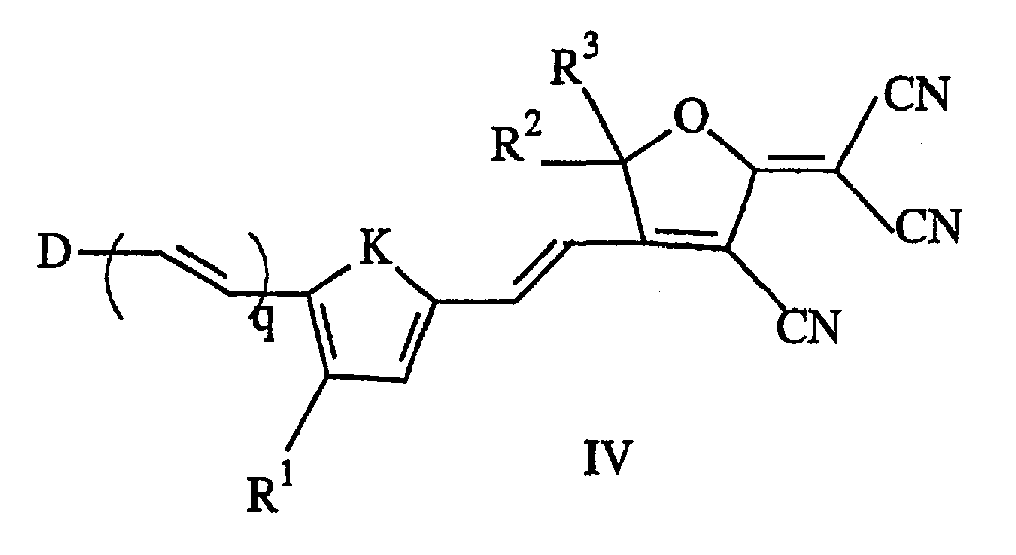

- R2 and R3 are further characterized in that they define a ring in which * denotes a spiro junction, or where * denotes a chiral center.
- Other useful compounds of the invention have Formula V:


- R2 and R3 are further characterized in that they define a ring in which * denotes a spiro junction, or where * denotes a chiral center.
- The present invention is also directed to optical waveguides comprising a thin film medium having Formula VI:

- The phrase "electron donating group" is used synonymously with "electron donator" and refers to substituents which contribute electron density to the π-electron system when the conjugated electron structure is polarized by the input of electromagnetic energy.
- The phrase "electron withdrawing group" is used synonymously with "electron accepting group" and "electron acceptor" and refers to electronegative organic compounds or substituents which attract electron density from the π-electron system when the conjugated electron structure is polarized by the input of electromagnetic energy.
- The term "chromophore" as used herein refers to an optical compound comprising an electron donating group and an electron withdrawing group at opposing termini of a conjugated π-electron system.
- The phrase "cyclic bridge" is used to refer to bivalent cyclic structures which serve to couple the electron donating and withdrawing groups.
- The present invention is also directed to optical devices comprising the optical waveguides described above.
- The present invention is directed, in part, to novel electro-optic chromophores which have utility in organic nonlinear optical applications such as polymeric thin films for optical waveguides and optical devices. Such polymeric thin films are described in, for example,
U.S. Patent Numbers 5,044,725 ,4,795,664 ,5,247,042 ,5,196,509 ,4,810,338 ,4,936,645 ,4,767,169 ,5,326,661 ,5,187,234 ,5,170,461 ,5,133,037 ,5,106,211 , and5,006,285 , each of which is incorporated herein by reference in its entirety. - The inventive chromophores have several advantageous features which are not found in other known or commercially available chromophores. For example, we have found that the introduction of a chiral center, preferably in the acceptor portion of the molecule, and more preferably as a racemic mixture, greatly increases the chromophore's solubility. We have found that solubility is enhanced the greater the structural or functional differences between R2 and R3. For example, we have observed significantly enhanced solubility when one of R2 or R3 is a chain and the other is a ring structure; or when one is a short chain (up to three carbons), and the other is a long chain (say, C4-C18). This increased solublility in turn can lead to an enhanced nonlinearity of the final material in many cases. It is known that the introduction of long chain alkane groups increase the solubility of chromophores, and that as the number and size of the alkane moieties increase, both the solubility and bulk material nonlinearity are greatly improved. The chromophores of the present invention have an enhanced solubility over the dimethyl types of the prior art.
- While there may be other factors contributing to this improved property, we have found that one major difference between the inventive acceptors and those of the prior art is the presence of chiral centers in the inventive acceptors. It is known that the physical characteristics like melting point and solubility are different for the pure enantiomer than for the racemic mixture. Several examples of this difference exist. For example, pure chiral (D) lycine has a melting point of 218 C and is very soluble at room temperature. The racimate has a melting point of 170 C and is considered infinitely soluble in room temperature water. Also, pure enantiomers of Mandelic acid have a melting point of 133 C while the racimate has a melting pint of 120 C. (R)-(+)-Mandelonirile has a melting point of 29 C while the racimate is an oil at room temperature.
- In the specific chemistry of the present invention, the chiral centers do not form a single chiral compound but rather a mixture of racemic enantiomers, which when introduced into chromophores increase the solubility of the chromophores due to a depression of the melting point. In fact, we have found that the inventive compounds tend to form glassy solids rather than crystalline materials. Without intending to be bound by theory, we believe that the present chemistry results in improvements in the nonlinearity of the bulk polymer because of the incorporation of a racemic chiral center in the chromophores.
- The electro-optic chromophores of the invention exhibit thermal stability to temperatures from 260 C to 310 C. These chromophores also show great solubility in most common organic solvents and, thus, are useful when used as a guest additive in most polymer films for waveguides. In addition, under intense UV-irradiation (365 nm, dosage 3 J/cm2 up to 13 minutes), the chromophores of the invention show no changes of the UV-VIS-NIR spectrum, which indicates that the chromophores are photostable. The chromophores also demonstrate an adjustable absorption band away from normal communications wavelengths, which can be very important for reducing optical loss at communication wavelengths. The chromophores of the invention have significant three-dimensional design which can prevent chromophore-chromophore anti-parallel stacking. Because of the flexible side chain substitutions, the chromophores of the invention show significantly reduced birefringence losses. In some of the chromophores of the invention, there is unique regiospecific substitution on the bridging thiophene ring, which allows the electron acceptor to more easily access the conjugated π-system of the bridge and allows the molecule backbone to be flatter. In addition, some of the preferred chromophores of the invention have hydroxyl groups on the electron donor termini in order to easily process the chromophore into hydroxyl compatible organic and inorganic polymer reactions to make soluble chromophores, polymers and copolymers, as well as can be used to make highly soluble "guest" chromophores for guest-host applications.
- The present invention is directed, in part, to compounds which can be employed as chromophores in polymeric thin films for optical waveguides. In preferred embodiments of the invention, such compounds comprise novel electron withdrawing groups having Formula I:

U.S. Patent Numbers 5,044,725 ,4,795,664 ,5,247,042 ,5,196,509 ,4,810,338 ,4,936,645 ,4,767,169 ,5,326,661 ,5,187,234 ,5,170,461 ,5,133,037 ,5,106,211 , and5,006,285 , each of which is incorporated herein by reference in its entirety. Preferably, D is selected from the group consisting of, but not limited to, phenyl ring(s) substituted in the para position by, for example, amino, alkylamino, dialkylamino, dialkylanilino, 1-piperidino, 1-piperazino, 1-pyrrolidino, acylamino, hydroxyl, thiolo, alkylthio, arylthio, alkoxy, aryloxy, acyloxy, alkyl, vinyl, 1,2,3,4-tetrahydroquinolinyl, and the like. The most preferred electron donating groups are substituted and unsubstituted -phenyl-N(CH2CH2OH)2. - B is a cyclic bridge which couples the electron withdrawing group and the electron donating group. Preferably, B is at least one bivalent ring. Preferred cyclic bridges comprise one or a plurality of bivalent rings. Preferred bivalent rings which can be employed as cyclic bridges in the present application are described in, for example, U.S. Patent Numbers 5,044,725, 4,795,664, 5,247,042, 5,196,509, 4,810,338, 4,936,645, 4,767,169; 5,326,661, 5,187,234, 5,170,461, 5,133,037, 5,106,211, and 5,006,285, each of which is incorporated herein by reference in its entirety. Ring B can be aromatic or non-aromatic. Preferably, B is selected from the group consisting of, but not limited to,


- R2 and R3 each, independently, are selected from the group consisting of, but not limited to, substituted or unsubstituted C1-C10 alkyl, substituted or unsubstituted C2-C10 alkenyl, substituted or unsubstituted C2-C10 alkynyl, substituted or unsubstituted aryl, substituted or unsubstituted alkylaryl, substituted or unsubstituted carbocycle, substituted or unsubstituted heterocycle, substituted or unsubstituted cyclohexyl, (CH2)n-O-(CH2)n where n is 1-10, and the like. "C1-C10" refers to C1, C2, C3, C4, C5, C6, C7, Cg, C9, C10, and all combinations of ranges thereof. Preferably, when R2 and R3 are both selected from substituted or unsubstituted C1-C10 alkyl the following condition is also met: R2 ≠ R3. More preferably, R2 and R3 define a ring in which * denotes a spiro junction, or where * denotes a chiral center.
- The substituted alkyl, alkenyl, alkynyl, carbocyclic, and heterocyclic groups can comprise one or a plurality of substituents including, for example, fluorine, chlorine, D, and the like. In addition, the heterocyclic groups can comprise O, N, S, and the like.
- The aryl groups preferably include, but are not limited to, benzyl, phenyl, fluorenyl, and naphthyl. The aryl groups, carbocycles, heterocycles, and cyclohexyl can also be substituted by one or a plurality of substituents including, for example, D, halides, including fluorine, chlorine and bromine. The alkylaryl groups preferably comprise C1-C10 alkyl and the substituted alkylaryl groups comprise the substitutions for the alkyl and aryl groups described above.
- In more preferred embodiments of the invention, R2 and R3 each, independently, are selected from the group consisting of benzyl, carbocycle, heterocycle, cyclohexyl, phenyl, cycloalkyl, cycloalkenyl, and substituted phenyl. Additional moieties for R2 and/or R3, independently, include, but are not limited to the following:

- In even more preferred embodiments of the invention, one of R2 and R3 is CH3 and the other of R2 and R3 is a substituted phenyl. Preferably, the substituted phenyl is selected from the group consisting of, but not limited to:

- Alternatively, R2 and R3 together form a ring structure or a substituted ring structure from 3 to 7 atoms total with 5 or 6 atoms being preferred. Preferably, the ring structure is substituted or unsubstituted carbocycle, substituted or unsubstituted heterocycle, or substituted or unsubstituted cyclohexyl or cyclopentyl. The substituted ring structure can comprise substituents including, but not limited to, halides, including fluorine, chlorine and bromine. A preferred compound having a ring structure formed by R2 and R3 comprises

- The electron withdrawing groups of the present invention are preferably prepared according to Scheme I:

- Compounds having Formula I are preferably prepared by the following steps depicted in Scheme I: a) providing an alkylvinylether, b) contacting the alkylvinylether with a strong base to form a first intermediate compound, c) contacting the first intermediate compound with a ketone to form a second intermediate compound, and d) reacting the second intermediate compound with dicyanomethane in the presence of a second base to form an electron withdrawing group portion of a compound having Formula I. Each of the above mentioned steps is described in greater detail below.
- In preferred embodiments of the invention, an alkylvinylether in a solvent is the starting material. The solvent is, preferably, tetrahydrofuran (THF), 1,4-dioxane, or the like. Although the alkylvinylether depicted in Scheme I is ethylvinylether, other alkylvinylethers can be used. The alkylvinylether preferably comprises the formula CH3-(CH2)x-O-CH=CHR6, where x is 1-3 and R6 is C1-C4 alkyl. Most preferably, the alkylvinylether is methylvinylether or ethylvinylether.
- The alkylvinylether is contacted with a strong base to form a first intermediate compound. Preferably, the strong base has a pKa greater than the ethylinic C-H bond α to the oxygen function of the alkylvinylether. For example, see Advanced Organic Chemistry, Third Ed., Jerry March, 1985, Table 1, pp. 220-222. In preferred embodiments of the invention, the strong base is an alkyl lithium, or an alkali metal salt of an alkyl anion, including, but not limited to, t-BuLi or sec-BuLi. The alkylvinylether is preferably contacted with the strong base between about -70 C and -85 C, most preferably at about -78 C.
- The first intermediate compound is contacted with a ketone and an acid/alcohol/water solution to form a second intermediate compound. Numerous acid/alcohol/water solutions known to those skilled in the art can be used in the present invention. The acid/alcohol/water solution is preferably HCl/MeOH/H2O, HBr/EtOH/H2O, or H2SO4/EtOH/H2O. Preferably, the contacting is at room temperature. Preferably, the pH is adjusted between 1 and 4.
- Preferably, the ketone comprises R3-C(=O)R2, wherein R2 and R3 each, independently, are selected from the group consisting of, substituted and unsubstituted C1-C10 alkyl, substituted and unsubstituted C1-C10 alkenyl, substituted and unsubstituted C1-C10 alkynyl, substituted and unsubstituted aryl, substituted and unsubstituted alkylaryl, substituted and unsubstituted carbocycle, substituted and unsubstituted heterocycle, substituted and unsubstituted cyclohexyl, and (CH2)n-O-(CH2)n where n is 1-10.
- "C1-C10" refers to C1, C2, C3, C4, C5, C6, C7, C8, C9, C10, and all combinations of ranges thereof.
- Preferably, the C=C and C≡C bonds of the alkenyl and alkynyl groups are not immediately adjacent or conjugated to the carbonyl group of the ketone compound.
- The substituted alkyl, alkenyl, alkynyl, carbocyclic, and heterocyclic groups can comprise one or a plurality of substituents including, for example, fluorine, chlorine, D, and the like. In addition, the heterocyclic groups can comprise O, N, S, and the like.
- The aryl groups preferably include, but are not limited to, benzyl, phenyl, fluorenyl, and naphthyl. The aryl groups, carbocycles, heterocycles, and cyclohexyl can also be substituted by one or a plurality of substituents including, for example, D, halides, including fluorine, chlorine and bromine. The alkylaryl groups preferably comprise C1-C10 alkyl and the substituted alkylaryl groups comprise the substitutions for the alkyl and aryl groups described above.
- In more preferred embodiments of the invention, R2 and R3 each, independently, are selected from the group consisting of benzyl, carbocycle, heterocycle, cyclohexyl, phenyl, cycloalkyl, cycloalkenyl, and substituted phenyl. Additional moieties for R2 and/or R3, independently, include, but are not limited to the following:

- In even more preferred embodiments of the invention, one of R2 and R3 is CH3 and the other of R2 and R3 is a substituted phenyl. Preferably, the substituted phenyl is selected from the group consisting of, but not limited to:

- Alternatively, R2 and R3 together form a ring structure or a substituted ring structure from 3 to 7 atoms total with 5 or 6 atoms being preferred. Preferably, the ring structure is substituted or unsubstituted carbocycle, substituted or unsubstituted heterocycle, or substituted or unsubstituted cyclohexyl or cyclopentyl. The substituted ring structure can comprise substituents including, but not limited to, halides, including fluorine, chlorine and bromine. A preferred compound having a ring structure formed by R2 and R3 comprises

- The second intermediate compound is reacted with dicyanomethane in the presence of a second base to form the electron withdrawing group portion of a compound having Formula I. The second base is preferably a metal alkoxide including, but not limited to, NaOC2H5. After contacting the second intermediate compound with dicyanomethane in the presence of a second base, dilute acid such as, for example, HCl, is added for neutralization of the resultant electron withdrawing group.
- The electron withdrawing group comprises R6 which is preferably selected from the group consisting of unbranched substituted or unsubstituted C1-C4 alkyl, unbranched substituted or unsubstituted C2-C4 alkenyl, unbranched substituted or unsubstituted C2-C4 alkynyl. The substituted alkyl, alkenyl, and alkynyl groups can comprise one or a plurality of substituents including, for example, fluorine. In preferred embodiments of the invention, R6 is selected from the group consisting of unbranched C1-C4 alkyl, C1-C4 alkenyl, and C1-C4 alkynyl. In more preferred embodiments of the invention, R6 is CH3.
- The present invention is also directed, in part, to compounds which can be employed as chromophores in polymeric thin films for optical waveguides wherein the compounds comprise novel bridge groups which couple the electron withdrawing and donating groups of the chromophore. Preferred compounds of the invention have Formula II:
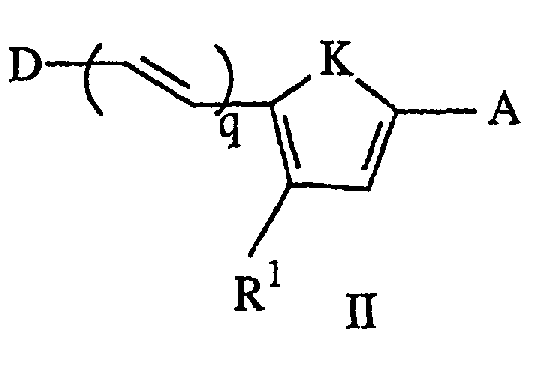
- D is an electron donating group. Preferred electron donating groups are described above.
- A is an electron withdrawing group. Preferred electron withdrawing groups are described in, for example, U.S. Patent Numbers 5,044,725, 4,795,664, 5,247,042, 5,196,509, 4,810,338, 4,936,645, 4,767,169, 5,326,661, 5,187,234, 5,170,461, 5,133,037, 5,106,211, and 5,006,285, each of which is incorporated herein by reference in its entirety. Preferably, A is selected from the group of molecular units containing, but not limited to, nitro, cyano, haloalkyl, acyl, carboxy, aryloxy, carboxamido, alkoxysulfonyl, aryloxysulfonyl, -CH=C(CN)2, -C(CN)=C(CN)2, SO2CF3, alkanoyloxy,

- R1 is -Q-CnH2n+1, -Q-(CH2)aCnF2n+1, -Q-CH2OCH2CnF2n+1, -Q-CH2SCH2CCnF2n+1, -Q-CH2OCH2CF3, or -Q-CH2SCH2CF3, where n is 1-10, a is 0-10, and Q preferably is either absent or, when present, O or S; q is 1, 2, or 3. More preferably, R1 is C4-C10 or fluorine substituted C4-C10.
- A compound having Formula II can be prepared using a thiophene cyclic bridge which preferably comprises Formula VII:

- Preferably, K is O or S.
- Preferably, R1 is -Q-CnH2n+1, -Q-(CH2)aCnF2n+1, -Q-CH2OCH2CnF2n+1, -Q-CH2SCH2CCnF2n+1, -Q-CH2OCH2CF3, or -Q-CH2SCH2CF3, where n is 1-10, a is 0-10, and Q preferably is either absent or, when present, O or S. Other halogens or deuterium can be used in place of F. In more preferred embodiments of the invention, R1 is C4-C10 or fluorine substituted C4-C10.
- X preferably has the formula -(CH=CH)b-C(=O)H, where b is 0-3. The terminal aldehyde group serves as the preferred site of reaction with electron withdrawing groups. In more preferred embodiments of the invention, b is 0 so that X is -C(=O)H.
- Z is a chemical group that is capable of being linked to a donor and includes, but is not limited to, Br, I, -CH2-Br, -CH2-OH, -CH3, -C(=O)H, and the like. Those skilled in the art can use additional groups known to those skilled in the art to couple a bridge compound to a donor. Another Z group that can be used to link a bridge compound to a donor is

- In other embodiments of the invention, preferred compounds of the invention have Formula III:

- D is an electron donating group and A is an electron withdrawing group as described above. J is CH2, O or S.
- R1 is -Q-CnH2n+1, -Q-(CH2)aCnF2n+1, -Q-CH2OCH2CnF2n+1, -Q-CH2SCH2CCnF2n+1, -Q-CH2OCH2CF3, or -Q-CH2SCH2CF3, where n is 1-10, a is 0-10, and Q is absent, O or S. More preferably, R1 is C4-C10 or fluorine substituted C4-C10.
- A compound having Formula IV can be prepared using a dihydronaphthyl cyclic bridge which preferably comprises Formula VIII:

- Preferably, J is CH2, O or S.
- Preferably, R1 is H, -Q-CnH2n+1, -Q-(CH2)aCnF2n+1, -Q-CH2OCH2CnF2+1, -Q-CH2SCH2CCnF2n+1, -Q-CH2OCH2CF3, or -Q-CH2SCH2CF3, where n is 1-10, a is 0-10, and Q is absent, O or S. Other halogens can be used in place of F. In more preferred embodiments of the invention, R1 is C4-C10 or fluorine substituted C4-C10.
- X preferably has the formula (C=O)H or C=CH(-CH=CH)d-C(=O)H, where d is 0-3. The terminal aldehyde or ketone group serves as the preferred site of reaction with electron withdrawing groups. In more preferred embodiments of the invention, X is (C=O)H.
- Z is a chemical group that is capable of being linked to a donor, as described above.
- The present invention is also directed to compounds which can be employed as chromophores in polymeric thin films for optical waveguides wherein the compounds comprise novel bridge groups and novel electron withdrawing groups, and are represented by Formula IV:

- R1 is -Q-CnH2n+1, -Q-(CH2)aCnF2n+1, -Q-CH2OCH2CnF2n+1, -Q-CH2SCH2CCnF2n+1, -Q-CH2OCH2CF3, or -Q-CH2SCH2CF3, where n is 1-10, a is 0-10, and Q is absent, O or S, and q is 1, 2, or 3. In more preferred embodiments of the invention, R1 is C4-C10 or fluorine substituted C4-C10. More preferred compounds of this embodiment of the invention are represented by Formula IV':

- R2 and R3 are further characterized in that they define a ring in which * denotes a spiro junction, or where * denotes a chiral center.
- Alternatively, R2 and R3 each, independently, are selected from the group consisting of, but not limited to, substituted or unsubstituted C1-C10 alkyl, substituted or unsubstituted C2-C10 alkenyl, substituted or unsubstituted C2-C10 alkynyl, substituted or unsubstituted aryl, substituted or unsubstituted alkylaryl, substituted or unsubstituted carbocycle, substituted or unsubstituted heterocycle, substituted or unsubstituted cyclohexyl, (CH2)n-O-(CH2)n where n is 1-10, and the like. More preferably, R2 and R3 each, independently, are selected from the group consisting of substituted or unsubstituted aryl, substituted or unsubstituted alkylaryl, and substituted or unsubstituted cyclohexyl. More preferably, R2 and R3 each, independently, are selected from the group consisting of benzyl, cyclohexyl, and substituted or unsubstituted phenyl. More preferably, one of R2 and R3 is CH3 and the other of R2 and R3 is a substituted phenyl. Most preferably, one of R2 and R3 is

- Alternatively, R2 and R3 together form a ring structure or a substituted ring structure from 3 to 7 atoms total with 5 or 6 atoms being preferred. Preferably, the ring structure is substituted or unsubstituted carbocycle, substituted or unsubstituted heterocycle, or substituted or unsubstituted cyclohexyl or cyclopentyl. The substituted ring structure can comprise substituents including, but not limited to, deuterium and halides, including fluorine, chlorine and bromine. A preferred compound having a ring structure formed by R2 and R3 comprises

- D is an electron donating group as described above.
- In other embodiments of the invention, useful compounds are represented by the structure of Formula V:

- Preferably, R1 is -Q-CnH2n+1, -Q-(CH2)aCnF2n+1, -Q-CH2OCH2CnF2n+1, -Q-CH2SCH2CCnF2n+1, -Q-CH2OCH2CF3, or -Q-CH2SCH2CF3, where n is 1-10, a is 0-10, and Q is absent, O or S. In more preferred embodiments of the invention, R1 is C4-C10 or fluorine substituted C4-C10. More preferred compounds of this embodiment are represented by the structure of Formula V':

- Alternatively, R2 and R3 each, independently, are selected from the group consisting of, but not limited to, substituted or unsubstituted C1-C10 alkyl, substituted or unsubstituted C2-C10 alkenyl, substituted or unsubstituted C2-C10 alkynyl, substituted or unsubstituted aryl, substituted or unsubstituted alkylaryl, substituted or unsubstituted carbocycle, substituted or unsubstituted heterocycle, substituted or unsubstituted cyclohexyl, (CH2)n-O-(CH2)n where n is 1-10, and the like. More preferably, R2 and R3 each, independently, are selected from the group consisting of substituted or unsubstituted aryl, substituted or unsubstituted alkylaryl, and substituted or unsubstituted cyclohexyl. More preferably, R2 and R3 each, independently, are selected from the group consisting of benzyl, cyclohexyl, and substituted or unsubstituted phenyl. More preferably, one of R2 and R3 is CH3 and the other of R2 and R3 is a substituted phenyl. Most preferably, one of R2 and R3 is

- Alternatively, R2 and R3 together form a ring structure or a substituted ring structure from 3 to 7 atoms total with 5 or 6 atoms being preferred. Preferably, the ring structure is substituted or unsubstituted carbocycle, substituted or unsubstituted heterocycle, or substituted or unsubstituted cyclohexyl. The substituted ring structure can comprise substituents including, but not limited to, deuterium and halides, including fluorine, chlorine and bromine. A preferred compound having a ring structure formed by R2 and R3 comprises

- D is an electron donating group as described above.
- The present invention is also directed, in part, to optical waveguides comprising polymeric this films having comprising the chromophores of the invention. In preferred embodiments of the invention, optical waveguides comprising a thin film medium have Formula VI:

- P and P' are polymer main chain units, which can be the same mer unit or different mer unit, and C is a comonomer unit where n is an integer greater than zero and n' is 0 or an integer greater than zero. Polymers and copolymers that may be employed in the present invention are described in, for example, U.S. Patent Numbers 5,044,725, 4,795,664, 5,247,042, 5,196,509, 4,810,338, 4,936,645, 4,767,169, 5,326,661, 5,187,234, 5,170,461, 5,133,037, 5,106,211, and 5,006,285, each of which is incorporated herein by reference in its entirety. The polymers of the invention can be a homopolymer or a copolymer. Preferred polymers and copolymers include, but are not limited to, acrylate, vinyl carboxylate, substituted arylvinyl, vinyl halide, vinyl carboxylate, alkene, alkadiene, arylvinyl, methacrylate, vinyl chloride, vinyl acetate, vinyl ether, ethylene, propylene, isobutylene, 1-butene, isoprene, styrene, and the like.
- Preferably, the polymers of the invention comprise an external field-induced orientation and alignment of pendant side chains. Preferably, the polymer main chain can be a structural type such as polyvinyl, polyoxyalkylene, polysiloxane, polycondensation, and the like. A polymer can be applied to a supporting substrate by conventional means, such as spin coating, dip coating, spraying, Langmuir-Blodgett deposition, and the like. Thin film optical waveguide medium of the present invention after fabrication can be subjected to an external field to orient and align uniaxially the polymer side chains. In one method the polymer medium is heated close to or above the polymer glass transition temperature Tg, then an external field (e.g., a DC electric field) is applied to the medium of mobile chromophore molecules to induce uniaxial molecular alignment of the chromophore polymer side chains or guests in a guest-host system parallel to the applied field, and the medium is cooled while maintaining the external field effect.
- S is a pendant spacer group having a linear chain length of between about 2-12 atoms. Pendant spacer groups that may be employed in the present invention are described in, for example,
U.S. Patent Numbers 5,044,725 ,4,795,664 ,5,247,042 ,5,196,509 ,4,810,338 ,4,936,645 ,4,767,169 ,5,326,661 ,5,187,234 ,5,170,461 ,5,133,037 ,5,106,211 , and5,006,285 , each of which is incorporated herein by reference in its entirety. - M is a chromophore compound having Formula I, Formula I', Formula II, Formula III, Formula IV, Formula IV', Formula V, or Formula V', described above.
- The present invention is also directed, in part, to optical devices comprising the optical waveguides of the invention. Optical devices are described in, for example,
U.S. Patent Numbers 5,044,725 ,4,795,664 ,5,247,042 ,5,196,509 ,4,810,338 ,4,936,645 ,4,767,169 ,5,326,661 ,5,187,234 ,5,170,461 ,5,133,037 ,5,106,211 , and5,006,285 , each of which is incorporated herein by reference in its entirety. Preferred optical devices include, but are not limited to, laser frequency converters, optical interferometric waveguide gates, wideband electrooptical guided wave analog-to-digital converters, optical parametric devices, and the like, as described inU.S. Pat. No. 4,775,215 , which is incorporated herein by reference in its entirety. - The invention is further illustrated by way of the following examples which are intended to elucidate the invention. These examples are not intended, nor are they to be construed, as limiting the scope of the disclosure.
- To a solution of 0.33 mol of ethyl vinyl ether in 150 ml of dry THF, 0.3 mol of t-BuLi in pentane was added dropwise at -78 C. The mixture was stirred and allowed to warm up slowly to 0 C and subsequently cooled to -78 C again. Next, 0.25 mol of cyclohexyl phenyl ketone dissolved in a minimum of dry THF was added dropwise. The mixture was stirred overnight at room temperature, then acidified using HCl/MeOH/THF/H2O solution to pH 1-4. After stirring this mixture for two hours, most of the solution was evaporated using a rotary evaporator. The remaining mixture was extracted with ethyl ether (3 x 100 ml). The organic solution was washed with NaHCO3, brine, and DI water. This mixture was then dried over anhydrous MgSO4. After evaporating the ether, the crude product was purified by column chromatography (5% ethyl acetate in hexane) to give pure alpha-hydroxy ketone (30 g).
- The hydroxy ketone synthesized above (0.02 mol) was mixed with malononitrile (0.04 mol) in ethyl alcohol at 20% w/v based on malononitrile cooled in an ice bath. To this, 20 ml of 1 M NaOC2H5/EtOH was added dropwise. The mixture was allowed to stir overnight. After neutralization by concentrated HCl to pH 6, the solvent was evaporated by vacuum. The residue was dissolved into CH2Cl2 and filtered to remove the undissolved solid. After evaporating the CH2Cl2, the crude product was purified by recrystalization from ethanol to give the dicyanomethylenedihydrofuran compound (1.25 g).
- Alternatively, and more preferably, the hydroxy ketone synthesized above (0.02 mol) was mixed with malononitrile (0.04 mol) and potassium carbonate (0.02 mol) in THF (40 ml) and EtOH (2 ml). To this mixture, a catalytic amount of 18-crown ether was added. The mixture was stirred and allowed to reflux overnight. The solid was filtered off, followed by evaporation of most of the solvent. The crude mixture was purified by column chromatography (CH2Cl2) to give the dicyanomethylenedihydrofuran compound (1.5 g) shown below (melting point, MP =194-196 C).
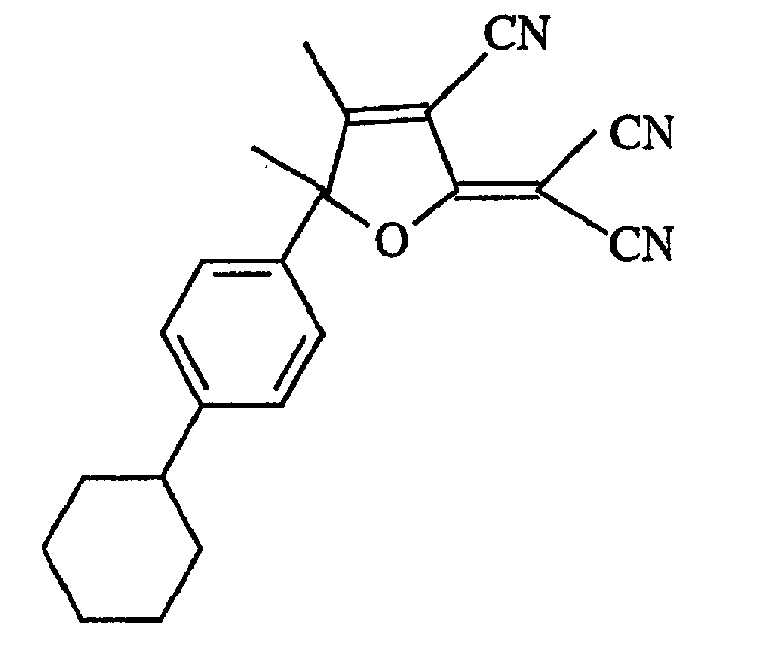
- To a solution of ethylvinylether (28.8 g in 300 ml of THF) was added 176 ml of t-BuLi dropwise at -78 C. The mixture was slowly warmed to 0 C and subsequently cooled to -78 C again. Cyclohexanone (30 g in 30 ml of THF) was added dropwise and the mixture was slowly warmed to room temperature and stirred for an additional four hours. A solution of methanol (70 ml), water (20 ml) and conc. HCl (10 ml) was slowly added to the reaction mixture until a pH of about 2-3 was obtained. The mixture was stirred overnight and neutralized to pH 7 by addition of a 20% solution of NaHCO3 in water and the solvent was evaporated. The residual solvent was extracted by ether (3 x 100 ml). The ether solution was washed with NaHCO3 (50 ml), brine (100 ml), and dried over anhydrous MgSO4. After removal of the ether, vacuum distillation of the intermediate yielded 36g.
- CH2(CN)2 (13.2 g) and a 1 M solution of NaOC2H5 (0.1 mole) were mixed in an ice bath. Approximately 14.2 g of the intermediate prepared as described above and dissolved in a minimum of EtOH was added dropwise and stirred overnight at room temperature. The mixture was neutralized by 8 ml of conc. HCl to a pH of 6.0 and the solid material was filtered off and the remaining solution was evaporated. The residue from the solution was dissolved into CH2Cl2, filtered again, followed by evaporating the CH2Cl2. The rest of the mixture was recrystalized from ethanol (150 ml) to give 6.1 g of the final compound shown below (mMP = 239-241 C).
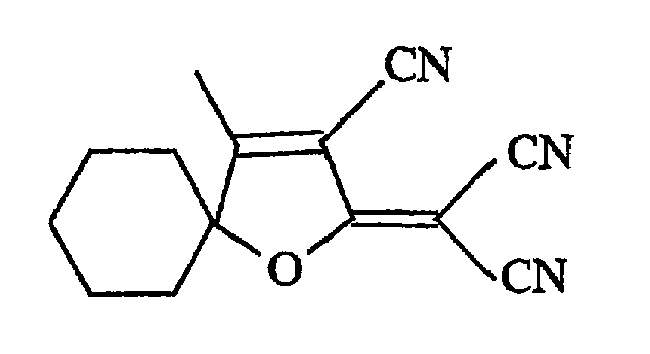
- To a solution of ethylvinylether (21.6 g in 300 ml of THF) was added 110 ml of t-BuLi dropwise at -78 C. The mixture was warmed to 0 C and subsequently cooled to -78 C again. 5', 4'-dichloroacetophenone (30.5 g) was dissolved into 150 ml of THF and then added dropwise. This mixture was run overnight at room temperature. A solution of HCl (10 ml), methanol (70 ml), and water (20 ml) was added to the reaction the next day. The mixture was adjusted to pH 4 and allowed to stir overnight. NaHCO3 was added to neutralize this solution to pH 7. The mixture was extracted by ether (3 x 100 ml). The combined organic acid mixture was washed with NaHCO3 (50 ml), brine (100 ml), and dried over anhydrous MgSO4. Vacuum distillation of the intermediate yielded 55 g.
- CH2(CN)2 (13.2 g) and a 1 M solution of NaOC2H5 (0.1 mole) were mixed in an ice bath. Approximately 15 g of the intermediate prepared as described above and dissolved in EtOH was added dropwise and stirred overnight at room temperature. The mixture was neutralized by 8 ml of conc. HCL to a pH of 6.0 and the solid material was filtered and the resulting solution evaporated. The residue was dissolved into CH2Cl2, filtered again, followed by evaporating the CH2Cl2. The rest of the mixture was recrystalized from ethanol (150 ml) to give 5.5 g of the final compound shown below (MP = 110-111 C; 152-153 C; and 222-224 C, respectively left to right).

- To a solution of 3-decanyl-2-methyltributylphosphonium-thiophene bromide (26 g, 0.05 mol) and N,N-di-ethanol aminophenyl aldehyde (12.6 g, 0.06 mol) in 200 ml of ethanol, NaOC2H5 (1 M in ethanol) was added dropwise. The resulting mixture was refluxed for 98 hours. After removal of this reaction from the bath oil, the solvent was evaporated, and the residue was extracted with ethyl ether (3 x 150 ml). The combined ether mixture was washed with water (100 ml), brine (2 x 100 ml) and dried over anhydrous MgSO4. After removal of the solvent, the residue was purified by column chromatography on silica and eluted using 50% ethyl acetate, 10% acetone, and 40% hexane to give the pure title compound with a yield of 16 g. Carbon and proton NMR were consistent with the structure.
- To a 500 ml flask with the compound synthesized above (10.44 g, 0.0243 mol), 200 ml of THF was added. The solution was cooled to -78 C and n-BuLi (32 ml, 2.5 M in hexane) was added dropwise. The mixture was stirred for 2 hours followed by addition of DMF (6 ml). The resulting solution was stirred overnight at room temperature. After adding HCl (2 M, 50 ml) and stirring for an hour, the THF was evaporated. The residue was extracted with ethyl ether (3 x 100 ml). The combined organic solution was washed with saturated Na2CO3 solution (50 ml), water (100 ml), brine (100 ml) and dried over anhydrous MgSO4. After evaporating the solvent, solid target compound (11.1 g, mp 107-109 C) was obtained. HNMR showed that this compound was pure enough for the next step.
- The above aldehyde compound (3 g, 6.54 mmol) and 2-dicyanomethylen-3-cyano-4,5-dimethyl-5-(3,4-dichlorophenyl)-2,5-dihydrofuran (2.4 g, 7.27 mmol) were mixed and dissolved in EtOH (30 ml). Two or three drops of piperidine were added. The mixture was refluxed for 48 hours. After cooling, the precipitated solid was filtered, recrystalized from EtOH, and purified by chromatography silica elution solvent to give 3.38 g of the chromophore. Carbon and proton NMR were performed and analysis thereof was consistent with the structure.
- Trans-[(N,N-di(2-ethanol)amino)phenylene-3,4-dibutyl-2-thiophene-5-al] (0.3 g, 0.7 mmol) is mixed with 2-dicyanomethylen-3-cyano-4,5-dimethyl-5-(3,4-dichlorophenyl)-2,5-dihydrofurane (0.23 g, 0.7 mmol) in EtOH (20 ml). Two or three drops of piperidine is added. The mixture is refluxed for 48 hours. After cooling, the precipitated solid is filtered, recrystalized from EtOH, and purified by chromatography silica elution solvent.
- To a three-neck flask with 1,4,5,6,7,7-hexchloro-5-norbornene-2,3-dicarboxylic acid chloride (2.65 g, 6.23 mmol) and 2,3,5,6-tetrachloro-p-xylene-αα-diol (1.36 g, 4.93 mmol), 2-dicyanomethylen-3-cyano-4-{2-[E-(4-N,N-di-(2-ethanol)amino)phenylene-(3-decanyl)thien-5]-E-vinyl}-5-methyl-5-(3,4-dichlorophenyl)-2,5-dihydrofuran (1 g, 1.3 mmol) were mixed in 20 ml THF at 70 C. Et3N (1.26 g in 15 ml THF) was added dropwise. The mixture was refluxed under Ar for 48 hours. After evaporating some of the THF, the rest of the solution was slowly dropped into MeOH (300 ml) and water (50 ml) with violent stirring. The precipitated solid was filtered, redissolved in THF and precipitated again in MeOH (300 ml). The collected solid was vacuum dried for 8 hours and weighed 4.5 g. The polymer was characterized by DSC and TGA. The Tg is 152 C, and the decomposing temperature under air is 285 C.
- Although the invention has been described in detail for the purpose of illustration, it is understood that such detail is solely for that purpose, and variations can be made therein by those skilled in the art without departing from the spirit and scope of the invention which is defined by the following claims.
Claims (12)
- A compound having Formula II
 K is O or S;D is an electron donating group;A is an electron accepting group;R1 is -Q-CnH2n+1, -Q-(CH2)aCnF2n+1, -Q-CH2OCH2CnF2n+1, -Q-CH2SCH2CCnF2n+1, -Q-CH2OCH2CF3, or -Q-CH2SCH2CF3, where n is 1-10, a is 0-10, and Q is absent, O or S; andq is 1,2, or 3.
- The compound of claim 1 wherein A comprises a molecular unit selected from the group consisting of nitro, cyano, haloalkyl, acyl, carboxy, aryloxy, carboxamido, alkoxysulfonyl, aryloxysulfonyl, -CH=C(CN)2, -C(CN)=C(CN)2, SO2CF3, alkanoyloxy,

- The compound of claim 1 wherein a is 1-3 and n is 1-3; preferably wherein R1 is C4-C10 or fluorine substituted C4-C10.
- The compound of any of claims 1-3 wherein D is a phenyl ring substituted at the para position by a moiety selected from the group consisting of amino, alkylamino, dialkylamino, dialkylanilino, 1-piperidino, 1-piperazino, 1-pyrrolidino, acylamino, hydroxyl, thiolo, alkylthio, arylthio, alkoxy, aryloxy, acyloxy, alkyl, vinyl, and 1,2,3,4-tetrahydroquinolinyl.
- An optical waveguide comprising a thin film medium having Formula VI
 P and P' are polymer main chain units;C is a comonomer unit;S is a pendant spacer group having a linear chain length of between about 2-12 atoms;n is an integer greater than zero;n' is 0 or an integer greater than zero; andM is a compound of claim 1 to 4.
- An optical device comprising the optical waveguide of claim 5.
- The optical device of claim 6 wherein said device is selected from the group consisting of a laser frequency converter, an optical interferometric waveguide gate, a wideband electrooptical guided wave analog-to-digital converter, and an optical parametric device.
- A method of preparing an electron withdrawing group comprising the steps:(a) providing an alkylvinylether;(b) contacting said alkylvinylether with a strong base to form a first intermediate compound;(c) contacting said first intermediate compound with a ketone to form a second intermediate compound; and(d) reacting said second intermediate compound with dicyanomethane in the presence of a second base to form said electron withdrawing group;preferably wherein said alkylvinylether is in a solvent,
preferably wherein said solvent is tetrahydrofuran or 1,4-dioxane;
preferably wherein said alkylvinylether comprises the formula CH3-(CH2)x-O-CH=CHR6, where x is 1-3 and R6 is H or C1-C4 alkyl,
preferably wherein said alkylvinylether is methylvinylether or ethylvinylether. - The method of claim 8 wherein said strong base has a pKa greater than the ethylinic C-H bond α to the oxygen function of said alkylvinylether.
- The method of claim 8 wherein said strong base is an alkyl lithium, preferably wherein said alkyl lithium is t-BuLi or sec-BuLi.
- The method of claim 8 wherein said ketone comprises the formula R3-C(=O)R2, wherein R2 and R3 each, independently, are selected from the group consisting of, substituted or unsubstituted C1-C10 alkyl, substituted or unsubstituted C2-C10 alkenyl, substituted or unsubstituted C2-C10 alkynyl, substituted or unsubstituted aryl, substituted or unsubstituted alkylaryl, substituted or unsubstituted carbocycle, substituted or unsubstituted heterocycle, substituted or unsubstituted cyclohexyl, and (CH2)n-O-(CH2)n where n is 1-10;
preferably wherein said R2 and R3 each, independently, are selected from the group consisting of benzyl, cyclohexyl, cyclopentyl, phenyl, and substituted phenyl;
preferably wherein one of said R2 and R3 is CH3 and the other of R2 and R3 is a substituted phenyl. - The method of claim 8 wherein said second base is a metal alkoxide, preferably wherein said metal alkoxide is NaOC2H5.
Applications Claiming Priority (3)
| Application Number | Priority Date | Filing Date | Title |
|---|---|---|---|
| US09/595,221 US6584266B1 (en) | 2000-06-16 | 2000-06-16 | Chromophores for polymeric thin films and optical waveguides and devices comprising the same |
| US09/675,966 US6393190B1 (en) | 2000-06-16 | 2000-09-29 | Chromophores for polymeric thin films and optical waveguides and devices comprising the same |
| EP01937449A EP1290000A4 (en) | 2000-06-16 | 2001-05-16 | Novel chromophores for polymeric thin films and optical waveguides and devices comprising the same |
Related Parent Applications (1)
| Application Number | Title | Priority Date | Filing Date |
|---|---|---|---|
| EP01937449A Division EP1290000A4 (en) | 2000-06-16 | 2001-05-16 | Novel chromophores for polymeric thin films and optical waveguides and devices comprising the same |
Publications (2)
| Publication Number | Publication Date |
|---|---|
| EP1772459A2 true EP1772459A2 (en) | 2007-04-11 |
| EP1772459A3 EP1772459A3 (en) | 2008-01-09 |
Family
ID=24382290
Family Applications (2)
| Application Number | Title | Priority Date | Filing Date |
|---|---|---|---|
| EP07100799A Withdrawn EP1772458A3 (en) | 2000-06-16 | 2001-05-16 | Novel chromophores for polymeric thin films and optical waveguides and devices comprising the same |
| EP07100800A Withdrawn EP1772459A3 (en) | 2000-06-16 | 2001-05-16 | Novel chromophores for polymeric thin films and optical waveguides and devices comprising the same |
Family Applications Before (1)
| Application Number | Title | Priority Date | Filing Date |
|---|---|---|---|
| EP07100799A Withdrawn EP1772458A3 (en) | 2000-06-16 | 2001-05-16 | Novel chromophores for polymeric thin films and optical waveguides and devices comprising the same |
Country Status (3)
| Country | Link |
|---|---|
| US (2) | US6584266B1 (en) |
| EP (2) | EP1772458A3 (en) |
| TW (1) | TWI274756B (en) |
Families Citing this family (27)
| Publication number | Priority date | Publication date | Assignee | Title |
|---|---|---|---|---|
| EP1305305A4 (en) * | 2000-07-24 | 2005-07-20 | Univ Washington | HYPERPOLARIZABLE ORGANIC CHROMOPHORE |
| US7019453B2 (en) * | 2000-08-17 | 2006-03-28 | Lumera Corporation | Polymers having pendant nonlinear optical chromophores and electro-optic devices therefrom |
| EP1313729B1 (en) * | 2000-08-17 | 2007-03-21 | Lumera Corporation | Design and synthesis of thiophene derived nlo materials for electro-optic applications |
| US6750603B2 (en) * | 2000-08-17 | 2004-06-15 | Lumera Corporation | Second order nonlinear optical chromophores and electro-optic devices therefrom |
| US6610219B2 (en) | 2001-02-06 | 2003-08-26 | Battelle Memorial Institute | Functional materials for use in optical systems |
| US20030201429A1 (en) * | 2002-04-30 | 2003-10-30 | Mingqian He | Low loss electro-optic polymers and devices made therefrom |
| WO2004065384A1 (en) * | 2003-01-15 | 2004-08-05 | University Of Washington | Nonlinear optical compounds and methods for their preparation |
| NZ526561A (en) * | 2003-06-18 | 2005-12-23 | Ind Res Ltd | Zwitterionic non-linear optophores and devices incorporating these |
| US7425643B1 (en) | 2004-01-26 | 2008-09-16 | University Of Washington | Electron acceptors for nonlinear optical chromophores |
| US7705108B2 (en) | 2004-09-14 | 2010-04-27 | Corning Incorporated | Fused thiophenes, methods for making fused thiophenes, and uses thereof |
| US7161726B2 (en) * | 2004-11-05 | 2007-01-09 | Lumera Corporation | Linear optical modulators and method of linear optical modulation |
| US7723462B2 (en) * | 2006-05-03 | 2010-05-25 | Corning Incorporated | Mercaptofunctional high mubeta EO chromophores and high Tg, low optical loss, covalently bonded, high mubeta EO chromophore containing polymers and methods of synthesizing EO materials |
| US8409713B2 (en) * | 2007-12-07 | 2013-04-02 | University Of Washington | Crosslinkable polymer host containing a nonlinear optical chromophore guest |
| US8394499B2 (en) * | 2007-12-07 | 2013-03-12 | University Of Washington | Crosslinkable polymer host having pendant nonlinear optical chromophores and containing a nonlinear optical chromophore guest |
| CN104610774B (en) | 2009-08-24 | 2017-07-18 | 独立行政法人情报通信研究机构 | Second nonlinear optic compound and the nonlinear optical element containing it |
| US20120329865A1 (en) | 2009-12-31 | 2012-12-27 | Huayun Deng | MOLECULES RELATED hERG ION CHANNELS AND THE USE THEREOF |
| US20120022116A1 (en) | 2010-07-20 | 2012-01-26 | Huayun Deng | Compositions and methods for the treatment of pathological condition(s) related to gpr35 and/or gpr35-herg complex |
| US11661428B1 (en) | 2017-10-03 | 2023-05-30 | Lightwave Logic, Inc. | Nonlinear optical chromophores, nonlinear optical materials containing the same, and uses thereof in optical devices |
| WO2019151318A1 (en) | 2018-01-30 | 2019-08-08 | 国立研究開発法人情報通信研究機構 | Electro-optical polymer |
| US11614670B2 (en) | 2018-09-17 | 2023-03-28 | Lightwave Logic, Inc. | Electro-optic polymer devices having high performance claddings, and methods of preparing the same |
| CN120904177A (en) | 2020-06-25 | 2025-11-07 | 光波逻辑有限公司 | Nonlinear optical chromophores comprising adamantyl-like groups |
| CA3239316A1 (en) | 2021-12-03 | 2023-06-08 | Cory Pecinovsky | Non-linear optical materials containing high boiling point solvents, and methods of efficiently poling the same |
| KR20250099408A (en) | 2021-12-10 | 2025-07-01 | 라이트웨이브 로직, 인크. | Nonlinear optical chromophores having tetrahydrocarbazole donor groups, lyotropic compositions containing the same, and methods of poling such compositions |
| JP2025504377A (en) | 2022-01-05 | 2025-02-12 | ライトウェーブ ロジック インコーポレイテッド | Nonlinear optical chromophores having short-chain bridge structures, low optical loss materials containing the same and methods for preparing the same |
| CN121568992A (en) | 2023-06-29 | 2026-02-24 | 光波逻辑有限公司 | Nonlinear optical chromophores with indolizine donor groups |
| CN121532703A (en) | 2023-07-07 | 2026-02-13 | 光波逻辑有限公司 | Nonlinear photochemical chromophores with michidine-type donors |
| JP2026525744A (en) | 2023-07-20 | 2026-08-03 | ライトウェーブ ロジック インコーポレイテッド | Wafer-level polling of electro-optical phase modulators |
Family Cites Families (25)
| Publication number | Priority date | Publication date | Assignee | Title |
|---|---|---|---|---|
| US4014951A (en) | 1973-06-07 | 1977-03-29 | Firmenich S.A. | Process for the preparation of poly-unsaturated hydrocarbons |
| JPS60237082A (en) * | 1984-05-09 | 1985-11-25 | Toyama Chem Co Ltd | Amine derivative and its salt |
| US4810338A (en) | 1986-01-24 | 1989-03-07 | Hoecast Celanese Corp. | Side chain liquid crystalline polymers exhibiting nonlinear optical response |
| US5044725A (en) | 1986-01-24 | 1991-09-03 | Hoechst Celanese Corp. | Polymeric thin film waveguide media |
| US4795664A (en) | 1986-01-24 | 1989-01-03 | Hoechst Celanese Corp. | Side chain liquid crystalline condensation polymers exhibiting nonlinear optical response |
| US4767169A (en) | 1987-02-26 | 1988-08-30 | Hoechst Celanese Corporation | Thin film waveguide electrooptic modulator |
| US5006285A (en) | 1988-07-28 | 1991-04-09 | Lockheed Missiles & Space Company, Inc. | Electro-optic channel waveguide |
| US4936645A (en) | 1989-08-24 | 1990-06-26 | Hoechst Celanese Corp. | Waveguide electrooptic light modulator with low optical loss |
| US5247042A (en) | 1989-09-11 | 1993-09-21 | Hoechst Celanese Corp. | Isotropic acrylic polymer exhibiting nonlinear optical response |
| JPH03101671A (en) | 1989-09-14 | 1991-04-26 | Mitsubishi Kasei Corp | Method for producing optically active alcohol |
| GB9019347D0 (en) * | 1990-09-05 | 1990-10-17 | Ici Plc | Chromophore-containing compounds for opto-electronic applications |
| US5187234A (en) | 1990-10-23 | 1993-02-16 | Hoechst Celanese Corp. | Vinyl polymers exhibiting nonlinear optical response |
| JP2814739B2 (en) * | 1990-11-22 | 1998-10-27 | 富士電機株式会社 | Electrophotographic photoreceptor |
| US5106211A (en) | 1991-02-14 | 1992-04-21 | Hoechst Celanese Corp. | Formation of polymer channel waveguides by excimer laser ablation and method of making same |
| US5196509A (en) | 1991-03-25 | 1993-03-23 | Hoechst Celanese Corp. | Side chain condensation polymer which exhibits nonlinear optical response |
| US5133037A (en) | 1991-06-07 | 1992-07-21 | Hoechst Celanese Corp | Polymeric optical modulator and waveguiding media |
| US5326661A (en) | 1991-11-13 | 1994-07-05 | Hoechst Celanese Corp. | Photorefractive polymers containing discrete photoconductive and electrooptical units |
| US5170461A (en) | 1991-12-11 | 1992-12-08 | Hoechst Celanese Corp. | Polymeric electrooptic waveguide devices using a polymeric substrate |
| US5169854A (en) * | 1992-02-26 | 1992-12-08 | Abbott Laboratories | N-substituted-furylalkenyl hydroxamic acid and N-hydroxyurea compounds having lipoxygenase inhibitory activity |
| US5882785A (en) * | 1997-01-23 | 1999-03-16 | The United States Of America As Represented By The Secretary Of The Navy | Nonlinear optical films from pair-wise-deposited semi-ionomeric syndioregic polymers |
| JPH10232502A (en) * | 1997-02-20 | 1998-09-02 | Fuji Electric Co Ltd | Electrophotographic photoreceptor |
| US6005137A (en) | 1997-06-10 | 1999-12-21 | 3M Innovative Properties Company | Halogenated acrylates and polymers derived therefrom |
| JP3101671B2 (en) | 1997-07-17 | 2000-10-23 | 科学技術庁航空宇宙技術研究所長 | Method for forming oxygen-sensitive film, oxygen sensor and pressure measuring method using the same |
| US6057316A (en) | 1998-05-12 | 2000-05-02 | American Home Products Corporation | 4-aryl-1-oxa-9-thia-cyclopenta[b]fluorenes |
| US6067186A (en) * | 1998-07-27 | 2000-05-23 | Pacific Wave Industries, Inc. | Class of high hyperpolarizability organic chromophores and process for synthesizing the same |
-
2000
- 2000-06-16 US US09/595,221 patent/US6584266B1/en not_active Expired - Lifetime
- 2000-09-29 US US09/675,966 patent/US6393190B1/en not_active Expired - Lifetime
-
2001
- 2001-05-16 EP EP07100799A patent/EP1772458A3/en not_active Withdrawn
- 2001-05-16 EP EP07100800A patent/EP1772459A3/en not_active Withdrawn
- 2001-06-16 TW TW090114787A patent/TWI274756B/en not_active IP Right Cessation
Also Published As
| Publication number | Publication date |
|---|---|
| EP1772458A2 (en) | 2007-04-11 |
| TWI274756B (en) | 2007-03-01 |
| US6393190B1 (en) | 2002-05-21 |
| US6584266B1 (en) | 2003-06-24 |
| EP1772458A3 (en) | 2008-01-09 |
| EP1772459A3 (en) | 2008-01-09 |
Similar Documents
| Publication | Publication Date | Title |
|---|---|---|
| US6393190B1 (en) | Chromophores for polymeric thin films and optical waveguides and devices comprising the same | |
| EP1313729B1 (en) | Design and synthesis of thiophene derived nlo materials for electro-optic applications | |
| US6995884B2 (en) | Fluorinated crosslinked electro-optic materials and electro-optic devices therefrom | |
| US6514434B1 (en) | Electro-optic chromophore bridge compounds and donor-bridge compounds for polymeric thin film waveguides | |
| CN109438459B (en) | Organic second-order nonlinear optical chromophore and synthetic method and application thereof | |
| US6448416B1 (en) | Electron acceptors for polymeric thin film waveguide media | |
| US7019453B2 (en) | Polymers having pendant nonlinear optical chromophores and electro-optic devices therefrom | |
| EP1289978B1 (en) | Novel electron acceptors for polymeric thin film waveguide media | |
| EP0585999A1 (en) | Functional heteroaromatics for NLO applications | |
| US7307173B1 (en) | Pyrroline chromophores | |
| US7425643B1 (en) | Electron acceptors for nonlinear optical chromophores | |
| EP1290000A1 (en) | Novel chromophores for polymeric thin films and optical waveguides and devices comprising the same | |
| US7109355B2 (en) | Fluorinated π-bridge second order nonlinear optical chromophores and electro-optic devices therefrom | |
| US7601849B1 (en) | Nonlinear optical compounds and related macrostructures | |
| WO1991012462A1 (en) | Side chain copolymers exhibiting nonlinear optical response | |
| US8648332B2 (en) | Phenyltetraene-based nonlinear optical chromophores | |
| EP0496884A1 (en) | Pyrrole monomer, process for preparing the same, and functional polymer film | |
| JP2837546B2 (en) | Polymer nonlinear optical material | |
| JP3837463B2 (en) | Second-order nonlinear optical material | |
| JP2004250399A (en) | Thiophene compound, nonlinear optical material and electrooptic material | |
| KR19980077455A (en) | New nonlinear optical polymer with excellent thermal stability |
Legal Events
| Date | Code | Title | Description |
|---|---|---|---|
| PUAI | Public reference made under article 153(3) epc to a published international application that has entered the european phase |
Free format text: ORIGINAL CODE: 0009012 |
|
| AC | Divisional application: reference to earlier application |
Ref document number: 1290000 Country of ref document: EP Kind code of ref document: P |
|
| AK | Designated contracting states |
Kind code of ref document: A2 Designated state(s): DE FR GB IT |
|
| RIC1 | Information provided on ipc code assigned before grant |
Ipc: C07D 307/94 20060101ALI20070727BHEP Ipc: C07D 409/06 20060101ALI20070727BHEP Ipc: G02F 1/361 20060101ALI20070727BHEP Ipc: C07D 333/22 20060101ALI20070727BHEP Ipc: C07D 307/68 20060101AFI20070727BHEP Ipc: C07D 333/20 20060101ALI20070727BHEP |
|
| PUAL | Search report despatched |
Free format text: ORIGINAL CODE: 0009013 |
|
| AK | Designated contracting states |
Kind code of ref document: A3 Designated state(s): DE FR GB IT |
|
| AKX | Designation fees paid | ||
| STAA | Information on the status of an ep patent application or granted ep patent |
Free format text: STATUS: THE APPLICATION IS DEEMED TO BE WITHDRAWN |
|
| 18D | Application deemed to be withdrawn |
Effective date: 20081201 |
|
| REG | Reference to a national code |
Ref country code: DE Ref legal event code: 8566 |