EP1772181A1 - Filter for air cleaning and method for manufacturing the same - Google Patents
Filter for air cleaning and method for manufacturing the same Download PDFInfo
- Publication number
- EP1772181A1 EP1772181A1 EP06019902A EP06019902A EP1772181A1 EP 1772181 A1 EP1772181 A1 EP 1772181A1 EP 06019902 A EP06019902 A EP 06019902A EP 06019902 A EP06019902 A EP 06019902A EP 1772181 A1 EP1772181 A1 EP 1772181A1
- Authority
- EP
- European Patent Office
- Prior art keywords
- filter
- air cleaning
- graft copolymer
- activated carbon
- adsorbent
- Prior art date
- Legal status (The legal status is an assumption and is not a legal conclusion. Google has not performed a legal analysis and makes no representation as to the accuracy of the status listed.)
- Granted
Links
- 238000004140 cleaning Methods 0.000 title claims abstract description 66
- 238000000034 method Methods 0.000 title claims abstract description 35
- 238000004519 manufacturing process Methods 0.000 title claims abstract description 23
- 239000000463 material Substances 0.000 claims abstract description 74
- 229920000578 graft copolymer Polymers 0.000 claims abstract description 57
- 239000011230 binding agent Substances 0.000 claims abstract description 37
- 239000003463 adsorbent Substances 0.000 claims abstract description 35
- OKTJSMMVPCPJKN-UHFFFAOYSA-N Carbon Chemical group [C] OKTJSMMVPCPJKN-UHFFFAOYSA-N 0.000 claims description 110
- 239000004745 nonwoven fabric Substances 0.000 claims description 19
- 239000000126 substance Substances 0.000 claims description 11
- 238000004378 air conditioning Methods 0.000 claims description 8
- 238000002791 soaking Methods 0.000 claims description 7
- PIICEJLVQHRZGT-UHFFFAOYSA-N Ethylenediamine Chemical group NCCN PIICEJLVQHRZGT-UHFFFAOYSA-N 0.000 claims description 4
- QGZKDVFQNNGYKY-UHFFFAOYSA-N Ammonia Chemical compound N QGZKDVFQNNGYKY-UHFFFAOYSA-N 0.000 abstract description 34
- 229910021529 ammonia Inorganic materials 0.000 abstract description 17
- 150000002430 hydrocarbons Chemical class 0.000 abstract description 17
- 125000003172 aldehyde group Chemical group 0.000 abstract description 16
- 230000015572 biosynthetic process Effects 0.000 abstract description 2
- WSFSSNUMVMOOMR-UHFFFAOYSA-N Formaldehyde Chemical compound O=C WSFSSNUMVMOOMR-UHFFFAOYSA-N 0.000 description 22
- 239000000835 fiber Substances 0.000 description 15
- YXFVVABEGXRONW-UHFFFAOYSA-N Toluene Chemical compound CC1=CC=CC=C1 YXFVVABEGXRONW-UHFFFAOYSA-N 0.000 description 6
- 230000000052 comparative effect Effects 0.000 description 6
- 239000002245 particle Substances 0.000 description 5
- 229920005601 base polymer Polymers 0.000 description 4
- 238000009960 carding Methods 0.000 description 4
- 125000000524 functional group Chemical group 0.000 description 4
- 239000012855 volatile organic compound Substances 0.000 description 4
- 238000005507 spraying Methods 0.000 description 3
- VYPSYNLAJGMNEJ-UHFFFAOYSA-N Silicium dioxide Chemical compound O=[Si]=O VYPSYNLAJGMNEJ-UHFFFAOYSA-N 0.000 description 2
- 229920001577 copolymer Polymers 0.000 description 2
- 230000007423 decrease Effects 0.000 description 2
- 238000010586 diagram Methods 0.000 description 2
- 238000001035 drying Methods 0.000 description 2
- 239000000839 emulsion Substances 0.000 description 2
- 238000011156 evaluation Methods 0.000 description 2
- 230000001747 exhibiting effect Effects 0.000 description 2
- 238000010438 heat treatment Methods 0.000 description 2
- 230000000379 polymerizing effect Effects 0.000 description 2
- 229920003048 styrene butadiene rubber Polymers 0.000 description 2
- 238000004804 winding Methods 0.000 description 2
- 239000002759 woven fabric Substances 0.000 description 2
- JHPBZFOKBAGZBL-UHFFFAOYSA-N (3-hydroxy-2,2,4-trimethylpentyl) 2-methylprop-2-enoate Chemical compound CC(C)C(O)C(C)(C)COC(=O)C(C)=C JHPBZFOKBAGZBL-UHFFFAOYSA-N 0.000 description 1
- 229920000049 Carbon (fiber) Polymers 0.000 description 1
- 241000208125 Nicotiana Species 0.000 description 1
- 235000002637 Nicotiana tabacum Nutrition 0.000 description 1
- 239000004113 Sepiolite Substances 0.000 description 1
- 241001062472 Stokellia anisodon Species 0.000 description 1
- 239000002174 Styrene-butadiene Substances 0.000 description 1
- 229910021536 Zeolite Inorganic materials 0.000 description 1
- -1 acrylic ester Chemical class 0.000 description 1
- PNEYBMLMFCGWSK-UHFFFAOYSA-N aluminium oxide Inorganic materials [O-2].[O-2].[O-2].[Al+3].[Al+3] PNEYBMLMFCGWSK-UHFFFAOYSA-N 0.000 description 1
- 238000006243 chemical reaction Methods 0.000 description 1
- 239000004927 clay Substances 0.000 description 1
- 229910052570 clay Inorganic materials 0.000 description 1
- 238000013329 compounding Methods 0.000 description 1
- 150000001875 compounds Chemical class 0.000 description 1
- HNPSIPDUKPIQMN-UHFFFAOYSA-N dioxosilane;oxo(oxoalumanyloxy)alumane Chemical compound O=[Si]=O.O=[Al]O[Al]=O HNPSIPDUKPIQMN-UHFFFAOYSA-N 0.000 description 1
- 238000010559 graft polymerization reaction Methods 0.000 description 1
- 239000004816 latex Substances 0.000 description 1
- 229920000126 latex Polymers 0.000 description 1
- WSFSSNUMVMOOMR-NJFSPNSNSA-N methanone Chemical compound O=[14CH2] WSFSSNUMVMOOMR-NJFSPNSNSA-N 0.000 description 1
- 239000000203 mixture Substances 0.000 description 1
- 229920001084 poly(chloroprene) Polymers 0.000 description 1
- 229910052624 sepiolite Inorganic materials 0.000 description 1
- 235000019355 sepiolite Nutrition 0.000 description 1
- 239000000741 silica gel Substances 0.000 description 1
- 229910002027 silica gel Inorganic materials 0.000 description 1
- 239000000377 silicon dioxide Substances 0.000 description 1
- JOYRKODLDBILNP-UHFFFAOYSA-N urethane group Chemical group NC(=O)OCC JOYRKODLDBILNP-UHFFFAOYSA-N 0.000 description 1
- 239000010457 zeolite Substances 0.000 description 1
Images
Classifications
-
- B—PERFORMING OPERATIONS; TRANSPORTING
- B01—PHYSICAL OR CHEMICAL PROCESSES OR APPARATUS IN GENERAL
- B01D—SEPARATION
- B01D53/00—Separation of gases or vapours; Recovering vapours of volatile solvents from gases; Chemical or biological purification of waste gases, e.g. engine exhaust gases, smoke, fumes, flue gases, aerosols
- B01D53/02—Separation of gases or vapours; Recovering vapours of volatile solvents from gases; Chemical or biological purification of waste gases, e.g. engine exhaust gases, smoke, fumes, flue gases, aerosols by adsorption, e.g. preparative gas chromatography
- B01D53/04—Separation of gases or vapours; Recovering vapours of volatile solvents from gases; Chemical or biological purification of waste gases, e.g. engine exhaust gases, smoke, fumes, flue gases, aerosols by adsorption, e.g. preparative gas chromatography with stationary adsorbents
- B01D53/0407—Constructional details of adsorbing systems
-
- B—PERFORMING OPERATIONS; TRANSPORTING
- B01—PHYSICAL OR CHEMICAL PROCESSES OR APPARATUS IN GENERAL
- B01D—SEPARATION
- B01D39/00—Filtering material for liquid or gaseous fluids
- B01D39/14—Other self-supporting filtering material ; Other filtering material
- B01D39/20—Other self-supporting filtering material ; Other filtering material of inorganic material, e.g. asbestos paper, metallic filtering material of non-woven wires
- B01D39/2055—Carbonaceous material
- B01D39/2058—Carbonaceous material the material being particulate
-
- B—PERFORMING OPERATIONS; TRANSPORTING
- B01—PHYSICAL OR CHEMICAL PROCESSES OR APPARATUS IN GENERAL
- B01D—SEPARATION
- B01D39/00—Filtering material for liquid or gaseous fluids
- B01D39/14—Other self-supporting filtering material ; Other filtering material
- B01D39/20—Other self-supporting filtering material ; Other filtering material of inorganic material, e.g. asbestos paper, metallic filtering material of non-woven wires
- B01D39/2055—Carbonaceous material
- B01D39/2058—Carbonaceous material the material being particulate
- B01D39/2062—Bonded, e.g. activated carbon blocks
-
- B—PERFORMING OPERATIONS; TRANSPORTING
- B01—PHYSICAL OR CHEMICAL PROCESSES OR APPARATUS IN GENERAL
- B01D—SEPARATION
- B01D39/00—Filtering material for liquid or gaseous fluids
- B01D39/14—Other self-supporting filtering material ; Other filtering material
- B01D39/20—Other self-supporting filtering material ; Other filtering material of inorganic material, e.g. asbestos paper, metallic filtering material of non-woven wires
- B01D39/2055—Carbonaceous material
- B01D39/2065—Carbonaceous material the material being fibrous
-
- B—PERFORMING OPERATIONS; TRANSPORTING
- B01—PHYSICAL OR CHEMICAL PROCESSES OR APPARATUS IN GENERAL
- B01D—SEPARATION
- B01D39/00—Filtering material for liquid or gaseous fluids
- B01D39/14—Other self-supporting filtering material ; Other filtering material
- B01D39/20—Other self-supporting filtering material ; Other filtering material of inorganic material, e.g. asbestos paper, metallic filtering material of non-woven wires
- B01D39/2068—Other inorganic materials, e.g. ceramics
- B01D39/2072—Other inorganic materials, e.g. ceramics the material being particulate or granular
- B01D39/2079—Other inorganic materials, e.g. ceramics the material being particulate or granular otherwise bonded, e.g. by resins
-
- B—PERFORMING OPERATIONS; TRANSPORTING
- B01—PHYSICAL OR CHEMICAL PROCESSES OR APPARATUS IN GENERAL
- B01D—SEPARATION
- B01D2239/00—Aspects relating to filtering material for liquid or gaseous fluids
- B01D2239/04—Additives and treatments of the filtering material
- B01D2239/0407—Additives and treatments of the filtering material comprising particulate additives, e.g. adsorbents
-
- B—PERFORMING OPERATIONS; TRANSPORTING
- B01—PHYSICAL OR CHEMICAL PROCESSES OR APPARATUS IN GENERAL
- B01D—SEPARATION
- B01D2239/00—Aspects relating to filtering material for liquid or gaseous fluids
- B01D2239/06—Filter cloth, e.g. knitted, woven non-woven; self-supported material
- B01D2239/0604—Arrangement of the fibres in the filtering material
- B01D2239/0618—Non-woven
-
- B—PERFORMING OPERATIONS; TRANSPORTING
- B01—PHYSICAL OR CHEMICAL PROCESSES OR APPARATUS IN GENERAL
- B01D—SEPARATION
- B01D2239/00—Aspects relating to filtering material for liquid or gaseous fluids
- B01D2239/06—Filter cloth, e.g. knitted, woven non-woven; self-supported material
- B01D2239/069—Special geometry of layers
-
- B—PERFORMING OPERATIONS; TRANSPORTING
- B01—PHYSICAL OR CHEMICAL PROCESSES OR APPARATUS IN GENERAL
- B01D—SEPARATION
- B01D2239/00—Aspects relating to filtering material for liquid or gaseous fluids
- B01D2239/08—Special characteristics of binders
- B01D2239/086—Binders between particles or fibres
-
- B—PERFORMING OPERATIONS; TRANSPORTING
- B01—PHYSICAL OR CHEMICAL PROCESSES OR APPARATUS IN GENERAL
- B01D—SEPARATION
- B01D2239/00—Aspects relating to filtering material for liquid or gaseous fluids
- B01D2239/10—Filtering material manufacturing
-
- B—PERFORMING OPERATIONS; TRANSPORTING
- B01—PHYSICAL OR CHEMICAL PROCESSES OR APPARATUS IN GENERAL
- B01D—SEPARATION
- B01D2253/00—Adsorbents used in seperation treatment of gases and vapours
- B01D2253/10—Inorganic adsorbents
- B01D2253/102—Carbon
-
- B—PERFORMING OPERATIONS; TRANSPORTING
- B01—PHYSICAL OR CHEMICAL PROCESSES OR APPARATUS IN GENERAL
- B01D—SEPARATION
- B01D2257/00—Components to be removed
- B01D2257/70—Organic compounds not provided for in groups B01D2257/00 - B01D2257/602
- B01D2257/708—Volatile organic compounds V.O.C.'s
-
- B—PERFORMING OPERATIONS; TRANSPORTING
- B01—PHYSICAL OR CHEMICAL PROCESSES OR APPARATUS IN GENERAL
- B01D—SEPARATION
- B01D2259/00—Type of treatment
- B01D2259/45—Gas separation or purification devices adapted for specific applications
- B01D2259/4508—Gas separation or purification devices adapted for specific applications for cleaning air in buildings
-
- B—PERFORMING OPERATIONS; TRANSPORTING
- B01—PHYSICAL OR CHEMICAL PROCESSES OR APPARATUS IN GENERAL
- B01D—SEPARATION
- B01D2259/00—Type of treatment
- B01D2259/45—Gas separation or purification devices adapted for specific applications
- B01D2259/4566—Gas separation or purification devices adapted for specific applications for use in transportation means
-
- B—PERFORMING OPERATIONS; TRANSPORTING
- B01—PHYSICAL OR CHEMICAL PROCESSES OR APPARATUS IN GENERAL
- B01D—SEPARATION
- B01D53/00—Separation of gases or vapours; Recovering vapours of volatile solvents from gases; Chemical or biological purification of waste gases, e.g. engine exhaust gases, smoke, fumes, flue gases, aerosols
- B01D53/02—Separation of gases or vapours; Recovering vapours of volatile solvents from gases; Chemical or biological purification of waste gases, e.g. engine exhaust gases, smoke, fumes, flue gases, aerosols by adsorption, e.g. preparative gas chromatography
Definitions
- the present invention relates to a filter for air cleaning which adsorbs suspended substances in atmosphere such as a volatile organic compound (hereinafter, also referred to as "VOC") suspended in atmosphere and a method for manufacturing the same, and specifically, to a filter for air cleaning suitable for use in an air conditioning system for vehicles and a method for manufacturing the same.
- VOC volatile organic compound
- a filter for air cleaning incorporated into an air conditioning system for vehicles
- a filter for air cleaning provided with activated carbon as an adsorbent is generally used.
- activated carbon as an adsorbent exhibits an excellent adsorbability for hydrocarbon compounds, but its adsorbability for aldehyde groups, ammonia, etc. is low.
- a filter for air cleaning using another adsorbent except activated carbon is used, or a filter for air cleaning is structured by compounding a material exhibiting an excellent cleaning ability for aldehyde groups, ammonia, etc. with activated carbon.
- a filter is proposed in JP-A-5-111607 which is manufactured by treating a woven fabric or a nonwoven fabric by graft polymerization in order to effectively decompose ammonia, formaldehyde, etc.
- a filter is reduced in its ability under a condition of a high-velocity air flow. Further, its ability for treating hydrocarbon compounds is low.
- an air filter device is proposed in JP-A-10-230118 in which a filter using activated carbon capable of exhibiting an excellent adsorbability for hydrocarbon compounds as an adsorbent and a filter using a graft copolymer are arranged in series in an air flow direction.
- a filter is also proposed in JP-A-2001-145816 in which a mixture of activated carbon and a graft copolymer is charged into a honeycomb-like base material to form a filtrating material for treating hydrocarbon compounds and a compound of ammonia or an aldehyde group.
- the treatment ability thereof for hydrocarbon compounds or ammonia, etc. may be reduced.
- a filter for air cleaning according to the present invention comprises a filtrating material in which an adsorbent is fixed to a base material by a binder, and is characterized in that a graft copolymer is contained in the binder.
- a filtrating material having both of the adsorbent and the graft copolymer can be easily obtained. Therefore, by forming the filter for air cleaning using this filtrating material, the filter can decompose ammonia and aldehyde groups in the air to be treated by the graft copolymer.
- hydrocarbon compounds in the air to be treated can be adsorbed to, for example, activated carbon used as the adsorbent. Therefore, ammonia, aldehyde groups, etc. and hydrocarbon compounds can be both removed simultaneously, and a high-performance filter for air cleaning capable of surely cleaning air can be realized.
- activated carbon activated carbon fibers, zeolite, activated clay, sepiolite, alumina, silica gel, alumina-silica, etc.
- Activated carbon is most preferable from the viewpoints of its performance, easiness of availability on the market, variety on selection, stability in material quality, safety, cost, etc.
- acrylic-group emulsion type binder such as one containing acrylic ester or methacrylic ester
- rubber-group latex type binder such as one containing SBR (styrene-butadiene rubber) or chloroprene rubber
- other type binders such as urethane-group binder
- the filter comprises a filtrating material formed by fixing an adsorbent to a base material by a binder, and the method is characterized in that, after a graft copolymer is contained in the binder, the adsorbent is fixed to the base material using the binder containing the graft copolymer.
- the content of the above-described graft copolymer is preferably in a range of 1 wt% to 40 wt% relative to the adsorbent. If the content is less than 1 wt%, there is a fear that ammonia and aldehyde groups in the air to be treated can not be decomposed and removed enough. If the content is more than 40 wt%, because the content of the adsorbent such as activated carbon decreases relatively, there is a fear that hydrocarbon compounds in the air to be treated can not be adsorbed enough.
- the amount of the adsorbent fixed to the base material is preferably in a range of 10 g/m 2 to 300 g/m 2 . If the amount is less than 10 g/m 2 , there is a fear that the removal of hydrocarbon compounds adsorbed by the adsorbent becomes insufficient. On the other hand, if the amount is more than 300 g/m 2 , because the amount of the graft copolymer decreases relatively, there is a fear causing a reduction of the treatment ability for ammonia and aldehyde groups and an increase of pressure loss.
- the adsorbent is not particularly limited as long as it has an absorbability for hydrocarbon compounds, as the adsorbent, for example, a nonwoven fabric, a woven fabric, a foamed material, etc. can be raised, and in particular, a nonwoven fabric is preferably employed.
- the nonwoven fabric may be produced by chemical bonding.
- the filtrating material used for the filter for air cleaning according to the present invention is preferably formed, for example, in a wavy shape. In such a structure, because the surface area of the filter can be ensured wide, the air cleaning performance of the filter may be increased.
- the graft copolymer is prepared by polymerizing a functional group of H 2 NCH 2 CH 2 NH 2 to a base polymer as a side chain of the graft copolymer.
- the filter for air cleaning according to the present invention may be used as a filter for air cleaning for air conditioning units installed in houses, factories, etc., and in particular, it is suitable as a filter for air cleaning used for an air conditioning system for vehicles.
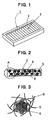
- Figs. 1 to 3 depict a filter for air cleaning according to an embodiment of the present invention.
- symbol 1 indicates a filter for air cleaning
- the filter for air cleaning 1 comprises a frame 2 and a filtrating material 3.
- the filter for air cleaning 1 is formed as a filter for air cleaning used for an air conditioning system for vehicles.
- the filtrating material 3 is formed in a wavy shape.
- filtrating material 3 has a base material 4 made of a nonwoven fabric, and to the base material 4, activated carbon 5 provided as an adsorbent and graft copolymer 6 are fixed by a binder.
- the nonwoven fabric forming the base material 4 is formed by short fibers 8.
- Such a filtrating material 3 can be easily produced by a chemical bonding method as shown in Fig. 4 or 5.
- the amount of activated carbon 5 is set in a range of 10 g/m 2 to 300 g/m 2
- the content of graft copolymer 6 is set in a range of 1 wt% to 40 wt% relative to the activated carbon 5.
- a graft copolymer prepared by polymerizing a functional group of H 2 NCH 2 CH 2 NH 2 to a base polymer of the copolymer as a side chain of the graft copolymer, is used.
- this functional group for example, formaldehyde (HCHO) is decomposed as shown in the following reaction formula.
- R(CH 2 CH 2 NH 2 )-N CH 2 + H 2 O
- R indicates a base polymer which becomes a main component of the copolymer.
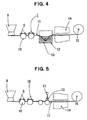
- Fig. 4 shows an apparatus used for producing the filtrating material 3 by a chemical bonding method (soaking method).
- a production apparatus 7 includes a supply means 9 for supplying short fibers 8 (in this embodiment, the length of the short fibers is 6 mm or less).
- Short fibers 8 containing activated carbon 5 are supplied from the supply means 9 to a carding machine 10, and at the carding machine 10, a fleece 11 of the short fibers 8 mixed with the activated carbon 5 is formed.
- the content of activated carbon 5 is set so as to become a content in a range of 10 g/m 2 to 300 g/m 2 in a completed filtrating material 3.
- the fleece 11 is soaked into a binder containing graft copolymer 13 which is prepared by containing a graft copolymer in a binder and which is stored in a binder bath 12, and thereafter, it is treated by a heating/drying means 14, and the dried fleece is wound by a winding roller 15 as a roll of the nonwoven fabric for forming the filtrating material 3.
- the content of graft copolymer 6 contained in the graft copolymer containing binder 13 is set so as to become a content in a range of 1 wt% to 40 wt% relative to the amount of activated carbon 5.
- Fig. 5 shows an apparatus used for producing the filtrating material 3 by a chemical bonding method (spraying method).
- a production apparatus 16 includes a supply means 9 for supplying short fibers 8 (in this embodiment, the length of the short fibers is 6 mm or less).
- Short fibers 8 containing activated carbon 5 are supplied from the supply means 9 to a carding machine 10, and at the carding machine 10, a fleece 11 of the short fibers 8 mixed with the activated carbon 5 is formed.
- the content of activated carbon 5 is set so as to become a content in a range of 10 g/m 2 to 300 g/m 2 in a completed filtrating material 3.
- a graft copolymer containing binder 13 which is prepared by containing a graft copolymer in a binder, is applied to the fleece 11 by a binder spraying means 17, the fleece 11 is treated by a heating/drying means 14, and the dried fleece is wound by a winding roller 15 as a roll of the nonwoven fabric for forming the filtrating material 3.
- the content of graft copolymer 6 contained in the graft copolymer containing binder 13 is set so as to become a content in a range of 1 wt% to 40 wt% relative to the amount of activated carbon 5.
- the content of graft copolymer 6 is in a range of 1 wt% to 40 wt% relative to the amount of activated carbon 5 provided as an adsorbent and the activated carbon 5 and the graft copolymer 6 are compounded at a good balance, ammonia and aldehyde-group compounds in the air can be decomposed and removed sufficiently, and at the same time, hydrocarbon compounds can be adsorbed and removed sufficiently.
- the amount of activated carbon 5 provided as an adsorbent is in a range of 10 g/m 2 to 300 g/m 2 and it is an adequate amount, the activated carbon 5 substantially does not cause a reduction of treatment ability for ammonia and aldehyde-group compounds and an increase of pressure loss.
- acrylic-group emulsion type binder (“Boncoat” AB-901, produced by Dainippon Ink Corporation) was used as the binder to be contained with the graft copolymer.
- Activated carbon (particle diameter: 50 ⁇ m) was mixed with short fibers (fiber length: 6 mm or less) prepared for forming a nonwoven fabric as a base material of a filtrating material so that the amount of the activated carbon became 75 g/m 2 in the filtrating material, a filtrating material having a thickness of 0.5 to 2.0 mm was made by the chemical bonding method (soaking method) using the graft copolymer containing binder so that the content of the graft copolymer became 0.5 wt% relative to the amount of the activated carbon, and a filter for air cleaning was manufactured using this filtrating material.
- a filter for air cleaning was manufactured using a filtrating material in a manner similar to than in Example 1 other than a condition where the content of the graft copolymer was set at 1.0 wt% relative to the amount of the activated carbon.
- a filter for air cleaning was manufactured using a filtrating material in a manner similar to than in Example 1 other than a condition where the content of the graft copolymer was set at 10 wt% relative to the amount of the activated carbon.
- a filter for air cleaning was manufactured using a filtrating material in a manner similar to than in Example 1 other than a condition where the content of the graft copolymer was set at 20 wt% relative to the amount of the activated carbon.
- a filter for air cleaning was manufactured using a filtrating material in a manner similar to than in Example 1 other than a condition where the content of the graft copolymer was set at 40 wt% relative to the amount of the activated carbon.
- a filter for air cleaning was manufactured using a filtrating material in a manner similar to than in Example 1 other than a condition where the content of the graft copolymer was set at 60 wt% relative to the amount of the activated carbon.
- Activated carbon (particle diameter: 50 ⁇ m) was mixed with short fibers (fiber length: 6 mm or less) prepared for forming a nonwoven fabric as a base material of a filtrating material so that the amount of the activated carbon became 75 g/m 2 in the filtrating material, a filtrating material having a thickness of 0.5 to 2.0 mm was made by the chemical bonding method (soaking method) without containing a graft copolymer, and a filter for air cleaning was manufactured using this filtrating material.
- Activated carbon (particle diameter: 50 ⁇ m) was mixed with short fibers (fiber length: 6 mm or less) prepared for forming a nonwoven fabric as a base material of a filtrating material so that the amount of the activated carbon became 65 g/m 2 in the filtrating material, a filtrating material A having a thickness of 0.5 to 2.0 mm was made by the chemical bonding method (soaking method).
- a filtrating material B was made by directly graft treating a nonwoven fabric having a thickness of 0.5 to 2.0 mm and containing a graft copolymer in the filtrating material at a content of 15 wt% relative to the amount of activated carbon contained in the filtrating material A.
- the filtrating material A and the filtrating material B were laminated to manufacture a filter for air cleaning.
- Table 1 shows the contents of graft copolymer, the decomposed amounts of formaldehyde (HOCHO), the contents of activated carbon and the results of evaluation in Examples 1 to 6 and Comparative Examples 1 and 2.
- a case remarkably excellent in decomposed amount of formaldehyde as compared with the conventional filter for air cleaning was ranked as ⁇
- a case slightly excellent was ranked as ⁇
- a case equal to the conventional filter was ranked as ⁇ .
Landscapes
- Chemical & Material Sciences (AREA)
- Chemical Kinetics & Catalysis (AREA)
- Geology (AREA)
- Life Sciences & Earth Sciences (AREA)
- Engineering & Computer Science (AREA)
- General Chemical & Material Sciences (AREA)
- Oil, Petroleum & Natural Gas (AREA)
- Analytical Chemistry (AREA)
- Materials Engineering (AREA)
- Ceramic Engineering (AREA)
- Inorganic Chemistry (AREA)
- Filtering Materials (AREA)
- Solid-Sorbent Or Filter-Aiding Compositions (AREA)
- Disinfection, Sterilisation Or Deodorisation Of Air (AREA)
- Separation Of Gases By Adsorption (AREA)
Abstract
Description
- The present invention relates to a filter for air cleaning which adsorbs suspended substances in atmosphere such as a volatile organic compound (hereinafter, also referred to as "VOC") suspended in atmosphere and a method for manufacturing the same, and specifically, to a filter for air cleaning suitable for use in an air conditioning system for vehicles and a method for manufacturing the same.
- Recently, in the industrial field for vehicles, a requirement for improving the comfortableness in a vehicle interior has been increased, and for example, the attachment of a filter for air cleaning to an air conditioning system for a vehicle has been promoted for removing VOC and the like suspended in atmosphere.
- In such a filter for air cleaning incorporated into an air conditioning system for vehicles, in a case where air is cleaned by adsorbing gas components in atmosphere such as tobacco smelt gas component or automotive exhaust gas component, a filter for air cleaning provided with activated carbon as an adsorbent is generally used. However, such a filter for air cleaning using activated carbon as an adsorbent exhibits an excellent adsorbability for hydrocarbon compounds, but its adsorbability for aldehyde groups, ammonia, etc. is low. Therefore, in order to effectively adsorb and remove aldehyde groups, ammonia, etc., for example, a filter for air cleaning using another adsorbent except activated carbon is used, or a filter for air cleaning is structured by compounding a material exhibiting an excellent cleaning ability for aldehyde groups, ammonia, etc. with activated carbon.
- As the filter using an adsorbent except activated carbon, a filter is proposed in
JP-A-5-111607 - Therefore, an air filter device is proposed in
JP-A-10-230118 JP-A-2001-145816 - Accordingly, it would be desirable to provide a high-performance filter for air cleaning which can effectively remove hydrocarbon compounds and ammonia, aldehyde group compounds, etc. in atmosphere simultaneously by a single filter formation, and a method for manufacturing the same.
- A filter for air cleaning according to the present invention comprises a filtrating material in which an adsorbent is fixed to a base material by a binder, and is characterized in that a graft copolymer is contained in the binder. In such a structure, because the graft copolymer is contained in the binder, it can be fixed, for example, at the time of forming the base material, and therefore, a filtrating material having both of the adsorbent and the graft copolymer can be easily obtained. Therefore, by forming the filter for air cleaning using this filtrating material, the filter can decompose ammonia and aldehyde groups in the air to be treated by the graft copolymer. On the other hand, hydrocarbon compounds in the air to be treated can be adsorbed to, for example, activated carbon used as the adsorbent. Therefore, ammonia, aldehyde groups, etc. and hydrocarbon compounds can be both removed simultaneously, and a high-performance filter for air cleaning capable of surely cleaning air can be realized.
- Where, as the adsorbent, except activated carbon, activated carbon fibers, zeolite, activated clay, sepiolite, alumina, silica gel, alumina-silica, etc. can be used. Activated carbon is most preferable from the viewpoints of its performance, easiness of availability on the market, variety on selection, stability in material quality, safety, cost, etc.
- Further, as the binder, acrylic-group emulsion type binder such as one containing acrylic ester or methacrylic ester, rubber-group latex type binder such as one containing SBR (styrene-butadiene rubber) or chloroprene rubber, and other type binders such as urethane-group binder can be used.
- Further, in a method for manufacturing a filter for air cleaning according to the present invention, the filter comprises a filtrating material formed by fixing an adsorbent to a base material by a binder, and the method is characterized in that, after a graft copolymer is contained in the binder, the adsorbent is fixed to the base material using the binder containing the graft copolymer.
- The content of the above-described graft copolymer is preferably in a range of 1 wt% to 40 wt% relative to the adsorbent. If the content is less than 1 wt%, there is a fear that ammonia and aldehyde groups in the air to be treated can not be decomposed and removed enough. If the content is more than 40 wt%, because the content of the adsorbent such as activated carbon decreases relatively, there is a fear that hydrocarbon compounds in the air to be treated can not be adsorbed enough.
- The amount of the adsorbent fixed to the base material is preferably in a range of 10 g/m2 to 300 g/m2. If the amount is less than 10 g/m2, there is a fear that the removal of hydrocarbon compounds adsorbed by the adsorbent becomes insufficient. On the other hand, if the amount is more than 300 g/m2, because the amount of the graft copolymer decreases relatively, there is a fear causing a reduction of the treatment ability for ammonia and aldehyde groups and an increase of pressure loss.
- Although the adsorbent is not particularly limited as long as it has an absorbability for hydrocarbon compounds, as the adsorbent, for example, a nonwoven fabric, a woven fabric, a foamed material, etc. can be raised, and in particular, a nonwoven fabric is preferably employed.
- The nonwoven fabric may be produced by chemical bonding. For the production of the filter, for example, a method wherein the activated carbon provided as the adsorbent is fixed to the nonwoven fabric provided as the base material via a step of soaking a fleece mixed with the activated carbon into the binder containing the graft copolymer, or a method wherein the activated carbon provided as the adsorbent is fixed to the nonwoven fabric provided as the base material via a step of applying the binder containing the graft copolymer to a fleece mixed with the activated carbon, may be employed.
- The filtrating material used for the filter for air cleaning according to the present invention is preferably formed, for example, in a wavy shape. In such a structure, because the surface area of the filter can be ensured wide, the air cleaning performance of the filter may be increased.
- In the filter for air cleaning according to the present invention, it is preferred that the graft copolymer is prepared by polymerizing a functional group of H2NCH2CH2NH2 to a base polymer as a side chain of the graft copolymer. By such a functional group, for example, formaldehyde (HCHO) is decomposed as follows.
R(CH2CH2NH2)-NH2 + HCHO → R(CH2CH2NH2)-N=CH2 + H2O
Where, R indicates a base polymer. - The filter for air cleaning according to the present invention may be used as a filter for air cleaning for air conditioning units installed in houses, factories, etc., and in particular, it is suitable as a filter for air cleaning used for an air conditioning system for vehicles.
- Thus, in the filter for air cleaning according to the present invention, since all of hydrocarbon compounds, ammonia and aldehyde-group compounds can be effectively removed by a single filter, air to be treated can be cleaned very efficiently.
- Further features and advantages of the present invention will be understood from the following detailed description of the preferred embodiments of the present invention with reference to the accompanying figures, of which:
- Fig. 1 is a perspective view of a filter for air cleaning according to an embodiment of the present invention.
- Fig. 2 is an enlarged cross-sectional view of the filter depicted in Fig. 1.
- Fig. 3 is an enlarged sectional view of a portion A of the filter depicted in Fig. 2.
- Fig. 4 is a schematic view of an apparatus used for manufacturing a filter for air cleaning according to an embodiment of the present invention by a chemical bonding method (soaking method).
- Fig. 5 is a schematic view of an apparatus used for manufacturing a filter for air cleaning according to an embodiment of the present invention by a chemical bonding method (spraying method).
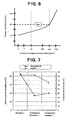
- Fig. 6 is a diagram showing the relationship between an amount of charged activated carbon and a pressure loss of a filtrating material.
- Fig. 7 is a comparison diagram showing the removal rates of formaldehyde and toluene in Example 3 and Comparative Examples 1 and 2.
- Hereinafter, the desirable embodiments of the filter for air cleaning and the method for manufacturing it according to the present invention will be explained referring to figures.
- Figs. 1 to 3 depict a filter for air cleaning according to an embodiment of the present invention. In Fig. 1,
symbol 1 indicates a filter for air cleaning, and the filter forair cleaning 1 comprises aframe 2 and a filtratingmaterial 3. In this embodiment, the filter forair cleaning 1 is formed as a filter for air cleaning used for an air conditioning system for vehicles. The filtratingmaterial 3 is formed in a wavy shape. - As shown in Figs. 2 and 3, filtrating
material 3 has abase material 4 made of a nonwoven fabric, and to thebase material 4, activatedcarbon 5 provided as an adsorbent andgraft copolymer 6 are fixed by a binder. In this embodiment, the nonwoven fabric forming thebase material 4 is formed byshort fibers 8. Such a filtratingmaterial 3 can be easily produced by a chemical bonding method as shown in Fig. 4 or 5. In this filtratingmaterial 3, the amount of activatedcarbon 5 is set in a range of 10 g/m2 to 300 g/m2, and the content ofgraft copolymer 6 is set in a range of 1 wt% to 40 wt% relative to the activatedcarbon 5. - In this embodiment, as the
graft copolymer 6, a graft copolymer, prepared by polymerizing a functional group of H2NCH2CH2NH2 to a base polymer of the copolymer as a side chain of the graft copolymer, is used. By this functional group, for example, formaldehyde (HCHO) is decomposed as shown in the following reaction formula.
R(CH2CH2NH2)-NH2 + HCHO → R(CH2CH2NH2)-N=CH2 + H2O
Where, R indicates a base polymer which becomes a main component of the copolymer. - Fig. 4 shows an apparatus used for producing the filtrating
material 3 by a chemical bonding method (soaking method). In Fig. 4, aproduction apparatus 7 includes a supply means 9 for supplying short fibers 8 (in this embodiment, the length of the short fibers is 6 mm or less).Short fibers 8 containing activated carbon 5 (particle diameter: for example, 50µm) are supplied from the supply means 9 to acarding machine 10, and at thecarding machine 10, afleece 11 of theshort fibers 8 mixed with the activatedcarbon 5 is formed. Where, the content of activatedcarbon 5 is set so as to become a content in a range of 10 g/m2 to 300 g/m2 in a completed filtratingmaterial 3. Thefleece 11 is soaked into a binder containinggraft copolymer 13 which is prepared by containing a graft copolymer in a binder and which is stored in abinder bath 12, and thereafter, it is treated by a heating/drying means 14, and the dried fleece is wound by awinding roller 15 as a roll of the nonwoven fabric for forming the filtratingmaterial 3. In this process, the content ofgraft copolymer 6 contained in the graftcopolymer containing binder 13 is set so as to become a content in a range of 1 wt% to 40 wt% relative to the amount of activatedcarbon 5. - Fig. 5 shows an apparatus used for producing the
filtrating material 3 by a chemical bonding method (spraying method). In Fig. 5, aproduction apparatus 16 includes a supply means 9 for supplying short fibers 8 (in this embodiment, the length of the short fibers is 6 mm or less).Short fibers 8 containing activated carbon 5 (particle diameter: for example, 50µm) are supplied from the supply means 9 to a cardingmachine 10, and at the cardingmachine 10, afleece 11 of theshort fibers 8 mixed with the activatedcarbon 5 is formed. Where, the content of activatedcarbon 5 is set so as to become a content in a range of 10 g/m2 to 300 g/m2 in a completedfiltrating material 3. After a graftcopolymer containing binder 13, which is prepared by containing a graft copolymer in a binder, is applied to thefleece 11 by a binder spraying means 17, thefleece 11 is treated by a heating/drying means 14, and the dried fleece is wound by a windingroller 15 as a roll of the nonwoven fabric for forming thefiltrating material 3. Also in this process, the content ofgraft copolymer 6 contained in the graftcopolymer containing binder 13 is set so as to become a content in a range of 1 wt% to 40 wt% relative to the amount of activatedcarbon 5. - In the above-described embodiment, because the
graft copolymer 6 is contained in the graftcopolymer containing binder 13, afiltrating material 3 having both of activatedcarbon 5 and thegraft copolymer 6 is obtained. Therefore, in the filter using thisfiltrating material 3, ammonia and aldehyde-group compounds contained in the air to be treated are decomposed by thegraft copolymer 6, and hydrocarbon compounds contained in the air is adsorbed by the activatedcarbon 5 provided as an adsorbent. As a result, both of ammonia, aldehyde-group compounds, etc. and hydrocarbon compounds can be removed by a single filter, and a high-performance filter capable of cleaning air surely and efficiently can be realized. - Further, in the embodiment, because the content of
graft copolymer 6 is in a range of 1 wt% to 40 wt% relative to the amount of activatedcarbon 5 provided as an adsorbent and the activatedcarbon 5 and thegraft copolymer 6 are compounded at a good balance, ammonia and aldehyde-group compounds in the air can be decomposed and removed sufficiently, and at the same time, hydrocarbon compounds can be adsorbed and removed sufficiently. Furthermore, because the amount of activatedcarbon 5 provided as an adsorbent is in a range of 10 g/m2 to 300 g/m2 and it is an adequate amount, the activatedcarbon 5 substantially does not cause a reduction of treatment ability for ammonia and aldehyde-group compounds and an increase of pressure loss. - Hereinafter, the present invention will be explained referring examples and comparative examples. In these examples, acrylic-group emulsion type binder ("Boncoat" AB-901, produced by Dainippon Ink Corporation) was used as the binder to be contained with the graft copolymer.
- Activated carbon (particle diameter: 50µm) was mixed with short fibers (fiber length: 6 mm or less) prepared for forming a nonwoven fabric as a base material of a filtrating material so that the amount of the activated carbon became 75 g/m2 in the filtrating material, a filtrating material having a thickness of 0.5 to 2.0 mm was made by the chemical bonding method (soaking method) using the graft copolymer containing binder so that the content of the graft copolymer became 0.5 wt% relative to the amount of the activated carbon, and a filter for air cleaning was manufactured using this filtrating material.
- A filter for air cleaning was manufactured using a filtrating material in a manner similar to than in Example 1 other than a condition where the content of the graft copolymer was set at 1.0 wt% relative to the amount of the activated carbon.
- A filter for air cleaning was manufactured using a filtrating material in a manner similar to than in Example 1 other than a condition where the content of the graft copolymer was set at 10 wt% relative to the amount of the activated carbon.
- A filter for air cleaning was manufactured using a filtrating material in a manner similar to than in Example 1 other than a condition where the content of the graft copolymer was set at 20 wt% relative to the amount of the activated carbon.
- A filter for air cleaning was manufactured using a filtrating material in a manner similar to than in Example 1 other than a condition where the content of the graft copolymer was set at 40 wt% relative to the amount of the activated carbon.
- A filter for air cleaning was manufactured using a filtrating material in a manner similar to than in Example 1 other than a condition where the content of the graft copolymer was set at 60 wt% relative to the amount of the activated carbon.
- Activated carbon (particle diameter: 50µm) was mixed with short fibers (fiber length: 6 mm or less) prepared for forming a nonwoven fabric as a base material of a filtrating material so that the amount of the activated carbon became 75 g/m2 in the filtrating material, a filtrating material having a thickness of 0.5 to 2.0 mm was made by the chemical bonding method (soaking method) without containing a graft copolymer, and a filter for air cleaning was manufactured using this filtrating material.
- Activated carbon (particle diameter: 50µm) was mixed with short fibers (fiber length: 6 mm or less) prepared for forming a nonwoven fabric as a base material of a filtrating material so that the amount of the activated carbon became 65 g/m2 in the filtrating material, a filtrating material A having a thickness of 0.5 to 2.0 mm was made by the chemical bonding method (soaking method). On the other hand, a filtrating material B was made by directly graft treating a nonwoven fabric having a thickness of 0.5 to 2.0 mm and containing a graft copolymer in the filtrating material at a content of 15 wt% relative to the amount of activated carbon contained in the filtrating material A. The filtrating material A and the filtrating material B were laminated to manufacture a filter for air cleaning.
- Table 1 shows the contents of graft copolymer, the decomposed amounts of formaldehyde (HOCHO), the contents of activated carbon and the results of evaluation in Examples 1 to 6 and Comparative Examples 1 and 2. In the evaluation, a case remarkably excellent in decomposed amount of formaldehyde as compared with the conventional filter for air cleaning was ranked as ○, a case slightly excellent was ranked as Δ, and a case equal to the conventional filter was ranked as ×.
- Further, change of pressure loss at an air velocity of 3 m/s of the filtrating material, when the amount of the charged activated carbon in Example 3 was changed, is shown in Fig. 6. Furthermore, comparison of the removal rates of formaldehyde and toluene between Example 3 and Comparative Examples 1 and 2 is shown in Fig. 7.

Claims (19)
- A filter for air cleaning comprising a filtrating material in which an adsorbent is fixed to a base material by a binder, characterized in that a graft copolymer is contained in said binder.
- The filter for air cleaning according to claim 1, wherein said graft copolymer is contained in said binder at a content in a range of 1 wt% to 40 wt% relative to said adsorbent.
- The filter for air cleaning according to claim 1 or 2, wherein said adsorbent is fixed to said base material at an amount in a range of 10 g/m2 to 300 g/m2.
- The filter for air cleaning according to any preceding claim, wherein said adsorbent is an activated carbon.
- The filter for air cleaning according to any preceding claim, wherein said base material is a nonwoven fabric.
- The filter for air cleaning according to claim 5, wherein said nonwoven fabric is produced by chemical bonding.
- The filter for air cleaning according to any preceding claim, wherein said filtrating material is formed in a wavy shape.
- The filter for air cleaning according to any preceding claim, wherein said graft copolymer contains H2NCH2CH2NH2 group as a side chain of said graft copolymer.
- The filter for air cleaning according to any preceding claim, wherein said filter is a filter for air cleaning used for an air conditioning system for vehicles.
- A method for manufacturing a filter for air cleaning which comprises a filtrating material formed by fixing an adsorbent to a base material by a binder, characterized in that, after a graft copolymer is contained in said binder, said adsorbent is fixed to said base material using said binder containing said graft copolymer.
- The method for manufacturing a filter for air cleaning according to claim 10, wherein said graft copolymer is contained in said binder at a content in a range of 1 wt% to 40 wt% relative to said adsorbent.
- The method for manufacturing a filter for air cleaning according to claim 10 or 11, wherein said adsorbent is fixed to said base material at an amount in a range of 10 g/m2 to 300 g/m2.
- The method for manufacturing a filter for air cleaning according to any of claims 10 to 12, wherein said adsorbent is an activated carbon.
- The method for manufacturing a filter for air cleaning according to any of claims 10 to 13, wherein said base material is a nonwoven fabric.
- The method for manufacturing a filter for air cleaning according to claim 14, wherein an activated carbon provided as said adsorbent is fixed to said nonwoven fabric provided as said base material via a step of soaking a fleece mixed with said activated carbon into said binder containing said graft copolymer.
- The method for manufacturing a filter for air cleaning according to claim 14, wherein an activated carbon provided as said adsorbent is fixed to said nonwoven fabric provided as said base material via a step of applying said binder containing said graft copolymer to a fleece mixed with said activated carbon.
- The method for manufacturing a filter for air cleaning according to any of claims 10 to 16, wherein said filtrating material is formed in a wavy shape.
- The method for manufacturing a filter for air cleaning according to any of claims 10 to 17, wherein H2NCH2CH2NH2 group is provided to said graft copolymer as a side chain of said graft copolymer.
- The method for manufacturing a filter for air cleaning according to any of claims 10 to 18, wherein said filter is a filter for air cleaning used for an air conditioning system for vehicles.
Applications Claiming Priority (1)
| Application Number | Priority Date | Filing Date | Title |
|---|---|---|---|
| JP2005293671A JP4828198B2 (en) | 2005-10-06 | 2005-10-06 | Air purification filter and manufacturing method thereof |
Publications (2)
| Publication Number | Publication Date |
|---|---|
| EP1772181A1 true EP1772181A1 (en) | 2007-04-11 |
| EP1772181B1 EP1772181B1 (en) | 2010-02-03 |
Family
ID=37402509
Family Applications (1)
| Application Number | Title | Priority Date | Filing Date |
|---|---|---|---|
| EP06019902A Not-in-force EP1772181B1 (en) | 2005-10-06 | 2006-09-22 | Filter for air cleaning and method for manufacturing the same |
Country Status (5)
| Country | Link |
|---|---|
| EP (1) | EP1772181B1 (en) |
| JP (1) | JP4828198B2 (en) |
| CN (1) | CN1958123A (en) |
| AT (1) | ATE456974T1 (en) |
| DE (1) | DE602006012107D1 (en) |
Cited By (1)
| Publication number | Priority date | Publication date | Assignee | Title |
|---|---|---|---|---|
| WO2013165992A1 (en) * | 2012-05-04 | 2013-11-07 | Ticona Llc | Gas phase air filtration |
Families Citing this family (6)
| Publication number | Priority date | Publication date | Assignee | Title |
|---|---|---|---|---|
| CN101808709B (en) * | 2007-09-28 | 2013-05-08 | 东丽株式会社 | Filter element and filter unit |
| CN102350299B (en) * | 2011-07-20 | 2014-12-10 | 湖南华杰宝灵海泡石科技有限公司 | Fabrication process for meerschaum air purifying agent |
| DE102013019327B4 (en) * | 2013-11-20 | 2023-06-01 | Mann+Hummel Gmbh | Filter element with filter bellows and use of the filter element |
| CN105522893A (en) | 2014-09-29 | 2016-04-27 | 福特环球技术公司 | VOC (Volatile Organic Compound) reduction system for vehicle |
| CN107921729A (en) * | 2015-07-09 | 2018-04-17 | 英格维蒂南卡罗来纳有限责任公司 | Gas storage system and methods of making and using the same |
| JP7139166B2 (en) * | 2018-06-28 | 2022-09-20 | 株式会社キャタラー | Sheet-shaped adsorbent and its manufacturing method |
Citations (6)
| Publication number | Priority date | Publication date | Assignee | Title |
|---|---|---|---|---|
| US5783608A (en) * | 1994-11-22 | 1998-07-21 | Ebara Corporation | Process for producing separation functional fibers and ion-exchange fibers produced therefrom |
| JPH10230118A (en) | 1997-02-18 | 1998-09-02 | Ebara Corp | Chemical filter |
| WO2000010687A1 (en) * | 1998-08-20 | 2000-03-02 | Extraction Systems, Inc. | Filters employing porous strongly acidic polymers |
| JP2001145816A (en) | 1999-11-19 | 2001-05-29 | Ebara Corp | Filter for purifying gas |
| WO2001085308A2 (en) * | 2000-05-05 | 2001-11-15 | Extraction Systems, Inc. | Filters employing both acidic polymers and physical-absorption media |
| EP1247558A1 (en) * | 2001-04-07 | 2002-10-09 | 3M Innovative Properties Company | A combination filter for filtering fluids |
Family Cites Families (6)
| Publication number | Priority date | Publication date | Assignee | Title |
|---|---|---|---|---|
| JPH0796659B2 (en) * | 1986-05-13 | 1995-10-18 | 大日精化工業株式会社 | Deodorizing paint and deodorizing sheet using the same |
| JPH1033981A (en) * | 1996-07-22 | 1998-02-10 | Mitsubishi Electric Corp | Activated carbon impregnated for removing low-concentration nitrogen oxides, its regeneration method, impregnated activated carbon filter for removing low-concentration nitrogen oxides, and air conditioner having a low-concentration nitrogen oxides removal function |
| JP3714453B2 (en) * | 1998-05-08 | 2005-11-09 | 東洋紡績株式会社 | Adsorbent sheet, method for producing the same, and filter for air purification |
| JP2003320209A (en) * | 2002-05-01 | 2003-11-11 | Mahle Tennex Corp | Deodorizing filter medium and deodorizing filter |
| JP4401670B2 (en) * | 2003-03-27 | 2010-01-20 | 大阪瓦斯株式会社 | Molded article for desulfurization and method for producing the same |
| DE112005002676T5 (en) * | 2004-10-27 | 2007-09-13 | Suminoe Textile Co., Ltd. | Fiber fabric with VOC removal function |
-
2005
- 2005-10-06 JP JP2005293671A patent/JP4828198B2/en not_active Expired - Fee Related
-
2006
- 2006-09-22 AT AT06019902T patent/ATE456974T1/en not_active IP Right Cessation
- 2006-09-22 DE DE602006012107T patent/DE602006012107D1/en active Active
- 2006-09-22 EP EP06019902A patent/EP1772181B1/en not_active Not-in-force
- 2006-09-29 CN CNA200610142179XA patent/CN1958123A/en active Pending
Patent Citations (6)
| Publication number | Priority date | Publication date | Assignee | Title |
|---|---|---|---|---|
| US5783608A (en) * | 1994-11-22 | 1998-07-21 | Ebara Corporation | Process for producing separation functional fibers and ion-exchange fibers produced therefrom |
| JPH10230118A (en) | 1997-02-18 | 1998-09-02 | Ebara Corp | Chemical filter |
| WO2000010687A1 (en) * | 1998-08-20 | 2000-03-02 | Extraction Systems, Inc. | Filters employing porous strongly acidic polymers |
| JP2001145816A (en) | 1999-11-19 | 2001-05-29 | Ebara Corp | Filter for purifying gas |
| WO2001085308A2 (en) * | 2000-05-05 | 2001-11-15 | Extraction Systems, Inc. | Filters employing both acidic polymers and physical-absorption media |
| EP1247558A1 (en) * | 2001-04-07 | 2002-10-09 | 3M Innovative Properties Company | A combination filter for filtering fluids |
Cited By (1)
| Publication number | Priority date | Publication date | Assignee | Title |
|---|---|---|---|---|
| WO2013165992A1 (en) * | 2012-05-04 | 2013-11-07 | Ticona Llc | Gas phase air filtration |
Also Published As
| Publication number | Publication date |
|---|---|
| JP4828198B2 (en) | 2011-11-30 |
| CN1958123A (en) | 2007-05-09 |
| EP1772181B1 (en) | 2010-02-03 |
| ATE456974T1 (en) | 2010-02-15 |
| JP2007097944A (en) | 2007-04-19 |
| DE602006012107D1 (en) | 2010-03-25 |
Similar Documents
| Publication | Publication Date | Title |
|---|---|---|
| DE60214197T2 (en) | ADSORPTION ELEMENT AND METHOD | |
| EP1374968B1 (en) | Filter element, method for manufacture thereof, and filter using said element | |
| KR101577840B1 (en) | Filter element and filter unit | |
| US5350443A (en) | Filter sheet material for passenger cabins in motor vehicles | |
| US4992319A (en) | Activated carbon supporting honeycomb structure and process for fabricating the same | |
| US20100018396A1 (en) | Method of Using Adsorptive Filter Element | |
| US20060243134A1 (en) | Air filter unit with several filter elements | |
| JPWO2003066193A1 (en) | Fluid cleaning filter and filter device | |
| EP1772181B1 (en) | Filter for air cleaning and method for manufacturing the same | |
| DE102018114351A1 (en) | filter media | |
| JP7188383B2 (en) | Gas adsorbent, deodorant fiber sheet, and method for producing gas adsorbent | |
| JPH05305213A (en) | Air purifying sheet and air purifying filter using the same | |
| CN113423485A (en) | Filter medium for depositing nitrogen oxides | |
| CN1247485A (en) | Filter media | |
| JP2018167155A (en) | Adsorbent | |
| JP2010063524A (en) | Air cleaner | |
| KR20000067428A (en) | Filter for internal combustion engine and its manufacturing method | |
| JP5001826B2 (en) | Gas adsorbent and gas adsorbing material | |
| WO1994020193A1 (en) | Gas purification system | |
| KR100705281B1 (en) | Stack and Insert Chemical Adsorption Filters | |
| JP2003103165A (en) | Chemical filter and regeneration method thereof | |
| JP2025528227A (en) | Filter media containing adsorbents | |
| JPWO1996008303A1 (en) | Deodorizing filter | |
| JP2008212828A (en) | Functional fiber sheet and method for producing the same | |
| JP2010022979A (en) | Gas adsorbent and gas adsorbing material |
Legal Events
| Date | Code | Title | Description |
|---|---|---|---|
| PUAI | Public reference made under article 153(3) epc to a published international application that has entered the european phase |
Free format text: ORIGINAL CODE: 0009012 |
|
| AK | Designated contracting states |
Kind code of ref document: A1 Designated state(s): AT BE BG CH CY CZ DE DK EE ES FI FR GB GR HU IE IS IT LI LT LU LV MC NL PL PT RO SE SI SK TR |
|
| AX | Request for extension of the european patent |
Extension state: AL BA HR MK YU |
|
| 17P | Request for examination filed |
Effective date: 20070914 |
|
| 17Q | First examination report despatched |
Effective date: 20071022 |
|
| AKX | Designation fees paid |
Designated state(s): AT BE BG CH CY CZ DE DK EE ES FI FR GB GR HU IE IS IT LI LT LU LV MC NL PL PT RO SE SI SK TR |
|
| GRAJ | Information related to disapproval of communication of intention to grant by the applicant or resumption of examination proceedings by the epo deleted |
Free format text: ORIGINAL CODE: EPIDOSDIGR1 |
|
| GRAP | Despatch of communication of intention to grant a patent |
Free format text: ORIGINAL CODE: EPIDOSNIGR1 |
|
| GRAP | Despatch of communication of intention to grant a patent |
Free format text: ORIGINAL CODE: EPIDOSNIGR1 |
|
| RAP1 | Party data changed (applicant data changed or rights of an application transferred) |
Owner name: SANDEN CORPORATION Owner name: GRAFTON LABORATORIES INC. |
|
| GRAS | Grant fee paid |
Free format text: ORIGINAL CODE: EPIDOSNIGR3 |
|
| GRAA | (expected) grant |
Free format text: ORIGINAL CODE: 0009210 |
|
| AK | Designated contracting states |
Kind code of ref document: B1 Designated state(s): AT BE BG CH CY CZ DE DK EE ES FI FR GB GR HU IE IS IT LI LT LU LV MC NL PL PT RO SE SI SK TR |
|
| REG | Reference to a national code |
Ref country code: GB Ref legal event code: FG4D |
|
| REG | Reference to a national code |
Ref country code: CH Ref legal event code: EP |
|
| REG | Reference to a national code |
Ref country code: IE Ref legal event code: FG4D |
|
| REF | Corresponds to: |
Ref document number: 602006012107 Country of ref document: DE Date of ref document: 20100325 Kind code of ref document: P |
|
| REG | Reference to a national code |
Ref country code: NL Ref legal event code: VDEP Effective date: 20100203 |
|
| LTIE | Lt: invalidation of european patent or patent extension |
Effective date: 20100203 |
|
| PG25 | Lapsed in a contracting state [announced via postgrant information from national office to epo] |
Ref country code: LT Free format text: LAPSE BECAUSE OF FAILURE TO SUBMIT A TRANSLATION OF THE DESCRIPTION OR TO PAY THE FEE WITHIN THE PRESCRIBED TIME-LIMIT Effective date: 20100203 Ref country code: PT Free format text: LAPSE BECAUSE OF FAILURE TO SUBMIT A TRANSLATION OF THE DESCRIPTION OR TO PAY THE FEE WITHIN THE PRESCRIBED TIME-LIMIT Effective date: 20100603 Ref country code: IS Free format text: LAPSE BECAUSE OF FAILURE TO SUBMIT A TRANSLATION OF THE DESCRIPTION OR TO PAY THE FEE WITHIN THE PRESCRIBED TIME-LIMIT Effective date: 20100603 Ref country code: ES Free format text: LAPSE BECAUSE OF FAILURE TO SUBMIT A TRANSLATION OF THE DESCRIPTION OR TO PAY THE FEE WITHIN THE PRESCRIBED TIME-LIMIT Effective date: 20100514 |
|
| PG25 | Lapsed in a contracting state [announced via postgrant information from national office to epo] |
Ref country code: FI Free format text: LAPSE BECAUSE OF FAILURE TO SUBMIT A TRANSLATION OF THE DESCRIPTION OR TO PAY THE FEE WITHIN THE PRESCRIBED TIME-LIMIT Effective date: 20100203 Ref country code: AT Free format text: LAPSE BECAUSE OF FAILURE TO SUBMIT A TRANSLATION OF THE DESCRIPTION OR TO PAY THE FEE WITHIN THE PRESCRIBED TIME-LIMIT Effective date: 20100203 Ref country code: PL Free format text: LAPSE BECAUSE OF FAILURE TO SUBMIT A TRANSLATION OF THE DESCRIPTION OR TO PAY THE FEE WITHIN THE PRESCRIBED TIME-LIMIT Effective date: 20100203 Ref country code: SI Free format text: LAPSE BECAUSE OF FAILURE TO SUBMIT A TRANSLATION OF THE DESCRIPTION OR TO PAY THE FEE WITHIN THE PRESCRIBED TIME-LIMIT Effective date: 20100203 Ref country code: LV Free format text: LAPSE BECAUSE OF FAILURE TO SUBMIT A TRANSLATION OF THE DESCRIPTION OR TO PAY THE FEE WITHIN THE PRESCRIBED TIME-LIMIT Effective date: 20100203 |
|
| PG25 | Lapsed in a contracting state [announced via postgrant information from national office to epo] |
Ref country code: GR Free format text: LAPSE BECAUSE OF FAILURE TO SUBMIT A TRANSLATION OF THE DESCRIPTION OR TO PAY THE FEE WITHIN THE PRESCRIBED TIME-LIMIT Effective date: 20100504 Ref country code: BE Free format text: LAPSE BECAUSE OF FAILURE TO SUBMIT A TRANSLATION OF THE DESCRIPTION OR TO PAY THE FEE WITHIN THE PRESCRIBED TIME-LIMIT Effective date: 20100203 Ref country code: CY Free format text: LAPSE BECAUSE OF FAILURE TO SUBMIT A TRANSLATION OF THE DESCRIPTION OR TO PAY THE FEE WITHIN THE PRESCRIBED TIME-LIMIT Effective date: 20100203 Ref country code: EE Free format text: LAPSE BECAUSE OF FAILURE TO SUBMIT A TRANSLATION OF THE DESCRIPTION OR TO PAY THE FEE WITHIN THE PRESCRIBED TIME-LIMIT Effective date: 20100203 Ref country code: NL Free format text: LAPSE BECAUSE OF FAILURE TO SUBMIT A TRANSLATION OF THE DESCRIPTION OR TO PAY THE FEE WITHIN THE PRESCRIBED TIME-LIMIT Effective date: 20100203 Ref country code: RO Free format text: LAPSE BECAUSE OF FAILURE TO SUBMIT A TRANSLATION OF THE DESCRIPTION OR TO PAY THE FEE WITHIN THE PRESCRIBED TIME-LIMIT Effective date: 20100203 Ref country code: SE Free format text: LAPSE BECAUSE OF FAILURE TO SUBMIT A TRANSLATION OF THE DESCRIPTION OR TO PAY THE FEE WITHIN THE PRESCRIBED TIME-LIMIT Effective date: 20100203 |
|
| PG25 | Lapsed in a contracting state [announced via postgrant information from national office to epo] |
Ref country code: CZ Free format text: LAPSE BECAUSE OF FAILURE TO SUBMIT A TRANSLATION OF THE DESCRIPTION OR TO PAY THE FEE WITHIN THE PRESCRIBED TIME-LIMIT Effective date: 20100203 Ref country code: BG Free format text: LAPSE BECAUSE OF FAILURE TO SUBMIT A TRANSLATION OF THE DESCRIPTION OR TO PAY THE FEE WITHIN THE PRESCRIBED TIME-LIMIT Effective date: 20100503 Ref country code: SK Free format text: LAPSE BECAUSE OF FAILURE TO SUBMIT A TRANSLATION OF THE DESCRIPTION OR TO PAY THE FEE WITHIN THE PRESCRIBED TIME-LIMIT Effective date: 20100203 |
|
| PGFP | Annual fee paid to national office [announced via postgrant information from national office to epo] |
Ref country code: FR Payment date: 20100921 Year of fee payment: 5 |
|
| PLBE | No opposition filed within time limit |
Free format text: ORIGINAL CODE: 0009261 |
|
| STAA | Information on the status of an ep patent application or granted ep patent |
Free format text: STATUS: NO OPPOSITION FILED WITHIN TIME LIMIT |
|
| 26N | No opposition filed |
Effective date: 20101104 |
|
| PG25 | Lapsed in a contracting state [announced via postgrant information from national office to epo] |
Ref country code: DK Free format text: LAPSE BECAUSE OF FAILURE TO SUBMIT A TRANSLATION OF THE DESCRIPTION OR TO PAY THE FEE WITHIN THE PRESCRIBED TIME-LIMIT Effective date: 20100203 |
|
| PGFP | Annual fee paid to national office [announced via postgrant information from national office to epo] |
Ref country code: DE Payment date: 20100915 Year of fee payment: 5 |
|
| PG25 | Lapsed in a contracting state [announced via postgrant information from national office to epo] |
Ref country code: IT Free format text: LAPSE BECAUSE OF FAILURE TO SUBMIT A TRANSLATION OF THE DESCRIPTION OR TO PAY THE FEE WITHIN THE PRESCRIBED TIME-LIMIT Effective date: 20100203 |
|
| PG25 | Lapsed in a contracting state [announced via postgrant information from national office to epo] |
Ref country code: MC Free format text: LAPSE BECAUSE OF NON-PAYMENT OF DUE FEES Effective date: 20100930 |
|
| REG | Reference to a national code |
Ref country code: CH Ref legal event code: PL |
|
| GBPC | Gb: european patent ceased through non-payment of renewal fee |
Effective date: 20100922 |
|
| PG25 | Lapsed in a contracting state [announced via postgrant information from national office to epo] |
Ref country code: LI Free format text: LAPSE BECAUSE OF NON-PAYMENT OF DUE FEES Effective date: 20100930 Ref country code: IE Free format text: LAPSE BECAUSE OF NON-PAYMENT OF DUE FEES Effective date: 20100922 Ref country code: CH Free format text: LAPSE BECAUSE OF NON-PAYMENT OF DUE FEES Effective date: 20100930 |
|
| PG25 | Lapsed in a contracting state [announced via postgrant information from national office to epo] |
Ref country code: GB Free format text: LAPSE BECAUSE OF NON-PAYMENT OF DUE FEES Effective date: 20100922 |
|
| REG | Reference to a national code |
Ref country code: FR Ref legal event code: ST Effective date: 20120531 |
|
| REG | Reference to a national code |
Ref country code: DE Ref legal event code: R119 Ref document number: 602006012107 Country of ref document: DE Effective date: 20120403 |
|
| PG25 | Lapsed in a contracting state [announced via postgrant information from national office to epo] |
Ref country code: DE Free format text: LAPSE BECAUSE OF NON-PAYMENT OF DUE FEES Effective date: 20120403 |
|
| PG25 | Lapsed in a contracting state [announced via postgrant information from national office to epo] |
Ref country code: FR Free format text: LAPSE BECAUSE OF NON-PAYMENT OF DUE FEES Effective date: 20110930 |
|
| PG25 | Lapsed in a contracting state [announced via postgrant information from national office to epo] |
Ref country code: LU Free format text: LAPSE BECAUSE OF NON-PAYMENT OF DUE FEES Effective date: 20100922 Ref country code: HU Free format text: LAPSE BECAUSE OF FAILURE TO SUBMIT A TRANSLATION OF THE DESCRIPTION OR TO PAY THE FEE WITHIN THE PRESCRIBED TIME-LIMIT Effective date: 20100804 |
|
| PG25 | Lapsed in a contracting state [announced via postgrant information from national office to epo] |
Ref country code: TR Free format text: LAPSE BECAUSE OF FAILURE TO SUBMIT A TRANSLATION OF THE DESCRIPTION OR TO PAY THE FEE WITHIN THE PRESCRIBED TIME-LIMIT Effective date: 20100203 |