EP1771145B1 - Mittel zum gleichzeitigen Färben und Aufhellen von keratinhaltigen Fasern - Google Patents
Mittel zum gleichzeitigen Färben und Aufhellen von keratinhaltigen Fasern Download PDFInfo
- Publication number
- EP1771145B1 EP1771145B1 EP05746460A EP05746460A EP1771145B1 EP 1771145 B1 EP1771145 B1 EP 1771145B1 EP 05746460 A EP05746460 A EP 05746460A EP 05746460 A EP05746460 A EP 05746460A EP 1771145 B1 EP1771145 B1 EP 1771145B1
- Authority
- EP
- European Patent Office
- Prior art keywords
- carbonic acid
- acid mono
- bis
- amino
- agent
- Prior art date
- Legal status (The legal status is an assumption and is not a legal conclusion. Google has not performed a legal analysis and makes no representation as to the accuracy of the status listed.)
- Expired - Lifetime
Links
- 0 Cc(cc1C)c(*)c(N)c1N Chemical compound Cc(cc1C)c(*)c(N)c1N 0.000 description 2
Classifications
-
- A—HUMAN NECESSITIES
- A61—MEDICAL OR VETERINARY SCIENCE; HYGIENE
- A61K—PREPARATIONS FOR MEDICAL, DENTAL OR TOILETRY PURPOSES
- A61K8/00—Cosmetics or similar toiletry preparations
- A61K8/18—Cosmetics or similar toiletry preparations characterised by the composition
- A61K8/30—Cosmetics or similar toiletry preparations characterised by the composition containing organic compounds
- A61K8/33—Cosmetics or similar toiletry preparations characterised by the composition containing organic compounds containing oxygen
- A61K8/37—Esters of carboxylic acids
-
- A—HUMAN NECESSITIES
- A61—MEDICAL OR VETERINARY SCIENCE; HYGIENE
- A61K—PREPARATIONS FOR MEDICAL, DENTAL OR TOILETRY PURPOSES
- A61K8/00—Cosmetics or similar toiletry preparations
- A61K8/18—Cosmetics or similar toiletry preparations characterised by the composition
- A61K8/19—Cosmetics or similar toiletry preparations characterised by the composition containing inorganic ingredients
- A61K8/22—Peroxides; Oxygen; Ozone
-
- A—HUMAN NECESSITIES
- A61—MEDICAL OR VETERINARY SCIENCE; HYGIENE
- A61K—PREPARATIONS FOR MEDICAL, DENTAL OR TOILETRY PURPOSES
- A61K8/00—Cosmetics or similar toiletry preparations
- A61K8/18—Cosmetics or similar toiletry preparations characterised by the composition
- A61K8/30—Cosmetics or similar toiletry preparations characterised by the composition containing organic compounds
- A61K8/40—Cosmetics or similar toiletry preparations characterised by the composition containing organic compounds containing nitrogen
- A61K8/42—Amides
-
- A—HUMAN NECESSITIES
- A61—MEDICAL OR VETERINARY SCIENCE; HYGIENE
- A61Q—SPECIFIC USE OF COSMETICS OR SIMILAR TOILETRY PREPARATIONS
- A61Q5/00—Preparations for care of the hair
- A61Q5/08—Preparations for bleaching the hair
-
- A—HUMAN NECESSITIES
- A61—MEDICAL OR VETERINARY SCIENCE; HYGIENE
- A61Q—SPECIFIC USE OF COSMETICS OR SIMILAR TOILETRY PREPARATIONS
- A61Q5/00—Preparations for care of the hair
- A61Q5/10—Preparations for permanently dyeing the hair
Definitions
- the present invention relates to a novel means for the simultaneous dyeing and whitening of keratin-containing fibers, in particular human hair dyes based on substantive dyes and / or oxidation dye precursors, which compared to conventional hair dyes both a more brilliant coloring and a better lightening of the hair causes ,
- Coupler and developer components are also referred to as oxidation dye precursors.
- developer components are usually primary aromatic amines with another, located in the para or ortho position free or substituted hydroxy or amino group, diaminopyridine derivatives, heterocyclic hydrazones, 4-aminopyrazolone derivatives and 2,4,5,6-tetraaminopyrimidine and its derivatives used.
- representatives include, for example, p-phenylenediamine, p-toluenediamine, 2,4,5,6-tetraaminopyrimidine, p-aminophenol, N, N-bis (2-hydroxyethyl) -p-phenylenediamine, 2- (2,5-diaminophenyl ) -ethanol, 2- (2,5-diaminophenoxy) ethanol, 1-phenyl-3-carboxyamido-4-amino-pyrazol-5-one, 4-amino-3-methylphenol, 2-aminomethyl-4-aminophenol, 2-hydroxymethyl-4-aminophenol, 2-hydroxy-4,5,6-triaminopyrimidine, 2,4-dihydroxy-5,6-diaminopyrimidine and 2,5,6-triamino-4-hydroxypyrimidine.
- m-phenylenediamine derivatives naphthols, resorcinol and resorcinol derivatives, pyrazolones, m-aminophenols and substituted pyridine derivatives are generally used.
- Suitable coupler substances are in particular ⁇ -naphthol, 1,5-, 2,7- and 1,7-dihydroxynaphthalene, 5-amino-2-methylphenol, m-aminophenol, resorcinol, resorcinol monomethyl ether, m-phenylenediamine, 2,4-diaminophenoxyethanol , 2-amino-4- (2-hydroxyethylamino) -anisole (Lehmann's Blue), 1-phenyl-3-methyl-pyrazol-5-one, 2,4-dichloro-3-aminophenol, 1,3-bis ( 2,4-diaminophenoxy) -propane, 2-chlororesorcinol, 4-chlororesorcinol, 2-chloro-6-methyl-3-aminophenol, 2-methylresorcinol, 5-methylresorcinol, 3-amino-6-methoxy-2-methylamino-pyridine and 3,5-diamino-2,6-dimethoxy
- dyeing or tinting agents which contain so-called direct drawers as a coloring component. These are dye molecules that grow directly on the hair and do not require an oxidative process to form the color. These dyes include, for example, the henna already known from antiquity for coloring body and hair. These dyeings are generally much more sensitive to shampooing than the oxidative dyeings, so that a much more undesirable nuance shift or even a visible "discoloration" occurs much more quickly.
- hair dyes Prior to their application to human hair, hair dyes are mixed with oxidation dye precursors with dilute aqueous hydrogen peroxide solution.
- the duration of exposure to the hair to achieve complete coloration is between about 30 and 40 minutes. It is obvious that there is a need among users of these hair dyes to reduce this exposure time.
- Means for the simultaneous dyeing and lightening of keratin-containing fibers are known from DE 43 31 136 A1 known.
- the disclosed therein agents contain at least one developing agent and at least one coupler substance and at least one ammonium compound selected from the group consisting of ammonium chloride, ammonium sulfate, ammonium carbonate, ammonium bicarbonate and ammonium carbamate, and, after mixing with an oxidizing agent, in the ready-to-use mixture has a pH between 8 and 11.
- WO-A-00/30596 discloses bleaching preparations for hair containing dyes, peroxo compounds and as a solvent prepylene carbonate.
- a first object of the present invention is therefore an agent for the simultaneous dyeing and lightening of human hair, comprising at least one substantive hair dye and / or at least one oxidation dye precursor containing at least one carbonic acid monoester and / or a carbonic acid monoamide.
- keratin-containing fibers are understood to mean furs, wool, feathers and, in particular, human hair.
- colorants according to the invention are primarily suitable for dyeing keratin fibers, in principle, there is nothing to prevent their use in other fields, in particular in color photography.
- compositions according to the invention contain, in addition to at least one dye or dye precursor, at least one carbonic acid monoester and / or at least one carbonic acid monoamide. These substances are described in detail below.
- Agents preferred according to the invention are characterized in that they contain at least one carbonic acid monoester of the formula (I) ROC (O) -OH (I) in which R represents a saturated or unsaturated, straight-chain, branched, or cyclic, substituted or unsubstituted hydrocarbon radical, or a substituted or unsubstituted aryl group or a substituted or unsubstituted heterocycle.
- R represents a saturated or unsaturated, straight-chain, branched, or cyclic, substituted or unsubstituted hydrocarbon radical, or a substituted or unsubstituted aryl group or a substituted or unsubstituted heterocycle.
- R preferably represents a substituted or unsubstituted, straight-chain or branched alkyl, alkenyl or alkynyl radical, preference being given to hydroxy, amino, nitro, sulfonic acid groups or halogens as substituents.
- Further preferred radicals R are phenyl and benzyl radicals and further substituted representatives. More preferably, R is a C 1-6 alkyl group.
- C 1 -C 6 -alkyl groups are the groups methyl; Ethyl, n-propyl, isopropyl, n-butyl, sec-butyl, iso-butyl, tert -butyl, pentyl, iso-pentyl and hexyl.
- radical R in formula (I) is selected from methyl, ethyl, n-propyl, iso-propyl, n-butyl, isobutyl, tert -butyl as well as hydroxymethyl and hydroxyethyl radicals.
- compositions according to the invention may contain carbonic acid monoamides.
- preferred agents according to the invention are characterized in that they contain at least one carbonic acid monoamide of the formula (II) R-NH-C (O) -OH (II) in which R is a saturated or unsaturated, straight-chain, branched, or cyclic, substituted or unsubstituted hydrocarbon radical, or a substituted or unsubstituted aryl group or a substituted or unsubstituted heterocycle.
- R preferably represents a substituted or unsubstituted, straight-chain or branched alkyl, alkenyl or alkynyl radical, preference being given to hydroxy, amino, nitro, sulfonic acid groups or halogens as substituents.
- Further preferred radicals R are phenyl and benzyl radicals and further substituted representatives. More preferably, R is a C 1-6 alkyl group.
- C 1 -C 6 -alkyl groups are the groups methyl, ethyl, n-propyl, isopropyl, n-butyl, sec-butyl, isobutyl, tert-butyl, pentyl, isopentyl and hexyl.
- radical R in formula (II) is selected from methyl, ethyl, n-propyl, iso-propyl, n-butyl, isobutyl, tert -butyl as well as hydroxymethyl and hydroxyethyl radicals.
- the acidic H atom of the carbonic acid monoester or monoamide can also be present in neutralized form, ie according to the invention it is also possible to use salts of carbonic acid monoesters or carbonic acid monoamides.
- agents according to the invention which completely or partially neutralize the carbonic acid monoester or the carbonic acid monoamide, preferably in the form of its alkali metal, ammonium, alkaline earth metal or aluminum salt and in particular in the form of its sodium salt.
- compositions according to the invention comprise one or more carbonic acid monoesters and / or one or more carbonic acid monoamides
- agents according to the invention are preferred which contain the carbonic acid monoester and / or carbonic acid monoamides in amounts of from 0.1 to 20% by weight, preferably from 0 , 5 to 18 wt.%, Particularly preferably from 2 to 15 wt.% And in particular from 5 to 12 wt.%, Each based on the total agent.
- compositions according to the invention may contain one or more dye precursors.
- compositions according to the invention which additionally comprise at least one developer-type oxidation dye precursor and / or optionally at least one coupler-type oxidation dye precursor are preferred.
- the colorant further contains at least one developer component.
- developer components are usually primary aromatic amines having a further, located in the para or ortho position, free or substituted hydroxy or amino group, diaminopyridine derivatives, heterocyclic hydrazones, 4-aminopyrazole derivatives and 2,4,5,6-tetraaminopyrimidine and its derivatives used.
- C 1 - to C 4 -alkyl radicals mentioned as substituents in the compounds according to the invention are the groups methyl, ethyl, propyl, isopropyl and butyl. Ethyl and methyl are preferred alkyl radicals.
- C 1 -C 4 -alkoxy radicals which are preferred according to the invention are, for example, a methoxy or an ethoxy group.
- a C 1 -C 4 -hydroxyalkyl group a hydroxymethyl, a 2-hydroxyethyl, a 3-hydroxypropyl or a 3-hydroxypropyl group may be used 4-hydroxybutyl group may be mentioned. A 2-hydroxyethyl group is particularly preferred.
- a particularly preferred C 2 to C 4 polyhydroxyalkyl group is the 1,2-dihydroxyethyl group.
- halogen atoms are according to the invention F, Cl or Br atoms, Cl atoms are very particularly preferred.
- the other terms used are derived according to the invention from the definitions given here.
- nitrogen-containing groups of the formula (E1) are, in particular, the amino groups, C 1 - to C 4 -monoalkylamino groups, C 1 - to C 4 -dialkylamino groups, C 1 - to C 4 -trialkylammonium groups, C 1 - to C 4 -monohydroxyalkylamino groups, Imidazolinium and ammonium.
- Particularly preferred p-phenylenediamines of the formula (E1) are selected from p-phenylenediamine, p-toluenediamine, 2-chloro-p-phenylenediamine, 2,3-dimethyl-p-phenylenediamine, 2,6-dimethyl-p-phenylenediamine, 2 , 6-diethyl-p-phenylenediamine, 2,5-dimethyl-p-phenylenediamine, N, N-dimethyl-p-phenylenediamine, N, N-diethyl-p-phenylenediamine, N, N-dipropyl-p-phenylenediamine, 4 -Amino-3-methyl- (N, N-diethyl) -aniline, N, N-bis ( ⁇ -hydroxyethyl) -p-phenylenediamine, 4-N, N-bis ( ⁇ -hydroxyethyl) amino-2- methylaniline, 4-N, N-
- Very particular preferred p-phenylenediamine derivatives of the formula (E1) according to the invention are p-phenylenediamine, p-toluenediamine, 2- ( ⁇ -hydroxyethyl) -p-phenylenediamine, 2- ( ⁇ , ⁇ -dihydroxyethyl) -p-phenylenediamine and N, N bis ( ⁇ -hydroxyethyl) -p-phenylenediamine.
- developer component compounds which contain at least two aromatic nuclei which are substituted by amino and / or hydroxyl groups.
- Preferred binuclear developer components of the formula (E2) are in particular: N, N'-bis ( ⁇ -hydroxyethyl) -N, N'-bis (4'-aminophenyl) -1,3-diaminopropan-2-ol, N, N'-bis ( ⁇ -hydroxyethyl) -N, N'-bis (4'-aminophenyl) ethylenediamine, N, N'-bis (4-aminophenyl) tetramethylenediamine, N, N'-bis ( ⁇ -hydroxyethyl) -N, N'-bis (4-aminophenyl) tetramethylenediamine, N, N'-bis (4-methyl-aminophenyl) -tetramethylenediamine, N, N'-diethyl-N, N'-bis (4'-amino-3'-methylphenyl) -ethylenediamine, bis- (2- hydroxy-5-aminophenyl) methan
- Very particularly preferred binuclear developer components of the formula (E2) are N, N'-bis ( ⁇ -hydroxyethyl) -N, N'-bis (4'-aminophenyl) -1,3-diaminopropan-2-ol, bis- (2-hydroxy-5-aminophenyl) -methane, 1, 3-bis (2,5-diaminophenoxy) -propan-2-ol, N, N'-bis (4'-aminophenyl) -1,4- diazacycloheptane and 1,10-bis- (2 ', 5'-diaminophenyl) -1,4,7,10-tetraoxadecane or one of its physiologically acceptable salts.
- Preferred p-aminophenols of the formula (E3) are, in particular, p-aminophenol, N-methyl-p-aminophenol, 4-amino-3-methylphenol, 4-amino-3-fluorophenol, 2-hydroxymethylamino-4-aminophenol; 4-amino-3-hydroxymethylphenol, 4-amino-2- ( ⁇ -hydroxyethoxy) -phenol, 4-amino-2-methylphenol, 4-amino-2-hydroxymethylphenol, 4-amino-2-methoxymethyl-phenol, 4- Amino-2-aminomethylphenol, 4-amino-2- ( ⁇ -hydroxyethyl-aminomethyl) phenol, 4-amino-2- ( ⁇ , ⁇ -dihydroxyethyl) phenol, 4-amino-2-fluorophenol, 4-amino 2-chlorophenol, 4-amino-2,6-dichlorophenol, 4-amino-2- (diethylaminomethyl) -phenol and their physiologically acceptable salts.
- Very particularly preferred compounds of the formula (E3) are p-aminophenol, 4-amino-3-methylphenol, 4-amino-2-aminomethylphenol, 4-amino-2- ( ⁇ , ⁇ -dihydroxyethyl) -phenol and 4-amino 2- (diethylaminomethyl) -phenol.
- the developer component may be selected from o-aminophenol and its derivatives such as 2-amino-4-methylphenol, 2-amino-5-methylphenol or 2-amino-4-chlorophenol.
- the developer component may be selected from heterocyclic developer components such as the pyridine, pyrimidine, pyrazole, pyrazole pyrimidine derivatives and their physiologically acceptable salts.
- Preferred pyridine derivatives are in particular the compounds 2,5-diaminopyridine, 2- (4'-methoxyphenyl) amino-3-amino-pyridine, 2,3-diamino-6-methoxypyridine, 2- ( ⁇ -methoxyethyl) amino 3-amino-6-methoxy-pyridine and 3,4-diaminopyridine.
- Preferred pyrimidine derivatives are in particular 2,4,5,6-tetraaminopyrimidine, 4-hydroxy-2,5,6-triaminopyrimidine, 2-hydroxy-4,5,6-triaminopyrimidine, 2-dimethylamino-4,5,6- triaminopyrimidine, 2,4-dihydroxy-5,6-diaminopyrimidine and 2,5,6-triaminopyrimidine.
- Preferred pyrazole derivatives are in particular 4,5-diamino-1-methylpyrazole, 4,5-diamino-1- ( ⁇ -hydroxyethyl) pyrazole, 3,4-diaminopyrazole, 4,5-diamino-1- (4'- chlorobenzyl) pyrazole, 4,5-diamino-1,3-dimethylpyrazole, 4,5-diamino-3-methyl-1-phenylpyrazole, 4,5-diamino-1-methyl-3-phenylpyrazole, 4-amino-1 , 3-dimethyl-5-hydrazinopyrazole, 1-benzyl-4,5-diamino-3-methylpyrazole, 4,5-diamino-3-tert-butyl-1-methylpyrazole, 4,5-diamino-1-tert.
- the pyrazolo [1,5-a] -pyrimidines of the above formula (E4) can be prepared as described in the literature by cyclization from an aminopyrazole or from hydrazine.
- the colorants according to the invention contain at least one coupler component.
- coupler components m-phenylenediamine derivatives, naphthols, resorcinol and resorcinol derivatives, pyrazolones and m-aminophenol derivatives are generally used.
- Suitable coupler substances are in particular 1-naphthol, 1,5-, 2,7- and 1,7-dihydroxynaphthalene, 5-amino-2-methylphenol, m-aminophenol, resorcinol, resorcinol monomethyl ether, m-phenylenediamine, 1-phenyl-3 -methylpyrazolone-5, 2,4-dichloro-3-aminophenol, 1,3-bis (2 ', 4'-diaminophenoxy) -propane, 2-chloro-resorcinol, 4-chloro-resorcinol, 2-chloro-6 -methyl-3-aminophenol, 2-amino-3-hydroxypyridine, 2-methylresorcinol, 5-methylresorcinol
- coupler components according to the invention are 1-naphthol, 1,5-, 2,7- and 1,7-dihydroxynaphthalene, 3-aminophenol, 5-amino-2-methylphenol, 2-amino-3-hydroxypyridine, resorcinol, 4-chlororesorcinol , 2-chloro-6-methyl-3-aminophenol, 2-methylresorcinol, 5-methylresorcinol, 2,5-dimethylresorcinol and 2,6-dihydroxy-3,4-dimethylpyridine.
- indoles and indolines which have at least one hydroxy or amino group, preferably as a substituent on the six-membered ring.
- these groups may carry further substituents, e.g. Example in the form of etherification or esterification of the hydroxy group or alkylation of the amino group.
- the colorants contain at least one indole and / or indoline derivative.
- Particularly preferred derivatives of indoline are 5,6-dihydroxyindoline, N-methyl-5,6-dihydroxyindoline, N-ethyl-5,6-dihydroxyindoline, N-propyl-5,6-dihydroxyindoline, N-butyl-5,6 dihydroxyindoline, 5,6-dihydroxyindoline-2-carboxylic acid and 6-hydroxyindoline, 6-aminoindoline and 4-aminoindoline.
- N-methyl-5,6-dihydroxyindoline N-ethyl-5,6-dihydroxyindoline, N-propyl-5,6-dihydroxyindoline, N-butyl-5,6-dihydroxyindoline and especially 5, 6-Dihydroxyindolin.
- Particularly preferred derivatives of indole are 5,6-dihydroxyindole, N-methyl-5,6-dihydroxyindole, N-ethyl-5,6-dihydroxyindole, N-propyl-5,6-dihydroxyindole, N-butyl-5,6- dihydroxyindole, 5,6-dihydroxyindole-2-carboxylic acid, 6-hydroxyindole, 6-aminoindole and 4-aminoindole.
- N-methyl-5,6-dihydroxyindole N-ethyl-5,6-dihydroxyindole, N-propyl-5,6-dihydroxyindole, N-butyl-5,6-dihydroxyindole, and especially the 5,6 -Dihydroxyindol.
- the indoline and indole derivatives can be used in the colorants used in the process according to the invention both as free bases and in the form of their physiologically acceptable salts with inorganic or organic acids, for.
- hydrochlorides, sulfates and hydrobromides be used as the hydrochlorides, sulfates and hydrobromides.
- the indole or indoline derivatives are contained therein usually in amounts of 0.05-10 wt .-%, preferably 0.2-5 wt .-%.
- the indoline or indole derivative in hair dyes in combination with at least one amino acid or an oligopeptide.
- the amino acid is advantageously an ⁇ -amino acid;
- Very particularly preferred ⁇ -amino acids are arginine, ornithine, lysine, serine and histidine, in particular arginine.
- Preferred agents according to the invention are characterized in that they contain at least one dye precursor from the groups of aromatic and heteroaromatic diamines, aminophenols, naphthols, polyphenols CH-acidic coupler components and their derivatives in amounts of from 0.01 to 25% by weight, preferably 0.5 to 10 wt.%, In particular from 1 to 5 wt .-%, each based on the total agent included.
- the colorants according to the invention may contain one or more substantive dyes for shading.
- Direct dyes are usually nitrophenylenediamines, nitroaminophenols, azo dyes, anthraquinones or indophenols.
- Preferred substantive dyes are those having the international designations or trade names HC Yellow 2, HC Yellow 4, HC Yellow 5, HC Yellow 6, HC Yellow 12, Acid Yellow 1, Acid Yellow 10, Acid Yellow 23, Acid Yellow 36, HC Orange Disperse Orange 3, Acid Orange 7, HC Red 1, HC Red 3, HC Red 10, HC Red 11, HC Red 13, Acid Red 33, Acid Red 52, HC Red BN, Pigment Red 57: 1, HC Blue 2, HC Blue 12, Disperse Blue 3, Acid Blue 7, Acid Green 50, HC Violet 1, Disperse Violet 1, Disperse Violet 4, Acid Violet 43, Disperse Black 9, Acid Black 1, and Acid Black 52 known compounds as well as 1 , 4-diamino-2-nitrobenzene, 2-amino-4-nitrophenol, 1,4-bis ( ⁇ -hydroxyethyl) amino-2-nitrobenzene, 3-nitro-4- ( ⁇ -hydroxyethyl) aminophenol, 2- (2'-hydroxyethyl) amino-4, 6-dinitrophenol, 1- (2'-hydroxyethyl) amino-4-methyl-2-nitrobenz
- Corresponding agents according to the invention which are characterized in that they contain at least one substantive dye from the group of cationic (basic) dyes, preferably Basic Blue 6, CI-No. 51,175; Basic Blue 7, CI-No. 42.595; Basic Blue 9, CI-No. 52.015; Basic Blue 26, CI-No. 44.045; Basic Blue 41, CI-No. 11.154; Basic Blue 99, CI-No. 56.059; Basic Brown 4, CI-No. 21.010; Basic Brown 16, CI-No. 12.250; Basic Brown 17, CI-No. 12.251; Basic Green 1, CI-No. 42.040; Basic Orange 31; Basic Red 2, CI-No. 50.240; Basic Red 22, CI-No.
- Basic Blue 6 cationic (basic) dyes
- dyes some representatives are particularly preferred, for which reason further preferred agents according to the invention are characterized in that they comprise at least one direct-puller selected from Basic Blue 7, Basic Blue 99, Basic Violet 14, Basic Brown 16, Basic Brown 17, Basic Orange 31, Basic Red 46, Basic Red 51, Basic Red 76, Basic Yellow 57, Basic Yellow 87, Acid Black 1, Acid Blue 7, Acid Violet 43, Acid Red 23, Acid Red 52, Acid Orange 7, Acid Yellow Disperse Blue 1, Disperse Blue 3, Disperse Violet 1, Disperse Violet 4, HC Orange 1, HC Red 1, HC Red 1, Acid Yellow 10, Acid Yellow 36, Food Green 3, Pigment Red 57-1, Disperse Black 9, Disperse Blue 1 3, HC Red 13, HC Yellow 2, HC Yellow 4, Na picakrate, 1,4-bis- (2'-hydroxyethyl) amino-2-nitro-p-phenylenediamine, HC Yellow 5, HC Blue 2, HC Blue 12, 4-amino-3-nitrophenol, HC Yellow 6, HC Yellow 12, 2-nitro-1- (2'-hydroxyethyl)
- Preferred cationic substantive dyes of group (c) are in particular the following compounds:
- the compounds of the formulas (DZ1), (DZ3) and (DZ5) which are also known by the names Basic Yellow 87, Basic Orange 31 and Basic Red 51, are very particularly preferred cationic substantive dyes of group (c).
- the cationic direct dyes which are sold under the trademark Arianor ®, according to the invention are also very particularly preferred cationic direct dyes.
- the agents according to the invention according to this embodiment preferably contain the substantive dyes in an amount of from 0.01 to 20% by weight, based on the total colorant.
- preparations according to the invention may also contain naturally occurring dyes such as those found in henna red, henna neutral, henna black, chamomile flower, sandelhoiz, black tea, buckthorn bark, sage, sawnwood, madder root, catechu, sedre and alkana root.
- naturally occurring dyes such as those found in henna red, henna neutral, henna black, chamomile flower, sandelhoiz, black tea, buckthorn bark, sage, sawnwood, madder root, catechu, sedre and alkana root.
- oxidation dye precursors or the direct dyes it is not necessary for the oxidation dye precursors or the direct dyes to be in each case homogeneous compounds. Rather, in the hair colorants according to the invention, due to the production process for the individual dyes, in minor amounts, further components may be included, as far as they do not adversely affect the dyeing result or for other reasons, e.g. toxicological, must be excluded.
- Component A is preferably selected from the group formed from acetophenone, propiophenone, 2-hydroxyacetophenone, 3-hydroxyacetophenone, 4-hydroxyacetophenone, 2-hydroxypropiophenone, 3-hydroxypropiophenone, 4-hydroxypropiophenone, 2-hydroxybutyrophenone, 3-hydroxybutyrophenone, 4-hydroxybutyrophenone, 2,4-dihydroxyacetophenone, 2,5-dihydroxyacetophenone, 2,6-dihydroxyacetophenone, 2,3, 4-trihydroxyacetophenone, 3,4,5-trihydroxyacetophenone, 2,4,6-trihydroxyacetophenone, 2,4,6-trimethoxyacetophenone, 3,4,5-trimethoxyacetophenone, 3,4,5-trimethoxyacetophenone diethyl ketal, 4-hydroxy 3-methoxy-acetophenone, 3,5-dimethoxy-4-hydroxyacetophenone, 4-aminoacetophenone, 4-dimethylaminoacetophenone, 4-morpholinoaceto
- CH-acidic compounds are generally considered to carry a bound to an aliphatic carbon atom hydrogen atom, wherein due to electron-withdrawing substituents activation of the corresponding carbon-hydrogen bond is effected.
- CH-acidic compounds also include enamines which are formed by alkaline treatment of quaternized N-heterocycles with a CH-acidic alkyl group in conjugation with the quaternary nitrogen.
- the CH-acidic compounds of component B are preferably selected from the group consisting of 1,2,3,3-tetramethyl-3H-indolium iodide, 1,2,3,3-tetramethyl-3H-indolium p-toluenesulfonate, 1, 2,3,3-tetramethyl-3H-indolium methanesulfonate, 1,3,3-trimethyl-2-methylenindoline (Fischer's base), 2,3-dimethylbenzothiazolium iodide, 2,3-dimethylbenzothiazolium p-toluenesulfonate, 2,3-dimethylnaphtho [1,2-d] thiazolium p-toluenesulfonate, 3-ethyl-2-methylnaphtho [1,2-d] thiazolium p-toluenesulfonate, rhodanine, rhodanine-3-acetic acid,
- component B is those skilled in the art from the document WO-A1-99 / 18916 (Pages 6 to 9), to which reference is expressly made and incorporated herein by reference.
- the dyeing and whitening agents according to the invention may additionally contain a peroxo compound.
- the selection of this peroxo compound is in principle not limited; Typical peroxo compounds known to the person skilled in the art are, for example, ammonium peroxydisulfate, potassium peroxodisulfate, sodium persulfate, ammonium persulfate, potassium persulfate, sodium persulfate, potassium peroxydiphosphate, percarbonates such as magnesium percarbonate, peroxides such as barium peroxide and perborates, urea peroxide and melamine peroxide.
- the inorganic compounds are preferred according to the invention. Particularly preferred are the peroxydisulfates, in particular combinations of at least two peroxydisulfates.
- Agents preferred according to the invention are characterized in that they additionally contain a peroxodisulfate.
- the peroxo compounds are preferably present in the compositions according to the invention in amounts of 2-80% by weight, in particular in amounts of 5-50% by weight.
- compositions according to the invention may contain further ingredients.
- use of certain metal ions or complexes may be preferred to obtain intense colorations.
- agents according to the invention are preferred which additionally contain Cu, Fe, Mn, Ru ions or complexes of these ions.
- Preferred hair coloring and lightening agents according to the invention contain from 0.0001 to 2.5% by weight, preferably from 0.001 to 1% by weight, based on the total composition of the composition, of at least one compound from the group consisting of copper chloride (CuCl 2 ), copper sulfate ( CuSO 4 ), iron (II) sulfate, manganese (II) sulfate, manganese (II) chloride, cobalt (II) chloride, cerium sulfate, cerium chloride, vanadium sulfate, potassium iodide, sodium iodide, lithium chloride, potassium dichromate, magnesium acetate, calcium chloride, calcium nitrate, barium nitrate, Manganese dioxide (MnO 2 ) and / or hydroquinone.
- CuCl 2 copper chloride
- CuSO 4 copper sulfate
- iron (II) sulfate manganese (II) sulfate
- compositions according to the invention may contain at least one ammonium compound from the group of ammonium chloride, ammonium carbonate, ammonium bicarbonate, ammonium sulfate and / or ammonium carbamate in an amount of from 0.5 to 10, preferably from 1 to 5,% by weight, based on the total composition of the composition ,
- the colorants of the invention may further contain all known for such preparations active ingredients, additives and excipients.
- the colorants contain at least one surfactant, wherein in principle both anionic and zwitterionic, ampholytic, nonionic and cationic surfactants are suitable. In many cases, however, it has proved to be advantageous to select the surfactants from anionic, zwitterionic or nonionic surfactants.
- Preferred anionic surfactants are alkyl sulfates, alkyl polyglycol ether sulfates and ether carboxylic acids having 10 to 18 carbon atoms in the alkyl group and up to 12 glycol ether groups in the molecule and in particular salts of saturated and in particular unsaturated C 8 -C 22 carboxylic acids, such as oleic acid, stearic acid, isostearic acid and palmitic acid ,
- Preferred nonionic surfactants are alkyl polyglycosides of the general formula R 1 O- (Z) x . These connections are identified by the following parameters.
- the alkyl radical R 1 contains 6 to 22 carbon atoms and may be both linear and branched. Preference is given to primary linear and methyl-branched in the 2-position aliphatic radicals.
- Such alkyl radicals are, for example, 1-octyl, 1-decyl, 1-lauryl, 1-myristyl, 1-cetyl and 1-stearyl. Particularly preferred are 1-octyl, 1-decyl, 1-lauryl, 1-myristyl.
- oxo-alcohols compounds with an odd number of carbon atoms in the alkyl chain predominate.
- the alkyl polyglycosides which can be used according to the invention can contain, for example, only one particular alkyl radical R 1 .
- these compounds are prepared starting from natural fats and oils or mineral oils.
- the alkyl radicals R are mixtures corresponding to the starting compounds or corresponding to the particular work-up of these compounds.
- sugar building block Z it is possible to use any desired mono- or oligosaccharides.
- sugars with 5 or 6 carbon atoms and the corresponding oligosaccharides are used.
- Such sugars are, for example, glucose, fructose, galactose, arabinose, ribose, xylose, lyxose, allose, altrose, mannose, gulose, idose, talose and sucrose.
- Preferred sugar building blocks are glucose, fructose, galactose, arabinose and sucrose; Glucose is particularly preferred.
- alkyl polyglycosides which can be used according to the invention contain on average from 1.1 to 5 sugar units. Alkyl polyglycosides having x values of 1.1 to 1.6 are preferred. Very particular preference is given to alkyl glycosides in which x is 1.1 to 1.4.
- the alkyl glycosides can also serve to improve the fixation of fragrance components on the hair.
- this substance class as a further constituent of the preparations according to the invention in the event that an effect of the perfume oil on the hair which exceeds the duration of the hair treatment is desired.
- alkoxylated homologs of said alkyl polyglycosides can also be used according to the invention. These homologs may contain on average up to 10 ethylene oxide and / or propylene oxide units per alkyl glycoside unit.
- zwitterionic surfactants can be used, in particular as cosurfactants.
- Zwitterionic surfactants are surface-active compounds which carry at least one quaternary ammonium group and at least one -COO (-) or -SO 3 (-) group in the molecule.
- Particularly suitable zwitterionic surfactants are the so-called betaines such as N-alkyl-N, N-dimethylammonium glycinates, for example cocoalkyldimethylammonium glycinate, N-acylaminopropyl N, N-dimethylammonium glycinates, for example cocoacylaminopropyldimethylammonium glycinate, and Alkyl-3-carboxylmethyl-3-hydroxyethyl-imidazolines each having 8 to 18 carbon atoms in the alkyl or acyl group and Kokosacylaminoethylhydroxyethylcarboxymethylglycinat.
- a preferred zwitterionic surfactant is the fatty acid amide derivative known by the INCI name Cocamidopropyl Betaine.
- ampholytic surfactants are understood as meaning those surface-active compounds which, apart from a C 8 -C 18 -alkyl or acyl group in the molecule, contain at least one free amino group and at least one -COOH or -SO 3 H group and are capable of forming internal salts.
- ampholytic surfactants are N-alkylglycines, N-alkylpropionic acids, N-alkylaminobutyric acids, N-alkyliminodipropionic acids, N-hydroxyethyl-N-alkylamidopropylglycines, N-alkyltaurines, N-alkylsarcosines, 2-alkylaminopropionic acids and alkylaminoacetic acids each having about 8 to 18 C Atoms in the alkyl group.
- Particularly preferred ampholytic surfactants are N-cocoalkylaminopropionate, cocoacylaminoethylaminopropionate and C 12-18 acylsarcosine.
- the cationic surfactants used are, in particular, those of the quaternary ammonium compound type, the esterquats and the amidoamines.
- Preferred quaternary ammonium compounds are ammonium halides, especially chlorides and bromides, such as alkyltrimethylammonium chlorides, dialkyldimethylammonium chlorides and trialkylmethylammonium chlorides, e.g.
- alkyltrimethylammonium chlorides dialkyldimethylammonium chlorides and trialkylmethylammonium chlorides, e.g.
- cetyltrimethylammonium chloride, stearyltrimethylammonium chloride, distearyldimethylammonium chloride, lauryldimethylammonium chloride, lauryldimethylbenzylammonium chloride and tricetylmethylammonium chloride and the imidazolium compounds known under the INCI names Quaternium-27 and Quaternium-83.
- the long alkyl chains of the above-mentioned surfactants preferably have 10 to 18 carbon atoms.
- Esterquats are known substances which contain both at least one ester function and at least one quaternary ammonium group as a structural element.
- Preferred ester quats are quaternized ester salts of fatty acids with triethanolamine, quaternized ester salts of fatty acids Diethanolalkylaminen and quaternized ester salts of fatty acids with 1,2-Dihydroxypropyldialkylaminen.
- Such products are marketed under the trade names Stepantex® ®, ® and Dehyquart® Armocare® ®.
- the alkylamidoamines are usually prepared by amidation of natural or synthetic fatty acids and fatty acid cuts with dialkylaminoamines.
- An inventively particularly suitable compound from this group of substances under the name Tegoamid ® S 18 commercial stearamidopropyl dimethylamine is.
- cationic surfactants which can be used according to the invention are the quaternized protein hydrolysates.
- cationic silicone oils such as the commercially available products Q2-7224 (manufactured by Dow Corning, a stabilized trimethylsilylamodimethicone), Dow Corning 929 emulsion (containing a hydroxylamino-modified silicone, also referred to as amodimethicones), SM-2059 (manufacturer: General Electric), SLM-55067 (manufacturer: Wacker) and Abil ® quat 3270 and 3272 (manufacturer: Th Goldschmidt; diquaternary polydimethylsiloxanes, quaternium-80.).
- Glucquat ® 100 is, according to INCI nomenclature a "lauryl methyl Gluceth-10 Hydroxypropyl Dimonium Chloride”.
- the compounds used as surfactant with alkyl groups may each be uniform substances. However, it is usually preferred in the preparation of these substances from native plant or animal Going raw materials, so that one obtains substance mixtures with different, depending on the particular raw material alkyl chain lengths.
- both products with a "normal” homolog distribution and those with a narrow homolog distribution can be used.
- normal homolog distribution are meant mixtures of homologs obtained in the reaction of fatty alcohol and alkylene oxide using alkali metals, alkali metal hydroxides or alkali metal alcoholates as catalysts. Narrowed homolog distributions, on the other hand, are obtained when, for example, hydrotalcites, alkaline earth metal salts of ether carboxylic acids, alkaline earth metal oxides, hydroxides or alcoholates are used as catalysts.
- the use of products with narrow homolog distribution may be preferred.
- the agents according to the invention preferably contain the compounds of the formula I in a suitable aqueous, alcoholic or aqueous-alcoholic carrier.
- a suitable aqueous, alcoholic or aqueous-alcoholic carrier for the purpose of hair coloring such carriers are, for example, creams, emulsions, gels or surfactant-containing foaming solutions, such as shampoos, foam aerosols or other preparations which are suitable for use on the hair.
- hair coloring such carriers are, for example, creams, emulsions, gels or surfactant-containing foaming solutions, such as shampoos, foam aerosols or other preparations which are suitable for use on the hair.
- the dye precursors in a powdered or tablet-formulated formulation.
- aqueous-alcoholic solutions are to be understood as meaning aqueous solutions containing from 3 to 70% by weight of a C 1 -C 4 -alcohol, in particular ethanol or isopropanol.
- the compositions according to the invention may additionally contain further organic solvents, for example methoxybutanol, benzyl alcohol, ethyl diglycol or 1,2-propylene glycol. Preference is given to all water-soluble organic solvents.
- Preferred agents according to the invention are characterized in that they additionally contain a nonaqueous solvent, particularly preferred compositions according to the invention the solvent in a concentration of 0.1 to 30 weight percent, preferably in a concentration of 1 to 20 weight percent, most preferably in a concentration of 2 - 10 weight percent, each based on the agent included.
- the solvent is selected from ethanol, n-propanol, isoropanol, n-butanol, propylene glycol, n-butylene glycol, glycerol, diethylene glycol monoethyl ether, diethylene glycol mono-n-butyl ether, phenoxyethanol and benzyl alcohol and their mixtures.
- the pH of the compositions according to the invention can be adjusted within a wide range by suitable ingredients such as acidifying agent or alkalizing agent.
- suitable ingredients such as acidifying agent or alkalizing agent.
- Preferred agents according to the invention are characterized in that the pH of the composition is 6 to 11, preferably 7.5 to 10 and more preferably 8 to 9.
- Oxidative dyeing of the fibers can in principle be carried out with atmospheric oxygen in the presence of oxidation dye precursors.
- a chemical oxidizing agent is used, especially if, in addition to the coloring, a lightening effect on human hair is desired. This lightening effect may be desired regardless of the staining method.
- the presence of oxidation dye precursors is not a mandatory requirement for the use of oxidizing agents in the compositions according to the invention.
- Suitable oxidizing agents are persulfates, chlorites and in particular hydrogen peroxide or its addition products of urea, melamine and sodium borate.
- the oxidation colorant can also be applied to the hair together with a catalyst which promotes the oxidation of the dye precursors, e.g. by atmospheric oxygen, activated.
- catalysts are e.g. Metal ions, iodides, quinones or certain enzymes.
- Suitable metal ions are, for example, Zn 2+ , Cu 2+ , Fe 2+ , Fe 3+ , Mn 2+ , Mn 4+ , Li + , Mg 2+ , Ca 2+ and Al 3+ . Particularly suitable are Zn 2+ , Cu 2+ and Mn 2+ .
- the metal ions can in principle be used in the form of any physiologically acceptable salt or in the form of a complex compound.
- Preferred salts are the acetates, sulfates, halides, lactates and tartrates.
- the actual colorant is conveniently prepared immediately prior to use by mixing the preparation of the oxidizing agent with the preparation containing the compounds of formula I and optionally dye precursors.
- the resulting ready-to-use hair dye preparation should preferably have a pH in the range of 6 to 12. Particularly preferred is the use of the hair dye in a weakly alkaline medium.
- the application temperatures can range between 15 and 40 ° C. After a contact time of 5 to 45 minutes, the hair dye by rinsing away from the hair to be dyed. The washing with a shampoo is omitted if a strong surfactant-containing carrier, such as a dyeing shampoo was used.
- an agent according to the invention may optionally be applied to the hair with additional dye precursors but also without prior mixing with the oxidation component. After an exposure time of 20 to 30 minutes, the oxidation component is then applied, if appropriate after an intermediate rinse. After a further exposure time of 10 to 20 minutes is then rinsed and nachshampooniert if desired.
- the corresponding agent is adjusted to a pH of about 4 to 7.
- an air oxidation is initially desired, wherein the applied agent preferably has a pH of 7 to 10.
- the use of acidified peroxydisulfate solutions may be preferred as the oxidizing agent.
- the agents according to the invention can be formulated as one-component agents (tinting or coloring agent M2 or after-treatment agent M4), as two-component agents (M2 + M3) or as three-component agents (M2 + M3 + M4) and used accordingly.
- Tting or coloring agent M2 or after-treatment agent M4 a two-component agent
- M2 + M3 a three-component agent
- Separation into multicomponent systems is particularly suitable where incompatibilities of the ingredients are to be expected or feared; the agent to be used in such systems is manufactured by the consumer just prior to use by mixing the component.
- a hair dyeing and whitening process in which the dyeing cream and the oxidizing agent are initially separate is preferred.
- Another object of the present invention is therefore a process for the simultaneous dyeing and whitening of human hair, comprising an aqueous-based composition containing hydrogen peroxide with an agent containing at least one substantive hair dye and / or at least one oxidation dye precursor, and at least one carbonic acid monoester and or a carbonic acid monoamide mixed into a homogeneous composition, and this is applied to the hair.
- the aqueous composition contains from 1 to 20% by weight, preferably from 2 to 10% by weight and in particular from 3 to 6% by weight of hydrogen peroxide, calculated as 100% H 2 O 2 .
- aqueous-based composition comprising hydrogen peroxide with an agent comprising at least one substantive hair dye and at least one carbonic acid monoester and / or a carbonic acid monoamide in a weight ratio of 1: 5 to 10: 1, preferably 1: 2 to 5: 1 and in particular 1: 1 to 2: 1 mixed to form a homogeneous composition, and this is applied to the hair, wherein the concentration of the carbonic acid monoester and / or the carbonic acid monoamide in the application mixture 0.01 to 2 wt.%, based on the mixture.
- oxidation dye precursors can also be present in the agents used in the process.
- Preferred variants of the process according to the invention are those in which the composition comprises an aqueous base containing hydrogen peroxide with an agent comprising at least one oxidation dye precursor and at least one carbonic acid monoester and / or a carbonic acid monoamide in a weight ratio of 1: 5 to 10: 1, preferably 1: 2 to 5: 1 and in particular 1: 2 to 2: 1 mixed to form a homogeneous composition, and this is applied to the hair, wherein the concentration of the carbonic acid monoester and / or the carbonic acid monoamide in the application mixture 0.01 to 2 wt.%, Based on the mixture is.
- a further subject of the present invention is therefore a process for the simultaneous dyeing and lightening of human hair, comprising an aqueous-based composition containing hydrogen peroxide with an agent containing at least one substantive hair dye and / or at least one oxidation dye precursor, and an agent at least one carbonic acid monoester and / or a carbonic acid monoamide mixed into a homogeneous composition, and this is applied to the hair.
- Another object of the present invention is the use of carbonic acid monoesters and / or carbonic acid monoamides in hair dyes to increase the brilliance of the dyeings.
- Another object of the present invention is the use of carbonic acid monoesters and / or a carbonic acid monoamides in oxidation dye-containing hair dyes to accelerate the oxidation of the dyes in use.
- Coloring cream 1 octyl 25.0% by weight paraffin oil 19.0% by weight Aerosil 200 4.0% by weight vaseline 15.0% by weight Dehydrol® ® LS 3 * 10.0% by weight Foryl 100 ** 10.0% by weight Na-tert-butyl carbonate 8.0% by weight Xanthan gum 3.0% by weight EDTA disodium salt 0.8% by weight HC Blue 2 4.40% by weight HC Yellow 2 0.40% by weight HC Yellow 5 0.20% by weight Basic Yellow 87 0.10% by weight Violet 1-4 D 0.80% by weight trisodium phosphate 1.0% by weight * C12-C14 fatty alcohol with 3 moles of EO (INCI name: Laureth-3) ** INCI name: Laureth-10 Coloring cream 2 isopropyl palmitate 13.8% by weight jojoba oil 4.3% by weight Silicone oil DC 1401 4.3% by weight Aerosil 200 5.7% by weight Cutina ® MD * 14.0% by weight Dehydol ® LS 3 **
- Formulations 1 and 2 were mixed in a weight ratio of 1: 3 with a hydrogen peroxide-containing emulsion of the following composition: Fatty alcohol mixture C12-C18 5.0% by weight Water-peroxide solution, 50% 16.0% by weight Eumulgin B1 * 0.4% by weight Eumulgin B2 ** 0.4% by weight Aculyne 22 *** 0.5% by weight Aculyne 33 **** 5.0% by weight EDTA disodium salt 0.5% by weight water ad 100% by weight * Cetylstearyl alcohol with 12 EO units (INCI name: Ceteareth-12) (Cognis Germany) ** Cetylstearyl alcohol with 20 EO units (INCI name: Ceteareth-20) (Cognis Germany) *** Methacrylic acid (stearyl alcohol + 20 EO ester) acrylic acid copolymer (Rohm & Haas) **** Acid-containing, crosslinked acrylic copolymer (INCI name: Acrylates Copolymer, approx. 28% active substance)
- the formulations were mixed in a weight ratio of 1: 3 with a hydrogenous emulsion of the following composition: Fatty alcohol mixture C12-C18 5.0% by weight Water-peroxide solution, 50% 16.0% by weight Eumulgin B1 * 0.4% by weight Eumulgin B2 ** 0.4% by weight Aculyne 22 *** 0.5% by weight Aculyne 33 **** 5.0% by weight EDTA disodium salt 0.5% by weight water ad 100% by weight * Cetylstearyl alcohol with 12 EO units (INCI name: Ceteareth-12) (Cognis Germany) ** Cetylstearyl alcohol with 20 EO units (INCI name: Ceteareth-20) (Cognis Germany) *** Methacrylic acid (stearyl alcohol + 20 EO ester) acrylic acid copolymer (Rohm & Haas) **** Acid-containing, crosslinked acrylic copolymer (INCI name: Acrylates Copolymer, approx. 28% active substance) (Rohm &
Landscapes
- Health & Medical Sciences (AREA)
- Life Sciences & Earth Sciences (AREA)
- Animal Behavior & Ethology (AREA)
- General Health & Medical Sciences (AREA)
- Public Health (AREA)
- Veterinary Medicine (AREA)
- Birds (AREA)
- Epidemiology (AREA)
- Emergency Medicine (AREA)
- Chemical & Material Sciences (AREA)
- Inorganic Chemistry (AREA)
- Cosmetics (AREA)
Description
- Die vorliegende Erfindung bezieht sich auf ein neues Mittel zum gleichzeitigen Färben und Aufhellen von keratinhaltigen Fasern, insbesondere menschlichen Haaren Haarfärbemittel auf Basis von direktziehenden Farbstoffen und/oder Oxidationsfarbstoff-Vorprodukten, das gegenüber herkömmlichen Haarfärbemitteln sowohl eine brilliantere Färbung als auch eine bessere Aufhellung des Haares bewirkt.
- Konventionelle Haarfärbemittel bestehen in der Regel aus mindestens einer Entwickler- und mindestens einer Kupplersubstanz und enthalten ggf. noch direktziehende Farbstoffe als Nuanceure. Kuppler- und Entwicklerkomponenten werden auch als Oxidationsfarbstoffvorprodukte bezeichnet.
- Als Entwicklerkomponenten werden üblicherweise primäre aromatische Amine mit einer weiteren, in para- oder ortho-Position befindlichen freien oder substituierten Hydroxy- oder Aminogruppe, Diaminopyridinderivate, heterocyclische Hydrazone, 4-Aminopyrazolonderivate sowie 2,4,5,6-Tetraaminopyrimidin und dessen Derivate eingesetzt.
- Speziell Vertreter sind beispielsweise p-Phenylendiamin, p-Toluylendiamin, 2,4,5,6-Tetraaminopyrimidin, p-Aminophenol, N,N-Bis-(2-hydroxyethyl)-p-phenylendiamin, 2-(2,5-Diaminophenyl)-ethanol, 2-(2,5-Diaminophenoxy)-ethanol, 1-Phenyl-3-carboxyamido-4-amino-pyrazol-5-on, 4-Amino-3-methylphenol, 2-Aminomethyl-4-aminophenol, 2-Hydroxymethyl-4-aminophenol, 2-Hydroxy-4,5,6-triaminopyrimidin, 2,4-Dihydroxy-5,6-diaminopyrimidin und 2,5,6-Triamino-4-hydroxypyrimidin.
- Als Kupplerkomponenten werden in der Regel m-Phenylendiaminderivate, Naphthole, Resorcin und Resorcinderivate, Pyrazolone, m-Aminophenole und substituierte Pyridinderivate verwendet. Als Kupplersubstanzen eignen sich insbesondere α-Naphthol, 1,5-, 2,7- und 1,7-Dihydroxynaphthalin, 5-Amino-2-methylphenol, m-Aminophenol, Resorcin, Resorcinmonomethylether, m-Phenylendiamin, 2,4-Diaminophenoxyethanol, 2-Amino-4-(2-hydroxyethylamino)-anisol (Lehmanns Blau), 1-Phenyl-3-methyl-pyrazol-5-on, 2,4-Dichlor-3-aminophenol, 1,3-Bis-(2,4-diaminophenoxy)-propan, 2-Chlorresorcin, 4-Chlorresorcin, 2-Chlor-6-methyl-3-aminophenol, 2-Methylresorcin, 5-Methylresorcin, 3-Amino-6-methoxy-2-methylamino-pyridin und 3,5-Diamino-2,6-dimethoxypyridin.
- Für temporäre Färbungen werden üblicherweise Färbe- oder Tönungsmittel verwendet, die als färbende Komponente sogenannte Direktzieher enthalten. Hierbei handelt es sich um Farbstoffmoleküle, die direkt auf das Haar aufziehen und keinen oxidativen Prozeß zur Ausbildung der Farbe benötigen. Zu diesen Farbstoffen gehört beispielsweise das bereits aus dem Altertum zur Färbung von Körper und Haaren bekannte Henna. Diese Färbungen sind gegen Shampoonieren in der Regel deutlich empfindlicher als die oxidativen Färbungen, so daß dann sehr viel schneller eine vielfach unerwünschte Nuancenverschiebung oder gar eine sichtbare "Entfärbung" eintritt.
- Vor ihrer Anwendung auf menschliches Haar werden Haarfärbemittel mit Oxidationsfarbstoffvorprodukten mit verdünnter wäßriger WasserstoffperoxidLösung vermischt. Die Einwirkungsdauer auf dem Haar zur Erzielung einer vollständigen Ausfärbung liegt zwischen etwa 30 und 40 Minuten. Es ist naheliegend, daß bei den Benutzern dieser Haarfarben ein Bedürfnis besteht, diese Einwirkungszeit zu verringern.
- Gleichzeitig besteht auch vielfach der Wunsch, zusammen mit der Haarfärbung auch eine Aufhellung des zu färbenden Haares, die sich auch als erhöhter Glanz bemerkbar macht, zu erreichen.
- Mittel zum gleichzeitigen Färben und Aufhellen von keratinhaltigen Fasern sind aus der
DE 43 31 136 A1 bekannt. Die dort offenbarten Mittel enthalten mindestens eine Entwickler- und mindestens eine Kupplersubstanz sowie mindestens ein näher definiertes Metallsalz und mindestens eine Ammoniumverbindung, ausgewählt aus der Gruppe Ammoniumchlorid, Ammoniumsulfat, Ammoniumcarbonat, Ammoniumbicarbonat und Ammoniumcarbamat, enthält und weist, nach dem Vermischen mit einem Oxidationsmittel, in der gebrauchsfertigen Mischung einen pH-Wert zwischen 8 und 11 auf. -
WO-A-00/30596 - Es bestand weiter das Bedürfnis, Haarfärbe- und Aufhellmittel dahingehend zu verbessern, daß intensivere, kräftigere und brillantere Farben erhalten werden und gleichzeitig die Einwirkzeit verkürzt wird, beispielsweise indem die Oxidationsreaktion beschleunigt wird.
- Es wurde nun gefunden, daß der Zusatz von Kohlensäuremonoestern und/oder Kohlensäuremonoamiden zu Haarfärbe- und Aufhellmitteln die genannten Vorteile bietet.
- Ein erster Gegenstand der vorliegenden Erfindung ist daher ein Mittel zum gleichzeitigen Färben und Aufhellen von menschlichen Haaren, enthaltend mindestens einen direktziehenden Haarfarbstoff und/oder mindestens ein Oxidationsfarbstoffvorprodukt, das mindestens einen Kohlensäuremonoester und/oder ein Kohlensäuremonoamid enthält.
- Unter keratinhaltigen Fasern werden im Rahmen dieser Anmeldung Pelze, Wolle, Federn und insbesondere menschliche Haare verstanden. Obwohl die erfindungsgemäßen Färbemittel in erster Linie zum Färben von Keratinfasern geeignet sind, steht prinzipiell einer Verwendung auch auf anderen Gebieten, insbesondere in der Farbphotographie, nichts entgegen.
- Erfindungsgemäße Mittel enthalten neben mindestens einem Farbstoff bzw. Farbstoffvorläufer mindestens einen Kohlensäuremonoester und/oder mindestens ein Kohlensäuremonoamid. Diese Substanzen werden nachfolgend detailliert beschrieben.
- Erfindungsgemäß bevorzugte Mittel sind dadurch gekennzeichnet, daß sie mindestens einen Kohlensäuremonoester der Formel (I)
R-O-C(O)-O-H (I)
enthalten, in der R für einen gesättigten oder ungesättigten, geradkettigen, verzweigten, oder cyclischen, substituierten oder unsubstituierten Kohlenwasserstoffrest, oder eine substituierte oder unsubstiuierte Arylgruppe bzw. einen substituierten oder unsubstituierten Heterocyclus steht. - In Formel (I) steht R vorzugsweise für einen substituierten oder unsubstituierten, geradkettigen oder verzweigten Alkyl-, Alkenyl- oder Alkinylrest, wobei als Substituenten bevorzugt Hydroxy-, Amino-, Nitro-, Sulfonsäuregruppen oder Halogene in Frage kommen. Weitere Bevorzugte Reste R sind Phenyl- und Benzylreste sowie weiter substituierte Vertreter. Besonders bevorzugt steht R für eine C1-6-Alkylgruppe. Beispiele für erfindungsgemäße C1-C6-Alkylgruppen sind die Gruppen Methyl; Ethyl, n-Propyl, Isopropyl, n-Butyl, sec-Butyl, iso-Butyl, tert-Butyl, Pentyl, iso-Pentyl und Hexyl.
- Erfindungsgemäß besonders bevorzugte Mittel sind dadurch gekennzeichnet, daß der Rest R in Formel (I) ausgewählt ist aus Methyl-, Ethyl-, n-Propyl-, iso-Propyl-, n-Butyl-, iso-Butyl-, tert-Butyl- sowie Hydroxymethyl- und Hydroxyethyl-Resten.
- Alternativ zum Kohlensäuremonoester oder in Verbindung mit ihm können die erfindungsgemäßen Mittel Kohlensäuremonoamide enthalten. Hier sind erfindungsgemäß bevorzugte Mittel dadurch gekennzeichnet, daß sie mindestens ein Kohlensäuremonoamid der Formel (II)
R-NH-C(O)-O-H (II)
enthält, in der R für einen gesättigten oder ungesättigten, geradkettigen, verzweigten, oder cyclischen, substituierten oder unsubstituierten Kohlenwasserstoffrest, oder eine substituierte oder unsubstiuierte Arylgruppe bzw. einen substituierten oder unsubstituierten Heterocyclus steht. - In Formel (II) steht R vorzugsweise für einen substituierten oder unsubstituierten, geradkettigen oder verzweigten Alkyl-, Alkenyl- oder Alkinylrest, wobei als Substituenten bevorzugt Hydroxy-, Amino-, Nitro-, Sulfonsäuregruppen oder Halogene in Frage kommen. Weitere Bevorzugte Reste R sind Phenyl- und Benzylreste sowie weiter substituierte Vertreter. Besonders bevorzugt steht R für eine C1-6-Alkylgruppe. Beispiele für erfindungsgemäße C1-C6-Alkylgruppen sind die Gruppen Methyl, Ethyl, n-Propyl, Isopropyl, n-Butyl, sec-Butyl, iso-Butyl, tert-Butyl, Pentyl, iso-Pentyl und Hexyl.
- Erfindungsgemäß besonders bevorzugte Mittel sind dadurch gekennzeichnet, daß der Rest R in Formel (II) ausgewählt ist aus Methyl-, Ethyl-, n-Propyl-, iso-Propyl-, n-Butyl-, iso-Butyl-, tert-Butyl- sowie Hydroxymethyl- und Hydroxyethyl-Resten.
- Das acide H-Atom des Kohlensäuremonoesters bzw. -monoamids kann auch in neutralisierter Form vorliegen, d.h. es können erfindungsgemäß auch Salze von Kohlensäuremonoestern bzw. Kohlensäuremonoamiden eingesetzt werden. Hier sind erfindungsgemäße Mittel bevorzugt, die den Kohlensäuremonoester bzw. das Kohlensäuremonoamid in ganz oder teilweise neutralisierter Form, vorzugsweise in Form seines Alkalimetall-, Ammonium-, Erdalkalimetall- oder Aluminiumsalzes und insbesondere in Form seines Natriumsalzes, enthalten.
- Unabhängig davon, ob die erfindungsgemäßen Mittel einen oder mehrere Kohlensäuremonoester und/oder ein oder mehrere Kohlensäuremonoamide enthalten, sind erfindungsgemäße Mittel bevorzugt, die den bzw. die Kohlensäuremonoester und/oder Kohlensäuremonoamide in Mengen von 0,1 bis 20 Gew.%, vorzugsweise von 0,5 bis 18 Gew.%, besonders bevorzugt von 2 bis 15 Gew.% und insbesondere von 5 bis 12 Gew.%, jeweils bezogen auf das gesamte Mittel, enthalten.
- Neben den erfindungsgemäß enthaltenen Kohlensäuremonoestern und/oder Kohlensäureamiden, die vorzugsweise durch die Formeln (I) oder (II) wiedergegeben werden, können die erfindungsgemäßen Mittel ein oder mehrere Farbstoffvorprodukte enthalten.
- Erfindungsgemäße Mittel, die zusätzlich mindestens ein Oxidationsfarbstoffvorproduckt vom Entwicklertyp und/gegebenenfalls mindestens ein Oxidationsfarbstoffvorprodukt vom Kupplertyp enthalten, sind dabei bevorzugt.
- Hinsichtlich der in den erfindungsgemäßen Färbemitteln einsetzbaren weiteren Farbstoffvorprodukte unterliegt die vorliegende Erfindung keinerlei Einschränkungen. Die erfindungsgemäßen Färbemittel können als weitere Farbstoffvorprodukte
- Oxidationsfarbstoffvorprodukte vom Entwickler- und/oder Kuppler-Typ, und
- Vorstufen naturanaloger Farbstoffe, wie Indol- und Indolin-Derivate,
- In einer ersten bevorzugten Ausführungsform enthält das Färbemittel weiterhin mindestens eine Entwicklerkomponente. Als Entwicklerkomponenten werden üblicherweise primäre aromatische Amine mit einer weiteren, in para- oder ortho-Position befindlichen, freien oder substituierten Hydroxy- oder Aminogruppe, Diaminopyridinderivate, heterozyklische Hydrazone, 4-Aminopyrazolderivate sowie 2,4,5,6-Tetraaminopyrimidin und dessen Derivate eingesetzt.
- Es kann erfindungsgemäß bevorzugt sein, als Entwicklerkomponente ein p-Phenylendiaminderivat oder eines seiner physiologisch verträglichen Salze einzusetzen. Besonders bevorzugt sind p-Phenylendiaminderivate der Formel (E1)

- G1 steht für ein Wasserstoffatom, einen C1- bis C4-Alkylrest, einen C1- bis C4-Monohydroxyalkylrest, einen C2- bis C4-Polyhydroxyalkylrest, einen (C1- bis C4)-Alkoxy-(C1- bis C4)-alkylrest, einen 4'-Aminophenylrest oder einen C1- bis C4-Alkylrest, der mit einer stickstoffhaltigen Gruppe, einem Phenyl- oder einem 4'-Aminophenylrest substituiert ist;
- G2 steht für ein Wasserstoffatom, einen C1- bis C4-Alkylrest, einen C1- bis C4-Monohydroxyalkylrest, einen C2- bis C4-Polyhydroxyalkylrest, einen (C1- bis C4)-Alkoxy-(C1- bis C4)-alkylrest oder einen C1- bis C4-Alkylrest, der mit einer stickstoffhaltigen Gruppe substituiert ist;
- G3 steht für ein Wasserstoffatom, ein Halogenatom, wie ein Chlor-, Brom-, lod- oder Fluoratom, einen C1- bis C4-Alkylrest, einen C1- bis C4-Monohydroxyalkylrest, einen C2- bis C4-Polyhydroxyalkylrest, einen C1- bis C4-Hydroxyalkoxyrest, einen C1- bis C4-Acetylaminoalkoxyrest, einen C1- bis C4- Mesylaminoalkoxyrest oder einen C1- bis C4-Carbamoylaminoalkoxyrest;
- G4 steht für ein Wasserstoffatom, ein Halogenatom oder einen C1- bis C4-Alkylrest oder
- wenn G3 und G4 in ortho-Stellung zueinander stehen, können sie gemeinsam eine verbrückende α,ω-Alkylendioxogruppe, wie beispielsweise eine Ethylendioxygruppe bilden.
- Beispiele für die als Substituenten in den erfindungsgemäßen Verbindungen genannten C1- bis C4-Alkylreste sind die Gruppen Methyl, Ethyl, Propyl, Isopropyl und Butyl. Ethyl und Methyl sind bevorzugte Alkylreste. Erfindungsgemäß bevorzugte C1- bis C4-Alkoxyreste sind beispielsweise eine Methoxy- oder eine Ethoxygruppe Weiterhin können als bevorzugte Beispiele für eine C1- bis C4-Hydroxyalkylgruppe eine Hydroxymethyl-, eine 2-Hydroxyethyl-, eine 3-Hydroxypropyl- oder eine 4-Hydroxybutylgruppe genannt werden. Eine 2-Hydroxyethylgruppe ist besonders bevorzugt. Eine besonders bevorzugte C2- bis C4-Polyhydroxyalkylgruppe ist die 1,2-Dihydroxyethylgruppe. Beispiele für Halogenatome sind erfindungsgemäß F-, Cl- oder Br-Atome, Cl-Atome sind ganz besonders bevorzugt. Die weiteren verwendeten Begriffe leiten sich erfindungsgemaß von den hier gegebenen Definitionen ab. Beispiele für stickstoffhaltige Gruppen der Formel (E1) sind insbesondere die Aminogruppen, C1- bis C4-Monoalkylaminogruppen, C1- bis C4-Dialkylaminogruppen, C1- bis C4-Trialkylammoniumgruppen, C1- bis C4-Monohydroxyalkylaminogruppen, Imidazolinium und Ammonium.
- Besonders bevorzugte p-Phenylendiamine der Formel (E1) sind ausgewählt aus p-Phenylendiamin, p-Toluylendiamin, 2-Chlor-p-phenylendiamin, 2,3-Dimethyl-p-phenylendiamin, 2,6-Dimethyl-p-phenylendiamin, 2,6-Diethyl-p-phenylendiamin, 2,5-Dimethyl-p-phenylendiamin, N,N-Dimethyl-p-phenylendiamin, N,N-Diethyl-p-phenylendiamin, N,N-Dipropyl-p-phenylendiamin, 4-Amino-3-methyl-(N,N-diethyl)-anilin, N,N-Bis-(β-hydroxyethyl)-p-phenylendiamin, 4-N,N-Bis-(β-hydroxyethyl)amino-2-methylanilin, 4-N,N-Bis-(β-hydroxyethyl)amino-2-chloranilin, 2-(β-Hydroxyethyl)-p-phenylendiamin, 2-(α,β-Dihydroxyethyl)-p-phenylendiamin, 2-Fluor-p-phenylendiamin, 2-Isopropyl-p-phenylendiamin, N-(β-Hydroxypropyl)-p-phenylendiamin, 2-Hydroxymethyl-p-phenylendiamin, N,N-Dimethyl-3-methyl-p-phenylendiamin, N,N-(Ethyl,β-hydroxyethyl)-p-phenylendiamin, N-(β,γ-Dihydroxypropyl)-p-phenylendiamin, N-(4'-Aminophenyl)-p-phenylendiamin, N-Phenyl-p-phenylendiamin, 2-(β-Hydroxyethyloxy)-p-phenylendiamin, 2-(β-Acetylaminoethyloxy)-p-phenylendiamin, N-(β-Methoxyethyl)-p-phenylendiamin und 5,8-Diaminobenzo-1,4-dioxan sowie ihren physiologisch verträglichen Salzen.
- Erfindungsgemäß ganz besonders bevorzugte p-Phenylendiaminderivate der Formel (E1) sind p-Phenylendiamin, p-Toluylendiamin, 2-(β-Hydroxyethyl)-p-phenylendiamin, 2-(α,β-Dihydroxyethyl)-p-phenylendiamin und N,N-Bis-(β-hydroxyethyl)-p-phenylendiamin.
- Es kann erfindungsgemäß weiterhin bevorzugt sein, als Entwicklerkomponente Verbindungen einzusetzen, die mindestens zwei aromatische Kerne enthalten, die mit Amino- und/oder Hydroxylgruppen substituiert sind.
- Unter den zweikernigen Entwicklerkomponenten, die in den Färbemitteln gemäß der Erfindung verwendet werden können, kann man insbesondere die Verbindungen nennen, die der folgenden Formel (E2) entsprechen, sowie ihre physiologisch verträglichen Salze:

- Z1 und Z2 stehen unabhängig voneinander für einen Hydroxyl- oder NH2-Rest, der gegebenenfalls durch einen C1- bis C4-Alkylrest, durch einen C1- bis C4-Hydroxyalkylrest und/oder durch eine Verbrückung Y substituiert ist oder der gegebenenfalls Teil eines verbrückenden Ringsystems ist,
- die Verbrückung Y steht für eine Alkylengruppe mit 1 bis 14 Kohlenstoffatomen, wie beispielsweise eine lineare oder verzweigte Alkylenkette oder einen Alkylenring, die von einer oder mehreren stickstoffhaltigen Gruppen und/oder einem oder mehreren Heteroatomen wie Sauerstoff-, Schwefel- oder Stickstoffatomen unterbrochen oder beendet sein kann und eventuell durch einen oder mehrere Hydroxyl- oder C1- bis C8-Alkoxyreste substituiert sein kann, oder eine direkte Bindung,
- G5 und G6 stehen unabhängig voneinander für ein Wasserstoff- oder Halogenatom, einen C1- bis C4-Alkylrest, einen C1- bis C4-Monohydroxyalkylrest, einen C2- bis C4- Polyhydroxyalkylrest, einen C1- bis C4-Aminoalkylrest oder eine direkte Verbindung zur Verbrückung Y,
- G7, G8, G9, G10, G11 und G12 stehen unabhängig voneinander für ein Wasserstoffatom, eine direkte Bindung zur Verbrückung Y oder einen C1- bis C4-Alkylrest,
- die Verbindungen der Formel (E2) nur eine Verbrückung Y pro Molekül enthalten und
- die Verbindungen der Formel (E2) mindestens eine Aminogruppe enthalten, die mindestens ein Wasserstoffatom trägt.
- Die in Formel (E2) verwendeten Substituenten sind erfindungsgemäß analog zu den obigen Ausführungen definiert.
- Bevorzugte zweikernige Entwicklerkomponenten der Formel (E2) sind insbesondere: N,N'-Bis-(β-hydroxyethyl)-N,N'-bis-(4'-aminophenyl)-1,3-diaminopropan-2-ol, N,N'-Bis-(β-hydroxyethyl)-N,N'-bis-(4'-aminophenyl)-ethylendiamin, N,N'-Bis-(4-aminophenyl)-tetramethylendiamin, N,N'-Bis-(β-hydroxyethyl)-N,N'-bis-(4-aminophenyl)-tetramethylendiamin, N,N'-Bis-(4-methyl-aminophenyl)-tetramethylendiamin, N,N'-Diethyl-N,N'-bis-(4'-amino-3'-methylphenyl)-ethylendiamin, Bis-(2-hydroxy-5-aminophenyl)-methan, 1,3-Bis-(2,5-diaminophenoxy)-propan-2-ol, N,N'-Bis-(4'-aminophenyl)-1,4-diazacycloheptan, N,N'-Bis-(2-hydroxy-5-aminobenzyl)-piperazin, N-(4'-Aminophenyl)-p-phenylendiamin und 1,10-Bis-(2',5'-diaminophenyl)-1,4,7,10-tetraoxadecan und ihre physiologisch verträglichen Salze.
- Ganz besonders bevorzugte zweikernige Entwicklerkomponenten der Formel (E2) sind N,N'-Bis-(β-hydroxyethyl)-N,N'-bis-(4'-aminophenyl)-1,3-diaminopropan-2-ol, Bis-(2-hydroxy-5-aminophenyl)-methan, 1 ,3-Bis-(2,5-diaminophenoxy)-propan-2-ol, N,N'-Bis-(4'-aminophenyl)-1,4-diazacycloheptan und 1,10-Bis-(2',5'-diaminophenyl)-1,4,7,10-tetraoxadecan oder eines ihrer physiologisch verträglichen Salze.
- Weiterhin kann es erfindungsgemäß bevorzugt sein, als Entwicklerkomponente ein p-Aminophenolderivat oder eines seiner physiologisch verträglichen Salze einzusetzen. Besonders bevorzugt sind p-Aminophenolderivate der Formel (E3)

- G13 steht für ein Wasserstoffatom, ein Halogenatom, einen C1- bis C4-Alkylrest, einen C1- bis C4-Monohydroxyalkylrest, einen C2- bis C4-Polyhydroxyalkylrest einen (C1- bis C4)-Alkoxy-(C1- bis C4)-alkylrest, einen C1- bis C4-Aminoalkylrest, einen Hydroxy-(C1- bis C4)-alkylaminorest, einen C1- bis C4-Hydroxyalkoxyrest, einen C1- bis C4-Hydroxyalkyl-(C1-bis C4)-aminoalkylrest oder einen (Di-C1- bis C4-Alkylamino)-(C1- bis C4)-alkylrest, und
- G14 steht für ein Wasserstoff- oder Halogenatom, einen C1- bis C4-Alkylrest, einen C1- bis C4-Monohydroxyalkylrest, einen C2- bis C4-Polyhydroxyalkylrest, einen (C1- bis C4)-Alkoxy-(C1- bis C4)-alkylrest, einen C1- bis C4-Aminoalkylrest oder einen C1- bis C4-Cyanoalkylrest,
- G15 steht für Wasserstoff, einen C1- bis C4-Alkylrest, einen C1- bis C4-Monohydroxyalkylrest, einen C2- bis C4-Polyhydroxyalkylrest, einen Phenylrest oder einen Benzylrest, und
- G16 steht für wasserstoff oder ein Halogenatom.
- Die in Formel (E3) verwendeten Substituenten sind erfindungsgemäß analog zu den obigen Ausführungen definiert.
- Bevorzugte p-Aminophenole der Formel (E3) sind insbesondere p-Aminophenol, N-Methyl-p-aminophenol, 4-Amino-3-methyl-phenol, 4-Amino-3-fluorphenol, 2-Hydroxymethylamino-4-aminophenol; 4-Amino-3-hydroxymethylphenol, 4-Amino-2-(□-hydroxyethoxy)-phenol, 4-Amino-2-methylphenol, 4-Amino-2-hydroxymethylphenol, 4-Amino-2-methoxymethyl-phenol, 4-Amino-2-aminomethylphenol, 4-Amino-2-(ß-hydroxyethyl-aminomethyl)-phenol, 4-Amino-2-(α,β-dihydroxyethyl)-phenol, 4-Amino-2-fluorphenol, 4-Amino-2-chlorphenol, 4-Amino-2,6-dichlorphenol, 4-Amino-2-(diethyl-aminomethyl)-phenol sowie ihre physiologisch verträglichen Salze.
- Ganz besonders bevorzugte Verbindungen der Formel (E3) sind p-Aminophenol, 4-Amino-3-methylphenol, 4-Amino-2-aminomethylphenol, 4-Amino-2-(α,β-dihydroxyethyl)-phenol und 4-Amino-2-(diethyl-aminomethyl)-phenol.
- Ferner kann die Entwicklerkomponente ausgewählt sein aus o-Aminophenol und seinen Derivaten, wie beispielsweise 2-Amino-4-methylphenol, 2-Amino-5-methylphenol oder 2-Amino-4-chlorphenol.
- Weiterhin kann die Entwicklerkomponente ausgewählt sein aus heterozyklischen Entwicklerkomponenten, wie beispielsweise den Pyridin-, Pyrimidin-, Pyrazol-, Pyrazol-Pyrimidin-Derivaten und ihren physiologisch verträglichen Salzen.
- Bevorzugte Pyridin-Derivate sind insbesondere die Verbindungen 2,5-Diaminopyridin, 2-(4'-Methoxyphenyl)amino-3-amino-pyridin, 2,3-Diamino-6-methoxy-pyridin, 2-(ß-Methoxyethyl)amino-3-amino-6-methoxy-pyridin und 3,4-Diaminopyridin.
- Bevorzugte Pyrimidin-Derivate sind insbesondere 2,4,5,6-Tetraaminopyrimidin, 4-Hydroxy-2,5,6-triaminopyrimidin, 2-Hydroxy-4,5,6-triaminopyrimidin, 2-Dimethylamino-4,5,6-triaminopyrimidin, 2,4-Dihydroxy-5,6-diaminopyrimidin und 2,5,6-Triaminopyrimidin.
- Bevorzugte Pyrazol-Derivate sind insbesondere 4,5-Diamino-1-methylpyrazol, 4,5-Diamino-1-(ß-hydroxyethyl)-pyrazol, 3,4-Diaminopyrazol, 4,5-Diamino-1-(4'-chlorbenzyl)-pyrazol, 4,5-Diamino-1,3-dimethylpyrazol, 4,5-Diamino-3-methyl-1-phenylpyrazol, 4,5-Diamino-1-methyl-3-phenylpyrazol, 4-Amino-1,3-dimethyl-5-hydrazinopyrazol, 1-Benzyl-4,5-diamino-3-methylpyrazol, 4,5-Diamino-3-tert.-butyl-1-methylpyrazol, 4,5-Diamino-1-tert.-butyl-3-methylpyrazol, 4,5-Diamino-1-(ß-hydroxyethyl)-3-methylpyrazol, 4,5-Diamino-1-ethyl-3-methylpyrazol, 4,5-Diamino-1-ethyl-3-(4'-methoxyphenyl)-pyrazol, 4,5-Diamino-1-ethyl-3-hydroxymethylpyrazol, 4,5-Diamino-3-hydroxymethyl-1-methylpyrazol, 4,5-Diamino-3-hydroxymethyl-1-isopropylpyrazol, 4,5-Diamino-3-methyl-1-isopropylpyrazol, 4-Amino-5-(□-aminoethyl)amino-1,3-dimethylpyrazol, 3,4,5-Triaminopyrazol, 1-Methyl-3,4,5-triaminopyrazol, 3,5-Diamino-1-methyl-4-methylaminopyrazol und 3,5-Diamino-4-(ß-hydroxyethyl)amino-1-methylpyrazol.
- Bevorzugte Pyrazol-Pyrimidin-Derivate sind insbesondere die Derivate des Pyrazol-[1,5-a]-pyrimidin der folgenden Formel (E4) und dessen tautomeren Formen, sofern ein tautomeres Gleichgewicht besteht:

- G17, G18 G19 und G20 unabhängig voneinander stehen für ein Wasserstoffatom, einen C1- bis C4-Alkylrest, einen Aryl-Rest, einen C1- bis C4-Hydroxyalkylrest, einen C2- bis C4-Polyhydroxyalkylrest einen (C1- bis C4)-Alkoxy-(C1- bis C4)-alkylrest, einen C1- bis C4-Aminoalkylrest, der gegebenenfalls durch ein Acetyl-Ureid- oder einen Sulfonyl-Rest geschützt sein kann, einen (C1- bis C4)-Alkylamino-(C1- bis C4)-alkylrest, einen Di-[(C1- bis C4)-alkyl]-(C1- bis C4)-aminoalkylrest, wobei die Dialkyl-Reste gegebenenfalls einen Kohlenstoffzyklus oder einen Heterozyklus mit 5 oder 6 Kettengliedern bilden, einen C1- bis C4-Hydroxyalkyl- oder einen Di-(C1- bis C4)-[Hydroxyalkyl]-(C1- bis C4)-aminoalkylrest,
- die X-Reste stehen unabhängig voneinander für ein Wasserstoffatom, einen C1- bis C4-Alkylrest, einen Aryl-Rest, einen C1- bis C4-Hydroxyalkylrest, einen C2- bis C4- Polyhydroxyalkylrest, einen C1- bis C4-Aminoalkylrest, einen (C1- bis C4)-Alkylamino-(C1- bis C4)-alkylrest, einen Di-[(C1- bis C4)alkyl]- (C1- bis C4)-aminoalkylrest, wobei die Dialkyl-Reste gegebenenfalls einen Kohlenstoffzyklus oder einen Heterozyklus mit 5 oder 6 Kettengliedern bilden, einen C1- bis C4-Hydroxyalkyl- oder einen Di-(C1- bis C4- hydroxyalkyl)aminoalkylrest, einen Aminorest, einen C1- bis C4-Alkyl- oder Di-(C1- bis C4-hydroxyalkyl)aminorest, ein Halogenatom, eine Carboxylsäuregruppe oder eine Sulfonsäuregruppe,
- i hat den Wert 0, 1, 2 oder 3,
- p hat den Wert 0 oder 1,
- q hat den Wert 0 oder 1 und
- n hat den Wert 0 oder 1,
- die Summe aus p + q ungleich 0 ist,
- wenn p + q gleich 2 ist, n den Wert 0 hat, und die Gruppen NG17G18 und NG19G20 belegen die Positionen (2,3); (5,6); (6,7); (3,5) oder (3,7);
- wenn p + q gleich 1 ist, n den Wert 1 hat, und die Gruppen NG17G18 (oder NG19G20) und die Gruppe OH belegen die Positionen (2,3); (5,6); (6,7); (3,5) oder (3,7);
- Die in Formel (E4) verwendeten Substituenten sind erfindungsgemäß analog zu den obigen Ausführungen definiert.
- Wenn das Pyrazol-[1,5-a]-pyrimidin der obenstehenden Formel (E4) eine Hydroxygruppe an einer der Positionen 2, 5 oder 7 des Ringsystems enthält, besteht ein tautomeres Gleichgewicht, das zum Beispiel im folgenden Schema dargestellt wird:

- Unter den Pyrazol-[1,5-a]-pyrimidinen der obenstehenden Formel (E4) kann man insbesondere nennen:
- Pyrazol-[1,5-a]-pyrimidin-3,7-diamin;
- 2,5-Dimethyl-pyrazol-[1,5-a]-pyrimidin-3,7-diamin;
- Pyrazol-[1,5-a]-pyrimidin-3,5-diamin;
- 2,7-Dimethyl-pyrazol-[1,5-a]-pyrimidin-3,5-diamin;
- 3-Aminopyrazol-[1,5-a]-pyrimidin-7-ol;
- 3-Aminopyrazol-[1,5-a]-pyrimidin-5-ol;
- 2-(3-Aminopyrazol-[1,5-a]-pyrimidin-7-ylamino)-ethanol;
- 2-(7-Aminopyrazol-[1,5-a]-pyrimidin-3-ylamino)-ethanol;
- 2-[(3-Aminopyrazol-[1,5-a]-pyrimidin-7-yl)-(2-hydroxy-ethyl)amino]-ethanol;
- 2-[(7-Aminopyrazol-[1,5-a]-pyrimidin-3-yl)-(2-hydroxy-ethyl)amino]-ethanol;
- 5,6-Dimethylpyrazol-[1,5-a]-pyrimidin-3,7-diamin;
- 2,6-Dimethylpyrazol-[1,5-a]-pyrimidin-3,7-diamin ;
- 3-Amino-7-dimethylamino-2,5-dimethylpyrazol-[1,5-a]-pyrimidin;
- Die Pyrazol-[1,5-a]-pyrimidine der obenstehenden Formel (E4) können wie in der Literatur beschrieben durch Zyklisierung ausgehend von einem Aminopyrazol oder von Hydrazin hergestellt werden.
- In einer weiteren bevorzugten Ausführungsform enthalten die erfindungsgemäßen Färbemittel mindestens eine Kupplerkomponente.
- Als Kupplerkomponenten werden in der Regel m-Phenylendiaminderivate, Naphthole, Resorcin und Resorcinderivate, Pyrazolone und m-Aminophenolderivate verwendet. Als Kupplersubstanzen eignen sich insbesondere 1-Naphthol, 1,5-, 2,7- und 1,7-Dihydroxynaphthalin, 5-Amino-2-methylphenol, m-Aminophenol, Resorcin, Resorcinmonomethylether, m-Phenylendiamin, 1-Phenyl-3-methylpyrazolon-5, 2,4-Dichlor-3-aminophenol, 1,3-Bis-(2',4'-diaminophenoxy)-propan, 2-Chlor-resorcin, 4-Chlor-resorcin, 2-Chlor-6-methyl-3-aminophenol, 2-Amino-3-hydroxypyridin, 2-Methylresorcin, 5-Methylresorcin und 2-Methyl-4-chlor-5-aminophenol.
- Erfindungsgemäß bevorzugte Kupplerkomponenten sind
- m-Aminophenol und dessen Derivate wie beispielsweise 5-Amino-2-methylphenol, N-Cyclopentyl-3-aminophenol, 3-Amino-2-chlor-6-methylphenol, 2-Hydroxy-4-aminophenoxyethanol, 2,6-Dimethyl-3-aminophenol, 3-Trifluoroacetylamino-2-chlor-6-methylphenol, 5-Amino-4-chlor-2-methylphenol, 5-Amino-4-methoxy-2-methylphenol, 5-(2'-Hydroxyethyl)amino-2-methylphenol, 3-(Diethylamino)-phenol, N-Cyclopentyl-3-aminophenol, 1,3-Dihydroxy-5-(methylamino)-benzol, 3-Ethylamino-4-methylphenol und 2,4-Dichlor-3-aminophenol,
- o-Aminophenol und dessen Derivate,
- m-Diaminobenzol und dessen Derivate wie beispielsweise 2,4-Diaminophenoxyethanol, 1,3-Bis-(2',4'-diaminophenoxy)-propan, 1-Methoxy-2-amino-4-(2'-hydroxyethylamino)benzol, 1,3-Bis-(2',4'-diaminophenyl)-propan, 2,6-Bis-(2'-hydroxyethylamino)-1-methylbenzol und 1-Amino-3-bis-(2'-hydroxyethyl)aminobenzol,
- o-Diaminobenzol und dessen Derivate wie beispielsweise 3,4-Diaminobenzoesäure und 2,3-Diamino-1-methylbenzol,
- Di- beziehungsweise Trihydroxybenzolderivate wie beispielsweise Resorcin, Resorcinmonomethylether, 2-Methylresorcin, 5-Methylresorcin, 2,5 Dimethylresorcin, 2-Chlorresorcin, 4-Chlorresorcin, Pyrogallol und 1,2,4-Trihydroxybenzol,
- Pyridinderivate wie beispielsweise 2,6-Dihydroxypyridin, 2-Amino-3-hydroxypyridin, 2-Amino-5-chlor-3-hydroxypyridin, 3-Amino-2-methylamino-6-methoxypyridin, 2,6-Dihydroxy-3,4-dimethylpyridin, 2,6-Dihydroxy-4-methylpyridin, 2,6-Diaminopyridin, 2,3-Diamino-6-methoxypyridin und 3,5-Diamino-2,6-dimethoxypyridin,
- Naphthalinderivate wie beispielsweise 1-Naphthol, 2-Methyl-1-naphthol, 2-Hydroxymethyl-1-naphthol, 2-Hydroxyethyl-1-naphthol, 1,5-Dihydroxynaphthalin, 1,6-Dihydroxynaphthalin, 1,7-Dihydroxynaphthalin, 1,8-Dihydroxynaphthalin, 2,7-Dihydroxynaphthalin und 2,3-Dihydroxynaphthalin,
- Morpholinderivate wie beispielsweise 6-Hydroxybenzomorpholin und 6-Amino-benzomorpholin,
- Chinoxalinderivate wie beispielsweise 6-Methyl-1,2,3,4-tetrahydrochinoxalin,
- Pyrazolderivate wie beispielsweise 1-Phenyl-3-methylpyrazol-5-on,
- Indolderivate wie beispielsweise 4-Hydroxyindol, 6-Hydroxyindol und 7-Hydroxyindol,
- Pyrimidinderivate, wie beispielsweise 4,6-Diaminopyrimidin, 4-Amino-2,6-dihydroxypyrimidin, 2,4-Diamino-6-hydroxypyrimidin, 2,4,6-Trihydroxypyrimidin, 2-Amino-4-methylpyrimidin, 2-Amino-4-hydroxy-6-methylpyrimidin und 4,6-Dihydroxy-2-methylpyrimidin, oder
- Methylendioxybenzolderivate wie beispielsweise 1-Hydroxy-3,4-methylendioxybenzol, 1-Amino-3,4-methylendioxybenzol und 1-(2'-Hydroxyethyl)amino-3,4-methylendioxybenzoi.
- Erfindungsgemäß besonders bevorzugte Kupplerkomponenten sind 1-Naphthol, 1,5-, 2,7- und 1,7-Dihydroxynaphthalin, 3-Aminophenol, 5-Amino-2-methylphenol, 2-Amino-3-hydroxypyridin, Resorcin, 4-Chlorresorcin, 2-Chlor-6-methyl-3-aminophenol, 2-Methylresorcin, 5-Methylresorcin, 2,5-Dimethylresorcin und 2,6-Dihydroxy-3,4-dimethylpyridin.
- Als Vorstufen naturanaloger Farbstoffe werden bevorzugt solche Indole und Indoline eingesetzt, die mindestens eine Hydroxy- oder Aminogruppe, bevorzugt als Substituent am Sechsring, aufweisen. Diese Gruppen können weitere Substituenten tragen, z. B. in Form einer Veretherung oder Veresterung der Hydroxygruppe oder eine Alkylierung der Aminogruppe. In einer zweiten bevorzugten Ausführungsform enthalten die Färbemittel mindestens ein Indol- und/oder Indolinderivat.
- Besonders gut als Vorstufen naturanaloger Haarfarbstoffe geeignet sind Derivate des 5,6-Dihydroxyindolins der Formel (IIIa),

- R1 steht für Wasserstoff, eine C1-C4-Alkylgruppe oder eine C1-C4-Hydroxyalkylgruppe,
- R2 steht für Wasserstoff oder eine -COOH-Gruppe, wobei die -COOH-Gruppe auch als Salz mit einem physiologisch verträglichen Kation vorliegen kann,
- R3 steht für Wasserstoff oder eine C1-C4-Alkylgruppe,
- R4 steht für Wasserstoff, eine C1-C4-Alkylgruppe oder eine Gruppe -CO-R6, in der R6 steht für eine C1-C4-Alkylgruppe, und
- R5 steht für eine der unter R4 genannten Gruppen,
- Besonders bevorzugte Derivate des Indolins sind das 5,6-Dihydroxyindolin, N-Methyl-5,6-dihydroxyindolin, N-Ethyl-5,6-dihydroxyindolin, N-Propyl-5,6-dihydroxyindolin, N-Butyl-5,6-dihydroxyindolin, 5,6-Dihydroxyindolin-2-carbonsäure sowie das 6-Hydroxyindolin, das 6-Aminoindolin und das 4-Aminoindolin.
- Besonders hervorzuheben sind innerhalb dieser Gruppe N-Methyl-5,6-dihydroxyindolin, N-Ethyl-5,6-dihydroxyindolin, N-Propyl-5,6-dihydroxyindolin, N-Butyl-5,6-dihydroxyindolin und insbesondere das 5,6-Dihydroxyindolin.
- Als Vorstufen naturanaloger Haarfarbstoffe hervorragend geeignet sind weiterhin Derivate des 5,6-Dihydroxyindols der Formel (IIIb),

- R1 steht für Wasserstoff, eine C1-C4-Alkylgruppe oder eine C1-C4-HydroxyAlkylgruppe,
- R2 steht für Wasserstoff oder eine -COOH-Gruppe, wobei die -COOH-Gruppe auch als Salz mit einem physiologisch verträglichen Kation vorliegen kann,
- R3 steht für Wasserstoff oder eine C1-C4-Alkylgruppe,
- R4 steht für Wasserstoff, eine C1-C4-Alkylgruppe oder eine Gruppe -CO-R6, in der R6 steht für eine C1-C4-Alkylgruppe, und
- R5 steht für eine der unter R4 genannten Gruppen,
- sowie physiologisch verträgliche Salze dieser Verbindungen mit einer organischen oder anorganischen Säure.
- Besonders bevorzugte Derivate des Indols sind 5,6-Dihydroxyindol, N-Methyl-5,6-dihydroxyindol, N-Ethyl-5,6-dihydroxyindol, N-Propyl-5,6-dihydroxyindol, N-Butyl-5,6-dihydroxyindol, 5,6-Dihydroxyindol-2-carbonsäure, 6-Hydroxyindol, 6-Aminoindol und 4-Aminoindol.
- Innerhalb dieser Gruppe hervorzuheben sind N-Methyl-5,6-dihydroxyindol, N-Ethyl-5,6-dihydroxyindol, N-Propyl-5,6-dihydroxyindol, N-Butyl-5,6-dihydroxyindol sowie insbesondere das 5,6-Dihydroxyindol.
- Die Indolin- und Indol-Derivate können in den im Rahmen des erfindungsgemäßen Verfahrens eingesetzten Färbemitteln sowohl als freie Basen als auch in Form ihrer physiologisch verträglichen Salze mit anorganischen oder organischen Säuren, z. B. der Hydrochloride, der Sulfate und Hydrobromide, eingesetzt werden. Die Indol- oder Indolin-Derivate sind in diesen üblicherweise in Mengen von 0,05-10 Gew.-%, vorzugsweise 0,2-5 Gew.-% enthalten.
- In einer weiteren Ausführungsform kann es erfindungsgemäß bevorzugt sein, das Indolin- oder Indolderivat in Haarfärbemitteln in Kombination mit mindestens einer Aminosäure oder einem Oligopeptid einzusetzen. Die Aminosäure ist vorteilhafterweise eine α-Aminosäure; ganz besonders bevorzugte α-Aminosäuren sind Arginin, Ornithin, Lysin, Serin und Histidin, insbesondere Arginin.
- Bevorzugte erfindungsgemäße Mittel sind dadurch gekennzeichnet, daß sie mindestens einen Farbstoffvorläufer aus den Gruppen der aromatischen und heteroaromatischen Diamine, Aminophenole, Naphthole, Polyphenole CH-aciden Kupplerkomponenten und ihrer Derivate in Mengen von 0,01 bis 25 Gew.%, vorzugsweise von 0,5 bis 10 Gew.%, insbesondere von 1 bis 5 Gew.-%, jeweils bezogen auf das gesamte Mittel, enthalten.
- Neben den erfindungsgemäß enthaltenen Kohlensäuremonoestern und/oder Kohlensäureamiden, die vorzugsweise durch die Formeln (I) oder (II) wiedergegeben werden, können die erfindungsgemäßen Färbemittel zur Nuancierung einen oder mehrere direktziehende Farbstoffe enthalten. Direktziehende Farbstoffe sind üblicherweise Nitrophenylendiamine, Nitroaminophenole, Azofarbstoffe, Anthrachinone oder Indophenole. Bevorzugte direktziehende Farbstoffe sind die unter den internationalen Bezeichnungen bzw. Handelsnamen HC Yellow 2, HC Yellow 4, HC Yellow 5, HC Yellow 6, HC Yellow 12, Acid Yellow 1, Acid Yellow 10, Acid Yellow 23, Acid Yellow 36, HC Orange 1, Disperse Orange 3, Acid Orange 7, HC Red 1, HC Red 3, HC Red 10, HC Red 11, HC Red 13, Acid Red 33, Acid Red 52, HC Red BN, Pigment Red 57:1, HC Blue 2, HC Blue 12, Disperse Blue 3, Acid Blue 7, Acid Green 50, HC Violet 1, Disperse Violet 1, Disperse Violet 4, Acid Violet 43, Disperse Black 9, Acid Black 1, und Acid Black 52 bekannten Verbindungen sowie 1,4-Diamino-2-nitrobenzol, 2-Amino-4-nitrophenol, 1,4-Bis-(β-hydroxyethyl)amino-2-nitrobenzol, 3-Nitro-4-(β-hydroxyethyl)aminophenol, 2-(2'-Hydroxyethyl)amino-4,6-dinitrophenol, 1-(2'-Hydroxyethyl)amino-4-methyl-2-nitrobenzol, 1-Amino-4-(2'-hydroxyethyl)amino-5-chlor-2-nitrobenzol, 4-Amino-3-nitrophenol, 1-(2'-Ureidoethyl)amino-4-nitrobenzol, 4-Amino-2-nitrodiphenylamin-2'-carbonsäure, 6-Nitro-1,2,3,4-tetrahydrochinoxalin, 2-Hydroxy-1,4-naphthochinon, Pikraminsäure und deren Salze, 2-Amino-6-chloro-4-nitrophenol, 4-Ethylamino-3-nitrobenzoesäure und 2-Chloro-6-ethylamino-1-hydroxy-4-nitrobenzol.
- Entsprechende erfindungsgemäße Mittel, die dadurch gekennzeichnet sind, daß sie mindestens einen direktziehenden Farbstoff aus der Gruppe der kationischen (basischen) Farbstoffe, vorzugsweise Basic Blue 6, C.I.-No. 51,175; Basic Blue 7, C.I.-No. 42,595; Basic Blue 9, C.I.-No. 52,015; Basic Blue 26, C.I.-No. 44,045; Basic Blue 41, C.I.-No. 11,154; Basic Blue 99, C.I.-No. 56,059; Basic Brown 4, C.I.-No. 21,010; Basic Brown 16, C.I.-No. 12,250; Basic Brown 17, C.I.-No. 12,251; Basic Green 1, C.I.-No. 42,040; Basic Orange 31; Basic Red 2, C.I.-No. 50,240; Basic Red 22, C.I.-No. 11,055; Basic Red 46; Basic Red 51; Basic Red 76, C.I.-No. 12,245; Basic Violet 1, C.I.-No. 42,535; Basic Violet 2; Basic Violet 3, C.I.-No. 42, 555; Basic Violet 10, C.I.-No 45, 170; Basic Violet 14, C.I.-No. 42,510; Basic Yellow 57, C.I.-No. 12,719; Basic Yellow 87 und/oder der anionischen (sauren) Farbstoffe, und/oder der nichtionischen Farbstoffe, vorzugsweise Acid Black 1, C.I.-No. 20,470; Acid Black 52; Acid Blue 7; Acid Blue 9, C.I.-No. 42,090; Acid Blue 74, C.I.-No. 73,015, Acid Red 18, C.I.-No. 16,255; Acid Red 23; Acid Red 27, C.I.-No. 16,185; Acid Red 33; Acid Red 52; Acid Red 87, C.I.-No. 45,380; Acid Red 92, C.I.-No. 45,410; Acid Orange 3; Acid Orange 7; Acid Violet 43, C.I.-No. 60,730; Acid Yellow 1, C.I.-No. 10,316; Acid Yellow 10; Acid Yellow 23, C.I.-No. 19,140; Acid Yellow 3, C.I.-No. 47,005; Acid Yellow 36; D& C Brown No. 1, C.I.-No. 20,170 (Acid Orange 24); D&C Green No. 5, C.I.-No. 61,570 (Acid Green G); D&C Orange No. 4, C.I.-No. 15,510 (Acid Orange II); D&C Orange No. 10, C. I.-No. 45,425 : 1 (Solvent Red 73); D&C Orange No. 11, C.I.-No. 45,425 (Acid Red 95); D&C Red No. 21, C.I.-No. 45,380 : 2 (Solvent Red 43); D&C Red No. 27, C.I.-No. 45,410: 1 (Solvent Red 48); D&C Red No. 33, C.I.-No. 17,200 (Acid Red 2A, Acid Red B); D&C Yellow No. 7, C. I.-No. 45,350 : 1 (Solvent Yellow 94); D&C Yellow No. 8, C.I.-No. 45,350 (Acid Yellow 73); FD& C Red No. 4, C.I.-No. 14,700 (Food Red 4); FD&C Yellow No. 6, C.I.-No. 15,985 (Food Yellow 3); Food Green 3; Pigment Red 57-1; Disperse Black 9; Disperse Blue 1; Disperse Blue 3; Disperse Violet 1; Disperse Violet 4; HC Orange 1; HC Red 1; HC Red 3; HC Red 13; HC Yellow 2; HC Yellow 4; Na-Pikramat; 1,4-Bis-(2'-hydroxyethyl)amino- 2-nitro-p-phenylendiamin; HC Yellow 5; HC Blue 2; HC Blue 12; 4-Amino-3-nitrophenol; HC Yellow 6; HC Yellow 12; 2-Nitro-1-(2'hydroxyethyl)amino-4-methylbenzol; 2-Nitro-4-amino-diphenylamin-2 - carbonsäure; 2-Amino-6-chlor-4-nitrophenol; HC Red BN; 6-Nitro-1,2,3,4-tetranitrochinoxalin; o-Nitro-p-phenylendiamin; p-Nitro-m-phenylendiamin; HC Red B 54; HC Red 10; HC Red 11; HC Red 13; 2-(2'-Hydroxyethyl)amino-1-hydroxy-4,6-dinitrobenzol; 4-Ethylamino-3-nitrobenzoesäure; 2-Chlor-6-ethylamino-4-nitrophenol; 2-Hydroxy-1,4-napthochinon; 1-Propen-(4-amino-2-nitrophenyl)amin; Isatin; N-methylylisatin; HC Violet 1; HC Violet 2; 4-Nitrophenyl-aminoethylharnstoff in Mengen von 0,01 bis 25 Gew.%, vorzugsweise von 0,5 bis 10 Gew.%, insbesondere von 1 bis 5 Gew.-%, jeweils bezogen auf das gesamte Mittel, enthalten, sind bevorzugte Ausführungsformen der vorliegenden Erfindung.
- Unter den vorstehend genannten Farbstoffen sind einige Vertreter besonders bevorzugt, weshalb weiter bevorzugte erfindungsgemäße Mittel, die dadurch gekennzeichnet sind, daß sie mindestens einen Direktzieher, ausgewählt aus Basic Blue 7, Basic Blue 99, Basic Violet 14, Basic Brown 16, Basic Brown 17, Basic Orange 31, Basic Red 46, Basic Red 51, Basic Red 76, Basic Yellow 57, Basic Yellow 87, Acid Black 1, Acid Blue 7, Acid Violet 43, Acid Red 23, Acid Red 52, Acid Orange 7, Acid Yellow 1, Acid Yellow 10, Acid Yellow 36, Food Green 3, Pigment Red 57-1, Disperse Black 9, Disperse Blue 1, Disperse Blue 3, Disperse Violet 1, Disperse Violet 4, HC Orange 1, HC Red 1, HC Red 3, HC Red 13, HC Yellow 2, HC Yellow 4, Na-Pikramat, 1,4-Bis-(2'-hydroxyethyl)amino-2-nitro- p-phenylendiamin, HC Yellow 5, HC Blue 2, HC Blue 12, 4-Amino-3-nitrophenol, HC Yellow 6, HC Yellow 12, 2-Nitro-1-(2'hydroxyethyl)amino-4-methylbenzol, 2-Nitro-4-amino-diphenylamin-2 -carbonsäure, 2 -Amino-6-chlor-4-nitrophenol, HC Red BN; 6-Nitro-1,2,3,4-tetranitrochinoxalin, o-Nitro-p-phenylendiamin, p-Nitro-m-phenylendiamin, HC Red B 54, HC Red 10, HC Red 11, HC Red 13, 2-(2'-Hydroxyethyl)amino-1-hydroxy-4,6-dinitrobenzol, 4-Ethylamino-3-nitrobenzoesäure, 2-Chlor-6-ethylamino-4-nitrophenol, 2-Hydroxy-1,4-napthochinon, 1-Propen-(4-amino-2-nitrophenyl)amin, Isatin, N-Methylylisatin, HC Violet 1, HC Violet 2, 4-Nitrophenyl-aminoethylharnstoff in Mengen von 0,01 bis 25 Gew.%, vorzugsweise von 0,5 bis 10 Gew.%, insbesondere von 1 bis 5 Gew.-%, jeweils bezogen auf das gesamte Mittel, enthalten, bevorzugt sind.
- Ferner können die erfindungsgemäßen Mittel einen kationischen direktziehenden Farbstoff enthalten. Besonders bevorzugt sind dabei
- (a) kationische Triphenylmethanfarbstoffe, wie beispielsweise Basic Blue 7, Basic Blue 26, Basic Violet 2 und Basic Violet 14,
- (b) aromatischen Systeme, die mit einer quaternären Stickstoffgruppe substituiert sind, wie beispielsweise Basic Yellow 57, Basic Red 76, Basic Blue 99, Basic Brown 16 und Basic Brown 17, sowie
- (c) direktziehende Farbstoffe, die einen Heterozyklus enthalten, der mindestens ein quaternäres Stickstoffatom aufweist, wie sie beispielsweise in der
EP-A2-998 908 - Bevorzugte kationische direktziehende Farbstoffe der Gruppe (c) sind insbesondere die folgenden Verbindungen:


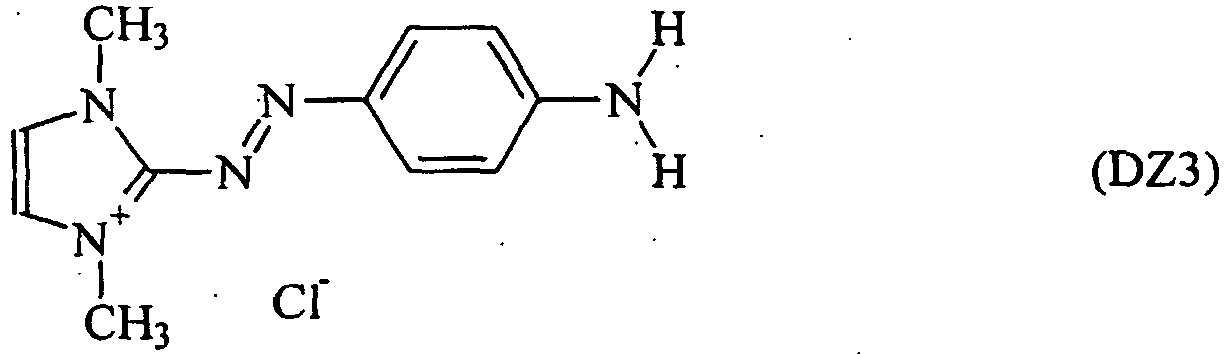


- Die Verbindungen der Formeln (DZ1), (DZ3) und (DZ5), die auch unter den Bezeichnungen Basic Yellow 87, Basic Orange 31 und Basic Red 51 bekannt sind, sind ganz besonders bevorzugte kationische direktziehende Farbstoffe der Gruppe (c).
- Die kationischen direktziehenden Farbstoffe, die unter dem Warenzeichen Arianor® vertrieben werden, sind erfindungsgemäß ebenfalls ganz besonders bevorzugte kationische direktziehende Farbstoffe.
- Die erfindungsgemäßen Mittel gemäß dieser Ausführungsform enthalten die direktziehenden Farbstoffe bevorzugt in einer Menge von 0,01 bis 20 Gew.-%, bezogen auf das gesamte Färbemittel.
- Weiterhin können die erfindungsgemäßen Zubereitungen auch in der Natur vorkommende Farbstoffe wie sie beispielsweise in Henna rot, Henna neutral, Henna schwarz, Kamillenblüte, Sandelhoiz, schwarzem Tee, Faulbaumrinde, Salbei, Blauholz, Krappwurzel, Catechu, Sedre und Alkannawurzel enthalten sind, enthalten.
- Es ist nicht erforderlich, dass die Oxidationsfarbstoffvorprodukte oder die direktziehenden Farbstoffe jeweils einheitliche Verbindungen darstellen. Vielmehr können in den erfindungsgemäßen Haarfärbemitteln, bedingt durch die Herstellungsverfahren für die einzelnen Farbstoffe, in untergeordneten Mengen noch weitere Komponenten enthalten sein, soweit diese nicht das Färbeergebnis nachteilig beeinflussen oder aus anderen Gründen, z.B. toxikologischen, ausgeschlossen werden müssen.
- Bezüglich der in den erfindungsgemäßen Haarfärbe- und -tönungsmitteln einsetzbaren Farbstoffe wird weiterhin ausdrücklich auf die Monographie Ch. Zviak, The Science of Hair Care, Kapitel 7 (Seiten 248-250; direktziehende Farbstoffe) sowie Kapitel 8, Seiten 264-267; Oxidationsfarbstoffvorprodukte), erschienen als Band 7 der Reihe "Dermatology" (Hrg.: Ch., Culnan und H. Maibach), Verlag Marcel Dekker Inc., New York, Basel, 1986, sowie das "Europäische Inventar der Kosmetik-Rohstoffe", herausgegeben von der Europäischen Gemeinschaft, erhältlich in Diskettenform vom Bundesverband Deutscher Industrie- und Handelsunternehmen für Arzneimittel, Reformwaren und Körperpflegemittel e.V., Mannheim, Bezug genommen.
- In einer weiteren Ausführungsform enthält das erfindungsgemäße Mittel zusätzlich eine Kombination aus Komponente
- A
- Verbindungen, die eine reaktive Carbonylgruppe enthalten mit Komponente
- B
- Verbindungen, ausgewählt aus (a) CH-aciden Verbindungen, (b) Verbindungen mit primärer oder sekundärer Aminogruppe oder Hydroxygruppe, ausgewählt aus primären oder sekundären aromatischen Aminen, stickstoffhaltigen heterozyklischen Verbindungen und aromatischen Hydroxyverbindungen, (c) Aminosäuren, (d) aus 2 bis 9 Aminosäuren aufgebauten Oligopeptiden.
- Erfindungsgemäße Verbindungen mit einer reaktiven Carbonylgruppe (im Folgenden auch reaktive Carbonylverbindungen oder Komponente A genannt) besitzen mindestens eine Carbonylgruppe als reaktive Gruppe, welche mit den Verbindungen der Komponente B unter Ausbildung einer beide Komponenten verknüpfenden chemischen Bindung reagiert. Ferner sind erfindungsgemäß auch solche Verbindungen als Komponente A umfaßt, in denen die reaktive Carbonylgruppe derart derivatisiert bzw. maskiert ist, daß die Reaktivität des Kohlenstoffatoms der derivatisierten bzw. maskierten Carbonylgruppe gegenüber der Komponente B stets vorhanden ist. Diese Derivate sind bevorzugt Kondensationsverbindungen von reaktiven Carbonylverbindungen mit
- a) Aminen und deren Derivate unter Bildung von Iminen oder Oximen als Kondensationsverbindung
- b) von Alkoholen unter Bildung von Acetalen oder Ketalen als Kondensationsverbindung.
- Die Komponente A wird bevorzugt ausgewählt aus der Gruppe, die gebildet wird aus Acetophenon, Propiophenon, 2-Hydroxyacetophenon, 3-Hydroxyacetophenon, 4-Hydroxyacetophenon, 2-Hydroxypropiophenon, 3-Hydroxypropiophenon, 4-Hydroxypropiophenon, 2-Hydroxybutyrophenon, 3-Hydroxybutyrophenon, 4-Hydroxybutyrophenon, 2,4-Dihydroxyacetophenon, 2,5-Dihydroxyacetophenon, 2,6-Dihydroxyacetophenon, 2,3,4-Trihydroxyacetophenon, 3,4,5-Trihydroxyacetophenon, 2,4,6-Trihydroxyacetophenon, 2,4,6-Trimethoxyacetophenon, 3,4,5-Trimethoxyacetophenon, 3,4,5-Trimethoxyacetophenon-diethylketal, 4-Hydroxy-3-methoxy-acetophenon, 3,5-Dimethoxy-4-hydroxyacetophenon, 4-Aminoacetophenon, 4-Dimethylaminoacetophenon, 4-Morpholinoacetophenon, 4-Piperidinoacetophenon, 4-Imidazolinoacetophenon, 2-Hydroxy-5-brom-acetophenon, 4-Hydroxy-3-nitroacetophenon, Acetophenon-2-carbonsäure, Acetophenon-4-carbonsäure, Benzophenon, 4-Hydroxybenzophenon, 2-Aminobenzophenon, 4,4'-Dihydroxybenzophenon, 2,4-Dihydroxy-benzophenon, 2,4,4'-Trihydroxybenzophenon, 2,3,4-Trihydroxybenzophenon, 2-Hydroxy-1-acetonaphthon, 1-Hydroxy-2-acetonaphthon, Chromon, Chromon-2-carbonsäure, Flavon, 3-Hydroxyflavon, 3,5,7-Trihydroxyflavon, 4',5,7-Trihydroxyflavon, 5,6,7-Trihydroxyflavon, Quercetin, 1-Indanon, 9-Fluorenon, 3-Hydroxyfluorenon, Anthron, 1,8-Dihydroxyanthron, Vanillin, Coniferylaldehyd, 2-Methoxybenzaldehyd, 3-Methoxybenzaldehyd, 4-Methoxybenzaldehyd, 2-Ethoxybenzaldehyd, 3-Ethoxybenzaldehyd, 4-Ethoxybenzaldehyd, 4-Hydroxy-2,3-dimethoxy-benzaldehyd, 4-Hydroxy-2,5-dimethoxy-benzaldehyd, 4-Hydroxy-2,6-dimethoxy-benzaldehyd, 4-Hydroxy-2-methyl-benzaldehyd, 4-Hydroxy-3-methyl-benzaldehyd, 4-Hydroxy-2,3-dimethyl-benzaldehyd, 4-Hydroxy-2,5-dimethyl-benzatdehyd, 4-Hydroxy-2,6-dimethyl-benzaldehyd, 4-Hydroxy-3,5-dimethoxy-benzaldehyd, 4-Hydroxy-3,5-dimethyl-benzaldehyd, 3,5-Diethoxy-4-hydroxy-benzaldehyd, 2,6-Diethoxy-4-hydroxy-benzaldehyd, 3-Hydroxy-4-methoxy-benzaldehyd, 2-Hydroxy-4-methoxy-benzaldehyd, 2-Ethoxy-4-hydroxy-benzaldehyd, 3-Ethoxy-4-hydroxy-benzaldehyd, 4-Ethoxy-2-hydroxy-benzaldehyd, 4-Ethoxy-3-hydroxy-benzaldehyd, 2,3-Dimethoxybenzaldehyd, 2,4-Dimethoxybenzaldehyd, 2,5-Dimethoxybenzaldehyd, 2,6-Dimethoxybenzaldehyd, 3,4-Dimethoxybenzaldehyd, 3,5-Dimethoxybenzaldehyd, 2,3,4-Trimethoxybenzaldehyd, 2,3,5-Trimethoxybenzaldehyd, 2,3,6-Trimethoxybenzaldehyd, 2,4,6-Trimethoxybenzaldehyd, 2,4,5-Trimethoxybenzaldehyd, 2,5,6-Trimethoxybenzaldehyd, 2-Hydroxybenzaldehyd, 3-Hydroxybenzaldehyd, 4-Hydroxybenzaldehyd, 2,3-Dihydroxybenzaldehyd, 2,4-Dihydroxybenzaldehyd, 2,5-Dihydroxybenzaldehyd, 2,6-Dihydroxybenzaldehyd, 3,4-Dihydroxybenzaldehyd, 3,5-Dihydroxybenzaldehyd, 2,3,4-Trihydroxybenzaldehyd, 2,3,5-Trihydroxybenzaldehyd, 2,3,6-Trihydroxybenzaldehyd, 2,4,6-Trihydroxybenzaldehyd, 2,4,5-Trihydroxybenzaldehyd, 2,5,6-Trihydroxybenzaldehyd, 4-Hydroxy-2-methoxybenzaldehyd, 4-Dimethylaminobenzaldehyd, 4-Diethylaminobenzaldehyd, 4-Dimethylamino-2-hydroxybenzaldehyd, 4-Diethylamino-2-hydroxybenzaldehyd, 4-Pyrrolidinobenzaldehyd, 4-Morpholinobenzaldehyd, 2-Morpholinobenzaldehyd, 4-Piperidinobenzaldehyd, 2-Methoxy-1-naphthaldehyd, 4-Methoxy-1-naphthaldehyd, 2-Hydroxy-1-naphthaldehyd, 2,4-Dihydroxy-1-napthaldehyd, 4-Hydroxy-3-methoxy-1-naphthaldehyd, 2-Hydroxy-4-methoxy-1-naphthaldehyd, 3-Hydroxy-4-methoxy-1-naphthaldehyd, 2,4-Dimethoxy-1-naphthaldehyd, 3,4-Dimethoxy-1-naphthaldehyd, 4-Hydroxy-1-naphthaldehyd, 4-Dimethylamino-1-naphthaldehyd, 2-Methoxy-zimtaldehyd, 4-Methoxy-zimtaldehyd, 4-Hydroxy-3-methoxy-zimtaldehyd, 3,5-Dimethoxy-4-hydroxy-zimtaldehyd, 4-Dimethylaminozimtaldehyd, 2-Dimethylaminobenzaldehyd, 2-Chlor-4-dimethylaminobenzaldehyd, 4-Dimethylamino-2-methylbenzaldehyd, 4-Diethylamino-zimtaldehyd, 4-Dibutylamino-benzaldehyd, 4-Diphenylamino-benzaldehyd, 4-Dimethylamino-2-methoxybenzaldehyd, 4-(1-Imidazolyl)-benzaldehyd, Piperonal, 2,3,6,7-Tetrahydro-1H,5H-benzo[ij]chinolizin-9-carboxaldehyd, 2,3,6,7-Tetrahydro-8-hydroxy-1H,5H-benzo[ij]chinolizin-9-carboxaldehyd, N-Ethylcarbazol-3-aldehyd, 2-Formylmethylen-1,3,3-trimethylindolin (Fischers Aldehyd oder Tribasen Aldehyd), 2-Indolaldehyd, 3-Indolaldehyd, 1-Methylindol-3-aldehyd, 2-Methylindol-3-aldehyd, 1-Acetylindol-3-aldehyd, 3-Acetylindol, 1-Methyl-3-acetylindol, 2-(1',3',3'-Trimethyl-2-indolinyliden)-acetaldehyd, 1-Methylpyrrol-2-aldehyd, 1-Methyl-2-acetylpyrrol, 4-Pyridinaldehyd, 2-Pyridinaldehyd, 3-Pyridinaldehyd, 4-Acetylpyridin, 2-Acetylpyridin, 3-Acetylpyridin, Pyridoxal, Chinolin-3-aldehyd, Chinolin-4-aldehyd, Antipyrin-4-aldehyd, Furfural, 5-Nitrofurfural, 2-Thenoyltrifluor-aceton, Chromon-3-aldehyd, 3-(5'-Nitro-2'-furyl)-acrolein, 3-(2'-Furyl)-acrolein und Imidazol-2-aldehyd, 1,3-Diacetylbenzol, 1,4-Diacetylbenzol, 1,3,5-Triacetylbenzol, 2-Benzoyl-acetophenon, 2-(4'-Methoxybenzoyl)-acetophenon, 2-(2'-Furoyl)-acetophenon, 2-(2'-Pyridoyl)-acetophenon und 2-(3'-Pyridoyl)-acetophenon, Benzylidenaceton, 4-Hydroxybenzylidenaceton, 2-Hydroxybenzylidenaceton, 4-Methoxybenzylidenaceton, 4-Hydroxy-3-methoxybenzylidenaceton, 4-Dimethylaminobenzylidenaceton, 3,4-Methylendioxybenzylidenaceton, 4-Pyrrolidinobenzylidenaceton, 4-Piperidinobenzylidenaceton, 4-Morpholinobenzylidenaceton, 4-Diethylaminobenzylidenaceton, 3-Benzyliden-2,4-pentandion, 3-(4'-Hydroxybenzyliden)-2,4-pentandion, 3-(4'-Dimethylaminobenzyliden)-2,4-pentandion, 2-Benzylidencyclohexanon, 2-(4'-Hydroxybenzyliden)-cyclohexanon, 2-(4'-Dimethylaminobenzyliden)-cyclohexanon, 2-Benzyliden-1,3-cyclohexandion, 2-(4'-Hydroxybenzyliden)-1,3-cyclohexandion, 3-(4'-Dimethylaminobenzyliden)-1,3-cyclohexandion, 2-Benzyliden-5,5-dimethyl-1,3-cyclohexandion, 2-(4'-Hydroxybenzyliden)-5,5-dimethyl-1,3-cyclohexandion, 2-(4'-Hydroxy-3-methoxybenzyliden)-5,5-dimethyl-1,3-cyclohexandion, 2-(4'-Dimethylaminobenzyliden)-5,5-dimethyl-1,3-cyclohexandion, 2-Benzylidencyclopentanon, 2'-(4-Hydroxybenzyliden)-cyclopentanon, 2-(4'-Dimethylaminobenzyliden)-cyclopentanon, 5-(4-Dimethylaminophenyl)penta-2,4-dienal, 5-(4-Diethylaminophenyl)penta-2,4-dienal, 5-(4-Methoxyphenyl)penta-2,4-dienal, 5-(3,4-Dimethoxyphenyl)penta-2,4-dienal, 5-(2,4-Dimethoxyphenyl)penta-2,4-dienal, 5-(4-Piperidinophenyl)penta-2,4-dienal, 5-(4-Morpholinophenyl)penta-2,4-dienal, 5-(4-Pyrrolidinophenyl)penta-2,4-dienal, 6-(4-Dimethylaminophenyl)hexa-3,5-dien-2-on, 6-(4-Diethylaminophenyl)hexa-3,5-dien-2-on, 6-(4-Methoxyphenyl)hexa-3,5-dien-2-on, 6-(3,4-Dimethoxyphenyl)hexa-3,5-dien-2-on, 6-(2,4-Dimethoxyphenyl)hexa-3,5-dien-2-on, 6-(4-Piperidinophenyl)hexa-3,5-dien-2-on, 6-(4-Morpholinophenyl)hexa-3,5-dien-2-on, 6-(4-Pyrrolidinophenyl)hexa-3,5-dien-2-on, 5-(4-Dimethylamino-1-naphthyl)penta-3,5-dienal, 2-Nitrobenzaldehyd, 3-Nitrobenzaldehyd, 4-Nitrobenzaldehyd, 4-Methyl-3-nitrobenzaldehyd, 3-Hydroxy-4-nitrobenzaldehyd, 4-Hydroxy-3-nitrobenzaldehyd, 5-Hydroxy-2-nitrobenzaldehyd, 2-Hydroxy-5-nitrobenzaldehyd, 2-Hydroxy-3-nitrobenzaldehyd, 2-Fluor-3-nitrobenzaldehyd, 3-Methoxy-2-nitrobenzaldehyd, 4-Chlor-3-nitrobenzaldehyd, 2-Chlor-6-nitrobenzaldehyd, 5-Chlor-2-nitrobenzaldehyd, 4-Chlor-2-nitrobenzaldehyd, 2,4-Dinitrobenzaldehyd, 2,6-Dinitrobenzaldehyd, 2-Hydroxy-3-methoxy-5-nitrobenzaldehyd, 4,5-Dimethoxy-2-nitrobenzaldehyd, 6-Nitropiperonal, 2-Nitropiperonal, 5-Nitrovanillin, 2,5-Dinitrosalicylaldehyd, 5-Brom-3-nitrosalicylaldehyd, 3-Nitro-4-formylbenzolsulfonsäure, 4-Nitro-1-naphthaldehyd, 2-Nitrozimtaldehyd, 3-Nitrozimtaldehyd, 4-Nitrozimtaldehyd, 9-Methyl-3-carbazolaldehyd, 9-Ethyl-3-carbazolaldehyd, 3-Acetylcarbazol, 3,6-Diacetyl-9-ethylcarbazol, 3-Acetyl-9-methylcarbazol, 1,4-Dimethyl-3-carbazolaldehyd, 1,4,9-Trimethyl-3-carbazolaldehyd, 4-Formyl-1-methylpyridinium-, 2-Formyl-1-methylpyridinium-, 4-Formyl-1-ethylpyridinium-, 2-Formyl-1-ethylpyridinium-, 4-Formyl-1-benzylpyridinium-, 2-Formyl-1-benzylpyridinium-, 4-Formyl-1,2-dimethylpyridinium-, 4-Formyl-1,3-dimethylpyridinium-, 4-Formyl-1-methylchinolinium-, 2-Formyl-1-methylchinolinium-, 4-Acetyl-1-methylpyridinium-, 2-Acetyl-1-methylpyridinium-, 4-Acetyl-1-methylchinolinium-, 5-Formyl-1-methylchinolinium-, 6-Formyl-1-methylchinolinium-, 7-Formyl-1-methylchinolinium-, 8-Formyl-1-methylchinolinium, 5-Formyl-1-ethylchinolinium-, 6-Formyl-1-ethylchinolinium-, 7-Formyl-1-ethylchinolinium-, 8-Formyl-1-ethylchinolinium, 5-Formyl-1-benzylchinolinium-, 6-Formyl-1-benzylchinolinium-, 7-Formyl-1-benzylchinolinium-, 8-Formyl-1-benzylchinolinium, 5-Formyl-1-allylchinolinium-, 6-Formyl-1-allylchinolinium-, 7-Formyl-1-allylchinolinium- und 8-Formyl-1-allylchinolinium-, 5-Acetyl-1-methylchinolinium-, 6-Acetyl-1-methylchinolinium-, 7-Acetyl-1-methylchinolinium-, 8-Acetyl-1-methylchinolinium, 5-Acetyl-1-ethylchinolinium-, 6-Acetyl-1-ethylchinolinium-, 7-Acetyl-1-ethylchinolinium-, 8-Acetyl-1-ethylchinolinium, 5-Acetyl-1-benzylchinolinium-, 6-Acetyl-1-benzylchinolinium-, 7-Acetyl-1-benzylchinolinium-, 8-Acetyl-1-benzylchinolinium, 5-Acetyl-1-allylchinolinium-, 6-Acetyl-1-allylchinolinium-, 7-Acetyl-1-allylchinolinium- und 8-Acetyl-1-allylchinolinium, 9-Formyl-10-methylacridinium-, 4-(2'-Formylvinyl)-1-methylpyridinium-, 1,3-Dimethyl-2-(4'-formylphenyl)-benzimidazolium-, 1,3-Dimethyl-2-(4'-formylphenyl)-imidazolium-, 2-(4'-Formylphenyl)-3-methylbenzothiazolium-, 2-(4'-Acetylphenyl)-3-methylbenzothiazolium-, 2-(4'-Formylphenyl)-3-methylbenzoxazolium-, 2-(5'-Formyl-2'-furyl)-3-methylbenzothiazolium-, 2-(5'-Formyl-2'-furyl)-3-methylbenzothiazolium-, 2-(5'-Formyl-2'-thienyl)-3-methylbenzothiazolium-, 2-(3'-Formylphenyl)-3-methylbenzothiazolium-, 2-(4'-Formyl-1-naphthyl)-3-methylbenzothiazolium-, 5-Chlor-2-(4'-formylphenyl)-3-methylbenzothiazolium-, 2-(4'-Formylphenyl)-3,5-dimethylbenzothiazolium-benzolsulfonat, -p-toluolsulfonat, -methansulfonat, -perchlorat, -sulfat, -chlorid, -bromid, -iodid, -tetrachlorozinkat, -methylsulfat-, trifluormethansulfonat, -tetrafluoroborat, Isatin, 1-Methyl-isatin, 1-Allyl-isatin, 1-Hydroxymethyl-isatin, 5-Chlor-isatin, 5-Methoxy-isatin, 5-Nitroisatin, 6-Nitro-isatin, 5-Sulfo-isatin, 5-Carboxy-isatin, Chinisatin, 1-Methylchinisatin, sowie beliebigen Gemischen der voranstehenden Verbindungen.
- Als CH-acide werden im allgemeinen solche Verbindungen angesehen, die ein an ein aliphatisches Kohlenstoffatom gebundenes Wasserstoffatom tragen, wobei aufgrund von Elektronen-ziehenden Substituenten eine Aktivierung der entsprechenden Kohlenstoff-Wasserstoff-Bindung bewirkt wird. Unter CH-acide Verbindungen fallen erfindungsgemäß auch Enamine, die durch alkalische Behandlung von quaternierten N-Heterozyklen mit einer in Konjugation zum quartären Stickstoff stehenden CH-aciden Alkylgruppe entstehen.
- Die CH-aciden Verbindungen der Komponente B sind bevorzugt ausgewählt aus der Gruppe bestehend aus 1,2,3,3-Tetramethyl-3H-indoliumiodid, 1,2,3,3-Tetramethyl-3H-indolium-p-toluolsulfonat, 1,2,3,3-Tetramethyl-3H-indolium-methansulfonat, 1,3,3-Trimethyl-2-methylenindolin (Fischersche Base), 2,3-Dimethyl-benzothiazoliumiodid, 2,3-Dimethyl-benzothiazolium-p-toluolsulfonat, 2,3-Dimethyl-naphtho[1,2-d]thiazolium-p-toluolsulfonat, 3-Ethyl-2-methyl-naphtho[1,2-d]thiazolium-p-toluolsulfonat, Rhodanin, Rhodanin-3-essigsäure, 1,4-Dimethylchinolinium-iodid, 1,2-Dimethylchinolinium-iodid, Barbitursäure, Thiobarbitursäure, 1,3-Dimethylthiobarbitursäure, 1,3-Diethylthiobarbitursäure, 1,3-Diethylbarbitursäure, Oxindol, 3-Indoxylacetat, 2-Cumaranon, 5-Hydroxy-2-cumaranon, 6-Hydroxy-2-cumaranon, 3-Methyl-1-phenyl-pyrazolin-5-on, Indan-1,2-dion, Indan-1,3-dion, Indan-1-on, Benzoylacetonitril, 3-Dicyanmethylenindan-1-on, 2-Amino-4-imino-1,3-thiazolin-hydrochlorid, 5,5-Dimethylcyclohexan-1,3-dion, 2H-1,4-Benzoxazin-4H-3-on, 3-Ethyl-2-methyl-benzoxazoliumiodid, 3-Ethyl-2-methyl-benzothiazoliumiodid, 1-Ethyl-4-methyl-chinoliniumiodid, 1-methyl-2-methylchinoliniumiodid, 1,2,3-Trimethylchinoxaliniumiodid, 3-Ethyl-2-methyl-benzoxazolium-p-toluolsulfonat, 3-Ethyl-2-methyl-benzothiazolium-p-toluolsulfonat, 1-Ethyl-4-methyl-chinolinium-p-toluolsulfonat, 1-Ethyl-2-methylchinolinium-p-toluolsulfonat, und 1,2,3-Trimethylchinoxalinium-p-toluolsulfonat.
- Die weiteren bevorzugten Verbindungen der Komponente B sind dem Fachmann aus der Druckschrift
WO-A1-99/18916 - Die erfindungsgemäßen Färbe- und Aufhellmittel können zusätzlich eine Peroxoverbindung enthalten. Die Auswahl dieser Peroxoverbindung unterliegt prinzipiell keinen Beschränkungen; übliche, dem Fachmann bekannte Peroxoverbindungen sind beispielsweise Ammoniumperoxidisulfat, Kaliumperoxidisulfat, Natriumperoxidisulfat, Ammoniumpersulfat, Kaliumpersulfat, Natriumpersulfat, Kaliumperoxidiphosphat, Percarbonate wie Magnesiumpercarbonat, Peroxide wie Bariumperoxid sowie Perborate, Harnstoffperoxid und Melaminperoxid. Unter diesen Peroxoverbindungen, die auch in Kombination eingesetzt werden können, sind erfindungsgemäß die anorganischen Verbindungen bevorzugt. Besonders bevorzugt sind die Peroxidisulfate, insbesondere Kombinationen aus mindestens zwei Peroxidisulfaten. Erfindungsgemäß bevorzugte Mittel sind dadurch gekennzeichnet, dass sie zusätzlich ein Peroxodisulfat enthalten.
- Die Peroxoverbindungen sind in den erfindungsgemäßen Mitteln bevorzugt in Mengen von 2-80 Gew.-%, insbesondere in Mengen von 5-50 Gew.-% enthalten.
- Zusätzlich können die erfindungsgemäßen Mittel weitere Inhaltsstoffe enthalten. Ein Einsatz bestimmter Metallionen oder -komplexe kann beispielsweise bevorzugt sein, um intensive Färbungen zu erhalten. Hier sind erfindungsgemäße Mittel bevorzugt, die zusätzlich Cu-, Fe-, Mn-, Ru-lonen oder Komplexe dieser Ionen enthalten.
- Bevorzugte erfindungsgemäße Haarfärbe- und - aufhellungsmittel enthalten 0,0001 bis 2,5 Gew.-%, vorzugsweise 0,001 bis 1 Gew.-%, bezogen auf die Gesamtzusammensetzung des Mittels, mindestens einer Verbindung aus der Gruppe Kupferchlorid (CuCl2), Kupfersulfat (CuSO4), Eisen(II)sulfat, Mangan(II)sulfat, Mangan(II)chlorid, Kobalt(II)chlorid, Cersulfat, Cerchlorid, Vanadiumsulfat, Kaliumjodid, Natriumjodid, Lithiumchlorid, Kaliumdichromat, Magnesiumacetat, Calciumchlorid, Calciumnitrat, Bariumnitrat, Mangandioxid (MnO2) und/oder Hydrochinon.
- Als weiteren Bestandteil können die erfindungsgemäßsen Zusammensetzungen mindestens eine Ammoniumverbindung aus der Gruppe Ammoniumchlorid, Ammoniumcarbonat, Ammoniumbicarbonat, Ammoniumsulfat und/oder Ammoniumcarbamat in einer Menge von 0,5 bis 10, vorzugsweise 1 bis 5 Gew.-%, bezogen auf die Gesamtzusammensetzung des Mittels enthalten.
- Die erfindungsgemäßen Färbemittel können weiterhin alle für solche Zubereitungen bekannten Wirk-, Zusatz- und Hilfsstoffe enthalten. In vielen Fällen enthalten die Färbemittel mindestens ein Tensid, wobei prinzipiell sowohl anionische als auch zwitterionische, ampholytische, nichtionische und kationische Tenside geeignet sind. In vielen Fällen hat es sich aber als vorteilhaft erwiesen, die Tenside aus anionischen, zwitterionischen oder nichtionischen Tensiden auszuwählen.
- Als anionische Tenside eignen sich in erfindungsgemäßen Zubereitungen alle für die Verwendung am menschlichen Körper geeigneten anionischen oberflächenaktiven Stoffe. Diese sind gekennzeichnet durch eine wasserlöslichmachende, anionische Gruppe wie z. B. eine Carboxylat-, Sulfat-, Sulfonat- oder Phosphat-Gruppe und eine lipophile Alkylgruppe mit etwa 10 bis 22 C-Atomen. Zusätzlich können im Molekül Glykol- oder Polyglykolether-Gruppen, Ester-, Ether- und Amidgruppen sowie Hydroxylgruppen enthalten sein. Beispiele für geeignete anionische Tenside sind, jeweils in Form der Natrium-, Kalium- und Ammonium- sowie der Mono-, Di- und Trialkanolammoniumsalze mit 2 oder 3 C-Atomen in der Alkanolgruppe,
- lineare Fettsäuren mit 10 bis 22 C-Atomen (Seifen),
- Ethercarbonsäuren der Formel R-O-(CH2-CH2O)x -CH2-COOH, in der R eine lineare Alkylgruppe mit 10 bis 22 C-Atomen und x = 0 oder 1 bis 16 ist,
- Acylsarcoside mit 10 bis 18 C-Atomen in der Acylgruppe,
- Acyltauride mit 10 bis 18 C-Atomen in der Acylgruppe,
- Acylisethionate mit 10 bis 18 C-Atomen in der Acylgruppe,
- Sulfobernsteinsäuremono- und -dialkylester mit 8 bis 18 C-Atomen in der Alkylgruppe und Sulfobernsteinsäuremono-alkylpolyoxyethylester mit 8 bis 18 C-Atomen in der Alkylgruppe und 1 bis 6 Oxyethylgruppen,
- lineare Alkansulfonate mit 12 bis 18 C-Atomen,
- lineare Alpha-Olefinsulfonate mit 12 bis 18 C-Atomen,
- Alpha-Sulfofettsäuremethylester von Fettsäuren mit 12 bis 18 C-Atomen,
- Alkylsulfate und Alkylpolyglykolethersulfate der Formel R-O(CH2-CH2O)x-SO3H, in der R eine bevorzugt lineare Alkylgruppe mit 10 bis 18 C-Atomen und x = 0 oder 1 bis 12 ist,
- Gemische oberflächenaktiver Hydroxysulfonate gemäß
DE-A-37 25 030 , - sulfatierte Hydroxyalkylpolyethylen- und/oder Hydroxyalkylenpropylenglykolether gemäß
DE-A-37 23 354 , - Sulfonate ungesättigter Fettsäuren mit 12 bis 24 C-Atomen und 1 bis 6 Doppelbindungen gemäß
DE-A-39 26 344 , - Ester der Weinsäure und Zitronensäure mit Alkoholen, die Anlagerungsprodukte von etwa 2-15 Molekülen Ethylenoxid und/oder Propylenoxid an Fettalkohole mit 8 bis 22 C-Atomen darstellen.
- Bevorzugte anionische Tenside sind Alkylsulfate, Alkylpolyglykolethersulfate und Ethercarbonsäuren mit 10 bis 18 C-Atomen in der Alkylgruppe und bis zu 12 Glykolethergruppen im Molekül sowie insbesondere Salze von gesättigten und insbesondere ungesättigten C8-C22-Carbonsäuren, wie Ölsäure, Stearinsäure, Isostearinsäure und Palmitinsäure.
- Nichtionogene Tenside enthalten als hydrophile Gruppe z. B. eine Polyolgruppe, eine Polyalkylenglykolethergruppe oder eine Kombination aus Polyol- und Polyglykolethergruppe. Solche Verbindungen sind beispielsweise
- Anlagerungsprodukte von 2 bis 30 Mol Ethylenoxid und/oder 0 bis 5 Mol Propylenoxid an lineare Fettalkohole mit 8 bis 22 C-Atomen, an Fettsäuren mit 12 bis 22 C-Atomen und an Alkylphenole mit 8 bis 15 C-Atomen in der Alkylgruppe,
- C12-C22-Fettsäuremono- und -diester von Anlagerungsprodukten von 1 bis 30 Mol Ethylenoxid an Glycerin,
- C8-C22-Alkylmono- und -oligoglycoside und deren ethoxylierte Analoga sowie
- Anlagerungsprodukte von 5 bis 60 Mol Ethylenoxid an Rizinusöl und gehärtetes Rizinusöl.
- Bevorzugte nichtionische Tenside sind Alkylpolyglykoside der allgemeinen Formel R1O-(Z)x. Diese Verbindungen sind durch die folgenden Parameter gekennzeichnet.
- Der Alkylrest R1 enthält 6 bis 22 Kohlenstoffatome und kann sowohl linear als auch verzweigt sein. Bevorzugt sind primäre lineare und in 2-Stellung methylverzweigte aliphatische Reste. Solche Alkylreste sind beispielsweise 1-Octyl, 1-Decyl, 1-Lauryl, 1-Myristyl, 1-Cetyl und 1-Stearyl. Besonders bevorzugt sind 1-Octyl, 1-Decyl, 1-Lauryl, 1-Myristyl. Bei Verwendung sogenannter "Oxo-Alkohole" als Ausgangsstoffe überwiegen Verbindungen mit einer ungeraden Anzahl von Kohlenstoffatomen in der Alkylkette.
- Die erfindungsgemäß verwendbaren Alkylpolyglykoside können beispielsweise nur einen bestimmten Alkylrest R1 enthalten. Üblicherweise werden diese Verbindungen aber ausgehend von natürlichen Fetten und Ölen oder Mineralölen hergestellt. In diesem Fall liegen als Alkylreste R Mischungen entsprechend den Ausgangsverbindungen bzw. entsprechend der jeweiligen Aufarbeitung dieser Verbindungen vor.
- Besonders bevorzugt sind solche Alkylpolyglykoside, bei denen R1
- im wesentlichen aus C8- und C10-Alkylgruppen,
- im wesentlichen aus C12- und C14-Alkylgruppen,
- im wesentlichen aus C8- bis C16-Alkylgruppen oder
- im wesentlichen aus C12- bis C16-Alkylgruppen besteht.
- Als Zuckerbaustein Z können beliebige Mono- oder Oligosaccharide eingesetzt werden. Üblicherweise werden Zucker mit 5 bzw. 6 Kohlenstoffatomen sowie die entsprechenden Oligosaccharide eingesetzt. Solche Zucker sind beispielsweise Glucose, Fructose, Galactose, Arabinose, Ribose, Xylose, Lyxose, Allose, Altrose, Mannose, Gulose, Idose, Talose und Sucrose. Bevorzugte Zuckerbausteine sind Glucose, Fructose, Galactose, Arabinose und Sucrose; Glucose ist besonders bevorzugt.
- Die erfindungsgemäß verwendbaren Alkylpolyglykoside enthalten im Schnitt 1,1 bis 5 Zuckereinheiten. Alkylpolyglykoside mit x-Werten von 1,1 bis 1,6 sind bevorzugt. Ganz besonders bevorzugt sind Alkylglykoside, bei denen x 1,1 bis 1,4 beträgt.
- Die Alkylglykoside können neben ihrer Tensidwirkung auch dazu dienen, die Fixierung von Duftkomponenten auf dem Haar zu verbessern. Der Fachmann wird also für den Fall, dass eine über die Dauer der Haarbehandlung hinausgehende Wirkung des Parfümöles auf dem Haar gewünscht wird, bevorzugt zu dieser Substanzklasse als weiterem Inhaltsstoff der erfindungsgemäßen Zubereitungen zurückgreifen.
- Auch die alkoxylierten Homologen der genannten Alkylpolyglykoside können erfindungsgemäß eingesetzt werden. Diese Homologen können durchschnittlich bis zu 10 Ethylenoxid- und/oder Propylenoxideinheiten pro Alkylglykosideinheit enthalten.
- Weiterhin können, insbesondere als Co-Tenside, zwitterionische Tenside verwendet werden. Als zwitterionische Tenside werden solche oberflächenaktive Verbindungen bezeichnet, die im Molekül mindestens eine quartäre Ammoniumgruppe und mindestens eine -COO(-)- oder -SO3 (-)-Gruppe tragen. Besonders geeignete zwitterionische Tenside sind die sogenannten Betaine wie die N-Alkyl-N,N-dimethylammonium-glycinate, beispielsweise das Kokosalkyl-dimethylammonium-glycinat, N-Acyl-aminopropyl-N,N-dimethylammoniumglycinate, beispielsweise das Kokosacylaminopropyl-dimethylammoniumglycinat, und 2-Alkyl-3-carboxylmethyl-3-hydroxyethyl-imidazoline mit jeweils 8 bis 18 C-Atomen in der Alkyl- oder Acylgruppe sowie das Kokosacylaminoethylhydroxyethylcarboxymethylglycinat. Ein bevorzugtes zwitterionisches Tensid ist das unter der INCI-Bezeichnung Cocamidopropyl Betaine bekannte Fettsäureamid-Derivat.
- Ebenfalls insbesondere als Co-Tenside geeignet sind ampholytische Tenside. Unter ampholytischen Tensiden werden solche oberflächenaktiven Verbindungen verstanden, die außer einer C8-C18-Alkyl- oder Acylgruppe im Molekül mindestens eine freie Aminogruppe und mindestens eines -COOH- oder -SO3H-Gruppe enthalten und zur Ausbildung innerer Salze befähigt sind. Beispiele für geeignete ampholytische Tenside sind N-Alkylglycine, N-Alkylpropionsäuren, N-Alkylaminobuttersäuren, N-Alkyliminodipropionsäuren, N-Hydroxyethyl-N-alkylamidopropylglycine, N-Alkyltaurine, N-Alkylsarcosine, 2-Alkylaminopropionsäuren und Alkylaminoessigsäuren mit jeweils etwa 8 bis 18 C-Atomen in der Alkylgruppe. Besonders bevorzugte ampholytische Tenside sind das N-Kokosalkylaminopropionat, das Kokosacylaminoethylaminopropionat und das C12-18-Acylsarcosin.
- Erfindungsgemäß werden als kationische Tenside insbesondere solche vom Typ der quartären Ammoniumverbindungen, der Esterquats und der Amidoamine eingesetzt.
- Bevorzugte quaternäre Ammoniumverbindungen sind Ammoniumhalogenide, insbesondere Chloride und Bromide, wie Alkyltrimethylammoniumchloride, Dialkyldimethylammoniumchloride und Trialkylmethylammoniumchloride, z. B. Cetyltrimethylammoniumchlorid, Stearyltrimethylammoniumchlorid, Distearyldimethylammoniumchlorid, Lauryldimethylammoniumchlorid, Lauryldimethylbenzylammoniumchlorid und Tricetylmethylammoniumchlorid, sowie die unter den INCI-Bezeichnungen Quaternium-27 und Quaternium-83 bekannten Imidazolium-Verbindungen. Die langen Alkylketten der oben genannten Tenside weisen bevorzugt 10 bis 18 Kohlenstoffatome auf.
- Bei Esterquats handelt es sich um bekannte Stoffe, die sowohl mindestens eine Esterfunktion als auch mindestens eine quartäre Ammoniumgruppe als Strukturelement enthalten. Bevorzugte Esterquats sind quaternierte Estersalze von Fettsäuren mit Triethanolamin, quaternierte Estersalze von Fettsäuren mit Diethanolalkylaminen und quaternierten Estersalze von Fettsäuren mit 1,2-Dihydroxypropyldialkylaminen. Solche Produkte werden beispielsweise unter den Warenzeichen Stepantex®, Dehyquart® und Armocare® vertrieben. Die Produkte Armocare® VGH-70, ein N,N-Bis(2-Palmitoyloxyethyl)dimethylammoniumchlorid, sowie Dehyquart® F-75 und Dehyquart® AU-35 sind Beispiele für solche Esterquats.
- Die Alkylamidoamine werden üblicherweise durch Amidierung natürlicher oder synthetischer Fettsäuren und Fettsäureschnitte mit Dialkylaminoaminen hergestellt. Eine erfindungsgemäß besonders geeignete Verbindung aus dieser Substanzgruppe stellt das unter der Bezeichnung Tegoamid® S 18 im Handel erhältliche Stearamidopropyl-dimethylamin dar.
- Weitere erfindungsgemäß verwendbare kationische Tenside stellen die quaternisierten Proteinhydrolysate dar.
- Erfindungsgemäß ebenfalls geeignet sind kationische Silikonöle wie beispielsweise die im Handel erhältlichen Produkte Q2-7224 (Hersteller: Dow Corning; ein stabilisiertes Trimethylsilylamodimethicon), Dow Corning 929 Emulsion (enthaltend ein hydroxylamino-modifiziertes Silicon, das auch als Amodimethicone bezeichnet wird), SM-2059 (Hersteller: General Electric), SLM-55067 (Hersteller: Wacker) sowie Abil®-Quat 3270 und 3272 (Hersteller: Th. Goldschmidt; diquaternäre Polydimethylsiloxane, Quaternium-80).
- Ein Beispiel für ein als kationisches Tensid einsetzbares quaternäres Zuckerderivat stellt das Handelsprodukt Glucquat®100 dar, gemäß INCI-Nomenklatur ein "Lauryl Methyl Gluceth-10 Hydroxypropyl Dimonium Chloride".
- Bei den als Tensid eingesetzten Verbindungen mit Alkylgruppen kann es sich jeweils um einheitliche Substanzen handeln. Es ist jedoch in der Regel bevorzugt, bei der Herstellung dieser Stoffe von nativen pflanzlichen oder tierischen Rohstoffen auszugehen, so dass man Substanzgemische mit unterschiedlichen, vom jeweiligen Rohstoff abhängigen Alkylkettenlängen erhält.
- Bei den Tensiden, die Anlagerungsprodukte von Ethylen- und/oder Propylenoxid an Fettalkohole oder Derivate dieser Anlagerungsprodukte darstellen, können sowohl Produkte mit einer "normalen" Homologenverteilung als auch solche mit einer eingeengten Homologenverteilung verwendet werden. Unter "normaler" Homologenverteilung werden dabei Mischungen von Homologen verstanden, die man bei der Umsetzung von Fettalkohol und Alkylenoxid unter Verwendung von Alkalimetallen, Alkalimetallhydroxiden oder Alkalimetallalkoholaten als Katalysatoren erhält. Eingeengte Homologenverteilungen werden dagegen erhalten, wenn beispielsweise Hydrotalcite, Erdalkalimetallsalze von Ethercarbonsäuren, Erdalkalimetalloxide, -hydroxide oder -alkoholate als Katalysatoren verwendet werden. Die Verwendung von Produkten mit eingeengter Homologenverteilung kann bevorzugt sein.
- Ferner können die erfindungsgemäßen Färbemittel weitere Wirk-, Hilfs- und Zusatzstoffe, wie beispielsweise
- nichtionische Polymere wie beispielsweise VinylpyrrolidonNinylacrylat-Copolymere, Polyvinylpyrrolidon und VinylpyrrolidonNinylacetat-Copolymere und Polysiloxane,
- kationische Polymere wie quaternisierte Celluloseether, Polysiloxane mit quaternären Gruppen, Dimethyldiallylammoniumchlorid-Polymere, Acrylamid-Dimethyldiallyl-ammoniumchlorid-Copolymere, mit Diethylsulfat quaternierte Dimethylamino-ethylmethacrylat-Vinylpyrrolidon-Copolymere, Vinylpyrrolidon-Imidazolinium-methochlorid-Copolymere und quaternierter Polyvinylalkohol,
- zwitterionische und amphotere Polymere wie beispielsweise Acrylamidopropyl-trimethylammoniumchlorid/Acrylat-Copolymere und Octylacrylamid/Methyl-methacrylat/tert-Butylaminoethylmethacrylat/2-Hydroxypropylmethacrylat-Copolymere,
- anionische Polymere wie beispielsweise Polyacrylsäuren, vernetzte Polyacrylsäuren, Vinylacetat/Crotonsäure-Copolymere, Vinylpyrrolidon/Vinylacrylat-Copolymere, Vinylacetat/Butylmaleat/Isobornylacrylat-Copolymere, Methylvinylether/Malein-säureanhydrid-Copolymere und Acrylsäure/Ethylacrylat/N-tert.Butyl-acrylamid-Terpolymere,
- Verdickungsmittel wie Agar-Agar, Guar-Gum, Alginate, Xanthan-Gum, Gummi arabicum, Karaya-Gummi, Johannisbrotkernmehl, Leinsamengummen, Dextrane, Cellulose-Derivate, z. B. Methylcellulose, Hydroxyalkylcellulose und Carboxymethylcellulose, Stärke-Fraktionen und Derivate wie Amylose, Amylopektin und Dextrine, Tone wie z. B. Bentonit oder vollsynthetische Hydrokolloide wie z.B. Polyvinylalkohol,
- Strukturanten wie Maleinsäure und Milchsäure,
- haarkonditionierende Verbindungen wie Phospholipide, beispielsweise Sojalecithin, Ei-Lecitin und Kephaline,
- Proteinhydrolysate, insbesondere Elastin-, Kollagen-, Keratin-, Milcheiweiß-, Sojaprotein- und Weizenproteinhydrolysate, deren Kondensationsprodukte mit Fettsäuren sowie quaternisierte Proteinhydrolysate,
- Parfümöle, Dimethylisosorbid und Cyclodextrine,
- Lösungsmittel und -vermittler wie Ethanol, Isopropanol, Ethylenglykol, Propylenglykol, Glycerin und Diethylenglykol,
- faserstrukturverbessernde Wirkstoffe, insbesondere Mono-, Di- und Oligosaccharide wie beispielsweise Glucose, Galactose, Fructose, Fruchtzucker und Lactose,
- quaternierte Amine wie Methyl-1-alkylamidoethyl-2-alkylimidazolinium-methosulfat
- Entschäumer wie Silikone,
- Farbstoffe zum Anfärben des Mittels,
- Antischuppenwirkstoffe wie Piroctone Olamine, Zink Omadine und Climbazol,
- Lichtschutzmittel, insbesondere derivatisierte Benzophenone, Zimtsäure-Derivate und Triazine,
- Substanzen zur Einstellung des pH-Wertes, wie beispielsweise übliche Säuren, insbesondere Genußsäuren und Basen,
- Wirkstoffe wie Allantoin, Pyrrolidoncarbonsäuren und deren Salze sowie Bisabolol,
- Vitamine, Provitamine und Vitaminvorstufen, insbesondere solche der Gruppen A, B3, B5, B6, C, E, F und H,
- Pflanzenextrakte wie die Extrakte aus Grünem Tee, Eichenrinde, Brennessel, Hamamelis, Hopfen, Kamille, Klettenwurzel, Schachtelhalm, Weißdorn, Lindenblüten, Mandel, Aloe Vera, Fichtennadel, Roßkastanie, Sandelholz, Wacholder, Kokosnuß, Mango, Aprikose, Limone, Weizen, Kiwi, Melone, Orange, Grapefruit, Salbei, Rosmarin, Birke, Malve, Wiesenschaumkraut, Quendel, Schafgarbe, Thymian, Melisse, Hauhechel, Huflattich, Eibisch, Meristem, Ginseng und Ingwerwurzel,.
- Cholesterin,
- Konsistenzgeber wie Zuckerester, Polyolester oder Polyolalkylether,
- Fette und Wachse wie Walrat, Bienenwachs, Montanwachs und Paraffine,
- Fettsäurealkanolamide,
- Komplexbildner wie EDTA, NTA, β-Alanindiessigsäure und Phosphonsäuren,
- Quell- und Penetrationsstoffe wie Glycerin, Propylenglykolmonoethylether, Carbonate, Hydrogencarbonate, Guanidine, Harnstoffe sowie primäre, sekundäre und tertiäre Phosphate,
- Trübungsmittel wie Latex, Styrol/PVP- und Styrol/Acrylamid-Copolymere
- Perlglanzmittel wie Ethylenglykolmono- und -distearat sowie PEG-3-distearat,
- Pigmente,
- Stabilisierungsmittel für Wasserstoffperoxid und andere Oxidationsmittel,
- Treibmittel wie Propan-Butan-Gemische, N2O, Dimethylether, CO2 und Luft,
- Antioxidantien,
- Bezüglich weiterer fakultativer Komponenten sowie die eingesetzten Mengen dieser Komponenten wird ausdrücklich auf die dem Fachmann bekannten einschlägigen Handbücher, z. B. Kh. Schrader, Grundlagen und Rezepturen der Kosmetika, 2. Auflage, Hüthig Buch Verlag, Heidelberg, 1989, verwiesen.
- Die erfindungsgemäßen Mittel enthalten die Verbindungen gemäß Formel I bevorzugt in einem geeigneten wäßrigen, alkoholischen oder wäßrig-alkoholischen Träger. Zum Zwecke der Haarfärbung sind solche Träger beispielsweise Cremes, Emulsionen, Gele oder auch tensidhaltige schäumende Lösungen, wie beispielsweise Shampoos, Schaumaerosole oder andere Zubereitungen, die für die Anwendung auf dem Haar geeignet sind. Es ist aber auch denkbar, die Farbstoffvorprodukte in eine pulverförmige oder auch Tablettenförmige Formulierung zu integrieren.
- Unter wäßrig-alkoholischen Lösungen sind im Sinne der vorliegenden Erfindung wäßrige Lösungen enthaltend 3 bis 70 Gew.-% eines C1-C4-Alkohols, insbesondere Ethanol bzw. Isopropanol, zu verstehen. Die erfindungsgemäßen Mittel können zusätzlich weitere organische Lösemittel, wie beispielsweise Methoxybutanol, Benzylalkohol, Ethyldiglykol oder 1,2-Propylenglykol, enthalten. Bevorzugt sind dabei alle wasserlöslichen organischen Lösemittel.
- Bevorzugte erfindungsgemäße Mittel sind dadurch gekennzeichnet, daß sie zusätzlich ein nichtwässriges Lösungsmittel enthalten, wobei besonders bevorzugte erfindungsgemäße Mittel das Lösungsmittel in einer Konzentration von 0,1 - 30 Gewichtsprozent, bevorzugt in einer Konzentration von 1 - 20 Gewichtsprozent, ganz besonders bevorzugt in einer Konzentration von 2 - 10 Gewichtsprozent, jeweils bezogen auf das Mittel, enthalten.
- In weiter bevorzugten erfindungsgemäßen Mitteln ist das Lösungsmittel ausgewählt aus Ethanol, n-Propanol, Isoropanol, n-Butanol, Propylenglykol, n-Butylenglykol, Glycerin, Diethylenglykolmonoethylether, Diethylenglykolmono-n-butylether , Phenoxyethanol und Benzylalkohol sowie ihren Mischungen.
- Der pH-Wert der erfindungsgemäßen Mittel kann durch geeignete Inhaltstoffe wie Acidifizierungsmittel oder Alkalisierungsmittel in einem weiten Bereich eingestellt werden. Bevorzugte erfindungsgemäße Mittel sind dadurch gekennzeichnet, daß der pH-Wert des Mittels 6 - 11, bevorzugt 7,5 - 10 und besonders bevorzugt 8 - 9 beträgt.
- Eine oxidative Färbung der Fasern kann in Gegenwart von Oxidationsfarbstoffvorprodukten grundsätzlich mit Luftsauerstoff erfolgen. Bevorzugt wird jedoch ein chemisches Oxidationsmittel eingesetzt, besonders dann, wenn neben der Färbung ein Aufhelleffekt an menschlichem Haar gewünscht ist. Dieser Aufhelleffekt kann unabhängig von der Färbemethode gewünscht sein. Die Gegenwart von Oxidationsfarbstoffvorprdukten ist demnach keine zwingende Voraussetzung für einen Einsatz von Oxidationsmitteln in den erfindungsgemäßen Mitteln. Als Oxidationsmittel kommen Persulfate, Chlorite und insbesondere Wasserstoffperoxid oder dessen Anlagerungsprodukte an Harnstoff, Melamin sowie Natriumborat in Frage.
- Erfindungsgemäß kann aber das Oxidationsfärbemittel auch zusammen mit einem Katalysator auf das Haar aufgebracht werden, der die Oxidation der Farbstoffvorprodukte, z.B. durch Luftsauerstoff, aktiviert. Solche Katalysatoren sind z.B. Metallionen, Iodide, Chinone oder bestimmte Enzyme.
- Geeignete Metallionen sind beispielsweise Zn2+, Cu2+, Fe2+, Fe3+, Mn2+, Mn4+, Li+, Mg2+, Ca2+ und Al3+. Besonders geeignet sind dabei Zn2+, Cu2+ und Mn2+. Die Metallionen können prinzipiell in der Form eines beliebigen, physiologisch verträglichen Salzes oder in Form einer Komplexverbindung eingesetzt werden. Bevorzugte Salze sind die Acetate, Sulfate, Halogenide, Lactate und Tartrate. Durch Verwendung dieser Metallsalze kann sowohl die Ausbildung der Färbung beschleunigt als auch die Farbnuance gezielt beeinflusst werden.
- Geeignete Enzyme sind z.B. Peroxidasen, die die Wirkung geringer Mengen an Wasserstoffperoxid deutlich verstärken können. Weiterhin sind solche Enzyme erfindungsgemäß geeignet, die mit Hilfe von Luftsauerstoff die Oxidationsfarbstoffvorprodukte direkt oxidieren, wie beispielsweise die Laccasen, oder in situ geringe Mengen Wasserstoffperoxid erzeugen und auf diese Weise die Oxidation der Farbstoffvorprodukte biokatalytisch aktivieren. Besonders geeignete Katalysatoren für die Oxidation der Farbstoffvorläufer sind die sogenannten 2-Elektronen-Oxidoreduktasen in Kombination mit den dafür spezifischen Substraten, z.B.
- Pyranose-Oxidase und z.B. D-Glucose oder Galactose,
- Glucose-Oxidase und D-Glucose,
- Glycerin-Oxidase und Glycerin,
- Pyruvat-Oxidase und Benztraubensäure oder deren Salze,
- Alkohol-Oxidase und Alkohol (MeOH, EtOH),
- Lactat-Oxidase und Milchsäure und deren Salze,
- Tyrosinase-Oxidase und Tyrosin,
- Uricase und Harnsäure-ode deren-Salze,
- Cholinoxidase und Cholin,
- Aminosäure-Oxidase und Aminosäuren.
- Bei einer Anwendung von Oxidationsmitteln wird das eigentliche Färbemittel zweckmäßigerweise unmittelbar vor der Anwendung durch Mischung der Zubereitung des Oxidationsmittels mit der Zubereitung, enthaltend die Verbindungen der Formel I und gegebenenfalls Farbstoffvorprodukte, hergestellt. Das dabei entstehende gebrauchsfertige Haarfärbepräparat sollte bevorzugt einen pH-Wert im Bereich von 6 bis 12 aufweisen. Besonders bevorzugt ist die Anwendung der Haarfärbemittel in einem schwach alkalischen Milieu. Die Anwendungstemperaturen können in einem Bereich zwischen 15 und 40 °C liegen. Nach einer Einwirkungszeit von 5 bis 45 Minuten wird das Haarfärbemittel durch Ausspülen von dem zu färbenden Haar entfernt. Das Nachwaschen mit einem Shampoo entfällt, wenn ein stark tensidhaltiger Träger, z.B. ein Färbeshampoo, verwendet wurde.
- Insbesondere bei schwer färbbarem Haar kann ein erfindungsgemäßes Mittel gegebenenfalls mit zusätzlichen Farbstoffvorprodukten aber auch ohne vorherige Vermischung mit der Oxidationskomponente auf das Haar aufgebracht werden. Nach einer Einwirkdauer von 20 bis 30 Minuten wird dann - gegebenenfalls nach einer Zwischenspülung - die Oxidationskomponente aufgebracht. Nach einer weiteren Einwirkdauer von 10 bis 20 Minuten wird dann gespült und gewünschtenfalls nachshampooniert. Bei dieser Ausführungsform wird gemäß einer ersten Variante, bei der das vorherige Aufbringen der Farbstoffvorprodukte eine bessere Penetration in das Haar bewirken soll, das entsprechende Mittel auf einen pH-Wert von etwa 4 bis 7 eingestellt. Gemäß einer zweiten Variante wird zunächst eine Luftoxidation angestrebt, wobei das aufgebrachte Mittel bevorzugt einen pH-Wert von 7 bis 10 aufweist. Bei der anschließenden beschleunigten Nachoxidation kann die Verwendung von sauer eingestellten Peroxidisulfat-Lösungen als Oxidationsmittel bevorzugt sein.
- Ein zweiter Gegenstand der vorliegenden Erfindung ist ein Verfahren zum gleichzeitigen Färben und Aufhellen von Keratinfasern, insbesondere menschlichen Haaren, in dem
- gewünschtenfalls ein Vorbehandlungsmittel M1 auf die Faser aufgebracht wird, dann
- ein Tönungs- oder Färbemittel M2 auf der Faser zur Anwendung kommt, wobei gewünschtenfalls dem Mittel M2 vor der Anwendung ein weiteres Mittel M3 zugegeben wird,
- dieses Färbemittel M2 nach einer Zeit von 5-30 Minuten von der Faser abgespült wird
- und nach der Behandlung gegebenenfalls ein Nachbehandlungsmittel M4 auf die Faser aufgetragen und nach einer Einwirkzeit von einigen Minuten wieder abgespült wird,
- Die erfindungsgemäßen Mittel können demnach als Einkomponentenmittel (Tönungs- oder Färbemittel M2 bzw. Nachbehandlungsmittel M4), als Zweikomponenten Mittel (M2 + M3) oder als Dreikomponentenmittel (M2 + M3 + M4) formuliert und entsprechend angewendet werden. Eine Auftrennung in Mehrkomponentensysteme bietet sich insbesondere dort an, wo Inkompatibilitäten der Inhaltsstoffe zu erwarten oder zu befürchten sind; das einzusetzende Mittel wird bei solchen Systemen vom Verbraucher direkt vor der Anwendung durch Vermischen der Komponente hergestellt.
- Enthält nur das Mittel M4 als Nachbehandlungsmittel mindestens einen Kohlensäuremonoester und/oder ein Kohlensäuremonoamid, so ist es bevorzugt, daß dieses Mittel gleichzeitig einen Alkalitätsgeber und Wasserstoffperoxid oder ein Wasserstoffperoxid-Addukt bzw. eine andere H2O2-Quelle enthält.
- Ein Haarfärbe- und Aufhellungsverfahren, bei dem die Färbecreme und das Oxidationsmittel zunächst getrennt vorliegen, ist dabei bevorzugt. Ein weiterer Gegenstand der vorliegenden Erfindung ist daher ein Verfahren zum gleichzeitigen Färben und Aufhellen von menschlichen Haaren, bei dem eine Zusammensetzung auf wäßriger Grundlage, enthaltend Wasserstoffperoxid, mit einem Mittel enthaltend mindestens einen direktziehenden Haarfarbstoff und/oder mindestens ein Oxidationsfarbstoffvorprodukt, und mindestens einen Kohlensäuremonoester und/oder ein Kohlensäuremonoamid zu einer homogenen Zusammensetzung vermischt, und diese auf das Haar aufgebracht wird.
- In bevorzugten erfindungsgemäßen Verfahren dieser Art enthält die Zusammensetzung auf wäßriger Grundlage bezogen auf ihr Gewicht 1 bis 20 Gew.%, vorzugsweise 2 bis 10 Gew.% und insbesondere 3 bis 6 Gew.% Wasserstoffperoxid, berechnet als 100%iges H2O2.
- Weiter bevorzugte erfindungsgemäße Verfahren dieser Art sind dadurch gekennzeichnet, daß die Zusammensetzung auf wäßriger Grundlage, enthaltend Wasserstoffperoxid, mit einem Mittel enthaltend mindestens einen direktziehenden Haarfarbstoff und mindestens einen Kohlensäuremonoester und/oder ein Kohlensäuremonoamid im Gewichtsverhältnis 1:5 bis 10:1, vorzugsweise 1:2 bis 5:1 und insbesondere 1:1 bis 2:1 zu einer homogenen Zusammensetzung vermischt, und diese auf das Haar aufgebracht wird, wobei die Konzentration des Kohlensäuremonoesters und/oder des Kohlensäuremonoamids in der Anwendungsmischung 0,01 bis 2 Gew.%, bezogen auf die Mischung, beträgt.
- Alternativ oder in Ergänzung zum direktziehenden Farbstoff können auch Oxidationsfarbstoffvorprodukte in den im Verfahren eingesetzten Mitteln enthalten sein. Hier sind Varianten des erfindungsgemäßen Verfahrens bevorzugt, bei dene die Zusammensetzung auf wäßriger Grundlage, enthaltend Wasserstoffperoxid, mit einem Mittel enthaltend mindestens ein Oxidationsfarbstoffvorprodukt und mindestens einen Kohlensäuremonoester und/oder ein Kohlensäuremonoamid im Gewichtsverhältnis 1:5 bis 10:1, vorzugsweise 1:2 bis 5:1 und insbesondere 1:2 bis 2:1 zu einer homogenen Zusammensetzung vermischt, und diese auf das Haar aufgebracht wird, wobei die Konzentration des Kohlensäuremonoesters und/oder des Kohlensäuremonoamids in der Anwendungsmischung 0,01 bis 2 Gew.%, bezogen auf die Mischung, beträgt.
- Alternativ kann - wie vorstehend erwähnt - auch ein Dreikomponentensystem zur Anwendung gelangen. Ein weiterer Gegenstand der vorliegenden Erfindung ist daher ein Verfahren zum gleichzeitigen Färben und Aufhellen von menschlichen Haaren, bei dem eine Zusammensetzung auf wäßriger Grundlage, enthaltend Wasserstoffperoxid, mit einem Mittel enthaltend mindestens einen direktziehenden Haarfarbstoff und/oder mindestens ein Oxidationsfarbstoffvorprodukt, und einem Mittel, enthaltend mindestens einen Kohlensäuremonoester und/oder ein Kohlensäuremonoamid zu einer homogenen Zusammensetzung vermischt, und diese auf das Haar aufgebracht wird.
- Bezüglich weiterer bevorzugter Ausführungsformen der erfindungsgemäßen Verfahren gilt mutatis mutandis das zu den erfindungsgemäßen Mitteln Gesagte.
- Ein weiterer Gegenstand der vorliegenden Erfindung ist die Verwendung von Kohlensäuremonoestern und/oder Kohlensäuremonoamiden in Haarfärbemitteln zur Steigerung der Brillanz der Ausfärbungen.
- Bezüglich bevorzugter Ausführungsformen dieser erfindungsgemäßen Verwendung gilt mutatis mutandis das zu den erfindungsgemäßen Mitteln Gesagte.
- Ein weiterer Gegenstand der vorliegenden Erfindung ist die Verwendung von Kohlensäuremonoestern und/oder ein Kohlensäuremonoamiden in oxidationsfarbstoffhaltigen Haarfärbemitteln zur Beschleunigung der Oxidation der Farbstoffe bei Anwendung.
- Auch bezüglich bevorzugter Ausführungsformen dieser erfindungsgemäßen Verwendung gilt mutatis mutandis das zu den erfindungsgemäßen Mitteln Gesagte.
- Es wurden folgende Färbecremes hergestellt:
Färbecreme 1 Octylstearat 25,0 Gew.-% Paraffinöl 19,0 Gew.-% Aerosil 200 4,0 Gew.-% Vaseline 15,0 Gew.-% Dehydol® LS 3 * 10,0 Gew.-% Foryl 100 ** 10,0 Gew.-% Na-tert-Butylcarbonat 8,0 Gew.-% Xanthan Gum 3,0 Gew.-% EDTA-Dinatriumsalz 0,8 Gew.-% HC Blue 2 4,40 Gew.-% HC Yellow 2 0,40 Gew.-% HC Yellow 5 0,20 Gew.-% Basic Yellow 87 0,10 Gew.-% Violet 1-4 D 0,80 Gew.% Trinatriumphosphat 1,0 Gew.% * C12-C14-Fettalkohol mit 3 Mol EO (INCI-Bezeichnung: Laureth-3)
** INCI-Bezeichnung: Laureth-10
Färbecreme 2 Isopropylpalmitat 13,8 Gew.-% Jojobaöl 4,3 Gew.-% Silikonöl DC 1401 4,3 Gew.% Aerosil 200 5,7 Gew.-% Cutina® MD * 14,0 Gew.% Dehydol® LS 3 ** 28,3 Gew.-% Vaseline 14,0 Gew.-% Trinatriumphosphat 1,0 Gew.% Na-Methylcarbonat 6,0 Gew.-% Natrosol® 250 HR *** 3,0 Gew.-% Polymer JR 30 M **** 0,5 Gew.% EDTA-Dinatriumsalz 0,8 Gew.-% Basic Orange 31 0,3 Gew.-% Basic Red 51 0,20 Gew.-% Basic Yellow 87 0,10 Gew.-% HC Red BN 1,2 Gew.-% Rodol 9R 0,8 Gew.-% Violet 1-4 D 1,2 Gew.% HC Yellow 2 0,8 Gew.-% * Gemisch aus Mono- und Diglyceriden der Palmitin- und Stearinsäure (INCl-Bezeichnung Glyceryl Stearate)
** C12-C14-Fettalkohol mit 3 Mol EO (INCI-Bezeichnung: Laureth-3)
*** Hydroxyethylcellulose (Hercules)
**** quaternierte Hydroxyethylcellulose (INCI - Bezeichnung: Polyquaternium-10) (UNION CARBIDE) - Die Rezepturen 1 und 2 wurden im Gewichtsverhältnis 1 : 3 mit einer wasserstoffperoxidhaltigen Emulsion der folgenden Zusammensetzung vermischt:
Fettalkoholgemisch C12-C18 5,0 Gew.-% Wassertoffperoxidlösung, 50% 16,0 Gew.-% Eumulgin B1 * 0,4 Gew.-% Eumulgin B2 ** 0,4 Gew.-% Aculyne 22 *** 0,5 Gew.-% Aculyne 33 **** 5,0 Gew.-% EDTA-Dinatriumsalz 0,5 Gew.-% Wasser ad 100 Gew.-% * Cetylstearylalkohol mit 12 EO-Einheiten (INCI-Bezeichnung: Ceteareth-12) (Cognis Deutschland)
** Cetylstearylalkohol mit 20 EO-Einheiten (INCI-Bezeichnung: Ceteareth-20) (Cognis Deutschland)
*** Methacrylsäure(stearylalkohol-+ 20-EO-ester)-Acrylsäure-Copolymer (Rohm&Haas)
**** Säure-enthaltendes, vernetztes Acrylcopolymer (INCI-Bezeichnung: Acrylates Copolymer, ca. 28% Aktivsubstanz) (Rohm&Haas) - 1,8 g der angemischten Färbecreme werden auf eine ca. 6 cm lange Strähne Menschenhaares (Kerling Euronaturhaar, blond) aufgetragen und dort 30 Minuten bei 30 °C belassen. Nach Beendigung der Einwirkzeit wird das Haar ausgespült, mit einem üblichen Haarwaschmittel gewaschen und anschließend getrocknet. Das Haar erhielt die in der Tabelle angegebenen Färbungen.
Färbecreme Färbung 1 Braun 2 orange - Es wurden weitere Färbecremes auf Oxidationsfarbstoffbasis hergestellt: Rezepturen 1-3
Rohstoff Rez Nr. / Gew % 1 2 3 Polymer JR 400 3,0 3,0 3,0 Glycerinmonostearat 10,0 10,0 10,0 Geliderm 3000 P 2,0 2,0 2,0 Cetiol 868 20,0 20,0 20,0 Paraffinöl 10,0 10,0 10,0 Dehydol LS 4 18,1 26,1 17,5 Aluminiumtristearat 2,0 2,0 2,0 Magnesiumdistearat 1,0 1,0 1,0 Calciumdistearat 1,0 1,0 1,0 Ammoniumchlorid 2,0 2,0 2,0 Natriummethylcarbonat 8,0 8,0 8,0 Natriummetasilikat 3,0 3,0 3,0 Natriumstearat 2,0 2,0 2,0 Aerosil 200 3,0 3,0 3,0 p-Phenylendiamindihydrochlorid 0,4 p-Toluylendiaminsulfat 2,2 N,N-Bis-(2'-Hydroxyethyl)-p-phenylendiaminsulfat 3,8 0,64 2-(2'-Hydroxyethyl)-p-phenylendiaminsulfat 1,36 3,32 4-Aminophenol 0,8 4-Amino-3-methylphenol 0,12 0,04 Bis-(5-amino-2-hydroxyphenyl) methandihydrochlorid 0,40 2,4,5,6-Tetraaminopyrimidinsulfat 4,0 4,40 4-Hydroxy-2,5,6-triaminopyrimidinsulfat 0,60 4,5-Diamino-2-(2'-Hydroxyethyl) pyrazolsulfat 1,2 2,4-Bis-(2'-Hydroxyethyl) amino]-6-methylanisol 0,40 0,20 1,0 2,6-Bis-[(2'-Hydroxyethyl)] amino-1-methylanisol 0,20 0,40 0,20 Resorcin 0,44 0,36 0,4 2-Methylresorcin 2,2 2,4 4-Chlorresorcin 0,12 3-Aminophenol 0,24 0,02 5-Amino-2-methylphenol 0,12 5-(2'-Hydroxyethyl) amino-2-methylphenol 0,28 3-Amino-2-chlor-6-methylphenol 0,80 0,12 3-Amino-2,4-dichlorphenol .0,12 2,4-Diaminophenoxyethanol-sulfat 0,04 2-Amino-4-(2'-hydroxyethyl) anisolsulfat 0,04 1,3-Bis-(2',4'-diaminophehoxy)propan-tetrahydrochlorid 0,004 0,04 2-Amino-3-hydroxypyridin 1,2 0,36 0,96 2-Methylämino-3-amino-6-methoxypyridin 0,004 2,6-Dihydroxy-3,4-dimethylpyridin 0,40 3,5-Diamino-2,6-dimethoxypyridin 0,02 2,7-Dihydroxynaphthalin 0,12 0,08 1-Phenyl-3-methylpyrazol-5-on 0,04 2,6-Bis-[(2'-hydroxyethyl)amino]- toluol 0,4 5,6-Dihydroxyindolin-hydrobromid 0,20 HC-Red 1 0,01 4-Amino-2-nitro-diphenylamin-2'-carbonsäure 0,01 -
Rohstoff Rez Nr./% 4 5 6 Gluadin AGP 4,0 4,0 4,0 Reisstärke 54,0 54,1 54,2 Phospholipin P 3,0 3,0 3,0 Guarkernmehl 10,0 10,0 10,0 Na.-tert.-Butylcarbonat 4,0 4,0 4,0 Ammoniumsulfat 2,0 2,0 2,0 Arginin 4,0 4,0 4,0 Aerosil 200 0,5 0,5 0,5 Hydroxypropylguar-trimoniumchlorid 10,0 10,0 10,0 Diatomeenerde 2,0 2,0 2,0 EDTA 0,5 0,5 0,5 Hydroxyethylcellulose 4,0 4,0 4,0 Xanthangum 1,0 1,0 1,0 p-Toluylendiaminsulfat 0,28 2-Amino-4-N-(2'-hydroxyethyl) anisolsulfat 0,05 5-Amino-2-methylphenol 0,31 0,14 2-(2'-Hydroxyethyl)-p-phenylendiamin-sulfat 0,21 1,3-Bis-(2',4'-diaminophenoxy)propan-tetrahydrochlorid 0,43 N,N-Bis-(2'-hydroxyethyl)-p-phenylendiaminsulfat 0,18 2,4-Dichlor-3-aminophenol 0,18 0,18 Bis-(5-amino-2-hydroxyphenyl) methan-dihydrochlorid 0,30 4,5-Diamino-1-(2'-hydroxyethyl) + pyrazolsulfat 0,48 - Die Rezepturen wurden im Gewichtsverhältnis 1:3 mit einer wasserstoffhaltigen Emulsion der folgenden Zusammensetzung gemischt:
Fettalkoholgemisch C12-C18 5,0 Gew.-% Wassertoffperoxidlösung, 50% 16,0 Gew.-% Eumulgin B1 * 0,4 Gew.-% Eumulgin B2 ** 0,4 Gew.-% Aculyne 22 *** 0,5 Gew.-% Aculyne 33 **** 5,0 Gew.-% EDTA-Dinatriumsalz 0,5 Gew.-% Wasser ad 100 Gew.-% * Cetylstearylalkohol mit 12 EO-Einheiten (INCI-Bezeichnung: Ceteareth-12) (Cognis Deutschland)
** Cetylstearylalkohol mit 20 EO-Einheiten (INCI-Bezeichnung: Ceteareth-20) (Cognis Deutschland)
*** Methacrylsäure(stearylalkohol-+ 20-EO-ester)-Acrylsäure-Copolymer (Rohm&Haas)
**** Säure-enthaltendes, vernetztes Acrylcopolymer (INCI-Bezeichnung: Acrylates Copolymer, ca. 28% Aktivsubstanz) (Rohm&Haas) - Es resultierten die folgenden Farbtöne:
Rezeptur Nr. Nuance 1 dunkles Rot 2 violett 3 rubin 4 violett 5 braun 6 orangerot
Claims (15)
- Mittel zum gleichzeitigen Färben und Aufhellen von menschlichen Haaren, enthaltend mindestens einen direktziehenden Haarfarbstoff und/oder mindestens ein Oxidationsfarbstoffvorprodukt, dadurch gekennzeichnet, daß es mindestens einen Kohlensäuremonoester und/oder ein Kohlensäuremonoamid enthält.
- Mittel nach Anspruch 1, dadurch gekennzeichnet, daß es mindestens einen Kohlensäuremonoester der Formel (I)
R-O-C(O)-O-H (I)
enthält, in der R für einen gesättigten oder ungesättigten, geradkettigen, verzweigten, oder cyclischen, substituierten oder unsubstituierten Kohlenwasserstoffrest, oder eine substituierte oder unsubstituierte Arylgruppe bzw. einen substituierten oder unsubstituierten Heterocyclus steht. - Mittel nach Anspruch 2, dadurch gekennzeichnet, daß der Rest R in Formel (I) ausgewählt ist aus Methyl-, Ethyl-, n-Propyl-, iso-Propyl-, n-Butyl-, iso-Butyl-, tert-Butyl- sowie Hydroxymethyl- und Hydroxyethyl-Resten.
- Mittel nach Anspruch 1, dadurch gekennzeichnet, daß es mindestens ein Kohlensäuremonoamid der Formel (II)
R-NH-C(O)-O-H (II)
enthält, in der R für einen gesättigten oder ungesättigten, geradkettigen, verzweigten, oder cyclischen, substituierten oder unsubstituierten Kohlenwasserstoffrest, oder eine substituierte oder unsubstituierte Arylgruppe bzw. einen substituierten oder unsubstituierten Heterocyclus steht. - Mittel nach Anspruch 4, dadurch gekennzeichnet, daß der Rest R in Formel (II) ausgewählt ist aus Methyl-, Ethyl-, n-Propyl-, iso-Propyl-, n-Butyl-, iso-Butyl-, tert-Butyl- sowie Hydroxymethyl- und Hydroxyethyl-Resten.
- Mittel nach einem der Ansprüche 1 bis 5, dadurch gekennzeichnet, daß es den Kohlensäuremonoester bzw. das Kohlensäuremonoamid in ganz oder teilweise neutralisierter Form, vorzugsweise in Form seines Alkalimetall-, Ammonium-, Erdalkalimetall- oder Aluminiumsalzes und insbesondere in Form seines Natriumsalzes, enthält.
- Mittel nach einem der Ansprüche 1 bis 6, dadurch gekennzeichnet, daß es den bzw. die Kohlensäuremonoester und/oder Kohlensäuremonoamide in Mengen von 0,1 bis 20 Gew.%, vorzugsweise von 0,5 bis 18 Gew.%, besonders bevorzugt von 2 bis 15 Gew.% und insbesondere von 5 bis 12 Gew.%, jeweils bezogen auf das gesamte Mittel, enthält.
- Mittel nach einem der Ansprüche 1 bis 7, dadurch gekennzeichnet, daß es mindestens einen direktziehenden Farbstoff aus der Gruppe der kationischen (basischen) Farbstoffe und/oder der anionischen (sauren) Farbstoffe, und/oder der nichtionischen Farbstoffe in Mengen von 0,01 bis 25 Gew.%, bezogen auf das gesamte Mittel, enthält.
- Mittel nach einem der Ansprüche 1 bis 8, dadurch gekennzeichnet, daß es mindestens einen Farbstoffvorläufer aus den Gruppen der aromatischen und heteroaromatischen Diamine, Aminophenole, Naphthole, Polyphenole CH-aciden Kupplerkomponenten und ihrer Derivate in Mengen von 0,01 bis 25 Gew.%, vorzugsweise von 0,5 bis 10 Gew.%, insbesondere von 1 bis 5 Gew.-%, jeweils bezogen auf das gesamte Mittel, enthält.
- Mittel nach einem der Ansprüche 1 bis 9, dadurch gekennzeichnet, dass es zusätzlich ein nichtwässriges Lösungsmittel enthält.
- Verfahren zum gleichzeitigen Färben und Aufhellen von menschlichen Haaren, dadurch gekennzeichnet, daß eine Zusammensetzung auf wäßriger Grundlage, enthaltend Wasserstoffperoxid, mit einem Mittel enthaltend mindestens einen direktziehenden Haarfarbstoff und/oder mindestens ein Oxidationsfarbstoffvorprodukt, und mindestens einen Kohlensäuremonoester und/oder ein Kohlensäuremonoamid zu einer homogenen Zusammensetzung vermischt, und diese auf das Haar aufgebracht wird.
- Verfahren nach Anspruch 11, dadurch gekennzeichnet, daß die Zusammensetzung auf wäßriger Grundlage bezogen auf ihr Gewicht 1 bis 20 Gew.%, vorzugsweise 2 bis 10 Gew.% und insbesondere 3 bis 6 Gew.% Wasserstoffperoxid, berechnet als 100%iges H2O2, enthält.
- Verfahren nach einem der Ansprüche 11 oder 12, dadurch gekennzeichnet, daß die Zusammensetzung auf wäßriger Grundlage, enthaltend Wasserstoffperoxid, mit einem Mittel enthaltend mindestens einen direktziehenden Haarfarbstoff und mindestens einen Kohlensäuremonoester und/oder ein Kohlensäuremonoamid im Gewichtsverhältnis 1:5 bis 10:1, vorzugsweise 1:2 bis 5:1 und insbesondere 1:1 bis 2:1 zu einer homogenen Zusammensetzung vermischt, und diese auf das Haar aufgebracht wird, wobei die Konzentration des Kohlensäuremonoesters und/oder des Kohlensäuremonoamids in der Anwendungsmischung 0,01 bis 2 Gew.%, bezogen auf die Mischung, beträgt.
- Verfahren nach einem der Ansprüche 11 oder 12, dadurch gekennzeichnet, daß die Zusammensetzung auf wäßriger Grundlage, enthaltend Wasserstoffperoxid, mit einem Mittel enthaltend mindestens ein Oxidationsfarbstoffvorprodukt und mindestens einen Kohlensäuremonoester und/oder ein Kohlensäuremonoamid im Gewichtsverhältnis 1:5 bis 10:1, vorzugsweise 1:2 bis 5:1 und insbesondere 1:2 bis 2:1 zu einer homogenen Zusammensetzung vermischt, und diese auf das Haar aufgebracht wird, wobei die Konzentration des Kohlensäuremonoesters und/oder des Kohlensäuremonoamids in der Anwendungsmischung 0,01 bis 2 Gew.%, bezogen auf die Mischung, beträgt.
- Verfahren zum gleichzeitigen Färben und Aufhellen von menschlichen Haaren, dadurch gekennzeichnet, daß eine Zusammensetzung auf wäßriger Grundlage, enthaltend Wasserstoffperoxid, mit einem Mittel enthaltend mindestens einen direktziehenden Haarfarbstoff und/oder mindestens ein Oxidationsfarbstoffvorprodukt, und einem Mittel, enthaltend mindestens einen Kohlensäuremonoester und/oder ein Kohlensäuremonoamid zu einer homogenen Zusammensetzung vermischt, und diese auf das Haar aufgebracht wird.
Applications Claiming Priority (2)
| Application Number | Priority Date | Filing Date | Title |
|---|---|---|---|
| DE200410030177 DE102004030177A1 (de) | 2004-06-22 | 2004-06-22 | Mittel zum gleichzeitigen Färben und Aufhellen von keratinhaltigen Fasern |
| PCT/EP2005/005144 WO2005123019A1 (de) | 2004-06-22 | 2005-05-12 | Mittel zum gleichzeitigen färben und aufhellen von keratinhaltigen fasern |
Publications (2)
| Publication Number | Publication Date |
|---|---|
| EP1771145A1 EP1771145A1 (de) | 2007-04-11 |
| EP1771145B1 true EP1771145B1 (de) | 2012-11-21 |
Family
ID=34968921
Family Applications (1)
| Application Number | Title | Priority Date | Filing Date |
|---|---|---|---|
| EP05746460A Expired - Lifetime EP1771145B1 (de) | 2004-06-22 | 2005-05-12 | Mittel zum gleichzeitigen Färben und Aufhellen von keratinhaltigen Fasern |
Country Status (3)
| Country | Link |
|---|---|
| EP (1) | EP1771145B1 (de) |
| DE (1) | DE102004030177A1 (de) |
| WO (1) | WO2005123019A1 (de) |
Families Citing this family (18)
| Publication number | Priority date | Publication date | Assignee | Title |
|---|---|---|---|---|
| DE102005013488A1 (de) * | 2005-03-21 | 2006-09-28 | Henkel Kgaa | Mittel zum gleichzeitigen Färben und Aufhellen von keratinhaltigen Fasern |
| DE102005055268A1 (de) * | 2005-11-17 | 2007-05-24 | Henkel Kgaa | Neue Farbstoffvorproduktkombinationen |
| EP1820488A3 (de) * | 2006-02-16 | 2010-09-01 | The Procter & Gamble Company | Haarfärbezusammensetzungen |
| DE102006020050A1 (de) * | 2006-04-26 | 2007-10-31 | Henkel Kgaa | Aufhell-und/oder Färbemittel mit mehreren Ameisensäureestern und/oder Imidoameisensäureestern |
| EP1854449A1 (de) * | 2006-05-04 | 2007-11-14 | Henkel Kommanditgesellschaft auf Aktien | Färbe- und/oder Aufhellmittel mit Cyanaten |
| DE102006034959A1 (de) * | 2006-07-28 | 2008-01-31 | Henkel Kgaa | Wasserstoffperoxid-Aktivierung mit anionischen Tensiden |
| DE102006043920A1 (de) * | 2006-09-14 | 2008-03-27 | Henkel Kgaa | Wasserstoffperoxid-Aktivierung mit Dionen |
| JP5815205B2 (ja) | 2008-12-19 | 2015-11-17 | ロレアル | 有機アミン及び無機塩基の存在下で、淡色化し、あるいは淡色化直接染色し、あるいは酸化染色する方法、及びそのためのデバイス |
| EP2226065A3 (de) | 2010-03-15 | 2010-09-29 | KPSS-Kao Professional Salon Services GmbH | Composition de coloration de fibres de kératine |
| MX336131B (es) | 2011-02-22 | 2016-01-07 | Procter & Gamble | Composiciones para teñido oxidativo que comprende un 1-hexil/heptil-4,5-diaminopirazol y un m-aminofenoly derivados de estos. |
| JP6433124B2 (ja) | 2011-02-22 | 2018-12-05 | ノクセル・コーポレーション | 1−ヘキシル/ヘプチル−4,5−ジアミノピラゾール及びベンゾ[1,3]ジオキソール−5−イルアミン及びこれらの誘導体を含む、酸化染色組成物 |
| US8444713B2 (en) | 2011-02-22 | 2013-05-21 | The Procter & Gamble Company | Oxidative dyeing compositions comprising an 1-hexyl/heptyl-4,5-diaminopyrazole and a naphthalen-1-ol and derivatives thereof |
| CN103379939B (zh) | 2011-02-22 | 2016-12-07 | 宝洁公司 | 包含1‑己基/庚基‑4,5‑二氨基吡唑和吡啶及其衍生物的氧化性染色组合物 |
| EP2677989A1 (de) | 2011-02-22 | 2014-01-01 | The Procter and Gamble Company | Oxidative färbemittelzusammensetzungen mit einem 1-hexyl-/heptyl-4,5-diaminopyrazol und einem benzen-1,3-ol sowie derivaten davon |
| WO2013058815A1 (en) | 2011-02-22 | 2013-04-25 | The Procter & Gamble Company | Oxidative dyeing compositions comprising an 1-hexyl/heptyl-4,5-diaminopyrazole and a benzene-1,3-diamine and derivatives thereof |
| EP2677992A1 (de) | 2011-02-22 | 2014-01-01 | The Procter and Gamble Company | Haarfärbemittelzusammensetzungen mit einem 1-hexyl-/heptyl-4,5-diaminopyrazol und einem 2-aminophenol und derivaten davon |
| EP2830584B1 (de) | 2012-03-30 | 2020-09-16 | L'oreal | Zusammensetzung mit (2,5-diaminophenyl)ethanol und einem cellulosepolymer oder anionischem carboxylpolymer in einem medium reich an fettstoffen, färbeverfahren und vorrichtung |
| FR3001386B1 (fr) | 2013-01-29 | 2015-06-05 | Oreal | Composition de teinture mettant en oeuvre au moins un coupleur de type meta-phenylenediamine substituee en position 4 dans un milieu comprenant un corps gras, procedes et dispositif |
Family Cites Families (2)
| Publication number | Priority date | Publication date | Assignee | Title |
|---|---|---|---|---|
| DE4331136C1 (de) * | 1993-09-14 | 1994-08-25 | Goldwell Ag | Mittel zum gleichzeitigen Färben und Aufhellen von menschlichen Haaren |
| DE19853653A1 (de) * | 1998-11-20 | 2000-05-25 | Schwarzkopf Gmbh Hans | Entstaubung pulverförmiger Mittel |
-
2004
- 2004-06-22 DE DE200410030177 patent/DE102004030177A1/de not_active Withdrawn
-
2005
- 2005-05-12 EP EP05746460A patent/EP1771145B1/de not_active Expired - Lifetime
- 2005-05-12 WO PCT/EP2005/005144 patent/WO2005123019A1/de not_active Ceased
Also Published As
| Publication number | Publication date |
|---|---|
| EP1771145A1 (de) | 2007-04-11 |
| WO2005123019A1 (de) | 2005-12-29 |
| DE102004030177A1 (de) | 2006-02-09 |
Similar Documents
| Publication | Publication Date | Title |
|---|---|---|
| EP1714634A1 (de) | Haarbehandlungs-Kit mit Komplexbildnern | |
| EP1726289A2 (de) | Reduktionsmittel-haltiges Mittel zum Färben von keratinhaltigen Fasern | |
| EP1771145A1 (de) | Mittel zum gleichzeitigen färben und aufhellen von keratinhaltigen fasern | |
| DE102005052139A1 (de) | Haarfärbe- und/oder -aufhellverfahren mit verbesserter Wirksamkeit | |
| EP1752191B1 (de) | Mittel zum Aufhellen und/oder Färben von keratinhaltigen Fasern mit beschichtetem Alkalisierungsmittel | |
| DE102007041492A1 (de) | Blondiermittel mit verzögertem Bleichbeginn | |
| EP1800654A2 (de) | Verringerung der Haaralterung | |
| EP1779894A1 (de) | Haarfärbemittel | |
| DE102006060944A1 (de) | Hautberuhigende oxidative Haarbehandlung | |
| EP1430874A2 (de) | 4-N, N-Bis-(monohydroxyalkyl)amino-3-nitrophenol-Derivate in Färbemitteln für keratinhaltige Fasern | |
| EP1948125B1 (de) | Volumengebendes haarbehandlungsmittel mit hydroxyalkylharnstoff | |
| EP1433468A1 (de) | N-Methylchinoliniumimine zum Färben keratinhaltiger Fasern | |
| DE102004030181A1 (de) | Blondiermittel mit Kohlensäurederivaten | |
| DE102005050912A1 (de) | Verfahren zur Verlängerung der Nachfärbezyklen | |
| EP1542982A1 (de) | Haarfärbemittel mit m-phenylendiaminderivaten als kupplerkomponenten | |
| DE102004052060A1 (de) | Silylcarbonat-und/oder -carbamat-haltiges Mittel zum gleichzeitigen Färben und Aufhellen von keratinhaltigen Fasern | |
| DE102004039357A1 (de) | Oxidationsfärbemittel mit Diaminobenzolderivaten | |
| DE102005056158A1 (de) | Mittel zum Färben und/oder Aufhellen keratinischer Fasern mit Phthalimidoperoxycapronsäure | |
| EP1433469A1 (de) | Mittel zum Färben von keratinhaltigen Fasern | |
| EP1909913A1 (de) | Verfahren zur schnellen kaschierung des nachgewachsenen haaransatzes bei gefärbtem haar | |
| EP1705227A2 (de) | Neue Farbstoffe und Färbemittel mit speziellen Carbonylverbindungen | |
| DE102004045686A1 (de) | Haarfärbemittel mit 2-((4-(Di(2-hydroxyethyl)amino)phenyl)amino)-5-((2-hydroxyethyl)-amino)-2,5-cyclohexadien-1,4-dion | |
| DE102004029124A1 (de) | Mittel zum Färben von keratinhaltigen Fasern | |
| DE102004052052A1 (de) | Blondiermittel mit Silylcarbonat(en) und/oder Silylcarbamat(en) | |
| DE102005034016A1 (de) | Haarbehandlungs-Kit mit Färbe- und Farbschutzmittel |
Legal Events
| Date | Code | Title | Description |
|---|---|---|---|
| PUAI | Public reference made under article 153(3) epc to a published international application that has entered the european phase |
Free format text: ORIGINAL CODE: 0009012 |
|
| 17P | Request for examination filed |
Effective date: 20060905 |
|
| AK | Designated contracting states |
Kind code of ref document: A1 Designated state(s): AT BE BG CH CY CZ DE DK EE ES FI FR GB GR HU IE IS IT LI LT LU MC NL PL PT RO SE SI SK TR |
|
| DAX | Request for extension of the european patent (deleted) | ||
| 17Q | First examination report despatched |
Effective date: 20080430 |
|
| RAP1 | Party data changed (applicant data changed or rights of an application transferred) |
Owner name: HENKEL AG & CO. KGAA |
|
| REG | Reference to a national code |
Ref country code: DE Ref legal event code: R079 Ref document number: 502005013277 Country of ref document: DE Free format text: PREVIOUS MAIN CLASS: A61K0008000000 Ipc: A61K0008370000 |
|
| RIC1 | Information provided on ipc code assigned before grant |
Ipc: A61K 8/37 20060101AFI20120322BHEP Ipc: A61Q 5/10 20060101ALI20120322BHEP Ipc: A61Q 5/08 20060101ALI20120322BHEP Ipc: A61K 8/42 20060101ALI20120322BHEP Ipc: A61K 8/22 20060101ALI20120322BHEP |
|
| RTI1 | Title (correction) |
Free format text: AGENTS FOR THE SIMULTANEOUS DYEING AND BLEACHING OF KERATIN-CONTAINING FIBERS |
|
| GRAP | Despatch of communication of intention to grant a patent |
Free format text: ORIGINAL CODE: EPIDOSNIGR1 |
|
| GRAS | Grant fee paid |
Free format text: ORIGINAL CODE: EPIDOSNIGR3 |
|
| GRAA | (expected) grant |
Free format text: ORIGINAL CODE: 0009210 |
|
| AK | Designated contracting states |
Kind code of ref document: B1 Designated state(s): AT BE BG CH CY CZ DE DK EE ES FI FR GB GR HU IE IS IT LI LT LU MC NL PL PT RO SE SI SK TR |
|
| REG | Reference to a national code |
Ref country code: GB Ref legal event code: FG4D Free format text: NOT ENGLISH |
|
| REG | Reference to a national code |
Ref country code: CH Ref legal event code: EP |
|
| REG | Reference to a national code |
Ref country code: AT Ref legal event code: REF Ref document number: 584667 Country of ref document: AT Kind code of ref document: T Effective date: 20121215 |
|
| REG | Reference to a national code |
Ref country code: IE Ref legal event code: FG4D Free format text: LANGUAGE OF EP DOCUMENT: GERMAN |
|
| REG | Reference to a national code |
Ref country code: DE Ref legal event code: R096 Ref document number: 502005013277 Country of ref document: DE Effective date: 20130117 |
|
| REG | Reference to a national code |
Ref country code: NL Ref legal event code: VDEP Effective date: 20121121 |
|
| REG | Reference to a national code |
Ref country code: LT Ref legal event code: MG4D |
|
| PG25 | Lapsed in a contracting state [announced via postgrant information from national office to epo] |
Ref country code: FI Free format text: LAPSE BECAUSE OF FAILURE TO SUBMIT A TRANSLATION OF THE DESCRIPTION OR TO PAY THE FEE WITHIN THE PRESCRIBED TIME-LIMIT Effective date: 20121121 Ref country code: SE Free format text: LAPSE BECAUSE OF FAILURE TO SUBMIT A TRANSLATION OF THE DESCRIPTION OR TO PAY THE FEE WITHIN THE PRESCRIBED TIME-LIMIT Effective date: 20121121 Ref country code: LT Free format text: LAPSE BECAUSE OF FAILURE TO SUBMIT A TRANSLATION OF THE DESCRIPTION OR TO PAY THE FEE WITHIN THE PRESCRIBED TIME-LIMIT Effective date: 20121121 Ref country code: ES Free format text: LAPSE BECAUSE OF FAILURE TO SUBMIT A TRANSLATION OF THE DESCRIPTION OR TO PAY THE FEE WITHIN THE PRESCRIBED TIME-LIMIT Effective date: 20130304 |
|
| PG25 | Lapsed in a contracting state [announced via postgrant information from national office to epo] |
Ref country code: PL Free format text: LAPSE BECAUSE OF FAILURE TO SUBMIT A TRANSLATION OF THE DESCRIPTION OR TO PAY THE FEE WITHIN THE PRESCRIBED TIME-LIMIT Effective date: 20121121 Ref country code: PT Free format text: LAPSE BECAUSE OF FAILURE TO SUBMIT A TRANSLATION OF THE DESCRIPTION OR TO PAY THE FEE WITHIN THE PRESCRIBED TIME-LIMIT Effective date: 20130321 Ref country code: SI Free format text: LAPSE BECAUSE OF FAILURE TO SUBMIT A TRANSLATION OF THE DESCRIPTION OR TO PAY THE FEE WITHIN THE PRESCRIBED TIME-LIMIT Effective date: 20121121 Ref country code: GR Free format text: LAPSE BECAUSE OF FAILURE TO SUBMIT A TRANSLATION OF THE DESCRIPTION OR TO PAY THE FEE WITHIN THE PRESCRIBED TIME-LIMIT Effective date: 20130222 |
|
| PG25 | Lapsed in a contracting state [announced via postgrant information from national office to epo] |
Ref country code: CZ Free format text: LAPSE BECAUSE OF FAILURE TO SUBMIT A TRANSLATION OF THE DESCRIPTION OR TO PAY THE FEE WITHIN THE PRESCRIBED TIME-LIMIT Effective date: 20121121 Ref country code: BG Free format text: LAPSE BECAUSE OF FAILURE TO SUBMIT A TRANSLATION OF THE DESCRIPTION OR TO PAY THE FEE WITHIN THE PRESCRIBED TIME-LIMIT Effective date: 20130221 Ref country code: DK Free format text: LAPSE BECAUSE OF FAILURE TO SUBMIT A TRANSLATION OF THE DESCRIPTION OR TO PAY THE FEE WITHIN THE PRESCRIBED TIME-LIMIT Effective date: 20121121 Ref country code: SK Free format text: LAPSE BECAUSE OF FAILURE TO SUBMIT A TRANSLATION OF THE DESCRIPTION OR TO PAY THE FEE WITHIN THE PRESCRIBED TIME-LIMIT Effective date: 20121121 Ref country code: EE Free format text: LAPSE BECAUSE OF FAILURE TO SUBMIT A TRANSLATION OF THE DESCRIPTION OR TO PAY THE FEE WITHIN THE PRESCRIBED TIME-LIMIT Effective date: 20121121 |
|
| PGFP | Annual fee paid to national office [announced via postgrant information from national office to epo] |
Ref country code: CH Payment date: 20130514 Year of fee payment: 9 |
|
| REG | Reference to a national code |
Ref country code: DE Ref legal event code: R084 Ref document number: 502005013277 Country of ref document: DE Effective date: 20130702 |
|
| PG25 | Lapsed in a contracting state [announced via postgrant information from national office to epo] |
Ref country code: NL Free format text: LAPSE BECAUSE OF FAILURE TO SUBMIT A TRANSLATION OF THE DESCRIPTION OR TO PAY THE FEE WITHIN THE PRESCRIBED TIME-LIMIT Effective date: 20121121 Ref country code: RO Free format text: LAPSE BECAUSE OF FAILURE TO SUBMIT A TRANSLATION OF THE DESCRIPTION OR TO PAY THE FEE WITHIN THE PRESCRIBED TIME-LIMIT Effective date: 20121121 Ref country code: IT Free format text: LAPSE BECAUSE OF FAILURE TO SUBMIT A TRANSLATION OF THE DESCRIPTION OR TO PAY THE FEE WITHIN THE PRESCRIBED TIME-LIMIT Effective date: 20121121 |
|
| PLBE | No opposition filed within time limit |
Free format text: ORIGINAL CODE: 0009261 |
|
| STAA | Information on the status of an ep patent application or granted ep patent |
Free format text: STATUS: NO OPPOSITION FILED WITHIN TIME LIMIT |
|
| 26N | No opposition filed |
Effective date: 20130822 |
|
| BERE | Be: lapsed |
Owner name: HENKEL A.G. & CO. KGAA Effective date: 20130531 |
|
| REG | Reference to a national code |
Ref country code: DE Ref legal event code: R097 Ref document number: 502005013277 Country of ref document: DE Effective date: 20130822 |
|
| PG25 | Lapsed in a contracting state [announced via postgrant information from national office to epo] |
Ref country code: MC Free format text: LAPSE BECAUSE OF FAILURE TO SUBMIT A TRANSLATION OF THE DESCRIPTION OR TO PAY THE FEE WITHIN THE PRESCRIBED TIME-LIMIT Effective date: 20121121 |
|
| REG | Reference to a national code |
Ref country code: IE Ref legal event code: MM4A |
|
| PG25 | Lapsed in a contracting state [announced via postgrant information from national office to epo] |
Ref country code: BE Free format text: LAPSE BECAUSE OF NON-PAYMENT OF DUE FEES Effective date: 20130531 |
|
| PG25 | Lapsed in a contracting state [announced via postgrant information from national office to epo] |
Ref country code: IE Free format text: LAPSE BECAUSE OF NON-PAYMENT OF DUE FEES Effective date: 20130512 |
|
| REG | Reference to a national code |
Ref country code: CH Ref legal event code: PL |
|
| REG | Reference to a national code |
Ref country code: AT Ref legal event code: MM01 Ref document number: 584667 Country of ref document: AT Kind code of ref document: T Effective date: 20140512 |
|
| PG25 | Lapsed in a contracting state [announced via postgrant information from national office to epo] |
Ref country code: CH Free format text: LAPSE BECAUSE OF NON-PAYMENT OF DUE FEES Effective date: 20140531 Ref country code: LI Free format text: LAPSE BECAUSE OF NON-PAYMENT OF DUE FEES Effective date: 20140531 |
|
| PG25 | Lapsed in a contracting state [announced via postgrant information from national office to epo] |
Ref country code: AT Free format text: LAPSE BECAUSE OF NON-PAYMENT OF DUE FEES Effective date: 20140512 |
|
| REG | Reference to a national code |
Ref country code: FR Ref legal event code: PLFP Year of fee payment: 11 |
|
| PG25 | Lapsed in a contracting state [announced via postgrant information from national office to epo] |
Ref country code: CY Free format text: LAPSE BECAUSE OF FAILURE TO SUBMIT A TRANSLATION OF THE DESCRIPTION OR TO PAY THE FEE WITHIN THE PRESCRIBED TIME-LIMIT Effective date: 20121121 Ref country code: TR Free format text: LAPSE BECAUSE OF FAILURE TO SUBMIT A TRANSLATION OF THE DESCRIPTION OR TO PAY THE FEE WITHIN THE PRESCRIBED TIME-LIMIT Effective date: 20121121 |
|
| PG25 | Lapsed in a contracting state [announced via postgrant information from national office to epo] |
Ref country code: HU Free format text: LAPSE BECAUSE OF FAILURE TO SUBMIT A TRANSLATION OF THE DESCRIPTION OR TO PAY THE FEE WITHIN THE PRESCRIBED TIME-LIMIT; INVALID AB INITIO Effective date: 20050512 Ref country code: LU Free format text: LAPSE BECAUSE OF NON-PAYMENT OF DUE FEES Effective date: 20130512 |
|
| PGFP | Annual fee paid to national office [announced via postgrant information from national office to epo] |
Ref country code: GB Payment date: 20150521 Year of fee payment: 11 Ref country code: DE Payment date: 20150521 Year of fee payment: 11 |
|
| PGFP | Annual fee paid to national office [announced via postgrant information from national office to epo] |
Ref country code: FR Payment date: 20150521 Year of fee payment: 11 |
|
| PG25 | Lapsed in a contracting state [announced via postgrant information from national office to epo] |
Ref country code: IS Free format text: LAPSE BECAUSE OF FAILURE TO SUBMIT A TRANSLATION OF THE DESCRIPTION OR TO PAY THE FEE WITHIN THE PRESCRIBED TIME-LIMIT Effective date: 20121121 |
|
| REG | Reference to a national code |
Ref country code: DE Ref legal event code: R119 Ref document number: 502005013277 Country of ref document: DE |
|
| GBPC | Gb: european patent ceased through non-payment of renewal fee |
Effective date: 20160512 |
|
| REG | Reference to a national code |
Ref country code: FR Ref legal event code: ST Effective date: 20170131 |
|
| PG25 | Lapsed in a contracting state [announced via postgrant information from national office to epo] |
Ref country code: FR Free format text: LAPSE BECAUSE OF NON-PAYMENT OF DUE FEES Effective date: 20160531 Ref country code: DE Free format text: LAPSE BECAUSE OF NON-PAYMENT OF DUE FEES Effective date: 20161201 |
|
| PG25 | Lapsed in a contracting state [announced via postgrant information from national office to epo] |
Ref country code: GB Free format text: LAPSE BECAUSE OF NON-PAYMENT OF DUE FEES Effective date: 20160512 |