EP1770089A1 - Pyranodibenzofuran derivatives with antifungal and antibacterial activity - Google Patents
Pyranodibenzofuran derivatives with antifungal and antibacterial activity Download PDFInfo
- Publication number
- EP1770089A1 EP1770089A1 EP05292048A EP05292048A EP1770089A1 EP 1770089 A1 EP1770089 A1 EP 1770089A1 EP 05292048 A EP05292048 A EP 05292048A EP 05292048 A EP05292048 A EP 05292048A EP 1770089 A1 EP1770089 A1 EP 1770089A1
- Authority
- EP
- European Patent Office
- Prior art keywords
- compound
- alkyl
- formula
- pharmaceutical composition
- mixture
- Prior art date
- Legal status (The legal status is an assumption and is not a legal conclusion. Google has not performed a legal analysis and makes no representation as to the accuracy of the status listed.)
- Withdrawn
Links
- 230000000844 anti-bacterial effect Effects 0.000 title description 16
- 230000000843 anti-fungal effect Effects 0.000 title description 9
- 229940121375 antifungal agent Drugs 0.000 title description 3
- 150000001875 compounds Chemical class 0.000 claims abstract description 158
- 239000003814 drug Substances 0.000 claims abstract description 28
- 238000000034 method Methods 0.000 claims abstract description 18
- 208000035143 Bacterial infection Diseases 0.000 claims abstract description 6
- 208000022362 bacterial infectious disease Diseases 0.000 claims abstract description 6
- 206010062207 Mycobacterial infection Diseases 0.000 claims abstract description 5
- 208000027531 mycobacterial infectious disease Diseases 0.000 claims abstract description 5
- 206010017533 Fungal infection Diseases 0.000 claims abstract description 3
- 208000031888 Mycoses Diseases 0.000 claims abstract description 3
- 230000002538 fungal effect Effects 0.000 claims abstract description 3
- OKKJLVBELUTLKV-UHFFFAOYSA-N Methanol Chemical compound OC OKKJLVBELUTLKV-UHFFFAOYSA-N 0.000 claims description 84
- 125000002496 methyl group Chemical group [H]C([H])([H])* 0.000 claims description 61
- 239000000203 mixture Substances 0.000 claims description 41
- 125000004169 (C1-C6) alkyl group Chemical group 0.000 claims description 30
- 241000187479 Mycobacterium tuberculosis Species 0.000 claims description 21
- 229910052760 oxygen Inorganic materials 0.000 claims description 21
- 150000003839 salts Chemical class 0.000 claims description 21
- 125000004435 hydrogen atom Chemical group [H]* 0.000 claims description 18
- 239000008194 pharmaceutical composition Substances 0.000 claims description 18
- 239000000243 solution Substances 0.000 claims description 18
- 230000001580 bacterial effect Effects 0.000 claims description 16
- 208000015181 infectious disease Diseases 0.000 claims description 16
- YXFVVABEGXRONW-UHFFFAOYSA-N Toluene Chemical compound CC1=CC=CC=C1 YXFVVABEGXRONW-UHFFFAOYSA-N 0.000 claims description 15
- 239000002904 solvent Substances 0.000 claims description 13
- 125000001495 ethyl group Chemical group [H]C([H])([H])C([H])([H])* 0.000 claims description 12
- GQHTUMJGOHRCHB-UHFFFAOYSA-N 2,3,4,6,7,8,9,10-octahydropyrimido[1,2-a]azepine Chemical compound C1CCCCN2CCCN=C21 GQHTUMJGOHRCHB-UHFFFAOYSA-N 0.000 claims description 10
- 230000002829 reductive effect Effects 0.000 claims description 10
- WEVYAHXRMPXWCK-UHFFFAOYSA-N Acetonitrile Chemical compound CC#N WEVYAHXRMPXWCK-UHFFFAOYSA-N 0.000 claims description 9
- VEXZGXHMUGYJMC-UHFFFAOYSA-N Hydrochloric acid Chemical compound Cl VEXZGXHMUGYJMC-UHFFFAOYSA-N 0.000 claims description 9
- HEMHJVSKTPXQMS-UHFFFAOYSA-M Sodium hydroxide Chemical compound [OH-].[Na+] HEMHJVSKTPXQMS-UHFFFAOYSA-M 0.000 claims description 9
- 239000003242 anti bacterial agent Substances 0.000 claims description 9
- 229940088710 antibiotic agent Drugs 0.000 claims description 9
- 125000005843 halogen group Chemical group 0.000 claims description 9
- NLKNQRATVPKPDG-UHFFFAOYSA-M potassium iodide Chemical compound [K+].[I-] NLKNQRATVPKPDG-UHFFFAOYSA-M 0.000 claims description 9
- 241000187678 Nocardia asteroides Species 0.000 claims description 8
- VYPSYNLAJGMNEJ-UHFFFAOYSA-N Silicium dioxide Chemical compound O=[Si]=O VYPSYNLAJGMNEJ-UHFFFAOYSA-N 0.000 claims description 8
- 238000004587 chromatography analysis Methods 0.000 claims description 8
- 239000000741 silica gel Substances 0.000 claims description 8
- 229910002027 silica gel Inorganic materials 0.000 claims description 8
- 238000003756 stirring Methods 0.000 claims description 7
- QMCVJHYLJSSYQF-UHFFFAOYSA-N 1-chlorobut-1-yne Chemical compound CCC#CCl QMCVJHYLJSSYQF-UHFFFAOYSA-N 0.000 claims description 6
- UHOVQNZJYSORNB-UHFFFAOYSA-N Benzene Chemical compound C1=CC=CC=C1 UHOVQNZJYSORNB-UHFFFAOYSA-N 0.000 claims description 6
- 239000012298 atmosphere Substances 0.000 claims description 5
- 210000002421 cell wall Anatomy 0.000 claims description 5
- 125000004309 pyranyl group Chemical group O1C(C=CC=C1)* 0.000 claims description 5
- 125000004916 (C1-C6) alkylcarbonyl group Chemical group 0.000 claims description 4
- ZPQOPVIELGIULI-UHFFFAOYSA-N 1,3-dichlorobenzene Chemical compound ClC1=CC=CC(Cl)=C1 ZPQOPVIELGIULI-UHFFFAOYSA-N 0.000 claims description 4
- DGAQECJNVWCQMB-PUAWFVPOSA-M Ilexoside XXIX Chemical compound C[C@@H]1CC[C@@]2(CC[C@@]3(C(=CC[C@H]4[C@]3(CC[C@@H]5[C@@]4(CC[C@@H](C5(C)C)OS(=O)(=O)[O-])C)C)[C@@H]2[C@]1(C)O)C)C(=O)O[C@H]6[C@@H]([C@H]([C@@H]([C@H](O6)CO)O)O)O.[Na+] DGAQECJNVWCQMB-PUAWFVPOSA-M 0.000 claims description 4
- ZMXDDKWLCZADIW-UHFFFAOYSA-N N,N-Dimethylformamide Chemical compound CN(C)C=O ZMXDDKWLCZADIW-UHFFFAOYSA-N 0.000 claims description 4
- JLTDJTHDQAWBAV-UHFFFAOYSA-N N,N-dimethylaniline Chemical compound CN(C)C1=CC=CC=C1 JLTDJTHDQAWBAV-UHFFFAOYSA-N 0.000 claims description 4
- WYURNTSHIVDZCO-UHFFFAOYSA-N Tetrahydrofuran Chemical group C1CCOC1 WYURNTSHIVDZCO-UHFFFAOYSA-N 0.000 claims description 4
- 238000000746 purification Methods 0.000 claims description 4
- 239000011734 sodium Substances 0.000 claims description 4
- 229910052708 sodium Inorganic materials 0.000 claims description 4
- 239000000725 suspension Substances 0.000 claims description 4
- BVKZGUZCCUSVTD-UHFFFAOYSA-M Bicarbonate Chemical compound OC([O-])=O BVKZGUZCCUSVTD-UHFFFAOYSA-M 0.000 claims description 3
- KEAYESYHFKHZAL-UHFFFAOYSA-N Sodium Chemical compound [Na] KEAYESYHFKHZAL-UHFFFAOYSA-N 0.000 claims description 3
- 239000012267 brine Substances 0.000 claims description 3
- MPTQRFCYZCXJFQ-UHFFFAOYSA-L copper(II) chloride dihydrate Chemical compound O.O.[Cl-].[Cl-].[Cu+2] MPTQRFCYZCXJFQ-UHFFFAOYSA-L 0.000 claims description 3
- 238000010438 heat treatment Methods 0.000 claims description 3
- 239000012312 sodium hydride Substances 0.000 claims description 3
- 229910000104 sodium hydride Inorganic materials 0.000 claims description 3
- HPALAKNZSZLMCH-UHFFFAOYSA-M sodium;chloride;hydrate Chemical compound O.[Na+].[Cl-] HPALAKNZSZLMCH-UHFFFAOYSA-M 0.000 claims description 3
- 241000186367 Mycobacterium avium Species 0.000 claims description 2
- 241000186362 Mycobacterium leprae Species 0.000 claims description 2
- CTQNGGLPUBDAKN-UHFFFAOYSA-N O-Xylene Chemical compound CC1=CC=CC=C1C CTQNGGLPUBDAKN-UHFFFAOYSA-N 0.000 claims description 2
- 239000012223 aqueous fraction Substances 0.000 claims description 2
- 238000009835 boiling Methods 0.000 claims description 2
- GGSUCNLOZRCGPQ-UHFFFAOYSA-N diethylaniline Chemical compound CCN(CC)C1=CC=CC=C1 GGSUCNLOZRCGPQ-UHFFFAOYSA-N 0.000 claims description 2
- 230000001717 pathogenic effect Effects 0.000 claims description 2
- 238000010992 reflux Methods 0.000 claims description 2
- 238000004007 reversed phase HPLC Methods 0.000 claims description 2
- 238000000638 solvent extraction Methods 0.000 claims description 2
- 238000005406 washing Methods 0.000 claims description 2
- 239000008096 xylene Substances 0.000 claims description 2
- 238000002360 preparation method Methods 0.000 abstract description 9
- HEDRZPFGACZZDS-MICDWDOJSA-N Trichloro(2H)methane Chemical compound [2H]C(Cl)(Cl)Cl HEDRZPFGACZZDS-MICDWDOJSA-N 0.000 description 60
- IWBVETVKZNHKQJ-UHFFFAOYSA-N 3,3-dimethyl-[1]benzofuro[3,2-f]chromene Chemical compound C1=CC=C2C3=C(C=CC(C)(C)O4)C4=CC=C3OC2=C1 IWBVETVKZNHKQJ-UHFFFAOYSA-N 0.000 description 36
- IOLCXVTUBQKXJR-UHFFFAOYSA-M potassium bromide Chemical compound [K+].[Br-] IOLCXVTUBQKXJR-UHFFFAOYSA-M 0.000 description 32
- YMWUJEATGCHHMB-UHFFFAOYSA-N Dichloromethane Chemical compound ClCCl YMWUJEATGCHHMB-UHFFFAOYSA-N 0.000 description 26
- JQXXHWHPUNPDRT-BQVAUQFYSA-N chembl1523493 Chemical compound O([C@](C1=O)(C)O\C=C/[C@@H]([C@H]([C@@H](OC(C)=O)[C@H](C)[C@H](O)[C@H](C)[C@@H](O)[C@@H](C)/C=C\C=C(C)/C(=O)NC=2C(O)=C3C(O)=C4C)C)OC)C4=C1C3=C(O)C=2C=NN1CCN(C)CC1 JQXXHWHPUNPDRT-BQVAUQFYSA-N 0.000 description 19
- 230000000694 effects Effects 0.000 description 19
- QRXWMOHMRWLFEY-UHFFFAOYSA-N isoniazide Chemical compound NNC(=O)C1=CC=NC=C1 QRXWMOHMRWLFEY-UHFFFAOYSA-N 0.000 description 19
- 229960001225 rifampicin Drugs 0.000 description 19
- 201000008827 tuberculosis Diseases 0.000 description 19
- KYNSBQPICQTCGU-UHFFFAOYSA-N Benzopyrane Chemical compound C1=CC=C2C=CCOC2=C1 KYNSBQPICQTCGU-UHFFFAOYSA-N 0.000 description 18
- 238000000338 in vitro Methods 0.000 description 16
- IAZDPXIOMUYVGZ-UHFFFAOYSA-N Dimethylsulphoxide Chemical compound CS(C)=O IAZDPXIOMUYVGZ-UHFFFAOYSA-N 0.000 description 14
- 229910052739 hydrogen Inorganic materials 0.000 description 14
- 241000894006 Bacteria Species 0.000 description 13
- 229910052799 carbon Inorganic materials 0.000 description 13
- 210000002540 macrophage Anatomy 0.000 description 13
- 241001646725 Mycobacterium tuberculosis H37Rv Species 0.000 description 12
- 230000003013 cytotoxicity Effects 0.000 description 12
- 231100000135 cytotoxicity Toxicity 0.000 description 12
- 241000699670 Mus sp. Species 0.000 description 10
- 229940079593 drug Drugs 0.000 description 10
- AEUTYOVWOVBAKS-UWVGGRQHSA-N ethambutol Chemical compound CC[C@@H](CO)NCCN[C@@H](CC)CO AEUTYOVWOVBAKS-UWVGGRQHSA-N 0.000 description 10
- UCSJYZPVAKXKNQ-HZYVHMACSA-N streptomycin Chemical compound CN[C@H]1[C@H](O)[C@@H](O)[C@H](CO)O[C@H]1O[C@@H]1[C@](C=O)(O)[C@H](C)O[C@H]1O[C@@H]1[C@@H](NC(N)=N)[C@H](O)[C@@H](NC(N)=N)[C@H](O)[C@H]1O UCSJYZPVAKXKNQ-HZYVHMACSA-N 0.000 description 10
- 239000003795 chemical substances by application Substances 0.000 description 9
- 239000007787 solid Substances 0.000 description 9
- 230000002401 inhibitory effect Effects 0.000 description 8
- 239000002609 medium Substances 0.000 description 8
- 241000187480 Mycobacterium smegmatis Species 0.000 description 7
- 108700035964 Mycobacterium tuberculosis HsaD Proteins 0.000 description 7
- 239000000443 aerosol Substances 0.000 description 7
- 210000004027 cell Anatomy 0.000 description 7
- HGIDRHWWNZRUEP-UHFFFAOYSA-N 2-hydroxydibenzofuran Chemical compound C1=CC=C2C3=CC(O)=CC=C3OC2=C1 HGIDRHWWNZRUEP-UHFFFAOYSA-N 0.000 description 6
- CSCPPACGZOOCGX-UHFFFAOYSA-N Acetone Chemical compound CC(C)=O CSCPPACGZOOCGX-UHFFFAOYSA-N 0.000 description 6
- CURLTUGMZLYLDI-UHFFFAOYSA-N Carbon dioxide Chemical compound O=C=O CURLTUGMZLYLDI-UHFFFAOYSA-N 0.000 description 6
- XEKOWRVHYACXOJ-UHFFFAOYSA-N Ethyl acetate Chemical compound CCOC(C)=O XEKOWRVHYACXOJ-UHFFFAOYSA-N 0.000 description 6
- 230000015572 biosynthetic process Effects 0.000 description 6
- 230000001332 colony forming effect Effects 0.000 description 6
- PHXYBNIJKWNKJW-HOTGVXAUSA-N (3s,4s)-2,2-dimethyl-3,4-dihydro-[1]benzofuro[2,3-g]chromene-3,4-diol Chemical compound O1C2=CC=CC=C2C2=C1C=C([C@H](O)[C@@H](C(C)(C)O1)O)C1=C2 PHXYBNIJKWNKJW-HOTGVXAUSA-N 0.000 description 5
- ALEQKJOHODTDTC-UHFFFAOYSA-N 2,3-dimethyl-2h-chromene Chemical group C1=CC=C2C=C(C)C(C)OC2=C1 ALEQKJOHODTDTC-UHFFFAOYSA-N 0.000 description 5
- 241000222122 Candida albicans Species 0.000 description 5
- CSNNHWWHGAXBCP-UHFFFAOYSA-L Magnesium sulfate Chemical compound [Mg+2].[O-][S+2]([O-])([O-])[O-] CSNNHWWHGAXBCP-UHFFFAOYSA-L 0.000 description 5
- 239000002253 acid Substances 0.000 description 5
- 239000004480 active ingredient Substances 0.000 description 5
- 230000003115 biocidal effect Effects 0.000 description 5
- TXCDCPKCNAJMEE-UHFFFAOYSA-N dibenzofuran Chemical group C1=CC=C2C3=CC=CC=C3OC2=C1 TXCDCPKCNAJMEE-UHFFFAOYSA-N 0.000 description 5
- 238000010790 dilution Methods 0.000 description 5
- 239000012895 dilution Substances 0.000 description 5
- 229960000285 ethambutol Drugs 0.000 description 5
- 238000001727 in vivo Methods 0.000 description 5
- 239000007788 liquid Substances 0.000 description 5
- 229960005206 pyrazinamide Drugs 0.000 description 5
- IPEHBUMCGVEMRF-UHFFFAOYSA-N pyrazinecarboxamide Chemical compound NC(=O)C1=CN=CC=N1 IPEHBUMCGVEMRF-UHFFFAOYSA-N 0.000 description 5
- 229960005322 streptomycin Drugs 0.000 description 5
- XLYOFNOQVPJJNP-UHFFFAOYSA-N water Substances O XLYOFNOQVPJJNP-UHFFFAOYSA-N 0.000 description 5
- BLPREAMJWQGEBN-HZPDHXFCSA-N (1r,2r)-3,3-dimethyl-1,2-dihydro-[1]benzofuro[3,2-f]chromene-1,2-diol Chemical compound C1=CC=C2C3=C([C@@H](O)[C@H](C(C)(C)O4)O)C4=CC=C3OC2=C1 BLPREAMJWQGEBN-HZPDHXFCSA-N 0.000 description 4
- UJOBWOGCFQCDNV-UHFFFAOYSA-N 9H-carbazole Chemical compound C1=CC=C2C3=CC=CC=C3NC2=C1 UJOBWOGCFQCDNV-UHFFFAOYSA-N 0.000 description 4
- QTBSBXVTEAMEQO-UHFFFAOYSA-N Acetic acid Chemical compound CC(O)=O QTBSBXVTEAMEQO-UHFFFAOYSA-N 0.000 description 4
- XKRFYHLGVUSROY-UHFFFAOYSA-N Argon Chemical compound [Ar] XKRFYHLGVUSROY-UHFFFAOYSA-N 0.000 description 4
- 108091003079 Bovine Serum Albumin Proteins 0.000 description 4
- 0 CC1(*2)C=C3c4c(*)c(O*)c(*)c(*)c4OC3=CC2(*)C=C1 Chemical compound CC1(*2)C=C3c4c(*)c(O*)c(*)c(*)c4OC3=CC2(*)C=C1 0.000 description 4
- XDTMQSROBMDMFD-UHFFFAOYSA-N Cyclohexane Chemical compound C1CCCCC1 XDTMQSROBMDMFD-UHFFFAOYSA-N 0.000 description 4
- 101100229939 Mus musculus Gpsm1 gene Proteins 0.000 description 4
- 241001302239 Mycobacterium tuberculosis complex Species 0.000 description 4
- KDLHZDBZIXYQEI-UHFFFAOYSA-N Palladium Chemical compound [Pd] KDLHZDBZIXYQEI-UHFFFAOYSA-N 0.000 description 4
- 210000001185 bone marrow Anatomy 0.000 description 4
- 229910002092 carbon dioxide Inorganic materials 0.000 description 4
- PFKFTWBEEFSNDU-UHFFFAOYSA-N carbonyldiimidazole Chemical compound C1=CN=CN1C(=O)N1C=CN=C1 PFKFTWBEEFSNDU-UHFFFAOYSA-N 0.000 description 4
- 238000002512 chemotherapy Methods 0.000 description 4
- 239000013078 crystal Substances 0.000 description 4
- 239000012894 fetal calf serum Substances 0.000 description 4
- 239000007903 gelatin capsule Substances 0.000 description 4
- 230000005764 inhibitory process Effects 0.000 description 4
- 210000004962 mammalian cell Anatomy 0.000 description 4
- 230000003647 oxidation Effects 0.000 description 4
- 238000007254 oxidation reaction Methods 0.000 description 4
- 238000003786 synthesis reaction Methods 0.000 description 4
- ONBQEOIKXPHGMB-VBSBHUPXSA-N 1-[2-[(2s,3r,4s,5r)-3,4-dihydroxy-5-(hydroxymethyl)oxolan-2-yl]oxy-4,6-dihydroxyphenyl]-3-(4-hydroxyphenyl)propan-1-one Chemical compound O[C@@H]1[C@H](O)[C@@H](CO)O[C@H]1OC1=CC(O)=CC(O)=C1C(=O)CCC1=CC=C(O)C=C1 ONBQEOIKXPHGMB-VBSBHUPXSA-N 0.000 description 3
- HNUKTDKISXPDPA-UHFFFAOYSA-N 2-oxopropyl Chemical compound [CH2]C(C)=O HNUKTDKISXPDPA-UHFFFAOYSA-N 0.000 description 3
- WFDIJRYMOXRFFG-UHFFFAOYSA-N Acetic anhydride Chemical compound CC(=O)OC(C)=O WFDIJRYMOXRFFG-UHFFFAOYSA-N 0.000 description 3
- 241001517041 Corynebacterium jeikeium Species 0.000 description 3
- 241000194032 Enterococcus faecalis Species 0.000 description 3
- 241000588724 Escherichia coli Species 0.000 description 3
- LFQSCWFLJHTTHZ-UHFFFAOYSA-N Ethanol Chemical compound CCO LFQSCWFLJHTTHZ-UHFFFAOYSA-N 0.000 description 3
- BYBLEWFAAKGYCD-UHFFFAOYSA-N Miconazole Chemical compound ClC1=CC(Cl)=CC=C1COC(C=1C(=CC(Cl)=CC=1)Cl)CN1C=NC=C1 BYBLEWFAAKGYCD-UHFFFAOYSA-N 0.000 description 3
- MUBZPKHOEPUJKR-UHFFFAOYSA-N Oxalic acid Chemical compound OC(=O)C(O)=O MUBZPKHOEPUJKR-UHFFFAOYSA-N 0.000 description 3
- OFOBLEOULBTSOW-UHFFFAOYSA-N Propanedioic acid Natural products OC(=O)CC(O)=O OFOBLEOULBTSOW-UHFFFAOYSA-N 0.000 description 3
- 241000589517 Pseudomonas aeruginosa Species 0.000 description 3
- FAPWRFPIFSIZLT-UHFFFAOYSA-M Sodium chloride Chemical compound [Na+].[Cl-] FAPWRFPIFSIZLT-UHFFFAOYSA-M 0.000 description 3
- 241000191967 Staphylococcus aureus Species 0.000 description 3
- ZMANZCXQSJIPKH-UHFFFAOYSA-N Triethylamine Chemical compound CCN(CC)CC ZMANZCXQSJIPKH-UHFFFAOYSA-N 0.000 description 3
- 230000001355 anti-mycobacterial effect Effects 0.000 description 3
- 238000003556 assay Methods 0.000 description 3
- 125000004429 atom Chemical group 0.000 description 3
- 230000004071 biological effect Effects 0.000 description 3
- 229940095731 candida albicans Drugs 0.000 description 3
- KRKNYBCHXYNGOX-UHFFFAOYSA-N citric acid Chemical compound OC(=O)CC(O)(C(O)=O)CC(O)=O KRKNYBCHXYNGOX-UHFFFAOYSA-N 0.000 description 3
- 229940126142 compound 16 Drugs 0.000 description 3
- 150000002009 diols Chemical class 0.000 description 3
- 229940032049 enterococcus faecalis Drugs 0.000 description 3
- RTZKZFJDLAIYFH-UHFFFAOYSA-N ether Substances CCOCC RTZKZFJDLAIYFH-UHFFFAOYSA-N 0.000 description 3
- 238000002474 experimental method Methods 0.000 description 3
- 239000008187 granular material Substances 0.000 description 3
- 229960002509 miconazole Drugs 0.000 description 3
- 229930014626 natural product Natural products 0.000 description 3
- 230000003287 optical effect Effects 0.000 description 3
- 239000012044 organic layer Substances 0.000 description 3
- 238000007747 plating Methods 0.000 description 3
- 230000003389 potentiating effect Effects 0.000 description 3
- 239000000843 powder Substances 0.000 description 3
- 238000011002 quantification Methods 0.000 description 3
- 239000006188 syrup Substances 0.000 description 3
- 235000020357 syrup Nutrition 0.000 description 3
- 238000012360 testing method Methods 0.000 description 3
- 210000003501 vero cell Anatomy 0.000 description 3
- VZURXKFLTDWBDC-UHFFFAOYSA-N 1,1-dimethyl-2-methylidene-[1]benzofuro[3,2-e][1]benzofuran Chemical compound C1=CC=C2C3=C4C(C)(C)C(=C)OC4=CC=C3OC2=C1 VZURXKFLTDWBDC-UHFFFAOYSA-N 0.000 description 2
- HXHLFZBPRHHATE-UHFFFAOYSA-N 2,3-dimethyl-2h-pyran Chemical group CC1OC=CC=C1C HXHLFZBPRHHATE-UHFFFAOYSA-N 0.000 description 2
- HZAXFHJVJLSVMW-UHFFFAOYSA-N 2-Aminoethan-1-ol Chemical compound NCCO HZAXFHJVJLSVMW-UHFFFAOYSA-N 0.000 description 2
- ZWEHNKRNPOVVGH-UHFFFAOYSA-N 2-Butanone Chemical compound CCC(C)=O ZWEHNKRNPOVVGH-UHFFFAOYSA-N 0.000 description 2
- LLQKBOXMHOCDDN-UHFFFAOYSA-N 2-hydroxy-3,3-dimethyl-2h-[1]benzofuro[3,2-f]chromen-1-one Chemical compound C1=CC=C2C3=C(C(=O)C(C(C)(C)O4)O)C4=CC=C3OC2=C1 LLQKBOXMHOCDDN-UHFFFAOYSA-N 0.000 description 2
- MGADZUXDNSDTHW-UHFFFAOYSA-N 2H-pyran Chemical compound C1OC=CC=C1 MGADZUXDNSDTHW-UHFFFAOYSA-N 0.000 description 2
- GSDSWSVVBLHKDQ-UHFFFAOYSA-N 9-fluoro-3-methyl-10-(4-methylpiperazin-1-yl)-7-oxo-2,3-dihydro-7H-[1,4]oxazino[2,3,4-ij]quinoline-6-carboxylic acid Chemical compound FC1=CC(C(C(C(O)=O)=C2)=O)=C3N2C(C)COC3=C1N1CCN(C)CC1 GSDSWSVVBLHKDQ-UHFFFAOYSA-N 0.000 description 2
- 241000186361 Actinobacteria <class> Species 0.000 description 2
- 229920001817 Agar Polymers 0.000 description 2
- OJRUSAPKCPIVBY-KQYNXXCUSA-N C1=NC2=C(N=C(N=C2N1[C@H]3[C@@H]([C@@H]([C@H](O3)COP(=O)(CP(=O)(O)O)O)O)O)I)N Chemical compound C1=NC2=C(N=C(N=C2N1[C@H]3[C@@H]([C@@H]([C@H](O3)COP(=O)(CP(=O)(O)O)O)O)O)I)N OJRUSAPKCPIVBY-KQYNXXCUSA-N 0.000 description 2
- DYDCUQKUCUHJBH-UWTATZPHSA-N D-Cycloserine Chemical compound N[C@@H]1CONC1=O DYDCUQKUCUHJBH-UWTATZPHSA-N 0.000 description 2
- DYDCUQKUCUHJBH-UHFFFAOYSA-N D-Cycloserine Natural products NC1CONC1=O DYDCUQKUCUHJBH-UHFFFAOYSA-N 0.000 description 2
- VZCYOOQTPOCHFL-OWOJBTEDSA-N Fumaric acid Chemical compound OC(=O)\C=C\C(O)=O VZCYOOQTPOCHFL-OWOJBTEDSA-N 0.000 description 2
- AEMRFAOFKBGASW-UHFFFAOYSA-N Glycolic acid Chemical compound OCC(O)=O AEMRFAOFKBGASW-UHFFFAOYSA-N 0.000 description 2
- XEEYBQQBJWHFJM-UHFFFAOYSA-N Iron Chemical compound [Fe] XEEYBQQBJWHFJM-UHFFFAOYSA-N 0.000 description 2
- 241000588749 Klebsiella oxytoca Species 0.000 description 2
- 206010065048 Latent tuberculosis Diseases 0.000 description 2
- GSDSWSVVBLHKDQ-JTQLQIEISA-N Levofloxacin Chemical compound C([C@@H](N1C2=C(C(C(C(O)=O)=C1)=O)C=C1F)C)OC2=C1N1CCN(C)CC1 GSDSWSVVBLHKDQ-JTQLQIEISA-N 0.000 description 2
- AFVFQIVMOAPDHO-UHFFFAOYSA-N Methanesulfonic acid Chemical compound CS(O)(=O)=O AFVFQIVMOAPDHO-UHFFFAOYSA-N 0.000 description 2
- 241000186359 Mycobacterium Species 0.000 description 2
- LFTLOKWAGJYHHR-UHFFFAOYSA-N N-methylmorpholine N-oxide Chemical compound CN1(=O)CCOCC1 LFTLOKWAGJYHHR-UHFFFAOYSA-N 0.000 description 2
- NBIIXXVUZAFLBC-UHFFFAOYSA-N Phosphoric acid Chemical compound OP(O)(O)=O NBIIXXVUZAFLBC-UHFFFAOYSA-N 0.000 description 2
- GLUUGHFHXGJENI-UHFFFAOYSA-N Piperazine Chemical compound C1CNCCN1 GLUUGHFHXGJENI-UHFFFAOYSA-N 0.000 description 2
- NQRYJNQNLNOLGT-UHFFFAOYSA-N Piperidine Chemical compound C1CCNCC1 NQRYJNQNLNOLGT-UHFFFAOYSA-N 0.000 description 2
- JUJWROOIHBZHMG-UHFFFAOYSA-N Pyridine Chemical compound C1=CC=NC=C1 JUJWROOIHBZHMG-UHFFFAOYSA-N 0.000 description 2
- LCTONWCANYUPML-UHFFFAOYSA-N Pyruvic acid Chemical compound CC(=O)C(O)=O LCTONWCANYUPML-UHFFFAOYSA-N 0.000 description 2
- UIIMBOGNXHQVGW-UHFFFAOYSA-M Sodium bicarbonate Chemical compound [Na+].OC([O-])=O UIIMBOGNXHQVGW-UHFFFAOYSA-M 0.000 description 2
- DBMJMQXJHONAFJ-UHFFFAOYSA-M Sodium laurylsulphate Chemical compound [Na+].CCCCCCCCCCCCOS([O-])(=O)=O DBMJMQXJHONAFJ-UHFFFAOYSA-M 0.000 description 2
- 241000187747 Streptomyces Species 0.000 description 2
- QAOWNCQODCNURD-UHFFFAOYSA-N Sulfuric acid Chemical compound OS(O)(=O)=O QAOWNCQODCNURD-UHFFFAOYSA-N 0.000 description 2
- DTQVDTLACAAQTR-UHFFFAOYSA-N Trifluoroacetic acid Chemical compound OC(=O)C(F)(F)F DTQVDTLACAAQTR-UHFFFAOYSA-N 0.000 description 2
- ZWBTYMGEBZUQTK-PVLSIAFMSA-N [(7S,9E,11S,12R,13S,14R,15R,16R,17S,18S,19E,21Z)-2,15,17,32-tetrahydroxy-11-methoxy-3,7,12,14,16,18,22-heptamethyl-1'-(2-methylpropyl)-6,23-dioxospiro[8,33-dioxa-24,27,29-triazapentacyclo[23.6.1.14,7.05,31.026,30]tritriaconta-1(32),2,4,9,19,21,24,26,30-nonaene-28,4'-piperidine]-13-yl] acetate Chemical compound CO[C@H]1\C=C\O[C@@]2(C)Oc3c(C2=O)c2c4NC5(CCN(CC(C)C)CC5)N=c4c(=NC(=O)\C(C)=C/C=C/[C@H](C)[C@H](O)[C@@H](C)[C@@H](O)[C@@H](C)[C@H](OC(C)=O)[C@@H]1C)c(O)c2c(O)c3C ZWBTYMGEBZUQTK-PVLSIAFMSA-N 0.000 description 2
- 239000008272 agar Substances 0.000 description 2
- 150000001412 amines Chemical class 0.000 description 2
- 229940126575 aminoglycoside Drugs 0.000 description 2
- 238000004458 analytical method Methods 0.000 description 2
- 239000003926 antimycobacterial agent Substances 0.000 description 2
- 229910052786 argon Inorganic materials 0.000 description 2
- WPYMKLBDIGXBTP-UHFFFAOYSA-N benzoic acid Chemical compound OC(=O)C1=CC=CC=C1 WPYMKLBDIGXBTP-UHFFFAOYSA-N 0.000 description 2
- RYYVLZVUVIJVGH-UHFFFAOYSA-N caffeine Chemical compound CN1C(=O)N(C)C(=O)C2=C1N=CN2C RYYVLZVUVIJVGH-UHFFFAOYSA-N 0.000 description 2
- 230000003197 catalytic effect Effects 0.000 description 2
- 229940125758 compound 15 Drugs 0.000 description 2
- 239000006071 cream Substances 0.000 description 2
- 230000007423 decrease Effects 0.000 description 2
- PXBRQCKWGAHEHS-UHFFFAOYSA-N dichlorodifluoromethane Chemical compound FC(F)(Cl)Cl PXBRQCKWGAHEHS-UHFFFAOYSA-N 0.000 description 2
- XBDQKXXYIPTUBI-UHFFFAOYSA-N dimethylselenoniopropionate Natural products CCC(O)=O XBDQKXXYIPTUBI-UHFFFAOYSA-N 0.000 description 2
- 229940072185 drug for treatment of tuberculosis Drugs 0.000 description 2
- 229960002001 ethionamide Drugs 0.000 description 2
- AEOCXXJPGCBFJA-UHFFFAOYSA-N ethionamide Chemical compound CCC1=CC(C(N)=S)=CC=N1 AEOCXXJPGCBFJA-UHFFFAOYSA-N 0.000 description 2
- 229940093499 ethyl acetate Drugs 0.000 description 2
- 235000019439 ethyl acetate Nutrition 0.000 description 2
- 238000001914 filtration Methods 0.000 description 2
- 238000003818 flash chromatography Methods 0.000 description 2
- 229940124307 fluoroquinolone Drugs 0.000 description 2
- 235000003599 food sweetener Nutrition 0.000 description 2
- 238000009472 formulation Methods 0.000 description 2
- 239000007789 gas Substances 0.000 description 2
- KWIUHFFTVRNATP-UHFFFAOYSA-N glycine betaine Chemical compound C[N+](C)(C)CC([O-])=O KWIUHFFTVRNATP-UHFFFAOYSA-N 0.000 description 2
- 150000007529 inorganic bases Chemical class 0.000 description 2
- 229960003350 isoniazid Drugs 0.000 description 2
- SBUJHOSQTJFQJX-NOAMYHISSA-N kanamycin Chemical compound O[C@@H]1[C@@H](O)[C@H](O)[C@@H](CN)O[C@@H]1O[C@H]1[C@H](O)[C@@H](O[C@@H]2[C@@H]([C@@H](N)[C@H](O)[C@@H](CO)O2)O)[C@H](N)C[C@@H]1N SBUJHOSQTJFQJX-NOAMYHISSA-N 0.000 description 2
- 208000033353 latent tuberculosis infection Diseases 0.000 description 2
- 239000006166 lysate Substances 0.000 description 2
- HQKMJHAJHXVSDF-UHFFFAOYSA-L magnesium stearate Chemical compound [Mg+2].CCCCCCCCCCCCCCCCCC([O-])=O.CCCCCCCCCCCCCCCCCC([O-])=O HQKMJHAJHXVSDF-UHFFFAOYSA-L 0.000 description 2
- -1 manganese, aluminium salts Chemical class 0.000 description 2
- FABPRXSRWADJSP-MEDUHNTESA-N moxifloxacin Chemical compound COC1=C(N2C[C@H]3NCCC[C@H]3C2)C(F)=CC(C(C(C(O)=O)=C2)=O)=C1N2C1CC1 FABPRXSRWADJSP-MEDUHNTESA-N 0.000 description 2
- 229960003702 moxifloxacin Drugs 0.000 description 2
- VMGAPWLDMVPYIA-HIDZBRGKSA-N n'-amino-n-iminomethanimidamide Chemical compound N\N=C\N=N VMGAPWLDMVPYIA-HIDZBRGKSA-N 0.000 description 2
- 229960001699 ofloxacin Drugs 0.000 description 2
- 239000003921 oil Substances 0.000 description 2
- 235000019198 oils Nutrition 0.000 description 2
- 150000007530 organic bases Chemical class 0.000 description 2
- 239000002245 particle Substances 0.000 description 2
- 239000000546 pharmaceutical excipient Substances 0.000 description 2
- 210000004043 pneumocyte Anatomy 0.000 description 2
- 230000009467 reduction Effects 0.000 description 2
- BOLDJAUMGUJJKM-LSDHHAIUSA-N renifolin D Natural products CC(=C)[C@@H]1Cc2c(O)c(O)ccc2[C@H]1CC(=O)c3ccc(O)cc3O BOLDJAUMGUJJKM-LSDHHAIUSA-N 0.000 description 2
- 210000002345 respiratory system Anatomy 0.000 description 2
- 229960000885 rifabutin Drugs 0.000 description 2
- YGSDEFSMJLZEOE-UHFFFAOYSA-N salicylic acid Chemical compound OC(=O)C1=CC=CC=C1O YGSDEFSMJLZEOE-UHFFFAOYSA-N 0.000 description 2
- 229910000033 sodium borohydride Inorganic materials 0.000 description 2
- 239000012279 sodium borohydride Substances 0.000 description 2
- 239000008247 solid mixture Substances 0.000 description 2
- 238000001228 spectrum Methods 0.000 description 2
- 239000000829 suppository Substances 0.000 description 2
- 239000003765 sweetening agent Substances 0.000 description 2
- 239000003826 tablet Substances 0.000 description 2
- YAPQBXQYLJRXSA-UHFFFAOYSA-N theobromine Chemical compound CN1C(=O)NC(=O)C2=C1N=CN2C YAPQBXQYLJRXSA-UHFFFAOYSA-N 0.000 description 2
- JOXIMZWYDAKGHI-UHFFFAOYSA-N toluene-4-sulfonic acid Chemical compound CC1=CC=C(S(O)(=O)=O)C=C1 JOXIMZWYDAKGHI-UHFFFAOYSA-N 0.000 description 2
- VZCYOOQTPOCHFL-UHFFFAOYSA-N trans-butenedioic acid Natural products OC(=O)C=CC(O)=O VZCYOOQTPOCHFL-UHFFFAOYSA-N 0.000 description 2
- GETQZCLCWQTVFV-UHFFFAOYSA-N trimethylamine Chemical compound CN(C)C GETQZCLCWQTVFV-UHFFFAOYSA-N 0.000 description 2
- QBYIENPQHBMVBV-HFEGYEGKSA-N (2R)-2-hydroxy-2-phenylacetic acid Chemical compound O[C@@H](C(O)=O)c1ccccc1.O[C@@H](C(O)=O)c1ccccc1 QBYIENPQHBMVBV-HFEGYEGKSA-N 0.000 description 1
- GHYOCDFICYLMRF-UTIIJYGPSA-N (2S,3R)-N-[(2S)-3-(cyclopenten-1-yl)-1-[(2R)-2-methyloxiran-2-yl]-1-oxopropan-2-yl]-3-hydroxy-3-(4-methoxyphenyl)-2-[[(2S)-2-[(2-morpholin-4-ylacetyl)amino]propanoyl]amino]propanamide Chemical compound C1(=CCCC1)C[C@@H](C(=O)[C@@]1(OC1)C)NC([C@H]([C@@H](C1=CC=C(C=C1)OC)O)NC([C@H](C)NC(CN1CCOCC1)=O)=O)=O GHYOCDFICYLMRF-UTIIJYGPSA-N 0.000 description 1
- WBYWAXJHAXSJNI-VOTSOKGWSA-M .beta-Phenylacrylic acid Natural products [O-]C(=O)\C=C\C1=CC=CC=C1 WBYWAXJHAXSJNI-VOTSOKGWSA-M 0.000 description 1
- DDMOUSALMHHKOS-UHFFFAOYSA-N 1,2-dichloro-1,1,2,2-tetrafluoroethane Chemical compound FC(F)(Cl)C(F)(F)Cl DDMOUSALMHHKOS-UHFFFAOYSA-N 0.000 description 1
- UNILWMWFPHPYOR-KXEYIPSPSA-M 1-[6-[2-[3-[3-[3-[2-[2-[3-[[2-[2-[[(2r)-1-[[2-[[(2r)-1-[3-[2-[2-[3-[[2-(2-amino-2-oxoethoxy)acetyl]amino]propoxy]ethoxy]ethoxy]propylamino]-3-hydroxy-1-oxopropan-2-yl]amino]-2-oxoethyl]amino]-3-[(2r)-2,3-di(hexadecanoyloxy)propyl]sulfanyl-1-oxopropan-2-yl Chemical compound O=C1C(SCCC(=O)NCCCOCCOCCOCCCNC(=O)COCC(=O)N[C@@H](CSC[C@@H](COC(=O)CCCCCCCCCCCCCCC)OC(=O)CCCCCCCCCCCCCCC)C(=O)NCC(=O)N[C@H](CO)C(=O)NCCCOCCOCCOCCCNC(=O)COCC(N)=O)CC(=O)N1CCNC(=O)CCCCCN\1C2=CC=C(S([O-])(=O)=O)C=C2CC/1=C/C=C/C=C/C1=[N+](CC)C2=CC=C(S([O-])(=O)=O)C=C2C1 UNILWMWFPHPYOR-KXEYIPSPSA-M 0.000 description 1
- IIZPXYDJLKNOIY-JXPKJXOSSA-N 1-palmitoyl-2-arachidonoyl-sn-glycero-3-phosphocholine Chemical compound CCCCCCCCCCCCCCCC(=O)OC[C@H](COP([O-])(=O)OCC[N+](C)(C)C)OC(=O)CCC\C=C/C\C=C/C\C=C/C\C=C/CCCCC IIZPXYDJLKNOIY-JXPKJXOSSA-N 0.000 description 1
- 238000005160 1H NMR spectroscopy Methods 0.000 description 1
- 238000002223 1H--13C heteronuclear multiple bond coherence Methods 0.000 description 1
- 238000001026 1H--1H correlation spectroscopy Methods 0.000 description 1
- 238000000362 1H--1H nuclear Overhauser enhancement spectroscopy Methods 0.000 description 1
- MSWZFWKMSRAUBD-IVMDWMLBSA-N 2-amino-2-deoxy-D-glucopyranose Chemical compound N[C@H]1C(O)O[C@H](CO)[C@@H](O)[C@@H]1O MSWZFWKMSRAUBD-IVMDWMLBSA-N 0.000 description 1
- BFSVOASYOCHEOV-UHFFFAOYSA-N 2-diethylaminoethanol Chemical compound CCN(CC)CCO BFSVOASYOCHEOV-UHFFFAOYSA-N 0.000 description 1
- 229940013085 2-diethylaminoethanol Drugs 0.000 description 1
- KDBDODKQLZKLIU-UHFFFAOYSA-N 2-nitropyrano[2,3-d]imidazole Chemical class C1=COC2=NC([N+](=O)[O-])=NC2=C1 KDBDODKQLZKLIU-UHFFFAOYSA-N 0.000 description 1
- 238000005084 2D-nuclear magnetic resonance Methods 0.000 description 1
- HUHOTPIDORCCCA-UHFFFAOYSA-N 3,3-dimethyl-1,2-dihydro-[1]benzofuro[3,2-f]chromene Chemical compound O1C2=CC=CC=C2C2=C1C=CC1=C2CCC(C)(C)O1 HUHOTPIDORCCCA-UHFFFAOYSA-N 0.000 description 1
- BMYNFMYTOJXKLE-UHFFFAOYSA-N 3-azaniumyl-2-hydroxypropanoate Chemical compound NCC(O)C(O)=O BMYNFMYTOJXKLE-UHFFFAOYSA-N 0.000 description 1
- IVPRFDWUUZKEOB-UHFFFAOYSA-N 3H-[1]benzofuro[3,2-f]chromene Chemical compound C1=CC=C2C3=C(C=CCO4)C4=CC=C3OC2=C1 IVPRFDWUUZKEOB-UHFFFAOYSA-N 0.000 description 1
- HBAQYPYDRFILMT-UHFFFAOYSA-N 8-[3-(1-cyclopropylpyrazol-4-yl)-1H-pyrazolo[4,3-d]pyrimidin-5-yl]-3-methyl-3,8-diazabicyclo[3.2.1]octan-2-one Chemical class C1(CC1)N1N=CC(=C1)C1=NNC2=C1N=C(N=C2)N1C2C(N(CC1CC2)C)=O HBAQYPYDRFILMT-UHFFFAOYSA-N 0.000 description 1
- 208000030507 AIDS Diseases 0.000 description 1
- 244000215068 Acacia senegal Species 0.000 description 1
- QTBSBXVTEAMEQO-UHFFFAOYSA-M Acetate Chemical compound CC([O-])=O QTBSBXVTEAMEQO-UHFFFAOYSA-M 0.000 description 1
- GUBGYTABKSRVRQ-XLOQQCSPSA-N Alpha-Lactose Chemical compound O[C@@H]1[C@@H](O)[C@@H](O)[C@@H](CO)O[C@H]1O[C@@H]1[C@@H](CO)O[C@H](O)[C@H](O)[C@H]1O GUBGYTABKSRVRQ-XLOQQCSPSA-N 0.000 description 1
- QGZKDVFQNNGYKY-UHFFFAOYSA-N Ammonia Chemical compound N QGZKDVFQNNGYKY-UHFFFAOYSA-N 0.000 description 1
- QGZKDVFQNNGYKY-UHFFFAOYSA-O Ammonium Chemical compound [NH4+] QGZKDVFQNNGYKY-UHFFFAOYSA-O 0.000 description 1
- 239000004475 Arginine Substances 0.000 description 1
- 241000228212 Aspergillus Species 0.000 description 1
- 241000208838 Asteraceae Species 0.000 description 1
- 208000023275 Autoimmune disease Diseases 0.000 description 1
- 241000193830 Bacillus <bacterium> Species 0.000 description 1
- 239000005711 Benzoic acid Substances 0.000 description 1
- 238000011740 C57BL/6 mouse Methods 0.000 description 1
- TULBFJXTJXUTSR-UHFFFAOYSA-N CC(C)(C1(C)O)Oc(ccc2c3c(cccc4)c4[o]2)c3C1=O Chemical compound CC(C)(C1(C)O)Oc(ccc2c3c(cccc4)c4[o]2)c3C1=O TULBFJXTJXUTSR-UHFFFAOYSA-N 0.000 description 1
- OYPRJOBELJOOCE-UHFFFAOYSA-N Calcium Chemical compound [Ca] OYPRJOBELJOOCE-UHFFFAOYSA-N 0.000 description 1
- WBYWAXJHAXSJNI-SREVYHEPSA-N Cinnamic acid Chemical compound OC(=O)\C=C/C1=CC=CC=C1 WBYWAXJHAXSJNI-SREVYHEPSA-N 0.000 description 1
- 208000035473 Communicable disease Diseases 0.000 description 1
- RYGMFSIKBFXOCR-UHFFFAOYSA-N Copper Chemical compound [Cu] RYGMFSIKBFXOCR-UHFFFAOYSA-N 0.000 description 1
- 241001337994 Cryptococcus <scale insect> Species 0.000 description 1
- FEWJPZIEWOKRBE-JCYAYHJZSA-N Dextrotartaric acid Chemical compound OC(=O)[C@H](O)[C@@H](O)C(O)=O FEWJPZIEWOKRBE-JCYAYHJZSA-N 0.000 description 1
- 239000004338 Dichlorodifluoromethane Substances 0.000 description 1
- XBPCUCUWBYBCDP-UHFFFAOYSA-N Dicyclohexylamine Chemical compound C1CCCCC1NC1CCCCC1 XBPCUCUWBYBCDP-UHFFFAOYSA-N 0.000 description 1
- PIICEJLVQHRZGT-UHFFFAOYSA-N Ethylenediamine Chemical compound NCCN PIICEJLVQHRZGT-UHFFFAOYSA-N 0.000 description 1
- 241000233866 Fungi Species 0.000 description 1
- YLQBMQCUIZJEEH-UHFFFAOYSA-N Furan Chemical group C=1C=COC=1 YLQBMQCUIZJEEH-UHFFFAOYSA-N 0.000 description 1
- 108010010803 Gelatin Proteins 0.000 description 1
- 229920000084 Gum arabic Polymers 0.000 description 1
- 241000282412 Homo Species 0.000 description 1
- 241000725303 Human immunodeficiency virus Species 0.000 description 1
- LPHGQDQBBGAPDZ-UHFFFAOYSA-N Isocaffeine Natural products CN1C(=O)N(C)C(=O)C2=C1N(C)C=N2 LPHGQDQBBGAPDZ-UHFFFAOYSA-N 0.000 description 1
- ODKSFYDXXFIFQN-BYPYZUCNSA-P L-argininium(2+) Chemical compound NC(=[NH2+])NCCC[C@H]([NH3+])C(O)=O ODKSFYDXXFIFQN-BYPYZUCNSA-P 0.000 description 1
- HNDVDQJCIGZPNO-YFKPBYRVSA-N L-histidine Chemical compound OC(=O)[C@@H](N)CC1=CN=CN1 HNDVDQJCIGZPNO-YFKPBYRVSA-N 0.000 description 1
- KDXKERNSBIXSRK-YFKPBYRVSA-N L-lysine Chemical compound NCCCC[C@H](N)C(O)=O KDXKERNSBIXSRK-YFKPBYRVSA-N 0.000 description 1
- GUBGYTABKSRVRQ-QKKXKWKRSA-N Lactose Natural products OC[C@H]1O[C@@H](O[C@H]2[C@H](O)[C@@H](O)C(O)O[C@@H]2CO)[C@H](O)[C@@H](O)[C@H]1O GUBGYTABKSRVRQ-QKKXKWKRSA-N 0.000 description 1
- 241000234280 Liliaceae Species 0.000 description 1
- WHXSMMKQMYFTQS-UHFFFAOYSA-N Lithium Chemical compound [Li] WHXSMMKQMYFTQS-UHFFFAOYSA-N 0.000 description 1
- KDXKERNSBIXSRK-UHFFFAOYSA-N Lysine Natural products NCCCCC(N)C(O)=O KDXKERNSBIXSRK-UHFFFAOYSA-N 0.000 description 1
- 239000004472 Lysine Substances 0.000 description 1
- FYYHWMGAXLPEAU-UHFFFAOYSA-N Magnesium Chemical compound [Mg] FYYHWMGAXLPEAU-UHFFFAOYSA-N 0.000 description 1
- 241001529936 Murinae Species 0.000 description 1
- 241000699666 Mus <mouse, genus> Species 0.000 description 1
- 241001467552 Mycobacterium bovis BCG Species 0.000 description 1
- 241000187919 Mycobacterium microti Species 0.000 description 1
- UEEJHVSXFDXPFK-UHFFFAOYSA-N N-dimethylaminoethanol Chemical compound CN(C)CCO UEEJHVSXFDXPFK-UHFFFAOYSA-N 0.000 description 1
- HTLZVHNRZJPSMI-UHFFFAOYSA-N N-ethylpiperidine Chemical compound CCN1CCCCC1 HTLZVHNRZJPSMI-UHFFFAOYSA-N 0.000 description 1
- MBBZMMPHUWSWHV-BDVNFPICSA-N N-methylglucamine Chemical compound CNC[C@H](O)[C@@H](O)[C@H](O)[C@H](O)CO MBBZMMPHUWSWHV-BDVNFPICSA-N 0.000 description 1
- GRYLNZFGIOXLOG-UHFFFAOYSA-N Nitric acid Chemical compound O[N+]([O-])=O GRYLNZFGIOXLOG-UHFFFAOYSA-N 0.000 description 1
- 206010034133 Pathogen resistance Diseases 0.000 description 1
- IHPVFYLOGNNZLA-UHFFFAOYSA-N Phytoalexin Natural products COC1=CC=CC=C1C1OC(C=C2C(OCO2)=C2OC)=C2C(=O)C1 IHPVFYLOGNNZLA-UHFFFAOYSA-N 0.000 description 1
- 241000758706 Piperaceae Species 0.000 description 1
- 241000233870 Pneumocystis Species 0.000 description 1
- ZLMJMSJWJFRBEC-UHFFFAOYSA-N Potassium Chemical compound [K] ZLMJMSJWJFRBEC-UHFFFAOYSA-N 0.000 description 1
- IWYDHOAUDWTVEP-UHFFFAOYSA-N R-2-phenyl-2-hydroxyacetic acid Natural products OC(=O)C(O)C1=CC=CC=C1 IWYDHOAUDWTVEP-UHFFFAOYSA-N 0.000 description 1
- 239000012980 RPMI-1640 medium Substances 0.000 description 1
- 235000004789 Rosa xanthina Nutrition 0.000 description 1
- 241000220222 Rosaceae Species 0.000 description 1
- 241001093501 Rutaceae Species 0.000 description 1
- DWAQJAXMDSEUJJ-UHFFFAOYSA-M Sodium bisulfite Chemical compound [Na+].OS([O-])=O DWAQJAXMDSEUJJ-UHFFFAOYSA-M 0.000 description 1
- 229920002472 Starch Polymers 0.000 description 1
- 241000187432 Streptomyces coelicolor Species 0.000 description 1
- KDYFGRWQOYBRFD-UHFFFAOYSA-N Succinic acid Natural products OC(=O)CCC(O)=O KDYFGRWQOYBRFD-UHFFFAOYSA-N 0.000 description 1
- 229930006000 Sucrose Natural products 0.000 description 1
- CZMRCDWAGMRECN-UGDNZRGBSA-N Sucrose Chemical compound O[C@H]1[C@H](O)[C@@H](CO)O[C@@]1(CO)O[C@@H]1[C@H](O)[C@@H](O)[C@H](O)[C@@H](CO)O1 CZMRCDWAGMRECN-UGDNZRGBSA-N 0.000 description 1
- FEWJPZIEWOKRBE-UHFFFAOYSA-N Tartaric acid Natural products [H+].[H+].[O-]C(=O)C(O)C(O)C([O-])=O FEWJPZIEWOKRBE-UHFFFAOYSA-N 0.000 description 1
- DKGAVHZHDRPRBM-UHFFFAOYSA-N Tert-Butanol Chemical compound CC(C)(C)O DKGAVHZHDRPRBM-UHFFFAOYSA-N 0.000 description 1
- 239000013504 Triton X-100 Substances 0.000 description 1
- 229920004890 Triton X-100 Polymers 0.000 description 1
- HCHKCACWOHOZIP-UHFFFAOYSA-N Zinc Chemical compound [Zn] HCHKCACWOHOZIP-UHFFFAOYSA-N 0.000 description 1
- PZRMKVRNELZREZ-WOJBJXKFSA-N [(1r,2r)-2-acetyloxy-3,3-dimethyl-1,2-dihydro-[1]benzofuro[3,2-f]chromen-1-yl] acetate Chemical compound C1=CC=C2C3=C4[C@@H](OC(=O)C)[C@@H](OC(C)=O)C(C)(C)OC4=CC=C3OC2=C1 PZRMKVRNELZREZ-WOJBJXKFSA-N 0.000 description 1
- JRCOPCSLGRSOEJ-PMACEKPBSA-N [(3s,4s)-3-acetyloxy-2,2-dimethyl-3,4-dihydro-[1]benzofuro[2,3-g]chromen-4-yl] acetate Chemical compound O1C2=CC=CC=C2C2=C1C=C1[C@H](OC(=O)C)[C@H](OC(C)=O)C(C)(C)OC1=C2 JRCOPCSLGRSOEJ-PMACEKPBSA-N 0.000 description 1
- RUYQZWYHFCRCBY-UHFFFAOYSA-N [Br-].CC1=C(C(=C(C=C1)[N+]=1NN=NC=1C1=CC=CC=C1)C=1SC=CN=1)C Chemical compound [Br-].CC1=C(C(=C(C=C1)[N+]=1NN=NC=1C1=CC=CC=C1)C=1SC=CN=1)C RUYQZWYHFCRCBY-UHFFFAOYSA-N 0.000 description 1
- 239000000205 acacia gum Substances 0.000 description 1
- 235000010489 acacia gum Nutrition 0.000 description 1
- 239000003929 acidic solution Substances 0.000 description 1
- 150000007513 acids Chemical class 0.000 description 1
- 125000003158 alcohol group Chemical group 0.000 description 1
- 229910000147 aluminium phosphate Inorganic materials 0.000 description 1
- 230000002421 anti-septic effect Effects 0.000 description 1
- 239000007864 aqueous solution Substances 0.000 description 1
- ODKSFYDXXFIFQN-UHFFFAOYSA-N arginine Natural products OC(=O)C(N)CCCNC(N)=N ODKSFYDXXFIFQN-UHFFFAOYSA-N 0.000 description 1
- 229960003121 arginine Drugs 0.000 description 1
- 235000010233 benzoic acid Nutrition 0.000 description 1
- MSWZFWKMSRAUBD-UHFFFAOYSA-N beta-D-galactosamine Natural products NC1C(O)OC(CO)C(O)C1O MSWZFWKMSRAUBD-UHFFFAOYSA-N 0.000 description 1
- 229960003237 betaine Drugs 0.000 description 1
- 239000011230 binding agent Substances 0.000 description 1
- 229920002988 biodegradable polymer Polymers 0.000 description 1
- 239000004621 biodegradable polymer Substances 0.000 description 1
- KDYFGRWQOYBRFD-NUQCWPJISA-N butanedioic acid Chemical compound O[14C](=O)CC[14C](O)=O KDYFGRWQOYBRFD-NUQCWPJISA-N 0.000 description 1
- VJEONQKOZGKCAK-UHFFFAOYSA-N caffeine Natural products CN1C(=O)N(C)C(=O)C2=C1C=CN2C VJEONQKOZGKCAK-UHFFFAOYSA-N 0.000 description 1
- 229960001948 caffeine Drugs 0.000 description 1
- 239000011575 calcium Substances 0.000 description 1
- 229910052791 calcium Inorganic materials 0.000 description 1
- 125000004432 carbon atom Chemical group C* 0.000 description 1
- 239000001569 carbon dioxide Substances 0.000 description 1
- 229960004424 carbon dioxide Drugs 0.000 description 1
- 150000004649 carbonic acid derivatives Chemical class 0.000 description 1
- 230000001413 cellular effect Effects 0.000 description 1
- 238000000451 chemical ionisation Methods 0.000 description 1
- 238000006243 chemical reaction Methods 0.000 description 1
- 239000003153 chemical reaction reagent Substances 0.000 description 1
- KYKAJFCTULSVSH-UHFFFAOYSA-N chloro(fluoro)methane Chemical compound F[C]Cl KYKAJFCTULSVSH-UHFFFAOYSA-N 0.000 description 1
- OEYIOHPDSNJKLS-UHFFFAOYSA-N choline Chemical compound C[N+](C)(C)CCO OEYIOHPDSNJKLS-UHFFFAOYSA-N 0.000 description 1
- 229960001231 choline Drugs 0.000 description 1
- 235000013985 cinnamic acid Nutrition 0.000 description 1
- 229930016911 cinnamic acid Natural products 0.000 description 1
- 235000015165 citric acid Nutrition 0.000 description 1
- 229940110456 cocoa butter Drugs 0.000 description 1
- 235000019868 cocoa butter Nutrition 0.000 description 1
- 239000003086 colorant Substances 0.000 description 1
- 238000004440 column chromatography Methods 0.000 description 1
- 229940125773 compound 10 Drugs 0.000 description 1
- 229940125797 compound 12 Drugs 0.000 description 1
- 229940126208 compound 22 Drugs 0.000 description 1
- 229940125898 compound 5 Drugs 0.000 description 1
- 238000001816 cooling Methods 0.000 description 1
- 229910052802 copper Inorganic materials 0.000 description 1
- 239000010949 copper Substances 0.000 description 1
- 239000002285 corn oil Substances 0.000 description 1
- 235000005687 corn oil Nutrition 0.000 description 1
- 150000005676 cyclic carbonates Chemical class 0.000 description 1
- 230000034994 death Effects 0.000 description 1
- 231100000517 death Toxicity 0.000 description 1
- 230000003111 delayed effect Effects 0.000 description 1
- 238000002285 desorption chemical ionisation mass spectrometry Methods 0.000 description 1
- 238000011161 development Methods 0.000 description 1
- 150000004826 dibenzofurans Chemical class 0.000 description 1
- 235000019404 dichlorodifluoromethane Nutrition 0.000 description 1
- 229940042935 dichlorodifluoromethane Drugs 0.000 description 1
- 229940087091 dichlorotetrafluoroethane Drugs 0.000 description 1
- HPNMFZURTQLUMO-UHFFFAOYSA-N diethylamine Chemical compound CCNCC HPNMFZURTQLUMO-UHFFFAOYSA-N 0.000 description 1
- 239000003085 diluting agent Substances 0.000 description 1
- YWEUIGNSBFLMFL-UHFFFAOYSA-N diphosphonate Chemical compound O=P(=O)OP(=O)=O YWEUIGNSBFLMFL-UHFFFAOYSA-N 0.000 description 1
- 201000010099 disease Diseases 0.000 description 1
- 208000037265 diseases, disorders, signs and symptoms Diseases 0.000 description 1
- 239000002270 dispersing agent Substances 0.000 description 1
- 239000003937 drug carrier Substances 0.000 description 1
- 238000009509 drug development Methods 0.000 description 1
- 239000000839 emulsion Substances 0.000 description 1
- 239000003623 enhancer Substances 0.000 description 1
- 230000007613 environmental effect Effects 0.000 description 1
- 150000002148 esters Chemical class 0.000 description 1
- CCIVGXIOQKPBKL-UHFFFAOYSA-M ethanesulfonate Chemical compound CCS([O-])(=O)=O CCIVGXIOQKPBKL-UHFFFAOYSA-M 0.000 description 1
- 229940012017 ethylenediamine Drugs 0.000 description 1
- 210000003527 eukaryotic cell Anatomy 0.000 description 1
- 230000003203 everyday effect Effects 0.000 description 1
- 230000001747 exhibiting effect Effects 0.000 description 1
- 239000000796 flavoring agent Substances 0.000 description 1
- 235000019634 flavors Nutrition 0.000 description 1
- 239000001530 fumaric acid Substances 0.000 description 1
- 235000011087 fumaric acid Nutrition 0.000 description 1
- 244000053095 fungal pathogen Species 0.000 description 1
- 239000008273 gelatin Substances 0.000 description 1
- 229920000159 gelatin Polymers 0.000 description 1
- 235000019322 gelatine Nutrition 0.000 description 1
- 235000011852 gelatine desserts Nutrition 0.000 description 1
- 229960002442 glucosamine Drugs 0.000 description 1
- 239000001963 growth medium Substances 0.000 description 1
- 238000003929 heteronuclear multiple quantum coherence Methods 0.000 description 1
- HNDVDQJCIGZPNO-UHFFFAOYSA-N histidine Natural products OC(=O)C(N)CC1=CN=CN1 HNDVDQJCIGZPNO-UHFFFAOYSA-N 0.000 description 1
- 229960002885 histidine Drugs 0.000 description 1
- XGIHQYAWBCFNPY-AZOCGYLKSA-N hydrabamine Chemical compound C([C@@H]12)CC3=CC(C(C)C)=CC=C3[C@@]2(C)CCC[C@@]1(C)CNCCNC[C@@]1(C)[C@@H]2CCC3=CC(C(C)C)=CC=C3[C@@]2(C)CCC1 XGIHQYAWBCFNPY-AZOCGYLKSA-N 0.000 description 1
- 238000005984 hydrogenation reaction Methods 0.000 description 1
- 230000028993 immune response Effects 0.000 description 1
- 210000000987 immune system Anatomy 0.000 description 1
- 239000003018 immunosuppressive agent Substances 0.000 description 1
- 229940124589 immunosuppressive drug Drugs 0.000 description 1
- 238000011534 incubation Methods 0.000 description 1
- 238000002329 infrared spectrum Methods 0.000 description 1
- 239000002054 inoculum Substances 0.000 description 1
- 238000007918 intramuscular administration Methods 0.000 description 1
- 238000001990 intravenous administration Methods 0.000 description 1
- 239000003456 ion exchange resin Substances 0.000 description 1
- 229920003303 ion-exchange polymer Polymers 0.000 description 1
- 229910052742 iron Inorganic materials 0.000 description 1
- 238000002955 isolation Methods 0.000 description 1
- JJWLVOIRVHMVIS-UHFFFAOYSA-N isopropylamine Chemical compound CC(C)N JJWLVOIRVHMVIS-UHFFFAOYSA-N 0.000 description 1
- ZLVXBBHTMQJRSX-VMGNSXQWSA-N jdtic Chemical compound C1([C@]2(C)CCN(C[C@@H]2C)C[C@H](C(C)C)NC(=O)[C@@H]2NCC3=CC(O)=CC=C3C2)=CC=CC(O)=C1 ZLVXBBHTMQJRSX-VMGNSXQWSA-N 0.000 description 1
- 239000008101 lactose Substances 0.000 description 1
- TUYGWZAPCSJESY-UHFFFAOYSA-N lead;methanol Chemical compound [Pb].OC TUYGWZAPCSJESY-UHFFFAOYSA-N 0.000 description 1
- 239000000787 lecithin Substances 0.000 description 1
- 235000010445 lecithin Nutrition 0.000 description 1
- 229940067606 lecithin Drugs 0.000 description 1
- 230000000670 limiting effect Effects 0.000 description 1
- 238000009630 liquid culture Methods 0.000 description 1
- 229910052744 lithium Inorganic materials 0.000 description 1
- 210000004072 lung Anatomy 0.000 description 1
- 229960003646 lysine Drugs 0.000 description 1
- 239000011777 magnesium Substances 0.000 description 1
- 229910052749 magnesium Inorganic materials 0.000 description 1
- 235000019359 magnesium stearate Nutrition 0.000 description 1
- 229910052943 magnesium sulfate Inorganic materials 0.000 description 1
- 235000019341 magnesium sulphate Nutrition 0.000 description 1
- VZCYOOQTPOCHFL-UPHRSURJSA-N maleic acid Chemical compound OC(=O)\C=C/C(O)=O VZCYOOQTPOCHFL-UPHRSURJSA-N 0.000 description 1
- 239000011976 maleic acid Substances 0.000 description 1
- 229960002510 mandelic acid Drugs 0.000 description 1
- 238000001819 mass spectrum Methods 0.000 description 1
- 239000000463 material Substances 0.000 description 1
- 238000002844 melting Methods 0.000 description 1
- 230000008018 melting Effects 0.000 description 1
- 229940098779 methanesulfonic acid Drugs 0.000 description 1
- WBYWAXJHAXSJNI-UHFFFAOYSA-N methyl p-hydroxycinnamate Natural products OC(=O)C=CC1=CC=CC=C1 WBYWAXJHAXSJNI-UHFFFAOYSA-N 0.000 description 1
- 238000005497 microtitration Methods 0.000 description 1
- 150000007522 mineralic acids Chemical class 0.000 description 1
- 238000002156 mixing Methods 0.000 description 1
- 238000012986 modification Methods 0.000 description 1
- 230000004048 modification Effects 0.000 description 1
- 239000002808 molecular sieve Substances 0.000 description 1
- VQSRKMNBWMHJKY-YTEVENLXSA-N n-[3-[(4ar,7as)-2-amino-6-(5-fluoropyrimidin-2-yl)-4,4a,5,7-tetrahydropyrrolo[3,4-d][1,3]thiazin-7a-yl]-4-fluorophenyl]-5-methoxypyrazine-2-carboxamide Chemical compound C1=NC(OC)=CN=C1C(=O)NC1=CC=C(F)C([C@@]23[C@@H](CN(C2)C=2N=CC(F)=CN=2)CSC(N)=N3)=C1 VQSRKMNBWMHJKY-YTEVENLXSA-N 0.000 description 1
- 229910017604 nitric acid Inorganic materials 0.000 description 1
- 125000004433 nitrogen atom Chemical group N* 0.000 description 1
- 238000010899 nucleation Methods 0.000 description 1
- ZQPPMHVWECSIRJ-KTKRTIGZSA-N oleic acid group Chemical group C(CCCCCCC\C=C/CCCCCCCC)(=O)O ZQPPMHVWECSIRJ-KTKRTIGZSA-N 0.000 description 1
- 210000000056 organ Anatomy 0.000 description 1
- 150000007524 organic acids Chemical class 0.000 description 1
- 235000005985 organic acids Nutrition 0.000 description 1
- 229910052762 osmium Inorganic materials 0.000 description 1
- SYQBFIAQOQZEGI-UHFFFAOYSA-N osmium atom Chemical compound [Os] SYQBFIAQOQZEGI-UHFFFAOYSA-N 0.000 description 1
- 239000012285 osmium tetroxide Substances 0.000 description 1
- 229910000489 osmium tetroxide Inorganic materials 0.000 description 1
- 235000006408 oxalic acid Nutrition 0.000 description 1
- 125000004430 oxygen atom Chemical group O* 0.000 description 1
- 229910052763 palladium Inorganic materials 0.000 description 1
- FJKROLUGYXJWQN-UHFFFAOYSA-N papa-hydroxy-benzoic acid Natural products OC(=O)C1=CC=C(O)C=C1 FJKROLUGYXJWQN-UHFFFAOYSA-N 0.000 description 1
- 239000008188 pellet Substances 0.000 description 1
- 125000001997 phenyl group Chemical group [H]C1=C([H])C([H])=C(*)C([H])=C1[H] 0.000 description 1
- DLYUQMMRRRQYAE-UHFFFAOYSA-N phosphorus pentoxide Inorganic materials O1P(O2)(=O)OP3(=O)OP1(=O)OP2(=O)O3 DLYUQMMRRRQYAE-UHFFFAOYSA-N 0.000 description 1
- 239000000280 phytoalexin Substances 0.000 description 1
- 150000001857 phytoalexin derivatives Chemical class 0.000 description 1
- 239000000419 plant extract Substances 0.000 description 1
- 201000000317 pneumocystosis Diseases 0.000 description 1
- 229920000768 polyamine Polymers 0.000 description 1
- 229920001223 polyethylene glycol Polymers 0.000 description 1
- 229920000642 polymer Polymers 0.000 description 1
- 239000011591 potassium Substances 0.000 description 1
- 229910052700 potassium Inorganic materials 0.000 description 1
- 239000012286 potassium permanganate Substances 0.000 description 1
- 239000002244 precipitate Substances 0.000 description 1
- 238000003825 pressing Methods 0.000 description 1
- 150000003141 primary amines Chemical class 0.000 description 1
- MFDFERRIHVXMIY-UHFFFAOYSA-N procaine Chemical compound CCN(CC)CCOC(=O)C1=CC=C(N)C=C1 MFDFERRIHVXMIY-UHFFFAOYSA-N 0.000 description 1
- 229960004919 procaine Drugs 0.000 description 1
- 230000002062 proliferating effect Effects 0.000 description 1
- 230000002035 prolonged effect Effects 0.000 description 1
- 239000003380 propellant Substances 0.000 description 1
- 235000019260 propionic acid Nutrition 0.000 description 1
- 208000008128 pulmonary tuberculosis Diseases 0.000 description 1
- 150000003212 purines Chemical class 0.000 description 1
- UMJSCPRVCHMLSP-UHFFFAOYSA-N pyridine Natural products COC1=CC=CN=C1 UMJSCPRVCHMLSP-UHFFFAOYSA-N 0.000 description 1
- 229940107700 pyruvic acid Drugs 0.000 description 1
- IUVKMZGDUIUOCP-BTNSXGMBSA-N quinbolone Chemical compound O([C@H]1CC[C@H]2[C@H]3[C@@H]([C@]4(C=CC(=O)C=C4CC3)C)CC[C@@]21C)C1=CCCC1 IUVKMZGDUIUOCP-BTNSXGMBSA-N 0.000 description 1
- 150000003254 radicals Chemical class 0.000 description 1
- 239000011541 reaction mixture Substances 0.000 description 1
- 238000001953 recrystallisation Methods 0.000 description 1
- 239000011347 resin Substances 0.000 description 1
- 229920005989 resin Polymers 0.000 description 1
- 229960004889 salicylic acid Drugs 0.000 description 1
- 229920006395 saturated elastomer Polymers 0.000 description 1
- 229930195734 saturated hydrocarbon Natural products 0.000 description 1
- 238000012216 screening Methods 0.000 description 1
- 150000003335 secondary amines Chemical class 0.000 description 1
- URGAHOPLAPQHLN-UHFFFAOYSA-N sodium aluminosilicate Chemical compound [Na+].[Al+3].[O-][Si]([O-])=O.[O-][Si]([O-])=O URGAHOPLAPQHLN-UHFFFAOYSA-N 0.000 description 1
- 235000017557 sodium bicarbonate Nutrition 0.000 description 1
- 229910000030 sodium bicarbonate Inorganic materials 0.000 description 1
- 239000011780 sodium chloride Substances 0.000 description 1
- 229940079827 sodium hydrogen sulfite Drugs 0.000 description 1
- 235000010267 sodium hydrogen sulphite Nutrition 0.000 description 1
- 210000000952 spleen Anatomy 0.000 description 1
- 239000008107 starch Substances 0.000 description 1
- 235000019698 starch Nutrition 0.000 description 1
- 238000007920 subcutaneous administration Methods 0.000 description 1
- 239000000126 substance Substances 0.000 description 1
- 239000005720 sucrose Substances 0.000 description 1
- 239000004094 surface-active agent Substances 0.000 description 1
- 239000000375 suspending agent Substances 0.000 description 1
- 238000013268 sustained release Methods 0.000 description 1
- 239000012730 sustained-release form Substances 0.000 description 1
- 239000000454 talc Substances 0.000 description 1
- 229910052623 talc Inorganic materials 0.000 description 1
- 235000012222 talc Nutrition 0.000 description 1
- 235000002906 tartaric acid Nutrition 0.000 description 1
- 239000011975 tartaric acid Substances 0.000 description 1
- 125000000999 tert-butyl group Chemical group [H]C([H])([H])C(*)(C([H])([H])[H])C([H])([H])[H] 0.000 description 1
- 150000003512 tertiary amines Chemical class 0.000 description 1
- 125000003831 tetrazolyl group Chemical group 0.000 description 1
- 229960004559 theobromine Drugs 0.000 description 1
- 230000001225 therapeutic effect Effects 0.000 description 1
- 238000002560 therapeutic procedure Methods 0.000 description 1
- 230000000699 topical effect Effects 0.000 description 1
- 230000001988 toxicity Effects 0.000 description 1
- 231100000419 toxicity Toxicity 0.000 description 1
- CYRMSUTZVYGINF-UHFFFAOYSA-N trichlorofluoromethane Chemical compound FC(Cl)(Cl)Cl CYRMSUTZVYGINF-UHFFFAOYSA-N 0.000 description 1
- 229940029284 trichlorofluoromethane Drugs 0.000 description 1
- YFTHZRPMJXBUME-UHFFFAOYSA-N tripropylamine Chemical compound CCCN(CCC)CCC YFTHZRPMJXBUME-UHFFFAOYSA-N 0.000 description 1
- 238000002211 ultraviolet spectrum Methods 0.000 description 1
- 229960005486 vaccine Drugs 0.000 description 1
- 239000000080 wetting agent Substances 0.000 description 1
- 239000011701 zinc Substances 0.000 description 1
- 229910052725 zinc Inorganic materials 0.000 description 1
Images

Classifications
-
- C—CHEMISTRY; METALLURGY
- C07—ORGANIC CHEMISTRY
- C07D—HETEROCYCLIC COMPOUNDS
- C07D307/00—Heterocyclic compounds containing five-membered rings having one oxygen atom as the only ring hetero atom
- C07D307/77—Heterocyclic compounds containing five-membered rings having one oxygen atom as the only ring hetero atom ortho- or peri-condensed with carbocyclic rings or ring systems
- C07D307/91—Dibenzofurans; Hydrogenated dibenzofurans
-
- A—HUMAN NECESSITIES
- A61—MEDICAL OR VETERINARY SCIENCE; HYGIENE
- A61P—SPECIFIC THERAPEUTIC ACTIVITY OF CHEMICAL COMPOUNDS OR MEDICINAL PREPARATIONS
- A61P31/00—Antiinfectives, i.e. antibiotics, antiseptics, chemotherapeutics
- A61P31/04—Antibacterial agents
-
- C—CHEMISTRY; METALLURGY
- C07—ORGANIC CHEMISTRY
- C07D—HETEROCYCLIC COMPOUNDS
- C07D493/00—Heterocyclic compounds containing oxygen atoms as the only ring hetero atoms in the condensed system
- C07D493/02—Heterocyclic compounds containing oxygen atoms as the only ring hetero atoms in the condensed system in which the condensed system contains two hetero rings
- C07D493/04—Ortho-condensed systems
-
- C—CHEMISTRY; METALLURGY
- C07—ORGANIC CHEMISTRY
- C07D—HETEROCYCLIC COMPOUNDS
- C07D493/00—Heterocyclic compounds containing oxygen atoms as the only ring hetero atoms in the condensed system
- C07D493/12—Heterocyclic compounds containing oxygen atoms as the only ring hetero atoms in the condensed system in which the condensed system contains three hetero rings
- C07D493/14—Ortho-condensed systems
Definitions
- the present invention concerns new pyranodibenzofuran compounds with antifungal and antibacterial, particularly anti-mycobacterial, activity, as well as methods to synthesize such compounds.
- the new compounds, or pharmaceutical compositions comprising them may be used as medicaments for the treatment of mycobacterial infections, in particular tuberculosis infection, including infections by virulent and/or drug resistant Mycobacterium tuberculosis strains. These compounds might be particularly useful for immunodeficient patients who may reactivate a latent tuberculosis infection.
- Tuberculosis remains a leading infectious disease accounting for more than 2 million deaths and 8 million new cases each year in the world.
- the live vaccine BCG fails to prevent pulmonary tuberculosis in adults and to confer any protection in African countries and India partly due to environmental mycobacterial interference.
- the human immunodeficiency virus pandemic and the decline of the healthcare systems also contribute to this increase in tuberculosis incidence in less-developed countries and in the former Soviet Union.
- the current short course chemotherapy which was established more than 30 years ago, consists of a combination of isoniazid (INH), rifampin (RIF), pyrazinamide and ethambutol or streptomycin.
- MDR-TB multiple drug resistant strains of tuberculosis
- the inventors synthesized new compounds featuring a dimethylbenzopyran component as well as a dibenzofuran ring system and, contrary to carbazole family compounds, surprisingly found that these compounds displayed antifungal activity and high antimycobacterial activity.
- the invention thus concerns a compound of the general formula : wherein :
- (C 1 -C 6 )alkyl is intended to mean any linear or branched saturated hydrocarbon radical having from one to six carbon atoms.
- Examples of (C 1 -C 6 )alkyl groups include a methyl or an ethyl group.
- (C 1 -C 6 )alkylcarbonyl(C 1 -C 6 )alkyl is intended to mean wherein (C 1 -C 6 )alkyl is as defined above.
- Examples of (C 1 -C 6 )alkylcarbonyl(C 1 -C 6 )alkyl groups include -CH 2 -CO-CH 3 , -CH 2 -CO-CH 2 -CH 3 ,- CH 2 -CH 3 -CO-CH 3 ,- CH 2 -CH 3 -CO-CH 2 -CH 3 .
- a “pharmaceutically acceptable salt” includes both acid and base addition salts.
- “Pharmaceutically acceptable acid addition salt” refers to those salts which retain the biological effectiveness and properties of the free bases, which are not biologically or otherwise undesirable, and which are formed with inorganic acids such as hydrochloric acid, hydrobromic acid, sulfuric acid, nitric acid, phosphoric acid and the like, and organic acids such as acetic acid, trifluoroacetic acid, propionic acid, glycolic acid, pyruvic acid, oxalic acid, maleic acid, malonic acid, succinic acid, fumaric acid, tartaric acid, citric acid, benzoic acid, cinnamic acid, mandelic acid, methanesulfonic acid, ethanesulfonic acid, p-toluenesulfonic acid, salicylic acid, and the like.
- “Pharmaceutically acceptable base addition salt” refers to those salts which retain the biological effectiveness and properties of the free acids, which are not biologically or otherwise undesirable. These salts are prepared from addition of an inorganic base or an organic base to the free acid. Salts derived from inorganic bases include, but are not limited to, the sodium, potassium, lithium, ammonium, calcium, magnesium, iron, zinc, copper, manganese, aluminium salts and the like.
- Salts derived from organic bases include, but are not limited to, salts of primary, secondary, and tertiary amines, substituted amines including naturally occurring substituted amines, cyclic amines and basic ion exchange resins, such as isopropylamine, trimethylamine, diethylamine, triethylamine, tripropylamine, ethanolamine, 2-dimethylaminoethanol, 2-diethylaminoethanol, dicyclohexylamine, lysine, arginine, histidine, caffeine, procaine, hydrabamine, choline, betaine, ethylenediamine, glucosamine, methylglucamine, theobromine, purines, piperazine, piperidine, N-ethylpiperidine, polyamine resins and the like.
- basic ion exchange resins such as isopropylamine, trimethylamine, diethylamine, triethylamine, tripropylamine, ethanolamine,
- “isomer” compounds are compounds that have identical molecular formulae but that differ in the nature or the sequence of bonding of their atoms or in the arrangement of their atoms in space. Isomers that differ in the arrangement of their atoms in space are termed “stereoisomers”. Stereoisomers that are not mirror images of one another are termed “diastereoisomers”, and stereoisomers that are non-superimposable mirror images are termed "enantiomers”, or sometimes optical isomers.
- a compound according to the invention including a pharmaceutically acceptable salt, an isomer, an enantiomer, or a diastereoisomer thereof, or a mixture thereof, has the following general formula: wherein R1, R2, R3, R4, and are as defined above.
- a compound according to the invention including a pharmaceutically acceptable salt, an isomer, an enantiomer, or a diastereoisomer thereof, or a mixture thereof, has the following general formula: wherein R1, R2, R3, R6, and are as defined above.
- a compound according to the invention including a pharmaceutically acceptable salt, an isomer, an enantiomer, or a diastereoisomer thereof, or a mixture thereof, in ring D1 or D3 of general formulas (V) and (VI) represents
- R1, R2, R3, R4 and R6 when they are not members of a pyran or oxacyclopentan ring independently represent a hydrogen atom, a halogen atom, in particular F, Cl, or Br, a (C 1 -C 6 )alkyl, in particular methyl or ethyl, OH, or OR8, wherein R8 is as defined above.
- R1, R2, R3, R4 and R6 when they are not members of a pyran or oxacyclopentan ring, are a hydrogen atom.
- Preferred compounds according to the invention have one of the following formulas:
- a compound according to the invention may have one of the following formulas:
- the invention also concerns a method for preparing a compound having the following general formula: wherein R1 and R2 are as defined above, comprising:
- the invention further concerns a method for preparing a compound having the following general formula: wherein R1 and R2 are as defined above, comprising:
- R1 and R2 represent an hydrogen atom.
- derivatives of compounds of formula (IX) may be obtained by methods well known in the art. For instance, a catalytic osmium oxidation of the double bond of the pyran ring, using N -methylmorpholine N -oxide, permits to generate cis diols derivatives, such as compound 12 described above. Besides, a permanganate oxidation of compound of formula (IX) leads to the isolation of an ⁇ -hydroxy ketone derivative, such as compound 13 described above. Reduction of such an ⁇ -hydroxy ketone derivative using sodium borohydride allows for the preparation of a trans diol derivative, such as compound 15 described above. Alcohol functions may be alkylated to generate carbonate derivatives, such as compounds 18 to 20 described above.
- Cyclic carbonates derivatives such as compound 22 described above, may be obtained upon treatment of cis-diol derivatives with N,N' -carbonyl diimidazole in 2-butanone.
- a catalytic palladium hydrogenation of compound of formula (IX) leads to the formation of an hydrogenated compound such as compound 16.
- Any other modification of compound of formula (IX) by methods known by one skilled in the art may be performed.
- the invention further concerns a pharmaceutical composition
- a pharmaceutical composition comprising at least one compound as described above, with an acceptable carrier.
- the composition may be in the form of a solid, liquid or aerosol.
- solid compositions include tablets, gelatin capsules, powders, granules, suppositories, creams, and implantable dosage units.
- liquid compositions include aqueous solutions, isotonic saline solutions, injectable solutions, emulsions, syrup, and elixir.
- aerosol formulations include inhaler formulations for administration to the lungs.
- the main active ingredient is mixed with a pharmaceutical vehicle such as gelatin, starch, lactose, magnesium stearate, talc, gum arabic and the like.
- a pharmaceutical vehicle such as gelatin, starch, lactose, magnesium stearate, talc, gum arabic and the like.
- the tablets may be coated with sucrose or with other suitable materials, or they may be treated in such a way that they have a prolonged or delayed activity and they continuously release a predetermined amount of active principle.
- a preparation in gelatin capsules is obtained by mixing the active ingredient with a diluent and pouring the mixture obtained into soft or hard gelatin capsules.
- a preparation in the form of a syrup or an elixir may contain the active ingredient together with a sweetener, an antiseptic, and also a taste enhancer and a suitable coloring agent.
- the water-dispersible powders or granules may contain the active ingredient mixed with dispersing agents or wetting agents, or suspending agents, and with flavor correctors or sweeteners.
- suppositories are used which are prepared with binders which melt at rectal temperature, for example cocoa butter or polyethylene glycols.
- the compound will generally have a small particle size for example of the order of five (5) microns or less. Such a particle size may be obtained by means known in the art, for example by micronization.
- the active ingredient is provided in a pressurized pack with a suitable propellant such as a chlorofluorocarbon (CFC), for example, dichlorodifluoromethane, trichlorofluoromethane, or dichlorotetrafluoroethane, or carbon dioxide or other suitable gas.
- CFC chlorofluorocarbon
- the aerosol may conveniently also contain a surfactant such as lecithin.
- the dose of drug may be controlled by a metered valve.
- the composition may be administered by any standard route of administration, including topical, oral, rectal, nasal or parenteral (for example, intravenous, subcutaneous, or intramuscular) routes.
- the composition will be formulated in any suitable form known by one skilled in the art.
- tablets, gelatin capsules, powders, granules, syrups and elixirs may be administered orally, therapeutic creams may be administered topically; implantable dosage units may be administered locally, for example, subcutaneously, and aerosol are particularly suitable for administration in the respiratory tract.
- the composition may be incorporated into sustained release matrices such as biodegradable polymers, the polymers being implanted in the vicinity of where delivery is desired.
- the composition is administered by oral route.
- the dosage of the composition will depend on the condition being treated, the particular composition used, and other clinical factors such as weight and condition of the patient, and the route of administration.
- a pharmaceutical composition according to the invention may further comprise at least one other antibiotic agent.
- an "antibiotic agent” may be any agent able to prevent the growth of or to destroy some bacteria.
- antibiotic agents include isoniazid (INH), rifampin (RIF), pyrazinamide, ethambutol, streptomycin, rifabutine, the aminoglycosides (Kanamycine/Amykacine Capréomycine), Acide aminosalicylique, Ethionamide, D-Cycloserine or Fluoroquinolones, (Ofloxacine, moxifloxacine, levofloxacine).
- a pharmaceutical composition according to the invention when directed to the treatment of tuberculosis, it may thus further comprise at least one of these antibiotics agents.
- a pharmaceutical composition comprises a combination of several of these antibiotic agents, such as that used in current short course chemotherapy (DOTS), which consists of a combination of isoniazid (INH), rifampin (RIF), pyrazinamide and ethambutol or streptomycin.
- DTS current short course chemotherapy
- the invention also concerns a compound as described above, including any pharmaceutically acceptable salt, isomer, enantiomer, or diastereoisomer thereof, or mixture thereof, or a pharmaceutical composition as described above, as a medicament.
- Said medicament may be formulated in any form and administrated by any route described above.
- the compounds according to the invention are particularly suitable for use as medicament because of their low cytotoxicity on mammalian cells.
- compounds according to the invention were shown by the inventors to display a low cytotoxicity on macrophages and pneumocytes, which are the target cell types of Mycobacterium tuberculosis.
- said medicament is directed to the treatment of fungal or bacterial infections.
- said medicament may be directed to the treatment of infections by Candida albicans, which is one of the most frequent pathogenic fungus of humans, Aspergillus, Cryptococcus, or Pneumocystis.
- a medicament according to the invention is preferably directed to the treatment of a mycobacterial infection, including Mycobacterium tuberculosis, Mycobacterium avium and Mycobacterium leprae infections, or of infection by a bacterial strain that shares similarities in its cell wall composition with mycobacteria.
- a bacterial strain that shares similarities in its cell wall composition with mycobacteria is a bacterial strain that contains mycolic acid, such as actinomycetes, in particular Nocardia asteroides.
- a bacterial strain that shares similarities in its cell wall composition with mycobacteria is Nocardia asteroides.
- a medicament according to the invention when a medicament according to the invention is preferably directed to the treatment of infection by a bacterial strain that shares similarities in its cell wall composition with mycobacteria, in particular Nocardia asteroides, said medicament preferably comprises compound 9 or compound 16 according to the invention.
- a medicament according to the invention is directed to the treatment of an infection caused by a Mycobacterium tuberculosis strain.
- Mycobacterium tuberculosis strains against which compounds according to the invention display an inhibitory activity notably include Mycobacterium tuberculosis H37Rv, H37Ra, the particularly virulent strain Beijing (GC1237), and ionazide resistant strain 2003/1762 and rifampin resistant strain 2004/0499.
- a medicament according to the invention is thus directed to the treatment of infections by a Mycobacterium tuberculosis strain that is known to be resistant to at least one antibiotic agent, such as ionazide resistant strain 2003/1762 and rifampin resistant strain 2004/0499.
- a medicament according to the invention is used in combination with at least one other antibiotic agent.
- antibiotic agents used for the treatment of tuberculosis include isoniazid (INH), rifampin (RIF), pyrazinamide, ethambutol, streptomycin, rifabutine, the aminoglycosides (Kanamycine/Amykacine Capréomycine), Acide aminosalicylique, Ethionamide, D-Cycloserine and Fluoroquinolones, (Ofloxacine, moxifloxacine, levofloxacine).
- a pharmaceutical composition according to the invention when directed to the treatment of tuberculosis, it may thus further comprise at least one of these antibiotics agents.
- a pharmaceutical composition comprises a combination of several of these antibiotic agents, such as that used in current short course chemotherapy (DOTS), which consists of a combination of isoniazid (INH), rifampin (RIP), pyrazinamide and ethambutol or streptomycin.
- DTS current short course chemotherapy
- Tuberculosis may remain in an individual in a latent asymptomatic form. However, such a latent tuberculosis infection may be reactivated in immunodeficient patients.
- a medicament according to the invention is thus directed to the treatment of immunodeficient patients infected by mycobacterial pathogenic strain.
- immunodeficient patients represent any patient whose immune system is not able to mount efficient immune responses to infections. Examples of immunodeficient patients include AIDS patients, or patients who are treated with immunosuppressive drugs, such as patients treated against autoimmune diseases or transplanted patients.
- FIG. 1 Bacterial load (CFU) in spleens of mice infected by M. tuberculosis H37Rv and treated with excipient alone (ND), compound 9 at 50 mg/kg/day (compound 9), or ionazide at 25 mg/kg/day (INH).
- CFU Bacterial load
- ND excipient alone
- compound 9 compound 9
- IH ionazide
- the biological activities of pyranodibenzofuran derivatives 9-22 were investigated on a wide range of bacteria.
- the antimycobacterial activity was screened on the fast growing saprophyte Mycobacterium smegmatis mc 2 155 and on the virulent strain Mycobacterium tuberculosis H37Rv for all synthesized compounds. This was achieved using a liquid culture, which was then plated on solid media to determine the exact number of colony-forming units (CFU).
- CFU colony-forming units
- the Minimal Inhibitory Concentration (MIC 99 ) is defined as the amount of compound required for > 99 % inhibition of bacterial growth (Table 1). Results of the most promising compounds on various strains of the M.
- tuberculosis complex including the more virulent Beijing strain and drug resistant ones are shown in Table 2.
- compounds were also screened for activity against a whole range of bacteria and fungi as well as for cytotoxicity (Tables 3 and 4).
- Some of the synthesized compounds thus display some antifungal activity, particularly compounds 11 and 14, although this activity is lower than that of the reference molecule miconazole.
- Escherichia coli CIP 100631
- Corynebacterium jeikeium ATCC43734
- Nocardia asteroides ATCC19247
- Streptomyces coelicolor M145
- albus avidini, avermitilis
- Pseudomonas aeruginosa 13C310
- Enterococcus faecalis 14C1104
- Pneumococcus pneumoniae (15C5004)
- Staphylococcus aureus (18C2204) strains were isolated from patients and kindly provided by Philippe Mazodier, Laurent Marsollier and GC1237 Beijing strains from Dr. Carlos Martin.
- Resistant strains 2003/1762 and 2004/0499
- were obtained from Dr. Véronique Vincent Laboratoires de prepared des Mycobactéries, Institut Pasteur, Paris, France).
- tuberculosis a 5 5.3 12 NI 9 5.5 5 5 11 3.1 60 NI 12 3.4 30 60 15 3.4 30 NI 16 5.6 1 5 19 4.8 180 NI INH -0.7 13 0.1 MIC is the minimal concentration ( ⁇ g/mL) of a compound resulting in a 99% decrease in the number of colony forming units of mycobacterial cultures compared to control (DMSO only).
- NI No inhibition observed at the highest concentration tested (1 mg/mL). Data are representative of three independent experiments and standard deviation is within 10% of the MIC 99 .
- LogP (ClogP) represents hydrophobicity and was determined using the ChemDrawPro software. a MIC of compound 9 and 16 were also determined by Bactec 460 (Becton Dickinson) method as previously described and are 10 ⁇ g and 5 ⁇ g respectively.
- the minimal inhibitory concentration (MIC 99 ) given is the concentration of compound for which 99% of the bacterial growth is inhibited.
- Compound 9 as well as the reduced benzopyran 16 have a good inhibition activity on the growth of H37Rv and the more virulent Beijing mycobacterium tuberculosis strains.
- the corresponding MIC 99 which are less than 5 ⁇ g/mL, are indeed comparable to that of first-line anti-TB drugs such as ionazide.
- Macrophages were cultured in 96 wells microplates at a 2.10 5 macrophages/mL concentration for 7 days, and were then infected by M. tuberculosis H37Rv with a 1/10 ratio. After 2 hours, infected macrophages were washed and treated with different concentrations of compound 9 (respectively 50, 10, 5, and 1 ⁇ g/mL) for 24 or 48 hours. Macrophages were then lysed using triton X-100 at 0.1% in PBS. To count bacteria able to grow, the lysates were diluted and seeded on 7H11 culture medium. The enumeration of colony forming units (CFU) was determined after 4 to 6 weeks.
- CFU colony forming units
- Results are shown in the following Table 4.
- Table 4 In vitro antibacterial activity of compound 9 on bone marrow macrophages infected by Mycobacterium tuberculosis H37Rv Compound 9 concentration ( ⁇ g/mL) CFU 24 hours treatment 48 hours treatment 50 1750 ⁇ 1500 3800 ⁇ 497 10 1500 ⁇ 577 10000 ⁇ 7360 5 3000 ⁇ 816 2875 ⁇ 250 0 4000 ⁇ 1414 17500 ⁇ 12583
- mice C57BL/6 and BalbC mice were infected by aerosol route with a bacterial load of 100 CFU each. Every day during 3 weeks, mice were fed with compound 9 (100, 50 or 25 mg/kg/day) in 200 ⁇ L of corn oil (Sigma) or in hydroxypropylcyclodextrine (HPCD). The treatment with compound 9 was started either on the day of the infection, or 3 weeks post infection. Mice were then sacrificed 30 days after and the bacterial load was assessed by seeding of organs lysates and CFU enumeration.
- compound 9 100, 50 or 25 mg/kg/day
- HPCD hydroxypropylcyclodextrine
- Results are shown in Figure 1 for mice treated from the day of infection with the excipient alone (ND), compound 9 at 50 mg/kg/day or ionazide at 25 mg/kg/day. (i.e. 0.5 mg/mouse/day).
- the cytotoxicity of compounds 5, 9, and 10-21 was determined in L1210 cells using the MTA (Microculture Tetrazolium Assay) test.
- cytotoxicity of compounds 9 and 16 was further assessed in various mammalian cell lines using the MTT test.
- RAW and A549 cell lines were maintained in RPMI 1640 medium without L-GLU supplemented with 10% Fetal calf serum (FCS), penicillin-streptomycin solution 1 % at 37 °C in air with 5 % CO2.
- VERO cell lines were maintained in D-MEM medium without L-GLU supplemented with 10% Fetal calf Serum (FCS), penicillin-streptomycin solution 1 % at 37 °C in air with 5 % CO 2 .
- Proliferating cells were seeded for 96-well microtitration plates at a density of 5.
- the crystals of formazan were then dissolved with 100 ⁇ l of an acidic solution (Sodium dodecyl sulfate (SDS) 10 %, HCl 10 mM).
- SDS sodium dodecyl sulfate
- the optical density of each well was measured at 595 nm using a Multiwell plate reader. The values given are the average means of six replicates.
- the 50 % inhibition concentration was determined by curve fitting.
- results presented in the examples show that several of the synthesized compound display some antifungal activity in vitro, and/or have a significant inhibitory activity against Mycobacterium smegmatis, and have a low cytotoxicity in vitro on mammalian cells.
- compounds 9 and 16 were further tested for their in vitro activity on several Mycobacterium tuberculosis strains, including drug resistant strains, on macrophages infected by Mycobacterium tuberculosis H37Rv, and compound 9 for its in vivo activity on mice infected by aerosol with Mycobacterium tuberculosis H37Rv. All the results show that this compound has a high inhibitory activity on the growth of Mycobacterium tuberculosis in vitro and in vivo, with a low cytotoxicity on macrophages and pneumocytes cell lines, which are the host cellular types targets of the tuberculosis bacillus.
Landscapes
- Chemical & Material Sciences (AREA)
- Organic Chemistry (AREA)
- Health & Medical Sciences (AREA)
- Communicable Diseases (AREA)
- Oncology (AREA)
- Chemical Kinetics & Catalysis (AREA)
- General Chemical & Material Sciences (AREA)
- Medicinal Chemistry (AREA)
- Nuclear Medicine, Radiotherapy & Molecular Imaging (AREA)
- Pharmacology & Pharmacy (AREA)
- Life Sciences & Earth Sciences (AREA)
- Animal Behavior & Ethology (AREA)
- General Health & Medical Sciences (AREA)
- Public Health (AREA)
- Veterinary Medicine (AREA)
- Pharmaceuticals Containing Other Organic And Inorganic Compounds (AREA)
Abstract


Description
- The present invention concerns new pyranodibenzofuran compounds with antifungal and antibacterial, particularly anti-mycobacterial, activity, as well as methods to synthesize such compounds. The new compounds, or pharmaceutical compositions comprising them, may be used as medicaments for the treatment of mycobacterial infections, in particular tuberculosis infection, including infections by virulent and/or drug resistant Mycobacterium tuberculosis strains. These compounds might be particularly useful for immunodeficient patients who may reactivate a latent tuberculosis infection.
- Tuberculosis (TB) remains a leading infectious disease accounting for more than 2 million deaths and 8 million new cases each year in the world. Though widely prescribed, the live vaccine BCG fails to prevent pulmonary tuberculosis in adults and to confer any protection in African countries and India partly due to environmental mycobacterial interference. The human immunodeficiency virus pandemic and the decline of the healthcare systems also contribute to this increase in tuberculosis incidence in less-developed countries and in the former Soviet Union. The current short course chemotherapy (DOTS), which was established more than 30 years ago, consists of a combination of isoniazid (INH), rifampin (RIF), pyrazinamide and ethambutol or streptomycin. Its outcome strongly depends on following the drug regimen for 6 months or more. Together with the resurgence of the disease, inappropriate regimens or inadequate compliance to DOTS further entail the rise of multiple drug resistant strains of tuberculosis (MDR-TB). When not restrained, MDR-TB spreads in the population with the same trend as the more sensitive strains. Thus, there is a pressing need for the development of a new class of antimycobacterial agents in order to fight the resistance and shorten the duration of therapy.
- Apart from a nitroimidazopyran derivative, (PA-824), which gave promising results in preclinical trials (Stover, C. K. et al. Nature 2000, 405, 962-965), no new specific anti-TB agents have been introduced lately. Since natural products are a rich source of drug leads, attempts to identify a novel class of anti TB-agents in marine and plant extracts have been undertaken in the past (Okunade, A. L. et al. Phytochemistry 2004, 65, 1017-1032). New families of natural compounds exhibiting various antibacterial activities in vitro were thus reported (Copp, B. R. Nat. Prod.Rep. 2003, 20, 535-537). For instance, natural products bearing dimethylbenzopyran moiety 1 were isolated from Asteraceae, Rutaceae and Piperaceae (Ingolfsdottir, K. et al., Eur J Pharm Sci 1998, 6, (2), 141-4; Ingolfsdottir, K. Phytochemistry 2002, 61, 729-736; Muller, K. Appl. Microbiol. Biotechnol. 2001, 56, 9-16; Cocchietto, M. et al., Naturwissenschaften 2002, 89,137-146).

- In addition, phytoalexins, which were found mainly in lichens and in fungus-infected Rosaceae and Liliaceae, quite often, harbor the dibenzofuran structure 2. Both dimethylbenzopyran and dibenzofuran derived compounds have been reported to be of medicinal interest with potent antibacterial properties (Muller, K. Appl. Microbiol. Biotechnol. 2001, 56, 9-16; Cocchietto, M. et al. Naturwissenschaften 2002, 89, 137-146; Ingolfsdottir, K. Phytochemistry 2002, 61, 729-736).

- However, very few natural or synthetic compounds featuring the dimethylbenzopyran component as well as a dibenzofuran ring system have been described for the moment. Compounds in which one or both of the methyl groups of the dimethylbenzopyran component are replaced by a phenyl group have been described for their photochromic properties, but no biological activity of these compounds has been tested (Pozzo, J.L. et al. Can. J. Chem. 1996 74, 1649-1659). Compounds of the carbazole family in which the O atom of the furan ring is replaced by a N atom have also been described and shown to display antifungal and/or antibacterial activity, but the antifungal activity of compounds with a dimethylpyran ring was lower than that of compounds without the dimethylpyran ring (Pacher, T. et al. Phytochemistry 1999, 58, 129-135).
- The inventors synthesized new compounds featuring a dimethylbenzopyran component as well as a dibenzofuran ring system and, contrary to carbazole family compounds, surprisingly found that these compounds displayed antifungal activity and high antimycobacterial activity.
- The invention thus concerns a compound of the general formula :
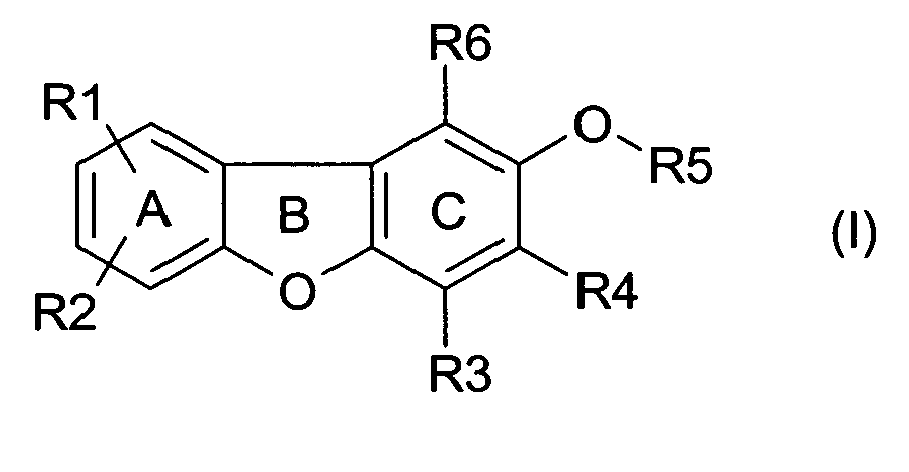
- R1, R2 and R3 independently represent an hydrogen atom, a halogen atom , in particular F, Cl, or Br, a (C1-C6)alkyl, in particular methyl or ethyl, CF3, NO2, NH2, NR7, NHCOR8, OH, OR8, CN, O(C1-C6alkyl)NR7, (C1-C6alkyl) NR7, or NR8 (C1-C6 alkyl)NR7, wherein NR7 represents a nitrogenous heterocycle, in particular

- R4 and R6 represent an hydrogen atom, a halogen atom , in particular F, Cl, or Br, a (C1-C6)alkyl, in particular methyl or ethyl, CF3, NO2, NH2, NR7, NHCOR8, OH, OR8, CN, O(C1-C6 alkyl)NR7, (C1-C6 alkyl)NR7, or NR8(C1-C6 alkyl)NR7, wherein R7 and R8 are as defined above, and R5 represents

- or R4 represents an hydrogen atom, a halogen atom , in particular F, Cl, or Br, a (C1-C6)alkyl, in particular methyl or ethyl, CF3, NO2, NH2, NR7, NHCOR8, OH, OR8, CN, O(C1-C6 alkyl)NR7, (C1-C6 alkyl)NR7, or NR8(C1-C6 alkyl)NR7, wherein R7 and R8 are as defined above, and R5 and R6 taken together form a pyran ring D1, according to the following formula:

and wherein


or R5 and R6 taken together form a oxacyclopentan ring D2 according to the following formula :
- or R6 represents an hydrogen atom, a halogen atom , in particular F, Cl, or Br, a C1-C6 alkyl, in particular methyl or ethyl, CF3, NO2, NH2, NR7, NHCOR8, OH, OR8, CN, O(C1-C6 alkyl)NR7, (C1-C6 alkyl)NR7, or NR8(C1-C6 alkyl)NR7, wherein R7 and R8 are as defined above, and R4 and R5 taken together form a pyran ring D3, according to the following formula:


or a pharmaceutically acceptable salt, an isomer, an enantiomer, or a diastereoisomer thereof, or a mixture thereof. - For the purpose of the present invention, the term "(C1-C6)alkyl" is intended to mean any linear or branched saturated hydrocarbon radical having from one to six carbon atoms. Examples of (C1-C6)alkyl groups include a methyl or an ethyl group.
- For the purpose of the present invention, the term "(C1-C6)alkylcarbonyl(C1-C6)alkyl" is intended to mean

- As used herein, a "pharmaceutically acceptable salt" includes both acid and base addition salts. "Pharmaceutically acceptable acid addition salt" refers to those salts which retain the biological effectiveness and properties of the free bases, which are not biologically or otherwise undesirable, and which are formed with inorganic acids such as hydrochloric acid, hydrobromic acid, sulfuric acid, nitric acid, phosphoric acid and the like, and organic acids such as acetic acid, trifluoroacetic acid, propionic acid, glycolic acid, pyruvic acid, oxalic acid, maleic acid, malonic acid, succinic acid, fumaric acid, tartaric acid, citric acid, benzoic acid, cinnamic acid, mandelic acid, methanesulfonic acid, ethanesulfonic acid, p-toluenesulfonic acid, salicylic acid, and the like. "Pharmaceutically acceptable base addition salt" refers to those salts which retain the biological effectiveness and properties of the free acids, which are not biologically or otherwise undesirable. These salts are prepared from addition of an inorganic base or an organic base to the free acid. Salts derived from inorganic bases include, but are not limited to, the sodium, potassium, lithium, ammonium, calcium, magnesium, iron, zinc, copper, manganese, aluminium salts and the like. Salts derived from organic bases include, but are not limited to, salts of primary, secondary, and tertiary amines, substituted amines including naturally occurring substituted amines, cyclic amines and basic ion exchange resins, such as isopropylamine, trimethylamine, diethylamine, triethylamine, tripropylamine, ethanolamine, 2-dimethylaminoethanol, 2-diethylaminoethanol, dicyclohexylamine, lysine, arginine, histidine, caffeine, procaine, hydrabamine, choline, betaine, ethylenediamine, glucosamine, methylglucamine, theobromine, purines, piperazine, piperidine, N-ethylpiperidine, polyamine resins and the like.
- As used herein, "isomer" compounds are compounds that have identical molecular formulae but that differ in the nature or the sequence of bonding of their atoms or in the arrangement of their atoms in space. Isomers that differ in the arrangement of their atoms in space are termed "stereoisomers". Stereoisomers that are not mirror images of one another are termed "diastereoisomers", and stereoisomers that are non-superimposable mirror images are termed "enantiomers", or sometimes optical isomers.
- In an embodiment, a compound according to the invention, including a pharmaceutically acceptable salt, an isomer, an enantiomer, or a diastereoisomer thereof, or a mixture thereof, has the following general formula:


- In another embodiment, a compound according to the invention, including a pharmaceutically acceptable salt, an isomer, an enantiomer, or a diastereoisomer thereof, or a mixture thereof, has the following general formula:


- In a preferred embodiment of a compound according to the invention, including a pharmaceutically acceptable salt, an isomer, an enantiomer, or a diastereoisomer thereof, or a mixture thereof,


- Advantageously, in a compound according to the invention, R1, R2, R3, R4 and R6 when they are not members of a pyran or oxacyclopentan ring, independently represent a hydrogen atom, a halogen atom, in particular F, Cl, or Br, a (C1-C6)alkyl, in particular methyl or ethyl, OH, or OR8, wherein R8 is as defined above.
- More advantageously, in a compound according to the invention, R1, R2, R3, R4 and R6 when they are not members of a pyran or oxacyclopentan ring, are a hydrogen atom.
- Preferred compounds according to the invention have one of the following formulas:


- Most preferably, a compound according to the invention may have one of the following formulas:

- The invention also concerns a method for preparing a compound having the following general formula:

- (a) adding 1,8-Diazabicyclo[5.4.0]undec-7-ene (DBU) and copper chloride dihydrate to a cooled solution in anhydrous acetonitrile under inert atmosphere of a compound having the following formula

- (b) stirring at 0°C, advantageously between 2 and 48 hours, more advantageously for 5 hours,
- (c) concentrating the mixture at reduced pressure
- (d) partitioning the organic fraction and the aqueous fraction,
- (e) washing the organic fraction successively with hydrochloric acid, sodium hydroxide, sodium hydrogenocarbonate and brine,
- (f) removing the solvent to give compound of formula (VII).
- The invention further concerns a method for preparing a compound having the following general formula:

- (g1) heating the compound of formula

- (h1) purifying compound of formula (IX) by chromatography over silica gel and
- (i1) recrystallizing the compound of formula (IX) in methanol.
- Also included in the invention is a method for preparing a compound having the following general formula:

- (g2) suspending sodium hydride in a dry solvent, advantageously chosen from toluene, benzene or xylene, more advantageously toluene, under an inert atmosphere, and adding a compound of formula

- (h2) stirring at room temperature, advantageously between 10 and 45 minutes, more advantageously for 30 minutes;
- (i2) adding chlorobutyne and potassium iodide and refluxing the suspension, advantageously between 24 hours and 7 days, more advantageously for three days,
- (j2) removing the solvent, and purifying the residue by chromatography over silica gel in order to obtain a mixture of the compound of formula (IX) and of the compound of formula (X),
- (k2) recrystallizing the mixture obtained in (j2) in methanol to obtain compound of formula (IX), or
- (k3) purification of the compound of formula (X) by reverse phase HPLC.
- In a preferred embodiment of the methods according to the invention, R1 and R2 represent an hydrogen atom.
- Several types of derivatives of compounds of formula (IX) may be obtained by methods well known in the art. For instance, a catalytic osmium oxidation of the double bond of the pyran ring, using N-methylmorpholine N-oxide, permits to generate cis diols derivatives, such as compound 12 described above. Besides, a permanganate oxidation of compound of formula (IX) leads to the isolation of an α-hydroxy ketone derivative, such as compound 13 described above. Reduction of such an α-hydroxy ketone derivative using sodium borohydride allows for the preparation of a trans diol derivative, such as compound 15 described above. Alcohol functions may be alkylated to generate carbonate derivatives, such as compounds 18 to 20 described above. Cyclic carbonates derivatives, such as compound 22 described above, may be obtained upon treatment of cis-diol derivatives with N,N'-carbonyl diimidazole in 2-butanone. A catalytic palladium hydrogenation of compound of formula (IX) leads to the formation of an hydrogenated compound such as compound 16. Any other modification of compound of formula (IX) by methods known by one skilled in the art may be performed.
- The invention further concerns a pharmaceutical composition comprising at least one compound as described above, with an acceptable carrier.
- The composition may be in the form of a solid, liquid or aerosol. Examples of solid compositions include tablets, gelatin capsules, powders, granules, suppositories, creams, and implantable dosage units. Examples of liquid compositions include aqueous solutions, isotonic saline solutions, injectable solutions, emulsions, syrup, and elixir. Examples of aerosol formulations include inhaler formulations for administration to the lungs.
- When a solid composition is prepared in the form of tablets, the main active ingredient is mixed with a pharmaceutical vehicle such as gelatin, starch, lactose, magnesium stearate, talc, gum arabic and the like. The tablets may be coated with sucrose or with other suitable materials, or they may be treated in such a way that they have a prolonged or delayed activity and they continuously release a predetermined amount of active principle.
- A preparation in gelatin capsules is obtained by mixing the active ingredient with a diluent and pouring the mixture obtained into soft or hard gelatin capsules.
- A preparation in the form of a syrup or an elixir may contain the active ingredient together with a sweetener, an antiseptic, and also a taste enhancer and a suitable coloring agent.
- The water-dispersible powders or granules may contain the active ingredient mixed with dispersing agents or wetting agents, or suspending agents, and with flavor correctors or sweeteners.
- For rectal administration, suppositories are used which are prepared with binders which melt at rectal temperature, for example cocoa butter or polyethylene glycols.
- For aerosol administration, particularly to the respiratory tract, the compound will generally have a small particle size for example of the order of five (5) microns or less. Such a particle size may be obtained by means known in the art, for example by micronization. The active ingredient is provided in a pressurized pack with a suitable propellant such as a chlorofluorocarbon (CFC), for example, dichlorodifluoromethane, trichlorofluoromethane, or dichlorotetrafluoroethane, or carbon dioxide or other suitable gas. The aerosol may conveniently also contain a surfactant such as lecithin. The dose of drug may be controlled by a metered valve.
- The composition may be administered by any standard route of administration, including topical, oral, rectal, nasal or parenteral (for example, intravenous, subcutaneous, or intramuscular) routes. Depending on the administration route, the composition will be formulated in any suitable form known by one skilled in the art. For instance, tablets, gelatin capsules, powders, granules, syrups and elixirs may be administered orally, therapeutic creams may be administered topically; implantable dosage units may be administered locally, for example, subcutaneously, and aerosol are particularly suitable for administration in the respiratory tract. In addition, the composition may be incorporated into sustained release matrices such as biodegradable polymers, the polymers being implanted in the vicinity of where delivery is desired. Advantageously, the composition is administered by oral route.
- The dosage of the composition will depend on the condition being treated, the particular composition used, and other clinical factors such as weight and condition of the patient, and the route of administration.
- In certain embodiment, a pharmaceutical composition according to the invention may further comprise at least one other antibiotic agent. As used herein, an "antibiotic agent" may be any agent able to prevent the growth of or to destroy some bacteria. In particular, when bacteria are Mycobacterium tuberculosis bacteria, usual antibiotic agents used for the treatment of tuberculosis include isoniazid (INH), rifampin (RIF), pyrazinamide, ethambutol, streptomycin, rifabutine, the aminoglycosides (Kanamycine/Amykacine Capréomycine), Acide aminosalicylique, Ethionamide, D-Cycloserine or Fluoroquinolones, (Ofloxacine, moxifloxacine, levofloxacine). In a preferred embodiment, when a pharmaceutical composition according to the invention is directed to the treatment of tuberculosis, it may thus further comprise at least one of these antibiotics agents. Preferably, such a pharmaceutical composition comprises a combination of several of these antibiotic agents, such as that used in current short course chemotherapy (DOTS), which consists of a combination of isoniazid (INH), rifampin (RIF), pyrazinamide and ethambutol or streptomycin.
- The invention also concerns a compound as described above, including any pharmaceutically acceptable salt, isomer, enantiomer, or diastereoisomer thereof, or mixture thereof, or a pharmaceutical composition as described above, as a medicament. Said medicament may be formulated in any form and administrated by any route described above.
- The compounds according to the invention are particularly suitable for use as medicament because of their low cytotoxicity on mammalian cells. In particular, compounds according to the invention were shown by the inventors to display a low cytotoxicity on macrophages and pneumocytes, which are the target cell types of Mycobacterium tuberculosis.
- In certain embodiments of the invention, said medicament is directed to the treatment of fungal or bacterial infections. In particular, said medicament may be directed to the treatment of infections by Candida albicans, which is one of the most frequent pathogenic fungus of humans, Aspergillus, Cryptococcus, or Pneumocystis.
- Concerning bacterial infections, a medicament according to the invention is preferably directed to the treatment of a mycobacterial infection, including Mycobacterium tuberculosis, Mycobacterium avium and Mycobacterium leprae infections, or of infection by a bacterial strain that shares similarities in its cell wall composition with mycobacteria. According to the invention, a bacterial strain that shares similarities in its cell wall composition with mycobacteria is a bacterial strain that contains mycolic acid, such as actinomycetes, in particular Nocardia asteroides. Advantageously, a bacterial strain that shares similarities in its cell wall composition with mycobacteria is Nocardia asteroides. In addition, when a medicament according to the invention is preferably directed to the treatment of infection by a bacterial strain that shares similarities in its cell wall composition with mycobacteria, in particular Nocardia asteroides, said medicament preferably comprises
compound 9 or compound 16 according to the invention. - Preferably, a medicament according to the invention is directed to the treatment of an infection caused by a Mycobacterium tuberculosis strain. Mycobacterium tuberculosis strains against which compounds according to the invention display an inhibitory activity notably include Mycobacterium tuberculosis H37Rv, H37Ra, the particularly virulent strain Beijing (GC1237), and ionazide resistant strain 2003/1762 and rifampin resistant strain 2004/0499.
- In the case of tuberculosis, inappropriate regimens or inadequate compliance to current short course chemotherapy (DOTS) has entailed the rise of drug resistant strains of Mycobacterium tuberculosis, and even to multiple drug resistant strains (MDR-TB). For instance, Mycobacterium tuberculosis strains that are resistant to isoniazid or rifampin or both have been described.
Compounds 9 and 16, as described above, were shown to have the same effect on non resistant Mycobacterium tuberculosis strains and on isoniazid or rifampin resistant Mycobacterium tuberculosis strains (see Table 3). In certain embodiments, a medicament according to the invention is thus directed to the treatment of infections by a Mycobacterium tuberculosis strain that is known to be resistant to at least one antibiotic agent, such as ionazide resistant strain 2003/1762 and rifampin resistant strain 2004/0499. - In a preferred embodiment, a medicament according to the invention is used in combination with at least one other antibiotic agent. In particular, when bacteria are Mycobacterium tuberculosis bacteria, usual antibiotic agents used for the treatment of tuberculosis include isoniazid (INH), rifampin (RIF), pyrazinamide, ethambutol, streptomycin, rifabutine, the aminoglycosides (Kanamycine/Amykacine Capréomycine), Acide aminosalicylique, Ethionamide, D-Cycloserine and Fluoroquinolones, (Ofloxacine, moxifloxacine, levofloxacine). In a preferred embodiment, when a pharmaceutical composition according to the invention is directed to the treatment of tuberculosis, it may thus further comprise at least one of these antibiotics agents. Preferably, such a pharmaceutical composition comprises a combination of several of these antibiotic agents, such as that used in current short course chemotherapy (DOTS), which consists of a combination of isoniazid (INH), rifampin (RIP), pyrazinamide and ethambutol or streptomycin.
- Tuberculosis may remain in an individual in a latent asymptomatic form. However, such a latent tuberculosis infection may be reactivated in immunodeficient patients. In a particular embodiment, a medicament according to the invention is thus directed to the treatment of immunodeficient patients infected by mycobacterial pathogenic strain. As used herein, immunodeficient patients represent any patient whose immune system is not able to mount efficient immune responses to infections. Examples of immunodeficient patients include AIDS patients, or patients who are treated with immunosuppressive drugs, such as patients treated against autoimmune diseases or transplanted patients.
- Having generally described this invention, a further understanding of characteristics and advantages of the invention can be obtained by reference to certain specific examples and figures which are provided herein for purposes of illustration only and are not intended to be limiting unless otherwise specified.
- Figure 1. Bacterial load (CFU) in spleens of mice infected by M. tuberculosis H37Rv and treated with excipient alone (ND),
compound 9 at 50 mg/kg/day (compound 9), or ionazide at 25 mg/kg/day (INH). - Melting points were determined on a hot stage Reichert microscope and were uncorrected. Mass spectra were recorded with a Nermag R-10-10C spectrometer using desorption-chemical ionisation (DCI-MS; reagent gas: NH3.). UV spectra (λmax in nm) were recorded in spectroscopic grade MeOH on a Beckman Model 34 spectrophotometer. IR Spectra (νmax in cm-1) were obtained from potassium bromide pellets or sodium chloride films on a Perkin-Elmer 257 instrument.1H NMR (™ [ppm], J [Hz]) spectra were run at 400 MHz and 13C spectra at 75 MHz, using Bruker AVANCE-400 and AC-300 spectrometers, respectively. All the structures were insured and the signals unambiguously assigned by 2D NMR techniques: 1H-1H COSY, 1H-1H NOESY, 13C-1H HMQC and 13C-1H HMBC. These experiments were performed using standard Bruker microprograms. Column chromatographies were performed on Merck silica gel 35-70 µM or 20-45 µM. 2-hydroxydibenzofuran (4) were purchased from Aldrich Chemical Company (Steinheim, Germany).
- To a solution of 2-hydroxydibenzofuran (4) (16.20 mmoles, 3 g) in anhydrous acetonitrile (6 mL, dried over 4A molecular sieve) under argon and cooled using an ice-salt bath were added DBU (16.20 mmol, 1.68 mL) and copper chloride dihydrate (0.20 mol, 3 mg) followed by the addition of chlorobutyne 3 (16.20 mmol, 2.50 mL). After stirring for 5 hours at 0°C, the mixture was concentrated at reduced pressure and the residue was partitioned between water (20 mL) and toluene (20 mL). The organic fraction was washed successively with hydrochloric acid 1N (20 mL), sodium hydroxide 1N (20 mL), 1N sodium hydrogenocarbonate (20 mL) and brine (20 mL) before being dried over anhydrous magnesium sulfate. After filtration, the solvent was then evaporated to dryness under reduced pressure to give compound 5 as a pale yellow oil (3.40 g, 85 %) which was used without further purification.
- IR (KBr) νmax cm-1 : 3299, 2992, 2918, 2358, 2334, 1593, 1481, 1444, 1175, 1137, 747. UV. λ nm (log Σ) in methanol: 211 (4.06), 251 (3.59), 287 (3.49) 1H (CDCl3): 7.98 (dd, 1H, J = 9, 2, H-9); 7.81 (d, 1H, J = 2, H-1), 7,60 (dd, 1H, J = 9, 2, H-6); 7.50 (d, 1H, J = 9, H-3); 7.48 (td, 1H, J = 9, 2, H-7); 7.35 (td, 1H, J = 9, 2, H-8); 7.33 (d, 1H, J = 9, H-4); 2.60 (s, CH.C), 1.53 (s, 3H, 2 x CH3). 13C (400 MHz, CDCl3) :157.2 (C2); 153.1 (C5a); 151.4 (C4a); 127.5 (C7); 124.8 (C9a); 124.7 (2C, C9 + C8); 121.1 (C6); 114.6 (C4); 112.1 (C1); 111.9 (C9b); 111.7 (C3); 86.6 (HC.C), 74.3 (HC.C), 73.82 (C(CH3)3), 30.0 (2C, CH3); m/z : = 251.[MH]+.
- Under an inert atmosphere, sodium hydride (50% in oil 67.70 mmol, 3.25 g) was dissolved in dry toluene (250 mL) and 2-hydroxydibenzofuran (4) (27.14 mmol, 5.00 g) was slowly added. After 30 min of stirring at room temperature, chlorobutyne (3)36,47 (30.00 mmol, 3.10 g) and potassium iodide (30.00 mmol, 4.98 g) were added and the suspension was refluxed for three days. After removal of the solvent under reduced pressure, the residue was purified by chromatography over silica gel eluting with a mixture of cyclohexane/dichloromethane in proportions varying from 99.5-0.5 to 98-2 to yield the 1/10 mixture of compounds 8 and 9 (3.94 g, 58 %) as well as compound 10 (0.72 g, 11%). A recrystallisation of the above-mentioned mixture in methanol lead to compound 9 (1.40 g, 21%) as white needles.

-
Compound 9 was also obtained, from ether propargylic 5 (20.00 mmol, 5.00 g) by heating in 1,3-dichlorobenzene (150 mL) during 12 hours, as white needles (1.60 g, 53 %) after purification by chromatography over silica gel (solvant: cyclohexane/dichloromethane 98/2 v/v). - 3,3-dimethyl-3H-benzofuro[3,2-f][1]benzopyran (9) : mp : 101°C (from MeOH). IR (KBr) vmax cm-1 : 2975, 1424, 1146, 810. UV. λ nm (log Σ) in methanol: 217 (6.82), 276 (6.37), 295 (6.67), 305 (6.73) 1H (CDCl3): 8.01 (dd, 1H, J = 8, 2, H-11); 7.57 (dd, 1H, J = 8, 1, H-8), 7,45 (td, 1H, J = 8, 2, H-9); 7.35 (m, 2H, H-6 and H-10); 7.11 (d, 1H, J = 9, H-1); 6.95 (d, 1H, J = 9, H-5); 5.85 (d, 1H, J = 9, H-2); 1.53 (s, 3H, CH3); 1.38 (s, 3H, CH3). 13C (400 MHz, CDCl3) :157.1 (C7a); 151.2 (C6a); 148.6 (C4a); 132.2 (C2); 126.9 (C9); 124.5 (C11a); 123.0 (C11); 122.6 (C10); 120.65 (C11b); 119.4 (C1); 116.1 (C5); 115.8 (C11c); 111.9 (C8); 111.2 (C6); 75.8 (C3); 27.7 (CH3); 27.5 (CH3). m/z : = 251.[MH]+ .Anal. (C17H1402) : C, H, O.
- mp : 121°C (from MeOH). IR (KBr) νmax cm-1: 2958, 2916, 2856, 2363, 2335. U.V. λ nm (log Σ) in methanol : 237 (3.37), 260 (3.02), 292, (3.22). 1H (CDCl3): 7,85 (dd, 1H, J=8, 1, H-10), 7.44 (dd, 1H, J = 8, 1, H-7), 7.34 (td, 1H, J = 8, 1, H-8), 7.24 (d, 1H, J = 9, H-5), 7.22 (dd, 1H, J = 8, 2, H-9), 6.91 (d, 1H, J = 9, H-4), 4.56 (d, 1H, J = 3, H-2a), 4.16 (d, 1H, J = 3, H-2b), 1.62 (s, 3H, CH3), 1.53 (s, 3H, CH3). 13C (CDCl3) : 172.6 (C2), 157.2 (C6a), 152.6 (C5a), 151.7 (C3a), 127.3 (C8), 127.1 (C10a), 123.5 (C10), 122.5 (C9), 122.4 (C10b), 119.9 (C10c), 112.0 (C4), 111.9 (C7), 108.7 (C5), 82.0 (C2'), 45.0 (C1), 29.7 (CH3), 28.6 (CH3). mlz : = 251.[MH]+ Anal. (C17H1402) : C, H, O.
- The mixture of the linear and angular pyranodibenzofuran 8 and 9 (1.98 mmol, 0.05 g) was added to a solution of osmium tetroxide (2.5 % in 2-methyl-2-propanol) (1.25 mL) and N-methylmorpholine N-oxide (1.98 mmol, 232.00 mg) in ter-butanol-tetrahydrofuran-water (10/3/1, v/v/v, 8.90 mL) and stirred at room temperature during 2 days. After addition of saturated aqueous sodium hydrogensulfite (20 mL) and stirring for 1h, the solution was then extracted with dichloromethane (5 x 20 mL). The organic layers were dried over anhydrous magnesium sulfate before being evaporated to dryness under reduced pressure. A flash chromatography (solvent cyclohexane/ ethyle acetate from 99/1 to 95/5 v/v) afforded 11 (0.10 g, 17 %) as white crystals and 12 (0.40 g, 72 %) as an amorphous white solid.

- (±)cis-3,4-dihydro-3,4-dihydroxy-2,2-dimethyl-2H-benzofuro[2,3-g]-[1]-benzopyran (11) : mp: 206°C (from MeOH). IR (KBr) νmax cm-1 : 3355, 2963, 2928, 1576, 1462, 1433, 1172, 750. U.V. λ nm (log Σ) in methanol :244 (5.57), 253 (5.67), 260 (4.26), 291 (5.69) , 316 (5.25), 326 (5.27), 347 (3.91). 1H (CDCl3) : 7.85 (dd, 1H, J = 8, 1, H-10), 7.75 (d, 1H, J = 1, H-5), 7.56 (dd, 1H, J = 8, 1 H-7), 7.45 (td, 1H, J = 8, 1, H-8 ), 7.37 (s, 1H, H-11), 7.31 (td, 1H, J = 8, 1, H-9), 4.95 (dd, 1H, J=9, 4, H-4), 3.78 (dd, 1H, J=9, 4, H-3), 2.84 (s, 1H, J=9, OH-4), 2.09 (s, 1H, J=9, OH-3), 1.45 (s, 3H, CH3), 1.2 (s, 3H, CH3). 13C (CDCl3) :157.1 (C6a), 151.5 (C5a), 148.0 (C11a), 127.6 (C8), 125.4 (C4a), 124.1 (C10a) , 122.6 (C10b), 122.5 (C9), 120.9 (C10), 111.8 (C7), 111.1 (C5), 108.1 (C11), 77.9 (C2), 71.6 (C3), 66.5 (C4), 25.0 (CH3), 23.3 (CH3). m/z : = 285.[MH]+. Anal. (C17H1604): C, H, O.
- (±)cis-1,2-dihydro-1,2-dihydroxy-3,3-dimethyl-3H-benzofuro[3,2-f][1]benzopyran (12) : IR (KBr) νmax cm-1: 3493, 3331, 2929, 1429, 1038, 930. U.V. λ nm (log Σ) in methanol : 254 (5.84), 290 (5.90), 314 (5.43) , 325 (5.45). 1H (CDCl3) : 8.40 (dd, 1H, J = 8, 1, H-11), 7.56 (dd, 1H, J = 8, 1, H-8), 7.46 (td, 1H, J = 8, 1, H-9), 7.44 (d, 1H, J = 9, H-6 ), 7.36 (td, 1H, J = 8, 1, H-10), 6.97 (d, 1H, J = 9, H-5), 5.28 (dd, 1H, J = 9, 5, H-1), 3.92 (dd, 1H, J = 9, 5 H-2), 2.96 (d, 1H, J = 9, OH-1), 2.44 (d, 1H, J = 9, OH-2), 1.53 (s, 3H, CH3), 1.39 (s, 3H, CH3). 13C (CDCl3) : 156.9 (C7a), 151.1 (C6a), 147.9 (C4a), 127.0 (C9), 124,5 (C11a), 122.4 (C11), 122.2 (C10), 119.8 (C11b), 117.1 (C5), 116.1 (C11c), 112.7 (C8), 111.4 (C6), 77.6 (C3), 71.8 (C2), 64.4 (C1), 23.4 (CH3), 23.1 (CH3). m/z : = 285.[MH]+ . Anal. (C17H1604): C,H,O
- A suspension of powered potassium permanganate (3.66 mmol, 0.58 g) in water (2.14 mL) was added drop-wise for 2 h to a solution of 9 (0.66 mmol, 0.17 g) in acetone (4.00 mL) at room temperature. The solvents were removed under reduced pressure and the residue was submitted to flash chromatography with cyclohexane/dichloromethane (from 90/10 v/v to 35/65 v/v) to afford compounds 13 (0.10 g, 55 %) and 14 (0.01 g, 5%).
- Amorphous white solid. IR (KBr) νmax cm-1: 2485, 3101, 2976, 1680, 1440, 1083, 906, 743. U.V. λ nm (log Σ) in methanol : 251 (5.04), 309 (3.70), 311 (3.71), 338 (3.45) , 365 (3.55). 1H (CDCl3) : 9.05 (dd,1H, J = 7, 2, H-11), 7.73 (d,1H, J = 9, H-6), 7.57 (dd, 1H, J = 8, 1, H-8), 7.53 (td, 1H, J = 8, 2, H-9), 7.41 (ddd, 1H, J = 8, 7, 1, H-10), 7.05 (d,1H, J = 9, H-5), 4.57 (s, 1H, H-2), 4.05 (s, 1H, OH), 1.71 (s, 3H, CH3), 1.29 (s, 3H, CH3). 13C (CDCl3) : 194.3 (CO), 157.5 (C7a), 157.1 (C6a), 150.6 (C4a), 128.4 (C9), 126.4 (C11), 123.2 (C11a), 122.6 (C10), 122.0 (C11b), 119.8 (C5), 117.4 (C8), 112.9 (C11c), 111.1 (C6), 88.2 (C3), 76.4 (C2), 26.8 (2XCH3). m/z := 283.[MH]+. Anal. (C17H1404): C, H, O.
- Amorphous white solid. IR (KBr) vmax cm-1 : 3082, 2984, 2940, 1709, 1596, 1440, 1110. λ nm (log Σ) in methanol : 242 (6.12), 313 (6.27), 338 (6.01), 360 (7.16). 1H (CDCl3) : 8.86 (dd, 1H, J = 8, 1, H-11), 7.71 (d, 1H, J = 9, H-6), 7.58 (dd, 1H, J = 8, 1, H-8), 7.53 (td, 1H, J = 8,1, H-9), 7.40 (td, 1H, J = 8, 1, H-10), 7.02 (d,1H, J = 9, H-5), 4.79 (s, 1H, OH), 3.06 (s, 2H, CH2-CO-CH3), 2.1 (s, 3H, CH2-CO-CH3), 1.57 (s, 3H, CH3), 1.41 (s, 3H, CH3). 13C (CDCl3) : 188.0 (CO), 169.4 (CH2COCH3), 157.7 (C7a), 155.4 (C6a), 151.0 (C4a), 128.8 (C9), 126.2 (C11), 123.3 (C11a), 123.0 (C10), 122.5 (C11b), 119.3 (C5), 117.0 (C8), 116,1 (C11c), 113.3 (C6), 84.3 (C3), 68.1 (C2), 45.6 (CH2COCH3), 32.0 (CH2COCH3), 23,7 (2XCH3). m/z : = 339.[MH]+. Anal. (C20H1805) : C, H, O
- To a cold solution of 13 (1.10 mmol, 0.31 g) in methanol (12.00 mL) was added NaBH4 (8.80 mmol, 0.33 g). The mixture was stirred for 15 min at room temperature. The reaction was quenched by addition of water, and extracted by dichloromethane (2 x 5 mL). The organic layers were dried over magnesium sulfate and evaporated to dryness. The cis/trans mixture was purified by OPLC chromatography eluting with dichloromethane/ethylacetate (90/10 V/V) and allowed some pure compound 15 (0.08g, 26 %) to be isolated as amorphous white solid. IR (KBr) vmax cm-1 : 3438, 2980, 2908, 2843, 2357, 1621, 1473, 1180, 813, 754 λ nm (log Σ) in methanol :221 (5.64), 202 (7.14), 207 (7.13), 254 (6.78), 260 (5.54), 290 (6.86), 325 (6.39). 1H (CDCl3) : 8.31 (dd, 1H, J = 8, 2, H-11), 7.55 (d, 1H, J = 8, H-8), 7.47 (td, 1H, J = 8,2, H-9), 7.45 (dd, 1H, J = 9, H-6), 7.35 (td, 1H, J = 8, 1 H-10 ), 6.97 (d, 1H, J = 9, H-5), 5.1 (dd, 1H, J = 7, 6, H-1), 3.88 (t, 1H, J = 6, H-2), 2.47 (d, 1H, J = 6, OH-2), 2.14 (d, 1H,J = 7, OH-1), 1,54 (s, 2X3H, 2XCH3). 13C (CDCl3) : 156.9 (C7a), 151.1 (C6a), 148.3 (C4a), 127.1 (C9), 124.2 (C11), 123.6 (C11a), 122.9 (C11b),122.5 (C10), 117.1 (C5), 116.1 (C11c), 112.8 (C8), 111.4 (C6), 77.8 (C3), 77.5 (C2), 69.8 (C1), 25.5 (2XCH3). m/z : = 285.[MH]+. Anal. (C17H1604) : C, H, O.
- 1,2-dihydro-3,3-dimethyl-3H-benzofuro[3,2-f][1]benzopyran (16). To a solution of 9 (0.25 mmol, 0.06 g) in ethanol (15 mL) was added Pd/C (10 %, 0.007 g). The resulting mixture was flushed under H2 (1 atm) at room temperature for 18 hours. After filtration, the solution was concentrated to dryness using a high vacuum pump and led to compound 16 (0.059 g, 96 %) as a white needles. mp : 124°C (from MeOH). IR (KBr) νmax cm-1: 2971, 2920, 1638, 1420, 1266, 1168. UV. λnm (log ε) in methanol: 217 (3.68), 223 (3.77), 290 (3.87), 328 (3.85) .1H (CDCl3): 8.00 (dd, 1H, J = 8, H-11); 7.58 (d, 1H, J = 8, H-8), 7,48 (td, 1H, J = 8, 2, H-9); 7.37 (m, 2H, H-6 and H-10); 6.98 (d, 1H, J = 9, H-5); 3.28 (t, 2H, J = 4, H-1); 2.02 (t, 2H, J = 4, H-1); 1.42 (s, 6H, CH3). 13C (400 MHz, CDCl3) : 157.1 (C7a); 150.6 (C6a); 149.62 (C4a); 126.7 (C9); 125.59 300 (C11a); 122.7 (C11+C10); 122.5 (C11b); 123.0 (C11); 117.5 (C5); 115.7 (C11c); 111.9 (C8); 111.2 (C6); 74.1 (C3); 32.7 (C2); 26.9 (CH3); 21.4 (C1). m/z : = 253.[MH]+. Anal. (C17H16O2): C, H.
-

- To a solution of 11-15 (0.17 mmol, 0.05 g) in dry pyridine (4.00 mL) was added an excess of acetic anhydride (4.00 mL). The reaction mixture was stirred during 2 days at room temperature. The resulting solution was poured on cold water. The precipitate was filtered, washed with water and then dried in a vacuum over phosphorus pentoxide to afford compounds 17-20 in the yield described below.
- Amorphous white solid. IR (KBr) νmax cm-1 : 3438, 2980, 2908, 2843, 2357, 1621, 1473, 1180, 813, 754. λ nm (log Σ) in methanol : 209 (5.97), 245 (5.47), 254 (5.59), 260 (4.80), 291 (5.66), 315 (5.18), 326 (5.23). 1H (CDCl3) : 7.89 (d, 1H, J = 9, H-10), 7.53 (d, 1H, J = 9, H-7), 7.46 (t, 1H, J = 9, H-8), 7.43 (s, 1H, H-5), 7.38 (s, 1H, H-11), 7.32 (t, 1H, J = 9, H-9), 6.35 (d, 1H, J = 7, H-4), 5.40 (s, 1H, J = 7, H-3), 2.18 (s, 3H, OCOCH3), 2.08 (s, 3H, OCOCH3), 1.46 (s, 2X3H, 2XCH3). 13C (CDCl3) :170.6 (OCOCH3), 157.2 (C6a), 150.9 (C5a), 148.8 (C11a), 127.7 (C8), 125.7 (C10a), 123.9 (C10b), 122.5 (C9), 120.9 (C10), 117.6 (C4a), 111.7 (C7), 109.9 (C5), 108.1 (C11), 77.1 (C2), 69.6 (C3), 66.1 (C4), 24.2 (OCOCH3), 20.7 (2XCH3). m/z = 369.[MH]+. Anal. (C21H2006): C, H, O
- White crystals mp. = 188.7°C (from CH2Cl2/MeOH). IR (KBr) νmax cm-1 : 3722, 2986, 1734, 1374, 1240, 1188, 1093, 808. λ nm (log Σ) in methanol : 253 (5.28), 291 (5.35), 326 (5.03). 1H (CDCl3) :7.60 (dd, 1H, J = 8, 1,H-11), 7.53 (dd, 1H, J = 8, 1, H-8), 7.50 (d, 1H, J = 9, H-6), 7.44 (dd, 1H, J = 8, 1, H-9), 7.28 (td, 1H, J = 8,1, H-10), 7.01 (d, 1H, J = 9, H-5), 6.71 (d, 1H, J = 5, H-1), 5.45 (d, 1H, J = 5, H-2), 2.10 (s, 3H, OCOCH3), 2.08 (s, 3H, OCOCH3), 1.49 (s, 3H, CH3), 1.45 (s, 3H, CH3). 13C (CDCl3) : 169.9 (O-CO-CH3 C1), 156.8 (O-CO-CH3 C2), 157.0 (C7a), 151.0 (C6a), 149.5 (C4a), 127.2 (C9), 123.5 (C11a), 123.0 (C11), 121.9 (C10), 123.0 (C11b), 117.5 (C5), 114.0 (C8), 112.0 (C6), 110.4 (C11c), 75.6 (C3), 71.7 (C1), 64.5 (C2), 21.5 (O-CO-CH3 C1), 20.6 (O-CO-CH3 C2), 25.9 (2XCH3). m/z = 369.[MH]+. Anal. (C21H2006) : C, H, O
- White crystals mp. = 259°C (from MeOH). IR (KBr) νmax cm-1 : 3450, 3065, 2980, 1748, 1439, 1228. λ nm (log Σ) in methanol: 211 (5.23), 246 (5.05), 255 (5.08), 284 (5.16), 328 (4.53). 1H (CDCl3):7.60 (d,1H, J = 8, H-11), 7.56 (d,1H, J = 8, H-8), 7.53 (d, 1H, J = 9, H-6), 7.46 (t, 1H, J = 8, H-9), 7.31 (t, 1H, J = 8, H-10), 7.05 (d, 1H, J = 9, H-5), 6.28 (d, 1H, J = 3, H-1), 5.41 (d, 1H, J = 3, H-2), 2.13 (s, 3H, OCOCH3), 2.08 (s, 3H, OCOCH3), 1.49 (s, 3H, CH3), 1.41 (s, 3H, CH3). 13C (CDCl3) : 170.7 (O-CO-CH3 C1),169.7 (O-CO-CH3 C2),156.9 (C7a), 151.0 (C6a), 149.4 (C4a), 127.2 (C9), 123.5 (C11a), 122.9 (C11), 121.4 (C11b), 121.6 (C10), 117.6 (C5), 113.7 (C8), 111.9 (C6), 110.8 (C11c), 75.4 (C3), 71.7 (C1), 67.7 (C2), 23.7 (O-CO-CH3 C1), 23.6 (O-CO-CH3 C2), 20.9 (2XCH3). m/z = 369.[MH]+. Anal. (C21H2006) : C, H, O
- Amorphous white solid. IR (KBr) νmax cm-1 : 3497, 2983, 2939, 1757, 1687, 1594. λ nm (log Σ) in methanol: 211 (2.40), 215 (2.46), 251 (2.67), 265 (2.46), 320 (2.76). 1H (CDCl3) : 9.1 (d, 1H, J = 8, H-11), 7.75 (d, 1H, J = 9, H-6), 7.58 (d, 1H, J = 8, H-8), 7.53 (td, 1H, J = 8, 1, H-9), 7.35 (dd, 1H, J = 8, 1, H-10), 7.07 (d,1H, J = 9, H-5), 5.7 (s, 1H, H-2), 1.71 (s, 3H, CH3), 2.1 (s, OCOCH3), 1.62 (s, 3H, CH3), 1.58 (s, 3H, CH3). 13C (CDCl3) : 188.0 (CO), 169.4 (O-CO-CH3),157.4 (C7a), 156.2 (C6a), 150.7 (C4a), 128.2 (C9), 126.8 (C11), 123.0 (C11a), 122.4 (C10), 122.2(C11b), 119.3 (C5), 117.0 (C8), 114.2 (C11c), 110.8 (C6), 80.7 (C2), 75.4 (C3), 26.0 (CH3-COOH), 26.8 (2XCH3). m/z = 325.[MH]+. Anal. (C19H1605) : C, H, O
- To a solution of 11 or 12 (0.10 mmol, 0.03 g) in 2-butanone (2.00 ml) was added N,N'-carbonyldiimidazole (0.50 mmol, 0.081 g). The solution was refluxed for 2 h under argon and after cooling, 5% aqueous sodium hydrogencarbonate (20 mL) was added. The solution was extracted with ethyl acetate (3 x 20 mL) and the combined organic layers were dried over anhydrous magnesium sulfate, filtered and evaporated under reduced pressure. The residue obtained was purified by chromatography over silica gel (solvent dichloromethane then dichloromethane/acetone 98/2 to 96/4 v/v).

- Amorphous white solid .IR (KBr) νmax cm-1 : 2918, 1794, 1175, 1072, 997. λ nm (log Σ) in methanol: 209 (5.65), 247 (5.17), 292 (5.20), 305 (4.93), 310 (4.92). 1H (CDCl3) : 8.1 (d, 1H, J = 8, 1, H-10), 7.8 (s,1H, H-5), 7.73 (s, 1H, H-11), 7.66 (d, 1H, J = 8, 1, H-7), 7.55 (dd, 1H, J = 8, 1, H-8), 7.38 (dd, 1H, J = 8, 1, H-9), 6.15 (d, 1H, J = 8, H-4), 5.13 (d, 1H, J = 8, H-3), 1.45 (s, 3H, CH3), 1.15 (s, 3H, CH3). 13C (CDCl3) :159.5 (OCOO), 157.4 (C6a), 152.8 (C5a), 148.7 (C11a), 128.3 (C8), 127.4 (C10a), 123.5 (C10b), 122.9 (C9), 121.2 (C10), 116.2 (C4a), 112.3 (C7), 111.9 (C5), 109.8 (C11), 78.9 (C2), 75.3 (C3/C4), 30.9 (2XCH3). mlz = 311.[MH]+. Anal. (C18H1405) : C, H, O.
- white needles. m.p. = 215°C (from MeOH). IR (KBr) νmax cm-1 : 2990, 2933, 1802, 1626, 1175, 1029, 745. λ nm (log Σ) in methanol: 219 (5.95), 253 (5.23), 262 (4.60), 291 (5.32), 312 (4.99). 1H (CDCl3) : 8.06 (dd, 1H, J = 8,1, H-11), 7.59 (dd, 1H, J = 8, 1,H-8), 7.55 (d, 1H, J = 9, H-6), 7.51 (td, 1H, J = 8, 1, H-9), 7.39 (td, 1H, J = 8, 1, H-10), 7.02 (d, 1H, J = 9, H-5), 6.23 (d, 1H, J = 8, H-1), 4.88 (d, 1H, J = 8, H-2), 1.6 (s, 3H, CH3), 1.4 (s, 3H, CH3). 13C (CDCl3) : 157.1 (O-CO-O), 153.8 (C7a), 151.3 (C6a), 148.5 (C4a), 127.8 (C9), 123.5 (C11a), 123.0 (C11), 122.9 (C11b), 122.7 (C10), 117.6 (C5), 114.7 (C8), 111.9 (C6), 109.7 (C11c), 78.8 (C3), 74.9 (C2), 70.4 (C1), 22.8/22.5 (2XCH3). m/z = 311.[MH]+. Anal. (C18H1405) : C, H, O.
- The biological activities of pyranodibenzofuran derivatives 9-22 were investigated on a wide range of bacteria. The antimycobacterial activity was screened on the fast growing saprophyte Mycobacterium smegmatis mc2155 and on the virulent strain Mycobacterium tuberculosis H37Rv for all synthesized compounds. This was achieved using a liquid culture, which was then plated on solid media to determine the exact number of colony-forming units (CFU). The Minimal Inhibitory Concentration (MIC99) is defined as the amount of compound required for > 99 % inhibition of bacterial growth (Table 1). Results of the most promising compounds on various strains of the M. tuberculosis complex, including the more virulent Beijing strain and drug resistant ones are shown in Table 2. To further assess the specificity of this new series, compounds were also screened for activity against a whole range of bacteria and fungi as well as for cytotoxicity (Tables 3 and 4).
- The antifungal activity of
compounds 5, 9, and 11-22 against Candida albicans was analyzed by the measure of the MIC99 concentration (see Table 1).Table 1. In Vitro Activity against Candida albicans of pyranodibenzofuran derivatives Compound MIC99 (ug/mL) C. albicans 5 ND 9 > 600 10 > 300 11 27 12 > 160 13 > 330 14 150 15 > 300 16 ND 17 > 400 18 > 300 19 > 300 20 > 280 21 > 400 22 ND INH ND Miconazole 0.25-60 ND: Not determined
Data are representative of three independent experiments and standard deviation is within 10 % of the MIC99. - Some of the synthesized compounds thus display some antifungal activity, particularly compounds 11 and 14, although this activity is lower than that of the reference molecule miconazole.
- The antibacterial activity of
compounds 5, 9, and 10-22 was also investigated on different types of bacteria. - Escherichia coli (CIP 100631), Corynebacterium jeikeium (ATCC43734), Nocardia asteroides (ATCC19247), were obtained from the Collection de l'Institut Pasteur, Paris, France. Streptomyces coelicolor (M145), albus, avidini, avermitilis (ATCC31267); Pseudomonas aeruginosa (13C3104), Enterococcus faecalis (14C1104), Pneumococcus pneumoniae (15C5004), Staphylococcus aureus (18C2204) strains were isolated from patients and kindly provided by Philippe Mazodier, Laurent Marsollier and GC1237 Beijing strains from Dr. Carlos Martin. Resistant strains (2003/1762 and 2004/0499) were obtained from Dr. Véronique Vincent (Laboratoires de référence des Mycobactéries, Institut Pasteur, Paris, France).
- Effect of the compounds was assessed on mycobacterial strains in vitro growth in liquid medium. Compounds were solubilized in DMSO and 100 µl of the appropriate dilution were added to a 5 ml culture with predetermined mycobacterium inocula. For the assays on the rapid growing mycobacterium Mycobacterium smegmatis, optical density of the culture in Luria-Bertani 410 medium at 595nm was measured after two-day's growth at 37°C. The effect on Mycobacterium tuberculosis strains and MDR-TB was monitored after three weeks growth in Middlebrook 7H9 broth at 37°C. Quantification of the mycobacteria was carried out by plating on 7H11 agar serial 5-fold dilutions in medium, and colony forming units (CFUs) ascertained after 2 weeks growth. The minimal inhibitory concentration (MIC) given is the concentration of compound for which 99% of the bacterial growth is inhibited.
Table 2. In vitro Activity against M. smegmatis mc2155 and M. tuberculosis H37Rv of pyranodibenzofuran derivatives N° (compound) ClogP MIC99 (µg/mL) on M. smegmatis MIC99 (µg/mL) on M. tuberculosis a 5 5.3 12 NI 9 5.5 5 5 11 3.1 60 NI 12 3.4 30 60 15 3.4 30 NI 16 5.6 1 5 19 4.8 180 NI INH -0.7 13 0.1 MIC is the minimal concentration (µg/mL) of a compound resulting in a 99% decrease in the number of colony forming units of mycobacterial cultures compared to control (DMSO only). NI : No inhibition observed at the highest concentration tested (1 mg/mL). Data are representative of three independent experiments and standard deviation is within 10% of the MIC99. LogP (ClogP) represents hydrophobicity and was determined using the ChemDrawPro software. a MIC of compound 9 and 16 were also determined by Bactec 460 (Becton Dickinson) method as previously described and are 10µg and 5 µg respectively. - From the results shown in table 2, an inhibitory activity on M. smegmatis mc2 155 of the 2,2-dimethyl-propargylic ether 5 (MIC99 of 12 µg/mL), equivalent in this test to the control antibiotic isoniazid (INH), was found. Of even more interest, the 3,3-dimethyl-3H-benzofuro[3,2-f][1]-
benzopyran 9 and its reduced analogue 16 with an MIC99 of 5 µg/mL, are actually more potent than INH. The three diol-bearing compounds 11, 12 and 15, derived from a controlled oxidation ofcompounds 8 or 9, exhibited a lower level of activity ranking between 30 to 60 µg/ml. -
Compounds 5, 9 and 16 were then tested on strains of the complex M. tuberculosis, including H37Rv and the more virulent Beijing. - Effect of compounds on mycobacterial strains of the M. tuberculosis complex, including H37Rv and the more virulent Beijing, was assessed on in vitro growth in liquid medium. Compounds were solubilized in DMSO and 100 µl of the appropriate dilution were added to a 5 ml culture with predetermined mycobacterium inocula. The effect on M. tuberculosis strains and resistant strains was monitored after a three week growth in Middlebrook 7H9 culture (Difco, Sparks MD, USA) supplemented with oleic acid-albumindextrose-catalase (OADC, Difco, Sparks MD, USA) at 37°C. Quantification of the mycobacteria was carried out by plating on Middlebrook 7H11 medium (Difco, Sparks MD, USA) supplemented with OADC and colony forming units (CFUs) ascertained after a 2 week growth. The minimal inhibitory concentration (MIC99) given is the concentration of compound for which 99% of the bacterial growth is inhibited.
- Results are shown in the following Table 3.
Table 3. In vitro activity of compounds 5, 9 and 16 against a whole range of mycobacteriaMycobacterial strain of M. tuberculosis complex MIC99 (µg/mL) 5 9 16 INH M. tuberculosis H37Rv > 500 5 5 0.1 Beijing (GC1237) > 500 2 10 0.1 H37Ra > 500 10 10 1 INH resistant (2003/1762) ND 5 1 5 RIF resistant (2004/0499) ND 5 1 0.1 M. bovis BCG (Pasteur) > 500 10 10 1 M. microti (MYC-942272) > 500 1 ND 0.1 ND : Not Determined
INH: ionazide, RIF: rifampin -
Compound 9 as well as the reduced benzopyran 16 have a good inhibition activity on the growth of H37Rv and the more virulent Beijing mycobacterium tuberculosis strains. The corresponding MIC99, which are less than 5 µg/mL, are indeed comparable to that of first-line anti-TB drugs such as ionazide. - In addition, exactly the same MIC99 was found on RIP and INH resistant strains as on sensitive H37Rv strain (Table 3), indicating that
compounds 9 or 16 could be particularly valuable for the treatment of drug-resistant M. tuberculosis strains. - The activity of
compound 9 was also evaluated in vitro on murine bone marrow macrophages infected by M. tuberculosis H37Rv. - Macrophages were cultured in 96 wells microplates at a 2.105 macrophages/mL concentration for 7 days, and were then infected by M. tuberculosis H37Rv with a 1/10 ratio. After 2 hours, infected macrophages were washed and treated with different concentrations of compound 9 (respectively 50, 10, 5, and 1 µg/mL) for 24 or 48 hours. Macrophages were then lysed using triton X-100 at 0.1% in PBS. To count bacteria able to grow, the lysates were diluted and seeded on 7H11 culture medium. The enumeration of colony forming units (CFU) was determined after 4 to 6 weeks.
- Results are shown in the following Table 4.
Table 4. In vitro antibacterial activity of compound 9 on bone marrow macrophages infected by Mycobacteriumtuberculosis H37Rv Compound 9 concentration (µg/mL) CFU 24 hours treatment 48 hours treatment 50 1750 ± 1500 3800 ± 497 10 1500 ± 577 10000 ± 7360 5 3000 ± 816 2875 ± 250 0 4000 ± 1414 17500 ± 12583 - Despite the presence of somewhat large standard deviations (50 µg/mL at 24 hours, 0 and 10 µg/mL at 48 hours), which are probably due to the low solubility of
compound 9, results of table 4 clearly indicate thatcompound 9 is able to significantly reduce the bacterial load in vitro in infected bone marrow macrophages (60% reduction of bacterial load for 10µg/mL at 24 hours). -
Compound 9 in vivo antibacterial activity on mice infected by Mycobacterium tuberculosis H37Rv was also assessed. - C57BL/6 and BalbC mice were infected by aerosol route with a bacterial load of 100 CFU each. Every day during 3 weeks, mice were fed with compound 9 (100, 50 or 25 mg/kg/day) in 200 µL of corn oil (Sigma) or in hydroxypropylcyclodextrine (HPCD). The treatment with
compound 9 was started either on the day of the infection, or 3 weeks post infection. Mice were then sacrificed 30 days after and the bacterial load was assessed by seeding of organs lysates and CFU enumeration. - Results are shown in Figure 1 for mice treated from the day of infection with the excipient alone (ND),
compound 9 at 50 mg/kg/day or ionazide at 25 mg/kg/day. (i.e. 0.5 mg/mouse/day). - At 30 days post infection, no bacteria was detected in 2 out of 3 mice treated with
compound 9, indicating thatcompound 9 is able to inhibit mycobacterium tuberculosis growth in vivo in mice. - To further assess its specificity, effect of
compounds 9 and 16 was also assessed in vitro growth in liquid medium on a whole range of bacteria (Corynebacterium jeikeium, Escherichia coli, Enterococcus faecalis, Klebsiella oxytoca, Nocardia asteroides, Staphylococcus aureus, Pseudomonas aeruginosa and Streptomyces). Compounds were solubilized in dimethylsulfoxide (DMSO) and 100 µl of the appropriate dilution were added to a 5 ml culture with predetermined bacterium inoculum. Quantification of the bacteria was carried out by plating on appropriate agar serial 5-fold dilutions in medium, and colony forming units (CFUs) were ascertained after 24 to 48 hours according to the strains.Table 5. Antibacterial activity of compounds 9 and 16 on other bacteriaStrains MIC99 (µg/mL) Compounds 9 16 Gram-negative Escherichia coli > 600 > 500 Klebsiella oxytoca > 600 ND Pseudomonas aeruginosa > 500 > 500 Gram-positive Staphylococcus aureus > 100 ND Enterococcus faecalis > 500 > 500 Pneumococcus pneumoniae > 500 ND Actinomycetes Corynebacterium jeikeium > 150 > 150 Streptomyces Subspec > 500 ND Nocardia asteroides 12,8 15 Fungus Candida albicans > 600 ND - The general antibacterial screening shown in Table 5 demonstrates that
compound 9 and its closely related analogue 16, like all the others described here, have no effect on Gram-positive and Gram-negative bacteria at the maximum concentration tested. Among the actinomycetes, a significant inhibitory effect was observed on Nocardia asteroides. Altogether these results suggest a very specific biological target within mycobacteria for these pyranodibenzofuran derivatives. - The cytotoxicity of
compounds 5, 9, and 10-21 was determined in L1210 cells using the MTA (Microculture Tetrazolium Assay) test. - Results are indicated in the following Table 5.
Table 5. cytotoxicity of compounds 5, 9, and 10-21 on L1210 cellsCompound IC50 (µg/mL) SI 5 ND ND 9 > 14 > 2.8 10 3.705 < 0.06175 11 12.996 < 0.4332 12 1.3 < 0.0013 13 5.0445 < 0.0050445 14 18.981 0.6327 15 12.3405 < 0.0123405 16 ND ND 17 8.5215 < 0.0085215 18 9.348 < 0.009348 19 5.5005 < 0.0055005 20 28.5 < 0.0285 21 12.8535 < 0.0128535 22 ND ND INH 14 2.8 miconazole ND ND SI = IC50/MIC99 - These results show that compounds 9, 11, 14, 15, 20 and 21 have a toxicity on eukaryotic cells, equivalent than INH.
- The cytotoxicity of
compounds 9 and 16 was further assessed in various mammalian cell lines using the MTT test. RAW and A549 cell lines were maintained in RPMI 1640 medium without L-GLU supplemented with 10% Fetal calf serum (FCS), penicillin-streptomycin solution 1 % at 37 °C in air with 5 % CO2. VERO cell lines were maintained in D-MEM medium without L-GLU supplemented with 10% Fetal calf Serum (FCS), penicillin-streptomycin solution 1 % at 37 °C in air with 5 % CO2. Proliferating cells were seeded for 96-well microtitration plates at a density of 5. 105 cells/mL which were further incubated for 24 h at 37°C under 5 % CO2 in air before each assay. Various concentrations of solutions of 9 and 16 (10 µl/well) in 1.25 % dimethylsulfoxide (DMSO)) were added and then incubated for 24 hours under the above conditions. At the end of incubation, 20 µl of dimethylthiazolyl diphenyl tetrazolium bromide solution (MTT) (7.5 mg/ml) was then added into each well and further incubated for 4 h at 37°C to allow the formation of formazan. The crystals of formazan were then dissolved with 100 µl of an acidic solution (Sodium dodecyl sulfate (SDS) 10 %,HCl 10 mM). The optical density of each well was measured at 595 nm using a Multiwell plate reader. The values given are the average means of six replicates. The 50 % inhibition concentration was determined by curve fitting. - Results are indicated in the following Table 6.
Table 6. cytotoxicity of compounds 9 and 16Cell type IC50 (µg/mL) SI IC50 (µg/mL) SI 9 16 VERO cells 80 15 100 20 Macrophages 80 15 > 100 > 20 SI = IC50/MIC99 - These results indicate that
compounds 9 and 16 display a low cytotoxicity on mammalian VERO cells (IC50 > 50 µg/ml), as well as on macrophages. In all cases, the observed IC50 is higher than 50 µg/mL. - The results presented in the examples show that several of the synthesized compound display some antifungal activity in vitro, and/or have a significant inhibitory activity against Mycobacterium smegmatis, and have a low cytotoxicity in vitro on mammalian cells.
- In addition, compounds 9 and 16 were further tested for their in vitro activity on several Mycobacterium tuberculosis strains, including drug resistant strains, on macrophages infected by Mycobacterium tuberculosis H37Rv, and
compound 9 for its in vivo activity on mice infected by aerosol with Mycobacterium tuberculosis H37Rv. All the results show that this compound has a high inhibitory activity on the growth of Mycobacterium tuberculosis in vitro and in vivo, with a low cytotoxicity on macrophages and pneumocytes cell lines, which are the host cellular types targets of the tuberculosis bacillus. - The potent and remarkable specificity of
compounds 9 and 16 on mycobacteria, including MDR-TB strains, suggests a novel biological target that is restricted to the mycobacteria. Moreover, these compounds displayed low cytotoxicity on various mammalian cell lines. A quite attractive feature is thatcompounds 9 and 16 not only have a MIC99 comparable to the first-line anti-TB drugs but also display no crossresistance with INH and RIF. As the MIC measured on M. tuberculosis is below 6.25 µg/ml and its Selectivity Index is above 10, our results indicate thatcompounds 9 and 16 meet the criteria required for further tuberculosis drug development.
Claims (20)
- Compound of the general formula :
 - R1, R2 and R3 independently represent an hydrogen atom, a halogen atom , in particular F, Cl, or Br, a C1-C6 alkyl, in particular methyl or ethyl, CF3, NO2, NH2, NR7, NHCOR8, OH, OR8, CN, O(C1-C6 alkyl)NR7, (C1-C6 alkyl)NR7, or NR8(C1-C6 alkyl)NR7, wherein NR7 represents a nitrogenous heterocycle, in particular
 - R4 and R6 represent an hydrogen atom, a halogen atom , in particular F, Cl, or Br, a C1-C6 alkyl, in particular methyl or ethyl, CF3, NO2, NH2, NR7, NHCOR8, OH, OR8, CN, O(C1-C6 alkyl)NR7, (C1-C6 alkyl)NR7, or NR8(C1-C6 alkyl)NR7, wherein R7 and R8 are as defined above,wherein R9 and R10 independently represent an hydrogen atom or a C1-C6 alkyl, in particular methyl or ethyl.
and R5 represents - or R4 represents an hydrogen atom, a halogen atom , in particular F, Cl, or Br, a C1-C6 alkyl, in particular methyl or ethyl, CF3, NO2, NH2, NR7, NHCOR8, OH, OR8, CN, O(C1-C6 alkyl)NR7, (C1-C6 alkyl)NR7, or NR8(C1-C6 alkyl)NR7, wherein R7 and R8 are as defined above,wherein R9 and R10 are as defined above, and wherein
and R5 and R6 taken together form a pyran ring D1, according to the following formula :


or R5 and R6 taken together form a oxacyclopentan ring D2 according to the following formula: - or R6 represents an hydrogen atom, a halogen atom , in particular F, Cl, or Br, a C1-C6 alkyl, in particular methyl or ethyl, CF3, NO2, NH2, NR7, NHCOR8, OH, OR8, CN, O(C1-C6 alkyl)NR7, (C1-C6 alkyl)NR7, or NR8(C1-C6 alkyl)NR7, wherein R7 and R8 are as defined above, and R4 and R5 taken together form a pyran ring D3, according to the following formula :wherein R9, R10 and

or a pharmaceutically acceptable salt, an isomer, an enantiomer, or a diastereoisomer thereof, or a mixture thereof. - Compound according to claim 1, having the following general formula:


or a pharmaceutically acceptable salt, an isomer, an enantiomer, or a diastereoisomer thereof, or a mixture thereof. - Compound according to claim 1, having the following general formula:


or a pharmaceutically acceptable salt, an isomer, an enantiomer, or a diastereoisomer thereof, or a mixture thereof. - Compound according to anyone of claims 2-3, wherein


- Compound according to claim 1, having one of the following formulas:


- Compound according to claim 5, having one of the following formulas:

- Method for preparing a compound having the following general formula :
 (a) adding 1,8-Diazabicyclo[5.4.0]undec-7-ene (DBU) and copper chloride dihydrate to a cooled solution in anhydrous acetonitrile under inert atmosphere of a compound having the following formula
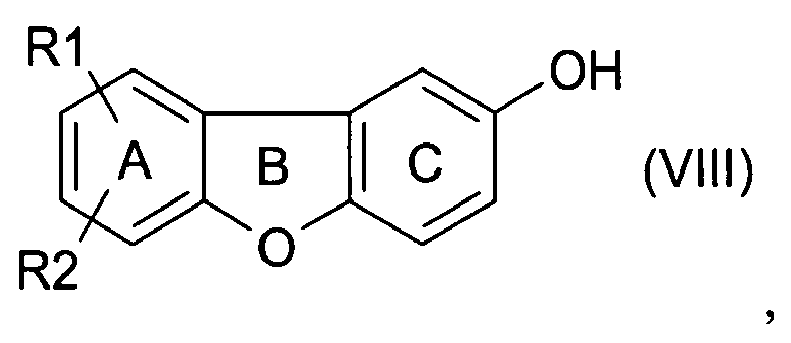 (b) stirring, advantageously for 5 hours at 0°C,(c) concentrating the mixture at reduced pressure(d) partitioning the organic fraction and the aqueous fraction,(e) washing the organic fraction successively with hydrochloric acid, sodium hydroxide, sodium hydrogenocarbonate and brine,(f) removing the solvent to give compound of formula (VII).
 - Method for preparing a compound having the following general formula :
 (g1) heating the compound of formula
 (h1) purifying compound of formula (IX) by chromatography over silica gel and(i1) recrystallizing the compound of formula (IX) in methanol.
 - Method for preparing a compound having the following general formula :
 (g2) suspending sodium hydride in dry solvent, advantageously chosen from toluene, benzene or xylene, under an inert atmosphere, and adding a compound of formula
 (h2) stirring at room temperature, advantageously for 30 minutes,(i2) adding chlorobutyne and potassium iodide and refluxing the suspension, advantageously for three days,(j2) removing the solvent, and purifying the residue by chromatography over silica gel in order to obtain a mixture of the compound of formula (IX) and of the compound of formula (X),(k2) recrystallizing the mixture obtained in (j2) in methanol to obtain compound of formula (IX), or(k3) purification of the compound of formula (X) by reverse phase HPLC.
 - Method according to any of claims 7-9, wherein R1 and R2 represent an hydrogen atom.
- Pharmaceutical composition comprising at least one compound according to any of claims 1-6, with an acceptable carrier.
- Pharmaceutical composition according to claim 11, further comprising at least one other antibiotic agent.
- Compound according to any of claims 1-6 or pharmaceutical composition according to any of claims 11-12, as a medicament.
- Compound or pharmaceutical composition according to claim 13, wherein said medicament is directed to the treatment of fungal or bacterial infections.
- Compound or pharmaceutical composition according to claim 14, wherein said bacterial infection is a mycobacterial infection, including Mycobacterium tuberculosis, Mycobacterium avium and Mycobacterium leprae infections.
- Compound or pharmaceutical composition according to claim 15, wherein said mycobacterial infection is caused by a Mycobacterium tuberculosis strain.
- Compound or pharmaceutical composition according to claim 16, wherein said Mycobacterium tuberculosis strain is known to be resistant to at least one antibiotic agent.
- Compound or pharmaceutical composition according to claim 14, wherein said bacterial infection is an infection by a bacterial strain that shares similarities in its cell wall composition with mycobacteria, in particular Nocardia asteroides.
- Compound or pharmaceutical composition according to any of claims 13-18, wherein said medicament is used in combination with at least one other antibiotic agent.
- Compound or pharmaceutical composition according to any of claims 13-19, wherein said medicament is directed to the treatment of immunodeficient patients infected by a Mycobacterial pathogenic strain.
Priority Applications (2)
| Application Number | Priority Date | Filing Date | Title |
|---|---|---|---|
| EP05292048A EP1770089A1 (en) | 2005-10-03 | 2005-10-03 | Pyranodibenzofuran derivatives with antifungal and antibacterial activity |
| PCT/EP2006/067004 WO2007039609A1 (en) | 2005-10-03 | 2006-10-03 | Pyranodibenzofuran derivatives with antifungal and antibacterial activity |
Applications Claiming Priority (1)
| Application Number | Priority Date | Filing Date | Title |
|---|---|---|---|
| EP05292048A EP1770089A1 (en) | 2005-10-03 | 2005-10-03 | Pyranodibenzofuran derivatives with antifungal and antibacterial activity |
Publications (1)
| Publication Number | Publication Date |
|---|---|
| EP1770089A1 true EP1770089A1 (en) | 2007-04-04 |
Family
ID=35620479
Family Applications (1)
| Application Number | Title | Priority Date | Filing Date |
|---|---|---|---|
| EP05292048A Withdrawn EP1770089A1 (en) | 2005-10-03 | 2005-10-03 | Pyranodibenzofuran derivatives with antifungal and antibacterial activity |
Country Status (2)
| Country | Link |
|---|---|
| EP (1) | EP1770089A1 (en) |
| WO (1) | WO2007039609A1 (en) |
Families Citing this family (2)
| Publication number | Priority date | Publication date | Assignee | Title |
|---|---|---|---|---|
| CN111530461A (en) * | 2020-05-28 | 2020-08-14 | 中国科学院兰州化学物理研究所 | A low-loading, high-dispersion single-active-site Cu catalyst and its preparation method and application |
| CN115197183B (en) * | 2021-04-13 | 2023-12-01 | 中国中医科学院中药研究所 | Sulfur-containing dibenzofuran type compound and preparation method and application thereof |
Citations (1)
| Publication number | Priority date | Publication date | Assignee | Title |
|---|---|---|---|---|
| GB1329848A (en) * | 1969-12-10 | 1973-09-12 | Medica Ab Oy | Process for preparing dibenzofuran derivatives |
Family Cites Families (5)
| Publication number | Priority date | Publication date | Assignee | Title |
|---|---|---|---|---|
| US4141921A (en) * | 1972-02-09 | 1979-02-27 | Ciba-Geigy Corporation | Phenoxyphenyl- and phenoxybenzyl-alkynyl ethers |
| BE795129A (en) * | 1972-02-09 | 1973-08-08 | Ciba Geigy | ALCYNYL ETHERS AND PESTICIDE PRODUCTS WHICH CONTAIN IT |
| WO1998042671A1 (en) * | 1997-03-20 | 1998-10-01 | Basf Aktiengesellschaft | Substituted 2-benz(o)ylpyridines, their preparation and their use as herbicides |
| AU2001252269A1 (en) * | 2000-04-27 | 2001-11-12 | Basilea Pharmaceutica Ag | Chromenylmethyl pyrimidinediamines as antibacterial agents |
| ES2391636T3 (en) * | 2004-03-05 | 2012-11-28 | F. Hoffmann-La Roche Ag | Diaminopyrimidines as antagonists of P2X3 and P2X2 / 3 |
-
2005
- 2005-10-03 EP EP05292048A patent/EP1770089A1/en not_active Withdrawn
-
2006
- 2006-10-03 WO PCT/EP2006/067004 patent/WO2007039609A1/en not_active Ceased
Patent Citations (1)
| Publication number | Priority date | Publication date | Assignee | Title |
|---|---|---|---|---|
| GB1329848A (en) * | 1969-12-10 | 1973-09-12 | Medica Ab Oy | Process for preparing dibenzofuran derivatives |
Non-Patent Citations (10)
| Title |
|---|
| COCCHIETTO, M., NATURWISSENSCHAFTEN, vol. 89, 2002, pages 137 - 146 |
| COPP, B. R., NAT. PROD.REP., vol. 20, 2003, pages 535 - 537 |
| INGOLFSDOTTIR, K., EUR JPHARM SCI, vol. 6, no. 2, 1998, pages 141 - 4 |
| INGOLFSDOTTIR, K., PHYTOCHEMISTRY, vol. 61, 2002, pages 729 - 736 |
| ISHIHARA TSUKASA; KAKUTA HIROTOSHI; MORITANI HIROSHI; UGAWA TOHRU; SAKAMOTO SHUICHI; TSUKAMOTO SHIN-ICHI; YANAGISAWA ISAO: "Syntheses and biological evaluation of novel quinuclidine derivatives as squalene synthase inhibitors", BIOORGANIC & MEDICINAL CHEMISTRY, vol. 11, 2003, pages 2403 - 2414, XP002367037 * |
| MULLER, K., APPL. MICROBIOL. BIOTECHNOL., vol. 56, 2001, pages 9 - 16 |
| OKUNADE, A. L., PHYTOCHEMISTRY, vol. 65, 2004, pages 1017 - 1032 |
| PACHER, T., PHYTOCHEMISTRY, vol. 58, 1999, pages 129 - 135 |
| POZZO, J.L., CAN. J. CHEM., vol. 74, 1996, pages 1649 - 1659 |
| STOVER, C. K., NATURE, vol. 405, 2000, pages 962 - 965 |
Also Published As
| Publication number | Publication date |
|---|---|
| WO2007039609A1 (en) | 2007-04-12 |
Similar Documents
| Publication | Publication Date | Title |
|---|---|---|
| DE69325262T2 (en) | VINYLENE AZAINE DERIVATIVES AND METHOD FOR THE PRODUCTION THEREOF | |
| KR101209397B1 (en) | Enantiomerically pure flavone derivatives for the treatment of poliferative disorders and processes for their preparation | |
| JPH07228558A (en) | Stilbene derivative and carcinostatic agent containing the same | |
| CA2951516C (en) | Polyene macrolide derivative | |
| KR20200086385A (en) | Cap-dependent endonuclease inhibitors | |
| US9133155B2 (en) | Antibacterial agents: high-potency myxopyronin derivatives | |
| KR101851774B1 (en) | 2-piperazin-1-yl-4h-1,3-benzothiazin-4-one derivatives and their use for the treatment of mammalian infections | |
| DE69717044T2 (en) | Flavone derivatives, processes for their preparation and pharmaceutical compositions containing them | |
| JP4773975B2 (en) | Substituted quinolines and their use as mycobacterial inhibitors | |
| EP2880023A1 (en) | Griseofulvin derivatives | |
| JP2020500920A (en) | Substituted pyrazoloazepin-4-ones and their use as phosphodiesterase inhibitors | |
| RU2483722C1 (en) | Aminothiazole derivatives of usnic acid as novel anti-tuberculosis agents | |
| AU2005218308A1 (en) | Synthesis of epothilones, intermediates thereto, analogues and uses thereof | |
| JP5220601B2 (en) | Use of chorismycin and its derivatives as oxidative stress inhibitors | |
| JP4769726B2 (en) | Concentricide and derivatives thereof, process for preparing them, pharmaceutical composition containing the same and use thereof | |
| AP1208A (en) | 2-Aminopyridines containing fused ring substituents | |
| Babaev et al. | 2-Allyloxy/propargyloxypyridines: Synthesis, structure, and biological activity | |
| DE69228259T2 (en) | NEW ALPHA MANNOSIDASE INHIBITORS | |
| PL202231B1 (en) | Novel analogues of camptothecin, method of obtaining them and pharmacological compositions containing such compounds | |
| WO2007039609A1 (en) | Pyranodibenzofuran derivatives with antifungal and antibacterial activity | |
| CA2489136C (en) | Novel 3-(4-oxo-40-chromen-2-yl)-(1h)-quinoline-4-one derivatives, method for preparing same and pharmaceutical compositions containing same | |
| WO2021104416A1 (en) | Compounds and methods for treating inflammatory bowel disease | |
| EP4194454A1 (en) | Heterocyclic compound as bcl-2 inhibitor | |
| CN121471116B (en) | Sulfonyl-containing compounds, their preparation and use | |
| EP4674846A1 (en) | Urea motif containing compounds as antibacterial drugs against multiresistant mycobacteria |
Legal Events
| Date | Code | Title | Description |
|---|---|---|---|
| PUAI | Public reference made under article 153(3) epc to a published international application that has entered the european phase |
Free format text: ORIGINAL CODE: 0009012 |
|
| AK | Designated contracting states |
Kind code of ref document: A1 Designated state(s): AT BE BG CH CY CZ DE DK EE ES FI FR GB GR HU IE IS IT LI LT LU LV MC NL PL PT RO SE SI SK TR |
|
| AX | Request for extension of the european patent |
Extension state: AL BA HR MK YU |
|
| 17P | Request for examination filed |
Effective date: 20070911 |
|
| 17Q | First examination report despatched |
Effective date: 20071016 |
|
| AKX | Designation fees paid |
Designated state(s): AT BE BG CH CY CZ DE DK EE ES FI FR GB GR HU IE IS IT LI LT LU LV MC NL PL PT RO SE SI SK TR |
|
| STAA | Information on the status of an ep patent application or granted ep patent |
Free format text: STATUS: THE APPLICATION IS DEEMED TO BE WITHDRAWN |
|
| 18D | Application deemed to be withdrawn |
Effective date: 20080923 |