EP1769679A1 - Bactericidal composition for agricultural or horticultural use and method of controlling plant disease - Google Patents
Bactericidal composition for agricultural or horticultural use and method of controlling plant disease Download PDFInfo
- Publication number
- EP1769679A1 EP1769679A1 EP05760021A EP05760021A EP1769679A1 EP 1769679 A1 EP1769679 A1 EP 1769679A1 EP 05760021 A EP05760021 A EP 05760021A EP 05760021 A EP05760021 A EP 05760021A EP 1769679 A1 EP1769679 A1 EP 1769679A1
- Authority
- EP
- European Patent Office
- Prior art keywords
- agricultural
- horticultural use
- fungicidal composition
- formula
- controlling plant
- Prior art date
- Legal status (The legal status is an assumption and is not a legal conclusion. Google has not performed a legal analysis and makes no representation as to the accuracy of the status listed.)
- Granted
Links
Classifications
-
- A—HUMAN NECESSITIES
- A01—AGRICULTURE; FORESTRY; ANIMAL HUSBANDRY; HUNTING; TRAPPING; FISHING
- A01N—PRESERVATION OF BODIES OF HUMANS OR ANIMALS OR PLANTS OR PARTS THEREOF; BIOCIDES, e.g. AS DISINFECTANTS, AS PESTICIDES OR AS HERBICIDES; PEST REPELLANTS OR ATTRACTANTS; PLANT GROWTH REGULATORS
- A01N43/00—Biocides, pest repellants or attractants, or plant growth regulators containing heterocyclic compounds
- A01N43/48—Biocides, pest repellants or attractants, or plant growth regulators containing heterocyclic compounds having rings with two nitrogen atoms as the only ring hetero atoms
- A01N43/50—1,3-Diazoles; Hydrogenated 1,3-diazoles
Definitions
- the present invention relates to a fungicidal composition for agricultural or horticultural use having plant diseases-controlling effects, particularly effects to prevent and/or cure plant diseases, remarkably improved, and a method for controlling plant diseases by using such a composition.
- EP 298196A discloses that the imidazole compound as an active ingredient of the fungicidal composition for agricultural or horticultural use of the present invention is useful as a pesticide, and it may be used as mixed or combined with another fungicide as the case requires. Further, as a blend pesticidal composition containing the above imidazole compound as an active ingredient, one disclosed in WO98/48628 may be mentioned. Further, propamocarb hydrochloride is a compound disclosed in THE Pesticide Manual Thirteenth Edition, p. 814-816 . Patent Document 1: EP 298196A Patent Document 2: WO98/48628 Non-patent Document 1: THE Pesticide Manual Thirteenth Editi on
- the imidazole compounds of the after-mentioned formula (I) may respectively have problems such that their effects may not be sufficient to a certain plant disease, or their residual effects may be too short, whereby in some application sites, no adequate controlling effects may practically be obtained to plant diseases.
- the present inventors have conducted a research to solve the above problems as a result have found that by using an imidazole compound of the after-mentioned formula (I) in combination with propamocarb hydrochloride, it is possible to obtain unexpected and further improved effects for controlling plant diseases, as compared with a case where each compound is used alone, and the present invention has been accomplished on the basis of this discovery.
- the present invention provides the following:
- the fungicidal composition for agricultural or horticultural use of the present invention has constant and high controlling effects against crop plants infected with plant diseases, and it is possible to control the plant diseases by using such a composition.
- the C 1-6 alkyl group or the alkyl moiety of the C 1-6 alkoxy group for R may be C 1-6 alkyl, such as methyl, ethyl, propyl, butyl, pentyl or hexyl, and such alkyl may be linear or branched.
- n is 2 or more, the plurality of R may be the same or different.
- the imidazole compounds of the formula (I) include, for example, the following compounds.
- the imidazole compound of the above formula (I) can be prepared by the methods disclosed in e.g. EP 298196A and EP 705823A .
- the fungicidal composition for agricultural or horticultural use which comprises at least one imidazole compound of the above formula (I) and propamocarb hydrochloride, as active ingredients, exhibits excellent fungicidal activities when applied to crop plants e.g.
- vegetables such as cucumbers, tomatoes or eggplants, cereal crops such as rice or wheat, beans, fruits such as apples, pears, grapes or oranges, or potatoes, which are infected or likely to be infected with pathogenic fungi, and it is suitable for controlling diseases such as powdery mildew, downy mildew, anthracnose, gray mold, green mold, scab, Alternaria leaf spot, bacterial blight, leaf blight, pod and stem blight, ripe rot, late blight, ring leaf-spot, blast, sheath blight, damping-off and southern blight.
- diseases such as powdery mildew, downy mildew, anthracnose, gray mold, green mold, scab, Alternaria leaf spot, bacterial blight, leaf blight, pod and stem blight, ripe rot, late blight, ring leaf-spot, blast, sheath blight, damping-off and southern blight.
- the fungicidal composition for agricultural or horticultural use of the present invention has a long residual effect and is excellent in penetration transfer, and thus, it has a preventive effect and/or a curative effect, but it is excellent particularly in the preventive effect.
- the fungicidal composition for agricultural or horticultural use of the present invention exhibits excellent controlling effects against diseases by algal fungi, specifically against blast of rice; sheath blight of rice; anthracnose of cucumber; downy mildew of cucumber, melon, cabbage, chinese cabbage, onion, pumpkin or grape; powdery mildew of wheat, barley or cucumber; late blight of potato, red pepper, green pepper, watermelon, pumpkin, tobacco or tomato; speckled leaf blotch of wheat; early blight of tomato; melanose of citrus; common green mold of citrus; scab of pear; Antenaria leaf spot of apple; Shiroiro eki byo of onion; brown rot of watermelon; various diseases such as various gray mold, Sclerotinia rot, rust and bacterial blight; various soil-born diseases caused by phytopathogenic fungi such as Fusarium , Pythium , Rhizoctonia and Verticillium .
- composition exhibits excellent controlling effects also against diseases by Plasmodiophora .
- the composition further exhibits particularly excellent controlling effects specifically against late blight of potato, red pepper, green pepper, watermelon, pumpkin, tobacco or tomato; or downy mildew of cucumber, melon, cabbage, chinese cabbage, onion, pumpkin or grape.
- the plural active ingredients constituting the fungicidal composition for agricultural or horticultural use in the present invention may be blended with various adjuvants to prepare various formulations such as an emulsifiable concentrate, a dust, a wettable powder, an aqueous solution, granules and a suspension, in the same manner as for conventional agricultural formulations.
- various formulations such as an emulsifiable concentrate, a dust, a wettable powder, an aqueous solution, granules and a suspension, in the same manner as for conventional agricultural formulations.
- the compound of the formula (I) and other specific compounds may be mixed and formulated together, or may separately be formulated and then mixed.
- a formulated product When such a formulated product is to be practically used, it may be used as it is or after being diluted to a predetermined concentration with a diluting agent such as water.
- the adjuvants here may, for example, be a carrier, an emulsifier, a suspension agent, a thickener, a stabilizer, a dispersant, a spreading agent, a wetting agent, a penetrating agent, an antifreezer and a defoaming agent, and they may be added as the case requires.
- the carrier may be divided into a solid carrier and a liquid carrier.
- the solid carrier may, for example, be an animal or plant powder such as starch, sugar, cellulose powder, cyclodextrin, activated carbon, soybean powder, wheat powder, chaff powder, wood powder, fish powder or dry milk; or a mineral powder such as talc, kaolin, bentonite, organic bentonite, calcium carbonate, calcium sulfate, sodium hydrogencarbonate, zeolite, diatomaceous earth, white carbon, clay, alumina, silica, sulfur powder or slaked lime.
- animal or plant powder such as starch, sugar, cellulose powder, cyclodextrin, activated carbon, soybean powder, wheat powder, chaff powder, wood powder, fish powder or dry milk
- a mineral powder such as talc, kaolin, bentonite, organic bentonite, calcium carbonate, calcium sulfate, sodium hydrogencarbonate, zeolite, diatomaceous earth, white carbon, clay, alumina, silica, sulfur powder or slaked
- the liquid carrier may, for example, be water; a vegetable oil such as soybean oil or cotton oil; an animal oil such as beef tallow or whale oil; an alcohol such as ethyl alcohol or ethylene glycol; a ketone such as acetone, methyl ethyl ketone, methyl isobutyl ketone or isophorone; an ether such as dioxane or tetrahydrofuran; an aliphatic hydrocarbon such as kerosene, lamp oil, liquid paraffin or cyclohexane; an aromatic hydrocarbon such as toluene, xylene, trimethylbenzene, tetramethylbenzene or solvent naphtha; a halogenated hydrocarbon such as chloroform or chlorobenzene; an acid amide such as dimethylformamide; an ester such as ethyl acetate or a glycerin ester of a fatty acid; a nitrile such as acetonitrile;
- the spreading agent may, for example, be sodium alkylsulfate, sodium alkylbenzenesulfonate, sodium lignin sulfonate, polyoxyethylene alkyl ether, polyoxyethylene lauryl ether, polyoxyethylene alkyl aryl ether or polyoxyethylene sorbitan fatty acid ester.
- a suitable blend weight ratio of at least one compound of the formula (I) to the propamocarb hydrochloride is usually from 1:150,000 to 1,000:1, preferably from 1:10,000 to 1,000:1, more preferably from 1:200 to 200:1.
- the most preferred blend weight ratio is from 1:100 to 1:1.
- the present invention also includes a method for controlling plant diseases, which comprises applying the fungicidal composition for agricultural or horticultural use of the present invention to plants.
- concentrations of the active ingredients in the fungicidal composition for agricultural or horticultural use of the present invention vary depending upon the crop plant to be treated, the method to be used, the formulation, the dose, the season for application, the type of pathogenic fungi and can not generally be defined.
- the concentrations of the active ingredients are such that usually, the compound of the above formula (I) is from 0.01 to 1,000 ppm, preferably from 0.3 to 500 ppm, and the propamocarb hydrochloride is from 0.1 to 10,000 ppm, preferably from 0.5 to 5,000 ppm.
- Cucumber (cultivar: Suyo) was cultivated in a polyethylene pot having a diameter of 7.5 cm, and when the cucumber reached two-leaf stage, a drug solution having the respective test compounds adjusted to the predetermined concentrations, was applied in a sufficient amount (20 ml) by means of a spray gun. After the applied solution dried, the cucumber was sprayed and inoculated with a suspension of spores of cucumber downy mildew and kept in a humidified chamber at 20°C for 4 hours. Thereafter, the cucumber was kept in a thermostatic chamber at 20°C for 7 days, whereupon the lesion area ratio in the first leaf was investigated, and the control value was obtained by the following formula. The results are shown in Table 1. Here, the test was carried out in double series.
- the lesion area ratio in non-treated area was obtained in the same manner as in the treated area except that instead of the drug solution, water was applied by means of a spray gun.
- Control value ( b - a ) / b ⁇ 100 where a is the lesion area ratio in treated area, and b is the lesion area ratio in non-treated area.
- a theoretical value can be calculated by the Colby formula. If the experimental value is higher than the theoretical value by the Colby formula, the fungicidal composition for agricultural or horticultural use of the present invention has a synergistic effect for controlling the plant disease.
- the theoretical values by the Colby formula are also shown in brackets ( ) in Table 1.
- the lesion area ratio in the non-treated area was 100.
- Cucumber (cultivar: Suyo) was cultivated in a polyethylene pot having a diameter of 7.5 cm, and when it reached two-leaf stage, the cucumber was sprayed and inoculated with a suspension of spores of cucumber downy mildew and kept in a humidified chamber at 20°C for 4 hours. Then, after drying the crop plant, a drug solution having the respective test compounds adjusted to the predetermined concentrations, was applied in a sufficient amount (20 ml) by means of a spray gun. After the sprayed solution dried, it was kept in a thermostatic chamber at 20°C for 7 days, whereupon the lesion area ratio in the first leaf was investigated, and the control value was obtained by the following formula. The results are shown in Table 2. Here, the test was carried out in double series.
- the lesion area in non-treated area was obtained in the same manner as in the treated area except that instead of the drug solution, water was applied by means of a spray gun.
- Control value ( b - a ) / b ⁇ 100 where a is the lesion area ratio in treated area, and b is the lesion area ratio in non-treated area.
- a theoretical value can be calculated by the Colby formula. If the experimental value is higher than the theoretical value by the Colby formula, the fungicidal composition for agricultural or horticultural use of the present invention has a synergistic effect for controlling the plant disease.
- the theoretical values by the Colby formula are also shown in brackets ( ) in Table 2.
- the lesion area ratio in the non-treated area was 100.
- Tomato (cultivar: Ponderosa) was cultivated in a polyethylene pot having a diameter of 7.5 cm, and when it reached four-leaf stage, a drug solution having the respective test compounds adjusted to the predetermined concentrations, was applied in a sufficient amount (20 ml) by means of a spray gun. After the applied solution dried, the tomato was sprayed and inoculated with a zoosporangia suspension of tomato late blight and kept in a humidified chamber at 20°C for 6 hours. Then, it was kept in a thermostatic chamber at 20°C for 3 days. Then, the disease outbreak index of each leaf was investigated by the following standards, and the degree of disease outbreak was obtained by the following formula.
- Disease outbreak index 1 The lesion area is less than 10% of the leaf area.
- Disease outbreak index 2 The lesion area is from 10% to less than 25% of the leaf area.
- Disease outbreak index 3 The lesion area is from 25% to less than 50% of the leaf area.
- Disease outbreak index 4 The lesion area is at least 50% of the leaf area.
- control value is obtained by the following formula, and the results are shown in Table 3.
- the test was carried out in double series.
- the degree of disease outbreak in non-treated area was obtained in the same manner as in the treated area except that instead of the drug solution, water was applied by means of a spray gun.
- Degree of disease outbreak 0 ⁇ A + 1 ⁇ B + 2 ⁇ C + 3 ⁇ D + 4 ⁇ E / 4 ⁇ A + B + C + D + E ⁇ 100
- A is the number of leaves with disease outbreak index
- B is the number of leaves with disease outbreak index 1
- C is the number of leaves with disease outbreak index 2
- D is the number of leaves with disease outbreak index 3
- E is the number of leaves with disease outbreak index 4.
- Control value b ⁇ - a ⁇ / b ⁇ ⁇ 100 where a' is the degree of disease outbreak in treated area, and b' is the degree of disease outbreak in non-treated area.
- the degree of disease outbreak in the non-treated area was 100.
Landscapes
- Life Sciences & Earth Sciences (AREA)
- Agronomy & Crop Science (AREA)
- Pest Control & Pesticides (AREA)
- Plant Pathology (AREA)
- Health & Medical Sciences (AREA)
- Engineering & Computer Science (AREA)
- Dentistry (AREA)
- General Health & Medical Sciences (AREA)
- Wood Science & Technology (AREA)
- Zoology (AREA)
- Environmental Sciences (AREA)
- Agricultural Chemicals And Associated Chemicals (AREA)
Abstract
Description
- The present invention relates to a fungicidal composition for agricultural or horticultural use having plant diseases-controlling effects, particularly effects to prevent and/or cure plant diseases, remarkably improved, and a method for controlling plant diseases by using such a composition.
-
EP 298196A WO98/48628
Patent Document 1:EP 298196A
Patent Document 2:WO98/48628
Non-patent Document 1: THE Pesticide Manual Thirteenth Edition - In their effects for controlling plant diseases, the imidazole compounds of the after-mentioned formula (I) may respectively have problems such that their effects may not be sufficient to a certain plant disease, or their residual effects may be too short, whereby in some application sites, no adequate controlling effects may practically be obtained to plant diseases.
- The present inventors have conducted a research to solve the above problems as a result have found that by using an imidazole compound of the after-mentioned formula (I) in combination with propamocarb hydrochloride, it is possible to obtain unexpected and further improved effects for controlling plant diseases, as compared with a case where each compound is used alone, and the present invention has been accomplished on the basis of this discovery.
- Namely, the present invention provides the following:
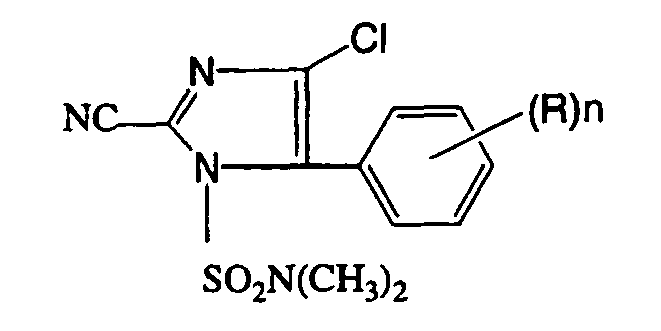
- (1) A fungicidal composition for agricultural or horticultural use, which comprises at least one imidazole compound of the formula (I):
- (2) The fungicidal composition for agricultural or horticultural use according to the above (1), wherein the blend weight ratio of the imidazole compound to the propamocarb hydrochloride is from 1:150,000 to 1,000:1.
- (3) A method for controlling plant diseases, which comprises applying a fungicidal composition for agricultural or horticultural use as defined in the above (1) or (2) to plants.
- The fungicidal composition for agricultural or horticultural use of the present invention has constant and high controlling effects against crop plants infected with plant diseases, and it is possible to control the plant diseases by using such a composition.
- In the imidazole compound of the formula (I) constituting the fungicidal composition for agricultural or horticultural use of the present invention, the C1-6 alkyl group or the alkyl moiety of the C1-6 alkoxy group for R, may be C1-6 alkyl, such as methyl, ethyl, propyl, butyl, pentyl or hexyl, and such alkyl may be linear or branched. Further, when n is 2 or more, the plurality of R may be the same or different.
- The imidazole compounds of the formula (I) include, for example, the following compounds.
- ·4-Chloro-2-cyano-1-dimethylsulfamoyl-5-(4-methylphenyl)imidazole (Compound No. 1)
- ·4-Chloro-2-cyano-1-dimethylsulfamoyl-5-(4-methoxyphenyl)imidazole (Compound No. 2)
- ·4-Chloro-2-cyano-1-dimethylsulfamoyl-5-(4-ethylphenyl)imidazole (Compound No. 3)
- ·4-Chloro-2-cyano-1-dimethylsulfamoyl-5-(3-methyl-4-methoxyphenyl)imidazole (Compound No. 4)
- The imidazole compound of the above formula (I) can be prepared by the methods disclosed in e.g.
EP 298196A EP 705823A - The fungicidal composition for agricultural or horticultural use, which comprises at least one imidazole compound of the above formula (I) and propamocarb hydrochloride, as active ingredients, exhibits excellent fungicidal activities when applied to crop plants e.g. vegetables such as cucumbers, tomatoes or eggplants, cereal crops such as rice or wheat, beans, fruits such as apples, pears, grapes or oranges, or potatoes, which are infected or likely to be infected with pathogenic fungi, and it is suitable for controlling diseases such as powdery mildew, downy mildew, anthracnose, gray mold, green mold, scab, Alternaria leaf spot, bacterial blight, leaf blight, pod and stem blight, ripe rot, late blight, ring leaf-spot, blast, sheath blight, damping-off and southern blight. Further, it exhibits excellent controlling effects against soil-borne diseases caused by phytopathogenic fungi such as Fusarium, Rhizoctonia, Verticillium, Plasmodiophora and Pythium. The fungicidal composition for agricultural or horticultural use of the present invention has a long residual effect and is excellent in penetration transfer, and thus, it has a preventive effect and/or a curative effect, but it is excellent particularly in the preventive effect.
- The fungicidal composition for agricultural or horticultural use of the present invention exhibits excellent controlling effects against diseases by algal fungi, specifically against blast of rice; sheath blight of rice; anthracnose of cucumber; downy mildew of cucumber, melon, cabbage, chinese cabbage, onion, pumpkin or grape; powdery mildew of wheat, barley or cucumber; late blight of potato, red pepper, green pepper, watermelon, pumpkin, tobacco or tomato; speckled leaf blotch of wheat; early blight of tomato; melanose of citrus; common green mold of citrus; scab of pear; Antenaria leaf spot of apple; Shiroiro eki byo of onion; brown rot of watermelon; various diseases such as various gray mold, Sclerotinia rot, rust and bacterial blight; various soil-born diseases caused by phytopathogenic fungi such as Fusarium, Pythium, Rhizoctonia and Verticillium. Further, it exhibits excellent controlling effects also against diseases by Plasmodiophora. The composition further exhibits particularly excellent controlling effects specifically against late blight of potato, red pepper, green pepper, watermelon, pumpkin, tobacco or tomato; or downy mildew of cucumber, melon, cabbage, chinese cabbage, onion, pumpkin or grape.
- The plural active ingredients constituting the fungicidal composition for agricultural or horticultural use in the present invention may be blended with various adjuvants to prepare various formulations such as an emulsifiable concentrate, a dust, a wettable powder, an aqueous solution, granules and a suspension, in the same manner as for conventional agricultural formulations. At that time, the compound of the formula (I) and other specific compounds may be mixed and formulated together, or may separately be formulated and then mixed. When such a formulated product is to be practically used, it may be used as it is or after being diluted to a predetermined concentration with a diluting agent such as water. The adjuvants here may, for example, be a carrier, an emulsifier, a suspension agent, a thickener, a stabilizer, a dispersant, a spreading agent, a wetting agent, a penetrating agent, an antifreezer and a defoaming agent, and they may be added as the case requires. The carrier may be divided into a solid carrier and a liquid carrier. The solid carrier may, for example, be an animal or plant powder such as starch, sugar, cellulose powder, cyclodextrin, activated carbon, soybean powder, wheat powder, chaff powder, wood powder, fish powder or dry milk; or a mineral powder such as talc, kaolin, bentonite, organic bentonite, calcium carbonate, calcium sulfate, sodium hydrogencarbonate, zeolite, diatomaceous earth, white carbon, clay, alumina, silica, sulfur powder or slaked lime. The liquid carrier may, for example, be water; a vegetable oil such as soybean oil or cotton oil; an animal oil such as beef tallow or whale oil; an alcohol such as ethyl alcohol or ethylene glycol; a ketone such as acetone, methyl ethyl ketone, methyl isobutyl ketone or isophorone; an ether such as dioxane or tetrahydrofuran; an aliphatic hydrocarbon such as kerosene, lamp oil, liquid paraffin or cyclohexane; an aromatic hydrocarbon such as toluene, xylene, trimethylbenzene, tetramethylbenzene or solvent naphtha; a halogenated hydrocarbon such as chloroform or chlorobenzene; an acid amide such as dimethylformamide; an ester such as ethyl acetate or a glycerin ester of a fatty acid; a nitrile such as acetonitrile; a sulfur-containing compound such as dimethylsulfoxide, or N-methyl-2-pyrrolidone or N,N-dimethylformamide. The spreading agent may, for example, be sodium alkylsulfate, sodium alkylbenzenesulfonate, sodium lignin sulfonate, polyoxyethylene alkyl ether, polyoxyethylene lauryl ether, polyoxyethylene alkyl aryl ether or polyoxyethylene sorbitan fatty acid ester.
- In the fungicidal composition for agricultural or horticultural use of the present invention, a suitable blend weight ratio of at least one compound of the formula (I) to the propamocarb hydrochloride, is usually from 1:150,000 to 1,000:1, preferably from 1:10,000 to 1,000:1, more preferably from 1:200 to 200:1. The most preferred blend weight ratio is from 1:100 to 1:1.
- The present invention also includes a method for controlling plant diseases, which comprises applying the fungicidal composition for agricultural or horticultural use of the present invention to plants. The concentrations of the active ingredients in the fungicidal composition for agricultural or horticultural use of the present invention vary depending upon the crop plant to be treated, the method to be used, the formulation, the dose, the season for application, the type of pathogenic fungi and can not generally be defined. However, in the case of foliar treatment, the concentrations of the active ingredients are such that usually, the compound of the above formula (I) is from 0.01 to 1,000 ppm, preferably from 0.3 to 500 ppm, and the propamocarb hydrochloride is from 0.1 to 10,000 ppm, preferably from 0.5 to 5,000 ppm.
- Now, some preferred embodiments of the fungicidal composition for agricultural or horticultural use of the present invention will be exemplified. However, the present invention is by no means thereby restricted.
- (1) A fungicidal composition for agricultural or horticultural use, which comprises at least one compound of the formula (I) and propamocarb hydrochloride, as active ingredients.
- (2) The fungicidal composition for agricultural or horticultural use according to (1) wherein the weight ratio of said at least one compound of the formula (I) to the propamocarb hydrochloride is from 1:10,000 to 1,000:1.
- (3) The fungicidal composition for agricultural or horticultural use according to (1), wherein the weight ratio of said at least one compound of the formula (I) to the propamocarb hydrochloride is from 1:200 to 200:1.
- (4) The fungicidal composition for agricultural for horticultural use according to (1), wherein the weight ratio of said at least one compound of the formula (I) to the propamocarb hydrochloride is from 1:100 to 1:1.
- Now, Test Examples relating to the present invention will be described, but the present invention is by no means thereby restricted.
- Cucumber (cultivar: Suyo) was cultivated in a polyethylene pot having a diameter of 7.5 cm, and when the cucumber reached two-leaf stage, a drug solution having the respective test compounds adjusted to the predetermined concentrations, was applied in a sufficient amount (20 ml) by means of a spray gun. After the applied solution dried, the cucumber was sprayed and inoculated with a suspension of spores of cucumber downy mildew and kept in a humidified chamber at 20°C for 4 hours. Thereafter, the cucumber was kept in a thermostatic chamber at 20°C for 7 days, whereupon the lesion area ratio in the first leaf was investigated, and the control value was obtained by the following formula. The results are shown in Table 1. Here, the test was carried out in double series.
- The lesion area ratio in non-treated area was obtained in the same manner as in the treated area except that instead of the drug solution, water was applied by means of a spray gun.

where a is the lesion area ratio in treated area, and b is the lesion area ratio in non-treated area. - Further, a theoretical value can be calculated by the Colby formula. If the experimental value is higher than the theoretical value by the Colby formula, the fungicidal composition for agricultural or horticultural use of the present invention has a synergistic effect for controlling the plant disease. In this context, the theoretical values by the Colby formula are also shown in brackets ( ) in Table 1.

- The lesion area ratio in the non-treated area was 100.
- Cucumber (cultivar: Suyo) was cultivated in a polyethylene pot having a diameter of 7.5 cm, and when it reached two-leaf stage, the cucumber was sprayed and inoculated with a suspension of spores of cucumber downy mildew and kept in a humidified chamber at 20°C for 4 hours. Then, after drying the crop plant, a drug solution having the respective test compounds adjusted to the predetermined concentrations, was applied in a sufficient amount (20 ml) by means of a spray gun. After the sprayed solution dried, it was kept in a thermostatic chamber at 20°C for 7 days, whereupon the lesion area ratio in the first leaf was investigated, and the control value was obtained by the following formula. The results are shown in Table 2. Here, the test was carried out in double series.
- The lesion area in non-treated area was obtained in the same manner as in the treated area except that instead of the drug solution, water was applied by means of a spray gun.

where a is the lesion area ratio in treated area, and b is the lesion area ratio in non-treated area. - Further, a theoretical value can be calculated by the Colby formula. If the experimental value is higher than the theoretical value by the Colby formula, the fungicidal composition for agricultural or horticultural use of the present invention has a synergistic effect for controlling the plant disease. In this context, the theoretical values by the Colby formula are also shown in brackets ( ) in Table 2.

- The lesion area ratio in the non-treated area was 100.
- Tomato (cultivar: Ponderosa) was cultivated in a polyethylene pot having a diameter of 7.5 cm, and when it reached four-leaf stage, a drug solution having the respective test compounds adjusted to the predetermined concentrations, was applied in a sufficient amount (20 ml) by means of a spray gun. After the applied solution dried, the tomato was sprayed and inoculated with a zoosporangia suspension of tomato late blight and kept in a humidified chamber at 20°C for 6 hours. Then, it was kept in a thermostatic chamber at 20°C for 3 days. Then, the disease outbreak index of each leaf was investigated by the following standards, and the degree of disease outbreak was obtained by the following formula.
- Disease outbreak index 0: No lesion is observed.
- Disease outbreak index 1: The lesion area is less than 10% of the leaf area.
- Disease outbreak index 2: The lesion area is from 10% to less than 25% of the leaf area.
- Disease outbreak index 3: The lesion area is from 25% to less than 50% of the leaf area.
- Disease outbreak index 4: The lesion area is at least 50% of the leaf area.
- Further, using the degree of disease outbreak, the control value is obtained by the following formula, and the results are shown in Table 3. Here, the test was carried out in double series.
- The degree of disease outbreak in non-treated area was obtained in the same manner as in the treated area except that instead of the drug solution, water was applied by means of a spray gun.

where A is the number of leaves with disease outbreak index 0, B is the number of leaves with disease outbreak index 1, C is the number of leaves with disease outbreak index 2, D is the number of leaves with disease outbreak index 3, and E is the number of leaves with disease outbreak index 4.
where a' is the degree of disease outbreak in treated area, and b' is the degree of disease outbreak in non-treated area. - Further, a theoretical value can be calculated by the Colby formula. If the experimental value is higher than the theoretical value by the Colby formula, the fungicidal composition for agricultural or horticultural use of the present invention has a synergistic effect for controlling the plant disease. In such a context, the theoretical values by the Colby formula are also shown in brackets ( ) in Table 3.
TABLE 3
- The degree of disease outbreak in the non-treated area was 100.
- The entire disclosure of
Japanese Patent Application No. 2004-210175 filed on July 16, 2004
Claims (3)
- A fungicidal composition for agricultural or horticultural use, which comprises at least one imidazole compound of the formula (I):

- The fungicidal composition for agricultural or horticultural use according to Claim 1, wherein the blend weight ratio of the imidazole compound to the propamocarb hydrochloride is from 1:150,000 to 1,000:1.
- A method for controlling plant diseases, which comprises applying a fungicidal composition for agricultural or horticultural use as defined in Claim 1 or 2 to plants.
Priority Applications (3)
| Application Number | Priority Date | Filing Date | Title |
|---|---|---|---|
| SI200531237T SI1769679T1 (en) | 2004-07-16 | 2005-07-14 | Bactericidal composition for agricultural or horticultural use and method of controlling plant disease |
| PL05760021T PL1769679T3 (en) | 2004-07-16 | 2005-07-14 | Bactericidal composition for agricultural or horticultural use and method of controlling plant disease |
| CY20111100369T CY1112146T1 (en) | 2004-07-16 | 2011-04-08 | BACTERIDIC COMPOSITION FOR AGRICULTURAL OR HORTICULTURAL USE AND METHOD OF CONTROL OF PLANT DISEASE |
Applications Claiming Priority (2)
| Application Number | Priority Date | Filing Date | Title |
|---|---|---|---|
| JP2004210175 | 2004-07-16 | ||
| PCT/JP2005/013080 WO2006009085A1 (en) | 2004-07-16 | 2005-07-14 | Bactericidal composition for agricultural or horticultural use and method of controlling plant disease |
Publications (3)
| Publication Number | Publication Date |
|---|---|
| EP1769679A1 true EP1769679A1 (en) | 2007-04-04 |
| EP1769679A4 EP1769679A4 (en) | 2010-05-05 |
| EP1769679B1 EP1769679B1 (en) | 2011-01-19 |
Family
ID=35785198
Family Applications (1)
| Application Number | Title | Priority Date | Filing Date |
|---|---|---|---|
| EP05760021A Expired - Lifetime EP1769679B1 (en) | 2004-07-16 | 2005-07-14 | Bactericidal composition for agricultural or horticultural use and method of controlling plant disease |
Country Status (11)
| Country | Link |
|---|---|
| US (1) | US7851497B2 (en) |
| EP (1) | EP1769679B1 (en) |
| AT (1) | ATE495669T1 (en) |
| CY (1) | CY1112146T1 (en) |
| DE (1) | DE602005026008D1 (en) |
| DK (1) | DK1769679T3 (en) |
| ES (1) | ES2358912T3 (en) |
| PL (1) | PL1769679T3 (en) |
| PT (1) | PT1769679E (en) |
| SI (1) | SI1769679T1 (en) |
| WO (1) | WO2006009085A1 (en) |
Cited By (3)
| Publication number | Priority date | Publication date | Assignee | Title |
|---|---|---|---|---|
| WO2008077926A3 (en) * | 2006-12-22 | 2009-05-07 | Bayer Cropscience Ag | Pesticide composition comprising propamocarb-hydrochloride and an insecticide active substance |
| EP2943067A4 (en) * | 2013-04-16 | 2016-06-01 | Upl Ltd | Fungicidal composition |
| CN107494562A (en) * | 2017-09-22 | 2017-12-22 | 上海升联化工有限公司 | A kind of bactericidal composition containing cyazofamid and propamocarb |
Families Citing this family (1)
| Publication number | Priority date | Publication date | Assignee | Title |
|---|---|---|---|---|
| GB201009853D0 (en) | 2010-06-11 | 2010-07-21 | Chroma Therapeutics Ltd | HSP90 inhibitors |
Family Cites Families (7)
| Publication number | Priority date | Publication date | Assignee | Title |
|---|---|---|---|---|
| US3649674A (en) * | 1967-08-25 | 1972-03-14 | Schering Ag | Salts of carbamic and thiocarbamic esters with fungicidal and fungistatic action |
| GB8429739D0 (en) * | 1984-11-24 | 1985-01-03 | Fbc Ltd | Fungicides |
| JP2606720B2 (en) | 1987-03-13 | 1997-05-07 | 石原産業株式会社 | Imidazole compounds and pesticides containing them |
| CA1339133C (en) | 1987-03-13 | 1997-07-29 | Rikuo Nasu | Imidazole compounds and biocidal composition comprising the same for controlling harmful organisms |
| MY129863A (en) | 1988-03-11 | 2007-05-31 | Ishihara Sangyo Kaisha | Biocidal composition |
| IL132435A (en) * | 1997-04-25 | 2005-03-20 | Ishihara Sangyo Kaisha | Composition for controlling harmful bio-organisms and method for controlling harmful bio-organisms using the same |
| US6096769A (en) * | 1998-04-20 | 2000-08-01 | American Cyanamid Company | Fungicidal co-formulation |
-
2005
- 2005-07-14 DK DK05760021.5T patent/DK1769679T3/en active
- 2005-07-14 AT AT05760021T patent/ATE495669T1/en active
- 2005-07-14 PL PL05760021T patent/PL1769679T3/en unknown
- 2005-07-14 US US11/632,630 patent/US7851497B2/en active Active
- 2005-07-14 ES ES05760021T patent/ES2358912T3/en not_active Expired - Lifetime
- 2005-07-14 DE DE602005026008T patent/DE602005026008D1/en not_active Expired - Lifetime
- 2005-07-14 SI SI200531237T patent/SI1769679T1/en unknown
- 2005-07-14 PT PT05760021T patent/PT1769679E/en unknown
- 2005-07-14 WO PCT/JP2005/013080 patent/WO2006009085A1/en not_active Ceased
- 2005-07-14 EP EP05760021A patent/EP1769679B1/en not_active Expired - Lifetime
-
2011
- 2011-04-08 CY CY20111100369T patent/CY1112146T1/en unknown
Cited By (4)
| Publication number | Priority date | Publication date | Assignee | Title |
|---|---|---|---|---|
| WO2008077926A3 (en) * | 2006-12-22 | 2009-05-07 | Bayer Cropscience Ag | Pesticide composition comprising propamocarb-hydrochloride and an insecticide active substance |
| EP2943067A4 (en) * | 2013-04-16 | 2016-06-01 | Upl Ltd | Fungicidal composition |
| CN107494562A (en) * | 2017-09-22 | 2017-12-22 | 上海升联化工有限公司 | A kind of bactericidal composition containing cyazofamid and propamocarb |
| CN107494562B (en) * | 2017-09-22 | 2020-08-14 | 上海升联化工有限公司 | Sterilization composition containing cyazofamid and propamocarb hydrochloride |
Also Published As
| Publication number | Publication date |
|---|---|
| ATE495669T1 (en) | 2011-02-15 |
| DK1769679T3 (en) | 2011-04-26 |
| CY1112146T1 (en) | 2015-11-04 |
| EP1769679A4 (en) | 2010-05-05 |
| US20070254936A1 (en) | 2007-11-01 |
| PL1769679T3 (en) | 2011-06-30 |
| SI1769679T1 (en) | 2011-04-29 |
| US7851497B2 (en) | 2010-12-14 |
| EP1769679B1 (en) | 2011-01-19 |
| WO2006009085A1 (en) | 2006-01-26 |
| PT1769679E (en) | 2011-03-01 |
| DE602005026008D1 (en) | 2011-03-03 |
| ES2358912T3 (en) | 2011-05-16 |
Similar Documents
| Publication | Publication Date | Title |
|---|---|---|
| JP2022501395A (en) | Bacillus amyloliquefaciens FCC1256 composition and method for controlling phytopathogens | |
| CA3105364C (en) | Fungicidal composition and method for controlling plant diseases | |
| MX2011000077A (en) | Fungicidal mixtures comprising substituted 1-methylpyrazol-4-ylca rboxanilides. | |
| CA3094425C (en) | Agricultural or horticultural fungicide composition comprising fluazinam and picoxystrobin | |
| HUE029331T2 (en) | Nematicidal agent composition and method of using the same | |
| RU2484630C2 (en) | Fungicidal composition for agriculture and horticulture and method of preventing plant diseases | |
| JP4351789B2 (en) | Pest control composition and pest control method | |
| EP1769679B1 (en) | Bactericidal composition for agricultural or horticultural use and method of controlling plant disease | |
| WO2015161749A1 (en) | A synergistic fungicidal composition comprising cymoxanil and chlorothalonil | |
| CN104336036A (en) | Fungicidal composition and application thereof | |
| JPH0613442B2 (en) | Agro-horticultural fungicide composition | |
| RU2523285C2 (en) | Agricultural or horticultural fungicidal composition and application thereof for fighting plant pathogens | |
| AU2018327734B2 (en) | Fungicide composition and method for controlling disease of crop | |
| JP4153092B2 (en) | Pest control composition and pest control method | |
| JP4848147B2 (en) | Agricultural / horticultural fungicide composition and method for controlling plant diseases | |
| CN107593710B (en) | Bactericidal composition | |
| JP4800333B2 (en) | Agricultural / horticultural fungicide composition and method for controlling plant pathogens | |
| JPH0257522B2 (en) | ||
| JPH0713002B2 (en) | Agro-horticultural fungicide composition |
Legal Events
| Date | Code | Title | Description |
|---|---|---|---|
| PUAI | Public reference made under article 153(3) epc to a published international application that has entered the european phase |
Free format text: ORIGINAL CODE: 0009012 |
|
| 17P | Request for examination filed |
Effective date: 20070103 |
|
| AK | Designated contracting states |
Kind code of ref document: A1 Designated state(s): AT BE BG CH CY CZ DE DK EE ES FI FR GB GR HU IE IS IT LI LT LU LV MC NL PL PT RO SE SI SK TR |
|
| DAX | Request for extension of the european patent (deleted) | ||
| RIC1 | Information provided on ipc code assigned before grant |
Ipc: A01P 3/00 20060101ALI20100325BHEP Ipc: A01N 47/12 20060101ALI20100325BHEP Ipc: A01N 43/50 20060101AFI20060217BHEP |
|
| A4 | Supplementary search report drawn up and despatched |
Effective date: 20100401 |
|
| GRAP | Despatch of communication of intention to grant a patent |
Free format text: ORIGINAL CODE: EPIDOSNIGR1 |
|
| RIC1 | Information provided on ipc code assigned before grant |
Ipc: A01P 3/00 20060101ALI20100708BHEP Ipc: A01N 47/12 20060101ALI20100708BHEP Ipc: A01N 43/50 20060101AFI20100708BHEP |
|
| GRAS | Grant fee paid |
Free format text: ORIGINAL CODE: EPIDOSNIGR3 |
|
| GRAA | (expected) grant |
Free format text: ORIGINAL CODE: 0009210 |
|
| AK | Designated contracting states |
Kind code of ref document: B1 Designated state(s): AT BE BG CH CY CZ DE DK EE ES FI FR GB GR HU IE IS IT LI LT LU LV MC NL PL PT RO SE SI SK TR |
|
| REG | Reference to a national code |
Ref country code: GB Ref legal event code: FG4D |
|
| REG | Reference to a national code |
Ref country code: CH Ref legal event code: NV Representative=s name: BOHEST AG Ref country code: CH Ref legal event code: EP |
|
| REG | Reference to a national code |
Ref country code: IE Ref legal event code: FG4D |
|
| REG | Reference to a national code |
Ref country code: PT Ref legal event code: SC4A Free format text: AVAILABILITY OF NATIONAL TRANSLATION Effective date: 20110222 |
|
| REF | Corresponds to: |
Ref document number: 602005026008 Country of ref document: DE Date of ref document: 20110303 Kind code of ref document: P |
|
| REG | Reference to a national code |
Ref country code: DE Ref legal event code: R096 Ref document number: 602005026008 Country of ref document: DE Effective date: 20110303 |
|
| REG | Reference to a national code |
Ref country code: NL Ref legal event code: T3 |
|
| REG | Reference to a national code |
Ref country code: SE Ref legal event code: TRGR |
|
| REG | Reference to a national code |
Ref country code: RO Ref legal event code: EPE |
|
| REG | Reference to a national code |
Ref country code: DK Ref legal event code: T3 |
|
| REG | Reference to a national code |
Ref country code: ES Ref legal event code: FG2A Ref document number: 2358912 Country of ref document: ES Kind code of ref document: T3 Effective date: 20110504 |
|
| REG | Reference to a national code |
Ref country code: EE Ref legal event code: FG4A Ref document number: E005189 Country of ref document: EE Effective date: 20110419 |
|
| REG | Reference to a national code |
Ref country code: GR Ref legal event code: EP Ref document number: 20110400861 Country of ref document: GR Effective date: 20110513 |
|
| REG | Reference to a national code |
Ref country code: PL Ref legal event code: T3 |
|
| REG | Reference to a national code |
Ref country code: SK Ref legal event code: T3 Ref document number: E 9210 Country of ref document: SK |
|
| REG | Reference to a national code |
Ref country code: HU Ref legal event code: AG4A Ref document number: E010755 Country of ref document: HU |
|
| PLBE | No opposition filed within time limit |
Free format text: ORIGINAL CODE: 0009261 |
|
| STAA | Information on the status of an ep patent application or granted ep patent |
Free format text: STATUS: NO OPPOSITION FILED WITHIN TIME LIMIT |
|
| 26N | No opposition filed |
Effective date: 20111020 |
|
| REG | Reference to a national code |
Ref country code: DE Ref legal event code: R097 Ref document number: 602005026008 Country of ref document: DE Effective date: 20111020 |
|
| REG | Reference to a national code |
Ref country code: CH Ref legal event code: PCAR Free format text: NEW ADDRESS: HOLBEINSTRASSE 36-38, 4051 BASEL (CH) |
|
| PGFP | Annual fee paid to national office [announced via postgrant information from national office to epo] |
Ref country code: MC Payment date: 20150609 Year of fee payment: 11 |
|
| REG | Reference to a national code |
Ref country code: FR Ref legal event code: PLFP Year of fee payment: 12 |
|
| PG25 | Lapsed in a contracting state [announced via postgrant information from national office to epo] |
Ref country code: MC Free format text: LAPSE BECAUSE OF NON-PAYMENT OF DUE FEES Effective date: 20160801 |
|
| REG | Reference to a national code |
Ref country code: FR Ref legal event code: PLFP Year of fee payment: 13 |
|
| REG | Reference to a national code |
Ref country code: FR Ref legal event code: PLFP Year of fee payment: 14 |
|
| PGFP | Annual fee paid to national office [announced via postgrant information from national office to epo] |
Ref country code: LT Payment date: 20240621 Year of fee payment: 20 |
|
| PGFP | Annual fee paid to national office [announced via postgrant information from national office to epo] |
Ref country code: LU Payment date: 20240719 Year of fee payment: 20 |
|
| PGFP | Annual fee paid to national office [announced via postgrant information from national office to epo] |
Ref country code: NL Payment date: 20240719 Year of fee payment: 20 |
|
| PGFP | Annual fee paid to national office [announced via postgrant information from national office to epo] |
Ref country code: IS Payment date: 20240711 Year of fee payment: 20 |
|
| PGFP | Annual fee paid to national office [announced via postgrant information from national office to epo] |
Ref country code: BG Payment date: 20240722 Year of fee payment: 20 |
|
| PGFP | Annual fee paid to national office [announced via postgrant information from national office to epo] |
Ref country code: DE Payment date: 20240719 Year of fee payment: 20 Ref country code: FI Payment date: 20240722 Year of fee payment: 20 Ref country code: IE Payment date: 20240722 Year of fee payment: 20 |
|
| PGFP | Annual fee paid to national office [announced via postgrant information from national office to epo] |
Ref country code: GR Payment date: 20240723 Year of fee payment: 20 Ref country code: DK Payment date: 20240726 Year of fee payment: 20 |
|
| PGFP | Annual fee paid to national office [announced via postgrant information from national office to epo] |
Ref country code: GB Payment date: 20240722 Year of fee payment: 20 Ref country code: PT Payment date: 20240704 Year of fee payment: 20 |
|
| PGFP | Annual fee paid to national office [announced via postgrant information from national office to epo] |
Ref country code: BE Payment date: 20240719 Year of fee payment: 20 |
|
| PGFP | Annual fee paid to national office [announced via postgrant information from national office to epo] |
Ref country code: FR Payment date: 20240729 Year of fee payment: 20 |
|
| PGFP | Annual fee paid to national office [announced via postgrant information from national office to epo] |
Ref country code: ES Payment date: 20240828 Year of fee payment: 20 Ref country code: CH Payment date: 20240801 Year of fee payment: 20 |
|
| PGFP | Annual fee paid to national office [announced via postgrant information from national office to epo] |
Ref country code: EE Payment date: 20240716 Year of fee payment: 20 Ref country code: CZ Payment date: 20240710 Year of fee payment: 20 |
|
| PGFP | Annual fee paid to national office [announced via postgrant information from national office to epo] |
Ref country code: AT Payment date: 20240722 Year of fee payment: 20 |
|
| PGFP | Annual fee paid to national office [announced via postgrant information from national office to epo] |
Ref country code: PL Payment date: 20240705 Year of fee payment: 20 |
|
| PGFP | Annual fee paid to national office [announced via postgrant information from national office to epo] |
Ref country code: SI Payment date: 20240704 Year of fee payment: 20 Ref country code: HU Payment date: 20240723 Year of fee payment: 20 Ref country code: SK Payment date: 20240710 Year of fee payment: 20 |
|
| PGFP | Annual fee paid to national office [announced via postgrant information from national office to epo] |
Ref country code: LV Payment date: 20240717 Year of fee payment: 20 |
|
| PGFP | Annual fee paid to national office [announced via postgrant information from national office to epo] |
Ref country code: RO Payment date: 20240711 Year of fee payment: 20 Ref country code: SE Payment date: 20240719 Year of fee payment: 20 Ref country code: IT Payment date: 20240725 Year of fee payment: 20 |
|
| PGFP | Annual fee paid to national office [announced via postgrant information from national office to epo] |
Ref country code: TR Payment date: 20240705 Year of fee payment: 20 |
|
| PGFP | Annual fee paid to national office [announced via postgrant information from national office to epo] |
Ref country code: CY Payment date: 20240708 Year of fee payment: 20 |
|
| REG | Reference to a national code |
Ref country code: DE Ref legal event code: R071 Ref document number: 602005026008 Country of ref document: DE |
|
| REG | Reference to a national code |
Ref country code: CH Ref legal event code: PL |
|
| REG | Reference to a national code |
Ref country code: NL Ref legal event code: MK Effective date: 20250713 |
|
| REG | Reference to a national code |
Ref country code: DK Ref legal event code: EUP Expiry date: 20250714 |
|
| REG | Reference to a national code |
Ref country code: LT Ref legal event code: MM9A Effective date: 20250714 |
|
| PG25 | Lapsed in a contracting state [announced via postgrant information from national office to epo] |
Ref country code: CZ Free format text: LAPSE BECAUSE OF EXPIRATION OF PROTECTION Effective date: 20250714 |
|
| REG | Reference to a national code |
Ref country code: ES Ref legal event code: FD2A Effective date: 20250729 |
|
| REG | Reference to a national code |
Ref country code: SK Ref legal event code: MK4A Ref document number: E 9210 Country of ref document: SK Expiry date: 20250714 |
|
| REG | Reference to a national code |
Ref country code: GB Ref legal event code: PE20 Expiry date: 20250713 |
|
| REG | Reference to a national code |
Ref country code: IE Ref legal event code: MK9A |
|
| REG | Reference to a national code |
Ref country code: BE Ref legal event code: MK Effective date: 20250714 |
|
| REG | Reference to a national code |
Ref country code: SE Ref legal event code: EUG |
|
| REG | Reference to a national code |
Ref country code: AT Ref legal event code: MK07 Ref document number: 495669 Country of ref document: AT Kind code of ref document: T Effective date: 20250714 |
|
| PG25 | Lapsed in a contracting state [announced via postgrant information from national office to epo] |
Ref country code: ES Free format text: LAPSE BECAUSE OF EXPIRATION OF PROTECTION Effective date: 20250715 Ref country code: PT Free format text: LAPSE BECAUSE OF EXPIRATION OF PROTECTION Effective date: 20250723 |
|
| PG25 | Lapsed in a contracting state [announced via postgrant information from national office to epo] |
Ref country code: IE Free format text: LAPSE BECAUSE OF EXPIRATION OF PROTECTION Effective date: 20250714 |
|
| PG25 | Lapsed in a contracting state [announced via postgrant information from national office to epo] |
Ref country code: SK Free format text: LAPSE BECAUSE OF EXPIRATION OF PROTECTION Effective date: 20250714 |