EP1767993A1 - Positive photosensitive composition and pattern forming method using the same - Google Patents
Positive photosensitive composition and pattern forming method using the same Download PDFInfo
- Publication number
- EP1767993A1 EP1767993A1 EP06019979A EP06019979A EP1767993A1 EP 1767993 A1 EP1767993 A1 EP 1767993A1 EP 06019979 A EP06019979 A EP 06019979A EP 06019979 A EP06019979 A EP 06019979A EP 1767993 A1 EP1767993 A1 EP 1767993A1
- Authority
- EP
- European Patent Office
- Prior art keywords
- group
- resin
- acid
- solvent
- repeating unit
- Prior art date
- Legal status (The legal status is an assumption and is not a legal conclusion. Google has not performed a legal analysis and makes no representation as to the accuracy of the status listed.)
- Granted
Links
- 239000000203 mixture Substances 0.000 title claims abstract description 61
- 238000000034 method Methods 0.000 title claims description 36
- 229920005989 resin Polymers 0.000 claims abstract description 112
- 239000011347 resin Substances 0.000 claims abstract description 112
- 125000000217 alkyl group Chemical group 0.000 claims abstract description 101
- 239000002904 solvent Substances 0.000 claims abstract description 86
- 150000001875 compounds Chemical class 0.000 claims abstract description 73
- 239000002253 acid Substances 0.000 claims abstract description 58
- 230000009471 action Effects 0.000 claims abstract description 35
- 125000004435 hydrogen atom Chemical group [H]* 0.000 claims abstract description 31
- 239000003513 alkali Substances 0.000 claims abstract description 30
- ZICQBHNGXDOVJF-UHFFFAOYSA-N diamantane Chemical group C1C2C3CC(C4)CC2C2C4C3CC1C2 ZICQBHNGXDOVJF-UHFFFAOYSA-N 0.000 claims abstract description 19
- 230000005855 radiation Effects 0.000 claims abstract description 16
- -1 alkylene glycol monoalkyl ether carboxylate Chemical class 0.000 claims description 126
- 125000002887 hydroxy group Chemical group [H]O* 0.000 claims description 42
- 125000004185 ester group Chemical group 0.000 claims description 23
- 238000006116 polymerization reaction Methods 0.000 claims description 23
- JHIVVAPYMSGYDF-UHFFFAOYSA-N cyclohexanone Chemical compound O=C1CCCCC1 JHIVVAPYMSGYDF-UHFFFAOYSA-N 0.000 claims description 22
- YEJRWHAVMIAJKC-UHFFFAOYSA-N 4-Butyrolactone Chemical compound O=C1CCCO1 YEJRWHAVMIAJKC-UHFFFAOYSA-N 0.000 claims description 16
- 125000000524 functional group Chemical group 0.000 claims description 16
- LZCLXQDLBQLTDK-UHFFFAOYSA-N ethyl 2-hydroxypropanoate Chemical compound CCOC(=O)C(C)O LZCLXQDLBQLTDK-UHFFFAOYSA-N 0.000 claims description 14
- 125000000686 lactone group Chemical group 0.000 claims description 13
- ARXJGSRGQADJSQ-UHFFFAOYSA-N 1-methoxypropan-2-ol Chemical compound COCC(C)O ARXJGSRGQADJSQ-UHFFFAOYSA-N 0.000 claims description 12
- LYCAIKOWRPUZTN-UHFFFAOYSA-N ethylene glycol Natural products OCCO LYCAIKOWRPUZTN-UHFFFAOYSA-N 0.000 claims description 12
- ORILYTVJVMAKLC-UHFFFAOYSA-N adamantane Chemical group C1C(C2)CC3CC1CC2C3 ORILYTVJVMAKLC-UHFFFAOYSA-N 0.000 claims description 9
- WGCNASOHLSPBMP-UHFFFAOYSA-N hydroxyacetaldehyde Natural products OCC=O WGCNASOHLSPBMP-UHFFFAOYSA-N 0.000 claims description 9
- 125000005587 carbonate group Chemical group 0.000 claims description 8
- 229940116333 ethyl lactate Drugs 0.000 claims description 7
- DKPFZGUDAPQIHT-UHFFFAOYSA-N Butyl acetate Natural products CCCCOC(C)=O DKPFZGUDAPQIHT-UHFFFAOYSA-N 0.000 claims description 6
- 125000001033 ether group Chemical group 0.000 claims description 6
- 125000000468 ketone group Chemical group 0.000 claims description 5
- FUZZWVXGSFPDMH-UHFFFAOYSA-N hexanoic acid Chemical compound CCCCCC(O)=O FUZZWVXGSFPDMH-UHFFFAOYSA-N 0.000 claims 1
- 229910052799 carbon Inorganic materials 0.000 description 87
- OKTJSMMVPCPJKN-UHFFFAOYSA-N Carbon Chemical compound [C] OKTJSMMVPCPJKN-UHFFFAOYSA-N 0.000 description 83
- 125000000753 cycloalkyl group Chemical group 0.000 description 63
- 125000003118 aryl group Chemical group 0.000 description 34
- 239000000243 solution Substances 0.000 description 31
- 125000001424 substituent group Chemical group 0.000 description 29
- 125000003545 alkoxy group Chemical group 0.000 description 28
- 125000002496 methyl group Chemical group [H]C([H])([H])* 0.000 description 27
- 239000000178 monomer Substances 0.000 description 27
- 239000004094 surface-active agent Substances 0.000 description 26
- 229910052731 fluorine Inorganic materials 0.000 description 23
- 125000005843 halogen group Chemical group 0.000 description 21
- 230000015572 biosynthetic process Effects 0.000 description 20
- 239000012046 mixed solvent Substances 0.000 description 20
- NIXOWILDQLNWCW-UHFFFAOYSA-M Acrylate Chemical compound [O-]C(=O)C=C NIXOWILDQLNWCW-UHFFFAOYSA-M 0.000 description 19
- 125000003178 carboxy group Chemical group [H]OC(*)=O 0.000 description 18
- 150000002596 lactones Chemical group 0.000 description 18
- 150000001450 anions Chemical class 0.000 description 17
- 238000006243 chemical reaction Methods 0.000 description 16
- CERQOIWHTDAKMF-UHFFFAOYSA-M methacrylate group Chemical group C(C(=C)C)(=O)[O-] CERQOIWHTDAKMF-UHFFFAOYSA-M 0.000 description 15
- 125000001153 fluoro group Chemical group F* 0.000 description 13
- 239000003999 initiator Substances 0.000 description 13
- LLHKCFNBLRBOGN-UHFFFAOYSA-N propylene glycol methyl ether acetate Chemical compound COCC(C)OC(C)=O LLHKCFNBLRBOGN-UHFFFAOYSA-N 0.000 description 13
- 238000003786 synthesis reaction Methods 0.000 description 13
- XEKOWRVHYACXOJ-UHFFFAOYSA-N Ethyl acetate Chemical compound CCOC(C)=O XEKOWRVHYACXOJ-UHFFFAOYSA-N 0.000 description 12
- 238000011161 development Methods 0.000 description 12
- 230000018109 developmental process Effects 0.000 description 12
- 125000001495 ethyl group Chemical group [H]C([H])([H])C([H])([H])* 0.000 description 12
- CATSNJVOTSVZJV-UHFFFAOYSA-N heptan-2-one Chemical compound CCCCCC(C)=O CATSNJVOTSVZJV-UHFFFAOYSA-N 0.000 description 12
- 238000002156 mixing Methods 0.000 description 12
- 229920000642 polymer Polymers 0.000 description 12
- 229920001577 copolymer Polymers 0.000 description 11
- 238000004090 dissolution Methods 0.000 description 11
- YCKRFDGAMUMZLT-UHFFFAOYSA-N Fluorine atom Chemical compound [F] YCKRFDGAMUMZLT-UHFFFAOYSA-N 0.000 description 10
- 125000000113 cyclohexyl group Chemical group [H]C1([H])C([H])([H])C([H])([H])C([H])(*)C([H])([H])C1([H])[H] 0.000 description 10
- 239000011737 fluorine Substances 0.000 description 10
- 230000000269 nucleophilic effect Effects 0.000 description 10
- 125000001436 propyl group Chemical group [H]C([*])([H])C([H])([H])C([H])([H])[H] 0.000 description 10
- 239000000126 substance Substances 0.000 description 10
- 125000002023 trifluoromethyl group Chemical group FC(F)(F)* 0.000 description 10
- XLYOFNOQVPJJNP-UHFFFAOYSA-N water Chemical group O XLYOFNOQVPJJNP-UHFFFAOYSA-N 0.000 description 10
- HEMHJVSKTPXQMS-UHFFFAOYSA-M Sodium hydroxide Chemical compound [OH-].[Na+] HEMHJVSKTPXQMS-UHFFFAOYSA-M 0.000 description 9
- 125000002947 alkylene group Chemical group 0.000 description 9
- 125000004093 cyano group Chemical group *C#N 0.000 description 9
- 125000004122 cyclic group Chemical group 0.000 description 9
- 238000007654 immersion Methods 0.000 description 9
- 230000008569 process Effects 0.000 description 9
- 239000000758 substrate Substances 0.000 description 9
- 125000002915 carbonyl group Chemical group [*:2]C([*:1])=O 0.000 description 8
- 238000000576 coating method Methods 0.000 description 8
- CBOIHMRHGLHBPB-UHFFFAOYSA-N hydroxymethyl Chemical compound O[CH2] CBOIHMRHGLHBPB-UHFFFAOYSA-N 0.000 description 8
- WGTYBPLFGIVFAS-UHFFFAOYSA-M tetramethylammonium hydroxide Chemical compound [OH-].C[N+](C)(C)C WGTYBPLFGIVFAS-UHFFFAOYSA-M 0.000 description 8
- 150000007514 bases Chemical class 0.000 description 7
- 239000011248 coating agent Substances 0.000 description 7
- 125000001511 cyclopentyl group Chemical group [H]C1([H])C([H])([H])C([H])([H])C([H])(*)C1([H])[H] 0.000 description 7
- 230000007547 defect Effects 0.000 description 7
- 238000010438 heat treatment Methods 0.000 description 7
- 230000002401 inhibitory effect Effects 0.000 description 7
- 125000004108 n-butyl group Chemical group [H]C([H])([H])C([H])([H])C([H])([H])C([H])([H])* 0.000 description 7
- 125000002868 norbornyl group Chemical group C12(CCC(CC1)C2)* 0.000 description 7
- 125000000962 organic group Chemical group 0.000 description 7
- 230000002829 reductive effect Effects 0.000 description 7
- 125000002914 sec-butyl group Chemical group [H]C([H])([H])C([H])([H])C([H])(*)C([H])([H])[H] 0.000 description 7
- 239000007787 solid Substances 0.000 description 7
- ZWEHNKRNPOVVGH-UHFFFAOYSA-N 2-Butanone Chemical compound CCC(C)=O ZWEHNKRNPOVVGH-UHFFFAOYSA-N 0.000 description 6
- IJGRMHOSHXDMSA-UHFFFAOYSA-N Atomic nitrogen Chemical compound N#N IJGRMHOSHXDMSA-UHFFFAOYSA-N 0.000 description 6
- RTZKZFJDLAIYFH-UHFFFAOYSA-N Diethyl ether Chemical compound CCOCC RTZKZFJDLAIYFH-UHFFFAOYSA-N 0.000 description 6
- ZMXDDKWLCZADIW-UHFFFAOYSA-N N,N-Dimethylformamide Chemical compound CN(C)C=O ZMXDDKWLCZADIW-UHFFFAOYSA-N 0.000 description 6
- YXFVVABEGXRONW-UHFFFAOYSA-N Toluene Chemical compound CC1=CC=CC=C1 YXFVVABEGXRONW-UHFFFAOYSA-N 0.000 description 6
- 230000032683 aging Effects 0.000 description 6
- 125000004453 alkoxycarbonyl group Chemical group 0.000 description 6
- 125000005079 alkoxycarbonylmethyl group Chemical group 0.000 description 6
- 125000004414 alkyl thio group Chemical group 0.000 description 6
- 238000001312 dry etching Methods 0.000 description 6
- 238000001914 filtration Methods 0.000 description 6
- 125000002950 monocyclic group Chemical group 0.000 description 6
- VLKZOEOYAKHREP-UHFFFAOYSA-N n-Hexane Chemical compound CCCCCC VLKZOEOYAKHREP-UHFFFAOYSA-N 0.000 description 6
- 230000003287 optical effect Effects 0.000 description 6
- 125000001147 pentyl group Chemical group C(CCCC)* 0.000 description 6
- 239000003505 polymerization initiator Substances 0.000 description 6
- 239000004793 Polystyrene Substances 0.000 description 5
- 125000003710 aryl alkyl group Chemical group 0.000 description 5
- UHKJHMOIRYZSTH-UHFFFAOYSA-N ethyl 2-ethoxypropanoate Chemical compound CCOC(C)C(=O)OCC UHKJHMOIRYZSTH-UHFFFAOYSA-N 0.000 description 5
- 125000006162 fluoroaliphatic group Chemical group 0.000 description 5
- FUZZWVXGSFPDMH-UHFFFAOYSA-M hexanoate Chemical compound CCCCCC([O-])=O FUZZWVXGSFPDMH-UHFFFAOYSA-M 0.000 description 5
- 125000000959 isobutyl group Chemical group [H]C([H])([H])C([H])(C([H])([H])[H])C([H])([H])* 0.000 description 5
- 125000001449 isopropyl group Chemical group [H]C([H])([H])C([H])(*)C([H])([H])[H] 0.000 description 5
- 238000004519 manufacturing process Methods 0.000 description 5
- 239000003960 organic solvent Substances 0.000 description 5
- 125000004430 oxygen atom Chemical group O* 0.000 description 5
- 230000036961 partial effect Effects 0.000 description 5
- 125000001997 phenyl group Chemical group [H]C1=C([H])C([H])=C(*)C([H])=C1[H] 0.000 description 5
- 229920002223 polystyrene Polymers 0.000 description 5
- 230000035945 sensitivity Effects 0.000 description 5
- IAZDPXIOMUYVGZ-UHFFFAOYSA-N Dimethylsulphoxide Chemical compound CS(C)=O IAZDPXIOMUYVGZ-UHFFFAOYSA-N 0.000 description 4
- CERQOIWHTDAKMF-UHFFFAOYSA-N Methacrylic acid Chemical compound CC(=C)C(O)=O CERQOIWHTDAKMF-UHFFFAOYSA-N 0.000 description 4
- NQRYJNQNLNOLGT-UHFFFAOYSA-N Piperidine Chemical compound C1CCNCC1 NQRYJNQNLNOLGT-UHFFFAOYSA-N 0.000 description 4
- XUIMIQQOPSSXEZ-UHFFFAOYSA-N Silicon Chemical compound [Si] XUIMIQQOPSSXEZ-UHFFFAOYSA-N 0.000 description 4
- WYURNTSHIVDZCO-UHFFFAOYSA-N Tetrahydrofuran Chemical compound C1CCOC1 WYURNTSHIVDZCO-UHFFFAOYSA-N 0.000 description 4
- 125000005073 adamantyl group Chemical group C12(CC3CC(CC(C1)C3)C2)* 0.000 description 4
- 125000001931 aliphatic group Chemical group 0.000 description 4
- 150000001721 carbon Chemical group 0.000 description 4
- 238000007334 copolymerization reaction Methods 0.000 description 4
- 238000010894 electron beam technology Methods 0.000 description 4
- 150000002576 ketones Chemical class 0.000 description 4
- 125000005647 linker group Chemical group 0.000 description 4
- ZQMHJBXHRFJKOT-UHFFFAOYSA-N methyl 2-[(1-methoxy-2-methyl-1-oxopropan-2-yl)diazenyl]-2-methylpropanoate Chemical compound COC(=O)C(C)(C)N=NC(C)(C)C(=O)OC ZQMHJBXHRFJKOT-UHFFFAOYSA-N 0.000 description 4
- 125000001570 methylene group Chemical group [H]C([H])([*:1])[*:2] 0.000 description 4
- 229910052757 nitrogen Inorganic materials 0.000 description 4
- 239000002245 particle Substances 0.000 description 4
- 230000009257 reactivity Effects 0.000 description 4
- 239000010703 silicon Substances 0.000 description 4
- 229910052717 sulfur Inorganic materials 0.000 description 4
- 125000003903 2-propenyl group Chemical group [H]C([*])([H])C([H])=C([H])[H] 0.000 description 3
- WEVYAHXRMPXWCK-UHFFFAOYSA-N Acetonitrile Chemical compound CC#N WEVYAHXRMPXWCK-UHFFFAOYSA-N 0.000 description 3
- WKBOTKDWSSQWDR-UHFFFAOYSA-N Bromine atom Chemical group [Br] WKBOTKDWSSQWDR-UHFFFAOYSA-N 0.000 description 3
- 229920003171 Poly (ethylene oxide) Polymers 0.000 description 3
- KWYUFKZDYYNOTN-UHFFFAOYSA-M Potassium hydroxide Chemical compound [OH-].[K+] KWYUFKZDYYNOTN-UHFFFAOYSA-M 0.000 description 3
- DNIAPMSPPWPWGF-UHFFFAOYSA-N Propylene glycol Chemical compound CC(O)CO DNIAPMSPPWPWGF-UHFFFAOYSA-N 0.000 description 3
- ZMANZCXQSJIPKH-UHFFFAOYSA-N Triethylamine Chemical compound CCN(CC)CC ZMANZCXQSJIPKH-UHFFFAOYSA-N 0.000 description 3
- 239000007983 Tris buffer Substances 0.000 description 3
- 239000007877 V-601 Substances 0.000 description 3
- 125000002252 acyl group Chemical group 0.000 description 3
- 150000001334 alicyclic compounds Chemical class 0.000 description 3
- 150000007824 aliphatic compounds Chemical class 0.000 description 3
- 125000003368 amide group Chemical group 0.000 description 3
- 125000000484 butyl group Chemical group [H]C([*])([H])C([H])([H])C([H])([H])C([H])([H])[H] 0.000 description 3
- 150000007942 carboxylates Chemical group 0.000 description 3
- 230000008859 change Effects 0.000 description 3
- 230000000052 comparative effect Effects 0.000 description 3
- 230000000875 corresponding effect Effects 0.000 description 3
- 230000000694 effects Effects 0.000 description 3
- 238000011156 evaluation Methods 0.000 description 3
- RAXXELZNTBOGNW-UHFFFAOYSA-N imidazole Natural products C1=CNC=N1 RAXXELZNTBOGNW-UHFFFAOYSA-N 0.000 description 3
- 239000007788 liquid Substances 0.000 description 3
- LGRLWUINFJPLSH-UHFFFAOYSA-N methanide Chemical compound [CH3-] LGRLWUINFJPLSH-UHFFFAOYSA-N 0.000 description 3
- 125000001624 naphthyl group Chemical group 0.000 description 3
- 125000001971 neopentyl group Chemical group [H]C([*])([H])C(C([H])([H])[H])(C([H])([H])[H])C([H])([H])[H] 0.000 description 3
- ISWSIDIOOBJBQZ-UHFFFAOYSA-N phenol group Chemical group C1(=CC=CC=C1)O ISWSIDIOOBJBQZ-UHFFFAOYSA-N 0.000 description 3
- 239000000843 powder Substances 0.000 description 3
- RUOJZAUFBMNUDX-UHFFFAOYSA-N propylene carbonate Chemical compound CC1COC(=O)O1 RUOJZAUFBMNUDX-UHFFFAOYSA-N 0.000 description 3
- 229910052710 silicon Inorganic materials 0.000 description 3
- 241000894007 species Species 0.000 description 3
- 238000003860 storage Methods 0.000 description 3
- 125000004434 sulfur atom Chemical group 0.000 description 3
- 125000000999 tert-butyl group Chemical group [H]C([H])([H])C(*)(C([H])([H])[H])C([H])([H])[H] 0.000 description 3
- 125000000391 vinyl group Chemical group [H]C([*])=C([H])[H] 0.000 description 3
- FDYDISGSYGFRJM-UHFFFAOYSA-N (2-methyl-2-adamantyl) 2-methylprop-2-enoate Chemical compound C1C(C2)CC3CC1C(OC(=O)C(=C)C)(C)C2C3 FDYDISGSYGFRJM-UHFFFAOYSA-N 0.000 description 2
- RNIPJYFZGXJSDD-UHFFFAOYSA-N 2,4,5-triphenyl-1h-imidazole Chemical compound C1=CC=CC=C1C1=NC(C=2C=CC=CC=2)=C(C=2C=CC=CC=2)N1 RNIPJYFZGXJSDD-UHFFFAOYSA-N 0.000 description 2
- WKBALTUBRZPIPZ-UHFFFAOYSA-N 2,6-di(propan-2-yl)aniline Chemical compound CC(C)C1=CC=CC(C(C)C)=C1N WKBALTUBRZPIPZ-UHFFFAOYSA-N 0.000 description 2
- OZAIFHULBGXAKX-UHFFFAOYSA-N 2-(2-cyanopropan-2-yldiazenyl)-2-methylpropanenitrile Chemical compound N#CC(C)(C)N=NC(C)(C)C#N OZAIFHULBGXAKX-UHFFFAOYSA-N 0.000 description 2
- SMZOUWXMTYCWNB-UHFFFAOYSA-N 2-(2-methoxy-5-methylphenyl)ethanamine Chemical compound COC1=CC=C(C)C=C1CCN SMZOUWXMTYCWNB-UHFFFAOYSA-N 0.000 description 2
- XGLVDUUYFKXKPL-UHFFFAOYSA-N 2-(2-methoxyethoxy)-n,n-bis[2-(2-methoxyethoxy)ethyl]ethanamine Chemical compound COCCOCCN(CCOCCOC)CCOCCOC XGLVDUUYFKXKPL-UHFFFAOYSA-N 0.000 description 2
- HZAXFHJVJLSVMW-UHFFFAOYSA-N 2-Aminoethan-1-ol Chemical compound NCCO HZAXFHJVJLSVMW-UHFFFAOYSA-N 0.000 description 2
- XNWFRZJHXBZDAG-UHFFFAOYSA-N 2-METHOXYETHANOL Chemical compound COCCO XNWFRZJHXBZDAG-UHFFFAOYSA-N 0.000 description 2
- NIXOWILDQLNWCW-UHFFFAOYSA-N 2-Propenoic acid Natural products OC(=O)C=C NIXOWILDQLNWCW-UHFFFAOYSA-N 0.000 description 2
- OJPDDQSCZGTACX-UHFFFAOYSA-N 2-[n-(2-hydroxyethyl)anilino]ethanol Chemical compound OCCN(CCO)C1=CC=CC=C1 OJPDDQSCZGTACX-UHFFFAOYSA-N 0.000 description 2
- ZNQVEEAIQZEUHB-UHFFFAOYSA-N 2-ethoxyethanol Chemical compound CCOCCO ZNQVEEAIQZEUHB-UHFFFAOYSA-N 0.000 description 2
- XLLIQLLCWZCATF-UHFFFAOYSA-N 2-methoxyethyl acetate Chemical compound COCCOC(C)=O XLLIQLLCWZCATF-UHFFFAOYSA-N 0.000 description 2
- IFDUTQGPGFEDHJ-UHFFFAOYSA-N 2-methylprop-2-enoic acid;oxolan-2-one Chemical compound CC(=C)C(O)=O.O=C1CCCO1 IFDUTQGPGFEDHJ-UHFFFAOYSA-N 0.000 description 2
- ZCYVEMRRCGMTRW-UHFFFAOYSA-N 7553-56-2 Chemical group [I] ZCYVEMRRCGMTRW-UHFFFAOYSA-N 0.000 description 2
- XKRFYHLGVUSROY-UHFFFAOYSA-N Argon Chemical compound [Ar] XKRFYHLGVUSROY-UHFFFAOYSA-N 0.000 description 2
- QUSNBJAOOMFDIB-UHFFFAOYSA-N Ethylamine Chemical compound CCN QUSNBJAOOMFDIB-UHFFFAOYSA-N 0.000 description 2
- ZRALSGWEFCBTJO-UHFFFAOYSA-N Guanidine Chemical compound NC(N)=N ZRALSGWEFCBTJO-UHFFFAOYSA-N 0.000 description 2
- FXHOOIRPVKKKFG-UHFFFAOYSA-N N,N-Dimethylacetamide Chemical compound CN(C)C(C)=O FXHOOIRPVKKKFG-UHFFFAOYSA-N 0.000 description 2
- JLTDJTHDQAWBAV-UHFFFAOYSA-N N,N-dimethylaniline Chemical compound CN(C)C1=CC=CC=C1 JLTDJTHDQAWBAV-UHFFFAOYSA-N 0.000 description 2
- SECXISVLQFMRJM-UHFFFAOYSA-N N-Methylpyrrolidone Chemical compound CN1CCCC1=O SECXISVLQFMRJM-UHFFFAOYSA-N 0.000 description 2
- GLUUGHFHXGJENI-UHFFFAOYSA-N Piperazine Chemical compound C1CNCCN1 GLUUGHFHXGJENI-UHFFFAOYSA-N 0.000 description 2
- 239000004698 Polyethylene Substances 0.000 description 2
- 229920001214 Polysorbate 60 Polymers 0.000 description 2
- KAESVJOAVNADME-UHFFFAOYSA-N Pyrrole Chemical compound C=1C=CNC=1 KAESVJOAVNADME-UHFFFAOYSA-N 0.000 description 2
- VYPSYNLAJGMNEJ-UHFFFAOYSA-N Silicium dioxide Chemical compound O=[Si]=O VYPSYNLAJGMNEJ-UHFFFAOYSA-N 0.000 description 2
- CDBYLPFSWZWCQE-UHFFFAOYSA-L Sodium Carbonate Chemical compound [Na+].[Na+].[O-]C([O-])=O CDBYLPFSWZWCQE-UHFFFAOYSA-L 0.000 description 2
- 239000004115 Sodium Silicate Substances 0.000 description 2
- UIIMBOGNXHQVGW-UHFFFAOYSA-M Sodium bicarbonate Chemical compound [Na+].OC([O-])=O UIIMBOGNXHQVGW-UHFFFAOYSA-M 0.000 description 2
- 239000004147 Sorbitan trioleate Substances 0.000 description 2
- PRXRUNOAOLTIEF-ADSICKODSA-N Sorbitan trioleate Chemical compound CCCCCCCC\C=C/CCCCCCCC(=O)OC[C@@H](OC(=O)CCCCCCC\C=C/CCCCCCCC)[C@H]1OC[C@H](O)[C@H]1OC(=O)CCCCCCC\C=C/CCCCCCCC PRXRUNOAOLTIEF-ADSICKODSA-N 0.000 description 2
- GSEJCLTVZPLZKY-UHFFFAOYSA-N Triethanolamine Chemical compound OCCN(CCO)CCO GSEJCLTVZPLZKY-UHFFFAOYSA-N 0.000 description 2
- 238000010521 absorption reaction Methods 0.000 description 2
- HVBNWICGKWTLIY-UHFFFAOYSA-N adamantan-1-ol;2-methylprop-2-enoic acid Chemical compound CC(=C)C(O)=O.C1C(C2)CC3CC2CC1(O)C3 HVBNWICGKWTLIY-UHFFFAOYSA-N 0.000 description 2
- 125000002723 alicyclic group Chemical group 0.000 description 2
- 125000003342 alkenyl group Chemical group 0.000 description 2
- 150000003973 alkyl amines Chemical class 0.000 description 2
- 230000003321 amplification Effects 0.000 description 2
- 150000001448 anilines Chemical class 0.000 description 2
- 125000001204 arachidyl group Chemical group [H]C([*])([H])C([H])([H])C([H])([H])C([H])([H])C([H])([H])C([H])([H])C([H])([H])C([H])([H])C([H])([H])C([H])([H])C([H])([H])C([H])([H])C([H])([H])C([H])([H])C([H])([H])C([H])([H])C([H])([H])C([H])([H])C([H])([H])C([H])([H])[H] 0.000 description 2
- 229920001400 block copolymer Polymers 0.000 description 2
- 125000004106 butoxy group Chemical group [*]OC([H])([H])C([H])([H])C(C([H])([H])[H])([H])[H] 0.000 description 2
- 125000002843 carboxylic acid group Chemical group 0.000 description 2
- 239000012986 chain transfer agent Substances 0.000 description 2
- 239000007810 chemical reaction solvent Substances 0.000 description 2
- 239000003795 chemical substances by application Substances 0.000 description 2
- 229910052801 chlorine Inorganic materials 0.000 description 2
- 125000001309 chloro group Chemical group Cl* 0.000 description 2
- BHQCQFFYRZLCQQ-OELDTZBJSA-N cholic acid Chemical class C([C@H]1C[C@H]2O)[C@H](O)CC[C@]1(C)[C@@H]1[C@@H]2[C@@H]2CC[C@H]([C@@H](CCC(O)=O)C)[C@@]2(C)[C@@H](O)C1 BHQCQFFYRZLCQQ-OELDTZBJSA-N 0.000 description 2
- 230000001276 controlling effect Effects 0.000 description 2
- 239000012043 crude product Substances 0.000 description 2
- NZNMSOFKMUBTKW-UHFFFAOYSA-N cyclohexanecarboxylic acid Chemical compound OC(=O)C1CCCCC1 NZNMSOFKMUBTKW-UHFFFAOYSA-N 0.000 description 2
- BGTOWKSIORTVQH-UHFFFAOYSA-N cyclopentanone Chemical compound O=C1CCCC1 BGTOWKSIORTVQH-UHFFFAOYSA-N 0.000 description 2
- 125000001559 cyclopropyl group Chemical group [H]C1([H])C([H])([H])C1([H])* 0.000 description 2
- 238000000354 decomposition reaction Methods 0.000 description 2
- 125000002704 decyl group Chemical group [H]C([H])([H])C([H])([H])C([H])([H])C([H])([H])C([H])([H])C([H])([H])C([H])([H])C([H])([H])C([H])([H])C([H])([H])* 0.000 description 2
- KXGVEGMKQFWNSR-UHFFFAOYSA-N deoxycholic acid Natural products C1CC2CC(O)CCC2(C)C2C1C1CCC(C(CCC(O)=O)C)C1(C)C(O)C2 KXGVEGMKQFWNSR-UHFFFAOYSA-N 0.000 description 2
- 235000014113 dietary fatty acids Nutrition 0.000 description 2
- 238000009826 distribution Methods 0.000 description 2
- 125000003438 dodecyl group Chemical group [H]C([H])([H])C([H])([H])C([H])([H])C([H])([H])C([H])([H])C([H])([H])C([H])([H])C([H])([H])C([H])([H])C([H])([H])C([H])([H])C([H])([H])* 0.000 description 2
- 150000002170 ethers Chemical class 0.000 description 2
- 125000001301 ethoxy group Chemical group [H]C([H])([H])C([H])([H])O* 0.000 description 2
- 239000000194 fatty acid Substances 0.000 description 2
- 229930195729 fatty acid Natural products 0.000 description 2
- 125000003187 heptyl group Chemical group [H]C([*])([H])C([H])([H])C([H])([H])C([H])([H])C([H])([H])C([H])([H])C([H])([H])[H] 0.000 description 2
- 125000005842 heteroatom Chemical group 0.000 description 2
- 125000004051 hexyl group Chemical group [H]C([H])([H])C([H])([H])C([H])([H])C([H])([H])C([H])([H])C([H])([H])* 0.000 description 2
- 230000002209 hydrophobic effect Effects 0.000 description 2
- XLYOFNOQVPJJNP-UHFFFAOYSA-M hydroxide Chemical compound [OH-] XLYOFNOQVPJJNP-UHFFFAOYSA-M 0.000 description 2
- 125000004029 hydroxymethyl group Chemical group [H]OC([H])([H])* 0.000 description 2
- 125000002883 imidazolyl group Chemical group 0.000 description 2
- 229910052740 iodine Inorganic materials 0.000 description 2
- 125000002960 margaryl group Chemical group [H]C([*])([H])C([H])([H])C([H])([H])C([H])([H])C([H])([H])C([H])([H])C([H])([H])C([H])([H])C([H])([H])C([H])([H])C([H])([H])C([H])([H])C([H])([H])C([H])([H])C([H])([H])C([H])([H])C([H])([H])[H] 0.000 description 2
- 239000000463 material Substances 0.000 description 2
- 125000001434 methanylylidene group Chemical group [H]C#[*] 0.000 description 2
- 125000000956 methoxy group Chemical group [H]C([H])([H])O* 0.000 description 2
- 125000001421 myristyl group Chemical group [H]C([*])([H])C([H])([H])C([H])([H])C([H])([H])C([H])([H])C([H])([H])C([H])([H])C([H])([H])C([H])([H])C([H])([H])C([H])([H])C([H])([H])C([H])([H])C([H])([H])[H] 0.000 description 2
- 125000004123 n-propyl group Chemical group [H]C([H])([H])C([H])([H])C([H])([H])* 0.000 description 2
- 125000004923 naphthylmethyl group Chemical group C1(=CC=CC2=CC=CC=C12)C* 0.000 description 2
- 125000001196 nonadecyl group Chemical group [H]C([*])([H])C([H])([H])C([H])([H])C([H])([H])C([H])([H])C([H])([H])C([H])([H])C([H])([H])C([H])([H])C([H])([H])C([H])([H])C([H])([H])C([H])([H])C([H])([H])C([H])([H])C([H])([H])C([H])([H])C([H])([H])C([H])([H])[H] 0.000 description 2
- 125000001400 nonyl group Chemical group [H]C([*])([H])C([H])([H])C([H])([H])C([H])([H])C([H])([H])C([H])([H])C([H])([H])C([H])([H])C([H])([H])[H] 0.000 description 2
- 229920003986 novolac Polymers 0.000 description 2
- 238000003199 nucleic acid amplification method Methods 0.000 description 2
- 238000007344 nucleophilic reaction Methods 0.000 description 2
- 125000002347 octyl group Chemical group [H]C([*])([H])C([H])([H])C([H])([H])C([H])([H])C([H])([H])C([H])([H])C([H])([H])C([H])([H])[H] 0.000 description 2
- 125000006353 oxyethylene group Chemical group 0.000 description 2
- 125000000913 palmityl group Chemical group [H]C([*])([H])C([H])([H])C([H])([H])C([H])([H])C([H])([H])C([H])([H])C([H])([H])C([H])([H])C([H])([H])C([H])([H])C([H])([H])C([H])([H])C([H])([H])C([H])([H])C([H])([H])C([H])([H])[H] 0.000 description 2
- 125000002958 pentadecyl group Chemical group [H]C([*])([H])C([H])([H])C([H])([H])C([H])([H])C([H])([H])C([H])([H])C([H])([H])C([H])([H])C([H])([H])C([H])([H])C([H])([H])C([H])([H])C([H])([H])C([H])([H])C([H])([H])[H] 0.000 description 2
- 125000003356 phenylsulfanyl group Chemical group [*]SC1=C([H])C([H])=C([H])C([H])=C1[H] 0.000 description 2
- 125000003367 polycyclic group Chemical group 0.000 description 2
- 229920000573 polyethylene Polymers 0.000 description 2
- 239000002244 precipitate Substances 0.000 description 2
- 125000002572 propoxy group Chemical group [*]OC([H])([H])C(C([H])([H])[H])([H])[H] 0.000 description 2
- WGYKZJWCGVVSQN-UHFFFAOYSA-N propylamine Chemical compound CCCN WGYKZJWCGVVSQN-UHFFFAOYSA-N 0.000 description 2
- 125000006239 protecting group Chemical group 0.000 description 2
- 238000010526 radical polymerization reaction Methods 0.000 description 2
- 150000003254 radicals Chemical class 0.000 description 2
- NTHWMYGWWRZVTN-UHFFFAOYSA-N sodium silicate Chemical compound [Na+].[Na+].[O-][Si]([O-])=O NTHWMYGWWRZVTN-UHFFFAOYSA-N 0.000 description 2
- 229910052911 sodium silicate Inorganic materials 0.000 description 2
- GEHJYWRUCIMESM-UHFFFAOYSA-L sodium sulfite Chemical compound [Na+].[Na+].[O-]S([O-])=O GEHJYWRUCIMESM-UHFFFAOYSA-L 0.000 description 2
- 235000019337 sorbitan trioleate Nutrition 0.000 description 2
- 229960000391 sorbitan trioleate Drugs 0.000 description 2
- 125000004079 stearyl group Chemical group [H]C([*])([H])C([H])([H])C([H])([H])C([H])([H])C([H])([H])C([H])([H])C([H])([H])C([H])([H])C([H])([H])C([H])([H])C([H])([H])C([H])([H])C([H])([H])C([H])([H])C([H])([H])C([H])([H])C([H])([H])C([H])([H])[H] 0.000 description 2
- 125000000565 sulfonamide group Chemical group 0.000 description 2
- 125000005420 sulfonamido group Chemical group S(=O)(=O)(N*)* 0.000 description 2
- 125000000542 sulfonic acid group Chemical group 0.000 description 2
- 150000008027 tertiary esters Chemical group 0.000 description 2
- VDZOOKBUILJEDG-UHFFFAOYSA-M tetrabutylammonium hydroxide Chemical compound [OH-].CCCC[N+](CCCC)(CCCC)CCCC VDZOOKBUILJEDG-UHFFFAOYSA-M 0.000 description 2
- YLQBMQCUIZJEEH-UHFFFAOYSA-N tetrahydrofuran Natural products C=1C=COC=1 YLQBMQCUIZJEEH-UHFFFAOYSA-N 0.000 description 2
- 125000000101 thioether group Chemical group 0.000 description 2
- 125000005270 trialkylamine group Chemical group 0.000 description 2
- 125000002889 tridecyl group Chemical group [H]C([*])([H])C([H])([H])C([H])([H])C([H])([H])C([H])([H])C([H])([H])C([H])([H])C([H])([H])C([H])([H])C([H])([H])C([H])([H])C([H])([H])C([H])([H])[H] 0.000 description 2
- 125000002948 undecyl group Chemical group [H]C([*])([H])C([H])([H])C([H])([H])C([H])([H])C([H])([H])C([H])([H])C([H])([H])C([H])([H])C([H])([H])C([H])([H])C([H])([H])[H] 0.000 description 2
- XSQUKJJJFZCRTK-UHFFFAOYSA-N urea group Chemical group NC(=O)N XSQUKJJJFZCRTK-UHFFFAOYSA-N 0.000 description 2
- JOYRKODLDBILNP-UHFFFAOYSA-N urethane group Chemical group NC(=O)OCC JOYRKODLDBILNP-UHFFFAOYSA-N 0.000 description 2
- 230000004304 visual acuity Effects 0.000 description 2
- YSWBUABBMRVQAC-UHFFFAOYSA-N (2-nitrophenyl)methanesulfonic acid Chemical compound OS(=O)(=O)CC1=CC=CC=C1[N+]([O-])=O YSWBUABBMRVQAC-UHFFFAOYSA-N 0.000 description 1
- BHQCQFFYRZLCQQ-UHFFFAOYSA-N (3alpha,5alpha,7alpha,12alpha)-3,7,12-trihydroxy-cholan-24-oic acid Natural products OC1CC2CC(O)CCC2(C)C2C1C1CCC(C(CCC(O)=O)C)C1(C)C(O)C2 BHQCQFFYRZLCQQ-UHFFFAOYSA-N 0.000 description 1
- DSSYKIVIOFKYAU-XCBNKYQSSA-N (R)-camphor Chemical group C1C[C@@]2(C)C(=O)C[C@@H]1C2(C)C DSSYKIVIOFKYAU-XCBNKYQSSA-N 0.000 description 1
- FFJCNSLCJOQHKM-CLFAGFIQSA-N (z)-1-[(z)-octadec-9-enoxy]octadec-9-ene Chemical compound CCCCCCCC\C=C/CCCCCCCCOCCCCCCCC\C=C/CCCCCCCC FFJCNSLCJOQHKM-CLFAGFIQSA-N 0.000 description 1
- ZORQXIQZAOLNGE-UHFFFAOYSA-N 1,1-difluorocyclohexane Chemical compound FC1(F)CCCCC1 ZORQXIQZAOLNGE-UHFFFAOYSA-N 0.000 description 1
- WSLDOOZREJYCGB-UHFFFAOYSA-N 1,2-Dichloroethane Chemical compound ClCCCl WSLDOOZREJYCGB-UHFFFAOYSA-N 0.000 description 1
- RYHBNJHYFVUHQT-UHFFFAOYSA-N 1,4-Dioxane Chemical compound C1COCCO1 RYHBNJHYFVUHQT-UHFFFAOYSA-N 0.000 description 1
- SGUVLZREKBPKCE-UHFFFAOYSA-N 1,5-diazabicyclo[4.3.0]-non-5-ene Chemical compound C1CCN=C2CCCN21 SGUVLZREKBPKCE-UHFFFAOYSA-N 0.000 description 1
- JOLQKTGDSGKSKJ-UHFFFAOYSA-N 1-ethoxypropan-2-ol Chemical compound CCOCC(C)O JOLQKTGDSGKSKJ-UHFFFAOYSA-N 0.000 description 1
- DIYFBIOUBFTQJU-UHFFFAOYSA-N 1-phenyl-2-sulfanylethanone Chemical group SCC(=O)C1=CC=CC=C1 DIYFBIOUBFTQJU-UHFFFAOYSA-N 0.000 description 1
- HYZJCKYKOHLVJF-UHFFFAOYSA-N 1H-benzimidazole Chemical compound C1=CC=C2NC=NC2=C1 HYZJCKYKOHLVJF-UHFFFAOYSA-N 0.000 description 1
- GQHTUMJGOHRCHB-UHFFFAOYSA-N 2,3,4,6,7,8,9,10-octahydropyrimido[1,2-a]azepine Chemical compound C1CCCCN2CCCN=C21 GQHTUMJGOHRCHB-UHFFFAOYSA-N 0.000 description 1
- SVONRAPFKPVNKG-UHFFFAOYSA-N 2-ethoxyethyl acetate Chemical compound CCOCCOC(C)=O SVONRAPFKPVNKG-UHFFFAOYSA-N 0.000 description 1
- DWYHDSLIWMUSOO-UHFFFAOYSA-N 2-phenyl-1h-benzimidazole Chemical compound C1=CC=CC=C1C1=NC2=CC=CC=C2N1 DWYHDSLIWMUSOO-UHFFFAOYSA-N 0.000 description 1
- XLLXMBCBJGATSP-UHFFFAOYSA-N 2-phenylethenol Chemical compound OC=CC1=CC=CC=C1 XLLXMBCBJGATSP-UHFFFAOYSA-N 0.000 description 1
- 125000000094 2-phenylethyl group Chemical group [H]C1=C([H])C([H])=C(C([H])=C1[H])C([H])([H])C([H])([H])* 0.000 description 1
- RNMDNPCBIKJCQP-UHFFFAOYSA-N 5-nonyl-7-oxabicyclo[4.1.0]hepta-1,3,5-trien-2-ol Chemical compound C(CCCCCCCC)C1=C2C(=C(C=C1)O)O2 RNMDNPCBIKJCQP-UHFFFAOYSA-N 0.000 description 1
- XZIIFPSPUDAGJM-UHFFFAOYSA-N 6-chloro-2-n,2-n-diethylpyrimidine-2,4-diamine Chemical compound CCN(CC)C1=NC(N)=CC(Cl)=N1 XZIIFPSPUDAGJM-UHFFFAOYSA-N 0.000 description 1
- LPEKGGXMPWTOCB-UHFFFAOYSA-N 8beta-(2,3-epoxy-2-methylbutyryloxy)-14-acetoxytithifolin Natural products COC(=O)C(C)O LPEKGGXMPWTOCB-UHFFFAOYSA-N 0.000 description 1
- QTBSBXVTEAMEQO-UHFFFAOYSA-M Acetate Chemical compound CC([O-])=O QTBSBXVTEAMEQO-UHFFFAOYSA-M 0.000 description 1
- VHUUQVKOLVNVRT-UHFFFAOYSA-N Ammonium hydroxide Chemical compound [NH4+].[OH-] VHUUQVKOLVNVRT-UHFFFAOYSA-N 0.000 description 1
- 229910015900 BF3 Inorganic materials 0.000 description 1
- 239000004215 Carbon black (E152) Substances 0.000 description 1
- 239000004380 Cholic acid Substances 0.000 description 1
- RWSOTUBLDIXVET-UHFFFAOYSA-N Dihydrogen sulfide Chemical class S RWSOTUBLDIXVET-UHFFFAOYSA-N 0.000 description 1
- ZAFNJMIOTHYJRJ-UHFFFAOYSA-N Diisopropyl ether Chemical compound CC(C)OC(C)C ZAFNJMIOTHYJRJ-UHFFFAOYSA-N 0.000 description 1
- XXRCUYVCPSWGCC-UHFFFAOYSA-N Ethyl pyruvate Chemical compound CCOC(=O)C(C)=O XXRCUYVCPSWGCC-UHFFFAOYSA-N 0.000 description 1
- KMTRUDSVKNLOMY-UHFFFAOYSA-N Ethylene carbonate Chemical compound O=C1OCCO1 KMTRUDSVKNLOMY-UHFFFAOYSA-N 0.000 description 1
- SMEROWZSTRWXGI-UHFFFAOYSA-N Lithocholsaeure Natural products C1CC2CC(O)CCC2(C)C2C1C1CCC(C(CCC(O)=O)C)C1(C)CC2 SMEROWZSTRWXGI-UHFFFAOYSA-N 0.000 description 1
- NTIZESTWPVYFNL-UHFFFAOYSA-N Methyl isobutyl ketone Chemical compound CC(C)CC(C)=O NTIZESTWPVYFNL-UHFFFAOYSA-N 0.000 description 1
- UIHCLUNTQKBZGK-UHFFFAOYSA-N Methyl isobutyl ketone Natural products CCC(C)C(C)=O UIHCLUNTQKBZGK-UHFFFAOYSA-N 0.000 description 1
- UEEJHVSXFDXPFK-UHFFFAOYSA-N N-dimethylaminoethanol Chemical compound CN(C)CCO UEEJHVSXFDXPFK-UHFFFAOYSA-N 0.000 description 1
- CHJJGSNFBQVOTG-UHFFFAOYSA-N N-methyl-guanidine Natural products CNC(N)=N CHJJGSNFBQVOTG-UHFFFAOYSA-N 0.000 description 1
- PAYRUJLWNCNPSJ-UHFFFAOYSA-N N-phenyl amine Natural products NC1=CC=CC=C1 PAYRUJLWNCNPSJ-UHFFFAOYSA-N 0.000 description 1
- GRYLNZFGIOXLOG-UHFFFAOYSA-N Nitric acid Chemical compound O[N+]([O-])=O GRYLNZFGIOXLOG-UHFFFAOYSA-N 0.000 description 1
- 239000004677 Nylon Substances 0.000 description 1
- 206010034972 Photosensitivity reaction Diseases 0.000 description 1
- 229920001213 Polysorbate 20 Polymers 0.000 description 1
- GOOHAUXETOMSMM-UHFFFAOYSA-N Propylene oxide Chemical group CC1CO1 GOOHAUXETOMSMM-UHFFFAOYSA-N 0.000 description 1
- WTKZEGDFNFYCGP-UHFFFAOYSA-N Pyrazole Chemical compound C=1C=NNC=1 WTKZEGDFNFYCGP-UHFFFAOYSA-N 0.000 description 1
- JUJWROOIHBZHMG-UHFFFAOYSA-N Pyridine Chemical group C1=CC=NC=C1 JUJWROOIHBZHMG-UHFFFAOYSA-N 0.000 description 1
- 101710201629 Ribulose bisphosphate carboxylase/oxygenase activase 2, chloroplastic Proteins 0.000 description 1
- PMZURENOXWZQFD-UHFFFAOYSA-L Sodium Sulfate Chemical compound [Na+].[Na+].[O-]S([O-])(=O)=O PMZURENOXWZQFD-UHFFFAOYSA-L 0.000 description 1
- IYFATESGLOUGBX-YVNJGZBMSA-N Sorbitan monopalmitate Chemical compound CCCCCCCCCCCCCCCC(=O)OC[C@@H](O)[C@H]1OC[C@H](O)[C@H]1O IYFATESGLOUGBX-YVNJGZBMSA-N 0.000 description 1
- HVUMOYIDDBPOLL-XWVZOOPGSA-N Sorbitan monostearate Chemical compound CCCCCCCCCCCCCCCCCC(=O)OC[C@@H](O)[C@H]1OC[C@H](O)[C@H]1O HVUMOYIDDBPOLL-XWVZOOPGSA-N 0.000 description 1
- NINIDFKCEFEMDL-UHFFFAOYSA-N Sulfur Chemical compound [S] NINIDFKCEFEMDL-UHFFFAOYSA-N 0.000 description 1
- QYKIQEUNHZKYBP-UHFFFAOYSA-N Vinyl ether Chemical class C=COC=C QYKIQEUNHZKYBP-UHFFFAOYSA-N 0.000 description 1
- IJCWFDPJFXGQBN-RYNSOKOISA-N [(2R)-2-[(2R,3R,4S)-4-hydroxy-3-octadecanoyloxyoxolan-2-yl]-2-octadecanoyloxyethyl] octadecanoate Chemical compound CCCCCCCCCCCCCCCCCC(=O)OC[C@@H](OC(=O)CCCCCCCCCCCCCCCCC)[C@H]1OC[C@H](O)[C@H]1OC(=O)CCCCCCCCCCCCCCCCC IJCWFDPJFXGQBN-RYNSOKOISA-N 0.000 description 1
- JKZWZMPRTYKSJF-UHFFFAOYSA-N [OH-].CC(=O)CC1=CC=C[SH+]1 Chemical compound [OH-].CC(=O)CC1=CC=C[SH+]1 JKZWZMPRTYKSJF-UHFFFAOYSA-N 0.000 description 1
- 125000004036 acetal group Chemical group 0.000 description 1
- 125000004018 acid anhydride group Chemical group 0.000 description 1
- 150000003926 acrylamides Chemical class 0.000 description 1
- 150000001252 acrylic acid derivatives Chemical class 0.000 description 1
- 125000005396 acrylic acid ester group Chemical group 0.000 description 1
- LBVBDLCCWCJXFA-UHFFFAOYSA-N adamantane-1,2-dicarboxylic acid Chemical compound C1C(C2)CC3CC1C(C(=O)O)C2(C(O)=O)C3 LBVBDLCCWCJXFA-UHFFFAOYSA-N 0.000 description 1
- JIMXXGFJRDUSRO-UHFFFAOYSA-M adamantane-1-carboxylate Chemical compound C1C(C2)CC3CC2CC1(C(=O)[O-])C3 JIMXXGFJRDUSRO-UHFFFAOYSA-M 0.000 description 1
- JIMXXGFJRDUSRO-UHFFFAOYSA-N adamantane-1-carboxylic acid Chemical class C1C(C2)CC3CC2CC1(C(=O)O)C3 JIMXXGFJRDUSRO-UHFFFAOYSA-N 0.000 description 1
- 239000000654 additive Substances 0.000 description 1
- 150000001298 alcohols Chemical class 0.000 description 1
- 125000004450 alkenylene group Chemical group 0.000 description 1
- 125000004849 alkoxymethyl group Chemical group 0.000 description 1
- 125000004448 alkyl carbonyl group Chemical group 0.000 description 1
- 150000005215 alkyl ethers Chemical class 0.000 description 1
- 150000001408 amides Chemical class 0.000 description 1
- 125000003277 amino group Chemical class 0.000 description 1
- 125000004103 aminoalkyl group Chemical group 0.000 description 1
- 125000005124 aminocycloalkyl group Chemical group 0.000 description 1
- QGZKDVFQNNGYKY-UHFFFAOYSA-N ammonia Natural products N QGZKDVFQNNGYKY-UHFFFAOYSA-N 0.000 description 1
- 125000002490 anilino group Chemical group [H]N(*)C1=C([H])C([H])=C([H])C([H])=C1[H] 0.000 description 1
- GUNJVIDCYZYFGV-UHFFFAOYSA-K antimony trifluoride Chemical compound F[Sb](F)F GUNJVIDCYZYFGV-UHFFFAOYSA-K 0.000 description 1
- 239000007864 aqueous solution Substances 0.000 description 1
- 229910052786 argon Inorganic materials 0.000 description 1
- 125000005410 aryl sulfonium group Chemical group 0.000 description 1
- 125000000732 arylene group Chemical group 0.000 description 1
- 239000012298 atmosphere Substances 0.000 description 1
- QVGXLLKOCUKJST-UHFFFAOYSA-N atomic oxygen Chemical compound [O] QVGXLLKOCUKJST-UHFFFAOYSA-N 0.000 description 1
- 125000001797 benzyl group Chemical group [H]C1=C([H])C([H])=C(C([H])=C1[H])C([H])([H])* 0.000 description 1
- FYGUSUBEMUKACF-UHFFFAOYSA-N bicyclo[2.2.1]hept-2-ene-5-carboxylic acid Chemical compound C1C2C(C(=O)O)CC1C=C2 FYGUSUBEMUKACF-UHFFFAOYSA-N 0.000 description 1
- VIIRNWDYAQXNGQ-UHFFFAOYSA-M bis(2-tert-butylphenyl)iodanium;hydroxide Chemical compound [OH-].CC(C)(C)C1=CC=CC=C1[I+]C1=CC=CC=C1C(C)(C)C VIIRNWDYAQXNGQ-UHFFFAOYSA-M 0.000 description 1
- WTEOIRVLGSZEPR-UHFFFAOYSA-N boron trifluoride Chemical compound FB(F)F WTEOIRVLGSZEPR-UHFFFAOYSA-N 0.000 description 1
- 125000005382 boronyl group Chemical group 0.000 description 1
- GDTBXPJZTBHREO-UHFFFAOYSA-N bromine Substances BrBr GDTBXPJZTBHREO-UHFFFAOYSA-N 0.000 description 1
- 229910052794 bromium Inorganic materials 0.000 description 1
- MIOPJNTWMNEORI-UHFFFAOYSA-M camphorsulfonate anion Chemical compound C1CC2(CS([O-])(=O)=O)C(=O)CC1C2(C)C MIOPJNTWMNEORI-UHFFFAOYSA-M 0.000 description 1
- JHRWWRDRBPCWTF-OLQVQODUSA-N captafol Chemical group C1C=CC[C@H]2C(=O)N(SC(Cl)(Cl)C(Cl)Cl)C(=O)[C@H]21 JHRWWRDRBPCWTF-OLQVQODUSA-N 0.000 description 1
- 125000004432 carbon atom Chemical group C* 0.000 description 1
- 150000001732 carboxylic acid derivatives Chemical class 0.000 description 1
- 239000003054 catalyst Substances 0.000 description 1
- 150000001768 cations Chemical class 0.000 description 1
- SVURIXNDRWRAFU-OGMFBOKVSA-N cedrol Chemical group C1[C@]23[C@H](C)CC[C@H]3C(C)(C)[C@@H]1[C@@](O)(C)CC2 SVURIXNDRWRAFU-OGMFBOKVSA-N 0.000 description 1
- 235000019416 cholic acid Nutrition 0.000 description 1
- 229960002471 cholic acid Drugs 0.000 description 1
- 239000002812 cholic acid derivative Substances 0.000 description 1
- 238000004040 coloring Methods 0.000 description 1
- 238000004440 column chromatography Methods 0.000 description 1
- 239000013065 commercial product Substances 0.000 description 1
- 239000000470 constituent Substances 0.000 description 1
- 230000002596 correlated effect Effects 0.000 description 1
- 125000001995 cyclobutyl group Chemical group [H]C1([H])C([H])([H])C([H])(*)C1([H])[H] 0.000 description 1
- VZFUCHSFHOYXIS-UHFFFAOYSA-N cycloheptane carboxylic acid Natural products OC(=O)C1CCCCCC1 VZFUCHSFHOYXIS-UHFFFAOYSA-N 0.000 description 1
- 125000000582 cycloheptyl group Chemical group [H]C1([H])C([H])([H])C([H])([H])C([H])([H])C([H])(*)C([H])([H])C1([H])[H] 0.000 description 1
- QYQADNCHXSEGJT-UHFFFAOYSA-N cyclohexane-1,1-dicarboxylate;hydron Chemical compound OC(=O)C1(C(O)=O)CCCCC1 QYQADNCHXSEGJT-UHFFFAOYSA-N 0.000 description 1
- 125000000640 cyclooctyl group Chemical group [H]C1([H])C([H])([H])C([H])([H])C([H])([H])C([H])(*)C([H])([H])C([H])([H])C1([H])[H] 0.000 description 1
- 229960002887 deanol Drugs 0.000 description 1
- 125000004855 decalinyl group Chemical group C1(CCCC2CCCCC12)* 0.000 description 1
- KXGVEGMKQFWNSR-LLQZFEROSA-N deoxycholic acid Chemical compound C([C@H]1CC2)[C@H](O)CC[C@]1(C)[C@@H]1[C@@H]2[C@@H]2CC[C@H]([C@@H](CCC(O)=O)C)[C@@]2(C)[C@@H](O)C1 KXGVEGMKQFWNSR-LLQZFEROSA-N 0.000 description 1
- 229960003964 deoxycholic acid Drugs 0.000 description 1
- 238000013461 design Methods 0.000 description 1
- 230000006866 deterioration Effects 0.000 description 1
- 239000012954 diazonium Substances 0.000 description 1
- 150000001989 diazonium salts Chemical class 0.000 description 1
- QVQGTNFYPJQJNM-UHFFFAOYSA-N dicyclohexylmethanamine Chemical compound C1CCCCC1C(N)C1CCCCC1 QVQGTNFYPJQJNM-UHFFFAOYSA-N 0.000 description 1
- ZBCBWPMODOFKDW-UHFFFAOYSA-N diethanolamine Chemical compound OCCNCCO ZBCBWPMODOFKDW-UHFFFAOYSA-N 0.000 description 1
- HPNMFZURTQLUMO-UHFFFAOYSA-N diethylamine Chemical compound CCNCC HPNMFZURTQLUMO-UHFFFAOYSA-N 0.000 description 1
- 238000009792 diffusion process Methods 0.000 description 1
- VVRKSAMWBNJDTH-UHFFFAOYSA-N difluorophosphane Chemical compound FPF VVRKSAMWBNJDTH-UHFFFAOYSA-N 0.000 description 1
- SWSQBOPZIKWTGO-UHFFFAOYSA-N dimethylaminoamidine Natural products CN(C)C(N)=N SWSQBOPZIKWTGO-UHFFFAOYSA-N 0.000 description 1
- 239000012972 dimethylethanolamine Substances 0.000 description 1
- 239000012153 distilled water Substances 0.000 description 1
- ODQWQRRAPPTVAG-GZTJUZNOSA-N doxepin Chemical compound C1OC2=CC=CC=C2C(=C/CCN(C)C)/C2=CC=CC=C21 ODQWQRRAPPTVAG-GZTJUZNOSA-N 0.000 description 1
- 125000006575 electron-withdrawing group Chemical group 0.000 description 1
- 229940093499 ethyl acetate Drugs 0.000 description 1
- JBTWLSYIZRCDFO-UHFFFAOYSA-N ethyl methyl carbonate Chemical compound CCOC(=O)OC JBTWLSYIZRCDFO-UHFFFAOYSA-N 0.000 description 1
- 229940117360 ethyl pyruvate Drugs 0.000 description 1
- 125000000816 ethylene group Chemical group [H]C([H])([*:1])C([H])([H])[*:2] 0.000 description 1
- 125000004705 ethylthio group Chemical group C(C)S* 0.000 description 1
- 230000001747 exhibiting effect Effects 0.000 description 1
- 238000011049 filling Methods 0.000 description 1
- 125000003709 fluoroalkyl group Chemical group 0.000 description 1
- 238000009472 formulation Methods 0.000 description 1
- 230000009477 glass transition Effects 0.000 description 1
- 229910052736 halogen Inorganic materials 0.000 description 1
- 150000002367 halogens Chemical group 0.000 description 1
- 229930195733 hydrocarbon Natural products 0.000 description 1
- 150000002430 hydrocarbons Chemical group 0.000 description 1
- XMBWDFGMSWQBCA-UHFFFAOYSA-N hydrogen iodide Chemical class I XMBWDFGMSWQBCA-UHFFFAOYSA-N 0.000 description 1
- 125000002768 hydroxyalkyl group Chemical group 0.000 description 1
- 125000005350 hydroxycycloalkyl group Chemical group 0.000 description 1
- 238000005286 illumination Methods 0.000 description 1
- 230000006872 improvement Effects 0.000 description 1
- 239000011261 inert gas Substances 0.000 description 1
- 230000003993 interaction Effects 0.000 description 1
- 230000001788 irregular Effects 0.000 description 1
- 239000004973 liquid crystal related substance Substances 0.000 description 1
- SMEROWZSTRWXGI-HVATVPOCSA-N lithocholic acid Chemical compound C([C@H]1CC2)[C@H](O)CC[C@]1(C)[C@@H]1[C@@H]2[C@@H]2CC[C@H]([C@@H](CCC(O)=O)C)[C@@]2(C)CC1 SMEROWZSTRWXGI-HVATVPOCSA-N 0.000 description 1
- 239000011159 matrix material Substances 0.000 description 1
- 150000002734 metacrylic acid derivatives Chemical class 0.000 description 1
- FQPSGWSUVKBHSU-UHFFFAOYSA-N methacrylamide Chemical class CC(=C)C(N)=O FQPSGWSUVKBHSU-UHFFFAOYSA-N 0.000 description 1
- 125000005397 methacrylic acid ester group Chemical group 0.000 description 1
- DCUFMVPCXCSVNP-UHFFFAOYSA-N methacrylic anhydride Chemical compound CC(=C)C(=O)OC(=O)C(C)=C DCUFMVPCXCSVNP-UHFFFAOYSA-N 0.000 description 1
- BDJSOPWXYLFTNW-UHFFFAOYSA-N methyl 3-methoxypropanoate Chemical compound COCCC(=O)OC BDJSOPWXYLFTNW-UHFFFAOYSA-N 0.000 description 1
- 229940057867 methyl lactate Drugs 0.000 description 1
- CWKLZLBVOJRSOM-UHFFFAOYSA-N methyl pyruvate Chemical compound COC(=O)C(C)=O CWKLZLBVOJRSOM-UHFFFAOYSA-N 0.000 description 1
- 125000002816 methylsulfanyl group Chemical group [H]C([H])([H])S[*] 0.000 description 1
- JESXATFQYMPTNL-UHFFFAOYSA-N mono-hydroxyphenyl-ethylene Natural products OC1=CC=CC=C1C=C JESXATFQYMPTNL-UHFFFAOYSA-N 0.000 description 1
- MKQLBNJQQZRQJU-UHFFFAOYSA-N morpholin-4-amine Chemical compound NN1CCOCC1 MKQLBNJQQZRQJU-UHFFFAOYSA-N 0.000 description 1
- XTAZYLNFDRKIHJ-UHFFFAOYSA-N n,n-dioctyloctan-1-amine Chemical compound CCCCCCCCN(CCCCCCCC)CCCCCCCC XTAZYLNFDRKIHJ-UHFFFAOYSA-N 0.000 description 1
- OOHAUGDGCWURIT-UHFFFAOYSA-N n,n-dipentylpentan-1-amine Chemical compound CCCCCN(CCCCC)CCCCC OOHAUGDGCWURIT-UHFFFAOYSA-N 0.000 description 1
- 125000004708 n-butylthio group Chemical group C(CCC)S* 0.000 description 1
- GNVRJGIVDSQCOP-UHFFFAOYSA-N n-ethyl-n-methylethanamine Chemical compound CCN(C)CC GNVRJGIVDSQCOP-UHFFFAOYSA-N 0.000 description 1
- QVEIBLDXZNGPHR-UHFFFAOYSA-N naphthalene-1,4-dione;diazide Chemical compound [N-]=[N+]=[N-].[N-]=[N+]=[N-].C1=CC=C2C(=O)C=CC(=O)C2=C1 QVEIBLDXZNGPHR-UHFFFAOYSA-N 0.000 description 1
- 125000004998 naphthylethyl group Chemical group C1(=CC=CC2=CC=CC=C12)CC* 0.000 description 1
- 229910017604 nitric acid Inorganic materials 0.000 description 1
- 125000000449 nitro group Chemical group [O-][N+](*)=O 0.000 description 1
- 125000004433 nitrogen atom Chemical group N* 0.000 description 1
- 239000002736 nonionic surfactant Substances 0.000 description 1
- 125000005485 noradamantyl group Chemical group 0.000 description 1
- 229920001778 nylon Polymers 0.000 description 1
- JRZJOMJEPLMPRA-UHFFFAOYSA-N olefin Natural products CCCCCCCC=C JRZJOMJEPLMPRA-UHFFFAOYSA-N 0.000 description 1
- 238000006384 oligomerization reaction Methods 0.000 description 1
- 229910052760 oxygen Inorganic materials 0.000 description 1
- 239000001301 oxygen Substances 0.000 description 1
- 125000004817 pentamethylene group Chemical group [H]C([H])([*:2])C([H])([H])C([H])([H])C([H])([H])C([H])([H])[*:1] 0.000 description 1
- 125000004115 pentoxy group Chemical group [*]OC([H])([H])C([H])([H])C([H])([H])C(C([H])([H])[H])([H])[H] 0.000 description 1
- 150000002978 peroxides Chemical class 0.000 description 1
- 230000010363 phase shift Effects 0.000 description 1
- UINNBXWPHZJNPF-UHFFFAOYSA-N phenacylsulfanium;hydroxide Chemical compound [OH-].[SH2+]CC(=O)C1=CC=CC=C1 UINNBXWPHZJNPF-UHFFFAOYSA-N 0.000 description 1
- 150000004714 phosphonium salts Chemical class 0.000 description 1
- 230000036211 photosensitivity Effects 0.000 description 1
- 239000003504 photosensitizing agent Substances 0.000 description 1
- 239000004014 plasticizer Substances 0.000 description 1
- 125000005570 polycyclic cycloalkylene group Chemical group 0.000 description 1
- 229920000259 polyoxyethylene lauryl ether Polymers 0.000 description 1
- 239000000256 polyoxyethylene sorbitan monolaurate Substances 0.000 description 1
- 235000010486 polyoxyethylene sorbitan monolaurate Nutrition 0.000 description 1
- 235000010483 polyoxyethylene sorbitan monopalmitate Nutrition 0.000 description 1
- 239000000249 polyoxyethylene sorbitan monopalmitate Substances 0.000 description 1
- 239000001818 polyoxyethylene sorbitan monostearate Substances 0.000 description 1
- 235000010989 polyoxyethylene sorbitan monostearate Nutrition 0.000 description 1
- 239000001816 polyoxyethylene sorbitan tristearate Substances 0.000 description 1
- 235000010988 polyoxyethylene sorbitan tristearate Nutrition 0.000 description 1
- 229920002503 polyoxyethylene-polyoxypropylene Polymers 0.000 description 1
- 229920001296 polysiloxane Polymers 0.000 description 1
- 229920001343 polytetrafluoroethylene Polymers 0.000 description 1
- 239000004810 polytetrafluoroethylene Substances 0.000 description 1
- 239000011148 porous material Substances 0.000 description 1
- 239000002243 precursor Substances 0.000 description 1
- 150000003141 primary amines Chemical class 0.000 description 1
- 150000005374 primary esters Chemical class 0.000 description 1
- 238000012545 processing Methods 0.000 description 1
- ILPVOWZUBFRIAX-UHFFFAOYSA-N propyl 2-oxopropanoate Chemical compound CCCOC(=O)C(C)=O ILPVOWZUBFRIAX-UHFFFAOYSA-N 0.000 description 1
- DNXIASIHZYFFRO-UHFFFAOYSA-N pyrazoline Chemical compound C1CN=NC1 DNXIASIHZYFFRO-UHFFFAOYSA-N 0.000 description 1
- SBMSLRMNBSMKQC-UHFFFAOYSA-N pyrrolidin-1-amine Chemical compound NN1CCCC1 SBMSLRMNBSMKQC-UHFFFAOYSA-N 0.000 description 1
- 150000003242 quaternary ammonium salts Chemical class 0.000 description 1
- 239000000376 reactant Substances 0.000 description 1
- 238000011084 recovery Methods 0.000 description 1
- 230000009467 reduction Effects 0.000 description 1
- 238000010992 reflux Methods 0.000 description 1
- 238000001226 reprecipitation Methods 0.000 description 1
- 150000003335 secondary amines Chemical class 0.000 description 1
- 239000004065 semiconductor Substances 0.000 description 1
- 239000000377 silicon dioxide Substances 0.000 description 1
- 235000012239 silicon dioxide Nutrition 0.000 description 1
- 229910052814 silicon oxide Inorganic materials 0.000 description 1
- 229910000030 sodium bicarbonate Inorganic materials 0.000 description 1
- 235000017557 sodium bicarbonate Nutrition 0.000 description 1
- 229910000029 sodium carbonate Inorganic materials 0.000 description 1
- 235000019795 sodium metasilicate Nutrition 0.000 description 1
- 235000010265 sodium sulphite Nutrition 0.000 description 1
- 229940035044 sorbitan monolaurate Drugs 0.000 description 1
- 239000001593 sorbitan monooleate Substances 0.000 description 1
- 235000011069 sorbitan monooleate Nutrition 0.000 description 1
- 229940035049 sorbitan monooleate Drugs 0.000 description 1
- 235000011071 sorbitan monopalmitate Nutrition 0.000 description 1
- 239000001570 sorbitan monopalmitate Substances 0.000 description 1
- 229940031953 sorbitan monopalmitate Drugs 0.000 description 1
- 239000001587 sorbitan monostearate Substances 0.000 description 1
- 235000011076 sorbitan monostearate Nutrition 0.000 description 1
- 229940035048 sorbitan monostearate Drugs 0.000 description 1
- 239000001589 sorbitan tristearate Substances 0.000 description 1
- 235000011078 sorbitan tristearate Nutrition 0.000 description 1
- 229960004129 sorbitan tristearate Drugs 0.000 description 1
- 125000003003 spiro group Chemical group 0.000 description 1
- 150000003431 steroids Chemical group 0.000 description 1
- 238000003756 stirring Methods 0.000 description 1
- 125000000547 substituted alkyl group Chemical group 0.000 description 1
- LPSWFOCTMJQJIS-UHFFFAOYSA-N sulfanium;hydroxide Chemical compound [OH-].[SH3+] LPSWFOCTMJQJIS-UHFFFAOYSA-N 0.000 description 1
- 125000005463 sulfonylimide group Chemical group 0.000 description 1
- 239000011593 sulfur Substances 0.000 description 1
- QAOWNCQODCNURD-UHFFFAOYSA-N sulfuric acid Substances OS(O)(=O)=O QAOWNCQODCNURD-UHFFFAOYSA-N 0.000 description 1
- 238000001308 synthesis method Methods 0.000 description 1
- PUGUQINMNYINPK-UHFFFAOYSA-N tert-butyl 4-(2-chloroacetyl)piperazine-1-carboxylate Chemical compound CC(C)(C)OC(=O)N1CCN(C(=O)CCl)CC1 PUGUQINMNYINPK-UHFFFAOYSA-N 0.000 description 1
- 125000001973 tert-pentyl group Chemical group [H]C([H])([H])C([H])([H])C(*)(C([H])([H])[H])C([H])([H])[H] 0.000 description 1
- 229940073455 tetraethylammonium hydroxide Drugs 0.000 description 1
- LRGJRHZIDJQFCL-UHFFFAOYSA-M tetraethylazanium;hydroxide Chemical compound [OH-].CC[N+](CC)(CC)CC LRGJRHZIDJQFCL-UHFFFAOYSA-M 0.000 description 1
- 125000000383 tetramethylene group Chemical group [H]C([H])([*:1])C([H])([H])C([H])([H])C([H])([H])[*:2] 0.000 description 1
- 125000003396 thiol group Chemical group [H]S* 0.000 description 1
- 125000003944 tolyl group Chemical group 0.000 description 1
- 238000002834 transmittance Methods 0.000 description 1
- 125000005409 triarylsulfonium group Chemical group 0.000 description 1
- IMFACGCPASFAPR-UHFFFAOYSA-N tributylamine Chemical compound CCCCN(CCCC)CCCC IMFACGCPASFAPR-UHFFFAOYSA-N 0.000 description 1
- IMNIMPAHZVJRPE-UHFFFAOYSA-N triethylenediamine Chemical compound C1CN2CCN1CC2 IMNIMPAHZVJRPE-UHFFFAOYSA-N 0.000 description 1
- XZZGCKRBJSPNEF-UHFFFAOYSA-M triphenylsulfanium;acetate Chemical compound CC([O-])=O.C1=CC=CC=C1[S+](C=1C=CC=CC=1)C1=CC=CC=C1 XZZGCKRBJSPNEF-UHFFFAOYSA-M 0.000 description 1
- KOFQUBYAUWJFIT-UHFFFAOYSA-M triphenylsulfanium;hydroxide Chemical compound [OH-].C1=CC=CC=C1[S+](C=1C=CC=CC=1)C1=CC=CC=C1 KOFQUBYAUWJFIT-UHFFFAOYSA-M 0.000 description 1
- MKZVNKSVBFCDLB-UHFFFAOYSA-M tris(2-tert-butylphenyl)sulfanium;hydroxide Chemical compound [OH-].CC(C)(C)C1=CC=CC=C1[S+](C=1C(=CC=CC=1)C(C)(C)C)C1=CC=CC=C1C(C)(C)C MKZVNKSVBFCDLB-UHFFFAOYSA-M 0.000 description 1
- 229920001567 vinyl ester resin Polymers 0.000 description 1
- 238000005406 washing Methods 0.000 description 1
Images

Classifications
-
- G—PHYSICS
- G03—PHOTOGRAPHY; CINEMATOGRAPHY; ANALOGOUS TECHNIQUES USING WAVES OTHER THAN OPTICAL WAVES; ELECTROGRAPHY; HOLOGRAPHY
- G03F—PHOTOMECHANICAL PRODUCTION OF TEXTURED OR PATTERNED SURFACES, e.g. FOR PRINTING, FOR PROCESSING OF SEMICONDUCTOR DEVICES; MATERIALS THEREFOR; ORIGINALS THEREFOR; APPARATUS SPECIALLY ADAPTED THEREFOR
- G03F7/00—Photomechanical, e.g. photolithographic, production of textured or patterned surfaces, e.g. printing surfaces; Materials therefor, e.g. comprising photoresists; Apparatus specially adapted therefor
- G03F7/004—Photosensitive materials
- G03F7/039—Macromolecular compounds which are photodegradable, e.g. positive electron resists
- G03F7/0392—Macromolecular compounds which are photodegradable, e.g. positive electron resists the macromolecular compound being present in a chemically amplified positive photoresist composition
- G03F7/0397—Macromolecular compounds which are photodegradable, e.g. positive electron resists the macromolecular compound being present in a chemically amplified positive photoresist composition the macromolecular compound having an alicyclic moiety in a side chain
-
- G—PHYSICS
- G03—PHOTOGRAPHY; CINEMATOGRAPHY; ANALOGOUS TECHNIQUES USING WAVES OTHER THAN OPTICAL WAVES; ELECTROGRAPHY; HOLOGRAPHY
- G03F—PHOTOMECHANICAL PRODUCTION OF TEXTURED OR PATTERNED SURFACES, e.g. FOR PRINTING, FOR PROCESSING OF SEMICONDUCTOR DEVICES; MATERIALS THEREFOR; ORIGINALS THEREFOR; APPARATUS SPECIALLY ADAPTED THEREFOR
- G03F7/00—Photomechanical, e.g. photolithographic, production of textured or patterned surfaces, e.g. printing surfaces; Materials therefor, e.g. comprising photoresists; Apparatus specially adapted therefor
- G03F7/20—Exposure; Apparatus therefor
- G03F7/2041—Exposure; Apparatus therefor in the presence of a fluid, e.g. immersion; using fluid cooling means
Definitions
- the present invention relates to a positive photosensitive composition for use in the production process of a semiconductor such as IC, in the production of a circuit substrate of liquid crystal, thermal head or the like or in other photofabrication processes, and a pattern forming method using the same. More specifically, the present invention relates to a positive photosensitive composition suitable for the processing where an exposure light source of emitting a far ultraviolet ray or the like of 250 nm or less, preferably 220 nm or less, or an irradiation source utilizing an electron beam or the like is used, and a pattern forming method using the same.
- a chemical amplification-type photosensitive composition is a pattern forming material capable of forming a pattern on a substrate by producing an acid in the exposed area upon irradiation with actinic rays or radiation, such as far ultraviolet ray, and through a reaction using this acid as the catalyst, changing the solubility in a developer between the area irradiated with actinic rays or radiation and the non-irradiated area.
- a resin having small absorption in the region of 248 nm and having a basic skeleton of poly(hydroxystyrene) is predominantly used as the main component, and this is an excellent system capable of forming a good pattern with high sensitivity and high resolution as compared with the conventional naphthoquinonediazide/novolak resin system.
- JP-A-9-73173 (the term "JP-A" as used herein means an "unexamined published Japanese patent application") describes a resist composition containing an acid-decomposable resin having an adamantane structure.
- the thickness of the resist film needs to be reduced and dry etching resistance is required of the resist film.
- U.S. Patent Application Publication No. 2005/0074690A describes a resin containing a repeating unit having a diamantane structure.
- JP-A-2001-215704 discloses that a resin having a certain high-polarity polymerization unit is effective for the improvement of wettability to an alkali developer.
- an object of the present invention is to provide a positive photosensitive composition ensuring that even in the formation of a fine pattern of 100 nm or less, the difference in the finish size between the Dark Field Mask and the Bright Field Mask with the same size and the same exposure amount (Dark ⁇ Bright difference) is reduced, and a pattern forming method using the same.
- the positive photosensitive composition of the present invention ensures that even in the formation of a fine pattern of 100 nm or less, the Dark ⁇ Bright difference is improved and a good pattern can be stably obtained without depending on the pattern coverage.
- an "alkyl group” includes not only an alkyl group having no substituent (unsubstituted alkyl group) but also an alkyl group having a substituent (substituted alkyl group).
- the resin as the component (A) is a resin comprising at least one kind of a group capable of decomposing under the action of an acid to increase the solubility in an alkali developer (hereinafter sometimes referred to as an "acid-decomposable group").
- the acid-decomposable group may be contained in the (Aa) repeating unit having a diamantane structure or in another repeating unit.
- Examples of the acid-decomposable group include a group where the hydrogen atom of an alkali-soluble group such as carboxyl group and hydroxyl group is protected by a group capable of desorbing under the action of an acid.
- Examples of the group capable of desorbing under the action of an acid include -C(R 36 ) (R 37 ) (R 38 ), -C(R 36 ) (R 37 ) (OR 39 ) and -C(R 01 )(R 02 )(OR 39 ).
- R 36 to R 39 each independently represents an alkyl group, a cycloalkyl group, an aryl group, an aralkyl group or an alkenyl group, and R 36 and R 37 may combine with each other to form a ring.
- R 01 and R 02 each independently represents a hydrogen atom, an alkyl group, a cycloalkyl group, an aryl group, an aralkyl group or an alkenyl group.
- the (Aa) repeating unit having an adamantane structure is preferably a repeating unit selected from the followings:
- the repeating units (Aa-1) and (Aa-2) each may have a substituent, and preferred examples of the substituent include an alkyl group and a polar functional group.
- the repeating units (Aa-1) and (Aa-2) are preferably a repeating unit having a structure where a polar group is substituted on the diamantane.
- the polar functional include a hydroxyl group, a carboxyl group, a cyano group, an amide group, a sulfonamide group and a sulfonylimide group, with a hydroxyl group being preferred.
- (Aa-1) Repeating unit containing an acid-decomposable group and having a diamantane structure in a group capable of desorbing under the action of an acid, which is present in the acid-decomposable group
- the group having a diamantane structure and desorbing under the action of an acid is preferably a group represented by any one of the following formulae (DpI) to (DpV), and the repeating unit containing an acid-decomposable group and having a diamantane structure in the group capable of desorbing under the action of an acid, which is present in the acid-decomposable group, is preferably a repeating unit containing an acid-decomposable group where the hydrogen atom of an alkali-soluble group is protected by a group represented by any one of formulae (DpI) to (DpV).
- Rd 11 represents a methyl group, an ethyl group, an n-propyl group, an isopropyl group, an n-butyl group, an isobutyl group or a sec-butyl group, and Z represents an atomic group necessary for forming a diamantyl group together with the carbon atom.
- Rd 12 to Rd 16 each independently represents a linear or branched alkyl group having a carbon number of 1 to 4 or a cycloalkyl group, provided that at least one of Rd 12 to Rd 14 or either one of Rd 15 and Rd 16 represents a diamantyl group or a diamantyl group-containing group (preferably an alkyl group containing a diamantyl group and having a carbon number of 1 to 5).
- Rd 17 to Rd 21 each independently represents a hydrogen atom, a linear or branched alkyl group having a carbon number of 1 to 4 or a cycloalkyl group, provided that at least one of Rd 17 to Rd 21 represents a diamantyl group or a diamantyl group-containing group (preferably an alkyl group containing a diamantyl group and having a carbon number of 1 to 5). Also, either one of Rd 19 and Rd 21 represents a linear or branched alkyl group having a carbon number of 1 to 4 or a cycloalkyl group.
- Rd 22 to Rd 25 each independently represents a hydrogen atom, a linear or branched alkyl group having a carbon number of 1 to 4 or an alicyclic hydrocarbon group, provided that at least one of Rd 22 to Rd 25 represents a diamantyl group or a diamantyl group-containing group (preferably an alkyl group containing a diamantyl group and having a carbon number of 1 to 5).
- Rd 23 and Rd 24 may combine with each other to form a ring.
- the repeating unit containing an acid-decomposable group where the hydrogen atom of an alkali-soluble group is protected by a group represented by any one of formulae (DpI) to (DpV), is preferably a repeating unit represented by the following formula (DpA):
- R represents a hydrogen atom, a halogen atom, a linear or branched alkyl group having a carbon number of 1 to 4, a carboxyl group, an alkoxycarbonyl group or a hydroxymethyl group, and the plurality of R's may be the same or different.
- A represents a single bond, or sole group or a combination of two or more groups, selected from the group consisting of an alkylene group, an ether group, a thioether group, a carbonyl group, an ester group, an amido group, a sulfonamido group, a urethane group and a urea group.
- A is preferably a single bond.
- Rp 1 represents any one group of formulae (DpI) to (DpV).
- repeating unit (Aa-1) Specific preferred examples of the repeating unit (Aa-1) are set forth below, but the present invention is not limited thereto.
- Rx is H, CH 3 , CF 3 or CH 2 OH, and Rxa and Rxa each is an alkyl group having a carbon number of 1 to 4.
- Rx represents H, CH 3 , CF 3 or CH 2 OH
- Rxa and Rxb each independently represents a linear or branched alkyl group having a carbon number of 1 to 6 or a cycloalkyl group having a carbon number of 3 to 6.
- the alkyl chain or cycloalkyl chain may contain a heteroatom such as oxygen and sulfur.
- insusceptible to the action of an acid or an alkali means that the repeating unit exhibits no or very low reactivity for the action of an acid or an alkali in the process where the positive photosensitive composition of the present invention is usually used, and contains substantially no group contributing to the image formation utilizing the action of an acid or an alkali.
- an acid generator is decomposed in the exposed area at the exposure step to generate an acid, and the acid decomposes an acid-decomposable group-containing resin at the post-heating step to release an alkali-soluble group, whereby only the exposed area becomes alkali-developable and the exposed area is selectively developed at the alkali development step to form a pattern.
- the repeating unit (Aa-2) exhibits no or very low reactivity for the action of an acid or an alkali in this exposure, post-heating or development step and contains substantially no group contributing to the change in the dissolution contrast.
- the repeating unit (Aa-2) is preferably represented by the following formula (DPB):
- Rx represents H, CH 3 , CF 3 or CH 2 OH.
- R p2 represents a diamantyl group or a diamantyl group-containing group (preferably a diamantyl group-containing alkyl group having a carbon number of 1 to 5), which does not desorb from the oxygen atom under the action of an acid or an alkali.
- Examples of the group which does not desorb from the oxygen atom under the action of an acid or an alkali include a group having a primary or secondary ester bond.
- a tertiary ester structure connected to the tertiary carbon atom at the 1-, 4-, 6- or 9-position of a diamantyl group through an ester bond as in D2-1, D2-2 and D2-5 to D2-14 shown below exhibits no acid-decomposability and does not substantially contribute to the image formation utilizing the action of an acid, and this is also a preferred structure.
- repeating unit (Aa-2) Specific preferred examples of the repeating unit (Aa-2) are set forth below, but the present invention is not limited thereto.
- Rx represents H, CH 3 , CF 3 or CH 2 OH.
- the resin as the component (A) contains an acid-decomposable group in another repeating unit.
- the resin as the component (A) may contain a repeating unit (Aa-1) containing an acid-decomposable group and having a diamantane structure in a group capable of desorbing under the action of an acid, which is present in the acid-decomposable group, and another repeating unit having an acid-decomposable group.
- the group preferred as the acid-decomposable group is a group where the hydrogen atom of a -COOH group or a -OH group is substituted by a group capable of desorbing under the action of an acid.
- the acid-decomposable group is preferably an acetal group or a tertiary ester group.
- the matrix resin is an alkali-soluble resin having an -OH or -COOH group in the side chain.
- alkali-soluble resin which is described later.
- the alkali dissolution rate of such an alkali-soluble resin is preferably 170 A/sec or more, more preferably 330 A/sec or more (A is angstrom), as measured (at 23°C) with 0.261 N tetramethylammonium hydroxide (TMAH).
- TMAH tetramethylammonium hydroxide
- alkali-soluble resins are an alkali-soluble resin having a hydroxystyrene structural unit, for example, an o-, m- or p-poly(hydroxystyrene) including a copolymer thereof, a hydrogenated poly(hydroxystyrene), a halogen- or alkylsubstituted poly(hydroxystyrene), a partially O-alkylated or O-acylated poly(hydroxystyrene), a styrene-hydroxystyrene copolymer, an ⁇ -methylstyrene-hydroxystyrene copolymer and a hydrogenated novolak resin; and an alkali-soluble resin having a carboxyl group-containing repeating unit such as (meth)acrylic acid and norbornenecarboxylic acid.
- a hydroxystyrene structural unit for example, an o-, m- or p-poly(hydroxystyrene) including
- the resin as the component (A) may be obtained, as disclosed, for example, in European Patent No. 254853 , JP-A-2-25850 , JP-A-3-223860 and JP-A-4-251259 , by reacting a precursor of an acid-decomposable group with an alkali-soluble resin or by copolymerizing an alkali-soluble resin monomer having bonded thereto an acid-decomposable group with various monomers.
- the another repeating unit containing an acid-decomposable group is preferably at least one member selected from the repeating units where the alkali-soluble group is protected by a chain tertiary alkyl group such as tert-butyl group and tert-pentyl group or by a group having an alicyclic hydrocarbon-containing partial structure represented by any one of the following formulae (pI) to (pV).
- R 11 represents a methyl group, an ethyl group, an n-propyl group, an isopropyl group, an n-butyl group, an isobutyl group or a sec-butyl group.
- Z represents an atomic group necessary for forming a cycloalkyl group together with the carbon atom.
- R 12 to R 16 each independently represents a linear or branched alkyl group having a carbon number of 1 to 4 or a cycloalkyl group, provided that at least one of R 12 to R 14 or either one of R 15 and R 16 represents a cycloalkyl group.
- R 17 to R 21 each independently represents a hydrogen atom, a linear or branched alkyl group having a carbon number of 1 to 4 or a cycloalkyl group, provided that at least one of R 17 to R 21 represents a cycloalkyl group and that either one of R 19 and R 21 represents a linear or branched alkyl group having a carbon number of 1 to 4 or a cycloalkyl group.
- R 22 to R 25 each independently represents a hydrogen atom, a linear or branched alkyl group having a carbon number of 1 to 4 or a cycloalkyl group, provided that at least one of R 22 to R 25 represents a cycloalkyl group.
- R 23 and R 24 may combine with each other to form a ring.
- the alkyl group as R 12 to R 25 is a linear or branched alkyl group having from 1 to 4 carbon atoms, and examples thereof include a methyl group, an ethyl group and a propyl group.
- the cycloalkyl group of R 12 to R 25 and the cycloalkyl group formed by Z together with the carbon atom may be monocyclic or polycyclic.
- the cycloalkyl group includes a group having a carbon number of 5 or more and having a monocyclo, bicyclo, tricyclo or tetracyclo structure or the like.
- the carbon number thereof is preferably from 6 to 30, more preferably from 7 to 25.
- These cycloalkyl groups each may have a substituent.
- cycloalkyl group examples include an adamantyl group, a noradamantyl group, a decalin residue, a tricyclodecanyl group, a tetracyclododecanyl group, a norbornyl group, a cedrol group, a cyclopentyl group, a cyclohexyl group, a cycloheptyl group, a cyclooctyl group, a cyclodecanyl group and a cyclododecanyl group.
- adamantyl group a norbornyl group, a cyclohexyl group, a cyclopentyl group, a tetracyclododecanyl group and a tricyclodecanyl group.
- Examples of the substituent which these alkyl group and cycloalkyl group may further have include an alkyl group (having a carbon number of 1 to 4), a halogen atom, a hydroxyl group, an alkoxy group (having a carbon number of 1 to 4), a carboxyl group and an alkoxycarbonyl group (having a carbon number of 2 to 6).
- Examples of the substituent which these alkyl group, alkoxy group, alkoxycarbonyl group and the like may further have include a hydroxyl group, a halogen atom and an alkoxy group.
- the structures represented by formulae (pI) to (pV) each can be used for the protection of an alkali-soluble group in the resin. Specific examples thereof include a structure where the hydrogen atom of a carboxylic acid group, a sulfonic acid group, a phenol group or a thiol group is replaced by the structure represented by any one of formulae (pI) to (pV). A structure where the hydrogen atom of a carboxylic acid group or a sulfonic acid group is replaced by the structure represented by any one of formulae (pI) to (pV), is preferred.
- the repeating unit having an alkali-soluble group protected by the structure represented by any one of formulae (pI) to (pV) is preferably a repeating unit represented by the following formula (pA):
- R represents a hydrogen atom, a halogen atom or a linear or branched alkyl group having a carbon number of 1 to 4, and a plurality of R's may be the same or different.
- A represents a single bond, or sole group or a combination of two or more groups, selected from the group consisting of an alkylene group, an ether group, a thioether group, a carbonyl group, an ester group, an amido group, a sulfonamido group, a urethane group and a urea group.
- A is preferably a single bond.
- R p1 represents any one group of formulae (pI) to (pV).
- the repeating unit represented by formula (pA) is preferably a repeating unit comprising 2-alkyl-2-adamantyl (meth)acrylate, 2-(1-adamantyl)-2-propyl (meth)acrylate, 1-alkyl-1-cyclopentyl (meth)acrylate or 1-alkyl-1-cyclohexyl (meth)acrylate.
- repeating unit represented by formula (pA) Specific examples of the repeating unit represented by formula (pA) are set forth below.
- Rx represents H, CH 3 , CF 3 or CH 2 OH, and Rxa and Rxa each independently represents an alkyl group having a carbon number of 1 to 4.
- the resin as the component (A) preferably further contains a non-acid-decomposable repeating unit.
- the non-acid-decomposable repeating unit includes a non-acid-decomposable repeating unit which is, for example, the following repeating unit having a lactone group or having an alicyclic hydrocarbon structure substituted by a polar group.
- non-acid-decomposable as used herein means that the repeating unit exhibits no or very low reactivity for the action of an acid in the process where the positive photosensitive composition of the present invention is usually employed, and contains substantially no group contributing to the image formation utilizing an acid.
- the resin as the component (A) preferably contains a repeating unit having a lactone group.
- the lactone group any group may be used as long as it has a lactone structure, but a group having a 5-, 6- or 7-membered ring lactone structure is preferred.
- the 5-, 6- or 7-membered ring lactone structure is preferably condensed with another ring structure in the form of forming a bicyclo or spiro structure.
- the repeating unit is more preferably a repeating unit containing a group having a lactone structure represented by any one of the following formulae (LC1-1) to (LC1-16).
- the group having a lactone structure may be bonded directly to the main chain.
- the lactone group is preferably connected to the polymer main chain through a non-acid-decomposable bond. That is, the repeating unit having a lactone group is preferably a non-acid-decomposable repeating unit.
- the non-acid-decomposable bond is preferably a primary or secondary ester bond.
- the primary or secondary ester bond exhibits no or very low reactivity for the action of an acid in the process where the positive photosensitive composition of the present invention is usually used.
- Preferred lactone structures are (LC1-1), (LC1-4), (LC1-5), (LC1-6), (LC1-13) and (LC1-14).
- the lactone structure moiety may or may not have a substituent (Rb 2 ).
- Preferred examples of the substituent (Rb 2 ) include an alkyl group having a carbon number of 1 to 8, a cycloalkyl group having a carbon number of 4 to 7, an alkoxy group having a carbon number of 1 to 8, an alkoxycarbonyl group having a carbon number of 1 to 8, a carboxyl group, a halogen atom, a hydroxyl group, a cyano group and an acid-decomposable group.
- n 2 represents an integer of 0 to 4.
- the plurality of Rb 2 's may be the same or different and also, the plurality of Rb 2 's may combine with each other to form a ring.
- repeating unit containing a group having a lactone structure represented by any one of formulae (LC1-1) to (LC1-16) include a repeating unit represented by the following formula (AI):
- Rb 0 represents a hydrogen atom, a halogen atom or an alkyl group having a carbon number of 1 to 4.
- Preferred examples of the substituent which the alkyl group of Rb 0 may have include a hydroxy group and a halogen atom.
- halogen atom of Rb 0 examples include a fluorine atom, a chlorine atom, a bromine atom and an iodine atom.
- Rb 0 is preferably a hydrogen atom or a methyl group.
- Ab represents an alkylene group, a divalent linking group having a monocyclic or polycyclic alicyclic hydrocarbon structure, a single bond, an ether group, an ester group, a carbonyl group, a carboxyl group, or a divalent group comprising a combination thereof, preferably a single bond or a linking group represented by -Ab 1 -CO 2 -.
- Ab 1 is a linear or branched alkylene group or a monocyclic or polycyclic cycloalkylene group, preferably a methylene group, an ethylene group, a cyclohexyl group, an adamantyl group or a norbornyl group.
- V represents a group represented by any one of formulae (LC1-1) to (LC1-16).
- the repeating unit having a lactone structure usually has an optical isomer, but any optical isomer may be used.
- One optical isomer may be used alone or a mixture of a plurality of optical isomers may be used.
- the optical purity (ee) thereof is preferably 90 or more, more preferably 95 or more.
- repeating unit containing a group having a lactone structure Specific examples of the repeating unit containing a group having a lactone structure are set forth below, but the present invention is not limited thereto.
- Rx is H, CH 3 , CH 2 OH or CF 3 .
- Rx is H, CH 3 , CH 2 OH or CF 3 .
- Rx is H, CH 3 , CH 2 OH or CF 3 .
- the resin as the component (A) preferably contains a repeating unit having an alicyclic hydrocarbon structure substituted by a polar group. By virtue of this repeating unit, the adhesion to substrate and the affinity for developer are enhanced.
- the polar group is preferably a hydroxyl group or a cyano group.
- the repeating unit is preferably a repeating unit having a partial structure represented by the following formula (VIIa) or (VIIb), more preferably a repeating unit represented by the following formula (AIIa) or (AIIb).
- R 2c to R 4c each independently represents a hydrogen atom, a hydroxyl group or a cyano group, provided that at least one of R 2c to R 4c represents a hydroxyl group or a cyano group.
- a partial structure where one or two member out of R 2c to R 4c is a hydroxyl group with the remaining being a hydrogen atom is preferred, and a partial structure where two members out of R 2c to R 4c are a hydroxyl group with the remaining being a hydrogen atom is more preferred.
- R 1c represents a hydrogen atom, a methyl group, a trifluoromethyl group or a hydroxymethyl group.
- repeating unit having a structure represented by formula (VIIa) or (VIIb) are set forth below, but the present invention is not limited thereto.
- the resin as the component (A) may contain a repeating unit represented by the following formula (VIII):
- Z 2 represents -O- or -N(R 41 )-.
- R 41 represents a hydrogen atom, a hydroxyl group, an alkyl group or -OSO 2 -R 42 .
- R 42 represents an alkyl group, a cycloalkyl group or a camphor residue.
- the alkyl group of R 41 and R 42 may be substituted by a halogen atom (preferably fluorine atom) or the like.
- repeating unit represented by formula (VIII) are set forth below, but the present invention is not limited thereto.
- the resin as the component (A) preferably contains a repeating unit having an alkali-soluble group, more preferably a repeating unit having a carboxyl group. By virtue of containing such a repeating unit, the resolution increases in usage of forming contact holes.
- the repeating unit having a carboxyl group a repeating unit where a carboxyl group is directly bonded to the resin main chain, such as repeating unit by an acrylic acid or a methacrylic acid, a repeating unit where a carboxyl group is bonded to the resin main chain through a linking group, and a repeating unit where an alkali-soluble group is introduced into the polymer chain terminal by using an alkali-soluble group-containing polymerization initiator or chain transfer agent at the polymerization, all are preferred.
- the linking group may have a monocyclic or polycyclic hydrocarbon structure. An acrylic acid and a methacrylic acid are most preferred.
- the resin as the component (A) may contain a repeating unit having from 1 to 3 groups represented by the following formula (F1). By virtue of this repeating unit, the line edge roughness performance is enhanced.
- R 50 to R 55 each independently represents a hydrogen atom, a fluorine atom or an alkyl group, provided that at least one of R 50 to R 55 is a fluorine atom or an alkyl group with at least one hydrogen atom being substituted by a fluorine atom.
- Ra represents a hydrogen atom or an organic group (preferably an acid-decomposable protective group, an alkyl group, a cycloalkyl group, an acyl group or an alkoxycarbonyl group).
- the alkyl group of R 50 to R 55 may be substituted by a halogen atom (e.g., fluorine), a cyano group or the like and is preferably an alkyl group having a carbon number of 1 to 3, and examples thereof include a methyl group and a trifluoromethyl group.
- a halogen atom e.g., fluorine
- a cyano group or the like is preferably an alkyl group having a carbon number of 1 to 3, and examples thereof include a methyl group and a trifluoromethyl group.
- R 50 to R 55 all are a fluorine atom.
- the organic group represented by Ra is preferably an acid-decomposable protective group or an alkyl, cycloalkyl, acyl, acyl, alkylcarbonyl, alkoxycarbonyl, alkoxycarbonylmethyl, alkoxymethyl or 1-alkoxyethyl group which may have a substituent.
- the repeating unit having a group represented by formula (F1) is preferably a repeating unit represented by the following formula (F2):
- Rx represents a hydrogen atom, a halogen atom or an alkyl group having a carbon number of 1 to 4.
- Preferred examples of the substituent which the alkyl group of Rx may have include a hydroxyl group and a halogen atom.
- Fa represents a single bond or a linear or branched alkylene group, preferably a single bond.
- Fb represents a monocyclic or polycyclic hydrocarbon group.
- Fc represents a single bond or a linear or branched alkylene group, preferably a single bond or a methylene group.
- F 1 represents a group represented by formula (F1).
- p 1 represents 1, 2 or 3.
- the cyclic hydrocarbon group in Fb is preferably a cyclopentyl group, a cyclohexyl group or a norbornyl group.
- repeating unit having a structure represented formula (F1) are set forth below.
- the resin as the component (A) may further contain a repeating unit having an alicyclic hydrocarbon structure and not exhibiting acid decomposability.
- a repeating unit having an alicyclic hydrocarbon structure and not exhibiting acid decomposability.
- dissolving out of a low molecular component from the photosensitive film into the immersion liquid at the immersion exposure can be reduced.
- Examples of such a repeating unit include 1-adamantyl (meth)acrylate, tricyclodecanyl (meth) acrylate and cyclohexyl (meth)-acrylate.
- the resin as the component (A) may contain, in addition to the above-described repeating structural units, various repeating structural units for the purpose of controlling the dry etching resistance, suitability for standard developer, adhesion to substrate, resist profile and properties generally required of the resist, such as resolving power, heat resistance and sensitivity.
- repeating structural unit examples include, but are not limited to, repeating structural units corresponding to the monomers described below.
- Examples of the monomer include a compound having one addition-polymerizable unsaturated bond selected from acrylic acid esters, methacrylic acid esters, acrylamides, methacrylamides, allyl compounds, vinyl ethers and vinyl esters.
- an addition-polymerizable unsaturated compound copolymerizable with the monomer corresponding to the above-described various repeating structural units may be copolymerized.
- the molar ratio of respective repeating structural units contained is appropriately determined to control the dry etching resistance of resist, suitability for standard developer, adhesion to substrate, resist profile and performances generally required of the resist, such as resolving power, heat resistance and sensitivity.
- the preferred embodiment of the resin as the component (A) includes a resin where all repeating units have a (meth)acrylate repeating unit, and the resin may be a resin where the repeating units all are a methacrylate repeating unit, a resin where the repeating units all are an acrylate repeating unit, or a resin containing both a methacrylate repeating unit and an acrylate repeating unit.
- the repeating unit having a polar functional group is preferably an acrylate.
- the content of the repeating unit having an acid-decomposable group is preferably from 10 to 60 mol%, more preferably from 20 to 50 mol%, still more preferably from 25 to 40 mol%, based on all repeating structural units.
- the content of the repeating unit (Aa-1) is preferably from 20 to 50 mol% based on all repeating units.
- the content of the repeating unit (Aa-2) is preferably from 5 to 30 mol% based on all repeating units.
- the resin as the component (A) preferably has no aromatic group in view of transparency to ArF light.
- a more preferred embodiment is a ternary copolymerization polymer comprising from 20 to 50 mol% of the repeating unit (Aa-1) containing an acid-decomposable group and having a diamantane structure in a group capable of desorbing under the action of an acid, which is present in the acid-decomposable group, or another acid-decomposable group-containing repeating unit, from 20 to 50 mol% of the repeating unit having a lactone structure, and from 5 to 30 mol% of the repeating unit having a diamantane structure substituted by a polar functional group or the repeating unit having another alicyclic hydrocarbon structure substituted by a polar group, or a quaternary copolymerization polymer additionally comprising from 0 to 20 mol% of other repeating units.
- the repeating unit (Aa-1) containing an acid-decomposable group and having a diamantane structure in a group capable of desorbing under the action of an acid, which is present in the acid-decom
- Another preferred embodiment is a ternary copolymerization polymer comprising from 5 to 30 mol% of the repeating unit (Aa-2) having a diamantane structure and substantially insusceptible to the action of an acid or an alkali, from 20 to 50 mol% of an acid-decomposable repeating unit having an adamantane structure, and from 20 to 50 mol% of a non-acid-decomposable repeating unit having a lactone group, or a quaternary copolymerization polymer additionally comprising from 0 to 20 mol% of other repeating units.
- Examples of the acid-decomposable repeating unit include a repeating unit where in the repeating unit represented by formula (PA), Rp 1 has an adamantane structure.
- Examples of the non-acid-decomposable repeating unit having a lactone group include a repeating unit where in the repeating unit represented by formula (AI), V is a group incapable of desorbing under the action of an acid.
- the resin as the component (A) preferably further contains a repeating unit having an adamantane structure.
- the repeating unit having an adamantane structure include a repeating unit where in the repeating unit represented by formula (PA), Rp 1 has an adamantane structure, and a repeating unit represented by formula (AIIa).
- the resin as the component (A) can be synthesized by an ordinary method (for example, radical polymerization).
- Examples of the synthesis method in general include a batch polymerization method of dissolving monomer species and an initiator in a solvent and heating the solution, thereby effecting the polymerization, and a dropping polymerization method of adding dropwise a solution containing monomer species and an initiator to a heated solvent over 1 to 10 hours.
- a dropping polymerization method is preferred.
- the method of adding monomers in the dropping polymerization method either a method of charging only a solvent into a reaction vessel and adding dropwise a monomer solution thereto, or a method of previously charging a part of monomer species into a reaction vessel and adding dropwise the remaining may be used.
- the polymerization initiator may be added by the same solution as monomers or may be added from a solution different from the monomer solution. In the case of adding the polymerization initiator from a solution different from the monomer solution, the monomer solution and the initiator solution may be added dropwise at the same or different speed.
- reaction solvent examples include tetrahydrofuran, 1,4-dioxane, ethers (e.g., diisopropyl ether), ketones (e.g., methyl ethyl ketone, methyl isobutyl ketone), an ester solvent (e.g., ethyl acetate), an amide solvent (e.g., dimethylformamide, dimethylacetamide), and a solvent capable of dissolving the positive photosensitive composition of the present invention, which is described later, such as propylene glycol monomethyl ether acetate, propylene glycol monomethyl ether and cyclohexanone.
- the polymerization is preferably performed by using the same solvent as the solvent used for the positive photosensitive composition of the present invention. By the use of this solvent, generation of particles during storage can be suppressed.
- the polymerization reaction is preferably performed in an inert gas atmosphere such as nitrogen and argon.
- the polymerization initiator the polymerization is started by using a commercially available radical initiator (e.g., azo-based initiator, peroxide).
- the radical initiator is preferably an azo-based initiator, and an azo-based initiator having an ester group, a cyano group or a carboxyl group is preferred.
- Preferred examples of the initiator include azobisisobutyronitrile, azobisdimethylvaleronitrile and dimethyl 2,2'-azobis(2-methyl-propionate). If desired, the initiator is added additionally or in parts.
- reaction concentration is from 5 to 50 mass%, preferably from 10 to 30 mass%
- reaction temperature is usually from 10 to 150°C, preferably from 30 to 120°C, more preferably from 60 to 100°C.
- the weight average molecular weight of the resin as the component (A) is preferably from 3,000 to 30,000, more preferably from 5,000 to 15,000, further more preferably from 6,000 to 12,000, in terms of polystyrene by the GPC method.
- the weight average molecular weight can be adjusted by appropriately selecting the species of polymerization initiator, the amount of polymerization initiator, the chain transfer agent, the polymerization temperature, the reaction solvent, the concentration of reaction solution, and the polymerization method (e.g., dropping polymerization, batch polymerization), in the polymerization reaction.
- the species of polymerization initiator e.g., the amount of polymerization initiator, the chain transfer agent, the polymerization temperature, the reaction solvent, the concentration of reaction solution, and the polymerization method (e.g., dropping polymerization, batch polymerization), in the polymerization reaction.
- the dispersity (Mw/Mn) of the resin as the component (A) is preferably from 1.1 to 3.0, more preferably from 1.2 to 2.5, still more preferably from 1.4 to 2.1. As the molecular weight distribution is smaller, the resolution and resist profile are excellent, the side wall of the resist pattern is smooth, and the roughness property is satisfied.
- a resin having a dispersity of 1.0 to 1.5 can be obtained by using a living radical polymerization method. Also, when a resin having a relatively wide dispersity obtained by the polymerization is subjected to reprecipitation or washing with a solvent to thereby remove either one or both of a low molecular weight component and a high molecular weight component by utilizing the difference in the solubility of the resin in a solvent, a resin having a narrow dispersity can be obtained.
- the resin as the component (A) preferably has a weight average molecular weight of 3,000 to 30,000 and a dispersity of 1.1 to 3.0.
- the blending amount of the resin as the component (A) in the entire composition is preferably from 50 to 99.99 mass%, more preferably from 60 to 99.0 mass%, based on the entire solid content.
- one resin may be used alone or a plurality of resins may be used in combination.
- the positive photosensitive composition of the present invention may contain a resin not having a group capable of decomposing under the action of an acid (hereinafter sometimes referred to as a “resin as the component (A2)").
- the term "not having a group capable of decomposing under the action of an acid” means that the resin exhibits no or very low decomposability for the action of an acid in the process where the positive photosensitive composition of the present invention is usually used, and contains substantially no group contributing to the image formation utilizing the acid decomposition.
- a resin includes a resin having an alkali-soluble group, and a resin having a group capable of decomposing under the action of an alkali to increase the solubility in an alkali developer.
- the resin as the component (A2) is preferably, for example, a resin having at least one repeating unit derived from a (meth)acrylic acid derivative and/or an alicyclic olefin derivative.
- Preferred examples of the alkali-soluble group in the resin as the component (A2) include a carboxyl group, a phenolic hydroxyl group, an aliphatic hydroxyl group with the 1- or 2-position being substituted by an electron-withdrawing group, an electron-withdrawing group-substituted amino group (for example, a sulfonamide group, a sulfonimide group and a bis-sulfonylimide group), and an electron-withdrawing group-substituted methylene or methine group (for example, a methylene or methine group substituted by at least two groups selected from a ketone group and an ester group).
- an electron-withdrawing group-substituted amino group for example, a sulfonamide group, a sulfonimide group and a bis-sulfonylimide group
- an electron-withdrawing group-substituted methylene or methine group for example,
- the group capable of decomposing under the action of an alkali to increase the solubility in an alkali developer, contained in the resin as the component (A2), is preferably, for example, a lactone group or an acid anhydride group, more preferably a lactone group.
- the resin as the component (A2) may further contain a repeating unit having a functional group other than those described above.
- a repeating unit having an another functional group a repeating unit having an appropriate functional group may be selected in the light of dry etching resistance, hydrophilicity/hydrophobicity, interaction and the like.
- repeating unit having another functional group examples include a repeating unit having a polar functional group such as hydroxyl group, cyano group, carbonyl group and ester group, a repeating unit having a monocyclic or polycyclic hydrocarbon structure, a repeating unit having a fluoroalkyl group, and a repeating unit having a plurality of these functional groups.
- the weight average molecular weight of the resin as the component (A2) is preferably from 3,000 to 30,000, more preferably from 5,000 to 15,000, still more preferably from 6,000 to 12,000, in terms of polystyrene by the GPC method.
- the amount added of the resin as the component (A2) is usually from 0 to 50 mass%, preferably from 0 to 30 mass%, more preferably from 0 to 20 mass%, based on the resin as the component (A).
- the compound capable of generating an acid upon irradiation with actinic rays or radiation (hereinafter sometimes referred to as an "acid generator"), which is used in the positive photosensitive composition of the present invention, is described below.
- the acid generator for use in the present invention may be selected from the compounds generally used as the acid generator.
- a photoinitiator for photocationic polymerization a photoinitiator for photoradical polymerization, a photo-decoloring agent for coloring matters, a photo-discoloring agent, a known compound capable of generating an acid upon irradiation with actinic rays or radiation, which is used for microresist and the like, or a mixture thereof may be appropriately selected and used.
- Examples thereof include a diazonium salt, a phosphonium salt, a sulfonium salt, an iodonium salt, an imidosulfonate, an oxime sulfonate, a diazodisulfone, a disulfone and an o-nitrobenzyl sulfonate.
- a compound where the above-described group or compound capable of generating an acid upon irradiation with actinic rays or radiation is introduced into the polymer main or side chain such as compounds described in U.S. Patent 3,849,137 , German Patent 3,914,407 , JP-A-63-26653 , JP-A-55-164824 , JP-A-62-69263 , JP-A-63-146038 , JP-A-63-163452 , JP-A-62-153853 and JP-A-63-146029 , may be used.
- the compounds represented by the following formulae (ZI), (ZII) and (ZIII) are preferred.
- R 201 , R 202 and R 203 each independently represents an organic group.
- X - represents a non-nucleophilic anion
- the carbon number of the organic group as R 201 , R 202 and R 203 is preferably from 1 to 30, more preferably from 1 to 20.
- two members out of R 201 to R 203 may combine to form a ring structure, and the ring may contain an oxygen atom, a sulfur atom, an ester bond, an amide bond or a carbonyl group.
- the group formed by combining two members out of R 201 to R 203 includes an alkylene group (e.g., butylene, pentylene).
- R 201 , R 202 and R 203 include the corresponding groups in the compounds (ZI-1), (ZI-2) and (ZI-3) which are described later.
- the compound may be a compound having a plurality of structures represented by formula (Z1).
- the compound may be a compound having a structure that at least one of R 201 to R 203 in the compound represented by formula (Z1) is bonded to at least one of R 201 to R 203 in another compound represented by formula (Z1).
- the component (Z1) is more preferably a compound (ZI-1), (ZI-2) or (ZI-3) described below.
- the compound (ZI-1) is an arylsulfonium compound where at least one of R 201 to R 203 in formula (Z1) is an aryl group, that is, a compound having an arylsulfonium as the cation.
- R 201 to R 203 all may be an aryl group or a part of R 201 to R 203 may be an aryl group with the remaining being an alkyl group or a cycloalkyl group.
- arylsulfonium compound examples include a triarylsulfonium compound, a diarylalkylsulfonium compound, an aryldialkylsulfonium compound, a diarylcycloalkyl-sulfonium compound and an aryldicycloalkylsulfonium compound.
- the aryl group in the arylsulfonium compound is preferably a phenyl group or a naphthyl group, more preferably a phenyl group. In the case where the arylsulfonium compound has two or more aryl groups, these two or more aryl groups may be the same of different.
- the alkyl group which is present, if desired, in the arylsulfonium compound is preferably a linear or branched alkyl group having a carbon number of 1 to 15, and examples thereof include a methyl group, an ethyl group, a propyl group, an n-butyl group, a sec-butyl group and a tert-butyl group.
- the cycloalkyl group which is present, if desired, in the arylsulfonium compound is preferably a cycloalkyl group having a carbon number of 3 to 15, and examples thereof include a cyclopropyl group, a cyclobutyl group and a cyclohexyl group.
- the aryl group, alkyl group and cycloalkyl group of R 201 to R 203 each may have, as the substituent, an alkyl group (for example, an alkyl group having a carbon number of 1 to 15), a cycloalkyl group (for example, a cycloalkyl group having a carbon number of 3 to 15), an aryl group (for example, an aryl group having a carbon number of 6 to 14), an alkoxy group (for example, an alkoxy group having a carbon number of 1 to 15), a halogen atom, a hydroxyl group or a phenylthio group.
- an alkyl group for example, an alkyl group having a carbon number of 1 to 15
- a cycloalkyl group for example, a cycloalkyl group having a carbon number of 3 to 15
- an aryl group for example, an aryl group having a carbon number of 6 to 14
- an alkoxy group for example,
- the substituent is preferably a linear or branched alkyl group having a carbon number of 1 to 12, a cycloalkyl group having a carbon number of 3 to 12, or a linear, branched or cyclic alkoxy group having a carbon number of 1 to 12, and most preferably an alkyl group having a carbon number of 1 to 4, or an alkoxy group having a carbon number of 1 to 4.
- the substituent may be substituted to any one of three members R 201 to R 203 or may be substituted to all of these three members. In the case where R 201 to R 203 are an aryl group, the substituent is preferably substituted at the p-position of the aryl group.
- non-nucleophilic anion of X - in formula (ZI) examples include a sulfonate anion, a carboxylate anion, a sulfonylimide anion, a bis(alkylsulfonyl)imide anion and a tris(alkylsulfonyl)methyl anion.
- the non-nucleophilic anion is an anion having an extremely low ability of causing a nucleophilic reaction, and this anion can suppress the decomposition in aging due to an intramolecular nucleophilic reaction. By virtue of this anion, the aging stability of the photosensitive composition is enhanced.
- sulfonate anion examples include an aliphatic sulfonate anion, an aromatic sulfonate anion and a camphorsulfonate anion.
- carboxylate anion examples include an aliphatic carboxylate anion, an aromatic carboxylate anion and an aralkylcarboxylate anion.
- the aliphatic hydrocarbon group in the aliphatic sulfonate anion includes an alkyl group preferably having a carbon number of 1 to 30, such as methyl group, ethyl group, propyl group, isopropyl group, n-butyl group, isobutyl group, sec-butyl group, pentyl group, neopentyl group, hexyl group, heptyl group, octyl group, nonyl group, decyl group, undecyl group, dodecyl group, tridecyl group, tetradecyl group, pentadecyl group, hexadecyl group, heptadecyl group, octadecyl group, nonadecyl group and eicosyl group; and a cycloalkyl group preferably having a carbon number of 3 to 30, such as cyclopropyl group, cyclopenty
- the aromatic group in the aromatic sulfonate anion includes an aryl group preferably having a carbon number of 6 to 14, such as phenyl group, tolyl group and naphthyl group.
- alkyl group, cycloalkyl group and aryl group in the aliphatic sulfonate anion and aromatic sulfonate anion each may have a substituent.
- substituents examples include a halogen atom, an alkyl group, an alkoxy group and an alkylthio group.
- halogen atom examples include a chlorine atom, a bromine atom, a fluorine atom and an iodine atom.
- alkyl group examples include an alkyl group preferably having a carbon number of 1 to 15, such as methyl group, ethyl group, propyl group, isopropyl group, n-butyl group, isobutyl group, sec-butyl group, pentyl group, neopentyl group, hexyl group, heptyl group, octyl group, nonyl group, decyl group, undecyl group, dodecyl group, tridecyl group, tetradecyl group, pentadecyl group, hexadecyl group, heptadecyl group, octadecyl group, nonadecyl group and eicosyl group.
- alkyl group preferably having a carbon number of 1 to 15, such as methyl group, ethyl group, propyl group, isopropyl group, n-butyl group, isobut
- alkoxy group examples include an alkoxy group preferably having a carbon number of 1 to 5, such as methoxy group, ethoxy group, propoxy group and butoxy group.
- alkylthio group examples include an alkylthio group preferably having a carbon number of 1 to 15, such as methylthio group, ethylthio group, propylthio group, isopropylthio group, n-butylthio group, isobutylthio group, sec-butylthio group, pentylthio group, neopentylthio group, hexylthio group, heptylthio group, octylthio group, nonylthio group, decylthio group, undecylthio group, dodecylthio group, tridecylthio group, tetradecylthio group, pentadecylthio group, hexadecylthio group, heptadecylthio group, octadecylthio group, nonadecylthio group and eicosylthio group.
- Examples of the aliphatic hydrocarbon group in the aliphatic carboxylate anion are the same as those of the aliphatic hydrocarbon group in the aliphatic sulfonate anion.
- Examples of the aromatic group in the aromatic carboxylate anion are the same as those of the aromatic group in the aromatic sulfonate anion.
- Examples of the aralkyl group in the aralkylcarboxylate anion include an aralkyl group preferably having a carbon number of 6 to 12, such as benzyl group, phenethyl group, naphthylmethyl group, naphthylethyl group and naphthylmethyl group.
- the alkyl group, cycloalkyl group, aryl group and aralkyl group in the aliphatic carboxylate anion, aromatic carboxylate anion and aralkylcarboxylate anion each may have a substituent, and examples of the substituent include the same halogen atom, alkyl group, alkoxy group and alkylthio group as those in the aliphatic sulfonate anion and aromatic sulfonate anion.
- Examples of the sulfonylimide anion include a saccharine anion.
- the alkyl group in the bis(alkylsulfonyl)imide anion and tris(alkylsulfonyl)methyl anion is preferably an alkyl group having a carbon number of 1 to 5, and examples thereof include a methyl group, an ethyl group, a propyl group, an isopropyl group, an n-butyl group, an isobutyl group, a sec-butyl group, a pentyl group and a neopentyl group.
- This alkyl group may have a substituent, and examples of the substituent include a halogen atom, a halogen atom-substituted alkyl group, an alkoxy group and an alkylthio group, with a fluorine atom-substituted alkyl group being preferred.
- non-nucleophilic anion examples include a phosphorus fluoride anion, a boron fluoride anion and an antimony fluoride anion.
- the non-nucleophilic anion of X - is preferably an aliphatic sulfonate anion substituted by fluorine atom, an aromatic sulfonate anion substituted by fluorine atom or a fluorine atom-containing group, a bis(alkylsulfonyl)imide anion with the alkyl group being substituted by fluorine atom, or a tris(alkylsulfonyl)methide anion with the alkyl group being substituted by fluorine atom.
- the non-nucleophilic anion of X - is more preferably a fluorine-substituted aliphatic sulfonate anion having a carbon number of 4 to 8, still more preferably nonafluoro-butanesulfonate anion or perfluorooctanesulfonate anion.
- the compound (ZI-2) is a compound where R 201 to R 203 in formula (ZI) each independently represents an aromatic ring-free organic group.
- the aromatic ring as used herein includes an aromatic ring containing a heteroatom.
- the aromatic ring-free organic group as R 201 to R 203 preferably has a carbon number of 1 to 30, more preferably from 1 to 20.
- R 201 to R 203 each is independently, preferably an alkyl group, a cycloalkyl group, an allyl group or a vinyl group, more preferably a linear, branched or cyclic 2-oxoalkyl group or an alkoxycarbonylmethyl group, and most preferably a linear or branched 2-oxoalkyl group.
- the alkyl group as R 201 to R 203 may be either linear or branched and is preferably a linear or branched alkyl group having a carbon number of 1 to 10 (e.g., methyl, ethyl, propyl, butyl, pentyl).
- the alkyl group is more preferably a linear or branched 2-oxoalkyl group or an alkoxycarbonylmethyl group.
- the cycloalkyl group as R 201 to R 203 is preferably a cycloalkyl group having a carbon number of 3 to 10 (e.g., cyclopentyl, cyclohexyl, norbornyl).
- the cycloalkyl group is more preferably a cyclic 2-oxoalkyl group.
- the alkoxy group in the alkoxycarbonylmethyl group as R 201 to R 203 is preferably an alkoxy group having a carbon number of 1 to 5 (e.g., methoxy, ethoxy, propoxy, butoxy, pentoxy).
- R 201 to R 203 each may be further substituted by a halogen atom, an alkoxy group (for example, an alkoxy group having a carbon number of 1 to 5), a hydroxyl group, a cyano group or a nitro group.
- an alkoxy group for example, an alkoxy group having a carbon number of 1 to 5
- a hydroxyl group for example, a cyano group or a nitro group.
- the compound (ZI-3) is a compound represented by the following formula (ZI-3), and this is a compound having a phenacylsulfonium salt structure.
- R 1c to R 5c each independently represents a hydrogen atom, an alkyl group, a cycloalkyl group, an alkoxy group or a halogen atom.
- R 6c and R 7c each independently represents a hydrogen atom, an alkyl group or a cycloalkyl group.
- R x and Ry each independently represents an alkyl group, a cycloalkyl group, an allyl group or a vinyl group.
- Any two or more members out of R 1c to R 5c , a pair of R 6c and R 7c or a pair of R x and R y may combine with each other to form a ring structure, and the ring structure may contain an oxygen atom, a sulfur atom, an ester bond or an amide bond.
- Examples of the group formed by combining any two or more members out of R 1c to R 5c or combining a pair of R 6c and R 7c or of R x and R y include a butylene group and a pentylene group.
- Zc - represents a non-nucleophilic anion, and examples thereof are the same as those of the non-nucleophilic anion of X - in formula (I).
- the alkyl group as R 1c to R 7c which may be linear or branched, is, for example, a linear or branched alkyl group having a carbon number of 1 to 20, preferably a linear or branched alkyl group having a carbon number of 1 to 12 (for example, a methyl group, an ethyl group, a linear or branched propyl group, a linear or branched butyl group, or a linear or branched pentyl group).
- the cycloalkyl group as R 1c to R 7c is preferably a cycloalkyl group having a carbon number of 3 to 8 (e.g., cyclopentyl, cyclohexyl).
- the alkoxy group as R 1c to R 5c which may be linear, branched or cyclic, is, for example, an alkoxy group having a carbon number of 1 to 10, preferably a linear or branched alkoxy group having a carbon number of 1 to 5 (for example, a methoxy group, an ethoxy group, a linear or branched propoxy group, a linear or branched butoxy group, or a linear or branched pentoxy group) or a cyclic alkoxy group having a carbon number of 3 to 8 (e.g., cyclopentyloxy, cyclohexyloxy).
- a linear or branched alkoxy group having a carbon number of 1 to 5 for example, a methoxy group, an ethoxy group, a linear or branched propoxy group, a linear or branched butoxy group, or a linear or branched pentoxy group
- a compound where any one of R 1c to R 5c is a linear or branched alkyl group, a cycloalkyl group or a linear, branched or cyclic alkoxy group is preferred, and a compound where the sum of carbon numbers of R 1c to R 5c is from 2 to 15 is more preferred.
- the solubility in a solvent is more enhanced and the generation of particles during storage is suppressed.
- Examples of the alkyl group as R x and Ry are the same as those of the alkyl group as R 1c to R 7c .
- the alkyl group as R x and Ry is preferably a linear or branched 2-oxoalkyl group or an alkoxycarbonylmethyl group are preferred.
- Examples of the alkoxy group in the alkoxycarbonylmethyl group are the same as those of the alkoxy group as R 1c to R 5c .
- Examples of the cycloalkyl group as R x and Ry are the same as those of the cycloalkyl group as R 1c to R 7c .
- the cycloalkyl group as R x and Ry is preferably a cyclic 2-oxoalkyl group.
- R x and Ry each is preferably an alkyl or cycloalkyl group having a carbon number of 4 or more, more preferably 6 or more, still more preferably 8 or more.
- R 204 to R 207 each independently represents an aryl group, an alkyl group or a cycloalkyl group.
- the aryl group as R 204 to R 207 is preferably a phenyl group or a naphthyl group, more preferably a phenyl group.
- the alkyl group as R 204 to R 207 which may be linear or branched, is preferably a linear or branched alkyl group having a carbon number of 1 to 10 (e.g., methyl, ethyl, propyl, butyl, pentyl).
- the cycloalkyl group as R 204 to R 207 is preferably a cycloalkyl group having a carbon number of 3 to 10 (e.g., cyclopentyl, cyclohexyl, norbornyl).
- the aryl group, alkyl group and cycloalkyl group of R 204 to R 207 each may have a substituent.
- substituents which the aryl group, alkyl group and cycloalkyl group of R 204 to R 207 each may have include an alkyl group (for example, an alkyl group having a carbon number of 1 to 15), a cycloalkyl group (for example, a cycloalkyl group having a carbon number of 3 to 15), an aryl group (for example, an aryl group having a carbon number of 6 to 15), an alkoxy group (for example, an alkoxy group having a carbon number of 1 to 15), a halogen atom, a hydroxyl group and a phenylthio group.
- X - represents a non-nucleophilic anion, and examples thereof are the same as those of the non-nucleophilic anion of X - in formula (ZI).
- Ar 3 and Ar 4 each independently represents an aryl group.
- R 206 , R 207 and R 208 each independently represents an alkyl group, a cycloalkyl group or an aryl group.
- A represents an alkylene group, an alkenylene group or an arylene group.
- One of the compounds as the component (B) may be used alone or two or more thereof may be used in combination.
- the content of the compound as the component (B) in the positive photosensitive composition is preferably from 0.1 to 20 mass%, more preferably from 0.5 to 10 mass%, still more preferably from 1 to 7 mass%, based on the solid content of the composition.
- the surfactant for use in the positive photosensitive composition of the present invention is a compound represented by the following formula (1) (hereinafter, sometimes referred to as a "surfactant (C)").
- R 1 represents a hydrogen atom or an alkyl group
- m represents an integer of 1 to 30
- n represents an integer of 0 to 3
- p represents an integer of 0 to 5.
- the alkyl group of R 1 is preferably a linear or branched alkyl group having a carbon number of 1 to 5, and examples thereof include a methyl group, an ethyl group, a propyl group, an n-butyl group, a sec-butyl group and a tert-butyl group. Among these, a methyl group, an ethyl group and a propyl group are more preferred.
- n is an integer of 0 to 2
- p is an integer of 0 to 3.
- the positive photosensitive composition of the present invention contains the surfactant (C) together with the above-described resin, whereby the Dark-Bright difference is reduced.
- the positive photosensitive composition of the present invention ensures that the sensitivity, resolution and adhesion are good and a resist pattern with less development defects can be formed. Furthermore, when applied to immersion exposure, the defocus latitude is broad and a good profile can be obtained.
- the amount used of the surfactant (C) is preferably from 0.00001 to 0.5 mass%, more preferably from 0.0001 to 0.1 mass%, based on the entire amount of the positive photosensitive composition (excluding the solvent).
- another surfactant may be used in combination with the surfactant (C).
- the ratio of the surfactant (C) and another surfactant used is preferably, in terms of the mass ratio (surfactant (C)/another surfactant), from 60/40 to 99/1, more preferably from 70/30 to 99/1.
- Examples of the another surfactant which can be used in combination include surfactants described in JP-A-62-36663 , JP-A-61-226746 , JP-A-61-226745 , JP-A-62-170950 , JP-A-63-34540 , JP-A-7-230165 , JP-A-8-62834 , JP-A-9-54432 , JP-A-9-5988 , JP-A-2002-277862 and U.S. Patents 5,405,720 , 5,360,692 , 5,529,881 , 5,296,330 , 5,436,098 , 5,576,143 , 5,294,511 and 5,824,451 .
- Examples of the commercially available surfactant therefor include a fluorine-containing surfactant and a silicon-containing surfactant, such as EFtop EF301 and EF303 (produced by Shin-Akita Kasei K.K.), Florad FC430 and 431 (produced by Sumitomo 3M Inc.), Megafac F171, F173, F176, F189 and R08 (produced by Dainippon Ink & Chemicals, Inc.), Surflon S-382, SC101, 102, 103, 104, 105 and 106 (produced by Asahi Glass Co., Ltd.), and Troysol S-366 (produced by Troy Chemical). Also, polysiloxane polymer KP-341 (produced by Shin-Etsu Chemical Co., Ltd.) may be used.
- EFtop EF301 and EF303 produced by Shin-Akita Kasei K.K.
- Florad FC430 and 431 produced by Sumitomo 3M Inc.
- examples of the surfactant include a surfactant using a polymer having a fluoro-aliphatic group derived from a fluoro-aliphatic compound produced by the telomerization process (also called telomer process) or oligomerization process (also called oligomer process).
- the fluoro-aliphatic compound can be synthesized by the method described in JP-A-2002-90991 .
- the polymer having a fluoro-aliphatic group is preferably a copolymer of a fluoro-aliphatic group-containing monomer with (poly(oxyalkylene)) acrylate and/or (poly(oxyalkylene)) methacrylate, and the polymer may have an irregular distribution or may be a block copolymer.
- the poly(oxyalkylene) group include a poly(oxyethylene) group, a poly(oxypropylene) group and a poly(oxybutylene) group.
- the copolymer of a fluoro-aliphatic group-containing monomer and a (poly(oxyalkylene)) acrylate (or methacrylate) may be not only a binary copolymer but also a ternary or greater copolymer obtained by simultaneously copolymerizing two or more different fluoro-aliphatic group-containing monomers or two or more different (poly(oxyalkylene)) acrylates (or methacrylates).
- Examples thereof include commercially available surfactants such as Megafac F178, F-470, F-473, F-475, F-476 and F-472 (produced by Dainippon Ink & Chemicals, Inc.), and further include a copolymer of a C 6 F 13 group-containing acrylate (or methacrylate) with a (poly(oxyalkylene)) acrylate (or methacrylate), a copolymer of a C 6 F 13 group-containing acrylate (or methacrylate) with a (poly(oxyethylene)) acrylate (or methacrylate) and a (poly(oxypropylene)) acrylate (or methacrylate), a copolymer of a C 8 F 17 group-containing acrylate (or methacrylate) with a (poly(oxyalkylene)) acrylate (or methacrylate), and a copolymer of a C 8 F 17 group-containing acrylate (or methacrylate) with
- a surfactant other than the fluorine-containing and/or silicon-containing surfactant may also be used in combination.
- a nonionic surfactant such as polyoxyethylene alkyl ethers (e.g., polyoxyethylene lauryl ether, polyoxyethylene stearyl ether, polyoxyethylene cetyl ether, polyoxyethylene oleyl ether), polyoxyethylene alkylallyl ethers (e.g., polyoxyethylene octylphenol ether, polyoxyethylene nonylphenol ether), polyoxyethylene-polyoxypropylene block copolymers, sorbitan fatty acid esters (e.g., sorbitan monolaurate, sorbitan monopalmitate, sorbitan monostearate, sorbitan monooleate, sorbitan trioleate, sorbitan tristearate), and polyoxyethylene sorbitan fatty acid esters (e.g., polyoxyethylene sorbitan monolaurate, polyoxyethylene
- the positive photosensitive composition of the present invention is used by dissolving respective components in a predetermined organic solvent.
- the solvent which can be used examples include an organic solvent such as ethylene dichloride, cyclohexanone, cyclopentanone, 2-heptanone, ⁇ -butyrolactone, methyl ethyl ketone, ethylene glycol monomethyl ether, ethylene glycol monoethyl ether, 2-methoxyethyl acetate, ethylene glycol monoethyl ether acetate, propylene glycol monomethyl ether, propylene glycol monomethyl ether acetate, toluene, ethyl acetate, methyl lactate, ethyl lactate, methyl methoxypropionate, ethyl ethoxypropionate, methyl pyruvate, ethyl pyruvate, propyl pyruvate, N,N-dimethylformamide, dimethylsulfoxide, N-methylpyrrolidone and tetrahydrofuran.
- organic solvent such as ethylene dichlor
- one organic solvent may be used alone or some organic solvents may be used as a mixture, but it is preferred to use a mixed solvent containing two or more solvents having different functional groups.
- a mixed solvent containing two or more solvents having different functional groups By this use, the solubility of the material is enhanced and not only production of particles in aging can be suppressed but also a good pattern profile can be obtained.
- Preferred examples of the functional group contained in the solvent include an ester group, a lactone group, a hydroxyl group, a ketone group and a carbonate group.
- the mixed solvent having different functional groups is preferably a mixed solvent in any one of the following (S1) to (S5):
- hydroxyl group-containing solvent examples include ethylene glycol, ethylene glycol monomethyl ether, ethylene glycol monoethyl ether, propylene glycol, propylene glycol monomethyl ether, propylene glycol monoethyl ether and ethyl lactate. Among these, propylene glycol monomethyl ether and ethyl lactate are preferred.
- hydroxy group-free solvent examples include propylene glycol monomethyl ether acetate, ethyl ethoxypropionate, 2-heptanone, ⁇ -butyrolactone, cyclohexanone, butyl acetate, N-methylpyrrolidone, N,N-dimethylacetamide and dimethyl sulfoxide.
- propylene glycol monomethyl ether acetate, ethyl ethoxypropionate, 2-heptanone, ⁇ -butyrolactone, cyclohexanone and butyl acetate are preferred, and propylene glycol monomethyl ether acetate, ethyl ethoxypropionate, 2-heptanone and cyclohexanone are more preferred.
- Examples of the solvent having a ketone structure include cyclohexanone and 2-heptanone, with cyclohexanone being preferred.
- solvent having an ester structure examples include propylene glycol monomethyl ether acetate, ethyl ethoxypropionate and butyl acetate, with propylene glycol monomethyl ether acetate being preferred.
- Examples of the solvent having a lactone structure include ⁇ -butyrolactone.
- solvent having a carbonate structure examples include propylene carbonate and ethylene carbonate, with propylene carbonate being preferred.
- the mixing ratio (by mass) between the hydroxy group-containing solvent and the hydroxy group-free solvent is from 1/99 to 99/1, preferably from 10/90 to 90/10, more preferably from 20/80 to 60/40.
- a mixed solvent containing the hydroxy group-free solvent in a proportion of 50 mass% or more is particularly preferred in view of coating uniformity.
- the mixing ratio (by mass) between the solvent having an ester structure and the solvent having a ketone structure is from 1/99 to 99/1, preferably from 10/90 to 90/10, more preferably from 40/60 to 80/20.
- a mixed solvent containing the solvent having an ester structure in a proportion of 50 mass% or more is particularly preferred in view of coating uniformity.
- the mixing ratio (by mass) between the solvent having an ester structure and the solvent having a lactone structure is from 70/30 to 99/1, preferably from 80/20 to 99/1, more preferably from 90/10 to 99/1.
- a mixed solvent containing the solvent having an ester structure in a proportion of 70 mass% or more is particularly preferred in view of aging stability.
- the mixed solvent preferably contains from 30 to 80 mass% of the solvent having an ester structure, from 1 to 20 mass% of the solvent having a lactone structure, and from 10 to 60 mass% of the hydroxyl group-containing solvent.
- the mixed solvent preferably contains from 30 to 80 mass% of the solvent having an ester structure, from 1 to 20 mass% of the solvent having a carbonate structure, and from 10 to 60 mass% of the hydroxyl group-containing solvent.
- the solvent is a solvent containing an alkylene glycol monoalkyl ether carboxylate (preferably propylene glycol monomethyl ether acetate), more preferably a mixed solvent of an alkylene glycol monoalkyl ether carboxylate with another solvent, still more preferably a mixed solvent where the another solvent is at least one solvent having a functional group selected from a hydroxyl group, a ketone group, a lactone group, an ester group, an ether group and a carbonate group, or having a plurality of functional groups selected therefrom in combination.
- an alkylene glycol monoalkyl ether carboxylate preferably propylene glycol monomethyl ether acetate
- another solvent is at least one solvent having a functional group selected from a hydroxyl group, a ketone group, a lactone group, an ester group, an ether group and a carbonate group, or having a plurality of functional groups selected therefrom in combination.
- the particularly preferable mixed solvent is a mixed solvent of at least one member selected from ethyl lactate, ⁇ -butyrolactone, propylene glycol monomethyl ether, butyl acetate and cyclohexanone, with propylene glycol monomethyl ether acetate.
- the mixing ratio between the alkylene glycol monoalkyl ether carboxylate and another solvent is, in terms of the mass ratio (alkylene glycol monoalkyl ether carboxylate/another solvent), from 95/5 to 30/70, preferably from 95/5 to 40/60, more preferably from 80/20 to 50/50.
- the solid content concentration in the positive photosensitive composition of the present invention is preferably from 3 to 15 mass%, more preferably from 4 to 10 mass%, still more preferably from 5 to 8 mass%.
- the positive photosensitive composition of the present invention may comprise a dissolution inhibiting compound having a molecular weight of 3,000 or less, which decomposes under the action of an acid to increase the solubility in an alkali developer (hereinafter sometimes referred to as a "dissolution inhibiting compound").
- a dissolution inhibiting compound having a molecular weight of 3,000 or less, which decomposes under the action of an acid to increase the solubility in an alkali developer
- the dissolution inhibiting compound is preferably an alicyclic or aliphatic compound having an acid-decomposable group, such as acid-decomposable group-containing cholic acid derivatives described in Proceeding of SPIE, 2724, 355 (1996).
- acid-decomposable group and alicyclic structure are the same as those described above for the resin of the component (A).
- the molecular weight of the dissolution inhibiting compound is 3,000 or less, preferably from 300 to 3,000, more preferably from 500 to 2,500.
- the amount of the dissolution inhibiting compound added is preferably from 3 to 50 mass%, more preferably from 5 to 40 mass%, based on the solid content of the positive photosensitive composition.
- the positive photosensitive composition of the present invention preferably contains a basic compound for reducing the change of performance in aging from exposure to heating or for controlling the in-film diffusion of the acid generated upon exposure.
- the basic compound includes a nitrogen-containing basic compound and an onium salt compound.
- the preferred nitrogen-containing basic compound includes compounds having a partial structure represented by the following formulae (A) to (E).
- R 250 , R 251 and R 252 each independently represents a hydrogen atom, an alkyl group having a carbon number of 1 to 20, a cycloalkyl group having a carbon number of 3 to 20, or an aryl group having a carbon number of 6 to 20, and R 250 and R 251 may combine with each other to form a ring. These groups each may have a substituent.
- the alkyl or cycloalkyl group having a substituent is preferably an aminoalkyl group having a carbon number of 1 to 20, an aminocycloalkyl group having a carbon number of 3 to 20, a hydroxyalkyl group having a carbon number of 1 to 20, or a hydroxycycloalkyl group having a carbon number of 3 to 20.
- the alkyl chain thereof may contain an oxygen atom, a sulfur atom or a nitrogen atom.
- R 253 , R 254 , R 255 and R 256 each independently represents an alkyl group having a carbon number of 1 to 6 or a cycloalkyl group having a carbon number of 3 to 6.
- Preferred examples of the compound include guanidine, aminopyrrolidine, pyrazole, pyrazoline, piperazine, aminomorpholine, aminoalkylmorpholine and piperidine, and these compounds each may have a substituent.
- these compounds more preferred are a compound having an imidazole structure, a diazabicyclo structure, an onium hydroxide structure, an onium carboxylate structure, a trialkylamine structure, an aniline structure or a pyridine structure; an alkylamine derivative having a hydroxyl group and/or an ether bond; and an aniline derivative having a hydroxyl group and/or an ether bond.
- Examples of the compound having an imidazole structure include imidazole, 2,4,5-triphenylimidazole and benzimidazole.
- Examples of the compound having a diazabicyclo structure include 1,4-diazabicyclo[2,2,2]octane, 1,5-diazabicyclo[4,3,0]non-5-ene and 1,8-diazabicyclo-[5,4,0]undec-7-ene.
- Examples of the compound having an onium hydroxide structure include a triarylsulfonium hydroxide, a phenacylsulfonium hydroxide and a sulfonium hydroxide having a 2-oxoalkyl group, specifically, triphenylsulfonium hydroxide, tris(tert-butylphenyl)sulfonium hydroxide, bis(tert-butylphenyl)iodonium hydroxide, phenacylthiophenium hydroxide and 2-oxopropylthiophenium hydroxide.
- the compound having an onium carboxylate structure is a compound where the anion moiety of the compound having an onium hydroxide structure is converted into a carboxylate, and examples thereof include acetate, adamantane-1-carboxylate and perfluoroalkyl carboxylate.
- Examples of the compound having a trialkylamine structure include tri(n-butyl)amine and tri(n-octyl)amine.
- Examples of the aniline compound include 2,6-diisopropylaniline and N,N-dimethylaniline.
- Examples of the alkylamine derivative having a hydroxyl group and/or an ether bond include ethanolamine, diethanolamine, triethanolamine and tris-(methoxyethoxyethyl)amine.
- Examples of the aniline derivative having a hydroxyl group and/or an ether bond include N,N-bis(hydroxyethyl)aniline.
- One of these basic compounds may be used alone, or two or more species thereof may be used.
- the amount of the basic compound used is usually from 0.001 to 10 mass%, preferably from 0.01 to 5 mass%, based on the solid content of the positive photosensitive composition.
- the amount used is preferably 0.001 mass% or more for obtaining a sufficiently high addition effect and preferably 10 mass% or less in view of sensitivity and developability of the unexposed area.
- the positive photosensitive composition of the present invention may further contain a dye, a plasticizer, a photosensitizer, a compound capable of accelerating the solubility in a developer, and the like.
- the compound capable of accelerating the dissolution in a developer which can be used in the present invention, is a low molecular compound containing two or more phenolic OH groups or one or more carboxy group and having a molecular weight of 1,000 or less.
- a carboxyl group an alicyclic or aliphatic compound is preferred.
- the amount of the dissolution accelerating compound added is preferably from 2 to 50 mass%, more preferably from 5 to 30 mass%, based on the total amount of the resin.
- the amount added is preferably 50 mass% or less from the standpoint of suppressing the development residue or preventing the deformation of pattern at the development.
- the phenol compound having a molecular weight of 1,000 or less can be easily synthesized by one skilled in the art with reference to the method described, for example, in JP-A-4-122938 , JP-A-2-28531 , U.S. Patent 4,916,210 and European Patent 219294 .
- alicyclic or aliphatic compound having a carboxy group examples include, but are not limited to, a carboxylic acid derivative having a steroid structure, such as cholic acid, deoxycholic acid and lithocholic acid, an adamantane carboxylic acid derivative, an adamantane dicarboxylic acid, a cyclohexanecarboxylic acid and a cyclohexanedicarboxylic acid.
- the positive photosensitive composition of the present invention is used by dissolving the above-described components in a predetermined organic solvent, preferably in a mixed solvent described above, filtering the resulting solution through a filter, and coating the obtained solution on a predetermined support as follows.
- the filter for use in the filtering is preferably a filter made of polytetrafluoroethylene, polyethylene or nylon and having a pore size of 0.1 micron or less, more preferably 0.05 microns or less, still more preferably 0.03 microns or less.
- the positive photosensitive composition is coated on a substrate (e.g., silicon/silicon dioxide-coated substrate) as used in the production of a precision integrated circuit device, by an appropriate coating method such as spinner or coater, and dried to form a photosensitive film.
- a substrate e.g., silicon/silicon dioxide-coated substrate
- spinner or coater an appropriate coating method such as spinner or coater
- a known antireflection film may be previously provided by coating.
- the thickness of the photosensitive film formed is preferably from 50 to 300 nm, more preferably from 70 to 200 nm, still more preferably from 80 to 150 nm. With a smaller film thickness, the effect of the positive photosensitive composition of the present invention becomes prominent.
- the photosensitive film formed is irradiated with actinic rays or radiation through a predetermined mask and preferably after baking (heating), subjected to development and rinsing, whereby a good pattern can be obtained.
- the exposure may be performed by filling a liquid (immersion medium) having a refractive index higher than that of air between the photosensitive film and the lens (immersion exposure).
- immersion exposure By this exposure, the resolution can be enhanced.
- the immersion medium used may be any liquid as long as it has a refractive index higher than that of air, but pure water is preferred.
- an overcoat layer may be further provided on the photosensitive film so as to prevent the immersion medium from coming into direct contact with the photosensitive film at the immersion exposure. By virtue of this overcoat layer, dissolving out of the composition from the photosensitive film into the immersion medium can be suppressed and the development defect can be reduced.
- Examples of the actinic ray or radiation include infrared light, visible light, ultraviolet light, far ultraviolet light, X-ray and electron beam. Among these, preferred is far ultraviolet light at a wavelength of 250 nm or less, more preferably 220 nm or less.
- a KrF excimer laser (248 nm), an ArF excimer laser (193 nm), an F 2 excimer laser (157 nm), an X-ray, an electron beam and the like are used, and an ArF excimer laser, an F 2 excimer laser, EUV (13 nm) and an electron beam are preferred.
- the alkali developer usable for the resist composition is an alkaline aqueous solution of inorganic alkalis such as sodium hydroxide, potassium hydroxide, sodium carbonate, sodium silicate, sodium metasilicate and aqueous ammonia, primary amines such as ethylamine and n-propylamine, secondary amines such as diethylamine and din-butylamine, tertiary amines such as triethylamine and methyldiethylamine, alcohol amines such as dimethylethanolamine and triethanolamine, a quaternary ammonium salt such as tetramethylammonium hydroxide and tetraethylammonium hydroxide, or cyclic amines such as pyrrole and piperidine.
- inorganic alkalis such as sodium hydroxide, potassium hydroxide, sodium carbonate, sodium silicate, sodium metasilicate and aqueous ammonia
- primary amines such as ethylamine
- alcohols and a surfactant may also be added in an appropriate amount.
- the alkali concentration of the alkali developer is usually from 0.1 to 20 mass%.
- the pH of the alkali developer is usually from 10.0 to 15.0.
- the resulting reaction solution was allowed to cool and then poured in 720 ml of hexane/80 ml of ethyl acetate, and the precipitated powder was collected by filtration and dried to obtain 18 g of Resin (RA-1).
- the obtained resin had a weight average molecular weight of 10,700 in terms of polystyrene by the GPC method and a dispersity (Mw/Mn) of 1.81.
- Resins (RA-2) to (RA-18) were synthesized in the same manner.
- Resin (RA-1') having the same structure as Resin (RA-1) was obtained by performing the same operation as in Synthesis Example 3 except for changing the amount of initiator V-601 (produced by Wako Pure Chemical Industries, Ltd.) to 1 mol% based on the monomer in Synthesis Example 3.
- the obtained Resin (RA-1') had a weight average molecular weight of 33,600 in terms of polystyrene by the GPC method and a dispersity (Mw/Mn) of 2.6.
- Resin (RA-1") having the same structure as Resin (RA-1).
- the obtained Resin (RA-1") had a weight average molecular weight of 35,200 in terms of polystyrene by the GPC method and a dispersity (Mw/Mn) of 3.6.
- Example Acid Generator (0.06 g) Resin (2 g) Basic Compound (4 mg) Surfactant (0.1 mg) Solvent Dark ⁇ Bright Difference (nm)
- Example 9 Z1/Z2 6/4 RA-9
- PF636 PF6320 PF656 PF6520
- An antireflection film ARC-29A produced by Brewer Science Co., Ltd. was coated on a silicon substrate by a spin coater to a thickness of 780 angstrom and dried under heating at 205°C for 60 seconds. Thereafter, each positive resist solution was coated by a spin coater and dried at 110°C for 60 seconds to form a resist film of 180 nm.
- the resist pattern used for the evaluation was a dense pattern comprising a 30-nm line at a line/space ratio of 1:1 (pitch: 180 nm).
- the exposure mask used for transferring this line pattern had both a Bright Field Mask region and a Dark Field Mask region.
- the exposure amount (Eopt) for reproducing the mask size of the Bright Field Mask (A in Fig. 1) was determined by the length-measuring scanning electron microscope (S-9260) manufactured by Hitachi Ltd. and furthermore, the finish size (CD1) of the Dark Field Mask (B in Fig. 1) at the Eopt was measured. In Fig. 1, the white portion indicates the light passing portion.
- the difference between the finish size with the Dark Field Mask and the finish size with the Bright Field Mask is defined as the Dark ⁇ Bright difference. As the numerical value is smaller, the performance is higher.
- the positive photosensitive composition of the present invention is assured of small Dark ⁇ Bright difference and excellent performance.
Landscapes
- Physics & Mathematics (AREA)
- Spectroscopy & Molecular Physics (AREA)
- General Physics & Mathematics (AREA)
- Materials For Photolithography (AREA)
- Exposure And Positioning Against Photoresist Photosensitive Materials (AREA)
- Addition Polymer Or Copolymer, Post-Treatments, Or Chemical Modifications (AREA)
Abstract

Description
- The present invention relates to a positive photosensitive composition for use in the production process of a semiconductor such as IC, in the production of a circuit substrate of liquid crystal, thermal head or the like or in other photofabrication processes, and a pattern forming method using the same. More specifically, the present invention relates to a positive photosensitive composition suitable for the processing where an exposure light source of emitting a far ultraviolet ray or the like of 250 nm or less, preferably 220 nm or less, or an irradiation source utilizing an electron beam or the like is used, and a pattern forming method using the same.
- A chemical amplification-type photosensitive composition is a pattern forming material capable of forming a pattern on a substrate by producing an acid in the exposed area upon irradiation with actinic rays or radiation, such as far ultraviolet ray, and through a reaction using this acid as the catalyst, changing the solubility in a developer between the area irradiated with actinic rays or radiation and the non-irradiated area.
- In the case of using a KrF excimer laser as the exposure light source, a resin having small absorption in the region of 248 nm and having a basic skeleton of poly(hydroxystyrene) is predominantly used as the main component, and this is an excellent system capable of forming a good pattern with high sensitivity and high resolution as compared with the conventional naphthoquinonediazide/novolak resin system.
- In the case where a light source of emitting light at a shorter wavelength, for example, an ArF excimer laser (193 nm), is used as the exposure light source, a satisfactory pattern cannot be formed even by the above-described chemical amplification system because the compound having an aromatic group substantially has large absorption in the region of 193 nm.
- In order to solve this problem, a resist containing a resin having an alicyclic hydrocarbon structure has been developed as the resist for use with an ArF excimer laser.
JP-A-9-73173 U.S. Patent Application Publication No. 2005/0074690A describes a resin containing a repeating unit having a diamantane structure. - The dry etching resistance is correlated with the carbon density of the resin and may be improved by increasing the carbon density, but the resin becomes hydrophobic due to increase in the carbon density and this gives rise to deterioration or the like of the development defect performance or pattern forming ability. In order to solve this problem,
JP-A-2001-215704 - Accordingly, an object of the present invention is to provide a positive photosensitive composition ensuring that even in the formation of a fine pattern of 100 nm or less, the difference in the finish size between the Dark Field Mask and the Bright Field Mask with the same size and the same exposure amount (Dark·Bright difference) is reduced, and a pattern forming method using the same.
- It has been found that the above-described object can be attained by the following constitutions.
- (1) A positive photosensitive composition comprising:
- (A) a resin which comprises (Ba) a repeating unit having a diamantane structure and decomposes under the action of an acid to increase the solubility in an alkali developer,
- (B) a compound capable of generating an acid upon irradiation with actinic rays or radiation,
- (C) a compound represented by formula (1), and
- (D) a solvent:

m represents an integer of 1 to 30,
n represents an integer of 0 to 3, and
p represents an integer of 0 to 5. - (2) The positive photosensitive composition as described in (1) above, wherein the resin as the component (A) has a weight average molecular weight of 3,000 to 30,000 and a dispersity of 1.1 to 3.0.
- (3) The positive photosensitive composition as described in (1) or (2) above, wherein the resin as the component (A) is a resin containing a repeating unit having an adamantane structure.
- (4) The positive photosensitive composition as described in any one of (1) to (3) above, wherein the resin as the component (A) is a resin further containing a non-acid-decomposable repeating unit.
- (5) The positive photosensitive composition as described in any one of (1) to (4) above, which contains an alkylene glycol monoalkyl ether carboxylate as the (D) solvent.
- (6) The positive photosensitive composition as described in (5) above, wherein an alkylene glycol monoalkyl ether carboxylate and another solvent are contained as the (D) solvent, and the another solvent is at least one kind of solvent selected from solvents having at least one functional group selected from the group consisting of a hydroxyl group, a ketone group, a lactone group, an ester group, and ether group and a carbonate group.
- (7) The positive photosensitive composition as described in (6) above, wherein propylene glycol monomethyl ether carboxylate and another solvent are contained as the (D) solvent, and the another solvent is at least one kind of solvent selected from propylene glycol monomethyl ether, cyclohexanone, γ-butyrolactone, butyl acetate and ethyl lactate.
- (8) The positive photosensitive composition as described in any one of (1) to (7) above, wherein the resin as the component (A) is a resin synthesized by dropping polymerization.
- (9) A pattern forming method comprising steps of forming a photosensitive film from the positive photosensitive composition described in any one of (1) to (8) above, and exposing and developing the photosensitive film.
- The positive photosensitive composition of the present invention ensures that even in the formation of a fine pattern of 100 nm or less, the Dark·Bright difference is improved and a good pattern can be stably obtained without depending on the pattern coverage.
-
- Fig. 1 is a view showing the Bright Field Mask and Dark Field Mask used in Examples.
- The best mode for carrying out the present invention is described below.
- In the present invention, when a group (atomic group) is denoted without specifying whether substituted or unsubstituted, the group includes both a group having no substituent and a group having a substituent. For example, an "alkyl group" includes not only an alkyl group having no substituent (unsubstituted alkyl group) but also an alkyl group having a substituent (substituted alkyl group).
- The resin as the component (A) is a resin comprising at least one kind of a group capable of decomposing under the action of an acid to increase the solubility in an alkali developer (hereinafter sometimes referred to as an "acid-decomposable group"). The acid-decomposable group may be contained in the (Aa) repeating unit having a diamantane structure or in another repeating unit.
- Examples of the acid-decomposable group include a group where the hydrogen atom of an alkali-soluble group such as carboxyl group and hydroxyl group is protected by a group capable of desorbing under the action of an acid.
- Examples of the group capable of desorbing under the action of an acid include -C(R36) (R37) (R38), -C(R36) (R37) (OR39) and -C(R01)(R02)(OR39).
- In the formulae, R36 to R39 each independently represents an alkyl group, a cycloalkyl group, an aryl group, an aralkyl group or an alkenyl group, and R36 and R37 may combine with each other to form a ring.
- R01 and R02 each independently represents a hydrogen atom, an alkyl group, a cycloalkyl group, an aryl group, an aralkyl group or an alkenyl group.
- The (Aa) repeating unit having an adamantane structure is preferably a repeating unit selected from the followings:
- (Aa-1) a repeating unit containing an acid-decomposable group and having a diamantane structure in a group capable of desorbing under the action of an acid, which is present in the acid-decomposable group; and
- (Aa-2) a repeating unit having a diamantane structure and insusceptible to the action of an acid or an alkali.
- The repeating units (Aa-1) and (Aa-2) each may have a substituent, and preferred examples of the substituent include an alkyl group and a polar functional group. The repeating units (Aa-1) and (Aa-2) are preferably a repeating unit having a structure where a polar group is substituted on the diamantane. Examples of the polar functional include a hydroxyl group, a carboxyl group, a cyano group, an amide group, a sulfonamide group and a sulfonylimide group, with a hydroxyl group being preferred.
- The group having a diamantane structure and desorbing under the action of an acid is preferably a group represented by any one of the following formulae (DpI) to (DpV), and the repeating unit containing an acid-decomposable group and having a diamantane structure in the group capable of desorbing under the action of an acid, which is present in the acid-decomposable group, is preferably a repeating unit containing an acid-decomposable group where the hydrogen atom of an alkali-soluble group is protected by a group represented by any one of formulae (DpI) to (DpV).

- In formulae (DpI) to (DpV), Rd11 represents a methyl group, an ethyl group, an n-propyl group, an isopropyl group, an n-butyl group, an isobutyl group or a sec-butyl group, and Z represents an atomic group necessary for forming a diamantyl group together with the carbon atom.
- Rd12 to Rd16 each independently represents a linear or branched alkyl group having a carbon number of 1 to 4 or a cycloalkyl group, provided that at least one of Rd12 to Rd14 or either one of Rd15 and Rd16 represents a diamantyl group or a diamantyl group-containing group (preferably an alkyl group containing a diamantyl group and having a carbon number of 1 to 5).
- Rd17 to Rd21 each independently represents a hydrogen atom, a linear or branched alkyl group having a carbon number of 1 to 4 or a cycloalkyl group, provided that at least one of Rd17 to Rd21 represents a diamantyl group or a diamantyl group-containing group (preferably an alkyl group containing a diamantyl group and having a carbon number of 1 to 5). Also, either one of Rd19 and Rd21 represents a linear or branched alkyl group having a carbon number of 1 to 4 or a cycloalkyl group.
- Rd22 to Rd25 each independently represents a hydrogen atom, a linear or branched alkyl group having a carbon number of 1 to 4 or an alicyclic hydrocarbon group, provided that at least one of Rd22 to Rd25 represents a diamantyl group or a diamantyl group-containing group (preferably an alkyl group containing a diamantyl group and having a carbon number of 1 to 5). Rd23 and Rd24 may combine with each other to form a ring.
- The repeating unit containing an acid-decomposable group where the hydrogen atom of an alkali-soluble group is protected by a group represented by any one of formulae (DpI) to (DpV), is preferably a repeating unit represented by the following formula (DpA):

- In formula (DPA), R represents a hydrogen atom, a halogen atom, a linear or branched alkyl group having a carbon number of 1 to 4, a carboxyl group, an alkoxycarbonyl group or a hydroxymethyl group, and the plurality of R's may be the same or different.
- A represents a single bond, or sole group or a combination of two or more groups, selected from the group consisting of an alkylene group, an ether group, a thioether group, a carbonyl group, an ester group, an amido group, a sulfonamido group, a urethane group and a urea group. A is preferably a single bond.
- Rp1 represents any one group of formulae (DpI) to (DpV).
- Specific preferred examples of the repeating unit (Aa-1) are set forth below, but the present invention is not limited thereto.
- (In the formulae, Rx is H, CH3, CF3 or CH2OH, and Rxa and Rxa each is an alkyl group having a carbon number of 1 to 4.)


- In specific examples above, Rx represents H, CH3, CF3 or CH2OH, and Rxa and Rxb each independently represents a linear or branched alkyl group having a carbon number of 1 to 6 or a cycloalkyl group having a carbon number of 3 to 6. The alkyl chain or cycloalkyl chain may contain a heteroatom such as oxygen and sulfur.
- The term "insusceptible to the action of an acid or an alkali" as used in the present invention means that the repeating unit exhibits no or very low reactivity for the action of an acid or an alkali in the process where the positive photosensitive composition of the present invention is usually used, and contains substantially no group contributing to the image formation utilizing the action of an acid or an alkali. For example, in the case of positive chemical amplification photosensitivity, an acid generator is decomposed in the exposed area at the exposure step to generate an acid, and the acid decomposes an acid-decomposable group-containing resin at the post-heating step to release an alkali-soluble group, whereby only the exposed area becomes alkali-developable and the exposed area is selectively developed at the alkali development step to form a pattern. The repeating unit (Aa-2) exhibits no or very low reactivity for the action of an acid or an alkali in this exposure, post-heating or development step and contains substantially no group contributing to the change in the dissolution contrast.
- The repeating unit (Aa-2) is preferably represented by the following formula (DPB):

- In formula (DPB), Rx represents H, CH3, CF3 or CH2OH.
- Rp2 represents a diamantyl group or a diamantyl group-containing group (preferably a diamantyl group-containing alkyl group having a carbon number of 1 to 5), which does not desorb from the oxygen atom under the action of an acid or an alkali. Examples of the group which does not desorb from the oxygen atom under the action of an acid or an alkali include a group having a primary or secondary ester bond. Furthermore, a tertiary ester structure connected to the tertiary carbon atom at the 1-, 4-, 6- or 9-position of a diamantyl group through an ester bond as in D2-1, D2-2 and D2-5 to D2-14 shown below exhibits no acid-decomposability and does not substantially contribute to the image formation utilizing the action of an acid, and this is also a preferred structure.
- Specific preferred examples of the repeating unit (Aa-2) are set forth below, but the present invention is not limited thereto.


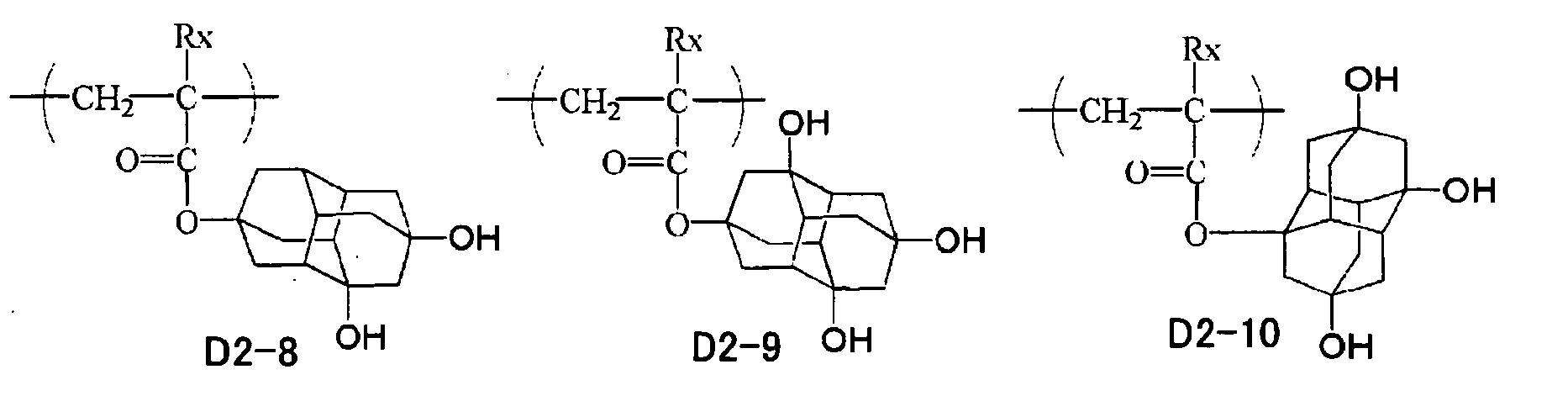


- In specific examples above, Rx represents H, CH3, CF3 or CH2OH.
- In the case where the repeating unit (Aa) having a diamantane structure does not contain an acid-decomposable group, the resin as the component (A) contains an acid-decomposable group in another repeating unit. The resin as the component (A) may contain a repeating unit (Aa-1) containing an acid-decomposable group and having a diamantane structure in a group capable of desorbing under the action of an acid, which is present in the acid-decomposable group, and another repeating unit having an acid-decomposable group. The group preferred as the acid-decomposable group is a group where the hydrogen atom of a -COOH group or a -OH group is substituted by a group capable of desorbing under the action of an acid. In the present invention, the acid-decomposable group is preferably an acetal group or a tertiary ester group.
- In the case where the acid-decomposable group is bonded as a side chain, the matrix resin is an alkali-soluble resin having an -OH or -COOH group in the side chain. Examples thereof include an alkali-soluble resin which is described later.
- The alkali dissolution rate of such an alkali-soluble resin is preferably 170 A/sec or more, more preferably 330 A/sec or more (A is angstrom), as measured (at 23°C) with 0.261 N tetramethylammonium hydroxide (TMAH).
- From this standpoint, preferred alkali-soluble resins are an alkali-soluble resin having a hydroxystyrene structural unit, for example, an o-, m- or p-poly(hydroxystyrene) including a copolymer thereof, a hydrogenated poly(hydroxystyrene), a halogen- or alkylsubstituted poly(hydroxystyrene), a partially O-alkylated or O-acylated poly(hydroxystyrene), a styrene-hydroxystyrene copolymer, an α-methylstyrene-hydroxystyrene copolymer and a hydrogenated novolak resin; and an alkali-soluble resin having a carboxyl group-containing repeating unit such as (meth)acrylic acid and norbornenecarboxylic acid.
- The resin as the component (A) may be obtained, as disclosed, for example, in
European Patent No. 254853 JP-A-2-25850 JP-A-3-223860 JP-A-4-251259 - The another repeating unit containing an acid-decomposable group is preferably at least one member selected from the repeating units where the alkali-soluble group is protected by a chain tertiary alkyl group such as tert-butyl group and tert-pentyl group or by a group having an alicyclic hydrocarbon-containing partial structure represented by any one of the following formulae (pI) to (pV).

- In formulae (pI) to (pV), R11 represents a methyl group, an ethyl group, an n-propyl group, an isopropyl group, an n-butyl group, an isobutyl group or a sec-butyl group. Z represents an atomic group necessary for forming a cycloalkyl group together with the carbon atom.
- R12 to R16 each independently represents a linear or branched alkyl group having a carbon number of 1 to 4 or a cycloalkyl group, provided that at least one of R12 to R14 or either one of R15 and R16 represents a cycloalkyl group.
- R17 to R21 each independently represents a hydrogen atom, a linear or branched alkyl group having a carbon number of 1 to 4 or a cycloalkyl group, provided that at least one of R17 to R21 represents a cycloalkyl group and that either one of R19 and R21 represents a linear or branched alkyl group having a carbon number of 1 to 4 or a cycloalkyl group.
- R22 to R25 each independently represents a hydrogen atom, a linear or branched alkyl group having a carbon number of 1 to 4 or a cycloalkyl group, provided that at least one of R22 to R25 represents a cycloalkyl group. R23 and R24 may combine with each other to form a ring.
- In formulae (pI) to (pV), the alkyl group as R12 to R25 is a linear or branched alkyl group having from 1 to 4 carbon atoms, and examples thereof include a methyl group, an ethyl group and a propyl group.
- The cycloalkyl group of R12 to R25 and the cycloalkyl group formed by Z together with the carbon atom may be monocyclic or polycyclic. Specifically, the cycloalkyl group includes a group having a carbon number of 5 or more and having a monocyclo, bicyclo, tricyclo or tetracyclo structure or the like. The carbon number thereof is preferably from 6 to 30, more preferably from 7 to 25. These cycloalkyl groups each may have a substituent.
- Preferred examples of the cycloalkyl group include an adamantyl group, a noradamantyl group, a decalin residue, a tricyclodecanyl group, a tetracyclododecanyl group, a norbornyl group, a cedrol group, a cyclopentyl group, a cyclohexyl group, a cycloheptyl group, a cyclooctyl group, a cyclodecanyl group and a cyclododecanyl group. Among these, more preferred are an adamantyl group, a norbornyl group, a cyclohexyl group, a cyclopentyl group, a tetracyclododecanyl group and a tricyclodecanyl group.
- Examples of the substituent which these alkyl group and cycloalkyl group may further have include an alkyl group (having a carbon number of 1 to 4), a halogen atom, a hydroxyl group, an alkoxy group (having a carbon number of 1 to 4), a carboxyl group and an alkoxycarbonyl group (having a carbon number of 2 to 6). Examples of the substituent which these alkyl group, alkoxy group, alkoxycarbonyl group and the like may further have include a hydroxyl group, a halogen atom and an alkoxy group.
- The structures represented by formulae (pI) to (pV) each can be used for the protection of an alkali-soluble group in the resin. Specific examples thereof include a structure where the hydrogen atom of a carboxylic acid group, a sulfonic acid group, a phenol group or a thiol group is replaced by the structure represented by any one of formulae (pI) to (pV). A structure where the hydrogen atom of a carboxylic acid group or a sulfonic acid group is replaced by the structure represented by any one of formulae (pI) to (pV), is preferred.
- The repeating unit having an alkali-soluble group protected by the structure represented by any one of formulae (pI) to (pV) is preferably a repeating unit represented by the following formula (pA):

- In this formula, R represents a hydrogen atom, a halogen atom or a linear or branched alkyl group having a carbon number of 1 to 4, and a plurality of R's may be the same or different.
- A represents a single bond, or sole group or a combination of two or more groups, selected from the group consisting of an alkylene group, an ether group, a thioether group, a carbonyl group, an ester group, an amido group, a sulfonamido group, a urethane group and a urea group. A is preferably a single bond.
- Rp1 represents any one group of formulae (pI) to (pV).
- The repeating unit represented by formula (pA) is preferably a repeating unit comprising 2-alkyl-2-adamantyl (meth)acrylate, 2-(1-adamantyl)-2-propyl (meth)acrylate, 1-alkyl-1-cyclopentyl (meth)acrylate or 1-alkyl-1-cyclohexyl (meth)acrylate.
- Specific examples of the repeating unit represented by formula (pA) are set forth below.
- (In the formulae, Rx represents H, CH3, CF3 or CH2OH, and Rxa and Rxa each independently represents an alkyl group having a carbon number of 1 to 4.)


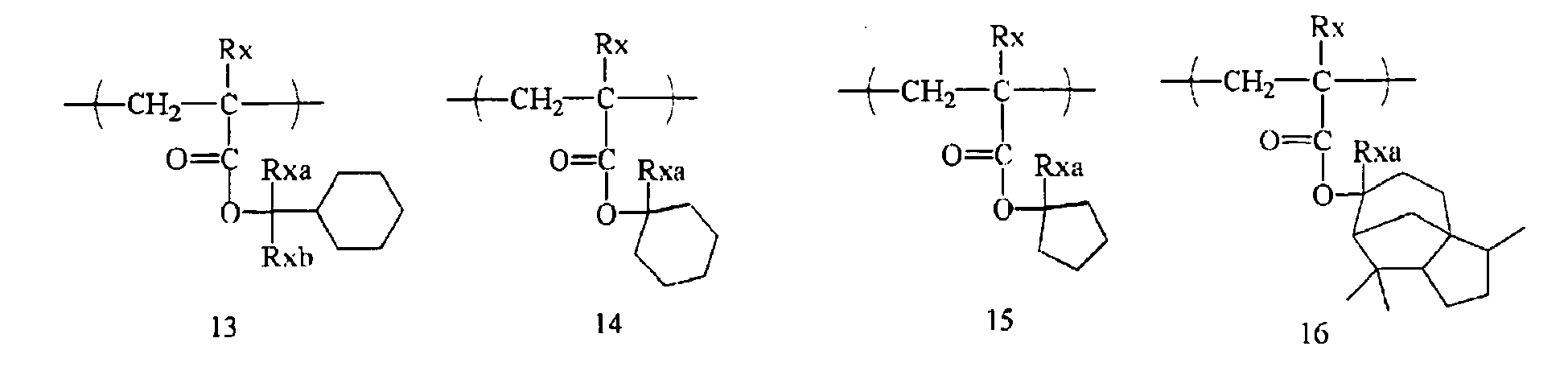

- The resin as the component (A) preferably further contains a non-acid-decomposable repeating unit.
- The non-acid-decomposable repeating unit includes a non-acid-decomposable repeating unit which is, for example, the following repeating unit having a lactone group or having an alicyclic hydrocarbon structure substituted by a polar group. The term "non-acid-decomposable" as used herein means that the repeating unit exhibits no or very low reactivity for the action of an acid in the process where the positive photosensitive composition of the present invention is usually employed, and contains substantially no group contributing to the image formation utilizing an acid.
- The resin as the component (A) preferably contains a repeating unit having a lactone group. As for the lactone group, any group may be used as long as it has a lactone structure, but a group having a 5-, 6- or 7-membered ring lactone structure is preferred. The 5-, 6- or 7-membered ring lactone structure is preferably condensed with another ring structure in the form of forming a bicyclo or spiro structure. The repeating unit is more preferably a repeating unit containing a group having a lactone structure represented by any one of the following formulae (LC1-1) to (LC1-16). The group having a lactone structure may be bonded directly to the main chain. The lactone group is preferably connected to the polymer main chain through a non-acid-decomposable bond. That is, the repeating unit having a lactone group is preferably a non-acid-decomposable repeating unit. The non-acid-decomposable bond is preferably a primary or secondary ester bond. The primary or secondary ester bond exhibits no or very low reactivity for the action of an acid in the process where the positive photosensitive composition of the present invention is usually used.
- Preferred lactone structures are (LC1-1), (LC1-4), (LC1-5), (LC1-6), (LC1-13) and (LC1-14). By virtue of using a specific lactone structure, the line edge roughness and the development defect are improved.


- The lactone structure moiety may or may not have a substituent (Rb2). Preferred examples of the substituent (Rb2) include an alkyl group having a carbon number of 1 to 8, a cycloalkyl group having a carbon number of 4 to 7, an alkoxy group having a carbon number of 1 to 8, an alkoxycarbonyl group having a carbon number of 1 to 8, a carboxyl group, a halogen atom, a hydroxyl group, a cyano group and an acid-decomposable group. n2 represents an integer of 0 to 4. When n2 is an integer of 2 or more, the plurality of Rb2's may be the same or different and also, the plurality of Rb2's may combine with each other to form a ring.
- Examples of the repeating unit containing a group having a lactone structure represented by any one of formulae (LC1-1) to (LC1-16) include a repeating unit represented by the following formula (AI):

- In formula (AI), Rb0 represents a hydrogen atom, a halogen atom or an alkyl group having a carbon number of 1 to 4.
- Preferred examples of the substituent which the alkyl group of Rb0 may have include a hydroxy group and a halogen atom.
- Examples of the halogen atom of Rb0 include a fluorine atom, a chlorine atom, a bromine atom and an iodine atom.
- Rb0 is preferably a hydrogen atom or a methyl group.
- Ab represents an alkylene group, a divalent linking group having a monocyclic or polycyclic alicyclic hydrocarbon structure, a single bond, an ether group, an ester group, a carbonyl group, a carboxyl group, or a divalent group comprising a combination thereof, preferably a single bond or a linking group represented by -Ab1-CO2-. Ab1 is a linear or branched alkylene group or a monocyclic or polycyclic cycloalkylene group, preferably a methylene group, an ethylene group, a cyclohexyl group, an adamantyl group or a norbornyl group.
- V represents a group represented by any one of formulae (LC1-1) to (LC1-16).
- The repeating unit having a lactone structure usually has an optical isomer, but any optical isomer may be used. One optical isomer may be used alone or a mixture of a plurality of optical isomers may be used. In the case of using primarily one optical isomer, the optical purity (ee) thereof is preferably 90 or more, more preferably 95 or more.
- Specific examples of the repeating unit containing a group having a lactone structure are set forth below, but the present invention is not limited thereto.
- (In the formulae, Rx is H, CH3, CH2OH or CF3.)


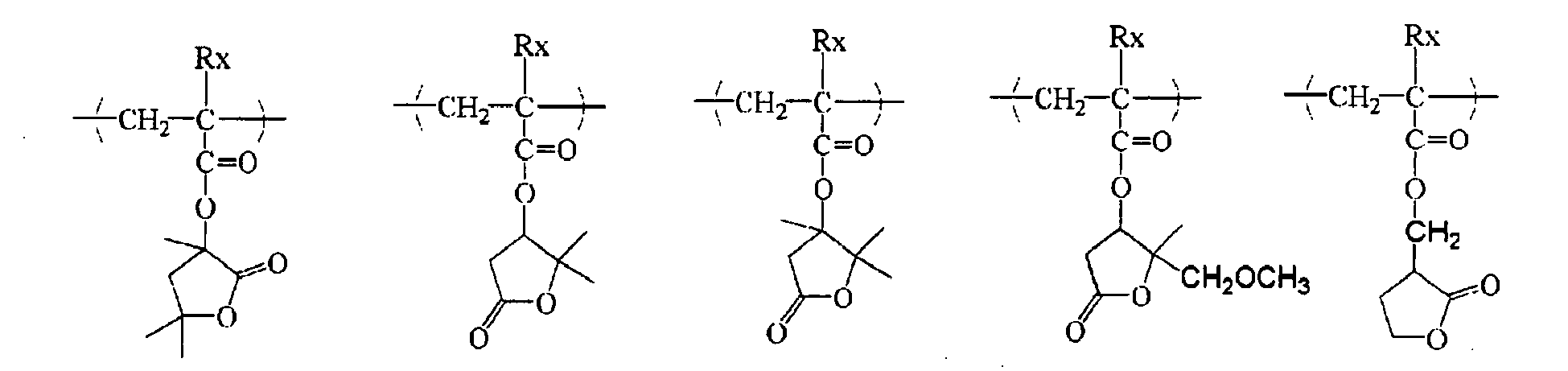


- (In the formulae, Rx is H, CH3, CH2OH or CF3.)


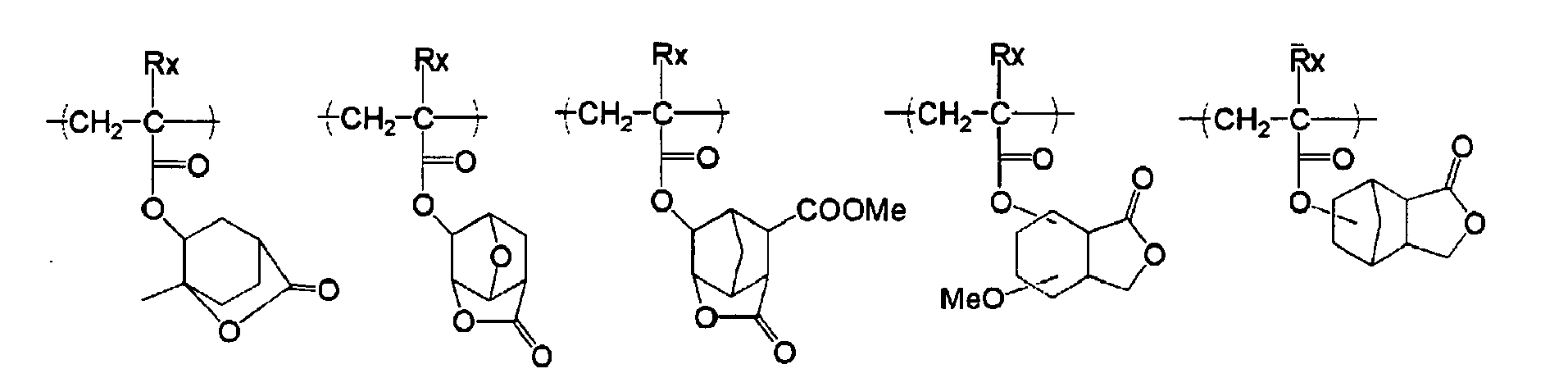


- (In the formulae, Rx is H, CH3, CH2OH or CF3.)


- The resin as the component (A) preferably contains a repeating unit having an alicyclic hydrocarbon structure substituted by a polar group. By virtue of this repeating unit, the adhesion to substrate and the affinity for developer are enhanced. The polar group is preferably a hydroxyl group or a cyano group. The repeating unit is preferably a repeating unit having a partial structure represented by the following formula (VIIa) or (VIIb), more preferably a repeating unit represented by the following formula (AIIa) or (AIIb).

- In formula (VIIa), R2c to R4c each independently represents a hydrogen atom, a hydroxyl group or a cyano group, provided that at least one of R2c to R4c represents a hydroxyl group or a cyano group. A partial structure where one or two member out of R2c to R4c is a hydroxyl group with the remaining being a hydrogen atom is preferred, and a partial structure where two members out of R2c to R4c are a hydroxyl group with the remaining being a hydrogen atom is more preferred.

- In formulae (AIIa) and (AIIb), R1c represents a hydrogen atom, a methyl group, a trifluoromethyl group or a hydroxymethyl group.
- Specific examples of the repeating unit having a structure represented by formula (VIIa) or (VIIb) are set forth below, but the present invention is not limited thereto.


- The resin as the component (A) may contain a repeating unit represented by the following formula (VIII):

- In formula (VIII), Z2 represents -O- or -N(R41)-. R41 represents a hydrogen atom, a hydroxyl group, an alkyl group or -OSO2-R42. R42 represents an alkyl group, a cycloalkyl group or a camphor residue. The alkyl group of R41 and R42 may be substituted by a halogen atom (preferably fluorine atom) or the like.
- Specific examples of the repeating unit represented by formula (VIII) are set forth below, but the present invention is not limited thereto.

- The resin as the component (A) preferably contains a repeating unit having an alkali-soluble group, more preferably a repeating unit having a carboxyl group. By virtue of containing such a repeating unit, the resolution increases in usage of forming contact holes. As for the repeating unit having a carboxyl group, a repeating unit where a carboxyl group is directly bonded to the resin main chain, such as repeating unit by an acrylic acid or a methacrylic acid, a repeating unit where a carboxyl group is bonded to the resin main chain through a linking group, and a repeating unit where an alkali-soluble group is introduced into the polymer chain terminal by using an alkali-soluble group-containing polymerization initiator or chain transfer agent at the polymerization, all are preferred. The linking group may have a monocyclic or polycyclic hydrocarbon structure. An acrylic acid and a methacrylic acid are most preferred.
- The resin as the component (A) may contain a repeating unit having from 1 to 3 groups represented by the following formula (F1). By virtue of this repeating unit, the line edge roughness performance is enhanced.

- In formula (F1), R50 to R55 each independently represents a hydrogen atom, a fluorine atom or an alkyl group, provided that at least one of R50 to R55 is a fluorine atom or an alkyl group with at least one hydrogen atom being substituted by a fluorine atom.
- Ra represents a hydrogen atom or an organic group (preferably an acid-decomposable protective group, an alkyl group, a cycloalkyl group, an acyl group or an alkoxycarbonyl group).
- The alkyl group of R50 to R55 may be substituted by a halogen atom (e.g., fluorine), a cyano group or the like and is preferably an alkyl group having a carbon number of 1 to 3, and examples thereof include a methyl group and a trifluoromethyl group.
- It is preferred that R50 to R55 all are a fluorine atom.
- The organic group represented by Ra is preferably an acid-decomposable protective group or an alkyl, cycloalkyl, acyl, acyl, alkylcarbonyl, alkoxycarbonyl, alkoxycarbonylmethyl, alkoxymethyl or 1-alkoxyethyl group which may have a substituent.
- The repeating unit having a group represented by formula (F1) is preferably a repeating unit represented by the following formula (F2):

- In formula (F2), Rx represents a hydrogen atom, a halogen atom or an alkyl group having a carbon number of 1 to 4. Preferred examples of the substituent which the alkyl group of Rx may have include a hydroxyl group and a halogen atom.
- Fa represents a single bond or a linear or branched alkylene group, preferably a single bond.
- Fb represents a monocyclic or polycyclic hydrocarbon group.
- Fc represents a single bond or a linear or branched alkylene group, preferably a single bond or a methylene group.
- F1 represents a group represented by formula (F1).
- p1 represents 1, 2 or 3.
- The cyclic hydrocarbon group in Fb is preferably a cyclopentyl group, a cyclohexyl group or a norbornyl group.
- Specific examples of the repeating unit having a structure represented formula (F1) are set forth below.

- The resin as the component (A) may further contain a repeating unit having an alicyclic hydrocarbon structure and not exhibiting acid decomposability. By virtue of this repeating unit, dissolving out of a low molecular component from the photosensitive film into the immersion liquid at the immersion exposure can be reduced. Examples of such a repeating unit include 1-adamantyl (meth)acrylate, tricyclodecanyl (meth) acrylate and cyclohexyl (meth)-acrylate.
- The resin as the component (A) may contain, in addition to the above-described repeating structural units, various repeating structural units for the purpose of controlling the dry etching resistance, suitability for standard developer, adhesion to substrate, resist profile and properties generally required of the resist, such as resolving power, heat resistance and sensitivity.
- Examples of such a repeating structural unit include, but are not limited to, repeating structural units corresponding to the monomers described below.
- By virtue of such a repeating structural unit, the performance required of the resin as the component (A), particularly,
- (1) solubility in the coating solvent,
- (2) film-forming property (glass transition point),
- (3) alkali developability,
- (4) film loss (selection of hydrophilic, hydrophobic or alkali-soluble group),
- (5) adhesion of unexposed area to substrate,
- (6) dry etching resistance
and the like, can be subtly controlled. - Examples of the monomer include a compound having one addition-polymerizable unsaturated bond selected from acrylic acid esters, methacrylic acid esters, acrylamides, methacrylamides, allyl compounds, vinyl ethers and vinyl esters.
- Other than these, an addition-polymerizable unsaturated compound copolymerizable with the monomer corresponding to the above-described various repeating structural units may be copolymerized.
- In the resin as the component (A), the molar ratio of respective repeating structural units contained is appropriately determined to control the dry etching resistance of resist, suitability for standard developer, adhesion to substrate, resist profile and performances generally required of the resist, such as resolving power, heat resistance and sensitivity.
- The preferred embodiment of the resin as the component (A) includes a resin where all repeating units have a (meth)acrylate repeating unit, and the resin may be a resin where the repeating units all are a methacrylate repeating unit, a resin where the repeating units all are an acrylate repeating unit, or a resin containing both a methacrylate repeating unit and an acrylate repeating unit. In the case of containing both a methacrylate repeating unit and an acrylate repeating unit, the repeating unit having a polar functional group is preferably an acrylate.
- In the resin as the component (A), the content of the repeating unit having an acid-decomposable group is preferably from 10 to 60 mol%, more preferably from 20 to 50 mol%, still more preferably from 25 to 40 mol%, based on all repeating structural units.
- In the resin as the component (A), the content of the repeating unit (Aa-1) is preferably from 20 to 50 mol% based on all repeating units.
- In the resin as the component (A), the content of the repeating unit (Aa-2) is preferably from 5 to 30 mol% based on all repeating units.
- When the positive photosensitive composition of the present invention is used for exposure with ArF, the resin as the component (A) preferably has no aromatic group in view of transparency to ArF light.
- A more preferred embodiment is a ternary copolymerization polymer comprising from 20 to 50 mol% of the repeating unit (Aa-1) containing an acid-decomposable group and having a diamantane structure in a group capable of desorbing under the action of an acid, which is present in the acid-decomposable group, or another acid-decomposable group-containing repeating unit, from 20 to 50 mol% of the repeating unit having a lactone structure, and from 5 to 30 mol% of the repeating unit having a diamantane structure substituted by a polar functional group or the repeating unit having another alicyclic hydrocarbon structure substituted by a polar group, or a quaternary copolymerization polymer additionally comprising from 0 to 20 mol% of other repeating units.
- Another preferred embodiment is a ternary copolymerization polymer comprising from 5 to 30 mol% of the repeating unit (Aa-2) having a diamantane structure and substantially insusceptible to the action of an acid or an alkali, from 20 to 50 mol% of an acid-decomposable repeating unit having an adamantane structure, and from 20 to 50 mol% of a non-acid-decomposable repeating unit having a lactone group, or a quaternary copolymerization polymer additionally comprising from 0 to 20 mol% of other repeating units. Examples of the acid-decomposable repeating unit include a repeating unit where in the repeating unit represented by formula (PA), Rp1 has an adamantane structure. Examples of the non-acid-decomposable repeating unit having a lactone group include a repeating unit where in the repeating unit represented by formula (AI), V is a group incapable of desorbing under the action of an acid.
- The resin as the component (A) preferably further contains a repeating unit having an adamantane structure. Examples of the repeating unit having an adamantane structure include a repeating unit where in the repeating unit represented by formula (PA), Rp1 has an adamantane structure, and a repeating unit represented by formula (AIIa).
- The resin as the component (A) can be synthesized by an ordinary method (for example, radical polymerization). Examples of the synthesis method in general include a batch polymerization method of dissolving monomer species and an initiator in a solvent and heating the solution, thereby effecting the polymerization, and a dropping polymerization method of adding dropwise a solution containing monomer species and an initiator to a heated solvent over 1 to 10 hours. A dropping polymerization method is preferred. As for the method of adding monomers in the dropping polymerization method, either a method of charging only a solvent into a reaction vessel and adding dropwise a monomer solution thereto, or a method of previously charging a part of monomer species into a reaction vessel and adding dropwise the remaining may be used. The polymerization initiator may be added by the same solution as monomers or may be added from a solution different from the monomer solution. In the case of adding the polymerization initiator from a solution different from the monomer solution, the monomer solution and the initiator solution may be added dropwise at the same or different speed. Examples of the reaction solvent include tetrahydrofuran, 1,4-dioxane, ethers (e.g., diisopropyl ether), ketones (e.g., methyl ethyl ketone, methyl isobutyl ketone), an ester solvent (e.g., ethyl acetate), an amide solvent (e.g., dimethylformamide, dimethylacetamide), and a solvent capable of dissolving the positive photosensitive composition of the present invention, which is described later, such as propylene glycol monomethyl ether acetate, propylene glycol monomethyl ether and cyclohexanone. The polymerization is preferably performed by using the same solvent as the solvent used for the positive photosensitive composition of the present invention. By the use of this solvent, generation of particles during storage can be suppressed.
- The polymerization reaction is preferably performed in an inert gas atmosphere such as nitrogen and argon. As for the polymerization initiator, the polymerization is started by using a commercially available radical initiator (e.g., azo-based initiator, peroxide). The radical initiator is preferably an azo-based initiator, and an azo-based initiator having an ester group, a cyano group or a carboxyl group is preferred. Preferred examples of the initiator include azobisisobutyronitrile, azobisdimethylvaleronitrile and dimethyl 2,2'-azobis(2-methyl-propionate). If desired, the initiator is added additionally or in parts. After the completion of reaction, the reactant is charged into a solvent, and the desired polymer is recovered by a method such as powder or solid recovery. The reaction concentration is from 5 to 50 mass%, preferably from 10 to 30 mass%, and the reaction temperature is usually from 10 to 150°C, preferably from 30 to 120°C, more preferably from 60 to 100°C.
- The weight average molecular weight of the resin as the component (A) is preferably from 3,000 to 30,000, more preferably from 5,000 to 15,000, further more preferably from 6,000 to 12,000, in terms of polystyrene by the GPC method. By adjusting the molecular weight to a proper range, exposure latitude, development defect, scumming, line edge roughness and the like can be improved.
- The weight average molecular weight can be adjusted by appropriately selecting the species of polymerization initiator, the amount of polymerization initiator, the chain transfer agent, the polymerization temperature, the reaction solvent, the concentration of reaction solution, and the polymerization method (e.g., dropping polymerization, batch polymerization), in the polymerization reaction.
- The dispersity (Mw/Mn) of the resin as the component (A) is preferably from 1.1 to 3.0, more preferably from 1.2 to 2.5, still more preferably from 1.4 to 2.1. As the molecular weight distribution is smaller, the resolution and resist profile are excellent, the side wall of the resist pattern is smooth, and the roughness property is satisfied.
- In order to adjust the dispersity, for example, a resin having a dispersity of 1.0 to 1.5 can be obtained by using a living radical polymerization method. Also, when a resin having a relatively wide dispersity obtained by the polymerization is subjected to reprecipitation or washing with a solvent to thereby remove either one or both of a low molecular weight component and a high molecular weight component by utilizing the difference in the solubility of the resin in a solvent, a resin having a narrow dispersity can be obtained.
- The resin as the component (A) preferably has a weight average molecular weight of 3,000 to 30,000 and a dispersity of 1.1 to 3.0.
- In the positive photosensitive composition of the present invention, the blending amount of the resin as the component (A) in the entire composition is preferably from 50 to 99.99 mass%, more preferably from 60 to 99.0 mass%, based on the entire solid content.
- In the present invention, as for the resin of the component (A), one resin may be used alone or a plurality of resins may be used in combination.
- The positive photosensitive composition of the present invention may contain a resin not having a group capable of decomposing under the action of an acid (hereinafter sometimes referred to as a "resin as the component (A2)").
- The term "not having a group capable of decomposing under the action of an acid" means that the resin exhibits no or very low decomposability for the action of an acid in the process where the positive photosensitive composition of the present invention is usually used, and contains substantially no group contributing to the image formation utilizing the acid decomposition. Such a resin includes a resin having an alkali-soluble group, and a resin having a group capable of decomposing under the action of an alkali to increase the solubility in an alkali developer.
- The resin as the component (A2) is preferably, for example, a resin having at least one repeating unit derived from a (meth)acrylic acid derivative and/or an alicyclic olefin derivative.
- Preferred examples of the alkali-soluble group in the resin as the component (A2) include a carboxyl group, a phenolic hydroxyl group, an aliphatic hydroxyl group with the 1- or 2-position being substituted by an electron-withdrawing group, an electron-withdrawing group-substituted amino group (for example, a sulfonamide group, a sulfonimide group and a bis-sulfonylimide group), and an electron-withdrawing group-substituted methylene or methine group (for example, a methylene or methine group substituted by at least two groups selected from a ketone group and an ester group).
- The group capable of decomposing under the action of an alkali to increase the solubility in an alkali developer, contained in the resin as the component (A2), is preferably, for example, a lactone group or an acid anhydride group, more preferably a lactone group.
- The resin as the component (A2) may further contain a repeating unit having a functional group other than those described above. As for the repeating unit having an another functional group, a repeating unit having an appropriate functional group may be selected in the light of dry etching resistance, hydrophilicity/hydrophobicity, interaction and the like.
- Examples of the repeating unit having another functional group include a repeating unit having a polar functional group such as hydroxyl group, cyano group, carbonyl group and ester group, a repeating unit having a monocyclic or polycyclic hydrocarbon structure, a repeating unit having a fluoroalkyl group, and a repeating unit having a plurality of these functional groups.
- The weight average molecular weight of the resin as the component (A2) is preferably from 3,000 to 30,000, more preferably from 5,000 to 15,000, still more preferably from 6,000 to 12,000, in terms of polystyrene by the GPC method.
- Specific preferred examples of the resin as the component (A2) are set forth below, but the present invention is not limited thereto.

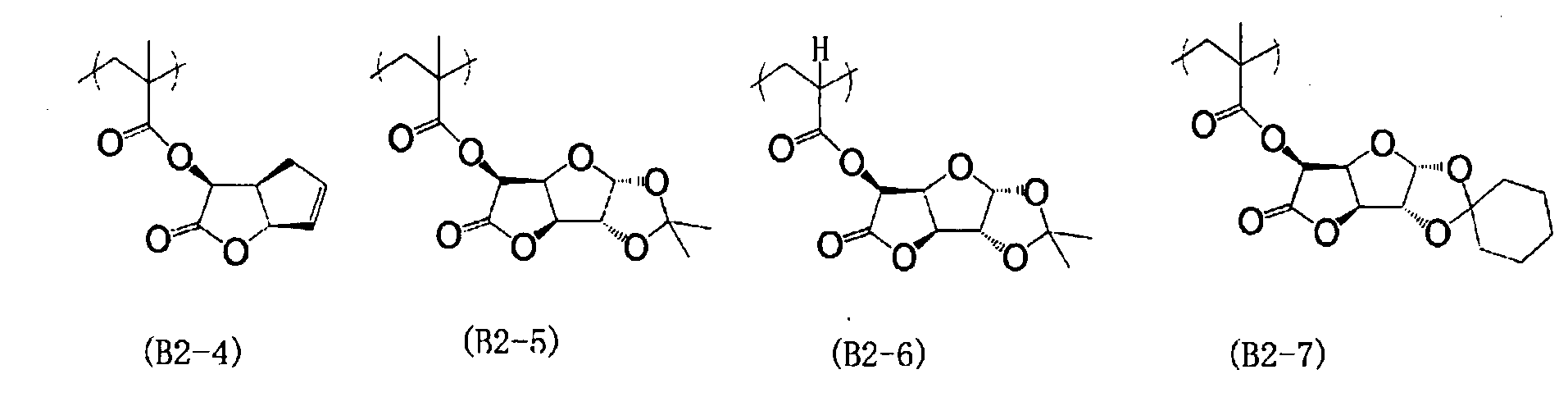

- The amount added of the resin as the component (A2) is usually from 0 to 50 mass%, preferably from 0 to 30 mass%, more preferably from 0 to 20 mass%, based on the resin as the component (A).
- The compound capable of generating an acid upon irradiation with actinic rays or radiation (hereinafter sometimes referred to as an "acid generator"), which is used in the positive photosensitive composition of the present invention, is described below.
- The acid generator for use in the present invention may be selected from the compounds generally used as the acid generator.
- More specifically, a photoinitiator for photocationic polymerization, a photoinitiator for photoradical polymerization, a photo-decoloring agent for coloring matters, a photo-discoloring agent, a known compound capable of generating an acid upon irradiation with actinic rays or radiation, which is used for microresist and the like, or a mixture thereof may be appropriately selected and used.
- Examples thereof include a diazonium salt, a phosphonium salt, a sulfonium salt, an iodonium salt, an imidosulfonate, an oxime sulfonate, a diazodisulfone, a disulfone and an o-nitrobenzyl sulfonate.
- Also, a compound where the above-described group or compound capable of generating an acid upon irradiation with actinic rays or radiation is introduced into the polymer main or side chain, such as compounds described in
U.S. Patent 3,849,137 ,German Patent 3,914,407 ,JP-A-63-26653 JP-A-55-164824 JP-A-62-69263 JP-A-63-146038 JP-A-63-163452 JP-A-62-153853 JP-A-63-146029 - Furthermore, a compound capable of generating an acid by the effect of light described, for example, in
U.S. Patent 3,779,778 andEuropean Patent 126,712 - As for the compound capable of decomposing upon irradiation with actinic rays or radiation to generate an acid, which can be used in combination, the compounds represented by the following formulae (ZI), (ZII) and (ZIII) are preferred.

- In formula (ZI), R201, R202 and R203 each independently represents an organic group.
- X- represents a non-nucleophilic anion.
- The carbon number of the organic group as R201, R202 and R203 is preferably from 1 to 30, more preferably from 1 to 20.
- Also, two members out of R201 to R203 may combine to form a ring structure, and the ring may contain an oxygen atom, a sulfur atom, an ester bond, an amide bond or a carbonyl group.
- The group formed by combining two members out of R201 to R203 includes an alkylene group (e.g., butylene, pentylene).
- Specific examples of the organic group as R201, R202 and R203 include the corresponding groups in the compounds (ZI-1), (ZI-2) and (ZI-3) which are described later.
- The compound may be a compound having a plurality of structures represented by formula (Z1). For example, the compound may be a compound having a structure that at least one of R201 to R203 in the compound represented by formula (Z1) is bonded to at least one of R201 to R203 in another compound represented by formula (Z1).
- The component (Z1) is more preferably a compound (ZI-1), (ZI-2) or (ZI-3) described below.
- The compound (ZI-1) is an arylsulfonium compound where at least one of R201 to R203 in formula (Z1) is an aryl group, that is, a compound having an arylsulfonium as the cation.
- In the arylsulfonium compound, R201 to R203 all may be an aryl group or a part of R201 to R203 may be an aryl group with the remaining being an alkyl group or a cycloalkyl group.
- Examples of the arylsulfonium compound include a triarylsulfonium compound, a diarylalkylsulfonium compound, an aryldialkylsulfonium compound, a diarylcycloalkyl-sulfonium compound and an aryldicycloalkylsulfonium compound.
- The aryl group in the arylsulfonium compound is preferably a phenyl group or a naphthyl group, more preferably a phenyl group. In the case where the arylsulfonium compound has two or more aryl groups, these two or more aryl groups may be the same of different.
- The alkyl group which is present, if desired, in the arylsulfonium compound is preferably a linear or branched alkyl group having a carbon number of 1 to 15, and examples thereof include a methyl group, an ethyl group, a propyl group, an n-butyl group, a sec-butyl group and a tert-butyl group.
- The cycloalkyl group which is present, if desired, in the arylsulfonium compound is preferably a cycloalkyl group having a carbon number of 3 to 15, and examples thereof include a cyclopropyl group, a cyclobutyl group and a cyclohexyl group.
- The aryl group, alkyl group and cycloalkyl group of R201 to R203 each may have, as the substituent, an alkyl group (for example, an alkyl group having a carbon number of 1 to 15), a cycloalkyl group (for example, a cycloalkyl group having a carbon number of 3 to 15), an aryl group (for example, an aryl group having a carbon number of 6 to 14), an alkoxy group (for example, an alkoxy group having a carbon number of 1 to 15), a halogen atom, a hydroxyl group or a phenylthio group. The substituent is preferably a linear or branched alkyl group having a carbon number of 1 to 12, a cycloalkyl group having a carbon number of 3 to 12, or a linear, branched or cyclic alkoxy group having a carbon number of 1 to 12, and most preferably an alkyl group having a carbon number of 1 to 4, or an alkoxy group having a carbon number of 1 to 4. The substituent may be substituted to any one of three members R201 to R203 or may be substituted to all of these three members. In the case where R201 to R203 are an aryl group, the substituent is preferably substituted at the p-position of the aryl group.
- Examples of the non-nucleophilic anion of X- in formula (ZI) include a sulfonate anion, a carboxylate anion, a sulfonylimide anion, a bis(alkylsulfonyl)imide anion and a tris(alkylsulfonyl)methyl anion.
- The non-nucleophilic anion is an anion having an extremely low ability of causing a nucleophilic reaction, and this anion can suppress the decomposition in aging due to an intramolecular nucleophilic reaction. By virtue of this anion, the aging stability of the photosensitive composition is enhanced.
- Examples of the sulfonate anion include an aliphatic sulfonate anion, an aromatic sulfonate anion and a camphorsulfonate anion.
- Examples of the carboxylate anion include an aliphatic carboxylate anion, an aromatic carboxylate anion and an aralkylcarboxylate anion.
- The aliphatic hydrocarbon group in the aliphatic sulfonate anion includes an alkyl group preferably having a carbon number of 1 to 30, such as methyl group, ethyl group, propyl group, isopropyl group, n-butyl group, isobutyl group, sec-butyl group, pentyl group, neopentyl group, hexyl group, heptyl group, octyl group, nonyl group, decyl group, undecyl group, dodecyl group, tridecyl group, tetradecyl group, pentadecyl group, hexadecyl group, heptadecyl group, octadecyl group, nonadecyl group and eicosyl group; and a cycloalkyl group preferably having a carbon number of 3 to 30, such as cyclopropyl group, cyclopentyl group, cyclohexyl group, adamantyl group, norbornyl group and boronyl group.
- The aromatic group in the aromatic sulfonate anion includes an aryl group preferably having a carbon number of 6 to 14, such as phenyl group, tolyl group and naphthyl group.
- The alkyl group, cycloalkyl group and aryl group in the aliphatic sulfonate anion and aromatic sulfonate anion each may have a substituent.
- Examples of the substituent include a halogen atom, an alkyl group, an alkoxy group and an alkylthio group.
- Examples of the halogen atom include a chlorine atom, a bromine atom, a fluorine atom and an iodine atom.
- Examples of the alkyl group include an alkyl group preferably having a carbon number of 1 to 15, such as methyl group, ethyl group, propyl group, isopropyl group, n-butyl group, isobutyl group, sec-butyl group, pentyl group, neopentyl group, hexyl group, heptyl group, octyl group, nonyl group, decyl group, undecyl group, dodecyl group, tridecyl group, tetradecyl group, pentadecyl group, hexadecyl group, heptadecyl group, octadecyl group, nonadecyl group and eicosyl group.
- Examples of the alkoxy group include an alkoxy group preferably having a carbon number of 1 to 5, such as methoxy group, ethoxy group, propoxy group and butoxy group.
- Examples of the alkylthio group include an alkylthio group preferably having a carbon number of 1 to 15, such as methylthio group, ethylthio group, propylthio group, isopropylthio group, n-butylthio group, isobutylthio group, sec-butylthio group, pentylthio group, neopentylthio group, hexylthio group, heptylthio group, octylthio group, nonylthio group, decylthio group, undecylthio group, dodecylthio group, tridecylthio group, tetradecylthio group, pentadecylthio group, hexadecylthio group, heptadecylthio group, octadecylthio group, nonadecylthio group and eicosylthio group. The alkyl group, alkoxy group and alkylthio group each may be further substituted by a halogen atom (preferably a fluorine atom).
- Examples of the aliphatic hydrocarbon group in the aliphatic carboxylate anion are the same as those of the aliphatic hydrocarbon group in the aliphatic sulfonate anion.
- Examples of the aromatic group in the aromatic carboxylate anion are the same as those of the aromatic group in the aromatic sulfonate anion.
- Examples of the aralkyl group in the aralkylcarboxylate anion include an aralkyl group preferably having a carbon number of 6 to 12, such as benzyl group, phenethyl group, naphthylmethyl group, naphthylethyl group and naphthylmethyl group.
- The alkyl group, cycloalkyl group, aryl group and aralkyl group in the aliphatic carboxylate anion, aromatic carboxylate anion and aralkylcarboxylate anion each may have a substituent, and examples of the substituent include the same halogen atom, alkyl group, alkoxy group and alkylthio group as those in the aliphatic sulfonate anion and aromatic sulfonate anion.
- Examples of the sulfonylimide anion include a saccharine anion.
- The alkyl group in the bis(alkylsulfonyl)imide anion and tris(alkylsulfonyl)methyl anion is preferably an alkyl group having a carbon number of 1 to 5, and examples thereof include a methyl group, an ethyl group, a propyl group, an isopropyl group, an n-butyl group, an isobutyl group, a sec-butyl group, a pentyl group and a neopentyl group. This alkyl group may have a substituent, and examples of the substituent include a halogen atom, a halogen atom-substituted alkyl group, an alkoxy group and an alkylthio group, with a fluorine atom-substituted alkyl group being preferred.
- Other examples of the non-nucleophilic anion include a phosphorus fluoride anion, a boron fluoride anion and an antimony fluoride anion.
- The non-nucleophilic anion of X- is preferably an aliphatic sulfonate anion substituted by fluorine atom, an aromatic sulfonate anion substituted by fluorine atom or a fluorine atom-containing group, a bis(alkylsulfonyl)imide anion with the alkyl group being substituted by fluorine atom, or a tris(alkylsulfonyl)methide anion with the alkyl group being substituted by fluorine atom. The non-nucleophilic anion of X- is more preferably a fluorine-substituted aliphatic sulfonate anion having a carbon number of 4 to 8, still more preferably nonafluoro-butanesulfonate anion or perfluorooctanesulfonate anion.
- The compound (ZI-2) is described below.
- The compound (ZI-2) is a compound where R201 to R203 in formula (ZI) each independently represents an aromatic ring-free organic group. The aromatic ring as used herein includes an aromatic ring containing a heteroatom.
- The aromatic ring-free organic group as R201 to R203 preferably has a carbon number of 1 to 30, more preferably from 1 to 20.
- R201 to R203 each is independently, preferably an alkyl group, a cycloalkyl group, an allyl group or a vinyl group, more preferably a linear, branched or cyclic 2-oxoalkyl group or an alkoxycarbonylmethyl group, and most preferably a linear or branched 2-oxoalkyl group.
- The alkyl group as R201 to R203 may be either linear or branched and is preferably a linear or branched alkyl group having a carbon number of 1 to 10 (e.g., methyl, ethyl, propyl, butyl, pentyl). The alkyl group is more preferably a linear or branched 2-oxoalkyl group or an alkoxycarbonylmethyl group.
- The cycloalkyl group as R201 to R203 is preferably a cycloalkyl group having a carbon number of 3 to 10 (e.g., cyclopentyl, cyclohexyl, norbornyl). The cycloalkyl group is more preferably a cyclic 2-oxoalkyl group.
- The linear, branched or cyclic 2-oxoalkyl group as R201 to R203 is preferably a group having >C=O at the 2-position of the above-described alkyl or cycloalkyl group.
- The alkoxy group in the alkoxycarbonylmethyl group as R201 to R203 is preferably an alkoxy group having a carbon number of 1 to 5 (e.g., methoxy, ethoxy, propoxy, butoxy, pentoxy).
- R201 to R203 each may be further substituted by a halogen atom, an alkoxy group (for example, an alkoxy group having a carbon number of 1 to 5), a hydroxyl group, a cyano group or a nitro group.
- The compound (ZI-3) is a compound represented by the following formula (ZI-3), and this is a compound having a phenacylsulfonium salt structure.

- In formula (ZI-3), R1c to R5c each independently represents a hydrogen atom, an alkyl group, a cycloalkyl group, an alkoxy group or a halogen atom.
- R6c and R7c each independently represents a hydrogen atom, an alkyl group or a cycloalkyl group.
- Rx and Ry each independently represents an alkyl group, a cycloalkyl group, an allyl group or a vinyl group.
- Any two or more members out of R1c to R5c, a pair of R6c and R7c or a pair of Rx and Ry may combine with each other to form a ring structure, and the ring structure may contain an oxygen atom, a sulfur atom, an ester bond or an amide bond. Examples of the group formed by combining any two or more members out of R1c to R5c or combining a pair of R6c and R7c or of Rx and Ry include a butylene group and a pentylene group.
- Zc- represents a non-nucleophilic anion, and examples thereof are the same as those of the non-nucleophilic anion of X- in formula (I).
- The alkyl group as R1c to R7c, which may be linear or branched, is, for example, a linear or branched alkyl group having a carbon number of 1 to 20, preferably a linear or branched alkyl group having a carbon number of 1 to 12 (for example, a methyl group, an ethyl group, a linear or branched propyl group, a linear or branched butyl group, or a linear or branched pentyl group).
- The cycloalkyl group as R1c to R7c is preferably a cycloalkyl group having a carbon number of 3 to 8 (e.g., cyclopentyl, cyclohexyl).
- The alkoxy group as R1c to R5c, which may be linear, branched or cyclic, is, for example, an alkoxy group having a carbon number of 1 to 10, preferably a linear or branched alkoxy group having a carbon number of 1 to 5 (for example, a methoxy group, an ethoxy group, a linear or branched propoxy group, a linear or branched butoxy group, or a linear or branched pentoxy group) or a cyclic alkoxy group having a carbon number of 3 to 8 (e.g., cyclopentyloxy, cyclohexyloxy).
- A compound where any one of R1c to R5c is a linear or branched alkyl group, a cycloalkyl group or a linear, branched or cyclic alkoxy group is preferred, and a compound where the sum of carbon numbers of R1c to R5c is from 2 to 15 is more preferred. In this case, the solubility in a solvent is more enhanced and the generation of particles during storage is suppressed.
- Examples of the alkyl group as Rx and Ry are the same as those of the alkyl group as R1c to R7c. The alkyl group as Rx and Ry is preferably a linear or branched 2-oxoalkyl group or an alkoxycarbonylmethyl group are preferred. Examples of the linear or branched 2-oxoalkyl group include a group having >C=O at the 2-position of the alkyl group as R1c to R7c. Examples of the alkoxy group in the alkoxycarbonylmethyl group are the same as those of the alkoxy group as R1c to R5c.
- Examples of the cycloalkyl group as Rx and Ry are the same as those of the cycloalkyl group as R1c to R7c. The cycloalkyl group as Rx and Ry is preferably a cyclic 2-oxoalkyl group. Examples of the cyclic 2-oxoalkyl group include a group having >C=O at the 2-position of the cycloalkyl group as R1c to R7c.
- Rx and Ry each is preferably an alkyl or cycloalkyl group having a carbon number of 4 or more, more preferably 6 or more, still more preferably 8 or more.
- In formulae (ZII) and (ZIII), R204 to R207 each independently represents an aryl group, an alkyl group or a cycloalkyl group.
- The aryl group as R204 to R207 is preferably a phenyl group or a naphthyl group, more preferably a phenyl group.
- The alkyl group as R204 to R207, which may be linear or branched, is preferably a linear or branched alkyl group having a carbon number of 1 to 10 (e.g., methyl, ethyl, propyl, butyl, pentyl).
- The cycloalkyl group as R204 to R207 is preferably a cycloalkyl group having a carbon number of 3 to 10 (e.g., cyclopentyl, cyclohexyl, norbornyl).
- The aryl group, alkyl group and cycloalkyl group of R204 to R207 each may have a substituent. Examples of the substituent which the aryl group, alkyl group and cycloalkyl group of R204 to R207 each may have include an alkyl group (for example, an alkyl group having a carbon number of 1 to 15), a cycloalkyl group (for example, a cycloalkyl group having a carbon number of 3 to 15), an aryl group (for example, an aryl group having a carbon number of 6 to 15), an alkoxy group (for example, an alkoxy group having a carbon number of 1 to 15), a halogen atom, a hydroxyl group and a phenylthio group.
- X- represents a non-nucleophilic anion, and examples thereof are the same as those of the non-nucleophilic anion of X- in formula (ZI).
- Other examples of the compound capable of decomposing upon irradiation with actinic rays or radiation to generate an acid, which can be used, include the compounds represented by the following formulae (ZIV), (ZV) and (ZVI).

- In formulae (ZIV) to (ZVI), Ar3 and Ar4 each independently represents an aryl group.
- R206, R207 and R208 each independently represents an alkyl group, a cycloalkyl group or an aryl group.
- A represents an alkylene group, an alkenylene group or an arylene group.
- Among the compounds capable of decomposing upon irradiation with actinic rays or radiation to generate an acid, which may be used, the compounds represented by formulae (ZI) to (ZIII) are preferred.
- Out of the compounds capable of decomposing upon irradiation with actinic rays or radiation to generate an acid, which may be used, more preferred compounds are set forth below.








- One of the compounds as the component (B) may be used alone or two or more thereof may be used in combination.
- The content of the compound as the component (B) in the positive photosensitive composition is preferably from 0.1 to 20 mass%, more preferably from 0.5 to 10 mass%, still more preferably from 1 to 7 mass%, based on the solid content of the composition.
- The surfactant for use in the positive photosensitive composition of the present invention is a compound represented by the following formula (1) (hereinafter, sometimes referred to as a "surfactant (C)").

- In formula (1), R1 represents a hydrogen atom or an alkyl group,
m represents an integer of 1 to 30,
n represents an integer of 0 to 3, and
p represents an integer of 0 to 5. - The alkyl group of R1 is preferably a linear or branched alkyl group having a carbon number of 1 to 5, and examples thereof include a methyl group, an ethyl group, a propyl group, an n-butyl group, a sec-butyl group and a tert-butyl group. Among these, a methyl group, an ethyl group and a propyl group are more preferred.
- In formula (1), it is preferred that m is an integer of 1 to 25, n is an integer of 0 to 2, and p is an integer of 0 to 3.
- Examples of the commercial product for the surfactant represented by formula (1) include PF636 (n=0, m=6, p=1, R1 = methyl group), PF6320 (n=0, m=20, p=1, R1 = methyl group), PF656 (n=1, m=6, p=1, R1 = methyl group), and PF6520 (n=1, m=20, p=1, R1 = methyl group) (all are produced by OMNOVA).
- The positive photosensitive composition of the present invention contains the surfactant (C) together with the above-described resin, whereby the Dark-Bright difference is reduced.
- Also, the positive photosensitive composition of the present invention ensures that the sensitivity, resolution and adhesion are good and a resist pattern with less development defects can be formed. Furthermore, when applied to immersion exposure, the defocus latitude is broad and a good profile can be obtained.
- The amount used of the surfactant (C) is preferably from 0.00001 to 0.5 mass%, more preferably from 0.0001 to 0.1 mass%, based on the entire amount of the positive photosensitive composition (excluding the solvent).
- In the present invention, another surfactant may be used in combination with the surfactant (C).
- The ratio of the surfactant (C) and another surfactant used is preferably, in terms of the mass ratio (surfactant (C)/another surfactant), from 60/40 to 99/1, more preferably from 70/30 to 99/1.
- Examples of the another surfactant which can be used in combination include surfactants described in
JP-A-62-36663 JP-A-61-226746 JP-A-61-226745 JP-A-62-170950 JP-A-63-34540 JP-A-7-230165 JP-A-8-62834 JP-A-9-54432 JP-A-9-5988 JP-A-2002-277862 U.S. Patents 5,405,720 ,5,360,692 ,5,529,881 ,5,296,330 ,5,436,098 ,5,576,143 ,5,294,511 and5,824,451 . Examples of the commercially available surfactant therefor include a fluorine-containing surfactant and a silicon-containing surfactant, such as EFtop EF301 and EF303 (produced by Shin-Akita Kasei K.K.), Florad FC430 and 431 (produced by Sumitomo 3M Inc.), Megafac F171, F173, F176, F189 and R08 (produced by Dainippon Ink & Chemicals, Inc.), Surflon S-382, SC101, 102, 103, 104, 105 and 106 (produced by Asahi Glass Co., Ltd.), and Troysol S-366 (produced by Troy Chemical). Also, polysiloxane polymer KP-341 (produced by Shin-Etsu Chemical Co., Ltd.) may be used. - Other than these known surfactants, examples of the surfactant include a surfactant using a polymer having a fluoro-aliphatic group derived from a fluoro-aliphatic compound produced by the telomerization process (also called telomer process) or oligomerization process (also called oligomer process). The fluoro-aliphatic compound can be synthesized by the method described in
JP-A-2002-90991 - The polymer having a fluoro-aliphatic group is preferably a copolymer of a fluoro-aliphatic group-containing monomer with (poly(oxyalkylene)) acrylate and/or (poly(oxyalkylene)) methacrylate, and the polymer may have an irregular distribution or may be a block copolymer. Examples of the poly(oxyalkylene) group include a poly(oxyethylene) group, a poly(oxypropylene) group and a poly(oxybutylene) group. A unit having alkylenes differing in the chain length within the same chain, such as block-linked poly(oxyethylene, oxypropylene and oxyethylene) and block-linked poly(oxyethylene and oxypropylene), may also be used. Furthermore, the copolymer of a fluoro-aliphatic group-containing monomer and a (poly(oxyalkylene)) acrylate (or methacrylate) may be not only a binary copolymer but also a ternary or greater copolymer obtained by simultaneously copolymerizing two or more different fluoro-aliphatic group-containing monomers or two or more different (poly(oxyalkylene)) acrylates (or methacrylates).
- Examples thereof include commercially available surfactants such as Megafac F178, F-470, F-473, F-475, F-476 and F-472 (produced by Dainippon Ink & Chemicals, Inc.), and further include a copolymer of a C6F13 group-containing acrylate (or methacrylate) with a (poly(oxyalkylene)) acrylate (or methacrylate), a copolymer of a C6F13 group-containing acrylate (or methacrylate) with a (poly(oxyethylene)) acrylate (or methacrylate) and a (poly(oxypropylene)) acrylate (or methacrylate), a copolymer of a C8F17 group-containing acrylate (or methacrylate) with a (poly(oxyalkylene)) acrylate (or methacrylate), and a copolymer of a C8F17 group-containing acrylate (or methacrylate) with a (poly(oxyethylene)) acrylate (or methacrylate) and a (poly(oxypropylene)) acrylate (or methacrylate).
- Furthermore, a surfactant other than the fluorine-containing and/or silicon-containing surfactant may also be used in combination. Specific examples thereof include a nonionic surfactant such as polyoxyethylene alkyl ethers (e.g., polyoxyethylene lauryl ether, polyoxyethylene stearyl ether, polyoxyethylene cetyl ether, polyoxyethylene oleyl ether), polyoxyethylene alkylallyl ethers (e.g., polyoxyethylene octylphenol ether, polyoxyethylene nonylphenol ether), polyoxyethylene-polyoxypropylene block copolymers, sorbitan fatty acid esters (e.g., sorbitan monolaurate, sorbitan monopalmitate, sorbitan monostearate, sorbitan monooleate, sorbitan trioleate, sorbitan tristearate), and polyoxyethylene sorbitan fatty acid esters (e.g., polyoxyethylene sorbitan monolaurate, polyoxyethylene sorbitan monopalmitate, polyoxyethylene sorbitan monostearate, polyoxyethylene sorbitan trioleate, polyoxyethylene sorbitan tristearate).
- The positive photosensitive composition of the present invention is used by dissolving respective components in a predetermined organic solvent.
- Examples of the solvent which can be used include an organic solvent such as ethylene dichloride, cyclohexanone, cyclopentanone, 2-heptanone, γ-butyrolactone, methyl ethyl ketone, ethylene glycol monomethyl ether, ethylene glycol monoethyl ether, 2-methoxyethyl acetate, ethylene glycol monoethyl ether acetate, propylene glycol monomethyl ether, propylene glycol monomethyl ether acetate, toluene, ethyl acetate, methyl lactate, ethyl lactate, methyl methoxypropionate, ethyl ethoxypropionate, methyl pyruvate, ethyl pyruvate, propyl pyruvate, N,N-dimethylformamide, dimethylsulfoxide, N-methylpyrrolidone and tetrahydrofuran.
- In the present invention, one organic solvent may be used alone or some organic solvents may be used as a mixture, but it is preferred to use a mixed solvent containing two or more solvents having different functional groups. By this use, the solubility of the material is enhanced and not only production of particles in aging can be suppressed but also a good pattern profile can be obtained. Preferred examples of the functional group contained in the solvent include an ester group, a lactone group, a hydroxyl group, a ketone group and a carbonate group. The mixed solvent having different functional groups is preferably a mixed solvent in any one of the following (S1) to (S5):
- (S1) a mixed solvent prepared by mixing a hydroxyl group-containing solvent and a hydroxyl group-free solvent;
- (S2) a mixed solvent prepared by mixing a solvent having an ester group and a solvent having a ketone structure;
- (S3) a mixed solvent prepared by mixing a solvent having an ester structure and a solvent having a lactone structure;
- (S4) a mixed solvent prepared by mixing a solvent having an ester structure, a solvent having a lactone structure, and a hydroxyl group-containing solvent; and
- (S5) a mixed solvent prepared by mixing a solvent having an ester structure, a solvent having a carbonate structure, and a hydroxyl group-containing solvent.
- By the use of such a mixed solvent, production of particles during storage of the resist solution can be reduced and generation of a defect at the coating can be suppressed.
- Examples of the hydroxyl group-containing solvent include ethylene glycol, ethylene glycol monomethyl ether, ethylene glycol monoethyl ether, propylene glycol, propylene glycol monomethyl ether, propylene glycol monoethyl ether and ethyl lactate. Among these, propylene glycol monomethyl ether and ethyl lactate are preferred.
- Examples of the hydroxy group-free solvent include propylene glycol monomethyl ether acetate, ethyl ethoxypropionate, 2-heptanone, γ-butyrolactone, cyclohexanone, butyl acetate, N-methylpyrrolidone, N,N-dimethylacetamide and dimethyl sulfoxide. Among these, propylene glycol monomethyl ether acetate, ethyl ethoxypropionate, 2-heptanone, γ-butyrolactone, cyclohexanone and butyl acetate are preferred, and propylene glycol monomethyl ether acetate, ethyl ethoxypropionate, 2-heptanone and cyclohexanone are more preferred.
- Examples of the solvent having a ketone structure include cyclohexanone and 2-heptanone, with cyclohexanone being preferred.
- Examples of the solvent having an ester structure include propylene glycol monomethyl ether acetate, ethyl ethoxypropionate and butyl acetate, with propylene glycol monomethyl ether acetate being preferred.
- Examples of the solvent having a lactone structure include γ-butyrolactone.
- Examples of the solvent having a carbonate structure include propylene carbonate and ethylene carbonate, with propylene carbonate being preferred.
- The mixing ratio (by mass) between the hydroxy group-containing solvent and the hydroxy group-free solvent is from 1/99 to 99/1, preferably from 10/90 to 90/10, more preferably from 20/80 to 60/40. A mixed solvent containing the hydroxy group-free solvent in a proportion of 50 mass% or more is particularly preferred in view of coating uniformity.
- The mixing ratio (by mass) between the solvent having an ester structure and the solvent having a ketone structure is from 1/99 to 99/1, preferably from 10/90 to 90/10, more preferably from 40/60 to 80/20. A mixed solvent containing the solvent having an ester structure in a proportion of 50 mass% or more is particularly preferred in view of coating uniformity.
- The mixing ratio (by mass) between the solvent having an ester structure and the solvent having a lactone structure is from 70/30 to 99/1, preferably from 80/20 to 99/1, more preferably from 90/10 to 99/1. A mixed solvent containing the solvent having an ester structure in a proportion of 70 mass% or more is particularly preferred in view of aging stability.
- In the case of mixing a solvent having an ester structure, a solvent having a lactone structure and a hydroxyl group-containing solvent, the mixed solvent preferably contains from 30 to 80 mass% of the solvent having an ester structure, from 1 to 20 mass% of the solvent having a lactone structure, and from 10 to 60 mass% of the hydroxyl group-containing solvent.
- In the case of mixing a solvent having an ester structure, a solvent having a carbonate structure and a hydroxyl group-containing solvent, the mixed solvent preferably contains from 30 to 80 mass% of the solvent having an ester structure, from 1 to 20 mass% of the solvent having a carbonate structure, and from 10 to 60 mass% of the hydroxyl group-containing solvent.
- In a more preferred embodiment of the solvent, the solvent is a solvent containing an alkylene glycol monoalkyl ether carboxylate (preferably propylene glycol monomethyl ether acetate), more preferably a mixed solvent of an alkylene glycol monoalkyl ether carboxylate with another solvent, still more preferably a mixed solvent where the another solvent is at least one solvent having a functional group selected from a hydroxyl group, a ketone group, a lactone group, an ester group, an ether group and a carbonate group, or having a plurality of functional groups selected therefrom in combination. The particularly preferable mixed solvent is a mixed solvent of at least one member selected from ethyl lactate, γ-butyrolactone, propylene glycol monomethyl ether, butyl acetate and cyclohexanone, with propylene glycol monomethyl ether acetate. By selecting the particularly preferably mixed solvent, the development defect performance can be improved.
- The mixing ratio between the alkylene glycol monoalkyl ether carboxylate and another solvent is, in terms of the mass ratio (alkylene glycol monoalkyl ether carboxylate/another solvent), from 95/5 to 30/70, preferably from 95/5 to 40/60, more preferably from 80/20 to 50/50. By increasing the proportion of the alkylene glycol monoalkyl ether carboxylate, the change of performance in aging after coating to exposure can be reduced.
- The solid content concentration in the positive photosensitive composition of the present invention is preferably from 3 to 15 mass%, more preferably from 4 to 10 mass%, still more preferably from 5 to 8 mass%.
- The positive photosensitive composition of the present invention may comprise a dissolution inhibiting compound having a molecular weight of 3,000 or less, which decomposes under the action of an acid to increase the solubility in an alkali developer (hereinafter sometimes referred to as a "dissolution inhibiting compound").
- In order to prevent reduction in the transparency to light at 220 nm or less, the dissolution inhibiting compound is preferably an alicyclic or aliphatic compound having an acid-decomposable group, such as acid-decomposable group-containing cholic acid derivatives described in Proceeding of SPIE, 2724, 355 (1996). Examples of the acid-decomposable group and alicyclic structure are the same as those described above for the resin of the component (A).
- The molecular weight of the dissolution inhibiting compound is 3,000 or less, preferably from 300 to 3,000, more preferably from 500 to 2,500.
- The amount of the dissolution inhibiting compound added is preferably from 3 to 50 mass%, more preferably from 5 to 40 mass%, based on the solid content of the positive photosensitive composition.
- Specific examples of the dissolution inhibiting compound are set forth below, but the present invention is not limited thereto.


- The positive photosensitive composition of the present invention preferably contains a basic compound for reducing the change of performance in aging from exposure to heating or for controlling the in-film diffusion of the acid generated upon exposure.
- The basic compound includes a nitrogen-containing basic compound and an onium salt compound.
- The preferred nitrogen-containing basic compound includes compounds having a partial structure represented by the following formulae (A) to (E).


- In formula (A), R250, R251 and R252 each independently represents a hydrogen atom, an alkyl group having a carbon number of 1 to 20, a cycloalkyl group having a carbon number of 3 to 20, or an aryl group having a carbon number of 6 to 20, and R250 and R251 may combine with each other to form a ring. These groups each may have a substituent. The alkyl or cycloalkyl group having a substituent is preferably an aminoalkyl group having a carbon number of 1 to 20, an aminocycloalkyl group having a carbon number of 3 to 20, a hydroxyalkyl group having a carbon number of 1 to 20, or a hydroxycycloalkyl group having a carbon number of 3 to 20. The alkyl chain thereof may contain an oxygen atom, a sulfur atom or a nitrogen atom.
- In formula (E), R253, R254, R255 and R256 each independently represents an alkyl group having a carbon number of 1 to 6 or a cycloalkyl group having a carbon number of 3 to 6.
- Preferred examples of the compound include guanidine, aminopyrrolidine, pyrazole, pyrazoline, piperazine, aminomorpholine, aminoalkylmorpholine and piperidine, and these compounds each may have a substituent. Among these compounds, more preferred are a compound having an imidazole structure, a diazabicyclo structure, an onium hydroxide structure, an onium carboxylate structure, a trialkylamine structure, an aniline structure or a pyridine structure; an alkylamine derivative having a hydroxyl group and/or an ether bond; and an aniline derivative having a hydroxyl group and/or an ether bond.
- Examples of the compound having an imidazole structure include imidazole, 2,4,5-triphenylimidazole and benzimidazole. Examples of the compound having a diazabicyclo structure include 1,4-diazabicyclo[2,2,2]octane, 1,5-diazabicyclo[4,3,0]non-5-ene and 1,8-diazabicyclo-[5,4,0]undec-7-ene. Examples of the compound having an onium hydroxide structure include a triarylsulfonium hydroxide, a phenacylsulfonium hydroxide and a sulfonium hydroxide having a 2-oxoalkyl group, specifically, triphenylsulfonium hydroxide, tris(tert-butylphenyl)sulfonium hydroxide, bis(tert-butylphenyl)iodonium hydroxide, phenacylthiophenium hydroxide and 2-oxopropylthiophenium hydroxide. The compound having an onium carboxylate structure is a compound where the anion moiety of the compound having an onium hydroxide structure is converted into a carboxylate, and examples thereof include acetate, adamantane-1-carboxylate and perfluoroalkyl carboxylate. Examples of the compound having a trialkylamine structure include tri(n-butyl)amine and tri(n-octyl)amine. Examples of the aniline compound include 2,6-diisopropylaniline and N,N-dimethylaniline. Examples of the alkylamine derivative having a hydroxyl group and/or an ether bond include ethanolamine, diethanolamine, triethanolamine and tris-(methoxyethoxyethyl)amine. Examples of the aniline derivative having a hydroxyl group and/or an ether bond include N,N-bis(hydroxyethyl)aniline.
- One of these basic compounds may be used alone, or two or more species thereof may be used. The amount of the basic compound used is usually from 0.001 to 10 mass%, preferably from 0.01 to 5 mass%, based on the solid content of the positive photosensitive composition. The amount used is preferably 0.001 mass% or more for obtaining a sufficiently high addition effect and preferably 10 mass% or less in view of sensitivity and developability of the unexposed area.
- If desired, the positive photosensitive composition of the present invention may further contain a dye, a plasticizer, a photosensitizer, a compound capable of accelerating the solubility in a developer, and the like.
- The compound capable of accelerating the dissolution in a developer, which can be used in the present invention, is a low molecular compound containing two or more phenolic OH groups or one or more carboxy group and having a molecular weight of 1,000 or less. In the case of containing a carboxyl group, an alicyclic or aliphatic compound is preferred.
- The amount of the dissolution accelerating compound added is preferably from 2 to 50 mass%, more preferably from 5 to 30 mass%, based on the total amount of the resin. The amount added is preferably 50 mass% or less from the standpoint of suppressing the development residue or preventing the deformation of pattern at the development.
- The phenol compound having a molecular weight of 1,000 or less can be easily synthesized by one skilled in the art with reference to the method described, for example, in
JP-A-4-122938 JP-A-2-28531 U.S. Patent 4,916,210 andEuropean Patent 219294 - Specific examples of the alicyclic or aliphatic compound having a carboxy group include, but are not limited to, a carboxylic acid derivative having a steroid structure, such as cholic acid, deoxycholic acid and lithocholic acid, an adamantane carboxylic acid derivative, an adamantane dicarboxylic acid, a cyclohexanecarboxylic acid and a cyclohexanedicarboxylic acid.
- The positive photosensitive composition of the present invention is used by dissolving the above-described components in a predetermined organic solvent, preferably in a mixed solvent described above, filtering the resulting solution through a filter, and coating the obtained solution on a predetermined support as follows. The filter for use in the filtering is preferably a filter made of polytetrafluoroethylene, polyethylene or nylon and having a pore size of 0.1 micron or less, more preferably 0.05 microns or less, still more preferably 0.03 microns or less.
- For example, the positive photosensitive composition is coated on a substrate (e.g., silicon/silicon dioxide-coated substrate) as used in the production of a precision integrated circuit device, by an appropriate coating method such as spinner or coater, and dried to form a photosensitive film. If desired, a known antireflection film may be previously provided by coating.
- The thickness of the photosensitive film formed is preferably from 50 to 300 nm, more preferably from 70 to 200 nm, still more preferably from 80 to 150 nm. With a smaller film thickness, the effect of the positive photosensitive composition of the present invention becomes prominent.
- The photosensitive film formed is irradiated with actinic rays or radiation through a predetermined mask and preferably after baking (heating), subjected to development and rinsing, whereby a good pattern can be obtained.
- At the irradiation with actinic rays or radiation, the exposure may be performed by filling a liquid (immersion medium) having a refractive index higher than that of air between the photosensitive film and the lens (immersion exposure). By this exposure, the resolution can be enhanced. The immersion medium used may be any liquid as long as it has a refractive index higher than that of air, but pure water is preferred. Also, an overcoat layer may be further provided on the photosensitive film so as to prevent the immersion medium from coming into direct contact with the photosensitive film at the immersion exposure. By virtue of this overcoat layer, dissolving out of the composition from the photosensitive film into the immersion medium can be suppressed and the development defect can be reduced.
- Examples of the actinic ray or radiation include infrared light, visible light, ultraviolet light, far ultraviolet light, X-ray and electron beam. Among these, preferred is far ultraviolet light at a wavelength of 250 nm or less, more preferably 220 nm or less. Specifically, a KrF excimer laser (248 nm), an ArF excimer laser (193 nm), an F2 excimer laser (157 nm), an X-ray, an electron beam and the like are used, and an ArF excimer laser, an F2 excimer laser, EUV (13 nm) and an electron beam are preferred.
- In the development step, an alkali developer is used as follows. The alkali developer usable for the resist composition is an alkaline aqueous solution of inorganic alkalis such as sodium hydroxide, potassium hydroxide, sodium carbonate, sodium silicate, sodium metasilicate and aqueous ammonia, primary amines such as ethylamine and n-propylamine, secondary amines such as diethylamine and din-butylamine, tertiary amines such as triethylamine and methyldiethylamine, alcohol amines such as dimethylethanolamine and triethanolamine, a quaternary ammonium salt such as tetramethylammonium hydroxide and tetraethylammonium hydroxide, or cyclic amines such as pyrrole and piperidine.
- In the alkali developer, alcohols and a surfactant may also be added in an appropriate amount.
- The alkali concentration of the alkali developer is usually from 0.1 to 20 mass%.
- The pH of the alkali developer is usually from 10.0 to 15.0.
- The present invention is described in greater detail below by referring to Examples, but the present invention should not be construed as being limited thereto.
- Hydroxydiamantane (9.8 g), 3.7 g of methacrylic anhydride and 0.5 g of concentrated sulfuric acid were dissolved in 150 ml of toluene and reacted under reflux conditions for 2 hours. The reaction solution was washed with an aqueous sodium hydrogencarbonate solution and then with distilled water, dried over anhydrous sodium sulfate and concentrated to obtain a crude product. This crude product was purified by column chromatography, as a result, 6.3 g of Monomer (A) was obtained.

- Bromine (160 ml) was cooled to -7°C, and 40 g of diamantane was gradually added thereto while keeping the reaction solution temperature at -3°C or less. Thereafter, 2.16 g of aluminum bromide was gradually added while keeping the reaction solution temperature at 0°C or less. After stirring at -7°C for 30 minutes, the resulting reaction solution was gently poured in a solution containing 500 g of sodium sulfite, 160 g of sodium hydroxide and 3 L of water. The precipitate was collected by filtration and washed with acetonitrile to obtain 63 g of dibromodiamantane.
- Subsequently, 80 ml of concentrated nitric acid was gently added to 20 g of dibromodiamantane and reacted under heating at 70°C for 30 minutes. The obtained reaction solution was poured in 300 ml of water and then rendered alkaline by adding 72 g of sodium hydroxide/500 ml of water. The precipitate was collected by filtration and washed with water to obtain 7 g of dihydroxydiamantane.
- Using this dihydroxydiamantane, 3 g of Monomer (B) was obtained in the same manner as in the synthesis of Monomer (A).

- In a nitrogen stream, 5.1 g of propylene glycol monomethyl ether acetate and 3.4 g of propylene glycol monomethyl ether were changed into a three-necked flask, and the flask was heated to 80°C. Thereto, a solution prepared by dissolving 2.7 g of Monomer (A), 4.7 g of 3-hydroxyadamantane methacrylate, 7.0 g of 2-methyl-2-adamantyl methacrylate, 6.8 g of γ-butyrolactone methacrylate, and initiator V-601 (produced by Wako Pure Chemical Industries, Ltd.) in an amount of 4 mol% based on the monomer, in 46 g of propylene glycol monomethyl ether acetate and 30.7 g of propylene glycol monomethyl ether, was added dropwise. After the completion of dropwise addition, the reaction was further allowed to proceed at 80°C for 2 hours. The resulting reaction solution was allowed to cool and then poured in 720 ml of hexane/80 ml of ethyl acetate, and the precipitated powder was collected by filtration and dried to obtain 18 g of Resin (RA-1). The obtained resin had a weight average molecular weight of 10,700 in terms of polystyrene by the GPC method and a dispersity (Mw/Mn) of 1.81.
- Resins (RA-2) to (RA-18) were synthesized in the same manner.
- Resin (RA-1') having the same structure as Resin (RA-1) was obtained by performing the same operation as in Synthesis Example 3 except for changing the amount of initiator V-601 (produced by Wako Pure Chemical Industries, Ltd.) to 1 mol% based on the monomer in Synthesis Example 3. The obtained Resin (RA-1') had a weight average molecular weight of 33,600 in terms of polystyrene by the GPC method and a dispersity (Mw/Mn) of 2.6.
- In a nitrogen stream, 2.7 g of Monomer (A), 4.7 g of 3-hydroxyadamantane methacrylate, 7.0 g of 2-methyl-2-adamantyl methacrylate and 6.8 g of γ-butyrolactone methacrylate were dissolved in 51 g of propylene glycol monomethyl ether acetate and 34 g of propylene glycol monomethyl ether. The resulting solution was heated to 80°C and after adding thereto initiator V-601 (produced by Wako Pure Chemical Industries, Ltd.) in an amount of 3 mol% based on the monomer, the reaction was allowed to proceed at 80°C for 5 hours. The resulting reaction solution was allowed to cool and then poured in 720 ml of hexane/80 ml of ethyl acetate, and the precipitated powder was collected by filtration and dried to obtain 17 g of Resin (RA-1") having the same structure as Resin (RA-1). The obtained Resin (RA-1") had a weight average molecular weight of 35,200 in terms of polystyrene by the GPC method and a dispersity (Mw/Mn) of 3.6.
- The structure, compositional ratio, weight average molecular weight and dispersity of each of Resins (RA-1) to (RA-18) are shown below.


- The components shown in Table 1 below were dissolved in a solvent to prepare a solution having a solid content concentration of 8 mass%, and this solution was filtered through a 0.05 µm polyethylene filter to prepare a positive resist solution. The prepared positive resist solution was evaluated by the following methods. The results are shown in Table 1.
Table 1 Example Acid Generator (0.06 g) Resin (2 g) Basic Compound (4 mg) Surfactant (0.1 mg) Solvent Dark·Bright Difference (nm) Example 1 Z1 RA-3 N-1 W-4 S1/S4=95/5 1.0 Example 2 Z7 RA-6 N-9 W-2 S1/S6=80/20 0.3 Example 3 Z5 RA-8 N-8 W-3 S1/S5=80/20 1.4 Example 4 Z4 RA-17 N-2 W-3 S1/S3=60/40 0.8 Example 5 Z1 RA-18 N-5 W-1 S1/S5/S7=70/28/2 1.1 Example 6 Z7/Z2 = 5/5 RA-10 N-4 W-3 S1/S2=80/20 0.4 Example 7 Z4/Z36 = 9/1 RA-1 N-6 W-4 S1/S6=70/30 0.9 Example 8 Z5/Z56 = 8/2 RA-15 N-3 W-1 S1/S5=60/40 1.3 Example 9 Z1/Z2 = 6/4 RA-9 N-2/N-7=7/3 W-4/W-5=8/2 S1/S4=95/5 1.1 Example 10 Z43/Z1 = 7/3 RA-7 N-8 W-3 S1/S3=60/40 0.2 Example 11 Z3 RA-13 N-8 W-1 S1/S5/S7=70/28/2 0.6 Example 12 Z30 RA-16 N-10 W-3 S1/S6=70/30 1.2 Example 13 Z2 RA-4 N-9 W-2 S1/S4=95/5 0.8 Example 14 Z1 RA-12 N-6 W-3/W-6=9/1 S1/S5=80/20 0.7 Example 15 Z1/Z56 = 5/5 RA-14 N-2 W-4 S1/S3=60/40 1.3 Example 16 Z3/Z55 = 6/4 RA-11 N-4 W-2 S1/S6=80/20 0.5 Example 17 Z3/Z1 = 8/2 RA-5 N-3 W-4 S1/S3=60/40 1.3 Comparative Example 1 z1 RA-1' N-8 W-5 S1/S4=95/5 9.7 Comparative Example 2 z2 PA-1" N-4 W-6 S1/S5=60/40 8.3 As for each component, in the case of using a plurality of species, the ratio is a ratio by mass. - The abbreviations in the Table indicate the followings.
-
- N-1: 2,4,5-triphenylimidazole
- N-2: 2-phenylbenzimidazole
- N-3: triphenylsulfonium acetate
- N-4: 2,6-diisopropylaniline
- N-5: dicyclohexylmethylamine
- N-6: tripentylamine
- N-7: hydroxyantipyrine
- N-8: tetrabutylammonium hydroxide
- N-9: tris(methoxyethoxyethyl)amine
- N-10: N-phenyldiethanolamine
-
- W-1: PF636 (produced by OMNOVA) (fluorine-containing)
- W-2: PF6320 (produced by OMNOVA) (fluorine-containing)
- W-3: PF656 (produced by OMNOVA) (fluorine-containing)
- W-4: PF6520 (produced by OMNOVA) (fluorine-containing)
- W-5: Megafac F176 (produced by Dainippon Ink & Chemicals, Inc.) (fluorine-containing)
- W-6: Florad FC430 (produced by Sumitomo 3M Inc.) (fluorine-containing)
- The structures of PF636, PF6320, PF656 and PF6520 are shown below.
PF636 
PF6320 
PF656 
PF6520 
-
- S1: propylene glycol methyl ether acetate
- S2: 2-heptanone
- S3: cyclohexanone
- S4: γ-butyrolactone
- S5: propylene glycol methyl ether
- S6: ethyl lactate
- S7: propylene carbonate
- An antireflection film ARC-29A produced by Brewer Science Co., Ltd. was coated on a silicon substrate by a spin coater to a thickness of 780 angstrom and dried under heating at 205°C for 60 seconds. Thereafter, each positive resist solution was coated by a spin coater and dried at 110°C for 60 seconds to form a resist film of 180 nm. This resist film was pattern-exposed through a halftone phase-shift mask with a transmittance of 6% by using an ArF excimer laser stepper (manufactured by ASML, NA=0.75, 2/3 annular illumination) and then heated on a hot plate at 120°C for 60 seconds. Furthermore, the resulting resist film was developed with an aqueous 2.38 mass% tetramethylammonium hydroxide solution (at 23°C) for 30 seconds, rinsed with pure water for 30 seconds and then spin-dried to obtain a resist pattern.
- The resist pattern used for the evaluation was a dense pattern comprising a 30-nm line at a line/space ratio of 1:1 (pitch: 180 nm). At this time, the exposure mask used for transferring this line pattern had both a Bright Field Mask region and a Dark Field Mask region. The exposure amount (Eopt) for reproducing the mask size of the Bright Field Mask (A in Fig. 1) was determined by the length-measuring scanning electron microscope (S-9260) manufactured by Hitachi Ltd. and furthermore, the finish size (CD1) of the Dark Field Mask (B in Fig. 1) at the Eopt was measured. In Fig. 1, the white portion indicates the light passing portion.
- The difference between the finish size with the Dark Field Mask and the finish size with the Bright Field Mask is defined as the Dark·Bright difference. As the numerical value is smaller, the performance is higher.
- As seen from Table 1, the positive photosensitive composition of the present invention is assured of small Dark·Bright difference and excellent performance.
- This application is based on
Japanese Patent application JP 2005-278297, filed September 26, 2005
Claims (9)
- A positive photosensitive composition comprising:a resin which comprises a repeating unit having a diamantane structure and decomposes under an action of an acid to increase a solubility in an alkali developer;a compound capable of generating an acid upon irradiation with actinic rays or radiation;a compound represented by the following formula (1); anda solvent:wherein R1 represents a hydrogen atom or an alkyl group, m represents an integer of from 1 to 30, n represents an integer of from 0 to 3, and p represents an integer of from 0 to 5.

- The positive photosensitive composition as claimed in claim 1, wherein the resin has a weight average molecular weight of from 3,000 to 30,000 and a dispersity of from 1.1 to 3.0.
- The positive photosensitive composition as claimed in claim 1, wherein the resin is a resin comprising a repeating unit having an adamantane structure.
- The positive photosensitive composition as claimed in claim 1, wherein the resin is a resin further comprising a non-acid-decomposable repeating unit.
- The positive photosensitive composition as claimed in claim 1, which comprises an alkylene glycol monoalkyl ether carboxylate as the solvent.
- The positive photosensitive composition as claimed in claim 1, which comprises, as the solvent, an alkylene glycol monoalkyl ether carboxylate and a solvent having at least one functional group selected from the group consisting of a hydroxyl group, a ketone group, a lactone group, an ester group, and ether group and a carbonate group.
- The positive photosensitive composition as claimed in claim 1, which comprises, as the solvent, propylene glycol monomethyl ether carboxylate and at least one solvent selected from propylene glycol monomethyl ether, cyclohexanone, γ-butyrolactone, butyl acetate and ethyl lactate.
- The positive photosensitive composition as claimed in claim 1, wherein the resin is a resin synthesized by dropping polymerization.
- A pattern forming method comprising: forming a photosensitive film from the positive photosensitive composition claimed in claim 1; exposing the photosensitive film; and developing the photosensitive film.
Applications Claiming Priority (1)
| Application Number | Priority Date | Filing Date | Title |
|---|---|---|---|
| JP2005278297 | 2005-09-26 |
Publications (2)
| Publication Number | Publication Date |
|---|---|
| EP1767993A1 true EP1767993A1 (en) | 2007-03-28 |
| EP1767993B1 EP1767993B1 (en) | 2008-12-24 |
Family
ID=37697938
Family Applications (1)
| Application Number | Title | Priority Date | Filing Date |
|---|---|---|---|
| EP06019979A Not-in-force EP1767993B1 (en) | 2005-09-26 | 2006-09-25 | Positive photosensitive composition and pattern forming method using the same |
Country Status (4)
| Country | Link |
|---|---|
| US (1) | US20070072118A1 (en) |
| EP (1) | EP1767993B1 (en) |
| AT (1) | ATE418748T1 (en) |
| DE (1) | DE602006004413D1 (en) |
Cited By (1)
| Publication number | Priority date | Publication date | Assignee | Title |
|---|---|---|---|---|
| CN114262404A (en) * | 2020-09-16 | 2022-04-01 | 宁波南大光电材料有限公司 | Photosensitive resin and photoresist composition using same |
Families Citing this family (6)
| Publication number | Priority date | Publication date | Assignee | Title |
|---|---|---|---|---|
| JP2007108581A (en) * | 2005-10-17 | 2007-04-26 | Fujifilm Corp | Positive photosensitive composition and pattern forming method using the same |
| JP2008083385A (en) * | 2006-09-27 | 2008-04-10 | Fujifilm Corp | Photosensitive composition and pattern forming method using the same |
| US20080171270A1 (en) * | 2007-01-16 | 2008-07-17 | Munirathna Padmanaban | Polymers Useful in Photoresist Compositions and Compositions Thereof |
| JP4917969B2 (en) * | 2007-06-01 | 2012-04-18 | 東京応化工業株式会社 | Antireflection film forming composition and resist pattern forming method using the same |
| US8252503B2 (en) * | 2007-08-24 | 2012-08-28 | Az Electronic Materials Usa Corp. | Photoresist compositions |
| WO2017065207A1 (en) | 2015-10-16 | 2017-04-20 | 東京応化工業株式会社 | Resist composition and resist pattern forming method |
Citations (2)
| Publication number | Priority date | Publication date | Assignee | Title |
|---|---|---|---|---|
| US20050147915A1 (en) * | 2003-12-29 | 2005-07-07 | Dammel Ralph R. | Photoresist composition |
| US20050208419A1 (en) * | 2004-03-18 | 2005-09-22 | Fuji Photo Film Co., Ltd. | Positive resist composition for immersion exposure and pattern-forming method using the same |
Family Cites Families (3)
| Publication number | Priority date | Publication date | Assignee | Title |
|---|---|---|---|---|
| EP1491951A3 (en) * | 2003-06-09 | 2010-03-31 | FUJIFILM Corporation | Positive-working resist composition |
| US7488565B2 (en) * | 2003-10-01 | 2009-02-10 | Chevron U.S.A. Inc. | Photoresist compositions comprising diamondoid derivatives |
| JP2007041200A (en) * | 2005-08-02 | 2007-02-15 | Fujifilm Corp | Positive photosensitive composition and pattern forming method using the same |
-
2006
- 2006-09-25 DE DE602006004413T patent/DE602006004413D1/en active Active
- 2006-09-25 AT AT06019979T patent/ATE418748T1/en not_active IP Right Cessation
- 2006-09-25 US US11/525,911 patent/US20070072118A1/en not_active Abandoned
- 2006-09-25 EP EP06019979A patent/EP1767993B1/en not_active Not-in-force
Patent Citations (2)
| Publication number | Priority date | Publication date | Assignee | Title |
|---|---|---|---|---|
| US20050147915A1 (en) * | 2003-12-29 | 2005-07-07 | Dammel Ralph R. | Photoresist composition |
| US20050208419A1 (en) * | 2004-03-18 | 2005-09-22 | Fuji Photo Film Co., Ltd. | Positive resist composition for immersion exposure and pattern-forming method using the same |
Cited By (2)
| Publication number | Priority date | Publication date | Assignee | Title |
|---|---|---|---|---|
| CN114262404A (en) * | 2020-09-16 | 2022-04-01 | 宁波南大光电材料有限公司 | Photosensitive resin and photoresist composition using same |
| CN114262404B (en) * | 2020-09-16 | 2023-06-30 | 宁波南大光电材料有限公司 | Photosensitive resin and photoresist composition using the same |
Also Published As
| Publication number | Publication date |
|---|---|
| EP1767993B1 (en) | 2008-12-24 |
| ATE418748T1 (en) | 2009-01-15 |
| US20070072118A1 (en) | 2007-03-29 |
| DE602006004413D1 (en) | 2009-02-05 |
Similar Documents
| Publication | Publication Date | Title |
|---|---|---|
| US8753792B2 (en) | Positive photosensitive composition and pattern forming method using the same | |
| EP2034361B1 (en) | Compound for use in a photosensitive composition | |
| EP1701214B1 (en) | Positive photosensitive composition and pattern-forming method using the same | |
| EP1500977B1 (en) | A positive stimulus-sensitive composition and pattern formation method using the stimulus-sensitive composition | |
| EP1688791B1 (en) | Photosensitive composition, compound for use in the photosensitive composition and pattern forming method using the photosensitive composition | |
| US7799505B2 (en) | Photosensitive composition, compound for use in the photosensitive composition and pattern forming method using the photosensitive composition | |
| US7691558B2 (en) | Photosensitive composition, compound for use in the photosensitive composition and pattern forming method using the photosensitive composition | |
| EP1536285A2 (en) | Photosensitive composition, compound for use in the photosensitive composition, and pattern forming method using the photosensitive composition | |
| KR101414535B1 (en) | Positive type photosensitive composition and pattern formation method using the same | |
| EP1406122A2 (en) | Photosensitive composition and acid generator | |
| EP1795962B1 (en) | Positive resist composition and pattern for forming method using the same | |
| US7666574B2 (en) | Positive resist composition and pattern forming method | |
| US20070054217A1 (en) | Positive photosensitive composition and pattern-forming method using the same | |
| EP1906238B1 (en) | Photosensitive composition and pattern forming method using the same | |
| US7695891B2 (en) | Photosensitive composition, pattern forming method using the photosensitive composition and compound for use in the photosensitive composition | |
| EP1764649B1 (en) | Positive resist composition and pattern forming method using the same | |
| EP1767993B1 (en) | Positive photosensitive composition and pattern forming method using the same | |
| US20070031757A1 (en) | Positive photosensitive composition and method of pattern formation with the same | |
| EP1835340A1 (en) | Positive resist composition and pattern formation method using the positive resist composition | |
| JP2007114765A (en) | Positive photosensitive composition and pattern forming method using the same |
Legal Events
| Date | Code | Title | Description |
|---|---|---|---|
| PUAI | Public reference made under article 153(3) epc to a published international application that has entered the european phase |
Free format text: ORIGINAL CODE: 0009012 |
|
| AK | Designated contracting states |
Kind code of ref document: A1 Designated state(s): AT BE BG CH CY CZ DE DK EE ES FI FR GB GR HU IE IS IT LI LT LU LV MC NL PL PT RO SE SI SK TR |
|
| AX | Request for extension of the european patent |
Extension state: AL BA HR MK YU |
|
| 17P | Request for examination filed |
Effective date: 20070705 |
|
| AKX | Designation fees paid |
Designated state(s): AT BE BG CH CY CZ DE DK EE ES FI FR GB GR HU IE IS IT LI LT LU LV MC NL PL PT RO SE SI SK TR |
|
| GRAP | Despatch of communication of intention to grant a patent |
Free format text: ORIGINAL CODE: EPIDOSNIGR1 |
|
| GRAS | Grant fee paid |
Free format text: ORIGINAL CODE: EPIDOSNIGR3 |
|
| GRAS | Grant fee paid |
Free format text: ORIGINAL CODE: EPIDOSNIGR3 |
|
| GRAA | (expected) grant |
Free format text: ORIGINAL CODE: 0009210 |
|
| AK | Designated contracting states |
Kind code of ref document: B1 Designated state(s): AT BE BG CH CY CZ DE DK EE ES FI FR GB GR HU IE IS IT LI LT LU LV MC NL PL PT RO SE SI SK TR |
|
| REG | Reference to a national code |
Ref country code: GB Ref legal event code: FG4D |
|
| REG | Reference to a national code |
Ref country code: CH Ref legal event code: EP |
|
| REG | Reference to a national code |
Ref country code: IE Ref legal event code: FG4D |
|
| REF | Corresponds to: |
Ref document number: 602006004413 Country of ref document: DE Date of ref document: 20090205 Kind code of ref document: P |
|
| PG25 | Lapsed in a contracting state [announced via postgrant information from national office to epo] |
Ref country code: LT Free format text: LAPSE BECAUSE OF FAILURE TO SUBMIT A TRANSLATION OF THE DESCRIPTION OR TO PAY THE FEE WITHIN THE PRESCRIBED TIME-LIMIT Effective date: 20081224 |
|
| PG25 | Lapsed in a contracting state [announced via postgrant information from national office to epo] |
Ref country code: LV Free format text: LAPSE BECAUSE OF FAILURE TO SUBMIT A TRANSLATION OF THE DESCRIPTION OR TO PAY THE FEE WITHIN THE PRESCRIBED TIME-LIMIT Effective date: 20081224 Ref country code: NL Free format text: LAPSE BECAUSE OF FAILURE TO SUBMIT A TRANSLATION OF THE DESCRIPTION OR TO PAY THE FEE WITHIN THE PRESCRIBED TIME-LIMIT Effective date: 20081224 Ref country code: PL Free format text: LAPSE BECAUSE OF FAILURE TO SUBMIT A TRANSLATION OF THE DESCRIPTION OR TO PAY THE FEE WITHIN THE PRESCRIBED TIME-LIMIT Effective date: 20081224 Ref country code: FI Free format text: LAPSE BECAUSE OF FAILURE TO SUBMIT A TRANSLATION OF THE DESCRIPTION OR TO PAY THE FEE WITHIN THE PRESCRIBED TIME-LIMIT Effective date: 20081224 Ref country code: SI Free format text: LAPSE BECAUSE OF FAILURE TO SUBMIT A TRANSLATION OF THE DESCRIPTION OR TO PAY THE FEE WITHIN THE PRESCRIBED TIME-LIMIT Effective date: 20081224 |
|
| NLV1 | Nl: lapsed or annulled due to failure to fulfill the requirements of art. 29p and 29m of the patents act | ||
| PG25 | Lapsed in a contracting state [announced via postgrant information from national office to epo] |
Ref country code: RO Free format text: LAPSE BECAUSE OF FAILURE TO SUBMIT A TRANSLATION OF THE DESCRIPTION OR TO PAY THE FEE WITHIN THE PRESCRIBED TIME-LIMIT Effective date: 20081224 Ref country code: EE Free format text: LAPSE BECAUSE OF FAILURE TO SUBMIT A TRANSLATION OF THE DESCRIPTION OR TO PAY THE FEE WITHIN THE PRESCRIBED TIME-LIMIT Effective date: 20081224 Ref country code: ES Free format text: LAPSE BECAUSE OF FAILURE TO SUBMIT A TRANSLATION OF THE DESCRIPTION OR TO PAY THE FEE WITHIN THE PRESCRIBED TIME-LIMIT Effective date: 20090404 Ref country code: BG Free format text: LAPSE BECAUSE OF FAILURE TO SUBMIT A TRANSLATION OF THE DESCRIPTION OR TO PAY THE FEE WITHIN THE PRESCRIBED TIME-LIMIT Effective date: 20090324 |
|
| PG25 | Lapsed in a contracting state [announced via postgrant information from national office to epo] |
Ref country code: CZ Free format text: LAPSE BECAUSE OF FAILURE TO SUBMIT A TRANSLATION OF THE DESCRIPTION OR TO PAY THE FEE WITHIN THE PRESCRIBED TIME-LIMIT Effective date: 20081224 Ref country code: SE Free format text: LAPSE BECAUSE OF FAILURE TO SUBMIT A TRANSLATION OF THE DESCRIPTION OR TO PAY THE FEE WITHIN THE PRESCRIBED TIME-LIMIT Effective date: 20090324 Ref country code: PT Free format text: LAPSE BECAUSE OF FAILURE TO SUBMIT A TRANSLATION OF THE DESCRIPTION OR TO PAY THE FEE WITHIN THE PRESCRIBED TIME-LIMIT Effective date: 20090525 Ref country code: IS Free format text: LAPSE BECAUSE OF FAILURE TO SUBMIT A TRANSLATION OF THE DESCRIPTION OR TO PAY THE FEE WITHIN THE PRESCRIBED TIME-LIMIT Effective date: 20090424 Ref country code: AT Free format text: LAPSE BECAUSE OF FAILURE TO SUBMIT A TRANSLATION OF THE DESCRIPTION OR TO PAY THE FEE WITHIN THE PRESCRIBED TIME-LIMIT Effective date: 20081224 |
|
| PG25 | Lapsed in a contracting state [announced via postgrant information from national office to epo] |
Ref country code: SK Free format text: LAPSE BECAUSE OF FAILURE TO SUBMIT A TRANSLATION OF THE DESCRIPTION OR TO PAY THE FEE WITHIN THE PRESCRIBED TIME-LIMIT Effective date: 20081224 |
|
| PG25 | Lapsed in a contracting state [announced via postgrant information from national office to epo] |
Ref country code: DK Free format text: LAPSE BECAUSE OF FAILURE TO SUBMIT A TRANSLATION OF THE DESCRIPTION OR TO PAY THE FEE WITHIN THE PRESCRIBED TIME-LIMIT Effective date: 20081224 |
|
| PLBE | No opposition filed within time limit |
Free format text: ORIGINAL CODE: 0009261 |
|
| STAA | Information on the status of an ep patent application or granted ep patent |
Free format text: STATUS: NO OPPOSITION FILED WITHIN TIME LIMIT |
|
| 26N | No opposition filed |
Effective date: 20090925 |
|
| PG25 | Lapsed in a contracting state [announced via postgrant information from national office to epo] |
Ref country code: MC Free format text: LAPSE BECAUSE OF NON-PAYMENT OF DUE FEES Effective date: 20090930 |
|
| REG | Reference to a national code |
Ref country code: FR Ref legal event code: ST Effective date: 20100531 |
|
| PG25 | Lapsed in a contracting state [announced via postgrant information from national office to epo] |
Ref country code: IE Free format text: LAPSE BECAUSE OF NON-PAYMENT OF DUE FEES Effective date: 20090925 Ref country code: FR Free format text: LAPSE BECAUSE OF NON-PAYMENT OF DUE FEES Effective date: 20090930 |
|
| PG25 | Lapsed in a contracting state [announced via postgrant information from national office to epo] |
Ref country code: GR Free format text: LAPSE BECAUSE OF FAILURE TO SUBMIT A TRANSLATION OF THE DESCRIPTION OR TO PAY THE FEE WITHIN THE PRESCRIBED TIME-LIMIT Effective date: 20090325 |
|
| PG25 | Lapsed in a contracting state [announced via postgrant information from national office to epo] |
Ref country code: IT Free format text: LAPSE BECAUSE OF FAILURE TO SUBMIT A TRANSLATION OF THE DESCRIPTION OR TO PAY THE FEE WITHIN THE PRESCRIBED TIME-LIMIT Effective date: 20081224 |
|
| PG25 | Lapsed in a contracting state [announced via postgrant information from national office to epo] |
Ref country code: LU Free format text: LAPSE BECAUSE OF NON-PAYMENT OF DUE FEES Effective date: 20090925 |
|
| REG | Reference to a national code |
Ref country code: CH Ref legal event code: PL |
|
| GBPC | Gb: european patent ceased through non-payment of renewal fee |
Effective date: 20100925 |
|
| PG25 | Lapsed in a contracting state [announced via postgrant information from national office to epo] |
Ref country code: HU Free format text: LAPSE BECAUSE OF FAILURE TO SUBMIT A TRANSLATION OF THE DESCRIPTION OR TO PAY THE FEE WITHIN THE PRESCRIBED TIME-LIMIT Effective date: 20090625 |
|
| PG25 | Lapsed in a contracting state [announced via postgrant information from national office to epo] |
Ref country code: LI Free format text: LAPSE BECAUSE OF NON-PAYMENT OF DUE FEES Effective date: 20100930 Ref country code: CH Free format text: LAPSE BECAUSE OF NON-PAYMENT OF DUE FEES Effective date: 20100930 |
|
| PG25 | Lapsed in a contracting state [announced via postgrant information from national office to epo] |
Ref country code: TR Free format text: LAPSE BECAUSE OF FAILURE TO SUBMIT A TRANSLATION OF THE DESCRIPTION OR TO PAY THE FEE WITHIN THE PRESCRIBED TIME-LIMIT Effective date: 20081224 Ref country code: GB Free format text: LAPSE BECAUSE OF NON-PAYMENT OF DUE FEES Effective date: 20100925 |
|
| PG25 | Lapsed in a contracting state [announced via postgrant information from national office to epo] |
Ref country code: CY Free format text: LAPSE BECAUSE OF FAILURE TO SUBMIT A TRANSLATION OF THE DESCRIPTION OR TO PAY THE FEE WITHIN THE PRESCRIBED TIME-LIMIT Effective date: 20081224 |
|
| PGFP | Annual fee paid to national office [announced via postgrant information from national office to epo] |
Ref country code: DE Payment date: 20140917 Year of fee payment: 9 |
|
| PGFP | Annual fee paid to national office [announced via postgrant information from national office to epo] |
Ref country code: BE Payment date: 20140912 Year of fee payment: 9 |
|
| REG | Reference to a national code |
Ref country code: DE Ref legal event code: R119 Ref document number: 602006004413 Country of ref document: DE |
|
| PG25 | Lapsed in a contracting state [announced via postgrant information from national office to epo] |
Ref country code: DE Free format text: LAPSE BECAUSE OF NON-PAYMENT OF DUE FEES Effective date: 20160401 |
|
| PG25 | Lapsed in a contracting state [announced via postgrant information from national office to epo] |
Ref country code: BE Free format text: LAPSE BECAUSE OF NON-PAYMENT OF DUE FEES Effective date: 20150930 |