EP1767901A2 - Fill tube/flange assembly for ring laser gyroscope block - Google Patents
Fill tube/flange assembly for ring laser gyroscope block Download PDFInfo
- Publication number
- EP1767901A2 EP1767901A2 EP06121010A EP06121010A EP1767901A2 EP 1767901 A2 EP1767901 A2 EP 1767901A2 EP 06121010 A EP06121010 A EP 06121010A EP 06121010 A EP06121010 A EP 06121010A EP 1767901 A2 EP1767901 A2 EP 1767901A2
- Authority
- EP
- European Patent Office
- Prior art keywords
- fill tube
- assembly
- tube
- flange assembly
- flange
- Prior art date
- Legal status (The legal status is an assumption and is not a legal conclusion. Google has not performed a legal analysis and makes no representation as to the accuracy of the status listed.)
- Withdrawn
Links
- 239000012530 fluid Substances 0.000 claims abstract description 33
- 230000006835 compression Effects 0.000 claims abstract description 20
- 238000007906 compression Methods 0.000 claims abstract description 20
- 238000004519 manufacturing process Methods 0.000 claims abstract description 5
- 229910001030 Iron–nickel alloy Inorganic materials 0.000 claims description 3
- 230000015572 biosynthetic process Effects 0.000 claims description 3
- 238000005755 formation reaction Methods 0.000 claims description 3
- 239000010935 stainless steel Substances 0.000 claims description 3
- 229910001220 stainless steel Inorganic materials 0.000 claims description 3
- 238000012545 processing Methods 0.000 description 40
- 238000000034 method Methods 0.000 description 13
- 239000007789 gas Substances 0.000 description 12
- 238000007789 sealing Methods 0.000 description 9
- 238000003466 welding Methods 0.000 description 8
- 230000000712 assembly Effects 0.000 description 7
- 238000000429 assembly Methods 0.000 description 7
- 229910045601 alloy Inorganic materials 0.000 description 6
- 239000000956 alloy Substances 0.000 description 6
- 238000010276 construction Methods 0.000 description 3
- 230000005284 excitation Effects 0.000 description 3
- RYGMFSIKBFXOCR-UHFFFAOYSA-N Copper Chemical compound [Cu] RYGMFSIKBFXOCR-UHFFFAOYSA-N 0.000 description 2
- 229910052802 copper Inorganic materials 0.000 description 2
- 239000010949 copper Substances 0.000 description 2
- 230000001627 detrimental effect Effects 0.000 description 2
- 230000013011 mating Effects 0.000 description 2
- 230000003287 optical effect Effects 0.000 description 2
- 238000010926 purge Methods 0.000 description 2
- 238000013459 approach Methods 0.000 description 1
- 238000004891 communication Methods 0.000 description 1
- 230000001010 compromised effect Effects 0.000 description 1
- 239000000356 contaminant Substances 0.000 description 1
- 239000003989 dielectric material Substances 0.000 description 1
- -1 for example Substances 0.000 description 1
- 239000011521 glass Substances 0.000 description 1
- 239000002241 glass-ceramic Substances 0.000 description 1
- 229910052734 helium Inorganic materials 0.000 description 1
- 239000001307 helium Substances 0.000 description 1
- SWQJXJOGLNCZEY-UHFFFAOYSA-N helium atom Chemical compound [He] SWQJXJOGLNCZEY-UHFFFAOYSA-N 0.000 description 1
- 239000007788 liquid Substances 0.000 description 1
- 239000000203 mixture Substances 0.000 description 1
- 238000012986 modification Methods 0.000 description 1
- 230000004048 modification Effects 0.000 description 1
- 229910052754 neon Inorganic materials 0.000 description 1
- GKAOGPIIYCISHV-UHFFFAOYSA-N neon atom Chemical compound [Ne] GKAOGPIIYCISHV-UHFFFAOYSA-N 0.000 description 1
- 230000037361 pathway Effects 0.000 description 1
- 230000000717 retained effect Effects 0.000 description 1
Images


Classifications
-
- G—PHYSICS
- G01—MEASURING; TESTING
- G01C—MEASURING DISTANCES, LEVELS OR BEARINGS; SURVEYING; NAVIGATION; GYROSCOPIC INSTRUMENTS; PHOTOGRAMMETRY OR VIDEOGRAMMETRY
- G01C19/00—Gyroscopes; Turn-sensitive devices using vibrating masses; Turn-sensitive devices without moving masses; Measuring angular rate using gyroscopic effects
- G01C19/58—Turn-sensitive devices without moving masses
- G01C19/64—Gyrometers using the Sagnac effect, i.e. rotation-induced shifts between counter-rotating electromagnetic beams
- G01C19/66—Ring laser gyrometers
- G01C19/661—Ring laser gyrometers details
Definitions
- This invention relates generally to fabrication of ring laser gyroscopes, and more particularly, to a fill tube and flange assembly that is utilizing in the processing of the bores of the laser block, for example, with a gas used in the generation of a laser beam within the block.
- One of these ancillary parts is a fill tube welded to a flange.
- This assembly as the name implies, is fabricated by welding a flange onto a fill robe.
- the welding process is tedious because the fill tube and flange may be formed from different alloys, and also because particulates from the welding process may end up within the fill tube portion. Any welding particulates that may end up within the laser block as a result of the welding process could be detrimental to operation of the finished ring laser gyroscope product.
- the fill tube engages a block of the ring laser gyroscope and the flange engages a processing station utilized in the fabrication of ring laser gyroscope laser blocks. After processing steps performed at this particular processing station are complete, the fill tube is compressed between the flange and the portion of the fill tube that engages the block. As the fill tube is compressed, it forms a seal for a portion of the block of the gyroscope. A remainder of the assembly (e.g., the portion having the flange welded thereto) is broken off.
- the flange is sometimes referred to as a fluid port as fluids utilized in the processing of ring laser gyroscope blocks are "ported" through the flange.
- This process of breaking off the fluid port and a portion of the fill tube is thought to be inefficient as this welded flange portion may be discarded after the processing of only one gyroscope block.
- the fluid port is cut out from the remaining portion of the fill tube and re-welded to a new fill tube.
- the fluid port may be re-welded to a fill tube up to four times.
- such a large amount of processing by personnel raises costs and with each additional weld, the fluid port has an increased possibility of becoming compromised.
- a fill tube and flange assembly for fabrication of ring laser gyroscope blocks.
- the assembly comprises a flange assembly comprising a tube and a fluid port at a first end of the flange assembly tube, a fill tube assembly comprising a fill tube and a laser block engaging portion at a first end of the fill tube, and a compression interface.
- the compression interface is configured to couple the second ends of the fill tube and the flange assembly tube,
- a method of attaching a laser block of a ring laser gyroscope to a processing station comprises providing a flange assembly having a first end configured with a flange to interface with a ring laser gyroscope laser block processing station, providing a fill tube assembly having a first end configured with a laser block engaging portion configured for a sealing engagement with the laser block, and attaching the fill tube assembly and the flange assembly with a compression interface configured to couple second ends of the flange assembly and the fill tube assembly.
- a fill tube assembly used in the processing of ring laser gyroscope blocks.
- the fill tube assembly comprises a fill tube, a laser block engaging portion at a first end of the fill tube, and a circular protrusion extending from a second end of the fill tube.
- the circular protrusion is configured to engage a seal within a compression interface.
- Laser block assembly 10 includes a laser block 14 having an optical closed loop pathway 16 comprising a plurality of interconnected passages 16a, 16b, and 16c (shown partially in phantom). Reflective surfaces, such as mirrors 20, are positioned and appropriately angled at the intersection of the individual passages 16a, 16b, and 16c to reflect light from one passage into another passage. Excitation electrodes 30, 32, and 34 are mounted to laser block 14 in fluid communication with the closed loop path 16. Closed loop passage 16 is filled with a lasing gas, such as a mixture of helium and neon, through one of the electrodes appropriately fitted with a fluid port configured to interface with a fill tube/flange assembly.
- a lasing gas such as a mixture of helium and neon
- electrodes 30,32, and 34 are connected to a source of electrical potential (not shown), with excitation electrode 30 being connected to the negative terminal of the source of electrical potential (to function as a cathode) and excitation electrodes 32 and 34 being connected to the positive terminal of the source of electrical potential (to act as anodes).
- An electrical potential is placed across the cathode 30 and the anodes 32 and 34 through the lasing gas, which electrically charges the lasing gas to generate a pair of counter-rotating lasers.
- a sensor array (not shown) is also added in forming a ring laser gyroscope from laser block assembly 10 to measure the angular rate experienced by the laser block assembly 10 as a function of the deflection of the lasers.
- laser block 14 is typically formed from a dielectric material, such as glass or glass-ceramic, having a relatively low coefficient of thermal expansion. It is typically necessary to cleanse the laser block 14 of contaminants or otherwise process the laser block assembly 10 prior to filling closed loop path 16 with a lasing gas.
- processing steps often include the use of a variety of processing fluids, including gases and or liquids, applied under a variety of atmospheric conditions, including full or partial vacuum.
- a single laser block assembly 10 is processed at a time on a station of a processing tool. That is, an individual laser block assembly is mounted to an individual station typically utilizing a fill tube welded to a flange assembly to interface laser block assembly 10 to the station. During such processing, a number of sequential processing steps are performed on the laser block assembly while interfaced (mounted) to the fill tube and flange. After the desired processing steps are carried out, the laser block assembly is removed from the processing station and the fill tube is consumed in the removal process. The flange may be removed from the remaining portion of the fill tube and reattached to a new fill tube.
- FIG. 2 is a cross-sectional view of a known fill tube and flange assembly 50 that is currently utilized in the processing of laser block assemblies.
- Fill tube and flange assembly 50 includes an elongated tube 52 having first end 54 and a second end 56. Extending from first end 54 is a laser block interface portion 58 which is configured to engage laser block assembly 10, for example, during the purging and subsequent filling of the laser block with a lasing gas. Laser block engaging portion 58 is configured to provide a substantially permanent seal with the laser block.
- Welded at second end 56 of elongated tube 52 is a fluid port 60 that is configured to engage mating hardware from the processing station (not shown).
- fluid port 60 is engaged, for example, in a compression type interface with the processing station.
- fluid port 60 is typically fabricated from, for example, a stainless steel, which is capable of utilization in a compression type interface.
- the remainder of elongated tube 52, including laser block interfacing portion 58, is fabricated from an iron-nickel alloy which is capable of forming a cold welded seal. For example, once the laser block is filled with the lasing gas, a portion of elongated tube 52 is "pinched off", leaving the laser block engaging portion 58 and a portion of elongated tube 52 to form a seal which causes the lasing gas to be retained within the lasing block due to the cold welded seal.
- fluid port 60 is attached to, typically by welding, to second end 56 of elongated tube 52, and includes a sealing mechanism that is adapted to be mated to a processing tool to provide a flow path into elongated tube 52.
- One preferred sealing mechanism includes a knife edge flange seal 70 within fluid port 60 that engages an annular copper gasket (not shown) that surrounds a recessed area 72 of fluid port 60.
- the copper gasket engages and seals with a mating surface of the processing tool to provide a fluid-tight seal between tube and flange assembly 50 and the processing tool.
- This fluid-tight seal permits a vacuum to be drawn if desired for a particular processing application, and ensures that processing fluid is dispensed into fill tube and flange assembly 50 without loss to the surrounding environment of the processing tool.
- Tube and flange assembly 50 is functional for the processing of laser block assemblies 10. However, as fluid port 60 is welded to elongated tube 52, and a portion of elongated tube 52 is pinched off during the cold weld sealing process, for example at 80, a particular welded fluid port 60 and elongated tube combination is usable only once.
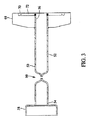
- Figure 3 is a side view of a portion of the tube and flange assembly after it has been separated at 80 during the above described processing step,
- the portion of the assembly that includes laser block interfacing portion 58, as described above, remains attached to the laser block after the processing step to provide a sealing function for the bores within the laser block that have been filled with a lasing gas, while the portion including the flange (e.g., fluid port 60) has to be refurbished.
- fluid port 60 it has to be removed from the remaining portion of elongated tube 52 and welded to another tube 52. This process is labor intensive, and a fluid port 60 may be reused only a couple of times.
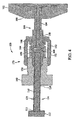
- Figure 4 is a side view of a fill tube and flange assembly 100 which allows for many usages of a fluid port 102 that is welded to, or alternatively, formed integrally with at a first end 103 of a flange assembly tube 104.
- Fluid port 102 and flange assembly tube 104 are collectively referred to herein as a flange assembly 106.
- a tube 110 which is formed integrally with a laser block engaging portion 112 at a first end 113 of tube 110 is collectively referred to herein as a fill tube 114.
- Fluid port 102 and laser block engaging portion 112 are functionary equivalent to fluid port 60 and laser block engaging portion 58 respectively (both shown in Figure 2) and will not be described further.
- Fill tube and flange assembly 100 includes a compression interface 120 that is utilized to interface tubes 104 and 110.
- tube 110 is pinched off in the cold weld sealing process, for example, at 122, as described above such that laser block engaging portion 112 and a portion of tube 110 remain attached to the laser block assembly.
- a remaining portion 124 of fill tube 114 is removed from compression interface 120 and a new fill tube may be inserted and interfaced with flange assembly 106 for processing of another laser block assembly.
- Both tubes 104 and 110 are configured with second ends 130 and 132 respectively that are configured for utilization with components of compression interface 120.
- compression interface 120 includes a male split-nut 140 which engages second end 132 of fill tube 14, a female nut 142 which engages second end 130 of flange assembly 106, components of a torque eliminator 144 and 146, and a seal 148.
- flange assembly 106 can be utilized in the processing of multiple laser block assemblies, which is an increase in efficiency and a decrease in costs from the fill tube flange assembly 50 (shown in Figure 2) which is manufactured using a welding process.
- Flange assembly 106 is described herein as known ring laser gyroscope processing stations are configured to interface with the flange (herein, fluid port 102).
- the processing station for the ring laser gyroscope blocks is configured such that second end 132 of fill tube 114 is attachable thereto, for example, using a compression type interface, and eliminating flange assembly 106.
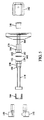
- Figure 5 is an exploded view of fill tube and flange assembly 100.
- End surface 150 of fill tube 114 is configured with a circular protrusion 152 extending therefrom.
- End surface 160 of flange assembly 106 is similarly configured with a circular protrusion 162 extending therefrom.
- male split-nut 140 engages a flanged area 164 (e.g., at second end 132) of fill tube 114, and likewise female nut 142 engages a flanged area 166 (e.g., at second end 130) of flange assembly 106
- protrusions 152 and 162 engage seal 148.
- the pressure placed by protrusions 160 and 162 onto seal 148 results in a sealing arrangement allowing purging gas, lasing gas, or fluid to be passed to and from fluid port 102 and laser block engaging portion 112 without leakage.
- optional torque eliminators 144 and 146 are configured to engage lateral formations 170 on respective ends 130 and 132 of flange assembly 106 and fill tube 114 to reduce and possibly prevent twisting and deformation of flange assembly 106 and fill tube 114 which may be detrimental to sealing and reuse of flange assembly 106.
- Fill tube and flange assembly 50 (shown in Figure 2) is difficult to produce as the elongated tube 52 and fluid port 60 are individually fabricated from different alloys. Utilization of different alloys sometimes results in a difficult welding operation between the two alloys.
- fill tube 114 is fabricated from bar stock of one alloy, for example, an iron-nickel alloy, and flange assembly 106 is fabricated from another alloy, for example, stainless steel.
Landscapes
- Physics & Mathematics (AREA)
- Engineering & Computer Science (AREA)
- Optics & Photonics (AREA)
- Electromagnetism (AREA)
- Power Engineering (AREA)
- General Physics & Mathematics (AREA)
- Radar, Positioning & Navigation (AREA)
- Remote Sensing (AREA)
- Gyroscopes (AREA)
Abstract
Description
- This invention relates generally to fabrication of ring laser gyroscopes, and more particularly, to a fill tube and flange assembly that is utilizing in the processing of the bores of the laser block, for example, with a gas used in the generation of a laser beam within the block.
- Ring laser gyroscopes are well known and are widely utilized in aerospace systems, weapons delivery systems, and multiple other applications. However, construction of these ring laser gyroscopes is expensive, and includes construction of numerous ancillary parts that are not included or are only partially included in the finished ring laser gyroscope.
- One of these ancillary parts is a fill tube welded to a flange. This assembly, as the name implies, is fabricated by welding a flange onto a fill robe. The welding process is tedious because the fill tube and flange may be formed from different alloys, and also because particulates from the welding process may end up within the fill tube portion. Any welding particulates that may end up within the laser block as a result of the welding process could be detrimental to operation of the finished ring laser gyroscope product.
- The fill tube engages a block of the ring laser gyroscope and the flange engages a processing station utilized in the fabrication of ring laser gyroscope laser blocks. After processing steps performed at this particular processing station are complete, the fill tube is compressed between the flange and the portion of the fill tube that engages the block. As the fill tube is compressed, it forms a seal for a portion of the block of the gyroscope. A remainder of the assembly (e.g., the portion having the flange welded thereto) is broken off. The flange is sometimes referred to as a fluid port as fluids utilized in the processing of ring laser gyroscope blocks are "ported" through the flange. This process of breaking off the fluid port and a portion of the fill tube is thought to be inefficient as this welded flange portion may be discarded after the processing of only one gyroscope block. Alternatively, the fluid port is cut out from the remaining portion of the fill tube and re-welded to a new fill tube. In one known process the fluid port may be re-welded to a fill tube up to four times. However, such a large amount of processing by personnel raises costs and with each additional weld, the fluid port has an increased possibility of becoming compromised.
- In one aspect, a fill tube and flange assembly for fabrication of ring laser gyroscope blocks is provided. The assembly comprises a flange assembly comprising a tube and a fluid port at a first end of the flange assembly tube, a fill tube assembly comprising a fill tube and a laser block engaging portion at a first end of the fill tube, and a compression interface. The compression interface is configured to couple the second ends of the fill tube and the flange assembly tube,
- In another aspect, a method of attaching a laser block of a ring laser gyroscope to a processing station is provided. The method comprises providing a flange assembly having a first end configured with a flange to interface with a ring laser gyroscope laser block processing station, providing a fill tube assembly having a first end configured with a laser block engaging portion configured for a sealing engagement with the laser block, and attaching the fill tube assembly and the flange assembly with a compression interface configured to couple second ends of the flange assembly and the fill tube assembly.
- In still another aspect, a fill tube assembly used in the processing of ring laser gyroscope blocks is provided. The fill tube assembly comprises a fill tube, a laser block engaging portion at a first end of the fill tube, and a circular protrusion extending from a second end of the fill tube. The circular protrusion is configured to engage a seal within a compression interface.
- Figure 1 is a plan view of a laser block assembly illustrating a closed loop optical path of the laser block.
- Figure 2 is a side view of a flange assembly configured to interface a laser block to a processing station.
- Figure 3 is a side view of a portion of the assembly after it has been separated during a processing step.
- Figure 4 is a side view of a fill tube and a flange assembly that includes a compression interface therebetween.
- Figure 5 is an exploded view of the fill tube and flange assembly of Figure 4.
- A representative
laser block assembly 10 which can be processed using the below described fill tube/flange assembly is shown in Figure 1. However, it is to be understood that other types of laser block assemblies can also be processed using the fill tube/flange assembly in accordance with the invention.Laser block assembly 10 includes alaser block 14 having an optical closedloop pathway 16 comprising a plurality ofinterconnected passages mirrors 20, are positioned and appropriately angled at the intersection of theindividual passages Excitation electrodes laser block 14 in fluid communication with the closedloop path 16. Closedloop passage 16 is filled with a lasing gas, such as a mixture of helium and neon, through one of the electrodes appropriately fitted with a fluid port configured to interface with a fill tube/flange assembly. - In forming a ring laser gyroscope from
laser block assembly 10,electrodes excitation electrode 30 being connected to the negative terminal of the source of electrical potential (to function as a cathode) andexcitation electrodes cathode 30 and theanodes laser block assembly 10 to measure the angular rate experienced by thelaser block assembly 10 as a function of the deflection of the lasers. - To ensure the proper operation of a ring laser gyroscope that includes
laser block assembly 10, thelaser block assembly 10 undergoes a series of processing steps. For example,laser block 14 is typically formed from a dielectric material, such as glass or glass-ceramic, having a relatively low coefficient of thermal expansion. It is typically necessary to cleanse thelaser block 14 of contaminants or otherwise process thelaser block assembly 10 prior to filling closedloop path 16 with a lasing gas. Such processing steps often include the use of a variety of processing fluids, including gases and or liquids, applied under a variety of atmospheric conditions, including full or partial vacuum. - Typically, in performing the various processing steps on a laser block assembly, only a single
laser block assembly 10 is processed at a time on a station of a processing tool. That is, an individual laser block assembly is mounted to an individual station typically utilizing a fill tube welded to a flange assembly to interfacelaser block assembly 10 to the station. During such processing, a number of sequential processing steps are performed on the laser block assembly while interfaced (mounted) to the fill tube and flange. After the desired processing steps are carried out, the laser block assembly is removed from the processing station and the fill tube is consumed in the removal process. The flange may be removed from the remaining portion of the fill tube and reattached to a new fill tube. However, such as approach is inefficient, however, as the flange has to be manually removed from the old fill tube and manually reattached to the new fill tube. These processing costs are not the only drawback. The flange can be reattached to new fill tube only a limited number of times, for example, four times. Since a flange is essentially consumed each time a small number oflaser block assemblies 10 are processed, the costs of components and construction and reconstruction of multiple piece fill tube and flange assemblies has to be incorporated into the cost of the ring laser gyroscope. - Figure 2 is a cross-sectional view of a known fill tube and
flange assembly 50 that is currently utilized in the processing of laser block assemblies. Fill tube andflange assembly 50 includes anelongated tube 52 havingfirst end 54 and asecond end 56. Extending fromfirst end 54 is a laserblock interface portion 58 which is configured to engagelaser block assembly 10, for example, during the purging and subsequent filling of the laser block with a lasing gas. Laserblock engaging portion 58 is configured to provide a substantially permanent seal with the laser block. Welded atsecond end 56 ofelongated tube 52 is afluid port 60 that is configured to engage mating hardware from the processing station (not shown). - During the processing of laser block assemblies,
fluid port 60 is engaged, for example, in a compression type interface with the processing station. To provide a good sealing arrangement with the processing station,fluid port 60 is typically fabricated from, for example, a stainless steel, which is capable of utilization in a compression type interface. The remainder ofelongated tube 52, including laserblock interfacing portion 58, is fabricated from an iron-nickel alloy which is capable of forming a cold welded seal. For example, once the laser block is filled with the lasing gas, a portion ofelongated tube 52 is "pinched off", leaving the laserblock engaging portion 58 and a portion ofelongated tube 52 to form a seal which causes the lasing gas to be retained within the lasing block due to the cold welded seal. - As described above,
fluid port 60 is attached to, typically by welding, tosecond end 56 ofelongated tube 52, and includes a sealing mechanism that is adapted to be mated to a processing tool to provide a flow path intoelongated tube 52. One preferred sealing mechanism includes a knifeedge flange seal 70 withinfluid port 60 that engages an annular copper gasket (not shown) that surrounds arecessed area 72 offluid port 60. The copper gasket engages and seals with a mating surface of the processing tool to provide a fluid-tight seal between tube andflange assembly 50 and the processing tool. This fluid-tight seal permits a vacuum to be drawn if desired for a particular processing application, and ensures that processing fluid is dispensed into fill tube andflange assembly 50 without loss to the surrounding environment of the processing tool. - Tube and
flange assembly 50 is functional for the processing oflaser block assemblies 10. However, asfluid port 60 is welded toelongated tube 52, and a portion ofelongated tube 52 is pinched off during the cold weld sealing process, for example at 80, a particular weldedfluid port 60 and elongated tube combination is usable only once. Figure 3 is a side view of a portion of the tube and flange assembly after it has been separated at 80 during the above described processing step, The portion of the assembly that includes laserblock interfacing portion 58, as described above, remains attached to the laser block after the processing step to provide a sealing function for the bores within the laser block that have been filled with a lasing gas, while the portion including the flange (e.g., fluid port 60) has to be refurbished. To reusefluid port 60, it has to be removed from the remaining portion ofelongated tube 52 and welded to anothertube 52. This process is labor intensive, and afluid port 60 may be reused only a couple of times. - Figure 4 is a side view of a fill tube and
flange assembly 100 which allows for many usages of afluid port 102 that is welded to, or alternatively, formed integrally with at afirst end 103 of aflange assembly tube 104.Fluid port 102 andflange assembly tube 104 are collectively referred to herein as aflange assembly 106. Atube 110 which is formed integrally with a laserblock engaging portion 112 at afirst end 113 oftube 110 is collectively referred to herein as afill tube 114.Fluid port 102 and laserblock engaging portion 112 are functionary equivalent tofluid port 60 and laserblock engaging portion 58 respectively (both shown in Figure 2) and will not be described further. Fill tube andflange assembly 100 includes a compression interface 120 that is utilized to interfacetubes tube 110 is pinched off in the cold weld sealing process, for example, at 122, as described above such that laserblock engaging portion 112 and a portion oftube 110 remain attached to the laser block assembly. After the "pinching off" operation, sometimes referred to as a cold welded seal, a remainingportion 124 offill tube 114 is removed from compression interface 120 and a new fill tube may be inserted and interfaced withflange assembly 106 for processing of another laser block assembly. - Both
tubes second ends nut 140 which engagessecond end 132 offill tube 14, afemale nut 142 which engagessecond end 130 offlange assembly 106, components of atorque eliminator seal 148. By using compression interface 120 to join second ends 130 and 132 offlange assembly 106 and filltube 114,flange assembly 106 can be utilized in the processing of multiple laser block assemblies, which is an increase in efficiency and a decrease in costs from the fill tube flange assembly 50 (shown in Figure 2) which is manufactured using a welding process. -
Flange assembly 106 is described herein as known ring laser gyroscope processing stations are configured to interface with the flange (herein, fluid port 102). In an alternative embodiment, the processing station for the ring laser gyroscope blocks is configured such thatsecond end 132 offill tube 114 is attachable thereto, for example, using a compression type interface, and eliminatingflange assembly 106. - Figure 5 is an exploded view of fill tube and
flange assembly 100.End surface 150 offill tube 114 is configured with acircular protrusion 152 extending therefrom.End surface 160 offlange assembly 106 is similarly configured with acircular protrusion 162 extending therefrom. As male split-nut 140 engages a flanged area 164 (e.g., at second end 132) offill tube 114, and likewisefemale nut 142 engages a flanged area 166 (e.g., at second end 130) offlange assembly 106,protrusions seal 148. The pressure placed byprotrusions seal 148 results in a sealing arrangement allowing purging gas, lasing gas, or fluid to be passed to and fromfluid port 102 and laserblock engaging portion 112 without leakage. - As compression type junctions are known to twist the tubes that are being joined,
optional torque eliminators lateral formations 170 onrespective ends flange assembly 106 and filltube 114 to reduce and possibly prevent twisting and deformation offlange assembly 106 and filltube 114 which may be detrimental to sealing and reuse offlange assembly 106. - Fill tube and flange assembly 50 (shown in Figure 2) is difficult to produce as the
elongated tube 52 andfluid port 60 are individually fabricated from different alloys. Utilization of different alloys sometimes results in a difficult welding operation between the two alloys. In the embodiment of Figures 4 and 5, filltube 114 is fabricated from bar stock of one alloy, for example, an iron-nickel alloy, andflange assembly 106 is fabricated from another alloy, for example, stainless steel. - While the invention has been described in terms of various specific embodiments, those skilled in the art will recognize that the invention can be practiced with modification within the spirit and scope of the claims.
Claims (9)
- A fill tube and flange assembly (100) for fabrication of ring laser gyroscope blocks (14), said assembly comprising:a flange assembly (106) comprising a flange assembly tube (104) and a fluid port (102) at a first end (103) of said flange assembly tube;a fill tube assembly comprising a fill tube (114) and a laser block engaging portion (112) at a first end of said fill tube; anda compression interface, said compression interface configured to couple second ends (132) of said fill tube and said flange assembly tube.
- A fill tube and flange assembly (100) according to Claim 1 wherein said fill tube assembly is fabricated from a single piece of bar stock.
- A fill tube and flange assembly (100) according to Claim 1 wherein said compression interface (120) comprises:a male split-nut (140) configured to engage the second end (130) of said fill tube assembly;a female nut (142) configured to engage the second end of said flange assembly tube (04); anda seal (148) configured to be located between the second ends (132) of said fill tube assembly and said flange assembly tube,
- A fill tube and flange assembly (100) according to Claim 3 wherein the second ends (132) of said fill tube assembly and said flange assembly tube (104) each comprise a circular protrusion (152) extending therefrom, said circular protrusions configured to engage said seal (148) as said compression interface (120) is tightened.
- A fill tube and flange assembly (100) according to Claim 3 wherein said fill tube assembly and said flange assembly tube (104) each comprise lateral formations (170) approximate the second ends (132), said fill tube and flange assembly further comprising torque eliminators (144) configured to engage lateral formations.
- A fill tube and flange assembly (100) according to Claim 1 wherein said fill tube assembly comprises an iron-nickel alloy and said flange assembly (106) comprises a stainless steel.
- A fill tube and flange assembly (100) according to Claim 1 wherein at least a portion of said fill tube assembly is configured to be compressed (120) and form a cold welded seal (122).
- A fill tube and flange assembly (100) according to Claim 1 wherein said laser block (14) engaging portion is integrally formed with said fill tube (114).
- A fill tube and flange assembly (100) according to Claim 1 wherein said fluid port (114) is integrally formed with said flange assembly tube (104).
Applications Claiming Priority (1)
| Application Number | Priority Date | Filing Date | Title |
|---|---|---|---|
| US11/232,350 US20080012325A1 (en) | 2005-09-21 | 2005-09-21 | Fill tube-flange assembly for ring laser gyroscope block |
Publications (2)
| Publication Number | Publication Date |
|---|---|
| EP1767901A2 true EP1767901A2 (en) | 2007-03-28 |
| EP1767901A3 EP1767901A3 (en) | 2008-07-23 |
Family
ID=37533260
Family Applications (1)
| Application Number | Title | Priority Date | Filing Date |
|---|---|---|---|
| EP06121010A Withdrawn EP1767901A3 (en) | 2005-09-21 | 2006-09-21 | Fill tube/flange assembly for ring laser gyroscope block |
Country Status (2)
| Country | Link |
|---|---|
| US (1) | US20080012325A1 (en) |
| EP (1) | EP1767901A3 (en) |
Families Citing this family (3)
| Publication number | Priority date | Publication date | Assignee | Title |
|---|---|---|---|---|
| US20080231049A1 (en) * | 2007-03-21 | 2008-09-25 | Honeywell International Inc. | Integrated seal gland and coupler assembly |
| KR101146108B1 (en) * | 2012-02-24 | 2012-05-16 | 한국엔지니어링플라스틱 주식회사 | Laser welding structure of intank filter for motor vehicle |
| US10281069B2 (en) * | 2013-11-13 | 2019-05-07 | Brookhaven Science Associates, Llc | Vacuum sealing flange |
Family Cites Families (16)
| Publication number | Priority date | Publication date | Assignee | Title |
|---|---|---|---|---|
| US3521910A (en) * | 1968-11-12 | 1970-07-28 | Cajon Co | Tube coupling |
| US4838583A (en) * | 1982-08-23 | 1989-06-13 | Cajon Company | Fluid coupling |
| US4660868A (en) * | 1984-05-07 | 1987-04-28 | Toyoko Kagaku Co., Ltd. | Fluid coupling having high sealability |
| US4735442A (en) * | 1985-09-13 | 1988-04-05 | J. & R. Gunzenhauser Ag | Plastic pipe connection |
| JPH0123021Y2 (en) * | 1986-07-04 | 1989-07-13 | ||
| US5226678A (en) * | 1987-03-31 | 1993-07-13 | Petranto Joseph J | Split gland |
| JPH0342302Y2 (en) * | 1987-11-10 | 1991-09-04 | ||
| US5058935A (en) * | 1990-01-23 | 1991-10-22 | Eidsmore Paul G | Fluid fitting with torque suppression arrangement |
| US5145219A (en) * | 1990-08-01 | 1992-09-08 | Cajon Company | Tube coupling with gasket retainer |
| US5129688A (en) * | 1990-08-10 | 1992-07-14 | General Components, Inc. | Torque reducing coupling for face seal fittings |
| US5163721A (en) * | 1990-10-24 | 1992-11-17 | Cajon Company | Fluid coupling with gasket retainer having interlocking portions |
| US5142499A (en) * | 1991-02-25 | 1992-08-25 | Fletcher Gerald L | Method and apparatus for shallow water seismic operations |
| US5160178A (en) * | 1991-12-17 | 1992-11-03 | Kabushiki Kaisha Com | Direct sealing coupling |
| US5547229A (en) * | 1994-05-13 | 1996-08-20 | Eidsmore; Paul G. | Fluid coupling assembly |
| JP2001521606A (en) * | 1997-04-08 | 2001-11-06 | スウエイジロク・カンパニー | Fluid coupling with torque suppression device |
| US6819430B2 (en) * | 2001-01-08 | 2004-11-16 | Honeywell International, Inc. | Manifold for processing a stacked array of laser block assemblies |
-
2005
- 2005-09-21 US US11/232,350 patent/US20080012325A1/en not_active Abandoned
-
2006
- 2006-09-21 EP EP06121010A patent/EP1767901A3/en not_active Withdrawn
Also Published As
| Publication number | Publication date |
|---|---|
| US20080012325A1 (en) | 2008-01-17 |
| EP1767901A3 (en) | 2008-07-23 |
Similar Documents
| Publication | Publication Date | Title |
|---|---|---|
| US7009136B2 (en) | Method of fabricating a bipolar plate assembly | |
| US6555754B2 (en) | Automotive fuel tank electrical fitting | |
| EP3540760A1 (en) | Mechanically sealed tube for laser sustained plasma lamp and production method for same | |
| EP2926009B1 (en) | Vacuum pump | |
| US20080012325A1 (en) | Fill tube-flange assembly for ring laser gyroscope block | |
| US20100230960A1 (en) | Genderless flange for high vacuum waveguides | |
| JP3836602B2 (en) | Manufacturing method of vacuum chamber | |
| JP2002022586A (en) | Differential pressure transmitter with diaphragm seal | |
| CN112368503A (en) | Piping structure and construction method | |
| US6819430B2 (en) | Manifold for processing a stacked array of laser block assemblies | |
| US20070024011A1 (en) | Thermally stable vacuum enclosure seal design for CO2 lasers | |
| US4612648A (en) | Modular gas laser end assembly | |
| US20190009353A1 (en) | Pipe joint, fluid control device, fluid control unit, semiconductor fabrication apparatus and method of forming pipe joint | |
| KR101616549B1 (en) | Hermetically-sealed chamber | |
| EP1302965A1 (en) | Tube for pumping a space between two tiles, especially for a plasma display | |
| JP2009245975A (en) | Optical cap component | |
| US20250067282A1 (en) | Manufacturing method and exterior body of accumulator | |
| JP2936463B2 (en) | Double seal connection terminal device | |
| Crane et al. | Nonmagnetic UHV optical viewports | |
| JP2003294145A (en) | Sealing tool, seal ring holder, sealing method | |
| JPH02114428A (en) | Reproducible sealed electron tube device | |
| JPS6312183A (en) | Fixed support structure for laser optical components | |
| JPH02284772A (en) | Method for connecting capillary with block body | |
| GB1596732A (en) | Xenon arc lamp with compressive ceramic to metal seals | |
| KR20000019710A (en) | Reaction chamber for semiconductor device supplied with guide for alignment |
Legal Events
| Date | Code | Title | Description |
|---|---|---|---|
| PUAI | Public reference made under article 153(3) epc to a published international application that has entered the european phase |
Free format text: ORIGINAL CODE: 0009012 |
|
| AK | Designated contracting states |
Kind code of ref document: A2 Designated state(s): AT BE BG CH CY CZ DE DK EE ES FI FR GB GR HU IE IS IT LI LT LU LV MC NL PL PT RO SE SI SK TR |
|
| AX | Request for extension of the european patent |
Extension state: AL BA HR MK YU |
|
| PUAL | Search report despatched |
Free format text: ORIGINAL CODE: 0009013 |
|
| AK | Designated contracting states |
Kind code of ref document: A3 Designated state(s): AT BE BG CH CY CZ DE DK EE ES FI FR GB GR HU IE IS IT LI LT LU LV MC NL PL PT RO SE SI SK TR |
|
| AX | Request for extension of the european patent |
Extension state: AL BA HR MK RS |
|
| RIC1 | Information provided on ipc code assigned before grant |
Ipc: G01C 25/00 20060101ALI20080613BHEP Ipc: G01C 19/66 20060101AFI20061227BHEP |
|
| AKX | Designation fees paid | ||
| REG | Reference to a national code |
Ref country code: DE Ref legal event code: 8566 |
|
| STAA | Information on the status of an ep patent application or granted ep patent |
Free format text: STATUS: THE APPLICATION IS DEEMED TO BE WITHDRAWN |
|
| 18D | Application deemed to be withdrawn |
Effective date: 20090124 |