EP1765789B1 - N-(1-(1-benzyl-4-phenyl-1h-imidazol-2-yl)-2,2-dimethylpropyl)benzamide derivatives and related compounds as kinesin spindle protein (ksp) inhibitors for the treatment of cancer - Google Patents
N-(1-(1-benzyl-4-phenyl-1h-imidazol-2-yl)-2,2-dimethylpropyl)benzamide derivatives and related compounds as kinesin spindle protein (ksp) inhibitors for the treatment of cancer Download PDFInfo
- Publication number
- EP1765789B1 EP1765789B1 EP05760871A EP05760871A EP1765789B1 EP 1765789 B1 EP1765789 B1 EP 1765789B1 EP 05760871 A EP05760871 A EP 05760871A EP 05760871 A EP05760871 A EP 05760871A EP 1765789 B1 EP1765789 B1 EP 1765789B1
- Authority
- EP
- European Patent Office
- Prior art keywords
- imidazol
- benzyl
- phenyl
- dimethylpropyl
- amino
- Prior art date
- Legal status (The legal status is an assumption and is not a legal conclusion. Google has not performed a legal analysis and makes no representation as to the accuracy of the status listed.)
- Expired - Lifetime
Links
- 0 CC(C)(C)OC(N[C@](*)c1nc(-c2ccccc2)c[n]1)=O Chemical compound CC(C)(C)OC(N[C@](*)c1nc(-c2ccccc2)c[n]1)=O 0.000 description 53
- MXXNEFMIRPHICR-UHFFFAOYSA-N CC(C)(C)OC(NCC(CO)F)=O Chemical compound CC(C)(C)OC(NCC(CO)F)=O MXXNEFMIRPHICR-UHFFFAOYSA-N 0.000 description 2
- YXFVVABEGXRONW-UHFFFAOYSA-N Cc1ccccc1 Chemical compound Cc1ccccc1 YXFVVABEGXRONW-UHFFFAOYSA-N 0.000 description 2
- XNUXSAGMXTXYOS-QMMMGPOBSA-N O=CC[C@@H](CF)N(C(c1c2cccc1)=O)C2=O Chemical compound O=CC[C@@H](CF)N(C(c1c2cccc1)=O)C2=O XNUXSAGMXTXYOS-QMMMGPOBSA-N 0.000 description 2
- AWMVMTVKBNGEAK-UHFFFAOYSA-N C1OC1c1ccccc1 Chemical compound C1OC1c1ccccc1 AWMVMTVKBNGEAK-UHFFFAOYSA-N 0.000 description 1
- UUXFFYIHUSQJJY-UHFFFAOYSA-N CC(C)(C)C(c1nc(-c2ccccc2)c[n]1Cc1ccccc1)[N+](CCCNCC(O)=O)(Cc1ccccc1)[O-] Chemical compound CC(C)(C)C(c1nc(-c2ccccc2)c[n]1Cc1ccccc1)[N+](CCCNCC(O)=O)(Cc1ccccc1)[O-] UUXFFYIHUSQJJY-UHFFFAOYSA-N 0.000 description 1
- ADIZHJPABVAPCI-UHFFFAOYSA-N CC(C)(C)C1(CC1)c1nc(-c2ccccc2)c[n]1Cc1n[o]c(C)c1 Chemical compound CC(C)(C)C1(CC1)c1nc(-c2ccccc2)c[n]1Cc1n[o]c(C)c1 ADIZHJPABVAPCI-UHFFFAOYSA-N 0.000 description 1
- VVWDIBACHNEDIW-JGVFFNPUSA-N CC(C)(C)OC(N(C[C@H]1C=O)C[C@H]1O)=O Chemical compound CC(C)(C)OC(N(C[C@H]1C=O)C[C@H]1O)=O VVWDIBACHNEDIW-JGVFFNPUSA-N 0.000 description 1
- CDYASQVVGJAAIH-LURJTMIESA-N CC(C)(C)OC(NC[C@@H](C=O)F)=O Chemical compound CC(C)(C)OC(NC[C@@H](C=O)F)=O CDYASQVVGJAAIH-LURJTMIESA-N 0.000 description 1
- IUNRBHPDQJCDLT-LURJTMIESA-N CC(C)(C)OC(N[C@@H](CC(N)=O)CC(O)=O)=O Chemical compound CC(C)(C)OC(N[C@@H](CC(N)=O)CC(O)=O)=O IUNRBHPDQJCDLT-LURJTMIESA-N 0.000 description 1
- FQGVWUZSSBCRPD-SSDOTTSWSA-N CC(C)(C)OC(N[C@H](CC=O)CC(N)=O)=O Chemical compound CC(C)(C)OC(N[C@H](CC=O)CC(N)=O)=O FQGVWUZSSBCRPD-SSDOTTSWSA-N 0.000 description 1
- CWHPROHOIKHWLA-HNNXBMFYSA-N CC(C)(C)[C@H](C(OCC(c1ccccc1)=O)=O)NC(OC(C)(C)C)=O Chemical compound CC(C)(C)[C@H](C(OCC(c1ccccc1)=O)=O)NC(OC(C)(C)C)=O CWHPROHOIKHWLA-HNNXBMFYSA-N 0.000 description 1
- ROGCPZWZLBDDHH-HNNXBMFYSA-N CC(C)(C)[C@H](c1nc(-c2ccccc2)c[nH]1)NC(OC(C)(C)C)=O Chemical compound CC(C)(C)[C@H](c1nc(-c2ccccc2)c[nH]1)NC(OC(C)(C)C)=O ROGCPZWZLBDDHH-HNNXBMFYSA-N 0.000 description 1
- ROVFSEYNVAEUNX-IBGZPJMESA-N CC(C)(C)[C@H](c1nc(-c2ccccc2)c[n]1Cc1ccccc1)N Chemical compound CC(C)(C)[C@H](c1nc(-c2ccccc2)c[n]1Cc1ccccc1)N ROVFSEYNVAEUNX-IBGZPJMESA-N 0.000 description 1
- GHROEUNRQNVZTI-MILIPEGGSA-N CC(C)(C)[C@H](c1nc(-c2ccccc2)c[n]1Cc1ccccc1)N(CCC(CC(N)=O)N)C(c1ccccc1)=O Chemical compound CC(C)(C)[C@H](c1nc(-c2ccccc2)c[n]1Cc1ccccc1)N(CCC(CC(N)=O)N)C(c1ccccc1)=O GHROEUNRQNVZTI-MILIPEGGSA-N 0.000 description 1
- FEMXNGOSHRKIGQ-MHZLTWQESA-N CC(C)(C)[C@H](c1nc(-c2ccccc2)c[n]1Cc1ccccc1)N(CCCN)C(c1n[n](C)c(C)c1)=O Chemical compound CC(C)(C)[C@H](c1nc(-c2ccccc2)c[n]1Cc1ccccc1)N(CCCN)C(c1n[n](C)c(C)c1)=O FEMXNGOSHRKIGQ-MHZLTWQESA-N 0.000 description 1
- GHROEUNRQNVZTI-OFSOJUDTSA-N CC(C)(C)[C@H](c1nc(-c2ccccc2)c[n]1Cc1ccccc1)N(CC[C@H](CC(N)=O)N)C(c1ccccc1)=O Chemical compound CC(C)(C)[C@H](c1nc(-c2ccccc2)c[n]1Cc1ccccc1)N(CC[C@H](CC(N)=O)N)C(c1ccccc1)=O GHROEUNRQNVZTI-OFSOJUDTSA-N 0.000 description 1
- REJVVGRLSICVTE-NDKRRWIDSA-N CC(C)(C)[C@H](c1nc(-c2ccccc2)c[n]1Cc1ccccc1)N(CC[C@H](CC(N)=O)NC(OC(C)(C)C)=O)C(c1ccccc1)=O Chemical compound CC(C)(C)[C@H](c1nc(-c2ccccc2)c[n]1Cc1ccccc1)N(CC[C@H](CC(N)=O)NC(OC(C)(C)C)=O)C(c1ccccc1)=O REJVVGRLSICVTE-NDKRRWIDSA-N 0.000 description 1
- UKPMTYFFZJNBJO-KRWDZBQOSA-N CC(C)(C)[C@H](c1nc(-c2cnccn2)c[n]1Cc1ccccc1)N Chemical compound CC(C)(C)[C@H](c1nc(-c2cnccn2)c[n]1Cc1ccccc1)N UKPMTYFFZJNBJO-KRWDZBQOSA-N 0.000 description 1
- WHMSMNPYXFWPOJ-FQEVSTJZSA-N CC(C)(C)[C@H](c1nc(-c2nccnc2)c[n]1Cc1ccccc1)NC(OC(C)(C)C)=O Chemical compound CC(C)(C)[C@H](c1nc(-c2nccnc2)c[n]1Cc1ccccc1)NC(OC(C)(C)C)=O WHMSMNPYXFWPOJ-FQEVSTJZSA-N 0.000 description 1
- XMSNSCUOLJFXGI-JOCHJYFZSA-N CC(C)[C@H](c1nc(-c2cccc(Cl)c2)c[n]1Cc1ccccc1)NC(OC(C)(C)C)=O Chemical compound CC(C)[C@H](c1nc(-c2cccc(Cl)c2)c[n]1Cc1ccccc1)NC(OC(C)(C)C)=O XMSNSCUOLJFXGI-JOCHJYFZSA-N 0.000 description 1
- BNNPBRSQDIBEDO-MSFZQBJKSA-N CC(C1)(C1CC(C1)[C@@H](CF)N=C)[C@H](c2nc(-c3cc(F)ccc3)c[n]2Cc2cc(F)ccc2)N1C(C)=O Chemical compound CC(C1)(C1CC(C1)[C@@H](CF)N=C)[C@H](c2nc(-c3cc(F)ccc3)c[n]2Cc2cc(F)ccc2)N1C(C)=O BNNPBRSQDIBEDO-MSFZQBJKSA-N 0.000 description 1
- BFNXWMIAOPUYOV-XUFZRAOVSA-N CC([C@H](c1nc(-c2cc(Cl)ccc2)c[n]1Cc1ccccc1)N(CCCNC)C([C@H]1OCCC1)=O)[Cl]=[IH] Chemical compound CC([C@H](c1nc(-c2cc(Cl)ccc2)c[n]1Cc1ccccc1)N(CCCNC)C([C@H]1OCCC1)=O)[Cl]=[IH] BFNXWMIAOPUYOV-XUFZRAOVSA-N 0.000 description 1
- IMLKYQPCFFAOSA-MHZLTWQESA-N CCC(C)(C)[C@H](c1nc(-c2ccccc2)c[n]1Cc1cc(C)ccc1)N(CCCN)C(COC)=O Chemical compound CCC(C)(C)[C@H](c1nc(-c2ccccc2)c[n]1Cc1cc(C)ccc1)N(CCCN)C(COC)=O IMLKYQPCFFAOSA-MHZLTWQESA-N 0.000 description 1
- YNQLUTRBYVCPMQ-UHFFFAOYSA-N CCc1ccccc1 Chemical compound CCc1ccccc1 YNQLUTRBYVCPMQ-UHFFFAOYSA-N 0.000 description 1
- ZZGOJAUAVFBXHX-AWEZNQCLSA-N O=C(C[C@@H](CF)N(C(c1c2cccc1)=O)C2=O)OCc1ccccc1 Chemical compound O=C(C[C@@H](CF)N(C(c1c2cccc1)=O)C2=O)OCc1ccccc1 ZZGOJAUAVFBXHX-AWEZNQCLSA-N 0.000 description 1
Classifications
-
- C—CHEMISTRY; METALLURGY
- C07—ORGANIC CHEMISTRY
- C07D—HETEROCYCLIC COMPOUNDS
- C07D233/00—Heterocyclic compounds containing 1,3-diazole or hydrogenated 1,3-diazole rings, not condensed with other rings
- C07D233/54—Heterocyclic compounds containing 1,3-diazole or hydrogenated 1,3-diazole rings, not condensed with other rings having two double bonds between ring members or between ring members and non-ring members
-
- A—HUMAN NECESSITIES
- A61—MEDICAL OR VETERINARY SCIENCE; HYGIENE
- A61P—SPECIFIC THERAPEUTIC ACTIVITY OF CHEMICAL COMPOUNDS OR MEDICINAL PREPARATIONS
- A61P35/00—Antineoplastic agents
-
- A—HUMAN NECESSITIES
- A61—MEDICAL OR VETERINARY SCIENCE; HYGIENE
- A61P—SPECIFIC THERAPEUTIC ACTIVITY OF CHEMICAL COMPOUNDS OR MEDICINAL PREPARATIONS
- A61P35/00—Antineoplastic agents
- A61P35/02—Antineoplastic agents specific for leukemia
-
- A—HUMAN NECESSITIES
- A61—MEDICAL OR VETERINARY SCIENCE; HYGIENE
- A61P—SPECIFIC THERAPEUTIC ACTIVITY OF CHEMICAL COMPOUNDS OR MEDICINAL PREPARATIONS
- A61P43/00—Drugs for specific purposes, not provided for in groups A61P1/00-A61P41/00
-
- C—CHEMISTRY; METALLURGY
- C07—ORGANIC CHEMISTRY
- C07D—HETEROCYCLIC COMPOUNDS
- C07D233/00—Heterocyclic compounds containing 1,3-diazole or hydrogenated 1,3-diazole rings, not condensed with other rings
- C07D233/04—Heterocyclic compounds containing 1,3-diazole or hydrogenated 1,3-diazole rings, not condensed with other rings having one double bond between ring members or between a ring member and a non-ring member
- C07D233/20—Heterocyclic compounds containing 1,3-diazole or hydrogenated 1,3-diazole rings, not condensed with other rings having one double bond between ring members or between a ring member and a non-ring member with substituted hydrocarbon radicals, directly attached to ring carbon atoms
- C07D233/24—Radicals substituted by nitrogen atoms not forming part of a nitro radical
-
- C—CHEMISTRY; METALLURGY
- C07—ORGANIC CHEMISTRY
- C07D—HETEROCYCLIC COMPOUNDS
- C07D233/00—Heterocyclic compounds containing 1,3-diazole or hydrogenated 1,3-diazole rings, not condensed with other rings
- C07D233/54—Heterocyclic compounds containing 1,3-diazole or hydrogenated 1,3-diazole rings, not condensed with other rings having two double bonds between ring members or between ring members and non-ring members
- C07D233/64—Heterocyclic compounds containing 1,3-diazole or hydrogenated 1,3-diazole rings, not condensed with other rings having two double bonds between ring members or between ring members and non-ring members with substituted hydrocarbon radicals attached to ring carbon atoms, e.g. histidine
-
- C—CHEMISTRY; METALLURGY
- C07—ORGANIC CHEMISTRY
- C07D—HETEROCYCLIC COMPOUNDS
- C07D401/00—Heterocyclic compounds containing two or more hetero rings, having nitrogen atoms as the only ring hetero atoms, at least one ring being a six-membered ring with only one nitrogen atom
- C07D401/02—Heterocyclic compounds containing two or more hetero rings, having nitrogen atoms as the only ring hetero atoms, at least one ring being a six-membered ring with only one nitrogen atom containing two hetero rings
- C07D401/04—Heterocyclic compounds containing two or more hetero rings, having nitrogen atoms as the only ring hetero atoms, at least one ring being a six-membered ring with only one nitrogen atom containing two hetero rings directly linked by a ring-member-to-ring-member bond
-
- C—CHEMISTRY; METALLURGY
- C07—ORGANIC CHEMISTRY
- C07D—HETEROCYCLIC COMPOUNDS
- C07D401/00—Heterocyclic compounds containing two or more hetero rings, having nitrogen atoms as the only ring hetero atoms, at least one ring being a six-membered ring with only one nitrogen atom
- C07D401/02—Heterocyclic compounds containing two or more hetero rings, having nitrogen atoms as the only ring hetero atoms, at least one ring being a six-membered ring with only one nitrogen atom containing two hetero rings
- C07D401/06—Heterocyclic compounds containing two or more hetero rings, having nitrogen atoms as the only ring hetero atoms, at least one ring being a six-membered ring with only one nitrogen atom containing two hetero rings linked by a carbon chain containing only aliphatic carbon atoms
-
- C—CHEMISTRY; METALLURGY
- C07—ORGANIC CHEMISTRY
- C07D—HETEROCYCLIC COMPOUNDS
- C07D401/00—Heterocyclic compounds containing two or more hetero rings, having nitrogen atoms as the only ring hetero atoms, at least one ring being a six-membered ring with only one nitrogen atom
- C07D401/02—Heterocyclic compounds containing two or more hetero rings, having nitrogen atoms as the only ring hetero atoms, at least one ring being a six-membered ring with only one nitrogen atom containing two hetero rings
- C07D401/12—Heterocyclic compounds containing two or more hetero rings, having nitrogen atoms as the only ring hetero atoms, at least one ring being a six-membered ring with only one nitrogen atom containing two hetero rings linked by a chain containing hetero atoms as chain links
-
- C—CHEMISTRY; METALLURGY
- C07—ORGANIC CHEMISTRY
- C07D—HETEROCYCLIC COMPOUNDS
- C07D403/00—Heterocyclic compounds containing two or more hetero rings, having nitrogen atoms as the only ring hetero atoms, not provided for by group C07D401/00
- C07D403/02—Heterocyclic compounds containing two or more hetero rings, having nitrogen atoms as the only ring hetero atoms, not provided for by group C07D401/00 containing two hetero rings
- C07D403/04—Heterocyclic compounds containing two or more hetero rings, having nitrogen atoms as the only ring hetero atoms, not provided for by group C07D401/00 containing two hetero rings directly linked by a ring-member-to-ring-member bond
-
- C—CHEMISTRY; METALLURGY
- C07—ORGANIC CHEMISTRY
- C07D—HETEROCYCLIC COMPOUNDS
- C07D403/00—Heterocyclic compounds containing two or more hetero rings, having nitrogen atoms as the only ring hetero atoms, not provided for by group C07D401/00
- C07D403/02—Heterocyclic compounds containing two or more hetero rings, having nitrogen atoms as the only ring hetero atoms, not provided for by group C07D401/00 containing two hetero rings
- C07D403/12—Heterocyclic compounds containing two or more hetero rings, having nitrogen atoms as the only ring hetero atoms, not provided for by group C07D401/00 containing two hetero rings linked by a chain containing hetero atoms as chain links
-
- C—CHEMISTRY; METALLURGY
- C07—ORGANIC CHEMISTRY
- C07D—HETEROCYCLIC COMPOUNDS
- C07D403/00—Heterocyclic compounds containing two or more hetero rings, having nitrogen atoms as the only ring hetero atoms, not provided for by group C07D401/00
- C07D403/14—Heterocyclic compounds containing two or more hetero rings, having nitrogen atoms as the only ring hetero atoms, not provided for by group C07D401/00 containing three or more hetero rings
-
- C—CHEMISTRY; METALLURGY
- C07—ORGANIC CHEMISTRY
- C07D—HETEROCYCLIC COMPOUNDS
- C07D405/00—Heterocyclic compounds containing both one or more hetero rings having oxygen atoms as the only ring hetero atoms, and one or more rings having nitrogen as the only ring hetero atom
- C07D405/02—Heterocyclic compounds containing both one or more hetero rings having oxygen atoms as the only ring hetero atoms, and one or more rings having nitrogen as the only ring hetero atom containing two hetero rings
- C07D405/06—Heterocyclic compounds containing both one or more hetero rings having oxygen atoms as the only ring hetero atoms, and one or more rings having nitrogen as the only ring hetero atom containing two hetero rings linked by a carbon chain containing only aliphatic carbon atoms
-
- C—CHEMISTRY; METALLURGY
- C07—ORGANIC CHEMISTRY
- C07D—HETEROCYCLIC COMPOUNDS
- C07D405/00—Heterocyclic compounds containing both one or more hetero rings having oxygen atoms as the only ring hetero atoms, and one or more rings having nitrogen as the only ring hetero atom
- C07D405/02—Heterocyclic compounds containing both one or more hetero rings having oxygen atoms as the only ring hetero atoms, and one or more rings having nitrogen as the only ring hetero atom containing two hetero rings
- C07D405/12—Heterocyclic compounds containing both one or more hetero rings having oxygen atoms as the only ring hetero atoms, and one or more rings having nitrogen as the only ring hetero atom containing two hetero rings linked by a chain containing hetero atoms as chain links
-
- C—CHEMISTRY; METALLURGY
- C07—ORGANIC CHEMISTRY
- C07D—HETEROCYCLIC COMPOUNDS
- C07D413/00—Heterocyclic compounds containing two or more hetero rings, at least one ring having nitrogen and oxygen atoms as the only ring hetero atoms
- C07D413/02—Heterocyclic compounds containing two or more hetero rings, at least one ring having nitrogen and oxygen atoms as the only ring hetero atoms containing two hetero rings
- C07D413/06—Heterocyclic compounds containing two or more hetero rings, at least one ring having nitrogen and oxygen atoms as the only ring hetero atoms containing two hetero rings linked by a carbon chain containing only aliphatic carbon atoms
-
- C—CHEMISTRY; METALLURGY
- C07—ORGANIC CHEMISTRY
- C07D—HETEROCYCLIC COMPOUNDS
- C07D413/00—Heterocyclic compounds containing two or more hetero rings, at least one ring having nitrogen and oxygen atoms as the only ring hetero atoms
- C07D413/02—Heterocyclic compounds containing two or more hetero rings, at least one ring having nitrogen and oxygen atoms as the only ring hetero atoms containing two hetero rings
- C07D413/12—Heterocyclic compounds containing two or more hetero rings, at least one ring having nitrogen and oxygen atoms as the only ring hetero atoms containing two hetero rings linked by a chain containing hetero atoms as chain links
-
- C—CHEMISTRY; METALLURGY
- C07—ORGANIC CHEMISTRY
- C07D—HETEROCYCLIC COMPOUNDS
- C07D413/00—Heterocyclic compounds containing two or more hetero rings, at least one ring having nitrogen and oxygen atoms as the only ring hetero atoms
- C07D413/14—Heterocyclic compounds containing two or more hetero rings, at least one ring having nitrogen and oxygen atoms as the only ring hetero atoms containing three or more hetero rings
-
- C—CHEMISTRY; METALLURGY
- C07—ORGANIC CHEMISTRY
- C07D—HETEROCYCLIC COMPOUNDS
- C07D417/00—Heterocyclic compounds containing two or more hetero rings, at least one ring having nitrogen and sulfur atoms as the only ring hetero atoms, not provided for by group C07D415/00
- C07D417/02—Heterocyclic compounds containing two or more hetero rings, at least one ring having nitrogen and sulfur atoms as the only ring hetero atoms, not provided for by group C07D415/00 containing two hetero rings
- C07D417/04—Heterocyclic compounds containing two or more hetero rings, at least one ring having nitrogen and sulfur atoms as the only ring hetero atoms, not provided for by group C07D415/00 containing two hetero rings directly linked by a ring-member-to-ring-member bond
-
- C—CHEMISTRY; METALLURGY
- C07—ORGANIC CHEMISTRY
- C07D—HETEROCYCLIC COMPOUNDS
- C07D417/00—Heterocyclic compounds containing two or more hetero rings, at least one ring having nitrogen and sulfur atoms as the only ring hetero atoms, not provided for by group C07D415/00
- C07D417/02—Heterocyclic compounds containing two or more hetero rings, at least one ring having nitrogen and sulfur atoms as the only ring hetero atoms, not provided for by group C07D415/00 containing two hetero rings
- C07D417/06—Heterocyclic compounds containing two or more hetero rings, at least one ring having nitrogen and sulfur atoms as the only ring hetero atoms, not provided for by group C07D415/00 containing two hetero rings linked by a carbon chain containing only aliphatic carbon atoms
-
- C—CHEMISTRY; METALLURGY
- C07—ORGANIC CHEMISTRY
- C07D—HETEROCYCLIC COMPOUNDS
- C07D417/00—Heterocyclic compounds containing two or more hetero rings, at least one ring having nitrogen and sulfur atoms as the only ring hetero atoms, not provided for by group C07D415/00
- C07D417/02—Heterocyclic compounds containing two or more hetero rings, at least one ring having nitrogen and sulfur atoms as the only ring hetero atoms, not provided for by group C07D415/00 containing two hetero rings
- C07D417/12—Heterocyclic compounds containing two or more hetero rings, at least one ring having nitrogen and sulfur atoms as the only ring hetero atoms, not provided for by group C07D415/00 containing two hetero rings linked by a chain containing hetero atoms as chain links
-
- C—CHEMISTRY; METALLURGY
- C07—ORGANIC CHEMISTRY
- C07D—HETEROCYCLIC COMPOUNDS
- C07D417/00—Heterocyclic compounds containing two or more hetero rings, at least one ring having nitrogen and sulfur atoms as the only ring hetero atoms, not provided for by group C07D415/00
- C07D417/14—Heterocyclic compounds containing two or more hetero rings, at least one ring having nitrogen and sulfur atoms as the only ring hetero atoms, not provided for by group C07D415/00 containing three or more hetero rings
-
- C—CHEMISTRY; METALLURGY
- C07—ORGANIC CHEMISTRY
- C07D—HETEROCYCLIC COMPOUNDS
- C07D498/00—Heterocyclic compounds containing in the condensed system at least one hetero ring having nitrogen and oxygen atoms as the only ring hetero atoms
- C07D498/02—Heterocyclic compounds containing in the condensed system at least one hetero ring having nitrogen and oxygen atoms as the only ring hetero atoms in which the condensed system contains two hetero rings
- C07D498/10—Spiro-condensed systems
Definitions
- the present invention relates to substituted imidazole compounds and pharmaceutically acceptable salts or esters thereof, compositions of these compounds together with pharmaceutically acceptable carriers, and uses of these compounds.
- Kinesins are motor proteins that use adenosine triphosphate to bind to microtubules and generate mechanical force. Kinesins are characterized by a motor domain having about 350 amino acid residues. The crystal structures of several kinesin motor domains have been resolved.
- Kinesin-related proteins Currently, about one hundred kinesin-related proteins (KRP) have been identified. Kinesins are involved in a variety of cell biological processes including transport of organelles and vesicles, and maintenance of the endoplasmic reticulum-. Several KRPs interact with the microtubules of the mitotic spindle or with the chromosomes directly and appear to play a pivotal role during the mitotic stages of the cell cycle. These mitotic KRPs are of particular interest for the development of cancer therapeutics.
- Kinesin spindle protein (also known as Eg5, HsEg5, KNSL1, or KIF11) is one of several kinesin-like motor proteins that are localized to the mitotic spindle and known to be required for formation and/or function of the bipolar mitotic spindle.
- the first cell permeable small molecule inhibitor for KSP was shown to arrest cells with monopolar spindles without affecting microtubule polymerization as do conventional chemotherapeutics such as taxanes and vinca alkaloids ( Mayer, T.U., et al., Science 286:971-974, 1999 ). Monastrol was identified as an inhibitor in phenotype-based screens and it was suggested that this compound may serve as a lead for the development of anticancer drugs.
- the inhibition was determined not to be competitive in respect to adenosine triphosphate and to be rapidly reversible ( DeBonis, S., et al., Biochemistry 42:338-349, 2003 ; Kapoor, T.M., et al., J. Cell Biol. 150:975-988, 2000 ).
- KSP inhibitors that are effective in vivo inhibitors of KSP and KSP-related proteins.
- This invention is directed to substituted imidazole compounds which modulate the activity of KSP represented by the formula I: wherein:
- the invention is directed to compounds represented by formula III: wherein:
- the compounds of this invention are represented by formula IV: wherein X 1 , A, A 2 , R 4 , R 8 , R 15 , R 16 , R 17 , and m 1 are as defined above.
- the compounds of this invention are represented by formula V: wherein X 1 , A, A 2 , R 4 , R 8 , R 15 , R 16 , R 17 , and m 1 are as defined above.
- the invention is directed to compounds of formula VI: wherein X 1 , A, A 2 , R 4 , R 8 , R 15 , R 16 , R 17 , and m 1 are as defined above.
- composition comprising a compound of formulae I-VII (including mixtures thereof) and a pharmaceutically acceptable excipient or carrier.
- R 1 is a group such as methyl, iso- propyl, t -butyl, 1-methyl- n -prop-1-yl, phenyl, and 2-hydroxy- iso -propyl.
- R 2 (or R 12 or R 17 ) is a group such as hydrogen, methyl, and ethyl.
- X or X 1 is C(O) or S(O) 2 and A is an unsubstituted group such as 1,3-benzothiadiazol-4-yl, t -butoxy, butoxy, n-butoxy, carboxyl, cyclohexyl, 2,2-dimethylpropoxy, ethoxy, furan-3-yl, hydrogen, isoxazol-3-yl, methoxy, methyl, 2-methylpropoxy, phenyl, piperidin-3-yl, piperidin-4-yl, n-propoxy, pyridin-2-yl, pyrazin-2-yl, tetrahydrofuran-2-yl, tetrahydrofuran-3-yl, tetrahydro-2H-pyran-4-yl, 1H-tetrazol-1-yl, 2H-tetrazol-2-yl, and thiazol-4-yl.
- A is an unsubstituted group such as 1,3-benz
- X or X 1 is C(O) or S(O) 2 and A is an unsubstituted group such as 1,3,4-thiadiazol-2-yl, 1,3-benzothiadiazol-6-yl, 3,3-dihydrobenzo[1,2,3]thiadiazol-4-yl, benzimidazol-2-yl, benzimidazol-6-yl, benzo[1,2,5]thiadiazole, benzoxadiazol-4-yl, cyclopentyl, imidazol-4-yl, indazol-6-y, isooxazol-5-yl, morpholin-2-yl morpholino, oxazol-4-yl, piperidin-N-yl, pyrazol-3-yl, pyrrolidin-2-yl pyrrolidin-3-yl, pyrrolidin-N-yl, tetrazol-5-yl, and thiadiazol-4-yl.
- A is an unsubsti
- X or X 1 is C(O) or S(O) 2 and A is a substituted aryl or heteroaryl group such as 5-methyl-2H-imidazol-4yl, 2-aminothiazol-4-yl, 4-t-butylphenyl, 2-chlorophenyl, 2-chloro-6-methylpyrid-4-yl, 3-chlorophenyl, 4-chlorophenyl, 6-chloropyridin-3-yl, 3,4-dichlorophenyl, 2,4-difluorophenyl, 1,5-dimethyl-1H-pyrazol-3-yl, 2,4-dimethylthiazol-5-yl, 1-ethyl-3-methyl-1H-pyrazol-5-yl, 2-methoxyphenyl, 4-methoxyphenyl, 4-methylisoxazol-3-yl, 5-methylisoxazol-4-yl, 4-methylphenyl, 1-methyl-3-trifluoromethyl-1H-pyr
- X or X 1 is C(O) or S(O) 2 and A is a substituted aryl or heteroaryl group such as 2,5-dimethyloxazol-4-yl, 2-aminothiazol-4-yl, 4-methylpyrazol-5-yl, 3-trifluoromethylpyrazol-4-yl, 2-methyl-3-trifluoromethylpyrazol-5-yl, 4-chloro-1,3-dimethylpyrazolo[3,4]pyridine, and 1-methylbenzimidazol-2-yl.
- X or X 1 is C(O) or S(O) 2 and A is a substituted heterocyclic or cycloalkyl group such as 3-[(aminoacetyl)amino]cyclohexyl and 3-(2-aminoethylsulfonylamino)cyclohexyl.
- X or X 1 is C(O) or S(O) 2 and A is a substituted heterocyclic or cycloalkyl group such as 1-methylpiperazin-4-yl, 1-methylcarbonylpiperidin-4-yl, 1-methoxycarbonylpiperidin-4-yl, quinuclidin-3-yl, 2-oxopyrrolidin-5-yl, 2-oxopyrrolidin-4-yl, 2-oxo-dihydrofuran-5-yl, 2-oxothiazolidin-4-yl, and 3-hydroxypyrrolidin-5-yl.
- A is a substituted heterocyclic or cycloalkyl group such as 1-methylpiperazin-4-yl, 1-methylcarbonylpiperidin-4-yl, 1-methoxycarbonylpiperidin-4-yl, quinuclidin-3-yl, 2-oxopyrrolidin-5-yl, 2-oxopyrrolidin-4-yl, 2-oxo-di
- X or X 1 is C(O) or S(O) 2 and A is a substituted alkyl group such as 3-amino-2-oxo-1(2H)-pyridinylmethyl, cyanomethyl, (N,N-dimethylamino)methyl, ethoxymethyl, p -fluorophenoxymethyl, hydroxymethyl, 1H-imidazol-1-ylmethyl, methoxymethyl, (N-methylamino)methyl, methylsulfonylmethyl, (5-methyl-1H-tetrazol-1-yl)methyl, (5-methyl-2H-tetrazol-2-yl)methyl, morpholin-4-ylmethyl, 1H-pyrazol-1-ylmethyl, 1H-1,2,3-triazol-1-ylmethyl, 2H-1,2,3-triazol-2-ylmethyl, 1H-1,2,4-triazol-1-ylmethyl, 2H-1,2,4-triazol-2-ylmethyl, 4H
- X or X 1 is C(O) or S(O) 2 and A is a substituted alkyl group such as imidazol-4-ylmethyl, 1-methylpyrazol-3-ylmethyl, piperidin-4-ylmethyl, trifluoromethyl, dimethylaminoethyl, and 2-oxo-3-aminopyrrolidin-1-ylmethyl.
- X or X 1 is C(O) or S(O) 2 and R 1 and R 3 are cyclized to form a divalent heterocyclic group such as 2-oxopiperidin-N-6-yl or pyrrolidin-1-yl.
- R 3 and R 4 (Or R 4 / X 1 -A) cyclize to form 1-oxa-3,7-diazaspiro[4.4]nonan-2-one or 6-oxa-2,9-diazaspiro[4.5]decan-8-one.
- A is N-methylaminocarbonyl.
- R 4 is a group such as hydrogen, piperidin-4-yl, -(CH 2 ) 2 -NH 2 , -CH 2 -azetidin-3-yl, -CH 2 -(2,5-dihydropyrrol-3-yl), -(CH 2 ) 3 -imidazol-1-yl, -CH 2 -(1H-imidazol-4-yl), -CH 2 -pyridin-3-yl, -CH 2 -(2-hydroxypyridin-4-yl), -CH 2 -(6-hydroxypyridin-3-yl), -CH 2 -morpholin-2-yl, -CH 2 -pyrrolidin-3-yl, -CH 2 -(3-fluoropyrrolidin-3-yl), -CH 2 -(3-hydroxypyrrolidin-3-yl), -CH 2 -(4-fluoropyrrolidin-3-yl), -CH 2 -CH 2
- a 1 or A 2 is a group such as phenyl, 6-aminopyridin-2
- R 7 is hydrogen, halo, or methyl and R 6 (Ar-(R 8 ) ml ) is a group such as phenyl, 3-bromophenyl, 3-chlorophenyl, 4-cyanophenyl, 2,5-difluorophenyl, 3-fluorophenyl, 2-methoxyphenyl, 3-methoxyphenyl, 4-methoxyphenyl, 4-methylphenyl, pyrazin-2-yl, pyridin-2-yl, thiazol-2-yl, 2-trifluoromethylphenyl, and 3-trifluoromethylphenyl.
- R 6 is hydrogen, halo, or methyl and R 7 is a group such as 3-fluorophenyl.
- n is 1.
- Embodiments of the invention also include the embodiments defined in the appended claims.
- the invention is directed to compounds represented by the following formula: wherein:
- composition comprising a compound of formulae I-VII (including mixtures thereof) and a pharmaceutically acceptable excipient or carrier.
- the present invention provides the use of a compound of the invention in the manufacture of a medicament for use in a method of treating a mammalian patient suffering from a disorder mediated, at least in part, by KSP.
- the present invention provides a compound of the invention for use in methods of treating a mammalian patient in need of such treatment comprising administering to the patient a therapeutically effective amount of a compound of formulae I-VII (including mixtures thereof) either alone or in combination with other anticancer agents.
- the present invention is directed to new substituted imidazole compounds.
- alkyl refers to monovalent saturated aliphatic hydrocarbyl groups having from 1 to 6 carbon atoms and more preferably 1 to 3 carbon atoms. This term is exemplified by groups such as methyl, ethyl, n-propyl, iso-propyl, n-butyl, t-butyl, n-pentyl and the like.
- linear alkyl refers to an alkyl group that is not branched.
- Substituted alkyl refers to an alkyl group having from 1 to 3, and preferably 1to 2, substituents selected from the group consisting of alkoxy, substituted alkoxy, acyl, acylamino, acyloxy, amino, substituted amino, aminoacyl, aryl, substituted aryl, aryloxy, substituted aryloxy, cyano, halogen, hydroxyl, nitro, carboxyl, carboxyl esters, cycloalkyl, substituted cycloalkyl, spirocycloalkyl, heteroaryl, substituted heteroaryl, heterocyclic, substituted heterocyclic, -SO 2 -alkyl -SO 2 -substituted alkyl wherein said substituents are defined herein.
- Alkylene refers to divalent saturated aliphatic hydrocarbyl groups preferably having from 1 to 5 and more preferably 1 to 3 carbon atoms which are either straight-chained or branched. This term is exemplified by groups such as methylene (-CH 2 -), ethylene (-CH 2 CH 2 -), n-propylene (-CH 2 CH 2 CH 2 -), iso-propylene (-CH 2 CH(CH 3 )-) and the like.
- Alkoxy refers to the group “alkyl-O-" which includes, by way of example, methoxy, ethoxy, n-propoxy, iso-propoxy, n-butoxy, t-butoxy, sec-butoxy, n-pentoxy and the like.
- Substituted alkoxy refers to the group “substituted alkyl-O-”.
- Acyl refers to the groups H-C(O)-, alkyl-C(O)-, substituted alkyl-C(O)-, alkenyl-C(O)-, substituted alkenyl-C(O)-, alkynyl-C(O)-, substituted alkynyl-C(O)-cycloalkyl-C(O)-, substituted cycloalkyl-C(O)-, aryl-C(O)-, substituted aryl-C(O)-, heteroaryl-C(O)-, substituted heteroaryl-C(O)-, heterocyclic-C(O)-, and substituted heterocyclic-C(O)-, wherein alkyl, substituted alkyl, alkenyl, substituted alkenyl, alkynyl, substituted alkynyl, cycloalkyl, substituted cycloalkyl, aryl, substituted aryl, heteroaryl, substituted heterocyclic
- Aminoacyl refers to the group -C(O)NRR where each R is independently selected from the group consisting of hydrogen, alkyl, substituted alkyl, alkenyl, substituted alkenyl, alkynyl, substituted alkynyl, aryl, substituted aryl, cycloalkyl, substituted cycloalkyl, heteroaryl, substituted heteroaryl, heterocyclic, substituted heterocyclic and where each R is joined to form together with the nitrogen atom a heterocyclic or substituted heterocyclic ring wherein alkyl, substituted alkyl, alkenyl, substituted alkenyl, alkynyl, substituted alkynyl, cycloalkyl, substituted cycloalkyl, aryl, substituted aryl, heteroaryl, substituted heteroaryl, heterocyclic and substituted heterocyclic are as defined herein.
- Acyloxy refers to the groups alkyl-C(O)O-, substituted alkyl-C(O)O-, alkenyl-C(O)O-, substituted alkenyl-C(O)O-, alkynyl-C(O)O-, substituted alkynyl-C(O)O-, aryl-C(O)O-, substituted aryl-C(O)O-, cycloalkyl-C(O)O-, substituted cycloalkyl-C(O)O-, heteroaryl-C(O)O-, substituted heteroaryl-C(O)O-, heterocyclic-C(O)O-, and substituted heterocyclic-C(O)O- wherein alkyl, substituted alkyl, alkenyl, substituted alkenyl, alkynyl, substituted alkynyl, cycloalkyl, substituted cycloalkyl, aryl, substituted aryl
- Oxyacyl or “carboxyl ester” refers to the groups -C(O)O-alkyl, substituted -C(O)O-alkyl, -C(O)O-alkenyl, -C(O)O-substituted alkenyl, -C(O)O-alkynyl, -C(O)O-substituted alkynyl, -C(O)O-aryl, -C(O)O-substituted aryl, -C(O)O-cycloalkyl, -C(O)O-substituted cycloalkyl, -C(O)O-heteroaryl, -C(O)O-substituted heteroaryl, -C(O)O-heterocyclic, and -C(O)O-substituted heterocyclic wherein alkyl, substituted alkyl, alkenyl, substituted alkeny
- Alkenyl refers to alkenyl groups having from 2 to 6 carbon atoms and preferably 2 to 4 carbon atoms and having at least 1 and preferably from 1 to 2 sites of alkenyl unsaturation. Such groups are exemplified by vinyl, allyl, but-3-en-1-yl, and the like.
- Substituted alkenyl refers to alkenyl groups having from 1 to 3 substituents, and preferably 1 to 2 substituents, selected from the group consisting of alkoxy, substituted alkoxy, acyl, acylamino, acyloxy, amino, substituted amino, aminoacyl, aryl, substituted aryl, aryloxy, substituted aryloxy, cyano, halogen, hydroxyl, nitro, carboxyl, carboxyl esters, cycloalkyl, substituted cycloalkyl, heteroaryl, substituted heteroaryl, heterocyclic, and substituted heterocyclic with the proviso that any hydroxyl substitution is not attached to a vinyl (unsaturated) carbon atom.
- Alkynyl refers to alkynyl groups having from 2 to 6 carbon atoms and preferably 2 to 3 carbon atoms and having at least 1 and preferably from 1 to 2 sites of alkynyl unsaturation.
- Substituted alkynyl refers to alkynyl groups having from 1 to 3 substituents, and preferably 1 to 2 substituents, selected from the group consisting of alkoxy, substituted alkoxy, acyl, acylamino, acyloxy, amino, substituted amino, aminoacyl, aryl, substituted aryl, aryloxy, substituted aryloxy, cyano, halogen, hydroxyl, nitro, carboxyl, carboxyl esters, cycloalkyl, substituted cycloalkyl, heteroaryl, substituted heteroaryl, heterocyclic, and substituted heterocyclic with the proviso that any hydroxyl substitution is not attached to an acetylenic carbon atom.
- Amino refers to the group NH 2 .
- Cyano refers to the group -CN.
- Substituted amino refers to the group -NR'R" where R' and R" are independently selected from the group consisting of hydrogen, alkyl, substituted alkyl, alkenyl, substituted alkenyl, alkynyl, substituted alkynyl, aryl, substituted aryl, cycloalkyl, substituted cycloalkyl, heteroaryl, substituted heteroaryl, heterocyclic, substituted heterocyclic, -SO 2 -alkyl, -SO 2 -substituted alkyl, and where R' and R" are joined, together with the nitrogen bound thereto to form a heterocyclic or substituted heterocyclic group provided that R' and R" are both not hydrogen.
- R' is hydrogen and R" is alkyl
- the substituted amino group is sometimes referred to herein as alkylamino.
- R' and R" are alkyl
- the substituted amino group is sometimes referred to herein as dialkylamino.
- a monosubstituted amino it is meant that either R' or R" is hydrogen but not both.
- a disubstituted amino it is meant that neither R' or R" is hydrogen.
- Acylamino refers to the groups NRC(O)alkyl, -NRC(O)substituted alkyl, -NRC(O)cycloalkyl, -NRC(O)substituted cycloalkyl, -NRC(O)alkenyl, -NRC(O)substituted alkenyl, -NRC(O)alkynyl, -NRC(O)substituted alkynyl, -NRC(O)aryl, -NRC(O)substituted aryl, -NRC(O)heteroaryl, -NRC(O)substituted heteroaryl, -NRC(O)heterocyclic, and -NRC(O)substituted heterocyclic where R is hydrogen or alkyl and wherein alkyl, substituted alkyl, alkenyl, substituted alkenyl, alkynyl, substituted
- Niro refers to the group -NO 2 .
- Aryl or “Ar” refers to a monovalent aromatic carbocyclic group of from 6 to 14 carbon atoms having a single ring (e.g., phenyl) or multiple condensed rings (e.g., naphthyl or anthryl) which condensed rings may or may not be aromatic (e.g., 2-benzoxazolinone, 2H-1,4-benzoxazin-3(4H)-one-7-yl, and the like) provided that the point of attachment is at an aromatic carbon atom.
- Preferred aryls include phenyl and naphthyl.
- Substituted aryl refers to aryl groups which are substituted with from 1 to 3 substituents, and preferably 1 to 2 substituents, selected from the group consisting of hydroxy, acyl, acylamino, acyloxy, alkyl, substituted alkyl, alkoxy, substituted alkoxy, alkenyl, substituted alkenyl, alkynyl, substituted alkynyl, amino, substituted amino, aminoacyl, aryl, substituted aryl, aryloxy, substituted aryloxy, carboxyl, carboxyl esters, cyano, thiol, alkylthio, substituted alkylthio, arylthio, substituted arylthio, heteroarylthio, substituted heteroarylthio, cycloalkylthio, substituted cycloalkylthio, heterocyclicthio, substituted heterocyclicthio, cycloalkyl, substituted cycloalkyl, substituted
- Aryloxy refers to the group aryl-O- that includes, by way of example, phenoxy, naphthoxy, and the like.
- Substituted aryloxy refers to substituted aryl-O- groups.
- Carboxyl refers to -COOH or salts thereof.
- Cycloalkyl refers to cyclic alkyl groups of from 3 to 10 carbon atoms having single or multiple cyclic rings including, by way of example, adamantyl, cyclopropyl, cyclobutyl, cyclopentyl, cyclooctyl and the like.
- “Spirocycloalkyl” refers to cyclic groups from 3 to 10 carbon atoms having a cycloalkyl ring with a spiro union (the union formed by a single atom which is the only common member of the rings) as exemplified by the following structure:
- Halo or halogen refers to fluoro, chloro, bromo and iodo and preferably is fluoro or chloro.
- Haldroxy refers to the group -OH.
- Heteroaryl refers to an aromatic group of from 1 to 10 carbon atoms and 1 to 4 heteroatoms selected from the group consisting of oxygen, nitrogen and sulfur within the ring.
- Such heteroaryl groups can have a single ring ( e.g. , pyridinyl or furyl) or multiple condensed rings ( e.g. , indolizinyl or benzothienyl) wherein the condensed rings may or may not be aromatic and/or contain a heteroatom provided that the point of attachment is through an atom of the aromatic heteroaryl group.
- the nitrogen and/or the sulfur ring atom(s) of the heteroaryl gropu are optionally oxidized to provide for the N-oxide (N ⁇ O) sulfinyl, or sulfonyl moieties.
- Preferred heteroaryls include pyridinyl, pyrrolyl, indolyl, thiophenyl, and furanyl.
- Substituted heteroaryl refers to heteroaryl groups that are substituted with from 1 to 3 substituents selected from the same group of substituents defined for substituted aryl.
- Non-containing heteroaryl and “nitrogen-containing substituted heteroaryl” refers to heteroaryl groups and substituted heteroaryl groups comprising at least one nitrogen ring atom and optionally comprising other non-nitrogen hetero ring atoms such as sulfur, oxygen and the like.
- Heteroaryloxy refers to the group -O-heteroaryl and "substituted heteroaryloxy” refers to the group -O-substituted heteroaryl wherein heteroaryl and substituted heteroaryl are as defined herein.
- Heterocycle or “heterocyclic” or “heterocycloalkyl” or “heterocyclyl” refers to a saturated or unsaturated group having a single ring or multiple condensed rings, including fused bridged and spiro ring systems, from 1 to 10 carbon atoms and from 1 to 4 hetero atoms selected from the group consisting of nitrogen, sulfur or oxygen within the ring wherein, in fused ring systems, one or more the rings can be cycloalkyl, aryl or heteroaryl provided that the point of attachment is through the heterocyclic ring.
- the nitrogen and/or sulfur atom(s) of the heterocycylic group are optionally oxidized to provide for the N-oxide, sulfinyl, sulfonyl moieties.
- Substituted heterocyclic or “substituted heterocycloalkyl” or “substituted heterocyclyl” refers to heterocyclyl groups that are substituted with from 1 to 3 of the same substituents as defined for substituted cycloalkyl.
- heterocyclyls and heteroaryls include, but are not limited to, azetidine, pyrrole, imidazole, pyrazole, pyridine, pyrazine, pyrimidine, pyridazine, indolizine, isoindole, indole, dihydroindole, indazole, purine, quinolizine, isoquinoline, quinoline, phthalazine, naphthylpyridine, quinoxaline, quinazoline, cinnoline, pteridine, carbazole, carboline, phenanthridine, acridine, phenanthroline, isothiazole, phenazine, isoxazole, phenoxazine, phenothiazine, imidazolidine, imidazoline, piperidine, piperazine, indoline, phthalimide, 1,2,3,4-tetrahydroisoquinoline, 4,5
- Non-containing heterocyclic and “nitrogen-containing substituted heterocyclic” refers to heterocyclic groups and substituted heterocyclic groups comprising at least one nitrogen ring atom and optionally comprising other non-nitrogen hetero ring atoms such as sulfur, oxygen and the like.
- Thiol refers to the group -SH.
- Alkylthio or “thioalkoxy” refers to the group -S-alkyl.
- Substituted alkylthio or “substituted thioalkoxy” refers to the group -S-substituted alkyl.
- Arylthio refers to the group -S-aryl, where aryl is defined above.
- Substituted arylthio refers to the group -S-substituted aryl, where substituted aryl is defined above.
- Heteroarylthio refers to the group -S-heteroaryl, where heteroaryl is as defined above.
- Substituted heteroarylthio refers to the group -S-substituted heteroaryl, where substituted heteroaryl is defined above.
- Heterocyclicthio refers to the group -S-heterocyclic and “substituted heterocyclicthio” refers to the group -S-substituted heterocyclic, where heterocyclic and substituted heterocyclic are as defined above.
- Heterocyclyloxy refers to the group heterocyclyl-O- and "substituted heterocyclyloxy refers to the group substituted heterocyclyl-O- where heterocyclyl and substituted heterocyclyl are as defined above.
- Cycloalkylthio refers to the group -S-cycloalkyl and "substituted cycloalkylthio” refers to the group -S-substituted cycloalkyl, where cycloalkyl and substituted cycloalkyl are as defined above.
- Bioactivity refers to an inhibition concentration when tested in at least one of the assays outlined in Example 20-27.
- salts refers to the nontoxic acid or alkaline earth metal salts of the compounds of formulae I-VII. These salts can be prepared in situ during the final isolation and purification of the compounds of formulae I-VII, or by separately reacting the base or acid functions with a suitable organic or inorganic acid or base, respectively.
- Representative salts include, but are not limited to, the following: acetate, adipate, alginate, citrate, aspartate, benzoate, benzenesulfonate, bisulfate, butyrate, camphorate, camphorsulfonate, digluconate, cyclopentanepropionate, dodecylsulfate, ethanesulfonate, glucoheptanoate, glycerophosphate, hemi-sulfate, heptanoate, hexanoate, fumarate, hydrochloride, hydrobromide, hydroiodide, 2-hydroxyethanesulfonate, lactate, maleate, methanesulfonate, nicotinate, 2-napth-alenesulfonate, oxalate, pamoate, pectinate, persulfate, 3-phenylproionate, picrate, pivalate, propionate, succinate,
- the basic nitrogen-containing groups can be quaternized with such agents as alkyl halides, such as methyl, ethyl, propyl, and butyl chloride, bromides, and iodides; dialkyl sulfates like dimethyl, diethyl, dibutyl, and diamyl sulfates, long chain halides such as decyl, lauryl, myristyl and stearyl chlorides, bromides and iodides, aralkyl halides like benzyl and phenethyl bromides, and others. Water or oil-soluble or dispersible products are thereby obtained.
- alkyl halides such as methyl, ethyl, propyl, and butyl chloride, bromides, and iodides
- dialkyl sulfates like dimethyl, diethyl, dibutyl, and diamyl sulfates
- long chain halides such as de
- Basic addition salts can be prepared in situ during the final isolation and purification of the compounds of formulae I-VII, or separately by reacting carboxylic acid moieties with a suitable base such as the hydroxide, carbonate or bicarbonate of a pharmaceutically acceptable metal cation or with ammonia, or an organic primary, secondary or tertiary amine.
- Pharmaceutically acceptable salts include, but are not limited to, cations based on the alkali and alkaline earth metals, such as sodium, lithium, potassium, calcium, magnesium, aluminum salts and the like, as well as ammonium, quaternary ammonium, and amine cations, including, but not limited to ammonium, tetramethylammonium, tetraethylammonium, methylamine, dimethylamine, trimethylamine, triethylamine, ethylamine, and the like.
- Other representative organic amines useful for the formation of base addition salts include diethylamine, ethylenediamine, ethanolamine, diethanolamine, piperazine and the like.
- ester refers to esters which hydrolyze in vivo and include those that break down in the human body to leave the parent compound or a salt thereof.
- Suitable ester groups include, for example, those derived from pharmaceutically acceptable aliphatic carboxylic acids, particularly alkanoic, alkenoic, cycloalkanoic and alkanedioic acids, in which each alkyl or alkenyl moiety advantageously has not more than 6 carbon atoms.
- Representative examples of particular esters include, but are not limited to, formates, acetates, propionates, butyrates, acrylates and ethylsuccinates.
- prodrugs of the compounds of the present invention are those which are, within the scope of sound medical judgment, suitable for use in contact with the tissues of humans and lower animals without undue toxicity, irritation, allergic response, and the like, commensurate with a reasonable benefit/risk ratio, and effective for their intended use, as well as the zwitterionic forms, where possible, of the compounds of the invention.
- prodrug refers to compounds that are rapidly transformed in vivo to yield the parent compound of the above formula, for example by hydrolysis in blood.
- a discussion is provided in T. Higuchi and V. Stella, Pro-drugs as Novel Delivery Systems, Vol. 14 of the A.C.S. Symposium Series , and in Edward B. Roche, ed., Bioreversible Carriers in Drug Design, American Pharmaceutical Association and Pergamon Press, 1987 .
- anticancer agents or “agent for the treatment of cancer” refers to agents that include, by way of example only, agents that induce apoptosis; polynucleotides (e.g. , ribozymes); polypeptides (e.g. , enzymes); drugs; biological mimetics; alkaloids; alkylating agents; antitumor antibiotics; antimetabolites; hormones; platinum compounds; monoclonal antibodies conjugated with anticancer drugs, toxins, and/or radionuclides; biological response modifiers ( e.g. interferons and interleukins, etc.); adoptive immunotherapy agents; hematopoietic growth factors; agents that induce tumor cell differentiation (e.g.
- impermissible substitution patterns e.g. , methyl substituted with 5 fluoro groups or a hydroxyl group alpha to ethenylic or acetylenic unsaturation.
- impermissible substitution patterns are well known to the skilled artisan.
- Compounds of this invention may exhibit stereoisomerism by virtue of the presence of one or more asymmetric or chiral centers in the compounds.
- the present invention contemplates the various stereoisomers and mixtures thereof.
- Certain of the compounds of the invention comprise asymmetrically substituted carbon atoms.
- Such asymmetrically substituted carbon atoms can result in the compounds of the invention comprising mixtures of stereoisomers at a particular asymmetrically substituted carbon atom or a single stereoisomer.
- racemic mixtures, mixtures of diastereomers, single enantiomer, as well as single diastereomers of the compounds of the invention are included in the present invention.
- Desired enantiomers can be obtained by chiral synthesis from commercially available chiral starting materials by methods well known in the art, or may be obtained from mixtures of the enantiomers by separating the desired enantiomer by using known techniques.
- Geometrical isomers include the cis and trans forms of compounds of the invention having alkenyl or alkenylenyl moieties.
- the present invention comprises the individual geometrical isomers and stereoisomers and mixtures thereof.
- the compounds of this invention can be prepared from readily available starting materials using the following general methods and procedures. Unless otherwise indicated, the starting materials are commercially available and well known in the art. It will be appreciated that where typical or preferred process conditions (i.e. , reaction temperatures, times, mole ratios of reactants, solvents, pressures) are given, other process conditions can also be used unless otherwise stated. Optimum reaction conditions may vary with the particular reactants or solvent used, but such conditions can be determined by one skilled in the art by routine optimization procedures.
- protecting groups may be necessary to prevent certain functional groups from undergoing undesired reactions.
- Suitable protecting groups for various functional groups as well as suitable conditions for protecting and deprotecting particular functional groups are well known in the art. For example, numerous protecting groups are described in T. W. Greene and P. G. M. Wuts, Protecting Groups in Organic Synthesis, Second Edition, Wiley, New York, 1991 , and references cited therein.
- the compounds of this invention may contain one or more chiral centers. Accordingly, if desired, such compounds can be prepared or isolated as pure stereoisomers, i.e. , as individual enantiomers or diastereomers, or as stereoisomer-enriched mixtures. All such stereoisomers (and enriched mixtures) are included within the scope of this invention, unless otherwise indicated. Pure stereoisomers (or enriched mixtures) may be prepared using, for example, optically active starting materials or stereoselective reagents well-known in the art. Alternatively, racemic mixtures of such compounds can be separated using, for example, chiral column chromatography, chiral resolving agents, and the like.
- Arylimidazole compounds may be synthesized by Scheme 1 below: R 1 , Ar, A 2 , and A are as defined herein. -CH 2 -R 4' is R 4 , where R 4 is as defined herein. PG refers to a protecting group, such as BOC. PG' refers to a protecting group, such as phthalimide. X refers to a halide, such as bromo.
- amino acid 1000 is dissolved in a suitable amount of an inert solvent, such as methanol or ethanol.
- an inert solvent such as methanol or ethanol.
- amino acid 1000 is typically commercially available as are ⁇ , ⁇ -disubstituted amino acids (PG-NH-C(R 1 )(R 2 )-COOH).
- a monovalent cation such as cesium carbonate (Cs 2 CO 3 )
- the remaining salt is then re-dissolved in a suitable solvent, such as DMF, and then treated with 1 to 4 equivalents of the appropriate ⁇ -halo ketone 1001, for example 2-bromoacetophenone and then stirred at room temperature until the reaction is substantially complete.
- a suitable solvent such as DMF
- the resulting ⁇ -ketoester 1002 can be recovered and optionally purified by conventional methods, such as precipitation, filtration, evaporation, crystallization and the like. Alternatively, ⁇ -ketoester 1002 can be used directly in the next step without purification or isolation.
- arylimidazole 1003 is then recovered and optionally purified by conventional methods such as precipitation, filtration, evaporation, crystallization, chromatography and the like. Alternatively, arylimidazole 1003 may be used in the next step without purification and/or isolation.
- the arylimidazole 1003 is then reacted with an appropriate aryl or heteroaryl-substituted alkyl halide, such as benzyl bromide. Typically, this can be accomplished by stirring the arylimidazole 1003 with an excess of potassium carbonate and DMF and then adding at least an equimolar amount of the aryl or heteroaryl-substituted alkyl halide.
- an appropriate aryl or heteroaryl-substituted alkyl halide such as benzyl bromide.
- amine 1004 is then removed by conventional techniques to provide amine 1004, which is then optionally purified by conventional means such as precipitation, filtration, evaporation, crystallization, chromatography and the like. Alternatively, amine 1004 can be used directly in the next step without purification and/or isolation.
- Amine 1004 is reacted under conventional reductive amination conditions with aldehyde 1005 to provide for substituted amine 1006 which is then recovered and optionally purified by conventional methods such as precipitation, filtration, evaporation, crystallization, chromatography and the like. Alternatively, substituted amine 1006 can be used directly in the next step without purification and/or isolation.
- Substituted amine 1006 is then reacted under conventional amidation conditions with acyl chloride 1007.
- Any protecting groups, such as PG', remaining on the resulting amide product, 1008 can be removed by conventional methods and the product can be recovered and purified by conventional methods such as precipitation, filtration, evaporation, crystallization, chromatography and the like.
- compositions When employed as pharmaceuticals, the compounds of the subject invention are usually administered in the form of pharmaceutical compositions. These compositions can be administered by a variety of routes including oral, parenteral, transdermal, topical, rectal, and intranasal. These compounds are effective, for example, as both injectable and oral compositions. Such compositions are prepared in a manner well known in the pharmaceutical art and comprise at least one active compound.
- compositions which contain, as the active ingredient, one or more of the compounds of the subject invention above associated with pharmaceutically acceptable carriers.
- the active ingredient is usually mixed with an excipient, diluted by an excipient or enclosed within such a carrier which can be in the form of a capsule, sachet, paper or other container.
- the excipient employed is typically an excipient suitable for administration to human subjects or other mammals.
- the excipient serves as a diluent, it can be a solid, semi-solid, or liquid material, which acts as a vehicle, carrier or medium for the active ingredient.
- compositions can be in the form of tablets, pills, powders, lozenges, sachets, cachets, elixirs, suspensions, emulsions, solutions, syrups, aerosols (as a solid or in a liquid medium), ointments containing, for example, up to 10% by weight of the active compound, soft and hard gelatin capsules, suppositories, sterile injectable solutions, and sterile packaged powders.
- the active compound In preparing a formulation, it may be necessary to mill the active compound to provide the appropriate particle size prior to combining with the other ingredients. If the active compound is substantially insoluble, it ordinarily is milled to a particle size of less than 200 mesh. If the active compound is substantially water soluble, the particle size is normally adjusted by milling to provide a substantially uniform distribution in the formulation, e.g. , about 40 mesh.
- excipients include lactose, dextrose, sucrose, sorbitol, mannitol, starches, gum acacia, calcium phosphate, alginates, tragacanth, gelatin, calcium silicate, microcrystalline cellulose, polyvinylpyrrolidone, cellulose, sterile water, syrup, and methyl cellulose.
- the formulations can additionally include: lubricating agents such as talc, magnesium stearate, and mineral oil; wetting agents; emulsifying and suspending agents; preserving agents such as methyl- and propylhydroxy-benzoates; sweetening agents; and flavoring agents.
- the compositions of the invention can be formulated so as to provide quick, sustained or delayed release of the active ingredient after administration to the patient by employing procedures known in the art.
- the quantity of active component, that is the compound according to the subject invention, in the pharmaceutical composition and unit dosage form thereof may be varied or adjusted widely depending upon the particular application, the potency of the particular compound and the desired concentration.
- compositions are preferably formulated in a unit dosage form, each dosage containing from about 1 to about 500 mg, usually about 5 to about 100 mg, occasionally about 10 to about 30 mg, of the active ingredient.
- unit dosage forms refers to physically discrete units suitable as unitary dosages for human subjects and other mammals, each unit containing a predetermined quantity of active material calculated to produce the desired therapeutic effect, in association with a suitable pharmaceutical excipient.
- the compound of the subject invention above is employed at no more than about 20 weight percent of the pharmaceutical composition, more preferably no more than about 15 weight percent, with the balance being pharmaceutically inert carrier(s).
- the active compound is effective over a wide dosage range and is generally administered in a pharmaceutically or therapeutically effective amount. It will be understood, however, that the amount of the compound actually administered will be determined by a physician, in the light of the relevant circumstances, including the condition to be treated, the severity of the condition being treated, the chosen route of administration, the actual compound administered, the age, weight, and response of the individual patient, the severity of the patient's symptoms, and the like.
- the compounds or pharmaceutical compositions thereof will be administered by any appropriate route, such as orally, topically, transdermally, and/or parenterally at a dosage to obtain and maintain a concentration, that is, an amount, or blood-level of active component in the mammal undergoing treatment that will be therapeutically effective.
- a dosage that is, an amount, or blood-level of active component in the mammal undergoing treatment that will be therapeutically effective.
- such therapeutically effective amount of dosage of active component i.e. , an effective dosage
- an effective dosage will be in the range of about 0.1 to about 100, more preferably about 1.0 to about 50 mg/kg of body weight/day.
- the principal active ingredient is mixed with a pharmaceutical excipient to form a solid preformulation composition containing a homogeneous mixture of a compound of the present invention.
- a solid preformulation composition containing a homogeneous mixture of a compound of the present invention.
- the active ingredient is dispersed evenly throughout the composition so that the composition may be readily subdivided into equally effective unit dosage forms such as tablets, pills and capsules.
- This solid preformulation is then subdivided into unit dosage forms of the type described above containing from, for example, 0.1 to about 500 mg of the active ingredient of the present invention.
- the tablets or pills of the present invention may be coated or otherwise compounded to provide a dosage form affording the advantage of prolonged action.
- the tablet or pill can comprise an inner dosage and an outer dosage component, the latter being in the form of an envelope over the former.
- the two components can be separated by an enteric layer which serves to resist disintegration in the stomach and permit the inner component to pass intact into the duodenum or to be delayed in release.
- enteric layers or coatings such materials including a number of polymeric acids and mixtures of polymeric acids with such materials as shellac, cetyl alcohol, and cellulose acetate.
- liquid forms in which the novel compositions of the present invention may be incorporated for administration orally or by injection include aqueous solutions, suitably flavored syrups, aqueous or oil suspensions, and flavored emulsions with edible oils such as corn oil, cottonseed oil, sesame oil, coconut oil, or peanut oil, as well as elixirs and similar pharmaceutical vehicles.
- compositions for inhalation or insufflation include solutions and suspensions in pharmaceutically acceptable, aqueous or organic solvents, or mixtures thereof, and powders.
- the liquid or solid compositions may contain suitable pharmaceutically acceptable excipients as described supra.
- the compositions are administered by the oral or nasal respiratory route for local or systemic effect.
- Compositions in preferably pharmaceutically acceptable solvents may be nebulized by use of inert gases. Nebulized solutions may be inhaled directly from the nebulizing device or the nebulizing device may be attached to a face mask tent, or intermittent positive pressure breathing machine. Solution, suspension, or powder compositions may be administered, preferably orally or nasally, from devices which deliver the formulation in an appropriate manner.
- Hard gelatin capsules containing the following ingredients are prepared: Ingredient Quantity (mg/capsule) Active Ingredient 30.0 Starch 305.0 Magnesium stearate 5.0
- the above ingredients are mixed and filled into hard gelatin capsules in 340 mg quantities.
- a tablet formula is prepared using the ingredients below: Ingredient Quantity (mg/tablet) Active Ingredient 25.0 Cellulose, microcrystalline 200.0 Colloidal silicon dioxide 10.0 Stearic acid 5.0
- the components are blended and compressed to form tablets, each weighing 240 mg.
- a dry powder inhaler formulation is prepared containing the following components: Ingredient Weight % Active Ingredient 5 Lactose 95
- the active ingredient is mixed with the lactose and the mixture is added to a dry powder inhaling appliance.
- Tablets each containing 30 mg of active ingredient, are prepared as follows Ingredient Quantity (mg/tablet) Active Ingredient 30.0 mg Starch 45.0 mg Microcrystalline cellulose 35.0 mg Polyvinylpyrrolidone (as 10% solution in sterile water) 4.0 mg Sodium carboxymethyl starch 4.5 mg Magnesium stearate 0.5 mg Talc 1.0 mg Total 120 mg
- the active ingredient, starch and cellulose are passed through a No. 20 mesh U.S. sieve and mixed thoroughly.
- the solution of polyvinylpyrrolidone is mixed with the resultant powders, which are then passed through a 16 mesh U.S. sieve.
- the granules so produced are dried at 50°C to 60°C and passed through a 16 mesh U.S. sieve.
- the sodium carboxymethyl starch, magnesium stearate, and talc previously passed through a No. 30 mesh U.S. sieve, are then added to the granules which, after mixing, are compressed on a tablet machine to yield tablets each weighing 120 mg.
- Capsules each containing 40 mg of medicament are made as follows: Ingredient Quantity (mg/capsule) Active Ingredient 40.0 mg Starch 109.0 mg Magnesium stearate 1.0 mg Total 150.0 mg
- the active ingredient, starch and magnesium stearate are blended, passed through a No. 20 mesh U.S. sieve, and filled into hard gelatin capsules in 150 mg quantities.
- Suppositories each containing 25 mg of active ingredient are made as follows: Ingredient Amount Active Ingredient 25 mg Saturated fatty acid glycerides to 2,000 mg
- the active ingredient is passed through a No. 60 mesh U.S. sieve and suspended in the saturated fatty acid glycerides previously melted using the minimum heat necessary. The mixture is then poured into a suppository mold of nominal 2.0 g capacity and allowed to cool.
- Suspensions each containing 50 mg of medicament per 5.0 ml dose are made as follows: Ingredient Amount Active Ingredient 50.0 mg Xanthan gum 4.0 mg Sodium carboxymethyl cellulose (11%) Microcrystalline cellulose (89%) 50.0 mg Sucrose 1.75 g Sodium benzoate 10.0 mg Flavor and Color q.v. Purified water to 5.0 ml
- the active ingredient, sucrose and xanthan gum are blended, passed through a No. 10 mesh U.S. sieve, and then mixed with a previously made solution of the microcrystalline cellulose and sodium carboxymethyl cellulose in water.
- the sodium benzoate, flavor, and color are diluted with some of the water and added with stirring. Sufficient water is then added to produce the required volume.
- the active ingredient, starch, and magnesium stearate are blended, passed through a No. 20 mesh U.S. sieve, and filled into hard gelatin capsules in 425.0 mg quantities.
- a subcutaneous formulation may be prepared as follows: Ingredient Quantity Active Ingredient 5.0 mg Corn Oil 1.0 ml
- a topical formulation may be prepared as follows: Ingredient Quantity Active Ingredient 1-10 g Emulsifying Wax 30 g Liquid Paraffin 20 g White Soft Paraffin to 100 g
- the white soft paraffin is heated until molten.
- the liquid paraffin and emulsifying wax are incorporated and stirred until dissolved.
- the active ingredient is added and stirring is continued until dispersed.
- the mixture is then cooled until solid.
- An intravenous formulation may be prepared as follows: Ingredient Quantity Active Ingredient 250 mg Isotonic saline 1000 ml
- transdermal delivery devices Such transdermal patches may be used to provide continuous or discontinuous infusion of the compounds of the present invention in controlled amounts.
- the construction and use of transdermal patches for the delivery of pharmaceutical agents is well known in the art. See, e.g. , U.S. Patent 5,023,252, issued June 11, 1991 .
- Such patches may be constructed for continuous, pulsatile, or on demand delivery of pharmaceutical agents.
- Indirect techniques usually involve formulating the compositions to provide for drug latentiation by the conversion of hydrophilic drugs into lipid-soluble drugs.
- Latentiation is generally achieved through blocking of the hydroxy, carbonyl, sulfate, and primary amine groups present on the drug to render the drug more lipid soluble and amenable to transportation across the blood-brain barrier.
- the delivery of hydrophilic drugs may be enhanced by intra-arterial infusion of hypertonic solutions which can transiently open the blood-brain barrier.
- the compounds described herein are suitable for use in a variety of drug delivery systems described above. Additionally, in order to enhance the in vivo serum half-life of the administered compound, the compounds may be encapsulated, introduced into the lumen of liposomes, prepared as a colloid, or other conventional techniques may be employed which provide an extended serum half-life of the compounds. A variety of methods are available for preparing liposomes, as described in, e.g. , Szoka, et al., U.S. Patent Nos. 4,235,871 , 4,501,728 and 4,837,028 .
- Compounds of the instant invention are useful for inhibiting or treating a disorder mediated, at least in part, by the activity of KSP.
- the disorder that is mediated, at least in part by KSP is a cellular proliferative disorder.
- cellular proliferative disorder or “cell proliferative disorder” refers to diseases including, for example, cancer, tumor, hyperplasia, restenosis, cardiac hypertrophy, immune disorder and inflammation.
- the present invention provides a compound of the invention for use in methods of treating a human or mammalian subject in need of such treatment, comprising administering to the subject a therapeutically effective amount of a compound of formulae I-VII, either alone or in combination with other anticancer agents.
- cancer refers to cancer diseases including, for example, lung and bronchus; prostate; breast; pancreas; colon and rectum; thyroid; stomach; liver and intrahepatic bile duct; kidney and renal pelvis; urinary bladder; uterine corpus; uterine cervix; ovary; multiple myeloma; esophagus; acute myelogenous leukemia; chronic myelognous leukemia; lymphocytic leukemia; myeloid leukemia; brain; oral cavity and pharynx; larynx; small intestine; non-hodgkin lymphoma; melanoma; and villous colon adenoma.
- Cancer also includes tumors or neoplasms selected from the group consisting of carcinomas, adenocarcinomas, sarcomas, and hematological malignancies.
- the type of cancer can be selected from the group consisting of growth of solid tumors/malignancies, myxoid and round cell carcinoma, locally advanced tumors, human soft tissue carcinoma, cancer metastases, squamous cell carcinoma, esophageal squamous cell carcinoma, oral carcinoma, cutaneous T cell lymphoma, Hodgkin's lymphoma, non-Hodgkin's lymphoma, cancer of the adrenal cortex, ACTH-producing tumors, nonsmall cell cancers, breast cancer, gastrointestinal cancers, urological cancers, malignancies of the female genital tract, malignancies of the male genital tract, kidney cancer, brain cancer, bone cancers, skin cancers, thyroid cancer, retinoblastoma, neuroblastoma, peritoneal effusion, malignant pleural effusion, mesothelioma, Wilms's tumors, gall bladder cancer, trophoblastic neoplasms, hemangiopericytoma, and Kaposi
- a compound or composition of this invention may be administered to the mammal by a suitable route, such as orally, intravenously, parenterally, transdermally, topically, rectally, or intranasally.
- Mammals include, for example, humans and other primates, pet or companion animals, such as dogs and cats, laboratory animals, such as rats, mice and rabbits, and farm animals, such as horses, pigs, sheep, and cattle.
- Tumors or neoplasms include growths of tissue cells in which the multiplication of the cells is uncontrolled and progressive. Some such growths are benign, but others are termed “malignant” and can lead to death of the organism. Malignant neoplasms or “cancers” are distinguished from benign growths in that, in addition to exhibiting aggressive cellular proliferation, they can invade surrounding tissues and metastasize. Moreover, malignant neoplasms are characterized in that they show a greater loss of differentiation (greater "dedifferentiation") and organization relative to one another and to surrounding tissues. This property is called “anaplasia.”
- Compounds having the desired biological activity may be modified as necessary to provide desired properties such as improved pharmacological properties (e.g., in vivo stability, bio-availability), or the ability to be detected in diagnostic applications. Stability can be assayed in a variety of ways such as by measuring the half-life of the compounds during incubation with peptidases or human plasma or serum.
- a wide variety of labels may be linked to the compounds, which may provide, directly or indirectly, a detectable signal.
- the compounds and/or compositions of the subject invention may be modified in a variety of ways for a variety of end purposes while still retaining biological activity.
- various reactive sites may be introduced for linking to particles, solid substrates, macromolecules, and the like.
- Labeled compounds can be used in a variety of in vivo or in vitro applications.
- a wide variety of labels may be employed, such as radionuclides (e.g. , gamma-emitting radioisotopes such as technetium-99 or indium-111), fluorescers (e.g. , fluorescein), enzymes, enzyme substrates, enzyme cofactors, enzyme inhibitors, chemiluminescent compounds, bioluminescent compounds, and the like.
- radionuclides e.g. , gamma-emitting radioisotopes such as technetium-99 or indium-111
- fluorescers e.g. , fluorescein
- enzymes enzyme substrates
- enzyme cofactors enzyme inhibitors
- chemiluminescent compounds chemiluminescent compounds
- bioluminescent compounds bioluminescent compounds
- compositions of the invention are suitable for use in a variety of drug delivery systems. Suitable formulations for use in the present invention are found in Remington's Pharmaceutical Sciences, Mace Publishing Company, Philadelphia, Pa., 17th ed. (1985 ).
- compositions are administered to a patient already suffering from a disease in an amount sufficient to cure or at least partially arrest the progression or symptoms of the disease and its complications.
- An amount adequate to accomplish this is defined as "therapeutically effective dose.” Amounts effective for this use will depend on the disease condition being treated as well as by the judgment of the attending clinician depending upon factors such as the severity of the disease, disorder or condition, the age, weight and general condition of the patient, and the like.
- the compounds administered to a patient are typically in the form of pharmaceutical compositions described above. These compositions may be sterilized by conventional sterilization techniques, or may be sterile filtered. The resulting aqueous solutions may be packaged for use as is, or lyophilized, the lyophilized preparation being combined with a sterile aqueous carrier prior to administration.
- the pH of the compound preparations typically will be between about 3 and 11, more preferably from about 5 to 9 and most preferably from about 7 to 8. It will be understood that use of certain of the foregoing excipients, carriers, or stabilizers will result in the formation of pharmaceutical salts.
- the therapeutic dosage of the compounds and/or compositions of the present invention will vary according to, for example, the particular use for which the treatment is made, the manner of administration of the compound, the health and condition of the patient, and the judgment of the prescribing physician.
- the dose will typically be in the range of about 5 ⁇ g to about 50 mg per kilogram body weight per day, preferably about 1 mg to about 10 mg per kilogram body weight per day.
- the dose will typically be in the range of about 5 ⁇ g to about 50 mg per kilogram body weight, preferably about 500 ⁇ g to about 5000 ⁇ g per kilogram body weight.
- Alternative routes of administration contemplated include, but are not limited to, intranasal, transdermal, inhaled, subcutaneous and intramuscular. Effective doses can be extrapolated from dose-response curves derived from in vitro or animal model test systems.
- the compounds and/or compositions of the subject invention will be administered in a therapeutically effective amount by any of the accepted modes of administration for agents that serve similar utilities.
- Toxicity and therapeutic efficacy of such compounds can be determined by standard pharmaceutical procedures in cell cultures or experimental animals, e.g. , for determining the LD 50 (the dose lethal to 50% of the population) and the ED 50 (the dose therapeutically effective in 50% of the population).
- the dose ratio between toxic and therapeutic effects is the therapeutic index and it can be expressed as the ratio LD 50 /ED 50 .
- Compounds that exhibit large therapeutic indices are preferred.
- the data obtained from the cell culture assays and animal studies can be used in formulating a range of dosage for use in humans.
- the dosage of such compounds lies preferably within a range of circulating concentrations that include the ED 50 with little or no toxicity.
- the dosage may vary within this range depending upon the dosage form employed and the route of administration utilized.
- the therapeutically effective dose can be estimated initially from cell culture assays.
- a dose may be formulated in animal models to achieve a circulating plasma concentration range which includes the IC 50 (the concentration of the test compound which achieves a half-maximal inhibition of activity) as determined in cell culture.
- IC 50 the concentration of the test compound which achieves a half-maximal inhibition of activity
- levels in plasma may be measured, for example, by high performance liquid chromatography.
- the compounds and/or intermediates were characterized by high performance liquid chromatography (HPLC) using a Waters Millenium chromatography system with a 2690 Separation Module (Milford, MA).
- HPLC high performance liquid chromatography
- the analytical columns were Alltima C-18 reversed phase, 4.6 x 250 mm from Alltech (Deerfield, IL).
- a gradient elution was used, typically starting with 5% acetonitrile/95% water and progressing to 100% acetonitrile over a period of 40 minutes. All solvents contained 0.1 % trifluoroacetic acid (TFA).
- TFA trifluoroacetic acid
- HPLC solvents were from Burdick and Jackson (Muskegan, MI), or Fisher Scientific (Pittsburgh, PA). In some instances, purity was assessed by thin layer chromatography (TLC) using glass or plastic backed silica gel plates, such as, for example, Baker-Flex Silica Gel 1B2-F flexible sheets. TLC results were readily detected visually under ultraviolet light, or by employing well known iodine vapor and other various staining techniques.
- Mass spectrometric analysis was performed on one of two LCMS instruments: a Waters System (Alliance HT HPLC and a Micromass ZQ mass spectrometer; Column: Eclipse XDB-C18, 2.1 x 50 mm; solvent system: 5-95% (or 35-95%, or 65-95% or 95-95%) acetonitrile in water with 0.05% TFA; flow rate 0.8 ml/min; molecular weight range 500-1500; cone Voltage 20 V; column temperature 40°C) or a Hewlett Packard System (Series 1100 HPLC; Column: Eclipse XDB-C18, 2.1 x 50 mm; solvent system: 1-95% acetonitrile in water with 0.05% TFA; flow rate 0.4 ml/min; molecular weight range 150-850; cone Voltage 50 V; column temperature 30°C). All masses were reported as those of the protonated parent ions.
- a Waters System Alliance HT HPLC and a Micromass ZQ
- GCMS analysis is performed on a Hewlett Packard instrument (HP6890 Series gas chromatograph with a Mass Selective Detector 5973; injector volume: 1 ml; initial column temperature: 50°C; final column temperature: 250°C; ramp time: 20 minutes; gas flow rate: 1 ml/min; column: 5% phenyl methyl siloxane, Model No. HP 190915-443, dimensions: 30.0 m x 25 m x 0.25 m).
- NMR Nuclear magnetic resonance
- Preparative separations were carried out using a Flash 40 chromatography system and KP-Sil, 60A (Biotage, Charlottesville, VA), or by flash column chromatography using silica gel (230-400 mesh) packing material, or by HPLC using a C-18 reversed phase column.
- Typical solvents employed for the Flash 40 Biotage system and flash column chromatography were dichloromethane, methanol, ethyl acetate, hexane, acetone, aqueous hydroxyamine and triethyl amine.
- Typical solvents employed for the reverse phase HPLC were varying concentrations of acetonitrile and water with 0.1 % trifluoroacetic acid.
- R 1 is as defined herein
- keto-ester 1-3 (4.0 mmol) in xylenes (40 ml) was added ammonium acetate (20 mmol). A Dean-Stark trap was added and the reaction heated to 140°C. Once the reaction was complete, the mixture was allowed to cool to room temperature, then partitioned between EtOAc and sat. aq. NaHCO 3 . The organics were separated, then washed with sat. aq. NaHCO 3 (x2), H 2 O (x3), brine (x3), then dried (Na 2 SO 4 ), filtered, and evaporated under reduced pressure to give the phenyl imidazole 1-4 which was pure enough to use directly in the next step.
- Step C Benzylation of the phenyl Imidazole
- Step D Deprotection to the free amine
- Boc-protected amine 1-6 (1.0 mmol) was treated with 10% TFA in CH 2 Cl 2 (5 ml). Once reaction was complete, the reaction was concentrated in vacuo and then partitioned between EtOAc and sat. aq. NaHCO 3 . The organics were separated, then washed with sat. aq. NaHCO 3 (x2), H 2 O (x2), brine (x2), then dried (Na 2 SO 4 ), filtered, and evaporated under reduced pressure to give the phenyl imidazole free amine 1-7 which was pure enough to use directly in the next step.
- keto-ester 2-2 (4.0 mmol) in xylenes (40 ml) was added ammonium acetate (20 mmol). A Dean-Stark trap was added and the reaction heated to 140°C. Once the reaction was complete, the mixture was allowed to cool to r.t., then partitioned between EtOAc and sat. aq. NaHCO 3 . The organics were separated, then washed with sat. aq. NaHCO 3 (x2), H 2 O (x3), brine (x3), then dried (Na 2 SO 4 ), filtered, and evaporated under reduced pressure to give the phenyl imidazole 2-3 which was pure enough to use directly in the next step.
- Step C Benzylation of the phenyl imidazole
- Step D Deprotection to the free amine
- Boc-protected amine 2-4 (1.0 mmol) was treated with 10% TFA in CH 2 Cl 2 (5 ml). Once reaction was complete, the reaction was concentrated in vacuo and then partitioned between EtOAc and sat. aq. NaHCO 3 . The organics were separated, then washed with sat. aq. NaHCO 3 (x2), H 2 O (x2), brine (x2), then dried (Na 2 SO 4 ), filtered, and evaporated under reduced pressure to give the phenyl imidazole free amine 2-5 which was pure enough to use directly in the next step.
- Step F DIBAL Reduction to the Aldehyde
- ester 2-7 To a cooled (-78°C), stirred solution of ester 2-7 (5.11 mmol) in toluene (25 ml) was added DIBAL-H (6.64 mmol) dropwise. After 3h, the reaction was quenched by cautious addition of sat. aqueous NH 4 Cl (40 ml). The mixture was diluted with EtOAc, the organic phase was separated, the aqueous extracted with EtOAc (x2).
- Step G Reductive Amination to install sidechain:
- Step A Formation of enol ethers
- Step B Formation of the Aldehyde
- Step B Cyclization to the 5,5-spiro compound
- Boc-amine 5-3 (0.0135 mmol) was treated with 10% TFA/ CH 2 Cl 2 (0.3 ml). Once reaction was complete, the reaction was evaporated under reduced pressure and purified by reverse phase prep. HPLC to give the separated 320 (R,R) and 319 (R,S) diastereomers.
- Step C Benzylation of the phenyl imidazole
- Step D Deprotection to the free amine
- Boc-protected amine compound 6-3 from Step C (0.406g, 1.0 mmol) was treated with 10% TFA in CH 2 Cl 2 (5 ml). Once reaction was complete, the reaction was concentrated in vacuo and then partitioned between EtOAc and sat. aq. NaHCO 3 . The organics were separated, then washed with sat. aq. NaHCO 3 (x2), H 2 O (x2), brine (x2), then dried (Na 2 SO 4 ), filtered, and evaporated under reduced pressure to give the phenyl imidazole free amine compound 6-4 which was pure enough to use directly in the next step.
- keto-ester 2-2 from Step A (15.1 g, 43.2 mmol, 1.0 eq.) in xylenes (500 ml) was added ammonium acetate (16.6 g, 216.2 mmol, 5.0 eq.).
- a Dean-Stark trap was added and the reaction heated to 140°C for 1 hour. Once the reaction was complete, the mixture was allowed to cool to room temperature, then partitioned between EtOAc and sat. aq. NaHCO 3 . The organics were separated, then washed with sat. aq.
- Step D Deprotection of the free amine
- Boc-protected amine 2-4 from Step C (5.0 g, 11.93 mmol) was treated with 15% TFA in CH 2 Cl 2 (35 ml). Once reaction was complete, the reaction was concentrated in vacuo and then partitioned between EtOAc and sat. aq. NaHCO 3 . The organics were separated, then washed with sat. aq. NaHCO 3 (x2), H 2 O (x2), brine (x2), then dried (Na 2 SO 4 ), filtered, and evaporated under reduced pressure to give the phenyl imidazole free amine 2-5 which was pure enough to use directly in the next step.
- Step B Formation of phenyl-imidazole
- keto-ester 8-1 from Step A (13.5 g, 36.8 mmol, 1.0 eq.) in xylenes (450 ml) was added ammonium acetate (14.2 g, 185.0 mmol, 5.0 eq.).
- a Dean-Stark trap was added and the reaction heated to 140°C for 1 hour. Once the reaction was complete, the mixture was allowed to cool to room temperature, then partitioned between EtOAc and sat. aq. NaHCO 3 . The organics were separated, then washed with sat. aq.
- Step D Deprotection of the amine
- Boc-protected amine 8-3 from Step C (5.0 g, 11.40 mmol) was treated with 15% TFA in CH 2 Cl 2 (35 ml). Once reaction was complete, the reaction was concentrated in vacuo and then partitioned between EtOAc and sat. aq. NaHCO 3 . The organics were separated, then washed with sat. aq. NaHCO 3 (x2), H 2 O (x2), brine (x2), then dried (Na 2 SO 4 ), filtered, and evaporated under reduced pressure to give the phenyl imidazole free amine 8-4 which was pure enough to use directly in the next step.
- Step E Reductive amination
- Step G Deprotection of the amine
- the title compound is useful as an intermediate in synthesizing compounds of the invention.
- the Boc protected compound 10-5 was treated with HCl in dioxane (4N, 10 eq.) for 30 min, and the solvent was removed to give the final product 100 as HCl salt.
- Compound 11-4 was synthesized using procedures similar to that in Example 10, steps C, D, and E.
- N-Boc-acid e.g. N-Boc-Glycine (0.15 mmol) and phenylimidazole amine compound 23 (0.1 mmol) in THF (3 ml) was treated with PyBOP (0.15 mmol) and Et 3 N (0.3 mmol).
- Compound 23 was prepared using the method described in Example 1. The reaction was stirred at room temperature until the completion, and was evaporated under reduced pressure. Purification by silica gel column to give the protecte amine 12-1 .
- DL- ⁇ -Aminoadipic acid hydrate 14-1 (2 g, 11 mmol) was dissolved in 2 M NaOH (11 ml, 22 mmol).
- Benzaldehyde (1.4 ml, 11 mmol) was dissolved in 3.0 ml of ethanol and this solution was added to the first solution. After 10 minutes the mixture was cooled to 0°C and sodium borohydride (0.13 g, 3.3 mmol) was added. After 1 hour, the reaction was complete as monitored by LCMS. The solution was extracted 3 times with 20 ml portions of ether, cooled to 0°C, acidified to pH 2 with concentrated HCl and the resulting precipitate was filtered to afford a white solid.
- the solid was washed once with a minium amount of acetonitrile (1 ml) and three times with ether.
- the crude solid was dissolved in 55 ml ethanol and the solution was refluxed overnight. The solution was evaporated to provide the lactam product 14-2 .
- Step C Formation of the phenyl-imidazole
- keto-ester 14-3 (4.0 mmol) in xylenes (40 ml) was added ammonium acetate (20 mmol). A Dean-Stark trap was added and the reaction heated to 140°C. Once the reaction was complete, the mixture was allowed to cool to r.t., then partitioned between EtOAc and sat. aq. NaHCO 3 . The organics were separated, then washed with sat. aq.
- Step A Synthesis of (tert-butoxy)-N- ⁇ 1-[4-(3-fluorophenyl)-imidazol-2-yl]-isopropyl ⁇ carboxamide
- Step B Synthesis of (tert-butoxy)-N ⁇ 1-[4-(3-fluorophenyl-1-[(3-fluorophenyl)methyl]imidazol-2-yl]-isopropyl ⁇ carboxamide
- Step C Synthesis of 2- ⁇ 4-(3-fluorophenyl ⁇ -1-[(3-fluorophenyl)methyl]imidazol-2-yl ⁇ prop-2-yl-amine
- Step D Synthesis of 2-13-1(1-14-(3-fluorophenyl)-1-1(3-fluorophenyl)methyljimidazol-2-yl)-isopropyl)amino]propyl ⁇ benzo[C]azoline-1,3-dione
- Step E Synthesis of N-[3-(1-3-dioxobenzo[C]azoline-2-yl)propyl]-N-(1-(4-(3-fluorophenyl ⁇ -1-[3-fluorophenyl)methyl]imidazol-2-yl ⁇ -isopropyl)-2-methoxyacetamide
- Step F Synthesis of N-(3-Amino-propyl)-N- ⁇ 1-[1-(3-fluoro-benzyl)-4-(3-fluoro-phenyl)-1H-imidazol-2-y]-1-methyl-ethyl ⁇ -2-methoxy-acetamide
- Step A Synthesis of tert-butyl (S)-1-((benzyloxy) carbonyl) -3-methoxypropan-2-ylcarbamate
- Step B Synthesis of tert-butyl (S)-1-formyl-3-methoxypropan-2-ylcarbamate
- Step C Synthesis of tert-butyl (S)-4-((R)-1-(1-benzyl-4-(2,5-difluorophenyl)-1H-imidazol-2-yl)-2,2-dimethylpropylamino)-1-methoxybutan-2-ylcarbamate
- Step D Synthesis of tert-butyl (S)-4-((R)-1-(1-benzyl-4-(2,5-difluorophenyl)-1H-imidazol-2-yl)-2,2-dimethylpropyl)-2-methoxyacetamido)-1-methoxybutan-2-ylcarbamate
- Step E Synthesis of N- ((S)-3-amino-4-methoxybutyl)-N- ((R)-1-(1-benzyl-4- (2,5-difluorophenyl)-1H-imidazol-2-yl)-2,2-dimethylpropyl)-2-methoxyacetamide
- This intermediate is useful in preparing compounds of the invention which have pyrazine substituent, such as Compound 328, 331 and the like.
- keto-ester 17-4 (4.4 mmol) in xylenes (44 ml) was added ammonium acetate (22 mmol). A Dean-Stark trap was added and the reaction heated to 140°C. Once the reaction was complete, the mixture was allowed to cool to r.t., then partitioned between EtOAc and sat. aq. NaHCO 3 . The organics were separated, then washed with sat. aq. NaHCO 3 (x2), H 2 O (x3), brine (x3), then dried (Na 2 SO 4 ), filtered, and evaporated under reduced pressure to give the pyrazine-imidazole 17-5 which was pure enough to use directly in the next step.
- Step E Benzylation of the pyrazine-imidazole
- Step F Deprotection to the free amine
- Boc-protected amine 17-6 (0.5 mmol) was treated with 20% TFA in CH 2 Cl 2 (5 ml). Once reaction was complete, the reaction was concentrated in vacuo and then partitioned between EtOAc and sat. aq. NaHCO 3 The organics were separated, then washed with sat. aq. NaHCO 3 (x2), H 2 O (x2), brine (x2), then dried (Na 2 SO 4 ), filtered, and evaporated under reduced pressure to give the imidazole free amine 17-7 which was pure enough to use as an intermediate in synthesizing compounds of the invention with the pyrazine substitution.
- Residual oil was dissolved in IN HCl (200 ml), extracted with diethylether and pH of the aqueous layer was adjusted to 10 with the help of NH 4 OH (50%, 3 00ml). The resultant was extracted with EtOAc and combined extracts were concentrated under vacuum to give product (86.2g, 95.0%) as pale brown oil.
- Step A (S)-3-((benzylozy)carbonyl)-2-(1,3-dioxoisoindolin-2-yl)propanoic acid
- Step B (S)-benzyl 4-hydroxy-3-(1,3-dioxoisoindolin-2-yl)butanoate
- Step C (S)-benzyl 4-fluoro-3-(1,3-dioxoisoindolin-2-yl)butanoate
- Step D (S)-4-fluoro-3-(1,3-dioxoisoindolin-2-yl)butanal
- Step A-1 (S)-4-fluoro-3-(1,3-dioxoisoindolin-2-yl)butanoic acid
- Step A-2 (S)-S-ethyl 4-fluoro-3-(1,3-dioxoisoindolin-2-yl)butanethioate
- Step A-3 (S)-4-fluoro-3-(1,3-dioxoisoindolin-2-yl)butanal.
- 482.3 N-(3-aminopropyl)-N-[(1R)-1-(1-benzyl-4-pyridin-2-yl-1H-imidazol-2-yl)-2,2-dimethylpropyl]benzamide 124.
- This example provides a representative in vitro assay for determining KSP activity in vitro.
- Purified microtubules obtained from bovine brain were purchased from Cytoskeleton Inc. (Denver, Colorado, USA).
- the motor domain of human KSP (Eg 5, KNSL1) was cloned, expressed, and purified to greater than 95% homogeneity.
- Biomol Green was purchased from Affinity Research Products Ltd. (Matford Court, Singer, Devon, United Kingdom).
- Microtubules and KSP motor protein i.e ., the KSP motor domain
- assay buffer 20 mM Tris-HCl (pH 7.5), 1 mM MgCl 2 , 10 mM DTT and 0.25 mg/ml BSA
- the microtubule/KSP mixture was then pre-incubated at 37°C for 10 min to promote the binding of KSP to microtubules.
- the amount of absorbance at 630 nm corresponded to the amount of KSP activity in the samples.
- the IC 50 of each inhibitor or test compound was then determined based on the decrease in absorbance at 630 nm at each concentration, via nonlinear regression using either XLFit for Excel or Prism data analysis software by GraphPad Software Inc.
- Cells were plated in 96-well plates at densities from 500 cells/well of a 96-well plate and allowed to adhere/grow for 24 hours. They were then treated with various concentrations of drug for 72 hours. Than 100 ⁇ l of CellTiter Glo is added, a tetrazolium-based assay using the reagent 3-(4,5-dimethylthiazol-2-yl) 5- (3-carboxymethoxyphenyl)-2-(4-sulfophenyl)-2H-tetrazolium (MTS) ( U.S. Patent No.
- the cell proliferation assay was performed as described above.
- Colo 205 colon carcinoma RPMI 1640 +10%FBS +1% L-glutamine +1% P/S +1%NaPyr.+ Hepes +4.5g/L Glucose +1%NaBicarb.
- MDA 435 breast cancer- high met EMEM + 10% FBS + 1%P/S + 1%L-Glutamine+1%NEAA +1%NaPyr + 1 %vitamins HCT-15 and HCT116 -colon carcinoma RPMI 1640 +10%FBS +1% L-glutamine +1% P/S
- KB3.1 - colon epidermal carcinoma parental cell line Iscove's +10%FBS +1% L-glutamine +1% P/S KBV1 - p-glycoprotein associated multi-drug resistant cell line RPMI 1640 +10%FBS +1% L-glutamine +1% P/S +0.2ug/ml Vinblastine KB85 - p-glycoprotein associated multi-drug resistant cell line DMEM +10%FBS +1% L-glutamine +1% P/S + 10ng/ml Colchicine
- Human cancer cells were plated at a density of 3x10 5 cells / well in a 6-well plate. The next day compound of interest at a certain concentration is added to each well. After 24 and 48 hrs incubation in the presence of compound of interest the cells were harvested, washed and counted. The following steps were performed using the Multimek 96 robot. Than 500 viable cells / well were plated in a 96-well plate that was coated with PolyHema previously to prevent attachment of the cells to the bottom of the well. Agarose (3% stock) was melted, diluted in warmed media and added to the cells to a final concentration of 0.5%. After the soft agar solidified the plates were incubated at 37°C for 6 days. Alamar blue dye was added to cells and plates were incubated for additional 6 hrs. The OD change was measured on a Tecan plate reader and is considered to correlate with the number of colonies formed in soft agar.
- Preferred compounds of the invention have a biological activity as measured by an IC 50 of less than about 1 mM in assay protocols described in Examples 20-22, with preferred embodiments having biological activity of less than about 25 ⁇ M, with particularly preferred embodiments having biological activity of less than about 1000 nM, and with the most preferred embodiments having biological activity of less than about 100 nM.
- the HCT-116 human colon carcinoma cell lines were obtained from the American Type Culture Collection (ATCC; Rockville, MD).
- Cells were cultured using standard technique in RPMI 1640 supplemented with 10% fetal bovine serum, 2 mM glutamine, 1 mM sodium pyruvate (Life Technologies Inc., Gaithersburg, MD) and maintained routinely in a humidified chamber at 37°C and 5% carbon dioxide.
- mice received subcutaneous injections into the hind flank on Day 0 with 5 X 10 6 HCT-116 cells.
- animals with established tumors (approximately 300 mm 3 ) were randomized into treatment groups of approximately 10 mice each for efficacy studies.
- Compounds of interest or their vehicles were administered orally to mice, with the compounds prepared in a vehicle containing 10% Captisol ® to appropriate concentrations.
- Tumor growth was measured twice weekly using Vernier calipers for the duration of the treatment. Tumor volumes were calculated as the product of (length x width 2 )/2.
- p-values were calculated using the two-tailed Student's t test.
- mice bearing tumors ranging from 300-600 mm 3 in volume were treated with a single oral dose of compounds of interest at various concentrations.
- Control animals received an oral dose of vehicle.
- individual mice were euthanized, with plasma and half of the resected tumors collected for PK and half of the tumors fixed in 10% buffered formalin, followed by transference to 70% ethanol by 24 hrs of fixation.
- Sections were prepared from formalin-fixed, paraffin-embedded subcutaneous tumors.
- a rabbit polyclonal anti-human antibody (Cat. #9701L, Cell Signaling, Beverley MA) was used.
- a biotinylated anti-rabbit secondary antibody (Jackson Labs, West Grove, PA) was also employed in this detection assay.
- Slides were stained using an automated slide stainer and compatible ancillary reagents (Ventana Medical Systems, Arlington AZ). Cell conditioning for phosho-histone H3 was CC2 mild.
- a rabbit polyclonal antibody (Cat. #9701L, Cell Signaling, Beverley MA) was used for detection of phospho-histone H3.
- Sections were prepared from formalin-fixed, paraffin-embedded subcutaneous tumors.
- a rabbit polyclonal anti-human antibody Cat. # AKIN03 from Cytoskeleton
- a biotinylated anti-rabbit secondary antibody Jackson Labs, West Grove, PA
- Slides were stained using an automated slide stainer and compatible ancillary reagents (Ventana Medical Systems, Arlington AZ).
- Cell conditioning for KSP was a CC1 standard.
- the chromagen used for this assay was DAB.
Landscapes
- Organic Chemistry (AREA)
- Chemical & Material Sciences (AREA)
- Health & Medical Sciences (AREA)
- Life Sciences & Earth Sciences (AREA)
- General Health & Medical Sciences (AREA)
- Chemical Kinetics & Catalysis (AREA)
- General Chemical & Material Sciences (AREA)
- Medicinal Chemistry (AREA)
- Nuclear Medicine, Radiotherapy & Molecular Imaging (AREA)
- Pharmacology & Pharmacy (AREA)
- Veterinary Medicine (AREA)
- Animal Behavior & Ethology (AREA)
- Public Health (AREA)
- Bioinformatics & Cheminformatics (AREA)
- Engineering & Computer Science (AREA)
- Hematology (AREA)
- Oncology (AREA)
- Pharmaceuticals Containing Other Organic And Inorganic Compounds (AREA)
- Plural Heterocyclic Compounds (AREA)
- Nitrogen And Oxygen Or Sulfur-Condensed Heterocyclic Ring Systems (AREA)
Description
- The present invention relates to substituted imidazole compounds and pharmaceutically acceptable salts or esters thereof, compositions of these compounds together with pharmaceutically acceptable carriers, and uses of these compounds.
- Kinesins are motor proteins that use adenosine triphosphate to bind to microtubules and generate mechanical force. Kinesins are characterized by a motor domain having about 350 amino acid residues. The crystal structures of several kinesin motor domains have been resolved.
- Currently, about one hundred kinesin-related proteins (KRP) have been identified. Kinesins are involved in a variety of cell biological processes including transport of organelles and vesicles, and maintenance of the endoplasmic reticulum-. Several KRPs interact with the microtubules of the mitotic spindle or with the chromosomes directly and appear to play a pivotal role during the mitotic stages of the cell cycle. These mitotic KRPs are of particular interest for the development of cancer therapeutics.
- Kinesin spindle protein (KSP) (also known as Eg5, HsEg5, KNSL1, or KIF11) is one of several kinesin-like motor proteins that are localized to the mitotic spindle and known to be required for formation and/or function of the bipolar mitotic spindle.
- In 1995, the depletion of KSP using an antibody directed against the C-terminus of KSP was shown to arrest HeLa cells in mitosis with monoastral microtubule arrays (Blangy et al., Cell 83:1159-1169, 1995). Mutations in bimC and cut7 genes, which are considered to be homologues of KSP, cause failure in centrosome separation in Aspergillus nidulans (Enos, A.P., and N.R. Morris, Cell 60: 1019-1027, 1990) and Schizosaccharomyces pombe (Hagan, I., and M. Yanagida, Nature 347:563-566, 1990). Treatment of cells with either ATRA (all trans-retinoic acid), which reduces KSP expression on the protein level, or depletion of KSP using antisense oligonucleotides revealed a significant growth inhibition in DAN-G pancreatic carcinoma cells indicating that KSP might be involved in the antiproliferative action of all trans-retinoic acid (Kaiser, A., et al., J. Biol. Chem. 274, 18925-18931, 1999). Interestingly, the Xenopus laevis Aurora-related protein kinase pEg2 was shown to associate and phosphorylate XlEg5 (Giet, R., et al., J. Biol. Chem. 274:15005-15013, 1999). Potential substrates of Aurora-related kinases are of particular interest for cancer drug development. For example, Aurora 1 and 2 kinases are overexpressed on the protein and RNA level and the genes are amplified in colon cancer patients.
- The first cell permeable small molecule inhibitor for KSP, "monastrol," was shown to arrest cells with monopolar spindles without affecting microtubule polymerization as do conventional chemotherapeutics such as taxanes and vinca alkaloids (Mayer, T.U., et al., Science 286:971-974, 1999). Monastrol was identified as an inhibitor in phenotype-based screens and it was suggested that this compound may serve as a lead for the development of anticancer drugs. The inhibition was determined not to be competitive in respect to adenosine triphosphate and to be rapidly reversible (DeBonis, S., et al., Biochemistry 42:338-349, 2003; Kapoor, T.M., et al., J. Cell Biol. 150:975-988, 2000).
- In light of the importance of improved chemotherapeutics, there is a need for KSP inhibitors that are effective in vivo inhibitors of KSP and KSP-related proteins.
- This invention is directed to substituted imidazole compounds which modulate the activity of KSP represented by the formula I:

- R1 is selected from the group consisting of aminoacyl, acylamino, carboxyl, carboxyl ester, aryl, and alkyl optionally substituted with hydroxy or halo;
- R2 is selected from the group consisting of hydrogen, alkyl, and aryl;
- R3 is selected from the group consisting of hydrogen and -X-A, wherein X is selected from the group consisting of-C(O)-, -C(S)-, -S(O)-, -S(O)2-, and -S(O)2-N(R)-, where R is hydrogen or alkyl; and
- A is selected from the group consisting of hydrogen, optionally substituted alkyl, optionally substituted alkoxy, optionally substituted aryl, carboxyl, carboxyl ester, aminoacyl, optionally substituted heteroaryl, optionally substituted heterocyclic, and optionally substituted cycloalkyl, wherein the optionally substituted groups are substituted with 1 to 4 substituents selected from the group consisting of alkyl, substituted alkyl, alkoxy, substituted alkoxy, amino, substituted amino, aryloxy, substituted aryloxy, cyano, aryl, substituted aryl, heteroaryl, substituted heteroaryl, heterocyclic, substituted heterocyclic, heterocyclyloxy, substituted heterocyclyloxy, acyl, carboxyl, carboxyl ester, oxo (except when A is optionally substituted aryl or optionally substituted heteroaryl), halo, hydroxy, -S(O)2-R9 where R9 is alkyl, substituted alkyl, aryl, substituted aryl, heteroaryl or substituted heteroaryl, and nitro;
- or R1 and R3, together with the carbon atom attached to R1 and the nitrogen atom attached to R3 form a heterocyclic or substituted heterocyclic group;
- R4 is selected from the group consisting of hydrogen, linear alkyl, -alkylene-aminoacyl, -alkylene-oxyacyl, -alkylene-acyloxy, -alkylene-hydroxy, -[alkylene]p-nitrogen-containing heterocyclic, -[alkylene]p-nitrogen-containing substituted heterocyclic, -[alkylene]p-nitrogen-containing heteroaryl, -[alkylene]p-nitrogen-containing substituted heteroaryl, and -[alkylene]p-NR10R11 wherein p is an integer from 0 to 1,
- alkylene is a straight chained alkylene optionally mono- or disubstituted with one of the foregoing substituents selected from the group consisting of amino, substituted amino, hydroxy, alkyl, substituted alkyl, carboxyl, carboxyl ester, oxo, spirocycloalkyl, and halo;
- R10 and R11 are independently selected from the group consisting of hydrogen, alkyl, substituted alkyl, -S(O)-alkyl, -S(O)-substituted alkyl, -S(O)2-alkyl, -S(O)2-substituted alkyl, heterocyclic, substituted heterocyclic, acyl, aryl, substituted aryl, heteroaryl, substituted heteroaryl, cycloalkyl, and substituted cycloalkyl,
- or when R10 is hydrogen, R11 is hydroxy, alkoxy or substituted alkoxy;
- or when R1 and R3, together with the carbon and nitrogen atoms bound respectively thereto, do not form a heterocyclic or substituted heterocyclic group, then R3 and R4, together with the nitrogen atom bound thereto, form a heterocyclic or substituted heterocyclic group;
- R5 is selected from the group consisting of L-A1, wherein L is selected from the group consisting of -S(O)q- where q is one or two, and C1 to C5 alkylene optionally substituted with hydroxy, halo, or acylamino; and
- A1 is selected from the group consisting of aryl, substituted aryl, heteroaryl, substituted heteroaryl, heterocyclic, substituted heterocyclic, cycloalkyl, and substituted cycloalkyl; and
- one of either R6 or R7 is selected from the group consisting of heterocyclic, aryl and heteroaryl, all of which may be optionally substituted with -(R8)m where R8 is as defined herein and m is an integer from 1 to 3, and
- the other of R6 or R7 is selected from the group consisting of hydrogen, halo, and alkyl;
- R8 is selected from the group consisting of cyano, alkyl, alkenyl, alkynyl, -CF3, alkoxy, halo, and hydroxy;
- In another embodiment, the invention is directed to compounds represented by formula II:

- Ar is selected from the group consisting of phenyl, pyridinyl, pyrazinyl, and thiazolyl;
- X1 is selected from the group consisting of -C(O)- and -S(O)2-;
- A2 is selected from the group consisting of aryl, heteroaryl, heterocyclic, and cycloalkyl, all of which may be optionally substituted with I to 4 substituents selected from the group consisting of alkyl, substituted alkyl, alkoxy, substituted alkoxy, amino, halo, hydroxy, and nitro;
- A is selected from the group consisting of hydrogen, optionally substituted alkyl, optionally substituted alkoxy, optionally substituted aryl, carboxyl, carboxyl ester, aminoacyl, optionally substituted heteroaryl, optionally substituted heterocyclic, and optionally substituted cycloalkyl,
- wherein the optionally substituted groups are substituted with 1 to 4 substituents selected from the group consisting of alkyl, substituted alkyl, alkoxy, substituted alkoxy, amino, substituted amino, aryloxy, substituted aryloxy, cyano, aryl, substituted aryl, heteroaryl, substituted heteroaryl, heterocyclic, substituted heterocyclic, heterocyclyloxy, substituted heterocyclyloxy, acyl, carboxyl, carboxyl ester, oxo (except when A is optionally substituted aryl or optionally substituted heteroaryl), halo, hydroxy, -S(O)2-R9 where R9 is alkyl, substituted alkyl, aryl, substituted aryl, heteroaryl or substituted heteroaryl, and nitro;
- R4 is selected from the group consisting of hydrogen, linear alkyl, -alkylene-aminoacyl, -alkylene-oxyacyl, -alkylene-acyloxy, -alkylene-hydroxy, -[alkylene]p-nitrogen-containing heterocyclic, -[alkylene]p-nitrogen-containing substituted heterocyclic, -[alkylene]p-nitrogen-containing heteroaryl, -[alkylene]p-nitrogen-containing substituted heteroaryl, and -[alkylene]p-NR10R11wherein p is an integer from 0 to 1,
- alkylene is a straight chained alkylene optionally mono- or disubstituted with one of the foregoing substituents selected from the group consisting of amino, substituted amino, hydroxy, alkyl, substituted alkyl, carboxyl, carboxyl ester, oxo, spirocycloalkyl, and halo;
- R10 and R11 are independently selected from the group consisting of hydrogen, alkyl, substituted alkyl, -S(O)-alkyl, -S(O)-substituted alkyl, -S(O)2-alkyl, -S(O)2-substituted alkyl, heterocyclic, substituted heterocyclic, acyl, aryl, substituted aryl, heteroaryl, substituted heteroaryl, cycloalkyl, and substituted cycloalkyl or when R10 is hydrogen, R11 is hydroxy, alkoxy or substituted alkoxy;
- or when R13 and A, together with the carbon atom and the X1 group bound respectively thereto, do not form a heterocyclic or substituted heterocyclic group, then X1-A and R4, together with the nitrogen atom bound thereto, form a heterocyclic or substituted heterocyclic group;
- R8 is selected from the group consisting of cyano, alkyl, alkenyl, alkynyl, -CF3, alkoxy, halo, and hydroxy;
- R12 is hydrogen, alkyl;
- R13 is alkyl or aryl;
- R13 and X1-A, together with the carbon atom attached to R13 and the nitrogen atom attached to X1 join to form a heterocyclic or a substituted heterocyclic group;
- R14 is hydrogen or C1 to C4 alkyl;
- m1 is an integer equal to 0 to 2;
- n is an integer equal to I to 3; or
- pharmaceutically acceptable salts or esters thereof.
- In yet another embodiment, the invention is directed to compounds represented by formula III:

- X1 is -C(O)- or -S(O)2-;
- A2 is selected from the group consisting of aryl, heteroaryl, heterocyclic, and cycloalkyl, all of which may be optionally substituted with 1 to 4 substituents selected from the group consisting of alkyl, substituted alkyl, alkoxy, substituted alkoxy, amino, halo, hydroxy, and nitro;
- A is selected from the group consisting of hydrogen, optionally substituted alkyl, optionally substituted alkoxy, optionally substituted aryl, carboxyl, carboxyl ester, aminoacyl, optionally substituted heteroaryl, optionally substituted heterocyclic, and optionally substituted cycloalkyl,
- wherein the optionally substituted groups are substituted with I to 4 substituents selected from the group consisting of alkyl, substituted alkyl, alkoxy, substituted alkoxy, amino, substituted amino, aryloxy, substituted aryloxy, cyano, aryl, substituted aryl, heteroaryl, substituted heteroaryl, heterocyclic, substituted heterocyclic, heterocyclyloxy, substituted heterocyclyloxy, acyl, carboxyl, carboxyl ester, oxo (except when A is optionally substituted aryl or optionally substituted heteroaryl), halo, hydroxy, -S(O)2-R9 where R9 is alkyl, substituted alkyl, aryl, substituted aryl, heteroaryl or substituted heteroaryl, and nitro;
- R8 is selected from the group consisting of alkyl, alkenyl, alkynyl, -CF3, alkoxy, halo, and hydroxy;
- R4 is selected from the group consisting of hydrogen, linear alkyl, -alkylene-aminoacyl, -alkylene-oxyacyl, -alkylene-acyloxy, -alkylene-hydroxy, -[alkylene]p-nitrogen-containing heterocyclic, -[alkylene]p-nitrogen-containing substituted heterocyclic, -[alkylene]p-nitrogen-containing heteroaryl, -[alkylene]p-nitrogen-containing substituted heteroaryl, and -[alkylene]p-NR10R11 wherein p is an integer from 0 to 1,
- alkylene is a straight chained alkylene optionally mono- or disubstituted with one of the foregoing substituents selected from the group consisting of amino, substituted amino, hydroxy, alkyl, substituted alkyl, carboxyl, carboxyl ester, oxo, spirocycloalkyl, and halo;
- R10 and R11 are independently selected from the group consisting of hydrogen, alkyl, substituted alkyl, -S(O)-alkyl, -S(O)-substituted alkyl, -S(O)2-alkyl, -S(O)2-substituted alkyl, heterocyclic, substituted heterocyclic, acyl, aryl, substituted aryl, heteroaryl, substituted heteroaryl, cycloalkyl, and substituted cycloalkyl or when R10 is hydrogen, R11 is hydroxy, alkoxy or substituted alkoxy; or when R15 and A, together with the carbon atoms and X1 bound respectively thereto, do not form a heterocyclic or substituted heterocyclic group, then X1, A and R4, together with the nitrogen atom bound thereto, form a heterocyclic or substituted heterocyclic group;
- R15 is selected from the group consisting of ethyl, isopropyl, t-butyl, or phenyl;
- R15 and X1-A, together with the carbon atom attached to R15 and the nitrogen atom attached to X1 join to form a heterocyclic or a substituted heterocyclic group;
- R16 is hydrogen or methyl;
- R17 is hydrogen or methyl;
- m1 is an integer equal to 0, 1 or 2;
- In still another preferred embodiment, the compounds of this invention are represented by formula IV:

- In another embodiment, the compounds of this invention are represented by formula V:

- In yet another embodiment, the invention is directed to compounds of formula VI:

- Also provided is a composition comprising a compound of formulae I-VII (including mixtures thereof) and a pharmaceutically acceptable excipient or carrier.
- The following embodiments are selected from embodiments in which the compound is any of formula I-VII, depending on the variable discussed.
- In one embodiment, R1 (or R13 or R15) is a group such as methyl, iso-propyl, t-butyl, 1-methyl-n-prop-1-yl, phenyl, and 2-hydroxy-iso-propyl.
- In one embodiment, R2 (or R12 or R17) is a group such as hydrogen, methyl, and ethyl.
- In one embodiment, X or X1 is C(O) or S(O)2 and A is an unsubstituted group such as 1,3-benzothiadiazol-4-yl, t-butoxy, butoxy, n-butoxy, carboxyl, cyclohexyl, 2,2-dimethylpropoxy, ethoxy, furan-3-yl, hydrogen, isoxazol-3-yl, methoxy, methyl, 2-methylpropoxy, phenyl, piperidin-3-yl, piperidin-4-yl, n-propoxy, pyridin-2-yl, pyrazin-2-yl, tetrahydrofuran-2-yl, tetrahydrofuran-3-yl, tetrahydro-2H-pyran-4-yl, 1H-tetrazol-1-yl, 2H-tetrazol-2-yl, and thiazol-4-yl.
- In another embodiment, X or X1 is C(O) or S(O)2 and A is an unsubstituted group such as 1,3,4-thiadiazol-2-yl, 1,3-benzothiadiazol-6-yl, 3,3-dihydrobenzo[1,2,3]thiadiazol-4-yl, benzimidazol-2-yl, benzimidazol-6-yl, benzo[1,2,5]thiadiazole, benzoxadiazol-4-yl, cyclopentyl, imidazol-4-yl, indazol-6-y, isooxazol-5-yl, morpholin-2-yl morpholino, oxazol-4-yl, piperidin-N-yl, pyrazol-3-yl, pyrrolidin-2-yl pyrrolidin-3-yl, pyrrolidin-N-yl, tetrazol-5-yl, and thiadiazol-4-yl.
- In one embodiment, X or X1 is C(O) or S(O)2 and A is a substituted aryl or heteroaryl group such as 5-methyl-2H-imidazol-4yl, 2-aminothiazol-4-yl, 4-t-butylphenyl, 2-chlorophenyl, 2-chloro-6-methylpyrid-4-yl, 3-chlorophenyl, 4-chlorophenyl, 6-chloropyridin-3-yl, 3,4-dichlorophenyl, 2,4-difluorophenyl, 1,5-dimethyl-1H-pyrazol-3-yl, 2,4-dimethylthiazol-5-yl, 1-ethyl-3-methyl-1H-pyrazol-5-yl, 2-methoxyphenyl, 4-methoxyphenyl, 4-methylisoxazol-3-yl, 5-methylisoxazol-4-yl, 4-methylphenyl, 1-methyl-3-trifluoromethyl-1H-pyrazol-4-yl, 1-methyl-5-chloro-1H-pyrazol-4-yl, 5-methyl-1H-pyrazol-3-yl, 6-methylpyridin-3-yl, 2-pyrrolidin-3-ylphenyl, 4-(trifluoromethyl)phenyl, and 6-(trifluoromethyl)pyridin-3-yl.
- In another embodiment, X or X1 is C(O) or S(O)2 and A is a substituted aryl or heteroaryl group such as 2,5-dimethyloxazol-4-yl, 2-aminothiazol-4-yl, 4-methylpyrazol-5-yl, 3-trifluoromethylpyrazol-4-yl, 2-methyl-3-trifluoromethylpyrazol-5-yl, 4-chloro-1,3-dimethylpyrazolo[3,4]pyridine, and 1-methylbenzimidazol-2-yl.
- In one embodiment, X or X1 is C(O) or S(O)2 and A is a substituted heterocyclic or cycloalkyl group such as 3-[(aminoacetyl)amino]cyclohexyl and 3-(2-aminoethylsulfonylamino)cyclohexyl.
- In another embodiment, X or X1 is C(O) or S(O)2 and A is a substituted heterocyclic or cycloalkyl group such as 1-methylpiperazin-4-yl, 1-methylcarbonylpiperidin-4-yl, 1-methoxycarbonylpiperidin-4-yl, quinuclidin-3-yl, 2-oxopyrrolidin-5-yl, 2-oxopyrrolidin-4-yl, 2-oxo-dihydrofuran-5-yl, 2-oxothiazolidin-4-yl, and 3-hydroxypyrrolidin-5-yl.
- In one embodiment, X or X1 is C(O) or S(O)2 and A is a substituted alkyl group such as 3-amino-2-oxo-1(2H)-pyridinylmethyl, cyanomethyl, (N,N-dimethylamino)methyl, ethoxymethyl, p-fluorophenoxymethyl, hydroxymethyl, 1H-imidazol-1-ylmethyl, methoxymethyl, (N-methylamino)methyl, methylsulfonylmethyl, (5-methyl-1H-tetrazol-1-yl)methyl, (5-methyl-2H-tetrazol-2-yl)methyl, morpholin-4-ylmethyl, 1H-pyrazol-1-ylmethyl, 1H-1,2,3-triazol-1-ylmethyl, 2H-1,2,3-triazol-2-ylmethyl, 1H-1,2,4-triazol-1-ylmethyl, 2H-1,2,4-triazol-2-ylmethyl, 4H-1,2,4-triazol-4-ylmethyl, 1H-tetrazol-1-ylmethyl, 1H-tetrazol-5-ylmethyl,and 2H-tetrazol-2-ylmethyl.
- In another embodiment, X or X1 is C(O) or S(O)2 and A is a substituted alkyl group such as imidazol-4-ylmethyl, 1-methylpyrazol-3-ylmethyl, piperidin-4-ylmethyl, trifluoromethyl, dimethylaminoethyl, and 2-oxo-3-aminopyrrolidin-1-ylmethyl.
- In one embodiment, X or X1 is C(O) or S(O)2 and R1 and R3 are cyclized to form a divalent heterocyclic group such as 2-oxopiperidin-N-6-yl or pyrrolidin-1-yl.
- In one embodiment, R3 and R4 (Or R4 / X1-A) cyclize to form 1-oxa-3,7-diazaspiro[4.4]nonan-2-one or 6-oxa-2,9-diazaspiro[4.5]decan-8-one.
- In one embodiment, A is N-methylaminocarbonyl.
- In one embodiment, R4 is a group such as hydrogen, piperidin-4-yl, -(CH2)2-NH2, -CH2-azetidin-3-yl, -CH2-(2,5-dihydropyrrol-3-yl), -(CH2)3-imidazol-1-yl, -CH2-(1H-imidazol-4-yl), -CH2-pyridin-3-yl, -CH2-(2-hydroxypyridin-4-yl), -CH2-(6-hydroxypyridin-3-yl), -CH2-morpholin-2-yl, -CH2-pyrrolidin-3-yl, -CH2-(3-fluoropyrrolidin-3-yl), -CH2-(3-hydroxypyrrolidin-3-yl), -CH2-(4-fluoropyrrolidin-3-yl), -CH2-(4-hydroxypyrrolidin-3-yl), -CH2-(2-hydroxymethylpyrrolidin-3-yl), -CH2-piperidin-3-yl, -CH2-[1H-(1,2,3-triazol-4-yl)], -CH2CH(NH2)CH2OH, -(CH2)3-OH, -(CH2)3-O(CO)-phenyl, -(CH2)3-NH2, -(CH2)3-NHCH3, -(CH2)3-N(CH3)2, -(CH2)3-NHOCH3, -(CH2)3-NHSO2CH3, -(CH2)3NH-(5-cyanopyridin-2-yl), -(CH2)3NH-cyclopropyl, -(CH2)3NH-cyclobutyl, -(CH2)3-(1H-imidazol-2-yl), -(CH2)3-(2-hydroxyethylpiperidin-1-yl), -(CH2)3NH(2-hydroxymethylphenyl), -(CH2)3NH-(5-trifluoromethylpyridin-2-yl), -(CH2)3NHCH2-cyclopropyl, -(CH2)3NHCH2-{5-(pyridin-3-yloxy)-1H-indazol-3-yl}, -(CH2)3NHCH2-(5-methoxy-1H-indazol-3-yl), -(CH2)3NHCH2-(6-fluoro-1H-indazol-3-yl), -CH2CHOHCH2NH2, -CH2CH(CH2OH)CH2NH2, -CH2C(CH3)2CH2-N(CH3)2, -CH2C(CH3)2CH2-(4-methylpiperazin-1-yl), -(CH2)2C(O)NH2, -(CH2)2CH(NH2)C(O)NH2, -(CH2)2CH(NH2)C(O)OH, -(CH2)2CH(NH2)CH2C(O)NH2, -(CH2)2CH(NH2)CH2OH, -(CH2)2CH(NH2)CH3, -(CH2)3NHC(O)CH2NH2, -(CH2)3NHC(O)CH(NH2)CH(CH3)2, -CH2CHFCH2NH2, -(CH2)2NHC(O)CH2NH2, -(CH2)3-NHCH2CH2OH, -(CH2)3-NHCH2CO2H, -(CH2)3-NHCH2CO2CH2CH3, -(CH2)3-N(CH2CH2OH)2, -(CH2)3-NHCH(CH2OH)2, -(CH2)3CH3, -(CH2)2CH(NH2)CH2OH -(CH2)2C(CH3)2NH2, -(CH2)2CH(NH2)CH2OCH3 -(CH2)2CH(NH2)CH2F, -CH2CHFCH(NH2)CH2OH, and -(CH2)2spirocylcopropyl-NH2.
- In one embodiment, L is methylene (n=1 in formula II) and A1 or A2 is a group such as phenyl, 6-aminopyridin-2-yl, 3-chlorophenyl, 3-cyanophenyl, 2,4-difluorophenyl, 2,5-difluorophenyl, 3,5-difluorophenyl, 2-fluorophenyl, 3-fluorophenyl, 4-fluorophenyl, 3-hydroxyphenyl, 3-methoxyphenyl, 1-(5-methyl)-isoxazol-3-yl, 2-methylphenyl, 3-methylphenyl, 4-methylphenyl, pyridin-2-yl, pyridin-3-yl, pyridin-4-yl, tetrahydropyran-4-yl, thiazol-4-yl, and 5-trifluoromethylfuran-2-yl.
- In one embodiment, R7 (R14/R16) is hydrogen, halo, or methyl and R6 (Ar-(R8)ml) is a group such as phenyl, 3-bromophenyl, 3-chlorophenyl, 4-cyanophenyl, 2,5-difluorophenyl, 3-fluorophenyl, 2-methoxyphenyl, 3-methoxyphenyl, 4-methoxyphenyl, 4-methylphenyl, pyrazin-2-yl, pyridin-2-yl, thiazol-2-yl, 2-trifluoromethylphenyl, and 3-trifluoromethylphenyl.
- In another embodiment, R6 is hydrogen, halo, or methyl and R7 is a group such as 3-fluorophenyl.
- In one embodiment, m1 is 0, 1 or 2. In another embodiment, n is 1.
- Embodiments of the invention also include the embodiments defined in the appended claims.
- In an alternate embodiment, the invention is directed to compounds represented by the following formula:

- R1 is aminoacyl, acylamino, carboxyl, carboxyl ester, aryl, C1 to C6 alkyl, optionally substituted with hydroxy or halo;
- R2 is selected from the group consisting of hydrogen, C1 to C6 alkyl, and aryl;
- R3 is X-A, wherein A is selected from the group consisting of alkyl, substituted alkyl, aryl, heteroaryl, heterocyclic, and cycloalkyl, all of which may be optionally substituted with 1 to 4 substituents selected from the group consisting of C1 to C6 alkyl, C1 to C6 substituted alkyl, C1 to C6 alkoxy, C1 to C6 substituted alkoxy, amino, substituted amino, heterocyclic, substituted heterocyclic, heterocyclyloxy, substituted heterocyclyloxy, acyl, carboxyl, carboxyl ester, oxo (except when A is optionally substituted aryl or optionally substituted heteroaryl), halo, hydroxy, and nitro and X is selected from the group consisting of-C(O)-, -C(S)-, -S(O)-, -S(O)2-, and -S(O)2-NR, where R is hydrogen or C1 to C6 alkyl;
- R1 and R3, together with the carbon atom attached to R1 and the nitrogen atom attached to R3 form a heterocyclic or substituted heterocyclic group;
- R4 is selected from the group consisting of-alkylene-aminoacyl, -alkylene-oxyacyl, -alkylene-hydroxy, -[alkylene]p-nitrogen-containing heterocyclic, -[alkylene]p-nitrogen-containing substituted heterocyclic, -[alkylene]p-nitrogen-containing aryl, -[alkylene]p-nitrogen-containing substituted aryl, -[alkylene]p-nitrogen-containing heteroaryl, -[alkylene]p-nitrogen-containing substituted heteroaryl and -[alkylene]p-NR8Rb wherein p is an integer from 0 to 1, alkylene is a C1 to C6 straight chained alkylene optionally mono- or disubstituted with one of the foregoing substituents selected from the group consisting of amino, substituted amino, hydroxy, alkyl, substituted alkyl, carboxyl, carboxyl ester, oxo and halo; Ra and Rb are independently selected from the group consisting of hydrogen, C1 to C6 alkyl, C1 to C6 substituted alkyl, -S(O)-alkyl, -S(O)-substituted alkyl, -S(O)2-alkyl, -S(O)2-substituted alkyl, heterocyclic, substituted heterocyclic, acyl, aryl, substituted aryl, heteroaryl, substituted heteroaryl, cycloalkyl and substituted cycloalkyl or when Ra is hydrogen, Rb is hydroxy, alkoxy or substituted alkoxy;
- R5 is selected from the group consisting of L-A', wherein L is selected from the group consisting of -S(O)q- where q is one or two, and C1 to C5 alkylene, optionally substituted with hydroxy, halo, or acylamino; and A' is selected from the group consisting of aryl, substituted aryl, heteroaryl, substituted heteroaryl, heterocyclic, substituted heterocyclic, cycloalkyl and substituted cycloalkyl; and
- one of either R6 or R7 is selected from the group consisting of aryl and heteroaryl, wherein aryl and heteroaryl may be optionally substituted with -(R8)m where R8 is as defined herein and m is an integer from 0 to 3, and the other of R6 and R7 is hydrogen or C1 to C6 alkyl;
- R8 is selected from the group consisting of C1 to C6 alkyl, C2 to C6 alkenyl, C2 to C6 alkynyl, -CF3, C1 to C6 alkoxy, halo, and hydroxy;
- Specific compounds within the scope of this invention are exemplified in Tables 1, 2, and 3 in the experimental section.
- Also provided is a composition comprising a compound of formulae I-VII (including mixtures thereof) and a pharmaceutically acceptable excipient or carrier.
- In another aspect, the present invention provides the use of a compound of the invention in the manufacture of a medicament for use in a method of treating a mammalian patient suffering from a disorder mediated, at least in part, by KSP. Similarly, the present invention provides a compound of the invention for use in methods of treating a mammalian patient in need of such treatment comprising administering to the patient a therapeutically effective amount of a compound of formulae I-VII (including mixtures thereof) either alone or in combination with other anticancer agents.
- As discussed above, the present invention is directed to new substituted imidazole compounds.
- It is to be understood that the terminology used herein is for the purpose of describing particular embodiments only and is not intended to limit the scope of the present invention, which is defined in the appended claims. It must be noted that as used herein and in the claims, the singular forms "a," "and" and "the" include plural referents unless the context clearly dictates otherwise. In this specification and in the claims which follow, reference will be made to a number of terms which shall be defined to have the following meanings:
- As used herein, "alkyl" refers to monovalent saturated aliphatic hydrocarbyl groups having from 1 to 6 carbon atoms and more preferably 1 to 3 carbon atoms. This term is exemplified by groups such as methyl, ethyl, n-propyl, iso-propyl, n-butyl, t-butyl, n-pentyl and the like.
- The term "linear alkyl" refers to an alkyl group that is not branched.
- "Substituted alkyl" refers to an alkyl group having from 1 to 3, and preferably 1to 2, substituents selected from the group consisting of alkoxy, substituted alkoxy, acyl, acylamino, acyloxy, amino, substituted amino, aminoacyl, aryl, substituted aryl, aryloxy, substituted aryloxy, cyano, halogen, hydroxyl, nitro, carboxyl, carboxyl esters, cycloalkyl, substituted cycloalkyl, spirocycloalkyl, heteroaryl, substituted heteroaryl, heterocyclic, substituted heterocyclic, -SO2-alkyl -SO2-substituted alkyl wherein said substituents are defined herein.
- "Alkylene" refers to divalent saturated aliphatic hydrocarbyl groups preferably having from 1 to 5 and more preferably 1 to 3 carbon atoms which are either straight-chained or branched. This term is exemplified by groups such as methylene (-CH2-), ethylene (-CH2CH2-), n-propylene (-CH2CH2CH2-), iso-propylene (-CH2CH(CH3)-) and the like.
- "Alkoxy" refers to the group "alkyl-O-" which includes, by way of example, methoxy, ethoxy, n-propoxy, iso-propoxy, n-butoxy, t-butoxy, sec-butoxy, n-pentoxy and the like.
- "Substituted alkoxy" refers to the group "substituted alkyl-O-".
- "Acyl" refers to the groups H-C(O)-, alkyl-C(O)-, substituted alkyl-C(O)-, alkenyl-C(O)-, substituted alkenyl-C(O)-, alkynyl-C(O)-, substituted alkynyl-C(O)-cycloalkyl-C(O)-, substituted cycloalkyl-C(O)-, aryl-C(O)-, substituted aryl-C(O)-, heteroaryl-C(O)-, substituted heteroaryl-C(O)-, heterocyclic-C(O)-, and substituted heterocyclic-C(O)-, wherein alkyl, substituted alkyl, alkenyl, substituted alkenyl, alkynyl, substituted alkynyl, cycloalkyl, substituted cycloalkyl, aryl, substituted aryl, heteroaryl, substituted heteroaryl, heterocyclic and substituted heterocyclic are as defined herein.
- "Aminoacyl" refers to the group -C(O)NRR where each R is independently selected from the group consisting of hydrogen, alkyl, substituted alkyl, alkenyl, substituted alkenyl, alkynyl, substituted alkynyl, aryl, substituted aryl, cycloalkyl, substituted cycloalkyl, heteroaryl, substituted heteroaryl, heterocyclic, substituted heterocyclic and where each R is joined to form together with the nitrogen atom a heterocyclic or substituted heterocyclic ring wherein alkyl, substituted alkyl, alkenyl, substituted alkenyl, alkynyl, substituted alkynyl, cycloalkyl, substituted cycloalkyl, aryl, substituted aryl, heteroaryl, substituted heteroaryl, heterocyclic and substituted heterocyclic are as defined herein.
- "Acyloxy" refers to the groups alkyl-C(O)O-, substituted alkyl-C(O)O-, alkenyl-C(O)O-, substituted alkenyl-C(O)O-, alkynyl-C(O)O-, substituted alkynyl-C(O)O-, aryl-C(O)O-, substituted aryl-C(O)O-, cycloalkyl-C(O)O-, substituted cycloalkyl-C(O)O-, heteroaryl-C(O)O-, substituted heteroaryl-C(O)O-, heterocyclic-C(O)O-, and substituted heterocyclic-C(O)O- wherein alkyl, substituted alkyl, alkenyl, substituted alkenyl, alkynyl, substituted alkynyl, cycloalkyl, substituted cycloalkyl, aryl, substituted aryl, heteroaryl, substituted heteroaryl, heterocyclic and substituted heterocyclic are as defined herein.
- "Oxyacyl" or "carboxyl ester" refers to the groups -C(O)O-alkyl, substituted -C(O)O-alkyl, -C(O)O-alkenyl, -C(O)O-substituted alkenyl, -C(O)O-alkynyl, -C(O)O-substituted alkynyl, -C(O)O-aryl, -C(O)O-substituted aryl, -C(O)O-cycloalkyl, -C(O)O-substituted cycloalkyl, -C(O)O-heteroaryl, -C(O)O-substituted heteroaryl, -C(O)O-heterocyclic, and -C(O)O-substituted heterocyclic wherein alkyl, substituted alkyl, alkenyl, substituted alkenyl, alkynyl, substituted alkynyl, cycloalkyl, substituted cycloalkyl, aryl, substituted aryl, heteroaryl, substituted heteroaryl, heterocyclic and substituted heterocyclic are as defined herein.
- "Alkenyl" refers to alkenyl groups having from 2 to 6 carbon atoms and preferably 2 to 4 carbon atoms and having at least 1 and preferably from 1 to 2 sites of alkenyl unsaturation. Such groups are exemplified by vinyl, allyl, but-3-en-1-yl, and the like.
- "Substituted alkenyl" refers to alkenyl groups having from 1 to 3 substituents, and preferably 1 to 2 substituents, selected from the group consisting of alkoxy, substituted alkoxy, acyl, acylamino, acyloxy, amino, substituted amino, aminoacyl, aryl, substituted aryl, aryloxy, substituted aryloxy, cyano, halogen, hydroxyl, nitro, carboxyl, carboxyl esters, cycloalkyl, substituted cycloalkyl, heteroaryl, substituted heteroaryl, heterocyclic, and substituted heterocyclic with the proviso that any hydroxyl substitution is not attached to a vinyl (unsaturated) carbon atom.
- "Alkynyl" refers to alkynyl groups having from 2 to 6 carbon atoms and preferably 2 to 3 carbon atoms and having at least 1 and preferably from 1 to 2 sites of alkynyl unsaturation.
- "Substituted alkynyl" refers to alkynyl groups having from 1 to 3 substituents, and preferably 1 to 2 substituents, selected from the group consisting of alkoxy, substituted alkoxy, acyl, acylamino, acyloxy, amino, substituted amino, aminoacyl, aryl, substituted aryl, aryloxy, substituted aryloxy, cyano, halogen, hydroxyl, nitro, carboxyl, carboxyl esters, cycloalkyl, substituted cycloalkyl, heteroaryl, substituted heteroaryl, heterocyclic, and substituted heterocyclic with the proviso that any hydroxyl substitution is not attached to an acetylenic carbon atom.
- "Amino" refers to the group NH2.
- "Cyano" refers to the group -CN.
- "Substituted amino" refers to the group -NR'R" where R' and R" are independently selected from the group consisting of hydrogen, alkyl, substituted alkyl, alkenyl, substituted alkenyl, alkynyl, substituted alkynyl, aryl, substituted aryl, cycloalkyl, substituted cycloalkyl, heteroaryl, substituted heteroaryl, heterocyclic, substituted heterocyclic, -SO2-alkyl, -SO2-substituted alkyl, and where R' and R" are joined, together with the nitrogen bound thereto to form a heterocyclic or substituted heterocyclic group provided that R' and R" are both not hydrogen. When R' is hydrogen and R" is alkyl, the substituted amino group is sometimes referred to herein as alkylamino. When R' and R" are alkyl, the substituted amino group is sometimes referred to herein as dialkylamino. When referring to a monosubstituted amino, it is meant that either R' or R" is hydrogen but not both. When referring to a disubstituted amino, it is meant that neither R' or R" is hydrogen.
- "Acylamino" refers to the groups NRC(O)alkyl, -NRC(O)substituted alkyl, -NRC(O)cycloalkyl, -NRC(O)substituted cycloalkyl, -NRC(O)alkenyl, -NRC(O)substituted alkenyl, -NRC(O)alkynyl, -NRC(O)substituted alkynyl, -NRC(O)aryl, -NRC(O)substituted aryl, -NRC(O)heteroaryl, -NRC(O)substituted heteroaryl, -NRC(O)heterocyclic, and -NRC(O)substituted heterocyclic where R is hydrogen or alkyl and wherein alkyl, substituted alkyl, alkenyl, substituted alkenyl, alkynyl, substituted alkynyl, cycloalkyl, substituted cycloalkyl, aryl, substituted aryl, heteroaryl, substituted heteroaryl, heterocyclic and substituted heterocyclic are as defined herein.
- "Nitro" refers to the group -NO2.
- "Aryl" or "Ar" refers to a monovalent aromatic carbocyclic group of from 6 to 14 carbon atoms having a single ring (e.g., phenyl) or multiple condensed rings (e.g., naphthyl or anthryl) which condensed rings may or may not be aromatic (e.g., 2-benzoxazolinone, 2H-1,4-benzoxazin-3(4H)-one-7-yl, and the like) provided that the point of attachment is at an aromatic carbon atom. Preferred aryls include phenyl and naphthyl.
- "Substituted aryl" refers to aryl groups which are substituted with from 1 to 3 substituents, and preferably 1 to 2 substituents, selected from the group consisting of hydroxy, acyl, acylamino, acyloxy, alkyl, substituted alkyl, alkoxy, substituted alkoxy, alkenyl, substituted alkenyl, alkynyl, substituted alkynyl, amino, substituted amino, aminoacyl, aryl, substituted aryl, aryloxy, substituted aryloxy, carboxyl, carboxyl esters, cyano, thiol, alkylthio, substituted alkylthio, arylthio, substituted arylthio, heteroarylthio, substituted heteroarylthio, cycloalkylthio, substituted cycloalkylthio, heterocyclicthio, substituted heterocyclicthio, cycloalkyl, substituted cycloalkyl, halo, nitro, heteroaryl, substituted heteroaryl, heterocyclic, substituted heterocyclic, heteroaryloxy, substituted heteroaryloxy, heterocyclyloxy, substituted heterocyclyloxy, amino sulfonyl (NH2-SO2-), and substituted amino sulfonyl.
- "Aryloxy" refers to the group aryl-O- that includes, by way of example, phenoxy, naphthoxy, and the like.
- "Substituted aryloxy" refers to substituted aryl-O- groups.
- "Carboxyl" refers to -COOH or salts thereof.
- "Cycloalkyl" refers to cyclic alkyl groups of from 3 to 10 carbon atoms having single or multiple cyclic rings including, by way of example, adamantyl, cyclopropyl, cyclobutyl, cyclopentyl, cyclooctyl and the like.
- "Spirocycloalkyl" refers to cyclic groups from 3 to 10 carbon atoms having a cycloalkyl ring with a spiro union (the union formed by a single atom which is the only common member of the rings) as exemplified by the following structure:

- "Substituted cycloalkyl" refers to a cycloalkyl group, having from 1 to 5 substituents selected from the group consisting of alkyl, substituted alkyl, oxo (=O), thioxo (=S), alkoxy, substituted alkoxy, acyl, acylamino, acyloxy, amino, substituted amino, aminoacyl, aryl, substituted aryl, aryloxy, substituted aryloxy, cyano, halogen, hydroxyl, nitro, carboxyl, carboxyl esters, cycloalkyl, substituted cycloalkyl, heteroaryl, substituted heteroaryl, heterocyclic, and substituted heterocyclic.
- "Halo" or "halogen" refers to fluoro, chloro, bromo and iodo and preferably is fluoro or chloro.
- "Hydroxy" refers to the group -OH.
- "Heteroaryl" refers to an aromatic group of from 1 to 10 carbon atoms and 1 to 4 heteroatoms selected from the group consisting of oxygen, nitrogen and sulfur within the ring. Such heteroaryl groups can have a single ring (e.g., pyridinyl or furyl) or multiple condensed rings (e.g., indolizinyl or benzothienyl) wherein the condensed rings may or may not be aromatic and/or contain a heteroatom provided that the point of attachment is through an atom of the aromatic heteroaryl group. In one embodiment, the nitrogen and/or the sulfur ring atom(s) of the heteroaryl gropu are optionally oxidized to provide for the N-oxide (N→O) sulfinyl, or sulfonyl moieties. Preferred heteroaryls include pyridinyl, pyrrolyl, indolyl, thiophenyl, and furanyl.
- "Substituted heteroaryl" refers to heteroaryl groups that are substituted with from 1 to 3 substituents selected from the same group of substituents defined for substituted aryl.
- "Nitrogen-containing heteroaryl" and "nitrogen-containing substituted heteroaryl" refers to heteroaryl groups and substituted heteroaryl groups comprising at least one nitrogen ring atom and optionally comprising other non-nitrogen hetero ring atoms such as sulfur, oxygen and the like.
- "Heteroaryloxy" refers to the group -O-heteroaryl and "substituted heteroaryloxy" refers to the group -O-substituted heteroaryl wherein heteroaryl and substituted heteroaryl are as defined herein.
- "Heterocycle" or "heterocyclic" or "heterocycloalkyl" or "heterocyclyl" refers to a saturated or unsaturated group having a single ring or multiple condensed rings, including fused bridged and spiro ring systems, from 1 to 10 carbon atoms and from 1 to 4 hetero atoms selected from the group consisting of nitrogen, sulfur or oxygen within the ring wherein, in fused ring systems, one or more the rings can be cycloalkyl, aryl or heteroaryl provided that the point of attachment is through the heterocyclic ring. In one embodiment, the nitrogen and/or sulfur atom(s) of the heterocycylic group are optionally oxidized to provide for the N-oxide, sulfinyl, sulfonyl moieties.
- "Substituted heterocyclic" or "substituted heterocycloalkyl" or "substituted heterocyclyl" refers to heterocyclyl groups that are substituted with from 1 to 3 of the same substituents as defined for substituted cycloalkyl.
- Examples of heterocyclyls and heteroaryls include, but are not limited to, azetidine, pyrrole, imidazole, pyrazole, pyridine, pyrazine, pyrimidine, pyridazine, indolizine, isoindole, indole, dihydroindole, indazole, purine, quinolizine, isoquinoline, quinoline, phthalazine, naphthylpyridine, quinoxaline, quinazoline, cinnoline, pteridine, carbazole, carboline, phenanthridine, acridine, phenanthroline, isothiazole, phenazine, isoxazole, phenoxazine, phenothiazine, imidazolidine, imidazoline, piperidine, piperazine, indoline, phthalimide, 1,2,3,4-tetrahydroisoquinoline, 4,5,6,7-tetrahydrobenzo[b]thiophene, thiazole, thiazolidine, thiophene, benzo[b]thiophene, morpholinyl, thiomorpholinyl (also referred to as thiamorpholinyl), 1,1-dioxothiomorpholinyl, piperidinyl, pyrrolidine, tetrahydrofuranyl, and the like.
- "Nitrogen-containing heterocyclic" and "nitrogen-containing substituted heterocyclic" refers to heterocyclic groups and substituted heterocyclic groups comprising at least one nitrogen ring atom and optionally comprising other non-nitrogen hetero ring atoms such as sulfur, oxygen and the like.
- "Thiol" refers to the group -SH.
- "Alkylthio" or "thioalkoxy" refers to the group -S-alkyl.
- "Substituted alkylthio" or "substituted thioalkoxy" refers to the group -S-substituted alkyl.
- "Arylthio" refers to the group -S-aryl, where aryl is defined above.
- "Substituted arylthio" refers to the group -S-substituted aryl, where substituted aryl is defined above.
- "Heteroarylthio" refers to the group -S-heteroaryl, where heteroaryl is as defined above.
- "Substituted heteroarylthio" refers to the group -S-substituted heteroaryl, where substituted heteroaryl is defined above.
- "Heterocyclicthio" refers to the group -S-heterocyclic and "substituted heterocyclicthio" refers to the group -S-substituted heterocyclic, where heterocyclic and substituted heterocyclic are as defined above.
- "Heterocyclyloxy" refers to the group heterocyclyl-O- and "substituted heterocyclyloxy refers to the group substituted heterocyclyl-O- where heterocyclyl and substituted heterocyclyl are as defined above.
- "Cycloalkylthio" refers to the group -S-cycloalkyl and "substituted cycloalkylthio" refers to the group -S-substituted cycloalkyl, where cycloalkyl and substituted cycloalkyl are as defined above.
- "Biological activity" as used herein refers to an inhibition concentration when tested in at least one of the assays outlined in Example 20-27.
- As used herein, the term "pharmaceutically acceptable salts" refers to the nontoxic acid or alkaline earth metal salts of the compounds of formulae I-VII. These salts can be prepared in situ during the final isolation and purification of the compounds of formulae I-VII, or by separately reacting the base or acid functions with a suitable organic or inorganic acid or base, respectively. Representative salts include, but are not limited to, the following: acetate, adipate, alginate, citrate, aspartate, benzoate, benzenesulfonate, bisulfate, butyrate, camphorate, camphorsulfonate, digluconate, cyclopentanepropionate, dodecylsulfate, ethanesulfonate, glucoheptanoate, glycerophosphate, hemi-sulfate, heptanoate, hexanoate, fumarate, hydrochloride, hydrobromide, hydroiodide, 2-hydroxyethanesulfonate, lactate, maleate, methanesulfonate, nicotinate, 2-napth-alenesulfonate, oxalate, pamoate, pectinate, persulfate, 3-phenylproionate, picrate, pivalate, propionate, succinate, sulfate, tartrate, thiocyanate, p-toluenesulfonate and undecanoate. Also, the basic nitrogen-containing groups can be quaternized with such agents as alkyl halides, such as methyl, ethyl, propyl, and butyl chloride, bromides, and iodides; dialkyl sulfates like dimethyl, diethyl, dibutyl, and diamyl sulfates, long chain halides such as decyl, lauryl, myristyl and stearyl chlorides, bromides and iodides, aralkyl halides like benzyl and phenethyl bromides, and others. Water or oil-soluble or dispersible products are thereby obtained.
- Examples of acids that may be employed to form pharmaceutically acceptable acid addition salts include such inorganic acids as hydrochloric acid, sulfuric acid and phosphoric acid and such organic acids as oxalic acid, maleic acid, methanesulfonic acid, succinic acid and citric acid. Basic addition salts can be prepared in situ during the final isolation and purification of the compounds of formulae I-VII, or separately by reacting carboxylic acid moieties with a suitable base such as the hydroxide, carbonate or bicarbonate of a pharmaceutically acceptable metal cation or with ammonia, or an organic primary, secondary or tertiary amine. Pharmaceutically acceptable salts include, but are not limited to, cations based on the alkali and alkaline earth metals, such as sodium, lithium, potassium, calcium, magnesium, aluminum salts and the like, as well as ammonium, quaternary ammonium, and amine cations, including, but not limited to ammonium, tetramethylammonium, tetraethylammonium, methylamine, dimethylamine, trimethylamine, triethylamine, ethylamine, and the like. Other representative organic amines useful for the formation of base addition salts include diethylamine, ethylenediamine, ethanolamine, diethanolamine, piperazine and the like.
- As used herein, the term "pharmaceutically acceptable ester" refers to esters which hydrolyze in vivo and include those that break down in the human body to leave the parent compound or a salt thereof. Suitable ester groups include, for example, those derived from pharmaceutically acceptable aliphatic carboxylic acids, particularly alkanoic, alkenoic, cycloalkanoic and alkanedioic acids, in which each alkyl or alkenyl moiety advantageously has not more than 6 carbon atoms. Representative examples of particular esters include, but are not limited to, formates, acetates, propionates, butyrates, acrylates and ethylsuccinates.
- Pharmaceutically acceptable prodrugs of the compounds of the present invention are those which are, within the scope of sound medical judgment, suitable for use in contact with the tissues of humans and lower animals without undue toxicity, irritation, allergic response, and the like, commensurate with a reasonable benefit/risk ratio, and effective for their intended use, as well as the zwitterionic forms, where possible, of the compounds of the invention. The term "prodrug" refers to compounds that are rapidly transformed in vivo to yield the parent compound of the above formula, for example by hydrolysis in blood. A discussion is provided in T. Higuchi and V. Stella, Pro-drugs as Novel Delivery Systems, Vol. 14 of the A.C.S. Symposium Series, and in Edward B. Roche, ed., Bioreversible Carriers in Drug Design, American Pharmaceutical Association and Pergamon Press, 1987.
- As used herein "anticancer agents" or "agent for the treatment of cancer" refers to agents that include, by way of example only, agents that induce apoptosis; polynucleotides (e.g., ribozymes); polypeptides (e.g., enzymes); drugs; biological mimetics; alkaloids; alkylating agents; antitumor antibiotics; antimetabolites; hormones; platinum compounds; monoclonal antibodies conjugated with anticancer drugs, toxins, and/or radionuclides; biological response modifiers (e.g. interferons and interleukins, etc.); adoptive immunotherapy agents; hematopoietic growth factors; agents that induce tumor cell differentiation (e.g. all-trans-retinoic acid, etc.); gene therapy reagents; antisense therapy reagents and nucleotides; tumor vaccines; inhibitors of angiogenesis, and the like. Numerous other agents are well within the purview of one of skill in the art
- It is understood that in all substituted groups defined above, polymers arrived at by defining substituents with further substituents to themselves (e.g., substituted aryl having a substituted aryl group as a substituent which is itself substituted with a substituted aryl group, etc.) are not intended for inclusion herein. In such cases, the maximum number of such substituents is three. That is to say that each of the above definitions is constrained by a limitation that, for example, substituted aryl groups are limited to -substituted aryl-(substituted aryl)-substituted aryl.
- Similarly, it is understood that the above definitions are not intended to include impermissible substitution patterns (e.g., methyl substituted with 5 fluoro groups or a hydroxyl group alpha to ethenylic or acetylenic unsaturation). Such impermissible substitution patterns are well known to the skilled artisan.
- Compounds of this invention may exhibit stereoisomerism by virtue of the presence of one or more asymmetric or chiral centers in the compounds. The present invention contemplates the various stereoisomers and mixtures thereof. Certain of the compounds of the invention comprise asymmetrically substituted carbon atoms. Such asymmetrically substituted carbon atoms can result in the compounds of the invention comprising mixtures of stereoisomers at a particular asymmetrically substituted carbon atom or a single stereoisomer. As a result, racemic mixtures, mixtures of diastereomers, single enantiomer, as well as single diastereomers of the compounds of the invention are included in the present invention. The terms "S" and "R" configuration, as used herein, are as defined by the IUPAC 1974 "RECOMMENDATIONS FOR SECTION E, FUNDAMENTAL STEREOCHEMISTRY," Pure Appl. Chem. 45:13-30, 1976. Desired enantiomers can be obtained by chiral synthesis from commercially available chiral starting materials by methods well known in the art, or may be obtained from mixtures of the enantiomers by separating the desired enantiomer by using known techniques.
- Compounds of this invention may also exhibit geometrical isomerism. Geometrical isomers include the cis and trans forms of compounds of the invention having alkenyl or alkenylenyl moieties. The present invention comprises the individual geometrical isomers and stereoisomers and mixtures thereof.
- The compounds of this invention can be prepared from readily available starting materials using the following general methods and procedures. Unless otherwise indicated, the starting materials are commercially available and well known in the art. It will be appreciated that where typical or preferred process conditions (i.e., reaction temperatures, times, mole ratios of reactants, solvents, pressures) are given, other process conditions can also be used unless otherwise stated. Optimum reaction conditions may vary with the particular reactants or solvent used, but such conditions can be determined by one skilled in the art by routine optimization procedures.
- Additionally, as will be apparent to those skilled in the art, conventional protecting groups may be necessary to prevent certain functional groups from undergoing undesired reactions. Suitable protecting groups for various functional groups as well as suitable conditions for protecting and deprotecting particular functional groups are well known in the art. For example, numerous protecting groups are described in T. W. Greene and P. G. M. Wuts, Protecting Groups in Organic Synthesis, Second Edition, Wiley, New York, 1991, and references cited therein.
- Furthermore, the compounds of this invention may contain one or more chiral centers. Accordingly, if desired, such compounds can be prepared or isolated as pure stereoisomers, i.e., as individual enantiomers or diastereomers, or as stereoisomer-enriched mixtures. All such stereoisomers (and enriched mixtures) are included within the scope of this invention, unless otherwise indicated. Pure stereoisomers (or enriched mixtures) may be prepared using, for example, optically active starting materials or stereoselective reagents well-known in the art. Alternatively, racemic mixtures of such compounds can be separated using, for example, chiral column chromatography, chiral resolving agents, and the like.
- Compounds in the present invention may be better understood by the following synthetic Scheme that illustrate methods for the synthesis of compounds of the invention. Unless otherwise indicated, the reagents used in the following examples are commercially available and may be purchased from vendors such as Sigma-Aldrich Company, Inc. (Milwaukee, WI, USA).
- Arylimidazole compounds may be synthesized by Scheme 1 below:

-CH2-R4' is R4, where R4 is as defined herein.
PG refers to a protecting group, such as BOC.
PG' refers to a protecting group, such as phthalimide.
X refers to a halide, such as bromo. - Specifically, in Scheme 1, an appropriately protected (PG) amino acid 1000, is dissolved in a suitable amount of an inert solvent, such as methanol or ethanol. It should be noted amino acid 1000 is typically commercially available as are α,α-disubstituted amino acids (PG-NH-C(R1)(R2)-COOH). To that is added about a stoichiometric amount of a monovalent cation, such as cesium carbonate (Cs2CO3), to form the carboxylate salt (not shown). Upon substantial completion of the reaction, typically about 15 minutes to about 2 hours, excess solvent is removed under reduced pressure. The remaining salt is then re-dissolved in a suitable solvent, such as DMF, and then treated with 1 to 4 equivalents of the appropriate α-halo ketone 1001, for example 2-bromoacetophenone and then stirred at room temperature until the reaction is substantially complete.
- The resulting β-ketoester 1002 can be recovered and optionally purified by conventional methods, such as precipitation, filtration, evaporation, crystallization and the like. Alternatively, β-ketoester 1002 can be used directly in the next step without purification or isolation.
- Next, to a stirred solution of β-ketoester 1002 in a suitable inert solvent, such as toluene, xylenes, and the like is added an excess of ammonium acetate, typically from about 2 to about 20 equivalents and preferably about 5 equivalents. In one embodiment, a Dean-Stark trap is added and the resulting mixture is heated at elevated temperatures of from about 120 to about 160°C until the reaction is complete. Once complete, the mixture is allowed to cool to room temperature. The resulting arylimidazole 1003 is then recovered and optionally purified by conventional methods such as precipitation, filtration, evaporation, crystallization, chromatography and the like. Alternatively, arylimidazole 1003 may be used in the next step without purification and/or isolation.
- The arylimidazole 1003 is then reacted with an appropriate aryl or heteroaryl-substituted alkyl halide, such as benzyl bromide. Typically, this can be accomplished by stirring the arylimidazole 1003 with an excess of potassium carbonate and DMF and then adding at least an equimolar amount of the aryl or heteroaryl-substituted alkyl halide.
- Compounds of the invention when R5 is L-A1 and L is -S(O)q-, may be synthesized using a suitable sulfonyl chloride. Descriptions of various suflonyl chlorides may be found, for example, in
U.S. Patent 6,489,300 . - The protecting group, PG is then removed by conventional techniques to provide amine 1004, which is then optionally purified by conventional means such as precipitation, filtration, evaporation, crystallization, chromatography and the like. Alternatively, amine 1004 can be used directly in the next step without purification and/or isolation.
- Amine 1004 is reacted under conventional reductive amination conditions with aldehyde 1005 to provide for substituted amine 1006 which is then recovered and optionally purified by conventional methods such as precipitation, filtration, evaporation, crystallization, chromatography and the like. Alternatively, substituted amine 1006 can be used directly in the next step without purification and/or isolation.
- Substituted amine 1006 is then reacted under conventional amidation conditions with acyl chloride 1007. Any protecting groups, such as PG', remaining on the resulting amide product, 1008, can be removed by conventional methods and the product can be recovered and purified by conventional methods such as precipitation, filtration, evaporation, crystallization, chromatography and the like.
- It will be well within the skill of the art to further modify the above preparation to synthesize other compounds of this invention.
- When employed as pharmaceuticals, the compounds of the subject invention are usually administered in the form of pharmaceutical compositions. These compositions can be administered by a variety of routes including oral, parenteral, transdermal, topical, rectal, and intranasal. These compounds are effective, for example, as both injectable and oral compositions. Such compositions are prepared in a manner well known in the pharmaceutical art and comprise at least one active compound.
- This invention also includes pharmaceutical compositions which contain, as the active ingredient, one or more of the compounds of the subject invention above associated with pharmaceutically acceptable carriers. In making the compositions of this invention, the active ingredient is usually mixed with an excipient, diluted by an excipient or enclosed within such a carrier which can be in the form of a capsule, sachet, paper or other container. The excipient employed is typically an excipient suitable for administration to human subjects or other mammals. When the excipient serves as a diluent, it can be a solid, semi-solid, or liquid material, which acts as a vehicle, carrier or medium for the active ingredient. Thus, the compositions can be in the form of tablets, pills, powders, lozenges, sachets, cachets, elixirs, suspensions, emulsions, solutions, syrups, aerosols (as a solid or in a liquid medium), ointments containing, for example, up to 10% by weight of the active compound, soft and hard gelatin capsules, suppositories, sterile injectable solutions, and sterile packaged powders.
- In preparing a formulation, it may be necessary to mill the active compound to provide the appropriate particle size prior to combining with the other ingredients. If the active compound is substantially insoluble, it ordinarily is milled to a particle size of less than 200 mesh. If the active compound is substantially water soluble, the particle size is normally adjusted by milling to provide a substantially uniform distribution in the formulation, e.g., about 40 mesh.
- Some examples of suitable excipients include lactose, dextrose, sucrose, sorbitol, mannitol, starches, gum acacia, calcium phosphate, alginates, tragacanth, gelatin, calcium silicate, microcrystalline cellulose, polyvinylpyrrolidone, cellulose, sterile water, syrup, and methyl cellulose. The formulations can additionally include: lubricating agents such as talc, magnesium stearate, and mineral oil; wetting agents; emulsifying and suspending agents; preserving agents such as methyl- and propylhydroxy-benzoates; sweetening agents; and flavoring agents. The compositions of the invention can be formulated so as to provide quick, sustained or delayed release of the active ingredient after administration to the patient by employing procedures known in the art.
- The quantity of active component, that is the compound according to the subject invention, in the pharmaceutical composition and unit dosage form thereof may be varied or adjusted widely depending upon the particular application, the potency of the particular compound and the desired concentration.
- The compositions are preferably formulated in a unit dosage form, each dosage containing from about 1 to about 500 mg, usually about 5 to about 100 mg, occasionally about 10 to about 30 mg, of the active ingredient. The term "unit dosage forms" refers to physically discrete units suitable as unitary dosages for human subjects and other mammals, each unit containing a predetermined quantity of active material calculated to produce the desired therapeutic effect, in association with a suitable pharmaceutical excipient. Preferably, the compound of the subject invention above is employed at no more than about 20 weight percent of the pharmaceutical composition, more preferably no more than about 15 weight percent, with the balance being pharmaceutically inert carrier(s).
- The active compound is effective over a wide dosage range and is generally administered in a pharmaceutically or therapeutically effective amount. It will be understood, however, that the amount of the compound actually administered will be determined by a physician, in the light of the relevant circumstances, including the condition to be treated, the severity of the condition being treated, the chosen route of administration, the actual compound administered, the age, weight, and response of the individual patient, the severity of the patient's symptoms, and the like.
- In therapeutic use for treating, or combating, cancer in mammals, the compounds or pharmaceutical compositions thereof will be administered by any appropriate route, such as orally, topically, transdermally, and/or parenterally at a dosage to obtain and maintain a concentration, that is, an amount, or blood-level of active component in the mammal undergoing treatment that will be therapeutically effective. Generally, such therapeutically effective amount of dosage of active component (i.e., an effective dosage) will be in the range of about 0.1 to about 100, more preferably about 1.0 to about 50 mg/kg of body weight/day.
- For preparing solid compositions such as tablets, the principal active ingredient is mixed with a pharmaceutical excipient to form a solid preformulation composition containing a homogeneous mixture of a compound of the present invention. When referring to these preformulation compositions as homogeneous, it is meant that the active ingredient is dispersed evenly throughout the composition so that the composition may be readily subdivided into equally effective unit dosage forms such as tablets, pills and capsules. This solid preformulation is then subdivided into unit dosage forms of the type described above containing from, for example, 0.1 to about 500 mg of the active ingredient of the present invention.
- The tablets or pills of the present invention may be coated or otherwise compounded to provide a dosage form affording the advantage of prolonged action. For example, the tablet or pill can comprise an inner dosage and an outer dosage component, the latter being in the form of an envelope over the former. The two components can be separated by an enteric layer which serves to resist disintegration in the stomach and permit the inner component to pass intact into the duodenum or to be delayed in release. A variety of materials can be used for such enteric layers or coatings, such materials including a number of polymeric acids and mixtures of polymeric acids with such materials as shellac, cetyl alcohol, and cellulose acetate.
- The liquid forms in which the novel compositions of the present invention may be incorporated for administration orally or by injection include aqueous solutions, suitably flavored syrups, aqueous or oil suspensions, and flavored emulsions with edible oils such as corn oil, cottonseed oil, sesame oil, coconut oil, or peanut oil, as well as elixirs and similar pharmaceutical vehicles.
- Compositions for inhalation or insufflation include solutions and suspensions in pharmaceutically acceptable, aqueous or organic solvents, or mixtures thereof, and powders. The liquid or solid compositions may contain suitable pharmaceutically acceptable excipients as described supra. Preferably the compositions are administered by the oral or nasal respiratory route for local or systemic effect. Compositions in preferably pharmaceutically acceptable solvents may be nebulized by use of inert gases. Nebulized solutions may be inhaled directly from the nebulizing device or the nebulizing device may be attached to a face mask tent, or intermittent positive pressure breathing machine. Solution, suspension, or powder compositions may be administered, preferably orally or nasally, from devices which deliver the formulation in an appropriate manner.
- The following formulation examples illustrate representative pharmaceutical compositions of the present invention.
- Hard gelatin capsules containing the following ingredients are prepared:
Ingredient Quantity (mg/capsule) Active Ingredient 30.0 Starch 305.0 Magnesium stearate 5.0 - The above ingredients are mixed and filled into hard gelatin capsules in 340 mg quantities.
- A tablet formula is prepared using the ingredients below:
Ingredient Quantity (mg/tablet) Active Ingredient 25.0 Cellulose, microcrystalline 200.0 Colloidal silicon dioxide 10.0 Stearic acid 5.0 - The components are blended and compressed to form tablets, each weighing 240 mg.
- A dry powder inhaler formulation is prepared containing the following components:
Ingredient Weight % Active Ingredient 5 Lactose 95 - The active ingredient is mixed with the lactose and the mixture is added to a dry powder inhaling appliance.
- Tablets, each containing 30 mg of active ingredient, are prepared as follows
Ingredient Quantity (mg/tablet) Active Ingredient 30.0 mg Starch 45.0 mg Microcrystalline cellulose 35.0 mg Polyvinylpyrrolidone (as 10% solution in sterile water) 4.0 mg Sodium carboxymethyl starch 4.5 mg Magnesium stearate 0.5 mg Talc 1.0 mg Total 120 mg - The active ingredient, starch and cellulose are passed through a No. 20 mesh U.S. sieve and mixed thoroughly. The solution of polyvinylpyrrolidone is mixed with the resultant powders, which are then passed through a 16 mesh U.S. sieve. The granules so produced are dried at 50°C to 60°C and passed through a 16 mesh U.S. sieve. The sodium carboxymethyl starch, magnesium stearate, and talc, previously passed through a No. 30 mesh U.S. sieve, are then added to the granules which, after mixing, are compressed on a tablet machine to yield tablets each weighing 120 mg.
- Capsules, each containing 40 mg of medicament are made as follows:
Ingredient Quantity (mg/capsule) Active Ingredient 40.0 mg Starch 109.0 mg Magnesium stearate 1.0 mg Total 150.0 mg - The active ingredient, starch and magnesium stearate are blended, passed through a No. 20 mesh U.S. sieve, and filled into hard gelatin capsules in 150 mg quantities.
- Suppositories, each containing 25 mg of active ingredient are made as follows:
Ingredient Amount Active Ingredient 25 mg Saturated fatty acid glycerides to 2,000 mg - The active ingredient is passed through a No. 60 mesh U.S. sieve and suspended in the saturated fatty acid glycerides previously melted using the minimum heat necessary. The mixture is then poured into a suppository mold of nominal 2.0 g capacity and allowed to cool.
- Suspensions, each containing 50 mg of medicament per 5.0 ml dose are made as follows:
Ingredient Amount Active Ingredient 50.0 mg Xanthan gum 4.0 mg Sodium carboxymethyl cellulose (11%) Microcrystalline cellulose (89%) 50.0 mg Sucrose 1.75 g Sodium benzoate 10.0 mg Flavor and Color q.v. Purified water to 5.0 ml - The active ingredient, sucrose and xanthan gum are blended, passed through a No. 10 mesh U.S. sieve, and then mixed with a previously made solution of the microcrystalline cellulose and sodium carboxymethyl cellulose in water. The sodium benzoate, flavor, and color are diluted with some of the water and added with stirring. Sufficient water is then added to produce the required volume.
-
Ingredient Quantity (mg/capsule) Active Ingredient 15.0 mg Starch 407.0 mg Magnesium stearate 3.0 mg Total 425.0 mg - The active ingredient, starch, and magnesium stearate are blended, passed through a No. 20 mesh U.S. sieve, and filled into hard gelatin capsules in 425.0 mg quantities.
- A subcutaneous formulation may be prepared as follows:
Ingredient Quantity Active Ingredient 5.0 mg Corn Oil 1.0 ml - A topical formulation may be prepared as follows:
Ingredient Quantity Active Ingredient 1-10 g Emulsifying Wax 30 g Liquid Paraffin 20 g White Soft Paraffin to 100 g - The white soft paraffin is heated until molten. The liquid paraffin and emulsifying wax are incorporated and stirred until dissolved. The active ingredient is added and stirring is continued until dispersed. The mixture is then cooled until solid.
- An intravenous formulation may be prepared as follows:
Ingredient Quantity Active Ingredient 250 mg Isotonic saline 1000 ml - Another preferred formulation employed in the methods of the present invention employs transdermal delivery devices ("patches"). Such transdermal patches may be used to provide continuous or discontinuous infusion of the compounds of the present invention in controlled amounts. The construction and use of transdermal patches for the delivery of pharmaceutical agents is well known in the art. See, e.g.,
U.S. Patent 5,023,252, issued June 11, 1991 . Such patches may be constructed for continuous, pulsatile, or on demand delivery of pharmaceutical agents. - Frequently, it will be desirable or necessary to introduce the pharmaceutical composition to the brain, either directly or indirectly. Direct techniques usually involve placement of a drug delivery catheter into the host's ventricular system to bypass the blood-brain barrier. One such implantable delivery system used for the transport of biological factors to specific anatomical regions of the body is described in
U.S. Patent 5,011,472 . - Indirect techniques, which are generally preferred, usually involve formulating the compositions to provide for drug latentiation by the conversion of hydrophilic drugs into lipid-soluble drugs. Latentiation is generally achieved through blocking of the hydroxy, carbonyl, sulfate, and primary amine groups present on the drug to render the drug more lipid soluble and amenable to transportation across the blood-brain barrier. Alternatively, the delivery of hydrophilic drugs may be enhanced by intra-arterial infusion of hypertonic solutions which can transiently open the blood-brain barrier.
- Other suitable formulations for use in the present invention can be found in Remington's Pharmaceutical Sciences, Mack Publishing Company, Philadelphia, PA, 17th ed. (1985).
- As noted above, the compounds described herein are suitable for use in a variety of drug delivery systems described above. Additionally, in order to enhance the in vivo serum half-life of the administered compound, the compounds may be encapsulated, introduced into the lumen of liposomes, prepared as a colloid, or other conventional techniques may be employed which provide an extended serum half-life of the compounds. A variety of methods are available for preparing liposomes, as described in, e.g.,
Szoka, et al., U.S. Patent Nos. 4,235,871 ,4,501,728 and4,837,028 . - Compounds of the instant invention are useful for inhibiting or treating a disorder mediated, at least in part, by the activity of KSP. In one aspect, the disorder that is mediated, at least in part by KSP, is a cellular proliferative disorder. The term "cellular proliferative disorder" or "cell proliferative disorder" refers to diseases including, for example, cancer, tumor, hyperplasia, restenosis, cardiac hypertrophy, immune disorder and inflammation. The present invention provides a compound of the invention for use in methods of treating a human or mammalian subject in need of such treatment, comprising administering to the subject a therapeutically effective amount of a compound of formulae I-VII, either alone or in combination with other anticancer agents.
- The compounds of the invention are useful in vitro or in vivo in inhibiting the growth of cancer cells. The term "cancer" refers to cancer diseases including, for example, lung and bronchus; prostate; breast; pancreas; colon and rectum; thyroid; stomach; liver and intrahepatic bile duct; kidney and renal pelvis; urinary bladder; uterine corpus; uterine cervix; ovary; multiple myeloma; esophagus; acute myelogenous leukemia; chronic myelognous leukemia; lymphocytic leukemia; myeloid leukemia; brain; oral cavity and pharynx; larynx; small intestine; non-hodgkin lymphoma; melanoma; and villous colon adenoma.
- Cancer also includes tumors or neoplasms selected from the group consisting of carcinomas, adenocarcinomas, sarcomas, and hematological malignancies.
- Additionally, the type of cancer can be selected from the group consisting of growth of solid tumors/malignancies, myxoid and round cell carcinoma, locally advanced tumors, human soft tissue carcinoma, cancer metastases, squamous cell carcinoma, esophageal squamous cell carcinoma, oral carcinoma, cutaneous T cell lymphoma, Hodgkin's lymphoma, non-Hodgkin's lymphoma, cancer of the adrenal cortex, ACTH-producing tumors, nonsmall cell cancers, breast cancer, gastrointestinal cancers, urological cancers, malignancies of the female genital tract, malignancies of the male genital tract, kidney cancer, brain cancer, bone cancers, skin cancers, thyroid cancer, retinoblastoma, neuroblastoma, peritoneal effusion, malignant pleural effusion, mesothelioma, Wilms's tumors, gall bladder cancer, trophoblastic neoplasms, hemangiopericytoma, and Kaposi's sarcoma.
- A compound or composition of this invention may be administered to the mammal by a suitable route, such as orally, intravenously, parenterally, transdermally, topically, rectally, or intranasally.
- Mammals include, for example, humans and other primates, pet or companion animals, such as dogs and cats, laboratory animals, such as rats, mice and rabbits, and farm animals, such as horses, pigs, sheep, and cattle.
- Tumors or neoplasms include growths of tissue cells in which the multiplication of the cells is uncontrolled and progressive. Some such growths are benign, but others are termed "malignant" and can lead to death of the organism. Malignant neoplasms or "cancers" are distinguished from benign growths in that, in addition to exhibiting aggressive cellular proliferation, they can invade surrounding tissues and metastasize. Moreover, malignant neoplasms are characterized in that they show a greater loss of differentiation (greater "dedifferentiation") and organization relative to one another and to surrounding tissues. This property is called "anaplasia."
- Compounds having the desired biological activity may be modified as necessary to provide desired properties such as improved pharmacological properties (e.g., in vivo stability, bio-availability), or the ability to be detected in diagnostic applications. Stability can be assayed in a variety of ways such as by measuring the half-life of the compounds during incubation with peptidases or human plasma or serum.
- For diagnostic purposes, a wide variety of labels may be linked to the compounds, which may provide, directly or indirectly, a detectable signal. Thus, the compounds and/or compositions of the subject invention may be modified in a variety of ways for a variety of end purposes while still retaining biological activity. In addition, various reactive sites may be introduced for linking to particles, solid substrates, macromolecules, and the like.
- Labeled compounds can be used in a variety of in vivo or in vitro applications. A wide variety of labels may be employed, such as radionuclides (e.g., gamma-emitting radioisotopes such as technetium-99 or indium-111), fluorescers (e.g., fluorescein), enzymes, enzyme substrates, enzyme cofactors, enzyme inhibitors, chemiluminescent compounds, bioluminescent compounds, and the like. Those of ordinary skill in the art will know of other suitable labels for binding to the complexes, or will be able to ascertain such using routine experimentation. The binding of these labels is achieved using standard techniques common to those of ordinary skill in the art.
- Pharmaceutical compositions of the invention are suitable for use in a variety of drug delivery systems. Suitable formulations for use in the present invention are found in Remington's Pharmaceutical Sciences, Mace Publishing Company, Philadelphia, Pa., 17th ed. (1985).
- The amount administered to the patient will vary depending upon what is being administered, the purpose of the administration, such as prophylaxis or therapy, the state of the patient, the manner of administration, and the like. In therapeutic applications, compositions are administered to a patient already suffering from a disease in an amount sufficient to cure or at least partially arrest the progression or symptoms of the disease and its complications. An amount adequate to accomplish this is defined as "therapeutically effective dose." Amounts effective for this use will depend on the disease condition being treated as well as by the judgment of the attending clinician depending upon factors such as the severity of the disease, disorder or condition, the age, weight and general condition of the patient, and the like.
- The compounds administered to a patient are typically in the form of pharmaceutical compositions described above. These compositions may be sterilized by conventional sterilization techniques, or may be sterile filtered. The resulting aqueous solutions may be packaged for use as is, or lyophilized, the lyophilized preparation being combined with a sterile aqueous carrier prior to administration. The pH of the compound preparations typically will be between about 3 and 11, more preferably from about 5 to 9 and most preferably from about 7 to 8. It will be understood that use of certain of the foregoing excipients, carriers, or stabilizers will result in the formation of pharmaceutical salts.
- The therapeutic dosage of the compounds and/or compositions of the present invention will vary according to, for example, the particular use for which the treatment is made, the manner of administration of the compound, the health and condition of the patient, and the judgment of the prescribing physician. For example, for oral administration, the dose will typically be in the range of about 5 µg to about 50 mg per kilogram body weight per day, preferably about 1 mg to about 10 mg per kilogram body weight per day. In the alternative, for intravenous administration, the dose will typically be in the range of about 5 µg to about 50 mg per kilogram body weight, preferably about 500 µg to about 5000 µg per kilogram body weight. Alternative routes of administration contemplated include, but are not limited to, intranasal, transdermal, inhaled, subcutaneous and intramuscular. Effective doses can be extrapolated from dose-response curves derived from in vitro or animal model test systems.
- In general, the compounds and/or compositions of the subject invention will be administered in a therapeutically effective amount by any of the accepted modes of administration for agents that serve similar utilities. Toxicity and therapeutic efficacy of such compounds can be determined by standard pharmaceutical procedures in cell cultures or experimental animals, e.g., for determining the LD50 (the dose lethal to 50% of the population) and the ED50 (the dose therapeutically effective in 50% of the population). The dose ratio between toxic and therapeutic effects is the therapeutic index and it can be expressed as the ratio LD50/ED50. Compounds that exhibit large therapeutic indices are preferred.
- The data obtained from the cell culture assays and animal studies can be used in formulating a range of dosage for use in humans. The dosage of such compounds lies preferably within a range of circulating concentrations that include the ED50 with little or no toxicity. The dosage may vary within this range depending upon the dosage form employed and the route of administration utilized. For any compound and/or composition used in the method of the invention, the therapeutically effective dose can be estimated initially from cell culture assays. A dose may be formulated in animal models to achieve a circulating plasma concentration range which includes the IC50 (the concentration of the test compound which achieves a half-maximal inhibition of activity) as determined in cell culture. Such information can be used to more accurately determine useful doses in humans. Levels in plasma may be measured, for example, by high performance liquid chromatography.
- The following synthetic and biological examples are offered to illustrate this invention and are not to be construed in any way as limiting the scope of this invention, which is defined in the appended claims.
- Referring to the examples that follow, compounds of the present invention were synthesized using the methods described herein, or other methods, which are well known in the art.
- The compounds and/or intermediates were characterized by high performance liquid chromatography (HPLC) using a Waters Millenium chromatography system with a 2690 Separation Module (Milford, MA). The analytical columns were Alltima C-18 reversed phase, 4.6 x 250 mm from Alltech (Deerfield, IL). A gradient elution was used, typically starting with 5% acetonitrile/95% water and progressing to 100% acetonitrile over a period of 40 minutes. All solvents contained 0.1 % trifluoroacetic acid (TFA). Compounds were detected by ultraviolet light (UV) absorption at either 220 or 254 nm. HPLC solvents were from Burdick and Jackson (Muskegan, MI), or Fisher Scientific (Pittsburgh, PA). In some instances, purity was assessed by thin layer chromatography (TLC) using glass or plastic backed silica gel plates, such as, for example, Baker-Flex Silica Gel 1B2-F flexible sheets. TLC results were readily detected visually under ultraviolet light, or by employing well known iodine vapor and other various staining techniques.
- Mass spectrometric analysis was performed on one of two LCMS instruments: a Waters System (Alliance HT HPLC and a Micromass ZQ mass spectrometer; Column: Eclipse XDB-C18, 2.1 x 50 mm; solvent system: 5-95% (or 35-95%, or 65-95% or 95-95%) acetonitrile in water with 0.05% TFA; flow rate 0.8 ml/min; molecular weight range 500-1500; cone Voltage 20 V; column temperature 40°C) or a Hewlett Packard System (Series 1100 HPLC; Column: Eclipse XDB-C18, 2.1 x 50 mm; solvent system: 1-95% acetonitrile in water with 0.05% TFA; flow rate 0.4 ml/min; molecular weight range 150-850; cone Voltage 50 V; column temperature 30°C). All masses were reported as those of the protonated parent ions.
- GCMS analysis is performed on a Hewlett Packard instrument (HP6890 Series gas chromatograph with a Mass Selective Detector 5973; injector volume: 1 ml; initial column temperature: 50°C; final column temperature: 250°C; ramp time: 20 minutes; gas flow rate: 1 ml/min; column: 5% phenyl methyl siloxane, Model No. HP 190915-443, dimensions: 30.0 m x 25 m x 0.25 m).
- Nuclear magnetic resonance (NMR) analysis was performed on some of the compounds with a Varian 300 MHz NMR (Palo Alto, CA). The spectral reference was either TMS or the known chemical shift of the solvent. Some compound samples were run at elevated temperatures (e.g., 75°C) to promote increased sample solubility.
- The purity of some of the invention compounds is assessed by elemental analysis (Desert Analytics, Tucson, AZ).
- Melting points are determined on a Laboratory Devices Mel-Temp apparatus (Holliston, MA).
- Preparative separations were carried out using a Flash 40 chromatography system and KP-Sil, 60A (Biotage, Charlottesville, VA), or by flash column chromatography using silica gel (230-400 mesh) packing material, or by HPLC using a C-18 reversed phase column. Typical solvents employed for the Flash 40 Biotage system and flash column chromatography were dichloromethane, methanol, ethyl acetate, hexane, acetone, aqueous hydroxyamine and triethyl amine. Typical solvents employed for the reverse phase HPLC were varying concentrations of acetonitrile and water with 0.1 % trifluoroacetic acid.
- Unless otherwise stated all temperatures are in degrees Celsius. Also, in these examples and elsewhere, abbreviations have the following meanings:
- µg =
- micrograms
- µl =
- microliter
- µM =
- micromolar
- AcOH =
- acetic acid
- aq =
- aqueous
- ATP =
- adenosine 5'-triphosphate
- Boc =
- t-butoxycarbonyl
- BSA =
- bovine serum albumin
- cbz =
- benzyloxycarbonyl
- DCM =
- dichloromethane
- DIAD =
- diisopropyl azodicarboxylate
- DIBAL =
- diisobutylaluminum hydride
- DIPEA =
- diisopropylethylamine
- DMAP =
- dimethylaminopyridine
- DMF =
- dimethyl formamide
- DMSO =
- dimethylsulfoxide
- DTT =
- dithiothreitol
- EDC =
- ethylene dichloride
- eq. =
- equivalents
- ES/MS =
- electrospray mass spectroscopy
- Et =
- ethyl
- Et2O =
- diethyl ether
- Et3N =
- triethyl amine
- EtOAc =
- ethyl acetate
- EtOH =
- ethanol
- g =
- gram
- GCMS =
- gas chromatography mass spectroscopy
- h =
- hour
- HOAT =
- 1-Hydroxy-7-azabenzotriazole
- HPLC =
- high performance liquid chromatography
- kg =
- kilogram
- L =
- liter
- LCMS =
- liquid chromatography mass spectroscopy
- LiHMDS =
- lithium hexamethyldisilazide
- M =
- molar
- m =
- meter
- m/z =
- mass/charge ratio
- MeOH =
- methanol
- mg =
- milligram
- min =
- minute
- ml =
- milliliter
- mM =
- millimolar
- mm =
- millimeter
- mM =
- millimolar
- mmol =
- millimole
- mol =
- mole
- N =
- normal
- nm =
- nanometer
- NMR =
- nuclear magnetic resonance
- PTFE =
- Teflon tetrafluoroethylene
- PyBOP =
- Benzotriazole-1-yl-oxy-trispyrrolidinophosphonium hexafluorophosphate
- room temperature or r.t. =
- room temperature
- sat. =
- saturated
- TEA =
- triethylamine
- TFA =
- trifluoroacetic acid
- THF =
- tetrahydrofuran
- TMS =
- tetramethylsilane
- TMSCl =
- trimethylsilyl chloride
-

-

- A stirred solution of the appropriate N-Boc-acid 1-1 (4.0 mmol) in EtOH (10 ml) was treated with Cs2CO3 (2.0 mmol). After 45 min, the EtOH was removed by evaporation under reduced pressure. The residual cesium salt was re-dissolved in DMF (15 ml) and the treated with the appropriate α-halo-ketone 1-2, e.g., 2-bromoacetophenone (4.0 mmol) and stirred at room temperature until the reaction was complete. The reaction mixture was then partitioned between EtOAc and H2O, and the organics separated, then washed with H2O (x3), brine (x3), then dried (Na2SO4), filtered, and evaporated under reduced pressure to give the keto-ester 1-3 which was pure enough to use directly in the next step.
-

- To a stirred solution of keto-ester 1-3 (4.0 mmol) in xylenes (40 ml) was added ammonium acetate (20 mmol). A Dean-Stark trap was added and the reaction heated to 140°C. Once the reaction was complete, the mixture was allowed to cool to room temperature, then partitioned between EtOAc and sat. aq. NaHCO3. The organics were separated, then washed with sat. aq. NaHCO3 (x2), H2O (x3), brine (x3), then dried (Na2SO4), filtered, and evaporated under reduced pressure to give the phenyl imidazole 1-4 which was pure enough to use directly in the next step.
-

- To a stirred solution/ suspension of imidazole 1-4 (4.0 mmol) and K2CO3 (8.0 mmol) in DMF (10 ml) was added the benzylating agent, e.g., benzyl bromide (4.40 mmol). Once the reaction was complete, the mixture was partitioned between EtOAc and H2O. The organic layer was separated and washed with H2O (x3), brine (x3), then dried (Na2SO4), filtered, and evaporated under reduced pressure to give the crude benzylated phenyl imidazole 1-6. The crude reaction material was then crystallized (EtOAc, hexanes) to give pure product. The regiochemical outcome was verified by 1H NMR.
-
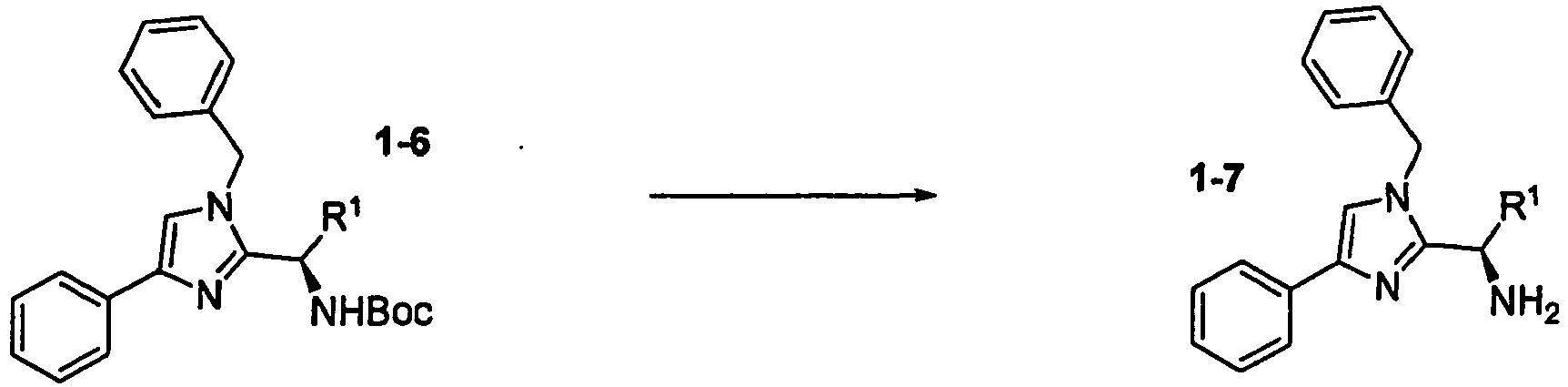
- Boc-protected amine 1-6 (1.0 mmol) was treated with 10% TFA in CH2Cl2 (5 ml). Once reaction was complete, the reaction was concentrated in vacuo and then partitioned between EtOAc and sat. aq. NaHCO3. The organics were separated, then washed with sat. aq. NaHCO3 (x2), H2O (x2), brine (x2), then dried (Na2SO4), filtered, and evaporated under reduced pressure to give the phenyl imidazole free amine 1-7 which was pure enough to use directly in the next step.
-

- To a stirred solution of amine 1-7 (1.0 mmol) and appropriate aldehyde 1-8, e.g., 2-(3-oxopropyl)benzo[c]azoline-1,3-dione (1.0 mmol) in CH2Cl2 (7 ml) was added AcOH (1.0 mmol). The mixture was allowed to stir for 5 min before the addition of sodium tris-acetoxyborohydride (1.10 mmol). Once the reaction was complete, the mixture was concentrated in vacuo, partitioned between EtOAc and 2 M aq. Na2CO3. The organics were separated, then washed with 2 M aq. Na2CO3 (x2), H2O (x2), brine (x2), then dried (Na2SO4), filtered, and evaporated under reduced pressure to give product 1-9 which was either purified by reverse phase prep. HPLC, or more usually was pure enough to use directly in the next step.
-

- To a stirred solution of amine 1-9 (1.0 mmol) in CH2Cl2 (6 ml) was added Et3N (2.0 mmol) followed by the appropriate acid chloride 1-10, e.g., benzoyl chloride (1.0 mmol). Once the reaction was complete, the mixture was partitioned between CH2Cl2 and sat. aq. NaHCO3. The organics were separated and washed with H2O (x2), brine (x2), then dried (Na2SO4), filtered, and evaporated under reduced pressure to give product 1-11.
-

- To a non-stirred solution of phthalimido compound 1-12 (0.3 mmol) in EtOH (1.5 ml) was added anhydrous hydrazine (1.5 mmol). Once the reaction was complete, the reaction was filtered, and the filtrate evaporated under reduced pressure to give the title compound which was purified by reverse phase prep. HPLC to give the pure product 1-13.
-

- A stirred solution of the appropriate N-Boc-acid (4.0 mmol), compound 2-1, tert-butyl glycine, in EtOH (10 ml) was treated with Cs2CO3 (2.0 mmol). After 45 min, the EtOH was removed by evaporation under reduced pressure. The residual cesium salt was re-dissolved in DMF (15 ml) and the treated with the appropriate α-halo-ketone, eg, 2-bromoacetophenone (4.0 mmol) and stirred at r.t. until the reaction was complete. The reaction mixture was then partitioned between EtOAc and H2O, and the organics separated, then washed with H2O (x3), brine (x3), then dried (Na2SO4), filtered, and evaporated under reduced pressure to give the keto-ester 2-2 which was pure enough to use directly in the next step.
-

- To a stirred solution of keto-ester 2-2 (4.0 mmol) in xylenes (40 ml) was added ammonium acetate (20 mmol). A Dean-Stark trap was added and the reaction heated to 140°C. Once the reaction was complete, the mixture was allowed to cool to r.t., then partitioned between EtOAc and sat. aq. NaHCO3. The organics were separated, then washed with sat. aq. NaHCO3 (x2), H2O (x3), brine (x3), then dried (Na2SO4), filtered, and evaporated under reduced pressure to give the phenyl imidazole 2-3 which was pure enough to use directly in the next step.
-

- To a stirred solution/ suspension of imidazole 2-3 (4.0 mmol) and K2CO3 (8.0 mmol) in DMF (10 ml) was added the benzylating agent, eg, benzyl bromide (4.40 mmol). Once the reaction was complete, the mixture was partitioned between EtOAc and H2O. The organic layer was separated and washed with H2O (x3), brine (x3), then dried (Na2SO4), filtered, and evaporated under reduced pressure to give the crude benzylated phenyl imidazole. The crude reaction material was then crystallized (EtOAc, hexanes) to give pure product 2-4.
-

- Boc-protected amine 2-4 (1.0 mmol) was treated with 10% TFA in CH2Cl2 (5 ml). Once reaction was complete, the reaction was concentrated in vacuo and then partitioned between EtOAc and sat. aq. NaHCO3. The organics were separated, then washed with sat. aq. NaHCO3 (x2), H2O (x2), brine (x2), then dried (Na2SO4), filtered, and evaporated under reduced pressure to give the phenyl imidazole free amine 2-5 which was pure enough to use directly in the next step.
-

- To a stirred solution of Cbz protected amino alcohol 2-6 (12.25 mmol) in acetone (50 ml) was added dimethoxypropane (24.5 mmol) followed by BF3 etherate (20 µL, catalytic amount). After 16 h, further dimethoxypropane (80.6 mmol) was added and stirring continued for a further 16 h. The mixture was then concentrated under reduced pressure, then partitioned between EtOAc and sat. aqueous NaHCO3. The organics were separated, then washed with sat. aq. NaHCO3 (x2), H2O (x2), brine (x2), then dried (Na2SO4), filtered, and evaporated under reduced pressure to give the crude compound. Purification by silica gel chromatography afforded the ester product 2-7.
-

- To a cooled (-78°C), stirred solution of ester 2-7 (5.11 mmol) in toluene (25 ml) was added DIBAL-H (6.64 mmol) dropwise. After 3h, the reaction was quenched by cautious addition of sat. aqueous NH4Cl (40 ml). The mixture was diluted with EtOAc, the organic phase was separated, the aqueous extracted with EtOAc (x2). The organics were combined, then washed with 10% Rochelle's Salt (x3), H20 (x1), brine (x3) then dried (Na2SO4), filtered, and evaporated under reduced pressure to give the crude aldehyde 2-8 which was used directly in the reductive amination.
-

- To a stirred solution of (R)-amine 2-5 from step D (1.15 mmol) and aldehyde 2-8, (1.0 mmol) in CH2Cl2 (10 ml) was added AcOH (1.15 mmol) followed by the addition of sodium tris-acetoxyborohydride (1.28 mmol). Once the reaction was complete, the mixture was concentrated in vacuo, partitioned between EtOAc and 1M NaOH. The organics were separated, then washed with 1M NaOH (x2), H2O (x1), brine (x2), then dried (Na2SO4) filtered, and evaporated under reduced pressure to give crude product 2-9 which was used directly in the next step.
-

- To a stirred solution of amine 2-9 (0.25 mmol) in CH2Cl2 (2 ml) was added DIPEA (0.5 mmol) followed by the appropriate acid chloride, e.g., benzoyl chloride (0.27 mmol). Once the reaction was complete, the mixture was partitioned between CH2Cl2 and sat. aq. NaHCO3. The organics were separated and washed with H2O (x2), brine (x2), then dried (Na2SO4), filtered, and evaporated under reduced pressure to give product 2-10 which was used directly in the next step.
-

- A solution of Cbz-protected amine 2-10 from step H (0.25 mmol) in MeOH was hydrogenated in the presence of a catalytic amount of 10% Pd/C under an atmosphere of hydrogen. After 2 h, the solution was filtered (Celite) then concentrated under reduced pressure. The residue was treated with 10% TFA/CH2Cl2 (5 ml). Once reaction was complete, the reaction was evaporated under reduced pressure to give the title compound which was purified by reverse phase prep. HPLC to give the pure Compound 175 in Table 2.
-

- A mixture of N-Boc-3-formyl pyrrolidine (50 mmol), TMSC1 (125 mmol) and Et3N (250 mmol) in DMF (60 ml) were heated for 6 h. The mixture was then diluted with hexanes and filtered (Celite). The filtrate was then evaporated under reduced pressure to give the TMS enol ethers 3-1 as a mixture of E and Z isomers that were used directly in the next step.
-

- To a solution of TMS enol ether 3-1 (3.7 mmol) in acetone (8 ml) was added a solution of N-methyl morpholine N-oxide (5.5 mmol) in H2O (1.2 ml). To this rapidly stirred solution was added OsO4 (0.074 mmol). After 3 h, the mixture was evaporated to dryness under reduced pressre azeotroping with benzene (3 x 5 ml) to give the crude hydroxy aldehyde. Purification by silica gel chromatography afforded pure hydroxy aldehyde 3-2.
-

- To a stirred solution of (R)-amine 3-3 (0.282 mmol) and aldehyde 3-2, (0.3 mmol) in CH2Cl2 (3 ml) was added AcOH (0.31 mmol) followed by the addition of sodium tris-acetoxyborohydride (0.31 mmol). Compound 3-3 was synthesized in a manner similar to Example 1, utilizing the appropriately fluoro-substituted starting materials. After 18h, further sodium tris-acetoxyborohydride (0.157 mmol) was added. Once the reaction was complete, the mixture was concentrated in vacuo, partitioned between EtOAc and 1M NaOH. The organics were separated, then washed with 1M NaOH (x2), H2O (x1), brine (x2), then dried (Na2SO4), filtered, and evaporated under reduced pressure to give crude product. Purification by silica gel chromatography affored a single diastereomer 3-4, though it was unknown whether it was the R,R or R,S diastereomer.
-

- To a stirred solution of amino alcohol 3-4 (0.115 mmol) in CH2Cl2 (1.0 ml) was added DIPEA (0.575 mmol) followed by chloroacetyl chloride (0.127 mmol). After 1h, further chloroacetyl chloride (0.075 mmol) followed by DIPEA (0.287 mmol). Once the reaction was complete, the mixture was evaporated under reduced pressure to give the spiro compound 3-5 which was used directly in the next step.
-
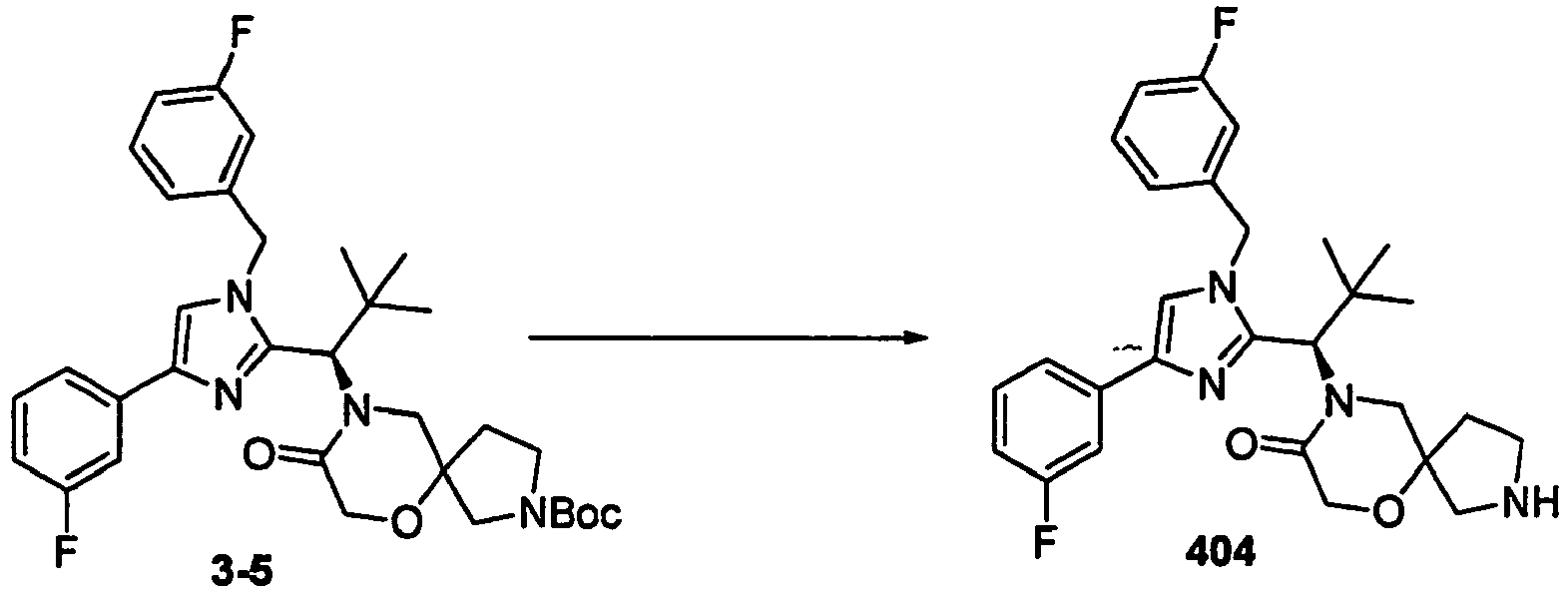
- Boc-protected amine 3-5 (0.115 mmol) was treated with 10% TFA/CH2Cl2 (3 ml). Once reaction was complete, the reaction was evaporated under reduced pressure to give the title compound which was purified by reverse phase prep. HPLC to give the pure compound 404 in Table 3.
-

- To a solution of TMS enol ether 3-1 from Step A of Example 3 (42 mmol) in CH3CN (400 ml) was added SelectFluor® (available from Air Products and Chemicals, Inc.) (43.2 mmol). Once the reaction was complete, the mixture was evaporated under reduced pressure and the remaining solid/oil was extracted with Et2O (x5). The ether extracts were evaporated under reduced pressure to give the crude aldehyde. Purification by silica gel chromatography afforded the desired aldehyde 4-1.
-

- To a stirred solution of (R)-amine 2-5 (2.0 mmol) and aldehyde 4-1, (2.2 mmol) in CH2Cl2 (20 ml) was added AcOH (2.0 mmol) followed by the addition of sodium tris-acetoxyborohydride (3.0 mmol). After 19 h, further sodium tris-acetoxyborohydride (1.0 mmol) was added. Once the reaction was complete, the mixture was concentrated in vacuo, partitioned between EtOAc and 1M NaOH. The organics were separated, then washed with 1M NaOH (x2), H2O (x1), brine (x2), then dried (Na2SO4), filtered, and evaporated under reduced pressure to give crude product. Purification by silica gel chromatography affored the amine 4-2 as a mixture of (R,R) and (R,S) diastereomers.
-

- To a solution of (R) amine 4-2 (0.069 mmol) in THF (0.5 ml) was added DIPEA (0.138 mmol) followed by 1,5-dimethyl-1H-pyrazole-3-carbonyl chloride (0.076 mmol). The mixture was heated at 50°C. Once the reaction was complete, the mixture was concentrated in vacuo, and then purified by reverse phase prep. HPLC which separated the (R,R) 4-4 and the (R,S) 4-3 diastereomers.
-

- Boc-protected amine 4-3 (0.004 mmol) was treated with 10% TFA/CH2Cl2 (1 ml). Once the reaction was complete, the reaction was evaporated under reduced pressure and purified by reverse phase prep. HPLC to give the pure Compound 257 in Table 2. Compound 258 (not shown) in Table 2 was synthesized using similar procedures usning 47 as starting material in Step D.
-

- To a stirred solution of amino alcohol 5-1 (0.96 mmol) in DMF (0.4 ml) was added imidazole (0.482 mmol), DMAP (catalytic amount) and TMSCI. Once the reaction was complete, the mixture was partitioned between EtOAc and sat. aqueous NaHCO3. The organics were separated, then washed with sat. aqueous NaHCO3 (x2), H2O (x1), brine (x2), then dried (Na2SO4), filtered, and evaporated under reduced pressure to give crude product. Purification by silica gel chromatography afforded the silyl ether 5-2.
-

- To a solution of silyl ether 5-2 (0.073 mmol) in CH2Cl2 (0.8 ml) was added DIPEA (0.876 mmol) followed by phosgene (0.584 mmol). Once the reaction was complete, the mixture was concentrated in vacuo, and then purified by reverse phase prep. HPLC to give the pure spiro compound 5-3 as a mixture of (R,R) and (R,S) diastereomers.
-

- Boc-amine 5-3 (0.0135 mmol) was treated with 10% TFA/ CH2Cl2 (0.3 ml). Once reaction was complete, the reaction was evaporated under reduced pressure and purified by reverse phase prep. HPLC to give the separated 320 (R,R) and 319 (R,S) diastereomers.
-

- A stirred solution of D-Boc-Valine (4.605 mmol) in EtOH (10 ml) was treated with Cs2CO3 (0.75g, 2.30 mmol). After 45 min, the EtOH was removed by evaporation under reduced pressure. The residual cesium salt was re-dissolved in DMF (15 ml) and the treated with 2-bromoacetophenone (0.916g, 4.605 mmol) and stirred at room temperature until the reaction was complete. The reaction mixture was then partitioned between EtOAc and H2O, and the organics separated, then washed with H2O (x3), brine (x3), then dried (Na2SO4), filtered, and evaporated under reduced pressure to give the keto-ester 6-1 which was pure enough to use directly in the next step.
-

- To a stirred solution of the product from Step A keto ester 6-1(1.589g, 4.743 mmol) in xylenes (50 ml) was added ammonium acetate (1.82g, 23.7 mmol). A Dean-Stark trap was added and the reaction heated to 140°C. Once the reaction was complete, the mixture was allowed to cool to room temperature, then partitioned between EtOAc and sat. aq. NaHCO3. The organics were separated, then washed with sat. aq. NaHCO3 (x2), H2O (x3), brine (x3), then dried (Na2SO4), filtered, and evaporated under reduced pressure to give the phenyl imidazole 6-2 which was pure enough to use directly in the next step.
-

- To a stirred solution/ suspension of the product from Step B compound 6-2 (1.00g, 3.17 mmol) and K2CO3 (0.876g, 6.34 mmol) in DMF (10 ml) was added benzyl bromide (0.415 ml, 3.49 mmol). Once the reaction was complete, the mixture was partitioned between EtOAc and H2O. The organic layer was separated and washed with H2O (x3), brine (x3), then dried (Na2SO4), filtered, and evaporated under reduced pressure to give the crude benzylated phenyl imidazole. The crude reaction material was then crystallized (EtOAc, hexanes) to give pure product compound 6-3. The regiochemical outcome was verified by 1H nOe NMR.
-
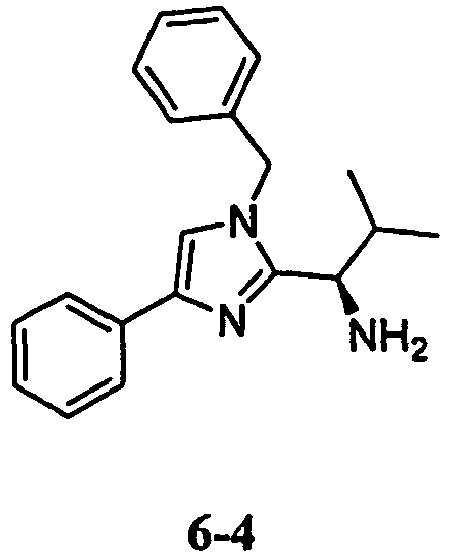
- Boc-protected amine compound 6-3 from Step C (0.406g, 1.0 mmol) was treated with 10% TFA in CH2Cl2 (5 ml). Once reaction was complete, the reaction was concentrated in vacuo and then partitioned between EtOAc and sat. aq. NaHCO3. The organics were separated, then washed with sat. aq. NaHCO3 (x2), H2O (x2), brine (x2), then dried (Na2SO4), filtered, and evaporated under reduced pressure to give the phenyl imidazole free amine compound 6-4 which was pure enough to use directly in the next step.
-

- To a stirred solution of amine 6-4 from Step D (59mg, 0.193 mmol) and 2-(3-oxopropyl)benzo[c]azoline-1,3-dione (39mg, 0.193 mmol) in CH2Cl2 (1.5 ml) was added AcOH (11µL, 0.193 mmol). The mixture was allowed to stir for 5 min before the addition of sodium tris-acetoxyborohydride (45mg, 0.212 mmol). After 1h, the mixture was concentrated in vacuo, partitioned between EtOAc and 2 M aq. Na2CO3. The organics were separated, then washed with 2 M aq. Na2CO3 (x2), H2O (x2), brine (x2), then dried (Na2SO4), filtered, and evaporated under reduced pressure to give product 6-5 which was pure enough to use directly in the next step.
-

- To a stirred solution of amine 6-5 from Step E (42mg, 0.085mmol) in CH2Cl2 (1.2 ml) was added DIPEA (30 µL, 0.170 mmol) followed byp-toluoyl chloride (12.4 L, 1.0 mmol). Once the reaction was complete, the mixture was partitioned between CH2Cl2 and sat. aq. NaHCO3. The organics were separated and washed with H2O (x2), brine (x2), then dried (Na2SO4), filtered, and evaporated under reduced pressure to give product 6-6 which was pure enough to use directly in the next step.
-

- To a non-stirred solution of phthalimido compound 6-6 from step F, (52mg, 0.085 mmol) in EtOH (1.5 ml) was added anhydrous hydrazine (26 µL, 0.85 mmol). Once the reaction was complete, the reaction was filtered, and the filtrate evaporated under reduced pressure to give the title compound which was purified by reverse phase prep. HPLC to give the pure product 1 in Table 1.
-

- A stirred solution of the N-Boc-acid (10.0 g, 43.2 mmol 1.0 eq.) in EtOH (150 ml) was treated with Cs2CO3 (7.04 g, 21.6 mmol, 0.5 eq.). After 45 min, the EtOH was removed by evaporation under reduced pressure. The residual cesium salt was re-dissolved in DMF (150 ml) and the treated with 2-bromoacetophenone (8.60 g, 43.2 mmol, 1.0 eq.) and stirred at room temperature for 1 hour. The reaction mixture was then partitioned between EtOAc and H2O, and the organics separated, then washed with H2O (x3), brine (x3), then dried (Na2SO4), filtered, and evaporated under reduced pressure to give the keto-ester 2-2 which was pure enough to use directly in the next step.
-

- To a stirred solution of keto-ester 2-2 from Step A (15.1 g, 43.2 mmol, 1.0 eq.) in xylenes (500 ml) was added ammonium acetate (16.6 g, 216.2 mmol, 5.0 eq.). A Dean-Stark trap was added and the reaction heated to 140°C for 1 hour. Once the reaction was complete, the mixture was allowed to cool to room temperature, then partitioned between EtOAc and sat. aq. NaHCO3. The organics were separated, then washed with sat. aq. NaHCO3 (x2), H2O (x3), brine (x3), then dried (Na2SO4), filtered, and evaporated under reduced pressure to give the phenyl imidazole 2-3 which was pure enough to use directly in the next step.
-

- To a stirred solution/ suspension of imidazole 2-3 from Step B (14.26 g, 43.2 mmol, 1.0 eq.) and K2CO3 (12.00 g, 86.4 mmol, 2.0 eq.) in DMF (150 ml) was added the benzyl bromide (5.65 ml, 47.53 mmol, 1.1 eq.). The reaction was stirred at room temperature for 12 hours. Once the reaction was complete, the mixture was partitioned between EtOAc and H2O. The organic layer was separated and washed with H2O (x3), brine (x3), then dried (Na2SO4), filtered, and evaporated under reduced pressure to give the crude benzylated phenyl imidazole 2-4, which was pure enough to move directly onto the next step.
-

- Boc-protected amine 2-4 from Step C (5.0 g, 11.93 mmol) was treated with 15% TFA in CH2Cl2 (35 ml). Once reaction was complete, the reaction was concentrated in vacuo and then partitioned between EtOAc and sat. aq. NaHCO3. The organics were separated, then washed with sat. aq. NaHCO3 (x2), H2O (x2), brine (x2), then dried (Na2SO4), filtered, and evaporated under reduced pressure to give the phenyl imidazole free amine 2-5 which was pure enough to use directly in the next step.
-

- To a stirred solution of amine 2-5 from Step D (1.00 g, 3.13 mmol, 1.0 eq.) and the 2-(3-oxopropyl)benzo[c]azoline-1,3-dione 25 (0.51 g, 2.51 mmol, 1.0 eq.) in CH2Cl2 (10 ml) was added AcOH (0.18 ml, 3.13 mmol, 1.0 eq.). The mixture was allowed to stir for 5 min before the addition of sodium tris-acetoxyborohydride (0.73 g, 3.44 mmol, 1.1 eq.). Once the reaction was complete, the mixture was concentrated in vacuo, partitioned between EtOAc and 2 M aq. Na2CO3. The organics were separated, then washed with 2 M aq. Na2CO3 (x2), H2O (x2), brine (x2), then dried (Na2SO4), filtered, and evaporated under reduced pressure to give product 7-1 which was pure enough to use directly in the next step.
-

- To a stirred solution of amine 7-1 from Step E (0.04 g, 0.08 mmol, 1.0 eq.) in CH2Cl2 (0.3 ml) was added the acid (0.024 g, 0.17 mmol, 2.2 eq.), HOAT (0.24 g, 0.17 mmol, 2.2 eq.), and TEA (0.05 ml, 0.33 mmol, 4.2 eq.). After 5 minutes EDC (0.04 g, 0.18 mmol, 2.3 eq.) was added, and the reaction was heated to 55°C for 24 hours. The mixture was then partitioned between CH2Cl2 and sat. aq. NaHCO3. The organics were separated and washed with H2O (x2), brine (x2), then dried (Na2SO4), filtered, and evaporated under reduced pressure to give product 7-2.
-

- To a non-stirred solution of phthalimido compound 7-2 from Step F (0.02 g, 0.03 mmol, 1.0 eq.) in EtOH (0.1 ml) was added anhydrous hydrazine (0.005 g, 0.15 mmol, 5.0 eq.). Once the reaction was complete, the reaction was filtered, and the filtrate evaporated under reduced pressure to give the title compound which was purified by reverse phase prep. HPLC to give the pure product 99.
-

- A stirred solution of the N-Boc-acid (8.0 g, 36.8 mmol 1.0 eq.) in EtOH (130 ml) was treated with Cs2CO3 (6.0 g, 18.4 mmol, 0.5 eq.). After 45 min, the EtOH was removed by evaporation under reduced pressure. The residual cesium salt was redissolved in DMF (130 ml) and the treated with chloro-subtituted 2-bromoacetophenone (8.60 g, 36.84 mmol, 1.0 eq.) and stirred at room temperature for 1 hour. The reaction mixture was then partitioned between EtOAc and H2O, and the organics separated, then washed with H2O (x3), brine (x3), then dried (Na2SO4), filtered, and evaporated under reduced pressure to give the keto-ester 8-1 which was pure enough to use directly in the next step.
-

- To a stirred solution of keto-ester 8-1 from Step A (13.5 g, 36.8 mmol, 1.0 eq.) in xylenes (450 ml) was added ammonium acetate (14.2 g, 185.0 mmol, 5.0 eq.). A Dean-Stark trap was added and the reaction heated to 140°C for 1 hour. Once the reaction was complete, the mixture was allowed to cool to room temperature, then partitioned between EtOAc and sat. aq. NaHCO3. The organics were separated, then washed with sat. aq. NaHCO3 (x2), H2O (x3), brine (x3), then dried (Na2SO4), filtered, and evaporated under reduced pressure to give the phenyl imidazole 8-2 which was pure enough to use directly in the next step.
-

- To a stirred solution/ suspension of imidazole 8-2 from Step B (12.85 g, 36.8 mmol, 1.0 eq.) and K2CO3 (10.17 g, 73.6 mmol, 2.0 eq.) in DMF (122 ml) was added the benzyl bromide (5.20 ml, 40.49 mmol, 1.1 eq.). Reaction was stirred at room temperature for 12 hours. Once the reaction was complete, the mixture was partitioned between EtOAc and H2O. The organic layer was separated and washed with H2O (x3), brine (x3), then dried (Na2SO4), filtered, and evaporated under reduced pressure to give the crude benzylated phenyl imidazole 8-3, which was pure enough to move directly onto the next step.
-

- Boc-protected amine 8-3 from Step C (5.0 g, 11.40 mmol) was treated with 15% TFA in CH2Cl2 (35 ml). Once reaction was complete, the reaction was concentrated in vacuo and then partitioned between EtOAc and sat. aq. NaHCO3. The organics were separated, then washed with sat. aq. NaHCO3 (x2), H2O (x2), brine (x2), then dried (Na2SO4), filtered, and evaporated under reduced pressure to give the phenyl imidazole free amine 8-4 which was pure enough to use directly in the next step.
-

- To a stirred solution of amine 8-4 from Step D (3.86 g, 11.40 mmol, 1.0 eq.) and 2-(3-oxopropyl)benzo[c]azoline-1,3-dione (2.31 g, 11.40 mmol, 1.0 eq.) in CH2Cl2 (40 ml) was added AcOH (0.65 ml, 11.40 mmol, 1.0 eq.). The mixture was allowed to stir for 5 min before the addition of sodium tris-acetoxyborohydride (2.65 g, 12.52 mmol, 1.1 eq.). Once the reaction was complete, the mixture was concentrated in vacuo, partitioned between EtOAc and 2 M aq. Na2CO3. The organics were separated, then washed with 2 M aq. Na2CO3 (x2), H2O (x2), brine (x2), then dried (Na2SO4), filtered, and evaporated under reduced pressure to give product 8-5 which was pure enough to use directly in the next step.
-

- To a stirred solution of amine 8-5 from Step E (0.05 g, 0.10 mmol, 1.0 eq.) in CH2Cl2 (0.3 ml) was added the acid (0.02 g, 0.11 mmol, 1.0 eq.), HOAT (0.15 g, 0.10 mmol, 1.0 eq.), and TEA (0.03 ml, 0.20 mmol, 2.1 eq.). After 5 minutes EDC was added (0.22 g, 0.20 mmol, 2.0 eq.), and the reaction was heated to 55°C for 24 hours. The mixture was then partitioned between CH2Cl2 and sat. aq. NaHCO3. The organics were separated and washed with H2O (x2), brine (x2), then dried (Na2SO4), filtered, and evaporated under reduced pressure to give product 8-6.
-

- To a non-stirred solution of phthalimido compound 8-6 from Step F (0.01 g, 0.02 mmol, 1.0 eq.) in EtOH (0.6 ml) was added anhydrous hydrazine (0.003 g, 0.10 mmol, 5.0 eq.). Once the reaction was complete, the reaction was filtered, and the filtrate evaporated under reduced pressure to give the title compound which was purified by reverse phase prep. HPLC to give the pure product 71.
- The title compound is useful as an intermediate in synthesizing compounds of the invention.
-

- 5.0 g (29.5 mmol) of tert-Butyl 2,5-dihydro-1H-pyrrole-1-carboxylate and 11.7 g (67.9 mmol) 3-chloroperoxybenzoic acid were stirred in 70 ml of DCM under nitrogen at ambient temperature for 20 hours. Excess IN NaOH was added to the reaction mixture and the resulting solution was extracted using DCM (3x). The organic layers were combined, dried over MgSO4, and the solvent was removed in vacuo yielding 5.2 g (28.1 mmol, 95%) of 9-1 as a yellow oil.
-

- 4.3 g (23.3 mmol) of compound 9-1 and 0.21 g (2.33 mmol) CuCN in 50 ml anhydrous THF were cooled to -78 °C. Vinyl magnesium bromide (73.3 mmol) was added drop wise and the resulting solution was allowed to warm to ambient temperature during the course of 7 hours. The reaction was monitored by thin-layer chromatography and the product was eluted using 1:2 ethyl acetate and hexanes and staining with ninhydrin. The reaction was quenched with saturated NH4Cl and extracted with ethyl acetate (3X). The combined organic layers were dried over MgSO4 and the solvent was removed in vacuo yielding 4.75 g (22.3 mmol, 96%) of 9-2 as a tan oil.
-

- 2.0 g (9.4 mmol) of 9-2 was dissolved in 20 ml THF and 10 ml H2O followed by the addition of 3.51 g (16.4 mmol) NaIO4 and 0.23 ml osmium tetroxide. The reaction was stirred at ambient temperature under nitrogen yielding a white precipitate after 30 minutes. The reaction was monitored by thin-layer chromatography and the product was eluted using 1:1 ethyl acetate and hexanes and staining with ninhydrin. The reaction was complete after approximately 8 hours. Excess H2O was added to the reaction mixture and the resulting solution was extracted using ethyl acetate (3X). The combined organic layers were washed with saturated NaHCO3 and brine, dried over MgSO4, and the solvent was removed in vacuo yielding 1.35 g (6.3 mmol, 67%) of 9-3 as a tan foam.
- Compound 297, 298, 299, 300, 307, 308, 309, 310, 326, and 327 were synthesized using similar procedures as in Example 6, 7, and 8 using intermediate 9-3 as intermediate in reductive amination step.
-

- To a stirred solution of Boc-L-β-homoasparagine 10-1 (8.0 mmol) and ethane thiol (16 mmol) in DMF (10 ml) was added 1,3-dicyclohexylcarbodimide (8.8 mmol) and DMAP (0.8 mmol). The reaction was stirred at room temperature until the reaction was complete. The precipitate was filtered and washed with ethyl acetate. The organics were combined and concentrated. Separation on a silica gel column with ethyl acetate gave the desired thioester 10-2.
-

- To a stirred mixture of ethyl thio ester 10-2 (0.1 mmol) and 10% Pd on carbon (20 mol%) in acetone (1 ml) was added Et3SiH (4.4 mmol) at room temperature under an argon atmosphere. Stirring was continued at room temperature until the reduction was complete in about 30 min. The catalyst was filtered off through Celite and washed with acetone. Evaporation under reduced pressure produced aldehyde 10-3, which was use directly in the next step.
-

- To a stirred solution of amine 2-5, from Example 2 above (1.0 mmol) in CH2Cl2 was added appropriate aldehyde 10-3 (1.0 mmol) (7 ml). The mixture was allowed to stir for 5 min before the addition of sodium tris-acetoxyborohydride (1.0 mmol). Once the reaction was complete, the mixture was concentrated in vacuo, partitioned between EtOAc and 2M aq. Na2CO3. The organics were separated, then washed with 2M aq. Na2CO3 (x2), H2O (x2), brine (x2), then dried (Na2SO4), filtered, and evaporated under reduced pressure to give product 10-4 which was used directly in the next step.
-

- To a stirred solution of amine 10-4 (1.0 mmol) in CH2Cl2 (6 ml) was added Et3N (2.0 mmol), DMAP (10.1 mmol) followed by benzoyl chloride (1.0 mmol). Once the reaction was complete, the mixture was partitioned between CH2Cl2 and sat. aq. NaHCO3. The organics were separated and washed with H2O (x2), brine (x2), then dried (Na2SO4), filtered, and evaporated under reduced pressure to give product 10-5, which was further purified by reverse phase HPLC.
-

- The Boc protected compound 10-5 was treated with HCl in dioxane (4N, 10 eq.) for 30 min, and the solvent was removed to give the final product 100 as HCl salt.
-

- Using the similar procedures to make the thiol ester from 3-(1H-imidazole-2-yl)-propionic acid, then reduced to the aldehyde. Reductive amination followed by acylation to form the final compound 113 as shown in the following scheme.
-

- Compound 11-2 was synthesized in a matter similar to that described in Example 10, steps A and B.
-

- Compound 11-4 was synthesized using procedures similar to that in Example 10, steps C, D, and E.
-

-

- A stirred solution of the appropriate N-Boc-acid, e.g. N-Boc-Glycine (0.15 mmol) and phenylimidazole amine compound 23 (0.1 mmol) in THF (3 ml) was treated with PyBOP (0.15 mmol) and Et3N (0.3 mmol). Compound 23 was prepared using the method described in Example 1. The reaction was stirred at room temperature until the completion, and was evaporated under reduced pressure. Purification by silica gel column to give the protecte amine 12-1.
-

- The Boc protected compound 12-1 was treated with HCl in dioxane (4N, 10 eq.). Once the reaction was complete, the solvent was removed to give the final product, compound 101, which was purified by reverse phase prep. HPLC.
- The following compounds were synthesized using the the similar procedures:

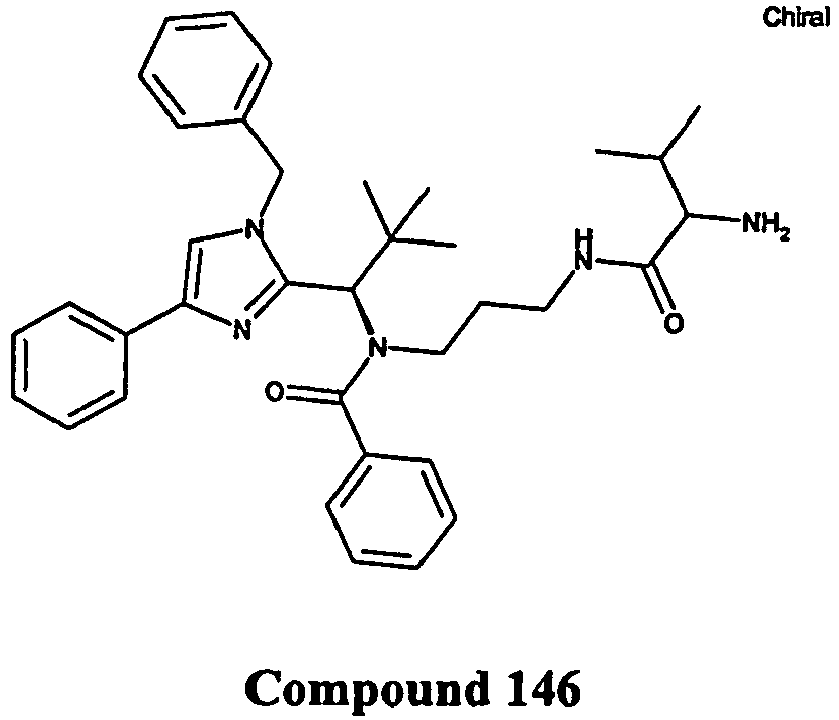
-

- To a stirred solution of amine 23 (0.1 mmol) was added appropriate aldehyde, e.g., glyoxylic acid (0.1 mmol) in CH2Cl2 (1 ml). The mixture was allowed to stir for 5 min before the addition of sodium tris-acetoxyborohydride (0.1 mmol). Once the reaction was complete, the mixture was concentrated and purified by reverse phase prep. HPLC to get the title compound 13-1 as TFA salt.
- The following compounds were prepared by this procedure:
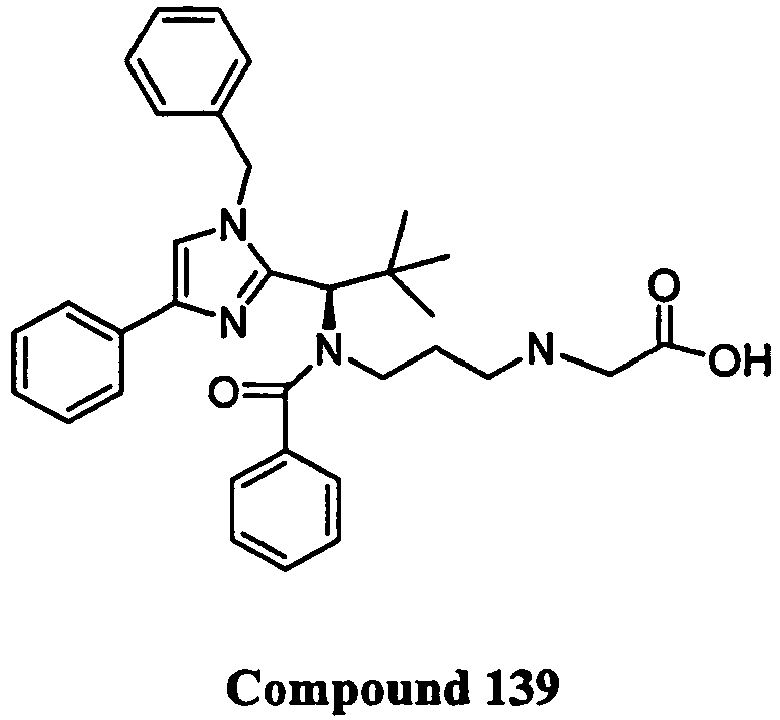

-

-

- DL-α-Aminoadipic acid hydrate 14-1 (2 g, 11 mmol) was dissolved in 2 M NaOH (11 ml, 22 mmol). Benzaldehyde (1.4 ml, 11 mmol) was dissolved in 3.0 ml of ethanol and this solution was added to the first solution. After 10 minutes the mixture was cooled to 0°C and sodium borohydride (0.13 g, 3.3 mmol) was added. After 1 hour, the reaction was complete as monitored by LCMS. The solution was extracted 3 times with 20 ml portions of ether, cooled to 0°C, acidified to pH 2 with concentrated HCl and the resulting precipitate was filtered to afford a white solid. The solid was washed once with a minium amount of acetonitrile (1 ml) and three times with ether. The crude solid was dissolved in 55 ml ethanol and the solution was refluxed overnight. The solution was evaporated to provide the lactam product 14-2.
-

- A stirred solution of the lactam acid 14-2 (4.0 mmol) in EtOH (10 ml) was treated with Cs2CO3 (2.0 mmol). After 45 min, the EtOH was removed by evaporation under reduced pressure. The residual cesium salt was re-dissolved in DMF (15 ml) and the treated with 2-bromoacetophenone (4.0 mmol) and stirred at r.t. until the reaction was complete. The reaction mixture was then partitioned between EtOAc and H2O, and the organics separated, washed with H2O (x3), brine (x3), then dried (Na2SO4), filtered, and evaporated under reduced pressure. The residue was purified by silica gel column to afford the keto ester 14-3.
-

- To a stirred solution of keto-ester 14-3 (4.0 mmol) in xylenes (40 ml) was added ammonium acetate (20 mmol). A Dean-Stark trap was added and the reaction heated to 140°C. Once the reaction was complete, the mixture was allowed to cool to r.t., then partitioned between EtOAc and sat. aq. NaHCO3. The organics were separated, then washed with sat. aq. NaHCO3 (x2), H2O (x3), brine (x3), then dried (Na2SO4), filtered, and evaporated under reduced pressure to give the phenyl imidazole which was purified on a silica gel column to get the title compound 14-4.

- To a stirred suspension of imidazole 14-4 (4.0 mmol) and K2CO3 (8.0 mmol) in DMF (10 ml) was added the benzylating agent, benzyl bromide (4.40 mmol). Once the reaction was complete, the mixture was partitioned between EtOAc and H2O. The organic layer was separated and washed with H2O (x3), brine (x3), then dried (Na2SO4), filtered, and evaporated under reduced pressure to give the crude benzylated phenyl imidazole 114. The crude reaction material was then purified by silica gel column or reverse phase HPLC.
The following compound was also prepared by using a similar procedure.
- To 2-[(tert-butoxy)carbonylamino]-2-methylpropanoic acid (1 eq.) in N,N-dimethylformamide was added ammonium carbonate (1 eq.) and the mixture was heated to 110°C for 10 min. The reaction mixture was cooled to 60°C and to it was added 2-bromo-1-(3-fluorophenyl)ethan-1-one (0.2 eq.) and the mixture was heated to 125°C for 3h. LCMS showed the formation of (tert-butoxy)-N-{1-[4-(3-fluorophenyl-imidazol-2-yl]-isopropyl}carboxamide. The reaction mixture was concentrated and partitioned between ethyl acetate and water. The organic layer was separated and washed with saturated sodium chloride solution and dried with sodium sulfate. The resulting crude was purified by silica gel chromatography to give (tert-butoxy)-N-{1-[4-(3-fluorophenyl-imidazol-2-yl]-isopropyl}carboxamide.
- MS: MH+ = 320.
- To a stirred solution/ suspension of (tert-butoxy)-N-{1-[4-(3-fluorophenyl-imidazol-2-yl]-isopropyl}carboxamide (1eq.) and potassium carbonate (2 eq.) in N,N-dimethylformamide was added 1-(bromomethyl)-3-fluorobenzene (1.1 eq.). Once the reaction was complete, the mixture was partitioned between ethyl acetate and water. The organic layer was separated and washed with water, saturated sodium chloride solution, then dried with sodium sulfate, filtered, and evaporated under reduced pressure to give the crude benzylated phenyl imidazole. The crude reaction material was purified by silica gel chromatography.
- MS: MH+ = 428.
- To (tert-butoxy)-N{1-[4-(3-fluorophenyl-imidazol-2-yl]-isopropyl}carboxaimide (1 eq.) was added 10% trifluoroacetic acid in methylene chloride. Once the reaction was complete the mixture was concentrated and partitioned between saturated sodium carbonate and ethyl acetate. The organic layer was separated and washed with water saturated sodium chloride solution, then dried with sodium sulfate, filtered, and evaporated under reduced pressure to give 2-{4-(3-fluorophenyl}-1-((3-fluorophenyl)methyl]imidazol-2-yl}prop-2-yl-amine.
- MS: MH+ = 328.
- To a stirred solution of 2-{4-(3-fluorophenyl}-1-[(3-fluorophenyl)methyl]imidazol-2-yl}prop-2-yl-amine amine (1 eq.) and 2-(3-oxopropyl)benzo[C]azoline-1,3-dione(1 eq.) in methylene chloride at 0°C was added acetic acid (1 eq.) followed by the addition of sodium tris-acetoxyborohydride (1.5 eq.). Once the reaction was complete, the mixture was concentrated in vacuo, partitioned between ethyl acetate and saturated sodium bicarbonate solution. The organic layer was separated and washed with saturated bicarbonate and water followed by saturated sodium chloride solution, then dried with sodium sulfate, filtered, and evaporated under reduced pressure to give crude product which was purified by silica gel chromatography.
- MS: MH+ = 515.
- To a stirred solution of 2-{(1S)-1-(fluoromethyl)-3[(1-(4-(3-fluorophenyl)-1-[(3-fluorophenyl)methyl]imidazol-2-yl}-isopropyl)amino]propyl}benzo{C}azoline-1,3-dione) (1 eq.)in methylene chloride was added methoxy acetylchloride (3 eq.) and triethylamine (3 eq.). Once the reaction was complete, the mixture was concentrated in vacuo, partitioned between ethyl acetate and saturated sodium bicarbonate solution. The organic layer was separated and washed with saturated bicarbonate and water followed by saturated sodium chloride solution, then dried with sodium sulfate, filtered, and evaporated under reduced pressure to give N-[3-(1,3-dioxobenzo[C]azline-2-yl)propyl]-N-(1-{4-(3-fluorophenyl)-1-[3-fluorophenyl)methyl]imidazol-2-yl}-isopropyl)-2-methoxyacetamide
- MS: MH+ = 587.
- To a stirred solution of 2-{(1S)-1-(fluoromethyl)-3[(1-{4-(3-fluorophenyl)-1-[(3-fluorophenyl)methyl]imidazol-2-yl}-isopropyl)amino]propyl}benzo{C}azoline-1,3-dione) in ethanol was added hydrazine (1.5 eq.). Once the reation was complete it was filtered and the filtrate was evaporated under reduced pressure. It was purified on preparative HPLC to give N-(3-Amino-propyl)-N-{1-[1-(3-fluorobenzyl)-4-(3-fluoro-phenyl)-1H-imidazol-2-yl]-1-methyl-ethyl}-2-methoxy-acetamide
- MS: MH+ = 457.
- To tert-butyl (S)-1((benzyloxy)carbonyl)-3-hydroxypropan-2-ylcarbamate (1 eq.) in dichloromethane was added 2,6-di-t-butyl 4-methylpyridine (2.5 eq.) and trimethyloxonium tetrafluoroborate (1.25 eq.) at 0°C. The reaction mixture was gradually warm to room temperature and stirred overnight. The reaction mixture was diluted with dichloromethane and washed with cold satd. sodium bicarbonate, water, and brine and dried over sodium sulfate. Purification by silica gel chromatography (25% EtOAc / Hexane) provide pure product as a colorless viscous liquid.
- MS: MH+ = 324.1
- Azeotrope tert-butyl (S)-1-((benzyloxy) carbonyl)-3-methoxy propan-2-ylcarbamate (1 eq.) with toluene (x=3). Dissolved in dichloromethane and cooled to -78°C. To then was added drop wise 1 M solution of DIBAL in toluene (2 eq.) under N2 atmosphere and stirred at -78°C for 2h. The reaction was quenched with methanol and concentrated. To concentrated residue was added 2 M potassium sodium tartrate solution at 0°C and stirred vigorously at room temperature for 30 min. Partitioned between ethyl acetate and water. The organic layer was washed with brine and dried over sodium sulfate. Filtered, evaporated and dried under high-pressure vacuum to provide product as a colorless viscous liquid.
- MS: MH+ = 218.2
- To (R)-1-(1-benzyl-4- (2,5-difluorophenyl)-1H-imidazol-2-yl)-2,2-dimethylpropan-1-amine (1eq) in dichloromethane was added tert-butyl (S)-1-formyl-3-methoxypropan-2-ylcarbamate (1.5eq) and acetic acid (1eq). The reaction mixture was stirred at room temperature for 1h. Sodium triacetoxy borohydride (2eq) was added at 0°C. The reaction mixture was warmed to room temperature and stirred overnight. Solvent was concentrated and crude was partitioned between ethyl acetate and satd. sodium bicarbonate. The organic layer was washed with water, brine and dried over sodium sulfate. Purification by silica gel chromatography (25% EtOAc / Hexane) provide pure product as a white foamy solid.
- MS: MH+ = 557.2
- To tert-butyl (S)-4-((R)-1-(1-benzyl-4-(2,5-difluorophenyl)-1H-imidazol-2-yl)-2,2-dimethylpropylamino)-1-methoxybutan-2-ylcarbamate (1eq.) in THF was added triethylamine (2 eq.) and methoxyacetalchloride (10 eq.). Stirred at room temperature for 30min. The reaction mixture was diluted with ethyl acetate and washed with water and brine. Dried over sodium sulfate. Filtered, evaporated and dried under reduced pressure to provide product as a colorless semi solid.
- MS: MH+ = 629.2
- To tert-butyl (S)-4-((R)-1-(1-benzyl-4-(2,5-difluorophenyl)-1H-imidazol-2-yl)-2,2-dimethylpropyl)-2-methoxyacetamido)-1-methoxybutan-2-ylcarbamate was added 30% TFA / DCM. Stirred at room temperature for 1h. Solvent was evaporated.
- Purification by preparative chromatography provide product as a white solid.
- MS: MH+ = 529.1
- This intermediate is useful in preparing compounds of the invention which have pyrazine substituent, such as Compound 328, 331 and the like.
-

- To a stirred solution of acetylpyrazine 17-1 (24.6 mmol) and TMSCl (24.6 mmol) in THF (12.3 ml) in a-78 °C acetone/dry ice bath was added LiHMDS (24.6 mmol, 1.0 M solution in THF) dropwise via an addition funnel. After 90 min, the reaction was allowed to warm to r.t. To the reaction was added cold EtOAc and the organics were washed with sat. aq. NaHCO3 (x3) and cold brine (x1), then dried (Na2SO4), filtered, and concentrated in vacuo to provide a yellow liquid. The liquid was purified via flash chromatography (5% EtOAc/hexanes) to give 85% pure product 17-2 (remaining 15% as starting pyrazine).
-

- To a stirred solution of TMS enol ether 17-2 (6.5 mmol) in cold pentane (15.2 ml), was added a solution of bromine (6.8 mmol) in pentane (5.3 ml) dropwise. After 1h, the reaction was diluted with EtOAc. The organics were washed with sat. aq. NaHCO3 (x3) and brine (x1), dried (Na2SO4), filtered, and evaporated under reduced pressure to give a brown solid.
-

- A stirred solution of tert-butyl leucine 2-1 (4.5 mmol), in EtOH (15 ml) was treated with Cs2CO3 (2.25 mmol). After 45 min, the EtOH was removed by evaporation under reduced pressure. The residual cesium salt was re-dissolved in DMF (15 ml) and the treated with the α-bromo ketone 17-3 (4.5 mmol) and stirred at room temperature until the reaction was complete. The reaction mixture was then partitioned between EtOAc and H2O, and the organics separated, then washed with H2O (x3), brine (x3), then dried (Na2SO4), filtered, and evaporated under reduced pressure to give the keto-ester 17-4 which was pure enough to use directly in the next step.
-

- To a stirred solution of keto-ester 17-4 (4.4 mmol) in xylenes (44 ml) was added ammonium acetate (22 mmol). A Dean-Stark trap was added and the reaction heated to 140°C. Once the reaction was complete, the mixture was allowed to cool to r.t., then partitioned between EtOAc and sat. aq. NaHCO3. The organics were separated, then washed with sat. aq. NaHCO3 (x2), H2O (x3), brine (x3), then dried (Na2SO4), filtered, and evaporated under reduced pressure to give the pyrazine-imidazole 17-5 which was pure enough to use directly in the next step.
-

- To a stirred solution/ suspension of imidazole 17-5 (0.9 mmol) and K2CO3 (1.8 mmol) in DMF (3 ml) was added benzyl bromide (0.95 mmol). Once the reaction was complete, the mixture was partitioned between EtOAc and H2O. The organic layer was separated and washed with H2O (x3), brine (x3), then dried (Na2SO4), filtered, and evaporated under reduced pressure to give the crude benzylated imidazole. The crude reaction material was then purified via flash chromatography (15% EtOAc/hexanes) to give pure product 17-6.
-

- Boc-protected amine 17-6 (0.5 mmol) was treated with 20% TFA in CH2Cl2 (5 ml). Once reaction was complete, the reaction was concentrated in vacuo and then partitioned between EtOAc and sat. aq. NaHCO3 The organics were separated, then washed with sat. aq. NaHCO3 (x2), H2O (x2), brine (x2), then dried (Na2SO4), filtered, and evaporated under reduced pressure to give the imidazole free amine 17-7 which was pure enough to use as an intermediate in synthesizing compounds of the invention with the pyrazine substitution.
-

-

- To a stirred solution of anhydrous K2CO3 (46.53 g, 0.3371 mol) in N,N-dimethylformamide (500 ml), D-serine methyl ester hydrochloride (35.0 g, 0.2250 mol), KI (18.66 g, 0.1124 mol) and benzyl bromide (96.18 g, 0.5623 mol) were added in one shot. The reaction mixture was stirred vigorously for 5h at room temperature. After completion of reaction, contents were poured into ice water and extracted with ethyl acetate. The combined organic layer was washed with water, brine, dried over Na2SO4 and concentrated to give a crude product 18-2. Purification was carried out by column chromatography to yield pure (61.7g, 91.7%) as pale yellow oil.
-

- To a stirred solution of diethylamine sulphur trifluoride (32.3 ml, 0.2006 mol) in THF (400 ml), alcohol (100.0 g, 0.3344 mol) in THF (400 ml) was added dropwise compound 18-2 during the span of 3h at room temperature. After completion of addition, stirring was continued for further 1h. The mixture was extracted with ethylacetate and combined organic phase was washed with saturated solution of NaHCO3. Removal of solvent under vacuum lead to a crude product, which was purified by column chromatography using hexane grading to 3% EtOAc in hexane afforded product 18-3 (70.4g, 69.9%) as pale yellow oil.
-

- To a mechanically stirred solution of LiBH4 (230.8 ml, 0.4651 mol) in THF (2.0 L), methyl ester (100.0 g, 0.3322 mol) in THF (1.0 L) was added dropwise 18-3 through addition funnel during the span of 3h at -15°C under N2. After the completion of addition, stirring was continued for 4h at room temperature. Saturated solution of NH4Cl (500ml) was added dropwise to the above mixture and extracted with EtOAc. The combined organic phase was washed with water, brine, dried over Na2SO4 and concentrated under vacuum. Residual oil was dissolved in IN HCl (200 ml), extracted with diethylether and pH of the aqueous layer was adjusted to 10 with the help of NH4OH (50%, 3 00ml). The resultant was extracted with EtOAc and combined extracts were concentrated under vacuum to give product (86.2g, 95.0%) as pale brown oil.
-

- A mixture of alcohol 18-4 (50.g, 0.18315 mol) and Pd(OH)2 on carbon (20%, 6.26 g, 0.04395 mol) in absolute ethanol (500 ml) was stirred for 7h under the pressure of hydrogen at 50-60 psi. After the reaction, charcoal was removed by filtration and residue was concentrated on rota evaporator to get product 18-5 (15.8 g, 92.7%) as pale brown oil.
-

- To a stirred mixture of amino alcohol 18-5 (15.0 g, 0.16129 mol) and K2C03 (33.39 g, 0.24195 mol) in aqueous dioxane (∼25%, 375 ml dioxane in 125m water), (Boc)2O (38.66 g, 0.17733 mol) was added drop wise at 0°C. The reaction mixture was stirred overnight at room temperature after the addition. Saturated solution of KHSO4 was added to the above mixture to adjust the pH 3-4 and extracted with EtOAc. The organic phase was concentrated under vacuum to give pure product (27.7 g, 89.0%) as a pale brown oil.
-

- To a cooled (-78°C), stirred solution of oxalyl chloride (84 mmol) in CH2Cl2 (180 ml) was added a solution of DMSO (168 mmol) in CH2Cl2 (90 ml). After 1h, a solution of alcohol 18-6 (56 mmol) in CH2Cl2 (90 ml) was added. After 1h, triethyl amine (281 mmol) was added and stirred for a further hour. Then a solution of saturated aqueous NH4Cl was added and allowed to warm to room temperature. The organics were separated, washed with H2O (x2), saturated brine (x2), then dried, filtered and evaporated under reduced pressure to give the crude aldehyde. Purification by column chromatography affored the pure (S)-aldehyde.
- Starting from the other enantiomer, (L)-serine methyl ester leads to the (R) enantiomer.

-

-

- To a stirred solution of Boc-Asp(Obzl)-OH 19-1 (10.0 mmol) in 20 ml of DCM was added 10 ml of trifluoroacetic acid. The mixture was stirred at room temperature for 24h. The reaction progress was followed by LCMS. After completion, the solvent and TFA were removed by evaporation under reduced pressure and lypholization to get white solid as TFA salts. The crude solid was suspended in 50 ml of THF and N-carboethoxy phthalimide (10.5 mmol), Et3N (10 mmol) were added. The mixture was refluxed under N2 for 18hr. Then the reaction was cooled down and the solvents were evaporated off. DCM was added and washed with water, brine, dried over sodium sulfate, filter and concentrated. Purification by chromatography on silica gel column (Hexan/Ethylacetate) to give 2.68 g of colorless oil 19-2, yield 76%.
-

- To a stirred solution of (S)-3-((benzyloxy)carbonyl)-2-(1,3-dioxoisoindolin-2-yl)propanoic acid (19-2, 6.07 mmol) in 30 ml of dry THF at -15°C were successively added N-methylmorpholine (6.07 mmol), iso-butylchloroformate (6.07mmol). After stirring for 5 min at-15°C, a solution of NaBH4 (689mg, 18.21 mmol) in 2.73 ml of water were added at once. The reaction was stirred at -15°C for 2 min, then hydrolyzed with water (30 ml). Extracted with EtOAc (x 3), washed with water (x 3), brine (x1), dried over sodium sulfate, filtered, concentrated. Purification by chromatography on silica gel column (Hexan/Ethylacetate) to give 1.9 g of colorless oil 19-3, yield 92%.
-

- To a stirred solution of (S)-benzyl 4-hydroxy-3-(1,3-dioxoisoindolin-2-yl)butanoate (19-3, 5.6 mmol) in acetonitrile (28 ml) were added perfluoro-1-butane sulfonyl fluoride (44.8 mmol), diisopropylethylamine (44.8 mmol), and diisopropylethylaminie trihydrofluoride (134 mmol). The mixture was stirred at 50°C overnight. The reaction progress was followed by LCMS. After completion, the reaction was cooled down to room temperature, evaporated under reduced pressure. The mixture was then partitioned into DCM, washed with water (x 3), brine (x2), dried over sodium sulfate, filtered, concentrated. Purification by chromatography on silica gel column (Hexan/Ethylacetate) to give light yellow oil 19-4, yield 40%.
-

- To a stirred solution of (S)-benzyl 4-fluoro-3-(1,3-dioxoisoindolin-2-yl)butanoate (19-4, 0.5 mmol) in dry ether (5 ml) was added dropwise diisobutylaluminum hydride (1.0 M in toluene, 1.5 mmol) at -78°C. The reaction was stirred at -78°C for approximately 30 min as monitored by LC-MS. After completion, the reaction was quenched by adding water (10 ml) at -78°C. Extracted with ethyl acetate, washed with water (x3), brine (x2), dried over sodium sulfate, filtered and concentrated. The crude product 19-5 was used in the next reaction step.
- An alternate route for preparing 19-5 is presented below.
-

- (S)-4-fluoro-3-(1,3-dioxoisoindolin-2-yl)butanoic acid 19-4 (0.20 mmol) was dissolved in ethanol (5 ml). This solution was purged with nitrogen for 10 minutes, then 10% palladium on carbon was added (0.02 mmol of palladium) under an atmosphere of nitrogen. Hydrogen was then bubbled rapidly through the solution, while stirring, for approximately 1h. The reaction progress was followed with LCMS. The reaction mixture was filtered through celite to remove the palladium. The celite was rinsed twice with methylene chloride. The filtrate was then concentrated to give the crude product. The crude product 19-6 was used for the next reaction step.
-

- 19-6 (0.20 mmol), 1,3 diclyclohexyl carbodiimid (0.30 mmol), ethanethiol (0.6 mmol), and 4-dimethylaminopyridine (0.10 mmol) were dissolved in DMF (5 ml). The mixture was stirred overnight at room temperature. The reaction completion was determined with LCMS. EtOAc was added to the reaction mixture. This was then washed with water (2x) and brine (2X). The EtOAc layer was then dried over sodium sulfate, filtered, and concentrated. The crude product was then purified using flash chromatography.
-
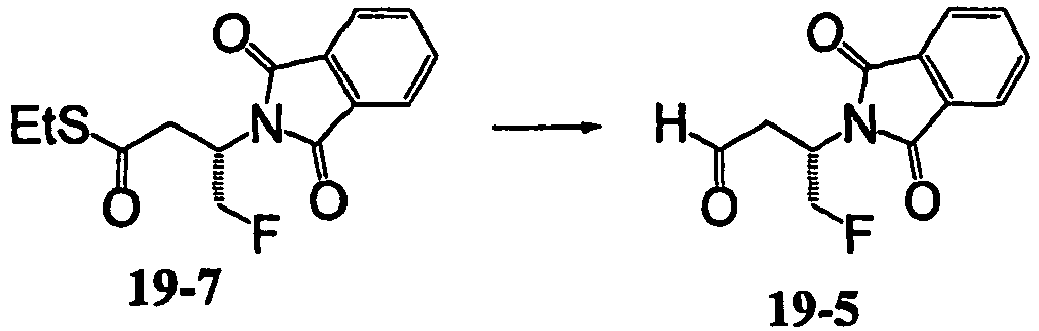
- 19-7 (0.20 mmol) was dissolved in dry acetone (10ml). 10% Palladium (0.02mmol)) on carbon was then added under an atmosphere of nitrogen. Triethyl silane (0.5mmol)) was then added. Bubbling occurred after about 10 seconds, and the reaction was allowed to continue until the bubbling ceased (30 min). The reaction completion was determined using LCMS. The reaction mixture was filtered through a celite plug. The plug was washed twice with methylene chloride, and the filtrate was then concentrated to give the crude product. The crude product was used in the next reaction.
- Starting from the other (R) enantiomer, (R)-3-((benzyloxy)carbonyl)-2-(1,3-dioxoisoindolin-2-yl)propanoic acid, leads to the other enantiomer.
- The compounds in the table below were prepared using the methodology described in the previous Examples and Methods. The following tables also include compounds described in the experimentals. The starting materials used in the synthesis are recognizable to one of skill in the art and are commercially available or may be prepared using known methods. The compounds were named using ACD/Name Batch Version 5.04 (Advanced Chemistry Development Inc.; Toronto, Ontario; www.acdlabs.com).
No. Compound MH+ Name 1. 
481.3 N-(3-aminopropyl)-N-[(1R)-1-(1-benzyl-4-phenyl-1H-imidazol-2-yl)-2-methylpropyl]-4-methylbenzamide 2. 
467.3 N-(3-aminopropyl)-N-[(1R)-1-(1-benzyl-4-phenyl-1H-imidazol-2-yl)-2-methylpropyl]benzamide 3. 
515.3 N-(3-aminopropyl)-N-[(R)-(1-benzyl-4-phenyl-1H-imidazol-2-yl)(phenyl)methyl]-4-methylbenzamide 4. 
501.3 N-(3-aminopropyl)-N-[(R)-(1-benzyl-4-phenyl-1H-imidazol-2-yl)(phenyl)methyl]benzamid e 5. 
545.2 N-(3-aminopropyl)-N-{(1R)-1-[1-benzyl-4-(3-bromophenyl)-1H-imidazol-2-yl]-2-methylpropyl}benzamide 6. 
559.2 N-(3-aminopropyl)-N-{(1R)-1-[1-benzyl-4-(3-bromophenyl)-1H-imidazol-2-yl]-2-methylpropyl}-4-methylbenzamide 7. 
613.2 N-(3-aminopropyl)-N-{(1R)-1-[1-benzyl-4-(3-bromophenyl)-1H-imidazol-2-yl]-2-methylpropyl)-4-(trifluoromethyl)benzamide 8. 
581.2 N-(3-aminopropyl)-N-((1R)-1-[1-benzyl-4-(3-bromophenyl)-1H-imidazol-2-yl]-2-methylpropyl}-2,4-difluorobenzamide 9. 
495.3 N-(3-aminopropyl)-4-methyl-N-{2-methyl-1-[1-(3-methylbenzyl)-4-phenyl-1H-imidazol-2-yl]propyl}benzamide 10. 
497.3 N-(3-aminopropyl)-N-{(1R)-1-[1-benzyl-4-(3-methoxyphenyl)-1H-imidazol-2-yl]-2-methylpropyl}benzamide 11. 
511.3 N-(3-aminopropyl)-N-{(1R)-1-[1-benzyl-4-(3-methoxyphenyl)-1H-imidazol-2-yl]-2-methylpropyl}-4-methylbenzamide 12. 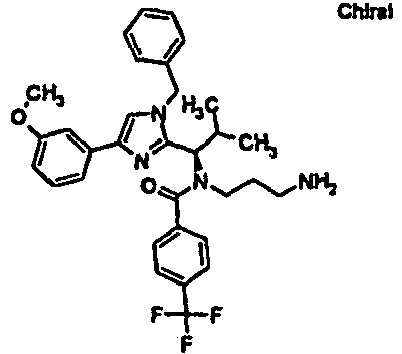
565.3 N-(3-aminopropyl)-N-{(1R)-1-[1-benzyl-4-(3-methoxyphenyl)-1H-imidazol-2-yl]-2-methylpropyl}-4-(trifluoromethyl)benzamide 13. 
533.3 N-(3-aminopropyl)-N((1R)-1-[1-benzyl-4-(3-methoxyphenyl)-1H-imidazol-2-yl]-2-methylpropyl}-2,4-difluorobenzamide 14. 
501.2 N-(3-aminopropyl)-N-{(1R)-1-[1-benzyl-4-(3-chlorophenyl)-1H-imidazol-2-yl]-2-methylpropyl}benzamide 15. 
515.2 N-(3-aminopropyl)-N-((1R)-1-[1-benzyl-4-(3-chlorophenyl)-1H-imidazol-2-yl]-2-methylpropyl}-4-methylbenzamide 16. 
569.2 N-(3-aminopropyl)-N-{(1R)-1-[1-benzyl-4-(3-chlorophenyl)-1H-imidazol-2-yl]-2-methylpropyl]-4-(trifluoromethyl)benzamide 17. 
537.2 N-(3-aminopropyl)-N-((1R)-1-[1-benzyl-4-(3-chlorophenyl)-1H-imidazol-2-yl]-2-methylpropyl}-2,4-difluorobenzamide 18. 
481.3 N-(3-aminopropyl)-N-{(1R)-1-[1-benzyl-4-(4-methylphenyl)-1H-imidazol-2-yl]-2-methylpropyl)benzamide 19. 
495.3 N-(3-aminopropyl)-N-{(1R)-1-[1-benzyl-4-(4-methylphenyl)-1H-imidazol-2-yl]-2-methylpropyl}-4-methylbenzamide 20. 
549.3 N-(3-aminopropyl)-N-{(1R)-1-[1-benzyl-4-(4-methylphenyl)-1H-imidazol-2-yl]-2-methylpropyl}-4-(trifluoromethyl)benzamide 21. 
517.3 N-(3-aminopropyl)-N-{(1R)-1-[1-benzyl-4-(4-methylphenyl)-1H-imidazol-2-yl]-2-methylpropyl)-2,4-difluorobenzamide 22. 
495.3 N-(3-aminopropyl)-N-[(1R)-1-(1-benzyl-4-phenyl-1H-imidazol-2-yl)-2,2-dimethylpropyl]-4-methylbenzamide 23. 
481.3 N-(3-aminopropyl)-N-((1R)-1-(1-benzyl-4-phenyl-1H-imidazol-2-yl)-2,2-dimethylpropyl]benzamide 24. 
517.3 N-(3-aminopropyl)-N-{(1R)-1-[1-(3,5-difluorobenzyl)-4-phenyl-1H-imidazol-2-yl]-2-methylpropyl}-4-methylbenzamide 25. 
503.2 N-(3-aminopropyl)-N-{(1R)-1-[1-(3,5-difluorobenzyl)-4-phenyl-1H-imidazol-2-yl]-2-methylpropyl}benzamide 26. 
637.2 N-{(1R)-1-[1-benzyl-4-(3-bromophenyl)-1H-imidazol-2-yl]-2-methylpropyl}-4-methyl-N-{3-[(methylsulfonyl)amino]pro pyl}benzamide 27. 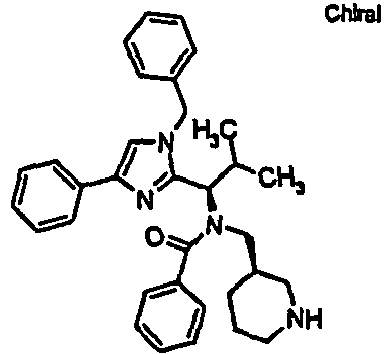
507.3 N-[(1R)-1-(1-benzyl-4-phenyl-1H-imidazol-2-yl)-2-methylpropyl]-N-[(3R)-piperidin-3-ylmethyl]benzamide 28. 
507.3 N-[(1R)-1-(1-benzyl-4-phenyl-1H-imidazol-2-yl)-2-methylpropyl]-N-[(3S)-piperidin-3-ylmethyl]benzamide 29. 
495.3 N-(3-aminopropyl)-4-methyl-N-{(1R)-2-methyl-1-[1-(4-methylbenzyl)-4-phenyl-1H-imidazol-2-yl]propyl}benzamide 30. 
481.3 N-(3-aminopropyl)-N-{(1R)-2-methyl-1-[1-(4-methylbenzyl)-4-phenyl-1H-imidazol-2-yl]propyl}benzamidc 31. 
495.3 N-(3-aminopropyl)-4-methyl-N-{(1R)-2-methyl-1-[1-(2-methylbenzyl)-4-phenyl-1H-imidazol-2-yl]propyl}benzamide 32. 
480.65 N-(3-aminopropyl)-N-{(1R)-2-methyl-1-[1-(2-methylbenzyl)-4-phenyl-1H-imidazol-2-yl]propyl}benzamide 33. 
578.4 N-[(1R)-1-(1-benzyl-4-phenyl-1H-imidazol-2-yl)-2-methylpropyl]-N-[2,2-dimethyl-3-(4-methylpiperazin-1-yl)propyl]benzamide 34. 
592.4 N-[(1R)-1-(1-benzyl-4-phenyl-1H-imidazol-2-yl)-2-methylpropyl]-N-[2,2-dimethyl-3-(4-methylpiperazin-1-yl)propyl]-4-methylbenzamide 35. 
521.3 N-[(1R)-1-(1-benzyl-4-phenyl-1H-imidazol-2-yl)-2-methylpropyl]-4-methyl-N-[(3R)-piperidin-3-ylmethyl]benzamide 36. 
521.3 N-[(1R)-1-(1-benzyl-4-phenyl-1H-imidazol-2-yl)-2-methylpropyl]-4-methyl-N-[(3S)-piperidin-3-ylmethyl]benzamide 37. 
535.3 N-(3-aminopropyl)-N-((1R)1-{1-benzyl-4-[2-(trifluoromethyl)phenyl]-1H-imidazol-2-yl}-2-methylpropyl)benzamide 38. 
549.3 N-(3-aminopropyl)-N-((1R)-1-{1-benzyl-4-[2-(trifluoromethyl)phenyl]-1H-imidazol-2-yl}-2-methylpropyl)-4-methylbenzamide 39. 
571.2 N-(3-aminopropyl)-N-((1R)-1-{1-benzyl-4-[2-(trifluoromethyl)phenyl]-1H-imidazol-2-yl}-2-methylpropyl)-2,4-difluorobenzamide 40. 
531.2 N-(3-aminopropyl)-N-((1R)-1-[1-benzyl-4-(3-chlorophenyl)-1H-imidazol-2-yl]-2-methylpropyl}-4-methoxybenzamide 41. 
535.2 N-(3-aminopropyl)-N-{(1R)-1-[1-benzyl-4-(3-chlorophenyl)-1H-imidazol-2-yl]-2-methylpropyl}-3-chlorobenzamide 42. 
535.2 N-(3-aminopropyl)-N-{(1R)-1-[1-benzyl-4-(3-chlorophenyl)-1H-imidazol-2-yl)-2-methylpropyl}4-chlorobenzamide 43. 
557.3 N-(3-aminopropyl)-N-{(1R)-1-[1-benzyl-4-(3-chlorophenyl)-1H-imidazol-2-yl]-2-methylpropyl}-4-tert-butylbenzamide 44. 
569.2 N-(3-aminopropyl)-N-{(1R)-1-[1-benzyl-4-(3-chlorophenyl)-1H-imidazol-2-yl]-2-methylpropyl}-3,4-dichlorobenzamide 45. 
647.2 N-{(1R)-1-[1-benzyl-4-(3-bromophenyl)-1H-imidazol-2-yl]-2-methylpropyl}-N-{3-[(5-cyanopyridin-2-yl)amino]propyl}benzamide 46. 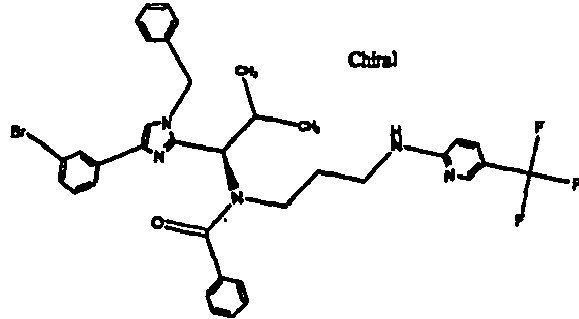
690.2 N-{(1R)-1-[1-benzyl-4-(3-bromophenyl)-1H-imidazol-2-yl]-2-methylpropyl}-N-(3-{[5-(trifluoromethyl)pyridin-2-yl]amino}propyl)benzamide 47. 
493.3 N-[(1R)-1-(1-benzyl-4-phenyl-1H-imidazol-2-yl)-2-methylpropyl]-N-piperidin-4-ylbenzamide 48. 
507.3 N-[(1R)-1-(1-benzyl-4-phenyl-1H-imidazol-2-yl)-2-methylpropyl]-4-methyl-N-piperidin-4-ylbenzamide 49. 
529.3 N-[(1R)-1-(1-benzyl-4-phenyl-1H-imidazol-2-yl)-2-methylpropyl]-2,4-difluoro-N-piperidin-4-ylbenzamide 50. 
507.3 N-(3-aminopropyl)-N-{(1R)-1-[1-benzyl-4-(3-chlorophenyl)-1H-imidazol-2-yl]-2-methylpropyl}cyclohexanec arboxamide 51. 
536.2 N-(3-aminopropyl)-N-{(1R)-1-[1-benzyl-4-(3-chlorophenyl)-1H-imidazol-2-yl]-2-methylpropyl}-6-chloronicotinamide 52. 
515.2 N-(3-aminopropyl)-N-{(1R)-1-[1-benzyl-4-(3-chlorophenyl)-1H-imidazol-2-yl]-2,2-dimethylpropyl}benzamide 53. 
529.3 N-(3-aminopropyl)-N-{(1R)-1-[1-benzyl-4-(3-chlorophenyl)-1H-imidazol-2-yl]-2,2-dimethylpropyl]-4-methylbenzamide 54. 
551.2 N-(3-aminopropyl)-N-{(1R)-1-[4-(3-chlorophenyl)-1-(2,4-difluorobenzyl)-1H-imidazol-2-yl]-2,2-dimethylpropyl}benzamide 55. 
565.2 N-(3-aminopropyl)-N-{(1R)-1-[4-(3-chlorophenyl)-1-(2,4-difluorobenzyl)-1H-imidazol-2-yl]-2,2-dimethylpropyl}-4-methylbenzamide 56. 
523.3 N-[(1R)-1-(1-benzyl-4-phenyl-1H-imidazol-2-yl)-2-methylpropyl]-N-[3-(dimethylamino)-2,2-dimethylpropyl]benzamide 57. 
537.4 N-[(1R)-1-(1-benzyl-4-phenyl-1H-imidazol-2-yl)-2-methylpropyl]-N-[3-(dimethylamino)-2,2-dimethylpropyl]-4-methylbenzamide 58. 
550.2 N-(3-aminopropyl)-N-{(1R)-1-[1-benzyl-4-(3-chlorophenyl)-1H-imidazol-2-yl]-2,2-dimethylpropyl}-6-chloronicotinamide 59. 
586.2 N-(3-aminopropyl)-6-chloro-N-{(1R)-1-[4-(3-chlorophenyl)-1-(3,5-difluorobenzyl)-1H-imidazol-2-yl]-2,2-dimethylpropyl}nicotinamid e 60. 
481.3 N-(3-aminopropyl)-N-[(1R)-1-(1-benzyl-5-methyl-4-phenyl-1H-imidazol-2-yl)-2-methylpropyl]benzamide 61. 
495.3 N-(3-aminopropyl)-N-[(1R)-1-(1-benzyl-5-methyl-4-phenyl-1H-imidazol-2-yl)-2-methylpropyl]-4-methylbenzamide 62. 
617.3 N-(3-aminopropyl)-N-[(1R)-1-(1-benzyl-5-methyl-4-phenyl-1H-imidazol-2-yl)-2-methylpropyl]-2,4-difluorobenzamide 63. 
516.2 N-(3-aminopropyl)-N-[(1R)-1-(1-benzyl-5-methyl-4-phenyl-1H-imidazol-2-yl)-2-methylpropyl]-6-chloronicotinamide 64. 
535.2 N-(3-aminopropyl)-N-{(1R)-1-[1-benzyl-4-(3-chlorophenyl)-1H-imidazol-2-yl]-2-methylpropyl}-2-chlorobenzamide 65. 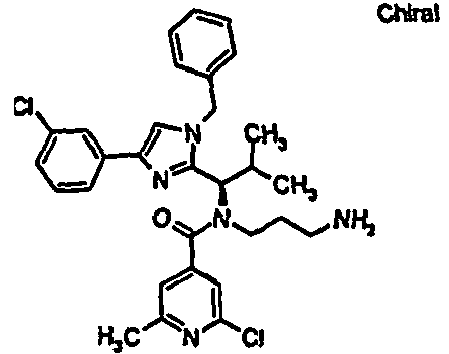
550.2 N-(3-aminopropyl)-N-{(1R)-1-[1-benzyl-4-(3-chlorophenyl)-1H-imidazol-2-yl]-2-methylpropyl)-2-chloro-6-methylisonicotinamide 66. 
491.2 N-(3-aminopropyl)-N-{(1R)-1-[1-benzyl-4-(3-chlorophenyl)-1H-imidazol-2-yl]-2-methylpropyl}-3-furamide 67. 
505.2 N-(3-aminopropyl)-N-{(1R)-1-[1-benzyl-4-(3-chlorophenyl)-1H-imidazol-2-yl]-2-methylpropyl}-5-methyl-2H-imidazole-4-carboxamide 68. 
531.2 N-(3-aminopropyl)-N-{(1R)-1-[1-benzyl-4-(3-chlorophenyl)-1H-imidazol-2-yl]-2-methylpropyl}-2-methoxybenzamide 69. 
502.2 N-(3-aminopropyl)-N-{(1R)-1-[1-benzyl-4-(3-chlorophenyl)-1H-imidazol-2-yl]-2-methylpropyl}pyridine-2-carboxamide 70. 
519.3 N-(3-aminopropyl)-N-{(1R)-1-[1-benzyl-4-(3-chlorophenyl)-1H-imidazol-2-yl]-2-methylpropyl}-1,5-dimethyl-1H-pyrazole-3-carboxamide 71. 
481.3 N-(3-aminopropyl)-N-[(1R)-1-(1-benzyl-4-phenyl-1H-imidazol-2-yl)-1,2-dimethylpropyl]benzamide 72. 
495.3 N-(3-aminopropyl)-N-[(1R)-1-(1-benzyl-4-phenyl-1H-imidazol-2-yl)-1,2-dimethylpropyl]-4-methylbenzamide 73. 
467.3 N-(2-aminoethyl)-N-[(1R)-1-(1-benzyl-4-phenyl-1H-imidazol-2-yl)-2-methylpropyl]-4-methylbenzamide 74. 
153.3 N-(2-aminoethyl)-N-[(1R)-1-(1-benzyl-4-phenyl-1H-imidazol-2-yl)-2-methylpropyl]benzamide 75. 
508.2 N-(3-aminopropyl)-N-{(1R)-1-[1-benzyl-4-(3-chlorophenyl)-1H-imidazol-2-yl]-2-methylpropyl}-1,3-thiazole-4-carboxamide 76. 
541.3 N-{(1R)-1-[1-benzyl-4-(3-chlorophenyl)-1H-imidazol-2-yl]-2,2-dimethylpropyl}-N-(pyrrolidin-3-ylmethyl)benzamide 77. 
577.2 N-{(1R)-1-[4-(3-chlorophenyl)-1-(3,5-difluorobenzyl)-1H-imidazol-2-yl]-2,2-dimethylpropyl}-N-(pyrrolidin-3-ylmethyl)benzamide 78. 
537.2 N-(3-aminopropyl)-N-{(1R)-1-[1-benzyl-4-(3-chlorophenyl)-1H-imidazol-2-yl]-2-methylpropyl}benzenesulfo namide 79. 
506.2 N-(3-aminopropyl)-N-{(1R)-1-[1-benzyl-4-(3-chlorophenyl)-1H-imidazol-2-yl]-2-methylpropyl}-4-methylisoxazole-3-carboxamide 80. 
492.2 N-(3-aminopropyl)-N-{(1R)-1-[1-benzyl-4-(3-chlorophenyl)-1H-imidazol-2-yl]-2-methylpropyl}isoxazole-3-carboxamide 81. 
505.2 N-(3-aminopropyl)-N-{(1R)-1-[1-benzyl-4-(3-chlorophenyl)-1H-imidazol-2-yl]-2-methylpropyl}-5-methyl-1H-pyrazole-3-carboxamide 82. 
536.2 N-(3-aminopropyl)-N-{(1R)-1-[1-benzyl-4-(3-chlorophenyl)-1H-imidazol-2-yl]-2-methylpropyl}-2,4-dimethyl-1,3-thiazole-5-carboxamide 83. 
495.2 N-(3-aminopropyl)-N-{(1R)-1-[1-benzyl-4-(3-chlorophenyl)-1H-imidazol-2-yl]-2-methylpropyl}tetrahydrofura n-3-carboxamide 84. 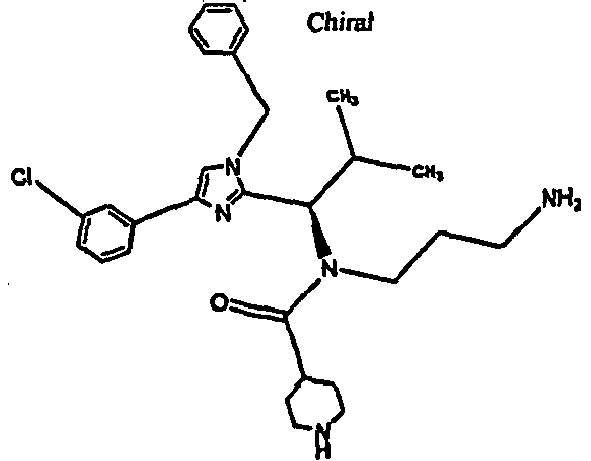
508.3 N-(3-aminopropyl)-N-{(1R)-1-[1-benzyl-4-(3-chlorophenyl)-1H-imidazol-2-yl]-2-methylpropyl}piperidine-4-carboxamide 85. 
523.2 2-amino-N-(3-aminopropyl)-N-{(1R)-1-[1-benzyl-4-(3-chlorophenyl)-1H-imidazol-2-yl]-2-methylpropyl)-1,3-thiazole-4-carboxamide 86. 
504.3 N-[(1R)-1-(1-benzyl-4-phenyl-1H-imidazol-2-yl)-2,2-dimethylpropyl]-N-(1H-imidazol-4-ylmethyl)benzamide 87. 
531.3 N-[(1R)-1-(1-benzyl-4-phenyl-1H-imidazol-2-yl)-2,2-dimethylpropyl]-N-[(2-hydroxypyridin-4-yl)methyl]benzamide 88. 
531.3 N-[(1R)-1-(1-benzyl-4-phenyl-1H-imidazol-2-yl)-2,2-diinethylpropyl]-N-[(6-hydroxypyridin-3-yl)methyl]benzamide 89. 
515.3 N-[(1R)-1-(1-benzyl-4-phenyl-1H-imidazol-2-yl)-2,2-dimethylpropyl]-N-(pyridin-3-ylmethyl)benzamide 90. 
535.3 N-[(1R)-1-(1-benzyl-4-phenyl-1H-imidazol-2-yl)-2,2-dimethylpropyl]-N-[3-(cyclobutylamino)propyl]be nzamide 91. 
507.3 N-[(1R)-1-(1-benzyl-4-phenyl-1H-imidazol-2-yl)-2,2-dimethylpropyl)-N-(pyrrolidin-3-ylmethyl)benzamide 92. 
496.3 N-(3-aminopropyl)-N-[(1R)-1-(1-benzyl-4-phenyl-1H-imidazol-2-yl)-2,2-dimethylpropyl]-6-methylnicotinamide 93. 
535.3 N-[(1R)-1-(1-benzyl-4-phenyl-1H-imidazol-2-yl)-2,2-dimethylpropyl]-N-{3-[(cyclopropylmethyl)amino] propyl}benzamide 94. 
704.4 N-[(1R)-1-(1-benzyl-4-phenyl-1H-imidazol-2-yl)-2,2-dimethylpropyl]-N-[3-({[5-(pyridin-3-yloxy)-1H-indazol-3-yl]methyl)amino)propyl]ben zamide 95. 
584.3 N-[(1R)-1-(1-benzyl-4-phenyl-1H-imidazol-2-yl)-2,2-dimethylpropyl]-N-[(5-methoxy-1H-indazol-3-yl)methyl]benzamide 96. 
629.3 N-((1R)-1-{1-benzyl-4-phenyl-1H-imidazol-2-yl)-2,2-dimethylpropyl]-N-(3-{[(6-fluoro-1H-indazol-3-yl)methyl]amino}propyl)ben zamide 97. 
647.3 N-[(1R)-1-{1-benzyl-4-phenyl-1H-imidazol-2-yl)-2,2-dimethylpropyl]-N-{[5-(pyridin-3-yloxy)-1H-indazol-3-yl]methyl}benzamide 98. 
482.3 N-[(1R)-1-(1-benzyl-4-phenyl-1H-imidazol-2-yl)-2,2-dimethylpropyl]-N-(3-hydroxypropyl)benzamide 99. 
499.3 N-(3-aminopropyl)-N-[(1R)-1-(1-benzyl-4-phenyl-1H-imidazol-2-yl)-2,2-dimethylpropyl]-1,5-dimethyl-1H-pyrazole-3-carboxamide 100. 
538.3 N-[(1R)-1-(1-benzyl-4-phenyl-1H-imidazol-2-yl)-2,2-dimethylpropyl]-N-((3R)-3,5-diamino-5-oxopentyl]benzamide 101. 
538.3 N-{3-[(aminoacetyl)amino]propyl }-N-[(1R)-1-(1-benzyl-4-phenyl-1H-imidazol-2-yl)-2,2-dimethylpropyl]benzamide 102. 
524.3 N-{2-[(aminoacetyl)amino]ethyl}-N-[(1R)-1-(1-benzyl-4-phenyl-1H-imidazol-2-yl)-2,2-dimethylpropyl]benzamide 103. 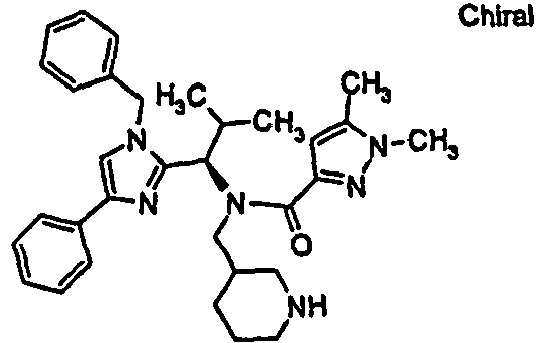
525.3 N-[(1R)-1-(1-benzyl-4-phenyl-1H-imidazol-2-yl)-2-methylpropyl)-1,5-dimethyl-N-(piperidin-3-ylmethyl)-1H-pyrazole-3-carboxamide 104. 
495.2 (2R)-N-(3-aminopropyl)-N-{(1R)-1-[1-benzyl-4-(3-chlorophenyl)-1H-imidazol-2-yl]-2-methylpropyl}tetrahydrofura n-2-carboxamide 105. 
495.2 (2S)-N-(3-aminopropyl)-N-{(1R)-1-[1-benzyl-4-(3-chlorophenyl)-1H-imidazol-2-yl]-2-methylpropyl}tetrahydrofura n-2-carboxamide 106. 
503.2 N-(3-aminopropyl)-N-{(1R)-1-[1-benzyl-4-(3-chlorophenyl)-1H-imidazol-2-yl]-2-methylpropyl}pyrazine-2-carboxamide 107. 
586.3 3-{benzoyl[(1R)-1-(1-benzyl-4-phenyl-1H-imidazol-2-yl)-2,2-dimethylpropyl]amino}prop yl benzoate 108. 
595.3 N-{(1R)-1-[4-(3-chlorophenyl)-1-(3,5-difluorobenzyl)-1H-imidazol-2-yl]-2,2-dimethylpropyl}-1,5-dimethyl-N-[(3R)-pyrrolidin-3-ylmethyl]-1H-pyrazole-3-carboxamide 109. 
595.3 N-{(1R)-1-[4-(3-chlorophenyl)-1-(3,5-difluorobenzyl)-1H-imidazol-2-yl]-2,2-dimethylpropyl}-1,5-dimethyl-N-[(3S)-pyrrolidin-3-ylmethyl]-1H-pyrazole-3-carboxamide 110. 
573.2 N-(3-aminopropyl)-N-{(1R)-1-[1-benzyl-4-(3-chlorophenyl)-1H-imidazol-2-yl]-2-methylpropyl}-1-methyl-3-(trifluoromethyl)-1H-pyrazole-4-carboxamide 111. 
539.2 N-(3-aminopropyl)-N-{(1R)-1-[1-benzyl-4-(3-chlorophenyl)-1H-imidazol-2-yl]-2-methylpropyl}-5-chloro-1-methyl-1H-pyrazole-4-carboxamide 112. 
482.3 N-(3-aminopropyl)-N-{(1R)-1-[1-benzyl-4-(3-chlorophenyl)-1H-imidazol-2-yl]-2-methylpropyl}-2-(dimethylamino)acetamide 113. 
532.3 N-[(1R)-1-(1-benzyl-4-phenyl-1H-imidazol-2-yl)-2,2-dimethylpropyl]-N-[3-(1H-imidazol-2-yl)propyl]benzamide 114. 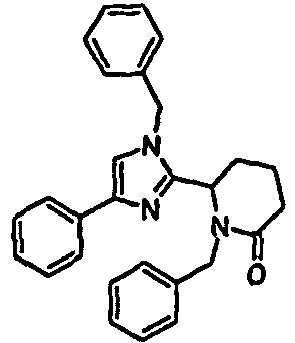
422.2 1-benzyl-6-(1-benzyl-4-phenyl-1H-imidazol-2-yl)piperidin-2-one 115. 
456.2 1-benzyl-6-[1-(3-chlorobenzyl)-4-phenyl-1H-imidazol-2-yl]piperidin-2-one 116. 
485.3 N-(3-aminopropyl)-N-[(1R)-1-(1-benzyl-4-phenyl-1H-imidazol-2-yl)-2-methylpropyl]-1,5-dimethyl-1H-pyrazole-3-carboxamide 117. 
525.3 N-[(1R)-1-(1-benzyl-4-phenyl-1H-imidazol-2-yl)-2,2-dimethylpropyl]-N-{3-[(2-hydroxyethyl)amino]propyl} benzamide 118. 
521.3 N-[(1R)-1-(1-benzyl-4-phenyl- H-imidazol-2-yl)-2,2-dimethylpropyl]-N-[3-(cyclopropylamino)propylJb enzamide 119. 
474.2 N-(3-aminopropyl)-N-{(1R)-2-methyl-1-[4-phenyl-1-(1,3-thiazol-4-ylmethyl)-1H-imidazol-2-yl]propyl}benzamide 120. 
488.2 N-(3-aminopropyl)-4-methyl-N-{(1R)-2-methyl-1-[4-phenyl-1-(1,3-thiazol-4-ylmethyl)-1H-imidazol-2-yl]propyl}benzamide 121. 
510.2 N-(3-aminopropyl)-2,4-difluoro-N-{(1R)-2-methyl-1-[4-phenyl-1-(1,3-thiazol-4-ylmethyl)-1H-imidazol-2-yl]propyl}benzamide 122. 
509.2 N-(3-aminopropyl)-6-chloro-N-{(1R)-2-methyl-1-[4-phenyl-1-(1,3-thiazol-4-ylmethyl)-1H-imidazol-2-yl]propyl}nicotinarnide 123. 
482.3 N-(3-aminopropyl)-N-[(1R)-1-(1-benzyl-4-pyridin-2-yl-1H-imidazol-2-yl)-2,2-dimethylpropyl]benzamide 124. 
496.3 N-(3-aminopropyl)-N-[(1R)-1-(1-benzyl-4-pyridin-2-yl-1H-imidazol-2-yl)-2,2-dimethylpropyl]-4-methylbenzamide 125. 
518.3 N-(3-aminopropyl)-N-[(1R)-1-(1-benzyl-4-pyridin-2-yl-1H-imidazol-2-yl)-2,2-dimethylpropyl]-2,4-difluorobenzamide 126. 
517.3 N-(3-aminopropyl)-N-[(1R)-1-(1-benzyl-4-pyridin-2-yl-1H-imidazol-2-yl)-2,2-dimethylpropyl]-6-chloronicotinamide Table 2 No. Compound MH+ Name 127 
483.2 N-(2-amino-3-hydroxypropyl)-N-[(1R)-1-(1-benzyl-4-phenyl-1H-imidazol-2-yl)-2-methylpropyl]benzamide 128 
481.2 N-(3-aminopropyl)-N-[(1R)-1-(1-benzyl-4-phenyl-1H-imidazol-2-yl)-3-methylbutyl]benzamide 129 
495.3 N-(3-aminopropyl)-N-[(1R)-1-(1-benzyl-4-phenyl-1H-imidazol-2-yl)-3-methylbutyl]-4-methylbenzamide 130 
481.3 N-(3-aminopropyl)-N-[(1R,2R)-1-(1-benzyl-4-phenyl-1H-imidazol-2-yl)-2-methylbutyl]benzamide 131 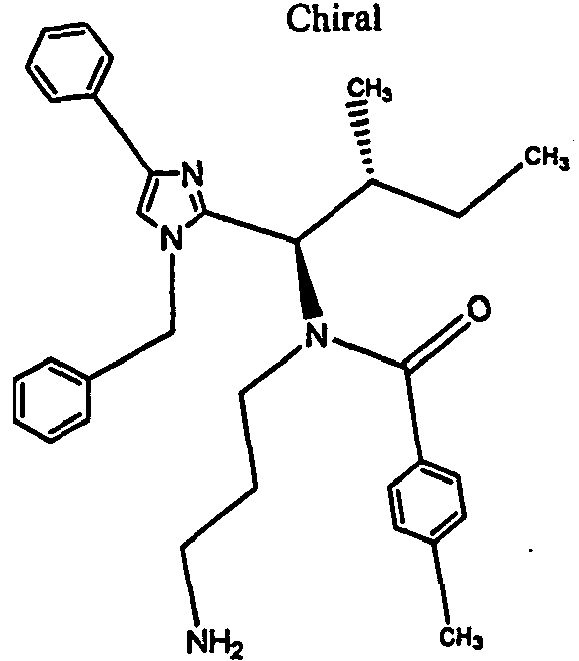
495.3 N-(3-aminopropyl)-N-[(1R,2R)-1-(1-benzyl-4-phenyl-1H-imidazol-2-yl)-2-methylbutyl]-4-methylbenzamide 132 
481.3 N-(3-aminopropyl)-N-[(1R,2S)-1-(1-benzyl-4-phenyl-1H-imidazol-2-yl)-2-methylbutyl]benzamide 133 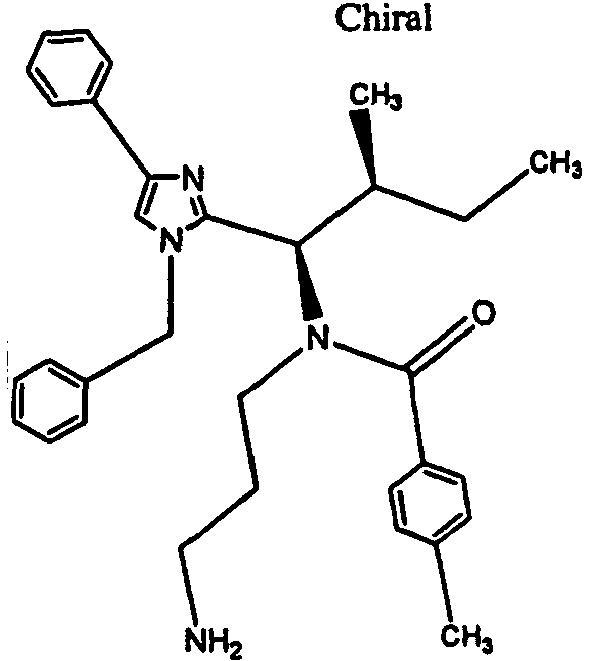
495.2 N-(3-aminopropyl)-N-[(1R,2S)-1-(1-benzyl-4-phenyl-1H-imidazol-2-yl)-2-methylbutyl]-4-methylbenzamide 134 
506.2 N-(3-aminopropyl)-N-{(1R)-1-[1-benzyl-4-(3-chlorophenyl)-1H-imidazol-2-yl]-2-methylpropyl}-5-methylisoxazole-4-carboxamide 135 
439.2 N-(3-aminopropyl)-N-{(1R)-1-[1-benzyl-4-(3-chlorophenyl)-1H-imidazol-2-yl]-2-methylpropyl}acetamide 136 
519.2 N-(3-aminopropyl)-N-{(1R)-1-[1-benzyl-4-(3-chlorophenyl)-1H-imidazol-2-yl]-2-methylpropyl}-2-(4-fluorophenoxy)acetamide 137 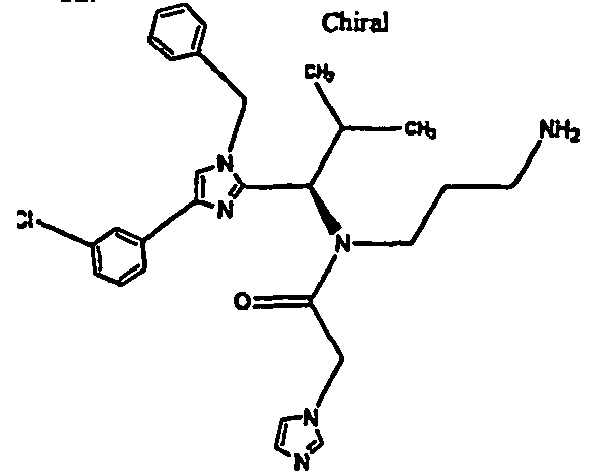
506.2 N-(3-aminopropyl)-N-{(1R)-1-[1-benzyl-4-(3-chlorophenyl)-1H-imidazol-2-yl]-2-methylpropyl}-2-(1H-imidazol-1-yl)acetamide 138 
525.3 N-(3-aminopropyl)-N-{(1R)-1-[1-benzyl-4-(3-chlorophenyl)-1H-imidazol-2-yl]-2-methylpropyl}-2-morpholin-4-ylacetamide 139 
539.3 [(3-{benzoyl[(1R)-1-(1-benzyl-4-phenyl-1H-imidazol-2-yl)-2,2-dimethylpropyl]amino prop yl)amino]acetic acid 140 
155.2 N-(3-aminopropyl)-N-{(1R)-1-[1-benzyl-4-(3-chlorophenyl)-1H-imidazol-2-yl]-2-methylpropyl}-2-hydroxyacetamide 141 
469.2 N-(3-aminopropyl)-N-{(1R)-1-[1-benzyl-4-(3chlorophenyl)-1H-imidazol-2-yl]-2-methylpropyl}-2-methoxyacetamide 142 
435.3 N-(3-aminopropyl)-N-[(1R)-1-(1-benzyl-4-phenyl-1H-imidazol-2-yl)-2,2-dimethylpropyl]-2-hydroxyacetamide 143 
449.3 N-(3-aminopropyl)-N-[(1R)-1-(1-benzyl-4-phenyl-1H-imidazol-2-yl)-2,2-dimethylpropyl]-2-methoxyacetamide 144 
533.3 N-(3-aminopropyl)-N-{(1R)-1-[1-benzyl-4-(3-chlorophenyl)-1H-imidazol-2-yl]-2-methylpropyl}-1-ethyl-3-methyl-1H-pyrazole-5-carboxamide 145 
167.3 ethyl[(3-{benzoyl[(1R)-1-(1-benzyl-4-phenyl-1H-imidazol-2-yl)-2,2-dimethylpropyl]amino}prop yl)amino]acetate 146 
580.2 N-{3-[(2-amino-3-methylbutanoyl)amino]propyl}-N-[(1R)-1-(1-benzyl-4-phenyl-1H-imidazol-2-yl)-2,2-dimethylpropyl]benzamide 147 
509.3 N-(3-aminopropyl)-N-{(1R)-1-[1-benzyl-4-(3-chlorophenyl)-1H-imidazol-2-yl]-2-methylpropyl}tetrahydro-2H-pyran-4-carboxamide 148 
469.2 N-(3-aminopropyl)-N-{(1R)-1-[1-benzyl-4-(3-cblorophenyl)-1H-imidazol-2-yl]-2-methylpropyl}-2-(methylamino)acetamide 149 
166.2 N-[(1R)-1-(1-benzyl-4-phenyl-1H-imidazol-2-yl)-2,2-dimethylpropyl]-N-propylbenzamide 150 
480.3 N-[(1R)-1-(1-benzyl-4-phenyl-1H-imidazol-2-yl)-2,2-dimethylpropyl]-N-butylbenzamide 151 
498.3 N-[(1R)-1-(1-benzyl-4-phenyl-1H-imidazol-2-yl)-2,2-dimethylpropyl]-N-butyl-1,5-dimethyl-1H-pyrazole-3-carboxamide 152 
448.2 [[(1R)-1-(1-benzyl-4-phenyl-1H-imidazol-2-yl)-2,2-dimethylpropyl](butyl)amin o](oxo)acetic acid 153 
434.2 [[(1R)-1-(1-benzyl-4-phenyl-1H-imidazol-2-yl)-2,2-dimethylpropyl](propyl)ami no](oxo)acetic acid 154 
579.3 N-[(1R)-1-(1-benzyl-4-phenyl-1H-imidazol-2-yl)-2,2-dimethylpropyl]-N-{3-[2-(hydroxymethyl)piperidin-1-yl]propyl}benzamide 155 
569.3 N-[(1R)-1-(1-benzyl-4-phenyl-1H-imidazol-2-yl)-2,2-dimethylpropyl]-N-{3-[bis(2-hydroxyethyl)amino]propyl }benzamide 156 
451.2 1-(2-amino-1-phenylethyl)-6-(1-benzyl-4-phenyl-1H--imidazol-2-yl)piperidin-2-one 157 
332.2 -6-(1-benzyl-4-phenyl-1H-imidazol-2-yl)piperidin-2-one 158 
499.2 N-[(2S)-3-amino-2-fluoropropyl]-N-[(1R)-1-(1-benzyl-4-phenyl-1H-imidazol-2-yl)-2,2-dimethylpropyl]benzamide 159 
555.3 N-[(1R)-1-(1-benzyl-4-phenyl-1H-imidazol-2-yl)-2,2-dimethylpropyl]-N-(3-{[2-hydroxy-1-(hydroxymethyl)ethyl]amin o}propyl)benzamide 160 
587.3 N-[(1R)-1-(1-benzyl-4-phenyl-1H-imidazol-2-yl)-2,2-dimethylpropyl]-N-(3-{[2-(hydroxymethyl)phenyl]ami no}propyl)benzamide 161 
527.3 N-((1R)-1-[1-benzyl-4-(3-chlorophenyl)-1H-imidazol-2-yl]-2-methylpropyl)-N-piperidin-4-ylbenzamide 162 
527.3 N-{(1R)-1-[1-benzyl-4-(3-chlorophenyl)-1H-imidazol-2-yl]-2-methylpropyl}-N-(piperidin-3-ylmethyl)benzamide 163 
470.2 2-(3-amino-2-oxopyridin-1(2H)-yl)-N-[(1R)-1-(1-benzyl-4-phenyl-1H-imidazol-2-yl)-2,2-dimethylpropyl]acetamide 164 
513.2 N-{(1R)-1-[1-benzyl-4-(3-chlorophenyl)-1H-imidazol-2-yl]-2-methylpropyl}-2-pyrrolidin-3-ylbenzamide 165 
552.3 (1R,3S)-3-{[(2-aminoethyl)sulfonyl]amino} -N-[(1 R)-1-(1-benzyl-4-phenyl-1H-imidazol-2-yl)-2,2-dimethylpropyl]cyclohexane carboxamide 166 
502.3 (1R,3S)-3-[(aminoacetyl)amino]-N-[(1R)-1-(1-benzyl-4-phenyl-1H-imidazol-2-yl)-2,2-dimethylpropyl]cyclohexane carboxamide 167 
570.2 N-(3-aminopropyl)-N-{(1R)-1-[1-benzyl-4-(3-chlorophenyl)-1H-imidazol-2-yl]-2-methylpropyl}-6-(trifluoromethyl)nicotinamide 168 
499.2 N-[(2R)-3-amino-2-fluoropropyl]-N-[(1R)-1-(1-benzyl-4-phenyl-1H-imidazol-2-yl)-2,2-dimethylpropyl]benzamide 169 
508.2 (3R)-N-(3-aminopropyl)-N-{(1R)-1-[1-benzyl-4-(3-chlorophenyl)-1H-imidazol-2-yl]-2-methylpropyl piperidine-3 -carboxamide 170 
508.2 (3S)-N-(3-aminopropyl)-N-{(1R)-1-[1-benzyl-4-(3-chlorophenyl)-1H-imidazol-2-yl]-2-methylpropyl}piperidine-3-carboxamide 171 
506.2 N-(3-aminopropyl)-N-{(1R)-1-[1-benzyl-4-(3-chlorophenyl)-1H-imidazol-2-yl]-2-methylpropyl}-2-(1H-1,2,4-triazol-1-yl)acetamide 172 
437.2 [(5R)-1-benzoyl-5-(1-benzyl-4-phenyl-1H-imidazol-2-yl)pyrrolidin-2-yl]methylamine 173 
506.05 N-(3-aminopropyl)-N-{(1R)-1-[1-benzyl-4-(3-chlorophenyl)-1H-imidazol-2-yl]-2-methylpropyl}-2-(4H-1,2,4-triazol-4-yl)acetamide 174 
559.2 N-(3-aminopropyl)-N-{(1R)-1-[1-benzyl-4-(3-chlorophenyl)-1H-imidazol-2-yl]-2-methylpropyl}-2,1,3-benzothiadiazole-4-carboxamide 175 
497.3 N-[(2S)-3-amino-2-hydroxypropyl]-N-[(1R)-1-(1-benzyl-4-phenyl-1H-imidazol-2-yl)-2,2-dimethylpropyl]benzamide 176 
517.3 N-[(2S)-3-amino-2-fluoropropyl]-N-[(1R)-1-(1-benzyl-4-phenyl-1H-imidazol-2-yl)-2,2-dimethylpropyl]-1,5-dimethyl-1H-pyrazole-3-carboxamide 177 
541.3 N-[(1R)-1-(1-benzyl-4-phenyl-1H-imidazol-2-yl)-2,2-dimethylpropyl]-1,5-dimethyl-N-[(2S)-morpholin-2-ylmethyl]-1H-pyrazole-3-carboxamide 178 
541.3 N-[(1R)-1-(1-benzyl-4-phenyl-1H-imidazol-2-yl)-2,2-dimethylpropyl]-1,5-dimethyl-N-[(2R)-morpholin-2-ylmethyl]-1H-pyrazole-3-carboxamide 179 
515.3 N-[(2S)-3-amino-2-hydroxypropyl]-N-[(1R)-1-(1-benzyl-4-phenyl-1H-imidazol-2-yl)-2,2-dimethylpropyl]-1,5-dimethyl-1H-pyrazole-3-carboxamide 180 
465.3 N-[(2S)-3-amino-2-hydroxypropyl]-N-[(1R)-1-(1-benzyl-4-phenyl-1H-imidazol-2-yl)-2,2-dimethylpropyl]-2-methoxyacetamide 181 
493.3 N-[(1R)-1-(1-benzyl-4-phenyl-1H-imidazol-2-yl)-2,2-dimethylpropyl]-2-pyrrolidin-3-ylbenzamide 182 
505.2 N-(3-aminopropyl)-N-{(1R)-1-[1-benzyl-4-(3-chlorophenyl)-1H-imidazol-2-yl]-2-methylpropyl}-2-(1H-pyrazol-1-yl)acetamide 183 
517.2 N-[(2R)-3-amino-2-fluoropropyl]-N-[(1R)-1-(1-benzyl-4-phenyl-1H-imidazol-2-yl)-2,2-dimethylpropyl]-1,5-dimethyl-1H-pyrazole-3-carboxamide 184 
435.2 methyl 3-aminopropyl[(1R)-1-(1-benzyl-4-phenyl-1H-imidazol-2-yl)-2,2-dimethylpropyl]carbamate 185 
487.3 N-(3-aminopropyl)-N-[(1R)-1-(1-benzyl-4-phenyl-1H-imidazol-2-yl)-2,2-dimethylpropyl]-2-(1H-tetrazol-1-yl)acetamide 186 
487.3 N-(3-aminopropyl)-N-[(1R)-1-(1-benzyl-4-phenyl-1H-imidazol-2-yl)-2,2-dimethylpropyl]-2-(2H-tetrazol-2-yl)acetamide 187 
486.3 N-(3-aminopropyl)-N-[(1R)-1-(1-benzyl-4-phenyl-1H-imidazol-2-yl)-2,2-dimethylpropyl]-2-(1H-1,2,4-triazol-1-yl)acetamide 188 
486.3 N-(3-aminopropyl)-N-[(1R)-1-(1-benzyl-4-phenyl-1H-imidazol-2-yl)-2,2-dimethylpropyl]-2-(4H-1,2,4-triazol-4-yl)acetamide 189 
491.3 N-[(1R)-1-(1-benzyl-4-phenyl-1H-imidazol-2-yl)-2,2-dimethylpropyl]-2-methoxy-N-[(2S)-morpholin-2-ylmethyl]acetamide 190 
491.3 N-[(1R)-1-(1-benzyl-4-phenyl-1H-imidazol-2-yl)-2,2-dimethylpropyl]-2-methoxy-N-[(2R)-morpholin-2-ylmethyl]acetamide 191 
483.2 N-(3-aminopropyl)-N-[(1S)-1-(1-benzyl-4-phenyl-1H-imidazol-2-yl)-2-hydroxy-2-methylpropyl]benzamide 192 
477.3 N-[(1R)-1-(1-benzyl-4-phenyl-1H-imidazol-2-yl)-2,2-dimethylpropyl]-2-hydroxy-N-[(2S)-morpholin-2-ylmethyl]acetamide 193 
477.3 N-[(1R)-1-(1-benzyl-4-phenyl-1H-imidazol-2-yl)-2,2-dimethylpropyl]-2-hydroxy-N-[(2R)-morpholin-2-ylmethyl]acetamide 194 
475.3 (2S)-N-(3-aminopropyl)-N-[(1R)-1-(1-benzyl-4-phenyl-1H-imidazol-2-yl)-2,2-dimethylpropyl]tetrahydrofu ran-2-carboxamide 195 
526.3 N-(3-aminopropyl)-N-{(1R)-1-[4-(3-chlorophenyl)-1-(3-cyanobenzyl)-1H-imidazol-2-yl]-2-methylpropyl}benzamide 196 
540.3 N-(3-aminopropyl)-N-{(1R)-1-[4-(3-chlorophenyl)-1-(3-cyanobenzyl)-1H-imidazol-2-yl]-2-methylpropyl}-4-methylbenzamide 197 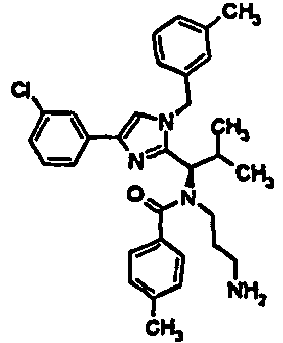
529.3 N-(3-aminopropyl)-N-{(1R)-1-[4-(3-chlorophenyl)-1-(3-methylbenzyl)-1H-imidazol-2-yl]-2-methylpropyl}-4-methylbenzamide 198 
514.3 N-(3-aminopropyl)-N-{(1R)-1-[4-(3-chlorophenyl)-1-(3-methylbenzyl)-1-imidazol-2-yl]-2-methylpropyl}benzamide 199 
149.3 ethyl 3-aminopropyl[(1R)-1-(1-benzyl-4-phenyl-1H-imidazol-2-yl)-2,2-dimethylpropyl]carbamate 200 
191.4 neopentyl 3-aminopropyl[(1R)-1-(1-benzyl-4-phenyl-1H-imidazol-2-yl)-2,2-dimethylpropyl]carbamate 201 
477.3 isobutyl 3-aminopropyl [(1R)-1-(1-benzyl-4-phenyl-1H-imidazol-2-yl)-2,2-dimethylpropyl]carbamate : 202 
444.2 propyl 3-aminopropyl[(1R)-1-(1-benzyl-4-phenyl-1H-imidazol-2-yl)-2,2-dimethylpropyl]carbamate 203 
444.3 N-(3-aminopropyl)-N-[(1R)-1-(1-benzyl-4-phenyl-1H-imidazol-2-yl)-2,2-dimethylpropyl]-2-cyanoacetamide 204 
475.3 N-[(1R)-1-(1-benzyl-4-phenyl-1H-imidazol-2-yl)-2,2-dimethylpropyl]-2-methoxy-N-[(3R)-pyrrolidin-3-ylmethyl]acetamide 205 
475.3 N-[(1R)-1-(1-benzyl-4-phenyl-1H-imidazol-2-yl)-2,2-dimethylpropyl]-2-methoxy-N-[(3S)-pyrrolidin-3-ylmethyl]acetamide 206 
477.3 butyl 3-aminopropyl[(1R)-1-(1-benzyl-4-phenyl-1H-imidazol-2-yl)-2,2-dimethylpropyl]carbamate 207 
461.3 N-[(1R)-1-(1-benzyl-4-phenyl-1H-imidazol-2-yl)-2,2-dimethylpropyl]-2-hydroxy-N-[(3R)-pyrrolidin-3-ylmethyl]acetamide 208 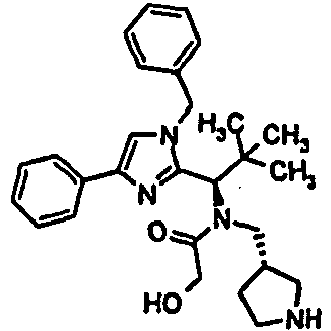
461.3 N-[(1R)-1-(1-benzyl-4-phenyl-1H-imidazol-2-yl)-2,2-dimethylpropyl]-2-hydroxy-N-[(3S)-pyrmlidin-3-ylmethyl]acetamide 209 
507.3 N-[(1R)-1-(1-benzyl-4-phenyl-1H-imidazol-2-yl)-2,2-dimethylpropyl]-N-[(3S)-pyrrolidin-3-ylmethyl]benzamide 210 
505.2 N-[(2R)-3-amino-2-fluoropropyl]-N-[(1R)-1-(1-benzyl-4-phenyl-1H-imidazol-2-yl)-2,2-dimethylpropyl]-2-(2H-tetrazol-2-yl)acetamide 211 
505.3 N-[(2R)-3-amino-2-fluoropropyl]-N-[(1R)-1-(1-benzyl-4-phenyl-1H-imidazol-2-yl)-2,2-dimethylpropyl]-2-(1H-tetrazol-1-yl)acetamide 212 
467.2 N-[(2R)-3-amino-2-fluoropropyl]-N-[(1R)-1-(1-benzyl-4-phenyl-1H-imidazol-2-yl)-2,2-dimethylpropyl]-2-methoxyacetamide 213 
467.2 N-[(2S)-3-amino-2-fluoropropyl]-N-[(1R)-1-(1-benzyl-4-phenyl-1H-imidazol-2-yl)-2,2-dimethylpropyl]-2-methoxyacetamide 214 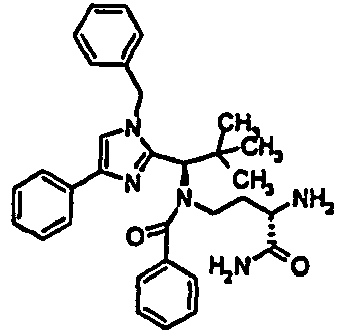
524.3 N-[(1R)-1-(1-benzyl-4-phenyl-1H-imidazol-2-yl)-2,2-dimethylpropyl]-N-[(3S)-3,4-diamino-4-oxobutyl]benzamide 215 
524.3 N-[(1R)-1-(1-benzyl-4-phenyl-1H-imidazol-2-yl)-2,2-dimethylpropyl]-N-[(3R)-3,4-diamino-4-oxobutyl]benzamide 216 
511.3 N-[(3S)-3-amino-4-hydroxybutyl]-N-[(1R)-1-(1-benzyl-4-phenyl-1H-imidazol-2-yl)-2,2-dimethylpropyl]benzamide 217 
525.3 (2S)-2-amino-4-{benzoyl[(1R)-1-(1-benzyl-4-phenyl-1H-imidazol-2-yl)-2,2-dimethylpropyl]amino}buta noic acid 218 
453.2 N-[(2R)-3-amino-2-fluoropropyl]-N-[(1R)-1-(1-benzyl-4-phenyl-1H-imidazol-2-yl)-2,2-dimethylpropyl]-2-hydroxyacetamide 219 
487.3 N-(3-aminopropyl)-N-[(1R)-1-(1-benzyl-4-phenyl-1H-imidazol-2-yl)-2,2-dimethylpropyl]-2-(1H-tetrazol-5-yl)acetamide 220 
513.3 N-[(1R)-1-(1-benzyl-4-phenyl-1H-imidazol-2-yl)-2,2-dimethylpropyl]-N-[(3S)-pyrrolidin-3-ylmethyl]-2-(1H-tetrazol-1-yl)acetamide 221 
513.3 N-[(1R)-1-(1-benzyl-4-phenyl-1H-imidazol-2-yl)-2,2-dimethylpropyl]-N-[(3S)-pyrrolidin-3-ylmethyl]-2-(2H-tetrazol-2-yl)acetamide 222 
522.3 N-[(1R)-1-(1-benzyl-4-phenyl-1H-imidazol-2-yl)-2,2-dimethylpropyl]-6-methyl-N-[(3S)-pyrrolidin-3-ylmethyl]nicotinamide 223 
461.3 N-(azetidin-3-ylmethyl)-N-[(1R)-1-(1-benzyl-4-phenyl-1H-imidazol-2-yl)-2,2-dimethylpropyl]-2-methoxyacetamide 224 
532.3 N-{(1R)-1-[1-(3-cyanobenzyl)-4-phenyl-1H-imidazol-2-yl]-2,2-dimethylpropyl}-N-(pyrrolidin-3-ylmethyl)benzamide 225 
521.3 N-((1R)-2,2-dimethyl-1-[1-(3-methylbenzyl)-4-phenyl-1H-imidazol-2-yl]propyl)-N-(pyrrolidin-3-ylmethyl)benzamide 226 
451.3 N-[(2S)-3-amino-2-hydroxypropyl]-N-[(1R)-1-(1-benzyl-4-phenyl-1H-imidazol-2-yl)-2,2-dimethylpropyl]-2-hydroxyacetamide 227 
511.2 N-[(1R)-1-(1-benzyl-4-phenyl-1H-imidazol-2-yl)-2,2-dimethylpropyl]-N-[3-(methoxyamino)propyl]benz amide 228 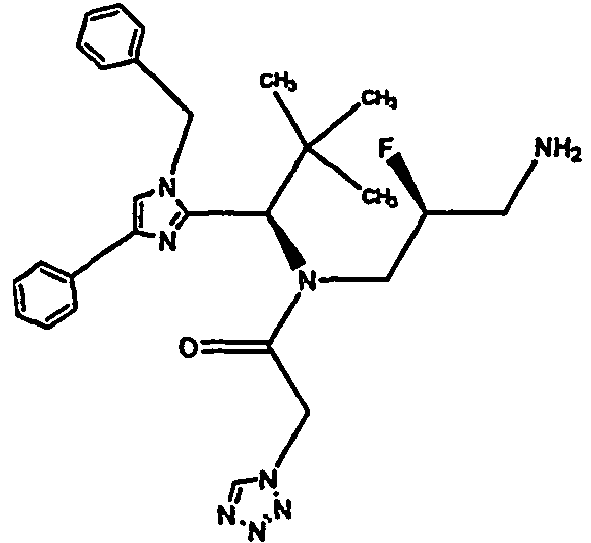
505.2 N-[(2S)-3-amino-2-fluoropropyl]-N-[(1R)-1-(1-benzyl-4-phenyl-1H-imidazol-2-yl)-2,2-dimethylpropyl]-2-(1H-tetrazol-1-yl)acetamide 229 
505.2 N-[(2S)-3-amino-2-fluoropropyl]-N-[(1R)-1-(1-benzyl-4-phenyl-1H-imidazol-2-yl)-2,2-dimethylpropyl]-2-(2H-tetrazol-2-yl)acetamide 230 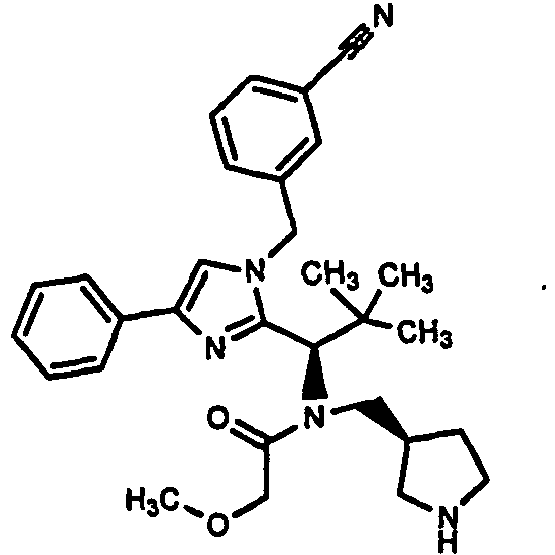
500.3 N-{(1R)-1-[1-(3-cyanobenzyl)-4-phenyl-1H-imidazol-2-yl]-2,2-dimethylpropyl}-2-methoxy-N-[(3S)-pyrrolidin-3-ylmethyl]acetamide 231 
500.3 N-{(1R)-1-[1-(3-cyanobenzyl)-4-phenyl-1H-imidazol-2-yl]-2,2-dimethylpropyl}-2-methoxy-N-[(3R)-pyrrolidin-3-ylmethyl]acetamide 232 
506.3 N-(3-aminopropyl)-N-{(1R)-1-[1-(3-cyanobenzyl)-4-phenyl-1H-imidazol-2-yl]-2,2-dimethylpropyl}benzamide 233 
474.3 N-(3-aminopropyl)-N-{(1R)-1-[1-(3-cyanobenzyl)-4-phenyl-1H-imidazol-2-yl]-2,2-dimethylpropyl}-2-methoxyacetamide 234 
477.3 2-hydroxy-N-{(1R)-1-[1-(3-hydroxybenzyl)-4-phenyl-1H-imidazol-2-yl]-2,2-dimethylpropyl}-N-(pyrrolidin-3-ylmethyl)acetamide 235 
489.3 N-{(1R)-2,2-dimethyl-1-[1-(3-methylbenzyl)-4-phenyl-1H-imidazol-2-yl]propyl}-2-methoxy-N-[(3S)-pyrrolidin-3-ylmethyl]acetamide 236 
489.3 N-{(1R)-2,2-dimethyl-1-[1-(3-methylbenzyl)-4-phenyl-1H-imidazol-2-yl]propyl}-2-methoxy-N-[(3R)-pyrrolidin-3-ylmethyl]acetamide 237 
463.3 N-(3-aminopropyl)-N-{(1R)-2,2-dimethyl-1-[1-(3-methylbenzyl)-4-phenyl-1H-imidazol-2-yl]propyl}-2-methoxyacetamide 238 
529.3 N-[(3S)-3-amino-4-hydroxybutyl]-N-[(1R)-1-(1-benzyl-4-phenyl-1H-imidazol-2-yl)-2,2-dimethylpropyl]-1,5-dimethyl-1H-pyrazole-3-carboxamide 239 
503.2 N-(3-amino-2-hydroxypropyl)-N-[(1R)-1-(1-benzyl-4-phenyl-1H-imidazol-2-yl)-2,2-dimethylpropyl]-2-(1H-tetrazol-1-yl)acetamide 240 
503.2 N-(3-amino-2-hydroxypropyl)-N-[(1R)-1-(1-benzyl-4-phenyl-1H-imidazol-2-yl)-2,2-dimethylpropyl]-2-(2H-tetrazol-2-yl)acetamide 241 
525.3 N-[(1R)-1-(1-benzyl-4-phenyl-1H-imidazol-2-yl)-2,2-dimethylpropyl]-1,5-dimethyl-N-[(3S)-pyrrolidin-3-ylmethyl]-1H-pyrazole-3-carboxamide 242 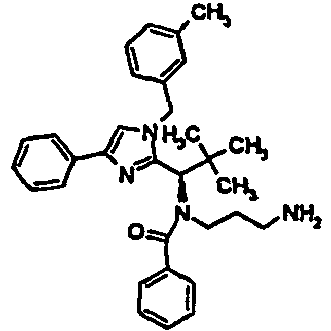
495.3 N-(3-aminopropyl)-N-{(1R)-2,2-dimethyl-1-[1-(3-methylbenzyl)-4-phenyl-1H-imidazol-2-yl]propyl}benzamide 243 
493.3 N-(azetidin-3-ylmethyl)-N-[(1R)-1-(1-benzyl-4-phenyl-1H-imidazol-2-yl)-2,2-dimethylpropyl]benzamide 244 
447.3 N-(azetidin-3-ylmethyl)-N-[(1R)-1-(1-benzyl-4-phenyl-1H-imidazol-2-yl)-2,2-dimethylpropyl]-2-hydroxyacetamide 245 
511.3 N-(azetidin-3-ylmethyl)-N-[(1R)-1-(-benzyl-4-phenyl-1H-imidazol-2-yl)-2,2-dimethylpropyl]-1,5-dimethyl-1H-pyrazole-3-carboxamide 246 
479.3 N-[(3S)-3-amino-4-hydroxybutyl]-N-[(1R)-1-(1-benzyl-4-phenyl-1H-imidazol-2-yl)-2,2-dimethylpropyl]-2-methoxyacetamide 247 
504.3 N-[(2S)-3-amino-2-fluoropropyl]-N-[(1R)-1-(1-benzyl-4-phenyl-1H-imidazol-2-yl)-2,2-dimethylpropyl]-2-(1H-1,2,3-triazol-1-yl)acetamide 248 
504.3 N-[(2S)-3-amino-2-fluoropropyl]-N-[(1R)-1-(1-benzyl-4-phenyl-1H-imidazol-2-yl)-2,2-dimethylpropyl]-2-(2H-1,2,3-triazol-2-yl)acetamide 249 
517.3 N-[(3S)-3-amino-4-hydroxybutyl]-N-[(1R)-1-(1-benzyl-4-phenyl-1H-imidazol-2-yl)-2,2-dimethylpropyl]-2-(1H-tetrazol-1-yl)acetamide 250 
517.3 N-[(3S)-3-amino-4-hydroxybutyl]-N-[(1R)-1-(1-benzyl-4-phenyl-1H-imidazol-2-yl)-2,2-dimethylpropyl]-2-(2H-tetrazol-2-yl)acetamide 251 
516.3 N-[(3S)-3-amino-4-hydroxybutyl]-N-[(1 R)-I-(1-benzyl-4-phenyl-1H-imidazol-2-yl)-2,2-dimethylpropyl]-2-(1H-1,2,3-triazol-1-yl)acetamide 252 
421.3 N-[(1R)-1-(1-benzyl4-phenyl-1H-imidazol-2-yl)-2,2-dimethylpropyl]-N-[(3-fluoropyrrolidin-3-yl)methyl]amine 253 
491.3 N-[(1R)-1-(1-benzyl-4-phenyl-1H-imidazol-2-yl)-2,2-dimethylpropyl]-N-{[(3S)-3-hydroxypyrrolidin-3-yl]methyl}-2-methoxyacetamide 254 
491.3 N-[(1R)-1-(1-benzyl-4-phenyl-1H-imidazol-2-yl)-2,2-dimethylpropyl]-N-{[(3R)-3-hydroxypyrrolidin-3-yl]methyl}-2-methoxyacetamide 255 
491.3 N-[(1R)-1-(1-benzyl-4-phenyl-1H-imidazol-2-yl)-2,2-dimethylpropyl]-N-[(3-hydroxypyrrolidin-3-yl)methyl]-2-methoxyacetamide 256 
508.3 N-(azetidin-3-ylmethyl)-N-[(1R)-1-(1-benzyl-4-phenyl-1H-imidazol-2-yl)-2,2-dimethylpropyl]-6-methylnicotinamide 257 
529.3 N-[(1R)-1-(1-benzyl-4-phenyl-1H-imidazol-2-yl)-2,2-dimethylpropyl]-N-{[(3S)-3-fluoropyrrolidin-3-yl]methyl}-1,5-dimethyl-1H-pyrazole-3-carboxamide 258 
529.3 N-[(1R)-1-(1-benzyl-4-phenyl-1H-imidazol-2-yl)-2,2-dimethylpropyl]-N-{[(3R)-3-fluoropyrrolidin-3-yl]methyl}-1,5-dimethyl-1H-pyrazole-3-carboxamide 259 
529.3 N-[(1R)-1-(1-benzyl-4-phenyl-1H-imidazol-2-yl)-2,2-dimethylpropyl]-N-[(3-fluoropyrrolidin-3-yl)methyl]-1,5-dimethyl-1H-pyrazole-3-carboxamide 260 
525.3 N-[(1R)-1-(1-benzyl-4-phenyl-1H-imidazol-2-yl)-2,2-dimethylpropyl]-N-{[(3S)-3-fluoropyrrolidin-3-yl]methyl}benzamide 261 
525.3 N-[(1R)-1-(1-benzyl-4-phenyl-1H-imidazol-2-yl)-2,2-dimethylpropyl]-N-{[(3R)-3-fluoropyrrolidin-3-yl]methyl}benzamide 262 
525.3 N-[(1R)-1-(1-benzyl-4-phenyl-1H-imidazol-2-yl)-2,2-dimethylpropyl]-N-[(3-fluoropyrrolidin-3-yl)methyl]benzamide 263 
451.3 N-(3-aminopropyl)-2-hydroxy-N-{(1R)-1-[1-(3-hydroxybenzyl)-4-phenyl-1H-imidazol-2-yl]-2,2-dimethylpropyl}acetamide 264 
523.3 N-{(1R)-1-[1-(3-hydroxybenzyl)-4-phenyl-1H-imidazol-2-yl]-2,2-dimethylpropyl}-N-(pyrrolidin-3-ylmethyl)benzamide 265 
513.3 N-(3-aminopropyl)-N-{(1R)-2,2-dinlethyl-1-[1-(3-methylbenzyl)-4-phenyl-1H-imidazol-2-yl]propyl}-1,5-dimethyl-1H-pyrazole-3-carboxamide 266 
539.3 N-{(1R)-2,2-dimethyl-1-[1-(3-methylbenzyl)-4-phenyl-1H-imidazol-2-yl]propyl}-1,5-dimethyl-N-(pyrrolidin-3-ylmethyl)-1H-pyrazole-3-carboxamide 267 
497.3 N-(3-aminopropyl)-N-{(1R)-1-[1-(3-hydroxybenzyl)-4-phenyl-1H-imidazol-2-yl]-2,2-dimethylpropyl benzamide 268 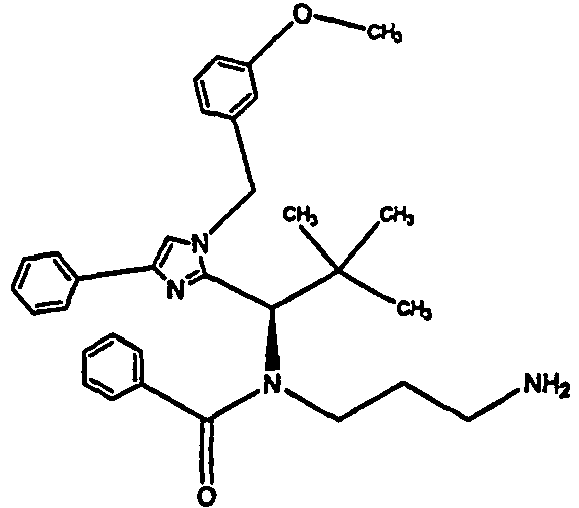
511.3 N-(3-aminopropyl)-N-{(1R)-1-[1-(3-methoxybenzyl)-4-phenyl-1H-imidazol-2-yl]-2,2-dimethylpropyl}benzamide 269 
479.3 N-(3-aminopropyl)-2-methoxy-N-{(1R)-1-[1-(3-methoxybenzyl)-4-phenyl-1H-imidazol-2-yl]-2,2-dimethylpropyl}acetamide 270 
460.3 N-(3-aminopropyl)-N-{(1R)-1-[1-(3-cyanobenzyl)-4-phenyl-1H-imidazol-2-yl]-2,2-dimethylpropyl}-2-hydroxyacetamide 271 
529.3 N-(3-aminopropyl)-N-{(1R)-1-[1-(3-methoxybenzyl)-4-phenyl-1H-imidazol-2-yl]-2,2-dimethylpropyl}-1,5-dimethyl-1H-pyrazole-3-carboxamide 272 
525.3 N-[(3S)-3-amino-4-methoxybutyl]-N-[(1R)-1-(1-benzyl-4-phenyl-1H-imidazol-2-yl)-2,2-dimethylpropyl]benzamide 273 
524.3 N-(3-aminopropyl)-N-{(1R)-1-[1-(3-cyanobenzyl)-4-phenyl-1H-imidazol-2-yl]-2,2-dimethylpropyl}-1,5-dimethyl-1H-pyrazole-3-carboxamide 274 
550.3 N-{(1R)-1-[1-(3-cyanobenzyl)-4-phenyl-1H-imidazol-2-yl]-2,2-dimethylpropyl}-1,5-dimethyl-N-(pyrrolidin-3-ylmethyl)-1H-pyrazole-3-carboxamide 275 
486.3 N-{(1R)-1-[1-(3-cyanobenzyl)-4-phenyl-1H-imidazol-2-yl]-2,2-dimethylpropyl}-2-hydroxy-N-[(3S)-pyrrolidin-3-ylmethyl]acetamide 276 
504.3 N-[(2R)-3-amino-2-fluoropropyl]-N-[(1R)-1-(1-benzyl-4-phenyl-1H-imidazol-2-yl)-2,2-dimethylpropyl]-2-(1H-1,2,3-triazol-1-yl)acetamide 277 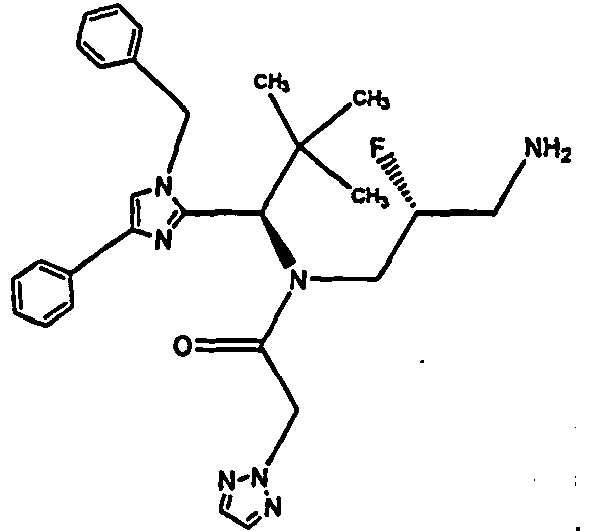
504.3 N-[(2R)-3-amino-2-fluoropropyl]-N-[(1R)-1-(1-benzyl-4-phenyl-1H-imidazol-2-yl)-2,2-dimethylpropyl]-2-(2H-1,2,3-triazol-2-yl)acetamide 278 
523.3 N-[(1R)-1-(1-benzyl-4-phenyl-1H-imidazol-2-yl)-2,2-dimethylpropyl]-N-{[(3S)-3-hydroxypyrrolidin-3-yl]methyl}benzamide 279 
523.3 N-[(1R)-1-(1-benzyl-4-phenyl-1H-imidazol-2-yl)-2,2-dimethylpropyl]-N-{[(3R)-3-hydroxypyrrolidin-3-yl]methyl}benzamide 280 
523.3 N-[(1R)-1-(1-benzyl-4-phenyl-1H-imidazol-2-yl)-2,2-dimethylpropyl]-N-[(3-hydroxypyrrolidin-3-yl)methyl]benzamide 281 
489.3 N-[(1R)-1-(1-benzyl-4-phenyl-1H-imidazol-2-yl)-2,2-dimethylpropyl]-2-ethoxy-N-[(3S)-pyrrolidin-3-ylmethyl]acetamide 282 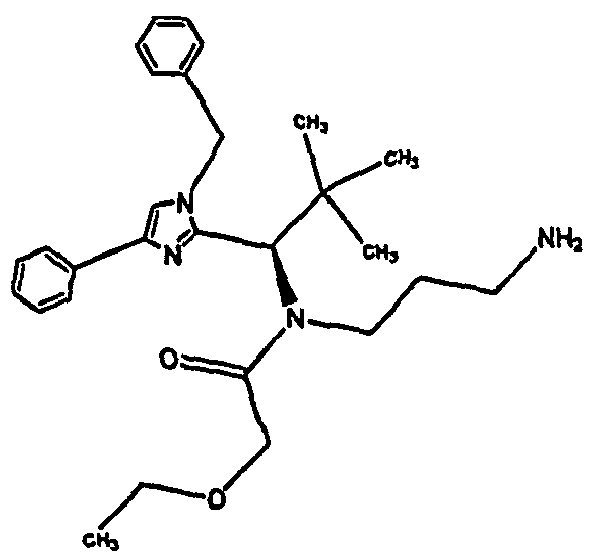
463.3 N-(3-aminopropyl)-N-[(1R)-1-(1-benzyl-4-phenyl-1H-imidazol-2-yl)-2,2-dimethylpropyl]-2-ethoxyacetamide 283 
527.3 N-[(1R)-1-(1-benzyl-4-phenyl-1H-imidazol-2-yl)-2,2-dimethylpropyl]-N-{[(3S)-3-hydroxypyrrolidin-3-yl]methyl}-1,5-dimethyl-1H-pyrazole-3-carboxamide 284 
527.3 N-[(1R)-1-(1-benzyl-4-phenyl-1H-imidazol-2-yl)-2,2-dimethylpropyl]-N-{[(3R)-3-hydroxypyrrolidin-3-yl]methyl}-1,5-dimethyl-1H-pyrazole-3-carboxamide 285 
527.3 N-[(1R)-1-(1-benzyl-4-phenyl-1H-imidazol-2-yl)-2,2-dimethylpropyl]-N-[(3-hydroxypyrrolidin-3-yl)methyl]-1,5-dimethyl-1H-pyrazole-3-carboxamide 286 
507.3 N-[(2S)-3-amino-2-fluoropropyl]-N-[(1S)-1-(1-benzyl-4-phenyl-1H-imidazol-2-yl)-2-hydroxy-2-methylpropyl]-2-(1H-tetrazol-1-yl)acetamide 287 
507.3 N-[(2S)-3-amino-2-fluoropropyl]-N-[(1S)-1-(1-benzyl-4-phenyl-1H-imidazol-2-yl)-2-hydroxy-2-methylpropyl]-2-(2H-tetrazol-2-yl)acetamide 288 
523.2 N-[(2S)-3-amino-2-fluoropropyl]-N-{(1R)-1-[1-benzyl-4-(3-fluorophenyl)-1H-imidazol-2-yl]-2,2-dimethylpropyl)-2-(1H-tetrazol-1-yl)acetamide 289 
523.2 N-[(2S)-3-amino-2-fluoropropyl]-N-{(1R)-1-[1-benzyl-4-(3-fluorophenyl)-1H-imidazol-2-yl]-2,2-dimethylpropyl}-2-(2H-tetrazol-2-yl)acetamide 290 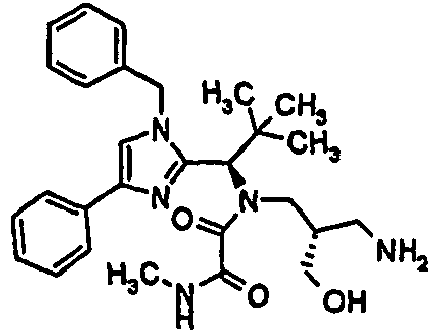
492.3 N-[(2S)-3-amino-2(hydroxymethyl)propyl]-N-[(1R)-1-(1-benzyl-4-phenyl-1H-imidazol-2-yl)-2,2-dimethylpropyl]-N'-methylethanediamide 291 
492.3 N-[(2R)-3-amino-2-(hydroxymethyl)propyl]-N-[(1R)-1-(1-benzyl-4-phenyl-1H-imidazol-2-yl)-2,2-dimethylpropyl]-N'-methylethanediamide 292 
479.3 N-[(3R)-3-amino-4-hydroxybutyl]-N-[(1R)-1-(1-benzyl-4-phenyl-1H-imidazol-2-yl)-2,2-dimethylpropyl]-2-methoxyacetamide 293 
517.2 N-[(3R)-3-amino-4-hydroxybutyl]-N-[(1R)-1-(1-benzyl-4-phenyl-1H-imidazol-2-yl)-2,2-dimethylpropyl]-2-(1H-tetrazol-1-yl)acetamide 294 
517.2 N-[(3R)-3-amino-4-hydroxybutyl]-N-[(1R)-1-(1-benzyl-4-phenyl-1H-imidazol-2-yl)-2,2-dimethylpropyl]-2-(2H-tetrazol-2-yl)acetamide 295 
493.3 N-[(1R)-1-(1-benzyl-4-phenyl-1H-imidazol-2-yl)-2,2-dimethylpropyl]-N-{[(3S)-3-fluoropyrrolidin-3-yl]methyl}-2-methoxyacetamide 296 
493.3 N-[(1R)-1-(1-benzyl-4-phenyl-1H-imidazol-2-yl)-2,2-dimethylpropyl]-N-{[(3R)-3-fluoropyrrolidin-3-yl]methyl}-2-methoxyacetamide 297 
491.3 N-[(1R)-1-(1-benzyl-4-phenyl-1H-imidazol-2-yl)-2,2-dimethylpropyl]-N-{[(3R,4R)-4-hydroxypyrrolidin-3-yl]methyl}-2-methoxyacetamide 298 
191.3 N-[(1R)-1-(1-benzyl-4-phenyl-1H-imidazol-2-yl)-2,2-dimethylpropyl]-N-{[(3S,4S)-4-hydroxypyrrolidin-3-yl]methyl]-2-methoxyacetamide 299 
523.3 N-[(1R)-1-(1-benzyl-4-phenyl-1H-imidazol-2-yl)-2,2-dimethylpropyl]-N-{[(3R,4R)-4-hydroxypyrrolidin-3-yl]methyl}benzamide 300 
523.3 N-[(1R)-1-(1-benzyl-4-phenyl-1H-imidazol-2-yl)-2,2-dimethylpropyl]-N-{[(3S,4S)-4-hydroxypyrrolidin-3-yl]methyl}benzamide 301 
535.3 N-[(3S)-3-amino-4-hydroxybutyl]-N-{(1R)-1-[1-benzyl-4-(3-fluorophenyl)-1H-imidazol-2-yl]-2,2-dimethylpropyl}-2-(1H-tetrazol-1-yl)acetamide 302 
535.3 N-[(3S)-3-amino-4-hydroxybutyl]-N-{(1R)-1-[1-benzyl-4-(3-fluorophenyl)-1H-imidazol-2-yl]-2,2-dimethylpropyl}-2-(2H-tetrazol-2-yl)acetamide 303 
497.3 N-[(3S)-3-amino-4-methoxybutyl]-N-[(1R)-1-(1-benzyl-4-phenyl- H-imidazol-2-yl)-2,2-dimethylpropyl]-2-methoxyacetamide 304 
497.3 N-[(3S)-3-amino-4-hydroxybutyl]-N-{(1R)-1-[1-benzyl-4-(3-fluorophenyl)-1H-imidazol-2-yl]-2,2-dimethylpropyl}-2-methoxyacetamide 305 
531.3 N-[(1R)-1-(1-benzyl-4-phenyl-1H-imidazol-2-yl)-2,2-dimethylpropyl]-N-{[(3S)-3-fluoropyrrolidin-3-yl]methyl}-2-(2H-tetrazol-2-yl)acetamide 306 
531.2 N-[(1R)-1-(1-benzyl-4-phenyl-1H-imidazol-2-yl)-2,2-dimethylpropyl]-N-{[(3R)-3-fluoropyrrolidin-3-yl]methyl}-2-(1H-tetrazol-1-yl)acetamide 307 
529.2 N-[(1R)-1-(1-benzyl-4-phenyl-1H-imidazol-2-yl)-2,2-dimethylpropyl]-N-{[(3S,4S)-4-hydroxypyrrolidin-3-yl]methyl}-2-(1H-tetrazol-1-yl)acetamide 308 
529.2 N-[(1R)-1-(1-benzyl-4-phenyl-1H-imidazol-2-yl)-2,2-dimethylpropyl]-N-{[(3S,4S)-4-hydroxypyrrolidin-3-yl]methyl}-2-(2H-tetrazol-2-yl)acetamide 309 
529.3 N-[(1R)-1-(1-benzyl-4-phenyl-1H-imidazol-2-yl)-2,2-dimethylpropyl]-N-{[(3R,4R)-4-hydroxypyrrolidin-3-yl]methyl}-2-(1H-tetrazol-1-yl)acetamide 310 
529.3 N-[(1R)-1-(1-benzyl-4-phenyl-1H-imidazol-2-yl)-2,2-dimethylpropyl]-N-{[(3R,4R)-4-hydroxypyrrolidin-3-yl]methyl}-2-(2H-tetrazol-2-yl)acetamide 311 
543.3 N-[(1R)-1-(1-benzyl-4-phenyl-1H-imidazol-2-yl)-2,2-dimethylpropyl]-N-{[(2S,3S)-2-(hydroxymethyl)pyrrolidin-3-yl]methyl}-2-(2H-tetrazol-2-yl)acetamide 312 
543.3 N-[(1R)-1-(1-benzyl-4-phenyl-1H-imidazol-2-yl)-2,2-dimethylpropyl]-N-{[(2S,3S)-2-(hydroxymethyl)pyrrolidin-3-yl]methyl}-2-(1H-tetrazol-1-yl)acetamide 313 
505.3 N-[(1R)-1-(1-benzyl-4-phenyl-1H-imidazol-2-yl)-2,2-dimethylpropyl]-N-{[(2S,3S)-2-(hydroxymethyl)pyrrolidin-3-yl]methyl}-2-methoxyacetamide 314 
537.3 N-[(1R)-1-(1-benzyl-4-phenyl-1H-imidazol-2-yl)-2,2-dimethylpropyl]-N-{[(2S,3S)-2-(hydroxymethyl)pyrrolidin-3-yl]methyl}benzamide 315 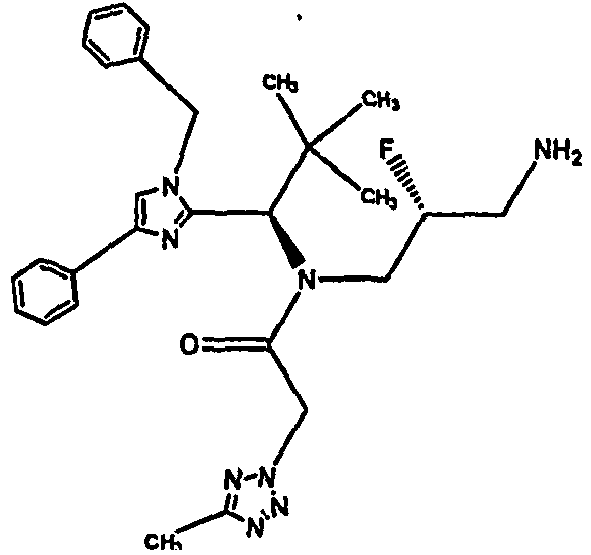
519.3 N-[(2R)-3-amino-2-fluoropropyl]-N-[(1R)-1-(1-benzyl-4-phenyl-1H-imidazol-2-yl)-2,2-dimethylpropyl]-2-(5-methyl-2H-tetrazol-2-yl)acetamide 316 
519.2 N-[(2R)-3-amino-2-fluoropropyl]-N-[(1R)-1-(1-benzyl-4-phenyl-1H-imidazol-2-yl)-2,2-dimethylpropyl]-2-(5-methyl-1H-tetrazol-1-yl)acetamide 317 
529.3 N-[(1R)-1-(1-benzyl-4-phenyl-1H-imidazol-2-yl)-2,2-dimethylpropyl]-N-{[(3R)-3-hydroxypyrrolidin-3-yl]methyl}-2-(1H-tetrazol-1-yl)acetamide 318 
529.2 N-[(1R)-1-(1-benzyl-4-phenyl-1H-imidazol-2-yl)-2,2-dimethylpropyl]-N-{[(3S)-3-hydroxypyrrolidin-3-yl]methyl}-2-(1H-tetrazol-1-yl)acetamide 319 
445.2 (5S)-3-[(1R)-1-(1-benzyl-4-phenyl-1H-imidazol-2-yl)-2,2-dimethylpropyl]-1-oxa-3,7-diazaspiro[4.4]nonan-2-one 320 
445.2 (5R)-3-[(1R)-1-(1-benzyl-4-phenyl-1H-imidazol-2-yl)-2,2-dimethylpropyl]-1-oxa-3,7-diazaspiro[4.4]nonan-2-one 321 
497.3 N-[(2S,3R)-3-amino-2-fluoro-4-hydroxybutyl]-N-[(1R)-1-(1-benzyl-4-phenyl-1H-imidazol-2-yl)-2,2-dimethylpropyl]-2-methoxyacetamide 322 
481.2 N-[(3S)-3-amino-4-fluorobutyl]-N-[(1R)-1-(1-benzyl-4-phenyl-1H-imidazol-2-yl)-2,2-dimethylpropyl]-2-methoxyacetamide 323 
481.2 N-[(3R)-3-amino-4-fluorobutyl]-N-[(1R)-1-(1-benzyl-4-phenyl-1H-imidazol-2-yl)-2,2-dimethylpropyl]-2-methoxyacetamide 324 
491.2 N-[(1R)-1-(1-benzyl-4-phenyl-1H-imidazol-2-yl)-2,2-dimethylpropyl]-N-{[(3R,4S)-4-hydroxypyrrolidin-3-yl]methyl}-2-methoxyacetamide 325 
491.2 N-[(1R)-1-(1-benzyl-4-phenyl-1H-imidazol-2-yl)-2,2-dimethylpropyl]-N-{[(3S,4R)-4-hydroxypyrrolidin-3-yl]methyl}-2-methoxyacetamide 326 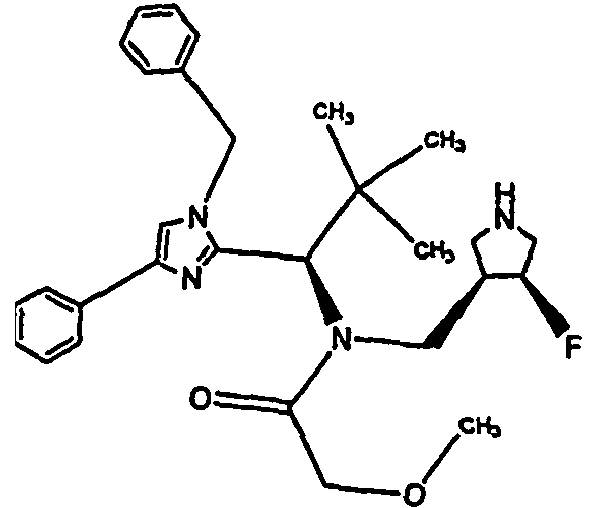
493.2 N-[(1R)-1-(1-benzyl-4-phenyl-1H-imidazol-2-yl)-2,2-dimethylpropyl]-N-{[(3R,4S)-4-fluoropyrrolidin-3-yl]methyl}-2-methoxyacetamide 327 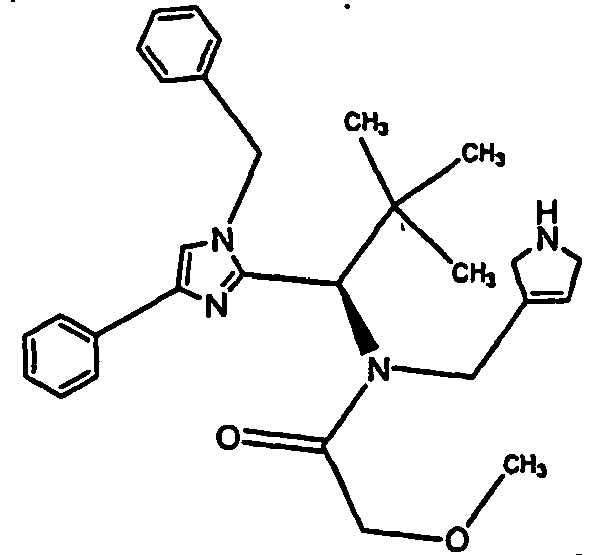
473.2 N-[(1R)-1-(1-benzyl-4-phenyl-1H-imidazol-2-yl)-2,2-dimethylpropyl]-N-(2,5-dihydro-1H-pyrrol-3-ylmethyl)-2-methoxyacetamide Table 3 No. Compound MH+ Name 328 
469.3 N-((R)-3-Amino-2-fluoro-propyl)-N-[(R)-1-(1-benzyl-4-pyrazin-2-yl-1H-imidazol-2-yl)-2,2-dimethyl-propyl]-2-methoxy-acetamide 329 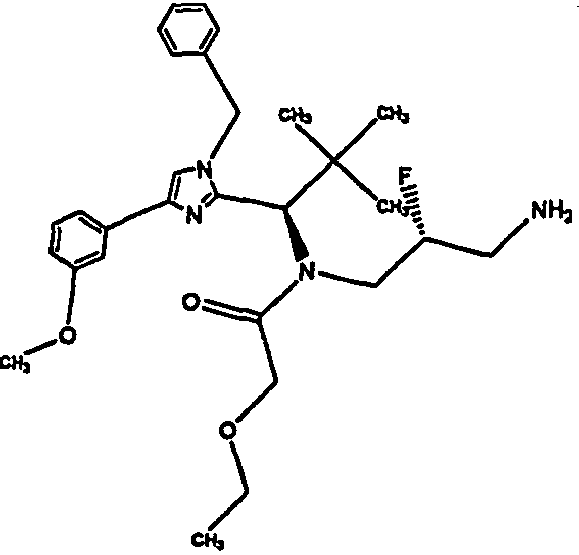
511.3 N-((R)-3-Amino-2-fluoro-propyl)-N-{(R)-1-[1-benzyl-4-(3-methoxy-phenyl)-1H-imidazol-2-yl]-2,2-dimethyl-propyl}-2-ethoxy-acetamide 330 
497.3 N-((R)-3-Amino-2-fluoro-propyl)-N-{(R)-1-[1-benzyl-4-(3-methoxy-phenyl)-1H-imidazol-2-yl]-2,2-dimethyl-propyl}-2-methoxy-acetamide 331 
495.3 (S)-Tetrahydro-furan-2-carboxylic acid ((R)-3-amino-2-fluoro-propyl)-[(R)-1-(1-benzyl-4-pyrazin-2-yl-1H-imidazol-2-yl)-2,2-dimethyl-propyl]-amide 332 
483.3 N-((R)-3-Amino-2-fluoro-propyl)-N-[(R)-1-(1-benzyl-4-pyrazin-2-yl-1H-imidazol-2-yl)-2,2-dimethyl-propyl]-2-ethoxy-acetamide 333 
481.3 N-((R)-3-Amino-2-fluoro-propyl)-N-[(R)-1-(1-benzyl-4-phenyl-1H-imidazol-2-yl)-2,2-dimethyl-propyl]-2-ethoxy-acetamide 334 
493.3 (S)-Tetrahydro-furan-2-carboxylic acid ((R)-3-amino-2-fluoro-propyl)-[(R)-1-(1-benzyl-4-phenyl-1H-imdazol-2-yl)-2,2-dimethyl-propyl]-amide 335 
482.2 N-((S)-3-Amino-4-fluoro-butyl)-N-[(R)-2,2-dimethyl-1-(4-phenyl-1-pyridin-3-ylmethyl-1H-imidazol-2-yl)-propyl]-2-methoxy-acetamide 336 
482.2 N-((R)-3-Amino-4-fluoro-butyl)-N-[(R)-2,2-dimethyl-1-(4-phenyl-1-pyridin-3-ylmethyl-1H-imidazol-2-yl)-propyl]-2-methoxy-acetamide 337 
511.1 N-((S)-3-Amino-4-methoxy-butyl)-N-{(R)-1-[1-benzyl-4-(3-fluoro-phenyl)-1H-imidazol-2-yl]-2,2-dimethyl-propyl}-2-methoxy-acetamide 338 
492.3 N-((R)-3-Amino-2-fluoro-propyl)-N-{(R)-1-[1-benyl-4-(4-cyano-phenyl)-1H-imidazol-2-yl]-2,2-dimethyl-propyl}-2-methoxy-acetamide 339 
497.3 N-((R)-3-Amino-2-fluoro-propyl)-N-{(R)-1-[1-benzyl-4-(4-methoxy-phenyl)-1H-imidazol-2-yl]-2,2-dimethyl-propyl}-2-methoxy-acetamide 340 
485.3 N-((R)-3-Amino-2-fluoro-propyl)-N-{(R)-1-[1-(2-fluoro-benzyl)-4-phenyl-1H-imidazol-2-yl]-2,2-dimethyl-propyl}-2-methoxy-acetamide 341 
485.3 N-((R)-3-Amino-2-fluoro-propyl)-N-{(R)-1-[1-(3-fluoro-benzyl)-4-phenyl-1H-imidazol-2-yl]-2,2-dimethyl-propyl}-2-methoxy-acetamide 342 
501.2 N-((R)-3-Amino-2-fluoro-propyl)-N-{(R)-1-[1-(3-chloro-benzyl)-4-phenyl-1H-imidazol-2-yl]-2,2-dimethyl-propyl}-2-methoxy-acetamide 343 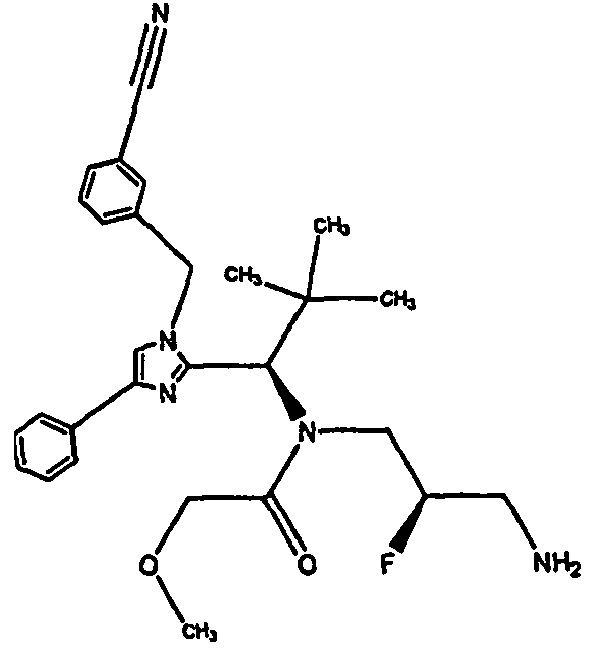
492.3 N-((R)-3-Amino-2-fluoro-propyl)-N-{(R)-1-[1-(3-cyano-benzyl)-4-phenyl-1H-imidazol-2-yl]-2,2-dimethyl-propyl}-2-methoxy-acetamide 344 
475.3 N-((R)-3-Amino-2-fluoro-propyl)N-{(R)-2,2-dimethyl-1-[4-phenyl-1-(tetrahydro-pyran-4-lmethyl)-1H-imidazol-2-yl]-propyl}-2-methoxy-acetamide 345 
511.3 (S)-Tetrahydro-furan-2-carboxylic acid ((R)-3-amino-2-fluoro-propyl)-{(R)-1-[1-benzyl-4-(3-fluoro-phenyl)-1H-imidazol-2-yl]-2,2-dimethyl-propyl}-amide 346 
523.3 (S)-Tetrahydro-furan-2-carboxylic acid ((R)-3-amino-2-fluoro-propyl)-{(R)-1-[1-benzyl-4-(2-methoxy-phenyl)-1H-imidazol-2-yl]-2,2-dimethyl-propyl}-amide 347 
561.3 (S)-Tetrahydro-furan-2-carboxylic acid ((R)-3-amino-2-fluoro-propyl)-{(R)-1-[1-benzyl-4-(3-trifluoromethyl-phenyl)-1H-imidazol-2-yl]-2,2-dimethyl-propyl}-amide 348 
571.2 (S)-Tetrahydro-furan-2-carboxylic acid ((R)-3-amino-2-fluoro-propyl)-{(R)-1-[1-benzyl-4-(3-bromo-phenyl)-1H-imidazol-2-yl]-2,2-dimethyl-propyl}-amide 349 
485.3 N-((R)-3-Amino-2-fluoro-propyl)-N-{(R)-1-[1-benzyl-4-(3-fluoro-phenyl)-1H-imidazol-2-yl]-2,2-dimethyl-propyl}-2-methoxy-acetamide 350 
497.3 N-((R)-3-Amino-2-fluoro-propyl)-N-{(R)-1-[1-benzyl-4-(2-methoxy-phenyl)-1H-imidazol-2-yl]-2,2-dimethyl-propyl}-2-methoxy-acetamide 351 
535.3 N-((R)-3-Amino-2-fluoro-propyl)-N-{(R)-1-[1-benzyl-4-(3-trifluoromethyl-phenyl)-1H-imidazol-2-yl]-2,2-dimethyl-propyl}-2-methoxy-acetamide 352 
545.2 N-((R)-3-Amino-2-fluoro-propyl)-N-{(R)-1-(1-benzyl-4-(3-bromo-phenyl)-1H-imidazol-2-yl]-2,2-dimethyl-propyl}-2-methoxy-acetamide 353 
481.3 N-((R)-3-Amino-2-fluoro-propyl)-N-[(R)-1-(1-benzyl-4-p-tolyl-1H-imidazol-2-yl)-2,2-dimethyl-propyl]-2-methoxy-acetamide 354 
482.2 N-((S)-3-Amino-4-fluoro-butyl)-N-[(R)-2,2-dimethyl-1-(4-phenyl-1-pyridin-4-ylmethyl-1H-imidazol-2-yl)-propyl]-2-methoxy-acetamide 355 
482.2 N-((R)-3-Amino-4-fluoro-butyl)-N-[(R)-2,2-dimethyl-1-(4-phenyl-1-pyridin-4-ylmethyl-1H-imidazol-2-yl)-propyl]-2-methoxy-acetamide 356 
486.1 N-((S)-3-Amino-4-fluoro-butyl)-N-{(R)-2,2-dimethyl-1-[1-(5-methyl-isoxazol-3-ylmethyl)-4-phenyl-1H-imidazol-2-yl]-propyl}-2-methoxy-acetamide 357 
486.1 N-((R)-3-Amino-4-fluoro-butyl)-N-{(R)-2,2-dimethyl-1-[1-(5-methyl-isoxazol-3-ylmethyl)-4-phenyl-1H-imidazol-2-yl]-propyl)-2-methoxy-acetamide 358 
482.2 N-((S)-3-Amino-4-fluoro-butyl)-N-[(R)-2,2-dimethyl-1-(4-phenyl-1-pyridin-2-ylmethyl-1H-imidazol-2-yl)-propyl]-2-methoxy-acetamide 359 
482.2 N-((R)-3-Amino-4-fluoro-butyl)-N-[(R)-2,2-dimethyl-1-(4-phenyl-1-pyridin-2-ylmethyl-1H-imidazol-2-yl)-propyl]-2-methoxy-acetamide 360 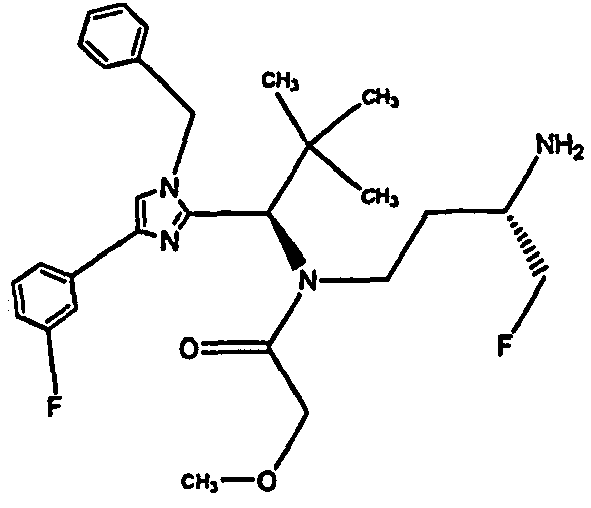
499.2 N-((S)-3-Amino-4-fluoro-butyl)-N-{(R)-1-[1-benzyl-4-(3-fluoro-phenyl)-1H-imidazol-2-yl]-2,2-dimethyl-propyl}-2-methoxy-acetamide 361 
499.2 N-((R)-3-Amino-4-fluoro-butyl)-N-{(R)-1-[1-benzyl-4-(3-fluoro-phenyl)-1H-imidazol-2-yl]-2,2-dimethyl-propyl}-2-methoxy-acetamide 362 
477.2 N-(3-Amino-3-methyl-butyl)-N-[(R)-1-(1-benzyl-4-phenyl-1H-imidazol-2-yl)-2,2-dimethyl-propyl]-2-methoxy-acetamide 363 
527.2 (S)-Tetrahydro-furan-2-carboxylic acid ((R)-3-amino-2-fluoro-propyl)-[(R)-1-(1-benzyl-5-chloro-4-phenyl-1H-imidazol-2-yl)-2,2-dimethyl-propyl]-amide 364 
501.2 N-((R)-3-Amino-2-fluoro-propyl)-N-[(R)-1-(1-benzyl-5-chloro-4-phenyl-1H-imidazol-2-yl)-2,2-dimethyl-propyl]-2-methoxy-acetamide 365 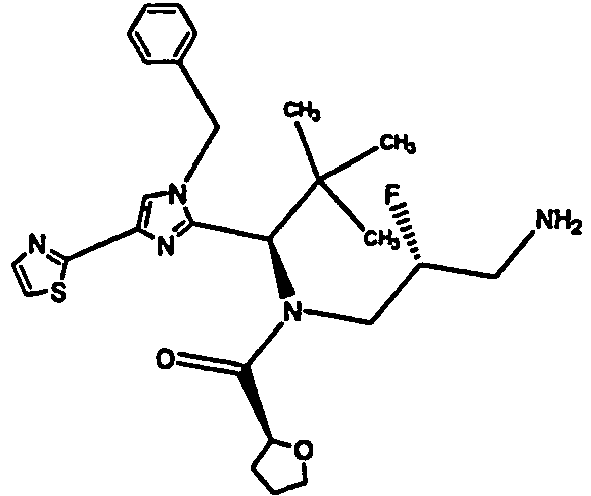
500.2 S)-Tetrahydro-furan-2-arboxylic acid ((R)-3-amino-2-fluoro-propyl)-[(R)-1-(1-benzyl-4-thiazol-2-yl-1H-imidazol-2-yl)-2,2-dimethyl-propyl]-amide 366 
525.2 N-((S)-3-Amino-2-fluoro-propyl)-N-{(R)-2,2-dimethyl-1-[4-phenyl-1-(5-trifluoromethyl-furan-2-ylmethyl)-1H-imidazol-2-yl]-propyl}-2-methoxy-acetamide 367 
472.3 N-((S)-3-Amino-2-fluoro-propyl)-N-{(R)-2,2-dimethyl-1-[1-(5-methyl-isoxazol-3-ylmethyl)-4-phenyl-1H-imidazol-2-yl]-propyl}-2-methoxy-acetamide 368 
498.3 (S)-Tetrahydro-furan-2-carboxylic acid ((S)-3-amino-2-fluoro-propyl)-{(R)-2,2-dimethyl-1-[1-(5-methyl-isoxazol-3-ylmethyl)-4-phenyl-1H-imidazol-2-yl]-propyl}-amide 369 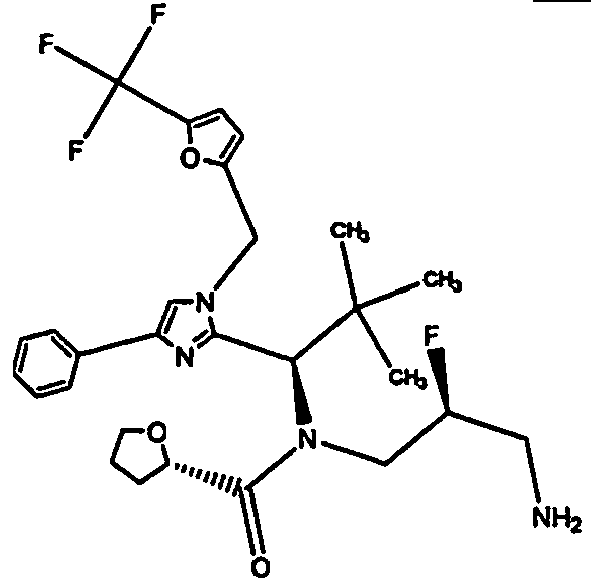
551.3 (S)-Tetrahydro-furan-2-carboxylic acid ((S)-3-amino-2-fluoro-propyl)-{(R)-2,2-dimethyl-1-[4-phenyl-1-(5-trifluoromethyl-furan-2-ylmethyl)-1H-imidazol-2-yl]-propyl}-amide 370 
529.2 N-((S)-3-Amino-4-methoxy-butyl)-N-{(R)-1-[1-(3-fluoro-benzyl)-4-(3-fluoro-phenyl)-1H-imidazol-2-yl]-2,2-dimethyl-propyl}-2-methoxy-acetamide 371 
515.1 N-((S)-3-Amino-4-hydroxy-butyl)-N-{(R)-1-[1-(3-fluoro-benzyl)-4-(3-fluoro-phenyl)-1H-imidazol-2-yl]-2,2-dimethyl-propyl}-2-methoxy-acetamide 372 
517.1 N-((S)-3-Amino-4-fluoro-butyl)-N-{(R)-1-[1-(2,5-difluoro-benzyl)-4-phenyl-1H-imidazol-2-yl]-2,2-dimethyl-propyl}-2-methoxy-acetamide 373 
517.1 N-((R)-3-Amino-4-fluoro-butyl)-N-{(R)-1-[1-(2,5-difluoro-benzyl)-4-phenyl-1H-imidazol-2-yl]-2,2-dimethyl-propyl}-2-methoxy-acetamide 374 
485.3 N-((R)-3-Amino-2-fluoro-propyl)-N-{(R)-1-[1-(4-fluoro-benzyl)-4-phenyl-1H-imidazol-2-yl]-2,2-dimethyl-propyl}-2-methoxy-acetamide 375 
497.3 N-((R)-3-Amino-2-fluoro-propyl)-2-methoxy-N-{(R)-1-[1-(3-methoxy-benzyl)-4-phenyl-1H-imidazol-2-yl]-2,2-dimethyl-propyl}-acetamide 376 
581.3 N-((R)-3-Amino-2-fluoro-propyl)-N-{(R)-2,2-dimethyl-1-[1-(2-methyl-benzyl)-4-phenyl-1H-imidazol-2-yl]-propyl}-2-methoxy-acetamide 377 
581.3 N-((R)-3-Amino-2-fluoro-propyl)-N-{(R)-2,2-dimethyl-1-[1-(3-methyl-benzyl)-4-phenyl-1H-imidazol-2-yl]-propyl}-2-methoxy-acetamide 378 
581.3 N-((S)-3-Amino-2-fluoro-propyl)-N-{(R)-2,2-dimethyl-1-[1-(3-methyl-benzyl)-4-phenyl-1H-imidazol-2-yl]-propyl}-2-methoxy-acetamide 379 
419.2 N-(3-Amino-propyl)-N-[(R)-1-(1-benzyl-4-phenyl-1H-imidazol-2-yl)-2,2-dimethyl-propyl]-acetamide 380- Reference example 
391.2 N-((S)-3-Amino-2-fluoro-propyl)-N-[(R)-1-(1-benzyl-1H-imidazol-2-yl)-2,2-dimethyl-propyl]-2-methoxy-acetamide 381 - Reference example 
417.3 (S)-Tetrahydro-furan-2-carboxylic acid ((S)-3-amino-2-fluoro-propyl)-[(R)-1-(1-benzyl-1H-imidazol-2-yl)-2,2-dimethyl-propyl]-amide 382 
517.2 N-((S)-3-Amino-4-fluoro-butyl)-N-((R)-1-[1-(3-fluoro-benzyl)-4-(3-fluoro-phenyl)-1H-imidazol-2-yl]-2,2-dimethyl-propyl}-2-methoxy-acetamide 383 
474.2 N-((S)-3-Amino-2-fluoro-propyl)-N-[(R)-1-(1-benzyl-4-thiazol-2-yl-1H-imidazol-2-yl)-2,2-dimethyl-propyl]-2-methoxy-acetamide 384 
517.2 N-((R)-3-Amino-4-fluoro-butyl)-N-{(R)-1-[1-(3-fluoro-benzyl)-4-(3-fluoro-phenyl)-1H-imidazol-2-yl]-2,2-dimethyl-propyl}-2-methoxy-acetamide 385 
475.3 N-[2-(1-Amino-cyclopropyl)-ethyl]-N-[(R)-1-(1-benzyl-4-phenyl-1H-imidazol-2-yl)-2,2-dimethyl-propyl]-2-methoxy-acetamide 386 
501.3 (S)-Tetrahydro-furan-2-carboxylic acid [2-(1-amino-cyclopropyl)-ethyl]-[(R)-1-(1-benzyl-4-phenyl-1H-imidazol-2-yl)-2,2-dimethyl-propyl]-amide 387 
461.3 [2-(1-Amino-cyclopropyl)-ethyl]-[(R)-1-(1-benzyl-4-phenyl-1H-imidazol-2-yl)-2,2-dimethyl-propyl]-carbamic acid methyl ester 388 
493.3 [2-(1-Amino-cyclopropyl)-ethyl]-N-{(R)-1-[1-benzyl-4-(3-fluoro-phenyl)-1H-imidazol-2-yl]-2,2-dimethyl-propyl}-2-methoxy-acetamide 389 
519.3 (S)-Tetrahydro-furan-2-carboxylic acid [2-(1-amino-cyclopropyl)-ethyl]-{(R)-1-[1-benzyl-4-(3-fluoro-phenyl)-1H-imidazol-2-yl]-2,2-dimethyl-propyl}-amide 390 
485.2 N-(3-Amino-propyl)-N-{(R)-1-[1-benzyl-4-(2,5-difluoro-phenyl)-1H-imidazol-2-yl]-2,2-dimethyl-propyl}-2-methoxy-acetamide 391 
517.2 N-((S)-3-Amino-4-fluoro-butyl)-N-{(R)-1-[1-benzyl-4-(2,5-difluoro-phenyl)-1H-imidazol-2-yl]-2,2-dimethyl-propyl}-2-methoxy-acetamide 392 
517.2 N-((R)-3-Amino-4-fluoro-butyl)-N-{(R)-1-[1-benzyl-4-(2,5-difluoro-phenyl)-1H-imidazol-2-yl]-2,2-dimethyl-propyl}-2-methoxy-acetamide 393 
457.5 N-(3-Amino-propyl)-N-{1-[1-(3-fluoro-benzyl)-4-(3-fluoro-phenyl)-1H-imidazol-2-yl]-1-methyl-ethyl}-2-methoxy-acetamide 394 
485.6 N-(3-Amino-propyl)-N-{(R)-1-[1-(3-fluoro-benzyl)-4-(3-fluoro-phenyl)-1H-imidazol-2-yl]-2,2-dimethyl-propyl}-2-methoxy-acetamide 395 
543.3 (S)-Tetrahydro-furan-2-carboxylic acid ((S)-3-amino-4-fluoro-butyl)-{(R)-1-[1-(3-fluoro-benzyl)-4-(3-fluoro-phenyl)-1H-imidazol-2-yl]-2,2-dimethyl-propyl}-amide 396 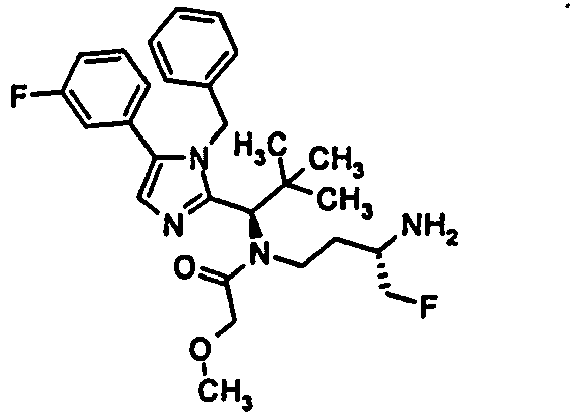
499.3 N-((S)-3-Amino-4-fluoro-butyl)-N-{(R)-1-[1-benzyl-5-(3-fluoro-phenyl)-1H-imidazol-2-yl]-2,2-dimethyl-propyl}-2-methoxy-acetamide 397 
531.3 N-((S)-3-Amino-4-methoxy-butyl)-N-{(R)-1-[4-(3-chloro-phenyl)-1-(3-fluoro-benzyl)-1H-imidazol-2-yl]-2-methyl-propyl}-2-methoxy-acetamide 398 
501.2 N-((S)-3-Amino-4-fluoro-butyl)-N-{(R)-1-[1-benzyl-4-(3-chloro-phenyl)-1H-imidazol-2-yl]-2-methyl-propyl}-2-methoxy-aceamide 399 
519.2 N-((S)-3-Amino-4-fluoro-butyl)-N-{(R)-1-[4-(3-chloro-phenyl)-1-(3-fluoro-benzyl)-1H-imidazol-2-yl]-2-methyl-propyl}-2-methoxy-acetamide 400 
489.5 N-(3-Amino-4-fluoro-butyl)-N-{1-[1-(3-fluoro-benzyl)-4-(3-fluoro-phenyl)-1H-imidazol-2-yl]-1-methyl-ethyl}-2-methoxy-acetamide 401 
487.1 N-((S)-3-Amino-4-fluoro-butyl)-N-{(R)-1-[1-(3-fluoro-benzyl)-4-(3-fluoro-phenyl)-1H-imidazol-2-yl]-2,2-dimethyl-propyl}-acetamide 402 
487.1 N-((R)-3-Amino-4-fluoro-butyl)-N-{(R)-1-[1-(3-fluoro-benzyl)-4-(3-fluoro-phenyl)-1H-imidazol-2-yl]-2,2-dimethyl-propyl}-acetamide 403 
529.3 (S)-Tetrahydro-furan-2-carboxylic acid ((S)-3-amino-2-fluoro-propyl)-{(R)-1-[1-(3-fluoro-benzyl)-4-(3-fluoro-phenyl)-1H-imidazol-2-yl]-2,2-dimethyl-propyl}-amide 404 
495.2 (R)-9-{(R)-1-[1-(3-Fluoro-benzyl)-4-(3-fluoro-phenyl)-1H-imidazol-2-yl]-2,2-dimethyl-propyl}-6-oxa-2,9-diaza-spiro[4.5]decan-8-one 405 
503.2 (3-Amino-4-fluoro-butyl)-{(R)-1-[1-(3-fluoro-benzyl)-4-(3-fluoro-phenyl)-1H-imidazol-2-yl]-2,2-dimethyl-propyl}-carbamic acid methyl ester 406 
473.2 N-((S)-3-Amino-4-fluoro-butyl)-N-{(R)-1-[1-(3-fluoro-benzyl)-4-(3-fluoro-phenyl)-1H-imidazol-2-yl]-2,2-dimethyl-propyl}-formamide 407 
473.2 N-((R)-3-Amino-4-fluoro-butyl)-N-{(R)-1-[1-(3-fluoro-benzyl)-4-(3-fluoro-phenyl)-1H-imidazol-2-yl]-2,2-dimethyl-propyl}-formamide 408 
513.2 N-(3-Dimethylamino-propyl)-N-{(R)-1-[1-(3-fluoro-benzyl)-4-(3-fluoro-phenyl)-1H-imidazol-2-yl]-2,2-dimethyl-propyl}-2-methoxy-acetamide 409 
499.6 N-((S)-3-Amino-butyl)-N-{(R)-1-[1-(3-fluoro-benzyl)-4-(3-fluoro-phenyl)-1H-imidazol-2-yl]-2,2-dimethyl-propyl}-2-methoxy-acetamide 410 
499.6 N-((R)-3-Amino-butyl)-N-{(R)-1-[1-(3-fluoro-benzyl)-4-(3-fluoro-phenyl)-1H-imidazol-2-yl]-2,2-dimethyl-propyl}-2-methoxy-acetamide 411 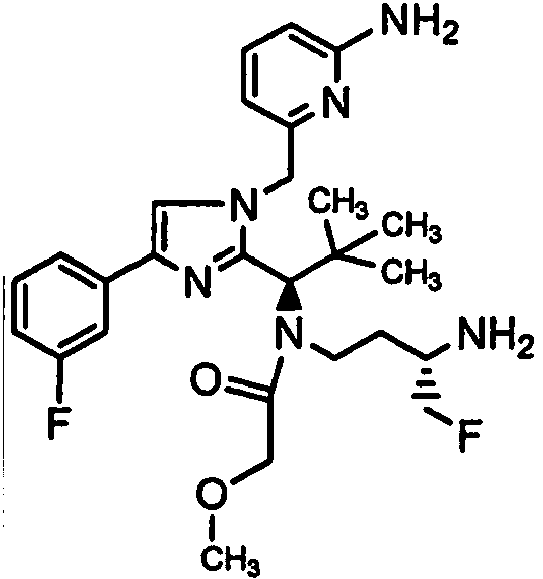
515.2 N-((S)-3-Amino-4-fluoro-butyl)-N-{(R)-1-[1-(6-amino-pyridin-2-ylmethyl)-4-(3-fluoro-phenyl)-1H-imidazol-2-yl]-2,2-dimethyl-propyl}-2-methoxy-acetamide 412 
515.2 N-((R)-3-Amino-4-fluoro-butyl)-N-{(R)-1-[1-(6-amino-pyridin-2-ylmethyl)-4-(3-fluoro-phenyl)-1H-imidazol-2-yl]-2,2-dimethyl-propyl}-2-methoxy-acetamide 413 
515.2 N-((S)-3-Amino-4-fluoro-butyl)-N-{(R)-1-[4-(3-fluoro-phenyl)-1-(3-hydroxy-benzyl)-1H-imidazol-2-yl]-2,2-dimethyl-propyl}-2-methoxy-acetamide 414 
515.2 N-((R)-3-Amino-4-fluoro-butyl)-N-{(R)-1-[4-(3-fluoro-phenyl)-1-(3-hydroxy-benzyl)-1H-imidazol-2-yl]-2,2-dimethyl-propyl}-2-methoxy-acetamide 415 
488.2 N-((S)-3-Amino-4-fluoro-butyl)-N-[(R)-1-(1-benzyl-4-thiazol-2-yl-1H-imidazol-2-yl)-2,2-dimethyl-propyl]-2-methoxy-acetamide 416 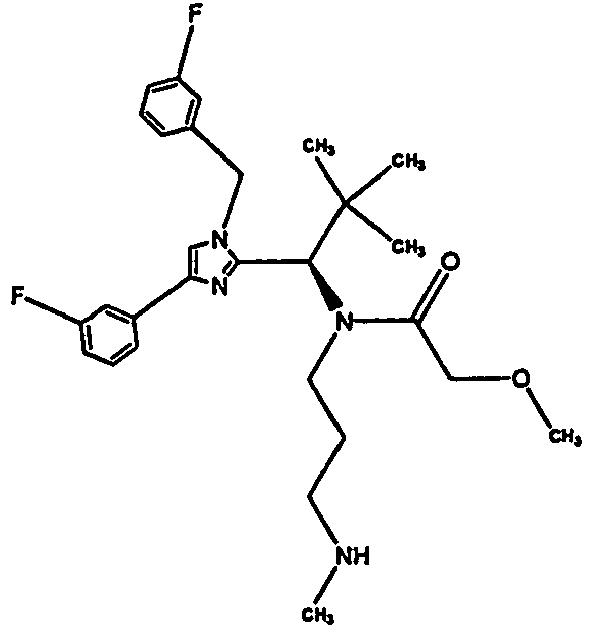
499.2 N-{(R)-1-[1-(3-Fluoro-benzyl)-4-(3-fluoro-phenyl)-1H-imidazol-2-yl]-2,2-dimethyl-propyl}-2-methoxy-N-(3-methylamino-propyl)-acetamide 417 
455.5 N-(3-Amino-propyl)-N-{(R)-1-[1-benzyl-4-(2,5-difluoro-phenyl)-1H-imidazol-2-yl]-2,2-dimethyl-propyl}-acetamide 418 
471.5 (3-Amino-propyl)-{(R)-1-[1-benzyl-4-(2,5-difluoro-phenyl)-1H-imidazol-2-yl]-2,2-dimethyl-propyl}-carbamic acid methyl ester 419 
511.6 (S)-Tetrahydro-furan-2-carboxylic acid (3-amino-propyl)-{(R)-1-[1-benzyl-4-(2,5-difluoro-phenyl)-1H-imidazol-2-yl]-2,2-dimethyl-propyl}-amide 420 
499.2 3-[{(R)-1-[1-(3-Fluoro-benzyl)-4-(3-fluoro-phenyl)-1H-imidazol-2-yl]-2,2-dimethyl-propyl}-(2-methoxy-acetyl)-amino]-propionamide 421 
533.6 N-(3-Amino-propyl)-N-{(R)-1-[1-benzyl-4-(2,5-difluoro-phenyl)-1H-imidazol-2-yl]-2,2-dimethyl-propyl}-2-methanesulfonyl-acetamide 422 
429.3 N-((S)-3-Amino-4-methoxy-butyl)-N-{(R)-1-[1-benzyl-4-(2,5-difluoro-phenyl)-1H-imidazol-2-yl]-2,2-dimethyl-propyl}-2-methoxy-acetamide 423 
543.3 (S)-Tetrahydro-furan-2-carboxylic acid ((S)-3-amino-4-fluoro-butyl)-{(R)-1-[1-benzyl-4-(2,5-difluoro-phenyl)-1H-imidazol-2-yl]-2,2-dimethyl-propyl}-amide 424 
356.2 (R)-1-[1-Benzyl-4-(2,5-difluoro-phenyl)-1H-imidazol-2-yl]-2,2-dimethyl-propylamine 425 
555.3 (S)-Tetrahydro-furan-2-carboxylic acid ((S)-3-amino-4-methoxy-butyl)-{(R)-1-[1-benzyl-4-(2,5-difluoro-phenyl)-1H-imidazol-2-yl]-2,2-dimethyl-propyl}-amide 426 
499.6 N-((R)-3-Amino-butyl)-N-{(R)-1-[1-benzyl-4-(2,5-difluoro-phenyl)-1H-imidazol-2-yl]-2,2-dimethyl-propyl}-2-methoxy-acetamide 427 
499.6 N-((S)-3-Amino-butyl)-N-{(R)-1-[1-benzyl-4-(2,5-difluoro-phenyl)-1H-imidazol-2-yl]-2,2-dimethyl-propyl}-2-methoxy-acetamide 428 
509.2 N-{(R)-1-[1-Benzyl-4-(2,5-difluoro-phenyl)-1H-imidazol-2-yl]-2,2-dimethyl-propyl}-2-methoxy-N-(1H-[1,2,3]triazol-4-ylmethyl)-acetamide 429 
487.3 N-((S)-3-Amino-4-fluoro-butyl)-N-{(R)-1-[1-benzyl-4-(2,5-difluoro-phenyl)-1H-imidazol-2-yl]-2,2-dimethyl-propyl}-acetamide 430 
503.2 ((S)-3-Amino-4-fluoro-butyl)-{(R)-1-[1-benzyl-4-(2,5-difluoro-phenyl)-1H-imidazol-2-yl]-2,2-dimethyl-propyl}-carbamic acid methyl ester 431 
456.2 {(R)-1-[1-Benzyl-4-(2,5-difluoro-phenyl)-1H-imidazol-2-yl]-2,2-dimethyl-propyl}-carbamic acid tert-butyl ester 432 
424.2 N-[(1R)-1-(1-benzyl-4-phenyl-1H-imidazol-2-yl)-2-methylpropyl]-4-methylbenzamide 433 
550.2 N-(3-aninopropyl)-N-[(1R)-1-(1-benzyl-4-phenyl-1H imidazol-2-yl)-2-methylpropyl]-2-(4-fluorophenoxy)acetamide - This example provides a representative in vitro assay for determining KSP activity in vitro. Purified microtubules obtained from bovine brain were purchased from Cytoskeleton Inc. (Denver, Colorado, USA). The motor domain of human KSP (Eg 5, KNSL1) was cloned, expressed, and purified to greater than 95% homogeneity. Biomol Green was purchased from Affinity Research Products Ltd. (Matford Court, Exeter, Devon, United Kingdom). Microtubules and KSP motor protein (i.e., the KSP motor domain) were diluted in assay buffer (20 mM Tris-HCl (pH 7.5), 1 mM MgCl2, 10 mM DTT and 0.25 mg/ml BSA) to a final concentration of 35 µg/ml microtubules and 45 nM KSP. The microtubule/KSP mixture was then pre-incubated at 37°C for 10 min to promote the binding of KSP to microtubules.
- To each well of the testing plate (384-well plate) containing 1.25 µl of inhibitor or test compound in DMSO (or DMSO only in the case of controls) were added 25 µl of ATP solution (ATP diluted to a concentration of 300 µM in assay buffer) and 25 µl of the above-described microtubule/KSP solution. The plates were incubated at room temperature for 1 hour. Following incubation, 65 µl of Biomol Green (a malachite green-based dye that detects the release of inorganic phosphate) was added to each well. The plates were incubated for an additional 5-10 minutes then the absorbance at 630 nm was determined using a Victor II plate reader. The amount of absorbance at 630 nm corresponded to the amount of KSP activity in the samples. The IC50 of each inhibitor or test compound was then determined based on the decrease in absorbance at 630 nm at each concentration, via nonlinear regression using either XLFit for Excel or Prism data analysis software by GraphPad Software Inc.
- Cells were plated in 96-well plates at densities from 500 cells/well of a 96-well plate and allowed to adhere/grow for 24 hours. They were then treated with various concentrations of drug for 72 hours. Than 100 µl of CellTiter Glo is added, a tetrazolium-based assay using the reagent 3-(4,5-dimethylthiazol-2-yl) 5- (3-carboxymethoxyphenyl)-2-(4-sulfophenyl)-2H-tetrazolium (MTS) (
U.S. Patent No. 5,185,450 ) (see Promega product catalog #G3580, CeIITiter 96 Aqueous One Solution Cell Proliferation Assay), and incubated in the dark for 30 minutes. The amount of luminescence was determined for each well using a Walloc Trilux plate reader, which correlates with the number of cells/well. The number of viable cells in the wells, that received only DMSO (0.5%) serve as the 0% inhibition data point, while wells without cells serve as 100% inhibition of cell growth. The drug concentration that resulted in a 50% growth inhibition (GI50) was determined graphically from sigmoidal dose-response curves of log-transformed dose values versus cell counts (percent of control) at 72 hours of continuous drug exposure. - The cell lines used are listed below.
- The cell proliferation assay was performed as described above.
-
Colo 205 - colon carcinoma RPMI 1640 +10%FBS +1% L-glutamine +1% P/S +1%NaPyr.+ Hepes +4.5g/L Glucose +1%NaBicarb. MDA 435- breast cancer- high met EMEM + 10% FBS + 1%P/S + 1%L-Glutamine+1%NEAA +1%NaPyr + 1 %vitamins HCT-15 and HCT116 -colon carcinoma RPMI 1640 +10%FBS +1% L-glutamine +1% P/S -
KB3.1- colon epidermal carcinoma; parental cell line Iscove's +10%FBS +1% L-glutamine +1% P/S KBV1 - p-glycoprotein associated multi-drug resistant cell line RPMI 1640 +10%FBS +1% L-glutamine +1% P/S +0.2ug/ml Vinblastine KB85 - p-glycoprotein associated multi-drug resistant cell line DMEM +10%FBS +1% L-glutamine +1% P/S + 10ng/ml Colchicine - Human cancer cells were plated at a density of 3x10⁵ cells / well in a 6-well plate. The next day compound of interest at a certain concentration is added to each well. After 24 and 48 hrs incubation in the presence of compound of interest the cells were harvested, washed and counted. The following steps were performed using the Multimek 96 robot. Than 500 viable cells / well were plated in a 96-well plate that was coated with PolyHema previously to prevent attachment of the cells to the bottom of the well. Agarose (3% stock) was melted, diluted in warmed media and added to the cells to a final concentration of 0.5%. After the soft agar solidified the plates were incubated at 37°C for 6 days. Alamar blue dye was added to cells and plates were incubated for additional 6 hrs. The OD change was measured on a Tecan plate reader and is considered to correlate with the number of colonies formed in soft agar.
- Preferred compounds of the invention have a biological activity as measured by an IC50 of less than about 1 mM in assay protocols described in Examples 20-22, with preferred embodiments having biological activity of less than about 25 µM, with particularly preferred embodiments having biological activity of less than about 1000 nM, and with the most preferred embodiments having biological activity of less than about 100 nM.
- The HCT-116 human colon carcinoma cell lines were obtained from the American Type Culture Collection (ATCC; Rockville, MD).
- Cells were cultured using standard technique in RPMI 1640 supplemented with 10% fetal bovine serum, 2 mM glutamine, 1 mM sodium pyruvate (Life Technologies Inc., Gaithersburg, MD) and maintained routinely in a humidified chamber at 37°C and 5% carbon dioxide.
- Cells to be implanted in mice were harvested from cell culture flasks during exponential growth, washed once with sterile phosphate-buffered saline (PBS), counted, and resuspended in Hank's Balanced Salt Solution to a suitable concentration prior to implantation.
- All animal studies were in accordance with the Institute of Laboratory Animal Research (National Institutes of Health, Bethesda, MD) Guide for the Care and Use of Laboratory Animals. Nine to twelve week old female athymic nu/nu mice purchased from Charles River Laboratories (Wilmington, MA) were used.
- Mice received subcutaneous injections into the hind flank on Day 0 with 5 X 10⁶ HCT-116 cells. For multi-dose efficacy studies, animals with established tumors (approximately 300 mm3) were randomized into treatment groups of approximately 10 mice each for efficacy studies. Compounds of interest or their vehicles were administered orally to mice, with the compounds prepared in a vehicle containing 10% Captisol® to appropriate concentrations. Tumor growth was measured twice weekly using Vernier calipers for the duration of the treatment. Tumor volumes were calculated as the product of (length x width2)/2. For stastical analysis, p-values were calculated using the two-tailed Student's t test.
- To evaluate early pharmacodynamic changes to tumors after treatment with a KSP inhibitor, mice bearing tumors ranging from 300-600 mm3 in volume were treated with a single oral dose of compounds of interest at various concentrations. Control animals received an oral dose of vehicle. At predetermined timepoints, individual mice were euthanized, with plasma and half of the resected tumors collected for PK and half of the tumors fixed in 10% buffered formalin, followed by transference to 70% ethanol by 24 hrs of fixation.
- Sections were prepared from formalin-fixed, paraffin-embedded subcutaneous tumors. For detection of phospho-histone H3, a rabbit polyclonal anti-human antibody (Cat. #9701L, Cell Signaling, Beverley MA) was used. A biotinylated anti-rabbit secondary antibody (Jackson Labs, West Grove, PA) was also employed in this detection assay. Slides were stained using an automated slide stainer and compatible ancillary reagents (Ventana Medical Systems, Tucson AZ). Cell conditioning for phosho-histone H3 was CC2 mild. For detection of cleaved PARP, a rabbit polyclonal antibody (Cat. # 44-698G, BioSource, Camarillo CA) and a biotinylated anti-rabbit secondary antibody (Jackson Labs, West Grove, PA) followed by a peroxidase-based immunostaining protocol (Vectastain® ABC Elite KIT, Vector Laboratories, Burlingame, CA) were used. Heat induced epitope retrieval was accomplished using citrate buffer (Decloaker, BioCare, Walnut Creek, CA) before staining on an automated stainer (Dako, Carpenteria, CA). For detection of cleaved Caspase 3, a rabbit polyclonal antibody (Cat. # 44-698G, BioSource, Camarillo CA) and a biotinylated anti-rabbit secondary antibody (Jackson Labs, West Grove, PA) followed by a peroxidase-based immunostaining protocol (Vectastain® ABC Elite KIT, Vector Laboratories, Burlingame, CA) were used. Heat induced epitope retrieval was accomplished using citrate buffer (Decloaker, BioCare, Walnut Creek, CA) before staining on an automated stainer (Dako, Carpenteria, CA). In all cases the chromagen used for these assays was DAB.
- Sections were prepared from formalin-fixed, paraffin-embedded subcutaneous tumors. For detection of KSP, a rabbit polyclonal anti-human antibody (Cat. # AKIN03 from Cytoskeleton) was used. A biotinylated anti-rabbit secondary antibody (Jackson Labs, West Grove, PA) was also employed in this detection assay. Slides were stained using an automated slide stainer and compatible ancillary reagents (Ventana Medical Systems, Tucson AZ). Cell conditioning for KSP was a CC1 standard. The chromagen used for this assay was DAB.
Claims (32)
- A compound of formula I:
 R1 is selected from the group consisting of aminoacyl, acylamino, carboxyl, carboxyl ester, aryl, and alkyl optionally substituted with hydroxy or halo;R2 is selected from the group consisting of hydrogen, alkyl, and aryl;R3 is selected from the group consisting of hydrogen and -X-A, wherein X is selected from the group consisting of -C(O)-, -C(S)-, -S(O)-, -S(O)2-, and -S(O)2-N(R)-, where R is hydrogen or alkyl; andA is selected from the group consisting of hydrogen, optionally substituted alkyl, optionally substituted alkoxy, optionally substituted aryl, carboxyl, carboxyl ester, aminoacyl, optionally substituted heteroaryl, optionally substituted heterocyclic, and optionally substituted cycloalkyl, wherein the optionally substituted groups are substituted with 1 to 4 substituents selected from the group consisting of alkyl, substituted alkyl, alkoxy, substituted alkoxy, amino, substituted amino, aryloxy, substituted aryloxy, cyano, aryl, substituted aryl, heteroaryl, substituted heteroaryl, heterocyclic, substituted heterocyclic, heterocyclyloxy, substituted heterocyclyloxy, acyl, carboxyl, carboxyl ester, oxo (except when A is optionally substituted aryl or optionally substituted heteroaryl), halo, hydroxy, -S(O)2-R9 where R9 is alkyl, substituted alkyl, aryl, substituted aryl, heteroaryl or substituted heteroaryl, and nitro;or R1 and R3, together with the carbon atom attached to R1 and the nitrogen atom attached to R3 form a heterocyclic or substituted heterocyclic group;R4 is selected from the group consisting of hydrogen, linear alkyl, -alkylene-aminoacyl, -alkylene-oxyacyl, -alkylene-acyloxy, -alkylene-hydroxy, -[alkylene]p-nitrogen-containing heterocyclic, -[alkylene]p-nitrogen-containing substituted heterocyclic, -[alkylene]p-nitrogen-containing heteroaryl, -[alkylene]p-nitrogen-containing substituted heteroaryl, and-[alkylene]p-NR10R11 wherein p is an integer from 0 to 1,alkylene is a straight chained alkylene optionally mono- or disubstituted with one of the foregoing substituents selected from the group consisting of amino, substituted amino, hydroxy, alkyl, substituted alkyl, carboxyl, carboxyl ester, oxo, spirocycloalkyl, and halo;R10 and R11 are independently selected from the group consisting of hydrogen, alkyl, substituted alkyl, -S(O)-alkyl, -S(O)-substituted alkyl, -S(O)2-alkyl, -S(O)2-substituted alkyl, heterocyclic, substituted heterocyclic, acyl, aryl, substituted aryl, heteroaryl, substituted heteroaryl, cycloalkyl, and substituted cycloalkyl,or when R10 is hydrogen, R11 is hydroxy, alkoxy or substituted alkoxy;or when R1 and R3, together with the carbon and nitrogen atoms bound respectively thereto, do not form a heterocyclic or substituted heterocyclic group, then R3 and R4, together with the nitrogen atom bound thereto, form a heterocyclic or substituted heterocyclic group;R5 is selected from the group consisting of L-A1, wherein L is selected from the group consisting of -S(O)q- where q is one or two, and C1 to C5 alkylene optionally substituted with hydroxy, halo, or acylamino; andA1 is selected from the group consisting of aryl, substituted aryl, heteroaryl, substituted heteroaryl, heterocyclic, substituted heterocyclic, cycloalkyl, and substituted cycloalkyl; andone of either R6 or R7 is selected from the group consisting of heterocyclic, aryl and heteroaryl, all of which may be optionally substituted with -(R8)m where R8 is as defined herein and m is an integer from 1 to 3, andthe other of R6 or R7 is selected from the group consisting of hydrogen, halo, and alkyl;R8 is selected from the group consisting of cyano, alkyl, alkenyl, alkynyl, -CF3, alkoxy, halo, and hydroxy;or pharmaceutically acceptable salts or esters thereof.
 - The compound of claim 1, wherein the compound is represented by formula II:
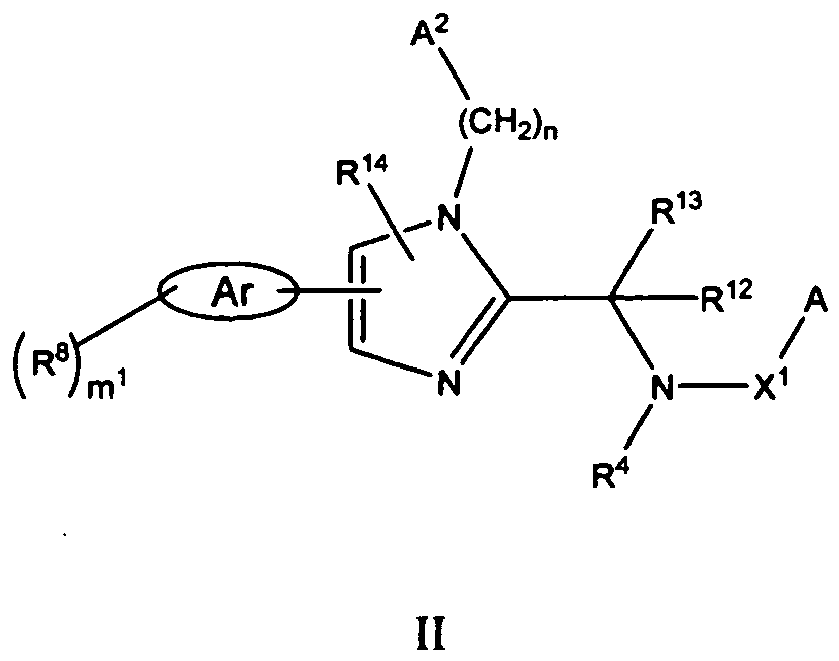 Ar is selected from the group consisting of phenyl, pyridinyl, pyrazinyl, and thiazolyl;X1 is selected from the group consisting of-C(O)- and-S(O)2-;A2 is selected from the group consisting of aryl, heteroaryl, heterocyclic, and cycloalkyl, all of which may be optionally substituted with 1 to 4 substituents selected from the group consisting of alkyl, substituted alkyl, alkoxy, substituted alkoxy, amino, halo, hydroxy, and nitro;A is selected from the group consisting of hydrogen, optionally substituted alkyl, optionally substituted alkoxy, optionally substituted aryl, carboxyl, carboxyl ester, aminoacyl, optionally substituted heteroaryl, optionally substituted heterocyclic, and optionally substituted cycloalkyl,wherein the optionally substituted groups are substituted with 1 to 4 substituents selected from the group consisting of alkyl, substituted alkyl, alkoxy, substituted alkoxy, amino, substituted amino, aryloxy, substituted aryloxy, cyano, aryl, substituted aryl, heteroaryl, substituted heteroaryl, heterocyclic, substituted heterocyclic, heterocyclyloxy, substituted heterocyclyloxy, acyl, carboxyl, carboxyl ester, oxo (except when A is optionally substituted aryl or optionally substituted heteroaryl), halo, hydroxy, -S(O)2-R9 where R9 is alkyl, substituted alkyl, aryl, substituted aryl, heteroaryl or substituted heteroaryl, and nitro;R4 is selected from the group consisting of hydrogen, linear alkyl, -alkylene-aminoacyl, -alkylene-oxyacyl, -alkylene-acyloxy, -alkylene-hydroxy, -[alkylene]p-nitrogen-containing heterocyclic, -[alkylene]p-nitrogen-containing substituted heterocyclic, -[alkylene]p-nitrogen-containing heteroaryl, -[alkylene]p-nitrogen-containing substituted heteroaryl, and -[alkylene]p-NR10R11 wherein p is an integer from 0 to 1,alkylene is a straight chained alkylene optionally mono- or disubstituted with one of the foregoing substituents selected from the group consisting of amino, substituted amino, hydroxy, alkyl, substituted alkyl, carboxyl, carboxyl ester, oxo, spirocycloalkyl, and halo;R10 and R11 are independently selected from the group consisting of hydrogen, alkyl, substituted alkyl, -S(O)-alkyl, -S(O)-substituted alkyl, -S(O)2-alkyl, -S(O)2-substituted alkyl, heterocyclic, substituted heterocyclic, acyl, aryl, substituted aryl, heteroaryl, substituted heteroaryl, cycloalkyl, and substituted cycloalkyl or when R10 is hydrogen, R11 is hydroxy, alkoxy or substituted alkoxy;or when R13 and A, together with the carbon atom and the X1 group bound respectively thereto, do not form a heterocyclic or substituted heterocyclic group, then X1-A and R4, together with the nitrogen atom bound thereto, form a heterocyclic or substituted heterocyclic group;R8 is selected from the group consisting of cyano, alkyl, alkenyl, alkynyl, -CF3, alkoxy, halo, and hydroxy;R12 is hydrogen, alkyl;R13 is alkyl or aryl;R13 and X1-A, together with the carbon atom attached to R13 and the nitrogen atom attached to X1 join to form a heterocyclic or a substituted heterocyclic group;R14 is hydrogen or C1 to C4 alkyl;m1 is an integer equal to 0 to 2;n is an integer equal to I to 3; orpharmaceutically acceptable salts or esters thereof.
 - The compound of claim 1, wherein the compound is represented by formula III:
 X1 is -C(O)- or -S(O)2-;A2 is selected from the group consisting of aryl, heteroaryl, heterocyclic, and cycloalkyl, all of which may be optionally substituted with 1 to 4 substituents selected from the group consisting of alkyl, substituted alkyl, alkoxy, substituted alkoxy, amino, halo, hydroxy, and nitro;A is selected from the group consisting of hydrogen, optionally substituted alkyl, optionally substituted alkoxy, optionally substituted aryl, carboxyl, carboxyl ester, aminoacyl, optionally substituted heteroaryl, optionally substituted heterocyclic, and optionally substituted cycloalkyl,wherein the optionally substituted groups are substituted with 1 to 4 substituents selected from the group consisting of alkyl, substituted alkyl, alkoxy, substituted alkoxy, amino, substituted amino, aryloxy, substituted aryloxy, cyano, aryl, substituted aryl, heteroaryl, substituted heteroaryl, heterocyclic, substituted heterocyclic, heterocyclyloxy, substituted heterocyclyloxy, acyl, carboxyl, carboxyl ester, oxo (except when A is optionally substituted aryl or optionally substituted heteroaryl), halo, hydroxy, -S(O)2-R9 where R9 is alkyl, substituted alkyl, aryl, substituted aryl, heteroaryl or substituted heteroaryl, and nitro;R8 is selected from the group consisting of alkyl, alkenyl, alkynyl, -CF3, alkoxy, halo, and hydroxy;R4 is selected from the group consisting of hydrogen, linear alkyl, -alkylene-aminoacyl, -alkylene-oxyacyl, -alkylene-acyloxy, -alkylene-hydroxy, -[alkylene]p-nitrogen-containing heterocyclic, -[alkylene]p-nitrogen-containing substituted heterocyclic, -[alkylene]p-nitrogen-containing heteroaryl, -[alkylene]p-nitrogen-containing substituted heteroaryl, and -[alkylene]p-NR10R11 wherein p is an integer from 0 to 1,alkylene is a straight chained alkylene optionally mono- or disubstituted with one of the foregoing substituents selected from the group consisting of amino, substituted amino, hydroxy, alkyl, substituted alkyl, carboxyl, carboxyl ester, oxo, spirocycloalkyl, and halo;R10 and R11 are independently selected from the group consisting of hydrogen, alkyl, substituted alkyl, -S(O)-alkyl, -S(O)-substituted alkyl, -S(O)2-alkyl, -S(O)2-substituted alkyl, heterocyclic, substituted heterocyclic, acyl, aryl, substituted aryl, heteroaryl, substituted heteroaryl, cycloalkyl, and substituted cycloalkyl or when R10 is hydrogen, R11 is hydroxy, alkoxy or substituted alkoxy; or when R15 and A, together with the carbon atoms and X1 bound respectively thereto, do not form a heterocyclic or substituted heterocyclic group, then X1, A and R4, together with the nitrogen atom bound thereto, form a heterocyclic or substituted heterocyclic group;R15 is selected from the group consisting of ethyl, isopropyl, t-butyl, or phenyl;R15 and X1-A, together with the carbon atom attached to R15 and the nitrogen atom attached to X' join to form a heterocyclic or a substituted heterocyclic group;R16 is hydrogen or methyl;R17 is hydrogen or methyl;m1 is an integer equal to 0, 1 or 2;or pharmaceutically acceptable salts or esters thereof.
 - The compound of claim 1, wherein the compound is represented by formula IV:

- The compound of claim 1, wherein the compound is represented by formula V:

- The compound of claim 1, wherein the compound is represented by formula VI:

- The compound of claim 1, wherein R1 is selected from the group consisting of phenyl, methyl, iso-propyl, t-butyl, 1-methyl-n-prop-1-yl, and 2-hydroxy-iso-propyl.
- The compound of claim 1, wherein R2 is selected from the group consisting of hydrogen, methyl, and ethyl.
- The compound of claim 1, wherein X or X1 is C(O) or S(O)2 and A is unsubstituted and selected from the group consisting of 1,3-benzothiadiazol-4-yl, t-butoxy, butoxy, n-butoxy, carboxyl, cyclohexyl, 2,2-dimethylpropoxy, ethoxy, furan-3-yl, hydrogen, isoxazol-3-yl, methoxy, methyl, 2-methylpropoxy, phenyl, piperidin-3-yl, piperidin-4-yl, n-propoxy, pyridin-2-yl, pyrazin-2-yl, tetrahydrofuran-2-yl, tetrahydrofuran-3-yl, tetrahydro-2H-pyran-4-yl, 1H-tetrazol-1-yl, 2H-tetrazol-2-yl, thiazol-4-yl, 1,3,4-thiadiazol-2-yl, 1,3-benzothiadiazol-6-yl, 3,3-dihydrobenzo[1,2,3]thiadiazol-4-yl, benzimidazol-2-yl, benzimidazol-6-yl, benzo[1,2,5]thiadiazole, benzoxadiazol-4-yl, cyclopentyl, imidazol-4-yl, indazol-6-y, isooxazol-5-yl, morpholin-2-yl morpholino, oxazol-4-yl, piperidin-N-yl, pyrazol-3-yl, pyrrolidin-2-yl pyrrolidin-3-yl, pyrrolidin-N-yl, tetrazol-5-yl, and thiadiazol-4-yl.
- The compound of claim 1, wherein X or X1 is C(O) or S(O)2 and A is a substituted aryl or heteroaryl group selected from the group consisting of 5-methyl-2H-imidazol-4yl, 2-aminothiazol-4-yl, 4-t-butylphenyl, 2-chlorophenyl, 2-chloro-6-methylpyrid-4-yl, 3-chlorophenyl, 4-chlorophenyl, 6-chloropyridin-3-yl, 3,4-dichlorophenyl, 2,4-difluorophenyl, 1,5-dimethyl-1H-pyrazol-3-yl, 2,4-dimethylthiazol-5-yl, 1-ethyl -3-methyl-1H-pyrazol-5-yl, 2-methoxyphenyl, 4-methoxyphenyl, 4-methylisoxazol-3-yl, 5-methylisoxazol-4-yl, 4-methylphenyl, 1-methyl-3-trifluoromethyl-1H-pyrazol-4-yl, 1-methyl-5-chloro-1H-pyrazol-4-yl, 5-methyl-1H-pyrazol-3-yl, 6-methylpyridin-3-yl, 2-pyrrolidin-3-ylphenyl, 4-(trifluoromethyl)phenyl, 6-(trifluoromethyl)pyridin-3-yl, 2,5-dimethyloxazol-4-yl, 2-aminothiazol-4-yl, 4-methylpyrazol-5-yl, 3-trifluoromethylpyrazol-4-yl, 2-methyl-3-trifluoromethylpyrazol-5-yl, 4-chloro-1,3-dimethylpyrazolo[3,4]pyridine, and 1-methylbenzimidazol-2-yl.
- The compound of claim 1, wherein X or X1 is C(O) or S(O)2 and A is a substituted heterocyclic or cycloalkyl selected from the group consisting of 3-[(aminoacetyl)amino]cyclohexyl, 3-(2-aminoethylsulfonylamino)cyclohexyl, 1-methylpiperazin-4-yl, 1-methylcarbonylpiperidin-4-yl, 1-methoxycarbonylpiperidin-4-yl, quinuclidin-3-yl, 2-oxopyrrolidin-5-yl, 2-oxopyrrolidin-4-yl, 2-oxo-dihydrofuran-5-yl, 2-oxothiazolidin-4-yl, and 3-hydroxypyrrolidin-5-yl.
- The compound of claim 1, wherein X or X1 is C(O) or S(O)2 and A is a substituted alkyl selected from the group consisting of 3-amino-2-oxo-1(2H)-pyridinylmethyl, cyanomethyl, (N,N-dimethylamino)methyl, ethoxymethyl, p-fluorophenoxymethyl, hydroxymethyl, 1H-imidazol-1-ylmethyl, methoxymethyl, (N-methylamino)methyl, methylsulfonylmethyl, (5-methyl-1H-tetrazol-1-yl)methyl, (5-methyl-2H-tetrazol-2-yl)methyl, morpholin-4-ylmethyl, 1H-pyrazol-1-ylmethyl, 1H-1,2,3-triazol-1-ylmethyl, 2H-1,2,3-triazol-2-ylmethyl, 1H-1,2,4-triazol-1-ylmethyl, 2H-1,2,4-triazol-2-ylmethyl, 4H-1,2,4-triazol-4-ylmethyl, 1H-tetrazol-1-ylmethyl, 1H-tetrazol-5-ylmethyl, 2H-tetrazol-2-ylmethyl. imidazol-4-ylmethyl, 1-methylpyrazol-3-ylmethyl, piperidin-4-ylmethyl, trifluoromethyl, dimethylaminoethyl, and 2-oxo-3-aminopyrrolidin-1-ylmethyl.
- The compound of claim 1, wherein X or X1 is C(O) or S(O)2 and R1 and R3 are cyclized to form a divalent heterocyclic group such as 2-oxopiperidin-N-6-yl or pyrrolidin-1-yl.
- The compound of claim 1, wherein A is N-methylaminocarbonyl.
- The compound of claim 1, wherein R4 is selected from the group consisting of: hydrogen, piperidin-4-yl, -(CH2)2-NH2, -CH2-azetidin-3-yl, -CH2-(2,5-dihydropyrrol-3-yl), -(CH2)3-imidazol-1-yl, -CH2-(1H-imidazol-4-yl), -CH2-pyridin-3-yl, -CH2-(2-hydroxypyridin-4-yl), -CH2-(6-hydroxypyridin-3-yl), -CH2-morpholin-2-yl, -CH2-pyrrolidin-3-yl, -CH2-(3-fluoropyrrolidin-3-yl), -CH2-(3-hydroxypyrrolidin-3-yl), -CH2-(4-fluoropyrrolidin-3-yl), -CH2-(4-hydroxypyrrolidin-3-yl), -CH2-(2-hydroxymethylpyrrolidin-3-yl), -CH2-piperidin-3-yl, -CH2-[1H-(1,2,3-triazol-4-yl)], -CH2CH(NH2)CH2OH, -(CH2)3-OH, -(CH2)3-O(CO)-phenyl, -(CH2)3-NH2, -(CH2)3-NHCH3, -(CH2)3-N(CH3)2, -(CH2)3-NHOCH3, -(CH2)3-NHSO2CH3, -(CH2)3NH-(5-cyanopyridin-2-yl), -(CH2)3NH-cyclopropyl, -(CH2)3NH-cyclobutyl, -(CH2)3-(1H-imidazol-2-yl), -(CH2)3-(2-hydroxyethylpiperidin-1-yl), -(CH2)3NH(2-hydroxymethylphenyl), -(CH2)3NH-(5-trifluoromethylpyridin-2-yl), -(CH2)3NHCH2-cyclopropyl, -(CH2)3NHCH2-{5-(pyridin-3-yloxy)-1H-indazol-3-yl}, -(CH2)3NHCH2-(5-methoxy-1H-indazol-3-yl), -(CH2)3NHCH2-(6-fluoro-1H-indazol-3-yl), -CH2CHOHCH2NH2, -CH2CH(CH2OH)CH2NH2, -CH2C(CH3)2CH2-N(CH3)2, -CH2C(CH3)2CH2-(4-methylpiperazin-1-yl), -(CH2)2C(O)NH2, -(CH2)2CH(NH2)C(O)NH2, -(CH2)2CH(NH2)C(O)OH, -(CH2)2CH(NH2)CH2C(O)NH2, -(CH2)2CH(NH2)CH2OH, -(CH2)2CH(NH2)CH3, -(CH2)3NHC(O)CH2NH2, -(CH2)3NHC(O)CH(NH2)CH(CH3)2, -CH2CHFCH2NH2, -(CH2)2NHC(O)CH2NH2, -(CH2)3-NHCH2CH2OH, -(CH2)3-NHCH2CO2H, -(CH2)3-NHCH2CO2CH2CH3, -(CH2)3-N(CH2CH2OH)2, -(CH2)3-NHCH(CH2OH)2, -(CH2)3CH3, -(CH2)2CH(NH2)CH2OH, -(CH2)2C(CH3)2NH2, -(CH2)2CH(NH2)CH2OCH3, -(CH2)2CH(NH2)CH2F, -CH2CHFCH(NH2)CH2OH, and -(CH2)2spirocylcopropyl-NH2.
- The compound of claim 1, wherein L is methylene and A1 is selected from the group consisting of phenyl, 6-aminopyridin-2-yl, 3-chlorophenyl, 3-cyanophenyl, 2,4-difluorophenyl, 2,5-difluorophenyl, 3,5-difluorophenyl, 2-fluorophenyl, 3-fluorophenyl, 4-fluorophenyl, 3-hydroxyphenyl, 3-methoxyphenyl, 1-(5-methyl)-isoxazol-3-yl, 2-methylphenyl, 3-methylphenyl, 4-methylphenyl, pyridin-2-yl, pyridin-3-yl, pyridin-4-yl, tetrahydropyran-4-yl, thiazol-4-yl, and 5-trifluoromethylfuran-2-yl.
- The compound of claim 1, wherein R7 is hydrogen, halo, or methyl.
- The compound of claim 17, wherein R6 is selected from the group consisting of phenyl, 3-bromophenyl, 3-chlorophenyl, 4-cyanophenyl, 2,5-difluorophenyl, 3-fluorophenyl, 2-methoxyphenyl, 3-methoxyphenyl, 4-methoxyphenyl, 4-methylphenyl, pyrazin-2-yl, pyridin-2-yl, thiazol-2-yl, 2-trifluoromethylphenyl, and 3-trifluoromethylphenyl.
- The compound of claim 1, wherein R6 is hydrogen, halo, or methyl.
- The compound of claim 19, wherein R7 is 3-fluorophenyl.
- The compound of claim 1, wherein R3 and R4 cyclize to form 1-oxa-3,7-diazaspiro[4.4]nonan-2-one or 6-oxa-2,9-diazaspiro[4.5]decan-8-one.
- A compound of claim I selected from the group consisting of:N-(3-aminopropyl)-N-[(1R)-1-(1-benzyl-4-phenyl-1H-imidazol-2-yl)-2-methylpropyl]-4-methylbenzamide;N-(3-aminopropyl)-N-[(1R)-1-(1-benzyl-4-phenyl-1H-imidazol-2-yl)-2-methylpropyl]benzamide;N-(3-aminopropyl)-N-[(R)-(1-benzyl-4-phenyl-1H-imidazol-2-yl)(phenyl)methyl]-4-methylbenzamide;N-(3-aminopropyl)-N-[(R)-(1-benzyl-4-phenyl-1H-imidazol-2-yl)(phenyl)methyl]benzamide;N-(3-aminopropyl)-N-{(1R)-1-[1-benzyl-4-(3-bromophenyl)-1H-imidazol-2-yl]-2-methylpropyl}benzamide;N-(3-aminopropyl)-N-{(R)-1-[1-benzyl-4-(3-bromophenyl)-1H-imidazol-2-yl]-2-methylpropyl}-4-methylbenzamide;N-(3-aminopropyl)-N-{(1R)-1-[1-benzyl-4-(3-bromophenyl)-1H-imidazol-2-yl]-2-methylpropyl}-4-(trifluoromethyl)benzamide;N-(3-aminopropyl)-N-{(1R)-1-[1-benzyl-4-(3-bromophenyl)-1H-imidazol-2-yl]-2-methylpropyl}-2,4-difluorobenzamide;N-(3-aminopropyl)-4-methyl-N-{2-methyl-1-[1-(3-methylbenzyl)-4-phenyl-1H-imidazol-2-yl]propyl}benzamide;N-(3-aminopropyl)-N-{(1R)-1-[1-benzyl-4-(3-methoxyphenyl)-1H-imidazol-2-yl]-2-methylpropyl}benzamide;N-(3-aminopropyl)-N-{(1R)-1-[1-benzyl-4-(3-methoxyphenyl)-1H-imidazol-2-yl]-2-methylpropyl}-4-methylbenzamide;N-(3-aminopropyl)-N-{(1R)-1-[1-benzyl-4-(3-methoxyphenyl)-1H-imidazol-2-yl]-2-methylpropyl}-4-(trifluoromethyl)benzamide;N-(3-aminopropyl)-N-{(1R)-1-[1-benzyl-4-(3-methoxyphenyl)-1H-imidazol-2-yl]-2-methylpropyl}-2,4-difluorobenzamide;N-(3-aminopropyl)-N-{(1R)-1-[1-benzyl-4-(3-chlorophenyl)-1H-imidazol-2-yl]-2-methylpropyl}benzamide;N-(3-aminopropyl)-N-{(1R)-1-[1-benzyl-4-(3-chlorophenyl)-1H-imidazol-2-yl]-2-methylpropyl}-4-methylbenzamide;N-(3-aminopropyl)-N-{(1R)-1-[1-benzyl-4-(3-chlorophenyl)-1H-imidazol-2-yl]-2-methylpropyl}-4-(trifluoromethyl)benzamide;N-(3-aminopropyl)-N-{(1R)-1-[1-benzyl-4-(3-chlorophenyl)-1H-imidazol-2-yl]-2-methylpropyl}-2,4-difluorobenzamide;N-(3-aminopropyl)-N-{(1R)-1-[1-benzyl-4-(4-methylphenyl)-1H-imidazol-2-yl]-2-methylpropyl}benzamide;N-(3-aminopropyl)-N- {(1R)-1-[1-benzyl-4-(4-methylphenyl)-1H-imidazol-2-yl]-2-methylpropyl}-4-methylbenzamide;N-(3-aminopropyl)-N-{(1R)-1-[1-benzyl-4-(4-methylphenyl)-1H-imidazol-2-yl]-2-methylpropyl}-4-(trifluoromethyl)benzamide;N-(3-aminopropyl)-N-{(1R)-1-[1-benzyl-4-(4-methylphenyl)-1H-imidazol-2-yl]-2-methylpropyl}-2,4-difluorobenzamide;N-(3-aminopropyl)-N-[(1R)-1-(1-benzyl-4-phenyl-1H-imidazol-2-yl)-2,2-dimethylpropyl]-4-methylbenzamide;N-(3-aminopropyl)-N-[(1R)-1-(1-benzyl-4-phenyl-1H-imidazol-2-yl)-2,2-dimethylpropyl]benzamide;N-(3-aminopropyl)-N-{(1R)-1-[1-(3,5-difluorobenzyl)-4-phenyl-1H-imidazol-2-yl]-2-methylpropyl}-4-methylbenzamide;N-(3-aminopropyl)-N-{(1R)-1-[1-(3,5-difluorobenzyl)-4-phenyl-1H-imidazol-2-yl]-2-methylpropyl}benzamide;N-{(1R)-1-[1-benzyl-4-(3-bromophenyl)-1H-imidazol-2-yl]-2-methylpropyl}-4-methyl-N-{3-[(methylsulfonyl)amino]propyl}benzamide;N-[(1R)-1-(1-benzyl-4-phenyl-1H-imidazol-2-yl)-2-methylpropyl]-N-[(3R)-piperidin-3-ylmethyl]benzamide;N-[(1R)-1-(1-benzyl-4-phenyl-1H-imidazol-2-yl)-2-methylpropyl]-N-[(3S)-piperidin-3-ylmethyl]benzamide;N-(3-aminopropyl)-4-methyl-N-{(1R)-2-methyl-1-[1-(4-methylbenzyl)-4-phenyl-1H-imidazol-2-yl]propyl)benzamide;N-(3-aminopropyl)-N-{(1R)-2-methyl-1-[1-(4-methylbenzyl)-4-phenyl-1H-imidazol-2-yl]propyl}benzamide;N-(3-aminopropyl)-4-methyl-N-{(1R)-2-methyl-1-[1-(2-methylbenzyl)-4-phenyl-1H-imidazol-2-yl]propyl}benzamide;N-(3-aminopropyl)-N-{(1R)-2-methyl-1-[1-(2-methylbenzyl)-4-phenyl-1H-imidazol-2-yl]propyl}benzamide;N-[(1R)-1-(1-benzyl-4-phenyl-1H-imidazol-2-yl)-2-methylpropyl]-N-[2,2-dimethyl-3-(4-methylpiperazin-1-yl)propyl]benzamide;N-[(1R)-1-(1-benzyl-4-phenyl-1H-imidazol-2-yl)-2-methylpropyl]-N-[2,2-dimethyl-3-(4-methylpiperazin-1-yl)propyl]-4-methylbenzamide;N-[(1R)-1-(1-benzyl-4-phenyl-1H-imidazol-2-yl)-2-methylpropyl]-4-methyl-N-[(3R)-piperidin-3-ylmethyl]benzamide;N-[(1R)-1-(1-benzyl-4-phenyl-1H-imidazol-2-yl)-2-methylpropyl]-4-methyl-N-[(3S)-piperidin-3-ylmethyl]benzamide;N-(3-aminopropyl)-N-((1R)-1-{1-benzyl-4-[2-(trifluoromethyl)phenyl]-1H-imidazol-2-yl}-2-methylpropyl)benzamide;N-(3-aminopropyl)-N-((1R)-1-{1-benzyl-4-[2-(trifluoromethyl)phenyl]-1H-imidazol-2-yl}-2-methylpropyl)-4-methylbenzamide;N-(3-aminopropyl)-N-((1R)-1-{1-benzyl-4-[2-(trifluoromethyl)phenyl]-1H-imidazol-2-yl}-2-methylpropyl)-2,4-difluorobenzamide;N-(3-aminopropyl)-N-{(1R)-1-[1-benzyl-4-(3-chlorophenyl)-1H-imidazol-2-yl]-2-methylpropyl}-4-methoxybenzamide;N-(3-aminopropyl)-N-{(1R)-1-[1-benzyl-4-(3-chlorophenyl)-1H-imidazol-2-yl]-2-methylpropyl}-3-chlorobenzamide;N-(3-aminopropyl)-N-{(1R)-1-[1-benzyl-4-(3-chlorophenyl)-1H-imidazol-2-yl]-2-methylpropyl}-4-chlorobenzamide;N-(3-aminopropyl)-N-{{(1R)-1-[1-benzyl-4-(3-chlorophenyl)-1H-imidazol-2-yl]-2-methylpropyl}-4-tert-butylbenzamide;N-(3-aminopropyl)-N-{(1R)-1-[1-benzyl-4-(3-chlorophenyl)-1H-imidazol-2-yl]-2-methylpropyl}-3,4-dichlorobenzamide;N-{(1R)-1-[1-benzyl-4-(3-bromophenyl)-1H-imidazol-2-yl]-2-methylpropyl}-N-{3-[(5-cyanopyridin-2-yl)amino]propyl}benzamide;N-{(1R)-1-[1-benzyl-4-(3-bromophenyl)-1H-imidazol-2-yl]-2-methylpropyl}-N-(3-{[5-(trifluoromethyl)pyridin-2-yl]amino}propyl)benzamide;N-[(1R)-1-(1-benzyl-4-phenyl-1H-imidazol-2-yl)-2-methylpropyl]-N-piperidin-4-ylbenzamide;N-[(1R)-1-(1-benzyl-4-phenyl-1H-imidazol-2-yl)-2-methylpropyl]-4-methyl-N-piperidin-4-ylbenzamide;N-[(1R)-1-(1-benzyl-4-phenyl-1H-imidazol-2-yl)-2-methylpropyl]-2,4-difluoro-N-piperidin-4-ylbenzamide;N-(3-aminopropyl)-N-{(1R)-1-[1-benzyl-4-(3-chlorophenyl)-1H-imidazol-2-yl]-2-methylpropyl}cyclohexanecarboxamide;N-(3-aminopropyl)-N-{(1R)-1-[1-benzyl-4-(3-chlorophenyl)-1H-imidazol-2-yl]-2-methylpropyl}-6-chloronicotinamide;N-(3-aminopropyl)-N- {(1R)-1-[1-benzyl-4-(3-chlorophenyl)-1H-imidazol-2-yl]-2,2-dimethylpropyl}benzamide;N-(3-aminopropyl)-N-{(1R)-1-[1-benzyl-4-(3-chlorophenyl)-1H-imidazol-2-yl]-2,2-dimethylpropyl}-4-methylbenzamide;N-(3-aminopropyl)-N-{(1R)-1-[4-(3-chlorophenyl)-1-(2,4-difluorobenzyl)-1H-imidazol-2-yl]-2,2-dimethylpropyl}benzamide;N-(3-aminopropyl)-N-{(1R)-1-[4-(3-chlorophenyl)-1-(2,4-difluorobenzyl)-1H-imidazol-2-yl]-2,2-dimethylpropyl}-4-methylbenzamide;N-[(1R)-1-(-benzyl-4-phenyl-1H-imidazol-2-yl)-2-methylpropyl]-N-[3-(dimethylamino)-2,2-dimethylpropyl]benzamide;N-[(1R)-1-(1-benzyl-4-phenyl-1H-imidazol-2-yl)-2-methylpropyl]-N-[3-(dimethylamino)-2,2-dimethylpropyl]-4-methylbenzamide;N-(3-aminopropyl)-N-{(1R)-1-[1-benzyl-4-(3-chlorophenyl)-1H-imidazol-2-yl]-2,2-dimethylpropyl}-6-chloronicotinamide;N-(3-aminopropyl)-6-chloro-N-((1R)-1-[4-(3-chlorophenyl)-1-(3,5-difluorobenzyl)-1H-imidazol-2-yl]-2,2-dimethylpropyl)nicotinamide;N-(3-aminopropyl)-N-[(1R)-1-(1-benzyl-5-methyl-4-phenyl-1H-imidazol-2-yl)-2-methylpropyl]benzamide;N-(3-aminopropyl)-N-[(1R)-1-(1-benzyl-5-methyl-4-phenyl-1H-imidazol-2-yl)-2-methylpropyl]-4-methylbenzamide;N-(3-aminopropyl)-N-[(1R)-1-(1-benzyl-5-methyl-4-phenyl-1H-imidazol-2-yl)-2-methylpropyl]-2,4-difluorobenzamide;N-(3-aminopropyl)-N-[(1R)-1-(1-benzyl-5-methyl-4-phenyl-1H-imidazol-2-yl)-2-methylpropyl]-6-chloronicotinamide;N-(3-aminopropyl)-N-{(1R)-1-[1-benzyl-4-(3-chlorophenyl)-1H-imidazol-2-yl]-2-methylpropyl}-2-chlorobenzamide;N-(3-aminopropyl)-N-{(1R)-1-[1-benzyl-4-(3-chlorophenyl)-1H-imidazol-2-yl]-2-methylpropyl}-2-chloro-6-methylisonicotinamide;N-(3-aminopropyl)-N-{(1R)-1-[1-benzyl-4-(3-chlorophenyl)-1H-imidazol-2-yl]-2-methylpropyl}-3-furamide;N-(3-aminopropyl)-N-{(1R)-1-[1-benzyl-4-(3-chlorophenyl)-1H-imidazol-2-yl]-2-methylpropyl}-5-methyl-2H-imidazole-4-carboxamide;N-(3-aminopropyl)-N-{(1R)-1-[1-benzyl-4-(3-chlorophenyl)-1H-imidazol-2-yl]-2-methylpropyl}-2-methoxybenzamide;N-(3-aminopropyl)-N-{(1R)-1-[1-benzyl-4-(3-chlorophenyl)-1H-imidazol-2-yl]-2-methylpropyl}pyridine-2-carboxamide;N-(3-aminopropyl)-N-{(1R)-1-[1-benzyl-4-(3-chlorophenyl)-1H-imidazol-2-yl]-2-methylpropyl}-1,5-dimethyl-1H-pyrazole-3-carboxamide;N-(3-aminopropyl)-N-[(1R)-1-(1-benzyl-4-phenyl-1H-imidazol-2-yl)-1,2-dimethylpropyl]benzamide;N-(3-aminopropyl)-N-[(1R)-1-(1-benzyl-4-phenyl-1H-imidazol-2-yl)-1,2-dimethylpropyl]-4-methylbenzamide;N-(2-aminoethyl)-N-[(1R)-1-(1-benzyl-4-phenyl-1H-imidazol-2-yl)-2-methylpropyl]-4-methylbenzamide;N-(2-aminoethyl)-N-[(1R)-1-(1-benzyl-4-phenyl-1H-imidazol-2-yl)-2-methylpropyl]benzamide;N-(3-aminopropyl)-N-{(1R)-1-[1-benzyl-4-(3-chlorophenyl)-1H-imidazol-2-yl]-2-methylpropyl}-1,3-thiazole-4-carboxamide;N-{(1R)-1-[1-benzyl-4-(3-chlorophenyl)-1H-imidazol-2-yl]-2,2-dimethylpropyl}-N-(pyrrolidin-3-ylmethyl)benzamide;N-{(1R)-1-[4-(3-chlorophenyl)-1-(3,5-difluorobenzyl)-1H-imidazol-2-yl]-2,2-dimethylpropyl}-N-(pyrrolidin-3-ylmethyl)benzamide;N-(3-aminopropyl)-N-{(R)-1-[1-benzyl-4-(3-chlorophenyl)-1H-imidazol-2-yl]-2-methylpropyl}benzenesulfonamide;N-(3-aminopropyl)-N-{(1R)-1-[1-benzyl-4-(3-chlorophenyl)-1H-imidazol-2-yl]-2-methylpropyl}-4-methylisoxazole-3-carboxamide;N-(3-aminopropyl)-N-{(1R)-1-[1-benzyl-4-(3-chlorophenyl)-1H-imidazol-2-yl]-2-methylpropyl}isoxazole-3-carboxamide;N-(3-aminopropyl)-N-{(1R)-1-[1-benzyl-4-(3-chlorophenyl)-1H-imidazol-2-yl]-2-methylpropyl}-5-methyl-1H-pyrazole-3-carboxamide;N-(3-aminopropyl)-N-{(1R)-1-[1-benzyl-4-(3-chlorophenyl)-1H-imidazol-2-yl]-2-methylpropyl}-2,4-dimethyl-1,3-thiazole-5-carboxamide;N-(3-aminopropyl)-N-{(1R)-1-[1-benzyl-4-(3-chlorophenyl)-1H-imidazol-2-yl]-2-methylpropyl}tetrahydrofuran-3-carboxamide;N-(3-aminopropyl)-N-{(1R)-1-[1-benzyl-4-(3-chlorophenyl)-1H-imidazol-2-yl]-2-methylpropyl}piperidine-4-carboxamide;2-amino-N-(3-aminopropyl)-N-{(1R)-1-[1-benzyl-4-(3-chlorophenyl)-1H-imidazol-2-yl]-2-methylpropyl}-1,3-thiazole-4-carboxamide;N-[(1R)-1-(1-benzyl-4-phenyl-1H-imidazol-2-yl)-2,2-dimethylpropyl]-N-(1H-imidazol-4-ylmethyl)benzamide;N-[(1R)-1-(1-benzyl-4-phenyl-1H-imidazol-2-yl)-2,2-dimethylpropyl]-N-[(2-hydroxypyridin-4-yl)methyl]benzamide;N-[(1R)-1-(1-benzyl-4-phenyl-1H-imidazol-2-yl)-2,2-dimethylpropyl]-N-[(6-hydroxypyridin-3-yl)methyl]benzamide;N-[(1R)-1-(1-benzyl-4-phenyl-1H-imidazol-2-yl)-2,2-dimethylpropyl]-N-(pyridin-3-ylmethyl)benzamide;N-[(1R)-1-(1-benzyl-4-phenyl-1H-imidazol-2-yl)-2,2-dimethylpropyl]-N-[3-(cyclobutylamino)propyl]benzamide;N-[(1R)-1-(1-benzyl-4-phenyl-1H-imidazol-2-yl)-2,2-dimethylpropyl]-N-(pyrrolidin-3-ylmethyl)benzamide;N-(3-aminopropyl)-N-[(1R)-1-(1-benzyl-4-phenyl-1H-imidazol-2-yl)-2,2-dimethylpropyl]-6-methylnicotinamide;N-[(1R)-1-(1-benzyl-4-phenyl-1H-imidazol-2-yl)-2,2-dimethylpropyl]-N-{3-[(cyclopropylmethyl)amino]propyl}benzamide;N-[(1R)-1-(1-benzyl-4-phenyl-1H-imidazol-2-yl)-2,2-dimethylpropyl]-N-[3-({[5-(pyridin-3-yloxy)-1H-indazol-3-yl]methyl}amino)propyl]benzamide;N-[(1R)-1-(1-benzyl-4-phenyl-1H-imidazol-2-yl)-2,2-dimethylpropyl]-N-[(5-methoxy-1H-indazol-3-yl)methyl]benzamide;N-[(1R)-1-(1-benzyl-4-phenyl-1H-imidazol-2-yl)-2,2-dimethylpropyl]-N-(3-{[(6-fluoro-1H-indazol-3-yl)methyl]amino}propyl)benzamide;N-[(1R)-1-(1-benzyl-4-phenyl-1H-imidazol-2-yl)-2,2-dimethylpropyl]-N-{[5-(pyridin-3-yloxy)-1H-indazol-3-yl]methyl}benzamide;N-[(1R)-1-(1-benzyl-4-phenyl-1H-imidazol-2-yl)-2,2-dimethylpropyl]-N-(3-hydroxypropyl)benzamide;N-(3-aminopropyl)-N-[(1R)-1-(1-benzyl-4-phenyl-1H-imidazol-2-yl)-2,2-dimethylpropyl]-1,5-dimethyl-1H-pyrazole-3-carboxamide;N-[(1R)-1-(1-benzyl-4-phenyl-1H-imidazol-2-yl)-2,2-dimethylpropyl]-N-[(3R)-3,5-diamino-5-oxopentyl]benzamide;N-{3-[(aminoacetyl)amino]propyl}-N-[(1R)-1-(1-benzyl-4-phenyl-1H-imidazol-2-yl)-2,2-dimethylpropyl]benzamide;N-{2-[(aminoacetyl)amino]ethyl}-N-[(1R)-1-(1-benzyl-4-phenyl-1H-imidazol-2-yl)-2,2-dimethylpropyl]benzamide;N-[(1R)-1-(1-benzyl-4-phenyl-1H-imidazol-2-yl)-2-methylpropyl]-1,5-dimethyl-N-(piperidin-3-ylmethyl)-1H-pyrazole-3-carboxamide;(2R)-N-(3-aminopropyl)-N-{(1R)-1-[1-benzyl-4-(3-chlorophenyl)-1H-imidazol-2-yl]-2-methylpropyl}tetrahydrofuran-2-carboxamide;(2S)-N-(3-aminopropyl)-N-{(1R)-1-[1-benzyl-4-(3-chlorophenyl)-1H-imidazol-2-yl]-2-methylpropyl}tetrahydrofuran-2-carboxamide;N-(3-aminopropyl)-N- {(1R)-1-[1-benzyl-4-(3-chlorophenyl)-1H-imidazol-2-yl]-2-methylpropyl}pyrazine-2-carboxamide;3-{benzoyl[(1R)-1-(1-benzyl-4-phenyl-1H-imidazol-2-yl)-2,2-dimethylpropyl]amino}propyl benzoate;N-{(1R)-1-[4-(3-chlorophenyl)-1-(3,5-difluorobenzyl)-1H-imidazol-2-yl]-2,2-dimethylpropyl}-1,5-dimethyl-N-[(3R)-pyrrolidin-3-ylmethyl]-1H-pyrazole-3-carboxamide;N-{(1R)-1-[4-(3-chlorophenyl)-1-(3,5-difluorobenzyl)-1H-imidazol-2-yl]-2,2-dimethylpropyl}-1,5-dimethyl-N-[(3S)-pyrrolidin-3-ylmethyl]-1H-pyrazole-3-carboxamide;N-(3-aminopropyl)-N-{(1R)-1-[1-benzyl-4-(3-chlorophenyl)-1H-imidazol-2-yl]-2-methylpropyl}-1-methyl-3-(trifluoromethyl)-1H-pyrazole-4-carboxamide;N-(3-aminopropyl)-N-{(1R)-1-[1-benzyl-4-(3-chlorophenyl)-1H-imidazol-2-yl]-2-methylpropyl}-5-chloro-1-methyl-1H-pyrazole-4-carboxamide;N-(3-aminopropyl)-N-{(1R)-1-[1-benzyl-4-(3-chlorophenyl)-1H-imidazol-2-yl]-2-methylpropyl}-2-(dimethylamino)acetamide;N-[(1 R)-1-(1-benzyl-4-phenyl-1H-imidazol-2-yl)-2,2-dimethylpropyl]-N-[3-(1H-imidazol-2-yl)propyl]benzamide;1-benzyl-6-(1-benzyl-4-phenyl-1H-imidazol-2-yl)piperidin-2-one;1-benzyl-6-[1-(3-chlorobenzyl)-4-phenyl-1H-imidazol-2-yl]piperidin-2-one;N-(3-aminopropyl)-N-[(1R)-1-(1-benzyl-4-phenyl-1H-imidazol-2-yl)-2-methylpropyl]-1,5-dimethyl-1H-pyrazole-3-carboxamide;N-[(1R)-1-(1-benzyl-4-phenyl-1H-imidazol-2-yl)-2,2-dimethylpropyl]-N-{3-[(2-hydroxyethyl)amino]propyl}benzamide;N-[(1R)-1-(1-benzyl-4-phenyl-1H-imidazol-2-yl)-2,2-dimethylpropyl]-N-[3-(cyclopropylamino)propyl]benzamide;N-(3-aminopropyl)-N-{(1R)-2-methyl-1-[4-phenyl-1-(1,3-thiazol-4-ylmethyl)-1H-imidazol-2-yl]propyl}benzamide;N-(3-aminopropyl)-4-methyl-N-{(1R)-2-methyl-1-[4-phenyl-1-(1,3-thiazol-4-ylmethyl)-1H-imidazol-2-yl]propyl}benzamide;N-(3-aminopropyl)-2,4-difluoro-N-{(1R)-2-methyl-1-[4-phenyl-1-(1,3-thiazol-4-ylmethyl)-1H-imidazol-2-yl]propyl}benzamide;N-(3-aminopropyl)-6-chloro-N-{(1R)-2-methyl-1-[4-phenyl-1-(1,3-thiazol-4-ylmethyl)-1H-imidazol-2-yl]propyl}nicotinamide;N-(3-aminopropyl)-N-[(1R)-1-(1-benzyl-4-pyridin-2-yl-1H-imidazol-2-yl)-2,2-dimethylpropyl]benzamide;N-(3-aminopropyl)-N-[(1R)-1-(1-benzyl-4-pyridin-2-yl-1H-imidazol-2-yl)-2,2-dimethylpropyl]-4-methylbenzamide;N-(3-aminopropyl)-N-[(1R)-1-(1-benzyl-4-pyridin-2-yl-1H-imidazol-2-yl)-2,2-dimethylpropyl]-2,4-difluorobenzamide;N-(3-aminopropyl)-N-[(1R)-1-(1-benzyl-4-pyridin-2-yl-1H-imidazol-2-yl)-2,2-dimethylpropyl]-6-chloronicotinamide;N-(2-amino-3-hydroxypropyl)-N-[(1R)-1-(-benzyl-4-phenyl-1H-imidazol-2-yl)-2-methylpropyl]benzamide;N-(3-aminopropyl)-N-[(1R)-1-(1-benzyl-4-phenyl-1H-imidazol-2-yl)-3-methylbutyl]benzamide;N-(3-aminopropyl)-N-[(1R)-1-(1-benzyl-4-phenyl-1H-imidazol-2-yl)-3-methylbutyl]-4-methylbenzamide;N-(3-aminopropyl)-N-[(1R,2R)-1-(1-benzyl-4-phenyl-1H-imidazol-2-yl)-2-methylbutyl]benzamide;N-(3-aminopropyl)-N-[(1R,2R)-1-(1-benzyl-4-phenyl-1H-imidazol-2-yl)-2-methylbutyl]-4-methylbenzamide;N-(3-aminopropyl)-N-[(1R,2S)-1-(1-benzyl-4-phenyl-1H-imidazol-2-yl)-2-methylbutyl]benzamide;N-(3-aminopropyl)-N-[(1R,2S)-1-(1-benzyl-4-phenyl-1H-imidazol-2-yl)-2-methylbutyl]-4-methylbenzamide;N-(3-aminopropyl)-N-{(1R)-1-[1-benzyl-4-(3-chlorophenyl)-1H-imidazol-2-yl]-2-methylpropyl}-5-methylisoxazole-4-carboxamide;N-(3-aminopropyl)-N-{(1R)-1-[-benzyl-4-(3-chlorophenyl)-1H-imidazol-2-yl]-2-methylpropyl}acetamide;N-(3-aminopropyl)-N-{(1R)-1-[1-benzyl-4-(3-chlorophenyl)-1H-imidazol-2-yl]-2-methylpropyl}-2-(4-fluorophenoxy)acetamide;N-(3-aminopropyl)-N-{(1R)-1-[1-benzyl-4-(3-chlorophenyl)-1H-imidazol-2-yl]-2-methylpropyl}-2-(1H-imidazol-1-yl)acetamide;N-(3-aminopropyl)-N-{(1R)-1-[1-benzyl-4-(3-chlorophenyl)-1H-imidazol-2-yl]-2-methylpropyl}-2-morpholin-4-ylacetamide;[(3-{benzoyl[(1R)-1-(1-benzyl-4-phenyl-1H-imidazol-2-yl)-2,2-dimethylpropyl]amino}propyl)amino]acetic acid;N-(3-aminopropyl)-N-{(1R)-1-[1-benzyl-4-(3-chlorophenyl)-1H-imidazol-2-yl]-2-methylpropyl}-2-hydroxyacetamide;N-(3-aminopropyl)-N-{(1R)-1-[1-benzyl-4-(3-chlorophenyl)-1H-imidazol-2-yl]-2-methylpropyl}-2-methoxyacetamide;N-(3-aminopropyl)-N-[(1R)-1-(1-benzyl-4-phenyl-1H-imidazol-2-yl)-2,2-dimethylpropyl]-2-hydroxyacetamide;N-(3-aminopropyl)-N-[(1R)-1-(1-benzyl-4-phenyl-1H-imidazol-2-yl)-2,2-dimethylpropyl]-2-methoxyacetamide;N-(3-aminopropyl)-N- {(1R)-1-[1-benzyl-4-(3-chlorophenyl)-1H-imidazol-2-yl]-2-methylpropyl}-1-ethyl-3-methyl-1H-pyrazole-5-carboxamide;ethyl [(3-{benzoyl[(1R)-1-(1-benzyl-4-phenyl-1H-imidazol-2-yl)-2,2-dimethylpropyl]amino}propyl)amino]acetate;N-{3-[(2-amino-3-methylbutanoyl)amino]propyl}-N-[(1R)-1-(1-benzyl-4-phenyl-1H-imidazol-2-yl)-2,2-dimethylpropyl]benzamide;N-(3-aminopropyl)-N-{(1R)-1-[1-benzyl-4-(3-chlorophenyl)-1H-imidazol-2-yl]-2-methylpropyl}tetrahydro-2H-pyran-4-carboxamide;N-(3-aminopropyl)-N-{(1R)-1-[1-benzyl-4-(3-chlorophenyl)-1H-imidazol-2-yl]-2-methylpropyl}-2-(methylamino)acetamide;N-[(1R)-1-(1-benzyl-4-phenyl-1H-imidazol-2-yl)-2,2-dimethylpropyl]-N-propylbenzamide;N-[(1R)-1-(1-benzyl-4-phenyl-1H-imidazol-2-yl)-2,2-dimethylpropyl]-N-butylbenzamide;N-[(1R)-1-(1-benzyl-4-phenyl-1H-imidazol-2-yl)-2,2-dimethylpropyl]-N-butyl-1,5-dimethyl-1H-pyrazole-3-carboxamide;[[(1R)-1-(1-benzyl-4-phenyl-1H-imidazol-2-yl)-2,2-dimethylpropyl](butyl)amino](oxo)acetic acid;[[(1R)-1-(1-benzyl-4-phenyl-1H-imidazol-2-yl)-2,2-dimethylpropyl](propyl)amino](oxo)acetic acid;N-[(1R)-1-(1-benzyl-4-phenyl-1H-imidazol-2-yl)-2,2-dimethylpropyl]-N-{3-[2-(hydroxymethyl)piperidin-1-yl]propyl}benzamide;N-[(1R)-1-(1-benzyl-4-phenyl-1H-imidazol-2-yl)-2,2-dimethylpropyl]-N-{3-[bis(2-hydroxyethyl)amino]propyl}benzamide;1-(2-amino-1-phenylethyl)-6-(1-benzyl-4-phenyl-1H-imidazol-2-yl)piperidin-2-one;6-(1-benzyl-4-phenyl-1H-imidazol-2-yl)piperidin-2-one;N-[(2S)-3-amino-2-fluoropropyl]-N-[(1R)-1-(1-benzyl-4-phenyl-1H-imidazol-2-yl)-2,2-dimethylpropyl]benzamide;N-[(1R)-1-(1-benzyl-4-phenyl-1H-imidazol-2-yl)-2,2-dimethylpropyl]-N-(3-{[2-hydroxy-1-(hydroxymethyl)ethyl]amino}propyl)benzamide;N-[(1R)-1-(1-benzyl-4-phenyl-1H-imidazol-2-yl)-2,2-dimethylpropyl]-N-(3-{[2-(hydroxymethyl)phenyl]amino}propyl)benzamide;N-{(1R)-1-[1-benzyl-4-(3-chlorophenyl)-1H-imidazol-2-yl]-2-methylpropyl}-N-piperidin-4-ylbenzamide;N-{(1R)-1-[1-benzyl-4-(3-chlorophenyl)-1H-imidazol-2-yl]-2-methylpropyl}-N-(piperidin-3-ylmethyl)benzamide;2-(3-amino-2-oxopyridin-1(2H)-yl)-N-[(1R)-1-(1-benzyl-4-phenyl-1H-imidazol-2-yl)-2,2-dimethylpropyl]acetamide;N-{(1R)-1-[1-benzyl-4-(3-chlorophenyl)-1H-imidazol-2-yl]-2-methylpropyl}-2-pyrrolidin-3-ylbenzamide;(1R,3S)-3-{[(2-amtnoethyl)sulfonyl]amino}-N-[(1R)-1-(1-benzyl-4-phenyl-1H-imidazol-2-yl)-2,2-dimethylpropyl]cyclohexanecarboxamide;(1R,3S)-3-[(aminoacetyl)amino]-N-[(1R)-1-(1-benzyl-4-phenyl-1H-imidazol-2-yl)-2,2-dimethylpropyl]cyclohexanecarboxamide;N-(3-aminopropyl)-N-{(1R)-1-[1-benzyl-4-(3-chlorophenyl)-1H-imidazol-2-yl]-2-methylpropyl}-6-(trifluoromethyl)nicotinamide;N-[(2R)-3-amino-2-fluoropropyl]-N-[(1R)-1-(1-benzyl-4-phenyl-1H-imidazol-2-yl)-2,2-dimethylpropyl]benzamide;(3R)-N-(3-aminopropyl)-N-{(1R)-1-[1-benzyl-4-(3-chlorophenyl)-1H-imidazol-2-yl]-2-methylpropyl}piperidine-3-carboxamide;(3S)-N-(3-aminopropyl)-N-{(1R)-1-[1-benzyl-4-(3-chlorophenyl)-1H-imidazol-2-yl]-2-methylpropyl}piperidine-3-carboxamide;N-(3-aminopropyl)-N-{1R)-1-[1-benzyl-4-(3-chlorophenyl)-1H-imidazol-2-yl]-2-methylpropyl}-2-(1H-1,2,4-triazol-1-yl)acetamide;[(5R)-1-benzoyl-5-(1-benzyl-4-phenyl-1H-imidazol-2-yl)pyrrolidin-2-yl]methylamine;N-(3-aminopropyl)-N-{(1R)-1-[1-benzyl-4-(3-chlorophenyl)-1H-imidazol-2-yl]-2-methylpropyl}-2-(4H-1,2,4-triazol-4-yl)acetamide;N-(3-aminopropyl)-N- {(1R)-1-[1-benzyl-4-(3-chlorophenyl)-1H-imidazol-2-yl]-2-methylpropyl}-2,1,3-benzothiadiazole-4-carboxamide;N-[(2S)-3-amino-2-hydroxypropyl]-N-[(1R)-1-(1-benzyl-4-phenyl-1H-imidazol-2-yl)-2,2-dimethylpropyl]benzamide;N-[(2S)-3-amino-2-fluoropropyl]-N-[(1R)-1-(1-benzyl-4-phenyl-1H-imidazol-2-yl)-2,2-dimethylpropyl]-1,5-dimethyl-1H-pyrazole-3-carboxamide;N-[(1R)-1-(1-benzyl-4-phenyl-1H-imidazol-2-yl)-2,2-dimethylpropyl]-1,5-dimethyl-N-[(2S)-morpholin-2-ylmethyl]-1H-pyrazole-3-carboxamide;N-[(1R)-1-(1-benzyl-4-phenyl-1H-imidazol-2-yl)-2,2-dimethylpropyl]-1,5-dimethyl-N-[(2R)-morpholin-2-ylmethyl]-1H-pyrazole-3-carboxamide;N-[(2S)-3-amino-2-hydroxypropyl]-N-[(1R)-1-(1-benzyl-4-phenyl-1H-imidazol-2-yl)-2,2-dimethylpropyl]-1,5-dimethyl-1H-pyrazole-3-carboxamide;N-[(2S)-3-amino-2-hydroxypropyl]-N-[(1R)-1-(1-benzyl-4-phenyl-1H-imidazol-2-yl)-2,2-dimethylpropyl]-2-methoxyacetamide;N-[(1R)-1-(1-benzyl-4-phenyl-1H-imidazol-2-yl)-2,2-dimethylpropyl]-2-pyrrolidin-3-ylbenzamide;N-(3-aminopropyl)-N-{(1R)-1-[1-benzyl-4-(3-chlorophenyl)-1H-imidazol-2-yl]-2-methylpropyl}-2-(1H-pyrazol-1-yl)acetamide;N-[(2R)-3-amino-2-fluoropropyl]-N-[(1R)-1-(1-benzyl-4-phenyl-1H-imidazol-2-yl)-2,2-dimethylpropyl]-1,5-dimethyl-1H-pyrazole-3-carboxamide;methyl 3-aminopropyl[(1R)-1-(1-benzyl-4-phenyl-1H-imidazol-2-yl)-2,2-dimethylpropyl]carbamate;N-(3-aminopropyl)-N-[(1R)-1-(1-benzyl-4-phenyl-1H-imidazol-2-yl)-2,2-dimethylpropyl]-2-(1H-tetrazol-1-yl)acetamide;N-(3-aminopropyl)-N-[(1R)-1-(1-benzyl-4-phenyl-1H-imidazol-2-yl)-2,2-dimethylpropyl]-2-(2H-tetrazol-2-yl)acetamide;N-(3-aminopropyl)-N-[(1R)-1-(1-benzyl-4-phenyl-1H-imidazol-2-yl)-2,2-dimethylpropyl]-2-(1H-1,2,4-triazol-1-yl)acetamide;N-(3-aminopropyl)-N-[(1R)-1-(1-benzyl-4-phenyl-1H-imidazol-2-yl)-2,2-dimethylpropyl]-2-(4H-1,2,4-triazol-4-yl)acetamide;N-[(1R)-1-(1-benzyl-4-phenyl-1H-imidazol-2-yl)-2,2-dimethylpropyl]-2-methoxy-N-[(2S)-morpholin-2-ylmethyl]acetamide;N-[(1R)-1-(1-benzyl-4-phenyl-1H-imidazol-2-yl)-2,2-dimethylpropyl]-2-methoxy-N-[(2R)-morpholin-2-ylmethyl]acetamide;N-(3-aminopropyl)-N-[(1S)-1-(1-benzyl-4-phenyl-1H-imidazol-2-yl)-2-hydroxy-2-methylpropyl]benzamide;N-[(1R)-1-(1-benzyl-4-phenyl-1H-imidazol-2-yl)-2,2-dimethylpropyl]-2-hydroxy-N-[(2S)-morpholin-2-ylmethyl]acetamide;N-[(1R)-1-(1-benzyl-4-phenyl-1H-imidazol-2-yl)-2,2-dimethylpropyl]-2-hydroxy-N-[(2R)-morpholin-2-ylmethyl]acetamide;(2S)-N-(3-aminopropyl)-N-[(1R)-1-(1-benzyl-4-phenyl-1H-imidazol-2-yl)-2,2-dimethylpropyl]tetrahydrofuran-2-carboxamide;N-(3-aminopropyl)-N-{(1R)-1-[4-(3-chlorophenyl)-1-(3-cyanobenzyl)-1H-imidazol-2-yl]-2-methylpropyl}benzamide;N-(3-aminopropyl)-N-{(1R)-1-[4-(3-chlorophenyl)-1-(3-cyanobenzyl)-1H-imidazol-2-yl]-2-methylpropyl}-4-methylbenzamide;N-(3-aminopropyl)-N- {(1R)-1-[4-(3-chlorophenyl)-1-(3-methylbenzyl)-1H-imidazol-2-yl]-2-methylpropyl}-4-methylbenzamide;N-(3-aminopropyl)-N-{(1R)-1-[4-(3-chlorophenyl)-1-(3-methylbenzyl)-1H-imidazol-2-yl]-2-methylpropyl}benzamide;ethyl 3-aminopropyl[(1R)-1-(1-benzyl-4-phenyl-1H-imidazol-2-yl)-2,2-dimethylpropyl]carbamate;neopentyl 3-aminopropyl[(1R)-1-(1-benzyl-4-phenyl-1H-imidazol-2-yl)-2,2-dimethylpropyl]carbamate;isobutyl 3-aminopropyl[(1R)-1-(1-benzyl-4-phenyl-1H-imidazol-2-yl)-2,2-dimethylpropyl]carbamate;propyl 3-aminopropyl[(1R)-1-(1-benzyl-4-phenyl-1H-imidazol-2-yl)-2,2-dimethylpropyl]carbamate;N-(3-aminopropyl)-N-[(1R)-1-(1-benzyl-4-phenyl-1H-imidazol-2-yl)-2,2-dimethylpropyl]-2-cyanoacetamide;N-[(1R)-1-(1-benzyl-4-phenyl-1H-imidazol-2-yl)-2,2-dimethylpropyl]-2-methoxy-N-[(3R)-pyrrolidin-3-ylmethyl]acetamide;N-[(1R)-1-(1-benzyl-4-phenyl-1H-imidazol-2-yl)-2,2-dimethylpropyl]-2-methoxy-N-[(3S)-pyrrolidin-3-ylmethyl]acetamide;butyl 3-aminopropyl[(1R)-1-(-benzyl-4-phenyl-1H-imidazol-2-yl)-2,2-dimethylpropyl]carbamate;N-[(1R)-1-(1-benzyl-4-phenyl-1H-imidazol-2-yl)-2,2-dimethylpropyl]-2-hydroxy-N-[(3R)-pyrrolidin-3-ylmethyl]acetamide;N-[(1R)-1-(1-benzyl-4-phenyl-1H-imidazol-2-yl)-2,2-dimethylpropyl]-2-hydroxy-N-[(3S)-pyrrolidin-3-ylmethyl]acetamide;N-[(1R)-1-(1-benzyl-4-phenyl-1H-imidazol-2-yl)-2,2-dimethylpropyl]-N-[(3S)-pyrrolidin-3-ylmethyl]benzamide;N-[(2R)-3-amino-2-fluoropropyl]-N-[(1R)-1-(1-benzyl-4-phenyl-1H-imidazol-2-yl)-2,2-dimethylpropyl]-2-(2H-tetrazol-2-yl)acetamide;N-[(2R)-3-amino-2-fluoropropyl]-N-[(1R)-1-(1-benzyl-4-phenyl-1H-imidazol-2-yl)-2,2-dimethylpropyl]-2-(1H-tetrazol-1-yl)acetamide;N-[(2R)-3-amino-2-fluoropropyl]-N-[(1R)-1-(-benzyl-4-phenyl-1H-imidazol-2-yl)-2,2-dimethylpropyl]-2-methoxyacetamide;N-[(2S)-3-amino-2-fluoropropyl]-N-[(1R)-1-(1-benzyl-4-phenyl-1H-imidazol-2-yl)-2,2-dimethylpropyl]-2-methoxyacetamide;N-[(1R)-1-(1-benzyl-4-phenyl-1H-imidazol-2-yl)-2,2-dimethylpropyl]-N-[(3S)-3,4-diamino-4-oxobutyl]benzamide;N-[(1R)-1-(1-benzyl-4-phenyl-1H-imidazol-2-yl)-2,2-dimethylpropyl]-N-[(3R)-3,4-diamino-4-oxobutyl]benzamide;N-[(3S)-3-amino-4-hydroxybutyl]-N-[(1R)-1-(1-benzyl-4-phenyl-1H-imidazol-2-yl)-2,2-dimethylpropyl]benzamide;(2S)-2-amino-4-{benzoyl[(1R)-1-(1-benzyl-4-phenyl-1H-imidazol-2-yl)-2,2-dimethylpropyl]amino}butanoic acid;N-[(2R)-3-amino-2-fluoropropyl]-N-[(1R)-1-(1-benzyl-4-phenyl-1H-imidazol-2-yl)-2,2-dimethylpropyl]-2-hydroxyacetamide;N-(3-aminopropyl)-N-[(1R)-1-(1-benzyl-4-phenyl-1H-imidazol-2-yl)-2,2-dimethylpropyl]-2-(1H-tetrazol-5-yl)acetamide;N-[(1R)-1-(1-benzyl-4-phenyl-1H-imidazol-2-yl)-2,2-dimethylpropyl]-N-[(3S)-pyrrolidin-3-ylmethyl]-2-(1H-tetrazol-1-yl)acetamide;N-[(1R)-1-(1-benzyl-4-phenyl-1H-imidazol-2-yl)-2,2-dimethylpropyl]-N-[(3S)-pyrrolidin-3-ylmethyl]-2-(2H-tetrazol-2-yl)acetamide;N-[(1R)-1-(1-benzyl-4-phenyl-1H-imidazol-2-yl)-2,2-dimethylpropyl]-6-methyl-N-[(3S)-pyrrolidin-3-ylmethyl]nicotinamide;N-(azetidin-3-ylmethyl)-N-[(1R)-1-(1-benzyl-4-phenyl-1H-imidazol-2-yl)-2,2-dimethylpropyl]-2-methoxyacetamide;N-{(1R)-1-[1-(3-cyanobenzyl)-4-phenyl-1H-imidazol-2-yl]-2,2-dimethylpropyl}-N-(pyrrolidin-3-ylmethyl)benzamide;N-{(1R)-2,2-dimethyl-1-[1-(3-methylbenzyl)-4-phenyl-1H-imidazol-2-yl]propyl}-N-(pyrrolidin-3-ylmethyl)benzamide;N-[(2S)-3-amino-2-hydroxypropyl]-N-[(1R)-1-(1-benzyl-4-phenyl-1H-imidazol-2-yl)-2,2-dimethylpropyl]-2-hydroxyacetamide;N-[(1R)-1-(1-benzyl-4-phenyl-1H-imidazol-2-yl)-2,2-dimethylpropyl]-N-[3-(methoxyamino)propyl]benzamide;N-[(2S)-3-amino-2-fluoropropyl]-N-[(1R)-1-(1-benzyl-4-phenyl-1H-imidazol-2-yl)-2,2-dimethylpropyl]-2-(1H-tetrazol-1-yl)acetamide;N-[(2S)-3-amino-2-fluoropropyl]-N-[(1R)-1-(1-benzyl-4-phenyl-1H-imidazol-2-yl)-2,2-dimethylpropyl]-2-(2H-tetrazol-2-yl)acetamide;N- {(1R)-1-[1-(3-cyanobenzyl)-4-phenyl-1H-imidazol-2-yl]-2,2-dimethylpropyl}-2-methoxy-N-[(3S)-pyrrolidin-3-ylmethyl]acetamide;N-{(1R)-1-[1-(3-cyanobenzyl)-4-phenyl-1H-imidazol-2-yl]-2,2-dimethylpropyl}-2-methoxy-N-[(3R)-pyrrolidin-3-ylmethyl]acetamide;N-(3-aminopropyl)-N-{(1R)-1-[1-(3-cyanobenzyl)-4-phenyl-1H-imidazol-2-yl]-2,2-dimethylpropyl}benzamide;N-(3-aminopropyl)-N-{(1R)-1-[1-(3-cyanobenzyl)-4-phenyl-1H-imidazol-2-yl]-2,2-dimethylpropyl}-2-methoxyacetamide;2-hydroxy-N-{(1R)-1-[1-(3-hydroxybenzyl)-4-phenyl-1H-imidazol-2-yl]-2,2-dimethylpropyl}-N-(pyrrolidin-3-ylmethyl)acetamide;N-{(1R)-2,2-dimethyl-1-[1-(3-methylbenzyl)-4-phenyl-1H-imidazol-2-yl]propyl}-2-methoxy-N-[(3S)-pyrrolidin-3-ylmethyl]acetamide;N-{(1R)-2,2-dimethyl-1-[1-(3-methylbenzyl)-4-phenyl-1H-imidazol-2-yl]propyl}-2-methoxy-N-[(3R)-pyrrolidin-3-ylmethyl]acetamide;N-(3-aminopropyl)-N- {(1R)-2,2-dimethyl-1-[1-(3-methylbenzyl)-4-phenyl-1H-imidazol-2-yl]propyl}-2-methoxyacetamide;N-[(3S)-3-amino-4-hydroxybutyl]-N-[(1R)-1-(1-benzyl-4-phenyl-1H-imidazol-2-yl)-2,2-dimethylpropyl]-1,5-dimethyl-1H-pyrazole-3-carboxamide;N-(3-amino-2-hydroxypropyl)-N-[(1R)-1-(1-benzyl-4-phenyl-1H-imidazol-2-yl)-2,2-dimethylpropyl]-2-(1H-tetrazol-1-yl)acetamide;N-(3-amino-2-hydroxypropyl)-N-[(1R)-1-(1-benzyl-4-phenyl-1H-imidazol-2-yl)-2,2-dimethylpropyl]-2-(2H-tetrazol-2-yl)acetamide;N-[(1R)-1-(1-benzyl-4-phenyl-1H-imidazol-2-yl)-2,2-dimethylpropyl]-1,5-dimethyl-N-[(3S)-pyrrolidin-3-ylmethyl]-1H-pyrazole-3-carboxamide;N-(3-aminopropyl)-N-{(1R)-2,2-dimethyl-1-[1-(3-methylbenzyl)-4-phenyl-1H-imidazol-2-yl]propyl}benzamide;N-(azetidin-3-ylmethyl)-N-[(1R)-1-(1-benzyl-4-phenyl-1H-imidazol-2-yl)-2,2-dimethylpropyl]benzamide;N-(azetidin-3-ylmethyl)-N-[(1R)-1-(1-benzyl-4-phenyl-1H-imidazol-2-yl)-2,2-dimethylpropyl]-2-hydroxyacetamide;N-(azetidin-3-ylmethyl)-N-[(1R)-1-(1-benzyl-4-phenyl-1H-imidazol-2-yl)-2,2-dimethylpropyl]-1,5-dimethyl-1H-pyrazole-3-carboxamide;N-[(3S)-3-amino-4-hydroxybutyl]-N-[(1R)-1-(1-benzyl-4-phenyl-1H-imidazol-2-yl)-2,2-dimethylpropyl]-2-methoxyacetamide;N-[(2S)-3-amino-2-fluoropropyl]-N-[(1R)-1-(1-benzyl-4-phenyl-1H-imidazol-2-yl)-2,2-dimethylpropyl]-2-(1H-1,2,3-triazol-1-yl)acetamide;N-[(2S)-3-amino-2-fluoropropyl]-N-[(1R)-1-(1-benzyl-4-phenyl-1H-imidazol-2-yl)-2,2-dimethylpropyl]-2-(2H-1,2,3-triazol-2-yl)acetamide;N-[(3S)-3-amino-4-hydroxybutyl]-N-[(1R)-1-(1-benzyl-4-phenyl-1H-imidazol-2-yl)-2,2-dimethylpropyl]-2-(1H-tetrazol-1-yl)acetamide;N-[(3S)-3-amino-4-hydroxybutyl]-N-[(1R)-1-(1-benzyl-4-phenyl-1H-imidazol-2-yl)-2,2-dimethylpropyl]-2-(2H-tetrazol-2-yl)acetamide;N-[(3S)-3-amino-4-hydroxybutyl]-N-[(1R)-1-(1-benzyl-4-phenyl-1H-imidazol-2-yl)-2,2-dimethylpropyl]-2-(1H-1,2,3-triazol-1-yl)acetamide;N-[(1R)-1-(1-benzyl-4-phenyl-1H-imidazol-2-yl)-2,2-dimethylpropyl]-N-[(3-fluoropyrrolidin-3-yl)methyl]amine;N-[(1R)-1-(1-benzyl-4-phenyl-1H-imidazol-2-yl)-2,2-dimethylpropyl]-N-{[(3S)-3-hydroxypyrrolidin-3-yl]methyl}-2-methoxyacetamide;N-[(1R)-1-(1-benzyl-4-phenyl-1H-imidazol-2-yl)-2,2-dimethylpropyl]-N-{[(3R)-3-hydroxypyrrolidin-3-yl]methyl}-2-methoxyacetamide;N-[(1R)-1-(1-benzyl-4-phenyl-1H-imidazol-2-yl)-2,2-dimethylpropyl]-N-[(3-hydroxypyrrolidin-3-yl)methyl]-2-methoxyacetamide;N-(azetidin-3-ylmethyl)-N-[(1R)-1-(1-benzyl-4-phenyl-1H-imidazol-2-yl)-2,2-dimethylpropyl]-6-methylnicotinamide;N-[(1R)-1-(1-benzyl-4-phenyl-1H-imidazol-2-yl)-2,2-dimethylpropyl]-N-{[(3S)-3-fluoropyrrolidin-3-yl]methyl}-1,5-dimethyl-1H-pyrazole-3-carboxamide;N-[(1R)-1-(1-benzyl-4-phenyl-1H-imidazol-2-yl)-2,2-dimethylpropyl]-N-{[(3R)-3-fluoropyrrolidin-3-yl]methyl}-1,5-dimethyl-1H-pyrazole-3-carboxamide;N-[(1R)-1-(1-benzyl-4-phenyl-1H-imidazol-2-yl)-2,2-dimethylpropyl]-N-[(3-fluoropyrrolidin-3-yl)methyl]-1,5-dimethyl-1H-pyrazole-3-carboxamide;N-[(1R)-1-(1-benzyl-4-phenyl-1H-imidazol-2-yl)-2,2-dimethylpropyl]-N-{[(3S)-3-fluoropyrrolidin-3-yl]methyl}benzamide;N-[(1R)-1-(1-benzyl-4-phenyl-1H-imidazol-2-yl)-2,2-dimethylpropyl]-N-{[(3R)-3-fluoropyrrolidin-3-yl]methyl}benzamide;N-[(1R)-1-(1-benzyl-4-phenyl-1H-imidazol-2-yl)-2,2-dimethylpropyl]-N-[(3-fluoropyrrolidin-3-yl)methyl]benzamide;N-(3-aminopropyl)-2-hydroxy-N-{(1R)-1-[1-(3-hydroxybenzyl)-4-phenyl-1H-imidazol-2-yl]-2,2-dimethylpropyl}acetamide;N-{(1R)-1-[1-(3-hydroxybenzyl)-4-phenyl-1H-imidazol-2-yl]-2,2-dimethylpropyl}-N-(pyrrolidin-3-ylmethyl)benzamide;N-(3-aminopropyl)-N-{(1R)-2,2-dimethyl-1-[1-(3-methylbenzyl)-4-phenyl-1H-imidazol-2-yl]propyl}-1,5-dimethyl-1H-pyrazole-3-carboxamide;N-{(1R)-2,2-dimethyl-1-[1-(3-methylbenzyl)-4-phenyl-1H-imidazol-2-yl]propyl}-1,5-dimethyl-N-(pyrrolidin-3-ylmethyl)-1H-pyrazole-3-carboxamide;N-(3-aminopropyl)-N-{(1R)-1-[1-(3-hydroxybenzyl)-4-phenyl-1H-imidazol-2-yl]-2,2-dimethylpropyl}benzamide;N-(3-aminopropyl)-N-{(1R)-1-[1-(3-methoxybenzyl)-4-phenyl-1H-imidazol-2-yl]-2,2-dimethylpropyl}benzamide;N-(3-aminopropyl)-2-methoxy-N-{(1R)-1-[1-(3-methoxybenzyl)-4-phenyl-1H-imidazol-2-yl]-2,2-dimethylpropyl}acetamide;N-(3-aminopropyl)-N-{(1R)-1-[1-(3-cyanobenzyl)-4-phenyl-1H-imidazol-2-yl]-2,2-dimethylpropyl}-2-hydroxyacetamide;N-(3-aminopropyl)-N-{(1R)-1-[1-(3-methoxybenzyl)-4-phenyl-1H-imidazol-2-yl]-2,2-dimethylpropyl}-1,5-dimethyl-1H-pyrazole-3-carboxamide;N-[(3S)-3-amino-4-methoxybutyl]-N-[(1R)-1-(1-benzyl-4-phenyl-1H-imidazol-2-yl)-2,2-dimethylpropyl]benzamide;N-(3-aminopropyl)-N-{(1R)-1-[1-(3-cyanobenzyl)-4-phenyl-1H-imidazol-2-yl]-2,2-dimethylpropyl}-1,5-dimethyl-1H-pyrazole-3-carboxamide;N-{(1R)-1-[1-(3-cyanobenzyl)-4-phenyl-1H-imidazol-2-yl]-2,2-dimethylpropyl}-1,5-dimethyl-N-(pyrrolidin-3-ylmethyl)-1H-pyrazole-3-carboxamide;N-{(1R)-1-[1-(3-cyanobenzyl)-4-phenyl-1H-imidazol-2-yl]-2,2-dimethylpropyl}-2-hydroxy-N-[(3S)-pyrrolidin-3-ylmethyl]acetamide;N-[(2R)-3-amino-2-fluoropropyl]-N-[(1R)-1-(1-benzyl-4-phenyl-1H-imidazol-2-yl)-2,2-dimethylpropyl]-2-(1H-1,2,3-triazol-1-yl)acetamide;N-[(2R)-3-amino-2-fluoropropyl]-N-[(1R)-1-(-1-benzyl-4-phenyl-1H-imidazol-2-yl)-2,2-dimethylpropyl]-2-(2H-1,2,3-triazol-2-yl)acetamide;N-[(1R)-1-(1-benzyl-4-phenyl-1H-imidazol-2-yl)-2,2-dimethylpropyl]-N-{[(3S)-3-hydroxypyrrolidin-3-yl]methyl}benzamide;N-[(1R)-1-(1-benzyl-4-phenyl-1H-imidazol-2-yl)-2,2-dimethylpropyl]-N-{[(3R)-3-hydroxypyrrolidin-3-yl]methyl}benzamide;N-[(1R)-1-(1-benzyl-4-phenyl-1H-imidazol-2-yl)-2,2-dimethylpropyl]-N-[(3-hydroxypyrrolidin-3-yl)methyl]benzamide;N-[(1R)-1-(1-benzyl-4-phenyl-1H-imidazol-2-yl)-2,2-dimethylpropyl]-2-ethoxy-N-[(3S)-pyrrolidin-3-ylmethyl]acetamide;N-(3-aminopropyl)-N-[(1R)-1-(1-benzyl-4-phenyl-1H-imidazol-2-yl)-2,2-dimethylpropyl]-2-ethoxyacetamide;N-[(1R)-1-(1-benzyl-4-phenyl-1H-imidazol-2-yl)-2,2-dimethylpropyl]-N-{[(3S)-3-hydroxypyrrolidin-3-yl]methyl}-1,5-dimethyl-1H-pyrazole-3-carboxamide;N-[(1R)-1-(1-benzyl-4-phenyl-1H-imidazol-2-yl)-2,2-dimethylpropyl]-N-{[(3R)-3-hydroxypyrrolidin-3-yl]methyl}-1,5-dimethyl-1H-pyrazole-3-carboxamide;N-[(1R)-1-(1-benzyl-4-phenyl-1H-imidazol-2-yl)-2,2-dimethylpropyl]-N-[(3-hydroxypyrrolidin-3-yl)methyl]-1,5-dimethyl-1H-pyrazole-3-calrboxamide;N-[(2S)-3-amino-2-fluoropropyl]-N-[(1S)-1-(1-benzyl-4-phenyl-1H-imidazol-2-yl)-2-hydroxy-2-methylpropyl]-2-(1H-tetrazol-1-yl)acetamide;N-[(2S)-3-amino-2-fluoropropyl]-N-[(1S)-1-(1-benzyl-4-phenyl-1H-imidazol-2-yl)-2-hydroxy-2-methylpropyl]-2-(2H-tetrazol-2-yl)acetamide;N-[(2S)-3-amino-2-fluoropropyl]-N-{(1R)-1-[1-benzyl-4-(3-fluorophenyl)-1H-imidazol-2-yl]-2,2-dimethylpropyl}-2-(1H-tetrazol-1-yl)acetamide;N-[(2S)-3-amino-2-fluoropropyl]-N-{(1R)-1-[1-benzyl-4-(3-fluorophenyl)-1H-imidazol-2-yl]-2,2-dimethylpropyl}-2-(2H-tetrazol-2-yl)acetamide;N-[(2S)-3-amino-2-(hydroxymethyl)propyl]-N-[(1R)-1-(1-benzyl-4-phenyl-1H-imidazol-2-yl)-2,2-dimethylpropyl]-N'-methylethanediamide;N-[(2R)-3-amino-2-(hydroxymethyl)propyl]-N-[(1R)-1-(1-benzyl-4-phenyl-1H-imidazol-2-yl)-2,2-dimethylpropyl]-N'-methylethanediamide;N-[(3R)-3-amino-4-hydroxybutyl]-N-[(1R)-1-(1-benzyl-4-phenyl-1H-imidazol-2-yl)-2,2-dimethylpropyl]-2-methoxyacetamide;N-[(3R)-3-amino-4-hydroxybutyl]-N-[(1R)-1-(1-benzyl-4-phenyl-1H-imidazol-2-yl)-2,2-dimethylpropyl]-2-(1H-tetrazol-1-yl)acetamide;N-[(3R)-3-amino-4-hydroxybutyl]-N-[(1R)-1-(1-benzyl-4-phenyl-1H-imidazol-2-yl)-2,2-dimethylpropyl]-2-(2H-tetrazol-2-yl)acetamide;N-[(1R)-1-(1-benzyl-4-phenyl-1H-imidazol-2-yl)-2,2-dimethylpropyl]-N-{[(3S)-3-fluoropyrrolidin-3-yl]methyl}-2-methoxyacetamide;N-[(1R)-1-(1-benzyl-4-phenyl-1H-imidazol-2-yl)-2,2-dimethylpropyl]-N-{[(3R)-3-fluoropyrrolidin-3-yl]methyl}-2-methoxyacetamide;N-[(1R)-1-(1-benzyl-4-phenyl-1H-imidazol-2-yl)-2,2-dimethylpropyl]-N-{[(3R,4R)-4-hydroxypyrrolidin-3-yl]methyl}-2-methoxyacetamide;N-[(1R)-1-(1-benzyl-4-phenyl-1H-imidazol-2-yl)-2,2-dimethylpropyl]-N-{[(3S,4S)-4-hydroxypyrrolidin-3-yl]methyl}-2-methoxyacetamide;N-[(1R)-1-(1-benzyl-4-phenyl-1H-imidazol-2-yl)-2,2-dimethylpropyl]-N-{[(3R,4R)-4-hydroxypyrrolidin-3-yl]methyl}benzamide;N-[(1R)-1-(1-benzyl-4-phenyl-1H-imidazol-2-yl)-2,2-dimethylpropyl]-N-{[(3S,4S)-4-hydroxypyrrolidin-3-yl]methyl}benzamide;N-[(3 S)-3-amino-4-hydroxybutyl]-N- {(1R)-1-[1-benzyl-4-(3-fluorophenyl)-1H-imidazol-2-yl]-2,2-dimethylpropyl}-2-(1H-tetrazol-1-yl)acetamide;N-[(3S)-3-amino-4-hydroxybutyl]-N-{(1R)-1-[1-benzyl-4-(3-fluorophenyl)-1H-imidazol-2-yl]-2,2-dimethylpropyl}-2-(2H-tetrazol-2-yl)acetamide;N-[(3S)-3-amino-4-methoxybutyl]-N-[(1R)-1-(1-benzyl-4-phenyl-1H-imidazol-2-yl)-2,2-dimethylpropyl]-2-methoxyacetamide;N-[(3S)-3-amino-4-hydroxybutyl]-N-{(1R)-1-[1-benzyl-4-(3-fluorophenyl)-1H-imidazol-2-yl]-2,2-dimethylpropyl}-2-methoxyacetamide;N-[(1R)-1-(1-benzyl-4-phenyl-1H-imidazol-2-yl)-2,2-dimethylpropyl]-N-{[(3S)-3-fluoropyrrolidin-3-yl]methyl}-2-(2H-tetrazol-2-yl)acetamide;N-[(1R)-1-(1-benzyl-4-phenyl-1H-imidazol-2-yl)-2,2-dimethylpropyl]-N-{[(3R)-3-fluoropyrrolidin-3-yl]methyl}-2-(1H-tetrazol-1-yl)acetamide;N-[(1R)-1-(1-benzyl-4-phenyl-1H-imidazol-2-yl)-2,2-dimethylpropyl]-N-{[(3S,4S)-4-hydroxypyrrolidin-3-yl]methyl}-2-(1H-tetrazol-1-yl)acetamide;N-[(1R)-1-(1-benzyl-4-phenyl-1H-imidazol-2-yl)-2,2-dimethylpropyl]-N-{[(3S,4S)-4-hydroxypyrrolidin-3-yl]methyl}-2-(2H-tetrazol-2-yl)acetamide;N-[(1R)-1-(1-benzyl-4-phenyl-1H-imidazol-2-yl)-2,2-dimethylpropyl]-N-{[(3R,4R)-4-hydroxypyrrolidin-3-yl]methyl}-2-(1H-tetrazol-1-yl)acetamide;N-[(1R)-1-(1-benzyl-4-phenyl-1H-imidazol-2-yl)-2,2-dimethylpropyl]-N-{[(3R,4R)-4-hydroxypyrrolidin-3-yl]methyl}-2-(2H-tetrazol-2-yl)acetamide;N-[(1R)-1-(1-benzyl-4-phenyl-1H-imidazol-2-yl)-2,2-dimethylpropyl]-N-{[(2S,3S)-2-(hydroxymethyl)pyrrolidin-3-yl]methyl}-2-(2H-tetrazol-2-yl)acetamide;N-[(1R)-1-(1-benzyl-4-phenyl-1H-imidazol-2-yl)-2,2-dimethylpropyl]-N-{[(2S,3S)-2-(hydroxymethyl)pyrrolidin-3-yl]methyl}-2-(1H-tetrazol-1-yl)acetamide;N-[(1R)-1-(1-benzyl-4-phenyl-1H-imidazol-2-yl)-2,2-dimethylpropyl]-N-{[(2S,3S)-2-(hydroxymethyl)pyrrolidin-3-yl]methyl}-2-methoxyacetamide;N-[(1R)-1-(1-benzyl-4-phenyl-1H-imidazol-2-yl)-2,2-dimethylpropyl]-N-{[(2S,3S)-2-(hydroxymethyl)pyrrolidin-3-yl]methyl}benzamide;N-[(2R)-3-amino-2-fluoropropyl]-N-[(1R)-1-(1-benzyl-4-phenyl-1H-imidazol-2-yl)-2,2-dimethylpropyl]-2-(5-methyl-2H-tetrazol-2-yl)acetamide;N-[(2R)-3-amino-2-fluoropropyl]-N-[(1R)-1-(1-benzyl-4-phenyl-1H-imidazol-2-yl)-2,2-dimethylpropyl]-2-(5-methyl-1H-tetrazol-1-yl)acetamide;N-[(1R)-1-(1-benzyl-4-phenyl-1H-imidazol-2-yl)-2,2-dimethylpropyl]-N-{[(3R)-3-hydroxypyrrolidin-3-yl]methyl}-2-(1H-tetrazol-1-yl)acetamide;N-[(1R)-1-(1-benzyl-4-phenyl-1H-imidazol-2-yl)-2,2-dimethylpropyl]-N-{[(3S)-3-hydroxypyrrolidin-3-yl]methyl}-2-(1H-tetrazol-1-yl)acetamide;(5S)-3-[(1R)-1-(1-benzyl-4-phenyl-1H-imidazol-2-yl)-2,2-dimethylpropyl]-1-oxa-3,7-diazaspiro[4.4]nonan-2-one;(5R)-3-[(1R)-1-(1-benzyl-4-phenyl-1H-imidazol-2-yl)-2,2-dimethylpropyl]-1-oxa-3,7-diazaspiro[4.4]nonan-2-one;N-[(2S,3R)-3-amino-2-fluoro-4-hydroxybutyl]-N-[(1R)-1-(1-benzyl-4-phenyl-1H-imidazol-2-yl)-2,2-dimethylpropyl]-2-methoxyacetamide;N-[(3S)-3-amino-4-fluorobutyl]-N-[(1R)-1-(1-benzyl-4-phenyl-1H-imidazol-2-yl)-2,2-dimethylpropyl]-2-methoxyacetamide;N-[(3R)-3-amino-4-fluorobutyl]-N-[(1R)-1-(1-benzyl-4-phenyl-1H-imidazol-2-yl)-2,2-dimethylpropyl]-2-methoxyacetamide;N-[(1R)-1-(1-benzyl-4-phenyl-1H-imidazol-2-yl)-2,2-dimethylpropyl]-N-{[(3R,4S)-4-hydroxypyrrolidin-3-yl]methyl}-2-methoxyacetamide;N-[(1R)-1-(1-benzyl-4-phenyl-1H-imidazol-2-yl)-2,2-dimethylpropyl]-N-{[(3S,4R)-4-hydroxypyrrolidin-3-yl]methyl}-2-methoxyacetamide;N-[(1R)-1-(1-benzyl-4-phenyl-1H-imidazol-2-yl)-2,2-dimethylpropyl]-N-{[(3R,4S)-4-fluoropyrrolidin-3-yl]methyl}-2-methoxyacetamide;N-[(1R)-1-(1-benzyl-4-phenyl-1H-imidazol-2-yl)-2,2-dimethylpropyl]-N-(2,5-dihydro-1H-pyrrol-3-ylmethyl)-2-methoxyacetamide;N-((R)-3-Amino-2-fluoro-propyl)-N-[(R)-1-(1-benzyl-4-pyrazin-2-yl-1H-imidazol-2-yl)-2,2-dimethyl-propyl]-2-methoxy-acetamide;N-((R)-3-Amino-2-fluoro-propyl)-N-{(R)-1-[1-benzyl-4-(3-methoxy-phenyl)-1H-imidazol-2-yl]-2,2-dimethyl-propyl}-2-ethoxy-acetamide;N-((R)-3-Amino-2-fluoro-propyl)-N-{(R)-1-[1-benzyl-4-(3-methoxy-phenyl)-1H-imidazol-2-yl]-2,2-dimethyl-propyl}-2-methoxy-acetamide;(S)-Tetrahydro-furan-2-carboxylic acid ((R)-3-amino-2-fluoro-propyl)-[(R)-1-(1-benzyl-4-pyrazin-2-yl-1H-imidazol-2-yl)-2,2-dimethyl-propyl]-amide;N-((R)-3-Amino-2-fluoro-propyl)-N-[(R)-1-(1-benzyl-4-pyrazin-2-yl-1H-imidazol-2-yl)-2,2-dimethyl-propyl]-2-ethoxy-acetamide;N-((R)-3-Amino-2-fluoro-propyl)-N-[(R)-1-(1-benzyl-4-phenyl-1H-imidazol-2-yl)-2,2-dimethyl-propyl]-2-ethoxy-acetamide;(S)-Tetrahydro-furan-2-carboxylic acid ((R)-3-amino-2-fluoro-propyl)-[(R)-1-(1-benzyl-4-phenyl-1H-imidazol-2-yl)-2,2-dimethyl-propyl]-amide;N-((S)-3-Amino-4-fluoro-butyl)-N-[(R)-2,2-dimethyl-1-(4-phenyl-1-pyridin-3-ylmethyl-1H-imidazol-2-yl)-propyl]-2-methoxy-acetamide;N-((R)-3-Amino-4-fluoro-butyl)-N-[(R)-2,2-dimethyl-1-(4-phenyl-1-pyridin-3-ylmethyl-1H-imidazol-2-yl)-propyl]-2-methoxy-acetamide;N-((S)-3-Amino-4-methoxy-butyl)-N-{(R)-1-[1-benzyl-4-(3-fluoro-phenyl)-1H-imidazol-2-yl]-2,2-dimethyl-propyl}-2-methoxy-acetamide;N-((R)-3-Amino-2-fluoro-propyl)-N-{(R)-1-[1-benzyl-4-(4-cyano-phenyl)-1H-imidazol-2-yl]-2,2-dimethyl-propyl}-2-methoxy-acetamide;N-((R)-3-Amino-2-fluoro-propyl)-N-{(R)-1-[1-benzyl-4-(4-methoxy-phenyl)-1H-imidazol-2-yl]-2,2-dimethyl-propyl}-2-methoxy-acetamide;N-((R)-3-Amino-2-fluoro-propyl)-N-{(R)-1-[1-(2-fluoro-benzyl)-4-phenyl-1H-imidazol-2-yl]-2,2-dimethyl-propyl}-2-methoxy-acetamide;N-((R)-3-Amino-2-fluoro-propyl)-N-{(R)-1-[1-(3-fluoro-benzyl)-4-phenyl-1H-imidazol-2-yl]-2,2-dimethyl-propyl}-2-methoxy-acetamide;N-((R)-3-Amino-2-fluoro-propyl)-N-{(R)-1-[1-(3-chloro-benzyl)-4-phenyl-1H-imidazol-2-yl]-2,2-dimethyl-propyl}-2-methoxy-acetamide;N-((R)-3-Amino-2-fluoro-propyl)-N-{(R)-1-[1-(3-cyano-benzyl)-4-phenyl-1H-imidazol-2-yl]-2,2-dimethyl-propyl}-2-methoxy-acetamide;N-((R)-3-Amino-2-fluoro-propyl)-N-{(R)-2,2-dimethyl-1-[4-phenyl-1-(tetrahydro-pyran-4-ylmethyl)-1H-imidazol-2-yl]-propyl}-2-methoxy-acetamide;(S)-Tetrahydro-furan-2-carboxylic acid ((R)-3-amino-2-fluoro-propyl)-{(R)-1-[1-benzyl-4-(3-fluoro-phenyl)-1H-imidazol-2-yl]-2,2-dimethyl-propyl}-amide;(S)-Tetrahydro-furan-2-carboxylic acid ((R)-3-amino-2-fluoro-propyl)-{(R)-1-[1-benzyl-4-(2-methoxy-phenyl)-1H-imidazol-2-yl]-2,2-dimethyl-propyl}-amide;(S)-Tetrahydro-furan-2-carboxylic acid ((R)-3-amino-2-fluoro-propyl)-{(R)-1-[1-benzyl-4-(3-trifluoromethyl-phenyl)-1H-imidazol-2-yl]-2,2-dimethyl-propyl}-amide;(S)-Tetrahydro-furan-2-carboxylic acid ((R)-3-amino-2-fluoro-propyl)-{(R)-1-[1-benzyl-4-(3-bromo-phenyl)-1H-imidazol-2-yl]-2,2-dimethyl-propyl}-amide;N-((R)-3-Amino-2-fluoro-propyl)-N-{(R)-1-[1-benzyl-4-(3-fluoro-phenyl)-1H-imidazol-2-yl]-2,2-dimethyl-propyl}-2-methoxy-acetamide;N-((R)-3-Amino-2-fluoro-propyl)-N-{(R)-1-[1-benzyl-4-(2-methoxy-phenyl)-1H-imidazol-2-yl]-2,2-dimethyl-propyl}-2-methoxy-acetamide;N-((R)-3-Amino-2-fluoro-propyl)-N-{(R)-1-[1-benzyl-4-(3-trifluoromethylphenyl)-1H-imidazol-2-yl]-2,2-dimethyl-propyl}-2-methoxy-acetamide;N-((R)-3-Amino-2-fluoro-propyl)-N-{(R)-1-[1-benzyl-4-(3-bromo-phenyl)-1H-imidazol-2-yl]-2,2-dimethyl-propyl}-2-methoxy-acetamide;N-((R)-3-Amino-2-fluoro-propyl)-N-[(R)-1-(1-benzyl-4-p-tolyl-1H-imidazol-2-yl)-2,2-dimethyl-propyl]-2-methoxy-acetamide;N-((S)-3-Amino-4-fluoro-butyl)-N-[(R)-2,2-dimethyl-1-(4-phenyl-1-pyridin-4-ylmethyl-1H-imidazol-2-yl)-propyl]-2-methoxy-acetamide;N-((R)-3-Amino-4-fluoro-butyl)-N-[(R)-2,2-dimethyl-1-(4-phenyl-1-pyridin-4-ylmethyl-1H-imidazol-2-yl)-propyl]-2-methoxy-acetamide;N-((S)-3-Amino-4-fluoro-butyl)-N-{(R)-2,2-dimethyl-1-[1-(5-methyl-isoxazol-3-ylmethyl)-4-phenyl-1H-imidazol-2-yl]-propyl}-2-methoxy-acetamide;N-((R)-3-Amino-4-fluoro-butyl)-N-{(R)-2,2-dimethyl-1-[1-(5-methyl-isoxazol-3-ylmethyl)-4-phenyl-1H-imidazol-2-yl]-propyl}-2-methoxy-acetamide;N-((S)-3-Amino-4-fluoro-butyl)-N-[(R)-2,2-dimethyl-1-(4-phenyl-1-pyridin-2-ylmethyl-1H-imidazol-2-yl)-propyl]-2-methoxy-acetamide;N-((R)-3-Amino-4-fluoro-butyl)-N-[(R)-2,2-dimethyl-1-(4-phenyl-1-pyridin-2-ylmethyl-1H-imidazol-2-yl)-propyl]-2-methoxy-acetamide;N-((S)-3-Amino-4-fluoro-butyl)-N-{(R)-1-[1-benzyl-4-(3-fluoro-phenyl)-1H-imidazol-2-yl]-2,2-dimethyl-propyl}-2-methoxy-acetamide;N-((R)-3-Amino-4-fluoro-butyl)-N-{(R)-1-[1-benzyl-4-(3-fluoro-phenyl)-1H-imidazol-2-yl]-2,2-dimethyl-propyl}-2-methoxy-acetamide;N-(3-Amino-3-methyl-butyl)-N-[(R)-1-(1-benzyl-4-phenyl-1H-imidazol-2-yl)-2,2-dimethyl-propyl]-2-methoxy-acetamide;(S)-Tetrahydro-furan-2-carboxylic acid ((R)-3-amino-2-fluoro-propyl)-[(R)-1-(1-benzyl-5-chloro-4-phenyl-1H-imidazol-2-yl)-2,2-dimethyl-propyl]-amide;N-((R)-3-Amino-2-fluoro-propyl)-N-[(R)-1-(1-benzyl-5-chloro-4-phenyl-1H-imidazol-2-yl)-2,2-dimethyl-propyl]-2-methoxy-acetamide;(S)-Tetrahydro-furan-2-carboxylic acid ((R)-3-amino-2-fluoro-propyl)-[(R)-1-(1-benzyl-4-thiazol-2-yl-1H-imidazol-2-yl)-2,2-dimethyl-propyl]-amide;N-((S)-3-Amino-2-fluoro-propyl)-N-{(R)-2,2-dimethyl-1-[4-phenyl-1-(5-trifluoromethyl-furan-2-ylmethyl)-1H-imidazol-2-yl]-propyl}-2-methoxy-acetamide;N-((S)-3-Amino-2-fluoro-propyl)-N-{(R)-2,2-dimethyl-1-[1-(5-methyl-isoxazol-3-ylmethyl)-4-phenyl-1H-imidazol-2-yl]-propyl}-2-methoxy-acetamide;(S)-Tetrahydro-furan-2-carboxylic acid ((S)-3-amino-2-fluoro-propyl)-{(R)-2,2-dimethyl-1-[1-(5-methyl-isoxazol-3-ylmethyl)-4-phenyl-1H-imidazol-2-yl]-propyl}-amide;(S)-Tetrahydro-furan-2-carboxylic acid ((S)-3-amino-2-fluoro-propyl)-{(R)-2,2-dimethyl-1-[4-phenyl-1-(5-trifluoromethyl-furan-2-ylmethyl)-1H-imidazol-2-yl]-propyl}-amide;N-((S)-3-Amino-4-methoxy-butyl)-N-{(R)-1-[1-(3-fluoro-benzyl)-4-(3-fluorophenyl)-1H-imidazol-2-yl]-2,2-dimethyl-propyl}-2-methoxy-acetamide;N-((S)-3-Amino-4-hydroxy-butyl)-N-{(R)-1-[1-(3-fluoro-benzyl)-4-(3-fluorophenyl)-1H-imidazol-2-yl]-2,2-dimethyl-propyl}-2-methoxy-acetamide;N-((S)-3-Amino-4-fluoro-butyl)-N-{(R)-1-[1-(2,5-difluoro-benzyl)-4-phenyl-1H-imidazol-2-yl]-2,2-dimethyl-propyl}-2-methoxy-acetamide;N-((R)-3-Amino-4-fluoro-butyl)-N-{(R)-1-[1-(2,5-difluoro-benzyl)-4-phenyl-1H-imidazol-2-yl]-2,2-dimethyl-propyl}-2-methoxy-acetamide;N-((R)-3-Amino-2-fluoro-propyl)-N-{(R)-1-[1-(4-fluoro-benzyl)-4-phenyl-1H-imidazol-2-yl]-2,2-dimethyl-propyl}-2-methoxy-acetamide;N-((R)-3-Amino-2-fluoro-propyl)-2-methoxy-N-{(R)-1-[1-(3-methoxy-benzyl)-4-phenyl-1H-imidazol-2-yl]-2,2-dimethyl-propyl}-acetamide;N-((R)-3-Amino-2-fluoro-propyl)-N-{(R)-2,2-dimethyl-1-[1-(2-methyl-benzyl)-4-phenyl-1H-imidazol-2-yl]-propyl}-2-methoxy-acetamide;N-((R)-3-Amino-2-fluoro-propyl)-N-{(R)-2,2-dimethyl-1-[1-(3-methyl-benzyl)-4-phenyl-1H-imidazol-2-yl]-propyl}-2-methoxy-acetamide;N-((S)-3-Amino-2-fluoro-propyl)-N-{(R)-2,2-dimethyl-1-[1-(3-methyl-benzyl)-4-phenyl-1H-imidazol-2-yl]-propyl}-2-methoxy-acetamide;N-(3-Amino-propyl)-N-[(R)-1-(1-benzyl-4-phenyl-1H-imidazol-2-yl)-2,2-dimethyl-propyl]-acetamide;N-((S)-3-Amino-4-fluoro-butyl)-N-{(R)-1-[1-(3-fluoro-benzyl)-4-(3-fluorophenyl)-1H-imidazol-2-yl]-2,2-dimethyl-propyl}-2-methoxy-acetamide;N-((S)-3-Amino-2-fluoro-propyl)-N-[(R)-1-(1-benzyl-4-thiazol-2-yl-1H-imidazol-2-yl)-2,2-dimethyl-propyl]-2-methoxy-acetamide;N-((R)-3-Amino-4-fluoro-butyl)-N-{(R)-1-[1-(3-fluoro-benzyl)-4-(3-fluorophenyl)-1H-imidazol-2-yl]-2,2-dimethyl-propyl}-2-methoxy-acetamide;N-[2-(1-Amino-cyclopropyl)-ethyl]-N-[(R)-1-(1-benzyl-4-phenyl-1H-imidazol-2-yl)-2,2-dimethyl-propyl]-2-methoxy-acetamide;(S)-Tetrahydro-furan-2-carboxylic acid [2-(1-amino-cyclopropyl)-ethyl]-[(R)-1-(1-benzyl-4-phenyl-1H-imidazol-2-yl)-2,2-dimethyl-propyl]-amide;[2-(1-Amino-cyclopropyl)-ethyl]-[(R)-1-(1-benzyl-4-phenyl-1H-imidazol-2-yl)-2,2-dimethyl-propyl]-carbamic acid methyl ester;N-[2-(1-Amino-cyclopropyl)-ethyl]-N-{(R)-1-[1-benzyl-4-(3-fluoro-phenyl)-1H-imidazol-2-yl]-2,2-dimethyl-propyl}-2-methoxy-acetamide;(S)-Tetrahydro-furan-2-carboxylic acid [2-(1-amino-cyclopropyl)-ethyl]-{(R)-1-[1-benzyl-4-(3-fluoro-phenyl)-1H-imidazol-2-yl]-2,2-dimethyl-propyl}-amide;N-(3-Amino-propyl)-N-{(R)-1-[1-benzyl-4-(2,5-difluoro-phenyl)-1H-imidazol-2-yl]-2,2-dimethyl-propyl}-2-methoxy-acetamide;N-((S)-3-Amino-4-fluoro-butyl)-N-{(R)-1-[1-benzyl-4-(2,5-difluoro-phenyl)-1H-imidazol-2-yl]-2,2-dimethyl-propyl -2-methoxy-acetamide;N-((R)-3-Amino-4-fluoro-butyl)-N-{(R)-1-[1-benzyl-4-(2,5-difluoro-phenyl)-1H-imidazol-2-yl]-2,2-dimethyl-propyl}-2-methoxy-acetamide;N-(3-Amino-propyl)-N-{1-[1-(3-fluoro-benzyl)-4-(3-fluoro-phenyl)-1H-imidazol-2-yl]-1-methyl-ethyl}-2-methoxy-acetamide;N-(3-Amino-propyl)-N-{(R)-1-[1-(3-fluoro-benzyl)-4-(3-fluoro-phenyl)-1H-imidazol-2-yl]-2,2-dimethyl-propyl}-2-methoxy-acetamide;(S)-Tetrahydro-furan-2-carboxylic acid ((S)-3-amino4-fluoro-butyl)-{(R)- -[1-(3-fluoro-benzyl)-4-(3-fluoro-phenyl)-1H-imidazol-2-yl]-2,2-dimethyl-propyl}-amide;N-((S)-3-Amino-4-fluoro-butyl)-N-{(R)-1-[1-benzyl-5-(3-fluoro-phenyl)-1H-imidazol-2-yl]-2,2-dimethyl-propyl}-2-methoxy-acetamide;N-((S)-3-Amino-4-methoxy-butyl)-N-{(R)-1-[4-(3-chloro-phenyl)-1-(3-fluorobenzyl)-1H-imidazol-2-yl]-2-methyl-propyl}-2-methoxy-acetamide;N-((S)-3-Amino-4-fluoro-butyl)-N-{(R)-1-[1-benzyl-4-(3-chloro-phenyl)-1H-imidazol-2-yl]-2-methyl-propyl}-2-methoxy-aceamide;N-((S)-3-Amino-4-fluoro-butyl)-N-{(R)-1-[4-(3-chloro-phenyl)-1-(3-fluorobenzyl)-1H-imidazol-2-yl]-2-methyl-propyl -2-methoxy-acetamide;N-(3-Amino-4-fluoro-butyl)-N-{1-[1-(3-fluoro-benzyl)-4-(3-fluoro-phenyl)-1H-imidazol-2-yl]-1-methyl-ethyl}-2-methoxy-acetamide;N-((S)-3-Amino-4-fluoro-butyl)-N-{(R)-1-[1-(3-fluoro-benzyl)-4-(3-fluorophenyl)-1H-imidazol-2-yl]-2,2-dimethyl-propyl}-acetamide;N-((R)-3-Amino-4-fluoro-butyl)-N-{(R)-1-[1-(3-fluoro-benzyl)-4-(3-fluorophenyl)-1H-imidazol-2-yl]-2,2-dimethyl-propyl}-acetamide;(S)-Tetrahydro-furan-2-carboxylic acid ((S)-3-amino-2-fluoro-propyl)-{(R)-1-[1-(3-fluoro-benzyl)-4-(3-fluoro-phenyl)-1H-imidazol-2-yl]-2,2-dimethyl-propyl)-amide;(R)-9-{(R)-1-[1-(3-Fluoro-benzyl)-4-(3-fluoro-phenyl)-1H-imidazol-2-yl]-2,2-dimethyl-propyl}-6-oxa-2,9-diaza-spiro[4.5]decan-8-one;(3-Amino-4-fluoro-butyl)-{(R)-1-[1-(3-fluoro-benzyl)-4-(3-fluoro-phenyl)-1H-imidazol-2-yl]-2,2-dimethyl-propyl}-carbamic acid methyl ester;N-((S)-3-Amino-4-fluoro-butyl)-N-{(R)-1-[1-(3-fluoro-benzyl)-4-(3-fluorophenyl)-1H-imidazol-2-yl]-2,2-dimethyl-propyl}-formamide;N-((R)-3-Amino-4-fluoro-butyl)-N-{(R)-1-[1-(3-fluoro-benzyl)-4-(3-fluorophenyl)-1H-imidazol-2-yl]-2,2-dimethyl-propyl}-formamide;N-(3-Dimethytamino-propyl)-N-{(R)-1-[1-(3-fluoro-benzyl)-4-(3-fluoro-phenyl)-1H-imidazol-2-yl]-2,2-dimethyl-propyl}-2-methoxy-acetamide;N-((S)-3-Amino-butyl)-N-{(R)-1-[1-(3-fluoro-benzyl)-4-(3-fluoro-phenyl)-1H-imidazol-2-yl]-2,2-dimethyl-propyl}-2-methoxy-acetamide;N-((R)-3-Amino-butyl)-N-{(R)-1-[1-(3-fluoro-benzyl)-4-(3-fluoro-phenyl)-1H-imidazol-2-yl]-2,2-dimethyl-propyl}-2-methoxy-acetamide;N-((S)-3-Amino-4-fluoro-butyl)-N-{(R)-1-[1-(6-amino-pyridin-2-ylmethyl)-4-(3-fluoro-phenyl)-1H-imidazol-2-yl]-2,2-dimethyl-propyl}-2-methoxy-acetamide;N-((R)-3-Amino-4-fluoro-butyl)-N-{(R)-1-[1-(6-amino-pyridin-2-ylmethyl)-4-(3-fluoro-phenyl)-1H-imidazol-2-yl]-2,2-dimethyl-propyl}-2-methoxy-acetamide;N-((S)-3-Amino-4-fluoro-butyl)-N-{(R)-1-[4-(3-fluoro-phenyl)-1-(3-hydroxybenzyl)-1H-imidazol-2-yl]-2,2-dimethyl-propyl}-2-methoxy-acetamide;N-((R)-3-Amino-4-fluoro-butyl)-N-{(R)-1-[4-(3-fluoro-phenyl)-1-(3-hydroxybenzyl)-1H-imidazol-2-yl]-2,2-dimethyl-propyl}-2-methoxy-acetamide;N-((S)-3-Amino-4-fluoro-butyl)-N-[(R)-1-(1-benzyl-4-thiazol-2-yl-1H-imidazol-2-yl)-2,2-dimethyl-propyl]-2-methoxy-acetamide;N-{(R)-1-[1-(3-Fluoro-benzyl)-4-(3-fluoro-phenyl)-1H-imidazol-2-yl]-2,2-dimethyl-propyl}-2-methoxy-N-(3-methylamino-propyl)-acetamide;N-(3-Amino-propyl)-N-{(R)-1-[1-benzyl-4-(2,5-difluoro-phenyl)-1H-imidazol-2-yl]-2,2-dimethyl-propyl}-acetamide;(3-Amino-propyl)-{(R)-1-[1-benzyl-4-(2,5-difluoro-phenyl)-1H-imidazol-2-yl]-2,2-dimethyl-propyl}-carbamic acid methyl ester;(S)-Tetrahydro-furan-2-carboxylic acid (3-amino-propyl)-{(R)-1-[1-benzyl-4-(2,5-difluoro-phenyl)-1H-imidazol-2-yl]-2,2-dimethyl-propyl}-amide;3-[{(R)-1-[1-(3-Fluoro-benzyl)-4-(3-fluoro-phenyl)-1H-imidazol-2-yl]-2,2-dimethyl-propyl}-(2-methoxy-acetyl)-amino]-propionamide;N-(3-Amino-propyl)-N-{(R)-1-[1-benzyl-4-(2,5-difluoro-phenyl)-1H-imidazol-2-yl]-2,2-dimethyl-propyl}-2-methanesulfonyl-acetamide;N-((S)-3-Amino-4-methoxy-butyl)-N-{(R)-1-[1-benzyl-4-(2,5-difluoro-phenyl)-1H-imidazol-2-yl]-2,2-dimethyl-propyl}-2-methoxy-acetamide;(S)-Tetrahydro-furan-2-carboxylic acid ((S)-3-amino-4-fluoro-butyl)-{(R)-1-[1-benzyl-4-(2,5-difluoro-phenyl)-1H-imidazol-2-yl]-2,2-dimethyl-propyl}-amide;(R)-1-[1-Benzyl-4-(2,5-difluoro-phenyl)-1H-imidazol-2-yl]-2,2-dimethylpropylamine;(S)-Tetrahydro-furan-2-carboxylic acid ((S)-3-amino-4-methoxy-butyl)-{(R)-1-[1-benzyl-4-(2,5-difluoro-phenyl)-1H-imidazol-2-yl]-2,2-dimethyl-propyl}-amide;N-((R)-3-Amino-butyl)-N-{(R)-1-[1-benzyl-4-(2,5-difluoro-phenyl)-1H-imidazol-2-yl]-2,2-dimethyl-propyl}-2-methoxy-acetamide;N-((S)-3-Amino-butyl)-N-{(R)-1-[1-benzyl-4-(2,5-difluoro-phenyl)-1H-imidazol-2-yl]-2,2-dimethyl-propyl}-2-methoxy-acetamide;N-{(R)-1-[1-Benzyl-4-(2,5-difluoro-phenyl)-1H-imidazol-2-yl]-2,2-dimethylpropyl}-2-methoxy-N-(1H-[1,2,3]triazol-4-ylmethyl)-acetamide;N-((S)-3-Amino-4-fluoro-butyl)-N-{(R)-1-[1-benzyl-4-(2,5-difluoro-phenyl)-1H-imidazol-2-yl]-2,2-dimethyl-propyl}-acetamide;((S)-3-Amino-4-fluoro-butyl)-{(R)-1-[1-benzyl-4-(2,5-difluoro-phenyl)-1H-imidazol-2-yl]-2,2-dimethyl-propyl}-carbamic acid methyl ester;{(R)-1-[1-Benzyl-4-(2,5-difluoro-phenyl)-1H-imidazol-2-yl]-2,2-dimethylpropyl}-carbamic acid tert-butyl ester;N-[(1R)-1-(1-benzyl-4-phenyl-1H-imidazol-2-yl)-2-methylpropyl]-4-methylbenzamide;N-(3-aminopropyl)-N-[(1R)-1-(1-benzyl-4-phenyl-1H-imidazol-2-yl)-2-methylpropyl]-2-(4-fluorophenoxy)acetamide; andpharmaceutically acceptable salts thereof.
- A pharmaceutical composition comprising a therapeutically effective amount of a compound of any one of the preceding claims and a pharmaceutically acceptable carrier.
- The composition of claim 23 further comprising at least one additional agent for the treatment of cancer.
- Use of a compound according to any one of claims 1-22 in the manufacture of a medicament for use in a method of treating a disorder mediated, at least in part, by KSP in a mammalian patient.
- A compound according to any one of claims 1-22 for use in a method of treating a disorder mediated, at least in part, by KSP in a mammalian patient comprising administering to a mammalian patient in need of such treatment a therapeutically effective amount of the compound.
- The use of claim 25 or the compound of claim 26, wherein the disorder is a cellular proliferative disease.
- The use or compound of claim 27, wherein the cellular proliferative disease is cancer.
- The use or compound of claim 28, wherein the cancer is selected from the group consisting of lung and bronchus; prostate; breast; pancreas; colon and rectum; thyroid; stomach; liver and intrahepatic bile duct; kidney and renal pelvis; urinary bladder; uterine corpus; uterine cervix; ovary; multiple myeloma; esophagus; acute myelogenous leukemia; chronic myelognous leukemia; lymphocytic leukemia; myeloid leukemia; brain; oral cavity and pharynx; larynx; small intestine; non-hodgkin lymphoma; melanoma; and villous colon adenoma.
- The use or compound of claim 29, wherein the method further comprisesadministering to the mammalian patient one additional agent for the treatment of cancer.
- The composition of claim 23, or the use or compound of claim 30, wherein the additional agent for the treatment of cancer is selected from the group consisting of irinotecan, topotecan, gemcitabine, imatinib, trastuzumab, 5-fluorouracil, leucovorin, carboplatin, cisplatin, docetaxel,paclitaxel, tezacitabine, cyclophosphamide, vinca alkaloids, anthracyclines, rituximab, and trastuzumab.
- A compound of any one of claims 1-22 for use as a pharmaceutical or as a diagnostic agent.
Applications Claiming Priority (2)
| Application Number | Priority Date | Filing Date | Title |
|---|---|---|---|
| US58092704P | 2004-06-18 | 2004-06-18 | |
| PCT/US2005/022062 WO2006002236A1 (en) | 2004-06-18 | 2005-06-20 | N- (1- (1-benzyl -4-phenyl-1h-imidazol-2-yl) -2,2-dymethylpropyl) benzamide derivatives and related compounds as kinesin spindle protein (ksp) inhibitors for the treatment of cancer |
Publications (2)
| Publication Number | Publication Date |
|---|---|
| EP1765789A1 EP1765789A1 (en) | 2007-03-28 |
| EP1765789B1 true EP1765789B1 (en) | 2013-02-27 |
Family
ID=34980173
Family Applications (1)
| Application Number | Title | Priority Date | Filing Date |
|---|---|---|---|
| EP05760871A Expired - Lifetime EP1765789B1 (en) | 2004-06-18 | 2005-06-20 | N-(1-(1-benzyl-4-phenyl-1h-imidazol-2-yl)-2,2-dimethylpropyl)benzamide derivatives and related compounds as kinesin spindle protein (ksp) inhibitors for the treatment of cancer |
Country Status (21)
| Country | Link |
|---|---|
| US (3) | US7576221B2 (en) |
| EP (1) | EP1765789B1 (en) |
| JP (2) | JP4836280B2 (en) |
| KR (1) | KR101170925B1 (en) |
| CN (1) | CN1993331A (en) |
| AU (1) | AU2005258135B2 (en) |
| BR (1) | BRPI0510929A (en) |
| CA (1) | CA2571002A1 (en) |
| EC (1) | ECSP077183A (en) |
| ES (1) | ES2409345T3 (en) |
| IL (1) | IL180147A0 (en) |
| MA (1) | MA28739B1 (en) |
| MX (1) | MXPA06014909A (en) |
| NO (1) | NO20070343L (en) |
| NZ (1) | NZ552510A (en) |
| RU (1) | RU2427572C2 (en) |
| SG (1) | SG153851A1 (en) |
| TN (1) | TNSN06419A1 (en) |
| TW (1) | TW200612958A (en) |
| WO (1) | WO2006002236A1 (en) |
| ZA (1) | ZA200700481B (en) |
Families Citing this family (32)
| Publication number | Priority date | Publication date | Assignee | Title |
|---|---|---|---|---|
| JP4836280B2 (en) * | 2004-06-18 | 2011-12-14 | ノバルティス バクシンズ アンド ダイアグノスティックス,インコーポレーテッド | N- (1- (1-benzyl-4-phenyl-1H-imidazol-2-yl) -2,2-dimethylpropyl) benzamide derivatives and related as kinesin spindle protein (KSP) inhibitors for the treatment of cancer Compound |
| BRPI0514390A (en) | 2004-08-18 | 2008-06-10 | Astrazeneca Ab | the enantiomer of a compound or a pharmaceutically acceptable salt or an in vivo hydrolysable ester thereof, use thereof, methods for treating cancer, to produce an eg5 inhibitory effect on a warm-blooded animal and to treat disease, and, composition. pharmaceutical |
| WO2007011647A2 (en) * | 2005-07-15 | 2007-01-25 | Kalypsys, Inc. | Inhibitors of mitotic kinesin ksp |
| TW200800951A (en) * | 2005-08-09 | 2008-01-01 | Novartis Ag | Substituted imidazole compounds as KSP inhibitors |
| US8119655B2 (en) | 2005-10-07 | 2012-02-21 | Takeda Pharmaceutical Company Limited | Kinase inhibitors |
| DK2010528T3 (en) | 2006-04-19 | 2018-01-15 | Novartis Ag | 6-O-Substituted Benzoxazole and Benzothiazole Compounds and Methods for Inhibiting CSF-1R Signaling |
| PL2090570T3 (en) | 2006-09-05 | 2012-03-30 | Kyowa Hakko Kirin Co Ltd | Imidazole derivative |
| SG158147A1 (en) | 2006-10-09 | 2010-01-29 | Takeda Pharmaceutical | Kinase inhibitors |
| US8129358B2 (en) * | 2006-11-13 | 2012-03-06 | Novartis Ag | Substituted pyrazole and triazole compounds as KSP inhibitors |
| JP2010515687A (en) * | 2007-01-05 | 2010-05-13 | ノバルティス アーゲー | Imidazole derivatives as kinesin spindle protein inhibitors (EG-5) |
| US8252832B2 (en) | 2007-12-14 | 2012-08-28 | Novartis Ag | Kinesin inhibitors as cancer therapeutics |
| US20110275685A1 (en) | 2009-01-26 | 2011-11-10 | Michael Mutz | Salt and polymorphs of a kinesin inhibitor compound |
| US8748626B2 (en) | 2010-04-15 | 2014-06-10 | Novartis Ag | Oxazole and thiazole compounds as KSP inhibitors |
| US8546434B2 (en) * | 2010-04-15 | 2013-10-01 | Novartis Ag | Triazole compounds as KSP inhibitors |
| DE102010025663A1 (en) | 2010-06-30 | 2012-01-05 | Karl-Heinz Glüsenkamp | Novel beta-aminoaldehyde derivatives, processes for their preparation and their chemical use as reactive intermediates |
| US8809372B2 (en) | 2011-09-30 | 2014-08-19 | Asana Biosciences, Llc | Pyridine derivatives |
| US9498540B2 (en) | 2013-03-15 | 2016-11-22 | Novartis Ag | Cell proliferation inhibitors and conjugates thereof |
| WO2014151030A1 (en) * | 2013-03-15 | 2014-09-25 | Novartis Ag | Cell proliferation inhibitors and conjugates thereof |
| CA2934617A1 (en) * | 2013-12-23 | 2015-07-02 | Bayer Pharma Aktiengesellschaft | Antibody drug conjugates (adcs) with kinesin spindle protein (ksp) |
| WO2016020791A1 (en) | 2014-08-05 | 2016-02-11 | Novartis Ag | Ckit antibody drug conjugates |
| EP3233127A1 (en) | 2014-12-15 | 2017-10-25 | Bayer Pharma Aktiengesellschaft | Antibody-drug conjugates (adcs) of ksp inhibitors with aglycosylated anti-tweakr antibodies |
| IS2977B (en) | 2015-02-23 | 2017-07-15 | Actavis Group Ptc Ehf. | Process for the preparation of intermediates useful in the synthesis of eluxadoline |
| AU2016282723B2 (en) * | 2015-06-22 | 2021-09-23 | Bayer Pharma Aktiengesellschaft | Antibody drug conjugates (ADCs) and antibody prodrug conjugates (APDCs) with enzymatically cleavable groups |
| JP2018525334A (en) | 2015-06-23 | 2018-09-06 | バイエル ファーマ アクチエンゲゼルシャフト | Antibody drug complex of kinesin spindle protein (KSP) inhibitor with anti-TWEAKR antibody |
| US11071788B2 (en) | 2015-06-23 | 2021-07-27 | Bayer Pharma Aktiengesellschaft | Antibody drug conjugates of kinesin spindel protein (KSP) inhibitors with antiB7H3-antibodies |
| CN107921288A (en) | 2015-06-23 | 2018-04-17 | 拜耳医药股份有限公司 | The targeting conjugate of KSP inhibitor |
| WO2017216028A1 (en) | 2016-06-15 | 2017-12-21 | Bayer Pharma Aktiengesellschaft | Specific antibody-drug-conjugates (adcs) with ksp inhibitors and anti-cd123-antibodies |
| KR102556826B1 (en) * | 2016-12-21 | 2023-07-18 | 바이엘 파마 악티엔게젤샤프트 | Antibody drug conjugates (ADCs) with enzymatically cleavable groups |
| WO2018114804A1 (en) | 2016-12-21 | 2018-06-28 | Bayer Pharma Aktiengesellschaft | Specific antibody drug conjugates (adcs) having ksp inhibitors |
| KR20210033470A (en) | 2018-06-18 | 2021-03-26 | 바이엘 악티엔게젤샤프트 | Enzymatically cleavable linker and binding agent-drug conjugates directed against CXCR5 with improved activity profile |
| PE20211475A1 (en) * | 2018-12-20 | 2021-08-05 | Amgen Inc | KIF18A INHIBITORS |
| WO2023028564A1 (en) | 2021-08-26 | 2023-03-02 | Volastra Therapeutics, Inc. | Spiro indoline inhibitors of kif18a |
Family Cites Families (65)
| Publication number | Priority date | Publication date | Assignee | Title |
|---|---|---|---|---|
| DE2550959C3 (en) | 1975-11-13 | 1980-12-04 | Hoechst Ag, 6000 Frankfurt | Tetrazolyl-imidazoles and tetrazolyl-benzimidazoles, processes for their preparation and pharmaceuticals containing them |
| WO1998027108A2 (en) | 1996-12-16 | 1998-06-25 | Fujisawa Pharmaceutical Co., Ltd. | New amide compounds and their use as nitric oxide synthase inhibitors |
| US6117940A (en) | 1997-10-17 | 2000-09-12 | Mjalli; Adnan M. M. | Amino-ketone solid support templates |
| CN1142912C (en) * | 1998-08-04 | 2004-03-24 | 阿斯特拉曾尼卡有限公司 | Amide derivatives useful as inhibitors of cytokine production |
| ES2211172T3 (en) * | 1998-09-25 | 2004-07-01 | Astrazeneca Ab | DERIVATIVES OF BENZAMIDA AND ITS USE AS INHIBITORS OF CYTOKINES. |
| JP2002541146A (en) | 1999-04-02 | 2002-12-03 | ニューロゲン コーポレイション | Aminoalkyl-imidazole derivatives of aryl and heteroaryl fusions and their use as diabetic agents |
| TWI283577B (en) * | 1999-10-11 | 2007-07-11 | Sod Conseils Rech Applic | Pharmaceutical composition of imidazole derivatives acting as modulators of sodium channels and the use thereof |
| US7291641B2 (en) * | 1999-10-11 | 2007-11-06 | Societe De Conseils De Recherches Et D'applications Scientifiques (S.C.R.A.S.) | Derivatives of heterocycles with 5 members, their preparation and their use as medicaments |
| US20040132788A1 (en) | 1999-10-11 | 2004-07-08 | Chabrier De Lassauniere Pierre-Etienne | Derivatives of heterocycles with 5 members, their preparation and their use as medicaments |
| US6545004B1 (en) | 1999-10-27 | 2003-04-08 | Cytokinetics, Inc. | Methods and compositions utilizing quinazolinones |
| ES2263501T3 (en) | 1999-10-27 | 2006-12-16 | Cytokinetics, Inc. | PROCEDURE AND COMPOSITIONS THAT USE QUINAZOLINONES. |
| US6620882B1 (en) | 2000-05-02 | 2003-09-16 | Advanced Syntech, Llc | Solid support template for preparation of highly functionalized heterocycle compounds |
| AU2001264872A1 (en) * | 2000-06-05 | 2001-12-17 | Ortho-Mcneil Pharmaceutical, Inc. | Method for synthesis of substituted azole libraries |
| US6683191B2 (en) * | 2000-06-05 | 2004-01-27 | Ortho-Mcneil Pharmaceuticals, Inc. | Method for synthesis of substituted azole libraries |
| AU7909801A (en) * | 2000-08-01 | 2002-02-13 | Sod Conseils Rech Applic | Imidazolyl derivatives |
| CA2425185A1 (en) | 2000-10-06 | 2002-04-11 | Stephane De Lombaert | Benzimidazole and indole derivatives as crf receptor modulators |
| JP2002190437A (en) | 2000-12-20 | 2002-07-05 | Advantest Corp | Electron beam exposure apparatus and calibration method |
| US6992082B2 (en) | 2001-01-19 | 2006-01-31 | Cytokinetics, Inc. | Phenothiazine kinesin inhibitors |
| US20040132830A1 (en) | 2001-01-19 | 2004-07-08 | Finer Jeffrey T | Triphenylmethane kinesin inhibitors |
| US6610723B2 (en) * | 2001-01-29 | 2003-08-26 | Hoffmann-La Roche Inc. | Imidazole derivatives |
| US7049303B2 (en) | 2001-11-07 | 2006-05-23 | Medical Research Council | Inhibition of viruses |
| AU2002363429B2 (en) | 2001-11-07 | 2008-05-08 | Merck & Co., Inc. | Mitotic kinesin inhibitors |
| WO2003043995A1 (en) | 2001-11-20 | 2003-05-30 | Cytokinetics, Inc. | Process for the racemization of chiral quinazolinones |
| AU2002363960B2 (en) | 2001-12-06 | 2008-07-10 | Merck Sharp & Dohme Corp. | Mitotic kinesin inhibitors |
| US7378411B2 (en) | 2001-12-06 | 2008-05-27 | Merck & Co., Inc. | Substituted thienopyrimidinones as a mitotic kinesin inhibitor |
| WO2003049679A2 (en) | 2001-12-06 | 2003-06-19 | Merck & Co., Inc. | Mitotic kinesin inhibitors |
| CA2467726A1 (en) | 2001-12-06 | 2003-06-19 | Merck & Co., Inc. | Mitotic kinesin inhibitors |
| ATE424388T1 (en) | 2001-12-06 | 2009-03-15 | Merck & Co Inc | MITOTIC KINESIN INHIBITORS |
| WO2003059289A2 (en) | 2002-01-10 | 2003-07-24 | Neurogen Corporation | Melanin concentrating hormone receptor ligands: substituted benzoimidazole analogues |
| AU2003213092A1 (en) | 2002-02-15 | 2003-09-09 | Smithkline Beecham Corporation | Syntheses of quinazolinones |
| AU2003249597B2 (en) | 2002-03-08 | 2007-06-28 | Merck Sharp & Dohme Corp. | Mitotic kinesin inhibitors |
| DE10211770A1 (en) | 2002-03-14 | 2003-10-02 | Boehringer Ingelheim Pharma | Novel substituted piperidines, pharmaceutical compositions containing them and processes for their preparation |
| US7026312B2 (en) | 2002-03-14 | 2006-04-11 | Boehringer Ingelheim Pharma Gmbh & Co. Kg | Substituted piperidines, pharmaceutical compositions containing these compounds, their use and processes for the preparation thereof |
| AU2003245259A1 (en) | 2002-05-02 | 2003-11-17 | Neurogen Corporation | Substituted imidazole derivatives: gabaa receptor ligands |
| AU2003301864A1 (en) | 2002-05-08 | 2004-06-07 | Neurogen Corporation | Substituted imidazolylmethyl pyridine and pyrazine derivatives and their use as gabaa receptor ligands |
| JP2005530785A (en) | 2002-05-09 | 2005-10-13 | サイトキネティクス・インコーポレーテッド | Compounds, compositions and methods |
| EP1503993A4 (en) | 2002-05-09 | 2006-05-03 | Cytokinetics Inc | Compounds, methods and compositions |
| AU2003290507A1 (en) | 2002-05-10 | 2004-04-08 | Cytokinetics, Inc. | Compounds, compositions and methods |
| WO2003097643A1 (en) | 2002-05-17 | 2003-11-27 | Neurogen Corporation | Substituted ring-fused imidazole derivates: gabaa receptor ligands |
| EP1513820A4 (en) * | 2002-05-23 | 2006-09-13 | Cytokinetics Inc | Compounds, compositions, and methods |
| AU2003231799A1 (en) | 2002-05-23 | 2003-12-12 | Merck & Co., Inc. | Mitotic kinesin inhibitors |
| KR20050010515A (en) | 2002-06-14 | 2005-01-27 | 머크 앤드 캄파니 인코포레이티드 | Mitotic kinesin inhibitors |
| EP1515949B1 (en) | 2002-06-14 | 2007-03-14 | Merck & Co., Inc. | Mitotic kinesin inhibitors |
| WO2004001489A1 (en) | 2002-06-19 | 2003-12-31 | Mitsubishi Denki Kabushiki Kaisha | Light modulator |
| EP1551962A4 (en) | 2002-07-08 | 2007-08-01 | Merck & Co Inc | BINDING SITE OF MITOTIC KINESIN |
| RU2233736C2 (en) | 2002-07-11 | 2004-08-10 | Раховский Вадим Израилович | Nanometer-range positioning device |
| EP1539727B1 (en) | 2002-07-17 | 2009-02-18 | Cytokinetics, Inc. | Compounds, compositions, and methods for treating cellular proliferative diseases |
| US7211580B2 (en) | 2002-07-23 | 2007-05-01 | Cytokinetics, Incorporated | Compounds, compositions, and methods |
| KR100492252B1 (en) | 2002-08-09 | 2005-05-30 | 한국화학연구원 | Benzopyran derivatives substituted with secondary amines including imidazole and their preparation |
| AU2003262747A1 (en) | 2002-08-21 | 2004-03-11 | Cytokinetics, Inc. | Compounds, compositions, and methods |
| JP2005539062A (en) | 2002-09-13 | 2005-12-22 | サイトキネティクス・インコーポレーテッド | Compounds, compositions and methods |
| KR20050057392A (en) * | 2002-09-18 | 2005-06-16 | 화이자 프로덕츠 인크. | Novel imidazole compounds as transforming growth factor(tgf) inhibitors |
| JP2006501306A (en) * | 2002-09-30 | 2006-01-12 | サイトキネティクス・インコーポレーテッド | Compounds, compositions and methods |
| CN100579579C (en) | 2002-10-01 | 2010-01-13 | 诺华疫苗和诊断公司 | Anti-cancer and anti-infectious disease compositions and methods of use thereof |
| PL375889A1 (en) * | 2002-10-11 | 2005-12-12 | Cytokinetics, Inc. | Compounds for treating cellular proliferative diseases, compositions containing them and their application |
| DE60307499T2 (en) | 2002-11-08 | 2007-02-01 | Neurogen Corp., Branford | 4-IMIDAZOLE-1-YLMETHYLPYRIMIDIN DERIVATIVES AS LIGANDS FOR GABAA RECEPTORS |
| WO2004071448A2 (en) | 2003-02-12 | 2004-08-26 | Transtech Pharma Inc. | Substituted azole derivatives as inhibitors of protein tyrosine phosphatases |
| US7662581B1 (en) * | 2003-12-18 | 2010-02-16 | Novartis Vaccines And Diagnostics, Inc. | Eg5 co-crystals |
| CA2552558A1 (en) * | 2004-01-16 | 2005-08-11 | Wyeth | Heterocyclic sulfonamide inhibitors of beta amyloid production containing an azole |
| US20050187277A1 (en) * | 2004-02-12 | 2005-08-25 | Mjalli Adnan M. | Substituted azole derivatives, compositions, and methods of use |
| PT1732926E (en) * | 2004-04-06 | 2009-04-03 | Novartis Vaccines & Diagnostic | Mitotic kinesin inhibitors |
| US20080132549A1 (en) | 2004-04-14 | 2008-06-05 | Pfizer Inc. | Sulphur-Linked Imidazone Compounds for the Treatment of Hiv/Aids |
| KR20070015598A (en) | 2004-04-28 | 2007-02-05 | 다케다 야쿠힌 고교 가부시키가이샤 | Fused Quinoline Derivatives and Uses thereof |
| US7618981B2 (en) | 2004-05-06 | 2009-11-17 | Cytokinetics, Inc. | Imidazopyridinyl-benzamide anti-cancer agents |
| JP4836280B2 (en) * | 2004-06-18 | 2011-12-14 | ノバルティス バクシンズ アンド ダイアグノスティックス,インコーポレーテッド | N- (1- (1-benzyl-4-phenyl-1H-imidazol-2-yl) -2,2-dimethylpropyl) benzamide derivatives and related as kinesin spindle protein (KSP) inhibitors for the treatment of cancer Compound |
-
2005
- 2005-06-20 JP JP2007516842A patent/JP4836280B2/en not_active Expired - Fee Related
- 2005-06-20 CN CNA2005800262037A patent/CN1993331A/en active Pending
- 2005-06-20 MX MXPA06014909A patent/MXPA06014909A/en active IP Right Grant
- 2005-06-20 TW TW094120475A patent/TW200612958A/en unknown
- 2005-06-20 KR KR1020077000979A patent/KR101170925B1/en not_active Expired - Fee Related
- 2005-06-20 ES ES05760871T patent/ES2409345T3/en not_active Expired - Lifetime
- 2005-06-20 WO PCT/US2005/022062 patent/WO2006002236A1/en not_active Ceased
- 2005-06-20 SG SG200904294-6A patent/SG153851A1/en unknown
- 2005-06-20 CA CA002571002A patent/CA2571002A1/en not_active Abandoned
- 2005-06-20 BR BRPI0510929-9A patent/BRPI0510929A/en not_active IP Right Cessation
- 2005-06-20 RU RU2007101612/04A patent/RU2427572C2/en not_active IP Right Cessation
- 2005-06-20 NZ NZ552510A patent/NZ552510A/en not_active IP Right Cessation
- 2005-06-20 US US11/158,574 patent/US7576221B2/en not_active Expired - Fee Related
- 2005-06-20 EP EP05760871A patent/EP1765789B1/en not_active Expired - Lifetime
- 2005-06-20 AU AU2005258135A patent/AU2005258135B2/en not_active Ceased
-
2006
- 2006-12-18 IL IL180147A patent/IL180147A0/en unknown
- 2006-12-18 TN TNP2006000419A patent/TNSN06419A1/en unknown
-
2007
- 2007-01-16 ZA ZA200700481A patent/ZA200700481B/en unknown
- 2007-01-17 MA MA29617A patent/MA28739B1/en unknown
- 2007-01-18 EC EC2007007183A patent/ECSP077183A/en unknown
- 2007-01-18 NO NO20070343A patent/NO20070343L/en not_active Application Discontinuation
-
2009
- 2009-06-05 US US12/455,798 patent/US8318791B2/en not_active Expired - Fee Related
-
2011
- 2011-08-18 JP JP2011179247A patent/JP2011256197A/en not_active Withdrawn
-
2012
- 2012-09-13 US US13/613,977 patent/US8735599B2/en not_active Expired - Fee Related
Also Published As
| Publication number | Publication date |
|---|---|
| CN1993331A (en) | 2007-07-04 |
| TW200612958A (en) | 2006-05-01 |
| KR20070106961A (en) | 2007-11-06 |
| US20130017196A1 (en) | 2013-01-17 |
| KR101170925B1 (en) | 2012-08-07 |
| MXPA06014909A (en) | 2007-02-28 |
| RU2427572C2 (en) | 2011-08-27 |
| WO2006002236A1 (en) | 2006-01-05 |
| US7576221B2 (en) | 2009-08-18 |
| JP2011256197A (en) | 2011-12-22 |
| JP4836280B2 (en) | 2011-12-14 |
| US20060009472A1 (en) | 2006-01-12 |
| EP1765789A1 (en) | 2007-03-28 |
| US8318791B2 (en) | 2012-11-27 |
| ECSP077183A (en) | 2007-02-28 |
| BRPI0510929A (en) | 2007-07-17 |
| US8735599B2 (en) | 2014-05-27 |
| NZ552510A (en) | 2010-12-24 |
| IL180147A0 (en) | 2007-06-03 |
| TNSN06419A1 (en) | 2008-02-22 |
| NO20070343L (en) | 2007-03-05 |
| AU2005258135A1 (en) | 2006-01-05 |
| ES2409345T3 (en) | 2013-06-26 |
| AU2005258135B2 (en) | 2011-09-22 |
| RU2007101612A (en) | 2008-08-10 |
| MA28739B1 (en) | 2007-07-02 |
| ZA200700481B (en) | 2008-10-29 |
| SG153851A1 (en) | 2009-07-29 |
| CA2571002A1 (en) | 2006-01-05 |
| JP2008503501A (en) | 2008-02-07 |
| US20090258016A1 (en) | 2009-10-15 |
Similar Documents
| Publication | Publication Date | Title |
|---|---|---|
| US8318791B2 (en) | Substituted imidazole derivatives | |
| EP2091926B1 (en) | Substituted pyrazole and triazole compounds as ksp inhibitors | |
| AU2008205169B2 (en) | Imidazole derivatives as kinesin spindle protein inhibitors (Eg-5) | |
| EP1912972B1 (en) | Substituted imidazole compounds as ksp inhibitors | |
| HK1111995B (en) | Substituted imidazole compounds as ksp inhibitors | |
| MX2008001411A (en) | Substituted imidazole compounds as ksp inhibitors |
Legal Events
| Date | Code | Title | Description |
|---|---|---|---|
| PUAI | Public reference made under article 153(3) epc to a published international application that has entered the european phase |
Free format text: ORIGINAL CODE: 0009012 |
|
| 17P | Request for examination filed |
Effective date: 20070118 |
|
| AK | Designated contracting states |
Kind code of ref document: A1 Designated state(s): AT BE BG CH CY CZ DE DK EE ES FI FR GB GR HU IE IS IT LI LT LU MC NL PL PT RO SE SI SK TR |
|
| REG | Reference to a national code |
Ref country code: HK Ref legal event code: DE Ref document number: 1098750 Country of ref document: HK |
|
| DAX | Request for extension of the european patent (deleted) | ||
| 17Q | First examination report despatched |
Effective date: 20080314 |
|
| RAP1 | Party data changed (applicant data changed or rights of an application transferred) |
Owner name: NOVARTIS AG |
|
| GRAP | Despatch of communication of intention to grant a patent |
Free format text: ORIGINAL CODE: EPIDOSNIGR1 |
|
| GRAS | Grant fee paid |
Free format text: ORIGINAL CODE: EPIDOSNIGR3 |
|
| GRAA | (expected) grant |
Free format text: ORIGINAL CODE: 0009210 |
|
| AK | Designated contracting states |
Kind code of ref document: B1 Designated state(s): AT BE BG CH CY CZ DE DK EE ES FI FR GB GR HU IE IS IT LI LT LU MC NL PL PT RO SE SI SK TR |
|
| REG | Reference to a national code |
Ref country code: GB Ref legal event code: FG4D |
|
| REG | Reference to a national code |
Ref country code: CH Ref legal event code: EP |
|
| REG | Reference to a national code |
Ref country code: AT Ref legal event code: REF Ref document number: 598444 Country of ref document: AT Kind code of ref document: T Effective date: 20130315 |
|
| REG | Reference to a national code |
Ref country code: IE Ref legal event code: FG4D |
|
| REG | Reference to a national code |
Ref country code: DE Ref legal event code: R096 Ref document number: 602005038337 Country of ref document: DE Effective date: 20130425 |
|
| REG | Reference to a national code |
Ref country code: ES Ref legal event code: FG2A Ref document number: 2409345 Country of ref document: ES Kind code of ref document: T3 Effective date: 20130626 |
|
| REG | Reference to a national code |
Ref country code: AT Ref legal event code: MK05 Ref document number: 598444 Country of ref document: AT Kind code of ref document: T Effective date: 20130227 |
|
| REG | Reference to a national code |
Ref country code: LT Ref legal event code: MG4D |
|
| PG25 | Lapsed in a contracting state [announced via postgrant information from national office to epo] |
Ref country code: SE Free format text: LAPSE BECAUSE OF FAILURE TO SUBMIT A TRANSLATION OF THE DESCRIPTION OR TO PAY THE FEE WITHIN THE PRESCRIBED TIME-LIMIT Effective date: 20130227 Ref country code: IS Free format text: LAPSE BECAUSE OF FAILURE TO SUBMIT A TRANSLATION OF THE DESCRIPTION OR TO PAY THE FEE WITHIN THE PRESCRIBED TIME-LIMIT Effective date: 20130627 Ref country code: AT Free format text: LAPSE BECAUSE OF FAILURE TO SUBMIT A TRANSLATION OF THE DESCRIPTION OR TO PAY THE FEE WITHIN THE PRESCRIBED TIME-LIMIT Effective date: 20130227 Ref country code: LT Free format text: LAPSE BECAUSE OF FAILURE TO SUBMIT A TRANSLATION OF THE DESCRIPTION OR TO PAY THE FEE WITHIN THE PRESCRIBED TIME-LIMIT Effective date: 20130227 Ref country code: BG Free format text: LAPSE BECAUSE OF FAILURE TO SUBMIT A TRANSLATION OF THE DESCRIPTION OR TO PAY THE FEE WITHIN THE PRESCRIBED TIME-LIMIT Effective date: 20130527 |
|
| REG | Reference to a national code |
Ref country code: NL Ref legal event code: VDEP Effective date: 20130227 |
|
| PG25 | Lapsed in a contracting state [announced via postgrant information from national office to epo] |
Ref country code: PL Free format text: LAPSE BECAUSE OF FAILURE TO SUBMIT A TRANSLATION OF THE DESCRIPTION OR TO PAY THE FEE WITHIN THE PRESCRIBED TIME-LIMIT Effective date: 20130227 Ref country code: PT Free format text: LAPSE BECAUSE OF FAILURE TO SUBMIT A TRANSLATION OF THE DESCRIPTION OR TO PAY THE FEE WITHIN THE PRESCRIBED TIME-LIMIT Effective date: 20130627 Ref country code: GR Free format text: LAPSE BECAUSE OF FAILURE TO SUBMIT A TRANSLATION OF THE DESCRIPTION OR TO PAY THE FEE WITHIN THE PRESCRIBED TIME-LIMIT Effective date: 20130528 Ref country code: BE Free format text: LAPSE BECAUSE OF FAILURE TO SUBMIT A TRANSLATION OF THE DESCRIPTION OR TO PAY THE FEE WITHIN THE PRESCRIBED TIME-LIMIT Effective date: 20130227 Ref country code: SI Free format text: LAPSE BECAUSE OF FAILURE TO SUBMIT A TRANSLATION OF THE DESCRIPTION OR TO PAY THE FEE WITHIN THE PRESCRIBED TIME-LIMIT Effective date: 20130227 Ref country code: FI Free format text: LAPSE BECAUSE OF FAILURE TO SUBMIT A TRANSLATION OF THE DESCRIPTION OR TO PAY THE FEE WITHIN THE PRESCRIBED TIME-LIMIT Effective date: 20130227 |
|
| PG25 | Lapsed in a contracting state [announced via postgrant information from national office to epo] |
Ref country code: RO Free format text: LAPSE BECAUSE OF FAILURE TO SUBMIT A TRANSLATION OF THE DESCRIPTION OR TO PAY THE FEE WITHIN THE PRESCRIBED TIME-LIMIT Effective date: 20130227 Ref country code: SK Free format text: LAPSE BECAUSE OF FAILURE TO SUBMIT A TRANSLATION OF THE DESCRIPTION OR TO PAY THE FEE WITHIN THE PRESCRIBED TIME-LIMIT Effective date: 20130227 Ref country code: CZ Free format text: LAPSE BECAUSE OF FAILURE TO SUBMIT A TRANSLATION OF THE DESCRIPTION OR TO PAY THE FEE WITHIN THE PRESCRIBED TIME-LIMIT Effective date: 20130227 Ref country code: EE Free format text: LAPSE BECAUSE OF FAILURE TO SUBMIT A TRANSLATION OF THE DESCRIPTION OR TO PAY THE FEE WITHIN THE PRESCRIBED TIME-LIMIT Effective date: 20130227 Ref country code: DK Free format text: LAPSE BECAUSE OF FAILURE TO SUBMIT A TRANSLATION OF THE DESCRIPTION OR TO PAY THE FEE WITHIN THE PRESCRIBED TIME-LIMIT Effective date: 20130227 Ref country code: NL Free format text: LAPSE BECAUSE OF FAILURE TO SUBMIT A TRANSLATION OF THE DESCRIPTION OR TO PAY THE FEE WITHIN THE PRESCRIBED TIME-LIMIT Effective date: 20130227 |
|
| PG25 | Lapsed in a contracting state [announced via postgrant information from national office to epo] |
Ref country code: CY Free format text: LAPSE BECAUSE OF FAILURE TO SUBMIT A TRANSLATION OF THE DESCRIPTION OR TO PAY THE FEE WITHIN THE PRESCRIBED TIME-LIMIT Effective date: 20130227 |
|
| PLBE | No opposition filed within time limit |
Free format text: ORIGINAL CODE: 0009261 |
|
| STAA | Information on the status of an ep patent application or granted ep patent |
Free format text: STATUS: NO OPPOSITION FILED WITHIN TIME LIMIT |
|
| REG | Reference to a national code |
Ref country code: HK Ref legal event code: WD Ref document number: 1098750 Country of ref document: HK |
|
| PG25 | Lapsed in a contracting state [announced via postgrant information from national office to epo] |
Ref country code: MC Free format text: LAPSE BECAUSE OF FAILURE TO SUBMIT A TRANSLATION OF THE DESCRIPTION OR TO PAY THE FEE WITHIN THE PRESCRIBED TIME-LIMIT Effective date: 20130227 |
|
| REG | Reference to a national code |
Ref country code: CH Ref legal event code: PL |
|
| 26N | No opposition filed |
Effective date: 20131128 |
|
| REG | Reference to a national code |
Ref country code: DE Ref legal event code: R097 Ref document number: 602005038337 Country of ref document: DE Effective date: 20131128 |
|
| REG | Reference to a national code |
Ref country code: IE Ref legal event code: MM4A |
|
| PG25 | Lapsed in a contracting state [announced via postgrant information from national office to epo] |
Ref country code: CH Free format text: LAPSE BECAUSE OF NON-PAYMENT OF DUE FEES Effective date: 20130630 Ref country code: IE Free format text: LAPSE BECAUSE OF NON-PAYMENT OF DUE FEES Effective date: 20130620 Ref country code: LI Free format text: LAPSE BECAUSE OF NON-PAYMENT OF DUE FEES Effective date: 20130630 |
|
| REG | Reference to a national code |
Ref country code: FR Ref legal event code: PLFP Year of fee payment: 11 |
|
| PG25 | Lapsed in a contracting state [announced via postgrant information from national office to epo] |
Ref country code: TR Free format text: LAPSE BECAUSE OF FAILURE TO SUBMIT A TRANSLATION OF THE DESCRIPTION OR TO PAY THE FEE WITHIN THE PRESCRIBED TIME-LIMIT Effective date: 20130227 |
|
| PG25 | Lapsed in a contracting state [announced via postgrant information from national office to epo] |
Ref country code: HU Free format text: LAPSE BECAUSE OF FAILURE TO SUBMIT A TRANSLATION OF THE DESCRIPTION OR TO PAY THE FEE WITHIN THE PRESCRIBED TIME-LIMIT; INVALID AB INITIO Effective date: 20050620 Ref country code: LU Free format text: LAPSE BECAUSE OF NON-PAYMENT OF DUE FEES Effective date: 20130620 |
|
| PGFP | Annual fee paid to national office [announced via postgrant information from national office to epo] |
Ref country code: ES Payment date: 20150512 Year of fee payment: 11 Ref country code: GB Payment date: 20150617 Year of fee payment: 11 Ref country code: DE Payment date: 20150616 Year of fee payment: 11 |
|
| PGFP | Annual fee paid to national office [announced via postgrant information from national office to epo] |
Ref country code: FR Payment date: 20150608 Year of fee payment: 11 |
|
| PGFP | Annual fee paid to national office [announced via postgrant information from national office to epo] |
Ref country code: IT Payment date: 20150625 Year of fee payment: 11 |
|
| REG | Reference to a national code |
Ref country code: DE Ref legal event code: R119 Ref document number: 602005038337 Country of ref document: DE |
|
| GBPC | Gb: european patent ceased through non-payment of renewal fee |
Effective date: 20160620 |
|
| REG | Reference to a national code |
Ref country code: FR Ref legal event code: ST Effective date: 20170228 |
|
| PG25 | Lapsed in a contracting state [announced via postgrant information from national office to epo] |
Ref country code: FR Free format text: LAPSE BECAUSE OF NON-PAYMENT OF DUE FEES Effective date: 20160630 Ref country code: DE Free format text: LAPSE BECAUSE OF NON-PAYMENT OF DUE FEES Effective date: 20170103 |
|
| PG25 | Lapsed in a contracting state [announced via postgrant information from national office to epo] |
Ref country code: GB Free format text: LAPSE BECAUSE OF NON-PAYMENT OF DUE FEES Effective date: 20160620 |
|
| PG25 | Lapsed in a contracting state [announced via postgrant information from national office to epo] |
Ref country code: IT Free format text: LAPSE BECAUSE OF NON-PAYMENT OF DUE FEES Effective date: 20160620 |
|
| PG25 | Lapsed in a contracting state [announced via postgrant information from national office to epo] |
Ref country code: ES Free format text: LAPSE BECAUSE OF NON-PAYMENT OF DUE FEES Effective date: 20160621 |
|
| REG | Reference to a national code |
Ref country code: ES Ref legal event code: FD2A Effective date: 20181203 |