EP1764404A1 - Use of methylene blue as polymerization inhibitor - Google Patents
Use of methylene blue as polymerization inhibitor Download PDFInfo
- Publication number
- EP1764404A1 EP1764404A1 EP05020181A EP05020181A EP1764404A1 EP 1764404 A1 EP1764404 A1 EP 1764404A1 EP 05020181 A EP05020181 A EP 05020181A EP 05020181 A EP05020181 A EP 05020181A EP 1764404 A1 EP1764404 A1 EP 1764404A1
- Authority
- EP
- European Patent Office
- Prior art keywords
- composition according
- methylene blue
- polymerizable compound
- conjugated unsaturated
- ppm
- Prior art date
- Legal status (The legal status is an assumption and is not a legal conclusion. Google has not performed a legal analysis and makes no representation as to the accuracy of the status listed.)
- Granted
Links
- RBTBFTRPCNLSDE-UHFFFAOYSA-N 3,7-bis(dimethylamino)phenothiazin-5-ium Chemical compound C1=CC(N(C)C)=CC2=[S+]C3=CC(N(C)C)=CC=C3N=C21 RBTBFTRPCNLSDE-UHFFFAOYSA-N 0.000 title claims abstract description 37
- 229960000907 methylthioninium chloride Drugs 0.000 title claims abstract description 37
- 238000006116 polymerization reaction Methods 0.000 title claims abstract description 17
- 239000003112 inhibitor Substances 0.000 title claims description 15
- 239000000203 mixture Substances 0.000 claims abstract description 37
- 150000001875 compounds Chemical class 0.000 claims abstract description 36
- 230000002028 premature Effects 0.000 claims abstract description 5
- -1 poly(ethylene glycol) Polymers 0.000 claims description 22
- QVGXLLKOCUKJST-UHFFFAOYSA-N atomic oxygen Chemical compound [O] QVGXLLKOCUKJST-UHFFFAOYSA-N 0.000 claims description 14
- 239000001301 oxygen Substances 0.000 claims description 14
- 229910052760 oxygen Inorganic materials 0.000 claims description 14
- 239000003814 drug Substances 0.000 claims description 9
- 229920001223 polyethylene glycol Polymers 0.000 claims description 8
- NIXOWILDQLNWCW-UHFFFAOYSA-N 2-Propenoic acid Natural products OC(=O)C=C NIXOWILDQLNWCW-UHFFFAOYSA-N 0.000 claims description 6
- SMZOUWXMTYCWNB-UHFFFAOYSA-N 2-(2-methoxy-5-methylphenyl)ethanamine Chemical compound COC1=CC=C(C)C=C1CCN SMZOUWXMTYCWNB-UHFFFAOYSA-N 0.000 claims description 4
- NIXOWILDQLNWCW-UHFFFAOYSA-M Acrylate Chemical compound [O-]C(=O)C=C NIXOWILDQLNWCW-UHFFFAOYSA-M 0.000 claims description 4
- CERQOIWHTDAKMF-UHFFFAOYSA-N Methacrylic acid Chemical compound CC(=C)C(O)=O CERQOIWHTDAKMF-UHFFFAOYSA-N 0.000 claims description 3
- 150000001252 acrylic acid derivatives Chemical class 0.000 claims description 3
- 241000157855 Cinchona Species 0.000 claims description 2
- 235000001258 Cinchona calisaya Nutrition 0.000 claims description 2
- 150000003926 acrylamides Chemical class 0.000 claims description 2
- 125000003410 quininyl group Chemical group 0.000 claims description 2
- 125000005396 acrylic acid ester group Chemical group 0.000 claims 1
- 125000005397 methacrylic acid ester group Chemical group 0.000 claims 1
- WJFKNYWRSNBZNX-UHFFFAOYSA-N 10H-phenothiazine Chemical compound C1=CC=C2NC3=CC=CC=C3SC2=C1 WJFKNYWRSNBZNX-UHFFFAOYSA-N 0.000 description 9
- 229950000688 phenothiazine Drugs 0.000 description 9
- 229920000642 polymer Polymers 0.000 description 8
- XKRFYHLGVUSROY-UHFFFAOYSA-N Argon Chemical compound [Ar] XKRFYHLGVUSROY-UHFFFAOYSA-N 0.000 description 6
- LFQSCWFLJHTTHZ-UHFFFAOYSA-N Ethanol Chemical compound CCO LFQSCWFLJHTTHZ-UHFFFAOYSA-N 0.000 description 5
- 230000000694 effects Effects 0.000 description 4
- 238000003860 storage Methods 0.000 description 4
- 229910052786 argon Inorganic materials 0.000 description 3
- 239000011159 matrix material Substances 0.000 description 3
- 239000000178 monomer Substances 0.000 description 3
- 238000005935 nucleophilic addition reaction Methods 0.000 description 3
- 239000002904 solvent Substances 0.000 description 3
- 230000000087 stabilizing effect Effects 0.000 description 3
- 206010067484 Adverse reaction Diseases 0.000 description 2
- IJGRMHOSHXDMSA-UHFFFAOYSA-N Atomic nitrogen Chemical compound N#N IJGRMHOSHXDMSA-UHFFFAOYSA-N 0.000 description 2
- SOGAXMICEFXMKE-UHFFFAOYSA-N Butylmethacrylate Chemical compound CCCCOC(=O)C(C)=C SOGAXMICEFXMKE-UHFFFAOYSA-N 0.000 description 2
- 101100129500 Caenorhabditis elegans max-2 gene Proteins 0.000 description 2
- AEMRFAOFKBGASW-UHFFFAOYSA-N Glycolic acid Chemical compound OCC(O)=O AEMRFAOFKBGASW-UHFFFAOYSA-N 0.000 description 2
- QIGBRXMKCJKVMJ-UHFFFAOYSA-N Hydroquinone Chemical compound OC1=CC=C(O)C=C1 QIGBRXMKCJKVMJ-UHFFFAOYSA-N 0.000 description 2
- BAPJBEWLBFYGME-UHFFFAOYSA-N Methyl acrylate Chemical compound COC(=O)C=C BAPJBEWLBFYGME-UHFFFAOYSA-N 0.000 description 2
- 230000006838 adverse reaction Effects 0.000 description 2
- 125000000217 alkyl group Chemical group 0.000 description 2
- 125000004429 atom Chemical group 0.000 description 2
- 229920001400 block copolymer Polymers 0.000 description 2
- 238000006243 chemical reaction Methods 0.000 description 2
- 230000008020 evaporation Effects 0.000 description 2
- 238000001704 evaporation Methods 0.000 description 2
- 238000010438 heat treatment Methods 0.000 description 2
- JVTAAEKCZFNVCJ-UHFFFAOYSA-N lactic acid Chemical compound CC(O)C(O)=O JVTAAEKCZFNVCJ-UHFFFAOYSA-N 0.000 description 2
- 238000000034 method Methods 0.000 description 2
- 229910052757 nitrogen Inorganic materials 0.000 description 2
- 238000012360 testing method Methods 0.000 description 2
- JHPBZFOKBAGZBL-UHFFFAOYSA-N (3-hydroxy-2,2,4-trimethylpentyl) 2-methylprop-2-enoate Chemical compound CC(C)C(O)C(C)(C)COC(=O)C(C)=C JHPBZFOKBAGZBL-UHFFFAOYSA-N 0.000 description 1
- GOXQRTZXKQZDDN-UHFFFAOYSA-N 2-Ethylhexyl acrylate Chemical compound CCCCC(CC)COC(=O)C=C GOXQRTZXKQZDDN-UHFFFAOYSA-N 0.000 description 1
- OMIGHNLMNHATMP-UHFFFAOYSA-N 2-hydroxyethyl prop-2-enoate Chemical compound OCCOC(=O)C=C OMIGHNLMNHATMP-UHFFFAOYSA-N 0.000 description 1
- VHSHLMUCYSAUQU-UHFFFAOYSA-N 2-hydroxypropyl methacrylate Chemical compound CC(O)COC(=O)C(C)=C VHSHLMUCYSAUQU-UHFFFAOYSA-N 0.000 description 1
- GWZMWHWAWHPNHN-UHFFFAOYSA-N 2-hydroxypropyl prop-2-enoate Chemical compound CC(O)COC(=O)C=C GWZMWHWAWHPNHN-UHFFFAOYSA-N 0.000 description 1
- OKTJSMMVPCPJKN-UHFFFAOYSA-N Carbon Chemical compound [C] OKTJSMMVPCPJKN-UHFFFAOYSA-N 0.000 description 1
- LCGLNKUTAGEVQW-UHFFFAOYSA-N Dimethyl ether Chemical group COC LCGLNKUTAGEVQW-UHFFFAOYSA-N 0.000 description 1
- 206010013710 Drug interaction Diseases 0.000 description 1
- JIGUQPWFLRLWPJ-UHFFFAOYSA-N Ethyl acrylate Chemical compound CCOC(=O)C=C JIGUQPWFLRLWPJ-UHFFFAOYSA-N 0.000 description 1
- IAYPIBMASNFSPL-UHFFFAOYSA-N Ethylene oxide Chemical group C1CO1 IAYPIBMASNFSPL-UHFFFAOYSA-N 0.000 description 1
- WOBHKFSMXKNTIM-UHFFFAOYSA-N Hydroxyethyl methacrylate Chemical compound CC(=C)C(=O)OCCO WOBHKFSMXKNTIM-UHFFFAOYSA-N 0.000 description 1
- 241001465754 Metazoa Species 0.000 description 1
- VVQNEPGJFQJSBK-UHFFFAOYSA-N Methyl methacrylate Chemical compound COC(=O)C(C)=C VVQNEPGJFQJSBK-UHFFFAOYSA-N 0.000 description 1
- 229920002125 Sokalan® Polymers 0.000 description 1
- 230000004913 activation Effects 0.000 description 1
- 125000003368 amide group Chemical group 0.000 description 1
- 150000001413 amino acids Chemical class 0.000 description 1
- 150000008064 anhydrides Chemical class 0.000 description 1
- 230000000507 anthelmentic effect Effects 0.000 description 1
- 230000000844 anti-bacterial effect Effects 0.000 description 1
- 239000012620 biological material Substances 0.000 description 1
- 230000015572 biosynthetic process Effects 0.000 description 1
- 239000008280 blood Substances 0.000 description 1
- 210000004369 blood Anatomy 0.000 description 1
- CQEYYJKEWSMYFG-UHFFFAOYSA-N butyl acrylate Chemical compound CCCCOC(=O)C=C CQEYYJKEWSMYFG-UHFFFAOYSA-N 0.000 description 1
- 229910052799 carbon Inorganic materials 0.000 description 1
- CREMABGTGYGIQB-UHFFFAOYSA-N carbon carbon Chemical compound C.C CREMABGTGYGIQB-UHFFFAOYSA-N 0.000 description 1
- 239000011203 carbon fibre reinforced carbon Substances 0.000 description 1
- 229920001577 copolymer Polymers 0.000 description 1
- 230000003247 decreasing effect Effects 0.000 description 1
- 230000036267 drug metabolism Effects 0.000 description 1
- 230000008406 drug-drug interaction Effects 0.000 description 1
- 125000004185 ester group Chemical group 0.000 description 1
- 150000002148 esters Chemical class 0.000 description 1
- 238000002474 experimental method Methods 0.000 description 1
- 230000000855 fungicidal effect Effects 0.000 description 1
- 238000001879 gelation Methods 0.000 description 1
- 239000003292 glue Substances 0.000 description 1
- 229920000578 graft copolymer Polymers 0.000 description 1
- 125000005842 heteroatom Chemical group 0.000 description 1
- 239000000017 hydrogel Substances 0.000 description 1
- 229920001477 hydrophilic polymer Polymers 0.000 description 1
- 230000005764 inhibitory process Effects 0.000 description 1
- 230000000749 insecticidal effect Effects 0.000 description 1
- 235000014655 lactic acid Nutrition 0.000 description 1
- 239000004310 lactic acid Substances 0.000 description 1
- 230000007774 longterm Effects 0.000 description 1
- 239000011976 maleic acid Substances 0.000 description 1
- 238000004519 manufacturing process Methods 0.000 description 1
- 239000000463 material Substances 0.000 description 1
- 238000005259 measurement Methods 0.000 description 1
- 229940126601 medicinal product Drugs 0.000 description 1
- 238000002156 mixing Methods 0.000 description 1
- 230000002232 neuromuscular Effects 0.000 description 1
- 125000004433 nitrogen atom Chemical group N* 0.000 description 1
- WXZMFSXDPGVJKK-UHFFFAOYSA-N pentaerythritol Chemical compound OCC(CO)(CO)CO WXZMFSXDPGVJKK-UHFFFAOYSA-N 0.000 description 1
- PNJWIWWMYCMZRO-UHFFFAOYSA-N pent‐4‐en‐2‐one Natural products CC(=O)CC=C PNJWIWWMYCMZRO-UHFFFAOYSA-N 0.000 description 1
- 150000002978 peroxides Chemical class 0.000 description 1
- 239000008194 pharmaceutical composition Substances 0.000 description 1
- 208000017983 photosensitivity disease Diseases 0.000 description 1
- 231100000434 photosensitization Toxicity 0.000 description 1
- 229920001713 poly(ethylene-co-vinyl alcohol) Polymers 0.000 description 1
- 229920002401 polyacrylamide Polymers 0.000 description 1
- 229920001444 polymaleic acid Polymers 0.000 description 1
- 229920001451 polypropylene glycol Polymers 0.000 description 1
- 229920002451 polyvinyl alcohol Polymers 0.000 description 1
- 230000002265 prevention Effects 0.000 description 1
- 238000000746 purification Methods 0.000 description 1
- 238000010526 radical polymerization reaction Methods 0.000 description 1
- 229920005604 random copolymer Polymers 0.000 description 1
- 238000011160 research Methods 0.000 description 1
- 239000000565 sealant Substances 0.000 description 1
- 150000003384 small molecules Chemical class 0.000 description 1
- 238000007711 solidification Methods 0.000 description 1
- 230000008023 solidification Effects 0.000 description 1
- 239000003381 stabilizer Substances 0.000 description 1
- 239000000126 substance Substances 0.000 description 1
- 238000003786 synthesis reaction Methods 0.000 description 1
- 231100000419 toxicity Toxicity 0.000 description 1
- 230000001988 toxicity Effects 0.000 description 1
- YFHICDDUDORKJB-UHFFFAOYSA-N trimethylene carbonate Chemical compound O=C1OCCCO1 YFHICDDUDORKJB-UHFFFAOYSA-N 0.000 description 1
- 125000000391 vinyl group Chemical group [H]C([*])=C([H])[H] 0.000 description 1
- 230000029663 wound healing Effects 0.000 description 1
- PAPBSGBWRJIAAV-UHFFFAOYSA-N ε-Caprolactone Chemical compound O=C1CCCCCO1 PAPBSGBWRJIAAV-UHFFFAOYSA-N 0.000 description 1
Images


Classifications
-
- C—CHEMISTRY; METALLURGY
- C08—ORGANIC MACROMOLECULAR COMPOUNDS; THEIR PREPARATION OR CHEMICAL WORKING-UP; COMPOSITIONS BASED THEREON
- C08F—MACROMOLECULAR COMPOUNDS OBTAINED BY REACTIONS ONLY INVOLVING CARBON-TO-CARBON UNSATURATED BONDS
- C08F2/00—Processes of polymerisation
- C08F2/46—Polymerisation initiated by wave energy or particle radiation
- C08F2/48—Polymerisation initiated by wave energy or particle radiation by ultraviolet or visible light
- C08F2/50—Polymerisation initiated by wave energy or particle radiation by ultraviolet or visible light with sensitising agents
-
- A—HUMAN NECESSITIES
- A61—MEDICAL OR VETERINARY SCIENCE; HYGIENE
- A61K—PREPARATIONS FOR MEDICAL, DENTAL OR TOILETRY PURPOSES
- A61K6/00—Preparations for dentistry
- A61K6/80—Preparations for artificial teeth, for filling teeth or for capping teeth
- A61K6/884—Preparations for artificial teeth, for filling teeth or for capping teeth comprising natural or synthetic resins
- A61K6/887—Compounds obtained by reactions only involving carbon-to-carbon unsaturated bonds
-
- C—CHEMISTRY; METALLURGY
- C07—ORGANIC CHEMISTRY
- C07C—ACYCLIC OR CARBOCYCLIC COMPOUNDS
- C07C51/00—Preparation of carboxylic acids or their salts, halides or anhydrides
- C07C51/42—Separation; Purification; Stabilisation; Use of additives
- C07C51/50—Use of additives, e.g. for stabilisation
-
- C—CHEMISTRY; METALLURGY
- C07—ORGANIC CHEMISTRY
- C07C—ACYCLIC OR CARBOCYCLIC COMPOUNDS
- C07C67/00—Preparation of carboxylic acid esters
- C07C67/48—Separation; Purification; Stabilisation; Use of additives
- C07C67/62—Use of additives, e.g. for stabilisation
Definitions
- the present invention relates to the prevention of premature polymerization during the transportation and storage of a polymerizable compound with at least one conjugated unsaturated group by addition of methylene blue as inhibitor.
- Polymerizable compounds with at least one conjugated unsaturated group are widely used as basic chemicals. Examples are acrylic monomers, in particular acrylic acid and methacrylic acid. They are mostly used for the synthesis of polymers. In recent times such polymerizable compounds have been used in medicine.
- Polymerizable compounds with at least one conjugated unsaturated group are also known to be used for forming biodegradable materials.
- WO 01/92584 a matrix material is disclosed which is formed by nucleophilic addition reaction to conjugated unsaturated groups.
- WO 00/44808 also discloses a polymeric biomaterial formed by nucleophilic addition reaction to conjugated unsaturated groups.
- the obtained hydrogels may be used for example as glues or sealants and as scaffolds for tissue engineering and wound healing applications.
- MEHQ hydroquinone
- S. Schulze, H. Vogel, Chem. Eng. Technol. 21, 829-836 (1998) Said inhibitor works only in the presence of oxygen. Therefore MEHQ is not suitable for compositions which are to be used in medicine. Oxygen could impair the longterm stability of components of these compositions, e.g. peroxides could be formed in poly(ethylene glycol), and should therefore not be present in such compositions.
- phenothiazine An other inhibitor which is industrially used to inhibit polymerization of said polymerizable compounds is phenothiazine (PTZ).
- PTZ is also a good inhibitor in the absence of oxygen ( Levy, J. Polymer Science: Part A: Polymer Chemistry, Vol 30, 569-576 (1992) ).
- Said compound is known for its insecticidal, fungicidal, antibacterial and anthelmintic properties. Due to its widespread use in animals and man also many adverse reactions are known encompassing effects on blood elements, neuromuscular problems and photosensitization ( Mitchell, S.C., the toxicity of phenothiazine, Drug Metabolism and Drug Interactions, 11, 204-235 (1994) ). Due to said adverse reaction phenothiazine-based inhibitors should be replaced in compositions which are to be used in medicine.
- Methylene blue is a well known dye. It is used as dye in medicine and is known to be biocompatible.
- conjugated unsaturated group the alternation of carbon-carbon, carbon-heteroatom or heteroatom-heteroatom multiple bonds with single bonds is meant.
- polymerizable compound is meant that said compound can undergo a polymerization reaction.
- the problem of the present invention is to provide an inhibitor to prevent the polymerization of polymerizable compounds with at least one conjugated unsaturated group, which may be used in medicine.
- methylene blue has the ability to prevent the polymerization of polymerizable compounds with at least one conjugated unsaturated group.
- methylene blue inhibits said polymerization reaction even better than the well known inhibitor phenothiazine.
- Methylene blue has to be present in a concentration of 10 to 5000 ppm, preferably 20 to 1000 ppm, to inhibit the polymerization of the polymerizable compounds over a long period of time.
- a composition comprising 100 ppm methylene blue is significantly better stabilized than a composition comprising 10 times more phenothiazine (1000 ppm).
- methylene blue Due to the fact that methylene blue has the ability to function as inhibitor in the absence of oxygen, said inhibitor may be used in all fields in which the presence of oxygen is undesired. As mentioned before, for example in pharmaceutical compositions the presence of oxygen should be avoided since oxygen could impair the stability of said compositions.
- Such compositions are generally in an inert atmosphere such as under argon or under nitrogen. Said compositions are oxygen-free or oxygen-poor, which means that the concentration of oxygen is less than 5%, preferably less than 2%, and most preferably less than 0.5%. It has been found that the absence of oxygen does not influence the activity of methylene blue as inhibitor of the polymerization reaction.
- the blue colour of the composition according to the present invention has a positive side effect when used in medicine, since the visibility of the medicinal product is improved.
- the polymerizable compound with at least one conjugated unsaturated group is acrylic acid, methacrylic acid and esters thereof which are particularly liable to polymerize among vinyl compounds. Said compounds may be present alone or as mixtures.
- the acrylic ester include methyl acrylate, ethyl acrylate, butyl acrylate, 2-ethylhexyl acrylate, 2-hydroxyethyl acrylate, and 2-hydroxypropyl acrylate.
- the methacrylic ester include methyl methacrylate, butyl methacrylate, 2-hydroxyethyl methacrylate, and 2-hydroxypropyl methacrylate.
- Polymerizable compounds which are used to form biodegradable matrix material are generally difficult to stabilize since they have to be stored under oxygen-free or oxygen-poor conditions and since the stabilizer has to be biocompatible. Said compounds are especially difficult to stabilize if they have a high number of short chains, and thus a high density of acrylates, resulting in a strong tendency to spontaneously polymerize. It has been found that said compounds which are described below are particularly well stabilized in the presence of methylene blue.
- Polymerizable compounds which are used to form biodegradable matrix material comprise a core which carries 2 to 10 chains with a conjugated unsaturated group attached to any of the last 20 atoms of the chain.
- said conjugated unsaturated group is terminal.
- the core can be a single atom such as a carbon or a nitrogen atom or small molecules such as an ethylene oxide unit, a sugar, a multifunctional alcohol, such as pentaerythritol or hexaglycerol.
- the chains are linear polymers or linear or branched alkyl chains optionally comprising heteroatoms, amide groups or ester groups. Beside the chains the core may be additionally substituted with linear or branched alkyl residues or polymers which have no conjugated unsaturated groups.
- the compound has 2 to 10 chains, most preferably 4 to 8 chains.
- the conjugated unsaturated group is preferably selected from the group consisting of acrylates, acrylamides, quinines, and 2- or 4-vinylpyridiniums.
- the chains of the polymerizable compounds are linear polymers.
- Said polymers are preferably selected from the group consisting of poly(ethylene glycol), poly(vinyl alcohol), poly(ethylene-co-vinyl alcohol), poly(acrylic acid), poly(ethylene-co-vinyl-pyrrolidone), poly(ethyloxazoline), poly(vinyl pyrrolidone), poly(ethylene-co-vinyl pyrrolidone), poly(maleic acid), poly(ethylene-co-maleic acid), poly(acrylamide) or poly ethylene-co-poly(propylene oxide) block copolymers.
- Said polymers can also be copolymers, block copolymers, graft copolymers, or random copolymers.
- Blocks which are polymerized on the ends of the hydrophilic polymers, can be composed of, for example, lactic acid, glycolic acid, ⁇ -caprolactone, lactic-co-glycolic acid oligomers, trimethylene carbonate, anhydrides, and amino acids.
- the chains of the polymerizable compounds are poly (ethylene glycol) molecules (PEG).
- the following procedure is preferred. Immediately after purification of the compound with at least one conjugated unsaturated group and before evaporation of the solvent, methylene blue is added to said compound. After mixing the components the solvent is evaporated which results in the stabilized composition according to the present invention.
- composition according to the present invention may additionally comprise ethanol which increases the solubility of methylene blue in the compound with at least one conjugated unsaturated group. To obtain such a composition ethanol is added after evaporation of the solvent.
- composition according to the present invention may be used in different fields. Especially preferred are fields in which the absence of oxygen and biocompatibility are important. Preferably the composition according to the present invention is used in medicine, in particular in dentistry.
- Figure 1 shows the data for 5 different samples.
- Figure 2 clearly shows the superior stability of the methylene blue stabilized samples compared to the PTZ and MEHQ stabilized samples.
- Samples of one freshly synthesized 8-arm PEG-acrylate 2k batch (Nektar, batch# CM030703) were spiked with different concentrations of MB (250, 500, 1000, and 2000 ppm). For each MB concentration two 3 gram samples were added into separate 20 ml test tubes, which were closed with covers with argon inlets. The tubes were kept at 70°C under argon and the samples were checked daily until they had polymerized, as observed by solidification of the PEG oil.
- Figure 3 shows the results of the experiment.
- the linear relationship between MB content and stability confirms that the stabilizing effect is exerted by methylene blue.
- the content of methylene blue in 8-arm PEG-acrylate 2k was monitored in time under different simulated storage conditions for samples that were taken from the freezer and for samples that had been prestressed at 40°C for 1 day (figure 4). For all conditions the methylene blue content decreased in time, indicating that methylene blue was consumed while exerting its stabilizing function. After 6 months, methylene blue concentrations reached approximately constant values, which were higher for lower temperatures. The prestressed samples showed a clearly lowered methylene blue content at the start of the measurements, but levels of prestressed and non-prestressed samples became similar after some time at 40°C.
Landscapes
- Chemical & Material Sciences (AREA)
- Organic Chemistry (AREA)
- Health & Medical Sciences (AREA)
- Oral & Maxillofacial Surgery (AREA)
- Animal Behavior & Ethology (AREA)
- General Health & Medical Sciences (AREA)
- Medicinal Chemistry (AREA)
- Plastic & Reconstructive Surgery (AREA)
- Epidemiology (AREA)
- Life Sciences & Earth Sciences (AREA)
- Chemical Kinetics & Catalysis (AREA)
- Polymers & Plastics (AREA)
- Public Health (AREA)
- Veterinary Medicine (AREA)
- Engineering & Computer Science (AREA)
- Oil, Petroleum & Natural Gas (AREA)
- Polymerisation Methods In General (AREA)
- Dental Preparations (AREA)
- Medicinal Preparation (AREA)
- Materials For Medical Uses (AREA)
Abstract
Description
- The present invention relates to the prevention of premature polymerization during the transportation and storage of a polymerizable compound with at least one conjugated unsaturated group by addition of methylene blue as inhibitor.
- Polymerizable compounds with at least one conjugated unsaturated group are widely used as basic chemicals. Examples are acrylic monomers, in particular acrylic acid and methacrylic acid. They are mostly used for the synthesis of polymers. In recent times such polymerizable compounds have been used in medicine.
- Polymerizable compounds with at least one conjugated unsaturated group are also known to be used for forming biodegradable materials. In
WO 01/92584 -
WO 00/44808 - During the manufacture, transport and storage of these polymerizable compounds with at least one conjugated unsaturated group, the so-called "runaway" polymerization has to be avoided, since this leads not only to quality loss of the monomer but also to safety problems. Especially when used in medicine such compounds have to fulfil purity requirements, since polymerization would impede stoichiometry of the nucleophilic addition reaction and cause premature gelation of a product. The research of past decades on the inhibition of polymerization of for example acrylic monomers has produced many usable inhibitors to prevent the radical polymerization.
- An example a powerful inhibitor is a methyl ether of hydroquinone (MEHQ), which is usually present in acrylic acid at a concentration of approximately 200 ppm (S. Schulze, H. Vogel, Chem. Eng. Technol. 21, 829-836 (1998)). Said inhibitor works only in the presence of oxygen. Therefore MEHQ is not suitable for compositions which are to be used in medicine. Oxygen could impair the longterm stability of components of these compositions, e.g. peroxides could be formed in poly(ethylene glycol), and should therefore not be present in such compositions.
- An other inhibitor which is industrially used to inhibit polymerization of said polymerizable compounds is phenothiazine (PTZ). In contrast to MEHQ, PTZ is also a good inhibitor in the absence of oxygen (Levy, J. Polymer Science: Part A: Polymer Chemistry, ). Said compound is known for its insecticidal, fungicidal, antibacterial and anthelmintic properties. Due to its widespread use in animals and man also many adverse reactions are known encompassing effects on blood elements, neuromuscular problems and photosensitization (Mitchell, S.C., the toxicity of phenothiazine, Drug Metabolism and Drug Interactions, 11, 204-235 (1994)). Due to said adverse reaction phenothiazine-based inhibitors should be replaced in compositions which are to be used in medicine.
- Methylene blue is a well known dye. It is used as dye in medicine and is known to be biocompatible.
- By "conjugated unsaturated group" the alternation of carbon-carbon, carbon-heteroatom or heteroatom-heteroatom multiple bonds with single bonds is meant.
- By "polymerizable compound" is meant that said compound can undergo a polymerization reaction.
- The problem of the present invention is to provide an inhibitor to prevent the polymerization of polymerizable compounds with at least one conjugated unsaturated group, which may be used in medicine.
- The problem is solved by a composition according to
claim 1. Further preferred embodiments are subject ofclaims 2 to 13. - Surprisingly it has been found that methylene blue has the ability to prevent the polymerization of polymerizable compounds with at least one conjugated unsaturated group. In the absence of oxygen methylene blue inhibits said polymerization reaction even better than the well known inhibitor phenothiazine. Methylene blue has to be present in a concentration of 10 to 5000 ppm, preferably 20 to 1000 ppm, to inhibit the polymerization of the polymerizable compounds over a long period of time. Surprisingly it could be shown that in absence of oxygen a composition comprising 100 ppm methylene blue is significantly better stabilized than a composition comprising 10 times more phenothiazine (1000 ppm).
- Due to the fact that methylene blue has the ability to function as inhibitor in the absence of oxygen, said inhibitor may be used in all fields in which the presence of oxygen is undesired. As mentioned before, for example in pharmaceutical compositions the presence of oxygen should be avoided since oxygen could impair the stability of said compositions. Such compositions are generally in an inert atmosphere such as under argon or under nitrogen. Said compositions are oxygen-free or oxygen-poor, which means that the concentration of oxygen is less than 5%, preferably less than 2%, and most preferably less than 0.5%. It has been found that the absence of oxygen does not influence the activity of methylene blue as inhibitor of the polymerization reaction.
- The blue colour of the composition according to the present invention has a positive side effect when used in medicine, since the visibility of the medicinal product is improved.
- In a preferred embodiment the polymerizable compound with at least one conjugated unsaturated group is acrylic acid, methacrylic acid and esters thereof which are particularly liable to polymerize among vinyl compounds. Said compounds may be present alone or as mixtures. Examples of the acrylic ester include methyl acrylate, ethyl acrylate, butyl acrylate, 2-ethylhexyl acrylate, 2-hydroxyethyl acrylate, and 2-hydroxypropyl acrylate. Examples of the methacrylic ester include methyl methacrylate, butyl methacrylate, 2-hydroxyethyl methacrylate, and 2-hydroxypropyl methacrylate.
- Polymerizable compounds which are used to form biodegradable matrix material are generally difficult to stabilize since they have to be stored under oxygen-free or oxygen-poor conditions and since the stabilizer has to be biocompatible. Said compounds are especially difficult to stabilize if they have a high number of short chains, and thus a high density of acrylates, resulting in a strong tendency to spontaneously polymerize. It has been found that said compounds which are described below are particularly well stabilized in the presence of methylene blue.
- Polymerizable compounds which are used to form biodegradable matrix material comprise a core which carries 2 to 10 chains with a conjugated unsaturated group attached to any of the last 20 atoms of the chain. In a preferred embodiment said conjugated unsaturated group is terminal. The core can be a single atom such as a carbon or a nitrogen atom or small molecules such as an ethylene oxide unit, a sugar, a multifunctional alcohol, such as pentaerythritol or hexaglycerol. The chains are linear polymers or linear or branched alkyl chains optionally comprising heteroatoms, amide groups or ester groups. Beside the chains the core may be additionally substituted with linear or branched alkyl residues or polymers which have no conjugated unsaturated groups. In a preferred embodiment the compound has 2 to 10 chains, most preferably 4 to 8 chains.
- The conjugated unsaturated group is preferably selected from the group consisting of acrylates, acrylamides, quinines, and 2- or 4-vinylpyridiniums.
- In a most preferred embodiment the chains of the polymerizable compounds are linear polymers. Said polymers are preferably selected from the group consisting of poly(ethylene glycol), poly(vinyl alcohol), poly(ethylene-co-vinyl alcohol), poly(acrylic acid), poly(ethylene-co-vinyl-pyrrolidone), poly(ethyloxazoline), poly(vinyl pyrrolidone), poly(ethylene-co-vinyl pyrrolidone), poly(maleic acid), poly(ethylene-co-maleic acid), poly(acrylamide) or poly ethylene-co-poly(propylene oxide) block copolymers. Said polymers can also be copolymers, block copolymers, graft copolymers, or random copolymers. Blocks, which are polymerized on the ends of the hydrophilic polymers, can be composed of, for example, lactic acid, glycolic acid, ε-caprolactone, lactic-co-glycolic acid oligomers, trimethylene carbonate, anhydrides, and amino acids.
- In a most preferred embodiment the chains of the polymerizable compounds are poly (ethylene glycol) molecules (PEG).
- It has been found that methylene blue stabilizes particularly well an eight-arm branched PEG acrylate from hexaglycerol as shown below:
Hexaglycerol [-(CH2CH2O)n-CH2CH2-O-CO-CH=CH2]8
wherein n is 2 to 200, preferably 3 to 10. - To obtain the stabilized composition according to the present invention the following procedure is preferred. Immediately after purification of the compound with at least one conjugated unsaturated group and before evaporation of the solvent, methylene blue is added to said compound. After mixing the components the solvent is evaporated which results in the stabilized composition according to the present invention.
- The composition according to the present invention may additionally comprise ethanol which increases the solubility of methylene blue in the compound with at least one conjugated unsaturated group. To obtain such a composition ethanol is added after evaporation of the solvent.
- The composition according to the present invention may be used in different fields. Especially preferred are fields in which the absence of oxygen and biocompatibility are important. Preferably the composition according to the present invention is used in medicine, in particular in dentistry.
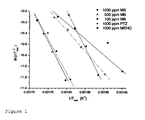
- Samples of 8-arm PEG-acrylate 2k with different inhibitors were weighed into DSC pans and were heated until they had polymerized. Analysis was performed according to the ASTM698 method:
- for each sample DSC traces (energy released vs. temperature) were recorded at different heating rates (β = 4, 7, 10, and 13 K/min). The temperatures Tmax at which the polymerization peaks showed a maximum were recorded and the activation energy for the polymerization (Ea) was determined from eq. 1:

- Figure 1 shows the data for 5 different samples.
- The preexponential factor A was determined by eq. (2):

- The values of A were averaged over the four heating rates. The values of Ea and average values of A are shown in table 1.
Table 1 Ea (kJ/mol) A (min-1) 1000 ppm MB 110 4.4·109 500 ppm MB 110 1.3·1010 100 ppm MB 104 1.0.109 1000 ppm PTZ 63 2.2·105 1000 ppm MEHQ 48 6.4·103 - By assuming the first order kinetics, ASTM698 permits evaluating the time (tα) to reach a certain extent of reaction (α) as follows:

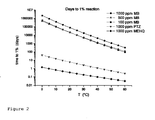
- Using the experimentally evaluated values of Ea and A, for each of the samples times to reach 1% of conversion (α = 0.01 in eq. 3) at different temperatures T were estimated. The results are shown in Figure 2.
- Figure 2 clearly shows the superior stability of the methylene blue stabilized samples compared to the PTZ and MEHQ stabilized samples.
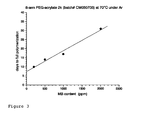
- In order to establish a relationship between methylene blue (MB) concentration and stability of 8-arm PEG-acrylate 2k, a stress test has been performed.
- Samples of one freshly synthesized 8-arm PEG-acrylate 2k batch (Nektar, batch# CM030703) were spiked with different concentrations of MB (250, 500, 1000, and 2000 ppm). For each MB concentration two 3 gram samples were added into separate 20 ml test tubes, which were closed with covers with argon inlets. The tubes were kept at 70°C under argon and the samples were checked daily until they had polymerized, as observed by solidification of the PEG oil.
- Figure 3 shows the results of the experiment. The linear relationship between MB content and stability confirms that the stabilizing effect is exerted by methylene blue.
- The content of methylene blue in 8-arm PEG-acrylate 2k was monitored in time under different simulated storage conditions for samples that were taken from the freezer and for samples that had been prestressed at 40°C for 1 day (figure 4). For all conditions the methylene blue content decreased in time, indicating that methylene blue was consumed while exerting its stabilizing function. After 6 months, methylene blue concentrations reached approximately constant values, which were higher for lower temperatures. The prestressed samples showed a clearly lowered methylene blue content at the start of the measurements, but levels of prestressed and non-prestressed samples became similar after some time at 40°C.
- After 6 months at 40°C, some of the 8-arm PEG-acrylate 2k samples had partly or completely polymerized, indicating that a lower limit exists, under which the stabilizing effect of methylene blue is not given anymore. Figure 5 shows that the content of acrylate groups in the 8-arm PEG-acrylate 2k samples that had not polymerized remained constant over the whole observation period, which is another proof that the methylene blue present in the samples protects the acrylate groups from reacting. As becomes clear from figure 4, the effect of methylene blue is enhanced by choosing appropriately low storage temperatures.
Claims (13)
- A composition comprising a polymerizable compound with at least one conjugated unsaturated group and methylene blue to prevent premature polymerization of the polymerizable compound, characterized in that said composition contains methylene blue in a concentration of 10 to 5000 ppm.
- A composition according to claim 1, characterized in that said composition contains methylene blue in a concentration of 20 to 1000 ppm.
- Composition according to any of the preceding claims comprising less than 5%, preferably less than 2% oxygen.
- Composition according to claim 1 to 3 comprising less than 0.5% oxygen.
- Composition according to claim 1 to 4, wherein the polymerizable compound is acrylic acid or an acrylic acid ester or a mixture thereof.
- Composition according to claim 1 to 4, wherein the polymerizable compound is methacrylic acid or a methacrylic acid ester or a mixture thereof.
- Composition according to claim 1 to 4, wherein the conjugated unsaturated group of the polymerizable compound is selected from the group consisting of acrylates, acrylamides, quinines, and 2- or 4 vinylpyridiniums.
- Composition according to claim 7, wherein the polymerizable compound comprises a core which carries 2 to 10 chains comprising said conjugated unsaturated groups, whereby said conjugated unsaturated groups are attached to any of the last 20 atoms of the chain.
- Composition according to claim 8, wherein the chains are poly(ethylene glycol) molecules.
- Composition according to claim 9, wherein the polymerizable compound is a 4 to 8-arm poly(ethylene glycol) acrylate.
- Use of the composition according to any of the preceding claims in medicine.
- Use of the composition according to claims 1 to 10 in dentistry.
- Use of 10 to 5000 ppm methylene blue in a composition comprising a polymerizable compound with at least one conjugated unsaturated group as inhibitor to prevent premature polymerization of the polymerizable compound.
Priority Applications (8)
| Application Number | Priority Date | Filing Date | Title |
|---|---|---|---|
| EP09000633A EP2053066A1 (en) | 2005-09-16 | 2005-09-16 | Use of methylene blue as polymerization inhibitor |
| DE602005017493T DE602005017493D1 (en) | 2005-09-16 | 2005-09-16 | Use of methylene blue as a polymerization inhibitor |
| EP05020181A EP1764404B1 (en) | 2005-09-16 | 2005-09-16 | Use of methylene blue as polymerization inhibitor |
| ES05020181T ES2334799T3 (en) | 2005-09-16 | 2005-09-16 | USE OF METHYLENE BLUE AS A POLYMERIZATION INHIBITOR. |
| AT05020181T ATE447602T1 (en) | 2005-09-16 | 2005-09-16 | USE OF METHYLENE BLUE AS A POLYMERIZATION INHIBITOR |
| US11/521,971 US7282584B2 (en) | 2004-06-16 | 2006-09-15 | Methylene blue |
| US11/872,234 US20080090979A1 (en) | 2004-06-16 | 2007-10-15 | Methylene blue |
| US12/773,387 US8227460B2 (en) | 2004-06-16 | 2010-05-04 | Methylene blue |
Applications Claiming Priority (1)
| Application Number | Priority Date | Filing Date | Title |
|---|---|---|---|
| EP05020181A EP1764404B1 (en) | 2005-09-16 | 2005-09-16 | Use of methylene blue as polymerization inhibitor |
Related Child Applications (1)
| Application Number | Title | Priority Date | Filing Date |
|---|---|---|---|
| EP09000633A Division EP2053066A1 (en) | 2005-09-16 | 2005-09-16 | Use of methylene blue as polymerization inhibitor |
Publications (2)
| Publication Number | Publication Date |
|---|---|
| EP1764404A1 true EP1764404A1 (en) | 2007-03-21 |
| EP1764404B1 EP1764404B1 (en) | 2009-11-04 |
Family
ID=35702046
Family Applications (2)
| Application Number | Title | Priority Date | Filing Date |
|---|---|---|---|
| EP05020181A Expired - Lifetime EP1764404B1 (en) | 2004-06-16 | 2005-09-16 | Use of methylene blue as polymerization inhibitor |
| EP09000633A Withdrawn EP2053066A1 (en) | 2005-09-16 | 2005-09-16 | Use of methylene blue as polymerization inhibitor |
Family Applications After (1)
| Application Number | Title | Priority Date | Filing Date |
|---|---|---|---|
| EP09000633A Withdrawn EP2053066A1 (en) | 2005-09-16 | 2005-09-16 | Use of methylene blue as polymerization inhibitor |
Country Status (4)
| Country | Link |
|---|---|
| EP (2) | EP1764404B1 (en) |
| AT (1) | ATE447602T1 (en) |
| DE (1) | DE602005017493D1 (en) |
| ES (1) | ES2334799T3 (en) |
Families Citing this family (2)
| Publication number | Priority date | Publication date | Assignee | Title |
|---|---|---|---|---|
| EP3072879A1 (en) | 2015-03-26 | 2016-09-28 | Nitto Europe N.V | Method for prevention of premature polymerization |
| GB202219052D0 (en) | 2022-12-16 | 2023-02-01 | Ucl Business Ltd | Antimicrobial compositions and objects, and methods of making them |
Citations (9)
| Publication number | Priority date | Publication date | Assignee | Title |
|---|---|---|---|---|
| GB942318A (en) | 1960-06-29 | 1963-11-20 | Ici Ltd | Improvements in or relating to the preparation of methacrylic compounds |
| US4012310A (en) | 1975-09-11 | 1977-03-15 | Progressive Equipment Corporation | Electrostatic water treatment system |
| US4021310A (en) * | 1972-12-22 | 1977-05-03 | Nippon Shokubai Kagaku Kogyo Co., Ltd. | Method for inhibiting the polymerization of acrylic acid or its esters |
| JPS5684708A (en) * | 1979-12-13 | 1981-07-10 | Mitsubishi Gas Chem Co Inc | Polymerization inhibitor |
| DD215699A1 (en) | 1983-05-27 | 1984-11-21 | Univ Schiller Jena | BY LIGHT HAERTBARE DENTALMASSE |
| EP0334500A1 (en) * | 1988-03-22 | 1989-09-27 | UNIROYAL CHEMICAL COMPANY, Inc. | Vinyl aromatic compositons stabilized against polymerization |
| JPH08155024A (en) * | 1994-12-02 | 1996-06-18 | Nippon Electric Glass Co Ltd | Bioactive cement |
| WO2000044808A1 (en) | 1999-02-01 | 2000-08-03 | Hubbell Jeffrey A | Biomaterials formed by nucleophilic addition reaction to conjugated unsaturated groups |
| WO2001092584A1 (en) | 2000-06-02 | 2001-12-06 | Eidgenossische Technische Hochschule Zurich | Conjugate addition reactions for the controlled delivery of pharmaceutically active compounds |
-
2005
- 2005-09-16 EP EP05020181A patent/EP1764404B1/en not_active Expired - Lifetime
- 2005-09-16 ES ES05020181T patent/ES2334799T3/en not_active Expired - Lifetime
- 2005-09-16 DE DE602005017493T patent/DE602005017493D1/en not_active Expired - Lifetime
- 2005-09-16 AT AT05020181T patent/ATE447602T1/en not_active IP Right Cessation
- 2005-09-16 EP EP09000633A patent/EP2053066A1/en not_active Withdrawn
Patent Citations (9)
| Publication number | Priority date | Publication date | Assignee | Title |
|---|---|---|---|---|
| GB942318A (en) | 1960-06-29 | 1963-11-20 | Ici Ltd | Improvements in or relating to the preparation of methacrylic compounds |
| US4021310A (en) * | 1972-12-22 | 1977-05-03 | Nippon Shokubai Kagaku Kogyo Co., Ltd. | Method for inhibiting the polymerization of acrylic acid or its esters |
| US4012310A (en) | 1975-09-11 | 1977-03-15 | Progressive Equipment Corporation | Electrostatic water treatment system |
| JPS5684708A (en) * | 1979-12-13 | 1981-07-10 | Mitsubishi Gas Chem Co Inc | Polymerization inhibitor |
| DD215699A1 (en) | 1983-05-27 | 1984-11-21 | Univ Schiller Jena | BY LIGHT HAERTBARE DENTALMASSE |
| EP0334500A1 (en) * | 1988-03-22 | 1989-09-27 | UNIROYAL CHEMICAL COMPANY, Inc. | Vinyl aromatic compositons stabilized against polymerization |
| JPH08155024A (en) * | 1994-12-02 | 1996-06-18 | Nippon Electric Glass Co Ltd | Bioactive cement |
| WO2000044808A1 (en) | 1999-02-01 | 2000-08-03 | Hubbell Jeffrey A | Biomaterials formed by nucleophilic addition reaction to conjugated unsaturated groups |
| WO2001092584A1 (en) | 2000-06-02 | 2001-12-06 | Eidgenossische Technische Hochschule Zurich | Conjugate addition reactions for the controlled delivery of pharmaceutically active compounds |
Non-Patent Citations (8)
| Title |
|---|
| DATABASE CA [online] CHEMICAL ABSTRACTS SERVICE, COLUMBUS, OHIO, US; INSTITUTUL DE CERCETARI PRODUSE AUSILIARE ORGANICE, MEDIAS, ROM.: "Triethylene glycol dimethylacrylate", XP002366213, retrieved from STN Database accession no. 100:176196 * |
| H. VOGEL ET AL: "Aspects of the safe storage of acrylic monomers: Kinetics of the oxygen consumption", CHEM.ENG.TECHNOL., vol. 21, no. 10, 1998, pages 829 - 837, XP002366196 * |
| L. LEVY: "Inhibition of acrylic acid polymerization by phenothiazine and p-methoxyphenol.II. Catalytic inhibition by phenothiazine", J.POLYMER SCIENCE: PART A: POLYMER CHEMISTRY, vol. 30, 1992, pages 569 - 576, XP009061210 * |
| LEVY, J. POLYMER SCIENCE: PART A: POLYMER CHEMISTRY, vol. 30, 1992, pages 569 - 576 |
| MITCHELL, S.C., THE TOXICITY OF PHENOTHIAZINE, DRUG METABOLISM AND DRUG INTERACTIONS, vol. 11, 1994, pages 204 - 235 |
| PATENT ABSTRACTS OF JAPAN vol. 005, no. 152 (C - 073) 25 September 1981 (1981-09-25) * |
| PATENT ABSTRACTS OF JAPAN vol. 1996, no. 10 31 October 1996 (1996-10-31) * |
| S. SCHULZE; H. VOGEL, CHEM. ENG. TECHNOL., vol. 21, 1998, pages 829 - 836 |
Also Published As
| Publication number | Publication date |
|---|---|
| ES2334799T3 (en) | 2010-03-16 |
| EP2053066A1 (en) | 2009-04-29 |
| ATE447602T1 (en) | 2009-11-15 |
| DE602005017493D1 (en) | 2009-12-17 |
| EP1764404B1 (en) | 2009-11-04 |
Similar Documents
| Publication | Publication Date | Title |
|---|---|---|
| KR970010462B1 (en) | Method for inhibiting polymerization of (meth)acrylic acid and esters thereof | |
| US8227460B2 (en) | Methylene blue | |
| EP2039714B1 (en) | Bio-degradable/absorbable polymer having reduced metal catalyst content, and process for production thereof | |
| EP1776400B1 (en) | Temperature sensitive polymers | |
| US20140135414A1 (en) | Preparation of polymerizable compositions | |
| US5171812A (en) | Polyanhydrides of oligomerized unsaturated aliphatic acids | |
| Vazquez et al. | Application of tertiary amines with reduced toxicity to the curing process of acrylic bone cements | |
| JP2010094514A (en) | Coating composition | |
| EP2679251A1 (en) | Adhesive compositions for medical use: single additive as both the thickening agent and the accelerator | |
| EP0299730A2 (en) | Process of preparing dl-lactic acid-glycolic acid-copolymer | |
| CN101495377A (en) | Improved stabilizer cyanoacrylate formulations | |
| US20110021742A1 (en) | Method for purifying polymer and method for producing polymer using the same | |
| WO2000064947A1 (en) | Method of immediately terminating free-radical polymerisation processes | |
| EP1764404B1 (en) | Use of methylene blue as polymerization inhibitor | |
| WO2012133608A1 (en) | Biodegradable particle, vascular embolization material and method for producing biodegradable particles | |
| Vazquez et al. | Application of long chain amine activator in conventional acrylic bone cement | |
| US6348429B1 (en) | Polymers from vinylic monomer(s) peroxides and amines | |
| US11712404B2 (en) | Methacrylamide adhesive systems | |
| WO2012086569A1 (en) | Biodegradable particles for medical treatment and vascular embolization material | |
| JPH0216322B2 (en) | ||
| JP2004533494A (en) | Method for producing polyester having free acid functional groups in the chain | |
| KR101572973B1 (en) | Novel bifunctinal crosslinking agent compound, manufacturing method thereof, and hydrogel soft contact lens comprising the same for releasing drug | |
| US5010173A (en) | Free radical stabilized alkoxylates | |
| JPH05502172A (en) | Improved reactive systems and/or polymer compositions for contacting biological tissue | |
| US6566391B2 (en) | Trioxepan compounds |
Legal Events
| Date | Code | Title | Description |
|---|---|---|---|
| PUAI | Public reference made under article 153(3) epc to a published international application that has entered the european phase |
Free format text: ORIGINAL CODE: 0009012 |
|
| AK | Designated contracting states |
Kind code of ref document: A1 Designated state(s): AT BE BG CH CY CZ DE DK EE ES FI FR GB GR HU IE IS IT LI LT LU LV MC NL PL PT RO SE SI SK TR |
|
| AX | Request for extension of the european patent |
Extension state: AL BA HR MK YU |
|
| 17P | Request for examination filed |
Effective date: 20070602 |
|
| 17Q | First examination report despatched |
Effective date: 20070706 |
|
| AKX | Designation fees paid |
Designated state(s): AT BE BG CH CY CZ DE DK EE ES FI FR GB GR HU IE IS IT LI LT LU LV MC NL PL PT RO SE SI SK TR |
|
| RIC1 | Information provided on ipc code assigned before grant |
Ipc: C07D 279/28 20060101ALI20080911BHEP Ipc: C08F 2/38 20060101ALI20080911BHEP Ipc: A61K 6/00 20060101ALI20080911BHEP Ipc: C09K 15/30 20060101AFI20080911BHEP Ipc: C08F 290/06 20060101ALI20080911BHEP |
|
| GRAP | Despatch of communication of intention to grant a patent |
Free format text: ORIGINAL CODE: EPIDOSNIGR1 |
|
| GRAS | Grant fee paid |
Free format text: ORIGINAL CODE: EPIDOSNIGR3 |
|
| R17C | First examination report despatched (corrected) |
Effective date: 20090225 |
|
| GRAJ | Information related to disapproval of communication of intention to grant by the applicant or resumption of examination proceedings by the epo deleted |
Free format text: ORIGINAL CODE: EPIDOSDIGR1 |
|
| GRAL | Information related to payment of fee for publishing/printing deleted |
Free format text: ORIGINAL CODE: EPIDOSDIGR3 |
|
| GRAP | Despatch of communication of intention to grant a patent |
Free format text: ORIGINAL CODE: EPIDOSNIGR1 |
|
| GRAC | Information related to communication of intention to grant a patent modified |
Free format text: ORIGINAL CODE: EPIDOSCIGR1 |
|
| GRAS | Grant fee paid |
Free format text: ORIGINAL CODE: EPIDOSNIGR3 |
|
| GRAA | (expected) grant |
Free format text: ORIGINAL CODE: 0009210 |
|
| AK | Designated contracting states |
Kind code of ref document: B1 Designated state(s): AT BE BG CH CY CZ DE DK EE ES FI FR GB GR HU IE IS IT LI LT LU LV MC NL PL PT RO SE SI SK TR |
|
| REG | Reference to a national code |
Ref country code: GB Ref legal event code: FG4D |
|
| REG | Reference to a national code |
Ref country code: CH Ref legal event code: EP |
|
| REG | Reference to a national code |
Ref country code: IE Ref legal event code: FG4D |
|
| REG | Reference to a national code |
Ref country code: CH Ref legal event code: NV Representative=s name: PATENTANWAELTE SCHAAD, BALASS, MENZL & PARTNER AG |
|
| REF | Corresponds to: |
Ref document number: 602005017493 Country of ref document: DE Date of ref document: 20091217 Kind code of ref document: P |
|
| REG | Reference to a national code |
Ref country code: SE Ref legal event code: TRGR |
|
| REG | Reference to a national code |
Ref country code: ES Ref legal event code: FG2A Ref document number: 2334799 Country of ref document: ES Kind code of ref document: T3 |
|
| LTIE | Lt: invalidation of european patent or patent extension |
Effective date: 20091104 |
|
| PG25 | Lapsed in a contracting state [announced via postgrant information from national office to epo] |
Ref country code: PT Free format text: LAPSE BECAUSE OF FAILURE TO SUBMIT A TRANSLATION OF THE DESCRIPTION OR TO PAY THE FEE WITHIN THE PRESCRIBED TIME-LIMIT Effective date: 20100304 Ref country code: IS Free format text: LAPSE BECAUSE OF FAILURE TO SUBMIT A TRANSLATION OF THE DESCRIPTION OR TO PAY THE FEE WITHIN THE PRESCRIBED TIME-LIMIT Effective date: 20100304 Ref country code: LT Free format text: LAPSE BECAUSE OF FAILURE TO SUBMIT A TRANSLATION OF THE DESCRIPTION OR TO PAY THE FEE WITHIN THE PRESCRIBED TIME-LIMIT Effective date: 20091104 Ref country code: FI Free format text: LAPSE BECAUSE OF FAILURE TO SUBMIT A TRANSLATION OF THE DESCRIPTION OR TO PAY THE FEE WITHIN THE PRESCRIBED TIME-LIMIT Effective date: 20091104 |
|
| PG25 | Lapsed in a contracting state [announced via postgrant information from national office to epo] |
Ref country code: PL Free format text: LAPSE BECAUSE OF FAILURE TO SUBMIT A TRANSLATION OF THE DESCRIPTION OR TO PAY THE FEE WITHIN THE PRESCRIBED TIME-LIMIT Effective date: 20091104 Ref country code: LV Free format text: LAPSE BECAUSE OF FAILURE TO SUBMIT A TRANSLATION OF THE DESCRIPTION OR TO PAY THE FEE WITHIN THE PRESCRIBED TIME-LIMIT Effective date: 20091104 Ref country code: CY Free format text: LAPSE BECAUSE OF FAILURE TO SUBMIT A TRANSLATION OF THE DESCRIPTION OR TO PAY THE FEE WITHIN THE PRESCRIBED TIME-LIMIT Effective date: 20091104 Ref country code: SI Free format text: LAPSE BECAUSE OF FAILURE TO SUBMIT A TRANSLATION OF THE DESCRIPTION OR TO PAY THE FEE WITHIN THE PRESCRIBED TIME-LIMIT Effective date: 20091104 |
|
| PG25 | Lapsed in a contracting state [announced via postgrant information from national office to epo] |
Ref country code: BE Free format text: LAPSE BECAUSE OF FAILURE TO SUBMIT A TRANSLATION OF THE DESCRIPTION OR TO PAY THE FEE WITHIN THE PRESCRIBED TIME-LIMIT Effective date: 20091104 Ref country code: AT Free format text: LAPSE BECAUSE OF FAILURE TO SUBMIT A TRANSLATION OF THE DESCRIPTION OR TO PAY THE FEE WITHIN THE PRESCRIBED TIME-LIMIT Effective date: 20091104 |
|
| PG25 | Lapsed in a contracting state [announced via postgrant information from national office to epo] |
Ref country code: BG Free format text: LAPSE BECAUSE OF FAILURE TO SUBMIT A TRANSLATION OF THE DESCRIPTION OR TO PAY THE FEE WITHIN THE PRESCRIBED TIME-LIMIT Effective date: 20100204 Ref country code: DK Free format text: LAPSE BECAUSE OF FAILURE TO SUBMIT A TRANSLATION OF THE DESCRIPTION OR TO PAY THE FEE WITHIN THE PRESCRIBED TIME-LIMIT Effective date: 20091104 Ref country code: EE Free format text: LAPSE BECAUSE OF FAILURE TO SUBMIT A TRANSLATION OF THE DESCRIPTION OR TO PAY THE FEE WITHIN THE PRESCRIBED TIME-LIMIT Effective date: 20091104 Ref country code: RO Free format text: LAPSE BECAUSE OF FAILURE TO SUBMIT A TRANSLATION OF THE DESCRIPTION OR TO PAY THE FEE WITHIN THE PRESCRIBED TIME-LIMIT Effective date: 20091104 |
|
| PG25 | Lapsed in a contracting state [announced via postgrant information from national office to epo] |
Ref country code: CZ Free format text: LAPSE BECAUSE OF FAILURE TO SUBMIT A TRANSLATION OF THE DESCRIPTION OR TO PAY THE FEE WITHIN THE PRESCRIBED TIME-LIMIT Effective date: 20091104 Ref country code: SK Free format text: LAPSE BECAUSE OF FAILURE TO SUBMIT A TRANSLATION OF THE DESCRIPTION OR TO PAY THE FEE WITHIN THE PRESCRIBED TIME-LIMIT Effective date: 20091104 |
|
| PLBE | No opposition filed within time limit |
Free format text: ORIGINAL CODE: 0009261 |
|
| STAA | Information on the status of an ep patent application or granted ep patent |
Free format text: STATUS: NO OPPOSITION FILED WITHIN TIME LIMIT |
|
| 26N | No opposition filed |
Effective date: 20100805 |
|
| PG25 | Lapsed in a contracting state [announced via postgrant information from national office to epo] |
Ref country code: GR Free format text: LAPSE BECAUSE OF FAILURE TO SUBMIT A TRANSLATION OF THE DESCRIPTION OR TO PAY THE FEE WITHIN THE PRESCRIBED TIME-LIMIT Effective date: 20100205 |
|
| PG25 | Lapsed in a contracting state [announced via postgrant information from national office to epo] |
Ref country code: MC Free format text: LAPSE BECAUSE OF NON-PAYMENT OF DUE FEES Effective date: 20100930 |
|
| PG25 | Lapsed in a contracting state [announced via postgrant information from national office to epo] |
Ref country code: IE Free format text: LAPSE BECAUSE OF NON-PAYMENT OF DUE FEES Effective date: 20100916 |
|
| PG25 | Lapsed in a contracting state [announced via postgrant information from national office to epo] |
Ref country code: HU Free format text: LAPSE BECAUSE OF FAILURE TO SUBMIT A TRANSLATION OF THE DESCRIPTION OR TO PAY THE FEE WITHIN THE PRESCRIBED TIME-LIMIT Effective date: 20100505 Ref country code: LU Free format text: LAPSE BECAUSE OF NON-PAYMENT OF DUE FEES Effective date: 20100916 |
|
| PG25 | Lapsed in a contracting state [announced via postgrant information from national office to epo] |
Ref country code: TR Free format text: LAPSE BECAUSE OF FAILURE TO SUBMIT A TRANSLATION OF THE DESCRIPTION OR TO PAY THE FEE WITHIN THE PRESCRIBED TIME-LIMIT Effective date: 20091104 |
|
| REG | Reference to a national code |
Ref country code: FR Ref legal event code: PLFP Year of fee payment: 12 |
|
| REG | Reference to a national code |
Ref country code: FR Ref legal event code: PLFP Year of fee payment: 13 |
|
| REG | Reference to a national code |
Ref country code: FR Ref legal event code: PLFP Year of fee payment: 14 |
|
| PGFP | Annual fee paid to national office [announced via postgrant information from national office to epo] |
Ref country code: DE Payment date: 20190918 Year of fee payment: 15 Ref country code: NL Payment date: 20190918 Year of fee payment: 15 Ref country code: SE Payment date: 20190918 Year of fee payment: 15 Ref country code: IT Payment date: 20190925 Year of fee payment: 15 Ref country code: FR Payment date: 20190926 Year of fee payment: 15 |
|
| PGFP | Annual fee paid to national office [announced via postgrant information from national office to epo] |
Ref country code: GB Payment date: 20190920 Year of fee payment: 15 |
|
| PGFP | Annual fee paid to national office [announced via postgrant information from national office to epo] |
Ref country code: CH Payment date: 20190919 Year of fee payment: 15 |
|
| PGFP | Annual fee paid to national office [announced via postgrant information from national office to epo] |
Ref country code: ES Payment date: 20191022 Year of fee payment: 15 |
|
| REG | Reference to a national code |
Ref country code: DE Ref legal event code: R119 Ref document number: 602005017493 Country of ref document: DE |
|
| REG | Reference to a national code |
Ref country code: CH Ref legal event code: PL |
|
| REG | Reference to a national code |
Ref country code: NL Ref legal event code: MM Effective date: 20201001 |
|
| GBPC | Gb: european patent ceased through non-payment of renewal fee |
Effective date: 20200916 |
|
| PG25 | Lapsed in a contracting state [announced via postgrant information from national office to epo] |
Ref country code: NL Free format text: LAPSE BECAUSE OF NON-PAYMENT OF DUE FEES Effective date: 20201001 |
|
| PG25 | Lapsed in a contracting state [announced via postgrant information from national office to epo] |
Ref country code: DE Free format text: LAPSE BECAUSE OF NON-PAYMENT OF DUE FEES Effective date: 20210401 Ref country code: FR Free format text: LAPSE BECAUSE OF NON-PAYMENT OF DUE FEES Effective date: 20200930 |
|
| PG25 | Lapsed in a contracting state [announced via postgrant information from national office to epo] |
Ref country code: SE Free format text: LAPSE BECAUSE OF NON-PAYMENT OF DUE FEES Effective date: 20200917 Ref country code: GB Free format text: LAPSE BECAUSE OF NON-PAYMENT OF DUE FEES Effective date: 20200916 Ref country code: LI Free format text: LAPSE BECAUSE OF NON-PAYMENT OF DUE FEES Effective date: 20200930 Ref country code: CH Free format text: LAPSE BECAUSE OF NON-PAYMENT OF DUE FEES Effective date: 20200930 |
|
| REG | Reference to a national code |
Ref country code: SE Ref legal event code: EUG |
|
| REG | Reference to a national code |
Ref country code: ES Ref legal event code: FD2A Effective date: 20220118 |
|
| PG25 | Lapsed in a contracting state [announced via postgrant information from national office to epo] |
Ref country code: IT Free format text: LAPSE BECAUSE OF NON-PAYMENT OF DUE FEES Effective date: 20200916 |
|
| PG25 | Lapsed in a contracting state [announced via postgrant information from national office to epo] |
Ref country code: ES Free format text: LAPSE BECAUSE OF NON-PAYMENT OF DUE FEES Effective date: 20200917 |