EP1762982A2 - Procédé de reconstuction de la distribution d'éléments fluorescents dans un milieu diffusant - Google Patents
Procédé de reconstuction de la distribution d'éléments fluorescents dans un milieu diffusant Download PDFInfo
- Publication number
- EP1762982A2 EP1762982A2 EP06354025A EP06354025A EP1762982A2 EP 1762982 A2 EP1762982 A2 EP 1762982A2 EP 06354025 A EP06354025 A EP 06354025A EP 06354025 A EP06354025 A EP 06354025A EP 1762982 A2 EP1762982 A2 EP 1762982A2
- Authority
- EP
- European Patent Office
- Prior art keywords
- functions
- fluorescent elements
- transfer
- energy
- distribution
- Prior art date
- Legal status (The legal status is an assumption and is not a legal conclusion. Google has not performed a legal analysis and makes no representation as to the accuracy of the status listed.)
- Granted
Links
Images
Classifications
-
- G—PHYSICS
- G06—COMPUTING OR CALCULATING; COUNTING
- G06T—IMAGE DATA PROCESSING OR GENERATION, IN GENERAL
- G06T12/00—Tomographic reconstruction from projections
- G06T12/20—Inverse problem, i.e. transformations from projection space into object space
Definitions
- the invention relates to a method for reconstructing the distribution of fluorescent elements in a diffusing medium having substantially a finely cylindrical shape, comprising a step of formulating energy transfer functions in the medium between at least one light source. punctual excitation and at least one detector.
- the examined object In optical imaging and in diffusive optical tomography, the examined object, or at least the examined area, often has a cylindrical shape. It may be a cylindrical tube in which is disposed a mouse, for example, or a part of the human body.
- the object of the invention is to remedy these drawbacks and, in particular, to propose a method for reconstructing the distribution of fluorescent elements in a diffusing medium having substantially the shape of a finished cylinder, this method making it possible to use a analytical and three-dimensional approach.
- the formulation step comprises the formulation of a plurality of first representative energy transfer functions respectively of the transfer of the energy between the source of point excitation light and the fluorescent elements and the formulation of a plurality of second energy transfer functions representative respectively of the transfer of energy between the fluorescent elements and the detector.
- the first and second transfer functions are Green functions solving the diffusion equation and corresponding to a finite cylindrical volume, the functions of Green being expressed as a function of the modified Bessel functions.
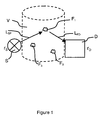
- a source S of point excitation light is placed at a point r S and emits light having a first wavelength ⁇ SF and a magnitude Q.
- the emitted light propagates in a volume V d a diffusing medium having substantially a finely cylindrical shape, in which are distributed fluorescent elements F according to a distribution that is to be determined.
- a first diffusive wave L SF emitted by the source S excites a fluorescent element F 1 which then emits radiation having a second wavelength ⁇ FD : the intensity of this second diffusive wave L FD is measured by the detector D.
- the distribution of the fluorescent elements must then be determined from the measurements made by the detector D. These measurements are made from a set of source positions. In the case of several detectors, the measurements made by all the detectors will be taken into account.
- FIG 1 two other fluorescent elements F 2 and F 3 are shown. Since the fluorescent elements F 1 , F 2 and F 3 are distributed in the volume V, the detector receives a measured photon density ⁇ M composed by all the second waves L FD emitted by all the fluorescent elements F 1 , F 2 and F 3 . For the sake of clarity, the waves corresponding to the fluorescent elements F 2 and F 3 are not represented.
- the parameter ⁇ r ⁇ F ⁇ r ⁇ F ⁇ ⁇ 1 - i ⁇ r ⁇ F depends on the quantum efficiency ⁇ of the fluorescent element, the local absorption ⁇ r ⁇ F due to fluorescent elements and damping 1 - i ⁇ r ⁇ F - 1 linked to the life time ⁇ of the fluorescent elements F and to the pulsation ⁇ imposed externally on the radiation, the light being emitted in a pulsed manner.
- c n is the speed of light in the medium
- ⁇ ⁇ is the absorption coefficient of the medium
- D ⁇ is the diffusion coefficient
- r ⁇ and r ⁇ o are the spatial variables of Green's function.
- the ⁇ ⁇ and ⁇ D parameters are measured at corresponding wavelengths ⁇ and ⁇ SF FD.
- the solutions of the diffusion equations must satisfy boundary conditions on the surface delimiting the cylindrical volume, for example the Dirichlet conditions or the Neumann conditions. The mathematical problem is thus analogous to the problem of conduction of heat in a condensed medium having a finite cylindrical shape.
- l is the height of the cylinder
- a is the radius of the cylinder
- r ⁇ r ⁇ ⁇ ⁇ z
- F n ( u, v ) I n ( u ) K n ( ⁇ ) - K n ( u ) I n ( ⁇ )
- I n and K n are the Bessel functions modified respectively of first and second kind of order n .
- k p k ⁇ 2 + p 2 ⁇ ⁇ 2 / l 2 .
- Equations (4) are then introduced into equation (1).
- the space of the cylindrical volume V is divided into N elementary volumes according to a suitable mesh.
- the reconstruction method comprises the formulation of a plurality of N first energy transfer functions BOY WUT ⁇ SF ⁇ r ⁇ S ⁇ r ⁇ j representative respectively of the transfer of energy between the point excitation light source S and the fluorescent elements F and the formulation of a plurality of N seconds energy transfer functions BOY WUT ⁇ FD ⁇ r ⁇ j ⁇ r ⁇ D representative respectively of the transfer of energy between the fluorescent elements and the detector.
- a first energy transfer function BOY WUT ⁇ SF ⁇ r ⁇ S ⁇ r ⁇ j and a second energy transfer function BOY WUT ⁇ FD ⁇ r ⁇ j ⁇ r ⁇ D we associate with each elementary volume dv j a first energy transfer function BOY WUT ⁇ SF ⁇ r ⁇ S ⁇ r ⁇ j and a second energy transfer function BOY WUT ⁇ FD ⁇ r ⁇ j ⁇ r ⁇ D .
- ⁇ M NOT D ⁇ NOT S BOY WUT FD NOT D ⁇ NOT ⁇ ⁇ dv NOT ⁇ NOT ⁇ BOY WUT SF NOT ⁇ NOT S ⁇ Q NOT S
- each column of ⁇ M NOT D ⁇ NOT S represents the measurement on N D detectors for a given source S.
- the set of source-detector combinations makes it possible to construct the matrix equation which is then solved in a reconstruction algorithm, either by calculating the error between the experimental measurements and this theoretical matrix equation (for example by means of the method for backprojection of errors or algorithms of the ART (Algebraic Reconstruction Technique) type, or by directly inverting the matrix J (for example by means of algorithms of SVD (Single Value Decomposition) type).
- the parameter ⁇ is obtained which depends on the distribution of the fluorescent elements via local absorption. ⁇ r ⁇ F due to fluorescent elements and through damping 1 - i ⁇ r ⁇ F - 1 linked to the life time ⁇ of the fluorescent elements F.
- the knowledge of the parameter ⁇ thus makes it possible to determine the distribution and the local concentration of the fluorescent elements.
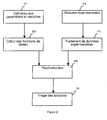
- the parameters and the variables are defined (function F1 in FIG. 2) at the beginning of the reconstruction process.
- the functions of Green G are determined (function F2 in Figure 2) according to equations (4).
- the conversion matrix J can then be determined.
- the experimental measurement (function F3 in FIG. 2) and a treatment of the experimental data (function F4 in FIG. 2) make it possible to determine the photon densities ⁇ M measured by the different detectors D.
- the parameters related to Fluorescent elements F are then reconstructed (function F5 in FIG. 2).
- An additional processing (function F6 in FIG. 2) then makes it possible to represent in image form the distribution of the fluorescent elements F as well as their concentration.
Landscapes
- Physics & Mathematics (AREA)
- General Physics & Mathematics (AREA)
- Engineering & Computer Science (AREA)
- Theoretical Computer Science (AREA)
- Investigating, Analyzing Materials By Fluorescence Or Luminescence (AREA)
- Luminescent Compositions (AREA)
Abstract
Description
- L'invention concerne un procédé de reconstruction de la distribution d'éléments fluorescents dans un milieu diffusant ayant sensiblement une forme cylindrique finie, comportant une étape de formulation de fonctions de transfert de l'énergie dans le milieu entre au moins une source de lumière d'excitation ponctuelle et au moins un détecteur.
- En imagerie optique et en tomographie optique diffusive, l'objet examiné, ou au moins la zone examinée, présente souvent une forme cylindrique. Il peut s'agir d'un tube cylindrique dans lequel est disposée une souris, par exemple, ou une partie du corps humain.
- La tomographie optique diffusive classique comporte la reconstruction de contrastes d'absorption et/ou de diffusion, tandis que la tomographie optique diffusive de fluorescence comporte la reconstruction de la concentration en fluorophores et/ou du temps de vie de molécules fluorescentes. Dans ce dernier cas, on cherche à déterminer la distribution de marqueurs fluorescents dans un milieu diffusant à partir de données de mesure.
- On trouve classiquement deux approches pour le traitement des données de mesure. Dans une première approche, analytique, un cylindre infini est considéré afin de faire une approximation bidimensionnelle, ce qui ne permet pas d'obtenir de résultats satisfaisants dans le cas où le cylindre n'est pas infini. Dans une seconde approche, qui est numérique et tridimensionnelle, un cylindre de taille finie est considéré. Dans ce cas, on utilise par exemple la méthode des éléments finis, la méthode des différences finies ou la méthode des intégrales de frontières. Cependant, ces méthodes sont coûteuses en temps de calcul.
- Dans l'article « The theoretical basis for the determination of optical pathlengths in tissue : temporal and frequency analysis » de S.R. Arridge et al. (Phys. Med. Biol., 1992, Vol. 37, No 7, 1531-1560), la propagation de la lumière dans des tissus biologiques confinés dans un cylindre fini est donnée par analogie avec la conduction de la chaleur dans des solides, sans cependant tenir compte de la fluorescence. L'article de S.R.Arridge fait référence à l'ouvrage « Conduction of heat in solids » de H.S. Carslaw et al. (1986, Oxford at the Clarendon Press), qui décrit une solution de l'équation de conduction de la chaleur dans un cylindre fini par l'intermédiaire de fonctions de Green. L'expression est limitée aux points de la surface du cylindre.
- L'invention a pour but de remédier à ces inconvénients et, en particulier, de proposer un procédé de reconstruction de la distribution d'éléments fluorescents dans un milieu diffusant ayant sensiblement la forme d'un cylindre fini, ce procédé permettant d'utiliser une approche analytique et tridimensionnelle.
- Selon l'invention, ce but est atteint par le fait que l'étape de formulation comporte la formulation d'une pluralité de premières fonctions de transfert d'énergie représentatives respectivement du transfert de l'énergie entre la source de lumière d'excitation ponctuelle et les éléments fluorescents et la formulation d'une pluralité de secondes fonctions de transfert d'énergie représentatives respectivement du transfert de l'énergie entre les éléments fluorescents et le détecteur.
- Selon un développement de l'invention, les premières et secondes fonctions de transfert sont des fonctions de Green résolvant l'équation de diffusion et correspondant à un volume cylindrique fini, les fonctions de Green étant exprimées en fonction des fonctions de Bessel modifiées.
- D'autres avantages et caractéristiques ressortiront plus clairement de la description qui va suivre de modes particuliers de réalisation de l'invention donnés à titre d'exemples non limitatifs et représentés aux dessins annexés, dans lesquels :
- La figure 1 illustre la propagation de la lumière dans un milieu diffusant ayant sensiblement une forme cylindrique finie.
- La figure 2 représente l'organigramme d'un mode de réalisation particulier du procédé selon l'invention.
- Sur la figure 1, une source S de lumière d'excitation ponctuelle est placée à un point rS et émet une lumière ayant une première longueur d'onde λSF et une amplitude Q. La lumière émise se propage dans un volume V d'un milieu diffusant ayant sensiblement une forme cylindrique finie, dans lequel sont répartis des éléments fluorescents F selon une distribution que l'on cherche à déterminer. Sur la figure 1, une première onde diffusive LSF émise par la source S excite un élément fluorescent F1 qui émet ensuite un rayonnement ayant une seconde longueur d'onde λFD: l'intensité de cette seconde onde diffusive LFD est mesurée par le détecteur D. La distribution des éléments fluorescents doit alors être déterminée à partir des mesures effectuées par le détecteur D. Ces mesures sont effectuées à partir d'un ensemble de positions de source. Dans le cas de plusieurs détecteurs, les mesures effectuées par tous les détecteurs seront prises en compte.
- Sur la figure 1, deux autres éléments fluorescents F2 et F3 sont représentés. Les éléments fluorescents F1, F2 et F3 étant répartis dans le volume V, le détecteur reçoit une densité de photons φM mesurée composée par toutes les secondes ondes LFD émises par l'ensemble des éléments fluorescents F1, F2 et F3. Pour des raisons de clarté, les ondes correspondant aux éléments fluorescents F2 et F3 ne sont pas représentées.
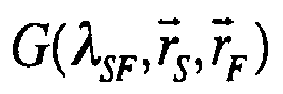
- On définit une première fonction de transfert d'énergie

- On peut montrer que la densité théorique de photons φM mesurée par le détecteur D peut être exprimée, de façon approximative, par une intégrale comportant le produit des première et seconde fonctions de transfert G :

où le paramètre
dépend du rendement quantique η de l'élément fluorescent, de l'absorption locale

- Les première et seconde fonctions de transfert G peuvent ainsi être traitées comme des fonctions de Green déterminées en résolvant des équations de diffusion pour le volume cylindrique V fini et pour une longueur d'onde λ donnée :

δ étant la fonction de Dirac et


- Pour un volume cylindrique fini, les fonctions de Green résolvant les équations de diffusion et satisfaisant aux conditions aux limites peuvent être exprimées en fonction des fonctions de Bessel modifiées :

- Dans ces équations (4), l est la hauteur du cylindre, a est le rayon du cylindre,


- Les équations (4) sont ensuite introduites dans l'équation (1). Pour un calcul discret, l'espace du volume cylindrique V est divisé en N volumes élémentaires selon un maillage approprié. L'intégrale de l'équation (1) est alors remplacée par une somme sur les N volumes élémentaires dνj constituant le volume cylindrique V :

- Selon l'invention, le procédé de reconstruction comporte la formulation d'une pluralité de N premières fonctions de transfert d'énergie


- Lorsqu'on considère une pluralité de NS sources S de lumière d'excitation ponctuelle et une pluralité de ND détecteurs D, une représentation matricielle peut être choisie :

- Dans cette équation, chaque colonne de

- Pour chaque source S et pour chaque détecteur D, une matrice de conversion J peut être calculée, ce qui permet de relier de manière linéaire la densité de photons φM mesurée au paramètre β :

- L'ensemble des combinaisons source-détecteur permet de construire l'équation matricielle qui est ensuite résolue dans un algorithme de reconstruction, soit en calculant l'erreur entre les mesures expérimentales et cette équation théorique matricielle (par exemple par l'intermédiaire de la méthode de rétroprojection d'erreurs ou d'algorithmes de type ART (Algebraic Reconstruction Technique)), soit en inversant directement la matrice J (par exemple par l'intermédiaire d'algorithmes de type SVD (Single Value Decomposition)).
- Dans le cas du calcul d'erreur entre la mesure expérimentale et la théorie, on utilise une distribution théorique des éléments fluorescents qui est ajustée au fur et à mesure de manière à réduire cette erreur.
- Dans le cas de l'inversion de la matrice, on obtient, dans une première étape, le paramètre β qui dépend de la distribution des éléments fluorescents par l'intermédiaire de l'absorption locale


- Comme représenté à la figure 2, les paramètres et les variables sont définies (fonction F1 sur la figure 2) en début du procédé de reconstruction. On définit ainsi la géométrie du cylindre (la hauteur l et le rayon a), les positions des sources


- D'autre part, la mesure expérimentale (fonction F3 sur la figure 2) et un traitement des données expérimentales (fonction F4 sur la figure 2) permettent de déterminer les densités de photons φM mesurées par les différents détecteurs D. Les paramètres liés aux éléments fluorescents F sont ensuite reconstruits (fonction F5 sur la figure 2). Un traitement supplémentaire (fonction F6 sur la figure 2) permet ensuite de représenter sous forme d'image la distribution des éléments fluorescents F ainsi que de leur concentration.
- Le calcul des fonctions de Green conformément aux équations (4) peut être optimisé en temps de calcul en utilisant une représentation synthétique des fonctions de Green :

où

Claims (2)
- Procédé de reconstruction de la distribution d'éléments fluorescents (F) dans un milieu diffusant (V) ayant sensiblement une forme cylindrique finie, comportant une étape de formulation de fonctions de transfert de l'énergie dans le milieu entre au moins une source (S) de lumière d'excitation ponctuelle et au moins un détecteur (D), caractérisé en ce que l'étape de formulation comporte la formulation d'une pluralité de premières fonctions


- Procédé selon la revendication 1, caractérisé en ce que les premières et secondes fonctions de transfert (G) sont des fonctions de Green résolvant l'équation de diffusion et correspondant à un volume cylindrique fini, les fonctions de Green (G) étant exprimées en fonction des fonctions de Bessel modifiées (Fn, In, Kn).
Applications Claiming Priority (1)
| Application Number | Priority Date | Filing Date | Title |
|---|---|---|---|
| FR0508836A FR2890203B1 (fr) | 2005-08-29 | 2005-08-29 | Procede de reconstruction de la distribution d'elements fluorescents dans un milieu diffusant |
Publications (3)
| Publication Number | Publication Date |
|---|---|
| EP1762982A2 true EP1762982A2 (fr) | 2007-03-14 |
| EP1762982A3 EP1762982A3 (fr) | 2008-02-06 |
| EP1762982B1 EP1762982B1 (fr) | 2017-05-10 |
Family
ID=36354076
Family Applications (1)
| Application Number | Title | Priority Date | Filing Date |
|---|---|---|---|
| EP06354025.6A Not-in-force EP1762982B1 (fr) | 2005-08-29 | 2006-08-28 | Procédé de reconstuction de la distribution d'éléments fluorescents dans un milieu diffusant |
Country Status (3)
| Country | Link |
|---|---|
| US (1) | US20070049807A1 (fr) |
| EP (1) | EP1762982B1 (fr) |
| FR (1) | FR2890203B1 (fr) |
Families Citing this family (2)
| Publication number | Priority date | Publication date | Assignee | Title |
|---|---|---|---|---|
| CN102940482B (zh) * | 2012-11-22 | 2015-03-25 | 中国科学院自动化研究所 | 自适应的荧光断层成像重建方法 |
| CN103750824B (zh) * | 2014-01-17 | 2015-12-02 | 天津大学 | 一种针对小动物荧光层析成像系统的信息提取方法 |
-
2005
- 2005-08-29 FR FR0508836A patent/FR2890203B1/fr not_active Expired - Lifetime
-
2006
- 2006-08-28 EP EP06354025.6A patent/EP1762982B1/fr not_active Not-in-force
- 2006-08-29 US US11/511,323 patent/US20070049807A1/en not_active Abandoned
Non-Patent Citations (5)
| Title |
|---|
| DA SILVA A ET AL: "Evaluation of a segmentation-based reconstruction scheme for fluorescence-enhanced diffuse optical tomography" PHOTON MIGRATION AND DIFFUSE-LIGHT IMAGING II, JUN. 12-16 2005, MUNICH, GERMANY; PROCEEDINGS OF THE SPIE, vol. 5859, 12 juin 2005 (2005-06-12), pages 1-10, XP008064640 * |
| EPPSTEIN M J ET AL: "A COMPARISON OF EXACT AND APPROXIMATE ADJOINT SENSITIVITIES IN FLUORESCENCE TOMOGRAPHY" IEEE TRANSACTIONS ON MEDICAL IMAGING, IEEE SERVICE CENTER, PISCATAWAY, NJ, US, vol. 22, no. 10, octobre 2003 (2003-10), pages 1215-1223, XP001231838 ISSN: 0278-0062 * |
| FEDELE ET AL: "Fluorescence photon migration by the boundary element method" JOURNAL OF COMPUTATIONAL PHYSICS, LONDON, GB, vol. 210, no. 1, 1 juin 2005 (2005-06-01), pages 109-132, XP005001655 Elsevier, www.sciencedirect.com ISSN: 0021-9991 * |
| JOSHI A ET AL: "adaptive finite element based tomography for fluorescence optical imaging in tissue" OPTICS EXPRESS, OPTICAL SOCIETY OF AMERICA, WASHINGTON, DC,, US, vol. 12, no. 22, 1 novembre 2004 (2004-11-01), pages 1-16, XP002353720 ISSN: 1094-4087 * |
| LAM S ET AL: "Time domain fluorescent diffuse optical tomography: analytical expressions" OPTICS EXPRESS OPT. SOC. AMERICA USA, vol. 13, no. 7, 4 avril 2005 (2005-04-04), XP002392050 ISSN: 1094-4087 * |
Also Published As
| Publication number | Publication date |
|---|---|
| EP1762982B1 (fr) | 2017-05-10 |
| FR2890203B1 (fr) | 2007-09-21 |
| EP1762982A3 (fr) | 2008-02-06 |
| FR2890203A1 (fr) | 2007-03-02 |
| US20070049807A1 (en) | 2007-03-01 |
Similar Documents
| Publication | Publication Date | Title |
|---|---|---|
| US7965389B2 (en) | Method for reconstructing the distribution of fluorophores in a non-homogeneous medium by optical tomography in continuous mode | |
| Yao et al. | Frequency-domain optical imaging of absorption and scattering distributions by a Born iterative method | |
| JP3819032B2 (ja) | 組織およびその他のランダム媒体における蛍光寿命に基づく撮像および分光分析 | |
| Palmer et al. | Monte-Carlo-based model for the extraction of intrinsic fluorescence from turbid media | |
| US8374409B2 (en) | Method for optically imaging an interior of a turbid medium, method for reconstructing an image of an interior of a turbid medium, device for imaging an interior of a turbid medium, medical image acquisition device and computer program | |
| Li et al. | Multiview Hilbert transformation in full-ring transducer array-based photoacoustic computed tomography | |
| CN105559750B (zh) | 组织结构引导的复合正则化生物发光断层成像重建方法 | |
| CN104921706B (zh) | 基于多任务贝叶斯压缩感知方法的生物发光断层成像重建算法 | |
| EP1994505B1 (fr) | Procede de reconstruction d'une image de tomographie optique par fluorescence d'un objet a contour quelconque | |
| CN106097441A (zh) | 基于l1范数与tv范数的复合正则化生物发光断层成像重建方法 | |
| CN102940482A (zh) | 自适应的荧光断层成像重建方法 | |
| EP1762982B1 (fr) | Procédé de reconstuction de la distribution d'éléments fluorescents dans un milieu diffusant | |
| Holt et al. | Multiple-gate time domain diffuse fluorescence tomography allows more sparse tissue sampling without compromising image quality | |
| Eom et al. | Local analysis for locating a single point target in time-domain fluorescence diffuse optical tomography | |
| JP4364995B2 (ja) | 散乱吸収体内部の光路分布計算方法 | |
| CN107184181A (zh) | 动态荧光分子断层成像的处理方法和系统 | |
| CN105894537B (zh) | 一种发射式光学投影断层成像衰减与散射校正方法 | |
| WO2006128889A2 (fr) | Procede de reconstruction tomographique | |
| Lin et al. | Anatomical modeling and optimization of speckle contrast optical tomography | |
| Gao et al. | RBF-based reconstruction method for tomographic imaging of temperature and water vapor concentration in flames | |
| Yi et al. | Full time-resolved diffuse fluorescence tomography accelerated with parallelized Fourier-series truncated diffusion approximation | |
| Kang et al. | A hardware design for portable continuous wave diffuse optical tomography | |
| CN101453948A (zh) | 通过光漂白减少来自混浊介质的散射 | |
| EP4641505A1 (fr) | Procédé de reconstruction d'une distribution spatiale d'une caractéristique d'un objet | |
| Kravtsenyuk et al. | Path method for reconstructing images in fluorescence optical tomography |
Legal Events
| Date | Code | Title | Description |
|---|---|---|---|
| PUAI | Public reference made under article 153(3) epc to a published international application that has entered the european phase |
Free format text: ORIGINAL CODE: 0009012 |
|
| AK | Designated contracting states |
Kind code of ref document: A2 Designated state(s): AT BE BG CH CY CZ DE DK EE ES FI FR GB GR HU IE IS IT LI LT LU LV MC NL PL PT RO SE SI SK TR |
|
| AX | Request for extension of the european patent |
Extension state: AL BA HR MK YU |
|
| PUAL | Search report despatched |
Free format text: ORIGINAL CODE: 0009013 |
|
| AK | Designated contracting states |
Kind code of ref document: A3 Designated state(s): AT BE BG CH CY CZ DE DK EE ES FI FR GB GR HU IE IS IT LI LT LU LV MC NL PL PT RO SE SI SK TR |
|
| AX | Request for extension of the european patent |
Extension state: AL BA HR MK YU |
|
| 17P | Request for examination filed |
Effective date: 20080717 |
|
| AKX | Designation fees paid |
Designated state(s): AT BE BG CH CY CZ DE DK EE ES FI FR GB GR HU IE IS IT LI LT LU LV MC NL PL PT RO SE SI SK TR |
|
| RAP1 | Party data changed (applicant data changed or rights of an application transferred) |
Owner name: COMMISSARIAT A L'ENERGIE ATOMIQUE ET AUX ENERGIES |
|
| GRAP | Despatch of communication of intention to grant a patent |
Free format text: ORIGINAL CODE: EPIDOSNIGR1 |
|
| STAA | Information on the status of an ep patent application or granted ep patent |
Free format text: STATUS: GRANT OF PATENT IS INTENDED |
|
| INTG | Intention to grant announced |
Effective date: 20170103 |
|
| GRAS | Grant fee paid |
Free format text: ORIGINAL CODE: EPIDOSNIGR3 |
|
| GRAA | (expected) grant |
Free format text: ORIGINAL CODE: 0009210 |
|
| STAA | Information on the status of an ep patent application or granted ep patent |
Free format text: STATUS: THE PATENT HAS BEEN GRANTED |
|
| AK | Designated contracting states |
Kind code of ref document: B1 Designated state(s): AT BE BG CH CY CZ DE DK EE ES FI FR GB GR HU IE IS IT LI LT LU LV MC NL PL PT RO SE SI SK TR |
|
| REG | Reference to a national code |
Ref country code: GB Ref legal event code: FG4D Free format text: NOT ENGLISH |
|
| REG | Reference to a national code |
Ref country code: AT Ref legal event code: REF Ref document number: 893061 Country of ref document: AT Kind code of ref document: T Effective date: 20170515 Ref country code: CH Ref legal event code: EP |
|
| REG | Reference to a national code |
Ref country code: IE Ref legal event code: FG4D Free format text: LANGUAGE OF EP DOCUMENT: FRENCH |
|
| REG | Reference to a national code |
Ref country code: DE Ref legal event code: R096 Ref document number: 602006052491 Country of ref document: DE |
|
| REG | Reference to a national code |
Ref country code: FR Ref legal event code: PLFP Year of fee payment: 12 |
|
| REG | Reference to a national code |
Ref country code: NL Ref legal event code: MP Effective date: 20170510 |
|
| REG | Reference to a national code |
Ref country code: LT Ref legal event code: MG4D |
|
| REG | Reference to a national code |
Ref country code: AT Ref legal event code: MK05 Ref document number: 893061 Country of ref document: AT Kind code of ref document: T Effective date: 20170510 |
|
| PG25 | Lapsed in a contracting state [announced via postgrant information from national office to epo] |
Ref country code: LT Free format text: LAPSE BECAUSE OF FAILURE TO SUBMIT A TRANSLATION OF THE DESCRIPTION OR TO PAY THE FEE WITHIN THE PRESCRIBED TIME-LIMIT Effective date: 20170510 Ref country code: FI Free format text: LAPSE BECAUSE OF FAILURE TO SUBMIT A TRANSLATION OF THE DESCRIPTION OR TO PAY THE FEE WITHIN THE PRESCRIBED TIME-LIMIT Effective date: 20170510 Ref country code: ES Free format text: LAPSE BECAUSE OF FAILURE TO SUBMIT A TRANSLATION OF THE DESCRIPTION OR TO PAY THE FEE WITHIN THE PRESCRIBED TIME-LIMIT Effective date: 20170510 Ref country code: AT Free format text: LAPSE BECAUSE OF FAILURE TO SUBMIT A TRANSLATION OF THE DESCRIPTION OR TO PAY THE FEE WITHIN THE PRESCRIBED TIME-LIMIT Effective date: 20170510 Ref country code: GR Free format text: LAPSE BECAUSE OF FAILURE TO SUBMIT A TRANSLATION OF THE DESCRIPTION OR TO PAY THE FEE WITHIN THE PRESCRIBED TIME-LIMIT Effective date: 20170811 |
|
| PGFP | Annual fee paid to national office [announced via postgrant information from national office to epo] |
Ref country code: GB Payment date: 20170822 Year of fee payment: 12 Ref country code: FR Payment date: 20170831 Year of fee payment: 12 Ref country code: DE Payment date: 20170817 Year of fee payment: 12 |
|
| PG25 | Lapsed in a contracting state [announced via postgrant information from national office to epo] |
Ref country code: IS Free format text: LAPSE BECAUSE OF FAILURE TO SUBMIT A TRANSLATION OF THE DESCRIPTION OR TO PAY THE FEE WITHIN THE PRESCRIBED TIME-LIMIT Effective date: 20170910 Ref country code: LV Free format text: LAPSE BECAUSE OF FAILURE TO SUBMIT A TRANSLATION OF THE DESCRIPTION OR TO PAY THE FEE WITHIN THE PRESCRIBED TIME-LIMIT Effective date: 20170510 Ref country code: SE Free format text: LAPSE BECAUSE OF FAILURE TO SUBMIT A TRANSLATION OF THE DESCRIPTION OR TO PAY THE FEE WITHIN THE PRESCRIBED TIME-LIMIT Effective date: 20170510 Ref country code: NL Free format text: LAPSE BECAUSE OF FAILURE TO SUBMIT A TRANSLATION OF THE DESCRIPTION OR TO PAY THE FEE WITHIN THE PRESCRIBED TIME-LIMIT Effective date: 20170510 Ref country code: PL Free format text: LAPSE BECAUSE OF FAILURE TO SUBMIT A TRANSLATION OF THE DESCRIPTION OR TO PAY THE FEE WITHIN THE PRESCRIBED TIME-LIMIT Effective date: 20170510 Ref country code: BG Free format text: LAPSE BECAUSE OF FAILURE TO SUBMIT A TRANSLATION OF THE DESCRIPTION OR TO PAY THE FEE WITHIN THE PRESCRIBED TIME-LIMIT Effective date: 20170810 |
|
| PG25 | Lapsed in a contracting state [announced via postgrant information from national office to epo] |
Ref country code: EE Free format text: LAPSE BECAUSE OF FAILURE TO SUBMIT A TRANSLATION OF THE DESCRIPTION OR TO PAY THE FEE WITHIN THE PRESCRIBED TIME-LIMIT Effective date: 20170510 Ref country code: SK Free format text: LAPSE BECAUSE OF FAILURE TO SUBMIT A TRANSLATION OF THE DESCRIPTION OR TO PAY THE FEE WITHIN THE PRESCRIBED TIME-LIMIT Effective date: 20170510 Ref country code: DK Free format text: LAPSE BECAUSE OF FAILURE TO SUBMIT A TRANSLATION OF THE DESCRIPTION OR TO PAY THE FEE WITHIN THE PRESCRIBED TIME-LIMIT Effective date: 20170510 Ref country code: RO Free format text: LAPSE BECAUSE OF FAILURE TO SUBMIT A TRANSLATION OF THE DESCRIPTION OR TO PAY THE FEE WITHIN THE PRESCRIBED TIME-LIMIT Effective date: 20170510 Ref country code: CZ Free format text: LAPSE BECAUSE OF FAILURE TO SUBMIT A TRANSLATION OF THE DESCRIPTION OR TO PAY THE FEE WITHIN THE PRESCRIBED TIME-LIMIT Effective date: 20170510 |
|
| REG | Reference to a national code |
Ref country code: DE Ref legal event code: R097 Ref document number: 602006052491 Country of ref document: DE |
|
| PG25 | Lapsed in a contracting state [announced via postgrant information from national office to epo] |
Ref country code: IT Free format text: LAPSE BECAUSE OF FAILURE TO SUBMIT A TRANSLATION OF THE DESCRIPTION OR TO PAY THE FEE WITHIN THE PRESCRIBED TIME-LIMIT Effective date: 20170510 |
|
| PLBE | No opposition filed within time limit |
Free format text: ORIGINAL CODE: 0009261 |
|
| STAA | Information on the status of an ep patent application or granted ep patent |
Free format text: STATUS: NO OPPOSITION FILED WITHIN TIME LIMIT |
|
| REG | Reference to a national code |
Ref country code: CH Ref legal event code: PL |
|
| PG25 | Lapsed in a contracting state [announced via postgrant information from national office to epo] |
Ref country code: MC Free format text: LAPSE BECAUSE OF FAILURE TO SUBMIT A TRANSLATION OF THE DESCRIPTION OR TO PAY THE FEE WITHIN THE PRESCRIBED TIME-LIMIT Effective date: 20170510 |
|
| 26N | No opposition filed |
Effective date: 20180213 |
|
| PG25 | Lapsed in a contracting state [announced via postgrant information from national office to epo] |
Ref country code: LI Free format text: LAPSE BECAUSE OF NON-PAYMENT OF DUE FEES Effective date: 20170831 Ref country code: CH Free format text: LAPSE BECAUSE OF NON-PAYMENT OF DUE FEES Effective date: 20170831 |
|
| REG | Reference to a national code |
Ref country code: IE Ref legal event code: MM4A |
|
| PG25 | Lapsed in a contracting state [announced via postgrant information from national office to epo] |
Ref country code: SI Free format text: LAPSE BECAUSE OF FAILURE TO SUBMIT A TRANSLATION OF THE DESCRIPTION OR TO PAY THE FEE WITHIN THE PRESCRIBED TIME-LIMIT Effective date: 20170510 |
|
| REG | Reference to a national code |
Ref country code: BE Ref legal event code: MM Effective date: 20170831 |
|
| PG25 | Lapsed in a contracting state [announced via postgrant information from national office to epo] |
Ref country code: LU Free format text: LAPSE BECAUSE OF NON-PAYMENT OF DUE FEES Effective date: 20170828 |
|
| PG25 | Lapsed in a contracting state [announced via postgrant information from national office to epo] |
Ref country code: IE Free format text: LAPSE BECAUSE OF NON-PAYMENT OF DUE FEES Effective date: 20170828 |
|
| PG25 | Lapsed in a contracting state [announced via postgrant information from national office to epo] |
Ref country code: BE Free format text: LAPSE BECAUSE OF NON-PAYMENT OF DUE FEES Effective date: 20170831 |
|
| REG | Reference to a national code |
Ref country code: DE Ref legal event code: R119 Ref document number: 602006052491 Country of ref document: DE |
|
| GBPC | Gb: european patent ceased through non-payment of renewal fee |
Effective date: 20180828 |
|
| PG25 | Lapsed in a contracting state [announced via postgrant information from national office to epo] |
Ref country code: HU Free format text: LAPSE BECAUSE OF FAILURE TO SUBMIT A TRANSLATION OF THE DESCRIPTION OR TO PAY THE FEE WITHIN THE PRESCRIBED TIME-LIMIT; INVALID AB INITIO Effective date: 20060828 |
|
| PG25 | Lapsed in a contracting state [announced via postgrant information from national office to epo] |
Ref country code: DE Free format text: LAPSE BECAUSE OF NON-PAYMENT OF DUE FEES Effective date: 20190301 |
|
| PG25 | Lapsed in a contracting state [announced via postgrant information from national office to epo] |
Ref country code: FR Free format text: LAPSE BECAUSE OF NON-PAYMENT OF DUE FEES Effective date: 20180831 |
|
| PG25 | Lapsed in a contracting state [announced via postgrant information from national office to epo] |
Ref country code: GB Free format text: LAPSE BECAUSE OF NON-PAYMENT OF DUE FEES Effective date: 20180828 Ref country code: CY Free format text: LAPSE BECAUSE OF NON-PAYMENT OF DUE FEES Effective date: 20170510 |
|
| PG25 | Lapsed in a contracting state [announced via postgrant information from national office to epo] |
Ref country code: TR Free format text: LAPSE BECAUSE OF FAILURE TO SUBMIT A TRANSLATION OF THE DESCRIPTION OR TO PAY THE FEE WITHIN THE PRESCRIBED TIME-LIMIT Effective date: 20170510 |
|
| PG25 | Lapsed in a contracting state [announced via postgrant information from national office to epo] |
Ref country code: PT Free format text: LAPSE BECAUSE OF FAILURE TO SUBMIT A TRANSLATION OF THE DESCRIPTION OR TO PAY THE FEE WITHIN THE PRESCRIBED TIME-LIMIT Effective date: 20170510 |