EP1762564A1 - Process for producing hydrazone compound - Google Patents
Process for producing hydrazone compound Download PDFInfo
- Publication number
- EP1762564A1 EP1762564A1 EP05755876A EP05755876A EP1762564A1 EP 1762564 A1 EP1762564 A1 EP 1762564A1 EP 05755876 A EP05755876 A EP 05755876A EP 05755876 A EP05755876 A EP 05755876A EP 1762564 A1 EP1762564 A1 EP 1762564A1
- Authority
- EP
- European Patent Office
- Prior art keywords
- group
- general formula
- compound
- compound represented
- reaction
- Prior art date
- Legal status (The legal status is an assumption and is not a legal conclusion. Google has not performed a legal analysis and makes no representation as to the accuracy of the status listed.)
- Granted
Links
- 0 CN(*)c1ccc(C=N*(c2ccccc2)c2ccccc2)cc1 Chemical compound CN(*)c1ccc(C=N*(c2ccccc2)c2ccccc2)cc1 0.000 description 1
Classifications
-
- C—CHEMISTRY; METALLURGY
- C07—ORGANIC CHEMISTRY
- C07C—ACYCLIC OR CARBOCYCLIC COMPOUNDS
- C07C249/00—Preparation of compounds containing nitrogen atoms doubly-bound to a carbon skeleton
- C07C249/16—Preparation of compounds containing nitrogen atoms doubly-bound to a carbon skeleton of hydrazones
-
- C—CHEMISTRY; METALLURGY
- C07—ORGANIC CHEMISTRY
- C07C—ACYCLIC OR CARBOCYCLIC COMPOUNDS
- C07C241/00—Preparation of compounds containing chains of nitrogen atoms singly-bound to each other, e.g. hydrazines, triazanes
- C07C241/02—Preparation of hydrazines
-
- C—CHEMISTRY; METALLURGY
- C07—ORGANIC CHEMISTRY
- C07C—ACYCLIC OR CARBOCYCLIC COMPOUNDS
- C07C251/00—Compounds containing nitrogen atoms doubly-bound to a carbon skeleton
- C07C251/72—Hydrazones
- C07C251/86—Hydrazones having doubly-bound carbon atoms of hydrazone groups bound to carbon atoms of six-membered aromatic rings
Definitions
- the present invention relates to a process for producing a hydrazone compound useful as a photoconductive substance for use in an electrophotographic photoconductor.
- Patent Document 1 JP-A-06-166667
- Patent Document 2 JP-A-02-308862
- Patent Document 3 JP-A-02-308861
- Patent Document 4 JP-A-61-23154
- Patent Document 5 JP-A-60-255854
- a hydrazone compound can be generally obtained by reducing an N-nitrosoamine compound to form a hydrazine compound and subsequently, after it is taken out as a hydrochloride salt, subjecting it to a condensation reaction with a carbonyl compound.
- N-nitrosoamine compounds and hydrazine compounds are known to have toxicity (mutagenicity). Therefore, form the viewpoint of securing safety of workers, an exposure-preventing measure for workers against N-nitrosoamine compounds and hydrazine compounds is highly required.
- a process for producing a hydrazone compound which comprises adding an sodium nitrite solution to a solution of 1 part by weight of N-phenyl-N- ⁇ or ⁇ -naphthylamine dissolved in 3 to 30 parts by weight of an organic acid to form an N-nitroso compound, subsequently reducing a solution containing the corresponding N-nitrosoamine, and condensing a reaction solution containing thus formed N-phenyl-N- ⁇ or ⁇ -naphthylhydrazine with a corresponding carbonyl compound (see, e.g., Patent Documents 6 and 7).
- a hydrazine compound is obtained by reducing an N-nitrosoamine compound with zinc powder-acetic acid, sodium-ethanol, sodium-liquid ammonia, lithium aluminum hydride, or the like, separating the hydrazine compound from the reaction mixture, and further purifying it by salting-out, rectification distillation, chromatography, recrystallization, or the like.
- all these reducing agents are accompanied by danger in handling and also treatments of the residue of the reducing agents and the waste liquid after the reaction is vexatious and complex.
- the N-N bond is apt to be cleaved and the yield of the hydrazine compound is not sufficient, the process is industrially not satisfactory.
- Patent Document 8 A contrivance for avoiding the problems has been disclosed (see, e.g., Patent Document 8).
- the process disclosed in Patent Document 8 is a process for reducing an N-nitrosoamine compound with thiourea dioxide and an alkali in an aqueous medium.
- the hydrazine compound is taken out, the exposure of workers to the hydrazine compound is unavoidable and also the cleavage of the N-N-bond can be not completely suppressed, so that the process is not suitable as an industrial process for producing a hydrazone compound.
- Patent Document 6 JP-A-59-39860
- Patent Document 7 JP-A-58-65261
- Patent Document 8 JP-A-1-224333
- An object of the invention is to provide a productions process capable of avoiding the exposure of workers to an N-nitrosoamine compound and a hydrazine compound as reaction intermediates to a hydrazone compound, generating no residue of a reducing agent, and synthesizing a hydrazone compound of high quality in a high yield.
- the prevention of the exposure of workers to an N-nitrosoamine compound and a hydrazine compound can be achieved by an operation that the compounds are not taken out of a reactor. Further, in order to produce a hydrazone compound of high quality in a high yield, after a hydrazine compound of high purity and high quality is obtained by selecting an appropriate reduction method of an N-nitrosoamine compound and optimizing reaction conditions, the aimed production can be achieved by converting the compound into the hydrazone compound as prompt as possible.
- the present inventors have found a one-pot synthetic process with one reactor capable of producing a hydrazone compound of high quality in a high yield without taking the reaction intermediates out of the reactor at all from the starting amine compound by adopting a reduction process with thiourea dioxide and an alkali as a reduction process of an N-nitrosoamine compound and further converting the resulting hydrazine compound, in the form of the solution as formed, into the hydrazone compound without taking the hydrazine compound out of the reactor.
- a reduction process with thiourea dioxide and an alkali as a reduction process of an N-nitrosoamine compound
- the invention relates to a process for producing a hydrazone compound represented by the general formula (5): wherein R 1 , R 2 , R 3 , R 4 , R 5 , R 6 , and R 7 may be the same or different and each represents a hydrogen atom, a methyl group, an ethyl group, an n-propyl group, a 2-propyl group, an n-butyl group, an isobutyl group, a secondary-butyl group, a tertialy-butyl group, a methoxy group, an ethoxy group, a substituted or unsubstituted aralkyl group, or a substituted or unsubstituted aryl group, and R 1 and R 2 may be combined to form a ring and R 3 and R 4 may be combined to form a ring, which comprises:
- the invention provides a process for producing a hydrazone compound effective as a photoconductive material for use in a photographic photoconductor, which is capable of synthesizing the compound in high quality and in a high yield with little waste without taking a hydrazine compound as a reaction intermediate out of a reactor at all while safety of workers is highly secured.
- the industrial value of the process is high.
- the aralkyl group for R 1 , R 2 , R 3 , R 4 , R 5 , R 6 , and R 7 includes a benzyl group, a phenethyl group and the like, and the aryl group includes a phenyl group, a naphthyl group and the like.
- the substituent for them includes a halogen atom (fluorine, chlorine, or bromine), a hydroxyl group, a vinyl group, a trifluoromethyl group, an alkyl group such as a methyl group, an ethyl group, an n-propyl group, a 2-propyl group, an n-butyl group, an isobutyl group, a secondary-butyl group or a tertiary-butyl group, an alkoxy group such as a methoxy group or an ethoxy group, or the above-mentioned aryl group.
- a halogen atom fluorine, chlorine, or bromine
- an N-nitroso compound from the amine compound represented by the general formula (1) in the invention is carried out by adding an acid and sodium nitrite in a mixed solvent of water and a water-miscible organic solvent.
- the water-miscible organic solvent include alcohols such as methanol, ethanol, 2-propanol, and ethylene glycol, ethers such as dioxane, trioxane, ethylene glycol dimethyl ether, and tetrahydrofuran, and the like.
- specific examples of the acid include inorganic acids such as hydrochloric acid and diluted sulfuric acid and organic acids such as formic acid and acetic acid.
- N-nitrosoamine compound represented by the general formula (2) is subjected to a reduction reaction in the form of the reaction solution as formed without taking it out.
- the reduction reaction of the N-nitrosoamine compound represented by the general formula (2) in the invention is carried out by adding an alkali and thiourea dioxide to the above reaction solution.
- the alkali usable is suitably sodium hydroxide but is not limited thereto and lithium hydroxide, potassium hydroxide, or the like can be also used.
- thiourea dioxide and the alkali it is suitable to use thiourea dioxide in an amount ranging from 2.0 to 2.5 mol relative to 1 mol of the amine compound represented by the general formula (1) and the alkali in an amount ranging from 4.5 to 6.0 mol in addition to the amount required for neutralization of the acid used for the formation of an N-nitroso compound.
- the cleavage of the N-N bond also occurs as in the cases of the above-mentioned other reducing agents.
- this is not attributed to the action of the reducing agent itself but to the reaction of the formed hydrazine compound represented by the general formula (3) with the N-nitrosoamine compound represented by the general formula (2). Therefore, the regulation of the total amount of the mixed solvent for use in the nitroso compound-forming reaction is especially important from the viewpoint of suppressing the production of the amine compound represented by the general formula (1) as a by-product.
- the total amount of the mixed solvent is within the range of 14 to 31 times weight relative to the amount of thiourea dioxide, and the ratio of water is within the range of 30 to 60% by weight based on the mixed solvent.
- the amine compound represented by the general formula (1) is remarkably produced as a by-product, so that the yield and quality of the hydrazone compound as a final product are deteriorated.
- the production of the amine compound represented by the general formula (1) as a by-product is dependent on temperature and thus the reduction reaction is carried out suitably in the temperature range of 35 to 45°C, desirably in the temperature range of 38 to 43°C.
- the reaction temperature is 45°C or higher, remarkable production of the amine compound represented by the general formula (1) as a by product occurs.
- a remarkable decrease in reaction rate is observed at a temperature of 35°C or lower.
- the solution of the hydrazine compound represented by the general formula (3) is obtained by removing the water-miscible organic solvent by distillation after the completion of the reduction reaction and extracting the residue with a suitable organic solvent.
- the organic solvent for extraction is suitably an organic solvent having a specific gravity of less than 1.0, which dissolves the hydrazine compound represented by the general formula (3) and the carbonyl compound represented by the general formula (4) and which is not miscible with water.
- Specific examples include ethers such as diethyl ether and isopropyl ether, aromatic hydrocarbons such as toluene and xylene, and the like.
- the hydrazone compound as the final target compound in the invention is obtained by reacting the extraction solution of the hydrazine compound represented by the general formula (3) with the carbonyl compound represented by the general formula (4).
- the dehydrative condensation reaction can be accelerated by adding an acid as commonly known and, for example, an inorganic acid such as hydrochloric acid or sulfuric acid or an organic acid such as acetic acid is used.
- the reaction well proceeds at room temperature without heating but heating may be conducted in order to accelerate the reaction. In either case, the reaction time is from 1 to 5 hours.
- the final target compound can be taken out by filtering off the precipitated crystals or, in the case where crystals are not precipitated or the precipitation of crystals is insufficient, by filtering off the crystals formed through addition of an alcohol such as methanol or ethanol, a hydrous alcohol or the like, or by partially removing the organic solvent by distillation under reduced pressure and then dispersing the residue into an alcohol such as methanol or ethanol, a hydrous alcohol or the like and filtering the resulting crystals.
- an alcohol such as methanol or ethanol, a hydrous alcohol or the like
- the process for producing a hydrazone compound in the present invention is useful since the target hydrazone compound can be obtained in high quality and in a high yield without taking the hydrazine compound out of the reactor at all, the hydrazine compound being a reaction intermediate which is structurally unstable and has a fear of influencing safety of workers owing to its toxicity (mutagenicity).
Landscapes
- Chemical & Material Sciences (AREA)
- Organic Chemistry (AREA)
- Organic Low-Molecular-Weight Compounds And Preparation Thereof (AREA)
Abstract

Description
- The present invention relates to a process for producing a hydrazone compound useful as a photoconductive substance for use in an electrophotographic photoconductor.
- Hitherto, hydrazone compounds are useful as photoconductive substances for use in electrophotographic photoconductors and their application to electrophotographic photoconductors and production processes have been disclosed (see, e.g., Patent Documents 1 to 5).
Patent Document 1:JP-A-06-166667
Patent Document 2:JP-A-02-308862
Patent Document 3:JP-A-02-308861
Patent Document 4:JP-A-61-23154
Patent Document 5:JP-A-60-255854 - A hydrazone compound can be generally obtained by reducing an N-nitrosoamine compound to form a hydrazine compound and subsequently, after it is taken out as a hydrochloride salt, subjecting it to a condensation reaction with a carbonyl compound. In the case that it is intended to produce a hydrazone of industrially high quality in a high yield, it is required to obtain an easily oxidizable and unstable hydrazine compound in high quality and in a high yield at the completion of reaction. Furthermore, most of N-nitrosoamine compounds and hydrazine compounds are known to have toxicity (mutagenicity). Therefore, form the viewpoint of securing safety of workers, an exposure-preventing measure for workers against N-nitrosoamine compounds and hydrazine compounds is highly required.
- As mentioned above, many of hydrazine compounds are very instable and easily oxidized and, in the case that hydrazine compounds are once taken out after N-nitrosoamine compounds are reduced, cases where it cannot be converted into hydrazone compounds or a remarkable decrease in yield may occur, so that this is mostly not suitable as an industrial production process for producing hydrazone compounds. There have been disclosed contrivances for avoiding these problems. For example, there has been proposed a process for producing a hydrazone compound, which comprises adding an sodium nitrite solution to a solution of 1 part by weight of N-phenyl-N-α or β-naphthylamine dissolved in 3 to 30 parts by weight of an organic acid to form an N-nitroso compound, subsequently reducing a solution containing the corresponding N-nitrosoamine, and condensing a reaction solution containing thus formed N-phenyl-N-α or β-naphthylhydrazine with a corresponding carbonyl compound (see, e.g., Patent Documents 6 and 7). In this process, since the N-nitrosoamine compound is reduced by a powder of a metal such as zinc and acetic acid, a filtration step of a residue of the reducing agent is indispensable in the post-treatment of the reaction. Due to the filtration step, oxidative decomposition of the hydrazine compound is still promoted and, as a result, a decrease in yield (about 60%) of the hydrazone compound as a final target compound and a decrease in quality thereof occur. Moreover, at the time of the filtering operation and the handling of the filtration residue, the exposure of workers to the hydrazine compound is unavoidable and thus, also from the viewpoint of securing safety of the workers, the process is not suitable as an industrial process for producing a hydrazone compound.
- Hitherto, a hydrazine compound is obtained by reducing an N-nitrosoamine compound with zinc powder-acetic acid, sodium-ethanol, sodium-liquid ammonia, lithium aluminum hydride, or the like, separating the hydrazine compound from the reaction mixture, and further purifying it by salting-out, rectification distillation, chromatography, recrystallization, or the like. However, all these reducing agents are accompanied by danger in handling and also treatments of the residue of the reducing agents and the waste liquid after the reaction is vexatious and complex. Also, since the N-N bond is apt to be cleaved and the yield of the hydrazine compound is not sufficient, the process is industrially not satisfactory. A contrivance for avoiding the problems has been disclosed (see, e.g., Patent Document 8). The process disclosed in Patent Document 8 is a process for reducing an N-nitrosoamine compound with thiourea dioxide and an alkali in an aqueous medium. However, since the hydrazine compound is taken out, the exposure of workers to the hydrazine compound is unavoidable and also the cleavage of the N-N-bond can be not completely suppressed, so that the process is not suitable as an industrial process for producing a hydrazone compound.
Patent Document 6:JP-A-59-39860
Patent Document 7:JP-A-58-65261
Patent Document 8:JP-A-1-224333 - An object of the invention is to provide a productions process capable of avoiding the exposure of workers to an N-nitrosoamine compound and a hydrazine compound as reaction intermediates to a hydrazone compound, generating no residue of a reducing agent, and synthesizing a hydrazone compound of high quality in a high yield.
- The prevention of the exposure of workers to an N-nitrosoamine compound and a hydrazine compound can be achieved by an operation that the compounds are not taken out of a reactor. Further, in order to produce a hydrazone compound of high quality in a high yield, after a hydrazine compound of high purity and high quality is obtained by selecting an appropriate reduction method of an N-nitrosoamine compound and optimizing reaction conditions, the aimed production can be achieved by converting the compound into the hydrazone compound as prompt as possible. The present inventors have found a one-pot synthetic process with one reactor capable of producing a hydrazone compound of high quality in a high yield without taking the reaction intermediates out of the reactor at all from the starting amine compound by adopting a reduction process with thiourea dioxide and an alkali as a reduction process of an N-nitrosoamine compound and further converting the resulting hydrazine compound, in the form of the solution as formed, into the hydrazone compound without taking the hydrazine compound out of the reactor. Thus, they have accomplished the invention.
- Namely, the invention relates to a process for producing a hydrazone compound represented by the general formula (5):

which comprises: - a step of dissolving an amine compound represented by the general formula (1):

- a step of adding thiourea dioxide and an alkali to a reaction solution containing an N-nitrosoamine compound formed by the reaction and represented by the general formula (2):

- The invention provides a process for producing a hydrazone compound effective as a photoconductive material for use in a photographic photoconductor, which is capable of synthesizing the compound in high quality and in a high yield with little waste without taking a hydrazine compound as a reaction intermediate out of a reactor at all while safety of workers is highly secured. Thus, the industrial value of the process is high.
- In the hydrazone compound of the invention represented by the above general formula (5), the aralkyl group for R1, R2, R3, R4, R5, R6, and R7 includes a benzyl group, a phenethyl group and the like, and the aryl group includes a phenyl group, a naphthyl group and the like. Moreover, the substituent for them includes a halogen atom (fluorine, chlorine, or bromine), a hydroxyl group, a vinyl group, a trifluoromethyl group, an alkyl group such as a methyl group, an ethyl group, an n-propyl group, a 2-propyl group, an n-butyl group, an isobutyl group, a secondary-butyl group or a tertiary-butyl group, an alkoxy group such as a methoxy group or an ethoxy group, or the above-mentioned aryl group.
- The formation of an N-nitroso compound from the amine compound represented by the general formula (1) in the invention is carried out by adding an acid and sodium nitrite in a mixed solvent of water and a water-miscible organic solvent. Specific examples of the water-miscible organic solvent include alcohols such as methanol, ethanol, 2-propanol, and ethylene glycol, ethers such as dioxane, trioxane, ethylene glycol dimethyl ether, and tetrahydrofuran, and the like. Further, specific examples of the acid include inorganic acids such as hydrochloric acid and diluted sulfuric acid and organic acids such as formic acid and acetic acid. Sodium nitrite is added as an aqueous solution, and suitable is a concentration where no precipitation of sodium nitrite and the amine compound represented by the general formula (1) occurs. The thus formed N-nitrosoamine compound represented by the general formula (2) is subjected to a reduction reaction in the form of the reaction solution as formed without taking it out.
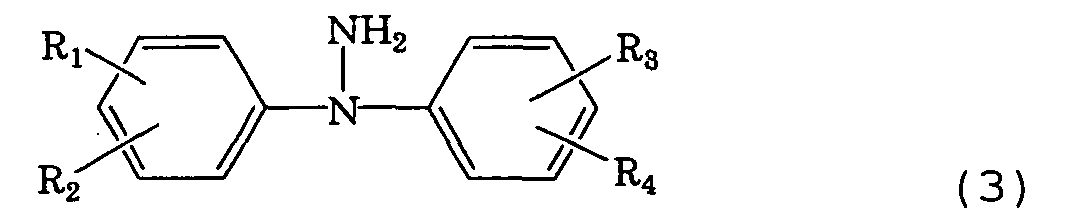
- The reduction reaction of the N-nitrosoamine compound represented by the general formula (2) in the invention is carried out by adding an alkali and thiourea dioxide to the above reaction solution. The alkali usable is suitably sodium hydroxide but is not limited thereto and lithium hydroxide, potassium hydroxide, or the like can be also used. With regard to the amounts of thiourea dioxide and the alkali, it is suitable to use thiourea dioxide in an amount ranging from 2.0 to 2.5 mol relative to 1 mol of the amine compound represented by the general formula (1) and the alkali in an amount ranging from 4.5 to 6.0 mol in addition to the amount required for neutralization of the acid used for the formation of an N-nitroso compound. In the reduction with thiourea dioxide and the alkali according to the invention, the cleavage of the N-N bond also occurs as in the cases of the above-mentioned other reducing agents. However, this is not attributed to the action of the reducing agent itself but to the reaction of the formed hydrazine compound represented by the general formula (3) with the N-nitrosoamine compound represented by the general formula (2). Therefore, the regulation of the total amount of the mixed solvent for use in the nitroso compound-forming reaction is especially important from the viewpoint of suppressing the production of the amine compound represented by the general formula (1) as a by-product. It is suitable that the total amount of the mixed solvent is within the range of 14 to 31 times weight relative to the amount of thiourea dioxide, and the ratio of water is within the range of 30 to 60% by weight based on the mixed solvent. In particular, when the reduction reaction is carried out with an amount of the solvent lower than the regulation, the amine compound represented by the general formula (1) is remarkably produced as a by-product, so that the yield and quality of the hydrazone compound as a final product are deteriorated. Moreover, the production of the amine compound represented by the general formula (1) as a by-product is dependent on temperature and thus the reduction reaction is carried out suitably in the temperature range of 35 to 45°C, desirably in the temperature range of 38 to 43°C. When the reaction temperature is 45°C or higher, remarkable production of the amine compound represented by the general formula (1) as a by product occurs. On the other hand, a remarkable decrease in reaction rate is observed at a temperature of 35°C or lower.
- The solution of the hydrazine compound represented by the general formula (3) is obtained by removing the water-miscible organic solvent by distillation after the completion of the reduction reaction and extracting the residue with a suitable organic solvent. The organic solvent for extraction is suitably an organic solvent having a specific gravity of less than 1.0, which dissolves the hydrazine compound represented by the general formula (3) and the carbonyl compound represented by the general formula (4) and which is not miscible with water. Specific examples include ethers such as diethyl ether and isopropyl ether, aromatic hydrocarbons such as toluene and xylene, and the like.
- The hydrazone compound as the final target compound in the invention is obtained by reacting the extraction solution of the hydrazine compound represented by the general formula (3) with the carbonyl compound represented by the general formula (4). The dehydrative condensation reaction can be accelerated by adding an acid as commonly known and, for example, an inorganic acid such as hydrochloric acid or sulfuric acid or an organic acid such as acetic acid is used. The reaction well proceeds at room temperature without heating but heating may be conducted in order to accelerate the reaction. In either case, the reaction time is from 1 to 5 hours. After the completion of the reaction, the final target compound can be taken out by filtering off the precipitated crystals or, in the case where crystals are not precipitated or the precipitation of crystals is insufficient, by filtering off the crystals formed through addition of an alcohol such as methanol or ethanol, a hydrous alcohol or the like, or by partially removing the organic solvent by distillation under reduced pressure and then dispersing the residue into an alcohol such as methanol or ethanol, a hydrous alcohol or the like and filtering the resulting crystals.
- The hydrazone compounds to be produced by the production process of the invention include the following: p-diethylaminobenzaldehyde=dipenylhydrazone, p-diphenylaminobenzaldehyde=dipenylhydrazone, p-(p-tolyl)phenylaminobenzaldehyde-dipenylhydrazone, p-di(p-tolyl)aminobenzaldehyde=dipenylhydrazone, p-(p-methoxyphenyl)phenylaminobenzaldehyde=dipenylhydrazone, 2-methyl-4-dibenzylaminobenzaldehyde=dipenylhydrazone, p-diphenylaminobenzaldehyde=di(p-tolyl)hydrazone, p-diphenylaminobenzaldehyde=bis(6-tetralyl)hydrazone, p-diphenylaminobenzaldehyde=bis(5-indanyl)hydrazone, p-dibenzylaminobenzaldehyde=bis(6-tetralyl)hydrazone, p-dimethylaminobenzaldehyde=bis(2,4-dimethylphenyl)hydrazone, p-bis(2-methyl-4-methoxyphenyl)aminobenzaldehyde=diphenylhydrazone, p-bis(2,4-dimethylphenyl)aminobenzaldehyde=di(p-tolyl)hydrazone.
- The following will explain the present invention in detail with reference to Examples but the invention is not limited to Examples.
- Into a 500 ml four-neck flask were added 16.9 g (100 mmol) of diphenylamine, 15.1 g (251 mmol) of acetic acid, and 207 g of methanol, and the whole was dissolved under stirring. Thereto was added 13.8 g (200 mmol) of sodium nitrite dissolved in 57 g of water, followed by stirring at 15 to 20°C for 3 hours. After the disappearance of diphenylamine was confirmed by high-performance liquid chromatography, 26.1 g (653 mmol) of sodium hydroxide dissolved in 119 g of water and 25.9 g (240 mmol) of thiourea dioxide were added, followed by stirring at 38 to 43°C for 3 hours. After the disappearance of N-nitrosodiphenylamine was confirmed by high-performance liquid chromatography, methanol was removed by distillation under reduced pressure, followed by extraction with 120 g of toluene to obtain a toluene solution of 1,1-diphenylhydrazine. The compositional ratio excluding toluene determined by high-performance liquid chromatography was 88.9% of 1,1-diphenylhydrazine and 10.2% of diphenylamine.
- To the toluene solution of 1,1-diphenylhydrazine obtained in Example 1 were added 24.3 g (89 mmol) of p-diphenylaminobenzaldehyde and 3.0 g (50 mmol) of acetic acid, followed by stirring at 40 to 45°C for 2 hours. After the disappearance of 1,1-diphenylhydrazine was confirmed by high-performance liquid chromatography, 110 g of methanol was added and precipitated crystals were filtered off to obtain 36.5 g of p-diphenylaminobenzaldehyde=diphenylhydrazone. The yield was 83.1% based on the starting diphenylamine and the purity determined by high-performance liquid chromatography was 99.4%.
- To the toluene solution of 1,1-diphenylhydrazine obtained in Example 1 were added 26.8 g (89 mmol) of p-di(p-tolyl)aminobenzaldehyde and 3.0 g (50 mmol) of acetic acid, followed by stirring at 40 to 45°C for 1 hours. After the disappearance of 1,1-diphenylhydrazine was confirmed by high-performance liquid chromatography, 100 g of methanol was added and precipitated crystals were filtered off to obtain 38.6 g of p-di(p-tolyl)aminobenzaldehyde=diphenylhydrazone. The yield was 82.7% based on the starting diphenylamine and the purity determined by high-performance liquid chromatography was 99.7%.
- To the toluene solution of 1,1-diphenylhydrazine obtained in Example 1 were added 28.0 g (89 mmol) of 2-methyl-4-dibenzylaminobenzaldehyde and 3.0 g (50 mmol) of acetic acid, followed by stirring at 40 to 45°C for 3 hours. After the disappearance of 1,1-diphenylhydrazine was confirmed by high-performance liquid chromatography, toluene was partially removed by distillation under reduced pressure and 100 g of methanol was added and dispersed and resulting crystals were filtered off to obtain 39.2 g of 2-methyl-4-dibenzylaminobenzaldehyde=diphenylhydrazone. The yield was 81.5% based on the starting diphenylamine and the purity determined by high-performance liquid chromatography was 99.3%.
- To the toluene solution of 1,1-diphenylhydrazine obtained in Example 1 were added 15.7 g (89 mmol) of p-diethylaminobenzaldehyde and 3.0 g (50 mmol) of acetic acid, followed by stirring at 40 to 45°C for 3 hours. After the disappearance of 1,1-diphenylhydrazine was confirmed by high-performance liquid chromatography, toluene was partially removed by distillation under reduced pressure and 105 g of methanol was added and dispersed and resulting crystals were filtered off to obtain 29.0 g of p-diethylaminobenzaldehyde=diphenylhydrazone. The yield was 83.8% based on the starting diphenylamine and the purity determined by high-performance liquid chromatography was 99.3%.
- Into a 300 ml four-neck flask were added 16.9 g (0.1 mol) of diphenylamine and 118 g (2.0 mol) of acetic acid, and the whole was dissolved under stirring. Thereto was added 15.2 g (0.2 mol) of sodium nitrite dissolved in 22 g of water, followed by stirring at 30 to 35°C for 6 hours. Then, 19.6 g (0.3 mol) of zinc powder was added to the reaction solution containing N-nitrosodiphenylamine in the range of 20 to 25°C to effect reduction. The reaction was traced by thin-layer chromatography. After the completion of the reduction, the reduced residue was immediately filtered. Then, 24.3 g (0.09 mol) of p-diphenylaminobenzaldehyde was added to the filtrate, followed by stirring at 15 to 20°C for 1 hour. After the disappearance of N-nitrosodiphenylamine was confirmed by thin-layer chromatography, the reaction solution was poured into water, followed by extraction with 120 g of toluene. Then, 110 g of methanol was added and precipitated crystals were filtered off to obtain 25.8 g of p-diphenylaminobenzaldehyde=diphenylhydrazone. The yield was 58.8% based on the starting diphenylamine and the purity determined by high-performance liquid chromatography was 98.4%.
- Into a 1000 ml four-neck flask were added 16.9 g (100 mmol) of diphenylamine, 15.1 g (251 mmol) of acetic acid, and 256 g of methanol, and the whole was dissolved under stirring. Thereto was added 13.8 g (200 mmol) of sodium nitrite dissolved in 57 g of water, followed by stirring at 15 to 20°C for 8 hours. After the disappearance of diphenylamine was confirmed by high-performance liquid chromatography, 26.1 g (653 mmol) of sodium hydroxide dissolved in 225 g of water and 25.9 g (240 mmol) of thiourea dioxide were added, followed by stirring at 38 to 43°C for 3 hours. After the disappearance of N-nitrosodiphenylamine was confirmed by high-performance liquid chromatography, methanol was removed by distillation under reduced pressure, followed by extraction with 100 g of diethyl ether.. The compositional ratio determined by high-performance liquid chromatography was 88.9% of 1,1-diphenylhydrazine and 11.0% of diphenylamine. After the extraction solution was subjected to water removal over anhydrous magnesium sulfate, hydrogen chloride gas was introduced into the solution and precipitated crystals were filtered off to obtain 17.8 g of 1,1-diphenylhydrazine hydrochloride. The yield was 80.8% based on the starting diphenylamine.
- To a 300 ml four-neck flask were added 17.0 g (77 mmol) of 1,1-diphenylhydrazine hydrochloride obtained in Comparative Example 2, 21.1 g (77 mmol) of p-diphenylaminobenzaldehyde, and 70 g of DMF, followed by stirring at 40 to 45°C for 3 hours. The reaction was traced by thin-layer chromatography. After, the completion of the reaction, 100 g of methanol was added and precipitated crystals were filtered off to obtain 32.3 g of p-diphenylaminobenzaldehyde=diphenylhydrazone. The yield was 95.4% based on the starting 1,1-diphenylhydrazine, the over all yield from the starting diphenylamine was 77.0%, and the purity determined by high-performance liquid chromatography was 98.2%.
- The process for producing a hydrazone compound in the present invention is useful since the target hydrazone compound can be obtained in high quality and in a high yield without taking the hydrazine compound out of the reactor at all, the hydrazine compound being a reaction intermediate which is structurally unstable and has a fear of influencing safety of workers owing to its toxicity (mutagenicity).
- While the invention has been described in detail and with reference to specific examples thereof, it will be apparent to one skilled in the art that various changes and modifications can be made therein without departing from the spirit and scope thereof.
- The present application is based on
Japanese Patent Application No. 2004-191082 filed on June 29, 2004
in a mixed solvent of water and a water-miscible organic solvent arranged in a reactor and reacting the compound with an acid and sodium nitrite;
a step of condensing a hydrazine compound formed by the reduction and represented by the general formula (3) :

with a carbonyl compound represented by the general formula (4):

Claims (5)
- A process for producing a hydrazone compound represented by the general formula (5):

which comprises:a step of dissolving an amine compound represented by the general formula (1):wherein R1, R2, R3, and R4 may be the same or different and each represents a hydrogen atom, a methyl group, an ethyl group, an n-propyl group, a 2-propyl group, an n-butyl group, an isobutyl group, a secondary-butyl group, a tertiary-butyl group, a methoxy group, an ethoxy group, a substituted or unsubstituted aralkyl group, or a substituted or unsubstituted aryl group, and R1 and R2 may be combined to form a ring and R3 and R4 may be combined to form a ring,
in a mixed solvent of water and a water-miscible organic solvent arranged in a reactor and reacting the compound with an acid and sodium nitrite;a step of adding thiourea dioxide and an alkali to a reaction solution containing an N-nitrosoamine compound formed by the reaction and represented by the general formula (2):wherein R1, R2, R3, and R4 represent the same meanings as in the case of the general formula (1), to reduce the compound; and
a step of condensing a hydrazine compound formed by the reduction and represented by the general formula (3):
with a carbonyl compound represented by the general formula (4):
- The process for producing a hydrazone compound according to claim 1, wherein the condensation step is conducted by removing the water-miscible organic solvent by distillation from the mixed solvent dissolving the hydrazine compound represented by the general formula (3) obtained according to the reduction step, adding an organic solvent for extraction of the hydrazine compound thereto, and then reacting a solution obtained by the extraction with the carbonyl compound represented by the general formula (4).
- The process for producing a hydrazone compound according to claim 1 or 2, wherein the total amount of the mixed solvent is within the range of 14 to 31 times weight relative to the amount of thiourea dioxide used in the reduction reaction of the N-nitrosoamine compound represented by the general formula (2) and the ratio of water is within the range of 30 to 60% by weight relative to the mixed solvent.
- The process for producing a hydrazone compound according to claim 1 or 2, wherein the reduction reaction of the N-nitrosoamine compound represented by the general formula (2) is carried out at the reaction temperature range of 35 to 45°C.
- The process for producing a hydrazone compound according to claim 1 or 2, wherein the reduction reaction of the N-nitrosoamine compound represented by the general formula (2) is carried out at the reaction temperature range of 38 to 43°C.
Applications Claiming Priority (2)
| Application Number | Priority Date | Filing Date | Title |
|---|---|---|---|
| JP2004191082 | 2004-06-29 | ||
| PCT/JP2005/012275 WO2006001537A1 (en) | 2004-06-29 | 2005-06-28 | Process for producing hydrazone compound |
Publications (3)
| Publication Number | Publication Date |
|---|---|
| EP1762564A1 true EP1762564A1 (en) | 2007-03-14 |
| EP1762564A4 EP1762564A4 (en) | 2008-05-28 |
| EP1762564B1 EP1762564B1 (en) | 2013-12-25 |
Family
ID=35781933
Family Applications (1)
| Application Number | Title | Priority Date | Filing Date |
|---|---|---|---|
| EP05755876.9A Expired - Lifetime EP1762564B1 (en) | 2004-06-29 | 2005-06-28 | Process for producing hydrazone compound |
Country Status (7)
| Country | Link |
|---|---|
| US (1) | US7884245B2 (en) |
| EP (1) | EP1762564B1 (en) |
| JP (1) | JP4824564B2 (en) |
| KR (1) | KR101180563B1 (en) |
| CN (2) | CN1976896A (en) |
| TW (1) | TWI356817B (en) |
| WO (1) | WO2006001537A1 (en) |
Families Citing this family (6)
| Publication number | Priority date | Publication date | Assignee | Title |
|---|---|---|---|---|
| EP2090576A1 (en) | 2008-02-01 | 2009-08-19 | Merz Pharma GmbH & Co.KGaA | 6-halo-pyrazolo[1,5-a]pyridines, a process for their preparation and their use as metabotropic glutamate receptor (mGluR) modulators |
| US11338983B2 (en) | 2014-08-22 | 2022-05-24 | Plastipak Packaging, Inc. | Oxygen scavenging compositions, articles containing same, and methods of their use |
| CN106366017A (en) * | 2016-08-16 | 2017-02-01 | 天津大学 | Preparation method of 9-anthraldehyde-1, 1-diphenylhydrazone |
| CN112341357B (en) * | 2020-09-24 | 2023-08-08 | 国药集团化学试剂有限公司 | Preparation method of 4-methoxy phenylhydrazine hydrochloride |
| CN115160180A (en) * | 2022-06-22 | 2022-10-11 | 广东海洋大学 | A kind of green synthesis method of vanillin acetal 2,4-dinitrophenylhydrazone |
| CN115950987B (en) * | 2022-12-30 | 2025-01-28 | 暨明医药科技(苏州)有限公司 | A kind of analysis and detection method of phenylhydrazone compounds |
Family Cites Families (8)
| Publication number | Priority date | Publication date | Assignee | Title |
|---|---|---|---|---|
| DE2758027A1 (en) | 1977-12-24 | 1979-06-28 | Bayer Ag | METHOD OF MANUFACTURING HYDRACINES |
| DE3029742A1 (en) | 1980-08-06 | 1982-03-04 | Bayer Ag, 5090 Leverkusen | Nitroso di:phenyl amine prodn. by nitrosation in aq. alcohol - to give high yield and purity, useful as vulcanisation retarder |
| US4313002A (en) * | 1980-10-29 | 1982-01-26 | Uop Inc. | Preparation of p-aminodiphenylamines |
| JPS57154162A (en) * | 1981-03-16 | 1982-09-22 | Ricoh Co Ltd | Novel hydrazone compound and its preparation |
| JPS5865261A (en) * | 1981-10-13 | 1983-04-18 | Canon Inc | Synthesis method of hydrazone compounds |
| JPS5939860A (en) * | 1982-08-31 | 1984-03-05 | Canon Inc | Production method of hydrazone compound |
| JP2654057B2 (en) * | 1988-03-01 | 1997-09-17 | イヌイ株式会社 | Method for producing N, N-disubstituted hydrazine |
| JPH06234720A (en) * | 1993-02-09 | 1994-08-23 | Mitsubishi Gas Chem Co Inc | Dihydroxy compound having hydrazone structure and process for producing the same |
-
2005
- 2005-06-28 JP JP2006528872A patent/JP4824564B2/en not_active Expired - Fee Related
- 2005-06-28 EP EP05755876.9A patent/EP1762564B1/en not_active Expired - Lifetime
- 2005-06-28 CN CNA2005800215426A patent/CN1976896A/en active Pending
- 2005-06-28 CN CN2013100938794A patent/CN103232364A/en active Pending
- 2005-06-28 US US11/571,399 patent/US7884245B2/en not_active Expired - Fee Related
- 2005-06-28 KR KR1020067027544A patent/KR101180563B1/en not_active Expired - Fee Related
- 2005-06-28 WO PCT/JP2005/012275 patent/WO2006001537A1/en not_active Ceased
- 2005-06-29 TW TW094121816A patent/TWI356817B/en not_active IP Right Cessation
Also Published As
| Publication number | Publication date |
|---|---|
| KR101180563B1 (en) | 2012-09-06 |
| US20080015387A1 (en) | 2008-01-17 |
| CN103232364A (en) | 2013-08-07 |
| KR20070036080A (en) | 2007-04-02 |
| JP4824564B2 (en) | 2011-11-30 |
| TW200621717A (en) | 2006-07-01 |
| WO2006001537A1 (en) | 2006-01-05 |
| JPWO2006001537A1 (en) | 2008-04-17 |
| US7884245B2 (en) | 2011-02-08 |
| CN1976896A (en) | 2007-06-06 |
| TWI356817B (en) | 2012-01-21 |
| EP1762564B1 (en) | 2013-12-25 |
| EP1762564A4 (en) | 2008-05-28 |
Similar Documents
| Publication | Publication Date | Title |
|---|---|---|
| KR20100025533A (en) | Processes for the preparation of pyrazoles | |
| EP1713750A1 (en) | Method for preparation of a fluoroarmatic compound from an aminoaromatic amine compound | |
| EP1762564B1 (en) | Process for producing hydrazone compound | |
| JP4889737B2 (en) | Production of N-substituted isothiazolinone derivatives | |
| EP1972621B1 (en) | Method for producing thiazole compound | |
| EP1829872B1 (en) | Processes for production of indole compounds | |
| EP2325161B1 (en) | Method for producing alpha-hydroxyester compound | |
| EP2980079A1 (en) | Method of manufacturing pyridazinone compound | |
| US7282610B2 (en) | Method of producing aromatic amine compound having alkylthio group | |
| JP2004315535A (en) | Method for preparing hexahydropyridazine-3-carboxylic acid derivative | |
| EP1697310B9 (en) | Method for the continuous synthesis of monoalkyl-hydrazines with a functionalised alkyl group | |
| EP2167514B1 (en) | Improved process for preparing alkoxyamines resulting from beta-phosphorated nitroxides | |
| JP2677115B2 (en) | Imine compound and method for producing the same | |
| JPH10114729A (en) | Production of aminophenol | |
| JP2001072638A (en) | PRODUCTION OF alpha-BROMOALKYLPHENONES | |
| JP5112621B2 (en) | Purification method and production method of 5-substituted oxazole compounds | |
| JP3937600B2 (en) | Method for producing aminobenzonitrile compound | |
| JPH0559019A (en) | Preparation of aminosulfonylcarbamoyltriazole derivative | |
| JPH0226623B2 (en) | ||
| JP4196572B2 (en) | Method for producing aminonaphthoquinones | |
| JPS63174977A (en) | Method for producing heterocyclic compounds | |
| JPH10330342A (en) | Production of n,n-disubstituted hydroxylamine compounds | |
| JPWO2019235493A1 (en) | Method for producing diaminobenzoic acid ester | |
| JP2010510258A (en) | Method for producing aminoglycol | |
| JPS6155504B2 (en) |
Legal Events
| Date | Code | Title | Description |
|---|---|---|---|
| PUAI | Public reference made under article 153(3) epc to a published international application that has entered the european phase |
Free format text: ORIGINAL CODE: 0009012 |
|
| 17P | Request for examination filed |
Effective date: 20061221 |
|
| AK | Designated contracting states |
Kind code of ref document: A1 Designated state(s): DE GB NL |
|
| RIN1 | Information on inventor provided before grant (corrected) |
Inventor name: TAKASO, KIYOKAZU Inventor name: TAKESUE, ATSUSHI Inventor name: ABE, KATSUMI |
|
| DAX | Request for extension of the european patent (deleted) | ||
| RBV | Designated contracting states (corrected) |
Designated state(s): DE GB NL |
|
| A4 | Supplementary search report drawn up and despatched |
Effective date: 20080428 |
|
| GRAP | Despatch of communication of intention to grant a patent |
Free format text: ORIGINAL CODE: EPIDOSNIGR1 |
|
| INTG | Intention to grant announced |
Effective date: 20130710 |
|
| RAP1 | Party data changed (applicant data changed or rights of an application transferred) |
Owner name: HODOGAYA CHEMICAL CO., LTD. |
|
| GRAS | Grant fee paid |
Free format text: ORIGINAL CODE: EPIDOSNIGR3 |
|
| GRAA | (expected) grant |
Free format text: ORIGINAL CODE: 0009210 |
|
| AK | Designated contracting states |
Kind code of ref document: B1 Designated state(s): DE GB NL |
|
| REG | Reference to a national code |
Ref country code: GB Ref legal event code: FG4D |
|
| REG | Reference to a national code |
Ref country code: DE Ref legal event code: R096 Ref document number: 602005042253 Country of ref document: DE Effective date: 20140213 |
|
| REG | Reference to a national code |
Ref country code: NL Ref legal event code: T3 |
|
| REG | Reference to a national code |
Ref country code: DE Ref legal event code: R097 Ref document number: 602005042253 Country of ref document: DE |
|
| PLBE | No opposition filed within time limit |
Free format text: ORIGINAL CODE: 0009261 |
|
| STAA | Information on the status of an ep patent application or granted ep patent |
Free format text: STATUS: NO OPPOSITION FILED WITHIN TIME LIMIT |
|
| 26N | No opposition filed |
Effective date: 20140926 |
|
| REG | Reference to a national code |
Ref country code: DE Ref legal event code: R119 Ref document number: 602005042253 Country of ref document: DE |
|
| REG | Reference to a national code |
Ref country code: DE Ref legal event code: R097 Ref document number: 602005042253 Country of ref document: DE Effective date: 20140926 |
|
| REG | Reference to a national code |
Ref country code: NL Ref legal event code: V1 Effective date: 20150101 |
|
| GBPC | Gb: european patent ceased through non-payment of renewal fee |
Effective date: 20140628 |
|
| PG25 | Lapsed in a contracting state [announced via postgrant information from national office to epo] |
Ref country code: NL Free format text: LAPSE BECAUSE OF NON-PAYMENT OF DUE FEES Effective date: 20150101 |
|
| PG25 | Lapsed in a contracting state [announced via postgrant information from national office to epo] |
Ref country code: DE Free format text: LAPSE BECAUSE OF NON-PAYMENT OF DUE FEES Effective date: 20150101 |
|
| REG | Reference to a national code |
Ref country code: DE Ref legal event code: R119 Ref document number: 602005042253 Country of ref document: DE Effective date: 20150101 |
|
| PG25 | Lapsed in a contracting state [announced via postgrant information from national office to epo] |
Ref country code: GB Free format text: LAPSE BECAUSE OF NON-PAYMENT OF DUE FEES Effective date: 20140628 |