EP1760143A1 - Succinic acid-producing bacterium and process for producing succinic acid - Google Patents
Succinic acid-producing bacterium and process for producing succinic acid Download PDFInfo
- Publication number
- EP1760143A1 EP1760143A1 EP05741285A EP05741285A EP1760143A1 EP 1760143 A1 EP1760143 A1 EP 1760143A1 EP 05741285 A EP05741285 A EP 05741285A EP 05741285 A EP05741285 A EP 05741285A EP 1760143 A1 EP1760143 A1 EP 1760143A1
- Authority
- EP
- European Patent Office
- Prior art keywords
- gene
- strain
- succinic acid
- activity
- acetyl
- Prior art date
- Legal status (The legal status is an assumption and is not a legal conclusion. Google has not performed a legal analysis and makes no representation as to the accuracy of the status listed.)
- Granted
Links
Images



Classifications
-
- C—CHEMISTRY; METALLURGY
- C12—BIOCHEMISTRY; BEER; SPIRITS; WINE; VINEGAR; MICROBIOLOGY; ENZYMOLOGY; MUTATION OR GENETIC ENGINEERING
- C12P—FERMENTATION OR ENZYME-USING PROCESSES TO SYNTHESISE A DESIRED CHEMICAL COMPOUND OR COMPOSITION OR TO SEPARATE OPTICAL ISOMERS FROM A RACEMIC MIXTURE
- C12P7/00—Preparation of oxygen-containing organic compounds
- C12P7/40—Preparation of oxygen-containing organic compounds containing a carboxyl group including Peroxycarboxylic acids
- C12P7/44—Polycarboxylic acids
- C12P7/46—Dicarboxylic acids having four or less carbon atoms, e.g. fumaric acid, maleic acid
-
- C—CHEMISTRY; METALLURGY
- C12—BIOCHEMISTRY; BEER; SPIRITS; WINE; VINEGAR; MICROBIOLOGY; ENZYMOLOGY; MUTATION OR GENETIC ENGINEERING
- C12N—MICROORGANISMS OR ENZYMES; COMPOSITIONS THEREOF; PROPAGATING, PRESERVING, OR MAINTAINING MICROORGANISMS; MUTATION OR GENETIC ENGINEERING; CULTURE MEDIA
- C12N15/00—Mutation or genetic engineering; DNA or RNA concerning genetic engineering, vectors, e.g. plasmids, or their isolation, preparation or purification; Use of hosts therefor
- C12N15/09—Recombinant DNA-technology
- C12N15/63—Introduction of foreign genetic material using vectors; Vectors; Use of hosts therefor; Regulation of expression
- C12N15/74—Vectors or expression systems specially adapted for prokaryotic hosts other than E. coli, e.g. Lactobacillus, Micromonospora
- C12N15/77—Vectors or expression systems specially adapted for prokaryotic hosts other than E. coli, e.g. Lactobacillus, Micromonospora for Corynebacterium; for Brevibacterium
-
- C—CHEMISTRY; METALLURGY
- C12—BIOCHEMISTRY; BEER; SPIRITS; WINE; VINEGAR; MICROBIOLOGY; ENZYMOLOGY; MUTATION OR GENETIC ENGINEERING
- C12N—MICROORGANISMS OR ENZYMES; COMPOSITIONS THEREOF; PROPAGATING, PRESERVING, OR MAINTAINING MICROORGANISMS; MUTATION OR GENETIC ENGINEERING; CULTURE MEDIA
- C12N9/00—Enzymes; Proenzymes; Compositions thereof; Processes for preparing, activating, inhibiting, separating or purifying enzymes
- C12N9/14—Hydrolases (3)
- C12N9/16—Hydrolases (3) acting on ester bonds (3.1)
-
- C—CHEMISTRY; METALLURGY
- C12—BIOCHEMISTRY; BEER; SPIRITS; WINE; VINEGAR; MICROBIOLOGY; ENZYMOLOGY; MUTATION OR GENETIC ENGINEERING
- C12Y—ENZYMES
- C12Y301/00—Hydrolases acting on ester bonds (3.1)
- C12Y301/02—Thioester hydrolases (3.1.2)
- C12Y301/02001—Acetyl-CoA hydrolase (3.1.2.1)
-
- C—CHEMISTRY; METALLURGY
- C08—ORGANIC MACROMOLECULAR COMPOUNDS; THEIR PREPARATION OR CHEMICAL WORKING-UP; COMPOSITIONS BASED THEREON
- C08G—MACROMOLECULAR COMPOUNDS OBTAINED OTHERWISE THAN BY REACTIONS ONLY INVOLVING UNSATURATED CARBON-TO-CARBON BONDS
- C08G63/00—Macromolecular compounds obtained by reactions forming a carboxylic ester link in the main chain of the macromolecule
- C08G63/02—Polyesters derived from hydroxycarboxylic acids or from polycarboxylic acids and polyhydroxy compounds
- C08G63/12—Polyesters derived from hydroxycarboxylic acids or from polycarboxylic acids and polyhydroxy compounds derived from polycarboxylic acids and polyhydroxy compounds
- C08G63/16—Dicarboxylic acids and dihydroxy compounds
Definitions
- the present invention relates to a fermentation industry, and to a process for efficiently producing succinic acid by a fermentation method using a coryneform bacterium.
- anaerobic bacteria such as those belonging to the genus Anaerobiospirillum or Actinobacillus are used (Patent Document 1 or 2, and Non-Patent Document 1).
- Anaerobic bacteria makes the yield of products high, while such bacteria require many nutrients for proliferation and therefore, there is a need for adding a large amount of organic nitrogen sources such as corn steep liquor (CSL) to a medium.
- CSL corn steep liquor
- the addition of abundant amounts of organic nitrogen sources not only leads to an increase in cost of the medium but also leads to an increase in cost of purification for isolating the product, which is uneconomical.
- Patent Document 3 and 4 a method, which comprises culturing aerobic bacteria such as coryneform bacteria under an aerobic condition to proliferate bacterial cells and then collecting and washing the cells to use them as resting bacteria to produce succinic acid without oxygen aeration.
- This method is economical because the bacterial cells can grow sufficiently in a simple medium, into which a small amount of organic nitrogen is added for proliferation of bacterial cells, but this method is still to be improved in terms of the amount of generated succinic acid, the concentration thereof, and the production rate thereof per bacterial cells as well as simplification of production process, and the like.
- Those methods are intended to reduce generation of acetic acid as a by-product by actively assimilating acetic acid released into a culture medium.
- methods of suppressing generation of acetic acid as a by-product by suppressing the biosynthesis of acetic acid there have been known a method of producing succinic acid using Escherichia coli in which phosphoacetyltransferase (pta) and lactate dehydrogenase (ldh) are deficient (Patent Document 8), a method of producing an amino acid using an enterobacterium in which pyruvate oxidase (poxB) is deficient, and a method of producing D-pantothenic acid using an enterobacterium in which pyruvate oxidase (poxB) is deficient (Patent Document 9).
- Non-Patent Document 2 As enzymes responsible for assimilation of acetic acid in coryneform bacteria, there have been reported acetate kinase (ack) and phosphotransacetylase (pta) (Non-Patent Document 2). On the other hand, it is assumed that not only the above-mentioned enzymes but also a plurality of enzymes such as pyruvate oxidase (poxB) (Patent Document 10), acylphosphatase (acp), aldehyde dehydrogenase, and acetyl-CoA hydrolase are responsible for generation of acetic acid, but a specific enzyme that contributes to the synthesis of acetic acid has not been clarified. Therefore, there has not been known a method of producing succinic acid using a strain of a coryneform bacterium having a decreased acetic acid biosynthetic enzyme.
- Acetyl-CoA hydrolase is an enzyme to generate acetic acid from acetyl-CoA and water (3.1.2.1), and the gene sequence in Corynebacterium glutamicum has been predicted (Patent Document 11). However, no report has been provided for cloning of the gene and expression analysis of the gene, and its actual function has not been clarified.
- An object of the present invention is to provide a coryneform bacterium having an improved succinic acid-producing ability.
- the inventors of the present invention have intensively studied for solving the aforementioned problems, and as a result, found that succinic acid-producing ability is improved by decreasing an activity of acetyl-CoA hydrolase in a coryneform bacterium. Furthermore, they found that generation of acetic acid as a by-product is reduced by decreasing activities of phosphotransacetylase and acetate kinase in addition to the acetyl-CoA hydrolase activity, thereby accomplished the present invention.
- the present invention is as follows.
- coryneform bacterium includes a bacterium which had been classified as the genus Brevibacterium but now classified as the genus Corynebacterium ( Int. J. Syst. Bacteriol., 41, 255(1981 )), and it also includes a bacterium belonging to the genus Brevibacterium, which is very closely related to Corynebacterium. Examples of such coryneform bacteria include the followings.
- succinic acid-producing ability means an ability to accumulate succinic acid in a medium when the coryneform bacterium of the present invention is cultured.
- the succinic acid-producing ability may be a feature inherent to a wild-type coryneform bacterium or a feature provided by breeding.
- a coryneform bacterium having a succinic acid-producing ability include Brevibacterium flavum MJ233 ⁇ ldh strain having decreased lactate dehydrogenase activity ( JP11-206385A ), Brevibacterium flavum MJ233/pPCPYC strain having enhanced activity of pyruvate carboxylase or phosphoenol pyruvate carboxylase ( WO 01/27258 and JP11-196887A ), Brevibacterium flavum MJ-233 (FERM PB-1497), Brevibacterium flavum MJ-233 AB-41 (FERM BP-1498), Brevibacterium ammoniagenes ATCC6872, Corynebacterium glutamicum ATCC31831, and Brevibacterium lactofermentum ATCC13869.
- Brevibacterium flavum may be currently classified as Corynebacterium glutamicum ( Lielbl, W., Ehrmann, M., Ludwig, W. and Schleifer, K. H., International Journal of Systematic Bacteriology, 1991, vol. 41, p255-260 ), the aforementioned Brevibacterium flavum MJ-233 strain and its mutant MJ-233 AB-41 strain, are defined as the same strains as Corynebacterium glutamicum MJ-233 strain and Corynebacterium glutamicum MJ-233 AB-41 strain, respectively.
- the coryneform bacterium of the present invention has the above-mentioned succinic acid-producing ability and has been modified so that an activity of acetyl-CoA hydrolase is decreased.
- the provision of succinic acid-producing ability and the modification to decrease the acetyl-CoA hydrolase (EC 3.1.2.1) activity may be performed in any order.
- acetyl-CoA hydrolase (ACH) activity means an activity to catalyze the reaction to generate acetic acid from acetyl-CoA and water.
- modified so that activity of acetyl-CoA hydrolase is decreased means that an activity of acetyl-CoA hydrolase is decreased as compared to a specific activity of an unmodified strain such as a wild-type coryneform bacterium.
- the ACH activity is preferably decreased to 50% or less per bacterial cells, more preferably 30% or less, further more preferably 10% or less per bacterial cells as compared to an unmodified strain.
- examples of a wild-type coryneform bacterium to be used as a control include Brevibacterium lactofermentum ATCC13869 (wild-type strain) and Brevibacterium lactofermentum ⁇ ldh strain (unmodified strain).
- the activity of acetyl-CoA hydrolase can be determined according to the method of Gergely, J., et al. ( Gergely, J., Hele, P. & Ramkrishnan, C.V. (1952) J. Biol. Chem. 198 p323-334 ).
- the term "decreased" includes complete loss of the activity.
- the coryneform bacterium of the present invention preferably has an acetyl-CoA hydrolase activity lower than a wild-type or unmodified strain and more preferably has improved accumulation of succinic acid as compared to those strains.
- it may be a protein having an amino acid sequence of SEQ ID NO: 45 including a substitution, deletion, insertion or addition of one or several amino acids as long as it has an acetyl-CoA hydrolase activity.
- severe means 2 to 20, preferably 2 to 10, more preferably 2 to 5.
- modified so that the acetyl-CoA hydrolase activity is decreased includes decrease in the number of molecules of acetyl-CoA hydrolase per cell, decrease in the acetyl-CoA hydrolase activity per molecule, and the like. Specifically, it is achieved by making a gene encoding acetyl-CoA hydrolase on a chromosome deficient, modification of an expression regulatory sequence such as promoter or Shine-Dalgarno (SD) sequence, or the like.
- Examples of acetyl-CoA hydrolase gene on a chromosome include a DNA having a nucleotide sequence of nucleotide numbers 1037-2542 of SEQ ID NO: 44.
- nucleotide sequence may be a DNA that hybridizes with the nucleotide sequence of nucleotide numbers 1037-2542 of SEQ ID NO: 44 or a probe that can be prepared from the nucleotide sequence under stringent conditions as long as it encodes a protein having acetyl-CoA hydrolase activity.
- stringent conditions means conditions in which so-called specific hybrid is formed and non-specific hybrid is not formed. It is difficult to clearly define the conditions by numeric value, but examples thereof include conditions comprising washing once, preferably twice or three times at salt concentration corresponding to 1 x SSC, 0.1% SDS, preferably 0.1 x SSC, 0.1% SDS at 60°C.
- the acetyl-CoA hydrolase gene (hereinafter, referred to as ach gene) can be cloned by synthesizing synthetic oligonucleotides based on a sequence of Corynebactenium glutamicum registered in GenBank (NCg12480 of GenBank Accession No. NC_003450 (complementary strand of 2729376..2730884 of NC_003450)), and performing PCR using a chromosome of Corynebacterium glutamicum as a template. Furthermore, there may also be used a sequence of a coryneform bacterium such as Brevibacterium lactofermentum having a nucleotide sequence determined by recent genome project.
- Chromosomal DNA can be prepared from a bacterium as a DNA donor by, for example, a method of Saito and Miura ( H. Saito and K. Miura, Biochem. Biophys. Acta, 72, 6.19 (1963 ), Experimental Manual for Biotechnology, edited by The Society for Biotechnology, Japan, p97-98, Baifukan Co., Ltd., 1992 ) or the like.
- the ach gene thus prepared or a part thereof can be used for gene disruption.
- a gene to be used for gene disruption only needs to have homology that is enough to cause homologous recombination with an ach gene to be disrupted on a chromosomal DNA of a coryneform bacterium (e.g. a gene having the nucleotide sequence of nucleotide numbers 1037-2542 in SEQ ID NO: 44), so such a homologous gene may also be used.
- the homology that is enough to cause homologous recombination is preferably not less than 70%, more preferably not less than 80%, further more preferably not less than 90%, particularly preferably not less than 95%.
- stringent conditions refers to conditions under which a so-called specific hybrid is formed and non-specific hybrid is not formed. It is difficult to clearly define the conditions by numeric value, but the conditions include, for example, conditions that comprise washing once, preferably twice or three times at salt concentrations corresponding to 1 x SSC, 0.1% SDS, preferably 0.1 x SSC, 0.1% SDS at 60°C.
- a deleted-form of ach gene which is modified so as not to produce acetyl-CoA hydrolase that normally functions by deleting a partial sequence of the ach gene, is prepared, and a coryneform bacterium is transformed with a DNA containing the gene to cause recombination between the deleted-form of the gene and the gene on a chromosome, to thereby disrupt the ach gene on a chromosome.
- a gene disruption by gene substitution using homologous recombination has already been established, and examples thereof include a method using a linear DNA and a method using a plasmid containing a temperature-sensitive replication origin ( US Patent No. 6,303,383 or JP05-007491A ).
- the above-mentioned gene disruption based on gene substitution using homologous recombination may also be performed using a plasmid having no replication ability in a host.
- an ach gene on a chromosome of a host can be substituted by a deleted-form of ach gene in accordance with the following procedures.
- a plasmid for recombination is prepared by inserting a temperature-sensitive replication origin, deleted-form of ach gene, sacB gene encoding levansucrase and a marker gene exhibiting resistance to such a drug as chloramphenicol.
- sacB gene encoding levansucrase is a gene which is used for efficiently selecting a strain in which a vector portion has been excised from a chromosome ( Schafer, A. et al.,Gene 145 (1994) 69-73 ). That is, when levansucrase is expressed in a coryneform bacterium, levan generated by assimilation of sucrose acts lethally on the bacterium, so the bacterium cannot grow. Therefore, if a bacterial strain in which a vector carrying levansucrase remains on a chromosome is cultured on a sucrose-containing plate, it cannot grow. As a result, only a bacterial strain from which the vector has been excised can be selected on the sucrose-containing plate.
- Bacillus subtilis sacB GenBank Accession Number X02730 (SEQ ID NO: 35)
- Bacillus amyloliquefaciens sacB GenBank Accession Number X52988
- Zymomonas mobilis sacB GenBank Accession Number L33402
- Bacillus stearothermophilus surB GenBank Accession Number U34874
- Lactobacillus sanfranciscensis frfA GenBank Accession Number AJ508391
- Acetobacter xylinus 1sxA GenBank Accession Number AB034152
- Gluconacetobacter diazotrophicus IsdA GenBank Accession Number L41732
- a coryneform bacterium is transformed with the above-mentioned recombinant plasmid.
- the transformation can be performed in accordance with a transformation method which has been previously reported. Examples of the method include, a method of increasing permeability of a DNA by treating cells of a recipient bacterium with calcium chloride as reported for Escherichia coli K-12 ( Mandel, M. and Higa, A., J. Mol. Biol., 53, 159 (1970 )) and, a method of preparing competent cells using proliferating cells for introduction of DNA as reported for Bacillus subtilis ( Duncan, C.H., Wilson, G.A and Young, F.E, Gene, 1, 153 (1977 )).
- a method of introducing a recombinant DNA into cells of a DNA recipient bacterium ( Chang. S. and Choen, S.N., Molec. Gen. Genet., 168, 111 (1979 ); Bibb, M.J., Ward, J.M., and Hopwood, O.A., Nature, 274, 398 (1978 ); Hinnen, A., Hicks, J.B. and Fink, G.R., Proc. Natl. Acad. Sci. USA, 75 1929 (1978 )) may also be applied.
- a coryneform bacterium may be transformed by the electric pulse method (Sugimoto et al., JP02-207791 A ).
- Examples of a temperature-sensitive plasmid for a coryneform bacterium include p48K and pSFKT2 ( JP2000-262288A ), and pHSC4 ( France Patent No. 2667875 (1992 ) and JP05-7491A ). These plasmids are autonomously replicable in a coryneform bacterium at least at 25°C, but they are not autonomously replicable at 37°C. Escherichia coli AJ12571 having pHSC4 has been deposited with an Accession No.
- a transformant obtained as described above is cultured at a temperature at which the temperature-sensitive replication origin does not function (25°C), to thereby obtain a strain into which the plasmid has been introduced.
- the plasmid-introduced strain is cultured at high temperature to excise the temperature-sensitive plasmid, and the bacterial strain is applied onto a plate containing an antibiotic.
- the temperature-sensitive plasmid cannot replicate at high temperature. Therefore, a bacterial strain from which the plasmid has been excised cannot grow on a plate containing an antibiotic, but a bacterial strain in which recombination has occurred between the acetic acid-biosynthetic gene on the plasmid and the ach gene on a chromosome appears at a very low frequency.
- recombination occurs with an ach gene sequence that is originally present on a chromosome, and two fusion genes of the chromosomal ach gene and the deleted-form of ach gene are inserted into a chromosome so that other portions of the recombinant DNA (vector part, temperature-sensitive replication origin and drug-resistance marker) are present between the fusion genes.
- the gene is eliminated together with the vector portion (the temperature-sensitive replication origin and drug-resistance marker) from the chromosomal.
- This procedure causes a case where the normal ach gene remains on the chromosomal DNA and the deleted-form of ach gene is excised, or to the contrary, a case where the normal ach gene is excised and the deleted-form of ach gene remains on chromosomal DNA.
- the cleaved DNA is kept in a cell as a plasmid.
- the ach gene on the plasmid is eliminated from the cell together with the plasmid. Then, a strain in which the deleted-form of ach gene remains on the chromosome, is selected by PCR, Southern hybridization, or the like, to thereby yield a strain in which the ach gene is disrupted.
- the plasmid having no replicability in a coryneform bacterium is preferably a plasmid having a replicability in Escherichia coli, and examples thereof include pHSG299 (Takara Bio Inc.) and pHSG399 (Takara Bio Inc.).
- examples of a method of decreasing an activity of acetyl-CoA hydrolase include not only the above-mentioned genetic engineering method but also a method comprising treating a coryneform bacterium with ultraviolet irradiation or with a mutagenesis agent to be generally used for mutation such as N-methyl-N'-nitro-N-nitrosoguanidine (NTG) and nitrous acid, and selecting a bacterial strain having decreased acetyl-CoA hydrolase activity.
- NTG N-methyl-N'-nitro-N-nitrosoguanidine
- a bacterial strain modified so that either or both of activities of phosphotransacetylase (hereinafter, referred to as PTA) and acetate kinase (hereinafter, referred to as ACK) are decreased in addition to the decrease in the ACH activity.
- PTA phosphotransacetylase
- ACK acetate kinase
- phosphotransacetylase (PTA) activity means an activity to catalyze a reaction to generate acetyl phosphate by transferring phosphate to acetyl-CoA (EC:2.3.1.8), and acetate kinase (ACK) means an activity to catalyze a reaction to generate acetic acid from acetyl phosphate and ADP (EC:2.7.2.1).
- PTA phosphotransacetylase
- ACK acetate kinase
- Decreasing these activities may be accomplished by disruption of genes encoding the above-mentioned enzymes, or by modification of an expression regulatory sequence such as a promoter and Shine-Dalgarno (SD) sequence of the genes encoding the enzymes.
- Gene disruption can be performed in the same way as the above-mentioned method of disrupting the ach gene.
- genes encoding the enzymes for example, the following genes of Corynebacterium glutamicum deposited in GenBank may be used:
- PTA activity is decreased means that PTA activity is decreased as compared to a PTA-unmodified strain.
- the PTA activity is decreased than PTA-unmodified strain or a wild-type strain, and it is preferably decreased to 50% or less per bacterial cell, more preferably 10% or less per bacterial cell.
- the PTA activity may be completely eliminated.
- the decrease in PTA activity can be confirmed by determining the PTA activity by a method of Klotzsch et al. ( Klotzsch H.R., Meth Enzymol. 12, 381-386 (1969) ).
- a coryneform bacterium in which activities of both of ACH and PTA are decreased can be obtained by constructing a coryneform bacterium having decreased ACH activity and modifying it so as to decrease PTA activity.
- a coryneform bacterium having decreased ACH activity and modifying it so as to decrease PTA activity.
- ACK activity is decreased
- the phrase "acetate kinase (hereinafter, referred to as ACK) activity is decreased” means that ACK activity is decreased as compared to a wild-type strain or an ACK-unmodified strain.
- the ACK activity is decreased than ACK-unmodified strain or a wild-type strain, and it is preferably decreased to 50% or less per bacterial cell, more preferably 10% or less per bacterial cell as compared to an ACK-umnodified strain.
- ACK activity may be completely eliminated.
- the decrease in ACK activity can be confirmed by determining the ACK activity by a method of Ramponi et al. ( Ramponi G., Meth. Enzymol. 42, 409-426 (1975) ).
- a corynefonn bacterium in which activities of both of ACH and ACK are decreased can be obtained by constructing a coryneform bacterium having decreased ACH activity and modifying it so as to decrease ACK activity.
- a coryneform bacterium having decreased ACH activity and modifying it so as to decrease ACK activity.
- LDH activity means an activity to catalyze a reaction to generate lactic acid by reducing pyruvic acid using NADH as a coenzyme.
- lactate dehydrogenase activity is decreased means that LDH activity is decreased as compared to an LDH-unmodified strain.
- the LDH activity is decreased than an LDH-unmodified strain or a wild-type strain, and it is preferably decreased to 50% or less per bacterial cell, preferably 10% or less per bacterial cell.
- LDH activity may be completely eliminated.
- the decrease in LDH activity can be confirmed by determining the LDH activity by a method of L. Kanarek et al. ( L. Kanarek and R.L. Hill, J. Biol. Chem. 239, 4202 (1964 )).
- a coryneform bacterium of the present invention can be obtained by preparing a coryneform bacterium having decreased LDH activity and modifying it so as to decrease ACH activity.
- As an ldh gene there may be used, for example, a gene having a sequence represented by SEQ ID NO: 37, and gene disruption may be performed in a similar manner as in the case of the above-mentioned ach gene.
- PC pyruvate carboxylase
- pyruvate carboxylase activity means that PC activity is increased as compared to a wild-type strain or an unmodified strain such as a parent strain.
- PC activity can be determined by a method of Peters-Wendisch P.G et al. ( Peters-Wendisch P.G. et al. Microbiology 143, 1095-1103 (1997) ).
- a PC gene encoding a PC protein to be used in the method of the present invention there may be employed a gene whose nucleotide sequence has been determined, or a gene obtained by isolating a DNA fragment that encodes a protein having PC activity from a chromosome of microorganisms, animals, plants, or the like according to the method described below and determining its nucleotide sequence. Further, after determination of the nucleotide sequence, a gene synthesized based on the sequence may be used. For example, there may be used a pyruvate carboxylase gene of Corynebacterium glutamicum ATCC 13032 (GenBank Accession No. NCg10659 gene: SEQ ID NO: 46).
- PC genes derived from the following organisms. Human [ Biochem. Biophys. Res. Comm., 202, 1009-1014, (1994) ] Mouse [ Proc. Natl. Acad. Sci. USA., 90, 1766-1779, (1993) ] Rat [ GENE, 165, 331-332, (1995) ] Yeast; Saccharomyces cerevisiae [ Mol. Gen. Genet., 229, 307-315, (1991) ] Schizosaccharomyces pombe [DDBJ Accession No.; D78170] Bacillus stearother-mophilus [ GENE, 191, 47-50, (1997) ] Rhizobium etli [ J. Bacteriol., 178, 5960-5970, (1996) ]
- a DNA fragment containing a PC gene can be expressed by inserting the DNA fragment into a suitable expression plasmid such as pUC118 (Takara Bio Inc.), and introducing into a suitable host microorganism such as Escherichia coli JM109 (Takara Bio Inc.).
- the expressed PC gene product which is pyruvate carboxylase, can be confirmed by determining PC activity by the known method as described above in the transformant, and then comparing the determined PC activity with PC activity of a crude enzyme solution extracted from a non-transfonnant strain.
- a promoter for expression of PC gene may be a promoter of coryneform bacteria. However, it is not limited to such a promoter, and any promoter can be used as long as it has a nucleotide sequence capable of initiating transcription of PC gene.
- Plasmid vectors into which PC gene can be introduced, are not limited as long as they contain at least a gene responsible for replication function in coryneform bacteria. Specific examples thereof include: plasmid pCRY30 described in JP03-210184A ; plasmids pCRY21, pCRY2KE, pCRY2KX, pCRY31, pCRY3KE, and pCRY3KX each described in JP02-72876A and US Patent No.
- plasmid vectors used in host-vector system for coryneform bacteria are preferably those having a gene responsible for replication function of the plasmid in coryneform bacteria and a gene responsible for stabilization function of the plasmid in coryneform bacteria.
- plasmids pCRY30, pCRY21, pCRY2KE, pCRY2KX, pCRY31, pCRY3KE, and pCRY3KX can be preferably used.
- Coryneform bacteria having enhanced PC gene expression can be obtained by transforming a coryneform bacterium, for example, Brevibacterium lactofermentum 2256 strain (ATCC13869) with a recombinant vector prepared by inserting PC gene into an appropriate site of a plasmid vector which is replicable in aerobic coryneform bacteria as described above. Transformation can be carried out by, for example, the electric pulse method ( Res. Microbiol., Vol. 144, p. 181-185, 1993 ).
- PC activity can also be increased by enhancing gene expression by introduction, substitution, amplification or the like of PC gene on a chromosome by a known homologous recombination method.
- a bacterial strain with enhanced PC activity and decreased ACH activity can be obtained. There is no preference in the order for performing modifications to decrease ACH activity and to enhance PC activity.
- a bacterium that has been modified so that activity of ACH, or activities of ACH, PTA and ACK is/are decreased, and further modified so that LDH activity is decreased and PC activity is increased, is particularly effectively used for production of a substance, especially for production of succinic acid.
- Succinic acid can be efficiently produced by culturing the thus obtained coryneform bacterium in a medium to produce and accumulate succinic acid in the medium and collecting succinic acid from the medium.
- the bacterium subjected to slant culture on such a solid medium as an agar medium may be used directly for the reaction, but a bacterium obtained by culturing the above-mentioned bacterium in a liquid medium (seed culture) in advance may be preferably used.
- Succinic acid may be produced by allowing the seed-cultured bacterium to react with an organic material while the bacterium is proliferating in a medium containing the organic raw material.
- succinic acid can also be produced by harvesting bacterial cells which has been proliferated and then reacting the bacterial cells with an organic raw material in reaction liquid containing the organic raw material.
- the medium to be used for culture may be any medium normally used for culturing microorganisms.
- conventional media which can be prepared by adding natural nutrient sources such as meat extract, yeast extract and peptone to a composition made of inorganic salts such as ammonium sulfate, potassium phosphate and magnesium sulfate, can be used.
- the bacterial cells are harvested by centrifugation, membrane separation, or the like, and then used for the reaction.
- a treated product of bacterial cells can also be used.
- the treated products of bacterial cells include immobilized bacterial cells which are immobilized on acrylamide, carrageenan or the like, disrupted bacterial cells, centrifugal supernatant thereof, or fractions obtained by partially purifying the supernatant with an ammonium sulfate treatment or the like.
- An organic raw material to be used for the production method of the present invention is not particularly limited as long as it is a carbon source which can be assimilated by the microorganism described herein to produce succinic acid.
- a fermentable carbohydrate including: a carbohydrate such as galactose, lactose, glucose, fructose, glycerol, sucrose, saccharose, starch and cellulose; polyalcohol such as glycerin, mannitol, xylitol and ribitol. Of those, glucose, fructose and glycerol are preferable, and glucose is particularly preferable.
- a saccharified starch liquid, molasses and the like which contain any one of the above-mentioned fermentable carbohydrates, can also be used. Any one of those fermentable carbohydrates may be used alone or may be used in combination.
- the concentration at which the above-mentioned organic raw material is used is not particularly limited, but it is advantageous to increase the concentration as high as possible within the range that does not inhibit the production of succinic acid.
- the reaction is generally performed under the presence of the organic raw material in the range of 5 to 30% (w/v), preferably 10 to 20% (w/v).
- the organic raw material may be additionally added according to a decrease in the above-mentioned organic raw material when the reaction progresses.
- the reaction liquid containing the organic raw material is not particularly limited.
- the reaction liquid to be used may be water, buffer, medium or the like, but the medium is most preferable.
- the reaction liquid is preferably one containing a nitrogen source, inorganic salts and the like.
- the nitrogen source is not particularly limited as long as it can be assimilated by the microorganism described herein to produce succinic acid.
- Specific examples of the nitrogen source include various organic and inorganic nitrogen compounds such as ammonium salts, nitrate, urea, soybean hydrolysate, casein hydrolysate, peptone, yeast extract, meat extract, and corn steep liquor.
- the inorganic salts include various kinds of phosphoric acid salts, sulfuric acid salts and metal salts of magnesium, potassium, manganese, iron, zinc, and the like.
- components that promote growth of bacterial cells including: vitamins such as biotin, pantothenic acid, inositol and nicotinic acid; nucleotides; and amino acids, may be added if necessary.
- an appropriate amount of a commercially available antifoaming agent is added to the reaction liquid to suppress foaming at the time of reaction.
- pH of the reaction liquid can be adjusted by adding sodium carbonate, sodium bicarbonate, potassium carbonate, potassium bicarbonate, magnesium carbonate, sodium hydroxide, calcium hydroxide, magnesium hydroxide, or the like.
- the pH for the reaction is usually 5 to 10, preferably 6 to 9.5, so the pH of the reaction liquid is adjusted within the above-mentioned range with an alkaline material, carbonate, urea, or the like during the reaction, if necessary.
- the medium preferably contains carbonate ion, bicarbonate ion or carbonic acid gas (carbon dioxide).
- the carbonate ion or bicarbonate ion is supplied from magnesium carbonate, sodium carbonate, sodium bicarbonate, potassium carbonate, or potassium bicarbonate, which can also be used as a neutralizing agent.
- the carbonate ion or bicarbonate ion can also be supplied from carbonic acid or bicarbonic acid, or salts thereof, or carbonic acid gas.
- Specific examples of the salts of carbonic acid or bicarbonic acid include magnesium carbonate, ammonium carbonate, sodium carbonate, potassium carbonate, ammonium bicarbonate, sodium bicarbonate, and potassium bicarbonate.
- the carbonate ion or bicarbonate ion is added at a concentration of 0.001 1 to 5 M, preferably 0.1 to 3 M, and more preferably 1 to 2 M.
- the amount of the carbonic acid gas to be contained is 50 mg to 25 g, preferably 100 mg to 15 g, and more preferably 150 mg to 10 g per liter of the liquid.
- the optimal temperature at which the bacterium to be used in the reaction grow is generally in the range of 25°C to 35°C.
- the temperature at the time of reaction is generally in the range of 25°C to 40°C, preferably in the range of 30°C to 37°C.
- the amount of bacterial cells to be used in the reaction is not particularly limited, but the amount is adjusted in the range of 1 to 700 g/L, preferably 10 to 500 g/L, and more preferably 20 to 400 g/L.
- the time period of the reaction is preferably 1 to 168 hours, more preferably 3 to 72 hours.
- the reaction for producing succinic acid may be performed with aeration and agitation, or may be performed under an anaerobic condition with neither aeration nor supply of oxygen.
- anaerobic condition means that the reaction is conducted while keeping the dissolved oxygen low in the liquid. In this case, it is preferable to carry out the reaction at a dissolved oxygen of 0 to 2 ppm, preferably 0 to 1 ppm, and more preferably 0 to 0.5 ppm.
- a vessel is hermetically sealed to carry out the reaction without aeration; a method in which an inert gas such as a nitrogen gas is supplied to carry out the reaction; a method in which aeration with an inert gas containing carbonic acid gas is performed; and the like.
- Succinic acid accumulated in the reaction liquid can be isolated and purified from the reaction liquid according to a conventional procedure.
- succinic acid can be isolated and purified by removing solid materials including bacterial cells through centrifugation, filtration or the like, and desalting the solution with an ion exchange resin or the like, followed by crystallization or column chromatography from the solution.
- succinic acid-containing polymer may be a homopolymer or a coploymer with other polymer raw materials.
- environment-friendly industrial products are on the increase, and polymers prepared by using raw materials of a plant origin have been attracting attention.
- the succinic acid to be produced in the present invention can be processed into polymers such as polyester and polyamide and then used.
- succinic acid-containing polymer examples include a succinic acid-containing ployester obtained through polymerization between a diol such as butanediol or ethylene glycol and succinic acid, and a succinic acid-containing polyamide obtained through polymerization between a diamine such as hexamethylenediamine and succinic acid.
- succinic acid or a composition containing succinic acid which can be obtained by the production method of the present invention can be used as food additives, pharmaceuticals, cosmetics, and the like.
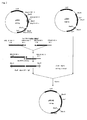
- the sacB gene (SEQ ID NO: 35) was obtained by PCR using a chromosomal DNA of Bacillus subtilis as a template and SEQ ID NOS: 1 and 2 as primers. PCR was carried out using LA Taq (Takara Bio Inc.) in such a way that one cycle of heat-retention at 94°C for 5 minutes was performed and then a cycle of denaturation at 94°C for 30 seconds, annealing at 49°C for 30 seconds and elongation at 72°C for 2 minutes was repeated 25 times. The PCR product thus obtained was purified by a conventional procedure and then digested with BgIII and BamHI, followed by blunt-ending.
- the fragment was inserted into a site of pHSG299 which had been digested with AvaII and blunt-ended.
- Competent cells of Escherichia coli JM109 (Takara Bio Inc.) were used for transformation with this DNA and the transformed cells were applied on an LB medium containing 25 ⁇ g/ml kanamycin (hereinafter, abbreviated as Km), followed by overnight culture. Subsequently, appeared colonies were picked up, and single colonies were isolated, thereby transformants were obtained. Plasmids were extracted from transformants, and a plasmid into which a PCR product of interest was inserted was named pBS3.
- Fig. 1 shows the construction procedures of pBS3.
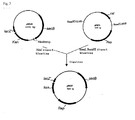
- SmaI site in the kanamycin resistance gene sequence present on pBS3 was disrupted by crossover PCR-mediated nucleotide substitution causing no amino acid substitution to obtain a plasmid.
- PCR was carried out using pBS3 as a template and synthetic DNAs of SEQ ID NOS: 3 and 4 as primers, thereby amplified product of N-terminal region of the kanamycin resistance gene was obtained.
- PCR was carried out using pBS3 as a template and synthetic DNAs of SEQ ID NOS: 5 and 6 as templates.
- the PCR was carried out using Pyrobest DNA Polymerase (Takara Bio Inc.) in such a way that one cycle of heat-retention at 98°C for 5 minutes was performed and then a cycle of denaturation at 98°C for 10 seconds, annealing at 57°C for 30 seconds and elongation at 72°C for 1 minute was repeated 25 times, to thereby yield a PCR product of interest.
- SEQ ID NOS: 4 and 5 are partially complementary to each other, and the SmaI site in the sequence is disrupted by nucleotide substitution causing no amino acid substitution.
- the gene products of the N-terminal and C-terminal regions of the above-mentioned kanamycin resistance gene were mixed at an approximately equimolar concentration, and PCR was carried out using the mixture of the gene products as templates and synthetic DNAs of SEQ ID NOS: 3 and 6 as primers, to thereby yield amplified product of a mutation-introduced Km resistance gene.
- PCR was carried out using Pyrobest DNA Polymerase (Takara Bio Inc.) in such a way that one cycle of heat-retention at 98°C for 5 minutes was performed and then a cycle of denaturation at 98°C for 10 seconds, annealing at 57°C for 30 seconds and elongation at 72°C for 1.5 minutes was repeated 25 times, to thereby yield a PCR product of interest.
- the PCR product was purified by a conventional procedure and then digested with BanII, followed by insertion into BanII site of the above-mentioned pBS3.
- Competent cells of Escherichia coli JM109 (Takara Bio Inc.) were used for transformation with this DNA and transformed cells were applied on an LB medium containing 25 ⁇ g/ml of kanamycin, followed by overnight culture. Subsequently, appeared colonies were picked up, and single colonies were isolated, thereby transformants were obtained. Plasmids were extracted from the transformants, and a plasmid into which a PCR product of interest was inserted was named pBS4S.
- Fig. 2 shows the construction procedures of pBS4S.
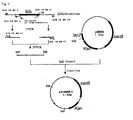
- a plasmid was constructed by inserting a temperature-sensitive replication origin for a coryneform bacterium into pBS4S constructed in the above-mentioned (B). That is, a temperature-sensitive replication origin for a coryneform bacterium was obtained by digesting pHSC4 ( JP05-7491A ) with BamHI and SmaI, followed by blunt-ending, and the temperature-sensitive replication origin was inserted into a blunt-ended NdeI site of pBS4S. Competent cells of Escherichia coli JM109 (Takara Bio Inc.) were used for transformation with this DNA and transformed cells were applied on an LB medium containing 25 ⁇ g/ml of Km, followed by overnight culture.
- Plasmids were extracted from the transformants, and a plasmid into which a PCR product of interest was inserted was named pBS5T.
- Fig. 3 shows the construction procedures of pBS5T.
- a fragment of a lactate dehydrogenase gene (hereinafter, abbreviated as ldh gene) derived from Brevibacterium lactofermentum 2256 strain in which ORF thereof was deleted was obtained by crossover PCR using as primers synthetic DNAs designed based on the nucleotide sequence (SEQ ID NO: 37) of the gene of Corynebacterium glutamicum ATCC13032 (GenBank Database Accession No. NC_003450), which has already been disclosed.
- PCR was carried out by a conventional procedure using a chromosomal DNA of Brevibacterium lactofermentum 2256 strain as a template and synthetic DNAs of SEQ ID NOS: 7 and 8 as primers, thereby amplified product of the N-terminal region of the ldh gene was obtained.
- PCR was carried out by a conventional procedure using a genomic DNA of Brevibacterium lactofermentum 2256 as a template and synthetic DNAs of SEQ ID NOS: 9 and 10 as primers.
- SEQ ID NO: 8 and 9 are complementary to each other and have structures for deleting the entire sequences of ldh ORF.
- Brevibacterium lactofermentum 2256 strain is available from the American Type Culture Collection (ATCC) (Address: ATCC, P.O. Box 1549, Manassas, VA 20108, United States of America).
- the above-mentioned gene products of the N-terminal and C-terminal regions of ldh were mixed at an approximately equimolar concentration, and PCR was carried out by a conventional procedure using the mixture of the gene products as templates and synthetic DNAs of SEQ ID NOS: 11 and 12 as primers, to thereby yield amplified product of the mutation-introduced ldh gene.
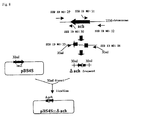
- the PCR product thus obtained was purified by a conventional procedure and then digested with SalI, followed by insertion into SalI site of the above-mentioned pBS4S.
- Competent cells of Escherichia coli JM109 were used for transformation with this DNA and transformed cells were applied on an LB medium containing 100 ⁇ M of IPTG, 40 ⁇ g/ml of X-Gal, and 25 ⁇ g/ml of Km, followed by overnight culture. Subsequently, appeared white colonies were picked up, and single colonies were isolated, thereby transformants were obtained. Plasmids were extracted from the transformants, and a plasmid into which a PCR product of interest was inserted was named p ⁇ ldh56-1. Fig. 4 shows the construction procedures of the plasmid.
- the p ⁇ ldh56-1 obtained by the above-mentioned (A) does not contain a region that enables autonomous replication in a cell of a coryneform bacterium. Therefore, when a coryneform bacterium is transformed with this plasmid, a strain in which the plasmid is integrated into a chromosome by homologous recombination appears at a very low frequency as a transformant.
- Brevibacterium lactofermentum 2256 strain was transformed using a high concentration of the plasmid p ⁇ ldh56-1 by the electric pulse method, and the transformed cells were applied on CM-Dex medium (5 g/L of glucose, 10 g/L of polypeptone, 10 g/L of yeast extract, 1 g/L of KH 2 PO 4 , 0.4 g/L of MgSO 4 ⁇ 7H 2 O, 0.01 g/L of FeSO 4 ⁇ 7H 2 O, 0.01 g/L of MnSO 4 ⁇ 7H 2 O, 3 g/L of urea, 1.2 g/L of soybean hydrolysate, pH 7.5 (KOH)) containing 25 ⁇ g/ml of kanamycin, followed by culture at 31.5°C for about 30 hours.
- CM-Dex medium 5 g/L of glucose, 10 g/L of polypeptone, 10 g/L of yeast extract, 1 g/L of KH 2 PO 4 ,
- a strain grown on the medium contains the kanamycin resistance gene and sacB gene which are derived from the plasmid on the genome, as a result of homologous recombination between the ldh gene fragment on the plasmid and the ldh gene on a genome of Brevibacterium lactofermentum 2256 strain.
- the single cross-over recombinant was cultured at 31.5°C overnight in CM-Dex liquid medium not containing kanamycin, and after suitable dilution, it was applied on 10% sucrose-containing Dex-S10 medium (10 g/L of sucrose, 10 g/L of polypeptone, 10 g/L of yeast extract, 1 g/L of KH 2 PO 4 , 0.4 g/L of MgSO 4 ⁇ 7H 2 O, 0.01 g/L of FeSO 4 ⁇ 7H 2 O, 0.01 g/L of MnSO 4 ⁇ 4H 2 O, 3 g/L of urea, 1.2 g/L of soybean hydrolysate, 10 ⁇ g/L of biotin, pH 7.5 (KOH)) not containing kanamycin, followed by culture at 31.5°C for about 30 hours.
- 10% sucrose-containing Dex-S10 medium (10 g/L of sucrose, 10 g/L of polypeptone, 10 g/L
- the strains thus obtained include: a strain in which ldh gene was replaced by the mutant type derived from p ⁇ ldh56-1; and a strain in which ldh gene reverted to the wild type. Whether the ldh gene is the mutant type or the wild type can be confirmed easily by directly subjecting the bacterial strains obtained by culturing on Dex-S10 agar medium to PCR and detecting their ldh gene.
- a strain which yielded a PCR product having a smaller size than that of a product obtained by PCR using a chromosomal DNA of the 2256 strain as a template was defined as an ldh-disrupted strain and used in the following experiments.
- a strain carrying only the mutant type gene was selected and named 2256 ⁇ (ldh) strain.
- the strain was used as a parent strain of the following acetic acid-biosynthetic gene-disrupted strain.
- a fragment of an acetate kinase gene (hereinafter, abbreviated as ack) of Brevibacterium lactofermentum 2256 strain in which ORF thereof was deleted was obtained by crossover PCR using as primers synthetic DNAs designed based on the nucleotide sequence (1945-3135 in SEQ ID NO: 39) of the gene of Corynebacterium glutamicum ATCC 13032 (GenBank Database Accession No. NC_003450), which has already been disclosed. That is, PCR was carried out using a genomic DNA of Brevibacterium lactofermentum 2256 strain as a template and synthetic DNAs of SEQ ID NOS: 13 and 14 as primers, thereby amplified product of N-terminal region of the ack gene was obtained.
- PCR was carried out using a genomic DNA of Brevibacterium lactofermentum 2256 as a template and synthetic DNAs of SEQ ID NOS: 15 and 16 as primers.
- SEQ ID NO: 14 and 15 are complementary to each other.
- the PCR was carried out using KOD-plus- (TOYOBO) in such a way that one cycle of heat-retention at 94°C for 2 minutes was performed and then, for the N-terminal region, a cycle of denaturation at 94°C for 10 seconds, annealing at 55°C for 30 seconds and elongation at 68°C for 30 seconds, and for the C-terminal region, a cycle of denaturation at 94°C for 10 seconds, annealing at 55°C for 30 seconds and elongation at 68°C for 2 minutes, were repeated 30 times, respectively.
- KOD-plus- TOYOBO
- the above-mentioned gene products of the N-terminal and C-terminal regions of ack were mixed at an approximately equimolar concentration, and PCR was carried out using the mixture of the gene products as templates and synthetic DNAs of SEQ ID NOS: 17 and 18 as primers, to thereby yield amplified product of the mutation-introduced ack gene.
- the PCR was carried out using KOD-plus-(TOYOBO) in such a way that one cycle of heat-retention at 94°C for 2 minutes was performed and then a cycle of denaturation at 94°C for 10 seconds, annealing at 55°C for 30 seconds and elongation at 68°C for 2.5 minutes was repeated 30 times, to thereby yield an amplified product of the mutation-introduced ack gene of interest.
- the PCR product thus obtained was purified by a conventional procedure and then digested with XbaI, followed by insertion into XbaI site in pBS5T constructed in the above-mentioned Example 1 (C). Competent cells of Escherichia coli JM109 (Takara Bio Inc.) were used for transformation with this DNA and transformed cells were applied on an LB medium containing 100 ⁇ M of IPTG, 40 ⁇ g/ml of X-Gal, and 25 ⁇ g/ml of kanamycin, followed by overnight culture. Subsequently, appeared white colonies were picked up, and single colonies were isolated, thereby transformants were obtained. Plasmids were extracted from the transformants, and a plasmid into which a PCR product of interest was inserted was named pBS5T:: ⁇ ack.
- Fig. 5 shows the construction procedures of pBS5T:: ⁇ ack.
- the replication origin for coryneform bacteria in pBS5T:: ⁇ ack obtained by the above-mentioned (A) is temperature-sensitive. That is, the plasmid is autonomously replicable in a cell of a coryneform bacterium at 25°C, but it is not autonomously replicable at 31.5°C (or 34°C).
- Brevibacterium lactofermentum 2256 ⁇ (ldh) strain was transformed using the plasmid by the electric pulse method, and transformed cells were applied on a CM-Dex medium containing 25 ⁇ g/ml of kanamycin, followed by culture at 25°C for 2 nights. Appeared colonies were isolated, to thereby yield transformants. The transformants contain the plasmid.
- the transformants were cultured at 34°C overnight in a CM-Dex medium (5 g/L of glucose, 10 g/L of polypeptone, 10 g/L of yeast extract, 1 g/L of KH 2 PO 4 , 0.4 g/L of MgSO 4 ⁇ 7H 2 O, 0.01 g/L of FeSO 4 ⁇ 7H 2 O, 0.01 g/L of MnSO 4 ⁇ 7H 2 O, 3 g/L of urea, 1.2 g/L of soybean hydrolysate, pH 7.5 (KOH)) not containing kanamycin and after suitable dilution, it was applied on a CM-Dex medium containing 25 ⁇ g/ml of kanamycin, followed by culture at 34°C for about 30 hours.
- a CM-Dex medium 5 g/L of glucose, 10 g/L of polypeptone, 10 g/L of yeast extract, 1 g/L of KH 2 PO 4 , 0.4 g
- the strain grown on the medium contains the kanamycin resistance gene and sacB gene which are derived from the plasmid on the genome, as a result of homologous recombination between the ack gene fragment on the plasmid and the ack gene on the genome of Brevibacterium lactofermentum 2256 ⁇ (ldh) strain.
- the singe crossover recombinant was cultured at 31.5°C overnight in CM-Dex liquid medium not containing kanamycin, and after suitable dilution, it was applied on 10% sucrose-containing Dex-S10 medium not containing kanamycin, followed by culture at 31.5°C for about 30 hours. As a result, about 50 strains which were considered to become sucrose-insensitive due to elimination of the sacB gene by the second homologous recombination, were obtained.
- the thus obtained strains include: a strain in which ack gene was replaced by the mutant type derived from pBS5T:: ⁇ ack; and a strain in which ack gene reverted to the wild type.
- Whether ack gene is the mutant type or the wild type can be confirmed easily by directly subjecting a bacterial strain obtained through culturing on a Dex-S10 agar medium to PCR and detecting the ack gene.
- Analysis of the ack gene by using primers (SEQ ID NOS: 13 and 16) for PCR amplification should result in a DNA fragment of 3.7 kb for the wild type and a DNA fragment of 2.5 kb for the mutant type having a deleted region.
- a strain carrying only the mutant type gene was selected and named 2256 ⁇ (ldh, ack).
- ORFs of acetate kinase gene ("ack") and phosphotransacetylase gene (hereinafter, referred to as pta) of Brevibacterium lactofermentum 2256 strain have an operon structure, and both ORFs can be made deficient simultaneously.
- These gene fragments were obtained by cross-over PCR using as primers synthetic DNAs designed based on the nucleotide sequences of the genes of Corynebacterium glutamicum ATCC13032 (GenBank Database Accession No. NC_003450) (pta-ack gene; SEQ ID NO: 39).
- PCR was carried out using a genomic DNA of Brevibacterium lactofermentum 2256 strain as a template, and synthetic DNAs of SEQ ID NOS: 19 and 20 as primers, to thereby yield an amplified product of N-terminal region of the pta gene.
- synthetic DNAs of SEQ ID NOS: 19 and 20 as primers, to thereby yield an amplified product of N-terminal region of the pta gene.
- PCR was carried out using a genomic DNA of Brevibacterium lactofermentum 2256 strain as a template and synthetic DNAs of SEQ ID NOS: 21 and 16 as primers.
- SEQ ID NOS: 20 and 21 are partially complementary to each other.
- PCR was performed by using KOD-plus- (TOYOBO) in such a way that one cycle of heat-retention at 94°C for 2 minutes was performed and then, for the N-terminal region, a cycle of denaturation at 94°C for 10 seconds, annealing at 55°C for 30 seconds and elongation at 68°C for 30 seconds, and for the C-terminal region, a cycle of denaturation at 94°C for 10 seconds, annealing at 55°C for 30 seconds and elongation at 68°C for 2 minutes, were repeated 30 times, respectively.
- KOD-plus- TOYOBO
- the above-mentioned gene products of the N-terminal region of pta and C-terminal region of ack were mixed at an approximately equimolar concentration, and PCR was carried out using the mixture as templates and synthetic DNAs of SEQ ID NOS: 22 and 18 as primers, to thereby yield amplified product of a mutation-introduced pta-ack gene.
- the PCR was carried out using KOD-plus- (TOYOBO) in such a way that one cycle of heat-retention at 94°C for 2 minutes was performed and then a cycle of denaturation at 94°C for 10 seconds, annealing at 55°C for 30 seconds, and elongation at 68°C for 2.5 minutes was repeated 30 times, to thereby yield an amplified product of the mutation-introduced pta-ack gene of interest.
- the PCR product thus obtained was purified by a conventional procedure and then digested with XbaI, followed by insertion into XbaI site of pBS5T.
- Competent cells of Escherichia coli JM109 were used for transformation with this DNA and transformed cells were applied on an LB medium containing 100 ⁇ M of IPTG, 40 ⁇ g/ml of X-Gal, and 25 ⁇ g/ml of kanamycin, followed by overnight culture. Subsequently, appeared white colonies were picked up, and single colonies were then isolated, thereby transformants were obtained. Plasmids were extracted from the transformants, and a plasmid into which a PCR product of interest was inserted was named pBS5T:: ⁇ pta-ack. Fig. 6 shows the construction procedures of pBS5T:: ⁇ pta-ack.
- the replication origin for coryneform bacteria in pBS5T:: ⁇ pta-ack obtained by the above-mentioned (A) is temperature-sensitive. That is, the plasmid is autonomously replicable in a cell of a coryneform bacterium at 25°C, but it is not autonomously replicable at 31.5°C (or 34°C). Brevibacterium lactofermentum 2256 ⁇ (ldh) strain was transformed using the plasmid by the electric pulse method, and transformed cells were applied on a CM-Dex medium containing 25 ⁇ g/ml of kanamycin, followed by culture at 25°C for 2 nights. Appeared colonies were isolated, to thereby yield transformants. The transformants have the plasmid.
- the transformants were cultured at 34°C overnight in a CM-Dex liquid medium not containing kanamycin, and after suitable dilution, it was applied on a CM-Dex liquid medium containing 25 ⁇ g/ml of kanamycin, followed by culture at 34°C for about 30 hours.
- the strain grown on the medium contains the kanamycin resistance gene and sacB gene which are derived from the plasmid on the genome, as a result of homologous recombination between the pta-ack gene fragment on the plasmid and the pta-ack gene on genome of Brevibacterium lactofermentum 2256 ⁇ (ldh) strain.
- the single crossover recombinant was cultured at 31.5°C overnight in CM-Dex liquid medium not containing kanamycin, and after suitable dilution, it was applied on 10% sucrose-containing Dex-S10 medium not containing kanamycin, followed by culture at 31.5°C for about 30 hours. As a result, about 50 strains, which were considered to become sucrose-insensitive due to elimination of sacB gene by the second homologous recombination, were obtained.
- the thus obtained strains include: a strain in which pta and ack genes were replaced by the mutant type derived from pBS5T:: ⁇ pta-ack; and a strain in which pta and ack genes were reverted to the wild type. Whether the ack gene is the mutant type or the wild type can be confirmed easily by directly subjecting a bacterial strain obtained through culture on a Dex-S10 agar medium to PCR and detecting the pta and ack genes.
- a fragment of a pyruvate oxidase gene (hereinafter, abbreviated as poxB) of Brevibacterium lactofermentum 2256 strain in which ORF thereof was deleted was obtained by crossover PCR using as primers synthetic DNAs designed based on the nucleotide sequence (SEQ ID NO: 42) of the gene of Corynebacterium glutamicum ATCC13032 (GenBank Database Accession No. NC_003450), which has already been disclosed. That is, PCR was carried out using a genomic DNA of Brevibacterium lactofermentum 2256 strain as a template and synthetic DNAs of SEQ ID NOS: 23 and 24 as primers, thereby amplified product of N-terminal region of the poxB gene was obtained.
- PCR was carried out using a genomic DNA of Brevibacterium lactofermentum 2256 strain as a template and synthetic DNAs of SEQ ID NOS: 25 and 26 as primers. SEQ ID NOS: 24 and 25 are complementary to each other.
- the PCR was carried out using KOD-plus-(TOYOBO) in such a way that one cycle of heat-retention at 94°C for 2 minutes was performed and then a cycle of denaturation at 94°C for 10 seconds, annealing at 55°C for 30 seconds and elongation at 68°C for 40 seconds was repeated 30 times for both the N-terminal region and the C-terminal region.
- the PCR was carried out using KOD-plus- (TOYOBO) in such a way that one cycle of heat-retention at 94°C for 2 minutes was performed, and then a cycle of denaturation at 94°C for 10 seconds, annealing at 55°C for 30 seconds and elongation at 68°C for 70 seconds was repeated 30 times, to thereby yield an amplified product of the mutation-introduced poxB gene of interest.
- KOD-plus- TOYOBO
- the PCR product thus obtained was purified by a conventional procedure and then digested with XbaI, followed by insertion into XbaI site of pBS5T constructed in Example 1 (C) as described above.
- Competent cells of Escherichia coli JM109 (Takara Bio Inc.) were used for transformation with this DNA and transformed cells were applied on an LB medium containing 100 ⁇ M of IPTG, 40 ⁇ g/ml of X-Gal, and 25 ⁇ g/ml of kanamycin, followed by overnight culture. Subsequently, appeared white colonies were picked up, and single colonies were isolated, thereby transformants were obtained.
- Plasmids were extracted from the transformants, and a plasmid in which a PCR product of interest was inserted was named pBS5T:: ⁇ poxB.
- Fig. 7 shows the construction procedures of pBS5T:: ⁇ poxB.
- the replication origin for coryneform bacteria in pBS5T:: ⁇ poxB obtained in Example 5 (A) as described above is temperature-sensitive. That is, the plasmid is autonomously replicable in a cell of a coryneform bacterium at 25°C, but it is not autonomously replicable at 31.5°C (or 34°C).
- Brevibacterium lactofermentum 2256 ⁇ (ldh, pta, ack) strain was transformed using the plasmid by the electric pulse method, and the transformed cells were applied on a CM-Dex medium containing 25 ⁇ g/ml of kanamycin, followed by culture at 25°C for 2 nights. Appeared colonies were isolated, to thereby yield transformants. The transformants should have the plasmid.
- the transformants were cultured at 34°C overnight in a CM-Dex liquid medium not containing kanamycin, and after suitable dilution, it was applied on a CM-Dex medium containing 25 ⁇ g/ml of kanamycin, followed by culture at 34°C for about 30 hours.
- the kanamycin resistance gene and sacB gene which are derived from the plasmid are inserted into the genome, as a result of homologous recombination between the poxB gene fragment on the plasmid and the poxB gene on the genome of Brevibacterium lactofermentum 2256 ⁇ (ldh, pta, ack) strain.
- the single crossover recombinant was cultured at 31.5°C overnight in CM-Dex liquid medium not containing kanamycin, and after suitable dilution, it was applied on 10% sucrose-containing Dex-S10 medium not containing kanamycin, followed by culture at 31.5°C for about 30 hours. As a result, about 50 strains, which were considered to become sucrose-insensitive due to elimination of sacB gene by the second homologous recombination, were obtained.
- the obtained strains include: a strain in which poxB gene was replaced by the mutant type derived from pBS5T:: ⁇ poxB; and a strain in which poxB gene reverted to the wild type.
- Whether the acetate kinase gene is the mutant type or the wild type can be confirmed easily by directly subjecting a bacterial strain obtained through culture on a Dex-S10 agar medium to PCR and detecting the poxB gene.
- a DNA fragment of 2.4 kb for the wild type and a DNA fragment of 1.2 kb for the mutant type having the deleted region can be detected by analysis of the poxB gene with primers (SEQ ID NOS: 23 and 26) for PCR amplification.
- a strain carrying only the mutant type gene was selected and named 2256 ⁇ (ldh, pta, ack, poxB).
- a fragment of acetyl-CoA hydrolase gene (hereinafter, abbreviated as ach) of Brevibacterium lactofermentum 2256 strain in which ORF thereof was deleted was obtained by crossover PCR using as primers synthetic DNAs designed based on the nucleotide sequence (SEQ ID NO: 44) of the gene of Corynebacterium glutamicum ATCC13032 (GenBank Database Accession No. NC_003450), which has already been disclosed. That is, PCR was carried out using a genomic DNA of Brevibacterium lactofermentum 2256 strain as a template and synthetic DNAs of SEQ ID NOS: 29 and 30 as primers, thereby amplified product of C-terminal region of the ach gene was obtained.
- PCR was carried out using a genomic DNA of Brevibacterium lactofermentum 2256 as a template and synthetic DNAs of SEQ ID NOS: 31 and 32 as primers. SEQ ID NO: 30 and 31 are complementary to each other.
- the PCR was carried out using KOD-plus- (TOYOBO) in such a way that one cycle of heat-retention at 94°C for 2 minutes was performed and then a cycle of denaturation at 94°C for 10 seconds, annealing at 55°C for 30 seconds and elongation at 68°C for 50 seconds was repeated 30 times for the N-terminal region and the C-terminal region.
- KOD-plus- TOYOBO
- the above-mentioned gene products of the N-terminal and C-terminal regions of ach were mixed at an approximately equimolar concentration, and PCR was carried out using the mixture as templates and synthetic DNAs of SEQ ID NOS: 33 and 34 as primers, to thereby yield amplified product of a mutation-introduced ach gene.
- the PCR was carried out using KOD-plus- (TOYOBO) in such a way that one cycle of heat-retention at 94°C for 2 minutes was performed and then a cycle of denaturation at 94°C for 10 seconds, annealing at 55°C for 30 seconds and elongation at 68°C for 90 seconds was repeated 30 times, to thereby yield an amplified product of the mutation-introduced ach gene of interest.
- the PCR product thus obtained was purified by a conventional procedure and digested with XbaI, followed by insertion into XbaI site of pBS4S constructed in Example 1 (B) as described above.
- Competent cells of Escherichia coli JM109 were used for transformation with this DNA and transformed cells were applied on an LB medium containing 100 ⁇ M of IPTG, 40 ⁇ g/ml of X-Gal, and 25 ⁇ g/ml of kanamycin, followed by overnight culture. Subsequently, appeared white colonies were picked up, and single colonies were isolated, thereby transformants were obtained. Plasmids were extracted from the transformants, and a plasmid in which a PCR product of interest was inserted was named pBS4S:: ⁇ ach. Fig. 8 shows the construction procedures of pBS4S:: ⁇ ach.
- the pBS4S:: ⁇ ach obtained in the above-mentioned (A) does not include a region which enables autonomous replication in a cell of a coryneform bacterium, so when a coryneform bacterium is transformed with the plasmid, a strain in which the plasmid is integrated into a chromosome by homologous recombination appears at a very low frequency as a transformant.
- Brevibacterium lactofermentum 2256 ⁇ (ldh) strain, 2256 ⁇ (ldh, pta, ack) strain, 2256 ⁇ (ldh, pta, ack, poxB) strain, and 2256 ⁇ (ldh, pta, ack, poxB, acp) strain were transformed by using a high concentration of the plasmid pBS4S:: ⁇ ach by the electric pulse method, and transformed cells were applied on a CM-Dex medium containing 25 ⁇ g/ml kanamycin, followed by culture at 31.5°C for about 30 hours.
- the kanamycin resistance gene and sacB gene derived from the plasmid are inserted on the genome as a result of homologous recombination between the ach gene fragment on the plasmid and the ach gene on the genome of each of Brevibacterium lactofermentum 2256 ⁇ (ldh) strain, 2256 ⁇ (ldh, pta, ack) strain, 2256 ⁇ (ldh, pta, ack, poxB) strain, and 2256 ⁇ (ldh, pta, ack, poxB, acp) strain.
- the single crossover recombinant was cultured at 31.5°C overnight in CM-Dex liquid medium not containing kanamycin, and after suitable dilution, it was applied on 10% sucrose-containing Dex-S 10 medium not containing kanamycin, followed by culture at 31.5°C for about 30 hours.
- CM-Dex liquid medium not containing kanamycin
- sucrose-containing Dex-S 10 medium not containing kanamycin
- the thus obtained strains include: a strain in which ach gene was replaced by the mutant type derived from pBS4S:: ⁇ ach; and a strain in which ach gene reverted to the wild type.
- Whether the ach gene is the mutant type or the wild type can be confirmed easily by directly subjecting a bacterial strain obtained through culture in a Dex-S10 agar medium to PCR and detecting the ach gene.
- Analysis of the ach gene by using primers (SEQ ID NOS: 29 and 32) for PCR amplification should result in a DNA fragment of 2.9 kb for the wild type and a DNA fragment of 1.4 kb for the mutant type having a deleted region.
- strains obtained from 2256 ⁇ (ldh), 2256 ⁇ (ldh, pta, ack), and 2256 ⁇ (ldh, pta, ack, poxB) were named 2256 ⁇ (ldh, ach), 2256 ⁇ (ldh, pta, ack, ach), and 2256 ⁇ (ldh, pta, ack, poxB, ach), respectively.
- Brevibacterium lactofermentum 2256 ⁇ (ldh) strain and 2256 ⁇ (ldh, ach) strain were used for culture for producing succinic acid as follows. Bacterial cells of the 2256 ⁇ (ldh) strain and 2256 ⁇ (ldh, ack) strain obtained by culturing them on a CM-Dex plate medium were inoculated into 3 ml of a seed medium (10 g/L of glucose, 2.5 g/L of (NH 4 ) 2 SO 4 , 0.5 g/L of KH 2 PO 4 , 0.25 g/L of MgSO 4 ⁇ 7H 2 O, 2 g/L of urea, 0.01 g/L of FeSO 4 ⁇ 7H 2 O, 0.01 g/L of MnSO 4 ⁇ 7H 2 O, 50 ⁇ g/L of biotin, 100 ⁇ g/L of VB1 ⁇ HCl, 15 mg/L of protocatechuic acid, 0.02 mg/L of CuSO 4 , and
- 3 ml of a main medium 70 g/L of glucose, 5 g/L of (NH 4 ) 2 SO 4 , 2 g/L of KH 2 PO 4 , 3 g/L of urea, 0.01 g/L of FeSO 4 ⁇ 7H 2 O, 0.01 g/L of MnSO 4 ⁇ 7H 2 O, 200 ⁇ g/L of biotin, 200 ⁇ g/L of VB1 ⁇ HCl, 40 g/L of MOPS, 50 g/L of MgCO 3 , with pH 6.8 (NaOH)) was added into the tube.
- the succinic acid production culture was carried out while the tube was sealed hermetically with a silicon cap. The culture was performed by shaking at 31.5°C for about 24 hours and terminated before sugar in the medium was exhausted.
- yield of the 2256 ⁇ (ldh, ach) strain improved by about 6% as compared to the 2256 ⁇ (ldh) strain as a parent strain.
- Brevibacterium lactofermentum 2256 ⁇ (ldh) strain and 2256 ⁇ (ldh, ach, pta, ack) strain were used for culture for producing succinic acid as follows.
- the bacterial cells of the 2256 ⁇ (ldh) strain and 2256 ⁇ (ldh, ack, pta, ack) strain obtained by culturing them on a CM-Dex plate medium were inoculated into 3 ml of the above-mentioned seed medium. Shaking culture was performed in a test tube at 31.5°C for about 15 hours under an aerobic condition. After that, 3 ml of the above-mentioned main medium was added into the test tube. For preventing aeration, the succinic acid production culture was carried out while the tube was sealed hermetically with a silicon cap. The culture was performed by shaking at 31.5°C for about 24 hours and terminated before sugar in the medium was exhausted.
- Brevibacterium lactofermentum 2256 ⁇ (ldh) strain, 2256 ⁇ (ldh, pta-ack, ach) strain, 2256 ⁇ (ldh, pta-ack, poxB) strain and 2256 ⁇ (ldh, pta-ack, poxB, ach) strain were used for culture for producing succinic acid as follows.
- the bacterial cells of the 2256 ⁇ (ldh), 2256 ⁇ (ldh, pta-ack, ach) strain, 2256 ⁇ (ldh, pta-ack, poxB) strain and 2256 ⁇ (ldh, pta-ack, poxB, ach) strain obtained by culturing them on a CM-Dex plate medium were inoculated into 3 ml of the above-mentioned seed medium, and shaking culture in a test tube was performed at 31.5°C for about 15 hours under an aerobic condition.
- the succinic acid production culture was carried out while the tube was sealed hermetically with a silicon cap.
- the culture was performed by shaking at 31.5°C for about 24 hours and terminated before sugar in the medium was exhausted.
- the accumulation amounts of succinic acid and by-product acetic acid in the medium were analyzed by liquid chromatography after the medium had been suitably diluted.
- a column obtained by connecting two pieces of Shim-pack SCR-102H (Simazu) in series, and the sample was eluted at 40°C by using 5 mM of p-toluene sulfonic acid.
- the eluent was neutralized by using 20 mM of Bis-Tris aqueous solution containing 5 mM of p-toluene sulfonic acid and 100 ⁇ M of EDTA.
- the succinic acid and by-product acetic acid were each measured by determining the electric conductivity by means of CDD-10AD (Simazu). The obtained results are shown in Table 3.
- Succinic acid is useful as a raw material for a biodegradable polymer and the like.
Landscapes
- Chemical & Material Sciences (AREA)
- Organic Chemistry (AREA)
- Life Sciences & Earth Sciences (AREA)
- Health & Medical Sciences (AREA)
- Engineering & Computer Science (AREA)
- Genetics & Genomics (AREA)
- Wood Science & Technology (AREA)
- Zoology (AREA)
- Bioinformatics & Cheminformatics (AREA)
- General Engineering & Computer Science (AREA)
- General Health & Medical Sciences (AREA)
- Biochemistry (AREA)
- Biotechnology (AREA)
- Microbiology (AREA)
- Biomedical Technology (AREA)
- Molecular Biology (AREA)
- Biophysics (AREA)
- Plant Pathology (AREA)
- Physics & Mathematics (AREA)
- Chemical Kinetics & Catalysis (AREA)
- General Chemical & Material Sciences (AREA)
- Medicinal Chemistry (AREA)
- Preparation Of Compounds By Using Micro-Organisms (AREA)
- Micro-Organisms Or Cultivation Processes Thereof (AREA)
- Biological Depolymerization Polymers (AREA)
Abstract
Description
- The present invention relates to a fermentation industry, and to a process for efficiently producing succinic acid by a fermentation method using a coryneform bacterium.
- For production of non-amino organic acids including succinic acid by fermentation, usually, anaerobic bacteria such as those belonging to the genus Anaerobiospirillum or Actinobacillus are used (
Patent Document - Furthermore, a method, which comprises culturing aerobic bacteria such as coryneform bacteria under an aerobic condition to proliferate bacterial cells and then collecting and washing the cells to use them as resting bacteria to produce succinic acid without oxygen aeration, has been known (
Patent Document 3 and 4). This method is economical because the bacterial cells can grow sufficiently in a simple medium, into which a small amount of organic nitrogen is added for proliferation of bacterial cells, but this method is still to be improved in terms of the amount of generated succinic acid, the concentration thereof, and the production rate thereof per bacterial cells as well as simplification of production process, and the like. - Furthermore, when aerobic bacteria such as coryneform bacteria are cultured under oxygen-limited conditions, organic acids other than a desired substance such as lactic acid and acetic acid are excessively accumulated as by-products, resulting in suppressed growth of bacterial cells and significantly decreased productivity in fermentation. In addition, excessive amounts of counterions to neutralize the organic acids generated as by-products are required, thereby resulting in being uneconomical. To solve such problems, reduction in lactate generated as a by-product has been performed by using a coryneform bacterium having a reduced lactate dehydrogenase activity (Patent Document 5).
- Even if the above-mentioned coryneform bacterium having a reduced lactate dehydrogenase activity is used, a large amount of acetic acid is generated as a by-product.
As means for achieving the reduction of acetic acid in a culture medium, there have been known a method of enhancing expression of an acetic acid assimilating gene (aceP) in a bacterium belonging to the genus Escherichia (Patent Document 6), a method of enhancing expression of a gene encoding ACE protein in a bacterium belonging to the genus Escherichia (Patent Document 7), and the like. Those methods are intended to reduce generation of acetic acid as a by-product by actively assimilating acetic acid released into a culture medium. Meanwhile, as methods of suppressing generation of acetic acid as a by-product by suppressing the biosynthesis of acetic acid, there have been known a method of producing succinic acid using Escherichia coli in which phosphoacetyltransferase (pta) and lactate dehydrogenase (ldh) are deficient (Patent Document 8), a method of producing an amino acid using an enterobacterium in which pyruvate oxidase (poxB) is deficient, and a method of producing D-pantothenic acid using an enterobacterium in which pyruvate oxidase (poxB) is deficient (Patent Document 9). - As enzymes responsible for assimilation of acetic acid in coryneform bacteria, there have been reported acetate kinase (ack) and phosphotransacetylase (pta) (Non-Patent Document 2). On the other hand, it is assumed that not only the above-mentioned enzymes but also a plurality of enzymes such as pyruvate oxidase (poxB) (Patent Document 10), acylphosphatase (acp), aldehyde dehydrogenase, and acetyl-CoA hydrolase are responsible for generation of acetic acid, but a specific enzyme that contributes to the synthesis of acetic acid has not been clarified. Therefore, there has not been known a method of producing succinic acid using a strain of a coryneform bacterium having a decreased acetic acid biosynthetic enzyme.
- Acetyl-CoA hydrolase is an enzyme to generate acetic acid from acetyl-CoA and water (3.1.2.1), and the gene sequence in Corynebacterium glutamicum has been predicted (Patent Document 11). However, no report has been provided for cloning of the gene and expression analysis of the gene, and its actual function has not been clarified.
- Patent Document 1:
US Patent No. 5,143,833 - Patent Document 2:
US Patent No. 5,504,004 - Patent Document 3:
JP11-113588A - Patent Document 4:
JP11-196888A - Patent Document 5:
JP11-206385A - Patent Document 6:
JP06-14781A - Patent Document 7:
JP07-67683A - Patent Document 8:
WO 99/06532 - Patent Document 9:
WO 02/36797 - Patent Document 10:
EP1096013A - Patent Document 11:
EP1108790A - Non-Patent Document 1: International Journal of Systematic Bacteriology, vol. 49, p 207-216, 1999
- Non-Patent Document 2: Microbiology. 1999, Feb; 145(Pt 2): 503-13
- An object of the present invention is to provide a coryneform bacterium having an improved succinic acid-producing ability.
- The inventors of the present invention have intensively studied for solving the aforementioned problems, and as a result, found that succinic acid-producing ability is improved by decreasing an activity of acetyl-CoA hydrolase in a coryneform bacterium. Furthermore, they found that generation of acetic acid as a by-product is reduced by decreasing activities of phosphotransacetylase and acetate kinase in addition to the acetyl-CoA hydrolase activity, thereby accomplished the present invention.
- That is, the present invention is as follows.
- (1) A coryneform bacterium having a succinic acid-producing ability, wherein said bacterium has been modified so that an activity of acetyl-CoA hydrolase is decreased.
- (2) The coryneform bacterium according to (1), wherein the acetyl-CoA hydrolase is a protein as described in the following (A) or (B):
- (A) a protein having an amino acid sequence of SEQ ID NO: 45; or
- (B) a protein having an amino acid sequence of SEQ ID NO: 45 including substitution, deletion, insertion, or addition of one or several amino acids, and having an acetyl-CoA hydrolase activity.
- (3) The coryneform bacterium according to (1) or (2), wherein the acetyl-CoA hydrolase activity has been decreased by disruption of an acetyl-CoA hydrolase gene on a chromosome.
- (4) The coryneform bacterium according to (3), wherein the acetyl-CoA hydrolase gene is a DNA as described in the following (a) or (b):
- (a) a DNA comprising a nucleotide sequence of nucleotide numbers 1037-2542 in SEQ ID NO: 44; or
- (b) a DNA that hybridizes with a nucleotide sequence of nucleotide numbers 1037-2542 in SEQ ID NO: 44 or a probe that can be prepared from the nucleotide sequence under stringent conditions, and encodes a protein having an acetyl-CoA hydrolase activity.
- (5) The coryneform bacterium according to any one of (1) to (4), which has been further modified so that activities of one or both of phosphotransacetylase and acetate kinase are decreased.
- (6) The coryneform bacterium according to any one of (1) to (5), wherein said bacterium has been further modified so that an activity of lactate dehydrogenase is decreased.
- (7) The coryneform bacterium according to any one of (1) to (6), wherein said bacterium has been further modified so that an activity of pyruvate carboxylase is increased.
- (8) A method for producing succinic acid, comprising allowing the coryneform bacterium according to any one of (1) to (7) or a treated product thereof to act on an organic raw material in a reaction liquid containing carbonate ion, bicarbonate ion, or carbon dioxide to generate and accumulate succinic acid in the reaction liquid, and collecting succinic acid from the reaction liquid.
- (9) The production method according to (8), wherein the coryneform bacterium or treated product thereof is allowed to act on the organic raw material under anaerobic conditions.
- (10) A method for producing a succinic acid-containing polymer, comprising the steps of producing succinic acid by the method according to (8) or (9) and polymerizing the obtained succinic acid.
-
- Fig. 1 shows the procedures for constructing plasmid pBS3.
- Fig. 2 shows the procedures for constructing plasmid pBS4S.
- Fig. 3 shows the procedures for constructing plasmid pBS5T.
- Fig. 4 shows the procedures for constructing plasmid pΔldh56-1.
- Fig. 5 shows the procedures for constructing plasmid pBS5T::Δack.
- Fig. 6shows the procedures for constructing plasmid pBS5T::Δpta-ack.
- Fig. 7 shows the procedures for constructing plasmid pBS5T::ΔpoxB.
- Fig. 8 shows the procedures for constructing plasmid pBS4S::Δach.
- Hereinafter, embodiments of the present invention will be described in detail.
- In the present invention, the term "coryneform bacterium" includes a bacterium which had been classified as the genus Brevibacterium but now classified as the genus Corynebacterium (Int. J. Syst. Bacteriol., 41, 255(1981)), and it also includes a bacterium belonging to the genus Brevibacterium, which is very closely related to Corynebacterium. Examples of such coryneform bacteria include the followings.
Corynebacterium acetoacidophilum
Corynebacterium acetoglutamicum
Corynebacterium alkanolyticum
Corynebacterium callunae
Corynebacterium glutamicum
Corynebacterium lilium
Corynebacterium melassecola
Corynebacterium thermoaminogenes
Corynebacterium herculis
Brevibacterium divaricatum
Brevibacterium flavum
Brevibacterium immariophilum
Brevibacterium lactofermentum
Brevibacterium roseum
Brevibacterium saccharolyticum
Brevibacterium thiogenitalis
Corynebacterium ammoniagenes
Brevibacterium album
Brevibacterium selinum
Microbacterium ammoniaphilum - In the present invention, the term "succinic acid-producing ability" means an ability to accumulate succinic acid in a medium when the coryneform bacterium of the present invention is cultured. The succinic acid-producing ability may be a feature inherent to a wild-type coryneform bacterium or a feature provided by breeding.
- To provide the succinic acid-producing ability by breeding, there may be applied methods that have been employed in breeding of coryneform bacteria, which include acquisition of metabolic regulation mutant strains, creation of a recombinant strain having an enhanced biosynthetic enzyme for a desired substance, and the like (Amino Acid Fermentation, Japan Scientific Societies Press, the first edition published on May 30, 1986, p77-100). In these methods, one or two or three or more features such as metabolic regulation mutations and enhancement of biosynthetic enzymes for a desired substance may be provided. Imparting properties such as metabolic regulation mutations and enhancement of biosynthetic enzymes may be combined.
- Particularly preferable specific examples of a coryneform bacterium having a succinic acid-producing ability include Brevibacterium flavum MJ233Δldh strain having decreased lactate dehydrogenase activity (
JP11-206385A WO 01/27258 JP11-196887A - The coryneform bacterium of the present invention has the above-mentioned succinic acid-producing ability and has been modified so that an activity of acetyl-CoA hydrolase is decreased.
In breeding of the coryneform bacterium of the present invention, the provision of succinic acid-producing ability and the modification to decrease the acetyl-CoA hydrolase (EC 3.1.2.1) activity may be performed in any order. - The term "acetyl-CoA hydrolase (ACH) activity" means an activity to catalyze the reaction to generate acetic acid from acetyl-CoA and water. The term "modified so that activity of acetyl-CoA hydrolase is decreased" means that an activity of acetyl-CoA hydrolase is decreased as compared to a specific activity of an unmodified strain such as a wild-type coryneform bacterium. The ACH activity is preferably decreased to 50% or less per bacterial cells, more preferably 30% or less, further more preferably 10% or less per bacterial cells as compared to an unmodified strain. Here, examples of a wild-type coryneform bacterium to be used as a control include Brevibacterium lactofermentum ATCC13869 (wild-type strain) and Brevibacterium lactofermentum Δldh strain (unmodified strain). The activity of acetyl-CoA hydrolase can be determined according to the method of Gergely, J., et al. (Gergely, J., Hele, P. & Ramkrishnan, C.V. (1952) J. Biol. Chem. 198 p323-334). The term "decreased" includes complete loss of the activity. The coryneform bacterium of the present invention preferably has an acetyl-CoA hydrolase activity lower than a wild-type or unmodified strain and more preferably has improved accumulation of succinic acid as compared to those strains.
- Examples of acetyl-CoA hydrolase having the above-mentioned activity include a protein having an amino acid sequence of SEQ ID NO: 45. In addition, it may be a protein having an amino acid sequence of SEQ ID NO: 45 including a substitution, deletion, insertion or addition of one or several amino acids as long as it has an acetyl-CoA hydrolase activity. Here, for example, the term "several" means 2 to 20, preferably 2 to 10, more preferably 2 to 5.
- The term "modified so that the acetyl-CoA hydrolase activity is decreased" includes decrease in the number of molecules of acetyl-CoA hydrolase per cell, decrease in the acetyl-CoA hydrolase activity per molecule, and the like. Specifically, it is achieved by making a gene encoding acetyl-CoA hydrolase on a chromosome deficient, modification of an expression regulatory sequence such as promoter or Shine-Dalgarno (SD) sequence, or the like. Examples of acetyl-CoA hydrolase gene on a chromosome include a DNA having a nucleotide sequence of nucleotide numbers 1037-2542 of SEQ ID NO: 44. It may be a DNA that hybridizes with the nucleotide sequence of nucleotide numbers 1037-2542 of SEQ ID NO: 44 or a probe that can be prepared from the nucleotide sequence under stringent conditions as long as it encodes a protein having acetyl-CoA hydrolase activity. The term "stringent conditions" means conditions in which so-called specific hybrid is formed and non-specific hybrid is not formed. It is difficult to clearly define the conditions by numeric value, but examples thereof include conditions comprising washing once, preferably twice or three times at salt concentration corresponding to 1 x SSC, 0.1% SDS, preferably 0.1 x SSC, 0.1% SDS at 60°C.
- The acetyl-CoA hydrolase gene (hereinafter, referred to as ach gene) can be cloned by synthesizing synthetic oligonucleotides based on a sequence of Corynebactenium glutamicum registered in GenBank (NCg12480 of GenBank Accession No. NC_003450 (complementary strand of 2729376..2730884 of NC_003450)), and performing PCR using a chromosome of Corynebacterium glutamicum as a template. Furthermore, there may also be used a sequence of a coryneform bacterium such as Brevibacterium lactofermentum having a nucleotide sequence determined by recent genome project. Chromosomal DNA can be prepared from a bacterium as a DNA donor by, for example, a method of Saito and Miura (H. Saito and K. Miura, Biochem. Biophys. Acta, 72, 6.19 (1963), Experimental Manual for Biotechnology, edited by The Society for Biotechnology, Japan, p97-98, Baifukan Co., Ltd., 1992) or the like.
- The ach gene thus prepared or a part thereof can be used for gene disruption. A gene to be used for gene disruption only needs to have homology that is enough to cause homologous recombination with an ach gene to be disrupted on a chromosomal DNA of a coryneform bacterium (e.g. a gene having the nucleotide sequence of nucleotide numbers 1037-2542 in SEQ ID NO: 44), so such a homologous gene may also be used. Here, the homology that is enough to cause homologous recombination is preferably not less than 70%, more preferably not less than 80%, further more preferably not less than 90%, particularly preferably not less than 95%. Further, a DNA capable of hybridizing with the above-mentioned gene under stringent conditions can cause homologous recombination.
The term "stringent conditions" refers to conditions under which a so-called specific hybrid is formed and non-specific hybrid is not formed. It is difficult to clearly define the conditions by numeric value, but the conditions include, for example, conditions that comprise washing once, preferably twice or three times at salt concentrations corresponding to 1 x SSC, 0.1% SDS, preferably 0.1 x SSC, 0.1% SDS at 60°C. - For example, by using the above-mentioned gene, a deleted-form of ach gene, which is modified so as not to produce acetyl-CoA hydrolase that normally functions by deleting a partial sequence of the ach gene, is prepared, and a coryneform bacterium is transformed with a DNA containing the gene to cause recombination between the deleted-form of the gene and the gene on a chromosome, to thereby disrupt the ach gene on a chromosome. Such a gene disruption by gene substitution using homologous recombination has already been established, and examples thereof include a method using a linear DNA and a method using a plasmid containing a temperature-sensitive replication origin (
US Patent No. 6,303,383 orJP05-007491A - For example, an ach gene on a chromosome of a host can be substituted by a deleted-form of ach gene in accordance with the following procedures. First, a plasmid for recombination is prepared by inserting a temperature-sensitive replication origin, deleted-form of ach gene, sacB gene encoding levansucrase and a marker gene exhibiting resistance to such a drug as chloramphenicol.
- Here, sacB gene encoding levansucrase is a gene which is used for efficiently selecting a strain in which a vector portion has been excised from a chromosome (Schafer, A. et al.,Gene 145 (1994) 69-73). That is, when levansucrase is expressed in a coryneform bacterium, levan generated by assimilation of sucrose acts lethally on the bacterium, so the bacterium cannot grow. Therefore, if a bacterial strain in which a vector carrying levansucrase remains on a chromosome is cultured on a sucrose-containing plate, it cannot grow. As a result, only a bacterial strain from which the vector has been excised can be selected on the sucrose-containing plate.
- Genes each having the following sequences can be used as a sacB gene or homologous gene thereof.
Bacillus subtilis: sacB GenBank Accession Number X02730 (SEQ ID NO: 35)
Bacillus amyloliquefaciens: sacB GenBank Accession Number X52988
Zymomonas mobilis: sacB GenBank Accession Number L33402
Bacillus stearothermophilus: surB GenBank Accession Number U34874
Lactobacillus sanfranciscensis: frfA GenBank Accession Number AJ508391
Acetobacter xylinus: 1sxA GenBank Accession Number AB034152
Gluconacetobacter diazotrophicus: IsdA GenBank Accession Number L41732 - A coryneform bacterium is transformed with the above-mentioned recombinant plasmid. The transformation can be performed in accordance with a transformation method which has been previously reported. Examples of the method include, a method of increasing permeability of a DNA by treating cells of a recipient bacterium with calcium chloride as reported for Escherichia coli K-12 (Mandel, M. and Higa, A., J. Mol. Biol., 53, 159 (1970)) and, a method of preparing competent cells using proliferating cells for introduction of DNA as reported for Bacillus subtilis (Duncan, C.H., Wilson, G.A and Young, F.E, Gene, 1, 153 (1977)). Alternatively, as reported for Bacillus subtilis, actinomycetes and yeasts, a method of introducing a recombinant DNA into cells of a DNA recipient bacterium (Chang. S. and Choen, S.N., Molec. Gen. Genet., 168, 111 (1979); Bibb, M.J., Ward, J.M., and Hopwood, O.A., Nature, 274, 398 (1978); Hinnen, A., Hicks, J.B. and Fink, G.R., Proc. Natl. Acad. Sci. USA, 75 1929 (1978)) may also be applied. In addition, a coryneform bacterium may be transformed by the electric pulse method (Sugimoto et al.,
JP02-207791 A - Examples of a temperature-sensitive plasmid for a coryneform bacterium include p48K and pSFKT2 (
JP2000-262288A France Patent No. 2667875 (1992 JP05-7491A Central 6, 1-1-1 Higashi, Tsukuba, Ibaraki, 305-54566 Japan) on October 11, 1990, and then transferred to an international deposit under the provisions of Budapest Treaty on August 26, 1991 with an Accession No. FERM BP-3524. - A transformant obtained as described above is cultured at a temperature at which the temperature-sensitive replication origin does not function (25°C), to thereby obtain a strain into which the plasmid has been introduced. The plasmid-introduced strain is cultured at high temperature to excise the temperature-sensitive plasmid, and the bacterial strain is applied onto a plate containing an antibiotic. The temperature-sensitive plasmid cannot replicate at high temperature. Therefore, a bacterial strain from which the plasmid has been excised cannot grow on a plate containing an antibiotic, but a bacterial strain in which recombination has occurred between the acetic acid-biosynthetic gene on the plasmid and the ach gene on a chromosome appears at a very low frequency.
- In the strain obtained by introducing the recombinant DNA into a chromosome as described above, recombination occurs with an ach gene sequence that is originally present on a chromosome, and two fusion genes of the chromosomal ach gene and the deleted-form of ach gene are inserted into a chromosome so that other portions of the recombinant DNA (vector part, temperature-sensitive replication origin and drug-resistance marker) are present between the fusion genes.
- Then, in order to leave only the deleted-form of ach gene on a chromosomal DNA, the gene is eliminated together with the vector portion (the temperature-sensitive replication origin and drug-resistance marker) from the chromosomal. This procedure causes a case where the normal ach gene remains on the chromosomal DNA and the deleted-form of ach gene is excised, or to the contrary, a case where the normal ach gene is excised and the deleted-form of ach gene remains on chromosomal DNA. In both cases, when culture is performed at a temperature that allows a temperature-sensitive replication origin to function, the cleaved DNA is kept in a cell as a plasmid. Next, when culture is performed at a temperature that does not allow a temperature-sensitive replication origin to function, the ach gene on the plasmid is eliminated from the cell together with the plasmid. Then, a strain in which the deleted-form of ach gene remains on the chromosome, is selected by PCR, Southern hybridization, or the like, to thereby yield a strain in which the ach gene is disrupted.
- In the case where a plasmid having no replicability in a coryneform bacterium is used instead of the above-mentioned temperature-sensitive plasmid, gene disruption can also be performed in a similar way. The plasmid having no replicability in a coryneform bacterium is preferably a plasmid having a replicability in Escherichia coli, and examples thereof include pHSG299 (Takara Bio Inc.) and pHSG399 (Takara Bio Inc.).
- Meanwhile, examples of a method of decreasing an activity of acetyl-CoA hydrolase include not only the above-mentioned genetic engineering method but also a method comprising treating a coryneform bacterium with ultraviolet irradiation or with a mutagenesis agent to be generally used for mutation such as N-methyl-N'-nitro-N-nitrosoguanidine (NTG) and nitrous acid, and selecting a bacterial strain having decreased acetyl-CoA hydrolase activity.
- In the present invention, it is more effective to use a bacterial strain modified so that either or both of activities of phosphotransacetylase (hereinafter, referred to as PTA) and acetate kinase (hereinafter, referred to as ACK) are decreased in addition to the decrease in the ACH activity.
- In the present invention, phosphotransacetylase (PTA) activity means an activity to catalyze a reaction to generate acetyl phosphate by transferring phosphate to acetyl-CoA (EC:2.3.1.8), and acetate kinase (ACK) means an activity to catalyze a reaction to generate acetic acid from acetyl phosphate and ADP (EC:2.7.2.1).
- Decreasing these activities may be accomplished by disruption of genes encoding the above-mentioned enzymes, or by modification of an expression regulatory sequence such as a promoter and Shine-Dalgarno (SD) sequence of the genes encoding the enzymes. Gene disruption can be performed in the same way as the above-mentioned method of disrupting the ach gene.
- As genes encoding the enzymes, for example, the following genes of Corynebacterium glutamicum deposited in GenBank may be used:
- pta (phosphoacetyltransferase) gene: GenBank Accession No. NCg12657 (complementary strand of nucleotide numbers 2936506-2937495 in NC_003450) (the nucleotide numbers 956-1942 in SEQ ID NO: 39)
- ack (acetate kinase) gene: GenBank Accession No. NCgl2656 (complementary strand of nucleotide numbers 2935313-2936506 in NC_003450) (the nucleotide numbers 1945-3135 in SEQ ID NO: 39).
- The phrase "phosphotransacetylase (hereinafter, referred to as PTA) activity is decreased" means that PTA activity is decreased as compared to a PTA-unmodified strain.
The PTA activity is decreased than PTA-unmodified strain or a wild-type strain, and it is preferably decreased to 50% or less per bacterial cell, more preferably 10% or less per bacterial cell. The PTA activity may be completely eliminated. The decrease in PTA activity can be confirmed by determining the PTA activity by a method of Klotzsch et al. (Klotzsch H.R., Meth Enzymol. 12, 381-386 (1969)). A coryneform bacterium in which activities of both of ACH and PTA are decreased can be obtained by constructing a coryneform bacterium having decreased ACH activity and modifying it so as to decrease PTA activity. However, there is no preference in the order for performing the modification to decrease PTA activity and the modification to decrease ACH activity. - The phrase "acetate kinase (hereinafter, referred to as ACK) activity is decreased" means that ACK activity is decreased as compared to a wild-type strain or an ACK-unmodified strain. The ACK activity is decreased than ACK-unmodified strain or a wild-type strain, and it is preferably decreased to 50% or less per bacterial cell, more preferably 10% or less per bacterial cell as compared to an ACK-umnodified strain. ACK activity may be completely eliminated. The decrease in ACK activity can be confirmed by determining the ACK activity by a method of Ramponi et al. (Ramponi G., Meth. Enzymol. 42, 409-426 (1975)). A corynefonn bacterium in which activities of both of ACH and ACK are decreased can be obtained by constructing a coryneform bacterium having decreased ACH activity and modifying it so as to decrease ACK activity. However, there is no preference in the order for performing the modification to decrease ACK activity and the modification to decrease ACH activity.
- In the present invention, it is more effective to use a bacterial strain modified so that a lactate dehydrogenase (hereinafter, referred to as LDH) activity is decreased in addition to decrease in the above-mentioned ACH activity. The lactate dehydrogenase activity means an activity to catalyze a reaction to generate lactic acid by reducing pyruvic acid using NADH as a coenzyme. The phrase "lactate dehydrogenase activity is decreased" means that LDH activity is decreased as compared to an LDH-unmodified strain. The LDH activity is decreased than an LDH-unmodified strain or a wild-type strain, and it is preferably decreased to 50% or less per bacterial cell, preferably 10% or less per bacterial cell. LDH activity may be completely eliminated. The decrease in LDH activity can be confirmed by determining the LDH activity by a method of L. Kanarek et al. (L. Kanarek and R.L. Hill, J. Biol. Chem. 239, 4202 (1964)). A coryneform bacterium of the present invention can be obtained by preparing a coryneform bacterium having decreased LDH activity and modifying it so as to decrease ACH activity. However, there is no preference in the order for performing the modification to decrease LDH activity and the modification to decrease ACH activity.
As an ldh gene, there may be used, for example, a gene having a sequence represented by SEQ ID NO: 37, and gene disruption may be performed in a similar manner as in the case of the above-mentioned ach gene. - Furthermore, in the present invention, there may be used a bacterium modified so that an activity of pyruvate carboxylase (hereinafter, referred to as PC) is increased in addition to decrease in ACH activity. The term "pyruvate carboxylase activity is increased" means that PC activity is increased as compared to a wild-type strain or an unmodified strain such as a parent strain. PC activity can be determined by a method of Peters-Wendisch P.G et al. (Peters-Wendisch P.G. et al. Microbiology 143, 1095-1103 (1997)).
- As a PC gene encoding a PC protein to be used in the method of the present invention, there may be employed a gene whose nucleotide sequence has been determined, or a gene obtained by isolating a DNA fragment that encodes a protein having PC activity from a chromosome of microorganisms, animals, plants, or the like according to the method described below and determining its nucleotide sequence. Further, after determination of the nucleotide sequence, a gene synthesized based on the sequence may be used. For example, there may be used a pyruvate carboxylase gene of Corynebacterium glutamicum ATCC 13032 (GenBank Accession No. NCg10659 gene: SEQ ID NO: 46). Further, there may also be used PC genes derived from the following organisms.
Human [Biochem. Biophys. Res. Comm., 202, 1009-1014, (1994)]
Mouse [Proc. Natl. Acad. Sci. USA., 90, 1766-1779, (1993)]
Rat [GENE, 165, 331-332, (1995)]
Yeast; Saccharomyces cerevisiae [Mol. Gen. Genet., 229, 307-315, (1991)] Schizosaccharomyces pombe [DDBJ Accession No.; D78170]
Bacillus stearother-mophilus [GENE, 191, 47-50, (1997)]
Rhizobium etli [J. Bacteriol., 178, 5960-5970, (1996)] - A DNA fragment containing a PC gene can be expressed by inserting the DNA fragment into a suitable expression plasmid such as pUC118 (Takara Bio Inc.), and introducing into a suitable host microorganism such as Escherichia coli JM109 (Takara Bio Inc.). The expressed PC gene product, which is pyruvate carboxylase, can be confirmed by determining PC activity by the known method as described above in the transformant, and then comparing the determined PC activity with PC activity of a crude enzyme solution extracted from a non-transfonnant strain. The DNA fragment containing PC gene is inserted into a suitable plasmid such as a plasmid vector containing at least a gene responsible for replication function of the plasmid in coryneform bacteria, thereby a recombinant plasmid capable of highly expressing PC in coryneform bacteria can be obtained. Here, in the recombinant plasmid, a promoter for expression of PC gene may be a promoter of coryneform bacteria. However, it is not limited to such a promoter, and any promoter can be used as long as it has a nucleotide sequence capable of initiating transcription of PC gene.
- Plasmid vectors, into which PC gene can be introduced, are not limited as long as they contain at least a gene responsible for replication function in coryneform bacteria. Specific examples thereof include: plasmid pCRY30 described in
JP03-210184A JP02-72876A US Patent No. 5,185,262 ; plasmids pCRY2 and pCRY3 each described inJP01-191686A JP58-67679A JP58-77895A JP58-192900A JP57-134500A JP58-35197A JP57-183799A - Of those, plasmid vectors used in host-vector system for coryneform bacteria are preferably those having a gene responsible for replication function of the plasmid in coryneform bacteria and a gene responsible for stabilization function of the plasmid in coryneform bacteria. For instance, plasmids pCRY30, pCRY21, pCRY2KE, pCRY2KX, pCRY31, pCRY3KE, and pCRY3KX can be preferably used.
- Coryneform bacteria having enhanced PC gene expression can be obtained by transforming a coryneform bacterium, for example,
Brevibacterium lactofermentum 2256 strain (ATCC13869) with a recombinant vector prepared by inserting PC gene into an appropriate site of a plasmid vector which is replicable in aerobic coryneform bacteria as described above. Transformation can be carried out by, for example, the electric pulse method (Res. Microbiol., Vol. 144, p. 181-185, 1993). PC activity can also be increased by enhancing gene expression by introduction, substitution, amplification or the like of PC gene on a chromosome by a known homologous recombination method. By disrupting the ach gene in a strain which highly expresses the PC gene, a bacterial strain with enhanced PC activity and decreased ACH activity can be obtained. There is no preference in the order for performing modifications to decrease ACH activity and to enhance PC activity. - Moreover, in the present invention, a bacterium that has been modified so that activity of ACH, or activities of ACH, PTA and ACK is/are decreased, and further modified so that LDH activity is decreased and PC activity is increased, is particularly effectively used for production of a substance, especially for production of succinic acid.
- Succinic acid can be efficiently produced by culturing the thus obtained coryneform bacterium in a medium to produce and accumulate succinic acid in the medium and collecting succinic acid from the medium.
- Upon use of the above-mentioned bacterium in reaction for producing succinic acid, the bacterium subjected to slant culture on such a solid medium as an agar medium may be used directly for the reaction, but a bacterium obtained by culturing the above-mentioned bacterium in a liquid medium (seed culture) in advance may be preferably used. Succinic acid may be produced by allowing the seed-cultured bacterium to react with an organic material while the bacterium is proliferating in a medium containing the organic raw material. In addition, succinic acid can also be produced by harvesting bacterial cells which has been proliferated and then reacting the bacterial cells with an organic raw material in reaction liquid containing the organic raw material. Further, for the purpose of using an aerobic coryneform bacterium in the method of the present invention, it is preferable to use the aerobic coryneform bacterium for the reaction after culturing the bacterium under a normal aerobic condition. The medium to be used for culture may be any medium normally used for culturing microorganisms. For instance, conventional media, which can be prepared by adding natural nutrient sources such as meat extract, yeast extract and peptone to a composition made of inorganic salts such as ammonium sulfate, potassium phosphate and magnesium sulfate, can be used. In the case of harvesting and using the bacterial cells after culture, the bacterial cells are harvested by centrifugation, membrane separation, or the like, and then used for the reaction.
- In the present invention, a treated product of bacterial cells can also be used. For instance, the treated products of bacterial cells include immobilized bacterial cells which are immobilized on acrylamide, carrageenan or the like, disrupted bacterial cells, centrifugal supernatant thereof, or fractions obtained by partially purifying the supernatant with an ammonium sulfate treatment or the like.
- An organic raw material to be used for the production method of the present invention is not particularly limited as long as it is a carbon source which can be assimilated by the microorganism described herein to produce succinic acid. In general, there is used a fermentable carbohydrate including: a carbohydrate such as galactose, lactose, glucose, fructose, glycerol, sucrose, saccharose, starch and cellulose; polyalcohol such as glycerin, mannitol, xylitol and ribitol. Of those, glucose, fructose and glycerol are preferable, and glucose is particularly preferable.
- In addition, a saccharified starch liquid, molasses and the like, which contain any one of the above-mentioned fermentable carbohydrates, can also be used. Any one of those fermentable carbohydrates may be used alone or may be used in combination. The concentration at which the above-mentioned organic raw material is used is not particularly limited, but it is advantageous to increase the concentration as high as possible within the range that does not inhibit the production of succinic acid. The reaction is generally performed under the presence of the organic raw material in the range of 5 to 30% (w/v), preferably 10 to 20% (w/v). The organic raw material may be additionally added according to a decrease in the above-mentioned organic raw material when the reaction progresses.
- The reaction liquid containing the organic raw material is not particularly limited. The reaction liquid to be used may be water, buffer, medium or the like, but the medium is most preferable. The reaction liquid is preferably one containing a nitrogen source, inorganic salts and the like. Here, the nitrogen source is not particularly limited as long as it can be assimilated by the microorganism described herein to produce succinic acid. Specific examples of the nitrogen source include various organic and inorganic nitrogen compounds such as ammonium salts, nitrate, urea, soybean hydrolysate, casein hydrolysate, peptone, yeast extract, meat extract, and corn steep liquor. Examples of the inorganic salts include various kinds of phosphoric acid salts, sulfuric acid salts and metal salts of magnesium, potassium, manganese, iron, zinc, and the like. In addition, components that promote growth of bacterial cells including: vitamins such as biotin, pantothenic acid, inositol and nicotinic acid; nucleotides; and amino acids, may be added if necessary. Further, it is preferable that an appropriate amount of a commercially available antifoaming agent is added to the reaction liquid to suppress foaming at the time of reaction.
- pH of the reaction liquid can be adjusted by adding sodium carbonate, sodium bicarbonate, potassium carbonate, potassium bicarbonate, magnesium carbonate, sodium hydroxide, calcium hydroxide, magnesium hydroxide, or the like. The pH for the reaction is usually 5 to 10, preferably 6 to 9.5, so the pH of the reaction liquid is adjusted within the above-mentioned range with an alkaline material, carbonate, urea, or the like during the reaction, if necessary.
- The medium preferably contains carbonate ion, bicarbonate ion or carbonic acid gas (carbon dioxide). The carbonate ion or bicarbonate ion is supplied from magnesium carbonate, sodium carbonate, sodium bicarbonate, potassium carbonate, or potassium bicarbonate, which can also be used as a neutralizing agent. However, if necessary, the carbonate ion or bicarbonate ion can also be supplied from carbonic acid or bicarbonic acid, or salts thereof, or carbonic acid gas. Specific examples of the salts of carbonic acid or bicarbonic acid include magnesium carbonate, ammonium carbonate, sodium carbonate, potassium carbonate, ammonium bicarbonate, sodium bicarbonate, and potassium bicarbonate. In addition, the carbonate ion or bicarbonate ion is added at a concentration of 0.001 1 to 5 M, preferably 0.1 to 3 M, and more preferably 1 to 2 M. When carbonic acid gas is contained, the amount of the carbonic acid gas to be contained is 50 mg to 25 g, preferably 100 mg to 15 g, and more preferably 150 mg to 10 g per liter of the liquid.
- The optimal temperature at which the bacterium to be used in the reaction grow is generally in the range of 25°C to 35°C. On the other hand, the temperature at the time of reaction is generally in the range of 25°C to 40°C, preferably in the range of 30°C to 37°C. The amount of bacterial cells to be used in the reaction is not particularly limited, but the amount is adjusted in the range of 1 to 700 g/L, preferably 10 to 500 g/L, and more preferably 20 to 400 g/L. The time period of the reaction is preferably 1 to 168 hours, more preferably 3 to 72 hours.
- Upon culture of the bacterium, it is necessary to supply oxygen by aeration and agitation. On the other hand, the reaction for producing succinic acid may be performed with aeration and agitation, or may be performed under an anaerobic condition with neither aeration nor supply of oxygen. Here, the term "anaerobic condition" means that the reaction is conducted while keeping the dissolved oxygen low in the liquid. In this case, it is preferable to carry out the reaction at a dissolved oxygen of 0 to 2 ppm, preferably 0 to 1 ppm, and more preferably 0 to 0.5 ppm. For that purpose, there may be used a method in which a vessel is hermetically sealed to carry out the reaction without aeration; a method in which an inert gas such as a nitrogen gas is supplied to carry out the reaction; a method in which aeration with an inert gas containing carbonic acid gas is performed; and the like.
- Succinic acid accumulated in the reaction liquid (culture solution) can be isolated and purified from the reaction liquid according to a conventional procedure. To be specific, succinic acid can be isolated and purified by removing solid materials including bacterial cells through centrifugation, filtration or the like, and desalting the solution with an ion exchange resin or the like, followed by crystallization or column chromatography from the solution.
- In the present invention, after production of succinic acid by the method of the present invention as described above, a polymerization reaction is carried out using the obtained succinic acid as a raw material to produce a succinic acid-containing polymer. The succinic acid-containing polymer may be a homopolymer or a coploymer with other polymer raw materials. In recent years, environment-friendly industrial products are on the increase, and polymers prepared by using raw materials of a plant origin have been attracting attention. The succinic acid to be produced in the present invention can be processed into polymers such as polyester and polyamide and then used. Specific examples of the succinic acid-containing polymer include a succinic acid-containing ployester obtained through polymerization between a diol such as butanediol or ethylene glycol and succinic acid, and a succinic acid-containing polyamide obtained through polymerization between a diamine such as hexamethylenediamine and succinic acid.
Further, succinic acid or a composition containing succinic acid which can be obtained by the production method of the present invention can be used as food additives, pharmaceuticals, cosmetics, and the like. - Hereinafter, the present invention will be described in further detail with reference to examples.
- The sacB gene (SEQ ID NO: 35) was obtained by PCR using a chromosomal DNA of Bacillus subtilis as a template and SEQ ID NOS: 1 and 2 as primers. PCR was carried out using LA Taq (Takara Bio Inc.) in such a way that one cycle of heat-retention at 94°C for 5 minutes was performed and then a cycle of denaturation at 94°C for 30 seconds, annealing at 49°C for 30 seconds and elongation at 72°C for 2 minutes was repeated 25 times. The PCR product thus obtained was purified by a conventional procedure and then digested with BgIII and BamHI, followed by blunt-ending. The fragment was inserted into a site of pHSG299 which had been digested with AvaII and blunt-ended. Competent cells of Escherichia coli JM109 (Takara Bio Inc.) were used for transformation with this DNA and the transformed cells were applied on an LB medium containing 25 µg/ml kanamycin (hereinafter, abbreviated as Km), followed by overnight culture. Subsequently, appeared colonies were picked up, and single colonies were isolated, thereby transformants were obtained. Plasmids were extracted from transformants, and a plasmid into which a PCR product of interest was inserted was named pBS3. Fig. 1 shows the construction procedures of pBS3.
- SmaI site in the kanamycin resistance gene sequence present on pBS3 was disrupted by crossover PCR-mediated nucleotide substitution causing no amino acid substitution to obtain a plasmid. First, PCR was carried out using pBS3 as a template and synthetic DNAs of SEQ ID NOS: 3 and 4 as primers, thereby amplified product of N-terminal region of the kanamycin resistance gene was obtained. On the other hand, to obtain amplified product of C-terminal region of the Km resistance gene, PCR was carried out using pBS3 as a template and synthetic DNAs of SEQ ID NOS: 5 and 6 as templates. The PCR was carried out using Pyrobest DNA Polymerase (Takara Bio Inc.) in such a way that one cycle of heat-retention at 98°C for 5 minutes was performed and then a cycle of denaturation at 98°C for 10 seconds, annealing at 57°C for 30 seconds and elongation at 72°C for 1 minute was repeated 25 times, to thereby yield a PCR product of interest. SEQ ID NOS: 4 and 5 are partially complementary to each other, and the SmaI site in the sequence is disrupted by nucleotide substitution causing no amino acid substitution. Next, to obtain a fragment of a mutant kanamycin resistance gene in which the SmaI site is disrupted, the gene products of the N-terminal and C-terminal regions of the above-mentioned kanamycin resistance gene were mixed at an approximately equimolar concentration, and PCR was carried out using the mixture of the gene products as templates and synthetic DNAs of SEQ ID NOS: 3 and 6 as primers, to thereby yield amplified product of a mutation-introduced Km resistance gene. PCR was carried out using Pyrobest DNA Polymerase (Takara Bio Inc.) in such a way that one cycle of heat-retention at 98°C for 5 minutes was performed and then a cycle of denaturation at 98°C for 10 seconds, annealing at 57°C for 30 seconds and elongation at 72°C for 1.5 minutes was repeated 25 times, to thereby yield a PCR product of interest.
- The PCR product was purified by a conventional procedure and then digested with BanII, followed by insertion into BanII site of the above-mentioned pBS3. Competent cells of Escherichia coli JM109 (Takara Bio Inc.) were used for transformation with this DNA and transformed cells were applied on an LB medium containing 25 µg/ml of kanamycin, followed by overnight culture. Subsequently, appeared colonies were picked up, and single colonies were isolated, thereby transformants were obtained. Plasmids were extracted from the transformants, and a plasmid into which a PCR product of interest was inserted was named pBS4S. Fig. 2 shows the construction procedures of pBS4S.
- A plasmid was constructed by inserting a temperature-sensitive replication origin for a coryneform bacterium into pBS4S constructed in the above-mentioned (B). That is, a temperature-sensitive replication origin for a coryneform bacterium was obtained by digesting pHSC4 (
JP05-7491A - A fragment of a lactate dehydrogenase gene (hereinafter, abbreviated as ldh gene) derived from Brevibacterium lactofermentum 2256 strain in which ORF thereof was deleted was obtained by crossover PCR using as primers synthetic DNAs designed based on the nucleotide sequence (SEQ ID NO: 37) of the gene of Corynebacterium glutamicum ATCC13032 (GenBank Database Accession No. NC_003450), which has already been disclosed. That is, PCR was carried out by a conventional procedure using a chromosomal DNA of
Brevibacterium lactofermentum 2256 strain as a template and synthetic DNAs of SEQ ID NOS: 7 and 8 as primers, thereby amplified product of the N-terminal region of the ldh gene was obtained. On the other hand, to obtain amplified product of the C-terminal region of the ldh gene, PCR was carried out by a conventional procedure using a genomic DNA ofBrevibacterium lactofermentum 2256 as a template and synthetic DNAs of SEQ ID NOS: 9 and 10 as primers. SEQ ID NO: 8 and 9 are complementary to each other and have structures for deleting the entire sequences of ldh ORF.
Brevibacterium lactofermentum 2256 strain is available from the American Type Culture Collection (ATCC) (Address: ATCC, P.O. Box 1549, Manassas, VA 20108, United States of America). - Next, to obtain a fragment of the ldh gene in which its internal sequence is deleted, the above-mentioned gene products of the N-terminal and C-terminal regions of ldh were mixed at an approximately equimolar concentration, and PCR was carried out by a conventional procedure using the mixture of the gene products as templates and synthetic DNAs of SEQ ID NOS: 11 and 12 as primers, to thereby yield amplified product of the mutation-introduced ldh gene. The PCR product thus obtained was purified by a conventional procedure and then digested with SalI, followed by insertion into SalI site of the above-mentioned pBS4S. Competent cells of Escherichia coli JM109 (Takara Bio Inc.) were used for transformation with this DNA and transformed cells were applied on an LB medium containing 100 µM of IPTG, 40 µg/ml of X-Gal, and 25 µg/ml of Km, followed by overnight culture. Subsequently, appeared white colonies were picked up, and single colonies were isolated, thereby transformants were obtained. Plasmids were extracted from the transformants, and a plasmid into which a PCR product of interest was inserted was named pΔldh56-1. Fig. 4 shows the construction procedures of the plasmid.
- The pΔldh56-1 obtained by the above-mentioned (A) does not contain a region that enables autonomous replication in a cell of a coryneform bacterium. Therefore, when a coryneform bacterium is transformed with this plasmid, a strain in which the plasmid is integrated into a chromosome by homologous recombination appears at a very low frequency as a transformant.
Brevibacterium lactofermentum 2256 strain was transformed using a high concentration of the plasmid pΔldh56-1 by the electric pulse method, and the transformed cells were applied on CM-Dex medium (5 g/L of glucose, 10 g/L of polypeptone, 10 g/L of yeast extract, 1 g/L of KH2PO4, 0.4 g/L of MgSO4·7H2O, 0.01 g/L of FeSO4·7H2O, 0.01 g/L of MnSO4·7H2O, 3 g/L of urea, 1.2 g/L of soybean hydrolysate, pH 7.5 (KOH)) containing 25 µg/ml of kanamycin, followed by culture at 31.5°C for about 30 hours. A strain grown on the medium contains the kanamycin resistance gene and sacB gene which are derived from the plasmid on the genome, as a result of homologous recombination between the ldh gene fragment on the plasmid and the ldh gene on a genome ofBrevibacterium lactofermentum 2256 strain. - Next, the single cross-over recombinant was cultured at 31.5°C overnight in CM-Dex liquid medium not containing kanamycin, and after suitable dilution, it was applied on 10% sucrose-containing Dex-S10 medium (10 g/L of sucrose, 10 g/L of polypeptone, 10 g/L of yeast extract, 1 g/L of KH2PO4, 0.4 g/L of MgSO4·7H2O, 0.01 g/L of FeSO4·7H2O, 0.01 g/L of MnSO4·4H2O, 3 g/L of urea, 1.2 g/L of soybean hydrolysate, 10 µg/L of biotin, pH 7.5 (KOH)) not containing kanamycin, followed by culture at 31.5°C for about 30 hours. As a result, about 50 strains, which were considered to become sucrose-insensitive due to elimination of the sacB gene by second homologous recombination, were obtained.
- The strains thus obtained include: a strain in which ldh gene was replaced by the mutant type derived from pΔldh56-1; and a strain in which ldh gene reverted to the wild type. Whether the ldh gene is the mutant type or the wild type can be confirmed easily by directly subjecting the bacterial strains obtained by culturing on Dex-S10 agar medium to PCR and detecting their ldh gene. In PCR analysis using primers (SEQ ID NOS: 7 and 10) for amplifying ldh gene, a strain which yielded a PCR product having a smaller size than that of a product obtained by PCR using a chromosomal DNA of the 2256 strain as a template was defined as an ldh-disrupted strain and used in the following experiments. As a result of the analysis of the sucrose-insensitive strains by the above-mentioned method, a strain carrying only the mutant type gene was selected and named 2256Δ(ldh) strain. Also, the strain was used as a parent strain of the following acetic acid-biosynthetic gene-disrupted strain.
- A fragment of an acetate kinase gene (hereinafter, abbreviated as ack) of
Brevibacterium lactofermentum 2256 strain in which ORF thereof was deleted was obtained by crossover PCR using as primers synthetic DNAs designed based on the nucleotide sequence (1945-3135 in SEQ ID NO: 39) of the gene of Corynebacterium glutamicum ATCC 13032 (GenBank Database Accession No. NC_003450), which has already been disclosed. That is, PCR was carried out using a genomic DNA ofBrevibacterium lactofermentum 2256 strain as a template and synthetic DNAs of SEQ ID NOS: 13 and 14 as primers, thereby amplified product of N-terminal region of the ack gene was obtained. On the other hand, to obtain amplified product of C-terminal region of the ack gene, PCR was carried out using a genomic DNA ofBrevibacterium lactofermentum 2256 as a template and synthetic DNAs of SEQ ID NOS: 15 and 16 as primers. SEQ ID NO: 14 and 15 are complementary to each other. The PCR was carried out using KOD-plus- (TOYOBO) in such a way that one cycle of heat-retention at 94°C for 2 minutes was performed and then, for the N-terminal region, a cycle of denaturation at 94°C for 10 seconds, annealing at 55°C for 30 seconds and elongation at 68°C for 30 seconds, and for the C-terminal region, a cycle of denaturation at 94°C for 10 seconds, annealing at 55°C for 30 seconds and elongation at 68°C for 2 minutes, were repeated 30 times, respectively. Next, to obtain a fragment of the ack gene in which its internal sequence is deleted, the above-mentioned gene products of the N-terminal and C-terminal regions of ack were mixed at an approximately equimolar concentration, and PCR was carried out using the mixture of the gene products as templates and synthetic DNAs of SEQ ID NOS: 17 and 18 as primers, to thereby yield amplified product of the mutation-introduced ack gene. The PCR was carried out using KOD-plus-(TOYOBO) in such a way that one cycle of heat-retention at 94°C for 2 minutes was performed and then a cycle of denaturation at 94°C for 10 seconds, annealing at 55°C for 30 seconds and elongation at 68°C for 2.5 minutes was repeated 30 times, to thereby yield an amplified product of the mutation-introduced ack gene of interest. - The PCR product thus obtained was purified by a conventional procedure and then digested with XbaI, followed by insertion into XbaI site in pBS5T constructed in the above-mentioned Example 1 (C). Competent cells of Escherichia coli JM109 (Takara Bio Inc.) were used for transformation with this DNA and transformed cells were applied on an LB medium containing 100 µM of IPTG, 40 µg/ml of X-Gal, and 25 µg/ml of kanamycin, followed by overnight culture. Subsequently, appeared white colonies were picked up, and single colonies were isolated, thereby transformants were obtained. Plasmids were extracted from the transformants, and a plasmid into which a PCR product of interest was inserted was named pBS5T::Δack. Fig. 5 shows the construction procedures of pBS5T::Δack.
- The replication origin for coryneform bacteria in pBS5T::Δack obtained by the above-mentioned (A) is temperature-sensitive. That is, the plasmid is autonomously replicable in a cell of a coryneform bacterium at 25°C, but it is not autonomously replicable at 31.5°C (or 34°C). Brevibacterium lactofermentum 2256Δ(ldh) strain was transformed using the plasmid by the electric pulse method, and transformed cells were applied on a CM-Dex medium containing 25 µg/ml of kanamycin, followed by culture at 25°C for 2 nights. Appeared colonies were isolated, to thereby yield transformants. The transformants contain the plasmid. The transformants were cultured at 34°C overnight in a CM-Dex medium (5 g/L of glucose, 10 g/L of polypeptone, 10 g/L of yeast extract, 1 g/L of KH2PO4, 0.4 g/L of MgSO4·7H2O, 0.01 g/L of FeSO4·7H2O, 0.01 g/L of MnSO4·7H2O, 3 g/L of urea, 1.2 g/L of soybean hydrolysate, pH 7.5 (KOH)) not containing kanamycin and after suitable dilution, it was applied on a CM-Dex medium containing 25 µg/ml of kanamycin, followed by culture at 34°C for about 30 hours. The strain grown on the medium contains the kanamycin resistance gene and sacB gene which are derived from the plasmid on the genome, as a result of homologous recombination between the ack gene fragment on the plasmid and the ack gene on the genome of Brevibacterium lactofermentum 2256Δ(ldh) strain.
- Next, the singe crossover recombinant was cultured at 31.5°C overnight in CM-Dex liquid medium not containing kanamycin, and after suitable dilution, it was applied on 10% sucrose-containing Dex-S10 medium not containing kanamycin, followed by culture at 31.5°C for about 30 hours. As a result, about 50 strains which were considered to become sucrose-insensitive due to elimination of the sacB gene by the second homologous recombination, were obtained.
- The thus obtained strains include: a strain in which ack gene was replaced by the mutant type derived from pBS5T::Δack; and a strain in which ack gene reverted to the wild type. Whether ack gene is the mutant type or the wild type can be confirmed easily by directly subjecting a bacterial strain obtained through culturing on a Dex-S10 agar medium to PCR and detecting the ack gene. Analysis of the ack gene by using primers (SEQ ID NOS: 13 and 16) for PCR amplification should result in a DNA fragment of 3.7 kb for the wild type and a DNA fragment of 2.5 kb for the mutant type having a deleted region. As a result of the analysis of the sucrose-insensitive strain by the above-mentioned method, a strain carrying only the mutant type gene was selected and named 2256Δ(ldh, ack).
- The ORFs of acetate kinase gene ("ack") and phosphotransacetylase gene (hereinafter, referred to as pta) of
Brevibacterium lactofermentum 2256 strain have an operon structure, and both ORFs can be made deficient simultaneously. These gene fragments were obtained by cross-over PCR using as primers synthetic DNAs designed based on the nucleotide sequences of the genes of Corynebacterium glutamicum ATCC13032 (GenBank Database Accession No. NC_003450) (pta-ack gene; SEQ ID NO: 39). That is, PCR was carried out using a genomic DNA ofBrevibacterium lactofermentum 2256 strain as a template, and synthetic DNAs of SEQ ID NOS: 19 and 20 as primers, to thereby yield an amplified product of N-terminal region of the pta gene. On the other hand, to yield an amplified product of C-terminal region of the ack gene, PCR was carried out using a genomic DNA ofBrevibacterium lactofermentum 2256 strain as a template and synthetic DNAs of SEQ ID NOS: 21 and 16 as primers. SEQ ID NOS: 20 and 21 are partially complementary to each other. PCR was performed by using KOD-plus- (TOYOBO) in such a way that one cycle of heat-retention at 94°C for 2 minutes was performed and then, for the N-terminal region, a cycle of denaturation at 94°C for 10 seconds, annealing at 55°C for 30 seconds and elongation at 68°C for 30 seconds, and for the C-terminal region, a cycle of denaturation at 94°C for 10 seconds, annealing at 55°C for 30 seconds and elongation at 68°C for 2 minutes, were repeated 30 times, respectively. - Next, to obtain a fragment of the pta-ack gene in which an internal sequence of pta and ack is deleted, the above-mentioned gene products of the N-terminal region of pta and C-terminal region of ack were mixed at an approximately equimolar concentration, and PCR was carried out using the mixture as templates and synthetic DNAs of SEQ ID NOS: 22 and 18 as primers, to thereby yield amplified product of a mutation-introduced pta-ack gene. The PCR was carried out using KOD-plus- (TOYOBO) in such a way that one cycle of heat-retention at 94°C for 2 minutes was performed and then a cycle of denaturation at 94°C for 10 seconds, annealing at 55°C for 30 seconds, and elongation at 68°C for 2.5 minutes was repeated 30 times, to thereby yield an amplified product of the mutation-introduced pta-ack gene of interest. The PCR product thus obtained was purified by a conventional procedure and then digested with XbaI, followed by insertion into XbaI site of pBS5T. Competent cells of Escherichia coli JM109 (Takara Bio Inc.) were used for transformation with this DNA and transformed cells were applied on an LB medium containing 100 µM of IPTG, 40 µg/ml of X-Gal, and 25 µg/ml of kanamycin, followed by overnight culture. Subsequently, appeared white colonies were picked up, and single colonies were then isolated, thereby transformants were obtained. Plasmids were extracted from the transformants, and a plasmid into which a PCR product of interest was inserted was named pBS5T::Δpta-ack. Fig. 6 shows the construction procedures of pBS5T::Δpta-ack.
- The replication origin for coryneform bacteria in pBS5T::Δpta-ack obtained by the above-mentioned (A) is temperature-sensitive. That is, the plasmid is autonomously replicable in a cell of a coryneform bacterium at 25°C, but it is not autonomously replicable at 31.5°C (or 34°C). Brevibacterium lactofermentum 2256Δ(ldh) strain was transformed using the plasmid by the electric pulse method, and transformed cells were applied on a CM-Dex medium containing 25 µg/ml of kanamycin, followed by culture at 25°C for 2 nights. Appeared colonies were isolated, to thereby yield transformants. The transformants have the plasmid. The transformants were cultured at 34°C overnight in a CM-Dex liquid medium not containing kanamycin, and after suitable dilution, it was applied on a CM-Dex liquid medium containing 25 µg/ml of kanamycin, followed by culture at 34°C for about 30 hours. The strain grown on the medium contains the kanamycin resistance gene and sacB gene which are derived from the plasmid on the genome, as a result of homologous recombination between the pta-ack gene fragment on the plasmid and the pta-ack gene on genome of Brevibacterium lactofermentum 2256Δ(ldh) strain.
- Next, the single crossover recombinant was cultured at 31.5°C overnight in CM-Dex liquid medium not containing kanamycin, and after suitable dilution, it was applied on 10% sucrose-containing Dex-S10 medium not containing kanamycin, followed by culture at 31.5°C for about 30 hours. As a result, about 50 strains, which were considered to become sucrose-insensitive due to elimination of sacB gene by the second homologous recombination, were obtained.
- The thus obtained strains include: a strain in which pta and ack genes were replaced by the mutant type derived from pBS5T::Δpta-ack; and a strain in which pta and ack genes were reverted to the wild type. Whether the ack gene is the mutant type or the wild type can be confirmed easily by directly subjecting a bacterial strain obtained through culture on a Dex-S10 agar medium to PCR and detecting the pta and ack genes. Analysis of the pta-ack gene by using primers (SEQ ID NOS: 19 and 16) for PCR amplification should result in a DNA fragment of 5.0 kb for the wild type and a DNA fragment of 2.7 kb for the mutant type having a deleted region.
As a result of the analysis of the sucrose-insensitive strain by the above-mentioned method, a strain carrying only the mutant type gene was selected and named 2256Δ(ldh, pta, ack). - A fragment of a pyruvate oxidase gene (hereinafter, abbreviated as poxB) of
Brevibacterium lactofermentum 2256 strain in which ORF thereof was deleted was obtained by crossover PCR using as primers synthetic DNAs designed based on the nucleotide sequence (SEQ ID NO: 42) of the gene of Corynebacterium glutamicum ATCC13032 (GenBank Database Accession No. NC_003450), which has already been disclosed. That is, PCR was carried out using a genomic DNA ofBrevibacterium lactofermentum 2256 strain as a template and synthetic DNAs of SEQ ID NOS: 23 and 24 as primers, thereby amplified product of N-terminal region of the poxB gene was obtained. - On the other hand, to obtain amplified product of C-terminal region of the poxB gene, PCR was carried out using a genomic DNA of
Brevibacterium lactofermentum 2256 strain as a template and synthetic DNAs of SEQ ID NOS: 25 and 26 as primers. SEQ ID NOS: 24 and 25 are complementary to each other. The PCR was carried out using KOD-plus-(TOYOBO) in such a way that one cycle of heat-retention at 94°C for 2 minutes was performed and then a cycle of denaturation at 94°C for 10 seconds, annealing at 55°C for 30 seconds and elongation at 68°C for 40 seconds was repeated 30 times for both the N-terminal region and the C-terminal region. Next, to obtain a fragment of poxB gene in which its internal sequence is deleted, the above-mentioned gene products of N-terminal and C-terminal regions of poxB were mixed at an approximate equimolar concentration, and PCR was carried out using the mixture as templates and synthetic DNAs of SEQ ID NOS: 27 and 28 as primers, to thereby yield amplified product of a mutation-introduced poxB gene. The PCR was carried out using KOD-plus- (TOYOBO) in such a way that one cycle of heat-retention at 94°C for 2 minutes was performed, and then a cycle of denaturation at 94°C for 10 seconds, annealing at 55°C for 30 seconds and elongation at 68°C for 70 seconds was repeated 30 times, to thereby yield an amplified product of the mutation-introduced poxB gene of interest. - The PCR product thus obtained was purified by a conventional procedure and then digested with XbaI, followed by insertion into XbaI site of pBS5T constructed in Example 1 (C) as described above. Competent cells of Escherichia coli JM109 (Takara Bio Inc.) were used for transformation with this DNA and transformed cells were applied on an LB medium containing 100 µM of IPTG, 40 µg/ml of X-Gal, and 25 µg/ml of kanamycin, followed by overnight culture. Subsequently, appeared white colonies were picked up, and single colonies were isolated, thereby transformants were obtained. Plasmids were extracted from the transformants, and a plasmid in which a PCR product of interest was inserted was named pBS5T::ΔpoxB. Fig. 7 shows the construction procedures of pBS5T::ΔpoxB.
- The replication origin for coryneform bacteria in pBS5T::ΔpoxB obtained in Example 5 (A) as described above is temperature-sensitive. That is, the plasmid is autonomously replicable in a cell of a coryneform bacterium at 25°C, but it is not autonomously replicable at 31.5°C (or 34°C). Brevibacterium lactofermentum 2256Δ(ldh, pta, ack) strain was transformed using the plasmid by the electric pulse method, and the transformed cells were applied on a CM-Dex medium containing 25 µg/ml of kanamycin, followed by culture at 25°C for 2 nights. Appeared colonies were isolated, to thereby yield transformants. The transformants should have the plasmid.
- The transformants were cultured at 34°C overnight in a CM-Dex liquid medium not containing kanamycin, and after suitable dilution, it was applied on a CM-Dex medium containing 25 µg/ml of kanamycin, followed by culture at 34°C for about 30 hours. In a strain grown on the medium, the kanamycin resistance gene and sacB gene which are derived from the plasmid are inserted into the genome, as a result of homologous recombination between the poxB gene fragment on the plasmid and the poxB gene on the genome of Brevibacterium lactofermentum 2256Δ(ldh, pta, ack) strain. Next, the single crossover recombinant was cultured at 31.5°C overnight in CM-Dex liquid medium not containing kanamycin, and after suitable dilution, it was applied on 10% sucrose-containing Dex-S10 medium not containing kanamycin, followed by culture at 31.5°C for about 30 hours. As a result, about 50 strains, which were considered to become sucrose-insensitive due to elimination of sacB gene by the second homologous recombination, were obtained.
- The obtained strains include: a strain in which poxB gene was replaced by the mutant type derived from pBS5T::ΔpoxB; and a strain in which poxB gene reverted to the wild type. Whether the acetate kinase gene is the mutant type or the wild type can be confirmed easily by directly subjecting a bacterial strain obtained through culture on a Dex-S10 agar medium to PCR and detecting the poxB gene. A DNA fragment of 2.4 kb for the wild type and a DNA fragment of 1.2 kb for the mutant type having the deleted region can be detected by analysis of the poxB gene with primers (SEQ ID NOS: 23 and 26) for PCR amplification.
As a result of the analysis of the sucrose-insensitive strain by the above-mentioned method, a strain carrying only the mutant type gene was selected and named 2256Δ(ldh, pta, ack, poxB). - A fragment of acetyl-CoA hydrolase gene (hereinafter, abbreviated as ach) of
Brevibacterium lactofermentum 2256 strain in which ORF thereof was deleted was obtained by crossover PCR using as primers synthetic DNAs designed based on the nucleotide sequence (SEQ ID NO: 44) of the gene of Corynebacterium glutamicum ATCC13032 (GenBank Database Accession No. NC_003450), which has already been disclosed. That is, PCR was carried out using a genomic DNA ofBrevibacterium lactofermentum 2256 strain as a template and synthetic DNAs of SEQ ID NOS: 29 and 30 as primers, thereby amplified product of C-terminal region of the ach gene was obtained. On the other hand, to obtain amplified product of N-terminal region of the ach gene, PCR was carried out using a genomic DNA ofBrevibacterium lactofermentum 2256 as a template and synthetic DNAs of SEQ ID NOS: 31 and 32 as primers. SEQ ID NO: 30 and 31 are complementary to each other. The PCR was carried out using KOD-plus- (TOYOBO) in such a way that one cycle of heat-retention at 94°C for 2 minutes was performed and then a cycle of denaturation at 94°C for 10 seconds, annealing at 55°C for 30 seconds and elongation at 68°C for 50 seconds was repeated 30 times for the N-terminal region and the C-terminal region. Next, to obtain a fragment of the ach gene in which an internal sequence is deleted, the above-mentioned gene products of the N-terminal and C-terminal regions of ach were mixed at an approximately equimolar concentration, and PCR was carried out using the mixture as templates and synthetic DNAs of SEQ ID NOS: 33 and 34 as primers, to thereby yield amplified product of a mutation-introduced ach gene. The PCR was carried out using KOD-plus- (TOYOBO) in such a way that one cycle of heat-retention at 94°C for 2 minutes was performed and then a cycle of denaturation at 94°C for 10 seconds, annealing at 55°C for 30 seconds and elongation at 68°C for 90 seconds was repeated 30 times, to thereby yield an amplified product of the mutation-introduced ach gene of interest. The PCR product thus obtained was purified by a conventional procedure and digested with XbaI, followed by insertion into XbaI site of pBS4S constructed in Example 1 (B) as described above. Competent cells of Escherichia coli JM109 (Takara Bio Inc.) were used for transformation with this DNA and transformed cells were applied on an LB medium containing 100 µM of IPTG, 40 µg/ml of X-Gal, and 25 µg/ml of kanamycin, followed by overnight culture. Subsequently, appeared white colonies were picked up, and single colonies were isolated, thereby transformants were obtained. Plasmids were extracted from the transformants, and a plasmid in which a PCR product of interest was inserted was named pBS4S::Δach. Fig. 8 shows the construction procedures of pBS4S::Δach. - The pBS4S::Δach obtained in the above-mentioned (A) does not include a region which enables autonomous replication in a cell of a coryneform bacterium, so when a coryneform bacterium is transformed with the plasmid, a strain in which the plasmid is integrated into a chromosome by homologous recombination appears at a very low frequency as a transformant. Brevibacterium lactofermentum 2256Δ(ldh) strain, 2256Δ(ldh, pta, ack) strain, 2256Δ(ldh, pta, ack, poxB) strain, and 2256Δ(ldh, pta, ack, poxB, acp) strain were transformed by using a high concentration of the plasmid pBS4S::Δach by the electric pulse method, and transformed cells were applied on a CM-Dex medium containing 25 µg/ml kanamycin, followed by culture at 31.5°C for about 30 hours. In the strain grown on the medium, the kanamycin resistance gene and sacB gene derived from the plasmid are inserted on the genome as a result of homologous recombination between the ach gene fragment on the plasmid and the ach gene on the genome of each of Brevibacterium lactofermentum 2256Δ(ldh) strain, 2256Δ(ldh, pta, ack) strain, 2256Δ(ldh, pta, ack, poxB) strain, and 2256Δ(ldh, pta, ack, poxB, acp) strain.
- Next, the single crossover recombinant was cultured at 31.5°C overnight in CM-Dex liquid medium not containing kanamycin, and after suitable dilution, it was applied on 10% sucrose-containing Dex-
S 10 medium not containing kanamycin, followed by culture at 31.5°C for about 30 hours. As a result, about 50 strains, which were considered to become sucrose-insensitive due to elimination of sacB gene by the second homologous recombination, were obtained. - The thus obtained strains include: a strain in which ach gene was replaced by the mutant type derived from pBS4S::Δach; and a strain in which ach gene reverted to the wild type. Whether the ach gene is the mutant type or the wild type can be confirmed easily by directly subjecting a bacterial strain obtained through culture in a Dex-S10 agar medium to PCR and detecting the ach gene. Analysis of the ach gene by using primers (SEQ ID NOS: 29 and 32) for PCR amplification should result in a DNA fragment of 2.9 kb for the wild type and a DNA fragment of 1.4 kb for the mutant type having a deleted region. As a result of the analysis of the sucrose-insensitive strain by the above-mentioned method, a strain carrying only the mutant type gene was selected and strains obtained from 2256Δ(ldh), 2256Δ(ldh, pta, ack), and 2256Δ(ldh, pta, ack, poxB) were named 2256Δ(ldh, ach), 2256Δ(ldh, pta, ack, ach), and 2256Δ(ldh, pta, ack, poxB, ach), respectively.
- Brevibacterium lactofermentum 2256Δ(ldh) strain and 2256Δ(ldh, ach) strain were used for culture for producing succinic acid as follows. Bacterial cells of the 2256Δ(ldh) strain and 2256Δ(ldh, ack) strain obtained by culturing them on a CM-Dex plate medium were inoculated into 3 ml of a seed medium (10 g/L of glucose, 2.5 g/L of (NH4)2SO4, 0.5 g/L of KH2PO4, 0.25 g/L of MgSO4·7H2O, 2 g/L of urea, 0.01 g/L of FeSO4·7H2O, 0.01 g/L of MnSO4·7H2O, 50 µg/L of biotin, 100 µg/L of VB1·HCl, 15 mg/L of protocatechuic acid, 0.02 mg/L of CuSO4, and 10 mg/L of CaCl2, with pH 7.0 (KOH)). Shaking culture was performed in a test tube at 31.5°C for about 15 hours under an aerobic condition.
- After that, 3 ml of a main medium (70 g/L of glucose, 5 g/L of (NH4)2SO4, 2 g/L of KH2PO4, 3 g/L of urea, 0.01 g/L of FeSO4·7H2O, 0.01 g/L of MnSO4·7H2O, 200 µg/L of biotin, 200 µg/L of VB1·HCl, 40 g/L of MOPS, 50 g/L of MgCO3, with pH 6.8 (NaOH)) was added into the tube. For preventing aeration, the succinic acid production culture was carried out while the tube was sealed hermetically with a silicon cap. The culture was performed by shaking at 31.5°C for about 24 hours and terminated before sugar in the medium was exhausted.
- After completion of the culture, the accumulation amounts of succinic acid and by-product acetic acid in the medium were analyzed by liquid chromatography after the culture liquid had been suitably diluted. A column obtained by connecting two pieces of Shim-pack SCR-102H (Simazu) in series was used, and the sample was eluted at 40°C by using 5 mM p-toluene sulfonic acid. The eluent was neutralized by using 20 mM Bis-Tris aqueous solution containing 5 mM p-toluene sulfonic acid and 100 µM of EDTA. Succinic acid and acetic acid were each measured by determining the electric conductivity by means of CDD-10AD (Simazu). The obtained results are shown in Table 1.
- It was found that yield of the 2256Δ(ldh, ach) strain improved by about 6% as compared to the 2256Δ(ldh) strain as a parent strain.
-
Table 1. Production of succinic acid and acetic acid in ACH-disrupted strain Strains OD620nm(×51) Consumed sugar (g/L) Yield of succinic acid (%) Acetic acid (/succinic acid, %) 2256Δldh 0.366 35.8 57.1 9.2 2256Δ(ldh, ach) 0.353 31.4 63.1 17.4 - Brevibacterium lactofermentum 2256Δ(ldh) strain and 2256Δ(ldh, ach, pta, ack) strain were used for culture for producing succinic acid as follows. The bacterial cells of the 2256Δ(ldh) strain and 2256Δ(ldh, ack, pta, ack) strain obtained by culturing them on a CM-Dex plate medium were inoculated into 3 ml of the above-mentioned seed medium. Shaking culture was performed in a test tube at 31.5°C for about 15 hours under an aerobic condition.
After that, 3 ml of the above-mentioned main medium was added into the test tube. For preventing aeration, the succinic acid production culture was carried out while the tube was sealed hermetically with a silicon cap. The culture was performed by shaking at 31.5°C for about 24 hours and terminated before sugar in the medium was exhausted. - After completion of the culture, the accumulation amounts of succinic acid and by-product acetic acid in the culture medium were analyzed by liquid chromatography after the culture medium had been suitably diluted. A column obtained by connecting two pieces of Shim-pack SCR-102H (Simazu) in series was used, and the sample was eluted at 40°C by using 5 mM of p-toluene sulfonic acid. The eluent was neutralized by using 20 mM of Bis-Tris aqueous solution containing 5 mM of p-toluene sulfonic acid and 100 µM of EDTA. The succinic acid and by-product acetic acid were each measured by determining the electric conductivity by means of CDD-10AD (Simazu). The obtained results are shown in Table 2.
- In the case of 2256Δ(ldh, ach, pta, ack) strain, the succinic acid production level was equal to the parent strain 2256Δ(ldh), but the level of acetic acid with respect to succinic acid was reduced to about one third of 2256Δ(ldh, ach) strain and to about half of 2256Δ(ldh) strain, which revealed that production of acetic acid as a by-product drastically decreased. This result and the above-mentioned result described in (A) indicated that eliminating or decreasing either PTA-ACK or ACH activity is ineffective for reducing acetic acid, but acetic acid is drastically reduced by eliminating or decreasing all these activities. Meanwhile, it is easily assumed that eliminating or decreasing the activity of PTA or ACK together with ACH activity is effective for reducing acetic acid. As for succinic acid production, eliminating or decreasing only ACH activity was found to be effective.
-
Table 2. Production of succinic acid and acetic acid in the strain in which ACH, PTA and ACK have been disrupted in combination Strains OD620(x51) Consumed sugar (g/L) Yield of succinic acid (%) Acetic acid (/succmic acid %) 2256Δldh 0.342 31.8 57.3 11.9 2256Δ(ldh, ach) 0.364 33.0 63.6 17.3 2256Δ(ldh, ach, pta, ack) 0.347 39.0 58.3 6.1 - Brevibacterium lactofermentum 2256Δ(ldh) strain, 2256Δ(ldh, pta-ack, ach) strain, 2256Δ(ldh, pta-ack, poxB) strain and 2256Δ(ldh, pta-ack, poxB, ach) strain were used for culture for producing succinic acid as follows. The bacterial cells of the 2256Δ(ldh), 2256Δ(ldh, pta-ack, ach) strain, 2256Δ(ldh, pta-ack, poxB) strain and 2256Δ(ldh, pta-ack, poxB, ach) strain obtained by culturing them on a CM-Dex plate medium were inoculated into 3 ml of the above-mentioned seed medium, and shaking culture in a test tube was performed at 31.5°C for about 15 hours under an aerobic condition.
- After that, 3 ml of the above-mentioned main medium was added into the tube. For preventing aeration, the succinic acid production culture was carried out while the tube was sealed hermetically with a silicon cap. The culture was performed by shaking at 31.5°C for about 24 hours and terminated before sugar in the medium was exhausted. After completion of the culture, the accumulation amounts of succinic acid and by-product acetic acid in the medium were analyzed by liquid chromatography after the medium had been suitably diluted. A column obtained by connecting two pieces of Shim-pack SCR-102H (Simazu) in series, and the sample was eluted at 40°C by using 5 mM of p-toluene sulfonic acid. The eluent was neutralized by using 20 mM of Bis-Tris aqueous solution containing 5 mM of p-toluene sulfonic acid and 100 µM of EDTA. The succinic acid and by-product acetic acid were each measured by determining the electric conductivity by means of CDD-10AD (Simazu). The obtained results are shown in Table 3.
- In the case of 2256Δ(ldh, pta, ack, ach, poxB) strain prepared by further disrupting poxB in the 2256Δ(ldh, pta, ack, ach) strain, acetic acid was further decreased by about 40% as compared to the parent 2256Δ(ldh, pta, ack, ach) strain. The result revealed that eliminating or decreasing ach activity together with activities of all or any of pta, ack and poxB is effective for reducing acetic acid.
-
Table 3. Production of succinic acid and acetic acid in the strain in which ACH, PTA, ACK and POXB have been decreased in combination Strains OD620(x51) Consumed sugar (g/L) Yield of succinic acid (%) Acetic acid (/succinic acid %) 2256Δldh 0.342 31.8 57.3 11.9 pta, 2256Δ(ldh, pta, ack,ach) 0.347 39 58.4 6.1 2256Δ(ldh, pta, ack, poxB, ach) 0.372 39.8 56.1 3.6 - Use of the bacterium of the present invention enables efficient production of succinic acid. Succinic acid is useful as a raw material for a biodegradable polymer and the like.


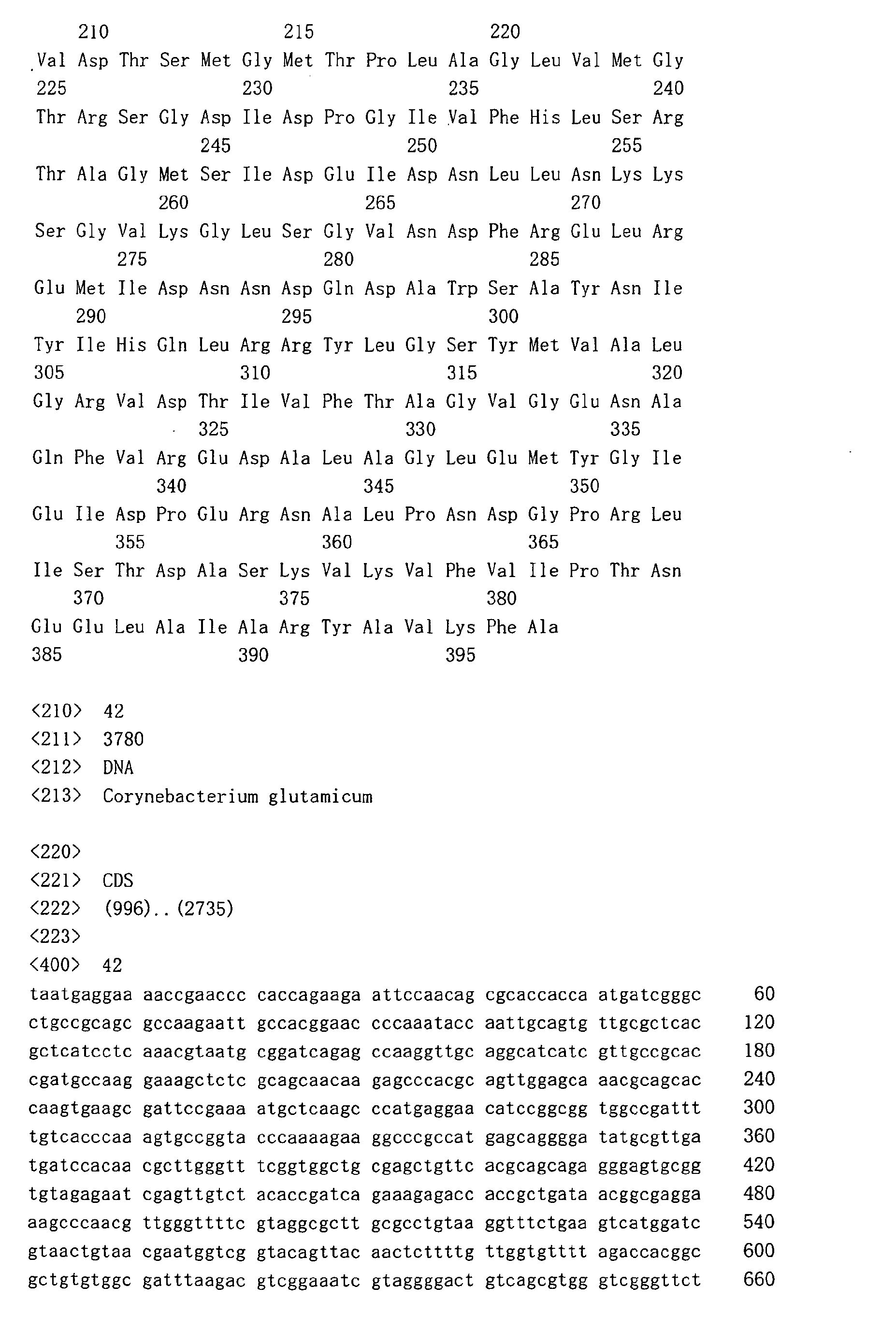


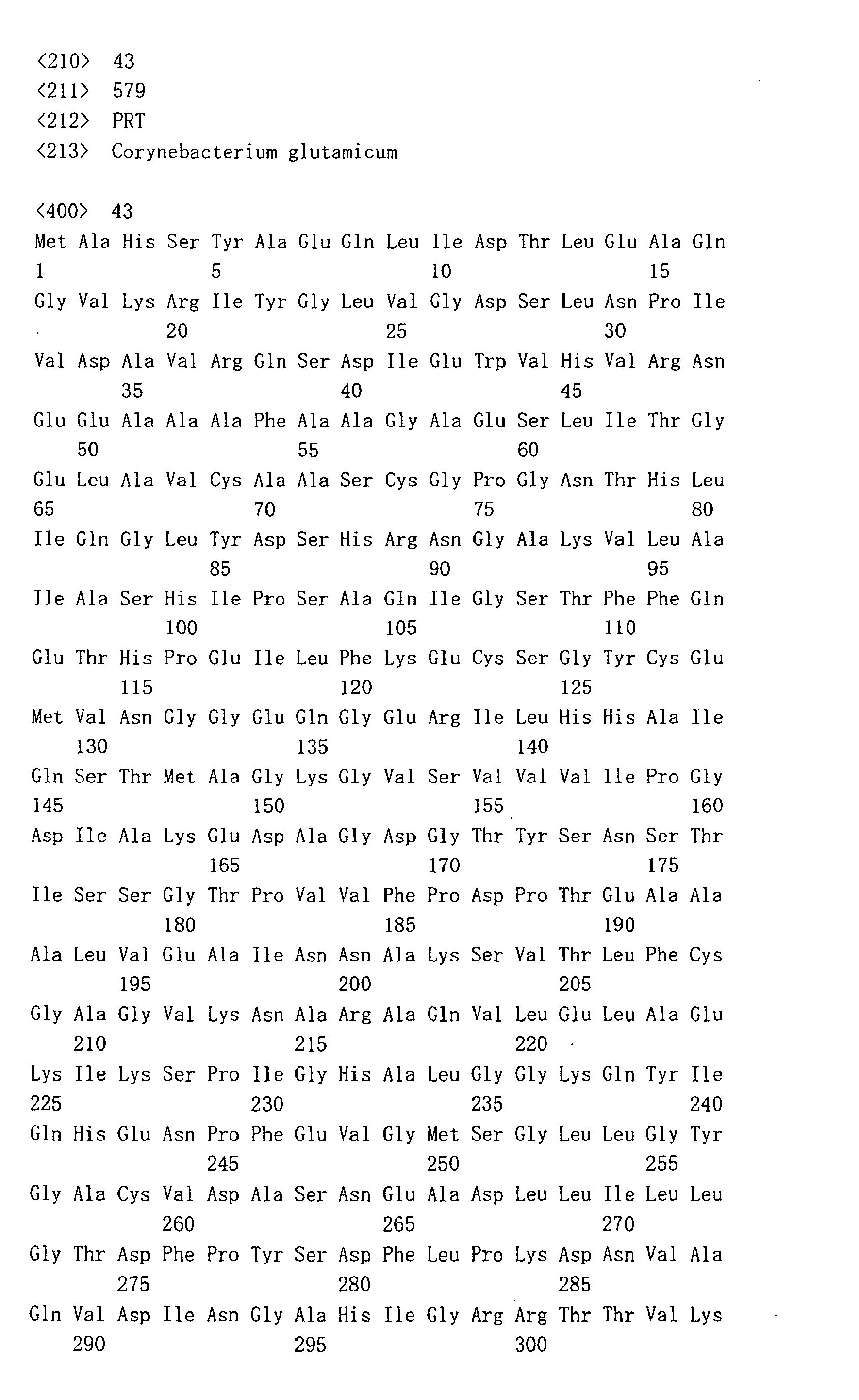


Claims (10)
- A coryneform bacterium having a succinic acid-producing ability, wherein said bacterium has been modified so that an activity of acetyl-CoA hydrolase is decreased.
- The coryneform bacterium according to claim 1, wherein the acetyl-CoA hydrolase is a protein as described in the following (A) or (B):(A) a protein having an amino acid sequence of SEQ ID NO: 45; or(B) a protein having an amino acid sequence of SEQ ID NO: 45 including substitution, deletion, insertion, or addition of one or several amino acids, and having an acetyl-CoA hydrolase activity.
- The coryneform bacterium according to claim 1 or 2, wherein the acetyl-CoA hydrolase activity has been decreased by disruption of an acetyl-CoA hydrolase gene on a chromosome.
- The coryneform bacterium according to claim 3, wherein the acetyl-CoA hydrolase gene is a DNA as described in the following (a) or (b):(a) a DNA comprising a nucleotide sequence of nucleotide numbers 1037-2542 in SEQ ID NO: 44; or(b) a DNA that hybridizes with a nucleotide sequence of nucleotide numbers 1037-2542 in SEQ ID NO: 44 or a probe that can be prepared from the nucleotide sequence under stringent conditions, and encodes a protein having an acetyl-CoA hydrolase activity.
- The coryneform bacterium according to any one of claims 1 to 4, which has been further modified so that activities of one or both of phosphotransacetylase and acetate kinase are decreased.
- The coryneform bacterium according to any one of claims 1 to 5, wherein said bacterium has been further modified so that an activity of lactate dehydrogenase is decreased.
- The coryneform bacterium according to any one of claims 1 to 6, wherein said bacterium has been further modified so that an activity of pyruvate carboxylase is increased.
- A method for producing succinic acid, comprising allowing the coryneform bacterium according to any one of claims 1 to 7 or a treated product thereof to act on an organic raw material in a reaction liquid containing a carbonate ion, a bicarbonate ion, or carbon dioxide to generate and accumulate succinic acid in the reaction liquid, and collecting succinic acid from the reaction liquid.
- The production method according to claim 8, wherein the coryneform bacterium or treated product thereof is allowed to act on the organic raw material under anaerobic conditions.
- A method for producing a succinic acid-containing polymer, comprising the steps of producing succinic acid by the method according to claim 8 or 9 and polymerizing the obtained succinic acid.
Applications Claiming Priority (2)
| Application Number | Priority Date | Filing Date | Title |
|---|---|---|---|
| JP2004150658 | 2004-05-20 | ||
| PCT/JP2005/009232 WO2005113744A1 (en) | 2004-05-20 | 2005-05-20 | Succinic acid-producing bacterium and process for producing succinic acid |
Publications (3)
| Publication Number | Publication Date |
|---|---|
| EP1760143A1 true EP1760143A1 (en) | 2007-03-07 |
| EP1760143A4 EP1760143A4 (en) | 2007-06-27 |
| EP1760143B1 EP1760143B1 (en) | 2012-05-16 |
Family
ID=35428402
Family Applications (1)
| Application Number | Title | Priority Date | Filing Date |
|---|---|---|---|
| EP05741285A Expired - Lifetime EP1760143B1 (en) | 2004-05-20 | 2005-05-20 | Succinic acid-producing bacterium and process for producing succinic acid |
Country Status (6)
| Country | Link |
|---|---|
| US (1) | US7972823B2 (en) |
| EP (1) | EP1760143B1 (en) |
| JP (1) | JP5023701B2 (en) |
| CN (1) | CN1989238B (en) |
| BR (1) | BRPI0510919A (en) |
| WO (1) | WO2005113744A1 (en) |
Cited By (3)
| Publication number | Priority date | Publication date | Assignee | Title |
|---|---|---|---|---|
| US7993888B2 (en) * | 2006-02-24 | 2011-08-09 | Mitsubishi Chemical Corporation | Bacterium having enhanced 2-oxoglutarate dehydrogenase activity |
| EP1947190A4 (en) * | 2005-10-18 | 2011-12-07 | Ajinomoto Kk | PROCESS FOR PRODUCING SUCCINIC ACID |
| EP2149608A4 (en) * | 2007-04-16 | 2013-02-20 | Ajinomoto Kk | PROCESS FOR PRODUCING AN ORGANIC ACID |
Families Citing this family (24)
| Publication number | Priority date | Publication date | Assignee | Title |
|---|---|---|---|---|
| JP4469568B2 (en) | 2003-07-09 | 2010-05-26 | 三菱化学株式会社 | Method for producing organic acid |
| BRPI0413403A (en) | 2003-08-28 | 2006-10-17 | Mitsubishi Chem Corp | method to produce succinic acid |
| EP1672067B1 (en) | 2003-09-17 | 2015-11-11 | Mitsubishi Chemical Corporation | Process for producing non-amino organic acid |
| BRPI0510919A (en) | 2004-05-20 | 2008-05-20 | Ajinomoto Kk | succinic acid producing bacteria and process for producing succinic acid |
| CN1989239B (en) * | 2004-05-20 | 2013-07-10 | 味之素株式会社 | Succinic acid - producing bacterium and process for producing succinic acid |
| BRPI0519410B1 (en) | 2004-12-28 | 2020-12-22 | Ajinomoto Co., Inc | method for producing l-glutamic acid |
| JP2010130899A (en) | 2007-03-14 | 2010-06-17 | Ajinomoto Co Inc | Microorganism producing l-glutamic acid-based amino acid, and method for producing amino acid |
| JP5493854B2 (en) | 2007-04-10 | 2014-05-14 | 味の素株式会社 | Method for producing organic acid |
| WO2008133161A1 (en) | 2007-04-17 | 2008-11-06 | Ajinomoto Co., Inc. | Method for production of acidic substance having carboxyl group |
| EP2192189B1 (en) | 2007-08-23 | 2018-08-22 | Mitsubishi Chemical Corporation | Method for production of succinic acid at high temperatures |
| WO2009072562A1 (en) | 2007-12-06 | 2009-06-11 | Ajinomoto Co., Inc. | Process for production of organic acid |
| JP5651989B2 (en) * | 2009-04-16 | 2015-01-14 | 三菱化学株式会社 | Method for producing succinic acid |
| JP2012223091A (en) | 2009-08-25 | 2012-11-15 | Ajinomoto Co Inc | Method for producing l-amino acid |
| EP2774982B1 (en) | 2011-11-02 | 2017-06-21 | Ajinomoto Co., Inc. | Method for secreting and producing proteins |
| JP6020581B2 (en) | 2011-11-02 | 2016-11-02 | 味の素株式会社 | Protein secretory production |
| JP2014150747A (en) * | 2013-02-06 | 2014-08-25 | Sekisui Chem Co Ltd | Mutant microorganisms and methods for producing succinic acid |
| RU2013119826A (en) | 2013-04-29 | 2014-11-10 | Закрытое акционерное общество "Научно-исследовательский институт Аджиномото-Генетика" (ЗАО "АГРИ") | CORINEFORM BACTERIA AND METHOD FOR PRODUCING HETEROLOGICAL HYBRID PROTEINS |
| JP2016165225A (en) | 2013-07-09 | 2016-09-15 | 味の素株式会社 | Method for producing useful substance |
| EP2860256B1 (en) | 2013-10-11 | 2017-03-08 | CJ Cheiljedang Corporation | Method of producing l-amino acids |
| RU2573933C1 (en) | 2014-08-21 | 2016-01-27 | Дафот Энтерпрайсис Лимитед | Peptide for medical treatment of pancreatic diabetes of 2nd type and its complications |
| JP2017216881A (en) | 2014-12-26 | 2017-12-14 | 味の素株式会社 | Method for producing dicarboxylate |
| CN118773233A (en) | 2017-03-28 | 2024-10-15 | 味之素株式会社 | Methods for producing RNA |
| WO2019078095A1 (en) | 2017-10-16 | 2019-04-25 | Ajinomoto Co., Inc. | A method for production of a protein having peptidylglycine alpha-hydroxylating monooxygenase activity |
| JP7367667B2 (en) | 2018-02-20 | 2023-10-24 | 味の素株式会社 | Methods of inducing RNA silencing |
Family Cites Families (77)
| Publication number | Priority date | Publication date | Assignee | Title |
|---|---|---|---|---|
| US6696561B1 (en) | 1909-07-09 | 2004-02-24 | Basf Aktiengesellschaft | Corynebacterium glutamicum genes encoding proteins involved in membrane synthesis and membrane transport |
| JPS57134500A (en) | 1981-02-12 | 1982-08-19 | Kyowa Hakko Kogyo Co Ltd | Plasmid pcg1 |
| JPS57183799A (en) | 1981-04-17 | 1982-11-12 | Kyowa Hakko Kogyo Co Ltd | Novel plasmid |
| JPS5835197A (en) | 1981-08-26 | 1983-03-01 | Kyowa Hakko Kogyo Co Ltd | Plamid pcg 2 |
| ZA816779B (en) | 1981-09-30 | 1982-09-29 | American Cyanamid Co | Process for trimerizing isocyanic acid to make cyanuric acid |
| JPS5877895A (en) | 1981-11-02 | 1983-05-11 | Ajinomoto Co Inc | Plasmid phm1519 |
| JPS58192900A (en) | 1982-05-04 | 1983-11-10 | Ajinomoto Co Inc | Complex plasmid |
| JPS61209596A (en) | 1985-03-12 | 1986-09-17 | Kanegafuchi Chem Ind Co Ltd | Production of organic acid by immobilized microorganism |
| JPH0636746B2 (en) | 1985-08-24 | 1994-05-18 | 味の素株式会社 | Method for producing L-glutamic acid |
| JPH0796522B2 (en) | 1986-04-08 | 1995-10-18 | 軽質留分新用途開発技術研究組合 | Method for producing carboxylic acid from ammonium carboxylate aqueous solution |
| JPS62238232A (en) | 1986-04-09 | 1987-10-19 | Res Assoc Util Of Light Oil | Production of carboxylic acid from aqueous solution of ammonium carboxylate |
| US5143834A (en) | 1986-06-11 | 1992-09-01 | Glassner David A | Process for the production and purification of succinic acid |
| US5168055A (en) | 1986-06-11 | 1992-12-01 | Rathin Datta | Fermentation and purification process for succinic acid |
| DE3783081T2 (en) | 1986-06-11 | 1993-04-15 | Michigan Biotech Inst | METHOD FOR PRODUCING AMBER ACID BY ANAEROBIC FERMENTATION. |
| JPH01191686A (en) | 1988-01-26 | 1989-08-01 | Mitsubishi Petrochem Co Ltd | Composite plasmid |
| US5185262A (en) | 1988-07-27 | 1993-02-09 | Mitsubishi Petrochemical Co., Ltd. | DNA fragment containing gene which encodes the function of stabilizing plasmid in host microorganism |
| JP2678995B2 (en) | 1988-09-08 | 1997-11-19 | 三菱化学株式会社 | Method for producing tryptophan synthase |
| US5034105A (en) | 1989-07-27 | 1991-07-23 | Michigan Biotechnology Institute | Carboxylic acid purification and crystallization process |
| JP2820279B2 (en) | 1989-08-11 | 1998-11-05 | 日本合成化学工業株式会社 | Method for producing sorbic acid |
| JP2973446B2 (en) | 1990-01-11 | 1999-11-08 | 三菱化学株式会社 | New plasmid vector |
| US5142834A (en) | 1990-07-12 | 1992-09-01 | Donnelly Corporation | Vehicle trim assembly and fastener therefor |
| US5132456A (en) | 1991-05-07 | 1992-07-21 | The Regents Of The University Of California | Sorption of carboxylic acid from carboxylic salt solutions at PHS close to or above the pKa of the acid, with regeneration with an aqueous solution of ammonia or low-molecular-weight alkylamine |
| JP2526836B2 (en) | 1991-08-23 | 1996-08-21 | 味の素株式会社 | Acetic acid-utilizing gene |
| JP3151884B2 (en) | 1991-12-03 | 2001-04-03 | 大日本インキ化学工業株式会社 | Polyurethane polyurea particles |
| CA2126365C (en) | 1993-07-06 | 1999-08-24 | Steven W. Felman | Recovery of citric acid from impure process streams by addition of strong acids and salts thereof |
| JP2844511B2 (en) | 1993-09-02 | 1999-01-06 | 味の素株式会社 | Acetic acid assimilation gene and use thereof |
| JP3394593B2 (en) | 1994-05-11 | 2003-04-07 | 昭和高分子株式会社 | Method for producing biodegradable aliphatic polyester |
| EP0771879B1 (en) | 1994-06-14 | 2001-09-12 | Ajinomoto Co., Inc. | alpha-ketoglutaric dehydrogenase gen |
| JP3210184B2 (en) | 1994-08-12 | 2001-09-17 | 明健株式会社 | Volcanic ash purification method and volcanic ash classification device |
| US5504004A (en) | 1994-12-20 | 1996-04-02 | Michigan Biotechnology Institute | Process for making succinic acid, microorganisms for use in the process and methods of obtaining the microorganisms |
| US5869301A (en) | 1995-11-02 | 1999-02-09 | Lockhead Martin Energy Research Corporation | Method for the production of dicarboxylic acids |
| US5770435A (en) | 1995-11-02 | 1998-06-23 | University Of Chicago | Mutant E. coli strain with increased succinic acid production |
| JP3072891B2 (en) | 1996-08-14 | 2000-08-07 | 川崎製鉄株式会社 | Extraction abnormality treatment method in hot rolling winder |
| KR19990013007A (en) | 1997-07-31 | 1999-02-25 | 박원훈 | Transformed Escherichia Coli S373 (BTCC 8818 P) and Production Method of Succinic Acid Using the Same |
| US5958744A (en) | 1997-08-18 | 1999-09-28 | Applied Carbochemicals | Succinic acid production and purification |
| JP4197754B2 (en) * | 1997-10-09 | 2008-12-17 | 三菱化学株式会社 | Method for producing lactic acid or succinic acid |
| JP3480274B2 (en) | 1997-10-29 | 2003-12-15 | 三菱化学株式会社 | Method for producing aliphatic polyester copolymer |
| JP3967812B2 (en) * | 1998-01-16 | 2007-08-29 | 三菱化学株式会社 | Production method of organic acid by pyruvate carboxylase genetically modified cells |
| JPH11196887A (en) * | 1998-01-16 | 1999-07-27 | Mitsubishi Chemical Corp | Production of organic acid by phosphoenolpyruvic acid carboxylase gene recombinant microbe |
| JP4074365B2 (en) * | 1998-01-28 | 2008-04-09 | 三菱化学株式会社 | Lactate dehydrogenase gene and gene-disrupted strain |
| US20030087381A1 (en) | 1998-04-13 | 2003-05-08 | University Of Georgia Research Foundation, Inc. | Metabolically engineered organisms for enhanced production of oxaloacetate-derived biochemicals |
| AU760575C (en) * | 1998-04-13 | 2005-04-14 | University Of Georgia Research Foundation, Inc., The | Pyruvate carboxylase overexpression for enhanced production of oxaloacetate-derived biochemicals in microbial cells |
| JP4132253B2 (en) | 1998-07-24 | 2008-08-13 | 株式会社武蔵野化学研究所 | Ammonia-resistant L (+)-lactic acid-producing bacterium and L (+)-lactic acid production method |
| DE19951975A1 (en) | 1999-10-28 | 2001-05-03 | Degussa | New Nuleotide sequences coding for the poxB gene |
| DE19959650A1 (en) | 1999-12-10 | 2001-06-13 | Degussa | New nucleotide sequences coding for the genes sdhA, sdhB and sdhC |
| JP4623825B2 (en) | 1999-12-16 | 2011-02-02 | 協和発酵バイオ株式会社 | Novel polynucleotide |
| US6670505B1 (en) | 2000-03-07 | 2003-12-30 | Eastman Chemical Company | Process for the recovery of organic acids from aqueous solutions |
| DE10044681A1 (en) | 2000-09-09 | 2002-03-21 | Degussa | New L-lactate dehydrogenase gene from coryneform bacteria, useful, when overexpressed, for increasing fermentative production of L-amino acid |
| US6911329B2 (en) | 2000-09-23 | 2005-06-28 | Degussa Ag | Process for the fermentative preparation of D-pantothenic acid using coryneform bacteria |
| AU2001291825A1 (en) | 2000-09-30 | 2002-04-15 | Degussa A.G. | Process for the fermentative preparation of d-pantothenic acid using coryneform bacteria |
| AU2002215910A1 (en) | 2000-11-04 | 2002-05-15 | Degussa Ag | Process for the fermentative preparation of l-amino acids using strains of the enterobacteriaceae family |
| DE10112102A1 (en) | 2001-03-14 | 2002-09-19 | Degussa | Process for the fermentative production of D-pantothenic acid and / or its salts |
| US6743610B2 (en) * | 2001-03-30 | 2004-06-01 | The University Of Chicago | Method to produce succinic acid from raw hydrolysates |
| JP2002291477A (en) * | 2001-03-30 | 2002-10-08 | Mitsubishi Chemicals Corp | DNA encoding fumarase and use thereof |
| US6488061B2 (en) * | 2001-04-04 | 2002-12-03 | Rollie Nathaniel White | Single pass radius molding system |
| EP1298158B1 (en) | 2001-09-26 | 2006-11-15 | Kabushiki Kaisha Toshiba | Copolymer resin composition and production process thereof |
| JP3754014B2 (en) | 2001-09-26 | 2006-03-08 | 株式会社東芝 | Copolymer resin composition and method for producing the same |
| DE10154175A1 (en) * | 2001-11-05 | 2003-05-15 | Basf Ag | Genes coding for homeostasis and adaptation proteins |
| JP2003199522A (en) | 2002-01-09 | 2003-07-15 | Inobakkusu Kk | Edible seasoning |
| JP4032765B2 (en) * | 2002-02-13 | 2008-01-16 | 三菱化学株式会社 | Method for producing organic acid |
| JP2003235592A (en) * | 2002-02-13 | 2003-08-26 | Mitsubishi Chemicals Corp | Organic acid production method |
| EP1546304B1 (en) * | 2002-10-04 | 2013-05-08 | Danisco US Inc. | Improved production of bacterial strains |
| JP4469568B2 (en) | 2003-07-09 | 2010-05-26 | 三菱化学株式会社 | Method for producing organic acid |
| DK1647594T3 (en) | 2003-07-29 | 2010-05-25 | Res Inst Innovative Tech Earth | Coryneform bacterial transformant and method of producing dicarboxylic acid using it |
| BRPI0413403A (en) | 2003-08-28 | 2006-10-17 | Mitsubishi Chem Corp | method to produce succinic acid |
| JP4575086B2 (en) | 2003-08-28 | 2010-11-04 | 三菱化学株式会社 | Method for producing succinic acid |
| EP1672067B1 (en) | 2003-09-17 | 2015-11-11 | Mitsubishi Chemical Corporation | Process for producing non-amino organic acid |
| CN100534972C (en) | 2003-09-30 | 2009-09-02 | 味之素株式会社 | Method for purifying succinic acid from fermentation broth |
| CN1989239B (en) | 2004-05-20 | 2013-07-10 | 味之素株式会社 | Succinic acid - producing bacterium and process for producing succinic acid |
| BRPI0510919A (en) | 2004-05-20 | 2008-05-20 | Ajinomoto Kk | succinic acid producing bacteria and process for producing succinic acid |
| WO2006020663A2 (en) | 2004-08-09 | 2006-02-23 | Rice University | Aerobic succinate production in bacteria |
| EP3130676A1 (en) | 2004-08-27 | 2017-02-15 | Rice University | Mutant e. coli strain with increased succinic acid production |
| US7569380B2 (en) | 2004-12-22 | 2009-08-04 | Rice University | Simultaneous anaerobic production of isoamyl acetate and succinic acid |
| JP2006238843A (en) | 2005-03-07 | 2006-09-14 | Mitsubishi Heavy Ind Ltd | Method for producing succinic acid, succinic acid, method for producing biodegradable plastic and biodegradable plastic |
| JP4760121B2 (en) | 2005-05-17 | 2011-08-31 | 三菱化学株式会社 | Method for producing succinic acid |
| EP1947190B1 (en) | 2005-10-18 | 2017-11-29 | Ajinomoto Co., Inc. | Process for production of succinic acid |
| WO2007099867A1 (en) | 2006-02-24 | 2007-09-07 | Mitsubishi Chemical Corporation | Bacterium capable of producing organic acid, and method for production of organic acid |
-
2005
- 2005-05-20 BR BRPI0510919-1A patent/BRPI0510919A/en not_active IP Right Cessation
- 2005-05-20 WO PCT/JP2005/009232 patent/WO2005113744A1/en not_active Ceased
- 2005-05-20 EP EP05741285A patent/EP1760143B1/en not_active Expired - Lifetime
- 2005-05-20 JP JP2006513736A patent/JP5023701B2/en not_active Expired - Lifetime
- 2005-05-20 CN CN2005800246195A patent/CN1989238B/en not_active Expired - Fee Related
-
2006
- 2006-11-17 US US11/561,011 patent/US7972823B2/en not_active Expired - Fee Related
Cited By (3)
| Publication number | Priority date | Publication date | Assignee | Title |
|---|---|---|---|---|
| EP1947190A4 (en) * | 2005-10-18 | 2011-12-07 | Ajinomoto Kk | PROCESS FOR PRODUCING SUCCINIC ACID |
| US7993888B2 (en) * | 2006-02-24 | 2011-08-09 | Mitsubishi Chemical Corporation | Bacterium having enhanced 2-oxoglutarate dehydrogenase activity |
| EP2149608A4 (en) * | 2007-04-16 | 2013-02-20 | Ajinomoto Kk | PROCESS FOR PRODUCING AN ORGANIC ACID |
Also Published As
| Publication number | Publication date |
|---|---|
| JPWO2005113744A1 (en) | 2008-03-27 |
| US20080293112A1 (en) | 2008-11-27 |
| WO2005113744A1 (en) | 2005-12-01 |
| EP1760143B1 (en) | 2012-05-16 |
| JP5023701B2 (en) | 2012-09-12 |
| EP1760143A4 (en) | 2007-06-27 |
| CN1989238A (en) | 2007-06-27 |
| US7972823B2 (en) | 2011-07-05 |
| BRPI0510919A (en) | 2008-05-20 |
| CN1989238B (en) | 2010-05-26 |
Similar Documents
| Publication | Publication Date | Title |
|---|---|---|
| EP1748062B1 (en) | Succinic acid-producing bacterium and process for producing succinic acid | |
| US7972823B2 (en) | Succinic acid-producing bacterium and process for producing succinic acid | |
| US7763447B2 (en) | Method of producing succinic acid with bacterium comprising a modified fumarate reductase gene or a modified succinate dehydrogenase gene | |
| US7993888B2 (en) | Bacterium having enhanced 2-oxoglutarate dehydrogenase activity | |
| US7563606B2 (en) | Method for producing non-amino organic acid | |
| US7829316B2 (en) | Process for production of succinic acid | |
| US9080189B2 (en) | Method for producing an organic acid | |
| EP2149608A1 (en) | Method for production of organic acid | |
| JP5034630B2 (en) | Preparation method of organic acid producing microorganism and production method of organic acid | |
| EP2192189B1 (en) | Method for production of succinic acid at high temperatures | |
| JP4720114B2 (en) | Method for producing oxaloacetic acid or oxaloacetic acid derivative | |
| JP2008067623A (en) | Method for producing non-amino organic acid | |
| JP5034395B2 (en) | Organic acid producing bacteria and method for producing organic acid | |
| JP5663859B2 (en) | Non-amino organic acid producing bacteria and method for producing non-amino organic acid | |
| EP2829601A1 (en) | Bacterial cell having enhanced succinic acid production and a method for producing the succinic acid using the same | |
| JP2008067624A (en) | Method for producing non-amino organic acid | |
| BRPI0510921B1 (en) | SUCCINIC ACID PRODUCTION BACTERIA AND PROCESS FOR PRODUCING SUCCINIC ACID | |
| BRPI0510919B1 (en) | METHODS FOR THE PRODUCTION OF SUCCINITIC ACID AND POLYMER CONTAINING IT | |
| JP2008067627A (en) | Non-amino organic acid producing bacteria and method for producing non-amino organic acid |
Legal Events
| Date | Code | Title | Description |
|---|---|---|---|
| PUAI | Public reference made under article 153(3) epc to a published international application that has entered the european phase |
Free format text: ORIGINAL CODE: 0009012 |
|
| 17P | Request for examination filed |
Effective date: 20061123 |
|
| AK | Designated contracting states |
Kind code of ref document: A1 Designated state(s): AT BE BG CH CY CZ DE DK EE ES FI FR GB GR HU IE IS IT LI LT LU MC NL PL PT RO SE SI SK TR |
|
| RIC1 | Information provided on ipc code assigned before grant |
Ipc: C12N 1/21 20060101ALI20070320BHEP Ipc: C12R 1/15 20060101ALN20070320BHEP Ipc: C12N 1/15 20060101AFI20070320BHEP Ipc: C12P 7/46 20060101ALI20070320BHEP Ipc: C12N 15/55 20060101ALI20070320BHEP Ipc: C12N 15/54 20060101ALI20070320BHEP |
|
| A4 | Supplementary search report drawn up and despatched |
Effective date: 20070525 |
|
| DAX | Request for extension of the european patent (deleted) | ||
| 17Q | First examination report despatched |
Effective date: 20071023 |
|
| RAP1 | Party data changed (applicant data changed or rights of an application transferred) |
Owner name: AJINOMOTO CO., INC. |
|
| REG | Reference to a national code |
Ref country code: DE Ref legal event code: R079 Ref document number: 602005034211 Country of ref document: DE Free format text: PREVIOUS MAIN CLASS: C12N0001150000 Ipc: C12N0001210000 |
|
| RIC1 | Information provided on ipc code assigned before grant |
Ipc: C12N 1/15 20060101AFI20111111BHEP Ipc: C12N 15/54 20060101ALI20111111BHEP Ipc: C12N 15/77 20060101ALI20111111BHEP Ipc: C12N 9/16 20060101ALI20111111BHEP Ipc: C12N 15/55 20060101ALI20111111BHEP Ipc: C12P 7/46 20060101ALI20111111BHEP Ipc: C12N 1/21 20060101ALI20111111BHEP |
|
| GRAP | Despatch of communication of intention to grant a patent |
Free format text: ORIGINAL CODE: EPIDOSNIGR1 |
|
| RIC1 | Information provided on ipc code assigned before grant |
Ipc: C12N 15/77 20060101ALI20111215BHEP Ipc: C12N 9/16 20060101ALI20111215BHEP Ipc: C12N 15/54 20060101ALI20111215BHEP Ipc: C12N 15/55 20060101ALI20111215BHEP Ipc: C12P 7/46 20060101ALI20111215BHEP Ipc: C12N 1/21 20060101AFI20111215BHEP |
|
| GRAS | Grant fee paid |
Free format text: ORIGINAL CODE: EPIDOSNIGR3 |
|
| GRAA | (expected) grant |
Free format text: ORIGINAL CODE: 0009210 |
|
| AK | Designated contracting states |
Kind code of ref document: B1 Designated state(s): AT BE BG CH CY CZ DE DK EE ES FI FR GB GR HU IE IS IT LI LT LU MC NL PL PT RO SE SI SK TR |
|
| REG | Reference to a national code |
Ref country code: GB Ref legal event code: FG4D |
|
| REG | Reference to a national code |
Ref country code: CH Ref legal event code: EP |
|
| REG | Reference to a national code |
Ref country code: AT Ref legal event code: REF Ref document number: 558113 Country of ref document: AT Kind code of ref document: T Effective date: 20120615 |
|
| REG | Reference to a national code |
Ref country code: IE Ref legal event code: FG4D |
|
| REG | Reference to a national code |
Ref country code: DE Ref legal event code: R096 Ref document number: 602005034211 Country of ref document: DE Effective date: 20120712 |
|
| REG | Reference to a national code |
Ref country code: NL Ref legal event code: VDEP Effective date: 20120516 |
|
| REG | Reference to a national code |
Ref country code: LT Ref legal event code: MG4D Effective date: 20120516 |
|
| PG25 | Lapsed in a contracting state [announced via postgrant information from national office to epo] |
Ref country code: SE Free format text: LAPSE BECAUSE OF FAILURE TO SUBMIT A TRANSLATION OF THE DESCRIPTION OR TO PAY THE FEE WITHIN THE PRESCRIBED TIME-LIMIT Effective date: 20120516 Ref country code: CY Free format text: LAPSE BECAUSE OF FAILURE TO SUBMIT A TRANSLATION OF THE DESCRIPTION OR TO PAY THE FEE WITHIN THE PRESCRIBED TIME-LIMIT Effective date: 20120516 Ref country code: LT Free format text: LAPSE BECAUSE OF FAILURE TO SUBMIT A TRANSLATION OF THE DESCRIPTION OR TO PAY THE FEE WITHIN THE PRESCRIBED TIME-LIMIT Effective date: 20120516 Ref country code: FI Free format text: LAPSE BECAUSE OF FAILURE TO SUBMIT A TRANSLATION OF THE DESCRIPTION OR TO PAY THE FEE WITHIN THE PRESCRIBED TIME-LIMIT Effective date: 20120516 Ref country code: IS Free format text: LAPSE BECAUSE OF FAILURE TO SUBMIT A TRANSLATION OF THE DESCRIPTION OR TO PAY THE FEE WITHIN THE PRESCRIBED TIME-LIMIT Effective date: 20120916 Ref country code: PL Free format text: LAPSE BECAUSE OF FAILURE TO SUBMIT A TRANSLATION OF THE DESCRIPTION OR TO PAY THE FEE WITHIN THE PRESCRIBED TIME-LIMIT Effective date: 20120516 |
|
| REG | Reference to a national code |
Ref country code: AT Ref legal event code: MK05 Ref document number: 558113 Country of ref document: AT Kind code of ref document: T Effective date: 20120516 |
|
| PG25 | Lapsed in a contracting state [announced via postgrant information from national office to epo] |
Ref country code: SI Free format text: LAPSE BECAUSE OF FAILURE TO SUBMIT A TRANSLATION OF THE DESCRIPTION OR TO PAY THE FEE WITHIN THE PRESCRIBED TIME-LIMIT Effective date: 20120516 Ref country code: PT Free format text: LAPSE BECAUSE OF FAILURE TO SUBMIT A TRANSLATION OF THE DESCRIPTION OR TO PAY THE FEE WITHIN THE PRESCRIBED TIME-LIMIT Effective date: 20120917 Ref country code: GR Free format text: LAPSE BECAUSE OF FAILURE TO SUBMIT A TRANSLATION OF THE DESCRIPTION OR TO PAY THE FEE WITHIN THE PRESCRIBED TIME-LIMIT Effective date: 20120817 |
|
| PG25 | Lapsed in a contracting state [announced via postgrant information from national office to epo] |
Ref country code: BE Free format text: LAPSE BECAUSE OF FAILURE TO SUBMIT A TRANSLATION OF THE DESCRIPTION OR TO PAY THE FEE WITHIN THE PRESCRIBED TIME-LIMIT Effective date: 20120516 Ref country code: MC Free format text: LAPSE BECAUSE OF NON-PAYMENT OF DUE FEES Effective date: 20120531 |
|
| REG | Reference to a national code |
Ref country code: CH Ref legal event code: PL |
|
| PG25 | Lapsed in a contracting state [announced via postgrant information from national office to epo] |
Ref country code: NL Free format text: LAPSE BECAUSE OF FAILURE TO SUBMIT A TRANSLATION OF THE DESCRIPTION OR TO PAY THE FEE WITHIN THE PRESCRIBED TIME-LIMIT Effective date: 20120516 Ref country code: LI Free format text: LAPSE BECAUSE OF NON-PAYMENT OF DUE FEES Effective date: 20120531 Ref country code: RO Free format text: LAPSE BECAUSE OF FAILURE TO SUBMIT A TRANSLATION OF THE DESCRIPTION OR TO PAY THE FEE WITHIN THE PRESCRIBED TIME-LIMIT Effective date: 20120516 Ref country code: CH Free format text: LAPSE BECAUSE OF NON-PAYMENT OF DUE FEES Effective date: 20120531 Ref country code: EE Free format text: LAPSE BECAUSE OF FAILURE TO SUBMIT A TRANSLATION OF THE DESCRIPTION OR TO PAY THE FEE WITHIN THE PRESCRIBED TIME-LIMIT Effective date: 20120516 Ref country code: CZ Free format text: LAPSE BECAUSE OF FAILURE TO SUBMIT A TRANSLATION OF THE DESCRIPTION OR TO PAY THE FEE WITHIN THE PRESCRIBED TIME-LIMIT Effective date: 20120516 Ref country code: DK Free format text: LAPSE BECAUSE OF FAILURE TO SUBMIT A TRANSLATION OF THE DESCRIPTION OR TO PAY THE FEE WITHIN THE PRESCRIBED TIME-LIMIT Effective date: 20120516 Ref country code: SK Free format text: LAPSE BECAUSE OF FAILURE TO SUBMIT A TRANSLATION OF THE DESCRIPTION OR TO PAY THE FEE WITHIN THE PRESCRIBED TIME-LIMIT Effective date: 20120516 Ref country code: AT Free format text: LAPSE BECAUSE OF FAILURE TO SUBMIT A TRANSLATION OF THE DESCRIPTION OR TO PAY THE FEE WITHIN THE PRESCRIBED TIME-LIMIT Effective date: 20120516 |
|
| REG | Reference to a national code |
Ref country code: IE Ref legal event code: MM4A |
|
| PG25 | Lapsed in a contracting state [announced via postgrant information from national office to epo] |
Ref country code: IT Free format text: LAPSE BECAUSE OF FAILURE TO SUBMIT A TRANSLATION OF THE DESCRIPTION OR TO PAY THE FEE WITHIN THE PRESCRIBED TIME-LIMIT Effective date: 20120516 |
|
| PLBE | No opposition filed within time limit |
Free format text: ORIGINAL CODE: 0009261 |
|
| STAA | Information on the status of an ep patent application or granted ep patent |
Free format text: STATUS: NO OPPOSITION FILED WITHIN TIME LIMIT |
|
| 26N | No opposition filed |
Effective date: 20130219 |
|
| PG25 | Lapsed in a contracting state [announced via postgrant information from national office to epo] |
Ref country code: ES Free format text: LAPSE BECAUSE OF FAILURE TO SUBMIT A TRANSLATION OF THE DESCRIPTION OR TO PAY THE FEE WITHIN THE PRESCRIBED TIME-LIMIT Effective date: 20120827 Ref country code: IE Free format text: LAPSE BECAUSE OF NON-PAYMENT OF DUE FEES Effective date: 20120520 |
|
| REG | Reference to a national code |
Ref country code: DE Ref legal event code: R097 Ref document number: 602005034211 Country of ref document: DE Effective date: 20130219 |
|
| PG25 | Lapsed in a contracting state [announced via postgrant information from national office to epo] |
Ref country code: BG Free format text: LAPSE BECAUSE OF FAILURE TO SUBMIT A TRANSLATION OF THE DESCRIPTION OR TO PAY THE FEE WITHIN THE PRESCRIBED TIME-LIMIT Effective date: 20120816 |
|
| PG25 | Lapsed in a contracting state [announced via postgrant information from national office to epo] |
Ref country code: TR Free format text: LAPSE BECAUSE OF FAILURE TO SUBMIT A TRANSLATION OF THE DESCRIPTION OR TO PAY THE FEE WITHIN THE PRESCRIBED TIME-LIMIT Effective date: 20120516 |
|
| PG25 | Lapsed in a contracting state [announced via postgrant information from national office to epo] |
Ref country code: LU Free format text: LAPSE BECAUSE OF NON-PAYMENT OF DUE FEES Effective date: 20120520 |
|
| PG25 | Lapsed in a contracting state [announced via postgrant information from national office to epo] |
Ref country code: HU Free format text: LAPSE BECAUSE OF FAILURE TO SUBMIT A TRANSLATION OF THE DESCRIPTION OR TO PAY THE FEE WITHIN THE PRESCRIBED TIME-LIMIT Effective date: 20050520 |
|
| REG | Reference to a national code |
Ref country code: FR Ref legal event code: PLFP Year of fee payment: 12 |
|
| REG | Reference to a national code |
Ref country code: FR Ref legal event code: PLFP Year of fee payment: 13 |
|
| REG | Reference to a national code |
Ref country code: FR Ref legal event code: PLFP Year of fee payment: 14 |
|
| PGFP | Annual fee paid to national office [announced via postgrant information from national office to epo] |
Ref country code: GB Payment date: 20220401 Year of fee payment: 18 Ref country code: FR Payment date: 20220408 Year of fee payment: 18 Ref country code: DE Payment date: 20220329 Year of fee payment: 18 |
|
| REG | Reference to a national code |
Ref country code: DE Ref legal event code: R119 Ref document number: 602005034211 Country of ref document: DE |
|
| GBPC | Gb: european patent ceased through non-payment of renewal fee |
Effective date: 20230520 |
|
| PG25 | Lapsed in a contracting state [announced via postgrant information from national office to epo] |
Ref country code: DE Free format text: LAPSE BECAUSE OF NON-PAYMENT OF DUE FEES Effective date: 20231201 Ref country code: GB Free format text: LAPSE BECAUSE OF NON-PAYMENT OF DUE FEES Effective date: 20230520 |
|
| PG25 | Lapsed in a contracting state [announced via postgrant information from national office to epo] |
Ref country code: FR Free format text: LAPSE BECAUSE OF NON-PAYMENT OF DUE FEES Effective date: 20230531 |