EP1760075A1 - Method for producing acetamidopyrrolidine derivative and intermediate compound thereof - Google Patents
Method for producing acetamidopyrrolidine derivative and intermediate compound thereof Download PDFInfo
- Publication number
- EP1760075A1 EP1760075A1 EP05751221A EP05751221A EP1760075A1 EP 1760075 A1 EP1760075 A1 EP 1760075A1 EP 05751221 A EP05751221 A EP 05751221A EP 05751221 A EP05751221 A EP 05751221A EP 1760075 A1 EP1760075 A1 EP 1760075A1
- Authority
- EP
- European Patent Office
- Prior art keywords
- group
- salt
- production method
- hydrogen atom
- reaction
- Prior art date
- Legal status (The legal status is an assumption and is not a legal conclusion. Google has not performed a legal analysis and makes no representation as to the accuracy of the status listed.)
- Withdrawn
Links
- 238000004519 manufacturing process Methods 0.000 title claims abstract description 51
- XSFMNFYLWHPZIQ-UHFFFAOYSA-N n-pyrrolidin-1-ylacetamide Chemical class CC(=O)NN1CCCC1 XSFMNFYLWHPZIQ-UHFFFAOYSA-N 0.000 title claims abstract description 26
- 150000001875 compounds Chemical class 0.000 title claims description 55
- 238000006243 chemical reaction Methods 0.000 claims abstract description 103
- 150000003839 salts Chemical class 0.000 claims abstract description 64
- 125000004435 hydrogen atom Chemical group [H]* 0.000 claims abstract description 63
- 125000004169 (C1-C6) alkyl group Chemical group 0.000 claims abstract description 37
- 125000004737 (C1-C6) haloalkoxy group Chemical group 0.000 claims abstract description 20
- 125000005843 halogen group Chemical group 0.000 claims abstract description 17
- 125000004191 (C1-C6) alkoxy group Chemical group 0.000 claims abstract description 16
- 125000000171 (C1-C6) haloalkyl group Chemical group 0.000 claims abstract description 16
- 125000002887 hydroxy group Chemical group [H]O* 0.000 claims abstract description 15
- 125000006239 protecting group Chemical group 0.000 claims abstract description 15
- QIAFMBKCNZACKA-UHFFFAOYSA-N N-benzoylglycine Chemical class OC(=O)CNC(=O)C1=CC=CC=C1 QIAFMBKCNZACKA-UHFFFAOYSA-N 0.000 claims description 23
- 239000007858 starting material Substances 0.000 claims description 15
- -1 amino acid ester Chemical class 0.000 claims description 11
- 125000002496 methyl group Chemical group [H]C([H])([H])* 0.000 claims description 8
- 125000001797 benzyl group Chemical group [H]C1=C([H])C([H])=C(C([H])=C1[H])C([H])([H])* 0.000 claims description 7
- 125000001495 ethyl group Chemical group [H]C([H])([H])C([H])([H])* 0.000 claims description 7
- SBMSLRMNBSMKQC-UHFFFAOYSA-N pyrrolidin-1-amine Chemical class NN1CCCC1 SBMSLRMNBSMKQC-UHFFFAOYSA-N 0.000 claims description 5
- 150000005440 nitrobenzoic acid derivatives Chemical class 0.000 claims description 4
- 125000000876 trifluoromethoxy group Chemical group FC(F)(F)O* 0.000 claims description 4
- 125000000999 tert-butyl group Chemical group [H]C([H])([H])C(*)(C([H])([H])[H])C([H])([H])[H] 0.000 claims description 3
- SLAMLWHELXOEJZ-UHFFFAOYSA-N 2-nitrobenzoic acid Chemical class OC(=O)C1=CC=CC=C1[N+]([O-])=O SLAMLWHELXOEJZ-UHFFFAOYSA-N 0.000 claims description 2
- XEKOWRVHYACXOJ-UHFFFAOYSA-N Ethyl acetate Chemical compound CCOC(C)=O XEKOWRVHYACXOJ-UHFFFAOYSA-N 0.000 description 30
- 238000000034 method Methods 0.000 description 26
- LFQSCWFLJHTTHZ-UHFFFAOYSA-N Ethanol Chemical compound CCO LFQSCWFLJHTTHZ-UHFFFAOYSA-N 0.000 description 18
- 229940126062 Compound A Drugs 0.000 description 17
- NLDMNSXOCDLTTB-UHFFFAOYSA-N Heterophylliin A Natural products O1C2COC(=O)C3=CC(O)=C(O)C(O)=C3C3=C(O)C(O)=C(O)C=C3C(=O)OC2C(OC(=O)C=2C=C(O)C(O)=C(O)C=2)C(O)C1OC(=O)C1=CC(O)=C(O)C(O)=C1 NLDMNSXOCDLTTB-UHFFFAOYSA-N 0.000 description 17
- 230000015572 biosynthetic process Effects 0.000 description 17
- 239000000203 mixture Substances 0.000 description 17
- 238000003786 synthesis reaction Methods 0.000 description 17
- 239000000243 solution Substances 0.000 description 16
- 230000002194 synthesizing effect Effects 0.000 description 16
- XLYOFNOQVPJJNP-UHFFFAOYSA-N water Substances O XLYOFNOQVPJJNP-UHFFFAOYSA-N 0.000 description 15
- IAZDPXIOMUYVGZ-WFGJKAKNSA-N Dimethyl sulfoxide Chemical compound [2H]C([2H])([2H])S(=O)C([2H])([2H])[2H] IAZDPXIOMUYVGZ-WFGJKAKNSA-N 0.000 description 14
- KDLHZDBZIXYQEI-UHFFFAOYSA-N Palladium Chemical compound [Pd] KDLHZDBZIXYQEI-UHFFFAOYSA-N 0.000 description 14
- 239000000047 product Substances 0.000 description 14
- QTBSBXVTEAMEQO-UHFFFAOYSA-N Acetic acid Chemical compound CC(O)=O QTBSBXVTEAMEQO-UHFFFAOYSA-N 0.000 description 12
- QOSSAOTZNIDXMA-UHFFFAOYSA-N Dicylcohexylcarbodiimide Chemical compound C1CCCCC1N=C=NC1CCCCC1 QOSSAOTZNIDXMA-UHFFFAOYSA-N 0.000 description 12
- VEXZGXHMUGYJMC-UHFFFAOYSA-N Hydrochloric acid Chemical compound Cl VEXZGXHMUGYJMC-UHFFFAOYSA-N 0.000 description 12
- HEMHJVSKTPXQMS-UHFFFAOYSA-M Sodium hydroxide Chemical compound [OH-].[Na+] HEMHJVSKTPXQMS-UHFFFAOYSA-M 0.000 description 12
- WYURNTSHIVDZCO-UHFFFAOYSA-N Tetrahydrofuran Chemical compound C1CCOC1 WYURNTSHIVDZCO-UHFFFAOYSA-N 0.000 description 12
- BWHMMNNQKKPAPP-UHFFFAOYSA-L potassium carbonate Chemical compound [K+].[K+].[O-]C([O-])=O BWHMMNNQKKPAPP-UHFFFAOYSA-L 0.000 description 12
- 238000000746 purification Methods 0.000 description 12
- 239000007864 aqueous solution Substances 0.000 description 10
- 229910052799 carbon Inorganic materials 0.000 description 10
- 239000000543 intermediate Substances 0.000 description 10
- SYTBZMRGLBWNTM-SNVBAGLBSA-N (R)-flurbiprofen Chemical compound FC1=CC([C@H](C(O)=O)C)=CC=C1C1=CC=CC=C1 SYTBZMRGLBWNTM-SNVBAGLBSA-N 0.000 description 9
- HBAQYPYDRFILMT-UHFFFAOYSA-N 8-[3-(1-cyclopropylpyrazol-4-yl)-1H-pyrazolo[4,3-d]pyrimidin-5-yl]-3-methyl-3,8-diazabicyclo[3.2.1]octan-2-one Chemical class C1(CC1)N1N=CC(=C1)C1=NNC2=C1N=C(N=C2)N1C2C(N(CC1CC2)C)=O HBAQYPYDRFILMT-UHFFFAOYSA-N 0.000 description 9
- 229940122444 Chemokine receptor antagonist Drugs 0.000 description 9
- OKKJLVBELUTLKV-UHFFFAOYSA-N Methanol Chemical compound OC OKKJLVBELUTLKV-UHFFFAOYSA-N 0.000 description 9
- YXFVVABEGXRONW-UHFFFAOYSA-N Toluene Chemical compound CC1=CC=CC=C1 YXFVVABEGXRONW-UHFFFAOYSA-N 0.000 description 9
- 239000002559 chemokine receptor antagonist Substances 0.000 description 9
- 238000005160 1H NMR spectroscopy Methods 0.000 description 8
- UIIMBOGNXHQVGW-UHFFFAOYSA-M Sodium bicarbonate Chemical compound [Na+].OC([O-])=O UIIMBOGNXHQVGW-UHFFFAOYSA-M 0.000 description 8
- 239000002253 acid Substances 0.000 description 8
- 239000000654 additive Substances 0.000 description 8
- 230000000996 additive effect Effects 0.000 description 8
- 239000002904 solvent Substances 0.000 description 8
- LMDZBCPBFSXMTL-UHFFFAOYSA-N 1-ethyl-3-(3-dimethylaminopropyl)carbodiimide Chemical compound CCN=C=NCCCN(C)C LMDZBCPBFSXMTL-UHFFFAOYSA-N 0.000 description 7
- PXBFMLJZNCDSMP-UHFFFAOYSA-N 2-Aminobenzamide Chemical compound NC(=O)C1=CC=CC=C1N PXBFMLJZNCDSMP-UHFFFAOYSA-N 0.000 description 7
- 230000000694 effects Effects 0.000 description 7
- 238000000926 separation method Methods 0.000 description 7
- ASOKPJOREAFHNY-UHFFFAOYSA-N 1-Hydroxybenzotriazole Chemical compound C1=CC=C2N(O)N=NC2=C1 ASOKPJOREAFHNY-UHFFFAOYSA-N 0.000 description 6
- UFHFLCQGNIYNRP-UHFFFAOYSA-N Hydrogen Chemical compound [H][H] UFHFLCQGNIYNRP-UHFFFAOYSA-N 0.000 description 6
- RWRDLPDLKQPQOW-UHFFFAOYSA-N Pyrrolidine Chemical compound C1CCNC1 RWRDLPDLKQPQOW-UHFFFAOYSA-N 0.000 description 6
- ZMANZCXQSJIPKH-UHFFFAOYSA-N Triethylamine Chemical compound CCN(CC)CC ZMANZCXQSJIPKH-UHFFFAOYSA-N 0.000 description 6
- 239000013078 crystal Substances 0.000 description 6
- 239000000706 filtrate Substances 0.000 description 6
- 229910000027 potassium carbonate Inorganic materials 0.000 description 6
- YLQBMQCUIZJEEH-UHFFFAOYSA-N tetrahydrofuran Natural products C=1C=COC=1 YLQBMQCUIZJEEH-UHFFFAOYSA-N 0.000 description 6
- CMRDMZZCCIFZBG-UHFFFAOYSA-N 2-[[2-nitro-5-(trifluoromethoxy)benzoyl]amino]acetic acid Chemical compound OC(=O)CNC(=O)C1=CC(OC(F)(F)F)=CC=C1[N+]([O-])=O CMRDMZZCCIFZBG-UHFFFAOYSA-N 0.000 description 5
- 230000008901 benefit Effects 0.000 description 5
- 125000003178 carboxy group Chemical group [H]OC(*)=O 0.000 description 5
- 239000003795 chemical substances by application Substances 0.000 description 5
- 239000012458 free base Substances 0.000 description 5
- ZWRPNNOLOKKURZ-OAHLLOKOSA-N n-[2-[[(3r)-1-benzylpyrrolidin-3-yl]amino]-2-oxoethyl]-2-nitro-5-(trifluoromethoxy)benzamide Chemical compound [O-][N+](=O)C1=CC=C(OC(F)(F)F)C=C1C(=O)NCC(=O)N[C@H]1CN(CC=2C=CC=CC=2)CC1 ZWRPNNOLOKKURZ-OAHLLOKOSA-N 0.000 description 5
- BASFCYQUMIYNBI-UHFFFAOYSA-N platinum Chemical compound [Pt] BASFCYQUMIYNBI-UHFFFAOYSA-N 0.000 description 5
- 229920006395 saturated elastomer Polymers 0.000 description 5
- OKTJSMMVPCPJKN-UHFFFAOYSA-N Carbon Chemical compound [C] OKTJSMMVPCPJKN-UHFFFAOYSA-N 0.000 description 4
- GRYLNZFGIOXLOG-UHFFFAOYSA-N Nitric acid Chemical compound O[N+]([O-])=O GRYLNZFGIOXLOG-UHFFFAOYSA-N 0.000 description 4
- 239000003054 catalyst Substances 0.000 description 4
- 239000010410 layer Substances 0.000 description 4
- 210000000265 leukocyte Anatomy 0.000 description 4
- BDAGIHXWWSANSR-UHFFFAOYSA-N methanoic acid Natural products OC=O BDAGIHXWWSANSR-UHFFFAOYSA-N 0.000 description 4
- LVMBFQCXZMAHJO-UHFFFAOYSA-N methyl 2-[[2-nitro-5-(trifluoromethoxy)benzoyl]amino]acetate Chemical compound COC(=O)CNC(=O)C1=CC(OC(F)(F)F)=CC=C1[N+]([O-])=O LVMBFQCXZMAHJO-UHFFFAOYSA-N 0.000 description 4
- 229910017604 nitric acid Inorganic materials 0.000 description 4
- 125000000449 nitro group Chemical group [O-][N+](*)=O 0.000 description 4
- 239000012044 organic layer Substances 0.000 description 4
- 229910000030 sodium bicarbonate Inorganic materials 0.000 description 4
- 235000017557 sodium bicarbonate Nutrition 0.000 description 4
- PJUPKRYGDFTMTM-UHFFFAOYSA-N 1-hydroxybenzotriazole;hydrate Chemical compound O.C1=CC=C2N(O)N=NC2=C1 PJUPKRYGDFTMTM-UHFFFAOYSA-N 0.000 description 3
- SMTNTYSZPYRCCT-MRVPVSSYSA-N 2-amino-n-[2-oxo-2-[[(3r)-pyrrolidin-3-yl]amino]ethyl]-5-(trifluoromethoxy)benzamide Chemical compound NC1=CC=C(OC(F)(F)F)C=C1C(=O)NCC(=O)N[C@H]1CNCC1 SMTNTYSZPYRCCT-MRVPVSSYSA-N 0.000 description 3
- KBMDBLCFKPRPOC-UHFFFAOYSA-N 2-bromo-3,3,3-trifluoro-2-(trifluoromethyl)propanenitrile Chemical compound FC(F)(F)C(Br)(C#N)C(F)(F)F KBMDBLCFKPRPOC-UHFFFAOYSA-N 0.000 description 3
- GQEIKAXUKWLVPL-UHFFFAOYSA-N 2-nitro-5-(trifluoromethoxy)benzoic acid Chemical compound OC(=O)C1=CC(OC(F)(F)F)=CC=C1[N+]([O-])=O GQEIKAXUKWLVPL-UHFFFAOYSA-N 0.000 description 3
- 102000009410 Chemokine receptor Human genes 0.000 description 3
- 108050000299 Chemokine receptor Proteins 0.000 description 3
- KFZMGEQAYNKOFK-UHFFFAOYSA-N Isopropanol Chemical compound CC(C)O KFZMGEQAYNKOFK-UHFFFAOYSA-N 0.000 description 3
- BZLVMXJERCGZMT-UHFFFAOYSA-N Methyl tert-butyl ether Chemical compound COC(C)(C)C BZLVMXJERCGZMT-UHFFFAOYSA-N 0.000 description 3
- ZMXDDKWLCZADIW-UHFFFAOYSA-N N,N-Dimethylformamide Chemical compound CN(C)C=O ZMXDDKWLCZADIW-UHFFFAOYSA-N 0.000 description 3
- SJRJJKPEHAURKC-UHFFFAOYSA-N N-Methylmorpholine Chemical compound CN1CCOCC1 SJRJJKPEHAURKC-UHFFFAOYSA-N 0.000 description 3
- VYPSYNLAJGMNEJ-UHFFFAOYSA-N Silicium dioxide Chemical compound O=[Si]=O VYPSYNLAJGMNEJ-UHFFFAOYSA-N 0.000 description 3
- 125000003277 amino group Chemical group 0.000 description 3
- KRKNYBCHXYNGOX-UHFFFAOYSA-N citric acid Chemical compound OC(=O)CC(O)(C(O)=O)CC(O)=O KRKNYBCHXYNGOX-UHFFFAOYSA-N 0.000 description 3
- 239000002198 insoluble material Substances 0.000 description 3
- 239000000463 material Substances 0.000 description 3
- 239000003960 organic solvent Substances 0.000 description 3
- 239000011369 resultant mixture Substances 0.000 description 3
- 159000000000 sodium salts Chemical class 0.000 description 3
- NUMQCACRALPSHD-UHFFFAOYSA-N tert-Butyl ethyl ether Natural products CCOC(C)(C)C NUMQCACRALPSHD-UHFFFAOYSA-N 0.000 description 3
- HBVNLKQGRZPGRP-LLVKDONJSA-N (3r)-1-benzylpyrrolidin-3-amine Chemical compound C1[C@H](N)CCN1CC1=CC=CC=C1 HBVNLKQGRZPGRP-LLVKDONJSA-N 0.000 description 2
- 0 *C(C(O)=O)NC(c1c(*)c(*)c(*)c(*)c1[N+]([O-])=O)=O Chemical compound *C(C(O)=O)NC(c1c(*)c(*)c(*)c(*)c1[N+]([O-])=O)=O 0.000 description 2
- YOETUEMZNOLGDB-UHFFFAOYSA-N 2-methylpropyl carbonochloridate Chemical compound CC(C)COC(Cl)=O YOETUEMZNOLGDB-UHFFFAOYSA-N 0.000 description 2
- FPQQSJJWHUJYPU-UHFFFAOYSA-N 3-(dimethylamino)propyliminomethylidene-ethylazanium;chloride Chemical compound Cl.CCN=C=NCCCN(C)C FPQQSJJWHUJYPU-UHFFFAOYSA-N 0.000 description 2
- OSWFIVFLDKOXQC-UHFFFAOYSA-N 4-(3-methoxyphenyl)aniline Chemical compound COC1=CC=CC(C=2C=CC(N)=CC=2)=C1 OSWFIVFLDKOXQC-UHFFFAOYSA-N 0.000 description 2
- IJGRMHOSHXDMSA-UHFFFAOYSA-N Atomic nitrogen Chemical compound N#N IJGRMHOSHXDMSA-UHFFFAOYSA-N 0.000 description 2
- 102000019034 Chemokines Human genes 0.000 description 2
- 108010012236 Chemokines Proteins 0.000 description 2
- VZCYOOQTPOCHFL-OWOJBTEDSA-N Fumaric acid Chemical compound OC(=O)\C=C\C(O)=O VZCYOOQTPOCHFL-OWOJBTEDSA-N 0.000 description 2
- OFOBLEOULBTSOW-UHFFFAOYSA-N Malonic acid Chemical compound OC(=O)CC(O)=O OFOBLEOULBTSOW-UHFFFAOYSA-N 0.000 description 2
- AFVFQIVMOAPDHO-UHFFFAOYSA-N Methanesulfonic acid Chemical compound CS(O)(=O)=O AFVFQIVMOAPDHO-UHFFFAOYSA-N 0.000 description 2
- NQTADLQHYWFPDB-UHFFFAOYSA-N N-Hydroxysuccinimide Chemical compound ON1C(=O)CCC1=O NQTADLQHYWFPDB-UHFFFAOYSA-N 0.000 description 2
- NBIIXXVUZAFLBC-UHFFFAOYSA-N Phosphoric acid Chemical compound OP(O)(O)=O NBIIXXVUZAFLBC-UHFFFAOYSA-N 0.000 description 2
- PMZURENOXWZQFD-UHFFFAOYSA-L Sodium Sulfate Chemical compound [Na+].[Na+].[O-]S([O-])(=O)=O PMZURENOXWZQFD-UHFFFAOYSA-L 0.000 description 2
- FAPWRFPIFSIZLT-UHFFFAOYSA-M Sodium chloride Chemical compound [Na+].[Cl-] FAPWRFPIFSIZLT-UHFFFAOYSA-M 0.000 description 2
- QAOWNCQODCNURD-UHFFFAOYSA-N Sulfuric acid Chemical compound OS(O)(=O)=O QAOWNCQODCNURD-UHFFFAOYSA-N 0.000 description 2
- 229910052784 alkaline earth metal Inorganic materials 0.000 description 2
- 150000001342 alkaline earth metals Chemical class 0.000 description 2
- 239000000010 aprotic solvent Substances 0.000 description 2
- WPYMKLBDIGXBTP-UHFFFAOYSA-N benzoic acid Chemical compound OC(=O)C1=CC=CC=C1 WPYMKLBDIGXBTP-UHFFFAOYSA-N 0.000 description 2
- 239000007810 chemical reaction solvent Substances 0.000 description 2
- 238000006482 condensation reaction Methods 0.000 description 2
- 238000010511 deprotection reaction Methods 0.000 description 2
- 239000002274 desiccant Substances 0.000 description 2
- 201000010099 disease Diseases 0.000 description 2
- 208000037265 diseases, disorders, signs and symptoms Diseases 0.000 description 2
- 239000003814 drug Substances 0.000 description 2
- 150000002148 esters Chemical class 0.000 description 2
- JYVBHHBWRIQOOH-UHFFFAOYSA-N ethyl 2-[[2-nitro-5-(trifluoromethoxy)benzoyl]amino]acetate Chemical compound CCOC(=O)CNC(=O)C1=CC(OC(F)(F)F)=CC=C1[N+]([O-])=O JYVBHHBWRIQOOH-UHFFFAOYSA-N 0.000 description 2
- 238000001914 filtration Methods 0.000 description 2
- 235000019253 formic acid Nutrition 0.000 description 2
- COQRGFWWJBEXRC-UHFFFAOYSA-N hydron;methyl 2-aminoacetate;chloride Chemical compound Cl.COC(=O)CN COQRGFWWJBEXRC-UHFFFAOYSA-N 0.000 description 2
- 238000009776 industrial production Methods 0.000 description 2
- 230000008595 infiltration Effects 0.000 description 2
- 238000001764 infiltration Methods 0.000 description 2
- 230000002401 inhibitory effect Effects 0.000 description 2
- 150000007522 mineralic acids Chemical class 0.000 description 2
- 239000012046 mixed solvent Substances 0.000 description 2
- 238000005580 one pot reaction Methods 0.000 description 2
- 229910052763 palladium Inorganic materials 0.000 description 2
- NXJCBFBQEVOTOW-UHFFFAOYSA-L palladium(2+);dihydroxide Chemical compound O[Pd]O NXJCBFBQEVOTOW-UHFFFAOYSA-L 0.000 description 2
- 229910052697 platinum Inorganic materials 0.000 description 2
- 238000004321 preservation Methods 0.000 description 2
- JOXIMZWYDAKGHI-UHFFFAOYSA-N toluene-4-sulfonic acid Chemical compound CC1=CC=C(S(O)(=O)=O)C=C1 JOXIMZWYDAKGHI-UHFFFAOYSA-N 0.000 description 2
- TXTWXQXDMWILOF-UHFFFAOYSA-N (2-ethoxy-2-oxoethyl)azanium;chloride Chemical compound [Cl-].CCOC(=O)C[NH3+] TXTWXQXDMWILOF-UHFFFAOYSA-N 0.000 description 1
- IMGBJFFPHUHQHX-MRXNPFEDSA-N 2-amino-n-[2-[[(3r)-1-[(6-methyl-1h-indol-3-yl)methyl]pyrrolidin-3-yl]amino]-2-oxoethyl]-5-(trifluoromethoxy)benzamide Chemical compound N([C@@H]1CCN(C1)CC=1C2=CC=C(C=C2NC=1)C)C(=O)CNC(=O)C1=CC(OC(F)(F)F)=CC=C1N IMGBJFFPHUHQHX-MRXNPFEDSA-N 0.000 description 1
- ZHUWCWKUDJCHDU-DDWIOCJRSA-N 2-amino-n-[2-oxo-2-[[(3r)-pyrrolidin-3-yl]amino]ethyl]-5-(trifluoromethoxy)benzamide;nitric acid Chemical compound O[N+]([O-])=O.NC1=CC=C(OC(F)(F)F)C=C1C(=O)NCC(=O)N[C@H]1CNCC1 ZHUWCWKUDJCHDU-DDWIOCJRSA-N 0.000 description 1
- SMUKODJVMQOSAB-UHFFFAOYSA-N 2-ethylbutanoyl chloride Chemical compound CCC(CC)C(Cl)=O SMUKODJVMQOSAB-UHFFFAOYSA-N 0.000 description 1
- 206010003210 Arteriosclerosis Diseases 0.000 description 1
- 239000005711 Benzoic acid Substances 0.000 description 1
- 102100021943 C-C motif chemokine 2 Human genes 0.000 description 1
- 101710155857 C-C motif chemokine 2 Proteins 0.000 description 1
- 108700012434 CCL3 Proteins 0.000 description 1
- 206010007559 Cardiac failure congestive Diseases 0.000 description 1
- 208000031229 Cardiomyopathies Diseases 0.000 description 1
- 102000000013 Chemokine CCL3 Human genes 0.000 description 1
- 208000011231 Crohn disease Diseases 0.000 description 1
- 206010012434 Dermatitis allergic Diseases 0.000 description 1
- FEWJPZIEWOKRBE-JCYAYHJZSA-N Dextrotartaric acid Chemical compound OC(=O)[C@H](O)[C@@H](O)C(O)=O FEWJPZIEWOKRBE-JCYAYHJZSA-N 0.000 description 1
- 201000009273 Endometriosis Diseases 0.000 description 1
- 206010020751 Hypersensitivity Diseases 0.000 description 1
- 208000011200 Kawasaki disease Diseases 0.000 description 1
- 206010027260 Meningitis viral Diseases 0.000 description 1
- 206010033645 Pancreatitis Diseases 0.000 description 1
- 201000004681 Psoriasis Diseases 0.000 description 1
- 206010039085 Rhinitis allergic Diseases 0.000 description 1
- 206010040047 Sepsis Diseases 0.000 description 1
- FEWJPZIEWOKRBE-UHFFFAOYSA-N Tartaric acid Natural products [H+].[H+].[O-]C(=O)C(O)C(O)C([O-])=O FEWJPZIEWOKRBE-UHFFFAOYSA-N 0.000 description 1
- 230000004913 activation Effects 0.000 description 1
- 230000001476 alcoholic effect Effects 0.000 description 1
- 239000003513 alkali Substances 0.000 description 1
- 229910052783 alkali metal Inorganic materials 0.000 description 1
- 150000001340 alkali metals Chemical class 0.000 description 1
- 208000026935 allergic disease Diseases 0.000 description 1
- 201000010105 allergic rhinitis Diseases 0.000 description 1
- 230000007815 allergy Effects 0.000 description 1
- 229910000147 aluminium phosphate Inorganic materials 0.000 description 1
- 150000001408 amides Chemical group 0.000 description 1
- 150000008361 aminoacetonitriles Chemical class 0.000 description 1
- VZTDIZULWFCMLS-UHFFFAOYSA-N ammonium formate Chemical compound [NH4+].[O-]C=O VZTDIZULWFCMLS-UHFFFAOYSA-N 0.000 description 1
- RWZYAGGXGHYGMB-UHFFFAOYSA-N anthranilic acid Chemical group NC1=CC=CC=C1C(O)=O RWZYAGGXGHYGMB-UHFFFAOYSA-N 0.000 description 1
- 208000011775 arteriosclerosis disease Diseases 0.000 description 1
- 208000006673 asthma Diseases 0.000 description 1
- 201000008937 atopic dermatitis Diseases 0.000 description 1
- 208000010668 atopic eczema Diseases 0.000 description 1
- 235000010233 benzoic acid Nutrition 0.000 description 1
- KGBXLFKZBHKPEV-UHFFFAOYSA-N boric acid Chemical compound OB(O)O KGBXLFKZBHKPEV-UHFFFAOYSA-N 0.000 description 1
- 239000004327 boric acid Substances 0.000 description 1
- 125000002915 carbonyl group Chemical group [*:2]C([*:1])=O 0.000 description 1
- 210000004027 cell Anatomy 0.000 description 1
- 206010008118 cerebral infarction Diseases 0.000 description 1
- 208000026106 cerebrovascular disease Diseases 0.000 description 1
- 239000007809 chemical reaction catalyst Substances 0.000 description 1
- 235000015165 citric acid Nutrition 0.000 description 1
- 206010009887 colitis Diseases 0.000 description 1
- 238000011161 development Methods 0.000 description 1
- 150000001470 diamides Chemical class 0.000 description 1
- 230000007613 environmental effect Effects 0.000 description 1
- 125000004185 ester group Chemical group 0.000 description 1
- NJSUFZNXBBXAAC-UHFFFAOYSA-N ethanol;toluene Chemical compound CCO.CC1=CC=CC=C1 NJSUFZNXBBXAAC-UHFFFAOYSA-N 0.000 description 1
- 238000000605 extraction Methods 0.000 description 1
- 239000001530 fumaric acid Substances 0.000 description 1
- 235000011087 fumaric acid Nutrition 0.000 description 1
- 208000006454 hepatitis Diseases 0.000 description 1
- 231100000283 hepatitis Toxicity 0.000 description 1
- 239000001257 hydrogen Substances 0.000 description 1
- 229910052739 hydrogen Inorganic materials 0.000 description 1
- 238000001727 in vivo Methods 0.000 description 1
- 238000012994 industrial processing Methods 0.000 description 1
- 238000011835 investigation Methods 0.000 description 1
- 208000017169 kidney disease Diseases 0.000 description 1
- 210000004698 lymphocyte Anatomy 0.000 description 1
- 229910052751 metal Inorganic materials 0.000 description 1
- 239000002184 metal Substances 0.000 description 1
- 229940098779 methanesulfonic acid Drugs 0.000 description 1
- 230000005012 migration Effects 0.000 description 1
- 238000013508 migration Methods 0.000 description 1
- 210000001616 monocyte Anatomy 0.000 description 1
- 208000001725 mucocutaneous lymph node syndrome Diseases 0.000 description 1
- 201000006417 multiple sclerosis Diseases 0.000 description 1
- GXMYBIFUWSMMKX-UHFFFAOYSA-N n,n-dimethyl-1-(6-methyl-1h-indol-3-yl)methanamine Chemical compound CC1=CC=C2C(CN(C)C)=CNC2=C1 GXMYBIFUWSMMKX-UHFFFAOYSA-N 0.000 description 1
- 201000008383 nephritis Diseases 0.000 description 1
- 201000001119 neuropathy Diseases 0.000 description 1
- 230000007823 neuropathy Effects 0.000 description 1
- 238000006386 neutralization reaction Methods 0.000 description 1
- 150000002823 nitrates Chemical class 0.000 description 1
- 229910052757 nitrogen Inorganic materials 0.000 description 1
- 238000005457 optimization Methods 0.000 description 1
- 125000004430 oxygen atom Chemical group O* 0.000 description 1
- 208000033808 peripheral neuropathy Diseases 0.000 description 1
- 239000008177 pharmaceutical agent Substances 0.000 description 1
- XAEFZNCEHLXOMS-UHFFFAOYSA-M potassium benzoate Chemical compound [K+].[O-]C(=O)C1=CC=CC=C1 XAEFZNCEHLXOMS-UHFFFAOYSA-M 0.000 description 1
- 238000012545 processing Methods 0.000 description 1
- 102000004169 proteins and genes Human genes 0.000 description 1
- 108090000623 proteins and genes Proteins 0.000 description 1
- 208000005069 pulmonary fibrosis Diseases 0.000 description 1
- 230000035484 reaction time Effects 0.000 description 1
- 230000009467 reduction Effects 0.000 description 1
- 206010039073 rheumatoid arthritis Diseases 0.000 description 1
- 201000000306 sarcoidosis Diseases 0.000 description 1
- 208000013223 septicemia Diseases 0.000 description 1
- 239000011780 sodium chloride Substances 0.000 description 1
- 238000003756 stirring Methods 0.000 description 1
- 239000000126 substance Substances 0.000 description 1
- 125000001424 substituent group Chemical group 0.000 description 1
- 239000000758 substrate Substances 0.000 description 1
- 239000011975 tartaric acid Substances 0.000 description 1
- 235000002906 tartaric acid Nutrition 0.000 description 1
- VZCYOOQTPOCHFL-UHFFFAOYSA-N trans-butenedioic acid Natural products OC(=O)C=CC(O)=O VZCYOOQTPOCHFL-UHFFFAOYSA-N 0.000 description 1
- 201000010044 viral meningitis Diseases 0.000 description 1
Classifications
-
- C—CHEMISTRY; METALLURGY
- C07—ORGANIC CHEMISTRY
- C07D—HETEROCYCLIC COMPOUNDS
- C07D207/00—Heterocyclic compounds containing five-membered rings not condensed with other rings, with one nitrogen atom as the only ring hetero atom
- C07D207/02—Heterocyclic compounds containing five-membered rings not condensed with other rings, with one nitrogen atom as the only ring hetero atom with only hydrogen or carbon atoms directly attached to the ring nitrogen atom
- C07D207/04—Heterocyclic compounds containing five-membered rings not condensed with other rings, with one nitrogen atom as the only ring hetero atom with only hydrogen or carbon atoms directly attached to the ring nitrogen atom having no double bonds between ring members or between ring members and non-ring members
- C07D207/10—Heterocyclic compounds containing five-membered rings not condensed with other rings, with one nitrogen atom as the only ring hetero atom with only hydrogen or carbon atoms directly attached to the ring nitrogen atom having no double bonds between ring members or between ring members and non-ring members with hetero atoms or with carbon atoms having three bonds to hetero atoms with at the most one bond to halogen, e.g. ester or nitrile radicals, directly attached to ring carbon atoms
- C07D207/14—Nitrogen atoms not forming part of a nitro radical
-
- C—CHEMISTRY; METALLURGY
- C07—ORGANIC CHEMISTRY
- C07C—ACYCLIC OR CARBOCYCLIC COMPOUNDS
- C07C231/00—Preparation of carboxylic acid amides
- C07C231/02—Preparation of carboxylic acid amides from carboxylic acids or from esters, anhydrides, or halides thereof by reaction with ammonia or amines
-
- C—CHEMISTRY; METALLURGY
- C07—ORGANIC CHEMISTRY
- C07D—HETEROCYCLIC COMPOUNDS
- C07D403/00—Heterocyclic compounds containing two or more hetero rings, having nitrogen atoms as the only ring hetero atoms, not provided for by group C07D401/00
- C07D403/02—Heterocyclic compounds containing two or more hetero rings, having nitrogen atoms as the only ring hetero atoms, not provided for by group C07D401/00 containing two hetero rings
- C07D403/06—Heterocyclic compounds containing two or more hetero rings, having nitrogen atoms as the only ring hetero atoms, not provided for by group C07D401/00 containing two hetero rings linked by a carbon chain containing only aliphatic carbon atoms
-
- Y—GENERAL TAGGING OF NEW TECHNOLOGICAL DEVELOPMENTS; GENERAL TAGGING OF CROSS-SECTIONAL TECHNOLOGIES SPANNING OVER SEVERAL SECTIONS OF THE IPC; TECHNICAL SUBJECTS COVERED BY FORMER USPC CROSS-REFERENCE ART COLLECTIONS [XRACs] AND DIGESTS
- Y02—TECHNOLOGIES OR APPLICATIONS FOR MITIGATION OR ADAPTATION AGAINST CLIMATE CHANGE
- Y02P—CLIMATE CHANGE MITIGATION TECHNOLOGIES IN THE PRODUCTION OR PROCESSING OF GOODS
- Y02P20/00—Technologies relating to chemical industry
- Y02P20/50—Improvements relating to the production of bulk chemicals
- Y02P20/55—Design of synthesis routes, e.g. reducing the use of auxiliary or protecting groups
Definitions
- the present invention relates to a method for producing acetamidopyrrolidine derivatives. More specifically, it relates to benzamidoacetic acid derivatives and acetamidopyrrolidine derivatives valuable for synthesizing chemokine receptor antagonists that are expected as effective for treating and/or preventing diseases in which infiltration of leukocyte components such as monocyte and lymphocyte into tissues plays a major role in their progress and preservation; and a production method thereof.
- Chemokines such as MIP-1 ⁇ and MCP-1 are protein factors that cause migration and activation of leukocytes. It is known that their function is expressed via mediation by chemokine receptors on leukocytes ( Allergy & Immunology, 1999, vol. 6, no. 11 ).
- a chemokine receptor antagonist which can inhibit activity of chemokines onto target cells, is effective for treating and/or preventing one or more diseases in which infiltration of leukocytes into tissues plays a major role in their progress and preservation, such as arteriosclerosis, rheumatoid arthritis, psoriasis, asthma, ulcerous colitis, nephritis (nephropathy), multiple sclerosis, pulmonary fibrosis, cardiomyopathy, hepatitis, pancreatitis, sarcoidosis, Crohn's disease, endometriosis, congestive cardiac failure, viral meningitis, cerebral infarction, neuropathy, Kawasaki disease, septicemia, allergic rhinitis, allergic dermatitis, and the like ( Schwarz, M.K.
- Japanese Patent Application Laid-open No. H5-169812 discloses monosubstituted nitrobenzamide derivatives
- Japanese Patent Application Laid-open No. 2002- 357285 discloses acylated aminoacetonitrile derivates
- Japanese Patent Application Laid-open No. 2002-326980 discloses diamide derivatives.
- the above-mentioned compound having chemokine receptor antagonist activity cannot be derived from these compounds.
- An object of the present invention is to find out production intermediates for the compounds disclosed in WO 99/25686 pamphlet.
- the present invention has as an object to provide production intermediates suitable for constructing the anthranilamide skeletal moiety and production intermediates in upper stream in the production process.
- it has as another object to provide a method suitable for industrial production thereof.
- objects of the present invention are to provide a production method of the above-mentioned compounds in which mild conditions can be employed, less environmental impact is imposed and there are economical advantages, such as no need of special equipments, easiness of operation, less number of steps, high yields and the like, and to provide intermediates to realize such a method.
- the first invention is a production method of an acetamidopyrrolidine derivative or a salt thereof comprising a reaction step represented by the following formula:
- R 1 represents a hydrogen atom or a C 1 -C 6 alkyl group and R 13 , R 14 , R 15 and R 16 each represent independently a hydrogen atom, a halogen atom, a C 1 -C 6 alkyl group, a C 1 -C 6 alkoxy group, a hydroxyl group, a C 1 -C 6 haloalkyl group or a C 1 -C 6 haloalkoxy group, excluding a case in which all of R 13 , R 14 , R 15 and R 16 are hydrogen atoms at the same time.
- one or both of the starting materials i.e., the aminopyrrolidine derivative and the benzamidoacetic acid derivative
- the product of the method of the present invention can form a salt.
- the present invention also includes a case in which the product is obtained as a salt and a case in which the product is transformed to a salt after the reaction.
- the present invention includes methods for producing any of R-form, S-form and mixtures thereof. Further, when R 1 represents a C 1 -C 6 alkyl group, there may exist enantiomers with respect to the carbon atom bonding to R 1 . The present invention also includes methods for producing any of the R-form, the S-form and mixtures thereof.
- the second invention is a production method of an acetamidopyrrolidine derivative or a salt thereof comprising a reaction step represented by the following formula:
- R 1 represents a hydrogen atom or a C 1 -C 6 alkyl group and R 13 , R 14 , R 15 and R 16 each represent independently a hydrogen atom, a halogen atom, a C 1 -C 6 alkyl group, a C 1 -C 6 alkoxy group, a hydroxyl group, a C 1 -C 6 haloalkyl group or a C 1 -C 6 haloalkoxy group, excluding a case in which all of R 13 , R 14 , R 15 and R 16 are hydrogen atoms at the same time.
- the starting material i.e., the acetamidopyrrolidine derivative, which has a basic group
- the product of the method of the present invention can form a salt.
- the present invention also includes a case in which the product is obtained as a salt and a case in which the product is transformed to a salt after the reaction.
- the present invention includes methods for producing any of R-form, S-form and mixtures thereof. Further, when R 1 represents a C 1 -C 6 alkyl group, there may exist enantiomers with respect to the carbon atom bonding to R 1 . The present invention also includes methods for producing any of the R-form, the S-form and mixtures thereof.
- the third invention is a production method of a benzamidoacetic acid derivative comprising a reaction step represented by the following formula:
- R 1 represents a hydrogen atom or a C 1 -C 6 alkyl group
- R 13 , R 14 , R 15 and R 16 each represent independently a hydrogen atom, a halogen atom, a C 1 -C 6 alkyl group, a C 1 -C 6 alkoxy group, a hydroxyl group, a C 1 -C 6 haloalkyl group or a C 1 -C 6 haloalkoxy group
- R 21 represents an ester-type protecting group, excluding a case in which all of R 13 , R 14 , R 15 and R 16 are hydrogen atoms at the same time.
- R 1 represents a C 1 -C 6 alkyl group
- the present invention includes methods for producing any of the R-form, the S-form and mixtures thereof.
- amino acid ester derivative and the nitrobenzoic acid derivative used in this reaction contain an amino group and a carboxyl group, respectively, both of them can form a salt.
- the present invention also includes a case in which one or both of these starting materials are in a form of salt.
- the fourth invention is a production method of a benzamidoacetic acid or a salt thereof comprising a reaction step represented by the following formula.
- the product of this reaction is used as the starting material in the first invention.
- R 1 represents a hydrogen atom or a C 1 -C 6 alkyl group
- R 13 , R 14 , R 15 and R 16 each represent independently a hydrogen atom, a halogen atom, a C 1 -C 6 alkyl group, a C 1 -C 6 alkoxy group, a hydroxyl group, a C 1 -C 6 haloalkyl group or a C 1 -C 6 haloalkoxy group
- R 21 represents an ester-type protecting group, excluding a case in which all of R 13 , R 14 , R 15 and R 16 are hydrogen atoms at the same time.
- R 1 represents a C 1 -C 6 alkyl group
- the present invention includes methods for producing any of the R-form, the S-form and mixtures thereof.
- the benzamidoacetic acid derivative thus obtained can form a salt, and the present invention also includes a case in which the product is obtained as a salt and a case in which the product is transformed to a salt after the reaction.
- the fifth invention is a benzamidoacetic acid derivative or a salt thereof represented by the following formula, which is the starting material in the above-mentioned first invention and the starting material or the product in the above-mentioned fourth invention:
- R 1 represents a hydrogen atom or a C 1 -C 6 alkyl group
- R 2 represents a hydrogen atom or an ester-type protecting group
- R 13 , R 14 , R 15 and R 16 each represent independently a hydrogen atom, a halogen atom, a C 1 -C 6 alkyl group, a C 1 -C 6 alkoxy group, a hydroxyl group, a C 1 -C 6 haloalkyl group or a C 1 -C 6 haloalkoxy group, excluding a case in which all of R 13 , R 14 , R 15 and R 16 are hydrogen atoms at the same time.
- this compound may contain a carboxyl group, it may form various kinds of salts, and the present invention also includes such salts.
- R 1 represents a C 1 -C 6 alkyl group
- the present invention includes any of the R-form, the S-form and mixtures thereof.
- the sixth invention is an acetamidopyrrolidine derivative or a salt thereof represented by the following formula, which is the product of the above-mentioned first invention and the starting material in the above-mentioned second invention.
- R 1 represents a hydrogen atom or a C 1 -C 6 alkyl group and R 13 , R 14 , R 15 and R 16 each represent independently a hydrogen atom, a halogen atom, a C 1 -C 6 alkyl group, a C 1 -C 6 alkoxy group, a hydroxyl group, a C 1 -C 6 haloalkyl group or a C 1 -C 6 haloalkoxy group, excluding a case in which all of R 13 , R 14 , R 15 and R 16 are hydrogen atoms at the same time.
- this compound may contain a basic nitrogen, it may form various kinds of salts, and the present invention also includes such salts.
- this compound has a chiral carbon in the pyrrolidine ring, there may exist enantiomers.
- the present invention includes any of the R-form, the S-form and mixtures thereof.
- R 1 represents a C 1 -C 6 alkyl group, there may exist enantiomers with respect to the carbon atom bonding to R 1 .
- the present invention includes any of the R-form, the S-form and mixtures thereof.
- ester-type protecting group as R 2 or R 21 means a group that can form an ester group together with the oxygen atom that bonds to R 2 or R 21 and the carbonyl group adjacent thereto.
- C 1 -C 6 haloalkyl group as R 13 , R 14 , R 15 or R 16 means a C 1 -C 6 alkyl group substituted with a theoretically possible and arbitrary number of identical or different halogen atoms.
- C 1 -C 6 haloalkoxy group as R 13 , R 14 , R 15 or R 16 means a C 1 -C 6 alkoxy group substituted with a theoretically possible and arbitrary number of identical or different halogen atoms.
- R 1 represents a hydrogen atom or a C 1 -C 6 alkyl group and R 13 , R 14 , R 15 and R 16 each represent independently a hydrogen atom, a halogen atom, a C 1 -C 6 alkyl group, a C 1 -C 6 alkoxy group, a hydroxyl group, a C 1 -C 6 haloalkyl group or a C 1 -C 6 haloalkoxy group, excluding a case in which all of R 13 , R 14 , R 15 and R 16 are hydrogen atoms at the same time.
- R 1 a hydrogen atom or a methyl group is preferred as R 1 and a hydrogen atom is particularly preferred.
- R 13 , R 14 , R 15 and R 16 it is preferred that any three of R 13 , R 14 , R 15 and R 16 are hydrogen atoms, and it is particularly preferred that R 13 , R 14 and R 16 are hydrogen atoms.
- R 15 is preferably a C 1 -C 6 haloalkoxy group, particularly preferably a trifluoromethoxy group.
- R 2 represents a hydrogen atom or an ester-type protecting group.
- an ester-type protection group there may be mentioned, for example, a methyl group, an ethyl group, a benzyl group and a tert-butyl group.
- R 2 is preferably a hydrogen atom, a methyl group or an ethyl group.
- the above-mentioned first invention is the first step in the following formula and a method for producing the above-mentioned sixth invention, the acetamidopyrrolidine derivative. It is preferred that this step is immediately followed by the reaction represented by the second step in the following formula, which is the above-mentioned second invention.
- R 1 , R 13 , R 14 , R 15 and R 16 are as defined above.
- the first step is a condensation reaction.
- the starting materials i.e., the aminopyrrolidine derivative and the benzamidoacetic acid derivative
- both of them can form a salt.
- salt of the aminopyrrolidine derivate include a salt with an inorganic acid, for example, hydrochloride.
- salt of the benzamidoacetic acid derivative include salt with an alkali metal or an alkaline-earth metal, for example, sodium salt.
- the present invention also includes reactions in which a part of or all possible groups in one or both of these compounds are in a form of chemically possible salt.
- the present invention also includes a case in which the staring material is a salt at the beginning of the reaction and converted to the corresponding free acid or free base in the reaction system to be subjected to the reaction.
- the solvent used for this reaction is an aprotic solvent such as N,N-dimethylformamide, tetrahydrofuran and the like, or an ester-type solvent such as ethyl acetate.
- the condensing agent used here is, for example, 1-ethyl-3-(3-dimethylaminopropyl)carbodiimide or hydrochloride thereof, N,N'-dicyclohexylcarbodiimide, carbodimidazole, isobutyl chloroformate, diethylacetyl chloride or the like.
- a basic additive such as triethylamine, N-methylmorpholine and the like may be used together.
- ethyl acetate is used as a solvent and 1-ethyl-3-(3-dimethylaminopropyl)carbodiimide is used as a condensing agent because of easiness of operation.
- an additive may be added if necessary.
- an additive for example, 1-hydroxy-1,2,3-benzotriazole or hydroxysuccinimide is used.
- the amount of the additive used is usually 0.1-1.0 equivalent. In particular, it is more preferred to use 0.1-0.2 equivalent of 1-hydroxy-1,2,3-benzotriazole.
- the second step in the above reaction formula involves deprotection and reduction. That is, in this reaction, the benzyl group is reductively eliminated and at the same time the nitro group is reduced.
- the reaction solvent there may be mentioned, for example, alcoholic solvents such as methanol, ethanol, 2-propanol, and the like.
- a mixed solvent for example, toluene-ethanol, may be also used.
- the reaction catalyst includes, for example, palladium catalysts such as 1-20% palladium on carbon and 1-20% palladium hydroxide (II) on carbon, platinum catalysts such as 1-10% platinum on carbon and the like. Particularly, 3-5% palladium on carbon is preferred.
- palladium catalysts or platinum catalysts although either dried form or water-containing form may be used, it is preferred to use water-containing form in terms of the safety in industrial production processes.
- a hydrogen source there may be mentioned, for example, hydrogen gas, formic acid, ammonium formate and the like, among which hydrogen gas is preferred.
- the acid used here includes, for example, hydrochloric acid, acetic acid, sulfuric acid, nitric acid, benzoic acid, boric acid, phosphoric acid, p-toluenesulfonic acid, methanesulfonic acid, citric acid, formic acid, tartaric acid, fumaric acid and malonic acid.
- acetic acid and nitric acid is more preferred.
- the benzyl group is reductively eliminated and the nitro group is reduced at the same time.
- This is a characteristic point of the second invention.
- the sixth invention acetamidopyrrolidine derivative, is characterized in that it can serve as a starting material for this type of reaction. Furthermore, achievement of synthesis of such a compound is a characteristic feature of the first invention.
- the third invention is a production method of a benzamidoacetic acid derivative represented by the following formula.
- R 21 represents an ester-type protecting group, and as specific examples thereof, the same groups as mentioned for the above-described ester-type protecting group R 2 may be mentioned as preferred groups. Among them, a methyl group and an ethyl group are preferred.
- This step is a condensation reaction of a nitrobenzoic acid and an amino acid ester derivative.
- the starting materials i.e., the nitrobenzoic acid derivative and the amino acid ester derivative
- both of them can form a salt.
- salt of the nitrobenzoic acid derivative include salts with an alkaline metal or an alkaline earth metal, for example, sodium salt.
- salt of the amino acid ester derivative include salts with an inorganic acid, for example, hydrochloride. Those skilled in art could mention other specific examples.
- the present invention also includes reactions in which a part or all of the possible groups in one or both of the starting materials are in a form of chemically possible salt.
- the present invention also includes a case in which the staring material is a salt at the beginning of the reaction and converted to the corresponding free acid or free base in the reaction system to be subjected to the reaction.
- the solvent used for this reaction is an aprotic solvent, such as tetrahydrofuran, tert-butyl ethyl ether and the like, an ester-type solvent such as ethyl acetate or the like.
- a mixed solvent such as a mixture of tert-butyl ethyl ether and methanol, may be used.
- the condensing agent there may be used, for example, 1-ethyl-3-(3-dimethylaminopropyl)carbodiimide or hydrochloride thereof, N,N'-dicyclohexylcarbodiimide, carbodimidazole, isobutyl chloroformate and the like.
- a basic additive such as triethylamine and potassium carbonate may be used together. It is particularly preferred that ethyl acetate is used as a solvent, N,N'-dicyclohexylcarbodiimide is used as a condensing agent, and potassium carbonate is used as a basic additive in terms of convenience in operation.
- an additive may be added in the present production method, if necessary.
- an additive there may be used, for example, 1-hydroxy-1,2,3-benzotriazole and hydroxysuccinimide.
- the amount added is usually 0.1-1.0 equivalent. Particularly, it is more preferred to use 0.5-1.0 equivalent of 1-hydroxy-1,2,3-benzotriazole.
- the fourth invention is a production method represented by the following formula.
- R 1 , R 13 , R 14 , R 15 , R 16 and R 21 are as described above.
- This step is a deprotection reaction of the ester-type protecting group.
- the ester-type protecting group used is a methyl group, an ethyl group, a benzyl group or the like, for example, the ester can be hydrolyzed with an alkali in methanol, tetrahydrofuran, tert-butyl ethyl ether, water or a mixture thereof.
- an alkaline there may be mentioned, for example, 0.1-2 M aqueous solution of sodium hydroxide.
- the ester can also be hydrolyzed with an acid.
- Compound A which is obtained by the reaction represented by the fifth step in the above formula, is a particularly valuable compound as a compound having good balance between chemokine receptor antagonist activity and properties desired as a pharmaceutical agent such as in vivo pharmacokinetics, safety, chemical properties and the like, among the above-described compounds described in the pamphlet of WO 99/25686 .
- the present invention also includes a part or whole of the steps in the above formula, for example, the following methods for synthesizing compound A.
- Method for synthesizing compound A wherein the reaction of the first step in the above formula, the reaction of the second step in the above formula, the reaction of the third step in the above formula, the reaction of the fourth step in the above formula and the reaction of the fifth step in the above formula are sequentially performed.
- processing steps such as a purification step, a concentration step and a solvent exchange step may be added between reactions of any steps in the above formula in these methods for synthesizing compound A.
- the benzamidoacetic acid derivative relating to the above-mentioned fifth invention may contain a carboxyl group and may form a salt if chemically possible.
- a salt for example, there may be mentioned sodium salt, potassium salt and the like.
- This compound shows good crystallinity and advantageously can readily be prepared with high purity. Further, it is excellent in storability because of stability at room temperature. This feature also provides an advantage that purification in the subsequent reaction can be omitted, which is suitable for synthesis in an industrial scale.
- the acetamidopyrrolidine derivative relating to the sixth invention also shows good crystalline and advantageously can readily be prepared with high purity. It is excellent in storability because of stability at room temperature. Further, it is also advantageous that the nitro group in this compound can be concurrently reduced during the subsequent step, which is a step of reductively eliminating the benzyl group (the second invention). Namely, the two reactions can be performed in one pot from the highly pure acetamidopyrrolidine derivative, which is favored in terms of production costs. As another advantage, the anthranilamide derivative formed is also obtained in high purity, and therefore it can be efficiently used for the subsequent reaction without purification.
- the benzamidoacetic acid derivative relating to the fifth invention and the acetamidopyrrolidine derivative relating to the sixth invention show good crystallinity and are obtained with high purity, thereby making it possible to eliminate purification procedures in each of the subsequent reaction steps, which is suitable for synthesis in an industrial scale. Further, one may properly judge after which step purification should be performed, considering efficiency of purification, yields and the like, and thus flexibly adapt the procedures in industrial processing.
- the fourth reaction step in the above formula which is common to the above methods 1 to 4 for synthesizing compound A, has an advantage that the benzyl group is reductively eliminated and the nitro group is simultaneously reduced, which is advantageous in terms of production costs.
- the fifth reaction step in the above formula can efficiently be performed without purification after this one-pot synthesis. This point is characteristic of the second invention.
- the third reaction step in the above formula which is common to the above methods 2 to 4 for synthesizing compound A, yields the acetamidopyrrolidine derivative relating to the sixth invention.
- This compound shows good crystallinity and advantageously can readily be prepared with high purity. Further, it is stable at room temperature and hence excellent in storability. This point is characteristic of the first invention.
- the second reaction step in the above formula which is common to the above methods 3 and 4 for synthesizing compound A, yields the benzamidoacetic acid derivative (wherein R 2 is a hydrogen atom) relating to the fifth invention.
- This compound also shows good crystallinity and advantageously can readily be prepared with high purity. It is also stable at room temperature and hence excellent in storability. Such properties enable to omit purification in the third reaction step in the above formula. This point is characteristic of the fourth invention.
- the first reaction step in the above formula which is used in the above method 4 for synthesizing compound A, also yields the benzamidoacetic acid derivative (wherein R 2 is an ester-type protecting group) relating to the fifth invention.
- This compound also shows good crystallinity and has an advantage that material with high purity can readily be prepared. It is also stable at room temperature and hence excellent in storability. Such properties enable to omit purification in the second reaction step in the above formula, which is characteristic of the third invention.
- the reactions from the first steps to the third step in the above formula can sequentially be performed without purification procedures. Further, the reactions from the fourth step to the fifth step in the above formula can also be performed without purification procedures.
- Methyl (2-nitro-5-trifluoromethoxybenzamido)acetate (6.18 g) was dissolved in tert-butyl methyl ether (200 mL) and to this solution, a 1 M aqueous solution (39.8 mL) of sodium hydroxide was added. After the reaction was performed at room temperature for 2 h, water (100 mL) was added for separation. To the aqueous layer separated, 2 M hydrochloric acid (25 mL) was added to precipitate crystals, which were collected by filtration to obtain the title compound (5.52 g).
- 2-Nitro-5-trifluoromethoxybenzoic acid (20.00 g) was dissolved in tetrahydrofuran (400 mL). Here were added 1-hydroxy-1,2,3-benzotriazole hydrate (12.20 g) and N,N'-dicyclohexylcarbodiimide (18.08 g). After that, glycine methyl ester hydrochloride (11.00 g) and potassium carbonate (22.01 g) were added and the reaction was carried out at 25°C for 3 h. After the reaction, insoluble material was filtered off to obtain a tetrahydrofuran solution containing the title compound.
- the benzamidoacetic acid derivatives and the acetamidopyrrolidine derivatives of the present invention are used as intermediates for pharmaceuticals. Further, the production methods of the present invention provide intermediates for producing pharmaceuticals.
Landscapes
- Chemical & Material Sciences (AREA)
- Organic Chemistry (AREA)
- Chemical Kinetics & Catalysis (AREA)
- Pharmaceuticals Containing Other Organic And Inorganic Compounds (AREA)
- Organic Low-Molecular-Weight Compounds And Preparation Thereof (AREA)
- Pyrrole Compounds (AREA)
Abstract
Description
- The present invention relates to a method for producing acetamidopyrrolidine derivatives. More specifically, it relates to benzamidoacetic acid derivatives and acetamidopyrrolidine derivatives valuable for synthesizing chemokine receptor antagonists that are expected as effective for treating and/or preventing diseases in which infiltration of leukocyte components such as monocyte and lymphocyte into tissues plays a major role in their progress and preservation; and a production method thereof.
- Chemokines such as MIP-1α and MCP-1 are protein factors that cause migration and activation of leukocytes. It is known that their function is expressed via mediation by chemokine receptors on leukocytes (Allergy & Immunology, 1999, vol. 6, no. 11). It is, therefore, expected that a chemokine receptor antagonist, which can inhibit activity of chemokines onto target cells, is effective for treating and/or preventing one or more diseases in which infiltration of leukocytes into tissues plays a major role in their progress and preservation, such as arteriosclerosis, rheumatoid arthritis, psoriasis, asthma, ulcerous colitis, nephritis (nephropathy), multiple sclerosis, pulmonary fibrosis, cardiomyopathy, hepatitis, pancreatitis, sarcoidosis, Crohn's disease, endometriosis, congestive cardiac failure, viral meningitis, cerebral infarction, neuropathy, Kawasaki disease, septicemia, allergic rhinitis, allergic dermatitis, and the like (Schwarz, M.K. et al., Exp. Opin. Ther. Patents, 1999, 9, 1471). On the basis of these findings, investigation towards development of chemokine receptor antagonists has progressed, and cyclic amine derivatives having high activity as chemokine receptor antagonists were found (
WO 99/25686 - Because many of preferred compounds having chemokine receptor antagonist activity contain acetamidopyrrolidine skeletal structure and/or anthranilamide skeletal structure, in order to obtain a wide variety of compounds having chemokine receptor antagonist activity, it was desired to produce such synthetic intermediates efficiently by a method suitable for large-scale synthesis.
- Examples of compound having such acetamidopyrrolidine skeletal structure are disclosed in
WO 01/96303 - As a production method for obtaining compounds having acetamidopyrrolidine skeletal structure, production examples for compounds with similar structure are described in the publication of
WO 99/25686 Japanese Patent No. 2001-500891 - As examples of compounds with similar structure to the benzamidoacetic acid derivatives, which are production intermediates of the compounds having anthranilamide skeletal structure,
Japanese Patent Application Laid-open No. H5-169812 Japanese Patent Application Laid-open No. 2002- 357285 Japanese Patent Application Laid-open No. 2002-326980 - Although compounds having an amide structure are disclosed in
WO 02/60859 WO 02/50019 - An object of the present invention is to find out production intermediates for the compounds disclosed in
WO 99/25686 - In other words, objects of the present invention are to provide a production method of the above-mentioned compounds in which mild conditions can be employed, less environmental impact is imposed and there are economical advantages, such as no need of special equipments, easiness of operation, less number of steps, high yields and the like, and to provide intermediates to realize such a method.
- The present investors have investigated with the above objects, found production methods of the present invention and a production intermediates therein, and attained the following inventions.
- Namely, the first invention is a production method of an acetamidopyrrolidine derivative or a salt thereof comprising a reaction step represented by the following formula:

- In the formula, R1 represents a hydrogen atom or a C1-C6 alkyl group and R13, R14, R15 and R16 each represent independently a hydrogen atom, a halogen atom, a C1-C6 alkyl group, a C1-C6 alkoxy group, a hydroxyl group, a C1-C6 haloalkyl group or a C1-C6 haloalkoxy group, excluding a case in which all of R13, R14, R15 and R16 are hydrogen atoms at the same time. Here one or both of the starting materials, i.e., the aminopyrrolidine derivative and the benzamidoacetic acid derivative, may be a form of salt. Similarly, the product of the method of the present invention can form a salt. The present invention also includes a case in which the product is obtained as a salt and a case in which the product is transformed to a salt after the reaction.
- Because the acetamidopyrrolidine derivative thus obtained has a chiral carbon in the pyrrolidine ring, enantiomers may exist. The present invention includes methods for producing any of R-form, S-form and mixtures thereof. Further, when R1 represents a C1-C6 alkyl group, there may exist enantiomers with respect to the carbon atom bonding to R1. The present invention also includes methods for producing any of the R-form, the S-form and mixtures thereof.
- The second invention is a production method of an acetamidopyrrolidine derivative or a salt thereof comprising a reaction step represented by the following formula:

- In the formula, R1 represents a hydrogen atom or a C1-C6 alkyl group and R13, R14, R15 and R16 each represent independently a hydrogen atom, a halogen atom, a C1-C6 alkyl group, a C1-C6 alkoxy group, a hydroxyl group, a C1-C6 haloalkyl group or a C1-C6 haloalkoxy group, excluding a case in which all of R13, R14, R15 and R16 are hydrogen atoms at the same time.
- Here the starting material, i.e., the acetamidopyrrolidine derivative, which has a basic group, may be a form of salt. Similarly, the product of the method of the present invention can form a salt. The present invention also includes a case in which the product is obtained as a salt and a case in which the product is transformed to a salt after the reaction.
- Because the acetamidopyrrolidine derivative thus obtained has a chiral carbon in the pyrrolidine ring, enantiomers may exist. The present invention includes methods for producing any of R-form, S-form and mixtures thereof. Further, when R1 represents a C1-C6 alkyl group, there may exist enantiomers with respect to the carbon atom bonding to R1. The present invention also includes methods for producing any of the R-form, the S-form and mixtures thereof.
- The third invention is a production method of a benzamidoacetic acid derivative comprising a reaction step represented by the following formula:

- In the formula, R1 represents a hydrogen atom or a C1-C6 alkyl group; R13, R14, R15 and R16 each represent independently a hydrogen atom, a halogen atom, a C1-C6 alkyl group, a C1-C6 alkoxy group, a hydroxyl group, a C1-C6 haloalkyl group or a C1-C6 haloalkoxy group; and R21 represents an ester-type protecting group, excluding a case in which all of R13, R14, R15 and R16 are hydrogen atoms at the same time.
- When R1 represents a C1-C6 alkyl group, there may exist enantiomers with respect to the carbon atom bonding to R1. The present invention includes methods for producing any of the R-form, the S-form and mixtures thereof.
- Further, because the amino acid ester derivative and the nitrobenzoic acid derivative used in this reaction contain an amino group and a carboxyl group, respectively, both of them can form a salt. The present invention also includes a case in which one or both of these starting materials are in a form of salt.
- The fourth invention is a production method of a benzamidoacetic acid or a salt thereof comprising a reaction step represented by the following formula. The product of this reaction is used as the starting material in the first invention.

- In the formula, R1 represents a hydrogen atom or a C1-C6 alkyl group; R13, R14, R15 and R16 each represent independently a hydrogen atom, a halogen atom, a C1-C6 alkyl group, a C1-C6 alkoxy group, a hydroxyl group, a C1-C6 haloalkyl group or a C1-C6 haloalkoxy group; and R21 represents an ester-type protecting group, excluding a case in which all of R13, R14, R15 and R16 are hydrogen atoms at the same time.
- When R1 represents a C1-C6 alkyl group, there may exist enantiomers with respect to the carbon atom bonding to R1. The present invention includes methods for producing any of the R-form, the S-form and mixtures thereof.
- The benzamidoacetic acid derivative thus obtained can form a salt, and the present invention also includes a case in which the product is obtained as a salt and a case in which the product is transformed to a salt after the reaction.
- The fifth invention is a benzamidoacetic acid derivative or a salt thereof represented by the following formula, which is the starting material in the above-mentioned first invention and the starting material or the product in the above-mentioned fourth invention:

- In the formula, R1 represents a hydrogen atom or a C1-C6 alkyl group; R2 represents a hydrogen atom or an ester-type protecting group; and R13, R14, R15 and R16 each represent independently a hydrogen atom, a halogen atom, a C1-C6 alkyl group, a C1-C6 alkoxy group, a hydroxyl group, a C1-C6 haloalkyl group or a C1-C6 haloalkoxy group, excluding a case in which all of R13, R14, R15 and R16 are hydrogen atoms at the same time.
- Because this compound may contain a carboxyl group, it may form various kinds of salts, and the present invention also includes such salts.
- When R1 represents a C1-C6 alkyl group, there may exist enantiomers with respect to the carbon atom bonding to R1. The present invention includes any of the R-form, the S-form and mixtures thereof.
- The sixth invention is an acetamidopyrrolidine derivative or a salt thereof represented by the following formula, which is the product of the above-mentioned first invention and the starting material in the above-mentioned second invention.

- In the formula, R1 represents a hydrogen atom or a C1-C6 alkyl group and R13, R14, R15 and R16 each represent independently a hydrogen atom, a halogen atom, a C1-C6 alkyl group, a C1-C6 alkoxy group, a hydroxyl group, a C1-C6 haloalkyl group or a C1-C6 haloalkoxy group, excluding a case in which all of R13, R14, R15 and R16 are hydrogen atoms at the same time.
- Because this compound may contain a basic nitrogen, it may form various kinds of salts, and the present invention also includes such salts.
- Further, because this compound has a chiral carbon in the pyrrolidine ring, there may exist enantiomers. The present invention includes any of the R-form, the S-form and mixtures thereof. Further, when R1 represents a C1-C6 alkyl group, there may exist enantiomers with respect to the carbon atom bonding to R1. The present invention includes any of the R-form, the S-form and mixtures thereof.
- In the present description, the "ester-type protecting group" as R2 or R21 means a group that can form an ester group together with the oxygen atom that bonds to R2 or R21 and the carbonyl group adjacent thereto.
- In the present description, the "C1-C6haloalkyl group" as R13, R14, R15 or R16 means a C1-C6 alkyl group substituted with a theoretically possible and arbitrary number of identical or different halogen atoms.
- Similarly, the "C1-C6 haloalkoxy group" as R13, R14, R15 or R16 means a C1-C6 alkoxy group substituted with a theoretically possible and arbitrary number of identical or different halogen atoms.
- In any of the production methods and production intermediates relating to the present invention, R1 represents a hydrogen atom or a C1-C6 alkyl group and R13 , R14, R15 and R16 each represent independently a hydrogen atom, a halogen atom, a C1-C6 alkyl group, a C1-C6 alkoxy group, a hydroxyl group, a C1-C6 haloalkyl group or a C1-C6 haloalkoxy group, excluding a case in which all of R13, R14, R15 and R16 are hydrogen atoms at the same time.
- In particular, a hydrogen atom or a methyl group is preferred as R1 and a hydrogen atom is particularly preferred. As for R13, R14, R15 and R16, it is preferred that any three of R13, R14, R15 and R16 are hydrogen atoms, and it is particularly preferred that R13, R14 and R16 are hydrogen atoms. In this case, furthermore, R15 is preferably a C1-C6 haloalkoxy group, particularly preferably a trifluoromethoxy group.
- R2 represents a hydrogen atom or an ester-type protecting group. As such an ester-type protection group there may be mentioned, for example, a methyl group, an ethyl group, a benzyl group and a tert-butyl group. Particularly, R2 is preferably a hydrogen atom, a methyl group or an ethyl group.
- The above-mentioned first invention is the first step in the following formula and a method for producing the above-mentioned sixth invention, the acetamidopyrrolidine derivative. It is preferred that this step is immediately followed by the reaction represented by the second step in the following formula, which is the above-mentioned second invention.

- In the formula, R1, R13, R14, R15 and R16 are as defined above.
- In the above reaction formula, the first step is a condensation reaction. Because the starting materials, i.e., the aminopyrrolidine derivative and the benzamidoacetic acid derivative, contain an amino group and a carboxyl group, respectively, both of them can form a salt. Examples of salt of the aminopyrrolidine derivate include a salt with an inorganic acid, for example, hydrochloride. Examples of salt of the benzamidoacetic acid derivative include salt with an alkali metal or an alkaline-earth metal, for example, sodium salt. Those skilled in the art could readily find other specific examples.
- Although the above formula represents reaction of a free base and a free acid as a representative case, the present invention also includes reactions in which a part of or all possible groups in one or both of these compounds are in a form of chemically possible salt. For example, the present invention also includes a case in which the staring material is a salt at the beginning of the reaction and converted to the corresponding free acid or free base in the reaction system to be subjected to the reaction.
- The solvent used for this reaction is an aprotic solvent such as N,N-dimethylformamide, tetrahydrofuran and the like, or an ester-type solvent such as ethyl acetate. The condensing agent used here is, for example, 1-ethyl-3-(3-dimethylaminopropyl)carbodiimide or hydrochloride thereof, N,N'-dicyclohexylcarbodiimide, carbodimidazole, isobutyl chloroformate, diethylacetyl chloride or the like. If necessary, a basic additive such as triethylamine, N-methylmorpholine and the like may be used together. Particularly, it is more preferred that ethyl acetate is used as a solvent and 1-ethyl-3-(3-dimethylaminopropyl)carbodiimide is used as a condensing agent because of easiness of operation.
- Furthermore, an additive may be added if necessary. As such an additive, for example, 1-hydroxy-1,2,3-benzotriazole or hydroxysuccinimide is used. The amount of the additive used is usually 0.1-1.0 equivalent. In particular, it is more preferred to use 0.1-0.2 equivalent of 1-hydroxy-1,2,3-benzotriazole.
- The second step in the above reaction formula involves deprotection and reduction. That is, in this reaction, the benzyl group is reductively eliminated and at the same time the nitro group is reduced. As the reaction solvent, there may be mentioned, for example, alcoholic solvents such as methanol, ethanol, 2-propanol, and the like. A mixed solvent, for example, toluene-ethanol, may be also used. The reaction catalyst includes, for example, palladium catalysts such as 1-20% palladium on carbon and 1-20% palladium hydroxide (II) on carbon, platinum catalysts such as 1-10% platinum on carbon and the like. Particularly, 3-5% palladium on carbon is preferred. As such palladium catalysts or platinum catalysts, although either dried form or water-containing form may be used, it is preferred to use water-containing form in terms of the safety in industrial production processes. As a hydrogen source, there may be mentioned, for example, hydrogen gas, formic acid, ammonium formate and the like, among which hydrogen gas is preferred.
- Here, in order to improve the reaction efficiency, various kinds of acid may be added. The acid used here includes, for example, hydrochloric acid, acetic acid, sulfuric acid, nitric acid, benzoic acid, boric acid, phosphoric acid, p-toluenesulfonic acid, methanesulfonic acid, citric acid, formic acid, tartaric acid, fumaric acid and malonic acid. In particular, use of acetic acid and nitric acid is more preferred. When the reaction is performed by adding such an acid, the product may be obtained as the corresponding salt depending on purification procedures.
- Thus, the benzyl group is reductively eliminated and the nitro group is reduced at the same time. This is a characteristic point of the second invention. In addition, the sixth invention, acetamidopyrrolidine derivative, is characterized in that it can serve as a starting material for this type of reaction. Furthermore, achievement of synthesis of such a compound is a characteristic feature of the first invention.
- The third invention is a production method of a benzamidoacetic acid derivative represented by the following formula.

- Here, the definitions and preferred examples of R1, R13, R14, R15 and R16 are as described above. R21 represents an ester-type protecting group, and as specific examples thereof, the same groups as mentioned for the above-described ester-type protecting group R2 may be mentioned as preferred groups. Among them, a methyl group and an ethyl group are preferred.
- This step is a condensation reaction of a nitrobenzoic acid and an amino acid ester derivative.
- Because the starting materials, i.e., the nitrobenzoic acid derivative and the amino acid ester derivative, contain a carboxyl group and an amino group, respectively, both of them can form a salt. Examples of salt of the nitrobenzoic acid derivative include salts with an alkaline metal or an alkaline earth metal, for example, sodium salt. Examples of salt of the amino acid ester derivative include salts with an inorganic acid, for example, hydrochloride. Those skilled in art could mention other specific examples.
- Although the above reaction formula shows reaction of a free acid and a free base as a representative case, the present invention also includes reactions in which a part or all of the possible groups in one or both of the starting materials are in a form of chemically possible salt. For example, the present invention also includes a case in which the staring material is a salt at the beginning of the reaction and converted to the corresponding free acid or free base in the reaction system to be subjected to the reaction.
- The solvent used for this reaction is an aprotic solvent, such as tetrahydrofuran, tert-butyl ethyl ether and the like, an ester-type solvent such as ethyl acetate or the like. A mixed solvent, such as a mixture of tert-butyl ethyl ether and methanol, may be used. As the condensing agent, there may be used, for example, 1-ethyl-3-(3-dimethylaminopropyl)carbodiimide or hydrochloride thereof, N,N'-dicyclohexylcarbodiimide, carbodimidazole, isobutyl chloroformate and the like. If necessary, a basic additive such as triethylamine and potassium carbonate may be used together. It is particularly preferred that ethyl acetate is used as a solvent, N,N'-dicyclohexylcarbodiimide is used as a condensing agent, and potassium carbonate is used as a basic additive in terms of convenience in operation.
- Furthermore, an additive may be added in the present production method, if necessary. As such an additive, there may be used, for example, 1-hydroxy-1,2,3-benzotriazole and hydroxysuccinimide. The amount added is usually 0.1-1.0 equivalent. Particularly, it is more preferred to use 0.5-1.0 equivalent of 1-hydroxy-1,2,3-benzotriazole.
- The fourth invention is a production method represented by the following formula.

- Here, the definitions and preferred examples of R1, R13, R14, R15, R16 and R21 are as described above.
- This step is a deprotection reaction of the ester-type protecting group. When the ester-type protecting group used is a methyl group, an ethyl group, a benzyl group or the like, for example, the ester can be hydrolyzed with an alkali in methanol, tetrahydrofuran, tert-butyl ethyl ether, water or a mixture thereof. As such an alkaline, there may be mentioned, for example, 0.1-2 M aqueous solution of sodium hydroxide. When a tert-butyl group is used as the protecting group, for example, the ester can also be hydrolyzed with an acid.
- An example of preferred reactions in combination of the first invention to the fourth invention described above can be summarized as the following formula, that is, the reactions from the first step to the fourth step in the following formula. When the product is further subjected to the reaction represented by the fifth step in the following formula, one (compound A) of the above-described compounds described in
WO 99/25686 
- Compound A, which is obtained by the reaction represented by the fifth step in the above formula, is a particularly valuable compound as a compound having good balance between chemokine receptor antagonist activity and properties desired as a pharmaceutical agent such as in vivo pharmacokinetics, safety, chemical properties and the like, among the above-described compounds described in the pamphlet of
WO 99/25686 - Furthermore, the present invention also includes a part or whole of the steps in the above formula, for example, the following methods for synthesizing compound A.
- Method for synthesizing compound A, wherein the reaction of the fourth step in the above formula is performed and subsequently the reaction of the fifth step in the above formula is performed.
- Method for synthesizing compound A, wherein the reaction of the third step in the above formula, the reaction of the fourth step in the above formula and the reaction of the fifth step in the above formula are sequentially performed.
- Method for synthesizing compound A, wherein the reaction of the second step in the above formula, the reaction of the third step in the above formula, the reaction of the fourth step in the above formula and the reaction of the fifth step in the above formula are sequentially performed.
- Method for synthesizing compound A, wherein the reaction of the first step in the above formula, the reaction of the second step in the above formula, the reaction of the third step in the above formula, the reaction of the fourth step in the above formula and the reaction of the fifth step in the above formula are sequentially performed.
- Here, it is needless to say that processing steps such as a purification step, a concentration step and a solvent exchange step may be added between reactions of any steps in the above formula in these methods for synthesizing compound A.
- The benzamidoacetic acid derivative relating to the above-mentioned fifth invention may contain a carboxyl group and may form a salt if chemically possible. For example, there may be mentioned sodium salt, potassium salt and the like.
- This compound shows good crystallinity and advantageously can readily be prepared with high purity. Further, it is excellent in storability because of stability at room temperature. This feature also provides an advantage that purification in the subsequent reaction can be omitted, which is suitable for synthesis in an industrial scale.
- The acetamidopyrrolidine derivative relating to the sixth invention also shows good crystalline and advantageously can readily be prepared with high purity. It is excellent in storability because of stability at room temperature. Further, it is also advantageous that the nitro group in this compound can be concurrently reduced during the subsequent step, which is a step of reductively eliminating the benzyl group (the second invention). Namely, the two reactions can be performed in one pot from the highly pure acetamidopyrrolidine derivative, which is favored in terms of production costs. As another advantage, the anthranilamide derivative formed is also obtained in high purity, and therefore it can be efficiently used for the subsequent reaction without purification.
- As described above, the benzamidoacetic acid derivative relating to the fifth invention and the acetamidopyrrolidine derivative relating to the sixth invention show good crystallinity and are obtained with high purity, thereby making it possible to eliminate purification procedures in each of the subsequent reaction steps, which is suitable for synthesis in an industrial scale. Further, one may properly judge after which step purification should be performed, considering efficiency of purification, yields and the like, and thus flexibly adapt the procedures in industrial processing.
- The characteristics of the above-described present invention, i.e., the first invention to the sixth invention, markedly appear particularly in synthesizing compound A.
- That is, the fourth reaction step in the above formula, which is common to the above methods 1 to 4 for synthesizing compound A, has an advantage that the benzyl group is reductively eliminated and the nitro group is simultaneously reduced, which is advantageous in terms of production costs. In addition, it is also advantageous that the fifth reaction step in the above formula can efficiently be performed without purification after this one-pot synthesis. This point is characteristic of the second invention.
- Besides this, the third reaction step in the above formula, which is common to the above methods 2 to 4 for synthesizing compound A, yields the acetamidopyrrolidine derivative relating to the sixth invention. This compound shows good crystallinity and advantageously can readily be prepared with high purity. Further, it is stable at room temperature and hence excellent in storability. This point is characteristic of the first invention.
- Furthermore, the second reaction step in the above formula, which is common to the above methods 3 and 4 for synthesizing compound A, yields the benzamidoacetic acid derivative (wherein R2 is a hydrogen atom) relating to the fifth invention. This compound also shows good crystallinity and advantageously can readily be prepared with high purity. It is also stable at room temperature and hence excellent in storability. Such properties enable to omit purification in the third reaction step in the above formula. This point is characteristic of the fourth invention.
- Similarly, the first reaction step in the above formula, which is used in the above method 4 for synthesizing compound A, also yields the benzamidoacetic acid derivative (wherein R2 is an ester-type protecting group) relating to the fifth invention. This compound also shows good crystallinity and has an advantage that material with high purity can readily be prepared. It is also stable at room temperature and hence excellent in storability. Such properties enable to omit purification in the second reaction step in the above formula, which is characteristic of the third invention.
- From the above, for example, the reactions from the first steps to the third step in the above formula can sequentially be performed without purification procedures. Further, the reactions from the fourth step to the fifth step in the above formula can also be performed without purification procedures.
- In the following, specific examples of the present invention are described as Examples. The other compounds of the present invention can also be synthesized with reference to these examples. From viewpoints of product yields, production costs, purity and the like, it is preferred to optimize reaction conditions such as reaction agent, reaction solvent, reaction temperature, reaction time, substrate concentration, and the like beforehand. The optimization can be easily performed by those skilled in the art on the basis of the present description and technical common knowledge, although it is not indispensable in carrying out the present invention.
- The present invention will be described in more detail with Examples below. However, the present invention is not limited to these examples.
-

- 2-Nitro-5-trifluoromethoxybenzoic acid (10.53 g) was dissolved in ethyl acetate (200 mL). Here were added glycine methyl ester hydrochloride (5.79 g), N,N'-dicyclohexylcarbodiimide (9.52 g) and 1-hydroxy-1,2,3-benzotriazole hydrate (5.67 g). After that, potassium carbonate (11.59 g) was added and the reaction was carried out at 25°C for 2 h. After the reaction, water (50 mL) was added to stop the reaction, insoluble material was filtered off and water (50 mL) was added to the filtrate for separation. The organic layer was washed with a saturated aqueous solution (200 mL) of sodium hydrogen carbonate and the organic solvent was evaporated to obtain the title compound (12.90 g).
1H NMR (200 MHz, DMSO-d6, TMS standard): δ 3.35 (s, 3H), 3.69 (s, 2H), 4.06 (d, J = 5.8 Hz, 2H), 7.57 (brs, 1H), 7.73 (dd, J = 2.6 Hz and 1.2 Hz, 1H), 8.23 (d, J = 9.0 Hz, 1H), 9.3 (t, J = 5 .8 Hz, 1H) -

- Methyl (2-nitro-5-trifluoromethoxybenzamido)acetate (6.18 g) was dissolved in tert-butyl methyl ether (200 mL) and to this solution, a 1 M aqueous solution (39.8 mL) of sodium hydroxide was added. After the reaction was performed at room temperature for 2 h, water (100 mL) was added for separation. To the aqueous layer separated, 2 M hydrochloric acid (25 mL) was added to precipitate crystals, which were collected by filtration to obtain the title compound (5.52 g).
1H NMR (400 MHz, CDCl3-d6, TMS standard): δ 3.96 (d, J = 5.8 Hz, 2H), 7.56 (dd, J = 2.6 Hz and 0.8 Hz, 1H), 7.71-7.78 (m, 1H), 8.22 (d, J = 9.0 Hz, 1H), 9.22 (t, J = 5.8 Hz, 1H) -

- 2-Nitro-5-trifluoromethoxybenzoic acid (6.47 g) was dissolved in ethyl acetate (130 mL). Here were added glycine ethyl ester hydrochloride (3.96 g), N,N'-dicyclohexylcarbodiimide (5.85 g) and 1-hydroxy-1,2,3-benzotriazole hydrate (3.94 g). After that, potassium carbonate (7.12 g) was added and the reaction was carried out at 25°C for 2 h. After the reaction, water (60 mL) was added to stop the reaction, insoluble material was filtered off, and water (50 mL) was added to the filtrate for separation. The organic layer was washed with a saturated aqueous solution (100 mL) of sodium hydrogen carbonate and then the organic solvent was evaporated to obtain the title compound (8.66 g).
1H NMR (200 MHz, DMSO-d6, TMS standard): δ 1.33 (t, J = 7.2 Hz, 3H), δ 4.25 (d, J = 5.2 Hz, 2H), δ 4.27 (q, J = 7.2 Hz, 2H), 7.27 (br, 1H), 7.39-7.43 (m, 3H), 8.18 (d, J = 5.2 Hz, 1H) -

- Ethyl (2-nitro-5-trifluoromethoxybenzamido)acetate (1.00 g) was dissolved in tert-butyl methyl ether (15 mL) and to this solution, a 1M aqueous solution (5.95 mL) of sodium hydroxide was added. After the reaction was performed at room temperature for 2 h, water (10 mL) was added for separation. To the aqueous layer separated, 2 M hydrochloric acid (3.72 mL) was added to precipitate crystals, which were collected by filtration to obtain the title compound (0.87 g).
1H NMR (200 MHz, DMSO-d6, TMS standard): δ 3.96 (d, J = 5.8 Hz, 2H), 7.56 (dd, J = 2.6 Hz and 0.8 Hz, 1H), 7.71-7.78 (m, 1H), 8.22 (d, J = 9.0 Hz, 1H), 9.22 (t, J = 5.8 Hz, 1H) -

- 2-Nitro-5-trifluoromethoxybenzoic acid (20.00 g) was dissolved in tetrahydrofuran (400 mL). Here were added 1-hydroxy-1,2,3-benzotriazole hydrate (12.20 g) and N,N'-dicyclohexylcarbodiimide (18.08 g). After that, glycine methyl ester hydrochloride (11.00 g) and potassium carbonate (22.01 g) were added and the reaction was carried out at 25°C for 3 h. After the reaction, insoluble material was filtered off to obtain a tetrahydrofuran solution containing the title compound.
-

- To the tetrahydrofuran solution (400 mL) containing methyl (2-nitro-5-trifluoromethoxybenzamido)acetate obtained in Example 5, a 0.5 M aqueous solution (191 mL) of sodium hydroxide was added. After the reaction was performed at room temperature for 2 h, the organic solvent was concentrated and tert-butyl methyl ether (200 mL) was added here for separation and the aqueous layer was collected. To this aqueous layer, 2 M hydrochloric acid (59.7 mL) was added to precipitate crystals, which were extracted by adding ethyl acetate (400 mL) to obtain an ethyl acetate solution containing the title compound.
-

- To the ethyl acetate solution (400 mL) containing 2-(2-nitro-5-trifluoromethoxybenzamido)acetic acid obtained in Example 6, were added (R)-1-benzyl-3-aminopyrrolidine (15.34 g), 1-hydroxy-1,2,3-benzotriazole (1.22 g), 1-ethyl-3-(3-dimethylaminopropyl)carbodiimide hydrochloride (16.68 g), and the resultant mixture was stirred at 40°C for 4 h. After the reaction, water (200 mL) was added to stop the reaction and water (200 mL) was added for separation. The organic layer was washed with a saturated aqueous solution (300 mL) of sodium hydrogen carbonate and dried over anhydrous sodium sulfate. After the drying agent was filtered off, the filtrate was concentrated under reduced pressure to obtain the title compound (33.39 g).
1H NMR (200 MHz, DMSO-d6, TMS standard): δ 1.43-1.59 (m, 1H), 1.91-2.12 (m, 1H), 2.22-2.62 (m, 4H), 3.48 (s, 2H), 3.76 (d, J = 5.8 Hz, 2H), 4.09-4.13 (m, 1H), 7.10-7.24 (m, 5H), 7.53-7.54 (m, 1H), 7.61-7.67 (m, 1H), 7.98 (d, J = 7.2 Hz, 1H), 8.13 (d, J = 8.8 Hz, 1H), 8.95 (t, J = 5.8 Hz, 1H) -

- 2-(2-Nitro-5-trifluoromethoxybenzamido)acetic acid (12.34 g) was dissolved in ethyl acetate (200 mL). To this solution, were added (R)-1-benzyl-3-aminopyrrolidine (7.76 g), 1-hydroxy-1,2,3-benzotriazole (0.54 g) and 1-ethyl-3-(3-dimethyaminopropyl)carbodiimide hydrochloride (8.44 g), and the resultant mixture was stirred at 40°C for 4 h. After the reaction, water (100 mL) was added to stop the reaction and water (50 mL) was added for separation. The organic layer was washed with a saturated aqueous solution (200 mL) of sodium hydrogen carbonate, further washed with a saturated aqueous solution (200 mL) of sodium chloride and dried over anhydrous sodium sulfate. After the drying agent was filtered off, the filtrate was concentrated under reduced pressure to obtain the title compound (17.56 g).
1H NMR (200 MHz, DMSO-d6, TMS standard): δ 1.43-1.59 (m, 1H), 1.91-2.12 (m, 1H), 2.22-2.62 (m, 4H), 3.48 (s, 2H), 3.76 (d, J = 5.8 Hz, 2H), 4.09-4.13 (m, 1H), 7.10-7.24 (m, 5H), 7.53-7.54 (m, 1H), 7.61-7.67 (m, 1H), 7.98 (d, J = 7.2 Hz, 1H), 8.13 (d, J = 8.8 Hz, 1H), 8.95 (t, J = 5.8Hz, 1H) -

- Ethanol (54 mL) was added to 10% palladium on carbon (0.50 g) and (R)-3-[2-(2-nitro-5-trifluoromethoxybenzamido)acetamido]-1-benzylpyrrolidine (5.00 g). After acetic acid (2.46 mL; 2 equivalents) was added here, the mixture was stirred at 30°C for 3 h while hydrogen gas was passed through the reaction system. The reaction solution obtained was filtered through a celite pad and the filtrate was concentrated under reduced pressure to obtain the title compound (4.35 g) as diacetate salt. After that, the free base was obtained by neutralization and extraction.
1H NMR (200 MHz, DMSO-d6, TMS standard): δ 1.50-1.63 (m, 1H), 1.84-2.01 (m, 1H), 1.86 (s, 3H), 2.60 (dd, J = 4.8 Hz, 11.4 Hz, 1H), 2.75-3.01 (m, 3H), 3.77 (d, J = 5.5 Hz, 2H), 4.08-4.21 (m, 1H), 6.65 (brs, 2H), 6.76 (d, J = 8.8 Hz, 1H), 7.17 (brd, J = 8.8 Hz, 1H), 7.55 (d, J = 2.2 Hz, 1H), 8.16 (d, J = 7.0 Hz, 1H), 8.57 (t, J = 5.5 Hz, 1H), 10.73 (brs, 1H) -

- Ethanol (54 mL) was added to 10% palladium on carbon (0.50 g) and (R)-3-[2-(2-nitro-5-trifluoromethoxybenzamido)acetamido]-1-benzylpyrrolidine (5.00 g). After 60% nitric acid (1.63 mL; 2 equivalents) was added here, the mixture was stirred at temperatures from 30°C to 60°C for 3 h while hydrogen gas was passed through the reaction system. The reaction solution obtained was filtered through a celite pad and the filtrate was concentrated under reduced pressure to obtain the title compound (5.06 g) as dinitrate salt.
-

- Ethanol (1070 mL) was added to 5% palladium on carbon (5 g) and (R)-3-[2-(2-nitro-5-trifluoromethoxybenzamido)acetamido]-1-benzylpyrrolidine (100 g). The resultant mixture was stirred at 20°C for 8 h while hydrogen gas was passed through the reaction system, and then 60% nitric acid (32.6 mL; 2 equivalents) was added and the mixture was stirred at 60°C for 2 h. The reaction solution obtained was filtered through a celite pad to obtain nitrate salt of the title compound as an ethanolic solution.
-

- To the ethanol solution (1070 mL) containing (R)-3-[2-(2-amino-5-trifluoromethoxybenzamido)acetamido]pyrrolidine nitrate obtained in Example 11, a 2 mol/L aqueous solution of potassium carbonate (118 mL; 1.1 equivalents) was added and the mixture was stirred for 20 min. Next, the bath temperature was slowly increased up to 70°C under reduced pressure to remove 580 mL of ethanol. After that, toluene (2.1 L) and 6-methylgramine (44.4 g; 1.1 equivalents) were added and the mixture was heated with stirring under reduced pressure in an oil bath whose temperature was 100°C. When the temperature of the reaction solution reached 80°C, the bath temperature was increased to 120°C and toluene (500 mL) was added to the reaction solution, this solution was heated for 8 h and then the reaction was stopped. After the solution was gradually cooled down to room temperature, water (1 L) was added here, the mixture was stirred for 30 min and slurry-like crystals obtained were collected with a centrifugal separator. The crystals were washed with toluene (500 mL) and water (500 mL) and then dried at 40°C in high vacuum for 2 days to obtain the title compound (103.48 g) as white crystals.
1H NMR (200 MHz, DMSO-d6, TMS standard): δ 1.48-1.62 (m, 1H), 1.99-2.15 (m, 1H), 2.28-2.46 (m, 2H), 2.37 (s, 3H), 2.56-2.69 (m, 2H), 3.33 (s, 2H), 3.75 (d, J = 5.9 Hz, 2H), 4.06-4.22 (m, 1H), 6.64 (brs, 2H), 6.76 (d, J = 9.2 Hz, 1H), 6.79 (d, J = 8.1 Hz, 1H), 7.12-7.19 (m, 3H), 7.47 (d, J = 8.1 Hz, 1H), 7.52 (d, J = 2.9 Hz, 1H), 8.04 (d, J = 7.3 Hz, 1H), 8.51 (d, J = 5.9 Hz, 1H), 10.73 (brs, 1H) - The benzamidoacetic acid derivatives and the acetamidopyrrolidine derivatives of the present invention are used as intermediates for pharmaceuticals. Further, the production methods of the present invention provide intermediates for producing pharmaceuticals.
Claims (32)
- A production method of an acetamidopyrrolidine derivative or a salt thereof comprising the reaction step represented by the following formula:

- A production method of an acetamidopyrrolidine derivative or a salt thereof comprising the reaction step represented by the following formula:
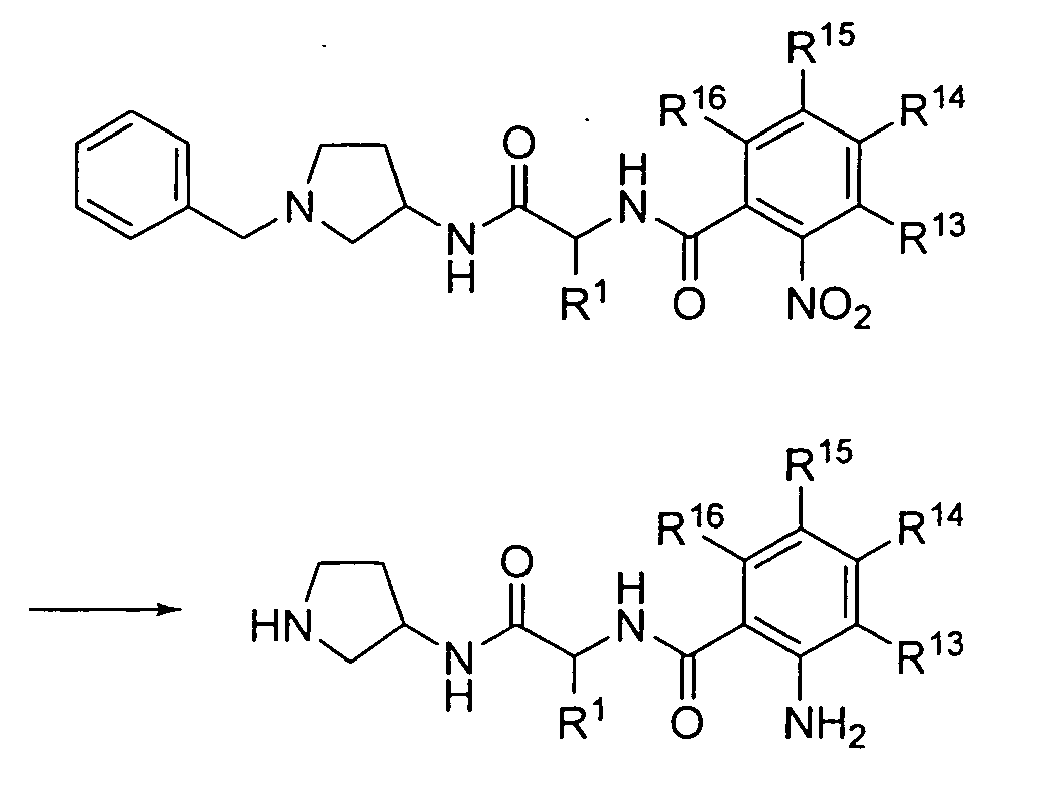
- A production method of an acetamidopyrrolidine derivative or a salt thereof comprising the reaction steps represented by the following formula:

- The production method according to any of claims 1 to 3, wherein R1 is a hydrogen atom.
- The production method according to any of claims 1 to 4, wherein any three of R13, R14, R15 and R16 are hydrogen atoms.
- The production method according to claim 5, wherein R13, R14 and R16 are hydrogen atoms.
- The production method according to claim 6, wherein R15 is a C1-C6 haloalkoxy group.
- The production method according to claim 6, wherein R15 is a trifluoromethoxy group.
- A production method of a benzamidoacetic acid derivative comprising the reaction step represented by the following formula:

- A production method of a benzamidoacetic acid derivative or a salt thereof comprising the reaction step represented by the following formula:

- A production method of a benzamidoacetic acid derivative or a salt thereof wherein a step comprising the reaction step according to claim 9 is performed and subsequently a step comprising the reaction step according to claim 10 is performed.
- The production method according to any of claims 9 to 11, wherein R21 is a methyl group or an ethyl group.
- The production method according to any of claims 9 to 12, wherein R1 is a hydrogen atom.
- The production method according to any of claims 9 to 13, wherein any three of R13, R14, R15 and R16 are hydrogen atoms.
- The production method according to claim 14, wherein R13, R14 and R16 are hydrogen atoms.
- The production method according to claim 15, wherein R15 is a C1-C6 haloalkoxy group.
- The production method according to claim 15, wherein R15 is a trifluoromethoxy group.
- A production method of a 2-nitrobenzoic acid derivative or a salt thereof comprising the reaction step represented by the following formula:

- A production method of a benzamidoacetic acid derivative comprising the reaction steps represented by the following formula:

- A production method of a benzamidoacetic acid derivative or a salt thereof comprising the reaction steps represented by the following formula:

- A production method of an acetamidopyrrolidine derivative or a salt thereof comprising the reaction steps represented by the following formula:

- A production method of an acetamidopyrrolidine derivative or a salt thereof comprising the reaction steps represented by the following formula:

- A compound represented by the following formula or a salt thereof:

- The compound or a salt thereof according to claim 23, wherein R2 is a methyl group, an ethyl group, a benzyl group or a tert-butyl group.
- The compound or a salt thereof according to claim 23, wherein R2 is a hydrogen atom.
- The compound or a salt thereof according to claim 23, wherein R2 is a methyl group or an ethyl group.
- A compound represented by the following formula or a salt thereof:

- The compound or a salt thereof according to any of claims 23 to 27, wherein R1 is a hydrogen atom.
- The compound or a salt thereof according to any of claims 23 to 28, wherein any three of R13, R14, R15 and R16 are hydrogen atoms.
- The compound or a salt thereof according to claim 29, wherein R13, R14 and R16 are hydrogen atoms.
- The compound or a salt thereof according to claim 30, wherein R15 is a C1-C6 haloalkoxy group.
- The compound or a salt thereof according to claim 30, wherein R15 is a trifluoromethoxy group.
Applications Claiming Priority (3)
| Application Number | Priority Date | Filing Date | Title |
|---|---|---|---|
| JP2004175159 | 2004-06-14 | ||
| JP2004175158 | 2004-06-14 | ||
| PCT/JP2005/011187 WO2005121081A1 (en) | 2004-06-14 | 2005-06-13 | Method for producing acetamidopyrrolidine derivative and intermediate compound thereof |
Publications (2)
| Publication Number | Publication Date |
|---|---|
| EP1760075A1 true EP1760075A1 (en) | 2007-03-07 |
| EP1760075A4 EP1760075A4 (en) | 2009-10-28 |
Family
ID=35502991
Family Applications (1)
| Application Number | Title | Priority Date | Filing Date |
|---|---|---|---|
| EP05751221A Withdrawn EP1760075A4 (en) | 2004-06-14 | 2005-06-13 | Method for producing acetamidopyrrolidine derivative and intermediate compound thereof |
Country Status (12)
| Country | Link |
|---|---|
| US (1) | US20070249847A1 (en) |
| EP (1) | EP1760075A4 (en) |
| JP (1) | JPWO2005121081A1 (en) |
| KR (1) | KR20070043770A (en) |
| AU (1) | AU2005252112A1 (en) |
| BR (1) | BRPI0511954A (en) |
| CA (1) | CA2570179A1 (en) |
| IL (1) | IL179724A0 (en) |
| MX (1) | MXPA06014262A (en) |
| SG (1) | SG136139A1 (en) |
| TW (1) | TW200604141A (en) |
| WO (1) | WO2005121081A1 (en) |
Families Citing this family (1)
| Publication number | Priority date | Publication date | Assignee | Title |
|---|---|---|---|---|
| US20090076120A1 (en) * | 2005-04-07 | 2009-03-19 | Teijin Pharma Limited | Crystal of Aminopyrrolidine Derivative and Production Method Thereof |
Family Cites Families (4)
| Publication number | Priority date | Publication date | Assignee | Title |
|---|---|---|---|---|
| PL192083B1 (en) * | 1997-11-18 | 2006-08-31 | Dupont Pharmaceuticals Res Lab | Derivatives of cyclic amines and their application as drugs |
| ES2250132T3 (en) * | 1999-05-18 | 2006-04-16 | Teijin Limited | PREVENTIVE REMEDIES FOR DISEASES ASSOCIATED WITH CHEMIOQUINS. |
| CN1192773C (en) * | 1999-08-04 | 2005-03-16 | 帝人株式会社 | Cyclic amine CCR3 antagonisis |
| US6362177B1 (en) * | 2000-05-16 | 2002-03-26 | Teijin Limited | Cyclic amine derivatives and their use as drugs |
-
2005
- 2005-06-13 WO PCT/JP2005/011187 patent/WO2005121081A1/en not_active Ceased
- 2005-06-13 MX MXPA06014262A patent/MXPA06014262A/en not_active Application Discontinuation
- 2005-06-13 EP EP05751221A patent/EP1760075A4/en not_active Withdrawn
- 2005-06-13 CA CA002570179A patent/CA2570179A1/en not_active Abandoned
- 2005-06-13 US US11/629,131 patent/US20070249847A1/en not_active Abandoned
- 2005-06-13 BR BRPI0511954-5A patent/BRPI0511954A/en not_active IP Right Cessation
- 2005-06-13 SG SG200708458-5A patent/SG136139A1/en unknown
- 2005-06-13 KR KR1020077000183A patent/KR20070043770A/en not_active Withdrawn
- 2005-06-13 JP JP2006514619A patent/JPWO2005121081A1/en not_active Withdrawn
- 2005-06-13 AU AU2005252112A patent/AU2005252112A1/en not_active Abandoned
- 2005-06-14 TW TW094119664A patent/TW200604141A/en unknown
-
2006
- 2006-11-30 IL IL179724A patent/IL179724A0/en unknown
Also Published As
| Publication number | Publication date |
|---|---|
| BRPI0511954A (en) | 2008-01-22 |
| MXPA06014262A (en) | 2007-03-12 |
| CA2570179A1 (en) | 2005-12-22 |
| US20070249847A1 (en) | 2007-10-25 |
| WO2005121081A1 (en) | 2005-12-22 |
| JPWO2005121081A1 (en) | 2008-04-10 |
| EP1760075A4 (en) | 2009-10-28 |
| AU2005252112A1 (en) | 2005-12-22 |
| IL179724A0 (en) | 2007-05-15 |
| KR20070043770A (en) | 2007-04-25 |
| TW200604141A (en) | 2006-02-01 |
| SG136139A1 (en) | 2007-10-29 |
Similar Documents
| Publication | Publication Date | Title |
|---|---|---|
| EP1595870B1 (en) | Process for producing phenylalanine derivative having quinazolinedione skeleton and intermediate for the same | |
| CA2483830A1 (en) | Process for preparing highly functionalized y-butyrolactams and y-amino acids | |
| JP2014523916A (en) | Method for synthesizing N-substituted cyclic alkylene ureas | |
| AU761721B2 (en) | Method for producing enantiomer-free N-methyl-N- ((1S)-1-phenyl- 2-((3S)- 3-hydroxypyrrolidine- 1-yl)ethyl)- 2,2-diphenyl acetamide | |
| EP1603875B1 (en) | New process for preparing 4-aminomethyl-3-alkoxyiminopyrrolidine methanesulfonate | |
| EP1259483B1 (en) | Process for the preparation of beta-alaninamides | |
| US20070249847A1 (en) | Method for Producing Acetamidopyrrolidine Derivatives and Intermediate Compounds Thereof | |
| HK1099006A (en) | Method for producing acetamidopyrrolidine derivative and intermediate compound thereof | |
| JP2025523682A (en) | Method for preparing heterocyclic compounds | |
| JP2010195793A (en) | Method for producing beta-alanine amides | |
| JP4768109B2 (en) | Process for producing 1H-2-substituted-4 (5) -amino-5 (4) -carboxamide-imidazole | |
| EP2240442B1 (en) | Preparation process useful in synthesis of atorvastatin | |
| CN111253369A (en) | Benzene sulfonate, preparation method thereof and application of benzene sulfonate in preparation of dabigatran etexilate | |
| JPS62286964A (en) | Production of oxiracetam | |
| US7473778B2 (en) | 3-(4-piperidinyl)-2,3,4,5-tetrahydro-1,3-benzodiazepin-2(1H)-one | |
| JP5279449B2 (en) | Process for producing 5- {4- [2- (5-ethyl-2-pyridyl) ethoxy] benzyl} -2,4-thiazolidinedione hydrochloride | |
| JP2005112804A (en) | Indolylmethylaminopyrrolidine derivative and method for producing the same derivative | |
| JP2005112787A (en) | Method for producing aminopyrrolidine derivative | |
| KR20250114721A (en) | METHOD FOR PREPARATION of INTERMEDIATE FOR Melanocortin-4 Receptor Agonist PREPARATION | |
| JP3155909B2 (en) | Method for producing 1,3-dialkyl-2-imidazolidinones | |
| CN118027027A (en) | Preparation method of non-neridrone | |
| JPWO2005035493A1 (en) | Process for producing aminopyrrolidine derivative and intermediate compound | |
| JP2005112803A (en) | Method for producing acetoamide pyrrolidine derivative | |
| JP2001302611A (en) | Method for producing 5-trifluoromethyldihydrouracil | |
| HK1092809A (en) | Process for producing aminopyrrolidine derivative and intermediate compound |
Legal Events
| Date | Code | Title | Description |
|---|---|---|---|
| PUAI | Public reference made under article 153(3) epc to a published international application that has entered the european phase |
Free format text: ORIGINAL CODE: 0009012 |
|
| 17P | Request for examination filed |
Effective date: 20061228 |
|
| AK | Designated contracting states |
Kind code of ref document: A1 Designated state(s): AT BE BG CH CY CZ DE DK EE ES FI FR GB GR HU IE IS IT LI LT LU MC NL PL PT RO SE SI SK TR |
|
| REG | Reference to a national code |
Ref country code: HK Ref legal event code: DE Ref document number: 1099006 Country of ref document: HK |
|
| DAX | Request for extension of the european patent (deleted) | ||
| A4 | Supplementary search report drawn up and despatched |
Effective date: 20090928 |
|
| 17Q | First examination report despatched |
Effective date: 20091211 |
|
| STAA | Information on the status of an ep patent application or granted ep patent |
Free format text: STATUS: THE APPLICATION IS DEEMED TO BE WITHDRAWN |
|
| 18D | Application deemed to be withdrawn |
Effective date: 20100422 |
|
| REG | Reference to a national code |
Ref country code: HK Ref legal event code: WD Ref document number: 1099006 Country of ref document: HK |