EP1758285A1 - Method and system for generating sequences with specific characteristics using adaptive genetic algorithm - Google Patents
Method and system for generating sequences with specific characteristics using adaptive genetic algorithm Download PDFInfo
- Publication number
- EP1758285A1 EP1758285A1 EP20060017791 EP06017791A EP1758285A1 EP 1758285 A1 EP1758285 A1 EP 1758285A1 EP 20060017791 EP20060017791 EP 20060017791 EP 06017791 A EP06017791 A EP 06017791A EP 1758285 A1 EP1758285 A1 EP 1758285A1
- Authority
- EP
- European Patent Office
- Prior art keywords
- sequences
- sequence
- generating
- computing
- communication system
- Prior art date
- Legal status (The legal status is an assumption and is not a legal conclusion. Google has not performed a legal analysis and makes no representation as to the accuracy of the status listed.)
- Withdrawn
Links
Images





Classifications
-
- H—ELECTRICITY
- H04—ELECTRIC COMMUNICATION TECHNIQUE
- H04J—MULTIPLEX COMMUNICATION
- H04J13/00—Code division multiplex systems
- H04J13/10—Code generation
Definitions
- the present invention relates to a method and system for generating sequences, especially to a method and system for generating sequences with low autocorrelation function and low sidelobe using adaptive genetic algorithm.
- Sequences such as pseudorandom sequence with specific length are widely used in many science and project fields, such as in the wireless communication, the satellite communication and the optical fiber communication, etc..
- the new generation broadband wireless communication system requires for sequences with high performance so as to satisfy specific needs, for example, sequences with good aperiodic autocorrelation function characteristic and low sidelobe for cell selection, synchronization and channel estimation, etc.
- the first method generates this kind of sequences with exhaustive search.
- the second method generates the sequences with a fixed length (63, 127 etc.) with theory of numbers such as Golay code.
- this method cannot generate sequences of any length with low autocorrelation function and cannot meet the requirements of different wireless communication system designs.
- One purpose of the present invention is to provide a method and system for generating sequences with specific characteristics using adaptive genetic algorithm, so that sequences of different length and different amount and with near theoretical value performance can be generated and as a result, the communication quality is improved.
- the present invention provides a method for generating sequences, wherein the sequences are used in a communication system.
- the method comprises following steps:
- step 3) Another step between the step 3) and step 4) performs crossover over operation on the selected plurality of sequences.
- the specific parameter is relative to the autocorrelation function.
- the adaptive genetic mutation comprises following steps:
- the step 3) may comprise the following steps:
- the sequences are the downlink synchronization sequences in the wireless communication system.
- the sequences are the uplink synchronization sequences in the wireless communication system.
- the present invention also provides a system for designing and generating sequences with specific characteristics, and the system comprises:
- a genetic crossover over operation means exists between the computing means and the genetic adaptive mutation means, for performing the crossover over operation on the selected plurality of sequences and sending the processed sequences to the genetic adaptive mutation means.
- sequences with specific characteristics can be designed. And the present invention is highly adaptive and feasible. Sequences applicable in many fields can be designed through specifying the evaluation indicator function corresponding to the specific characteristic.
- the embodiment of the present invention will be described with reference to the method for generating the binary downlink synchronization sequence in TD-SCDMA.
- the present invention is not limited to this embodiment for one skilled in the art.
- the present invention can generate sequences in other communication system, such as the uplink or downlink synchronization sequence of CDMA2000, WCDMA or WiMax.
- the present invention can generate sequences for other purposes.
- the first step of the mobile station accessing the system is to synchronize with the current optimal cell. This process is implemented through capturing the downlink synchroniztion sequence (SYNC) transmitted by the cell in the downlink pilot slot.
- SYNC downlink synchroniztion sequence
- SYNC is a 64-bit sequence predetermined by the system, and has 32 different SYNC codes.
- the neighbouring cells in the system choose different SYNC sequences and SYNC sequences of the unneighbored cells can be multiplexed.
- the SYNC is sent every 5ms.
- the 32 SYNC sequences are searched one by one (i.e.
- the timing of the downlink of the system can be preliminarily determined according to the time position of the correlated peak.
- Figure 1 is the flow diagram showing the method for generating sequences with specific characteristics according to the embodiment of the present invention, i.e., the flow diagram showing the generation of the SYNC sequence with good correlation characteristics.
- the maximum number of iteration is set and the initial value of the number of iteration is 0.
- the maximum number of iteration can be specifically set according to the storage capacity of the computing equipment and the CPU speed, such as 10,000 times, 100,000 times or more. The higher the iterative number is, the better the characteristics of the computed sequences are. Then, the method proceeds to the following steps:
- FIG. 2 shows an example of randomly generated sequences, in which 10 binary sequences, each with the length of 42, are generated, wherein every sequence is comprised of 0 and 1 (in practice, 0 in the sequence is -1 and 1 is 1, i.e., -1 and 1 comprise the sequences in practical use.) and has a serial number.
- the value of P may be far bigger than 10 in practice and the length of the sequence may be longer than 42, such as of 64, 128, 256 or even longer length at will.
- the value of P can be determined according to conditions, such as, the storage capacity of the computing equipment and the CPU speed, etc..
- the principle is that the bigger the value of P is, the better the result will be.
- the length L of each sequence can be any value.
- the length of each SYNC sequence is 64.
- step S102 the fitness of each sequence is computed and the iteration number is increased by 1.
- the fitness is an evaluation indicator, which can be designated by the user and represents the fitness of each sequence to the specific characteristic. If the user requires for a sequence with a specific characteristic, the corresponding fitness can be designated.
- ⁇ u,u ( ⁇ ) is the autocorrelation function for each sequence
- L is the length of each sequence
- PSL j is the largest sidelobe value of each sequence
- ⁇ is the equilibrium coefficient for balancing the sum of the peak sidelobe with the autocorrelation value.
- the value of ⁇ can be other values according to the specific requirements. Since the formulae of computing the sequence autocorrelation and the peak sidelobe are known to those skilled in the art, they will not be illustrated in detail here.
- the aperiodic autocorrelation function is [4 3 2 1 ].
- step S102 the genetic selection is done in the step S103 to determine the sequence which can evolve to the population of the next generation.
- the sequence with a higher fitness conforms to the environment better.
- a sequence with a good autcorrelation characteristic is needed, i.e., the sequence with a small fitness (j) is needed.
- the sequence is selected in accordance with the practical condition.). According to the Darwin's evolutionism, the sequence has a better chance to exist and be passed down to the next generation.
- the sequences are queued according to the fitness, and the one with the biggest fitness is put on the utmost top and the one with the smallest fitness is put on the utmost bottom.
- Figure 3 describes the detailed strategy, including the following steps:
- the number of the selected sequences in the present embodiment is P also, however, the number doesn't need to be the same with the number of the initial generated sequences and it can be either bigger than P or smaller than P.
- the newly selected population can include a plurality of the same sequences and the sequence with a smaller autocorrelation function will have a better chance to be selected for more times.
- the step S104 will be taken to get the next generation population by performing the genetic crossover over operation.
- the process is performed in the genetic crossover over operation apparatus 93, which randomly selects the individuals in the population to perform the pairwise genetic crossover.
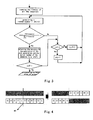
- Figure 4 explains the basic operations of genetic crossover, which intersects the two sequences and separates each individual into two segments at the crossover point; the segments of different individual is combined at the crossover point; the crossover point 401 can be selected randomly.
- the adaptive genetic mutation S105 is taken to determine whether a certain sequence needs to be adaptively mutated. The process is performed in the genetic adaptive mutation means 94.
- a random number r between 0 and 1 is generated during each time of iteration.
- Figure 6 shows the strategy to select the mutated sequences. If the mutated sequences are better, they have better opportunities to be selected but if the mutated sequences are worse, they have worse opportunities to be selected.
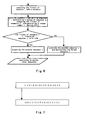
- the mutation operation of the sequence is very simple, i.e. changing the sign of a random bit in the sequence such as changing negative 1 to positive 1 or positive 1 to negative 1.
- Figure 7 shows the mutation operation.
- the mutation point can be selected randomly.
- step 103 in which the sequences can be added to the final sequence set are selected, i.e. the fitness of each sequence is computed, can be performed before the genetic crossover step S104 and also can be performed after the genetic adaptive mutation step S 105, i.e., the sequences selected from the P sequences are added to the final sequence set after the maximum number of iteration.
- the SYNC sequence used in TD-SCDMA is Golay code.
- Figure 8a and figure 8b are the curve diagrams showing the aperiodic autocorrelation function of SYNC and Golay code respectively according the embodiment of the present invention, wherein the ordinate represents the normalized value of the aperiodic autocorrelation function and the abscissa represents the off-peak autocorrelation index.
- the system 90 has generating means 91, which is used to generate at least one random sequence such as P sequences; computing means 92, which is used to compute the fitness of sequences according to the designated evaluation indicator corresponding to the specific characteristic; and selecting means 95, which is used to select the specific sequences among the sequences in accordance with the requirements of the user.
- the selecting means 95 can select the specific sequences among the sequences according to the fitness of each sequence or according to the specific characteristic of each sequence (evaluation indicator for the fitness).
- the system 90 may also have genetic crossover means 93, adaptive genetic mutation means 94, which are used to perform genetic crossover and adaptive mutation on the sequences according to the fitness computed by the computing means 92; the system 90 may also have repetition control means 96, which is used to control the repetition times of the processes from the computing means and the genetic crossover means to the genetic adaptive mutation means and to send the sequences obtained after cycling to the selecting means 95.
- sequences pass the computing means 92, the genetic crossover means 93 and the genetic mutation means 94 for several times and finally the selecting means 95 determines the output sequences.
Landscapes
- Engineering & Computer Science (AREA)
- Computer Networks & Wireless Communication (AREA)
- Signal Processing (AREA)
- Mobile Radio Communication Systems (AREA)
Abstract
Description
- The present invention relates to a method and system for generating sequences, especially to a method and system for generating sequences with low autocorrelation function and low sidelobe using adaptive genetic algorithm.
- Sequences such as pseudorandom sequence with specific length are widely used in many science and project fields, such as in the wireless communication, the satellite communication and the optical fiber communication, etc..
- Since the frequency of the digital baseband signal is high, the new generation broadband wireless communication system requires for sequences with high performance so as to satisfy specific needs, for example, sequences with good aperiodic autocorrelation function characteristic and low sidelobe for cell selection, synchronization and channel estimation, etc.
- Currently, two types of methods are available to design sequences with specific characteristics. The first method generates this kind of sequences with exhaustive search. However, generally the length of this kind of sequences is comparatively short, since for a sequence with the length L, there are 2 L probabilities. Accordingly, for a sequence with L=64, the number of probabilities is 264 = 1.8447e+019, which is far beyond the current computing capability, while generally the sequence length of the new generation broadband wireless communication system is more than 64.
- The second method generates the sequences with a fixed length (63, 127 etc.) with theory of numbers such as Golay code. However, this method cannot generate sequences of any length with low autocorrelation function and cannot meet the requirements of different wireless communication system designs.
- Currently (even in the foreseeable future), it is impossible to generate a 128-bit downlink synchronization sequence used in Wimax with exhaustive search.
- Therefore, a method and system that can overcome the above disadvantages and generate sequences with specific characteristics is needed.
- One purpose of the present invention is to provide a method and system for generating sequences with specific characteristics using adaptive genetic algorithm, so that sequences of different length and different amount and with near theoretical value performance can be generated and as a result, the communication quality is improved.
- Therefore, the present invention provides a method for generating sequences, wherein the sequences are used in a communication system. The method comprises following steps:
- 1) generating a plurality of sequences with a predetermined length randomly;
- 2) computing a specific parameter value of each sequence;
- 3) selecting a plurality of sequences whose computed specific parameter value accords with a certain condition;
- 4) mutating the selected sequences with an adaptive genetic algorithm and adaptively selecting the sequences with the mutated and optimized specific parameter value according to the probability;
- 5) repeating setp 2) to step 4) until a predetermined number of times and selecting the sequences with the optimal specific parameter value among the final sequences as output sequences.
- Another step between the step 3) and step 4) performs crossover over operation on the selected plurality of sequences.
- The specific parameter is relative to the autocorrelation function.
- The specific parameter is the fitness and its computation formula is:


wherein θ u,u (τ) is the autocorrelation function of each sequence, j is the serial number of the sequence, P is the whole number of the sequences, L is the length of each sequence, PSLj is the peak sidelobe value of each sequence and β is the equilibrium coefficient for balancing the sum of the peak sidelobe with the autocorrelation value. - The adaptive genetic mutation comprises following steps:
- a) computing the fitness of a sequence j before mutation;
- b) mutating the sequence j and getting a sequence j' while maintaining a backup of the sequence j, computing the fitness of the sequence j' and generating a random number r, wherein 0<r<1;
- c) determining whether the fitness of the sequence j' is less than that of the sequence j, with r> P
a ; - d) if yes, accepting the mutated sequence j'; if no, rejecting the mutated sequence j' and maintaining the former sequence j;
- e) repeating steps a) to d) and continuing to mutate other sequences;
- The step 3) may comprise the following steps:
- I) generating a random number r, and setting the initial numbers of integers a and j as 0, wherein 0<r<1;
- II) computing

- III) determining whether the current serial number a is bigger than or equal to P-1, if yes, proceeding to step 4); if no, determining the current value of j, if j<P-1, computing j=j+1; if j is equal to or bigger than P-1, computing j=j-P+1; and then returning to step I).
- The sequences are the downlink synchronization sequences in the wireless communication system.
- The sequences are the uplink synchronization sequences in the wireless communication system.
- The present invention also provides a system for designing and generating sequences with specific characteristics, and the system comprises:
- generating means for generating a plurality of sequences with a predetermined length randomly;
- computing means for computing a specific parameter value of each sequence and selecting a plurality of sequences whose computed specific parameter value accords with a certain condition;
- genetic adaptive mutation means for performing adaptive genetic mutation on sequences and adaptively selecting sequences with the mutated and optimized specific parameter value according to the probability;
- cyclic control means for controlling the number of cycle times of process from the computing means to the genetic adaptive mutation means; and
- selecting means for selecting the sequences with the optimal specific parameter value among the final sequences as the output sequences.
- A genetic crossover over operation means exists between the computing means and the genetic adaptive mutation means, for performing the crossover over operation on the selected plurality of sequences and sending the processed sequences to the genetic adaptive mutation means.
- According to the present invention, sequences with specific characteristics can be designed. And the present invention is highly adaptive and feasible. Sequences applicable in many fields can be designed through specifying the evaluation indicator function corresponding to the specific characteristic.
- The preferable embodiment of the present invention will be described with reference to the drawings. And the other features, purposes and effects of the present invention will become apparent.
- The preferable embodiment of the present invention will be described with reference to the drawings, wherein:
- Figure 1 is the overall flow diagram showing the method for generating sequences with specific characteristics according to the present invention;
- Figure 2 is the schematic diagram showing the random generated sequences;
- Figure 3 is the schematic diagram showing the genetic selection operation of the sequences;
- Figure 4 is the schematic diagram showing the genetic crossover over operation operation of the sequences;
- Figure 5 is the schematic diagram showing the adaptive mutation operation of the sequences;
- Figure 6 is the schematic diagram showing the operation of whether adopting the mutated sequences;
- Figure 7 is the schematic diagram showing the mutation operation of the sequences.
- Figure 8a is the curve diagram showing the aperiodic autocorrelation function of Golay code in prior art.
- Figure 8b is the curve diagram showing the aperiodic autocorrelation function of SYNC according to the present invention;
- Figure 9 is the block diagram showing the system for generating sequences with specific characteristics according to the present invention.
- The same reference sign represents the same, similar of corresponding features or functions in the above drawings.
- The present invention will be further described with reference to the drawings.
- The embodiment of the present invention will be described with reference to the method for generating the binary downlink synchronization sequence in TD-SCDMA. Of course, the present invention is not limited to this embodiment for one skilled in the art. The present invention can generate sequences in other communication system, such as the uplink or downlink synchronization sequence of CDMA2000, WCDMA or WiMax. Of course, the present invention can generate sequences for other purposes.
- The first step of the mobile station accessing the system is to synchronize with the current optimal cell. This process is implemented through capturing the downlink synchroniztion sequence (SYNC) transmitted by the cell in the downlink pilot slot. In the TD-SCDMA system, SYNC is a 64-bit sequence predetermined by the system, and has 32 different SYNC codes. The neighbouring cells in the system choose different SYNC sequences and SYNC sequences of the unneighbored cells can be multiplexed. According to the architecture of the TD-SCDMA wireless frame, the SYNC is sent every 5ms. When the mobile station accesses the system, the 32 SYNC sequences are searched one by one (i.e. correlating the received signals with the 32 probable SYNC sequences code by code), and the sequence with the largest correlation peak is regarded as the SYNC used in the current cell. At the same time, the timing of the downlink of the system can be preliminarily determined according to the time position of the correlated peak.
- Figure 1 is the flow diagram showing the method for generating sequences with specific characteristics according to the embodiment of the present invention, i.e., the flow diagram showing the generation of the SYNC sequence with good correlation characteristics.
- Firstly, the maximum number of iteration is set and the initial value of the number of iteration is 0. The maximum number of iteration can be specifically set according to the storage capacity of the computing equipment and the CPU speed, such as 10,000 times, 100,000 times or more. The higher the iterative number is, the better the characteristics of the computed sequences are. Then, the method proceeds to the following steps:
- In the step S101, P sequences are generated randomly. Figure 2 shows an example of randomly generated sequences, in which 10 binary sequences, each with the length of 42, are generated, wherein every sequence is comprised of 0 and 1 (in practice, 0 in the sequence is -1 and 1 is 1, i.e., -1 and 1 comprise the sequences in practical use.) and has a serial number. Of course, the value of P may be far bigger than 10 in practice and the length of the sequence may be longer than 42, such as of 64, 128, 256 or even longer length at will.
- The value of P can be determined according to conditions, such as, the storage capacity of the computing equipment and the CPU speed, etc.. The principle is that the bigger the value of P is, the better the result will be. However, when P exceeds a certain value, the improvement of the result will be limited. In the embodiment of the present invention, P=500.
- In addition, the length L of each sequence can be any value. In the embodiment of the present invention, the length of each SYNC sequence is 64.
- In the step S102, the fitness of each sequence is computed and the iteration number is increased by 1.
- The fitness is an evaluation indicator, which can be designated by the user and represents the fitness of each sequence to the specific characteristic. If the user requires for a sequence with a specific characteristic, the corresponding fitness can be designated.
- In the embodiment of the present invention, the evaluation indicator for the fitness adopted by each sequence is:


- Wherein θu,u (τ) is the autocorrelation function for each sequence, L is the length of each sequence, and PSLj is the largest sidelobe value of each sequence, and β is the equilibrium coefficient for balancing the sum of the peak sidelobe with the autocorrelation value. The β is related with the length of the sequence and in the embodiment of the present invention, β is

- The formula for computing the fitness of the sequence has been provided above and the computation of a sequence with the length of 5 bits is explained as the following:
- The sequence code is [11111]
- The computation of its aperiodic autocorrelation function is:
- with one bit shifted:

- with two bits shifted:

- with three bits shifted:


- with three bits shifted:

- with one bit shifted:
- By analogy, the aperiodic autocorrelation function is [4 3 2 1 ].
- The peak sidelobe PSL=4, assuming β=1.
- And the adaptive function

- Obviously, the less the fitness (j) is, the better the autocorrelation characteristic of the sequence is. Therefore, in the embodiment of the present invention, the less the fitness (j) is, the better the characteristic of the sequence is.
- After the step S102, the genetic selection is done in the step S103 to determine the sequence which can evolve to the population of the next generation.
- As described above, since the fitness indicates the degree of adaptiveness of a sequence to the environment, i.e., the degree of satisfying the users' need, the sequence with a higher fitness conforms to the environment better. In the present embodiment, a sequence with a good autcorrelation characteristic is needed, i.e., the sequence with a small fitness (j) is needed. The smaller the autocorrelation function is, the better it can be adaptive to the environment, i.e., the fitness is bigger (If a sequence with a bad autocorrelation characteristic is needed, it will be better to choose one with a big fitness. The sequence is selected in accordance with the practical condition.). According to the Darwin's evolutionism, the sequence has a better chance to exist and be passed down to the next generation. According to the embodiment of the present invention, the sequences are queued according to the fitness, and the one with the biggest fitness is put on the utmost top and the one with the smallest fitness is put on the utmost bottom. Figure 3 describes the detailed strategy, including the following steps:
- 1) Summing the fitness of all the sequences in the population to be selected (the population to be selected is the one created last time and the original population to be selected in the one comprised by the initially generated P sequences), i.e., computing the value of

- 2) Generating a random number r, wherein 0<r<1;
- 3) Computing

P+ 1 if j is equal to or bigger than P-1, and then returning to step 2); and thus the sequence in the next operation becoming the next sequence and operating each sequence with this cycle order; - 4) Determining whether the current serial number a is bigger than or equal to P-1, if yes, proceeding to step S104 for genetic crossover over operation; if no, determining the current value of j, computing j=j+1 if j<P-1 and computing j=j-
P+ 1 if j is equal to or bigger than P-1, and then returning to step 2). - In the present invention, the smaller the autocorrelation function is (the smaller the fitness is in formula (1)), the better chance the sequence will be selected, which fully reflects the basic idea of "survival of the fittest" of the evolutionism. The number of the selected sequences in the present embodiment is P also, however, the number doesn't need to be the same with the number of the initial generated sequences and it can be either bigger than P or smaller than P. The newly selected population can include a plurality of the same sequences and the sequence with a smaller autocorrelation function will have a better chance to be selected for more times.
- After the fitness of each sequence in the selected population is obtained according to the embodiment of the present invention, the step S104 will be taken to get the next generation population by performing the genetic crossover over operation. The process is performed in the genetic crossover over
operation apparatus 93, which randomly selects the individuals in the population to perform the pairwise genetic crossover. Figure 4 explains the basic operations of genetic crossover, which intersects the two sequences and separates each individual into two segments at the crossover point; the segments of different individual is combined at the crossover point; thecrossover point 401 can be selected randomly. - Then, the adaptive genetic mutation S105 is taken to determine whether a certain sequence needs to be adaptively mutated. The process is performed in the genetic adaptive mutation means 94.
- In the embodiment of the present invention, for every sequence, a random number r between 0 and 1 is generated during each time of iteration. The following formula is used to determine whether a sequence needs to be mutated.

- The meaning of the symbols in the formula is the same as those described above. When the above formula (2) is satisfied, the fitness (j) of the sequence is comparatively high, i.e., the autocorrelation function is comparatively big and since the sequence with a comparatively low autocorrelation function is needed, the sequence should be mutated; however, when the above formula (2) is not satisfied, the fitness (j) of the sequence is comparatively small, i.e., the autocorrelation function is comparatively small so the sequence has a comparatively good characteristic and need not be mutated. Figure 5 explains the above process in detail and the steps are as following:
- 1) Setting the initial value of the serial number j to 0;
- 2) Generating a random number r, wherein 0<r<1;
- 3) Determining whether the result of

is bigger than r; - 4) If the result is bigger than r, mutating the sequence and computing j=j+1 with the serial number unchanged; proceeding to step 5); if the result is smaller than r, computing j=j+1 and returning to step 2);
- 5) Determining whether j is bigger than P-1;
- 6) If j is bigger than P-1, proceeding to step 7); if j is equal to or smaller than P-1, returning to step 2);
- 7) Determining whether the iterative times has reached the maximum number, if not, returning to step S102; if yes, selecting in the selecting
means 95. The selection includes the following process:- (1) Computing the fitness of all the sequences in the population obtained after the selection of maximum iterative times, genetic crossover and adaptive mutation;
- (2) Comparing the values of the fitness of all the sequences and selecting the sequence with the smallest fitness as the output sequence (If there are more than one sequence with the smallest fitness, selecting one randomly as the output sequence.); and then the flow of generating the sequence ended.
- It is necessary to select in the mutated sequences since mutation may bring better sequences and also may bring worse ones. Figure 6 shows the strategy to select the mutated sequences. If the mutated sequences are better, they have better opportunities to be selected but if the mutated sequences are worse, they have worse opportunities to be selected. Pa is a fixed value set according to the requirement, which represents the probability of changing mutation and Pa = 0.1 in the present invention. The strategy to select is as follows:
- 1) Computing the fitness of the sequence j before mutation;
- 2) Mutating the sequence j and getting sequence j' while maintaining a backup of sequence j, computing the fitness of the sequence j' and generating a random number r, wherein 0<r<1;
- 3) Determining whether the fitness of the sequence j' is less than that of the sequence j, with r> Pa ;
- 4) If yes, accepting the mutated sequence j'; if no, rejecting the mutated sequence j' and maintaining the former sequence j;
- 5) Continuing to mutate other sequences.
- In the embodiment of the present invention, the mutation operation of the sequence is very simple, i.e. changing the sign of a random bit in the sequence such as changing negative 1 to positive 1 or positive 1 to negative 1. Figure 7 shows the mutation operation. The mutation point can be selected randomly.
- Those skilled in the art will find the
step 103, in which the sequences can be added to the final sequence set are selected, i.e. the fitness of each sequence is computed, can be performed before the genetic crossover step S104 and also can be performed after the genetic adaptive mutation step S 105, i.e., the sequences selected from the P sequences are added to the final sequence set after the maximum number of iteration. - Those skilled in the art will also find the sequences with less fitness can be added to the final sequence set according the fitness of each sequence without the above condition for adding it to the final sequence set.
- Those skilled in the art will also find different mutation probabilities, mutation methods and mutation strategies of sequences can be selected according to the practical situation.
- Currently, the SYNC sequence used in TD-SCDMA is Golay code.
- Figure 8a and figure 8b are the curve diagrams showing the aperiodic autocorrelation function of SYNC and Golay code respectively according the embodiment of the present invention, wherein the ordinate represents the normalized value of the aperiodic autocorrelation function and the abscissa represents the off-peak autocorrelation index. Figure 8a shows the maximum normalized value of the autocorrelation function of Golay code is 0.0158 (reference sign 801) and the corresponding gain is -18.0610dB; figure 8b shows the maximum normalized value of the autocorrelation function of SYNC is 0.0088 (reference sign 802) according to the embodiment of the present invention and the corresponding gain is -20.5606 dB, so the difference between the peak sidelobe values of SYNC and Golay code in the present invention (i.e. the relative gain according to the embodiment of the present invention) is (-18.0610)-(-20.5606)=2.4996dB.
- As shown in Figure 9, the
system 90 has generating means 91, which is used to generate at least one random sequence such as P sequences; computing means 92, which is used to compute the fitness of sequences according to the designated evaluation indicator corresponding to the specific characteristic; and selectingmeans 95, which is used to select the specific sequences among the sequences in accordance with the requirements of the user. The selecting means 95 can select the specific sequences among the sequences according to the fitness of each sequence or according to the specific characteristic of each sequence (evaluation indicator for the fitness). - The
system 90 may also have genetic crossover means 93, adaptive genetic mutation means 94, which are used to perform genetic crossover and adaptive mutation on the sequences according to the fitness computed by the computing means 92; thesystem 90 may also have repetition control means 96, which is used to control the repetition times of the processes from the computing means and the genetic crossover means to the genetic adaptive mutation means and to send the sequences obtained after cycling to the selectingmeans 95. - In figure 9, sequences pass the computing means 92, the genetic crossover means 93 and the genetic mutation means 94 for several times and finally the selecting
means 95 determines the output sequences. - The above is only the preferred embodiment of the present invention. It should be noted that those skilled in the art might make improvements and modifications. It is intended that the invention be construed as including all such improvements and modifications insofar they come within the scope of the appended claims or the equivalents thereof.
Claims (31)
- A method for generating sequences, wherein the sequences are used in a communication system and the method comprises following steps:1) generating a plurality of sequences with a predetermined length randomly;2) computing a specific parameter value of each sequence;3) selecting a plurality of sequences whose computed specific parameter value accords with a certain condition;4) mutating the selected sequences with an adaptive genetic algorithm and adaptively selecting the sequences with the mutated and optimized specific parameter value according to the probability;5) repeating setp 2) to step 4) until a predetermined number of times and selecting the sequences with the optimal specific parameter value among the final sequences as output sequences.
- The method for generating sequences as defined in claim 1, wherein, between the step 3) and 4), crossover over operation on the selected plurality of sequences is performed.
- The method for generating sequences as defined in claim 1, wherein, the specific parameter is relative to the autocorrelation function.
- The method for generating sequences as defined in claim 2, wherein, the specific parameter is relative to the autocorrelation function.
- The method for generating sequences as defined in any one of claims 1-3, wherein, the specific parameter is the fitness and its computation formula is:


wherein θu,u (τ) is the autocorrelation function of each sequence, j is the serial number of the sequence, P is the size of the sequences, L is the length of each sequence, PSLj is the peak sidelobe value of each sequence and β is the equilibrium coefficient for balancing the peak sidelobe with the sum of the autocorrelation value. - The method for generating sequences as defined in any one of claims 1-3, wherein, the adaptive genetic mutation step comprises following steps:a) computing the fitness of a sequence j before mutation;b) mutating the sequence j and getting a sequence j' while maintaining a backup of the sequence j, computing the fitness of the sequence j' and generating a random number r, wherein 0<r<1;c) determining whether the fitness of the sequence j' is less than that of the sequence j, with r>Pa ;d) if yes, accepting the mutated sequence j'; if no, rejecting the mutated sequence j' and maintaining the former sequence j;e) repeating steps a) to d) and continuing to mutate other sequences;wherein j is the serial number of the sequence, Pa is a predetermined value.
- The method for generating sequences as defined in claim 5, wherein, the adaptive genetic mutation includes the following steps:a) computing the fitness of a sequence j before mutation;b) mutating the sequence j and getting a sequence j' while maintaining a backup of the sequence j, computing the fitness of the sequence j' and generating a random number r, wherein O<r<1;c) determining whether the fitness of the sequence j' is less than that of the sequence j, with r>Pa ;d) if yes, accepting the mutated sequence j'; if no, rejecting the mutated sequence j' and maintaining the former sequence j;e) repeating steps a) to d) and continuing to mutate other sequences;wherein j is the serial number of the sequence, Pa is a predetermined value.
- The method for generating sequences as defined in claim 5 or 7, wherein, the step 3) may include the following steps:I) generating a random number r, and setting the initial numbers of integers a and j as 0, wherein 0<r<1;II) computing
 III) determining whether the current serial number a is bigger than or equal to P-1, if yes, proceeding to step 4); if no, determining the current value of j, if j<P-1, computing j=j+1; if j is equal to or bigger than P-1, computing j=j-P+1; and then returning to step I).
 - The method for generating sequences as defined in claim 2, wherein, the crossover point of the crossover over operation is selected randomly.
- The method for generating sequences as defined in any one of claims 1-4, wherein, the sequences are downlink synchronization sequences in the wireless communication system.
- The method for generating sequences as defined in claim 5, wherein, the sequences are downlink synchronization sequences in the wireless communication system.
- The method for generating sequences as defined in claim 6, wherein, the sequences are downlink synchronization sequences in the wireless communication system.
- The method for generating sequences as defined in claim 7, wherein, the sequences are downlink synchronization sequences in the wireless communication system.
- The method for generating sequences as defined in claim 8, wherein, the sequences are the downlink synchronization sequences in the wireless communication system.
- The method for generating sequences as defined in any one from claim 1 to claim 4, wherein, the sequences are the uplink synchronization sequences in the wireless communication system.
- The method for generating sequences as defined in claim 5, wherein, the sequences are the uplink synchronization sequences in the wireless communication system.
- The method for generating sequences as defined in claim 6, wherein, the sequences are the uplink synchronization sequences in the wireless communication system.
- The method for generating sequences as defined in claim 7, wherein, the sequences are the uplink synchronization sequences in the wireless communication system.
- The method for generating sequences as defined in claim 8, wherein, the sequences are the uplink synchronization sequences in the wireless communication system.
- An apparatus for generating sequences, wherein the sequences are used in the communication system and the apparatus comprises:generating means for generating a plurality of sequences with a predetermined length randomly;computing means for computing a specific parameter value of each sequence and selecting a plurality of sequences whose computed specific parameter value accords with a certain condition;genetic adaptive mutation means for performing adaptive genetic mutation on sequences and adaptively selecting sequences with the mutated and optimized specific parameter value according to the probability;cyclic control means for controlling the number of cycle times of process from the computing means to the genetic adaptive mutation means;selecting means for selecting the sequences with the optimal specific parameter value among the final sequences as the output sequences.
- The apparatus for generating sequences as defined in claim 20, further comprising genetic crossover over operation means which exists between the computing means and the genetic adaptive mutation means, for performing crossover over operation on the selected plurality of sequences and sending the processed sequences to the genetic adaptive mutation means.
- The apparatus for generating sequences as defined in claim 20, wherein, the specific parameter is relative to the autocorrelation function.
- The apparatus for generating sequences as defined in claim 21, wherein, the specific parameter is relative to the autocorrelation function.
- The apparatus for generating sequences as defined in any one of claims 20-22, wherein, the specific parameter is the fitness and its computation formula is:


wherein θu,u (τ) is the autocorrelation function of each sequence, j is the serial number of the sequence, P is the whole number of the sequences, L is the length of each sequence, PSLj is the peak sidelobe value of each sequence and β is the equilibrium coefficient for balancing the sum of the peak sidelobe with the autocorrelation value. - The apparatus for generating sequences as defined in claim 21, wherein, the crossover point of the crossover over operation is selected randomly.
- The apparatus for generating sequences as defined in any one of claims 20-23, wherein, the sequences are the downlink synchronization sequences in the wireless communication system.
- The apparatus for generating sequences as defined in claim 24, wherein, the sequences are the downlink synchronization sequences in the wireless communication system.
- The apparatus for generating sequences as defined in claim 25, wherein, the sequences are the downlink synchronization sequences in the wireless communication system.
- The apparatus for generating sequences as defined in any one of claims 20-23, wherein, the sequences are the uplink synchronization sequences in the wireless communication system.
- The apparatus for generating sequences as defined in claim 24, wherein, the sequences are the uplink synchronization sequences in the wireless communication system.
- The apparatus for generating sequences as defined in claim 25, wherein, the sequences are the uplink synchronization sequences in the wireless communication system.
Applications Claiming Priority (1)
| Application Number | Priority Date | Filing Date | Title |
|---|---|---|---|
| CNA200510093526XA CN1921347A (en) | 2005-08-26 | 2005-08-26 | Method and system for forming sequence with special property using self-adaptive genetic algorithm |
Publications (1)
| Publication Number | Publication Date |
|---|---|
| EP1758285A1 true EP1758285A1 (en) | 2007-02-28 |
Family
ID=37442048
Family Applications (1)
| Application Number | Title | Priority Date | Filing Date |
|---|---|---|---|
| EP20060017791 Withdrawn EP1758285A1 (en) | 2005-08-26 | 2006-08-25 | Method and system for generating sequences with specific characteristics using adaptive genetic algorithm |
Country Status (3)
| Country | Link |
|---|---|
| EP (1) | EP1758285A1 (en) |
| JP (1) | JP2007068174A (en) |
| CN (1) | CN1921347A (en) |
Cited By (1)
| Publication number | Priority date | Publication date | Assignee | Title |
|---|---|---|---|---|
| CN112749776A (en) * | 2021-01-12 | 2021-05-04 | 南京信息工程大学 | Job shop scheduling method based on improved hybrid genetic algorithm |
Families Citing this family (2)
| Publication number | Priority date | Publication date | Assignee | Title |
|---|---|---|---|---|
| CN106127249B (en) * | 2016-06-24 | 2020-05-01 | 深圳市颐通科技有限公司 | An online detection method for abnormal subsequences in ECG data |
| CN119449142B (en) * | 2024-10-31 | 2026-04-07 | 华中科技大学 | A method for integrated signal generation and analysis in low-Earth orbit satellite communication ranging |
Citations (1)
| Publication number | Priority date | Publication date | Assignee | Title |
|---|---|---|---|---|
| US5963584A (en) * | 1996-11-29 | 1999-10-05 | Commissariat A L'energie Atomique | Direct sequence spread spectrum transmission process, with generation and optimization of sequences |
Family Cites Families (5)
| Publication number | Priority date | Publication date | Assignee | Title |
|---|---|---|---|---|
| JPH07269926A (en) * | 1994-02-14 | 1995-10-20 | Daikin Ind Ltd | Control device for air conditioner |
| JPH10207857A (en) * | 1997-01-20 | 1998-08-07 | Fujitsu Ltd | Time series prediction device |
| JP2000059263A (en) * | 1998-08-05 | 2000-02-25 | Mitsubishi Heavy Ind Ltd | Communications system |
| JP2001285923A (en) * | 2000-03-31 | 2001-10-12 | Mitsubishi Electric Corp | Base station layout pattern determination method |
| JP3697548B2 (en) * | 2002-04-23 | 2005-09-21 | 防衛庁技術研究本部長 | Two-phase code generation method with high autocorrelation |
-
2005
- 2005-08-26 CN CNA200510093526XA patent/CN1921347A/en active Pending
-
2006
- 2006-08-25 EP EP20060017791 patent/EP1758285A1/en not_active Withdrawn
- 2006-08-28 JP JP2006230445A patent/JP2007068174A/en active Pending
Patent Citations (1)
| Publication number | Priority date | Publication date | Assignee | Title |
|---|---|---|---|---|
| US5963584A (en) * | 1996-11-29 | 1999-10-05 | Commissariat A L'energie Atomique | Direct sequence spread spectrum transmission process, with generation and optimization of sequences |
Non-Patent Citations (3)
| Title |
|---|
| EL-KHAMY S E ET AL: "Optimization of chaotic spreading codes for asynchronous DS-CDMA applications using genetic algorithms", RADIO SCIENCE CONFERENCE, 2005. NRSC 2005. PROCEEDINGS OF THE TWENTY-SECOND NATIONAL CAIRO, EGYPT MARCH 15-17, 2005, PISCATAWAY, NJ, USA,IEEE, 15 March 2005 (2005-03-15), pages 205 - 216, XP010833688, ISBN: 977-503183-4 * |
| NATARAJAN B ET AL: "Design of optimal complex spreading codes for DS-CDMA using an evolutionary approach", GLOBAL TELECOMMUNICATIONS CONFERENCE, 2004. GLOBECOM '04. IEEE DALLAS, TX, USA 29 NOV.-3 DEC., 2004, PISCATAWAY, NJ, USA,IEEE, vol. 6, 29 November 2004 (2004-11-29), pages 3882 - 3886, XP010758463, ISBN: 0-7803-8794-5 * |
| PIRLOT M: "GENERAL LOCAL SEARCH METHODS", EUROPEAN JOURNAL OF OPERATIONAL RESEARCH, AMSTERDAM, NL, vol. 92, no. 3, 9 August 1996 (1996-08-09), pages 493 - 511, XP002038263, ISSN: 0377-2217 * |
Cited By (2)
| Publication number | Priority date | Publication date | Assignee | Title |
|---|---|---|---|---|
| CN112749776A (en) * | 2021-01-12 | 2021-05-04 | 南京信息工程大学 | Job shop scheduling method based on improved hybrid genetic algorithm |
| CN112749776B (en) * | 2021-01-12 | 2023-08-15 | 南京信息工程大学 | Job shop scheduling method based on improved hybrid genetic algorithm |
Also Published As
| Publication number | Publication date |
|---|---|
| CN1921347A (en) | 2007-02-28 |
| JP2007068174A (en) | 2007-03-15 |
Similar Documents
| Publication | Publication Date | Title |
|---|---|---|
| US11211947B2 (en) | Polar code encoding method and apparatus, polar code decoding method and apparatus, and device | |
| US11005504B2 (en) | Polar code rate matching method and apparatus | |
| US8958462B2 (en) | Zero correlation zone sequences for communication system | |
| US20170257245A1 (en) | Receiver, frame synchronization method, transmitter, transmission method, and program | |
| CN106506052A (en) | A kind of method for improving communication efficiency based on day line options in extensive mimo system | |
| JP2000031870A (en) | Cellular communication signal receiver | |
| CN101313494B (en) | Radio network design apparatus and method | |
| CN1325243A (en) | Space multi-way radio communication method and radio communication device | |
| EP3535859B1 (en) | Mechanism for switching between uplink and downlink training in hybrid beamforming systems | |
| EP2624479A1 (en) | Preamble sequence detection apparatus | |
| EP1871063A2 (en) | Data transmission with trellis coding | |
| CN1086087C (en) | Receiving method and receiver | |
| CN110858773B (en) | Wireless communication device and method performed by same, computer-readable medium | |
| US8787510B2 (en) | Channel selection exploiting multiple observations of the channel delay spread | |
| US7366229B2 (en) | Method for generating a preamble sequence group | |
| US20070106480A1 (en) | Method and system for generating sequences with specific characteristics using adaptive genetic algorithm | |
| CN115426007B (en) | An Intelligent Beam Alignment Method Based on Deep Convolutional Neural Network | |
| US6567466B1 (en) | Method and apparatus for determining the data rate of a received signal in a variable data rate orthogonal spread spectrum communication system | |
| CN1294805A (en) | Method for digital equalisation, and radio communication receiver implementing said method | |
| CN100423467C (en) | Method and device for reducing the number of bits per soft bit and system thereof | |
| EP1883176A1 (en) | A direction of arrival estimation method for terminals of the same frequency cells | |
| CN111092643B (en) | Delay CSIT interference alignment method under MISO-BC by utilizing cache | |
| CN102315901A (en) | Method and device for determining discontinuous transmission (DTX) | |
| JP4993221B2 (en) | Apparatus and method for selecting TFC in mobile communication system and program thereof | |
| CN114513280A (en) | Polarization coding method and device |
Legal Events
| Date | Code | Title | Description |
|---|---|---|---|
| PUAI | Public reference made under article 153(3) epc to a published international application that has entered the european phase |
Free format text: ORIGINAL CODE: 0009012 |
|
| AK | Designated contracting states |
Kind code of ref document: A1 Designated state(s): AT BE BG CH CY CZ DE DK EE ES FI FR GB GR HU IE IS IT LI LT LU LV MC NL PL PT RO SE SI SK TR |
|
| AX | Request for extension of the european patent |
Extension state: AL BA HR MK YU |
|
| 17P | Request for examination filed |
Effective date: 20070821 |
|
| AKX | Designation fees paid |
Designated state(s): DE GB |
|
| 17Q | First examination report despatched |
Effective date: 20071025 |
|
| STAA | Information on the status of an ep patent application or granted ep patent |
Free format text: STATUS: THE APPLICATION IS DEEMED TO BE WITHDRAWN |
|
| 18D | Application deemed to be withdrawn |
Effective date: 20110208 |