EP1757663A2 - Functionalized alumina particles for polymer composites - Google Patents
Functionalized alumina particles for polymer composites Download PDFInfo
- Publication number
- EP1757663A2 EP1757663A2 EP06017668A EP06017668A EP1757663A2 EP 1757663 A2 EP1757663 A2 EP 1757663A2 EP 06017668 A EP06017668 A EP 06017668A EP 06017668 A EP06017668 A EP 06017668A EP 1757663 A2 EP1757663 A2 EP 1757663A2
- Authority
- EP
- European Patent Office
- Prior art keywords
- particles
- group
- acid
- composition
- alumina particles
- Prior art date
- Legal status (The legal status is an assumption and is not a legal conclusion. Google has not performed a legal analysis and makes no representation as to the accuracy of the status listed.)
- Withdrawn
Links
- 239000002245 particle Substances 0.000 title claims abstract description 110
- PNEYBMLMFCGWSK-UHFFFAOYSA-N aluminium oxide Inorganic materials [O-2].[O-2].[O-2].[Al+3].[Al+3] PNEYBMLMFCGWSK-UHFFFAOYSA-N 0.000 title claims abstract description 41
- 239000002131 composite material Substances 0.000 title claims abstract description 19
- 229920000642 polymer Polymers 0.000 title abstract description 34
- 239000000203 mixture Substances 0.000 claims abstract description 75
- 239000002253 acid Substances 0.000 claims abstract description 24
- -1 acryloxy, methacryloxy Chemical group 0.000 claims abstract description 14
- 125000000391 vinyl group Chemical group [H]C([*])=C([H])[H] 0.000 claims abstract description 8
- 229920002554 vinyl polymer Polymers 0.000 claims abstract description 8
- 239000004593 Epoxy Substances 0.000 claims abstract description 6
- 125000003178 carboxy group Chemical group [H]OC(*)=O 0.000 claims abstract description 6
- 229910018814 PO2 Inorganic materials 0.000 claims abstract description 5
- 229910018828 PO3H2 Inorganic materials 0.000 claims abstract description 5
- 229910006069 SO3H Inorganic materials 0.000 claims abstract description 5
- MDFFNEOEWAXZRQ-UHFFFAOYSA-N aminyl Chemical compound [NH2] MDFFNEOEWAXZRQ-UHFFFAOYSA-N 0.000 claims abstract description 5
- 125000001261 isocyanato group Chemical group *N=C=O 0.000 claims abstract description 5
- 125000000020 sulfo group Chemical group O=S(=O)([*])O[H] 0.000 claims abstract description 5
- 229920005862 polyol Polymers 0.000 claims description 33
- 150000003077 polyols Chemical class 0.000 claims description 31
- 229920002635 polyurethane Polymers 0.000 claims description 27
- 239000004814 polyurethane Substances 0.000 claims description 27
- LYCAIKOWRPUZTN-UHFFFAOYSA-N Ethylene glycol Chemical compound OCCO LYCAIKOWRPUZTN-UHFFFAOYSA-N 0.000 claims description 26
- 229920001971 elastomer Polymers 0.000 claims description 23
- 239000000806 elastomer Substances 0.000 claims description 22
- FAHBNUUHRFUEAI-UHFFFAOYSA-M hydroxidooxidoaluminium Chemical compound O[Al]=O FAHBNUUHRFUEAI-UHFFFAOYSA-M 0.000 claims description 18
- 229910001593 boehmite Inorganic materials 0.000 claims description 17
- 239000012948 isocyanate Substances 0.000 claims description 12
- 150000002334 glycols Chemical class 0.000 claims description 6
- 239000004615 ingredient Substances 0.000 claims description 6
- SUMDYPCJJOFFON-UHFFFAOYSA-N isethionic acid Chemical compound OCCS(O)(=O)=O SUMDYPCJJOFFON-UHFFFAOYSA-N 0.000 claims description 6
- XOAAWQZATWQOTB-UHFFFAOYSA-N taurine Chemical compound NCCS(O)(=O)=O XOAAWQZATWQOTB-UHFFFAOYSA-N 0.000 claims description 6
- 239000007795 chemical reaction product Substances 0.000 claims description 5
- 125000002015 acyclic group Chemical group 0.000 claims description 4
- 125000002723 alicyclic group Chemical group 0.000 claims description 4
- VXAUWWUXCIMFIM-UHFFFAOYSA-M aluminum;oxygen(2-);hydroxide Chemical compound [OH-].[O-2].[Al+3] VXAUWWUXCIMFIM-UHFFFAOYSA-M 0.000 claims description 4
- 239000003795 chemical substances by application Substances 0.000 claims description 4
- 125000004122 cyclic group Chemical group 0.000 claims description 4
- 125000000623 heterocyclic group Chemical group 0.000 claims description 4
- WGCNASOHLSPBMP-UHFFFAOYSA-N hydroxyacetaldehyde Natural products OCC=O WGCNASOHLSPBMP-UHFFFAOYSA-N 0.000 claims description 4
- 150000001993 dienes Chemical class 0.000 claims description 3
- 229940045996 isethionic acid Drugs 0.000 claims description 3
- 239000007787 solid Substances 0.000 claims description 3
- 229960003080 taurine Drugs 0.000 claims description 3
- 125000003342 alkenyl group Chemical group 0.000 claims description 2
- 125000002877 alkyl aryl group Chemical group 0.000 claims description 2
- 125000000217 alkyl group Chemical group 0.000 claims description 2
- 125000003710 aryl alkyl group Chemical group 0.000 claims description 2
- 125000003118 aryl group Chemical group 0.000 claims description 2
- 238000000034 method Methods 0.000 abstract description 18
- YXFVVABEGXRONW-UHFFFAOYSA-N toluene Substances CC1=CC=CC=C1 YXFVVABEGXRONW-UHFFFAOYSA-N 0.000 description 28
- 239000006185 dispersion Substances 0.000 description 20
- MTHSVFCYNBDYFN-UHFFFAOYSA-N diethylene glycol Chemical compound OCCOCCO MTHSVFCYNBDYFN-UHFFFAOYSA-N 0.000 description 19
- 238000011068 loading method Methods 0.000 description 19
- 230000000052 comparative effect Effects 0.000 description 15
- 239000000047 product Substances 0.000 description 12
- 239000000654 additive Substances 0.000 description 11
- 238000009472 formulation Methods 0.000 description 11
- 239000011159 matrix material Substances 0.000 description 10
- DNIAPMSPPWPWGF-UHFFFAOYSA-N Propylene glycol Chemical compound CC(O)CO DNIAPMSPPWPWGF-UHFFFAOYSA-N 0.000 description 9
- 230000000996 additive effect Effects 0.000 description 9
- 238000002156 mixing Methods 0.000 description 9
- 238000013019 agitation Methods 0.000 description 8
- 238000010926 purge Methods 0.000 description 8
- 238000006243 chemical reaction Methods 0.000 description 7
- 229920001228 polyisocyanate Polymers 0.000 description 7
- 239000005056 polyisocyanate Substances 0.000 description 7
- 238000002360 preparation method Methods 0.000 description 7
- UPMLOUAZCHDJJD-UHFFFAOYSA-N 4,4'-Diphenylmethane Diisocyanate Chemical compound C1=CC(N=C=O)=CC=C1CC1=CC=C(N=C=O)C=C1 UPMLOUAZCHDJJD-UHFFFAOYSA-N 0.000 description 6
- 150000007513 acids Chemical class 0.000 description 6
- 239000006260 foam Substances 0.000 description 6
- 239000002904 solvent Substances 0.000 description 6
- 239000000126 substance Substances 0.000 description 6
- 229920005830 Polyurethane Foam Polymers 0.000 description 5
- 239000003054 catalyst Substances 0.000 description 5
- 239000012973 diazabicyclooctane Substances 0.000 description 5
- 125000002887 hydroxy group Chemical group [H]O* 0.000 description 5
- 150000002513 isocyanates Chemical class 0.000 description 5
- 229920005906 polyester polyol Polymers 0.000 description 5
- 239000011496 polyurethane foam Substances 0.000 description 5
- 239000000843 powder Substances 0.000 description 5
- 230000002787 reinforcement Effects 0.000 description 5
- 238000003860 storage Methods 0.000 description 5
- DVKJHBMWWAPEIU-UHFFFAOYSA-N toluene 2,4-diisocyanate Chemical class CC1=CC=C(N=C=O)C=C1N=C=O DVKJHBMWWAPEIU-UHFFFAOYSA-N 0.000 description 5
- IMNIMPAHZVJRPE-UHFFFAOYSA-N triethylenediamine Chemical compound C1CN2CCN1CC2 IMNIMPAHZVJRPE-UHFFFAOYSA-N 0.000 description 5
- XLYOFNOQVPJJNP-UHFFFAOYSA-N water Chemical compound O XLYOFNOQVPJJNP-UHFFFAOYSA-N 0.000 description 5
- IBOFVQJTBBUKMU-UHFFFAOYSA-N 4,4'-methylene-bis-(2-chloroaniline) Chemical compound C1=C(Cl)C(N)=CC=C1CC1=CC=C(N)C(Cl)=C1 IBOFVQJTBBUKMU-UHFFFAOYSA-N 0.000 description 4
- IJGRMHOSHXDMSA-UHFFFAOYSA-N Atomic nitrogen Chemical compound N#N IJGRMHOSHXDMSA-UHFFFAOYSA-N 0.000 description 4
- 241001112258 Moca Species 0.000 description 4
- 230000008901 benefit Effects 0.000 description 4
- WERYXYBDKMZEQL-UHFFFAOYSA-N butane-1,4-diol Chemical compound OCCCCO WERYXYBDKMZEQL-UHFFFAOYSA-N 0.000 description 4
- 229910001679 gibbsite Inorganic materials 0.000 description 4
- 239000002243 precursor Substances 0.000 description 4
- 239000004094 surface-active agent Substances 0.000 description 4
- ZWEHNKRNPOVVGH-UHFFFAOYSA-N 2-Butanone Chemical compound CCC(C)=O ZWEHNKRNPOVVGH-UHFFFAOYSA-N 0.000 description 3
- QJRVOJKLQNSNDB-UHFFFAOYSA-N 4-dodecan-3-ylbenzenesulfonic acid Chemical compound CCCCCCCCCC(CC)C1=CC=C(S(O)(=O)=O)C=C1 QJRVOJKLQNSNDB-UHFFFAOYSA-N 0.000 description 3
- YMWUJEATGCHHMB-UHFFFAOYSA-N Dichloromethane Chemical compound ClCCl YMWUJEATGCHHMB-UHFFFAOYSA-N 0.000 description 3
- PEDCQBHIVMGVHV-UHFFFAOYSA-N Glycerine Chemical compound OCC(O)CO PEDCQBHIVMGVHV-UHFFFAOYSA-N 0.000 description 3
- NIXOWILDQLNWCW-UHFFFAOYSA-N acrylic acid group Chemical group C(C=C)(=O)O NIXOWILDQLNWCW-UHFFFAOYSA-N 0.000 description 3
- 238000004458 analytical method Methods 0.000 description 3
- 229910052593 corundum Inorganic materials 0.000 description 3
- 150000002009 diols Chemical class 0.000 description 3
- 238000001704 evaporation Methods 0.000 description 3
- 230000008020 evaporation Effects 0.000 description 3
- 230000003993 interaction Effects 0.000 description 3
- 238000012986 modification Methods 0.000 description 3
- 230000004048 modification Effects 0.000 description 3
- 229920000728 polyester Polymers 0.000 description 3
- 238000012360 testing method Methods 0.000 description 3
- 229910001845 yogo sapphire Inorganic materials 0.000 description 3
- PUPZLCDOIYMWBV-UHFFFAOYSA-N (+/-)-1,3-Butanediol Chemical compound CC(O)CCO PUPZLCDOIYMWBV-UHFFFAOYSA-N 0.000 description 2
- HVBSAKJJOYLTQU-UHFFFAOYSA-N 4-aminobenzenesulfonic acid Chemical compound NC1=CC=C(S(O)(=O)=O)C=C1 HVBSAKJJOYLTQU-UHFFFAOYSA-N 0.000 description 2
- CSCPPACGZOOCGX-UHFFFAOYSA-N Acetone Chemical compound CC(C)=O CSCPPACGZOOCGX-UHFFFAOYSA-N 0.000 description 2
- 239000004604 Blowing Agent Substances 0.000 description 2
- VTYYLEPIZMXCLO-UHFFFAOYSA-L Calcium carbonate Chemical compound [Ca+2].[O-]C([O-])=O VTYYLEPIZMXCLO-UHFFFAOYSA-L 0.000 description 2
- MXRIRQGCELJRSN-UHFFFAOYSA-N O.O.O.[Al] Chemical compound O.O.O.[Al] MXRIRQGCELJRSN-UHFFFAOYSA-N 0.000 description 2
- 229920002396 Polyurea Polymers 0.000 description 2
- VYPSYNLAJGMNEJ-UHFFFAOYSA-N Silicium dioxide Chemical compound O=[Si]=O VYPSYNLAJGMNEJ-UHFFFAOYSA-N 0.000 description 2
- 239000000853 adhesive Substances 0.000 description 2
- 230000001070 adhesive effect Effects 0.000 description 2
- 229920003054 adipate polyester Polymers 0.000 description 2
- WNLRTRBMVRJNCN-UHFFFAOYSA-N adipic acid Chemical compound OC(=O)CCCCC(O)=O WNLRTRBMVRJNCN-UHFFFAOYSA-N 0.000 description 2
- 229920000180 alkyd Polymers 0.000 description 2
- 150000001412 amines Chemical class 0.000 description 2
- 238000000576 coating method Methods 0.000 description 2
- 150000001875 compounds Chemical class 0.000 description 2
- 230000001419 dependent effect Effects 0.000 description 2
- 125000005442 diisocyanate group Chemical group 0.000 description 2
- RTZKZFJDLAIYFH-UHFFFAOYSA-N ether Substances CCOCC RTZKZFJDLAIYFH-UHFFFAOYSA-N 0.000 description 2
- 239000000945 filler Substances 0.000 description 2
- 125000005842 heteroatom Chemical group 0.000 description 2
- XLYOFNOQVPJJNP-UHFFFAOYSA-M hydroxide Chemical compound [OH-] XLYOFNOQVPJJNP-UHFFFAOYSA-M 0.000 description 2
- 230000006872 improvement Effects 0.000 description 2
- 239000007788 liquid Substances 0.000 description 2
- 238000004519 manufacturing process Methods 0.000 description 2
- 229910000000 metal hydroxide Inorganic materials 0.000 description 2
- 229910044991 metal oxide Inorganic materials 0.000 description 2
- 150000004706 metal oxides Chemical class 0.000 description 2
- 229910052757 nitrogen Inorganic materials 0.000 description 2
- ACVYVLVWPXVTIT-UHFFFAOYSA-N phosphinic acid Chemical compound O[PH2]=O ACVYVLVWPXVTIT-UHFFFAOYSA-N 0.000 description 2
- 230000000704 physical effect Effects 0.000 description 2
- 229920001281 polyalkylene Polymers 0.000 description 2
- 229920001223 polyethylene glycol Polymers 0.000 description 2
- 229920001296 polysiloxane Polymers 0.000 description 2
- 229920003225 polyurethane elastomer Polymers 0.000 description 2
- 229920003226 polyurethane urea Polymers 0.000 description 2
- 230000008569 process Effects 0.000 description 2
- 238000000518 rheometry Methods 0.000 description 2
- 239000000565 sealant Substances 0.000 description 2
- 229920003048 styrene butadiene rubber Polymers 0.000 description 2
- 150000003460 sulfonic acids Chemical class 0.000 description 2
- 150000004684 trihydrates Chemical class 0.000 description 2
- WHOZNOZYMBRCBL-OUKQBFOZSA-N (2E)-2-Tetradecenal Chemical compound CCCCCCCCCCC\C=C\C=O WHOZNOZYMBRCBL-OUKQBFOZSA-N 0.000 description 1
- MTZUIIAIAKMWLI-UHFFFAOYSA-N 1,2-diisocyanatobenzene Chemical class O=C=NC1=CC=CC=C1N=C=O MTZUIIAIAKMWLI-UHFFFAOYSA-N 0.000 description 1
- LTPSRQRIPCVMKQ-UHFFFAOYSA-N 2-amino-5-methylbenzenesulfonic acid Chemical compound CC1=CC=C(N)C(S(O)(=O)=O)=C1 LTPSRQRIPCVMKQ-UHFFFAOYSA-N 0.000 description 1
- AGBXYHCHUYARJY-UHFFFAOYSA-N 2-phenylethenesulfonic acid Chemical compound OS(=O)(=O)C=CC1=CC=CC=C1 AGBXYHCHUYARJY-UHFFFAOYSA-N 0.000 description 1
- 125000000094 2-phenylethyl group Chemical group [H]C1=C([H])C([H])=C(C([H])=C1[H])C([H])([H])C([H])([H])* 0.000 description 1
- ULUIMLJNTCECJU-UHFFFAOYSA-N 3-amino-4-hydroxybenzenesulfonate;hydron Chemical compound NC1=CC(S(O)(=O)=O)=CC=C1O ULUIMLJNTCECJU-UHFFFAOYSA-N 0.000 description 1
- WQPMYSHJKXVTME-UHFFFAOYSA-N 3-hydroxypropane-1-sulfonic acid Chemical compound OCCCS(O)(=O)=O WQPMYSHJKXVTME-UHFFFAOYSA-N 0.000 description 1
- DKJVSIITPZVTRO-UHFFFAOYSA-N 6,7-dihydroxynaphthalene-2-sulfonic acid Chemical compound C1=C(S(O)(=O)=O)C=C2C=C(O)C(O)=CC2=C1 DKJVSIITPZVTRO-UHFFFAOYSA-N 0.000 description 1
- LSNNMFCWUKXFEE-UHFFFAOYSA-M Bisulfite Chemical compound OS([O-])=O LSNNMFCWUKXFEE-UHFFFAOYSA-M 0.000 description 1
- 229920002943 EPDM rubber Polymers 0.000 description 1
- 239000005057 Hexamethylene diisocyanate Substances 0.000 description 1
- 229920002121 Hydroxyl-terminated polybutadiene Polymers 0.000 description 1
- RRHGJUQNOFWUDK-UHFFFAOYSA-N Isoprene Chemical compound CC(=C)C=C RRHGJUQNOFWUDK-UHFFFAOYSA-N 0.000 description 1
- OFOBLEOULBTSOW-UHFFFAOYSA-N Malonic acid Chemical compound OC(=O)CC(O)=O OFOBLEOULBTSOW-UHFFFAOYSA-N 0.000 description 1
- 239000004594 Masterbatch (MB) Substances 0.000 description 1
- 229920001730 Moisture cure polyurethane Polymers 0.000 description 1
- CTQNGGLPUBDAKN-UHFFFAOYSA-N O-Xylene Chemical compound CC1=CC=CC=C1C CTQNGGLPUBDAKN-UHFFFAOYSA-N 0.000 description 1
- ABLZXFCXXLZCGV-UHFFFAOYSA-N Phosphorous acid Chemical compound OP(O)=O ABLZXFCXXLZCGV-UHFFFAOYSA-N 0.000 description 1
- 229920003171 Poly (ethylene oxide) Polymers 0.000 description 1
- 239000004721 Polyphenylene oxide Substances 0.000 description 1
- NINIDFKCEFEMDL-UHFFFAOYSA-N Sulfur Chemical compound [S] NINIDFKCEFEMDL-UHFFFAOYSA-N 0.000 description 1
- ZJCCRDAZUWHFQH-UHFFFAOYSA-N Trimethylolpropane Chemical compound CCC(CO)(CO)CO ZJCCRDAZUWHFQH-UHFFFAOYSA-N 0.000 description 1
- 238000002441 X-ray diffraction Methods 0.000 description 1
- UKLDJPRMSDWDSL-UHFFFAOYSA-L [dibutyl(dodecanoyloxy)stannyl] dodecanoate Chemical compound CCCCCCCCCCCC(=O)O[Sn](CCCC)(CCCC)OC(=O)CCCCCCCCCCC UKLDJPRMSDWDSL-UHFFFAOYSA-L 0.000 description 1
- XECAHXYUAAWDEL-UHFFFAOYSA-N acrylonitrile butadiene styrene Chemical compound C=CC=C.C=CC#N.C=CC1=CC=CC=C1 XECAHXYUAAWDEL-UHFFFAOYSA-N 0.000 description 1
- 229920000122 acrylonitrile butadiene styrene Polymers 0.000 description 1
- 239000004676 acrylonitrile butadiene styrene Substances 0.000 description 1
- 235000011037 adipic acid Nutrition 0.000 description 1
- 239000001361 adipic acid Substances 0.000 description 1
- 230000002411 adverse Effects 0.000 description 1
- 150000001298 alcohols Chemical class 0.000 description 1
- WNROFYMDJYEPJX-UHFFFAOYSA-K aluminium hydroxide Chemical compound [OH-].[OH-].[OH-].[Al+3] WNROFYMDJYEPJX-UHFFFAOYSA-K 0.000 description 1
- 238000013459 approach Methods 0.000 description 1
- QVGXLLKOCUKJST-UHFFFAOYSA-N atomic oxygen Chemical compound [O] QVGXLLKOCUKJST-UHFFFAOYSA-N 0.000 description 1
- 229910001680 bayerite Inorganic materials 0.000 description 1
- 125000001797 benzyl group Chemical group [H]C1=C([H])C([H])=C(C([H])=C1[H])C([H])([H])* 0.000 description 1
- CDQSJQSWAWPGKG-UHFFFAOYSA-N butane-1,1-diol Chemical class CCCC(O)O CDQSJQSWAWPGKG-UHFFFAOYSA-N 0.000 description 1
- 229910000019 calcium carbonate Inorganic materials 0.000 description 1
- 238000005266 casting Methods 0.000 description 1
- 238000013329 compounding Methods 0.000 description 1
- 229920001577 copolymer Polymers 0.000 description 1
- PDXRQENMIVHKPI-UHFFFAOYSA-N cyclohexane-1,1-diol Chemical compound OC1(O)CCCCC1 PDXRQENMIVHKPI-UHFFFAOYSA-N 0.000 description 1
- 229910001648 diaspore Inorganic materials 0.000 description 1
- 239000012975 dibutyltin dilaurate Substances 0.000 description 1
- GPLRAVKSCUXZTP-UHFFFAOYSA-N diglycerol Chemical compound OCC(O)COCC(O)CO GPLRAVKSCUXZTP-UHFFFAOYSA-N 0.000 description 1
- SZXQTJUDPRGNJN-UHFFFAOYSA-N dipropylene glycol Chemical compound OCCCOCCCO SZXQTJUDPRGNJN-UHFFFAOYSA-N 0.000 description 1
- 230000000694 effects Effects 0.000 description 1
- 230000002708 enhancing effect Effects 0.000 description 1
- 238000002474 experimental method Methods 0.000 description 1
- 238000011049 filling Methods 0.000 description 1
- 125000000524 functional group Chemical group 0.000 description 1
- 238000007306 functionalization reaction Methods 0.000 description 1
- 239000011521 glass Substances 0.000 description 1
- RRAMGCGOFNQTLD-UHFFFAOYSA-N hexamethylene diisocyanate Chemical compound O=C=NCCCCCCN=C=O RRAMGCGOFNQTLD-UHFFFAOYSA-N 0.000 description 1
- ACCCMOQWYVYDOT-UHFFFAOYSA-N hexane-1,1-diol Chemical class CCCCCC(O)O ACCCMOQWYVYDOT-UHFFFAOYSA-N 0.000 description 1
- XXMIOPMDWAUFGU-UHFFFAOYSA-N hexane-1,6-diol Chemical compound OCCCCCCO XXMIOPMDWAUFGU-UHFFFAOYSA-N 0.000 description 1
- 230000003116 impacting effect Effects 0.000 description 1
- 238000010348 incorporation Methods 0.000 description 1
- 238000002347 injection Methods 0.000 description 1
- 239000007924 injection Substances 0.000 description 1
- 239000011256 inorganic filler Substances 0.000 description 1
- 229910003475 inorganic filler Inorganic materials 0.000 description 1
- 239000010954 inorganic particle Substances 0.000 description 1
- 150000002576 ketones Chemical class 0.000 description 1
- 150000002596 lactones Chemical class 0.000 description 1
- 229920000126 latex Polymers 0.000 description 1
- 239000000463 material Substances 0.000 description 1
- 239000006082 mold release agent Substances 0.000 description 1
- 150000004682 monohydrates Chemical class 0.000 description 1
- 239000000178 monomer Substances 0.000 description 1
- SLCVBVWXLSEKPL-UHFFFAOYSA-N neopentyl glycol Chemical compound OCC(C)(C)CO SLCVBVWXLSEKPL-UHFFFAOYSA-N 0.000 description 1
- 229910001682 nordstrandite Inorganic materials 0.000 description 1
- 125000002524 organometallic group Chemical group 0.000 description 1
- 230000010355 oscillation Effects 0.000 description 1
- 229910052760 oxygen Inorganic materials 0.000 description 1
- 239000001301 oxygen Substances 0.000 description 1
- WXZMFSXDPGVJKK-UHFFFAOYSA-N pentaerythritol Chemical compound OCC(CO)(CO)CO WXZMFSXDPGVJKK-UHFFFAOYSA-N 0.000 description 1
- UWJJYHHHVWZFEP-UHFFFAOYSA-N pentane-1,1-diol Chemical class CCCCC(O)O UWJJYHHHVWZFEP-UHFFFAOYSA-N 0.000 description 1
- 229940044654 phenolsulfonic acid Drugs 0.000 description 1
- 125000001997 phenyl group Chemical group [H]C1=C([H])C([H])=C(*)C([H])=C1[H] 0.000 description 1
- 238000013031 physical testing Methods 0.000 description 1
- 229920003023 plastic Polymers 0.000 description 1
- 239000004033 plastic Substances 0.000 description 1
- 229920000233 poly(alkylene oxides) Polymers 0.000 description 1
- 229920001084 poly(chloroprene) Polymers 0.000 description 1
- 229920000570 polyether Polymers 0.000 description 1
- 229920001195 polyisoprene Polymers 0.000 description 1
- 229920001451 polypropylene glycol Polymers 0.000 description 1
- 229920000909 polytetrahydrofuran Polymers 0.000 description 1
- QQONPFPTGQHPMA-UHFFFAOYSA-N propylene Natural products CC=C QQONPFPTGQHPMA-UHFFFAOYSA-N 0.000 description 1
- 125000004805 propylene group Chemical group [H]C([H])([H])C([H])([*:1])C([H])([H])[*:2] 0.000 description 1
- 239000000376 reactant Substances 0.000 description 1
- 230000011514 reflex Effects 0.000 description 1
- 230000003014 reinforcing effect Effects 0.000 description 1
- 229920005989 resin Polymers 0.000 description 1
- 239000011347 resin Substances 0.000 description 1
- 239000005060 rubber Substances 0.000 description 1
- 239000000377 silicon dioxide Substances 0.000 description 1
- 239000002002 slurry Substances 0.000 description 1
- 239000000243 solution Substances 0.000 description 1
- 238000000527 sonication Methods 0.000 description 1
- 239000003381 stabilizer Substances 0.000 description 1
- 239000007858 starting material Substances 0.000 description 1
- 230000003068 static effect Effects 0.000 description 1
- 238000003756 stirring Methods 0.000 description 1
- 125000001424 substituent group Chemical group 0.000 description 1
- 229950000244 sulfanilic acid Drugs 0.000 description 1
- 239000011593 sulfur Substances 0.000 description 1
- 229910052717 sulfur Inorganic materials 0.000 description 1
- 238000006557 surface reaction Methods 0.000 description 1
- 239000000454 talc Substances 0.000 description 1
- 229910052623 talc Inorganic materials 0.000 description 1
- 150000003512 tertiary amines Chemical class 0.000 description 1
- JOXIMZWYDAKGHI-UHFFFAOYSA-N toluene-4-sulfonic acid Chemical compound CC1=CC=C(S(O)(=O)=O)C=C1 JOXIMZWYDAKGHI-UHFFFAOYSA-N 0.000 description 1
- CYRMSUTZVYGINF-UHFFFAOYSA-N trichlorofluoromethane Chemical compound FC(Cl)(Cl)Cl CYRMSUTZVYGINF-UHFFFAOYSA-N 0.000 description 1
- 229940029284 trichlorofluoromethane Drugs 0.000 description 1
- 150000004072 triols Chemical class 0.000 description 1
- 238000002525 ultrasonication Methods 0.000 description 1
- 238000005292 vacuum distillation Methods 0.000 description 1
- NLVXSWCKKBEXTG-UHFFFAOYSA-N vinylsulfonic acid Chemical compound OS(=O)(=O)C=C NLVXSWCKKBEXTG-UHFFFAOYSA-N 0.000 description 1
- 229910009112 xH2O Inorganic materials 0.000 description 1
- 239000008096 xylene Substances 0.000 description 1
- PAPBSGBWRJIAAV-UHFFFAOYSA-N ε-Caprolactone Chemical compound O=C1CCCCCO1 PAPBSGBWRJIAAV-UHFFFAOYSA-N 0.000 description 1
Images



Classifications
-
- C—CHEMISTRY; METALLURGY
- C09—DYES; PAINTS; POLISHES; NATURAL RESINS; ADHESIVES; COMPOSITIONS NOT OTHERWISE PROVIDED FOR; APPLICATIONS OF MATERIALS NOT OTHERWISE PROVIDED FOR
- C09C—TREATMENT OF INORGANIC MATERIALS, OTHER THAN FIBROUS FILLERS, TO ENHANCE THEIR PIGMENTING OR FILLING PROPERTIES ; PREPARATION OF CARBON BLACK ; PREPARATION OF INORGANIC MATERIALS WHICH ARE NO SINGLE CHEMICAL COMPOUNDS AND WHICH ARE MAINLY USED AS PIGMENTS OR FILLERS
- C09C1/00—Treatment of specific inorganic materials other than fibrous fillers; Preparation of carbon black
- C09C1/40—Compounds of aluminium
- C09C1/407—Aluminium oxides or hydroxides
-
- B—PERFORMING OPERATIONS; TRANSPORTING
- B82—NANOTECHNOLOGY
- B82Y—SPECIFIC USES OR APPLICATIONS OF NANOSTRUCTURES; MEASUREMENT OR ANALYSIS OF NANOSTRUCTURES; MANUFACTURE OR TREATMENT OF NANOSTRUCTURES
- B82Y30/00—Nanotechnology for materials or surface science, e.g. nanocomposites
-
- C—CHEMISTRY; METALLURGY
- C01—INORGANIC CHEMISTRY
- C01P—INDEXING SCHEME RELATING TO STRUCTURAL AND PHYSICAL ASPECTS OF SOLID INORGANIC COMPOUNDS
- C01P2004/00—Particle morphology
- C01P2004/01—Particle morphology depicted by an image
- C01P2004/03—Particle morphology depicted by an image obtained by SEM
-
- C—CHEMISTRY; METALLURGY
- C01—INORGANIC CHEMISTRY
- C01P—INDEXING SCHEME RELATING TO STRUCTURAL AND PHYSICAL ASPECTS OF SOLID INORGANIC COMPOUNDS
- C01P2004/00—Particle morphology
- C01P2004/01—Particle morphology depicted by an image
- C01P2004/04—Particle morphology depicted by an image obtained by TEM, STEM, STM or AFM
-
- C—CHEMISTRY; METALLURGY
- C01—INORGANIC CHEMISTRY
- C01P—INDEXING SCHEME RELATING TO STRUCTURAL AND PHYSICAL ASPECTS OF SOLID INORGANIC COMPOUNDS
- C01P2004/00—Particle morphology
- C01P2004/60—Particles characterised by their size
- C01P2004/64—Nanometer sized, i.e. from 1-100 nanometer
-
- C—CHEMISTRY; METALLURGY
- C01—INORGANIC CHEMISTRY
- C01P—INDEXING SCHEME RELATING TO STRUCTURAL AND PHYSICAL ASPECTS OF SOLID INORGANIC COMPOUNDS
- C01P2004/00—Particle morphology
- C01P2004/80—Particles consisting of a mixture of two or more inorganic phases
- C01P2004/82—Particles consisting of a mixture of two or more inorganic phases two phases having the same anion, e.g. both oxidic phases
- C01P2004/84—Particles consisting of a mixture of two or more inorganic phases two phases having the same anion, e.g. both oxidic phases one phase coated with the other
-
- C—CHEMISTRY; METALLURGY
- C01—INORGANIC CHEMISTRY
- C01P—INDEXING SCHEME RELATING TO STRUCTURAL AND PHYSICAL ASPECTS OF SOLID INORGANIC COMPOUNDS
- C01P2006/00—Physical properties of inorganic compounds
- C01P2006/12—Surface area
-
- C—CHEMISTRY; METALLURGY
- C01—INORGANIC CHEMISTRY
- C01P—INDEXING SCHEME RELATING TO STRUCTURAL AND PHYSICAL ASPECTS OF SOLID INORGANIC COMPOUNDS
- C01P2006/00—Physical properties of inorganic compounds
- C01P2006/22—Rheological behaviour as dispersion, e.g. viscosity, sedimentation stability
-
- C—CHEMISTRY; METALLURGY
- C01—INORGANIC CHEMISTRY
- C01P—INDEXING SCHEME RELATING TO STRUCTURAL AND PHYSICAL ASPECTS OF SOLID INORGANIC COMPOUNDS
- C01P2006/00—Physical properties of inorganic compounds
- C01P2006/90—Other properties not specified above
Definitions
- Reinforcement of polymers is an approach commonly used to extend the polymer's performance in terms of stiffness or modulus.
- a common method of reinforcement is the use of inorganic fillers.
- the resulting improvements in stiffness and modulus are often accompanied by significant embrittlement of the polymer and significantly reduced percent elongation, flexibility, and resistance to tear.
- polymer composites having a suitable combination of these and other performance properties are desired for introduction as commercial products.
- the invention provides a composition comprising alumina particles wherein the particles are surface functionalized with at least one acid of the formula A-R-Q; wherein:
- A comprises at least one acid group selected from the group consisting of SO 3 H, PO 3 H 2 , and PO 2 H 2 ;
- R comprises at least one organic connecting group selected from the group consisting of substituted and unsubstituted acyclic, alicyclic, cyclic, and heterocyclic moieties;
- Q comprises at least one reactive moiety selected from the group consisting of OH, NH 2 , vinyl, acryloxy, methacryloxy, NCO, CO 2 H, SH, and epoxy.
- inventive particles can be employed alone or in mixtures with other fillers and inorganic particles.
- the invention provides methods of making a polyurethane composition and blended precursors for making the composition including polyurethane foams.
- the method includes mixing together in any suitable sequence at least one polymeric polyol; at least one isocyanate component selected from the group consisting of diisocyanates, triisocyanates, polyisocyanates, and combinations of these; and the inventive functionalized alumina particles.
- the particles are surface functionalized with at least one acid of the formula A-R-Q; wherein A-R-Q is as defined above.
- the invention provides a composite material including an elastomer and alumina particles wherein the particles are surface functionalized with at least one acid of the formula A-R-Q; wherein A-R-Q is as defined above.
- composite materials comprise at least one member selected from the group consisting of elastomers (cast, injection molded, among others), adhesives, sealants, coatings, and microcellular elastomers including components for shoes including shoe soles.
- inventive particles can be employed as a component of a precursor that is used for making the aforementioned compositions or composites.
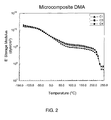
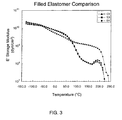
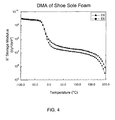
- FIGS. 1-5 are Dynamic Mechanical Analysis (DMA) plots for polyurethane elastomers containing functionalized alumina particles according to the invention, along with plots for control elastomers.
- DMA Dynamic Mechanical Analysis
- FIGS. 6A and 6B are TEM photographs of the product formed in accordance with Example E1.
- FIG 7 is an SEM photograph of the product formed in accordance with Example C4.
- the invention provides methods and compositions for reinforcing polymers while causing little or no embrittlement of the resulting composite material.
- non-functionalized particles such as clays and metal oxide/hydroxide particles (for example non-functionalized silicas and aluminas) is their tendency to aggregate during efforts to incorporate them into polymer systems, even with the aid of high shear mixing equipment.
- the result associated with prior art particles is poor dispersion of the particles and/or relatively poor association between the particles and the polymer matrix or system thereby causing composite embrittlement and other performance problems.
- alumina particles that have been surface functionalized to enable interaction or reaction of the particles with the polymer matrix are able to provide a significant increase in composite performance despite their relatively low aspect ratios of typically less than about 5:1 (e.g., this contrasts with the relatively high aspect ratios observed for conventional exfoliated clays, which typically have an aspect ratio of 50 or more).
- functionalized alumina particles are typically easier than clays to disperse into solvents or polymer precursors using conventional shear mixing equipment.
- the rheology of the resulting dispersions is also typically more satisfactory than that obtained when clays or other high aspect ratio particles are used, thus allowing easy handling and mold filling.
- the inventive particles can be used for improving the stiffness (Young's Modulus), Dynamic Storage Modulus (DMA) and hardness of composites incorporating the particles without adversely affecting flexibility, ductility, among other desired properties. While the affect is dependent upon the amount of inventive particles, the amount of the inventive particles is normally sufficient to increase at least one of the foregoing properties (e.g., a two hundred percent (200%) improvement in Young's Modulus and DMA in comparison to an article without the inventive particles).
- Base particles suitable for conversion to the functionalized particles of this invention comprise alumina.
- alumina means a hydrated aluminum oxide.
- the hydrated aluminum oxide may be naturally occurring or synthetic.
- Suitable exemplary aluminas comprise at least one of gibbsite (Al 2 O 3 ⁇ 3H 2 O, also known as hydrargillite or alumina trihydrate) and boehmite (Al 2 O 3 ⁇ H 2 O, also known as alumina monohydrate).
- gibbsite Al 2 O 3 ⁇ 3H 2 O, also known as hydrargillite or alumina trihydrate
- boehmite Al 2 O 3 ⁇ H 2 O, also known as alumina monohydrate.
- Gibbsite is present as the gamma form of aluminum hydroxide, ⁇ -Al(OH) 3
- boehmite is the gamma form of an aluminum oxide hydroxide, ⁇ -AIOOH.
- diaspore the alpha form of aluminum oxide hydroxide, ⁇ -AIOOH, as well as two other alumina trihydrate forms: nordstrandite and bayerite.
- Pseudoboehmite a hydrated alumina according to the general formula Al 2 O 3 ⁇ xH 2 O (2.0 > x > 1.0), may also be used, as may mixtures of aluminas.
- the alumina particles typically have an average size of less than about 1000nm, more typically less than about 200nm, and most typically less than about 100nm. This relatively small size provides a very large surface area available for interaction of the particles with the polymer. Functionalization of the alumina base particles may be performed by the methods described in U.S. Patent Nos. 6,224,846 and 6,846,435B1 , the entire disclosure of which is expressly incorporated herein by reference.
- Suitable alumina particles may be those such as described in U.S. Patent Nos. 6,846,435B1 . These alumina particles may have a crystallite size of about 4 to about 100nm, and usually the crystallite size will be about 6 to about 20nm (determined by x-ray diffraction on the 021 reflex). The particle size is generally less than about 1,000nm, more commonly about 5 to 500nm, and most typically about 20 to 100nm.
- the particles be strongly associated with the polymer so as not to merely be present in the composite, but rather to be structurally incorporated therein.
- the surface of the particles is treated with at least one of sulfonic, phosphonic, and/or phosphinic acid that bears a functional group capable of interacting or reacting with the polymer matrix.
- the acid group bonds firmly (e.g., ionically) to the base particle, thus tying the particle to the matrix.
- Modification of the surface with more than one functionalizing acid may be desirable, to optimize the interaction of the particles with the matrix.
- Suitable functionalizing acids are of the formula A-R-Q; wherein A comprises at least one member selected from the group consisting of SO 3 H, PO 3 H 2 , or PO 2 H 2 ; R comprises an organic connecting group; and Q comprises a reactive moiety.
- Suitable Q groups may comprise at least one of NCO, CO 2 H, epoxy, amine, and hydroxyl moieties, for example when the particles are to be used in polyurethane formulations.
- Other suitable Q groups may comprise at least one of SH, vinyl, or acrylic moieties (such as acryloxy, methacryloxy); these may for example be especially suitable for reacting with unsaturated compounds such as at least one of vinyl, acrylic, alkyd, neoprene, SBR, or UV curable polymer systems.
- R groups comprise, as nonlimiting examples, substituted and unsubstituted acyclic, alicyclic, cyclic, and heterocyclic moieties.
- R comprises at least one C2-C25 moiety selected from the group consisting of substituted and unsubstituted alkyl, aryl, aralkyl, alkaryl, and alkenyl.
- substituted when used in this context means that R contains one or more heteroatoms.
- Exemplary nonlimiting heteroatoms comprise at least one of oxygen, sulfur, and nitrogen.
- Exemplary nonlimiting substituents comprise at least one of OH, NH 2 , vinyl, acryloxy, methacryloxy, NCO, CO 2 H, SH, and epoxy.
- the Q group may be NH 2 and there may be one or more additional NH 2 groups (or hydroxyls, or others) on the R group.
- R comprises at least one member selected from the group consisting of C2-C8 alkyl, phenyl, benzyl, and phenethyl.
- Suitable specific examples of functionalizing acids comprise at least one member selected from the group of isethionic acid, taurine, sulfanilic acid, vinylsulfonic acid, styrenesulfonic acid, phenolsulfonic acid, 3-hydroxypropane-1-sulfonic acid, 4-aminotoluene-3-sulfonic acid, 3-amino-4-hydroxybenzenesulfonic acid, 1-amino-2-ehoxynahthalene-6-sulfonic acid, 2,3-dihydroxynaphthalene-6-sulfonic acid, and 2-hydroxy-4-methoxybenzopheneon-5-sulfonic acid.
- the functionalizing acids on the surface of alumina particles may or may not be in the form of the free acid.
- the acids may be in that form, or they may be in the form of a reaction product between the sulfonic, phosphonic or phosphinic acid group and the metal oxide/hydroxide (or other) groups on the surface of the alumina particle.
- a particle is described herein as having a functionalizing acid on its surface, or to being "surface functionalized,” it is to be understood that the acid may be in its free form or the acid may be in the form of a reaction product with the surface of the particle, or both.
- the functionalized alumina particle will in many cases be incorporated into a composition by reacting the Q group (OH, NH 2 , mixtures thereof, among others) with other components in the composition. Therefore, it will be understood that reference to compositions comprising surface functionalized alumina particles includes those in which the Q group is intact, those in which it has reacted with other components in the composition, or both.
- the polymer comprises an elastomer, for example at least one member selected from the group consisting of vinyl, acrylic, alkyd, UV curable, and diene-based elastomers.
- Nonlimiting examples of diene-based elastomers comprise at least one member selected from the group consisting of SBR, synthetic and natural latex rubbers, polyneoprene, polyisoprene, EPDM polymers, and acrylonitrile-butadiene-styrene polymers.
- Other elastomers will be well known to those skilled in the art, and are also contemplated for use according to the invention.
- the elastomers may be incorporated into adhesives, sealants, foams, coatings, and other forms, and may also take the form of microcellular elastomers; all of which have improved properties relative to elastomers without the inventive particles.
- polyurethane encompasses polyurethanes themselves, polyureas, and polyurethane-ureas.
- Exemplary polyurethanes may be made from any of a wide variety of polyisocyanates known in the art.
- suitable polyisocyanates comprise at least one member selected from the group consisting of hexamethylene diisocyanate, phenylene diisocyanates, toluene diisocyanates, and 4,4'-diphenylmethane diisocyanate.
- 2,4-and 2,6-toluene diisocyanates individually or together as their commercially available mixtures.
- suitable mixtures of diisocyanates are those known commercially as “crude MDI”, also known as PAPI, which contain about 60% of 4,4'-diphenylmethane diisocyanate along with other isomeric and analogous higher polyisocyanates and other modified "liquid MDI's" such as are known by that name in the polyurethane art.
- Suitable polymers of these polyisocyanates comprising a partially pre-reacted mixture of polyisocyanates and polymeric polyols such as polyether or polyester polyols.
- Suitable polymeric or oligomeric polyols for use in making polyurethane composites of this invention comprise polyalkylene ether polyols and polyester polyols.
- Polyalkylene ether polyols include poly(alkylene oxide) polymers such as poly(ethylene oxide) and poly(propylene oxide) polymers and copolymers having terminal hydroxyl groups derived from low molecular weight polyhydric compounds comprising diols and triols, such as at least one member selected from the group consisting of ethylene glycol, propylene glycol, 1,3-butanediol, 1,4-butanediol, 1,6-hexanediol, neopentyl glycol, diethylene glycol, dipropylene glycol, pentaerythritol, glycerol, diglycerol, trimethylol propane, cyclohexanediol, mixtures thereof, among others.
- Useful polyester polyols comprise those produced by reacting a dicarboxylic acid with an excess of a diol, for example adipic acid with ethylene glycol, diethylene glycol or 1,4-butanediol, or reacting a lactone such as caprolactone with an excess of a diol such as propylene glycol.
- Additional suitable polymeric polyols comprise hydroxy-terminated polybutadienes and hydroxy-terminated silicones.
- Other polymeric polyols are known in the art, and their use is also contemplated according to the invention.
- Formulations for making polyurethane/particle composites according to the invention may also include any of a variety of other ingredients comprising at least one member selected from the group consisting of blowing agents such as water, methylene chloride, trichlorofluoromethane, among others and mixtures thereof; cell stabilizers such as silicones, and organometallic catalysts such as dibutyltin dilaurate and tertiary amines.
- blowing agents such as water, methylene chloride, trichlorofluoromethane, among others and mixtures thereof
- cell stabilizers such as silicones
- organometallic catalysts such as dibutyltin dilaurate and tertiary amines.
- the functionalized alumina particles may be provided in a number of forms, including dry powders, slurries, and dispersions.
- the starting material will be a dry powder with an agglomerate particle size of about 0.1 to about 50 ⁇ m. Under shear conditions, and aided by the surface functionalization of this invention, these agglomerates tend to break down to give a significant percentage of particles below about 1000nm (1 ⁇ m) in size.
- at least about 50 volume%, more typically at least about 75 volume%, and most typically at least about 90 volume% of the particles will be below this size after dispersion into a composition. In many applications, the number is at least about 95 volume%.
- the particles may be incorporated into the polymer composition by any of a number of means, to obtain good dispersion.
- the particles may be predispersed in a compatible solvent or surfactant solution and added to the polymer formulation.
- suitable solvent any suitable solvent can be employed, examples of suitable solvents comprise at least one member selected from the group consisting of glycols, alcohols, ketones, acetone, toluene, xylene, methylethyl ketone, mixtures thereof, among others.
- the amount of solvent can vary depending upon the end use and solid content, and typically ranges from about 10 to about 30 wt.%.
- the solvent may optionally be removed by standard means.
- the particles may be dispersed in a portion of the formulation used to make the polymer matrix, for example in a component comprising one or more prepolymers, polyols, monomers, resins, curing agents or other additives, or they may be dispersed into mixtures containing all of the reactive ingredients for making the polymer.
- the particles may be incorporated in a polyurethane precursor comprising one or more ingredients selected from the group consisting of polymeric polyols, di- or tri-isocyanates, reaction products of polymeric polyols with di- or tri-isocyanates, lower glycols, and non-glycol polyurethane curing agents such as amines.
- Lower glycols typically include mono-, di-, tri-, and tetraethylene (or propylene) glycols, as well as C2-C6 glycols such as ethylene glycol, propylene glycol, butanediols, pentanediols, and hexanediols.
- compositions according to the invention may be made by mixing together in any sequence a polymeric polyol, a di- or tri-isocyanate, and the functionalized alumina particles. They may also be made by mixing together a polymeric polyol, a polyisocyanate, and the functionalized alumina particles. In some cases, it may be desirable to disperse the particles in a lower glycol and/or a non-glycol polyurethane curing catalyst without the presence of polymeric polyols, di- or tri-isocyanates, or reaction products of polymeric polyols with di- or tri-isocyanates. Such mixtures may provide convenient handling of the functionalized particles, greater formulation latitude for the ultimate polyurethane composition, and other advantages.
- the particles can be adequately dispersed using low or moderate shear processes such as blending. Sonication and other high energy processes may also be used to obtain optimal dispersion.
- the particles may be compounded directly into the polymer itself.
- One nonlimiting example of the latter is compounding into a non-crosslinked rubber.
- Optimum loading levels of the functionalized alumina particles in the polymer are dependent on a number of factors, including desired level of reinforcement, cost constraints, and system rheology. Typical use levels in many systems, for example polyurethanes, are less than about 10% by weight, more typically less than about 5% by weight. However, there may be circumstances where higher loadings are desired to optimize other performance characteristics, for example scratch resistance or flame retardancy, and all loading levels are contemplated by this invention. It should be further noted that other functionalized or unfunctionalized particles may also be included in any of the formulations of this invention, while still remaining within the scope thereof. Such other types of particles are well known to those of skill in the art, and include as nonlimiting examples silica, calcium carbonate, talc, clays, mixtures thereof, among others.
- Functionalized alumina (boehmite) particles were supplied by Sasol North America of Houston, TX. Similar particles may be made by the methods described in U.S. Pat. No. 6,224,846 or US 6,846,435 , hereby incorporated by reference.
- the loading of functionalizing acid on the boehmite is specified as a mole % of the available surface AIOH groups, which is based on the surface area of the base boehmite particles.
- the base boehmite particles had a surface area of 300 m 2 /g, which corresponds to a surface AIOH equivalent weight of 430 g/eq., or a surface area of 250 m 2 /g, corresponding to a surface AIOH equivalent weight of 500 g/eq.
- the particles used in the Examples and Comparative Examples are described below in Table 1.
- the linear alkylbenzenesulfonic acid was BIO-SOFT S-101 available from Stepan Company of Northfield, IL.
- TABLE 1 Boehmite particle Surface Area Linear Alkyl-benzene-sulfonic acid (LAS) Isethionic Acid Para Toluene-sulfonic Acid Taurine m 2 /g mole % mole % mole % mole % N-1 300 50 10 0 0 N-2 300 0 0 0 N-3 250 0 0 52 13
- notations regarding particle loadings reflect a particle content calculated to enable a 5% by weight loading of the particles in the final elastomer. Actual loading may differ slightly due to actual weights used and reactant variability.
- a 20% dispersion of N-1 in toluene was made by adding the dry particle powder to the toluene and shaking until a clear dispersion was obtained.
- a 311.8-g portion of the dispersion was added to a polyol blend consisting of 541.0 g POLYTHF 1000 (available from BASF) and 49.4 g diethylene glycol (DEG). The product was mixed until uniform.
- a 1387-g portion of 50% 2,4-toluene diisocyanate/50% 2,6-diisocyanate (TDI) was charged to a jacketed reactor equipped with a N 2 purge and mechanical agitator. The reactor was preheated to 40°C and the polyol blend was slowly fed into the reactor over 6 hours with agitation.
- the reactor temperature was maintained at 50 ⁇ 3°C.
- the mixture was held overnight at 50°C to complete the reaction.
- the excess unreacted TDI was removed by wiped-film evaporation using a Pope 2" molecular still operating at 130°C and 1 Torr with a feed rate of 5-10 g/min, to yield 844g of prepolymer.
- a 20% dispersion of N-1 in toluene was made by adding the dry particle powder to the toluene and shaking until a clear dispersion was obtained.
- a 186.0-g portion of the dispersion was added to a polyol blend consisting of 568.6 g POLYTHF 1000 (BASF) and 46.1 g diethylene glycol (DEG). The product was mixed until uniform.
- a 1393-g portion of 50% 2,4-toluene diisocyanate/50% 2,6-diisocyanate was charged to a jacketed reactor equipped with a N 2 purge and mechanical agitator. The reactor was preheated to 40°C and the polyol blend was slowly fed into the reactor over 6 hours with agitation.
- the reactor temperature was maintained at 50 ⁇ 3°C.
- the mixture was held overnight at 50°C to complete the reaction.
- the excess unreacted TDI was removed by wiped-film evaporation using a Pope 2" molecular still operating at 130°C and 1 Torr with a feed rate of 5-10 g/min.
- a prepolymer not containing any boehmite filler was prepared as follows. A 100-part portion of 50% 2,4-toluene diisocyanate/50% 2,6-diisocyanate (TDI) was charged to a jacketed reactor equipped with a N 2 purge and a mechanical agitator. A polyol blend prepared from 43.8 parts of PolyTHF 1000 (OH# 112) and 3.0 parts of diethyleneglycol was fed into the reactor over 2-6 hours with agitation, during which the reactor temperature was controlled between 45-60°C. The excess unreacted TDI was removed by wiped-film evaporation using a Pfaudler wiped film evaporator operating at 160°C and ⁇ 0.1mm Hg.
- TDI 2,4-toluene diisocyanate/50% 2,6-diisocyanate
- Unfunctionalized boehmite N-2 did not form a stable dispersion in toluene using moderate shear mixing (Cowles blade @ 1500 rpm) or ultrasonication.
- the N-2 particles also did not form a stable dispersion in the polyol blend or the TDI and therefore it was not possible to make a prepolymer with this material using the general procedure of Example 1.
- a 620-g portion of C1 prepolymer was charged to a 1 liter reactor equipped with a mechanical stirrer and an N 2 purge.
- the prepolymer was heated to 80°C and 41 g of N-2 was added with agitation.
- the contents were agitated for 1.5 hrs at 80°C to insure good mixing.
- a 700-g portion of C1 prepolymer was charged to a 1 liter reactor equipped with mechanical strirring and N 2 purge.
- the prepolymer was heated to 80°C and 47.5g of N-1 was added with agitation.
- the contents were agitated for 2.5 hrs at 80°C to insure good mixing.
- a 20% dispersion of N-1 in toluene was made by adding the dry particle powder to the toluene and shaking until a clear dispersion was obtained.
- a polyol blend was prepared consisting of 367.5 g POLYTHF 1000 (BASF) and 25.6 g diethylene glycol (DEG). A 93.92-g portion of the dispersion was added to 182.0 g of the polyol blend. The product was mixed until uniform.
- a 103.1-g portion of MONDUR TDS toluene diisocyanate having a high 2,4 isomer content, available from Bayer
- the polyol blend was slowly fed into the reactor over 30 minutes with agitation.
- the reactor temperature was maintained at 70 ⁇ 3°C.
- the mixture was held overnight at 70°C to complete the reaction, after which the toluene was removed by vacuum distillation.
- a 103.1-g portion of MONDUR TDS was charged to a jacketed reactor equipped with a N 2 purge and mechanical agitator.
- a 18.6-g portion of N-1 was added to the flask with vigorous stirring at room temperature.
- the mixture was then heated to 60°C and held for 1 hour.
- a 178.6-g portion of the polyol blend prepared in Example E3 was slowly fed into the reactor over 30 minutes with agitation.
- the reactor temperature was increased to 70°C and held overnight at 70 ⁇ 3°C to complete the reaction.
- a 557.2-g portion of MONDUR TDS was charged to a jacketed reactor equipped with a N 2 purge and mechanical agitator. The TDS was then heated to 70°C.
- a 1042.8-g portion of a polyol blend consisting of 987.8 g POLYTHF 1000 (BASF) and 68.45 g diethylene glycol (DEG) was slowly fed into the reactor over 2.5 hours with agitation. The mixture was held overnight at 70 ⁇ 3°C to complete the reaction.
- Cast elastomers were made from the prepolymers prepared in the foregoing paragraphs, using 4,4'-methylene bis-orthochloroaniline (MOCA) as the curing agent.
- the prepolymer was degassed and heated to 80°C.
- MOCA was melted on a hot plate and heated to 110-120°C.
- the MOCA was added to the prepolymer and mixed at 2500 rpm in a Flak Tek mixer. The mixture was poured into glass molds coated with a mold release agent and preheated to 100°C. Parts were cured in an oven at 100°C for 16 hours.
- the plaques were allowed to age at 75°F and 50% relative humidity for at least 2 weeks before testing. Physical testing was carried out according to ASTM methods D-412, D-470, D-1938, and D-2240.
- Dynamic Mechanical Analysis (DMA) data were collected for the composite samples in tension using a Rheometric Scientific (now TA Instruments) RSA II rheometer. Test sample dimensions were 22 mm in length, 6.2 mm in width, and 1.6 mm in thickness. Data were collected in 8°C increments between -130° and 250°C; liquid nitrogen was used for maintaining sub ambient temperatures. The applied oscillation frequency was 6.28 rad/sec (1 Hz). A 100-gram tensile force was initially applied to the samples; the static force was controlled at 110% of the dynamic force throughout the rest of the experiment. The strain was maintained in the linear viscoelastic region of the samples. The resulting plots are shown in FIGS. 1-3, and the numerical data are show in Table 3.
- DMA Dynamic Mechanical Analysis
- Functionalized alumina particles according to the invention may also be incorporated into additive packages for use in making polymers.
- additive packages typically contain catalysts, blowing agents, and/or other additives for enhancing the manufacturing process or the properties of the polyurethane product.
- Part C packages typically contain catalysts, blowing agents, and/or other additives for enhancing the manufacturing process or the properties of the polyurethane product.
- the preparations of two such packages (Comparative example C6 and inventive example E5) are described below, followed by preparations of lab-scale polyurethane foams from them.
- Part C A master batch for a polyurethane Additive Package (Part C) was blended from 8.0 parts by weight ethylene glycol, 0.7 parts water and 0.5 parts DABCO DC 193 surfactant, and was used as the control. The mixture was blended for 30 minutes using a high speed mixer (1000-1200 rpm) and a Cowles blade.
- a master additive package batch containing N-3 functionalized boehmite particles was prepared from 8.0 parts by weight ethylene glycol, 0.7 parts water, 0.5 parts DABCO DC 193 surfactant and 2.19 parts of the functionalized boehmite. The mixture was blended for 30 minutes using a high speed mixer (1000 - 1200 rpm) and a Cowles blade.
- Foams were prepared from the C6 and E5 additive packages described above, according to the following procedure.
- a 97.1-g portion of a shoe sole polyester polyol (poly(ethylene glycol/diethylene glycol)adipate polyester polyol, hydroxyl number 56) from Dow Chemical of Midland, MI was weighed into a disposable beaker.
- a 8.93-g portion of the Comparative Example C6 additive package was added to the polyol and it was mixed for 30 seconds using a high speed disperser.
- a 102.1-g portion of a shoe sole MDI/polyester prepolymer (17% NCO) was preweighed into syringes.
- a Part C blend was made from 8.0 parts of ethylene glycol, 2.0 parts DABCO EG catalyst (Air Products and Chemicals, Inc.), 0.7 parts water and 0.5 parts DABCO DC 193 surfactant (Air Products and Chemicals, Inc.).
- the Part C was mixed using a high speed mixer (1000-1200 rpm) and a Cowles blade.
- the Part B was prepared by adding 11.2 parts of Part C to 100 Parts shoe sole polyester polyol (poly(ethylene glycol/diethylene glycol)adipate polyester polyol, hydroxyl number 59.2) from Dow Chemical and shaking the contents until well mixed.
- a Part C blend was prepared as immediately above, except that it also contained 2.19 parts of N-3 functionalized boehmite.
- the Part B was prepared as immediately above, but using 13.39 parts of Part C containing the functionalized boehmite.
- the loading of N-3 in the Part B was picked so as to provide a 1 wt% loading in the final polyurethane formulation.
- Foam parts were made using an Edge-Sweets machine (Model Number 8BT), available from Edge-Sweets Company of Grand Rapids, MI.
- the Part B and a shoe sole polyester prepolymer (Dow Chemical 18.82% NCO, MDI/polyester) were added to separate tanks.
- the two feeds were pumped through the mix head using gear pumps, adjusting the pump speeds to control the mix ratio.
- the optimum mix ratio was determined by adjusting the Part B pump speed at constant isocyanate pump speed for each formulation by minimizing the pinch and pull time. Ratios were determined using separate shots of the Part B and prepolymer in calibration mode.
- the foam mixture was poured into a 1 cm x 30.5cm x 15.5cm mold heated to 140°F.
- the data in Table 5 indicate that hardness, Young's modulus and Tensile strength and tear strength of foams incorporating the functionalized particles of this invention are all improved significantly in comparison to the control.
- the Ross Flex values are comparable or slightly better than the control despite an increase in polymer hardness and stiffness.
- the DMA data also show a significant increase in Storage Modulus above Tg (0-150°C).
- Figures 6A/B and 7, illustrate that the instant invention can disperse particles within a polyurethane elastomer matrix.
- Figures 6A/B are TEM photographs of the product formed in accordance with Example E1 that were taken at two different magnifications noted by the scale-bars of 1 micron and 0.2 microns..
- Figures 6A/B illustrate that the instant invention can achieve fine and well dispersed particles.
- Figure 7 is an SEM of the product formed in accordance with Example C4 taken at 15.0 kv (500x) with a 10 micron scale bar that illustrates the agglomerated particles typically obtained when the proper dispersion conditions or proper surface modified particles are not used.
Landscapes
- Chemical & Material Sciences (AREA)
- Engineering & Computer Science (AREA)
- Nanotechnology (AREA)
- Materials Engineering (AREA)
- Condensed Matter Physics & Semiconductors (AREA)
- General Physics & Mathematics (AREA)
- Physics & Mathematics (AREA)
- Crystallography & Structural Chemistry (AREA)
- Composite Materials (AREA)
- Organic Chemistry (AREA)
- Polyurethanes Or Polyureas (AREA)
- Compounds Of Alkaline-Earth Elements, Aluminum Or Rare-Earth Metals (AREA)
- Pigments, Carbon Blacks, Or Wood Stains (AREA)
Abstract
Description
- This Application claims the benefit of Provisional Application No.
60/711,230, filed on August 25, 2005 - Reinforcement of polymers, especially elastomers or plastics, is an approach commonly used to extend the polymer's performance in terms of stiffness or modulus. A common method of reinforcement is the use of inorganic fillers. Unfortunately, the resulting improvements in stiffness and modulus are often accompanied by significant embrittlement of the polymer and significantly reduced percent elongation, flexibility, and resistance to tear. Thus polymer composites having a suitable combination of these and other performance properties are desired for introduction as commercial products.
- In one aspect, the invention provides a composition comprising alumina particles wherein the particles are surface functionalized with at least one acid of the formula A-R-Q; wherein:
- A comprises at least one acid group selected from the group consisting of SO3H, PO3H2, and PO2H2;
- R comprises at least one organic connecting group selected from the group consisting of substituted and unsubstituted acyclic, alicyclic, cyclic, and heterocyclic moieties; and
- Q comprises at least one reactive moiety selected from the group consisting of OH, NH2, vinyl, acryloxy, methacryloxy, NCO, CO2H, SH, and epoxy. The inventive particles can be employed alone or in mixtures with other fillers and inorganic particles.
- In yet another aspect, the invention provides methods of making a polyurethane composition and blended precursors for making the composition including polyurethane foams. The method includes mixing together in any suitable sequence at least one polymeric polyol; at least one isocyanate component selected from the group consisting of diisocyanates, triisocyanates, polyisocyanates, and combinations of these; and the inventive functionalized alumina particles. The particles are surface functionalized with at least one acid of the formula A-R-Q; wherein A-R-Q is as defined above.
- In still another aspect, the invention provides a composite material including an elastomer and alumina particles wherein the particles are surface functionalized with at least one acid of the formula A-R-Q; wherein A-R-Q is as defined above. Examples of such composite materials comprise at least one member selected from the group consisting of elastomers (cast, injection molded, among others), adhesives, sealants, coatings, and microcellular elastomers including components for shoes including shoe soles.
- In a further aspect of the invention, the inventive particles can be employed as a component of a precursor that is used for making the aforementioned compositions or composites.
- FIGS. 1-5 are Dynamic Mechanical Analysis (DMA) plots for polyurethane elastomers containing functionalized alumina particles according to the invention, along with plots for control elastomers.
- FIGS. 6A and 6B are TEM photographs of the product formed in accordance with Example E1.
- FIG 7 is an SEM photograph of the product formed in accordance with Example C4.
- The invention provides methods and compositions for reinforcing polymers while causing little or no embrittlement of the resulting composite material. A common problem with prior art, non-functionalized particles such as clays and metal oxide/hydroxide particles (for example non-functionalized silicas and aluminas) is their tendency to aggregate during efforts to incorporate them into polymer systems, even with the aid of high shear mixing equipment. The result associated with prior art particles is poor dispersion of the particles and/or relatively poor association between the particles and the polymer matrix or system thereby causing composite embrittlement and other performance problems.
- The inventors have found that alumina particles that have been surface functionalized to enable interaction or reaction of the particles with the polymer matrix are able to provide a significant increase in composite performance despite their relatively low aspect ratios of typically less than about 5:1 (e.g., this contrasts with the relatively high aspect ratios observed for conventional exfoliated clays, which typically have an aspect ratio of 50 or more). At least partly due to the relatively low aspect ratios, functionalized alumina particles are typically easier than clays to disperse into solvents or polymer precursors using conventional shear mixing equipment. The rheology of the resulting dispersions is also typically more satisfactory than that obtained when clays or other high aspect ratio particles are used, thus allowing easy handling and mold filling.
- The inventive particles can be used for improving the stiffness (Young's Modulus), Dynamic Storage Modulus (DMA) and hardness of composites incorporating the particles without adversely affecting flexibility, ductility, among other desired properties. While the affect is dependent upon the amount of inventive particles, the amount of the inventive particles is normally sufficient to increase at least one of the foregoing properties (e.g., a two hundred percent (200%) improvement in Young's Modulus and DMA in comparison to an article without the inventive particles).
- Base particles suitable for conversion to the functionalized particles of this invention comprise alumina. As used herein, the term "alumina" means a hydrated aluminum oxide. The hydrated aluminum oxide may be naturally occurring or synthetic. Suitable exemplary aluminas comprise at least one of gibbsite (Al2O3·3H2O, also known as hydrargillite or alumina trihydrate) and boehmite (Al2O3·H2O, also known as alumina monohydrate). Gibbsite is present as the gamma form of aluminum hydroxide, γ-Al(OH)3, and boehmite is the gamma form of an aluminum oxide hydroxide, γ-AIOOH. Also suitable is diaspore, the alpha form of aluminum oxide hydroxide, α-AIOOH, as well as two other alumina trihydrate forms: nordstrandite and bayerite. Pseudoboehmite, a hydrated alumina according to the general formula Al2O3·xH2O (2.0 > x > 1.0), may also be used, as may mixtures of aluminas.
- In order to obtain optimum composite properties, the alumina particles typically have an average size of less than about 1000nm, more typically less than about 200nm, and most typically less than about 100nm. This relatively small size provides a very large surface area available for interaction of the particles with the polymer. Functionalization of the alumina base particles may be performed by the methods described in
U.S. Patent Nos. 6,224,846 and6,846,435B1 , the entire disclosure of which is expressly incorporated herein by reference. - Suitable alumina particles may be those such as described in
U.S. Patent Nos. 6,846,435B1 . These alumina particles may have a crystallite size of about 4 to about 100nm, and usually the crystallite size will be about 6 to about 20nm (determined by x-ray diffraction on the 021 reflex). The particle size is generally less than about 1,000nm, more commonly about 5 to 500nm, and most typically about 20 to 100nm. - Given the high contact area between the particles and the polymer matrix, it is desirable that the particles be strongly associated with the polymer so as not to merely be present in the composite, but rather to be structurally incorporated therein. In order to achieve this, the surface of the particles is treated with at least one of sulfonic, phosphonic, and/or phosphinic acid that bears a functional group capable of interacting or reacting with the polymer matrix. The acid group bonds firmly (e.g., ionically) to the base particle, thus tying the particle to the matrix. Modification of the surface with more than one functionalizing acid may be desirable, to optimize the interaction of the particles with the matrix. Suitable functionalizing acids are of the formula A-R-Q; wherein A comprises at least one member selected from the group consisting of SO3H, PO3H2, or PO2H2; R comprises an organic connecting group; and Q comprises a reactive moiety.
- Suitable Q groups may comprise at least one of NCO, CO2H, epoxy, amine, and hydroxyl moieties, for example when the particles are to be used in polyurethane formulations. Other suitable Q groups may comprise at least one of SH, vinyl, or acrylic moieties (such as acryloxy, methacryloxy); these may for example be especially suitable for reacting with unsaturated compounds such as at least one of vinyl, acrylic, alkyd, neoprene, SBR, or UV curable polymer systems.
- Suitable R groups comprise, as nonlimiting examples, substituted and unsubstituted acyclic, alicyclic, cyclic, and heterocyclic moieties. In some embodiments, R comprises at least one C2-C25 moiety selected from the group consisting of substituted and unsubstituted alkyl, aryl, aralkyl, alkaryl, and alkenyl. As used herein, the term "substituted" when used in this context means that R contains one or more heteroatoms. Exemplary nonlimiting heteroatoms comprise at least one of oxygen, sulfur, and nitrogen. Exemplary nonlimiting substituents comprise at least one of OH, NH2, vinyl, acryloxy, methacryloxy, NCO, CO2H, SH, and epoxy. It is to be understood that these groups, if present, are in addition to the group Q. Thus, in one nonlimiting example, the Q group may be NH2 and there may be one or more additional NH2 groups (or hydroxyls, or others) on the R group. In some embodiments, R comprises at least one member selected from the group consisting of C2-C8 alkyl, phenyl, benzyl, and phenethyl. Suitable specific examples of functionalizing acids comprise at least one member selected from the group of isethionic acid, taurine, sulfanilic acid, vinylsulfonic acid, styrenesulfonic acid, phenolsulfonic acid, 3-hydroxypropane-1-sulfonic acid, 4-aminotoluene-3-sulfonic acid, 3-amino-4-hydroxybenzenesulfonic acid, 1-amino-2-ehoxynahthalene-6-sulfonic acid, 2,3-dihydroxynaphthalene-6-sulfonic acid, and 2-hydroxy-4-methoxybenzopheneon-5-sulfonic acid.
- Methods for treating base particles with functionalizing sulfonic acids may follow the general techniques described in
U.S. Patent No. 6,224,846 (hereby incorporated by reference) for reacting simple sulfonic acids with alumina. Similar methods are suitable for treating base particles with functionalizing phosphonic and phosphinic acids. - The functionalizing acids on the surface of alumina particles may or may not be in the form of the free acid. The acids may be in that form, or they may be in the form of a reaction product between the sulfonic, phosphonic or phosphinic acid group and the metal oxide/hydroxide (or other) groups on the surface of the alumina particle. Thus, when a particle is described herein as having a functionalizing acid on its surface, or to being "surface functionalized," it is to be understood that the acid may be in its free form or the acid may be in the form of a reaction product with the surface of the particle, or both. Similarly, the functionalized alumina particle will in many cases be incorporated into a composition by reacting the Q group (OH, NH2, mixtures thereof, among others) with other components in the composition. Therefore, it will be understood that reference to compositions comprising surface functionalized alumina particles includes those in which the Q group is intact, those in which it has reacted with other components in the composition, or both.
- Any of a number of polymer types may benefit from the inclusion of functionalized alumina particles according to the invention, and the invention contemplates the use of polymers of any kind such as polyurethanes, polyureas, polyurethaneureas, mixtures thereof, among others. In some embodiments, the polymer comprises an elastomer, for example at least one member selected from the group consisting of vinyl, acrylic, alkyd, UV curable, and diene-based elastomers. Nonlimiting examples of diene-based elastomers comprise at least one member selected from the group consisting of SBR, synthetic and natural latex rubbers, polyneoprene, polyisoprene, EPDM polymers, and acrylonitrile-butadiene-styrene polymers. Other elastomers will be well known to those skilled in the art, and are also contemplated for use according to the invention. The elastomers may be incorporated into adhesives, sealants, foams, coatings, and other forms, and may also take the form of microcellular elastomers; all of which have improved properties relative to elastomers without the inventive particles.
- Some exemplary embodiments of the invention employ a polyurethane polymer matrix. As used herein, the term "polyurethane" encompasses polyurethanes themselves, polyureas, and polyurethane-ureas. Exemplary polyurethanes may be made from any of a wide variety of polyisocyanates known in the art. Examples of suitable polyisocyanates comprise at least one member selected from the group consisting of hexamethylene diisocyanate, phenylene diisocyanates, toluene diisocyanates, and 4,4'-diphenylmethane diisocyanate. Especially suitable are the 2,4-and 2,6-toluene diisocyanates individually or together as their commercially available mixtures. Other suitable mixtures of diisocyanates are those known commercially as "crude MDI", also known as PAPI, which contain about 60% of 4,4'-diphenylmethane diisocyanate along with other isomeric and analogous higher polyisocyanates and other modified "liquid MDI's" such as are known by that name in the polyurethane art. Also suitable are "prepolymers" of these polyisocyanates comprising a partially pre-reacted mixture of polyisocyanates and polymeric polyols such as polyether or polyester polyols.
- Suitable polymeric or oligomeric polyols for use in making polyurethane composites of this invention comprise polyalkylene ether polyols and polyester polyols. Polyalkylene ether polyols include poly(alkylene oxide) polymers such as poly(ethylene oxide) and poly(propylene oxide) polymers and copolymers having terminal hydroxyl groups derived from low molecular weight polyhydric compounds comprising diols and triols, such as at least one member selected from the group consisting of ethylene glycol, propylene glycol, 1,3-butanediol, 1,4-butanediol, 1,6-hexanediol, neopentyl glycol, diethylene glycol, dipropylene glycol, pentaerythritol, glycerol, diglycerol, trimethylol propane, cyclohexanediol, mixtures thereof, among others. Useful polyester polyols comprise those produced by reacting a dicarboxylic acid with an excess of a diol, for example adipic acid with ethylene glycol, diethylene glycol or 1,4-butanediol, or reacting a lactone such as caprolactone with an excess of a diol such as propylene glycol. Additional suitable polymeric polyols comprise hydroxy-terminated polybutadienes and hydroxy-terminated silicones. Other polymeric polyols are known in the art, and their use is also contemplated according to the invention.
- Formulations for making polyurethane/particle composites according to the invention may also include any of a variety of other ingredients comprising at least one member selected from the group consisting of blowing agents such as water, methylene chloride, trichlorofluoromethane, among others and mixtures thereof; cell stabilizers such as silicones, and organometallic catalysts such as dibutyltin dilaurate and tertiary amines.
- The functionalized alumina particles may be provided in a number of forms, including dry powders, slurries, and dispersions. Typically the starting material will be a dry powder with an agglomerate particle size of about 0.1 to about 50µm. Under shear conditions, and aided by the surface functionalization of this invention, these agglomerates tend to break down to give a significant percentage of particles below about 1000nm (1µm) in size. Typically, at least about 50 volume%, more typically at least about 75 volume%, and most typically at least about 90 volume% of the particles will be below this size after dispersion into a composition. In many applications, the number is at least about 95 volume%. The particles may be incorporated into the polymer composition by any of a number of means, to obtain good dispersion. For example, the particles may be predispersed in a compatible solvent or surfactant solution and added to the polymer formulation. While any suitable solvent can be employed, examples of suitable solvents comprise at least one member selected from the group consisting of glycols, alcohols, ketones, acetone, toluene, xylene, methylethyl ketone, mixtures thereof, among others. The amount of solvent can vary depending upon the end use and solid content, and typically ranges from about 10 to about 30 wt.%. The solvent may optionally be removed by standard means. Instead, or in addition, the particles may be dispersed in a portion of the formulation used to make the polymer matrix, for example in a component comprising one or more prepolymers, polyols, monomers, resins, curing agents or other additives, or they may be dispersed into mixtures containing all of the reactive ingredients for making the polymer.
- For example, the particles may be incorporated in a polyurethane precursor comprising one or more ingredients selected from the group consisting of polymeric polyols, di- or tri-isocyanates, reaction products of polymeric polyols with di- or tri-isocyanates, lower glycols, and non-glycol polyurethane curing agents such as amines. Lower glycols typically include mono-, di-, tri-, and tetraethylene (or propylene) glycols, as well as C2-C6 glycols such as ethylene glycol, propylene glycol, butanediols, pentanediols, and hexanediols. Thus, compositions according to the invention may be made by mixing together in any sequence a polymeric polyol, a di- or tri-isocyanate, and the functionalized alumina particles. They may also be made by mixing together a polymeric polyol, a polyisocyanate, and the functionalized alumina particles. In some cases, it may be desirable to disperse the particles in a lower glycol and/or a non-glycol polyurethane curing catalyst without the presence of polymeric polyols, di- or tri-isocyanates, or reaction products of polymeric polyols with di- or tri-isocyanates. Such mixtures may provide convenient handling of the functionalized particles, greater formulation latitude for the ultimate polyurethane composition, and other advantages.
- Typically, the particles can be adequately dispersed using low or moderate shear processes such as blending. Sonication and other high energy processes may also be used to obtain optimal dispersion. In some cases, the particles may be compounded directly into the polymer itself. One nonlimiting example of the latter is compounding into a non-crosslinked rubber.
- Optimum loading levels of the functionalized alumina particles in the polymer are dependent on a number of factors, including desired level of reinforcement, cost constraints, and system rheology. Typical use levels in many systems, for example polyurethanes, are less than about 10% by weight, more typically less than about 5% by weight. However, there may be circumstances where higher loadings are desired to optimize other performance characteristics, for example scratch resistance or flame retardancy, and all loading levels are contemplated by this invention. It should be further noted that other functionalized or unfunctionalized particles may also be included in any of the formulations of this invention, while still remaining within the scope thereof. Such other types of particles are well known to those of skill in the art, and include as nonlimiting examples silica, calcium carbonate, talc, clays, mixtures thereof, among others.
- The invention is further illustrated by the following examples, which are presented for purposes of demonstrating, but not limiting, the methods and compositions of this invention.
- The following examples illustrate the preparation of prepolymers and other polyurethane ingredients containing functionalized alumina particles, the preparation of polyurethane/alumina composites from these ingredients, and the superior performance properties obtained by use of the methods and compositions of this invention.
- Functionalized alumina (boehmite) particles were supplied by Sasol North America of Houston, TX. Similar particles may be made by the methods described in
U.S. Pat. No. 6,224,846 orUS 6,846,435 , hereby incorporated by reference. The loading of functionalizing acid on the boehmite is specified as a mole % of the available surface AIOH groups, which is based on the surface area of the base boehmite particles. The base boehmite particles had a surface area of 300 m2/g, which corresponds to a surface AIOH equivalent weight of 430 g/eq., or a surface area of 250 m2/g, corresponding to a surface AIOH equivalent weight of 500 g/eq. The particles used in the Examples and Comparative Examples are described below in Table 1. The linear alkylbenzenesulfonic acid was BIO-SOFT S-101 available from Stepan Company of Northfield, IL.TABLE 1 Boehmite particle Surface Area Linear Alkyl-benzene-sulfonic acid (LAS) Isethionic Acid Para Toluene-sulfonic Acid Taurine m2/g mole % mole % mole % mole % N-1 300 50 10 0 0 N-2 300 0 0 0 0 N-3 250 0 0 52 13 - In the following examples, notations regarding particle loadings reflect a particle content calculated to enable a 5% by weight loading of the particles in the final elastomer. Actual loading may differ slightly due to actual weights used and reactant variability.
- A 20% dispersion of N-1 in toluene was made by adding the dry particle powder to the toluene and shaking until a clear dispersion was obtained. A 311.8-g portion of the dispersion was added to a polyol blend consisting of 541.0 g POLYTHF 1000 (available from BASF) and 49.4 g diethylene glycol (DEG). The product was mixed until uniform. A 1387-g portion of 50% 2,4-toluene diisocyanate/50% 2,6-diisocyanate (TDI) was charged to a jacketed reactor equipped with a N2 purge and mechanical agitator. The reactor was preheated to 40°C and the polyol blend was slowly fed into the reactor over 6 hours with agitation. The reactor temperature was maintained at 50±3°C. The mixture was held overnight at 50°C to complete the reaction. The excess unreacted TDI was removed by wiped-film evaporation using a Pope 2" molecular still operating at 130°C and 1 Torr with a feed rate of 5-10 g/min, to yield 844g of prepolymer.
- A 20% dispersion of N-1 in toluene was made by adding the dry particle powder to the toluene and shaking until a clear dispersion was obtained. A 186.0-g portion of the dispersion was added to a polyol blend consisting of 568.6 g POLYTHF 1000 (BASF) and 46.1 g diethylene glycol (DEG). The product was mixed until uniform. A 1393-g portion of 50% 2,4-toluene diisocyanate/50% 2,6-diisocyanate was charged to a jacketed reactor equipped with a N2 purge and mechanical agitator. The reactor was preheated to 40°C and the polyol blend was slowly fed into the reactor over 6 hours with agitation. The reactor temperature was maintained at 50±3°C. The mixture was held overnight at 50°C to complete the reaction. The excess unreacted TDI was removed by wiped-film evaporation using a Pope 2" molecular still operating at 130°C and 1 Torr with a feed rate of 5-10 g/min.
- A prepolymer not containing any boehmite filler was prepared as follows. A 100-part portion of 50% 2,4-toluene diisocyanate/50% 2,6-diisocyanate (TDI) was charged to a jacketed reactor equipped with a N2 purge and a mechanical agitator. A polyol blend prepared from 43.8 parts of PolyTHF 1000 (OH# 112) and 3.0 parts of diethyleneglycol was fed into the reactor over 2-6 hours with agitation, during which the reactor temperature was controlled between 45-60°C. The excess unreacted TDI was removed by wiped-film evaporation using a Pfaudler wiped film evaporator operating at 160°C and <0.1mm Hg.
- Unfunctionalized boehmite N-2 did not form a stable dispersion in toluene using moderate shear mixing (Cowles blade @ 1500 rpm) or ultrasonication. The N-2 particles also did not form a stable dispersion in the polyol blend or the TDI and therefore it was not possible to make a prepolymer with this material using the general procedure of Example 1.
- A 620-g portion of C1 prepolymer was charged to a 1 liter reactor equipped with a mechanical stirrer and an N2 purge. The prepolymer was heated to 80°C and 41 g of N-2 was added with agitation. The contents were agitated for 1.5 hrs at 80°C to insure good mixing.
- A 700-g portion of C1 prepolymer was charged to a 1 liter reactor equipped with mechanical strirring and N2 purge. The prepolymer was heated to 80°C and 47.5g of N-1 was added with agitation. The contents were agitated for 2.5 hrs at 80°C to insure good mixing.
- A 20% dispersion of N-1 in toluene was made by adding the dry particle powder to the toluene and shaking until a clear dispersion was obtained. A polyol blend was prepared consisting of 367.5 g POLYTHF 1000 (BASF) and 25.6 g diethylene glycol (DEG). A 93.92-g portion of the dispersion was added to 182.0 g of the polyol blend. The product was mixed until uniform. A 103.1-g portion of MONDUR TDS (toluene diisocyanate having a high 2,4 isomer content, available from Bayer) was charged to a jacketed reactor equipped with a N2 purge and mechanical agitator. The polyol blend was slowly fed into the reactor over 30 minutes with agitation. The reactor temperature was maintained at 70±3°C. The mixture was held overnight at 70°C to complete the reaction, after which the toluene was removed by vacuum distillation.
- A 103.1-g portion of MONDUR TDS was charged to a jacketed reactor equipped with a N2 purge and mechanical agitator. A 18.6-g portion of N-1 was added to the flask with vigorous stirring at room temperature. The mixture was then heated to 60°C and held for 1 hour. A 178.6-g portion of the polyol blend prepared in Example E3 was slowly fed into the reactor over 30 minutes with agitation. The reactor temperature was increased to 70°C and held overnight at 70±3°C to complete the reaction.
- A 557.2-g portion of MONDUR TDS was charged to a jacketed reactor equipped with a N2 purge and mechanical agitator. The TDS was then heated to 70°C. A 1042.8-g portion of a polyol blend consisting of 987.8 g POLYTHF 1000 (BASF) and 68.45 g diethylene glycol (DEG) was slowly fed into the reactor over 2.5 hours with agitation. The mixture was held overnight at 70±3°C to complete the reaction.
- Cast elastomers were made from the prepolymers prepared in the foregoing paragraphs, using 4,4'-methylene bis-orthochloroaniline (MOCA) as the curing agent. The prepolymer was degassed and heated to 80°C. MOCA was melted on a hot plate and heated to 110-120°C. The MOCA was added to the prepolymer and mixed at 2500 rpm in a Flak Tek mixer. The mixture was poured into glass molds coated with a mold release agent and preheated to 100°C. Parts were cured in an oven at 100°C for 16 hours. The plaques were allowed to age at 75°F and 50% relative humidity for at least 2 weeks before testing. Physical testing was carried out according to ASTM methods D-412, D-470, D-1938, and D-2240.
- Details of the formulations used for making the plaques are shown in Table 2, in which "Particle Content" refers to the modified particles.
TABLE 2 Prepolymer and Casting Data Example %NCO Prepolymer MOCA Particle Content (grams) (grams) Wt% E1 8.49 200 51.1 4.99 E2 8.51 200 51.1 2.96 C1 8.30 200 49.9 0 C3 6.97 200 42.1 5.17 C4 7.65 200 46.3 5.08 E3 8.22 75 18.5 4.96 E4 8.24 75 18.5 4.97 C5 8.69 75 19.6 0 - Dynamic Mechanical Analysis (DMA) data were collected for the composite samples in tension using a Rheometric Scientific (now TA Instruments) RSA II rheometer. Test sample dimensions were 22 mm in length, 6.2 mm in width, and 1.6 mm in thickness. Data were collected in 8°C increments between -130° and 250°C; liquid nitrogen was used for maintaining sub ambient temperatures. The applied oscillation frequency was 6.28 rad/sec (1 Hz). A 100-gram tensile force was initially applied to the samples; the static force was controlled at 110% of the dynamic force throughout the rest of the experiment. The strain was maintained in the linear viscoelastic region of the samples. The resulting plots are shown in FIGS. 1-3, and the numerical data are show in Table 3.
- Plaques made with prepolymer Examples E1 and E2 showed clear performance advantages over the control prepolymer, Comparative Example C1, especially in hardness, Young's modulus, and dynamic storage modulus, even at low loading levels. The data in FIGS. 1-3 is in the 0-50°C temperature range which encompasses most common use conditions. The E' (storage modulus) numbers, which relate to elastic stiffness, are seen to be greatly enhanced in the compositions that include modified boehmite. Untreated particles added to the control prepolymer, Comparative Example C3, did not perform as well as the control. As shown below in Table 3, for the plaque prepared with comparative example C4 prepolymer, directly adding particle N-1 to the control prepolymer resulted in poor particle dispersion and poor reinforcement relative to Examples E1 and E2. The same trends hold for the conventional prepolymers shown in Examples E3 and E4 versus the control, Comparative Example C5. A significant reinforcement effect was observed even at 3% particle loading.
TABLE 3 Hardness Tensile Prepolymer Dispersion Shore D Young's Modulus Tensile Strength Elongation 100% Modulus (psi) (psi) (%) (psi) E1 Good 77 95200 7210 167 5100 E2 Good 73 73400 7030 178 4723 C1 NA 68 42100 8880 236 4238 C3 Poor 64 26700 4750 200 2859 C4 Poor 66 52100 5190 188 3335 E3 Good 72 95700 6370 207 3430 E4 Good 73 79100 6330 208 3470 C5 NA 67 42600 8870 274 3725 Tear DMA Storage Modulus Prepolymer Die C Split Trouser 25°C 50°C (pli) (pli) (pli) (MPa) (MPa) E1 1289 83 195 609 466 E2 793 97 151 495 375 C1 914 103 132 291 206 C3 760 131 170 239 146 C4 643 122 165 278 185 E3 ND ND 111 593 400 E4 ND ND 107 571 373 C5 ND ND 115 386 269 ND - No data - Functionalized alumina particles according to the invention may also be incorporated into additive packages for use in making polymers. In the case of polyurethane manufacture, such "Part C" packages typically contain catalysts, blowing agents, and/or other additives for enhancing the manufacturing process or the properties of the polyurethane product. The preparations of two such packages (Comparative example C6 and inventive example E5) are described below, followed by preparations of lab-scale polyurethane foams from them.
- A master batch for a polyurethane Additive Package (Part C) was blended from 8.0 parts by weight ethylene glycol, 0.7 parts water and 0.5 parts DABCO DC 193 surfactant, and was used as the control. The mixture was blended for 30 minutes using a high speed mixer (1000-1200 rpm) and a Cowles blade.
- A master additive package batch containing N-3 functionalized boehmite particles was prepared from 8.0 parts by weight ethylene glycol, 0.7 parts water, 0.5 parts DABCO DC 193 surfactant and 2.19 parts of the functionalized boehmite. The mixture was blended for 30 minutes using a high speed mixer (1000 - 1200 rpm) and a Cowles blade.
- Foams were prepared from the C6 and E5 additive packages described above, according to the following procedure. A 97.1-g portion of a shoe sole polyester polyol (poly(ethylene glycol/diethylene glycol)adipate polyester polyol, hydroxyl number 56) from Dow Chemical of Midland, MI was weighed into a disposable beaker. A 8.93-g portion of the Comparative Example C6 additive package was added to the polyol and it was mixed for 30 seconds using a high speed disperser. A 102.1-g portion of a shoe sole MDI/polyester prepolymer (17% NCO) was preweighed into syringes. A 1.94-g portion of DABCO EG catalyst (Air Products and Chemicals, Inc., Allentown, PA) was added to the beaker followed immediately with the contents of the syringes to provide a formulation having a calculated isocyanate index of 100. The contents of the beaker were immediately mixed for 5 seconds using a high speed disperser and poured into a 1 cm x 30.5cm x 15.5cm mold. The mold was preheated to 140°F. The parts were demolded after 5 minutes, and had a foam density of 0.35 g/cc. This procedure was repeated, but using 11.25g of the Example E5 Additive Package. The results of physical property testing are shown below in Table 4.
TABLE 4 Additive Pkg Boehmite Young's Modulus Tensile Strength % Elongation 100% Modulus Split Tear Shore A Hardness Ross Flex Room temp. 48,000 cycles C6 none 429 691 340 252 12.9 34 pass 0 notch growth E5 N-3 533 549 300 250 12.3 37 pass 0 notch growth - As can be seen from the data in Table 4, the data indicate that hardness and Young's modulus have improved significantly in comparison to the control without significantly impacting the flexibility as seen in the %elongation, split tear and Ross flex. Additionally, the DMA data, shown in Fig. 4, show a significant increase in Storage Modulus above Tg (0-150°C).
- The preparations of two polyurethane "Part B" packages (Comparative example C7 and inventive example E6) are described below, followed by machine-run preparations of polyurethane foams from them.
- A Part C blend was made from 8.0 parts of ethylene glycol, 2.0 parts DABCO EG catalyst (Air Products and Chemicals, Inc.), 0.7 parts water and 0.5 parts DABCO DC 193 surfactant (Air Products and Chemicals, Inc.). The Part C was mixed using a high speed mixer (1000-1200 rpm) and a Cowles blade. The Part B was prepared by adding 11.2 parts of Part C to 100 Parts shoe sole polyester polyol (poly(ethylene glycol/diethylene glycol)adipate polyester polyol, hydroxyl number 59.2) from Dow Chemical and shaking the contents until well mixed.
- A Part C blend was prepared as immediately above, except that it also contained 2.19 parts of N-3 functionalized boehmite. The Part B was prepared as immediately above, but using 13.39 parts of Part C containing the functionalized boehmite. The loading of N-3 in the Part B was picked so as to provide a 1 wt% loading in the final polyurethane formulation.
- Foam parts were made using an Edge-Sweets machine (Model Number 8BT), available from Edge-Sweets Company of Grand Rapids, MI. The Part B and a shoe sole polyester prepolymer (Dow Chemical 18.82% NCO, MDI/polyester) were added to separate tanks. The two feeds were pumped through the mix head using gear pumps, adjusting the pump speeds to control the mix ratio. The optimum mix ratio was determined by adjusting the Part B pump speed at constant isocyanate pump speed for each formulation by minimizing the pinch and pull time. Ratios were determined using separate shots of the Part B and prepolymer in calibration mode. The foam mixture was poured into a 1 cm x 30.5cm x 15.5cm mold heated to 140°F. Pour time was used to control the amount of formulation added to the mold, and was adjusted to give a final part density of 0.45 g/cc. Plaques were also made at polyol/isocyanate ratios on either side of the optimum. The physical properties of the resulting plaques are shown below in Table 5, and DMA plots are shown in FIG. 5.
TABLE 5 Example Ratio Polyol / Isocyanate Tensile Strength (psi) Elongation at Break (%-in/in) 100% Modulus (psi) Young's Modulus (psi) Split Tear Strength (Lbf) Hardness (Shore A) Ross Flex (-15°C) 48000 cycles C7 0.99 299 282 117 172 10.90 35 Fail C7 1.02 419 336 129 207 12.10 35 Pass C7 1.055 465 364 143 225 12.51 35 No Data E6 1.08 521 409 156 247 14.20 38 Pass E6 1.1 536 413 161 238 14.50 39 Pass E6 1.09 457 389 157 269 13.87 40 Pass - As can be seen, the data in Table 5 indicate that hardness, Young's modulus and Tensile strength and tear strength of foams incorporating the functionalized particles of this invention are all improved significantly in comparison to the control. In addition, the Ross Flex values are comparable or slightly better than the control despite an increase in polymer hardness and stiffness. Additionally, the DMA data also show a significant increase in Storage Modulus above Tg (0-150°C).
- Referring now to Figures 6A/B and 7, these Figures illustrate that the instant invention can disperse particles within a polyurethane elastomer matrix. Figures 6A/B are TEM photographs of the product formed in accordance with Example E1 that were taken at two different magnifications noted by the scale-bars of 1 micron and 0.2 microns.. Figures 6A/B illustrate that the instant invention can achieve fine and well dispersed particles. In contrast, Figure 7 is an SEM of the product formed in accordance with Example C4 taken at 15.0 kv (500x) with a 10 micron scale bar that illustrates the agglomerated particles typically obtained when the proper dispersion conditions or proper surface modified particles are not used.
- Although the invention is illustrated and described herein with reference to specific embodiments, it is not intended that the subjoined claims be limited to the details shown. Rather, it is expected that various modifications may be made in these details by those skilled in the art, which modifications may still be within the spirit and scope of the claimed subject matter and it is intended that these claims be construed accordingly.
Claims (11)
- A composition comprising alumina particles wherein the particles are surface functionalized with at least one acid of the formula A-R-Q; wherein
A comprises at least one acid group selected from the group consisting of SO3H, PO3H2, and PO2H2;
R comprises at least one organic connecting group selected from the group consisting of substituted and unsubstituted acyclic, alicyclic, cyclic, and heterocyclic moieties; and
Q comprises at least one reactive moiety selected from the group consisting of OH, NH2, vinyl, acryloxy, methacryloxy, NCO, CO2H, SH, and epoxy. - The composition of claim 1, wherein the alumina particles comprise boehmite, pseudoboehmite, or a mixture of these.
- The composition of claim 1, wherein the surface functionalized particles have a volume average diameter less than about 100nm.
- The composition of claim 1, wherein R comprises at least one C2-C25 moiety selected from the group consisting of substituted and unsubstituted alkyl, aryl, aralkyl, alkaryl, and alkenyl.
- The composition of claim 1, wherein the at least one acid of formula A-R-Q comprises isethionic acid.
- The composition of claim 1, wherein the at least one acid of formula A-R-Q comprises taurine.
- The composition of claim 1, further comprising at least one ingredients selected from the group consisting of polymeric polyols, di- or tri-isocyanates, reaction products of polymeric polyols with di- or tri-isocyanates, lower glycols, and non-glycol polyurethane curing agents.
- A composite material comprising an elastomer and alumina particles wherein the particles are surface functionalized with at least one acid of the formula A-R-Q; wherein
A comprises at least one acid group selected from the group consisting of SO3H, PO3H2, and PO2H2;
R comprises at least one organic connecting group selected from the group consisting of substituted and unsubstituted acyclic, alicyclic, cyclic, and heterocyclic moieties; and
Q comprises at least one reactive moiety selected from the group consisting of OH, NH2, vinyl, acryloxy, methacryloxy, NCO, CO2H, SH, and epoxy. - The composite material of claim 8, wherein the elastomer comprises a cured solid polyurethane.
- The composition of claim 8, wherein the cured solid polyurethane comprises a microcellular elastomer.
- The composite material of claim 8, wherein the elastomer comprises a diene-based elastomer.
Applications Claiming Priority (2)
| Application Number | Priority Date | Filing Date | Title |
|---|---|---|---|
| US71123005P | 2005-08-25 | 2005-08-25 | |
| US11/500,332 US20070045700A1 (en) | 2005-08-26 | 2006-08-08 | Semiconductor apparatus and manufacturing method thereof |
Publications (2)
| Publication Number | Publication Date |
|---|---|
| EP1757663A2 true EP1757663A2 (en) | 2007-02-28 |
| EP1757663A3 EP1757663A3 (en) | 2007-03-21 |
Family
ID=37461139
Family Applications (1)
| Application Number | Title | Priority Date | Filing Date |
|---|---|---|---|
| EP06017668A Withdrawn EP1757663A3 (en) | 2005-08-25 | 2006-08-24 | Functionalized alumina particles for polymer composites |
Country Status (1)
| Country | Link |
|---|---|
| EP (1) | EP1757663A3 (en) |
Cited By (1)
| Publication number | Priority date | Publication date | Assignee | Title |
|---|---|---|---|---|
| US10240064B2 (en) | 2016-11-09 | 2019-03-26 | Ppg Industries Ohio, Inc. | Curable compositions and their use as coatings and footwear components |
Citations (2)
| Publication number | Priority date | Publication date | Assignee | Title |
|---|---|---|---|---|
| US6224846B1 (en) | 1999-08-21 | 2001-05-01 | Condea Vista Company | Method for making modified boehmite alumina |
| US6846435B1 (en) | 1999-07-07 | 2005-01-25 | Sasol Germany Gmbh | Method for producting metal oxides dispersibles in organic solvents |
Family Cites Families (1)
| Publication number | Priority date | Publication date | Assignee | Title |
|---|---|---|---|---|
| US5928127A (en) * | 1995-04-03 | 1999-07-27 | Asahi Glass Company Ltd. | Alumina sol and recording sheet |
-
2006
- 2006-08-24 EP EP06017668A patent/EP1757663A3/en not_active Withdrawn
Patent Citations (2)
| Publication number | Priority date | Publication date | Assignee | Title |
|---|---|---|---|---|
| US6846435B1 (en) | 1999-07-07 | 2005-01-25 | Sasol Germany Gmbh | Method for producting metal oxides dispersibles in organic solvents |
| US6224846B1 (en) | 1999-08-21 | 2001-05-01 | Condea Vista Company | Method for making modified boehmite alumina |
Cited By (1)
| Publication number | Priority date | Publication date | Assignee | Title |
|---|---|---|---|---|
| US10240064B2 (en) | 2016-11-09 | 2019-03-26 | Ppg Industries Ohio, Inc. | Curable compositions and their use as coatings and footwear components |
Also Published As
| Publication number | Publication date |
|---|---|
| EP1757663A3 (en) | 2007-03-21 |
Similar Documents
| Publication | Publication Date | Title |
|---|---|---|
| US20070049659A1 (en) | Functionalized alumina particles for polymer composites | |
| US4559366A (en) | Preparation of microcellular polyurethane elastomers | |
| CN102612528B (en) | Accelerated curing of isocyanate-terminated prepolymers | |
| US9217074B2 (en) | Moldings based on reaction products of polyols and isocyanates | |
| WO2022014398A1 (en) | Aqueous polyurethane resin composition and polyurethane film | |
| JPS60158213A (en) | Mixture containing homogeneously storable salt and use for manufacture of polyurethane | |
| US8586682B2 (en) | Curing compositions having low-free amounts of methylenedianiline | |
| JPS60255819A (en) | Manufacture of inactivated suspension of finely crushed polyisocyanate in relatively high molecular weight compound,inactivated suspension and use for urethane manufacture | |
| JP4107032B2 (en) | Solvent-free moisture-curable hot-melt urethane resin composition, foam, and sheet structure using the same | |
| ES2830824T3 (en) | Polymer Modified Polyol Dispersion | |
| KR101737764B1 (en) | Polyurethane resin composition for a microporous foam sheet used bio-polyol | |
| JP4578876B2 (en) | Moisture curable polyurethane sealant composition | |
| KR101971850B1 (en) | Method for producing polyurethane foam seat, polyurethane foam seat and leathery sheet-shaped article | |
| JP2024506080A (en) | Silica-reinforced thermoplastic polyurethane | |
| BRPI0808206A2 (en) | ISOCYANATE FOAM POLYMER | |
| JP2013107941A (en) | Two-part type ordinary temperature-curable urethane coating film waterproof material composition | |
| CN113165423A (en) | Rubber composition for dynamic use, method for the production thereof, products containing the same and use thereof | |
| JP2020143187A (en) | Resin composition and articles formed from the resin composition | |
| JP7514417B2 (en) | Two-component sealant composition | |
| JP4529665B2 (en) | Urethane resin composition | |
| JP2009249412A (en) | Two-pack type sealing material composition | |
| JP3780691B2 (en) | Two-component curable urethane composition and sealing material | |
| JPH09169828A (en) | Polyurethane elastomer composition for casting and molded product thereof | |
| JPH08239444A (en) | Waterproof resin foam | |
| JP3903067B1 (en) | Primer composition |
Legal Events
| Date | Code | Title | Description |
|---|---|---|---|
| PUAI | Public reference made under article 153(3) epc to a published international application that has entered the european phase |
Free format text: ORIGINAL CODE: 0009012 |
|
| PUAL | Search report despatched |
Free format text: ORIGINAL CODE: 0009013 |
|
| AK | Designated contracting states |
Kind code of ref document: A2 Designated state(s): AT BE BG CH CY CZ DE DK EE ES FI FR GB GR HU IE IS IT LI LT LU LV MC NL PL PT RO SE SI SK TR |
|
| AX | Request for extension of the european patent |
Extension state: AL BA HR MK YU |
|
| AK | Designated contracting states |
Kind code of ref document: A3 Designated state(s): AT BE BG CH CY CZ DE DK EE ES FI FR GB GR HU IE IS IT LI LT LU LV MC NL PL PT RO SE SI SK TR |
|
| AX | Request for extension of the european patent |
Extension state: AL BA HR MK YU |
|
| 17P | Request for examination filed |
Effective date: 20070627 |
|
| AKX | Designation fees paid |
Designated state(s): AT BE BG CH CY CZ DE DK EE ES FI FR GB GR HU IE IS IT LI LT LU LV MC NL PL PT RO SE SI SK TR |
|
| 17Q | First examination report despatched |
Effective date: 20081217 |
|
| STAA | Information on the status of an ep patent application or granted ep patent |
Free format text: STATUS: THE APPLICATION IS DEEMED TO BE WITHDRAWN |
|
| 18D | Application deemed to be withdrawn |
Effective date: 20090428 |