EP1757203A2 - Toothbrush with polishing member - Google Patents
Toothbrush with polishing member Download PDFInfo
- Publication number
- EP1757203A2 EP1757203A2 EP06254397A EP06254397A EP1757203A2 EP 1757203 A2 EP1757203 A2 EP 1757203A2 EP 06254397 A EP06254397 A EP 06254397A EP 06254397 A EP06254397 A EP 06254397A EP 1757203 A2 EP1757203 A2 EP 1757203A2
- Authority
- EP
- European Patent Office
- Prior art keywords
- projections
- polishing member
- toothbrush
- pattern
- sectional area
- Prior art date
- Legal status (The legal status is an assumption and is not a legal conclusion. Google has not performed a legal analysis and makes no representation as to the accuracy of the status listed.)
- Granted
Links
- 238000005498 polishing Methods 0.000 title claims abstract description 106
- 238000005201 scrubbing Methods 0.000 claims description 9
- 239000000463 material Substances 0.000 description 9
- 230000001680 brushing effect Effects 0.000 description 7
- 229920002725 thermoplastic elastomer Polymers 0.000 description 7
- 238000004140 cleaning Methods 0.000 description 6
- 238000012360 testing method Methods 0.000 description 5
- 239000000606 toothpaste Substances 0.000 description 5
- 229940034610 toothpaste Drugs 0.000 description 5
- 239000000551 dentifrice Substances 0.000 description 4
- 238000000034 method Methods 0.000 description 4
- 241001122767 Theaceae Species 0.000 description 3
- 239000003082 abrasive agent Substances 0.000 description 3
- 239000000654 additive Substances 0.000 description 3
- 238000013461 design Methods 0.000 description 3
- 238000000338 in vitro Methods 0.000 description 3
- -1 polypropylene Polymers 0.000 description 3
- VTYYLEPIZMXCLO-UHFFFAOYSA-L Calcium carbonate Chemical compound [Ca+2].[O-]C([O-])=O VTYYLEPIZMXCLO-UHFFFAOYSA-L 0.000 description 2
- GHXZTYHSJHQHIJ-UHFFFAOYSA-N Chlorhexidine Chemical compound C=1C=C(Cl)C=CC=1NC(N)=NC(N)=NCCCCCCN=C(N)N=C(N)NC1=CC=C(Cl)C=C1 GHXZTYHSJHQHIJ-UHFFFAOYSA-N 0.000 description 2
- VYPSYNLAJGMNEJ-UHFFFAOYSA-N Silicium dioxide Chemical compound O=[Si]=O VYPSYNLAJGMNEJ-UHFFFAOYSA-N 0.000 description 2
- 239000003242 anti bacterial agent Substances 0.000 description 2
- 239000007844 bleaching agent Substances 0.000 description 2
- 229960003260 chlorhexidine Drugs 0.000 description 2
- 238000002347 injection Methods 0.000 description 2
- 239000007924 injection Substances 0.000 description 2
- 230000001788 irregular Effects 0.000 description 2
- 230000014759 maintenance of location Effects 0.000 description 2
- 239000002002 slurry Substances 0.000 description 2
- 238000010186 staining Methods 0.000 description 2
- 238000011282 treatment Methods 0.000 description 2
- 241000283690 Bos taurus Species 0.000 description 1
- KRHYYFGTRYWZRS-UHFFFAOYSA-M Fluoride anion Chemical compound [F-] KRHYYFGTRYWZRS-UHFFFAOYSA-M 0.000 description 1
- 239000004677 Nylon Substances 0.000 description 1
- 239000004743 Polypropylene Substances 0.000 description 1
- 239000004480 active ingredient Substances 0.000 description 1
- PNEYBMLMFCGWSK-UHFFFAOYSA-N aluminium oxide Inorganic materials [O-2].[O-2].[O-2].[Al+3].[Al+3] PNEYBMLMFCGWSK-UHFFFAOYSA-N 0.000 description 1
- 230000000181 anti-adherent effect Effects 0.000 description 1
- 239000002246 antineoplastic agent Substances 0.000 description 1
- 229910000019 calcium carbonate Inorganic materials 0.000 description 1
- 239000003795 chemical substances by application Substances 0.000 description 1
- 230000000052 comparative effect Effects 0.000 description 1
- 229940127089 cytotoxic agent Drugs 0.000 description 1
- 230000007423 decrease Effects 0.000 description 1
- 238000011161 development Methods 0.000 description 1
- 238000011156 evaluation Methods 0.000 description 1
- 239000000835 fiber Substances 0.000 description 1
- 239000000796 flavoring agent Substances 0.000 description 1
- 235000019634 flavors Nutrition 0.000 description 1
- 229910052588 hydroxylapatite Inorganic materials 0.000 description 1
- 230000000977 initiatory effect Effects 0.000 description 1
- 238000001746 injection moulding Methods 0.000 description 1
- 230000001050 lubricating effect Effects 0.000 description 1
- 239000010445 mica Substances 0.000 description 1
- 229910052618 mica group Inorganic materials 0.000 description 1
- 230000003278 mimic effect Effects 0.000 description 1
- 238000000465 moulding Methods 0.000 description 1
- 239000002324 mouth wash Substances 0.000 description 1
- 229920001778 nylon Polymers 0.000 description 1
- 230000035515 penetration Effects 0.000 description 1
- XYJRXVWERLGGKC-UHFFFAOYSA-D pentacalcium;hydroxide;triphosphate Chemical compound [OH-].[Ca+2].[Ca+2].[Ca+2].[Ca+2].[Ca+2].[O-]P([O-])([O-])=O.[O-]P([O-])([O-])=O.[O-]P([O-])([O-])=O XYJRXVWERLGGKC-UHFFFAOYSA-D 0.000 description 1
- 230000002093 peripheral effect Effects 0.000 description 1
- ISWSIDIOOBJBQZ-UHFFFAOYSA-N phenol group Chemical group C1(=CC=CC=C1)O ISWSIDIOOBJBQZ-UHFFFAOYSA-N 0.000 description 1
- 239000000049 pigment Substances 0.000 description 1
- 229920001155 polypropylene Polymers 0.000 description 1
- 229920002635 polyurethane Polymers 0.000 description 1
- 239000004814 polyurethane Substances 0.000 description 1
- 230000002250 progressing effect Effects 0.000 description 1
- 238000011321 prophylaxis Methods 0.000 description 1
- 239000012858 resilient material Substances 0.000 description 1
- 239000000377 silicon dioxide Substances 0.000 description 1
- 229920002379 silicone rubber Polymers 0.000 description 1
- 239000004945 silicone rubber Substances 0.000 description 1
- 229920001169 thermoplastic Polymers 0.000 description 1
- 239000004416 thermosoftening plastic Substances 0.000 description 1
- 230000000007 visual effect Effects 0.000 description 1
- 230000001755 vocal effect Effects 0.000 description 1
Images



Classifications
-
- A—HUMAN NECESSITIES
- A46—BRUSHWARE
- A46B—BRUSHES
- A46B15/00—Other brushes; Brushes with additional arrangements
- A46B15/0002—Arrangements for enhancing monitoring or controlling the brushing process
-
- A—HUMAN NECESSITIES
- A46—BRUSHWARE
- A46B—BRUSHES
- A46B15/00—Other brushes; Brushes with additional arrangements
- A46B15/0002—Arrangements for enhancing monitoring or controlling the brushing process
- A46B15/0016—Arrangements for enhancing monitoring or controlling the brushing process with enhancing means
- A46B15/0032—Arrangements for enhancing monitoring or controlling the brushing process with enhancing means with protrusion for polishing teeth
-
- A—HUMAN NECESSITIES
- A46—BRUSHWARE
- A46B—BRUSHES
- A46B5/00—Brush bodies; Handles integral with brushware
- A46B5/02—Brush bodies; Handles integral with brushware specially shaped for holding by the hand
- A46B5/026—Grips or handles having a nonslip section
-
- A—HUMAN NECESSITIES
- A46—BRUSHWARE
- A46B—BRUSHES
- A46B2200/00—Brushes characterized by their functions, uses or applications
- A46B2200/10—For human or animal care
- A46B2200/1066—Toothbrush for cleaning the teeth or dentures
-
- A—HUMAN NECESSITIES
- A46—BRUSHWARE
- A46B—BRUSHES
- A46B5/00—Brush bodies; Handles integral with brushware
- A46B5/02—Brush bodies; Handles integral with brushware specially shaped for holding by the hand
Definitions
- the invention relates to toothbrushes having a head that includes a polishing member suitable for removing extrinsic stains from teeth.
- Toothbrushes that contain both bristles for brushing teeth and elements for polishing teeth are known. However, designs and configurations of polishing elements used in conventional toothbrushes may not provide sufficient polishing. Therefore, it would be advantageous to provide a toothbrush that not only provides effective brushing and cleaning of teeth, but that also provides enhanced polishing, i.e. removal of extrinsic stains, of teeth.
- the toothbrushes of the present invention utilize a novel polishing member that provides such enhanced removal of extrinsic stains from teeth.
- the invention is directed to toothbrushes including a handle, a neck and a head, where the head includes a front side that contains a plurality of bristles attached thereto for cleaning teeth, and a back side opposite the front side.
- the toothbrush also includes a polishing member attached to the head.
- the polishing member includes a base proximate the backside of the toothbrush head and a plurality of projections having a proximal end terminating at the base and a distal end extending upwards from the base.
- the projections are of sufficient size and shape and are disposed in a pattern on the base that is effective to remove extrinsic stains from teeth.
- the present invention is directed to a toothbrush that includes a handle, a neck area and a head.
- the neck area of the toothbrush is integral with and interconnects the handle and head of the toothbrush.
- the head includes a proximal end proximate the neck area and a distal end terminating at the distal end of the toothbrush.
- the head comprises a longitudinal axis and a horizontal axis transverse the longitudinal axis.
- the head includes a front side containing bristles suitable for cleaning and brushing teeth. Any conventional configuration or design of bristles suitable for cleaning and brushing teeth may be employed in toothbrushes of the present invention.
- the head also contains a backside opposite the front side.
- the backside may be, but is not necessarily, concave so as to approximate the curvature of teeth in the mouth.
- the periphery of the head may be in the shape of a parallelogram, for example a rectangle, or an ellipse, for example an oval, provided that it is suitable for use within the mouth.
- the toothbrush also includes a polishing member located at the head of the toothbrush.
- polishing is meant to denote the efficacious removal of extrinsic stains from teeth.
- the polishing member includes a proximal end proximate the neck area and a distal end terminating at the distal end of the head.
- the polishing member comprises a longitudinal axis and a horizontal axis transverse the longitudinal axis.
- the periphery of the polishing member substantially conforms to the shape of the head and may be in the shape of a parallelogram, for example a rectangle, or an ellipse, for example an oval, provided that it is suitable for use within the mouth.
- the polishing member may be, but is not necessarily, concave to conform to the natural curvature of teeth in the mouth. In certain embodiments both the head and polishing member may be concave, or the polishing member alone may be concave to conform to the curvature of the teeth.
- the polishing member comprises a base proximate the backside of the toothbrush head and a plurality of projections extending upwardly from the base.
- the projections extend upwards and are substantially perpendicular to the base of the polishing member.
- the projections comprise a proximal end proximate the base of the polishing member and a distal end for contacting teeth.
- the shape of the projections may be selected from the group consisting of cylindrical, conical, rectangular, square, oblong, elliptical, oval, star, triangle, and polygonal. Additionally the projections could be cup-shaped to mimic the prophy cup a dentist uses.
- the projections in the polishing member can be tapered so that the cross-sectional area of the distal end of the projection is less than cross-sectional area of the proximal end of the projections.
- the cross-sectional area of projections in an outer portion of the polishing member or a particular pattern on the polishing member may be less than or greater than the cross-sectional area of projections in an inner portion of the polishing member or particular pattern on the polishing member, whereby the polishing member and/or polishing pattern comprises a gradient of cross-sectional surface area.
- the flexibility/stiffness of the projections is a function of the geometry and the material properties making up the polishing elements.
- the geometry or shape of the projections are selected so as to provide optimum polishing of the teeth, while also providing optimum gentleness to the gums.
- the projections should be rigid enough to provide strength for polishing, while also being flexible enough to prevent damage to gums upon contact therewith while polishing the teeth.
- the projections could be hollow, such as a cylinder, where the wall thickness geometry and size could be adjusted to provide similar flexibility, while providing moe edges per area, which may enhance polishing efficacy.
- softer materials such as thermoplastic elastomers (TPE)
- TPE thermoplastic elastomers
- harder materials TPE
- a plurality of projections is disposed in a pattern on the polishing member base that is effective to enhance polishing of the surface of teeth.
- the surface formed by the distal ends of the projections in the pattern may be concave so as to conform to the natural curve of teeth, although it is not required.
- the periphery of the pattern may be in the shape of a parallelogram such as a rectangle or square, an ellipse such as an oval, or a circle.
- the pattern also may be in the form of a spiral comprising a plurality of projections.
- the pattern comprises a longitudinal axis substantially parallel to the longitudinal axis of the toothbrush head and a horizontal axis transverse the longitudinal axis of the pattern and substantially parallel to the horizontal axis of the toothbrush head.
- the two axes bisect their respective planes and may, but need not, intersect at the center of the pattern.
- the pattern may comprise repeating configurations of projections emanating at the periphery of the pattern and continuing towards the center of the pattern at spaced-apart intervals.
- the pattern may comprise a plurality of elliptical or circular rings, or a plurality of parallelograms, each comprising a plurality of projections.
- the space between the individual rings or parallelograms and the distance between the individual projections comprising the rings or parallelograms may be selected to provide optimum polishing, and/or to aid in retention of additional cleaning or polishing materials that may be utilized with the polishing member to enhance polishing, as described herein below.
- the patterns may also include additional structural elements, for example walls, which rise substantially vertically from the polishing member base.
- the walls may interconnect the individual projections within an individual configuration of projections within the pattern.
- the structural elements may be located between, within and/or around the projections.
- the width of the structural elements may be less than the diameter or cross-sectional area of the polishing projections.
- the height can be greater than or equal to individual projections to provide wiping and holding function, whereby the additional structural elements serve to retain additional cleansing or polishing materials within the polishing pattern to enhance polishing of the teeth , or less than individual projections to provide holding function only.
- the wall thickness may be about 0.25mm and the wall height about 0.3 mm from base..
- the polishing member may comprise a single pattern of projections covering a portion or substantially all of the base of the polishing member, so as to provide an effective polishing area.
- the polishing member may comprise a plurality of patterns, for example two or more patterns, positioned along the longitudinal axis of the polishing member. Multiple polishing patterns provide improved conformance to the irregular surfaces of the teeth, as the separate patterns can move independently of each other.
- the patterns may be positioned equidistant from the horizontal axis bisecting the polishing member, or may be positioned at irregular spaced-apart intervals along the longitudinal axis.
- the plurality of patterns may be of the same or different peripheral shape. For example, a combination of a parallelogram pattern and a circular, or elliptical pattern may be employed in the polishing member.
- Toothbrush 1 includes handle 2, neck 4 , and head 6.
- Head 6 includes proximal end 8 proximate neck 4 , distal end 10 terminating at the distal end of toothbrush 1 , backside 16 , front side 12 opposite backside 16 and bristles 14 extending from front side 12 .
- Longitudinal axis a substantially bisects head 6 and horizontal axis b is substantially transverse to longitudinal axis a.
- Toothbrush 1 further includes polishing member 20 located about and attached to head 6 .
- Polishing member 20 includes proximal end 22 proximate neck 4 and distal end 24 terminating at distal end 10 of head 6 .
- Polishing member 20 has longitudinal axis c substantially parallel to longitudinal axis a of head 6 , and horizontal axis d transverse longitudinal axis c and substantially parallel to longitudinal axis b of head 6 .
- a plurality of projections 28 extends upwards from base 26 of polishing member 20 to form a pattern to facilitate polishing of teeth.
- polishing member 20 comprises two patterns, each comprising a plurality of concentric circles and a single cylindrical projection at the center of the pattern, each concentric circle comprising a plurality of cylindrical projections 28 .
- Each pattern is disposed along longitudinal axis c of the polishing member.
- the cylindrical projections may be of consistent diameter, or different diameter.
- the diameter of the cylindrical projections in the outer ring may be less than the diameter of projections in the inner ring and/or the projection in the center of the pattern.
- a diameter gradient may exist, whereby the diameter of the projections in the respective concentric circles progressively increases from the outer ring to the inner rings, to the center of the pattern.
- each of the cylindrical projections may be about 1.13 millimeter (mm) high.
- the diameters of the cylindrical projections in the respective rings progressing from the outer ring to the center of the pattern may be about 0.90 mm (outer ring), about 1.07 mm (middle ring), about 1.14 mm (inner ring), and about 1.52 mm (center projection), respectively.
- the diameter, geometry, number, density, and height of the projections may be changed in order to achieve a different amount of flex upon use if desired.
- the cross-sectional area of the projection at a given distance extending from the proximal end of the projection towards the distal end of the projection may vary.
- the cross-sectional area of projections in the outer ring may be less than the cross-sectional area of projections in inner rings or at the center of the pattern, and a gradient of cross-sectional area may also exist, as with the diameter gradient.
- the diameter or cross-sectional area of the individual projections decreases, the flexibility increases.
- the projections in contact with the users gum line will be those with the smaller diameter or cross-sectional area, which are most flexible.
- structural element e.g. wall, 30 connects cylindrical projections 28 in each ring.
- the wall combined with the close spacing between the polishing projections, helps to hold toothpaste or other polishing materials against the teeth while polishing the teeth. This enhances the efficacy of the polishing member due to the abrasive in the toothpaste. Also, it provides lubricating properties to enhance the polishing experience.
- the wall forms an annular element connecting adjacent elements located at a common diameter from the central point of the polishing pattern.
- the distal end of the polishing member may angled relative to the longitudinal axis of the polishing member to provide an additional scrubbing portion 32 .
- the scrubbing portion may be on a convex radius of about 3mm, defined by an angle of about 25 degrees relative to the longitudinal axis of the polishing member, over a linear length, i.e. linear distance between radius end points defined by the 25 degree angle, of about 5mm.
- the scrubbing portion may include a ridged elliptical pattern as shown, disposed on the face thereof. This scrubbing portion design allows the user to turn the brush vertically and focus the stain removal on specific areas.
- the elliptical ridges can hold toothpaste or other polishing materials in place to enhance the polishing efficacy.
- the ridges on the scrubbing portion of the polishing member may be about 0.5 mm high. While the ridged elliptical pattern is shown, the ridges on the scrubbing portion could be eliminated, leaving a smooth polishing surface, or the scrubbing portion may be textured to provide different levels of drag and toothpaste/polishing material retention.
- the toothbrush features slightly curved horizontal rows of bristles.
- the rows are trimmed in a stepped pattern to allow better interdental penetration, as opposed to a flat trim.
- the tufts can be arranged and trimmed to optimize plaque and stain removal.
- the toothbrushes of the present invention are made via various injection molding processes known and used by those skilled in the art.
- the core of the brush which includes the handle, neck and head, may be polypropylene or another suitable thermoplastic.
- a thermoplastic elastomer (TPE) or another suitable material may be molded in a separate molding step over part of the handle to enhance the grip of the brush.
- TPE thermoplastic elastomer
- Such processes also are known to those skilled in the art.
- the polishing member is injection molded in a separate injection step over the backside of the and around the edges of the head of the polypropylene core. The polishing member is thusly attached to the head as a separate, yet substantially fixedly attached member.
- the polishing member may be comprised of the same TPE used to fabricate the brush handle, or it may be constructed of an alternative TPE, silicone rubber, polyurethane, or other resilient material.
- the polishing member may or may not contain additives for enhanced cleaning efficacy or visual appearance.
- Abrasives can be added to the polishing member and projections to increase the stain removal efficacy of the polishing member if so desired.
- These abrasives can include silica, mica, hydroxyapatite, fibers, or calcium carbonate. Additives such as alumina can also be added to enhance the aesthetics of any of the brush components. Other options for additives include agents to modify coefficient of friction, flavor, scent, whitening agents, pigments, chemotherapeutic agents and antibacterial agents.
- the toothbrush of the present invention significantly lowered extrinsic stain at each visit compared to baseline, as evaluated with the Modified Lobene Stain Index (MLSI).
- MLSI Modified Lobene Stain Index
- Week 2 Mean 1.10; Standard Deviation 0.98; p value 0.0001
- Week 4 Mean 1.51; Standard Deviation 1.0; p value 0.0001
- Week 5 Mean 1.61; Standard Deviation 1.07; p value 0.0001
- Week 2 Mean 0.81; Standard Deviation 0.65; p value less than 0.0001
- Week 4 Mean 0.95; Standard Deviation 0.70; p value less than 0.0001
- Week 5 Mean 1.01 Standard Deviation 0.72; p value less than 0.0001
- the toothbrush as depicted in Figures 1-5 was evaluated using an industry-accepted method of determining stain removal in the laboratory.
- the sample size for this evaluation was 16 brushes.
- the test was based on the method described by Stookey, et al ( Stookey, G.K.; Burkhard, T.A.; and Schemehorn, B.R.: In vitro removal of stain with dentifrices; J Dent Res 61(11):1236-1239, Nov 1982 ), which involves testing the toothbrush on stained bovine teeth.
- the whiteness of the teeth before and after treatment is determined by using a spectrophotometer to measure the L*a*b values of the specimen.
- the polishing member on the toothbrush as depicted was statistically effective in removing extrinsic stain from teeth when evaluated in vitro using a standard dentifrice slurry.
Landscapes
- Brushes (AREA)
Abstract
Description
- The invention relates to toothbrushes having a head that includes a polishing member suitable for removing extrinsic stains from teeth.
- Toothbrushes that contain both bristles for brushing teeth and elements for polishing teeth are known. However, designs and configurations of polishing elements used in conventional toothbrushes may not provide sufficient polishing. Therefore, it would be advantageous to provide a toothbrush that not only provides effective brushing and cleaning of teeth, but that also provides enhanced polishing, i.e. removal of extrinsic stains, of teeth. The toothbrushes of the present invention utilize a novel polishing member that provides such enhanced removal of extrinsic stains from teeth.
- The invention is directed to toothbrushes including a handle, a neck and a head, where the head includes a front side that contains a plurality of bristles attached thereto for cleaning teeth, and a back side opposite the front side. The toothbrush also includes a polishing member attached to the head. The polishing member includes a base proximate the backside of the toothbrush head and a plurality of projections having a proximal end terminating at the base and a distal end extending upwards from the base. The projections are of sufficient size and shape and are disposed in a pattern on the base that is effective to remove extrinsic stains from teeth.
-
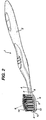
- Figure 1 is a perspective view of one toothbrush of the invention as seen from the bottom.
- Figure 2 is a perspective view of the toothbrush of Figure 1 as seen from the top.
- Figure 3 is a side elevational view thereof.
- Figure 4 is an enlarged fragmentary bottom view of the toothbrush of Figure 1.
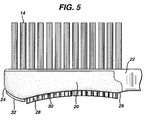
- Figure 5 is an enlarged fragmentary side view of the toothbrush of Figure 1.
- The present invention is directed to a toothbrush that includes a handle, a neck area and a head. The neck area of the toothbrush is integral with and interconnects the handle and head of the toothbrush. The head includes a proximal end proximate the neck area and a distal end terminating at the distal end of the toothbrush. The head comprises a longitudinal axis and a horizontal axis transverse the longitudinal axis. The head includes a front side containing bristles suitable for cleaning and brushing teeth. Any conventional configuration or design of bristles suitable for cleaning and brushing teeth may be employed in toothbrushes of the present invention. There are numerous options for the type of bristles used in addition to or instead of standard nylon bristles. These options include bristles with abrasives, active ingredients, whitening agents or antibacterial agents. In certain embodiments the bristles may be of varying length and pattern.
- The head also contains a backside opposite the front side. The backside may be, but is not necessarily, concave so as to approximate the curvature of teeth in the mouth. The periphery of the head may be in the shape of a parallelogram, for example a rectangle, or an ellipse, for example an oval, provided that it is suitable for use within the mouth.
- The toothbrush also includes a polishing member located at the head of the toothbrush. As used herein, "polishing" is meant to denote the efficacious removal of extrinsic stains from teeth. The polishing member includes a proximal end proximate the neck area and a distal end terminating at the distal end of the head. The polishing member comprises a longitudinal axis and a horizontal axis transverse the longitudinal axis. The periphery of the polishing member substantially conforms to the shape of the head and may be in the shape of a parallelogram, for example a rectangle, or an ellipse, for example an oval, provided that it is suitable for use within the mouth. As with the head, the polishing member may be, but is not necessarily, concave to conform to the natural curvature of teeth in the mouth. In certain embodiments both the head and polishing member may be concave, or the polishing member alone may be concave to conform to the curvature of the teeth.
- The polishing member comprises a base proximate the backside of the toothbrush head and a plurality of projections extending upwardly from the base. Preferably, but not necessarily, the projections extend upwards and are substantially perpendicular to the base of the polishing member. The projections comprise a proximal end proximate the base of the polishing member and a distal end for contacting teeth. The shape of the projections may be selected from the group consisting of cylindrical, conical, rectangular, square, oblong, elliptical, oval, star, triangle, and polygonal. Additionally the projections could be cup-shaped to mimic the prophy cup a dentist uses.
- The projections in the polishing member can be tapered so that the cross-sectional area of the distal end of the projection is less than cross-sectional area of the proximal end of the projections. In addition, the cross-sectional area of projections in an outer portion of the polishing member or a particular pattern on the polishing member may be less than or greater than the cross-sectional area of projections in an inner portion of the polishing member or particular pattern on the polishing member, whereby the polishing member and/or polishing pattern comprises a gradient of cross-sectional surface area.
- The flexibility/stiffness of the projections is a function of the geometry and the material properties making up the polishing elements. The geometry or shape of the projections, for example length, width and/or circumference, are selected so as to provide optimum polishing of the teeth, while also providing optimum gentleness to the gums. For example, the projections should be rigid enough to provide strength for polishing, while also being flexible enough to prevent damage to gums upon contact therewith while polishing the teeth. In certain embodiments the projections could be hollow, such as a cylinder, where the wall thickness geometry and size could be adjusted to provide similar flexibility, while providing moe edges per area, which may enhance polishing efficacy. In other embodiments softer materials, such as thermoplastic elastomers (TPE), may be used on the outer portions of the polishing member to contact with gums, and harder materials (TPE) may be used on the inner portion of the polishing member for efficacious polishing of teeth.
- A plurality of projections is disposed in a pattern on the polishing member base that is effective to enhance polishing of the surface of teeth. The surface formed by the distal ends of the projections in the pattern may be concave so as to conform to the natural curve of teeth, although it is not required. The periphery of the pattern may be in the shape of a parallelogram such as a rectangle or square, an ellipse such as an oval, or a circle. The pattern also may be in the form of a spiral comprising a plurality of projections. The pattern comprises a longitudinal axis substantially parallel to the longitudinal axis of the toothbrush head and a horizontal axis transverse the longitudinal axis of the pattern and substantially parallel to the horizontal axis of the toothbrush head. The two axes bisect their respective planes and may, but need not, intersect at the center of the pattern. The pattern may comprise repeating configurations of projections emanating at the periphery of the pattern and continuing towards the center of the pattern at spaced-apart intervals. For example, the pattern may comprise a plurality of elliptical or circular rings, or a plurality of parallelograms, each comprising a plurality of projections. The space between the individual rings or parallelograms and the distance between the individual projections comprising the rings or parallelograms may be selected to provide optimum polishing, and/or to aid in retention of additional cleaning or polishing materials that may be utilized with the polishing member to enhance polishing, as described herein below.
- The patterns may also include additional structural elements, for example walls, which rise substantially vertically from the polishing member base. The walls may interconnect the individual projections within an individual configuration of projections within the pattern. Alternately, the structural elements may be located between, within and/or around the projections. The width of the structural elements may be less than the diameter or cross-sectional area of the polishing projections. The height can be greater than or equal to individual projections to provide wiping and holding function, whereby the additional structural elements serve to retain additional cleansing or polishing materials within the polishing pattern to enhance polishing of the teeth , or less than individual projections to provide holding function only. In certain embodiments the wall thickness may be about 0.25mm and the wall height about 0.3 mm from base..
- The polishing member may comprise a single pattern of projections covering a portion or substantially all of the base of the polishing member, so as to provide an effective polishing area. The polishing member may comprise a plurality of patterns, for example two or more patterns, positioned along the longitudinal axis of the polishing member. Multiple polishing patterns provide improved conformance to the irregular surfaces of the teeth, as the separate patterns can move independently of each other. The patterns may be positioned equidistant from the horizontal axis bisecting the polishing member, or may be positioned at irregular spaced-apart intervals along the longitudinal axis. The plurality of patterns may be of the same or different peripheral shape. For example, a combination of a parallelogram pattern and a circular, or elliptical pattern may be employed in the polishing member.
- Referring to Figures 1-5, where like numbers refer to like elements, a toothbrush of the present invention is shown. Toothbrush 1 includes
handle 2,neck 4, andhead 6.Head 6 includesproximal end 8proximate neck 4,distal end 10 terminating at the distal end of toothbrush 1,backside 16,front side 12opposite backside 16 and bristles 14 extending fromfront side 12. Longitudinal axis a substantially bisectshead 6 and horizontal axis b is substantially transverse to longitudinal axis a. Toothbrush 1 further includes polishingmember 20 located about and attached tohead 6. - Polishing
member 20 includesproximal end 22proximate neck 4 anddistal end 24 terminating atdistal end 10 ofhead 6. Polishingmember 20 has longitudinal axis c substantially parallel to longitudinal axis a ofhead 6, and horizontal axis d transverse longitudinal axis c and substantially parallel to longitudinal axis b ofhead 6. A plurality ofprojections 28 extends upwards frombase 26 of polishingmember 20 to form a pattern to facilitate polishing of teeth. - In certain embodiments as shown in the Figures 4 and 5, polishing
member 20 comprises two patterns, each comprising a plurality of concentric circles and a single cylindrical projection at the center of the pattern, each concentric circle comprising a plurality ofcylindrical projections 28. Each pattern is disposed along longitudinal axis c of the polishing member. The cylindrical projections may be of consistent diameter, or different diameter. In one embodiment, the diameter of the cylindrical projections in the outer ring may be less than the diameter of projections in the inner ring and/or the projection in the center of the pattern. In other embodiments, a diameter gradient may exist, whereby the diameter of the projections in the respective concentric circles progressively increases from the outer ring to the inner rings, to the center of the pattern. As shown, each of the cylindrical projections may be about 1.13 millimeter (mm) high. The diameters of the cylindrical projections in the respective rings progressing from the outer ring to the center of the pattern may be about 0.90 mm (outer ring), about 1.07 mm (middle ring), about 1.14 mm (inner ring), and about 1.52 mm (center projection), respectively. The diameter, geometry, number, density, and height of the projections may be changed in order to achieve a different amount of flex upon use if desired. - Although cylindrical projections are exemplified, projections having different shapes could be used in the same pattern. Where non-circular, non-cylindrical projections are employed, the cross-sectional area of the projection at a given distance extending from the proximal end of the projection towards the distal end of the projection may vary. For example, the cross-sectional area of projections in the outer ring may be less than the cross-sectional area of projections in inner rings or at the center of the pattern, and a gradient of cross-sectional area may also exist, as with the diameter gradient. As the diameter or cross-sectional area of the individual projections decreases, the flexibility increases. When the product is in use, the projections in contact with the users gum line will be those with the smaller diameter or cross-sectional area, which are most flexible.
- As shown, structural element, e.g. wall, 30 connects
cylindrical projections 28 in each ring. The wall, combined with the close spacing between the polishing projections, helps to hold toothpaste or other polishing materials against the teeth while polishing the teeth. This enhances the efficacy of the polishing member due to the abrasive in the toothpaste. Also, it provides lubricating properties to enhance the polishing experience. The wall forms an annular element connecting adjacent elements located at a common diameter from the central point of the polishing pattern. - In other embodiments of the invention, the distal end of the polishing member may angled relative to the longitudinal axis of the polishing member to provide an
additional scrubbing portion 32. As shown in Figures 4 and 5, the scrubbing portion may be on a convex radius of about 3mm, defined by an angle of about 25 degrees relative to the longitudinal axis of the polishing member, over a linear length, i.e. linear distance between radius end points defined by the 25 degree angle, of about 5mm. The scrubbing portion may include a ridged elliptical pattern as shown, disposed on the face thereof. This scrubbing portion design allows the user to turn the brush vertically and focus the stain removal on specific areas. The elliptical ridges can hold toothpaste or other polishing materials in place to enhance the polishing efficacy. As shown, the ridges on the scrubbing portion of the polishing member may be about 0.5 mm high. While the ridged elliptical pattern is shown, the ridges on the scrubbing portion could be eliminated, leaving a smooth polishing surface, or the scrubbing portion may be textured to provide different levels of drag and toothpaste/polishing material retention. - As shown in the figures, the toothbrush features slightly curved horizontal rows of bristles. The rows are trimmed in a stepped pattern to allow better interdental penetration, as opposed to a flat trim. There are numerous ways the tufts can be arranged and trimmed to optimize plaque and stain removal.
- The toothbrushes of the present invention are made via various injection molding processes known and used by those skilled in the art. The core of the brush, which includes the handle, neck and head, may be polypropylene or another suitable thermoplastic. A thermoplastic elastomer (TPE) or another suitable material may be molded in a separate molding step over part of the handle to enhance the grip of the brush. Such processes also are known to those skilled in the art. The polishing member is injection molded in a separate injection step over the backside of the and around the edges of the head of the polypropylene core. The polishing member is thusly attached to the head as a separate, yet substantially fixedly attached member. The polishing member may be comprised of the same TPE used to fabricate the brush handle, or it may be constructed of an alternative TPE, silicone rubber, polyurethane, or other resilient material. The polishing member may or may not contain additives for enhanced cleaning efficacy or visual appearance.
- Abrasives can be added to the polishing member and projections to increase the stain removal efficacy of the polishing member if so desired. These abrasives can include silica, mica, hydroxyapatite, fibers, or calcium carbonate. Additives such as alumina can also be added to enhance the aesthetics of any of the brush components. Other options for additives include agents to modify coefficient of friction, flavor, scent, whitening agents, pigments, chemotherapeutic agents and antibacterial agents.
- Two independent studies using the same methodology were conducted to evaluate the efficacy of the toothbrush of the present invention depicted in Figures 1-5. Each study consisted of a 2-week pre-trial period of standardized stain development followed by 5 weeks of product usage. The subjects were examined for extrinsic tooth stain and oral health after 2, 4 and 5 weeks of product usage. 73 subjects were included in the first study, and 69 subjects were included in the second.
- All subjects received a dental prophylaxis before the staining period. A "forced stain model" was then used to rapidly induce stain on the anterior teeth by means of limited toothbrushing and stain forming rinses (See: Addy M, Moran J, Newcombe R, Warren P: The comparative tea staining potential of phenolic, chlorhexidine and anti-adhesive mouthrinses; J Clin Periodontol 22:923-928, 1995). Subjects were instructed to brush twice daily with a low-abrasive fluoride dentifrice and soft toothbrush. In the morning and after brushing at bedtime, subjects rinsed with both commercial 0.12% chlorhexidine rinse and double strength tea. After lunch, subjects rinsed with tea only.
- The subjects received both verbal and written instruction for the test period. They were advised to brush twice each day, once in the morning and once at night, with the assigned dentifrice and toothbrush for the entire 5-week trial period. Subjects were instructed to, after brushing, polish their anterior teeth with the polishing pad on the back of the brush head for 60 seconds using a circular motion. This step was done with the toothpaste slurry already in the subjects' mouth from brushing. The instructor supervised initiation of the first treatment to ensure that the subjects found use of the test products acceptable.
- In both studies, the toothbrush of the present invention significantly lowered extrinsic stain at each visit compared to baseline, as evaluated with the Modified Lobene Stain Index (MLSI). The MLSI data is summarized as follows.
- Baseline: 4.04; Week 2: 2.93; Week 4: 2.53; Week 5: 2.42
- Week 2: Mean 1.10; Standard Deviation 0.98; p value 0.0001
- Week 4: Mean 1.51; Standard Deviation 1.0; p value 0.0001
- Week 5: Mean 1.61; Standard Deviation 1.07; p value 0.0001
- Baseline: 1.69; Week 2: 0.89; Week 4: 0.74; Week 5: 0.67
- Week 2: Mean 0.81; Standard Deviation 0.65; p value less than 0.0001
- Week 4: Mean 0.95; Standard Deviation 0.70; p value less than 0.0001
- Week 5: Mean 1.01 Standard Deviation 0.72; p value less than 0.0001
- The toothbrush as depicted in Figures 1-5 was evaluated using an industry-accepted method of determining stain removal in the laboratory. The sample size for this evaluation was 16 brushes. The test was based on the method described by Stookey, et al (Stookey, G.K.; Burkhard, T.A.; and Schemehorn, B.R.: In vitro removal of stain with dentifrices; J Dent Res 61(11):1236-1239, Nov 1982), which involves testing the toothbrush on stained bovine teeth. The whiteness of the teeth before and after treatment is determined by using a spectrophotometer to measure the L*a*b values of the specimen. The polishing member on the toothbrush as depicted was statistically effective in removing extrinsic stain from teeth when evaluated in vitro using a standard dentifrice slurry.
Claims (20)
- A toothbrush, comprising:a handle,a neck,a head, said head comprising a front side and a backside oppositesaid front side; anda polishing member attached to said head, said polishing member comprising a base proximate said backside of said head, and a plurality of projections extending upwards from said base, said projections having a size and a shape and being disposed in a pattern on said base of said polishing member that is effective to provide polishing of teeth.
- The toothbrush of claim 1 wherein said pattern comprises a plurality of concentric rings disposed about a center of said pattern, each of said concentric rings comprising said plurality of projections.
- The toothbrush of claim 2 wherein said shape is cylindrical.
- The toothbrush of claim 3 wherein the diameter of said cylindrical projections in an outer ring of said pattern is less than the diameter of said cylindrical projections in an inner ring of said pattern.
- The toothbrush of claim 1 wherein a cross-sectional area of said projections comprises a gradient.
- The tooth brush of claim 5 wherein said cross-sectional area of said projections in an outer portion of said polishing member are less than said cross-sectional area of said projections in an inner portion of said polishing member.
- The tooth brush of claim 5 wherein said cross-sectional area of said projections in an outer portion of said polishing member are greater than said cross-sectional area of said projections in an inner portion of said polishing member.
- The tooth brush of claim 5 wherein said cross-sectional area of said projections in an outer portion of said pattern are less than said cross-sectional area of said projections in an inner portion of said pattern.
- The tooth brush of claim 5 wherein said cross-sectional area of said projections in an outer portion of said pattern are greater than said cross-sectional area of said projections in an inner portion of said pattern.
- The toothbrush of claim 1 wherein said polishing member comprises a plurality of said patterns disposed along a longitudinal axis of said polishing member.
- The toothbrush of claim 2 wherein said polishing member further comprises a wall interconnecting each of said plurality of projections in said concentric rings.
- The toothbrush of claim 3 wherein said toothbrush comprises a plurality of said patterns disposed along a longitudinal axis of said polishing member.
- The toothbrush of claim 12 wherein said polishing member further comprises a wall interconnecting each of said plurality of projections in said concentric rings.
- The toothbrush of claim 13 wherein said polishing member further comprises a scrubbing portion proximate a distal end of said polishing member.
- The toothbrush of claim 14 wherein said wall has a thickness of about 0.25 millimeters and a height from said base of said polishing member of about 0.3 millimeters.
- The toothbrush of claim 15 wherein each of said projections extends upwards about 1 millimeter from said base of said polishing member, the diameter of projections in an outer concentric ring in said pattern is about 0.9 millimeters, the diameter of projections in a middle ring in said pattern is about 1.07 millimeters, and the diameter of projections in an inner ring in said pattern is about 1.14 millimeters.
- The toothbrush of claim 14 wherein said backside of said head and said base of said polishing member are concave.
- The toothbrush of claim 1 wherein the shape of said projections is selected from the group consisting of cylindrical, conical, rectangular, square, oblong, elliptical, oval, star, triangle and polygonal.
- The toothbrush of claim 1 wherein said polishing member further comprises a scrubbing portion proximate a distal end of said polishing member.
- The toothbrush of claim 1 wherein a cross-sectional area of a distal end of said projection is less than a cross-sectional area of a proximal end of said projections
Applications Claiming Priority (3)
| Application Number | Priority Date | Filing Date | Title |
|---|---|---|---|
| US71039905P | 2005-08-23 | 2005-08-23 | |
| US29/248,308 USD549462S1 (en) | 2006-08-09 | 2006-08-09 | Toothbrush with polishing member |
| US11/463,363 US7712175B2 (en) | 2005-08-23 | 2006-08-09 | Toothbrush with polishing member |
Publications (3)
| Publication Number | Publication Date |
|---|---|
| EP1757203A2 true EP1757203A2 (en) | 2007-02-28 |
| EP1757203A3 EP1757203A3 (en) | 2009-12-02 |
| EP1757203B1 EP1757203B1 (en) | 2017-07-12 |
Family
ID=37875583
Family Applications (1)
| Application Number | Title | Priority Date | Filing Date |
|---|---|---|---|
| EP06254397.0A Not-in-force EP1757203B1 (en) | 2005-08-23 | 2006-08-22 | Toothbrush with polishing member |
Country Status (7)
| Country | Link |
|---|---|
| US (1) | US7712175B2 (en) |
| EP (1) | EP1757203B1 (en) |
| JP (1) | JP5188689B2 (en) |
| AU (1) | AU2006203655B2 (en) |
| BR (1) | BRPI0603393B1 (en) |
| CA (1) | CA2556315C (en) |
| CO (1) | CO5940094A1 (en) |
Cited By (1)
| Publication number | Priority date | Publication date | Assignee | Title |
|---|---|---|---|---|
| KR200468941Y1 (en) * | 2013-03-08 | 2013-09-17 | 김리선 | toothbrush |
Families Citing this family (48)
| Publication number | Priority date | Publication date | Assignee | Title |
|---|---|---|---|---|
| US20070129656A1 (en) * | 2005-01-26 | 2007-06-07 | Brooks William R | Myofacial massager |
| SE528271C2 (en) * | 2005-02-07 | 2006-10-10 | Henrik Falk | Toothbrush shaft and polisher with bowl-shaped part for microfiber cloth |
| US8234741B2 (en) * | 2008-05-06 | 2012-08-07 | Colgate-Palmolive Company | Oral care implement having tissue cleanser |
| USD645252S1 (en) | 2008-08-15 | 2011-09-20 | Mcneil-Ppc, Inc. | Toothbrush |
| USD658885S1 (en) | 2008-09-30 | 2012-05-08 | Mcneil-Ppc, Inc. | Toothbrush handle |
| US20110061189A1 (en) | 2009-09-15 | 2011-03-17 | Mark Stephen Meadows | Oral care products and methods of using and making the same |
| US8434183B2 (en) * | 2010-08-13 | 2013-05-07 | Braun Gmbh | Brush section for an electric toothbrush |
| USD675830S1 (en) | 2009-12-18 | 2013-02-12 | Colgate-Palmolive Company | Toothbrush |
| USD654696S1 (en) | 2009-12-18 | 2012-02-28 | Colgate-Palmolive Company | Toothbrush handle with tissue cleaner |
| USD654695S1 (en) | 2009-12-18 | 2012-02-28 | Colgate-Palmolive Company | Toothbrush |
| USD632484S1 (en) | 2009-12-18 | 2011-02-15 | Eduardo Jimenez | Toothbrush handle with tissue cleaner |
| USD654270S1 (en) | 2009-12-18 | 2012-02-21 | Colgate-Palmolive Company | Toothbrush handle |
| JP5491248B2 (en) * | 2010-03-25 | 2014-05-14 | パナソニック株式会社 | Oral device, and stain removal attachment used in the device |
| PL2642886T3 (en) | 2010-11-22 | 2017-12-29 | Braun Gmbh | Toothbrush |
| USD712155S1 (en) * | 2011-05-02 | 2014-09-02 | Colgate-Palmolive Company | Toothbrush |
| BR112014014935B1 (en) * | 2011-12-21 | 2020-03-03 | Colgate-Palmolive Company | Tissue cleaner and oral hygiene implement |
| GB201215724D0 (en) * | 2012-09-04 | 2012-10-17 | Stanton Deane M | A hair brushing device |
| US9131765B2 (en) | 2012-12-20 | 2015-09-15 | Brushpoint Innovations Inc | Brush head for an electric toothbrush |
| EP3057465B1 (en) | 2013-11-05 | 2018-03-28 | Colgate-Palmolive Company | Oral care implement |
| USD749855S1 (en) | 2013-11-05 | 2016-02-23 | Colgate-Palmolive Company | Oral care implement |
| USD751295S1 (en) | 2013-11-05 | 2016-03-15 | Colgate-Palmolive Company | Oral care implement |
| CN105744856B (en) | 2013-11-05 | 2018-04-20 | 高露洁-棕榄公司 | Oral care implement |
| USD764804S1 (en) | 2013-11-05 | 2016-08-30 | Colgate-Palmolive Company | Oral care implement |
| RU2016117288A (en) * | 2013-11-05 | 2017-12-11 | Колгейт-Палмолив Компани | ORAL CARE DEVICE |
| GB2525638A (en) * | 2014-04-30 | 2015-11-04 | Wisdom Toothbrushes Ltd | Oral hygiene device |
| EP3223657B1 (en) | 2014-12-23 | 2022-12-07 | Colgate-Palmolive Company | Oral care implement |
| US10660430B2 (en) | 2014-12-23 | 2020-05-26 | Colgate-Palmolive Company | Oral care implement having multi-component handle |
| US11291293B2 (en) | 2014-12-23 | 2022-04-05 | Colgate-Palmolive Company | Oral care implement |
| MX393731B (en) | 2014-12-23 | 2025-03-24 | Colgate Palmolive Co | ORAL CARE IMPLEMENT. |
| EP3223655B1 (en) | 2014-12-23 | 2024-10-09 | Colgate-Palmolive Company | Oral care implement |
| CA2970634C (en) | 2014-12-23 | 2022-04-12 | Colgate-Palmolive Company | Oral care implement having multi-component handle |
| RU2664278C1 (en) | 2014-12-23 | 2018-08-15 | Колгейт-Палмолив Компани | Device for oral cavity care, having a multicomponent handle |
| BR112017010792B1 (en) | 2014-12-23 | 2021-10-05 | Colgate-Palmolive Company | ORAL HYGIENE INSTRUMENT |
| USD780457S1 (en) | 2014-12-23 | 2017-03-07 | Colgate-Palmolive Company | Oral care implement |
| US10455931B2 (en) * | 2014-12-23 | 2019-10-29 | Colgate-Palmolive Company | Oral care implement |
| WO2016105374A1 (en) | 2014-12-23 | 2016-06-30 | Colgate-Palmolive Company | Oral care implement |
| EP3995036B1 (en) | 2014-12-23 | 2025-06-04 | Colgate-Palmolive Company | Oral care implement |
| AU2015383809B2 (en) | 2015-02-18 | 2018-04-12 | Colgate-Palmolive Company | Oral care implement |
| US10092380B1 (en) | 2016-05-24 | 2018-10-09 | Justin Solomon | Manually-operated tooth-buffing tool |
| JP2019030583A (en) * | 2017-08-09 | 2019-02-28 | ライオン株式会社 | toothbrush |
| US10709533B2 (en) | 2017-12-12 | 2020-07-14 | Colgate-Palmolive Company | Oral care implement and handle and refill head thereof |
| US10631964B2 (en) | 2017-12-12 | 2020-04-28 | Colgate-Palmolive Company | Oral care implement |
| USD846883S1 (en) | 2017-12-12 | 2019-04-30 | Colgate-Palmolive Company | Handle of an oral care implement |
| US10925384B2 (en) | 2018-04-16 | 2021-02-23 | Colgate-Palmolive Company | Oral care implement |
| USD891784S1 (en) | 2018-12-18 | 2020-08-04 | Colgate-Palmolive Company | Electric toothbrush handle |
| WO2020183759A1 (en) * | 2019-03-08 | 2020-09-17 | 株式会社 東亜産業 | Dental cleaner |
| USD960582S1 (en) | 2020-12-10 | 2022-08-16 | Colgate-Palmolive Company | Oral care refill head |
| USD1025607S1 (en) * | 2021-05-24 | 2024-05-07 | Burst.USA Inc. | Sonic toothbrush |
Family Cites Families (53)
| Publication number | Priority date | Publication date | Assignee | Title |
|---|---|---|---|---|
| US403350A (en) | 1889-05-14 | Lett and harry c | ||
| US245585A (en) | 1881-08-09 | Eoger s | ||
| US1125532A (en) * | 1913-02-03 | 1915-01-19 | Earl Himmel | Tooth-brush. |
| US1128139A (en) | 1913-10-31 | 1915-02-09 | John P Hoffman | Tooth-brush. |
| US1209516A (en) | 1915-10-19 | 1916-12-19 | Francis H Wager | Tooth-brush. |
| US1405279A (en) | 1920-12-04 | 1922-01-31 | William M Cassedy | Toothbrush |
| US1517615A (en) | 1922-08-07 | 1924-12-02 | William R Chynoweth | Brush |
| US1817585A (en) * | 1928-04-18 | 1931-08-04 | Samuel Max | Rubber brush |
| US1892068A (en) * | 1930-12-05 | 1932-12-27 | Robert J Metzler | Massage device |
| US2039278A (en) * | 1935-11-06 | 1936-05-05 | Lloyd H Blanchard | Cleaning and massage device for dental purposes |
| US2206726A (en) * | 1938-03-18 | 1940-07-02 | Robert L Lasater | Rubber toothbrush |
| US2244699A (en) * | 1939-01-03 | 1941-06-10 | Theodore A Hosey | Cleaning device for teeth |
| US2279355A (en) * | 1940-03-28 | 1942-04-14 | Harry L Wilensky | Tooth cleaning and gum massaging brush |
| US2364205A (en) | 1943-04-17 | 1944-12-05 | Leslie L Fuller | Gum massaging and tooth polishing appliance |
| US2545814A (en) * | 1945-09-15 | 1951-03-20 | George A Kempster | Device for treating teeth and gums |
| US2987742A (en) | 1955-02-07 | 1961-06-13 | Levi O Kittle | Brush having foam rubber massage and polishing pad therefor |
| US3007441A (en) * | 1959-05-18 | 1961-11-07 | Bird A Eyer | Tooth brush for use on domestic animals |
| US3337893A (en) | 1964-07-29 | 1967-08-29 | Colgate Palmolive Co | Tooth cleaning implement |
| US3258805A (en) | 1964-11-04 | 1966-07-05 | Rossnan Michael | Tooth brush |
| US4875247A (en) | 1974-05-15 | 1989-10-24 | Skip Berg | Disposable tooth cleaning & polishing apparatus |
| US3985147A (en) | 1975-03-13 | 1976-10-12 | Ricketts Craig M | Dental implement for removing stains from teeth |
| DE2930459A1 (en) * | 1979-07-27 | 1981-02-12 | Kraft Paul | Electrically operated tooth-cleaning instrument - has layer of polishing material fixed to top of body opposite brush |
| US4381792A (en) | 1980-04-22 | 1983-05-03 | Chesebrough-Pond's Inc. | Compositions, articles and methods for polishing surfaces |
| US4576190A (en) | 1982-12-21 | 1986-03-18 | Youssef Kamal A | Toothsticks "Toostix" |
| JPS60137360A (en) | 1983-11-24 | 1985-07-20 | スキャノラル インターナショナル エ−/エス | Apparatus for cleaning and removing scale substance from surface of tooth |
| JPS6326312U (en) * | 1986-08-02 | 1988-02-20 | ||
| US5040260A (en) | 1989-03-16 | 1991-08-20 | Michaels George G | Tooth cleaning and polishing device |
| US5273559A (en) | 1991-08-30 | 1993-12-28 | Minnesota Mining And Manufacturing Company | Abrasive dental articles |
| US5273425A (en) | 1992-09-28 | 1993-12-28 | Hoagland Richard W | Portable pet teeth cleaning abrasive instrument |
| US5604951A (en) | 1994-12-30 | 1997-02-25 | Shipp; Anthony D. | Prophy toothbrush |
| AU4612796A (en) * | 1995-09-07 | 1997-03-27 | Nar Inc. | Dental prophy cup having a paste-distributing channel arrangement |
| US5930860A (en) | 1996-03-27 | 1999-08-03 | Shipp; Anthony D. | Prophy bristle toothbrush |
| CA2260895A1 (en) | 1996-07-19 | 1998-01-29 | Young-Cheol Kweon | Toothbrush |
| US5771522A (en) | 1996-10-18 | 1998-06-30 | Carmody; Shawn J. | Dental hygiene wipe |
| WO1998018364A1 (en) | 1996-10-30 | 1998-05-07 | The Procter & Gamble Company | Toothbrush with combination of bristles, soft cleansing pad, and/or polishing fingers |
| US5735011A (en) * | 1996-11-19 | 1998-04-07 | Asher; Randall S. | Plaque removing toothbrush |
| US5799355A (en) | 1997-02-28 | 1998-09-01 | Burch; Aileen | Padded toothbrush |
| SK282926B6 (en) | 1998-05-22 | 2003-01-09 | Ivan Ďurana | Toothbrush |
| EP0972495A1 (en) | 1998-07-13 | 2000-01-19 | Identoflex AG | Method for manufacturing dental surface treatment tools |
| GB9905195D0 (en) | 1999-03-05 | 1999-04-28 | Unilever Plc | Toothbrush |
| US6319332B1 (en) | 1999-06-11 | 2001-11-20 | James Albert Gavney, Jr. | Squeegee device and system |
| WO2001001817A1 (en) * | 1999-07-02 | 2001-01-11 | Unilever N.V. | Electric toothbrush |
| US6386874B2 (en) | 1999-11-26 | 2002-05-14 | Marc William Bachmann | Hygiene instrument for cleaning and polishing the surface of the teeth and the composite materials of dental filings, in the shape of a rod |
| US6860738B2 (en) | 1999-11-26 | 2005-03-01 | Marc William Bachmann | Hygiene instrument for cleaning and polishing the surface of the teeth and the composite materials of dental fillings |
| US6685474B2 (en) | 2001-02-01 | 2004-02-03 | Douglas B. Harwood | Aqueous slurries useful for cleaning teeth and methods related thereto |
| US7143462B2 (en) | 2002-09-20 | 2006-12-05 | Colgate-Palmolive Company | Oral care implement |
| US7721376B2 (en) | 2002-09-20 | 2010-05-25 | Colgate-Palmolive Company | Oral care implement |
| DE60311478T2 (en) | 2002-09-20 | 2007-10-31 | Unilever N.V. | BRUSH ARRANGEMENT |
| CA2500180C (en) * | 2002-09-27 | 2008-08-12 | Colgate-Palmolive Company | Toothbrush with cups |
| EP1558111B1 (en) | 2002-11-06 | 2011-09-14 | Unilever N.V. | Toothbrush |
| US7934284B2 (en) * | 2003-02-11 | 2011-05-03 | Braun Gmbh | Toothbrushes |
| CA2842174C (en) | 2003-06-20 | 2016-04-26 | Colgate-Palmolive Company | Toothbrush tissue cleanser |
| US7044671B2 (en) | 2003-09-26 | 2006-05-16 | Warner-Lambert Company Llc | Applicator for cleaning teeth |
-
2006
- 2006-08-09 US US11/463,363 patent/US7712175B2/en not_active Expired - Fee Related
- 2006-08-17 CA CA2556315A patent/CA2556315C/en not_active Expired - Fee Related
- 2006-08-18 CO CO06082166A patent/CO5940094A1/en not_active Application Discontinuation
- 2006-08-22 EP EP06254397.0A patent/EP1757203B1/en not_active Not-in-force
- 2006-08-22 JP JP2006225506A patent/JP5188689B2/en not_active Expired - Fee Related
- 2006-08-22 BR BRPI0603393-8A patent/BRPI0603393B1/en not_active IP Right Cessation
- 2006-08-23 AU AU2006203655A patent/AU2006203655B2/en not_active Ceased
Non-Patent Citations (2)
| Title |
|---|
| ADDY M ET AL.: "The comparative tea staining potential of phenolic, chlorhexidine and anti-adhesive mouthrinses", J CLIN PERIODONTOL, vol. 22, 1995, pages 923 - 928 |
| STOOKEY, G.K.; BURKHARD, T.A.; SCHEMEHORN, B. R.: "In vitro removal of stain with dentifrices", J DENT RES, vol. 61, no. 11, November 1982 (1982-11-01), pages 1236 - 1239, XP000561316 |
Cited By (1)
| Publication number | Priority date | Publication date | Assignee | Title |
|---|---|---|---|---|
| KR200468941Y1 (en) * | 2013-03-08 | 2013-09-17 | 김리선 | toothbrush |
Also Published As
| Publication number | Publication date |
|---|---|
| JP5188689B2 (en) | 2013-04-24 |
| CA2556315C (en) | 2014-03-11 |
| US20070199168A1 (en) | 2007-08-30 |
| AU2006203655A1 (en) | 2007-03-15 |
| CA2556315A1 (en) | 2007-02-23 |
| CO5940094A1 (en) | 2008-07-31 |
| EP1757203A3 (en) | 2009-12-02 |
| US7712175B2 (en) | 2010-05-11 |
| BRPI0603393B1 (en) | 2017-06-27 |
| JP2007054625A (en) | 2007-03-08 |
| EP1757203B1 (en) | 2017-07-12 |
| AU2006203655B2 (en) | 2011-12-22 |
| BRPI0603393A (en) | 2007-04-27 |
Similar Documents
| Publication | Publication Date | Title |
|---|---|---|
| CA2556315C (en) | Toothbrush with polishing member | |
| KR102216259B1 (en) | Heads and oral care instruments for oral care instruments | |
| JP4050356B2 (en) | toothbrush | |
| CN101472503B (en) | Toothbrush with brushing and elastomer element | |
| CN102740729B (en) | Oral care implement | |
| US4610045A (en) | Toothbrush | |
| US20130255017A1 (en) | Oral care implement | |
| KR20100042267A (en) | Toothbrush with long tapered bristles and short non-tapered bristles | |
| US11672326B2 (en) | Applicator device | |
| RU2734810C2 (en) | Oral care appliance and filament for use with said appliance | |
| JP2008154808A (en) | toothbrush | |
| US4020522A (en) | Bristle ring for use in dental care | |
| CN110213979B (en) | Tooth brush | |
| JP3143239U (en) | toothbrush | |
| KR200407689Y1 (en) | Toothbrush with Interdental Toothbrush | |
| JPH07227318A (en) | toothbrush | |
| US9510666B1 (en) | Training toothbrush | |
| JP5296331B2 (en) | toothbrush | |
| JP2021178114A (en) | toothbrush | |
| JP2021178113A (en) | toothbrush | |
| Jamkhande et al. | International Journal of Advanced Multidisciplinary Research and Studies |
Legal Events
| Date | Code | Title | Description |
|---|---|---|---|
| PUAI | Public reference made under article 153(3) epc to a published international application that has entered the european phase |
Free format text: ORIGINAL CODE: 0009012 |
|
| AK | Designated contracting states |
Kind code of ref document: A2 Designated state(s): AT BE BG CH CY CZ DE DK EE ES FI FR GB GR HU IE IS IT LI LT LU LV MC NL PL PT RO SE SI SK TR |
|
| AX | Request for extension of the european patent |
Extension state: AL BA HR MK YU |
|
| PUAL | Search report despatched |
Free format text: ORIGINAL CODE: 0009013 |
|
| AK | Designated contracting states |
Kind code of ref document: A3 Designated state(s): AT BE BG CH CY CZ DE DK EE ES FI FR GB GR HU IE IS IT LI LT LU LV MC NL PL PT RO SE SI SK TR |
|
| AX | Request for extension of the european patent |
Extension state: AL BA HR MK RS |
|
| RIC1 | Information provided on ipc code assigned before grant |
Ipc: A46B 9/04 20060101ALN20091029BHEP Ipc: A46B 15/00 20060101AFI20091029BHEP |
|
| 17P | Request for examination filed |
Effective date: 20100514 |
|
| AKX | Designation fees paid |
Designated state(s): DE GB |
|
| RBV | Designated contracting states (corrected) |
Designated state(s): DE GB |
|
| 17Q | First examination report despatched |
Effective date: 20140226 |
|
| RAP1 | Party data changed (applicant data changed or rights of an application transferred) |
Owner name: JOHNSON & JOHNSON CONSUMER INC. |
|
| REG | Reference to a national code |
Ref country code: DE Ref legal event code: R079 Ref document number: 602006052994 Country of ref document: DE Free format text: PREVIOUS MAIN CLASS: A46B0009040000 Ipc: A46B0005020000 |
|
| GRAP | Despatch of communication of intention to grant a patent |
Free format text: ORIGINAL CODE: EPIDOSNIGR1 |
|
| RIC1 | Information provided on ipc code assigned before grant |
Ipc: A46B 15/00 20060101ALI20170320BHEP Ipc: A46B 5/02 20060101AFI20170320BHEP |
|
| INTG | Intention to grant announced |
Effective date: 20170419 |
|
| GRAS | Grant fee paid |
Free format text: ORIGINAL CODE: EPIDOSNIGR3 |
|
| GRAA | (expected) grant |
Free format text: ORIGINAL CODE: 0009210 |
|
| AK | Designated contracting states |
Kind code of ref document: B1 Designated state(s): DE GB |
|
| REG | Reference to a national code |
Ref country code: GB Ref legal event code: FG4D |
|
| REG | Reference to a national code |
Ref country code: DE Ref legal event code: R096 Ref document number: 602006052994 Country of ref document: DE |
|
| REG | Reference to a national code |
Ref country code: DE Ref legal event code: R097 Ref document number: 602006052994 Country of ref document: DE |
|
| PLBE | No opposition filed within time limit |
Free format text: ORIGINAL CODE: 0009261 |
|
| STAA | Information on the status of an ep patent application or granted ep patent |
Free format text: STATUS: NO OPPOSITION FILED WITHIN TIME LIMIT |
|
| 26N | No opposition filed |
Effective date: 20180413 |
|
| PGFP | Annual fee paid to national office [announced via postgrant information from national office to epo] |
Ref country code: DE Payment date: 20190806 Year of fee payment: 14 |
|
| PGFP | Annual fee paid to national office [announced via postgrant information from national office to epo] |
Ref country code: GB Payment date: 20190822 Year of fee payment: 14 |
|
| REG | Reference to a national code |
Ref country code: DE Ref legal event code: R119 Ref document number: 602006052994 Country of ref document: DE |
|
| GBPC | Gb: european patent ceased through non-payment of renewal fee |
Effective date: 20200822 |
|
| PG25 | Lapsed in a contracting state [announced via postgrant information from national office to epo] |
Ref country code: DE Free format text: LAPSE BECAUSE OF NON-PAYMENT OF DUE FEES Effective date: 20210302 |
|
| PG25 | Lapsed in a contracting state [announced via postgrant information from national office to epo] |
Ref country code: GB Free format text: LAPSE BECAUSE OF NON-PAYMENT OF DUE FEES Effective date: 20200822 |