EP1756126B1 - Process for the alkylation of phosphorus-containing compounds - Google Patents
Process for the alkylation of phosphorus-containing compounds Download PDFInfo
- Publication number
- EP1756126B1 EP1756126B1 EP05737652A EP05737652A EP1756126B1 EP 1756126 B1 EP1756126 B1 EP 1756126B1 EP 05737652 A EP05737652 A EP 05737652A EP 05737652 A EP05737652 A EP 05737652A EP 1756126 B1 EP1756126 B1 EP 1756126B1
- Authority
- EP
- European Patent Office
- Prior art keywords
- acid
- phosphorus
- tert
- carbon atoms
- butyl
- Prior art date
- Legal status (The legal status is an assumption and is not a legal conclusion. Google has not performed a legal analysis and makes no representation as to the accuracy of the status listed.)
- Expired - Lifetime
Links
- 238000000034 method Methods 0.000 title claims abstract description 28
- OAICVXFJPJFONN-UHFFFAOYSA-N Phosphorus Chemical compound [P] OAICVXFJPJFONN-UHFFFAOYSA-N 0.000 title claims abstract description 24
- 150000001875 compounds Chemical class 0.000 title claims abstract description 24
- 239000011574 phosphorus Substances 0.000 title claims abstract description 24
- 229910052698 phosphorus Inorganic materials 0.000 title claims abstract description 24
- 238000005804 alkylation reaction Methods 0.000 title claims description 8
- 230000029936 alkylation Effects 0.000 title description 6
- 239000003999 initiator Substances 0.000 claims abstract description 21
- 150000001336 alkenes Chemical class 0.000 claims abstract description 19
- 239000000376 reactant Substances 0.000 claims abstract description 11
- 230000002152 alkylating effect Effects 0.000 claims abstract description 10
- 150000001925 cycloalkenes Chemical class 0.000 claims abstract description 10
- 238000011065 in-situ storage Methods 0.000 claims abstract description 9
- 239000002168 alkylating agent Substances 0.000 claims abstract description 8
- 229940100198 alkylating agent Drugs 0.000 claims abstract description 8
- 229910052739 hydrogen Inorganic materials 0.000 claims abstract description 8
- 239000001257 hydrogen Substances 0.000 claims abstract description 8
- 150000003017 phosphorus Chemical class 0.000 claims abstract description 7
- 125000002947 alkylene group Chemical group 0.000 claims abstract 2
- 125000002993 cycloalkylene group Chemical group 0.000 claims abstract 2
- 239000002253 acid Substances 0.000 claims description 29
- -1 benzenephosphinic acid phenyl ester Chemical class 0.000 claims description 24
- DKGAVHZHDRPRBM-UHFFFAOYSA-N Tert-Butanol Chemical compound CC(C)(C)O DKGAVHZHDRPRBM-UHFFFAOYSA-N 0.000 claims description 23
- 125000004432 carbon atom Chemical group C* 0.000 claims description 23
- 125000000217 alkyl group Chemical group 0.000 claims description 17
- 239000000047 product Substances 0.000 claims description 15
- DRDKFCAHTAHYER-UHFFFAOYSA-N bis(2-methylpropyl)phosphinic acid Chemical compound CC(C)CP(O)(=O)CC(C)C DRDKFCAHTAHYER-UHFFFAOYSA-N 0.000 claims description 14
- ACVYVLVWPXVTIT-UHFFFAOYSA-N phosphinic acid Chemical compound O[PH2]=O ACVYVLVWPXVTIT-UHFFFAOYSA-N 0.000 claims description 13
- 229910052751 metal Inorganic materials 0.000 claims description 11
- 239000002184 metal Substances 0.000 claims description 11
- 150000003839 salts Chemical class 0.000 claims description 11
- 125000003118 aryl group Chemical group 0.000 claims description 8
- 125000000753 cycloalkyl group Chemical group 0.000 claims description 8
- LSXWFXONGKSEMY-UHFFFAOYSA-N di-tert-butyl peroxide Chemical compound CC(C)(C)OOC(C)(C)C LSXWFXONGKSEMY-UHFFFAOYSA-N 0.000 claims description 8
- OZAIFHULBGXAKX-UHFFFAOYSA-N 2-(2-cyanopropan-2-yldiazenyl)-2-methylpropanenitrile Chemical compound N#CC(C)(C)N=NC(C)(C)C#N OZAIFHULBGXAKX-UHFFFAOYSA-N 0.000 claims description 7
- WMOVHXAZOJBABW-UHFFFAOYSA-N tert-butyl acetate Chemical compound CC(=O)OC(C)(C)C WMOVHXAZOJBABW-UHFFFAOYSA-N 0.000 claims description 7
- MSXVEPNJUHWQHW-UHFFFAOYSA-N 2-methylbutan-2-ol Chemical compound CCC(C)(C)O MSXVEPNJUHWQHW-UHFFFAOYSA-N 0.000 claims description 6
- KFZMGEQAYNKOFK-UHFFFAOYSA-N Isopropanol Chemical compound CC(C)O KFZMGEQAYNKOFK-UHFFFAOYSA-N 0.000 claims description 6
- BTANRVKWQNVYAZ-UHFFFAOYSA-N butan-2-ol Chemical compound CCC(C)O BTANRVKWQNVYAZ-UHFFFAOYSA-N 0.000 claims description 6
- 229910052725 zinc Inorganic materials 0.000 claims description 6
- 239000011701 zinc Substances 0.000 claims description 6
- GQZXNSPRSGFJLY-UHFFFAOYSA-N hydroxyphosphanone Chemical compound OP=O GQZXNSPRSGFJLY-UHFFFAOYSA-N 0.000 claims description 5
- 150000002978 peroxides Chemical class 0.000 claims description 5
- HLMXUWAUCZMWOG-UHFFFAOYSA-N 2-methyl-2-[(2-methylpropan-2-yl)oxyphosphonoyloxy]propane Chemical compound CC(C)(C)OP(=O)OC(C)(C)C HLMXUWAUCZMWOG-UHFFFAOYSA-N 0.000 claims description 4
- HNVRRHSXBLFLIG-UHFFFAOYSA-N 3-hydroxy-3-methylbut-1-ene Chemical compound CC(C)(O)C=C HNVRRHSXBLFLIG-UHFFFAOYSA-N 0.000 claims description 4
- KWSLGOVYXMQPPX-UHFFFAOYSA-N 5-[3-(trifluoromethyl)phenyl]-2h-tetrazole Chemical compound FC(F)(F)C1=CC=CC(C2=NNN=N2)=C1 KWSLGOVYXMQPPX-UHFFFAOYSA-N 0.000 claims description 4
- VZOUAJWESDEYMF-UHFFFAOYSA-N CC(C)(C)OP(O)=O Chemical compound CC(C)(C)OP(O)=O VZOUAJWESDEYMF-UHFFFAOYSA-N 0.000 claims description 4
- MHAJPDPJQMAIIY-UHFFFAOYSA-N Hydrogen peroxide Chemical compound OO MHAJPDPJQMAIIY-UHFFFAOYSA-N 0.000 claims description 4
- XEEYBQQBJWHFJM-UHFFFAOYSA-N Iron Chemical compound [Fe] XEEYBQQBJWHFJM-UHFFFAOYSA-N 0.000 claims description 4
- PXHVJJICTQNCMI-UHFFFAOYSA-N Nickel Chemical compound [Ni] PXHVJJICTQNCMI-UHFFFAOYSA-N 0.000 claims description 4
- KFSLWBXXFJQRDL-UHFFFAOYSA-N Peracetic acid Chemical compound CC(=O)OO KFSLWBXXFJQRDL-UHFFFAOYSA-N 0.000 claims description 4
- HCHKCACWOHOZIP-UHFFFAOYSA-N Zinc Chemical compound [Zn] HCHKCACWOHOZIP-UHFFFAOYSA-N 0.000 claims description 4
- 229910052782 aluminium Inorganic materials 0.000 claims description 4
- 229910052500 inorganic mineral Inorganic materials 0.000 claims description 4
- 239000011777 magnesium Substances 0.000 claims description 4
- 229910052749 magnesium Inorganic materials 0.000 claims description 4
- 239000011707 mineral Substances 0.000 claims description 4
- 150000003254 radicals Chemical class 0.000 claims description 4
- 229910001379 sodium hypophosphite Inorganic materials 0.000 claims description 4
- DGAQECJNVWCQMB-PUAWFVPOSA-M Ilexoside XXIX Chemical compound C[C@@H]1CC[C@@]2(CC[C@@]3(C(=CC[C@H]4[C@]3(CC[C@@H]5[C@@]4(CC[C@@H](C5(C)C)OS(=O)(=O)[O-])C)C)[C@@H]2[C@]1(C)O)C)C(=O)O[C@H]6[C@@H]([C@H]([C@@H]([C@H](O6)CO)O)O)O.[Na+] DGAQECJNVWCQMB-PUAWFVPOSA-M 0.000 claims description 3
- 239000011575 calcium Substances 0.000 claims description 3
- 229910052791 calcium Inorganic materials 0.000 claims description 3
- 150000001451 organic peroxides Chemical class 0.000 claims description 3
- 239000011734 sodium Substances 0.000 claims description 3
- 229910052708 sodium Inorganic materials 0.000 claims description 3
- GCTIWQGPLSSWPO-UHFFFAOYSA-N (2-methylpropan-2-yl)oxy-oxidophosphanium Chemical compound CC(C)(C)O[PH2]=O GCTIWQGPLSSWPO-UHFFFAOYSA-N 0.000 claims description 2
- BQLFEOLREMDHJF-UHFFFAOYSA-N 1-methylcyclodecan-1-ol Chemical compound CC1(O)CCCCCCCCC1 BQLFEOLREMDHJF-UHFFFAOYSA-N 0.000 claims description 2
- YCICXFIRAMLYDV-UHFFFAOYSA-N 1-methylcyclooctan-1-ol Chemical compound CC1(O)CCCCCCC1 YCICXFIRAMLYDV-UHFFFAOYSA-N 0.000 claims description 2
- CAKWRXVKWGUISE-UHFFFAOYSA-N 1-methylcyclopentan-1-ol Chemical compound CC1(O)CCCC1 CAKWRXVKWGUISE-UHFFFAOYSA-N 0.000 claims description 2
- AVTLBBWTUPQRAY-UHFFFAOYSA-N 2-(2-cyanobutan-2-yldiazenyl)-2-methylbutanenitrile Chemical compound CCC(C)(C#N)N=NC(C)(CC)C#N AVTLBBWTUPQRAY-UHFFFAOYSA-N 0.000 claims description 2
- WCASXYBKJHWFMY-NSCUHMNNSA-N 2-Buten-1-ol Chemical compound C\C=C\CO WCASXYBKJHWFMY-NSCUHMNNSA-N 0.000 claims description 2
- BZAZNULYLRVMSW-UHFFFAOYSA-N 2-Methyl-2-buten-3-ol Natural products CC(C)=C(C)O BZAZNULYLRVMSW-UHFFFAOYSA-N 0.000 claims description 2
- JOUWCKCVTDSMHF-UHFFFAOYSA-N 2-bromo-2-methylbutane Chemical compound CCC(C)(C)Br JOUWCKCVTDSMHF-UHFFFAOYSA-N 0.000 claims description 2
- NAMYKGVDVNBCFQ-UHFFFAOYSA-N 2-bromopropane Chemical compound CC(C)Br NAMYKGVDVNBCFQ-UHFFFAOYSA-N 0.000 claims description 2
- GYYNUFBUILURBT-UHFFFAOYSA-N 2-methyl-1-[(2-methylpropan-2-yl)oxy-(2-methylpropyl)phosphoryl]propane Chemical compound CC(C)CP(=O)(CC(C)C)OC(C)(C)C GYYNUFBUILURBT-UHFFFAOYSA-N 0.000 claims description 2
- VFXXTYGQYWRHJP-UHFFFAOYSA-N 4,4'-azobis(4-cyanopentanoic acid) Chemical compound OC(=O)CCC(C)(C#N)N=NC(C)(CCC(O)=O)C#N VFXXTYGQYWRHJP-UHFFFAOYSA-N 0.000 claims description 2
- OMPJBNCRMGITSC-UHFFFAOYSA-N Benzoylperoxide Chemical compound C=1C=CC=CC=1C(=O)OOC(=O)C1=CC=CC=C1 OMPJBNCRMGITSC-UHFFFAOYSA-N 0.000 claims description 2
- QCMYYKRYFNMIEC-UHFFFAOYSA-N COP(O)=O Chemical compound COP(O)=O QCMYYKRYFNMIEC-UHFFFAOYSA-N 0.000 claims description 2
- XFTUHJMRNUMMJH-UHFFFAOYSA-N CP(=O)OC1=CC=CC=C1 Chemical compound CP(=O)OC1=CC=CC=C1 XFTUHJMRNUMMJH-UHFFFAOYSA-N 0.000 claims description 2
- OYPRJOBELJOOCE-UHFFFAOYSA-N Calcium Chemical compound [Ca] OYPRJOBELJOOCE-UHFFFAOYSA-N 0.000 claims description 2
- VYZAMTAEIAYCRO-UHFFFAOYSA-N Chromium Chemical compound [Cr] VYZAMTAEIAYCRO-UHFFFAOYSA-N 0.000 claims description 2
- RYGMFSIKBFXOCR-UHFFFAOYSA-N Copper Chemical compound [Cu] RYGMFSIKBFXOCR-UHFFFAOYSA-N 0.000 claims description 2
- JPVYNHNXODAKFH-UHFFFAOYSA-N Cu2+ Chemical compound [Cu+2] JPVYNHNXODAKFH-UHFFFAOYSA-N 0.000 claims description 2
- CWYNVVGOOAEACU-UHFFFAOYSA-N Fe2+ Chemical compound [Fe+2] CWYNVVGOOAEACU-UHFFFAOYSA-N 0.000 claims description 2
- VTLYFUHAOXGGBS-UHFFFAOYSA-N Fe3+ Chemical compound [Fe+3] VTLYFUHAOXGGBS-UHFFFAOYSA-N 0.000 claims description 2
- WHXSMMKQMYFTQS-UHFFFAOYSA-N Lithium Chemical group [Li] WHXSMMKQMYFTQS-UHFFFAOYSA-N 0.000 claims description 2
- FYYHWMGAXLPEAU-UHFFFAOYSA-N Magnesium Chemical compound [Mg] FYYHWMGAXLPEAU-UHFFFAOYSA-N 0.000 claims description 2
- ZOKXTWBITQBERF-UHFFFAOYSA-N Molybdenum Chemical compound [Mo] ZOKXTWBITQBERF-UHFFFAOYSA-N 0.000 claims description 2
- ZLMJMSJWJFRBEC-UHFFFAOYSA-N Potassium Chemical compound [K] ZLMJMSJWJFRBEC-UHFFFAOYSA-N 0.000 claims description 2
- RTAQQCXQSZGOHL-UHFFFAOYSA-N Titanium Chemical compound [Ti] RTAQQCXQSZGOHL-UHFFFAOYSA-N 0.000 claims description 2
- LXEKPEMOWBOYRF-UHFFFAOYSA-N [2-[(1-azaniumyl-1-imino-2-methylpropan-2-yl)diazenyl]-2-methylpropanimidoyl]azanium;dichloride Chemical compound Cl.Cl.NC(=N)C(C)(C)N=NC(C)(C)C(N)=N LXEKPEMOWBOYRF-UHFFFAOYSA-N 0.000 claims description 2
- GVWKYWPGUZKCAV-UHFFFAOYSA-M [Na+].CP([O-])=O Chemical compound [Na+].CP([O-])=O GVWKYWPGUZKCAV-UHFFFAOYSA-M 0.000 claims description 2
- XAGFODPZIPBFFR-UHFFFAOYSA-N aluminium Chemical compound [Al] XAGFODPZIPBFFR-UHFFFAOYSA-N 0.000 claims description 2
- 229910001377 aluminum hypophosphite Inorganic materials 0.000 claims description 2
- HJJOHHHEKFECQI-UHFFFAOYSA-N aluminum;phosphite Chemical compound [Al+3].[O-]P([O-])[O-] HJJOHHHEKFECQI-UHFFFAOYSA-N 0.000 claims description 2
- ROOXNKNUYICQNP-UHFFFAOYSA-N ammonium persulfate Chemical compound [NH4+].[NH4+].[O-]S(=O)(=O)OOS([O-])(=O)=O ROOXNKNUYICQNP-UHFFFAOYSA-N 0.000 claims description 2
- 239000012935 ammoniumperoxodisulfate Substances 0.000 claims description 2
- 229910052788 barium Inorganic materials 0.000 claims description 2
- DSAJWYNOEDNPEQ-UHFFFAOYSA-N barium atom Chemical compound [Ba] DSAJWYNOEDNPEQ-UHFFFAOYSA-N 0.000 claims description 2
- 235000019400 benzoyl peroxide Nutrition 0.000 claims description 2
- 229910001382 calcium hypophosphite Inorganic materials 0.000 claims description 2
- 229940064002 calcium hypophosphite Drugs 0.000 claims description 2
- 150000001732 carboxylic acid derivatives Chemical class 0.000 claims description 2
- 229910052804 chromium Inorganic materials 0.000 claims description 2
- 239000011651 chromium Substances 0.000 claims description 2
- 239000010941 cobalt Substances 0.000 claims description 2
- 229910017052 cobalt Inorganic materials 0.000 claims description 2
- GUTLYIVDDKVIGB-UHFFFAOYSA-N cobalt atom Chemical compound [Co] GUTLYIVDDKVIGB-UHFFFAOYSA-N 0.000 claims description 2
- 239000010949 copper Substances 0.000 claims description 2
- 229910052802 copper Inorganic materials 0.000 claims description 2
- 229910052736 halogen Inorganic materials 0.000 claims description 2
- 150000002367 halogens Chemical group 0.000 claims description 2
- IDVRZFQYOSGBAF-UHFFFAOYSA-O hydroxy-oxo-phenoxyphosphanium Chemical compound O[P+](=O)OC1=CC=CC=C1 IDVRZFQYOSGBAF-UHFFFAOYSA-O 0.000 claims description 2
- 229910052742 iron Inorganic materials 0.000 claims description 2
- BZWGENDDUSTHIR-UHFFFAOYSA-N iron phosphorous acid Chemical compound [Fe].P(O)(O)O BZWGENDDUSTHIR-UHFFFAOYSA-N 0.000 claims description 2
- ULYZAYCEDJDHCC-UHFFFAOYSA-N isopropyl chloride Chemical compound CC(C)Cl ULYZAYCEDJDHCC-UHFFFAOYSA-N 0.000 claims description 2
- 229910052744 lithium Inorganic materials 0.000 claims description 2
- 229910052750 molybdenum Inorganic materials 0.000 claims description 2
- 239000011733 molybdenum Substances 0.000 claims description 2
- QYZFTMMPKCOTAN-UHFFFAOYSA-N n-[2-(2-hydroxyethylamino)ethyl]-2-[[1-[2-(2-hydroxyethylamino)ethylamino]-2-methyl-1-oxopropan-2-yl]diazenyl]-2-methylpropanamide Chemical compound OCCNCCNC(=O)C(C)(C)N=NC(C)(C)C(=O)NCCNCCO QYZFTMMPKCOTAN-UHFFFAOYSA-N 0.000 claims description 2
- 229910052759 nickel Inorganic materials 0.000 claims description 2
- RYIOLWQRQXDECZ-UHFFFAOYSA-N phosphinous acid Chemical compound PO RYIOLWQRQXDECZ-UHFFFAOYSA-N 0.000 claims description 2
- 239000011591 potassium Substances 0.000 claims description 2
- 229910052700 potassium Inorganic materials 0.000 claims description 2
- USHAGKDGDHPEEY-UHFFFAOYSA-L potassium persulfate Chemical compound [K+].[K+].[O-]S(=O)(=O)OOS([O-])(=O)=O USHAGKDGDHPEEY-UHFFFAOYSA-L 0.000 claims description 2
- SDQCGKJCBWXRMK-UHFFFAOYSA-N propan-2-yl 4-methylbenzenesulfonate Chemical compound CC(C)OS(=O)(=O)C1=CC=C(C)C=C1 SDQCGKJCBWXRMK-UHFFFAOYSA-N 0.000 claims description 2
- SWWHCQCMVCPLEQ-UHFFFAOYSA-N propan-2-yl methanesulfonate Chemical compound CC(C)OS(C)(=O)=O SWWHCQCMVCPLEQ-UHFFFAOYSA-N 0.000 claims description 2
- 159000000000 sodium salts Chemical class 0.000 claims description 2
- HHJJPFYGIRKQOM-UHFFFAOYSA-N sodium;oxido-oxo-phenylphosphanium Chemical compound [Na+].[O-][P+](=O)C1=CC=CC=C1 HHJJPFYGIRKQOM-UHFFFAOYSA-N 0.000 claims description 2
- CRNIHJHMEQZAAS-UHFFFAOYSA-N tert-amyl chloride Chemical compound CCC(C)(C)Cl CRNIHJHMEQZAAS-UHFFFAOYSA-N 0.000 claims description 2
- RKSOPLXZQNSWAS-UHFFFAOYSA-N tert-butyl bromide Chemical compound CC(C)(C)Br RKSOPLXZQNSWAS-UHFFFAOYSA-N 0.000 claims description 2
- NBRKLOOSMBRFMH-UHFFFAOYSA-N tert-butyl chloride Chemical compound CC(C)(C)Cl NBRKLOOSMBRFMH-UHFFFAOYSA-N 0.000 claims description 2
- IRDFFAPCSABAGK-UHFFFAOYSA-N tert-butyl dihydrogen phosphate Chemical compound CC(C)(C)OP(O)(O)=O IRDFFAPCSABAGK-UHFFFAOYSA-N 0.000 claims description 2
- CNALVHVMBXLLIY-IUCAKERBSA-N tert-butyl n-[(3s,5s)-5-methylpiperidin-3-yl]carbamate Chemical compound C[C@@H]1CNC[C@@H](NC(=O)OC(C)(C)C)C1 CNALVHVMBXLLIY-IUCAKERBSA-N 0.000 claims description 2
- 239000010936 titanium Substances 0.000 claims description 2
- 229910052719 titanium Inorganic materials 0.000 claims description 2
- XWKBMOUUGHARTI-UHFFFAOYSA-N tricalcium;diphosphite Chemical compound [Ca+2].[Ca+2].[Ca+2].[O-]P([O-])[O-].[O-]P([O-])[O-] XWKBMOUUGHARTI-UHFFFAOYSA-N 0.000 claims description 2
- NCPXQVVMIXIKTN-UHFFFAOYSA-N trisodium;phosphite Chemical compound [Na+].[Na+].[Na+].[O-]P([O-])[O-] NCPXQVVMIXIKTN-UHFFFAOYSA-N 0.000 claims description 2
- AUTOISGCBLBLBA-UHFFFAOYSA-N trizinc;diphosphite Chemical compound [Zn+2].[Zn+2].[Zn+2].[O-]P([O-])[O-].[O-]P([O-])[O-] AUTOISGCBLBLBA-UHFFFAOYSA-N 0.000 claims description 2
- 229910052720 vanadium Inorganic materials 0.000 claims description 2
- GPPXJZIENCGNKB-UHFFFAOYSA-N vanadium Chemical compound [V]#[V] GPPXJZIENCGNKB-UHFFFAOYSA-N 0.000 claims description 2
- PGFZYOCLSPEKSN-UHFFFAOYSA-N 5,5-dimethyl-1,3-diazabicyclo[2.2.0]hex-3-ene dihydrochloride Chemical compound Cl.Cl.CC1(C)CN2CN=C12 PGFZYOCLSPEKSN-UHFFFAOYSA-N 0.000 claims 1
- ABLZXFCXXLZCGV-UHFFFAOYSA-N Phosphorous acid Chemical compound OP(O)=O ABLZXFCXXLZCGV-UHFFFAOYSA-N 0.000 claims 1
- 239000007795 chemical reaction product Substances 0.000 claims 1
- QTBSBXVTEAMEQO-UHFFFAOYSA-N Acetic acid Chemical compound CC(O)=O QTBSBXVTEAMEQO-UHFFFAOYSA-N 0.000 description 30
- 239000000203 mixture Substances 0.000 description 20
- DNSDAPMTVRGGLR-UHFFFAOYSA-N 2-methylpropylphosphinic acid Chemical compound CC(C)CP(O)=O DNSDAPMTVRGGLR-UHFFFAOYSA-N 0.000 description 10
- 238000006243 chemical reaction Methods 0.000 description 10
- HEMHJVSKTPXQMS-UHFFFAOYSA-M Sodium hydroxide Chemical compound [OH-].[Na+] HEMHJVSKTPXQMS-UHFFFAOYSA-M 0.000 description 9
- XLYOFNOQVPJJNP-UHFFFAOYSA-N water Substances O XLYOFNOQVPJJNP-UHFFFAOYSA-N 0.000 description 9
- 238000004679 31P NMR spectroscopy Methods 0.000 description 8
- 150000007513 acids Chemical class 0.000 description 8
- QAOWNCQODCNURD-UHFFFAOYSA-N Sulfuric acid Chemical compound OS(O)(=O)=O QAOWNCQODCNURD-UHFFFAOYSA-N 0.000 description 7
- 238000004458 analytical method Methods 0.000 description 7
- 150000002148 esters Chemical class 0.000 description 7
- 239000011541 reaction mixture Substances 0.000 description 7
- CDBYLPFSWZWCQE-UHFFFAOYSA-L Sodium Carbonate Chemical compound [Na+].[Na+].[O-]C([O-])=O CDBYLPFSWZWCQE-UHFFFAOYSA-L 0.000 description 4
- 229910052783 alkali metal Inorganic materials 0.000 description 4
- 229940046817 hypophosphorus acid Drugs 0.000 description 4
- 239000007788 liquid Substances 0.000 description 4
- 239000002244 precipitate Substances 0.000 description 4
- 239000002904 solvent Substances 0.000 description 4
- HAEFDDOAYBQRGK-UHFFFAOYSA-N 2-methylpropylphosphonic acid Chemical compound CC(C)CP(O)(O)=O HAEFDDOAYBQRGK-UHFFFAOYSA-N 0.000 description 3
- WFDIJRYMOXRFFG-UHFFFAOYSA-N Acetic anhydride Chemical compound CC(=O)OC(C)=O WFDIJRYMOXRFFG-UHFFFAOYSA-N 0.000 description 3
- YXFVVABEGXRONW-UHFFFAOYSA-N Toluene Chemical compound CC1=CC=CC=C1 YXFVVABEGXRONW-UHFFFAOYSA-N 0.000 description 3
- 150000001298 alcohols Chemical class 0.000 description 3
- AZDRQVAHHNSJOQ-UHFFFAOYSA-N alumane Chemical class [AlH3] AZDRQVAHHNSJOQ-UHFFFAOYSA-N 0.000 description 3
- 230000015572 biosynthetic process Effects 0.000 description 3
- 238000004519 manufacturing process Methods 0.000 description 3
- JRZJOMJEPLMPRA-UHFFFAOYSA-N olefin Natural products CCCCCCCC=C JRZJOMJEPLMPRA-UHFFFAOYSA-N 0.000 description 3
- 239000002002 slurry Substances 0.000 description 3
- KOUDKOMXLMXFKX-UHFFFAOYSA-N sodium oxido(oxo)phosphanium hydrate Chemical compound O.[Na+].[O-][PH+]=O KOUDKOMXLMXFKX-UHFFFAOYSA-N 0.000 description 3
- WSFPUZLPKLZAIE-UHFFFAOYSA-N CC(C)COP(O)=O Chemical compound CC(C)COP(O)=O WSFPUZLPKLZAIE-UHFFFAOYSA-N 0.000 description 2
- VQTUBCCKSQIDNK-UHFFFAOYSA-N Isobutene Chemical compound CC(C)=C VQTUBCCKSQIDNK-UHFFFAOYSA-N 0.000 description 2
- VSCWAEJMTAWNJL-UHFFFAOYSA-K aluminium trichloride Chemical compound Cl[Al](Cl)Cl VSCWAEJMTAWNJL-UHFFFAOYSA-K 0.000 description 2
- JGDITNMASUZKPW-UHFFFAOYSA-K aluminium trichloride hexahydrate Chemical compound O.O.O.O.O.O.Cl[Al](Cl)Cl JGDITNMASUZKPW-UHFFFAOYSA-K 0.000 description 2
- CDPKWOKGVUHZFR-UHFFFAOYSA-N dichloro(methyl)phosphane Chemical compound CP(Cl)Cl CDPKWOKGVUHZFR-UHFFFAOYSA-N 0.000 description 2
- 230000032050 esterification Effects 0.000 description 2
- 238000005886 esterification reaction Methods 0.000 description 2
- 239000003063 flame retardant Substances 0.000 description 2
- BHEPBYXIRTUNPN-UHFFFAOYSA-N hydridophosphorus(.) (triplet) Chemical compound [PH] BHEPBYXIRTUNPN-UHFFFAOYSA-N 0.000 description 2
- 239000000543 intermediate Substances 0.000 description 2
- 239000000463 material Substances 0.000 description 2
- BCDIWLCKOCHCIH-UHFFFAOYSA-N methylphosphinic acid Chemical compound CP(O)=O BCDIWLCKOCHCIH-UHFFFAOYSA-N 0.000 description 2
- 229920001707 polybutylene terephthalate Polymers 0.000 description 2
- 229920000139 polyethylene terephthalate Polymers 0.000 description 2
- 239000005020 polyethylene terephthalate Substances 0.000 description 2
- 239000000843 powder Substances 0.000 description 2
- 229910000029 sodium carbonate Inorganic materials 0.000 description 2
- 238000003786 synthesis reaction Methods 0.000 description 2
- QEQBMZQFDDDTPN-UHFFFAOYSA-N (2-methylpropan-2-yl)oxy benzenecarboperoxoate Chemical compound CC(C)(C)OOOC(=O)C1=CC=CC=C1 QEQBMZQFDDDTPN-UHFFFAOYSA-N 0.000 description 1
- XQUPVDVFXZDTLT-UHFFFAOYSA-N 1-[4-[[4-(2,5-dioxopyrrol-1-yl)phenyl]methyl]phenyl]pyrrole-2,5-dione Chemical compound O=C1C=CC(=O)N1C(C=C1)=CC=C1CC1=CC=C(N2C(C=CC2=O)=O)C=C1 XQUPVDVFXZDTLT-UHFFFAOYSA-N 0.000 description 1
- ASQUQUOEFDHYGP-UHFFFAOYSA-N 2-methoxyethanolate Chemical compound COCC[O-] ASQUQUOEFDHYGP-UHFFFAOYSA-N 0.000 description 1
- 239000004593 Epoxy Substances 0.000 description 1
- LFQSCWFLJHTTHZ-UHFFFAOYSA-N Ethanol Chemical compound CCO LFQSCWFLJHTTHZ-UHFFFAOYSA-N 0.000 description 1
- VGGSQFUCUMXWEO-UHFFFAOYSA-N Ethene Chemical compound C=C VGGSQFUCUMXWEO-UHFFFAOYSA-N 0.000 description 1
- 239000005977 Ethylene Substances 0.000 description 1
- IGYZIZQEEZDUQY-UHFFFAOYSA-N OP(=O)O[SiH3] Chemical class OP(=O)O[SiH3] IGYZIZQEEZDUQY-UHFFFAOYSA-N 0.000 description 1
- CJXGDWDDLMZNBC-UHFFFAOYSA-N P(O)(O)=O.P(O)(O)O Chemical compound P(O)(O)=O.P(O)(O)O CJXGDWDDLMZNBC-UHFFFAOYSA-N 0.000 description 1
- 239000004952 Polyamide Substances 0.000 description 1
- 239000004698 Polyethylene Substances 0.000 description 1
- 239000004743 Polypropylene Substances 0.000 description 1
- 239000004793 Polystyrene Substances 0.000 description 1
- NINIDFKCEFEMDL-UHFFFAOYSA-N Sulfur Chemical compound [S] NINIDFKCEFEMDL-UHFFFAOYSA-N 0.000 description 1
- 150000001350 alkyl halides Chemical class 0.000 description 1
- 150000004645 aluminates Chemical class 0.000 description 1
- WNROFYMDJYEPJX-UHFFFAOYSA-K aluminium hydroxide Chemical compound [OH-].[OH-].[OH-].[Al+3] WNROFYMDJYEPJX-UHFFFAOYSA-K 0.000 description 1
- 150000001450 anions Chemical class 0.000 description 1
- 238000009835 boiling Methods 0.000 description 1
- 244000309464 bull Species 0.000 description 1
- 238000006555 catalytic reaction Methods 0.000 description 1
- 125000002091 cationic group Chemical group 0.000 description 1
- 230000018044 dehydration Effects 0.000 description 1
- 238000006297 dehydration reaction Methods 0.000 description 1
- 238000007323 disproportionation reaction Methods 0.000 description 1
- 238000001704 evaporation Methods 0.000 description 1
- 230000008020 evaporation Effects 0.000 description 1
- 150000004820 halides Chemical class 0.000 description 1
- 230000007062 hydrolysis Effects 0.000 description 1
- 238000006460 hydrolysis reaction Methods 0.000 description 1
- 230000000977 initiatory effect Effects 0.000 description 1
- 150000002739 metals Chemical class 0.000 description 1
- 239000012452 mother liquor Substances 0.000 description 1
- 238000010534 nucleophilic substitution reaction Methods 0.000 description 1
- TWNQGVIAIRXVLR-UHFFFAOYSA-N oxo(oxoalumanyloxy)alumane Chemical compound O=[Al]O[Al]=O TWNQGVIAIRXVLR-UHFFFAOYSA-N 0.000 description 1
- ISWSIDIOOBJBQZ-UHFFFAOYSA-N phenol group Chemical group C1(=CC=CC=C1)O ISWSIDIOOBJBQZ-UHFFFAOYSA-N 0.000 description 1
- 150000003018 phosphorus compounds Chemical class 0.000 description 1
- 229920003192 poly(bis maleimide) Polymers 0.000 description 1
- 229920002647 polyamide Polymers 0.000 description 1
- 229920000728 polyester Polymers 0.000 description 1
- 229920000573 polyethylene Polymers 0.000 description 1
- 229920001155 polypropylene Polymers 0.000 description 1
- 229920002223 polystyrene Polymers 0.000 description 1
- 238000004064 recycling Methods 0.000 description 1
- 229920005989 resin Polymers 0.000 description 1
- 239000011347 resin Substances 0.000 description 1
- 239000011593 sulfur Substances 0.000 description 1
- 229910052717 sulfur Inorganic materials 0.000 description 1
- GJBRNHKUVLOCEB-UHFFFAOYSA-N tert-butyl benzenecarboperoxoate Chemical compound CC(C)(C)OOC(=O)C1=CC=CC=C1 GJBRNHKUVLOCEB-UHFFFAOYSA-N 0.000 description 1
- 229920001169 thermoplastic Polymers 0.000 description 1
- 239000004634 thermosetting polymer Substances 0.000 description 1
- LALRXNPLTWZJIJ-UHFFFAOYSA-N triethylborane Chemical compound CCB(CC)CC LALRXNPLTWZJIJ-UHFFFAOYSA-N 0.000 description 1
- 239000004711 α-olefin Substances 0.000 description 1
Classifications
-
- C—CHEMISTRY; METALLURGY
- C07—ORGANIC CHEMISTRY
- C07F—ACYCLIC, CARBOCYCLIC OR HETEROCYCLIC COMPOUNDS CONTAINING ELEMENTS OTHER THAN CARBON, HYDROGEN, HALOGEN, OXYGEN, NITROGEN, SULFUR, SELENIUM OR TELLURIUM
- C07F9/00—Compounds containing elements of Groups 5 or 15 of the Periodic Table
- C07F9/02—Phosphorus compounds
- C07F9/28—Phosphorus compounds with one or more P—C bonds
- C07F9/30—Phosphinic acids [R2P(=O)(OH)]; Thiophosphinic acids ; [R2P(=X1)(X2H) (X1, X2 are each independently O, S or Se)]
-
- C—CHEMISTRY; METALLURGY
- C07—ORGANIC CHEMISTRY
- C07F—ACYCLIC, CARBOCYCLIC OR HETEROCYCLIC COMPOUNDS CONTAINING ELEMENTS OTHER THAN CARBON, HYDROGEN, HALOGEN, OXYGEN, NITROGEN, SULFUR, SELENIUM OR TELLURIUM
- C07F9/00—Compounds containing elements of Groups 5 or 15 of the Periodic Table
- C07F9/02—Phosphorus compounds
- C07F9/28—Phosphorus compounds with one or more P—C bonds
- C07F9/30—Phosphinic acids [R2P(=O)(OH)]; Thiophosphinic acids ; [R2P(=X1)(X2H) (X1, X2 are each independently O, S or Se)]
- C07F9/301—Acyclic saturated acids which can have further substituents on alkyl
-
- C—CHEMISTRY; METALLURGY
- C01—INORGANIC CHEMISTRY
- C01B—NON-METALLIC ELEMENTS; COMPOUNDS THEREOF; METALLOIDS OR COMPOUNDS THEREOF NOT COVERED BY SUBCLASS C01C
- C01B25/00—Phosphorus; Compounds thereof
-
- C—CHEMISTRY; METALLURGY
- C07—ORGANIC CHEMISTRY
- C07F—ACYCLIC, CARBOCYCLIC OR HETEROCYCLIC COMPOUNDS CONTAINING ELEMENTS OTHER THAN CARBON, HYDROGEN, HALOGEN, OXYGEN, NITROGEN, SULFUR, SELENIUM OR TELLURIUM
- C07F9/00—Compounds containing elements of Groups 5 or 15 of the Periodic Table
Definitions
- This invention relates to processes for alkylating phosphorus-containing compounds. More particularly, this invention relates to processes for alkylating phosphorus-containing compounds possessing at least one phosphorus-hydrogen alkylatable site to provide an alkylated phosphorus-containing product, e.g., a mono- or dialkylphosphinic acid or metal salt thereof, an alkylarylphosphinic acid or metal salt thereof, an alkyl alkylphosphonic acid or metal salt thereof, an alkyl or aryl dialkylphosphinate ester, an alkyl or aryl alkylarylphosphinate ester, an alkyl or arylalkylphosphorous acid or metal salt thereof or a dialkyl or diaryl alkylphosphonate ester.
- a mono- or dialkylphosphinic acid or metal salt thereof an alkylarylphosphinic acid or metal salt thereof, an alkyl alkylphosphonic acid or metal salt thereof, an alkyl or aryl dialky
- dialkylphosphinic acid derivatives In order to prepare dialkylphosphinic acid derivatives, a complex synthesis route has been used which includes the hydrolysis of methyldichlorophosphine to provide methylphosphinic acid and the subsequent esterification of this acid to provide an alkyl methylphosphinic ester.
- the second phosphorus-hydrogen bond can also be alkylated in the presence of a free-radical initiator.
- dialkylphosphinic acid derivatives as flame retardants for polyesters (poly(ethylene terephthalate) and poly(butylene terephthalate)) is described in European Patent Publication No. 699,708 . These products are synthesized by a complex process using methyldichlorophosphine which is hydrolyzed to methylphosphinic acid; the ester of this acid has been prepared and isolated as intermediate.
- dialkylphosphinic acids or derivatives thereof alkylphosphinic esters can be alkylated by ⁇ -olefins at high temperatures under free-radical catalysis conditions. In the case of the reaction of alkylphosphonic acids under the same conditions, only the disproportionation products, namely, alkylphosphines and alkylphosphonic acids, are obtained while under mild conditions no reaction is observed.
- U.S. Patent No. 4,632,741 describes a process for preparing mixtures of salts of alkylphosphinic and dialkylphosphinic acids by reacting an olefin with a salt of hypophosphorous acid in the presence of a photoinitiator using UV light.
- U.S. Patent No. 4,590,014 describes a similar process in which the olefin is reacted with the alkali metal salt of hypophosphorous acid in the presence of a free-radical initiator. However, the predominant product monoalkylphosphinic acid.
- U.S. Patent No. 6,300,516 describes a process for preparing dialkylphosphinic acids and/or alkali metal salts thereof by reacting olefins, particularly ethylene, with alkylphosphinic acid or hypophosphorous acid in the presence of azo free-radical initiator. This process is performed in a pressurized reactor with complicated feeding systems which require special safety features. Only high boiling olefins can be reacted with hypophosphorous acid at atmospheric pressure.
- hypophosphorous acid with isobutene was reported in the literature ( S. Deprele and J-L. Montchamp, J. Org Chem. 2001, 66, 6745 ).
- the reaction was run in the presence of a stochiometric amount of triethyl borane as initiator.
- the yield of monosubstituted isobutylphosphinic acid was only 38%.
- alkylation as defined in claim 1 which comprises alkylating phosphorous-containing compound possessing at least one phosphorus-hydrogen alkylatable site with reactant which generates alkene and/or cycloalkene alkylating agent in situ in the presence of free radical initiator, the alkene and/or cycloalkene alkylating agent alkylating the phosphorus-containing compound to provide alkylated phosphorus-containing product.
- the reactant which generates alkene or cycloalkene in situ under alkylation conditions produces a sufficient concentration of these compounds that will result in alkylation of the at least one phosphorus-hydrogen alkylatable site present in the starting organophosphorous-containing compound and as the alkenes/cycloalkenes are consumed in the alkylation reaction, the equilibrium shifts towards generation of additional alkenes/cycloalkenes.
- the phosphorus-containing compound employed as one of the starting reactants herein must contain at least one phosphorus-hydrogen alkylatable site and can contain more than one such site in which case the alkylated phosphorus-containing product may either be partially or fully alkylated.
- R 1 is H
- Particularly useful phosphorus-containing compounds (I) are those of structural formulas (1)-(6): and in which R 1 , R 2 , Me and v have the aforestated meanings.
- R 1 is preferably H
- R 2 is preferably H (except in compounds of structural formula 1 where only R 1 may be H) or alkyl of from 1 to 8 carbon atoms and Me is preferably lithium, sodium, potassium, magnesium, calcium, barium, aluminum, titanium, vanadium, chromium, molybdenum, iron, nickel, cobalt, copper or zinc.
- Illustrative of the alkylatable phosphorus-containing starting reactants herein are phosphonic acid (phosphorous acid); hypophosphorous acid; phosphinic acid, phosphinous acid; esters of the foregoing such as phosphonic acid tert-butyl ester, phosphonic acid di-tert-butyl ester, phosphonic acid methyl ester, phosphonic acid phenyl ester, phosphinic acid tert-butyl ester, methylphosphinic acid phenyl ester, benzenephosphinic acid phenyl ester, and the like; and, metal salts of the foregoing such as sodium hypophosphite, calcium hypophosphite, zinc hyposphosphite, aluminum hypophosphite, sodium phosphite, calcium phosphite, zinc phosphite, aluminum phosphite, ferric phosphite, sodium benzenephosphinate, sodium
- R 4 is preferably branched alkyl since branching more readily provides alkene alkylating agent.
- R 4 -X are 2-chloro-2-methylpropane, 2-bromo-2-methylpropane, 2-chloropropane, 2-bromopropane, tert-amyl chloride, tert-amyl bromide, and the like.
- Useful alcohols of structure R 4 -OH include tert-butyl alcohol, tert-amyl alcohol, isopropyl alcohol, 2-butanol, 2-buten-1-ol and 2-methyl-3-buten-2-ol.
- suitable cyclic alcohols in particular, 1-methylcyclopentanol, 1-methycycloheptanol, 1-methylcyclooctanol and 1-methylcyclodecanol.
- Useful esters of the structures include tert-butyl acetate, phosphoric acid tert-butyl ester, phosphonic acid tert-butyl ester, phosphonic acid di-tert-butyl ester, diisobutylphosphinic acid tert-butyl ester, isopropyl tosylate, isopropyl mesylate, and the like.
- azo compounds are cationic and/or non-cationic azo compounds.
- cationic azo compounds use is made of 2,2'-azobis(2-amidinopropane) dihydrochloride or 2,2'-azobis(N,N-dimethyleneisobutyramidine) dihydrochloride.
- non-cationic azo compounds use is made of azobis(isobutyronitrile) (AIBN), 4,4'-azobis(4-cyanopentanoic acid) or 2,2'-azobis(2-methylbutyronitrile).
- free-radical initiators use is also made of inorganic peroxide and/or organic peroxide free-radical initiators.
- inorganic peroxide free-radical initiators use is made of hydrogen peroxide, ammonium peroxodisulfate and/or potassium peroxodisulfate.
- organic peroxide free-radical initiators use is made of dibenzoyl peroxide, di-tert-butyl peroxide, tert-butyl peroxybenzoate and/or peracetic acid.
- UV light initiation alone or in combination with above-mentioned initiators is employed.
- the reaction is carried out in the presence of carboxylic or mineral acid.
- carboxylic acid is acetic acid and the mineral acid is sulfuric acid.
- the reaction is carried out at a temperature of from about 25 to about 130°C. Particularly preferably, the reaction is carried out at a temperature of from about 60°C to about 120°C. Preferably, the reaction is carried out at atmospheric pressure. If generated in situ, an alkene tends to evaporate from the reaction vessel prior to reacting with P-H in which case a condenser can be used in order to return the alkene to the reaction vessel. Alternatively, a pressure of about 1-2 atmospheres can be applied in order to prevent evaporation of the alkene.
- the present invention also relates in particular to a process in which hypophosphorous acid or sodium hypophosphite is reacted with tert-butyl alcohol or tert-butyl acetate in the presence of azo free-radical initiator or in the presence of a peroxide free-radical initiator to give diisobutyl phosphinic acid and/or sodium salt thereof as main product.
- the invention also relates to the use of the dialkyphosphinic acids and/or alkali metal salts thereof obtained by the above-described process for preparing salts of such metals as Mg, Ca, Al, Zn, Fe(II), Fe(III), Cu(II), Zr(IV).
- These salts find use as flame retardants for thermoplastic polymers such as poly(ethylene terephthalate), poly(butylene terephthalate), polystyrene, polyamide, polyethylene, polypropylene, and the like, and thermoset resins such as epoxy, phenolic or bismaleimide resins, and the like.
- the dialkylphosphinic acids and/or alkali metal salts thereof obtained by the above-described process are also used as intermediates in the pharmaceutical industry.
- reaction mixture was either neutralized by aqueous sodium hydroxide solution and then treated with aqueous aluminum hydroxide or directly reacted with aluminum oxide.
- the resulting white precipitate was filtered out, washed with water and dried in an oven thus providing 23 g aluminum salt of isobutylphosphinic acid.
- the mother liquor can, if desired, be recycled and used for preparing another quantity of product.
- the mixture was treated with a second portion of 5.5 g AIBN and 5.7 g t-butyl peroxybenzoate in acetic acid while the temperature was gradually increased to 97°C over the course of 10 hours. After addition was complete, the mixture was found to contain 75% di-isobutylphosphinic acid, 20% isobutylphosphinic acid and 5% isobutylphosphonic acid.
- the mixture was dried in a rotavapor under vacuum at 75°C to remove water and solvent and washed with warm water three times. The upper oily phase was separated and dried in a rotavapor under vacuum at 75°C. 57.5 g. The oily material was collected and crystallized at room temperature. The yield based on hypophosphorous acid was 65% without recycling the mother liquid. The mother liquid can, if desired, be recycled and used for preparing another quantity of product.
- the alkylated product mixture obtained in Example 6, supra was first filtered and then stripped in a Rotavapor at a bath temperature of 100°C. A solution of 302 g was obtained. Part of this solution (233 g, total 1.37 mol P) was neutralized with diluted sodium hydroxide and added to 2.5 L 4% aqueous aluminum chloride (0.435 mol AlCl 3 6H 2 O). The resulting white precipitate was filtered and.dried in an oven at 75°C overnight. 214 g of white powder, aluminum salts of diisobutylphinic acid, monoisobutylphosphinic acid and monoisobutylphosphonic acid, was obtained.
- the liquid was mixed with 100 mL toluene and consecutively washed by 200 mL water, 150 mL 3.8% sodium carbonate three times and 100 mL water twice respectively.
- the upper layer was separated and dried at a Rotavapor under vacuum. The layer crystallized upon standing at room temperature to provide 288 g pure diisobutylphosphinic acid. The yield was 81%.
Landscapes
- Chemical & Material Sciences (AREA)
- Organic Chemistry (AREA)
- Health & Medical Sciences (AREA)
- Life Sciences & Earth Sciences (AREA)
- Biochemistry (AREA)
- General Health & Medical Sciences (AREA)
- Molecular Biology (AREA)
- Inorganic Chemistry (AREA)
- Organic Low-Molecular-Weight Compounds And Preparation Thereof (AREA)
- Low-Molecular Organic Synthesis Reactions Using Catalysts (AREA)
Abstract
Description
- This invention relates to processes for alkylating phosphorus-containing compounds. More particularly, this invention relates to processes for alkylating phosphorus-containing compounds possessing at least one phosphorus-hydrogen

- In order to prepare dialkylphosphinic acid derivatives, a complex synthesis route has been used which includes the hydrolysis of methyldichlorophosphine to provide methylphosphinic acid and the subsequent esterification of this acid to provide an alkyl methylphosphinic ester. The second phosphorus-hydrogen bond can also be alkylated in the presence of a free-radical initiator.
- The use of dialkylphosphinic acid derivatives as flame retardants for polyesters (poly(ethylene terephthalate) and poly(butylene terephthalate)) is described in European Patent Publication No.
699,708 -
U.S. Patent No. 4,632,741 describes a process for preparing mixtures of salts of alkylphosphinic and dialkylphosphinic acids by reacting an olefin with a salt of hypophosphorous acid in the presence of a photoinitiator using UV light.U.S. Patent No. 4,590,014 describes a similar process in which the olefin is reacted with the alkali metal salt of hypophosphorous acid in the presence of a free-radical initiator. However, the predominant product monoalkylphosphinic acid. -
U.S. Patent No. 6,300,516 describes a process for preparing dialkylphosphinic acids and/or alkali metal salts thereof by reacting olefins, particularly ethylene, with alkylphosphinic acid or hypophosphorous acid in the presence of azo free-radical initiator. This process is performed in a pressurized reactor with complicated feeding systems which require special safety features. Only high boiling olefins can be reacted with hypophosphorous acid at atmospheric pressure. - The reaction of hypophosphorous acid with isobutene was reported in the literature (S. Deprele and J-L. Montchamp, J. Org Chem. 2001, 66, 6745). The reaction was run in the presence of a stochiometric amount of triethyl borane as initiator. The yield of monosubstituted isobutylphosphinic acid was only 38%.
- I. Devedjiev et al. (Phosphorus and Sulfur, 1987, 31, 7-11) describe the esterification of hypophosphorous acid with alcohols and suggest that the olefin may possibly be formed in situ via the dehydration of the alcohol in the presence of mineral acid. E.A. Boyd and A.C. Regan (Tetrahedron Letters, 1994, 24, 4223-4226) describe the synthesis of alkyl phosphininc acids from silyl phosphonates and alkyl halides. Y Chauzov et al. (J. General Chemistry USSR, 1989, 59, 2211-2213) describe the alkylation of hydrophosphoryl compounds by alcohols. M Yamashita et al. (Bull. Chem. Soc. Japan, 1983, 56, 219-222) describe the nucleophilic substitution with phosphide anions prepared by an action of sodium dihydrobis(2-methoxyethanolate)aluminate on phosphorus compounds.
- It is an object of the invention to provide a process for the alkylation of phosphorous-containing compounds possessing at least one phosphorus-hydrogen

- It is a particular object of the present invention to provide a process as defined in claim 1 employing as alkylating agents short chain alkyls which result within a relatively short time in a high yield of the desired alkylated product while avoiding the aforenoted disadvantages associates with the known processes discussed above.
- These and other objects of the invention are achieved by the process of alkylation as defined in claim 1 which comprises alkylating phosphorous-containing compound possessing at least one phosphorus-hydrogen

- Without intending to be bound, it is thought that the reactant which generates alkene or cycloalkene in situ under alkylation conditions produces a sufficient concentration of these compounds that will result in alkylation of the at least one phosphorus-hydrogen alkylatable site present in the starting organophosphorous-containing compound and as the alkenes/cycloalkenes are consumed in the alkylation reaction, the equilibrium shifts towards generation of additional alkenes/cycloalkenes.
- The phosphorus-containing compound employed as one of the starting reactants herein must contain at least one phosphorus-hydrogen

- In one embodiment of the invention, the phosphorus-containing starting reactant is represented by the general formula (I):

x1, where present, is

a, b, c, d, e and f each independently is 0 or 1,
provided,
when a=1, c=1 and b=0,
when b=1, a=0 and x1 is not present,
when f=1, d=1 and e=0, and
when e=1, f=0 and x2 is not present. - Particularly useful phosphorus-containing compounds (I) are those of structural formulas (1)-(6):


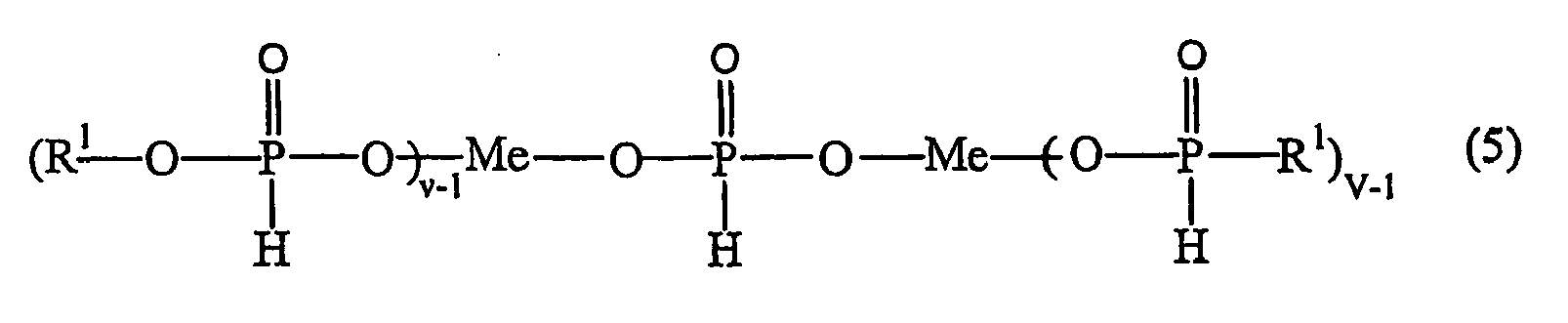
- Illustrative of the alkylatable phosphorus-containing starting reactants herein are phosphonic acid (phosphorous acid); hypophosphorous acid; phosphinic acid, phosphinous acid; esters of the foregoing such as phosphonic acid tert-butyl ester, phosphonic acid di-tert-butyl ester, phosphonic acid methyl ester, phosphonic acid phenyl ester, phosphinic acid tert-butyl ester, methylphosphinic acid phenyl ester, benzenephosphinic acid phenyl ester, and the like; and, metal salts of the foregoing such as sodium hypophosphite, calcium hypophosphite, zinc hyposphosphite, aluminum hypophosphite, sodium phosphite, calcium phosphite, zinc phosphite, aluminum phosphite, ferric phosphite, sodium benzenephosphinate, sodium methylphosphinate, and the like.
- The reactant which generates alkene or cycloalkene in situ is represented by the general formula
R4-X (II)
wherein: - R4 is alkyl of up to 30 carbon atoms or cycloalkyl of from 3 to 12 carbon atoms; and,
- X is halogen,
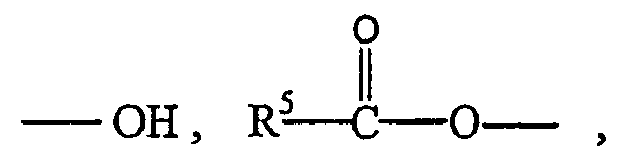

- In reactant (II), R4 is preferably branched alkyl since branching more readily provides alkene alkylating agent.
- Illustrative of useful halides R4-X are 2-chloro-2-methylpropane, 2-bromo-2-methylpropane, 2-chloropropane, 2-bromopropane, tert-amyl chloride, tert-amyl bromide, and the like.
- Useful alcohols of structure R4-OH include tert-butyl alcohol, tert-amyl alcohol, isopropyl alcohol, 2-butanol, 2-buten-1-ol and 2-methyl-3-buten-2-ol. Likewise suitable are cyclic alcohols, in particular, 1-methylcyclopentanol, 1-methycycloheptanol, 1-methylcyclooctanol and 1-methylcyclodecanol.
- Useful esters of the structures

- As free-radical initiators, advantageous use is made of azo compounds. Preferably, the azo compounds are cationic and/or non-cationic azo compounds. Preferably, as cationic azo compounds, use is made of 2,2'-azobis(2-amidinopropane) dihydrochloride or 2,2'-azobis(N,N-dimethyleneisobutyramidine) dihydrochloride. Preferably, as non-cationic azo compounds, use is made of azobis(isobutyronitrile) (AIBN), 4,4'-azobis(4-cyanopentanoic acid) or 2,2'-azobis(2-methylbutyronitrile).
- Preferably, as free-radical initiators, use is also made of inorganic peroxide and/or organic peroxide free-radical initiators.
- Preferably, as inorganic peroxide free-radical initiators, use is made of hydrogen peroxide, ammonium peroxodisulfate and/or potassium peroxodisulfate.
- Preferably, as organic peroxide free-radical initiators, use is made of dibenzoyl peroxide, di-tert-butyl peroxide, tert-butyl peroxybenzoate and/or peracetic acid.
- Preferably, UV light initiation alone or in combination with above-mentioned initiators is employed.
- Preferably, the reaction is carried out in the presence of carboxylic or mineral acid. Particularly preferably, the carboxylic acid is acetic acid and the mineral acid is sulfuric acid.
- Preferably, the reaction is carried out at a temperature of from about 25 to about 130°C. Particularly preferably, the reaction is carried out at a temperature of from about 60°C to about 120°C. Preferably, the reaction is carried out at atmospheric pressure. If generated in situ, an alkene tends to evaporate from the reaction vessel prior to reacting with P-H in which case a condenser can be used in order to return the alkene to the reaction vessel. Alternatively, a pressure of about 1-2 atmospheres can be applied in order to prevent evaporation of the alkene.
- The present invention also relates in particular to a process in which hypophosphorous acid or sodium hypophosphite is reacted with tert-butyl alcohol or tert-butyl acetate in the presence of azo free-radical initiator or in the presence of a peroxide free-radical initiator to give diisobutyl phosphinic acid and/or sodium salt thereof as main product.
- The invention also relates to the use of the dialkyphosphinic acids and/or alkali metal salts thereof obtained by the above-described process for preparing salts of such metals as Mg, Ca, Al, Zn, Fe(II), Fe(III), Cu(II), Zr(IV). These salts find use as flame retardants for thermoplastic polymers such as poly(ethylene terephthalate), poly(butylene terephthalate), polystyrene, polyamide, polyethylene, polypropylene, and the like, and thermoset resins such as epoxy, phenolic or bismaleimide resins, and the like. The dialkylphosphinic acids and/or alkali metal salts thereof obtained by the above-described process are also used as intermediates in the pharmaceutical industry.
- The process of the invention is illustrated by the examples which follow.
- Into a 250 ml three-necked flask equipped with condenser, addition funnel, magnetic stirrer and thermometer were charged 47.79 g (0.362 mol) 50% commercial hypophosphorous acid, 45.94 g (0.395 mol) tert-butyl acetate and 3.2 g AIBN. The reaction mixture was heated to 61 °C and stirred for 3 hours. Thereafter, a second portion of 8.7g AIBN in acetic acid solution was gradually added while the temperature of the reaction mixture was slowly raised to 84°C over the course of 11 hours. After addition was complete, 31P NMR analysis indicated the formation of 8% di-isobutylphosphinic acid, 63% isobutylphosphinic and 29% hypophosphorus acid. The reaction mixture was either neutralized by aqueous sodium hydroxide solution and then treated with aqueous aluminum hydroxide or directly reacted with aluminum oxide. The resulting white precipitate was filtered out, washed with water and dried in an oven thus providing 23 g aluminum salt of isobutylphosphinic acid. The mother liquor can, if desired, be recycled and used for preparing another quantity of product.
- Into a 500 ml three-necked flask equipped with condenser, addition funnel, magnetic stirrer and thermometer were charged 65.80 g (0.498 mol) 50% commercial hypophosphorous acid and 79.92 g (1.08 mol) tert-butyl alcohol. The reaction mixture was heated to 70°C and addition of 2.06 g AIBN in 35 g acetic acid solution begun. After 6 hours, the addition was complete. The mixture contained 50% isobutylphosphinic acid and 50% hypophosphorus acid as determined by 31P NMR. The mixture was treated with a second portion of 5.5 g AIBN and 5.7 g t-butyl peroxybenzoate in acetic acid while the temperature was gradually increased to 97°C over the course of 10 hours. After addition was complete, the mixture was found to contain 75% di-isobutylphosphinic acid, 20% isobutylphosphinic acid and 5% isobutylphosphonic acid. The mixture was dried in a rotavapor under vacuum at 75°C to remove water and solvent and washed with warm water three times. The upper oily phase was separated and dried in a rotavapor under vacuum at 75°C. 57.5 g. The oily material was collected and crystallized at room temperature. The yield based on hypophosphorous acid was 65% without recycling the mother liquid. The mother liquid can, if desired, be recycled and used for preparing another quantity of product.
- Into a 2L four-necked flask equipped with condenser, addition funnel, mechanical stirrer and thermometer were charged 321.35 g (3.03 mol) sodium hypophosphite monohydrate and 637 g acetic acid. After the solution became clear, 149.33 g sulfuric acid was gradually added to the mixture and a slurry was observed. A solution comprised of 458.18 g (6.186 mol) tert-butanol, 107.85 g acetic acid and 18.63 g (0.13 mol) di-tert-butyl peroxide was slowly added at a temperature of from 104 to 110°C over 14.5 hours. Analysis of the mixture by 31P NMR showed it to contain 58 mol % diisobutylphosphinic acid and 42 mol % monoisobutylphosphinic acid. There was no measurable amount of hypophosphorus acid as determined by 31P NMR analysis. A portion of the solvent was then removed. Another solution comprising 98.80 g (1.33 mol) tert-butanol, 5.87 g (0.040 mol) di-tert-butyl peroxide and 23.7 g acetic acid was added to the reaction mixture at a temperature of from 103 to 111°C over 7 hours. 31P NMR analysis indicated a mixture of 73% diisobutylphosphinic acid and 25% monoisobutylphosphinic acid with the remainder made up of monoisobutylphosphonate acid and phosphorus acid.
- The alkylated product mixture obtained in Example 3, supra, was filtered and the solvents were stripped out in a rotavapor under vacuum. The liquid mixture was then consecutively washed with 200 mL water, 200 mL 2.7% sodium carbonate three times and 200 mL water twice. The upper layer was separated and dried in a Rotavapor under vacuum. The material crystallized upon standing at room temperature to provide 350 g pure diisobutylphosphinic acid. The yield was 65%.
- A portion of the above pure diisobutylphosphinic acid (135.01 g, 0.758 mol) was mixed with water and neutralized with dilute aqueous sodium hydroxide solution. The neutralized product was then mixed with a solution of 61.83 g (0.256 mol) AlCl3 6H2O in 2 L water. A large amount of white precipitate was observed. The precipitate was filtered and dried to a constant weight in an oven at 105°C. A white powder, aluminum salt of diisobutylphosphinic acid, of 139.43 g was obtained. The yield was 98.9%.
- Into a 1L four-necked flask equipped with condenser, addition funnel, mechanical stirrer and thermometer were charged 187.52 g (1.77 mol) sodium hypophosphite monohydrate and 294 g acetic acid. After the solution became clear, 88.18 g sulfuric acid was gradually added thereto and a slurry was observed. A solution comprised of 150.81 g (2.03 mol) tert-butanol, 16.97 g acetic acid and 6.35 g (0.043 mol) di-tert-butyl peroxide was slowly added at a temperature range of from 111 to 118°C over 6 hours. Analysis of the mixture by 31P NMR showed the mixture to consist of 13 mol% diisobutylphosphinic acid, 72 mol % monoisobutylphosphinic acid and 13% hyposphosphorus acid. Another solution comprising 156.577 g (2.11 mol) tert-butanol, 11.86 g di-tert-butyl peroxide (0.081 mol) and 160.29 g acetic anhydride was then added to the reaction mixture at a temperature of 104 to 111°C over 14.5 hours while 13.71 g sulfuric acid was added from a second funnel. A mixture of 87.5% diisobutylphosphinic acid, 9.5% monoisobutylphosphinic acid, 1.6% monoisobutylphosphonic acid and 1.4% phosphorus acid was obtained.
- The alkylated product mixture obtained in Example 6, supra, was first filtered and then stripped in a Rotavapor at a bath temperature of 100°C. A solution of 302 g was obtained. Part of this solution (233 g, total 1.37 mol P) was neutralized with diluted sodium hydroxide and added to 2.5 L 4% aqueous aluminum chloride (0.435 mol AlCl3 6H2O). The resulting white precipitate was filtered and.dried in an oven at 75°C overnight. 214 g of white powder, aluminum salts of diisobutylphinic acid, monoisobutylphosphinic acid and monoisobutylphosphonic acid, was obtained.
- Into a 2L four-necked flask equipped with condenser, addition funnel, mechanical stirrer and thermometer were charged 211.76 g (2.00 mol) sodium hypophosphite monohydrate and 317 g acetic acid. After the solution became clear, 106.97 g sulfuric acid was gradually added to the mixture and a slurry was observed. The mixture was then heated to 120°C. A solution comprised of 243.19 g (2.09 mol) tert-butyl acetate and 7.35 g (0.050 mol) di-tert-butyl peroxide was slowly added at a temperature of 115 to 120°C over 5 hours. Analysis of the mixture by 31P NMR showed the mixture contained 11 mol % diisobutylphosphinic acid, 72 mol% monoisobutylphosphinic acid and 17 mol % hypophosphorus acid. A further 20.12 g sulfuric acid was added. Another solution comprising 310.73 g (2.68 mol) tert-butyl acetate and 13.10 g (0.090 mol) di-tert-butyl peroxide was added to the reaction mixture at a temperature of 114 to 120°C over 10 hours. 31P NMR analysis indicated the mixture to contain 88% diisobutylphosphinic acid and 10% monoisobutylphosphinic acid with the remainder made up of monoisobutylphosphonate acid and phosphorus acid.
- The alkylated product mixture obtained in Example 8, supra, was filtered and the solvents were stripped out in a rotavapor under vacuum. The liquid was mixed with 100 mL toluene and consecutively washed by 200 mL water, 150 mL 3.8% sodium carbonate three times and 100 mL water twice respectively. The upper layer was separated and dried at a Rotavapor under vacuum. The layer crystallized upon standing at room temperature to provide 288 g pure diisobutylphosphinic acid. The yield was 81%.
Claims (14)
- A process for alkylating a phosphorus-containing compound to provide an alkylated phosphorus-containing compound which comprises alkylating phosphorus-containing compound possessing at least one phosphorus-hydrogen

the reactant which generates alkene or cycloalkene in situ being represented by general formula (II):
R4-X (II)
wherein:R4 is alkyl of up to 30 carbon atoms or cycloalkyl of from 3 to 12 carbon atoms;X is halogen,
 in which R5 and R6 each independently is H, alkyl of up to 30 carbon atoms, cycloalkyl of from 3 to 12 carbon atoms or aryl of from 6 to 20 carbon atoms and g is 0 or 1; andthe initiator being at least one free radical initiator, UV light or a combination thereof,the alkylene and/or cycloalkylene alkylating agent alkylating the phosphorus-containing component to provide alkylated phosphorus-containing product.
 - The process of Claim 1 wherein phosphorus-containing compound is represented by general formula (I):
 x1, were present, is
 in which R is H, alkyl of up to 30 carbon atoms, cycloalkyl of from 3 to 12 carbon atoms or aryl of from 6 to 20 carbon atoms; Me is a metal having a valence v of 1, 2, 3 or 4; R2 is H, alkyl of up to 30 carbon atoms, cycloalkyl of from 3 to 12 carbon atoms or aryl of from 6 to 20 carbon atoms; and,a, b, c, d, e and f each independently is 0 or 1, provided,when a=1, c=1 and b=0,when b=1, a=0 and x1 is not present,when f=1, d=1 and e=0, andwhen e=1, f=0 and x2 is not present.
 - The process of Claim 1 wherein phosphorus-containing compound (I) is selected from the group (1)-(5) consisting of:


- The process of Claim 3 wherein in phosphorus-containing compounds (1)-(5), R1 is H and Me is lithium, sodium, potassium, magnesium, calcium, barium, aluminum, titanium, vanadium, chromium, molybdenum, iron, cobalt, nickel, copper or zinc.
- The process of Claim 4 wherein in phosphorus-containing compounds (2) and (3), R2 is H.
- The process of Claim 1 wherein the phosphorus-containing compound is at least one member of the group consisting of phosphonic acid, hypophosphorous acid, phosphinic acid, phosphinous acid, phosphonic acid tert-butyl ester, phosphonic acid di-tert-butyl ester, phosphonic acid methyl ester, phosphonic acid phenyl ester, phosphinic acid tert-butyl ester, methylphosphinic acid phenyl ester, benzenephosphinic acid phenyl ester, sodium hypophosphite, calcium hypophosphite, zinc hyposphosphite, aluminum hypophosphite, sodium phosphite, calcium phosphite, zinc phosphite, aluminum phosphite, ferric phosphite, sodium benzenephosphinate and sodium methylphosphinate.
- The process of Claim 1 or Claim 6 wherein the reactant which generates alkene or cycloalkene in situ is at least one member of the group consisting of 2-chloro-2-methylpropane, 2-bromo-2-methylpropane, 2-chloropropane, 2-bromopropane, tert-amyl chloride, tert-amyl bromide, tert-butyl alcohol, tert-amyl alcohol, isopropyl alcohol, 2-butanol, 2-buten-1-ol, 2- methyl-3-buten-2-ol, 1-methylcyclopentanol, 1-methycycloheptanol, 1- methylcyclooctanol, 1-methylcyclodecanol, tert-butyl acetate, phosphoric acid tert-butyl ester, phosphonic acid tert-butyl ester, phosphonic acid di-tert-butyl ester, diisobutylphosphinic acid tert-butyl ester, isopropyl tosylate and isopropyl mesylate.
- The process of Claim 1 wherein the free radical initiator is at least one azo compound, inorganic peroxide and/or organic peroxide.
- The process of Claim 8 wherein the free radical initiator is at least one member selected from the group consisting of 2,2'-azobis(2-amidinopropane) dihydrochloride, 2,2'-azobis(N,N'-dimethyleneisobutyramidine) dihydrochloride, azobis(isobutyronitrile), 4,4'-azobis(4-cyanopentanoic acid), 2,2'-azobis(2-methylbutyronitrile), hydrogen peroxide, ammonium peroxodisulfate, potassium peroxodisulfate, dibenzoyl peroxide, di-tert-butyl peroxide and peracetic acid.
- The process of Claim 1 carried out in the presence of carboxylic acid and/or mineral acid.
- The process of Claim 1 wherein the alkylation reaction is carried out at a temperature of from about 25 °C to about 130°C and a pressure ranging from about atmospheric up to about 2 atmospheres.
- The process of Claim 3 wherein phosphorus-containing compound (I) is at least one member selected from the group consisting of (2) and (3), the alkylated reaction product thereafter being converted to the corresponding metal salt.
- The process of Claim 12 wherein the metal of said metal salt is selected from the group consisting of Mg, Al, Zn, Fe(II), Fe(III), Cu(II) and Zr(IV).
- The process of Claim 1 wherein hypophosphorous acid or sodium hypophosphite is reacted with tert-butyl alcohol or tert- butyl acetate in the presence of azo free-radical initiator or in the presence of a peroxide free-radical initiator to provide diisobutyl phosphinic acid and/or sodium salt thereof.
Applications Claiming Priority (2)
| Application Number | Priority Date | Filing Date | Title |
|---|---|---|---|
| US56480104P | 2004-04-23 | 2004-04-23 | |
| PCT/US2005/013756 WO2005105818A1 (en) | 2004-04-23 | 2005-04-22 | Process for the alkylation of phosphorus-containing compounds |
Publications (2)
| Publication Number | Publication Date |
|---|---|
| EP1756126A1 EP1756126A1 (en) | 2007-02-28 |
| EP1756126B1 true EP1756126B1 (en) | 2012-02-08 |
Family
ID=34966428
Family Applications (1)
| Application Number | Title | Priority Date | Filing Date |
|---|---|---|---|
| EP05737652A Expired - Lifetime EP1756126B1 (en) | 2004-04-23 | 2005-04-22 | Process for the alkylation of phosphorus-containing compounds |
Country Status (10)
| Country | Link |
|---|---|
| US (1) | US8097747B2 (en) |
| EP (1) | EP1756126B1 (en) |
| JP (1) | JP4865701B2 (en) |
| KR (1) | KR101213544B1 (en) |
| CN (1) | CN1976941B (en) |
| AT (1) | ATE544770T1 (en) |
| CA (1) | CA2562883A1 (en) |
| RU (1) | RU2006141353A (en) |
| TW (1) | TWI371454B (en) |
| WO (1) | WO2005105818A1 (en) |
Families Citing this family (26)
| Publication number | Priority date | Publication date | Assignee | Title |
|---|---|---|---|---|
| SE0402462D0 (en) * | 2004-10-08 | 2004-10-08 | Astrazeneca Ab | New process |
| US10548659B2 (en) | 2006-01-17 | 2020-02-04 | Ulthera, Inc. | High pressure pre-burst for improved fluid delivery |
| US9486274B2 (en) | 2005-09-07 | 2016-11-08 | Ulthera, Inc. | Dissection handpiece and method for reducing the appearance of cellulite |
| US7967763B2 (en) | 2005-09-07 | 2011-06-28 | Cabochon Aesthetics, Inc. | Method for treating subcutaneous tissues |
| US9358033B2 (en) | 2005-09-07 | 2016-06-07 | Ulthera, Inc. | Fluid-jet dissection system and method for reducing the appearance of cellulite |
| US9011473B2 (en) | 2005-09-07 | 2015-04-21 | Ulthera, Inc. | Dissection handpiece and method for reducing the appearance of cellulite |
| US8518069B2 (en) | 2005-09-07 | 2013-08-27 | Cabochon Aesthetics, Inc. | Dissection handpiece and method for reducing the appearance of cellulite |
| US7885793B2 (en) | 2007-05-22 | 2011-02-08 | International Business Machines Corporation | Method and system for developing a conceptual model to facilitate generating a business-aligned information technology solution |
| EP2155762B1 (en) * | 2007-05-04 | 2011-10-12 | AstraZeneca AB | Process for the synthesis of alkyl phosphinic acids by initiation of an amine and an amineoxide |
| US8439940B2 (en) | 2010-12-22 | 2013-05-14 | Cabochon Aesthetics, Inc. | Dissection handpiece with aspiration means for reducing the appearance of cellulite |
| US9358064B2 (en) | 2009-08-07 | 2016-06-07 | Ulthera, Inc. | Handpiece and methods for performing subcutaneous surgery |
| US11096708B2 (en) | 2009-08-07 | 2021-08-24 | Ulthera, Inc. | Devices and methods for performing subcutaneous surgery |
| DE102010018682A1 (en) * | 2010-04-29 | 2011-11-03 | Clariant International Ltd. | Process for the preparation of alkylphosphonous acid salts |
| DE102010018684A1 (en) * | 2010-04-29 | 2011-11-03 | Clariant International Ltd. | Process for the preparation of mixtures of alkylphosphonous salts and dialkylphosphinic acid salts |
| DE102010018680A1 (en) * | 2010-04-29 | 2011-11-03 | Clariant International Limited | Flame retardant stabilizer combination for thermoplastic and thermosetting polymers |
| DE102010018681A1 (en) * | 2010-04-29 | 2011-11-03 | Clariant International Ltd. | Flame retardant stabilizer combination for thermoplastic and thermosetting polymers |
| CN101891762A (en) * | 2010-06-30 | 2010-11-24 | 南开大学 | Preparation method and application of diethylphosphinate |
| DE102010047790A1 (en) * | 2010-09-14 | 2012-03-15 | Clariant International Ltd. | Phosphorus-containing mixtures, process for their preparation and their use |
| DE102011121591A1 (en) * | 2011-12-16 | 2013-06-20 | Clariant International Ltd. | Mixtures of dialkylphosphinic acids and alkylphosphonic acids, a process for their preparation and their use |
| DE102014001222A1 (en) * | 2014-01-29 | 2015-07-30 | Clariant lnternational Ltd | Halogen-free solid flame retardant mixture and its use |
| CN106518915A (en) * | 2016-08-31 | 2017-03-22 | 淄博华众成化工科技有限公司 | Synthetic method of diisobutylphosphinic acid |
| US11089066B2 (en) * | 2016-12-09 | 2021-08-10 | Nutanix, Inc. | System and method for dynamic medium access control (MAC) relating to a virtualization environment |
| CN107652321A (en) * | 2017-09-30 | 2018-02-02 | 济南泰星精细化工有限公司 | A kind of preparation method and applications of graininess alkyl phosphinic acid aluminium |
| TWI664186B (en) * | 2017-10-05 | 2019-07-01 | 遠東新世紀股份有限公司 | Phosphate ester material and preparation method thereof, polyester resin containing phosphate ester material and preparation method thereof |
| CN109593308B (en) * | 2018-10-17 | 2021-12-28 | 江汉大学 | High-transparency flame-retardant polyvinyl alcohol film based on methyl hypophosphorous acid and preparation method thereof |
| CN113956285A (en) * | 2021-08-26 | 2022-01-21 | 东南大学 | Method for synthesizing dialkyl aluminum phosphinate under normal pressure condition |
Family Cites Families (7)
| Publication number | Priority date | Publication date | Assignee | Title |
|---|---|---|---|---|
| NL145897B (en) * | 1948-04-12 | Union Carbide Corp | PROCEDURE FOR PREPARING GRAINED DETERGENTS. | |
| US4590014A (en) * | 1984-09-06 | 1986-05-20 | Economics Laboratory, Inc. | Synthesis of alkyl phosphinate salts |
| US4632741A (en) * | 1984-09-06 | 1986-12-30 | Economics Laboratory, Inc. | Synthesis of alkyl phosphinate salts and bis(alkyl) phosphinate salts |
| JP3128015B2 (en) | 1992-03-04 | 2001-01-29 | 日本化学工業株式会社 | Method for producing 2-hydroxycarbonylethylalkylphosphinic acid |
| DE4430932A1 (en) * | 1994-08-31 | 1996-03-07 | Hoechst Ag | Flame retardant polyester molding compound |
| CN1232523C (en) * | 1997-11-28 | 2005-12-21 | 科莱恩有限公司 | Method for producing dialkylphosphinic acids |
| CA2311675C (en) * | 1997-11-28 | 2009-03-17 | Clariant Gmbh | Method for producing salts of dialkylphosphinic acids |
-
2005
- 2005-04-22 JP JP2007509663A patent/JP4865701B2/en not_active Expired - Fee Related
- 2005-04-22 TW TW094112925A patent/TWI371454B/en not_active IP Right Cessation
- 2005-04-22 AT AT05737652T patent/ATE544770T1/en active
- 2005-04-22 US US11/587,220 patent/US8097747B2/en not_active Expired - Fee Related
- 2005-04-22 RU RU2006141353/04A patent/RU2006141353A/en not_active Application Discontinuation
- 2005-04-22 CN CN2005800128165A patent/CN1976941B/en not_active Expired - Fee Related
- 2005-04-22 CA CA002562883A patent/CA2562883A1/en not_active Abandoned
- 2005-04-22 WO PCT/US2005/013756 patent/WO2005105818A1/en not_active Ceased
- 2005-04-22 EP EP05737652A patent/EP1756126B1/en not_active Expired - Lifetime
-
2006
- 2006-11-22 KR KR1020067024475A patent/KR101213544B1/en not_active Expired - Fee Related
Also Published As
| Publication number | Publication date |
|---|---|
| TW200606171A (en) | 2006-02-16 |
| RU2006141353A (en) | 2008-05-27 |
| JP2007534685A (en) | 2007-11-29 |
| CA2562883A1 (en) | 2005-11-10 |
| US20090054675A1 (en) | 2009-02-26 |
| CN1976941B (en) | 2012-09-12 |
| KR101213544B1 (en) | 2012-12-18 |
| US8097747B2 (en) | 2012-01-17 |
| WO2005105818A1 (en) | 2005-11-10 |
| CN1976941A (en) | 2007-06-06 |
| JP4865701B2 (en) | 2012-02-01 |
| EP1756126A1 (en) | 2007-02-28 |
| ATE544770T1 (en) | 2012-02-15 |
| KR20070011530A (en) | 2007-01-24 |
| TWI371454B (en) | 2012-09-01 |
Similar Documents
| Publication | Publication Date | Title |
|---|---|---|
| US8097747B2 (en) | Process for the alkylation of phosphorus-containing compounds | |
| KR100760170B1 (en) | Process for preparing salts of dialkylphosphinic acid | |
| KR100707704B1 (en) | Method for preparing dialkylphosphinic acid and product containing same | |
| US6090968A (en) | Process for preparing phosphinic esters | |
| US6855757B2 (en) | Preparation of glycol carboxyethylmethylphosphinate | |
| KR100697967B1 (en) | Process for preparing dialkylphosphinic acid salt | |
| JP2001002686A (en) | Process for producing dialkylphosphinic acid and salts thereof | |
| JP2001002686A5 (en) | ||
| JP2001026596A (en) | Method for producing phosphinic acid ester | |
| US6600068B2 (en) | Process for preparing ethanebis(methylphosphinic) acid | |
| WO2006047545A2 (en) | Process for the preparation of highly purified, dialkyl phosphinic acids | |
| CA2641112A1 (en) | Use of salts of dialkylphosphinic acids for preparing flame retardants and as additives in polymeric molding compounds | |
| JP4763879B2 (en) | Method for producing alkylphosphonic acid | |
| US6090967A (en) | Process for preparing phosphonous esters | |
| JPH11236392A (en) | Production of metal salt of arylalkylphosphinic acid | |
| EP1218387B1 (en) | An improved regiospecific synthesis of phosphonous acids | |
| US6727378B2 (en) | Process for the production of a phosphorus-containing organic compound | |
| JPH01268695A (en) | 2-alkoxycarbonylethylphosphinic acid and production thereof | |
| TH74895A (en) | The process for adding alkyl groups to phosphorus-containing compounds | |
| Muslinkin et al. | Synthesis of acrylic and α-substituted acrylic derivatives of chlorophos and some of its analogs |
Legal Events
| Date | Code | Title | Description |
|---|---|---|---|
| PUAI | Public reference made under article 153(3) epc to a published international application that has entered the european phase |
Free format text: ORIGINAL CODE: 0009012 |
|
| 17P | Request for examination filed |
Effective date: 20061116 |
|
| AK | Designated contracting states |
Kind code of ref document: A1 Designated state(s): AT BE BG CH CY CZ DE DK EE ES FI FR GB GR HU IE IS IT LI LT LU MC NL PL PT RO SE SI SK TR |
|
| DAX | Request for extension of the european patent (deleted) | ||
| 17Q | First examination report despatched |
Effective date: 20110117 |
|
| GRAP | Despatch of communication of intention to grant a patent |
Free format text: ORIGINAL CODE: EPIDOSNIGR1 |
|
| GRAS | Grant fee paid |
Free format text: ORIGINAL CODE: EPIDOSNIGR3 |
|
| GRAA | (expected) grant |
Free format text: ORIGINAL CODE: 0009210 |
|
| RAP1 | Party data changed (applicant data changed or rights of an application transferred) |
Owner name: ICL-IP AMERICA INC. |
|
| AK | Designated contracting states |
Kind code of ref document: B1 Designated state(s): AT BE BG CH CY CZ DE DK EE ES FI FR GB GR HU IE IS IT LI LT LU MC NL PL PT RO SE SI SK TR |
|
| REG | Reference to a national code |
Ref country code: GB Ref legal event code: FG4D |
|
| REG | Reference to a national code |
Ref country code: CH Ref legal event code: EP Ref country code: AT Ref legal event code: REF Ref document number: 544770 Country of ref document: AT Kind code of ref document: T Effective date: 20120215 |
|
| REG | Reference to a national code |
Ref country code: DE Ref legal event code: R096 Ref document number: 602005032590 Country of ref document: DE Effective date: 20120405 |
|
| REG | Reference to a national code |
Ref country code: NL Ref legal event code: VDEP Effective date: 20120208 |
|
| LTIE | Lt: invalidation of european patent or patent extension |
Effective date: 20120208 |
|
| PG25 | Lapsed in a contracting state [announced via postgrant information from national office to epo] |
Ref country code: NL Free format text: LAPSE BECAUSE OF FAILURE TO SUBMIT A TRANSLATION OF THE DESCRIPTION OR TO PAY THE FEE WITHIN THE PRESCRIBED TIME-LIMIT Effective date: 20120208 Ref country code: LT Free format text: LAPSE BECAUSE OF FAILURE TO SUBMIT A TRANSLATION OF THE DESCRIPTION OR TO PAY THE FEE WITHIN THE PRESCRIBED TIME-LIMIT Effective date: 20120208 Ref country code: IS Free format text: LAPSE BECAUSE OF FAILURE TO SUBMIT A TRANSLATION OF THE DESCRIPTION OR TO PAY THE FEE WITHIN THE PRESCRIBED TIME-LIMIT Effective date: 20120608 |
|
| PG25 | Lapsed in a contracting state [announced via postgrant information from national office to epo] |
Ref country code: GR Free format text: LAPSE BECAUSE OF FAILURE TO SUBMIT A TRANSLATION OF THE DESCRIPTION OR TO PAY THE FEE WITHIN THE PRESCRIBED TIME-LIMIT Effective date: 20120509 Ref country code: FI Free format text: LAPSE BECAUSE OF FAILURE TO SUBMIT A TRANSLATION OF THE DESCRIPTION OR TO PAY THE FEE WITHIN THE PRESCRIBED TIME-LIMIT Effective date: 20120208 Ref country code: BE Free format text: LAPSE BECAUSE OF FAILURE TO SUBMIT A TRANSLATION OF THE DESCRIPTION OR TO PAY THE FEE WITHIN THE PRESCRIBED TIME-LIMIT Effective date: 20120208 Ref country code: PL Free format text: LAPSE BECAUSE OF FAILURE TO SUBMIT A TRANSLATION OF THE DESCRIPTION OR TO PAY THE FEE WITHIN THE PRESCRIBED TIME-LIMIT Effective date: 20120208 Ref country code: PT Free format text: LAPSE BECAUSE OF FAILURE TO SUBMIT A TRANSLATION OF THE DESCRIPTION OR TO PAY THE FEE WITHIN THE PRESCRIBED TIME-LIMIT Effective date: 20120608 |
|
| REG | Reference to a national code |
Ref country code: AT Ref legal event code: MK05 Ref document number: 544770 Country of ref document: AT Kind code of ref document: T Effective date: 20120208 |
|
| PG25 | Lapsed in a contracting state [announced via postgrant information from national office to epo] |
Ref country code: CY Free format text: LAPSE BECAUSE OF FAILURE TO SUBMIT A TRANSLATION OF THE DESCRIPTION OR TO PAY THE FEE WITHIN THE PRESCRIBED TIME-LIMIT Effective date: 20120208 |
|
| PG25 | Lapsed in a contracting state [announced via postgrant information from national office to epo] |
Ref country code: SI Free format text: LAPSE BECAUSE OF FAILURE TO SUBMIT A TRANSLATION OF THE DESCRIPTION OR TO PAY THE FEE WITHIN THE PRESCRIBED TIME-LIMIT Effective date: 20120208 Ref country code: RO Free format text: LAPSE BECAUSE OF FAILURE TO SUBMIT A TRANSLATION OF THE DESCRIPTION OR TO PAY THE FEE WITHIN THE PRESCRIBED TIME-LIMIT Effective date: 20120208 Ref country code: EE Free format text: LAPSE BECAUSE OF FAILURE TO SUBMIT A TRANSLATION OF THE DESCRIPTION OR TO PAY THE FEE WITHIN THE PRESCRIBED TIME-LIMIT Effective date: 20120208 Ref country code: SE Free format text: LAPSE BECAUSE OF FAILURE TO SUBMIT A TRANSLATION OF THE DESCRIPTION OR TO PAY THE FEE WITHIN THE PRESCRIBED TIME-LIMIT Effective date: 20120208 Ref country code: CZ Free format text: LAPSE BECAUSE OF FAILURE TO SUBMIT A TRANSLATION OF THE DESCRIPTION OR TO PAY THE FEE WITHIN THE PRESCRIBED TIME-LIMIT Effective date: 20120208 Ref country code: DK Free format text: LAPSE BECAUSE OF FAILURE TO SUBMIT A TRANSLATION OF THE DESCRIPTION OR TO PAY THE FEE WITHIN THE PRESCRIBED TIME-LIMIT Effective date: 20120208 |
|
| PG25 | Lapsed in a contracting state [announced via postgrant information from national office to epo] |
Ref country code: SK Free format text: LAPSE BECAUSE OF FAILURE TO SUBMIT A TRANSLATION OF THE DESCRIPTION OR TO PAY THE FEE WITHIN THE PRESCRIBED TIME-LIMIT Effective date: 20120208 Ref country code: IT Free format text: LAPSE BECAUSE OF FAILURE TO SUBMIT A TRANSLATION OF THE DESCRIPTION OR TO PAY THE FEE WITHIN THE PRESCRIBED TIME-LIMIT Effective date: 20120208 Ref country code: MC Free format text: LAPSE BECAUSE OF NON-PAYMENT OF DUE FEES Effective date: 20120430 |
|
| REG | Reference to a national code |
Ref country code: CH Ref legal event code: PL |
|
| PLBE | No opposition filed within time limit |
Free format text: ORIGINAL CODE: 0009261 |
|
| STAA | Information on the status of an ep patent application or granted ep patent |
Free format text: STATUS: NO OPPOSITION FILED WITHIN TIME LIMIT |
|
| 26N | No opposition filed |
Effective date: 20121109 |
|
| REG | Reference to a national code |
Ref country code: IE Ref legal event code: MM4A |
|
| REG | Reference to a national code |
Ref country code: FR Ref legal event code: ST Effective date: 20121228 |
|
| PG25 | Lapsed in a contracting state [announced via postgrant information from national office to epo] |
Ref country code: AT Free format text: LAPSE BECAUSE OF FAILURE TO SUBMIT A TRANSLATION OF THE DESCRIPTION OR TO PAY THE FEE WITHIN THE PRESCRIBED TIME-LIMIT Effective date: 20120208 Ref country code: IE Free format text: LAPSE BECAUSE OF NON-PAYMENT OF DUE FEES Effective date: 20120422 Ref country code: LI Free format text: LAPSE BECAUSE OF NON-PAYMENT OF DUE FEES Effective date: 20120430 Ref country code: CH Free format text: LAPSE BECAUSE OF NON-PAYMENT OF DUE FEES Effective date: 20120430 |
|
| PG25 | Lapsed in a contracting state [announced via postgrant information from national office to epo] |
Ref country code: FR Free format text: LAPSE BECAUSE OF NON-PAYMENT OF DUE FEES Effective date: 20120430 |
|
| REG | Reference to a national code |
Ref country code: DE Ref legal event code: R097 Ref document number: 602005032590 Country of ref document: DE Effective date: 20121109 |
|
| PG25 | Lapsed in a contracting state [announced via postgrant information from national office to epo] |
Ref country code: ES Free format text: LAPSE BECAUSE OF FAILURE TO SUBMIT A TRANSLATION OF THE DESCRIPTION OR TO PAY THE FEE WITHIN THE PRESCRIBED TIME-LIMIT Effective date: 20120519 |
|
| PG25 | Lapsed in a contracting state [announced via postgrant information from national office to epo] |
Ref country code: BG Free format text: LAPSE BECAUSE OF FAILURE TO SUBMIT A TRANSLATION OF THE DESCRIPTION OR TO PAY THE FEE WITHIN THE PRESCRIBED TIME-LIMIT Effective date: 20120508 |
|
| PG25 | Lapsed in a contracting state [announced via postgrant information from national office to epo] |
Ref country code: TR Free format text: LAPSE BECAUSE OF FAILURE TO SUBMIT A TRANSLATION OF THE DESCRIPTION OR TO PAY THE FEE WITHIN THE PRESCRIBED TIME-LIMIT Effective date: 20120208 |
|
| PG25 | Lapsed in a contracting state [announced via postgrant information from national office to epo] |
Ref country code: LU Free format text: LAPSE BECAUSE OF NON-PAYMENT OF DUE FEES Effective date: 20120422 |
|
| PG25 | Lapsed in a contracting state [announced via postgrant information from national office to epo] |
Ref country code: HU Free format text: LAPSE BECAUSE OF FAILURE TO SUBMIT A TRANSLATION OF THE DESCRIPTION OR TO PAY THE FEE WITHIN THE PRESCRIBED TIME-LIMIT Effective date: 20050422 |
|
| PGFP | Annual fee paid to national office [announced via postgrant information from national office to epo] |
Ref country code: DE Payment date: 20170427 Year of fee payment: 13 Ref country code: GB Payment date: 20170427 Year of fee payment: 13 |
|
| REG | Reference to a national code |
Ref country code: DE Ref legal event code: R119 Ref document number: 602005032590 Country of ref document: DE |
|
| GBPC | Gb: european patent ceased through non-payment of renewal fee |
Effective date: 20180422 |
|
| PG25 | Lapsed in a contracting state [announced via postgrant information from national office to epo] |
Ref country code: DE Free format text: LAPSE BECAUSE OF NON-PAYMENT OF DUE FEES Effective date: 20181101 |
|
| PG25 | Lapsed in a contracting state [announced via postgrant information from national office to epo] |
Ref country code: GB Free format text: LAPSE BECAUSE OF NON-PAYMENT OF DUE FEES Effective date: 20180422 |