EP1755231A1 - Multiple input - multiple output wireless communication system - Google Patents
Multiple input - multiple output wireless communication system Download PDFInfo
- Publication number
- EP1755231A1 EP1755231A1 EP05017961A EP05017961A EP1755231A1 EP 1755231 A1 EP1755231 A1 EP 1755231A1 EP 05017961 A EP05017961 A EP 05017961A EP 05017961 A EP05017961 A EP 05017961A EP 1755231 A1 EP1755231 A1 EP 1755231A1
- Authority
- EP
- European Patent Office
- Prior art keywords
- frequency
- receiver
- decoupling
- uwb
- space
- Prior art date
- Legal status (The legal status is an assumption and is not a legal conclusion. Google has not performed a legal analysis and makes no representation as to the accuracy of the status listed.)
- Granted
Links
- 238000004891 communication Methods 0.000 title claims abstract description 8
- 238000000034 method Methods 0.000 abstract description 5
- 230000001419 dependent effect Effects 0.000 abstract description 4
- 238000005562 fading Methods 0.000 abstract description 4
- 239000011159 matrix material Substances 0.000 description 11
- 108010076504 Protein Sorting Signals Proteins 0.000 description 6
- 238000001514 detection method Methods 0.000 description 5
- 230000005540 biological transmission Effects 0.000 description 2
- 238000010586 diagram Methods 0.000 description 2
- 238000011084 recovery Methods 0.000 description 1
Images

Classifications
-
- H—ELECTRICITY
- H04—ELECTRIC COMMUNICATION TECHNIQUE
- H04B—TRANSMISSION
- H04B1/00—Details of transmission systems, not covered by a single one of groups H04B3/00 - H04B13/00; Details of transmission systems not characterised by the medium used for transmission
- H04B1/69—Spread spectrum techniques
- H04B1/7163—Spread spectrum techniques using impulse radio
- H04B1/71637—Receiver aspects
-
- H—ELECTRICITY
- H04—ELECTRIC COMMUNICATION TECHNIQUE
- H04B—TRANSMISSION
- H04B1/00—Details of transmission systems, not covered by a single one of groups H04B3/00 - H04B13/00; Details of transmission systems not characterised by the medium used for transmission
- H04B1/69—Spread spectrum techniques
- H04B1/7163—Spread spectrum techniques using impulse radio
- H04B1/71632—Signal aspects
-
- H—ELECTRICITY
- H04—ELECTRIC COMMUNICATION TECHNIQUE
- H04B—TRANSMISSION
- H04B7/00—Radio transmission systems, i.e. using radiation field
- H04B7/02—Diversity systems; Multi-antenna system, i.e. transmission or reception using multiple antennas
- H04B7/04—Diversity systems; Multi-antenna system, i.e. transmission or reception using multiple antennas using two or more spaced independent antennas
- H04B7/08—Diversity systems; Multi-antenna system, i.e. transmission or reception using multiple antennas using two or more spaced independent antennas at the receiving station
- H04B7/0837—Diversity systems; Multi-antenna system, i.e. transmission or reception using multiple antennas using two or more spaced independent antennas at the receiving station using pre-detection combining
- H04B7/0842—Weighted combining
- H04B7/0848—Joint weighting
- H04B7/0854—Joint weighting using error minimizing algorithms, e.g. minimum mean squared error [MMSE], "cross-correlation" or matrix inversion
-
- H—ELECTRICITY
- H04—ELECTRIC COMMUNICATION TECHNIQUE
- H04L—TRANSMISSION OF DIGITAL INFORMATION, e.g. TELEGRAPHIC COMMUNICATION
- H04L1/00—Arrangements for detecting or preventing errors in the information received
- H04L1/02—Arrangements for detecting or preventing errors in the information received by diversity reception
- H04L1/06—Arrangements for detecting or preventing errors in the information received by diversity reception using space diversity
- H04L1/0606—Space-frequency coding
-
- H—ELECTRICITY
- H04—ELECTRIC COMMUNICATION TECHNIQUE
- H04B—TRANSMISSION
- H04B1/00—Details of transmission systems, not covered by a single one of groups H04B3/00 - H04B13/00; Details of transmission systems not characterised by the medium used for transmission
- H04B1/69—Spread spectrum techniques
- H04B1/7163—Spread spectrum techniques using impulse radio
- H04B1/719—Interference-related aspects
-
- H—ELECTRICITY
- H04—ELECTRIC COMMUNICATION TECHNIQUE
- H04L—TRANSMISSION OF DIGITAL INFORMATION, e.g. TELEGRAPHIC COMMUNICATION
- H04L27/00—Modulated-carrier systems
- H04L27/26—Systems using multi-frequency codes
- H04L27/2601—Multicarrier modulation systems
- H04L27/2647—Arrangements specific to the receiver only
Definitions
- This invention relates to a multiple input-multiple output wireless (or MIMO) communication system.
- MIMO multiple input-multiple output wireless
- Such a system offers improved wireless link quality and capacity gains, which can be exploited by using multiple antennas at both ends of a link.
- An efficient way of exploiting MIMO wireless channels is the use of transmit diversity techniques by means of a space-time block coding (STBC) where the key idea is to equally obtain space diversity and coding gains at the receiver with just simple linear detection processing in both flat fading as well as multi-path frequency-selective fading environment.
- STBC space-time block coding
- the aim of the present invention is to achieve the full diversity and coding gains. This aim is achieved by the system as defined in claim 1. Details of preferred embodiments of the invention are defined in the subordinated claims. Shortly resumed the received MIMO signals are decoupled by means of a decoupling processing of the incoming MIMO signals received by combiner matrix circuits, in which frequency exchange processing is carried out to recover the lost orthogonality of MIMO wireless channels.
- Fig. 1 is a diagram showing the frequency diversity based on multiple sub-bands division in a UWB wireless system.
- Fig. 2 shows a block representation of a UWB transmitter using space-frequency block coding (SFBC) for a MIMO wireless channel.
- SFBC space-frequency block coding
- Fig. 3 shows a bloc representation of an UWB receiver for a SFBC-based MIMO wireless channel including a decoupling and combining circuit.
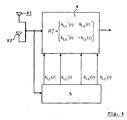
- Fig. 4 shows the decoupling and combining structure with a frequency exchange processing in the receiver corresponding to a SFBC-based MIMO frequency-dependent wireless channel.
- the WLAN channel is located between 5 and 6 MHz.
- the SFBC-based MIMO transmission scheme can be described as follows: On the UWB frequency sub-band f 1 two signal sequences are sent from an input data unit 1 to an encoder 2 where they are encoded according to a space-frequency-block encoding (SFBC) and then modulated by a multi-band pulse generator 3 before being applied to a first transmit antenna A1 and a second transmit antenna A2 respectively. Then, on the UWB frequency sub-band f 2 the negative and the complex conjugate version of the second signal sequence is transmitted through the first transmit antenna A1 and the complex conjugate version of the first signal sequence is transmitted through the second transmit antenna A2.
- H h 1 , f ⁇ 1 t h 2 , f ⁇ 2 * t h 2 , f ⁇ 1 t - h 1 , f ⁇ 2 * t h 1.f1 (t) and h 1.f2 (t) are the frequency-selective multipath channels from the transmit antenna A1 to the receiver on different UWB frequency sub-bands f 1 and f 2 respectively.
- h 2.f1 (t) and h 2.f2 (t) are the frequency-selective multipath channels from the transmit antenna A2 to the receiver on different UWB frequency Sub-bands f 1 and f 2 respectively.
- an antenna array (e.g. two receiving antennas R1 and R2) receives these signals and applies them to a decoupling and combining processing circuit 4. They are also applied to a channel estimator 5 which makes channel state informations available to the decoupling and combining processing circuit 4. Thus this circuit is able to supply decoupled signals to a baseband processing unit 6 for detection and release to an output 6.
- the matrix in the circuit 4 describes the decoupling and combining matrix according to the invention and corresponding to the SFBC-based MIMO wireless frequency-dependent channels.
- the received MIMO-UWB signal sequences are first fed into a SFBC-related decoupling matched filter 4, i.e. a decoupler and combiner circuit, to form the two decoupled outputs. Then, the two decoupled signal sequences are further used independently to estimate the originally transmitted first and second transmitted signal sequences.
- the necessary channel state information is available from a MIMO channel estimator unit 5.
- the following detection step can therefore be performed with a general base-band detection unit 6 (e.g. a minimum-mean-square-error or MMSE Rake detector).
- H is the MIMO wireless channel and H H is the corresponding MIMO decoupling combiner matrix on the receiver side (H H means matrix transpose and complex conjugate operation).
- the invention provides for a specific decoupling algorithm and combiner processing circuit 4 by employing a matrix H H F with frequency exchange operation for recovering orthogonality corresponding to the SFBC-based MIMO wireless channel.
- the system according to the present invention allows a cooperative utilization of the multiple UWB frequency sub-bands in a spectrum-efficient manner and the full space diversity and coding gains of MIMO architecture. Moreover SFBC can be achieved even in a frequency dependent, frequency-selective multi-path fading channel.
- the system and the related methods can be applied to the cooperative multi-hop relaying among multiple distributed nodes in ad-hoc UWB networks as well as UWB sensor networks. It overcomes the problem of the lack of perfect synchronisation on propagation delay and relaying timing among the intermediate relaying nodes while using a space-time block coding based cooperation scheme, and is capable of potentially providing full spatial and frequency diversity.
Landscapes
- Engineering & Computer Science (AREA)
- Computer Networks & Wireless Communication (AREA)
- Signal Processing (AREA)
- Physics & Mathematics (AREA)
- Mathematical Physics (AREA)
- Radio Transmission System (AREA)
- Mobile Radio Communication Systems (AREA)
Abstract
Description
- This invention relates to a multiple input-multiple output wireless (or MIMO) communication system. Such a system offers improved wireless link quality and capacity gains, which can be exploited by using multiple antennas at both ends of a link. An efficient way of exploiting MIMO wireless channels is the use of transmit diversity techniques by means of a space-time block coding (STBC) where the key idea is to equally obtain space diversity and coding gains at the receiver with just simple linear detection processing in both flat fading as well as multi-path frequency-selective fading environment. To this end reference is made to the following publications:
- [1] S.M. Alamouti "A simple transmitter diversity scheme for wireless communications", IEEE J.Select.Areas Commun., vol.16, n°8, pp.1451-1458, Oct. 1998.
- [2] V.Tarokh et al. "Space-time block coding for wireless communications: performance results", IEEE J.Select.Areas Commun., vol.17, n°3, pp. 451-460, march 1999.
- [3] E. Lindskog et al. "A transmit diversity scheme for channels with intersymbol interference" Proc. IEEE, Int. Conf. Communications 2000, New Orleans, pp.307-311, June 2000.
In the frame of ultra-wideband (UWB) wireless communications there are a number of frequency subsets available among the whole UWB frequency bandwidth (3,1 to 10,6 GHz). Therefore, cooperative utilization of the multiple UWB frequency sub-bands in a manner of frequency diversity MIMO transmissions is a natural and spectrum-efficient technical approach in power-limited as well as interference-limited operation environment for UWB wireless communication systems, which further suggests the usage of MIMO architecture and Space-Frequency block coding (SFBC). In this context, reference is made to: - [4] L. Yang et al., "Analog space-time coding for multi-antenna ultra-wideband transmissions" in IEEE Trans.Comm., vol .52, n°3, pp.507-517, March 2004.
- [5] W.P.Siriwongpairat et al. "Performance analysis of time hopping and direct sequence UWB spare-timing systems" in IEEE GLOBECOM 2004, vol.6, pp 3526-3530, Dec. 2004.
- This state of the art does not consider the problem of frequency-dependent multi-path fading channels corresponding to the different UWB frequency sub-bands, in which MIMO-UWB wireless communications suffer from severe multipath frequency -selective fading, and the channels orthogonality required by SFBC might be lost on the receiver side. An effective receiving combing algorithm with MIMO orthogonality recovery is necessary for realizing full space diversity as well as coding gain.
- The aim of the present invention is to achieve the full diversity and coding gains. This aim is achieved by the system as defined in
claim 1. Details of preferred embodiments of the invention are defined in the subordinated claims. Shortly resumed the received MIMO signals are decoupled by means of a decoupling processing of the incoming MIMO signals received by combiner matrix circuits, in which frequency exchange processing is carried out to recover the lost orthogonality of MIMO wireless channels. - The invention will be described here-after by means of the attached drawings.
- Fig. 1 is a diagram showing the frequency diversity based on multiple sub-bands division in a UWB wireless system.
- Fig. 2 shows a block representation of a UWB transmitter using space-frequency block coding (SFBC) for a MIMO wireless channel.
- Fig. 3 shows a bloc representation of an UWB receiver for a SFBC-based MIMO wireless channel including a decoupling and combining circuit.
- Fig. 4 shows the decoupling and combining structure with a frequency exchange processing in the receiver corresponding to a SFBC-based MIMO frequency-dependent wireless channel.
- On the horizontal axis of the diagram shown in Fig. 1 the frequency in GHz is plotted whereas the vertical axis represents the UWB effective isotropically-radiated power level (in dBm/MHz). The WLAN channel is located between 5 and 6 MHz.
- On the transmitter side (Fig.2) the SFBC-based MIMO transmission scheme can be described as follows: On the UWB frequency sub-band f1 two signal sequences are sent from an
input data unit 1 to anencoder 2 where they are encoded according to a space-frequency-block encoding (SFBC) and then modulated by amulti-band pulse generator 3 before being applied to a first transmit antenna A1 and a second transmit antenna A2 respectively. Then, on the UWB frequency sub-band f2 the negative and the complex conjugate version of the second signal sequence is transmitted through the first transmit antenna A1 and the complex conjugate version of the first signal sequence is transmitted through the second transmit antenna A2. The MIMO wireless channel between the transmitter (fig.2) and the receiver (fig. 3) can be described by the following matrix:
- On the MIMO receiver side (fig. 3 and 4) an antenna array (e.g. two receiving antennas R1 and R2) receives these signals and applies them to a decoupling and combining
processing circuit 4. They are also applied to achannel estimator 5 which makes channel state informations available to the decoupling and combiningprocessing circuit 4. Thus this circuit is able to supply decoupled signals to abaseband processing unit 6 for detection and release to anoutput 6. - In fig.4 the matrix in the
circuit 4 describes the decoupling and combining matrix according to the invention and corresponding to the SFBC-based MIMO wireless frequency-dependent channels. - At the MIMO decoupling and combining processing step, the received MIMO-UWB signal sequences are first fed into a SFBC-related decoupling matched
filter 4, i.e. a decoupler and combiner circuit, to form the two decoupled outputs. Then, the two decoupled signal sequences are further used independently to estimate the originally transmitted first and second transmitted signal sequences. The necessary channel state information is available from a MIMOchannel estimator unit 5. The following detection step can therefore be performed with a general base-band detection unit 6 (e.g. a minimum-mean-square-error or MMSE Rake detector). While in the conventional Space-Time Block Coding (STBC) the reason for the simplified linear receiving detection is the channel orthogonality recovery processing so that HHH is diagonal, according to the present invention H is the MIMO wireless channel and HH is the corresponding MIMO decoupling combiner matrix on the receiver side (HH means matrix transpose and complex conjugate operation). - Contrary to the state of the art as described above, the invention provides for a specific decoupling algorithm and combiner
processing circuit 4 by employing a matrix HH F with frequency exchange operation for recovering orthogonality corresponding to the SFBC-based MIMO wireless channel. - For the decoupling and combining processing unit the HH F matrix operation is defined as a matrix transpose, complex conjugate and frequency exchanging operation. Specifically the following definitions are true corresponding to each element in the matrix HH F :


where (*) represents the complex conjugate and frequency exchanging operation between different UWB frequency sub-bands such as f1 and f2. The specific HH matrix operation with frequency exchanging is only valid for the SFBC-based MIMO receiver decoupling procedure corresponding to the invention. - The system according to the present invention allows a cooperative utilization of the multiple UWB frequency sub-bands in a spectrum-efficient manner and the full space diversity and coding gains of MIMO architecture. Moreover SFBC can be achieved even in a frequency dependent, frequency-selective multi-path fading channel.
- The system and the related methods can be applied to the cooperative multi-hop relaying among multiple distributed nodes in ad-hoc UWB networks as well as UWB sensor networks. It overcomes the problem of the lack of perfect synchronisation on propagation delay and relaying timing among the intermediate relaying nodes while using a space-time block coding based cooperation scheme, and is capable of potentially providing full spatial and frequency diversity.
Claims (3)
- Multiple input - multiple output (MIMO) wireless communication system comprising an ultra-wideband (UWB) transmitter with multiple transmit antennas and a UWB-receiver with multiple receive antennas, characterized in that the transmitter (fig.2) incorporates a space-frequency block coding unit (2) and that the receiver (fig.3) incorporates a space/frequency block decoupling and combining circuit (4) realizing frequency exchange processing.
- System according to claim 1, characterized in that the receiver decoupling and combining circuit (4) is connected to the receive antenna array (R1, R2).
- System according to claim 2, characterized in that the receiver further includes a channel estimator (5) whose input is connected to the receive antenna array (R1, R2) and whose outputs are connected to the decoupling and combining circuit (4).
Priority Applications (2)
| Application Number | Priority Date | Filing Date | Title |
|---|---|---|---|
| EP20050017961 EP1755231B1 (en) | 2005-08-18 | 2005-08-18 | Multiple input - multiple output wireless communication system |
| ES05017961T ES2415355T3 (en) | 2005-08-18 | 2005-08-18 | Wireless multi-input multi-output communication system |
Applications Claiming Priority (1)
| Application Number | Priority Date | Filing Date | Title |
|---|---|---|---|
| EP20050017961 EP1755231B1 (en) | 2005-08-18 | 2005-08-18 | Multiple input - multiple output wireless communication system |
Publications (2)
| Publication Number | Publication Date |
|---|---|
| EP1755231A1 true EP1755231A1 (en) | 2007-02-21 |
| EP1755231B1 EP1755231B1 (en) | 2013-06-19 |
Family
ID=35589347
Family Applications (1)
| Application Number | Title | Priority Date | Filing Date |
|---|---|---|---|
| EP20050017961 Expired - Lifetime EP1755231B1 (en) | 2005-08-18 | 2005-08-18 | Multiple input - multiple output wireless communication system |
Country Status (2)
| Country | Link |
|---|---|
| EP (1) | EP1755231B1 (en) |
| ES (1) | ES2415355T3 (en) |
Cited By (6)
| Publication number | Priority date | Publication date | Assignee | Title |
|---|---|---|---|---|
| WO2008098670A1 (en) * | 2007-02-15 | 2008-08-21 | Mitsubishi Electric Information Technology Centre Europe B.V. | Method of multi-antenna wireless data emission, emitter and receiver using the method |
| EP1976173A1 (en) * | 2007-03-30 | 2008-10-01 | Mitsubishi Electric Information Technology Centre Europe B.V. | Method of multi-antenna wireless data emission, emitter and receiver using the method |
| CN101826944A (en) * | 2009-03-03 | 2010-09-08 | 中兴通讯股份有限公司 | Method and device for multi-node cooperative transmission |
| CN102185662A (en) * | 2011-01-05 | 2011-09-14 | 东南大学 | High-frequency-band broadband multi-channel upward and downward frequency conversion module |
| CN103117773A (en) * | 2013-01-24 | 2013-05-22 | 厦门大学深圳研究院 | Chaos ultra wide brand traffic flow collection system utilizing terminal cooperation and collection method |
| EP2256955A3 (en) * | 2009-05-27 | 2014-04-02 | Fujitsu Limited | Wireless relay device and wireless relay method |
Citations (3)
| Publication number | Priority date | Publication date | Assignee | Title |
|---|---|---|---|---|
| US20040081073A1 (en) | 2002-10-25 | 2004-04-29 | Walton J. Rodney | Transmit diversity processing for a multi-antenna communication system |
| US20040202256A1 (en) * | 2003-03-08 | 2004-10-14 | Giannakis Georgios B. | Space-time coding for multi-antenna ultra-wideband transmissions |
| WO2005034419A1 (en) * | 2003-10-01 | 2005-04-14 | Koninklijke Philips Electronics, N.V. | Multi-carrier ofdm uwb communications systems |
-
2005
- 2005-08-18 EP EP20050017961 patent/EP1755231B1/en not_active Expired - Lifetime
- 2005-08-18 ES ES05017961T patent/ES2415355T3/en not_active Expired - Lifetime
Patent Citations (3)
| Publication number | Priority date | Publication date | Assignee | Title |
|---|---|---|---|---|
| US20040081073A1 (en) | 2002-10-25 | 2004-04-29 | Walton J. Rodney | Transmit diversity processing for a multi-antenna communication system |
| US20040202256A1 (en) * | 2003-03-08 | 2004-10-14 | Giannakis Georgios B. | Space-time coding for multi-antenna ultra-wideband transmissions |
| WO2005034419A1 (en) * | 2003-10-01 | 2005-04-14 | Koninklijke Philips Electronics, N.V. | Multi-carrier ofdm uwb communications systems |
Non-Patent Citations (8)
| Title |
|---|
| ALAMOUTI S M: "A simple transmit diversity technique for wireless communications", IEEE JOURNAL ON SELECTED AREAS IN COMMUNICATIONS, IEEE SERVICE CENTER, PISCATAWAY, NJ, US, vol. 16, no. 8, October 1998 (1998-10-01), pages 1451 - 1458, XP002100058, ISSN: 0733-8716 * |
| E.1LINDSKOG ET AL.: "A transmit diversity scheme for channels with intersymbol interference", PROC. IEEE, INT. CONF. COMMUNICATIONS 2000, NEW ORLEANS, June 2000 (2000-06-01), pages 307 - 311 |
| FARSEROTU J ET AL: "UWB TRANSMISSION AND MIMO ANTENNA SYSTEMS FOR NOMADIC USERS AND MOBILE PANS", WIRELESS PERSONAL COMMUNICATIONS, SPRINGER, DORDRECHT, NL, vol. 22, no. 2, August 2002 (2002-08-01), pages 297 - 317, XP001122746, ISSN: 0929-6212 * |
| L.YANG ET AL.: "Analog space-time coding for multi-antenna ultra-wideband transmissions", IEEE TRANS.COMM., vol. 52, no. 3, March 2004 (2004-03-01), pages 507 - 517 |
| S.M. ALAMOUTI: "A simple transmitter diversity scheme for wireless communications", IEEE J.SELECT.AREAS COMMUN., vol. 16, no. 8, October 1998 (1998-10-01), pages 1451 - 1458 |
| V.TAROKH ET AL.: "Space-time block coding for wireless communications: performance results", IEEE J.SELECT.AREAS COMMUN, vol. 17, no. 3, March 1999 (1999-03-01), pages 451 - 460 |
| W.P.SIRIWONGPAIRAT ET AL.: "Performance analysis of time hopping and direct sequence UWB spare-timing systems", IEEE GLOBECOM 2004, vol. 6, December 2004 (2004-12-01), pages 3526 - 3530 |
| YUNHO JUNG ET AL: "Symbol detection algorithm and implementation results for space-frequency OFDM transmit diversity scheme", ADVANCED SYSTEM INTEGRATED CIRCUITS 2004. PROCEEDINGS OF 2004 IEEE ASIA-PACIFIC CONFERENCE ON FUKUOKA, JAPAN 4-5 AUG. 2004, PISCATAWAY, NJ, USA,IEEE, US, 4 August 2004 (2004-08-04), pages 322 - 325, XP010733946, ISBN: 0-7803-8637-X * |
Cited By (8)
| Publication number | Priority date | Publication date | Assignee | Title |
|---|---|---|---|---|
| WO2008098670A1 (en) * | 2007-02-15 | 2008-08-21 | Mitsubishi Electric Information Technology Centre Europe B.V. | Method of multi-antenna wireless data emission, emitter and receiver using the method |
| US8040867B2 (en) | 2007-02-15 | 2011-10-18 | Mitsubishi Electric Corporation | Method of multi-antenna wireless data emission, emitter and receiver using the method |
| EP1976173A1 (en) * | 2007-03-30 | 2008-10-01 | Mitsubishi Electric Information Technology Centre Europe B.V. | Method of multi-antenna wireless data emission, emitter and receiver using the method |
| CN101826944A (en) * | 2009-03-03 | 2010-09-08 | 中兴通讯股份有限公司 | Method and device for multi-node cooperative transmission |
| CN101826944B (en) * | 2009-03-03 | 2014-12-10 | 中兴通讯股份有限公司 | Method and device for multi-node cooperative transmission |
| EP2256955A3 (en) * | 2009-05-27 | 2014-04-02 | Fujitsu Limited | Wireless relay device and wireless relay method |
| CN102185662A (en) * | 2011-01-05 | 2011-09-14 | 东南大学 | High-frequency-band broadband multi-channel upward and downward frequency conversion module |
| CN103117773A (en) * | 2013-01-24 | 2013-05-22 | 厦门大学深圳研究院 | Chaos ultra wide brand traffic flow collection system utilizing terminal cooperation and collection method |
Also Published As
| Publication number | Publication date |
|---|---|
| ES2415355T3 (en) | 2013-07-25 |
| EP1755231B1 (en) | 2013-06-19 |
Similar Documents
| Publication | Publication Date | Title |
|---|---|---|
| van Zelst | Space division multiplexing algorithms | |
| US7809072B2 (en) | Transmitter and receiver for use in a relay network, and system and method for performing transmission and reception using the same | |
| EP2022184A2 (en) | A method and apparatus for distributed space-time coding in wireless radio networks | |
| CN101321009B (en) | Self-adapting MIMO system and its signal processing method | |
| Hammerstroem et al. | Space-time processing for cooperative relay networks | |
| EP1755231B1 (en) | Multiple input - multiple output wireless communication system | |
| Xu et al. | Combining MIMO with network coding: A viable means to provide multiplexing and diversity in wireless relay networks | |
| Zhang et al. | Cooperative spatial multiplexing in multi-hop wireless networks | |
| Eksim et al. | Extended balanced space-time block coding for wireless communications | |
| Ekşim et al. | Extended Cooperative Balanced Space-Time Block Coding for Increased Efficiency in Wireless Sensor Networks: (Work in Progress) | |
| Ahmad et al. | Cooperative MIMO systems in wireless sensor networks | |
| CN100574170C (en) | System and method for realizing multi-mode network coexistence | |
| Mohammed et al. | Performance investigation of distributed orthogonal space-time block coding based on relay selection in wireless cooperative systems | |
| Pan et al. | Performance analysis of selective space-time coding and selection diversity under perfect and imperfect CSI | |
| Allen et al. | Demystifying MIMO | |
| Sachan et al. | Performance analysis of STBC encoded cooperative MIMO system for wireless sensor networks | |
| Zeng et al. | Performance bounds for space-time block codes with antenna selection | |
| Zhang et al. | Distributed Turbo-BLAST for cooperative wireless networks | |
| Huang et al. | Achieving high data rates on the UMTS downlink shared channel using multiple antennas | |
| Maham et al. | Differential space–time coded cooperation for decode-and-forward-based wireless relay networks | |
| Poonsawatt et al. | Improving dual-hop amplify-and-forward cooperative mobile network based on path selection and STBC with pre-coding scheme | |
| Vu et al. | Design of two way relay network using space-time block coded network coding and linear detection | |
| Rathika et al. | A Survey On Co-Operative Communication in 4G-Lte Wireless Networks | |
| Ho et al. | Block based symbol detection for high rate space-time coded systems | |
| Rasouli et al. | A novel distributed space-time block coding protocol for cooperative wireless relay networks |
Legal Events
| Date | Code | Title | Description |
|---|---|---|---|
| PUAI | Public reference made under article 153(3) epc to a published international application that has entered the european phase |
Free format text: ORIGINAL CODE: 0009012 |
|
| AK | Designated contracting states |
Kind code of ref document: A1 Designated state(s): AT BE BG CH CY CZ DE DK EE ES FI FR GB GR HU IE IS IT LI LT LU LV MC NL PL PT RO SE SI SK TR |
|
| AX | Request for extension of the european patent |
Extension state: AL BA HR MK YU |
|
| 17P | Request for examination filed |
Effective date: 20070803 |
|
| AKX | Designation fees paid |
Designated state(s): AT BE BG CH CY CZ DE DK EE ES FI FR GB GR HU IE IS IT LI LT LU LV MC NL PL PT RO SE SI SK TR |
|
| 17Q | First examination report despatched |
Effective date: 20080506 |
|
| RAP1 | Party data changed (applicant data changed or rights of an application transferred) |
Owner name: TRENTINO SVILUPPO S.P.A. |
|
| RAP1 | Party data changed (applicant data changed or rights of an application transferred) |
Owner name: MOSAID TECHNOLOGIES INCORPORATED |
|
| GRAP | Despatch of communication of intention to grant a patent |
Free format text: ORIGINAL CODE: EPIDOSNIGR1 |
|
| RIC1 | Information provided on ipc code assigned before grant |
Ipc: H04B 1/7163 20110101ALI20121211BHEP Ipc: H04L 1/06 20060101ALI20121211BHEP Ipc: H04L 25/02 20060101ALI20121211BHEP Ipc: H04B 7/04 20060101ALI20121211BHEP Ipc: H04B 1/69 20110101AFI20121211BHEP Ipc: H04B 7/08 20060101ALI20121211BHEP |
|
| GRAS | Grant fee paid |
Free format text: ORIGINAL CODE: EPIDOSNIGR3 |
|
| GRAA | (expected) grant |
Free format text: ORIGINAL CODE: 0009210 |
|
| AK | Designated contracting states |
Kind code of ref document: B1 Designated state(s): AT BE BG CH CY CZ DE DK EE ES FI FR GB GR HU IE IS IT LI LT LU LV MC NL PL PT RO SE SI SK TR |
|
| REG | Reference to a national code |
Ref country code: GB Ref legal event code: FG4D |
|
| REG | Reference to a national code |
Ref country code: CH Ref legal event code: EP |
|
| REG | Reference to a national code |
Ref country code: AT Ref legal event code: REF Ref document number: 618138 Country of ref document: AT Kind code of ref document: T Effective date: 20130715 |
|
| REG | Reference to a national code |
Ref country code: ES Ref legal event code: FG2A Ref document number: 2415355 Country of ref document: ES Kind code of ref document: T3 Effective date: 20130725 |
|
| REG | Reference to a national code |
Ref country code: IE Ref legal event code: FG4D |
|
| REG | Reference to a national code |
Ref country code: SE Ref legal event code: TRGR |
|
| REG | Reference to a national code |
Ref country code: DE Ref legal event code: R096 Ref document number: 602005040013 Country of ref document: DE Effective date: 20130814 |
|
| REG | Reference to a national code |
Ref country code: NL Ref legal event code: T3 |
|
| PG25 | Lapsed in a contracting state [announced via postgrant information from national office to epo] |
Ref country code: GR Free format text: LAPSE BECAUSE OF FAILURE TO SUBMIT A TRANSLATION OF THE DESCRIPTION OR TO PAY THE FEE WITHIN THE PRESCRIBED TIME-LIMIT Effective date: 20130920 Ref country code: LT Free format text: LAPSE BECAUSE OF FAILURE TO SUBMIT A TRANSLATION OF THE DESCRIPTION OR TO PAY THE FEE WITHIN THE PRESCRIBED TIME-LIMIT Effective date: 20130619 Ref country code: SI Free format text: LAPSE BECAUSE OF FAILURE TO SUBMIT A TRANSLATION OF THE DESCRIPTION OR TO PAY THE FEE WITHIN THE PRESCRIBED TIME-LIMIT Effective date: 20130619 |
|
| REG | Reference to a national code |
Ref country code: AT Ref legal event code: MK05 Ref document number: 618138 Country of ref document: AT Kind code of ref document: T Effective date: 20130619 |
|
| REG | Reference to a national code |
Ref country code: LT Ref legal event code: MG4D |
|
| PG25 | Lapsed in a contracting state [announced via postgrant information from national office to epo] |
Ref country code: BG Free format text: LAPSE BECAUSE OF FAILURE TO SUBMIT A TRANSLATION OF THE DESCRIPTION OR TO PAY THE FEE WITHIN THE PRESCRIBED TIME-LIMIT Effective date: 20130919 |
|
| PG25 | Lapsed in a contracting state [announced via postgrant information from national office to epo] |
Ref country code: LV Free format text: LAPSE BECAUSE OF FAILURE TO SUBMIT A TRANSLATION OF THE DESCRIPTION OR TO PAY THE FEE WITHIN THE PRESCRIBED TIME-LIMIT Effective date: 20130619 |
|
| PG25 | Lapsed in a contracting state [announced via postgrant information from national office to epo] |
Ref country code: CY Free format text: LAPSE BECAUSE OF FAILURE TO SUBMIT A TRANSLATION OF THE DESCRIPTION OR TO PAY THE FEE WITHIN THE PRESCRIBED TIME-LIMIT Effective date: 20130717 Ref country code: AT Free format text: LAPSE BECAUSE OF FAILURE TO SUBMIT A TRANSLATION OF THE DESCRIPTION OR TO PAY THE FEE WITHIN THE PRESCRIBED TIME-LIMIT Effective date: 20130619 Ref country code: SK Free format text: LAPSE BECAUSE OF FAILURE TO SUBMIT A TRANSLATION OF THE DESCRIPTION OR TO PAY THE FEE WITHIN THE PRESCRIBED TIME-LIMIT Effective date: 20130619 Ref country code: EE Free format text: LAPSE BECAUSE OF FAILURE TO SUBMIT A TRANSLATION OF THE DESCRIPTION OR TO PAY THE FEE WITHIN THE PRESCRIBED TIME-LIMIT Effective date: 20130619 Ref country code: PT Free format text: LAPSE BECAUSE OF FAILURE TO SUBMIT A TRANSLATION OF THE DESCRIPTION OR TO PAY THE FEE WITHIN THE PRESCRIBED TIME-LIMIT Effective date: 20131021 Ref country code: IS Free format text: LAPSE BECAUSE OF FAILURE TO SUBMIT A TRANSLATION OF THE DESCRIPTION OR TO PAY THE FEE WITHIN THE PRESCRIBED TIME-LIMIT Effective date: 20131019 Ref country code: CZ Free format text: LAPSE BECAUSE OF FAILURE TO SUBMIT A TRANSLATION OF THE DESCRIPTION OR TO PAY THE FEE WITHIN THE PRESCRIBED TIME-LIMIT Effective date: 20130619 |
|
| PG25 | Lapsed in a contracting state [announced via postgrant information from national office to epo] |
Ref country code: RO Free format text: LAPSE BECAUSE OF FAILURE TO SUBMIT A TRANSLATION OF THE DESCRIPTION OR TO PAY THE FEE WITHIN THE PRESCRIBED TIME-LIMIT Effective date: 20130619 Ref country code: PL Free format text: LAPSE BECAUSE OF FAILURE TO SUBMIT A TRANSLATION OF THE DESCRIPTION OR TO PAY THE FEE WITHIN THE PRESCRIBED TIME-LIMIT Effective date: 20130619 |
|
| PG25 | Lapsed in a contracting state [announced via postgrant information from national office to epo] |
Ref country code: CY Free format text: LAPSE BECAUSE OF FAILURE TO SUBMIT A TRANSLATION OF THE DESCRIPTION OR TO PAY THE FEE WITHIN THE PRESCRIBED TIME-LIMIT Effective date: 20130619 |
|
| REG | Reference to a national code |
Ref country code: CH Ref legal event code: PL |
|
| PLBE | No opposition filed within time limit |
Free format text: ORIGINAL CODE: 0009261 |
|
| STAA | Information on the status of an ep patent application or granted ep patent |
Free format text: STATUS: NO OPPOSITION FILED WITHIN TIME LIMIT |
|
| PG25 | Lapsed in a contracting state [announced via postgrant information from national office to epo] |
Ref country code: DK Free format text: LAPSE BECAUSE OF FAILURE TO SUBMIT A TRANSLATION OF THE DESCRIPTION OR TO PAY THE FEE WITHIN THE PRESCRIBED TIME-LIMIT Effective date: 20130619 Ref country code: LI Free format text: LAPSE BECAUSE OF NON-PAYMENT OF DUE FEES Effective date: 20130831 Ref country code: CH Free format text: LAPSE BECAUSE OF NON-PAYMENT OF DUE FEES Effective date: 20130831 Ref country code: MC Free format text: LAPSE BECAUSE OF FAILURE TO SUBMIT A TRANSLATION OF THE DESCRIPTION OR TO PAY THE FEE WITHIN THE PRESCRIBED TIME-LIMIT Effective date: 20130619 |
|
| 26N | No opposition filed |
Effective date: 20140320 |
|
| REG | Reference to a national code |
Ref country code: DE Ref legal event code: R097 Ref document number: 602005040013 Country of ref document: DE Effective date: 20140320 |
|
| PGFP | Annual fee paid to national office [announced via postgrant information from national office to epo] |
Ref country code: IE Payment date: 20140812 Year of fee payment: 10 Ref country code: NL Payment date: 20140809 Year of fee payment: 10 Ref country code: FI Payment date: 20140812 Year of fee payment: 10 Ref country code: DE Payment date: 20140813 Year of fee payment: 10 |
|
| REG | Reference to a national code |
Ref country code: ES Ref legal event code: PC2A Owner name: CONVERSANT INTELLECTUAL PROPERTY MANAGEMENT INC. Effective date: 20141114 Ref country code: DE Ref legal event code: R082 Ref document number: 602005040013 Country of ref document: DE Representative=s name: NOTARBARTOLO & GERVASI GMBH, DE |
|
| REG | Reference to a national code |
Ref country code: FR Ref legal event code: CA Effective date: 20141021 Ref country code: FR Ref legal event code: CD Owner name: CONVERSANT INTELLECTUAL PROPERTY MANAGEMENT IN, CA Effective date: 20141021 |
|
| PGFP | Annual fee paid to national office [announced via postgrant information from national office to epo] |
Ref country code: GB Payment date: 20140813 Year of fee payment: 10 Ref country code: ES Payment date: 20140711 Year of fee payment: 10 Ref country code: SE Payment date: 20140826 Year of fee payment: 10 Ref country code: FR Payment date: 20140808 Year of fee payment: 10 |
|
| PGFP | Annual fee paid to national office [announced via postgrant information from national office to epo] |
Ref country code: IT Payment date: 20140818 Year of fee payment: 10 |
|
| REG | Reference to a national code |
Ref country code: DE Ref legal event code: R081 Ref document number: 602005040013 Country of ref document: DE Owner name: CONVERSANT INTELLECTUAL PROPERTY MANAGEMENT IN, CA Free format text: FORMER OWNER: CREATE-NET, TRENTO, IT Effective date: 20130620 Ref country code: DE Ref legal event code: R082 Ref document number: 602005040013 Country of ref document: DE Representative=s name: NOTARBARTOLO & GERVASI GMBH, DE Effective date: 20141120 Ref country code: DE Ref legal event code: R081 Ref document number: 602005040013 Country of ref document: DE Owner name: CONVERSANT INTELLECTUAL PROPERTY MANAGEMENT IN, CA Free format text: FORMER OWNER: MOSAID TECHNOLOGIES INC., OTTAWA, ONTARIO, CA Effective date: 20141120 |
|
| PGFP | Annual fee paid to national office [announced via postgrant information from national office to epo] |
Ref country code: BE Payment date: 20140812 Year of fee payment: 10 |
|
| REG | Reference to a national code |
Ref country code: NL Ref legal event code: TD Effective date: 20150216 |
|
| PG25 | Lapsed in a contracting state [announced via postgrant information from national office to epo] |
Ref country code: TR Free format text: LAPSE BECAUSE OF FAILURE TO SUBMIT A TRANSLATION OF THE DESCRIPTION OR TO PAY THE FEE WITHIN THE PRESCRIBED TIME-LIMIT Effective date: 20130619 |
|
| PG25 | Lapsed in a contracting state [announced via postgrant information from national office to epo] |
Ref country code: HU Free format text: LAPSE BECAUSE OF FAILURE TO SUBMIT A TRANSLATION OF THE DESCRIPTION OR TO PAY THE FEE WITHIN THE PRESCRIBED TIME-LIMIT; INVALID AB INITIO Effective date: 20050818 Ref country code: LU Free format text: LAPSE BECAUSE OF NON-PAYMENT OF DUE FEES Effective date: 20130818 |
|
| REG | Reference to a national code |
Ref country code: DE Ref legal event code: R119 Ref document number: 602005040013 Country of ref document: DE |
|
| REG | Reference to a national code |
Ref country code: SE Ref legal event code: EUG |
|
| GBPC | Gb: european patent ceased through non-payment of renewal fee |
Effective date: 20150818 |
|
| PG25 | Lapsed in a contracting state [announced via postgrant information from national office to epo] |
Ref country code: IT Free format text: LAPSE BECAUSE OF NON-PAYMENT OF DUE FEES Effective date: 20150818 |
|
| REG | Reference to a national code |
Ref country code: NL Ref legal event code: MM Effective date: 20150901 |
|
| PG25 | Lapsed in a contracting state [announced via postgrant information from national office to epo] |
Ref country code: FI Free format text: LAPSE BECAUSE OF NON-PAYMENT OF DUE FEES Effective date: 20150818 Ref country code: SE Free format text: LAPSE BECAUSE OF NON-PAYMENT OF DUE FEES Effective date: 20150819 |
|
| REG | Reference to a national code |
Ref country code: IE Ref legal event code: MM4A |
|
| REG | Reference to a national code |
Ref country code: FR Ref legal event code: ST Effective date: 20160429 |
|
| PG25 | Lapsed in a contracting state [announced via postgrant information from national office to epo] |
Ref country code: NL Free format text: LAPSE BECAUSE OF NON-PAYMENT OF DUE FEES Effective date: 20150901 |
|
| PG25 | Lapsed in a contracting state [announced via postgrant information from national office to epo] |
Ref country code: IE Free format text: LAPSE BECAUSE OF NON-PAYMENT OF DUE FEES Effective date: 20150818 Ref country code: DE Free format text: LAPSE BECAUSE OF NON-PAYMENT OF DUE FEES Effective date: 20160301 Ref country code: GB Free format text: LAPSE BECAUSE OF NON-PAYMENT OF DUE FEES Effective date: 20150818 |
|
| PG25 | Lapsed in a contracting state [announced via postgrant information from national office to epo] |
Ref country code: FR Free format text: LAPSE BECAUSE OF NON-PAYMENT OF DUE FEES Effective date: 20150831 |
|
| REG | Reference to a national code |
Ref country code: ES Ref legal event code: FD2A Effective date: 20160927 |
|
| PG25 | Lapsed in a contracting state [announced via postgrant information from national office to epo] |
Ref country code: ES Free format text: LAPSE BECAUSE OF NON-PAYMENT OF DUE FEES Effective date: 20150819 |
|
| PG25 | Lapsed in a contracting state [announced via postgrant information from national office to epo] |
Ref country code: BE Free format text: LAPSE BECAUSE OF NON-PAYMENT OF DUE FEES Effective date: 20150831 |