EP1753822B1 - Bridged monoazo dyes - Google Patents
Bridged monoazo dyes Download PDFInfo
- Publication number
- EP1753822B1 EP1753822B1 EP05738356A EP05738356A EP1753822B1 EP 1753822 B1 EP1753822 B1 EP 1753822B1 EP 05738356 A EP05738356 A EP 05738356A EP 05738356 A EP05738356 A EP 05738356A EP 1753822 B1 EP1753822 B1 EP 1753822B1
- Authority
- EP
- European Patent Office
- Prior art keywords
- alkyl
- branched
- unbranched
- formula
- independently
- Prior art date
- Legal status (The legal status is an assumption and is not a legal conclusion. Google has not performed a legal analysis and makes no representation as to the accuracy of the status listed.)
- Expired - Lifetime
Links
- 239000000975 dye Substances 0.000 title description 51
- NYGZLYXAPMMJTE-UHFFFAOYSA-M metanil yellow Chemical group [Na+].[O-]S(=O)(=O)C1=CC=CC(N=NC=2C=CC(NC=3C=CC=CC=3)=CC=2)=C1 NYGZLYXAPMMJTE-UHFFFAOYSA-M 0.000 title description 2
- 238000004043 dyeing Methods 0.000 claims abstract description 38
- 150000001875 compounds Chemical class 0.000 claims abstract description 26
- 238000000034 method Methods 0.000 claims abstract description 15
- 238000007639 printing Methods 0.000 claims abstract description 15
- 239000000758 substrate Substances 0.000 claims abstract description 7
- 125000002496 methyl group Chemical group [H]C([H])([H])* 0.000 claims description 31
- 125000004169 (C1-C6) alkyl group Chemical group 0.000 claims description 13
- 239000004952 Polyamide Substances 0.000 claims description 11
- -1 methoxy, ethoxy Chemical group 0.000 claims description 11
- 229920002647 polyamide Polymers 0.000 claims description 11
- 229910006069 SO3H Inorganic materials 0.000 claims description 10
- 229910052736 halogen Inorganic materials 0.000 claims description 7
- 150000002367 halogens Chemical class 0.000 claims description 7
- 125000005842 heteroatom Chemical group 0.000 claims description 7
- 229910052739 hydrogen Inorganic materials 0.000 claims description 7
- 239000001257 hydrogen Substances 0.000 claims description 7
- 125000004435 hydrogen atom Chemical class [H]* 0.000 claims description 7
- 125000004178 (C1-C4) alkyl group Chemical group 0.000 claims description 6
- 125000000732 arylene group Chemical group 0.000 claims description 6
- 125000001495 ethyl group Chemical group [H]C([H])([H])C([H])([H])* 0.000 claims description 6
- 210000002268 wool Anatomy 0.000 claims description 6
- 239000000976 ink Substances 0.000 claims description 5
- 229910052760 oxygen Inorganic materials 0.000 claims description 5
- 229910052717 sulfur Inorganic materials 0.000 claims description 5
- 125000004957 naphthylene group Chemical group 0.000 claims description 4
- 229910052757 nitrogen Inorganic materials 0.000 claims description 4
- 125000000843 phenylene group Chemical group C1(=C(C=CC=C1)*)* 0.000 claims description 4
- 125000004191 (C1-C6) alkoxy group Chemical group 0.000 claims description 3
- 125000004442 acylamino group Chemical group 0.000 claims description 3
- 238000004519 manufacturing process Methods 0.000 claims description 3
- 125000000229 (C1-C4)alkoxy group Chemical group 0.000 claims description 2
- 125000003161 (C1-C6) alkylene group Chemical group 0.000 claims description 2
- 125000001424 substituent group Chemical group 0.000 claims description 2
- 238000002360 preparation method Methods 0.000 abstract description 13
- QTBSBXVTEAMEQO-UHFFFAOYSA-N Acetic acid Chemical compound CC(O)=O QTBSBXVTEAMEQO-UHFFFAOYSA-N 0.000 description 21
- XLYOFNOQVPJJNP-UHFFFAOYSA-N water Substances O XLYOFNOQVPJJNP-UHFFFAOYSA-N 0.000 description 18
- 150000003839 salts Chemical class 0.000 description 14
- ZMXDDKWLCZADIW-UHFFFAOYSA-N N,N-Dimethylformamide Chemical compound CN(C)C=O ZMXDDKWLCZADIW-UHFFFAOYSA-N 0.000 description 9
- 125000000816 ethylene group Chemical group [H]C([H])([*:1])C([H])([H])[*:2] 0.000 description 9
- IOJUPLGTWVMSFF-UHFFFAOYSA-N benzothiazole Chemical compound C1=CC=C2SC=NC2=C1 IOJUPLGTWVMSFF-UHFFFAOYSA-N 0.000 description 8
- 239000000203 mixture Substances 0.000 description 8
- HEMHJVSKTPXQMS-UHFFFAOYSA-M Sodium hydroxide Chemical compound [OH-].[Na+] HEMHJVSKTPXQMS-UHFFFAOYSA-M 0.000 description 6
- 239000004744 fabric Substances 0.000 description 6
- 0 CCN(Cc1cc(*)ccc1)c(cc1)ccc1N=Nc1nc2ccc(Cc3ccc4nc(N=Nc(cc5)ccc5N(CC)Cc5cc(S(O)(=O)=O)ccc5)[s]c4c3)cc2[s]1 Chemical compound CCN(Cc1cc(*)ccc1)c(cc1)ccc1N=Nc1nc2ccc(Cc3ccc4nc(N=Nc(cc5)ccc5N(CC)Cc5cc(S(O)(=O)=O)ccc5)[s]c4c3)cc2[s]1 0.000 description 5
- 239000003795 chemical substances by application Substances 0.000 description 5
- 125000004093 cyano group Chemical group *C#N 0.000 description 5
- 235000014113 dietary fatty acids Nutrition 0.000 description 5
- 239000000194 fatty acid Substances 0.000 description 5
- 229930195729 fatty acid Natural products 0.000 description 5
- RTZKZFJDLAIYFH-UHFFFAOYSA-N Diethyl ether Chemical compound CCOCC RTZKZFJDLAIYFH-UHFFFAOYSA-N 0.000 description 4
- SJEYSFABYSGQBG-UHFFFAOYSA-M Patent blue Chemical compound [Na+].C1=CC(N(CC)CC)=CC=C1C(C=1C(=CC(=CC=1)S([O-])(=O)=O)S([O-])(=O)=O)=C1C=CC(=[N+](CC)CC)C=C1 SJEYSFABYSGQBG-UHFFFAOYSA-M 0.000 description 4
- 239000000980 acid dye Substances 0.000 description 4
- 239000002657 fibrous material Substances 0.000 description 4
- 238000007641 inkjet printing Methods 0.000 description 4
- 239000010985 leather Substances 0.000 description 4
- 239000000463 material Substances 0.000 description 4
- USFZMSVCRYTOJT-UHFFFAOYSA-N Ammonium acetate Chemical compound N.CC(O)=O USFZMSVCRYTOJT-UHFFFAOYSA-N 0.000 description 3
- 239000005695 Ammonium acetate Substances 0.000 description 3
- 229920002292 Nylon 6 Polymers 0.000 description 3
- 235000019257 ammonium acetate Nutrition 0.000 description 3
- 229940043376 ammonium acetate Drugs 0.000 description 3
- MTHSVFCYNBDYFN-UHFFFAOYSA-N diethylene glycol Chemical compound OCCOCCO MTHSVFCYNBDYFN-UHFFFAOYSA-N 0.000 description 3
- IPZJQDSFZGZEOY-UHFFFAOYSA-N dimethylmethylene Chemical compound C[C]C IPZJQDSFZGZEOY-UHFFFAOYSA-N 0.000 description 3
- 125000000956 methoxy group Chemical group [H]C([H])([H])O* 0.000 description 3
- 235000013912 Ceratonia siliqua Nutrition 0.000 description 2
- 240000008886 Ceratonia siliqua Species 0.000 description 2
- 239000004677 Nylon Substances 0.000 description 2
- 229920002302 Nylon 6,6 Polymers 0.000 description 2
- NBIIXXVUZAFLBC-UHFFFAOYSA-N Phosphoric acid Chemical compound OP(O)(O)=O NBIIXXVUZAFLBC-UHFFFAOYSA-N 0.000 description 2
- FAPWRFPIFSIZLT-UHFFFAOYSA-M Sodium chloride Chemical compound [Na+].[Cl-] FAPWRFPIFSIZLT-UHFFFAOYSA-M 0.000 description 2
- XSQUKJJJFZCRTK-UHFFFAOYSA-N Urea Chemical compound NC(N)=O XSQUKJJJFZCRTK-UHFFFAOYSA-N 0.000 description 2
- 239000002253 acid Substances 0.000 description 2
- 230000015572 biosynthetic process Effects 0.000 description 2
- 238000009835 boiling Methods 0.000 description 2
- 239000006227 byproduct Substances 0.000 description 2
- 239000004202 carbamide Substances 0.000 description 2
- 229910052799 carbon Inorganic materials 0.000 description 2
- 238000001816 cooling Methods 0.000 description 2
- 125000000113 cyclohexyl group Chemical group [H]C1([H])C([H])([H])C([H])([H])C([H])(*)C([H])([H])C1([H])[H] 0.000 description 2
- 238000011026 diafiltration Methods 0.000 description 2
- 150000004985 diamines Chemical class 0.000 description 2
- 235000013312 flour Nutrition 0.000 description 2
- BDAGIHXWWSANSR-UHFFFAOYSA-N methanoic acid Natural products OC=O BDAGIHXWWSANSR-UHFFFAOYSA-N 0.000 description 2
- VQTGUFBGYOIUFS-UHFFFAOYSA-N nitrosylsulfuric acid Chemical compound OS(=O)(=O)ON=O VQTGUFBGYOIUFS-UHFFFAOYSA-N 0.000 description 2
- 229920001778 nylon Polymers 0.000 description 2
- 229920006395 saturated elastomer Polymers 0.000 description 2
- 235000011121 sodium hydroxide Nutrition 0.000 description 2
- 239000000725 suspension Substances 0.000 description 2
- 238000003786 synthesis reaction Methods 0.000 description 2
- 239000004753 textile Substances 0.000 description 2
- 239000002562 thickening agent Substances 0.000 description 2
- OAYXUHPQHDHDDZ-UHFFFAOYSA-N 2-(2-butoxyethoxy)ethanol Chemical compound CCCCOCCOCCO OAYXUHPQHDHDDZ-UHFFFAOYSA-N 0.000 description 1
- OSWFIVFLDKOXQC-UHFFFAOYSA-N 4-(3-methoxyphenyl)aniline Chemical compound COC1=CC=CC(C=2C=CC(N)=CC=2)=C1 OSWFIVFLDKOXQC-UHFFFAOYSA-N 0.000 description 1
- QGZKDVFQNNGYKY-UHFFFAOYSA-O Ammonium Chemical compound [NH4+] QGZKDVFQNNGYKY-UHFFFAOYSA-O 0.000 description 1
- LFQSCWFLJHTTHZ-UHFFFAOYSA-N Ethanol Chemical compound CCO LFQSCWFLJHTTHZ-UHFFFAOYSA-N 0.000 description 1
- IAYPIBMASNFSPL-UHFFFAOYSA-N Ethylene oxide Chemical compound C1CO1 IAYPIBMASNFSPL-UHFFFAOYSA-N 0.000 description 1
- 229920001410 Microfiber Polymers 0.000 description 1
- MKYBYDHXWVHEJW-UHFFFAOYSA-N N-[1-oxo-1-(2,4,6,7-tetrahydrotriazolo[4,5-c]pyridin-5-yl)propan-2-yl]-2-[[3-(trifluoromethoxy)phenyl]methylamino]pyrimidine-5-carboxamide Chemical group O=C(C(C)NC(=O)C=1C=NC(=NC=1)NCC1=CC(=CC=C1)OC(F)(F)F)N1CC2=C(CC1)NN=N2 MKYBYDHXWVHEJW-UHFFFAOYSA-N 0.000 description 1
- IOVCWXUNBOPUCH-UHFFFAOYSA-M Nitrite anion Chemical compound [O-]N=O IOVCWXUNBOPUCH-UHFFFAOYSA-M 0.000 description 1
- FKNQFGJONOIPTF-UHFFFAOYSA-N Sodium cation Chemical compound [Na+] FKNQFGJONOIPTF-UHFFFAOYSA-N 0.000 description 1
- 238000006887 Ullmann reaction Methods 0.000 description 1
- 241001416177 Vicugna pacos Species 0.000 description 1
- 125000001931 aliphatic group Chemical group 0.000 description 1
- 229910052783 alkali metal Inorganic materials 0.000 description 1
- 229910001413 alkali metal ion Inorganic materials 0.000 description 1
- 125000003545 alkoxy group Chemical group 0.000 description 1
- 150000003973 alkyl amines Chemical class 0.000 description 1
- 125000000217 alkyl group Chemical group 0.000 description 1
- 229910000147 aluminium phosphate Inorganic materials 0.000 description 1
- 150000001412 amines Chemical class 0.000 description 1
- 125000000129 anionic group Chemical group 0.000 description 1
- 239000007864 aqueous solution Substances 0.000 description 1
- 239000002585 base Substances 0.000 description 1
- 239000001045 blue dye Substances 0.000 description 1
- 244000309464 bull Species 0.000 description 1
- 125000004432 carbon atom Chemical class C* 0.000 description 1
- 210000000085 cashmere Anatomy 0.000 description 1
- 150000001768 cations Chemical class 0.000 description 1
- 229920002678 cellulose Polymers 0.000 description 1
- 239000001913 cellulose Substances 0.000 description 1
- 235000013339 cereals Nutrition 0.000 description 1
- 238000006243 chemical reaction Methods 0.000 description 1
- 238000010924 continuous production Methods 0.000 description 1
- 238000007796 conventional method Methods 0.000 description 1
- 230000008878 coupling Effects 0.000 description 1
- 238000010168 coupling process Methods 0.000 description 1
- 238000005859 coupling reaction Methods 0.000 description 1
- 150000008049 diazo compounds Chemical class 0.000 description 1
- FPVGTPBMTFTMRT-UHFFFAOYSA-L disodium;2-amino-5-[(4-sulfonatophenyl)diazenyl]benzenesulfonate Chemical compound [Na+].[Na+].C1=C(S([O-])(=O)=O)C(N)=CC=C1N=NC1=CC=C(S([O-])(=O)=O)C=C1 FPVGTPBMTFTMRT-UHFFFAOYSA-L 0.000 description 1
- 238000001035 drying Methods 0.000 description 1
- 239000000839 emulsion Substances 0.000 description 1
- 235000019233 fast yellow AB Nutrition 0.000 description 1
- 150000004665 fatty acids Chemical class 0.000 description 1
- 238000001914 filtration Methods 0.000 description 1
- 235000021323 fish oil Nutrition 0.000 description 1
- 239000006260 foam Substances 0.000 description 1
- 235000019253 formic acid Nutrition 0.000 description 1
- 125000002887 hydroxy group Chemical group [H]O* 0.000 description 1
- 238000002955 isolation Methods 0.000 description 1
- 239000012528 membrane Substances 0.000 description 1
- 229910052751 metal Inorganic materials 0.000 description 1
- 239000002184 metal Substances 0.000 description 1
- 239000003658 microfiber Substances 0.000 description 1
- 210000000050 mohair Anatomy 0.000 description 1
- 239000000047 product Substances 0.000 description 1
- 239000012429 reaction media Substances 0.000 description 1
- 238000005185 salting out Methods 0.000 description 1
- 239000011780 sodium chloride Substances 0.000 description 1
- 229910001415 sodium ion Inorganic materials 0.000 description 1
- 239000002904 solvent Substances 0.000 description 1
- 238000010025 steaming Methods 0.000 description 1
- 125000000020 sulfo group Chemical group O=S(=O)([*])O[H] 0.000 description 1
- 238000005406 washing Methods 0.000 description 1
- 239000002759 woven fabric Substances 0.000 description 1
Classifications
-
- C—CHEMISTRY; METALLURGY
- C09—DYES; PAINTS; POLISHES; NATURAL RESINS; ADHESIVES; COMPOSITIONS NOT OTHERWISE PROVIDED FOR; APPLICATIONS OF MATERIALS NOT OTHERWISE PROVIDED FOR
- C09D—COATING COMPOSITIONS, e.g. PAINTS, VARNISHES OR LACQUERS; FILLING PASTES; CHEMICAL PAINT OR INK REMOVERS; INKS; CORRECTING FLUIDS; WOODSTAINS; PASTES OR SOLIDS FOR COLOURING OR PRINTING; USE OF MATERIALS THEREFOR
- C09D11/00—Inks
- C09D11/30—Inkjet printing inks
- C09D11/32—Inkjet printing inks characterised by colouring agents
- C09D11/328—Inkjet printing inks characterised by colouring agents characterised by dyes
-
- C—CHEMISTRY; METALLURGY
- C09—DYES; PAINTS; POLISHES; NATURAL RESINS; ADHESIVES; COMPOSITIONS NOT OTHERWISE PROVIDED FOR; APPLICATIONS OF MATERIALS NOT OTHERWISE PROVIDED FOR
- C09B—ORGANIC DYES OR CLOSELY-RELATED COMPOUNDS FOR PRODUCING DYES, e.g. PIGMENTS; MORDANTS; LAKES
- C09B35/00—Disazo and polyazo dyes of the type A<-D->B prepared by diazotising and coupling
- C09B35/02—Disazo dyes
- C09B35/039—Disazo dyes characterised by the tetrazo component
- C09B35/34—Disazo dyes characterised by the tetrazo component the tetrazo component being heterocyclic
-
- C—CHEMISTRY; METALLURGY
- C09—DYES; PAINTS; POLISHES; NATURAL RESINS; ADHESIVES; COMPOSITIONS NOT OTHERWISE PROVIDED FOR; APPLICATIONS OF MATERIALS NOT OTHERWISE PROVIDED FOR
- C09B—ORGANIC DYES OR CLOSELY-RELATED COMPOUNDS FOR PRODUCING DYES, e.g. PIGMENTS; MORDANTS; LAKES
- C09B35/00—Disazo and polyazo dyes of the type A<-D->B prepared by diazotising and coupling
- C09B35/02—Disazo dyes
- C09B35/021—Disazo dyes characterised by two coupling components of the same type
- C09B35/025—Disazo dyes characterised by two coupling components of the same type in which the coupling component is an amine or polyamine
-
- C—CHEMISTRY; METALLURGY
- C09—DYES; PAINTS; POLISHES; NATURAL RESINS; ADHESIVES; COMPOSITIONS NOT OTHERWISE PROVIDED FOR; APPLICATIONS OF MATERIALS NOT OTHERWISE PROVIDED FOR
- C09D—COATING COMPOSITIONS, e.g. PAINTS, VARNISHES OR LACQUERS; FILLING PASTES; CHEMICAL PAINT OR INK REMOVERS; INKS; CORRECTING FLUIDS; WOODSTAINS; PASTES OR SOLIDS FOR COLOURING OR PRINTING; USE OF MATERIALS THEREFOR
- C09D11/00—Inks
- C09D11/30—Inkjet printing inks
- C09D11/32—Inkjet printing inks characterised by colouring agents
-
- D—TEXTILES; PAPER
- D06—TREATMENT OF TEXTILES OR THE LIKE; LAUNDERING; FLEXIBLE MATERIALS NOT OTHERWISE PROVIDED FOR
- D06P—DYEING OR PRINTING TEXTILES; DYEING LEATHER, FURS OR SOLID MACROMOLECULAR SUBSTANCES IN ANY FORM
- D06P3/00—Special processes of dyeing or printing textiles, or dyeing leather, furs, or solid macromolecular substances in any form, classified according to the material treated
- D06P3/02—Material containing basic nitrogen
- D06P3/04—Material containing basic nitrogen containing amide groups
- D06P3/14—Wool
-
- D—TEXTILES; PAPER
- D06—TREATMENT OF TEXTILES OR THE LIKE; LAUNDERING; FLEXIBLE MATERIALS NOT OTHERWISE PROVIDED FOR
- D06P—DYEING OR PRINTING TEXTILES; DYEING LEATHER, FURS OR SOLID MACROMOLECULAR SUBSTANCES IN ANY FORM
- D06P3/00—Special processes of dyeing or printing textiles, or dyeing leather, furs, or solid macromolecular substances in any form, classified according to the material treated
- D06P3/02—Material containing basic nitrogen
- D06P3/04—Material containing basic nitrogen containing amide groups
- D06P3/24—Polyamides; Polyurethanes
Definitions
- the invention relates to novel acid dyes, to a process for their preparation and to their use for dyeing organic substrates.
- Bridged dyes based on benzothiazole are known for example from US 4 517 358 A , US 4 581 445 A or JP 04 046186 A .
- US 4 041 024 A discloses sulfo containing monoazo dyestuffs containing a benzthiazole diazo moiety and a N-benzylamino anilino coupling component.. Yet there continues to be a demand for bridged benzothiazole dyes having improved properties.
- the invention provides compounds of the general formula (I) where
- the bridge X is a bridge of the formula -(CH 2 ) y' - where y' is 1, 2, 3 or 4, especially -CH 2 - or -CH 2 CH 2 -, or branched C 3-4 alkyl, especially -C(CH 3 ) 2 -, CO, SO 2 , NH or -NH-C(O)-NH-.
- the bridge X is a heteroatom selected from the group of S or O.
- the bridge X is -CH 2 - or -CH 2 CH 2 -.
- the bridge X is a bridge of the formula wherein z is independently 5 or 6, wherein the asterix defines the point of attachment to the benzthiazole part of the dyestuff.
- X is the bridging cyclohexyl moiety wherein the asterix defines the point of attachment to the benzthiazole part of the dyestuff.
- the branched C 3-6 alkyl groups or unbranched C 1-6 alkyl groups can be further substituted with hydroxyl groups or cyano groups. Preferably, the alkyl groups are not further substituted.
- the invention also provides a process for preparing compounds of the formula (I).
- the invention's compounds of the formula (I) can be prepared in conventional processes under conventional conditions.
- compounds of the formula (II) which are known from the literature or synthesized as per Bull. Soc. Chim. France 1974, 641-648 , are conventionally diazotized and coupled onto two equivalents of a compound of the formula (III) where the substituents are each as defined above.
- the diamine is cooled down to 0 - 10°C or preferably to 0 - 5°C and diazotized by addition of nitrosylsulphuric acid. Thereafter, the diazotized amine is allowed to react with the compound (III), preferably in aqueous solution.
- the dyes of the formula (I) can be isolated from the reaction medium as per known processes, for example by salting out with an alkali metal salt, filtration and drying, if appropriate under reduced pressure at elevated temperature.
- the dyes of the formula (I) can be obtained as free acid, as salt or as mixed salt which contains for example one or more cations selected from alkali metal ions, for example the sodium ion, or an ammonium ion or alkylammonium cation, for example mono-, di- or trimethyl- or -ethylammonium cations.
- the dye can be converted by conventional techniques from the free acid into a salt or into a mixed salt or vice versa or from one salt form into another. If desired, the dyes can be further purified by diafiltration, in which case unwanted salts and synthesis by-products are separated from the crude anionic dye. In diafiltration, the crude dye is forced through a semipermeable membrane under an applied pressure to remove salts and synthesis by-products and partly remove water.
- the dyes of the formula (I) and their salts are particularly suitable for dyeing or printing fibrous material consisting of natural or synthetic polyamides in red to violet shades.
- the dyes of the formula (I) and their salts are suitable for producing Inkjet printing inks and for using these Inkjet printing inks to print fibrous material which consists of natural or synthetic polyamides or cellulose (paper for example).
- the invention accordingly provides from another aspect for the use of the dyes of the formula (I), their salts and mixtures for dyeing and/or printing fibrous materials consisting of natural or synthetic polyamides.
- a further aspect is the production of Inkjet printing inks and their use for printing fibrous materials consisting of natural or synthetic polyamides.
- Dyeing is carried out as per known processes, see for example the dyeing processes described in Ullmanns Encyklopädie der ischen Chemie, 4th Edition, 1982, Volume 22, pages 658-673 or in the book by M. Peter and H.K. Rouette, Kunststoffn der Textilveredlung, 13th Edition, 1989, pages 535-556 and 566-574 . Preference is given to dyeing in the exhaust process at a temperature of 30 to 140°C, more preferably 80 to 120°C and most preferably at a temperature of 80 to 100°C, and at a liquor ratio in the range from 3:1 to 40:1.
- the substrate to be dyed can be present in the form of yarn, woven fabric, loop-formingly knitted fabric or carpet for example. Fully fashioned dyeings are even permanently possible on delicate substrates, examples being lambswool, cashmere, alpaca and mohair.
- the dyes of the invention are particularly useful for dyeing fine-denier fibres (microfibres).
- the dyes according to the present invention and their salts are highly compatible with known acid dyes. Accordingly, the dyes of the formula (I), their salts or mixtures can be used alone in a dyeing or printing process or else as a component in a combination shade dyeing or printing composition together with other acid dyes of the same class, i.e. with acid dyes possessing comparable dyeing properties, such as for example fastness properties and exhaustion rates from the dyebath onto the substrate.
- the dyes of the present invention can be used in particular together with certain other dyes having suitable chromophores. The ratio in which the dyes are present in a combination shade dyeing or printing composition is dictated by the hue to be obtained.
- novel dyes of the formula (I), as stated above, are very useful for dyeing natural and synthetic polyamides, i.e. wool, silk and all nylon types, on each of which dyeings having a high fastness level, especially good light fastness and good wet fastnesses (washing, alkaline perspiration) are obtained.
- the dyes of the formula (I) and their salts have a high rate of exhaustion.
- the ability of the dyes of the formula (I) and their salt to build up is likewise very good.
- On-tone dyeings on the identified substrates are of outstanding quality. All dyeings moreover have a constant hue under artificial light. Furthermore, the fastness to decating and boiling is good.
- novel dyes are metal free and provide very level dyeings.
- the compounds according to the invention can be used as an individual dye or else, owing to their good compatibility, as a combination element with other dyes of the same class having comparable dyeing properties, for example with regard to general fastnesses, exhaustion value, etc.
- the combination shade dyeings obtained have similar fastnesses to dyeings with the individual dye.
- the invention's dyes of the formula (I) can also be used as red components in trichromatic dyeing or printing.
- Trichromatic dyeing or printing can utilize all customary and known dyeing and printing processes, such as for example the continuous process, exhaustion process, foam dyeing process and Ink-Jet process.
- composition of the individual dye components in the trichromatic dye mixture used in the process of the invention depends on the desired hue.
- a brown hue for example preferably utilizes 55 - 65% by weight of a yellow component, 20 - 30% by weight of the invention's red component and 10 - 20% by weight of a blue component.
- the yellow component as described above, can consist of a single component or of a mixture of different red individual components conforming to the formula (I). Preference is given to double and triple combinations. When a red individual component consisting of just one red component of the formula (III) is to be used, it should not account for more than 50% by weight of the trichromatic dye mixture.
- the residue is dissolved at 70°C in 1500 parts of water with caustic soda at pH 10.
- the dye is reprecipitated by addition of 50 parts of sodium chloride and 2000 parts of alcohol and filtered. It conforms to the structure and dyes polyamides and wool in a red hue with a high build-up capacity.
- the dyeings have excellent wet fastnesses and good light fastness. ⁇ max (dimethylformamide: water 1:1 (weight/weight) + 0.2 weight-% ammonium acetate): 536 nm
- the following dyes can be prepared similarly to Preparation Example 1 (The ⁇ max were measured in a dimethylformamide with water in 1:1 ratio (weight/weight) + 0.2 weight-% ammonium acetate (dimethylformamide: water 1:1 w/w + 0.2 wt.-% ammonium acetate): Ex.
- a dyebath at 40°C consisting of 2000 parts of water, 1 part of a weakly cation-active levelling agent which is based on an ethoxylated aminopropyl fatty acid amide and which has affinity for dye, 0.25 parts of the dye of Preparation Example 1 and adjusted to pH 5 with 1-2 parts of 40% acetic acid is entered with 100 parts of nylon-6 fabric. After 10 minutes at 40°C, the dyebath is heated to 98°C at a rate of 1°C per minute and then left at the boil for 45-60 minutes. Thereafter it is cooled down to 70°C over 15 minutes. The dyeing is removed from the bath, rinsed with hot and then with cold water and dried. The result obtained is a red polyamide dyeing possessing good light and wet fastnesses.
- a dyebath at 40°C consisting of 2000 parts of water, 1 part of a weakly cation-active levelling agent which is based on an ethoxylated aminopropyl fatty acid amide and which has affinity for dye, 0.3 parts of the dye of Preparation Example 1 and adjusted to pH 5.5 with 1-2 parts of 40% acetic acid is entered with 100 parts of nylon-6,6 fabric. After 10 minutes at 40°C, the dyebath is heated to 120°C at a rate of 1.5°C per minute and then left at this temperature for 15-25 minutes. Thereafter it is cooled down to 70°C over 25 minutes. The dyeing is removed from the dyebath, rinsed with hot and then with cold water and dried. The result obtained is a red polyamide dyeing with good levelness and having good light and wet fastnesses.
- a dyebath at 40°C consisting of 4000 parts of water, 1 part of a weakly amphoteric levelling agent which is based on a sulfated, ethoxylated fatty acid amide and which has affinity for dye, 0.4 parts of the dye of Preparation Example 1 and adjusted to pH 5 with 1-2 parts of 40% acetic acid is entered with 100 parts of wool fabric. After 10 minutes at 40°C, the dyebath is heated to boiling at a rate of 1°C per minute and then left at the boil for 40-60 minutes. Thereafter it is cooled down to 70°C over 20 minutes. The dyeing is removed from the bath, rinsed with hot and then with cold water and dried. The result obtained is a red wool dyeing possessing good light and wet fastnesses.
- 100 parts of a woven nylon-6 material are padded with a 50°C liquor consisting of 40 parts of the dye of Preparation Example 1, 100 parts of urea, 20 parts of a nonionic solubilizer based on butyldiglycol, 15-20 parts of acetic acid (to adjust the pH to 4), 10 parts of a weakly cation-active levelling agent which is based on an ethoxylated aminopropyl fatty acid amide and has affinity for dye, and 810-815 parts of water (to make up to 1000 parts of padding liquor).
- the material thus impregnated is rolled up and left to dwell in a steaming chamber under saturated steam conditions at 85-98°C for 3-6 hours for fixation.
- the dyeing is then rinsed with hot and cold water and dried.
- the result obtained is a red nylon dyeing having good levelness in the piece and good light and wet fastnesses.
- a textile cut pile sheet material composed of nylon-6 and having a synthetic base fabric is padded with a liquor containing per 1000 parts
- the print is fixed for 6 minutes in saturated steam at 100°C, rinsed and dried.
- the result obtained is a level-coloured cover material having a red and white pattern.
- a dyebath at 40°C consisting of 2000 parts of water, 1 part of a weakly cation-active levelling agent which is based on an ethoxylated aminopropyl fatty acid amide and has affinity for dye, 0.2 part of the dye of Preparation Example 1, 1.5 parts of a commercially available preparation of C.I. Acid Yellow 236 (Nylosan Yellow F-L) and 0.5 part of the blue dye of Example 46 of the patent application WO99/51681 or of EP 1066340 B1 : Example 46 of the patent application WO99/51681 or of EP 1066340 B 1 adjusted to pH 5 with 1-2 parts of 40% acetic acid is entered with 100 parts of woven nylon-6,6 fabric.
- the dyebath is heated to 98°C at a rate of 1°C per minute and then left at the boil for 45 to 60 minutes. This is followed by cooling down to 70°C over 15 minutes.
- the dyeing is removed from the bath, rinsed with hot and then with cold water and dried. The result obtained is a level grey polyamide dyeing having good light and wet fastnesses.
- 100 parts of a chrome-tanned and synthetically retanned shave-moist grain leather are dyed for 30 minutes in a bath of 300 parts of water and 2 parts of the dye of Preparation Example 1 at 55°C.
- the leather is fatliquored for 45 minutes. It is then acidified with 8.5% formic acid and milled for 10 minutes (final pH in the bath 3.5-4.0).
- the leather is then rinsed, allowed to drip dry and finished as usual.
- the result obtained is a leather dyed in a level clear red hue with good fastnesses.
- Use Example H can also be carried out with dyes 1 or 2 and 4 to 43 with similar results.
Landscapes
- Chemical & Material Sciences (AREA)
- Organic Chemistry (AREA)
- Engineering & Computer Science (AREA)
- Life Sciences & Earth Sciences (AREA)
- Materials Engineering (AREA)
- Wood Science & Technology (AREA)
- Textile Engineering (AREA)
- Coloring (AREA)
- Inks, Pencil-Leads, Or Crayons (AREA)
- Thiazole And Isothizaole Compounds (AREA)
Abstract
Description
- The invention relates to novel acid dyes, to a process for their preparation and to their use for dyeing organic substrates.
- Bridged dyes based on benzothiazole are known for example from
US 4 517 358 A ,US 4 581 445 A orJP 04 046186 A US 4 041 024 A discloses sulfo containing monoazo dyestuffs containing a benzthiazole diazo moiety and a N-benzylamino anilino coupling component.. Yet there continues to be a demand for bridged benzothiazole dyes having improved properties. - The invention provides compounds of the general formula (I)
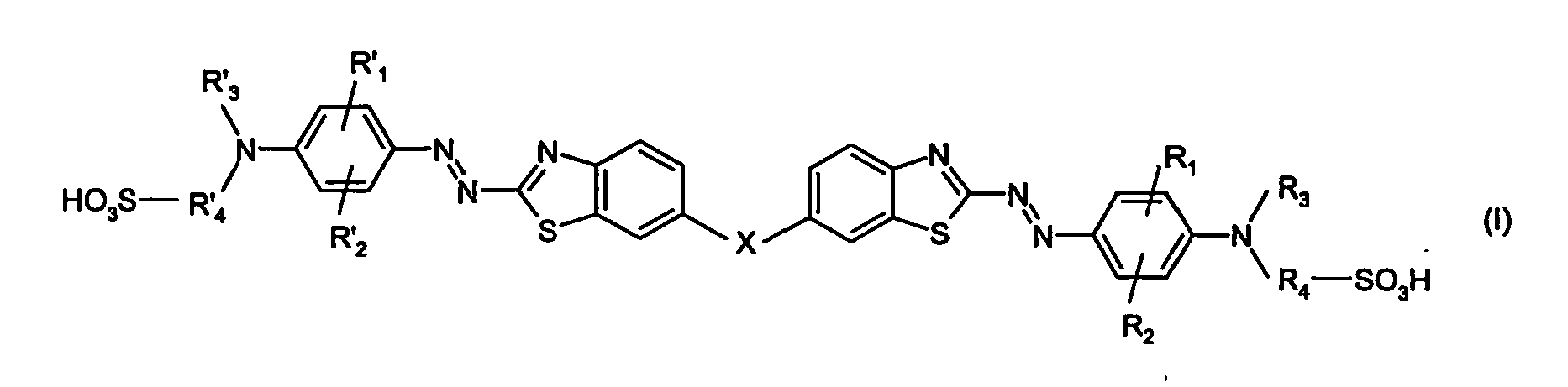
- R1, R'1, R2 and R'2
- are independently hydrogen, unbranched C1-6alkyl or branched C3-6alkyl, unbranched C1-6alkoxy or branched C3-6alkoxy, halogen or -NHCO-(C1-6alkyl) with an unbranched C1-6alkyl group or - NHCO-(C3-6alkyl) with a branched C3-6alkyl group,
- R3 and R'3
- are independently unbranched C1-6alkyl or branched C3-6alkyl,
- R4 and R'4
- are independently unbranched C1-6alkylene or branched C3-6-alkylene or arylene or -CH2-arylene which is optionally substituted by unbranched C1-6alkyl or branched C3-6alkyl, -OH, - CN or by further -SO3H groups, and
- X
- is any bridge or a direct bond.
- A in -NH-C(O)-A-C(O)-NH- is a group of the formula -(CH2)y- where y is 1, 2, 3, 4, 5, or 6, or branched C3-6alkylene which can be substituted by -OH or -CN or is -CH=CH-, phenylene, naphthylene or a five-membered or six-membered ring which can also contain one or two heteroatoms especially N, S or O.
- In further preferred compounds, the bridge X is a bridge of the formula -(CH2)y'- where y' is 1, 2, 3 or 4, especially -CH2- or -CH2CH2-, or branched C3-4alkyl, especially -C(CH3)2-, CO, SO2, NH or -NH-C(O)-NH-. In further preferred compounds the bridge X is a heteroatom selected from the group of S or O. In particularly preferred compounds the bridge X is -CH2- or -CH2CH2-.
- In further preferred compounds, the bridge X is a bridge of the formula


- In preferred compounds of the formula (I)
- R1, R'1, R2 and R'2
- are independently hydrogen, unbranched C1-4alkyl or branched C3-4alkyl, unbranched C1-4alkoxy or branched C3-4alkoxy, halogen or -NHCO-(C1-4alkyl) with an unbranched C1-4alkyl group or - NHCO-(C3-4alkyl) with a branched C3-4alkyl group,
- R3 and R'3
- are independently unbranched C1-4alkyl or branched C3-4alkyl,
- R4 and R'4
- are independently arylene or -CH2-arylene which is optionally substituted by unbranched C1-6alkyl or branched C3-6alkyl, -OH, - CN or by further -SO3H groups, and
- X
- is any bridge or a direct bond.
- In more preferred compounds of the formula (I)
- R1, R'1, R2 and R'2
- are independently hydrogen, methyl, ethyl, methoxy, ethoxy, halogen or acylamino,
- R3 and R'3
- are independently methyl or ethyl,
- R4 and R'4
- are independently arylene or -CH2- arylene which is optionally substituted by unbranched C1-6alkyl or branched C3-6alkyl, -OH, - CN or by further -SO3H groups, and
- X
- is any bridge or a direct bond.
- Very particular preference is given to compounds of the formula (I) where
- R1, R'1, R2 and R'2
- are independently hydrogen, methyl, ethyl, methoxy, ethoxy, halogen or acylamino,
- R3 and R'3
- are each ethyl,
- R4 and R'4
- are independently benzylene which is optionally substituted by unbranched C1-6alkyl or branched C3-6alkyl, -OH, -CN or by further -SO3H groups, and
- X
- is any bridge or a direct bond
- Very particular preference is further given to compounds of the formula (I) where R4 and R'4 is a -CH2-phenylene group which is not further substituted. It is very particularly preferred for the groups -R4-SO4H and -R'4-SO4H to be

- The branched C3-6alkyl groups or unbranched C1-6alkyl groups can be further substituted with hydroxyl groups or cyano groups. Preferably, the alkyl groups are not further substituted.
- The invention also provides a process for preparing compounds of the formula (I). The invention's compounds of the formula (I) can be prepared in conventional processes under conventional conditions.
- In the process of the invention, compounds of the formula (II)


- The dyes of the formula (I) can be isolated from the reaction medium as per known processes, for example by salting out with an alkali metal salt, filtration and drying, if appropriate under reduced pressure at elevated temperature.
- Depending on the reaction and/or isolation conditions, the dyes of the formula (I) can be obtained as free acid, as salt or as mixed salt which contains for example one or more cations selected from alkali metal ions, for example the sodium ion, or an ammonium ion or alkylammonium cation, for example mono-, di- or trimethyl- or -ethylammonium cations. The dye can be converted by conventional techniques from the free acid into a salt or into a mixed salt or vice versa or from one salt form into another. If desired, the dyes can be further purified by diafiltration, in which case unwanted salts and synthesis by-products are separated from the crude anionic dye. In diafiltration, the crude dye is forced through a semipermeable membrane under an applied pressure to remove salts and synthesis by-products and partly remove water.
- The dyes of the formula (I) and their salts are particularly suitable for dyeing or printing fibrous material consisting of natural or synthetic polyamides in red to violet shades. The dyes of the formula (I) and their salts are suitable for producing Inkjet printing inks and for using these Inkjet printing inks to print fibrous material which consists of natural or synthetic polyamides or cellulose (paper for example).
- The invention accordingly provides from another aspect for the use of the dyes of the formula (I), their salts and mixtures for dyeing and/or printing fibrous materials consisting of natural or synthetic polyamides. A further aspect is the production of Inkjet printing inks and their use for printing fibrous materials consisting of natural or synthetic polyamides.
- Dyeing is carried out as per known processes, see for example the dyeing processes described in Ullmanns Encyklopädie der technischen Chemie, 4th Edition, 1982, Volume 22, pages 658-673 or in the book by M. Peter and H.K. Rouette, Grundlagen der Textilveredlung, 13th Edition, 1989, pages 535-556 and 566-574. Preference is given to dyeing in the exhaust process at a temperature of 30 to 140°C, more preferably 80 to 120°C and most preferably at a temperature of 80 to 100°C, and at a liquor ratio in the range from 3:1 to 40:1.
- The substrate to be dyed can be present in the form of yarn, woven fabric, loop-formingly knitted fabric or carpet for example. Fully fashioned dyeings are even permanently possible on delicate substrates, examples being lambswool, cashmere, alpaca and mohair. The dyes of the invention are particularly useful for dyeing fine-denier fibres (microfibres).
- The dyes according to the present invention and their salts are highly compatible with known acid dyes. Accordingly, the dyes of the formula (I), their salts or mixtures can be used alone in a dyeing or printing process or else as a component in a combination shade dyeing or printing composition together with other acid dyes of the same class, i.e. with acid dyes possessing comparable dyeing properties, such as for example fastness properties and exhaustion rates from the dyebath onto the substrate. The dyes of the present invention can be used in particular together with certain other dyes having suitable chromophores. The ratio in which the dyes are present in a combination shade dyeing or printing composition is dictated by the hue to be obtained.
- The novel dyes of the formula (I), as stated above, are very useful for dyeing natural and synthetic polyamides, i.e. wool, silk and all nylon types, on each of which dyeings having a high fastness level, especially good light fastness and good wet fastnesses (washing, alkaline perspiration) are obtained. The dyes of the formula (I) and their salts have a high rate of exhaustion. The ability of the dyes of the formula (I) and their salt to build up is likewise very good. On-tone dyeings on the identified substrates are of outstanding quality. All dyeings moreover have a constant hue under artificial light. Furthermore, the fastness to decating and boiling is good.
- One decisive advantage of the novel dyes is that they are metal free and provide very level dyeings.
- The compounds according to the invention can be used as an individual dye or else, owing to their good compatibility, as a combination element with other dyes of the same class having comparable dyeing properties, for example with regard to general fastnesses, exhaustion value, etc. The combination shade dyeings obtained have similar fastnesses to dyeings with the individual dye.
- The invention's dyes of the formula (I) can also be used as red components in trichromatic dyeing or printing. Trichromatic dyeing or printing can utilize all customary and known dyeing and printing processes, such as for example the continuous process, exhaustion process, foam dyeing process and Ink-Jet process.
- The composition of the individual dye components in the trichromatic dye mixture used in the process of the invention depends on the desired hue. A brown hue for example preferably utilizes 55 - 65% by weight of a yellow component, 20 - 30% by weight of the invention's red component and 10 - 20% by weight of a blue component.
- The yellow component, as described above, can consist of a single component or of a mixture of different red individual components conforming to the formula (I). Preference is given to double and triple combinations. When a red individual component consisting of just one red component of the formula (III) is to be used, it should not account for more than 50% by weight of the trichromatic dye mixture.
- Particularly preferred blue and/or yellow components are described in
W02002/46318 - In the examples which follow, parts and percentages are by weight and temperatures are reported in degrees Celsius.
-

- The residue is dissolved at 70°C in 1500 parts of water with caustic soda at pH 10. The dye is reprecipitated by addition of 50 parts of sodium chloride and 2000 parts of alcohol and filtered. It conforms to the structure

λmax (dimethylformamide: water 1:1 (weight/weight) + 0.2 weight-% ammonium acetate): 536 nm - The following dyes can be prepared similarly to Preparation Example 1 (The λmax were measured in a dimethylformamide with water in 1:1 ratio (weight/weight) + 0.2 weight-% ammonium acetate (dimethylformamide: water 1:1 w/w + 0.2 wt.-% ammonium acetate):

Ex. X R1 R2 R3 R4 λ max [nm] 2 CH2CH2 H H C2H5 
530 3 CH2 H CH3 C2H5 
544 4 O H H C2H5 
544 5 O H CH3 C2H5 
550 6 O H H C2H5 CH2CH2SO3H 540 7 O H NHCOCH3 C2H5 
581 8 C(CH3)2 H H C2H5 
535 9 SO2 H H C2H5 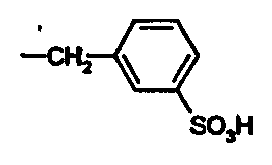
554 10 SO2 H CH3 C2H5 
562 11 SO2 H NHCOCH3 C2H5 
584 12 CH2 H H C4H9 
537 13 CH2 H CH3 C4H9 
546 14 C(CH3)2 H CH3 C2H5 
543 15 CO H H C2H5 
546 16 CH2 H H CH3 
535 17 CH2CH2 H H CH3 
529 18 CH2CH2 H CH3 CH3 
537 19 C(CH2)5 H H C2H5 
533 20 C(CH2)5 H NHCOCH3 C2H5 
574 21 CO H CH3 C2H5 
555 22 CO H NHCOCH3 C2H5 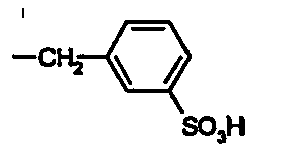
587 23 CH2CH2 H CH3 C2H5 
537 24 CH2CH2 H H C4H9 
532 25 CH2CH2 H CH3 C4H9 
538 26 C(CH3)2 H NHCOCH3 C2H5 
571 27 CH2 H NHCOCH3 C2H5 
573 28 CH2 H CH3 CH3 
543 29 C(CH2)5 H H C4H9 
535 30 C(CH2)5 OCH3 CH3 C2H5 
555 31 C(CH2)5 H H CH3 
534 32 CH2CH2 H NHCOCH3 C2H5 
566 33 O H CH3 C4H9 
552 34 O H H C4H9 
546 35 C(CH2)5 H CH3 CH3 
542 36 O H CH3 CH3 
551 37 CH2 OCH3 CH3 C2H5 
557 38 O H H CH3 
544 39 C(CH2)5 H CH3 C4H9 
544 40 CH2CH2 H H C2H5 CH2CH2SO3H 525 41 CH2CH2 OCH3 CH3 C2H5 
554 42 CH2 H H C2H5 CH2CH2SO3H 530 43 C(CH2)5 H CH3 C2H5 
542 
- A dyebath at 40°C, consisting of 2000 parts of water, 1 part of a weakly cation-active levelling agent which is based on an ethoxylated aminopropyl fatty acid amide and which has affinity for dye, 0.25 parts of the dye of Preparation Example 1 and adjusted to pH 5 with 1-2 parts of 40% acetic acid is entered with 100 parts of nylon-6 fabric. After 10 minutes at 40°C, the dyebath is heated to 98°C at a rate of 1°C per minute and then left at the boil for 45-60 minutes. Thereafter it is cooled down to 70°C over 15 minutes. The dyeing is removed from the bath, rinsed with hot and then with cold water and dried. The result obtained is a red polyamide dyeing possessing good light and wet fastnesses.
- A dyebath at 40°C, consisting of 2000 parts of water, 1 part of a weakly cation-active levelling agent which is based on an ethoxylated aminopropyl fatty acid amide and which has affinity for dye, 0.3 parts of the dye of Preparation Example 1 and adjusted to pH 5.5 with 1-2 parts of 40% acetic acid is entered with 100 parts of nylon-6,6 fabric. After 10 minutes at 40°C, the dyebath is heated to 120°C at a rate of 1.5°C per minute and then left at this temperature for 15-25 minutes. Thereafter it is cooled down to 70°C over 25 minutes. The dyeing is removed from the dyebath, rinsed with hot and then with cold water and dried. The result obtained is a red polyamide dyeing with good levelness and having good light and wet fastnesses.
- A dyebath at 40°C, consisting of 4000 parts of water, 1 part of a weakly amphoteric levelling agent which is based on a sulfated, ethoxylated fatty acid amide and which has affinity for dye, 0.4 parts of the dye of Preparation Example 1 and adjusted to pH 5 with 1-2 parts of 40% acetic acid is entered with 100 parts of wool fabric. After 10 minutes at 40°C, the dyebath is heated to boiling at a rate of 1°C per minute and then left at the boil for 40-60 minutes. Thereafter it is cooled down to 70°C over 20 minutes. The dyeing is removed from the bath, rinsed with hot and then with cold water and dried. The result obtained is a red wool dyeing possessing good light and wet fastnesses.
- 100 parts of a woven nylon-6 material are padded with a 50°C liquor consisting of
40 parts of the dye of Preparation Example 1, 100 parts of urea, 20 parts of a nonionic solubilizer based on butyldiglycol, 15-20 parts of acetic acid (to adjust the pH to 4), 10 parts of a weakly cation-active levelling agent which is based on an ethoxylated aminopropyl fatty acid amide and has affinity for dye, and 810-815 parts of water (to make up to 1000 parts of padding liquor). - The material thus impregnated is rolled up and left to dwell in a steaming chamber under saturated steam conditions at 85-98°C for 3-6 hours for fixation. The dyeing is then rinsed with hot and cold water and dried. The result obtained is a red nylon dyeing having good levelness in the piece and good light and wet fastnesses.
- A textile cut pile sheet material composed of nylon-6 and having a synthetic base fabric is padded with a liquor containing per 1000 parts
- 1
- part of dye of Preparation Example 1
- 4
- parts of a commercially available thickener based on carob flour ether
- 2
- parts of a nonionic ethylene oxide adduct of a higher alkylphenol
- 1
- part of 60% acetic acid.
- This is followed by printing with a paste which per 1000 parts contains the following components:
- 20
- parts of commercially available alkoxylated fatty alkylamine (displace product)
- 20
- parts of a commercially available thickener based on carob flour ether.
- The print is fixed for 6 minutes in saturated steam at 100°C, rinsed and dried. The result obtained is a level-coloured cover material having a red and white pattern.
- A dyebath at 40°C consisting of 2000 parts of water, 1 part of a weakly cation-active levelling agent which is based on an ethoxylated aminopropyl fatty acid amide and has affinity for dye, 0.2 part of the dye of Preparation Example 1, 1.5 parts of a commercially available preparation of C.I. Acid Yellow 236 (Nylosan Yellow F-L) and 0.5 part of the blue dye of Example 46 of the patent application
WO99/51681 EP 1066340 B1 :
WO99/51681 EP 1066340 B 1
adjusted to pH 5 with 1-2 parts of 40% acetic acid is entered with 100 parts of woven nylon-6,6 fabric. After 10 minutes at 40°C, the dyebath is heated to 98°C at a rate of 1°C per minute and then left at the boil for 45 to 60 minutes. This is followed by cooling down to 70°C over 15 minutes. The dyeing is removed from the bath, rinsed with hot and then with cold water and dried. The result obtained is a level grey polyamide dyeing having good light and wet fastnesses. - 100 parts of a chrome-tanned and synthetically retanned shave-moist grain leather are dyed for 30 minutes in a bath of 300 parts of water and 2 parts of the dye of Preparation Example 1 at 55°C. After addition of 4 parts of a 60% emulsion of a sulphited fish oil, the leather is fatliquored for 45 minutes. It is then acidified with 8.5% formic acid and milled for 10 minutes (final pH in the bath 3.5-4.0). The leather is then rinsed, allowed to drip dry and finished as usual. The result obtained is a leather dyed in a level clear red hue with good fastnesses.
- Use Examples A to G can also be carried out with dyes 2 to 43 with similar results.
- 3 parts of the dye of Preparation Example 3 are dissolved in 82 parts of demineralized water and 15 parts of diethylene glycol at 60°C. Cooling down to room temperature gives a red printing ink which is very highly suitable for ink jet printing on paper or polyamide and wool textiles.
- Use Example H can also be carried out with dyes 1 or 2 and 4 to 43 with similar results.
Claims (8)
- Compounds of the general formula (I)
 R1, R'1, R2 and R'2 are independently hydrogen, unbranched C1-6alkyl or branched C3-6alkyl, unbranched C1-6alkoxy or branched C3-6alkoxy, halogen or -NHCO-(C1-6alkyl) with an unbranched C1-6akl group or -NHCO-(C3-6alkyl) with a branched C3-6alkyl group,R3 and R'3 are independently unbranched C1-6alkyl or branched C3-6alkyl,R4 and R'4 are independently unbranched C1-6alkylene or branched C3-6akylene or arylene or -CH2-arylene which is optionally substituted by unbranched C1-6alkyl or branched C3-6alkyl, -OH, -CN or by further -SO3H groups, andX is any bridge or a direct bond.
 - Compounds according to Claim 1 characterized in thatR1, R'1, R2 and R'2 are independently hydrogen, unbranched C1-4alkyl or branched C3-4alkyl, unbranched C1-4alkoxy or branched C3-4alkoxy, halogen or -NHCO-(C1-4alkyl) with an unbranched C1-4alkyl group or -NHCO-(C3-4alkyl) with a branched C3-4alkyl group,R3 and R'3 are independently unbranched C1-4alkyl or branched C3-4alkyl,R4 and R'4 are independently arylene or -CH2-arylene which is optionally substituted by unbranched C1-6alkyl or branched C3-6alkyl, -OH, -CN or by further -SO3H groups, andX is any bridge or a direct bond.
- Compounds according to Claim 2 characterized in thatR1, R'1, R2 and R'2 are independently hydrogen, methyl, ethyl, methoxy, ethoxy, halogen or acylamino,R3 and R'3 are independently methyl or ethyl,R4 and R'4 are independently arylene or -CH2-arylene which is optionally substituted by unbranched C1-6alkyl or branched C3-6alkyl, -OH, -CN or by further -SO3H groups, andX is any bridge or a direct bond.
- Compounds according to Claim 1, 2 or 3 characterized in that X is a direct bond or a bridge of the formula -(CH2)y- where y is 1, 2, 3, 4, 5 or 6, or branched C3-6-alkylene which can be further substituted by -OH or -CN or is -CH=CH-, C3-6-alkylene, phenylene, naphthylene or a five-membered or six-membered ring which can also contain one or two heteroatoms, especially N, S or O, or -NH-(C1-6)-alkylene-NH-, -NH-arylene-NH-, -NH-C(O)-, -NH-C(O)-NH-, -NH-C(O)-A-C(O)-NH-, CO, SO2, NH or a heteroatom and A is a group of the formula - (CH2)y- where y is 1, 2, 3, 4, 5 or 6, or branched C3-6alkyl which can be substituted by -OH or -CN or is -CH=CH-, C3-6alkylene, phenylene, naphthylene or a five-membered or six-membered ring which can also contain one or two heteroatoms especially N, S or O.
- Process for preparing compounds of the formula (I) according to Claim 1, characterized in that a of the formula (II)


- Use of the compounds of the formula (I) according to Claim 1 for dyeing and/or printing organic substrates.
- Use of compounds of the formula (I) according to Claim 1 for dyeing and/or printing wool, silk and synthetic polyamides.
- Use of compounds of the formula (I) according to Claim 1 for producing printing inks for the InkJet process.
Priority Applications (1)
| Application Number | Priority Date | Filing Date | Title |
|---|---|---|---|
| EP05738356A EP1753822B1 (en) | 2004-05-19 | 2005-05-12 | Bridged monoazo dyes |
Applications Claiming Priority (3)
| Application Number | Priority Date | Filing Date | Title |
|---|---|---|---|
| EP04011855 | 2004-05-19 | ||
| EP05738356A EP1753822B1 (en) | 2004-05-19 | 2005-05-12 | Bridged monoazo dyes |
| PCT/IB2005/001419 WO2005113680A1 (en) | 2004-05-19 | 2005-05-12 | Bridged monoazo dyes |
Publications (2)
| Publication Number | Publication Date |
|---|---|
| EP1753822A1 EP1753822A1 (en) | 2007-02-21 |
| EP1753822B1 true EP1753822B1 (en) | 2009-07-15 |
Family
ID=34925058
Family Applications (1)
| Application Number | Title | Priority Date | Filing Date |
|---|---|---|---|
| EP05738356A Expired - Lifetime EP1753822B1 (en) | 2004-05-19 | 2005-05-12 | Bridged monoazo dyes |
Country Status (15)
| Country | Link |
|---|---|
| US (1) | US7559959B2 (en) |
| EP (1) | EP1753822B1 (en) |
| JP (1) | JP5090905B2 (en) |
| KR (1) | KR101160368B1 (en) |
| CN (1) | CN1954034B (en) |
| AU (1) | AU2005245686A1 (en) |
| BR (1) | BRPI0511257A (en) |
| CA (1) | CA2560957A1 (en) |
| DE (1) | DE602005015444D1 (en) |
| ES (1) | ES2326749T3 (en) |
| MX (1) | MXPA06013141A (en) |
| NO (1) | NO20064833L (en) |
| TW (1) | TWI373495B (en) |
| WO (1) | WO2005113680A1 (en) |
| ZA (1) | ZA200608735B (en) |
Families Citing this family (6)
| Publication number | Priority date | Publication date | Assignee | Title |
|---|---|---|---|---|
| WO2007115960A2 (en) * | 2006-04-07 | 2007-10-18 | Clariant International Ltd | Acid dyes |
| CA2646126A1 (en) * | 2006-05-16 | 2007-11-22 | Clariant Finance (Bvi) Limited | Disazo acid dyes |
| EP2576544A4 (en) * | 2010-06-01 | 2013-09-11 | Angion Biomedica Corp | CYTOCHROM P450 HEMMER AND USES THEREOF |
| EP2418256B1 (en) * | 2010-07-29 | 2013-03-27 | Clariant Finance (BV) Limited | Acid dyes |
| PT2910608T (en) * | 2014-02-25 | 2017-08-30 | Archroma Ip Gmbh | Dimeric anionic monoazo dyes |
| CN114958026B (en) * | 2022-05-30 | 2023-05-23 | 金华双宏化工有限公司 | Improved trisazo red acid dye and preparation method thereof |
Family Cites Families (10)
| Publication number | Priority date | Publication date | Assignee | Title |
|---|---|---|---|---|
| US3870696A (en) | 1970-01-19 | 1975-03-11 | Crompton & Knowles Corp | Benzthiazole-azo-(4-n-sulfopropyl)phenyl compounds |
| US4041024A (en) | 1970-04-30 | 1977-08-09 | Bayer Aktiengesellschaft | Sulfo containing monoazo dyestuffs containing a benzthiazole diazo moiety and an N-benzylamino anilino coupling component |
| GB2026520A (en) | 1978-07-24 | 1980-02-06 | Ici Ltd | Monoazo Dyes |
| JPS57185352A (en) * | 1981-05-07 | 1982-11-15 | Sumitomo Chem Co Ltd | Novel azo compound |
| CH648337A5 (en) * | 1981-09-22 | 1985-03-15 | Ciba Geigy Ag | CATIONIC disazo. |
| CH653358A5 (en) * | 1982-09-23 | 1985-12-31 | Ciba Geigy Ag | CATIONIC DISAZO CONNECTIONS. |
| JP2890687B2 (en) * | 1990-06-13 | 1999-05-17 | 三菱化学株式会社 | Azo metal chelate dye and optical recording medium using the dye |
| WO1999051681A1 (en) | 1998-04-03 | 1999-10-14 | Clariant Finance (Bvi) Limited | Triphendioxazine dyestuffs for dyeing organic substrates |
| JP4988140B2 (en) | 2000-12-05 | 2012-08-01 | クラリアント ファイナンス (ビーブイアイ) リミティド | Three primary color dyeing method |
| GB0321437D0 (en) * | 2003-09-12 | 2003-10-15 | Dystar Textilfarben Gmbh & Co | High light fastness reactive red dyes |
-
2005
- 2005-05-12 CA CA002560957A patent/CA2560957A1/en not_active Abandoned
- 2005-05-12 BR BRPI0511257-5A patent/BRPI0511257A/en active Search and Examination
- 2005-05-12 US US11/596,940 patent/US7559959B2/en not_active Expired - Fee Related
- 2005-05-12 DE DE602005015444T patent/DE602005015444D1/en not_active Expired - Lifetime
- 2005-05-12 WO PCT/IB2005/001419 patent/WO2005113680A1/en not_active Ceased
- 2005-05-12 CN CN2005800154827A patent/CN1954034B/en not_active Expired - Fee Related
- 2005-05-12 EP EP05738356A patent/EP1753822B1/en not_active Expired - Lifetime
- 2005-05-12 KR KR1020067024176A patent/KR101160368B1/en not_active Expired - Fee Related
- 2005-05-12 ES ES05738356T patent/ES2326749T3/en not_active Expired - Lifetime
- 2005-05-12 AU AU2005245686A patent/AU2005245686A1/en not_active Abandoned
- 2005-05-12 MX MXPA06013141A patent/MXPA06013141A/en active IP Right Grant
- 2005-05-12 JP JP2007517499A patent/JP5090905B2/en not_active Expired - Fee Related
- 2005-05-17 TW TW094115937A patent/TWI373495B/en not_active IP Right Cessation
-
2006
- 2006-10-19 ZA ZA200608735A patent/ZA200608735B/en unknown
- 2006-10-25 NO NO20064833A patent/NO20064833L/en not_active Application Discontinuation
Also Published As
| Publication number | Publication date |
|---|---|
| CA2560957A1 (en) | 2005-12-01 |
| ES2326749T3 (en) | 2009-10-19 |
| JP2007538129A (en) | 2007-12-27 |
| ZA200608735B (en) | 2008-08-27 |
| KR101160368B1 (en) | 2012-06-26 |
| WO2005113680A1 (en) | 2005-12-01 |
| TWI373495B (en) | 2012-10-01 |
| US20070220687A1 (en) | 2007-09-27 |
| DE602005015444D1 (en) | 2009-08-27 |
| MXPA06013141A (en) | 2007-02-28 |
| JP5090905B2 (en) | 2012-12-05 |
| NO20064833L (en) | 2007-02-13 |
| CN1954034B (en) | 2010-11-03 |
| CN1954034A (en) | 2007-04-25 |
| AU2005245686A1 (en) | 2005-12-01 |
| EP1753822A1 (en) | 2007-02-21 |
| KR20070015585A (en) | 2007-02-05 |
| TW200613455A (en) | 2006-05-01 |
| US7559959B2 (en) | 2009-07-14 |
| BRPI0511257A (en) | 2007-11-27 |
Similar Documents
| Publication | Publication Date | Title |
|---|---|---|
| EP2307510B1 (en) | Acid dyes | |
| EP2027213B1 (en) | Disazo acid dyes | |
| EP2768907A1 (en) | Trisazo acid dyes | |
| EP2324080B1 (en) | Acid dyes | |
| EP2035506B1 (en) | Acid dyes | |
| EP2418256B1 (en) | Acid dyes | |
| EP2429989B1 (en) | Bisazo compounds | |
| US7559959B2 (en) | Bridged monoazo dyes | |
| EP2251387B1 (en) | Acidic azo dyes | |
| EP2016135B1 (en) | Acid dyes | |
| EP2258685B1 (en) | Bisazo compounds | |
| EP2307508B1 (en) | Acid dyes | |
| EP2251321A1 (en) | Monoazo compounds | |
| EP2251322A1 (en) | Bisazo compounds | |
| EP2251388A1 (en) | Organic compounds | |
| EP2251384A1 (en) | Pyrazolone monoazo dyes | |
| EP2258684A1 (en) | Monoazo compounds | |
| EP2251382A1 (en) | Monoazo compounds | |
| EP2258686A1 (en) | Monoazo compounds | |
| EP2251385A1 (en) | Pyrazolone bisazo dyes | |
| EP2251381A1 (en) | Monoazo compounds |
Legal Events
| Date | Code | Title | Description |
|---|---|---|---|
| PUAI | Public reference made under article 153(3) epc to a published international application that has entered the european phase |
Free format text: ORIGINAL CODE: 0009012 |
|
| 17P | Request for examination filed |
Effective date: 20061219 |
|
| AK | Designated contracting states |
Kind code of ref document: A1 Designated state(s): AT BE BG CH CY CZ DE DK EE ES FI FR GB GR HU IE IS IT LI LT LU MC NL PL PT RO SE SI SK TR |
|
| DAX | Request for extension of the european patent (deleted) | ||
| RAP1 | Party data changed (applicant data changed or rights of an application transferred) |
Owner name: CLARIANT FINANCE (BVI) LIMITED |
|
| GRAP | Despatch of communication of intention to grant a patent |
Free format text: ORIGINAL CODE: EPIDOSNIGR1 |
|
| GRAS | Grant fee paid |
Free format text: ORIGINAL CODE: EPIDOSNIGR3 |
|
| GRAA | (expected) grant |
Free format text: ORIGINAL CODE: 0009210 |
|
| AK | Designated contracting states |
Kind code of ref document: B1 Designated state(s): AT BE BG CH CY CZ DE DK EE ES FI FR GB GR HU IE IS IT LI LT LU MC NL PL PT RO SE SI SK TR |
|
| REG | Reference to a national code |
Ref country code: GB Ref legal event code: FG4D Ref country code: CH Ref legal event code: EP |
|
| REG | Reference to a national code |
Ref country code: CH Ref legal event code: NV Representative=s name: CLARIANT INTERNATIONAL LTD. |
|
| REG | Reference to a national code |
Ref country code: IE Ref legal event code: FG4D |
|
| REF | Corresponds to: |
Ref document number: 602005015444 Country of ref document: DE Date of ref document: 20090827 Kind code of ref document: P |
|
| REG | Reference to a national code |
Ref country code: ES Ref legal event code: FG2A Ref document number: 2326749 Country of ref document: ES Kind code of ref document: T3 |
|
| NLV1 | Nl: lapsed or annulled due to failure to fulfill the requirements of art. 29p and 29m of the patents act | ||
| PG25 | Lapsed in a contracting state [announced via postgrant information from national office to epo] |
Ref country code: AT Free format text: LAPSE BECAUSE OF FAILURE TO SUBMIT A TRANSLATION OF THE DESCRIPTION OR TO PAY THE FEE WITHIN THE PRESCRIBED TIME-LIMIT Effective date: 20090715 Ref country code: IS Free format text: LAPSE BECAUSE OF FAILURE TO SUBMIT A TRANSLATION OF THE DESCRIPTION OR TO PAY THE FEE WITHIN THE PRESCRIBED TIME-LIMIT Effective date: 20091115 Ref country code: LT Free format text: LAPSE BECAUSE OF FAILURE TO SUBMIT A TRANSLATION OF THE DESCRIPTION OR TO PAY THE FEE WITHIN THE PRESCRIBED TIME-LIMIT Effective date: 20090715 Ref country code: SE Free format text: LAPSE BECAUSE OF FAILURE TO SUBMIT A TRANSLATION OF THE DESCRIPTION OR TO PAY THE FEE WITHIN THE PRESCRIBED TIME-LIMIT Effective date: 20090715 |
|
| PG25 | Lapsed in a contracting state [announced via postgrant information from national office to epo] |
Ref country code: SI Free format text: LAPSE BECAUSE OF FAILURE TO SUBMIT A TRANSLATION OF THE DESCRIPTION OR TO PAY THE FEE WITHIN THE PRESCRIBED TIME-LIMIT Effective date: 20090715 Ref country code: PL Free format text: LAPSE BECAUSE OF FAILURE TO SUBMIT A TRANSLATION OF THE DESCRIPTION OR TO PAY THE FEE WITHIN THE PRESCRIBED TIME-LIMIT Effective date: 20090715 Ref country code: NL Free format text: LAPSE BECAUSE OF FAILURE TO SUBMIT A TRANSLATION OF THE DESCRIPTION OR TO PAY THE FEE WITHIN THE PRESCRIBED TIME-LIMIT Effective date: 20090715 |
|
| PG25 | Lapsed in a contracting state [announced via postgrant information from national office to epo] |
Ref country code: BG Free format text: LAPSE BECAUSE OF FAILURE TO SUBMIT A TRANSLATION OF THE DESCRIPTION OR TO PAY THE FEE WITHIN THE PRESCRIBED TIME-LIMIT Effective date: 20091015 Ref country code: PT Free format text: LAPSE BECAUSE OF FAILURE TO SUBMIT A TRANSLATION OF THE DESCRIPTION OR TO PAY THE FEE WITHIN THE PRESCRIBED TIME-LIMIT Effective date: 20091115 |
|
| PG25 | Lapsed in a contracting state [announced via postgrant information from national office to epo] |
Ref country code: CZ Free format text: LAPSE BECAUSE OF FAILURE TO SUBMIT A TRANSLATION OF THE DESCRIPTION OR TO PAY THE FEE WITHIN THE PRESCRIBED TIME-LIMIT Effective date: 20090715 Ref country code: EE Free format text: LAPSE BECAUSE OF FAILURE TO SUBMIT A TRANSLATION OF THE DESCRIPTION OR TO PAY THE FEE WITHIN THE PRESCRIBED TIME-LIMIT Effective date: 20090715 Ref country code: RO Free format text: LAPSE BECAUSE OF FAILURE TO SUBMIT A TRANSLATION OF THE DESCRIPTION OR TO PAY THE FEE WITHIN THE PRESCRIBED TIME-LIMIT Effective date: 20090715 Ref country code: DK Free format text: LAPSE BECAUSE OF FAILURE TO SUBMIT A TRANSLATION OF THE DESCRIPTION OR TO PAY THE FEE WITHIN THE PRESCRIBED TIME-LIMIT Effective date: 20090715 |
|
| PLBE | No opposition filed within time limit |
Free format text: ORIGINAL CODE: 0009261 |
|
| STAA | Information on the status of an ep patent application or granted ep patent |
Free format text: STATUS: NO OPPOSITION FILED WITHIN TIME LIMIT |
|
| PG25 | Lapsed in a contracting state [announced via postgrant information from national office to epo] |
Ref country code: SK Free format text: LAPSE BECAUSE OF FAILURE TO SUBMIT A TRANSLATION OF THE DESCRIPTION OR TO PAY THE FEE WITHIN THE PRESCRIBED TIME-LIMIT Effective date: 20090715 Ref country code: BE Free format text: LAPSE BECAUSE OF FAILURE TO SUBMIT A TRANSLATION OF THE DESCRIPTION OR TO PAY THE FEE WITHIN THE PRESCRIBED TIME-LIMIT Effective date: 20090715 |
|
| 26N | No opposition filed |
Effective date: 20100416 |
|
| PG25 | Lapsed in a contracting state [announced via postgrant information from national office to epo] |
Ref country code: GR Free format text: LAPSE BECAUSE OF FAILURE TO SUBMIT A TRANSLATION OF THE DESCRIPTION OR TO PAY THE FEE WITHIN THE PRESCRIBED TIME-LIMIT Effective date: 20091016 |
|
| PG25 | Lapsed in a contracting state [announced via postgrant information from national office to epo] |
Ref country code: MC Free format text: LAPSE BECAUSE OF NON-PAYMENT OF DUE FEES Effective date: 20100531 |
|
| PG25 | Lapsed in a contracting state [announced via postgrant information from national office to epo] |
Ref country code: IE Free format text: LAPSE BECAUSE OF NON-PAYMENT OF DUE FEES Effective date: 20100512 |
|
| PGFP | Annual fee paid to national office [announced via postgrant information from national office to epo] |
Ref country code: FI Payment date: 20110520 Year of fee payment: 7 |
|
| PG25 | Lapsed in a contracting state [announced via postgrant information from national office to epo] |
Ref country code: CY Free format text: LAPSE BECAUSE OF FAILURE TO SUBMIT A TRANSLATION OF THE DESCRIPTION OR TO PAY THE FEE WITHIN THE PRESCRIBED TIME-LIMIT Effective date: 20090715 |
|
| PG25 | Lapsed in a contracting state [announced via postgrant information from national office to epo] |
Ref country code: LU Free format text: LAPSE BECAUSE OF NON-PAYMENT OF DUE FEES Effective date: 20100512 Ref country code: HU Free format text: LAPSE BECAUSE OF FAILURE TO SUBMIT A TRANSLATION OF THE DESCRIPTION OR TO PAY THE FEE WITHIN THE PRESCRIBED TIME-LIMIT Effective date: 20100116 |
|
| PG25 | Lapsed in a contracting state [announced via postgrant information from national office to epo] |
Ref country code: FI Free format text: LAPSE BECAUSE OF NON-PAYMENT OF DUE FEES Effective date: 20120512 |
|
| REG | Reference to a national code |
Ref country code: DE Ref legal event code: R082 Ref document number: 602005015444 Country of ref document: DE Representative=s name: WALLINGER RICKER SCHLOTTER TOSTMANN PATENT- UN, DE |
|
| REG | Reference to a national code |
Ref country code: FR Ref legal event code: PLFP Year of fee payment: 11 |
|
| PGFP | Annual fee paid to national office [announced via postgrant information from national office to epo] |
Ref country code: TR Payment date: 20150511 Year of fee payment: 11 Ref country code: ES Payment date: 20150622 Year of fee payment: 11 Ref country code: GB Payment date: 20150529 Year of fee payment: 11 Ref country code: CH Payment date: 20150526 Year of fee payment: 11 |
|
| PGFP | Annual fee paid to national office [announced via postgrant information from national office to epo] |
Ref country code: FR Payment date: 20150529 Year of fee payment: 11 Ref country code: IT Payment date: 20150526 Year of fee payment: 11 |
|
| PGFP | Annual fee paid to national office [announced via postgrant information from national office to epo] |
Ref country code: DE Payment date: 20150730 Year of fee payment: 11 |
|
| REG | Reference to a national code |
Ref country code: DE Ref legal event code: R119 Ref document number: 602005015444 Country of ref document: DE |
|
| REG | Reference to a national code |
Ref country code: CH Ref legal event code: PL |
|
| GBPC | Gb: european patent ceased through non-payment of renewal fee |
Effective date: 20160512 |
|
| PG25 | Lapsed in a contracting state [announced via postgrant information from national office to epo] |
Ref country code: CH Free format text: LAPSE BECAUSE OF NON-PAYMENT OF DUE FEES Effective date: 20160531 Ref country code: LI Free format text: LAPSE BECAUSE OF NON-PAYMENT OF DUE FEES Effective date: 20160531 |
|
| REG | Reference to a national code |
Ref country code: GB Ref legal event code: 732E Free format text: REGISTERED BETWEEN 20170119 AND 20170125 |
|
| PG25 | Lapsed in a contracting state [announced via postgrant information from national office to epo] |
Ref country code: IT Free format text: LAPSE BECAUSE OF NON-PAYMENT OF DUE FEES Effective date: 20160512 |
|
| REG | Reference to a national code |
Ref country code: FR Ref legal event code: ST Effective date: 20170131 |
|
| PG25 | Lapsed in a contracting state [announced via postgrant information from national office to epo] |
Ref country code: FR Free format text: LAPSE BECAUSE OF NON-PAYMENT OF DUE FEES Effective date: 20160531 Ref country code: DE Free format text: LAPSE BECAUSE OF NON-PAYMENT OF DUE FEES Effective date: 20161201 |
|
| PG25 | Lapsed in a contracting state [announced via postgrant information from national office to epo] |
Ref country code: GB Free format text: LAPSE BECAUSE OF NON-PAYMENT OF DUE FEES Effective date: 20160512 |
|
| PG25 | Lapsed in a contracting state [announced via postgrant information from national office to epo] |
Ref country code: ES Free format text: LAPSE BECAUSE OF NON-PAYMENT OF DUE FEES Effective date: 20160513 |
|
| REG | Reference to a national code |
Ref country code: ES Ref legal event code: FD2A Effective date: 20180626 |
|
| PG25 | Lapsed in a contracting state [announced via postgrant information from national office to epo] |
Ref country code: TR Free format text: LAPSE BECAUSE OF NON-PAYMENT OF DUE FEES Effective date: 20160512 |