EP1753237A1 - Scheduling for Internet Protocol Television Broadcast - Google Patents
Scheduling for Internet Protocol Television Broadcast Download PDFInfo
- Publication number
- EP1753237A1 EP1753237A1 EP05291708A EP05291708A EP1753237A1 EP 1753237 A1 EP1753237 A1 EP 1753237A1 EP 05291708 A EP05291708 A EP 05291708A EP 05291708 A EP05291708 A EP 05291708A EP 1753237 A1 EP1753237 A1 EP 1753237A1
- Authority
- EP
- European Patent Office
- Prior art keywords
- executing
- schedules
- node
- nodes
- executing node
- Prior art date
- Legal status (The legal status is an assumption and is not a legal conclusion. Google has not performed a legal analysis and makes no representation as to the accuracy of the status listed.)
- Granted
Links
Images

Classifications
-
- H—ELECTRICITY
- H04—ELECTRIC COMMUNICATION TECHNIQUE
- H04L—TRANSMISSION OF DIGITAL INFORMATION, e.g. TELEGRAPHIC COMMUNICATION
- H04L12/00—Data switching networks
- H04L12/02—Details
- H04L12/16—Arrangements for providing special services to substations
- H04L12/18—Arrangements for providing special services to substations for broadcast or conference, e.g. multicast
- H04L12/1881—Arrangements for providing special services to substations for broadcast or conference, e.g. multicast with schedule organisation, e.g. priority, sequence management
-
- H—ELECTRICITY
- H04—ELECTRIC COMMUNICATION TECHNIQUE
- H04L—TRANSMISSION OF DIGITAL INFORMATION, e.g. TELEGRAPHIC COMMUNICATION
- H04L65/00—Network arrangements, protocols or services for supporting real-time applications in data packet communication
- H04L65/1066—Session management
- H04L65/1101—Session protocols
-
- H—ELECTRICITY
- H04—ELECTRIC COMMUNICATION TECHNIQUE
- H04L—TRANSMISSION OF DIGITAL INFORMATION, e.g. TELEGRAPHIC COMMUNICATION
- H04L65/00—Network arrangements, protocols or services for supporting real-time applications in data packet communication
- H04L65/60—Network streaming of media packets
- H04L65/61—Network streaming of media packets for supporting one-way streaming services, e.g. Internet radio
- H04L65/611—Network streaming of media packets for supporting one-way streaming services, e.g. Internet radio for multicast or broadcast
-
- H—ELECTRICITY
- H04—ELECTRIC COMMUNICATION TECHNIQUE
- H04L—TRANSMISSION OF DIGITAL INFORMATION, e.g. TELEGRAPHIC COMMUNICATION
- H04L65/00—Network arrangements, protocols or services for supporting real-time applications in data packet communication
- H04L65/60—Network streaming of media packets
- H04L65/75—Media network packet handling
- H04L65/762—Media network packet handling at the source
-
- H—ELECTRICITY
- H04—ELECTRIC COMMUNICATION TECHNIQUE
- H04L—TRANSMISSION OF DIGITAL INFORMATION, e.g. TELEGRAPHIC COMMUNICATION
- H04L67/00—Network arrangements or protocols for supporting network services or applications
- H04L67/50—Network services
- H04L67/60—Scheduling or organising the servicing of application requests, e.g. requests for application data transmissions using the analysis and optimisation of the required network resources
- H04L67/62—Establishing a time schedule for servicing the requests
-
- H—ELECTRICITY
- H04—ELECTRIC COMMUNICATION TECHNIQUE
- H04N—PICTORIAL COMMUNICATION, e.g. TELEVISION
- H04N21/00—Selective content distribution, e.g. interactive television or video on demand [VOD]
- H04N21/20—Servers specifically adapted for the distribution of content, e.g. VOD servers; Operations thereof
- H04N21/23—Processing of content or additional data; Elementary server operations; Server middleware
- H04N21/231—Content storage operation, e.g. caching movies for short term storage, replicating data over plural servers, prioritizing data for deletion
- H04N21/23103—Content storage operation, e.g. caching movies for short term storage, replicating data over plural servers, prioritizing data for deletion using load balancing strategies, e.g. by placing or distributing content on different disks, different memories or different servers
-
- H—ELECTRICITY
- H04—ELECTRIC COMMUNICATION TECHNIQUE
- H04N—PICTORIAL COMMUNICATION, e.g. TELEVISION
- H04N21/00—Selective content distribution, e.g. interactive television or video on demand [VOD]
- H04N21/60—Network structure or processes for video distribution between server and client or between remote clients; Control signalling between clients, server and network components; Transmission of management data between server and client, e.g. sending from server to client commands for recording incoming content stream; Communication details between server and client
- H04N21/61—Network physical structure; Signal processing
- H04N21/6106—Network physical structure; Signal processing specially adapted to the downstream path of the transmission network
- H04N21/6125—Network physical structure; Signal processing specially adapted to the downstream path of the transmission network involving transmission via Internet
Definitions
- the invention relates to a system comprising storing means for storing schedules and comprising executing nodes for executing the schedules.
- a node may for example be a server node forming part of a system in the form of a server or may for example be a network node forming part of a system in the form of a network.
- the known system is disadvantageous, inter alia, owing to the fact that round robin arbitration requires the nodes to be monitored by a monitoring process.
- a monitoring process makes the system relatively complex. Further, the monitoring process forms a so-called single point of failure. In case the monitoring process fails, the whole system fails.
- the system according to the invention is characterized in that the executing nodes comprise a first executing node and a second executing node, the first executing node comprising first checking means for checking the storing means in dependence of a first executing node's load and first collecting means for collecting first schedules on the first executing node's own initiative and the second executing node comprising second checking means for checking the storing means in dependence of a second executing node's load and second collecting means for collecting second schedules on the second executing node's own initiative.
- a checking hierarchy has been created, to avoid arbitration.
- the system according to the invention is further advantageous, inter alia, in that at least one so-called single point of failure has been removed (the monitoring process). This makes the system according to the invention more reliable.
- An embodiment of the system according to the invention is characterized in that the first executing node comprises first marking means for marking the first schedules in the storing means and the second executing node comprises second marking means for marking the second schedules in the storing means.
- the first marking means of the first executing node for example mark a first schedule as "being executed” in case the first collecting means of the first executing node want to collect or are collecting or have collected this first schedule.
- the second checking means of the second executing node will, while checking the storing means, ignore or overlook or not even find this first schedule.
- An embodiment of the system according to the invention is characterized in that the first executing node comprises a first event driven scheduler for controlling the first means and in that the second executing node comprises a second event driven scheduler for controlling the second means.
- the schedulers are event driven or schedule driven and control the means. These means may form part of the schedulers or not.
- An embodiment of the system according to the invention is characterized in that the executing nodes compete for executing the schedules in a load balanced way.
- the executing nodes Without the executing nodes being monitored by a monitoring process of a system supervisor, the executing nodes will be in competition with each other.
- the fact that the schedules are executed in a load balanced way may for example result from the checking of the storing means by an executing node being dependent on this executing node's load.
- An embodiment of the system according to the invention is characterized in that the first checking means check the storing means a first predefined time-interval ahead of an actual schedule and the second checking means check the storing means a second predefined time-interval ahead of an actual schedule, the first predefined time-interval depending on the first executing node's load and the second predefined time-interval depending on the second executing node's load.
- the fact that the different checking means check the storing means different predefined time-intervals ahead of the actual schedule, which different time-intervals depend on the nodes' loads, is one way to make the execution of the schedules load balanced. Other ways to make the execution of the schedules load balanced are not to be excluded.
- An embodiment of the system according to the invention is characterized in that the schedules are defined by time information and type information.
- the time information defines for example when the schedule is to be executed and the type information defines for example to which category the schedule belongs.
- An embodiment of the system according to the invention is characterized in that the time information comprises a start time and a stop time and in that the type information defines a type and a destination.
- the destination may be in the form of an internet protocol address, without excluding other addresses such as medium access control addresses and uniform resource locators.
- the type for example defines a broadcast or a content distribution or a content delivery.
- An embodiment of the system according to the invention is characterized in that the executing nodes form a cluster of nodes, the cluster of nodes delivering services in a load balanced way.
- the load balancing of a cluster of nodes generally offers more possibilities and better results than the load balancing of only a few nodes.
- An embodiment of the system according to the invention is characterized in that the system comprises an internet protocol television broadcast system.
- An embodiment of the system according to the invention is characterized in that the system comprises a server system wherein the nodes are server nodes or comprises a network system wherein the nodes are network nodes.
- the server nodes may be in the same housing as the server storing means or not.
- the network nodes will usually each have their own housing.
- the network storing means may be in the same housing as one of the network nodes or not and then have their own housing.
- the invention also relates to an executing node for use in a system comprising storing means for storing schedules and comprising executing nodes for executing the schedules, which executing node according to the invention is characterized in that the executing node comprises checking means for checking the storing means in dependence of an executing node's load and collecting means for collecting first schedules on the executing node's own initiative.
- the invention also relates to a method for executing schedules, which method according to the invention is characterized in that the method comprises the steps of checking storing means in dependence of a load of a first executing node and collecting first schedules on an own initiative of the first executing node and of checking the storing means in dependence of a load of a second executing node and collecting second schedules on an own initiative of the second executing node.
- the invention also relates to a computer program product for executing schedules, which computer program product according to the invention is characterized in that the computer program product comprises the functions of checking storing means in dependence of a load of a first executing node and collecting first schedules on an own initiative of the first executing node and of checking the storing means in dependence of a load of a second executing node and collecting second schedules on an own initiative of the second executing node.
- the invention also relates to a medium for storing the computer program product according to the invention.
- Embodiments of the executing node according to the invention and of the method according to the invention and of the computer program product according to the invention and of the medium according to the invention correspond with the embodiments of the system according to the invention.
- the invention is based upon an insight, inter alia, that a monitoring process forms a so-called single point of failure, and is based upon a basic idea, inter alia, that the monitoring process can be avoided by letting the executing nodes check in dependence of their loads and collect on their own initiative and without being monitored by a monitoring process of a system supervisor.
- the invention solves the problem, inter alia, to provide a system that is relatively simple.
- the system according to the invention is further advantageous, inter alia, in that at least one so-called single point of failure has been removed (the monitoring process). This makes the system according to the invention more reliable.
- the system 1 comprises four executing nodes 3-6.
- a receiving side of each executing node 3-6 is coupled to a supplier 7 and a transmitting side of each executing node 3-6 is coupled to further (executing or non-executing) nodes not shown.
- a control side of each executing node 3-6 is coupled to storing means 2 which are shown in Fig. 2 in greater detail.
- the system 1 may comprise a server system wherein the executing nodes 3-6 are server nodes or may comprise a network system wherein the executing nodes 3-6 are network nodes.
- the server nodes may be in the same housing as the server storing means or not.
- the network nodes will usually each have their own housing.
- the network storing means may be in the same housing as one of the network nodes or not and then have their own housing.
- the storing means 2 shown in Fig. 2 comprise for example a table memory with rows and columns. Each row for example comprises one schedule defined by a start information and type information to be found in different columns.
- a schedule 200 is defined by a start time 201, a stop time 202, a type 203 and a destination 204.
- a schedule 210 is defined by a start time 211, a stop time 212, a type 203 and a destination 204 etc.
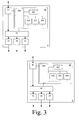
- the first executing node 3 shown in Fig. 3 comprises a controller 30 coupled to a supplier interface 31, to a switch 32 and to node interfaces 33-35.
- the supplier interface 31 is further coupled to the supplier 7 shown in Fig. 1 and to the switch 32.
- the node interfaces 33-35 are further coupled to the switch 32 and to the further nodes not shown.
- the controller 30 for example comprises a first (hardware and/or software) scheduler 300 coupled to a memory 301, to first (hardware and/or software) checking means 302 for checking the storing means 2 in dependence of a first executing node's load and to first (hardware and/or software) collecting means 303 for collecting first schedules on the first executing node's own initiative from the storing means 2 and to first (hardware and/or software) marking means 304 for marking the first schedules in the storing means 2.
- These means 302-304 are thereto further coupled to the storing means 2.
- the second executing node 4 shown in Fig. 3 comprises a controller 40 coupled to a supplier interface 41, to a switch 42 and to node interfaces 43-45.
- the supplier interface 41 is further coupled to the supplier 7 shown in Fig. 1 and to the switch 42.
- the node interfaces 43-45 are further coupled to the switch 42 and to the further nodes not shown.
- the controller 40 for example comprises a second (hardware and/or software) scheduler 400 coupled to a memory 401, to second (hardware and/or software) checking means 402 for checking the storing means 2 in dependence of a second executing node's load and to second (hardware and/or software) collecting means 403 for collecting second schedules on the second executing node's own initiative from the storing means 2 and to second (hardware and/or software) marking means 404 for marking the second schedules in the storing means 2.
- These means 402-404 are thereto further coupled to the storing means 2.
- a monitoring process for monitoring the nodes 3-6 for allocating the schedules 200, 210, 220, 230 stored in the storing means 2 to the different nodes 3-6 (one schedule can only be allocated to one node at a time).
- Such a monitoring process forms for example part of a system supervisor or is controlled by such a system supervisor.
- This monitoring process forms a so-called single point of failure. In case the monitoring process fails, the whole system fails.
- the monitoring process further increases a complexity of the system 1.
- the first executing node 3 comprises the first checking means 302 for checking the storing means 2 in dependence of a first executing node's load and the first collecting means 303 for collecting first schedules on the first executing node's own initiative
- the second executing node 4 comprises the second checking means 402 for checking the storing means 2 in dependence of a second executing node's load and the second collecting means 403 for collecting second schedules on the second executing node's own initiative.
- the executing nodes 3, 4 are no longer monitored by a system supervisor and are no longer instructed what to do. Contrary to that, the executing nodes 3, 4 check the storing means 2 on their own initiative, in dependence of their own load and independently from each other, and collect the schedules 200, 210, 220, 230 under two conditions. Firstly, a schedule 200, 210, 220, 230 must still be available to be collected by an executing node 3, 4, and secondly, the executing node 3, 4 must be willing and prepared and capable to collect the schedule 200,210,220,230.
- the first executing node 3 comprises the first marking means 303 for marking the first schedules in the storing means 2 and the second executing node 4 comprises the second marking means 403 for marking the second schedules in the storing means 2.
- the first marking means 303 of the first executing node 3 for example mark a first schedule as "being executed” in case the first collecting means 302 of the first executing node 3 want to collect or are collecting or have collected this first schedule.
- the second checking means 402 of the second executing node 4 will, while checking the storing means 2, ignore or overlook or not even find this first schedule.
- the schedules 200, 210, 220, 230 for example comprise the marks 205, 215, 225, 235.
- the first scheduler 300 for example comprises a first event driven scheduler for controlling the memory 301 and the first means 302-304 and the second scheduler 400 for example comprises a second event driven scheduler for controlling the memory 401 and the second means 402-404.
- the first and second means 302-304, 402-404 may form part of the first and second schedulers.
- each executing node 3, 4 may for example collect schedules until its maximum load has been reached. This however is a relatively non-elegant solution.
- the first checking means 302 check the storing means 2 a first predefined time-interval ahead of an actual schedule and the second checking means 402 check the storing means 2 a second predefined time-interval ahead of an actual schedule, the first predefined time-interval depending on the first executing node's load and the second predefined time-interval depending on the second executing node's load.
- a node that is not executing a schedule or that has not collected a schedule yet checks for example a time-interval T ahead of an actual schedule (or an actual time)
- a node that is executing one schedule or that has collected one schedule so far checks for example a time-interval T- ⁇ t ahead of an actual schedule (or an actual time)
- a node that is executing two schedules or that has collected two schedules so far checks for example a time-interval T-2 ⁇ t ahead of an actual schedule (or an actual time) etc.
- T-(N-1) ⁇ t ahead of an actual schedule (or an actual time) whereby (N-1) ⁇ t ⁇ T.
- the node that has the most capacity available has the primary choice and the node that has second most capacity available has the secondary choice etc.
- Other and/or further dependencies are not to be excluded, such as for example an individual T i per node and an individual ⁇ t i per node.
- the schedules 200, 210, 220, 230 are defined by time information 201, 202, 211, 212, 221, 222, 231, 232 and type information 203, 204, 213, 214, 223, 224, 233, 234.
- the time information 201, 202, 211, 212, 221, 222, 231, 232 comprises a start time 201, 211, 221, 231 and a stop time 202, 212, 222, 232 and the type information 203, 204, 213, 214, 223, 224, 233, 234 defines a type 203, 213, 223, 233 and a destination 204, 214, 224, 234.
- the destination 204, 214, 224, 234 may be in the form of an internet protocol address, without excluding other addresses such as medium access control addresses and uniform resource locators.
- the type 203, 213, 223, 233 for example defines a broadcast or a content distribution or a content delivery.
- the executing nodes 3-6 may form a cluster of nodes, with the cluster of nodes being load balanced.
- One of the executing nodes 3-6 may further be a primary node and one other of the executing nodes 3-6 may further be a secondary node, with the primary node being more privileged than the secondary nodes.
- several of the executing nodes 3-6 may be primary nodes and several of the other executing nodes 3-6 may be secondary nodes etc.
- Dependencies and privileges may be combined arbitrarily.
- a schedule 200 for example defines that at a start time 20h00 until a stop time 22h00 a content delivery A is to be delivered to a destination B, and a schedule 210 for example defines that at a start time 23h00 until a stop time 24h00 a content delivery C is to be delivered to a destination D.
- the first executing node that for example checks the storing means ten hours in advance (as defined by its load) will find at 10h00 the schedule 200 and will mark it as being executed and will find at 13h00 the schedule 210 and will mark it as being executed. Then, for example shortly before 20h00, the first executing node will collect and/or receive the entire content delivery A or at least a part of the content delivery A from the supplier and will start passing this entire content delivery or this part of the content delivery to the destination B etc. and, for example shortly before 23h00, the first executing node will collect and/or receive the entire content delivery C or at least a part of the content delivery C from the supplier and will start passing this entire content delivery or this part of the content delivery to the destination D etc.
- the first executing node In case the first executing node cannot handle both content deliveries A and C that shortly after each other, the first executing node will not mark the schedule 210 as being executed, and the second executing node that for example checks the storing means six hours in advance (as defined by its load) will find at 17h00 the schedule 210 and will mark it as being executed. Then, for example shortly before 23h00, the second executing node will collect and/or receive the entire content delivery C or at least a part of the content delivery C from the supplier and will start passing this entire content delivery or this part of the content delivery to the destination D etc.
- the schedule 200 has already been marked by the first executing node but the schedule 210 has not yet been marked.
- the second executing node that for example checks the storing means six hours in advance (as defined by its load) will find at 17h00 the schedule 210 and will mark it as being executed etc.
- the invention has the following advantages over prior art solutions. Firstly, resilient internet protocol television broadcasts and content distribution services are implemented in a distributed content delivery/video server network without the mentioned single point of failure being present. Secondly, the need for monitoring processes and their associated overhead has been removed. Thirdly, a loss of N-1 executing nodes is tolerated. Fourthly, it can be implemented on low cost general purpose computers because it does not rely on high availability monitoring processes. And fifthly, it can easily scale up and down because there is no inter-node communication involved.
- each coupling / connection may be a wired coupling / connection or a wireless coupling / connection.
- Any unit shown may be divided into sub-units, and any two or more units may be integrated into a new and larger unit. Any unit shown may comprise hardware and/or software.
- the computer program product according to the invention for executing schedules 200, 210, 220, 230 may be stored on a fixed medium such as the memory 301, 401 or on a removable medium not shown.
- a particular incarnation of the storing means might be a memory or a database, but other incarnations can be used for storing schedules as well, if they are accessible by the execution nodes for checking for new schedules either directly or indirectly via proxy solutions.
- the expression “for” in for example "for storing” etc. does not exclude that other functions are performed as well, simultaneously or not.
- the expressions "X coupled to Y” and “a coupling between X and Y” and “coupling/couples X and Y” etc. do not exclude that an element Z is in between X and Y.
- the expressions "P comprises Q” and “P comprising Q” etc. do not exclude that an element R is comprised/included as well.
- the terms “a” and “an” do not exclude the possible presence of one or more pluralities.
- the word “means” may comprise a single means or a single unit or a plurality of means or a plurality of units.
- steps and/or functions of checking and collecting do not exclude further steps and/or functions, like for example, inter alia, the steps and/or functions described for the Figures etc.
- a further block not shown may be present, and in addition to a block shown in the Figures, a further block not shown and coupled to this block shown may be present etc.
Landscapes
- Engineering & Computer Science (AREA)
- Multimedia (AREA)
- Signal Processing (AREA)
- Computer Networks & Wireless Communication (AREA)
- Business, Economics & Management (AREA)
- General Business, Economics & Management (AREA)
- Two-Way Televisions, Distribution Of Moving Picture Or The Like (AREA)
- Computer And Data Communications (AREA)
- Debugging And Monitoring (AREA)
- Hardware Redundancy (AREA)
Abstract
Description
- The invention relates to a system comprising storing means for storing schedules and comprising executing nodes for executing the schedules.
- A node may for example be a server node forming part of a system in the form of a server or may for example be a network node forming part of a system in the form of a network.
- A prior art system is known from
US 2003/0172212 A1 , which discloses a round robin arbitration system. As disclosed in paragraph 0005 ofUS 2003/4172212 A1 , round robin arbitration is defined by sequential, cyclical allocation of resources to numerous requesters. - The known system is disadvantageous, inter alia, owing to the fact that round robin arbitration requires the nodes to be monitored by a monitoring process. Such a monitoring process makes the system relatively complex. Further, the monitoring process forms a so-called single point of failure. In case the monitoring process fails, the whole system fails.
- It is an object of the invention, inter alia, to provide a system as defined above that is relatively simple.
- The system according to the invention is characterized in that the executing nodes comprise a first executing node and a second executing node, the first executing node comprising first checking means for checking the storing means in dependence of a first executing node's load and first collecting means for collecting first schedules on the first executing node's own initiative and the second executing node comprising second checking means for checking the storing means in dependence of a second executing node's load and second collecting means for collecting second schedules on the second executing node's own initiative.
- By introducing, per node, the checking means for checking the storing means on the executing node's own initiative and in dependence of an executing node's load and the collecting means for collecting the schedules on the executing node's own initiative, all without the executing node being monitored by a monitoring process of a system supervisor, the system according to the invention has become relatively simple. By making the checking of the storing means by an executing node dependent on this executing node's load, a checking hierarchy has been created, to avoid arbitration.
- The system according to the invention is further advantageous, inter alia, in that at least one so-called single point of failure has been removed (the monitoring process). This makes the system according to the invention more reliable.
- An embodiment of the system according to the invention is characterized in that the first executing node comprises first marking means for marking the first schedules in the storing means and the second executing node comprises second marking means for marking the second schedules in the storing means.
- The first marking means of the first executing node for example mark a first schedule as "being executed" in case the first collecting means of the first executing node want to collect or are collecting or have collected this first schedule. As a result, the second checking means of the second executing node will, while checking the storing means, ignore or overlook or not even find this first schedule.
- An embodiment of the system according to the invention is characterized in that the first executing node comprises a first event driven scheduler for controlling the first means and in that the second executing node comprises a second event driven scheduler for controlling the second means.
- The schedulers are event driven or schedule driven and control the means. These means may form part of the schedulers or not.
- An embodiment of the system according to the invention is characterized in that the executing nodes compete for executing the schedules in a load balanced way.
- Without the executing nodes being monitored by a monitoring process of a system supervisor, the executing nodes will be in competition with each other. The fact that the schedules are executed in a load balanced way may for example result from the checking of the storing means by an executing node being dependent on this executing node's load.
- An embodiment of the system according to the invention is characterized in that the first checking means check the storing means a first predefined time-interval ahead of an actual schedule and the second checking means check the storing means a second predefined time-interval ahead of an actual schedule, the first predefined time-interval depending on the first executing node's load and the second predefined time-interval depending on the second executing node's load.
- The fact that the different checking means check the storing means different predefined time-intervals ahead of the actual schedule, which different time-intervals depend on the nodes' loads, is one way to make the execution of the schedules load balanced. Other ways to make the execution of the schedules load balanced are not to be excluded.
- An embodiment of the system according to the invention is characterized in that the schedules are defined by time information and type information.
- The time information defines for example when the schedule is to be executed and the type information defines for example to which category the schedule belongs.
- An embodiment of the system according to the invention is characterized in that the time information comprises a start time and a stop time and in that the type information defines a type and a destination.
- The destination may be in the form of an internet protocol address, without excluding other addresses such as medium access control addresses and uniform resource locators. The type for example defines a broadcast or a content distribution or a content delivery.
- An embodiment of the system according to the invention is characterized in that the executing nodes form a cluster of nodes, the cluster of nodes delivering services in a load balanced way.
- The load balancing of a cluster of nodes generally offers more possibilities and better results than the load balancing of only a few nodes.
- An embodiment of the system according to the invention is characterized in that the system comprises an internet protocol television broadcast system.
- Especially but not exclusively for internet protocol television broadcast system it will be a great advantage to use the competing and executing nodes which are not monitored by a monitoring process of a system supervisor.
- An embodiment of the system according to the invention is characterized in that the system comprises a server system wherein the nodes are server nodes or comprises a network system wherein the nodes are network nodes.
- The server nodes may be in the same housing as the server storing means or not. The network nodes will usually each have their own housing. The network storing means may be in the same housing as one of the network nodes or not and then have their own housing.
- The invention also relates to an executing node for use in a system comprising storing means for storing schedules and comprising executing nodes for executing the schedules, which executing node according to the invention is characterized in that the executing node comprises checking means for checking the storing means in dependence of an executing node's load and collecting means for collecting first schedules on the executing node's own initiative.
- The invention also relates to a method for executing schedules, which method according to the invention is characterized in that the method comprises the steps of checking storing means in dependence of a load of a first executing node and collecting first schedules on an own initiative of the first executing node and of checking the storing means in dependence of a load of a second executing node and collecting second schedules on an own initiative of the second executing node.
- The invention also relates to a computer program product for executing schedules, which computer program product according to the invention is characterized in that the computer program product comprises the functions of checking storing means in dependence of a load of a first executing node and collecting first schedules on an own initiative of the first executing node and of checking the storing means in dependence of a load of a second executing node and collecting second schedules on an own initiative of the second executing node.
- The invention also relates to a medium for storing the computer program product according to the invention.
- Embodiments of the executing node according to the invention and of the method according to the invention and of the computer program product according to the invention and of the medium according to the invention correspond with the embodiments of the system according to the invention.
- The invention is based upon an insight, inter alia, that a monitoring process forms a so-called single point of failure, and is based upon a basic idea, inter alia, that the monitoring process can be avoided by letting the executing nodes check in dependence of their loads and collect on their own initiative and without being monitored by a monitoring process of a system supervisor.
- The invention solves the problem, inter alia, to provide a system that is relatively simple. The system according to the invention is further advantageous, inter alia, in that at least one so-called single point of failure has been removed (the monitoring process). This makes the system according to the invention more reliable.
- These and other aspects of the invention will be apparent from and elucidated with reference to the embodiments(s) described hereinafter.
- Fig. 1 shows diagrammatically a system according to the invention comprising storing means and executing nodes according to the invention,
- Fig. 2 shows diagrammatically in greater detail storing means for use in a system according to the invention, and
- Fig. 3 shows diagrammatically in greater detail a first executing node according to the invention and a second executing node according to the invention.
- The
system 1 according to the invention shown in Fig. 1 comprises four executing nodes 3-6. A receiving side of each executing node 3-6 is coupled to asupplier 7 and a transmitting side of each executing node 3-6 is coupled to further (executing or non-executing) nodes not shown. A control side of each executing node 3-6 is coupled to storingmeans 2 which are shown in Fig. 2 in greater detail. Thesystem 1 may comprise a server system wherein the executing nodes 3-6 are server nodes or may comprise a network system wherein the executing nodes 3-6 are network nodes. The server nodes may be in the same housing as the server storing means or not. The network nodes will usually each have their own housing. The network storing means may be in the same housing as one of the network nodes or not and then have their own housing. - The storing means 2 shown in Fig. 2 comprise for example a table memory with rows and columns. Each row for example comprises one schedule defined by a start information and type information to be found in different columns. For example a
schedule 200 is defined by astart time 201, astop time 202, atype 203 and adestination 204. For example aschedule 210 is defined by astart time 211, astop time 212, atype 203 and adestination 204 etc. - The
first executing node 3 shown in Fig. 3 comprises acontroller 30 coupled to asupplier interface 31, to aswitch 32 and to node interfaces 33-35. Thesupplier interface 31 is further coupled to thesupplier 7 shown in Fig. 1 and to theswitch 32. The node interfaces 33-35 are further coupled to theswitch 32 and to the further nodes not shown. Thecontroller 30 for example comprises a first (hardware and/or software)scheduler 300 coupled to amemory 301, to first (hardware and/or software) checking means 302 for checking the storing means 2 in dependence of a first executing node's load and to first (hardware and/or software) collecting means 303 for collecting first schedules on the first executing node's own initiative from the storing means 2 and to first (hardware and/or software) marking means 304 for marking the first schedules in the storing means 2. These means 302-304 are thereto further coupled to the storing means 2. - The second executing
node 4 shown in Fig. 3 comprises acontroller 40 coupled to asupplier interface 41, to aswitch 42 and to node interfaces 43-45. Thesupplier interface 41 is further coupled to thesupplier 7 shown in Fig. 1 and to theswitch 42. The node interfaces 43-45 are further coupled to theswitch 42 and to the further nodes not shown. Thecontroller 40 for example comprises a second (hardware and/or software)scheduler 400 coupled to amemory 401, to second (hardware and/or software) checking means 402 for checking the storing means 2 in dependence of a second executing node's load and to second (hardware and/or software) collecting means 403 for collecting second schedules on the second executing node's own initiative from the storing means 2 and to second (hardware and/or software) marking means 404 for marking the second schedules in the storing means 2. These means 402-404 are thereto further coupled to the storing means 2. - In a prior art situation, somewhere in the
system 1, for example inside or near the storing means 2, there is a monitoring process for monitoring the nodes 3-6 for allocating theschedules system 1. - To avoid such a monitoring process, in the
system 1 according to the invention, the first executingnode 3 comprises the first checking means 302 for checking the storing means 2 in dependence of a first executing node's load and the first collecting means 303 for collecting first schedules on the first executing node's own initiative, and the second executingnode 4 comprises the second checking means 402 for checking the storing means 2 in dependence of a second executing node's load and the second collecting means 403 for collecting second schedules on the second executing node's own initiative. By making the checking of the storing means by an executing node dependent on this executing node's load, a checking hierarchy has been created, to avoid prior art arbitration. Further, at least one so-called single point of failure has been removed by having removed the monitoring process. This increases the reliability of thesystem 1 according to the invention. - So, compared to a prior art situation, the executing
nodes nodes schedules schedule node node - To be sure that a schedule is still available to be collected by an executing
node nodes schedules nodes nodes - According to a more efficient solution, the first executing
node 3 comprises the first marking means 303 for marking the first schedules in the storing means 2 and the second executingnode 4 comprises the second marking means 403 for marking the second schedules in the storing means 2. The first marking means 303 of the first executingnode 3 for example mark a first schedule as "being executed" in case the first collecting means 302 of the first executingnode 3 want to collect or are collecting or have collected this first schedule. As a result, the second checking means 402 of the second executingnode 4 will, while checking the storing means 2, ignore or overlook or not even find this first schedule. Thereto, in the storing means 2, theschedules marks - The
first scheduler 300 for example comprises a first event driven scheduler for controlling thememory 301 and the first means 302-304 and thesecond scheduler 400 for example comprises a second event driven scheduler for controlling thememory 401 and the second means 402-404. Alternatively, the first and second means 302-304, 402-404 may form part of the first and second schedulers. - Without the executing
nodes nodes nodes node - According to a relatively elegant solution, the first checking means 302 check the storing means 2 a first predefined time-interval ahead of an actual schedule and the second checking means 402 check the storing means 2 a second predefined time-interval ahead of an actual schedule, the first predefined time-interval depending on the first executing node's load and the second predefined time-interval depending on the second executing node's load. This way, a node that is not executing a schedule or that has not collected a schedule yet checks for example a time-interval T ahead of an actual schedule (or an actual time), a node that is executing one schedule or that has collected one schedule so far checks for example a time-interval T-Δt ahead of an actual schedule (or an actual time), a node that is executing two schedules or that has collected two schedules so far checks for example a time-interval T-2 Δt ahead of an actual schedule (or an actual time) etc. A node that is executing N schedules or that has collected N schedules so far checks for example a time-interval T-(N-1) Δt ahead of an actual schedule (or an actual time), whereby (N-1) Δt < T. As a result, the node that has the most capacity available has the primary choice and the node that has second most capacity available has the secondary choice etc. Other and/or further dependencies are not to be excluded, such as for example an individual Ti per node and an individual Δti per node.
- The
schedules time information type information time information start time stop time type information type destination destination type - The executing nodes 3-6 may form a cluster of nodes, with the cluster of nodes being load balanced. One of the executing nodes 3-6 may further be a primary node and one other of the executing nodes 3-6 may further be a secondary node, with the primary node being more privileged than the secondary nodes. Alternatively, several of the executing nodes 3-6 may be primary nodes and several of the other executing nodes 3-6 may be secondary nodes etc. Dependencies and privileges may be combined arbitrarily.
- Especially but not exclusively for internet protocol television broadcast system it will be a great advantage to use the competing and executing nodes 3-6 which are not monitored by a monitoring process of a system supervisor. For such an internet protocol television broadcast system, a
schedule 200 for example defines that at a start time 20h00 until a stop time 22h00 a content delivery A is to be delivered to a destination B, and aschedule 210 for example defines that at a start time 23h00 until a stop time 24h00 a content delivery C is to be delivered to a destination D. Then, the first executing node that for example checks the storing means ten hours in advance (as defined by its load) will find at 10h00 theschedule 200 and will mark it as being executed and will find at 13h00 theschedule 210 and will mark it as being executed. Then, for example shortly before 20h00, the first executing node will collect and/or receive the entire content delivery A or at least a part of the content delivery A from the supplier and will start passing this entire content delivery or this part of the content delivery to the destination B etc. and, for example shortly before 23h00, the first executing node will collect and/or receive the entire content delivery C or at least a part of the content delivery C from the supplier and will start passing this entire content delivery or this part of the content delivery to the destination D etc. - In case the first executing node cannot handle both content deliveries A and C that shortly after each other, the first executing node will not mark the
schedule 210 as being executed, and the second executing node that for example checks the storing means six hours in advance (as defined by its load) will find at 17h00 theschedule 210 and will mark it as being executed. Then, for example shortly before 23h00, the second executing node will collect and/or receive the entire content delivery C or at least a part of the content delivery C from the supplier and will start passing this entire content delivery or this part of the content delivery to the destination D etc. - In case the first executing node goes down at 12h00, the
schedule 200 has already been marked by the first executing node but theschedule 210 has not yet been marked. The second executing node that for example checks the storing means six hours in advance (as defined by its load) will find at 17h00 theschedule 210 and will mark it as being executed etc. For theschedule 200, two options exist. According to a first option, in case the storing means is informed of the first executing node having gone down, the storing means might delete the mark introduced by the first executing node and as a result the second executing node that for example checks the storing means six hours in advance (as defined by its load) will find at 14h00 theschedule 200 and will mark it as being executed etc. According to a second option, in case the storing means is not informed of the first executing node having gone down, theschedule 200 will be lost. - The invention has the following advantages over prior art solutions. Firstly, resilient internet protocol television broadcasts and content distribution services are implemented in a distributed content delivery/video server network without the mentioned single point of failure being present. Secondly, the need for monitoring processes and their associated overhead has been removed. Thirdly, a loss of N-1 executing nodes is tolerated. Fourthly, it can be implemented on low cost general purpose computers because it does not rely on high availability monitoring processes. And fifthly, it can easily scale up and down because there is no inter-node communication involved.
- In Fig. 1 and 3, each coupling / connection may be a wired coupling / connection or a wireless coupling / connection. Any unit shown may be divided into sub-units, and any two or more units may be integrated into a new and larger unit. Any unit shown may comprise hardware and/or software. The computer program product according to the invention for executing
schedules memory - The expression "for" in for example "for storing" etc. does not exclude that other functions are performed as well, simultaneously or not. The expressions "X coupled to Y" and "a coupling between X and Y" and "coupling/couples X and Y" etc. do not exclude that an element Z is in between X and Y. The expressions "P comprises Q" and "P comprising Q" etc. do not exclude that an element R is comprised/included as well. The terms "a" and "an" do not exclude the possible presence of one or more pluralities. The word "means" may comprise a single means or a single unit or a plurality of means or a plurality of units.
- The steps and/or functions of checking and collecting do not exclude further steps and/or functions, like for example, inter alia, the steps and/or functions described for the Figures etc. Between each pair of blocks shown in the Figures, a further block not shown may be present, and in addition to a block shown in the Figures, a further block not shown and coupled to this block shown may be present etc.
Claims (14)
- System (1) comprising storing means (2) for storing schedules (200, 210, 220, 230) and comprising executing nodes (3, 4, 5, 6) for executing the schedules (200, 210, 220, 230), characterized in that the executing nodes (3, 4, 5, 6) comprise a first executing node (3) and a second executing node (4), the first executing node (3) comprising first checking means (302) for checking the storing means (2) in dependence of a first executing node's load and first collecting means (303) for collecting first schedules on the first executing node's own initiative and the second executing node (4) comprising second checking means (402) for checking the storing means (2) in dependence of a second executing node's load and second collecting means (403) for collecting second schedules on the second executing node's own initiative.
- System (1) as defined in claim 1, characterized in that the first executing node (3) comprises first marking means (304) for marking the first schedules in the storing means (2) and the second executing node (4) comprises second marking means (404) for marking the second schedules in the storing means (2).
- System (1) as defined in claim 1 or 2, characterized in that the first executing node (3) comprises a first event driven scheduler (300) for controlling the first means (302-304) and in that the second executing node (4) comprises a second event driven scheduler (400) for controlling the second means (402-404).
- System (1) as defined in claim 1, 2 or 3, characterized in that the executing nodes (3, 4, 5, 6) compete for executing the schedules (200, 210, 220, 230) in a load balanced way.
- System (1) as defined in claim 1, 2, 3 or 4, characterized in that the first checking means (302) check the storing means (2) a first predefined time-interval ahead of an actual schedule and the second checking means (402) check the storing means (2) a second predefined time-interval ahead of an actual schedule, the first predefined time-interval depending on the first executing node's load and the second predefined time-interval depending on the second executing node's load.
- System (1) as defined in claim 1, 2, 3, 4 or 5, characterized in that the schedules (200, 210, 220, 230) are defined by time information (201, 202, 211, 212, 221, 222, 231, 232) and type information (203, 204, 213, 214, 223, 224, 233, 234).
- System (1) as defined in claim 6, characterized in that the time information (201, 202, 211, 212, 221, 222, 231, 232) comprises a start time (201, 211, 221, 231) and a stop time (202, 212, 222, 232) and in that the type information (203, 204, 213, 214, 223, 224, 233, 234) defines a type (203, 213, 223, 233) and a destination (204, 214, 224, 234).
- System (1) as defined in claim 1, 2, 3, 4, 5, 6 or 7, characterized in that the executing nodes (3, 4, 5, 6) form a cluster of nodes, the cluster of nodes delivering services in a load balanced way.
- System (1) as defined in claim 1, 2, 3, 4, 5, 6 or 7, characterized in that the system (1) comprises an internet protocol television broadcast system.
- System (1) as defined in claim 1, 2, 3, 4, 5, 6 or 7, characterized in that the system (1) comprises a server system wherein the executing nodes (3, 4, 5, 6) are server nodes or comprises a network system wherein the executing nodes (3, 4, 5, 6) are network nodes.
- Executing node (3) for use in a system (1) comprising storing means (2) for storing schedules (200, 210, 220, 230) and comprising executing nodes (3, 4, 5, 6) for executing the schedules (200, 210, 220, 230), characterized in that the executing node (3) comprises checking means (302) for checking the storing means (2) in dependence of an executing node's load and collecting means (303) for collecting first schedules on the executing node's own initiative.
- Method for executing schedules (200, 210, 220, 230), characterized in that the method comprises the steps of checking storing means (2) in dependence of a load of a first executing node (3) and collecting first schedules on an own initiative of the first executing node (3) and of checking the storing means (2) in dependence of a load of a second executing node (4) and collecting second schedules on an own initiative of the second executing node (4).
- Computer program product for executing schedules (200, 210, 220, 230), characterized in that the computer program product comprises the functions of checking storing means (2) in dependence of a load of a first executing node (3) and collecting first schedules on an own initiative of the first executing node (3) and of checking the storing means (2) in dependence of a load of a second executing node (4) and collecting second schedules on an own initiative of the second executing node (4).
- Medium (301, 401) for storing the computer program product as defined in claim 13.
Priority Applications (5)
| Application Number | Priority Date | Filing Date | Title |
|---|---|---|---|
| AT05291708T ATE467978T1 (en) | 2005-08-10 | 2005-08-10 | PROCESS CONTROL FOR INTERNET PROTOCOL TELEVISION BROADCAST |
| DE602005021216T DE602005021216D1 (en) | 2005-08-10 | 2005-08-10 | Sequence control for Internet Protocol TV broadcasting |
| EP05291708A EP1753237B1 (en) | 2005-08-10 | 2005-08-10 | Scheduling for Internet Protocol Television Broadcast |
| CN200610110633.3A CN100508490C (en) | 2005-08-10 | 2006-08-04 | A system with execution nodes for executing schedules |
| US11/500,980 US20070083798A1 (en) | 2005-08-10 | 2006-08-09 | System with executing nodes for executing schedules |
Applications Claiming Priority (1)
| Application Number | Priority Date | Filing Date | Title |
|---|---|---|---|
| EP05291708A EP1753237B1 (en) | 2005-08-10 | 2005-08-10 | Scheduling for Internet Protocol Television Broadcast |
Publications (2)
| Publication Number | Publication Date |
|---|---|
| EP1753237A1 true EP1753237A1 (en) | 2007-02-14 |
| EP1753237B1 EP1753237B1 (en) | 2010-05-12 |
Family
ID=36617228
Family Applications (1)
| Application Number | Title | Priority Date | Filing Date |
|---|---|---|---|
| EP05291708A Expired - Lifetime EP1753237B1 (en) | 2005-08-10 | 2005-08-10 | Scheduling for Internet Protocol Television Broadcast |
Country Status (5)
| Country | Link |
|---|---|
| US (1) | US20070083798A1 (en) |
| EP (1) | EP1753237B1 (en) |
| CN (1) | CN100508490C (en) |
| AT (1) | ATE467978T1 (en) |
| DE (1) | DE602005021216D1 (en) |
Families Citing this family (2)
| Publication number | Priority date | Publication date | Assignee | Title |
|---|---|---|---|---|
| CN103150236B (en) * | 2013-03-25 | 2014-03-19 | 中国人民解放军国防科学技术大学 | Parallel communication library state self-recovery method facing to process failure fault |
| CN110209537B (en) * | 2018-02-28 | 2020-09-11 | 杭州海康威视系统技术有限公司 | Video data processing method, device and system and electronic equipment |
Citations (5)
| Publication number | Priority date | Publication date | Assignee | Title |
|---|---|---|---|---|
| EP0394939A2 (en) | 1989-04-27 | 1990-10-31 | Sony Corporation | Program transmission system and method |
| EP0759676A2 (en) | 1995-08-22 | 1997-02-26 | International Business Machines Corporation | Scheduling videos in a video-on-demand system |
| US20030093530A1 (en) | 2001-10-26 | 2003-05-15 | Majid Syed | Arbitrator system and method for national and local content distribution |
| US20030172212A1 (en) | 2002-03-05 | 2003-09-11 | Lavigne Bruce E. | Round robin arbitration system |
| US7024681B1 (en) * | 1997-12-04 | 2006-04-04 | Verizon Laboratories Inc. | Method and apparatus for near video on demand |
Family Cites Families (11)
| Publication number | Priority date | Publication date | Assignee | Title |
|---|---|---|---|---|
| US5790198A (en) * | 1990-09-10 | 1998-08-04 | Starsight Telecast, Inc. | Television schedule information transmission and utilization system and process |
| US6493658B1 (en) * | 1994-04-19 | 2002-12-10 | Lsi Logic Corporation | Optimization processing for integrated circuit physical design automation system using optimally switched fitness improvement algorithms |
| JP2853635B2 (en) * | 1996-01-29 | 1999-02-03 | 日本電気株式会社 | File batch transmission scheduling method |
| US6012150A (en) * | 1997-03-27 | 2000-01-04 | International Business Machines Corporation | Apparatus for synchronizing operator initiated commands with a failover process in a distributed processing system |
| US6330717B1 (en) * | 1998-03-27 | 2001-12-11 | Sony Corporation Of Japan | Process and system for developing an application program for a distributed adaptive run-time platform |
| US6711616B1 (en) * | 2000-05-01 | 2004-03-23 | Xilinx, Inc. | Client-server task distribution system and method |
| US6912533B1 (en) * | 2001-07-31 | 2005-06-28 | Oracle International Corporation | Data mining agents for efficient hardware utilization |
| US20030050957A1 (en) * | 2001-09-07 | 2003-03-13 | Atul Hatalkar | Delegating scheduling tasks to clients |
| CN1214635C (en) * | 2002-05-10 | 2005-08-10 | 华为技术有限公司 | Conference dispatching system and method of IP network meeting TV-set |
| CN100428167C (en) * | 2004-03-19 | 2008-10-22 | 国际商业机器公司 | Computer system, server and job execution control method |
| US8141118B2 (en) * | 2004-07-26 | 2012-03-20 | Microsoft Corporation | Data broadcasting receiver power management |
-
2005
- 2005-08-10 DE DE602005021216T patent/DE602005021216D1/en not_active Expired - Lifetime
- 2005-08-10 EP EP05291708A patent/EP1753237B1/en not_active Expired - Lifetime
- 2005-08-10 AT AT05291708T patent/ATE467978T1/en not_active IP Right Cessation
-
2006
- 2006-08-04 CN CN200610110633.3A patent/CN100508490C/en not_active Expired - Fee Related
- 2006-08-09 US US11/500,980 patent/US20070083798A1/en not_active Abandoned
Patent Citations (5)
| Publication number | Priority date | Publication date | Assignee | Title |
|---|---|---|---|---|
| EP0394939A2 (en) | 1989-04-27 | 1990-10-31 | Sony Corporation | Program transmission system and method |
| EP0759676A2 (en) | 1995-08-22 | 1997-02-26 | International Business Machines Corporation | Scheduling videos in a video-on-demand system |
| US7024681B1 (en) * | 1997-12-04 | 2006-04-04 | Verizon Laboratories Inc. | Method and apparatus for near video on demand |
| US20030093530A1 (en) | 2001-10-26 | 2003-05-15 | Majid Syed | Arbitrator system and method for national and local content distribution |
| US20030172212A1 (en) | 2002-03-05 | 2003-09-11 | Lavigne Bruce E. | Round robin arbitration system |
Also Published As
| Publication number | Publication date |
|---|---|
| EP1753237B1 (en) | 2010-05-12 |
| ATE467978T1 (en) | 2010-05-15 |
| CN100508490C (en) | 2009-07-01 |
| US20070083798A1 (en) | 2007-04-12 |
| DE602005021216D1 (en) | 2010-06-24 |
| CN1913481A (en) | 2007-02-14 |
Similar Documents
| Publication | Publication Date | Title |
|---|---|---|
| Krueger et al. | Adaptive location policies for global scheduling | |
| CN108268318A (en) | A kind of method and apparatus of distributed system task distribution | |
| US20080263561A1 (en) | Information processing apparatus, computer and resource allocation method | |
| CN111092921B (en) | Data acquisition method, device and storage medium | |
| WO2019006907A1 (en) | Systems and methods for allocating computing resources in distributed computing | |
| CN108717379A (en) | Electronic device, distributed task dispatching method and storage medium | |
| CN110058940B (en) | Data processing method and device in multi-thread environment | |
| CN110188258B (en) | Method and device for acquiring external data by using crawler | |
| CN116643890A (en) | Cluster resource scheduling method, device, equipment and medium | |
| CN113626213A (en) | Event processing method, device and equipment and computer readable storage medium | |
| CN101223507A (en) | data processing network | |
| CN113364888B (en) | Service scheduling method, system, electronic device and computer readable storage medium | |
| CN110912967A (en) | Service node scheduling method, device, equipment and storage medium | |
| EP1753204A1 (en) | System with executing nodes for executing schedules | |
| CN110955524A (en) | Server Optimization Scheduling Method | |
| CN117032885A (en) | Scheduling method and system suitable for multi-core group acceleration card of Kubernetes | |
| EP1753237A1 (en) | Scheduling for Internet Protocol Television Broadcast | |
| CN116166421A (en) | Resource scheduling method and equipment for distributed training task | |
| CN111309467B (en) | Task distribution method and device, electronic device and storage medium | |
| CN120335979A (en) | A method, structure and device for allocating computing power based on V2V intelligent computing virtualization | |
| CN119396331A (en) | A storage array system and storage access method | |
| CN111209333A (en) | Data updating method, device, terminal and storage medium | |
| WO2017018978A1 (en) | Scheduling jobs in a computing cluster | |
| CN100505637C (en) | Resource distribution in communication system | |
| CN115562820A (en) | Distributed task processing and asynchronous model training system, method, device and medium |
Legal Events
| Date | Code | Title | Description |
|---|---|---|---|
| PUAI | Public reference made under article 153(3) epc to a published international application that has entered the european phase |
Free format text: ORIGINAL CODE: 0009012 |
|
| AK | Designated contracting states |
Kind code of ref document: A1 Designated state(s): AT BE BG CH CY CZ DE DK EE ES FI FR GB GR HU IE IS IT LI LT LU LV MC NL PL PT RO SE SI SK TR |
|
| AX | Request for extension of the european patent |
Extension state: AL BA HR MK YU |
|
| RAP1 | Party data changed (applicant data changed or rights of an application transferred) |
Owner name: ALCATEL LUCENT |
|
| 17P | Request for examination filed |
Effective date: 20070814 |
|
| 17Q | First examination report despatched |
Effective date: 20070913 |
|
| AKX | Designation fees paid |
Designated state(s): AT BE BG CH CY CZ DE DK EE ES FI FR GB GR HU IE IS IT LI LT LU LV MC NL PL PT RO SE SI SK TR |
|
| GRAC | Information related to communication of intention to grant a patent modified |
Free format text: ORIGINAL CODE: EPIDOSCIGR1 |
|
| GRAP | Despatch of communication of intention to grant a patent |
Free format text: ORIGINAL CODE: EPIDOSNIGR1 |
|
| GRAS | Grant fee paid |
Free format text: ORIGINAL CODE: EPIDOSNIGR3 |
|
| GRAA | (expected) grant |
Free format text: ORIGINAL CODE: 0009210 |
|
| AK | Designated contracting states |
Kind code of ref document: B1 Designated state(s): AT BE BG CH CY CZ DE DK EE ES FI FR GB GR HU IE IS IT LI LT LU LV MC NL PL PT RO SE SI SK TR |
|
| REG | Reference to a national code |
Ref country code: GB Ref legal event code: FG4D |
|
| REG | Reference to a national code |
Ref country code: CH Ref legal event code: EP |
|
| REG | Reference to a national code |
Ref country code: IE Ref legal event code: FG4D |
|
| REF | Corresponds to: |
Ref document number: 602005021216 Country of ref document: DE Date of ref document: 20100624 Kind code of ref document: P |
|
| REG | Reference to a national code |
Ref country code: NL Ref legal event code: VDEP Effective date: 20100512 |
|
| LTIE | Lt: invalidation of european patent or patent extension |
Effective date: 20100512 |
|
| PG25 | Lapsed in a contracting state [announced via postgrant information from national office to epo] |
Ref country code: SE Free format text: LAPSE BECAUSE OF FAILURE TO SUBMIT A TRANSLATION OF THE DESCRIPTION OR TO PAY THE FEE WITHIN THE PRESCRIBED TIME-LIMIT Effective date: 20100512 Ref country code: NL Free format text: LAPSE BECAUSE OF FAILURE TO SUBMIT A TRANSLATION OF THE DESCRIPTION OR TO PAY THE FEE WITHIN THE PRESCRIBED TIME-LIMIT Effective date: 20100512 Ref country code: LT Free format text: LAPSE BECAUSE OF FAILURE TO SUBMIT A TRANSLATION OF THE DESCRIPTION OR TO PAY THE FEE WITHIN THE PRESCRIBED TIME-LIMIT Effective date: 20100512 Ref country code: ES Free format text: LAPSE BECAUSE OF FAILURE TO SUBMIT A TRANSLATION OF THE DESCRIPTION OR TO PAY THE FEE WITHIN THE PRESCRIBED TIME-LIMIT Effective date: 20100823 |
|
| PG25 | Lapsed in a contracting state [announced via postgrant information from national office to epo] |
Ref country code: IS Free format text: LAPSE BECAUSE OF FAILURE TO SUBMIT A TRANSLATION OF THE DESCRIPTION OR TO PAY THE FEE WITHIN THE PRESCRIBED TIME-LIMIT Effective date: 20100912 Ref country code: AT Free format text: LAPSE BECAUSE OF FAILURE TO SUBMIT A TRANSLATION OF THE DESCRIPTION OR TO PAY THE FEE WITHIN THE PRESCRIBED TIME-LIMIT Effective date: 20100512 Ref country code: FI Free format text: LAPSE BECAUSE OF FAILURE TO SUBMIT A TRANSLATION OF THE DESCRIPTION OR TO PAY THE FEE WITHIN THE PRESCRIBED TIME-LIMIT Effective date: 20100512 Ref country code: LV Free format text: LAPSE BECAUSE OF FAILURE TO SUBMIT A TRANSLATION OF THE DESCRIPTION OR TO PAY THE FEE WITHIN THE PRESCRIBED TIME-LIMIT Effective date: 20100512 Ref country code: SI Free format text: LAPSE BECAUSE OF FAILURE TO SUBMIT A TRANSLATION OF THE DESCRIPTION OR TO PAY THE FEE WITHIN THE PRESCRIBED TIME-LIMIT Effective date: 20100512 |
|
| PG25 | Lapsed in a contracting state [announced via postgrant information from national office to epo] |
Ref country code: PL Free format text: LAPSE BECAUSE OF FAILURE TO SUBMIT A TRANSLATION OF THE DESCRIPTION OR TO PAY THE FEE WITHIN THE PRESCRIBED TIME-LIMIT Effective date: 20100512 Ref country code: CY Free format text: LAPSE BECAUSE OF FAILURE TO SUBMIT A TRANSLATION OF THE DESCRIPTION OR TO PAY THE FEE WITHIN THE PRESCRIBED TIME-LIMIT Effective date: 20100512 Ref country code: GR Free format text: LAPSE BECAUSE OF FAILURE TO SUBMIT A TRANSLATION OF THE DESCRIPTION OR TO PAY THE FEE WITHIN THE PRESCRIBED TIME-LIMIT Effective date: 20100813 |
|
| PG25 | Lapsed in a contracting state [announced via postgrant information from national office to epo] |
Ref country code: PT Free format text: LAPSE BECAUSE OF FAILURE TO SUBMIT A TRANSLATION OF THE DESCRIPTION OR TO PAY THE FEE WITHIN THE PRESCRIBED TIME-LIMIT Effective date: 20100913 Ref country code: DK Free format text: LAPSE BECAUSE OF FAILURE TO SUBMIT A TRANSLATION OF THE DESCRIPTION OR TO PAY THE FEE WITHIN THE PRESCRIBED TIME-LIMIT Effective date: 20100512 Ref country code: EE Free format text: LAPSE BECAUSE OF FAILURE TO SUBMIT A TRANSLATION OF THE DESCRIPTION OR TO PAY THE FEE WITHIN THE PRESCRIBED TIME-LIMIT Effective date: 20100512 |
|
| PG25 | Lapsed in a contracting state [announced via postgrant information from national office to epo] |
Ref country code: BE Free format text: LAPSE BECAUSE OF FAILURE TO SUBMIT A TRANSLATION OF THE DESCRIPTION OR TO PAY THE FEE WITHIN THE PRESCRIBED TIME-LIMIT Effective date: 20100512 Ref country code: SK Free format text: LAPSE BECAUSE OF FAILURE TO SUBMIT A TRANSLATION OF THE DESCRIPTION OR TO PAY THE FEE WITHIN THE PRESCRIBED TIME-LIMIT Effective date: 20100512 Ref country code: RO Free format text: LAPSE BECAUSE OF FAILURE TO SUBMIT A TRANSLATION OF THE DESCRIPTION OR TO PAY THE FEE WITHIN THE PRESCRIBED TIME-LIMIT Effective date: 20100512 Ref country code: CZ Free format text: LAPSE BECAUSE OF FAILURE TO SUBMIT A TRANSLATION OF THE DESCRIPTION OR TO PAY THE FEE WITHIN THE PRESCRIBED TIME-LIMIT Effective date: 20100512 |
|
| PLBE | No opposition filed within time limit |
Free format text: ORIGINAL CODE: 0009261 |
|
| STAA | Information on the status of an ep patent application or granted ep patent |
Free format text: STATUS: NO OPPOSITION FILED WITHIN TIME LIMIT |
|
| PG25 | Lapsed in a contracting state [announced via postgrant information from national office to epo] |
Ref country code: MC Free format text: LAPSE BECAUSE OF NON-PAYMENT OF DUE FEES Effective date: 20100831 Ref country code: IT Free format text: LAPSE BECAUSE OF FAILURE TO SUBMIT A TRANSLATION OF THE DESCRIPTION OR TO PAY THE FEE WITHIN THE PRESCRIBED TIME-LIMIT Effective date: 20100512 |
|
| REG | Reference to a national code |
Ref country code: CH Ref legal event code: PL |
|
| 26N | No opposition filed |
Effective date: 20110215 |
|
| PG25 | Lapsed in a contracting state [announced via postgrant information from national office to epo] |
Ref country code: CH Free format text: LAPSE BECAUSE OF NON-PAYMENT OF DUE FEES Effective date: 20100831 Ref country code: LI Free format text: LAPSE BECAUSE OF NON-PAYMENT OF DUE FEES Effective date: 20100831 |
|
| REG | Reference to a national code |
Ref country code: DE Ref legal event code: R097 Ref document number: 602005021216 Country of ref document: DE Effective date: 20110214 |
|
| PG25 | Lapsed in a contracting state [announced via postgrant information from national office to epo] |
Ref country code: IE Free format text: LAPSE BECAUSE OF NON-PAYMENT OF DUE FEES Effective date: 20100810 |
|
| PG25 | Lapsed in a contracting state [announced via postgrant information from national office to epo] |
Ref country code: HU Free format text: LAPSE BECAUSE OF FAILURE TO SUBMIT A TRANSLATION OF THE DESCRIPTION OR TO PAY THE FEE WITHIN THE PRESCRIBED TIME-LIMIT Effective date: 20101113 Ref country code: LU Free format text: LAPSE BECAUSE OF NON-PAYMENT OF DUE FEES Effective date: 20100810 Ref country code: BG Free format text: LAPSE BECAUSE OF FAILURE TO SUBMIT A TRANSLATION OF THE DESCRIPTION OR TO PAY THE FEE WITHIN THE PRESCRIBED TIME-LIMIT Effective date: 20100512 |
|
| PG25 | Lapsed in a contracting state [announced via postgrant information from national office to epo] |
Ref country code: TR Free format text: LAPSE BECAUSE OF FAILURE TO SUBMIT A TRANSLATION OF THE DESCRIPTION OR TO PAY THE FEE WITHIN THE PRESCRIBED TIME-LIMIT Effective date: 20100512 |
|
| PG25 | Lapsed in a contracting state [announced via postgrant information from national office to epo] |
Ref country code: BG Free format text: LAPSE BECAUSE OF FAILURE TO SUBMIT A TRANSLATION OF THE DESCRIPTION OR TO PAY THE FEE WITHIN THE PRESCRIBED TIME-LIMIT Effective date: 20100812 |
|
| REG | Reference to a national code |
Ref country code: FR Ref legal event code: GC Effective date: 20131018 |
|
| REG | Reference to a national code |
Ref country code: FR Ref legal event code: CA Effective date: 20150521 |
|
| REG | Reference to a national code |
Ref country code: FR Ref legal event code: CA Effective date: 20150521 |
|
| REG | Reference to a national code |
Ref country code: FR Ref legal event code: PLFP Year of fee payment: 11 |
|
| PGFP | Annual fee paid to national office [announced via postgrant information from national office to epo] |
Ref country code: GB Payment date: 20150819 Year of fee payment: 11 Ref country code: DE Payment date: 20150821 Year of fee payment: 11 |
|
| PGFP | Annual fee paid to national office [announced via postgrant information from national office to epo] |
Ref country code: FR Payment date: 20150820 Year of fee payment: 11 |
|
| REG | Reference to a national code |
Ref country code: DE Ref legal event code: R119 Ref document number: 602005021216 Country of ref document: DE |
|
| GBPC | Gb: european patent ceased through non-payment of renewal fee |
Effective date: 20160810 |
|
| REG | Reference to a national code |
Ref country code: FR Ref legal event code: ST Effective date: 20170428 |
|
| PG25 | Lapsed in a contracting state [announced via postgrant information from national office to epo] |
Ref country code: FR Free format text: LAPSE BECAUSE OF NON-PAYMENT OF DUE FEES Effective date: 20160831 Ref country code: DE Free format text: LAPSE BECAUSE OF NON-PAYMENT OF DUE FEES Effective date: 20170301 Ref country code: GB Free format text: LAPSE BECAUSE OF NON-PAYMENT OF DUE FEES Effective date: 20160810 |