EP1750161A1 - Protein adsorption-preventing ocular lens material and method for producing same - Google Patents
Protein adsorption-preventing ocular lens material and method for producing same Download PDFInfo
- Publication number
- EP1750161A1 EP1750161A1 EP05741156A EP05741156A EP1750161A1 EP 1750161 A1 EP1750161 A1 EP 1750161A1 EP 05741156 A EP05741156 A EP 05741156A EP 05741156 A EP05741156 A EP 05741156A EP 1750161 A1 EP1750161 A1 EP 1750161A1
- Authority
- EP
- European Patent Office
- Prior art keywords
- lens material
- eye lens
- chemical compound
- water
- organic solvent
- Prior art date
- Legal status (The legal status is an assumption and is not a legal conclusion. Google has not performed a legal analysis and makes no representation as to the accuracy of the status listed.)
- Withdrawn
Links
- 239000000463 material Substances 0.000 title claims abstract description 63
- 102000004169 proteins and genes Human genes 0.000 title claims abstract description 41
- 108090000623 proteins and genes Proteins 0.000 title claims abstract description 41
- 238000004519 manufacturing process Methods 0.000 title claims abstract description 24
- 150000001875 compounds Chemical class 0.000 claims abstract description 51
- NJNWCIAPVGRBHO-UHFFFAOYSA-N 2-hydroxyethyl-dimethyl-[(oxo-$l^{5}-phosphanylidyne)methyl]azanium Chemical group OCC[N+](C)(C)C#P=O NJNWCIAPVGRBHO-UHFFFAOYSA-N 0.000 claims abstract description 49
- XLYOFNOQVPJJNP-UHFFFAOYSA-N water Substances O XLYOFNOQVPJJNP-UHFFFAOYSA-N 0.000 claims abstract description 42
- 238000000034 method Methods 0.000 claims abstract description 40
- 125000002887 hydroxy group Chemical group [H]O* 0.000 claims abstract description 31
- 238000001179 sorption measurement Methods 0.000 claims abstract description 31
- DHKHKXVYLBGOIT-UHFFFAOYSA-N acetaldehyde Diethyl Acetal Natural products CCOC(C)OCC DHKHKXVYLBGOIT-UHFFFAOYSA-N 0.000 claims abstract description 21
- 239000003960 organic solvent Substances 0.000 claims abstract description 20
- 239000003791 organic solvent mixture Substances 0.000 claims abstract description 11
- 230000008569 process Effects 0.000 claims abstract description 9
- 239000000178 monomer Substances 0.000 claims description 17
- 239000000470 constituent Substances 0.000 claims description 12
- 230000002265 prevention Effects 0.000 claims description 10
- WOBHKFSMXKNTIM-UHFFFAOYSA-N Hydroxyethyl methacrylate Chemical compound CC(=C)C(=O)OCCO WOBHKFSMXKNTIM-UHFFFAOYSA-N 0.000 claims description 9
- 229940044192 2-hydroxyethyl methacrylate Drugs 0.000 claims description 7
- 229920002451 polyvinyl alcohol Polymers 0.000 claims description 7
- 239000004372 Polyvinyl alcohol Substances 0.000 claims description 6
- 238000009832 plasma treatment Methods 0.000 claims description 6
- 238000006243 chemical reaction Methods 0.000 description 21
- VEXZGXHMUGYJMC-UHFFFAOYSA-N Hydrochloric acid Chemical compound Cl VEXZGXHMUGYJMC-UHFFFAOYSA-N 0.000 description 19
- IAZDPXIOMUYVGZ-UHFFFAOYSA-N Dimethylsulphoxide Chemical compound CS(C)=O IAZDPXIOMUYVGZ-UHFFFAOYSA-N 0.000 description 14
- 229920000642 polymer Polymers 0.000 description 11
- -1 acrylic ester Chemical class 0.000 description 10
- 230000000052 comparative effect Effects 0.000 description 10
- 230000000694 effects Effects 0.000 description 10
- ZMXDDKWLCZADIW-UHFFFAOYSA-N N,N-Dimethylformamide Chemical compound CN(C)C=O ZMXDDKWLCZADIW-UHFFFAOYSA-N 0.000 description 9
- 229950004354 phosphorylcholine Drugs 0.000 description 9
- 239000003377 acid catalyst Substances 0.000 description 8
- 229960004788 choline alfoscerate Drugs 0.000 description 8
- PYJNAPOPMIJKJZ-UHFFFAOYSA-N phosphorylcholine chloride Chemical compound [Cl-].C[N+](C)(C)CCOP(O)(O)=O PYJNAPOPMIJKJZ-UHFFFAOYSA-N 0.000 description 7
- QTBSBXVTEAMEQO-UHFFFAOYSA-N Acetic acid Chemical compound CC(O)=O QTBSBXVTEAMEQO-UHFFFAOYSA-N 0.000 description 6
- OKKJLVBELUTLKV-UHFFFAOYSA-N Methanol Chemical compound OC OKKJLVBELUTLKV-UHFFFAOYSA-N 0.000 description 6
- WYURNTSHIVDZCO-UHFFFAOYSA-N Tetrahydrofuran Chemical compound C1CCOC1 WYURNTSHIVDZCO-UHFFFAOYSA-N 0.000 description 6
- ZMANZCXQSJIPKH-UHFFFAOYSA-N Triethylamine Chemical compound CCN(CC)CC ZMANZCXQSJIPKH-UHFFFAOYSA-N 0.000 description 6
- 239000012530 fluid Substances 0.000 description 6
- 239000004615 ingredient Substances 0.000 description 6
- 239000000243 solution Substances 0.000 description 6
- QVGXLLKOCUKJST-UHFFFAOYSA-N atomic oxygen Chemical compound [O] QVGXLLKOCUKJST-UHFFFAOYSA-N 0.000 description 5
- 239000001301 oxygen Substances 0.000 description 5
- 229910052760 oxygen Inorganic materials 0.000 description 5
- CERQOIWHTDAKMF-UHFFFAOYSA-N Methacrylic acid Chemical compound CC(=C)C(O)=O CERQOIWHTDAKMF-UHFFFAOYSA-N 0.000 description 4
- OAICVXFJPJFONN-UHFFFAOYSA-N Phosphorus Chemical compound [P] OAICVXFJPJFONN-UHFFFAOYSA-N 0.000 description 4
- 229920001616 Polymacon Polymers 0.000 description 4
- QAOWNCQODCNURD-UHFFFAOYSA-N Sulfuric acid Chemical compound OS(O)(=O)=O QAOWNCQODCNURD-UHFFFAOYSA-N 0.000 description 4
- DTQVDTLACAAQTR-UHFFFAOYSA-N Trifluoroacetic acid Chemical compound OC(=O)C(F)(F)F DTQVDTLACAAQTR-UHFFFAOYSA-N 0.000 description 4
- 230000008901 benefit Effects 0.000 description 4
- VLTRZXGMWDSKGL-UHFFFAOYSA-N perchloric acid Chemical compound OCl(=O)(=O)=O VLTRZXGMWDSKGL-UHFFFAOYSA-N 0.000 description 4
- 229910052698 phosphorus Inorganic materials 0.000 description 4
- 239000011574 phosphorus Substances 0.000 description 4
- JQWHASGSAFIOCM-UHFFFAOYSA-M sodium periodate Chemical compound [Na+].[O-]I(=O)(=O)=O JQWHASGSAFIOCM-UHFFFAOYSA-M 0.000 description 4
- JOXIMZWYDAKGHI-UHFFFAOYSA-N toluene-4-sulfonic acid Chemical compound CC1=CC=C(S(O)(=O)=O)C=C1 JOXIMZWYDAKGHI-UHFFFAOYSA-N 0.000 description 4
- LFQSCWFLJHTTHZ-UHFFFAOYSA-N Ethanol Chemical compound CCO LFQSCWFLJHTTHZ-UHFFFAOYSA-N 0.000 description 3
- WHNWPMSKXPGLAX-UHFFFAOYSA-N N-Vinyl-2-pyrrolidone Chemical compound C=CN1CCCC1=O WHNWPMSKXPGLAX-UHFFFAOYSA-N 0.000 description 3
- 230000015572 biosynthetic process Effects 0.000 description 3
- 239000011248 coating agent Substances 0.000 description 3
- 238000000576 coating method Methods 0.000 description 3
- 230000006870 function Effects 0.000 description 3
- 239000002075 main ingredient Substances 0.000 description 3
- 230000035699 permeability Effects 0.000 description 3
- 230000000379 polymerizing effect Effects 0.000 description 3
- 229920001296 polysiloxane Polymers 0.000 description 3
- 238000003756 stirring Methods 0.000 description 3
- 230000001629 suppression Effects 0.000 description 3
- 238000003786 synthesis reaction Methods 0.000 description 3
- YLQBMQCUIZJEEH-UHFFFAOYSA-N tetrahydrofuran Natural products C=1C=COC=1 YLQBMQCUIZJEEH-UHFFFAOYSA-N 0.000 description 3
- SMZOUWXMTYCWNB-UHFFFAOYSA-N 2-(2-methoxy-5-methylphenyl)ethanamine Chemical compound COC1=CC=C(C)C=C1CCN SMZOUWXMTYCWNB-UHFFFAOYSA-N 0.000 description 2
- NIXOWILDQLNWCW-UHFFFAOYSA-N 2-Propenoic acid Natural products OC(=O)C=C NIXOWILDQLNWCW-UHFFFAOYSA-N 0.000 description 2
- 108010088751 Albumins Proteins 0.000 description 2
- 102000009027 Albumins Human genes 0.000 description 2
- CIWBSHSKHKDKBQ-JLAZNSOCSA-N Ascorbic acid Chemical compound OC[C@H](O)[C@H]1OC(=O)C(O)=C1O CIWBSHSKHKDKBQ-JLAZNSOCSA-N 0.000 description 2
- MYMOFIZGZYHOMD-UHFFFAOYSA-N Dioxygen Chemical compound O=O MYMOFIZGZYHOMD-UHFFFAOYSA-N 0.000 description 2
- UFHFLCQGNIYNRP-UHFFFAOYSA-N Hydrogen Chemical compound [H][H] UFHFLCQGNIYNRP-UHFFFAOYSA-N 0.000 description 2
- 102000016943 Muramidase Human genes 0.000 description 2
- 108010014251 Muramidase Proteins 0.000 description 2
- 108010062010 N-Acetylmuramoyl-L-alanine Amidase Proteins 0.000 description 2
- FAPWRFPIFSIZLT-UHFFFAOYSA-M Sodium chloride Chemical compound [Na+].[Cl-] FAPWRFPIFSIZLT-UHFFFAOYSA-M 0.000 description 2
- 238000004458 analytical method Methods 0.000 description 2
- 238000011088 calibration curve Methods 0.000 description 2
- PFKFTWBEEFSNDU-UHFFFAOYSA-N carbonyldiimidazole Chemical compound C1=CN=CN1C(=O)N1C=CN=C1 PFKFTWBEEFSNDU-UHFFFAOYSA-N 0.000 description 2
- 229920001688 coating polymer Polymers 0.000 description 2
- 229920001577 copolymer Polymers 0.000 description 2
- 230000002354 daily effect Effects 0.000 description 2
- 238000001514 detection method Methods 0.000 description 2
- 229910001882 dioxygen Inorganic materials 0.000 description 2
- 238000005886 esterification reaction Methods 0.000 description 2
- 238000011156 evaluation Methods 0.000 description 2
- 125000000524 functional group Chemical group 0.000 description 2
- 238000010438 heat treatment Methods 0.000 description 2
- 239000004325 lysozyme Substances 0.000 description 2
- 229960000274 lysozyme Drugs 0.000 description 2
- 235000010335 lysozyme Nutrition 0.000 description 2
- 239000011259 mixed solution Substances 0.000 description 2
- 229940088644 n,n-dimethylacrylamide Drugs 0.000 description 2
- YLGYACDQVQQZSW-UHFFFAOYSA-N n,n-dimethylprop-2-enamide Chemical compound CN(C)C(=O)C=C YLGYACDQVQQZSW-UHFFFAOYSA-N 0.000 description 2
- 238000007248 oxidative elimination reaction Methods 0.000 description 2
- FBCQUCJYYPMKRO-UHFFFAOYSA-N prop-2-enyl 2-methylprop-2-enoate Chemical compound CC(=C)C(=O)OCC=C FBCQUCJYYPMKRO-UHFFFAOYSA-N 0.000 description 2
- 238000011002 quantification Methods 0.000 description 2
- 230000035484 reaction time Effects 0.000 description 2
- 230000009467 reduction Effects 0.000 description 2
- 230000035807 sensation Effects 0.000 description 2
- 239000002904 solvent Substances 0.000 description 2
- 239000013076 target substance Substances 0.000 description 2
- 238000012360 testing method Methods 0.000 description 2
- FMQPBWHSNCRVQJ-UHFFFAOYSA-N 1,1,1,3,3,3-hexafluoropropan-2-yl 2-methylprop-2-enoate Chemical compound CC(=C)C(=O)OC(C(F)(F)F)C(F)(F)F FMQPBWHSNCRVQJ-UHFFFAOYSA-N 0.000 description 1
- IIZPXYDJLKNOIY-JXPKJXOSSA-N 1-palmitoyl-2-arachidonoyl-sn-glycero-3-phosphocholine Chemical compound CCCCCCCCCCCCCCCC(=O)OC[C@H](COP([O-])(=O)OCC[N+](C)(C)C)OC(=O)CCC\C=C/C\C=C/C\C=C/C\C=C/CCCCC IIZPXYDJLKNOIY-JXPKJXOSSA-N 0.000 description 1
- QTKPMCIBUROOGY-UHFFFAOYSA-N 2,2,2-trifluoroethyl 2-methylprop-2-enoate Chemical compound CC(=C)C(=O)OCC(F)(F)F QTKPMCIBUROOGY-UHFFFAOYSA-N 0.000 description 1
- DBCAQXHNJOFNGC-UHFFFAOYSA-N 4-bromo-1,1,1-trifluorobutane Chemical compound FC(F)(F)CCCBr DBCAQXHNJOFNGC-UHFFFAOYSA-N 0.000 description 1
- NIXOWILDQLNWCW-UHFFFAOYSA-M Acrylate Chemical compound [O-]C(=O)C=C NIXOWILDQLNWCW-UHFFFAOYSA-M 0.000 description 1
- 108091003079 Bovine Serum Albumin Proteins 0.000 description 1
- HXIMCEVSCBCWHA-UHFFFAOYSA-M CCOP([O-])(OCC[N](C)(C)C)=O Chemical compound CCOP([O-])(OCC[N](C)(C)C)=O HXIMCEVSCBCWHA-UHFFFAOYSA-M 0.000 description 1
- IMROMDMJAWUWLK-UHFFFAOYSA-N Ethenol Chemical compound OC=C IMROMDMJAWUWLK-UHFFFAOYSA-N 0.000 description 1
- 206010020751 Hypersensitivity Diseases 0.000 description 1
- 239000002211 L-ascorbic acid Substances 0.000 description 1
- 235000000069 L-ascorbic acid Nutrition 0.000 description 1
- VVQNEPGJFQJSBK-UHFFFAOYSA-N Methyl methacrylate Chemical compound COC(=O)C(C)=C VVQNEPGJFQJSBK-UHFFFAOYSA-N 0.000 description 1
- ZOKXTWBITQBERF-UHFFFAOYSA-N Molybdenum Chemical compound [Mo] ZOKXTWBITQBERF-UHFFFAOYSA-N 0.000 description 1
- PPBRXRYQALVLMV-UHFFFAOYSA-N Styrene Natural products C=CC1=CC=CC=C1 PPBRXRYQALVLMV-UHFFFAOYSA-N 0.000 description 1
- XTXRWKRVRITETP-UHFFFAOYSA-N Vinyl acetate Chemical compound CC(=O)OC=C XTXRWKRVRITETP-UHFFFAOYSA-N 0.000 description 1
- 238000006359 acetalization reaction Methods 0.000 description 1
- 239000002253 acid Substances 0.000 description 1
- 230000002378 acidificating effect Effects 0.000 description 1
- 125000003172 aldehyde group Chemical group 0.000 description 1
- 230000007815 allergy Effects 0.000 description 1
- 125000003277 amino group Chemical group 0.000 description 1
- 229960005070 ascorbic acid Drugs 0.000 description 1
- 210000000170 cell membrane Anatomy 0.000 description 1
- 229920006217 cellulose acetate butyrate Polymers 0.000 description 1
- 239000000882 contact lens solution Substances 0.000 description 1
- 238000007796 conventional method Methods 0.000 description 1
- 238000011161 development Methods 0.000 description 1
- 235000014113 dietary fatty acids Nutrition 0.000 description 1
- 150000002009 diols Chemical class 0.000 description 1
- PYLIXCKOHOHGKQ-UHFFFAOYSA-L disodium;hydrogen phosphate;heptahydrate Chemical compound O.O.O.O.O.O.O.[Na+].[Na+].OP([O-])([O-])=O PYLIXCKOHOHGKQ-UHFFFAOYSA-L 0.000 description 1
- 239000012153 distilled water Substances 0.000 description 1
- 230000032050 esterification Effects 0.000 description 1
- STVZJERGLQHEKB-UHFFFAOYSA-N ethylene glycol dimethacrylate Substances CC(=C)C(=O)OCCOC(=O)C(C)=C STVZJERGLQHEKB-UHFFFAOYSA-N 0.000 description 1
- 238000002474 experimental method Methods 0.000 description 1
- 229930195729 fatty acid Natural products 0.000 description 1
- 239000000194 fatty acid Substances 0.000 description 1
- 150000004665 fatty acids Chemical class 0.000 description 1
- 125000001153 fluoro group Chemical group F* 0.000 description 1
- 125000002485 formyl group Chemical class [H]C(*)=O 0.000 description 1
- 230000007062 hydrolysis Effects 0.000 description 1
- 238000006460 hydrolysis reaction Methods 0.000 description 1
- 230000005660 hydrophilic surface Effects 0.000 description 1
- 239000005457 ice water Substances 0.000 description 1
- 208000015181 infectious disease Diseases 0.000 description 1
- 239000000787 lecithin Substances 0.000 description 1
- 229940067606 lecithin Drugs 0.000 description 1
- 235000010445 lecithin Nutrition 0.000 description 1
- 230000031700 light absorption Effects 0.000 description 1
- 150000002632 lipids Chemical class 0.000 description 1
- 230000014759 maintenance of location Effects 0.000 description 1
- 238000005259 measurement Methods 0.000 description 1
- 125000002496 methyl group Chemical group [H]C([H])([H])* 0.000 description 1
- 239000012046 mixed solvent Substances 0.000 description 1
- 229910052750 molybdenum Inorganic materials 0.000 description 1
- 239000011733 molybdenum Substances 0.000 description 1
- 229910000402 monopotassium phosphate Inorganic materials 0.000 description 1
- 235000019796 monopotassium phosphate Nutrition 0.000 description 1
- 229910000403 monosodium phosphate Inorganic materials 0.000 description 1
- 235000019799 monosodium phosphate Nutrition 0.000 description 1
- 229910052757 nitrogen Inorganic materials 0.000 description 1
- 239000007800 oxidant agent Substances 0.000 description 1
- 230000001590 oxidative effect Effects 0.000 description 1
- KHIWWQKSHDUIBK-UHFFFAOYSA-N periodic acid Chemical compound OI(=O)(=O)=O KHIWWQKSHDUIBK-UHFFFAOYSA-N 0.000 description 1
- PJNZPQUBCPKICU-UHFFFAOYSA-N phosphoric acid;potassium Chemical compound [K].OP(O)(O)=O PJNZPQUBCPKICU-UHFFFAOYSA-N 0.000 description 1
- 229920000191 poly(N-vinyl pyrrolidone) Polymers 0.000 description 1
- 238000006116 polymerization reaction Methods 0.000 description 1
- 238000002360 preparation method Methods 0.000 description 1
- 238000002203 pretreatment Methods 0.000 description 1
- 238000004445 quantitative analysis Methods 0.000 description 1
- 150000003839 salts Chemical class 0.000 description 1
- 239000011780 sodium chloride Substances 0.000 description 1
- AJPJDKMHJJGVTQ-UHFFFAOYSA-M sodium dihydrogen phosphate Chemical compound [Na+].OP(O)([O-])=O AJPJDKMHJJGVTQ-UHFFFAOYSA-M 0.000 description 1
- 238000010186 staining Methods 0.000 description 1
- 238000001308 synthesis method Methods 0.000 description 1
- 150000004685 tetrahydrates Chemical class 0.000 description 1
- 238000006257 total synthesis reaction Methods 0.000 description 1
Images
Classifications
-
- G—PHYSICS
- G02—OPTICS
- G02C—SPECTACLES; SUNGLASSES OR GOGGLES INSOFAR AS THEY HAVE THE SAME FEATURES AS SPECTACLES; CONTACT LENSES
- G02C7/00—Optical parts
- G02C7/02—Lenses; Lens systems ; Methods of designing lenses
- G02C7/04—Contact lenses for the eyes
-
- C—CHEMISTRY; METALLURGY
- C08—ORGANIC MACROMOLECULAR COMPOUNDS; THEIR PREPARATION OR CHEMICAL WORKING-UP; COMPOSITIONS BASED THEREON
- C08J—WORKING-UP; GENERAL PROCESSES OF COMPOUNDING; AFTER-TREATMENT NOT COVERED BY SUBCLASSES C08B, C08C, C08F, C08G or C08H
- C08J7/00—Chemical treatment or coating of shaped articles made of macromolecular substances
- C08J7/12—Chemical modification
-
- A—HUMAN NECESSITIES
- A61—MEDICAL OR VETERINARY SCIENCE; HYGIENE
- A61F—FILTERS IMPLANTABLE INTO BLOOD VESSELS; PROSTHESES; DEVICES PROVIDING PATENCY TO, OR PREVENTING COLLAPSING OF, TUBULAR STRUCTURES OF THE BODY, e.g. STENTS; ORTHOPAEDIC, NURSING OR CONTRACEPTIVE DEVICES; FOMENTATION; TREATMENT OR PROTECTION OF EYES OR EARS; BANDAGES, DRESSINGS OR ABSORBENT PADS; FIRST-AID KITS
- A61F2/00—Filters implantable into blood vessels; Prostheses, i.e. artificial substitutes or replacements for parts of the body; Appliances for connecting them with the body; Devices providing patency to, or preventing collapsing of, tubular structures of the body, e.g. stents
- A61F2/02—Prostheses implantable into the body
- A61F2/14—Eye parts, e.g. lenses or corneal implants; Artificial eyes
- A61F2/16—Intraocular lenses
-
- G—PHYSICS
- G02—OPTICS
- G02B—OPTICAL ELEMENTS, SYSTEMS OR APPARATUS
- G02B1/00—Optical elements characterised by the material of which they are made; Optical coatings for optical elements
- G02B1/04—Optical elements characterised by the material of which they are made; Optical coatings for optical elements made of organic materials, e.g. plastics
- G02B1/041—Lenses
- G02B1/043—Contact lenses
Definitions
- the present invention relates to an eye lens material such as a contact lens, a method of manufacturing it, and a method of preventing protein adsorption. More specifically, it relates to a method of preventing protein stains by treating the surface of an eye lens material (particularly for contact lenses) by means of an after-treatment using a phosphorylcholine group-containing chemical compound.
- Patent Document 1 discloses a moist soft contact lens containing a phosphorylcholine group-containing (meth)acrylic ester as a constitutional unit; it is described as having superior moisture content, oxygen permeability, and tensile strength, as well as reduced protein adsorption and the ability to suppress stain adhesion.
- Patent Document 4 describes polymerization of phosphorylcholine group-containing monomers on the contact lens surface to prepare a contact lens having hydrophilic surfaces and reduced protein adsorption.
- Patent Document 5 describes a reduction in protein adsorption by chemically bonding a low molecular weight phosphorylcholine compound onto the contact lens surface. That is, Example 5 of Patent Document 5 claims that the adhesion of albumin and lysozyme onto a contact lens can be suppressed by treating a 4-hydroxyethyl methacrylate-co-methacryl acid copolymer contact lens with 2-[ ⁇ 2-(1-imidazolecarbonyloxyethoxy)hydroxyphosphinyl ⁇ oxy]-N,N,N-trimethyletanaminiumnitroxide inner salt.
- the method described in Patent Document 5 uses a very cumbersome method with many steps, which makes it very hard to obtain the target substance with a high yield and high purity.
- the reaction to introduce phosphorylcholine groups onto the contact lens surface does not proceed sufficiently and results in a low introduction level, and therefore a superior protein adsorption prevention effect is not achieved.
- Non-patent Document 1 Protein stains cause a fatal problem particularly for a moist contact lens whose main ingredient is a 2-hydroxyethyl methacrylate polymer, a highly moist soft contact lens prepared by copolymerizing this ingredient with a small amount of methacrylic acid, which is an ionic monomer, and a soft contact lens whose main ingredient is a polymer of a hydrophilic monomer such as N-vinyl pyrrolidone and N,N-dimethyl acrylamide.
- the present invention provides a contact lens that prevents protein stains by suppressing protein adsorption on the contact lens by means of an after-treatment in which phosphorylcholine groups are covalently bonded onto the contact lens surface via a chemical compound having a terminal amino group.
- the present invention does not prepare a protein adsorption prevention contact lens by polymerizing monomers having phosphorylcholine groups, as in the methods described in Patent Documents 1-3 above; its object is to give contact lenses a superior protein adsorption prevention function by means of an after-treatment.
- the present invention does not introduce phosphorylcholine groups by polymerizing phosphorylcholine-containing monomers onto the contact lens surface to coat it with a polymer different from the contact lens itself, as in a method described in Patent Document 4; it uses direct covalent bonding of phosphorylcholine groups, rather than polymer coating, and thus aims to achieve a superior protein adsorption prevention effect without changing the original characteristics of the contact lens with polymer coating.
- the present invention aims to achieve a superior protein adsorption prevention effect by introducing a sufficient amount of phosphorylcholine, as opposed to the method described in Reference 5, which is shown to be incapable of introducing a sufficient amount of phosphorylcholine groups onto the contact lens surface when an attempt to duplicate this method is actually made. That is, the essential difference between the present invention and the method shown in Patent Document 5 is a difference in the introduction efficiency of the phosphorylcholine group onto the contact lens surface; this difference led to the superior effect of more efficiently suppressing protein adsorption.
- An advantage of the present invention lies in the fact that phosphorylcholine groups can be stably introduced onto a contact lens material having hydroxyl groups on the surface by means of acetal bonding in any solvent: water or organic solvents.
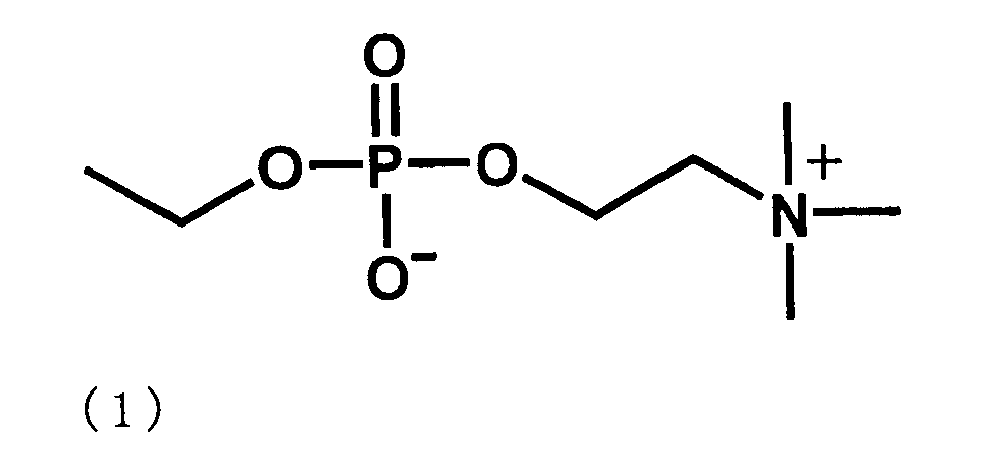
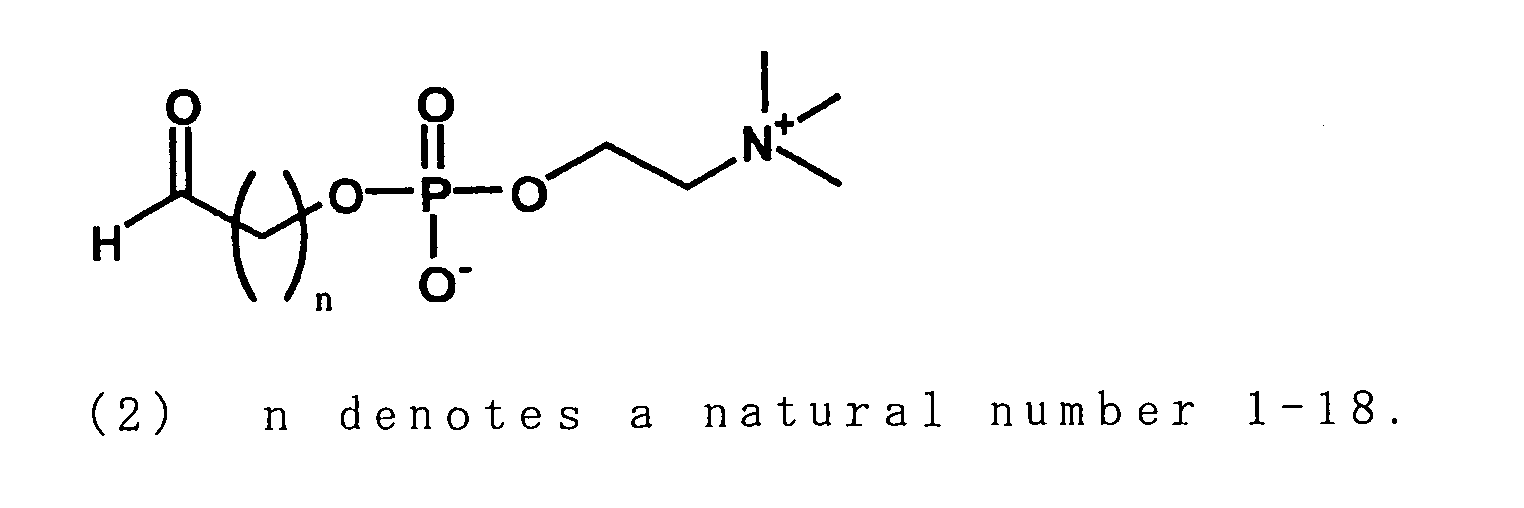
- the present invention provides a method of manufacturing an eye lens material having a process in which a phosphorylcholine group-containing chemical compound represented by the following formula (1) is reacted and covalently bonded onto the surface of an eye lens material wherein the chemical compound represented by the following formula (2) is reacted and covalently bonded through acetal bonding to the eye lens material having OH groups in water, an organic solvent, or a water/organic solvent mixture.
- the present invention provides the aforementioned method of manufacturing an eye lens material wherein constituent monomers of said eye lens material include monomers containing a hydroxyl group.
- the present invention provides the aforementioned method of manufacturing an eye lens material wherein constituent monomers of said eye lens material include 2-hydroxyethyl methacrylate.
- the present invention provides the aforementioned method of manufacturing an eye lens material wherein constituent ingredients of said eye lens material include polyvinyl alcohol.
- the present invention provides a method of manufacturing an eye lens material having a process in which a phosphorylcholine group-containing chemical compound represented by the following formula (1) is reacted and covalently bonded onto the surface of an eye lens material wherein OH groups are introduced to the surface of the eye lens material by means of a plasma treatment and then the chemical compound represented by the following formula (2) is reacted and covalently bonded through acetal bonding in water, an organic solvent, or a water/organic solvent mixture.
- a phosphorylcholine group-containing chemical compound represented by the following formula (1) is reacted and covalently bonded onto the surface of an eye lens material wherein OH groups are introduced to the surface of the eye lens material by means of a plasma treatment and then the chemical compound represented by the following formula (2) is reacted and covalently bonded through acetal bonding in water, an organic solvent, or a water/organic solvent mixture.
- the present invention provides an eye lens material characteristically obtained with a method of manufacturing an eye lens material having a process in which a phosphorylcholine group-containing chemical compound represented by the following formula (1) is reacted and covalently bonded onto the surface of an eye lens material wherein the chemical compound represented by the following formula (2) is reacted and covalently bonded through acetal bonding to the eye lens material having OH groups in water, an organic solvent, or a water/organic solvent mixture.
- the present invention provides an eye lens material characteristically obtained with a method of manufacturing an eye lens material having a process in which a phosphorylcholine group-containing chemical compound represented by the following formula (1) is reacted and covalently bonded onto the surface of an eye lens material wherein OH groups are introduced to the surface of the eye lens material by means of a plasma treatment and then the chemical compound represented by the following formula (2) is reacted and covalently bonded through acetal bonding in water, an organic solvent, or a water/organic solvent mixture.
- a phosphorylcholine group-containing chemical compound represented by the following formula (1) is reacted and covalently bonded onto the surface of an eye lens material wherein OH groups are introduced to the surface of the eye lens material by means of a plasma treatment and then the chemical compound represented by the following formula (2) is reacted and covalently bonded through acetal bonding in water, an organic solvent, or a water/organic solvent mixture.
- the present invention provides a protein adsorption prevention method wherein protein adsorption on an eye lens material is prevented by means of an after-treatment in which the chemical compound represented by the following formula (2) is reacted and covalently bonded through acetal bonding to the eye lens material having OH groups in water, an organic solvent, or a water/organic solvent mixture.
- the manufacturing method of the present invention uses a simple after-treatment method to covalently bond any amount of phosphorylcholine groups onto the eye lens material surface by means of acetal bonding.
- An important advantage lies in the fact that the chemical compound of formula (2) can be introduced by means of acetal bonding in either water or an organic solvent. That is, as opposed to ester bonding by esterification, this method has an advantage in that the after-treatment of an eye lens material having hydroxyl groups can be carried out in water. Since there is no condition for the esterification reaction to proceed in water, acetalization is a superior technique that can introduce phosphorylcholine groups in water or a water-containing organic solvent. That is, when the manufacturing method of the present invention is used, the after-treatment does not have to be carried out under strictly water free conditions. Also, when the after-treatment is done in water, there is another advantage in that the eye lens material will not be altered by an organic solvent.
- the eye lens material of the present invention is a contact lens onto whose surface phosphorylcholine groups are covalently bonded by means of acetal bonding and therefore it effectively suppresses protein adsorption on the contact lens and achieves a superior stain prevention effect. It can also improve moisture retention and the sensation of wearing the contact lens.
- the present invention can be easily used on existing contact lenses.
- the contact lens obtained by the present invention is a contact lens that gives a superior sensation when it is worn. Therefore it can be preferably used in situations where wearing contact lenses tends to feel like a foreign body is touching the eye due to reasons such as poor flexibility of the material.
- the reaction between OH group on the contact lens surface and the chemical compound of formula (2) has a very high yield and allows easy control of the amount to be introduced. Therefore, the present invention has the superior effect of very efficiently introducing the phosphorylcholine group of formula (1) onto the contact lens surface.
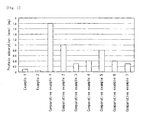
- Fig. 1 is a graph showing protein adsorption on the contact lenses of Examples and Comparative examples.
- This chemical compound can be synthesized by means of total synthesis.
- the synthesis conditions are cumbersome, a strict moisture-free condition is required, and therefore the manufacturing cost is high.
- phosphorylcholine can be extracted as lecithin, which is a constituent component of cell membranes; by removing the fatty acid portion by means of hydrolysis, phosphorylcholine can be easily obtained at low cost in the form of 1- ⁇ -glycerophosphorylcholine.
- the inventors discovered that a phosphorylcholine group-containing chemical compound having an aldehyde group can easily be obtained by means of oxidative cleavage of the diol portion of this 1- ⁇ -glycerophosphorylcholine.
- the most representative synthesis method oxidizes 1- ⁇ -glycerophosphorylcholine by using sodium periodate in water to obtain the target aldehyde derivative; the oxidant and solvent are not limited to these chemical compounds.
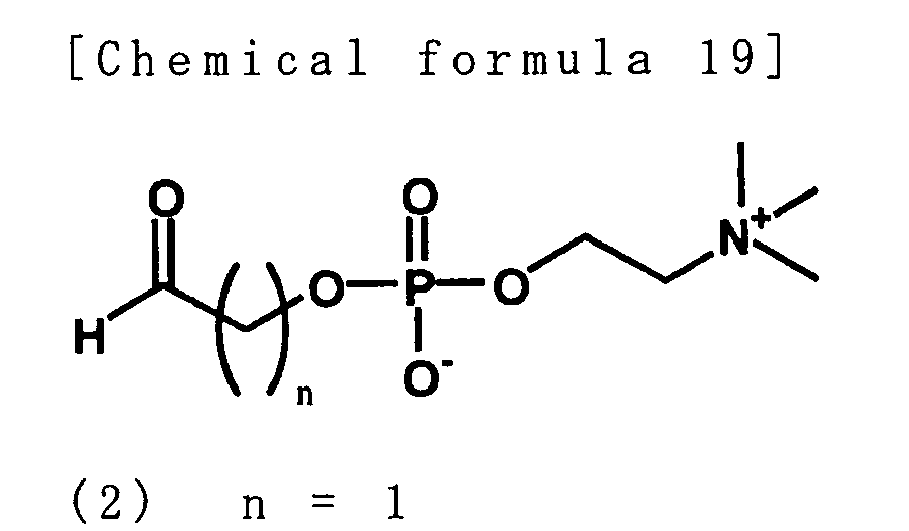
- 1- ⁇ -glycerophosphorylcholine can be oxidatively cleaved by periodate to obtain the chemical compound of formula (2).
- the eye lens material in the present invention refers to a molded piece of a material that is worn in the eye. It mainly refers to a contact lens.
- a contact lens of any material can be used.
- the contact lens of the present invention can be prepared from a contact lens comprising a polymer such as methacrylic acid (MAA), acrylic acid (AA), 2-hydroxyethyl methacrylate (HEMA), N-vinylpyrrolidone, N,N-dimethylacrylamide, vinyl acetate, methyl methacrylate, trifluoroethyl methacrylate, cellulose acetate butyrate, fluoro silicone, hexafluoroisopropyl methacrylate, perfluoroalkyl methacrylate, siloxanyl methacrylate, siloxanyl styrene, ethylene glycol dimethacrylate, allyl methacrylate (AMA), and silicone macromers, as well as a copolymer of two or more types of monomers,
- a soft contact lens that uses 2-hydroxyethyl methacrylate as the main constituent ingredient and an ionic soft contact lens prepared by copolymerizing it with methacrylic acid are representative soft contact lenses; these contact lenses are susceptible to protein adsorption. Therefore, they are preferably treated with the method of the present invention.
- a contact lens whose constituent ingredients include vinyl alcohol or poly-N-vinyl pyrrolidone is also treated preferably with the method of the present invention.
- hard contact lenses having methyl (meth)acrylate as a main ingredient of constituent monomers and hard contact lenses for extended wear and/or with oxygen permeability, to which proteins tend to be adsorbed are also preferably treated with the method of the present invention.
- a contact lens that contains 2-hydroxyethyl methacrylate and/or polyvinyl alcohol polymer as a functional group to which the phosphorylcholine group-containing chemical compound of the aforementioned formula (2) can covalently bond is preferable because it has hydroxyl groups.
- hydroxyl groups can be introduced by means of a plasma treatment.
- hydroxyl groups can be introduced onto a contact lens comprising N-vinyl pyrrolidone polymer to prepare the contact lens of the present invention. That is, hydroxyl groups are introduced onto the contact lens surface by using low temperature plasma in an oxygen gas atmosphere or oxygen/hydrogen gas atmosphere.
- the contact lens is put into a plasma reactor vessel and, after a vacuum pump is used to form a vacuum in the reactor vessel, oxygen gas or oxygen/hydrogen gas is introduced. Hydroxyl groups can then be introduced onto the contact lens surface by means of glow discharge.
- the phosphorylcholine group-containing chemical compound of formula (2) through acetal bonding, forms a strong covalent bond with the hydroxyl group on the contact lens surface.
- the present invention means that phosphorylcholine groups are introduced directly onto the contact lens surface by means of covalent bonding through acetal bonding. Therefore, the present invention does not include cases in which the chemical compound of formula (2) is bonded to a contact lens whose surface is coated with a polymer having OH groups.
- the phosphorylcholine group-containing chemical compound represented by formula (2) is covalently bonded onto the contact lens surface by means of direct acetal bonding
- a method of manufacturing it is not limited, i. e. acetal bonding can be done with any method.
- it does not include embodiments in which the contact lens surface is coated with a polymer having OH groups and then the chemical compound of formula (2) is acetal-bonded. This is because the coating polymer can peel off and/or there may be an influence from the coating polymer.
- the chemical compound of formula (2) is covalently bonded to the hydroxyl group in the constituent monomer of the contact lens or the hydroxyl group newly introduced by means of a plasma treatment and such.
- a contact lens that contains 2-hydroxyethyl methacrylate and/or polyvinyl alcohol has hydroxyl groups.
- phosphorylcholine groups can be introduced onto the contact lens surface by means of acetal bonding. This reaction can proceed easily under acidic conditions in water, in an organic solvent such as methanol, ethanol, dimethylformamide, dimethylsulfoxide, and tetrahydrofuran, or in a mixed solvent of water and the aforementioned organic solvent.
- a contact lens made of a HEMA (2-hydroxyethylmethacrylate polymer) can be treated by heating the chemical compound of formula (2) to a temperature ranging from room temperature to 100 °C in the presence of an acid catalyst such as hydrochloric acid, acetic acid, sulfuric acid, trifluoroacetic acid, and p-toluenesulfonic acid, using water or an organic solvent such as dimethylsulfoxide, dimethylformamide, and tetrahydrofuran as a medium.
- the introduction ratio can be controlled by adjusting the amount of the chemical compound of formula (2) to be added, the amount of the acid catalyst, and/or the reaction temperature.
- a contact lens made of a PVA can be treated by heating the chemical compound of formula (2) to a temperature ranging from room temperature to 100 °C in the presence of an acid catalyst such as hydrochloric acid, acetic acid, sulfuric acid, trifluoroacetic acid, and p-toluenesulfonic acid, using water or an organic solvent such as dimethylsulfoxide, dimethylformamide, and tetrahydrofuran as a medium.
- the introduction ratio can be controlled by adjusting the amount of the chemical compound of formula (2) to be added, the amount of the acid catalyst, and/or the reaction temperature.
- the phosphorylcholine group of formula (1), introduced onto the contact lens surface by means of the method described above or the like, is, after a pre-treatment using perchloric acid, quantified with the molybdenum blue method for the quantitative analysis of phosphorus (Reference: 3.8.2 Phosphorus, Analysis, 4 th edition, Experimental Chemistry Course (14), Maruzen).
- the amount of the phosphorylcholine group of formula (1) introduced onto the contact lens is preferably 0.005 micromol/mg or more. If it is less than 0.005 micromol/mg then a sufficient protein adsorption suppression effect is not obtained sometimes; however, this does not apply to the case in which the phosphorylcholine group is introduced only on the contact lens surface.
- the protein adsorption suppression effect increases as the amount introduced increases; therefore there is no upper limit for the amount introduced.
- the contact lenses of the present invention were prepared by using commercially available contact lenses.
- the protein adsorption suppression effect was compared based on the following evaluation method.
- a contact lens was immersed in 3 ml of an artificial lacrimal fluid and left alone for 24 hours at 37 °C.
- the protein level in the solution was quantified with the BCA method (the calibration curve: Albumin Bovine); the protein adsorption level was determined as the reduction in the proteins in the solution.
- the artificial lacrimal fluid was obtained by dissolving the following ingredients in pure water: 1.20 mg/ml lysozyme, 3.88 mg/ml albumin, 1.61 mg/ml y -globulin, 9.00 mg/ml sodium chloride, 0.14 mg potassium dihydrogen phosphate, and 0.80 mg/ml disodium hydrogen phosphate heptahydrate. (Reference) FDA Guideline Draft: Testing guidelines for class III soft(hydrophilic) contact lens solution, lens group compatibility test. July 15, 1985.
- the aforementioned phosphorylcholine group-containing chemical compound is a prior art chemical compound obtained with the following Synthesis example 1.
- 1- ⁇ -glycerophosphorylcholine (450 mg) was dissolved in 15 ml of distilled water and cooled in an ice water bath. Sodium periodate (750 mg) was added, followed by five hours of stirring. The reaction fluid was concentrated under reduced pressure and dried under reduced pressure; methanol 1 was then used to extract the target substance.
- Polymacon soft contact lens “Medalist” from Bausch & Lomb
- NelficonA NelficonA
- One Polymacon was immersed in 2 ml of water, in which 10 mg of the phosphorylcholine-containing chemical compound of formula (2) was dissolved. 2 ml of 2N hydrochloric acid was then added and the concentration of the hydrochloric acid in the mixed solution was adjusted to 1M, followed by five hours of reaction at 70 °C. The reaction fluid was cooled down to room temperature and rinsed thoroughly to obtain the target contact lens. The level of the introduced phosphorylcholine group of formula (1) was 0.0734 micromol/mg.
- NelfilconA was immersed in 2 ml of water, in which 10 mg of the phosphorylcholine-containing chemical compound of formula (2) was dissolved. 2 ml of 2N hydrochloric acid was then added and the concentration of the hydrochloric acid in the mixed solution was adjusted to 1M, followed by five hours of reaction at 40 °C. The reaction fluid was cooled down to room temperature and rinsed thoroughly to obtain the target contact lens. The level of the introduced phosphorylcholine group of formula (1) was 0.1688 micromol/mg.
- the obtained contact lens was immersed in perchloric acid and heated up to 180 °C to be decomposed.
- the obtained solution was diluted with water, to which hexaammonium heptamolybdate tetrahydrate and L-ascorbic acid were added, followed by 5 minutes at 95 °C of color development time; the amount introduced was determined by means of the light absorption measurement at 710 nm.
- a sodium dihydrogen phosphate solution was used for the calibration curve.
- Fig. 1 shows the results of protein adsorption for Examples 1-2 and Comparative examples 1-7. These results indicate that the contact lenses obtained by the preparation method of the present invention significantly suppress protein adsorption.
- Acid catalyst 1M Hydrochloric acid Reaction temperature: 40 °C [Table 3] Amount of the chemical compound of formula (2) added Level of the introduced phosphorylcholine group 5 equivalents 0.1688 micromol/mg 3 equivalents 0.1317 micromol/mg 1 equivalent 0.0447 micromol/mg
- reaction temperature Room temperature to 80 °C, more preferably 40 °C -70 °C.
- Hydrochloric acid concentration 0.01-5M, more preferably 0.1-1M
- Level of the added phosphorylcholine chemical compound (2) 0.1-10 equivalents, more preferably 1-5 equivalents
- the present invention can highly suppress protein adsorption on contact lenses and significantly prevent stains due to proteins.
- the method of the present invention can be preferably used for soft contact lenses, for which protein staining is a fatal problem. It can be preferably used in particular for ionic soft contact lenses, which accelerate protein adsorption. It can also be preferably used for hard contact lenses for extended wear and/or with oxygen permeability, to which proteins tend to be adsorbed.
Landscapes
- Health & Medical Sciences (AREA)
- Chemical & Material Sciences (AREA)
- Ophthalmology & Optometry (AREA)
- Physics & Mathematics (AREA)
- General Health & Medical Sciences (AREA)
- Public Health (AREA)
- Oral & Maxillofacial Surgery (AREA)
- Heart & Thoracic Surgery (AREA)
- Vascular Medicine (AREA)
- Life Sciences & Earth Sciences (AREA)
- Animal Behavior & Ethology (AREA)
- Engineering & Computer Science (AREA)
- Transplantation (AREA)
- Veterinary Medicine (AREA)
- Biomedical Technology (AREA)
- General Physics & Mathematics (AREA)
- Optics & Photonics (AREA)
- Cardiology (AREA)
- General Chemical & Material Sciences (AREA)
- Chemical Kinetics & Catalysis (AREA)
- Medicinal Chemistry (AREA)
- Polymers & Plastics (AREA)
- Organic Chemistry (AREA)
- Treatments Of Macromolecular Shaped Articles (AREA)
- Eyeglasses (AREA)
Abstract
The present invention is a method of manufacturing an eye lens material having a process in which a phosphorylcholine group-containing chemical compound represented by the following formula (1) is reacted and covalently bonded onto the surface of an eye lens material wherein the chemical compound represented by the following formula (2) is reacted and covalently bonded through acetal bonding to the eye lens material having OH groups in water, an organic solvent, or a water/organic solvent mixture.
The object of the present invention is to provide an eye lens material that prevents protein adsorption and a method of manufacturing thereof.
Description
- The present invention relates to an eye lens material such as a contact lens, a method of manufacturing it, and a method of preventing protein adsorption. More specifically, it relates to a method of preventing protein stains by treating the surface of an eye lens material (particularly for contact lenses) by means of an after-treatment using a phosphorylcholine group-containing chemical compound.
- The practice of polymerizing phosphorylcholine group-containing monomers for use as a contact lens material is a prior art (Patent Documents 1-3). For example,
Patent Document 1 discloses a moist soft contact lens containing a phosphorylcholine group-containing (meth)acrylic ester as a constitutional unit; it is described as having superior moisture content, oxygen permeability, and tensile strength, as well as reduced protein adsorption and the ability to suppress stain adhesion. - As an example of an after-treatment method for contact lenses,
Patent Document 4 describes polymerization of phosphorylcholine group-containing monomers on the contact lens surface to prepare a contact lens having hydrophilic surfaces and reduced protein adsorption. - In addition,
Patent Document 5 describes a reduction in protein adsorption by chemically bonding a low molecular weight phosphorylcholine compound onto the contact lens surface.
That is, Example 5 ofPatent Document 5 claims that the adhesion of albumin and lysozyme onto a contact lens can be suppressed by treating a 4-hydroxyethyl methacrylate-co-methacryl acid copolymer contact lens with 2-[{2-(1-imidazolecarbonyloxyethoxy)hydroxyphosphinyl}oxy]-N,N,N-trimethyletanaminiumnitroxide inner salt.
However, the method described inPatent Document 5 uses a very cumbersome method with many steps, which makes it very hard to obtain the target substance with a high yield and high purity. Also, the reaction to introduce phosphorylcholine groups onto the contact lens surface, under the conditions described in these Patent Documents, does not proceed sufficiently and results in a low introduction level, and therefore a superior protein adsorption prevention effect is not achieved. - Stains on a contact lens result from adsorption of proteins and/or lipids contained in lacrimal fluid; these stains can cause eye troubles such as allergies and infections (Non-patent Document 1). Protein stains cause a fatal problem particularly for a moist contact lens whose main ingredient is a 2-hydroxyethyl methacrylate polymer, a highly moist soft contact lens prepared by copolymerizing this ingredient with a small amount of methacrylic acid, which is an ionic monomer, and a soft contact lens whose main ingredient is a polymer of a hydrophilic monomer such as N-vinyl pyrrolidone and N,N-dimethyl acrylamide.
-
- Patent Document 1:
Japanese Patent Laid-Open H10-177152 - Patent Document 2:
Japanese Patent Laid-Open 2000-111847 - Patent Document 3:
Japanese Patent Laid-Open 2000-169526 - Patent Document 4:
Japanese Patent Laid-Open 2001-337298 - Patent Document 5:
Japanese Patent Laid-Open H5-505121 - Non-patent Document 1: "Stains on soft contact lenses and analysis thereof", Material Stage, Vol. 4, No. 1, 2004
- The present invention provides a contact lens that prevents protein stains by suppressing protein adsorption on the contact lens by means of an after-treatment in which phosphorylcholine groups are covalently bonded onto the contact lens surface via a chemical compound having a terminal amino group.
- That is, the present invention does not prepare a protein adsorption prevention contact lens by polymerizing monomers having phosphorylcholine groups, as in the methods described in Patent Documents 1-3 above; its object is to give contact lenses a superior protein adsorption prevention function by means of an after-treatment.
- Also, the present invention does not introduce phosphorylcholine groups by polymerizing phosphorylcholine-containing monomers onto the contact lens surface to coat it with a polymer different from the contact lens itself, as in a method described in
Patent Document 4; it uses direct covalent bonding of phosphorylcholine groups, rather than polymer coating, and thus aims to achieve a superior protein adsorption prevention effect without changing the original characteristics of the contact lens with polymer coating. - Furthermore, the present invention aims to achieve a superior protein adsorption prevention effect by introducing a sufficient amount of phosphorylcholine, as opposed to the method described in
Reference 5, which is shown to be incapable of introducing a sufficient amount of phosphorylcholine groups onto the contact lens surface when an attempt to duplicate this method is actually made.
That is, the essential difference between the present invention and the method shown inPatent Document 5 is a difference in the introduction efficiency of the phosphorylcholine group onto the contact lens surface; this difference led to the superior effect of more efficiently suppressing protein adsorption.
An advantage of the present invention lies in the fact that phosphorylcholine groups can be stably introduced onto a contact lens material having hydroxyl groups on the surface by means of acetal bonding in any solvent: water or organic solvents. - That is, the present invention provides a method of manufacturing an eye lens material having a process in which a phosphorylcholine group-containing chemical compound represented by the following formula (1) is reacted and covalently bonded onto the surface of an eye lens material wherein the chemical compound represented by the following formula (2) is reacted and covalently bonded through acetal bonding to the eye lens material having OH groups in water, an organic solvent, or a water/organic solvent mixture.


- Also, the present invention provides the aforementioned method of manufacturing an eye lens material wherein constituent monomers of said eye lens material include monomers containing a hydroxyl group.
- Furthermore, the present invention provides the aforementioned method of manufacturing an eye lens material wherein constituent monomers of said eye lens material include 2-hydroxyethyl methacrylate.
- Furthermore, the present invention provides the aforementioned method of manufacturing an eye lens material wherein constituent ingredients of said eye lens material include polyvinyl alcohol.
- That is, the present invention provides a method of manufacturing an eye lens material having a process in which a phosphorylcholine group-containing chemical compound represented by the following formula (1) is reacted and covalently bonded onto the surface of an eye lens material wherein OH groups are introduced to the surface of the eye lens material by means of a plasma treatment and then the chemical compound represented by the following formula (2) is reacted and covalently bonded through acetal bonding in water, an organic solvent, or a water/organic solvent mixture.


- That is, the present invention provides an eye lens material characteristically obtained with a method of manufacturing an eye lens material having a process in which a phosphorylcholine group-containing chemical compound represented by the following formula (1) is reacted and covalently bonded onto the surface of an eye lens material wherein the chemical compound represented by the following formula (2) is reacted and covalently bonded through acetal bonding to the eye lens material having OH groups in water, an organic solvent, or a water/organic solvent mixture.


- That is, the present invention provides an eye lens material characteristically obtained with a method of manufacturing an eye lens material having a process in which a phosphorylcholine group-containing chemical compound represented by the following formula (1) is reacted and covalently bonded onto the surface of an eye lens material wherein OH groups are introduced to the surface of the eye lens material by means of a plasma treatment and then the chemical compound represented by the following formula (2) is reacted and covalently bonded through acetal bonding in water, an organic solvent, or a water/organic solvent mixture.


- Also, the present invention provides a protein adsorption prevention method wherein protein adsorption on an eye lens material is prevented by means of an after-treatment in which the chemical compound represented by the following formula (2) is reacted and covalently bonded through acetal bonding to the eye lens material having OH groups in water, an organic solvent, or a water/organic solvent mixture.

- The manufacturing method of the present invention uses a simple after-treatment method to covalently bond any amount of phosphorylcholine groups onto the eye lens material surface by means of acetal bonding.
An important advantage lies in the fact that the chemical compound of formula (2) can be introduced by means of acetal bonding in either water or an organic solvent. That is, as opposed to ester bonding by esterification, this method has an advantage in that the after-treatment of an eye lens material having hydroxyl groups can be carried out in water.
Since there is no condition for the esterification reaction to proceed in water, acetalization is a superior technique that can introduce phosphorylcholine groups in water or a water-containing organic solvent.
That is, when the manufacturing method of the present invention is used, the after-treatment does not have to be carried out under strictly water free conditions. Also, when the after-treatment is done in water, there is another advantage in that the eye lens material will not be altered by an organic solvent. - The eye lens material of the present invention is a contact lens onto whose surface phosphorylcholine groups are covalently bonded by means of acetal bonding and therefore it effectively suppresses protein adsorption on the contact lens and achieves a superior stain prevention effect. It can also improve moisture retention and the sensation of wearing the contact lens.
- Also, since the protein adsorption prevention function can be added by means of an after-treatment, the present invention can be easily used on existing contact lenses.
- Since polymer coating is not used as the method to introduce the phosphorylcholine groups, durability is superior and the original characteristics of the contact lens are essentially not degraded.
- The contact lens obtained by the present invention is a contact lens that gives a superior sensation when it is worn. Therefore it can be preferably used in situations where wearing contact lenses tends to feel like a foreign body is touching the eye due to reasons such as poor flexibility of the material.
- In particular, the reaction between OH group on the contact lens surface and the chemical compound of formula (2) has a very high yield and allows easy control of the amount to be introduced. Therefore, the present invention has the superior effect of very efficiently introducing the phosphorylcholine group of formula (1) onto the contact lens surface.
- Fig. 1 is a graph showing protein adsorption on the contact lenses of Examples and Comparative examples.
- The present invention is described in detail below.
- This chemical compound can be synthesized by means of total synthesis. However, the synthesis conditions are cumbersome, a strict moisture-free condition is required, and therefore the manufacturing cost is high. On the other hand, phosphorylcholine can be extracted as lecithin, which is a constituent component of cell membranes; by removing the fatty acid portion by means of hydrolysis, phosphorylcholine can be easily obtained at low cost in the form of 1-α-glycerophosphorylcholine. The inventors discovered that a phosphorylcholine group-containing chemical compound having an aldehyde group can easily be obtained by means of oxidative cleavage of the diol portion of this 1-α -glycerophosphorylcholine. The most representative synthesis method oxidizes 1-α-glycerophosphorylcholine by using sodium periodate in water to obtain the target aldehyde derivative; the oxidant and solvent are not limited to these chemical compounds.
- 1-α -glycerophosphorylcholine can be oxidatively cleaved by periodate to obtain the chemical compound of formula (2).
- The eye lens material in the present invention refers to a molded piece of a material that is worn in the eye. It mainly refers to a contact lens. A contact lens of any material can be used. The contact lens of the present invention can be prepared from a contact lens comprising a polymer such as methacrylic acid (MAA), acrylic acid (AA), 2-hydroxyethyl methacrylate (HEMA), N-vinylpyrrolidone, N,N-dimethylacrylamide, vinyl acetate, methyl methacrylate, trifluoroethyl methacrylate, cellulose acetate butyrate, fluoro silicone, hexafluoroisopropyl methacrylate, perfluoroalkyl methacrylate, siloxanyl methacrylate, siloxanyl styrene, ethylene glycol dimethacrylate, allyl methacrylate (AMA), and silicone macromers, as well as a copolymer of two or more types of monomers, or a contact lens whose constituent ingredients include polyvinyl alcohol and/or polysiloxane.
The present invention is independent of the type of monomer, and it can be used for both hard contact lenses and soft contact lenses. - A soft contact lens that uses 2-hydroxyethyl methacrylate as the main constituent ingredient and an ionic soft contact lens prepared by copolymerizing it with methacrylic acid are representative soft contact lenses; these contact lenses are susceptible to protein adsorption. Therefore, they are preferably treated with the method of the present invention.
Also, a contact lens whose constituent ingredients include vinyl alcohol or poly-N-vinyl pyrrolidone is also treated preferably with the method of the present invention.
Furthermore, hard contact lenses having methyl (meth)acrylate as a main ingredient of constituent monomers and hard contact lenses for extended wear and/or with oxygen permeability, to which proteins tend to be adsorbed, are also preferably treated with the method of the present invention. - A contact lens that contains 2-hydroxyethyl methacrylate and/or polyvinyl alcohol polymer as a functional group to which the phosphorylcholine group-containing chemical compound of the aforementioned formula (2) can covalently bond is preferable because it has hydroxyl groups.
However, even if these functional groups are not present, hydroxyl groups can be introduced by means of a plasma treatment. For example, hydroxyl groups can be introduced onto a contact lens comprising N-vinyl pyrrolidone polymer to prepare the contact lens of the present invention. That is, hydroxyl groups are introduced onto the contact lens surface by using low temperature plasma in an oxygen gas atmosphere or oxygen/hydrogen gas atmosphere. Specifically, the contact lens is put into a plasma reactor vessel and, after a vacuum pump is used to form a vacuum in the reactor vessel, oxygen gas or oxygen/hydrogen gas is introduced. Hydroxyl groups can then be introduced onto the contact lens surface by means of glow discharge. - The phosphorylcholine group-containing chemical compound of formula (2), through acetal bonding, forms a strong covalent bond with the hydroxyl group on the contact lens surface.
The present invention means that phosphorylcholine groups are introduced directly onto the contact lens surface by means of covalent bonding through acetal bonding. Therefore, the present invention does not include cases in which the chemical compound of formula (2) is bonded to a contact lens whose surface is coated with a polymer having OH groups. - Since the essence of the present invention lies in the fact that the phosphorylcholine group-containing chemical compound represented by formula (2) is covalently bonded onto the contact lens surface by means of direct acetal bonding, a method of manufacturing it is not limited, i. e. acetal bonding can be done with any method. However, as explained above, it does not include embodiments in which the contact lens surface is coated with a polymer having OH groups and then the chemical compound of formula (2) is acetal-bonded. This is because the coating polymer can peel off and/or there may be an influence from the coating polymer.
- Specifically, using a conventional method in an organic solvent, the chemical compound of formula (2) is covalently bonded to the hydroxyl group in the constituent monomer of the contact lens or the hydroxyl group newly introduced by means of a plasma treatment and such.
- A contact lens that contains 2-hydroxyethyl methacrylate and/or polyvinyl alcohol has hydroxyl groups. By reacting the chemical compound of formula (2) with these hydroxyl groups, phosphorylcholine groups can be introduced onto the contact lens surface by means of acetal bonding. This reaction can proceed easily under acidic conditions in water, in an organic solvent such as methanol, ethanol, dimethylformamide, dimethylsulfoxide, and tetrahydrofuran, or in a mixed solvent of water and the aforementioned organic solvent.
- A contact lens made of a HEMA (2-hydroxyethylmethacrylate polymer) can be treated by heating the chemical compound of formula (2) to a temperature ranging from room temperature to 100 °C in the presence of an acid catalyst such as hydrochloric acid, acetic acid, sulfuric acid, trifluoroacetic acid, and p-toluenesulfonic acid, using water or an organic solvent such as dimethylsulfoxide, dimethylformamide, and tetrahydrofuran as a medium. The introduction ratio can be controlled by adjusting the amount of the chemical compound of formula (2) to be added, the amount of the acid catalyst, and/or the reaction temperature.
- A contact lens made of a PVA (polyvinyl alcohol) can be treated by heating the chemical compound of formula (2) to a temperature ranging from room temperature to 100 °C in the presence of an acid catalyst such as hydrochloric acid, acetic acid, sulfuric acid, trifluoroacetic acid, and p-toluenesulfonic acid, using water or an organic solvent such as dimethylsulfoxide, dimethylformamide, and tetrahydrofuran as a medium. The introduction ratio can be controlled by adjusting the amount of the chemical compound of formula (2) to be added, the amount of the acid catalyst, and/or the reaction temperature.
- The phosphorylcholine group of formula (1), introduced onto the contact lens surface by means of the method described above or the like, is, after a pre-treatment using perchloric acid, quantified with the molybdenum blue method for the quantitative analysis of phosphorus (Reference: 3.8.2 Phosphorus, Analysis, 4th edition, Experimental Chemistry Course (14), Maruzen).
The amount of the phosphorylcholine group of formula (1) introduced onto the contact lens is preferably 0.005 micromol/mg or more. If it is less than 0.005 micromol/mg then a sufficient protein adsorption suppression effect is not obtained sometimes; however, this does not apply to the case in which the phosphorylcholine group is introduced only on the contact lens surface. The protein adsorption suppression effect increases as the amount introduced increases; therefore there is no upper limit for the amount introduced. - Next, the present invention is described in detail by referring to Examples. The present invention is not limited to these Examples.
- The contact lenses of the present invention were prepared by using commercially available contact lenses. The protein adsorption suppression effect was compared based on the following evaluation method.
- A contact lens was immersed in 3 ml of an artificial lacrimal fluid and left alone for 24 hours at 37 °C. The protein level in the solution was quantified with the BCA method (the calibration curve: Albumin Bovine); the protein adsorption level was determined as the reduction in the proteins in the solution.
The artificial lacrimal fluid was obtained by dissolving the following ingredients in pure water:
1.20 mg/ml lysozyme, 3.88 mg/ml albumin, 1.61 mg/ml y -globulin, 9.00 mg/ml sodium chloride, 0.14 mg potassium dihydrogen phosphate, and 0.80 mg/ml disodium hydrogen phosphate heptahydrate. (Reference) FDA Guideline Draft: Testing guidelines for class III soft(hydrophilic) contact lens solution, lens group compatibility test. July 15, 1985. -
- The aforementioned phosphorylcholine group-containing chemical compound is a prior art chemical compound obtained with the following Synthesis example 1.
- 1-α -glycerophosphorylcholine (450 mg) was dissolved in 15 ml of distilled water and cooled in an ice water bath. Sodium periodate (750 mg) was added, followed by five hours of stirring. The reaction fluid was concentrated under reduced pressure and dried under reduced pressure;
methanol 1 was then used to extract the target substance. - Polymacon (soft contact lens "Medalist" from Bausch & Lomb) and NelficonA (Focus Dailies from Ciba Vision) were used for the contact lenses, to which the chemical compound of formula (2) was covalently bonded by means of acetal bonding.
- One Polymacon was immersed in 2 ml of water, in which 10 mg of the phosphorylcholine-containing chemical compound of formula (2) was dissolved. 2 ml of 2N hydrochloric acid was then added and the concentration of the hydrochloric acid in the mixed solution was adjusted to 1M, followed by five hours of reaction at 70 °C. The reaction fluid was cooled down to room temperature and rinsed thoroughly to obtain the target contact lens. The level of the introduced phosphorylcholine group of formula (1) was 0.0734 micromol/mg.
- One NelfilconA was immersed in 2 ml of water, in which 10 mg of the phosphorylcholine-containing chemical compound of formula (2) was dissolved. 2 ml of 2N hydrochloric acid was then added and the concentration of the hydrochloric acid in the mixed solution was adjusted to 1M, followed by five hours of reaction at 40 °C. The reaction fluid was cooled down to room temperature and rinsed thoroughly to obtain the target contact lens. The level of the introduced phosphorylcholine group of formula (1) was 0.1688 micromol/mg.
- The obtained contact lens was immersed in perchloric acid and heated up to 180 °C to be decomposed. The obtained solution was diluted with water, to which hexaammonium heptamolybdate tetrahydrate and L-ascorbic acid were added, followed by 5 minutes at 95 °C of color development time; the amount introduced was determined by means of the light absorption measurement at 710 nm. For the calibration curve, a sodium dihydrogen phosphate solution was used.
- For comparison, the following commercially available contact lenses were used.
- Comparative example 1: EtafilconA (product name: 1-Day Acuvue from J & J)
- Comparative example 2: EtafilconA (product name: 1 Day Aquair from Ocular Science)
- Comparative example 3: NelfilconA (Focus Dailies from Ciba Vision)
- Comparative example 4: Polymacon (product name: Medalist from Bausch & Lomb)
- Comparative example 5: VifilconA (Focus from Ciba Vision)
- Based on the technique described in
Patent Document 5, 10 mg of 1-α -glycerophosphorylcholine, 20 mg of 1,1-carbonyldiimidazole, and 20 mg of triethylamine were added to 3 ml of dimethylsulfoxide, followed by two hours of stirring at 50 °C. Polymacon, which was used in Example 1, was immersed in this solution, followed by 12 hours of reaction time at room temperature. The contact lens was thoroughly rinsed with dimethylsulfoxide and then with water; the phosphorus quantification showed the level of the introduced phosphorylcholine group to be at the detection limit, 0.0001 micromol/mg, or less, indicating that the reaction did not proceed. - Based on the technique described in
Patent Document 5, 10 mg of 1-α -glycerophosphorylcholine, 20 mg of 1,1-carbonyldiimidazole, and 20 mg of triethylamine were added to 3 ml of dimethylsulfoxide, followed by two hours of stirring at 50 °C. NelfilconA, which was used in Example 2, was immersed in this solution, followed by 12 hours of reaction time at room temperature. The contact lens was thoroughly rinsed with dimethylsulfoxide and then with water; the phosphorus quantification showed the level of the introduced phosphorylcholine group to be at the detection limit, 0.0001 micromol/mg, or less, indicating that the reaction did not proceed. - Fig. 1 shows the results of protein adsorption for Examples 1-2 and Comparative examples 1-7. These results indicate that the contact lenses obtained by the preparation method of the present invention significantly suppress protein adsorption.
- Next, the reaction treatment conditions for treating NelfilconA in Example 2 were changed and corresponding changes in the level of the introduced phosphorylcholine group were investigated.
The introduced levels of the phosphorylcholine group as functions of the reaction temperature, the acid catalyst level, and the amount of the chemical compound of formula (2) added are shown in Tables 1-3. - The chemical compound of formula (2): 1 equivalent (for hydroxyl groups of the contact lens)
Acid catalyst: 1M Hydrochloric acid[Table 1] Reaction temperature Level of the introduced phosphorylcholine group 70 °C 0.5842 micromol/mg 40 °C 0.1688 micromol/mg 25 °C 0.0328 micromol/mg - The chemical compound of formula (2): 1 equivalent (for hydroxyl groups of the contact lens)
-
[Table 2] HCl concentration Level of the introduced phosphorylcholine group 1M 0.1688 micromol/mg 0.1M 0.0149 micromol/mg 0.01M 0.0032 micromol/mg - Acid catalyst: 1M Hydrochloric acid
Reaction temperature: 40 °C[Table 3] Amount of the chemical compound of formula (2) added Level of the introduced phosphorylcholine group 5 equivalents 0.1688 micromol/ mg 3 equivalents 0.1317 micromol/ mg 1 equivalent 0.0447 micromol/mg - As the results shown in Tables 1-3 indicate, the level of the introduced phosphorylcholine group can be easily controlled by changing the reaction treatment conditions. Preferable reaction treatment conditions are as follows.
Reaction temperature: Room temperature to 80 °C, more preferably 40 °C -70 °C.
Hydrochloric acid concentration: 0.01-5M, more preferably 0.1-1M
Level of the added phosphorylcholine chemical compound (2): 0.1-10 equivalents, more preferably 1-5 equivalents - The present invention can highly suppress protein adsorption on contact lenses and significantly prevent stains due to proteins.
The method of the present invention can be preferably used for soft contact lenses, for which protein staining is a fatal problem. It can be preferably used in particular for ionic soft contact lenses, which accelerate protein adsorption.
It can also be preferably used for hard contact lenses for extended wear and/or with oxygen permeability, to which proteins tend to be adsorbed.
Claims (8)
- A method of manufacturing an eye lens material having a process in which a phosphorylcholine group-containing chemical compound represented by the following formula (1) is reacted and covalently bonded onto the surface of an eye lens material wherein the chemical compound represented by the following formula (2) is reacted and covalently bonded through acetal bonding to the eye lens material having OH groups in water, an organic solvent, or a water/organic solvent mixture.


- The method of manufacturing an eye lens material of claim 1 wherein constituent monomers of said eye lens material include monomers containing a hydroxyl group.
- The method of manufacturing an eye lens material of claim 1 wherein constituent monomers of said eye lens material include 2-hydroxyethylmethacrylate.
- The method of manufacturing an eye lens material of claim 1 wherein constituent monomers of said eye lens material include polyvinyl alcohol.
- A method of manufacturing an eye lens material having a process in which a phosphorylcholine group-containing chemical compound represented by the following formula (1) is reacted and covalently bonded onto the surface of an eye lens material wherein OH groups are introduced to the surface of the eye lens material by means of a plasma treatment and then the chemical compound represented by the following formula (2) is reacted and covalently bonded through acetal bonding in water, an organic solvent, or a water/organic solvent mixture.


- An eye lens material characteristically obtained with a method of manufacturing an eye lens material having a process in which a phosphorylcholine group-containing chemical compound represented by the following formula (1) is reacted and covalently bonded onto the surface of an eye lens material wherein the chemical compound represented by the following formula (2) is reacted and covalently bonded through acetal bonding to the eye lens material having OH groups in water, an organic solvent, or a water/organic solvent mixture.


- An eye lens material characteristically obtained with a method of manufacturing an eye lens material having a process in which a phosphorylcholine group-containing chemical compound represented by the following formula (1) is reacted and covalently bonded onto the surface of an eye lens material wherein OH groups are introduced to the surface of the eye lens material by means of a plasma treatment and then the chemical compound represented by the following formula (2) is reacted and covalently bonded through acetal bonding in water, an organic solvent, or a water/organic solvent mixture.


- A protein adsorption prevention method wherein protein adsorption on the eye lens material is prevented by means of an after-treatment in which the chemical compound represented by the following formula (2) is reacted and covalently bonded through acetal bonding to the eye lens material having OH groups in water, an organic solvent, or a water/organic solvent mixture.


Applications Claiming Priority (3)
| Application Number | Priority Date | Filing Date | Title |
|---|---|---|---|
| JP2004153256 | 2004-05-24 | ||
| JP2005136847A JP3715310B1 (en) | 2004-05-24 | 2005-05-10 | Protein adsorption preventing ophthalmic lens material and method for producing the same |
| PCT/JP2005/009084 WO2005114306A1 (en) | 2004-05-24 | 2005-05-18 | Protein adsorption-preventing ocular lens material and method for producing same |
Publications (1)
| Publication Number | Publication Date |
|---|---|
| EP1750161A1 true EP1750161A1 (en) | 2007-02-07 |
Family
ID=35428511
Family Applications (1)
| Application Number | Title | Priority Date | Filing Date |
|---|---|---|---|
| EP05741156A Withdrawn EP1750161A1 (en) | 2004-05-24 | 2005-05-18 | Protein adsorption-preventing ocular lens material and method for producing same |
Country Status (5)
| Country | Link |
|---|---|
| US (1) | US8236873B2 (en) |
| EP (1) | EP1750161A1 (en) |
| JP (1) | JP3715310B1 (en) |
| KR (1) | KR20070026433A (en) |
| WO (1) | WO2005114306A1 (en) |
Cited By (1)
| Publication number | Priority date | Publication date | Assignee | Title |
|---|---|---|---|---|
| WO2020100090A1 (en) * | 2018-11-15 | 2020-05-22 | Alcon Inc. | Contact lens with phosphorylcholine-modified polyvinylalcohols therein |
Families Citing this family (11)
| Publication number | Priority date | Publication date | Assignee | Title |
|---|---|---|---|---|
| ATE266668T1 (en) * | 2000-02-07 | 2004-05-15 | Biocompatibles Uk Ltd | SILICON CONTAINING COMPOUNDS PRODUCED BY MICHAEL ADDITION AS MONOMERS AND MACROMERS |
| US8490782B2 (en) * | 2007-10-23 | 2013-07-23 | Bausch & Lomb Incorporated | Packaging solutions |
| JP5280664B2 (en) | 2007-10-25 | 2013-09-04 | 株式会社 資生堂 | Surface modification method and surface modification material |
| JP2009120666A (en) * | 2007-11-13 | 2009-06-04 | Shiseido Co Ltd | Method for surface-modification of resin material and surface-modified resin material |
| KR20100126310A (en) * | 2008-03-19 | 2010-12-01 | 가부시키가이샤 시세이도 | Method for producing affinity particles, affinity particles and separation method |
| EP2405267A4 (en) | 2009-03-02 | 2012-01-11 | Shiseido Co Ltd | Surface-modified base plate, biochip and process for producing the biochip |
| WO2010147122A1 (en) | 2009-06-15 | 2010-12-23 | 株式会社資生堂 | Container for formation of aggregated cell mass, and method for formation of aggregated cell mass |
| BR112012014110B1 (en) * | 2009-12-04 | 2023-10-24 | Barrick Gold Corporation | PROCESS FOR SEPARATION OF COPPER AND/OR MOLYBDENUM MINERALS FROM PYRITE USING AIR METABISULPHITE TREATMENT |
| JP5095855B2 (en) | 2010-12-13 | 2012-12-12 | 株式会社 資生堂 | Method for forming cell aggregate |
| WO2018078542A1 (en) * | 2016-10-26 | 2018-05-03 | Novartis Ag | Soft contact lenses with a lubricious coating covalently-attached thereon |
| KR102945395B1 (en) * | 2019-12-09 | 2026-03-27 | 니치유 가부시키가이샤 | Pollen adsorption inhibitor and pollen protein adsorption inhibitor for soft contact lens |
Family Cites Families (10)
| Publication number | Priority date | Publication date | Assignee | Title |
|---|---|---|---|---|
| GB8401534D0 (en) * | 1984-01-20 | 1984-02-22 | Royal Free Hosp School Med | Biocompatible surfaces |
| GB9004881D0 (en) * | 1990-03-05 | 1990-05-02 | Biocompatibles Ltd | Method of improving the ocular of synthetic polymers haemo and biocompatibility |
| US5466853A (en) * | 1992-07-23 | 1995-11-14 | Nof Corporation | Diester monomer, its polymer, water-containing soft contact lens, and processing solution for contact lens |
| US5936703A (en) * | 1993-10-13 | 1999-08-10 | Nof Corporation | Alkoxysilane compound, surface processing solution and contact lens |
| JP3825502B2 (en) * | 1996-06-11 | 2006-09-27 | 日本油脂株式会社 | Modified protein production method and contact lens dirt remover |
| EP1109853B1 (en) * | 1998-07-17 | 2004-09-22 | Biocompatibles UK Limited | Method for providing coated moulded polymeric articles |
| ATE346873T1 (en) * | 1999-07-14 | 2006-12-15 | Nof Corp | STATISTICAL COPOLYMER, METHOD FOR THE PRODUCTION THEREOF AND MEDICAL MATERIAL |
| US6533415B2 (en) * | 2000-03-21 | 2003-03-18 | Menicon Co., Ltd. | Ocular lens material having hydrophilic surface and process for preparing the same |
| JP3959676B2 (en) * | 2001-11-07 | 2007-08-15 | 東洋紡績株式会社 | Highly safe polymer composition containing phosphorus-containing polymer |
| JP4245336B2 (en) * | 2002-11-25 | 2009-03-25 | 株式会社資生堂 | Polysiloxane having phosphorylcholine group and process for producing the same |
-
2005
- 2005-05-10 JP JP2005136847A patent/JP3715310B1/en not_active Expired - Fee Related
- 2005-05-18 KR KR1020067020171A patent/KR20070026433A/en not_active Withdrawn
- 2005-05-18 US US10/593,544 patent/US8236873B2/en not_active Expired - Fee Related
- 2005-05-18 WO PCT/JP2005/009084 patent/WO2005114306A1/en not_active Ceased
- 2005-05-18 EP EP05741156A patent/EP1750161A1/en not_active Withdrawn
Non-Patent Citations (1)
| Title |
|---|
| See references of WO2005114306A1 * |
Cited By (2)
| Publication number | Priority date | Publication date | Assignee | Title |
|---|---|---|---|---|
| WO2020100090A1 (en) * | 2018-11-15 | 2020-05-22 | Alcon Inc. | Contact lens with phosphorylcholine-modified polyvinylalcohols therein |
| US11061169B2 (en) | 2018-11-15 | 2021-07-13 | Alcon Inc. | Contact lens with phosphorylcholine-modified polyvinylalcohols therein |
Also Published As
| Publication number | Publication date |
|---|---|
| WO2005114306A1 (en) | 2005-12-01 |
| US8236873B2 (en) | 2012-08-07 |
| JP3715310B1 (en) | 2005-11-09 |
| JP2006011383A (en) | 2006-01-12 |
| KR20070026433A (en) | 2007-03-08 |
| US20090156741A1 (en) | 2009-06-18 |
Similar Documents
| Publication | Publication Date | Title |
|---|---|---|
| US8158192B2 (en) | Process for the coating of biomedical articles | |
| TWI441835B (en) | Novel polymers | |
| US8124668B2 (en) | Silicone-containing ocular lens material with high safety and preparing method thereof | |
| US8236873B2 (en) | Method of manufacturing protein adsorption preventing eye lens material | |
| US6255362B1 (en) | Ocular lens material and process for producing the same | |
| JP6843441B2 (en) | New polymer materials for contact lens applications | |
| CN1298489A (en) | Organic articles | |
| EP1750158A1 (en) | Ocular lens material and method for producing same | |
| EP2410371A1 (en) | Polymer material and ophthalmic lens | |
| CA2928011C (en) | Soft acrylic materials comprising a poly(phenylether)-containing monomer having a high refractive index and minimized glistening | |
| US8318865B2 (en) | Eye lens material and method of manufacturing thereof | |
| CN100465700C (en) | Lens material preventing protein adsorption and method for producing the same | |
| US8277834B2 (en) | Method for producing protein adsorption-preventing ocular lens material | |
| CN118922747B (en) | Contact lenses with sustained release of fatty acids | |
| KR20070022027A (en) | Eye lens material and manufacturing method thereof |
Legal Events
| Date | Code | Title | Description |
|---|---|---|---|
| PUAI | Public reference made under article 153(3) epc to a published international application that has entered the european phase |
Free format text: ORIGINAL CODE: 0009012 |
|
| 17P | Request for examination filed |
Effective date: 20060907 |
|
| AK | Designated contracting states |
Kind code of ref document: A1 Designated state(s): DE FR GB IT |
|
| DAX | Request for extension of the european patent (deleted) | ||
| RBV | Designated contracting states (corrected) |
Designated state(s): DE FR GB IT |
|
| STAA | Information on the status of an ep patent application or granted ep patent |
Free format text: STATUS: THE APPLICATION HAS BEEN WITHDRAWN |
|
| 18W | Application withdrawn |
Effective date: 20130709 |