EP1749348B1 - Equal ber power control for uplink mc-cdma with mmse successive interference cancellation - Google Patents
Equal ber power control for uplink mc-cdma with mmse successive interference cancellation Download PDFInfo
- Publication number
- EP1749348B1 EP1749348B1 EP05712636A EP05712636A EP1749348B1 EP 1749348 B1 EP1749348 B1 EP 1749348B1 EP 05712636 A EP05712636 A EP 05712636A EP 05712636 A EP05712636 A EP 05712636A EP 1749348 B1 EP1749348 B1 EP 1749348B1
- Authority
- EP
- European Patent Office
- Prior art keywords
- receiver
- ber
- mmse
- sic
- users
- Prior art date
- Legal status (The legal status is an assumption and is not a legal conclusion. Google has not performed a legal analysis and makes no representation as to the accuracy of the status listed.)
- Expired - Lifetime
Links
- 238000005562 fading Methods 0.000 claims abstract description 12
- 239000011159 matrix material Substances 0.000 claims description 14
- 238000000034 method Methods 0.000 claims description 9
- 238000004891 communication Methods 0.000 claims description 3
- 238000001514 detection method Methods 0.000 description 4
- 238000004088 simulation Methods 0.000 description 4
- 239000000969 carrier Substances 0.000 description 3
- 238000010586 diagram Methods 0.000 description 3
- 238000010845 search algorithm Methods 0.000 description 2
- 238000001228 spectrum Methods 0.000 description 2
- 230000004308 accommodation Effects 0.000 description 1
- 230000005540 biological transmission Effects 0.000 description 1
- 238000006243 chemical reaction Methods 0.000 description 1
- 230000002596 correlated effect Effects 0.000 description 1
- 125000004122 cyclic group Chemical group 0.000 description 1
- 230000003247 decreasing effect Effects 0.000 description 1
- 230000000694 effects Effects 0.000 description 1
- 238000001914 filtration Methods 0.000 description 1
- 238000010295 mobile communication Methods 0.000 description 1
- 238000006467 substitution reaction Methods 0.000 description 1
- 230000001360 synchronised effect Effects 0.000 description 1
- 230000001131 transforming effect Effects 0.000 description 1
Images


Classifications
-
- H—ELECTRICITY
- H04—ELECTRIC COMMUNICATION TECHNIQUE
- H04L—TRANSMISSION OF DIGITAL INFORMATION, e.g. TELEGRAPHIC COMMUNICATION
- H04L5/00—Arrangements affording multiple use of the transmission path
- H04L5/02—Channels characterised by the type of signal
- H04L5/023—Multiplexing of multicarrier modulation signals, e.g. multi-user orthogonal frequency division multiple access [OFDMA]
- H04L5/026—Multiplexing of multicarrier modulation signals, e.g. multi-user orthogonal frequency division multiple access [OFDMA] using code division
-
- H—ELECTRICITY
- H04—ELECTRIC COMMUNICATION TECHNIQUE
- H04B—TRANSMISSION
- H04B1/00—Details of transmission systems, not covered by a single one of groups H04B3/00 - H04B13/00; Details of transmission systems not characterised by the medium used for transmission
- H04B1/69—Spread spectrum techniques
- H04B1/707—Spread spectrum techniques using direct sequence modulation
- H04B1/7097—Interference-related aspects
- H04B1/7103—Interference-related aspects the interference being multiple access interference
- H04B1/7107—Subtractive interference cancellation
- H04B1/71072—Successive interference cancellation
-
- H—ELECTRICITY
- H04—ELECTRIC COMMUNICATION TECHNIQUE
- H04B—TRANSMISSION
- H04B15/00—Suppression or limitation of noise or interference
-
- H—ELECTRICITY
- H04—ELECTRIC COMMUNICATION TECHNIQUE
- H04W—WIRELESS COMMUNICATION NETWORKS
- H04W52/00—Power management, e.g. Transmission Power Control [TPC] or power classes
- H04W52/04—Transmission power control [TPC]
- H04W52/18—TPC being performed according to specific parameters
- H04W52/20—TPC being performed according to specific parameters using error rate
-
- H—ELECTRICITY
- H04—ELECTRIC COMMUNICATION TECHNIQUE
- H04B—TRANSMISSION
- H04B1/00—Details of transmission systems, not covered by a single one of groups H04B3/00 - H04B13/00; Details of transmission systems not characterised by the medium used for transmission
- H04B1/69—Spread spectrum techniques
- H04B1/707—Spread spectrum techniques using direct sequence modulation
- H04B1/7097—Interference-related aspects
- H04B1/7103—Interference-related aspects the interference being multiple access interference
- H04B1/7105—Joint detection techniques, e.g. linear detectors
-
- Y—GENERAL TAGGING OF NEW TECHNOLOGICAL DEVELOPMENTS; GENERAL TAGGING OF CROSS-SECTIONAL TECHNOLOGIES SPANNING OVER SEVERAL SECTIONS OF THE IPC; TECHNICAL SUBJECTS COVERED BY FORMER USPC CROSS-REFERENCE ART COLLECTIONS [XRACs] AND DIGESTS
- Y02—TECHNOLOGIES OR APPLICATIONS FOR MITIGATION OR ADAPTATION AGAINST CLIMATE CHANGE
- Y02D—CLIMATE CHANGE MITIGATION TECHNOLOGIES IN INFORMATION AND COMMUNICATION TECHNOLOGIES [ICT], I.E. INFORMATION AND COMMUNICATION TECHNOLOGIES AIMING AT THE REDUCTION OF THEIR OWN ENERGY USE
- Y02D30/00—Reducing energy consumption in communication networks
- Y02D30/70—Reducing energy consumption in communication networks in wireless communication networks
Definitions
- This invention relates generally to CDMA systems, and more specifically relates to a method for efficiently suppressing multiple access interferences (MAI), a major factor limiting the capacity of uplink MC-CDMA systems.
- MAI multiple access interferences
- MMSE successive interference cancellation can simultaneously maximize SIRs of all users [T. Guess Op. cit.].
- PC power control
- BER power control
- the MMSE-SIC integrated with the equal BER PC suppresses multiple access interference (MAI) effectively, resulting in a performance very close to the single user bound (SUB).
- MAI multiple access interference
- a novel power control algorithm is used under equal BER criterion for a nonlinear MMSE-SIC receiver.
- Figure 1 is a schematic block diagram of an MC-CDMA system in accordance with the invention, with MMSE receiver integrated with the equal BER PC;
- Figure 2 is a graph of BER performance, with different receiver structures, with and without PC, over 16 users versus the average E b lN 0 per user;
- Figure 3 is a graph of BER performance, with different receiver structures, with and without PC, over 16 users versus the average E b / N 0 per user.
- Figure 1 a block diagram of the MC-CDMA system with MMSE-SIC receiver integrated with the equal BER PC is schematically depicted.
- the method comprises the following steps:
- this power control algorithm has a low complexity, particularly under a slow fading channel.
- each transmit symbol is replicated into N copies and each copy is multiplied by a chip of a preassigned spreading code c k of length N (frequency domain spreading).
- a cyclic prefix (CP) is inserted between successive OFDM symbols to avoid inter-symbol interference (ISI).
- ISI inter-symbol interference
- a frequency-selective Rayleigh fading channel is considered.
- the channel can be considered frequency-nonselective over each sub-carrier [ Z. Wang and G.B. Giannakis, "Wireless multicarrier communications where Fourier meets Shannon," IEEE Signal Processing Mag., pp. 29-48, May 2000 ].
- the ( N ⁇ 1) white Gaussian noise vector ⁇ ( i ) has zero mean and covariance matrix ⁇ 2 I , where I is an ( N ⁇ 1)
- CF Cholesky factorization
- the number of searches can be reduced significantly.
- the sub-carrier number N is chosen to be 16.
- Orthogonal Walsh Hadamard codes are employed for spreading. For each user, the instantaneous channel is randomly chosen from an ensemble consisted of 1000 i.i.d. Rayleigh fading channels (assumed unchanged for 100 symbols).
- Integrating MMSE-SIC with the proposed equal BER PC ((f)) additional 8dB improvement can be obtained at a BER of 10 -4 , which is only less than 2dB worse than the SUB, and it significantly outperforms MF-SIC with the equal BER PC ((c)).
- the performance difference between the simulation result with MMSE-SIC with the equal BER PC ((f)) and the LB ((g), equation (13)) is very small, especially at high E b / N 0 , which justifies the assumption of ignoring decision errors.
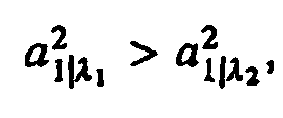
- S 2 ⁇ 1 - S 2 ⁇ 2 is positive definite, which means S 2 ⁇ 1 > S 2 ⁇ 2 .
Landscapes
- Engineering & Computer Science (AREA)
- Signal Processing (AREA)
- Computer Networks & Wireless Communication (AREA)
- Mobile Radio Communication Systems (AREA)
Abstract
Description
- This application claims priority from
U.S. Provisional Patent application Serial No. 60/574,191, filed May 25, 2004 - This invention relates generally to CDMA systems, and more specifically relates to a method for efficiently suppressing multiple access interferences (MAI), a major factor limiting the capacity of uplink MC-CDMA systems.
- The United States government may hold license and/or other rights in this invention as a result of financial support provided by governmental agencies in the development of aspects of the invention.
- The performance of CDMA systems is limited by multiple access interference (MAI). Among many interference cancellation schemes, successive interference cancellation (SIC) is highly desirable, due to its low complexity, high compatibility with existing systems and easy accommodation to strong error-correcting codes [A.J. Viterbi, "Very low rate convolutional codes for maximum theoretical performance of spread-spectrum multi-access channels," IEEE J. Select Areas Commun. Vol. 8, pp. 641-649, May 1990]. However, unlike other detection techniques, SIC is sensitive to received power allocation. By providing channel state information (CSI) at the receiver and reliable feedback of power allocation from the receiver to the transmitter, we are able to integrate SIC with power control (PC), which can improve system capacity significantly.
- For a system which aims to achieve comparable performance for all users, equal BER criterion is suitable for deriving the power allocation. As has been concluded in the literature, equal BER PC benefits SIC significantly by increasing the reliability of earlier detected users. Nevertheless, most of the work focused on (match filter) SIC (MF- SIC) [Viterbi op. cit.; G. Mazzini "Equal BER with successive interference cancellation DS-CDMA systems on AWGN and Ricean channels, "in Proc. ICCC PIMRC, July 1995, pp. 727-731; R. M. Buehrer, "Equal BER performance in linear successive interference cancellation for CDMA systems, " IEEE Trans. Commun., vol. 49, no. 7, pp 1250-1258, July 2001]. With the increase of system load, in CDMA systems, the performance of MF degrades quickly, limiting the effectiveness of SIC. Therefore, it is meaningful to integrate PC with SIC for more powerful detection techniques, such as decorrelating and MMSE. For a given decision order, MMSE SIC (MMSE-SIC) maximizes all users' SIRs simultaneously [T. Guess, "Optimal sequences for CDMA with decision-feedback receivers, " IEEE Trans. Commun., vol., 49, pp. 886-900, Apr. 2003]. Therefore, in this invention we consider the equal BER PC algorithm for this optimal SIC receiver in quasi- synchronous uplink MC-CDMA.
- Mizhou Tan et al: "Optimal power distribution control under different total power constraint strategies for multicode MC-CDMA with zero-forcing successive interference cancellation" discloses that multicode multi-carrier CDMA is a promising candidate for supporting multimedia services in future wireless communications.
- In accordance with an aspect of the invention, there is provided a method according to claim 1.
- In accordance with a second aspect of the invention, there is provided an apparatus according to
claim 4. - For a given decision order, MMSE successive interference cancellation (MMSE-SIC) can simultaneously maximize SIRs of all users [T. Guess Op. cit.]. To further increase its efficiency, a power control (PC) algorithm, under equal BER criterion, is used in this invention for uplink MC-CDMA. In frequency-selective Rayleigh fading channels, the MMSE-SIC integrated with the equal BER PC suppresses multiple access interference (MAI) effectively, resulting in a performance very close to the single user bound (SUB). In the present invention a method is thus disclosed for efficiently suppressing multiple access interference (MAI), a major factor limiting the capacity of uplink MC-CDMA systems. A novel power control algorithm is used under equal BER criterion for a nonlinear MMSE-SIC receiver.
- The invention is illustrated by way of example in the drawings appended hereto in which:
-
Figure 1 is a schematic block diagram of an MC-CDMA system in accordance with the invention, with MMSE receiver integrated with the equal BER PC; -
Figure 2 is a graph of BER performance, with different receiver structures, with and without PC, over 16 users versus the average EblN 0 per user; and -
Figure 3 is a graph of BER performance, with different receiver structures, with and without PC, over 16 users versus the average Eb /N 0 per user. - In
Figure 1 a block diagram of the MC-CDMA system with MMSE-SIC receiver integrated with the equal BER PC is schematically depicted. Referring to the Figure, the method comprises the following steps: - (a) Based on the channel state information (CSI) obtained at the receiver, the "Equal BER Power Control" block is employed to calculate the transmit power allocation of different users. A successive algorithm is used, which searches the transmit power of different users under Equal BER criterion with a total transmit power constraint (the "Multi-carrier Channel Model" represents a concatenation of IDFT, wireless fading channel and DFT).
- (b) With the assumption of slow fading channel, the calculated power allocation is fed back to the transmitter so that each user will transmit with the assigned power. (b denotes a vector including transmit symbols of all users.)
- (c) At the receiver, the non-linear MMSE-SIC receiver is employed. (The block diagram of
Figure 1 shows a standard operation of the non-linear MMSE-SIC receiver. The output of DFT x is first processed with a Matched-Filter Bank. Then, the output y is processed by a feedforward matrix F. After that, based on a certain decision order and output z, a "Hard Decision Device" is used to make decisions on certain transmit symbols with MMSE criterion and the earlier detected symbols b are fed back through a feedback matrix B to assist in detecting other symbols.) The equal BER power control ensures that different users achieve the same signal-to-interference (SIR) ratio after SIC, hence, significantly improving the performance of SIC and effectively suppressing MAI. - By properly defining the search district and with some well-known search algorithms, only a small number of searches are required for each channel realization. Therefore, this power control algorithm has a low complexity, particularly under a slow fading channel.
- Simulation results show that the MAI can be suppressed effectively, resulting in a performance very close to the theoretical limit MMSE-SIC Receiver for MC-CDMA.
- In quasi-synchronous uplink MC-CDMA, with total N sub-carriers and K active users, for the kth user, each transmit symbol is replicated into N copies and each copy is multiplied by a chip of a preassigned spreading code ck of length N (frequency domain spreading). After transforming by an N -point IDFT and parallel-to-serial (P/S) conversion, a cyclic prefix (CP) is inserted between successive OFDM symbols to avoid inter-symbol interference (ISI). Finally, after RF upconversion, the signal is transmitted through the channel [S. Hara and R. Prasad, "Overview of multicarrier CDMA," IEEE Commun. Mag., Vol. 35, no. 12, pp. 126-133, Dec. 1997].
- A frequency-selective Rayleigh fading channel is considered. However, with the use of CP, the channel can be considered frequency-nonselective over each sub-carrier [Z. Wang and G.B. Giannakis, "Wireless multicarrier communications where Fourier meets Shannon," IEEE Signal Processing Mag., pp. 29-48, May 2000]. We assume time-invariant during each OFDM symbol, hence, the channel for the kth user can be represented by an (N × 1) vector, h k = [h k,1, h k,2,···, h k,N ] T , where each element is a complex Gaussian random variable with unit variance. Furthermore, due to the proximity and partial overlap of signal spectra, correlated fading on different sub-carriers is considered. The correlation between two sub-carriers depends on their frequency spacing and the RMS channel delay spread τd [W.C. Jackes, Microwave Mobile Communications. New York: Wiley, 1974].
- After discarding the CP, the received signal is demodulated by an N - point DFT, and the output during the ith OFDM symbol interval can be expressed in a compact matrix form as

where C̃ = [h 1•c 1, h 2•c2, ..., h K •c K ] denotes the channel-modified spreading code matrix, with • representing element-wise multiplication; A = diag(a 1,a 2,..., aK ) is a diagonal matrix containing the received amplitudes of all users and b(i) = [b 1(i), b 2(i),···,bK (i)] T containing all parallel transmitted symbols, which are assumed BPSK modulated with normalized power; The (N × 1) white Gaussian noise vector η(i) has zero mean and covariance matrix σ2 I, where I is an (N × N) identity matrix.
After match filtering, we have
where R =C̃HC̃ is the channel-modified cross correlation matrix. The MMSE-SIC receiver is implemented using the Cholesky factorization (CF) of the positive definite matrix R m = R+σ2 A -2, which can be uniquely decomposed as R m =ΓHD2Γ, with Γ upper triangular and monic (having all ones along the diagonal) and

where η̂(i) is a (K × 1) vector with uncorrelated components, (Note that the extra term -D-2Γ-Hσ2A-1b(i) was included into η̂(i).) whose covariance matrix R η̂(i) = σ 2 D -2 [G. Ginis and J. Cioffi, "On the relationship between V-BLAST and the GDFE," IEEE Commun. Lett., vol. 5, pp. 364-366, Sept. 2001]. Since Γ is upper triangular and η̂(i) has uncorrelated components, b(i) can be recovered by back-substitution combined with symbol-by-symbol detection. The detection algorithm is as follows,


- From (snr), to achieve the same BER, for all users, we need


- An indoor Rayleigh fading channel model is employed for simulations, with 100MHz total bandwidth and τ d = 25ns. The sub-carrier number N is chosen to be 16. Orthogonal Walsh Hadamard codes are employed for spreading. For each user, the instantaneous channel is randomly chosen from an ensemble consisted of 1000 i.i.d. Rayleigh fading channels (assumed unchanged for 100 symbols).
- To emphasize the performance improvement with the proposed scheme, we compare in
Figure 2 the average BER performance, with different receiver structures, with and without PC, over 16 users versus the average Eb /N 0 per user. From this figure, we can see that the performance of MF (no SIC) ((a)) and MF-SIC with equal received power ((b)) are heavily limited by MAI, while MMSE (no SIC) ((d)) handles MAI much better than MF ((a) or (b)). Even with equal received power, employing SIC to MMSE ((e)) results in a significant performance improvement. Nevertheless, at a BER of 10-4, it is about 10dB worse than the SUB ((h), equation (6)). Integrating MMSE-SIC with the proposed equal BER PC ((f)), additional 8dB improvement can be obtained at a BER of 10-4, which is only less than 2dB worse than the SUB, and it significantly outperforms MF-SIC with the equal BER PC ((c)). Moreover, it is interesting to note that the performance difference between the simulation result with MMSE-SIC with the equal BER PC ((f)) and the LB ((g), equation (13)) is very small, especially at high Eb /N 0, which justifies the assumption of ignoring decision errors. -
Figure 3 shows the received power allocation (averaged over 1000 channels, σ-2 = 1) on 16 successive detected users. Not surprisingly, under different Eb /N 0, earlier detected users (larger index) are always allocated more power than the later detected ones (smaller index). - Under equal BER criterion, the PC algorithm disclosed for the MMSE-SIC receiver and its performance is thus analyzed and compared with other receiver strategies with and without PC in frequency-selective Rayleigh fading channels. From the results, we conclude that MMSE-SIC integrated with the equal BER PC is a powerful solution for suppressing MAI in uplink MC-CDMA systems.
- Proof of Property that:

with λ ∈ [σ2, +∞)
Proof: Clearly, when λ = σ2,






Claims (6)
- A method for efficiently suppressing multiple access interferences, MAI, in an uplink multi-carrier code division multiple access, MC-CDMA, system, the method comprising:integrating a nonlinear minimum mean square error - successive interference cancellation, MMSE-SIC, receiver in said system with an equal bit error rate power control BER PC to control the transmit power of different users on the uplink, wherein the integrating step comprises the steps of:the equal BER PC considering slow fading channels and a given decision order, for which, the MMSE-SIC receiver maximizes all users' signal-to-interference ratios, SIRs, simultaneously; andthe equal BER PC calculating, based on the channel state information, CSI, obtained at the receiver, the transmit power allocation of different users by use of a successive algorithm which searches the transmit power of different users under equal BER criterion with a total transmit power constraint.
- A method in accordance with claim 1 wherein the calculated power allocation is fed back to the transmitter so that each user will transmit with the assigned power.
- A method in accordance with claim 1 wherein the power allocation


where K is the number of active users; where σ 2 denotes the noise variance;
ri,j denotes the (i,j) th element of R, where R is the channel-modified cross correlation matrix;
γij denotes the (i,j) th element of r, which is obtained from the Cholesky factorization (CF) of the positive definite matrix Rm = R + σ 2 A -2, where A = diag(a 1. a 2,...,aK ) is a diagonal matrix containing the received amplitudes of all users;
the said CF enabling Rm to be uniquely decomposed to be Rm = Γ H D2Γ, where Γ is upper triangular and monic (having all ones along the diagonal) and D2 is diagonal with all positive elements and wherein the algorithm is implemented by the steps of:1) letting λ = σ2 ;2) applying Equation (A) to calculate 3) comparing the result with the power constraint P , and if smaller, increasing λ until finally
- An apparatus comprising:a receiver, said receiver comprising a nonlinear minimum mean square error - signal interference cancellation, MMSE-SIC, receiver and an equal bit-error rate, BER, power control calculator for calculating transmit power allocations for different users;said receiver configured to receive signals transmitted under an equal bit BER criterion and a power allocation that suppresses multiple access interference at least in part, wherein the BER power control calculator is configured to consider slow fading channels and a given decision order, for which, the MMSE-SIC receiver is configured to maximize all users' signal-to-interference ratios, SIRs, simultaneously; andwherein, the equal BER power control calculator is configured to utilize channel state information, CSI, obtained at the receiver to calculate the transmit power allocation of different users by use of a successive algorithm which searches the transmit power of different users under equal BER criterion with a total transmit power constraint.
- The apparatus of claim 4, wherein said receiver is incorporated into a multi-carrier CDMA communication system.
- The apparatus of claim 4, wherein said receiver is configured to determine power allocation successively across multiple users based at least in part on an estimate of covariance for one or more channels of said system.
Applications Claiming Priority (3)
| Application Number | Priority Date | Filing Date | Title |
|---|---|---|---|
| US57419104P | 2004-05-25 | 2004-05-25 | |
| US11/036,891 US7620096B2 (en) | 2004-05-25 | 2005-01-14 | Equal BER power control for uplink MC-CDMA with MMSE successive interference cancellation |
| PCT/US2005/003263 WO2005119938A2 (en) | 2004-05-25 | 2005-02-03 | Equal ber power control for uplink mc-cdma with mmse successive interference cancellation |
Publications (3)
| Publication Number | Publication Date |
|---|---|
| EP1749348A2 EP1749348A2 (en) | 2007-02-07 |
| EP1749348A4 EP1749348A4 (en) | 2010-06-02 |
| EP1749348B1 true EP1749348B1 (en) | 2012-06-13 |
Family
ID=35425137
Family Applications (1)
| Application Number | Title | Priority Date | Filing Date |
|---|---|---|---|
| EP05712636A Expired - Lifetime EP1749348B1 (en) | 2004-05-25 | 2005-02-03 | Equal ber power control for uplink mc-cdma with mmse successive interference cancellation |
Country Status (5)
| Country | Link |
|---|---|
| US (1) | US7620096B2 (en) |
| EP (1) | EP1749348B1 (en) |
| JP (1) | JP4741584B2 (en) |
| KR (1) | KR101053556B1 (en) |
| WO (1) | WO2005119938A2 (en) |
Families Citing this family (13)
| Publication number | Priority date | Publication date | Assignee | Title |
|---|---|---|---|---|
| GB2404822B (en) * | 2003-08-07 | 2007-07-11 | Ipwireless Inc | Method and arrangement for noise variance and sir estimation |
| US8670493B2 (en) | 2005-06-22 | 2014-03-11 | Eices Research, Inc. | Systems and/or methods of increased privacy wireless communications |
| US8660095B2 (en) * | 2005-07-21 | 2014-02-25 | Qualcomm Incorporated | Reverse link transmit power control in a wireless communication system |
| FR2905542A1 (en) * | 2006-09-06 | 2008-03-07 | France Telecom | SPREAD TRANSMISSION PROCESS WITH POWER ALLOCATION BY USER AND BY SYMBOL |
| KR101603338B1 (en) | 2008-08-11 | 2016-03-15 | 엘지전자 주식회사 | Method and apparatus of transmitting information in wireless communication system |
| KR101571566B1 (en) | 2008-08-11 | 2015-11-25 | 엘지전자 주식회사 | Method of transmitting control signal in wireless communication system |
| KR20100019947A (en) | 2008-08-11 | 2010-02-19 | 엘지전자 주식회사 | Method of transmitting information in wireless communication system |
| KR101597573B1 (en) * | 2008-08-11 | 2016-02-25 | 엘지전자 주식회사 | Uplink transmission method of control information |
| JP5613894B2 (en) * | 2008-08-11 | 2014-10-29 | 日本電産サンキョー株式会社 | Non-contact IC card reader and data reading method |
| KR101243508B1 (en) * | 2008-11-14 | 2013-03-20 | 엘지전자 주식회사 | Method and apparatus for signal transmission in wireless communication system |
| WO2010056078A2 (en) | 2008-11-14 | 2010-05-20 | 엘지전자주식회사 | Method and apparatus for information transmission in wireless communication system |
| KR20100091876A (en) | 2009-02-11 | 2010-08-19 | 엘지전자 주식회사 | Ue behavior for multi-antenna transmission |
| US9838227B2 (en) * | 2013-04-09 | 2017-12-05 | Interdigital Patent Holdings, Inc. | Joint precoding and multivariate backhaul compression for the downlink of cloud radio access networks |
Family Cites Families (14)
| Publication number | Priority date | Publication date | Assignee | Title |
|---|---|---|---|---|
| US6539213B1 (en) * | 1999-06-14 | 2003-03-25 | Time Domain Corporation | System and method for impulse radio power control |
| US7068628B2 (en) * | 2000-05-22 | 2006-06-27 | At&T Corp. | MIMO OFDM system |
| WO2003055068A1 (en) * | 2001-12-21 | 2003-07-03 | Nokia Corporation | A method for signal estimation in a receiver |
| DE60206873T2 (en) * | 2002-02-14 | 2006-06-14 | Lucent Technologies Inc | Receiver and method for multiple input and multiple output iterative detection by feedback of soft decisions |
| US7076263B2 (en) * | 2002-02-19 | 2006-07-11 | Qualcomm, Incorporated | Power control for partial channel-state information (CSI) multiple-input, multiple-output (MIMO) systems |
| KR100754721B1 (en) * | 2002-04-26 | 2007-09-03 | 삼성전자주식회사 | Multiplexed Data Transceiver and Method in Orthogonal Frequency Division Multiplexed Communication System |
| EP1359700A1 (en) * | 2002-05-02 | 2003-11-05 | Mitsubishi Electric Information Technology Centre Europe B.V. | MC-CDMA receiver with an equalisation per subcarrier |
| US8194770B2 (en) * | 2002-08-27 | 2012-06-05 | Qualcomm Incorporated | Coded MIMO systems with selective channel inversion applied per eigenmode |
| KR100703263B1 (en) * | 2003-12-02 | 2007-04-03 | 삼성전자주식회사 | Apparatus and method for removing interference signal in mobile communication system using multiple antennas |
| US20050136844A1 (en) * | 2003-12-09 | 2005-06-23 | Giesberts Pieter-Paul S. | Method and apparatus for automatic data rate control using channel correlation in a wireless communication system |
| KR100587417B1 (en) * | 2003-12-22 | 2006-06-08 | 한국전자통신연구원 | Adaptive Transceiver and its Method in Wireless Communication Systems Using Frequency Division Multiplexing |
| KR100605861B1 (en) * | 2004-02-02 | 2006-08-01 | 삼성전자주식회사 | Signal Receiving Device and Method of Communication System Using Multiple Input Multiple Output Method |
| US7463672B2 (en) * | 2004-03-16 | 2008-12-09 | Peter Monsen | Technique for adaptive multiuser equalization in code division multiple access systems |
| US20050249298A1 (en) * | 2004-04-28 | 2005-11-10 | Taeyoon Kim | Multi-code multi-carrier code division multiple access (CDMA) system and method |
-
2005
- 2005-01-14 US US11/036,891 patent/US7620096B2/en active Active
- 2005-02-03 KR KR1020067027252A patent/KR101053556B1/en not_active Expired - Fee Related
- 2005-02-03 EP EP05712636A patent/EP1749348B1/en not_active Expired - Lifetime
- 2005-02-03 WO PCT/US2005/003263 patent/WO2005119938A2/en not_active Ceased
- 2005-02-03 JP JP2007515049A patent/JP4741584B2/en not_active Expired - Fee Related
Also Published As
| Publication number | Publication date |
|---|---|
| US20050265291A1 (en) | 2005-12-01 |
| US7620096B2 (en) | 2009-11-17 |
| EP1749348A2 (en) | 2007-02-07 |
| WO2005119938A2 (en) | 2005-12-15 |
| EP1749348A4 (en) | 2010-06-02 |
| KR20070023774A (en) | 2007-02-28 |
| JP2008500770A (en) | 2008-01-10 |
| WO2005119938A3 (en) | 2006-08-31 |
| JP4741584B2 (en) | 2011-08-03 |
| KR101053556B1 (en) | 2011-08-04 |
Similar Documents
| Publication | Publication Date | Title |
|---|---|---|
| US8705641B2 (en) | Orthogonal frequency division multiplexing-code division multiple access system | |
| US7620096B2 (en) | Equal BER power control for uplink MC-CDMA with MMSE successive interference cancellation | |
| KR20050013611A (en) | Mt-cdma using spreading codes with interference-free windows | |
| Thippavajjula et al. | Parallel interference cancellation techniques for synchronous carrier interferometry/MC-CDMA uplink [4G cellular systems] | |
| US7583766B2 (en) | System, and associated method, for utilizing block BLAST with PPIC in a MIMO multicode MC-CDMA system | |
| Yi et al. | Transmitter precoding in downlink MC–CDMA systems over frequency-selective Rayleigh fading channels | |
| Kalofonos et al. | Performance of the multi-stage detector for a MC-CDMA system in a Rayleigh fading channel | |
| Tan et al. | Equal BER power control for uplink MC-CDMA with MMSE successive interference cancellation | |
| JP4284037B2 (en) | Multi-user detection method and receiver | |
| Dinis et al. | An iterative frequency-domain decision-feedback receiver for MC-CDMA schemes | |
| Kunnari et al. | Performance analysis of multirate MC-CDMA in Rayleigh-fading channels with delay power spectrum exceeding the guard interval | |
| Li et al. | Error probability of interleaved MC-CDMA systems with MRC receiver and correlated Nakagami-m fading channels | |
| Pan et al. | Time—frequency iterative multiuser detection in time—frequency‐domain spread multicarrier DS‐CDMA systems over Nakagami‐m fading channels | |
| Li et al. | Multicarrier CDMA system with parallel interference cancellation in fading channels | |
| Silva et al. | Transmit space-frequency prefiltering technique for downlink TDD MC-CDMA systems | |
| Tan et al. | Equal BER power distribution control for multicode MC-CDMA with MMSE successive interference cancellation | |
| Kusumawardhani et al. | Performance Analysis of Multiple Input Multiple Output (MIMO) Multi-Carrier Code-Division Multiple Access (MC-CDMA) Combined with Quasi-Orthogonal Space Time Block Coding (QO-STBC) in Rayleigh Fading Channel | |
| McCormick et al. | A differential phase-shift keying multicarrier code division multiple access system with an equal gain combining receiver | |
| CN101002395A (en) | Equal BER power control for uplink MC-CDMA with mmse successive interference cancellation | |
| Vasudevan et al. | An Identical Code–Data Based Nonorthogonal Multiple Access | |
| Doukopoulos et al. | Impact of the intercell interference in DL MC-CDMA systems | |
| Tabatabaee et al. | Joint Transmitter-Receiver Code Design for Spread-FBMC/OQAM | |
| Tan et al. | Optimal power distribution control under different total power constraint strategies for multicode MC-CDMA with zero-forcing successive interference cancellation | |
| Shono et al. | Inter-code interference and optimum spreading sequence in frequency-selective Rayleigh fading channels on uplink MC-CDMA | |
| Tan et al. | Optimal power distribution control for multicode MC-CDMA with zero-forcing successive interference cancellation |
Legal Events
| Date | Code | Title | Description |
|---|---|---|---|
| PUAI | Public reference made under article 153(3) epc to a published international application that has entered the european phase |
Free format text: ORIGINAL CODE: 0009012 |
|
| 17P | Request for examination filed |
Effective date: 20061124 |
|
| AK | Designated contracting states |
Kind code of ref document: A2 Designated state(s): AT BE BG CH CY CZ DE DK EE ES FI FR GB GR HU IE IS IT LI LT LU MC NL PL PT RO SE SI SK TR |
|
| AX | Request for extension of the european patent |
Extension state: AL BA HR LV MK YU |
|
| DAX | Request for extension of the european patent (deleted) | ||
| RIN1 | Information on inventor provided before grant (corrected) |
Inventor name: TAN, MIZHOU Inventor name: BAR-NESS, YEHESKEL |
|
| A4 | Supplementary search report drawn up and despatched |
Effective date: 20100429 |
|
| 17Q | First examination report despatched |
Effective date: 20110121 |
|
| REG | Reference to a national code |
Ref country code: DE Ref legal event code: R079 Ref document number: 602005034662 Country of ref document: DE Free format text: PREVIOUS MAIN CLASS: H04B0001690000 Ipc: H04B0001710700 |
|
| RIC1 | Information provided on ipc code assigned before grant |
Ipc: H04L 5/02 20060101ALI20110831BHEP Ipc: H04W 52/20 20090101ALI20110831BHEP Ipc: H04B 1/7107 20110101AFI20110831BHEP |
|
| GRAP | Despatch of communication of intention to grant a patent |
Free format text: ORIGINAL CODE: EPIDOSNIGR1 |
|
| GRAS | Grant fee paid |
Free format text: ORIGINAL CODE: EPIDOSNIGR3 |
|
| GRAA | (expected) grant |
Free format text: ORIGINAL CODE: 0009210 |
|
| AK | Designated contracting states |
Kind code of ref document: B1 Designated state(s): AT BE BG CH CY CZ DE DK EE ES FI FR GB GR HU IE IS IT LI LT LU MC NL PL PT RO SE SI SK TR |
|
| REG | Reference to a national code |
Ref country code: GB Ref legal event code: FG4D |
|
| REG | Reference to a national code |
Ref country code: CH Ref legal event code: EP Ref country code: AT Ref legal event code: REF Ref document number: 562380 Country of ref document: AT Kind code of ref document: T Effective date: 20120615 |
|
| REG | Reference to a national code |
Ref country code: IE Ref legal event code: FG4D |
|
| REG | Reference to a national code |
Ref country code: DE Ref legal event code: R096 Ref document number: 602005034662 Country of ref document: DE Effective date: 20120816 |
|
| REG | Reference to a national code |
Ref country code: NL Ref legal event code: VDEP Effective date: 20120613 |
|
| PG25 | Lapsed in a contracting state [announced via postgrant information from national office to epo] |
Ref country code: FI Free format text: LAPSE BECAUSE OF FAILURE TO SUBMIT A TRANSLATION OF THE DESCRIPTION OR TO PAY THE FEE WITHIN THE PRESCRIBED TIME-LIMIT Effective date: 20120613 Ref country code: CY Free format text: LAPSE BECAUSE OF FAILURE TO SUBMIT A TRANSLATION OF THE DESCRIPTION OR TO PAY THE FEE WITHIN THE PRESCRIBED TIME-LIMIT Effective date: 20120613 Ref country code: SE Free format text: LAPSE BECAUSE OF FAILURE TO SUBMIT A TRANSLATION OF THE DESCRIPTION OR TO PAY THE FEE WITHIN THE PRESCRIBED TIME-LIMIT Effective date: 20120613 Ref country code: LT Free format text: LAPSE BECAUSE OF FAILURE TO SUBMIT A TRANSLATION OF THE DESCRIPTION OR TO PAY THE FEE WITHIN THE PRESCRIBED TIME-LIMIT Effective date: 20120613 |
|
| REG | Reference to a national code |
Ref country code: AT Ref legal event code: MK05 Ref document number: 562380 Country of ref document: AT Kind code of ref document: T Effective date: 20120613 |
|
| REG | Reference to a national code |
Ref country code: LT Ref legal event code: MG4D Effective date: 20120613 |
|
| PG25 | Lapsed in a contracting state [announced via postgrant information from national office to epo] |
Ref country code: SI Free format text: LAPSE BECAUSE OF FAILURE TO SUBMIT A TRANSLATION OF THE DESCRIPTION OR TO PAY THE FEE WITHIN THE PRESCRIBED TIME-LIMIT Effective date: 20120613 Ref country code: GR Free format text: LAPSE BECAUSE OF FAILURE TO SUBMIT A TRANSLATION OF THE DESCRIPTION OR TO PAY THE FEE WITHIN THE PRESCRIBED TIME-LIMIT Effective date: 20120914 |
|
| PG25 | Lapsed in a contracting state [announced via postgrant information from national office to epo] |
Ref country code: EE Free format text: LAPSE BECAUSE OF FAILURE TO SUBMIT A TRANSLATION OF THE DESCRIPTION OR TO PAY THE FEE WITHIN THE PRESCRIBED TIME-LIMIT Effective date: 20120613 Ref country code: BE Free format text: LAPSE BECAUSE OF FAILURE TO SUBMIT A TRANSLATION OF THE DESCRIPTION OR TO PAY THE FEE WITHIN THE PRESCRIBED TIME-LIMIT Effective date: 20120613 Ref country code: RO Free format text: LAPSE BECAUSE OF FAILURE TO SUBMIT A TRANSLATION OF THE DESCRIPTION OR TO PAY THE FEE WITHIN THE PRESCRIBED TIME-LIMIT Effective date: 20120613 Ref country code: IS Free format text: LAPSE BECAUSE OF FAILURE TO SUBMIT A TRANSLATION OF THE DESCRIPTION OR TO PAY THE FEE WITHIN THE PRESCRIBED TIME-LIMIT Effective date: 20121013 Ref country code: SK Free format text: LAPSE BECAUSE OF FAILURE TO SUBMIT A TRANSLATION OF THE DESCRIPTION OR TO PAY THE FEE WITHIN THE PRESCRIBED TIME-LIMIT Effective date: 20120613 Ref country code: CZ Free format text: LAPSE BECAUSE OF FAILURE TO SUBMIT A TRANSLATION OF THE DESCRIPTION OR TO PAY THE FEE WITHIN THE PRESCRIBED TIME-LIMIT Effective date: 20120613 Ref country code: AT Free format text: LAPSE BECAUSE OF FAILURE TO SUBMIT A TRANSLATION OF THE DESCRIPTION OR TO PAY THE FEE WITHIN THE PRESCRIBED TIME-LIMIT Effective date: 20120613 |
|
| PG25 | Lapsed in a contracting state [announced via postgrant information from national office to epo] |
Ref country code: PL Free format text: LAPSE BECAUSE OF FAILURE TO SUBMIT A TRANSLATION OF THE DESCRIPTION OR TO PAY THE FEE WITHIN THE PRESCRIBED TIME-LIMIT Effective date: 20120613 Ref country code: IT Free format text: LAPSE BECAUSE OF FAILURE TO SUBMIT A TRANSLATION OF THE DESCRIPTION OR TO PAY THE FEE WITHIN THE PRESCRIBED TIME-LIMIT Effective date: 20120613 Ref country code: PT Free format text: LAPSE BECAUSE OF FAILURE TO SUBMIT A TRANSLATION OF THE DESCRIPTION OR TO PAY THE FEE WITHIN THE PRESCRIBED TIME-LIMIT Effective date: 20121015 |
|
| PG25 | Lapsed in a contracting state [announced via postgrant information from national office to epo] |
Ref country code: NL Free format text: LAPSE BECAUSE OF FAILURE TO SUBMIT A TRANSLATION OF THE DESCRIPTION OR TO PAY THE FEE WITHIN THE PRESCRIBED TIME-LIMIT Effective date: 20120613 |
|
| PLBE | No opposition filed within time limit |
Free format text: ORIGINAL CODE: 0009261 |
|
| STAA | Information on the status of an ep patent application or granted ep patent |
Free format text: STATUS: NO OPPOSITION FILED WITHIN TIME LIMIT |
|
| PG25 | Lapsed in a contracting state [announced via postgrant information from national office to epo] |
Ref country code: ES Free format text: LAPSE BECAUSE OF FAILURE TO SUBMIT A TRANSLATION OF THE DESCRIPTION OR TO PAY THE FEE WITHIN THE PRESCRIBED TIME-LIMIT Effective date: 20120924 Ref country code: DK Free format text: LAPSE BECAUSE OF FAILURE TO SUBMIT A TRANSLATION OF THE DESCRIPTION OR TO PAY THE FEE WITHIN THE PRESCRIBED TIME-LIMIT Effective date: 20120613 |
|
| 26N | No opposition filed |
Effective date: 20130314 |
|
| REG | Reference to a national code |
Ref country code: DE Ref legal event code: R097 Ref document number: 602005034662 Country of ref document: DE Effective date: 20130314 |
|
| PG25 | Lapsed in a contracting state [announced via postgrant information from national office to epo] |
Ref country code: BG Free format text: LAPSE BECAUSE OF FAILURE TO SUBMIT A TRANSLATION OF THE DESCRIPTION OR TO PAY THE FEE WITHIN THE PRESCRIBED TIME-LIMIT Effective date: 20120913 |
|
| PG25 | Lapsed in a contracting state [announced via postgrant information from national office to epo] |
Ref country code: MC Free format text: LAPSE BECAUSE OF NON-PAYMENT OF DUE FEES Effective date: 20130228 |
|
| REG | Reference to a national code |
Ref country code: CH Ref legal event code: PL |
|
| PG25 | Lapsed in a contracting state [announced via postgrant information from national office to epo] |
Ref country code: CH Free format text: LAPSE BECAUSE OF NON-PAYMENT OF DUE FEES Effective date: 20130228 Ref country code: LI Free format text: LAPSE BECAUSE OF NON-PAYMENT OF DUE FEES Effective date: 20130228 |
|
| REG | Reference to a national code |
Ref country code: IE Ref legal event code: MM4A |
|
| PG25 | Lapsed in a contracting state [announced via postgrant information from national office to epo] |
Ref country code: IE Free format text: LAPSE BECAUSE OF NON-PAYMENT OF DUE FEES Effective date: 20130203 |
|
| PG25 | Lapsed in a contracting state [announced via postgrant information from national office to epo] |
Ref country code: TR Free format text: LAPSE BECAUSE OF FAILURE TO SUBMIT A TRANSLATION OF THE DESCRIPTION OR TO PAY THE FEE WITHIN THE PRESCRIBED TIME-LIMIT Effective date: 20120613 |
|
| PG25 | Lapsed in a contracting state [announced via postgrant information from national office to epo] |
Ref country code: HU Free format text: LAPSE BECAUSE OF FAILURE TO SUBMIT A TRANSLATION OF THE DESCRIPTION OR TO PAY THE FEE WITHIN THE PRESCRIBED TIME-LIMIT; INVALID AB INITIO Effective date: 20050203 Ref country code: LU Free format text: LAPSE BECAUSE OF NON-PAYMENT OF DUE FEES Effective date: 20130203 |
|
| REG | Reference to a national code |
Ref country code: FR Ref legal event code: PLFP Year of fee payment: 12 |
|
| REG | Reference to a national code |
Ref country code: FR Ref legal event code: PLFP Year of fee payment: 13 |
|
| REG | Reference to a national code |
Ref country code: FR Ref legal event code: PLFP Year of fee payment: 14 |
|
| PGFP | Annual fee paid to national office [announced via postgrant information from national office to epo] |
Ref country code: FR Payment date: 20210120 Year of fee payment: 17 |
|
| PGFP | Annual fee paid to national office [announced via postgrant information from national office to epo] |
Ref country code: GB Payment date: 20210129 Year of fee payment: 17 Ref country code: DE Payment date: 20210113 Year of fee payment: 17 |
|
| REG | Reference to a national code |
Ref country code: DE Ref legal event code: R119 Ref document number: 602005034662 Country of ref document: DE |
|
| GBPC | Gb: european patent ceased through non-payment of renewal fee |
Effective date: 20220203 |
|
| PG25 | Lapsed in a contracting state [announced via postgrant information from national office to epo] |
Ref country code: FR Free format text: LAPSE BECAUSE OF NON-PAYMENT OF DUE FEES Effective date: 20220228 |
|
| PG25 | Lapsed in a contracting state [announced via postgrant information from national office to epo] |
Ref country code: GB Free format text: LAPSE BECAUSE OF NON-PAYMENT OF DUE FEES Effective date: 20220203 Ref country code: DE Free format text: LAPSE BECAUSE OF NON-PAYMENT OF DUE FEES Effective date: 20220901 |