EP1748666A1 - Method of identifying a radio link - Google Patents
Method of identifying a radio link Download PDFInfo
- Publication number
- EP1748666A1 EP1748666A1 EP05291618A EP05291618A EP1748666A1 EP 1748666 A1 EP1748666 A1 EP 1748666A1 EP 05291618 A EP05291618 A EP 05291618A EP 05291618 A EP05291618 A EP 05291618A EP 1748666 A1 EP1748666 A1 EP 1748666A1
- Authority
- EP
- European Patent Office
- Prior art keywords
- qos parameters
- radio link
- metric
- values
- parameters
- Prior art date
- Legal status (The legal status is an assumption and is not a legal conclusion. Google has not performed a legal analysis and makes no representation as to the accuracy of the status listed.)
- Withdrawn
Links
- 238000000034 method Methods 0.000 title claims abstract description 30
- 238000004891 communication Methods 0.000 claims abstract description 42
- 238000005516 engineering process Methods 0.000 claims abstract description 9
- 238000004590 computer program Methods 0.000 claims description 11
- 230000006870 function Effects 0.000 claims description 9
- 238000013507 mapping Methods 0.000 claims description 6
- 238000007620 mathematical function Methods 0.000 claims description 3
- 102000020897 Formins Human genes 0.000 claims description 2
- 108091022623 Formins Proteins 0.000 claims description 2
- 238000004364 calculation method Methods 0.000 description 6
- 238000007726 management method Methods 0.000 description 5
- 230000008901 benefit Effects 0.000 description 4
- 238000004422 calculation algorithm Methods 0.000 description 4
- 238000005259 measurement Methods 0.000 description 4
- 230000011664 signaling Effects 0.000 description 4
- 238000013459 approach Methods 0.000 description 3
- 238000013442 quality metrics Methods 0.000 description 3
- 230000005540 biological transmission Effects 0.000 description 2
- 239000000835 fiber Substances 0.000 description 2
- 238000010295 mobile communication Methods 0.000 description 2
- 230000003287 optical effect Effects 0.000 description 2
- 230000008569 process Effects 0.000 description 2
- 230000001131 transforming effect Effects 0.000 description 2
- 230000003466 anti-cipated effect Effects 0.000 description 1
- 230000001413 cellular effect Effects 0.000 description 1
- 230000008859 change Effects 0.000 description 1
- 230000001419 dependent effect Effects 0.000 description 1
- 238000001514 detection method Methods 0.000 description 1
- 230000006872 improvement Effects 0.000 description 1
- 238000003780 insertion Methods 0.000 description 1
- 230000037431 insertion Effects 0.000 description 1
- 239000011159 matrix material Substances 0.000 description 1
- 238000005457 optimization Methods 0.000 description 1
Images


Classifications
-
- H—ELECTRICITY
- H04—ELECTRIC COMMUNICATION TECHNIQUE
- H04W—WIRELESS COMMUNICATION NETWORKS
- H04W48/00—Access restriction; Network selection; Access point selection
- H04W48/18—Selecting a network or a communication service
-
- H—ELECTRICITY
- H04—ELECTRIC COMMUNICATION TECHNIQUE
- H04W—WIRELESS COMMUNICATION NETWORKS
- H04W28/00—Network traffic management; Network resource management
- H04W28/16—Central resource management; Negotiation of resources or communication parameters, e.g. negotiating bandwidth or QoS [Quality of Service]
- H04W28/24—Negotiating SLA [Service Level Agreement]; Negotiating QoS [Quality of Service]
Definitions
- the invention relates to a method of identifying a radio link, whereby the invention can be used in heterogeneous networks.
- terminals may access a multitude of telecommunication systems using a multitude of radio access technologies (RATs).
- RATs radio access technologies
- the invention provides a method and a corresponding computer program product with which the best radio link can be identified for the application the terminal is expected to provide.
- the computer program product can be part of a terminal device or of a telecommunication communication system, in particular a wireless communication system.
- UMTS universal mobile telecommunications system
- WLAN wideband local area network
- the desired application determines the RAT. If, for example, a high data rate is desired, e.g. for downloading music or a video file, WLAN is preferably used. If however, the user is interested in video telephony, UMTS is a good choice.
- Providing the best radio link for an application requires in many cases vertical handovers, i.e. handovers from a communication system operating with a first RAT to a communication system operating with a second RAT.
- each RAT has its own QoS specifications as it has different modulation scheme and access schemes.
- a signal-to-noise-interference (SNI) ratio measured in a system using a first RAT e.g. in a CDMA system
- SNI signal-to-noise-interference
- EP 1 418 782 A1 relates to a QoS based traffic load management method in a mobile communication network having multiple radio access technologies (RAT).
- RAT radio access technologies
- each radio network controller RNC or BSC calculates Cell QoS indicators for each service or a group of services or the whole services. The indicators are exchanged over existing interfaces.
- the range of each Cell QoS indicator encompasses a number INTEGER [1...N] ranging from a minimum to a maximum.
- RNCs or BSCs check the Cell QoS indicators to have indications for issuing or preventing handovers or cell reselection commands towards neighboring domains of the same or different RATs.
- US 2005/0159166 relates to a communication between a radio network and a wireless subscriber unit over a radio link.
- a method described therein determines at least a first desired QoS parameter and a first actual QoS parameter.
- a modulation and coding scheme for transmitting information over the radio link is selected or adjusted based on whether the first desired QoS parameter and the first actual QoS parameter are within an acceptable range or an acceptable relationship.
- the underlying principle of the invention is to use generic QoS parameters, which means RAT-independent parameters, to characterize the quality of a radio link.
- the generic QoS parameters may thus be used by systems using arbitrary RATs such as GSM, UMTS, WiMAX, WLAN, Bluetooth etc.
- Each radio link is characterized by a set of such generic QoS parameters.
- the radio links might be associated with the same RAT. An example would be a situation in which a mobile terminal has access to different base stations belonging to the same communication system and using the same RAT such as UMTS. In the alternative the radio links may be associated with different RATs such as UMTS, WLAN, WiMAX etc.
- Each generic QoS parameter is suitable to quantify at least an aspect of the quality of service of a radio link.
- the set of generic QoS parameters then serve to characterize the overall radio link quality.
- the generic QoS parameters may be identical to the QoS parameters known from UMTS or WLAN and may especially include:
- Table 1 A more comprehensive list of QoS parameters are listed in Table 1 for the case of UMTS systems. These are the radio access bearer attributes as defined in 3GPP document TS 23.107 V.6.1.0 and TS 25.413 V.6.0.0. Table 2 shows the QoS parameters for WLAN systems according to IEEE802.11e.
- the QoS parameters may differ from the QoS parameters known from UMTS in order to take considerations of other RATs into account.
- This modified set of generic QoS parameters may be agreed upon in a standardization process.
- QoS parameters will always be generic QoS parameters unless otherwise indicated.
- n is an integer. This determination can be done by a terminal device and/or by a wireless communication system as will be described below in more detail.
- a metric shall be understood to be a mathematical function having the multitude of QoS parameters as variables, whereby the metric calculates a value having a reduced number of variables.
- the output of the metric may be a matrix, a vector, or a scalar value.
- the value of the metric is calculated for each of the n ⁇ 2 radio links.
- the values obtained with the metric define the overall quality of service of each of the n ⁇ 2 radio links, such that the calculation serves to acquire values with which the overall radio link quality can be compared in an objective way.
- Quantifying the quality of a radio link by means of the values of the metric then makes it possible to identify one of the n ⁇ 2 radio links in a third step as being the radio link offering the best overall quality of service. Consequently, the identified radio link is called the "best radio link".
- the third step thus consists of a simple comparison of the n ⁇ 2 values obtained in the second step.
- the use of the metric provides the advantage that it is possible to identify the best radio link for a terminal device. This is the basis for handover decisions in heterogeneous networks as it facilitates a handover to the best cell. As it will be described below in more detail it is also possible to choose a metric to identify the best radio link for a particular application running on the terminal device. As an example, it is possible to identify the best radio link for video streaming or video telephony. This is however the primary interest of a user which can thus be satisfied more easily.
- the metric to identify the "best radio link" is extended to include QoS parameter on the consumption of system resources, so that more efficient radio links, e.g. with a higher bit rate per bandwidth for the particular application, are preferred.
- determining generic QoS parameters There are quite a few possibilities of determining generic QoS parameters.
- One possibility is to measure and/or estimate QoS parameters which are specific for a particular RAT and to map or transform them into generic QoS parameters.
- UMTS-specific QoS parameters may be mapped into generic QoS parameters. This means that existing algorithms for determining RAT-specific QoS parameters can still be used, and that only an additional piece of software is necessary to map the RAT-specific QoS parameters into generic QoS parameters.
- the mapping comprises information which is specific to only one single RAT, and is thus fully within the scope of OSI layer 2.
- a second possibility of determining generic QoS parameters is to measure and/or estimate them directly. This is useful for a communication system offering services with several RATs.
- the computer program for the determination of the QoS parameters is simplified as only a single algorithm is necessary instead of a multitude of algorithms for each RAT.
- Another possibility of determining generic QoS parameters consists in receiving them. If it is the terminal device which determines the QoS parameters it may receive further generic QoS parameters from the communication system. In the alternative the mobile terminal may receive further RAT-specific QoS parameters from the communication system for mapping or transforming them into generic QoS parameters.
- the reception of parameters by the terminal is advantageous when specific or generic QoS parameters can't be determined by the terminal device itself, for example statistical data on medium usage.
- the received QoS parameters may be parameters from system information data bases which also contribute to the quality of service such as
- the communication system may receive further generic QoS parameters from the terminal device.
- the communication system may receive further RAT-specific QoS parameters from the terminal device for mapping or transforming them into generic QoS parameters.
- QoS parameters to be received by the communication system may be
- the mathematical representation might be an intermediate value which can be inserted into the metric to calculate the radio link quality. The exact nature of this intermediate value depends strongly on the metric which is used.
- the communication system may determine 15 generic QoS parameters and may send an intermediate value representing these 15 parameters.
- the terminal device determines 10 generic QoS parameters itself, and uses them together with the intermediate value to calculate the value of the metric.
- this approach is possible when the metric consists of the product of all QoS parameters.
- the mathematical representation is the product of the above-mentioned 15 QoS parameters. This product is then multiplied with the 10 QoS parameters determined by the terminal device. This approach has the advantage to reduce the signalling load.
- the communication system After determining QoS parameters they are used for calculating a value of the metric. This may basically be done by an arbitrary combination of determined QoS parameters. If the communication system carries out the calculation, it may calculate the metric with generic QoS parameters received from the terminal device and with generic QoS parameters determined by itself. Correspondingly, if the terminal device carries out the calculation, it may calculate the metric with generic QoS parameters received from the communication system and generic QoS parameters determined by the terminal device.
- the values of the metric are scalar values. In this case comparing the quality of different radio links is particularly easy. As an example, a large value of the metric might indicate a link with good overall quality of service for an application, whereas a low value would indicate a link with bad overall quality of service.
- the metric is a configurable metric.
- Configurable means that parameters, namely parameters of the metric which are not QoS parameters, can be adjusted such that the terminal device or the communication system may adapt the metric to the specific situation, e.g. to the type of the application or to the operator policy.
- the configuration may be used to adjust the metric to a situation with limited availability of the QoS parameters, e.g. to calculate the metric results using only the QoS parameters it is able to determine but not those it would need to receive.
- a configurable metric has the advantage of reducing the signalling between the terminal device and the communication system. The reason is that the configurable metric allows identifying radio links showing an unacceptably low radio link quality.
- the QoS parameters determined by a terminal device may indicate clearly that the radio link is unsuitable for internet browsing because the data rate is too low. In such a case the QoS parameters of these radio links are not transmitted to the communication system or the terminal device respectively as further calculations are unnecessary. This reduces the overhead by avoiding a transmission of QoS parameters, or mathematical representations of them, which will not be used for a future access anyway.
- the method includes the step of calculating a value of a metric for a multitude of radio links, and of creating a quality ranking of the multitude of radio links on the basis of their values of the metric.
- This quality ranking can be used for handover decisions to identify the radio links which offer a better quality of service as the current serving radio link. This can be used to decrease signalling even further as a transmission of QoS parameters over the air interface becomes only necessary when they indicate that the ranking might have changed.
- the quality ranking itself can be transmitted from the communication system to the terminal device or vice versa.
- the metric is calculated according to the formula ⁇ i Q ⁇ o ⁇ S determined i Q ⁇ o ⁇ S application i a i QoS determined ( i ) are the determined QoS parameters as explained above.
- QoS application (i) are the corresponding QoS parameters as requested by an application running on the terminal device.
- i is an integer ranging from 1 to N, whereby N is the number of determined QoS parameters.
- a i are weighting factors.
- QoS application ( i ) are maximum allowed values or minimum allowed values of generic QoS parameters for a particular application. Examples for a conversational application would be
- the metric becomes a configurable metric, with which the metric can be adapted to the specific application running on the terminal device.
- the reason is that each application requires a specific set of QoS parameters.
- a MAC layer delay will have a higher weighting for a real-time application than for a background service.
- the corresponding exponent a i might be set to one or even to zero.
- the weighting factors thus allow the determination of an application-specific link quality, and thus of a link quality measure which is specifically tailored to the demand of the user or to the operator. It might however be necessary to find a certain compromise value for these weighting factors in the case that the user uses different applications at the same time.
- the calculation of the quality metric as disclosed above may yield unreasonable values in those cases in which one of the QoS parameters has an unacceptably low value, e.g. a value which is below a predefined threshold value.
- This can be compensated by complementing the metric with a clipping function, whereby the QoS component having this unacceptably low value is clipped to zero. This can be done by operating a clip function on some or all of the QoS ratios in the metric.
- This approach sets the whole metric to zero, such that this radio link will be disregarded in the quality ranking mentioned above. This avoids that a low measurement value of a first QoS parameter can be compensated by a high measurement value of a less important second QoS parameter.
- an over-provisioning of the QoS parameter may be clipped to a maximum value in the metric.
- a QoS parameter in the metric shall not regard to have a value which is higher than the requested value.
- An example would be a radio link offering a data rate of 54 MBit per seconds for a video streaming which requires only 384 kBit/s.
- the corresponding value of QoS determined ( i ) is set to 384 kBit/s for all those values which are larger than 384 kBit/s.
- this clipping function can be done by the terminal device as well as by the communication system.
- the weighting factors a i are updated from time to time and transmitted from the communication system to the terminal. This takes into account that the weighting factors will in most cases be operator-specific and subject to his policy, and may be changed from time to time to reflect changes of this policy. In such a case the determination of the parameters of the n ⁇ 2 radio links may be carried out by the terminal device which calculates the values of the metric after having received the weighting factors a i from the communication system.
- the terminal device transmits a trigger to the communication system if the serving radio link is not the best radio link.
- the best radio link, or a radio link which is better than the serving radio link according to the quality ranking can be selected as a future serving radio link for a handover.
- This is especially useful when the handover decision is network based but shall for load reasons be decided not after each measurement but only in case of relevant events. Only when the terminal detects (by the use of its configured metric) such an event, it transmits a trigger signal to the network decision function.
- This trigger may include all or selected measured QoS parameter and a proposed handover target. The network then takes the final decision on the target link and on the proper timing for carrying out a handover.
- Figure 1 shows a communication system using the invention
- Table 1 lists QoS parameters for UMTS systems.
- Table 2 lists QoS parameters for WLAN systems.
- Table 3 lists generic QoS parameters as requested by an application
- Table 4 lists generic QoS parameters as determined by a mobile terminal
- Table 5 lists exponents of the quality metric
- Table 6 lists values of the metric with clipping
- Table 7 lists values of the metric without clipping.
- a mobile terminal 2 may establish radio links 5, 5', 5" to base stations 6, 6' and 6" respectively.
- Base station 6 is a node B offering UMTS services
- base station 6' is a node B offering UMTS and high speed downlink packet access (HSDPA) services
- base station 6" is a hot spot offering WLAN services.
- Each base station 6, 6' and 6" is in communication with a corresponding radio resource controller 7,7',7", each of which comprises a radio resource management system 8, 8',8".
- base stations 6, 6' and 6" belong to the same provider.
- a system component 4 of the communication system 1 is connected with a fibre optic 10 to RNC 7". It includes an optical disk drive 9 for insertion of DVDs 3.
- Table 3 shows QoS parameters as requested by an application of the terminal 2, this means QoS application , for three different applications, namely video telephony, video streaming and a music download.
- Table 4 shows the QoS parameters as measured by the terminal 2 at an example channel loss of one or two percent respectively.
- Table 6 and 7 show the values of the metric.
- a clipping has been performed for those cases in which a factor of equation 2 is larger than 1.
- the factor has been clipped to 1.
- the best radio link for video telephony is access point 5 offering UMTS services only
- access point 5' offering UMTS and HSDPA services is the best base station for video streaming
- hot spot 5" is the best base station for music downloads.
- Table 7 shows the corresponding values of the quality metric in those cases in which no clipping has been performed.
- node B 5 offering UMTS services and servicing the terminal 2 with video streaming a very large number is obtained, namely 33,33. This is a high ranking even though the data rate is rather poor. The reason is that there is an overprovision of the delay requirement of a factor of more than 200.
Landscapes
- Engineering & Computer Science (AREA)
- Computer Security & Cryptography (AREA)
- Computer Networks & Wireless Communication (AREA)
- Signal Processing (AREA)
- Mobile Radio Communication Systems (AREA)
- Small-Scale Networks (AREA)
Abstract
Description
- The invention relates to a method of identifying a radio link, whereby the invention can be used in heterogeneous networks. In heterogeneous networks terminals may access a multitude of telecommunication systems using a multitude of radio access technologies (RATs). The invention provides a method and a corresponding computer program product with which the best radio link can be identified for the application the terminal is expected to provide. The computer program product can be part of a terminal device or of a telecommunication communication system, in particular a wireless communication system.
- The evolution of cellular mobile communication networks beyond the third generation and the introduction of new broadband wireless access technologies such as WiMAX open the way to heterogeneous networks with a diversification of radio access technologies. In many cases providers offering the same RAT compete with each other on the market. Furthermore, a provider may offer services of different RATs to a user. As an example, a provider may provide UMTS (universal mobile telecommunications system) services as well as WLAN (wideband local area network) services. In such a situation the user is not interested in the particular technology, but is interested in getting the best quality of service (QoS) for his application. For that purpose it may be necessary to carry out a handover to another radio link with or without a change of the RAT.
- In the prior art the desired application determines the RAT. If, for example, a high data rate is desired, e.g. for downloading music or a video file, WLAN is preferably used. If however, the user is interested in video telephony, UMTS is a good choice.
- Providing the best radio link for an application requires in many cases vertical handovers, i.e. handovers from a communication system operating with a first RAT to a communication system operating with a second RAT. However, each RAT has its own QoS specifications as it has different modulation scheme and access schemes. As an example, a signal-to-noise-interference (SNI) ratio measured in a system using a first RAT, e.g. in a CDMA system, can hardly be compared with a SNI in a system using a second RAT, e.g. when a TDM link is established. As a consequence, the radio link quality in the new system cannot be anticipated and providing the best QoS for the user becomes difficult.
- In the document A. Festtag, "Optimization of handover performance by link layer triggers in IP-based networks: parameters, protocol extensions and APls for implementation", TKN technical report TKN-02-014, TU Berlin, version 1.1, August 2002, two phases of a handover process are identified: a handover detection and triggering phase and a handover execution phase. In order to speed up the first phase the authors suggest the definition of a link layer trigger for a handover. A parameter for this link layer trigger is an abstract measure of a signal quality. This abstract measure is obtained by a mapping of RAT-specific measurement values into this abstract measure.
-
EP 1 418 782 A1 -
US 2005/0159166 relates to a communication between a radio network and a wireless subscriber unit over a radio link. A method described therein determines at least a first desired QoS parameter and a first actual QoS parameter. A modulation and coding scheme for transmitting information over the radio link is selected or adjusted based on whether the first desired QoS parameter and the first actual QoS parameter are within an acceptable range or an acceptable relationship. - It is an object of the present invention to provide a method of identifying a radio link which offers the best quality of service, in particular for a predetermined application.
- It is another object of the invention to provide a method of selecting a radio link which improves network efficiency and load distribution in the communication system.
- It is still another object of the invention to provide a computer program product, a terminal and a communication system applying the method.
- This object and other objects are solved by the features of the independent claims. Preferred embodiments of the invention are described by the features of the dependent claims. It should be emphasized that any reference signs in the claims shall not be construed as limiting the scope of the invention.
- The underlying principle of the invention is to use generic QoS parameters, which means RAT-independent parameters, to characterize the quality of a radio link. The generic QoS parameters may thus be used by systems using arbitrary RATs such as GSM, UMTS, WiMAX, WLAN, Bluetooth etc.
- Each radio link is characterized by a set of such generic QoS parameters. The radio links might be associated with the same RAT. An example would be a situation in which a mobile terminal has access to different base stations belonging to the same communication system and using the same RAT such as UMTS. In the alternative the radio links may be associated with different RATs such as UMTS, WLAN, WiMAX etc.
- Each generic QoS parameter is suitable to quantify at least an aspect of the quality of service of a radio link. The set of generic QoS parameters then serve to characterize the overall radio link quality. The generic QoS parameters may be identical to the QoS parameters known from UMTS or WLAN and may especially include:
- the mean and peak data rate (kbit/s)
- the packet delay (ms)
- the delay jitter (ms)
- the maximum packet loss rate (%) or the bit error rate or the block/frame error rate (per ‰).
- A more comprehensive list of QoS parameters are listed in Table 1 for the case of UMTS systems. These are the radio access bearer attributes as defined in 3GPP document TS 23.107 V.6.1.0 and TS 25.413 V.6.0.0. Table 2 shows the QoS parameters for WLAN systems according to IEEE802.11e.
- However, the QoS parameters may differ from the QoS parameters known from UMTS in order to take considerations of other RATs into account. This modified set of generic QoS parameters may be agreed upon in a standardization process. In the following description QoS parameters will always be generic QoS parameters unless otherwise indicated.
- In a first step of the method generic QoS parameters are determined. More precisely, all QoS parameters for each of n ≥ 2 radio links are determined. n is an integer. This determination can be done by a terminal device and/or by a wireless communication system as will be described below in more detail.
- In a second step the multitude of QoS parameters of each radio link are mapped into a single value by means of a metric. A metric shall be understood to be a mathematical function having the multitude of QoS parameters as variables, whereby the metric calculates a value having a reduced number of variables. The output of the metric may be a matrix, a vector, or a scalar value. The value of the metric is calculated for each of the n ≥ 2 radio links. The values obtained with the metric define the overall quality of service of each of the n ≥ 2 radio links, such that the calculation serves to acquire values with which the overall radio link quality can be compared in an objective way.
- Quantifying the quality of a radio link by means of the values of the metric then makes it possible to identify one of the n ≥ 2 radio links in a third step as being the radio link offering the best overall quality of service. Consequently, the identified radio link is called the "best radio link". The third step thus consists of a simple comparison of the n ≥ 2 values obtained in the second step.
- The advantage of generic QoS parameters as used by the method disclosed above is that, if they are delivered to
layer 3 or 3.5 or to a generic link layer on layer 2.5, they can be directly compared between two or more RATs. This means that systems operating with different RATs can easily interpret the QoS parameters of systems with another RAT as they use the same parameters, or simply speaking because they use the same language. This is however a prerequisite for anticipating aspects of the radio link quality for possible vertical handovers. - The use of the metric provides the advantage that it is possible to identify the best radio link for a terminal device. This is the basis for handover decisions in heterogeneous networks as it facilitates a handover to the best cell. As it will be described below in more detail it is also possible to choose a metric to identify the best radio link for a particular application running on the terminal device. As an example, it is possible to identify the best radio link for video streaming or video telephony. This is however the primary interest of a user which can thus be satisfied more easily.
- Furthermore, it has the potential for increasing the network efficiency and the load distribution. Therefore, the metric to identify the "best radio link" is extended to include QoS parameter on the consumption of system resources, so that more efficient radio links, e.g. with a higher bit rate per bandwidth for the particular application, are preferred.
- There are quite a few possibilities of determining generic QoS parameters. One possibility is to measure and/or estimate QoS parameters which are specific for a particular RAT and to map or transform them into generic QoS parameters. As an example, UMTS-specific QoS parameters may be mapped into generic QoS parameters. This means that existing algorithms for determining RAT-specific QoS parameters can still be used, and that only an additional piece of software is necessary to map the RAT-specific QoS parameters into generic QoS parameters. The mapping comprises information which is specific to only one single RAT, and is thus fully within the scope of
OSI layer 2. - A second possibility of determining generic QoS parameters is to measure and/or estimate them directly. This is useful for a communication system offering services with several RATs. In this case the computer program for the determination of the QoS parameters is simplified as only a single algorithm is necessary instead of a multitude of algorithms for each RAT.
- Another possibility of determining generic QoS parameters consists in receiving them. If it is the terminal device which determines the QoS parameters it may receive further generic QoS parameters from the communication system. In the alternative the mobile terminal may receive further RAT-specific QoS parameters from the communication system for mapping or transforming them into generic QoS parameters. The reception of parameters by the terminal is advantageous when specific or generic QoS parameters can't be determined by the terminal device itself, for example statistical data on medium usage. Furthermore, the received QoS parameters may be parameters from system information data bases which also contribute to the quality of service such as
- the type of the application
- capabilities such as hardware features and supported protocol options and access information
- operator policy
- network load for a load balancing between RATs and networks
- the supported mobility in the RAT, e.g. a typical cell radius or a maximum tolerated user velocity
- the signaling load and latency for the handover,
- the cost of link operation
- the security level
- dedicated access rights, e.g. in a non-public area of the network or in areas with restricted access
- user subscription restrictions and user preferences the latter e.g. due to connection costs.
- If it is the communication system which determines the QoS parameters it may receive further generic QoS parameters from the terminal device. In the alternative the communication system may receive further RAT-specific QoS parameters from the terminal device for mapping or transforming them into generic QoS parameters. QoS parameters to be received by the communication system may be
- the type of the application
- measured QoS parameter such as link budget or data rate
- capabilities such as hardware features and supported protocol options
- the user position or velocity
- the time delay to switch between RATs (zero indicating parallel usability of both RATs in the terminal,
- dedicated access rights such as stored on a SIM card
- user preferences due to connection costs
- Instead of receiving the QoS parameters themselves it is also possible to receive only mathematical representations of them. The mathematical representation might be an intermediate value which can be inserted into the metric to calculate the radio link quality. The exact nature of this intermediate value depends strongly on the metric which is used. As an example, the communication system may determine 15 generic QoS parameters and may send an intermediate value representing these 15 parameters. The terminal device determines 10 generic QoS parameters itself, and uses them together with the intermediate value to calculate the value of the metric.
- As a further example, this approach is possible when the metric consists of the product of all QoS parameters. In this case the mathematical representation is the product of the above-mentioned 15 QoS parameters. This product is then multiplied with the 10 QoS parameters determined by the terminal device.
This approach has the advantage to reduce the signalling load. - As a matter of fact, it is not only possible to receive mathematical representations of generic QoS parameters, but also mathematical representations of RAT-specific QoS parameters. In this case the mathematical representation might be an intermediate value usable in the algorithm which maps the RAT-specific QoS parameters into generic QoS parameters.
- After determining QoS parameters they are used for calculating a value of the metric. This may basically be done by an arbitrary combination of determined QoS parameters. If the communication system carries out the calculation, it may calculate the metric with generic QoS parameters received from the terminal device and with generic QoS parameters determined by itself. Correspondingly, if the terminal device carries out the calculation, it may calculate the metric with generic QoS parameters received from the communication system and generic QoS parameters determined by the terminal device.
- In a preferred embodiment of the invention the values of the metric are scalar values. In this case comparing the quality of different radio links is particularly easy. As an example, a large value of the metric might indicate a link with good overall quality of service for an application, whereas a low value would indicate a link with bad overall quality of service.
- In another preferred embodiment of the invention the metric is a configurable metric. Configurable means that parameters, namely parameters of the metric which are not QoS parameters, can be adjusted such that the terminal device or the communication system may adapt the metric to the specific situation, e.g. to the type of the application or to the operator policy. Furthermore, the configuration may be used to adjust the metric to a situation with limited availability of the QoS parameters, e.g. to calculate the metric results using only the QoS parameters it is able to determine but not those it would need to receive.
- A configurable metric has the advantage of reducing the signalling between the terminal device and the communication system. The reason is that the configurable metric allows identifying radio links showing an unacceptably low radio link quality. As an example, the QoS parameters determined by a terminal device may indicate clearly that the radio link is unsuitable for internet browsing because the data rate is too low. In such a case the QoS parameters of these radio links are not transmitted to the communication system or the terminal device respectively as further calculations are unnecessary. This reduces the overhead by avoiding a transmission of QoS parameters, or mathematical representations of them, which will not be used for a future access anyway.
- In a preferred embodiment the method includes the step of calculating a value of a metric for a multitude of radio links, and of creating a quality ranking of the multitude of radio links on the basis of their values of the metric. This quality ranking can be used for handover decisions to identify the radio links which offer a better quality of service as the current serving radio link. This can be used to decrease signalling even further as a transmission of QoS parameters over the air interface becomes only necessary when they indicate that the ranking might have changed. As a matter of fact, the quality ranking itself can be transmitted from the communication system to the terminal device or vice versa.
- In a preferred embodiment of the invention the metric is calculated according to the formula

QoSdetermined (i) are the determined QoS parameters as explained above.
QoSapplication(i) are the corresponding QoS parameters as requested by an application running on the terminal device.
i is an integer ranging from 1 to N, whereby N is the number of determined QoS parameters. ai are weighting factors. - In general QoSapplication (i) are maximum allowed values or minimum allowed values of generic QoS parameters for a particular application. Examples for a conversational application would be
- a delay in the MAC layer of less than 50 ms
- a jitter of less than 5 ms
- a bit-error-rate of less than 1 %
- For browsing in the internet QoSapplication (i) might be
- a delay in the MAC layer of less than 150 ms
- a data rate of more than 1 MBit/s
- a bit-error-rate of less than 0.1 %
- With the weighting factors ai the metric becomes a configurable metric, with which the metric can be adapted to the specific application running on the terminal device. The reason is that each application requires a specific set of QoS parameters. As an example, a MAC layer delay will have a higher weighting for a real-time application than for a background service. In the latter case the corresponding exponent ai might be set to one or even to zero. The weighting factors thus allow the determination of an application-specific link quality, and thus of a link quality measure which is specifically tailored to the demand of the user or to the operator. It might however be necessary to find a certain compromise value for these weighting factors in the case that the user uses different applications at the same time.
- In a further embodiment the metric is calculated according to Π (fi (xi )) a
i , whereby f(xi) is a mathematical function with
- An example of the function f(xi) will be a clip function as will be discussed below.
- The calculation of the quality metric as disclosed above may yield unreasonable values in those cases in which one of the QoS parameters has an unacceptably low value, e.g. a value which is below a predefined threshold value. This can be compensated by complementing the metric with a clipping function, whereby the QoS component having this unacceptably low value is clipped to zero. This can be done by operating a clip function on some or all of the QoS ratios in the metric. This approach sets the whole metric to zero, such that this radio link will be disregarded in the quality ranking mentioned above. This avoids that a low measurement value of a first QoS parameter can be compensated by a high measurement value of a less important second QoS parameter.
- Correspondingly, an over-provisioning of the QoS parameter may be clipped to a maximum value in the metric. In this case a QoS parameter in the metric shall not regard to have a value which is higher than the requested value. An example would be a radio link offering a data rate of 54 MBit per seconds for a video streaming which requires only 384 kBit/s. In this case the corresponding value of QoSdetermined (i) is set to 384 kBit/s for all those values which are larger than 384 kBit/s.
- When the surmounting data rate doesn't further increase the term in the metric all links with sufficient bandwidth are counted equivalently. Thus, the clipping retains the significance of other parameters like delay or loss. In this case handovers can be restricted to those cases in which the target cell offers a new useful QoS improvement for the application.
- According to a preferred embodiment of the invention each factor of the product of the metric is modified by a clip function

- In a further preferred embodiment the weighting factors ai are updated from time to time and transmitted from the communication system to the terminal. This takes into account that the weighting factors will in most cases be operator-specific and subject to his policy, and may be changed from time to time to reflect changes of this policy. In such a case the determination of the parameters of the n ≥ 2 radio links may be carried out by the terminal device which calculates the values of the metric after having received the weighting factors a i from the communication system.
- In a further preferred embodiment the terminal device transmits a trigger to the communication system if the serving radio link is not the best radio link. In this case the best radio link, or a radio link which is better than the serving radio link according to the quality ranking, can be selected as a future serving radio link for a handover. This is especially useful when the handover decision is network based but shall for load reasons be decided not after each measurement but only in case of relevant events. Only when the terminal detects (by the use of its configured metric) such an event, it transmits a trigger signal to the network decision function. This trigger may include all or selected measured QoS parameter and a proposed handover target. The network then takes the final decision on the target link and on the proper timing for carrying out a handover.
- It goes without saying that the method as disclosed above can be implemented in a terminal device and in a wireless communication system respectively, such that the invention can be carried out by a computer program. This computer program might be stored on the appropriate storage medium such as the CD or DVD, or may be transmitted by means of electrical carrier signals over a network such as the Internet.
- These and other aspects of the invention will be apparent from and elucidated with reference to the embodiments thereafter. It should be noted that the use of reference signs shall not be construed as limiting the scope of the invention.
-
Figure 1 shows a communication system using the invention, Table 1 lists QoS parameters for UMTS systems. Table 2 lists QoS parameters for WLAN systems. Table 3 lists generic QoS parameters as requested by an application, Table 4 lists generic QoS parameters as determined by a mobile terminal, Table 5 lists exponents of the quality metric, Table 6 lists values of the metric with clipping, Table 7 lists values of the metric without clipping. - The only figure shows a
communication system 1 which is using the invention. Amobile terminal 2 may establishradio links base stations Base station 6 is a node B offering UMTS services, base station 6' is a node B offering UMTS and high speed downlink packet access (HSDPA) services, andbase station 6" is a hot spot offering WLAN services. Eachbase station radio resource controller resource management system simplicity base stations - A
system component 4 of thecommunication system 1 is connected with afibre optic 10 toRNC 7". It includes an optical disk drive 9 for insertion ofDVDs 3. - The provider has the possibility to transmit a metric from
system component 4 viafibre optic 7,RNC 7" andhot spot 6" toterminal 2, namely the metric
- The nature of the factors of this metric have been described above.
- Table 3 shows QoS parameters as requested by an application of the
terminal 2, this means QoSapplication, for three different applications, namely video telephony, video streaming and a music download. - Table 4 shows the QoS parameters as measured by the
terminal 2 at an example channel loss of one or two percent respectively. The metric, which is used for a calculation of the quality of the radio links is as follows:
- Table 5 lists the exponents a1=r, a2=d, and a3=I as used in the metric. The
terminal 2 receives the metric ofequation 2 and the parameters QoSapplication (i), i={1,2,3}, from thecommunication system 1, and stores them in its internal memory (not shown). It regularly measures the above-mentioned generic parameters directly. - Table 6 and 7 show the values of the metric. In the case of table 6 a clipping has been performed for those cases in which a factor of
equation 2 is larger than 1. In this case the factor has been clipped to 1.
As can be derived from table 6 the best radio link for video telephony isaccess point 5 offering UMTS services only, access point 5' offering UMTS and HSDPA services is the best base station for video streaming, andhot spot 5" is the best base station for music downloads. - Table 7 shows the corresponding values of the quality metric in those cases in which no clipping has been performed. In the case of
node B 5 offering UMTS services and servicing theterminal 2 with video streaming a very large number is obtained, namely 33,33. This is a high ranking even though the data rate is rather poor. The reason is that there is an overprovision of the delay requirement of a factor of more than 200. -
- 01
- wireless communication system
- 02
- terminal
- 03
- computer readable medium
- 04
- system component
- 05
- radio link
- 05'
- radio link
- 05"
- radio link
- 06
- node B
- 06'
- node B
- 06"
- hot spot
- 07
- radio resource controller
- 07'
- radio resource controller
- 07"
- radio resource controller
- 08
- radio resource management (RRM) system
- 08'
- radio resource management (RRM) system
- 08"
- radio resource management (RRM) system
- 9
- optical disk drive
- 10
- cable
Claims (15)
- Method of identifying a radio link (1,1',1 ") of a terminal device (2) to a wireless communication system (3), the method comprising the following steps:a) determining values of parameters of n ≥ 2 radio links, whereby the parameters of each radio link are suitable to quantify at least an aspect of the quality of service of this radio link, the parameters (QoS parameters) being generic QoS parameters usable by different radio access technologies,b) calculating, for each radio link, a value of a metric with the associated determined QoS parameters, whereby the value of the metric defines the overall quality of service of the corresponding radio link,c) identifying one of the n ≥ 2 radio links (best radio link) as being the radio link offering the best quality of service by comparing the n ≥ 2 values of the metric calculated in step b).
- Method according to claim 1,
characterized in that
determining values of generic QoS parameters is done bya) measuring and/or estimating them, orb) measuring and/or estimating QoS parameters specific to a radio access technology, and mapping the obtained values into generic QoS parameters. - Method according to claim 1,
characterized in that
determining values of generic QoS parameters is done bya) receiving generic QoS parameters, or mathematical representations of generic QoS parameters, orb) receiving RAT-specific QoS parameters and mapping them into generic QoS parameters. - Method according to claim 1,
characterized in that
calculating the metric is done witha) generic QoS parameters received from the terminal device and generic QoS parameters determined by the communication system, and/or withb) generic QoS parameters received from the communication system and generic QoS parameters determined by the terminal device. - Method according to claim 1,
characterized in that
the output values of the metric are scalar values. - Method according to claim 1,
characterized in that
the output values of the metric are scalar values, and that larger values indicate a higher quality of service of the associated radio link. - Method according to claim 1,
characterized in that
it further comprises the step of creating a quality ranking of the n ≥ 2 radio links on the basis of the n ≥ 2 values of the metric. - Method according to claim 1,
characterized in that
the metric is calculated according to
- Method according to claim 1,
characterized in that
the metric is calculated according to

- Method according to claim 9,
characterized in that
the functions fi (x) are clip functions of the type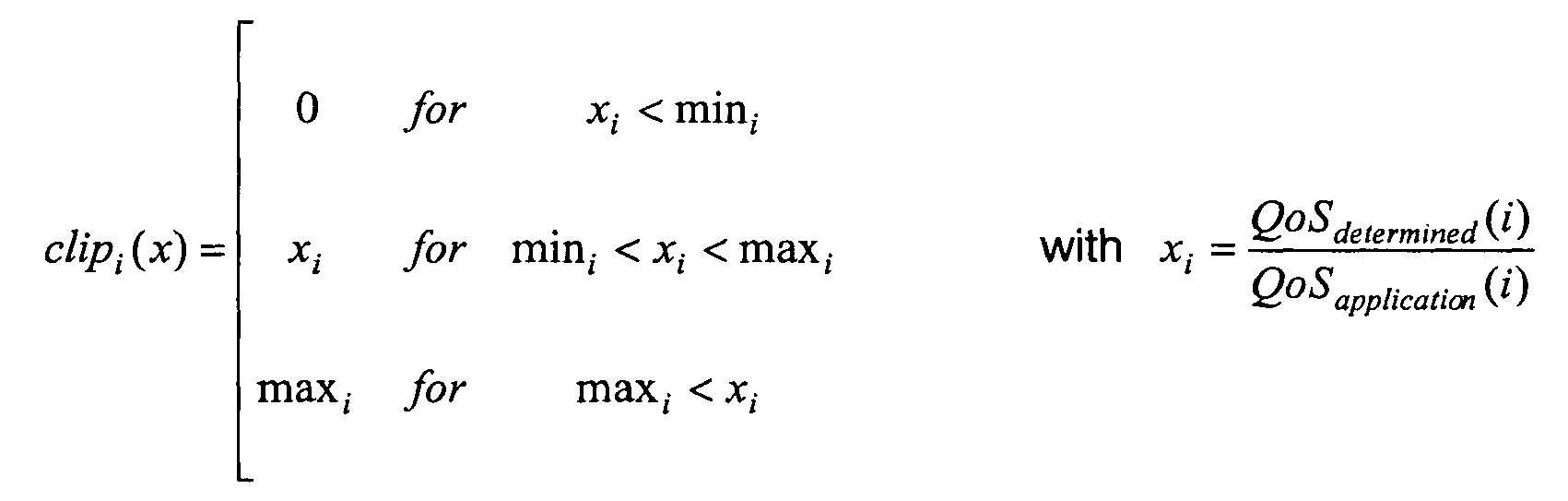
- Method according to claim 8,
characterized in that
determining the parameters of the n ≥ 2 radio links is carried out by the terminal device, and that the terminal device calculates the values of the metric after having received the weighting factors ai from the communication system. - Method according to claim 7 or 11,
characterized in that
the terminal device transmits a trigger to the communication system if the serving radio link is not the best radio link, to course the communication system to consider or decide a handover to a better radio link as a future serving radio link. - Computer program product for identifying a radio link, the computer program product comprising a computer readable medium, having thereon computer program code means, when said program is loaded, to make a computer executable for carrying out the method according to any of the claims 1 to 12.
- Terminal device for accessing a wireless communication system,
characterized in that
it comprises a computer program product according to claim 12. - Wireless communication system,
characterized in that
it comprises a computer program product according to claim 12.
Priority Applications (4)
| Application Number | Priority Date | Filing Date | Title |
|---|---|---|---|
| EP05291618A EP1748666A1 (en) | 2005-07-27 | 2005-07-27 | Method of identifying a radio link |
| JP2006192400A JP2007037119A (en) | 2005-07-27 | 2006-07-13 | How to identify a radio link |
| US11/486,281 US7616928B2 (en) | 2005-07-27 | 2006-07-14 | Method of identifying a radio link |
| CN2006101077082A CN1905748B (en) | 2005-07-27 | 2006-07-20 | How to determine the wireless link |
Applications Claiming Priority (1)
| Application Number | Priority Date | Filing Date | Title |
|---|---|---|---|
| EP05291618A EP1748666A1 (en) | 2005-07-27 | 2005-07-27 | Method of identifying a radio link |
Publications (1)
| Publication Number | Publication Date |
|---|---|
| EP1748666A1 true EP1748666A1 (en) | 2007-01-31 |
Family
ID=35385342
Family Applications (1)
| Application Number | Title | Priority Date | Filing Date |
|---|---|---|---|
| EP05291618A Withdrawn EP1748666A1 (en) | 2005-07-27 | 2005-07-27 | Method of identifying a radio link |
Country Status (4)
| Country | Link |
|---|---|
| US (1) | US7616928B2 (en) |
| EP (1) | EP1748666A1 (en) |
| JP (1) | JP2007037119A (en) |
| CN (1) | CN1905748B (en) |
Cited By (3)
| Publication number | Priority date | Publication date | Assignee | Title |
|---|---|---|---|---|
| EP2204060A4 (en) * | 2007-09-25 | 2013-01-09 | Fringland Ltd | Selecting a wireless communication technology according to application state |
| EP2530970A4 (en) * | 2010-05-25 | 2016-10-26 | Zte Corp | Method and system for handover based on radio resource allocation database |
| WO2019011142A1 (en) * | 2017-07-11 | 2019-01-17 | 阿里巴巴集团控股有限公司 | Network link switching method and system |
Families Citing this family (14)
| Publication number | Priority date | Publication date | Assignee | Title |
|---|---|---|---|---|
| JP4616785B2 (en) * | 2006-03-28 | 2011-01-19 | 富士通株式会社 | Service quality management apparatus and service quality management method |
| US7855958B2 (en) * | 2006-08-03 | 2010-12-21 | Alcatel-Lucent Usa Inc. | Determining priority of bearer channels in a wireless telecommunications network |
| TW200826583A (en) * | 2006-11-17 | 2008-06-16 | Interdigital Tech Corp | Method and apparatus for quality of service signaling and configuration |
| KR101375481B1 (en) * | 2007-07-06 | 2014-03-19 | 삼성전자주식회사 | Method and apparatus of deciding communication mode in a communication system |
| US20090040945A1 (en) * | 2007-08-10 | 2009-02-12 | Texas Instruments Incorporated | Systems and methods for utilizing global traffic flow parameters for packet-based networks |
| US7848756B2 (en) * | 2008-09-22 | 2010-12-07 | Telefonaktiebolaget L M Ericsson (Publ) | Radio access technology selection |
| US8407483B2 (en) * | 2008-12-18 | 2013-03-26 | Electronics And Telecommunications Research Institute | Apparatus and method for authenticating personal use of contents by using portable storage |
| KR101791284B1 (en) * | 2010-04-26 | 2017-10-27 | 인터디지탈 패튼 홀딩스, 인크 | Method and apparatus to enable ad hoc networks |
| US8787172B2 (en) * | 2010-06-21 | 2014-07-22 | Qualcomm Incorporated | Method and apparatus for QoS context transfer during inter radio access technology handover in a wireless communication system |
| US9888422B2 (en) * | 2013-06-03 | 2018-02-06 | Avago Technologies General Ip (Singapore) Pte. Ltd. | System and method for adaptive access and handover configuration based on prior history in a multi-RAT environment |
| US9907006B2 (en) * | 2013-06-03 | 2018-02-27 | Avago Technologies General Ip (Singapore) Pte. Ltd. | Cross radio access technology access with handoff and interference management using communication performance data |
| KR20160124518A (en) * | 2015-04-20 | 2016-10-28 | 삼성전자주식회사 | Method and apparatus for supporting communication of electronic device |
| CN116684314B (en) * | 2021-02-04 | 2024-06-14 | 华为技术有限公司 | Business indication method and device |
| CN117793776A (en) * | 2022-09-29 | 2024-03-29 | 华为技术有限公司 | Communication method and device based on flow classification service |
Citations (2)
| Publication number | Priority date | Publication date | Assignee | Title |
|---|---|---|---|---|
| EP1418782A1 (en) * | 2002-11-06 | 2004-05-12 | Siemens Mobile Communications S.p.A. | Quality of service (QoS) based traffic load management method in a mobile communication network having multiple radio access technologies |
| US20050159166A1 (en) * | 2004-01-21 | 2005-07-21 | Telefonaktiebolaget Lm Ericsson (Publ) | Quality of service controlled link adaptation |
Family Cites Families (4)
| Publication number | Priority date | Publication date | Assignee | Title |
|---|---|---|---|---|
| US6950655B2 (en) * | 2002-10-01 | 2005-09-27 | Interdigital Technology Corporation | Method and system wherein handover information is broadcast in wireless local area networks |
| ES2347648T3 (en) * | 2003-12-17 | 2010-11-03 | Telefonaktiebolaget Lm Ericsson (Publ) | A METHOD, A SYSTEM, A TERMINAL AND A COMPUTER PROGRAM PRODUCT TO SELECT A RADIO ACCESS SYSTEM IN A MULTIPLE ACCESS SYSTEM. |
| US20060276189A1 (en) * | 2005-04-01 | 2006-12-07 | Interdigital Technology Corporation | Supporting inter-technology handover using IEEE 802.16 handover procedures |
| DE602005015326D1 (en) * | 2005-07-27 | 2009-08-20 | Alcatel Lucent | Method for triggering a handover |
-
2005
- 2005-07-27 EP EP05291618A patent/EP1748666A1/en not_active Withdrawn
-
2006
- 2006-07-13 JP JP2006192400A patent/JP2007037119A/en not_active Withdrawn
- 2006-07-14 US US11/486,281 patent/US7616928B2/en active Active
- 2006-07-20 CN CN2006101077082A patent/CN1905748B/en not_active Expired - Fee Related
Patent Citations (2)
| Publication number | Priority date | Publication date | Assignee | Title |
|---|---|---|---|---|
| EP1418782A1 (en) * | 2002-11-06 | 2004-05-12 | Siemens Mobile Communications S.p.A. | Quality of service (QoS) based traffic load management method in a mobile communication network having multiple radio access technologies |
| US20050159166A1 (en) * | 2004-01-21 | 2005-07-21 | Telefonaktiebolaget Lm Ericsson (Publ) | Quality of service controlled link adaptation |
Cited By (4)
| Publication number | Priority date | Publication date | Assignee | Title |
|---|---|---|---|---|
| EP2204060A4 (en) * | 2007-09-25 | 2013-01-09 | Fringland Ltd | Selecting a wireless communication technology according to application state |
| US9100903B2 (en) | 2007-09-25 | 2015-08-04 | Genband Us Llc | Selecting a wireless communication technology according to application state |
| EP2530970A4 (en) * | 2010-05-25 | 2016-10-26 | Zte Corp | Method and system for handover based on radio resource allocation database |
| WO2019011142A1 (en) * | 2017-07-11 | 2019-01-17 | 阿里巴巴集团控股有限公司 | Network link switching method and system |
Also Published As
| Publication number | Publication date |
|---|---|
| CN1905748B (en) | 2010-12-08 |
| US7616928B2 (en) | 2009-11-10 |
| CN1905748A (en) | 2007-01-31 |
| JP2007037119A (en) | 2007-02-08 |
| US20070026811A1 (en) | 2007-02-01 |
Similar Documents
| Publication | Publication Date | Title |
|---|---|---|
| EP1771022B1 (en) | Method of triggering a handover | |
| US11425580B2 (en) | System and method for wireless network offloading | |
| EP1748666A1 (en) | Method of identifying a radio link | |
| EP1698137B1 (en) | Method, system and a mobile communication station adapted for selection of an access network | |
| US8635335B2 (en) | System and method for wireless network offloading | |
| KR100754301B1 (en) | Traffic load balancing method, access point device and computer readable recording medium | |
| EP1423934B1 (en) | Method and system for bit rate adaptation | |
| JP2013530640A (en) | Wireless network offload system and method | |
| EP2005767A2 (en) | Repeater for multiple radio access | |
| US20240040405A1 (en) | System and Method for Wireless Network Offloading | |
| WO2008080801A1 (en) | Apparatus and method for estimating and transmitting sub-band channel quality information in a multicarrier transmission system | |
| US20050227694A1 (en) | Handover method and apparatus | |
| EP1540979B1 (en) | A method for providing telecommunications services, related system and information technology product | |
| US9603042B1 (en) | Selection of wireless devices for measurement reports | |
| Sachs et al. | Generic abstraction of access performance and resources for multi-radio access management | |
| Sallent | A perspective on radio resource management in B3G | |
| Batkauskas et al. | Quality of heterogeneous mobile data services: capabilities and end-user achievements | |
| Sachs et al. | Generic abstraction of access performance and resources for multi-radio access management | |
| Gharsellaoui et al. | Optimizing access point selection in wireless local area networks |
Legal Events
| Date | Code | Title | Description |
|---|---|---|---|
| PUAI | Public reference made under article 153(3) epc to a published international application that has entered the european phase |
Free format text: ORIGINAL CODE: 0009012 |
|
| 17P | Request for examination filed |
Effective date: 20060220 |
|
| AK | Designated contracting states |
Kind code of ref document: A1 Designated state(s): AT BE BG CH CY CZ DE DK EE ES FI FR GB GR HU IE IS IT LI LT LU LV MC NL PL PT RO SE SI SK TR |
|
| AX | Request for extension of the european patent |
Extension state: AL BA HR MK YU |
|
| RAP1 | Party data changed (applicant data changed or rights of an application transferred) |
Owner name: ALCATEL LUCENT |
|
| AKX | Designation fees paid |
Designated state(s): AT BE BG CH CY CZ DE DK EE ES FI FR GB GR HU IE IS IT LI LT LU LV MC NL PL PT RO SE SI SK TR |
|
| STAA | Information on the status of an ep patent application or granted ep patent |
Free format text: STATUS: THE APPLICATION IS DEEMED TO BE WITHDRAWN |
|
| RAP1 | Party data changed (applicant data changed or rights of an application transferred) |
Owner name: ALCATEL LUCENT |
|
| 18D | Application deemed to be withdrawn |
Effective date: 20110924 |