EP1748298A2 - Methods And Systems For Providing Air Data Parameters Using Mass Flow And Pressure Sensors - Google Patents
Methods And Systems For Providing Air Data Parameters Using Mass Flow And Pressure Sensors Download PDFInfo
- Publication number
- EP1748298A2 EP1748298A2 EP06118133A EP06118133A EP1748298A2 EP 1748298 A2 EP1748298 A2 EP 1748298A2 EP 06118133 A EP06118133 A EP 06118133A EP 06118133 A EP06118133 A EP 06118133A EP 1748298 A2 EP1748298 A2 EP 1748298A2
- Authority
- EP
- European Patent Office
- Prior art keywords
- air
- pressure
- sensor
- mass
- data system
- Prior art date
- Legal status (The legal status is an assumption and is not a legal conclusion. Google has not performed a legal analysis and makes no representation as to the accuracy of the status listed.)
- Granted
Links
- 238000000034 method Methods 0.000 title description 6
- 230000003068 static effect Effects 0.000 claims abstract description 20
- 239000000523 sample Substances 0.000 claims description 13
- 238000010586 diagram Methods 0.000 description 6
- 239000007789 gas Substances 0.000 description 5
- 230000007423 decrease Effects 0.000 description 3
- RZVHIXYEVGDQDX-UHFFFAOYSA-N 9,10-anthraquinone Chemical compound C1=CC=C2C(=O)C3=CC=CC=C3C(=O)C2=C1 RZVHIXYEVGDQDX-UHFFFAOYSA-N 0.000 description 2
- XKRFYHLGVUSROY-UHFFFAOYSA-N Argon Chemical compound [Ar] XKRFYHLGVUSROY-UHFFFAOYSA-N 0.000 description 2
- CURLTUGMZLYLDI-UHFFFAOYSA-N Carbon dioxide Chemical compound O=C=O CURLTUGMZLYLDI-UHFFFAOYSA-N 0.000 description 2
- IJGRMHOSHXDMSA-UHFFFAOYSA-N Atomic nitrogen Chemical compound N#N IJGRMHOSHXDMSA-UHFFFAOYSA-N 0.000 description 1
- 229910052786 argon Inorganic materials 0.000 description 1
- QVGXLLKOCUKJST-UHFFFAOYSA-N atomic oxygen Chemical compound [O] QVGXLLKOCUKJST-UHFFFAOYSA-N 0.000 description 1
- 229910002092 carbon dioxide Inorganic materials 0.000 description 1
- 239000001569 carbon dioxide Substances 0.000 description 1
- 238000012512 characterization method Methods 0.000 description 1
- 239000002131 composite material Substances 0.000 description 1
- 230000003247 decreasing effect Effects 0.000 description 1
- 230000009977 dual effect Effects 0.000 description 1
- 230000000694 effects Effects 0.000 description 1
- 239000000446 fuel Substances 0.000 description 1
- 238000005259 measurement Methods 0.000 description 1
- 238000012986 modification Methods 0.000 description 1
- 230000004048 modification Effects 0.000 description 1
- 239000001301 oxygen Substances 0.000 description 1
- 229910052760 oxygen Inorganic materials 0.000 description 1
- 230000035939 shock Effects 0.000 description 1
Images
Classifications
-
- G—PHYSICS
- G01—MEASURING; TESTING
- G01C—MEASURING DISTANCES, LEVELS OR BEARINGS; SURVEYING; NAVIGATION; GYROSCOPIC INSTRUMENTS; PHOTOGRAMMETRY OR VIDEOGRAMMETRY
- G01C21/00—Navigation; Navigational instruments not provided for in groups G01C1/00 - G01C19/00
- G01C21/005—Navigation; Navigational instruments not provided for in groups G01C1/00 - G01C19/00 with correlation of navigation data from several sources, e.g. map or contour matching
-
- G—PHYSICS
- G01—MEASURING; TESTING
- G01F—MEASURING VOLUME, VOLUME FLOW, MASS FLOW OR LIQUID LEVEL; METERING BY VOLUME
- G01F1/00—Measuring the volume flow or mass flow of fluid or fluent solid material wherein the fluid passes through a meter in a continuous flow
- G01F1/68—Measuring the volume flow or mass flow of fluid or fluent solid material wherein the fluid passes through a meter in a continuous flow by using thermal effects
-
- G—PHYSICS
- G01—MEASURING; TESTING
- G01F—MEASURING VOLUME, VOLUME FLOW, MASS FLOW OR LIQUID LEVEL; METERING BY VOLUME
- G01F1/00—Measuring the volume flow or mass flow of fluid or fluent solid material wherein the fluid passes through a meter in a continuous flow
- G01F1/76—Devices for measuring mass flow of a fluid or a fluent solid material
-
- G—PHYSICS
- G01—MEASURING; TESTING
- G01P—MEASURING LINEAR OR ANGULAR SPEED, ACCELERATION, DECELERATION, OR SHOCK; INDICATING PRESENCE, ABSENCE, OR DIRECTION, OF MOVEMENT
- G01P13/00—Indicating or recording presence, absence, or direction, of movement
- G01P13/02—Indicating direction only, e.g. by weather vane
- G01P13/025—Indicating direction only, e.g. by weather vane indicating air data, i.e. flight variables of an aircraft, e.g. angle of attack, side slip, shear, yaw
-
- G—PHYSICS
- G01—MEASURING; TESTING
- G01P—MEASURING LINEAR OR ANGULAR SPEED, ACCELERATION, DECELERATION, OR SHOCK; INDICATING PRESENCE, ABSENCE, OR DIRECTION, OF MOVEMENT
- G01P5/00—Measuring speed of fluids, e.g. of air stream; Measuring speed of bodies relative to fluids, e.g. of ship, of aircraft
- G01P5/10—Measuring speed of fluids, e.g. of air stream; Measuring speed of bodies relative to fluids, e.g. of ship, of aircraft by measuring thermal variables
- G01P5/12—Measuring speed of fluids, e.g. of air stream; Measuring speed of bodies relative to fluids, e.g. of ship, of aircraft by measuring thermal variables using variation of resistance of a heated conductor
-
- G—PHYSICS
- G01—MEASURING; TESTING
- G01P—MEASURING LINEAR OR ANGULAR SPEED, ACCELERATION, DECELERATION, OR SHOCK; INDICATING PRESENCE, ABSENCE, OR DIRECTION, OF MOVEMENT
- G01P5/00—Measuring speed of fluids, e.g. of air stream; Measuring speed of bodies relative to fluids, e.g. of ship, of aircraft
- G01P5/14—Measuring speed of fluids, e.g. of air stream; Measuring speed of bodies relative to fluids, e.g. of ship, of aircraft by measuring differences of pressure in the fluid
-
- G—PHYSICS
- G01—MEASURING; TESTING
- G01P—MEASURING LINEAR OR ANGULAR SPEED, ACCELERATION, DECELERATION, OR SHOCK; INDICATING PRESENCE, ABSENCE, OR DIRECTION, OF MOVEMENT
- G01P5/00—Measuring speed of fluids, e.g. of air stream; Measuring speed of bodies relative to fluids, e.g. of ship, of aircraft
- G01P5/14—Measuring speed of fluids, e.g. of air stream; Measuring speed of bodies relative to fluids, e.g. of ship, of aircraft by measuring differences of pressure in the fluid
- G01P5/16—Measuring speed of fluids, e.g. of air stream; Measuring speed of bodies relative to fluids, e.g. of ship, of aircraft by measuring differences of pressure in the fluid using Pitot tubes, e.g. Machmeter
Definitions
- This invention relates generally to air data properties of air vehicles, and more specifically, to methods and systems for providing air data parameters using mass flow and pressure sensors.
- Air data properties are important in maintaining optimum performance of air vehicles.
- Three air data parameters include altitude, velocity, and mach number.
- Pressure altitude is a function of static pressure and is used to determine a quantity of flight conditions. For example, a decrease in pressure is typically indicative of an increase in altitude. Also, as pressure decreases, air density decreases. Air density is also a function of static air temperature. For example, if one plane is flying at sea level and one is flying at 10000 feet they both could be indicating 300 knots but the higher vehicle is actually flying faster. This phenomenon becomes more pronounced at higher altitudes.
- Velocity is a function of impact pressure (i.e. the total pressure minus the static pressure). Velocity is the most common parameter used to control air traffic and other aircraft maneuvers. Velocity, as well as air density, is used to control fuel consumption and required power needed to fly at cruise conditions.
- the mach number is the ratio of air vehicle speed and the speed of sound. As the air vehicle moves through the air, the air molecules near the air vehicle are disturbed and move around the air vehicle. If the air vehicle is moving at a relatively low speed, for example, less than 250 mph, the density of the air flow remains relatively constant.
- the mach number is an important air data parameter that is used to control the performance of the air vehicle. The mach number also changes as a function of altitude.
- the air data parameters are very important in large aircraft and it may be considered flight critical. These parameters provide precision inputs for flight control.
- the air data computers that monitor these parameters tend to be high cost items because of accuracy requirements and complexity.
- some air data systems are configured to be dual and triple redundant and incorporate very high precision and accurate pressure sensors. Extensive characterization procedures are also required to assure the air data computer system meets the desired performance levels.
- a system configured to determine a plurality of air data parameters for an air vehicle.
- the system comprises a mass air flow sensor mounted to sense an air flow caused by movement of the air vehicle, a pressure sensor mounted to sense a static pressure at the air vehicle, and a controller.
- the controller is configured to receive signals from the mass air flow sensor and the pressure sensor.
- the controller is further configured to determine an air velocity and a static pressure using the received signals.
- a method for determining an air velocity for an air vehicle comprises mounting a mass air flow sensor to sense an air flow caused by movement of the air vehicle, mounting a pressure sensor to sense a static pressure at the air vehicle, and configuring a controller to receive signals from the mass air flow sensor and the pressure sensor and determine the air velocity using the received signals.
- an air data system comprises a mass air flow sensor, a pressure sensor, a probe configured to provide an airflow across the air flow mass sensor and allow an ambient pressure to contact the pressure sensor, and a controller.
- the controller is configured to determine an air velocity based on signals received from the mass air flow sensor and the pressure sensor.
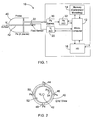
- FIG. 1 is a block diagram of an air data system 10 for determining air data parameters.
- System 10 includes a microcomputer 12, memory 14 and input/output (I/O) circuits 16 which are sometimes collectively referred to as a controller.
- I/O input/output
- a mass air flow sensor 22 provides air mass flow data (e.g., a velocity) to a velocity analog-to-digital converter (ADC) 20, which is interfaced to microcomputer 12.
- a pressure sensor 30 provides pressure data to a pressure ADC 32, which is interfaced to microcomputer 12.
- System 10 includes a probe 40 which includes a number of ports formed therein.
- a velocity port 42 is located along a longitudinal axis of probe 40 and allows an airflow across mass air flow sensor 22 which is placed adjacent velocity port 42.
- Pressure ports 44, 46, 48, and 50 are formed substantially perpendicularly to velocity port 42.
- Pressure ports 44, 46, 48, and 50 are interconnected, for example, by a hollow ring 52 formed within a perimeter of probe 40. Hollow ring 52 is configured to allow static pressure to contact pressure sensor 30.
- Figure 2 is a cross-sectional end view of probe 40 illustrating velocity port 42 and the pressure ports 44, 46, 48, and 50, along with hollow ring 52.
- Figure 2 further illustrates that a secondary port 54 may be located within hollow ring 52 of probe 40 that measures the average pressure at the other static pressure (Ps) ports, allowing the pressure to be applied to pressure sensor 30.
- Ps static pressure
- An air velocity, Vf is measured using mass flow sensor 22 and static pressure, Ps, from pressure sensor 30. Additional air data parameters can be determined from these two measurements. More specifically, the static pressure, Ps, is utilized to correct a pressure dependency of air velocity, Vf, to produce an accurate determination of air flow, Vc, which is referred to as a calibrated air velocity, which is also sometimes referred to as CAS.
- flow sensor 22 incorporates microbridge technology, such that flow sensor 22 is configured to operate in harsh environments.
- flow sensor 22 is capable of sensing extended air mass flow rates of more than 30 grams per square centimeter per second.
- flow sensors have a range of 1000:1 (i.e. the sensors can sense mass flow rates from 30 gm/cm 2 /sec to 0.030 gm/cm 2 /sec).
- Flow sensor 22 is also bi-directional, that is, it can measure air mass flow in both directions.
- Microbridge mass air flow sensors measures actual mass flow of a gas media. Actual flow is driven by a pressure gradient flowing from a higher pressure region to a lower pressure region. Sensor 22 measures air mass flow which is a function of the gas density, the gas density being a function of pressure and temperature. Sensor 22, in one embodiment, is compensated for temperature and therefore does not vary as a function of temperature due to altitude changes.
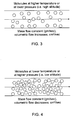
- Figure 3 is a diagram illustrating the flow of molecules 70 at low temperature and higher pressure, such as would be found at lower altitudes. To keep mass flow constant, volumetric flow, in cubic centimeters/second has to be decreased.
- Figure 4 is a diagram illustrating the flow of molecules 80 at a higher temperature and/or at a lower pressure, such as would be found at higher altitudes. To keep mass flow constant, volumetric flow, in cubic centimeters/second has to be increased.
- the mass can be calculated based on its composite makeup, in mass/mole, e.g., about 78.8% nitrogen (N 2 ) which is about 28.01 grams per mole, and about 21.2% oxygen (O 2 ) which is about 32.00 grams per mole.
- N 2 nitrogen
- O 2 oxygen
- the approximate 0.9% of argon, and 0.03% of carbon dioxide in the air can be ignored, and the result is that air is about 28.854 grams per mole.
- the above described methods and systems provide a low cost, viable air data system that provides calibrated air velocity (Vc), static pressure (Ps), total pressure (Pt), pressure altitude (Hp), and mach number (M) to, for example, a flight control system of an air vehicle.
- Vc calibrated air velocity
- Ps static pressure
- Pt total pressure
- Hp pressure altitude
- M mach number
Landscapes
- Engineering & Computer Science (AREA)
- Physics & Mathematics (AREA)
- General Physics & Mathematics (AREA)
- Aviation & Aerospace Engineering (AREA)
- Radar, Positioning & Navigation (AREA)
- Remote Sensing (AREA)
- Fluid Mechanics (AREA)
- Automation & Control Theory (AREA)
- Combined Controls Of Internal Combustion Engines (AREA)
- Measuring Temperature Or Quantity Of Heat (AREA)
- Measuring Volume Flow (AREA)
- Indicating Or Recording The Presence, Absence, Or Direction Of Movement (AREA)
Abstract
Description
- This application claims priority to
U.S. Provisional Application Serial Number 60/703,991, filed July 29, 2005 - This invention relates generally to air data properties of air vehicles, and more specifically, to methods and systems for providing air data parameters using mass flow and pressure sensors.
- Air data properties are important in maintaining optimum performance of air vehicles. Three air data parameters include altitude, velocity, and mach number. Pressure altitude is a function of static pressure and is used to determine a quantity of flight conditions. For example, a decrease in pressure is typically indicative of an increase in altitude. Also, as pressure decreases, air density decreases. Air density is also a function of static air temperature. For example, if one plane is flying at sea level and one is flying at 10000 feet they both could be indicating 300 knots but the higher vehicle is actually flying faster. This phenomenon becomes more pronounced at higher altitudes.
- Velocity is a function of impact pressure (i.e. the total pressure minus the static pressure). Velocity is the most common parameter used to control air traffic and other aircraft maneuvers. Velocity, as well as air density, is used to control fuel consumption and required power needed to fly at cruise conditions.
- The mach number is the ratio of air vehicle speed and the speed of sound. As the air vehicle moves through the air, the air molecules near the air vehicle are disturbed and move around the air vehicle. If the air vehicle is moving at a relatively low speed, for example, less than 250 mph, the density of the air flow remains relatively constant.
- At higher air vehicle speeds, some of the energy from the air vehicle compresses the air and locally changes a density of the air. This compressibility effect alters the amount of the resulting force on the air and becomes more important as speed increases. Near and beyond the speed of sound, about 330 meters per second or 760 mph at sea level, small disturbances in the flow are transmitted to other locations. Such disturbances have a constant entropy. For example, a sharp disturbance may generate a shock wave that could affect both the lift and drag of the air vehicle. As a result, the mach number is an important air data parameter that is used to control the performance of the air vehicle. The mach number also changes as a function of altitude.
- As such, the air data parameters are very important in large aircraft and it may be considered flight critical. These parameters provide precision inputs for flight control. The air data computers that monitor these parameters tend to be high cost items because of accuracy requirements and complexity. For example, some air data systems are configured to be dual and triple redundant and incorporate very high precision and accurate pressure sensors. Extensive characterization procedures are also required to assure the air data computer system meets the desired performance levels.
- In smaller air vehicles such as targets, missiles, and unmanned air vehicles (UAVs), the accuracy of the air data parameters is typically less critical. However, they are still important if air vehicle optimum performance is to be achieved. These air vehicle types are typically relatively low in cost and as such, any air data system incorporated therein must also be low cost.
- In one aspect, a system configured to determine a plurality of air data parameters for an air vehicle is provided. The system comprises a mass air flow sensor mounted to sense an air flow caused by movement of the air vehicle, a pressure sensor mounted to sense a static pressure at the air vehicle, and a controller. The controller is configured to receive signals from the mass air flow sensor and the pressure sensor. The controller is further configured to determine an air velocity and a static pressure using the received signals.
- In another aspect, a method for determining an air velocity for an air vehicle is provided. The method comprises mounting a mass air flow sensor to sense an air flow caused by movement of the air vehicle, mounting a pressure sensor to sense a static pressure at the air vehicle, and configuring a controller to receive signals from the mass air flow sensor and the pressure sensor and determine the air velocity using the received signals.
- In still another aspect, an air data system is provided. The air data system comprises a mass air flow sensor, a pressure sensor, a probe configured to provide an airflow across the air flow mass sensor and allow an ambient pressure to contact the pressure sensor, and a controller. The controller is configured to determine an air velocity based on signals received from the mass air flow sensor and the pressure sensor.
-
- Figure 1 is a block diagram of a system for determining air data parameters for an air vehicle.
- Figure 2 is an end cross-sectional view of a probe incorporated into the system of Figure 1.
- Figure 3 is a diagram of molecules at a lower temperature and high pressure.
- Figure 4 is a diagram of molecules at a higher temperature and a low pressure.
- A low cost air data solution can be achieved by using a combination of a low cost mass flow sensor and a cost effective static pressure sensor. More specifically, Figure 1 is a block diagram of an
air data system 10 for determining air data parameters.System 10 includes amicrocomputer 12,memory 14 and input/output (I/O)circuits 16 which are sometimes collectively referred to as a controller. - A mass
air flow sensor 22 provides air mass flow data (e.g., a velocity) to a velocity analog-to-digital converter (ADC) 20, which is interfaced tomicrocomputer 12. Apressure sensor 30 provides pressure data to apressure ADC 32, which is interfaced tomicrocomputer 12.System 10 includes aprobe 40 which includes a number of ports formed therein. Avelocity port 42 is located along a longitudinal axis ofprobe 40 and allows an airflow across massair flow sensor 22 which is placedadjacent velocity port 42.Pressure ports velocity port 42.Pressure ports hollow ring 52 formed within a perimeter ofprobe 40.Hollow ring 52 is configured to allow static pressure to contactpressure sensor 30. - Figure 2 is a cross-sectional end view of
probe 40illustrating velocity port 42 and thepressure ports hollow ring 52. Figure 2 further illustrates that asecondary port 54 may be located withinhollow ring 52 ofprobe 40 that measures the average pressure at the other static pressure (Ps) ports, allowing the pressure to be applied topressure sensor 30. - An air velocity, Vf, is measured using
mass flow sensor 22 and static pressure, Ps, frompressure sensor 30. Additional air data parameters can be determined from these two measurements. More specifically, the static pressure, Ps, is utilized to correct a pressure dependency of air velocity, Vf, to produce an accurate determination of air flow, Vc, which is referred to as a calibrated air velocity, which is also sometimes referred to as CAS. - From air flow and static pressure, a pressure altitude (Hp), a total pressure (Pt), and a mach number can be derived as shown by the following formulas:

- Therefore, knowing Vc, then Qc, the difference between total pressure and static pressure can be derived:

- Qc = Pt - Ps; therefore Pt = Qc + Ps and the mach number, M, can then be determined:

- Pressure altitude, Hp, can be calculated knowing Ps:


- In one embodiment,
flow sensor 22 incorporates microbridge technology, such thatflow sensor 22 is configured to operate in harsh environments. In addition,flow sensor 22 is capable of sensing extended air mass flow rates of more than 30 grams per square centimeter per second. In one embodiment, flow sensors have a range of 1000:1 (i.e. the sensors can sense mass flow rates from 30 gm/cm2/sec to 0.030 gm/cm2/sec).Flow sensor 22 is also bi-directional, that is, it can measure air mass flow in both directions. - Microbridge mass air flow sensors, for example,
sensor 22, measures actual mass flow of a gas media. Actual flow is driven by a pressure gradient flowing from a higher pressure region to a lower pressure region.Sensor 22 measures air mass flow which is a function of the gas density, the gas density being a function of pressure and temperature.Sensor 22, in one embodiment, is compensated for temperature and therefore does not vary as a function of temperature due to altitude changes. - Figure 3 is a diagram illustrating the flow of molecules 70 at low temperature and higher pressure, such as would be found at lower altitudes. To keep mass flow constant, volumetric flow, in cubic centimeters/second has to be decreased. Figure 4 is a diagram illustrating the flow of molecules 80 at a higher temperature and/or at a lower pressure, such as would be found at higher altitudes. To keep mass flow constant, volumetric flow, in cubic centimeters/second has to be increased.
- Mass
air flow sensor 22 translates to an air flow sensor according to the following gas law equation:
- For air, the mass can be calculated based on its composite makeup, in mass/mole, e.g., about 78.8% nitrogen (N2) which is about 28.01 grams per mole, and about 21.2% oxygen (O2) which is about 32.00 grams per mole. For this calculation the approximate 0.9% of argon, and 0.03% of carbon dioxide in the air can be ignored, and the result is that air is about 28.854 grams per mole.
- As can be seen by referring to Figures 3 and 4 and the above gas law equation, the volumetric flow of air changes as a function of both temperature and pressure.
- In one embodiment, mass
air flow sensor 22 is also a thermal anemometer, that is, it contains a temperature sensor. As a result, any air mass flow is compensated for temperature during calibration of thesensor 22. Therefore, the air mass flow is only a function of pressure:
system 10 bypressure sensor 30, then Q = Vc can be readily compensated as Ps varies with altitude. - The above described methods and systems provide a low cost, viable air data system that provides calibrated air velocity (Vc), static pressure (Ps), total pressure (Pt), pressure altitude (Hp), and mach number (M) to, for example, a flight control system of an air vehicle.
- While the invention has been described in terms of various specific embodiments, those skilled in the art will recognize that the invention can be practiced with modification within the spirit and scope of the claims.
Claims (10)
- An air data system (10) comprising:a mass air flow sensor (22);a pressure sensor (30);a probe (40) configured to provide an airflow across said mass air flow sensor and allow an ambient pressure to contact said pressure sensor; anda controller configured to determine an air velocity based on signals received from said mass air flow sensor and said pressure sensor.
- An air data system (10) according to Claim 1 wherein said probe (40) comprises a velocity port (42) formed along a longitudinal axis of said probe, said velocity port configured to provide the airflow across said mass air flow sensor (22) caused by movement of an air vehicle.
- An air data system (10) according to Claim 1 wherein said probe (40) comprises a plurality of interconnected pressure ports (44, 46, 48, 50) formed within a perimeter of said probe, said pressure ports configured to allow a static pressure to contact said pressure sensor (30).
- An air data system (10) according to Claim 3 wherein said probe (40) comprises a port (54) located within a perimeter formed by the interconnection of said pressure ports, said pressure sensor (30) mounted within said port.
- An air data system (10) according to Claim 1 wherein said controller is configured to receive signals from said mass air flow sensor (22) and said pressure sensor (30), said controller further configured to determine a velocity using the received signals.
- An air data system (10) according to Claim 5 wherein said controller is configured to utilize a static pressure received from said pressure sensor (30) to correct a pressure dependency of velocity to produce a determination of air flow across said mass air flow sensor (22).
- An air data system (10) according to Claim 1 wherein said air flow mass sensor (22) comprises a temperature sensor.
- An air data system (10) according to Claim 7 wherein said controller is configured to apply temperature compensation to air mass flows measured by said mass air flow sensor (22).
- An air data system (10) according to Claim 1 wherein said controller is configured to determine a pressure altitude, Hp, from the static pressure, Ps, received from said pressure sensor (30) according to:


- An air data system (10) according to Claim 1 wherein said controller is configured to determine a mach number, M, for an air vehicle according to:


Applications Claiming Priority (2)
| Application Number | Priority Date | Filing Date | Title |
|---|---|---|---|
| US70399105P | 2005-07-29 | 2005-07-29 | |
| US11/295,328 US7363809B2 (en) | 2005-07-29 | 2005-12-05 | Methods and systems for providing air data parameters using mass flow and pressure sensors |
Publications (3)
| Publication Number | Publication Date |
|---|---|
| EP1748298A2 true EP1748298A2 (en) | 2007-01-31 |
| EP1748298A3 EP1748298A3 (en) | 2008-02-27 |
| EP1748298B1 EP1748298B1 (en) | 2014-04-02 |
Family
ID=37434325
Family Applications (1)
| Application Number | Title | Priority Date | Filing Date |
|---|---|---|---|
| EP06118133.5A Not-in-force EP1748298B1 (en) | 2005-07-29 | 2006-07-28 | Methods And Systems For Providing Air Data Parameters Using Mass Flow And Pressure Sensors |
Country Status (2)
| Country | Link |
|---|---|
| US (1) | US7363809B2 (en) |
| EP (1) | EP1748298B1 (en) |
Cited By (3)
| Publication number | Priority date | Publication date | Assignee | Title |
|---|---|---|---|---|
| CN107101679A (en) * | 2016-02-23 | 2017-08-29 | 霍尼韦尔国际公司 | Power Control for air-data probe |
| CN115300879A (en) * | 2022-07-22 | 2022-11-08 | 魏杰 | Golf push rod handle capable of displaying force accumulation value before hitting |
| CN115435931A (en) * | 2022-07-29 | 2022-12-06 | 北京航空航天大学 | A high-frequency entropy probe capable of measuring the direction of gas flow between stages |
Families Citing this family (10)
| Publication number | Priority date | Publication date | Assignee | Title |
|---|---|---|---|---|
| WO2010031059A2 (en) | 2008-09-15 | 2010-03-18 | Deka Products Limited Partnership | Systems and methods for fluid delivery |
| FR2942043B1 (en) * | 2009-02-06 | 2011-02-11 | Thales Sa | SYSTEM AND METHOD FOR DETECTING AND DETERMINING REMOTE ATMOSPHERIC ANOMALIES. |
| WO2011082272A2 (en) | 2009-12-31 | 2011-07-07 | Deka Products Limited Partnership | Infusion pump assembley |
| US8464593B2 (en) * | 2010-05-24 | 2013-06-18 | Siargo, Ltd. | Integrated micro-machined air flow velocity meter for projectile arms |
| US20120312923A1 (en) * | 2011-06-08 | 2012-12-13 | Lockheed Martin Corporation | Mitigating transonic shock wave with plasma heating elements |
| US9038453B2 (en) * | 2013-05-07 | 2015-05-26 | The Boeing Company | Methods and apparatus to determine aircraft flight conditions |
| FR3008073B1 (en) * | 2013-07-04 | 2015-08-07 | Thales Sa | AIRCRAFT COMPRISING A MEASURING PROBE AND METHOD FOR DETERMINING FLIGHT PARAMETERS OF SUCH AN AIRCRAFT |
| US9574960B2 (en) * | 2014-07-09 | 2017-02-21 | Kulite Semiconductor Products, Inc. | Ultra-miniature multi-hole flow angle probes |
| CN107735317B (en) | 2015-06-01 | 2021-01-08 | 深圳市大疆创新科技有限公司 | UAV with barometric pressure sensor and method for separately arranging barometric pressure sensor in UAV |
| US11627014B2 (en) * | 2019-08-06 | 2023-04-11 | Rosemount Aerospace Inc. | Distributed electric air data module system |
Citations (2)
| Publication number | Priority date | Publication date | Assignee | Title |
|---|---|---|---|---|
| US6250149B1 (en) | 1999-04-08 | 2001-06-26 | The Boeing Company | System and method for generating aircraft flight data using a flush-mounted air data system |
| WO2003087847A1 (en) | 2002-04-10 | 2003-10-23 | Honeywell International Inc. | Sensor for measuring wind angle |
Family Cites Families (14)
| Publication number | Priority date | Publication date | Assignee | Title |
|---|---|---|---|---|
| US4152938A (en) * | 1978-05-19 | 1979-05-08 | Karl Danninger | Aircraft temperature probe |
| US4186602A (en) * | 1978-08-21 | 1980-02-05 | The Bendix Corporation | High response automotive mass air flow sensor |
| US4404858A (en) * | 1981-10-26 | 1983-09-20 | Ford Motor Company | Velocity and mass air flow sensor |
| US4440027A (en) * | 1982-05-26 | 1984-04-03 | Ford Motor Company | Velocity and mass air flow sensor |
| US5025661A (en) * | 1989-12-11 | 1991-06-25 | Allied-Signal Inc. | Combination air data probe |
| US5438880A (en) * | 1994-05-17 | 1995-08-08 | United Technologies Corporation | Electrostatic linear airspeed transducer |
| US5515735A (en) * | 1995-01-03 | 1996-05-14 | Motorola, Inc. | Micromachined flow sensor device using a pressure difference and method of manufacturing the same |
| RU2135971C1 (en) * | 1998-07-06 | 1999-08-27 | Центральный аэрогидродинамический институт им.проф.Н.Е.Жуковского | Air pressure transducer |
| US6076963A (en) * | 1998-10-20 | 2000-06-20 | Avionics Specialties, Inc. | Aircraft probe with integral air temperature sensor |
| FR2793022B1 (en) * | 1999-04-30 | 2001-07-13 | Sextant Avionique | FIXED MULTIFUNCTION PROBE FOR AIRCRAFT |
| FR2802647B1 (en) * | 1999-12-17 | 2002-03-01 | Thomson Csf Sextant | PROBE FOR AIRCRAFT |
| US6672152B2 (en) * | 2001-12-21 | 2004-01-06 | Honeywell International Inc. | Flush surface air data sensor |
| US7031871B2 (en) * | 2004-06-04 | 2006-04-18 | Rosemount Aerospace, Inc. | Sensor assembly for determining total temperature, static temperature and Mach number |
| US7284420B2 (en) * | 2004-07-13 | 2007-10-23 | Honeywell International Inc. | Air data system and method for rotary aircraft |
-
2005
- 2005-12-05 US US11/295,328 patent/US7363809B2/en not_active Expired - Fee Related
-
2006
- 2006-07-28 EP EP06118133.5A patent/EP1748298B1/en not_active Not-in-force
Patent Citations (2)
| Publication number | Priority date | Publication date | Assignee | Title |
|---|---|---|---|---|
| US6250149B1 (en) | 1999-04-08 | 2001-06-26 | The Boeing Company | System and method for generating aircraft flight data using a flush-mounted air data system |
| WO2003087847A1 (en) | 2002-04-10 | 2003-10-23 | Honeywell International Inc. | Sensor for measuring wind angle |
Cited By (4)
| Publication number | Priority date | Publication date | Assignee | Title |
|---|---|---|---|---|
| CN107101679A (en) * | 2016-02-23 | 2017-08-29 | 霍尼韦尔国际公司 | Power Control for air-data probe |
| CN115300879A (en) * | 2022-07-22 | 2022-11-08 | 魏杰 | Golf push rod handle capable of displaying force accumulation value before hitting |
| CN115435931A (en) * | 2022-07-29 | 2022-12-06 | 北京航空航天大学 | A high-frequency entropy probe capable of measuring the direction of gas flow between stages |
| CN115435931B (en) * | 2022-07-29 | 2024-04-26 | 北京航空航天大学 | High-frequency entropy probe capable of measuring direction of interstage airflow |
Also Published As
| Publication number | Publication date |
|---|---|
| US20070022807A1 (en) | 2007-02-01 |
| EP1748298A3 (en) | 2008-02-27 |
| EP1748298B1 (en) | 2014-04-02 |
| US7363809B2 (en) | 2008-04-29 |
Similar Documents
| Publication | Publication Date | Title |
|---|---|---|
| Crawford et al. | A sensitive fast-response probe to measure turbulence and heat flux from any airplane | |
| Haering Jr | Airdata measurement and calibration | |
| EP2434296B1 (en) | Airspeed sensing system for an aircraft | |
| Lenschow | Aircraft measurements in the boundary layer | |
| EP1748298B1 (en) | Methods And Systems For Providing Air Data Parameters Using Mass Flow And Pressure Sensors | |
| US10352813B2 (en) | Calibration of aircraft instruments using a laser sensor | |
| US7941250B2 (en) | Method and a device for obtaining a predictive vertical speed of a rotorcraft | |
| US6807468B2 (en) | Method for estimating wind | |
| Cary et al. | Flight evaluation of the X-15 ball-nose flow-direction sensor as an air-data system | |
| US5648604A (en) | Method and system for determining anemobaroclinometric parameters on board an aircraft | |
| EP0629166A1 (en) | Aerodynamic pressure sensor systems | |
| EP3685170B1 (en) | An airflow measurement device | |
| US7377159B2 (en) | Methods and system for determining angles of attack and sideslip using flow sensors | |
| Mansour et al. | Seven-sensor fast-response probe for full-scale wind turbine flowfield measurements | |
| US4843880A (en) | Method for measuring the direction and force of gaseous or liquid flows and probe for carrying out this method | |
| US10520523B2 (en) | Fluid movement sensor with instrumented centerbody | |
| US7334469B2 (en) | Methods and systems using ratiometric characterizations to improve air data accuracy | |
| Barrick et al. | Calibration of NASA turbulent air motion measurement system | |
| Armistead et al. | Flight calibration tests of a nose-boom-mounted fixed hemispherical flow-direction sensor | |
| Collinson | Air data and air data systems | |
| Matayoshi et al. | Development of airborne ultrasonic velocimeter and its application to helicopters | |
| Peltzer et al. | Low-and high-speed flight experiments on transition detection | |
| RU2331892C2 (en) | Method of aircraft velocity component defining | |
| Skinner et al. | In-situ measurements of turbulent velocity, temperature, and acoustic fluctuations in the stratosphere | |
| Woodruff et al. | Receptivity measurements on a swept-wing model |
Legal Events
| Date | Code | Title | Description |
|---|---|---|---|
| PUAI | Public reference made under article 153(3) epc to a published international application that has entered the european phase |
Free format text: ORIGINAL CODE: 0009012 |
|
| AK | Designated contracting states |
Kind code of ref document: A2 Designated state(s): AT BE BG CH CY CZ DE DK EE ES FI FR GB GR HU IE IS IT LI LT LU LV MC NL PL PT RO SE SI SK TR |
|
| AX | Request for extension of the european patent |
Extension state: AL BA HR MK YU |
|
| PUAL | Search report despatched |
Free format text: ORIGINAL CODE: 0009013 |
|
| AK | Designated contracting states |
Kind code of ref document: A3 Designated state(s): AT BE BG CH CY CZ DE DK EE ES FI FR GB GR HU IE IS IT LI LT LU LV MC NL PL PT RO SE SI SK TR |
|
| AX | Request for extension of the european patent |
Extension state: AL BA HR MK YU |
|
| RIC1 | Information provided on ipc code assigned before grant |
Ipc: G01C 5/06 20060101ALI20080122BHEP Ipc: G01P 13/02 20060101AFI20061130BHEP Ipc: G01F 1/76 20060101ALI20080122BHEP Ipc: G01P 5/16 20060101ALI20080122BHEP Ipc: G01F 1/68 20060101ALI20080122BHEP |
|
| 17P | Request for examination filed |
Effective date: 20080818 |
|
| 17Q | First examination report despatched |
Effective date: 20080924 |
|
| AKX | Designation fees paid |
Designated state(s): DE FR GB |
|
| RIC1 | Information provided on ipc code assigned before grant |
Ipc: G01P 13/02 20060101AFI20130820BHEP Ipc: G01P 5/16 20060101ALI20130820BHEP Ipc: G01P 5/14 20060101ALI20130820BHEP Ipc: G01P 5/12 20060101ALI20130820BHEP Ipc: G01F 1/68 20060101ALI20130820BHEP Ipc: G01C 21/00 20060101ALI20130820BHEP Ipc: G01C 5/06 20060101ALI20130820BHEP Ipc: G01F 1/76 20060101ALI20130820BHEP |
|
| GRAP | Despatch of communication of intention to grant a patent |
Free format text: ORIGINAL CODE: EPIDOSNIGR1 |
|
| INTG | Intention to grant announced |
Effective date: 20131219 |
|
| GRAS | Grant fee paid |
Free format text: ORIGINAL CODE: EPIDOSNIGR3 |
|
| GRAA | (expected) grant |
Free format text: ORIGINAL CODE: 0009210 |
|
| AK | Designated contracting states |
Kind code of ref document: B1 Designated state(s): DE FR GB |
|
| REG | Reference to a national code |
Ref country code: GB Ref legal event code: FG4D |
|
| REG | Reference to a national code |
Ref country code: DE Ref legal event code: R096 Ref document number: 602006040893 Country of ref document: DE Effective date: 20140515 |
|
| REG | Reference to a national code |
Ref country code: DE Ref legal event code: R097 Ref document number: 602006040893 Country of ref document: DE |
|
| PLBE | No opposition filed within time limit |
Free format text: ORIGINAL CODE: 0009261 |
|
| STAA | Information on the status of an ep patent application or granted ep patent |
Free format text: STATUS: NO OPPOSITION FILED WITHIN TIME LIMIT |
|
| 26N | No opposition filed |
Effective date: 20150106 |
|
| REG | Reference to a national code |
Ref country code: DE Ref legal event code: R097 Ref document number: 602006040893 Country of ref document: DE Effective date: 20150106 |
|
| REG | Reference to a national code |
Ref country code: FR Ref legal event code: PLFP Year of fee payment: 10 |
|
| PGFP | Annual fee paid to national office [announced via postgrant information from national office to epo] |
Ref country code: GB Payment date: 20150624 Year of fee payment: 10 |
|
| PGFP | Annual fee paid to national office [announced via postgrant information from national office to epo] |
Ref country code: FR Payment date: 20150624 Year of fee payment: 10 |
|
| PGFP | Annual fee paid to national office [announced via postgrant information from national office to epo] |
Ref country code: DE Payment date: 20150731 Year of fee payment: 10 |
|
| REG | Reference to a national code |
Ref country code: DE Ref legal event code: R119 Ref document number: 602006040893 Country of ref document: DE |
|
| GBPC | Gb: european patent ceased through non-payment of renewal fee |
Effective date: 20160728 |
|
| PG25 | Lapsed in a contracting state [announced via postgrant information from national office to epo] |
Ref country code: FR Free format text: LAPSE BECAUSE OF NON-PAYMENT OF DUE FEES Effective date: 20160801 Ref country code: DE Free format text: LAPSE BECAUSE OF NON-PAYMENT OF DUE FEES Effective date: 20170201 |
|
| REG | Reference to a national code |
Ref country code: FR Ref legal event code: ST Effective date: 20170331 |
|
| PG25 | Lapsed in a contracting state [announced via postgrant information from national office to epo] |
Ref country code: GB Free format text: LAPSE BECAUSE OF NON-PAYMENT OF DUE FEES Effective date: 20160728 |
|
| P01 | Opt-out of the competence of the unified patent court (upc) registered |
Effective date: 20230525 |