EP1748073B1 - Recombinant d-amino acid oxidase - Google Patents
Recombinant d-amino acid oxidase Download PDFInfo
- Publication number
- EP1748073B1 EP1748073B1 EP04726873A EP04726873A EP1748073B1 EP 1748073 B1 EP1748073 B1 EP 1748073B1 EP 04726873 A EP04726873 A EP 04726873A EP 04726873 A EP04726873 A EP 04726873A EP 1748073 B1 EP1748073 B1 EP 1748073B1
- Authority
- EP
- European Patent Office
- Prior art keywords
- amino acid
- acid oxidase
- recombinant
- seq
- sequence
- Prior art date
- Legal status (The legal status is an assumption and is not a legal conclusion. Google has not performed a legal analysis and makes no representation as to the accuracy of the status listed.)
- Expired - Lifetime
Links
- 108010003989 D-amino-acid oxidase Proteins 0.000 title claims abstract description 97
- 102000004674 D-amino-acid oxidase Human genes 0.000 title claims abstract description 84
- HOKIDJSKDBPKTQ-GLXFQSAKSA-N cephalosporin C Chemical compound S1CC(COC(=O)C)=C(C(O)=O)N2C(=O)[C@@H](NC(=O)CCC[C@@H](N)C(O)=O)[C@@H]12 HOKIDJSKDBPKTQ-GLXFQSAKSA-N 0.000 claims abstract description 28
- 108091028043 Nucleic acid sequence Proteins 0.000 claims abstract description 19
- 230000003197 catalytic effect Effects 0.000 claims description 11
- 125000000539 amino acid group Chemical group 0.000 claims description 9
- 239000002773 nucleotide Substances 0.000 claims description 9
- 125000003729 nucleotide group Chemical group 0.000 claims description 9
- AYFVYJQAPQTCCC-UHFFFAOYSA-N Threonine Natural products CC(O)C(N)C(O)=O AYFVYJQAPQTCCC-UHFFFAOYSA-N 0.000 claims description 6
- 239000004473 Threonine Substances 0.000 claims description 6
- 230000001590 oxidative effect Effects 0.000 claims description 4
- 239000013598 vector Substances 0.000 claims description 4
- 125000000341 threoninyl group Chemical group [H]OC([H])(C([H])([H])[H])C([H])(N([H])[H])C(*)=O 0.000 claims description 3
- 125000003275 alpha amino acid group Chemical group 0.000 claims 7
- 102000004316 Oxidoreductases Human genes 0.000 claims 2
- 108090000854 Oxidoreductases Proteins 0.000 claims 2
- 230000000694 effects Effects 0.000 abstract description 8
- IXUSDMGLUJZNFO-BXUZGUMPSA-N (7R)-7-(4-carboxybutanamido)cephalosporanic acid Chemical compound S1CC(COC(=O)C)=C(C(O)=O)N2C(=O)[C@@H](NC(=O)CCCC(O)=O)[C@@H]12 IXUSDMGLUJZNFO-BXUZGUMPSA-N 0.000 abstract description 6
- 101000983189 Trigonopsis variabilis D-amino-acid oxidase Proteins 0.000 abstract 1
- 241001480015 Trigonopsis variabilis Species 0.000 description 24
- 108090000623 proteins and genes Proteins 0.000 description 24
- 239000013612 plasmid Substances 0.000 description 19
- 239000012634 fragment Substances 0.000 description 18
- 102000004190 Enzymes Human genes 0.000 description 17
- 108090000790 Enzymes Proteins 0.000 description 17
- 238000000034 method Methods 0.000 description 17
- 108020004414 DNA Proteins 0.000 description 16
- 239000000203 mixture Substances 0.000 description 16
- CSNNHWWHGAXBCP-UHFFFAOYSA-L Magnesium sulfate Chemical compound [Mg+2].[O-][S+2]([O-])([O-])[O-] CSNNHWWHGAXBCP-UHFFFAOYSA-L 0.000 description 14
- 150000001413 amino acids Chemical class 0.000 description 9
- 238000002360 preparation method Methods 0.000 description 9
- 108010002747 Pfu DNA polymerase Proteins 0.000 description 8
- BFNBIHQBYMNNAN-UHFFFAOYSA-N ammonium sulfate Chemical compound N.N.OS(O)(=O)=O BFNBIHQBYMNNAN-UHFFFAOYSA-N 0.000 description 8
- 229910052921 ammonium sulfate Inorganic materials 0.000 description 8
- XLYOFNOQVPJJNP-UHFFFAOYSA-N water Chemical compound O XLYOFNOQVPJJNP-UHFFFAOYSA-N 0.000 description 8
- QKNYBSVHEMOAJP-UHFFFAOYSA-N 2-amino-2-(hydroxymethyl)propane-1,3-diol;hydron;chloride Chemical compound Cl.OCC(N)(CO)CO QKNYBSVHEMOAJP-UHFFFAOYSA-N 0.000 description 7
- HSHGZXNAXBPPDL-HZGVNTEJSA-N 7beta-aminocephalosporanic acid Chemical compound S1CC(COC(=O)C)=C(C([O-])=O)N2C(=O)[C@@H]([NH3+])[C@@H]12 HSHGZXNAXBPPDL-HZGVNTEJSA-N 0.000 description 7
- 229920004890 Triton X-100 Polymers 0.000 description 7
- 239000013504 Triton X-100 Substances 0.000 description 7
- 238000006243 chemical reaction Methods 0.000 description 7
- SUYVUBYJARFZHO-RRKCRQDMSA-N dATP Chemical compound C1=NC=2C(N)=NC=NC=2N1[C@H]1C[C@H](O)[C@@H](COP(O)(=O)OP(O)(=O)OP(O)(O)=O)O1 SUYVUBYJARFZHO-RRKCRQDMSA-N 0.000 description 7
- SUYVUBYJARFZHO-UHFFFAOYSA-N dATP Natural products C1=NC=2C(N)=NC=NC=2N1C1CC(O)C(COP(O)(=O)OP(O)(=O)OP(O)(O)=O)O1 SUYVUBYJARFZHO-UHFFFAOYSA-N 0.000 description 7
- RGWHQCVHVJXOKC-SHYZEUOFSA-J dCTP(4-) Chemical compound O=C1N=C(N)C=CN1[C@@H]1O[C@H](COP([O-])(=O)OP([O-])(=O)OP([O-])([O-])=O)[C@@H](O)C1 RGWHQCVHVJXOKC-SHYZEUOFSA-J 0.000 description 7
- HAAZLUGHYHWQIW-KVQBGUIXSA-N dGTP Chemical compound C1=NC=2C(=O)NC(N)=NC=2N1[C@H]1C[C@H](O)[C@@H](COP(O)(=O)OP(O)(=O)OP(O)(O)=O)O1 HAAZLUGHYHWQIW-KVQBGUIXSA-N 0.000 description 7
- NHVNXKFIZYSCEB-XLPZGREQSA-N dTTP Chemical compound O=C1NC(=O)C(C)=CN1[C@@H]1O[C@H](COP(O)(=O)OP(O)(=O)OP(O)(O)=O)[C@@H](O)C1 NHVNXKFIZYSCEB-XLPZGREQSA-N 0.000 description 7
- 239000008367 deionised water Substances 0.000 description 7
- 229910021641 deionized water Inorganic materials 0.000 description 7
- 229910052943 magnesium sulfate Inorganic materials 0.000 description 7
- 210000004027 cell Anatomy 0.000 description 6
- 108090000765 processed proteins & peptides Proteins 0.000 description 6
- 241001198387 Escherichia coli BL21(DE3) Species 0.000 description 5
- 102000004169 proteins and genes Human genes 0.000 description 5
- 229920001817 Agar Polymers 0.000 description 4
- 108010093096 Immobilized Enzymes Proteins 0.000 description 4
- 241000221523 Rhodotorula toruloides Species 0.000 description 4
- 239000008272 agar Substances 0.000 description 4
- 229960000723 ampicillin Drugs 0.000 description 4
- AVKUERGKIZMTKX-NJBDSQKTSA-N ampicillin Chemical compound C1([C@@H](N)C(=O)N[C@H]2[C@H]3SC([C@@H](N3C2=O)C(O)=O)(C)C)=CC=CC=C1 AVKUERGKIZMTKX-NJBDSQKTSA-N 0.000 description 4
- 238000010276 construction Methods 0.000 description 4
- 238000000746 purification Methods 0.000 description 4
- 238000002741 site-directed mutagenesis Methods 0.000 description 4
- 230000002194 synthesizing effect Effects 0.000 description 4
- CSCPPACGZOOCGX-UHFFFAOYSA-N Acetone Chemical compound CC(C)=O CSCPPACGZOOCGX-UHFFFAOYSA-N 0.000 description 3
- WEVYAHXRMPXWCK-UHFFFAOYSA-N Acetonitrile Chemical compound CC#N WEVYAHXRMPXWCK-UHFFFAOYSA-N 0.000 description 3
- 229920000936 Agarose Polymers 0.000 description 3
- PEDCQBHIVMGVHV-UHFFFAOYSA-N Glycerine Chemical compound OCC(O)CO PEDCQBHIVMGVHV-UHFFFAOYSA-N 0.000 description 3
- 240000004808 Saccharomyces cerevisiae Species 0.000 description 3
- 235000014680 Saccharomyces cerevisiae Nutrition 0.000 description 3
- 239000000872 buffer Substances 0.000 description 3
- 238000001962 electrophoresis Methods 0.000 description 3
- 210000003527 eukaryotic cell Anatomy 0.000 description 3
- 239000013604 expression vector Substances 0.000 description 3
- 238000004128 high performance liquid chromatography Methods 0.000 description 3
- 229930027917 kanamycin Natural products 0.000 description 3
- 229960000318 kanamycin Drugs 0.000 description 3
- SBUJHOSQTJFQJX-NOAMYHISSA-N kanamycin Chemical compound O[C@@H]1[C@@H](O)[C@H](O)[C@@H](CN)O[C@@H]1O[C@H]1[C@H](O)[C@@H](O[C@@H]2[C@@H]([C@@H](N)[C@H](O)[C@@H](CO)O2)O)[C@H](N)C[C@@H]1N SBUJHOSQTJFQJX-NOAMYHISSA-N 0.000 description 3
- 229930182823 kanamycin A Natural products 0.000 description 3
- 150000007523 nucleic acids Chemical group 0.000 description 3
- 229920001184 polypeptide Polymers 0.000 description 3
- 102000004196 processed proteins & peptides Human genes 0.000 description 3
- 210000001236 prokaryotic cell Anatomy 0.000 description 3
- 239000006228 supernatant Substances 0.000 description 3
- 241000588724 Escherichia coli Species 0.000 description 2
- 108050001049 Extracellular proteins Proteins 0.000 description 2
- MHAJPDPJQMAIIY-UHFFFAOYSA-N Hydrogen peroxide Chemical compound OO MHAJPDPJQMAIIY-UHFFFAOYSA-N 0.000 description 2
- 239000007836 KH2PO4 Substances 0.000 description 2
- 241001138401 Kluyveromyces lactis Species 0.000 description 2
- ONIBWKKTOPOVIA-UHFFFAOYSA-N Proline Natural products OC(=O)C1CCCN1 ONIBWKKTOPOVIA-UHFFFAOYSA-N 0.000 description 2
- MTCFGRXMJLQNBG-UHFFFAOYSA-N Serine Natural products OCC(N)C(O)=O MTCFGRXMJLQNBG-UHFFFAOYSA-N 0.000 description 2
- 238000001311 chemical methods and process Methods 0.000 description 2
- 238000010367 cloning Methods 0.000 description 2
- 239000013078 crystal Substances 0.000 description 2
- ZPWVASYFFYYZEW-UHFFFAOYSA-L dipotassium hydrogen phosphate Chemical compound [K+].[K+].OP([O-])([O-])=O ZPWVASYFFYYZEW-UHFFFAOYSA-L 0.000 description 2
- 229910000396 dipotassium phosphate Inorganic materials 0.000 description 2
- 238000005194 fractionation Methods 0.000 description 2
- 230000014509 gene expression Effects 0.000 description 2
- 210000001822 immobilized cell Anatomy 0.000 description 2
- 230000003100 immobilizing effect Effects 0.000 description 2
- 230000003834 intracellular effect Effects 0.000 description 2
- 229910000402 monopotassium phosphate Inorganic materials 0.000 description 2
- YBYRMVIVWMBXKQ-UHFFFAOYSA-N phenylmethanesulfonyl fluoride Chemical compound FS(=O)(=O)CC1=CC=CC=C1 YBYRMVIVWMBXKQ-UHFFFAOYSA-N 0.000 description 2
- GNSKLFRGEWLPPA-UHFFFAOYSA-M potassium dihydrogen phosphate Chemical compound [K+].OP(O)([O-])=O GNSKLFRGEWLPPA-UHFFFAOYSA-M 0.000 description 2
- 239000000047 product Substances 0.000 description 2
- 238000002415 sodium dodecyl sulfate polyacrylamide gel electrophoresis Methods 0.000 description 2
- 239000001488 sodium phosphate Substances 0.000 description 2
- 229910000162 sodium phosphate Inorganic materials 0.000 description 2
- 239000007787 solid Substances 0.000 description 2
- RYFMWSXOAZQYPI-UHFFFAOYSA-K trisodium phosphate Chemical compound [Na+].[Na+].[Na+].[O-]P([O-])([O-])=O RYFMWSXOAZQYPI-UHFFFAOYSA-K 0.000 description 2
- DGVVWUTYPXICAM-UHFFFAOYSA-N β‐Mercaptoethanol Chemical compound OCCS DGVVWUTYPXICAM-UHFFFAOYSA-N 0.000 description 2
- NWUYHJFMYQTDRP-UHFFFAOYSA-N 1,2-bis(ethenyl)benzene;1-ethenyl-2-ethylbenzene;styrene Chemical compound C=CC1=CC=CC=C1.CCC1=CC=CC=C1C=C.C=CC1=CC=CC=C1C=C NWUYHJFMYQTDRP-UHFFFAOYSA-N 0.000 description 1
- 241000228245 Aspergillus niger Species 0.000 description 1
- 244000063299 Bacillus subtilis Species 0.000 description 1
- 235000014469 Bacillus subtilis Nutrition 0.000 description 1
- 241000193764 Brevibacillus brevis Species 0.000 description 1
- 101000583086 Bunodosoma granuliferum Delta-actitoxin-Bgr2b Proteins 0.000 description 1
- 101100065878 Caenorhabditis elegans sec-10 gene Proteins 0.000 description 1
- 229930186147 Cephalosporin Natural products 0.000 description 1
- GUBGYTABKSRVRQ-WFVLMXAXSA-N DEAE-cellulose Chemical compound OC1C(O)C(O)C(CO)O[C@H]1O[C@@H]1C(CO)OC(O)C(O)C1O GUBGYTABKSRVRQ-WFVLMXAXSA-N 0.000 description 1
- 102000012410 DNA Ligases Human genes 0.000 description 1
- 108010061982 DNA Ligases Proteins 0.000 description 1
- 108010014303 DNA-directed DNA polymerase Proteins 0.000 description 1
- 102000016928 DNA-directed DNA polymerase Human genes 0.000 description 1
- KCXVZYZYPLLWCC-UHFFFAOYSA-N EDTA Chemical compound OC(=O)CN(CC(O)=O)CCN(CC(O)=O)CC(O)=O KCXVZYZYPLLWCC-UHFFFAOYSA-N 0.000 description 1
- 241000427940 Fusarium solani Species 0.000 description 1
- 241000235058 Komagataella pastoris Species 0.000 description 1
- ONIBWKKTOPOVIA-BYPYZUCNSA-N L-Proline Chemical compound OC(=O)[C@@H]1CCCN1 ONIBWKKTOPOVIA-BYPYZUCNSA-N 0.000 description 1
- 229910019142 PO4 Inorganic materials 0.000 description 1
- 229920002684 Sepharose Polymers 0.000 description 1
- 241000187747 Streptomyces Species 0.000 description 1
- 239000011543 agarose gel Substances 0.000 description 1
- 235000011130 ammonium sulphate Nutrition 0.000 description 1
- 230000003321 amplification Effects 0.000 description 1
- 230000001580 bacterial effect Effects 0.000 description 1
- 238000005119 centrifugation Methods 0.000 description 1
- 229940124587 cephalosporin Drugs 0.000 description 1
- 150000001780 cephalosporins Chemical class 0.000 description 1
- 239000003153 chemical reaction reagent Substances 0.000 description 1
- YKCWQPZFAFZLBI-UHFFFAOYSA-N cibacron blue Chemical compound C1=2C(=O)C3=CC=CC=C3C(=O)C=2C(N)=C(S(O)(=O)=O)C=C1NC(C=C1S(O)(=O)=O)=CC=C1NC(N=1)=NC(Cl)=NC=1NC1=CC=CC=C1S(O)(=O)=O YKCWQPZFAFZLBI-UHFFFAOYSA-N 0.000 description 1
- 239000002299 complementary DNA Substances 0.000 description 1
- 239000000287 crude extract Substances 0.000 description 1
- 238000012217 deletion Methods 0.000 description 1
- 230000037430 deletion Effects 0.000 description 1
- 239000012153 distilled water Substances 0.000 description 1
- 238000010828 elution Methods 0.000 description 1
- 238000000605 extraction Methods 0.000 description 1
- 238000001914 filtration Methods 0.000 description 1
- -1 glutaryl moiety Chemical group 0.000 description 1
- 108010034416 glutarylamidocephalosporanic acid acylase Proteins 0.000 description 1
- 230000014726 immortalization of host cell Effects 0.000 description 1
- 238000005342 ion exchange Methods 0.000 description 1
- 239000003456 ion exchange resin Substances 0.000 description 1
- 229920003303 ion-exchange polymer Polymers 0.000 description 1
- BPHPUYQFMNQIOC-NXRLNHOXSA-N isopropyl beta-D-thiogalactopyranoside Chemical compound CC(C)S[C@@H]1O[C@H](CO)[C@H](O)[C@H](O)[C@H]1O BPHPUYQFMNQIOC-NXRLNHOXSA-N 0.000 description 1
- 238000004519 manufacturing process Methods 0.000 description 1
- 239000000463 material Substances 0.000 description 1
- 230000000813 microbial effect Effects 0.000 description 1
- 238000012986 modification Methods 0.000 description 1
- 230000004048 modification Effects 0.000 description 1
- 238000010369 molecular cloning Methods 0.000 description 1
- 238000003199 nucleic acid amplification method Methods 0.000 description 1
- 108020004707 nucleic acids Proteins 0.000 description 1
- 102000039446 nucleic acids Human genes 0.000 description 1
- NBIIXXVUZAFLBC-UHFFFAOYSA-K phosphate Chemical compound [O-]P([O-])([O-])=O NBIIXXVUZAFLBC-UHFFFAOYSA-K 0.000 description 1
- 239000010452 phosphate Substances 0.000 description 1
- 238000001556 precipitation Methods 0.000 description 1
- 230000009465 prokaryotic expression Effects 0.000 description 1
- 239000011541 reaction mixture Substances 0.000 description 1
- 108091008146 restriction endonucleases Proteins 0.000 description 1
- 125000003607 serino group Chemical group [H]N([H])[C@]([H])(C(=O)[*])C(O[H])([H])[H] 0.000 description 1
- 239000012064 sodium phosphate buffer Substances 0.000 description 1
- HZWLVUKHUSRPCG-BJIHTTGYSA-M sodium;(6r,7r)-3-(acetyloxymethyl)-7-[(5-amino-5-carboxypentanoyl)amino]-8-oxo-5-thia-1-azabicyclo[4.2.0]oct-2-ene-2-carboxylate Chemical compound [Na+].S1CC(COC(=O)C)=C(C([O-])=O)N2C(=O)[C@@H](NC(=O)CCCC(N)C(O)=O)[C@@H]12 HZWLVUKHUSRPCG-BJIHTTGYSA-M 0.000 description 1
- 238000001179 sorption measurement Methods 0.000 description 1
- 238000006467 substitution reaction Methods 0.000 description 1
- 239000000758 substrate Substances 0.000 description 1
- 231100000331 toxic Toxicity 0.000 description 1
- 230000002588 toxic effect Effects 0.000 description 1
- YNJBWRMUSHSURL-UHFFFAOYSA-N trichloroacetic acid Chemical compound OC(=O)C(Cl)(Cl)Cl YNJBWRMUSHSURL-UHFFFAOYSA-N 0.000 description 1
- 238000002525 ultrasonication Methods 0.000 description 1
Images


Classifications
-
- C—CHEMISTRY; METALLURGY
- C12—BIOCHEMISTRY; BEER; SPIRITS; WINE; VINEGAR; MICROBIOLOGY; ENZYMOLOGY; MUTATION OR GENETIC ENGINEERING
- C12N—MICROORGANISMS OR ENZYMES; COMPOSITIONS THEREOF; PROPAGATING, PRESERVING, OR MAINTAINING MICROORGANISMS; MUTATION OR GENETIC ENGINEERING; CULTURE MEDIA
- C12N9/00—Enzymes; Proenzymes; Compositions thereof; Processes for preparing, activating, inhibiting, separating or purifying enzymes
- C12N9/0004—Oxidoreductases (1.)
- C12N9/0012—Oxidoreductases (1.) acting on nitrogen containing compounds as donors (1.4, 1.5, 1.6, 1.7)
- C12N9/0014—Oxidoreductases (1.) acting on nitrogen containing compounds as donors (1.4, 1.5, 1.6, 1.7) acting on the CH-NH2 group of donors (1.4)
- C12N9/0022—Oxidoreductases (1.) acting on nitrogen containing compounds as donors (1.4, 1.5, 1.6, 1.7) acting on the CH-NH2 group of donors (1.4) with oxygen as acceptor (1.4.3)
- C12N9/0024—D-Amino acid oxidase (1.4.3.3)
Definitions
- the present invention belongs to a field of biotechnology and, more specifically, relates to the preparation and use of novel D-amino acid oxidases that have higher catalytic activity and are suitable for the conversion of cephalosporin C to glutaryl-7-aminocephalosporanic acid.
- 7-Aminocephalosporanic acid (7-ACA), the core of many semi-synthetic cephalosporins, is conventionally manufactured chemically from cephalosporin C.
- the chemical process uses chemical reagents that are highly toxic and heavily pollute the environment and the chemical process is low in conversion rate, as the process requires multiple steps of reactions.
- Bio-process offers an attractive alternative for the production of 7-ACA.
- cephalosporin C is first oxidized by D-amino acid oxidase to glutaryl-7-ACA; (2) the glutaryl-7-ACA is then cleaved at the bond between the glutaryl moiety and the 7-ACA moiety by glutaryl-7ACA acylase to 7-ACA.
- Rhodotorula gracilis and Trigonopsis variabilis are the two major sources of D-amino acid oxidase for industrial application. However, these enzymes are low in their catalytic activities for oxidizing cephalosporin C ( Simonetta, et al., Biochim. Biophys.
- the object of the invention is to provide two recombinant D-amino acid oxidases with higher catalytic activities to oxidize cephalosporin C. Another object of the invention is to apply the recombinant D-amino acid oxidases for the efficient conversion of cephalosporin C to glutaryl-7-aminocephalosporanic acid.
- This invention cloned a gene for encoding T. variabilis FA10 D-amino acid oxidase (the wild-type; Li, W. et al., Acta Microbiologica Sinica, 31:251-253, 1991 ) into a suitable expression vector and performed the site-directed mutagenesis of the gene to generate a novel D-amino acid oxidase with higher catalytic activity. More specifically, the site-directed mutagenesis was targeted at the 53rd amino acid residue of the peptide in order to generate recombinant D-amino acid oxidases with higher catalytic activities.
- the present invention provides a DNA sequence for encoding a recombinant D-amino acid oxidase, which is characterized by a nucleotide variation in comparison to the SEQ ID NO.: 1, resulting in that the amino acid residue at position 53 (i.e. threonine) of the peptide encoded therefrom is replaced by other natural amino acids, and that catalytic activity for oxidizing cephalosporin C, which is used as a substrate, is at least 25% higher; preferably, at least 35% higher; more preferably, at least 50% higher; and most preferably, at least 100% higher than that of its wild-type D-amino acid oxidase.
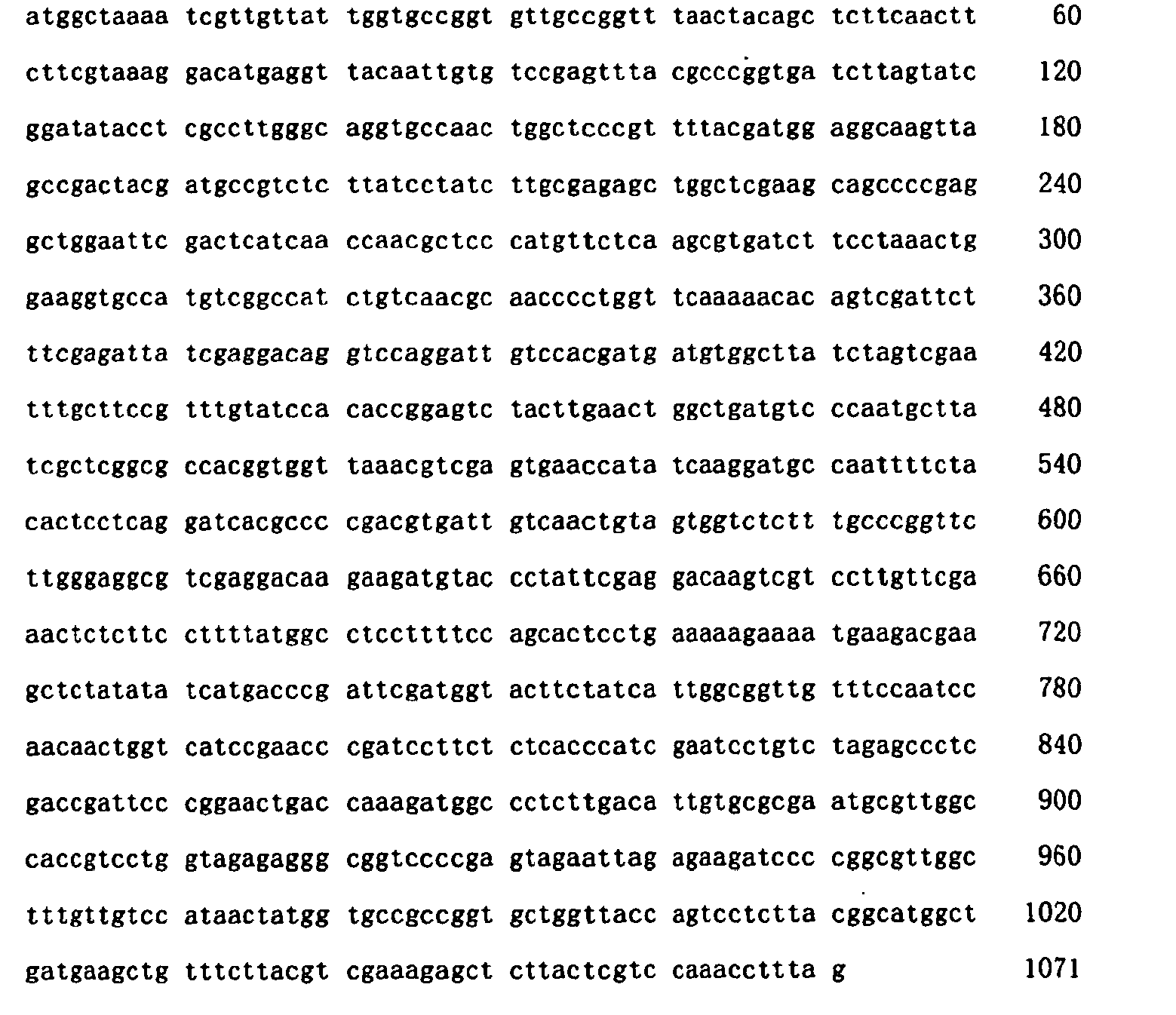
- the DNA sequence of the present invention includes the nucleic acid sequence for encoding the peptide sequence as shown in SEQ ID NO.:4 or SEQ ID NO.:6. More preferably, the DNA sequence includes the nucleic acid sequence as shown in SEQ ID NO.: 3 or SEQ ID NO.:5.
- the present invention provides a polypeptide characterized in that, with SEQ ID NO.: 2 as a reference sequence, the amino acid residue corresponding to the threonine at position 53 of the reference sequence is changed to other natural amino acids, and that its catalytic activity for oxidizing cephalosporin C is at least 25% higher; preferably, at least 35% higher; more preferably, at least 50% higher; and most preferably, at least 100% higher than that of the wild-type D-amino acid oxidase.
- the present invention provides a polypeptide characterized in that, with SEQ ID NO.: 2 as the reference sequence, the amino acid residue corresponding to the threonine at position 53 of the reference sequence is serine or proline.
- SEQ ID NO.: 2 amino acid residue corresponding to the threonine at position 53 of the reference sequence is serine or proline.
- two novel recombinant D-amino acid oxidases recombinant D-amino acid oxidase GHA and recombinant D-amino acid oxidase GHB, are provided.
- Recombinant D-amino acid oxidase GHA has an amino acid sequence as shown in SEQ ID NO.: 4 and its catalytic activity is 105% higher than that of the wild-type D-amino acid oxidase.
- the recombinant D-amino acid oxidase GHB has an amino acid sequence as shown in SEQ ID NO.: 6 and its catalytic activity is 35% higher than that of the wild-type D-amino acid oxidase.
- the wild-type D-amino acid oxidase gene refers to the one derived from the D-amino acid oxidase gene of Trigonopsis variabilis FA10 ( Li, W. et al., Acta Microbiologica Sinica, 31:251-253, 1991 ).
- the nucleic acid of the wild-type D-amino acid oxidase is shown in SEQ ID NO.: 1 and its amino acid sequence is shown in SEQ ID NO.: 2.
- suitable vectors include, but are not limited to, prokaryotic expression vectors, such as pRSET-A and pET; eukaryotic expression vectors, such as pYD1 and pYES2; and cloning vectors, such as pGEM ® -T Easy, pUC18, pUC19 and pBluescript ® -SK(+/-).
- prokaryotic or eukaryotic cells can be employed as host cells.
- the suitable prokaryotic cells include, but are not limited to, E. coli, Bacillus subtilis, Bacillus brevis and Streptomyces; and the suitable eukaryotic cells include, but are not limited to, Saccharomyces cerevisiae, Rhodotorula gracilis, Trigonopsis variabilis, Aspergillus niger, Kluyveromyces lactis and Pichia pastoris.
- the recombinant D-amino acid oxidases can be readily introduced into appropriate microbial hosts, e.g. E. coli, S. cerevisiae, and expressed as intra-cellular or extra-cellular proteins in prokaryotic or eukaryotic cells. Suitable techniques and means for expressing the polypeptide are well known in the art.
- the enzyme can be partially-purified by conventional biochemical procedures, such as ammonium sulfate fractionation and acetone precipitation, and can be further purified with conventional purification procedures, such as ion exchange and affinity columns.
- the recombinant D-amino acid oxidase can be used in the form of unpurified/crude extracts, as a partially-purified enzyme, or as a purified enzyme.
- the enzyme can be purified after the disruption of host cells, followed by centrifugation (to remove cell debris) and fractionation.
- the recombinant enzymes can be prepared as immobilized cells. Suitable methods or processes for immobilizing enzymes or cells expressing the enzymes are well known to those skilled in the field and may be used. Immobilized cells can be prepared by immobilizing transformed cells containing the recombinant D-amino acid oxidase of the present invention into or onto a solid support or carrier according to the known immobilization methodologies in the art. In the present invention, crude enzyme preparation, partially-purified enzyme preparation, or completely purified preparation of the recombinant D-amino acid oxidase can also be immobilized onto a solid support or carrier using conventional methodologies. Immobilized enzymes can be prepared by adsorption of the recombinant D-amino acid oxidase of the present invention onto an ion-exchange resin.
- the recombinant enzymes can also be prepared as crystal enzymes, as described by Miyake, Y., Aki, K., Hashimoto, S., Yamano, T., Biochim. Biophys. Acta, 105:86-99, 1965 .
- the use of the immobilized enzymes and/or crystal enzymes is also within the scope of the present invention.
- Enzymes such as restriction enzymes, T4 DNA ligase, DNA polymerase, and other materials, were obtained from commercial suppliers and used in accordance with manufacturers' instructions. DNA cloning, transformation of host cells, and other procedures are well known in the art or can be adapted from literature.
- Sequence-specific primers were designed in accordance with the known sequences of the 5'- and 3'-ends of the T. variabilis D-amino acid oxidase gene ( Gonzalez, F.J., Montes, J., Martin, F., Lopez, M.C., Ferminan, E., Catalan, J., Galan, M.A. and Dominguez, A., Molecular cloning of T ⁇ DAO1, a gene encoding a D-amino acid oxidase from Trigonopsis variabilis and its expression in Saccharomyces cerevisiae and Kluyveromyces lactis. Yeast 13:1399-1408, 1997 ).
- the primer pair is shown as follows:
- T. variabilis D-amino acid oxidase gene was synthesized by PCR, in which plasmid pJL (Yang, Y.L. et al. , Patent Application Publication number: CN1371999A, 2002 ) was a template. The above-mentioned primer pair and Pfu DNA polymerase (Promega) were used to amplify the gene. Plasmid pJL contains T. variabilis FA10 D-amino acid oxidase gene ( Li, W. et al., Acta Microbiologica Sinica, 31:251-253, 1991 ).
- the PCR mixture contained 40ng pJL, 0.4 ⁇ M 5'-NdeI, 0.4 ⁇ M 3'-BglII, 50 ⁇ M dATP, 50 ⁇ M dTTP, 50 ⁇ M dCTP, 50 ⁇ M dGTP, 20mM Tris-HCl (pH8.8), 10mM KCl, 10mM (NH 4 ) 2 SO 4 , 2mM MgSO 4 , 0.1% Triton X-100, and 2.5U Pfu DNA polymerase; and the volume of the mixture was made up to 50 ⁇ L with sterile deionized water.
- PCR profile was as follows: 94°C, 60 sec 10 cycles 94°C, 60 sec 25 cycles 94°C, 5 min ⁇ 50°C, 60 sec ⁇ 60°C, 60 sec ⁇ 72°C, 10 min 72°C, 120 sec 72°C,120 sec
- PCR fragment of 1,098bp was obtained, with NdeI and Bgl II at the 5'- and 3'-ends respectively.
- the PCR product was resolved in a 1% agarose gel, purified and cut with Nde I and Bgl II, then ligated to a 2.9kb restricted fragment obtained by digesting plasmid pRSET-A (Invitrogen) with Nde I and Bgl II, so as to generate plasmid pRSET-A-DAO.
- the plasmid was transformed into a competent E . coli BL21(DE3)pLysS (Novagen). The transformants were spread onto LB/amp agar plate and incubated at 37°C overnight.
- Plasmid was extracted in accordance with the procedures described in Molecular Cloning-A Laboratory Manual, ed. by J. Sambrook, et al., 1989, CSHL Press .
- the plasmid was sequenced and confirmed to be T. variabilis D-amino acid oxidase gene (see SEQ ID NO.:1). Its deduced amino acid sequence is shown in as SEQ ID NO.:2.
- the PCR mixture for amplifying pRSET-A fragment devoid of ampicillin resistance gene contained: 50ng pRSET-A, 0.4 ⁇ M VET-F, 0.4 ⁇ M VET-R, 50 ⁇ M dATP, 50 ⁇ M dTTP, 50 ⁇ M dCTP, 50 ⁇ M dGTP, 20mM Tris-HCl (pH8.8), 10mM KCl, 10mM (NH 4 ) 2 SO 4 , 2mM MgSO 4 , 0.1% Triton X-100, and 2.5U Pfu DNA polymerase; and the volume of the mixture was made up to 50 ⁇ L with sterile deionized water.
- the PCR mixture for amplifying the kanamycin resistance gene from plasmid pET-28b contained: 50ng pET-28b, 0.4 ⁇ M KAN-F, 0.4 ⁇ M KAN-R, 50 ⁇ M dATP, 50 ⁇ M dTTP, 50 ⁇ M dCTP, 50 ⁇ M dGTP, 20mM Tris-HCl (pH8.8), 10mM KCI, 10mM (NH 4 ) 2 SO 4 , 2mM MgSO 4 , 0.1% Triton X-100, and 2.5U Pfu DNA polymerase; and the volume of the mixture was made up to 50 ⁇ L with sterile deionized water.
- PCR profile was as follows: 94°C, 60 sec 35 cycles 94°C, 5 min ⁇ 50°C, 60 sec ⁇ 72°C, 10 min; 72°C, 4 min 72°C, 4 min
- plasmid pRSET-kan shown in Fig. 1
- the plasmid was transformed into a competent E. coli BL21(DE3)pLysS (Novagen) and the transformants were spread onto LB/kan agar plate and incubated at 37°C overnight.
- the plasmid was extracted and sequenced. The sequence was shown as Fig. 2 and SEQ ID NO.: 13.
- Recombinant D-amino acid oxidase GHA was constructed by site-directed mutagenesis, which was based on the procedures in PCR Protocols (Ed. John M.S. Bartlett and David Stirling, Totowa, N.J.: Humana Press, 2003 ). Primers were synthesized on the basis of the sequence of the cloned T. variabilis D-amino acid oxidase SEQ ID NO.:1):
- Primers A and B are a pair of outer primers.
- Primer A contains Nde I restriction site, with a portion of nucleotides overlapping with the 5'-end of the D-amino acid oxidase gene.
- Primer B contains Bgl II restriction site, with a portion of nucleotides overlapping with the 3'-end of the D-amino acid oxidase gene.
- Primers C 1 and D are a pair of inner primers.
- Primer C1 converts the 53rd amino acid residue of wild-type D-amino acid oxidase from threonine (Thr) to proline (Pro).
- Primer D contains a portion of nucleotides overlapping with primer C1.
- primers A and D were used to perform PCR to synthesize fragment 1, and primers B and C1 were used to synthesize fragment 2.
- the PCR mixture contained: 20ng pRSET-A-DAO, 20mM Tris-HCl (pH8.8), 10mM KCl, 10mM (NH 4 ) 2 SO 4 , 2mM MgSO 4 , 0.1% Triton X-100, 0.4 ⁇ M primer A and 0.4 ⁇ M primer D (for synthesizing fragment 1) or 0.4 ⁇ M primer B and 0.4 ⁇ M primer C1 (for synthesizing fragment 2), 50 ⁇ M dATP, 50 ⁇ M dTTP, 50 ⁇ M dCTP, 50 ⁇ M dGTP, 1.5U Pfu DNA polymerase, the volume of the mixture was made up to 50 ⁇ L with sterile deionized water.
- the PCR profile was as follows: 94°C, 60 sec 30 cycles 94°C, 2 min ⁇ 53°
- the amplified fragment 1 and fragment 2 were resolved in and purified from 1% agarose and were used to generate the full-length D-amino acid oxidase gene.
- the PCR mixture for synthesizing the full-length gene contained: 20ng fragment 1, 20ng fragment 2, 20mM Tris-HCl (pH8.8), 10mM KCI, 10mM (NH 4 ) 2 SO 4 , 2mM MgSO 4 , 0.1% Triton X-100, 0.4 ⁇ M primer A and 0.4 ⁇ M primer B, 50 ⁇ M dATP, 50 ⁇ M dTTP, 50 ⁇ M dCTP, 50 ⁇ M dGTP, 1.5U Pfu DNA polymerase, the volume of the mixture was made up to 50 ⁇ L with sterile deionized water.
- the PCR profile was as follows: 94°C, 60 sec 35 cycles 94°C, 2 min ⁇ 53°C, 60 sec ⁇ 72°C, 10 min 72°C, 120 sec
- the full-length recombinant D-amino acid oxidase GHA gene was obtained.
- the gene was cut with Nde I and Bgl II and then inserted into pRSET-kan, generating pRSET-kan-DAOGHA.
- the plasmid was transformed into a competent E . coli BL21(DE3)pLysS (Novagen). The resulted transformants were spread onto LB/kan agar plate and incubated at 37°C overnight. Plasmid was extracted, and the insert was sequenced and confirmed as recombinant D-amino acid oxidase GHA.
- the DNA sequence for encoding GHA was shown in S SEQ ID NO.:3 and the deduced amino acid sequence was shown in S SEQ ID NO.:4.
- primers A, B and D were identical as in Example 3.
- Primer C2 is an inner primer, which converts the 53rd amino acid residue of wild-type D-amino acid oxidase from threonine (Thr) to serine (Ser).
- Primer D contains a portion of nucleotides overlapping with primer C2.
- Amplification of fragment 1 was identical as in Example 3.
- Fragment 3 was amplified by PCR, using pRSET-A-DAO, as a template, and primers B and C2.
- the PCR mixture contained: 20ng pRSET-A-DAO, 20mM Tris-HCl (pH8.8), 10mM KCI, 10mM (NH 4 ) 2 SO 4 , 2mM MgSO 4 , 0.1% Triton X-100, 0.4 ⁇ M primer B and 0.4 ⁇ M primer C2, 50 ⁇ M dATP, 50 ⁇ M dTTP, 50 ⁇ M dCTP, 50 ⁇ M dGTP, 1.5U Pfu DNA polymerase, the volume of the mixture was made up to 50 ⁇ L with sterile deionized water.
- the PCR profile was as follows: 94°C, 60 sec 30 cycles 94°C, 2 min ⁇ 53°C, 60 sec ⁇ 72°C, 10 min 72°C, 60 sec
- the amplified fragment 1 and fragment 3 were resolved in and purified from 1% agarose and were used to generate the full-length D-amino acid oxidase gene GHB.
- the PCR mixture for synthesizing the full-length gene GHB contained: 20ng fragment 1, 20ng fragment 3, 20mM Tris-HCl (pH8.8), 10mM KCl, 10mM (NH 4 ) 2 SO 4 , 2mM MgSO 4 , 0.1% Triton X-100, 0.4 ⁇ M primer A and 0.4 ⁇ M primer B, 50 ⁇ M dATP, 50 ⁇ M dTTP, 50 ⁇ M dCTP, 50 ⁇ M dGTP, 1.5U Pfu DNA polymerase, the volume of the mixture was made up to 50 ⁇ L with sterile deionized water.
- the PCR profile was as follows: 94°C, 60 sec 35 cycles 94°C, 2 min ⁇ 53°C, 60 sec ⁇ 72°C, 10 min 72°C, 120 sec
- the full-length recombinant D-amino acid oxidase GHB gene was obtained.
- the gene was cut with Nde I and Bgl II and then inserted into pRSET-kan.
- the resultant plasmid was transformed into a competent E. coli BL21(DE3)pLysS (Novagen). The transformants were spread onto LB/kan agar plate and incubated overnight at 37°C.
- the plasmid was extracted, and the insert was sequenced and confirmed as recombinant D-amino acid oxidase GHB.
- the DNA sequence for encoding GHB was shown in SEQ ID NO.:5 and the deduced amino acid sequence was shown in SEQ ID NO.:6.
- D-amino acid oxidase was essentially performed in accordance with Alonso, J., Barredo, J.L., Diez, B., Mellado, E., Salto, F., Garcia, J.L., Cortes, E. (D-amino acid oxidase gene from Rhodotorula gracilis [Rhodosporidium toruloides] ATCC 26217, Microbiology 144:1095-1101, 1998 ). A single colony of pRSET-kan-DAOGHA containing E.
- coli BL21(DE3)pLysS (Example 3) was inoculated and cultivated in 200mL LB medium supplemented with ampicillin at 250rpm for 12 hours. Following this, 1mM IPTG was added and it was then induced for another 6 hours.
- the bacterial cells were pelleted and resuspended in 20mL Buffer A [20mM sodium phosphate buffer (pH8.0) containing 20% glycerol, 5mM 2-mercaptoethanol, 1mM PMSF and 2mM EDTA], disrupted with ultrasonication, and centrifuged at 13,000g for 20min at 4°C to collect the supernatant as crude D-amino acid oxidase.
- Buffer A 20mM sodium phosphate buffer (pH8.0) containing 20% glycerol, 5mM 2-mercaptoethanol, 1mM PMSF and 2mM EDTA
- the crude D-amino acid oxidase was applied to DEAE-cellulose (Sigma, 6 ⁇ 2.5cm), eluted by Buffer A. The eluate was considered as partially-purified recombinant D-amino acid oxidase GHA.
- the partially-purified recombinant D-amino acid oxidase GHA can be further purified by the following method: the partially-purified recombinant D-amino acid oxidase GHA is applied to Buffer A-equilibrated Cibacron Blue 3GA-sepharose (Pharmacia LKB Biotechnology, 4 ⁇ 1cm), washed by 30mL 1M sodium phosphate (pH8.0), followed by elution with 10mL Buffer A containing 50 ⁇ M FAD. The purity of the protein was analyzed by SDS-PAGE ( Fig. 3 ). T. variabilis D-amino acid oxidase and recombinant D-amino acid oxidase GHB were also extracted and purified in accordance with the above-described procedures ( Fig. 3 ).
- the mixture was oxygenated and vortexed at 22°C for 60min. Aliquots (100 ⁇ L) were withdrawn at different times (1, 5, 10, 30, 60min), mixed with 10 ⁇ L 3% hydrogen peroxide, and 50 ⁇ L 10% trichloroacetic acid was added to stop the reaction. The mixture was centrifuged (10,000g, 3min) and 10 ⁇ L of supernatant was mixed with 990 ⁇ L HPLC mobile phase and then it was analyzed by HPLC.
- the activity of the recombinant D-amino acid oxidase GHA was determined as 205% of that of the wild-type T. variabilis D-amino acid oxidase; the activity of the recombinant D-amino acid oxidase GHB was determined 135% of that of the wild-type T . variabilis D-amino acid oxidase.
- Extraction and purification of the D-amino acid oxidase was performed in accordance with Example 5.
- Preparation of the immobilized D-amino acid oxidase was performed in accordance with the description from Röhm (Darmstadt, Germany).
- a 50mL partially-purified recombinant D-amino acid oxidase GHA solution (containing 200mg total protein) was added to K 2 HPO 4 and KH 2 PO 4 in order to adjust it to contain 0.5M phosphate with a pH of 7.5.
- the activity of the immobilized recombinant D-amino acid oxidase GHA was determined in the same way as described in Example 6, with the exception of using 19.4g of immobilized recombinant D-amino acid oxidase GHA in a reaction volume of 1,000mL.
- the activity of the immobilized recombinant D-amino acid oxidase GHA was 65units/g wet carrier.
Landscapes
- Life Sciences & Earth Sciences (AREA)
- Health & Medical Sciences (AREA)
- Chemical & Material Sciences (AREA)
- Genetics & Genomics (AREA)
- Organic Chemistry (AREA)
- Zoology (AREA)
- Engineering & Computer Science (AREA)
- Bioinformatics & Cheminformatics (AREA)
- Wood Science & Technology (AREA)
- Molecular Biology (AREA)
- General Health & Medical Sciences (AREA)
- Microbiology (AREA)
- Biomedical Technology (AREA)
- Medicinal Chemistry (AREA)
- Biochemistry (AREA)
- General Engineering & Computer Science (AREA)
- Biotechnology (AREA)
- Proteomics, Peptides & Aminoacids (AREA)
- Enzymes And Modification Thereof (AREA)
- Micro-Organisms Or Cultivation Processes Thereof (AREA)
- Immobilizing And Processing Of Enzymes And Microorganisms (AREA)
- Preparation Of Compounds By Using Micro-Organisms (AREA)
- Cephalosporin Compounds (AREA)
Abstract
Description
- The present invention belongs to a field of biotechnology and, more specifically, relates to the preparation and use of novel D-amino acid oxidases that have higher catalytic activity and are suitable for the conversion of cephalosporin C to glutaryl-7-aminocephalosporanic acid.
- 7-Aminocephalosporanic acid (7-ACA), the core of many semi-synthetic cephalosporins, is conventionally manufactured chemically from cephalosporin C. The chemical process uses chemical reagents that are highly toxic and heavily pollute the environment and the chemical process is low in conversion rate, as the process requires multiple steps of reactions. Bio-process offers an attractive alternative for the production of 7-ACA. The bioconversion of cephalosporin C to 7-ACA is conducted in two steps: (1) cephalosporin C is first oxidized by D-amino acid oxidase to glutaryl-7-ACA; (2) the glutaryl-7-ACA is then cleaved at the bond between the glutaryl moiety and the 7-ACA moiety by glutaryl-7ACA acylase to 7-ACA. Rhodotorula gracilis and Trigonopsis variabilis are the two major sources of D-amino acid oxidase for industrial application. However, these enzymes are low in their catalytic activities for oxidizing cephalosporin C (Simonetta, et al., Biochim. Biophys. Acta, 914: 136-142 (1987);
U.S. Pat. No. 5,453,374 ; andU.S. Pat. No. 5,208,155 ). It is, therefore, desirable for the industry to have a D-amino acid oxidase of higher catalytic activity to reduce the cost of the bioconversion of cephalosporin C to 7-ACA. - The object of the invention is to provide two recombinant D-amino acid oxidases with higher catalytic activities to oxidize cephalosporin C. Another object of the invention is to apply the recombinant D-amino acid oxidases for the efficient conversion of cephalosporin C to glutaryl-7-aminocephalosporanic acid.
- This invention cloned a gene for encoding T. variabilis FA10 D-amino acid oxidase (the wild-type; Li, W. et al., Acta Microbiologica Sinica, 31:251-253, 1991) into a suitable expression vector and performed the site-directed mutagenesis of the gene to generate a novel D-amino acid oxidase with higher catalytic activity. More specifically, the site-directed mutagenesis was targeted at the 53rd amino acid residue of the peptide in order to generate recombinant D-amino acid oxidases with higher catalytic activities.
- In one aspect, the present invention provides a DNA sequence for encoding a recombinant D-amino acid oxidase, which is characterized by a nucleotide variation in comparison to the SEQ ID NO.: 1, resulting in that the amino acid residue at position 53 (i.e. threonine) of the peptide encoded therefrom is replaced by other natural amino acids, and that catalytic activity for oxidizing cephalosporin C, which is used as a substrate, is at least 25% higher; preferably, at least 35% higher; more preferably, at least 50% higher; and most preferably, at least 100% higher than that of its wild-type D-amino acid oxidase.
- Preferably, the DNA sequence of the present invention includes the nucleic acid sequence for encoding the peptide sequence as shown in SEQ ID NO.:4 or SEQ ID NO.:6. More preferably, the DNA sequence includes the nucleic acid sequence as shown in SEQ ID NO.: 3 or SEQ ID NO.:5.
- In another aspect, the present invention provides a polypeptide characterized in that, with SEQ ID NO.: 2 as a reference sequence, the amino acid residue corresponding to the threonine at position 53 of the reference sequence is changed to other natural amino acids, and that its catalytic activity for oxidizing cephalosporin C is at least 25% higher; preferably, at least 35% higher; more preferably, at least 50% higher; and most preferably, at least 100% higher than that of the wild-type D-amino acid oxidase.
- Preferably, the present invention provides a polypeptide characterized in that, with SEQ ID NO.: 2 as the reference sequence, the amino acid residue corresponding to the threonine at position 53 of the reference sequence is serine or proline. In the Examples of the present invention, two novel recombinant D-amino acid oxidases, recombinant D-amino acid oxidase GHA and recombinant D-amino acid oxidase GHB, are provided. Recombinant D-amino acid oxidase GHA has an amino acid sequence as shown in SEQ ID NO.: 4 and its catalytic activity is 105% higher than that of the wild-type D-amino acid oxidase. The recombinant D-amino acid oxidase GHB has an amino acid sequence as shown in SEQ ID NO.: 6 and its catalytic activity is 35% higher than that of the wild-type D-amino acid oxidase. In the present invention, the wild-type D-amino acid oxidase gene refers to the one derived from the D-amino acid oxidase gene of Trigonopsis variabilis FA10 (Li, W. et al., Acta Microbiologica Sinica, 31:251-253, 1991). The nucleic acid of the wild-type D-amino acid oxidase is shown in SEQ ID NO.: 1 and its amino acid sequence is shown in SEQ ID NO.: 2.
- Also covered by the invention are the derivatives of GHA or GHB, including those obtained by conservative substitutions or the addition or deletion of one or more amino acids.
- For the preparation of the recombinant D-amino acid oxidases GHA or GHB of the present invention, suitable vectors include, but are not limited to, prokaryotic expression vectors, such as pRSET-A and pET; eukaryotic expression vectors, such as pYD1 and pYES2; and cloning vectors, such as pGEM®-T Easy, pUC18, pUC19 and pBluescript®-SK(+/-).
- For the preparation of the novel D-amino acid oxidases of the present invention, either prokaryotic or eukaryotic cells can be employed as host cells. The suitable prokaryotic cells include, but are not limited to, E. coli, Bacillus subtilis, Bacillus brevis and Streptomyces; and the suitable eukaryotic cells include, but are not limited to, Saccharomyces cerevisiae, Rhodotorula gracilis, Trigonopsis variabilis, Aspergillus niger, Kluyveromyces lactis and Pichia pastoris.
- For the preparation of the novel D-amino acid oxidases GHA or GHB of the present invention, the recombinant D-amino acid oxidases can be readily introduced into appropriate microbial hosts, e.g. E. coli, S. cerevisiae, and expressed as intra-cellular or extra-cellular proteins in prokaryotic or eukaryotic cells. Suitable techniques and means for expressing the polypeptide are well known in the art.
- In the case in which the recombinant D-amino acid oxidase is expressed as an extra-cellular protein, the enzyme can be partially-purified by conventional biochemical procedures, such as ammonium sulfate fractionation and acetone precipitation, and can be further purified with conventional purification procedures, such as ion exchange and affinity columns. The recombinant D-amino acid oxidase can be used in the form of unpurified/crude extracts, as a partially-purified enzyme, or as a purified enzyme.
- In the case in which the recombinant D-amino acid oxidase is expressed as an intra-cellular protein, the enzyme can be purified after the disruption of host cells, followed by centrifugation (to remove cell debris) and fractionation.
- For various industrial applications, the recombinant enzymes can be prepared as immobilized cells. Suitable methods or processes for immobilizing enzymes or cells expressing the enzymes are well known to those skilled in the field and may be used. Immobilized cells can be prepared by immobilizing transformed cells containing the recombinant D-amino acid oxidase of the present invention into or onto a solid support or carrier according to the known immobilization methodologies in the art. In the present invention, crude enzyme preparation, partially-purified enzyme preparation, or completely purified preparation of the recombinant D-amino acid oxidase can also be immobilized onto a solid support or carrier using conventional methodologies. Immobilized enzymes can be prepared by adsorption of the recombinant D-amino acid oxidase of the present invention onto an ion-exchange resin.
- In addition, the recombinant enzymes can also be prepared as crystal enzymes, as described by Miyake, Y., Aki, K., Hashimoto, S., Yamano, T., Biochim. Biophys. Acta, 105:86-99, 1965. The use of the immobilized enzymes and/or crystal enzymes is also within the scope of the present invention.
-
-
Fig. 1 is the restriction map of plasmid pRSET-kan. -
Fig. 2 shows the DNA sequence of plasmid pRSET-kan. -
Fig. 3 is a photograph of the SDS-PAGE eletrophoresis of the recombinant D-amino acid oxidases GHA and GHB.Lane 1 shows BenchMark™ Pre-Stained Protein Ladder (Invitrogen) with protein sizes in kDa.Lane 2 shows the electrophoresis result of T. variabilis FA10 D-amino acid oxidase.Lane 3 shows the electrophoresis result of D-amino acid oxidase GHA. Finally,lane 4 shows the electrophoresis result of D-amino acid oxidase GHB. - Enzymes such as restriction enzymes, T4 DNA ligase, DNA polymerase, and other materials, were obtained from commercial suppliers and used in accordance with manufacturers' instructions. DNA cloning, transformation of host cells, and other procedures are well known in the art or can be adapted from literature.
- The following examples are given for the purpose of illustrating this invention but are not limited thereto. Unless indicated in the following examples, conventionally known conditions were adopted or the procedures are performed as recommended by the manufacturer, especially when some specific conditions are not given.
- Sequence-specific primers were designed in accordance with the known sequences of the 5'- and 3'-ends of the T. variabilis D-amino acid oxidase gene (Gonzalez, F.J., Montes, J., Martin, F., Lopez, M.C., Ferminan, E., Catalan, J., Galan, M.A. and Dominguez, A., Molecular cloning of TνDAO1, a gene encoding a D-amino acid oxidase from Trigonopsis variabilis and its expression in Saccharomyces cerevisiae and Kluyveromyces lactis. Yeast 13:1399-1408, 1997). The primer pair is shown as follows:
- 5'-NdeI (incorporated NdeI restriction site)
- 5'-TAGGGCTGACATATGGCTAAAATCGTTGTTATTGGTGC-3' (SEQ ID NO.: 7)
- 3'-BgIII (incorporated BglII restriction site)
- 5'-TAGGGCTGAAGATCTCTAAAGGTTTGGACGAGTAAGAGC-3' (SEQ ID NO.: 8)
- T. variabilis D-amino acid oxidase gene was synthesized by PCR, in which plasmid pJL (Yang, Y.L. et al., Patent Application Publication number:
CN1371999A, 2002 ) was a template. The above-mentioned primer pair and Pfu DNA polymerase (Promega) were used to amplify the gene. Plasmid pJL contains T. variabilis FA10 D-amino acid oxidase gene (Li, W. et al., Acta Microbiologica Sinica, 31:251-253, 1991). The PCR mixture contained 40ng pJL, 0.4µM 5'-NdeI, 0.4µM 3'-BglII, 50µM dATP, 50µM dTTP, 50µM dCTP, 50µM dGTP, 20mM Tris-HCl (pH8.8), 10mM KCl, 10mM (NH4)2SO4, 2mM MgSO4, 0.1% Triton X-100, and 2.5U Pfu DNA polymerase; and the volume of the mixture was made up to 50µL with sterile deionized water.
PCR profile was as follows:94°C, 60 sec 10 cycles 94°C, 60 sec 25 cycles 94°C, 5 min → 50°C, 60 sec →→→→→ 60°C, 60 sec →→→→→ 72°C, 10 min 72°C, 120 sec 72°C,120 sec - As a result, a PCR fragment of 1,098bp was obtained, with NdeI and BglII at the 5'- and 3'-ends respectively. The PCR product was resolved in a 1% agarose gel, purified and cut with NdeI and BglII, then ligated to a 2.9kb restricted fragment obtained by digesting plasmid pRSET-A (Invitrogen) with NdeI and BglII, so as to generate plasmid pRSET-A-DAO. The plasmid was transformed into a competent E. coli BL21(DE3)pLysS (Novagen). The transformants were spread onto LB/amp agar plate and incubated at 37°C overnight. Plasmid was extracted in accordance with the procedures described in Molecular Cloning-A Laboratory Manual, ed. by J. Sambrook, et al., 1989, CSHL Press. The plasmid was sequenced and confirmed to be T. variabilis D-amino acid oxidase gene (see SEQ ID NO.:1). Its deduced amino acid sequence is shown in as SEQ ID NO.:2.
- To remove the ampicillin resistance gene from pRSET-A, the following primers were synthesized based on the sequence of pRSET-A:
- VET-F
5'-CTGTCAGACCAAGTTTACTCATATATACTTTAG-3' (SEQ ID NO.:9) - VET-R
5'-ACTCTTCCTTTTTCAATATTATTGAAGC-3' (Sequence 10) - To amplify the kanamycin resistance gene from plasmid pET-28b (Novagen), the following primers were synthesized based on the sequence of pET-28b:
- KAN-F
5'-ATGAGTCATATTCAACGGGAAAC-3' (SEQ ID NO.:11) - KAN-R
5'-TTAGAAAAACTCATCGAGCATCAAATG-3' (SEQ ID NO.:12) - The PCR mixture for amplifying pRSET-A fragment devoid of ampicillin resistance gene contained: 50ng pRSET-A, 0.4µM VET-F, 0.4µM VET-R, 50µM dATP, 50µM dTTP, 50µM dCTP, 50µM dGTP, 20mM Tris-HCl (pH8.8), 10mM KCl, 10mM (NH4)2SO4, 2mM MgSO4, 0.1% Triton X-100, and 2.5U Pfu DNA polymerase; and the volume of the mixture was made up to 50µL with sterile deionized water. The PCR mixture for amplifying the kanamycin resistance gene from plasmid pET-28b contained: 50ng pET-28b, 0.4µM KAN-F, 0.4µM KAN-R, 50µM dATP, 50µM dTTP, 50µM dCTP, 50µM dGTP, 20mM Tris-HCl (pH8.8), 10mM KCI, 10mM (NH4)2SO4, 2mM MgSO4, 0.1% Triton X-100, and 2.5U Pfu DNA polymerase; and the volume of the mixture was made up to 50µL with sterile deionized water.
PCR profile was as follows:94°C, 60 sec 35 cycles 94°C, 5 min → 50°C, 60 sec →→→→→ 72°C, 10 min; 72°C, 4 min 72°C, 4 min - The two PCR products (pRSET-A fragment devoid of ampicillin resistance gene, 2,036bp in size; kanamycin resistance gene, 816bp in size) were resolved in 1% agarose and purified and ligated to each other. As a result, plasmid pRSET-kan (shown in
Fig. 1 ) was obtained. The plasmid was transformed into a competent E. coli BL21(DE3)pLysS (Novagen) and the transformants were spread onto LB/kan agar plate and incubated at 37°C overnight. The plasmid was extracted and sequenced. The sequence was shown asFig. 2 and SEQ ID NO.: 13. - Recombinant D-amino acid oxidase GHA was constructed by site-directed mutagenesis, which was based on the procedures in PCR Protocols (Ed. John M.S. Bartlett and David Stirling, Totowa, N.J.: Humana Press, 2003).
Primers were synthesized on the basis of the sequence of the cloned T. variabilis D-amino acid oxidase SEQ ID NO.:1): - Primer A:
5'-TAGGGCTGACATATGGCTAAAATCGTTGTTATTG-3' (SEQ ID NO.: 14) - Primer B:
5'-TAGGGCTGAAGATCTCTAAAGGTTTGGACGAG-3' (SEQ ID NO.:15) - Primer C 1:
5'-GCAGGTGCCAACTGGCTCCCGTTTTACGATGGAGGCAAG-3' (SEQ ID NO.:16) - Primer D:
5'-GAGCCAGTTGGCACCTGCCCAAGG-3' (SEQ ID NO.: 17) - Primers A and B are a pair of outer primers. Primer A contains NdeI restriction site, with a portion of nucleotides overlapping with the 5'-end of the D-amino acid oxidase gene. Primer B contains BglII restriction site, with a portion of nucleotides overlapping with the 3'-end of the D-amino acid oxidase gene.
Primers C 1 and D are a pair of inner primers. Primer C1 converts the 53rd amino acid residue of wild-type D-amino acid oxidase from threonine (Thr) to proline (Pro). Primer D contains a portion of nucleotides overlapping with primer C1. - With pRSET-A-DAO as a template, primers A and D were used to perform PCR to synthesize
fragment 1, and primers B and C1 were used to synthesizefragment 2. The PCR mixture contained: 20ng pRSET-A-DAO, 20mM Tris-HCl (pH8.8), 10mM KCl, 10mM (NH4)2SO4, 2mM MgSO4, 0.1% Triton X-100, 0.4µM primer A and 0.4µM primer D (for synthesizing fragment 1) or 0.4µM primer B and 0.4µM primer C1 (for synthesizing fragment 2), 50µM dATP, 50µM dTTP, 50µM dCTP, 50µM dGTP, 1.5U Pfu DNA polymerase, the volume of the mixture was made up to 50µL with sterile deionized water.
The PCR profile was as follows:94°C, 60 sec 30 cycles 94°C, 2 min →53°C, 60 sec →→→→→ 72°C, 10 min 72°C, 60 sec - The amplified
fragment 1 andfragment 2 were resolved in and purified from 1% agarose and were used to generate the full-length D-amino acid oxidase gene. The PCR mixture for synthesizing the full-length gene contained:20ng fragment 1,20ng fragment 2, 20mM Tris-HCl (pH8.8), 10mM KCI, 10mM (NH4)2SO4, 2mM MgSO4, 0.1% Triton X-100, 0.4µM primer A and 0.4µM primer B, 50µM dATP, 50µM dTTP, 50µM dCTP, 50µM dGTP, 1.5U Pfu DNA polymerase, the volume of the mixture was made up to 50µL with sterile deionized water.
The PCR profile was as follows:94°C, 60 sec 35 cycles 94°C, 2 min → 53°C, 60 sec →→→→→ 72°C, 10 min 72°C, 120 sec - As a result, the full-length recombinant D-amino acid oxidase GHA gene was obtained. The gene was cut with NdeI and BglII and then inserted into pRSET-kan, generating pRSET-kan-DAOGHA. The plasmid was transformed into a competent E. coli BL21(DE3)pLysS (Novagen). The resulted transformants were spread onto LB/kan agar plate and incubated at 37°C overnight. Plasmid was extracted, and the insert was sequenced and confirmed as recombinant D-amino acid oxidase GHA. The DNA sequence for encoding GHA was shown in S SEQ ID NO.:3 and the deduced amino acid sequence was shown in S SEQ ID NO.:4.
- Recombinant D-amino acid oxidase was constructed by site-directed mutagenesis, which is based on the procedures in PCR Protocols (Ed. John M.S. Bartlett and David Stirling, Totowa, N.J.: Humana Press, 2003).
Primers were synthesized on the basis of the sequence of the cloned T. variabilis D-amino acid oxidase (SEQ ID NO.:1): - Primer A:
5'-TAGGGCTGACATATGGCTAAAATCGTTGTTATTG-3' (Sequence 14) - Primer B:
5'-TAGGGCTGAAGATCTCTAAAGGTTTGGACGAG-3' (Sequence 15) - Primer C2:
5'-GCAGGTGCCAACTGGCTCAGCTTTTACGATGGAGGCAAG-3' (Sequence 18) - Primer D:
5'-GAGCCAGTTGGCACCTGCCCAAGG-3' (SEQ ID NO.:17) - The above primers A, B and D were identical as in Example 3. Primer C2 is an inner primer, which converts the 53rd amino acid residue of wild-type D-amino acid oxidase from threonine (Thr) to serine (Ser). Primer D contains a portion of nucleotides overlapping with primer C2. Amplification of
fragment 1 was identical as in Example 3.Fragment 3 was amplified by PCR, using pRSET-A-DAO, as a template, and primers B and C2. The PCR mixture contained: 20ng pRSET-A-DAO, 20mM Tris-HCl (pH8.8), 10mM KCI, 10mM (NH4)2SO4, 2mM MgSO4, 0.1% Triton X-100, 0.4µM primer B and 0.4µM primer C2, 50µM dATP, 50µM dTTP, 50µM dCTP, 50µM dGTP, 1.5U Pfu DNA polymerase, the volume of the mixture was made up to 50µL with sterile deionized water. - The PCR profile was as follows:
94°C, 60 sec 30 cycles 94°C, 2 min → 53°C, 60 sec →→→→→ 72°C, 10 min 72°C, 60 sec - The amplified
fragment 1 andfragment 3 were resolved in and purified from 1% agarose and were used to generate the full-length D-amino acid oxidase gene GHB. The PCR mixture for synthesizing the full-length gene GHB contained:20ng fragment 1,20ng fragment 3, 20mM Tris-HCl (pH8.8), 10mM KCl, 10mM (NH4)2SO4, 2mM MgSO4, 0.1% Triton X-100, 0.4µM primer A and 0.4µM primer B, 50µM dATP, 50µM dTTP, 50µM dCTP, 50µM dGTP, 1.5U Pfu DNA polymerase, the volume of the mixture was made up to 50µL with sterile deionized water.
The PCR profile was as follows:94°C, 60 sec 35 cycles 94°C, 2 min →53°C, 60 sec →→→→→ 72°C, 10 min 72°C, 120 sec - As a result, the full-length recombinant D-amino acid oxidase GHB gene was obtained. The gene was cut with NdeI and BglII and then inserted into pRSET-kan. The resultant plasmid was transformed into a competent E. coli BL21(DE3)pLysS (Novagen). The transformants were spread onto LB/kan agar plate and incubated overnight at 37°C. The plasmid was extracted, and the insert was sequenced and confirmed as recombinant D-amino acid oxidase GHB. The DNA sequence for encoding GHB was shown in SEQ ID NO.:5 and the deduced amino acid sequence was shown in SEQ ID NO.:6.
- The purification of D-amino acid oxidase was essentially performed in accordance with Alonso, J., Barredo, J.L., Diez, B., Mellado, E., Salto, F., Garcia, J.L., Cortes, E. (D-amino acid oxidase gene from Rhodotorula gracilis [Rhodosporidium toruloides] ATCC 26217, Microbiology 144:1095-1101, 1998). A single colony of pRSET-kan-DAOGHA containing E. coli BL21(DE3)pLysS (Example 3) was inoculated and cultivated in 200mL LB medium supplemented with ampicillin at 250rpm for 12 hours. Following this, 1mM IPTG was added and it was then induced for another 6 hours. The bacterial cells were pelleted and resuspended in 20mL Buffer A [20mM sodium phosphate buffer (pH8.0) containing 20% glycerol, 5mM 2-mercaptoethanol, 1mM PMSF and 2mM EDTA], disrupted with ultrasonication, and centrifuged at 13,000g for 20min at 4°C to collect the supernatant as crude D-amino acid oxidase. The crude D-amino acid oxidase was applied to DEAE-cellulose (Sigma, 6 × 2.5cm), eluted by Buffer A. The eluate was considered as partially-purified recombinant D-amino acid oxidase GHA. The partially-purified recombinant D-amino acid oxidase GHA can be further purified by the following method: the partially-purified recombinant D-amino acid oxidase GHA is applied to Buffer A-equilibrated Cibacron Blue 3GA-sepharose (Pharmacia LKB Biotechnology, 4 × 1cm), washed by 30mL 1M sodium phosphate (pH8.0), followed by elution with 10mL Buffer A containing 50µM FAD. The purity of the protein was analyzed by SDS-PAGE (
Fig. 3 ). T. variabilis D-amino acid oxidase and recombinant D-amino acid oxidase GHB were also extracted and purified in accordance with the above-described procedures (Fig. 3 ). - The procedures were performed in accordance with Isogai, T., Ono, H., Ishitani, Y., Kojo, H., Ueda, Y. and Kohsaka, M. (Structure and expression of cDNA for D-amino acid oxidase active against cephalosporin C from Fusarium solani. J. Biochem. [Tokyo] 108:1063-1069, 1990), with modifications made to a particular step. Three mL sodium phosphate (50mM, pH7.5) with 75mM cephalosporin C sodium was combined with 3mL partially-purified T. variabilis D-amino acid oxidase (Example 5) to prepare a reaction mixture. The mixture was oxygenated and vortexed at 22°C for 60min. Aliquots (100µL) were withdrawn at different times (1, 5, 10, 30, 60min), mixed with
10µL 3% hydrogen peroxide, and 50µL 10% trichloroacetic acid was added to stop the reaction. The mixture was centrifuged (10,000g, 3min) and 10µL of supernatant was mixed with 990µL HPLC mobile phase and then it was analyzed by HPLC. HPLC column: Diamonsil™ C18, 250 × 4.6mm (Beijing); mobile phase: 50mM K2HPO4/KH2PO4 (pH7.0), 5% acetonitrile; column temperature: 30°C; flow rate: 1mL/min; scanning: 260nm UV. One unit of enzyme activity was defined as the amount of enzyme that converted 1µmole of cephalosporin C to glutary-7-aminocephalosporanic acid per minute under the above reaction condition. The activities of recombinant D-amino acid oxidase GHA and recombinant D-amino acid oxidase GHB were also determined by the above-mentioned method. The activity of the recombinant D-amino acid oxidase GHA was determined as 205% of that of the wild-type T. variabilis D-amino acid oxidase; the activity of the recombinant D-amino acid oxidase GHB was determined 135% of that of the wild-type T. variabilis D-amino acid oxidase. - Extraction and purification of the D-amino acid oxidase was performed in accordance with Example 5. Preparation of the immobilized D-amino acid oxidase was performed in accordance with the description from Röhm (Darmstadt, Germany). A 50mL partially-purified recombinant D-amino acid oxidase GHA solution (containing 200mg total protein) was added to K2HPO4 and KH2PO4 in order to adjust it to contain 0.5M phosphate with a pH of 7.5. Five g dry Eupergit™ C (Röhm GmBH, Darmstadt, Germany), was added into the enzyme solution, stirred (75rpm) at room temperature (17°C-23°C) for 72hours and then filtered to remove the supernatant. The resultant immobilized enzyme was washed several times by deionized distilled water and collected by filtration. The total immobilized enzyme generated was 19.4g. The activity of the immobilized recombinant D-amino acid oxidase GHA was determined in the same way as described in Example 6, with the exception of using 19.4g of immobilized recombinant D-amino acid oxidase GHA in a reaction volume of 1,000mL. The activity of the immobilized recombinant D-amino acid oxidase GHA was 65units/g wet carrier.
-
- <110> BIORIGHT WORLDWIDE COMPANY LIMITED
- <120> Recombinant D-Amino Acid Oxidases
- <130> PCTIC0402CN
- <150>
CN200410030842.8
<151> 2004-04-08 - <160> 18
- <170> PatentIn version 3.3
- <210> 1
<211> 1071
<212> DNA
<213> Trigonopsis variabilis - <400> 1

- <210> 2
<211> 356
<212> PRT
<213> Trigonopsis variabilis - <400> 2


- <210> 3
<211> 1071
<212> DNA
<213> Trigonopsis variabilis - <400> 3
- <210> 4
<211> 356
<212> PRT
<213> Trigonopsis variabilis - <400> 4


- <210> 5
<211> 1071
<212> DNA
<213> Trigonopsis variabilis - <400> 5


- <210> 6
<211> 356
<212> PRT
<213> Trigonopsis variabilis - <400> 6


- <210> 7
<211> 38
<212> DNA
<213> Artificial Sequence - <220>
<223> primer for introducing NdeI restriction site - <400> 7
tagggctgac atatggctaa aatcgttgtt attggtgc 38 - <210> 8
<211> 39
<212> DNA
<213> Artificial Sequence - <220>
<223> primer for introducing BgIII restriction site - <400> 8
tagggctgaa gatctctaaa ggtttggacg agtaagagc 39 - <210> 9
<211> 33
<212> DNA
<213> Artificial Sequence - <220>
<223> forward primer for removing Ampr gene from pRSET-A - <400> 9
ctgtcagacc aagtttactc atatatactt tag 33 - <210> 10
<211> 28
<212> DNA
<213> Artificial Sequence - <220>
<223> reverse primer for removing Ampr gene from pRSET-A - <400> 10
actcttcctt tttcaatatt attgaagc 28 - <210> 11
<211> 23
<212> DNA
<213> Artificial Sequence - <220>
<223> forward primer for amplifying Kanr gene from pET-28b - <400> 11
atgagtcata ttcaacggga aac 23 - <210> 12
<211> 27
<212> DNA
<213> Artificial Sequence - <220>
<223> reverse primer for amplifying Kanr gene from pET-28b - <400> 12
ttagaaaaac tcatcgagca tcaaatg 27 - <210> 13
<211> 2852
<212> DNA
<213> Trigonopsis variabilis - <400> 13


- <210> 14
<211> 34
<212> DNA
<213> Artificial Sequence - <220>
<223> outer primer for amplifying a gene encoding D-amino acid oxidase - <400> 14
tagggctgac atatggctaa aatcgttgtt attg 34 - <210> 15
<211> 32
<212> DNA
<213> Artificial Sequence - <220>
<223> outer primer for amplifying a gene encoding D-amino acid oxidase - <400> 15
tagggctgaa gatctctaaa ggtttggacg ag 32 - <210> 16
<211> 39
<212> DNA
<213> Artificial Sequence - <220>
<223> inner forward primer for introducing a mutant of amino acid residue from Thr to Pro at position 53 of SEQ ID NO:2 - <400> 16
gcaggtgcca actggctccc gttttacgat ggaggcaag 39 - <210> 17
<211> 24
<212> DNA
<213> Artificial Sequence - <220>
<223> inner reverse primer - <400> 17
gagccagttg gcacctgccc aagg 24 - <210> 18
<211> 39
<212> DNA
<213> Artificial Sequence - <220>
<223> inner forward primer for introducing a mutant of amino acid residue from Thr to Ser at position 53 of SEQ ID N0:2 - <400> 18
gcaggtgcca actggctcag cttttacgat ggaggcaag 39
Claims (11)
- A recombinant D-amino acid oxidase, characterized in that, it has an amino acid residue other than threonine at position 53 of wild-type D-amino acid oxidase having an amino acid sequence as shown in SEQ ID NO.: 2, and its catalytic activity for oxidizing cephalosporin C is at least 25% higher than that of the wild-type D-amino acid oxidase.
- The recombinant D-amino acid oxidase according to claim 1, wherein the oxidase has the amino acid sequence of SEQ ID NO.: 4.
- The recombinant D-amino acid oxidase according to claim 2, wherein the amino acid sequence is encoded by the nucleotide sequence of SEQ ID NO.: 3.
- The recombinant D-amino acid oxidase according to claim 1, wherein the oxidase has the amino acid sequence of SEQ ID NO.: 6.
- The recombinant D-amino acid oxidase according to claim 4, wherein amino acid sequence is encoded by the nucleotide sequence of SEQ ID NO.: 5.
- An isolated DNA sequence encoding the recombinant D-amino acid oxidase of claim 1.
- The isolated DNA sequence according to claim 6, wherein said DNA sequence encodes the amino acid sequence of SEQ ID NO.: 4.
- The isolated DNA sequence according to claim 7, wherein said DNA sequence comprises the nucleotide sequence of SEQ ID NO.: 3.
- The isolated DNA sequence according to claim 6, wherein said DNA sequence encodes the amino acid sequence of SEQ ID NO.: 6.
- The isolated DNA sequence according to claim 9, wherein said DNA sequence comprises the nucleotide sequence of SEQ ID NO.: 5.
- A vector comprising a DNA sequence according to any of claims 6-10.
Applications Claiming Priority (2)
| Application Number | Priority Date | Filing Date | Title |
|---|---|---|---|
| CNB2004100308428A CN100342014C (en) | 2004-04-08 | 2004-04-08 | recombinant D-amino acid oxidase |
| PCT/CN2004/000340 WO2005098000A1 (en) | 2004-04-08 | 2004-04-12 | Recombinant d-amino acid oxidase |
Publications (3)
| Publication Number | Publication Date |
|---|---|
| EP1748073A1 EP1748073A1 (en) | 2007-01-31 |
| EP1748073A4 EP1748073A4 (en) | 2007-08-08 |
| EP1748073B1 true EP1748073B1 (en) | 2008-07-02 |
Family
ID=35067316
Family Applications (1)
| Application Number | Title | Priority Date | Filing Date |
|---|---|---|---|
| EP04726873A Expired - Lifetime EP1748073B1 (en) | 2004-04-08 | 2004-04-12 | Recombinant d-amino acid oxidase |
Country Status (6)
| Country | Link |
|---|---|
| US (1) | US7517677B2 (en) |
| EP (1) | EP1748073B1 (en) |
| CN (1) | CN100342014C (en) |
| AT (1) | ATE399865T1 (en) |
| DE (1) | DE602004014824D1 (en) |
| WO (1) | WO2005098000A1 (en) |
Cited By (1)
| Publication number | Priority date | Publication date | Assignee | Title |
|---|---|---|---|---|
| RU2362806C2 (en) * | 2007-07-23 | 2009-07-27 | Общество с ограниченной ответственностью "Инновации и высокие технологии МГУ" | Mutant d-aminoacid oxidases |
Families Citing this family (12)
| Publication number | Priority date | Publication date | Assignee | Title |
|---|---|---|---|---|
| CN1912130B (en) * | 2005-08-08 | 2011-06-15 | 百瑞全球有限公司 | Two-step enzyme method for preparing 7-aminocephalosporanic acid |
| CN1912127B (en) * | 2005-08-08 | 2011-05-25 | 百瑞全球有限公司 | A kind of Escherichia coli expression vector and its application |
| WO2007051355A1 (en) * | 2005-11-07 | 2007-05-10 | Bioright Worldwide Company Limited | The use of recombinant d-amino acid oxidase |
| CN1982445B (en) | 2005-12-16 | 2011-07-27 | 百瑞全球有限公司 | Carrier for producing immobilized enzyme or cell and immobilization method using the carrier |
| WO2008112206A2 (en) * | 2007-03-08 | 2008-09-18 | Richmond Chemical Corporation | Compositions of variant biocatalysts for preparing enantiopure amino acids |
| WO2012068047A2 (en) | 2010-11-19 | 2012-05-24 | Novozymes North America, Inc. | Processes of producing a fermentation product |
| RU2507262C1 (en) * | 2012-09-25 | 2014-02-20 | Общество с ограниченной ответственностью "Инновации и высокие технологии МГУ" | Mutant oxidase of d-amino acids (versions) |
| CN103710361B (en) * | 2013-07-12 | 2015-07-15 | 广西大学 | Gene daoE encoding D-amino acid oxidase, and application thereof |
| US10397388B2 (en) * | 2015-11-02 | 2019-08-27 | Hand Held Products, Inc. | Extended features for network communication |
| CN108840448B (en) * | 2018-06-29 | 2021-03-23 | 博瑞威生物化工(沧州)有限公司 | Method for treating D-type amino acid-containing wastewater by using recombinant yeast |
| CN111019916B (en) | 2018-11-23 | 2020-12-08 | 弈柯莱生物科技(上海)股份有限公司 | A D-amino acid oxidase mutant and its application |
| CN115896054A (en) * | 2022-10-11 | 2023-04-04 | 湖南福来格生物技术有限公司 | A kind of D-amino acid oxidase mutant and its application |
Family Cites Families (5)
| Publication number | Priority date | Publication date | Assignee | Title |
|---|---|---|---|---|
| JPS62262994A (en) | 1986-05-12 | 1987-11-16 | Asahi Chem Ind Co Ltd | D-amino acid oxidase gene |
| JPH07108225B2 (en) | 1986-09-16 | 1995-11-22 | 旭化成工業株式会社 | D-amino acid oxidase gene |
| CA2100987C (en) | 1992-07-27 | 1999-06-15 | Kaoru Furuya | A transformant capable of producing d-amino acid oxidase |
| ES2131018B1 (en) * | 1997-09-25 | 2000-04-01 | Antibioticos Sau | AN ENZYMATIC PROCEDURE FOR PREPARING 7BETA- (4-CARBOXYBUTANAMIDE) CEPHALOSPORANIC ACID USING THE MODIFIED TRIGONOPSIS VARIABILIS ENZYME D-AMINO ACID PRODUCED IN ESCHERICHIA COLI. |
| EP1344830A1 (en) | 2002-03-12 | 2003-09-17 | Bioferma Murcia, S.A. | A process for the preparation of cephalosporan acid derivatives from cephalosporin C |
-
2004
- 2004-04-08 CN CNB2004100308428A patent/CN100342014C/en not_active Expired - Lifetime
- 2004-04-12 EP EP04726873A patent/EP1748073B1/en not_active Expired - Lifetime
- 2004-04-12 US US11/547,639 patent/US7517677B2/en not_active Expired - Lifetime
- 2004-04-12 AT AT04726873T patent/ATE399865T1/en not_active IP Right Cessation
- 2004-04-12 WO PCT/CN2004/000340 patent/WO2005098000A1/en not_active Ceased
- 2004-04-12 DE DE602004014824T patent/DE602004014824D1/en not_active Expired - Lifetime
Cited By (1)
| Publication number | Priority date | Publication date | Assignee | Title |
|---|---|---|---|---|
| RU2362806C2 (en) * | 2007-07-23 | 2009-07-27 | Общество с ограниченной ответственностью "Инновации и высокие технологии МГУ" | Mutant d-aminoacid oxidases |
Also Published As
| Publication number | Publication date |
|---|---|
| EP1748073A1 (en) | 2007-01-31 |
| WO2005098000A1 (en) | 2005-10-20 |
| CN100342014C (en) | 2007-10-10 |
| ATE399865T1 (en) | 2008-07-15 |
| CN1680558A (en) | 2005-10-12 |
| US7517677B2 (en) | 2009-04-14 |
| DE602004014824D1 (en) | 2008-08-14 |
| EP1748073A4 (en) | 2007-08-08 |
| US20080009052A1 (en) | 2008-01-10 |
Similar Documents
| Publication | Publication Date | Title |
|---|---|---|
| JP3950196B2 (en) | Alcohol dehydrogenase and its use for enzymatic production of chiral hydroxy compounds | |
| EP1152054B1 (en) | Novel carbonyl reductase, gene thereof and method of using the same | |
| JP4651896B2 (en) | (R) -2-Octanol dehydrogenase, method for producing the enzyme, DNA encoding the enzyme, and method for producing alcohol using the same | |
| EP1748073A1 (en) | Recombinant d-amino acid oxidase | |
| KR20090033864A (en) | Method for preparing optically active alcohol | |
| JPWO2001061014A1 (en) | (R)-2-octanol dehydrogenase, method for producing said enzyme, DNA encoding said enzyme, and method for producing alcohol using said DNA | |
| JP2022000037A (en) | Method for Producing Hydroxy-L-Pipecolic Acid | |
| Alonso et al. | Engineering the D-amino acid oxidase from Trigonopsis variabilis to facilitate its overproduction in Escherichia coli and its downstream processing by tailor-made metal chelate supports | |
| Golini et al. | Immobilization of D-amino acid oxidase from different yeasts: characterization and application in the deamination of cephalosporin C | |
| Geueke et al. | Overproduction and characterization of a recombinant D-amino acid oxidase from Arthrobacter protophormiae | |
| JPWO2007094178A1 (en) | Novel (S, S) -butanediol dehydrogenase, gene thereof, and use thereof | |
| US7060477B2 (en) | Epoxide hydrolases of aspergillus origin | |
| WO2003091430A1 (en) | GLUCOSE DEHYDROGENASE β-SUBUNIT AND DNA ENCODING THE SAME | |
| Wang et al. | Cloning, sequence analysis, and expression in Escherichia coli of the gene encoding phenylacetaldehyde reductase from styrene-assimilating Corynebacterium sp. strain ST-10 | |
| KR20040064238A (en) | Oxidoreductase | |
| EP0843015A1 (en) | PROCESS FOR PRODUCING THE ENZYME D-AMINOACIDO OXYDASE OF $i(RHODOTORULA GRACILIS) IN HOST CELLS | |
| Utekal et al. | Expression of soluble Saccharomyces cerevisiae alcohol dehydrogenase in Escherichia coli applicable to oxido-reduction bioconversions | |
| EP2992106B1 (en) | Enzymatic process for the production of (r)-3-quinuclidinol | |
| US6635458B2 (en) | Enzymatic process for the preparation of cephalosporanic 7$B(G)-(4-Carboxybutanamide) acid by means of the modified enzyme D-aminoacid oxidase of trigonopsis variabilis produced in escherichia coli | |
| Lee et al. | Purification and characterization of a D-amino acid oxidase active against cephalosporin C from Rhodosporidium toruloides | |
| JP4039037B2 (en) | Reductase gene and its use | |
| CA2384625A1 (en) | Novel carbonyl reductase, gene thereof and method of using the same | |
| WO2007051355A1 (en) | The use of recombinant d-amino acid oxidase | |
| JP2005102511A (en) | New alcohol dehydrogenase and its gene | |
| JP2024096979A (en) | Polypeptide having cephalosporin c acylase activity and use thereof |
Legal Events
| Date | Code | Title | Description |
|---|---|---|---|
| PUAI | Public reference made under article 153(3) epc to a published international application that has entered the european phase |
Free format text: ORIGINAL CODE: 0009012 |
|
| 17P | Request for examination filed |
Effective date: 20061026 |
|
| AK | Designated contracting states |
Kind code of ref document: A1 Designated state(s): AT BE BG CH CY CZ DE DK EE ES FI FR GB GR HU IE IT LI LU MC NL PL PT RO SE SI SK TR |
|
| RIN1 | Information on inventor provided before grant (corrected) |
Inventor name: WANG, JUN Inventor name: SIU, YAULUNG, PHILIP Inventor name: YAU, MINGHON Inventor name: TSANG, SUPYIN Inventor name: LUI, YUKSUN Inventor name: YAP, HONGKIN Inventor name: TSANG, WAIKEI |
|
| DAX | Request for extension of the european patent (deleted) | ||
| A4 | Supplementary search report drawn up and despatched |
Effective date: 20070709 |
|
| GRAP | Despatch of communication of intention to grant a patent |
Free format text: ORIGINAL CODE: EPIDOSNIGR1 |
|
| GRAS | Grant fee paid |
Free format text: ORIGINAL CODE: EPIDOSNIGR3 |
|
| GRAA | (expected) grant |
Free format text: ORIGINAL CODE: 0009210 |
|
| AK | Designated contracting states |
Kind code of ref document: B1 Designated state(s): AT BE BG CH CY CZ DE DK EE ES FI FR GB GR HU IE IT LI LU MC NL PL PT RO SE SI SK TR |
|
| REG | Reference to a national code |
Ref country code: GB Ref legal event code: FG4D |
|
| RIN1 | Information on inventor provided before grant (corrected) |
Inventor name: YAU, MINGHON Inventor name: SIU, YAULUNG, PHILIP Inventor name: LUI, YUKSUN Inventor name: TSANG, WAIKEI Inventor name: YAP, HONGKIN Inventor name: WANG, JUN Inventor name: TSANG, SUPYIN |
|
| REG | Reference to a national code |
Ref country code: CH Ref legal event code: EP |
|
| REF | Corresponds to: |
Ref document number: 602004014824 Country of ref document: DE Date of ref document: 20080814 Kind code of ref document: P |
|
| REG | Reference to a national code |
Ref country code: IE Ref legal event code: FG4D |
|
| PG25 | Lapsed in a contracting state [announced via postgrant information from national office to epo] |
Ref country code: SI Free format text: LAPSE BECAUSE OF FAILURE TO SUBMIT A TRANSLATION OF THE DESCRIPTION OR TO PAY THE FEE WITHIN THE PRESCRIBED TIME-LIMIT Effective date: 20080702 |
|
| PG25 | Lapsed in a contracting state [announced via postgrant information from national office to epo] |
Ref country code: PT Free format text: LAPSE BECAUSE OF FAILURE TO SUBMIT A TRANSLATION OF THE DESCRIPTION OR TO PAY THE FEE WITHIN THE PRESCRIBED TIME-LIMIT Effective date: 20081202 Ref country code: ES Free format text: LAPSE BECAUSE OF FAILURE TO SUBMIT A TRANSLATION OF THE DESCRIPTION OR TO PAY THE FEE WITHIN THE PRESCRIBED TIME-LIMIT Effective date: 20081013 |
|
| PG25 | Lapsed in a contracting state [announced via postgrant information from national office to epo] |
Ref country code: BG Free format text: LAPSE BECAUSE OF FAILURE TO SUBMIT A TRANSLATION OF THE DESCRIPTION OR TO PAY THE FEE WITHIN THE PRESCRIBED TIME-LIMIT Effective date: 20081002 Ref country code: FI Free format text: LAPSE BECAUSE OF FAILURE TO SUBMIT A TRANSLATION OF THE DESCRIPTION OR TO PAY THE FEE WITHIN THE PRESCRIBED TIME-LIMIT Effective date: 20080702 Ref country code: AT Free format text: LAPSE BECAUSE OF FAILURE TO SUBMIT A TRANSLATION OF THE DESCRIPTION OR TO PAY THE FEE WITHIN THE PRESCRIBED TIME-LIMIT Effective date: 20080702 |
|
| PG25 | Lapsed in a contracting state [announced via postgrant information from national office to epo] |
Ref country code: BE Free format text: LAPSE BECAUSE OF FAILURE TO SUBMIT A TRANSLATION OF THE DESCRIPTION OR TO PAY THE FEE WITHIN THE PRESCRIBED TIME-LIMIT Effective date: 20080702 |
|
| PG25 | Lapsed in a contracting state [announced via postgrant information from national office to epo] |
Ref country code: EE Free format text: LAPSE BECAUSE OF FAILURE TO SUBMIT A TRANSLATION OF THE DESCRIPTION OR TO PAY THE FEE WITHIN THE PRESCRIBED TIME-LIMIT Effective date: 20080702 Ref country code: DK Free format text: LAPSE BECAUSE OF FAILURE TO SUBMIT A TRANSLATION OF THE DESCRIPTION OR TO PAY THE FEE WITHIN THE PRESCRIBED TIME-LIMIT Effective date: 20080702 |
|
| PLBE | No opposition filed within time limit |
Free format text: ORIGINAL CODE: 0009261 |
|
| STAA | Information on the status of an ep patent application or granted ep patent |
Free format text: STATUS: NO OPPOSITION FILED WITHIN TIME LIMIT |
|
| PG25 | Lapsed in a contracting state [announced via postgrant information from national office to epo] |
Ref country code: RO Free format text: LAPSE BECAUSE OF FAILURE TO SUBMIT A TRANSLATION OF THE DESCRIPTION OR TO PAY THE FEE WITHIN THE PRESCRIBED TIME-LIMIT Effective date: 20080702 Ref country code: CZ Free format text: LAPSE BECAUSE OF FAILURE TO SUBMIT A TRANSLATION OF THE DESCRIPTION OR TO PAY THE FEE WITHIN THE PRESCRIBED TIME-LIMIT Effective date: 20080702 Ref country code: SK Free format text: LAPSE BECAUSE OF FAILURE TO SUBMIT A TRANSLATION OF THE DESCRIPTION OR TO PAY THE FEE WITHIN THE PRESCRIBED TIME-LIMIT Effective date: 20080702 |
|
| 26N | No opposition filed |
Effective date: 20090403 |
|
| PG25 | Lapsed in a contracting state [announced via postgrant information from national office to epo] |
Ref country code: IT Free format text: LAPSE BECAUSE OF FAILURE TO SUBMIT A TRANSLATION OF THE DESCRIPTION OR TO PAY THE FEE WITHIN THE PRESCRIBED TIME-LIMIT Effective date: 20080702 |
|
| REG | Reference to a national code |
Ref country code: CH Ref legal event code: PL |
|
| REG | Reference to a national code |
Ref country code: FR Ref legal event code: ST Effective date: 20091231 |
|
| PG25 | Lapsed in a contracting state [announced via postgrant information from national office to epo] |
Ref country code: LI Free format text: LAPSE BECAUSE OF NON-PAYMENT OF DUE FEES Effective date: 20090430 Ref country code: SE Free format text: LAPSE BECAUSE OF FAILURE TO SUBMIT A TRANSLATION OF THE DESCRIPTION OR TO PAY THE FEE WITHIN THE PRESCRIBED TIME-LIMIT Effective date: 20081002 Ref country code: CH Free format text: LAPSE BECAUSE OF NON-PAYMENT OF DUE FEES Effective date: 20090430 |
|
| PG25 | Lapsed in a contracting state [announced via postgrant information from national office to epo] |
Ref country code: IE Free format text: LAPSE BECAUSE OF NON-PAYMENT OF DUE FEES Effective date: 20090412 Ref country code: MC Free format text: LAPSE BECAUSE OF NON-PAYMENT OF DUE FEES Effective date: 20090430 Ref country code: FR Free format text: LAPSE BECAUSE OF NON-PAYMENT OF DUE FEES Effective date: 20091222 |
|
| PG25 | Lapsed in a contracting state [announced via postgrant information from national office to epo] |
Ref country code: PL Free format text: LAPSE BECAUSE OF FAILURE TO SUBMIT A TRANSLATION OF THE DESCRIPTION OR TO PAY THE FEE WITHIN THE PRESCRIBED TIME-LIMIT Effective date: 20080702 |
|
| PG25 | Lapsed in a contracting state [announced via postgrant information from national office to epo] |
Ref country code: GR Free format text: LAPSE BECAUSE OF FAILURE TO SUBMIT A TRANSLATION OF THE DESCRIPTION OR TO PAY THE FEE WITHIN THE PRESCRIBED TIME-LIMIT Effective date: 20081003 |
|
| PG25 | Lapsed in a contracting state [announced via postgrant information from national office to epo] |
Ref country code: LU Free format text: LAPSE BECAUSE OF NON-PAYMENT OF DUE FEES Effective date: 20090412 |
|
| PG25 | Lapsed in a contracting state [announced via postgrant information from national office to epo] |
Ref country code: HU Free format text: LAPSE BECAUSE OF FAILURE TO SUBMIT A TRANSLATION OF THE DESCRIPTION OR TO PAY THE FEE WITHIN THE PRESCRIBED TIME-LIMIT Effective date: 20090103 |
|
| PG25 | Lapsed in a contracting state [announced via postgrant information from national office to epo] |
Ref country code: TR Free format text: LAPSE BECAUSE OF FAILURE TO SUBMIT A TRANSLATION OF THE DESCRIPTION OR TO PAY THE FEE WITHIN THE PRESCRIBED TIME-LIMIT Effective date: 20080702 |
|
| PG25 | Lapsed in a contracting state [announced via postgrant information from national office to epo] |
Ref country code: CY Free format text: LAPSE BECAUSE OF FAILURE TO SUBMIT A TRANSLATION OF THE DESCRIPTION OR TO PAY THE FEE WITHIN THE PRESCRIBED TIME-LIMIT Effective date: 20080702 |
|
| PGFP | Annual fee paid to national office [announced via postgrant information from national office to epo] |
Ref country code: NL Payment date: 20230417 Year of fee payment: 20 |
|
| PGFP | Annual fee paid to national office [announced via postgrant information from national office to epo] |
Ref country code: DE Payment date: 20230621 Year of fee payment: 20 |
|
| PGFP | Annual fee paid to national office [announced via postgrant information from national office to epo] |
Ref country code: GB Payment date: 20230420 Year of fee payment: 20 |
|
| REG | Reference to a national code |
Ref country code: DE Ref legal event code: R071 Ref document number: 602004014824 Country of ref document: DE |
|
| REG | Reference to a national code |
Ref country code: NL Ref legal event code: MK Effective date: 20240411 |
|
| REG | Reference to a national code |
Ref country code: GB Ref legal event code: PE20 Expiry date: 20240411 |
|
| PG25 | Lapsed in a contracting state [announced via postgrant information from national office to epo] |
Ref country code: GB Free format text: LAPSE BECAUSE OF EXPIRATION OF PROTECTION Effective date: 20240411 |
|
| PG25 | Lapsed in a contracting state [announced via postgrant information from national office to epo] |
Ref country code: GB Free format text: LAPSE BECAUSE OF EXPIRATION OF PROTECTION Effective date: 20240411 |