EP1747779A1 - Tetrahydro-b-carbolin-sulfonamide derivatives as 5-HT6 ligands - Google Patents
Tetrahydro-b-carbolin-sulfonamide derivatives as 5-HT6 ligands Download PDFInfo
- Publication number
- EP1747779A1 EP1747779A1 EP05380174A EP05380174A EP1747779A1 EP 1747779 A1 EP1747779 A1 EP 1747779A1 EP 05380174 A EP05380174 A EP 05380174A EP 05380174 A EP05380174 A EP 05380174A EP 1747779 A1 EP1747779 A1 EP 1747779A1
- Authority
- EP
- European Patent Office
- Prior art keywords
- optionally
- mono
- linear
- substituted
- saturated
- Prior art date
- Legal status (The legal status is an assumption and is not a legal conclusion. Google has not performed a legal analysis and makes no representation as to the accuracy of the status listed.)
- Withdrawn
Links
- YXGUHHWJRHJNJW-UHFFFAOYSA-N CN(CC1)Cc2c1c(cc(cc1)NS(c3cccc4n[s]nc34)(=O)=O)c1[nH]2 Chemical compound CN(CC1)Cc2c1c(cc(cc1)NS(c3cccc4n[s]nc34)(=O)=O)c1[nH]2 YXGUHHWJRHJNJW-UHFFFAOYSA-N 0.000 description 1
Classifications
-
- C—CHEMISTRY; METALLURGY
- C07—ORGANIC CHEMISTRY
- C07D—HETEROCYCLIC COMPOUNDS
- C07D471/00—Heterocyclic compounds containing nitrogen atoms as the only ring hetero atoms in the condensed system, at least one ring being a six-membered ring with one nitrogen atom, not provided for by groups C07D451/00 - C07D463/00
- C07D471/02—Heterocyclic compounds containing nitrogen atoms as the only ring hetero atoms in the condensed system, at least one ring being a six-membered ring with one nitrogen atom, not provided for by groups C07D451/00 - C07D463/00 in which the condensed system contains two hetero rings
- C07D471/04—Ortho-condensed systems
-
- A—HUMAN NECESSITIES
- A61—MEDICAL OR VETERINARY SCIENCE; HYGIENE
- A61P—SPECIFIC THERAPEUTIC ACTIVITY OF CHEMICAL COMPOUNDS OR MEDICINAL PREPARATIONS
- A61P1/00—Drugs for disorders of the alimentary tract or the digestive system
- A61P1/04—Drugs for disorders of the alimentary tract or the digestive system for ulcers, gastritis or reflux esophagitis, e.g. antacids, inhibitors of acid secretion, mucosal protectants
-
- A—HUMAN NECESSITIES
- A61—MEDICAL OR VETERINARY SCIENCE; HYGIENE
- A61P—SPECIFIC THERAPEUTIC ACTIVITY OF CHEMICAL COMPOUNDS OR MEDICINAL PREPARATIONS
- A61P25/00—Drugs for disorders of the nervous system
-
- A—HUMAN NECESSITIES
- A61—MEDICAL OR VETERINARY SCIENCE; HYGIENE
- A61P—SPECIFIC THERAPEUTIC ACTIVITY OF CHEMICAL COMPOUNDS OR MEDICINAL PREPARATIONS
- A61P25/00—Drugs for disorders of the nervous system
- A61P25/14—Drugs for disorders of the nervous system for treating abnormal movements, e.g. chorea, dyskinesia
-
- A—HUMAN NECESSITIES
- A61—MEDICAL OR VETERINARY SCIENCE; HYGIENE
- A61P—SPECIFIC THERAPEUTIC ACTIVITY OF CHEMICAL COMPOUNDS OR MEDICINAL PREPARATIONS
- A61P25/00—Drugs for disorders of the nervous system
- A61P25/14—Drugs for disorders of the nervous system for treating abnormal movements, e.g. chorea, dyskinesia
- A61P25/16—Anti-Parkinson drugs
-
- A—HUMAN NECESSITIES
- A61—MEDICAL OR VETERINARY SCIENCE; HYGIENE
- A61P—SPECIFIC THERAPEUTIC ACTIVITY OF CHEMICAL COMPOUNDS OR MEDICINAL PREPARATIONS
- A61P25/00—Drugs for disorders of the nervous system
- A61P25/18—Antipsychotics, i.e. neuroleptics; Drugs for mania or schizophrenia
-
- A—HUMAN NECESSITIES
- A61—MEDICAL OR VETERINARY SCIENCE; HYGIENE
- A61P—SPECIFIC THERAPEUTIC ACTIVITY OF CHEMICAL COMPOUNDS OR MEDICINAL PREPARATIONS
- A61P25/00—Drugs for disorders of the nervous system
- A61P25/22—Anxiolytics
-
- A—HUMAN NECESSITIES
- A61—MEDICAL OR VETERINARY SCIENCE; HYGIENE
- A61P—SPECIFIC THERAPEUTIC ACTIVITY OF CHEMICAL COMPOUNDS OR MEDICINAL PREPARATIONS
- A61P25/00—Drugs for disorders of the nervous system
- A61P25/24—Antidepressants
-
- A—HUMAN NECESSITIES
- A61—MEDICAL OR VETERINARY SCIENCE; HYGIENE
- A61P—SPECIFIC THERAPEUTIC ACTIVITY OF CHEMICAL COMPOUNDS OR MEDICINAL PREPARATIONS
- A61P25/00—Drugs for disorders of the nervous system
- A61P25/28—Drugs for disorders of the nervous system for treating neurodegenerative disorders of the central nervous system, e.g. nootropic agents, cognition enhancers, drugs for treating Alzheimer's disease or other forms of dementia
-
- A—HUMAN NECESSITIES
- A61—MEDICAL OR VETERINARY SCIENCE; HYGIENE
- A61P—SPECIFIC THERAPEUTIC ACTIVITY OF CHEMICAL COMPOUNDS OR MEDICINAL PREPARATIONS
- A61P3/00—Drugs for disorders of the metabolism
-
- A—HUMAN NECESSITIES
- A61—MEDICAL OR VETERINARY SCIENCE; HYGIENE
- A61P—SPECIFIC THERAPEUTIC ACTIVITY OF CHEMICAL COMPOUNDS OR MEDICINAL PREPARATIONS
- A61P3/00—Drugs for disorders of the metabolism
- A61P3/04—Anorexiants; Antiobesity agents
-
- A—HUMAN NECESSITIES
- A61—MEDICAL OR VETERINARY SCIENCE; HYGIENE
- A61P—SPECIFIC THERAPEUTIC ACTIVITY OF CHEMICAL COMPOUNDS OR MEDICINAL PREPARATIONS
- A61P3/00—Drugs for disorders of the metabolism
- A61P3/08—Drugs for disorders of the metabolism for glucose homeostasis
- A61P3/10—Drugs for disorders of the metabolism for glucose homeostasis for hyperglycaemia, e.g. antidiabetics
-
- A—HUMAN NECESSITIES
- A61—MEDICAL OR VETERINARY SCIENCE; HYGIENE
- A61P—SPECIFIC THERAPEUTIC ACTIVITY OF CHEMICAL COMPOUNDS OR MEDICINAL PREPARATIONS
- A61P43/00—Drugs for specific purposes, not provided for in groups A61P1/00-A61P41/00
Definitions
- the present invention relates to the use of tetrahydro- ⁇ -carbolin-sulfonamide derivatives of general formula (I), optionally in form of one of their stereoisomers, preferably enantiomers or diastereomers, their racemates or in form of a mixture of at least two of their stereoisomers, preferably enantiomers or diastereomers, in any mixing ratio, or corresponding physiologically acceptable salts or corresponding solvates.
- These compounds are suitable as pharmacologically active agents in a medicament for the prophylaxis and/or treatment of disorders or diseases related to 5-HT 6 receptors.
- the superfamily of serotonin receptors includes 7 classes (5-HT 1 -5-HT 7 ) encompassing 14 human subclasses [ D. Hoyer, et al., Neuropharmacology, 1997, 36, 419 ].
- the 5-HT 6 receptor is the latest serotonin receptor identified by molecular cloning both in rats [ F. J. Monsma, et al., Mol. Pharmacol., 1993, 43, 320 ; M. Ruat, et al., Biochem. Biophys. Res. Commun., 1993, 193, 268 ] and in humans [ R. Kohen, et al., J. Neurochem., 1996, 66, 47 ].
- Compounds with 5-HT 6 receptor affinity are useful for the treatment of various disorders of the Central Nervous System and of the gastrointestinal tract, such as irritable intestine syndrome. Compounds with 5-HT 6 receptor affinity are also useful in the treatment of anxiety, depression and cognitive memory disorders [ M. Yoshioka, et al., Ann. NY Acad. Sci., 1998, 861, 244 ; A. Bourson, et al., Br. J. Pharmacol., 1998, 125, 1562 ; D.C. Rogers, et al., Br. J. Pharmacol. Suppl., 1999, 127, 22P ; A. Bourson, et al., J. Pharmacol. Exp.
- Tetrahydro- ⁇ -carbolines has shown affinity for other serotonin receptors such as 5-HT 2A , 5-HT 2B and 5-HT 2C [patent WO 97/00871 ; J. E. Audia, et al., J. Med. Chem., 1996, 39, 2773-2780 ].
- Patents WO 02/064590 , WO 02/064591 , WO 02/088123 and WO 02/098875 disclose tetrahydro- ⁇ -carbolines as inhibitors of cyclic guanosine 3',5'-monophosphate specific phosphodiesterase (cGMP-specific PDE), in particular PDE5 and their utility in the treatment of cardiovascular disorders and erectile dysfunction.
- cGMP-specific PDE cyclic guanosine 3',5'-monophosphate specific phosphodiesterase
- Patent WO 99/33800 discloses tetrahydro- ⁇ -carbolines as inhibitors of factor Xa and their utility in thromboembolic diseases.
- substituted tetrahydro- ⁇ -carbolines compounds of general formula (I) given below show good to excellent affinity for 5-HT 6 receptors. These compounds are therefore particularly suitable as pharmacologically active agents in a medicament for the prophylaxis and/or treatment of disorders or diseases related to 5-HT 6 receptors.
- the present invention relates to new compounds with affinity for 5-HT 6 receptor useful in the elaboration of medicaments that are suitable for the prophylaxis and/or treatment of a disorder or a disease that is related to food intake, preferably for the regulation of appetite, for the maintenance, increase or reduction of body weight, for the prophylaxis and/or treatment of obesity, bulimia, anorexia, cachexia or type II diabetes (non insulin dependent diabetes mellitus), preferably type II diabetes that is caused by obesity, or for the prophylaxis and/or treatment of irritable colon syndrome; disorders of the central nervous system; anxiety; panic attacks; depression; bipolar disorders; cognitive disorders; memory disorders; senile dementia; psychosis; neurodegenerative disorders, preferably selected from the group consisting of Morbus Alzheimer, Morbus Parkinson, Morbus Huntington and Multiple Sclerosis; schizophrenia; psychosis; or hyperactivity disorders, preferably attention deficit/hyperactivity disorder (ADHD), or for the improvement of cognition (cognitive enhancement).
- ADHD attention deficit/hyp
- R 1 , R 2 , R 3 and R 6 are selected from hydrogen or C 1 -C 4 alkyl, R 4 is C 1- C 4 alkyl and R 5 is NHSO 2 R d , wherein R d is an aryl or heteroaryl group selected from phenyl, naphthyl, furanyl (furyl), thiophenyl (thienyl), pyrrolyl, oxazolyl, isoxazolyl, thiazolyl, isothiazolyl, imidazolyl, pyrazolyl, oxadiazolyl, thiadiazolyl, triazolyl, tetrazolyl, pyridinyl, pyridazinyl, pyrimidinyl, pyrazinyl, quinolinyl, isoquinolinyl, benzofuranyl, indolyl, benzothiophenyl, benzoxazolyl, benzoxazolyl, be
- the compounds are selected from the following group:
- the present invention also relates to a procedure for preparing a tetrahydro- ⁇ -carbolin-sulfonamide derivative of general formula (I), characterised by reacting a compound of general formula (II) wherein R 1 , R 2 , R 3 , R 4 and R 6 have the meanings previously given for general formula (I); with a sulfonyl halide of general formula R d SO 2 X, wherein R d has the meaning previously given for general formula (I) and X is halogen.
- the reaction is preferably carried out in the presence of a suitable organic base as triethylamine o preferably pyridine or an inorganic base such as hydroxides and/or carbonates of alkali metals.
- a suitable organic base as triethylamine o preferably pyridine or an inorganic base such as hydroxides and/or carbonates of alkali metals.
- the reaction is carried out in the presence of an organic reaction medium, such as an dialkyl ether, particularly diethyl ether, or a cyclic ether, particularly tetrahydrofurane or dioxane, a halogenated organic hydrocarbon, particularly methylene chloride or chloroform, an aprotic dipolar solvent, particularly acetonitrile, or dimethylformamide, or any other suitable reaction medium.
- an organic reaction medium such as an dialkyl ether, particularly diethyl ether, or a cyclic ether, particularly tetrahydrofurane or dioxan
- reaction temperatures range from 0° C to ambient temperature, i.e. approximately 25 °C, and the reaction time is preferably from 5 minutes to 24 hours.
- the resulting derivative of general formula (I) may be purified and/or isolated according to conventional methods known to those skilled in the art.
- Hydrogenation preferably takes place with the aid of a metallic catalyst such as palladium, platinum or rhodium on a suitable support such as carbon, aluminum oxide or barium sulphate, preferably palladium on carbon, with an initial hydrogen pressure of between 5 and 50 psi, in a solvent such as methanol or ethanol.
- a metallic catalyst such as palladium, platinum or rhodium on a suitable support such as carbon, aluminum oxide or barium sulphate, preferably palladium on carbon
- the reaction time ranges from 1 hour to 24 hours.
- the resulting amine can be isolated by filtering the catalyst and concentrating the filtrate at reduced pressure.
- the product recovered can be used as is or it can be purified by chromatography or by recrystallization from a suitable solvent.
- Compounds of general formula (III) may be prepared by conventional methods known to those skilled in the art, or according to the methods described in the present invention, for example by a Pictet-Spengler cyclization by reaction between a compound of general formula (IV) and an aldehyde of formula R 1 CHO or a ketone of formula R 1 R 2 CO.
- the reaction may be carried out in the presence of an acid as for example acetic acid, sulfuric acid or trifluoroacetic acid, optionally in the presence of an organic solvent such as a halogenated hydrocarbon or an aromatic hydrocarbon.
- an acid as for example acetic acid, sulfuric acid or trifluoroacetic acid
- an organic solvent such as a halogenated hydrocarbon or an aromatic hydrocarbon.
- the most suitable reaction temperatures range from ambient temperature to the refluxing temperature of the solvent.
- Compounds R 1 CHO and R 1 R 2 CO are commercially available or can be prepared according to standard methods.
- Compounds of general formula (IV) are commercially available or can be prepared according to standard methods known to those skilled in the art, or by analogous methods described in the bibliography [ J. Holenz, et al., J. Med. Chem., 2005, 48, 1781-1795 ; J. E. Macor, et al., Synt. Comm., 1993, 23, 65-72 ]
- Compounds of general formula (I), (II), (III) and (IV) prepared by this methodology can be prepared as stereoisomers, particularly enantiomers or diastereomers, their racemates or in form of a mixture of at least two of their stereoisomers, particularly enantiomers or diastereomers, in any mixing ratio.
- Enantiomers can be separated from racemic mixtures by resolution by standard procedures known to those skilled in the art, for example using HPLC on a chiral column, or using separation of salts of stereoisomers.
- chirality can be induced by analogous methods described in the bibliography [ T. Soe, et al., Tetrahedron Lett., 1995, 36, 1857-1860 ; R. Tsuji, et al., Tetrahedron: Asymmetry, 2003, 14, 177-180 ].
- the present invention also relates to another procedure for preparing a tetrahydro- ⁇ -carbolin-sulfonamide derivative of general formula (I), characterised by a Pictet-Spengler cyclization of a compound of general formula (V) wherein R 3 , R 4 , R 5 and R 6 have the meanings previously given for general formula (I); with an aldehyde of formula R 1 CHO or a ketone of formula R 1 R 2 CO or with CH 2 (OMe) 2 wherein R 1 and R 2 have the meaning previously indicated for general formula (I).
- the reaction may be carried out in the presence of an acid as for example acetic acid, sulfuric acid or trifluoroacetic acid, optionally in the presence of an organic solvent such as a halogenated hydrocarbon or an aromatic hydrocarbon.
- an acid as for example acetic acid, sulfuric acid or trifluoroacetic acid
- an organic solvent such as a halogenated hydrocarbon or an aromatic hydrocarbon.
- the most suitable reaction temperatures range from ambient temperature to the refluxing temperature of the solvent.
- Compounds R 1 CHO and R 1 R 2 CO are commercially available or can be prepared according to standard methods.
- Compounds of general formula (V) are commercially available or can be prepared according to standard methods known to those skilled in the art, or by analogous methods described in the bibliography [ J. Holenz, et al., J. Med. Chem., 2005, 48, 1781-1795 ; J. E. Macor, et al., Synt. Comm., 1993, 23, 65-72 ].
- Compounds of general formula (V) prepared by this methodology can be prepared as stereoisomers, particularly enantiomers or diastereomers, their racemates or in form of a mixture of at least two of their stereoisomers, particularly enantiomers or diastereomers, in any mixing ratio.
- Enantiomers can be separated from racemic mixtures by resolution by standard procedures known to those skilled in the art, for example using HPLC on a chiral column, or using separation of salts of stereoisomers.
- chirality can be induced by analogous methods described in the bibliography [ T. Soe, et al., Tefrahedron Lett., 1995, 36, 1857-1860 ; R. Tsuji, et al., Tetrahedron: Asymmetry, 2003, 14, 177-180 ].
- the pharmacologically acceptable salts of compounds with the general formula (I) can be prepared by conventional methods known to those skilled in the art, preferably by reaction with a mineral acid, such as hydrochloric, hydrobromic, phosphoric, sulphuric, nitric acids or with organic acids such as citric, maleic, fumaric, tartaric acids or their derivatives, p-toluensulphonic acid, methansulphonic acid, etc., in a suitable solvent such as methanol, ethanol, diethyl ether, ethyl acetate, acetonitrile or acetone and obtained with the usual techniques of precipitation or crystallisation of the corresponding salts.
- a mineral acid such as hydrochloric, hydrobromic, phosphoric, sulphuric, nitric acids or with organic acids such as citric, maleic, fumaric, tartaric acids or their derivatives, p-toluensulphonic acid, methansulphonic acid, etc.
- Preferred physiologically acceptable salts of the derivatives of general formula (I) are the additions salts of mineral acids, such as hydrochloric acid, hydrobromic acid, phosphoric acid, sulphuric acid, nitric acid, and of organic acids, such as citric acid, maleic acid, tartaric acid or derivatives thereof, p-toluenesulphonic acid, methansulphonic acid, camphorsulphonic acid, etc.
- mineral acids such as hydrochloric acid, hydrobromic acid, phosphoric acid, sulphuric acid, nitric acid
- organic acids such as citric acid, maleic acid, tartaric acid or derivatives thereof, p-toluenesulphonic acid, methansulphonic acid, camphorsulphonic acid, etc.
- physiologically acceptable solvates particularly hydrates, of the derivatives of general formula (I) or of the corresponding physiologically acceptable salts may be prepared by conventional methods known to those skilled in the art.
- the invention also relates to a tetrahydro- ⁇ -carbolin-sulfonamide derivative of general formula (I) as previously disclosed for the prophylaxis and/or treatment of a disorder or a disease related to 5-HT6 receptors in mammals, including humans.
- bulimia anorexia, cachexia or type II diabetes, preferably type II diabetes that is caused by obesity, or for the prophylaxis and/or treatment of irritable colon syndrome
- disorders of the central nervous system anxiety; panic attacks; depression; bipolar disorders; cognitive disorders; memory disorders; senile dementia; psychosis; neurodegenerative disorders, preferably selected from the group consisting of Morbus Alzheimer, Morbus Parkinson, Morbus Huntington and Multiple Sclerosis; schizophrenia; psychosis; or hyperactivity disorders, preferably attention deficit/hyperactivity disorder, or for the improvement of cognition.
- the invention also relates to the use of a tetrahydro- ⁇ -carbolin-sulfonamide derivative of general (I): wherein
- the commercial membrane is diluted (1:40 dilution) with the binding buffer: 50 mM Tris-HCl, 10 mM MgCl 2 , 0.5 mM EDTA (pH 7.4).
- the radioligand used is [ 3 H]-LSD at a concentration of 2.7 nM with a final volume of 200 ⁇ l.
- incubation is initiated by adding 100 ⁇ l of membrane suspension, ( ⁇ 22.9 ⁇ g membrane protein), and is prolonged for 60 minutes at a temperature of 37 °C. The incubation is ended by fast filtration in a Brandel Cell Harvester through fiber glass filters made by Schleicher & Schuell GF 3362 pretreated with a solution of polyethylenimine at 0.5 %.
- the filters are washed three times with three milliliters of buffer Tris-HCl 50 mM pH 7.4.
- the filters are transferred to flasks and 5 ml of Ecoscint H liquid scintillation cocktail are added to each flask.
- the flasks are allowed to reach equilibrium for several hours before counting with a Wallac Winspectral 1414 scintillation counter.
- Non-specific binding is determined in the presence of 100 ⁇ M of serotonin. Tests were made in triplicate.
- K i , nM The inhibition constants (K i , nM) were calculated by non-linear regression analysis using the program EBDA/LIGAND described in Munson and Rodbard, Analytical Biochemistry, 1980, 107, 220 , which is hereby incorporated by reference and forms part of the disclosure.
- the invention also relates to a pharmaceutical composition containing a compound of general formula (I) and one or more pharmaceutically acceptable excipients.
- a pharmaceutical composition containing a compound of general formula (I) and one or more pharmaceutically acceptable excipients.
- the pharmaceutical compositions and medicaments comprise 1 to 60 % by weight of one or more derivatives of general formula (I) and 40 to 99 % by weight of one or more excipients.
- the amount of active ingredient to be administered to the patient varies in dependence on the weight of the patient, the route of administration, the indication and the degree of severity of the disorder. Usually 1 to 500 mg of at least one derivative of general formula (I) are administered to the patient in need of treatment per day. The total daily dose may be administered to the patient in one or more portions.
- Formula per tablet Compound according to example 1 5 mg Lactose 60 mg Crystalline cellulose 25 mg K 90 Povidone 5 mg Pregelatinised starch 3 mg Colloidal silicon dioxide 1 mg Magnesium stearate 1 mg Total weight per tablet 100 mg
Landscapes
- Health & Medical Sciences (AREA)
- Organic Chemistry (AREA)
- Chemical & Material Sciences (AREA)
- Bioinformatics & Cheminformatics (AREA)
- Engineering & Computer Science (AREA)
- Veterinary Medicine (AREA)
- Medicinal Chemistry (AREA)
- Nuclear Medicine, Radiotherapy & Molecular Imaging (AREA)
- General Chemical & Material Sciences (AREA)
- Pharmacology & Pharmacy (AREA)
- Life Sciences & Earth Sciences (AREA)
- Animal Behavior & Ethology (AREA)
- General Health & Medical Sciences (AREA)
- Public Health (AREA)
- Chemical Kinetics & Catalysis (AREA)
- Neurosurgery (AREA)
- Biomedical Technology (AREA)
- Neurology (AREA)
- Diabetes (AREA)
- Psychiatry (AREA)
- Obesity (AREA)
- Hematology (AREA)
- Psychology (AREA)
- Endocrinology (AREA)
- Emergency Medicine (AREA)
- Child & Adolescent Psychology (AREA)
- Pain & Pain Management (AREA)
- Hospice & Palliative Care (AREA)
- Pharmaceuticals Containing Other Organic And Inorganic Compounds (AREA)
- Nitrogen Condensed Heterocyclic Rings (AREA)
- Nitrogen And Oxygen Or Sulfur-Condensed Heterocyclic Ring Systems (AREA)
Abstract
The present invention relates to new tetrahydro-β-carbolin-sulfonamide derivatives of general formula (I),

optionally in form of one of their stereoisomers, preferably enantiomers or diastereomers, their racemates or in form of a mixture of at least two of their stereoisomers, preferably enantiomers or diastereomers, in any mixing ratio, or corresponding physiologically acceptable salts or corresponding solvates. These compounds are suitable as pharmacologically active agents in a medicament for the prophylaxis and/or treatment of disorders or diseases related to 5-HT6 receptors. The invention also relates to two different methods for obtaining the mentioned compounds and to pharmaceutical compositions containing them.
Description
- The present invention relates to the use of tetrahydro-β-carbolin-sulfonamide derivatives of general formula (I),

- The superfamily of serotonin receptors (5-HT) includes 7 classes (5-HT1-5-HT7) encompassing 14 human subclasses [D. Hoyer, et al., Neuropharmacology, 1997, 36, 419]. The 5-HT6 receptor is the latest serotonin receptor identified by molecular cloning both in rats [F. J. Monsma, et al., Mol. Pharmacol., 1993, 43, 320; M. Ruat, et al., Biochem. Biophys. Res. Commun., 1993, 193, 268] and in humans [R. Kohen, et al., J. Neurochem., 1996, 66, 47]. Compounds with 5-HT6 receptor affinity are useful for the treatment of various disorders of the Central Nervous System and of the gastrointestinal tract, such as irritable intestine syndrome. Compounds with 5-HT6 receptor affinity are also useful in the treatment of anxiety, depression and cognitive memory disorders [M. Yoshioka, et al., Ann. NY Acad. Sci., 1998, 861, 244; A. Bourson, et al., Br. J. Pharmacol., 1998, 125, 1562; D.C. Rogers, et al., Br. J. Pharmacol. Suppl., 1999, 127, 22P; A. Bourson, et al., J. Pharmacol. Exp. Ther., 1995, 274, 173; A.J. Sleight, et al., Behav. Brain Res., 1996, 73, 245; T. A. Branchek, et al., Annu. Rev. Pharmacol. Toxicol., 2000, 40, 319; C. Routledge, et al., Br. J. Pharmacol., 2000, 130, 1606]. It has been shown that typical and atypical antipsychotic drugs for treating schizophrenia have a high affinity for 5-HT6 receptors [B. L. Roth, et al., J. Pharmacol. Exp. Ther., 1994, 268, 1403; C. E. Glatt, et al., Mol. Med., 1995, 1, 398; F. J. Mosma, et al., Mol. Pharmacol., 1993, 43, 320; T. Shinkai, et al., Am. J. Med. Genet., 1999, 88, 120]. Compounds with 5-HT6 receptor affinity are useful for treating infant hyperkinesia (ADHD, attention deficit / hyperactivity disorder) [W. D. Hirst, et al., Br. J. Pharmacol., 2000, 130, 1597; C. Gérard, et al., Brain Research, 1997, 746, 207; M. R. Pranzatelli, Drugs of Today, 1997, 33, 379]. Moreover, it has been shown that the 5-HT6 receptor also plays a role in food ingestion [ Neuropharmacology, 2001, 41, 210-219]. Food ingestion disorders, particularly obesity, are a serious, fast growing threat to the health of humans of all age groups, since they increase the risk of developing other serious, even life-threatening diseases such as diabetes or coronary diseases.
- Tetrahydro-β-carbolines has shown affinity for other serotonin receptors such as 5-HT2A, 5-HT2B and 5-HT2C [patent
WO 97/00871 - Patents
WO 02/064590 WO 02/064591 WO 02/088123 WO 02/098875 - Patent
WO 99/33800 - Surprisingly, it has been found that the substituted tetrahydro-β-carbolines compounds of general formula (I) given below show good to excellent affinity for 5-HT6 receptors. These compounds are therefore particularly suitable as pharmacologically active agents in a medicament for the prophylaxis and/or treatment of disorders or diseases related to 5-HT6 receptors.
- The present invention relates to new compounds with affinity for 5-HT6 receptor useful in the elaboration of medicaments that are suitable for the prophylaxis and/or treatment of a disorder or a disease that is related to food intake, preferably for the regulation of appetite, for the maintenance, increase or reduction of body weight, for the prophylaxis and/or treatment of obesity, bulimia, anorexia, cachexia or type II diabetes (non insulin dependent diabetes mellitus), preferably type II diabetes that is caused by obesity, or for the prophylaxis and/or treatment of irritable colon syndrome; disorders of the central nervous system; anxiety; panic attacks; depression; bipolar disorders; cognitive disorders; memory disorders; senile dementia; psychosis; neurodegenerative disorders, preferably selected from the group consisting of Morbus Alzheimer, Morbus Parkinson, Morbus Huntington and Multiple Sclerosis; schizophrenia; psychosis; or hyperactivity disorders, preferably attention deficit/hyperactivity disorder (ADHD), or for the improvement of cognition (cognitive enhancement).
- The compounds object of the present invention are related to the general formula (I):
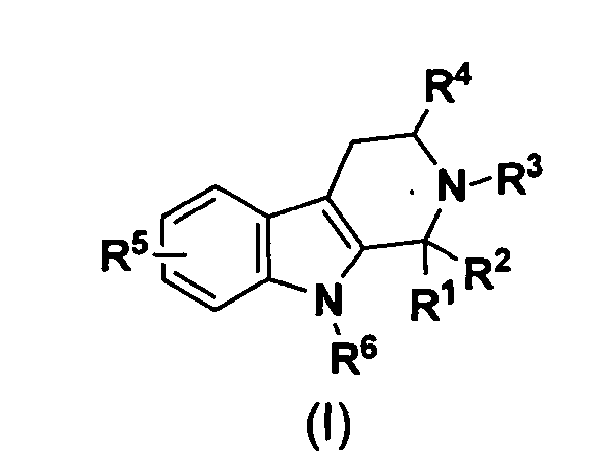
- R1 and R2, identical or different, represent hydrogen, C1-C6 alkyl, C2-C6 alkenyl, C2-C6 alkinyl, aryl, heteroaryl, C3-C6 cycloalkyl or C3-C6 heterocycloalkyl, optionally substituted with one or more substituents independently selected from -NO2; -NH2; -SH; -OH; -CN; -C(=O)-OH; -S(=O)2-OH; -C(=O)-NH2; -S(=O)2-NH2; -S(=O)2-Rf; -ORf; -SRf; -C(=O)-ORf; -N(Rf)-S(=O)2-Rg; -NH-Rf; -NRfRg; - C(=O)-NHRf, -C(=O)-NRfRg; -S(=O)2-NHRf, -S(=O)2-NRfRg; -O-C(=O)-Rf; -NH-C(=O)-Rf; -NRf-C(=O)-Rg; -NH-C(=O)-O-Rf; -NRf-C(=O)-O-Rg; -S(=O)2-O-Rf; an halogen atom; a linear or branched, saturated or unsaturated, optionally at least mono-substituted aliphatic radical; a saturated or unsaturated, optionally at least mono-substituted, optionally at least one heteroatom as a ring member containing cycloaliphatic radical, which may be bonded via a linear or branched alkylene group; or an optionally at least mono-substituted aryl or heteroaryl radical, which may be bonded via a linear or branched alkylene group;
wherein Rf and Rg, independent from one another, each represent a linear or branched, saturated or unsaturated, optionally at least mono-substituted aliphatic radical; a saturated or unsaturated, optionally at least mono-substituted, optionally at least one heteroatom as a ring member containing cycloaliphatic radical, which may be bonded via a linear or branched alkylene group; or an optionally at least mono-substituted aryl or heteroaryl radical, which may be bonded via a linear or branched alkylene, alkenylene or alkinylene group, - or R1 and R2 together form a spiro substituent of 3-6 carbons;
- R3 represents hydrogen, C1-C6 alkyl, C2-6 alkenyl, C2-6 alkinyl, C3-C6 cycloalkyl, C3-C6 heterocycloalkyl, aryl or heteroaryl; optionally substituted with one or more substituents independently selected from -NO2; -NH2; -SH; -OH; -CN; -C(=O)-OH; -S(=O)2-OH; -C(=O)-NH2; -S(=O)2-NH2; -S(=O)2-Rf; -ORf; -SRf; -C(=O)-ORf; -N(Rf)-S(=O)2-Rg; -NH-Rf; -NRfRg; -C(=O)-NHRf, -C(=O)-NRfRg; -S(=O)2-NHRf, -S(=O)2-NRfRg; -O-C(=O)-Rf; -NH-C(=O)-Rf; -NRf-C(=O)-Rg; -NH-C(=O)-O-Rf; -NRf-C(=O)-O-Rg; -S(=O)2-O-Rf; an halogen atom; a linear or branched, saturated or unsaturated, optionally at least mono-substituted aliphatic radical; a saturated or unsaturated, optionally at least mono-substituted, optionally at least one heteroatom as a ring member containing cycloaliphatic radical, which may be bonded via a linear or branched alkylene group; or an optionally at least mono-substituted aryl or heteroaryl radical, which may be bonded via a linear or branched alkylene group;
- R4 represents hydrogen, CO-NRaRb, CO-ORa, wherein
Ra and Rb, identical or different, represent hydrogen, C1-C6 alkyl, aryl, heteroaryl, C3-C6 cycloalkyl, or C3-C6 heterocycloalkyl, optionally substituted with one or more substituents independently selected from - NO2; -NH2; -SH; -OH; -CN; -C(=O)-OH; -S(=O)2-OH; -C(=O)-NH2; - S(=O)2-NH2; -S(=O)2-Rf; -ORf; -SRf; -C(=O)-ORf; -N(Rf)-S(=O)2-Rg; -NH-Rf; -NRfRg; -C(=O)-NHRf, -C(=O)-NRfRg; -S(=O)2-NHRf, -S(=O)2-NRfRg; - O-C(=O)-Rf; -NH-C(=O)-Rf; -NRf-C(=O)-Rg; -NH-C(=O)-O-Rf; -NRf-C(=O)-O-Rg; -S(=O)2-O-Rf; an halogen atom; a linear or branched, saturated or unsaturated, optionally at least mono-substituted aliphatic radical; a saturated or unsaturated, optionally at least mono-substituted, optionally at least one heteroatom as a ring member containing cycloaliphatic radical, which may be bonded via a linear or branched alkylene group; or an optionally at least mono-substituted aryl or heteroaryl radical, which may be bonded via a linear or branched alkylene group;
wherein Rf and Rg, have the meaning defined above - R5 represents NRcSO2Rd, wherein
Rc represents hydrogen or C1-4 alkyl optionally substituted with one or more substituents independently selected from C1-C6 alkyl, aryl, cyano, C1-C6 alkoxy and trifluoromethyl;
Rd represents aryl or heteroaryl optionally substituted with one or more substituents independently selected from -NO2; -NH2; -SH; -OH; -CN; - C(=O)-OH; -S(=O)2-OH; -C(=O)-NH2; -S(=O)2-NH2; -S(=O)2-Rf; -ORf; - SRf; -C(=O)-ORf; -N(Rf)-S(=O)2-Rg; -NH-Rf; -NRfRg; -C(=O)-NHRf, -C(=O)-NRfRg; -S(=O)2-NHRf, -S(=O)2-NRfRg; -O-C(=O)-Rf; -NH-C(=O)-Rf; -NRf-C(=O)-Rg; -NH-C(=O)-O-Rf; -NRf-C(=O)-O-Rg; -S(=O)2-O-Rf; an halogen atom; a linear or branched, saturated or unsaturated, optionally at least mono-substituted aliphatic radical; a saturated or unsaturated, optionally at least mono-substituted, optionally at least one heteroatom as a ring member containing cycloaliphatic radical, which may be bonded via a linear or branched alkylene group; or an optionally at least mono-substituted aryl or heteroaryl radical, which may be bonded via a linear or branched alkylene group;
wherein Rf and Rg, have the meaning defined above - R6 represents hydrogen, C1-4 alkyl, aryl, heteroaryl or SO2Re, wherein
Re represents aryl, heteroaryl, C3-C6 cycloalkyl, C3-C6 heterocycloalkyl; optionally substituted with one or more substituents independently selected from -NO2; -NH2; -SH; -OH; -CN; -C(=O)-OH; -S(=O)2-OH; -C(=O)-NH2; - S(=O)2-NH2; -S(=O)2-Rf; -ORf; -SRf; -C(=O)-ORf; -N(Rf)-S(=O)2-Rg; -NH-Rf; -NRfRg; -C(=O)-NHRf, -C(=O)-NRfRg; -S(=O)2-NHRf, -S(=O)2-NRfRg; - O-C(=O)-Rf; -NH-C(=O)-Rf; -NRf-C(=O)-Rg; -NH-C(=O)-O-Rf; -NRf-C(=O)-O-Rg; -S(=O)2-O-Rf; an halogen atom; a linear or branched, saturated or unsaturated, optionally at least mono-substituted aliphatic radical; a saturated or unsaturated, optionally at least mono-substituted, optionally at least one heteroatom as a ring member containing cycloaliphatic radical, which may be bonded via a linear or branched alkylene group; or an optionally at least mono-substituted aryl or heteroaryl radical, which may be bonded via a linear or branched alkylene group;
wherein Rf and Rg, have the meaning defined above - In a particular embodiment of the compounds of the invention, R1, R2, R3 and R6 are selected from hydrogen or C1-C4 alkyl, R4 is C1-C4 alkyl and R5 is NHSO2Rd, wherein Rd is an aryl or heteroaryl group selected from phenyl, naphthyl, furanyl (furyl), thiophenyl (thienyl), pyrrolyl, oxazolyl, isoxazolyl, thiazolyl, isothiazolyl, imidazolyl, pyrazolyl, oxadiazolyl, thiadiazolyl, triazolyl, tetrazolyl, pyridinyl, pyridazinyl, pyrimidinyl, pyrazinyl, quinolinyl, isoquinolinyl, benzofuranyl, indolyl, benzothiophenyl, benzoxazolyl, benzoisoxazolyl, benzothiazolyl, benzoimidazolyl, indazolyl, benzoxadiazolyl, benzothiadiazolyl, benzotriazolyl and imidazothiazolyl, optionally substitued.
- In another embodiment, the compounds are selected from the following group:
- [1] 6-chloro-imidazo[2,1-b]thiazole-5-sulfonic acid (2-methyl-2,3,4,9-tetrahydro-1H-β-carbolin-6-yl)-amide;
- [2] Benzo[b]thiophene-3-sulfonic acid (2-methyl-2,3,4,9-tetrahydro-1H-β-carbolin-6-yl)-amide;
- [3] Naphthalene-1-sulfonic acid (2-methyl-2,3,4,9-tetrahydro-1H-β-carbolin-6-yl)-amide;
- [4] 5-Chloro-naphthalene-2-sulfonic acid (2-methyl-2,3,4,9-tetrahydro-1H-β-carbolin-6-yl)-amide;
- [5] 5-Chloro-3-methyl-benzo[b]thiophene-2-sulfonic acid (2-methyl-2,3,4,9-tetrahydro-1H-β-carbolin-6-yl)-amide;
- [6] Benzo[1,2,5]thiadiazole-4-sulfonic acid (2-methyl-2,3,4,9-tetrahydro-1H-β-carbolin-6-yl)-amide;
- [7] N-[4-(2-Methyl-2,3,4,9-tetrahydro-1H-β-carbolin-6-ylsulfamoyl)-phenyl]-acetamide;
- [8] 4-Amino-N-(2-methyl-2,3,4,9-tetrahydro-1H-β-carbolin-6-yl)-benzenesulfonamide;
- [9] N-[4-Methyl-5-(2-methyl-2,3,4,9-tetrahydro-1H-β-carbolin-6-ylsulfamoyl)-thiazol-2-yl]-acetamide;
- [10] 5-Dimethylamino-naphthalene-1-sulfonic acid (2-methyl-2,3,4,9-tetrahydro-1H-β-carbolin-6-yl)-amide;
- [11] Benzofuran-2-sulfonic acid (2-methyl-2,3,4,9-tetrahydro-1H-β-carbolin-6-yl)-amide;
- [12] Naphthalene-2-sulfonic acid (2-methyl-2,3,4,9-tetrahydro-1H-β-carbolin-6-yl)-amide.
- The present invention also relates to a procedure for preparing a tetrahydro-β-carbolin-sulfonamide derivative of general formula (I), characterised by reacting a compound of general formula (II)

- The reaction is preferably carried out in the presence of a suitable organic base as triethylamine o preferably pyridine or an inorganic base such as hydroxides and/or carbonates of alkali metals. Optionally, the reaction is carried out in the presence of an organic reaction medium, such as an dialkyl ether, particularly diethyl ether, or a cyclic ether, particularly tetrahydrofurane or dioxane, a halogenated organic hydrocarbon, particularly methylene chloride or chloroform, an aprotic dipolar solvent, particularly acetonitrile, or dimethylformamide, or any other suitable reaction medium. Mixtures of at least two of the above mentioned classes of compounds or of at least two compounds of one class may, of course, also be used.
- The most suitable reaction temperatures range from 0° C to ambient temperature, i.e. approximately 25 °C, and the reaction time is preferably from 5 minutes to 24 hours.
- The resulting derivative of general formula (I) may be purified and/or isolated according to conventional methods known to those skilled in the art. Preferably, can be isolated by evaporating the reaction medium, adding water and eventually adjusting the pH so that it is obtained as a solid that can be isolated by filtration; or it can be extracted by a solvent immiscible with water, such as chloroform or ethyl acetate, and purified by chromatography or recrystallisation from a suitable solvent.
- The compounds of general formula RdSO2X are commercially available or can be prepared according to standard methods known to those skilled in the art, e.g. by methods analogous to those described in the literature [E. E. Gilbert, Synthesis, 1969, 1, 3] and compounds of general formula (II) may be prepared by hydrogenation of compounds of general formula (III).

- Hydrogenation preferably takes place with the aid of a metallic catalyst such as palladium, platinum or rhodium on a suitable support such as carbon, aluminum oxide or barium sulphate, preferably palladium on carbon, with an initial hydrogen pressure of between 5 and 50 psi, in a solvent such as methanol or ethanol. The reaction time ranges from 1 hour to 24 hours.
- The resulting amine can be isolated by filtering the catalyst and concentrating the filtrate at reduced pressure. The product recovered can be used as is or it can be purified by chromatography or by recrystallization from a suitable solvent.
- Compounds of general formula (III) may be prepared by conventional methods known to those skilled in the art, or according to the methods described in the present invention, for example by a Pictet-Spengler cyclization by reaction between a compound of general formula (IV) and an aldehyde of formula R1CHO or a ketone of formula R1R2CO.
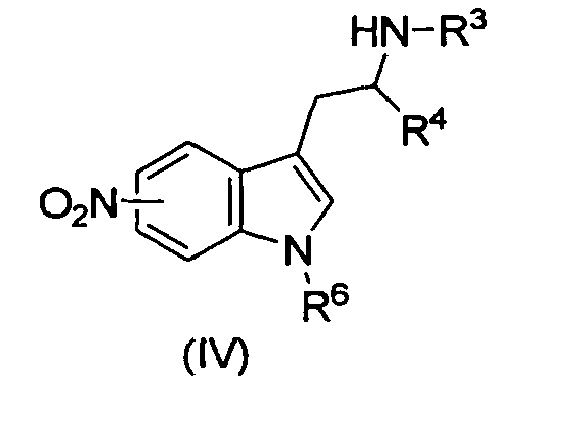
- The reaction may be carried out in the presence of an acid as for example acetic acid, sulfuric acid or trifluoroacetic acid, optionally in the presence of an organic solvent such as a halogenated hydrocarbon or an aromatic hydrocarbon. The most suitable reaction temperatures range from ambient temperature to the refluxing temperature of the solvent. Compounds R1CHO and R1R2CO are commercially available or can be prepared according to standard methods. Compounds of general formula (IV) are commercially available or can be prepared according to standard methods known to those skilled in the art, or by analogous methods described in the bibliography [J. Holenz, et al., J. Med. Chem., 2005, 48, 1781-1795; J. E. Macor, et al., Synt. Comm., 1993, 23, 65-72]
- Compounds of general formula (I), (II), (III) and (IV) prepared by this methodology can be prepared as stereoisomers, particularly enantiomers or diastereomers, their racemates or in form of a mixture of at least two of their stereoisomers, particularly enantiomers or diastereomers, in any mixing ratio. Enantiomers can be separated from racemic mixtures by resolution by standard procedures known to those skilled in the art, for example using HPLC on a chiral column, or using separation of salts of stereoisomers. Alternatively, chirality can be induced by analogous methods described in the bibliography [T. Soe, et al., Tetrahedron Lett., 1995, 36, 1857-1860; R. Tsuji, et al., Tetrahedron: Asymmetry, 2003, 14, 177-180].
- During one of the synthesis sequences described above, or in the preparation of suitable reactants used it may be necessary and/or desirable to protect sensitive or reactive groups in some of the molecules employed. This can be performed by means of conventional protective groups such as those described in the literature [T. W. Greene & P. G. M. Wuts, Protective Groups in Organic Chemistry, John Wiley & Sons, 3rd edition, 1999]. The protective groups can be eliminated in a suitable latter stage by methods known to those skilled in the art. The respective literature descriptions are hereby incorporated by reference and form part of the disclosure.
- The present invention also relates to another procedure for preparing a tetrahydro-β-carbolin-sulfonamide derivative of general formula (I), characterised by a Pictet-Spengler cyclization of a compound of general formula (V)

- The reaction may be carried out in the presence of an acid as for example acetic acid, sulfuric acid or trifluoroacetic acid, optionally in the presence of an organic solvent such as a halogenated hydrocarbon or an aromatic hydrocarbon. The most suitable reaction temperatures range from ambient temperature to the refluxing temperature of the solvent. Compounds R1CHO and R1R2CO are commercially available or can be prepared according to standard methods. Compounds of general formula (V) are commercially available or can be prepared according to standard methods known to those skilled in the art, or by analogous methods described in the bibliography [J. Holenz, et al., J. Med. Chem., 2005, 48, 1781-1795; J. E. Macor, et al., Synt. Comm., 1993, 23, 65-72].
- Compounds of general formula (V) prepared by this methodology can be prepared as stereoisomers, particularly enantiomers or diastereomers, their racemates or in form of a mixture of at least two of their stereoisomers, particularly enantiomers or diastereomers, in any mixing ratio. Enantiomers can be separated from racemic mixtures by resolution by standard procedures known to those skilled in the art, for example using HPLC on a chiral column, or using separation of salts of stereoisomers. Alternatively, chirality can be induced by analogous methods described in the bibliography [T. Soe, et al., Tefrahedron Lett., 1995, 36, 1857-1860; R. Tsuji, et al., Tetrahedron: Asymmetry, 2003, 14, 177-180].
- During one of the synthesis sequences described above, or in the preparation of suitable reactants used it may be necessary and/or desirable to protect sensitive or reactive groups in some of the molecules employed. This can be performed by means of conventional protective groups such as those described in the literature [T. W. Greene & P. G. M. Wuts, Protective Groups in Organic Chemistry, John Wiley & Sons, 3rd edition, 1999 ]. The protective groups can be eliminated in a suitable latter stage by methods known to those skilled in the art. The respective literature descriptions are hereby incorporated by reference and form part of the disclosure.
- The pharmacologically acceptable salts of compounds with the general formula (I) can be prepared by conventional methods known to those skilled in the art, preferably by reaction with a mineral acid, such as hydrochloric, hydrobromic, phosphoric, sulphuric, nitric acids or with organic acids such as citric, maleic, fumaric, tartaric acids or their derivatives, p-toluensulphonic acid, methansulphonic acid, etc., in a suitable solvent such as methanol, ethanol, diethyl ether, ethyl acetate, acetonitrile or acetone and obtained with the usual techniques of precipitation or crystallisation of the corresponding salts.
- Preferred physiologically acceptable salts of the derivatives of general formula (I) are the additions salts of mineral acids, such as hydrochloric acid, hydrobromic acid, phosphoric acid, sulphuric acid, nitric acid, and of organic acids, such as citric acid, maleic acid, tartaric acid or derivatives thereof, p-toluenesulphonic acid, methansulphonic acid, camphorsulphonic acid, etc.
- The physiologically acceptable solvates, particularly hydrates, of the derivatives of general formula (I) or of the corresponding physiologically acceptable salts may be prepared by conventional methods known to those skilled in the art.
- The invention also relates to a tetrahydro-β-carbolin-sulfonamide derivative of general formula (I) as previously disclosed for the prophylaxis and/or treatment of a disorder or a disease related to 5-HT6 receptors in mammals, including humans. More in particular, for the prophylaxis and/or treatment of a disorder or a disease related to food intake, preferably for the regulation of appetite, for the maintenance, increase or reduction of body weight, for the prophylaxis and/or treatment of obesity, bulimia, anorexia, cachexia or type II diabetes, preferably type II diabetes that is caused by obesity, or for the prophylaxis and/or treatment of irritable colon syndrome; disorders of the central nervous system; anxiety; panic attacks; depression; bipolar disorders; cognitive disorders; memory disorders; senile dementia; psychosis; neurodegenerative disorders, preferably selected from the group consisting of Morbus Alzheimer, Morbus Parkinson, Morbus Huntington and Multiple Sclerosis; schizophrenia; psychosis; or hyperactivity disorders, preferably attention deficit/hyperactivity disorder, or for the improvement of cognition.
- The invention also relates to the use of a tetrahydro-β-carbolin-sulfonamide derivative of general (I):

- R1 and R2, identical or different, represent hydrogen, C1-C6 alkyl, C2-C6 alkenyl, C2-C6 alkinyl, aryl, heteroaryl, C3-C6 cycloalkyl or C3-C6 heterocycloalkyl, optionally substituted with one or more substituents independently selected from -NO2; -NH2; -SH; -OH; -CN; -C(=O)-OH; -S(=O)2-OH; -C(=O)-NH2; -S(=O)2-NH2; -S(=O)2-Rf; -ORf; -SRf; -C(=O)-ORf; -N(Rf)-S(=O)2-Rg; -NH-Rf; -NRfRg; - C(=O)-NHRf, -C(=O)-NRfRg; -S(=O)2-NHRf, -S(=O)2-NRfRg; -O-C(=O)-Rf; -NH-C(=O)-Rf; -NRf-C(=O)-Rg; -NH-C(=O)-O-Rf; -NRf-C(=O)-O-Rg; -S(=O)2-O-Rf; an halogen atom; a linear or branched, saturated or unsaturated, optionally at least mono-substituted aliphatic radical; a saturated or unsaturated, optionally at least mono-substituted, optionally at least one heteroatom as a ring member containing cycloaliphatic radical, which may be bonded via a linear or branched alkylene group; or an optionally at least mono-substituted aryl or heteroaryl radical, which may be bonded via a linear or branched alkylene group;
wherein Rf and Rg, have the meaning defined above - or R1 and R2 together form a spiro substituent of 3-6 carbons;
- R3 represents hydrogen, C1-C6 alkyl, C2-6 alkenyl, C2-6 alkinyl, C3-C6 cycloalkyl, C3-C6 heterocycloalkyl, aryl or heteroaryl; optionally substituted with one or more substituents independently selected from -NO2; -NH2; -SH; -OH; -CN; -C(=O)-OH; -S(=O)2-OH; -C(=O)-NH2; -S(=O)2-NH2; -S(=O)2-Rf; -ORf; -SRf; -C(=O)-ORf; -N(Rf)-S(=O)2-Rg; -NH-Rf; -NRfRg; -C(=O)-NHRf, -C(=O)-NRfRg; -S(=O)2-NHRf, -S(=O)2-NRfRg; -O-C(=O)-Rf; -NH-C(=O)-Rf; -NRf-C(=O)-Rg; -NH-C(=O)-O-Rf; -NRf-C(=O)-O-Rg; -S(=O)2-O-Rf; an halogen atom; a linear or branched, saturated or unsaturated, optionally at least mono-substituted aliphatic radical; a saturated or unsaturated, optionally at least mono-substituted, optionally at least one heteroatom as a ring member containing cycloaliphatic radical, which may be bonded via a linear or branched alkylene group; or an optionally at least mono-substituted aryl or heteroaryl radical, which may be bonded via a linear or branched alkylene group;
wherein Rf and Rg, have the meaning defined above - R4 represents hydrogen, CO-NRaRb, CO-ORa, wherein
Ra and Rb, identical or different, represent hydrogen, C1-C6 alkyl, aryl, heteroaryl, C3-C6 cycloalkyl, or C3-C6 heterocycloalkyl, optionally substituted with one or more substituents independently selected from - NO2; -NH2; -SH; -OH; -CN; -C(=O)-OH; -S(=O)2-OH; -C(=O)-NH2; - S(=O)2-NH2; -S(=O)2-Rf; -ORf; -SRf; -C(=O)-ORf; -N(Rf)-S(=O)2-Rg; -NH-Rf; -NRfRg; -C(=O)-NHRf, -C(=O)-NRfRg; -S(=O)2-NHRf, -S(=O)2-NRfRg; - O-C(=O)-Rf; -NH-C(=O)-Rf; -NRf-C(=O)-Rg; -NH-C(=O)-O-Rf; -NRf-C(=O)-O-Rg; -S(=O)2-O-Rf; an halogen atom; a linear or branched, saturated or unsaturated, optionally at least mono-substituted aliphatic radical; a saturated or unsaturated, optionally at least mono-substituted, optionally at least one heteroatom as a ring member containing cycloaliphatic radical, which may be bonded via a linear or branched alkylene group; or an optionally at least mono-substituted aryl or heteroaryl radical, which may be bonded via a linear or branched alkylene group;
wherein Rf and Rg, have the meaning defined above - R5 represents NRcSO2Rd, wherein
Rc represents hydrogen or C1-4 alkyl optionally substituted with one or more substituents independently selected from C1-C6 alkyl, aryl, cyano, C1-C6 alkoxy and trifluoromethyl;
Rd represents aryl or heteroaryl optionally substituted with one or more substituents independently selected from -NO2; -NH2; -SH; -OH; -CN; - C(=O)-OH; -S(=O)2-OH; -C(=O)-NH2; -S(=O)2-NH2; -S(=O)2-Rf; -ORf; - SRf; -C(=O)-ORf; -N(Rf)-S(=O)2-Rg; -NH-Rf; -NRfRg; -C(=O)-NHRf, -C(=O)-NRfRg; -S(=O)2-NHRf, -S(=O)2-NRfRg; -O-C(=O)-Rf; -NH-C(=O)-Rf; -NRf-C(=O)-Rg; -NH-C(=O)-O-Rf; -NRf-C(=O)-O-Rg; -S(=O)2-O-Rf; an halogen atom; a linear or branched, saturated or unsaturated, optionally at least mono-substituted aliphatic radical; a saturated or unsaturated, optionally at least mono-substituted, optionally at least one heteroatom as a ring member containing cycloaliphatic radical, which may be bonded via a linear or branched alkylene group; or an optionally at least mono-substituted aryl or heteroaryl radical, which may be bonded via a linear or branched alkylene group;
wherein Rf and Rg, have the meaning defined above - R6 represents hydrogen, C1-4 alkyl, aryl, heteroaryl or SO2Re, wherein
Re represents aryl, heteroaryl, C3-C6 cycloalkyl, C3-C6 heterocycloalkyl; optionally substituted with one or more substituents independently selected from -NO2; -NH2; -SH; -OH; -CN; -C(=O)-OH; -S(=O)2-OH; -C(=O)-NH2; - S(=O)2-NH2; -S(=O)2-Rf; -ORf; -SRf; -C(=O)-ORf; -N(Rf)-S(=O)2-Rg; -NH-Rf; -NRfRg; -C(=O)-NHRf, -C(=O)-NRfRg; -S(=O)2-NHRf, -S(=O)2-NRfRg; - O-C(=O)-Rf; -NH-C(=O)-Rf; -NRf-C(=O)-Rg; -NH-C(=O)-O-Rf; -NRf-C(=O)-O-Rg; -S(=O)2-O-Rf; an halogen atom; a linear or branched, saturated or unsaturated, optionally at least mono-substituted aliphatic radical; a saturated or unsaturated, optionally at least mono-substituted, optionally at least one heteroatom as a ring member containing cycloaliphatic radical, which may be bonded via a linear or branched alkylene group; or an optionally at least mono-substituted aryl or heteroaryl radical, which may be bonded via a linear or branched alkylene group;
wherein Rf and Rg, have the meaning defined above - The examples that are indicated below, given by way of illustration, should not in any way limit the scope of the invention.
-

- Under N2, formaldehyde (0.56 ml of a 36.5% aqueous solution, 7.3 mmol) was added to a solution of 5-nitro-3-(2-methylaminoethyl)-1H-indole (1.6 g, 7.3 mmol) in glacial acetic acid (10 mL). After 20 h of stirring at room temperature, the mixture was refluxed for 2 h and taken to dryness in vacuo. The residue was treated with H2O (150 mL) and EtOAc (150 mL) and then basified by the addition of 2M NaOH. The organic phase was separated and the aqueous layer was reextracted with three portions of EtOAc. The combined organic solution was extracted with 10% aqueous H2SO4 (3 x 160 mL). The acidic aqueous phase was cooled in an ice bath, basified with concentrated aqueous NaOH and extracted with tert-butyl methyl ether (4 x 175 mL). The dried (Na2SO4) extract was evaporated to dryness to afford 1.40 g of 2-methyl-6-nitro-2,3,4,9-tetrahydro-1H-β-carboline that were used directly in the next step.
-

- To a solution of 2-methyl-6-nitro-2,3,4,9-tetrahydro-1H-β-carboline (description 1) (1.42 g, 6.13 mmol) in EtOH (300 mL), 570 mg of (5%) Pd/C were added. The mixture was hydrogenated under 20 psi at room temperature for 20 h and filtered through a pad of Celite. The EtOH was evaporated to dryness to yield 1.32 g of 6-amino-2-methyl-2,3,4,9-tetrahydro-1H-β-carboline.
-

- To a solution of 6-amino-2-methyl-2,3,4,9-tetrahydro-1H-β-carboline (description 2) (150 mg, 0.68 mmol) in pyridine (5 mL) cooled in an ice bath, were added 200 mg of 6-chloro-imidazo[2,1-b]thiazole-5-sulfonyl chloride (0.68 mmol). Under N2, the reaction mixture was left to reach room temperature and stirred for 1 h at this temperature. The reaction mixture was basified with aqueous saturated solution of NaHCO3 and the pyridine evaporated. The mixture was treated with EtOAc and H2O, the organic phase washed with aqueous saturated solution of NaHCO3, separated and dried with Na2SO4. The crude was further purified using SiO2 column chromatography with EtOAc/MeOH/NH3 mixtures to yield 130 mg of 6-chloro-imidazo[2,1-b]thiazole-5-sulfonic acid (2-methyl-2,3,4,9-tetrahydro-1H-β-carbolin-6-yl)-amide. 1H-NMR (300 MHz, DMSO-d6): δ(ppm) 2.36 (s, 3H); 2.54 (bb, 2H); 2.61 (bb, 2H); 3.45 (bb, 2H); 6.65 (dd, 1H, J = 8.7, 2.1 Hz); 6.99 (d, 1H, J = 1.8 Hz); 7.09 (d, 1 H, J = 8.7 Hz); 7.53 (d, 1H, J = 4.5 Hz); 7.81 (d, 1H, J = 4.5 Hz); 10.37 (bb, 1 H); 10.74 (s, 1 H).
- Using essentially the same general procedure described for example 1 with minor changes, compounds 2-7 and 9-12, were also prepared:
-

- 1H-NMR (400 MHz, DMSO-d6): .δ(ppm) 2.34 (s, 3H); 2.50 (bb, 2H); 2.59 (bb, 2H); 3.42 (bb, 2H); 6.59 (dd, 1 H, J = 8.4, 2.0 Hz); 6.97 (d, 1H, J = 2 Hz); 7.01 (d,
- 1 H, J = 8.8 Hz); 7.43-7.53 (m, 2H); 8.04 (d, 1H, J = 7.6 Hz); 8.24 (d, 1 H, J = 7.6 Hz); 8.30 (s, 1 H); 10.03 (bb, 1 H); 10.66 (s, 1 H).
-

- 1H-NMR (300 MHz, DMSO-d6): .δ(ppm) 2.33 (s, 3H); 2.48 (bb, 2H); 2.57 (bb, 2H); 3.40 (bb, 2H); 6.55 (dd, 1 H, J = 8.7, 2.1 Hz); 6.92 (d, 1 H, J = 1.5 Hz); 6.97 (d, 1H, J = 8.7 Hz); 7.49 (t, 1H, J = 8.1 Hz); 7.64 (t, 1 H, J = 6.9 Hz); 7.71 (m, 1 H); 8.02 (m, 2H); 8.12 (d, 1 H, J = 8.1 Hz); 8.78 (d, 1 H, J = 8.4 Hz); 10.10 (bb, 1 H); 10.62 (s, 1 H).
-

- 1H-NMR (400 MHz, DMSO-d6): δ(ppm) 2.34 (s, 3H); 2.51 (bb, 2H); 2.59 (bb, 2H); 3.42 (bb, 2H); 6.66 (dd, 1 H, J = 8.4, 2.0 Hz); 7.03 (d, 1 H, J = 8.8 Hz); 7.05 (d, 1H, J = 2.0 Hz); 7.58 (t, 1H, J = 8.0 Hz); 7.83 (d, 1H, J = 7.6 Hz); 7.89 (dd, 1 H, J = 8.8, 1.6 Hz); 8.08 (d, 1 H, J = 8.4 Hz); 8.28 (d, 1 H, J = 8.8 Hz); 8.36 (d, 1 H, J = 2.0 Hz); 9.95 (bb, 1H); 10.67 (s, 1H).
-

- 1H-NMR (400 MHz, DMSO-d6): δ(ppm) 2.33 (s, 3H); 2.35 (s, 3H); 2.52 (bb, 2H); 2.60 (bb, 2H); 3.44 (bb, 2H); 6.69 (dd, 1 H, J = 8.4, 2.0 Hz); 7.06 (d, 1 H, J = 2.0 Hz); 7.08 (d, 1 H, J = 8.4 Hz); 7.50 (dd, 1H, J = 8.8, 2.0 Hz); 7.93 (d, 1H, J = 2.0 Hz); 7.99 (d, 1H, J = 8.4 Hz); 10.16 (bb, 1H); 10.73 (s, 1 H).
-

- 1H-NMR (400 MHz, DMSO-d6): .δ(ppm) 2.33 (s, 3H); 2.48 (bb, 2H), 2.57 (bb, 2H); 3.40 (bb, 2H); 6.55 (dd, 1H, J = 8.4, 2.0 Hz); 6.94 (m, 2H); 7.72 (dd, 1H, J = 8.8, 7.2 Hz); 8.06 (dd, 1H, J = 6.8, 0.8 Hz); 8.30 (dd, 1H, J = 9.2, 1.2 Hz); 10.11 (bb, 1 H); 10.63 (s, 1 H).
-

- 1H-NMR (300 MHz, DMSO-d6): .δ(ppm) 2.02 (s, 3H); 2.36 (s, 3H); 2.55 (bb, 2H); 2.60 (bb, 2H); 3.45 (bb, 2H); 6.56 (dd, 1H, J = 8.4, 1.5 Hz); 7.00 (s, 1 H); 7.06 (d, 1H, J = 8.4 Hz); 7.54 (sys AB, 2H, J = 8.7 Hz); 7.61 (sys AB, 2H, J = 8.7 Hz); 9.60 (bb, 1 H); 10.22 (s, 1 H); 10.67 (s, 1 H).
-

- A solution of N-[4-(2-Methyl-2,3,4,9-tetrahydro-1H-β-carbolin-6-ylsulfamoyl)-phenyl]-acetamide (example 7) (80 mg, 0.2 mmol) in 1 mL of an aqueous 10% de NaOH solution was refluxed for 2 h. The resulting mixture was treated with H2O (25 mL) and EtOAc (25 mL) and neutralized by addition of AcOH glacial. The aqueous phase was washed again with EtOAc and the combined organic extracts dried to afford 50 mg of 4-amino-N-(2-methyl-2,3,4,9-tetrahydro-1H-β-carbolin-6-yl)-benzenesulfonamide. 1H-NMR (300 MHz, DMSO-d6): δ(ppm) 2.36 (s, 3H); 2.55 (bb, 2H); 2.61 (bb, 2H); 3.45 (bb, 2H); 5.83 (bb, 2H); 6.44 (sys AB, 2H, J = 8.7 Hz); 6.68 (dd, 1 H, J = 8.4, 1.8 Hz); 6.99 (bb, 1 H); 7.05 (d, 1H, J = 8.4 Hz); 7.25 (sys AB, 2H, J = 8.7 Hz); 9.27 (s, 1 H); 10.63 (s, 1 H).
-
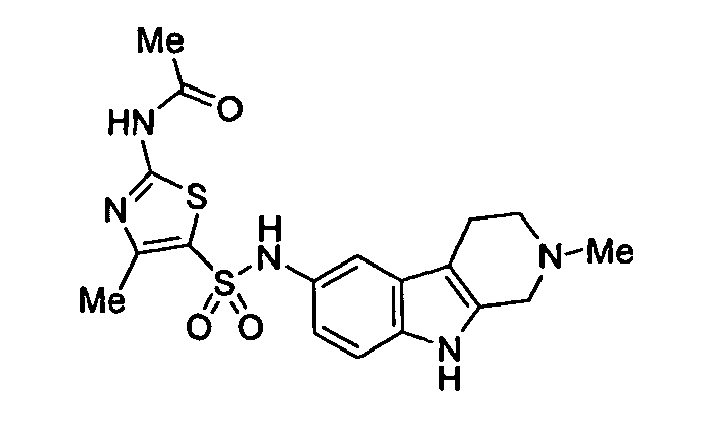
- 1H-NMR (300 MHz, DMSO-d6): .δ(ppm) 2.09 (s, 3H); 2.12 (s, 3H); 2.37 (s, 3H); 2.58 (bb, 2H); 2.62 (bb, 2H); 3.47 (bb, 2H); 6.72 (dd, 1H, J = 8.4, 1.8 Hz); 7.06 (d, 1H, J = 1.8 Hz); 7.13 (d, 1H, J = 8.4 Hz); 9.86 (bb, 1H); 10.74 (s, 1 H); 12.40 (bb, 1H).
-

- 1H-NMR (300 MHz, DMSO-d6): .δ(ppm) 2.33 (s, 3H); 2.55 (bb, 4H); 2.78 (s, 6H); 3.40 (bb, 2H); 6.59 (dd, 1 H, J = 8.7, 1.5 Hz); 6.91 (s, 1 H); 6.95 (d, 1H, J = 8.7 Hz); 7.23 (d, 1H, J = 7.5 Hz); 7.47 (dd, 1 H, J = 8.1, 7.8 Hz); 7.59 (dd, 1H, J = 8.4, 7.8 Hz); 8.00 (d, 1 H, J = 6.9 Hz); 8.36 (d, 1 H, J = 8.4 Hz); 8.42 (d, 1H, J = 8.7 Hz); 10.05 (s, 1 H); 10.61 (s, 1 H).
-

- 1H-NMR (300 MHz, DMSO-d6): .δ(ppm) 2.33 (s, 3H); 2.59 (bb, 2H); 2.79 (bb, 2H); 3.65 (bb, 2H); 6.75 (dd, 1 H, J = 8.4, 1.8 Hz); 7.13-7.10 (m, 2H); 7.33 (dd, 1H, J = 7.8, 7.2 Hz); 7.40 (s, 1 H); 7.48 (dd, 1H, J = 7.8, 7.5 Hz); 7.68 (d, 1 H, J = 7.5 Hz); 7.69 (d, 1H, J = 8.4 Hz); 10.33 (bb, 1 H); 10.82 (s, 1H).
-

- 1H-NMR (300 MHz, DMSO-d6): .δ(ppm) 2.37 (s, 3H); 2.53 (bb, 2H); 2.62 (bb, 2H); 3.47 (bb, 2H); 6.68 (dd, 1H, J = 8.4, 1.8 Hz); 7.02-7.06 (m, 2H); 7.56-7.66 (m, 2H); 7.72 (dd, 1H, J = 8.7, 1.5 Hz); 7.95 (d, 1 H, J = 7.8 Hz); 8.01-8.04 (m, 2H); 8.26 (d, 1 H, J = 1.2 Hz); 9.85 (bb, 1 H); 10.67 (s, 1H).
- Cell membranes of HEK-293 cells expressing the 5HT6-human recombinant receptor were supplied by Receptor Biology. In said membranes the receptor concentration is 2.18 pmol/mg protein and the protein concentration is 9.17 mg/ml. The experimental protocol follows the method of B. L. Roth et al. [B. L. Roth et al., The Journal of Pharmacology and Experimental Therapeutics, 1994, 268, 1403] with the following slight changes. The respective part of the literature description is hereby incorporated by reference and forms part of the disclosure.
- The commercial membrane is diluted (1:40 dilution) with the binding buffer: 50 mM Tris-HCl, 10 mM MgCl2, 0.5 mM EDTA (pH 7.4). The radioligand used is [3H]-LSD at a concentration of 2.7 nM with a final volume of 200 µl. incubation is initiated by adding 100 µl of membrane suspension, (≈ 22.9 µg membrane protein), and is prolonged for 60 minutes at a temperature of 37 °C. The incubation is ended by fast filtration in a Brandel Cell Harvester through fiber glass filters made by Schleicher & Schuell GF 3362 pretreated with a solution of polyethylenimine at 0.5 %. The filters are washed three times with three milliliters of buffer Tris-HCl 50 mM pH 7.4. The filters are transferred to flasks and 5 ml of Ecoscint H liquid scintillation cocktail are added to each flask. The flasks are allowed to reach equilibrium for several hours before counting with a Wallac Winspectral 1414 scintillation counter. Non-specific binding is determined in the presence of 100 µM of serotonin. Tests were made in triplicate. The inhibition constants (Ki, nM) were calculated by non-linear regression analysis using the program EBDA/LIGAND described in Munson and Rodbard, Analytical Biochemistry, 1980, 107, 220, which is hereby incorporated by reference and forms part of the disclosure.
- The binding results for some of these compounds are given in the following table.
Table Example % Inhibition
10-7 MKi (nM) 1 80.7 2.4 2 79.5 2.8 3 61.4 4 70.6 - The invention also relates to a pharmaceutical composition containing a compound of general formula (I) and one or more pharmaceutically acceptable excipients. Typically the pharmaceutical compositions and medicaments comprise 1 to 60 % by weight of one or more derivatives of general formula (I) and 40 to 99 % by weight of one or more excipients.
- The amount of active ingredient to be administered to the patient varies in dependence on the weight of the patient, the route of administration, the indication and the degree of severity of the disorder. Usually 1 to 500 mg of at least one derivative of general formula (I) are administered to the patient in need of treatment per day. The total daily dose may be administered to the patient in one or more portions.
Formula per tablet: Compound according to example 1 5 mg Lactose 60 mg Crystalline cellulose 25 mg K 90 Povidone 5 mg Pregelatinised starch 3 mg Colloidal silicon dioxide 1 mg Magnesium stearate 1 mg Total weight per tablet 100 mg
optionally in form of one of its stereoisomers, preferably enantiomers or diasteromers, a racemate or in form of a mixture of at least two of its stereoisomers, preferably enantiomers and/or diastereomers, in any mixing ratio, or a physiologically acceptable salt thereof, or a corresponding solvate thereof.
in the manufacture of a medicament for the prophylaxis and/or treatment of a disorder or a disease related to 5-HT6 receptors in mammals, including humans. Particularly, for the prophylaxis and/or treatment of a disorder or a disease related to food intake, preferably for the regulation of appetite, for the maintenance, increase or reduction of body weight, for the prophylaxis and/or treatment of obesity, bulimia, anorexia, cachexia or type II diabetes, preferably type II diabetes that is caused by obesity, or for the prophylaxis and/or treatment of irritable colon syndrome; disorders of the central nervous system; anxiety; panic attacks; depression; bipolar disorders; cognitive disorders; memory disorders; senile dementia; psychosis; neurodegenerative disorders, preferably selected from the group consisting of Morbus Alzheimer, Morbus Parkinson, Morbus Huntington and Multiple Sclerosis; schizophrenia; psychosis; or hyperactivity disorders, preferably attention deficit/hyperactivity disorder, or for the improvement of cognition.
Claims (10)
- A tetrahydro-β-carbolin-sulfonamide derivative of general formula (I):
 R1 and R2, identical or different, represent hydrogen, C1-C6 alkyl, C2-C6 alkenyl, C2-C6 alkinyl, aryl, heteroaryl, C3-C6 cycloalkyl or C3-C6 heterocycloalkyl, optionally substituted with one or more substituents independently selected from -NO2; -NH2; -SH; -OH; -CN; -C(=O)-OH; -S(=O)2-OH; -C(=O)-NH2; -S(=O)2-NH2; -S(=O)2-Rf; -ORf; -SRf; -C(=O)-ORf; -N(Rf)-S(=O)2-Rg; -NH-Rf; -NRfRg; - C(=O)-NHRf, -C(=O)-NRfRg; -S(=O)2-NHRf, -S(=O)2-NRfRg; -O-C(=O)-Rf; -NH-C(=O)-Rf; -NRf-C(=O)-Rg; -NH-C(=O)-O-Rf; -NRf-C(=O)-O-Rg; -S(=O)2-O-Rf; an halogen atom; a linear or branched, saturated or unsaturated, optionally at least mono-substituted aliphatic radical; a saturated or unsaturated, optionally at least mono-substituted, optionally at least one heteroatom as a ring member containing cycloaliphatic radical, which may be bonded via a linear or branched alkylene group; or an optionally at least mono-substituted aryl or heteroaryl radical, which may be bonded via a linear or branched alkylene group;
wherein Rf and Rg, independent from one another, each represent a linear or branched, saturated or unsaturated, optionally at least mono-substituted aliphatic radical; a saturated or unsaturated, optionally at least mono-substituted, optionally at least one heteroatom as a ring member containing cycloaliphatic radical, which may be bonded via a linear or branched alkylene group; or an optionally at least mono-substituted aryl or heteroaryl radical, which may be bonded via a linear or branched alkylene, alkenylene or alkinylene group,or R1 and R2 together form a spiro substituent of 3-6 carbons;R3 represents hydrogen, C1-C6 alkyl, C2-6 alkenyl, C2-6 alkinyl, C3-C6 cycloalkyl, C3-C6 heterocycloalkyl, aryl or heteroaryl; optionally substituted with one or more substituents independently selected from -NO2; -NH2; -SH; -OH; -CN; -C(=O)-OH; -S(=O)2-OH; -C(=O)-NH2; -S(=O)2-NH2; -S(=O)2-Rf; -ORf; -SRf; -C(=O)-ORf; -N(Rf)-S(=O)2-Rg; -NH-Rf; -NRfRg; -C(=O)-NHRf, -C(=O)-NRfRg; -S(=O)2-NHRf, -S(=O)2-NRfRg; -O-C(=O)-Rf; -NH-C(=O)-Rf; -NRf-C(=O)-Rg; -NH-C(=O)-O-Rf; -NRf-C(=O)-O-Rg; -S(=O)2-O-Rf; an halogen atom; a linear or branched, saturated or unsaturated, optionally at least mono-substituted aliphatic radical; a saturated or unsaturated, optionally at least mono-substituted, optionally at least one heteroatom as a ring member containing cycloaliphatic radical, which may be bonded via a linear or branched alkylene group; or an optionally at least mono-substituted aryl or heteroaryl radical, which may be bonded via a linear or branched alkylene group;
wherein Rf and Rg, have the meaning defined aboveR4 represents hydrogen, CO-NRaRb, CO-ORa, wherein
Ra and Rb, identical or different, represent hydrogen, C1-C6 alkyl, aryl, heteroaryl, C3-C6 cycloalkyl, or C3-C6 heterocycloalkyl, optionally substituted with one or more substituents independently selected from - NO2; -NH2; -SH; -OH; -CN; -C(=O)-OH; -S(=O)2-OH; -C(=O)-NH2; - S(=O)2-NH2; -S(=O)2-Rf; -ORf; -SRf; -C(=O)-ORf; -N(Rf)-S(=O)2-Rg; -NH-Rf; -NRfRg; -C(=O)-NHRf, -C(=O)-NRfRg; -S(=O)2-NHRf, -S(=O)2-NRfRg; - O-C(=O)-Rf; -NH-C(=O)-Rf; -NRf-C(=O)-Rg; -NH-C(=O)-O-Rf; -NRf-C(=O)-O-Rg; -S(=O)2-O-Rf; an halogen atom; a linear or branched, saturated or unsaturated, optionally at least mono-substituted aliphatic radical; a saturated or unsaturated, optionally at least mono-substituted, optionally at least one heteroatom as a ring member containing cycloaliphatic radical, which may be bonded via a linear or branched alkylene group; or an optionally at least mono-substituted aryl or heteroaryl radical, which may be bonded via a linear or branched alkylene group;
wherein Rf and Rg, have the meaning defined aboveR5 represents NRcSO2Rd, wherein
Rc represents hydrogen or C1-4 alkyl optionally substituted with one or more substituents independently selected from C1-C6 alkyl, aryl, cyano, C1-C6 alkoxy and trifluoromethyl;
Rd represents aryl or heteroaryl optionally substituted with one or more substituents independently selected from -NO2; -NH2; -SH; -OH; -CN; - C(=O)-OH; -S(=O)2-OH; -C(=O)-NH2; -S(=O)2-NH2; -S(=O)2-Rf; -ORf; - SRf; -C(=O)-ORf; -N(Rf)-S(=O)2-Rg; -NH-Rf; -NRfRg; -C(=O)-NHRf, -C(=O)-NRfRg; -S(=O)2-NHRf, -S(=O)2-NRfRg; -O-C(=O)-Rf; -NH-C(=O)-Rf; -NRf-C(=O)-Rg; -NH-C(=O)-O-Rf; -NRf-C(=O)-O-Rg; -S(=O)2-O-Rf; an halogen atom; a linear or branched, saturated or unsaturated, optionally at least mono-substituted aliphatic radical; a saturated or unsaturated, optionally at least mono-substituted, optionally at least one heteroatom as a ring member containing cycloaliphatic radical, which may be bonded via a linear or branched alkylene group; or an optionally at least mono-substituted aryl or heteroaryl radical, which may be bonded via a linear or branched alkylene group;
wherein Rf and Rg, have the meaning defined aboveR6 represents hydrogen, C1-4 alkyl, aryl, heteroaryl or SO2Re, whereinwith the proviso that when Rd is phenyl, Re is other than phenyl;
Re represents aryl, heteroaryl, C3-C6 cycloalkyl, C3-C6 heterocycloalkyl; optionally substituted with one or more substituents independently selected from -NO2; -NH2; -SH; -OH; -CN; -C(=O)-OH; -S(=O)2-OH; -C(=O)-NH2; - S(=O)2-NH2; -S(=O)2-Rf; -ORf; -SRf; -C(=O)-ORf; -N(Rf)-S(=O)2-Rg; -NH-Rf; -NRfRg; -C(=O)-NHRf, -C(=O)-NRfRg; -S(=O)2-NHRf, -S(=O)2-NRfRg; - O-C(=O)-Rf; -NH-C(=O)-Rf; -NRf-C(=O)-Rg; -NH-C(=O)-O-Rf; -NRf-C(=O)-O-Rg; -S(=O)2-O-Rf; an halogen atom; a linear or branched, saturated or unsaturated, optionally at least mono-substituted aliphatic radical; a saturated or unsaturated, optionally at least mono-substituted, optionally at least one heteroatom as a ring member containing cycloaliphatic radical, which may be bonded via a linear or branched alkylene group; or an optionally at least mono-substituted aryl or heteroaryl radical, which may be bonded via a linear or branched alkylene group;
wherein Rf and Rg, have the meaning defined above
optionally in form of one of its stereoisomers, preferably enantiomers or diasteromers, a racemate or in form of a mixture of at least two of its stereoisomers, preferably enantiomers and/or diastereomers, in any mixing ratio, or a physiologically acceptable salt thereof, or a corresponding solvate thereof. - A compound according to claim 1, wherein R1, R2, R3 and R6 are selected from hydrogen or C1-C4 alkyl, R4 is C1-C4 alkyl and R5 is NHSO2Rd, wherein Rd is an aryl or heteroaryl group selected from phenyl, naphthyl, furanyl, thiophenyl, pyrrolyl, oxazolyl, isoxazolyl, thiazolyl, isothiazolyl, imidazolyl, pyrazolyl, oxadiazolyl, thiadiazolyl, triazolyl, tetrazolyl, pyridinyl, pyridazinyl, pyrimidinyl, pyrazinyl, quinolinyl, isoquinolinyl, benzofuranyl, indolyl, benzothiophenyl, benzoxazolyl, benzoisoxazolyl, benzothiazolyl, benzoimidazolyl, indazolyl, benzoxadiazolyl, benzothiadiazolyl, benzotriazolyl and imidazothiazolyl, optionally substitued.
- A compound according to anyone of claims 1 and 2, selected from the following group:[1] 6-chloro-imidazo[2,1-b]thiazole-5-sulfonic acid (2-methyl-2,3,4,9-tetrahydro-1H-β-carbolin-6-yl)-amide;[2] Benzo[b]thiophene-3-sulfonic acid (2-methyl-2,3,4,9-tetrahydro-1H-β-carbolin-6-yl)-amide;[3] Naphthalene-1-sulfonic acid (2-methyl-2,3,4,9-tetrahydro-1H-β-carbolin-6-yl)-amide;[4] 5-Chloro-naphthalene-2-sulfonic acid (2-methyl-2,3,4,9-tetrahydro-1H-β-carbolin-6-yl)-amide;[5] 5-Chloro-3-methyl-benzo[b]thiophene-2-sulfonic acid (2-methyl-2,3,4,9-tetrahydro-1H-β-carbolin-6-yl)-amide;[6] Benzo[1,2,5]thiadiazole-4-sulfonic acid (2-methyl-2,3,4,9-tetrahydro-1H-β-carbolin-6-yl)-amide;[7] N-[4-(2-Methyl-2,3,4,9-tetrahydro-1H-β-carbolin-6-ylsulfamoyl)-phenyl]-acetamide;[8] 4-Amino-N-(2-methyl-2,3,4,9-tetrahydro-1H-β-carbolin-6-yl)-benzenesulfonamide;[9] N-[4-Methyl-5-(2-methyl-2,3,4,9-tetrahydro-1H-β-carbolin-6-ylsulfamoyl)-thiazol-2-yl]-acetamide;[10] 5-Dimethylamino-naphthalene-1-sulfonic acid (2-methyl-2,3,4,9-tetrahydro-1H-β-carbolin-6-yl)-amide;[11] Benzofuran-2-sulfonic acid (2-methyl-2,3,4,9-tetrahydro-1H-β-carbolin-6-yl)-amide;[12] Naphthalene-2-sulfonic acid (2-methyl-2,3,4,9-tetrahydro-1H-β-carbolin-6-yl)-amide.
- A procedure for preparing a tetrahydro-β-carbolin-sulfonamide derivative of general formula (I), characterised by reacting a compound of general formula (II)

- A procedure for preparing a tetrahydro-β-carbolin-sulfonamide derivative of general formula (I), characterised by a Pictet-Spengler cyclization of a compound of general formula (V)

- A pharmaceutical composition containing a compound according to anyone of claims 1-3 and one or more pharmaceutically acceptable excipients.
- A tetrahydro-β-carbolin-sulfonamide derivative of general formula (I) according to anyone of claims 1-3 for the prophylaxis and/or treatment of a disorder or a disease related to 5-HT6 receptors in mammals, including humans.
- A tetrahydro-β-carbolin-sulfonamide derivative of general formula (I) according to claim 7 for the prophylaxis and/or treatment of a disorder or a disease related to food intake, preferably for the regulation of appetite, for the maintenance, increase or reduction of body weight, for the prophylaxis and/or treatment of obesity, bulimia, anorexia, cachexia or type II diabetes, preferably type II diabetes that is caused by obesity, or for the prophylaxis and/or treatment of irritable colon syndrome; disorders of the central nervous system; anxiety; panic attacks; depression; bipolar disorders; cognitive disorders; memory disorders; senile dementia; psychosis; neurodegenerative disorders, preferably selected from the group consisting of Morbus Alzheimer, Morbus Parkinson, Morbus Huntington and Multiple Sclerosis; schizophrenia; psychosis; or hyperactivity disorders, preferably attention deficit/hyperactivity disorder, or for the improvement of cognition.
- Use of a tetrahydro-β-carbolin-sulfonamide derivative of general (I):
 R1 and R2, identical or different, represent hydrogen, C1-C6 alkyl, C2-C6 alkenyl, C2-C6 alkinyl, aryl, heteroaryl, C3-C6 cycloalkyl or C3-C6 heterocycloalkyl, optionally substituted with one or more substituents independently selected from -NO2; -NH2; -SH; -OH; -CN; -C(=O)-OH; -S(=O)2-OH; -C(=O)-NH2; -S(=O)2-NH2; -S(=O)2-Rf; -ORf; -SRf; -C(=O)-ORf; -N(Rf)-S(=O)2-Rg; -NH-Rf; -NRfRg; - C(=O)-NHRf, -C(=O)-NRfRg; -S(=O)2-NHRf, -S(=O)2-NRfRg; -O-C(=O)-Rf; -NH-C(=O)-Rf; -NRf-C(=O)-Rg; -NH-C(=O)-O-Rf; -NRf-C(=O)-O-Rg; -S(=O)2-O-Rf; an halogen atom; a linear or branched, saturated or unsaturated, optionally at least mono-substituted aliphatic radical; a saturated or unsaturated, optionally at least mono-substituted, optionally at least one heteroatom as a ring member containing cycloaliphatic radical, which may be bonded via a linear or branched alkylene group; or an optionally at least mono-substituted aryl or heteroaryl radical, which may be bonded via a linear or branched alkylene group;
wherein Rf and Rg, independent from one another, each represent a linear or branched, saturated or unsaturated, optionally at least mono-substituted aliphatic radical; a saturated or unsaturated, optionally at least mono-substituted, optionally at least one heteroatom as a ring member containing cycloaliphatic radical, which may be bonded via a linear or branched alkylene group; or an optionally at least mono-substituted aryl or heteroaryl radical, which may be bonded via a linear or branched alkylene, alkenylene or alkinylene group,or R1 and R2 together form a spiro substituent of 3-6 carbons;R3 represents hydrogen, C1-C6 alkyl, C2-6 alkenyl, C2-6 alkinyl, C3-C6 cycloalkyl, C3-C6 heterocycloalkyl, aryl or heteroaryl; optionally substituted with one or more substituents independently selected from -NO2; -NH2; -SH; -OH; -CN; -C(=O)-OH; -S(=O)2-OH; -C(=O)-NH2; -S(=O)2-NH2; -S(=O)2-Rf; -ORf; -SRf; -C(=O)-ORf; -N(Rf)-S(=O)2-Rg; -NH-Rf; -NRfRg; -C(=O)-NHRf, -C(=O)-NRfRg; -S(=O)2-NHRf, -S(=O)2-NRfRg; -O-C(=O)-Rf; -NH-C(=O)-Rf; -NRf-C(=O)-Rg; -NH-C(=O)-O-Rf; -NRf-C(=O)-O-Rg; -S(=O)2-O-Rf; an halogen atom; a linear or branched, saturated or unsaturated, optionally at least mono-substituted aliphatic radical; a saturated or unsaturated, optionally at least mono-substituted, optionally at least one heteroatom as a ring member containing cycloaliphatic radical, which may be bonded via a linear or branched alkylene group; or an optionally at least mono-substituted aryl or heteroaryl radical, which may be bonded via a linear or branched alkylene group;
wherein Rf and Rg, have the meaning defined aboveR4 represents hydrogen, CO-NRaRb, CO-ORa, wherein Ra and Rb, identical or different, represent hydrogen, C1-C6 alkyl, aryl, heteroaryl, C3-C6 cycloalkyl, or C3-C6 heterocycloalkyl, optionally substituted with one or more substituents independently selected from - NO2; -NH2; -SH; -OH; -CN; -C(=O)-OH; -S(=O)2-OH; -C(=O)-NH2; - S(=O)2-NH2; -S(=O)2-Rf; -ORf; -SRf; -C(=O)-ORf; -N(Rf)-S(=O)2-Rg; -NH-Rf; -NRfRg; -C(=O)-NHRf, -C(=O)-NRfRg; -S(=O)2-NHRf, -S(=O)2-NRfRg; - O-C(=O)-Rf; -NH-C(=O)-Rf; -NRf-C(=O)-Rg; -NH-C(=O)-O-Rf; -NRf-C(=O)-O-Rg; -S(=O)2-O-Rf; an halogen atom; a linear or branched, saturated or unsaturated, optionally at least mono-substituted aliphatic radical; a saturated or unsaturated, optionally at least mono-substituted, optionally at least one heteroatom as a ring member containing cycloaliphatic radical, which may be bonded via a linear or branched alkylene group; or an optionally at least mono-substituted aryl or heteroaryl radical, which may be bonded via a linear or branched alkylene group;
wherein Rf and Rg, have the meaning defined aboveR5 represents NRcSO2Rd, wherein
Rc represents hydrogen or C1-4 alkyl optionally substituted with one or more substituents independently selected from C1-C6 alkyl, aryl, cyano, C1-C6 alkoxy and trifluoromethyl;
Rd represents aryl or heteroaryl optionally substituted with one or more substituents independently selected from -NO2; -NH2; -SH; -OH; -CN; - C(=O)-OH; -S(=O)2-OH; -C(=O)-NH2; -S(=O)2-NH2; -S(=O)2-Rf; -ORf; - SRf; -C(=O)-ORf; -N(Rf)-S(=O)2-Rg; -NH-Rf; -NRfRg; -C(=O)-NHRf, -C(=O)-NRfRg; -S(=O)2-NHRf, -S(=O)2-NRfRg; -O-C(=O)-Rf; -NH-C(=O)-Rf; -NRf-C(=O)-Rg; -NH-C(=O)-O-Rf; -NRf-C(=O)-O-Rg; -S(=O)2-O-Rf; an halogen atom; a linear or branched, saturated or unsaturated, optionally at least mono-substituted aliphatic radical; a saturated or unsaturated, optionally at least mono-substituted, optionally at least one heteroatom as a ring member containing cycloaliphatic radical, which may be bonded via a linear or branched alkylene group; or an optionally at least mono-substituted aryl or heteroaryl radical, which may be bonded via a linear or branched alkylene group;
wherein Rf and Rg, have the meaning defined aboveR6 represents hydrogen, C1-4 alkyl, aryl, heteroaryl or SO2Re, wherein Re represents aryl, heteroaryl, C3-C6 cycloalkyl, C3-C6 heterocycloalkyl; optionally substituted with one or more substituents independently selected from -NO2; -NH2; -SH; -OH; -CN; -C(=O)-OH; -S(=O)2-OH; -C(=O)-NH2; -S(=O)2-NH2; -S(=O)2-Rf; -ORf; -SRf; -C(=O)-ORf; -N(Rf)-S(=O)2-Rg; -NH-Rf; -NRfRg; - C(=O)-NHRf, -C(=O)-NRfR9; -S(=O)2-NHRf, -S(=O)2-NRfRg; -O-C(=O)-Rf; -NH-C(=O)-Rf; -NRf-C(=O)-Rg; -NH-C(=O)-O-Rf; -NRf-C(=O)-O-Rg; -S(=O)2-O-Rf; an halogen atom; a linear or branched, saturated or unsaturated, optionally at least mono-substituted aliphatic radical; a saturated or unsaturated, optionally at least mono-substituted, optionally at least one heteroatom as a ring member containing cycloaliphatic radical, which may be bonded via a linear or branched alkylene group; or an optionally at least mono-substituted aryl or heteroaryl radical, which may be bonded via a linear or branched alkylene group;optionally in form of one of its stereoisomers, preferably enantiomers or diasteromers, a racemate or in form of a mixture of at least two of its stereoisomers, preferably enantiomers and/or diastereomers, in any mixing ratio, or a physiologically acceptable salt thereof, or a corresponding solvate thereof;
wherein Rf and Rg, have the meaning defined above
in the manufacture of a medicament for the prophylaxis and/or treatment of a disorder or a disease related to 5-HT6 receptors in mammals, including humans. - Use according to claim 9 for the prophylaxis and/or treatment of a disorder or a disease related to food intake, preferably for the regulation of appetite, for the maintenance, increase or reduction of body weight, for the prophylaxis and/or treatment of obesity, bulimia, anorexia, cachexia or type II diabetes, preferably type II diabetes that is caused by obesity, or for the prophylaxis and/or treatment of irritable colon syndrome; disorders of the central nervous system; anxiety; panic attacks; depression; bipolar disorders; cognitive disorders; memory disorders; senile dementia; psychosis; neurodegenerative disorders, preferably selected from the group consisting of Morbus Alzheimer, Morbus Parkinson, Morbus Huntington and Multiple Sclerosis; schizophrenia; psychosis; or hyperactivity disorders, preferably attention deficit/hyperactivity disorder, or for the improvement of cognition.
Priority Applications (12)
| Application Number | Priority Date | Filing Date | Title |
|---|---|---|---|
| EP05380174A EP1747779A1 (en) | 2005-07-28 | 2005-07-28 | Tetrahydro-b-carbolin-sulfonamide derivatives as 5-HT6 ligands |
| HK08112396.7A HK1120725B (en) | 2005-07-28 | 2006-07-26 | Tetrahydro-beta-carbolin-sulfonamide derivatives as 5-ht6ligands |
| ES06818244T ES2321879T3 (en) | 2005-07-28 | 2006-07-26 | TETRAHIDRO-BETA-CARBOLIN-SULFONAMIDE DERIVATIVES AS 5-HT6 LIGANDS. |
| AT06818244T ATE424822T1 (en) | 2005-07-28 | 2006-07-26 | TETRAHYDRO-BETA-CARBOLINE SULFONAMIDE DERIVATIVES AS 5-HT6 LIGANDS |
| PT06818244T PT1919475E (en) | 2005-07-28 | 2006-07-26 | Tetrahydro- beta-carbolin-sulfonamide derivatives as 5-ht6 ligands |
| US11/997,136 US8263609B2 (en) | 2005-07-28 | 2006-07-26 | Tetrahydro-β-carbolin-sulfonamide derivatives as 5-Ht6 ligands |
| EP06818244A EP1919475B1 (en) | 2005-07-28 | 2006-07-26 | Tetrahydro- beta-carbolin-sulfonamide derivatives as 5-ht6 ligands |
| CA002616729A CA2616729A1 (en) | 2005-07-28 | 2006-07-26 | Tetrahydro-.beta.-carbolin-sulfonamide derivatives as 5-ht6 ligands |
| CNA2006800357135A CN101272785A (en) | 2005-07-28 | 2006-07-26 | Tetrahydro- beta-carbolin-sulfonamide derivatives as 5-HT6 ligands |
| DE602006005685T DE602006005685D1 (en) | 2005-07-28 | 2006-07-26 | TETRAHYDRO-BETA-CARBOLIN-SULFONAMIDE DERIVATIVES AS 5-HT6 LIGANDS |
| JP2008523229A JP2009502840A (en) | 2005-07-28 | 2006-07-26 | Tetrahydro-β-carboline-sulfonamide derivatives as 5-HT6 ligands |
| PCT/EP2006/007358 WO2007028460A1 (en) | 2005-07-28 | 2006-07-26 | TETRAHYDRO-β-CARBOLIN-SULFONAMIDE DERIVATIVES AS 5-HT6 LIGANDS |
Applications Claiming Priority (1)
| Application Number | Priority Date | Filing Date | Title |
|---|---|---|---|
| EP05380174A EP1747779A1 (en) | 2005-07-28 | 2005-07-28 | Tetrahydro-b-carbolin-sulfonamide derivatives as 5-HT6 ligands |
Publications (1)
| Publication Number | Publication Date |
|---|---|
| EP1747779A1 true EP1747779A1 (en) | 2007-01-31 |
Family
ID=35559403
Family Applications (2)
| Application Number | Title | Priority Date | Filing Date |
|---|---|---|---|
| EP05380174A Withdrawn EP1747779A1 (en) | 2005-07-28 | 2005-07-28 | Tetrahydro-b-carbolin-sulfonamide derivatives as 5-HT6 ligands |
| EP06818244A Not-in-force EP1919475B1 (en) | 2005-07-28 | 2006-07-26 | Tetrahydro- beta-carbolin-sulfonamide derivatives as 5-ht6 ligands |
Family Applications After (1)
| Application Number | Title | Priority Date | Filing Date |
|---|---|---|---|
| EP06818244A Not-in-force EP1919475B1 (en) | 2005-07-28 | 2006-07-26 | Tetrahydro- beta-carbolin-sulfonamide derivatives as 5-ht6 ligands |
Country Status (10)
| Country | Link |
|---|---|
| US (1) | US8263609B2 (en) |
| EP (2) | EP1747779A1 (en) |
| JP (1) | JP2009502840A (en) |
| CN (1) | CN101272785A (en) |
| AT (1) | ATE424822T1 (en) |
| CA (1) | CA2616729A1 (en) |
| DE (1) | DE602006005685D1 (en) |
| ES (1) | ES2321879T3 (en) |
| PT (1) | PT1919475E (en) |
| WO (1) | WO2007028460A1 (en) |
Cited By (6)
| Publication number | Priority date | Publication date | Assignee | Title |
|---|---|---|---|---|
| EP2020230A1 (en) * | 2007-08-01 | 2009-02-04 | Laboratorios del Dr. Esteve S.A. | Combination of at least two 5-HT6-Ligands |
| EP2116547A1 (en) | 2008-05-09 | 2009-11-11 | Laboratorios Del. Dr. Esteve, S.A. | Substituted N-imidazo(2, 1-b) thiazole-5-sulfonamide derivatives as 5-TH6 ligands |
| EP2116546A1 (en) | 2008-05-09 | 2009-11-11 | Laboratorios Del. Dr. Esteve, S.A. | Substituted N-phenyl-2,3-dihydroimidazo[2,1-b]thiazole-5-sulfonamide derivatives as 5-HT6 ligands |
| US9063126B2 (en) | 2008-09-29 | 2015-06-23 | Abbvie Inc. | Indole and indoline derivatives and methods of use thereof |
| US9625475B2 (en) | 2008-09-29 | 2017-04-18 | Abbvie Inc. | Indole and indoline derivatives and methods of use thereof |
| WO2022047583A1 (en) * | 2020-09-02 | 2022-03-10 | Magicmed Industries Inc. | Nitrated psilocybin derivatives and use thereof for modulating 5-ht2a receptor and for treating a psychiatric disorder |
Families Citing this family (15)
| Publication number | Priority date | Publication date | Assignee | Title |
|---|---|---|---|---|
| DE10252667A1 (en) * | 2002-11-11 | 2004-05-27 | Grünenthal GmbH | New spiro-((cyclohexane)-tetrahydropyrano-(3,4-b)-indole) derivatives, are ORL1 receptor ligands useful e.g. for treating anxiety, depression, epilepsy, senile dementia, withdrawal symptoms or especially pain |
| DE102005016460A1 (en) * | 2005-04-11 | 2006-10-19 | Grünenthal GmbH | Spriocyclic cyclohexane derivatives for the treatment of substance dependence |
| DE102007009235A1 (en) * | 2007-02-22 | 2008-09-18 | Grünenthal GmbH | Spirocyclic cyclohexane derivatives |
| US20090221627A1 (en) * | 2007-09-20 | 2009-09-03 | Alexey Aksinenko | Fluoro-containing derivatives of hydrogenated pyrido[4,3-b]indoles with neuroprotective and cognition enhancing properties, process for preparing, and use |
| EP2053052A1 (en) | 2007-10-23 | 2009-04-29 | Laboratorios del Dr. Esteve S.A. | Process for the preparation of 6-substituted imidazo[2,1-b]thiazole-5-sulfonyl halide |
| CN104387382A (en) | 2008-03-24 | 2015-03-04 | 梅迪维新技术公司 | Pyrido[3,4-b]indoles and methods of use |
| AR073841A1 (en) * | 2008-03-27 | 2010-12-09 | Gruenenthal Chemie | HYDROXIMETHYLCYCLEHEXILAMINES, MEDICATIONS AND USE OF THE SAME FOR THE MANUFACTURE OF MEDICINES. |
| WO2009118173A1 (en) * | 2008-03-27 | 2009-10-01 | Grünenthal GmbH | Substituted spirocyclic cyclohexane derivatives |
| KR20120075500A (en) | 2008-03-27 | 2012-07-06 | 그뤼넨탈 게엠베하 | Substituted 4-aminocyclohexane derivatives |
| CA2719736C (en) * | 2008-03-27 | 2016-02-09 | Gruenenthal Gmbh | Spiro(5.5)undecane derivatives |
| CA2719743A1 (en) * | 2008-03-27 | 2009-10-01 | Gruenenthal Gmbh | Substituted cyclohexyldiamines |
| WO2012127885A1 (en) | 2011-03-18 | 2012-09-27 | 小野薬品工業株式会社 | Tetrahydrocarboline derivative |
| CN104557664B (en) * | 2013-10-19 | 2020-01-21 | 广东东阳光药业有限公司 | Aromatic Heterocyclic Derivatives and Their Application in Medicine |
| CN107686511A (en) * | 2016-08-05 | 2018-02-13 | 首都医科大学 | The formyl YIGS peptides of methyl tetrahydro-beta-carboline 3, it is synthesized, anti thrombotic action and application |
| CN107686510A (en) * | 2016-08-05 | 2018-02-13 | 首都医科大学 | The formyl RGD peptide of methyl tetrahydro-beta-carboline 3, it is synthesized, anti thrombotic action and application |
Citations (8)
| Publication number | Priority date | Publication date | Assignee | Title |
|---|---|---|---|---|
| WO1997000871A1 (en) | 1995-06-23 | 1997-01-09 | Novo Nordisk A/S | Tetrahydro-betacarboline derivatives and their preparation and use |
| WO1999033800A1 (en) | 1997-12-24 | 1999-07-08 | Aventis Pharma Deutschland Gmbh | Indole derivatives as inhibitors or factor xa |
| WO2002064590A2 (en) | 2001-02-12 | 2002-08-22 | Lilly Icos Llc | Carboline derivatives |
| WO2002064591A2 (en) | 2001-02-12 | 2002-08-22 | Lilly Icos Llc | Carboline derivatives |
| WO2002088123A1 (en) | 2001-04-25 | 2002-11-07 | Lilly Icos Llc | Chemical compounds |
| WO2002098875A1 (en) | 2001-06-05 | 2002-12-12 | Lilly Icos Llc | Carboline derivatives as pde-5 inhibitors |
| WO2003030901A1 (en) * | 2001-10-09 | 2003-04-17 | Pharmacia & Upjohn Company | Arylsulphonyl-substituted tetrahydro- and hexahydro-carbazoles as 5-ht-6 receptor ligands |
| WO2005047252A1 (en) * | 2003-11-10 | 2005-05-26 | Wyeth | Sulfonyltetrahydro-3h-benzo(e)indole-8-amine compounds as 5-hydroxytryptamine-6 ligands |
Family Cites Families (4)
| Publication number | Priority date | Publication date | Assignee | Title |
|---|---|---|---|---|
| US1234567A (en) * | 1915-09-14 | 1917-07-24 | Edward J Quigley | Soft collar. |
| JP2004509894A (en) * | 2000-09-20 | 2004-04-02 | ファルマシア・アンド・アップジョン・カンパニー | Substituted azepino [4,5-b] indoline derivatives |
| AU2002256418A1 (en) * | 2001-04-27 | 2002-11-11 | Vertex Pharmaceuticals Incorporated | Inhibitors of bace |
| US8486984B2 (en) * | 2004-10-14 | 2013-07-16 | Abbott Gmbh & Co., Kg | Aminomethyl substituted bicyclic aromatic compounds suitable for treating disorders that respond to modulation of the dopamine D3 receptor |
-
2005
- 2005-07-28 EP EP05380174A patent/EP1747779A1/en not_active Withdrawn
-
2006
- 2006-07-26 JP JP2008523229A patent/JP2009502840A/en active Pending
- 2006-07-26 PT PT06818244T patent/PT1919475E/en unknown
- 2006-07-26 US US11/997,136 patent/US8263609B2/en not_active Expired - Fee Related
- 2006-07-26 CN CNA2006800357135A patent/CN101272785A/en active Pending
- 2006-07-26 CA CA002616729A patent/CA2616729A1/en not_active Abandoned
- 2006-07-26 DE DE602006005685T patent/DE602006005685D1/en active Active
- 2006-07-26 AT AT06818244T patent/ATE424822T1/en not_active IP Right Cessation
- 2006-07-26 WO PCT/EP2006/007358 patent/WO2007028460A1/en not_active Ceased
- 2006-07-26 ES ES06818244T patent/ES2321879T3/en active Active
- 2006-07-26 EP EP06818244A patent/EP1919475B1/en not_active Not-in-force
Patent Citations (8)
| Publication number | Priority date | Publication date | Assignee | Title |
|---|---|---|---|---|
| WO1997000871A1 (en) | 1995-06-23 | 1997-01-09 | Novo Nordisk A/S | Tetrahydro-betacarboline derivatives and their preparation and use |
| WO1999033800A1 (en) | 1997-12-24 | 1999-07-08 | Aventis Pharma Deutschland Gmbh | Indole derivatives as inhibitors or factor xa |
| WO2002064590A2 (en) | 2001-02-12 | 2002-08-22 | Lilly Icos Llc | Carboline derivatives |
| WO2002064591A2 (en) | 2001-02-12 | 2002-08-22 | Lilly Icos Llc | Carboline derivatives |
| WO2002088123A1 (en) | 2001-04-25 | 2002-11-07 | Lilly Icos Llc | Chemical compounds |
| WO2002098875A1 (en) | 2001-06-05 | 2002-12-12 | Lilly Icos Llc | Carboline derivatives as pde-5 inhibitors |
| WO2003030901A1 (en) * | 2001-10-09 | 2003-04-17 | Pharmacia & Upjohn Company | Arylsulphonyl-substituted tetrahydro- and hexahydro-carbazoles as 5-ht-6 receptor ligands |
| WO2005047252A1 (en) * | 2003-11-10 | 2005-05-26 | Wyeth | Sulfonyltetrahydro-3h-benzo(e)indole-8-amine compounds as 5-hydroxytryptamine-6 ligands |
Non-Patent Citations (31)
| Title |
|---|
| A. BOURSON, BR. J. PHARMACOL., vol. 125, 1998, pages 1562 |
| A. BOURSON, J. PHARMACOL. EXP. THER., vol. 274, 1995, pages 173 |
| A.J. SLEIGHT, BEHAV. BRAIN RES., vol. 73, 1996, pages 245 |
| ADAMS R ET AL: "QUINONE IMIDES. XLVI. THE ADDITION OF HETEROCYCLIC ACTIVE METHYLENE COMPOUNDS TO RHO-BENZOQUINONE DIIMIDES", JOURNAL OF THE AMERICAN CHEMICAL SOCIETY, AMERICAN CHEMICAL SOCIETY, WASHINGTON, DC, US, vol. 80, 1958, pages 3291 - 3293, XP002174613, ISSN: 0002-7863 * |
| B. L. ROTH, J. PHARMACOL. EXP. THER., vol. 268, 1994, pages 1403 |
| B. L. ROTH, THE JOURNAL OF PHARMACOLOGY AND EXPERIMENTAL THERAPEUTICS, vol. 268, 1994, pages 1403 |
| C. E. GLATT, MOL. MED., vol. 1, 1995, pages 398 |
| C. GÉRARD, BRAIN RESEARCH, vol. 746, 1997, pages 207 |
| C. ROUTIEDGE, BR. J. PHARMACOL., vol. 130, 2000, pages 1606 |
| D. HOYER, NEUROPHARMACOLOGY, vol. 36, 1997, pages 419 |
| D.C. ROGERS, BR. J. PHARMACOL. SUPPL., vol. 127, 1999, pages 22P |
| E. E. GILBERT, SYNTHESIS, vol. 1, 1969, pages 3 |
| F. J. MONSMA, MOL. PHARMACOL., vol. 43, 1993, pages 320 |
| F. J. MOSMA, MOL. PHARMACOL., vol. 43, 1993, pages 320 |
| J. E. AUDIA, J. MED. CHEM., vol. 39, 1996, pages 2773 - 2780 |
| J. E. MACOR, SYNT. COMM., vol. 23, 1993, pages 65 - 72 |
| J. HOLENZ, J. MED. CHEM., vol. 48, 2005, pages 1781 - 1795 |
| M. R. PRANZATELLI, DRUGS OF TODAY, vol. 33, 1997, pages 379 |
| M. RUAT, BIOCHEM. BIOPHYS. RES. COMMUN., vol. 193, 1993, pages 268 |
| M. YOSHIOKA, ANN. NY ACAD. SCI., vol. 861, 1998, pages 244 |
| MUNSON; RODBARD, ANALYTICAL BIOCHEMISTRY, vol. 107, 1980, pages 220 |
| NEUROPHARMACOLOGY, vol. 41, 2001, pages 210 - 219 |
| R. KOHEN, J. NEUROCHEM., vol. 66, 1996, pages 47 |
| R. TSUJI, TETRAHEDRON: ASYMMETRY, vol. 14, 2003, pages 177 - 180 |
| R. TSUJI, TETRAHEDRON: ASYMMETRY, vol. 94, 2003, pages 177 - 180 |
| T. A. BRANCHEK, ANNU. REV. PHARMACOL. TOXICOL., vol. 40, 2000, pages 319 |
| T. SHINKAI, AM. J. MED. GENET., vol. 88, 1999, pages 120 |
| T. SOE, TEFRAHEDRON LETT., vol. 36, 1995, pages 1857 - 1860 |
| T. SOE, TETRAHEDRON LETT., vol. 36, 1995, pages 1857 - 1860 |
| T. W. GREENE; P. G. M. WUTS: "PROTECTIVE GROUPS IN ORGANIC CHEMISTRY", 1999, JOHN WILEY & SONS |
| W. D. HIRST, BR. J. PHARMACOL., vol. 130, 2000, pages 1597 |
Cited By (7)
| Publication number | Priority date | Publication date | Assignee | Title |
|---|---|---|---|---|
| EP2020230A1 (en) * | 2007-08-01 | 2009-02-04 | Laboratorios del Dr. Esteve S.A. | Combination of at least two 5-HT6-Ligands |
| EP2116547A1 (en) | 2008-05-09 | 2009-11-11 | Laboratorios Del. Dr. Esteve, S.A. | Substituted N-imidazo(2, 1-b) thiazole-5-sulfonamide derivatives as 5-TH6 ligands |
| EP2116546A1 (en) | 2008-05-09 | 2009-11-11 | Laboratorios Del. Dr. Esteve, S.A. | Substituted N-phenyl-2,3-dihydroimidazo[2,1-b]thiazole-5-sulfonamide derivatives as 5-HT6 ligands |
| WO2009135925A1 (en) | 2008-05-09 | 2009-11-12 | Laboratorios Del Dr. Esteve, S.A. | Substituted n-imidazo[2,1-b]thiazole-5-sulfonamide derivatives as 5-ht6 ligands |
| US9063126B2 (en) | 2008-09-29 | 2015-06-23 | Abbvie Inc. | Indole and indoline derivatives and methods of use thereof |
| US9625475B2 (en) | 2008-09-29 | 2017-04-18 | Abbvie Inc. | Indole and indoline derivatives and methods of use thereof |
| WO2022047583A1 (en) * | 2020-09-02 | 2022-03-10 | Magicmed Industries Inc. | Nitrated psilocybin derivatives and use thereof for modulating 5-ht2a receptor and for treating a psychiatric disorder |
Also Published As
| Publication number | Publication date |
|---|---|
| CA2616729A1 (en) | 2007-03-15 |
| US8263609B2 (en) | 2012-09-11 |
| ES2321879T3 (en) | 2009-06-12 |
| WO2007028460A1 (en) | 2007-03-15 |
| CN101272785A (en) | 2008-09-24 |
| HK1120725A1 (en) | 2009-04-09 |
| JP2009502840A (en) | 2009-01-29 |
| EP1919475A1 (en) | 2008-05-14 |
| DE602006005685D1 (en) | 2009-04-23 |
| EP1919475B1 (en) | 2009-03-11 |
| US20080280942A1 (en) | 2008-11-13 |
| ATE424822T1 (en) | 2009-03-15 |
| PT1919475E (en) | 2009-05-05 |
Similar Documents
| Publication | Publication Date | Title |
|---|---|---|
| EP1919475B1 (en) | Tetrahydro- beta-carbolin-sulfonamide derivatives as 5-ht6 ligands | |
| EP1666462B1 (en) | N-[1h-indol-5-yl]naphthalene-1-sulphonamide derivatives and related compounds as serotonin 5-ht6 receptor antagonists for the treatment of disorders of the central nervous system | |
| JP2008542433A (en) | Α-Carboline as a CDK-1 inhibitor | |
| US20240279226A1 (en) | Ergoline-derived agonists of the 5-ht2a receptor | |
| JP2008513355A (en) | Substituted indole compounds, their preparation and use in medicine | |
| AU2004237420B2 (en) | Use of sulphonamide derivatives for the manufacture of a medicament for the prophylaxis and/or treatment of disorders of food ingestion | |
| WO2006069809A1 (en) | Substituted indazolyl sulfonamide and 2,3-dihydro-indolyl sulfonamide compounds, their preparation and use in medicaments | |
| EP2016943B1 (en) | Substituted tetrahydro-quinoline-sulfonamide compounds, their preparation and use as medicaments | |
| EP1648444B1 (en) | Indol-7 sulfonamide derivatives, their preparation and their use 5-ht-6 as modulators | |
| HK1120725B (en) | Tetrahydro-beta-carbolin-sulfonamide derivatives as 5-ht6ligands | |
| MX2008001314A (en) | Tetrahydro-î²-carbolin-sulfonamide derivatives as 5-ht6 ligands | |
| EP2116546A1 (en) | Substituted N-phenyl-2,3-dihydroimidazo[2,1-b]thiazole-5-sulfonamide derivatives as 5-HT6 ligands | |
| EP2297166B1 (en) | Substituted n-imidazo[2,1-b]thiazole-5-sulfonamide derivatives as 5-ht6 ligands | |
| JPH06211841A (en) | β-carboline-derived compounds, benzodiazepine receptor ligands having inverse agonistic and antagonistic effects, and drugs containing the same | |
| TW202604504A (en) | Nitrogen-containing fused ring compounds, pharmaceutical compositions comprising the same and applications thereof | |
| HK1070053B (en) | Sulphonamide derivatives, the preparation thereof and the application of same as medicaments |
Legal Events
| Date | Code | Title | Description |
|---|---|---|---|
| PUAI | Public reference made under article 153(3) epc to a published international application that has entered the european phase |
Free format text: ORIGINAL CODE: 0009012 |
|
| AK | Designated contracting states |
Kind code of ref document: A1 Designated state(s): AT BE BG CH CY CZ DE DK EE ES FI FR GB GR HU IE IS IT LI LT LU LV MC NL PL PT RO SE SI SK TR |
|
| AX | Request for extension of the european patent |
Extension state: AL BA HR MK YU |
|
| AKX | Designation fees paid | ||
| REG | Reference to a national code |
Ref country code: DE Ref legal event code: 8566 |
|
| STAA | Information on the status of an ep patent application or granted ep patent |
Free format text: STATUS: THE APPLICATION IS DEEMED TO BE WITHDRAWN |
|
| 18D | Application deemed to be withdrawn |
Effective date: 20070801 |