EP1746797A1 - Scheme for resolving authentication in a wireless packet data network after a key update - Google Patents
Scheme for resolving authentication in a wireless packet data network after a key update Download PDFInfo
- Publication number
- EP1746797A1 EP1746797A1 EP05254477A EP05254477A EP1746797A1 EP 1746797 A1 EP1746797 A1 EP 1746797A1 EP 05254477 A EP05254477 A EP 05254477A EP 05254477 A EP05254477 A EP 05254477A EP 1746797 A1 EP1746797 A1 EP 1746797A1
- Authority
- EP
- European Patent Office
- Prior art keywords
- mobile node
- authentication
- packet data
- pdsn
- data network
- Prior art date
- Legal status (The legal status is an assumption and is not a legal conclusion. Google has not performed a legal analysis and makes no representation as to the accuracy of the status listed.)
- Granted
Links
Images



Classifications
-
- H—ELECTRICITY
- H04—ELECTRIC COMMUNICATION TECHNIQUE
- H04W—WIRELESS COMMUNICATION NETWORKS
- H04W12/00—Security arrangements; Authentication; Protecting privacy or anonymity
- H04W12/06—Authentication
-
- H—ELECTRICITY
- H04—ELECTRIC COMMUNICATION TECHNIQUE
- H04L—TRANSMISSION OF DIGITAL INFORMATION, e.g. TELEGRAPHIC COMMUNICATION
- H04L63/00—Network architectures or network communication protocols for network security
- H04L63/06—Network architectures or network communication protocols for network security for supporting key management in a packet data network
- H04L63/062—Network architectures or network communication protocols for network security for supporting key management in a packet data network for key distribution, e.g. centrally by trusted party
-
- H—ELECTRICITY
- H04—ELECTRIC COMMUNICATION TECHNIQUE
- H04L—TRANSMISSION OF DIGITAL INFORMATION, e.g. TELEGRAPHIC COMMUNICATION
- H04L63/00—Network architectures or network communication protocols for network security
- H04L63/06—Network architectures or network communication protocols for network security for supporting key management in a packet data network
- H04L63/068—Network architectures or network communication protocols for network security for supporting key management in a packet data network using time-dependent keys, e.g. periodically changing keys
-
- H—ELECTRICITY
- H04—ELECTRIC COMMUNICATION TECHNIQUE
- H04L—TRANSMISSION OF DIGITAL INFORMATION, e.g. TELEGRAPHIC COMMUNICATION
- H04L63/00—Network architectures or network communication protocols for network security
- H04L63/16—Implementing security features at a particular protocol layer
- H04L63/162—Implementing security features at a particular protocol layer at the data link layer
-
- H—ELECTRICITY
- H04—ELECTRIC COMMUNICATION TECHNIQUE
- H04L—TRANSMISSION OF DIGITAL INFORMATION, e.g. TELEGRAPHIC COMMUNICATION
- H04L63/00—Network architectures or network communication protocols for network security
- H04L63/20—Network architectures or network communication protocols for network security for managing network security; network security policies in general
- H04L63/205—Network architectures or network communication protocols for network security for managing network security; network security policies in general involving negotiation or determination of the one or more network security mechanisms to be used, e.g. by negotiation between the client and the server or between peers or by selection according to the capabilities of the entities involved
-
- H—ELECTRICITY
- H04—ELECTRIC COMMUNICATION TECHNIQUE
- H04W—WIRELESS COMMUNICATION NETWORKS
- H04W12/00—Security arrangements; Authentication; Protecting privacy or anonymity
- H04W12/04—Key management, e.g. using generic bootstrapping architecture [GBA]
- H04W12/043—Key management, e.g. using generic bootstrapping architecture [GBA] using a trusted network node as an anchor
- H04W12/0431—Key distribution or pre-distribution; Key agreement
-
- H—ELECTRICITY
- H04—ELECTRIC COMMUNICATION TECHNIQUE
- H04W—WIRELESS COMMUNICATION NETWORKS
- H04W76/00—Connection management
- H04W76/10—Connection setup
-
- H—ELECTRICITY
- H04—ELECTRIC COMMUNICATION TECHNIQUE
- H04W—WIRELESS COMMUNICATION NETWORKS
- H04W80/00—Wireless network protocols or protocol adaptations to wireless operation
- H04W80/04—Network layer protocols, e.g. mobile IP [Internet Protocol]
Definitions
- the present patent disclosure generally relates to wireless packet data networks. More particularly, and not by way of any limitation, the present patent disclosure is directed to a scheme for resolving authentication of a mobile node in a wireless packet data network after a key update mechanism that updates authentication keys.
- IP Internet Protocol
- the mobile node When an Internet Protocol (IP)-capable mobile node is operably disposed in a wireless packet data network, it is typically required to authenticate itself with the network infrastructure before obtaining packet data service.
- the authentication process may be effectuated using a number of protocols, each having appropriate set or sets of authentication keys, passwords, etc., that depend inter alia on the mode of IP service that the mobile node is configured to activate. Further, the mobile node may change its mode of service by design or default after initialization, in addition to effectuating a key update process that updates authentication keys.
- this situation can give rise to the possibility of an authentication/registration failure of the mobile node in the network.
- the present patent disclosure is broadly directed to a scheme for resolving authentication of a mobile node that negotiates with a packet data serving node (PDSN) for establishing a Simple IP (SIP) connection after encountering a failure in Mobile IP (MIP) service mode.
- PDSN packet data serving node
- SIP Simple IP
- MIP Mobile IP
- a method for resolving authentication of a mobile node disposed in a wireless packet data network, the method comprising at least one or more of the following operations: upon being rendered in a SIP service mode, attempting by the mobile node to negotiate a SIP connection with a PDSN of the wireless packet data network; responsive to a first authentication protocol proposed by the PDSN, counter-proposing by the mobile node of a second authentication protocol for use; and upon acknowledging the second authentication protocol by the PDSN, effectuating an authentication procedure in accordance with the second authentication protocol, wherein the authentication procedure uses a set of authentication keys, a first one provided with the mobile node and a second one provided with the PDSN, that have been updated in a key update process.
- a system for resolving authentication of a mobile node disposed in a wireless packet data network, the system comprising at least one or more of the following elements: means associated with the mobile node for negotiating a SIP connection with a PDSN of the wireless packet data network, the means operating responsive to the mobile node being rendered in a SIP service mode; means associated with the mobile node for counter-proposing a second authentication protocol for use after rejecting a first authentication protocol proposed by the PDSN; and means, operable upon acknowledging the second authentication protocol by the PDSN, for effectuating an authentication procedure in accordance with the second authentication protocol, wherein the authentication procedure uses a set of authentication keys, a first one provided with the mobile node and a second one provided with the PDSN, that have been updated in a key update process.
- a mobile node operable in a wireless packet data network, the mobile node comprising at least one or more of the following elements: a logic structure for negotiating a SIP connection with a PDSN of the wireless packet data network, the logic operating responsive to the mobile node being rendered in a SIP service mode; a logic structure for counter-proposing a second authentication protocol for use after rejecting a first authentication protocol proposed by the PDSN; and a logic structure for effectuating an authentication procedure in accordance with the second authentication protocol once the second authentication protocol is acknowledged by the PDSN, wherein the authentication procedure uses a set of authentication keys, a first one provided with the mobile node and a second one provided with the PDSN, that have been updated in a key update process.
- the present disclosure is directed to a PDSN operable in a wireless packet data network, the PDSN comprising at least one or more of the following elements: means for determining that a mobile node has updated a set of authentication keys provided in accordance with a particular authentication protocol for authenticating the mobile node, the set of authentication keys including a first one provided with the mobile node and a second one provided with the PDSN; and means for effectuating a particular authentication procedure, for which the authentication keys have been updated in a key update process, when the mobile node attempts to negotiate a SIP connection with the PDSN upon being rendered in a SIP service mode.
- FIG. 1 depicts a generalized wireless packet data network (WPDN) environment wherein an embodiment of the present patent disclosure may be practiced;
- WPDN wireless packet data network
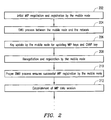
- FIG. 2 depicts a flowchart of a key update process in the WPDN embodiment depicted in FIG. 1;
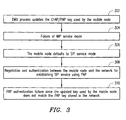
- FIG. 3 depicts a flowchart of an exemplary unsuccessful authentication procedure after a key update process
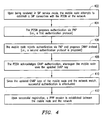
- FIG. 4 depicts a flowchart of a method for resolving authentication of a mobile node while establishing a Simple IP (SIP) connection in accordance with an embodiment of the present patent disclosure
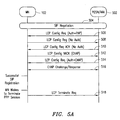
- FIG. 5A depicts a message flow diagram for effectuating an embodiment of authentication resolution procedure depicted in FIG. 4;
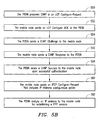
- FIG. 5B depicts a flowchart of an exemplary Challenge Handshake Authentication Protocol (CHAP) procedure for use in an embodiment of the present patent disclosure
- CHAP Challenge Handshake Authentication Protocol
- FIG. 6 depicts a message flow diagram for effectuating another embodiment of a method for resolving authentication of a mobile node while establishing a SIP connection in accordance with the teachings of the present patent disclosure.
- FIG. 7 depicts a block diagram of an embodiment of a communications device operable as a mobile node for purposes of the present patent disclosure.
- FIG. 1 depicted therein is a generalized wireless packet data network (WPDN) environment 100 wherein an embodiment of the present patent disclosure may be practiced for resolving authentication of a mobile node 102.
- WPDN wireless packet data network
- the WPDN environment 100 is implemented as a data-capable Code Division Multiple Access (CDMA) network (e.g., CDMA 2000), although it is envisaged that the teachings hereof may be applied in any 3 rd Generation Partnership Project (3GPP)-compliant cellular network (e.g., 3GPP or 3GPP2) with appropriate modifications and extensions.
- CDMA Code Division Multiple Access
- 3GPP 3 rd Generation Partnership Project
- Mobile node 102 may comprise any untethered user equipment operable to obtain IP-based packet data service within the WPDN environment 100, and may include any personal computer (e.g., desktops, laptops, palmtops, or handheld computing devices) equipped with a suitable wireless modem or a mobile communications device (e.g., cellular phones or data-enabled handheld devices capable of receiving and sending messages, web browsing, et cetera), or any enhanced PDA device or integrated information appliance capable of email, video mail, Internet access, corporate data access, messaging, calendaring and scheduling, information management, and the like.
- any personal computer e.g., desktops, laptops, palmtops, or handheld computing devices
- a mobile communications device e.g., cellular phones or data-enabled handheld devices capable of receiving and sending messages, web browsing, et cetera
- any enhanced PDA device or integrated information appliance capable of email, video mail, Internet access, corporate data access, messaging, calendaring and scheduling, information management, and the like.
- a Radio Access Network (RAN) 104 comprising a Base Transceiver Station 106 and an integrated Radio/Packet (RP) functionality 108 forms a network portion that provides access to both circuit-switched cellular telephony network portions as well as packet-switched network portions of the WPDN environment 100.
- a Visitor Location Register (VLR) and associated Mobile Switching Center (MSC) 110 a Signaling System No. 7 (SS7) network 112
- SS7 Signaling System No. 7
- HLR Home Location Register
- HLR Home Location Register
- a Packet Control Function (PCF) of the RP module 108 is operable to effectuate connectivity between the mobile node 102 and the packet data network portions via an R-P interface to a network node called a Packet Data Serving Node (PDSN) 114.
- PDSN 114 is coupled via an IP network 116 to a number of Authentication, Authorization and Accounting (AAA) servers for managing packet data services on behalf of the mobile node 102, including providing access to external IP networks such as, e.g., the Internet.
- AAA Authentication, Authorization and Accounting
- a Home IP network 122 includes a Remote Authentication Dial In User Service (RADIUS)-based AAA server 123 for providing AAA services as an Access Registrar (AR) for the user/subscriber associated with mobile node 102.
- the Home IP network 122 may comprise a private corporate network, publicly accessible network, or an International Mobile Telecommunications (IMT)-2000 network.
- a Visited RADIUS/AAA server 118 is operable as an AR when the mobile node 102 is roaming.
- a Home Agent 127 disposed in another network portion 126 is coupled via the IP network 116 to PDSN 114 for providing, inter alia, data mobility bindings as will be described below.
- a Broker RADIUS network 124 includes one or more Broker RADIUS servers 125 that maintain security relationships with the Visited RADIUS server 118 as well as the Home RADIUS server 123 for transferring RADIUS messages between a Visited Access Provider network portion and the Home IP network 122.
- the user When the user first makes a data call using the mobile node 102, it establishes a Point-to-Point Protocol (PPP) session with PDSN 114, which may authenticate the mobile node 102 by communicating with an appropriate AAA server.
- PDSN 114 may first communicate with the Visited AAA server 118 which in turn may communicate with the Home AAA server 123, possibly through some Broker RADIUS servers (e.g., Broker RADIUS server 125).
- the Home AAA server 123 verifies that the user is a valid subscriber, determines what services are available for the user, and tracks usage for billing.
- IPCP IP Control Protocol
- a packet data session describes an instance of continuous use of packet data service by the user of appropriate wireless IP equipment (e.g., mobile node 102).
- a packet data session begins when the user invokes packet data service, and it ends when the user or the network terminates the service.
- the user may change locations but the same IP address is maintained.
- IP data services Two types of IP data services are possible: Simple IP (SIP) service and Mobile IP (MIP) service.
- SIP Simple IP
- MIP Mobile IP
- the Home Agent assigns the IP address for the mobile node during the MIP registration process.
- a packet data session can span several PDSNs as long as the user continuously maintains mobility bindings at the Home Agent and there is no lapse in MIP registrations and/or re-registrations (i.e., the IP address is persistent).
- the mobile node registers with its Home Agent when it is determined that it is no longer in its Home IP network, and communicates with the Home Agent through the serving PDSN that acts as a Foreign Agent (FA).
- FA Foreign Agent
- the mobile node When not in its Home IP network, the mobile node will be associated with a care-of address (CoA), typically the address of the FA/PDSN.
- CoA care-of address
- the packet data session can exist through several changes of the PPP session.
- a PPP session describes the time during which a particular PPP connection instance is maintained in the open state in both the mobile node and PDSN. In general, the PPP session is maintained during periods even where the mobile node is dormant. If the user hands off from one RAN to another RAN but is still connected to the same PDSN, the PPP session remains. On the other hand, if the user changes PDSN coverage area, a new PPP session is created at the new PDSN.
- authentication between the mobile node 102 and the WPDN infrastructure may be effectuated using well-known protocols such as the Password Authentication Protocol (PAP) and the Challenge Handshake Authentication Protocol (CHAP), each having its own set of passwords, authentication keys, etc., that are distributed between the mobile node 102 and the infrastructure (i.e., PDSN/AAA) in some manner.
- PAP Password Authentication Protocol
- CHAP Challenge Handshake Authentication Protocol
- the network infrastructure may maintain separate keys or key locations for PAP and CHAP that correspond to the mobile node's PAP/CHAP key.
- a particular mobile node may be provisioned with a default value as its initial set of PAP/CHAP authentication keys.
- a mobile node is typically configured to be activated upon initialization in either SIP service mode or MIP service mode, and when initialized in MIP service mode, the mobile node includes logic for initiating a key update procedure for updating its cryptographic keys.
- a Dynamic MIP Key Update (DMU) procedure a mechanism for distributing and updating MIP keys, is accordingly executed between the mobile node and the Home AAA/RADIUS server via the PDSN acting as the MIP Foreign Agent.
- DMU Dynamic MIP Key Update
- FIG. 2 depicts a flowchart of a key update process in the WPDN embodiment depicted in FIG. 1 for purposes of the present patent disclosure.
- the mobile node 102 Upon being activated initially, the mobile node 102 is configured to execute MIP negotiation and registration with the network infrastructure (block 202). A DMU process then takes place between the mobile node 102 and the network in accordance with well-known procedures that involve encrypted key distribution and mutual authentication (block 204). Additional details regarding the DMU mechanism may be found in the Internet Draft draft-carroll-dynmobileip-cdma-05.txt (expiration date: September 2005) by Carroll et al.
- the mobile node 102 updates its MIP and CHAP keys from the default values with which it was initially provisioned. Since the mobile node typically maintains one location to store SIP authentication key, this effectively updates the PAP key on the mobile node as well. Further, pursuant to the DMU process, the network also updates its MIP/CHAP keys, but not the PAP key (block 206). Thereafter, the mobile node 102 renegotiates registration with the network using its updated authentication keys (block 208).
- the mobile node 102 If the DMU process has been properly executed, the mobile node 102 successfully registers with the network (block 210) since the MIP cryptographic keys at the mobile node and the network have been correspondingly updated. Subsequently, the mobile node 102 proceeds with establishment a MIP packet data session (block 212) which may be carried on until termination.
- FIG. 3 depicts a flowchart of an exemplary unsuccessful authentication procedure after a key update process such as the process set forth above in reference to FIG. 2.
- the DMU process updates the CHAP/PAP key used by the mobile node 102 for authentication (block 302).
- the mobile node 102 Upon encountering a failure while the mobile node 102 is in MIP service mode (block 304) (e.g., a failure resulting from the outage of a WPDN node such as the PDSN/FA, Home Agent, and the like), the mobile node 102 is rendered or placed in SIP service mode (i.e., the mobile node defaults to SIP) (block 306). Thereafter, the mobile node 102 attempts negotiation and authentication with the network infrastructure for establishing SIP service using PAP at the request of the PDSN (block 308).
- MIP service mode e.g., a failure resulting from the outage of a WPDN node such as the PDSN/FA, Home Agent, and the like
- SIP service mode i.e., the mobile node defaults to SIP
- authentication via PAP will be unsuccessful because the mobile node 102 has updated its common CHAP/PAP key during the key update process while the network continues to use the non-updated PAP key for authentication in SIP (block 310).
- an authentication conflict arises when the mobile node 102 attempts to reestablish a packet data session in SIP mode.
- FIG. 4 depicts a flowchart of a method for resolving authentication of a mobile node while establishing a SIP connection in accordance with an embodiment of the present patent disclosure.
- the mobile node 102 attempts to establish a SIP connection with PDSN 114 of the network upon being rendered in SIP service mode (block 402).
- the PDSN proposes authentication via a first authentication protocol, i.e., PAP (block 404).
- PAP i.e., PAP
- the mobile node 102 is provided with logic for rejecting authentication via PAP and for counter-proposing a second authentication protocol, i.e., CHAP, in lieu thereof (block 406).
- CHAP second authentication protocol
- the PDSN acknowledges CHAP authentication, whereupon the mobile node 102 uses the updated CHAP key for effectuating an authentication procedure in accordance with the second authentication protocol (block 408). Since the updated CHAP keys of the mobile node 102 and the network infrastructure match, successful authentication is effectuated (block 410). Upon successful registration, a PPP session is established between the mobile node 102 and the network, which continues until termination (block 412).
- FIG. 5A depicts a message flow diagram for effectuating an embodiment of the authentication resolution procedure depicted in FIG. 4, wherein reference numeral 502 collectively refers to a generalized WPDN infrastructure element including the PDSN and RADIUS-based AAA server functionalities described in detail hereinabove.
- SIP negotiation 504 takes place between the mobile node (MN) 102 and the network infrastructure 502, the PDSN transmits a Link Control Protocol (LCP) Configure-Request message 506 which proposes PAP for authentication.
- LCP Link Control Protocol
- MN 102 generates an LCP Configure-Request (without authentication option) message 508 to the PDSN.
- An LCP Configure-ACK (without authentication option) message 510 is generated in response from the node 502 to MN 102.
- MN 102 transmits a negative acknowledgment message (LCP Configuration NACK) 512 back to the PDSN, which includes an indication the PAP is not acceptable, but CHAP is. That is, MN 102 generates a counter-proposal that proposes CHAP instead of PAP for authentication.
- the PDSN transmits a reply message (LCP Configure-Request with CHAP authentication) 516, whereupon a CHAP authentication procedure (i.e., challenge/response procedure) 516 is effectuated, which is described hereinbelow.
- MN 102 successfully registers with the network in SIP mode.
- An LCP Terminate-Request message 518 may be generated when MN 102 wishes to terminate the PPP session in SIP mode.
- FIG. 5B depicts a flowchart of an exemplary CHAP procedure which may be used at least partially in an embodiment of the present patent disclosure.
- the mobile node when the PDSN proposes CHAP in an LCP Configure-Request message (block 550), the mobile node sends an LCP Configure-ACK response to the PDSN (block 552). Subsequently, the PDSN sends a CHAP Challenge to the mobile node (block 554). A CHAP Response is then transmitted back by the mobile node to the PDSN, which is generated based on the CHAP authentication key (updated or otherwise) stored in the mobile node (block 556).
- the Response is validated by the network using the network's CHAP authentication key, whereupon the PDSN sends a CHAP Success message to the mobile node indicating successful authentication (block 558). Thereafter, the mobile node sends an IPCP Configure-Request message to the network that includes an IP-Address configuration option (block 560). Responsive thereto, the PDSN assigns an IP address to the mobile node for establishing a PPP session (block 562).
- FIG. 6 depicts a message flow diagram for effectuating another embodiment of a method for resolving authentication of a mobile node while establishing a SIP connection in accordance with the teachings of the present patent disclosure.
- the network infrastructure element 502 is provided with the intelligence/logic for determining that a key update process has updated the CHAP authentication keys for a particular mobile node. Accordingly, when a SIP negotiation process 504 is attempted between MN 102 and PDSN/AAA 502, the network logic structure 602 determines that the CHAP key set associated with MN 102 has been updated due to a DMU procedure.
- Another logic structure 604 associated with PDSN/AAA 502 is operable to determine that CHAP should be proposed instead of PAP for authenticating MN 102 in SIP service mode. Responsive to the determinations by logic 602, 604, the PDSN and MN 102 engage in a CHAP Challenge/Response process 606 as set forth above. Upon successful authentication, MN 102 registers with the network infrastructure in SIP mode and proceeds to establish a PPP data session. Thereafter, the session may be terminated by MN 102 by transmitting an LCP Terminate-Request message 518 as described previously.
- FIG. 7 depicts a block diagram of an embodiment of a communications device operable as a mobile node for purposes of the present patent disclosure. It will be recognized by those skilled in the art upon reference hereto that although an embodiment of MN 102 may comprise an arrangement similar to one shown in FIG. 7, there can be a number of variations and modifications, in hardware, software or firmware, with respect to the various modules depicted. Accordingly, the arrangement of FIG. 7 should be taken as illustrative rather than limiting with respect to the embodiments of the present patent disclosure.
- a microprocessor 702 providing for the overall control of an embodiment of MN 116 is operably coupled to a communication subsystem 704 which includes a receiver 708 and transmitter 714 as well as associated components such as one or more local oscillator (LO) modules 710 and a processing module such as a digital signal processor (DSP) 712.
- LO local oscillator
- DSP digital signal processor
- the particular design of the communication module 704 may be dependent upon the communications network with which the mobile device is intended to operate (e.g., CDMA2000 network).
- signals received by antenna 706 through BTS 106 are provided to receiver 708, which may perform such common receiver functions as signal amplification, frequency down conversion, filtering, channel selection, analog-to-digital (A/D) conversion, and the like.
- signals to be transmitted are processed, including modulation and encoding, for example, by DSP 712, and provided to transmitter 714 for digital-to-analog (D/A) conversion, frequency up conversion, filtering, amplification and transmission over the air-radio interface via antenna 716.
- DSP 712 digital-to-analog
- Microprocessor 702 also interfaces with further device subsystems such as auxiliary input/output (I/O) 718, serial port 720, display 722, keyboard/keypad 724, speaker 726, microphone 728, random access memory (RAM) 730, a short-range communications subsystem 732, and any other device subsystems generally labeled as reference numeral 733.
- I/O auxiliary input/output
- serial port 720 serial port 720
- display 722 keyboard/keypad 724, speaker 726, microphone 728, random access memory (RAM) 730
- RAM random access memory
- a short-range communications subsystem 732 any other device subsystems generally labeled as reference numeral 733.
- SIM/RUIM interface 734 is operable with a SIM/RUIM card having a number of key configurations 744 and other information 746 such as identification and subscriber-related data.
- Operating system software and applicable transport stack software may be embodied in a persistent storage module (i.e., non-volatile storage) such as Flash memory 735.
- Flash memory 735 may be segregated into different areas, e.g., storage area for computer programs 736 as well as data storage regions such as device state 737, address book 739, other personal information manager (PIM) data 741, and other data storage areas generally labeled as reference numeral 743.
- PIM personal information manager
- an authentication logic module 748 is provided for effectuating CHAP/PAP authentication resolution according to the teachings set forth hereinabove. It is therefore envisaged that at least following logic structures are implemented within the arrangement of FIG.
- logic for negotiating a SIP connection with a PDSN of a wireless packet data network the logic operating responsive to the mobile node being rendered in a SIP service mode; logic for counter-proposing a second authentication protocol (e.g., CHAP) for use after rejecting a first authentication protocol (e.g., PAP) proposed by the PDSN; and logic for effectuating an authentication procedure in accordance with the second authentication protocol once the second authentication protocol is acknowledged by the PDSN, wherein the authentication procedure uses a set of authentication keys, a first one provided with the mobile node (e.g., CHAP/PAP key 745) and a second one provided with the PDSN, that have been updated in a key update process. Additionally, there is logic provided with MN 102 for effectuating appropriate DMU process when MN 102 is in MIP service mode.
- CHAP second authentication protocol
- the CHAP/PAP keys 745 may be segregated in the mobile node such that when MN 102 executes a DMU process, only the CHAP authentication key is updated and not the PAP authentication key.
- MN 102 defaults to SIP service mode upon encountering a failure in MIP service mode
- the PAP procedure proposed by the PDSN will operate normally without any authentication failure since the PAP keys have not been updated.
Landscapes
- Engineering & Computer Science (AREA)
- Computer Security & Cryptography (AREA)
- Computer Networks & Wireless Communication (AREA)
- Signal Processing (AREA)
- Computer Hardware Design (AREA)
- Computing Systems (AREA)
- General Engineering & Computer Science (AREA)
- Mobile Radio Communication Systems (AREA)
- Telephonic Communication Services (AREA)
Abstract
Description
- The present patent disclosure generally relates to wireless packet data networks. More particularly, and not by way of any limitation, the present patent disclosure is directed to a scheme for resolving authentication of a mobile node in a wireless packet data network after a key update mechanism that updates authentication keys.
- When an Internet Protocol (IP)-capable mobile node is operably disposed in a wireless packet data network, it is typically required to authenticate itself with the network infrastructure before obtaining packet data service. The authentication process may be effectuated using a number of protocols, each having appropriate set or sets of authentication keys, passwords, etc., that depend inter alia on the mode of IP service that the mobile node is configured to activate. Further, the mobile node may change its mode of service by design or default after initialization, in addition to effectuating a key update process that updates authentication keys. However, this situation can give rise to the possibility of an authentication/registration failure of the mobile node in the network.
- The present patent disclosure is broadly directed to a scheme for resolving authentication of a mobile node that negotiates with a packet data serving node (PDSN) for establishing a Simple IP (SIP) connection after encountering a failure in Mobile IP (MIP) service mode.
- In one aspect, a method is disclosed for resolving authentication of a mobile node disposed in a wireless packet data network, the method comprising at least one or more of the following operations: upon being rendered in a SIP service mode, attempting by the mobile node to negotiate a SIP connection with a PDSN of the wireless packet data network; responsive to a first authentication protocol proposed by the PDSN, counter-proposing by the mobile node of a second authentication protocol for use; and upon acknowledging the second authentication protocol by the PDSN, effectuating an authentication procedure in accordance with the second authentication protocol, wherein the authentication procedure uses a set of authentication keys, a first one provided with the mobile node and a second one provided with the PDSN, that have been updated in a key update process.
- In another aspect, a system is disclosed for resolving authentication of a mobile node disposed in a wireless packet data network, the system comprising at least one or more of the following elements: means associated with the mobile node for negotiating a SIP connection with a PDSN of the wireless packet data network, the means operating responsive to the mobile node being rendered in a SIP service mode; means associated with the mobile node for counter-proposing a second authentication protocol for use after rejecting a first authentication protocol proposed by the PDSN; and means, operable upon acknowledging the second authentication protocol by the PDSN, for effectuating an authentication procedure in accordance with the second authentication protocol, wherein the authentication procedure uses a set of authentication keys, a first one provided with the mobile node and a second one provided with the PDSN, that have been updated in a key update process.
- In a further aspect, also disclosed is a mobile node operable in a wireless packet data network, the mobile node comprising at least one or more of the following elements: a logic structure for negotiating a SIP connection with a PDSN of the wireless packet data network, the logic operating responsive to the mobile node being rendered in a SIP service mode; a logic structure for counter-proposing a second authentication protocol for use after rejecting a first authentication protocol proposed by the PDSN; and a logic structure for effectuating an authentication procedure in accordance with the second authentication protocol once the second authentication protocol is acknowledged by the PDSN, wherein the authentication procedure uses a set of authentication keys, a first one provided with the mobile node and a second one provided with the PDSN, that have been updated in a key update process.
- In yet another aspect, the present disclosure is directed to a PDSN operable in a wireless packet data network, the PDSN comprising at least one or more of the following elements: means for determining that a mobile node has updated a set of authentication keys provided in accordance with a particular authentication protocol for authenticating the mobile node, the set of authentication keys including a first one provided with the mobile node and a second one provided with the PDSN; and means for effectuating a particular authentication procedure, for which the authentication keys have been updated in a key update process, when the mobile node attempts to negotiate a SIP connection with the PDSN upon being rendered in a SIP service mode.
- A more complete understanding of the embodiments of the present patent disclosure may be had by reference to the following Detailed Description when taken in conjunction with the accompanying drawings wherein:
- FIG. 1 depicts a generalized wireless packet data network (WPDN) environment wherein an embodiment of the present patent disclosure may be practiced;
- FIG. 2 depicts a flowchart of a key update process in the WPDN embodiment depicted in FIG. 1;
- FIG. 3 depicts a flowchart of an exemplary unsuccessful authentication procedure after a key update process;
- FIG. 4 depicts a flowchart of a method for resolving authentication of a mobile node while establishing a Simple IP (SIP) connection in accordance with an embodiment of the present patent disclosure;
- FIG. 5A depicts a message flow diagram for effectuating an embodiment of authentication resolution procedure depicted in FIG. 4;
- FIG. 5B depicts a flowchart of an exemplary Challenge Handshake Authentication Protocol (CHAP) procedure for use in an embodiment of the present patent disclosure;
- FIG. 6 depicts a message flow diagram for effectuating another embodiment of a method for resolving authentication of a mobile node while establishing a SIP connection in accordance with the teachings of the present patent disclosure; and
- FIG. 7 depicts a block diagram of an embodiment of a communications device operable as a mobile node for purposes of the present patent disclosure.
- A system and method of the present patent disclosure will now be described with reference to various examples of how the embodiments can best be made and used. Like reference numerals are used throughout the description and several views of the drawings to indicate like or corresponding parts, wherein the various elements are not necessarily drawn to scale. Referring now to the drawings, and more particularly to FIG. 1, depicted therein is a generalized wireless packet data network (WPDN)
environment 100 wherein an embodiment of the present patent disclosure may be practiced for resolving authentication of amobile node 102. By way of example, the WPDNenvironment 100 is implemented as a data-capable Code Division Multiple Access (CDMA) network (e.g., CDMA 2000), although it is envisaged that the teachings hereof may be applied in any 3rd Generation Partnership Project (3GPP)-compliant cellular network (e.g., 3GPP or 3GPP2) with appropriate modifications and extensions.Mobile node 102 may comprise any untethered user equipment operable to obtain IP-based packet data service within the WPDNenvironment 100, and may include any personal computer (e.g., desktops, laptops, palmtops, or handheld computing devices) equipped with a suitable wireless modem or a mobile communications device (e.g., cellular phones or data-enabled handheld devices capable of receiving and sending messages, web browsing, et cetera), or any enhanced PDA device or integrated information appliance capable of email, video mail, Internet access, corporate data access, messaging, calendaring and scheduling, information management, and the like. - A Radio Access Network (RAN) 104 comprising a Base
Transceiver Station 106 and an integrated Radio/Packet (RP)functionality 108 forms a network portion that provides access to both circuit-switched cellular telephony network portions as well as packet-switched network portions of the WPDNenvironment 100. By way of illustration, a Visitor Location Register (VLR) and associated Mobile Switching Center (MSC) 110, a Signaling System No. 7 (SS7)network 112, and a Home AccessProvider network 120 that includes a Home Location Register (HLR) 121 exemplify the cellular telephony network portion that may be accessed using the Base Station Controller (BSC) functionality of the integratedRP module 108. A Packet Control Function (PCF) of theRP module 108 is operable to effectuate connectivity between themobile node 102 and the packet data network portions via an R-P interface to a network node called a Packet Data Serving Node (PDSN) 114. In general, PDSN 114 is coupled via anIP network 116 to a number of Authentication, Authorization and Accounting (AAA) servers for managing packet data services on behalf of themobile node 102, including providing access to external IP networks such as, e.g., the Internet. As illustrated, aHome IP network 122 includes a Remote Authentication Dial In User Service (RADIUS)-basedAAA server 123 for providing AAA services as an Access Registrar (AR) for the user/subscriber associated withmobile node 102. The HomeIP network 122 may comprise a private corporate network, publicly accessible network, or an International Mobile Telecommunications (IMT)-2000 network. A Visited RADIUS/AAA server 118 is operable as an AR when themobile node 102 is roaming. AHome Agent 127 disposed in anothernetwork portion 126 is coupled via theIP network 116 to PDSN 114 for providing, inter alia, data mobility bindings as will be described below. A Broker RADIUSnetwork 124 includes one or more Broker RADIUSservers 125 that maintain security relationships with the Visited RADIUSserver 118 as well as the Home RADIUSserver 123 for transferring RADIUS messages between a Visited Access Provider network portion and theHome IP network 122. - When the user first makes a data call using the
mobile node 102, it establishes a Point-to-Point Protocol (PPP) session withPDSN 114, which may authenticate themobile node 102 by communicating with an appropriate AAA server. For example, PDSN 114 may first communicate with the VisitedAAA server 118 which in turn may communicate with the HomeAAA server 123, possibly through some Broker RADIUS servers (e.g., Broker RADIUS server 125). The Home AAAserver 123 verifies that the user is a valid subscriber, determines what services are available for the user, and tracks usage for billing. After themobile node 102 is authenticated, it may use the IP Control Protocol (IPCP) to request an IP address for commencing a packet data session. - In general operation, a packet data session describes an instance of continuous use of packet data service by the user of appropriate wireless IP equipment (e.g., mobile node 102). Typically, a packet data session begins when the user invokes packet data service, and it ends when the user or the network terminates the service. During a particular packet data session, the user may change locations but the same IP address is maintained. Two types of IP data services are possible: Simple IP (SIP) service and Mobile IP (MIP) service. For SIP service, the mobile node is assigned an IP address by the serving PDSN. Accordingly, moving from the coverage area of one PDSN to another PDSN constitutes a change in the packet data session for SIP service. In other words, in SIP service, a packet data session and a PPP session are concurrent. For MIP service, the Home Agent assigns the IP address for the mobile node during the MIP registration process. A packet data session can span several PDSNs as long as the user continuously maintains mobility bindings at the Home Agent and there is no lapse in MIP registrations and/or re-registrations (i.e., the IP address is persistent). The mobile node registers with its Home Agent when it is determined that it is no longer in its Home IP network, and communicates with the Home Agent through the serving PDSN that acts as a Foreign Agent (FA). When not in its Home IP network, the mobile node will be associated with a care-of address (CoA), typically the address of the FA/PDSN. Thus, for a MIP service, the packet data session can exist through several changes of the PPP session.
- A PPP session describes the time during which a particular PPP connection instance is maintained in the open state in both the mobile node and PDSN. In general, the PPP session is maintained during periods even where the mobile node is dormant. If the user hands off from one RAN to another RAN but is still connected to the same PDSN, the PPP session remains. On the other hand, if the user changes PDSN coverage area, a new PPP session is created at the new PDSN.
- Continuing to refer to FIG. 1, authentication between the
mobile node 102 and the WPDN infrastructure may be effectuated using well-known protocols such as the Password Authentication Protocol (PAP) and the Challenge Handshake Authentication Protocol (CHAP), each having its own set of passwords, authentication keys, etc., that are distributed between themobile node 102 and the infrastructure (i.e., PDSN/AAA) in some manner. In one embodiment, themobile node 102 may be provided with a single authentication key/password that is used for both PAP as well as CHAP. The network infrastructure, on the other hand, may maintain separate keys or key locations for PAP and CHAP that correspond to the mobile node's PAP/CHAP key. - Based on arrangements between mobile node manufacturers and WPDN service providers, a particular mobile node may be provisioned with a default value as its initial set of PAP/CHAP authentication keys. Further, a mobile node is typically configured to be activated upon initialization in either SIP service mode or MIP service mode, and when initialized in MIP service mode, the mobile node includes logic for initiating a key update procedure for updating its cryptographic keys. A Dynamic MIP Key Update (DMU) procedure, a mechanism for distributing and updating MIP keys, is accordingly executed between the mobile node and the Home AAA/RADIUS server via the PDSN acting as the MIP Foreign Agent.
- FIG. 2 depicts a flowchart of a key update process in the WPDN embodiment depicted in FIG. 1 for purposes of the present patent disclosure. Upon being activated initially, the
mobile node 102 is configured to execute MIP negotiation and registration with the network infrastructure (block 202). A DMU process then takes place between themobile node 102 and the network in accordance with well-known procedures that involve encrypted key distribution and mutual authentication (block 204). Additional details regarding the DMU mechanism may be found in the Internet Draft draft-carroll-dynmobileip-cdma-05.txt (expiration date: September 2005) by Carroll et al. (March 2005), titled: Verizon Wireless Dynamic Mobile IP Key Update for cdma2000® Networks , which is incorporated by reference herein. During the key update process, themobile node 102 updates its MIP and CHAP keys from the default values with which it was initially provisioned. Since the mobile node typically maintains one location to store SIP authentication key, this effectively updates the PAP key on the mobile node as well. Further, pursuant to the DMU process, the network also updates its MIP/CHAP keys, but not the PAP key (block 206). Thereafter, themobile node 102 renegotiates registration with the network using its updated authentication keys (block 208). If the DMU process has been properly executed, themobile node 102 successfully registers with the network (block 210) since the MIP cryptographic keys at the mobile node and the network have been correspondingly updated. Subsequently, themobile node 102 proceeds with establishment a MIP packet data session (block 212) which may be carried on until termination. - As alluded to in the Background section of the present patent disclosure, when a mobile node updates its keys upon initial registration in MIP service mode, it may become susceptible to registration/authentication failure if the mobile node is rendered in SIP service mode for any reason (e.g., due to a failure encountered while in MIP service mode). FIG. 3 depicts a flowchart of an exemplary unsuccessful authentication procedure after a key update process such as the process set forth above in reference to FIG. 2. As described previously, the DMU process updates the CHAP/PAP key used by the
mobile node 102 for authentication (block 302). Upon encountering a failure while themobile node 102 is in MIP service mode (block 304) (e.g., a failure resulting from the outage of a WPDN node such as the PDSN/FA, Home Agent, and the like), themobile node 102 is rendered or placed in SIP service mode (i.e., the mobile node defaults to SIP) (block 306). Thereafter, themobile node 102 attempts negotiation and authentication with the network infrastructure for establishing SIP service using PAP at the request of the PDSN (block 308). However, authentication via PAP will be unsuccessful because themobile node 102 has updated its common CHAP/PAP key during the key update process while the network continues to use the non-updated PAP key for authentication in SIP (block 310). In other words, due to the mismatch in the PAP keys stored in themobile node 102 and the network, an authentication conflict arises when themobile node 102 attempts to reestablish a packet data session in SIP mode. - FIG. 4 depicts a flowchart of a method for resolving authentication of a mobile node while establishing a SIP connection in accordance with an embodiment of the present patent disclosure. As set forth above, the
mobile node 102 attempts to establish a SIP connection withPDSN 114 of the network upon being rendered in SIP service mode (block 402). The PDSN proposes authentication via a first authentication protocol, i.e., PAP (block 404). In accordance with the teachings herein, themobile node 102 is provided with logic for rejecting authentication via PAP and for counter-proposing a second authentication protocol, i.e., CHAP, in lieu thereof (block 406). Responsive thereto, the PDSN acknowledges CHAP authentication, whereupon themobile node 102 uses the updated CHAP key for effectuating an authentication procedure in accordance with the second authentication protocol (block 408). Since the updated CHAP keys of themobile node 102 and the network infrastructure match, successful authentication is effectuated (block 410). Upon successful registration, a PPP session is established between themobile node 102 and the network, which continues until termination (block 412). - FIG. 5A depicts a message flow diagram for effectuating an embodiment of the authentication resolution procedure depicted in FIG. 4, wherein
reference numeral 502 collectively refers to a generalized WPDN infrastructure element including the PDSN and RADIUS-based AAA server functionalities described in detail hereinabove. AsSIP negotiation 504 takes place between the mobile node (MN) 102 and thenetwork infrastructure 502, the PDSN transmits a Link Control Protocol (LCP) Configure-Request message 506 which proposes PAP for authentication. In response,MN 102 generates an LCP Configure-Request (without authentication option)message 508 to the PDSN. An LCP Configure-ACK (without authentication option)message 510 is generated in response from thenode 502 toMN 102. Thereafter,MN 102 transmits a negative acknowledgment message (LCP Configuration NACK) 512 back to the PDSN, which includes an indication the PAP is not acceptable, but CHAP is. That is,MN 102 generates a counter-proposal that proposes CHAP instead of PAP for authentication. In response, the PDSN transmits a reply message (LCP Configure-Request with CHAP authentication) 516, whereupon a CHAP authentication procedure (i.e., challenge/response procedure) 516 is effectuated, which is described hereinbelow. Thereafter,MN 102 successfully registers with the network in SIP mode. An LCP Terminate-Request message 518 may be generated whenMN 102 wishes to terminate the PPP session in SIP mode. - FIG. 5B depicts a flowchart of an exemplary CHAP procedure which may be used at least partially in an embodiment of the present patent disclosure. In general, when the PDSN proposes CHAP in an LCP Configure-Request message (block 550), the mobile node sends an LCP Configure-ACK response to the PDSN (block 552). Subsequently, the PDSN sends a CHAP Challenge to the mobile node (block 554). A CHAP Response is then transmitted back by the mobile node to the PDSN, which is generated based on the CHAP authentication key (updated or otherwise) stored in the mobile node (block 556). The Response is validated by the network using the network's CHAP authentication key, whereupon the PDSN sends a CHAP Success message to the mobile node indicating successful authentication (block 558). Thereafter, the mobile node sends an IPCP Configure-Request message to the network that includes an IP-Address configuration option (block 560). Responsive thereto, the PDSN assigns an IP address to the mobile node for establishing a PPP session (block 562).
- FIG. 6 depicts a message flow diagram for effectuating another embodiment of a method for resolving authentication of a mobile node while establishing a SIP connection in accordance with the teachings of the present patent disclosure. In this embodiment, the
network infrastructure element 502 is provided with the intelligence/logic for determining that a key update process has updated the CHAP authentication keys for a particular mobile node. Accordingly, when aSIP negotiation process 504 is attempted betweenMN 102 and PDSN/AAA 502, thenetwork logic structure 602 determines that the CHAP key set associated withMN 102 has been updated due to a DMU procedure. Anotherlogic structure 604 associated with PDSN/AAA 502 is operable to determine that CHAP should be proposed instead of PAP for authenticatingMN 102 in SIP service mode. Responsive to the determinations bylogic MN 102 engage in a CHAP Challenge/Response process 606 as set forth above. Upon successful authentication,MN 102 registers with the network infrastructure in SIP mode and proceeds to establish a PPP data session. Thereafter, the session may be terminated byMN 102 by transmitting an LCP Terminate-Request message 518 as described previously. - FIG. 7 depicts a block diagram of an embodiment of a communications device operable as a mobile node for purposes of the present patent disclosure. It will be recognized by those skilled in the art upon reference hereto that although an embodiment of
MN 102 may comprise an arrangement similar to one shown in FIG. 7, there can be a number of variations and modifications, in hardware, software or firmware, with respect to the various modules depicted. Accordingly, the arrangement of FIG. 7 should be taken as illustrative rather than limiting with respect to the embodiments of the present patent disclosure. Amicroprocessor 702 providing for the overall control of an embodiment ofMN 116 is operably coupled to acommunication subsystem 704 which includes areceiver 708 andtransmitter 714 as well as associated components such as one or more local oscillator (LO)modules 710 and a processing module such as a digital signal processor (DSP) 712. As will be apparent to those skilled in the field of communications, the particular design of thecommunication module 704 may be dependent upon the communications network with which the mobile device is intended to operate (e.g., CDMA2000 network). Regardless of the particular design, however, signals received byantenna 706 throughBTS 106 are provided toreceiver 708, which may perform such common receiver functions as signal amplification, frequency down conversion, filtering, channel selection, analog-to-digital (A/D) conversion, and the like. Similarly, signals to be transmitted are processed, including modulation and encoding, for example, byDSP 712, and provided totransmitter 714 for digital-to-analog (D/A) conversion, frequency up conversion, filtering, amplification and transmission over the air-radio interface viaantenna 716. -
Microprocessor 702 also interfaces with further device subsystems such as auxiliary input/output (I/O) 718,serial port 720,display 722, keyboard/keypad 724,speaker 726,microphone 728, random access memory (RAM) 730, a short-range communications subsystem 732, and any other device subsystems generally labeled asreference numeral 733. To control access, a Subscriber Identity Module (SIM) or Removable user Identity Module (RUIM)interface 734 is also provided in communication with themicroprocessor 702. In one implementation, SIM/RUIM interface 734 is operable with a SIM/RUIM card having a number ofkey configurations 744 andother information 746 such as identification and subscriber-related data. - Operating system software and applicable transport stack software may be embodied in a persistent storage module (i.e., non-volatile storage) such as
Flash memory 735. In one implementation,Flash memory 735 may be segregated into different areas, e.g., storage area forcomputer programs 736 as well as data storage regions such asdevice state 737,address book 739, other personal information manager (PIM)data 741, and other data storage areas generally labeled asreference numeral 743. Additionally, anauthentication logic module 748 is provided for effectuating CHAP/PAP authentication resolution according to the teachings set forth hereinabove. It is therefore envisaged that at least following logic structures are implemented within the arrangement of FIG. 7: logic for negotiating a SIP connection with a PDSN of a wireless packet data network, the logic operating responsive to the mobile node being rendered in a SIP service mode; logic for counter-proposing a second authentication protocol (e.g., CHAP) for use after rejecting a first authentication protocol (e.g., PAP) proposed by the PDSN; and logic for effectuating an authentication procedure in accordance with the second authentication protocol once the second authentication protocol is acknowledged by the PDSN, wherein the authentication procedure uses a set of authentication keys, a first one provided with the mobile node (e.g., CHAP/PAP key 745) and a second one provided with the PDSN, that have been updated in a key update process. Additionally, there is logic provided withMN 102 for effectuating appropriate DMU process whenMN 102 is in MIP service mode. - By way of a further embodiment, the CHAP/
PAP keys 745 may be segregated in the mobile node such that whenMN 102 executes a DMU process, only the CHAP authentication key is updated and not the PAP authentication key. In such an arrangement, whenMN 102 defaults to SIP service mode upon encountering a failure in MIP service mode, the PAP procedure proposed by the PDSN will operate normally without any authentication failure since the PAP keys have not been updated. - It is believed that the operation and construction of the embodiments of the present patent application will be apparent from the Detailed Description set forth above. While the exemplary embodiments shown and described may have been characterized as being preferred, it should be readily understood that various changes and modifications could be made therein without departing from the scope of the present invention as set forth in the following claims.
Claims (14)
- A method for resolving authentication of a mobile node (102) disposed in a wireless packet data network (100), comprising:responsive to a first authentication protocol proposed (404) by a packet data serving node (PDSN) (114) of said wireless packet data network (100) when said mobile node (102) attempts to negotiate (402) a Simple Internet Protocol (SIP) connection therewith, counter-proposing (406) by said mobile node (102) of a second authentication protocol for use; andupon acknowledging (408) said second authentication protocol by said PDSN (114), effectuating an authentication procedure (410) in accordance with said second authentication protocol, wherein said authentication procedure (410) uses a set of authentication keys, a first one provided with said mobile node (102) and a second one provided with said PDSN (114), that have been updated in a key update process (302).
- The method for resolving authentication of a mobile node (102) disposed in a wireless packet data network (100) as recited in claim 1, wherein said first authentication protocol comprises Password Authentication Protocol (PAP) (506) and said second authentication protocol comprises Challenge Handshake Authentication Protocol (CHAP) (512).
- The method for resolving authentication of a mobile node (102) disposed in a wireless packet data network (100) as recited in claim 1 or claim 2, wherein said mobile node (102) is configured to be activated (202) in a Mobile IP (MIP) service mode upon initialization.
- The method for resolving authentication of a mobile node (102) disposed in a wireless packet data network (100) as recited in claim 3, wherein said mobile node (102) effectuates said key update process (302) during initial MIP registration.
- The method for resolving authentication of a mobile node (102) disposed in a wireless packet data network (100) as recited in claim 3, wherein said mobile node (102) is placed in a SIP service mode upon encountering a failure in said MIP service mode (304, 306).
- A mobile node (102) operable in a wireless packet data network (100), comprising:a logic block (748) for counter-proposing (406) a second authentication protocol for use after rejecting a first authentication protocol proposed (404) by a packet data serving node (PDSN) (114) of said wireless packet data network (100) when said mobile node (102) attempts to negotiate (402) a Simple Internet Protocol (SIP) connection therewith; anda logic block (748) for effectuating an authentication procedure (410) in accordance with said second authentication protocol once said second authentication protocol is acknowledged (408) by said PDSN (114), wherein said authentication procedure (410) uses a set of authentication keys, a first one (745) provided with said mobile node (102) and a second one provided with said PDSN (114), that have been updated in a key update process (302).
- The mobile node (102) operable in a wireless packet data network (100) as recited in claim 6, wherein said first authentication protocol comprises Password Authentication Protocol (PAP) (506) and said second authentication protocol comprises Challenge Handshake Authentication Protocol (CHAP) (512).
- The mobile node (102) operable in a wireless packet data network (100) as recited in claim 6 or claim 7, further comprising logic for activating (202) said mobile node (102) in a Mobile IP (MIP) service mode upon initialization.
- The mobile node (102) operable in a wireless packet data network (100) as recited in claim 8, further comprising logic for effectuating said key update process (302) during initial MIP registration.
- The mobile node (102) operable in a wireless packet data network (100) as recited in claim 8, further comprising logic for placing said mobile node (102) in said SIP service mode upon encountering a failure in said MIP service mode (304, 306).
- A packet data serving node (PDSN) (502) operable in a wireless packet data network (100), comprising:means for determining (602) that a mobile node (102) has updated a set of authentication keys provided in accordance with a particular authentication protocol for authenticating said mobile node (102), said set of authentication keys including a first one provided with said mobile node (102) and a second one provided with said PDSN (502); andmeans for effectuating (604) an authentication procedure in accordance with said particular authentication protocol (606) when said mobile node (102) attempts to negotiate a Simple Internet Protocol (SIP) connection (504) with said PDSN (502) upon being rendered in a SIP service mode, wherein said authentication procedure uses said set of authentication keys that have been updated in a key update process (302).
- The PDSN (502) operable in a wireless packet data network (100) as recited in claim 11, wherein said particular authentication protocol (606) comprises Challenge Handshake Authentication Protocol (CHAP).
- The PDSN (502) operable in a wireless packet data network (100) as recited in claim 11, wherein said logic for effectuating (604) an authentication procedure in accordance with said particular authentication protocol includes logic for generating a challenge to said mobile node (102).
- The PDSN (502) operable in a wireless packet data network (100) as recited in claim 13, wherein said logic for effectuating (604) an authentication procedure in accordance with said particular authentication protocol further includes logic for validating a response transmitted by said mobile node (102), said validating being based on said second key associated with said PDSN (502) that has been updated in said key update process (302).
Priority Applications (4)
| Application Number | Priority Date | Filing Date | Title |
|---|---|---|---|
| EP05254477A EP1746797B1 (en) | 2005-07-18 | 2005-07-18 | Scheme for resolving authentication in a wireless packet data network after a key update |
| AT05254477T ATE373921T1 (en) | 2005-07-18 | 2005-07-18 | SCHEME FOR SOLVING AUTHENTICATION IN A RADIO PACKET DATA NETWORK AFTER KEY UPDATE |
| DE602005002561T DE602005002561T2 (en) | 2005-07-18 | 2005-07-18 | Scheme for solving authentication in a radio packet data network after key update |
| CA002551989A CA2551989A1 (en) | 2005-07-18 | 2006-07-11 | Scheme for resolving authentication in a wireless packet data network after a key update |
Applications Claiming Priority (1)
| Application Number | Priority Date | Filing Date | Title |
|---|---|---|---|
| EP05254477A EP1746797B1 (en) | 2005-07-18 | 2005-07-18 | Scheme for resolving authentication in a wireless packet data network after a key update |
Publications (2)
| Publication Number | Publication Date |
|---|---|
| EP1746797A1 true EP1746797A1 (en) | 2007-01-24 |
| EP1746797B1 EP1746797B1 (en) | 2007-09-19 |
Family
ID=35044921
Family Applications (1)
| Application Number | Title | Priority Date | Filing Date |
|---|---|---|---|
| EP05254477A Expired - Lifetime EP1746797B1 (en) | 2005-07-18 | 2005-07-18 | Scheme for resolving authentication in a wireless packet data network after a key update |
Country Status (4)
| Country | Link |
|---|---|
| EP (1) | EP1746797B1 (en) |
| AT (1) | ATE373921T1 (en) |
| CA (1) | CA2551989A1 (en) |
| DE (1) | DE602005002561T2 (en) |
Cited By (4)
| Publication number | Priority date | Publication date | Assignee | Title |
|---|---|---|---|---|
| WO2008074671A1 (en) * | 2006-12-21 | 2008-06-26 | Nokia Corporation | A method of providing a mobility service |
| WO2009043294A1 (en) * | 2007-09-28 | 2009-04-09 | Huawei Technologies Co., Ltd. | The method and device for updating the key in the active state |
| US8881305B2 (en) | 2009-07-13 | 2014-11-04 | Blackberry Limited | Methods and apparatus for maintaining secure connections in a wireless communication network |
| CN111356135A (en) * | 2018-12-22 | 2020-06-30 | 财团法人工业技术研究院 | Network security system and network security method |
Families Citing this family (1)
| Publication number | Priority date | Publication date | Assignee | Title |
|---|---|---|---|---|
| CN119071062B (en) * | 2024-08-27 | 2025-10-03 | 湖南大学 | A method and system for secure encryption of email transmission |
-
2005
- 2005-07-18 DE DE602005002561T patent/DE602005002561T2/en not_active Expired - Lifetime
- 2005-07-18 AT AT05254477T patent/ATE373921T1/en not_active IP Right Cessation
- 2005-07-18 EP EP05254477A patent/EP1746797B1/en not_active Expired - Lifetime
-
2006
- 2006-07-11 CA CA002551989A patent/CA2551989A1/en not_active Abandoned
Non-Patent Citations (4)
| Title |
|---|
| "TIA/IS-835-B, CDMA2000 WIRELESS IP NETWORK STANDARD", TIA/EIA INTERIM STANDARD, September 2002 (2002-09-01), pages 1 - 111, XP002288685 * |
| BLUNK L: "PPP Extensible Authentication Protocol (EAP) RFC 2284", IETF STANDARD, INTERNET ENGINEERING TASK FORCE, IETF, CH, 1 March 1998 (1998-03-01), XP015008068, ISSN: 0000-0003 * |
| CARROLL C ET AL: "Verizon Wireless Dynamic Mobile IP Key Update for cdma2000(R) Networks", IETF STANDARD-WORKING-DRAFT, INTERNET ENGINEERING TASK FORCE, IETF, CH, no. 5, March 2005 (2005-03-01), XP015037676, ISSN: 0000-0004 * |
| K. SANKAR, A. BALINSKY, D. MILLER, S. SUNDARALINGAM: "EAP Authentication Protocols for WLANs", CISCO PRESS, 18 February 2005 (2005-02-18), XP002349135, Retrieved from the Internet <URL:http://www.ciscopress.com/articles/article.asp?p=369223&rl=1> * |
Cited By (15)
| Publication number | Priority date | Publication date | Assignee | Title |
|---|---|---|---|---|
| US8412207B2 (en) | 2006-12-21 | 2013-04-02 | Core Wireless Licensing S.A.R.L. | Method of providing a mobility service |
| US10009818B2 (en) | 2006-12-21 | 2018-06-26 | Conversant Wireless Licensing S.a.r.l. | Method of providing a mobility service |
| US9577885B2 (en) | 2006-12-21 | 2017-02-21 | Core Wireless Licensing S.A.R.L. | Method of providing a mobility service |
| WO2008074671A1 (en) * | 2006-12-21 | 2008-06-26 | Nokia Corporation | A method of providing a mobility service |
| US8914033B2 (en) | 2006-12-21 | 2014-12-16 | Core Wireless Licensing S.A.R.L. | Method of providing a mobility service |
| EP2541870A1 (en) * | 2006-12-21 | 2013-01-02 | Core Wireless Licensing S.a.r.l. | Method for providing a mobility service |
| US8144877B2 (en) | 2007-09-28 | 2012-03-27 | Huawei Technologies Co., Ltd. | Method and apparatus for updating a key in an active state |
| US8300827B2 (en) | 2007-09-28 | 2012-10-30 | Huawei Technologies Co., Ltd. | Method and apparatus for updating key in an active state |
| US9031240B2 (en) | 2007-09-28 | 2015-05-12 | Huawei Technologies Co., Ltd. | Method and apparatus for updating a key in an active state |
| US8023658B2 (en) | 2007-09-28 | 2011-09-20 | Huawei Technologies Co., Ltd. | Method and apparatus for updating a key in an active state |
| WO2009043294A1 (en) * | 2007-09-28 | 2009-04-09 | Huawei Technologies Co., Ltd. | The method and device for updating the key in the active state |
| US10057769B2 (en) | 2007-09-28 | 2018-08-21 | Huawei Technologies Co., Ltd. | Method and apparatus for updating a key in an active state |
| US10999065B2 (en) | 2007-09-28 | 2021-05-04 | Huawei Technologies Co., Ltd. | Method and apparatus for updating a key in an active state |
| US8881305B2 (en) | 2009-07-13 | 2014-11-04 | Blackberry Limited | Methods and apparatus for maintaining secure connections in a wireless communication network |
| CN111356135A (en) * | 2018-12-22 | 2020-06-30 | 财团法人工业技术研究院 | Network security system and network security method |
Also Published As
| Publication number | Publication date |
|---|---|
| DE602005002561D1 (en) | 2007-10-31 |
| EP1746797B1 (en) | 2007-09-19 |
| CA2551989A1 (en) | 2007-01-18 |
| ATE373921T1 (en) | 2007-10-15 |
| DE602005002561T2 (en) | 2008-06-26 |
Similar Documents
| Publication | Publication Date | Title |
|---|---|---|
| CN1656771B (en) | Rekeying in Mobile Wireless Systems | |
| US8090348B2 (en) | System and method for assigning a personalized indicium to a mobile communications device | |
| AU776094B2 (en) | Method and apparatus for authentication in a wireless telecommunications system | |
| CN100538687C (en) | Method and device for exchanging protocol addresses between two different terminals | |
| WO2004014035A1 (en) | Always-on wireless internet protocol communication | |
| CN101588622A (en) | Method and apparatus for provisioning an electronic communication device via a mobile internet protocol registration | |
| US20070016775A1 (en) | Scheme for resolving authentication in a wireless packet data network after a key update | |
| EP1746797B1 (en) | Scheme for resolving authentication in a wireless packet data network after a key update | |
| US7464169B2 (en) | System and method for over the air provisioning of a single PDP context mobile communications device | |
| CA2527500C (en) | System and method for assigning a personalized indicium to a mobile communications device | |
| US8619557B2 (en) | System and method for managing network traffic load upon outage of a network node | |
| JP2006019934A (en) | Call switching method for packet switching network | |
| KR100785719B1 (en) | Method of guaranteeing quality of service between heterogeneous wireless communication networks using switching function of communication protocol stack and recording medium therefor | |
| US20070127364A1 (en) | System and method for managing network traffic load upon outage of a network node | |
| US20060153221A1 (en) | Methods for IP configuration negotiation and related devices | |
| KR20070110822A (en) | Terminal device for end-to-end secure communication for heterogeneous wireless communication networks using switching function of communication protocol stack | |
| CA2569942C (en) | System and method for managing network traffic load upon outage of a network node | |
| KR100785720B1 (en) | Broadband handoff method between heterogeneous wireless communication networks using switching function of communication protocol stack and recording medium therefor | |
| JP2004201087A (en) | Method for dial-up connecting by portable telephone | |
| CA2527744C (en) | System and method for porting a personalized indicium assigned to a mobile communications device | |
| KR100818371B1 (en) | Recording medium for performing switching function of communication protocol stack | |
| KR20070104226A (en) | Terminal device that provides broadband handoff between heterogeneous wireless communication networks using switching function of communication protocol stack | |
| EP1793632A1 (en) | System and method for managing network traffic load upon outage of a network node | |
| KR20070104227A (en) | Terminal equipment that provides service quality guarantee between heterogeneous wireless communication networks using switching function of communication protocol stack | |
| HK1091359B (en) | System and method for assigning a permanent personal identification number (pin) to a mobile communication device |
Legal Events
| Date | Code | Title | Description |
|---|---|---|---|
| PUAI | Public reference made under article 153(3) epc to a published international application that has entered the european phase |
Free format text: ORIGINAL CODE: 0009012 |
|
| 17P | Request for examination filed |
Effective date: 20050802 |
|
| AK | Designated contracting states |
Kind code of ref document: A1 Designated state(s): AT BE BG CH CY CZ DE DK EE ES FI FR GB GR HU IE IS IT LI LT LU LV MC NL PL PT RO SE SI SK TR |
|
| AX | Request for extension of the european patent |
Extension state: AL BA HR MK YU |
|
| GRAP | Despatch of communication of intention to grant a patent |
Free format text: ORIGINAL CODE: EPIDOSNIGR1 |
|
| GRAS | Grant fee paid |
Free format text: ORIGINAL CODE: EPIDOSNIGR3 |
|
| GRAA | (expected) grant |
Free format text: ORIGINAL CODE: 0009210 |
|
| AK | Designated contracting states |
Kind code of ref document: B1 Designated state(s): AT BE BG CH CY CZ DE DK EE ES FI FR GB GR HU IE IS IT LI LT LU LV MC NL PL PT RO SE SI SK TR |
|
| AX | Request for extension of the european patent |
Extension state: AL BA HR MK YU |
|
| REG | Reference to a national code |
Ref country code: GB Ref legal event code: FG4D |
|
| AKX | Designation fees paid |
Designated state(s): AT BE BG CH CY CZ DE DK EE ES FI FR GB GR HU IE IS IT LI LT LU LV MC NL PL PT RO SE SI SK TR |
|
| AXX | Extension fees paid |
Extension state: HR Payment date: 20070704 Extension state: MK Payment date: 20070704 Extension state: YU Payment date: 20070704 Extension state: AL Payment date: 20070704 Extension state: BA Payment date: 20070704 |
|
| REG | Reference to a national code |
Ref country code: CH Ref legal event code: EP |
|
| REF | Corresponds to: |
Ref document number: 602005002561 Country of ref document: DE Date of ref document: 20071031 Kind code of ref document: P |
|
| REG | Reference to a national code |
Ref country code: IE Ref legal event code: FG4D |
|
| PG25 | Lapsed in a contracting state [announced via postgrant information from national office to epo] |
Ref country code: LT Free format text: LAPSE BECAUSE OF FAILURE TO SUBMIT A TRANSLATION OF THE DESCRIPTION OR TO PAY THE FEE WITHIN THE PRESCRIBED TIME-LIMIT Effective date: 20070919 Ref country code: FI Free format text: LAPSE BECAUSE OF FAILURE TO SUBMIT A TRANSLATION OF THE DESCRIPTION OR TO PAY THE FEE WITHIN THE PRESCRIBED TIME-LIMIT Effective date: 20070919 |
|
| PG25 | Lapsed in a contracting state [announced via postgrant information from national office to epo] |
Ref country code: CH Free format text: LAPSE BECAUSE OF FAILURE TO SUBMIT A TRANSLATION OF THE DESCRIPTION OR TO PAY THE FEE WITHIN THE PRESCRIBED TIME-LIMIT Effective date: 20070919 Ref country code: LI Free format text: LAPSE BECAUSE OF FAILURE TO SUBMIT A TRANSLATION OF THE DESCRIPTION OR TO PAY THE FEE WITHIN THE PRESCRIBED TIME-LIMIT Effective date: 20070919 Ref country code: AT Free format text: LAPSE BECAUSE OF FAILURE TO SUBMIT A TRANSLATION OF THE DESCRIPTION OR TO PAY THE FEE WITHIN THE PRESCRIBED TIME-LIMIT Effective date: 20070919 Ref country code: PL Free format text: LAPSE BECAUSE OF FAILURE TO SUBMIT A TRANSLATION OF THE DESCRIPTION OR TO PAY THE FEE WITHIN THE PRESCRIBED TIME-LIMIT Effective date: 20070919 |
|
| NLV1 | Nl: lapsed or annulled due to failure to fulfill the requirements of art. 29p and 29m of the patents act | ||
| PG25 | Lapsed in a contracting state [announced via postgrant information from national office to epo] |
Ref country code: BE Free format text: LAPSE BECAUSE OF FAILURE TO SUBMIT A TRANSLATION OF THE DESCRIPTION OR TO PAY THE FEE WITHIN THE PRESCRIBED TIME-LIMIT Effective date: 20070919 Ref country code: LV Free format text: LAPSE BECAUSE OF FAILURE TO SUBMIT A TRANSLATION OF THE DESCRIPTION OR TO PAY THE FEE WITHIN THE PRESCRIBED TIME-LIMIT Effective date: 20070919 |
|
| REG | Reference to a national code |
Ref country code: CH Ref legal event code: PL |
|
| PG25 | Lapsed in a contracting state [announced via postgrant information from national office to epo] |
Ref country code: NL Free format text: LAPSE BECAUSE OF FAILURE TO SUBMIT A TRANSLATION OF THE DESCRIPTION OR TO PAY THE FEE WITHIN THE PRESCRIBED TIME-LIMIT Effective date: 20070919 Ref country code: GR Free format text: LAPSE BECAUSE OF FAILURE TO SUBMIT A TRANSLATION OF THE DESCRIPTION OR TO PAY THE FEE WITHIN THE PRESCRIBED TIME-LIMIT Effective date: 20071220 Ref country code: ES Free format text: LAPSE BECAUSE OF FAILURE TO SUBMIT A TRANSLATION OF THE DESCRIPTION OR TO PAY THE FEE WITHIN THE PRESCRIBED TIME-LIMIT Effective date: 20071230 |
|
| EN | Fr: translation not filed | ||
| PG25 | Lapsed in a contracting state [announced via postgrant information from national office to epo] |
Ref country code: CZ Free format text: LAPSE BECAUSE OF FAILURE TO SUBMIT A TRANSLATION OF THE DESCRIPTION OR TO PAY THE FEE WITHIN THE PRESCRIBED TIME-LIMIT Effective date: 20070919 Ref country code: SK Free format text: LAPSE BECAUSE OF FAILURE TO SUBMIT A TRANSLATION OF THE DESCRIPTION OR TO PAY THE FEE WITHIN THE PRESCRIBED TIME-LIMIT Effective date: 20070919 Ref country code: IS Free format text: LAPSE BECAUSE OF FAILURE TO SUBMIT A TRANSLATION OF THE DESCRIPTION OR TO PAY THE FEE WITHIN THE PRESCRIBED TIME-LIMIT Effective date: 20080119 Ref country code: PT Free format text: LAPSE BECAUSE OF FAILURE TO SUBMIT A TRANSLATION OF THE DESCRIPTION OR TO PAY THE FEE WITHIN THE PRESCRIBED TIME-LIMIT Effective date: 20080219 |
|
| PG25 | Lapsed in a contracting state [announced via postgrant information from national office to epo] |
Ref country code: SE Free format text: LAPSE BECAUSE OF FAILURE TO SUBMIT A TRANSLATION OF THE DESCRIPTION OR TO PAY THE FEE WITHIN THE PRESCRIBED TIME-LIMIT Effective date: 20071219 Ref country code: RO Free format text: LAPSE BECAUSE OF FAILURE TO SUBMIT A TRANSLATION OF THE DESCRIPTION OR TO PAY THE FEE WITHIN THE PRESCRIBED TIME-LIMIT Effective date: 20070919 |
|
| PLBE | No opposition filed within time limit |
Free format text: ORIGINAL CODE: 0009261 |
|
| STAA | Information on the status of an ep patent application or granted ep patent |
Free format text: STATUS: NO OPPOSITION FILED WITHIN TIME LIMIT |
|
| PG25 | Lapsed in a contracting state [announced via postgrant information from national office to epo] |
Ref country code: DK Free format text: LAPSE BECAUSE OF FAILURE TO SUBMIT A TRANSLATION OF THE DESCRIPTION OR TO PAY THE FEE WITHIN THE PRESCRIBED TIME-LIMIT Effective date: 20070919 |
|
| ET | Fr: translation filed | ||
| REG | Reference to a national code |
Ref country code: FR Ref legal event code: EERR Free format text: CORRECTION DE BOPI 08/21 - BREVETS EUROPEENS DONT LA TRADUCTION N A PAS ETE REMISE A L INPI. IL Y A LIEU DE SUPPRIMER : LA MENTION DE LA NON-REMISE. LA REMISE DE LA TRADUCTION EST PUBLIEE DANS LE PRESENT BOPI. |
|
| 26N | No opposition filed |
Effective date: 20080620 |
|
| PG25 | Lapsed in a contracting state [announced via postgrant information from national office to epo] |
Ref country code: FR Free format text: LAPSE BECAUSE OF FAILURE TO SUBMIT A TRANSLATION OF THE DESCRIPTION OR TO PAY THE FEE WITHIN THE PRESCRIBED TIME-LIMIT Effective date: 20080523 |
|
| PG25 | Lapsed in a contracting state [announced via postgrant information from national office to epo] |
Ref country code: MC Free format text: LAPSE BECAUSE OF NON-PAYMENT OF DUE FEES Effective date: 20080731 |
|
| PG25 | Lapsed in a contracting state [announced via postgrant information from national office to epo] |
Ref country code: EE Free format text: LAPSE BECAUSE OF FAILURE TO SUBMIT A TRANSLATION OF THE DESCRIPTION OR TO PAY THE FEE WITHIN THE PRESCRIBED TIME-LIMIT Effective date: 20070919 |
|
| PG25 | Lapsed in a contracting state [announced via postgrant information from national office to epo] |
Ref country code: SI Free format text: LAPSE BECAUSE OF FAILURE TO SUBMIT A TRANSLATION OF THE DESCRIPTION OR TO PAY THE FEE WITHIN THE PRESCRIBED TIME-LIMIT Effective date: 20070919 |
|
| PG25 | Lapsed in a contracting state [announced via postgrant information from national office to epo] |
Ref country code: IE Free format text: LAPSE BECAUSE OF NON-PAYMENT OF DUE FEES Effective date: 20080718 Ref country code: CY Free format text: LAPSE BECAUSE OF FAILURE TO SUBMIT A TRANSLATION OF THE DESCRIPTION OR TO PAY THE FEE WITHIN THE PRESCRIBED TIME-LIMIT Effective date: 20070919 |
|
| PG25 | Lapsed in a contracting state [announced via postgrant information from national office to epo] |
Ref country code: BG Free format text: LAPSE BECAUSE OF FAILURE TO SUBMIT A TRANSLATION OF THE DESCRIPTION OR TO PAY THE FEE WITHIN THE PRESCRIBED TIME-LIMIT Effective date: 20071219 |
|
| PG25 | Lapsed in a contracting state [announced via postgrant information from national office to epo] |
Ref country code: LU Free format text: LAPSE BECAUSE OF NON-PAYMENT OF DUE FEES Effective date: 20080718 Ref country code: HU Free format text: LAPSE BECAUSE OF FAILURE TO SUBMIT A TRANSLATION OF THE DESCRIPTION OR TO PAY THE FEE WITHIN THE PRESCRIBED TIME-LIMIT Effective date: 20080320 |
|
| PG25 | Lapsed in a contracting state [announced via postgrant information from national office to epo] |
Ref country code: TR Free format text: LAPSE BECAUSE OF FAILURE TO SUBMIT A TRANSLATION OF THE DESCRIPTION OR TO PAY THE FEE WITHIN THE PRESCRIBED TIME-LIMIT Effective date: 20070919 |
|
| PG25 | Lapsed in a contracting state [announced via postgrant information from national office to epo] |
Ref country code: IT Free format text: LAPSE BECAUSE OF NON-PAYMENT OF DUE FEES Effective date: 20080731 |
|
| REG | Reference to a national code |
Ref country code: DE Ref legal event code: R082 Ref document number: 602005002561 Country of ref document: DE Representative=s name: MERH-IP MATIAS ERNY REICHL HOFFMANN, DE |
|
| REG | Reference to a national code |
Ref country code: DE Ref legal event code: R082 Ref document number: 602005002561 Country of ref document: DE Representative=s name: MERH-IP MATIAS ERNY REICHL HOFFMANN, DE Effective date: 20140925 Ref country code: DE Ref legal event code: R081 Ref document number: 602005002561 Country of ref document: DE Owner name: BLACKBERRY LIMITED, WATERLOO, CA Free format text: FORMER OWNER: RESEARCH IN MOTION LTD., WATERLOO, ONTARIO, CA Effective date: 20140925 Ref country code: DE Ref legal event code: R082 Ref document number: 602005002561 Country of ref document: DE Representative=s name: MERH-IP MATIAS ERNY REICHL HOFFMANN PATENTANWA, DE Effective date: 20140925 |
|
| REG | Reference to a national code |
Ref country code: FR Ref legal event code: PLFP Year of fee payment: 12 |
|
| REG | Reference to a national code |
Ref country code: FR Ref legal event code: PLFP Year of fee payment: 13 |
|
| REG | Reference to a national code |
Ref country code: FR Ref legal event code: PLFP Year of fee payment: 14 |
|
| REG | Reference to a national code |
Ref country code: DE Ref legal event code: R079 Ref document number: 602005002561 Country of ref document: DE Free format text: PREVIOUS MAIN CLASS: H04L0029060000 Ipc: H04L0065000000 |
|
| REG | Reference to a national code |
Ref country code: DE Ref legal event code: R082 Ref document number: 602005002561 Country of ref document: DE Ref country code: DE Ref legal event code: R081 Ref document number: 602005002561 Country of ref document: DE Owner name: MALIKIE INNOVATIONS LTD., IE Free format text: FORMER OWNER: BLACKBERRY LIMITED, WATERLOO, ONTARIO, CA |
|
| PGFP | Annual fee paid to national office [announced via postgrant information from national office to epo] |
Ref country code: DE Payment date: 20240730 Year of fee payment: 20 |
|
| PGFP | Annual fee paid to national office [announced via postgrant information from national office to epo] |
Ref country code: GB Payment date: 20240724 Year of fee payment: 20 |
|
| PGFP | Annual fee paid to national office [announced via postgrant information from national office to epo] |
Ref country code: FR Payment date: 20240725 Year of fee payment: 20 |
|
| REG | Reference to a national code |
Ref country code: DE Ref legal event code: R071 Ref document number: 602005002561 Country of ref document: DE |
|
| REG | Reference to a national code |
Ref country code: GB Ref legal event code: PE20 Expiry date: 20250717 |