EP1746750A2 - Network and method for wireless redistribution of satellite radio broadcast signals in a localized area - Google Patents
Network and method for wireless redistribution of satellite radio broadcast signals in a localized area Download PDFInfo
- Publication number
- EP1746750A2 EP1746750A2 EP06076279A EP06076279A EP1746750A2 EP 1746750 A2 EP1746750 A2 EP 1746750A2 EP 06076279 A EP06076279 A EP 06076279A EP 06076279 A EP06076279 A EP 06076279A EP 1746750 A2 EP1746750 A2 EP 1746750A2
- Authority
- EP
- European Patent Office
- Prior art keywords
- satellite
- wireless
- programming
- distribution network
- satellite radio
- Prior art date
- Legal status (The legal status is an assumption and is not a legal conclusion. Google has not performed a legal analysis and makes no representation as to the accuracy of the status listed.)
- Withdrawn
Links
- 238000000034 method Methods 0.000 title claims abstract description 10
- 230000006854 communication Effects 0.000 claims abstract 4
- 230000007175 bidirectional communication Effects 0.000 claims description 4
- 238000010586 diagram Methods 0.000 description 2
- 239000011435 rock Substances 0.000 description 1
Images

Classifications
-
- H—ELECTRICITY
- H04—ELECTRIC COMMUNICATION TECHNIQUE
- H04H—BROADCAST COMMUNICATION
- H04H20/00—Arrangements for broadcast or for distribution combined with broadcast
- H04H20/53—Arrangements specially adapted for specific applications, e.g. for traffic information or for mobile receivers
- H04H20/61—Arrangements specially adapted for specific applications, e.g. for traffic information or for mobile receivers for local area broadcast, e.g. instore broadcast
- H04H20/63—Arrangements specially adapted for specific applications, e.g. for traffic information or for mobile receivers for local area broadcast, e.g. instore broadcast to plural spots in a confined site, e.g. MATV [Master Antenna Television]
-
- H—ELECTRICITY
- H04—ELECTRIC COMMUNICATION TECHNIQUE
- H04H—BROADCAST COMMUNICATION
- H04H40/00—Arrangements specially adapted for receiving broadcast information
- H04H40/18—Arrangements characterised by circuits or components specially adapted for receiving
- H04H40/27—Arrangements characterised by circuits or components specially adapted for receiving specially adapted for broadcast systems covered by groups H04H20/53 - H04H20/95
Definitions
- the disclosure generally relates to satellite radio programming distribution systems. More specifically, the disclosure relates to a satellite radio programming distribution system including a wireless distribution network.
- SDARS audio is typically broadcast on the 2320-2345 MHz frequency range and covers a large geographic area, such as North America.
- Satellite-based digital audio radio services generally employ either geo-stationary orbit satellites or highly elliptical orbit satellites that receive up-linked programming, which, in turn, is re-broadcast directly to the receivers in the vehicles, homes, or offices on the ground.
- a subscription fee is typically required to receive the satellite services / satellite audio programming at each designated receiver on the ground.
- a conventional satellite radio system is shown generally at 100, which includes a home or office 102 having a plurality of rooms 104a-104d.
- the conventional satellite radio system 100 operates with a satellite 75 broadcasts satellite signals, S, to antennas 106a-106d respectively associated with conventional satellite receivers 108a-108d, which are respectively located in each room 104a-104d.
- the arrangement of conventional satellite receivers 108a-108d in each room 104a-104d permits a user in each room to selectively tune to a desired audio channel for audio output at speakers 110a-110d.
- a first user in room 104a may listen to satellite talk radio audio programming
- a second user in room 104b may listen to satellite country music programming
- a third user in room 104c may listen to satellite rock music programming
- a fourth user in room 104d may listen to satellite smooth jazz music programming.
- a conventional satellite receiver 108a-108d for example, is sold under the trade-name SKI-FI® and is commercially available from XM® Satellite Audio Inc. of Washington, D.C.
- a conventional internet / computer audio system is shown generally at 200, which also includes a home, office, or the like at 202 having at least two rooms, which are shown generally at 204a and 204b.
- the first room 204a may be, for example, a home office / computer room, that includes a modem 208, a wireless router 210, and a computer workstation 212, such as, for example, a laptop computer or desktop computer.
- the second room 204b may be, for example, a home entertainment room including a wireless receiver 214 and a home theater system 250 including a home entertainment receiver 216, speakers 218, and a monitor 220.
- the wireless router 210 has conventionally shared a first wireless path, R', with the computer workstation 212 to provide wireless internet access from the internet 206 to the computer workstation 212.
- the conventional audio system 200 has also employed the wireless router 210 to share a second wireless path, R", with the wireless receiver 214.
- the wireless router 210 may provide MP3 audio from the computer workstation 212 to the wireless receiver 214 over the first and second wireless paths R', R".
- internet radio audio may be provided from the internet 206 to the wireless receiver 214 from a coaxial cable port 201, through a coaxial cable line 203, an Ethernet network cable 205, and over the second wireless path R".
- the MP3 or internet audio may be output by the speakers 218 of the home theatre system 250 via an audio cable 207 that connects the wireless receiver 214 and home entertainment receiver 216.
- the router 210 and the wireless receiver 214 are commercially available, for example, from LINKSYS® of San Jose, California and sold as model numbers WAP54G and WMLS11B, respectively.
- the wireless receiver 214 is commercially available, for example, from APPLE COMPUTER® of Cupertino, California and sold under the trade-name and AIRPORT® Express with AIRTUNES®.
- the conventional satellite radio system 100 allows a user in each room 104a-104d to selectively tune a desired audio channel, the homeowner or office administrator must pay a subscription fee to receive satellite services from satellite signals, S, at each conventional satellite receiver 108a-108d.
- the conventional internet / computer audio system 200 eliminates the wiring of audio cables throughout the home or office 202 from a first room 204a to a second room 204b while also providing the capability to play MP3 or internet radio audio over more powerful speakers 218 of the home theater system 250 rather than on weaker speakers of the computer workstation 212, the conventional audio system 200 does not permit the reception of satellite signals, S, to provide satellite programming in the first room 204a over the speakers of the computer workstation 212, nor over the speakers of a device in a different room, such as, for example the speakers 218 of the home theatre system 250 in the second room 204b.
- a wireless satellite radio distribution network is shown generally at 10 in Figure 1 according to an embodiment.
- the wireless satellite radio distribution network 10 includes a localized area, such as a home, office, or the like, which is generally shown at 12, having a plurality of rooms 14a-14d, which are hereinafter referred to as the first, second, third, and fourth rooms, respectively.
- a primary satellite receiver including an integrated wireless router is shown generally at 18.
- the integrated satellite receiver / wireless router 18 includes a satellite antenna 16 and is shown proximate the first room 14a. Although the satellite antenna 16 is shown outside of the home or office 12, it will be appreciated that the satellite antenna 16 may be located within the home or office 12 such that the satellite antenna 16 is proximate the integrated satellite receiver / wireless router 18.
- a plurality of networked wireless receiver nodes are shown generally at 24a-24c.
- the networked wireless receiver nodes 24a-24c do not directly receive satellite signals, S, but rather, the networked wireless receiver nodes 24a-24c receive a selected compressed satellite radio bit stream including satellite programming taken from the satellite signal, S.
- the satellite programming may include audio programming and streamed text data, such as weather, traffic, stock data, and the like.
- One of the networked wireless receiver nodes 24a-24c is shown in each of the second, third, and fourth rooms 14b-14d, respectively.
- the networked wireless receiver node 24 receives the selected compressed satellite radio bit stream including satellite programming from the integrated satellite receiver / wireless router 18 over a routed wireless path, R, at an antenna unit 22.
- the antenna unit 22 includes bi-directional communication channels 30, 38 with a satellite audio decoder 28 and a microcontroller 32, respectively.
- a user interface 34 includes a bi-directional communication channel 36 with the microcontroller 32 as a means for node control of the integrated satellite receiver / wireless router 18 to allow selection of the satellite programming.
- the satellite audio decoder 28 Upon selecting the compressed satellite radio bit stream associated with the desired satellite programming at the user interface 34, the satellite audio decoder 28 decodes the compressed satellite radio bit stream, which is then passed through digital-to-analog converters 42 and amplifiers 40 before being output at speakers 26 of a left audio channel 44L and a right audio channel 44R.
- the user interface 34 may also include selection/tuner buttons as well as a screen to view and select satellite programming from a listing of available programming. Volume control buttons, audio fade buttons (i.e. left, right, front, and rear fade), and the like, may also be provided on the user interface 34.
- the integrated satellite receiver / wireless router 18 operates on the same principles of well-known satellite receiver electronics and Wireless-B (i.e. 802.11b) or Wireless-G (i.e. 802.11g) routing / router devices.
- the satellite receiver electronics may, for example, process SDARS signals broadcast on the 2320-2345 MHz frequency range. Accordingly, it will be appreciated that the integrated satellite receiver / wireless router 18 may include satellite receiver electronics that receives and processes SDARS signals, S, and, if desired, wireless router electronics to send/receive the SDARS satellite information, internet information (e.g.
- satellite/internet programming or stored information originating from the satellite 75, internet 50, or computer workstation 25 may be output on any of the networked wireless receiver nodes 24a-24c, computer workstation 25, or integrated satellite receiver / wireless router 18 (i.e. if speakers are included thereon).
- an end-user may subscribe to a first service provider, such as XM® or SIRIUS®, to enable reception of satellite services at the satellite antenna 16.
- the end-user may also subscribe to a second service provider to obtain access to the internet 50 at the integrated satellite receiver / wireless router 18 from a port 11, cable 13, modem 15, and Ethernet network cable 17 located within the home or office 12.
- a single service provider may offer subscriptions to both the satellite services and the internet services.
- the satellite antenna 16 receives the satellite signals, S, from a satellite 75.
- the integrated satellite receiver / wireless router 18 Upon receiving the satellite signals, S, the integrated satellite receiver / wireless router 18 sends and receives signals from the first room 14a over the routed wireless paths R2-R4 to antennas 22a-22c extending from the networked wireless receiver nodes 24a-24c located, respectively, in each of the second, third, and fourth rooms 14a-14d.
- broadcast satellite audio may be output over speakers 26a-26c that are integrated with or connected to each networked wireless receiver node 24a-24c.
- the integrated satellite receiver / wireless router 18 may include speakers to provide audio output of the satellite programming in the first room 14a.
- the broadcast satellite audio may also be communicated over routed wireless path, R1, to the computer workstation 25 for output over computer speakers (not shown).
- the integrated satellite receiver / wireless router 18 may simultaneously receive and distribute many compressed satellite radio bit streams of programming from the satellite 75 to the networked wireless receiver nodes 24a-24c, end-users respectively located in each room 14a-14d may select any desirable programming that originates from a primary receiver source, such as the integrated satellite receiver / wireless router 18. As such, the homeowner or office administrator may pay for a single satellite service subscription to provide satellite programming to a plurality of rooms 14a-14d that includes a networked wireless receiver node 24a-24c or integrated satellite receiver / wireless router 18 including speakers.
- the integrated satellite receiver / wireless router 18 and networked wireless receiver node(s) 24a-24c of the wireless satellite radio distribution network 10 realizes cost savings for the homeowner, office administrator, or the like, because a single satellite service subscription is purchased rather than multiple satellite service subscriptions for a plurality of conventional satellite receivers 108a-108d as shown in Figure 3.
- the integrated satellite receiver / wireless router 18 may also provide satellite radio programming over wireless path R1 to the computer workstation 25; as such, satellite radio programming may either be output over the speakers of the computer workstation 25, or, alternatively, the satellite radio programming may be saved in memory for later use on the computer workstation 25.
- the satellite antenna 16 may also receive a terrestrial re-broadcast of the satellite signals, S, if a signal loss or interruption occurs.
- the integrated satellite receiver / wireless router 18 may include electronics that processes both satellite and internet information
- satellite service providers such as XM® or SIRIUS®, which have been typically limited to sales of satellite service subscriptions, may be enabled to broaden their customer base to include internet access subscriptions, and, conversely, internet service providers may broaden their customer base to include satellite service subscriptions.
- the modem 15 may be owned by the end-user or leased/rented from the satellite/internet service provider to enable reception of internet services; however, if desired, the modem electronics may be integrated with the satellite receiver / wireless router 18 to reduce the number of components provided by the service provider if the components are leased/rented.
- the integrated satellite receiver / wireless router 18 may ultimately reduce the number of components and service providers within a localized area, such as a home or office 12. Even further, it will be appreciated that the satellite receiver/wireless router 18 may also include electronics associated with well-known set-top cable or satellite television boxes that provides digital cable programming. Accordingly, the satellite receiver/wireless router 18 may include the modem and/or set-top cable or satellite television box electronics to function as a streamlined device that may be sold by a commercial retailer or rented by a service provider when an end user subscribes to the service provider's services including, for example, satellite radio services, internet services, and/or cable/satellite television services.
Landscapes
- Engineering & Computer Science (AREA)
- Signal Processing (AREA)
- Radio Relay Systems (AREA)
Abstract
Description
- The disclosure generally relates to satellite radio programming distribution systems. More specifically, the disclosure relates to a satellite radio programming distribution system including a wireless distribution network.
- It is known that vehicles, homes, offices, and the like, may include a receiver that receives satellite radio programming, which is commonly referred to as satellite digital audio radio services (SDARS). SDARS audio is typically broadcast on the 2320-2345 MHz frequency range and covers a large geographic area, such as North America. Satellite-based digital audio radio services generally employ either geo-stationary orbit satellites or highly elliptical orbit satellites that receive up-linked programming, which, in turn, is re-broadcast directly to the receivers in the vehicles, homes, or offices on the ground. A subscription fee is typically required to receive the satellite services / satellite audio programming at each designated receiver on the ground.
- Referring to Figure 3, a conventional satellite radio system is shown generally at 100, which includes a home or
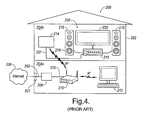
office 102 having a plurality ofrooms 104a-104d. The conventionalsatellite radio system 100 operates with asatellite 75 broadcasts satellite signals, S, toantennas 106a-106d respectively associated withconventional satellite receivers 108a-108d, which are respectively located in eachroom 104a-104d. The arrangement ofconventional satellite receivers 108a-108d in eachroom 104a-104d permits a user in each room to selectively tune to a desired audio channel for audio output atspeakers 110a-110d. Accordingly, a first user inroom 104a may listen to satellite talk radio audio programming, while a second user inroom 104b may listen to satellite country music programming, while a third user inroom 104c may listen to satellite rock music programming, while a fourth user inroom 104d may listen to satellite smooth jazz music programming. Aconventional satellite receiver 108a-108d, for example, is sold under the trade-name SKI-FI® and is commercially available from XM® Satellite Audio Inc. of Washington, D.C. - Referring to Figure 4, a conventional internet / computer audio system is shown generally at 200, which also includes a home, office, or the like at 202 having at least two rooms, which are shown generally at 204a and 204b. The
first room 204a, may be, for example, a home office / computer room, that includes amodem 208, awireless router 210, and acomputer workstation 212, such as, for example, a laptop computer or desktop computer. Thesecond room 204b, may be, for example, a home entertainment room including awireless receiver 214 and ahome theater system 250 including ahome entertainment receiver 216,speakers 218, and amonitor 220. - The
wireless router 210 has conventionally shared a first wireless path, R', with thecomputer workstation 212 to provide wireless internet access from theinternet 206 to thecomputer workstation 212. However, theconventional audio system 200 has also employed thewireless router 210 to share a second wireless path, R", with thewireless receiver 214. Accordingly, thewireless router 210 may provide MP3 audio from thecomputer workstation 212 to thewireless receiver 214 over the first and second wireless paths R', R". Alternatively, internet radio audio may be provided from theinternet 206 to thewireless receiver 214 from acoaxial cable port 201, through acoaxial cable line 203, an Ethernetnetwork cable 205, and over the second wireless path R". The MP3 or internet audio may be output by thespeakers 218 of thehome theatre system 250 via anaudio cable 207 that connects thewireless receiver 214 andhome entertainment receiver 216. Therouter 210 and thewireless receiver 214 are commercially available, for example, from LINKSYS® of San Jose, California and sold as model numbers WAP54G and WMLS11B, respectively. Alternatively, thewireless receiver 214 is commercially available, for example, from APPLE COMPUTER® of Cupertino, California and sold under the trade-name and AIRPORT® Express with AIRTUNES®. - Although the conventional
satellite radio system 100 allows a user in eachroom 104a-104d to selectively tune a desired audio channel, the homeowner or office administrator must pay a subscription fee to receive satellite services from satellite signals, S, at eachconventional satellite receiver 108a-108d. Even further, although the conventional internet /computer audio system 200 eliminates the wiring of audio cables throughout the home oroffice 202 from afirst room 204a to asecond room 204b while also providing the capability to play MP3 or internet radio audio over morepowerful speakers 218 of thehome theater system 250 rather than on weaker speakers of thecomputer workstation 212, theconventional audio system 200 does not permit the reception of satellite signals, S, to provide satellite programming in thefirst room 204a over the speakers of thecomputer workstation 212, nor over the speakers of a device in a different room, such as, for example thespeakers 218 of thehome theatre system 250 in thesecond room 204b. Even further, if a homeowner or office administrator subscribes to both satellite and internet services as shown in Figures 3 and 4, the homeowner or office administrator must pay subscriptions to a satellite service provider and also to an internet service provider while also buying, leasing, and/or maintaining equipment solely dedicated to providing satellite services and internet services, respectively. - The present disclosure will now be described, by way of example, with reference to the accompanying drawings, in which:
- Figure 1 illustrates a wireless satellite radio distribution network according to an embodiment;
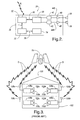
- Figure 2 illustrates a block diagram of a networked wireless receiver node of the wireless satellite radio distribution network according to Figure 1;
- Figure 3 illustrates a conventional satellite radio system; and
- Figure 4 illustrates a conventional internet / computer audio system.
- A wireless satellite radio distribution network is shown generally at 10 in Figure 1 according to an embodiment. The wireless satellite
radio distribution network 10 includes a localized area, such as a home, office, or the like, which is generally shown at 12, having a plurality ofrooms 14a-14d, which are hereinafter referred to as the first, second, third, and fourth rooms, respectively. A primary satellite receiver including an integrated wireless router is shown generally at 18. The integrated satellite receiver /wireless router 18 includes asatellite antenna 16 and is shown proximate thefirst room 14a. Although thesatellite antenna 16 is shown outside of the home oroffice 12, it will be appreciated that thesatellite antenna 16 may be located within the home oroffice 12 such that thesatellite antenna 16 is proximate the integrated satellite receiver /wireless router 18. - A plurality of networked wireless receiver nodes are shown generally at 24a-24c. The networked
wireless receiver nodes 24a-24c do not directly receive satellite signals, S, but rather, the networkedwireless receiver nodes 24a-24c receive a selected compressed satellite radio bit stream including satellite programming taken from the satellite signal, S. The satellite programming may include audio programming and streamed text data, such as weather, traffic, stock data, and the like. One of the networkedwireless receiver nodes 24a-24c is shown in each of the second, third, andfourth rooms 14b-14d, respectively. Although only fourrooms 14a-14d and three networkedwireless receiver nodes 24a-24c are shown, it will be appreciated that any desirable number ofrooms 14a-14d and any desirable number of networkedwireless receiver nodes 24a-24c may be included in the satelliteradio distribution network 10. - Referring to Figure 2, a block diagram of a networked wireless receiver node is shown generally at 24. The networked
wireless receiver node 24 receives the selected compressed satellite radio bit stream including satellite programming from the integrated satellite receiver /wireless router 18 over a routed wireless path, R, at anantenna unit 22. Theantenna unit 22 includes bi-directionalcommunication channels satellite audio decoder 28 and amicrocontroller 32, respectively. Auser interface 34 includes abi-directional communication channel 36 with themicrocontroller 32 as a means for node control of the integrated satellite receiver /wireless router 18 to allow selection of the satellite programming. Upon selecting the compressed satellite radio bit stream associated with the desired satellite programming at theuser interface 34, thesatellite audio decoder 28 decodes the compressed satellite radio bit stream, which is then passed through digital-to-analog converters 42 andamplifiers 40 before being output atspeakers 26 of aleft audio channel 44L and aright audio channel 44R. Theuser interface 34 may also include selection/tuner buttons as well as a screen to view and select satellite programming from a listing of available programming. Volume control buttons, audio fade buttons (i.e. left, right, front, and rear fade), and the like, may also be provided on theuser interface 34. - Referring to Figure 1, the integrated satellite receiver /
wireless router 18 operates on the same principles of well-known satellite receiver electronics and Wireless-B (i.e. 802.11b) or Wireless-G (i.e. 802.11g) routing / router devices. The satellite receiver electronics may, for example, process SDARS signals broadcast on the 2320-2345 MHz frequency range. Accordingly, it will be appreciated that the integrated satellite receiver /wireless router 18 may include satellite receiver electronics that receives and processes SDARS signals, S, and, if desired, wireless router electronics to send/receive the SDARS satellite information, internet information (e.g. internet radio), or other information (e.g.MP3s or the like) stored on thecomputer workstation 25 to/fromdistribution antennas 20 of the integrated satellite receiver /wireless router 18 to/from the networkedwireless receiver nodes 24a-24c and/or acomputer workstation 25 over routed network wireless paths R1-R4. As such, satellite/internet programming or stored information originating from thesatellite 75,internet 50, orcomputer workstation 25 may be output on any of the networkedwireless receiver nodes 24a-24c,computer workstation 25, or integrated satellite receiver / wireless router 18 (i.e. if speakers are included thereon). - To receive satellite and/or internet services, an end-user may subscribe to a first service provider, such as XM® or SIRIUS®, to enable reception of satellite services at the
satellite antenna 16. The end-user may also subscribe to a second service provider to obtain access to theinternet 50 at the integrated satellite receiver /wireless router 18 from aport 11,cable 13,modem 15, and Ethernetnetwork cable 17 located within the home oroffice 12. It will be appreciated that because the integrated satellite receiver /wireless router 18 of the wireless satelliteradio distribution network 10 processes both satellite and internet information in one device, a single service provider may offer subscriptions to both the satellite services and the internet services. - As illustrated, the
satellite antenna 16 receives the satellite signals, S, from asatellite 75. Upon receiving the satellite signals, S, the integrated satellite receiver /wireless router 18 sends and receives signals from thefirst room 14a over the routed wireless paths R2-R4 toantennas 22a-22c extending from the networkedwireless receiver nodes 24a-24c located, respectively, in each of the second, third, andfourth rooms 14a-14d. Accordingly, broadcast satellite audio may be output overspeakers 26a-26c that are integrated with or connected to each networkedwireless receiver node 24a-24c. If desired, the integrated satellite receiver /wireless router 18 may include speakers to provide audio output of the satellite programming in thefirst room 14a. Alternatively, the broadcast satellite audio may also be communicated over routed wireless path, R1, to thecomputer workstation 25 for output over computer speakers (not shown). - Because the integrated satellite receiver /
wireless router 18 may simultaneously receive and distribute many compressed satellite radio bit streams of programming from thesatellite 75 to the networkedwireless receiver nodes 24a-24c, end-users respectively located in eachroom 14a-14d may select any desirable programming that originates from a primary receiver source, such as the integrated satellite receiver /wireless router 18. As such, the homeowner or office administrator may pay for a single satellite service subscription to provide satellite programming to a plurality ofrooms 14a-14d that includes a networkedwireless receiver node 24a-24c or integrated satellite receiver /wireless router 18 including speakers. - Accordingly, the integrated satellite receiver /
wireless router 18 and networked wireless receiver node(s) 24a-24c of the wireless satelliteradio distribution network 10 realizes cost savings for the homeowner, office administrator, or the like, because a single satellite service subscription is purchased rather than multiple satellite service subscriptions for a plurality ofconventional satellite receivers 108a-108d as shown in Figure 3. Even further, the integrated satellite receiver /wireless router 18 may also provide satellite radio programming over wireless path R1 to thecomputer workstation 25; as such, satellite radio programming may either be output over the speakers of thecomputer workstation 25, or, alternatively, the satellite radio programming may be saved in memory for later use on thecomputer workstation 25. Yet even further, it will be appreciated that although the illustrated embodiment in Figure 1 shows asatellite 75 providing satellite signals, S, to thesatellite antenna 16, thesatellite antenna 16 may also receive a terrestrial re-broadcast of the satellite signals, S, if a signal loss or interruption occurs. - Also, because the integrated satellite receiver /
wireless router 18 may include electronics that processes both satellite and internet information, satellite service providers, such as XM® or SIRIUS®, which have been typically limited to sales of satellite service subscriptions, may be enabled to broaden their customer base to include internet access subscriptions, and, conversely, internet service providers may broaden their customer base to include satellite service subscriptions. It will be appreciated that that regardless of the service provider that the end-user patronizes, themodem 15 may be owned by the end-user or leased/rented from the satellite/internet service provider to enable reception of internet services; however, if desired, the modem electronics may be integrated with the satellite receiver /wireless router 18 to reduce the number of components provided by the service provider if the components are leased/rented. Thus, the integrated satellite receiver /wireless router 18 may ultimately reduce the number of components and service providers within a localized area, such as a home oroffice 12. Even further, it will be appreciated that the satellite receiver/wireless router 18 may also include electronics associated with well-known set-top cable or satellite television boxes that provides digital cable programming. Accordingly, the satellite receiver/wireless router 18 may include the modem and/or set-top cable or satellite television box electronics to function as a streamlined device that may be sold by a commercial retailer or rented by a service provider when an end user subscribes to the service provider's services including, for example, satellite radio services, internet services, and/or cable/satellite television services. - The present invention has been described with reference to certain exemplary embodiments thereof. However, it will be readily apparent to those skilled in the art that it is possible to embody the invention in specific forms other than those of the exemplary embodiments described above. This may be done without departing from the spirit of the invention. The exemplary embodiments are merely illustrative and should not be considered restrictive in any way. The scope of the invention is defined by the appended claims and their equivalents, rather than by the preceding description.
Claims (25)
- A component (18) of a wireless satellite radio distribution network (10), comprising:an integrated receiver / wireless router (18) including a receiving means (16) that receives a plurality of compressed bit streams of satellite programming from a satellite signal (S); anda distribution means (20) for distributing one or more selected compressed bit stream(s) of satellite programming from the plurality of compressed bit streams of satellite programming of the satellite signal (S) over one or more routed network wireless paths (R1-R4) to wirelessly distribute the selected one or more compressed bit stream(s) of satellite programming within a localized area (12).
- The component (18) of the wireless satellite radio distribution network (10) according to Claim 1, wherein the distribution means (20) operates with Wireless-B (802.11b) or Wireless-G (802.11g) routing.
- The component (18) of the wireless satellite radio distribution network (10) according to Claim 1, wherein the receiving means (16) and distribution means (20) includes one or more antennas.
- The component (18) of the wireless satellite radio distribution network (10) according to Claim 1, wherein the satellite programming is satellite audio programming or satellite data programming broadcast on the 2320-2345 MHz frequency range.
- The component (18) of the wireless satellite radio distribution network (10) according to Claim 4, wherein the an integrated receiver / wireless router (18) includes speakers that outputs satellite audio programming.
- The component (18) of the wireless satellite radio distribution network (10) according to Claim 1, wherein the localized area (12) is a home or office including a plurality of rooms (14a-14b) where the one or more routed network wireless paths (R1-R4) terminates for distribution of the selected one or more compressed bit stream(s) of satellite programming.
- The component (18) of the wireless satellite radio distribution network (10) according to Claim 1, wherein the integrated receiver / wireless router (18) obtains access to internet information from the internet (50), wherein internet information is provided over the one or more routed network wireless paths (R1-R4) to wirelessly provide the internet information within the localized area (12), wherein the internet information is internet radio programming.
- The component (18) of the wireless satellite radio distribution network (10) according to Claim 1, wherein the integrated receiver / wireless router (18) obtains access to stored information from a computer workstation (25), wherein stored information is provided over the one or more routed network wireless paths (R1-R4) to wirelessly provide the stored information within the localized area (12), wherein the stored information includes a plurality of MP3 files.
- A component (24a-24c) of a wireless satellite radio distribution network (10), comprising:a networked device (24a-24c) located in a localized area (12) including a communication means (22) for communicating over a routed network wireless path (R1-R4), wherein the networked device (24a-24c) is adapted to select and receive a distributed compressed bit stream of satellite programming from a plurality of compressed bit streams of a satellite signal (S) within the localized area (12).
- The component (24a-24c) of the wireless satellite radio distribution network (10) according to Claim 9, wherein the communication means (22) operates with Wireless-B (802.11b) or Wireless-G (802.11g) routing.
- The component (24a-24c) of the wireless satellite radio distribution network (10) according to Claim 9, wherein the satellite programming is satellite audio or satellite data programming broadcast on the 2320-2345 MHz frequency range.
- The component (24a-24c) of the wireless satellite radio distribution network (10) according to Claim 11, wherein the communication means (22) includes one or more antennas, wherein the one or more antennas (22)includes bi-directional communication channels (30, 38) with a satellite audio decoder (28) and a microcontroller (32), respectively, wherein the networked device includes a user interface (34) having a bi-directional communication channel (36) with the microcontroller (32) as a means for selecting the compressed bit stream of satellite programming.
- The component (24a-24c) of the wireless satellite radio distribution network (10) according to Claim 12, wherein the satellite audio decoder (28) decodes the selected compressed audio bit stream, wherein the decoded compressed audio bit stream is passed through digital-to-analog converters (42) and amplifiers (40) before being output at speakers (26) of a left audio channel (44L) and a right audio channel (44R).
- A wireless satellite radio distribution network (10), comprising:an integrated receiver / wireless router (18) including an antenna (16) that receives satellite signals (S) including satellite programming, wherein the integrated receiver / wireless router (18) wirelessly routes available satellite programming to one or more networked devices (24a-24c, 25) in a localized area (12) over one or more routed network wireless paths (R1-R4).
- The wireless satellite radio distribution network (10) according to Claim 14, wherein the integrated receiver / router (18) and one or more networked devices (24a-24c, 25) operates with Wireless-B (802.11b) or Wireless-G (802.11g) routing.
- The wireless satellite radio distribution network (10) according to Claim 14, wherein the satellite programming is satellite audio programming or satellite data broadcast on the 2320-2345 MHz frequency range.
- The wireless satellite radio distribution network (10) according to Claim 14, wherein the integrated receiver / wireless router (18) obtains access to internet information from the internet (50), wherein internet information is provided over the one or more routed network wireless paths (R1-R4) to wirelessly provide the internet information to the one or more networked devices (24a-24c, 25), wherein the internet information is internet radio programming.
- The wireless satellite radio distribution network (10) according to Claim 14, wherein the one or more networked devices are one or more networked satellite receiver node(s) (24a-24c) or a computer workstation (25).
- The wireless satellite radio distribution network (10) according to Claim 18, wherein the integrated receiver / wireless router (18) communicates over the one or more routed network wireless paths (R1-R4) with the computer workstation (25) to provide wireless access of the satellite programming to the computer workstation (25).
- The wireless satellite radio distribution network (10) according to Claim 18, wherein the integrated receiver / wireless router (18) communicates over the one or more routed network wireless paths (R2-R4) with the one or more networked satellite receiver node(s) (24a-24c) to provide wireless access of the satellite programming to the one or more network receiver node(s) (24a-24c).
- The wireless satellite radio distribution network (10) according to Claim 18, wherein the integrated receiver / wireless router (18) obtains access to the computer workstation (25), wherein stored information on the computer workstation (25) is provided over one or more routed network wireless paths (R1-R4) to the integrated receiver / wireless router (18) to wirelessly provide the stored information on the computer workstation (25) to the one or more networked receiver node(s) (24a-24c), wherein the stored information on the computer workstation (25) are MP3 audio files.
- A method for wirelessly distributing satellite radio, comprising the steps of:receiving a plurality of compressed bit streams of satellite programming from a satellite signal (S) at an integrated receiver / wireless router (18) proximate a localized area (12);positioning one or more networked devices (24a-24c) proximate the localized area (12),distributing the compressed bit streams of satellite programming from the integrated receiver / wireless router (18) to the one or more networked devices (24a-24c).
- The method according to Claim 22, prior to the distributing step, further comprising the step of utilizing the one or more networked devices (24a-24c) to select a compressed bit stream of satellite programming from the plurality of compressed bit streams from the satellite signal (S).
- A method for providing subscription services, comprising:providing a plurality of available subscription services from a service provider; andutilizing a single component (18) at an end-user location (10) to receive the plurality of subscription services, wherein at least one of the plurality subscription services received by the single component (18) is satellite radio programming (S).
- The method according to Claim 24, wherein the plurality of subscription services receivable by the single component (18) further comprises internet services and television services.
Applications Claiming Priority (1)
| Application Number | Priority Date | Filing Date | Title |
|---|---|---|---|
| US11/185,073 US20070021053A1 (en) | 2005-07-20 | 2005-07-20 | Wireless satellite radio distribution network |
Publications (2)
| Publication Number | Publication Date |
|---|---|
| EP1746750A2 true EP1746750A2 (en) | 2007-01-24 |
| EP1746750A3 EP1746750A3 (en) | 2011-04-27 |
Family
ID=37084751
Family Applications (1)
| Application Number | Title | Priority Date | Filing Date |
|---|---|---|---|
| EP06076279A Withdrawn EP1746750A3 (en) | 2005-07-20 | 2006-06-21 | Network and method for wireless redistribution of satellite radio broadcast signals in a localized area |
Country Status (2)
| Country | Link |
|---|---|
| US (1) | US20070021053A1 (en) |
| EP (1) | EP1746750A3 (en) |
Cited By (1)
| Publication number | Priority date | Publication date | Assignee | Title |
|---|---|---|---|---|
| GB2515877A (en) * | 2013-04-30 | 2015-01-07 | Global Invacom Ltd | System and method for data provision |
Families Citing this family (17)
| Publication number | Priority date | Publication date | Assignee | Title |
|---|---|---|---|---|
| CA2618060A1 (en) * | 2005-08-05 | 2007-02-15 | Xm Satellite Radio Inc. | Broadcast signal interface device and method thereof |
| US8140004B2 (en) * | 2005-08-30 | 2012-03-20 | Interdigital Technology Corporation | Digital satellite radio systems and associated methods for providing indoor reception |
| US7620365B2 (en) * | 2005-08-30 | 2009-11-17 | Interdigital Technology Corporation | Internet based digital satellite radio system and associated methods for providing indoor reception |
| US7606526B2 (en) * | 2005-09-30 | 2009-10-20 | Xm Satellite Radio Inc. | Method and apparatus for providing digital media player with portable digital radio broadcast system receiver or integrated antenna and docking system |
| US8095466B2 (en) | 2006-05-15 | 2012-01-10 | The Directv Group, Inc. | Methods and apparatus to conditionally authorize content delivery at content servers in pay delivery systems |
| US8996421B2 (en) * | 2006-05-15 | 2015-03-31 | The Directv Group, Inc. | Methods and apparatus to conditionally authorize content delivery at broadcast headends in pay delivery systems |
| US8775319B2 (en) | 2006-05-15 | 2014-07-08 | The Directv Group, Inc. | Secure content transfer systems and methods to operate the same |
| US8001565B2 (en) * | 2006-05-15 | 2011-08-16 | The Directv Group, Inc. | Methods and apparatus to conditionally authorize content delivery at receivers in pay delivery systems |
| US20070265966A1 (en) * | 2006-05-15 | 2007-11-15 | The Directv Group, Inc. | Content delivery systems and methods to operate the same |
| US7992175B2 (en) * | 2006-05-15 | 2011-08-02 | The Directv Group, Inc. | Methods and apparatus to provide content on demand in content broadcast systems |
| US9143493B2 (en) | 2007-12-20 | 2015-09-22 | The Directv Group, Inc. | Method and apparatus for communicating between a user device and a gateway device to form a system to allow a partner service to be provided to the user device |
| US8281343B2 (en) * | 2009-05-19 | 2012-10-02 | Cisco Technology, Inc. | Management and display of video content |
| US8762982B1 (en) * | 2009-06-22 | 2014-06-24 | Yazaki North America, Inc. | Method for programming an instrument cluster |
| US9213053B2 (en) * | 2010-12-02 | 2015-12-15 | Apple Inc. | System for field testing wireless devices with reduced multipath interference |
| US9332014B2 (en) | 2011-04-05 | 2016-05-03 | Securus Technologies, Inc. | Distribution of broadcast content to controlled-environment facilities |
| US8745654B1 (en) | 2012-02-09 | 2014-06-03 | The Directv Group, Inc. | Method and system for managing digital rights for content |
| US9467726B1 (en) | 2015-09-30 | 2016-10-11 | The Directv Group, Inc. | Systems and methods for provisioning multi-dimensional rule based entitlement offers |
Family Cites Families (9)
| Publication number | Priority date | Publication date | Assignee | Title |
|---|---|---|---|---|
| US5555100A (en) * | 1993-10-07 | 1996-09-10 | Audiofax, Inc. | Facsimile store and forward system with local interface translating DTMF signals into store and forward system commands |
| US6166614A (en) * | 1997-04-03 | 2000-12-26 | Murata Manufacturing Co., Ltd. | Nonradiative planar dielectric line and integrated circuit |
| UA56279C2 (en) * | 1997-11-04 | 2003-05-15 | Джорджія Тек Ресерч Корпорейшн | System and method for maintaining time synchronization in a digital video network |
| US8284774B2 (en) * | 1998-04-03 | 2012-10-09 | Megawave Audio Llc | Ethernet digital storage (EDS) card and satellite transmission system |
| US8151306B2 (en) * | 2000-01-14 | 2012-04-03 | Terayon Communication Systems, Inc. | Remote control for wireless control of system including home gateway and headend, either or both of which have digital video recording functionality |
| CA2350910A1 (en) * | 2001-06-20 | 2002-12-20 | Kevin Tuer | Reconfigurable dashboard system |
| US20040233284A1 (en) * | 2001-10-09 | 2004-11-25 | Vehicle Enhancement Systems, Inc. | Apparatus and methods for providing surveillance data concerning a scene of interest to a user located at a remote location |
| GB2381709A (en) * | 2001-10-30 | 2003-05-07 | Graeme Roy Smith | Programmable set-top box and home gateway |
| US7756513B2 (en) * | 2004-06-30 | 2010-07-13 | Arinc Incorporated | Command and control communications system with sub-networks and interface devices |
-
2005
- 2005-07-20 US US11/185,073 patent/US20070021053A1/en not_active Abandoned
-
2006
- 2006-06-21 EP EP06076279A patent/EP1746750A3/en not_active Withdrawn
Cited By (1)
| Publication number | Priority date | Publication date | Assignee | Title |
|---|---|---|---|---|
| GB2515877A (en) * | 2013-04-30 | 2015-01-07 | Global Invacom Ltd | System and method for data provision |
Also Published As
| Publication number | Publication date |
|---|---|
| US20070021053A1 (en) | 2007-01-25 |
| EP1746750A3 (en) | 2011-04-27 |
Similar Documents
| Publication | Publication Date | Title |
|---|---|---|
| EP1746750A2 (en) | Network and method for wireless redistribution of satellite radio broadcast signals in a localized area | |
| US6553077B2 (en) | Method and apparatus for customized selection of audio channels | |
| US6785656B2 (en) | Method and apparatus for digital audio playback using local stored content | |
| US5915207A (en) | Mobile and wireless information dissemination architecture and protocols | |
| US7954127B2 (en) | Direct broadcast signal distribution methods | |
| US7774814B2 (en) | Simultaneous tuning of multiple satellite frequencies | |
| US7522875B1 (en) | Signal selector and combiner system for broadband content distribution | |
| US8656436B2 (en) | Satellite reception and distribution system for use as a head end with programmable transponder conversion of transponder blocks | |
| MXPA96006588A (en) | Receptor apparatus, receiving method and termi unit | |
| US8014717B2 (en) | Media content distribution system and method | |
| US20030098782A1 (en) | Method and apparatus for dynamic group addressing | |
| US20100242261A1 (en) | Combined satellite and broadband access antennas using common infrastructure | |
| US7991348B2 (en) | Triple band combining approach to satellite signal distribution | |
| KR20010013146A (en) | Satellite broadcasting system and broadcasting satellite | |
| US20060056372A1 (en) | Method and apparatus for using multiple data-stream pathways | |
| US7149470B1 (en) | Direct broadcast receiver utilizing LNB in cascade | |
| EP3275096A1 (en) | Provision of bi-directional signals via fibre optic data distribution system | |
| US20060059523A1 (en) | Receiving and bridging broadband access signals for wired and wireless redistribution | |
| CA2532838A1 (en) | Method and system for converting streaming digital data to fm modulated data | |
| KR200237127Y1 (en) | AMP for combining and dividing satellite resonance input | |
| US20070288968A1 (en) | Video and data home networking architectures | |
| WO2017216554A1 (en) | Video and audio data distribution system | |
| GB2505989A (en) | Data distribution system for providing data from a plurality of data sources to a broadcast data receiver | |
| Williamson | Satellites Rock![satellite radio] | |
| MX2008015655A (en) | Video and data home networking architectures. |
Legal Events
| Date | Code | Title | Description |
|---|---|---|---|
| PUAI | Public reference made under article 153(3) epc to a published international application that has entered the european phase |
Free format text: ORIGINAL CODE: 0009012 |
|
| AK | Designated contracting states |
Kind code of ref document: A2 Designated state(s): AT BE BG CH CY CZ DE DK EE ES FI FR GB GR HU IE IS IT LI LT LU LV MC NL PL PT RO SE SI SK TR |
|
| AX | Request for extension of the european patent |
Extension state: AL BA HR MK YU |
|
| PUAL | Search report despatched |
Free format text: ORIGINAL CODE: 0009013 |
|
| AK | Designated contracting states |
Kind code of ref document: A3 Designated state(s): AT BE BG CH CY CZ DE DK EE ES FI FR GB GR HU IE IS IT LI LT LU LV MC NL PL PT RO SE SI SK TR |
|
| AX | Request for extension of the european patent |
Extension state: AL BA HR MK RS |
|
| AKY | No designation fees paid | ||
| REG | Reference to a national code |
Ref country code: DE Ref legal event code: R108 |
|
| REG | Reference to a national code |
Ref country code: DE Ref legal event code: R108 Effective date: 20120104 |
|
| STAA | Information on the status of an ep patent application or granted ep patent |
Free format text: STATUS: THE APPLICATION IS DEEMED TO BE WITHDRAWN |
|
| 18D | Application deemed to be withdrawn |
Effective date: 20111028 |