EP1746529B1 - Smart card and method and system for authentication thereof - Google Patents
Smart card and method and system for authentication thereof Download PDFInfo
- Publication number
- EP1746529B1 EP1746529B1 EP05717190A EP05717190A EP1746529B1 EP 1746529 B1 EP1746529 B1 EP 1746529B1 EP 05717190 A EP05717190 A EP 05717190A EP 05717190 A EP05717190 A EP 05717190A EP 1746529 B1 EP1746529 B1 EP 1746529B1
- Authority
- EP
- European Patent Office
- Prior art keywords
- elements
- card
- communication
- security elements
- verification
- Prior art date
- Legal status (The legal status is an assumption and is not a legal conclusion. Google has not performed a legal analysis and makes no representation as to the accuracy of the status listed.)
- Ceased
Links
Images

Classifications
-
- G—PHYSICS
- G06—COMPUTING OR CALCULATING; COUNTING
- G06K—GRAPHICAL DATA READING; PRESENTATION OF DATA; RECORD CARRIERS; HANDLING RECORD CARRIERS
- G06K19/00—Record carriers for use with machines and with at least a part designed to carry digital markings
- G06K19/06—Record carriers for use with machines and with at least a part designed to carry digital markings characterised by the kind of the digital marking, e.g. shape, nature, code
- G06K19/067—Record carriers with conductive marks, printed circuits or semiconductor circuit elements, e.g. credit or identity cards also with resonating or responding marks without active components
- G06K19/07—Record carriers with conductive marks, printed circuits or semiconductor circuit elements, e.g. credit or identity cards also with resonating or responding marks without active components with integrated circuit chips
- G06K19/073—Special arrangements for circuits, e.g. for protecting identification code in memory
-
- G—PHYSICS
- G06—COMPUTING OR CALCULATING; COUNTING
- G06K—GRAPHICAL DATA READING; PRESENTATION OF DATA; RECORD CARRIERS; HANDLING RECORD CARRIERS
- G06K19/00—Record carriers for use with machines and with at least a part designed to carry digital markings
- G06K19/06—Record carriers for use with machines and with at least a part designed to carry digital markings characterised by the kind of the digital marking, e.g. shape, nature, code
- G06K19/067—Record carriers with conductive marks, printed circuits or semiconductor circuit elements, e.g. credit or identity cards also with resonating or responding marks without active components
- G06K19/07—Record carriers with conductive marks, printed circuits or semiconductor circuit elements, e.g. credit or identity cards also with resonating or responding marks without active components with integrated circuit chips
Definitions
- the present invention relates to recording media-based high security environments provided with an integrated circuit. More specifically, the invention relates to high security environments wherein smart cards are used, and has the purpose of preventing the falsification of smart cards and, consequently, increasing the security level of said cards and of the environment wherein they are used.
- the invention provides means to unequivocally link the passive security elements and the active security elements these types of smart cards conventionally have, so that the invention manages to eliminate the possibility that said passive and active security elements are illicitly exchanged, and thus avoid identity theft.
- Smart cards are very widely used in our society for multiple applications such as identification of people or entities, control of access to buildings, financial transactions etc.
- These types of cards are comprised of a sheet of plastic material of standard dimensions and incorporate an integrated circuit wherein information is stored and they have capacity for processing and communication with an external processing terminal. This type of communication is performed securely by applying cryptographic processes that guarantee the authentication, confidentiality and integrity of the data transferred.
- smart cards usually contain elements of graphic identification such as photographs, graphic characters, holograms etc., which contribute to identifying the card owner and increasing its security level.
- graphic identification such as photographs, graphic characters, holograms etc.
- the combination of these two types of elements, i.e. the graphic elements and the integrated circuit, provides a considerable increase in card security and, therefore, of the security environment wherein it is used.
- US-A- 6 111 506 describes storage of encrypted biometric data in a contactless chip provided in an identification document.
- Corresponding biometric data is derived from the person presenting the document (e.g. by a retina scanner) and is compared with biometric data read from the chip of the document.
- EP-A- 1 329 843 teaches incorporation of an anti-counterfeit chip in a passport.
- the chip contains image data representing the photograph printed on the particular passport.
- the data is read by a chip reader for display and the displayed image can be visually compared with the photograph in the passport.
- the present invention has the object of increasing the security level of smart cards and, therefore, the high security environments wherein they are used as authentication elements, providing means that unequivocally link the different security elements the smart card is provided with and, therefore, prevent a fraudulent exchange thereof.
- a first aspect of the invention relates to an authentication smart card conventionally provided with a type of Active Security (AS) and a type of Passive Security (PS), where the type of Active Security consists of processes and data contained in a processing unit, which are able to establish data communication with a terminal external to the smart card. This communication will preferably be performed securely, applying cryptographic processes that guarantee the authentication, confidentiality and integrity of the data transferred.
- AS Active Security
- PS Passive Security
- the type of Passive Security is defined as a set of graphic elements, or of another type, present in the card, which establish a connection link between the smart card and the person or entity that owns it, such as, for example, graphic symbols, numerical characters, names, photographs, holograms, representation of biometric data or any combination of these elements.
- graphic or other types of elements should preferably be protected by printing techniques, or another type of technique, which hinder the falsification of the elements comprising the (PS).
- the present invention unequivocally links both types of security (AS and PS) and therefore eliminates the possibility of exchanging the elements comprising the (AS) and (PS), thus avoiding the identity theft this would involve.
- the smart card object of the invention incorporates means which allow data communication to be performed between the elements that comprise both security types (AS) and (PS). These means are called Verification Elements (VE) and allow the (AS) or third party elements to know to which person or entity the (PS) elements belong (PS).
- VE Verification Elements
- VE are elements capable of storing data that characterize the (PS) and which may be read by other units.
- the data stored in the verification elements (VE) may be any type of information that identifies the (PS) elements, such as, for example data related to a photograph, with a name, hologram, the card owner's biometric data, an identification code etc.
- the present invention includes the possibility that these elements (VE) contain processing units that guarantee greater security in the authentication occurring between the (VE) and the (AS).
- the (VE) are indivisibly integrated with the physical medium which constitutes the card, so that the (VE) form an integral, indivisible part of the elements comprising the (PS), so that its extraction and/or theft is very difficult or impossible.
- the verification elements (VE) are sufficiently integrated with the (PS), for which reason it can be assumed that internal (PS) and (VE) form a single indivisible entity.
- the passive security (PS) and active security (AS) elements are connected by data exchange between the (AS) and (VE) integrated in the (PS).
- a smart card of the invention is defined by claim 1.
- Communication between the verification elements (VE) and the active security elements (AS) may occur by a physical link that connects them electrically.
- this communication may occur aerially, e.g. by radio frequency, or it may even have both communication channels, the physical link and aerially.
- Said physical link may comprise, for example, a data bus.
- the verification elements (VE) may comprise a microprocessor and a communications port electrically connected to said microprocessor and to said physical link.
- the verification elements (VE) may consist of a data memory and a communications port electrically connected to said memory and to the physical link.
- the verification elements (VE) may have a microprocessor and a data memory.
- the (VE) have at least one antenna equipped to send and receive data, and which is electrically connected to the communications port of the microprocessor and/or the memory.
- the (AS) will have at least one antenna that enables its aerial communication with the (VE).
- the active security elements comprise at least one processing unit and means of communication which allow communication to be established with a processing unit external to the card.
- the processing unit is preferably an integrated circuit that comprises at least one microprocessor.
- the smart cards comprise a physical medium containing passive security elements (PS) that establish a connection between the card and its owner, and active security elements (AS) that have capacity for data storage and data communication with an external terminal, being designed to prevent the exchangeability of said (PS) and (AS) elements.
- the method comprises having verification elements (VE) with data storage capacity, indivisibly joined to the card's physical medium, and storing, in said verification elements (VE), data which identify the passive security elements (PS), establishing communication between the verification elements (VE) and the active security elements (AS) wherein mutual authentication is performed.
- Communication between the verification elements (VE) and the active security elements (AS) occurs by a physical link which electrically connects both types of elements, aerially, or by a combination of both means.
- the communication between the verification elements (VE) and the active security elements (AS), may not directly occur by a physical link or by radio frequency, but by a Link Unit (LU) consisting of a device or unit external to the card, and which may serve as a mere intermediary in the data exchange between the (VE) and the (AS), or may even participate in the verification of the correct correlation of data between the (VE) and the (AS).
- LU Link Unit
- the link between (AS) and the link unit (LU) may be physical, by electrical connection, or by an aerial connection.
- the link between the (VE) and the link unit may be physical, by an electrical connection, or an aerial connection.
- the link unit (LU) is comprised of hardware and software, and is provided with an antenna for aerial communication with the (VE) and!or the (AS).
- a smart card authentication system that comprises a physical medium containing passive security elements (PS) which establish a connection between the card and its owner, and active security elements (AS) which have capacity for data storage and data communication with an external terminal.
- the system is characterized in that the card comprises verification elements (VE) which form an indivisible part of the physical medium thereof and which store data which identify the passive security elements (PS) and a link unit (LU) which allows communication and data exchange between said verification elements (VE) and the active security elements (AS).
- VE verification elements
- LU link unit
- the link unit (LU) communicates with the active security elements (AS) by a physical link, by radio frequency or by a combination of both channels.
- the link unit (LU) communicates with the passive security elements (PS) by a physical link, by radio frequency or by a combination of both channels.
- the verification elements (VE) comprise a microprocessor and a communications port electrically connected to said microprocessor.
- the verification elements (VE) comprise a data memory and a communications port electrically connected to said memory.
- the verification elements comprise at least one antenna equipped to send and receive data, and which is electrically connected to the communications port of the microprocessor and/or to the memory.
- the active security elements comprise at least one processing unit and means of communication which allows communication to be established with a processing unit external to the card and with the link unit (LU).
- the active security elements (AS) have at least one antenna which allows data exchange with the processing unit (LU).
- the link unit (LU) may participate in the mutual verification between the (AS) and the (PS).
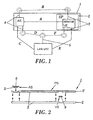
- FIG 1 schematically represents a smart card (1) comprised of a physical medium (2) conventionally made of plastic material.
- the card (1) is provided with active security elements (AS), such as an integrated circuit which comprises a microprocessor, as well as passive security elements (PS), such as printed graphic symbols, numerical characters, names, photographs, holograms, representation of the card owner's biometric data or any combination of these elements.
- AS active security elements
- PS passive security elements
- the card is characterized in that it incorporates verification elements (VE) which are physically and indivisibly joined to the physical medium (2) of the card, i.e. they are indivisibly joined to the passive security elements (PS) by the physical medium (2).
- VE verification elements
- the verification elements (VE) and the active security elements (AS) are in communication for the data exchange with the object of performing mutual authentication. Communication between both types of elements can be produced by a physical link (A), such as a data bus, or aerially (B), which may consist of radio frequency communication, for which purpose the verification elements (VE) have a first antenna (3) and the active security elements (AS) have a second antenna (4).
- the smart card (1) may simultaneously have both communication channels, i.e. a physical link (A) and an aerial channel (B).
- the link unit (LU) is comprised of hardware and software which allow these functions to be performed.
- the invention also relates to an identity authentication system, for example for people, which has also been represented in figure 1.
- identity authentication system for example for people, which has also been represented in figure 1.
- the communication between the card's (1) (VE) and (AS) does not directly occur between them, instead it is performed by a link unit (LU), consisting of a unit external to the card with capacity for communication with both the (VE) and the (AS).
- LU link unit
- Communication between the (LU) and the (VE) can occur by a physical link (E), or by an aerial link (F) by radio frequency, or by both means.
- communication between the (LU) and the (AS) may occur by a physical link (C) or by an aerial link (D) by radio frequency, or by both means.
- the link unit (LU) has an antenna (5) which enable its radio frequency communication with the (VE) and/or the (AS).
- FIG. 2 shows an example of embodiment of the smart card (1), wherein it can be seen that the physical medium (2) is comprised of an upper layer (2') and a lower layer (2").
- the verification elements (VE) consist of an integrated circuit (4) which is located within the physical medium (2).
- the active security elements (AS) consist of an integrated circuit (5) provided with contacts (6) and it is positioned on one of the outer faces of the card.
- the passive security elements (PS) also have printing on one of the external faces of the card.
- the card of figure 1 is complemented with a physical link consisting of a data bus and feed (7), which is also positioned inside the card between the upper layer (2') and the lower layer (2").
- Figure 4 represents the same card, but provided with an antenna (8) connected to the integrated circuit (4) the (VE) comprise through a connection (9).
- the verification elements can be fed by an electrical connection to an external source through the smart card contacts or, if there is an antenna, by the radio frequency waves received.
Landscapes
- Engineering & Computer Science (AREA)
- Computer Hardware Design (AREA)
- Microelectronics & Electronic Packaging (AREA)
- Physics & Mathematics (AREA)
- General Physics & Mathematics (AREA)
- Theoretical Computer Science (AREA)
- Computer Security & Cryptography (AREA)
- General Engineering & Computer Science (AREA)
- Credit Cards Or The Like (AREA)
Description
- The present invention relates to recording media-based high security environments provided with an integrated circuit. More specifically, the invention relates to high security environments wherein smart cards are used, and has the purpose of preventing the falsification of smart cards and, consequently, increasing the security level of said cards and of the environment wherein they are used.
- The invention provides means to unequivocally link the passive security elements and the active security elements these types of smart cards conventionally have, so that the invention manages to eliminate the possibility that said passive and active security elements are illicitly exchanged, and thus avoid identity theft.
- Smart cards are very widely used in our society for multiple applications such as identification of people or entities, control of access to buildings, financial transactions etc. These types of cards are comprised of a sheet of plastic material of standard dimensions and incorporate an integrated circuit wherein information is stored and they have capacity for processing and communication with an external processing terminal. This type of communication is performed securely by applying cryptographic processes that guarantee the authentication, confidentiality and integrity of the data transferred.
- Additionally, smart cards usually contain elements of graphic identification such as photographs, graphic characters, holograms etc., which contribute to identifying the card owner and increasing its security level. The combination of these two types of elements, i.e. the graphic elements and the integrated circuit, provides a considerable increase in card security and, therefore, of the security environment wherein it is used.
- Nevertheless, there is the potential risk that a smart card may be falsified by extracting the integrated circuit of an authentic card and then implanting it in another card, in which case the illicit identity theft of the holder of the falsified card would occur.
-
US-A- 6 111 506 describes storage of encrypted biometric data in a contactless chip provided in an identification document. Corresponding biometric data is derived from the person presenting the document (e.g. by a retina scanner) and is compared with biometric data read from the chip of the document. -
EP-A- 1 329 843 teaches incorporation of an anti-counterfeit chip in a passport. The chip contains image data representing the photograph printed on the particular passport. The data is read by a chip reader for display and the displayed image can be visually compared with the photograph in the passport. - The present invention has the object of increasing the security level of smart cards and, therefore, the high security environments wherein they are used as authentication elements, providing means that unequivocally link the different security elements the smart card is provided with and, therefore, prevent a fraudulent exchange thereof.
- More specifically, a first aspect of the invention relates to an authentication smart card conventionally provided with a type of Active Security (AS) and a type of Passive Security (PS), where the type of Active Security consists of processes and data contained in a processing unit, which are able to establish data communication with a terminal external to the smart card. This communication will preferably be performed securely, applying cryptographic processes that guarantee the authentication, confidentiality and integrity of the data transferred.
- Furthermore, in the present invention, the type of Passive Security (PS) is defined as a set of graphic elements, or of another type, present in the card, which establish a connection link between the smart card and the person or entity that owns it, such as, for example, graphic symbols, numerical characters, names, photographs, holograms, representation of biometric data or any combination of these elements. These graphic or other types of elements should preferably be protected by printing techniques, or another type of technique, which hinder the falsification of the elements comprising the (PS).
- The present invention unequivocally links both types of security (AS and PS) and therefore eliminates the possibility of exchanging the elements comprising the (AS) and (PS), thus avoiding the identity theft this would involve.
- To produce this connection between the different security types, the smart card object of the invention incorporates means which allow data communication to be performed between the elements that comprise both security types (AS) and (PS). These means are called Verification Elements (VE) and allow the (AS) or third party elements to know to which person or entity the (PS) elements belong (PS).
- (VE) are elements capable of storing data that characterize the (PS) and which may be read by other units. The data stored in the verification elements (VE) may be any type of information that identifies the (PS) elements, such as, for example data related to a photograph, with a name, hologram, the card owner's biometric data, an identification code etc.
- The present invention includes the possibility that these elements (VE) contain processing units that guarantee greater security in the authentication occurring between the (VE) and the (AS).
- The (VE) are indivisibly integrated with the physical medium which constitutes the card, so that the (VE) form an integral, indivisible part of the elements comprising the (PS), so that its extraction and/or theft is very difficult or impossible. The verification elements (VE) are sufficiently integrated with the (PS), for which reason it can be assumed that internal (PS) and (VE) form a single indivisible entity.
- The passive security (PS) and active security (AS) elements are connected by data exchange between the (AS) and (VE) integrated in the (PS).
- A smart card of the invention is defined by
claim 1. - Communication between the verification elements (VE) and the active security elements (AS) may occur by a physical link that connects them electrically. Alternatively, this communication may occur aerially, e.g. by radio frequency, or it may even have both communication channels, the physical link and aerially. Said physical link may comprise, for example, a data bus.
- The verification elements (VE) may comprise a microprocessor and a communications port electrically connected to said microprocessor and to said physical link. Alternatively, the verification elements (VE) may consist of a data memory and a communications port electrically connected to said memory and to the physical link. In another alternative embodiment, the verification elements (VE) may have a microprocessor and a data memory.
- To allow radio frequency communication between the verification elements (VE) and the active security elements (AS), the (VE) have at least one antenna equipped to send and receive data, and which is electrically connected to the communications port of the microprocessor and/or the memory. Likewise, the (AS) will have at least one antenna that enables its aerial communication with the (VE).
- The active security elements (AS) comprise at least one processing unit and means of communication which allow communication to be established with a processing unit external to the card. The processing unit is preferably an integrated circuit that comprises at least one microprocessor.
- Another aspect of the invention relates to a smart card authentication method according to claims 16. The smart cards comprise a physical medium containing passive security elements (PS) that establish a connection between the card and its owner, and active security elements (AS) that have capacity for data storage and data communication with an external terminal, being designed to prevent the exchangeability of said (PS) and (AS) elements. The method comprises having verification elements (VE) with data storage capacity, indivisibly joined to the card's physical medium, and storing, in said verification elements (VE), data which identify the passive security elements (PS), establishing communication between the verification elements (VE) and the active security elements (AS) wherein mutual authentication is performed.
- Communication between the verification elements (VE) and the active security elements (AS) occurs by a physical link which electrically connects both types of elements, aerially, or by a combination of both means.
- In another alternative embodiment of the invention, the communication between the verification elements (VE) and the active security elements (AS), may not directly occur by a physical link or by radio frequency, but by a Link Unit (LU) consisting of a device or unit external to the card, and which may serve as a mere intermediary in the data exchange between the (VE) and the (AS), or may even participate in the verification of the correct correlation of data between the (VE) and the (AS).
- The link between (AS) and the link unit (LU) may be physical, by electrical connection, or by an aerial connection. In turn, the link between the (VE) and the link unit may be physical, by an electrical connection, or an aerial connection.
- The link unit (LU) is comprised of hardware and software, and is provided with an antenna for aerial communication with the (VE) and!or the (AS).
- Therefore, another aspect of the invention relates to a smart card authentication system that comprises a physical medium containing passive security elements (PS) which establish a connection between the card and its owner, and active security elements (AS) which have capacity for data storage and data communication with an external terminal. The system is characterized in that the card comprises verification elements (VE) which form an indivisible part of the physical medium thereof and which store data which identify the passive security elements (PS) and a link unit (LU) which allows communication and data exchange between said verification elements (VE) and the active security elements (AS).
- In the system, the link unit (LU) communicates with the active security elements (AS) by a physical link, by radio frequency or by a combination of both channels. Likewise, the link unit (LU) communicates with the passive security elements (PS) by a physical link, by radio frequency or by a combination of both channels.
- In the system, the verification elements (VE) comprise a microprocessor and a communications port electrically connected to said microprocessor. Alternatively, the verification elements (VE) comprise a data memory and a communications port electrically connected to said memory.
- For radio frequency communication, the verification elements (VE) comprise at least one antenna equipped to send and receive data, and which is electrically connected to the communications port of the microprocessor and/or to the memory. Likewise, the active security elements (AS) comprise at least one processing unit and means of communication which allows communication to be established with a processing unit external to the card and with the link unit (LU). The active security elements (AS) have at least one antenna which allows data exchange with the processing unit (LU).
- Alternatively, the link unit (LU) may participate in the mutual verification between the (AS) and the (PS).
- To complement the description being made and with the object of aiding towards a better understanding of the characteristics of the invention, in accordance with a preferred example of embodiment thereof, a set of drawings is attached as an integral part of said description, wherein the following has been represented, with an illustrative, non-limiting character:
- Figure 1.-
- shows a schematic diagram of the different elements which participate in the invention and wherein various embodiments and aspects of the invention are simultaneously represented.
- Figure 2.-
- schematically shows an exploded cutaway view of the smart card of the invention in one of the possible embodiments.
- Figure 3.-
- schematically shows an exploded cutaway view of the smart card of the invention in another of the possible embodiments.
- Figure 4.-
- schematically shows an exploded cutaway view of the smart card of the invention in another of the possible embodiments.
- Figure 1 schematically represents a smart card (1) comprised of a physical medium (2) conventionally made of plastic material. The card (1) is provided with active security elements (AS), such as an integrated circuit which comprises a microprocessor, as well as passive security elements (PS), such as printed graphic symbols, numerical characters, names, photographs, holograms, representation of the card owner's biometric data or any combination of these elements.
- Starting with this conventional configuration, the card is characterized in that it incorporates verification elements (VE) which are physically and indivisibly joined to the physical medium (2) of the card, i.e. they are indivisibly joined to the passive security elements (PS) by the physical medium (2).
- The verification elements (VE) and the active security elements (AS) are in communication for the data exchange with the object of performing mutual authentication. Communication between both types of elements can be produced by a physical link (A), such as a data bus, or aerially (B), which may consist of radio frequency communication, for which purpose the verification elements (VE) have a first antenna (3) and the active security elements (AS) have a second antenna (4). In another preferred embodiment, the smart card (1) may simultaneously have both communication channels, i.e. a physical link (A) and an aerial channel (B). The link unit (LU) is comprised of hardware and software which allow these functions to be performed.
- The invention also relates to an identity authentication system, for example for people, which has also been represented in figure 1. In this system the communication between the card's (1) (VE) and (AS) does not directly occur between them, instead it is performed by a link unit (LU), consisting of a unit external to the card with capacity for communication with both the (VE) and the (AS).
- Communication between the (LU) and the (VE) can occur by a physical link (E), or by an aerial link (F) by radio frequency, or by both means. Similarly, communication between the (LU) and the (AS) may occur by a physical link (C) or by an aerial link (D) by radio frequency, or by both means. The link unit (LU) has an antenna (5) which enable its radio frequency communication with the (VE) and/or the (AS).
- Figure 2 shows an example of embodiment of the smart card (1), wherein it can be seen that the physical medium (2) is comprised of an upper layer (2') and a lower layer (2"). The verification elements (VE) consist of an integrated circuit (4) which is located within the physical medium (2). The active security elements (AS) consist of an integrated circuit (5) provided with contacts (6) and it is positioned on one of the outer faces of the card. The passive security elements (PS) also have printing on one of the external faces of the card.
- In another embodiment shown in figure 3, the card of figure 1 is complemented with a physical link consisting of a data bus and feed (7), which is also positioned inside the card between the upper layer (2') and the lower layer (2").
- Figure 4 represents the same card, but provided with an antenna (8) connected to the integrated circuit (4) the (VE) comprise through a connection (9).
- The verification elements can be fed by an electrical connection to an external source through the smart card contacts or, if there is an antenna, by the radio frequency waves received.
- For aerial radio frequency communication between the different elements involved in the invention we can use the standards ISO/IEC 10536 (Identification Cards Contactless Integrated Circuit(s), Close Coupled Cards), ISO/IEC 14443 (Identification Cards Contactless Integrated Circuit(s), Proximity Cards) or ISO/IEC 15693 (Identification Cards Contactless Integrated Circuit(s), Vicinity Cards).
- In view of this description and set of figures, the person skilled in the art will be able to understand that the embodiments of the invention which have been described may be combined in multiple forms within the object of the invention. The invention has been described according to preferred embodiments thereof, however, for the person skilled in the art it will be evident that multiple variations can be introduced in said preferred embodiments without departing from the invention as defined by the appended claims.
Claims (35)
- Smart card which comprises a physical medium having passive security elements (PS) which establish a link between the card and its owner, and active security elements (AS) which have capacity for data storage and data communication with an external terminal, the smart card being designed to prevent the exchangeability of said passive (PS) and active (AS) security elements, characterized in that it comprises verification elements (VE) which store data that identify the passive security elements (PS), and means of communication which allow data exchange between said verification elements (VE) and the active security elements (AS), the verification elements (VE) forming an indivisible part of the card's physical medium.
- Card according to claim 1, characterized in that the means of communication comprise at least one physical link that electrically connects the verification elements (VE) and the active security elements (AS).
- Card according to claims 1 or 2, characterized in that the means of communication between the verification elements (VE) and the active security elements (AS) comprise aerial means of communication.
- Card according to claim 3, characterized in that the aerial means of communication are means of communication by radio frequency.
- Card according to any of the preceding claims, characterized in that the verification elements (VE) comprise a microprocessor and a communications port electrically connected to said microprocessor and to a physical link.
- Card according to any of the preceding claims, characterized in that the verification elements (VE) comprise a data memory and a communications port electrically connected to said memory and to a physical link.
- Card according to claim 5 or 6, characterized in that the physical link is a data bus.
- Card according to any of the preceding claims, characterized in that the verification elements (VE) comprise at least one antenna adapted to send and receive data, and which is electrically connected to the communications port of the microprocessor and/or to the memory.
- Card according to any of the preceding claims, characterized in that the physical medium is made of plastic material and is formed by one or more layers, and in that at least part of the verification elements (VE) are located in at least one of said internal layers.
- Card according to any of the preceding claims, characterized in that the physical link is located in one of the internal layers of the card's physical medium.
- Card according to any of the preceding claims, characterized in that the passive security elements (PS) are selected from: i) graphic symbols, ii) numerical characters, iii) names, iii) photographs, iv) holograms, v) representation of biometric data, vi) any combination of elements i to v.
- Card according to any of the preceding claims, characterized in that the active security elements (AS) comprise at least one processing unit and means of communication which allow communication to be established with a processing unit external to the card.
- Card according to claim 12, characterized in that the processing unit is an integrated circuit that comprises at least one microprocessor.
- Card according to claim 12 or 13, characterized in that the active security elements (AS) have at least one antenna which allows data exchange with the verification elements (VE).
- Smart card authentication method, wherein the smart cart comprises a physical medium having passive security elements (PS) that establish a connection between the card and its owner, and active security elements (AS) that have capacity for data storage and data communication with an external terminal, the smart card being designed to prevent the exchangeability of said passive (PS) and active (AS) security elements, the method being characterized in that it comprises:providing verification elements (VE) with data storage capacity, indivisibly joined to the card's physical medium, and storing, in said verification elements (VE), data which identify the passive security elements (PS), and establish communication between the verification elements (VE) and the active security elements (AS) whereby mutual authentication is performed.
- Method according to claim 15, characterized in that communication between the verification elements (VE) and the active security elements (AS) occurs by a physical link that electrically connects both types of elements.
- Method according to claims 15 or 16, characterized in that communication between the verification elements (VE) and the active security elements (AS) directly occurs between them aerially.
- Method according to claim 15, characterized in that communication between the verification elements (VE) and the active security elements (AS) occurs by a link unit (LU) consisting of a unit external to the card, and which has capacity for communication with the verification elements (VE) and the active security elements (AS).
- Method according to claim 18, characterized in that the link unit (LU) communicates with the verification elements (VE) by a physical link or aerially.
- Method according to claims 18 or 19, characterized in that the link unit (LU) communicates with the active security elements (AS) by a physical link or aerially.
- Method according to any of the claims 18 to 20, characterized in that the link unit (LU) participates in the authentication process between the verification elements (VE) and the active security elements (AS).
- Method according to any of claims 17 to 21, characterized in that the aerial communication is performed by radio frequency.
- Method according to any of claims 15 to 18, characterized in that the verification elements (VE) are indivisibly joined to the card's physical medium by their insertion inside the physical medium.
- Method according to any of claims 15 to 23, characterized in that cryptographic mechanisms are used in the communication between the verification elements (VE) and the active security elements (AS).
- Identity authentication system based on the use of smart cards, said smart cards comprising a physical medium containing passive security elements (PS) which establish a connection between the card and its owner, and active security elements (AS) which have capacity for data storage and data communication with an external terminal, characterized in that the card comprises verification elements (VE) which form an indivisible part of the physical medium thereof and store data that identify the passive security elements (PS), the system comprising a link unit (LU) which allows communication and data exchange between said verification elements (VE) and the active security elements (AS) for mutual authentication.
- System according to claim 25, characterized in that the link unit (LU) communicates with the active security elements (AS) by a physical link.
- System according to claims 25 or 26, characterized in that the link unit (LU) communicates with the active security elements (AS) by radio frequency.
- System according to any of claims 25 to 27, characterized in that the link unit (LU) communicates with the passive security elements (PS) by a physical link.
- System according to claims 25 or 28, characterized in that the link unit (LU) communicates with the passive security elements (PS) by radio frequency.
- System according to any of claims 25 to 29, characterized in that the verification elements (VE) comprise a microprocessor and a communications port electrically connected to said microprocessor.
- System according to any of claims 25 to 30, characterized in that the verification elements (VE) comprise a data memory and a communications port electrically connected to said memory.
- System according to any of claims 25 to 31, characterized in that the verification elements (VE) comprise at least one antenna equipped to send and receive data, and which is electrically connected to the communications port of the microprocessor and/or to the memory.
- System according to any of claims 25 to 32 characterized in that the active security elements (AS) comprise at least one processing unit and means of communication which allow communication to be established with a processing unit external to the card and with the link unit (LU).
- System according to claim 33 characterized in that the processing unit is an integrated circuit which comprises at least one microprocessor.
- System according to claim 33 or 34 characterized in that the active security elements (AS) have at least one antenna which allows data exchange with the processing unit (LU).
Applications Claiming Priority (2)
| Application Number | Priority Date | Filing Date | Title |
|---|---|---|---|
| ES200400763A ES2213496B2 (en) | 2004-03-29 | 2004-03-29 | SMART CARD, METHOD AND SYSTEM FOR YOUR AUTHENTICATION. |
| PCT/ES2005/000106 WO2005093642A1 (en) | 2004-03-29 | 2005-03-03 | Smart card and method and system for authentication thereof |
Publications (2)
| Publication Number | Publication Date |
|---|---|
| EP1746529A1 EP1746529A1 (en) | 2007-01-24 |
| EP1746529B1 true EP1746529B1 (en) | 2008-02-06 |
Family
ID=32921803
Family Applications (1)
| Application Number | Title | Priority Date | Filing Date |
|---|---|---|---|
| EP05717190A Ceased EP1746529B1 (en) | 2004-03-29 | 2005-03-03 | Smart card and method and system for authentication thereof |
Country Status (4)
| Country | Link |
|---|---|
| EP (1) | EP1746529B1 (en) |
| DE (1) | DE602005004656T2 (en) |
| ES (1) | ES2213496B2 (en) |
| WO (1) | WO2005093642A1 (en) |
Cited By (1)
| Publication number | Priority date | Publication date | Assignee | Title |
|---|---|---|---|---|
| DE102013207477A1 (en) * | 2013-04-24 | 2014-10-30 | Bundesdruckerei Gmbh | Carrying out a chip card function |
Family Cites Families (2)
| Publication number | Priority date | Publication date | Assignee | Title |
|---|---|---|---|---|
| US6111506A (en) * | 1996-10-15 | 2000-08-29 | Iris Corporation Berhad | Method of making an improved security identification document including contactless communication insert unit |
| JP2003211878A (en) * | 2002-01-21 | 2003-07-30 | Hitachi Electronics Service Co Ltd | Passport with ID chip for forgery prevention |
-
2004
- 2004-03-29 ES ES200400763A patent/ES2213496B2/en not_active Expired - Fee Related
-
2005
- 2005-03-03 DE DE602005004656T patent/DE602005004656T2/en not_active Expired - Lifetime
- 2005-03-03 EP EP05717190A patent/EP1746529B1/en not_active Ceased
- 2005-03-03 WO PCT/ES2005/000106 patent/WO2005093642A1/en not_active Ceased
Cited By (1)
| Publication number | Priority date | Publication date | Assignee | Title |
|---|---|---|---|---|
| DE102013207477A1 (en) * | 2013-04-24 | 2014-10-30 | Bundesdruckerei Gmbh | Carrying out a chip card function |
Also Published As
| Publication number | Publication date |
|---|---|
| DE602005004656T2 (en) | 2009-02-05 |
| ES2213496A1 (en) | 2004-08-16 |
| WO2005093642A1 (en) | 2005-10-06 |
| ES2213496B2 (en) | 2005-09-16 |
| DE602005004656D1 (en) | 2008-03-20 |
| EP1746529A1 (en) | 2007-01-24 |
Similar Documents
| Publication | Publication Date | Title |
|---|---|---|
| US9396506B2 (en) | System providing an improved skimming resistance for an electronic identity document | |
| US7561049B2 (en) | Scope reduction of RFID medium | |
| CA2490208C (en) | System and method for automatic verification of the holder of an authorisation document | |
| US7374098B2 (en) | Chip card including tamper-proof security features | |
| EP1369829A2 (en) | Electronic value data communication method and system between IC cards | |
| EP2770484B1 (en) | Reader for a document, method for reading a data object and computer program product | |
| US9832182B2 (en) | Method for securing an electronic document | |
| WO2017021738A1 (en) | Puf based mobile user passport identification system and method | |
| Ferradi et al. | When organized crime applies academic results: a forensic analysis of an in-card listening device | |
| CN108241880A (en) | A kind of real-time card sending system | |
| JP2003123032A (en) | IC card terminal and personal authentication method | |
| Masters et al. | Forensic data recovery and examination of magnetic swipe card cloning devices | |
| KR20080018159A (en) | Personal identification card containing the user's two-dimensional image | |
| EP3726432B1 (en) | Patterned smart card module | |
| JP7278196B2 (en) | Patterned smart card modules, smart cards including patterned smart card modules, methods of manufacturing patterned smart card modules, and methods of verifying authentication of patterned smart card modules | |
| Le et al. | Building an Application that reads Secure Information Stored on the Chip of the Citizen Identity Card in Vietnam | |
| EP1746529A1 (en) | Smart card and method and system for authentication thereof | |
| AU1437999A (en) | Process to manange data in a chip card | |
| KR100794275B1 (en) | Card issuing system and method for issuing a card mounted with IC chip | |
| CN102024289A (en) | Method for acquiring passwords of intelligent card safely | |
| JP2001060259A (en) | Composite IC card and IC card forgery detection system | |
| JP2006209573A (en) | Authentication method and authentication device | |
| FR3030824A1 (en) | METHOD AND DEVICE FOR SECURING AN OBJECT, METHOD AND DEVICE FOR CONTROLLING THEIR CORRESPONDENT, AND SECURED OBJECT | |
| AU2013204335A1 (en) | Multiface document | |
| JP2006115162A (en) | Authentication method, system, and program |
Legal Events
| Date | Code | Title | Description |
|---|---|---|---|
| PUAI | Public reference made under article 153(3) epc to a published international application that has entered the european phase |
Free format text: ORIGINAL CODE: 0009012 |
|
| 17P | Request for examination filed |
Effective date: 20061026 |
|
| AK | Designated contracting states |
Kind code of ref document: A1 Designated state(s): DE FR IT |
|
| DAX | Request for extension of the european patent (deleted) | ||
| RBV | Designated contracting states (corrected) |
Designated state(s): DE FR IT |
|
| GRAP | Despatch of communication of intention to grant a patent |
Free format text: ORIGINAL CODE: EPIDOSNIGR1 |
|
| GRAS | Grant fee paid |
Free format text: ORIGINAL CODE: EPIDOSNIGR3 |
|
| GRAA | (expected) grant |
Free format text: ORIGINAL CODE: 0009210 |
|
| AK | Designated contracting states |
Kind code of ref document: B1 Designated state(s): DE FR IT |
|
| REF | Corresponds to: |
Ref document number: 602005004656 Country of ref document: DE Date of ref document: 20080320 Kind code of ref document: P |
|
| ET | Fr: translation filed | ||
| PLBE | No opposition filed within time limit |
Free format text: ORIGINAL CODE: 0009261 |
|
| STAA | Information on the status of an ep patent application or granted ep patent |
Free format text: STATUS: NO OPPOSITION FILED WITHIN TIME LIMIT |
|
| 26N | No opposition filed |
Effective date: 20081107 |
|
| PG25 | Lapsed in a contracting state [announced via postgrant information from national office to epo] |
Ref country code: IT Free format text: LAPSE BECAUSE OF FAILURE TO SUBMIT A TRANSLATION OF THE DESCRIPTION OR TO PAY THE FEE WITHIN THE PRESCRIBED TIME-LIMIT Effective date: 20080206 |
|
| REG | Reference to a national code |
Ref country code: FR Ref legal event code: PLFP Year of fee payment: 12 |
|
| REG | Reference to a national code |
Ref country code: FR Ref legal event code: PLFP Year of fee payment: 13 |
|
| REG | Reference to a national code |
Ref country code: FR Ref legal event code: PLFP Year of fee payment: 14 |
|
| PGFP | Annual fee paid to national office [announced via postgrant information from national office to epo] |
Ref country code: FR Payment date: 20180326 Year of fee payment: 14 |
|
| PGFP | Annual fee paid to national office [announced via postgrant information from national office to epo] |
Ref country code: DE Payment date: 20180323 Year of fee payment: 14 |
|
| REG | Reference to a national code |
Ref country code: DE Ref legal event code: R119 Ref document number: 602005004656 Country of ref document: DE |
|
| PG25 | Lapsed in a contracting state [announced via postgrant information from national office to epo] |
Ref country code: DE Free format text: LAPSE BECAUSE OF NON-PAYMENT OF DUE FEES Effective date: 20191001 |
|
| PG25 | Lapsed in a contracting state [announced via postgrant information from national office to epo] |
Ref country code: FR Free format text: LAPSE BECAUSE OF NON-PAYMENT OF DUE FEES Effective date: 20190331 |