EP1745787A2 - Non-calcemic, antiproliferative, transcriptionally active sulfur-containing analogs of 1-alpha 25-dihydroxy Vitamin D3 - Google Patents
Non-calcemic, antiproliferative, transcriptionally active sulfur-containing analogs of 1-alpha 25-dihydroxy Vitamin D3 Download PDFInfo
- Publication number
- EP1745787A2 EP1745787A2 EP06020197A EP06020197A EP1745787A2 EP 1745787 A2 EP1745787 A2 EP 1745787A2 EP 06020197 A EP06020197 A EP 06020197A EP 06020197 A EP06020197 A EP 06020197A EP 1745787 A2 EP1745787 A2 EP 1745787A2
- Authority
- EP
- European Patent Office
- Prior art keywords
- solution
- mmol
- nmr
- cdcl
- etoac
- Prior art date
- Legal status (The legal status is an assumption and is not a legal conclusion. Google has not performed a legal analysis and makes no representation as to the accuracy of the status listed.)
- Granted
Links
- GMRQFYUYWCNGIN-NKMMMXOESA-N calcitriol Chemical compound C1(/[C@@H]2CC[C@@H]([C@]2(CCC1)C)[C@@H](CCCC(C)(C)O)C)=C\C=C1\C[C@@H](O)C[C@H](O)C1=C GMRQFYUYWCNGIN-NKMMMXOESA-N 0.000 title claims abstract description 18
- 239000011612 calcitriol Substances 0.000 title claims abstract description 18
- NINIDFKCEFEMDL-UHFFFAOYSA-N Sulfur Chemical compound [S] NINIDFKCEFEMDL-UHFFFAOYSA-N 0.000 title claims abstract description 6
- 239000011593 sulfur Substances 0.000 title claims abstract description 6
- 229910052717 sulfur Inorganic materials 0.000 title claims abstract description 6
- 230000001028 anti-proliverative effect Effects 0.000 title abstract description 6
- 235000020964 calcitriol Nutrition 0.000 title description 10
- 150000001875 compounds Chemical class 0.000 claims description 36
- 125000001997 phenyl group Chemical group [H]C1=C([H])C([H])=C(*)C([H])=C1[H] 0.000 claims description 32
- QYSXJUFSXHHAJI-YRZJJWOYSA-N vitamin D3 Chemical class C1(/[C@@H]2CC[C@@H]([C@]2(CCC1)C)[C@H](C)CCCC(C)C)=C\C=C1\C[C@@H](O)CCC1=C QYSXJUFSXHHAJI-YRZJJWOYSA-N 0.000 claims description 24
- 125000000217 alkyl group Chemical group 0.000 claims description 22
- 238000002360 preparation method Methods 0.000 claims description 21
- 125000000999 tert-butyl group Chemical group [H]C([H])([H])C(*)(C([H])([H])[H])C([H])([H])[H] 0.000 claims description 17
- 125000003545 alkoxy group Chemical group 0.000 claims description 11
- 125000002496 methyl group Chemical group [H]C([H])([H])* 0.000 claims description 11
- 125000004172 4-methoxyphenyl group Chemical group [H]C1=C([H])C(OC([H])([H])[H])=C([H])C([H])=C1* 0.000 claims description 6
- 239000003814 drug Substances 0.000 claims description 4
- 206010028980 Neoplasm Diseases 0.000 claims description 3
- 201000011510 cancer Diseases 0.000 claims description 3
- 230000004663 cell proliferation Effects 0.000 claims description 3
- 201000004681 Psoriasis Diseases 0.000 claims description 2
- 201000010099 disease Diseases 0.000 claims description 2
- 208000037265 diseases, disorders, signs and symptoms Diseases 0.000 claims description 2
- 230000000125 calcaemic effect Effects 0.000 abstract description 5
- 238000001727 in vivo Methods 0.000 abstract description 5
- 238000000338 in vitro Methods 0.000 abstract description 2
- 230000002103 transcriptional effect Effects 0.000 abstract description 2
- 239000012634 fragment Substances 0.000 abstract 1
- HEDRZPFGACZZDS-MICDWDOJSA-N Trichloro(2H)methane Chemical compound [2H]C(Cl)(Cl)Cl HEDRZPFGACZZDS-MICDWDOJSA-N 0.000 description 280
- XEKOWRVHYACXOJ-UHFFFAOYSA-N Ethyl acetate Chemical compound CCOC(C)=O XEKOWRVHYACXOJ-UHFFFAOYSA-N 0.000 description 230
- WYURNTSHIVDZCO-UHFFFAOYSA-N Tetrahydrofuran Chemical compound C1CCOC1 WYURNTSHIVDZCO-UHFFFAOYSA-N 0.000 description 210
- 239000000243 solution Substances 0.000 description 183
- VLKZOEOYAKHREP-UHFFFAOYSA-N n-Hexane Chemical compound CCCCCC VLKZOEOYAKHREP-UHFFFAOYSA-N 0.000 description 144
- 235000019439 ethyl acetate Nutrition 0.000 description 115
- HEDRZPFGACZZDS-UHFFFAOYSA-N Chloroform Chemical compound ClC(Cl)Cl HEDRZPFGACZZDS-UHFFFAOYSA-N 0.000 description 108
- YLQBMQCUIZJEEH-UHFFFAOYSA-N tetrahydrofuran Natural products C=1C=COC=1 YLQBMQCUIZJEEH-UHFFFAOYSA-N 0.000 description 105
- LFQSCWFLJHTTHZ-UHFFFAOYSA-N Ethanol Chemical compound CCO LFQSCWFLJHTTHZ-UHFFFAOYSA-N 0.000 description 73
- CSNNHWWHGAXBCP-UHFFFAOYSA-L Magnesium sulfate Chemical compound [Mg+2].[O-][S+2]([O-])([O-])[O-] CSNNHWWHGAXBCP-UHFFFAOYSA-L 0.000 description 64
- 238000005160 1H NMR spectroscopy Methods 0.000 description 62
- 239000011541 reaction mixture Substances 0.000 description 62
- 238000001644 13C nuclear magnetic resonance spectroscopy Methods 0.000 description 60
- 229910001868 water Inorganic materials 0.000 description 57
- 239000000203 mixture Substances 0.000 description 54
- YMWUJEATGCHHMB-UHFFFAOYSA-N Dichloromethane Chemical compound ClCCl YMWUJEATGCHHMB-UHFFFAOYSA-N 0.000 description 51
- 239000012230 colorless oil Substances 0.000 description 48
- 239000012267 brine Substances 0.000 description 42
- 238000004440 column chromatography Methods 0.000 description 42
- HPALAKNZSZLMCH-UHFFFAOYSA-M sodium;chloride;hydrate Chemical compound O.[Na+].[Cl-] HPALAKNZSZLMCH-UHFFFAOYSA-M 0.000 description 42
- FPGGTKZVZWFYPV-UHFFFAOYSA-M tetrabutylammonium fluoride Chemical compound [F-].CCCC[N+](CCCC)(CCCC)CCCC FPGGTKZVZWFYPV-UHFFFAOYSA-M 0.000 description 38
- VYPSYNLAJGMNEJ-UHFFFAOYSA-N Silicium dioxide Chemical compound O=[Si]=O VYPSYNLAJGMNEJ-UHFFFAOYSA-N 0.000 description 35
- 238000006243 chemical reaction Methods 0.000 description 35
- 150000002576 ketones Chemical class 0.000 description 35
- 229910052943 magnesium sulfate Inorganic materials 0.000 description 32
- ZMANZCXQSJIPKH-UHFFFAOYSA-N Triethylamine Chemical compound CCN(CC)CC ZMANZCXQSJIPKH-UHFFFAOYSA-N 0.000 description 29
- 150000003457 sulfones Chemical class 0.000 description 29
- RTZKZFJDLAIYFH-UHFFFAOYSA-N Diethyl ether Chemical compound CCOCC RTZKZFJDLAIYFH-UHFFFAOYSA-N 0.000 description 23
- 239000000047 product Substances 0.000 description 23
- 238000004293 19F NMR spectroscopy Methods 0.000 description 21
- XLYOFNOQVPJJNP-UHFFFAOYSA-N water Substances O XLYOFNOQVPJJNP-UHFFFAOYSA-N 0.000 description 21
- BWHMMNNQKKPAPP-UHFFFAOYSA-L potassium carbonate Chemical compound [K+].[K+].[O-]C([O-])=O BWHMMNNQKKPAPP-UHFFFAOYSA-L 0.000 description 20
- CYRMSUTZVYGINF-UHFFFAOYSA-N trichlorofluoromethane Chemical compound FC(Cl)(Cl)Cl CYRMSUTZVYGINF-UHFFFAOYSA-N 0.000 description 20
- 239000003921 oil Substances 0.000 description 19
- 239000000741 silica gel Substances 0.000 description 19
- 229910002027 silica gel Inorganic materials 0.000 description 19
- 0 CC([C@](CC(C1)O*)*#C)C1=CC=C(CCC[C@]1(C)C(CCC(C)(F)S(C(C)(C)C)(O)O)CC2)[C@@]12N Chemical compound CC([C@](CC(C1)O*)*#C)C1=CC=C(CCC[C@]1(C)C(CCC(C)(F)S(C(C)(C)C)(O)O)CC2)[C@@]12N 0.000 description 16
- WEVYAHXRMPXWCK-UHFFFAOYSA-N Acetonitrile Chemical compound CC#N WEVYAHXRMPXWCK-UHFFFAOYSA-N 0.000 description 14
- 239000000463 material Substances 0.000 description 14
- 239000000543 intermediate Substances 0.000 description 13
- DLEDOFVPSDKWEF-UHFFFAOYSA-N lithium butane Chemical compound [Li+].CCC[CH2-] DLEDOFVPSDKWEF-UHFFFAOYSA-N 0.000 description 13
- -1 methoxyphenyl Chemical group 0.000 description 13
- MZRVEZGGRBJDDB-UHFFFAOYSA-N n-Butyllithium Substances [Li]CCCC MZRVEZGGRBJDDB-UHFFFAOYSA-N 0.000 description 13
- XKRFYHLGVUSROY-UHFFFAOYSA-N Argon Chemical compound [Ar] XKRFYHLGVUSROY-UHFFFAOYSA-N 0.000 description 12
- AUONHKJOIZSQGR-UHFFFAOYSA-N oxophosphane Chemical compound P=O AUONHKJOIZSQGR-UHFFFAOYSA-N 0.000 description 12
- 238000004007 reversed phase HPLC Methods 0.000 description 12
- 239000007787 solid Substances 0.000 description 12
- 239000000706 filtrate Substances 0.000 description 11
- DBYQHFPBWKKZAT-UHFFFAOYSA-N lithium;benzene Chemical compound [Li+].C1=CC=[C-]C=C1 DBYQHFPBWKKZAT-UHFFFAOYSA-N 0.000 description 11
- LJCNRYVRMXRIQR-OLXYHTOASA-L potassium sodium L-tartrate Chemical compound [Na+].[K+].[O-]C(=O)[C@H](O)[C@@H](O)C([O-])=O LJCNRYVRMXRIQR-OLXYHTOASA-L 0.000 description 11
- 239000001476 sodium potassium tartrate Substances 0.000 description 11
- 235000011006 sodium potassium tartrate Nutrition 0.000 description 11
- 230000000694 effects Effects 0.000 description 10
- 229910000027 potassium carbonate Inorganic materials 0.000 description 10
- OKKJLVBELUTLKV-UHFFFAOYSA-N Methanol Chemical compound OC OKKJLVBELUTLKV-UHFFFAOYSA-N 0.000 description 9
- UIIMBOGNXHQVGW-UHFFFAOYSA-M Sodium bicarbonate Chemical compound [Na+].OC([O-])=O UIIMBOGNXHQVGW-UHFFFAOYSA-M 0.000 description 9
- HEMHJVSKTPXQMS-UHFFFAOYSA-M Sodium hydroxide Chemical compound [OH-].[Na+] HEMHJVSKTPXQMS-UHFFFAOYSA-M 0.000 description 9
- 229960005084 calcitriol Drugs 0.000 description 9
- RLKHFSNWQCZBDC-UHFFFAOYSA-N n-(benzenesulfonyl)-n-fluorobenzenesulfonamide Chemical compound C=1C=CC=CC=1S(=O)(=O)N(F)S(=O)(=O)C1=CC=CC=C1 RLKHFSNWQCZBDC-UHFFFAOYSA-N 0.000 description 9
- 238000003756 stirring Methods 0.000 description 9
- 238000003786 synthesis reaction Methods 0.000 description 9
- 238000000034 method Methods 0.000 description 8
- 239000007832 Na2SO4 Substances 0.000 description 7
- PMZURENOXWZQFD-UHFFFAOYSA-L Sodium Sulfate Chemical compound [Na+].[Na+].[O-]S([O-])(=O)=O PMZURENOXWZQFD-UHFFFAOYSA-L 0.000 description 7
- 239000012300 argon atmosphere Substances 0.000 description 7
- 230000015572 biosynthetic process Effects 0.000 description 7
- KPUWHANPEXNPJT-UHFFFAOYSA-N disiloxane Chemical compound [SiH3]O[SiH3] KPUWHANPEXNPJT-UHFFFAOYSA-N 0.000 description 7
- 238000000746 purification Methods 0.000 description 7
- 238000010898 silica gel chromatography Methods 0.000 description 7
- 229910052938 sodium sulfate Inorganic materials 0.000 description 7
- 238000010792 warming Methods 0.000 description 7
- UHOVQNZJYSORNB-UHFFFAOYSA-N Benzene Chemical compound C1=CC=CC=C1 UHOVQNZJYSORNB-UHFFFAOYSA-N 0.000 description 6
- OFBQJSOFQDEBGM-UHFFFAOYSA-N Pentane Chemical compound CCCCC OFBQJSOFQDEBGM-UHFFFAOYSA-N 0.000 description 6
- 229930003316 Vitamin D Natural products 0.000 description 6
- QYSXJUFSXHHAJI-XFEUOLMDSA-N Vitamin D3 Natural products C1(/[C@@H]2CC[C@@H]([C@]2(CCC1)C)[C@H](C)CCCC(C)C)=C/C=C1\C[C@@H](O)CCC1=C QYSXJUFSXHHAJI-XFEUOLMDSA-N 0.000 description 6
- 229910052786 argon Inorganic materials 0.000 description 6
- 210000004027 cell Anatomy 0.000 description 6
- 150000004694 iodide salts Chemical class 0.000 description 6
- 239000007858 starting material Substances 0.000 description 6
- 239000000725 suspension Substances 0.000 description 6
- 235000019166 vitamin D Nutrition 0.000 description 6
- 239000011710 vitamin D Substances 0.000 description 6
- 150000003710 vitamin D derivatives Chemical class 0.000 description 6
- 229940046008 vitamin d Drugs 0.000 description 6
- QGZKDVFQNNGYKY-UHFFFAOYSA-N Ammonia Chemical compound N QGZKDVFQNNGYKY-UHFFFAOYSA-N 0.000 description 5
- 150000001299 aldehydes Chemical class 0.000 description 5
- 239000000126 substance Substances 0.000 description 5
- 230000004584 weight gain Effects 0.000 description 5
- 235000019786 weight gain Nutrition 0.000 description 5
- VHYFNPMBLIVWCW-UHFFFAOYSA-N 4-Dimethylaminopyridine Chemical compound CN(C)C1=CC=NC=C1 VHYFNPMBLIVWCW-UHFFFAOYSA-N 0.000 description 4
- KRHYYFGTRYWZRS-UHFFFAOYSA-N Fluorane Chemical compound F KRHYYFGTRYWZRS-UHFFFAOYSA-N 0.000 description 4
- 102000052812 Ornithine decarboxylases Human genes 0.000 description 4
- 108700005126 Ornithine decarboxylases Proteins 0.000 description 4
- 239000012043 crude product Substances 0.000 description 4
- 238000003818 flash chromatography Methods 0.000 description 4
- 238000005187 foaming Methods 0.000 description 4
- GNOIPBMMFNIUFM-UHFFFAOYSA-N hexamethylphosphoric triamide Chemical compound CN(C)P(=O)(N(C)C)N(C)C GNOIPBMMFNIUFM-UHFFFAOYSA-N 0.000 description 4
- XMBWDFGMSWQBCA-UHFFFAOYSA-N hydrogen iodide Chemical compound I XMBWDFGMSWQBCA-UHFFFAOYSA-N 0.000 description 4
- RCBVKBFIWMOMHF-UHFFFAOYSA-L hydroxy-(hydroxy(dioxo)chromio)oxy-dioxochromium;pyridine Chemical compound C1=CC=NC=C1.C1=CC=NC=C1.O[Cr](=O)(=O)O[Cr](O)(=O)=O RCBVKBFIWMOMHF-UHFFFAOYSA-L 0.000 description 4
- 239000002904 solvent Substances 0.000 description 4
- OYPRJOBELJOOCE-UHFFFAOYSA-N Calcium Chemical compound [Ca] OYPRJOBELJOOCE-UHFFFAOYSA-N 0.000 description 3
- XDTMQSROBMDMFD-UHFFFAOYSA-N Cyclohexane Chemical compound C1CCCCC1 XDTMQSROBMDMFD-UHFFFAOYSA-N 0.000 description 3
- 241000700159 Rattus Species 0.000 description 3
- DAGINYYFSALQDF-UHFFFAOYSA-N acetyloxysulfonyl acetate Chemical compound CC(=O)OS(=O)(=O)OC(C)=O DAGINYYFSALQDF-UHFFFAOYSA-N 0.000 description 3
- 150000001298 alcohols Chemical class 0.000 description 3
- 239000011575 calcium Substances 0.000 description 3
- 229910052791 calcium Inorganic materials 0.000 description 3
- UAOMVDZJSHZZME-UHFFFAOYSA-N diisopropylamine Chemical compound CC(C)NC(C)C UAOMVDZJSHZZME-UHFFFAOYSA-N 0.000 description 3
- 239000005556 hormone Substances 0.000 description 3
- 229940088597 hormone Drugs 0.000 description 3
- VNWKTOKETHGBQD-UHFFFAOYSA-N methane Chemical compound C VNWKTOKETHGBQD-UHFFFAOYSA-N 0.000 description 3
- 238000010992 reflux Methods 0.000 description 3
- 229910000030 sodium bicarbonate Inorganic materials 0.000 description 3
- GQHTUMJGOHRCHB-UHFFFAOYSA-N 2,3,4,6,7,8,9,10-octahydropyrimido[1,2-a]azepine Chemical compound C1CCCCN2CCCN=C21 GQHTUMJGOHRCHB-UHFFFAOYSA-N 0.000 description 2
- HLEIMSOLPXIGIS-UHFFFAOYSA-N 2-methyl-2-methylsulfonylpropane Chemical compound CC(C)(C)S(C)(=O)=O HLEIMSOLPXIGIS-UHFFFAOYSA-N 0.000 description 2
- 229960000549 4-dimethylaminophenol Drugs 0.000 description 2
- YYROPELSRYBVMQ-UHFFFAOYSA-N 4-toluenesulfonyl chloride Chemical compound CC1=CC=C(S(Cl)(=O)=O)C=C1 YYROPELSRYBVMQ-UHFFFAOYSA-N 0.000 description 2
- WFDIJRYMOXRFFG-UHFFFAOYSA-N Acetic anhydride Chemical compound CC(=O)OC(C)=O WFDIJRYMOXRFFG-UHFFFAOYSA-N 0.000 description 2
- NLXLAEXVIDQMFP-UHFFFAOYSA-N Ammonia chloride Chemical class [NH4+].[Cl-] NLXLAEXVIDQMFP-UHFFFAOYSA-N 0.000 description 2
- 101100132433 Arabidopsis thaliana VIII-1 gene Proteins 0.000 description 2
- 101100459319 Arabidopsis thaliana VIII-2 gene Proteins 0.000 description 2
- UXVMQQNJUSDDNG-UHFFFAOYSA-L Calcium chloride Chemical compound [Cl-].[Cl-].[Ca+2] UXVMQQNJUSDDNG-UHFFFAOYSA-L 0.000 description 2
- 241001465754 Metazoa Species 0.000 description 2
- AFVFQIVMOAPDHO-UHFFFAOYSA-N Methanesulfonic acid Chemical class CS(O)(=O)=O AFVFQIVMOAPDHO-UHFFFAOYSA-N 0.000 description 2
- 238000005481 NMR spectroscopy Methods 0.000 description 2
- JUJWROOIHBZHMG-UHFFFAOYSA-N Pyridine Chemical compound C1=CC=NC=C1 JUJWROOIHBZHMG-UHFFFAOYSA-N 0.000 description 2
- FAPWRFPIFSIZLT-UHFFFAOYSA-M Sodium chloride Chemical compound [Na+].[Cl-] FAPWRFPIFSIZLT-UHFFFAOYSA-M 0.000 description 2
- QAOWNCQODCNURD-UHFFFAOYSA-N Sulfuric acid Chemical compound OS(O)(=O)=O QAOWNCQODCNURD-UHFFFAOYSA-N 0.000 description 2
- OVMHABLOXWFPMV-UHFFFAOYSA-N acetyloxycarbonyl acetate Chemical compound CC(=O)OC(=O)OC(C)=O OVMHABLOXWFPMV-UHFFFAOYSA-N 0.000 description 2
- 239000007864 aqueous solution Substances 0.000 description 2
- 239000001110 calcium chloride Substances 0.000 description 2
- 229910001628 calcium chloride Inorganic materials 0.000 description 2
- BVKZGUZCCUSVTD-UHFFFAOYSA-N carbonic acid Chemical compound OC(O)=O BVKZGUZCCUSVTD-UHFFFAOYSA-N 0.000 description 2
- 238000004587 chromatography analysis Methods 0.000 description 2
- 238000010511 deprotection reaction Methods 0.000 description 2
- HRKQOINLCJTGBK-UHFFFAOYSA-N dihydroxidosulfur Chemical compound OSO HRKQOINLCJTGBK-UHFFFAOYSA-N 0.000 description 2
- 230000029142 excretion Effects 0.000 description 2
- 125000001153 fluoro group Chemical group F* 0.000 description 2
- 230000000121 hypercalcemic effect Effects 0.000 description 2
- 210000002510 keratinocyte Anatomy 0.000 description 2
- 239000010410 layer Substances 0.000 description 2
- JCDWETOKTFWTHA-UHFFFAOYSA-N methylsulfonylbenzene Chemical compound CS(=O)(=O)C1=CC=CC=C1 JCDWETOKTFWTHA-UHFFFAOYSA-N 0.000 description 2
- 239000002245 particle Substances 0.000 description 2
- 230000000144 pharmacologic effect Effects 0.000 description 2
- 238000012746 preparative thin layer chromatography Methods 0.000 description 2
- 239000000377 silicon dioxide Substances 0.000 description 2
- JHJLBTNAGRQEKS-UHFFFAOYSA-M sodium bromide Chemical compound [Na+].[Br-] JHJLBTNAGRQEKS-UHFFFAOYSA-M 0.000 description 2
- 238000001228 spectrum Methods 0.000 description 2
- 125000001424 substituent group Chemical group 0.000 description 2
- WMXCDAVJEZZYLT-UHFFFAOYSA-N tert-butylthiol Chemical compound CC(C)(C)S WMXCDAVJEZZYLT-UHFFFAOYSA-N 0.000 description 2
- VZGDMQKNWNREIO-UHFFFAOYSA-N tetrachloromethane Chemical compound ClC(Cl)(Cl)Cl VZGDMQKNWNREIO-UHFFFAOYSA-N 0.000 description 2
- 238000004809 thin layer chromatography Methods 0.000 description 2
- JOXIMZWYDAKGHI-UHFFFAOYSA-N toluene-4-sulfonic acid Chemical compound CC1=CC=C(S(O)(=O)=O)C=C1 JOXIMZWYDAKGHI-UHFFFAOYSA-N 0.000 description 2
- 102000009310 vitamin D receptors Human genes 0.000 description 2
- 108050000156 vitamin D receptors Proteins 0.000 description 2
- 239000011647 vitamin D3 Substances 0.000 description 2
- 238000010626 work up procedure Methods 0.000 description 2
- WVQFESJNOSYLJI-RGTRFGFKSA-N (1R,3S,5E)-5-[(2E)-2-[(3aS,7aS)-7a-methyl-1-[(2R)-7,7,7-trifluoro-6-hydroxy-6-(trifluoromethyl)hept-4-yn-2-yl]-3a,5,6,7-tetrahydro-3H-inden-4-ylidene]ethylidene]-4-methylidenecyclohexane-1,3-diol Chemical compound C1(/[C@@H]2CC=C([C@]2(CCC1)C)[C@@H](CC#CC(O)(C(F)(F)F)C(F)(F)F)C)=C\C=C1/C[C@@H](O)C[C@H](O)C1=C WVQFESJNOSYLJI-RGTRFGFKSA-N 0.000 description 1
- YBFHILNBYXCJKD-UHFFFAOYSA-N 1-(6-methylpyridin-3-yl)-2-(4-methylsulfonylphenyl)ethanone Chemical compound C1=NC(C)=CC=C1C(=O)CC1=CC=C(S(C)(=O)=O)C=C1 YBFHILNBYXCJKD-UHFFFAOYSA-N 0.000 description 1
- MSSQOQPKGAMUSY-LEAFIULHSA-N 2-[1-[2-[(4r,6s)-8-chloro-6-(2,3-dimethoxyphenyl)-4,6-dihydropyrrolo[1,2-a][4,1]benzoxazepin-4-yl]acetyl]piperidin-4-yl]acetic acid Chemical compound COC1=CC=CC([C@@H]2C3=CC(Cl)=CC=C3N3C=CC=C3[C@@H](CC(=O)N3CCC(CC(O)=O)CC3)O2)=C1OC MSSQOQPKGAMUSY-LEAFIULHSA-N 0.000 description 1
- SPJQDMKTFSPPLO-UHFFFAOYSA-N 2-tert-butylsulfonyl-2-methylpropane Chemical group CC(C)(C)S(=O)(=O)C(C)(C)C SPJQDMKTFSPPLO-UHFFFAOYSA-N 0.000 description 1
- ZEAKEDLKWXPWEN-UHFFFAOYSA-N 3-(3-hydroxypropylsulfonyl)propan-1-ol Chemical compound OCCCS(=O)(=O)CCCO ZEAKEDLKWXPWEN-UHFFFAOYSA-N 0.000 description 1
- YMJIOCMVHOKVGI-UHFFFAOYSA-N 3-[3-[4-(2-methoxyphenyl)-4-methylcyclohexa-1,5-dien-1-yl]sulfonyloxypropylsulfanyl]propyl 4-(2-methoxyphenyl)-4-methylcyclohexa-1,5-diene-1-sulfonate Chemical compound COC1=CC=CC=C1C1(C)C=CC(S(=O)(=O)OCCCSCCCOS(=O)(=O)C=2C=CC(C)(CC=2)C=2C(=CC=CC=2)OC)=CC1 YMJIOCMVHOKVGI-UHFFFAOYSA-N 0.000 description 1
- LAMUXTNQCICZQX-UHFFFAOYSA-N 3-chloropropan-1-ol Chemical compound OCCCCl LAMUXTNQCICZQX-UHFFFAOYSA-N 0.000 description 1
- MCSXGCZMEPXKIW-UHFFFAOYSA-N 3-hydroxy-4-[(4-methyl-2-nitrophenyl)diazenyl]-N-(3-nitrophenyl)naphthalene-2-carboxamide Chemical compound Cc1ccc(N=Nc2c(O)c(cc3ccccc23)C(=O)Nc2cccc(c2)[N+]([O-])=O)c(c1)[N+]([O-])=O MCSXGCZMEPXKIW-UHFFFAOYSA-N 0.000 description 1
- GJPUSXYFLSLGMD-UHFFFAOYSA-N 3-tert-butylsulfonylpropan-1-ol Chemical compound CC(C)(C)S(=O)(=O)CCCO GJPUSXYFLSLGMD-UHFFFAOYSA-N 0.000 description 1
- XCGOMJIMKPYTHT-UHFFFAOYSA-N 3-tert-butylsulfonylpropoxy(trimethyl)silane Chemical compound CC(C)(C)S(=O)(=O)CCCO[Si](C)(C)C XCGOMJIMKPYTHT-UHFFFAOYSA-N 0.000 description 1
- CSDQQAQKBAQLLE-UHFFFAOYSA-N 4-(4-chlorophenyl)-4,5,6,7-tetrahydrothieno[3,2-c]pyridine Chemical compound C1=CC(Cl)=CC=C1C1C(C=CS2)=C2CCN1 CSDQQAQKBAQLLE-UHFFFAOYSA-N 0.000 description 1
- NIFAOMSJMGEFTQ-UHFFFAOYSA-N 4-methoxybenzenethiol Chemical compound COC1=CC=C(S)C=C1 NIFAOMSJMGEFTQ-UHFFFAOYSA-N 0.000 description 1
- RXCVUHMIWHRLDF-HXUWFJFHSA-N 5,8-dichloro-2-[(4-methoxy-6-methyl-2-oxo-1H-pyridin-3-yl)methyl]-7-[(R)-methoxy(oxetan-3-yl)methyl]-3,4-dihydroisoquinolin-1-one Chemical compound ClC1=C2CCN(C(C2=C(C(=C1)[C@@H](C1COC1)OC)Cl)=O)CC=1C(NC(=CC=1OC)C)=O RXCVUHMIWHRLDF-HXUWFJFHSA-N 0.000 description 1
- 108091003079 Bovine Serum Albumin Proteins 0.000 description 1
- WKBOTKDWSSQWDR-UHFFFAOYSA-N Bromine atom Chemical compound [Br] WKBOTKDWSSQWDR-UHFFFAOYSA-N 0.000 description 1
- KLDJXBQQLXLNPN-SSDOTTSWSA-N CC(C)C(C)(C)[C@@H](CF)O Chemical compound CC(C)C(C)(C)[C@@H](CF)O KLDJXBQQLXLNPN-SSDOTTSWSA-N 0.000 description 1
- FHADKRPIZBCQBQ-IBYHCAJBSA-N C[C@H](CC(F)(P)S(C(C)(C)C)(O)O)[C@@H](CC1)C(C)(CCC/C2=C\C=C(\CC(C[C@@H]3O)O)/C3=C)[C@@]12N Chemical compound C[C@H](CC(F)(P)S(C(C)(C)C)(O)O)[C@@H](CC1)C(C)(CCC/C2=C\C=C(\CC(C[C@@H]3O)O)/C3=C)[C@@]12N FHADKRPIZBCQBQ-IBYHCAJBSA-N 0.000 description 1
- 208000005623 Carcinogenesis Diseases 0.000 description 1
- 239000006145 Eagle's minimal essential medium Substances 0.000 description 1
- YCKRFDGAMUMZLT-UHFFFAOYSA-N Fluorine atom Chemical compound [F] YCKRFDGAMUMZLT-UHFFFAOYSA-N 0.000 description 1
- 238000005033 Fourier transform infrared spectroscopy Methods 0.000 description 1
- 239000012359 Methanesulfonyl chloride Substances 0.000 description 1
- 241001529936 Murinae Species 0.000 description 1
- 101100189356 Mus musculus Papolb gene Proteins 0.000 description 1
- 150000001204 N-oxides Chemical class 0.000 description 1
- 101100190845 Neurospora crassa (strain ATCC 24698 / 74-OR23-1A / CBS 708.71 / DSM 1257 / FGSC 987) pmp-1 gene Proteins 0.000 description 1
- 238000010521 absorption reaction Methods 0.000 description 1
- BHELZAPQIKSEDF-UHFFFAOYSA-N allyl bromide Chemical compound BrCC=C BHELZAPQIKSEDF-UHFFFAOYSA-N 0.000 description 1
- 229910021529 ammonia Inorganic materials 0.000 description 1
- 239000002543 antimycotic Substances 0.000 description 1
- 238000003556 assay Methods 0.000 description 1
- 239000012298 atmosphere Substances 0.000 description 1
- 230000009286 beneficial effect Effects 0.000 description 1
- 230000004071 biological effect Effects 0.000 description 1
- FJGNICXCFLLEGU-UHFFFAOYSA-N bis(triethylsilyl) carbonate Chemical compound CC[Si](CC)(CC)OC(=O)O[Si](CC)(CC)CC FJGNICXCFLLEGU-UHFFFAOYSA-N 0.000 description 1
- IJWRJTUXZVVLND-UHFFFAOYSA-N bis[tert-butyl(dimethyl)silyl] carbonate Chemical compound CC(C)(C)[Si](C)(C)OC(=O)O[Si](C)(C)C(C)(C)C IJWRJTUXZVVLND-UHFFFAOYSA-N 0.000 description 1
- GDTBXPJZTBHREO-UHFFFAOYSA-N bromine Substances BrBr GDTBXPJZTBHREO-UHFFFAOYSA-N 0.000 description 1
- SISAYUDTHCIGLM-UHFFFAOYSA-N bromine dioxide Inorganic materials O=Br=O SISAYUDTHCIGLM-UHFFFAOYSA-N 0.000 description 1
- 229910052794 bromium Inorganic materials 0.000 description 1
- 230000003913 calcium metabolism Effects 0.000 description 1
- 230000036952 cancer formation Effects 0.000 description 1
- 239000011203 carbon fibre reinforced carbon Substances 0.000 description 1
- 231100000504 carcinogenesis Toxicity 0.000 description 1
- 239000012159 carrier gas Substances 0.000 description 1
- 230000001413 cellular effect Effects 0.000 description 1
- NFJPGAKRJKLOJK-UHFFFAOYSA-N chembl1901631 Chemical compound CCCCOP(=O)OCCCC NFJPGAKRJKLOJK-UHFFFAOYSA-N 0.000 description 1
- BJDCWCLMFKKGEE-CMDXXVQNSA-N chembl252518 Chemical compound C([C@@](OO1)(C)O2)C[C@H]3[C@H](C)CC[C@@H]4[C@@]31[C@@H]2O[C@H](O)[C@@H]4C BJDCWCLMFKKGEE-CMDXXVQNSA-N 0.000 description 1
- 238000000451 chemical ionisation Methods 0.000 description 1
- 239000003153 chemical reaction reagent Substances 0.000 description 1
- IJOOHPMOJXWVHK-UHFFFAOYSA-N chlorotrimethylsilane Chemical compound C[Si](C)(C)Cl IJOOHPMOJXWVHK-UHFFFAOYSA-N 0.000 description 1
- 229940125876 compound 15a Drugs 0.000 description 1
- 238000001816 cooling Methods 0.000 description 1
- 239000013078 crystal Substances 0.000 description 1
- WJYHCYBNUJVCEH-UHFFFAOYSA-N cyclohexane;ethoxyethane Chemical compound CCOCC.C1CCCCC1 WJYHCYBNUJVCEH-UHFFFAOYSA-N 0.000 description 1
- LGTLXDJOAJDFLR-UHFFFAOYSA-N diethyl chlorophosphate Chemical compound CCOP(Cl)(=O)OCC LGTLXDJOAJDFLR-UHFFFAOYSA-N 0.000 description 1
- IJKVHSBPTUYDLN-UHFFFAOYSA-N dihydroxy(oxo)silane Chemical compound O[Si](O)=O IJKVHSBPTUYDLN-UHFFFAOYSA-N 0.000 description 1
- 229940043279 diisopropylamine Drugs 0.000 description 1
- 238000010790 dilution Methods 0.000 description 1
- 239000012895 dilution Substances 0.000 description 1
- 150000002009 diols Chemical class 0.000 description 1
- AASUFOVSZUIILF-UHFFFAOYSA-N diphenylmethanone;sodium Chemical compound [Na].C=1C=CC=CC=1C(=O)C1=CC=CC=C1 AASUFOVSZUIILF-UHFFFAOYSA-N 0.000 description 1
- 239000006185 dispersion Substances 0.000 description 1
- 238000004821 distillation Methods 0.000 description 1
- 231100000673 dose–response relationship Toxicity 0.000 description 1
- 230000000668 effect on calcium Effects 0.000 description 1
- 230000002124 endocrine Effects 0.000 description 1
- 230000002708 enhancing effect Effects 0.000 description 1
- 230000001747 exhibiting effect Effects 0.000 description 1
- 238000000605 extraction Methods 0.000 description 1
- 239000012894 fetal calf serum Substances 0.000 description 1
- 238000001914 filtration Methods 0.000 description 1
- 229910052731 fluorine Inorganic materials 0.000 description 1
- 239000011737 fluorine Substances 0.000 description 1
- 239000006260 foam Substances 0.000 description 1
- 230000036449 good health Effects 0.000 description 1
- 230000009036 growth inhibition Effects 0.000 description 1
- 239000001963 growth medium Substances 0.000 description 1
- 230000036541 health Effects 0.000 description 1
- UQEAIHBTYFGYIE-UHFFFAOYSA-N hexamethyldisiloxane Chemical compound C[Si](C)(C)O[Si](C)(C)C UQEAIHBTYFGYIE-UHFFFAOYSA-N 0.000 description 1
- 238000004128 high performance liquid chromatography Methods 0.000 description 1
- 235000011167 hydrochloric acid Nutrition 0.000 description 1
- 125000004435 hydrogen atom Chemical group [H]* 0.000 description 1
- 125000002887 hydroxy group Chemical group [H]O* 0.000 description 1
- 230000006698 induction Effects 0.000 description 1
- 230000005764 inhibitory process Effects 0.000 description 1
- 230000000977 initiatory effect Effects 0.000 description 1
- LZWQNOHZMQIFBX-UHFFFAOYSA-N lithium;2-methylpropan-2-olate Chemical compound [Li+].CC(C)(C)[O-] LZWQNOHZMQIFBX-UHFFFAOYSA-N 0.000 description 1
- 238000001819 mass spectrum Methods 0.000 description 1
- 238000002844 melting Methods 0.000 description 1
- 230000008018 melting Effects 0.000 description 1
- 230000002503 metabolic effect Effects 0.000 description 1
- QARBMVPHQWIHKH-UHFFFAOYSA-N methanesulfonyl chloride Chemical compound CS(Cl)(=O)=O QARBMVPHQWIHKH-UHFFFAOYSA-N 0.000 description 1
- 239000002480 mineral oil Substances 0.000 description 1
- 235000010446 mineral oil Nutrition 0.000 description 1
- 238000012986 modification Methods 0.000 description 1
- 230000004048 modification Effects 0.000 description 1
- 239000002808 molecular sieve Substances 0.000 description 1
- 229910000069 nitrogen hydride Inorganic materials 0.000 description 1
- 239000012044 organic layer Substances 0.000 description 1
- 239000012074 organic phase Substances 0.000 description 1
- 238000006213 oxygenation reaction Methods 0.000 description 1
- 208000003154 papilloma Diseases 0.000 description 1
- UEZVMMHDMIWARA-UHFFFAOYSA-M phosphonate Chemical compound [O-]P(=O)=O UEZVMMHDMIWARA-UHFFFAOYSA-M 0.000 description 1
- 230000001766 physiological effect Effects 0.000 description 1
- 239000011148 porous material Substances 0.000 description 1
- NTTOTNSKUYCDAV-UHFFFAOYSA-N potassium hydride Chemical compound [KH] NTTOTNSKUYCDAV-UHFFFAOYSA-N 0.000 description 1
- 229910000105 potassium hydride Inorganic materials 0.000 description 1
- 230000003389 potentiating effect Effects 0.000 description 1
- 230000002265 prevention Effects 0.000 description 1
- 230000035755 proliferation Effects 0.000 description 1
- UMJSCPRVCHMLSP-UHFFFAOYSA-N pyridine Natural products COC1=CC=CN=C1 UMJSCPRVCHMLSP-UHFFFAOYSA-N 0.000 description 1
- JUJWROOIHBZHMG-UHFFFAOYSA-O pyridinium Chemical compound C1=CC=[NH+]C=C1 JUJWROOIHBZHMG-UHFFFAOYSA-O 0.000 description 1
- 102000005962 receptors Human genes 0.000 description 1
- 108020003175 receptors Proteins 0.000 description 1
- 230000001105 regulatory effect Effects 0.000 description 1
- TZSZZENYCISATO-WIOPSUGQSA-N rodatristat Chemical compound CCOC(=O)[C@@H]1CC2(CN1)CCN(CC2)c1cc(O[C@H](c2ccc(Cl)cc2-c2ccccc2)C(F)(F)F)nc(N)n1 TZSZZENYCISATO-WIOPSUGQSA-N 0.000 description 1
- 229920006395 saturated elastomer Polymers 0.000 description 1
- 230000028327 secretion Effects 0.000 description 1
- 238000011654 sencar mouse Methods 0.000 description 1
- 230000035945 sensitivity Effects 0.000 description 1
- 210000003491 skin Anatomy 0.000 description 1
- URGAHOPLAPQHLN-UHFFFAOYSA-N sodium aluminosilicate Chemical compound [Na+].[Al+3].[O-][Si]([O-])=O.[O-][Si]([O-])=O URGAHOPLAPQHLN-UHFFFAOYSA-N 0.000 description 1
- 239000011780 sodium chloride Substances 0.000 description 1
- 239000003270 steroid hormone Substances 0.000 description 1
- BDHFUVZGWQCTTF-UHFFFAOYSA-M sulfonate Chemical compound [O-]S(=O)=O BDHFUVZGWQCTTF-UHFFFAOYSA-M 0.000 description 1
- FKHIFSZMMVMEQY-UHFFFAOYSA-N talc Chemical compound [Mg+2].[O-][Si]([O-])=O FKHIFSZMMVMEQY-UHFFFAOYSA-N 0.000 description 1
- ILMRJRBKQSSXGY-UHFFFAOYSA-N tert-butyl(dimethyl)silicon Chemical group C[Si](C)C(C)(C)C ILMRJRBKQSSXGY-UHFFFAOYSA-N 0.000 description 1
- CZDYPVPMEAXLPK-UHFFFAOYSA-N tetramethylsilane Chemical compound C[Si](C)(C)C CZDYPVPMEAXLPK-UHFFFAOYSA-N 0.000 description 1
- OSBSFAARYOCBHB-UHFFFAOYSA-N tetrapropylammonium Chemical compound CCC[N+](CCC)(CCC)CCC OSBSFAARYOCBHB-UHFFFAOYSA-N 0.000 description 1
- 229940124597 therapeutic agent Drugs 0.000 description 1
- 230000009466 transformation Effects 0.000 description 1
- 230000032258 transport Effects 0.000 description 1
- XTTGYFREQJCEML-UHFFFAOYSA-N tributyl phosphite Chemical compound CCCCOP(OCCCC)OCCCC XTTGYFREQJCEML-UHFFFAOYSA-N 0.000 description 1
- FTVLMFQEYACZNP-UHFFFAOYSA-N trimethylsilyl trifluoromethanesulfonate Chemical compound C[Si](C)(C)OS(=O)(=O)C(F)(F)F FTVLMFQEYACZNP-UHFFFAOYSA-N 0.000 description 1
- 239000000717 tumor promoter Substances 0.000 description 1
- 210000002700 urine Anatomy 0.000 description 1
Images


Classifications
-
- C—CHEMISTRY; METALLURGY
- C07—ORGANIC CHEMISTRY
- C07C—ACYCLIC OR CARBOCYCLIC COMPOUNDS
- C07C401/00—Irradiation products of cholesterol or its derivatives; Vitamin D derivatives, 9,10-seco cyclopenta[a]phenanthrene or analogues obtained by chemical preparation without irradiation
-
- A—HUMAN NECESSITIES
- A61—MEDICAL OR VETERINARY SCIENCE; HYGIENE
- A61P—SPECIFIC THERAPEUTIC ACTIVITY OF CHEMICAL COMPOUNDS OR MEDICINAL PREPARATIONS
- A61P17/00—Drugs for dermatological disorders
- A61P17/06—Antipsoriatics
-
- A—HUMAN NECESSITIES
- A61—MEDICAL OR VETERINARY SCIENCE; HYGIENE
- A61P—SPECIFIC THERAPEUTIC ACTIVITY OF CHEMICAL COMPOUNDS OR MEDICINAL PREPARATIONS
- A61P17/00—Drugs for dermatological disorders
- A61P17/08—Antiseborrheics
-
- A—HUMAN NECESSITIES
- A61—MEDICAL OR VETERINARY SCIENCE; HYGIENE
- A61P—SPECIFIC THERAPEUTIC ACTIVITY OF CHEMICAL COMPOUNDS OR MEDICINAL PREPARATIONS
- A61P3/00—Drugs for disorders of the metabolism
- A61P3/02—Nutrients, e.g. vitamins, minerals
-
- A—HUMAN NECESSITIES
- A61—MEDICAL OR VETERINARY SCIENCE; HYGIENE
- A61P—SPECIFIC THERAPEUTIC ACTIVITY OF CHEMICAL COMPOUNDS OR MEDICINAL PREPARATIONS
- A61P35/00—Antineoplastic agents
-
- A—HUMAN NECESSITIES
- A61—MEDICAL OR VETERINARY SCIENCE; HYGIENE
- A61P—SPECIFIC THERAPEUTIC ACTIVITY OF CHEMICAL COMPOUNDS OR MEDICINAL PREPARATIONS
- A61P43/00—Drugs for specific purposes, not provided for in groups A61P1/00-A61P41/00
Definitions
- the present invention relates to novel analogs of the hormone 1 ⁇ ,25-dihydroxy vitamin D 3'
- Such analog materials exhibit a pharmacologically desirable combination of high antiproliferative and high transcriptional activity in vitro along with no or low calcemic activity in vivo.
- 1 ⁇ ,25-dihydroxy vitamin D 3 also known as calcitriol or 1,25D 3 , has stimulated the worldwide interest of medical researchers, molecular biologists, pharmacologists, medicinal and organic chemists, and researchers in the area of products for personal care and cancer prevention and/or treatment
- This Material corresponds to the structure set forth in Formula I.
- Vitamin D Chemical Biochemical and Clinical Update, Proceedings of the Sixth Workshop on Vitamin D, Merano, Italy, March 1985 ; Norman, A.W., Schaefer, K., Grigoleit, H.G., Herrath, D.V. Eds.; W. de Gruyter; New York, 1985; Brabel, R., DeLucca, H.F., Endocrine Rev. (1985) 6:491 ; Dickson, I., Nature (1987) 325.18 ; Cancela, L., Theofon, G., Norman, A.W., in Hormones and Their Actions. Part I; Cooke, B.A., King, R.J.B., Van der Molen, H.J.
- Vitamin D A Pluripotent Steroid Hormone; Structural Studies, Molecular Endocrinology and Clinical Applications, ed. Norman, Boullion and Thomasset, 1994, Walter de Gruyter, New York .
- the present invention relates to novel sulfur-containing, and optionally fluorinated, unsaturated and/or oxa-containing analogs of 1 ⁇ ,25-dihydroxy vitamin D 3'
- Such analogs have the diastereoisomeric structural formulas set forth as Formulas II, III, IV, V, VI, VII, VIII, IX and X,
- the hydroxyl substituents at Position 1 and at position 3 on the A-ring can be such that the analogs are either in the (-), i.e. (1 ⁇ , 3 ⁇ ) or the (+), i.e. (1 ⁇ , 3a), diastereomeric configuration.
- the C-0 bonds at these positions are occasionally indicated by wavy lines in structural formulae hereinbelow to indicate that alternative configurations are intended.
- Compounds with substituents in the (1 ⁇ , 3 ⁇ ) diastereomeric configuration are preferred according to the invention.
- the present invention also includes materials which are similar to the compounds of Formulae II-X but which have 23-oxa-25-sulfone, 20-epi-22-oxasulfone; 16-ene-alkenyl sulfone; 16-ene-alkynyl sulfone; and 22E, 24E diene sulfone units.
- Compounds represented by Formulae XIV-XVII and XIX are among the preferred compounds of the invention:
- Compounds of the invention can be represented by the general formulae XI-XIII and XVIII wherein X is H 2 or F 2 and R is a branched or straight chain lower alkyl (1-6 carbons), an unsubstituted phenyl group or a phenyl group substituted with a lower alkyl or alkoxy group.
- R is methyl, t -butyl, phenyl, and methoxyphenyl are especially preferred.
- X is H 2 or F 2 and R is a branched or straight chain lower alkyl (1-6 carbons), an unsubstituted phenyl group or a phenyl group substituted with a lower alkyl or alkoxy group.
- R is methyl, t -butyl, phenyl, and methoxyphenyl are especially preferred.
- n is 1 or 2
- R is a branched or straight chain lower alkyl (1-6 carbons), an unsubstituted phenyl group or a phenyl group substituted with a lower alkyl or alkoxy group.
- R is methyl, t -butyl, phenyl, and methoxyphenyl are especially preferred.
- R is a branched or straight chain lower alkyl (1-6 carbons), an unsubstituted phenyl group or a phenyl group substituted with a lower alkyl or alkoxy group.
- R is methyl, t -butyl, phenyl, and methoxyphenyl are especially preferred.
- the presence of two fluorine atoms should increase the lipophilicity of the analog relative to its non-fluorinated counterpart, thereby enhancing rates of absorption and transport in vivo.
- presence of a t -butylsulfone group at position 24 or 25 is expected to simulate the polar environment in that region characteristic of the natural polar 25-OH group.
- a 16-ene carbon-carbon double bond often potentiates antiproliferative activity.
- the sulfur-containing, and optionally fluorine-containing, unsaturated and oxa-containing analogs of the present invention can be prepared via multi-step organic synthesis reaction procedures as set forth hereinafter in Schemes 1, 2, 3, 4, 5, 6, 7, 8 and 9. Steps in the reaction process as depicted in the schemes are described in the examples following each scheme.
- reaction arc run in flame-dried round-bottomed flasks under an atmosphere of ultra high purity (UHP) argon.
- Diethyl ether (ether) and tetrahydrofuran (THF) are distilled from sodium benzophenone ketyl prior to use.
- Methylene chloride (CH 2 Cl 2 ) is distilled from calcium hydride prior to use. All other compounds are purchased from Aldrich Chemical Company and used without further purification.
- Analytical thin-layer chromatography (TLC) is conducted with Silica Gel 60 F 254 plates (250 ⁇ m thickness, Merck).
- Nuclear magnetic resonance (NMR) spectra are obtained either on a Varian XL-400 spectrometer, operating at 400 MHz for 1 H and 100 MHz for 13 C or on a Varian XL-500 spectrometer, operating at 500 MHz for 1 H and 125 MHz for 13 C. Chemical shifts are reported in parts per million (ppm, ⁇ ) downfield from tetramethylsilane. Infrared (IR) spectra are obtained using a Perkin-Elmer 1600 FT-IR spectrometer. Resonances are reported in wavenumbers (cm -1 ).
- reaction kept going on at -78°C until the reddish orange color faded to yellow (about 4 hours).
- the reaction was quenched by adding 3.0 mL of a 1:1 mixture of 2 N sodium potassium tartrate and 2 N K 2 CO 3 solution.
- the reaction mixture was extracted with EtOAc, washed with brine, dried over anhydrous MgSO 4 , concentrated in vacuo , and then purified by column chromatography (97% hexanes/ether) to afford 59 mg (66%) of the coupled product as a colorless oil.
- the coupled product (59 mg, 0.081 mmol) was dissolved in 3.0 mL of anhydrous THF, and to this solution were added TBAF (0.32 mL, 0.32 mmol, 1.0 M solution in THF) and 46 ⁇ L (0.32 mmol, 4 equiv) of Et 3 N.
- the reaction was run in darkness overnight, then quenched with water and extracted with EtOAc. The organic portions were washed with brine, dried over anhydrous MgSO 4 , concentrated in vacuo and then purified by silica gel chromatography (90% EtOAc/hexanes) to give 32 mg (79%) of a mixture of two diastereomers as a white solid.
- Racemic phosphine oxide (A-ring, 102 mg, 0.18 mmol) was dissolved in 2.0 mL of anhydrous THF and cooled to -78°C under argon atmosphere. To this solution was added 94 ⁇ L (0.15 mmol) of phenyllithium (1.8 M solution in THF) dropwise. The mixture turned deep reddish orange and persisted. After stirring at -78°C for 30 minutes, a precooled (-78°C) solution of C,D-ring ketone (+)-17 (44 mg, 0.12 mmol) dissolved in 1.0 mL of anhydrous THF was added dropwise via cannula. The reaction kept going on until the reddish orange color faded to yellow (about 4 hours).
- reaction was quenched by adding 3.0 mL of a 1:1 mixture of 2 N sodium potassium tartrate and 2 N K 2 CO 3 solution.
- the reaction mixture was allowed to warm to room temperature, extracted with EtOAc, washed with brine, dried over anhydrous MgSO 4 , filtered, concentrated in vacuo, and then purified by column chromatography (20% EtOAc/hexanes) to afford 47 mg (54%) of the coupled product as a colorless oil.
- the coupled product (47 mg, 0.065 mmol) was dissolved in 3.0 mL of anhydrous THF with 38 ⁇ L of Et 3 N, and to this solution was added 0.26 mL (0.26 mmol) of TBAF (1.0 M solution in THF) at room temperature. The reaction was run in darkness overnight, then extracted with EtOAc, washed with brine, dried over anhydrous MgSO 4 , concentrated in vacuo and then purified by column chromatography (90% EtOAc/Hexanes) to give 29 mg (90%) of a mixture of two diastereomers as a colorless oil.
- reaction was quenched by adding 3.0 mL of a 1:1 mixture of 2 N sodium potassium tartrate and 2 N K 2 CO 2 solution.
- the reaction mixture was extracted with EtOAc, washed with brine, dried over anhydrous MgSO 4 , concentrated in vacuo, and then purified by column chromatography (20% EtOAc/hexanes) to afford 37 mg (45%) of the coupled product as a colorless oil.
- the coupled product (37 mg, 0.053 mmol) was dissolved in 3.0 mL of anhydrous THF, and to this solution were added 0.21 mL (0.21 mmol) of a 1.0 M solution of TBAF in THF and 29 ⁇ L (0.21 mmol) of triethylamine.
- Scheme 4 begins with the same iodide derivative 24 and the next intermediate 25 as set forth in Scheme 3.
- Preparation of the various intermediates 28, 29, and 30 and the Formula V compounds is described in Examples 14 through 17 hereinafter.
- Racemic phosphine oxide (A-ring, 89 mg, 0.15 mmol) was dissolved in 2.0 mL of anhydrous THF and cooled to -78°C under argon atmosphere. To this solution was added 100 ⁇ L (0.16 mmol) of phenyllithium (1.6 M solution in THF) dropwise. The mixture turned deep reddish orange and persisted. After stirring at -78°C for 30 minutes, a precooled (-78°C) solution of C,D-ring ketone (+)-30 (30 mg, 0.080 mmol) dissolved in 1.0 mL of anhydrous THF was added dropwise via cannula. The reaction kept going on until the reddish orange color faded to yellow (about 4 hours).
- reaction was quenched by adding 3.0 mL of a 1:1 mixture of 2 N sodium potassium tartrate and 2 N K 2 CO 3 solution.
- the reaction mixture was allowed to warm to room temperature, extracted with EtOAc, washed with brine, dried over anhydrous MgSO 4 , filtered, concentrated in vacuo, and then purified by column chromatography (10% EtOAc/hexanes) to afford 50 mg (84%) of the coupled product as a colorless oil.
- the coupled product (50 mg, 0.067 mmol) was dissolved in 3.0 mL of anhydrous THF with 37 ⁇ L of Et 3 N, and to this solution was added 0.27 mL (0.27 mmol) of TBAF (1.0 M solution in THF) at room temperance.
- Scheme 5 begins with the same iodide derivative 24 as set forth in Schemes 3 and 4. Preparation of the various intermediates 31, 32 and 33 and the Formula VI compound is described in Examples 18 through 21 hereinafter.
- reaction was quenched by adding 3.0 mL of a 1:1 mixture of 2 N sodium potassium tartrate and 2 N K 2 CO 3 solution.
- the reaction mixture was extracted with EtOAc, washed with brine, dried over anhydrous MgSO 4 , concentrated in vacuo , and then purified by column chromatography (20% EtOAc/hexanes) to afford 76 mg (73%) of the coupled product as a colorless oil.
- the coupled product (76 mg, 0.10 mmol) was dissolved in 3.0 mL of anhydrous THF, and to this solution were added TBAF (0.41 mL, 0.41 mmol, 1.0 M solution in THF) and 59 ⁇ L of Et 3 N.
- the reaction was run in darkness overnight, then quenched with water, extracted with EtOAc, washed with brine, dried over anhydrous MgSO 4 , concentrated in vacuo and then purified by column chromatography (90% EtOAc/hexanes) to give 52 mg (96%) of a mixture of two diastereomers as a colorless oil.
- Scheme 6 begins with the same protected aldehyde derivative 22 as set forth in Scheme 3 above.
- Preparation of the various intermediates 34-E, 34-Z, 35-E, and 36-E, and the Formula VII compounds is described in Examples 22 through 25 hereinafter.
- Racemic phosphine oxide (A-ring, 48.9 mg, 0.084 mmol) was dissolved in 2.0 mL of anhydrous THF and cooled to -78°C under argon atmosphere. To this solution was added 65 ⁇ L (0.08 mmol) of phenyllithium (1.2 M solution in THF) dropwise. The mixture turned deep reddish orange and persisted. After stirring at -78°C for 30 minutes, a precooled (-78°C) solution of C,D-ring ketone (+)-36-E (24.2 mg, 0.068 mmol) dissolved in 1.0 mL of anhydrous THF was added dropwise via cannula.
- reaction kept going on until the reddish orange color faded to yellow (about 4 hours).
- the reaction was quenched by adding 3.0 mL of a 1:1 mixture of 2 N sodium potassium tartrate and 2 N K 2 CO 3 solution.
- the reaction mixture was allowed to warm to room temperature, extracted with EtOAc, washed with brine, dried over anhydrous MgSO 4 , filtered, concentrated in vacuo, and then purified by column chromatography (8% EtOAc/hexanes) to afford 33 mg (67%) of the coupled product as a colorless oil.
- the coupled product (31 mg, 0.043 mmol) was dissolved in 2.0 mL of anhydrous ethanol, and then 0.34 mL of HF (49% solution in water) was added and the resulted reaction mixture was stirred for I hour at room temperature.
- the reaction was quenched with diluted NaHCO 3 solution and extracted with EtOAc, washed with brine, dried over anhydrous MgSO 4 , concentrated in vacuo and then purified by column chromatography (80% EtOAc/Hexanes) to give 17.0 mg (80%) of a mixture of two diastereomers as a colorless oil.
- Scheme 7 begins with the same iodide derivative 24 as set forth in Schemes 3, 4, and 5. Preparation of the various intermediates, 37, 38, 39, 40, and 41, and the Formula VIII compounds is described in Examples 26 through 29 hereinafter.
- Racemic phosphine oxide (A-ring, 43.4 mg, 0.075 mmol) was dissolved in 1.0 mL of anhydrous THF and cooled to -78°C under argon atmosphere. To this solution was added 58 ⁇ L (0.070 mmol) of phenyllithium (1.2 M solution in THF) dropwise. The mixture turned deep reddish orange and persisted. After stirring at -78°C for 30 minutes, a precooled (-78°C) solution of C,D-ring ketone (+)-41 (24.8 mg, 0.068 mmol) dissolved in 1.0 mL of anhydrous THF was added dropwise via carmula. The reaction kept going on until the reddish orange color faded to yellow (about 4 hours).
- reaction was quenched by adding 3.0 mL of a 1:1 mixture of 2 N sodium potassium tartrate and 2 N K 2 CO 3 solution.
- the reaction mixture was allowed to warm to room temperature, extracted with EtOAc, washed with brine, dried over anhydrous MgSO 4 , filtered, concentrated in vacuo, and then purified by column chromatography (10% EtOAc/hexanes) to afford 37.2 mg (75%) of the coupled product as a colorless oiL
- the coupled product (37.2 mg, 0.051 mmol) was dissolved in 3.0 mL of anhydrous THF with 29 ⁇ L of Et 3 N, and to this solution was added 0.20 mL (0.20 mmol) of TBAF (1.0 M solution in THF) at room temperature. The reaction was run in darkness overnight, then extracted with EtOAc, washed with brine, dried over anhydrous MgSO 4 , concentrated in vacuo and then purified by column chromatography (90% EtOAc/Hexanes) to give 18,6 mg (73%) of a mixture of two diastereomers as a colorless oil.
- Scheme 8 begins with the same aldehyde derivative as set forth in Schemes 3 and 6. Preparation of the various intermediates, 42, 43E, 44E, and 45E, and the Formula IX compounds is described in Examples 30 through 34 hereinafter.
- racemic phosphine oxide ( ⁇ )-A 60 mg, 0.10 mmol
- phenyllithium 1.22 M in cyclohexane-ether, 0.082 mL, 0.10 mmol
- the resulting reddish orange solution was stirred at-78°C for 30 min and then a solution of the ketone (+)-45E (24 mg, 0.071 mmol) in 1 mL of anhydrous THF was added dropwise.
- the reaction mixture was stored until reddish color turned to pale yellow, and then quenched with 3 mL of a 1:1 mixture of 2N sodium potassium tartrate solution and 2 N K 2 CO 3 solution.
- the aqueous layer was extracted with EtOAc (50 mLx3).
- the combined organic portions were washed with brine (50 mL), dried over MgSO 4 , and concentrated.
- the residue was purified by preparative TLC (EtOAc) to give 44 mg (88%) of the coupled prduct as a colorless oil.
- Scheme 9 begins with a ketone derivative 46, the preparation of which is described in Posner et al; J. Org. Chem. Vol. 62, 1997 at pp, 3299-3314 and also uses t-butyl, 3-hydroxypropyl sulfone 49 as a reagent. Preparation of the various intermediates 47, 48, 50, 51 and 52 and the Formula X compounds is described in Examples 35 through 40 hereinafter.
- Racemic phosphine oxide ( ⁇ )-A (51 mg, 0.087 mmol) was dissolved in 1 mL of THF and cooled to -78 °C under argon. To this solution was added 51 ⁇ L (0.086 mmol, 1.69 M in cyclohexane/Et 2 O) of PhLi dropwise via syringe. The deep orange solution was stirred for 30 min, at which time a cold solution of C,D-ring ketone 52 (31 mg, 0.082 mmol) in 0.7 mL of THF was added dropwise via cannula.
- tosylate 10 (123 mg, 0.32 mmol) in THF (0.88 mL) was added via syringe. After 3 h, the reaction was cautiously diluted with EtOAc and H 2 O, and extracted with EtOAc (3 x 15 mL).
- Racemic phosphine oxide ( ⁇ )-8 (78 mg, 0.13 mmol) was dissolved in 1.3 mL of THF and cooled to -78 °C under argon. To this solution was added 88 ⁇ L. (0.13 mmol, 1.5 M in cyclohexane/Et 2 O) of PhLi dropwise via syringe.
- Racemic phosphine oxide ( ⁇ )-8 (70 mg, 0.12 mmol) was dissolved in 1.2 mL of THF and cooled to -78°C under argon. To this solution was added 80 ⁇ L of n -BuLi (0.12 mmol, 1.53 M in hexanes) dropwise via syringe.
- reaction mixture was quenched with H 2 O (1 mL), warmed to n, extracted with Et 2 O (3 x 10 mL), washed with brine, dried over MgSO 4 , filtered, concentrated and purified by silica gel column chromatography (5-40% EtOAc/hexanes) to afford 43 mg of the coupled product as a clear oil.
- 22E, 24E-diene sulfones can be synthesized by the method shown in Scheme 13.
- Analogous compounds in which the t -butyl group is replaced by an alternate lower alkyl group or by an unsubstituted phenyl or a phenyl substituted with a lower alkyl or alkoxy can be made with modifications which will be evident to persons of skill in the art, E -3-Bromo-3-propenyl t -butyl sulfone 16.
- NMO 4-methymorphaline N-oxide
- TPAP tetrapropylammonium perruthenate
- Racemic phosphine oxide ( ⁇ )-8 (78.0 mg, 0.134 mmol) was dissolved in 1.34 mL of THF and cooled to -78 °C under argon. To this solution was added 97.0 ⁇ L of PhLi (0.134 mmol, 1.38 M in cyclohexane/Et 2 O) dropwise via syringe. The deep orange solution was stirred for 30 min, at which time a cold solution of C,D-ring ketone (+)-22 (31.0 mg, 0.0880 mmol) in 1.00 mL of THF was added dropwise via cannula.
- This diastereomeric mixture was purified by reversed-phase HPLC (C-18 semipreparative column, 46% MeCN/H 2 O, 3 mL/min) giving 8.8 mg of 23a (20%, t R 115 min) and 2.1 mg of 23b (5%, t R 111 min).
- the compounds of the invention have been compared with calcitriol for biological activity.
- the compounds were tested for growth inhibition of murine keratinocyte cells (cell line PE) and for the inhibition of TPA-induced ornithine decarboxylase (ODC) activity as described in U.S. Patent No. 5,830,885 .
- the cell line PE was derived from a papilloma induced in female SENCAR mice by a standard skin initiation/promotion protocol ( Carcinogenesis, 7:949-958 (1986 ), the entire contents of which are hereby incorporated by reference) and was chosen for its particular sensitivity to the induction of ornithine decarboxylase (ODC) activity by the extensively characterized tumor promoter TPA.
- the PE cell line culture medium used in the tests consisted of Eagle's minimal essential medium without calcium chloride supplemented with 8% chelexed fetal calf serum and 1% antibiotic-antimycotic and the addition of CaCl 2 to 0.05 mM Ca ++ .
- compounds according to the invention exhibit the antiproliferative effects of vitamin D 3 without the associated effects on calcium excretion and weight gain exerted by vitamin D 3 . Accordingly, they should prove valuable as therapeutic agents in diseases where excessive cell proliferation and/or failure of cells to differentiate may occur, including but not limited to psoriasis and cancer.
- External or internal administration of the compounds of the invention can be made in accord with the condition to be treated using methods known to those of ordinary skill in the medical and veterinary arts, with appropriate dosages determined by routine experimentation,
Landscapes
- Health & Medical Sciences (AREA)
- Organic Chemistry (AREA)
- Chemical & Material Sciences (AREA)
- General Health & Medical Sciences (AREA)
- Veterinary Medicine (AREA)
- Nuclear Medicine, Radiotherapy & Molecular Imaging (AREA)
- General Chemical & Material Sciences (AREA)
- Pharmacology & Pharmacy (AREA)
- Life Sciences & Earth Sciences (AREA)
- Animal Behavior & Ethology (AREA)
- Chemical Kinetics & Catalysis (AREA)
- Public Health (AREA)
- Medicinal Chemistry (AREA)
- Engineering & Computer Science (AREA)
- Bioinformatics & Cheminformatics (AREA)
- Dermatology (AREA)
- Nutrition Science (AREA)
- Diabetes (AREA)
- Hematology (AREA)
- Obesity (AREA)
- Organic Low-Molecular-Weight Compounds And Preparation Thereof (AREA)
- Pharmaceuticals Containing Other Organic And Inorganic Compounds (AREA)
- Heterocyclic Carbon Compounds Containing A Hetero Ring Having Oxygen Or Sulfur (AREA)
Abstract
Description
- The invention described and claimed herein was made in part under a grant from the National Institutes of Health. The U.S. Government has certain rights in the invention.
- The present invention relates to novel analogs of the hormone 1α,25-dihydroxy vitamin D3' Such analog materials exhibit a pharmacologically desirable combination of high antiproliferative and high transcriptional activity in vitro along with no or low calcemic activity in vivo.
- Because of its extraordinarily high potency in regulating diverse biochemical events vital to good health in humans, 1α,25-dihydroxy vitamin D3, also known as calcitriol or 1,25D3, has stimulated the worldwide interest of medical researchers, molecular biologists, pharmacologists, medicinal and organic chemists, and researchers in the area of products for personal care and cancer prevention and/or treatment This Material corresponds to the structure set forth in Formula I.

- Numerous references can be cited as showing prior work with respect to vitamin D3 analogues, calcitriol or the like. See, for example:
- Vitamin D. Chemical Biochemical and Clinical Update, Proceedings of the Sixth Workshop on Vitamin D, Merano, Italy, March 1985; Norman, A.W., Schaefer, K., Grigoleit, H.G., Herrath, D.V. Eds.; W. de Gruyter; New York, 1985; Brommage, R., DeLucca, H.F., Endocrine Rev. (1985) 6:491; Dickson, I., Nature (1987) 325.18; Cancela, L., Theofon, G., Norman, A.W., in Hormones and Their Actions. Part I; Cooke, B.A., King, R.J.B., Van der Molen, H.J. Eds.; Elsevier, Holland, 1988; Tsoukas, D.C., Provvedini, D.M., Manolagas, S.C., Science, (Washington, D.C.) (1984) 224:1438; Provvedini, D.M., Tsoukas, C.D., Deftoe, L.J., Manolagas, S.C., Science (Washington, D.C.) (1983) 221:1181; Vitamin D. Chemical Biochemical. and Clinical Endocrinology of Calcium Metabolism. Proceedings of the Fifth Workshop on Vitamin D, Williamsburg, VA, Feb. 1982, Norman, A.W., Schaefer, K., Herrath, D.V., Grigoleit, H.G, Eds., W. de Gruyter, New York, 1982, pp. 901-940; Calverley, M,J. in Vitamin D: Molecular. Cellular, and Clinical Endocrinology, Norman, A.W., Ed., de Gruyter; Berlin, 1988, p, 51; Calverley, M.J., Tetrahedron (1987) 43:4609. Vitamin D, A Pluripotent Steroid Hormone; Structural Studies, Molecular Endocrinology and Clinical Applications, ed. Norman, Boullion and Thomasset, 1994, Walter de Gruyter, New York. Calverley and Binderup, Bioorganic & Medicinal Chemistry Letters (1993) 3:1845.
U.S. patents No. 5,274,142 ;5,389,622 ;5,403,832 and5,830,885 also describe and claim vitamin D3 analogs. The entire contents of each reference and patent cited above and elsewhere in the present application are hereby incorporated by reference. - A major chemical challenge has been to design and synthesize analogs of 1α,25-dihydroxy vitamin D3 that retain potent antiproliferative and pro-differentiating activities but that lack hypercalcemic activity. Some synthetic analogs exhibiting such selective physiological activities, like 1α, 25-dihydroxy-16-ene-23-yne-26,27-hexafluorocholecalciferol developed by Hoffman-La Roche, have been shown to possess very desirable pharmacological properties. Only a few 24-fluoro and 24,24-difluoro analogs of 1,25D3, having natural A-ring substituents and stereochemistry, have been synthesized. They have been shown, however, to be disappointingly similar to 1,25D3 in terms of calcemic activity. Although their binding affinity to the vitamin D receptor (VDR) is similar to that of calcitriol, such materials do have longer plasma half-lives.
- Given the foregoing, it is clear that there is a continuing need to identify additional synthetic analogs of the hormone 1α,25-dihydroxy vitamin D3, which analogs selectively exhibit desirable pharmcological activities but do not exhibit hypercalcemic activity. Accordingly, it is an object of the present invention to provide novel 1,25D3 analogs which are useful for a wide variety of beneficial medicinal and/or personal care product uses but which do not exhibit undesirably high levels of calcemic activity in vivo.
- The present invention relates to novel sulfur-containing, and optionally fluorinated, unsaturated and/or oxa-containing analogs of 1α,25-dihydroxy vitamin D3' Such analogs have the diastereoisomeric structural formulas set forth as Formulas II, III, IV, V, VI, VII, VIII, IX and X,


- In Formulae II-X and other compounds of the invention, the hydroxyl substituents at
Position 1 and atposition 3 on the A-ring can be such that the analogs are either in the (-), i.e. (1α, 3β) or the (+), i.e. (1β, 3a), diastereomeric configuration. The C-0 bonds at these positions are occasionally indicated by wavy lines in structural formulae hereinbelow to indicate that alternative configurations are intended. Compounds with substituents in the (1α, 3β) diastereomeric configuration are preferred according to the invention. - The present invention also includes materials which are similar to the compounds of Formulae II-X but which have 23-oxa-25-sulfone, 20-epi-22-oxasulfone; 16-ene-alkenyl sulfone; 16-ene-alkynyl sulfone; and 22E, 24E diene sulfone units. Compounds represented by Formulae XIV-XVII and XIX are among the preferred compounds of the invention:


- Compounds of the invention can be represented by the general formulae XI-XIII and XVIII


-
- Figure 1: Dose response effects of vitamin D3 analogs on keratinocyte proliferation. No represents the number of cells at zero hours and N1 represents the number of cells at 96 hours. KRC 22E, 24Ediene 26SO2-1 = compound 23a; KRC 22E, 24Ediene 26SO2-2 = compound 23b; KRC-20epi 22oxa 26 PMP-1= compound 15a; KRC-20epi 22oxa 26 PMP-2 = compound 15b.
- Figure 2: Effect of 22E, 24E diene sulfone vitamin D3 analog on calcium levels in rat urine. Values shown for control, calcitriol and diene sulfone analog groups, each containing three animals.
- Figure 3: Effect of 22E, 24E diene sulfone vitamin D3 analog on weight gain. Weight gain of rats, days 0-7 of treatment is shown for control, calcitriol and diene sulfone analog groups, each containing three animals.
- In preparing the calcitrol analogs corresponding to Formulas II•VIII, several considerations are taken into account in order to arrive at the desired combination of substitutents which will diminish calcemic activity yet also provide potently pro-differentiating side chains. Position 24 on the side chain is typically the site of side chain metabolic oxygenation. Therefore, it is believed that replacing C-H by stronger C-F bonds at this position should increase lifetime of such an analog in vivo. Further, the atomic size of a fluorine substituent closely matches that of a hydrogen atom, thereby causing no steric hindrance to receptor binding. Further, it is postulated that the presence of two fluorine atoms should increase the lipophilicity of the analog relative to its non-fluorinated counterpart, thereby enhancing rates of absorption and transport in vivo. Further, presence of a t-butylsulfone group at
position 24 or 25 is expected to simulate the polar environment in that region characteristic of the natural polar 25-OH group. Finally, a 16-ene carbon-carbon double bond often potentiates antiproliferative activity. - Taking these considerations into account, the sulfur-containing, and optionally fluorine-containing, unsaturated and oxa-containing analogs of the present invention can be prepared via multi-step organic synthesis reaction procedures as set forth hereinafter in
Schemes - Unless otherwise noted, in all of the examples, reactions arc run in flame-dried round-bottomed flasks under an atmosphere of ultra high purity (UHP) argon. Diethyl ether (ether) and tetrahydrofuran (THF) are distilled from sodium benzophenone ketyl prior to use. Methylene chloride (CH2Cl2) is distilled from calcium hydride prior to use. All other compounds are purchased from Aldrich Chemical Company and used without further purification. Analytical thin-layer chromatography (TLC) is conducted with Silica Gel 60 F254 plates (250 µm thickness, Merck). Column chromatography is performed using short path silica gel (particle size <230 mesh), flash silica gel (particle size 400-230 mesh), or Florisil® (200 mesh). Yields are not optimized. Purity of products is judged to be >95% based on their chromatographic homogeneity. High performance liquid chromatography (HPLC) is carried out with a Rainin HPLX system equipped with two 25 mL/min preparative pump heads using
Rainin Dynamax 10 mm x 250 mm (semipreparative) columns packed with 60 Å silica gel (8 µm pore size), either as bare silica or as C-18-bonded silica. Melting points are measured using a Mel-Temp metal-block apparatus and are uncorrected. Nuclear magnetic resonance (NMR) spectra are obtained either on a Varian XL-400 spectrometer, operating at 400 MHz for 1H and 100 MHz for 13C or on a Varian XL-500 spectrometer, operating at 500 MHz for 1H and 125 MHz for 13C. Chemical shifts are reported in parts per million (ppm, δ) downfield from tetramethylsilane. Infrared (IR) spectra are obtained using a Perkin-Elmer 1600 FT-IR spectrometer. Resonances are reported in wavenumbers (cm-1). Low and high resolution mass spectra (LRMS and HRMS) are obtained with electronic or chemical ionization (EI or CI) either (1) at Johns Hopkins University on a VG Instruments 70-S spectrometer run at 70 eV for EI and run with ammonia (NH3) as a carrier gas for CI, or (2) at the University of Illinois at Champaign-Urbana on a Finnigan-MAT CH5, a Finnigan-MAT 731, or a VG Instruments 70-VSE spectrometer run at 70 eV for EI and run with methane (CH4) for Cl. - Preparation of the Formula II materials is set forth in Scheme I as follows.


- Synthesis of the
iodide derivative 5 of the C,D-ring is carried out from thecalcitriol starting material 1 throughintermediates - Preparation of the
various intermediates - A solution of methyl tert-butyl sulfone (594 mg, 4.40 mmol) and 20 ml of THF was cooled to -78°C, and then 3.1 mL (4.40 mmol, 1.4 M solution in hexane) of n-BuLi was added dropwise to the solution. After 15 minutes, 1.3 mL of HMPA was added and the solution was stirred for another 15 minutes. A precooled (-78°C) solution of iodide 5 (381 mg, 0.87 mmol) in 20 mL of THF was added slowly via cannula. The reaction mixture was then warmed up to room temperature. The reaction was quenched with water, extracted with EtOAc, washed with brine, dried over anhydrous MgSO4, concentrated in vacuo, and then purified by column chromatography (25% EtOAc/hexanes) to give 336 mg (87%) of the desired sulfone (+)-6 as a colorless oil: [α]25 D +45.9° (c 3.3, CHCl3); 1H NMR (400 MHz, CDCl3) δ 4.02 (d, J = 1.6 Hz, 1H), 3.01-2.90 (m, 1H), 2.85-2.73 (m, 1H), 2.07-1.75 (m, 4H), 1.71-1.50 (m, 4H), 1.41 (s, 9H), 1.40-1.18 (m, 5H), 1.16.1.00 (m, 2H), 0.96-0.89 (m, 15H), 0.54 (q, J = 8.0 Hz, 6H); 13C NMR (100 MHz, CDCl3) δ 69.46, 59.15, 56.56, 53.20, 43.30, 42.44, 40.92, 34.99, 34.76, 27.41, 26.33, 23.76, 23.12, 18.56, 17.85, 13.74, 7.14, 5.12; IR (neat, cm-1) 2943, 2872, 1461, 1302, 1284, 1114, 1014; HRMS m/z (M+) calcd 4443093 for C24H40O3SSi, found 480.3098.
- To a solution of the TES protected C,D-ring sulfone (+)-6 (265 mg, 0.60 mmol) in THF (6.0 mL) was added 0.85 mL of n-BuLi (1.4 M solution in hexane, 1.19 mmol) at - 78°C. After being stirred for 30 minutes, a precooled solution of NFSI (N-fluorobenzenesulfonimide, bought directly from Aldrich, 226 mg, 0.72 mmol) in 5.0 mL of THF was added slowly to the reaction mixture, and then it was warmed up to room temperature. The reaction was quenched with water and extracted with EtOAc. The combined organic portions were washed with brine, dried, concentrated in vacuo, and then purified by column chromatography (25% EtOAc/hexanes) to give a mixture of mono and di-fluorinated sulfones.
- The mixture (280 mg) was dissolved in 6.0 mL of THF and the solution was cooled to -78°C. To the solution was added 1.1 mL of n-BuLi (1.4 M solution in hexane, 1.54 mmol) and the reaction mixture was stirred for 30 minutes, A precooled solution of NFSI (386 mg, 1.22 mmol) in 5.0 mL of THF was then added slowly via cannula, The reaction mixture was warmed up to room temperature, quenched with water, exacted with EtOAc, washed with brine and concentrated. Purification by column chromatography (25% EtQAc/hexanes) gave 230 mg (80%) of the desired difluoronated C,D-ring sulfone (+)-8 as a colorless oil: [α]25 D +40.7° (c 2.1, CHCl3); 1H NMR (400 MHz, CDCl3) δ 4.02 (d, J = 2.8 Hz, 1H), 2.45 (ddd, J = 35.6, 13.6, 8.8 Hz, 1H). 2.05-1.75 (m, 5H), 1.70-1.54 (m, 3H), 1,52 (s, 9H), 1.44-1.13 (m, 6H), 1.08 (d, J = 6.0 Hz, 3H). 0.95 (s, 3H), 0.94 (t, J = 8.0 Hz, 9H), 0.55 (q, J = 8.0 Hz, 6H); 13C NMR (100 MHz, CDCl3) δ 130.37 (t, J = 289.3 Hz), 69.49, 63.29, 56.97, 53.32, 42.58, 40.89, 35.21 (t, J = 18.3 Hz), 34.72, 30.76, 27.75, 24.48, 23.09, 20.55, 17.83, 13.56, 7.17, 5.14; 19F NMR (376 MHz, CDCl3, CFCl3 as internal) δ - 94.82 (dd, J = 218.1, 35.0 Hz), -97.41 (dd, J = 218.3, 30.6 Hz), IR (neat, cm-1) 2950, 2876, 1459, 1322, 1165, 1134, 1083, 1018; HRMS m/z (M+) calcd 480.2905 for C24H46F2O3SiS, found 480.2900.
- A solution of silyl ether (+)-8 (226 mg, 0.47 mmol) in THF (5.0 mL) and 1.2 mL of 1.0 M solution of tetra-n-butylammonium fluoride (TBAF) in THF was stirred overnight at room temperature. The mixture was quenched with water and extracted with EtOAc. The combined organic portions were washed with brine, dried, concentrated in vacuo and then purified by column chromatography (25% EtOAc/hexanes) to give 147 mg (85%) of the desired alcohol as a white solid: mp 105-106°C; [α]25 D +34.7° (c 1.7, CHCl3); 1H NMR (400 MHz, CDCl3) δ 4.07 (d, J = 2.4 Hz, 1H), 2.45 (ddd, J = 35.4, 13.6, 9.2 Hz, 1H), 2.05-1.74 (m, 6H), 1.64-1.12 (m, 18H), 1.09 (d, J = 6.0 Hz, 3H), 0.97 (s, 3H); 13C NMR (100 MHz, CDCl3) δ 130.27 (t, J = 289.3 Hz), 69.42, 63.32, 56.77, 52.82, 42.29, 40.51, 35.16 (t, J = 18.5 Hz), 33.68, 30.76, 27.63, 24.47, 22.61, 20.44 (d, J = 2.8 Hz), 17.57, 13.53; 19F NMR (376 MHz, CDCl3, CFCl3 as internal) δ -94.82 (dd, J = 218.1, 35.0 Hz), -97.43 (dd, J = 218.1, 32.0 Hz); IR (neat, cm-1) 3564, 2939, 2869, 1317, 1133; HRMS m/z (M+) calcd 366.2040 for C18H32F2O3S, found 366.2047; Anal. Calcd for C18H32F2O3S; C, 58,98; H, 8.74. Found: C, 58.45; H, 8.76.
- To a solution of the C,D-ring alcohol (+)-9 (74 mg, 0.20 mmol) in CH2Cl2 (5.0 mL) were added 150 mg of oven-dried celite and pyridinium dichromate (PDC, 152 mg, 0.40 mmol) at room temperature. The reaction mixture was stirred overnight and then passed through a 2 cm pad of flash silica gel and washed with EtOAc. The filtrate was concentrated and purified by column chromatography (25% EcOAc/hexanes) to give 67 mg (91%) of the desired C,D-ring ketone (+)-10 as a colorless solid: mp 106-107°C; [α]25 D +15.7° (c 3.5, CHCl3); 1H NMR (400 MHz, CDCl3) δ 2.51-233 (m, 2H), 2.30-2.14 (m, 2H), 2.12-2.04 (m, 1H), 2.04-1.80 (m, 5H), 1.72 (m, 1H), 1.64.-1.42 (m, 12H), 1.33 (m, 1H), 1.12 (d, J = 6.0 Hz, 3H), 0.65 (s, 3H); 13C NMR (100 MHz, CDCl3) δ 211.56, 129.93 (t, J= 289.4 Hz), 63.31, 61.99, 56.63, 49.90, 40.98, 38.95, 35.20 (t, J = 18.5 Hz), 30.79, 27.75, 24.35, 24.02, 20.54 (d, J = 2.6 Hz), 19.14, 12.49; 19F NMR (376 MHz, CDCl3, CFCl3 as internal) δ -94.87 (ddd, J = 219.0, 33.6; 5.6 Hz), -97.46 (ddd, J = 219.0, 30.5, 8.5 Hz); IR (neat, cm-1) 3013, 1708, 1314, 1208; HRMS mlz (M+) calcd 364.1884 for C11H30F1O3S, found 364.1884; Anal. Calcd for C18H30O3S: C, 59.31; H, 8.24, Found: C, 59.42; H, 8.27.
- A solution of 102 mg (0.18 mmol) of racemic phosphine oxide (A-ring) in 2.0 mL of anhydrous THF was cooled to -78°C and treated with 94 µL (0.15 mmol, 1.6 M solution in THF) of phenyllithium under argon atmosphere. The mixture turned reddish orange and was stirred for 30 min at -78°C. To the solution was added dropwise a solution of 45 mg (0.12 mmol) of the C, D-ring ketone (+)-10 (dried azeotropically three times with benzene and held under vacuum for at least 24 h prior to use) in 1.0 mL of anhydrous THF. The reaction kept going on at -78°C until the reddish orange color faded to yellow (about 4 hours). The reaction was quenched by adding 3.0 mL of a 1:1 mixture of 2 N sodium potassium tartrate and 2 N K2CO3 solution. The reaction mixture was extracted with EtOAc, washed with brine, dried over anhydrous MgSO4, concentrated in vacuo, and then purified by column chromatography (97% hexanes/ether) to afford 59 mg (66%) of the coupled product as a colorless oil.
- The coupled product (59 mg, 0.081 mmol) was dissolved in 3.0 mL of anhydrous THF, and to this solution were added TBAF (0.32 mL, 0.32 mmol, 1.0 M solution in THF) and 46 µL (0.32 mmol, 4 equiv) of Et3N. The reaction was run in darkness overnight, then quenched with water and extracted with EtOAc. The organic portions were washed with brine, dried over anhydrous MgSO4, concentrated in vacuo and then purified by silica gel chromatography (90% EtOAc/hexanes) to give 32 mg (79%) of a mixture of two diastereomers as a white solid. One portion (16 mg) of the diastereomers was separated by reverse phase HPLC (C-18 semipreparative column, 52% MeCN/H2O, 3.0 mL/min) to afford 5.7 mg (19%) of Formula II-1 (1α, 3β, tR 100.8 min) as a foaming solid and 4.1 mg (14%) of Formula II-2 (1β, 3α, tR 95.8 min) as a colorless oil. Formula II-1: [α]25 D +17.4° (c 0.6, CHCl3); 1H NMR (400 MHz, CDCl3) δ 6.37 (d, J = 11.2 Hz, 1H), 6.01 (d, J = 11.6 Hz, 1H), 5.33 (s, 1H), 4.99 (s, 1H), 4.44 (m, 1H), 4.23 (m, 1H), 2.83 (dd, J = 12.4, 3.6 Hz, 1H), 2.66-2.38 (m, 2H), 2.31 (dd, J = 13.4, 6.6 Hz, 1H), 2.10-1.20 (m, 24H), 1.12 (d, J = 6.0 Hz, 3H), 0.59 (s, 3H); 13C NMR (100 MHz, CDCl3) δ 147.78, 142.73, 133.42, 130.24 (t, J= 288.0 Hz), 125.04, 117.56, 112.10, 71.03, 67.06, 63.36, 56.70, 56.55, 46.17, 45.46, 43.02, 40.57, 35.13, 31.43, 29.17, 27.96, 24.48, 23.67, 22.40, 20.76, 12.09; 19F NMR (376 MHz, CDCl3, CFCl3 as internal) δ -94.87 (dd, J= 217.7, 37.2 Hz), -97.39 (dd, J= 219.0, 28.0 Hz); UV (EtOH) λmax 263 nm (e 12,225); IR (neat, cm-1) 3695, 3601, 2931. 2872, 1596, 1467, 1308, 1132, 1043; HRMS m/z (M+) calcd 500.2772 for C27H42F2O4S, found 500.2774. Formula II-2: [α]25 D +8.5° (c 0.4, CHCl3); 1H NMR (400 MHz, CDCl3) δ 6.38 (d, J = 11.2 Hz, 1H), 6.01 (d, J = 11.2 Hz, 1H), 5.32 (s, 1H), 5.00 (s, 1H), 4.45 (m, 1H), 4.22 (m, 1H), 2.83 (dd, J = 12.8, 4.4 Hz, 1H), 2.62 (dd, J = 12.8, 4.7 Hz, 1H), 2.46 (m, 1H), 2.29 (dd, J = 13.4, 7.4 Hz, 1H), 2.20-1.20 (m, 24H), 1.12 (d, J = 6.0 Hz, 3H), 0.59 (s, 3H); 13C NMR (100 MHz, CDCl3) δ 147.41, 142.76, 133.29, 130.24 (t, J = 289.3 Hz), 125.05, 117.55, 112.91, 71.58, 67.00, 63.36, 56.70, 56.52 46.17, 45.69, 42.97, 40.55, 3532 (t, J = 17.8 Hz), 31.43, 29.14, 27.94, 24.47, 23.65, 22.42, 20.74, 12.09; 19F NMR (376 MHz, CDCl3, CFCl3 as internal) δ -94.81 (dd, J = 220.7, 29.7 Hz), -97.38 (dd, J = 215.8, 26.7 Hz); UV (EtOH) λmin 263 nm (ε 12,200); IR (neat, cm-1) 3695, 3613, 2919, 1594, 1308, 1126, 1043. HRMS m/z (M+) calcd 500.2772 for C27H42F2O4S, found 500.2784.
- Preparation of the Formula III materials is set forth in
Scheme 2 as follows:

- Synthesis of the iodide derivative 14 of the C,D-ring is carried out from the
sulfonate starting material 4 and proceeds throughintermediates Scheme 2. These steps in the synthesis are described in greater detail in the following experimental sections. - Preparation of the
various intermediates 15, 16, and 17 and the Formula III compounds is described in Examples 6 through 9 hereinafter. - To a solution of methyl phenyl sulfone (181 mg, 1.16 mmol) and THF (10 mL) was added 0.83 mL (1.16 mmol) of a 1.4 M solution of n-BuLi in hexane at -78°C. After 15 minutes, 0.3 mL of HMPA was added and the solution was stirred for another 15 minutes at -78°C. A precooled (-78°C) solution of iodide 14 (105 mg, 0.23 mmol) in 3.0 mL of THF was added slowly via cannula. The reaction mixture was then warmed up to room temperature. The reaction was quenched with water, extracted with EtOAc, washed with brine, dried over anhydrous MgSO4, and concentrated to give a crude product that was purified by column chromatography (25% EtOAc/hexanes) to give 105 mg (95%) of the desired sulfone (+)-15 as a colorless oil: [α]25 D +44.1° (c 1.3, CHCl3); 1H NMR (400 MHz, CDCl3) δ 7.94-7.86 (m, 2H), 7.70-7.52 (m, 3H), 4.00 (d, J = 2.4 Hz, 1H), 3.03 (m, 2H), 1.93-1.46 (m, 7H), 1.44-1.22 (m, 5H), 1.22·0.96 (m, 5H), 0.92 (t, J = 8.0 Hz, 9H), 0.85 (s, 3H), 0.83 (d, J = 6.4 Hz, 3H), 0.53 (q, J = 7.9 Hz, 6H); 13C NMR (100 MHz, CDCl3) δ 139.43, 133.74, 129.39, 128.15, 69.45, 56,88, 56.51, 53.14, 42-27, 40.85, 35,10, 34.72, 34.54, 27.43, 23.07, 19.45, 18.47, 17.79, 13.64, 7.10, 5.07; IR (neat, cm-1) 2949, 2875, 1447, 1307, 1149, 1087, 1025; HRMS m/z (M+) calcd 478.2937 for C27H46OSiS, found 478.2932.
- A Game-dried 5 mL flask was charged with 105 mg (0.22 mmol) of the silyl ether (+)-15,2.0 mL of anhydrous THF and 0.55 mL (0.55 mmol) of a 1.0 M solution of TBAF in THF. The resulting reaction mixture was stirred overnight at room temperature, and then it was quenched with water and extracted with EtOAc. The combined organic portions were washed with brine, dried, concentrated in vacuo and then purified by chromatography (20% EtOAc/hexanes) to give 79 mg (99%) of the desired alcohol (+)-16 as a colorless oil: [α]25 D +31.8° (c 3.0, CHCl3); 1H NMR (400 MHz, CDCl3) δ 7.92-7.84 (m, 2H), 7.63 (t, J= 7.4 Hz, 1H), 7.58-7.50 (m, 2H), 4.02 (d, J= 2.4 Hz, 1H), 3.02 (m, 2H), 1.92 (d, J = 13.2 Hz, 1H), 1.85.1.67 (m, 4H), 1.62-0.94 (m, 12H), 0.86 (s, 3H), 0.82 (d, J = 6.8 Hz, 3H); 13C NMR (100 MHz, CDCl3) δ 139.32, 133.75, 129.38, 128.10, 69.27, 56,78, 56.31, 52.62, 41-95, 40.42, 35.05, 34.42, 33,65, 27.25, 22-55, 19.39, 18.35, 17.51, 13.61; IR (neat, cm-1) 3539, 2937, 2872, 1446, 1305, 1147, 1086; HRMS m/z (M+) calcd 3642072 for C21H32O3S, found 364.2069.
- To a solution of the C,D-ring alcohol (+)-16 (68 mg, 0.19 mmol) in CH2Cl2 (5.0 mL) were added 140 mg of oven-dried celite and pyridinium dichromate (PDC, 140 mg, 0.38 mmol) at room temperature. The reaction mixture was stirred overnight and then passed through a 2 cm pad of flash silica gel and washed with EtOAc. The filtrate was concentrated and purified by silica gel chromatography (50% EtOAc/hexanes) to give 62 mg (92%) of the desired C,D-ring ketone (+)-17 as a colorless oil: [α]25 D +10.8° (c 3.4, CHCl3); 1H NMR (400 MHz, CDCl3) δ 7.94-7.82 (m, 2H), 7.63 (t, J = 7.4 Hz, 1H), 7.58-7.48 (m, 2H), 3.02 (m, 2H), 2.39 (dd, J = 11.6, 7.2 Hz, 1H), 2.30-2.10 (m, 2H), 2.10-1.26 (m, 12H), 1.26-1.02 (m, 2H), 0.89 (d, J= 6.4 Hz, 3H), 0.57 (s, 3H); 13C MMR (100 MHz, CDCl3) δ 211.97, 139.34, 133.80, 129.41, 128.07, 61.91, 56.67, 56.28, 49.93, 41.01, 38.96, 35.30, 34.41, 27.56, 24.10, 19.33, 19-11, 18.53, 12.56; IR (neat, cm-1) 2943, 2872, 1708, 1443, 1378, 1302, 1143, 1079; HRMS m/z (M+) calcd 362.1916 for C21H30O3S, found 362.1910.
- Racemic phosphine oxide (A-ring, 102 mg, 0.18 mmol) was dissolved in 2.0 mL of anhydrous THF and cooled to -78°C under argon atmosphere. To this solution was added 94 µL (0.15 mmol) of phenyllithium (1.8 M solution in THF) dropwise. The mixture turned deep reddish orange and persisted. After stirring at -78°C for 30 minutes, a precooled (-78°C) solution of C,D-ring ketone (+)-17 (44 mg, 0.12 mmol) dissolved in 1.0 mL of anhydrous THF was added dropwise via cannula. The reaction kept going on until the reddish orange color faded to yellow (about 4 hours). The reaction was quenched by adding 3.0 mL of a 1:1 mixture of 2 N sodium potassium tartrate and 2 N K2CO3 solution. The reaction mixture was allowed to warm to room temperature, extracted with EtOAc, washed with brine, dried over anhydrous MgSO4, filtered, concentrated in vacuo, and then purified by column chromatography (20% EtOAc/hexanes) to afford 47 mg (54%) of the coupled product as a colorless oil.
- The coupled product (47 mg, 0.065 mmol) was dissolved in 3.0 mL of anhydrous THF with 38 µL of Et3N, and to this solution was added 0.26 mL (0.26 mmol) of TBAF (1.0 M solution in THF) at room temperature. The reaction was run in darkness overnight, then extracted with EtOAc, washed with brine, dried over anhydrous MgSO4, concentrated in vacuo and then purified by column chromatography (90% EtOAc/Hexanes) to give 29 mg (90%) of a mixture of two diastereomers as a colorless oil. One portion (20 mg) of the diastereomers was separated by reverse phase HPLC (C-18 semipreparative column, 51% MeCN/H2O, 3.0 mL/min) to afford 9.1 mg (22%) of Formula III-1 (1α, 3β, tR 66.4 min) and 2.6 mg (6%) of Formula III-2 (1β, 3α, tR 63.7 min) as colorless oils. Formula III-1: [α]25 D +23.0° (c 1.0, CHCl3); 1H NMR (400 MHz, CDCl3) δ 7.96-7.88(m, 2H), 7.66 (t, J = 7.4 Hz, 1H), 7.62.7.54 (m, 2H), 6.36 (d, J = 11.2 Hz. 1H), 6.00 (d, J = 11.2 Hz, 1H), 5.32 (s, 1H), 4.99 (s, 1H), 4.42 (m, 1H), 4.22 (m, 1H), 3.04 (m, 2H), 2.81 (dd, J = 12.0, 3.6 Hz, 1H), 2.59 (dd, J = 13.2, 3.2 Hz, 1H), 2.31 (dd, J = 13.4, 6.6 Hz, 1H), 2.08-1.04 (m,18H), 0.88 (d, J = 6.4 Hz, 3H), 0.51 (s, 3H); 13C NMR (100 MHz, CDCl3) δ 147.80, 143.11, 139.48, 133.84, 133.20, 129.48, 128.23, 125.13, 117.32, 112.02, 71.03, 67.05, 56.92, 56.44, 56.33, 46.07, 45.45, 43.04, 40.60, 36.02, 34.70, 29.22, 27.81, 23.73, 22.41, 19.55, 18.74, 12,19; UV (EtOH) λmax 264 nm (ε 15,100); IR (neat, cm-1) 3683, 3601, 2931, 2861, 1596, 1443, 1378, 1302, 1149, 1079, 1043; HRMS m/z (M+) calcd 498.2804 for C30H42O4S, found 498.2818. Formula III-2: [α]25 D-2.7° (c 0.3, CHCl3); 1H NMR (400 MHz, CDCl3) δ 7.98-7.88(m, 2H), 7.66 (t, J = 7.6 Hz, 1H), 7.62-7,54 (m, 2H), 6.38 (d, J = 11.6 Hz, 1H), 5.99 (d, J = 11.6 Hz, 1H), 5.31 (s, 1H), 4.99 (s, 1H), 4.44 (m, 1H), 4.21 (m, 1H), 3.05 (m, 2H), 2.82 (d, J = 13.2 Hz, 1H), 2,61 (dd, J = 13.2, 3.6 Hz, 1H), 2.29 (dd, J = 13.0, 7.4 Hz, 1H), 2.20-1.06 (m, 18H), 0.89 (d, J = 6.8 Hz, 3H), 0.51 (s, 3H); 13C NMR (100 MHz, CDCl3) δ 147.48, 143.16, 139.49, 133.85, 133.09, 129.49, 128.24, 125.14, 117.33, 112.76, 71.55, 67.02, 56.92, 56.44, 56.33, 46.08, 45.67, 43.02, 40.59, 36.02, 34.71, 29.20, 27.81, 23.71, 22.44, 19.56, 18.75, 12.19; UV (EtOH) λmax 263 nm (ε 13,600); IR (neat, cm-1) 3695, 3613, 2966, 1596, 1449, 1384, 1249, 1043; HRMS m/z (M+) calcd 498.2804 for C30H42O4S, found 498.2814.
- Preparation of the Formula IV materials is set forth in
Scheme 3 as follows:


- Synthesis of the iodide derivative 24 of the C,D-ring is carried out from the 17-ene starting material 18 and proceeds through
intermediates 19, 20, 21, 22, and 23 as set forth inScheme 3. These steps in the synthesis are described in greater detail in J. Med. Chem. 1999, Vol. 41, pp. 3008-3014. - Preparation of the
various intermediates 25, 26, and 27 and the Formula IV compounds are described in Examples 10 through 13 hereinafter. - A solution of methyl t-butyl sulfone (118 mg, 0.87 mmol) and THF (3.0 mL) was cooled to -78°C and treated dropwise under argon with 0.61 mL (0.85 mmol) of a 1.4 M solution of n-BuLi in hexane. The solution was stirred for 15 minutes at -78°C. To the solution was added 0,3 mL of HMPA and then the solution was stirred for another 15 minutes. A precooled (-78°C) solution of iodide 24 (78 mg, 0.17 mmol) in 2.0 mL of THF was added slowly via cannula. The reaction mixture was then warmed up to room temperature. The reaction was quenched with water, extracted with EtOAc, washed with brine, dried over anhydrous MgSO4, concentrated in vacuo, and then purified by column chromatography (20% EtOAc/hexanes) to give 73 mg (92%) of the desired sulfone (+)-25 as a colorless oil: [α]25 D +18.5° (c 7.3, CHCl3); 1H NMR (400 MHz, CDCl3) δ 526 (s, 1H), 4.10 (d, J = 2.0 Hz, 1H), 2.87 (t, J = 7.8 Hz, 2H), 2.24 (t, J = 13.2 Hz, 1H), 2.07 (m, 1H), 1.94-1.76 (m, 4H), 1.72-1.56 (m, 4H), 1.55-1,28 (m, 13H), 0.99 (s, J = 5.2 Hz, 3H), 0.93 (t, J = 7.8 Hz, 9H). 0.54 (q, J = 7.9 Hz, 6H); 13C NMR (100 MHz, CDCl3) δ 159.41, 120.15, 68.85, 58.73, 54.99, 46.61, 45.68, 35,71, 33.64,34.83, 31.55, 30.68, 23.39, 22.16, 18.87, 18.77, 17.98, 6.88, 4.84; IR (neat, cm-1) 2943, 2872, 1455,1284,1108, 1079,1026; HRMS m/z (M+ calcd 456.3093 for C23H49O3SSi, found 456.3090.
- To a solution of silyl ether (+)-25 (83 mg, 0.18 mmol) in THF (3.0 mL) was added 0.45 mL (0.45 mmol) of a 1.0 M solution of TBAF in THF, and then it was stirred overnight at room temperature. The reaction mixture was quenched with water and extracted with EtOAc. The combined organic portions were washed with brine, dried, concentrated in vacuo and then purified by chromatography (20% EtOAc/hexanes) to give 61 mg (99%) of the desired alcohol (+)-26 as a colorless oil: [α]25 D +4.2" (c 1.5, CHCl3); 1H NMR (400 MHz, CDCl3) δ 5.30 (d, J = 1.2 Hz, 1H), 4.15 (s, 1H), 2.87 (t, J = 8.0 Hz, 2H), 2.25 (t, J = 13.4 Hz, 1H), 2.07 (m, 1H), 2.00-1.45 (m, 12H), 1.38 (s, 9H), 0.99 (d, J = 6.8 Hz, 3H); 13C NMR (100 MHz, CDCl3) δ 159.23, 120.26, 68.94, 58.75, 54.31, 46.28, 45.62, 35.56, 35.38, 33.75, 31.57, 30.15, 23.38, 22.06, 18.88, 18.37, 17.71; IR (neat, cm-1) 3519, 2919, 1461, 1367, 1284, 1108; HRMS m/z (M+) calcd 342.2229 for C19H34O3S, found 342.2235.
- To a solution of the C,D-ring alcohol (+)-26 (60 mg, 0.18 mmol) in CH2Cl2 (5.0 mL) were added 130 mg of oven-dried celite and pyridinium dichromate (PDC, 132 mg, 0.35 mmol) at room temperature. The reaction mixture was stirred overnight and then passed through a 2 cm pad of flash silica gel and washed with EtOAc. The filtrate was concentrated and purified by column chromatography (50% EtOAc/hexanes) to give 56 mg (94%) of the desired C,D-ring ketone (+)-27 as a colorless oil: [α]25 D +14.7° (c 5.2, CHCl3); 1H NMR (400 MHz, CDCl3) δ 5.27 (t, J = 1.4 Hz, 1H), 2.86 (t, J = 7.8 Hz, 2H), 2.81 (m, 1H), 2.40 (ddt, J = 15.8, 10.6, 1.4 Hz, 1H). 2.29-2.19 (m, 2H), 2.17-1.90 (m, 4H). 1.90-1.58 (m, 5H), 1.56.1.40 (m, 1H), 1.36 (s, 9H), 1.04 (d, J = 6.8 Hz, 3H), 0.77 (s, 3H): 13C NMR (100 MHz, CDCl3) δ 210.72, 157.10, 120.67, 62.92, 58.73, 53.64, 45.37, 40.35, 35.40, 34.24, 32.64, 26.95, 23.86, 23.31, 21.47, 18.79, 17.24; IR (neat, cm-1) 2954, 1713, 1455, 1367, 1284, 1108; HRMS m/z (M+) calcd 340.2072 for C19H32O3S, found 340,2073.
- A solution of 108 mg (0.19 mmol) of racemic phosphine oxide (A-ring) in 2.0 mL of anhydrous THF was cooled to -78°C and treated with 107 µL (0.16 mmol, 1.5 M solution in THF) of phenyllithium under argon atmosphere. The mixture turned reddish orange and was stirred for 30 min at -78°C. To the solution was added dropwise a solution of 40 mg (0.12 mmol) of the C,D-ring ketone (+)-27 in 1.0 mL of anhydrous THF. The reaction kept going on until the reddish orange color faded to yellow (about 5 hours). The reaction was quenched by adding 3.0 mL of a 1:1 mixture of 2 N sodium potassium tartrate and 2 N K2CO2 solution. The reaction mixture was extracted with EtOAc, washed with brine, dried over anhydrous MgSO4, concentrated in vacuo, and then purified by column chromatography (20% EtOAc/hexanes) to afford 37 mg (45%) of the coupled product as a colorless oil.
- The coupled product (37 mg, 0.053 mmol) was dissolved in 3.0 mL of anhydrous THF, and to this solution were added 0.21 mL (0.21 mmol) of a 1.0 M solution of TBAF in THF and 29 µL (0.21 mmol) of triethylamine. The reaction was run in darkness overnight, then extracted with EtOAc, washed with brine, dried over anhydrous MgSO3, concentrated in vacuo and then purified by silica gel chromatography (90% EtOAc/hexanes) to give 19 mg (76%) of a mixture of two diastereomers as a colorless oil The diastereomers were separated by reverse phase HPLC (C-18 semipreparative column, 49% McCN/H2O, 3.0 mL/min) to afford 6.3 mg (11%) of Formula IV-1 (1α, 3β, tR 47.9 min) and 4.1 mg (7%) of Formula IV.2 (1β, 3α, tR 43.2 min) as colorless oils. Formula IV-1; [α]25 D +6.7° (c 0.6, EtOH); 1H NMR (400 MHz, CDCl3) δ 6.37 (d, J = 11.2 Hz, 1H), 6.11 (d, J = 10.4 Hz, 1H), 5.34 (s, 2H), 5.01 (s, 1H), 4.45 (m, 1H), 4.24 (m, 1H), 3.00-2.75 (m, 3H), 2.60 (d, J =12.8 Hz, 1H), 2.40-1.50 (m, 16H), 1.40 (s, 9H), 1.05 (d, J = 6.8 Hz, 3H), 0.69 (s, 3H); 13C NMR (100 MHz, CDCl3) δ 158.85, 147.62, 142,31, 133.09, 124.83, 120.84, 116.91, 111.64, 70.63, 66.86, 58.81, 58.31, 50.04, 45.62, 45.14, 42.82, 35.53, 35.28, 32.65, 29.39, 28.74, 23.57, 23.46, 21.59, 18.73, 16.98; UV (EtOH) λmax 263 nm (ε 12,000); IR (neat, cm-1) 3425, 2919, 1284, 1108, 1049; HRMS m/z (M+) calcd 476.2960 for C28H44O4S, found 476.2952. Formula IV-2: [α]25 D -8.9° (c 0.5, EtOH); 1H NMR. (400 MHz, CDCl3) δ 6.39 (d, J=11.2 Hz, 1H), 6.09 (d, J= 10.6 Hz, 1H), 5.32 (s, 2H), 5.01 (d, J=1.6 Hz, 1H), 4.45 (m, 1H), 4.22 (m, 1H), 2.94-2.76 (m, 3H), 2.62 (m, 1H), 2.42-1.46 (m, 16H), 1.41 (s, 9H), 1.05 (d, J = 6.8 Hz, 3H), 0.68 (s, 3H); 13C NMR (100 MHz, CDCl3) δ 158.84, 147.02, 142.40, 132.88, 124.89, 120.83, 116.91, 113.00, 71.55, 66.74, 58.82, 58.30, 50.06, 45.63, 45.53, 42.73, 35.54, 35.26, 32.65, 29.43, 28.73, 23.56, 23.47, 21.61, 18.72, 16.99; UV (EtOH) λmax 264 nm (ε 13,200); IR (neat, cm-1) 3401, 2919, 1455, 1284, 1108,1049; HRMS m/z (M+) calcd 476.2960 for C28H44O4S, found 476.2955.
- Preparation of the Formula V materials is set forth in
Scheme 4 as follows;
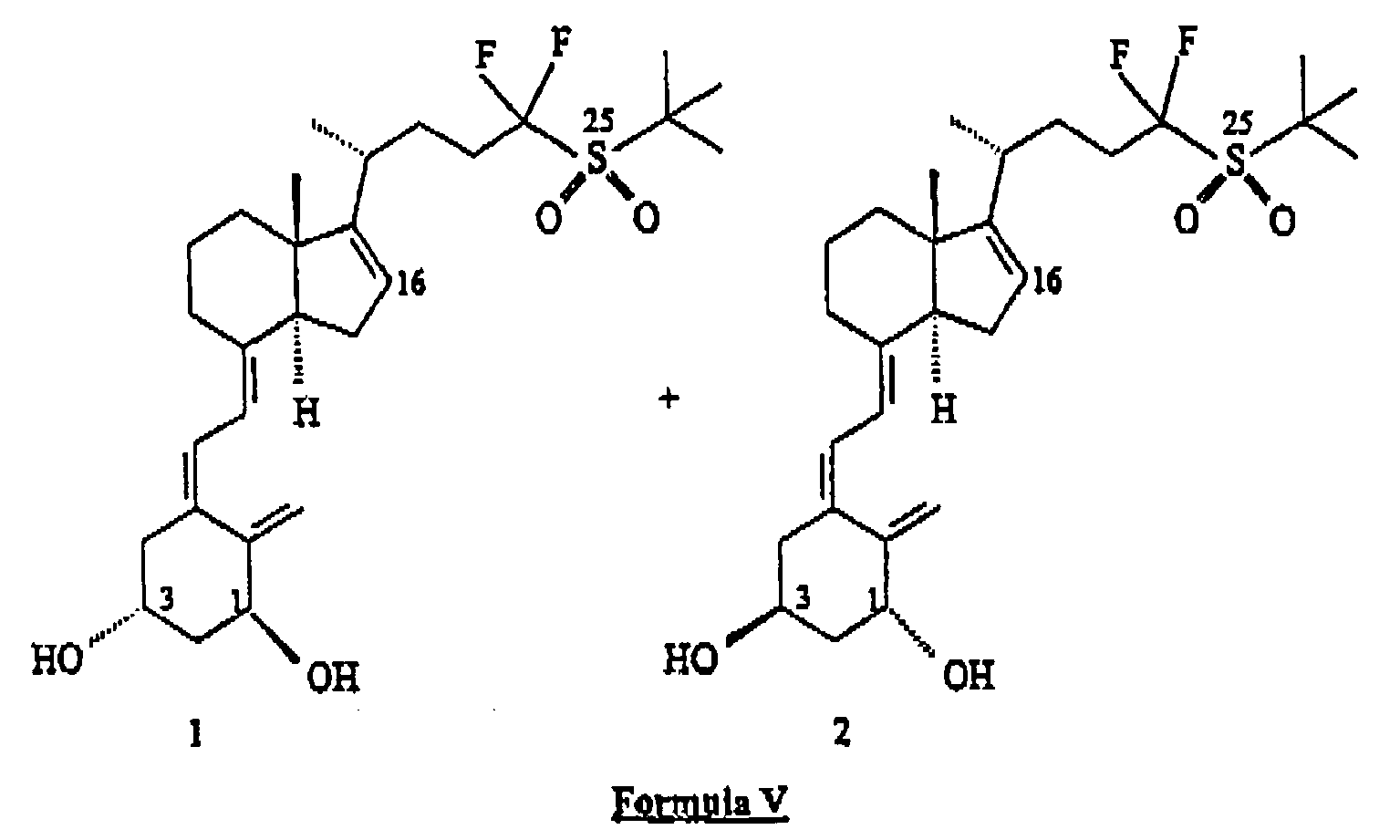
-
Scheme 4 begins with the same iodide derivative 24 and the next intermediate 25 as set forth inScheme 3. Preparation of thevarious intermediates 28, 29, and 30 and the Formula V compounds is described in Examples 14 through 17 hereinafter. - To a solution of the TES protected C,D-ring sulfone (+)-25 (56 mg, 0.12 mmol) in THF (3.0 mL) was added 0.18 mL (0.29 mmol) of a 1.6 M solution of n-BuLi in hexane at -78°C. After being stirred for 30 minutes, a precooled (-78°C) solution of NFSI (N-fluorobenzenesulfonimide, 77 mg, 0.24 mmol) in 1.0 mL of THF was added slowly to the reaction mixture, and then it was warmed up to room temperature. The reaction was quenched with water and extracted with EtOAc. The combined organic portions were washed with brine, dried, and concentrated in vacuo. Purification by column chromatography (20% EtOAc/hexanes) gave a mixture of mono and di-fluorinated sulfones.
- The mixture (58 mg) was dissolved in THF (3.0 mL) and the solution was cooled to -78°C. To the solution was added 0.18 mL of n-BuLi (1.6 M solution in hexane, 0.29 mmol) and the reaction mixture was stirred for 30 minutes at -78°C. A precooled (-78°C) solution of NFSI (96 mg, 0.30 mmol) in 1.0 mL of THF was then added slowly via cannula. The reaction mixture was warmed up to room temperature, quenched with water, extracted with EtOAc, washed with brine and concentrated. Purification by column chromatography (20% EtOAc/hexanes) gave 35 mg (58%) of the desired difluoronated C,D-ring sulfone (+)-28 as a colorless oil: [α]25 D +16.7° (c 3.5, CHCl3); 1H NMR (400 MHz, CDCl3) δ 5.30 (d, J = 1.2 Hz, 1H), 4.11 (d, J = 2.0 Hz, 1H), 2.45-2.02 (m, 4H), 1.94-1.58 (m, 9H), 1.56-1.20 (m, 10H), 1.02 (d, J = 6.8 Hz, 3H), 1.00 (s, 3H), 0.95 (t, J = 8.0 Hz, 9H), 0.56 (q, J = 7.9 Hz, 6H); 13C NMR (100 MHz, CDCl3) δ 158.80, 129.63 (t, J = 287.9 Hz), 120.94, 69.08, 6330, 55.28, 46.81, 35.92, 35.10, 31.65, 30.99, 29.02 (t, J = 19.3 Hz), 27.00, 24.36, 22.49, 18.91, 18.25, 7.17, 5.11; 19F NMR (376 MHz, CDCl3, CFCl3 as internal) δ -97.76 (t, J = 16.9 Hz); IR (neat, cm-1) 2955, 2933, 2876, 1458, 1324, 1136, 1082, 1029; HRMS m/z (M+) calcd 492.2905 for C25H46F2O3SSi, found 492.2907.
- A solution of silyl ether (+)-28 (89 mg, 0.18-mmol) in THF (2.0 mL) and 0.45 mL of 1.0 M solution of TBAF in THF was stirred overnight at room temperature. The mixture was quenched with water and extracted with EtOAc. The combined organic portions were washed with brine, dried, concentrated in vacuo and then purified by column chromatography (20% EtOAc/hexanes) to give 45 mg (66%) of the desired alcohol as a colorless oil: [α]25 D +3.4° (c 3.8, CHCl3); 1H NMR (400 MHz, CDCl3) δ 5.34 (t, J = 1.4 Hz, 1H), 4.16 (s, 1H), 2.34-136 (m, 23H), 1.03 (d, J = 6.8 Hz, 3H), 1.02 (s, 3H); 13C NMR (100 MHz, CDCl3) δ 158.62, 129.52 (t, J = 287.7 Hz), 121.04, 69.19, 63.29, 54.57, 45.47, 35.57, 33.96, 31.63, 30.42, 28.96 (t, J = 19.8 Hz), 26.93, 24.32, 22.37, 18.50, 17.96; 19F NMR (376 MHz, CDCl3, CFCl3 as internal) δ -97.83 (m); IR (neat, cm-1) 3568, 2930, 2870, 1458, 1320, 1134; HRMS m/z (M+) calcd 378.2040 for C19H32F2O3S, found 378.2047.
- A flame-dried 5 mL flask was charged with 40 mg (0.11 mmol) of the C,D-ring alcohol (+)-29, 3.0 mL of anhydrous THF, 100 mg of oven-dried celite and 100 mg (0.27 mmol) of PDC. The reaction mixture was stirred overnight at room temperature and then passed through a 2 cm pad of flash silica gel and washed with EtOAc. The filtrate was concentrated and purified by column chromatography (20% EtOAc/hexanes) to give 31 mg (78%) of the desired C,D-ring ketone (+)-30 as a colorless oil: [α]25 D +12.9° (c 3.4, CHCl3); 1H NMR (400 MHz, CDCl3) δ 5.33 (d, J = 1.2 Hz, 1H), 2.83 (dd, J = 10.4, 6.4 Hz, 1H), 2.45 (dd, J = 15.6, 10.8 Hz, 1H), 2.36-1.56 (m, 12H), 1.50(s, 9H), 1.09 (d, J = 6.8 Hz, 3H), 0.80 (s, 3H); 13C NMR (100 MHz, CDCl3) δ 210.87, 156.51, 129.38 (t, J = 287.8 Hz), 121.68, 63.36, 63.23, 53.83, 40.63, 34.50, 32.64, 28.85 (t, J = 19.6 Hz), 27.31, 26.90, 24.31, 24.14, 21.70, 17.47; 19F NMR (376 MHz. CDCl3, CFCl3 as internal) δ -97.79 (m); IR (neat, cm-1) 2939, 2873, 1718, 1458, 1377, 1320, 1130; HRMS m/z (M+) calcd 376.1884 for C19H30F2O3S, found 376.1889.
- Racemic phosphine oxide (A-ring, 89 mg, 0.15 mmol) was dissolved in 2.0 mL of anhydrous THF and cooled to -78°C under argon atmosphere. To this solution was added 100 µL (0.16 mmol) of phenyllithium (1.6 M solution in THF) dropwise. The mixture turned deep reddish orange and persisted. After stirring at -78°C for 30 minutes, a precooled (-78°C) solution of C,D-ring ketone (+)-30 (30 mg, 0.080 mmol) dissolved in 1.0 mL of anhydrous THF was added dropwise via cannula. The reaction kept going on until the reddish orange color faded to yellow (about 4 hours). The reaction was quenched by adding 3.0 mL of a 1:1 mixture of 2 N sodium potassium tartrate and 2 N K2CO3 solution. The reaction mixture was allowed to warm to room temperature, extracted with EtOAc, washed with brine, dried over anhydrous MgSO4, filtered, concentrated in vacuo, and then purified by column chromatography (10% EtOAc/hexanes) to afford 50 mg (84%) of the coupled product as a colorless oil.
- The coupled product (50 mg, 0.067 mmol) was dissolved in 3.0 mL of anhydrous THF with 37 µL of Et3N, and to this solution was added 0.27 mL (0.27 mmol) of TBAF (1.0 M solution in THF) at room temperance. The reaction was run in darkness overnight, then extracted with EtOAc, washed with brine, dried over anhydrous MgSO4, concentrated in vacuo and then purified by column chromatography (90% EtOAc/Hexanes) to give 33 mg (96%) of a mixture of two diastereomers as a colorless oiL The diastereomers were separated by reverse phase HPLC (C-18 semipreparative column, 52% MeCN/H2O, 3.0 mL/min) to afford 16.6 mg (41%) of Formula V-1 (1α, 3β, tR 145.3 min) as a foaming solid and 7.0 mg (17%) of Formula V-2 (1β, 3α, tR 129.2 min) as a colorless oil. Formula V-1: [α]25 D +0.1° (c 1.7, CHCl3); 1H NMR (400 MHz, CDCl3) δ 6.36 (d, J = 11.2 Hz, 1H), 6.10 (d, J = 11.2 Hz, 1H), 5.40-5.30 (m, 2H), 5.00 (s, 1H), 4.43 (dd, J = 8.0, 4.4 Hz, 1H), 4.23 (m, 1H), 2.81 (dd, J = 12.0, 4.0 Hz, 1H), 2.59 (dd, J = 13.2, 2.8 Hz, 1H), 2.43-2.13 (m, 5H), 2.09-1.96 (m, 2H), 1.95-1.63 (m, 9H), 1.51 (s, 9H), 1.07 (d, J = 6.8 Hz, 3H), 0.68 (s, 3H); 13C NMR (100 MHz, CDCl3) δ 158.19, 147.85, 142.36, 133.43, 129.60 (t, J = 287.7 Hz), 124.99, 121.67, 117.21, 111.88, 70.82, 67.07, 63.34, 58.52, 50.18, 45.35, 43.02, 35.42, 32.58, 29.65, 28.94, 28.70 (t, J = 19.6 Hz), 26.81, 24.36, 23,77, 21.79, 17.05; 19F NMR (376 MHz, CDCl3, CFCl3 as internal) δ -97.86 (m); UV (EtOH) λmax 263 nm (e 16,100); IR (neat, cm-1) 3601, 2931, 2837, 1455, 1314, 1126, 1043; HRMS m/z (M+) calcd 512.2772 for C28H42F2O4S, found 512.2781. Formula V-2: [α]25 D-24.1° (c 0.7, CHCl3); 1H NMR (400 MHz, CDCl3) δ 6.39 (d, J = 11.2 Hz, 1H), 6.10 (d, J = 11.2 Hz, 1H), 5.35 (t, J = 1.2 Hz, 1H), 5.32 (s, 1H), 5.01 (d, J = 2.0 Hz, 1H), 4.44 (dd, J= 6.0, 4.0 Hz, 1H), 4.22 (m, 1H), 2.82 (dd, J= 11.8, 4.2 Hz, 1H), 2.62 (dd; J= 13.2, 4.0 Hz, 1H), 2.42-2.12 (m, 5H), 2.10-1.96 (m, 2H), 1-95-1.55 (m, 9H), 1.52 (s, 9H), 1.07 (d, J = 6.8 Hz, 3H), 0.68 (s, 3H); 13C NMR (100 MHz, CDCl2) δ 138.20, 147.22, 142.49, 133.18, 129.62 (t, J = 288.0 Hz), 125.09, 121.66, 117.20, 113.29, 71.80, 66.96, 63.35, 58.53, 50.20, 45.78, 42.94, 35.40, 32.58, 29.70, 28.94, 28.69 (t, J = 19.1 Hz), 26-82, 24.38, 23.77, 21.81, 17.07; 19F NMR (376 MHz, CDCl3, CFCl3 as internal) δ -97.88 (m); UV (EtOH) λmax 263 nm (s 15,000); IR (neat, cm-1) 3683, 3601, 2931, 1314, 1132, 1043 ; HRMS m/z (M+) calcd 512.2772 for C25H42F2O4S3 found 512.2776.
- Preparation of the Formula VI materials is set forth in
Scheme 5 as follows: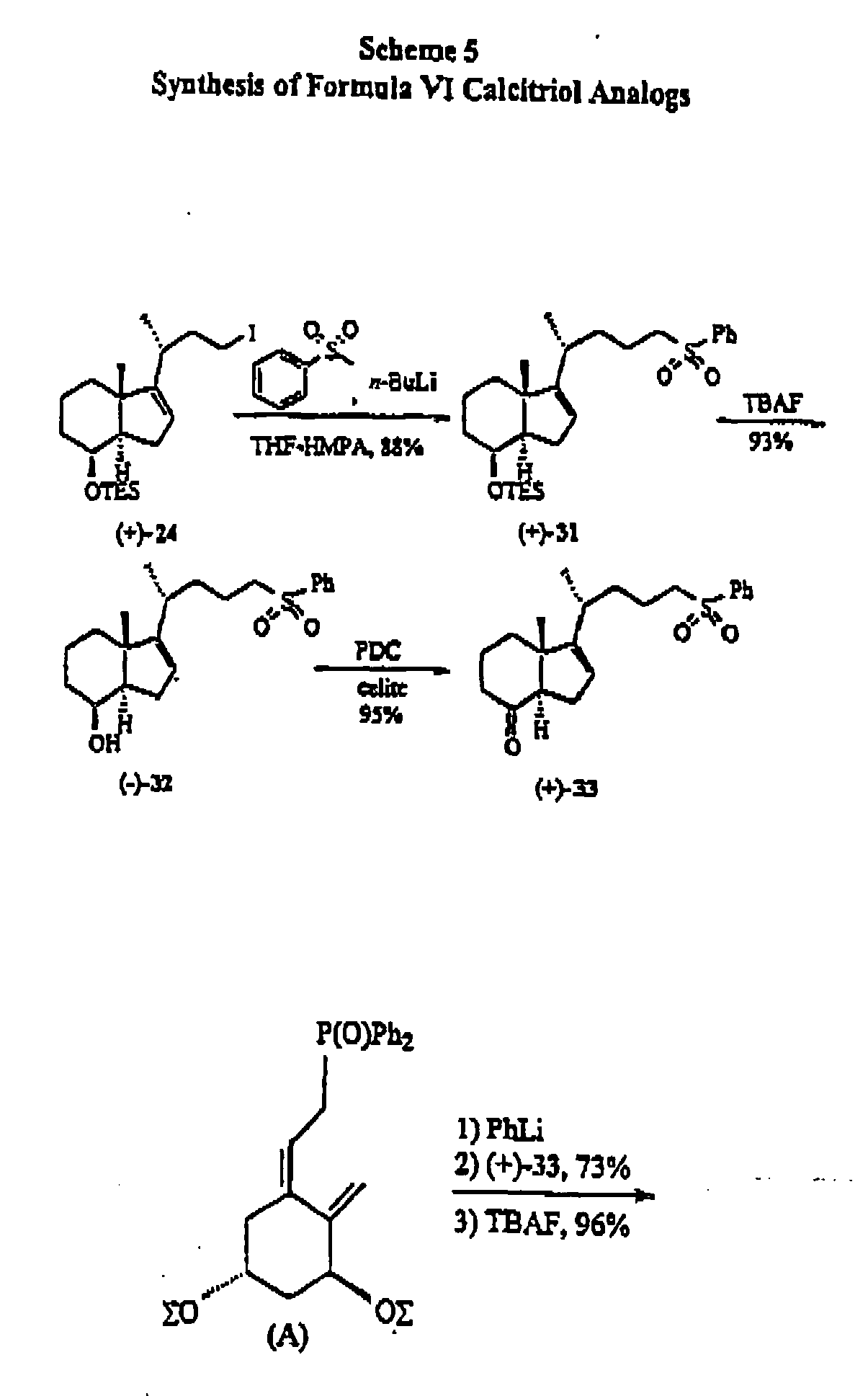

-
Scheme 5 begins with the same iodide derivative 24 as set forth inSchemes - A solution of methyl phenyl sulfone (147 mg, 0.95 mmol) and THF (3.0 mL) was cooled to -78°C, and then 0.60 mL (0.96 mmol, 1.6 M solution in hexane) of n-BuLi was added dropwise to the solution. After 15 minutes, 0.2 mL of HMPA was added and the solution was stirred for another 15 minutes. A precooled (-78°C) solution of iodide 24 (85 mg, 0.19 mmol) in 1.0 mL of THF was added slowly via cannula. The reaction mixture was then warmed up to room temperature. The reaction was quenched with water, extracted with EtOAc, washed with brine, dried over anhydrous MgSO4, concentrated in vacuo, and then purified by column chromatography (20% EtOAc/hexanes) to give 79 mg (88%) of the desired sulfone (+)-31 as a colorless oil: [α]25 D +14.7° (c 7.8, CHCl3); 1H NMR (400 MHz, CDCl3) δ 7.92-7.84 (m, 2H), 7.63 (t, J = 7.4 Hz, 1H), 7.54 (t, J = 7.6 Hz, 2H), 5.15 (t, J = 1.2 Hz, 1H), 4.08 (d, J = 2.0 Hz, 1H), 3,04 (m, 2H), 2.15 (t, J = 13.0 Hz, 1H), 2.01-1.76 (m, 3H), 1.73-1.22 (m, 10 H), 0.95 (t, J = 8.0 Hz, 9H), 0.92 (d, J = 6.8 Hz, 3H), 0.87 (s, 3H), 0.55 (q, J = 8.0 Hz, 6H); 13C NMR (100 MHz, CDCl3) δ 159.31, 139.19, 133.71, 129.32, 128.25, 120.35, 69.03, 56.58, 55.15, 46.72, 35.82, 35.06, 35.02, 31.52, 30.82, 22.50, 21.25, 18.86, 18.16, 7.14, 5.07; IR (neat, cm-1) 2953, 2874, 1447, 1319, 1306, 1148, 1082, 1028; HRMS m/z (M+) calcd 476.2780 for C27H44O3SSi, found 476.2787.
- A solution of silyl ether (+)-31 (78 mg, 0.16 mmol) in THF (2.0 mL) and 0.41 mL of 1.0 M solution of TBAF in THF was stirred overnight at room temperature. The mixture was quenched with water and extracted with EtOAc. The combined organic portions were washed with brine, dried, concentrated in vacuo and then purified by column chromatography (20% EtOAc/hexanes) to give 55 mg (93%) of the desired alcohol ()-32 as a colorless oil: [α]25 D -0.8° (c 5.8, CHCl3); 1H NMR (400 MHz, CDCl3) δ 7.92-7.84 (m, 2H), 7.63 (t, J = 7.4 Hz, 1H), 7.58-7.50 (m, 2H), 5.20 (t, J =1.4 Hz, 1H), 4.13 (d, J = 2.4 Hz, 1H), 3.04 (m, 2H), 2.18 (t, J = 13.2 Hz, 1H), 2.02-1.18 (m, 13H), 0.93 (d, J = 6.8 Hz, 3H), 0.92 (s, 3H); 13C NMR (100 MHz, CDCl3) δ 159.20, 139.21, 133.78, 129.37, 128.20, 120.51, 69.12, 56.54, 54.49, 46.43, 35.52, 35.04, 33.98, 31.60, 30.32, 22.34, 21.20, 18.49, 17.89, IR (neat, cm-1) 3535, 2926, 2864, 1447, 1305, 1147, 1086; HRMS m/z (M+) calcd 362.1916 for C21H30O3S, found 362.1913.

- To a solution of the C,D-ring alcohol (+)-32 (55 mg, 0.15 mmol) in CH2Cl2 (3.0 mL) were added 114 mg of oven-dried celite and pyridinium dichromate (PDC, 114 mg, 0.30 mmol) at room temperature. The reaction mixture was stirred overnight and then passed through a 2 cm pad of flash silica gel and washed with EtOAc. The filtrate was concentrated and purified by column chromatography (50% EtOAe/hexanes) to afford 52 mg (95%) of the desired C,D-ring ketone (+)-33 as a colorless oil; [α]25 D +112° (c 5.1, CHCl3); 1H NMR (400 MHz, CDCl3) δ 7.88-7.82 (m, 2H), 7.63 (t, J = 7.4 Hz, 1H), 7.53 (t, J= 7.6 Hz, 2H). 5.18 (t, J= 1.4 Hz, 1H), 3.03 (t, J = 7.8 Hz, 2H), 2.77 (dd, J = 10.8, 6.4 Hz, 1H), 2.38.2.20 (m, 3H), 2,12-1.36 (m, 10H), 0.98 (d, J = 6.8 Hz, 3H), 0.67 (s, 3H); 13C NMR (100 MHz, CDCl3) δ 210.93, 157.03, 139,13, 133.83, 129.38, 128.13,120.91,63.10, 56.37, 53.80, 40.58, 34,37, 34.40, 32.58, 27.14, 24.07, 21.80, 21.05, 17.32.; IR (neat, cm-1) 2943, 2861, 1708, 1443, 1302, 1143, 1085; HRMS m/z (M+) calcd 360.1759 for C21H21O3S, found 360.1758.
- A solution of 89 mg (0.15 mmol) of recemic phosphine oxide (A-ring) in 2.0 mL of anhydrous THF was cooled to -78°C and treated with 100 µL (0.15 mmol, 1.5 M solution in THF) of phenyllithium under argon atmosphere. The mixture turned reddish orange and was stirred for 30 min at -78°C. To the solution was added dropwise a solution of 52 mg (0.14 mmol) of the C,D-ring ketone (+)-33 in 1.0 mL of anhydrous THF. The reaction kept going on until the reddish orange color faded to yellow (about 4 hours). The reaction was quenched by adding 3.0 mL of a 1:1 mixture of 2 N sodium potassium tartrate and 2 N K2CO3 solution. The reaction mixture was extracted with EtOAc, washed with brine, dried over anhydrous MgSO4, concentrated in vacuo, and then purified by column chromatography (20% EtOAc/hexanes) to afford 76 mg (73%) of the coupled product as a colorless oil.
- The coupled product (76 mg, 0.10 mmol) was dissolved in 3.0 mL of anhydrous THF, and to this solution were added TBAF (0.41 mL, 0.41 mmol, 1.0 M solution in THF) and 59 µL of Et3N. The reaction was run in darkness overnight, then quenched with water, extracted with EtOAc, washed with brine, dried over anhydrous MgSO4, concentrated in vacuo and then purified by column chromatography (90% EtOAc/hexanes) to give 52 mg (96%) of a mixture of two diastereomers as a colorless oil. The diastereomers were separated by reverse phase HPLC (C-18 semipreparative column, 50% MeCN/H2O, 3.0 mL/min) to afford 19.1 mg (28%) of Formula VI-1 (1α, 3β, tR 59.3 min) and 12.7 mg (18%) of Formula VI-2 (1β, 3α, tR 53.6 min) as colorless oils. Formula VI-1: [α]25 D -1.6° (c 1.9, CHCl3); 1H NMR (400 MHz, CDCl3) δ 7.94-7.86 (m, 2H), 7.65 (t, J = 7.4 Hz, 1H), 7.60-7.52 (m, 2H), 6.35 (d, J = 11.2 Hz, 1H), 6.08 (d, J = 11.2 Hz, 1H), 5.35 (d, J = 1.6 Hz, 2H), 5.01 (s, 1H), 4.44 (dd, J = 8.0, 4.0 H2, 1H), 4.23 (m, 1H), 3.05 (t, J = 8.0 Hz, 2H), 2.79 (dd, J = 12.4, 4.4 Hz, 1H), 2.59 (dd, J= 13.2, 2.8 Hz, 1H), 2.40-2.26 (m, 2H), 2.20-2.00 (m, 3H), 2.00-1.84 (m, 2H), 1.84-1.20 (m, 9H), 0.98 (d, J= 6.8 Hz, 3H), 0.58 (s, 3H); 13C NMR (100 MHz, CDCl3) δ 158.80, 147.93, 142.36, 139.30, 133.81, 133.43, 129.41, 128.26, 124.98, 121.14, 117.16, 111.71, 70.76, 67.07, 58.47, 56.57, 50.16, 45.31, 43.08, 35.41, 34.98, 32.66, 29.55, 28.92, 23.74, 21.79, 21.02, 17.08; UV (EtOH) λmax 264 nm (ε 12,400); IR (neat, cm-1) 3613, 2919, 2837, 1443, 1302, 1143, 1043; HRMS m/z (M+) calcd 496.2647 for C30H40O4S, found 496.2635. Formula VI-2; [α]25 D -22.8° (c 1.3, CHCl3); 1H NMR (400 MHz, CDCl3) δ 7.94-7.86 (m, 2H), 7.65 (t, J = 7.4 Hz, 1H), 7.60. 7.52 (m, 2H), 6.38 (d, J = 11.2 Hz, 1H), 6.07 (d, J = 11.2 Hz, 1H), 533 (s, 1H), 5.23 (d, J = 1.2 Hz, 1H), 5.01 (d, J =1.6 Hz, 1H), 4.46 (dd, J= 5.6, 4.0 Hz, 1H), 4.22 (m, 1H), 3.05 (t, J = 8.0 Hz, 2H), 2.80 (dd, J = 11.6, 4.0 Hz, 1H), 2.62 (dd, J = 13.0, 3.8 Hz 1H), 2.36-2.24 (m, 2H), 210-1.86 (m, 5H), 1.84-1.20 (m, 9H), 0.98 (d, J = 6.8 Hz, 3H), 0.58 (s, 3H); 13C NMR (100 MHz, CDCl3) δ 158.83, 147.30, 142.48, 139.34, 133.81, 133.19, 129.42, 128.26, 125.07, 121.13, 117.15, 113.11, 71.75, 66.92, 58.48, 56.59, 50.18, 45.72, 42.99, 35.40, 35.00, 32.67, 29.59, 28.91, 23.72, 21.79, 21.01, 17.11; UV (EtOH) λmax 264 nm (ε 16,400); IR (neat, cm-1) 3601, 2919, 2849, 1443, 1302, 1143, 1085, 1043; HRMS m/z (M+) calcd 496.2647 for C30H40O4S, found 496.2650.
- Preparation of the Formula VII materials is described in
Scheme 6 as follows:
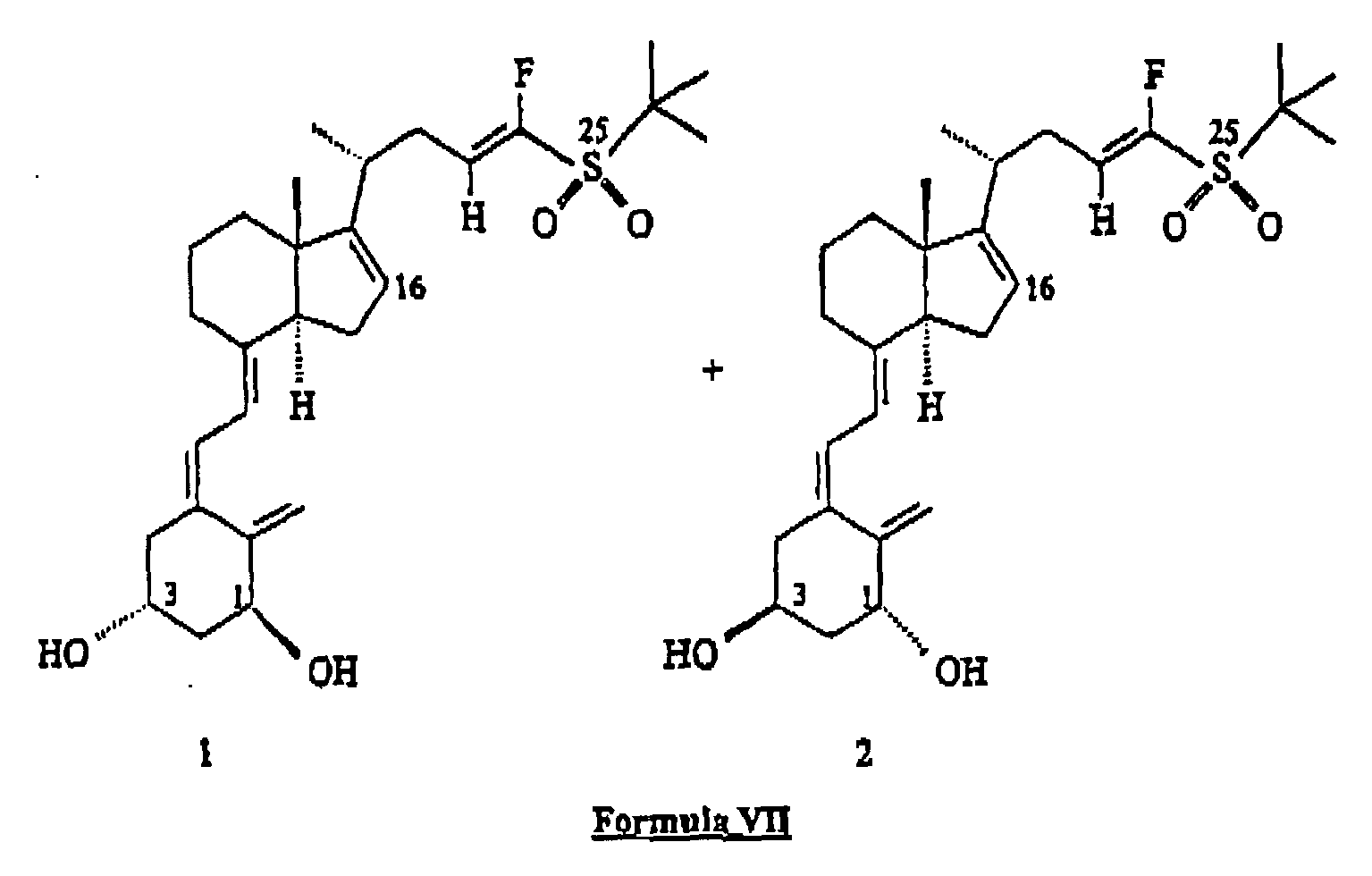
-
Scheme 6 begins with the same protected aldehyde derivative 22 as set forth inScheme 3 above. Preparation of the various intermediates 34-E, 34-Z, 35-E, and 36-E, and the Formula VII compounds is described in Examples 22 through 25 hereinafter. - A solution of 5.0 mL of THF and 0.53 mL of n-BuLi (1.5 M solution in THF, 0.80 mmol) was cooled to -78°C , and then 0.11 mL (0.80 mmol) of diisopropylamine was added dropwise to the solution. After 15 minutes, monofluorinated methyl tert-butyl sulfone (58.4 mg, 0.38 mmol) was added via cannula and the resulted reaction mixture was stirred for another 15 minutes. Diethyl chlorophosphate (52 µL, 0.36 mmol) was added and the reaction was stirred at -78°C for one hour. A precooled (-78°C) solution of TES protected aldehyde 22 (75.0 mg. 0.22 mmol) in 1.0 mL of THF was added slowly via cannula. The reaction mixture was then warmed up to room temperature. The reaction was quenched with water, extracted with EtOAc, washed with brine, dried over anhydrous MgSO4, concentrated in vacuo, and then the mixture (75 mg, 71%) was separated by column chromatography (2% Et2O/hexanes) to give 45 mg of the desired E isomer and 30 mg of the Z isomer as colorless oils. (+)-34-E: [α]25 D +28.2° (c 2.8, CHCl3); 1H NMR (400 MHz, CDCl3) δ 6.05 (dt, J = 32.8, 7.6 Hz, 1H), 5.31 (t, J = 1.6 Hz, 1H), 4.11 (d, J = 2.4 Hz, 1H), 2.54-2.18 (m, 4H), 1.98-1.20 (m, 17H), 1.06 (d, J = 6.8 Hz, 3H), 1.00 (s, 3H), 0.94 (t, J = 8.0 Hz, 9H), 0.56 (q, J = 8.0 Hz, 6H); 13C NMR (100 MHz, CDCl3) δ 158.62, 151.81 (d, J = 294.8 Hz), 122.33 (d, J = 6.4 Hz), 121.38, 69.02, 59.73, 55.19, 46.95, 35,98, 35.01, 31.41, 31.33, 30.96, 23.47, 22.16, 19.05, 18.22, 7.15, 5.10; 19F NMR (376 MHz, CDCl3, CFCl3 as internal) δ -119.77 (d, J = 33.5 Hz); IR (neat, cm-1) 2954, 2931, 2860, 1666, 1455, 1320, 1132, 1026; HRMS m/z (M+) pending.
- A solution of silyl ether (+)+34-E (73.5 mg, 0.16 mmol) and TBAF (0.39 mL, 1.0 M solution in THF, 0.39 mmol) in 2.0 mL of THF was stirred for 4 hours at room temperature. The mixture was quenched with water and extracted with EtOAc. The combined organic portions were washed with brine, dried, concentrated in vacuo and then purified by column chromatography (50% EtOAc/hexanes) to give 30 mg (54%) of the desired alcohol as a colorless oil; [α]25 D +6.8° (c 1.9, CHCl3); 1H NMR (400 MHz, CDCl3) δ 6.05 (dt, J= 33.2, 7.8 Hz, 1H), 5.36 (t, J = 1.6 Hz, 1H), 4.17 (d, J = 2.0 Hz, 1H), 2.55-2.20 (m, 4H), 2.06-1.30 (m, 17H), 1.06 (d, J= 6.8 Hz, 3H), 1.03 (s, 3H); 13C NMR (100 MHz, CDCl3) δ 158.45, 151.92 (d, J = 295.2 Hz), 122.07 (d, J = 6.3 Hz), 121.51, 69.14, 59.72, 54.52, 46.63, 35,64, 34.03, 31.34, 31.32, 30.45, 23.48, 22.14, 18.64, 17.93; 19F NMR (376 MHz, CDCl3, CFCl3 as internal) δ -119.62 (d, J = 33.5 Hz); IR (neat, cm-1) 3542, 2919, 2872, 1666, 1455, 1137, 1114; HRMS m/z (M+) pending.
- A flame-dried 5 mL flask was charged with 30.0 mg (0.084 mmol) of the C,D-ring alcohol (+)-35-E, 3.0 mL of anhydrous CH2Cl2, 70 mg of oven-dried celite and 63.0 mg (0.17 mmol) of PDC. The reaction mixture was stirred overnight at room temperature and then passed through a 2 cm pad of flash silica gel and washed with EtOAc. The filtrate was concentrated and purified by column chromatography (50% EtOAc/hexanes) to give 24.0 mg (78%) of the desired C,D-ring ketone (+)-36-E as a colorless oil; [α]25 D +26.0° (c 2.4, CHCl3); 1H NMR (400 MHz, CDCl3) δ 6.03 (dt, J = 32-8, 7.6 Hz, 1H), 5.35 (t, J = 1.2 Hz, 1H), 2.85 (dd, J= 10.8, 6.6 Hz, 1H), 2.60-2.20 (m, 6H), 2.18-1.60 (m, 5H), 1.38 (s, 9H), 1.13 (d, J = 6.4 Hz, 3H), 0.80 (s, 3H); 13C NMR (100 MHz, CDCl3) δ 210.70, 156.35, 152.31 (d, J = 295.7 Hz), 121.95, 121.38 (d, J = 6.4 Hz), 63.15, 59.74, 53.90, 40.60, 34.56, 32.24, 31.25, 27.34, 24.12, 23.47, 21.62, 17.54; 19F NMR (376 MHz, CDCl3, CFCl3 as internal) δ -119.06 (d, J = 33.1 Hz); IR (neat, cm-1) 2943, 1713, 1666, 1455, 1314, 1120, 1038; HRMS m/z (M+) pending.
- Racemic phosphine oxide (A-ring, 48.9 mg, 0.084 mmol) was dissolved in 2.0 mL of anhydrous THF and cooled to -78°C under argon atmosphere. To this solution was added 65 µL (0.08 mmol) of phenyllithium (1.2 M solution in THF) dropwise. The mixture turned deep reddish orange and persisted. After stirring at -78°C for 30 minutes, a precooled (-78°C) solution of C,D-ring ketone (+)-36-E (24.2 mg, 0.068 mmol) dissolved in 1.0 mL of anhydrous THF was added dropwise via cannula. The reaction kept going on until the reddish orange color faded to yellow (about 4 hours). The reaction was quenched by adding 3.0 mL of a 1:1 mixture of 2 N sodium potassium tartrate and 2 N K2CO3 solution. The reaction mixture was allowed to warm to room temperature, extracted with EtOAc, washed with brine, dried over anhydrous MgSO4, filtered, concentrated in vacuo, and then purified by column chromatography (8% EtOAc/hexanes) to afford 33 mg (67%) of the coupled product as a colorless oil.
- The coupled product (31 mg, 0.043 mmol) was dissolved in 2.0 mL of anhydrous ethanol, and then 0.34 mL of HF (49% solution in water) was added and the resulted reaction mixture was stirred for I hour at room temperature. The reaction was quenched with diluted NaHCO3 solution and extracted with EtOAc, washed with brine, dried over anhydrous MgSO4, concentrated in vacuo and then purified by column chromatography (80% EtOAc/Hexanes) to give 17.0 mg (80%) of a mixture of two diastereomers as a colorless oil. The diastereomers were separated by reverse phase HPLC (C-18 semipreparative column, 52% MeCN/H2O, 3.0 mL/min) to afford 5.7 mg (17%) of Formula VII-1 (1α, 3β, tR 77.3 min) as a foaming solid and 4.2 mg (12%) of Formula VII-2 (1β, 3α,
t R 70,4 min) as a colorless oil. Formula VII-1: [α]25 D +3.2° (c 0.57, CHCl3); 1H NMR (400 MHz, CDCl3) δ 6.36(d, J = 11.2 Hz, 1H). 6.10 (d, J = 10.8 Hz, 1H), 6.05 (dt, J = 33.2, 7.6 Hz, 1H), 5.37 (s, 1H), 5.34 (t, 7= 1.6 Hz. 1H), 5.00 (s, 1H). 4.44 (dd, J= 7.8, 4.2 Hz, 1H), 4.24 (m, 1H), 2.82 (dd, J = 12.2, 4.6 Hz, 1H), 2.60 (d, J = 13.6 Hz, 1H), 2.54-1.18 (m, 23H), 1.10 (d, J = 6.4 Hz, 3H), 0.69 (s, 3H); 13C NMR (100 MHz, CDCl3) δ 158.03, 152.01 (d, J = 295.3 Hz), 147.86, 142.11, 133.56, 124.97, 122.12, 121.88 (d, J = 6.3 Hz), 117.36, 111.90, 70.89, 67.07, 59.73, 58.51, 50.20, 45.37, 43.08, 35.46, 32.30, 31.26, 29.66, 28.90, 23.72, 23.50, 21.52, 17.21; 19F NMR (376 MHz, CDCl3, CFCl3 as internal) δ -119.50 (d, J = 33.1 Hz); UV (EtOH) λmax 263 nm (ε 14,700); IR (CHCl3, cm-1) 3707, 3601, 2919, 1654, 1455, 1314, 1220, 1038; HRMS m/z (M+) pending. Formula VII-2; [α]25 D -16.7°(c 0.42, CHCl3); 1H NMR (400 MHz, CDCl3) δ 6.38(d, J = 11.6 Hz, 1H), 6.09 (d, J = 10,4 Hz, 1H), 6.05 (dt, J = 33.6, 7.6 Hz, 1H), 5.37 (s, 1H), 533 (s, 1H), 5.01 (d, J = 1.6 Hz, 1H), 4.46 (m, 1H), 4.22 (m, 1H), 2.82 (dd, J = 12.0, 4,4 Hz, 1H), 2.62 (dd, J= 13.2, 3.6 Hz, 1H), 2.56-1.20 (m, 23H), 1.10 (d, J= 6.8 Hz, 3H), 0.69 (s, 3H); 13C NMR (100 MHz, CDCl3) δ 158.03, 152.01 (d, J = 295.7 Hz), 147.34, 142.20, 133.38, 125.02, 122.12, 121.89 (d, J = 5.9 Hz), 117.36, 113.03, 71.65, 67.00, 59.73, 58.51, 50.22, 45.71, 43.01, 35.45, 32.32, 31.27, 29.70, 28.89, 23.71, 23.51, 21.54, 17.23; 19F NMR (376 MHz, CDCl3, CFCl3 as internal) δ -119.51 (d, J = 32.0 Hz); UV (EtOH) λmax 263 nm (ε 14,900); IR (CHCl3, cm-1) 3601, 2919, 2849, 1655, 1455, 1314, 1214, 1038; HRMS m/z (M+) pending. - Preparation of the Formula VIII materials is described in Scheme 7 as follows:


- Scheme 7 begins with the same iodide derivative 24 as set forth in
Schemes - To a solution of the TES protected C,D-ring sulfone (+)-38 (64 mg, 0.15 mmol) in THF (3.0 mL) was added 0.29 mL (0.58 mmol) of a 2.0 M solution of n-BuLi in pentane at -78°C. After being stirred for 30 minutes, a precooled (-78°C) solution of NFSI (N-fluorobenzenesulfonimide, 127 mg, 0.41 mmol) in 1.0 mL of THF was added slowly to the reaction mixture, and then it was warmed up to room temperature. The reaction was quenched with water and extracted with EtOAc. The combined organic portions were washed with brine, dried, and concentrated in vacuo. Purification by column chromatography (20% EtOAc/hexanes) gave a mixture of mono and di-fluorinated sulfones.
- The mixture was dissolved in THF (3.0 mL) and the solution was cooled to -98°C. To the solution was added 0.29 mL of n-BuLi (2.0 M solution in pentane, 0.58 mmol) and the reaction mixture was stirred for 30 minutes at -78°C. A precooled (-78°C) solution of NFSI (127 mg, 0.41 mmol) in 1.0 mL of THF was then added slowly via cannula. The reaction mixture was warmed up to room temperature, quenched with water, extracted with EtOAc, washed with brine and concentrated. Purification by column chromatography (20% EtOAc/hexanes) gave 55 mg (80%) of the desired difluoronated C,D-ring sulfone (+)-39 as a colorless oil: [α]25 D +21.9° (c 5.5, CHCl3); 1H NMR (400 MHz, CDCl3) δ 5.37 (s, 1H), 4.12 (s, 1H), 2.68-2.18 (m, 4H), 1.96-1.30 (m, 17H), 1.12 (d, J = 5.6 Hz, 3H), 1.04 (s, 3H), 0.94 (t, J = 7.8 Hz, 9H), 0.56 (q, J = 8.0 Hz, 6H); 13C NMR (100 MHz, CDCl3) δ 158.94, 129.52 (t, J = 289.2 Hz), 121.67, 69.04, 63.31, 55.13, 47.36, 35,94, 35.05, 31.00, 25.44, 24.44, 23.91, 22.89, 19.01, 18.22, 7.13, 5.11; 19F NMR (376 MHz, CDCl3, CFCl3 as internal) δ -96.24 (ddd, J = 219.2, 31.9, 6.6 Hz), -97.83 (ddd, J= 219.6, 29.9, 5.5 Hz); IR (neat, cm-1) 2934, 2876, 1458, 1320, 1134, 1029; HRMS m/z (M+) pending.
- A solution of silyl ether (+)-39 (55 mg, 0.11- mmol) in THF (2.0 mL) and 0.29 mL (0.29 mmol) of 1.0 M solution of TBAF in THF was stirred overnight at room temperature. The mixture was quenched with water and extracted with EtOAc. The combined organic portions were washed with brine, dried, concentrated in vacuo and then purified by column chromatography (24% EtOAc/hexanes) to give 27 mg (66%) of the desired alcohol as a colorless oil: [α]25D +9.3° (c 2.7, CHCl3); 1H NMR (400 MHz, CDCl3) δ 5.41 (d, J = 1.2 Hz, 1H), 4.17 (d, J = 2.4 Hz, 1H), 2.72-2.20 (m, 4H), 2.06-1.32 (m, 17H), 1.13 (d, J = 6.0 Hz, 3H), 1.06 (s, 3H); 13C NMR (100 MHz, CDCl3) δ 158.70, 129.45 (t, J = 289.7 Hz), 121.75, 69.17, 63.38, 54.45, 47.01, 35.96 (t, J = 18.6 Hz), 35.60, 34.00, 30.46, 25.44, 24.42, 22.89, 18.57, 17.94; 19F NMR (376 MHz, CDCl3, CFCl3 as internal) δ -96.22, (ddd, J = 219.6, 32.4, 8.0 Hz), δ -97.76 (ddd, J = 219.6, 29.7, 6.8 Hz); IR (neat, cm-1) 3566, 3448, 2931, 2860, 1455, 1314, 1126, HRMS m/z (M+) pending.
- A flame-dried 5 mL flask was charged with 27 mg (0.074 mmol) of the C,D-ring alcohol (+)-40, 3.0 mL of anhydrous THF, 100 mg of oven-dried celite and 69 mg (0.19 mmol) ofPDC. The reaction mixture was stirred overnight at room temperature and then passed through a 2 cm pad of flash silica gel and washed with EtOAc. The filtrate was concentrated and purified by column chromatography (20% EtOAc/hexanes) to give 24 mg (89%) of the desired C,D-ring ketone (+)-41 as a colorless oil: [α]25 D +17.5° (c 2.5, CHCl3); 1H NMR (400 MHz, CDCl3) δ 5.41 (s, 1H), 2.84 (dd, J = 10.4, 6.4 Hz, 1H), 2.74-2.22 (m, 6H), 2.16-1.74 (m, 5H), 1.51 (s, 9H), 1.19 (d, J= 6.4 Hz, 3H), 0.84 (s, 3H); 13C NMR (100 MHz, CDCl3) δ 210.76, 156.38, 129.20 (t, J= 289.9 Hz), 122.29, 63.47, 63.12, 54.14, 40.62, 36.03 (t, J = 18.5 Hz), 34.54, 27.36. 26.48 (t, J= 2.7 Hz), 24.41 (t, J= 2.6 Hz), 24.11, 22.56, 17.50; 19F NMR (376 MHz, CDCl3, CFCl3 as internal) δ -96.20 (ddd, J = 219.8, 28.9, 9.2 Hz), δ -97.49 (ddd, J = 219.8, 28.9, 10.3 Hz); IR (neat, cm-1) 2943, 1713, 1314, 1132; HRMS mlz (M+) pending.
- Racemic phosphine oxide (A-ring, 43.4 mg, 0.075 mmol) was dissolved in 1.0 mL of anhydrous THF and cooled to -78°C under argon atmosphere. To this solution was added 58 µL (0.070 mmol) of phenyllithium (1.2 M solution in THF) dropwise. The mixture turned deep reddish orange and persisted. After stirring at -78°C for 30 minutes, a precooled (-78°C) solution of C,D-ring ketone (+)-41 (24.8 mg, 0.068 mmol) dissolved in 1.0 mL of anhydrous THF was added dropwise via carmula. The reaction kept going on until the reddish orange color faded to yellow (about 4 hours). The reaction was quenched by adding 3.0 mL of a 1:1 mixture of 2 N sodium potassium tartrate and 2 N K2CO3 solution. The reaction mixture was allowed to warm to room temperature, extracted with EtOAc, washed with brine, dried over anhydrous MgSO4, filtered, concentrated in vacuo, and then purified by column chromatography (10% EtOAc/hexanes) to afford 37.2 mg (75%) of the coupled product as a colorless oiL
- The coupled product (37.2 mg, 0.051 mmol) was dissolved in 3.0 mL of anhydrous THF with 29 µL of Et3N, and to this solution was added 0.20 mL (0.20 mmol) of TBAF (1.0 M solution in THF) at room temperature. The reaction was run in darkness overnight, then extracted with EtOAc, washed with brine, dried over anhydrous MgSO4, concentrated in vacuo and then purified by column chromatography (90% EtOAc/Hexanes) to give 18,6 mg (73%) of a mixture of two diastereomers as a colorless oil. The diastereomers were separated by reverse phase HPLC (C-18 semipreparative column, 52% MeCN/H2O, 3.0 mL/min) to afford 7.4 mg (22%) of Formula VIII-1 (1α, 3β, tR 90.7 min) as a foaming solid and 4,3 mg (13%) of Formula VIII-2 (1β, 3α, tR 84.3 min) as a colorless oiL Formula VIII-1: [α]25 D +2.1° (c 0.7, CHCl3);1H NMR (400 MHz, CDCl3) δ 6.37 (d, J = 11.6 Hz, 1H), 6.10 (d, J=11.2 Hz, 1H), 5.42 (s, 1H), 5.33 (s, 1H), 5.00 (s, 1H), 4.44 (dd, J = 7.2, 4.0 Hz,1H), 4.24 (m, 1H), 2.82 (dd, J = 11.8, 4.2 Hz, 1H), 2.74-2.50 (m, 3H), 2.44-2.16 (m, 5H), 2.10-1.48 (m, 16H), 1.17 (d, J = 6.8 Hz, 3H), 0.72 (s, 3H); 13C NMR (100 MHz, CDCl3) δ 158.32, 147.83, 142.25, 133.45, 129.44 (t, J = 290.0 Hz), 125.03, 122.26, 117.30, 111.92, 70.91, 67.08, 63.40, 58.42, 50.50, 45.39, 43.05, 35.98 (t, J = 18.6 Hz), 35.44, 29.67, 28.90, 26.49, 24.45, 23.71, 22.42, 17.14; 19F NMR (376 MHz, CDCl3, CFCl3 as internal) δ -96.17 (ddd, J = 218.6, 32.0, 8.1 Hz), δ -97.64 (ddd, J = 219.8,29.7, 8.5 Hz); UV (EtOH) λmax 263 nm (ε 16,900); IR (CHCl3, cm-1) 3601, 2931, 2849, 1649, 1602, 1455, 1314, 1132, 1043; HRMS m/z (M+) pending. Formula VIII-2: [α]25 D -19.3° (c 0.4, CHCl3); 1H NMR (400 MHz, CDCl3) δ 6.38 (d, J = 11.2 Hz, 1H), 6.09 (d, J = 11.2 Hz, 1H), 5.42 (s, 1H), 5.32 (s, 1H), 5.01 (d, J = 1.2 Hz, 1H). 4.45 (m, 1H), 4.22 (m, 1H), 2.82 (dd, J = 12.0, 4.4 Hz, 1H), 2.74-2.50 (m, 3H);2.44-2.16 (m, 5H), 2.10-1.48 (m, 16H), 1.17 (d, J = 6.8 Hz, 3H), 0.72 (s, 3H); 13C NMR (100 MHz, CDCl3) δ 158.34, 147.32, 142.32, 133.26, 129.45 (t, J = 294.7 Hz), 125.07, 122.26, 117.29, 113.07, 71.70, 66.99, 63.40, 58.41, 50.51, 45.73, 42.98, 35.99 (t, J = 18.6 Hz), 35.43, 29.70, 28.89, 26.49, 24.46, 23.71, 22.42, 17.14; 19F NMR (376 MHz, CDCl3, CFCl3 as internal) δ -96.17 (dd, J = 222.0,28.4 Hz), δ -97.69 (dd, J = 219.6, 28.9 Hz); UV (EtOH) λmax 262 nm (ε 14,000); IR (CHCl3, cm-1) 3601, 2931, 2849, 1455, 1314, 1132, 1038; HRMS m/z (M+) pending.
- Preparation of the Formula IX materials is described in Scheme 8 as follows:


- Scheme 8 begins with the same aldehyde derivative as set forth in
Schemes - To a solution of methyl t-butysulfone (103 mg, 0.76 mmol) in 10 mL of THF was added 0.52 mL of n-BuLi (1.60 M, 0.83 mmol) dropwise at -78°C. After 1 h at -78°C, a solution of aldehyde (+)-22 (45 mg, 0.13 mmol) in 10 mL of THF was added dropwise at -78°C. After 2 h at -78°C, the reaction mixture was quenched with saturated ammonium chloride solution (20 mL) and extracted with EtOAc (50 mLx3). The combined organic portions were washed with brine (30 mL), dried over MgSO4 and concentrated. The crude product was purified by flash column chromatography (33% EtOAc/hexanes) to give 45 mg (76%) of diastereomeric alcohols 42 as colorless oils: 1H NMR (400 MHz, CDCl3) δ 5.33 and 5.27 (two s, 1H), 4,48 and 4.38 (two s, 1H), 4.12 (s, 1H), 3.47 and 3.37 (two s, 1H), 3.09-2.94 (m, 2H). 2.41 (m, 1H), 2.26 (m, 1H), 1.91-1.41 (m, 13H), 1.42 and 1.41 (two s, 9H), 1.04 (m, 6H), 0.95 and 0.94 (t, J= 8.0 Hz, 9H), 0.56 and 0.55 (q, J = 8.0 Hz, 6H); IR (neat, cm-1) 3523, 2932, 1290, 1114; HRMS m/z (M+) calcd 472.3043 for C25H48O4SSi, found 472.3037.
- To a solution of alcohols 42 (42 mg, 0.089 mmol) in 10 mL of dry CH2Cl2 was added 0.20 mL of triethylamine and methanesulfonyl chloride (0.050 mL, 0.65 mmmol) at 0°C. The mixture was stirred for 1 h at 0°C. The solution was concentrated in vacuo. The residue was diluted with brine (20 mL) and extracted with EtOAc (30 mLx3). The combined organic portions were dried over MgSO4 and concentrated. The crude mesylates were used for the next step without further purification.
To a solution of the mesylates in 7 mL of dry benzene was added 1,8-diazabicyclo[5.4.0]undec-7-ene (0.050 mL, 0.33 mmol). The solution was gently refluxed for 15 min and then allowed to cool to room temperature. The reaction mixture was diluted with brine (20 mL) and extracted with EtOAc (30 mLx3). The combined organic portions were dried over MgSO4 and concentrated. The crude product was purified by flash chromatography (33% EtOAc/hexanes) to give 38 mg (94%) of the unsaturated sulfone (+)-43E as a colorless oil : [α]25 D +20.0 (c 1.4, CHCl3); 1H NMR (400 MHz,CDCl3) δ 6.81 (dt, J = 14.8, 7.6 Hz, 1H), 6.23 (d, J = 15.2 Hz, 1H), 5.29 (s, 1H), 4.11 (s, 1H), 2.51 (m, 1H), 2.41-2.02 (m, 3H), 1.91 (m, 2H), 1.73-1.37 (m, 10H), 1.04 (d, J= 6.4 Hz, 3H), 1.01 (s, 3H), 0.94 (t, J= 8.0 Hz, 9H), 0.56 (q, J = 8.0 Hz, 6H); 13C NMR (100 MHz,CDCl3) δ 158,38, 150.43, 124.31, 121.34, 68.75, 58.17, 54.95, 46.75, 38.76, 35.78, 34.74, 30.91, 30.70, 23.23, 21.83, 13.84, 17.96, 6.88, 4.83: IR (neat, cm-1) 2932, 1294, 1115; HRMS m/z pending. - To a solution of the sulfone (+)-43E (24 mg, 0.053 mmol) in 10 mL of acetonitrile was added hydrofluoric acid (2% in H2O, 0.10 mL, 0.10 mmol) at 0°C. After 2 h at 0°C, the reaction mixture was quenched with saturated NaHCO3 solution (20 mL) and extracted with EtOAc (30 mLx3). The combined organic layers were washed with brine (30 mL), dried over MgSO4 and concentrated. The crude product was purified by flash chromatography (50% EtOAc/hexanes) to give 17 mg (94 %) of the alcohol (+)-44E as a coloress oil : [α]25 D +5.9 (c 2.9, CHCl3); 1H NMR (400 MHz,CDCl3) δ 6.82 (dt, J = 15.2, 7.6 Hz, 1H), 6.25 (dt, J=15.2, 1.6 Hz, 1H), 5.35 (s, 1H), 4.18 (s, 1H), 2.54-2.22 (m, 4H), 2.02-1.52 (m, 14H), 1.35 (s, 9H), 1.06 (d, J= 8.0 Hz, 3H), 1.05 (s, 3H); 13C NMR (100 MHz, CDCl3) δ 158.30, 150.22, 124.45, 121.45, 68.89, 58.19, 54.31, 46.46, 38.72, 35.47, 33.79, 30,99, 3022, 23.28, 21.84, 18.46, 17.70; IR (neat, cm-1) 3526, 2927, 1290, 1120; HRMS m/z (M+NH4 +) calcd 358.2416 for C19H32O3S, found 358.2408.
- To a solution of the alcohol (+)-44E (28 mg, 0.083 mmol) in 10 mL of dry CH2Cl2 was added 57 mg of oven dried celite and pyridinium dichlomate (57 mg, 0.15 mmol) at rt. After 16 h, the reaction mixture was filtered through a flash silica gel pad, and then eluted with EtOAc. The filtrate was concentrated and purified by flash chromatography (50% EtOAc/hexanes) to give 25 mg (89%) of the ketone (+)-45E as a colorless oil: [α]25 D +22.2 (c 2.0, CHCl3); 1H NMR (400 MHz,CDCl3) δ 6.78 (dt, J = 15.2 7.6 Hz, 1H), 6.25 (d, J = 15.2 Hz, 1H), 5.33 (s, 1H), 2.85(m, 1H), 2.55-2.27 (m, 6H), 2.15-1.74 (m, 7H), 1.33 (s 9H), 1.11 (d, J = 6.4 Hz, 3H), 0.81 (s, 3H); 13C NMR (100 MHz,CDCl3) δ 210.43, 156.21, 149.49, 124.89, 121.80, 62.89, 58.19, 53.69, 40.34, 38.56, 34.35, 27.09, 23.86, 23.25, 21.35, 17.32; IR (neat, cm-1) 2935, 1715, 1289, 1113; HRMS m/z (M+NH4 +) calcd 356.2259 for C19H30O3S, found 356.2266.
- To a solution of racemic phosphine oxide (±)-A (60 mg, 0.10 mmol) in 1 mL of anhydrous THF was treated dropwise with phenyllithium (1.22 M in cyclohexane-ether, 0.082 mL, 0.10 mmol) at -78°C. The resulting reddish orange solution was stirred at-78°C for 30 min and then a solution of the ketone (+)-45E (24 mg, 0.071 mmol) in 1 mL of anhydrous THF was added dropwise. The reaction mixture was stored until reddish color turned to pale yellow, and then quenched with 3 mL of a 1:1 mixture of 2N sodium potassium tartrate solution and 2 N K2CO3 solution. The aqueous layer was extracted with EtOAc (50 mLx3). The combined organic portions were washed with brine (50 mL), dried over MgSO4, and concentrated. The residue was purified by preparative TLC (EtOAc) to give 44 mg (88%) of the coupled prduct as a colorless oil.
- To a solution of the coupled product (44 mg, 0.062 mmol) in 2 mL of anhydrous ethanol was added hydrofluoric acid (49% in H2O, 0.50 mL, 12.3 mmol). The solution was stirred at rt for 2 h in dark The reaction mixture was quenched with NaHCO3 solution (20mL) and the aqueous layer was extracted with EtOAc (30 mLx3). The combined organic portions were washed with brine (20 mL), dried over MgSO4, and concentrated. The residue was purified by preparative TLC (EtOAc) to give 27 mg (91 %) of diastereomeric diols Formula IX as colorless oils. The diastereomers were separated by reverse phase HPLC (C-18 semi preparative column, 52% MeCN/48% H2O, 3 mL/min) to give 12mg (36%) of (-)-Formula IX-1 (1α,3β, tR 30.2 min) and 9 mg (27%) of (-)-Formula IX-2 (1β,3α, tR 27.1 min) as colorless oils. (-)-Formula IX-1. [α]25 D - 2.5 (c 1.1, CHCl3); 1H NMR (400 MHz, CDCl3) δ 6.81 (dt, J = 15.2, 7.4 Hz, 1H), 6.36 (d, J= 11.2 Hz, 1H), 6.24 (d, J = 15.2 Hz, 1H), 6.10 (d, J = 11.6 Hz, 1H), 5.34 (two s, 2H), 5.00 (s, 1H), 4,44 (m, 1H), 4.24 (m, 1H), 2,88 (dd, J= 12.4, 4.2 Hz, 1H), 2.61-2.48 (m, 3H), 2.38-2.14 (m, 7H), 2.06-1.51 (m, 18H), 1.34 (s, 9H), 1.09 (d, J = 6.4 Hz, 3H), 0.70 (s, 3H); 13C NMR (100 MHz, CDCl3) δ 157.86, 150.15, 147.63, 141.81, 133.37, 124.70, 124.50, 122.98, 117.14, 111.64, 70.62, 66.83, 58.28, 58.21, 50.02, 45.12, 42.84, 38.64, 35.29, 32.00, 29.43, 28.67, 23.49, 23.29, 21.29, 17.03; IR (neat, cm-1) 3606, 2931, 1291, 1113; UV (EtOH) λmax 263 nm (ε 11,793); HRMS m/z pending. (-)-Formula IX-2: [α]25 D - 10.9 (C 0.8, CHCl3); 1H NMR (400 MHz, CDCl3) δ 6.81 (dt, J= 15.2, 7.6 Hz, 1H), 6.38 (d, J = 11.6 Hz, 1H), 6.24 (d, J = 15.2 Hz, 1H), 6.09 (d, J = 11.2 Hz, 1H), 5.35 and 5.33 (two s, 2H), 5.01 (s, 1H), 4.46 (m, 1H), 4.23 (m, 1H), 2.83 (dd, J = 12.8, 4.0 Hz, 1H), 2.64-2.48 (m, 3H), 2.34-2-15 (m, 7H), 2.05-1.52 (m, 20H), 1.35 (s, 9H), 1.09 (d, J = 6.4 Hz, 3H), 0.69 (s, 3H)); 13C NMR (100 MHz, CDCl3) δ 157.86, 150.15, 147.09, 141.91, 133.18, 124.76, 124.52, 121.98, 117.14, 112.82, 71.42, 66.74, 58.28, 58.22, 50.03, 45.47, 42.78, 38.64, 35.28, 32.01, 29.47, 28.66, 23.48, 23.30, 21.32, 17.05; IR (neat, cm-1) 3606, 2931, 1291, 1112; UV (EtOH) λmax 263 nm (e 11,572); HRMS m/z pending.
- Preparation of the Formula X materials is described in Scheme 9 as follows:


- Scheme 9 begins with a ketone derivative 46, the preparation of which is described in Posner et al; J. Org. Chem. Vol. 62, 1997 at pp, 3299-3314 and also uses t-butyl, 3-hydroxypropyl sulfone 49 as a reagent. Preparation of the various intermediates 47, 48, 50, 51 and 52 and the Formula X compounds is described in Examples 35 through 40 hereinafter.
- To a solution of (triethylsilyloxy)ketone (+)-46 (78 mg, 0.225 mmol) in 5 mL of THF at 0 °C was added 338 µL (0.338 mmol, 1.0 M in THF) of tetrabutylammonium fluoride dropwise via syringe. The reaction mixture was brought to rt and stirred for 5 h, after which the solvent was evaporated. The crude mixture was purified by column chromatography (20% EtOAc/hexanes) to give 48 mg of the desired hydroxy ketone 47 in quantitative yield: 1H NMR (CDCl3) δ 4.07 (m, 1H), 2.45 (t, J = 8.8 Hz, 1H), 2.05 (s, 3H), 0.82 (s, 3H); 13C NMR (CDCl3) δ 209.4, 68.5, 64.1, 52.6, 43.3, 39.4, 33.3, 31.4, 22.5, 21.6, 17.3, 15.1; [α]25 D, IR, HRMS pending.
- To a solution of hydoxy ketone 47 (48 mg, 0.245 mmol) in 2.2 mL of CH2Cl2 at 0 °C was added DMAP (1 mg, 0.03 mmol), pyridine (44 µL, 0.539 mmol), and Ac2O (46 µL, 0.489 mmol) sequentially and the resulting solution stirred for 8 h while warming to rt, Following concentration, the reaction mixture was passed through flash silica gel (10% EtOAc/hexanes) to afford acetoxy ketone 48 as a pale yellow oil (55 mg, 94%): 1H NMR. (CDCl3) δ 5.08 (m, 1H), 2.42 (t, J = 8.8 Hz, 1H), 2.02 (s, 3H), 1.94 (s, 3H), 0.73 (s, 3H); 13C NMR (CDCl3) δ 203.7, 170.4, 70.3, 63.6, 51.2, 43.1, 38.8, 31.3, 30.1, 22.5, 21.4, 21.0, 17.6, 14.5;

- To a solution of t-Butyl 3-hydroxypropyl sulfone1 49 (1.01 g, 5.60 mmol) in 25 mL of CH2Cl2 was added Et3N (1.17 mL, 8.40 mmol) and then TMSCl (0.78 mL, 6.16 mL). The resulting solution was stirred for 1 h, cooled to 0 °C, and quenched with saturated NaHCO3 (5 mL). After warning, the reaction mixture was diluted with H2O (10 mL), extracted with CH2Cl2 (3 x 15 mL), dried over Na2SO4, filtered, and concentrated to a red oil. Rapid column chromatography (25% EtOAc/hexanes) afforded the desired product 50 as a clear, colorless oil (0.75 g, 53% from 2-methyl-2-propanethiol1): 1H NMR (CDCl3) δ 3.71 (t, J = 5.8 Hz, 2H), 3.00 (t, J = 7.8 Hz, 2H), 2.07 (m, 2H), 1.40 (s, 9H), 0.09 (s, 9H); 13C NMR (CDCl3) δ 60.7, 58.8, 42.5, 23.8, 23.3, -0.63; IR (neat, cm-1) 2959, 2906, 2875, 1301-1249, 1113; HRMS submitted
- To a solution of ketone 48 (24 mg, 0.101 mmol) in 1 mL of CH2Cl2 at-78 °C was added 35 mg (0.138 mmol) of (trimethylsilyl)ether 50 in 0.350 mL of CH2Cl2. To this solution was added TMSOTf (0.019 mL, 0.105 mmol) via syringe and the resulting solution stirred at -78 °C for 1 h, Et3SiH (0.017 mL, 0.105 mmol) was added via syringe and the reaction mixture brought to rt. After 4 h, the reaction was ceased by the addition of a saturated NaHCO3 solution (1 mL). This mixture was diluted with H2O (10 mL), extracted with CH2Cl2 (3X), dried over MgSO4, filtered, concentrated, and passed through flash silica gel (25% EtOAc/hexanes) to afford the acetoxy sulfone 51 as a clear, colorless oil (21.0 mg, 52%): 1H NMR (CDCl3) δ 5.14 (m, 1H), 3.69 (dt, J = 9.2, 6.0 Hz, 1H), 3.35 (dt, J = 9.2, 6.0 Hz,1H), 3.30 (m, 1H), 3.04 (t, J = 7.8 Hz, 2H), 2.13 (m, 2H). 2.03 (s, 3H), 1.83 (m, 1H), 1.41(s, 9H), 1.05 (d, J = 6.0 Hz, 3H), 0.88 (3, 3H); 13C NMR (CDCl3) δ 170.8, 77.7, 71.1, 65.8, 58.8, 56.6, 50.9, 43.2, 41.8, 40.0, 30.6, 24.7, 23.4, 22.8, 21.7, 21.4, 18.1, 17.8, 13.7;

- To a solution of acetoxy sulfone 51 (18 mg, 0,045 mmol) in 2 mL of EtOH was added 10 M NaOH(aq) (1 mL) dropwise. After stirring for 3 h, the reaction mixture was cooled to 0 °C, diluted with Et2O (1mL), neutralized with 10% HCl(aq) (1 mL), exacted with EtOAc (3 x 5 mL), the combined organics washed with brine, dried over MgSO4, filtered, and concentrated to afford the crude alcohol (16 mg). This alcohol (16 mg) was then dissolved in 4 mL CH2Cl2, and to this solution was added celite (25 mg) and PDC (25 mg, 0.067 mmol). After stirring for 12 h, the suspension was passed through a short plug of celite and rinsed with CH2Cl2. The filtrate was then concentrated and passed through a short plug of flash silica gel (35% EtOAc/hexanes) to give the desired ketone 52 (16 mg) as a white solid in quantitative yield. 1H NMR (CDCl3) δ 3.69 (dt, J = 9.2, 6.0 Hz, 1H), 3.36 (dt, J = 9.2, 6.0 Hz, 1H), 3.29 (m, 1H), 3.01 (dt, J = 7.7, 3.0 Hz, 2H), 2.45 (dd, J = 11.2, 7.2 Hz, 1H), 1.41(s, 9H) 1.08 (d, J = 6.0 Hz, 3H), 0.64 (s, 3H); 13C NMR (CDCl3) δ 211.8, 77.5, 65.9, 61.4, 58.9, 56.7, 49.8, 42.9, 41.1, 39.0, 25.0, 24.1, 23.4, 21.7, 19.3, 18.2,13.1; mp, [α]25 D, IR, HRMS pending
- Racemic phosphine oxide (±)-A (51 mg, 0.087 mmol) was dissolved in 1 mL of THF and cooled to -78 °C under argon. To this solution was added 51 µL (0.086 mmol, 1.69 M in cyclohexane/Et2O) of PhLi dropwise via syringe. The deep orange solution was stirred for 30 min, at which time a cold solution of C,D-ring ketone 52 (31 mg, 0.082 mmol) in 0.7 mL of THF was added dropwise via cannula. The resulting solution was stirred at -78 °C in the dark for approximately 4 h and then quenched with 3 mL of a 2:1 (v:v) mixture of 2 N sodium potassium tartrate and 2 N potassium carbonate. Upon warming to rt, the reaction mixture was extracted with EtOAc (3 x 20 mL), dried over MgSO4, filtered, concentrated and purified by silica gel column chromatography (20% EtOAc/1% NEt3/hexanes) to afford 43 mg (72% based on 52) of the coupled product as a yellow oil. This oil was immediately dissolved in 10 mL of THF with 20 µL of NEt3. To this solution was added 178 µL (0.178 mmol, 1.0 M in THF) of tetrabutylammonium fluoride dropwise via syringe. The reaction mixture was stirred for 16 h in the dark, after which the solvent was evaporated and the crude mixture purified by column chromatography (1% NEt3/EtOAc) to give 21 mg (71%) of a mixture of two diastereomers Formula X-1 and Formula X-2. This diastereomeric mixture was purified by reversed-phase HPLC (C-18 semipreparative column, 40% MeCN/H2O, 3 mL/min) giving Formula X-1 (1α, 3β, t R 70.7 min) and Formula X-2 (1β, 3α, t R 66.6 min): Formula X-1 (1α, 3β): 1H NMR (CDCl3) δ 6.38 (d, J= 11.2 Hz, 1H), 6.00 (d, J = 11.2 Hz, 1H), 5,32 (m, 1H), 4.99 (m, 1H), 4.46-4.40 (m, 1H), 4.26-4.19 (m, 1H), 3.70 (dt, J = 9.2, 6.0 Hz, 1H), 3.34 (dt, J = 9.2, 6,0 Hz, 1H), 3.29 (m, 1H), 3.03 (m, 2H), 2.83 (dd, J = 13.2, 4.4 Hz, 1H), 2.60 (dd, J = 13.2, 3.6 Hz, 1H), 2.29 (dd, J= 13.4, 6.4 Hz, 1H), 1.41(s, 9H) 1.08 (d, J = 5.6 Hz, 3H), 0.55 (s, 3H); 13C NMR, UV, [α]25D -50.8 (c 4.4, CHCl3); Formula X-2 (1β, 3α): 1H NMR (CDCl3) δ 6.39 (d, J = 11.6 Hz, 1H), 5.99 (d, J = 11.2 Hz, 1H), 5.31 (m, 1H), 5.00 (m, 1H), 4.47-4.41 (m, 1H), 426-4.19 (m, 1H), 3.71 (dt, J = 9.2, 6.0 Hz, 1H), 3.35 (dt, J = 9.2, 6.0 Hz, 1H), 3.29 (m, 1H), 3.04 (m, 2H), 2.83 (dd, J= 13.2. 4.0 Hz, 1H), 2.61 (dd, J = 13.2, 4.0 Hz, 1H), 2.30 (dd, J = 13.0, 7.6 Hz, 1H), 1.41 (s, 9H) 1.08 (d, J = 5,6 Hz, 3H), 0.55 (s, 3H); 13C NMR, UV, [α]25 D -36.2 (c 3.0, CHCl3).
- Via synthesis procedures similar to those set forth in the examples herein, it is possible to prepare related 23-oxa-25-sulfones and 20-epi-22-oxa-sulfones. Such compounds have the generic structures shown in Formulas XI and XII as follows:


- Via conventional organic synthesis procedures starting from materials described herein, it is also possible to prepare related 16-ene-alkenylsulfones and 16-ene-alkynylsulfones. Such compounds have the generic structure shown in Formula XIII as follows:


- 4-[(Methoxy)phenyl]-3-
tosyloxypropyl Sulfide 10. To a solution of NaOH (0.572 g, 14.3 mmol) in EtOH (12 mL) at 0 °C was added dropwise via syringe 4-methoxythiophenol (1.75 mL, 14.3 mmol) over 2 min. The resulting solution was warmed to rt and stirred for 30 min. Upon dropwise addition of 3-chloro-1-propanol (1.19 mL, 14.3 mmol), the reaction mixture was heated to reflux and stirred overnight. The resulting suspension was filtered to remove NaCl, which was rinsed thoroughly with CH2Cl2. The filtrate was neutralized with 1 M HCl (12 mL), diluted with H2O (20 mL), extracted with CH2Cl2 (3 x 20 mL), washed with H2O, dried over Na2SO4, filtered, and concentrated to a pale yellow oil which solidified on standing. - A portion of this pale yellow solid (613 mg, 2.66 mmol) was dissolved in CH2Cl2 (17 mL) and cooled to 0°C. To this solution was added DMAP (390 mg, 3.19 mmol) and TsCl (558 mg, 2.93 mmol), and the resulting solution was allowed to stir with gradual warming to overnight. The reaction mixture was quenched with 10%(5 mL), partitioned between CH2Cl2 and H2O, extracted with CH2Cl2 (3 x 20 mL), dried over Na2SO4, filtered, concentrated, and purified by column chromatography (30-50% EtOAc/hexanes) to give the desired tosylate (448 mg, 44%) as a clear oil: 1H NMR (CDCl3) δ 7.77 (dt, J = 8.4, 1.6 Hz, 2H), 7.34 (m, 2H), 7.27 (dt, J = 9.0, 2.2 Hz, 2H), 6.82 (dt, J = 9.0, 2.2 Hz, 2H), 4.13 (t, J = 6.0 Hz, 2H), 3.78 (s, 3H), 2.80 (t, J = 7,0 Hz, 2H), 2.44 (s, 3H), 1.86 (m, 2H); 13C NMR (CDCl3) δ 159.10, 144.77, 133.58, 132.82, 129.81, 127.81, 125.15, 114,57, 68.61, 55.26, 31.62, 28.35, 21.59; IR (neat) 3063, 2957, 2834, 1594, 1571, 1494, 1462, 1441, 1359, 1284, 1244, 1187, 1174, 1096, 1030; HRMS: calcd for C17H20O4S2 352.0803, found 352.0804.

- R-Alcohol (+)-12. To a stirred solution of (t-butyldimethylsilyloxy)ketone (+)-11' (803 mg, 2.59 mmol) in THF (50 mL) at -78 °C was added lithium tri-tert-butoxyaluminohydride (7.76 mL, 1.0 M in THF) dropwise via syringe. The reaction mixture was brought to rt slowly overnight. The reaction was quenched with a saturated aqueous NH4Cl solution (15 mL) and the resulting mixture was extracted with EtOAc (3 x 25 mL), dried with brine and MgSO4, filtered, and concentrated. The crude mixture was purified on short path silica gel (5-10% EtOAc/hexanes) to give 658 mg (81%) of the desired R-alcohol (+)-12 and 113 mg (14%) of the S-alcohol, both having spectroscopic and physical characteristics analogous to those reported previously.2
- 8β-[(t-Butyldimethylsilyl)oxy]-20-epi-22-oxa-26-p-methoxyphenyl Sulfone (+)-13. Potassium hydride (63 mg of a 35 wt. % dispersion in mineral oil - approximately 22 mg, 0.54 mmol dry weight) was rinsed and dried according to methods described by Brown.3 To a suspension of the resulting dry KH in THF (1.0 mL) was added a solution of alcohol (+)-12 (50 mg, 0.16 mmol) in THF (2.2 mL) dropwise via syringe. The resulting yellow solution was stirred for 1 h. Then tosylate 10 (123 mg, 0.32 mmol) in THF (0.88 mL) was added via syringe. After 3 h, the reaction was cautiously diluted with EtOAc and H2O, and extracted with EtOAc (3 x 15 mL). The combined organic phases were dried over MgSO4, filtered, concentrated and purified on flash silica gel (2-5% EtOAc/hexanes) to afford 50 mg (63%) of the desired ether (+)-13 with 11 mg (22%) of recovered alcohol (+)-12:

- C,D-Ring Ketone (-)-14. Oxone® (20% aqueous solution: 68 mg, 0.11 mmol in 275 µL H2O) was added dropwise to a stirred solution of ether (+)-13 in MeOH (1.0 mL). The resulting solution was stirred for 2 d, with additional oxone® solution being added to consume starting material. Upon dilution with H2O and extraction with CHCl3, the combined organics were dried, filtered and concentrated to give a crude mixture of sulfones (C8-OTBS : C8-OH), which was immediately dissolved in THF (3.5 mL) and treated with TBAF (400 µL, 1.0 M in THF). The resulting solution was stirred at reflux for 2 d, with additional TBAF solution being added to consume starting material. The reaction mixture was cooled to rt, diluted with EtOAc and H2O (10 mL each), extracted with EtOAc (3 x 10 mL), dried, filtered, and concentrated to give crude hydroxy sulfone which was carried forward.
- To crude hydroxy sulfone in CH2Cl2 (8 mL) was added celite® (57 mg) and PDC (57 mg, 0.15 mmol) and the resulting brown suspension was stirred overnight. Upon filtration through celite®, the reaction mixture was concentrated and passed through a short pad of flash silica gel (40% EtOAc/hexanes) to afford the desired C,D-ring ketone (-)-14 as a pale yellow oil (37 mg, 90% from (+)-13):

- 20-Epi-22-oxa-26-p-methoxyphenyl Sulfone Analogs 15a and 15b. Racemic phosphine oxide (±)-8 (78 mg, 0.13 mmol) was dissolved in 1.3 mL of THF and cooled to -78 °C under argon. To this solution was added 88 µL. (0.13 mmol, 1.5 M in cyclohexane/Et2O) of PhLi dropwise via syringe. The deep orange solution was stirred for 30 min, at which time a cold (-78 °C) solution of C,D-ring ketone (-)-14 (36 mg, 0.087 mmol) in 1.2 mL of THF was added dropwise via cannula. The resulting solution was stirred in the dark at -78 °C for approximately 3 h, and for an additional 1 h at -60 °C. The reaction mixture was quenched with 3 mL of a 2:1 (v:v) mixture of 2 N sodium potassium tartrate and 2 N potassium carbonate. Upon warming to rt, the reaction mixture was diluted with H2O, extracted with EtOAc (4 x 20 mL), dried over MgSO4, filtered, concentrated and purified by silica gel column chromatography (20% EtOAc/hexanes-<0.1% NEt3) to afford 40 mg (64% based on (-)-14) of the coupled product as a yellow oil.
- This oil was immediately dissolved in THF (10 mL) with 10 µL of NEt3. To this solution was added 170 µL (0.17 mmol, 1.0 M in THF) of tetrabutylammonium fluoride dropwise via syringe. The reaction mixture was stirred for 16 h in the dark, after which the solvent was evaporated and the crude mixture purified by column chromatography (1% NEt3/EtOAc) to give 27 mg (90%) of a mixture of two diastereomers 15a and 15b. This diastereomeric mixture was purified by reversed-phase HPLC (C-18 semipreparative column, 43% MeCN/H2O, 3 mL/min) giving 15a (27%, t R 93.8 min) and 15b (15%, t R 88.9 min): 15a (1α, 3B):


- 20-Epi-22-oxa-25-difluoro-26-tert-butyl Sulfone Analogs 25a and 25b:

- 20-Epi-22-oxa-25-difluoro-26-tert-butyl Sulfone Analogs 25a and 25b. Racemic phosphine oxide (±)-8 (70 mg, 0.12 mmol) was dissolved in 1.2 mL of THF and cooled to -78°C under argon. To this solution was added 80 µL of n-BuLi (0.12 mmol, 1.53 M in hexanes) dropwise via syringe. The deep red solution was stirred for 1 h, at which time a cold (-78 °C) solution of C,D-ring ketone (-)-24 (24 mg, 0.061 mmol) in 1.0 mL of THF was added dropwise via cannula. The resulting solution was stirred at -78 °C in the dark for approximately 3 h, then slowly warmed to -40 °C over 2 h. The reaction mixture was quenched with H2O (1 mL), warmed to n, extracted with Et2O (3 x 10 mL), washed with brine, dried over MgSO4, filtered, concentrated and purified by silica gel column chromatography (5-40% EtOAc/hexanes) to afford 43 mg of the coupled product as a clear oil.
- This oil was immediately dissolved in 3.0 mL of EtOH. To this solution was added 100 µL of an aqueous HF solution (49% wt) dropwise via syringe. The reaction mixture was stirred for 4 h in the dark, which, after general aqueous workup and column chromatography (75% EtOAc/hexanes), yielded 30 mg [93% from (-)-24] of a mixture of diastereomers 25a and 25b. This diastereomeric mixture was purified by reversed-phase HPLC (C-18 semipreparative column, 49% MeCN/H2O, 3 mL/min) giving 10 mg (31%) of 25a (1α. 3β, tR 111 min) and 3.0 mg (9%) of 25b (1β, 3α, tR 105 min): 25a (1α, 3β): 1H NMR (CDCl3) δ 6.38 (d, J = 11 Hz, 1H), 5.99 (d, J = 11 Hz, 1H), 5.32 (m, 1H), 4.99 (m, 1H), 4.45-4.39 (m, 1H), 4.26-4.17 (m, 1H), 3.84 (m, 1H), 3.51 (m, 1H), 3.31 (m, 1H), 2.82 (dd, J= 16, 4.3 Hz, 1H 1H), 2.60 (m, 3H), 2.31 (dd, J = 18, 8.8 Hz, 1H). 1.52 (s, 9H) 1.09 (d, J = 5.6 Hz, 3H), 0.54 (s, 3H); 13C NMR (CDCl3) δ 147.62, 143.12, 132.82, 124.98, 116.94, 111.71, 78.56, 70.80, 66.83, 60.05, 56.58, 55.82, 45.76, 45.23, 42.84, 40.171 31.47, 29.12, 25.09, 24.14, 23-52, 22.42, 18.12, 12.53; HRMS: calcd for C28H44F2O5S 530.2878, found 530.2877; 25b (1β, 3α): 1H NMR (CDCl3) δ 6.40 (d, J = 12 Hz, 1H), 5.98 (d, J = 12 Hz, 1H), 5.31 (m, 1H), 5.00 (m, 1H), 4.44 (m, 1H), 4.23 (m, 1H), 3.85 (m, 1H), 3.52 (m, 1H), 3.31 (m, 1H), 2.82 (dd, J = 16, 4.3 Hz, 1H 1H), 2.59 (m, 3H), 2.29 (dd, J = 18, 8.8 Hz, 1H), 1.52 (s, 9H) 1.09 (d, J = 6.0 Hz, 3H), 0.54 (s, 3H); 13C NMR (CDCl3) δ 147.28, 143.18, 132.68, 125.00, 116.94, 112.49, 78.57, 71.35, 66.80, 60.06, 56.58, 55.82, 45.78, 45.48, 42.82, 40.16, 31.48, 29.10, 25.09, 24.14, 23-52, 22.45, 18.13, 12.55; HRMS: calcd for C28H44F2O5S 530.2878, found 530.2877; 19F NMR, UV,

- Through the use of similar methods, 27-t-butyl sulfone and 26-methyl sulfone analogs can be synthesized as shown in
Schemes - 1 Fernandez, B.; Perez, J. A. M.; Granja, J. R.; Castedo, L.; Mourino, A. J. Org. Chem. 1992, 57, 3173-3178.
- 2 Posner, G. H.; White, Dolan, P.; Kensler, T. W.; Yukihiro, S.; Guggino, S. E. Biorg. Med. Chem. Lett. 1994, 4, 2919-2924.
- 3 Brown, C. A. J. Org. Chem. 1974, 39, 3913-3918.

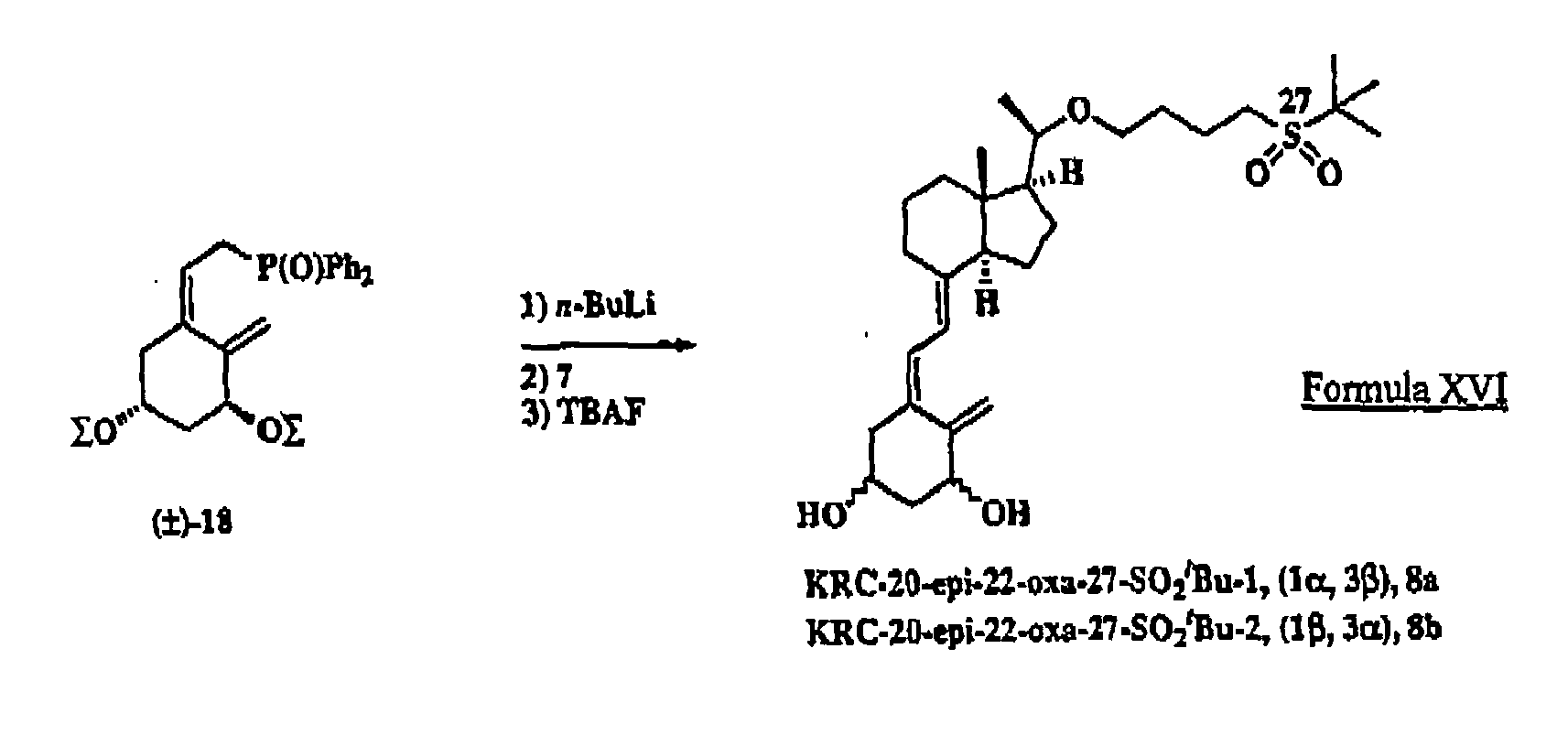


- 22E, 24E-diene sulfones can be synthesized by the method shown in Scheme 13. Analogous compounds in which the t-butyl group is replaced by an alternate lower alkyl group or by an unsubstituted phenyl or a phenyl substituted with a lower alkyl or alkoxy can be made with modifications which will be evident to persons of skill in the art,


- This pale yellow oil (7.81 g theor.) was dissolved in 215 mL of MeOH and cooled to 0 °C. To this solution was added a 26% oxone solution (55.3 g, 90.0 mmol in 150 mL H2O) dropwise via addition funnel. The resulting suspension was allowed to stir with gradual warming to rt overnight. The reaction mixture was diluted with 150 mL H2O, extracted with CHCl3 (3 x 75 mL), washed with H2O and brine (150 mL each), dried over Na2SO4, filtered, and concentrated to give essentially pure allyl t-butyl sulfone as a clear oil.
- A portion of this sulfone (1.00 g, 6.16 mmol) was dissolved in CCl4 (40 mL), treated with bromine (0.317 mL, 6.16 mmol) for 3 h, and concentrated to give the desired dibromide (1.46 g, 74%) as a pale orange solid (mp 75-80 °C) from cold Et2O/hexanes, clean enough for the following transformation.
- The dibromide was dissolved in THF (50 mL), cooled to 0 °C, and treated with Et3N (0.945 mL, 6.78 mmol) overnight, while gradually warming to rt. The reaction mixture was neutralized with dilute HCl, diluted with H2O, extracted with Et2O (3 x 25 mL), dried over Na2SO4, filtered, concentrated, and purified by column chromatography (10-20% Et2O/pentane) to give 16 (385 mg, 26% two steps) as white crystals: mp 60-62 °C; 1H NMR (CDCl3) δ 7.00 (dt, J = 15, 6.8 Hz, 1H), 6.55 (dt, J = 15, 1.2 Hz, 1H), 4.07 (dd, J = 6.8, 1.2 Hz, 2H), 1.38 (s, 9H); 13C NMR (CDCl3) δ 143.82, 127.63, 58.94, 27.36, 23.23; IR (neat) 3068, 3053, 2976, 1636, 1305, 1275, 1109, 982; Anal. Calcd for C7H13BrO2S: C, 34.86; H, 5.43. Found: C. 34.98; H, 5.32.
- Di-n-butylphosphonate 17. A stirred solution of tri-n-butyl phosphite (5 mL) and sulfone 16 (370 mg,1.53 mmol) was heated to 130 °C for 12 h, cooled to rt, concentrated and purified on silica gel (75% EtOAc/hexanes) to give 519 mg (95%) of 16 as a clear oil: 1H NMR (CDCl3) δ 7.00 (dt, J = 15, 8.0 Hz, 1H), 6.38 (ddt, J = 15, 4.6, 1.2 Hz, 1H), 4.03-3.92 (m, 4H), 2.76 (ddd, J = 25, 8.0, 1.2 Hz), 1.62-1.53 (m, 4H), 1.38-1.30 (m. 4H); 1.29 (6H), 0.85 (t, J = 7.2 Hz, 6H); 13C NMR (CDCl3) δ 140.23 (d, J = 11 Hz), 128.24 (d, J =14 Hz), 66.18 (d, J = 6.8 Hz), 58.69, 32.47 (d, J = 6.1 Hz), 29.97 (d, J = 140 Hz), 27.36, 23.18, 13.52; IR (neat) 2961, 2935, 2874, 1633, 1477, 1464, 1289, 1246, 1114, 1024, 983; Anal. Calcd for C15H31O5PS: C, 50.83; H, 8.82; S, 9.05. Found: C, 50.64: H, 8.65; S, 8.91.
- 8β-[(Triethylsilyl)oxy]-22E,24E -diene 26-tert-Butyl Sulfone (+)-21. A solution of lithium tert-butoxide (1.0 M in THF, 0.491 mL, 0.491 mmol) was added via syringe to a cold (-78 °C) solution of phosphonate 17 (175 mg, 0.493 mmol) in THF (1.0 mL). The mixture was warmed slightly to effect solution, then returned to -78°C. The resulting yellow solution was delivered via cannula to a stirred solution of aldehyde (+)-20 (64.0 mg, 0.197 mmol) in THF (1.5 mL) at n. After 10 min, the solvent was removed and the residual brown oil was flash chromatographed (8% EtOAc/hexanes) to give 86 mg of (+)-21 (93%) as a moist solid:

- C,D-Ring Ketone (+)-22. An aqueous solution of HF (0.500 mL, 10% wt) was added dropwise to a stirred solution of (+)-21 in H2O;THF (1.00 mL H2O:few drops of THF to effect solution) and the resulting solution stirred at π for 2 d (two additional 0.500 mL portions of 10% HF(20) were added over this period to consume starting material). The reaction mixture was then carefully neutralized (sat. NaHCO3), diluted with H2O, and extracted with CH2Cl2 (3 x 10 mL). The combined organics were dried (Na2SO4), filtered and concentrated to give the desired hydroxy sulfide as a white solid.
- To crude hydroxy sulfide in CH2Cl2 (3 mL) was added 4-methymorphaline N-oxide (NMO, 58.0 mg, 0.492 mmol) and powdered molecular sieves (4Å), followed by tetrapropylammonium perruthenate (TPAP, 4.30 mg, 0.0123 mmol). After stirring for 15 min, the reaction mixture was filtered, concentrated and passed through a short pad of flash silica gel (20 % EtOAc/hexanes) to afford the desired keto sulfone (+)-22 as a white foam (79 mg, quantitative from (+)-21): 1H NMR (CDCl3) δ 7.08 (dd, J = 15, 10 Hz 1H), 6.15 (t, J = 15 H2, 1H), 6.08 (m, 2H), 2.43 (m, 1H), 2.29-2.15 (m, 3H), 1.32 (s, 9H), 1.08 (d, J = 6.4 Hz, 3H), 0.63(s, 3H); 13C NMR (CDCl3) δ 211.39, 152.05, 146.59, 124,38, 121.21, 61.62, 58.57, 55.62, 49.85, 40,86, 40.12, 38.71, 27.46, 23.94, 23.30, 19.61, 19.06, 12.72; IR (neat) 2955, 2934, 2872, 1708, 1638, 1587, 1461, 1296, 1278, 1111, 1001, 824; HRMS: calcd for C20H32O3S: 352.2072, found 352.2066.
- 22E,24E-Diene-26-tert-butyl Sulfone Analogs 23a and 23b. Racemic phosphine oxide (±)-8 (78.0 mg, 0.134 mmol) was dissolved in 1.34 mL of THF and cooled to -78 °C under argon. To this solution was added 97.0 µL of PhLi (0.134 mmol, 1.38 M in cyclohexane/Et2O) dropwise via syringe. The deep orange solution was stirred for 30 min, at which time a cold solution of C,D-ring ketone (+)-22 (31.0 mg, 0.0880 mmol) in 1.00 mL of THF was added dropwise via cannula. The resulting solution was stirred in the dark at -78°C for approximately 4 h, then slowly warmed to -40°C over 2h. The reaction mixture was quenched with 3 mL of a 2:1 (v;v) mixture of 2 N sodium potassium tartrate and 2 N potassium carbonate. Upon warming to rt, the reaction mixture was diluted with H2O, extracted with EtOAc (4 x 20 mL), dried over MgSO4, filtered, concentrated and purified by silica gel column chromatography (10-50% EtOAc/hexanes-<0.1% Et3N) to afford 33 mg (90% based on (+)-22) of the coupled product as a yellow oil.
- This oil was immediately dissolved in 1.50 mL of EtOH, cooled to 0 °C, and treated with HF (0.100 mL, 49% aqueous). This solution was slowly warmed to rt and treated with additional HF (0.100 mL) to complete the deprotection. After aqueous work-up the resulting white film was flash chrmatographed (1% NEt3/EtOAc) to afford 17.3 mg (77% for deprotection) of a mixture of diastereomers 23a and 23b. This diastereomeric mixture was purified by reversed-phase HPLC (C-18 semipreparative column, 46% MeCN/H2O, 3 mL/min) giving 8.8 mg of 23a (20%, tR 115 min) and 2.1 mg of 23b (5%, tR 111 min). 23a (1α, 3β): [α]25 D +97 (c 7.5, CHCl3); 1H NMR (CDCl3) δ 7.12 (m, 1H), 6.37 (d, J =11 Hz, 1H), 6.16 (t, J = 15 Hz, 1H), 6.11 (m, 2H), 6.01 (d, J = 11 Hz, 1H), 5.32 (m, 1H), 4.99 (m, 1H), 4.46-4.40 (m, 1H), 4.26-4.19 (m, 1H), 2.83 (dd, J = 12, 3.7 Hz, 1H), 2.59 (dd, J = 14, 3.2 Hz, 1H), 1.36 (s, 9H), 1.09 (d, J = 6.8 Hz, 3H), 0.57 (s, 3H); 13C NMR (CDCl3) δ 153.13, 147.58, 146.98, 142.43, 133.24, 124.78, 124.00, 120.74, 117.30, 111.83, 70.80, 66.81, 58.60, 56.09, 55.63, 46.06, 45.23, 42.83, 40.69, 40.26, 28.97, 27.45, 23.45, 23.35, 22.24, 19.69, 12.29; IR (neat) 3598-3148 (br), 3013, 2935, 2870, 1637, 1588, 1457, 1295, 1108; HRMS; calcd for C29H44O4S 488.2960, found 488.2950. 23b (1β, 3α): [α]25 D +32 (c 1.0, CHCl3); 1H NMR (CDCl3) δ 7.12 (m, 1H), 6.38 (d, J = 11 Hz, 1H), 6.16 (t, J = 15 Hz, 1H), 6.11 (m, 2H), 6.01 (d, J = 11 Hz, 1H), 5.32 (m, 1H), 4,99 (m, 1H), 4.47-4.40 (m, 1H), 4.26-4.18 (m, 1H), 2.84 (dd, J = 12, 3.8 Hz, 1H), 2.61 (dd, J = 14,3.2 Hz, 1H), 1.36 (s, 9H), 1.09 (d, J = 6.8 Hz, 3H), 0.57 (s, 3H); 13C NMR (CDCl3) δ 153.13, 147.27, 147.01, 142.52, 133.10, 124.82, 124.01, 120.76, 117.30, 112.56, 71.32, 66.75, 58.61, 56.10, 55.64, 46.07, 45.45, 42.83, 40.70, 40.25, 29.00, 27.44, 23.45, 23.38, 22.28, 19.71, 12.32; IR (neat) 3568-3087 (br), 3016, 2954, 2928, 2872, 1637 1588, 1457, 1295, 1109; HRMS: calcd for C29H44O4S 488.2960, found 488, 2944, UV pending.
- The compounds of the invention have been compared with calcitriol for biological activity.
- The compounds were tested for growth inhibition of murine keratinocyte cells (cell line PE) and for the inhibition of TPA-induced ornithine decarboxylase (ODC) activity as described in
U.S. Patent No. 5,830,885 . - The cell line PE was derived from a papilloma induced in female SENCAR mice by a standard skin initiation/promotion protocol (Carcinogenesis, 7:949-958 (1986), the entire contents of which are hereby incorporated by reference) and was chosen for its particular sensitivity to the induction of ornithine decarboxylase (ODC) activity by the extensively characterized tumor promoter TPA. The PE cell line culture medium used in the tests consisted of Eagle's minimal essential medium without calcium chloride supplemented with 8% chelexed fetal calf serum and 1% antibiotic-antimycotic and the addition of CaCl2 to 0.05 mM Ca++.
- The results are shown in Figure 1, and indicate that the compounds of the invention inhibit cell proliferation, compounds 23a and 15a being nearly as effective as calcitriol.
- The compounds were also tested for their effect on calcium excretion and weight gain in rats according to the methods described in Posner et al., J. Med. Chem. 41:3008-3014 (1998). The results are shown in Figures 2 and 3, and demonstrate that the compounds of the invention do not inhibit weight gain nor stimulate calcium secretion in contrast to calcitriol.
- Thus, compounds according to the invention exhibit the antiproliferative effects of vitamin D3 without the associated effects on calcium excretion and weight gain exerted by vitamin D3. Accordingly, they should prove valuable as therapeutic agents in diseases where excessive cell proliferation and/or failure of cells to differentiate may occur, including but not limited to psoriasis and cancer. External or internal administration of the compounds of the invention can be made in accord with the condition to be treated using methods known to those of ordinary skill in the medical and veterinary arts, with appropriate dosages determined by routine experimentation,
- Various embodiments are set out in the following numbered clauses.
- 1. A sulfur containing analog of 1α, 25 dihydroxy vitamin D3 selected from the group consisting of compounds represented by formulae II-X and XIV-XVII as follows:


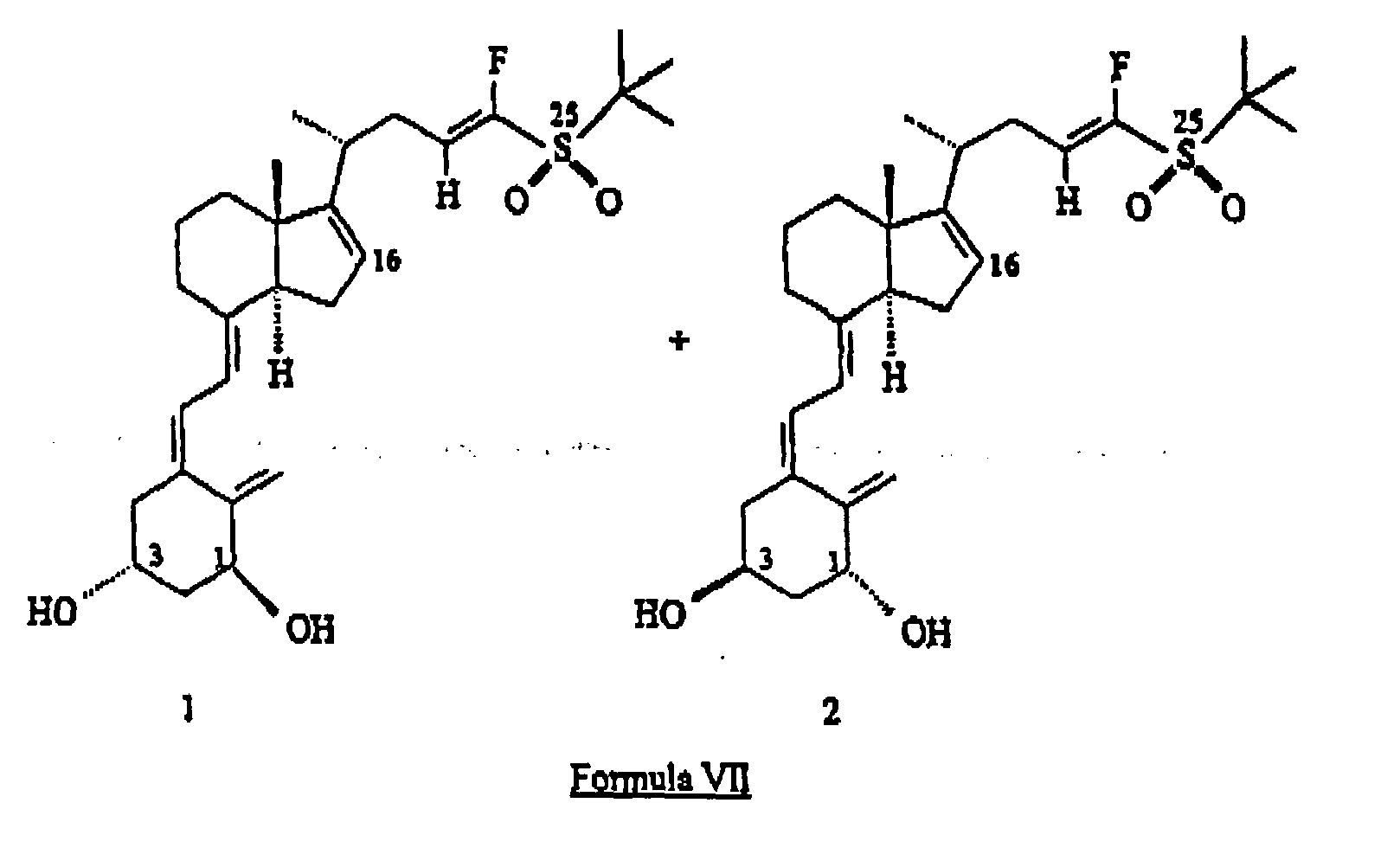


- 2. A vitamin D3 analog according to
clause 1 which is in the (+)(1β, 3α) diastereomeric configuration. - 3. A vitamin D3 analog according to
clause 1 which is in the (-)(1α, 3β) diastereomeric configuration. - 4. A vitamin D3 analog which is a 23-oxa-25-sulfone represented by formula XI

- 5. The vitamin D3 analog according to
clause 4 wherein R is selected from the group consisting of methyl, t-butyl, phenyl and p-methoxyphenyl. - 6. A vitamin D3 analog which is a 20-epi-22-oxa-sulfone represented by Formula XII

- 7. The vitamin D3 analog according to
clause 6 wherein R is selected from the group consisting of methyl, t-butyl, phenyl and p-methoxyphenyl. - 8. A vitamin D3 analog which is a 16-ene-alkenylsulfone or 16-ene-alkynylsulfone represented by formula XIII

- 9. The vitamin D3 analog according to clause 8 wherein R is selected from the group consisting of methyl, t-butyl, phenyl and p-methoxyphenyl.
- 10. A vitamin D3 analog which is a 22E, 24E diene sulfone represented by formula XVIII

- 11. The vitamin D3 analog according to
clause 10 which is in the (-)(1α, 3β) diastereomeric configuration. - 12. The vitamin D3 analog according to
clause 11 wherein R is selected from the group consisting of methyl, t-butyl, phenyl and p-methoxyphenyl. - 13. The vitamin D3 analog according to
clause 11 wherein R is t-butyl.
Claims (10)
- A sulfur containing analog of 1α, 25 dihydroxy vitamin D3 selected from the group consisting of compounds represented by formulae II-X and XIV-XVII as follows;


- A vitamin D3 analog according to claim 1 which is in the (+)(1β, 3α) diastereomeric configuration.
- A vitamin D3 analog according to claim 1 which is in the (-)(1α, 3β) diastereomeric configuration.
- A vitamin D3 analog which is a 23-oxa-25-sulfone represented by formula XI

- The vitamin D3 analog according to claim 4 wherein R is selected from the group consisting of methyl, t-butyl, phenyl and p-methoxyphenyl
- A vitamin D3 analog which is a 20-epi-22-oxa-sulfone represented by Formula XII

- The vitamin D3 analog according to claim 6 wherein R is selected from the group consisting of methyl, t-butyl, phenyl and p-methoxyphenyl
- A vitamin D3 analog according to any one of claims 1 to 7 for use as a medicament.
- Use of a compound according to any one of claims 1 to 7 in the preparation of a medicament for treating diseases where excessive cell proliferation and/or failure of cells to differentiate occurs.
- Use of a compound according to any one of claims 1 to 7 in the preparation of a medicament for treating cancer or psoriasis.
Applications Claiming Priority (3)
| Application Number | Priority Date | Filing Date | Title |
|---|---|---|---|
| US12732899P | 1999-04-01 | 1999-04-01 | |
| US12847899P | 1999-04-09 | 1999-04-09 | |
| EP00921523A EP1180035B1 (en) | 1999-04-01 | 2000-03-31 | NON-CALCEMIC, ANTIPROLIFERATIVE, TRANSCRIPTIONALLY ACTIVE SULFUR-CONTAINING ANALOGS OF 1-alpha, 25-DIHYDROXY VITAMIN D3 |
Related Parent Applications (1)
| Application Number | Title | Priority Date | Filing Date |
|---|---|---|---|
| EP00921523A Division EP1180035B1 (en) | 1999-04-01 | 2000-03-31 | NON-CALCEMIC, ANTIPROLIFERATIVE, TRANSCRIPTIONALLY ACTIVE SULFUR-CONTAINING ANALOGS OF 1-alpha, 25-DIHYDROXY VITAMIN D3 |
Publications (3)
| Publication Number | Publication Date |
|---|---|
| EP1745787A2 true EP1745787A2 (en) | 2007-01-24 |
| EP1745787A3 EP1745787A3 (en) | 2007-02-07 |
| EP1745787B1 EP1745787B1 (en) | 2016-11-09 |
Family
ID=26825543
Family Applications (2)
| Application Number | Title | Priority Date | Filing Date |
|---|---|---|---|
| EP00921523A Expired - Lifetime EP1180035B1 (en) | 1999-04-01 | 2000-03-31 | NON-CALCEMIC, ANTIPROLIFERATIVE, TRANSCRIPTIONALLY ACTIVE SULFUR-CONTAINING ANALOGS OF 1-alpha, 25-DIHYDROXY VITAMIN D3 |
| EP06020197.7A Expired - Lifetime EP1745787B1 (en) | 1999-04-01 | 2000-03-31 | NON-CALCEMIC, ANTIPROLIFERATIVE, TRANSCRIPTIONALLY ACTIVE SULFUR-CONTAINING ANALOGS OF 1-alpha 25-DIHYDROXY VITAMIN D3 |
Family Applications Before (1)
| Application Number | Title | Priority Date | Filing Date |
|---|---|---|---|
| EP00921523A Expired - Lifetime EP1180035B1 (en) | 1999-04-01 | 2000-03-31 | NON-CALCEMIC, ANTIPROLIFERATIVE, TRANSCRIPTIONALLY ACTIVE SULFUR-CONTAINING ANALOGS OF 1-alpha, 25-DIHYDROXY VITAMIN D3 |
Country Status (13)
| Country | Link |
|---|---|
| US (1) | US6380408B1 (en) |
| EP (2) | EP1180035B1 (en) |
| JP (2) | JP3630101B2 (en) |
| AT (1) | ATE344039T1 (en) |
| CA (1) | CA2366586C (en) |
| CY (1) | CY1107548T1 (en) |
| DE (1) | DE60031666T2 (en) |
| DK (1) | DK1180035T3 (en) |
| ES (2) | ES2274785T3 (en) |
| HK (1) | HK1044293B (en) |
| MX (1) | MXPA01009693A (en) |
| PT (1) | PT1180035E (en) |
| WO (1) | WO2000059513A1 (en) |
Families Citing this family (26)
| Publication number | Priority date | Publication date | Assignee | Title |
|---|---|---|---|---|
| ATE428692T1 (en) * | 2001-08-22 | 2009-05-15 | Univ Johns Hopkins | 24-SULFUR SUBSTITUTED 1-ALPHA-25-DIHYDROXY VITAMIN D3 ANALOGUE |
| US6559138B1 (en) * | 2001-09-21 | 2003-05-06 | Syntex (U.S.A.) Llc | 3-Desoxy-vitamin D3 analog esters |
| US7101865B2 (en) | 2002-06-13 | 2006-09-05 | Cytochroma Inc. | 24-sulfoximine vitamin D3 compounds |
| CA2510228C (en) * | 2002-12-18 | 2012-10-30 | Johns Hopkins University | 25-so2-substituted analogs of 1.alpha.,25-dihydroxyvitamin d3 |
| CA2544502A1 (en) * | 2003-11-25 | 2005-06-09 | Wisconsin Alumni Research Foundation | Vitamin d analogs for obesity prevention and treatment |
| WO2006074227A2 (en) * | 2005-01-04 | 2006-07-13 | Johns Hopkins University | HIGHLY ANTIPROLIFERATIVE, LOW-CALCEMIC, ANALOGS OF THE HORMONE 1α, 25-DIHYDROXYVITAMIN D3 WITH CARBONYL SIDE CHAINS |
| US20090137828A1 (en) * | 2005-08-18 | 2009-05-28 | Bioxell S.P.A. | Synthesis of 1A-Fluoro-25-Hydroxy-16-23E-Diene-26,27-Bishomo-20-Epi-Cholecalciferol |
| US20070122477A1 (en) * | 2005-10-12 | 2007-05-31 | Cytochroma, Inc. | Methods and articles for treating 25-hydroxyvitamin D insufficiency and deficiency |
| PT3095447T (en) | 2006-02-03 | 2022-01-24 | Opko Renal Llc | Treating vitamin d insufficiency and deficiency with 25-hydroxyvitamin d2 and 25-hydroxyvitamin d3 |
| DK2037936T3 (en) | 2006-06-21 | 2014-09-22 | Opko Renal Llc | Method of treating and preventing secondary hyperparathyroidism |
| WO2008131267A2 (en) * | 2007-04-18 | 2008-10-30 | Johns Hopkins University | Low calcemic, highly antiproliferative, analogs of calcitriol |
| ES3047207T3 (en) | 2007-04-25 | 2025-12-03 | Opko Renal Llc | Method of safely and effectively treating and preventing secondary hyperparathyroidism in chronic kidney disease |
| CA2683628C (en) * | 2007-04-25 | 2018-03-06 | Cytochroma Inc. | Method of treating vitamin d insufficiency and deficiency |
| EP2148685A4 (en) * | 2007-04-25 | 2010-07-28 | Cytochroma Inc | Methods and compounds for vitamin d therapy |
| KR101691876B1 (en) | 2007-04-25 | 2017-01-02 | 사이토크로마 인코포레이티드 | Oral controlled release compositions comprising vitamin d compound and waxy carrier |
| ES2593356T3 (en) | 2008-04-02 | 2016-12-07 | Opko Ireland Global Holdings, Ltd. | Useful methods, compositions, uses and kits for vitamin D deficiency and related disorders |
| WO2011088209A2 (en) * | 2010-01-13 | 2011-07-21 | Cytochroma Inc. | 1-deoxy analogs of vitamin d-related compounds |
| WO2011119610A2 (en) | 2010-03-23 | 2011-09-29 | Wisconsin Alumni Research Foundation | (20S)-2-METHYLENE-19-NOR-22-DIMETHYL-1α,25- DIHYDROXYVITAMIN D3 AND (20R)-2-METHYLENE-19-NOR-22- DIMETHYL-1α,25-HYDROXYVITAMIN D3 |
| US8664206B2 (en) | 2010-03-23 | 2014-03-04 | Wisconsin Alumni Research Foundation | Diastereomers of 2-methylene-19-nor-22-methyl-1α,25-dihydroxyvitamin D3 |
| US11672809B2 (en) | 2010-03-29 | 2023-06-13 | Eirgen Pharma Ltd. | Methods and compositions for reducing parathyroid levels |
| US8788551B2 (en) | 2011-11-15 | 2014-07-22 | Seagate Technology Llc | Random number generation using switching regulators |
| US9201630B2 (en) | 2012-02-10 | 2015-12-01 | Seagate Technology Llc | Random number generation using startup variances |
| KR101847947B1 (en) | 2013-03-15 | 2018-05-28 | 옵코 아이피 홀딩스 Ⅱ 인코포레이티드 | Stabilized modified release vitamin d formulation |
| US10220047B2 (en) | 2014-08-07 | 2019-03-05 | Opko Ireland Global Holdings, Ltd. | Adjunctive therapy with 25-hydroxyvitamin D and articles therefor |
| KR20180123100A (en) | 2016-03-28 | 2018-11-14 | 옵코 아일랜드 글로벌 홀딩스 리미티드 | How to Treat Vitamin D |
| WO2025094144A1 (en) | 2023-11-02 | 2025-05-08 | Eirgen Pharma Ltd. | Controlling loss of kidney function |
Citations (3)
| Publication number | Priority date | Publication date | Assignee | Title |
|---|---|---|---|---|
| US5274142A (en) | 1992-03-12 | 1993-12-28 | The Johns Hopkins University | Vitamin D3 analogues |
| US5403832A (en) | 1992-03-12 | 1995-04-04 | The Johns Hopkins University | Vitamin D3 analogues |
| US5830885A (en) | 1992-03-12 | 1998-11-03 | The Johns Hopkins University | Antiproliferative vitamin D3 hybrids |
Family Cites Families (13)
| Publication number | Priority date | Publication date | Assignee | Title |
|---|---|---|---|---|
| JPS5119752A (en) | 1974-08-07 | 1976-02-17 | Masayuki Ishikawa | 1 arufua* 2 arufuaa jihidorokishikorekarushifuerooruno seiho |
| US4224231A (en) | 1979-09-04 | 1980-09-23 | Wisconsin Alumni Research Foundation | Derivatives of 25-hydroxycholecalciferol |
| US4927815A (en) * | 1988-04-29 | 1990-05-22 | Wisconsin Alumni Research Foundation | Compounds effective in inducing cell differentiation and process for preparing same |
| JPH0667898B2 (en) * | 1989-02-15 | 1994-08-31 | 大同ほくさん株式会社 | Method for producing 22,23-secovitamin D or active form thereof or derivative thereof |
| US5401732A (en) | 1989-02-23 | 1995-03-28 | Leo Pharmaceutical Products Ltd. A/S Kemiske Fabrik Produkionsaktiese Skab | Vitamin D analogues |
| US4973584A (en) * | 1989-03-09 | 1990-11-27 | Deluca Hector F | Novel 1α-hydroxyvitamin D2 epimer and derivatives |
| US5401731A (en) | 1989-06-29 | 1995-03-28 | Leo Pharmaceutical Products Ltd. A/S (Lovens Kemiske Fabrik Productionsaktieselskab) | Vitamin D analogues |
| GB8915770D0 (en) | 1989-07-10 | 1989-08-31 | Leo Pharm Prod Ltd | Chemical compounds |
| US5260290A (en) | 1990-02-14 | 1993-11-09 | Wisconsin Alumni Research Foundation | Homologated vitamin D2 compounds and the corresponding 1α-hydroxylated derivatives |
| GB9007236D0 (en) * | 1990-03-30 | 1990-05-30 | Leo Pharm Prod Ltd | Chemical compounds |
| GB9015774D0 (en) | 1990-07-18 | 1990-09-05 | Leo Pharm Prod Ltd | Novel treatment |
| GB9226877D0 (en) | 1992-12-23 | 1993-02-17 | Leo Pharm Prod Ltd | Chemical compounds |
| US6043386A (en) | 1998-06-03 | 2000-03-28 | John Hopkins University | Non-calcemic, antiproliferative, transcriptionally active 24-fluorinated hybrid analogs of 1α,-25-dihydroxy vitamin D3 |
-
2000
- 2000-03-31 ES ES00921523T patent/ES2274785T3/en not_active Expired - Lifetime
- 2000-03-31 MX MXPA01009693A patent/MXPA01009693A/en active IP Right Grant
- 2000-03-31 HK HK02106019.2A patent/HK1044293B/en not_active IP Right Cessation
- 2000-03-31 WO PCT/US2000/008462 patent/WO2000059513A1/en not_active Ceased
- 2000-03-31 AT AT00921523T patent/ATE344039T1/en active
- 2000-03-31 US US09/541,060 patent/US6380408B1/en not_active Expired - Lifetime
- 2000-03-31 DE DE60031666T patent/DE60031666T2/en not_active Expired - Lifetime
- 2000-03-31 EP EP00921523A patent/EP1180035B1/en not_active Expired - Lifetime
- 2000-03-31 CA CA002366586A patent/CA2366586C/en not_active Expired - Lifetime
- 2000-03-31 JP JP2000609076A patent/JP3630101B2/en not_active Expired - Fee Related
- 2000-03-31 PT PT00921523T patent/PT1180035E/en unknown
- 2000-03-31 ES ES06020197.7T patent/ES2614632T3/en not_active Expired - Lifetime
- 2000-03-31 EP EP06020197.7A patent/EP1745787B1/en not_active Expired - Lifetime
- 2000-03-31 DK DK00921523T patent/DK1180035T3/en active
-
2004
- 2004-10-01 JP JP2004289968A patent/JP3796508B2/en not_active Expired - Fee Related
-
2007
- 2007-01-29 CY CY20071100119T patent/CY1107548T1/en unknown
Patent Citations (4)
| Publication number | Priority date | Publication date | Assignee | Title |
|---|---|---|---|---|
| US5274142A (en) | 1992-03-12 | 1993-12-28 | The Johns Hopkins University | Vitamin D3 analogues |
| US5389622A (en) | 1992-03-12 | 1995-02-14 | The John Hopkins University | Vitamin D3 analogues |
| US5403832A (en) | 1992-03-12 | 1995-04-04 | The Johns Hopkins University | Vitamin D3 analogues |
| US5830885A (en) | 1992-03-12 | 1998-11-03 | The Johns Hopkins University | Antiproliferative vitamin D3 hybrids |
Non-Patent Citations (20)
| Title |
|---|
| "Proceedings of the Sixth Workshop on Vitamin D", March 1985, W. DE GRUYTER, article "Vitamin D. Chemical. Biochemical and Clinical Update" |
| "Vitamin D, A Pluriporent Steroid Hormone: Structural Studies, Molecular Endocrinology and Clinical Applications", 1994, WALTER DE GRUYTE |
| "Vitamin D, A Pluripotent Steroid Hormone: Structural Studies, Molecular Endocrinology and Clinical Applications", 1994, WALTER DE GRUYTER |
| BROMMAGE, R.; DELUCCA, H.F., ENDOCRINE REV., vol. 6, 1985, pages 491 |
| CALVERLEY, M.J., TETRAHEDRON, vol. 43, 1987, pages 4609 |
| CALVERLEY, M.J.: "Vitamin D: Molecular. Cellular, and Clinical Endocrinology", 1988, DE GRUYTER, pages: 51 |
| CALVERLEY; BINDERUP, BIOORGANIC & MEDICINAL CHEMISTRY LETTERS, vol. 3, 1993, pages 1845 |
| CANCELA, L.; THEOFON, G.; NORMAN, A.W.: "Hormones and Their Actions. Part I", 1988, ELSEVIER |
| CARCINOGENESIS, vol. 7, 1986, pages 949 - 958 |
| DICKSON, I., NATURE, vol. 325, 1987, pages 18 |
| J. MED. CHEM., vol. 41, 1999, pages 3008 - 3014 |
| MED. CHEM., vol. 41, 1999, pages 3008 - 3014 |
| POSNER ET AL., J. MED. CHEM., vol. 41, 1998, pages 3008 - 3014 |
| POSNER ET AL., J. ORE. CHEM., vol. 62, 1997, pages 3299 - 3314 |
| POSNER ET AL., J. ORG. CHEM., vol. 62, 1997, pages 3299 - 3314 |
| PROVVEDINI, D.M.; TSOUKAS, C.D.; DEFTOE, L.J.; MANOLAGAS, S.C., SCIENCE, vol. 221, 1983, pages 1181 |
| PROVVEDINI, D.M.; TSOUKAS, C.D.; DEFTOE, LJ.; MANOLAGAS, S.C., SCIENCE, vol. 221, 1983, pages 1181 |
| TSOUKAS, D.C.; PROVVEDINI, D.M.; MANOLAGAS, S.C., SCIENCE, vol. 224, 1984, pages 1438 |
| WILLIAMSBURG, VA: "Proceedings of the Fifth Workshop on Vitamin D", February 1982, W. DE GRUYTER, article "Vitamin D. Chemical Biochemical, and Clinical Endocrinoloev of Calcium Metabolism", pages: 901 - 940 |
| WILLIAMSBURG, VA: "Proceedings of the Fifth Workshop on Vitamin D", February 1982, W. DE GRUYTER, article "Vitamin D. Chemical Biochemical. and Clinical Endocrinology of Calcium Metabolism", pages: 901 - 940 |
Also Published As
| Publication number | Publication date |
|---|---|
| EP1180035A4 (en) | 2003-07-30 |
| MXPA01009693A (en) | 2002-03-14 |
| CA2366586A1 (en) | 2000-10-12 |
| CA2366586C (en) | 2004-06-22 |
| JP3630101B2 (en) | 2005-03-16 |
| JP2002541112A (en) | 2002-12-03 |
| JP3796508B2 (en) | 2006-07-12 |
| DE60031666T2 (en) | 2007-08-30 |
| US6380408B1 (en) | 2002-04-30 |
| ES2274785T3 (en) | 2007-06-01 |
| DE60031666D1 (en) | 2006-12-14 |
| EP1745787A3 (en) | 2007-02-07 |
| CY1107548T1 (en) | 2013-03-13 |
| EP1180035A1 (en) | 2002-02-20 |
| ATE344039T1 (en) | 2006-11-15 |
| EP1745787B1 (en) | 2016-11-09 |
| JP2005023087A (en) | 2005-01-27 |
| DK1180035T3 (en) | 2007-03-05 |
| WO2000059513A1 (en) | 2000-10-12 |
| EP1180035B1 (en) | 2006-11-02 |
| PT1180035E (en) | 2007-02-28 |
| HK1044293B (en) | 2007-06-08 |
| HK1044293A1 (en) | 2002-10-18 |
| ES2614632T3 (en) | 2017-06-01 |
| WO2000059513A8 (en) | 2001-02-15 |
Similar Documents
| Publication | Publication Date | Title |
|---|---|---|
| EP1180035B1 (en) | NON-CALCEMIC, ANTIPROLIFERATIVE, TRANSCRIPTIONALLY ACTIVE SULFUR-CONTAINING ANALOGS OF 1-alpha, 25-DIHYDROXY VITAMIN D3 | |
| US4851401A (en) | Novel cyclopentano-vitamin D analogs | |
| US5840938A (en) | 20(S)-25-hydroxy vitamin D compounds | |
| AU630096B2 (en) | Compounds effective in inducing cell differentiation | |
| SK281443B6 (en) | ANALYSIS OF VITAMIN D, METHOD AND INTERMEDIATE ITS PRODUCTION, ITS USE AND PHARMACEUTICAL PREPARATION CONTAINING IT | |
| JP3773253B2 (en) | Novel vitamin D analog | |
| CZ403197A3 (en) | Derivatives of vitamin d with substituents in position c-25, process of their preparation, intermediates for such process as well as their use for preparing medicaments | |
| US5936105A (en) | 14-EPI-19-nor-vitamin D compounds and methods | |
| CA2535185C (en) | 2-methylene-19-nor-vitamin d2 compounds | |
| EP0937038B1 (en) | Vitamin d analogues | |
| CZ296255B6 (en) | Vitamin D analogue, process for its preparation and use as well as pharmaceutical composition in which the analogue is comprised | |
| US5994332A (en) | Vitamin D analogues | |
| AU629831B2 (en) | Side chain unsaturated 1 alpha-hydroxyvitamin d homologs for the treatment of leukemia | |
| US5354744A (en) | Side chain unsaturated 1 alpha-hydroxyvitamin D analogs | |
| JP2007532540A (en) | 2-alkylidene 18,19-dinor-vitamin D compound | |
| CZ198399A3 (en) | Vitamin D3 derivatives | |
| HK1100066A (en) | Non-calcemic, antiproliferative, transcriptionally active sulfur-containing analogs of 1-alpha 25-dihydroxy vitamin d3 | |
| MXPA06001248A (en) | 2-methylene-19-nor-vitamin d2 compounds |
Legal Events
| Date | Code | Title | Description |
|---|---|---|---|
| PUAI | Public reference made under article 153(3) epc to a published international application that has entered the european phase |
Free format text: ORIGINAL CODE: 0009012 |
|
| PUAL | Search report despatched |
Free format text: ORIGINAL CODE: 0009013 |
|
| 17P | Request for examination filed |
Effective date: 20061011 |
|
| AC | Divisional application: reference to earlier application |
Ref document number: 1180035 Country of ref document: EP Kind code of ref document: P |
|
| AK | Designated contracting states |
Kind code of ref document: A2 Designated state(s): AT BE CH CY DE DK ES FI FR GB GR IE IT LI LU MC NL PT SE |
|
| AK | Designated contracting states |
Kind code of ref document: A3 Designated state(s): AT BE CH CY DE DK ES FI FR GB GR IE IT LI LU MC NL PT SE |
|
| RIN1 | Information on inventor provided before grant (corrected) |
Inventor name: POSNER, GARY H. Inventor name: HAN, GYOONHEE Inventor name: CRAWFORD, KENNETH R. Inventor name: LEE, JAE KYOO Inventor name: WANG, QIANG |
|
| REG | Reference to a national code |
Ref country code: HK Ref legal event code: DE Ref document number: 1100066 Country of ref document: HK |
|
| AKX | Designation fees paid |
Designated state(s): AT BE CH CY DE DK ES FI FR GB GR IE IT LI LU MC NL PT SE |
|
| 17Q | First examination report despatched |
Effective date: 20070924 |
|
| REG | Reference to a national code |
Ref country code: DE Ref legal event code: R079 Ref document number: 60049492 Country of ref document: DE Free format text: PREVIOUS MAIN CLASS: A61K0031590000 Ipc: C07C0401000000 |
|
| GRAJ | Information related to disapproval of communication of intention to grant by the applicant or resumption of examination proceedings by the epo deleted |
Free format text: ORIGINAL CODE: EPIDOSDIGR1 |
|
| GRAP | Despatch of communication of intention to grant a patent |
Free format text: ORIGINAL CODE: EPIDOSNIGR1 |
|
| RIC1 | Information provided on ipc code assigned before grant |
Ipc: A61K 31/59 20060101ALI20160420BHEP Ipc: C07C 401/00 20060101AFI20160420BHEP |
|
| GRAP | Despatch of communication of intention to grant a patent |
Free format text: ORIGINAL CODE: EPIDOSNIGR1 |
|
| INTG | Intention to grant announced |
Effective date: 20160527 |
|
| GRAJ | Information related to disapproval of communication of intention to grant by the applicant or resumption of examination proceedings by the epo deleted |
Free format text: ORIGINAL CODE: EPIDOSDIGR1 |
|
| GRAP | Despatch of communication of intention to grant a patent |
Free format text: ORIGINAL CODE: EPIDOSNIGR1 |
|
| GRAS | Grant fee paid |
Free format text: ORIGINAL CODE: EPIDOSNIGR3 |
|
| GRAA | (expected) grant |
Free format text: ORIGINAL CODE: 0009210 |
|
| INTG | Intention to grant announced |
Effective date: 20160527 |
|
| AC | Divisional application: reference to earlier application |
Ref document number: 1180035 Country of ref document: EP Kind code of ref document: P |
|
| AK | Designated contracting states |
Kind code of ref document: B1 Designated state(s): AT BE CH CY DE DK ES FI FR GB GR IE IT LI LU MC NL PT SE |
|
| REG | Reference to a national code |
Ref country code: GB Ref legal event code: FG4D |
|
| REG | Reference to a national code |
Ref country code: AT Ref legal event code: REF Ref document number: 843763 Country of ref document: AT Kind code of ref document: T Effective date: 20161115 Ref country code: CH Ref legal event code: EP |
|
| REG | Reference to a national code |
Ref country code: IE Ref legal event code: FG4D |
|
| REG | Reference to a national code |
Ref country code: DE Ref legal event code: R096 Ref document number: 60049492 Country of ref document: DE |
|
| REG | Reference to a national code |
Ref country code: NL Ref legal event code: MP Effective date: 20161109 |
|
| REG | Reference to a national code |
Ref country code: FR Ref legal event code: PLFP Year of fee payment: 18 |
|
| REG | Reference to a national code |
Ref country code: AT Ref legal event code: MK05 Ref document number: 843763 Country of ref document: AT Kind code of ref document: T Effective date: 20161109 |
|
| PG25 | Lapsed in a contracting state [announced via postgrant information from national office to epo] |
Ref country code: NL Free format text: LAPSE BECAUSE OF FAILURE TO SUBMIT A TRANSLATION OF THE DESCRIPTION OR TO PAY THE FEE WITHIN THE PRESCRIBED TIME-LIMIT Effective date: 20161109 Ref country code: SE Free format text: LAPSE BECAUSE OF FAILURE TO SUBMIT A TRANSLATION OF THE DESCRIPTION OR TO PAY THE FEE WITHIN THE PRESCRIBED TIME-LIMIT Effective date: 20161109 Ref country code: GR Free format text: LAPSE BECAUSE OF FAILURE TO SUBMIT A TRANSLATION OF THE DESCRIPTION OR TO PAY THE FEE WITHIN THE PRESCRIBED TIME-LIMIT Effective date: 20170210 |
|
| PGFP | Annual fee paid to national office [announced via postgrant information from national office to epo] |
Ref country code: FR Payment date: 20170327 Year of fee payment: 18 |
|
| PG25 | Lapsed in a contracting state [announced via postgrant information from national office to epo] |
Ref country code: PT Free format text: LAPSE BECAUSE OF FAILURE TO SUBMIT A TRANSLATION OF THE DESCRIPTION OR TO PAY THE FEE WITHIN THE PRESCRIBED TIME-LIMIT Effective date: 20170309 Ref country code: AT Free format text: LAPSE BECAUSE OF FAILURE TO SUBMIT A TRANSLATION OF THE DESCRIPTION OR TO PAY THE FEE WITHIN THE PRESCRIBED TIME-LIMIT Effective date: 20161109 Ref country code: FI Free format text: LAPSE BECAUSE OF FAILURE TO SUBMIT A TRANSLATION OF THE DESCRIPTION OR TO PAY THE FEE WITHIN THE PRESCRIBED TIME-LIMIT Effective date: 20161109 |
|
| PGFP | Annual fee paid to national office [announced via postgrant information from national office to epo] |
Ref country code: GB Payment date: 20170327 Year of fee payment: 18 Ref country code: IE Payment date: 20170329 Year of fee payment: 18 |
|
| REG | Reference to a national code |
Ref country code: ES Ref legal event code: FG2A Ref document number: 2614632 Country of ref document: ES Kind code of ref document: T3 Effective date: 20170601 |
|
| PGFP | Annual fee paid to national office [announced via postgrant information from national office to epo] |
Ref country code: IT Payment date: 20170324 Year of fee payment: 18 |
|
| PG25 | Lapsed in a contracting state [announced via postgrant information from national office to epo] |
Ref country code: DK Free format text: LAPSE BECAUSE OF FAILURE TO SUBMIT A TRANSLATION OF THE DESCRIPTION OR TO PAY THE FEE WITHIN THE PRESCRIBED TIME-LIMIT Effective date: 20161109 |
|
| PGFP | Annual fee paid to national office [announced via postgrant information from national office to epo] |
Ref country code: DE Payment date: 20170329 Year of fee payment: 18 |
|
| REG | Reference to a national code |
Ref country code: DE Ref legal event code: R097 Ref document number: 60049492 Country of ref document: DE |
|
| PG25 | Lapsed in a contracting state [announced via postgrant information from national office to epo] |
Ref country code: BE Free format text: LAPSE BECAUSE OF FAILURE TO SUBMIT A TRANSLATION OF THE DESCRIPTION OR TO PAY THE FEE WITHIN THE PRESCRIBED TIME-LIMIT Effective date: 20161109 |
|
| PGFP | Annual fee paid to national office [announced via postgrant information from national office to epo] |
Ref country code: ES Payment date: 20170328 Year of fee payment: 18 |
|
| PLBE | No opposition filed within time limit |
Free format text: ORIGINAL CODE: 0009261 |
|
| STAA | Information on the status of an ep patent application or granted ep patent |
Free format text: STATUS: NO OPPOSITION FILED WITHIN TIME LIMIT |
|
| 26N | No opposition filed |
Effective date: 20170810 |
|
| REG | Reference to a national code |
Ref country code: CH Ref legal event code: PL |
|
| PG25 | Lapsed in a contracting state [announced via postgrant information from national office to epo] |
Ref country code: MC Free format text: LAPSE BECAUSE OF FAILURE TO SUBMIT A TRANSLATION OF THE DESCRIPTION OR TO PAY THE FEE WITHIN THE PRESCRIBED TIME-LIMIT Effective date: 20161109 |
|
| REG | Reference to a national code |
Ref country code: HK Ref legal event code: GR Ref document number: 1100066 Country of ref document: HK |
|
| PG25 | Lapsed in a contracting state [announced via postgrant information from national office to epo] |
Ref country code: LU Free format text: LAPSE BECAUSE OF NON-PAYMENT OF DUE FEES Effective date: 20170331 |
|
| PG25 | Lapsed in a contracting state [announced via postgrant information from national office to epo] |
Ref country code: CH Free format text: LAPSE BECAUSE OF NON-PAYMENT OF DUE FEES Effective date: 20170331 Ref country code: LI Free format text: LAPSE BECAUSE OF NON-PAYMENT OF DUE FEES Effective date: 20170331 |
|
| REG | Reference to a national code |
Ref country code: DE Ref legal event code: R119 Ref document number: 60049492 Country of ref document: DE |
|
| GBPC | Gb: european patent ceased through non-payment of renewal fee |
Effective date: 20180331 |
|
| REG | Reference to a national code |
Ref country code: IE Ref legal event code: MM4A |
|
| PG25 | Lapsed in a contracting state [announced via postgrant information from national office to epo] |
Ref country code: IE Free format text: LAPSE BECAUSE OF NON-PAYMENT OF DUE FEES Effective date: 20180331 Ref country code: DE Free format text: LAPSE BECAUSE OF NON-PAYMENT OF DUE FEES Effective date: 20181002 |
|
| PG25 | Lapsed in a contracting state [announced via postgrant information from national office to epo] |
Ref country code: IT Free format text: LAPSE BECAUSE OF NON-PAYMENT OF DUE FEES Effective date: 20180331 Ref country code: GB Free format text: LAPSE BECAUSE OF NON-PAYMENT OF DUE FEES Effective date: 20180331 |
|
| PG25 | Lapsed in a contracting state [announced via postgrant information from national office to epo] |
Ref country code: FR Free format text: LAPSE BECAUSE OF NON-PAYMENT OF DUE FEES Effective date: 20180331 |
|
| REG | Reference to a national code |
Ref country code: ES Ref legal event code: FD2A Effective date: 20190826 |
|
| PG25 | Lapsed in a contracting state [announced via postgrant information from national office to epo] |
Ref country code: CY Free format text: LAPSE BECAUSE OF NON-PAYMENT OF DUE FEES Effective date: 20161109 Ref country code: ES Free format text: LAPSE BECAUSE OF NON-PAYMENT OF DUE FEES Effective date: 20180401 |