EP1743893A1 - Stable lansoprazole containing more than 500 ppm, up to about 3,000 ppm water and more than 200 ppm, up to about 5,000 ppm alcohol - Google Patents
Stable lansoprazole containing more than 500 ppm, up to about 3,000 ppm water and more than 200 ppm, up to about 5,000 ppm alcohol Download PDFInfo
- Publication number
- EP1743893A1 EP1743893A1 EP06076730A EP06076730A EP1743893A1 EP 1743893 A1 EP1743893 A1 EP 1743893A1 EP 06076730 A EP06076730 A EP 06076730A EP 06076730 A EP06076730 A EP 06076730A EP 1743893 A1 EP1743893 A1 EP 1743893A1
- Authority
- EP
- European Patent Office
- Prior art keywords
- lansoprazole
- ppm
- stable
- compound
- water
- Prior art date
- Legal status (The legal status is an assumption and is not a legal conclusion. Google has not performed a legal analysis and makes no representation as to the accuracy of the status listed.)
- Withdrawn
Links
- 229960003174 lansoprazole Drugs 0.000 title claims abstract description 208
- MJIHNNLFOKEZEW-UHFFFAOYSA-N lansoprazole Chemical compound CC1=C(OCC(F)(F)F)C=CN=C1CS(=O)C1=NC2=CC=CC=C2N1 MJIHNNLFOKEZEW-UHFFFAOYSA-N 0.000 title claims abstract description 127
- LFQSCWFLJHTTHZ-UHFFFAOYSA-N Ethanol Chemical compound CCO LFQSCWFLJHTTHZ-UHFFFAOYSA-N 0.000 title claims abstract description 91
- XLYOFNOQVPJJNP-UHFFFAOYSA-N water Substances O XLYOFNOQVPJJNP-UHFFFAOYSA-N 0.000 title claims abstract description 71
- 238000000034 method Methods 0.000 claims abstract description 49
- 150000003457 sulfones Chemical class 0.000 claims abstract description 24
- 239000008194 pharmaceutical composition Substances 0.000 claims abstract description 22
- 150000003568 thioethers Chemical class 0.000 claims abstract description 12
- -1 lansoprazole compound Chemical class 0.000 claims description 92
- 239000000203 mixture Substances 0.000 claims description 42
- 239000003960 organic solvent Substances 0.000 claims description 37
- QGZKDVFQNNGYKY-UHFFFAOYSA-N Ammonia Chemical compound N QGZKDVFQNNGYKY-UHFFFAOYSA-N 0.000 claims description 26
- QTBSBXVTEAMEQO-UHFFFAOYSA-N Acetic acid Chemical compound CC(O)=O QTBSBXVTEAMEQO-UHFFFAOYSA-N 0.000 claims description 24
- 150000001412 amines Chemical class 0.000 claims description 20
- CSCPPACGZOOCGX-UHFFFAOYSA-N Acetone Chemical compound CC(C)=O CSCPPACGZOOCGX-UHFFFAOYSA-N 0.000 claims description 17
- VHUUQVKOLVNVRT-UHFFFAOYSA-N Ammonium hydroxide Chemical compound [NH4+].[OH-] VHUUQVKOLVNVRT-UHFFFAOYSA-N 0.000 claims description 15
- ZMANZCXQSJIPKH-UHFFFAOYSA-N Triethylamine Chemical compound CCN(CC)CC ZMANZCXQSJIPKH-UHFFFAOYSA-N 0.000 claims description 15
- BAVYZALUXZFZLV-UHFFFAOYSA-N Methylamine Chemical compound NC BAVYZALUXZFZLV-UHFFFAOYSA-N 0.000 claims description 14
- 239000000908 ammonium hydroxide Substances 0.000 claims description 14
- 239000002253 acid Substances 0.000 claims description 13
- OKKJLVBELUTLKV-UHFFFAOYSA-N Methanol Chemical compound OC OKKJLVBELUTLKV-UHFFFAOYSA-N 0.000 claims description 12
- 229910021529 ammonia Inorganic materials 0.000 claims description 12
- 238000001035 drying Methods 0.000 claims description 11
- 239000002904 solvent Substances 0.000 claims description 11
- OVARTBFNCCXQKS-UHFFFAOYSA-N propan-2-one;hydrate Chemical compound O.CC(C)=O OVARTBFNCCXQKS-UHFFFAOYSA-N 0.000 claims description 10
- ZMXDDKWLCZADIW-UHFFFAOYSA-N N,N-Dimethylformamide Chemical compound CN(C)C=O ZMXDDKWLCZADIW-UHFFFAOYSA-N 0.000 claims description 9
- 238000005406 washing Methods 0.000 claims description 8
- KFZMGEQAYNKOFK-UHFFFAOYSA-N Isopropanol Chemical compound CC(C)O KFZMGEQAYNKOFK-UHFFFAOYSA-N 0.000 claims description 7
- WYURNTSHIVDZCO-UHFFFAOYSA-N Tetrahydrofuran Chemical compound C1CCOC1 WYURNTSHIVDZCO-UHFFFAOYSA-N 0.000 claims description 6
- 150000001875 compounds Chemical class 0.000 claims description 6
- BDAGIHXWWSANSR-UHFFFAOYSA-N methanoic acid Natural products OC=O BDAGIHXWWSANSR-UHFFFAOYSA-N 0.000 claims description 6
- BDERNNFJNOPAEC-UHFFFAOYSA-N propan-1-ol Chemical compound CCCO BDERNNFJNOPAEC-UHFFFAOYSA-N 0.000 claims description 6
- OIFBSDVPJOWBCH-UHFFFAOYSA-N Diethyl carbonate Chemical compound CCOC(=O)OCC OIFBSDVPJOWBCH-UHFFFAOYSA-N 0.000 claims description 4
- VEXZGXHMUGYJMC-UHFFFAOYSA-N Hydrochloric acid Chemical compound Cl VEXZGXHMUGYJMC-UHFFFAOYSA-N 0.000 claims description 4
- IEJIGPNLZYLLBP-UHFFFAOYSA-N dimethyl carbonate Chemical compound COC(=O)OC IEJIGPNLZYLLBP-UHFFFAOYSA-N 0.000 claims description 4
- ZWEHNKRNPOVVGH-UHFFFAOYSA-N 2-Butanone Chemical compound CCC(C)=O ZWEHNKRNPOVVGH-UHFFFAOYSA-N 0.000 claims description 3
- OSWFIVFLDKOXQC-UHFFFAOYSA-N 4-(3-methoxyphenyl)aniline Chemical compound COC1=CC=CC(C=2C=CC(N)=CC=2)=C1 OSWFIVFLDKOXQC-UHFFFAOYSA-N 0.000 claims description 3
- GSEJCLTVZPLZKY-UHFFFAOYSA-N Triethanolamine Chemical compound OCCN(CCO)CCO GSEJCLTVZPLZKY-UHFFFAOYSA-N 0.000 claims description 3
- ZBCBWPMODOFKDW-UHFFFAOYSA-N diethanolamine Chemical compound OCCNCCO ZBCBWPMODOFKDW-UHFFFAOYSA-N 0.000 claims description 3
- HPNMFZURTQLUMO-UHFFFAOYSA-N diethylamine Chemical compound CCNCC HPNMFZURTQLUMO-UHFFFAOYSA-N 0.000 claims description 3
- 235000019253 formic acid Nutrition 0.000 claims description 3
- YLQBMQCUIZJEEH-UHFFFAOYSA-N tetrahydrofuran Natural products C=1C=COC=1 YLQBMQCUIZJEEH-UHFFFAOYSA-N 0.000 claims description 3
- HBDKFZNDMVLSHM-UHFFFAOYSA-N 2-(pyridin-2-ylmethylsulfinyl)-1h-benzimidazole Chemical compound N=1C2=CC=CC=C2NC=1S(=O)CC1=CC=CC=N1 HBDKFZNDMVLSHM-UHFFFAOYSA-N 0.000 abstract description 5
- 239000000243 solution Substances 0.000 description 12
- 239000000725 suspension Substances 0.000 description 12
- 238000001514 detection method Methods 0.000 description 11
- 239000002552 dosage form Substances 0.000 description 11
- 238000002425 crystallisation Methods 0.000 description 10
- 230000008025 crystallization Effects 0.000 description 10
- UCKMPCXJQFINFW-UHFFFAOYSA-N Sulphide Chemical compound [S-2] UCKMPCXJQFINFW-UHFFFAOYSA-N 0.000 description 9
- 239000007789 gas Substances 0.000 description 7
- 239000000546 pharmaceutical excipient Substances 0.000 description 7
- 239000003826 tablet Substances 0.000 description 7
- WEVYAHXRMPXWCK-UHFFFAOYSA-N Acetonitrile Chemical compound CC#N WEVYAHXRMPXWCK-UHFFFAOYSA-N 0.000 description 6
- 239000007787 solid Substances 0.000 description 6
- MXBLYTJQOBKCFU-UHFFFAOYSA-N 2-[3-methyl-4-(2,2,2-trifluoroethoxy)pyridin-2-yl]sulfanyl-1h-benzimidazole Chemical compound CC1=C(OCC(F)(F)F)C=CN=C1SC1=NC2=CC=CC=C2N1 MXBLYTJQOBKCFU-UHFFFAOYSA-N 0.000 description 5
- 238000004090 dissolution Methods 0.000 description 5
- 238000002360 preparation method Methods 0.000 description 5
- 238000003860 storage Methods 0.000 description 5
- OKTJSMMVPCPJKN-UHFFFAOYSA-N Carbon Chemical compound [C] OKTJSMMVPCPJKN-UHFFFAOYSA-N 0.000 description 4
- 229920002472 Starch Polymers 0.000 description 4
- 229910052799 carbon Inorganic materials 0.000 description 4
- 239000001913 cellulose Substances 0.000 description 4
- 125000004435 hydrogen atom Chemical group [H]* 0.000 description 4
- 239000012535 impurity Substances 0.000 description 4
- 238000002156 mixing Methods 0.000 description 4
- 239000008107 starch Substances 0.000 description 4
- 235000019698 starch Nutrition 0.000 description 4
- 239000000126 substance Substances 0.000 description 4
- UFHFLCQGNIYNRP-UHFFFAOYSA-N Hydrogen Chemical compound [H][H] UFHFLCQGNIYNRP-UHFFFAOYSA-N 0.000 description 3
- 229920000881 Modified starch Polymers 0.000 description 3
- WHNWPMSKXPGLAX-UHFFFAOYSA-N N-Vinyl-2-pyrrolidone Chemical compound C=CN1CCCC1=O WHNWPMSKXPGLAX-UHFFFAOYSA-N 0.000 description 3
- YXFVVABEGXRONW-UHFFFAOYSA-N Toluene Chemical compound CC1=CC=CC=C1 YXFVVABEGXRONW-UHFFFAOYSA-N 0.000 description 3
- DPXJVFZANSGRMM-UHFFFAOYSA-N acetic acid;2,3,4,5,6-pentahydroxyhexanal;sodium Chemical compound [Na].CC(O)=O.OCC(O)C(O)C(O)C(O)C=O DPXJVFZANSGRMM-UHFFFAOYSA-N 0.000 description 3
- 239000004480 active ingredient Substances 0.000 description 3
- 239000002775 capsule Substances 0.000 description 3
- 230000015556 catabolic process Effects 0.000 description 3
- KRKNYBCHXYNGOX-UHFFFAOYSA-N citric acid Chemical compound OC(=O)CC(O)(C(O)=O)CC(O)=O KRKNYBCHXYNGOX-UHFFFAOYSA-N 0.000 description 3
- 238000006731 degradation reaction Methods 0.000 description 3
- 230000001419 dependent effect Effects 0.000 description 3
- 238000002845 discoloration Methods 0.000 description 3
- 239000007937 lozenge Substances 0.000 description 3
- 239000000843 powder Substances 0.000 description 3
- 229920003124 powdered cellulose Polymers 0.000 description 3
- 235000019814 powdered cellulose Nutrition 0.000 description 3
- 239000008247 solid mixture Substances 0.000 description 3
- 229940032147 starch Drugs 0.000 description 3
- 238000003756 stirring Methods 0.000 description 3
- 239000000454 talc Substances 0.000 description 3
- 235000012222 talc Nutrition 0.000 description 3
- 229910052623 talc Inorganic materials 0.000 description 3
- 229940033134 talc Drugs 0.000 description 3
- IXPNQXFRVYWDDI-UHFFFAOYSA-N 1-methyl-2,4-dioxo-1,3-diazinane-5-carboximidamide Chemical compound CN1CC(C(N)=N)C(=O)NC1=O IXPNQXFRVYWDDI-UHFFFAOYSA-N 0.000 description 2
- VBICKXHEKHSIBG-UHFFFAOYSA-N 1-monostearoylglycerol Chemical compound CCCCCCCCCCCCCCCCCC(=O)OCC(O)CO VBICKXHEKHSIBG-UHFFFAOYSA-N 0.000 description 2
- XPCTZQVDEJYUGT-UHFFFAOYSA-N 3-hydroxy-2-methyl-4-pyrone Chemical compound CC=1OC=CC(=O)C=1O XPCTZQVDEJYUGT-UHFFFAOYSA-N 0.000 description 2
- SUBDBMMJDZJVOS-UHFFFAOYSA-N 5-methoxy-2-{[(4-methoxy-3,5-dimethylpyridin-2-yl)methyl]sulfinyl}-1H-benzimidazole Chemical compound N=1C2=CC(OC)=CC=C2NC=1S(=O)CC1=NC=C(C)C(OC)=C1C SUBDBMMJDZJVOS-UHFFFAOYSA-N 0.000 description 2
- IJGRMHOSHXDMSA-UHFFFAOYSA-N Atomic nitrogen Chemical compound N#N IJGRMHOSHXDMSA-UHFFFAOYSA-N 0.000 description 2
- VTYYLEPIZMXCLO-UHFFFAOYSA-L Calcium carbonate Chemical compound [Ca+2].[O-]C([O-])=O VTYYLEPIZMXCLO-UHFFFAOYSA-L 0.000 description 2
- 229920001353 Dextrin Polymers 0.000 description 2
- 239000004375 Dextrin Substances 0.000 description 2
- 239000004097 EU approved flavor enhancer Substances 0.000 description 2
- VZCYOOQTPOCHFL-OWOJBTEDSA-N Fumaric acid Chemical compound OC(=O)\C=C\C(O)=O VZCYOOQTPOCHFL-OWOJBTEDSA-N 0.000 description 2
- WQZGKKKJIJFFOK-GASJEMHNSA-N Glucose Natural products OC[C@H]1OC(O)[C@H](O)[C@@H](O)[C@@H]1O WQZGKKKJIJFFOK-GASJEMHNSA-N 0.000 description 2
- 229920002907 Guar gum Polymers 0.000 description 2
- 229920002774 Maltodextrin Polymers 0.000 description 2
- 239000005913 Maltodextrin Substances 0.000 description 2
- 229920000168 Microcrystalline cellulose Polymers 0.000 description 2
- IQPSEEYGBUAQFF-UHFFFAOYSA-N Pantoprazole Chemical compound COC1=CC=NC(CS(=O)C=2NC3=CC=C(OC(F)F)C=C3N=2)=C1OC IQPSEEYGBUAQFF-UHFFFAOYSA-N 0.000 description 2
- WCUXLLCKKVVCTQ-UHFFFAOYSA-M Potassium chloride Chemical compound [Cl-].[K+] WCUXLLCKKVVCTQ-UHFFFAOYSA-M 0.000 description 2
- VYPSYNLAJGMNEJ-UHFFFAOYSA-N Silicium dioxide Chemical compound O=[Si]=O VYPSYNLAJGMNEJ-UHFFFAOYSA-N 0.000 description 2
- FAPWRFPIFSIZLT-UHFFFAOYSA-M Sodium chloride Chemical compound [Na+].[Cl-] FAPWRFPIFSIZLT-UHFFFAOYSA-M 0.000 description 2
- 229920002125 Sokalan® Polymers 0.000 description 2
- 230000002378 acidificating effect Effects 0.000 description 2
- 230000002411 adverse Effects 0.000 description 2
- 235000010443 alginic acid Nutrition 0.000 description 2
- 229920000615 alginic acid Polymers 0.000 description 2
- 239000000783 alginic acid Substances 0.000 description 2
- 229960001126 alginic acid Drugs 0.000 description 2
- 150000004781 alginic acids Chemical class 0.000 description 2
- SNAAJJQQZSMGQD-UHFFFAOYSA-N aluminum magnesium Chemical compound [Mg].[Al] SNAAJJQQZSMGQD-UHFFFAOYSA-N 0.000 description 2
- 229940058303 antinematodal benzimidazole derivative Drugs 0.000 description 2
- 239000003699 antiulcer agent Substances 0.000 description 2
- 238000010533 azeotropic distillation Methods 0.000 description 2
- 150000001556 benzimidazoles Chemical class 0.000 description 2
- 230000015572 biosynthetic process Effects 0.000 description 2
- OSGAYBCDTDRGGQ-UHFFFAOYSA-L calcium sulfate Chemical compound [Ca+2].[O-]S([O-])(=O)=O OSGAYBCDTDRGGQ-UHFFFAOYSA-L 0.000 description 2
- 229920003123 carboxymethyl cellulose sodium Polymers 0.000 description 2
- 229940063834 carboxymethylcellulose sodium Drugs 0.000 description 2
- 229940075614 colloidal silicon dioxide Drugs 0.000 description 2
- 235000019425 dextrin Nutrition 0.000 description 2
- 239000003085 diluting agent Substances 0.000 description 2
- 239000007884 disintegrant Substances 0.000 description 2
- CBOQJANXLMLOSS-UHFFFAOYSA-N ethyl vanillin Chemical group CCOC1=CC(C=O)=CC=C1O CBOQJANXLMLOSS-UHFFFAOYSA-N 0.000 description 2
- 238000002474 experimental method Methods 0.000 description 2
- 239000000796 flavoring agent Substances 0.000 description 2
- 235000013355 food flavoring agent Nutrition 0.000 description 2
- 235000019264 food flavour enhancer Nutrition 0.000 description 2
- 238000004817 gas chromatography Methods 0.000 description 2
- 239000008187 granular material Substances 0.000 description 2
- 239000000665 guar gum Substances 0.000 description 2
- 235000010417 guar gum Nutrition 0.000 description 2
- 229960002154 guar gum Drugs 0.000 description 2
- 238000004128 high performance liquid chromatography Methods 0.000 description 2
- 239000001257 hydrogen Substances 0.000 description 2
- 229910052739 hydrogen Inorganic materials 0.000 description 2
- 239000008172 hydrogenated vegetable oil Substances 0.000 description 2
- 239000007788 liquid Substances 0.000 description 2
- 239000000314 lubricant Substances 0.000 description 2
- HQKMJHAJHXVSDF-UHFFFAOYSA-L magnesium stearate Chemical compound [Mg+2].CCCCCCCCCCCCCCCCCC([O-])=O.CCCCCCCCCCCCCCCCCC([O-])=O HQKMJHAJHXVSDF-UHFFFAOYSA-L 0.000 description 2
- 229940035034 maltodextrin Drugs 0.000 description 2
- 229920000609 methyl cellulose Polymers 0.000 description 2
- 239000001923 methylcellulose Substances 0.000 description 2
- 235000010981 methylcellulose Nutrition 0.000 description 2
- 235000019813 microcrystalline cellulose Nutrition 0.000 description 2
- 239000008108 microcrystalline cellulose Substances 0.000 description 2
- 229940016286 microcrystalline cellulose Drugs 0.000 description 2
- 229910000069 nitrogen hydride Inorganic materials 0.000 description 2
- 229960000381 omeprazole Drugs 0.000 description 2
- 229960005019 pantoprazole Drugs 0.000 description 2
- 239000012071 phase Substances 0.000 description 2
- 229920000191 poly(N-vinyl pyrrolidone) Polymers 0.000 description 2
- 229920000193 polymethacrylate Polymers 0.000 description 2
- 238000001556 precipitation Methods 0.000 description 2
- 238000000746 purification Methods 0.000 description 2
- 238000001953 recrystallisation Methods 0.000 description 2
- 230000002829 reductive effect Effects 0.000 description 2
- 238000010992 reflux Methods 0.000 description 2
- 239000013557 residual solvent Substances 0.000 description 2
- 238000000926 separation method Methods 0.000 description 2
- 235000010413 sodium alginate Nutrition 0.000 description 2
- 239000000661 sodium alginate Substances 0.000 description 2
- 229940005550 sodium alginate Drugs 0.000 description 2
- 239000007909 solid dosage form Substances 0.000 description 2
- 230000006641 stabilisation Effects 0.000 description 2
- 238000011105 stabilization Methods 0.000 description 2
- 239000007858 starting material Substances 0.000 description 2
- 239000000829 suppository Substances 0.000 description 2
- 235000020357 syrup Nutrition 0.000 description 2
- 239000006188 syrup Substances 0.000 description 2
- CIHOLLKRGTVIJN-UHFFFAOYSA-N tert‐butyl hydroperoxide Chemical compound CC(C)(C)OO CIHOLLKRGTVIJN-UHFFFAOYSA-N 0.000 description 2
- QORWJWZARLRLPR-UHFFFAOYSA-H tricalcium bis(phosphate) Chemical compound [Ca+2].[Ca+2].[Ca+2].[O-]P([O-])([O-])=O.[O-]P([O-])([O-])=O QORWJWZARLRLPR-UHFFFAOYSA-H 0.000 description 2
- 235000019731 tricalcium phosphate Nutrition 0.000 description 2
- NOOLISFMXDJSKH-UTLUCORTSA-N (+)-Neomenthol Chemical compound CC(C)[C@@H]1CC[C@@H](C)C[C@@H]1O NOOLISFMXDJSKH-UTLUCORTSA-N 0.000 description 1
- MFWFDRBPQDXFRC-LNTINUHCSA-N (z)-4-hydroxypent-3-en-2-one;vanadium Chemical compound [V].C\C(O)=C\C(C)=O.C\C(O)=C\C(C)=O.C\C(O)=C\C(C)=O MFWFDRBPQDXFRC-LNTINUHCSA-N 0.000 description 1
- UNNBKHCBTRYEPA-UHFFFAOYSA-N 2-[3-methyl-4-(2,2,2-trifluoroethoxy)pyridin-2-yl]sulfonyl-1h-benzimidazole Chemical compound CC1=C(OCC(F)(F)F)C=CN=C1S(=O)(=O)C1=NC2=CC=CC=C2N1 UNNBKHCBTRYEPA-UHFFFAOYSA-N 0.000 description 1
- BHVRHDLXKLRTEY-UHFFFAOYSA-N 2-sulfinyl-1,3-dihydrobenzimidazole Chemical compound C1=CC=C2NC(=S=O)NC2=C1 BHVRHDLXKLRTEY-UHFFFAOYSA-N 0.000 description 1
- NIXOWILDQLNWCW-UHFFFAOYSA-N Acrylic acid Chemical compound OC(=O)C=C NIXOWILDQLNWCW-UHFFFAOYSA-N 0.000 description 1
- 239000005995 Aluminium silicate Substances 0.000 description 1
- 239000004215 Carbon black (E152) Substances 0.000 description 1
- PTHCMJGKKRQCBF-UHFFFAOYSA-N Cellulose, microcrystalline Chemical compound OC1C(O)C(OC)OC(CO)C1OC1C(O)C(O)C(OC)C(CO)O1 PTHCMJGKKRQCBF-UHFFFAOYSA-N 0.000 description 1
- 229920002785 Croscarmellose sodium Polymers 0.000 description 1
- FBPFZTCFMRRESA-FSIIMWSLSA-N D-Glucitol Natural products OC[C@H](O)[C@H](O)[C@@H](O)[C@H](O)CO FBPFZTCFMRRESA-FSIIMWSLSA-N 0.000 description 1
- FBPFZTCFMRRESA-KVTDHHQDSA-N D-Mannitol Chemical compound OC[C@@H](O)[C@@H](O)[C@H](O)[C@H](O)CO FBPFZTCFMRRESA-KVTDHHQDSA-N 0.000 description 1
- FBPFZTCFMRRESA-JGWLITMVSA-N D-glucitol Chemical compound OC[C@H](O)[C@@H](O)[C@H](O)[C@H](O)CO FBPFZTCFMRRESA-JGWLITMVSA-N 0.000 description 1
- NOOLISFMXDJSKH-UHFFFAOYSA-N DL-menthol Natural products CC(C)C1CCC(C)CC1O NOOLISFMXDJSKH-UHFFFAOYSA-N 0.000 description 1
- FEWJPZIEWOKRBE-JCYAYHJZSA-N Dextrotartaric acid Chemical compound OC(=O)[C@H](O)[C@@H](O)C(O)=O FEWJPZIEWOKRBE-JCYAYHJZSA-N 0.000 description 1
- 239000001856 Ethyl cellulose Substances 0.000 description 1
- ZZSNKZQZMQGXPY-UHFFFAOYSA-N Ethyl cellulose Chemical compound CCOCC1OC(OC)C(OCC)C(OCC)C1OC1C(O)C(O)C(OC)C(CO)O1 ZZSNKZQZMQGXPY-UHFFFAOYSA-N 0.000 description 1
- YIKYNHJUKRTCJL-UHFFFAOYSA-N Ethyl maltol Chemical compound CCC=1OC=CC(=O)C=1O YIKYNHJUKRTCJL-UHFFFAOYSA-N 0.000 description 1
- 229920003134 Eudragit® polymer Polymers 0.000 description 1
- 108010010803 Gelatin Proteins 0.000 description 1
- 229920000663 Hydroxyethyl cellulose Polymers 0.000 description 1
- 239000004354 Hydroxyethyl cellulose Substances 0.000 description 1
- 229920002153 Hydroxypropyl cellulose Polymers 0.000 description 1
- GUBGYTABKSRVRQ-QKKXKWKRSA-N Lactose Natural products OC[C@H]1O[C@@H](O[C@H]2[C@H](O)[C@@H](O)C(O)O[C@@H]2CO)[C@H](O)[C@@H](O)[C@H]1O GUBGYTABKSRVRQ-QKKXKWKRSA-N 0.000 description 1
- 240000007472 Leucaena leucocephala Species 0.000 description 1
- 235000010643 Leucaena leucocephala Nutrition 0.000 description 1
- HYMLWHLQFGRFIY-UHFFFAOYSA-N Maltol Natural products CC1OC=CC(=O)C1=O HYMLWHLQFGRFIY-UHFFFAOYSA-N 0.000 description 1
- 229930195725 Mannitol Natural products 0.000 description 1
- 229920003091 Methocel™ Polymers 0.000 description 1
- 229920003072 Plasdone™ povidone Polymers 0.000 description 1
- 239000002202 Polyethylene glycol Substances 0.000 description 1
- DBMJMQXJHONAFJ-UHFFFAOYSA-M Sodium laurylsulphate Chemical compound [Na+].CCCCCCCCCCCCOS([O-])(=O)=O DBMJMQXJHONAFJ-UHFFFAOYSA-M 0.000 description 1
- 235000021355 Stearic acid Nutrition 0.000 description 1
- 208000007107 Stomach Ulcer Diseases 0.000 description 1
- FEWJPZIEWOKRBE-UHFFFAOYSA-N Tartaric acid Natural products [H+].[H+].[O-]C(=O)C(O)C(O)C([O-])=O FEWJPZIEWOKRBE-UHFFFAOYSA-N 0.000 description 1
- 150000007513 acids Chemical class 0.000 description 1
- 239000008186 active pharmaceutical agent Substances 0.000 description 1
- 239000012615 aggregate Substances 0.000 description 1
- 150000001298 alcohols Chemical class 0.000 description 1
- 235000012211 aluminium silicate Nutrition 0.000 description 1
- 238000003556 assay Methods 0.000 description 1
- 239000003637 basic solution Substances 0.000 description 1
- 230000008901 benefit Effects 0.000 description 1
- WQZGKKKJIJFFOK-VFUOTHLCSA-N beta-D-glucose Chemical compound OC[C@H]1O[C@@H](O)[C@H](O)[C@@H](O)[C@@H]1O WQZGKKKJIJFFOK-VFUOTHLCSA-N 0.000 description 1
- 239000011230 binding agent Substances 0.000 description 1
- 229910000019 calcium carbonate Inorganic materials 0.000 description 1
- XAAHAAMILDNBPS-UHFFFAOYSA-L calcium hydrogenphosphate dihydrate Chemical compound O.O.[Ca+2].OP([O-])([O-])=O XAAHAAMILDNBPS-UHFFFAOYSA-L 0.000 description 1
- CJZGTCYPCWQAJB-UHFFFAOYSA-L calcium stearate Chemical compound [Ca+2].CCCCCCCCCCCCCCCCCC([O-])=O.CCCCCCCCCCCCCCCCCC([O-])=O CJZGTCYPCWQAJB-UHFFFAOYSA-L 0.000 description 1
- 235000013539 calcium stearate Nutrition 0.000 description 1
- 239000008116 calcium stearate Substances 0.000 description 1
- 229940078456 calcium stearate Drugs 0.000 description 1
- 229960001631 carbomer Drugs 0.000 description 1
- 229940084030 carboxymethylcellulose calcium Drugs 0.000 description 1
- 239000004359 castor oil Substances 0.000 description 1
- 235000019438 castor oil Nutrition 0.000 description 1
- 235000010980 cellulose Nutrition 0.000 description 1
- 229920002678 cellulose Polymers 0.000 description 1
- 238000006243 chemical reaction Methods 0.000 description 1
- 229960004106 citric acid Drugs 0.000 description 1
- 239000003086 colorant Substances 0.000 description 1
- 238000005056 compaction Methods 0.000 description 1
- 238000007906 compression Methods 0.000 description 1
- 230000006835 compression Effects 0.000 description 1
- 239000000356 contaminant Substances 0.000 description 1
- 238000007796 conventional method Methods 0.000 description 1
- 238000001816 cooling Methods 0.000 description 1
- 229960001681 croscarmellose sodium Drugs 0.000 description 1
- 229960000913 crospovidone Drugs 0.000 description 1
- 235000010947 crosslinked sodium carboxy methyl cellulose Nutrition 0.000 description 1
- 239000013078 crystal Substances 0.000 description 1
- 238000000354 decomposition reaction Methods 0.000 description 1
- 229940096516 dextrates Drugs 0.000 description 1
- 239000008121 dextrose Substances 0.000 description 1
- GXGAKHNRMVGRPK-UHFFFAOYSA-N dimagnesium;dioxido-bis[[oxido(oxo)silyl]oxy]silane Chemical compound [Mg+2].[Mg+2].[O-][Si](=O)O[Si]([O-])([O-])O[Si]([O-])=O GXGAKHNRMVGRPK-UHFFFAOYSA-N 0.000 description 1
- 229940079593 drug Drugs 0.000 description 1
- 239000003814 drug Substances 0.000 description 1
- 238000009509 drug development Methods 0.000 description 1
- MVPICKVDHDWCJQ-UHFFFAOYSA-N ethyl 3-pyrrolidin-1-ylpropanoate Chemical compound CCOC(=O)CCN1CCCC1 MVPICKVDHDWCJQ-UHFFFAOYSA-N 0.000 description 1
- 235000019325 ethyl cellulose Nutrition 0.000 description 1
- 229920001249 ethyl cellulose Polymers 0.000 description 1
- 229940093503 ethyl maltol Drugs 0.000 description 1
- 229940073505 ethyl vanillin Drugs 0.000 description 1
- 238000001914 filtration Methods 0.000 description 1
- 238000009472 formulation Methods 0.000 description 1
- 239000001530 fumaric acid Substances 0.000 description 1
- 229960002598 fumaric acid Drugs 0.000 description 1
- 230000027119 gastric acid secretion Effects 0.000 description 1
- 229920000159 gelatin Polymers 0.000 description 1
- 239000008273 gelatin Substances 0.000 description 1
- 235000019322 gelatine Nutrition 0.000 description 1
- 235000011852 gelatine desserts Nutrition 0.000 description 1
- ZEMPKEQAKRGZGQ-XOQCFJPHSA-N glycerol triricinoleate Natural products CCCCCC[C@@H](O)CC=CCCCCCCCC(=O)OC[C@@H](COC(=O)CCCCCCCC=CC[C@@H](O)CCCCCC)OC(=O)CCCCCCCC=CC[C@H](O)CCCCCC ZEMPKEQAKRGZGQ-XOQCFJPHSA-N 0.000 description 1
- 229940075507 glyceryl monostearate Drugs 0.000 description 1
- FETSQPAGYOVAQU-UHFFFAOYSA-N glyceryl palmitostearate Chemical compound OCC(O)CO.CCCCCCCCCCCCCCCC(O)=O.CCCCCCCCCCCCCCCCCC(O)=O FETSQPAGYOVAQU-UHFFFAOYSA-N 0.000 description 1
- 229940046813 glyceryl palmitostearate Drugs 0.000 description 1
- IXCSERBJSXMMFS-UHFFFAOYSA-N hcl hcl Chemical compound Cl.Cl IXCSERBJSXMMFS-UHFFFAOYSA-N 0.000 description 1
- 229930195733 hydrocarbon Natural products 0.000 description 1
- 150000002430 hydrocarbons Chemical class 0.000 description 1
- 235000019447 hydroxyethyl cellulose Nutrition 0.000 description 1
- 239000001863 hydroxypropyl cellulose Substances 0.000 description 1
- 235000010977 hydroxypropyl cellulose Nutrition 0.000 description 1
- 239000001866 hydroxypropyl methyl cellulose Substances 0.000 description 1
- 235000010979 hydroxypropyl methyl cellulose Nutrition 0.000 description 1
- 229920003088 hydroxypropyl methyl cellulose Polymers 0.000 description 1
- UFVKGYZPFZQRLF-UHFFFAOYSA-N hydroxypropyl methyl cellulose Chemical compound OC1C(O)C(OC)OC(CO)C1OC1C(O)C(O)C(OC2C(C(O)C(OC3C(C(O)C(O)C(CO)O3)O)C(CO)O2)O)C(CO)O1 UFVKGYZPFZQRLF-UHFFFAOYSA-N 0.000 description 1
- 239000003112 inhibitor Substances 0.000 description 1
- 230000002401 inhibitory effect Effects 0.000 description 1
- 238000007918 intramuscular administration Methods 0.000 description 1
- 238000001990 intravenous administration Methods 0.000 description 1
- NLYAJNPCOHFWQQ-UHFFFAOYSA-N kaolin Chemical compound O.O.O=[Al]O[Si](=O)O[Si](=O)O[Al]=O NLYAJNPCOHFWQQ-UHFFFAOYSA-N 0.000 description 1
- 239000008101 lactose Substances 0.000 description 1
- 230000000670 limiting effect Effects 0.000 description 1
- 230000007774 longterm Effects 0.000 description 1
- ZLNQQNXFFQJAID-UHFFFAOYSA-L magnesium carbonate Chemical compound [Mg+2].[O-]C([O-])=O ZLNQQNXFFQJAID-UHFFFAOYSA-L 0.000 description 1
- 239000001095 magnesium carbonate Substances 0.000 description 1
- 229910000021 magnesium carbonate Inorganic materials 0.000 description 1
- 235000014380 magnesium carbonate Nutrition 0.000 description 1
- 239000000395 magnesium oxide Substances 0.000 description 1
- CPLXHLVBOLITMK-UHFFFAOYSA-N magnesium oxide Inorganic materials [Mg]=O CPLXHLVBOLITMK-UHFFFAOYSA-N 0.000 description 1
- 235000012245 magnesium oxide Nutrition 0.000 description 1
- 239000000391 magnesium silicate Substances 0.000 description 1
- 235000019359 magnesium stearate Nutrition 0.000 description 1
- 229940057948 magnesium stearate Drugs 0.000 description 1
- 229940099273 magnesium trisilicate Drugs 0.000 description 1
- 235000019793 magnesium trisilicate Nutrition 0.000 description 1
- 229910000386 magnesium trisilicate Inorganic materials 0.000 description 1
- AXZKOIWUVFPNLO-UHFFFAOYSA-N magnesium;oxygen(2-) Chemical compound [O-2].[Mg+2] AXZKOIWUVFPNLO-UHFFFAOYSA-N 0.000 description 1
- 229940043353 maltol Drugs 0.000 description 1
- 239000000594 mannitol Substances 0.000 description 1
- 235000010355 mannitol Nutrition 0.000 description 1
- 238000004519 manufacturing process Methods 0.000 description 1
- 239000000463 material Substances 0.000 description 1
- 230000007246 mechanism Effects 0.000 description 1
- 229940041616 menthol Drugs 0.000 description 1
- 125000002496 methyl group Chemical group [H]C([H])([H])* 0.000 description 1
- 229960002900 methylcellulose Drugs 0.000 description 1
- 239000002480 mineral oil Substances 0.000 description 1
- 235000010446 mineral oil Nutrition 0.000 description 1
- 238000012986 modification Methods 0.000 description 1
- 230000004048 modification Effects 0.000 description 1
- 239000001788 mono and diglycerides of fatty acids Substances 0.000 description 1
- 229910052757 nitrogen Inorganic materials 0.000 description 1
- QIQXTHQIDYTFRH-UHFFFAOYSA-N octadecanoic acid Chemical compound CCCCCCCCCCCCCCCCCC(O)=O QIQXTHQIDYTFRH-UHFFFAOYSA-N 0.000 description 1
- OQCDKBAXFALNLD-UHFFFAOYSA-N octadecanoic acid Natural products CCCCCCCC(C)CCCCCCCCC(O)=O OQCDKBAXFALNLD-UHFFFAOYSA-N 0.000 description 1
- 150000002894 organic compounds Chemical class 0.000 description 1
- 230000036961 partial effect Effects 0.000 description 1
- 239000000825 pharmaceutical preparation Substances 0.000 description 1
- 229940127557 pharmaceutical product Drugs 0.000 description 1
- 229960000540 polacrilin potassium Drugs 0.000 description 1
- 229920001223 polyethylene glycol Polymers 0.000 description 1
- 235000013809 polyvinylpolypyrrolidone Nutrition 0.000 description 1
- 229920000523 polyvinylpolypyrrolidone Polymers 0.000 description 1
- 229920000036 polyvinylpyrrolidone Polymers 0.000 description 1
- 235000013855 polyvinylpyrrolidone Nutrition 0.000 description 1
- 239000001103 potassium chloride Substances 0.000 description 1
- 235000011164 potassium chloride Nutrition 0.000 description 1
- WVWZXTJUCNEUAE-UHFFFAOYSA-M potassium;1,2-bis(ethenyl)benzene;2-methylprop-2-enoate Chemical compound [K+].CC(=C)C([O-])=O.C=CC1=CC=CC=C1C=C WVWZXTJUCNEUAE-UHFFFAOYSA-M 0.000 description 1
- 229940069328 povidone Drugs 0.000 description 1
- 230000008569 process Effects 0.000 description 1
- 239000000612 proton pump inhibitor Substances 0.000 description 1
- 238000000197 pyrolysis Methods 0.000 description 1
- YREYEVIYCVEVJK-UHFFFAOYSA-N rabeprazole Chemical compound COCCCOC1=CC=NC(CS(=O)C=2NC3=CC=CC=C3N=2)=C1C YREYEVIYCVEVJK-UHFFFAOYSA-N 0.000 description 1
- 229960004157 rabeprazole Drugs 0.000 description 1
- 150000003254 radicals Chemical class 0.000 description 1
- 230000002441 reversible effect Effects 0.000 description 1
- WXMKPNITSTVMEF-UHFFFAOYSA-M sodium benzoate Chemical compound [Na+].[O-]C(=O)C1=CC=CC=C1 WXMKPNITSTVMEF-UHFFFAOYSA-M 0.000 description 1
- 235000010234 sodium benzoate Nutrition 0.000 description 1
- 239000004299 sodium benzoate Substances 0.000 description 1
- 239000011780 sodium chloride Substances 0.000 description 1
- 235000002639 sodium chloride Nutrition 0.000 description 1
- 235000019333 sodium laurylsulphate Nutrition 0.000 description 1
- 229940080313 sodium starch Drugs 0.000 description 1
- 229920003109 sodium starch glycolate Polymers 0.000 description 1
- 239000008109 sodium starch glycolate Substances 0.000 description 1
- 229940079832 sodium starch glycolate Drugs 0.000 description 1
- 229940045902 sodium stearyl fumarate Drugs 0.000 description 1
- GEHJYWRUCIMESM-UHFFFAOYSA-L sodium sulfite Chemical compound [Na+].[Na+].[O-]S([O-])=O GEHJYWRUCIMESM-UHFFFAOYSA-L 0.000 description 1
- 239000007790 solid phase Substances 0.000 description 1
- 239000000600 sorbitol Substances 0.000 description 1
- 235000010356 sorbitol Nutrition 0.000 description 1
- 230000000087 stabilizing effect Effects 0.000 description 1
- 238000010561 standard procedure Methods 0.000 description 1
- 239000008117 stearic acid Substances 0.000 description 1
- 229960004274 stearic acid Drugs 0.000 description 1
- 210000002784 stomach Anatomy 0.000 description 1
- 238000007920 subcutaneous administration Methods 0.000 description 1
- 125000003375 sulfoxide group Chemical group 0.000 description 1
- 150000003462 sulfoxides Chemical class 0.000 description 1
- 239000011975 tartaric acid Substances 0.000 description 1
- 235000002906 tartaric acid Nutrition 0.000 description 1
- 230000001225 therapeutic effect Effects 0.000 description 1
- VZCYOOQTPOCHFL-UHFFFAOYSA-N trans-butenedioic acid Natural products OC(=O)C=CC(O)=O VZCYOOQTPOCHFL-UHFFFAOYSA-N 0.000 description 1
- 125000003652 trifluoroethoxy group Chemical group FC(CO*)(F)F 0.000 description 1
- 238000003828 vacuum filtration Methods 0.000 description 1
- XOOUIPVCVHRTMJ-UHFFFAOYSA-L zinc stearate Chemical compound [Zn+2].CCCCCCCCCCCCCCCCCC([O-])=O.CCCCCCCCCCCCCCCCCC([O-])=O XOOUIPVCVHRTMJ-UHFFFAOYSA-L 0.000 description 1
- 229940057977 zinc stearate Drugs 0.000 description 1
Classifications
-
- C—CHEMISTRY; METALLURGY
- C07—ORGANIC CHEMISTRY
- C07D—HETEROCYCLIC COMPOUNDS
- C07D401/00—Heterocyclic compounds containing two or more hetero rings, having nitrogen atoms as the only ring hetero atoms, at least one ring being a six-membered ring with only one nitrogen atom
- C07D401/02—Heterocyclic compounds containing two or more hetero rings, having nitrogen atoms as the only ring hetero atoms, at least one ring being a six-membered ring with only one nitrogen atom containing two hetero rings
- C07D401/12—Heterocyclic compounds containing two or more hetero rings, having nitrogen atoms as the only ring hetero atoms, at least one ring being a six-membered ring with only one nitrogen atom containing two hetero rings linked by a chain containing hetero atoms as chain links
-
- A—HUMAN NECESSITIES
- A61—MEDICAL OR VETERINARY SCIENCE; HYGIENE
- A61P—SPECIFIC THERAPEUTIC ACTIVITY OF CHEMICAL COMPOUNDS OR MEDICINAL PREPARATIONS
- A61P1/00—Drugs for disorders of the alimentary tract or the digestive system
- A61P1/04—Drugs for disorders of the alimentary tract or the digestive system for ulcers, gastritis or reflux esophagitis, e.g. antacids, inhibitors of acid secretion, mucosal protectants
Definitions
- the present invention relates to a stable 2-(2-pyridylmethyl) sulfinyl-1 H- benzimidazole (lansoprazole) compound, further comprising either greater than 500 ppm and not more than about 3,000 ppm water, or greater than 200 ppm and not more than about 5,000 ppm alcohol or both.
- the present invention relates to a method of preparing the same.
- the present invention also relates to a method of purifying a stable lansoprazole compound that is substantially free of sulfone and sulfide derivatives.
- Lansoprazole is a reversible proton (acid) pump inhibitor. Lansoprazole per se is protected by U.S. Pat. No. 4,628,098 assigned to Takeda Chemical Industries, Ltd. Lansoprazole is known chemically as (2-[[[3-methyl-4-(2,2,2-trifluoro-ethoxy)-2-pyridinyl]methyl]sulfinyl]- 1H -benzimidazole) and has the following chemical formula A: wherein R 1 is methyl, R 2 is trifluoro-ethoxy, and R 3 is hydrogen and R 4 is hydrogen. Other benzimidazole derivatives (e.g., omeprazole and pantoprazole) share lansoprazole's ability in inhibiting gastric acid secretion and they are commonly known as anti-ulcer agents.
- benzimidazole derivatives e.g., omeprazole and pantoprazole
- the preparation of lansoprazole by conventional methods is always accompanied by the formation of small quantities of the corresponding sulfone derivative as an impurity.
- U.S. Pat. No. 6,180,652 (“the '652 patent”) describes the presence of sulfone derivative. Formation of sulfone derivative brings about the drawback of low yield of the desired sulfoxide.
- the '652 patent describes a method that permits separation of lansoprazole from its sulfone derivative and discloses an acetone complex of the lansoprazole salt.
- U.S. Pat. No. 6,002,011 discloses that lansoprazole and other 2-(2-pyridylmethyl) sulfinyl-benzimidazole derivatives tend to lose stability and decompose when contaminated with traces of residual solvent, particularly in their crystal structure.
- the residual solvent must be reduced to a minimum and it discloses a water reslurry method which provides a 'solvent-free' lansoprazole said to be more stable. Specifically, it limits the lansoprazole content to no more than 500 ppm water and 200 ppm C 1-6 alcohol.
- the '011 patent also states that when an ethanol:water system is used to crystallize lansoprazole, it often contains solvent in excess of tolerable limits (i.e., more than 500 ppm water and more than 200 ppm alcohol) which causes the lansoprazole to be unstable. Efforts to eliminate this excessive solvent by intensive drying further destabilize the lansoprazole. As such, this prepared lansoprazole still contains intolerable levels of solvent and is unsuitable to be a pharmaceutical composition.
- tolerable limits i.e., more than 500 ppm water and more than 200 ppm alcohol
- Lansoprazole is a relatively unstable compound, especially in acidic conditions, but also under strongly basic conditions.
- the Tabata article further discloses that degradation of lansoprazole is minimized under weakly basic conditions, and concludes that the degradation of lansoprazole in dosage forms is minimized by it being formulated to also contain stabilizing compounds suitable to produce such a weakly basic pH.
- the Tabata article does not address the use of lansoprazole as an active pharmaceutical ingredient. As such, lansoprazole must be stored and transported, often for long time periods.
- the present invention provides a stable lansoprazole compound, further comprising greater than 500 ppm and not more than about 3,000 ppm water.
- the stable lansoprazole compound comprises greater than about 600 ppm and not more than about 3,000 ppm water.
- the present invention provides a stable lansoprazole compound, further comprising greater than 200 ppm and not more than about 5,000 ppm alcohol.
- the stable lansoprazole compound comprises greater than about 300 ppm and not more than about 5,000 ppm alcohol.
- the present invention provides a stable lansoprazole compound, further comprising greater than 500 ppm and not more than about 3,000 ppm water and greater than than 200 ppm and not more than about 5,000 ppm alcohol.
- the present invention provides a method of preparing a stable lansoprazole compound, comprising the steps of:
- the method provides a stable lansoprazole compound, further comprises greater than about 600 ppm and not more than about 3,000 ppm water.
- the present invention provides a method of preparing a stable lansoprazole compound, comprising the steps of:
- the method provides a stable lansoprazole compound, further comprises greater than about 300 ppm and not more than about 5,000 ppm alcohol.
- the present invention provides a method of preparing a stable lansoprazole compound, comprising the steps of:
- a method of purifying a lansoprazole compound comprising the steps of:
- the method after step a), further comprises the step of washing the crystallized lansoprazole compound in an acetone-water mixture. More preferably, the pH of the acetone-water mixture is adjusted to a pH of about 8 to about 10. More preferably, the pH of the acetone-water mixture is adjusted to a pH of 9.
- the isolating step comprises the step of drying the crystallized lansoprazole compound in the presence of a weakly basic gas. More preferably, the weakly basic gas is ammonia or methylamine.
- the present invention also provides a pharmaceutical composition comprising a stable lansoprazole.
- the present invention provides a stable lansoprazole compound that is substantially free of sulfone and sulfide (i.e., containing less than about 0.1 % (wt/wt) sulfone derivative and less than about 0.1 % (wt/wt) sulfide derivative).
- LNPS refers to the sulfide-containing starting compound for lansoprazole preparation.
- the chemical name for LNPS is 2-[[3-methyl-4-(2,2,2-trifluoroethoxy)-2-pyridyl]thio]-1 H benzimidazole.
- LNP refers to lansoprazole which has the chemical name of 2-[[3-methyl-4-(2,2,2-trifluoroethoxy)-2-pyridyl]methyl]sulfinyl-1 H benzimidazole.
- the present invention provides a lansoprazole substantially free of sulfone and sulfide (i.e., containing less than about 0.1 % (wt/wt) sulfone derivative and less than about 0.1 % (wt/wt) sulfide derivative).
- a "stable" lansoprazole refers to a lansoprazole that is stable (i.e., limited decomposition) under specified storage conditions (i.e., 2-8°C or 25°C at a relative humidity of up to 60% for a time period of up to about 6 months).
- a "stable" lansoprazole does not undergo discoloration and remains substantially free of sulfone and sulfide (i.e., containing less than about 0.1% (wt/wt) sulfone derivative and less than about 0.1% (wt/wt) sulfide derivative) under these specified storage conditions.
- % refers to % (wt/wt); “ ⁇ ” refers to less than; “>” refers to greater than; “ppm” refers to parts per million.
- the alcohol mentioned within this application includes C 1-6 alcohols (e.g., methanol, ethanol, isopropyl alcohol, and the like.).
- the alcohol is ethanol.
- 2-[[3-methyl-4-(2,2,2-trifluoro ethoxy)-2-pyridyl]thio]- 1H benzimidazole is used as a starting material for preparation of 2-[[3-methyl-4-(2,2,2-trifluoroethoxy)-2-pyridyl]methyl]sulfinyl-1 H benzimidazole and is dissolved in an organic solvent or a mixture of organic solvent with water.
- the exemplary organic solvents include C 1-6 alcohol such as ethanol, methanol, n-propanol, and i-propanol, as well as dimethyl-carbonate, diethyl-carbonate, acetone, 2-butanone, dimethyl-formamide, tetrahydrofuran and mixtures thereof.
- the organic solvent is ethanol.
- crystallization of lansoprazole in an organic solvent is performed in the presence of an amine to result in lansoprazole substantially free of sulfone and sulfide.
- An amine is an organic compound containing nitrogen, and includes any member of a group of chemical compounds formed from ammonia by replacement of one or more of the hydrogen atoms by organic (hydrocarbon) radicals. The amines may be primary, secondary or tertiary, dependent on whether one, or two or three hydrogen atoms are replaced.
- Exemplary amine compounds include ammonia, ammonium hydroxide, diethylamine, triethylamine, methylamine, diethanolamine, triethanolamine and mixtures thereof.
- the amine is ammonium hydroxide.
- ammonium hydroxide is present at a mol/mol ratio to lansoprazole of about 7 to about 1. Most preferably, the ammonium hydroxide is present at a mol/mol ratio to lansoprazole of greater than about 1. Crystallization of lansoprazole under such conditions permits a good separation of lansoprazole from impurities, especially sulfone and/or sulfide derivatives.
- precipitation of lansoprazole can be achieved by acidifying the solution of lansoprazole in organic solvent or a mixture of organic solvent and water. At lower temperatures, a partial precipitation of lansoprazole may take place even in the absence of an acid. The added acid can neutralize the ammonium hydroxide during the crystallization of lansoprazole.
- Exemplary acids used to crystallize lansoprazole include acetic acid, formic acid, hydrochloric acid (HCl) and mixtures thereof.
- the acid is acetic acid.
- the lansoprazole obtained by the above-mentioned crystallization process can be advantageous, it cannot be dried to ⁇ 0.1% water as required by the USP forum.
- water can have a negative impact on the long-term stability of lansoprazole (the '011 patent).
- the '011 patent explicitly states that lansoprazole containing water at a level more than 500 ppm is unstable; and lansoprazole containing ethanol at a level more than about 200 ppm is unstable.
- the '011 patent teaches the water content of lansoprazole can be reduced to by recrystallization from organic solvent.
- the lansoprazole is completely dissolved in the solvent before recrystallization.
- the dissolution of lansoprazole can be accelerated by the presence of small amounts of water.
- the presence of water can be insured by using wet lansoprazole from the previously mentioned purification step or by adding ⁇ 20% (vol/vol) water to the solvent.
- the dissolution of lansoprazole can be performed at the solvent reflux temperature.
- Preferred dissolution temperatures should be lower than the reflux temperature, given the instability of lansoprazole at higher temperatures.
- the dissolution temperature does not exceed 50°C.
- a lansoprazole compound that comprises either greater than 500 ppm and not more than about 3,000 ppm water, or greater than 200 ppm and not more than about 5,000 ppm alcohol or both, is stable during storage. Therefore, it is not necessary to continue the drying at elevated temperatures, which may adversely affect the purity of lansoprazole. Also, it is not necessary to reprocess lansoprazole by the additional steps such as disclosed in the '011 patent, which may adversely affect the overall yield of the preparation process.
- the crystallization yield of lansoprazole can be improved by cooling or by removing solvent or water from the crystallization system.
- solvent or water from the crystallization system.
- One skilled in the art would appreciate the techniques that are used to remove water from a mixture of organic solvent and water, e.g., azeotropic distillation.
- the precipitated lansoprazole may be washed prior to crystallization. Washing is carried out by use of an acetone-water mixture to which is added a sufficient amount of a weakly basic solution to bring the pH of the resulting washing solution to from about 8 to about 10. Most preferably, the pH of the washing solution is about 9.
- Other solvents that can be used include dimethyl-carbonate, diethyl-carbonate and mixtures thereof.
- the precipitated lansoprazole may be dried by conventional means, taking into account that at elevated temperatures lansoprazole is unstable.
- the drying process is performed in the presence of a weakly basic gas.
- a weakly basic gas may include ammonia, methylamine and mixtures thereof. More preferably, the weakly basic gas is ammonia.
- the present invention also provides a stable pharmaceutical formulation comprising a stable lansoprazole.
- a lansoprazole compound further comprises either greater than 500 ppm and not more than about 3,000 ppm water, or greater than 200 ppm and not more than about 5,000 ppm ethanol, or both, this amount of water and ethanol actually stabilize the lansoprazole.
- the stable lansoprazole compound may be formulated into a variety of pharmaceutical compositions and dosage forms for therapeutic uses, especially for the treatment of stomach ulcers.
- lansoprazole pharmaceutical compositions of the present invention may contain one or more pharmaceutically acceptable excipients. Excipients are added to the composition for a variety of purposes.
- Diluents increase the bulk of a solid pharmaceutical composition and may make a pharmaceutical dosage form containing the composition easier for the patient and caregiver to handle.
- Diluents for solid compositions include, for example, microcrystalline cellulose (e.g. AVICEL®, microfine cellulose, lactose, starch, pregelatinized starch, calcium carbonate, calcium sulfate, sugar, dextrates, dextrin, dextrose, dibasic calcium phosphate dihydrate, tribasic calcium phosphate, kaolin, magnesium carbonate, magnesium oxide, maltodextrin, mannitol, polymethacrylates (e.g. Eudragit®), potassium chloride, powdered cellulose, sodium chloride, sorbitol and talc.
- microcrystalline cellulose e.g. AVICEL®, microfine cellulose, lactose, starch, pregelatinized starch, calcium carbonate, calcium sulfate, sugar, dextrates, dextrin
- Solid pharmaceutical compositions that are compacted into a dosage form like a tablet may include excipients whose functions include helping to bind the active ingredient and other excipients together after compression.
- Binders for solid pharmaceutical compositions include acacia, alginic acid, carbomer (e.g. carbopol), carboxymethylcellulose sodium, dextrin, ethyl cellulose, gelatin, guar gum, hydrogenated vegetable oil, hydroxyethyl cellulose, hydroxypropyl cellulose (e.g. KLUCEL®), hydroxypropyl methyl cellulose (e.g. METHOCEL®), liquid glucose, magnesium aluminum silicate, maltodextrin, methylcellulose, polymethacrylates, povidone (e.g. KOLLIDON®, PLASDONE®), pregelatinized starch, sodium alginate and starch.
- carbomer e.g. carbopol
- carboxymethylcellulose sodium, dextrin ethyl cellulose
- gelatin
- the dissolution rate of a compacted solid pharmaceutical composition in the patient's stomach may be increased by the addition of a disintegrant to the composition.
- Disintegrants include alginic acid, carboxymethylcellulose calcium, carboxymethylcellulose sodium (e.g. AC-DI-SOL®, PRIMELLOSE®), colloidal silicon dioxide, croscarmellose sodium, crospovidone (e.g. KOLLIDON®, POLYPLASDONE®), guar gum, magnesium aluminum silicate, methyl cellulose, microcrystalline cellulose, polacrilin potassium, powdered cellulose, pregelatinized starch, sodium alginate, sodium starch glycolate (e.g. EXPLOTAB®) and starch.
- Glidants can be added to improve the flow properties of non-compacted solid compositions and improve the accuracy of dosing.
- Excipients that may function as glidants include colloidal silicon dioxide, magnesium trisilicate, powdered cellulose, starch, talc and tribasic calcium phosphate.
- a dosage form such as a tablet
- the composition is subjected to pressure from a punch and die.
- Some excipients and active ingredients have a tendency to adhere to the surfaces of the punch and die, which can cause the product to have pitting and other surface irregularities.
- a lubricant can be added to the composition to reduce adhesion and ease release of the product from the die.
- Lubricants include magnesium stearate, calcium stearate, glyceryl monostearate, glyceryl palmitostearate, hydrogenated castor oil, hydrogenated vegetable oil, mineral oil, polyethylene glycol, sodium benzoate, sodium lauryl sulfate, sodium stearyl fumarate, stearic acid, talc and zinc stearate. Flavoring agents and flavor enhancers make the dosage form more palatable to the patient. Common flavoring agents and flavor enhancers for pharmaceutical products that may be included in the composition of the present invention include maltol, vanillin, ethyl vanillin, menthol, citric acid, fumaric acid ethyl maltol, and tartaric acid.
- compositions may also be colored using any pharmaceutically acceptable colorant to improve their appearance and/or facilitate patient identification of the product and unit dosage level.
- the solid compositions of the present invention include powders, granulates, aggregates and compacted compositions.
- the dosages include dosages suitable for oral, buccal, rectal, parenteral (including subcutaneous, intramuscular, and intravenous), inhalant and ophthalmic administration. Although the most suitable route in any given case will depend on the nature and severity of the condition being treated, the most preferred route of the present invention is oral.
- the dosages may be conveniently presented in unit dosage form and prepared by any of the methods well-known in the pharmaceutical arts.
- Dosage forms include solid dosage forms like tablets, powders, capsules, suppositories, sachets, troches and lozenges as well as liquid syrups, suspensions and elixirs.
- An especially preferred dosage form of the present invention is a tablet.
- Tablets, capsules, lozenges and other unit dosage forms preferably contain lansoprazole in a dosage level of from about 50 to about 300 mg, more preferably about 200 mg.
- the active carbon was then separated on a filter and the cake was washed with a mixture of 14 ml ethanol and 12 ml water. The solution was cooled and lansoprazole was precipitated by the addition of 3.75 ml acetic acid. The suspension was then cooled to 10°C and filtered.
- Example 2 Water content as determined by Karl Fisher (KF) method was 2,200 ppm.
- the product of Example 2 cannot be dried to ⁇ 0.1% (wt/wt) water but can be dried to about 0.18% (wt/wt) water.
- Alcohol content as determined by gas chromatography (GC) was ⁇ 50 ppm.
- the obtained lansoprazole is stable.
- the stability of the lansoprazole was determined at different temperatures and relative humidities as shown in Table 1.
- Table 1 Stability of Lansoprazole under Different Conditions Time Temperature Humidity LNP-SO2 1 LNPS 2 Total Impurities °C % % % % 0 - - 0.04 ⁇ detection limit 0.04 2 weeks 25 60 0.04 ⁇ detection limit 0.04 1 month 2-8 - 0.04 0.01 0.05 25 60 0.04 0.01 0.09 2 month 2-8 - 0.04 0.01 0.05 25 60 0.04 0.01 0.08 3 month 2-8 - 0.04 ⁇ detection limit 0.04 25 60 0.04 ⁇ detection limit 0.1 6 month 2-8 - 0.04 ⁇ detection limit 0.04 25 60 0.04 ⁇ detection limit 0.12 9 month 2-8 - 0.05 ⁇ detection limit 0.05 25 60 0.05 0.04 0.18 12 month 2-8 - - ⁇ detection limit 0.03 25 60 0.04 0.07 0.32 1 2-[[3-methyl-4-(
- Karl Fisher (KF) method for water determination is the USP method ⁇ 921> Ia with the solvent:pyridine and ethylene glycol 9:1 as detailed in USP Forum Vol.26(5) [Sept.-Oct. 2000 ].
- the active carbon was then separated on a filter and the cake was washed with a mixture of 14ml ethanol and 12 ml water. The solution was cooled and lansoprazole was precipitated by the addition of 3.75ml acetic acid. The suspension was then cooled to 10°C and filtered.
- Example 2 the same procedure as in Example 2 is repeated up to the washing step of the wet lansoprazole (i.e., prior to the drying step).
- the water and alcohol contents of the obtained wet lansoprazole product are determined (prior to the drying step).
- the water content should be about 2,200 ppm, and the content of ethanol should be about 300 ppm to about 500 ppm.
- the wet lansoprazole product should behave similarly to the dry lansoprazole as detailed in Example 2 with respect to stability.
- Table 2 Stability of Stabilized vs. Non-Stabilized 'Solvent-Free' Lansoprazole Time Temperature Humidity LNP-SO2 1 LNPS 2 Total Impurities Color °C % % % % Lansoprazole Not Stabilized With Ammonia 3 months 40 75 0.04 0.06 0.31 Brownish Lansoprazole Stabilized With Ammonia 3 months 40 75 0.02 0.03 0.08
- White 1 2-[[3-methyl-4-(2,2,2-trifluoroethoxy)-2-pyridyl]sulfonyl]-1H benzimidazole 2 2-[[3-methyl-4-(2,2,2-trifluoroethoxy)-2-pyridyl]thio]-1H benzimidazole
- Karl Fisher (KF) method for water determination is the USP method ⁇ 921 > Ia with the solvent:pyridine and ethylene glycol 9:1 as detailed in USP Forum Vol.26(5) [Sept.-Oct. 2000 ].
- acetone examples include dimethyl-carbonate and diethyl-carbonate.
Landscapes
- Organic Chemistry (AREA)
- Chemical & Material Sciences (AREA)
- Health & Medical Sciences (AREA)
- Nuclear Medicine, Radiotherapy & Molecular Imaging (AREA)
- Life Sciences & Earth Sciences (AREA)
- Chemical Kinetics & Catalysis (AREA)
- General Chemical & Material Sciences (AREA)
- Medicinal Chemistry (AREA)
- Engineering & Computer Science (AREA)
- Pharmacology & Pharmacy (AREA)
- Bioinformatics & Cheminformatics (AREA)
- Animal Behavior & Ethology (AREA)
- General Health & Medical Sciences (AREA)
- Public Health (AREA)
- Veterinary Medicine (AREA)
- Pharmaceuticals Containing Other Organic And Inorganic Compounds (AREA)
- Plural Heterocyclic Compounds (AREA)
Abstract
Description
- This application claims the benefit of
U.S. Provisional Application Serial Nos. 60/427,589 filed November 18, 2002 60/445,219 filed February 5, 2003 - The present invention relates to a stable 2-(2-pyridylmethyl) sulfinyl-1H-benzimidazole (lansoprazole) compound, further comprising either greater than 500 ppm and not more than about 3,000 ppm water, or greater than 200 ppm and not more than about 5,000 ppm alcohol or both. The present invention relates to a method of preparing the same. The present invention also relates to a method of purifying a stable lansoprazole compound that is substantially free of sulfone and sulfide derivatives.
- Several substituted 2-(2-pyridylmethyl) sulfinyl-1H-benzimidazoles are known gastric proton pump inhibitors. These benzimidazole derivatives include omeprazole, lansoprazole, pantoprazole, and rabeprazole.
- Lansoprazole is a reversible proton (acid) pump inhibitor. Lansoprazole per se is protected by
U.S. Pat. No. 4,628,098 assigned to Takeda Chemical Industries, Ltd. Lansoprazole is known chemically as (2-[[[3-methyl-4-(2,2,2-trifluoro-ethoxy)-2-pyridinyl]methyl]sulfinyl]-1H-benzimidazole) and has the following chemical formula A: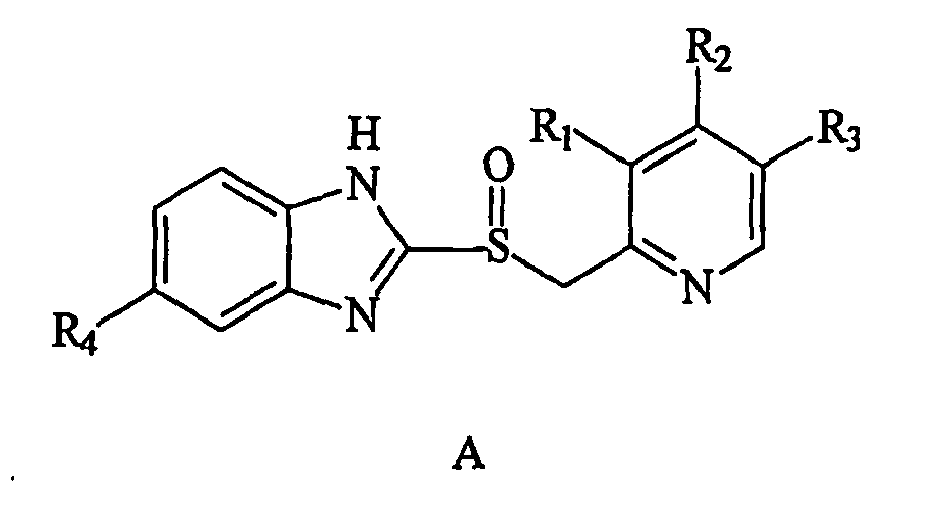
- The preparation of lansoprazole by conventional methods is always accompanied by the formation of small quantities of the corresponding sulfone derivative as an impurity. For example,
U.S. Pat. No. 6,180,652 ("the '652 patent") describes the presence of sulfone derivative. Formation of sulfone derivative brings about the drawback of low yield of the desired sulfoxide. The '652 patent describes a method that permits separation of lansoprazole from its sulfone derivative and discloses an acetone complex of the lansoprazole salt. -
U.S. Pat. No. 6,002,011 ("the '011 patent") discloses that lansoprazole and other 2-(2-pyridylmethyl) sulfinyl-benzimidazole derivatives tend to lose stability and decompose when contaminated with traces of residual solvent, particularly in their crystal structure. According to the '011 patent, the residual solvent must be reduced to a minimum and it discloses a water reslurry method which provides a 'solvent-free' lansoprazole said to be more stable. Specifically, it limits the lansoprazole content to no more than 500 ppm water and 200 ppm C1-6 alcohol. - The '011 patent also states that when an ethanol:water system is used to crystallize lansoprazole, it often contains solvent in excess of tolerable limits (i.e., more than 500 ppm water and more than 200 ppm alcohol) which causes the lansoprazole to be unstable. Efforts to eliminate this excessive solvent by intensive drying further destabilize the lansoprazole. As such, this prepared lansoprazole still contains intolerable levels of solvent and is unsuitable to be a pharmaceutical composition.
- Reducing water and ethanol to levels below the reported tolerable limits (i.e., more than 500 ppm water and more than 200 ppm alcohol) is both time-consuming and costly.
- In "Stabilization of a New Antiulcer Drug (Lansoprazole) in Solid Dosage Forms," by Tabata et al., Drug Development and Industrial Pharmacy, 18(13) 1437-47 (1992) (the 'Tabata article'), the mechanism of stabilization of lansoprazole in enteric granules is discussed. The Tabata article discloses that lansoprazole is unstable under conditions of high temperature and also high humidity, with a decrease in the amount of lansoprazole and discoloration of the material being noted on storage under such conditions. The variation in assay and color of solid lansoprazole over time on storage at various temperatures and humidities is presented in Table 2, at page 1439. The table shows that after 4 months at 40°C and 75% room humidity lansoprazole turns pale brown, and even in the absence of humidity under the same conditions, lansoprazole turns pale yellowish brown. The Tabata article explains the unusually high instability of lansoprazole under even weak acidic conditions as being due to proton attack on the sulfoxide group. Lansoprazole seems to be especially sensitive to such attack compared to the other members of the 2-(2-pyridylmethyl) sulfinyl-benzimidazole family of drugs.
- Lansoprazole is a relatively unstable compound, especially in acidic conditions, but also under strongly basic conditions. The Tabata article further discloses that degradation of lansoprazole is minimized under weakly basic conditions, and concludes that the degradation of lansoprazole in dosage forms is minimized by it being formulated to also contain stabilizing compounds suitable to produce such a weakly basic pH. The Tabata article, however, does not address the use of lansoprazole as an active pharmaceutical ingredient. As such, lansoprazole must be stored and transported, often for long time periods.
- There is a continuing need to obtain a stable 2-(2-pyridyhnethyl) sulfinyl-1H-benzimidazole (e.g., lansoprazole) that is free of contaminants (e.g., sulfone and sulfide derivatives) and a long-felt need for a pharmaceutical composition containing such a stable lansoprazole. In other words, the need exists for a stable form of lansoprazole, which does not suffer degradation and/or discoloration even if stored or transported under non-optimum conditions. The present invention provides such a stable lansoprazole compound and a method for its production.
- The present invention provides a stable lansoprazole compound, further comprising greater than 500 ppm and not more than about 3,000 ppm water. Preferably, the stable lansoprazole compound comprises greater than about 600 ppm and not more than about 3,000 ppm water.
- The present invention provides a stable lansoprazole compound, further comprising greater than 200 ppm and not more than about 5,000 ppm alcohol. Preferably, the stable lansoprazole compound comprises greater than about 300 ppm and not more than about 5,000 ppm alcohol.
- The present invention provides a stable lansoprazole compound, further comprising greater than 500 ppm and not more than about 3,000 ppm water and greater than than 200 ppm and not more than about 5,000 ppm alcohol.
- The present invention provides a method of preparing a stable lansoprazole compound, comprising the steps of:
- a) crystallizing a lansoprazole from an organic solvent or a mixture of organic solvent and water in the presence of an amine; and
- b) isolating a stable lansoprazole compound,
- Preferably, the method provides a stable lansoprazole compound, further comprises greater than about 600 ppm and not more than about 3,000 ppm water.
- The present invention provides a method of preparing a stable lansoprazole compound, comprising the steps of:
- a) crystallizing a lansoprazole from an organic solvent or a mixture of organic solvent and water in the presence of an amine; and
- b) isolating a stable lansoprazole compound,
- Preferably, the method provides a stable lansoprazole compound, further comprises greater than about 300 ppm and not more than about 5,000 ppm alcohol.
- The present invention provides a method of preparing a stable lansoprazole compound, comprising the steps of:
- a) crystallizing a lansoprazole from an organic solvent or a mixture of organic solvent and water in the presence of an amine; and
- b) isolating a stable lansoprazole compound,
- A method of purifying a lansoprazole compound, comprising the steps of:
- a) crystallizing a lansoprazole from an organic solvent or a mixture of organic solvent and water in the presence of an amine; and
- b) isolating a crystallized lansoprazole compound,
- Preferably, the method, after step a), further comprises the step of washing the crystallized lansoprazole compound in an acetone-water mixture. More preferably, the pH of the acetone-water mixture is adjusted to a pH of about 8 to about 10. More preferably, the pH of the acetone-water mixture is adjusted to a pH of 9.
- Preferably, the isolating step comprises the step of drying the crystallized lansoprazole compound in the presence of a weakly basic gas. More preferably, the weakly basic gas is ammonia or methylamine.
- The present invention also provides a pharmaceutical composition comprising a stable lansoprazole.
- More preferably, the present invention provides a stable lansoprazole compound that is substantially free of sulfone and sulfide (i.e., containing less than about 0.1 % (wt/wt) sulfone derivative and less than about 0.1 % (wt/wt) sulfide derivative).
- "LNPS" refers to the sulfide-containing starting compound for lansoprazole preparation. The chemical name for LNPS is 2-[[3-methyl-4-(2,2,2-trifluoroethoxy)-2-pyridyl]thio]-1H benzimidazole. "LNP" refers to lansoprazole which has the chemical name of 2-[[3-methyl-4-(2,2,2-trifluoroethoxy)-2-pyridyl]methyl]sulfinyl-1H benzimidazole. The present invention provides a lansoprazole substantially free of sulfone and sulfide (i.e., containing less than about 0.1 % (wt/wt) sulfone derivative and less than about 0.1 % (wt/wt) sulfide derivative). A "stable" lansoprazole refers to a lansoprazole that is stable (i.e., limited decomposition) under specified storage conditions (i.e., 2-8°C or 25°C at a relative humidity of up to 60% for a time period of up to about 6 months). In other words, a "stable" lansoprazole does not undergo discoloration and remains substantially free of sulfone and sulfide (i.e., containing less than about 0.1% (wt/wt) sulfone derivative and less than about 0.1% (wt/wt) sulfide derivative) under these specified storage conditions.
- Unless otherwise stated, % refers to % (wt/wt); "<" refers to less than; ">" refers to greater than; "ppm" refers to parts per million.
- The alcohol mentioned within this application includes C1-6 alcohols (e.g., methanol, ethanol, isopropyl alcohol, and the like.). Preferably, the alcohol is ethanol.
- In accordance with the present invention, 2-[[3-methyl-4-(2,2,2-trifluoro ethoxy)-2-pyridyl]thio]-1H benzimidazole is used as a starting material for preparation of 2-[[3-methyl-4-(2,2,2-trifluoroethoxy)-2-pyridyl]methyl]sulfinyl-1H benzimidazole and is dissolved in an organic solvent or a mixture of organic solvent with water.
- The exemplary organic solvents include C1-6 alcohol such as ethanol, methanol, n-propanol, and i-propanol, as well as dimethyl-carbonate, diethyl-carbonate, acetone, 2-butanone, dimethyl-formamide, tetrahydrofuran and mixtures thereof. Preferably, the organic solvent is ethanol.
- In the present invention, crystallization of lansoprazole in an organic solvent is performed in the presence of an amine to result in lansoprazole substantially free of sulfone and sulfide. An amine is an organic compound containing nitrogen, and includes any member of a group of chemical compounds formed from ammonia by replacement of one or more of the hydrogen atoms by organic (hydrocarbon) radicals. The amines may be primary, secondary or tertiary, dependent on whether one, or two or three hydrogen atoms are replaced. Exemplary amine compounds include ammonia, ammonium hydroxide, diethylamine, triethylamine, methylamine, diethanolamine, triethanolamine and mixtures thereof. Preferably, the amine is ammonium hydroxide.
- Preferably, ammonium hydroxide is present at a mol/mol ratio to lansoprazole of about 7 to about 1. Most preferably, the ammonium hydroxide is present at a mol/mol ratio to lansoprazole of greater than about 1. Crystallization of lansoprazole under such conditions permits a good separation of lansoprazole from impurities, especially sulfone and/or sulfide derivatives.
- In the present invention, precipitation of lansoprazole can be achieved by acidifying the solution of lansoprazole in organic solvent or a mixture of organic solvent and water. At lower temperatures, a partial precipitation of lansoprazole may take place even in the absence of an acid. The added acid can neutralize the ammonium hydroxide during the crystallization of lansoprazole.
- Exemplary acids used to crystallize lansoprazole include acetic acid, formic acid, hydrochloric acid (HCl) and mixtures thereof. Preferably, the acid is acetic acid.
- Although the lansoprazole obtained by the above-mentioned crystallization process can be advantageous, it cannot be dried to <0.1% water as required by the USP forum. As mentioned previously, water can have a negative impact on the long-term stability of lansoprazole (the '011 patent). The '011 patent explicitly states that lansoprazole containing water at a level more than 500 ppm is unstable; and lansoprazole containing ethanol at a level more than about 200 ppm is unstable. The '011 patent teaches the water content of lansoprazole can be reduced to by recrystallization from organic solvent.
- Preferably, the lansoprazole is completely dissolved in the solvent before recrystallization. The dissolution of lansoprazole can be accelerated by the presence of small amounts of water. The presence of water can be insured by using wet lansoprazole from the previously mentioned purification step or by adding <20% (vol/vol) water to the solvent.
- The dissolution of lansoprazole can be performed at the solvent reflux temperature. Preferred dissolution temperatures should be lower than the reflux temperature, given the instability of lansoprazole at higher temperatures. Preferably, the dissolution temperature does not exceed 50°C.
- According to the present invention, a lansoprazole compound that comprises either greater than 500 ppm and not more than about 3,000 ppm water, or greater than 200 ppm and not more than about 5,000 ppm alcohol or both, is stable during storage. Therefore, it is not necessary to continue the drying at elevated temperatures, which may adversely affect the purity of lansoprazole. Also, it is not necessary to reprocess lansoprazole by the additional steps such as disclosed in the '011 patent, which may adversely affect the overall yield of the preparation process.
- The crystallization yield of lansoprazole can be improved by cooling or by removing solvent or water from the crystallization system. One skilled in the art would appreciate the techniques that are used to remove water from a mixture of organic solvent and water, e.g., azeotropic distillation.
- Following crystallization, the precipitated lansoprazole may be washed prior to crystallization. Washing is carried out by use of an acetone-water mixture to which is added a sufficient amount of a weakly basic solution to bring the pH of the resulting washing solution to from about 8 to about 10. Most preferably, the pH of the washing solution is about 9. Other solvents that can be used include dimethyl-carbonate, diethyl-carbonate and mixtures thereof.
- Following washing, the precipitated lansoprazole may be dried by conventional means, taking into account that at elevated temperatures lansoprazole is unstable. In the present invention, the drying process is performed in the presence of a weakly basic gas. Preferably, a weakly basic gas may include ammonia, methylamine and mixtures thereof. More preferably, the weakly basic gas is ammonia.
- The present invention also provides a stable pharmaceutical formulation comprising a stable lansoprazole. When a lansoprazole compound further comprises either greater than 500 ppm and not more than about 3,000 ppm water, or greater than 200 ppm and not more than about 5,000 ppm ethanol, or both, this amount of water and ethanol actually stabilize the lansoprazole.
- In accordance with the present invention, the stable lansoprazole compound may be formulated into a variety of pharmaceutical compositions and dosage forms for therapeutic uses, especially for the treatment of stomach ulcers.
- In addition to the active ingredient(s), lansoprazole pharmaceutical compositions of the present invention may contain one or more pharmaceutically acceptable excipients. Excipients are added to the composition for a variety of purposes.
- Diluents increase the bulk of a solid pharmaceutical composition and may make a pharmaceutical dosage form containing the composition easier for the patient and caregiver to handle. Diluents for solid compositions include, for example, microcrystalline cellulose (e.g. AVICEL®, microfine cellulose, lactose, starch, pregelatinized starch, calcium carbonate, calcium sulfate, sugar, dextrates, dextrin, dextrose, dibasic calcium phosphate dihydrate, tribasic calcium phosphate, kaolin, magnesium carbonate, magnesium oxide, maltodextrin, mannitol, polymethacrylates (e.g. Eudragit®), potassium chloride, powdered cellulose, sodium chloride, sorbitol and talc.
- Solid pharmaceutical compositions that are compacted into a dosage form like a tablet may include excipients whose functions include helping to bind the active ingredient and other excipients together after compression. Binders for solid pharmaceutical compositions include acacia, alginic acid, carbomer (e.g. carbopol), carboxymethylcellulose sodium, dextrin, ethyl cellulose, gelatin, guar gum, hydrogenated vegetable oil, hydroxyethyl cellulose, hydroxypropyl cellulose (e.g. KLUCEL®), hydroxypropyl methyl cellulose (e.g. METHOCEL®), liquid glucose, magnesium aluminum silicate, maltodextrin, methylcellulose, polymethacrylates, povidone (e.g. KOLLIDON®, PLASDONE®), pregelatinized starch, sodium alginate and starch.
- The dissolution rate of a compacted solid pharmaceutical composition in the patient's stomach may be increased by the addition of a disintegrant to the composition. Disintegrants include alginic acid, carboxymethylcellulose calcium, carboxymethylcellulose sodium (e.g. AC-DI-SOL®, PRIMELLOSE®), colloidal silicon dioxide, croscarmellose sodium, crospovidone (e.g. KOLLIDON®, POLYPLASDONE®), guar gum, magnesium aluminum silicate, methyl cellulose, microcrystalline cellulose, polacrilin potassium, powdered cellulose, pregelatinized starch, sodium alginate, sodium starch glycolate (e.g. EXPLOTAB®) and starch.
- Glidants can be added to improve the flow properties of non-compacted solid compositions and improve the accuracy of dosing. Excipients that may function as glidants include colloidal silicon dioxide, magnesium trisilicate, powdered cellulose, starch, talc and tribasic calcium phosphate.
- When a dosage form such as a tablet is made by compaction of a powdered composition, the composition is subjected to pressure from a punch and die. Some excipients and active ingredients have a tendency to adhere to the surfaces of the punch and die, which can cause the product to have pitting and other surface irregularities. A lubricant can be added to the composition to reduce adhesion and ease release of the product from the die. Lubricants include magnesium stearate, calcium stearate, glyceryl monostearate, glyceryl palmitostearate, hydrogenated castor oil, hydrogenated vegetable oil, mineral oil, polyethylene glycol, sodium benzoate, sodium lauryl sulfate, sodium stearyl fumarate, stearic acid, talc and zinc stearate. Flavoring agents and flavor enhancers make the dosage form more palatable to the patient. Common flavoring agents and flavor enhancers for pharmaceutical products that may be included in the composition of the present invention include maltol, vanillin, ethyl vanillin, menthol, citric acid, fumaric acid ethyl maltol, and tartaric acid.
- Compositions may also be colored using any pharmaceutically acceptable colorant to improve their appearance and/or facilitate patient identification of the product and unit dosage level.
- Selection of excipients and the amounts to use may be readily determined by formulation scientists based upon experience and consideration of standard procedures and reference works in the field.
- The solid compositions of the present invention include powders, granulates, aggregates and compacted compositions. The dosages include dosages suitable for oral, buccal, rectal, parenteral (including subcutaneous, intramuscular, and intravenous), inhalant and ophthalmic administration. Although the most suitable route in any given case will depend on the nature and severity of the condition being treated, the most preferred route of the present invention is oral. The dosages may be conveniently presented in unit dosage form and prepared by any of the methods well-known in the pharmaceutical arts.
- Dosage forms include solid dosage forms like tablets, powders, capsules, suppositories, sachets, troches and lozenges as well as liquid syrups, suspensions and elixirs. An especially preferred dosage form of the present invention is a tablet.
- Tablets, capsules, lozenges and other unit dosage forms preferably contain lansoprazole in a dosage level of from about 50 to about 300 mg, more preferably about 200 mg.
- The following non-limiting examples illustrate the invention:
- Into a flask, 1 L ethanol (95%) was charged and cooled under stirring to 5°C. Under mixing, 200 grams 2-[[3-methyl-4-(2,2,2-trifluoroethoxy)-2-pyridyl]thio]-1H benzimidazole (LNPS) and 3 grams vanadium acetyl acetonate were added. 110 grams tert-butylhydroperoxide solution was dropped slowly into the suspension. The suspension was maintained under mixing for 6 hours.
- 40 grams Na2SO3 dissolved in 400 ml water were added. 1 L of water (pH=8-8.5, realized by the addition of NH4OH) was added. The suspension was further mixed for 17 hours at 25°C. The suspension was then cooled to 5°C. The solid phase was separated by vacuum filtration and then was dried. 178 grams of LNP crude was obtained (yield: 85 %).
Sulfone: 0.15% (wt/wt)
LNPS: 0.3% (wt/wt) - In a 0.25 L flask, 67.5 ml ethanol (95%), 15 ml ammonia (24%) and 45 ml water were charged. The suspension was cooled under stirring to 5°C. Under mixing, 10 grams lansoprazole crude were added and heated to 52°C until dissolved. 1 gram of active carbon was added to the slightly turbid solution and maintained for a short time at 49°C.
- The active carbon was then separated on a filter and the cake was washed with a mixture of 14 ml ethanol and 12 ml water. The solution was cooled and lansoprazole was precipitated by the addition of 3.75 ml acetic acid. The suspension was then cooled to 10°C and filtered.
- The product (wet lansoprazole) was washed with water and ethanol. Subsequently, the washed wet lansoprazole product was dried (vacuum/50°C/17 hours). 8.7 grams of lansoprazole (pure) was obtained (yield: 89%).
Sulfone: 0.05% (wt/wt)
LNPS: below the detection limit. - Water content as determined by Karl Fisher (KF) method was 2,200 ppm. The product of Example 2 cannot be dried to <0.1% (wt/wt) water but can be dried to about 0.18% (wt/wt) water.
- Alcohol content as determined by gas chromatography (GC) was < 50 ppm.
- The obtained lansoprazole is stable. The stability of the lansoprazole was determined at different temperatures and relative humidities as shown in Table 1.
Table 1 Stability of Lansoprazole under Different Conditions Time Temperature Humidity LNP-SO21 LNPS2 Total Impurities °C % % % % 0 - - 0.04 < detection limit 0.04 2 weeks 25 60 0.04 < detection limit 0.04 1 month 2-8 - 0.04 0.01 0.05 25 60 0.04 0.01 0.09 2 month 2-8 - 0.04 0.01 0.05 25 60 0.04 0.01 0.08 3 month 2-8 - 0.04 < detection limit 0.04 25 60 0.04 < detection limit 0.1 6 month 2-8 - 0.04 < detection limit 0.04 25 60 0.04 < detection limit 0.12 9 month 2-8 - 0.05 < detection limit 0.05 25 60 0.05 0.04 0.18 12 month 2-8 - - < detection limit 0.03 25 60 0.04 0.07 0.32 12-[[3-methyl-4-(2,2,2-trifluorethoxy)-2-pyridyl]surfonyl]-1H benzimidazole
22-[[3-methyl-4-(2,2,2-trifluoroethoxy)-2-pyridyl]thio]-1H benzimidazole - Chromatographic purity method of lansoprazole is detailed in the monograph in USP Forum Vol.26(5) [Sept.-Oct. 2000 ].
-
Column: C18 Mobile phase: Gradient of triethylamine in water with acetonitrile Flow: 0.8ml/min Detection: 285nm - Karl Fisher (KF) method for water determination is the USP method <921> Ia with the solvent:pyridine and ethylene glycol 9:1 as detailed in USP Forum Vol.26(5) [Sept.-Oct. 2000 ].
- In a 0.25L flask, 67.5ml ethanol (95%), 15ml ammonia (24%) and 45ml water were charged. The suspension was cooled under stirring to 5°C. Under mixing, 10 grams lansoprazole crude were added and heated to 52°C until dissolved. 1 gram of active carbon was added to the slightly turbid solution and maintained for a short time at 49°C.
- The active carbon was then separated on a filter and the cake was washed with a mixture of 14ml ethanol and 12 ml water. The solution was cooled and lansoprazole was precipitated by the addition of 3.75ml acetic acid. The suspension was then cooled to 10°C and filtered.
- The wet lansoprazole product was washed with water and ethanol. Subsequently, the washed wet lansoprazole product was subjected to the following drying conditions:
Experiment no Drying conditions Water content (by KF) ppm 3(a) Vacuum/40°C/17 hours 2,700 3(b) Vacuum/44°C/24 hours 2,300 3(c) Similar to Example 5 (see below) (under vacuum in the presence of a weak NH3 flow at 45°C) 1,800 3(d) Similar to Example 5 (see below) but i-propanol instead of ethanol in crystallization 2,500 3(e) Suspension in toluene and azeotropic removal of water 2,900 3(f) Dry distillation of solvent 1,900 - In this experiment, the same procedure as in Example 2 is repeated up to the washing step of the wet lansoprazole (i.e., prior to the drying step). The water and alcohol contents of the obtained wet lansoprazole product are determined (prior to the drying step). The water content should be about 2,200 ppm, and the content of ethanol should be about 300 ppm to about 500 ppm. The wet lansoprazole product should behave similarly to the dry lansoprazole as detailed in Example 2 with respect to stability.
- Into a 0.25L flask was charged 29.8 grams wet lansoprazole, prepared according to Example 2, and 30ml acetone. The suspension was heated to 52°C and 150ml acetone added dropped until a clear solution was obtained. The solution was cooled to 10°C and concentrated until the weight of the reaction mass was 48.5 grams. The solid was separated by filtration and washed with 20ml cold acetone water mixture, the pH of which was corrected to 9±1 by addition of ammonium hydroxide solution (25%). Lansoprazole was dried under vacuum in the presence of a weak NH3 flow at 45 °C.
18.58 grams product was obtained (yield 91 %)
Water content: 0.05 % (wt/wt), by Karl Fischer method.
The water content of additional dried lansoprazole samples (obtained by repeating the procedure in this example) was further determined to be within the range of about 200 ppm to about 800 ppm (i.e., less than about 1,000 ppm). - The stability of the lansoprazole was further determined at different temperatures and relative humidities as shown in Table 2:
Table 2: Stability of Stabilized vs. Non-Stabilized 'Solvent-Free' Lansoprazole Time Temperature Humidity LNP-SO21 LNPS2 Total Impurities Color °C % % % % Lansoprazole Not Stabilized With Ammonia 3 months 40 75 0.04 0.06 0.31 Brownish Lansoprazole Stabilized With Ammonia 3 months 40 75 0.02 0.03 0.08 White 12-[[3-methyl-4-(2,2,2-trifluoroethoxy)-2-pyridyl]sulfonyl]-1H benzimidazole
22-[[3-methyl-4-(2,2,2-trifluoroethoxy)-2-pyridyl]thio]-1H benzimidazole - Chromatographic purity method of lansoprazole is detailed in the monograph in USP Forum Vol.26(5) [Sept.-Oct. 2000 ].
-
Column: C18 Mobile phase: Gradient of triethylamine in water with acetonitrile Flow: 0.8 ml/min Detection: 285 nm - Karl Fisher (KF) method for water determination is the USP method <921 > Ia with the solvent:pyridine and ethylene glycol 9:1 as detailed in USP Forum Vol.26(5) [Sept.-Oct. 2000 ].
- Other solvents that can be used in lieu of acetone include dimethyl-carbonate and diethyl-carbonate.
- A number of embodiments of the invention have been described. The present invention is not to be limited in scope by the specific embodiments described herein. It will be understood that various modifications may be made without departing from the spirit and scope of the invention. Various publications and patents are cited herein, the disclosures of which are incorporated by reference in their entireties.
- Further particular and preferred aspects of the invention are set out in the accompanying independent and dependent clauses. Features of the dependent clauses may be combined with those of the independent clauses and/or independent clauses as appropriate and in combinations other than those explicitly set out in the clauses and clauses.
- 1. A stable lansoprazole compound, further comprising greater than 500 ppm and not more than about 3,000 ppm water.
- 2. The stable lansoprazole compound of clause 1, wherein the stable lansoprazole compound comprises greater than about 600 ppm and not more than about 3,000 ppm water.
- 3. A stable lansoprazole compound, further comprising greater than 200 ppm and not more than about 5,000 ppm alcohol.
- 4. The stable lansoprazole compound of clause 3, wherein the stable lansoprazole compound comprises greater than about 300 ppm and not more than about 5,000 ppm alcohol.
- 5. A stable lansoprazole compound, further comprising greater than 500 ppm and not more than about 3,000 ppm water, and greater than 200 ppm and not more than about 5,000 alcohol.
- 6. The stable lansoprazole compound as in one of clauses 1 to 5, further comprising less than about 0.1 % (wt/wt) sulfone derivative and less than about 0.1 % (wt/wt) sulfide derivative.
- 7. The stable lansoprazole compound as in one of clauses 1 to 5, wherein the lansoprazole compound is stable under 2-8°C or 25°C at a relative humidity of up to 60% for a time period of up to about 6 months.
- 8. A method of preparing a stable lansoprazole compound, comprising the steps of:
- a) crystallizing a lansoprazole from an organic solvent or a mixture of organic solvent and water in the presence of an amine; and
- b) isolating a stable lansoprazole compound,
- 9. The method of clause 8, wherein the stable lansoprazole compound comprises greater than about 600 ppm and not more than about 3,000 ppm water.
- 10. A method of preparing a stable lansoprazole compound, comprising the steps of:
- a) crystallizing a lansoprazole from an organic solvent or a mixture of organic solvent and water in the presence of an amine; and
- b) isolating a stable lansoprazole compound,
- 11. The method of clause 10, wherein the stable lansoprazole compound comprises greater than about 300 ppm and not more than about 5,000 ppm alcohol.
- 12. A method of preparing a stable lansoprazole compound, comprising the steps of:
- a) crystallizing a lansoprazole from an organic solvent or a mixture of organic solvent and water in the presence of an amine; and
- b) isolating a stable lansoprazole compound,
- 13. The method as in any one of clauses 8 to 12, wherein the organic solvent is at least one solvent selected from the group consisting of ethanol, methanol, n-propanol, i-propanol, dimethyl-carbonate, diethyl-carbonate, acetone, 2-butanone, dimethyl-formamide and tetrahydrofuran.
- 14. The method as in any one of clauses 8 to 12, wherein the organic solvent is ethanol.
- 15. The method as in any one of clauses 8 to 12, wherein the amine at least one compound selected from the group consisting of ammonia, ammonium hydroxide, diethylamine, triethylamine, methylamine, diethanolamine, and triethanolamine.
- 16. The method as in any one of clauses 8 to 12, wherein the amine is ammonium hydroxide.
- 17. The method of clause 16, wherein the ammonium hydroxide is present at a mol/mol ratio to lansoprazole of about 7 to about 1.
- 18. The method of clause 17, wherein the ammonium hydroxide is present at a mol/mol ratio to lansoprazole is greater than about 1.
- 19. The method as in any one of clauses 8 to 12, wherein the crystallizing step is achieved by acidifying the lansoprazole solution with an acid.
- 20. The method of clause 19, wherein the acid is at least one acid selected from the group consisting of acetic acid, formic acid, and hydrochloric acid.
- 21. The method of clause 19, wherein the acid is acetic acid.
- 22. The method as in any one of clauses 8 to 12, wherein the stable lansoprazole compound further comprises less than about 0.1% (wt/wt) sulfone derivative and less than about 0.1% (wt/wt) sulfide derivative.
- 23. A method of purifying a lansoprazole compound, comprising the steps of:
- a) crystallizing a lansoprazole from an organic solvent or a mixture of organic solvent and water in the presence of an amine; and
- b) isolating a crystallized lansoprazole compound,
- 24. The method of clause 23, after step a), further comprising the step of washing the crystallized lansoprazole compound in an acetone-water mixture.
- 25. The method of clause 24, wherein the acetone-water mixture is adjusted to a pH of about 8 to about 10.
- 26. The method of clause 24, wherein the acetone-water mixture is adjusted to a pH of about 9.
- 27. The method of clause 23, wherein the isolating step comprises drying drying the crystallized lansoprazole compound in the presence of a weakly basic gas.
- 28. The method of clause 27, wherein the weakly basic gas is ammonia or methylamine.
- 29. A pharmaceutical composition comprising a stable lansoprazole compound of any one of clauses 1 to 7 or prepared by a method defined in any one of clauses 8 to 28.
- 30. The pharmaceutical composition as in clause 29, wherein the pharmaceutical composition is in a dosage form selected from the group consisting of tablets, powders, capsules, suppositories, sachets, troches, lozenges, liquid syrups, suspensions and elixirs.
- 31. The pharmaceutical composition of clause 29, wherein the pharmaceutical composition is a tablet.
- 32. The pharmaceutical composition of clause 29, wherein the pharmaceutical composition comprises lansoprazole in a dosage level of from about 50 to about 300 mg.
- 33. The pharmaceutical composition of clause 29, wherein the pharmaceutical composition comprises lansoprazole in a dosage level of about 200 mg.
Claims (21)
- A stable lansoprazole compound, further comprising greater than 500 ppm and not more than about 3,000 ppm water.
- The stable lansoprazole compound of claim 1, wherein the stable lansoprazole compound comprises greater than about 600 ppm and not more than about 3,000 ppm water.
- A stable lansoprazole compound, further comprising greater than 200 ppm and not more than about 5,000 ppm alcohol.
- The stable lansoprazole compound of claim 3, wherein the stable lansoprazole compound comprises greater than about 300 ppm and not more than about 5,000 ppm alcohol.
- A stable lansoprazole compound, further comprising greater than 500 ppm and not more than about 3,000 ppm water, and greater than 200 ppm and not more than about 5,000 alcohol.
- The stable lansoprazole compound as in one of claims 1 to 5, further comprising less than about 0.1 % (wt/wt) sulfone derivative and less than about 0.1 % (wt/wt) sulfide derivative.
- The stable lansoprazole compound as in one of claims 1 to 5, wherein the lansoprazole compound is stable under 2-8°C or 25°C at a relative humidity of up to 60% for a time period of up to about 6 months.
- A stable lansoprazole compound comprising greater than 500 ppm, preferably greater than about 600 ppm, and not more than about 3,000 ppm water obtainable by a method comprising the steps of:a) crystallizing a lansoprazole from an organic solvent or a mixture of organic solvent and water in the presence of an amine; andb) isolating a stable lansoprazole compound.
- A stable lansoprazole compound comprising greater than 200 ppm, preferably greater than 300 ppm, and not more than about 5,000 ppm alcohol obtainable by a method comprising the steps of:a) crystallizing a lansoprazole from an organic solvent or a mixture of organic solvent and water in the presence of an amine; andb) isolating a stable lansoprazole compound.
- A stable lansoprazole compound comprising greater than 500 ppm and not more than about 3,000 water, and greater than 200 ppm, and not more than about 5,000 ppm alcohol obtainable by a method comprising the steps of:a) crystallizing a lansoprazole from an organic solvent or a mixture of organic solvent and water in the presence of an amine; andb) isolating a stable lansoprazole compound.
- The stable lansoprazole compound according to any of claims 8 to 10, wherein the organic solvent is at least one solvent selected from the group consisting of ethanol, methanol, n-propanol, i-propanol, dimethyl-carbonate, diethyl-carbonate, acetone, 2-butanone, dimethyl-formamide and tetrahydrofuran, preferably the organic solvent is ethanol.
- The stable lansoprazole compound according to any of claims 8 to 10, wherein the amine at least one compound selected from the group consisting of ammonia, ammonium hydroxide, diethylamine, triethylamine, methylamine, diethanolamine, and triethanolamine, preferably the amine is ammonium hydroxide.
- The stable lansoprazole compound according to claim 12, wherein the ammonium hydroxide is present at a mol/mol ratio to lansoprazole of about 7 to about 1, preferably the ammonium hydroxide is present at a mol/mol ratio to lansoprazole is greater than about 1.
- The stable lansoprazole compound according to any of claims 8 to 10, wherein the crystallizing step is achieved by acidifying the lansoprazole solution with an acid.
- The stable lansoprazole compound according to claim 14, wherein the acid is at least one acid selected from the group consisting of acetic acid, formic acid, and hydrochloric acid, preferably the acid is acetic acid.
- The stable lansoprazole compound according to claims 8 to 10, wherein the stable lansoprazole compound further comprises less than about 0.1% (wt/wt) sulfone derivative and less than about 0.1 % (wt/wt) sulfide derivative.
- A lansoprazole compound comprising less than about 0.1 % (wt/wt) sulfone derivative and less than about 0.1 % sulfide derivative (wt/wt) obtainable by a method comprising the steps of:a) crystallizing a lansoprazole from an organic solvent or a mixture of organic solvent and water in the presence of an amine; andb) isolating a crystallized lansoprazole compound.
- The lansoprazole compound of claim 17, wherein after step a), further comprising the step of washing the crystallized lansoprazole compound in an acetone-water mixture.
- The lansoprazole compound of claim 18, wherein the acetone-water mixture is adjusted to a pH of about 8 to about 10, preferably about 9.
- The lansoprazole compound of claim 17, wherein the isolating step comprises drying the crystallized lansoprazole compound in the presence of a weakly basic gas, preferably the weakly basic gas is ammonia or methylamine.
- A pharmaceutical composition comprising a lansoprazole compound of any one of claims 1 to 20.
Applications Claiming Priority (3)
| Application Number | Priority Date | Filing Date | Title |
|---|---|---|---|
| US42758902P | 2002-11-18 | 2002-11-18 | |
| US44521903P | 2003-02-05 | 2003-02-05 | |
| EP03789888A EP1465890B1 (en) | 2002-11-18 | 2003-11-18 | Stable lansoprazole containing more than 500 ppm, up to about 3,000 ppm water and more than 200 ppm, up to about 5,000 ppm alcohol |
Related Parent Applications (1)
| Application Number | Title | Priority Date | Filing Date |
|---|---|---|---|
| EP03789888A Division EP1465890B1 (en) | 2002-11-18 | 2003-11-18 | Stable lansoprazole containing more than 500 ppm, up to about 3,000 ppm water and more than 200 ppm, up to about 5,000 ppm alcohol |
Publications (1)
| Publication Number | Publication Date |
|---|---|
| EP1743893A1 true EP1743893A1 (en) | 2007-01-17 |
Family
ID=37507415
Family Applications (1)
| Application Number | Title | Priority Date | Filing Date |
|---|---|---|---|
| EP06076730A Withdrawn EP1743893A1 (en) | 2002-11-18 | 2003-11-18 | Stable lansoprazole containing more than 500 ppm, up to about 3,000 ppm water and more than 200 ppm, up to about 5,000 ppm alcohol |
Country Status (1)
| Country | Link |
|---|---|
| EP (1) | EP1743893A1 (en) |
Citations (4)
| Publication number | Priority date | Publication date | Assignee | Title |
|---|---|---|---|---|
| US4628098A (en) | 1984-08-16 | 1986-12-09 | Takeda Chemical Industries, Ltd. | 2-[2-pyridylmethylthio-(sulfinyl)]benzimidazoles |
| US6002011A (en) | 1996-11-14 | 1999-12-14 | Takeda Chemical Industries, Ltd. | Crystals of benzimidazole derivatives and their production |
| US6180652B1 (en) | 1998-11-16 | 2001-01-30 | Eisai Co., Ltd. | Sulfoxide compounds and acetone complexes, and a process for producing the same |
| US6268502B1 (en) * | 1998-07-13 | 2001-07-31 | Lek, Tovarna Farmacevtskih In Kemicnih Izdelkov. D.D. | Process of synthesis of 5-methoxy- 2-[(4-methoxy-3,5-dimethy-2-pyridyl)methyl]sulfiny-1h-benzimidazole |
-
2003
- 2003-11-18 EP EP06076730A patent/EP1743893A1/en not_active Withdrawn
Patent Citations (4)
| Publication number | Priority date | Publication date | Assignee | Title |
|---|---|---|---|---|
| US4628098A (en) | 1984-08-16 | 1986-12-09 | Takeda Chemical Industries, Ltd. | 2-[2-pyridylmethylthio-(sulfinyl)]benzimidazoles |
| US6002011A (en) | 1996-11-14 | 1999-12-14 | Takeda Chemical Industries, Ltd. | Crystals of benzimidazole derivatives and their production |
| US6268502B1 (en) * | 1998-07-13 | 2001-07-31 | Lek, Tovarna Farmacevtskih In Kemicnih Izdelkov. D.D. | Process of synthesis of 5-methoxy- 2-[(4-methoxy-3,5-dimethy-2-pyridyl)methyl]sulfiny-1h-benzimidazole |
| US6180652B1 (en) | 1998-11-16 | 2001-01-30 | Eisai Co., Ltd. | Sulfoxide compounds and acetone complexes, and a process for producing the same |
Non-Patent Citations (3)
| Title |
|---|
| TABATA: "Stabilization of a New Antiulcer Drug (Lansoprazole) in Solid Dosage Forms", DRUG DEVELOPMENT AND INDUSTRIAL PHARMACY, vol. 18, no. 13, 1992, pages 1437 - 47 |
| TETSURO TABATA ET AL: "STABILIZATION OF A NEW ANTIULCER DRUG (LANSOPRAZOLE) IN THE SOLID DOSAGE FORMS", DRUG DEVELOPMENT AND INDUSTRIAL PHARMACY, NEW YORK, NY, US, vol. 18, no. 13, 1992, pages 1437 - 1447, XP002921226, ISSN: 0363-9045 * |
| USP FORUM, vol. 26, no. 5, September 2000 (2000-09-01) |
Similar Documents
| Publication | Publication Date | Title |
|---|---|---|
| US20110021567A1 (en) | Preparation of lenalidomide | |
| US20040010151A1 (en) | Lansoprazole polymorphs and processes for preparation thereof | |
| SK2802001A3 (en) | Crystalline forms of eto2c-ch2-(r)cgl-aze-pab-oh | |
| EP1501824B1 (en) | A method for the purification of lansoprazole | |
| JP2007145872A (en) | Method of stabilizing lansoprazole | |
| US7683080B2 (en) | Stable iansoprazole containing more than 500 ppm, up to about 3,000 ppm water and more than 200 ppm, up to about 5,000 ppm alcohol | |
| US20060135565A1 (en) | Crystalline form of rabeprazole sodium | |
| US9034904B2 (en) | Forms of dexlansoprazole and processes for the preparation thereof | |
| CA2504796A1 (en) | Polymorphs of pantoprazole sodium salt and process for the preparation thereof | |
| WO2006035452A1 (en) | Novel pseudomorph of valaciclovir hydrochloride | |
| EP1764364A1 (en) | A method for the purification of lansoprazole |
Legal Events
| Date | Code | Title | Description |
|---|---|---|---|
| PUAI | Public reference made under article 153(3) epc to a published international application that has entered the european phase |
Free format text: ORIGINAL CODE: 0009012 |
|
| 17P | Request for examination filed |
Effective date: 20061005 |
|
| AC | Divisional application: reference to earlier application |
Ref document number: 1465890 Country of ref document: EP Kind code of ref document: P |
|
| AK | Designated contracting states |
Kind code of ref document: A1 Designated state(s): AT BE BG CH CY CZ DE DK EE ES FI FR GB GR HU IE IT LI LU MC NL PT RO SE SI SK TR |
|
| RIN1 | Information on inventor provided before grant (corrected) |
Inventor name: SINGER, CLAUDE Inventor name: LIBERMAN, ANITA Inventor name: VEINBERG, IRENA |
|
| 17Q | First examination report despatched |
Effective date: 20070816 |
|
| AKX | Designation fees paid |
Designated state(s): AT BE BG CH CY CZ DE DK EE ES FI FR GB GR HU IE IT LI LU MC NL PT RO SE SI SK TR |
|
| STAA | Information on the status of an ep patent application or granted ep patent |
Free format text: STATUS: THE APPLICATION IS DEEMED TO BE WITHDRAWN |
|
| 18D | Application deemed to be withdrawn |
Effective date: 20100918 |