EP1742957B1 - Process for the preparation of telithromycin - Google Patents
Process for the preparation of telithromycin Download PDFInfo
- Publication number
- EP1742957B1 EP1742957B1 EP05775551A EP05775551A EP1742957B1 EP 1742957 B1 EP1742957 B1 EP 1742957B1 EP 05775551 A EP05775551 A EP 05775551A EP 05775551 A EP05775551 A EP 05775551A EP 1742957 B1 EP1742957 B1 EP 1742957B1
- Authority
- EP
- European Patent Office
- Prior art keywords
- formula
- acid
- butyl
- carried out
- alcohol
- Prior art date
- Legal status (The legal status is an assumption and is not a legal conclusion. Google has not performed a legal analysis and makes no representation as to the accuracy of the status listed.)
- Expired - Lifetime
Links
- 238000000034 method Methods 0.000 title claims abstract description 86
- 238000002360 preparation method Methods 0.000 title claims abstract description 34
- LJVAJPDWBABPEJ-PNUFFHFMSA-N telithromycin Chemical compound O([C@@H]1[C@@H](C)C(=O)[C@@H](C)C(=O)O[C@@H]([C@]2(OC(=O)N(CCCCN3C=C(N=C3)C=3C=NC=CC=3)[C@@H]2[C@@H](C)C(=O)[C@H](C)C[C@@]1(C)OC)C)CC)[C@@H]1O[C@H](C)C[C@H](N(C)C)[C@H]1O LJVAJPDWBABPEJ-PNUFFHFMSA-N 0.000 title claims description 42
- 229960003250 telithromycin Drugs 0.000 title claims description 42
- 150000001875 compounds Chemical class 0.000 claims abstract description 78
- KXDHJXZQYSOELW-UHFFFAOYSA-M Carbamate Chemical compound NC([O-])=O KXDHJXZQYSOELW-UHFFFAOYSA-M 0.000 claims abstract description 67
- 125000002962 imidazol-1-yl group Chemical group [*]N1C([H])=NC([H])=C1[H] 0.000 claims abstract description 62
- 125000000484 butyl group Chemical group [H]C([*])([H])C([H])([H])C([H])([H])C([H])([H])[H] 0.000 claims abstract description 52
- 229960002626 clarithromycin Drugs 0.000 claims abstract description 32
- 150000003839 salts Chemical class 0.000 claims abstract description 7
- OKKJLVBELUTLKV-UHFFFAOYSA-N Methanol Chemical compound OC OKKJLVBELUTLKV-UHFFFAOYSA-N 0.000 claims description 72
- ZMXDDKWLCZADIW-UHFFFAOYSA-N N,N-Dimethylformamide Chemical compound CN(C)C=O ZMXDDKWLCZADIW-UHFFFAOYSA-N 0.000 claims description 69
- LFQSCWFLJHTTHZ-UHFFFAOYSA-N Ethanol Chemical compound CCO LFQSCWFLJHTTHZ-UHFFFAOYSA-N 0.000 claims description 66
- WEVYAHXRMPXWCK-UHFFFAOYSA-N Acetonitrile Chemical compound CC#N WEVYAHXRMPXWCK-UHFFFAOYSA-N 0.000 claims description 42
- 239000000203 mixture Substances 0.000 claims description 42
- DKGAVHZHDRPRBM-UHFFFAOYSA-N Tert-Butanol Chemical compound CC(C)(C)O DKGAVHZHDRPRBM-UHFFFAOYSA-N 0.000 claims description 37
- XLYOFNOQVPJJNP-UHFFFAOYSA-N water Substances O XLYOFNOQVPJJNP-UHFFFAOYSA-N 0.000 claims description 36
- KFZMGEQAYNKOFK-UHFFFAOYSA-N Isopropanol Chemical compound CC(C)O KFZMGEQAYNKOFK-UHFFFAOYSA-N 0.000 claims description 34
- CSCPPACGZOOCGX-UHFFFAOYSA-N Acetone Chemical compound CC(C)=O CSCPPACGZOOCGX-UHFFFAOYSA-N 0.000 claims description 33
- XEKOWRVHYACXOJ-UHFFFAOYSA-N Ethyl acetate Chemical compound CCOC(C)=O XEKOWRVHYACXOJ-UHFFFAOYSA-N 0.000 claims description 32
- 239000002798 polar solvent Substances 0.000 claims description 31
- IAZDPXIOMUYVGZ-UHFFFAOYSA-N Dimethylsulphoxide Chemical compound CS(C)=O IAZDPXIOMUYVGZ-UHFFFAOYSA-N 0.000 claims description 30
- ZMANZCXQSJIPKH-UHFFFAOYSA-N Triethylamine Chemical compound CCN(CC)CC ZMANZCXQSJIPKH-UHFFFAOYSA-N 0.000 claims description 30
- VEXZGXHMUGYJMC-UHFFFAOYSA-N Hydrochloric acid Chemical compound Cl VEXZGXHMUGYJMC-UHFFFAOYSA-N 0.000 claims description 29
- LRHPLDYGYMQRHN-UHFFFAOYSA-N N-Butanol Chemical compound CCCCO LRHPLDYGYMQRHN-UHFFFAOYSA-N 0.000 claims description 29
- BDERNNFJNOPAEC-UHFFFAOYSA-N propan-1-ol Chemical compound CCCO BDERNNFJNOPAEC-UHFFFAOYSA-N 0.000 claims description 28
- 239000002904 solvent Substances 0.000 claims description 27
- GQHTUMJGOHRCHB-UHFFFAOYSA-N 2,3,4,6,7,8,9,10-octahydropyrimido[1,2-a]azepine Chemical compound C1CCCCN2CCCN=C21 GQHTUMJGOHRCHB-UHFFFAOYSA-N 0.000 claims description 24
- WFDIJRYMOXRFFG-UHFFFAOYSA-N Acetic anhydride Chemical compound CC(=O)OC(C)=O WFDIJRYMOXRFFG-UHFFFAOYSA-N 0.000 claims description 24
- WYURNTSHIVDZCO-UHFFFAOYSA-N Tetrahydrofuran Chemical compound C1CCOC1 WYURNTSHIVDZCO-UHFFFAOYSA-N 0.000 claims description 22
- 239000002253 acid Substances 0.000 claims description 21
- SECXISVLQFMRJM-UHFFFAOYSA-N N-Methylpyrrolidone Chemical compound CN1CCCC1=O SECXISVLQFMRJM-UHFFFAOYSA-N 0.000 claims description 20
- JGFZNNIVVJXRND-UHFFFAOYSA-N N,N-Diisopropylethylamine (DIPEA) Chemical compound CCN(C(C)C)C(C)C JGFZNNIVVJXRND-UHFFFAOYSA-N 0.000 claims description 18
- 229960004592 isopropanol Drugs 0.000 claims description 17
- YYROPELSRYBVMQ-UHFFFAOYSA-N 4-toluenesulfonyl chloride Chemical compound CC1=CC=C(S(Cl)(=O)=O)C=C1 YYROPELSRYBVMQ-UHFFFAOYSA-N 0.000 claims description 16
- CTSLXHKWHWQRSH-UHFFFAOYSA-N oxalyl chloride Chemical compound ClC(=O)C(Cl)=O CTSLXHKWHWQRSH-UHFFFAOYSA-N 0.000 claims description 16
- 238000007254 oxidation reaction Methods 0.000 claims description 16
- LYCAIKOWRPUZTN-UHFFFAOYSA-N Ethylene glycol Chemical compound OCCO LYCAIKOWRPUZTN-UHFFFAOYSA-N 0.000 claims description 15
- PEDCQBHIVMGVHV-UHFFFAOYSA-N Glycerine Chemical compound OCC(O)CO PEDCQBHIVMGVHV-UHFFFAOYSA-N 0.000 claims description 15
- JRNVZBWKYDBUCA-UHFFFAOYSA-N N-chlorosuccinimide Chemical compound ClN1C(=O)CCC1=O JRNVZBWKYDBUCA-UHFFFAOYSA-N 0.000 claims description 15
- DNIAPMSPPWPWGF-UHFFFAOYSA-N Propylene glycol Chemical compound CC(O)CO DNIAPMSPPWPWGF-UHFFFAOYSA-N 0.000 claims description 15
- 239000003153 chemical reaction reagent Substances 0.000 claims description 15
- 230000003647 oxidation Effects 0.000 claims description 15
- QAOWNCQODCNURD-UHFFFAOYSA-N Sulfuric acid Chemical compound OS(O)(=O)=O QAOWNCQODCNURD-UHFFFAOYSA-N 0.000 claims description 13
- 239000007800 oxidant agent Substances 0.000 claims description 13
- 230000001590 oxidative effect Effects 0.000 claims description 11
- 125000006239 protecting group Chemical group 0.000 claims description 11
- YLQBMQCUIZJEEH-UHFFFAOYSA-N tetrahydrofuran Natural products C=1C=COC=1 YLQBMQCUIZJEEH-UHFFFAOYSA-N 0.000 claims description 11
- ZWEHNKRNPOVVGH-UHFFFAOYSA-N 2-Butanone Chemical compound CCC(C)=O ZWEHNKRNPOVVGH-UHFFFAOYSA-N 0.000 claims description 10
- KRHYYFGTRYWZRS-UHFFFAOYSA-N Fluorane Chemical compound F KRHYYFGTRYWZRS-UHFFFAOYSA-N 0.000 claims description 10
- ZHNUHDYFZUAESO-UHFFFAOYSA-N Formamide Chemical compound NC=O ZHNUHDYFZUAESO-UHFFFAOYSA-N 0.000 claims description 10
- FXHOOIRPVKKKFG-UHFFFAOYSA-N N,N-Dimethylacetamide Chemical compound CN(C)C(C)=O FXHOOIRPVKKKFG-UHFFFAOYSA-N 0.000 claims description 10
- AMQJEAYHLZJPGS-UHFFFAOYSA-N N-Pentanol Chemical compound CCCCCO AMQJEAYHLZJPGS-UHFFFAOYSA-N 0.000 claims description 10
- ATHHXGZTWNVVOU-UHFFFAOYSA-N N-methylformamide Chemical compound CNC=O ATHHXGZTWNVVOU-UHFFFAOYSA-N 0.000 claims description 10
- ISWSIDIOOBJBQZ-UHFFFAOYSA-N Phenol Chemical compound OC1=CC=CC=C1 ISWSIDIOOBJBQZ-UHFFFAOYSA-N 0.000 claims description 10
- NBIIXXVUZAFLBC-UHFFFAOYSA-N Phosphoric acid Chemical compound OP(O)(O)=O NBIIXXVUZAFLBC-UHFFFAOYSA-N 0.000 claims description 10
- XBDQKXXYIPTUBI-UHFFFAOYSA-M Propionate Chemical compound CCC([O-])=O XBDQKXXYIPTUBI-UHFFFAOYSA-M 0.000 claims description 10
- PFKFTWBEEFSNDU-UHFFFAOYSA-N carbonyldiimidazole Chemical compound C1=CN=CN1C(=O)N1C=CN=C1 PFKFTWBEEFSNDU-UHFFFAOYSA-N 0.000 claims description 10
- GUVUOGQBMYCBQP-UHFFFAOYSA-N dmpu Chemical compound CN1CCCN(C)C1=O GUVUOGQBMYCBQP-UHFFFAOYSA-N 0.000 claims description 10
- GNOIPBMMFNIUFM-UHFFFAOYSA-N hexamethylphosphoric triamide Chemical compound CN(C)P(=O)(N(C)C)N(C)C GNOIPBMMFNIUFM-UHFFFAOYSA-N 0.000 claims description 10
- ZXEKIIBDNHEJCQ-UHFFFAOYSA-N isobutanol Chemical compound CC(C)CO ZXEKIIBDNHEJCQ-UHFFFAOYSA-N 0.000 claims description 10
- KPSSIOMAKSHJJG-UHFFFAOYSA-N neopentyl alcohol Chemical compound CC(C)(C)CO KPSSIOMAKSHJJG-UHFFFAOYSA-N 0.000 claims description 10
- LQNUZADURLCDLV-UHFFFAOYSA-N nitrobenzene Chemical compound [O-][N+](=O)C1=CC=CC=C1 LQNUZADURLCDLV-UHFFFAOYSA-N 0.000 claims description 10
- VLTRZXGMWDSKGL-UHFFFAOYSA-N perchloric acid Chemical compound OCl(=O)(=O)=O VLTRZXGMWDSKGL-UHFFFAOYSA-N 0.000 claims description 10
- MSXVEPNJUHWQHW-UHFFFAOYSA-N 2-methylbutan-2-ol Chemical compound CCC(C)(C)O MSXVEPNJUHWQHW-UHFFFAOYSA-N 0.000 claims description 8
- 238000005675 Corey-Kim oxidation reaction Methods 0.000 claims description 8
- 125000003118 aryl group Chemical group 0.000 claims description 8
- 238000012986 modification Methods 0.000 claims description 8
- 230000004048 modification Effects 0.000 claims description 8
- DLYUQMMRRRQYAE-UHFFFAOYSA-N tetraphosphorus decaoxide Chemical compound O1P(O2)(=O)OP3(=O)OP1(=O)OP2(=O)O3 DLYUQMMRRRQYAE-UHFFFAOYSA-N 0.000 claims description 8
- VYZAMTAEIAYCRO-UHFFFAOYSA-N Chromium Chemical compound [Cr] VYZAMTAEIAYCRO-UHFFFAOYSA-N 0.000 claims description 7
- PWHULOQIROXLJO-UHFFFAOYSA-N Manganese Chemical compound [Mn] PWHULOQIROXLJO-UHFFFAOYSA-N 0.000 claims description 7
- BUGBHKTXTAQXES-UHFFFAOYSA-N Selenium Chemical compound [Se] BUGBHKTXTAQXES-UHFFFAOYSA-N 0.000 claims description 7
- 239000011651 chromium Substances 0.000 claims description 7
- 229910052804 chromium Inorganic materials 0.000 claims description 7
- 239000011572 manganese Substances 0.000 claims description 7
- 229910052748 manganese Inorganic materials 0.000 claims description 7
- 239000003444 phase transfer catalyst Substances 0.000 claims description 7
- 239000011669 selenium Substances 0.000 claims description 7
- 229910052711 selenium Inorganic materials 0.000 claims description 7
- NKLCNNUWBJBICK-UHFFFAOYSA-N dess–martin periodinane Chemical compound C1=CC=C2I(OC(=O)C)(OC(C)=O)(OC(C)=O)OC(=O)C2=C1 NKLCNNUWBJBICK-UHFFFAOYSA-N 0.000 claims description 6
- 150000007522 mineralic acids Chemical class 0.000 claims description 6
- CYSGHNMQYZDMIA-UHFFFAOYSA-N 1,3-Dimethyl-2-imidazolidinon Chemical compound CN1CCN(C)C1=O CYSGHNMQYZDMIA-UHFFFAOYSA-N 0.000 claims description 5
- RYHBNJHYFVUHQT-UHFFFAOYSA-N 1,4-Dioxane Chemical compound C1COCCO1 RYHBNJHYFVUHQT-UHFFFAOYSA-N 0.000 claims description 5
- XNWFRZJHXBZDAG-UHFFFAOYSA-N 2-METHOXYETHANOL Chemical compound COCCO XNWFRZJHXBZDAG-UHFFFAOYSA-N 0.000 claims description 5
- ZNQVEEAIQZEUHB-UHFFFAOYSA-N 2-ethoxyethanol Chemical compound CCOCCO ZNQVEEAIQZEUHB-UHFFFAOYSA-N 0.000 claims description 5
- BMYNFMYTOJXKLE-UHFFFAOYSA-N 3-azaniumyl-2-hydroxypropanoate Chemical compound NCC(O)C(O)=O BMYNFMYTOJXKLE-UHFFFAOYSA-N 0.000 claims description 5
- DOJXGHGHTWFZHK-UHFFFAOYSA-N Hexachloroacetone Chemical compound ClC(Cl)(Cl)C(=O)C(Cl)(Cl)Cl DOJXGHGHTWFZHK-UHFFFAOYSA-N 0.000 claims description 5
- OHLUUHNLEMFGTQ-UHFFFAOYSA-N N-methylacetamide Chemical compound CNC(C)=O OHLUUHNLEMFGTQ-UHFFFAOYSA-N 0.000 claims description 5
- GRYLNZFGIOXLOG-UHFFFAOYSA-N Nitric acid Chemical compound O[N+]([O-])=O GRYLNZFGIOXLOG-UHFFFAOYSA-N 0.000 claims description 5
- KXKVLQRXCPHEJC-UHFFFAOYSA-N acetic acid trimethyl ester Natural products COC(C)=O KXKVLQRXCPHEJC-UHFFFAOYSA-N 0.000 claims description 5
- 125000002777 acetyl group Chemical group [H]C([H])([H])C(*)=O 0.000 claims description 5
- 229910000147 aluminium phosphate Inorganic materials 0.000 claims description 5
- HPXRVTGHNJAIIH-UHFFFAOYSA-N cyclohexanol Chemical compound OC1CCCCC1 HPXRVTGHNJAIIH-UHFFFAOYSA-N 0.000 claims description 5
- WBJINCZRORDGAQ-UHFFFAOYSA-N formic acid ethyl ester Natural products CCOC=O WBJINCZRORDGAQ-UHFFFAOYSA-N 0.000 claims description 5
- 229940035429 isobutyl alcohol Drugs 0.000 claims description 5
- JMMWKPVZQRWMSS-UHFFFAOYSA-N isopropanol acetate Natural products CC(C)OC(C)=O JMMWKPVZQRWMSS-UHFFFAOYSA-N 0.000 claims description 5
- 229940011051 isopropyl acetate Drugs 0.000 claims description 5
- GWYFCOCPABKNJV-UHFFFAOYSA-N isovaleric acid Chemical compound CC(C)CC(O)=O GWYFCOCPABKNJV-UHFFFAOYSA-N 0.000 claims description 5
- 229910017604 nitric acid Inorganic materials 0.000 claims description 5
- LYGJENNIWJXYER-UHFFFAOYSA-N nitromethane Chemical compound C[N+]([O-])=O LYGJENNIWJXYER-UHFFFAOYSA-N 0.000 claims description 5
- 150000007524 organic acids Chemical class 0.000 claims description 5
- WVDDGKGOMKODPV-ZQBYOMGUSA-N phenyl(114C)methanol Chemical compound O[14CH2]C1=CC=CC=C1 WVDDGKGOMKODPV-ZQBYOMGUSA-N 0.000 claims description 5
- 229920000570 polyether Polymers 0.000 claims description 5
- FVSKHRXBFJPNKK-UHFFFAOYSA-N propionitrile Chemical compound CCC#N FVSKHRXBFJPNKK-UHFFFAOYSA-N 0.000 claims description 5
- HXJUTPCZVOIRIF-UHFFFAOYSA-N sulfolane Chemical compound O=S1(=O)CCCC1 HXJUTPCZVOIRIF-UHFFFAOYSA-N 0.000 claims description 5
- WMOVHXAZOJBABW-UHFFFAOYSA-N tert-butyl acetate Chemical compound CC(=O)OC(C)(C)C WMOVHXAZOJBABW-UHFFFAOYSA-N 0.000 claims description 5
- 125000000008 (C1-C10) alkyl group Chemical group 0.000 claims description 4
- 125000004178 (C1-C4) alkyl group Chemical group 0.000 claims description 4
- 125000003236 benzoyl group Chemical group [H]C1=C([H])C([H])=C(C([H])=C1[H])C(*)=O 0.000 claims description 4
- 125000001797 benzyl group Chemical group [H]C1=C([H])C([H])=C(C([H])=C1[H])C([H])([H])* 0.000 claims description 4
- 229910052500 inorganic mineral Inorganic materials 0.000 claims description 4
- 239000011707 mineral Substances 0.000 claims description 4
- MBHINSULENHCMF-UHFFFAOYSA-N n,n-dimethylpropanamide Chemical compound CCC(=O)N(C)C MBHINSULENHCMF-UHFFFAOYSA-N 0.000 claims description 4
- -1 n-butatlol Chemical compound 0.000 claims description 4
- 125000001997 phenyl group Chemical group [H]C1=C([H])C([H])=C(*)C([H])=C1[H] 0.000 claims description 4
- 239000003495 polar organic solvent Substances 0.000 claims description 4
- 238000006646 Dess-Martin oxidation reaction Methods 0.000 claims description 3
- 238000005835 Pfitzner-Moffat oxidation reaction Methods 0.000 claims description 3
- 239000000543 intermediate Substances 0.000 abstract description 3
- 230000015572 biosynthetic process Effects 0.000 abstract 1
- YMWUJEATGCHHMB-UHFFFAOYSA-N Dichloromethane Chemical compound ClCCl YMWUJEATGCHHMB-UHFFFAOYSA-N 0.000 description 39
- 238000006243 chemical reaction Methods 0.000 description 27
- 239000011541 reaction mixture Substances 0.000 description 16
- 239000007787 solid Substances 0.000 description 15
- 239000012044 organic layer Substances 0.000 description 13
- 239000003835 ketolide antibiotic agent Substances 0.000 description 10
- QMMFVYPAHWMCMS-UHFFFAOYSA-N Dimethyl sulfide Chemical compound CSC QMMFVYPAHWMCMS-UHFFFAOYSA-N 0.000 description 9
- 0 CCCN(C=C)C(O[C@](C)([C@@](CC)OC([C@](C([C@](C)[C@]([C@](*)(CC#N)C[C@@](C)C1=O)O[C@@]2O[C@](C)C[C@](C(C)C)[C@@]2O*)=O)C#N)=O)C=C1I)=O Chemical compound CCCN(C=C)C(O[C@](C)([C@@](CC)OC([C@](C([C@](C)[C@]([C@](*)(CC#N)C[C@@](C)C1=O)O[C@@]2O[C@](C)C[C@](C(C)C)[C@@]2O*)=O)C#N)=O)C=C1I)=O 0.000 description 8
- 238000003756 stirring Methods 0.000 description 7
- PMZURENOXWZQFD-UHFFFAOYSA-L Sodium Sulfate Chemical compound [Na+].[Na+].[O-]S([O-])(=O)=O PMZURENOXWZQFD-UHFFFAOYSA-L 0.000 description 6
- HEMHJVSKTPXQMS-UHFFFAOYSA-M Sodium hydroxide Chemical compound [OH-].[Na+] HEMHJVSKTPXQMS-UHFFFAOYSA-M 0.000 description 6
- 229910052938 sodium sulfate Inorganic materials 0.000 description 6
- 235000011152 sodium sulphate Nutrition 0.000 description 6
- 229940086542 triethylamine Drugs 0.000 description 6
- ZAFNJMIOTHYJRJ-UHFFFAOYSA-N Diisopropyl ether Chemical compound CC(C)OC(C)C ZAFNJMIOTHYJRJ-UHFFFAOYSA-N 0.000 description 5
- UIIMBOGNXHQVGW-UHFFFAOYSA-M Sodium bicarbonate Chemical class [Na+].OC([O-])=O UIIMBOGNXHQVGW-UHFFFAOYSA-M 0.000 description 5
- 150000001298 alcohols Chemical class 0.000 description 5
- 238000004519 manufacturing process Methods 0.000 description 5
- 238000010992 reflux Methods 0.000 description 5
- 150000001412 amines Chemical class 0.000 description 4
- 230000003115 biocidal effect Effects 0.000 description 4
- 239000012043 crude product Substances 0.000 description 4
- 239000003120 macrolide antibiotic agent Substances 0.000 description 4
- AOJFQRQNPXYVLM-UHFFFAOYSA-N pyridin-1-ium;chloride Chemical compound [Cl-].C1=CC=[NH+]C=C1 AOJFQRQNPXYVLM-UHFFFAOYSA-N 0.000 description 4
- PZFFSGZBQUSNGT-UHFFFAOYSA-N 4-(4-pyridin-3-ylimidazol-1-yl)butan-1-amine Chemical compound NCCCCN1C=NC(C=2C=NC=CC=2)=C1 PZFFSGZBQUSNGT-UHFFFAOYSA-N 0.000 description 3
- 235000010755 mineral Nutrition 0.000 description 3
- 239000000047 product Substances 0.000 description 3
- 238000000746 purification Methods 0.000 description 3
- 229910000104 sodium hydride Inorganic materials 0.000 description 3
- VHYFNPMBLIVWCW-UHFFFAOYSA-N 4-Dimethylaminopyridine Chemical compound CN(C)C1=CC=NC=C1 VHYFNPMBLIVWCW-UHFFFAOYSA-N 0.000 description 2
- IJGRMHOSHXDMSA-UHFFFAOYSA-N Atomic nitrogen Chemical compound N#N IJGRMHOSHXDMSA-UHFFFAOYSA-N 0.000 description 2
- BZLVMXJERCGZMT-UHFFFAOYSA-N Methyl tert-butyl ether Chemical compound COC(C)(C)C BZLVMXJERCGZMT-UHFFFAOYSA-N 0.000 description 2
- 206010057190 Respiratory tract infections Diseases 0.000 description 2
- KEAYESYHFKHZAL-UHFFFAOYSA-N Sodium Chemical compound [Na] KEAYESYHFKHZAL-UHFFFAOYSA-N 0.000 description 2
- AJSDVNKVGFVAQU-BIIVOSGPSA-N cladinose Chemical group O=CC[C@@](C)(OC)[C@@H](O)[C@H](C)O AJSDVNKVGFVAQU-BIIVOSGPSA-N 0.000 description 2
- AGOYDEPGAOXOCK-KCBOHYOISA-N clarithromycin Chemical compound O([C@@H]1[C@@H](C)C(=O)O[C@@H]([C@@]([C@H](O)[C@@H](C)C(=O)[C@H](C)C[C@](C)([C@H](O[C@H]2[C@@H]([C@H](C[C@@H](C)O2)N(C)C)O)[C@H]1C)OC)(C)O)CC)[C@H]1C[C@@](C)(OC)[C@@H](O)[C@H](C)O1 AGOYDEPGAOXOCK-KCBOHYOISA-N 0.000 description 2
- 238000004440 column chromatography Methods 0.000 description 2
- 238000002425 crystallisation Methods 0.000 description 2
- JHIVVAPYMSGYDF-UHFFFAOYSA-N cyclohexanone Chemical compound O=C1CCCCC1 JHIVVAPYMSGYDF-UHFFFAOYSA-N 0.000 description 2
- 238000010511 deprotection reaction Methods 0.000 description 2
- 238000004821 distillation Methods 0.000 description 2
- 239000006260 foam Substances 0.000 description 2
- RAXXELZNTBOGNW-UHFFFAOYSA-N imidazole Natural products C1=CNC=N1 RAXXELZNTBOGNW-UHFFFAOYSA-N 0.000 description 2
- 238000002955 isolation Methods 0.000 description 2
- VPKDCDLSJZCGKE-UHFFFAOYSA-N methanediimine Chemical compound N=C=N VPKDCDLSJZCGKE-UHFFFAOYSA-N 0.000 description 2
- 239000012299 nitrogen atmosphere Substances 0.000 description 2
- 239000003880 polar aprotic solvent Substances 0.000 description 2
- 239000002244 precipitate Substances 0.000 description 2
- 239000003586 protic polar solvent Substances 0.000 description 2
- 208000020029 respiratory tract infectious disease Diseases 0.000 description 2
- 239000012312 sodium hydride Substances 0.000 description 2
- NOGFHTGYPKWWRX-UHFFFAOYSA-N 2,2,6,6-tetramethyloxan-4-one Chemical compound CC1(C)CC(=O)CC(C)(C)O1 NOGFHTGYPKWWRX-UHFFFAOYSA-N 0.000 description 1
- ULGZDMOVFRHVEP-RWJQBGPGSA-N Erythromycin Chemical class O([C@@H]1[C@@H](C)C(=O)O[C@@H]([C@@]([C@H](O)[C@@H](C)C(=O)[C@H](C)C[C@@](C)(O)[C@H](O[C@H]2[C@@H]([C@H](C[C@@H](C)O2)N(C)C)O)[C@H]1C)(C)O)CC)[C@H]1C[C@@](C)(OC)[C@@H](O)[C@H](C)O1 ULGZDMOVFRHVEP-RWJQBGPGSA-N 0.000 description 1
- 230000021736 acetylation Effects 0.000 description 1
- 238000006640 acetylation reaction Methods 0.000 description 1
- 239000003242 anti bacterial agent Substances 0.000 description 1
- 230000000844 anti-bacterial effect Effects 0.000 description 1
- 229940088710 antibiotic agent Drugs 0.000 description 1
- 229960005475 antiinfective agent Drugs 0.000 description 1
- 239000004599 antimicrobial Substances 0.000 description 1
- 238000007068 beta-elimination reaction Methods 0.000 description 1
- 239000006227 byproduct Substances 0.000 description 1
- 239000003795 chemical substances by application Substances 0.000 description 1
- 238000009833 condensation Methods 0.000 description 1
- 230000005494 condensation Effects 0.000 description 1
- 230000008025 crystallization Effects 0.000 description 1
- 238000011161 development Methods 0.000 description 1
- 239000003814 drug Substances 0.000 description 1
- 229940079593 drug Drugs 0.000 description 1
- 238000001035 drying Methods 0.000 description 1
- 230000000694 effects Effects 0.000 description 1
- 229960003276 erythromycin Drugs 0.000 description 1
- 238000000605 extraction Methods 0.000 description 1
- 239000012467 final product Substances 0.000 description 1
- 231100001261 hazardous Toxicity 0.000 description 1
- 230000007062 hydrolysis Effects 0.000 description 1
- 238000006460 hydrolysis reaction Methods 0.000 description 1
- 239000012535 impurity Substances 0.000 description 1
- 238000011835 investigation Methods 0.000 description 1
- 125000000468 ketone group Chemical group 0.000 description 1
- 150000002576 ketones Chemical class 0.000 description 1
- 239000010410 layer Substances 0.000 description 1
- 229940041033 macrolides Drugs 0.000 description 1
- 239000000463 material Substances 0.000 description 1
- CXUHLFJQOKBANN-UHFFFAOYSA-N n-butyl-4-pyridin-3-ylimidazol-1-amine Chemical compound CCCCNN1C=NC(C=2C=NC=CC=2)=C1 CXUHLFJQOKBANN-UHFFFAOYSA-N 0.000 description 1
- 229910052757 nitrogen Inorganic materials 0.000 description 1
- 239000003960 organic solvent Substances 0.000 description 1
- 244000052769 pathogen Species 0.000 description 1
- 230000003389 potentiating effect Effects 0.000 description 1
- 230000002035 prolonged effect Effects 0.000 description 1
- 230000000241 respiratory effect Effects 0.000 description 1
- 238000007363 ring formation reaction Methods 0.000 description 1
- 229910000030 sodium bicarbonate Inorganic materials 0.000 description 1
- 235000017557 sodium bicarbonate Nutrition 0.000 description 1
- AKHNMLFCWUSKQB-UHFFFAOYSA-L sodium thiosulfate Chemical class [Na+].[Na+].[O-]S([O-])(=O)=S AKHNMLFCWUSKQB-UHFFFAOYSA-L 0.000 description 1
- 230000000707 stereoselective effect Effects 0.000 description 1
- 239000000758 substrate Substances 0.000 description 1
Classifications
-
- C—CHEMISTRY; METALLURGY
- C07—ORGANIC CHEMISTRY
- C07H—SUGARS; DERIVATIVES THEREOF; NUCLEOSIDES; NUCLEOTIDES; NUCLEIC ACIDS
- C07H17/00—Compounds containing heterocyclic radicals directly attached to hetero atoms of saccharide radicals
-
- C—CHEMISTRY; METALLURGY
- C07—ORGANIC CHEMISTRY
- C07H—SUGARS; DERIVATIVES THEREOF; NUCLEOSIDES; NUCLEOTIDES; NUCLEIC ACIDS
- C07H17/00—Compounds containing heterocyclic radicals directly attached to hetero atoms of saccharide radicals
- C07H17/04—Heterocyclic radicals containing only oxygen as ring hetero atoms
- C07H17/08—Hetero rings containing eight or more ring members, e.g. erythromycins
Definitions
- the present invention relates to the process for the preparation of Telithromycin of formula (I) and its pharmaceutically acceptable salts.
- Telithromycin of formula (I) has an antibiotic activity.
- Macrolide compounds are known for anti bacterial activity.
- the rapid development of antibiotic resistance among the major respiratory pathogens has created a serious problem for the effective management of respiratory tract infections.
- several novel series of macrolides with a common C-3 ketone group were recently introduced, which are collectively known as ketolides.
- Ketolides represent a novel class of macrolide antibiotics that have received much attention recently on account of their excellent activity against resistant organisms. Most ketolides are derivatives of erythromycin, a potent and safe antibiotic widely prescribed for the treatment of respiratory tract infections for more than four decades. Ketolides are 14-membered ring macrolide derivatives characterized by a keto group at the C-3 position [ Curr. Med. Chem. - Anti-Infective Agents, 2002, 1, 15-34 ]. Several Ketolide compounds are under clinical investigation. However, Telithromycin of Formula (I) is the first agent to receive approvable status in this class of drugs.
- US patent 5635485 discloses several ketolide compounds, which are prepared by condensing compounds of Formula (II) with amine of formula (III) in a solvent for prolonged hours to yield compound of formula (IV), followed by removal of protecting group Z' at 2' position by hydrolysis as shown in Scheme -1. Furthermore, Formula (II) has been prepared by following US 5527780 . wherein, definition of R and Z' are as defined in above referred patent.
- Telithromycin is prepared by condensing compound of formula (II) with amine of formula (III), where in followed by removing the protecting group to yield Telithromycin of formula (I).
- the preparation of formula II is disclosed in Current Medicinal chemistry, 2001, Vol. 8, 1727-1758 .
- the process described in US 5635485 suffers several drawbacks such as
- the compound of formula (VIII) is further treated with sodium hydride and carbonyldiimidazole to form 12-O-acyl imidazole of formula (II), which upon stereoselective cyclization with (4-(3-pyridinyl)-imidazol-1-yl)-butylamine and subsequent deprotection of the 2'-hydroxy group gives Telithromycin of Formula (I).
- This process is outlined in following SCHEME - 2
- the basic object of this invention is to provide a process for the preparation of Telithromycin.
- Another object of the present invention is to provide a process for the preparation of Telithromycin, which would be high yielding, cost effective, easy to operate at industrial scale and would not involve the use of moisture sensitive, pyrophoric compounds such as sodium hydride.
- Another object of the present invention is to provide a process of manufacture of Telithromycin, which lead to the removal of reagents and side products by intermediate crystallization. Thus, isolation of final product enabling good yield and purity, without column chromatography.
- a further objective of the invention is to provide a process of manufacture of Telithromycin that would involve selective mild reaction conditions.
- a further object of the invention is to provide a process of manufacture of Telithromycin that would be industrially feasible.
- Another object of the present invention is to provide a novel compound of formula (Xa), (XIa), (XIIa) and (XIIIa), which are useful as an intermediate for the preparation of Telithromycin (I).
- the compound of formula XIV may be crystallized using a polar solvent selected from acetone, alcohol, ethyl acetate, preferably acetone.
- a polar solvent selected from acetone, alcohol, ethyl acetate, preferably acetone.
- the present invention provides the novel compounds of formula (Xa), (XIa), (XIIa), (XIIIa), where R 1 and/or R 2 is benzoly (Bz) as stated in the above compounds of formula (X), (XI), (XII) and (XIII) respectively. where is R is as defined above.
- the polar solvent use in step (a) is selected from dimethylformamide, tetrahydrofuran, acetonitrile and mixtures thereof.
- the base used in step (a) is selected from DBU, Triethylamine, diisopropylethylamine.
- the polar solvent used in step (b) is a polar aprotic solvent or polar protic solvent
- the solvent is selected from the group comprises of methanol, ethanol, isopropanol, n-propanol, n-butanol, iso butyl alcohol, tert-butyl alcohol, methoxyethanol, ethoxyethanol, pentanol, neo-pentyl alcohol, t-pentyl alcohol, cyclohexanol, ethylene glycol, propylene glycol, benzyl alcohol, phenol, glycerol, dimethylformamide (DMF), dimethylacetamide (DMAC), 1,3-dimethyl-3,4,5,6-tetrahydro-2(1H)-pyrimidinone (DMPU), 1,3-dimethyl-2-imidazolidinone (DMI), N-methylpyrrolidinone (NMP), formamide, N-methylacetamide, N-methylformamide, acetonit
- Acid referred in step (c) is organic acid or inorganic acid selected from group comprising of hydrochloric acid, hydrobromic acid, sulfuric acid, nitric acid, phosphoric acid, perchloric acid or hydrofluoric acid.
- the preferred acid is hydrochloric acid.
- the reaction step (c) is carried out in a solvent selected from water, polar organic solvent such as alcohols selected from methanol, ethanol, isopropanol, n-propanol, tert-butanol, n-butanol or mixture there of.
- the said step is carried out at 0° to 70° C and more preferably at 20 to 60° C.
- the oxidation in step (d) is carried out by using the commonly used oxidising reagents such as Corey- Kim oxidation method, Dess- Martins reagent, Pfitzner moffat method or modifications thereof or with dimethyl sulfoxide in presence of oxalyl chloride or phosphorous pentoxide or p-Toluene sulfonyl chloride or acetic anhydride or N-chlrosuccinimide.
- the oxidation can also be carried out by Manganese or chromium or selenium reagents, tert-amine oxides or by any above oxidant in presence of phase transfer catalyst.
- the alcohol referred in step (e) is selected from group comprising of methanol, ethanol, n-propanol, isopropanol, tert-butanol, n-butanol or mixtures there of.
- the preferred alcohol is methanol.
- the reaction step (e) is carried out at a temperature of 0 to 100° C and preferably at 20 to 70° C.
- the step (e) can also be carried out in presence of mineral acid selected from HCl or H 2 SO 4 .
- the reaction step (f) is carried out in presence of alcohol to give compounds of formula (XIV).
- the alcohol in step (f) is selected from group comprising of methanol, ethanol, n-propanol, isopropanol, tert-butanol, n-butanol or mixtures there of.
- the preferred alcohol is methanol.
- the reaction step (f) is carried out at a temperature of 0 to 100° C and preferably at 20 to 70° C.
- the step (f) can also be carried out in presence of mineral acid selected from HCl or H 2 SO 4 .
- the compound formula (XIV) is selectively oxidized in step (g) to give Telithromycin of formula (I).
- the said oxidation is carried out using Corey- Kim Martins reagent, Pfitzner moffat method or modifications thereof or with dimethyl sulfoxide in presence of oxalyl chloride or phosphorous pentoxide or p-Toluene sulfonyl chloride or acetic anhydride or N-chlrosuccinimide.
- the compound of formula (XIIIa) obtained by above process can be converted to Telithromycin (I) or its pharmaceutically acceptable salts by treating it with alcohols.
- the polar solvent used in step (a') is selected from dimehtylformamide, tetrahydrofuran, acetonitrile and mixtures thereof.
- the reaction step (a') is carried out in presence of base selected from DBU, triethylamine, diisopropylethylamine.
- Polar solvent used in step (b') is selected from group comprising of methanol, ethanol, isopropanol, n-propanol, n-butanol, iso butyl alcohol, tert-butyl alcohol, methoxyethanol, ethoxyethanol, pentanol, neo-pentyl alcohol, tert-pentyl alcohol, cyclohexanol, ethylene glycol, propylene glycol, benzyl alcohol, phenol, glycerol, dimethylformamide (DMF), dimethylacetamide (DMAC), 1,3-dimethyl-3,4,5,6-tetrahydro-2(1H)-pyrimidinone (DMPU), 1,3-dimethyl-2-imidazolidinone (DMI), N-methylpyrrolidinone (NMP), formamide, N-methylacetamide, N-methylformamide, acetonitrile, dimethylsulfoxide, propionitrile, ethyl format
- the reaction step (b') is carried out in presence of base selected from DBU, triethylamine, diisopropylethylamine.
- the said step is preferably carried out at a temperature 30°C to 60° C.
- Acid referred in step (c') is organic acid or inorganic acid selected from group comprising of hydrochloric acid, hydrobromic acid, sulfuric acid, nitric acid, phosphoric acid, perchloric acid or hydrofluoric acid.
- the preferred acid is hydrochloric acid.
- the reaction step (c') is carried out in a solvent selected from water, polar organic solvent such as alcohols selected from methanol, ethanol, isopropanol, n-propanol, tert-butanol, n-butanol or mixture there of.
- the said step is carried out at 0 to 70° C and more preferably at 20 to 60° C.
- the oxidation in step (d') is carried out by using the commonly used oxidising reagents such as Corey- Kim oxidation method, Dess- Martin reagent, Pfitzner Moffat method or modifications thereof or with dimethyl sulfoxide in presence of oxalyl chloride or phosphorous pentoxide or p-Toluene sulfonyl chloride or acetic anhydride or N-chlorosuccinimide.
- the oxidation can also be carried out by Manganese or chromium or selenium reagents, tert-amine oxides or by any above oxidant in presence of phase transfer catalyst.
- the process for the preparation of Telithromycin of formula (I) comprises
- the polar solvents is selected form the group comprises of methanol, ethanol, n-propanol, isopropanol, n-butanol, isobutyl alcohol, tert-butyl alcohol, methoxyethanol, ethoxyethanol, pentanol, neo-pentyl alcohol, t-pentyl alcohol, cyclohexanol, ethylene glycol, propylene glycol, benzyl alcohol, phenol, glycerol, dimethylformamide (DMF), dimethylacetamide (DMAC), 1,3-dimethyl-3,4,5,6-tetrahydro-2(1H)-pyrimidinone (DMPU), 1,3-dimethyl-2-imidazolidinone (DMI), N-methylpyrrolidinone (NMP), formamide, N-methylacetamide, N-methylformamide, acetonitrile, dimethylsulfoxide, propionitrile, eth
- the preferred polar solvent is dimethylformamide (DMF) and acetonitrile.
- the most preferred solvent is dimethylformamide.
- reaction step is carried out at 5 to 120° C.
- step (i) can be carried out at 30 to 60° C.
- the reaction also can be carried out in water or the mixture of water and organic solvents (as mentioned above).
- the ratio of substrate to amine is 1: 3 mole and the preferably ratio is 1:2 mole.
- the acid is selected from organic acid or inorganic acid or mixtures thereof.
- Inorganic acid can be mineral acid selected from hydrochloric acid, hydrobromic acid, sulfuric acid, nitric acid, phosphoric acid and perchloric acid, hydrofluoric acid.
- the acid is preferably hydrochloric acid.
- the solvent is selected from the group comprising water or polar organic solvents like alcohols or mixtures thereof.
- the preferred solvents can be water, methanol, ethanol, iso propanol, n- butanol, tert-butanol or mixtures thereof.
- the reaction step is carried out at 0 to 100° C and more preferably 20°C to 60°C for 6 to 48 hrs.
- the oxidation can be carried out by way of Corey- Kim oxidation method, Dess- Martins reagent, Pfitzner Moffat method or modifications thereof or with dimethyl sulfoxide in presence of oxalyl chloride or phosphorous pentoxide or p-Toluene sulfonyl chloride or acetic anhydride or N-chlorosuccinimide.
- the oxidation can also be carried out by Manganese or chromium or selenium reagents, tert-amine oxides or any above oxidant in presence of phase transfer catalyst.
- step (v) of the process the alcohol is selected from the group comprising of methanol, ethanol, n-propanol, isopropanol, n-butanol, tert-butanol or mixtures there of or with water at 0°C to 100°C to give desired ketolide compounds of formula (I).
- step (vi) the alcohol is selected from the group comprising of methanol, ethanol, n-propanol, isopropanol, n-butanol, tert-butanol or mixtures thereof.
- the polar solvent is selected from acetone or alcohol or ethyl acetate or mixture thereof.
- the solvent used for the crystallisation of formula (XIV) is preferably acetone.
- step (vii) the oxidation is carried out by way of Corey- Kim oxidation method, Dess- Martin reagent, Pfitzner Moffat method or modifications thereof or with dimethyl sulfoxide in presence of oxalyl chloride or phosphorous pentoxide or p-Toluene sulfonyl chloride or acetic anhydride.
- the oxidation can also be carried out by manganese or chromium or selenium reagents, tert-amine oxides or any above oxidant in presence of phase transfer catalyst.
- Example 1 Preparation of 10,11-Anhydro-2'4"-di-O-acetyl-12-O-imidazolyl carbonyl-6-O-methylerythromycin A.
- Example 2 Preparation of 2',4"-di-O-acetyl-11-amino-11-N-[4-[4-(3-pyridyl)imidazol-1-yl]butyl]-11-deoxy-6-O-methylerythromycin A 11,12-cyclic carbamate.
- Example 3 Preparation of 2'-O-acetyl-11-amino-11-N-[4-[4-(3-pyridyl) imidazol-1-yl] butyl]-11-deoxy-5-O-desosaminyl-6-O-methylerythronolide A 11,12-cyclic carbamate.
- N-Chloro succinimide (4.68 gm) was charged to the reaction vessel under nitrogen atmosphere and Dichloromethane (200 ml) was added slowly.
- the reaction masses was cooled to 0°C, Dimethyl sulfide (3.5 ml) was added slowly and continue the stirring at same temperature for half an hour.
- the reaction mass was cooled to -25°C and 2'-O-acetyl-11-amino-11-N-[4-[4-(3-pyridyl) imidazol-1-yl] butyl]-11-deoxy-5-O-desosaminyl-6-O-methylerythronolide
- a 11,12-cyclic carbamate (10g) dissolved in 50 ml dichloromethane was added slowly.
- Example 7 11-Amino-11-N-[4-[4-(3-pyridyl) imidazol-1-yl]butyl-11-deoxy-3-oxo-5-O-desosaminyl-6-O-methylerythronolide A 11,12-cyclic carbamate [Telithromycin] (I)
- Example 8 11-Amino-11-N-[4-[4-(3-pyridyl) imidazol-1-yl]butyl-11-deoxy 3-oxo-5-O-desosaminyl-6-O-methylerythronolide A 11,12-cyclic carbamate [Telithromycin] (I)
- Example 9 2'-hydroxy -11-amino-11-N-[4-[4-(3-pyridyl) imidazol-1-yl] butyl]-11-deoxy-5-O-desosaminyl-6-O-methylerythronolide A 11,12-cyclic carbamate.
- Example 10 2'-hydroxy -11-amino-11-N-[4-[4-(3-pyridyl) imidazol-1-yl] butyl]-1 1-deoxy-5-O-desosaminyl-6-O-methylerythronolide A 11,12-cyclic carbamate.
- Example 11 11-Amino-11-N-[4-[4-(3-pyridyl) imidazol-1-yl]butyl-11-deoxy-3-oxo-5-O-desosaminyl-6-O-methylerythronolide A 11,12-cyclic carbamate [Telithromycin] (Formula I)
- Example 12 11-Amino-11-N-[4-[4-(3-pyridyl) imidazol-1-yl]butyl-11-deoxy-3-oxo-5-O-desosaminyl-6-O-methylerythronolide A 11,12-cyclic carbamate [Telithromycin] (Formula I)
- Example 13 11-Amino-1-N-[4-[4-(3-pyridyl)imidazol-1-yl]butyl-11-deoxy-3-oxo-5-O-desosaminyl-6-O-methylerythronolide A 11,12-cyclic carbamate [Telithromycin] (Formula I)
- N-Chloro succinimide (4.68 gm) was charged to the reaction vessel under nitrogen atmosphere and Dichloromethane (200 ml) was added slowly.
- the reaction masses was cooled to 0°C, Dimethyl sulfide (3.5 ml) was added slowly and continue the stirring at same temperature for half an hour.
- the reaction mass was cooled to -25°C and 2'-hydroxy -11-amino-11-N-[4-[4-(3-pyridyl)imidazol-1-yl] butyl]-11-deoxy-5-O-desosaminyl-6-O-methylerythronolide
- a 11,12-cyclic carbamate (10g) dissolved in 50 ml dichloromethane was added slowly.
- Example 19 Preparation of 11,12-dideoxy-3-de[(2,6-dideoxy-3-C-methyl-3-O-methyl-alpha-L-ribohexopyranosyl)oxy]-6-O-methyl-3-oxo-12,11-(oxycarbonyl[4-[4-(3-pyridinyl)-1H-imidazol-1-yl]butyl]imino)-erythromycin. (Telithromycin)
Landscapes
- Chemical & Material Sciences (AREA)
- Organic Chemistry (AREA)
- Engineering & Computer Science (AREA)
- Health & Medical Sciences (AREA)
- Biochemistry (AREA)
- Biotechnology (AREA)
- General Health & Medical Sciences (AREA)
- Genetics & Genomics (AREA)
- Molecular Biology (AREA)
- Life Sciences & Earth Sciences (AREA)
- Saccharide Compounds (AREA)
- Pharmaceuticals Containing Other Organic And Inorganic Compounds (AREA)
- Preparation Of Compounds By Using Micro-Organisms (AREA)
Abstract
Description
- The present invention relates to the process for the preparation of Telithromycin of formula (I) and its pharmaceutically acceptable salts.

- Macrolide compounds are known for anti bacterial activity. The rapid development of antibiotic resistance among the major respiratory pathogens has created a serious problem for the effective management of respiratory tract infections. There is a great medical need for new antibiotics to address the problem of antibiotic resistance. Under these circumstances, several novel series of macrolides with a common C-3 ketone group were recently introduced, which are collectively known as ketolides.
- Ketolides represent a novel class of macrolide antibiotics that have received much attention recently on account of their excellent activity against resistant organisms. Most ketolides are derivatives of erythromycin, a potent and safe antibiotic widely prescribed for the treatment of respiratory tract infections for more than four decades. Ketolides are 14-membered ring macrolide derivatives characterized by a keto group at the C-3 position [Curr. Med. Chem. - Anti-Infective Agents, 2002, 1, 15-34]. Several Ketolide compounds are under clinical investigation. However, Telithromycin of Formula (I) is the first agent to receive approvable status in this class of drugs.
-
US patent 5635485 discloses several ketolide compounds, which are prepared by condensing compounds of Formula (II) with amine of formula (III) in a solvent for prolonged hours to yield compound of formula (IV), followed by removal of protecting group Z' at 2' position by hydrolysis as shown in Scheme -1. Furthermore, Formula (II) has been prepared by followingUS 5527780 .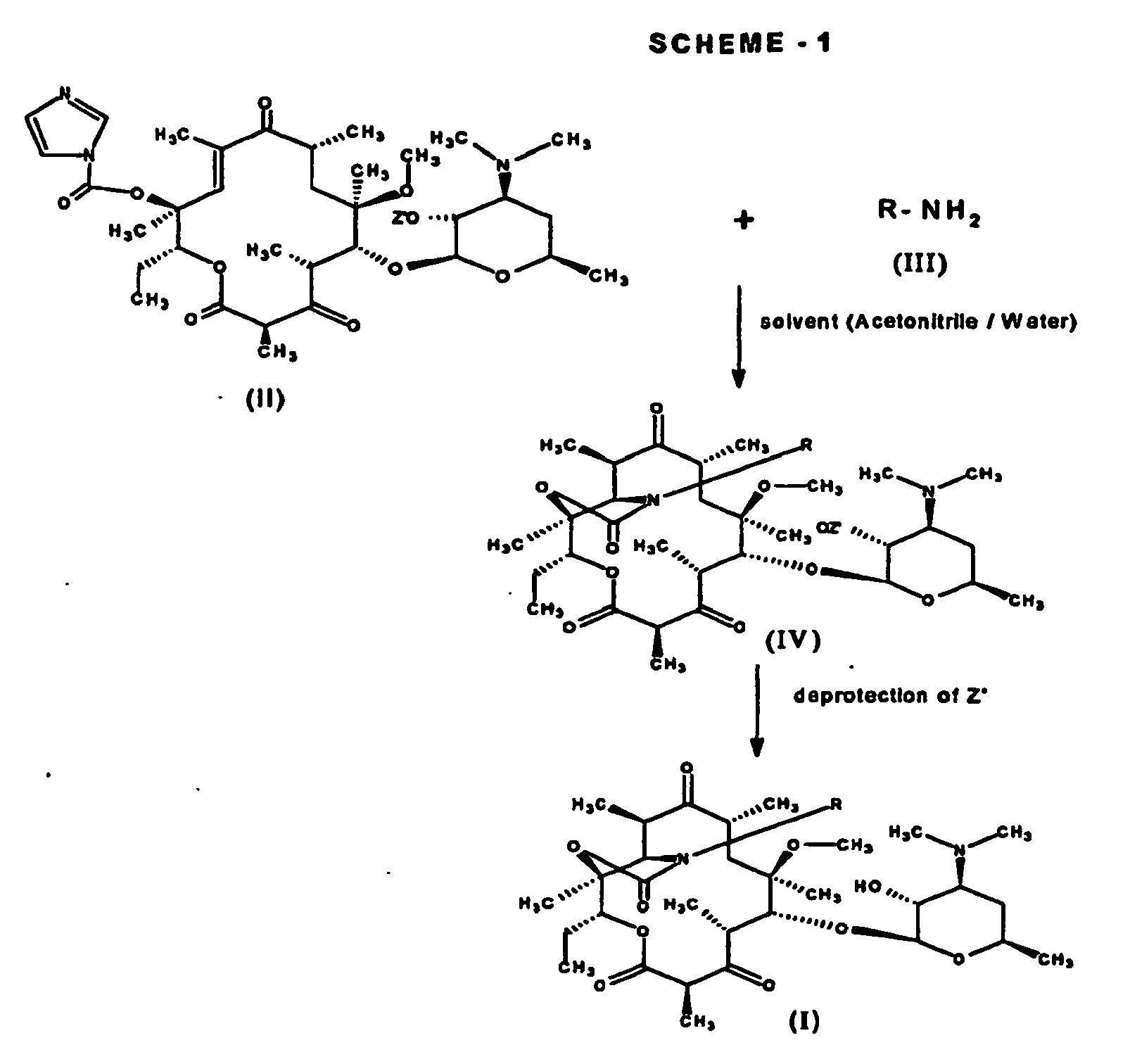
- Accordingly, Telithromycin is prepared by condensing compound of formula (II) with amine of formula (III), where in

US 5635485 suffers several drawbacks such as - (i) Condensation of formula II with formula III is cumbersome and it is very difficult to remove unreacted reagents and impurities formed during the reaction.
- (ii) The isolation and purification of the desired compound of Formula (I) cannot be done without laborious column chromatography, which is not viable at commercial production level.
- Current Medicinal Chemistry, 2001, Vol. 8, 1727-1758 also describes the process for the preparation of various ketolides, including Telithromycin in which Clarithromycin (formula V) is reacted with hydrochloric acid to remove cladinose ring at C-3 position (formula VI) followed by selective acetylation of the 2'-hydroxy group in formula VI and selective oxidation of the 3-hydroxy group generated ketolide of formula VII. Further, 11-hydorxy group of compound of formula (VII) is selectively mesylated followed by base induced β- elimination to furnish α,β-unsaturated ketone (formula VIII). The compound of formula (VIII) is further treated with sodium hydride and carbonyldiimidazole to form 12-O-acyl imidazole of formula (II), which upon stereoselective cyclization with (4-(3-pyridinyl)-imidazol-1-yl)-butylamine and subsequent deprotection of the 2'-hydroxy group gives Telithromycin of Formula (I). This process is outlined in following SCHEME - 2

- However, this process also consists of several difficulties as explained above and moreover other difficulties such as use of pyrophoric material like NaH, which is hazardous and extremely difficult to handle at the plant scale.
- In light of the above difficulties for the preparation of Telithromycin, this process is not suitable for commercial production level.
- Therefore the basic object of this invention is to provide a process for the preparation of Telithromycin.
- Another object of the present invention is to provide a process for the preparation of Telithromycin, which would be high yielding, cost effective, easy to operate at industrial scale and would not involve the use of moisture sensitive, pyrophoric compounds such as sodium hydride.
- Another object of the present invention is to provide a process of manufacture of Telithromycin, which lead to the removal of reagents and side products by intermediate crystallization. Thus, isolation of final product enabling good yield and purity, without column chromatography.
- A further objective of the invention is to provide a process of manufacture of Telithromycin that would involve selective mild reaction conditions.
- A further object of the invention is to provide a process of manufacture of Telithromycin that would be industrially feasible.
- Still, another object of the present invention is to provide a novel compound of formula (Xa), (XIa), (XIIa) and (XIIIa), which are useful as an intermediate for the preparation of Telithromycin (I).
- Present invention provides the process for the preparation of Telithromycin of formula (I) or its pharmaceutically acceptable salts


- (a) reacting compound of formula (IX)


- (b) condensing the compound of formula (X) with R-NH2 in suitable polar solvent to give compounds of formula (XI).

- (c) treating the compound of formula (XI) with acid to obtain compound of formula (XII)

- (d) oxidising the resulting compound of formula (XII) in presence of oxidizing agent to give compounds of formula (XIII)

- (e) removing the protecting group at 2' position of formula (XIII) by treating with alcohol to give Telithromycin of formula (I)
- The reaction scheme for the preparation of Telithromycin (I) is as shown in Scheme-3 hereunder:

- Alternatively, the process for the preparation of Telithromycin of formula (I) or its pharmaceutically acceptable salts, which comprises
- (a) reacting compound of formula (IX)


- (b) condensing the compound of formula (X) with R-NH2 in suitable polar solvent to give compounds of formula (XI).

- (c) treating the compound of formula (XI) with acid to obtain compound of formula (XII)

- (f) treating compounds of formula (XII) as received from step (c) with alcohol to give compounds of formula (XIV)

- (g) selective oxidization of resulting compounds of formula (XIV) of step (f) in the presence of oxidizing agent to form desired ketolide compound of formula (I)
- Optionally the compound of formula XIV may be crystallized using a polar solvent selected from acetone, alcohol, ethyl acetate, preferably acetone.
- The reaction scheme followed is as shown in Scheme-4 hereunder:

- Also, the present invention provides the novel compounds of formula (Xa), (XIa), (XIIa), (XIIIa), where R1 and/or R2 is benzoly (Bz) as stated in the above compounds of formula (X), (XI), (XII) and (XIII) respectively.

- The polar solvent use in step (a) is selected from dimethylformamide, tetrahydrofuran, acetonitrile and mixtures thereof.
- The base used in step (a) is selected from DBU, Triethylamine, diisopropylethylamine.
- The polar solvent used in step (b) is a polar aprotic solvent or polar protic solvent The solvent is selected from the group comprises of methanol, ethanol, isopropanol, n-propanol, n-butanol, iso butyl alcohol, tert-butyl alcohol, methoxyethanol, ethoxyethanol, pentanol, neo-pentyl alcohol, t-pentyl alcohol, cyclohexanol, ethylene glycol, propylene glycol, benzyl alcohol, phenol, glycerol, dimethylformamide (DMF), dimethylacetamide (DMAC), 1,3-dimethyl-3,4,5,6-tetrahydro-2(1H)-pyrimidinone (DMPU), 1,3-dimethyl-2-imidazolidinone (DMI), N-methylpyrrolidinone (NMP), formamide, N-methylacetamide, N-methylformamide, acetonitrile, dimethylsulfoxide, propionitrile, ethyl formate, methyl acetate, hexachloroacetone, HMPA, HMPT, acetone, ethyl methyl ketone, ethyl acetate, isopropyl acetate, t-butyl acetate, sulfolane, N,N-dimethylpropionamide, nitromethane, nitrobenzene, teteahydrofuran (THF), dioxane, water, polyethers or mixtures thereof.
- Acid referred in step (c) is organic acid or inorganic acid selected from group comprising of hydrochloric acid, hydrobromic acid, sulfuric acid, nitric acid, phosphoric acid, perchloric acid or hydrofluoric acid. The preferred acid is hydrochloric acid. The reaction step (c) is carried out in a solvent selected from water, polar organic solvent such as alcohols selected from methanol, ethanol, isopropanol, n-propanol, tert-butanol, n-butanol or mixture there of.
- The said step is carried out at 0° to 70° C and more preferably at 20 to 60° C.
- The oxidation in step (d) is carried out by using the commonly used oxidising reagents such as Corey- Kim oxidation method, Dess- Martins reagent, Pfitzner moffat method or modifications thereof or with dimethyl sulfoxide in presence of oxalyl chloride or phosphorous pentoxide or p-Toluene sulfonyl chloride or acetic anhydride or N-chlrosuccinimide. The oxidation can also be carried out by Manganese or chromium or selenium reagents, tert-amine oxides or by any above oxidant in presence of phase transfer catalyst.
- The alcohol referred in step (e) is selected from group comprising of methanol, ethanol, n-propanol, isopropanol, tert-butanol, n-butanol or mixtures there of. The preferred alcohol is methanol.
- The reaction step (e) is carried out at a temperature of 0 to 100° C and preferably at 20 to 70° C. The step (e) can also be carried out in presence of mineral acid selected from HCl or H2SO4.
- Alternative process for the preparation of Telithromycin, the reaction step (f) is carried out in presence of alcohol to give compounds of formula (XIV). The alcohol in step (f) is selected from group comprising of methanol, ethanol, n-propanol, isopropanol, tert-butanol, n-butanol or mixtures there of. The preferred alcohol is methanol.
- The reaction step (f) is carried out at a temperature of 0 to 100° C and preferably at 20 to 70° C. The step (f) can also be carried out in presence of mineral acid selected from HCl or H2SO4.
- The compound formula (XIV) is selectively oxidized in step (g) to give Telithromycin of formula (I). The said oxidation is carried out using Corey- Kim Martins reagent, Pfitzner moffat method or modifications thereof or with dimethyl sulfoxide in presence of oxalyl chloride or phosphorous pentoxide or p-Toluene sulfonyl chloride or acetic anhydride or N-chlrosuccinimide.
- According to another embodiment of the present invention, there is provided a process for the preparation of novel compound of formula (Xa), (XIa), (XIIa), (XIIIa).
- The process for the preparation of compound of formula (XIIIa), which comprises
- (a') reacting 2',4"-di-O-benzoyl-6-O-methylerythromycin A compound of formula (IXa)


- (b') condensing the compounds of formula (Xa) with R-NH2 in a suitable polar solvent in presence of base to obtain 2',4"-di-O-benzoyl-11-amino-11-N-[4-[4-(3-pyndyl)imidazol-1-yl]butyl]-11-deoxy-6-O-methylerythromycin A 11,12-cyclic carbamate of formula (XIa)

- (c') treating the obtained compound formula (XIa) with an acid to give 2'-O-benzoyl-11-amino-11-N-[4-[4-(3-pyridyl)imidazol-1-yl]butyl]-11-deoxy-5-O-desosaminyl-6-O-methylerythronolide A 11,12-cyclic carbamate of formula (XIIa)

- (d') oxidizing the resulting compounds of formula (XIIa) in presence of oxidizing agent to obtain the compound of formula (XIIIa)
- The compound of formula (XIIIa) obtained by above process can be converted to Telithromycin (I) or its pharmaceutically acceptable salts by treating it with alcohols.
- The polar solvent used in step (a') is selected from dimehtylformamide, tetrahydrofuran, acetonitrile and mixtures thereof.
- The reaction step (a') is carried out in presence of base selected from DBU, triethylamine, diisopropylethylamine.
- Polar solvent used in step (b') is selected from group comprising of methanol, ethanol, isopropanol, n-propanol, n-butanol, iso butyl alcohol, tert-butyl alcohol, methoxyethanol, ethoxyethanol, pentanol, neo-pentyl alcohol, tert-pentyl alcohol, cyclohexanol, ethylene glycol, propylene glycol, benzyl alcohol, phenol, glycerol, dimethylformamide (DMF), dimethylacetamide (DMAC), 1,3-dimethyl-3,4,5,6-tetrahydro-2(1H)-pyrimidinone (DMPU), 1,3-dimethyl-2-imidazolidinone (DMI), N-methylpyrrolidinone (NMP), formamide, N-methylacetamide, N-methylformamide, acetonitrile, dimethylsulfoxide, propionitrile, ethyl formate, methyl acetate, hexachloroacetone, HMPA, HMPT, acetone, ethyl methyl ketone, ethyl acetate, isopropyl acetate, t-butyl acetate, sulfolane, N,N-dimethylpropionamide, nitromethane, nitrobenzene, tetrahydrofuran (THF), dioxane, water, polyethers or mixtures thereof. The preferred solvent is dimethylformamide or acetonitrile.
- The reaction step (b') is carried out in presence of base selected from DBU, triethylamine, diisopropylethylamine. The said step is preferably carried out at a temperature 30°C to 60° C.
- Acid referred in step (c') is organic acid or inorganic acid selected from group comprising of hydrochloric acid, hydrobromic acid, sulfuric acid, nitric acid, phosphoric acid, perchloric acid or hydrofluoric acid. The preferred acid is hydrochloric acid. The reaction step (c') is carried out in a solvent selected from water, polar organic solvent such as alcohols selected from methanol, ethanol, isopropanol, n-propanol, tert-butanol, n-butanol or mixture there of.
- The said step is carried out at 0 to 70° C and more preferably at 20 to 60° C.
- The oxidation in step (d') is carried out by using the commonly used oxidising reagents such as Corey- Kim oxidation method, Dess- Martin reagent, Pfitzner Moffat method or modifications thereof or with dimethyl sulfoxide in presence of oxalyl chloride or phosphorous pentoxide or p-Toluene sulfonyl chloride or acetic anhydride or N-chlorosuccinimide. The oxidation can also be carried out by Manganese or chromium or selenium reagents, tert-amine oxides or by any above oxidant in presence of phase transfer catalyst.
- Another embodiment of the present invention, the process for the preparation of Telithromycin of formula (I) comprises
- (i) reacting 2'4"-di-O-acetyl-6-O-methylerythromycin A (obtained as indicated in example 1(1) of U.S. patent
US 5591837 ) with carbonyldiimidazole in presence of polar solvent and base to give 10,11-Anhydro-2'4"-di-O-acetyl-12-O-imidazolyl carbonyl-6-O-methylerythromycin A, the polar solvent being selected from Dimehtylformamide, Tetrahydrofuran, Acetonitrile and mixtures thereof and the base selected from DBU, Triethylamine, diisopropylethylamine. - (ii) condensing 10,11-anhydro-2'4"-di-O-acetyl-12-O-imidazolyl carbonyl-6-O-methylerythromycin A with 4-[4-(3-pyridyl)imidazol-1-yl]butaneamine in a polar solvent at 5° to 120°C to give 2',4"-di-O-acetyl-11-amino-11-N-[4-[4-(3-pyridyl)imidazol-1-yl]butyl]-11-deoxy-6-O-methylerythromycin A 11,12-cyclic carbamate, said polar solvent is polar aprotic solvent or polar protic solvent;
- (iii) reacting 2',4"-di-O-acetyl-11-amino-11-N-[4-[4-(3-pyridyl)imidazol-1-yl]butyl]-11-deoxy-6-O-methylerythromycin A 11,12-cyclic carbamate with acid at 0°C to 100°C by removal cladinose ring at C-3 position to obtain 2'-O-acetyl-11-amino-11-N-[4-[4-(3-pyridyl) imidazol-1-yl] butyl]-11-deoxy-5-O-desosaminyl-6-O-methylerythronolide A 11,12-cyclic carbamate.
- (iv) Further, 2'-O-acetyl-11-amino-11-N-[4-[4-(3-pyridyl) imidazol-1-yl] butyl]-11-deoxy-5-O-desosaminyl-6-O-methylerythronolide A 11,12-cyclic carbamate is oxidized at C-3 position to give 2'-O-acetyl-11-amino-11-N-[4-[4-(3-pyridyl) imidazol-1-yl] butyl]-11-deoxy-3-oxo-5-O-desosaminyl-6-O-methylerythronolide A 11,12-cyclic carbamate;
- (v) 2'-O-acetyl-11-amino-11-N-[4-[4-(3-pyridyl) imidazol-1-yl] butyl]-11-deoxy-3-oxo-5-O-desosaminyl-6-O-methylerythronolide A 11,12-cyclic carbamate is further treated with alcohols to remove protecting group at 2' position to give Telithromycin of formula (I).
- In step (ii) of the process the polar solvents is selected form the group comprises of methanol, ethanol, n-propanol, isopropanol, n-butanol, isobutyl alcohol, tert-butyl alcohol, methoxyethanol, ethoxyethanol, pentanol, neo-pentyl alcohol, t-pentyl alcohol, cyclohexanol, ethylene glycol, propylene glycol, benzyl alcohol, phenol, glycerol, dimethylformamide (DMF), dimethylacetamide (DMAC), 1,3-dimethyl-3,4,5,6-tetrahydro-2(1H)-pyrimidinone (DMPU), 1,3-dimethyl-2-imidazolidinone (DMI), N-methylpyrrolidinone (NMP), formamide, N-methylacetamide, N-methylformamide, acetonitrile, dimethylsulfoxide, propionitrile, ethyl formate, methyl acetate, hexachloroacetone, HMPA, HMPT, acetone, ethyl methyl ketone, ethyl acetate, isopropyl acetate, t-butyl acetate, sulfolane, N,N-dimethylpropionamide, nitromethane, nitrobenzene, tetrahydrofuran (THF), dioxane, polyethers or water or mixtures thereof.
- The preferred polar solvent is dimethylformamide (DMF) and acetonitrile.
- The most preferred solvent is dimethylformamide.
- The reaction step is carried out at 5 to 120° C. Preferably step (i) can be carried out at 30 to 60° C. The reaction also can be carried out in water or the mixture of water and organic solvents (as mentioned above).
- The ratio of substrate to amine is 1: 3 mole and the preferably ratio is 1:2 mole.
- In step (iii) of the process the acid is selected from organic acid or inorganic acid or mixtures thereof. Inorganic acid can be mineral acid selected from hydrochloric acid, hydrobromic acid, sulfuric acid, nitric acid, phosphoric acid and perchloric acid, hydrofluoric acid. The acid is preferably hydrochloric acid.
- The solvent is selected from the group comprising water or polar organic solvents like alcohols or mixtures thereof. The preferred solvents can be water, methanol, ethanol, iso propanol, n- butanol, tert-butanol or mixtures thereof.
- The reaction step is carried out at 0 to 100° C and more preferably 20°C to 60°C for 6 to 48 hrs.
- In step (iv) of the process the oxidation can be carried out by way of Corey- Kim oxidation method, Dess- Martins reagent, Pfitzner Moffat method or modifications thereof or with dimethyl sulfoxide in presence of oxalyl chloride or phosphorous pentoxide or p-Toluene sulfonyl chloride or acetic anhydride or N-chlorosuccinimide. The oxidation can also be carried out by Manganese or chromium or selenium reagents, tert-amine oxides or any above oxidant in presence of phase transfer catalyst.
- In step (v) of the process the alcohol is selected from the group comprising of methanol, ethanol, n-propanol, isopropanol, n-butanol, tert-butanol or mixtures there of or with water at 0°C to 100°C to give desired ketolide compounds of formula (I).
- Alternatively, pure and commercially viable process for the preparation of Telithromycin is by carrying out first deprotection of 2'-O-acetyl-11-amino-11-N-[4-[4-(3-pyridyl) imidazol-1-yl] butyl]-11-deoxy-5-O-desosaminyl-6-O-methylerythronolide A 11,12-cyclic carbamate as obtained in step (iii) purification and then oxidation of the resultant compound.
- The detail process is described as below:
- (vi) 2'-O-acetyl-11-amino-11-N-[4-[4-(3-pyridyl) imidazol-1-yl] butyl]-11-deoxy-5-O-desosaminyl-6-O-methylerythronolide A 11,12-cyclic carbamate is treated with an alcohol at 0 to 70°C or with water at 0° to 100°C to remove acetyl protecting group and form 2'-hydroxy-11-amino-11-N-[4-[4-(3-pyridyl) imidazol-1-yl] butyl]-11-deoxy-5-O-desosaminyl-6-O-methylerythronolide A 11,12-cyclic carbamate or with water at 0°C to 100°C to give desired compound of formula (XIV) the compound of formula (XIV) is crystallised by using polar solvent.
- (vii) 2'-hydroxy -11-amino-11-N-[4-[4-(3-pyridyl) imidazol-1-yl] butyl]-11-deoxy-5-O-desosaminyl-6-O-methylerythronolide A 11,12-cyclic carbamate is selectively oxidized at C-3 position to form Telithromycin of formula (I).
- In step (vi) the alcohol is selected from the group comprising of methanol, ethanol, n-propanol, isopropanol, n-butanol, tert-butanol or mixtures thereof. In the said step the polar solvent is selected from acetone or alcohol or ethyl acetate or mixture thereof. The solvent used for the crystallisation of formula (XIV) is preferably acetone.
- In step (vii) the oxidation is carried out by way of Corey- Kim oxidation method, Dess- Martin reagent, Pfitzner Moffat method or modifications thereof or with dimethyl sulfoxide in presence of oxalyl chloride or phosphorous pentoxide or p-Toluene sulfonyl chloride or acetic anhydride. The oxidation can also be carried out by manganese or chromium or selenium reagents, tert-amine oxides or any above oxidant in presence of phase transfer catalyst.
- The process of the present invention is described by the following examples, which are illustrative only and should not be construed so as to limit the scope of the invention in any manner.
- Mix 10 gm of 2',4"-di-O-acetyl-6-O-methylerythromycin A, 10 gm of carbonyldiimidazole, 40 ml dimethylformamide and 4 ml DBU at room temperature. The solution was cleared. The clear solution was stirred for 3 hrs. The reaction mixture was quenched with water (400ml). The solid was filtered and washed with water. The wet solid was dissolved in dichloromethane and the organic layer was separated. The solvent was removed under vacuum. Add diisopropylether (40 ml) and the reaction mixture was stirred for half an hour. The solid was filtered and washed with diisopropylether (2 X 5 ml). The solid was dried at room temperature to give 9.0 gm of 10,11-Anhydro-2'4"-di-O-acetyl-12-O-imidazolylcarbonyl-6-O- methyl erythromycin A.
- 20gm of 10,11-Anhydro-2'4"-di-O-acetyl-12-O-imidazolylcarbonyl-6-O- methyl erythromycin A was added in 9.6 gm of 4-[4-(3-pyridyl) imidazol-1-yl] butanamine and 100ml Dimethyl formamide and stirred at 50 °C for 18 hours. The reaction mixture was then diluted with water and stirred for 30min. The precipitated solid was filtered and washed with water. Further, it was dried at 50 °C under vacuum to give 18gm of 2', 4"-di-O-acetyl-11-amino-11-N-[4-[4-(3-pyridyl)imidazol-1-yl]butyl]-11-deoxy-6-O-methylerythromycin A 11,12-cyclic carbamate.
- 23g of 2',4"-di-O-acetyl-11-amino-11-N-[4-[4-(3-pyridyl)imidazol-1-yl]butyl]-11-deoxy-6-O-methylerythromycin A 11,12-cyclic carbamate was dissolved in solution of 23ml concentrated hydrochloric acid and 230ml water. The mixture was stirred at ambient temperature for 12 hours. The reaction mixture was then basified with sodium hydroxide when a white solid was obtained. The solid was filtered and washed with water. Drying at ambient temperature afforded 16gm of 2'-O-acetyl-11-amino-11-N-[4-[4-(3-pyridyl) imidazol-1-yl] butyl]-11-deoxy-5-O-desosaminyl-6-O-methylerythronolide A 11,12-cyclic carbamate. The product can be used in the next step without further purification.
- 15g of 2'-O-acetyl-11-amino-11-N-[4-[4-(3-pyridyl) imidazol-1-yl] butyl]-11-deoxy-5-O-desosaminyl-6-O-methylerythronolide A 11,12-cyclic carbamate was dissolved in 150 ml dichloromethane and 22.5g of Dess Martin reagent was added in one lot. The mixture was stirred at ambient temperature for 1 hour. Further, added the mixture of 260 ml saturated sodium bicarbonate solution and saturated sodium thiosulfate solution and stirred the mixture for 20 min. Filtered off the formed solid precipitate and separated the organic layer. Washed the organic layer with water, dried over sodium sulfate and distilled off the solvent under vacuum to give 13gm of 2'-O-acetyl-11-amino-11-N-[4-[4-(3-pyridyl) imidazol-1-yl] butyl]-11-deoxy-3-oxo-5-O-desosaminyl-6-O-methylerythronolide A 11,12-cyclic carbamate.
- 10g of 2'-O-acetyl-11-amino-11-N-[4-[4-(3-pyridyl) imidazol-1-yl] butyl]-11-deoxy-5-O-desosaminyl-6-O-methylerythronolide A 11,12-cyclic carbamate was dissolved in 100 ml dichloromethane. Dimethyl sulfoxide (16.6 ml), Cyclohexyl dimethyl amino propyl carbodimide Hydro chloride (25.0g) and Pyridine HCl (12.1 gm) was added in one lot. The mixture was stirred at ambient temperature (20-30°C) for 6 hour. Further, 500 ml water was added and stirred the mixture for 30 min. The organic layer was separated and washed with water, dried over sodium sulfate and distilled off the solvent under vacuum to give 7.05 gm of 2'-O-acetyl-11-amino-11 N-[4-[4-(3-pyridyl) imidazol-1-yl] butyl]-11-deoxy-3-oxo-5-O-desosaminyl-6-O-methylerythronolide A 11,12-cyclic carbamate.
- N-Chloro succinimide (4.68 gm) was charged to the reaction vessel under nitrogen atmosphere and Dichloromethane (200 ml) was added slowly. The reaction masses was cooled to 0°C, Dimethyl sulfide (3.5 ml) was added slowly and continue the stirring at same temperature for half an hour. The reaction mass was cooled to -25°C and 2'-O-acetyl-11-amino-11-N-[4-[4-(3-pyridyl) imidazol-1-yl] butyl]-11-deoxy-5-O-desosaminyl-6-O-methylerythronolide A 11,12-cyclic carbamate (10g) dissolved in 50 ml dichloromethane was added slowly. The mixture was stirred at -25°C temperature for 2 hour. At the same temperature Diisopropyletheyl amine (0.6ml) was added and the reaction mixture was stirred for an hour. Water (500 ml) was added and stirred the mixture for 30 min. The organic layer was separated and washed with water, dried over sodium sulfate and distilled off the solvent under vacuum to give 7.5 gm of 2'-O-acetyl-11-amino-11-N-[4-[4-(3-pyridyl) imidazol-1-yl] butyl]-11-deoxy-3-oxo-5-O-desosaminyl-6-O-methylerythronolide A 11,12-cyclic carbamate.
- A solution for 10g of 2'-O-acetyl-11-amino-11-N-[4-[4-(3-pyridyl) imidazol-1-yl] butyl]-11-deoxy-3-oxo-5-O-desosaminyl-6-O-methylerythronolide A 11,12-cyclic carbamate in 100ml methanol was stirred at ambient temperature for 16 hours. Further, solvent was distilled off under vacuum and stirring remain solid with 50ml diisoproyl ether to gave 7gm of desired compound 11-Amino-11-N-[4-[4-(3-pyridyl) imidazol-1-yl]butyl-11-deoxy-3-oxo-5-O-desosaminyl-6-O-methylerythronolide A 11,12-cyclic carbamate [Telithromycin] (I).
- A solution for 10g of 2'-O-acetyl-11-amino-11-N-[4-[4-(3-pyridyl) imidazol-1-yl] butyl]-11-deoxy-3-oxo-5-O-desosaminyl-6-O-methylerythronolide A 11,12-cyclic carbamate in 100ml Isopropanol was stirred at ambient temperature for 24 hours. Further, solvent was distilled off under vacuum and equilibrating remain solid with 50ml diisoproyl ether to gave 7gm of desired compound 11-Amino-11-N-[4-[4-(3-pyridyl) imidazol-1-yl]butyl-11-deoxy-3-oxo-5-O-desosaminyl-6-O-methylerythronolide A 11,12-cyclic carbamate [Telithromycin] (I).
- 10g of 2'-O-acetyl-11-amino-11-N-[4-[4-(3-pyridyl) imidazol-1-yl] butyl]-11-deoxy-5-O-desosaminyl-6-O-methylerythronolide A 11,12-cyclic carbamate in 100 ml methanol was stirred at reflux temperature for 6 hours. The solvent was then distilled off under vacuum to give crude product as white foam. Then, the crude product was purified by refluxing in 20 ml of acetone followed by 1 hour stirring at 10°C. Filtered off the solution and washed the solid and with 2×5 ml of chilled acetone to gave 8.0gm 2'-hydroxy -11-amino-11-N-[4-[4-(3-pyridyl) imidazol-1-yl] butyl]-11-deoxy-5-O-desosaminyl-6-O-methylerythronolide A 11,12-cyclic carbamate
- 10g of 2'-O-acetyl-11-amino-11-N-[4-[4-(3-pyridyl) imidazol-1-yl] butyl]-11-deoxy-5-O-desosaminyl-6-O-methylerythronolide A 11,12-cyclic carbamate in 100 ml Isoproapnol was stirred at reflux temperature for 18 hours. The solvent was then distilled off under vacuum to give crude product as white foam. Then, the crude product was purified by refluxing in 20 ml of acetone followed by 1 hour stirring at 10°C. Filtered off the solution and washed the solid and with 2x5 ml of chilled acetone to gave 8.0gm 2'-hydroxy -11-amino-11-N-[4-[4-(3-pyridyl) imidazol-1-yl] butyl]-11-deoxy-5-O-desosaminyl-6-O-methylerythronolide A 11,12-cyclic carbamate
- 10g of 2'-hydroxy -11-amino-11-N-[4-[4-(3-pyridyl) imidazol-1-yl] butyl]-11-deoxy-5-O-desosaminyl-6-O-methylerythronolide A 11,12-cyclic carbamate was dissolved in 200 ml dichloromethane and 15g of Dess Martin reagent was added in one lot. The mixture was stirred at ambient temperature for 30 min. Further, 260 ml of saturated sodium bicarbonate solution added and stirred the mixture for 30 min. Filtered off the solid precipitate and separated the organic layer. Washed the organic layer with water, dried over sodium sulfate and distilled off the solvent under vacuum to give solids. Further, it was stirred with 40ml of diisoproyl ether and filtered off and dried to give 9gm 11-Amino-11-N-[4-[4-(3 pyridyl) imidazol-1-yl]butyl-11-deoxy-3-oxo-5-O-desosaminyl-6-O-methylerythronolide A 11,12-cyclic carbamate [Telithromycin](I).
- 10g of 2'-hydroxy -11-amino-11-N-[4-[4-(3-pyridyl) imidazol-1-yl] butyl]-11-deoxy-5-O-desosaminyl-6-O-methylerythronolide A 11,12-cyclic carbamate was dissolved in 100 ml dichloromethane. Dimethyl sulfoxide (16.6 ml), Cyclohexyl dimethyl amino propyl carbodimide Hydro chloride (25.0g) and Pyridine HCl (12.1 gm) was added in one lot. The mixture was stirred at ambient temperature (20-30°C) for 6 hour. Further, 500 ml water was added and stirred the mixture for 30 min. The organic layer was separated and washed with water, dried over sodium sulfate and distilled off the solvent under vacuum to give 8.05 gm of 11-Amino-11-N-[4-[4-(3-pyridyl) imidazol-1-yl]butyl-11-deoxy-3-oxo-5-O-desosaminyl-6-O-methylerythronolide A 11,12-cyclic carbamate [Telithromycin](I).
- N-Chloro succinimide (4.68 gm) was charged to the reaction vessel under nitrogen atmosphere and Dichloromethane (200 ml) was added slowly. The reaction masses was cooled to 0°C, Dimethyl sulfide (3.5 ml) was added slowly and continue the stirring at same temperature for half an hour. The reaction mass was cooled to -25°C and 2'-hydroxy -11-amino-11-N-[4-[4-(3-pyridyl)imidazol-1-yl] butyl]-11-deoxy-5-O-desosaminyl-6-O-methylerythronolide A 11,12-cyclic carbamate (10g) dissolved in 50 ml dichloromethane was added slowly. The mixture was stirred at -25°C temperature for 2 hour. At the same temperature Diisopropylethyl amine (0.6ml) was added and the reaction mixture was stirred for half an hour. Water (500 ml) was added and stirred the mixture for 30 min. The organic layer was separated and washed with water, dried over sodium sulfate and distilled off the solvent under vacuum to give 6.5 gm of 11-Amino-11-N-[4-[4-(3-pyridyl) imidazol-1-yl]butyl-11-deoxy-3-oxo-5-O-desosaminyl-6-O-methylerythronolide A 11,12-cyclic carbamate [Telithromycin] (Formula I).
- 1250 ml of ethyl acetate was added to 250 gm Clarithromycin A. 264.65 g benzoic anhydride, 57.20g 4-dimethylamino pyridine and 67.60g tri ethyl amine was added to the reaction mixture at 25°C to 35°C. The reaction mixture was stirred for about 70 hours at ambient temperature After the completion of reaction, ethyl acetate was distilled out to obtain 2',4"-di-O-benzoyl-6-O-methylerythromycin A
- 1000 ml Dimethylformamide is added to 2',4"-di-O-benzoyl-6-O-methylerythromycin A at 25°C to35°C. 63.70 g DBU (1,8-Diazabicyclo[5.4.0]undec-7-ene) was added to the reaction mixture and stirred at ambient temperature. Further, 170 g 1,1-Carbonyl diimidazole was added to the reaction mass and it was stirred until completion of reaction at ambient temperature. The desired compound is isolated by addition of water
- 1000 ml dimethylformamide was added to 200 g 10,11-anhydro-2',4"-di-O-benzoyl-12-O-imidazolylcarbonyl-6-O-methylerythromycin A at 25°C to 35°C. 63 g of 4-[4-(3-pyridyl)imidazol-1-yl]butylamine and 29.50 g DBU was added to the reaction mixture and it was stirred at 25°C to 35°C until the completion of reaction, . It is further treated with cold water and obtained solid was treated with dichloromethane followed by extraction and removal of solvent to give 2',4"-di-O-benzoyl-11-amino-11-N-[4-[4-(3-pyridyl)imidazol-1-yl]butyl]-11-deoxy-6-O-methylerythromycin A 11,12-cyclic carbamate.
- 400 ml acetone was added to 200 g 2',4"-di-O-benzoyl-11-amino-11-N-[4-[4-(3-pyridyl)imidazol-1-yl]butyl]-11-deoxy-6-O-methylerythromycin A 11,12-cyclic carbamate to obtain clear solution at 25°C to 35°C. Dilute hydrochloric acid (400 ml) was added to the reaction mixture and it was stirred for 24 hours at ambient temperature. After the completion of the reaction, the reaction mixture was extracted with ethyl acetate and treated with Sodium hydroxide solution to give 2'-O-benzoyl-11-amino-11-N-[4-[4-(3-pyridyl)imidazol-1-yl]butyl]-11-deoxy-5-O-desosaminyl-6-O-methylerythronolide A 11,12-cyclic carbamate (XIIa)
- 180 ml dichloromethane was added to 8.0 g N-chlorosuccinimide under nitrogen at room temperature cooled to 0°C. 7.2 ml dimethylsulfide was added slowly to the reaction mixture at 0°C under stirring. 20 g 2'-O-benzoyl-11-amino-11-N-[4-[4-(3-pyridyl)imidazol-1-yl]butyl]-11-deoxy-5-O-desosaminyl-6-O-methylerythronolide A 11,12-cyclic carbamate dissolved in 80ml dichloromethane was added drop wise to the reaction mixture at 0°C under stirring. Further it was cooled to about -20°C and solution of 16 ml Triethylamine in 20 ml dichloromethane is added to the reaction mixture and stirred for 30 minutes. After completion of the reaction, it is treated with saturated sodium bicarbonate solution and organic layer separated out. Desired product is obtained from by distillation of solvent from organic layer
- 100 ml methanol was added to 10 g 2'-benzoyl-11-amino-11-N-[4-[4-(3-pyridyl)imidazol-1-yl]butyl]-11-deoxy-5-O-desosaminyl-6-O-methylerythronolide A 11,12-cyclic carbamate at 25°C to 30°C and the reaction mixture was heated to reflux for about 7 hours. After completion of the reaction, Methanol was distilled off under vacuum at 45°C. 100 ml dilute hydrochloric acid was added to the residue and the aqueous layer was extracted with ethyl acetate (3 x 40 ml) and sodium bicarbonate and organic layer separated out. The product is obtained by distillation of solvent from organic layer and recrystallized from Metyl tert- butyl ether (MTBE) and cyclohexanone to give Telithromycin.
Claims (42)
- A process for the preparation of compound of formula (I) (Telithromycin) or its pharmaceutically acceptable salts

 (a) reacting compound of formula (IX)

 (b) condensing the compounds of formula (X) with R-NH2 in a suitable polar solvent to obtain compounds of formula (XI)
 (c) treating the obtained compound formula (XI) with an acid to give the compound of formula (XII)
 (d) oxidizing the resulting compounds of formula (XII) in presence of oxidizing agent to form compounds of formula (XIII)
 (e) removing the protecting group at 2' position of formula (XIII) by treating with an alcohol to give Telithromycin of Formula (I)
 - A process for the preparation of compounds of formula (I) or its pharmaceutically acceptable salts

 (a) reacting compound of formula (IX)

 (b) condensing the compounds of formula (X) with R-NH2 in a suitable polar solvent to obtain compounds of formula (XI)
 (c) treating the obtained compound formula (XI) with an acid to give compound of formula (XII)
 (f) treating compounds of formula (XII) with an alcohol to give compounds of formula (XIV)
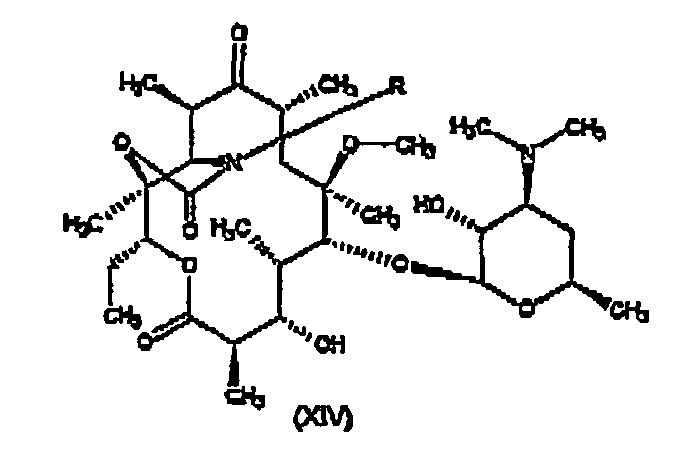 (g) oxidizing the resulting compounds of formula (XIV) of step (f) selectively in presence of oxidizing agent to obtain Telithromycin formula (I).
 - A process as claimed in claim 1, wherein said polar solvent in step (a) is selected from dimethylformamide, tetrahydrofuran, acetonitrile and mixtures thereof.
- A process as claimed in claim 1, wherein said base in step (a) is selected from DBU, triethylamine, diisopropylethylamine.
- A process as claimed in claim 1, wherein said polar solvent in step (b) is selected from group comprising of methanol, ethanol, isopropanol, n-propanol, n-butatlol, iso butyl alcohol, tert-butyl alcohol, methoxyethanol, ethoxyethanol, pentanol, neo-pentyl alcohol, tert-pentyl alcohol, cyclohexanol, ethylene glycol, propylene glycol, benzyl alcohol, phenol, glycerol, dimethylformamide (DMF), dimethylacetamide (DMAC), 1,3-dimethyl-3,4,5,6-tetrahydro-2(1H)-pyrimidinone (DMPU), 1,3-dimethyl-2-imidazolidinone (DMI), N-methylpyrrolidinone (NMP), formamide, N-methylacetamide, N-methylformamide, acetonitrile, dimethylsulfoxide, propionitrile, ethyl formate, methyl acetate, hexachloroacetone, HMPA, HMPT, acetone, ethyl methyl ketone, ethyl acetate, isopropyl acetate, t-butyl acetate, sulfolane, N,N-dimethylpropionamide, nitromethane, nitrobenzene, tetrahydrofuran (THF), dioxane, water, polyethers or mixtures thereof.
- A process as claimed in claim 5, wherein said polar solvent is selected from dimethylformamide or acetonitrile.
- A process as claimed in claim 1, wherein said step (b) is carried out in presence or absence of base selected from DBU, triethylamine, diisopropylethylamine
- A process as claimed in claim 1, wherein said step (b) is carried out at a temperature 5° C to 120° C.
- A process as claimed in claim 8, wherein the said step (b) is carried out preferably at a temperature 30°C to 60° C.
- A process as claimed in claim 1, wherein the said acid in step (c) is selected from organic or inorganic acid.
- A process as claimed in claim 10, wherein the said acid is selected from the group comprising of hydrochloric acid, hydrobromic acid, sulfuric acid, nitric acid, phosphoric acid, perchloric acid or hydrofluoric acid.
- A process as claimed in claim 11, wherein the acid is preferably hydrochloric acid.
- A process as claimed in claim 1, wherein step (c) is carried out in a solvent selected from water, polar organic solvents or mixtures thereof.
- A process as claimed in claim 13, wherein said solvent is selected from water, alcohol or mixtures thereof.
- A process as claimed in claim 14, wherein said solvent is selected from water, methanol, ethanol, isopropanol, n-propanol, tert-butanol, n-butanol or mixtures thereof
- A process as claimed in claim 1, wherein said step (c) is carried out at a temperature 0°C to 70° C
- A process as claimed in claim 16, where in step (c) is carried out at a temperature 20°C to 60° C
- A process as claimed in claim 1, wherein oxidation said in step (d) is carried out using Corey- Kim oxidation method, Dess- Martin reagent, Pfitzner Moffat method or modifications thereof or with dimethyl sulfoxide in presence of oxalyl chloride or phosphorous pentoxide or p-Toluene sulfonyl chloride or acetic anhydride or N-chlorosuccinimide or by manganese or chromium or selenium reagents, tert-amine oxides or any said oxidant in presence or absence of phase transfer catalyst.
- A process as claimed in claim 1, wherein alcohol said in step (e) is selected from group comprising of methanol, ethanol, n-propanol, iso propanol, tert-butanol, n-butanol or mixtures thereof.
- A process as claimed in claim 19, wherein the said alcohol is preferably methanol.
- A process as claimed in claim 1, wherein said step (e) is carried out in presence or absence of mineral acid selected from HCl, H2SO4
- A process as claimed in claim 1, wherein said step (e) is carried out at a temperature of 0°C to 100°C
- A process as claimed in claim 22, wherein step (e) is carried out preferably at a temperature of 20°C to 70°C.
- A process as claimed in claim 2, wherein said alcohol in step (f) is selected from group comprising of methanol, ethanol, -n-propanol, iso propanol, tert-butanol, n-butanol or mixtures thereof.
- A process as claimed in claim 24, wherein said alcohol is preferably methanol.
- A process as claimed in claim 2, wherein said step (g) is carried out at a temperature of 0 to 70°C.
- A process as claimed in claim 26, wherein the temperature is between 20 to 65°C.
- A process as claimed in claim 2, wherein said oxidation in step (g) is carried out using Corey- Kim oxidation method, Dess- Martins reagent, Pfitzner moffat method or modifications thereof or with dimethyl sulfoxide in presence of oxalyl chloride or phosphorous pentoxide or p-Toluene sulfonyl chloride or acetic anhydride or N-chlorosucinimide.
- A process as claimed in claim 2, wherein oxidation in step (g) is carried out by manganese or chromium or selenium reagents, tert-amine oxides or any above oxidant in presence of phase transfer catalyst.
- The novel compounds(i) 10,11-Anhydro-2',4"-di-O-benzoyl-12-O-imidazolylcarbonyl-6-O-methylerythromycin A of formula (Xa)
 (ii) 2',4"-di-O-benzoyl-11-amino-11-N-[4-[4-(3-pyridyl)imidazol-11-yl]butyl]-11-deoxy-6-O-methylerythromycin A 11,12-cyclic carbamate of formula (XIa)
 (iii) 2'-O-benzoyl-11-amino-11-N-[4-[4-(3-pyridyl)imidazol-1-yl]butyl]-11-deoxy-5-O-desosaminyl-6-O-methylerythronolide A 11,12-cyclic carbamate of formula (XIIa)
 (iv) 2'-benzoyl-11-amino-11-N-[4-[4-(3-pyridyl)imidazol-1-yl]butyl-11-deoxy-5-O-desosaminyl-6-O-methylerythronolide A 11,12-cyclic carbamate of formula (XIIIa)where R is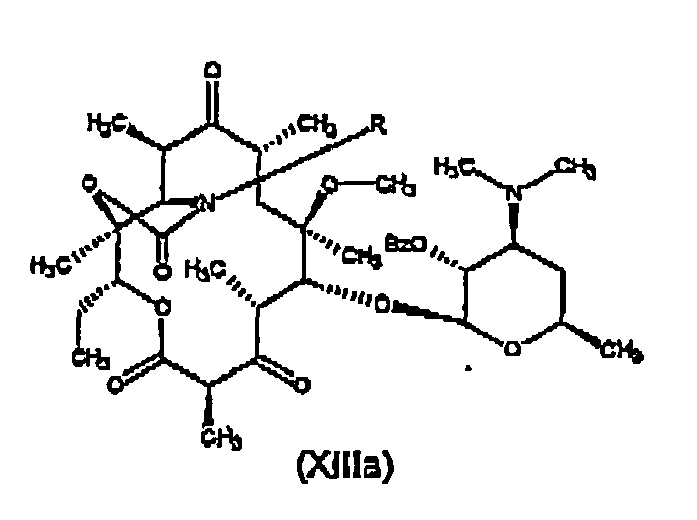

- A process for the preparation of compound of formula (XIIIa)

 (a') reacting 2',4"-di-O-benzoyl-6-O-methylerythromycin A compound of formula (IXa)
 (b') condensing the compounds of formula (Xa) with R-NH2 in a suitable polar solvent in presence of base to obtain 2',4"-di-O-benzoyl-11-amino-11-N-[4-[4-(3-pyridyl)imidazol-1-yl]butyl]-11-deoxy-6-O-methylerythromycin A 11,12-cyclic carbamate of formula (XIa)
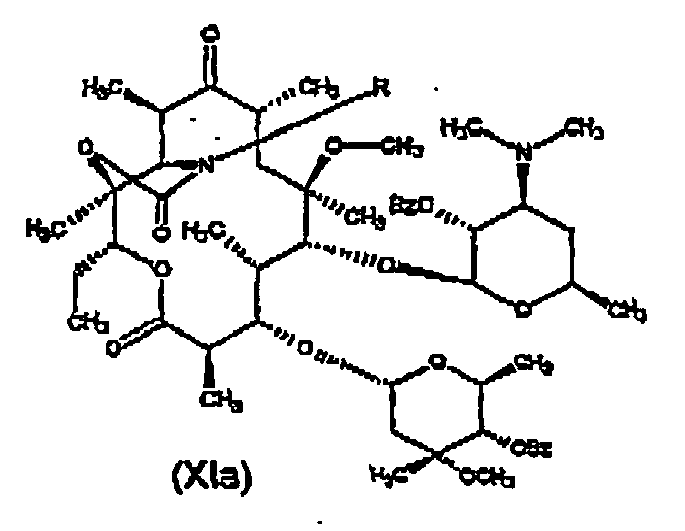 (c') treating the obtained compound formula (XIa) with an acid to give 2'-O-benzoyl-11-amino-11-N-[4-[4-(3-pyridyl)imidazol-1-yl]butyl]-11-deoxy-5-O-desosaminyl-6-O-methylerythronolide A 11,12-cyclic carbamate of formula (XIIa)
 (d') oxidizing the resulting compounds of formula (XIIa) in presence of oxidizing agent to obtain the compound of formula (XIIIa)
 - A process as claimed in claim 31, wherein said polar solvent in step (a') is selected from dimehtylformamide, tetrahydrofuran, acetonitrile and mixtures thereof
- A process as claimed in claim 31, wherein said base in step (a)' is selected from DBU, triethylamine, diisopropylethylamine.
- A process as claimed in claim 31, wherein said polar solvent in step (b') is selected from group comprising of methanol, ethanol, isopropanol, n-propanol, n-butanol, iso butyl alcohol, tert-butyl alcohol, methoxyethanol, ethoxyethanol, pentanol, neo-pentyl alcohol, tert-pentyl alcohol, cyclohexanol, ethylene glycol, propylene glycol, benzyl alcohol, phenol, glycerol, dimethylformamide (DMF), dimethylacetamide (DMAC), 1,3-dimethyl-3,4,5,6-tetrahydro-2(1H)-pyrimidinone (DMPU), 1,3-dimethyl-2-imidazolidinone (DMI), N-methylpyrrolidinone (NMP), formamide, N-methylacetamide, N-methylformamide, acetonitrile, dimethylsulfoxide, propionitrile, ethyl formate, methyl acetate, hexachloroacetone, HMPA, HMPT, acetone, ethyl methyl ketone, ethyl acetate, isopropyl acetate, t-butyl acetate, sulfolane, N,N-dimethylpropianamide, nitromethane, nitrobenzene, tetrahydrofuran (THF), dioxane, water, polyethers or mixtures thereof.
- A process as claimed in claim 31, wherein said polar solvent is selected from dimethylformamide or acetonitrile.
- A process as claimed in claim 31, wherein base said in step (b') is selected from DBU, triethylamine, diisopropylethylamine.
- A process as claimed in claim 31, wherein the said step (b') is carried out preferably at a temperature 30°C to 60° C.
- A process as claimed in claim 31, wherein the said acid in step (c') is selected from organic or inorganic acid selected from the group comprising of hydrochloric acid, hydrobromic acid, sulfuric acid, nitric acid, phosphoric acid, perchloric acid or hydrofluoric acid.
- A process as claimed in claim 31, wherein step (c') is carried out in a solvent selected from water, methanol, ethanol, isopropanol, n-propanol, tert-butanol, n-butanol or mixtures thereof.
- A process as claimed in claim 31, where in step (c') is carried out at a temperature 20°C to 60°C
- A process as claimed in claim 31, wherein oxidation said in step (d') is carried out using Corey- Kim oxidation method, Dess- Martin reagent, Pfitzner Moffat method or modifications thereof or with dimethyl sulfoxide in presence of oxalyl chloride or phosphorous pentoxide or p-Toluene sulfonyl chloride or acetic anhydride or N-chlorosuccinimide by manganese or chromium or selenium reagents, tert-amine oxides or any said oxidant in presence of phase transfer catalyst.
- Use of compounds of formula (Xa), (XIa), (XIIa), (XIIIa) for the preparation of Telithromycin (I)
Priority Applications (2)
| Application Number | Priority Date | Filing Date | Title |
|---|---|---|---|
| PL05775551T PL1742957T3 (en) | 2004-04-28 | 2005-04-25 | Process for the preparation of telithromycin |
| SI200530112T SI1742957T1 (en) | 2004-04-28 | 2005-04-25 | Process for the preparation of telithromycin |
Applications Claiming Priority (2)
| Application Number | Priority Date | Filing Date | Title |
|---|---|---|---|
| IN491MU2004 | 2004-04-28 | ||
| PCT/IN2005/000125 WO2005105821A2 (en) | 2004-04-28 | 2005-04-25 | Process for the preparation of telithromycin |
Publications (2)
| Publication Number | Publication Date |
|---|---|
| EP1742957A2 EP1742957A2 (en) | 2007-01-17 |
| EP1742957B1 true EP1742957B1 (en) | 2007-09-12 |
Family
ID=35159987
Family Applications (1)
| Application Number | Title | Priority Date | Filing Date |
|---|---|---|---|
| EP05775551A Expired - Lifetime EP1742957B1 (en) | 2004-04-28 | 2005-04-25 | Process for the preparation of telithromycin |
Country Status (10)
| Country | Link |
|---|---|
| US (1) | US20070260066A1 (en) |
| EP (1) | EP1742957B1 (en) |
| AT (1) | ATE373009T1 (en) |
| AU (1) | AU2005238313A1 (en) |
| CA (1) | CA2559281A1 (en) |
| DE (1) | DE602005002475T2 (en) |
| ES (1) | ES2294733T3 (en) |
| PL (1) | PL1742957T3 (en) |
| SI (1) | SI1742957T1 (en) |
| WO (1) | WO2005105821A2 (en) |
Families Citing this family (21)
| Publication number | Priority date | Publication date | Assignee | Title |
|---|---|---|---|---|
| EP1638549A4 (en) | 2003-03-10 | 2011-06-15 | Optimer Pharmaceuticals Inc | NEW ANTIBACTERIAL AGENTS |
| WO2007039914A2 (en) * | 2005-10-06 | 2007-04-12 | Alembic Limited | Novel polymorphs of telithromycin |
| WO2007049296A2 (en) * | 2005-10-28 | 2007-05-03 | Alembic Limited | Amorphous form of telithromycin |
| US20070167382A1 (en) * | 2005-11-15 | 2007-07-19 | Nina Finkelstein | Crystalline and amorphous forms of telithromycin |
| WO2007069264A2 (en) * | 2005-12-15 | 2007-06-21 | Alembic Limited | Reference standards for determining the purity of telithromycin and processes therefor |
| GB0600238D0 (en) * | 2006-01-06 | 2006-02-15 | Sandoz Ag | Organic compounds |
| WO2008007388A1 (en) * | 2006-07-12 | 2008-01-17 | Alembic Limited | Novel process for the preparation of telithromycin |
| WO2008023383A1 (en) * | 2006-08-25 | 2008-02-28 | Alembic Limited | Novel process for the preparation of telithromycin |
| ES2306590B1 (en) * | 2006-12-15 | 2009-08-07 | Ercros Industrial,S .A. | CRYSTALLINE FORMS I AND II OF TELITHROMYCIN. |
| ES2310121B1 (en) * | 2007-04-19 | 2009-09-11 | Ercros Industrial, S.A. | NEW TELITHROMYCIN SYNTHESIS PROCESS. |
| CA2703475A1 (en) | 2007-10-25 | 2009-04-30 | Cempra Pharmaceuticals, Inc. | Process for the preparation of macrolide antibacterial agents |
| WO2009053259A1 (en) * | 2007-10-25 | 2009-04-30 | Sandoz Ag | Process for the production of telithromycin |
| US8796232B2 (en) | 2008-10-24 | 2014-08-05 | Cempra Pharmaceuticals, Inc. | Methods for treating resistant diseases using triazole containing macrolides |
| US9937194B1 (en) | 2009-06-12 | 2018-04-10 | Cempra Pharmaceuticals, Inc. | Compounds and methods for treating inflammatory diseases |
| JP5914335B2 (en) | 2009-09-10 | 2016-05-11 | センプラ ファーマシューティカルズ,インコーポレイテッド | Method for treating malaria, tuberculosis and MAC disease |
| CN103080122A (en) | 2010-03-22 | 2013-05-01 | 森普拉制药公司 | Crystalline forms of macrolides and their uses |
| WO2011146829A1 (en) | 2010-05-20 | 2011-11-24 | Cempra Pharmaceuticals, Inc. | Processes for preparing macrolides and ketolides and intermediates therefor |
| JP6042334B2 (en) | 2010-09-10 | 2016-12-14 | センプラ ファーマシューティカルズ,インコーポレイテッド | Hydrogen bond forming fluoroketolides for disease treatment |
| CN104470527B (en) | 2012-03-27 | 2019-05-28 | 森普拉制药公司 | Parenteral formulations for administration of macrolide antibiotics |
| RU2015138796A (en) | 2013-03-14 | 2017-04-19 | Семпра Фармасьютикалс, Инк. | METHODS AND COMPOSITIONS FOR TREATMENT OF RESPIRATORY DISEASES |
| WO2014145210A1 (en) | 2013-03-15 | 2014-09-18 | Cempra Pharmaceuticals, Inc. | Convergent processes for preparing macrolide antibacterial agents |
Family Cites Families (3)
| Publication number | Priority date | Publication date | Assignee | Title |
|---|---|---|---|---|
| IL99995A (en) * | 1990-11-21 | 1997-11-20 | Roussel Uclaf | Erythromycin derivatives, their preparation and pharmaceutical compositions containing them |
| FR2719587B1 (en) * | 1994-05-03 | 1996-07-12 | Roussel Uclaf | New erythromycin derivatives, their preparation process and their use as drugs. |
| FR2732684B1 (en) * | 1995-04-06 | 1997-04-30 | Roussel Uclaf | NOVEL ERYTHROMYCIN DERIVATIVES, THEIR PREPARATION PROCESS AND THEIR APPLICATION AS MEDICAMENTS |
-
2005
- 2005-04-25 EP EP05775551A patent/EP1742957B1/en not_active Expired - Lifetime
- 2005-04-25 PL PL05775551T patent/PL1742957T3/en unknown
- 2005-04-25 DE DE602005002475T patent/DE602005002475T2/en not_active Expired - Fee Related
- 2005-04-25 WO PCT/IN2005/000125 patent/WO2005105821A2/en not_active Ceased
- 2005-04-25 CA CA002559281A patent/CA2559281A1/en not_active Abandoned
- 2005-04-25 SI SI200530112T patent/SI1742957T1/en unknown
- 2005-04-25 ES ES05775551T patent/ES2294733T3/en not_active Expired - Lifetime
- 2005-04-25 AU AU2005238313A patent/AU2005238313A1/en not_active Abandoned
- 2005-04-25 US US10/591,889 patent/US20070260066A1/en not_active Abandoned
- 2005-04-25 AT AT05775551T patent/ATE373009T1/en not_active IP Right Cessation
Also Published As
| Publication number | Publication date |
|---|---|
| SI1742957T1 (en) | 2008-04-30 |
| DE602005002475T2 (en) | 2008-05-29 |
| ES2294733T3 (en) | 2008-04-01 |
| WO2005105821A2 (en) | 2005-11-10 |
| US20070260066A1 (en) | 2007-11-08 |
| EP1742957A2 (en) | 2007-01-17 |
| AU2005238313A1 (en) | 2005-11-10 |
| DE602005002475D1 (en) | 2007-10-25 |
| PL1742957T3 (en) | 2008-05-30 |
| WO2005105821A3 (en) | 2006-04-27 |
| ATE373009T1 (en) | 2007-09-15 |
| CA2559281A1 (en) | 2005-11-10 |
Similar Documents
| Publication | Publication Date | Title |
|---|---|---|
| US20070260066A1 (en) | Process for the Preparation of Telithromycin | |
| JP6845099B2 (en) | Preparation process of macrolide antibacterial agent | |
| ES2229552T3 (en) | PROCESS FOR THE PREPARATION OF 6-0-METHYL-ERYTHROMYCIN A USING DERIVATIVES OF 9-HYDROXI ERYTHROMYCIN. | |
| HUP0300418A2 (en) | Method of preparing clarithromycin of form ii crystals | |
| AU2008327061B2 (en) | Methods for preparing capecitabine and beta-anomer-rich trialkyl carbonate compound used therein | |
| CN103145632B (en) | Preparation method of 1H-1,2,4-triazole-3-methyl formate | |
| US20110040078A1 (en) | Process for the production of telithromycin | |
| EP0080819B1 (en) | 11-0-alkylerythromycin a derivatives | |
| US20070037757A1 (en) | Compounds | |
| EP4079746B1 (en) | Process for the preparation of molnupiravir | |
| US20080167463A1 (en) | Process for Preparation of Gemcitabine Hydrochloride | |
| US20080051352A1 (en) | Novel process for the preparation of telithromycin | |
| WO2008007388A1 (en) | Novel process for the preparation of telithromycin | |
| US7235646B2 (en) | Process for the preparation of azithromycin monohydrate isopropanol clathrate | |
| CN110903335A (en) | A kind of preparation method of teramycin | |
| CN101906125A (en) | 4″-benzimidazole-5-formyl-carbazate clarithromycin derivatives and intermediates | |
| WO2005047260A1 (en) | Process for preparing gatifloxacin | |
| EP2930173B1 (en) | Method for preparing cabazitaxel from 10-deacetylbaccatin iii in high yield, and novel intermediate therefor | |
| ES2310121B1 (en) | NEW TELITHROMYCIN SYNTHESIS PROCESS. | |
| ES2243798T3 (en) | PROCEDURE FOR THE PRODUCTION OF DESCLARITHROMYCIN, AS WELL AS INTERMEDIATE PRODUCTS. | |
| HK40080515A (en) | Process for the preparation of molnupiravir | |
| WO2004007518A1 (en) | Erythromycin a 9-o-pseudosaccharinyloxime derivatives and process for the preparation of clarithromycin using the same | |
| KR0130942B1 (en) | Preparation process of 3-azido-3-deoxythimidine | |
| EP0515141A1 (en) | Novel process for the preparation of 8A-aza-8A-homoerythromycin cyclic lactams | |
| WO2025256544A1 (en) | Preparation method for 1-aminoalkyl-modified ribofuranose derivative |
Legal Events
| Date | Code | Title | Description |
|---|---|---|---|
| PUAI | Public reference made under article 153(3) epc to a published international application that has entered the european phase |
Free format text: ORIGINAL CODE: 0009012 |
|
| 17P | Request for examination filed |
Effective date: 20060918 |
|
| AK | Designated contracting states |
Kind code of ref document: A2 Designated state(s): AT BE BG CH CY CZ DE DK EE ES FI FR GB GR HU IE IS IT LI LT LU MC NL PL PT RO SE SI SK TR |
|
| AX | Request for extension of the european patent |
Extension state: AL BA HR LV MK YU |
|
| GRAJ | Information related to disapproval of communication of intention to grant by the applicant or resumption of examination proceedings by the epo deleted |
Free format text: ORIGINAL CODE: EPIDOSDIGR1 |
|
| GRAP | Despatch of communication of intention to grant a patent |
Free format text: ORIGINAL CODE: EPIDOSNIGR1 |
|
| GRAP | Despatch of communication of intention to grant a patent |
Free format text: ORIGINAL CODE: EPIDOSNIGR1 |
|
| GRAS | Grant fee paid |
Free format text: ORIGINAL CODE: EPIDOSNIGR3 |
|
| GRAA | (expected) grant |
Free format text: ORIGINAL CODE: 0009210 |
|
| AK | Designated contracting states |
Kind code of ref document: B1 Designated state(s): AT BE BG CH CY CZ DE DK EE ES FI FR GB GR HU IE IS IT LI LT LU MC NL PL PT RO SE SI SK TR |
|
| AX | Request for extension of the european patent |
Extension state: AL BA HR LV MK YU |
|
| REG | Reference to a national code |
Ref country code: GB Ref legal event code: FG4D |
|
| REG | Reference to a national code |
Ref country code: CH Ref legal event code: EP |
|
| REF | Corresponds to: |
Ref document number: 602005002475 Country of ref document: DE Date of ref document: 20071025 Kind code of ref document: P |
|
| REG | Reference to a national code |
Ref country code: IE Ref legal event code: FG4D |
|
| PG25 | Lapsed in a contracting state [announced via postgrant information from national office to epo] |
Ref country code: LT Free format text: LAPSE BECAUSE OF FAILURE TO SUBMIT A TRANSLATION OF THE DESCRIPTION OR TO PAY THE FEE WITHIN THE PRESCRIBED TIME-LIMIT Effective date: 20070912 Ref country code: FI Free format text: LAPSE BECAUSE OF FAILURE TO SUBMIT A TRANSLATION OF THE DESCRIPTION OR TO PAY THE FEE WITHIN THE PRESCRIBED TIME-LIMIT Effective date: 20070912 |
|
| PG25 | Lapsed in a contracting state [announced via postgrant information from national office to epo] |
Ref country code: AT Free format text: LAPSE BECAUSE OF FAILURE TO SUBMIT A TRANSLATION OF THE DESCRIPTION OR TO PAY THE FEE WITHIN THE PRESCRIBED TIME-LIMIT Effective date: 20070912 Ref country code: LI Free format text: LAPSE BECAUSE OF FAILURE TO SUBMIT A TRANSLATION OF THE DESCRIPTION OR TO PAY THE FEE WITHIN THE PRESCRIBED TIME-LIMIT Effective date: 20070912 Ref country code: CH Free format text: LAPSE BECAUSE OF FAILURE TO SUBMIT A TRANSLATION OF THE DESCRIPTION OR TO PAY THE FEE WITHIN THE PRESCRIBED TIME-LIMIT Effective date: 20070912 |
|
| NLV1 | Nl: lapsed or annulled due to failure to fulfill the requirements of art. 29p and 29m of the patents act | ||
| PG25 | Lapsed in a contracting state [announced via postgrant information from national office to epo] |
Ref country code: BE Free format text: LAPSE BECAUSE OF FAILURE TO SUBMIT A TRANSLATION OF THE DESCRIPTION OR TO PAY THE FEE WITHIN THE PRESCRIBED TIME-LIMIT Effective date: 20070912 |
|
| REG | Reference to a national code |
Ref country code: CH Ref legal event code: PL |
|
| REG | Reference to a national code |
Ref country code: ES Ref legal event code: FG2A Ref document number: 2294733 Country of ref document: ES Kind code of ref document: T3 |
|
| PG25 | Lapsed in a contracting state [announced via postgrant information from national office to epo] |
Ref country code: GR Free format text: LAPSE BECAUSE OF FAILURE TO SUBMIT A TRANSLATION OF THE DESCRIPTION OR TO PAY THE FEE WITHIN THE PRESCRIBED TIME-LIMIT Effective date: 20071213 Ref country code: NL Free format text: LAPSE BECAUSE OF FAILURE TO SUBMIT A TRANSLATION OF THE DESCRIPTION OR TO PAY THE FEE WITHIN THE PRESCRIBED TIME-LIMIT Effective date: 20070912 |
|
| REG | Reference to a national code |
Ref country code: HU Ref legal event code: AG4A Ref document number: E002691 Country of ref document: HU |
|
| PG25 | Lapsed in a contracting state [announced via postgrant information from national office to epo] |
Ref country code: PT Free format text: LAPSE BECAUSE OF FAILURE TO SUBMIT A TRANSLATION OF THE DESCRIPTION OR TO PAY THE FEE WITHIN THE PRESCRIBED TIME-LIMIT Effective date: 20080212 Ref country code: IS Free format text: LAPSE BECAUSE OF FAILURE TO SUBMIT A TRANSLATION OF THE DESCRIPTION OR TO PAY THE FEE WITHIN THE PRESCRIBED TIME-LIMIT Effective date: 20080112 |
|
| PGFP | Annual fee paid to national office [announced via postgrant information from national office to epo] |
Ref country code: CZ Payment date: 20080229 Year of fee payment: 4 Ref country code: SK Payment date: 20080227 Year of fee payment: 4 |
|
| REG | Reference to a national code |
Ref country code: PL Ref legal event code: T3 |
|
| ET | Fr: translation filed | ||
| PG25 | Lapsed in a contracting state [announced via postgrant information from national office to epo] |
Ref country code: RO Free format text: LAPSE BECAUSE OF FAILURE TO SUBMIT A TRANSLATION OF THE DESCRIPTION OR TO PAY THE FEE WITHIN THE PRESCRIBED TIME-LIMIT Effective date: 20070912 Ref country code: SE Free format text: LAPSE BECAUSE OF FAILURE TO SUBMIT A TRANSLATION OF THE DESCRIPTION OR TO PAY THE FEE WITHIN THE PRESCRIBED TIME-LIMIT Effective date: 20071212 |
|
| PLBE | No opposition filed within time limit |
Free format text: ORIGINAL CODE: 0009261 |
|
| STAA | Information on the status of an ep patent application or granted ep patent |
Free format text: STATUS: NO OPPOSITION FILED WITHIN TIME LIMIT |
|
| PG25 | Lapsed in a contracting state [announced via postgrant information from national office to epo] |
Ref country code: DK Free format text: LAPSE BECAUSE OF FAILURE TO SUBMIT A TRANSLATION OF THE DESCRIPTION OR TO PAY THE FEE WITHIN THE PRESCRIBED TIME-LIMIT Effective date: 20070912 |
|
| PGFP | Annual fee paid to national office [announced via postgrant information from national office to epo] |
Ref country code: HU Payment date: 20080314 Year of fee payment: 4 |
|
| 26N | No opposition filed |
Effective date: 20080613 |
|
| PGFP | Annual fee paid to national office [announced via postgrant information from national office to epo] |
Ref country code: SI Payment date: 20080222 Year of fee payment: 4 |
|
| PG25 | Lapsed in a contracting state [announced via postgrant information from national office to epo] |
Ref country code: MC Free format text: LAPSE BECAUSE OF NON-PAYMENT OF DUE FEES Effective date: 20080430 |
|
| PG25 | Lapsed in a contracting state [announced via postgrant information from national office to epo] |
Ref country code: EE Free format text: LAPSE BECAUSE OF FAILURE TO SUBMIT A TRANSLATION OF THE DESCRIPTION OR TO PAY THE FEE WITHIN THE PRESCRIBED TIME-LIMIT Effective date: 20070912 Ref country code: DE Free format text: LAPSE BECAUSE OF NON-PAYMENT OF DUE FEES Effective date: 20081101 |
|
| REG | Reference to a national code |
Ref country code: FR Ref legal event code: ST Effective date: 20081231 |
|
| PG25 | Lapsed in a contracting state [announced via postgrant information from national office to epo] |
Ref country code: BG Free format text: LAPSE BECAUSE OF NON-PAYMENT OF DUE FEES Effective date: 20081031 |
|
| PG25 | Lapsed in a contracting state [announced via postgrant information from national office to epo] |
Ref country code: FR Free format text: LAPSE BECAUSE OF NON-PAYMENT OF DUE FEES Effective date: 20080430 Ref country code: IE Free format text: LAPSE BECAUSE OF NON-PAYMENT OF DUE FEES Effective date: 20080425 |
|
| REG | Reference to a national code |
Ref country code: ES Ref legal event code: FD2A Effective date: 20080426 |
|
| PG25 | Lapsed in a contracting state [announced via postgrant information from national office to epo] |
Ref country code: ES Free format text: LAPSE BECAUSE OF NON-PAYMENT OF DUE FEES Effective date: 20080426 Ref country code: CY Free format text: LAPSE BECAUSE OF FAILURE TO SUBMIT A TRANSLATION OF THE DESCRIPTION OR TO PAY THE FEE WITHIN THE PRESCRIBED TIME-LIMIT Effective date: 20070912 |
|
| GBPC | Gb: european patent ceased through non-payment of renewal fee |
Effective date: 20090425 |
|
| REG | Reference to a national code |
Ref country code: SK Ref legal event code: MM4A Ref document number: E 2779 Country of ref document: SK Effective date: 20090425 |
|
| PG25 | Lapsed in a contracting state [announced via postgrant information from national office to epo] |
Ref country code: CZ Free format text: LAPSE BECAUSE OF NON-PAYMENT OF DUE FEES Effective date: 20090425 Ref country code: HU Free format text: LAPSE BECAUSE OF NON-PAYMENT OF DUE FEES Effective date: 20090426 |
|
| PG25 | Lapsed in a contracting state [announced via postgrant information from national office to epo] |
Ref country code: SK Free format text: LAPSE BECAUSE OF NON-PAYMENT OF DUE FEES Effective date: 20090425 Ref country code: PL Free format text: LAPSE BECAUSE OF NON-PAYMENT OF DUE FEES Effective date: 20080425 |
|
| REG | Reference to a national code |
Ref country code: PL Ref legal event code: LAPE Ref country code: SI Ref legal event code: KO00 Effective date: 20100129 |
|
| PG25 | Lapsed in a contracting state [announced via postgrant information from national office to epo] |
Ref country code: GB Free format text: LAPSE BECAUSE OF NON-PAYMENT OF DUE FEES Effective date: 20090425 |
|
| PG25 | Lapsed in a contracting state [announced via postgrant information from national office to epo] |
Ref country code: SI Free format text: LAPSE BECAUSE OF NON-PAYMENT OF DUE FEES Effective date: 20090426 |
|
| PG25 | Lapsed in a contracting state [announced via postgrant information from national office to epo] |
Ref country code: LU Free format text: LAPSE BECAUSE OF NON-PAYMENT OF DUE FEES Effective date: 20080425 |
|
| PG25 | Lapsed in a contracting state [announced via postgrant information from national office to epo] |
Ref country code: TR Free format text: LAPSE BECAUSE OF FAILURE TO SUBMIT A TRANSLATION OF THE DESCRIPTION OR TO PAY THE FEE WITHIN THE PRESCRIBED TIME-LIMIT Effective date: 20070912 |
|
| PGFP | Annual fee paid to national office [announced via postgrant information from national office to epo] |
Ref country code: IT Payment date: 20080430 Year of fee payment: 4 |